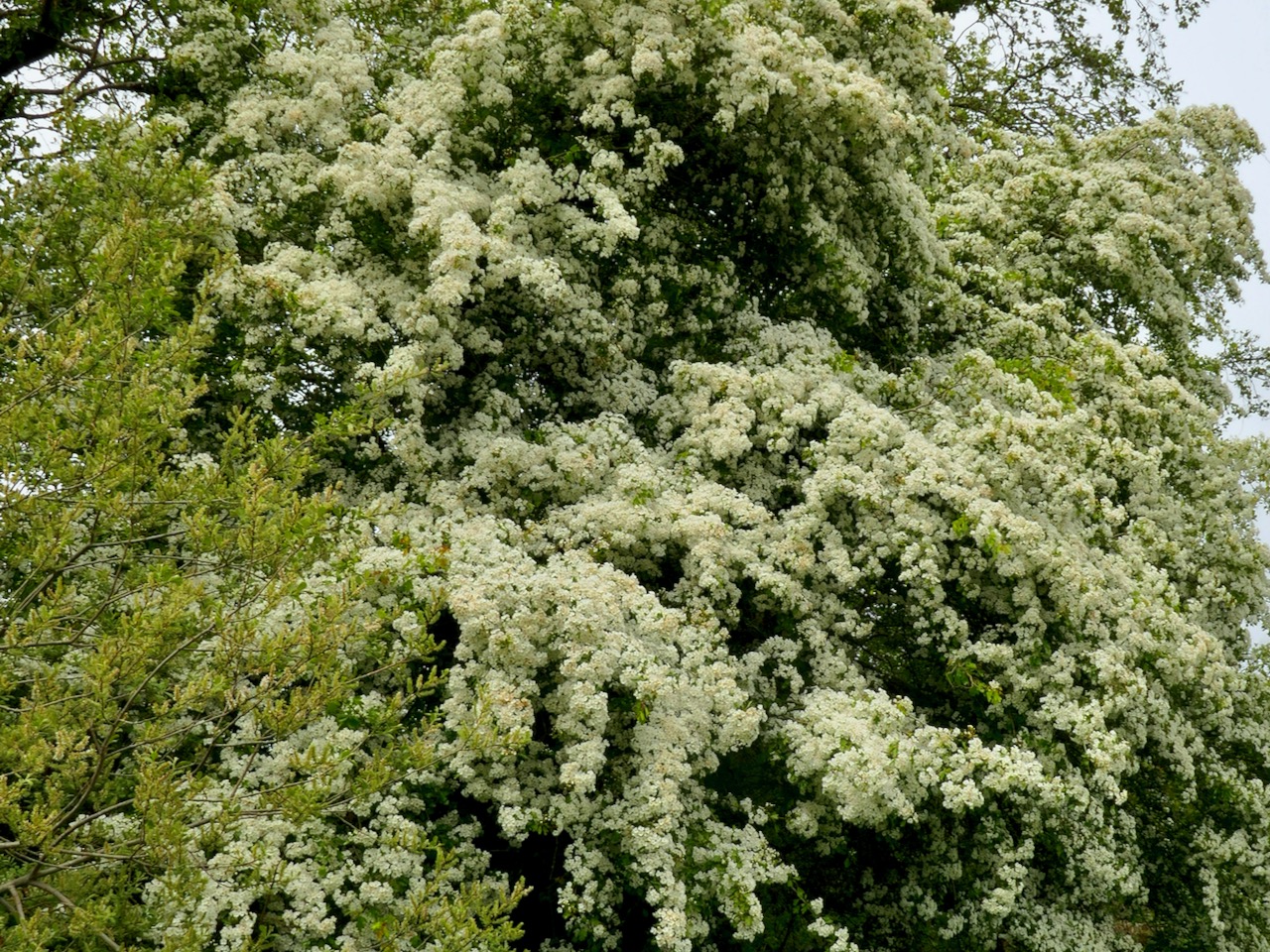
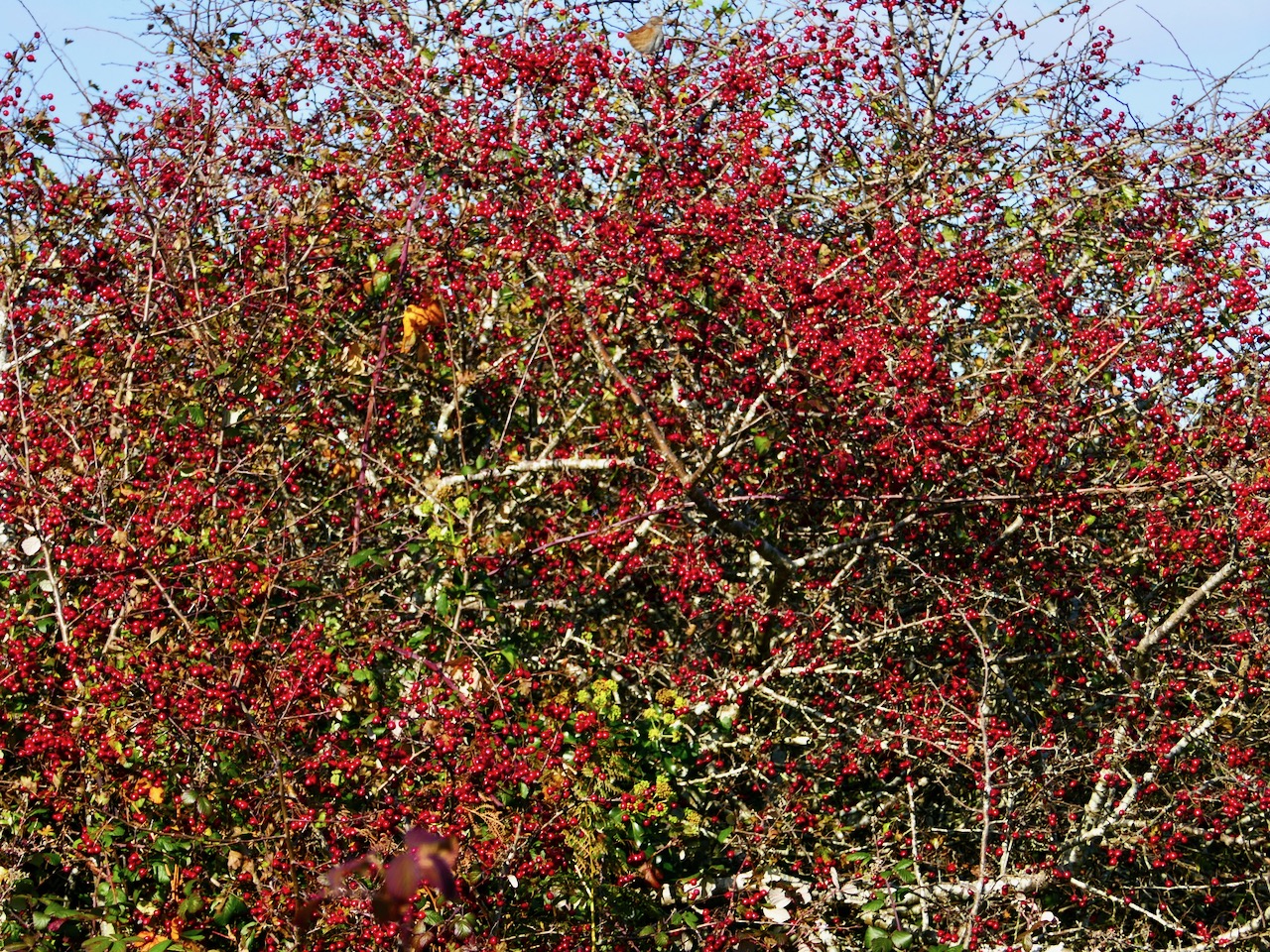
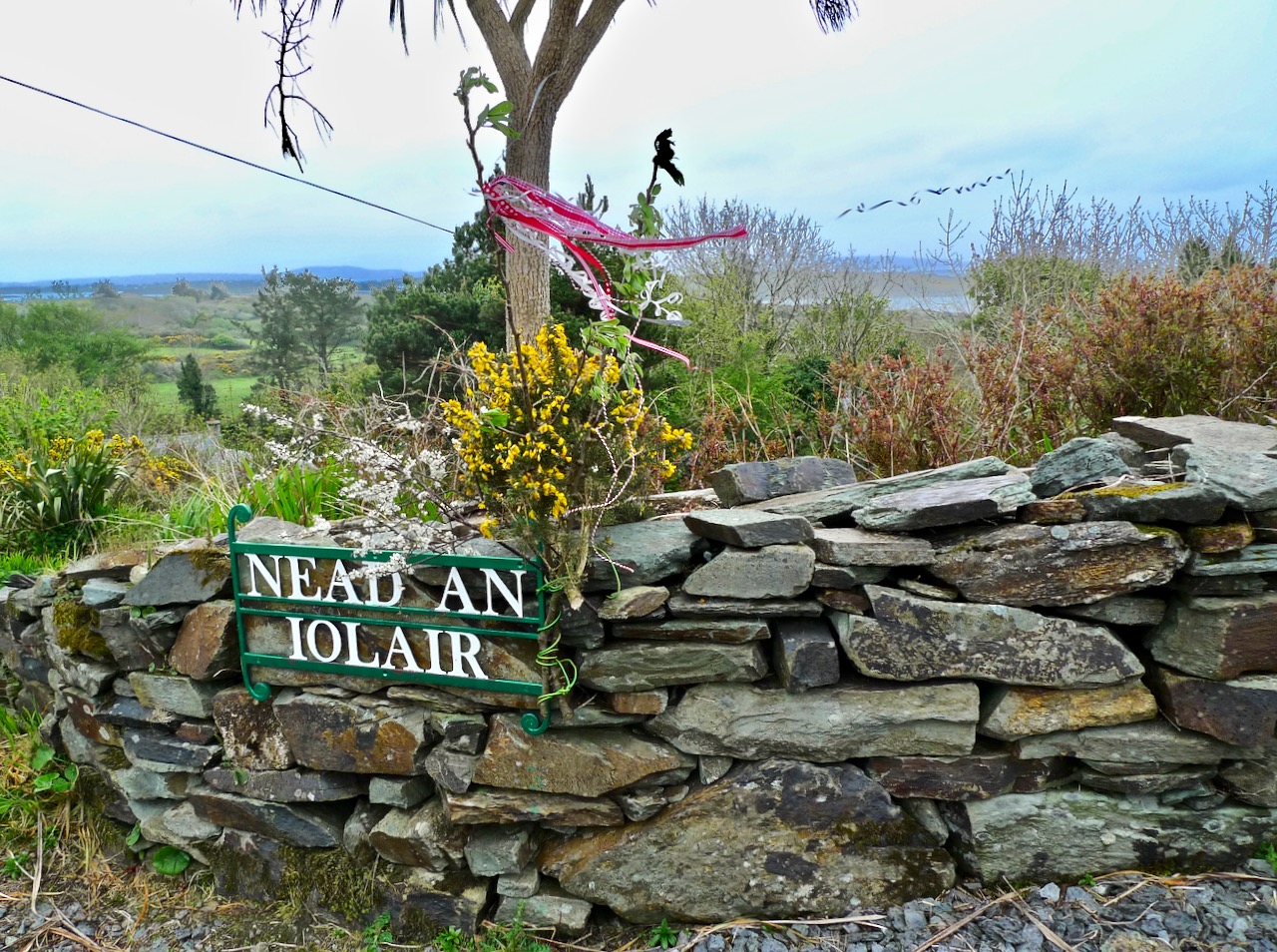
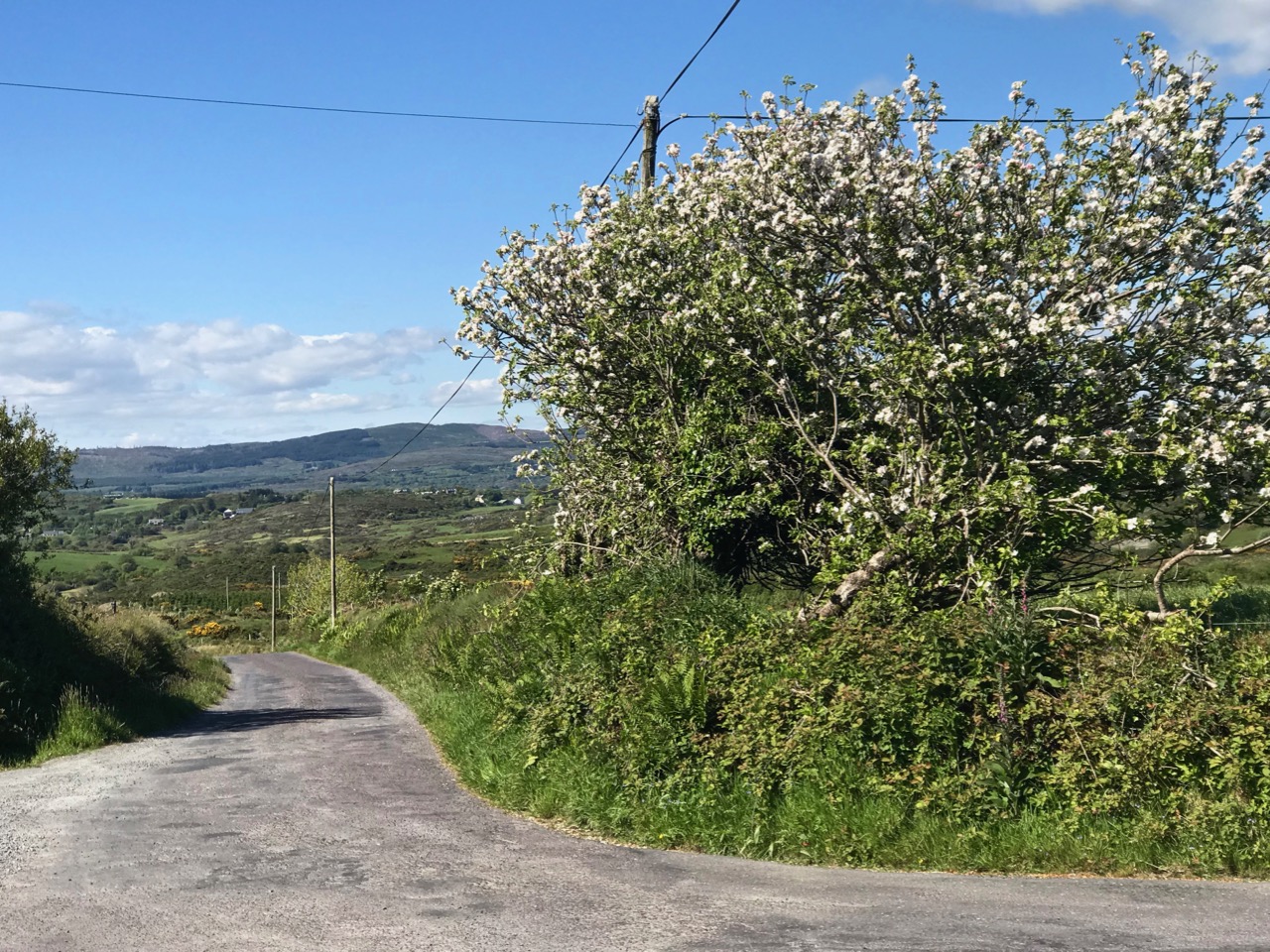
The crowning glory of our West Cork hedgerows, highways and boreens at this time of the year is the May bush – Sceach Gheal – Hawthorn or Whitethorn. The example above is on the way down to Ballydehob, just a few minutes’ walk from Nead an Iolair: we can’t resist stopping every time we pass to admire its brilliance – a shining presence among the abundant greenery of the early summer that’s all around us in these quiet days.
You have to get up close to fully appreciate the wonder of the tiny individual blooms that contribute to the billowing white cloud effects we see wherever there is a May bush in the hedges. We have one right outside of our bedroom window (see Rossbrin Castle in the distant view):
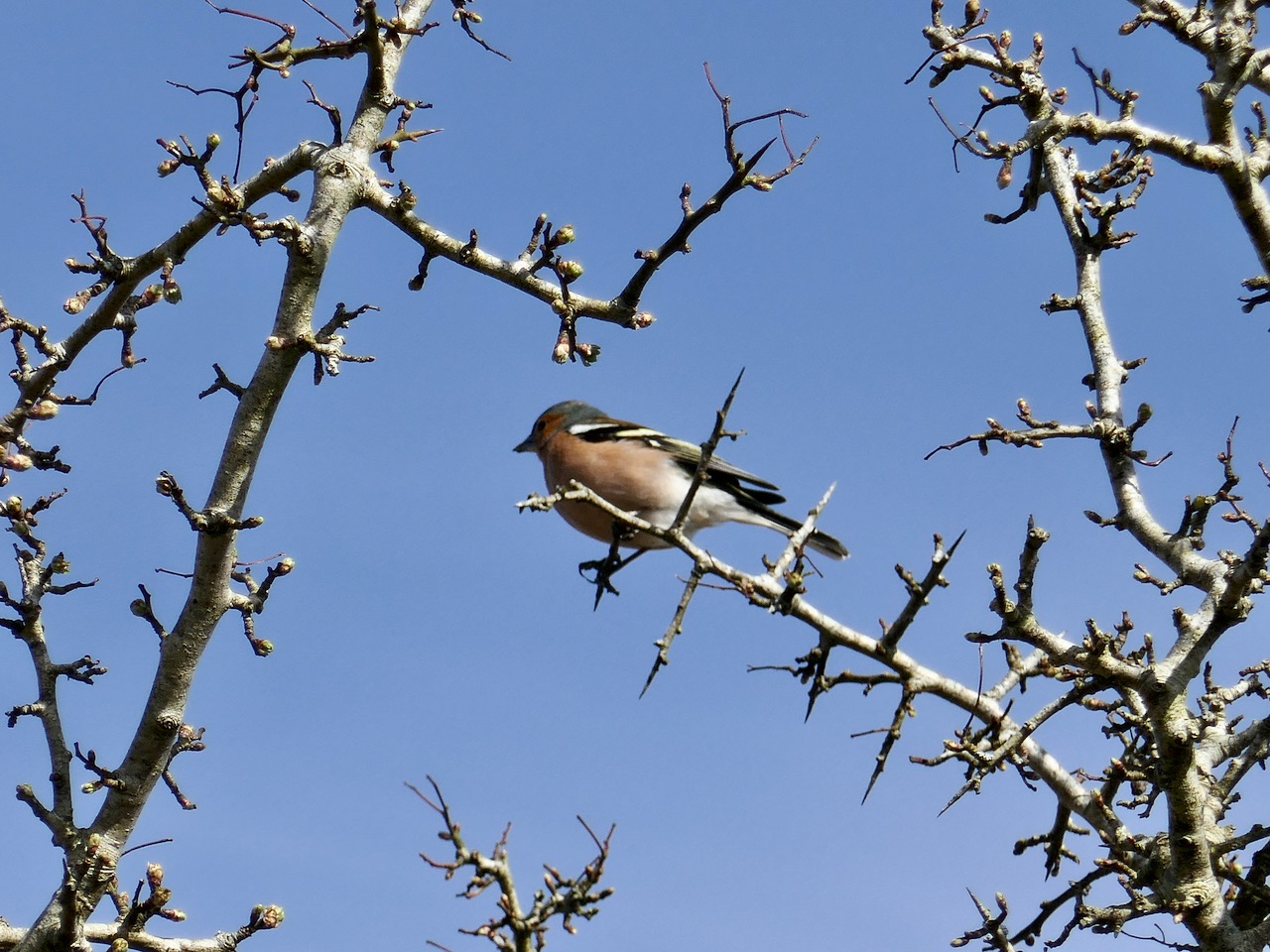
Of course, the May Bush is a thorn – a spiky tree, seen here before the blossoms come out. Even if those pisogues about it being unlucky to bring it into the house didn’t protect it from being cut, then those thorns would certainly be a goodly deterrent. This great picture, with chaffinch, was taken by Finola, who also provided many of the other photos here. Thank you, Finola! We admire the work of Michael Fortune, who lives in Wexford where, with Aileen Lambert, they have succeeded in re-establishing a May Bush tradition.
It’s been a quest of ours, when on our ‘lockdown’ walks – limited to 5km – to find the iconic ‘lone thorn tree’, out in a field, moor or open country, as this is the one imbued with the legends. So far we have been unsuccessful – the whitethorns around us all seem to be part of a hedgerow. In my English west country days – when I lived in the Celtic regions of Cornwall and Devon – I was aware of many solitary thorn trees, particularly out on the moors. Being in exposed locations they were usually distinctively shaped, bending away from the prevailing winds.
I had to search my archives for this photo of a lone thorn tree ‘bent’ by the wind: it was taken on the Sheep’s Head in June 2015 – after the blooms have faded. Always be careful of the solitary thorn for it guards the entrance to the realm of the Other Crowd. If you fall asleep under that thorn tree you will find yourselves transported into the kingdom of the old ones. It will not be an unpleasant experience – they will offer to satisfy all your thirst and hunger… But, if you accept, you will remain in that kingdom and grow old. One day they will release you, and it will seem as if just a few moments had passed since you left, but your aged body will very soon crumble to dust. This belief was as prevalent in Devon and Cornwall as it still is today in Ireland. Beware!
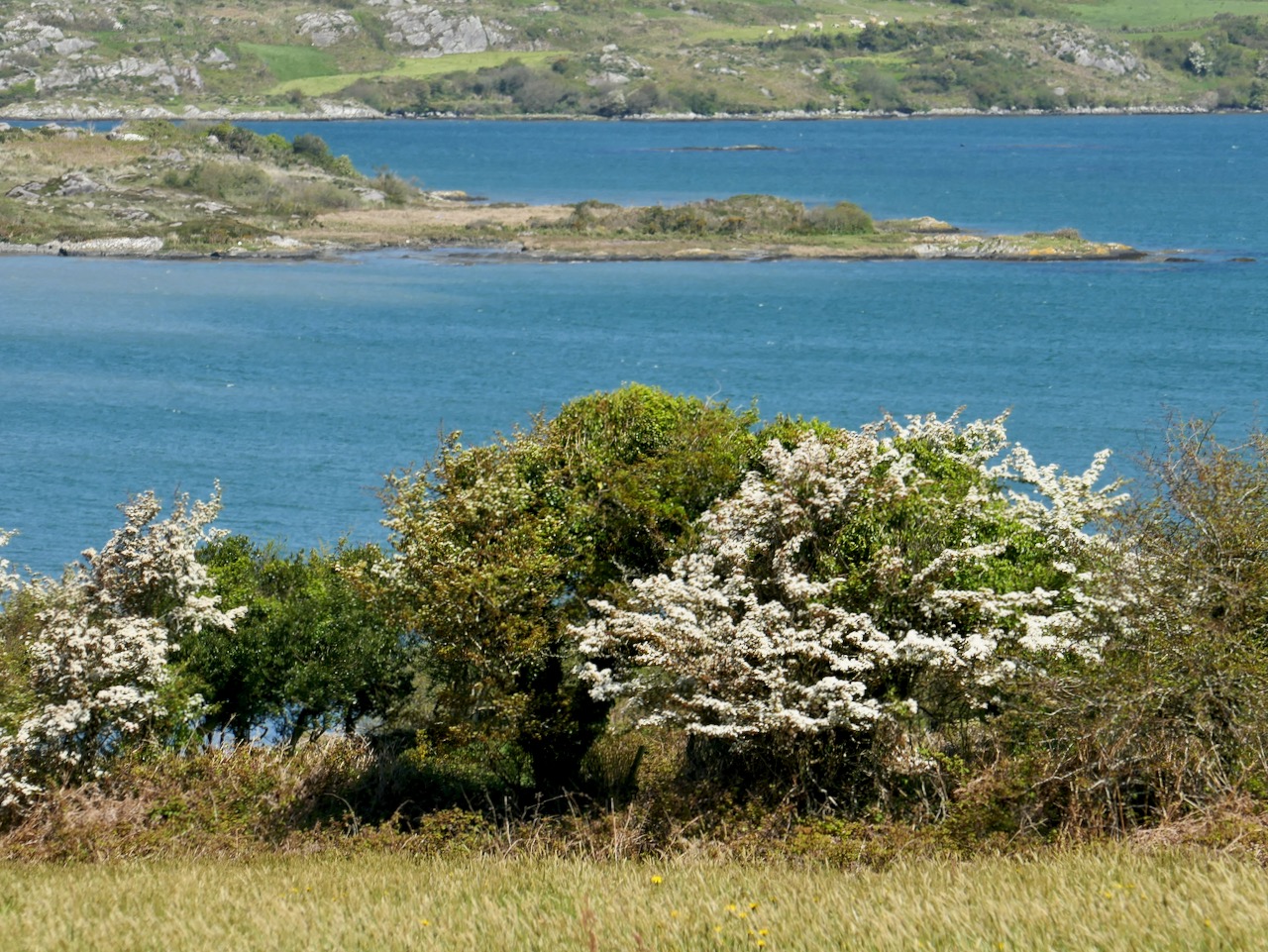
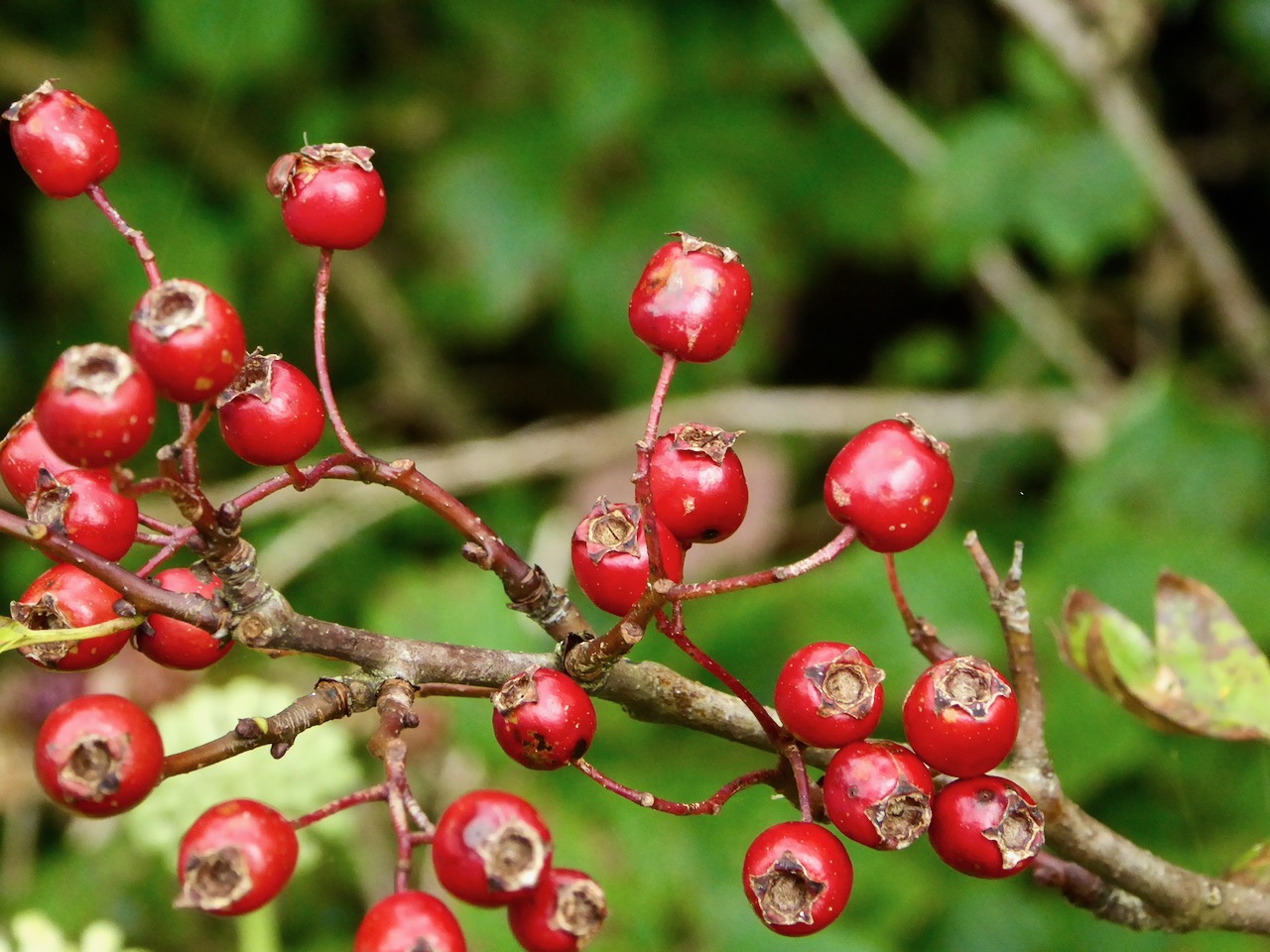
Close to home again – whitethorns in Ballydehob Bay. Once the blooms have gone, of course, we look forward to the haws, which are said to be edible but bland. They are traditionally used to make jelly and wine.
We could not be without the hawthorn trees which are all around us: they are lighting up our days in these times of anxiety and restriction – and they are reminding us of the continuity of nature and the constant cycle of the seasons. Life will prevail.
Our own May Bush a few years ago – blackthorn and gorse. We keep up the ancient traditions out of respect for the lore of our ancestors. If we don’t, the sun may never rise again!
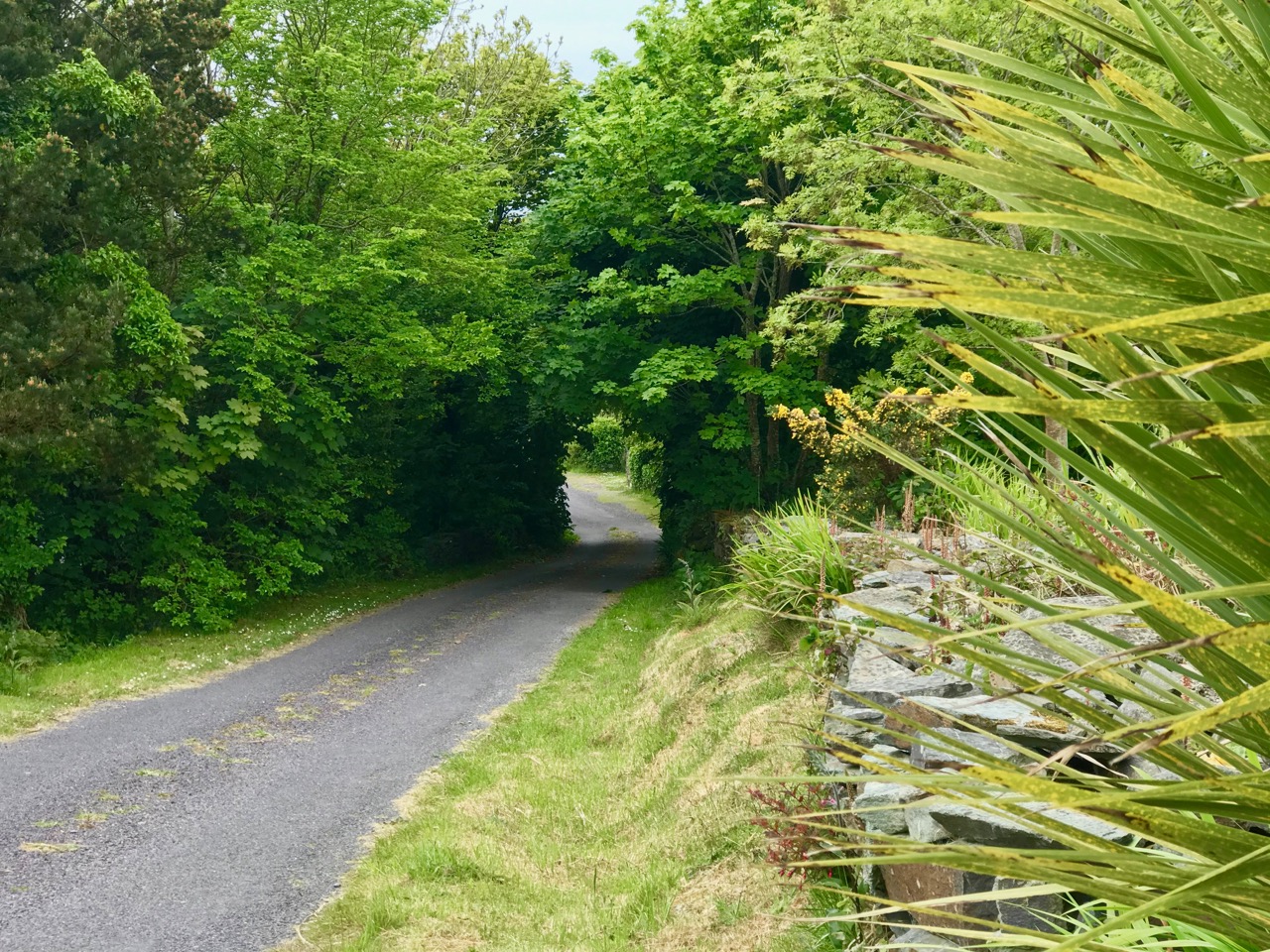
Only in Ireland can you wend your way along boreens. The Irish word is bóithrín, – a small bóthar (road). We are surrounded by them in our West Cork townlands. In these days of Covid19 restrictions, they are our whole world. With a maximum walk of 5 kilometres allowed, we can only ever be on boreens. But that’s no hardship – mostly they are beautiful (in fact they are all beautiful), and we enjoy every step we can take. So today’s post is simply a celebration of what is around us. But I have also combed the RWJ archives to look for boreens outside of our local area, for a bit of variety and comparison. Rest assured that any illustrations beyond our present limits were taken in other – normal – times!
Of course a ‘boreen’ or small road doesn’t have to be in a rural location, This fine boreen in Eyries, on the Beara Peninsula, is in fact a well used highway through the town, but you can’t deny that it is as atmospheric and picturesque as many of the rural byways shown here. It’s a moment in time captured for all time.
The photo at the top of the page is special for us: it’s the view we get when we turn out of Nead an Iolair, heading down towards Rossbrin Cove. And there (above) is our first glimpse of the sheltered harbour, overlooked by the medieval castle that was the home of Clan Chieftain Fininn O’Mahony in the 15th century. Not only do we have all the wonders of West Cork’s landscape on our doorstep, but we also have deep history as well…
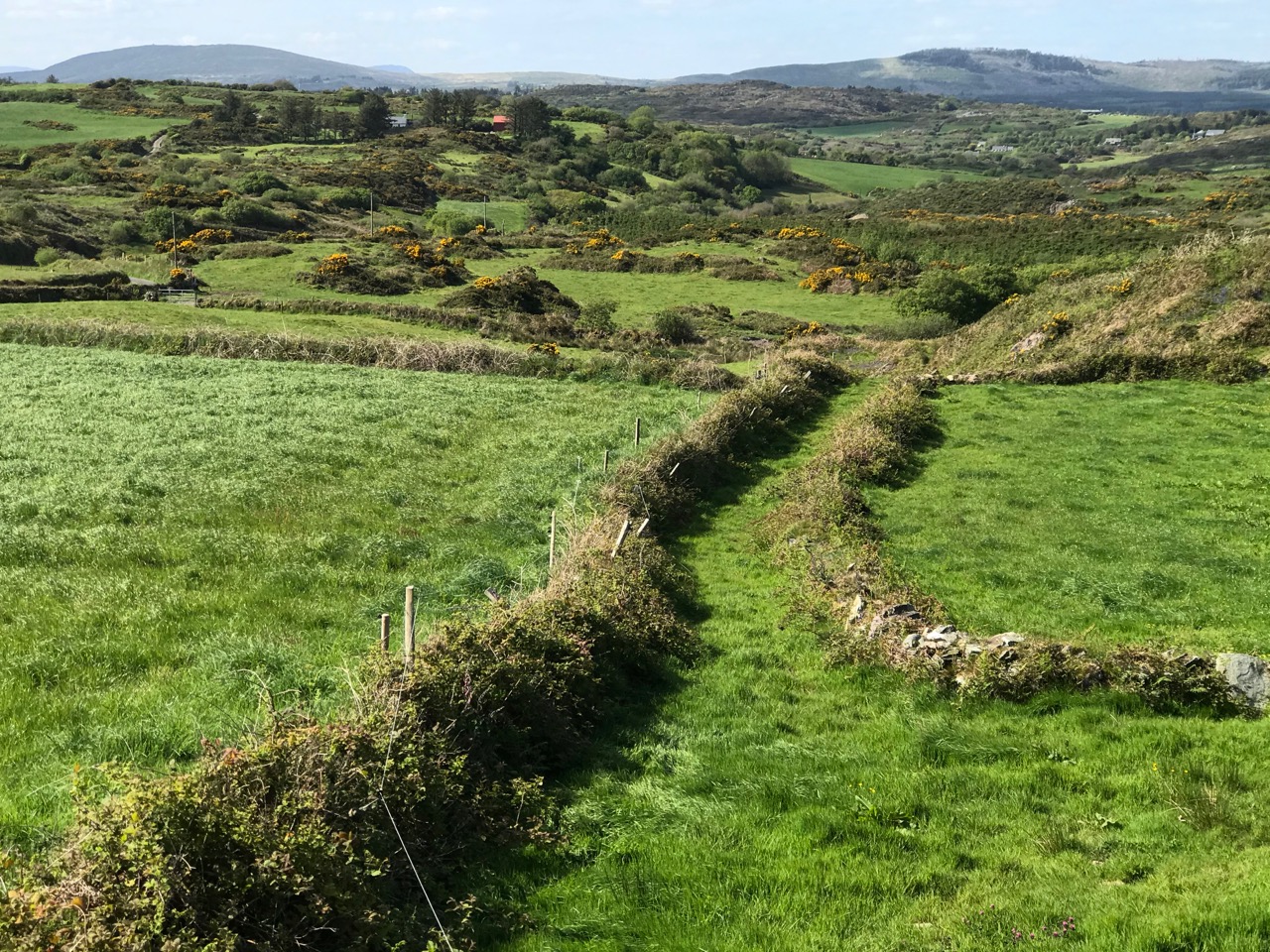
How much closer can you get to nature than this ‘green’ boreen just a short walk up the road from where we live in Cappaghglass? The stone hedge banks have become completely assimilated into the surroundings, and are a haven for so many native species of wildflowers, as Finola will readily point out to us!
And just a few yards from that last green trackway is the boreen that takes us down into our village of Ballydehob. Those are apple trees flourishing as part of the natural hedgerow.
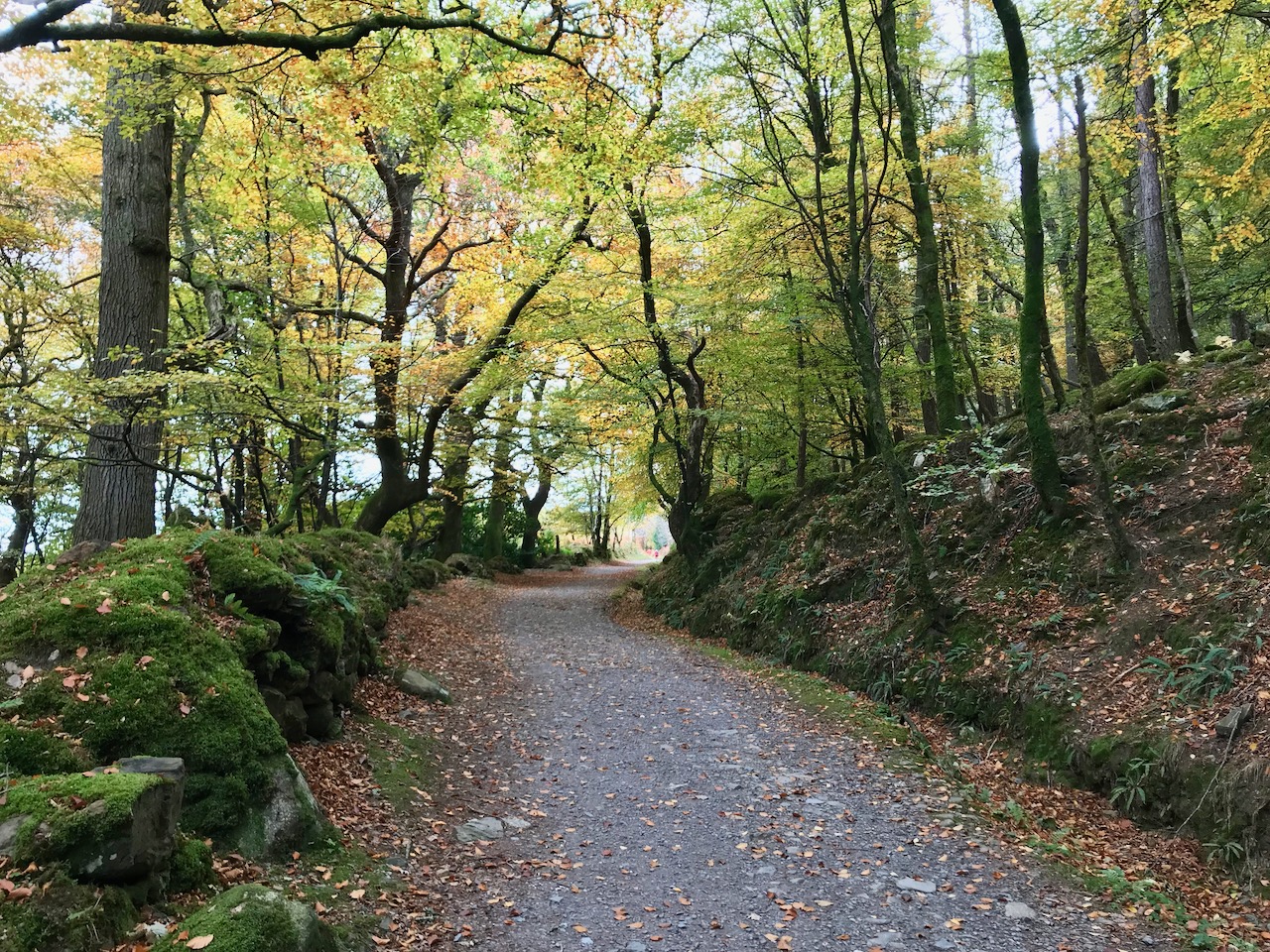
We have very little woodland around us here. This slightly mysterious tree-lined boreen was found on our travels near Glendalough, in County Wicklow, last year.
Close by the little harbour of Glandore (in Irish Cuan D’Ór – Harbour of Gold) in West Cork, we found a secluded boreen which pointed us towards an oddity: a pyramid in a graveyard – well worth a visit. Read about it in this post from two years ago.
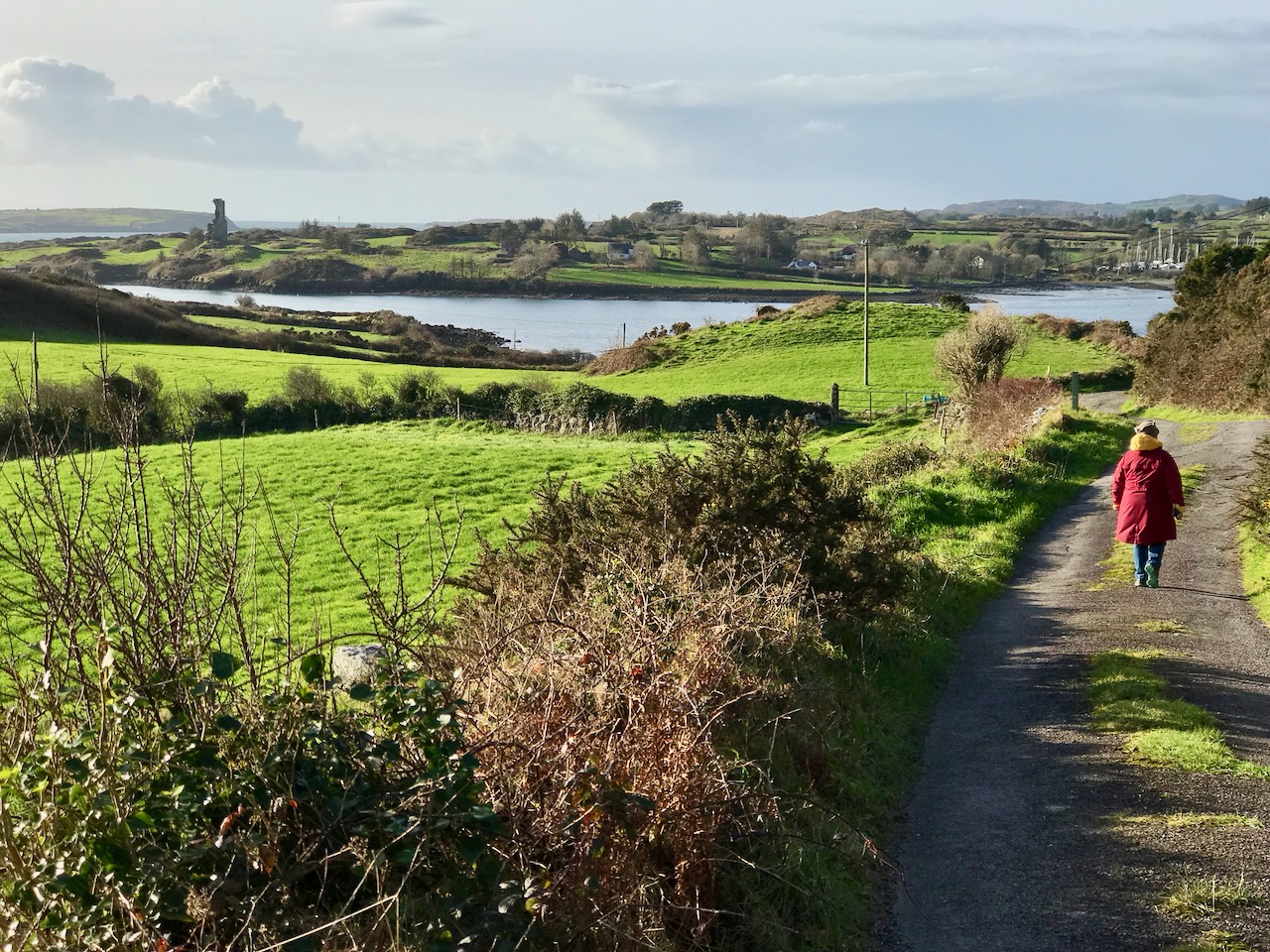
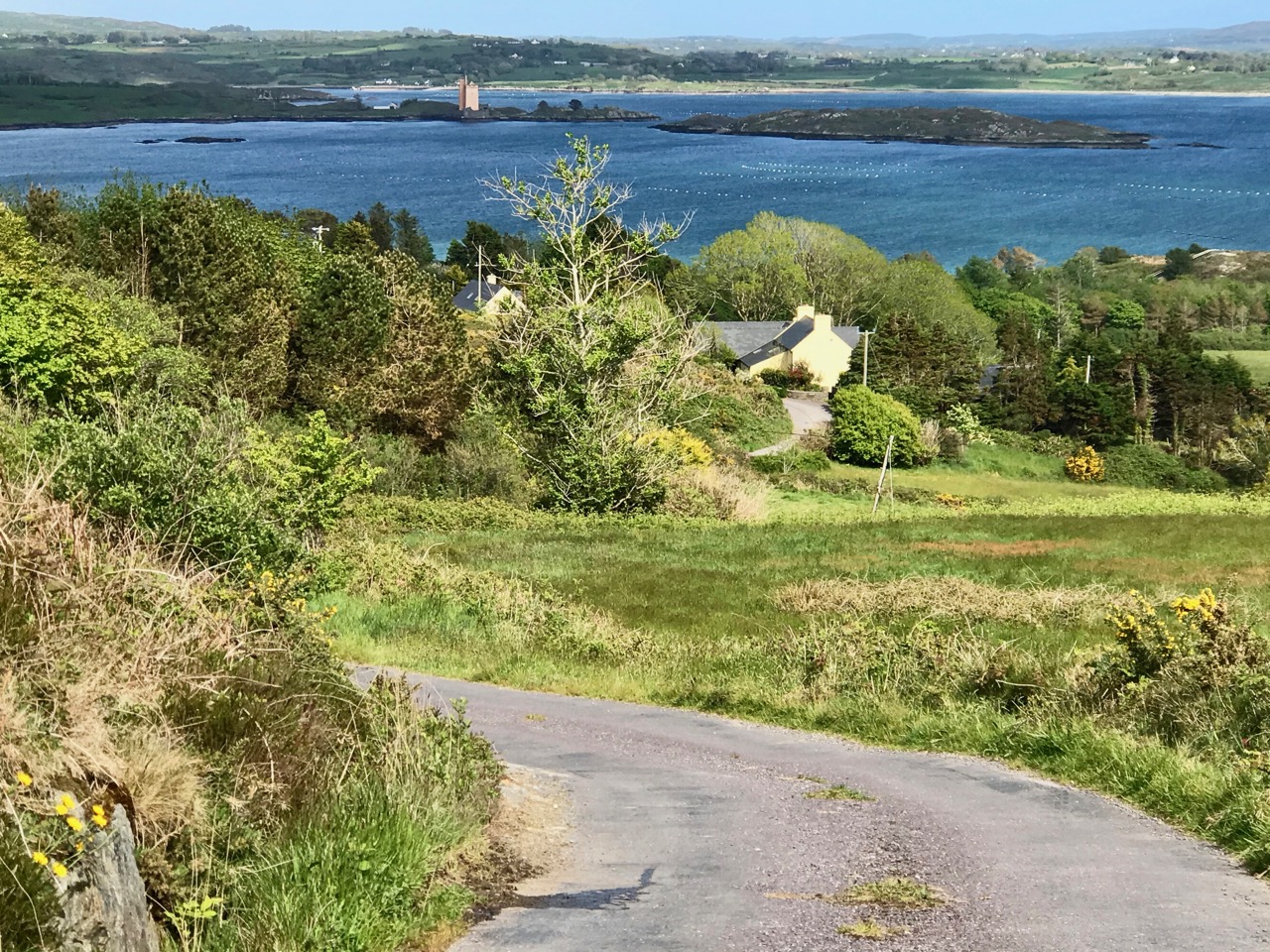
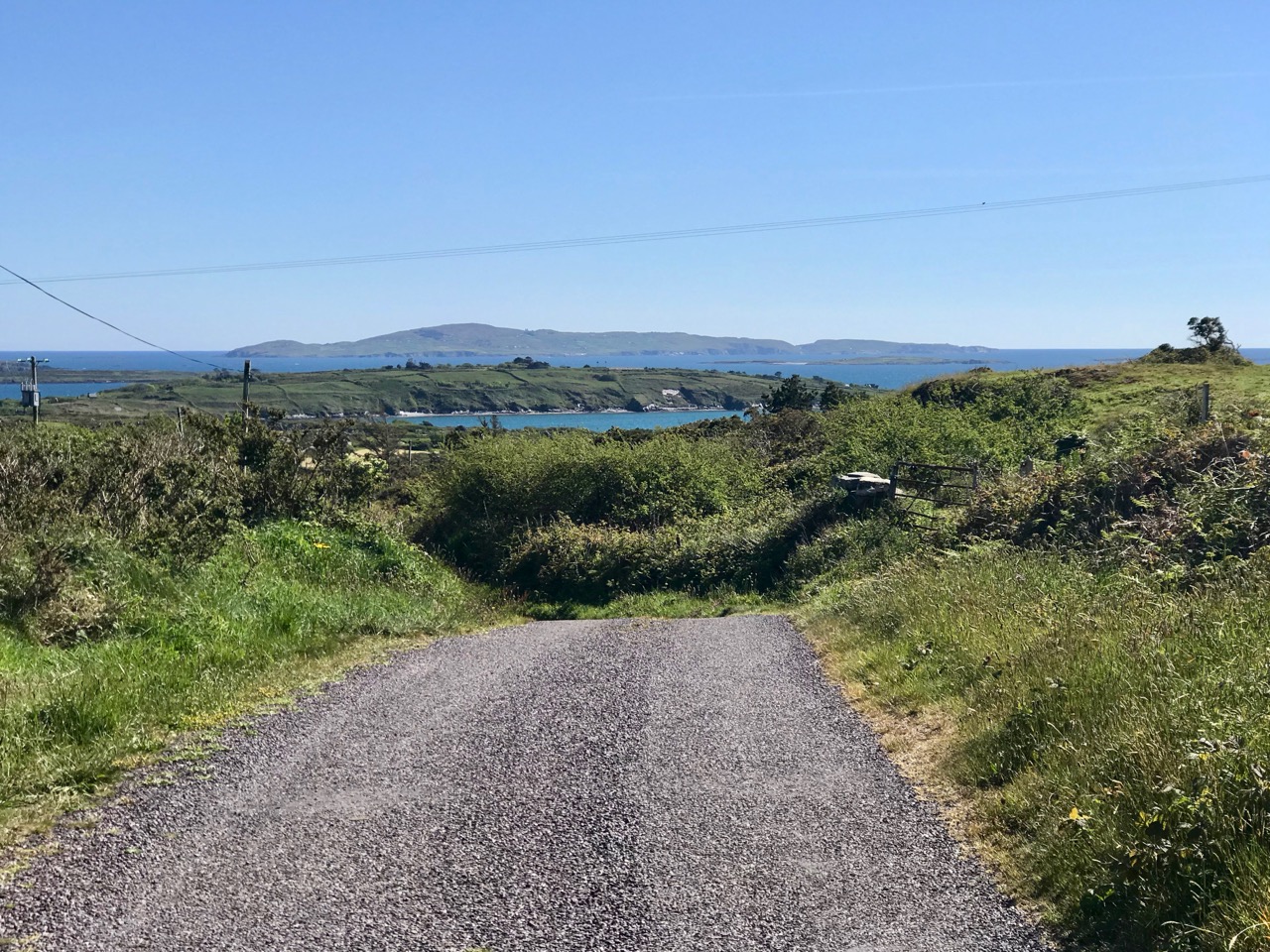
Returning to our own neighbourhood these two recent photos, taken only a couple of days ago, show how you can never quite know what you are going to find just around the corner or over the brow of the next hill. That’s Jeremy Irons’ Kilcoe Castle in the upper picture, and Cape Clear Island (on the horizon) in the lower one.
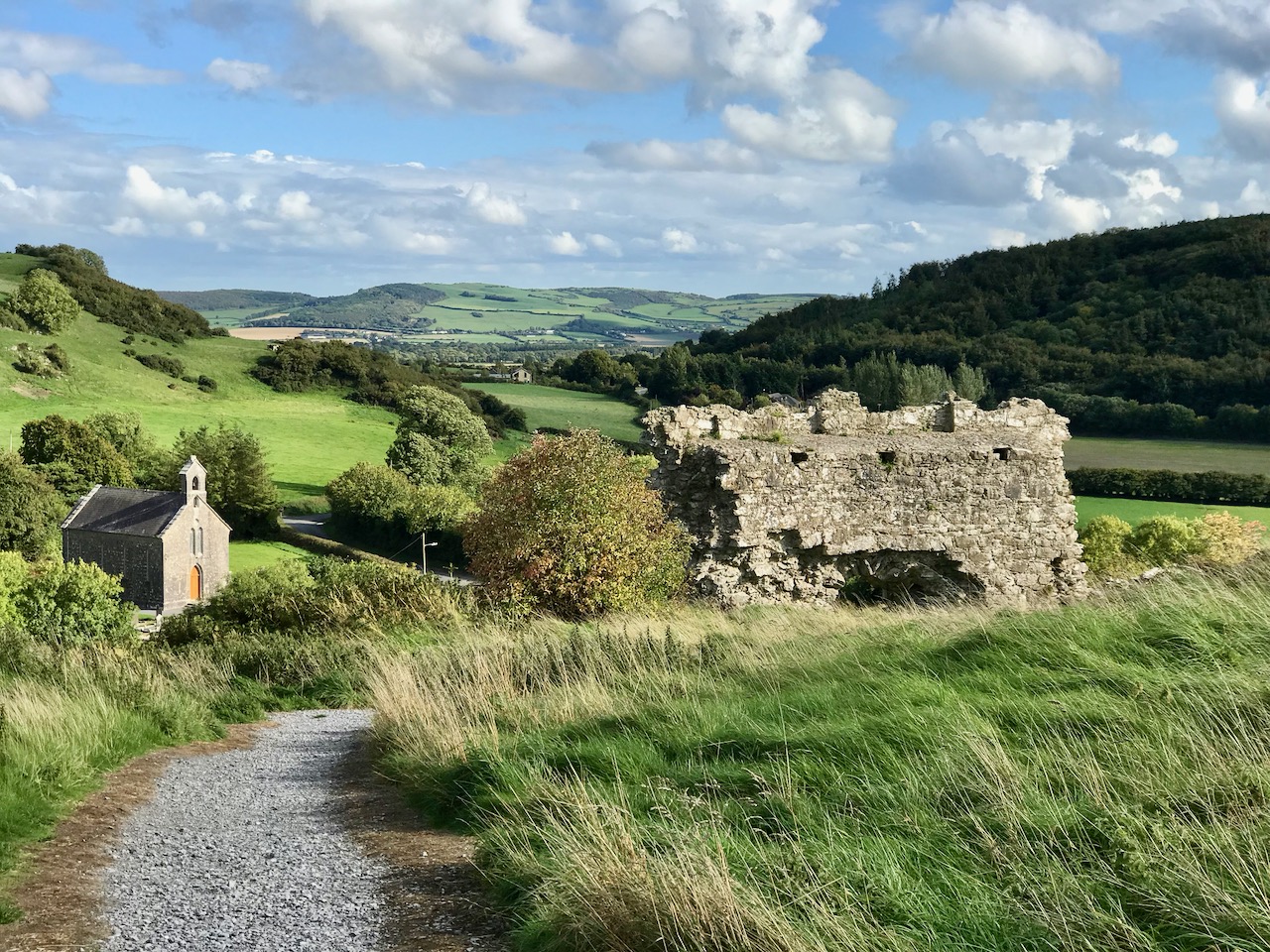
In contrast, here’s a little trackway that takes you up to the summit of the Rock of Dunamase in County Laois. This historic site with a view is associated with momentous events in the history of this country: in the painting by Daniel Maclise that hangs in the National Gallery of Ireland, The Marriage of Strongbow and Aoife is depicted as taking place at the now ruined Great Hall on the Rock. You can find the whole story of this most critical juncture in Ireland’s history in Finola’s post here.
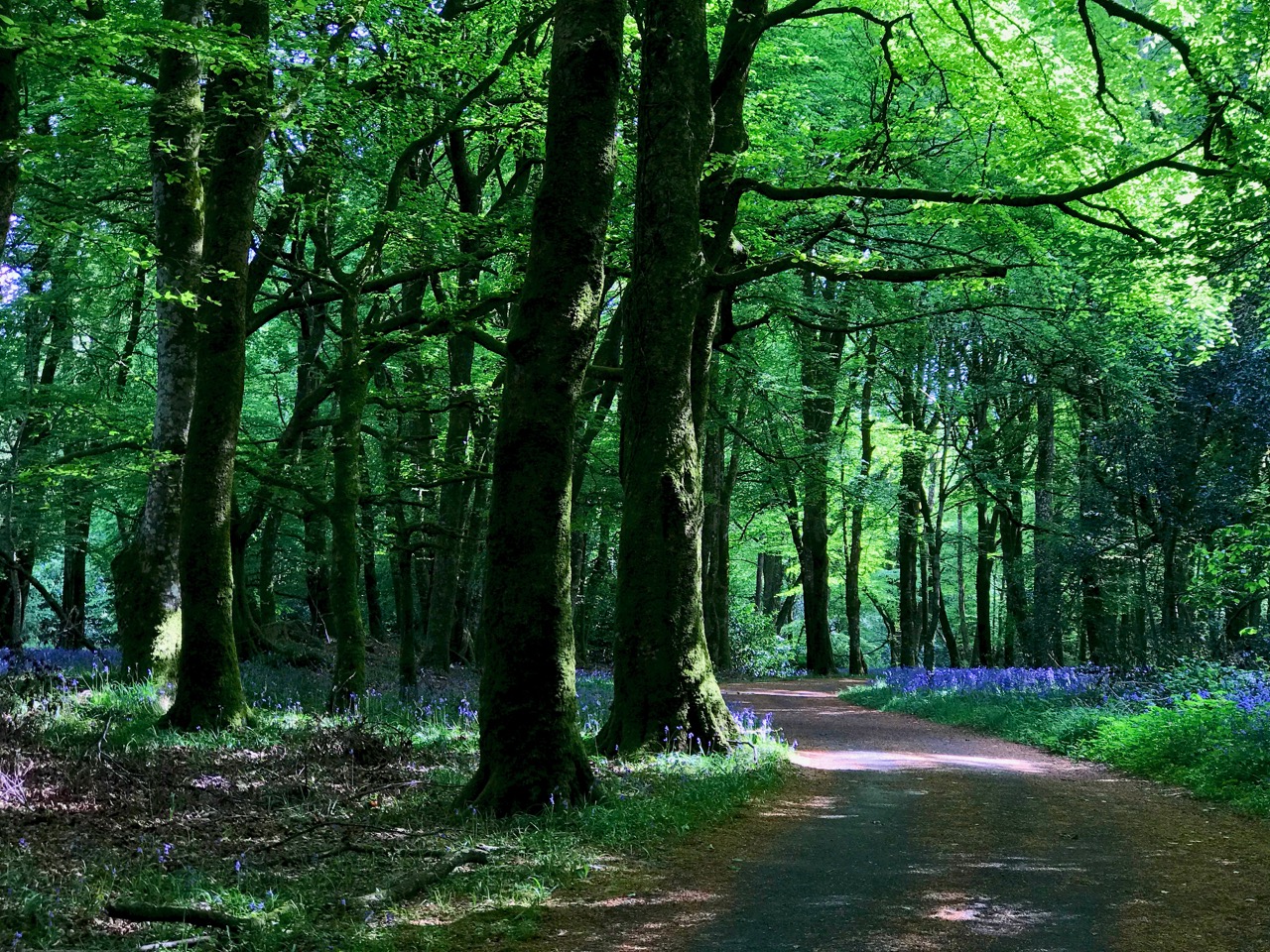
Even further afield – in Ballymoney, Co Antrim – is this spectacular avenue of beech trees planted on the entrance driveway leading to an eighteenth century Georgian mansion, Gracehill House. This boreen – open to pedestrians – is known as the Dark Hedges, and we visited it when we explored the North of Ireland three years ago.
Although in normal times we travel a lot – on major roads and motorways, as well as boreens – the places we like the best are near to home. How could we not be impressed by the winding boreen that climbs to the top of Mount Gabriel, the highest point on the Mizen? Look at the spectacular views (above). The preacher Caeser Otway travelling in this area in 1822 wrote:
. . . On my way to Bantry I passed the dark and lofty Mount Gabriel and took my way over a dreary, comfortless tract of country. Let no one say after looking at these moors , studded over with cabins crowded with children, pigs, goats, cocks and hens that an Irishman is not an industrious creature . . . Men, women, boys and girls toiling up the mountainside with seaweed and sea sand in baskets on their backs . . . See them reclaiming from amidst rocks and bogs, patches of ground on which to cultivate their only food, the potato; and no one witnessing this struggle of human industry against nature, but must acknowledge that the Irish are a most industrious race . . .
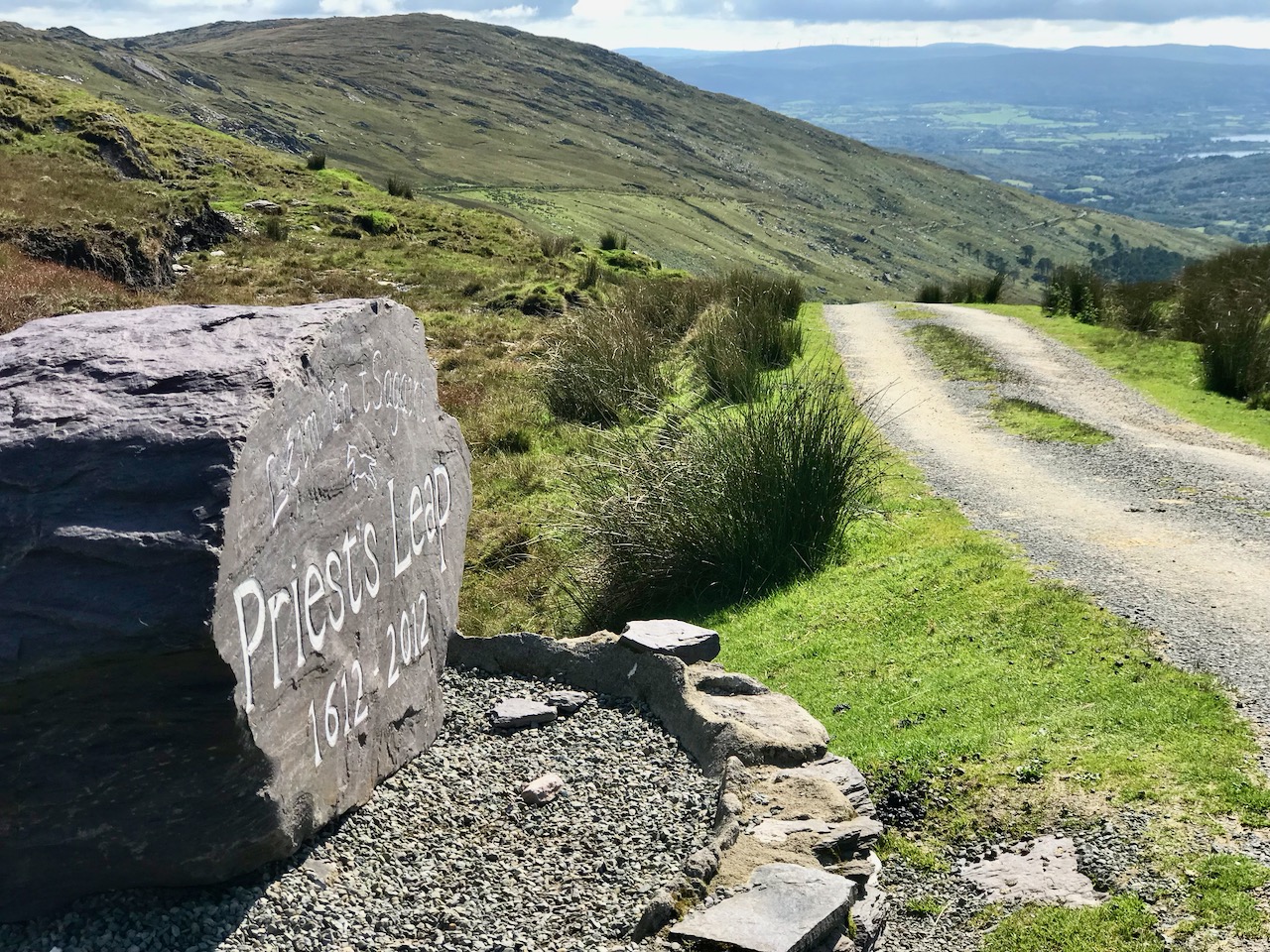
The 400 year old road that crosses the mountains from Cork into Kerry north of Bantry has to count as a boreen, as it’s single track for much of the way. The Priest’s Leap sign (above) marks the point at which the two counties meet. Although we have travelled all over Ireland in our explorations, this is still one of our favourite routes, and always will be. We so look forward to being able to go there again, when the present ‘lockdown’ is lifted.
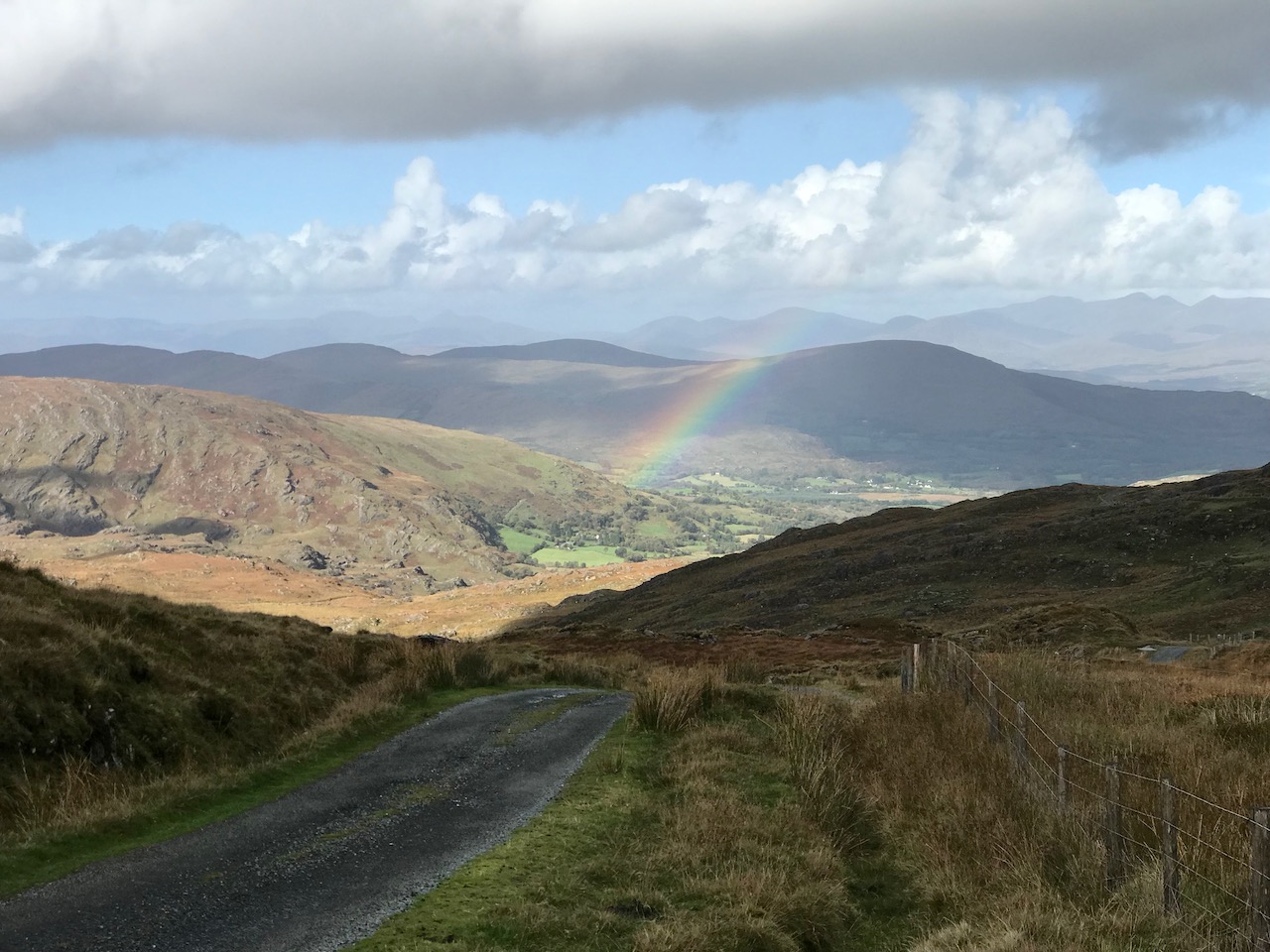
Another glimpse of the Priest’s Leap ‘boreen’.
This elegant woodland boreen is a fine example of regency landscaping, being part of the Ballyfin Demesne in Co Laois. Like so many of Ireland’s fine luxury hotels, Ballyfin remains closed until the Covid19 restrictions are lifted.
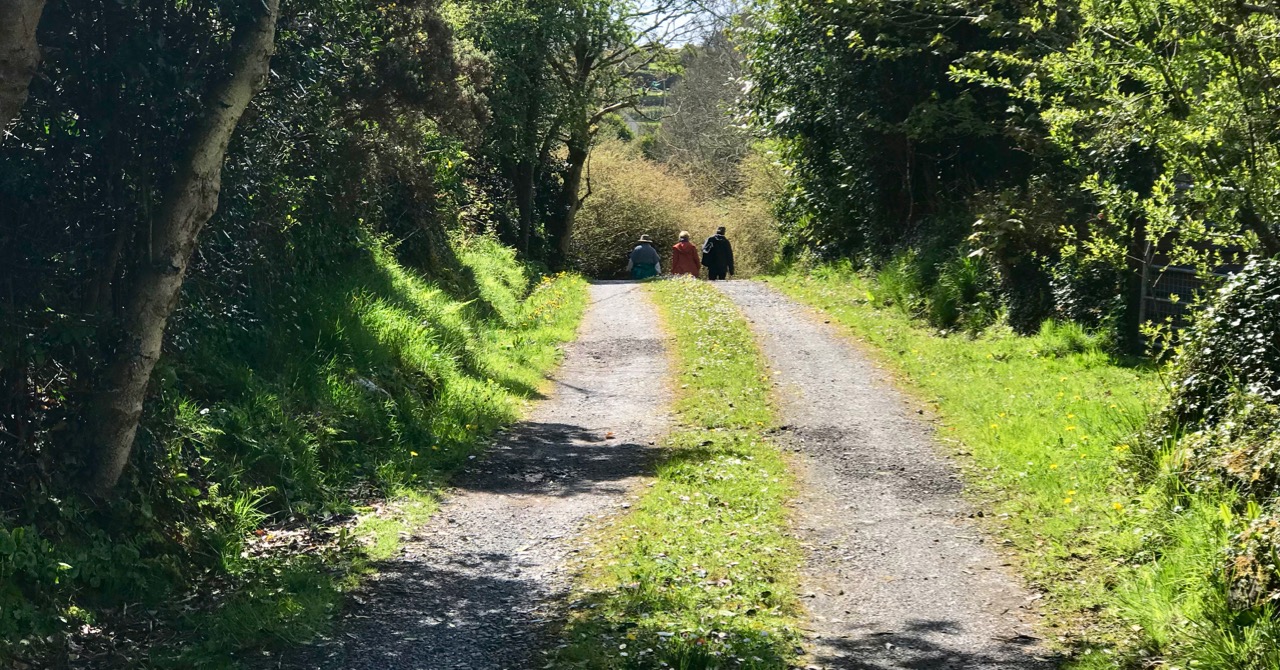
We’ll finish this post where we started – near to home in West Cork, with happy memories of unrestricted rambles with friends along the quietest and most beautiful of Ireland’s boreens . . .
That’s all we’re allowed during the Covid19 lockdown for ‘necessary exercise.’ But I have spent years now exploring the townlands around us and I like nothing better than to ramble out with my camera looking out for whatever comes my way, like Rossbrin Castle, above. Robert has done something similar this week – each of us with our own take on what life is like here right now.
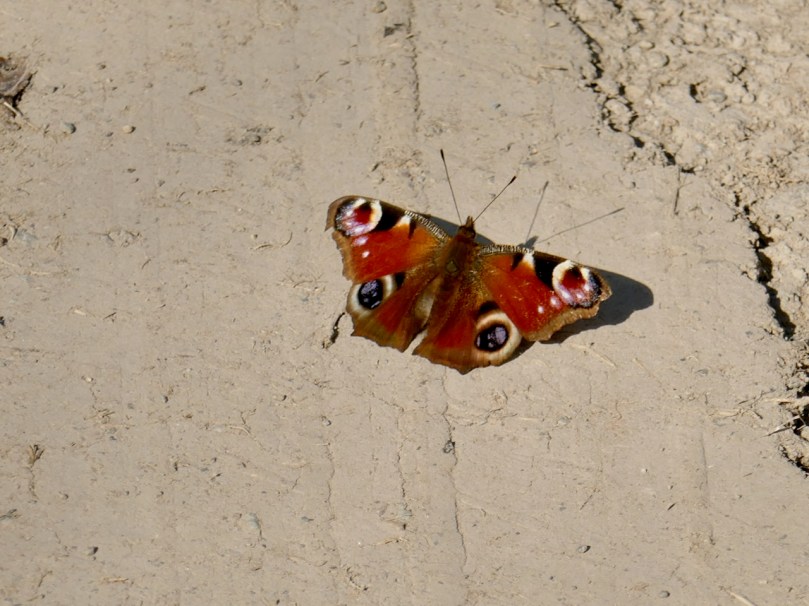
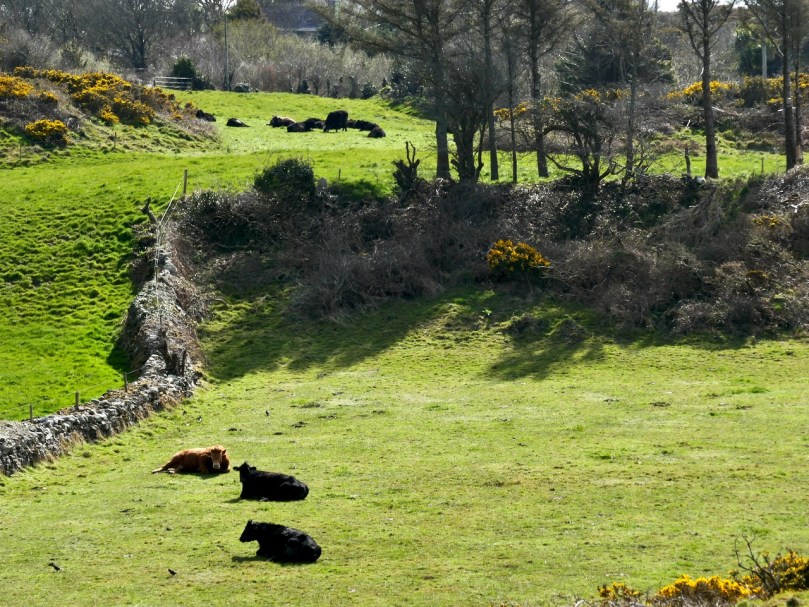
From the top: Seven-spot Ladybird; Peacock Butterfly; Mr Bull and his two cows observing social distancing
I’ve learned so much this way about the natural world. A lot of it has ended up as blog posts on Roaringwater Journal or as entries on my Wildflowers of West Cork Facebook Page.
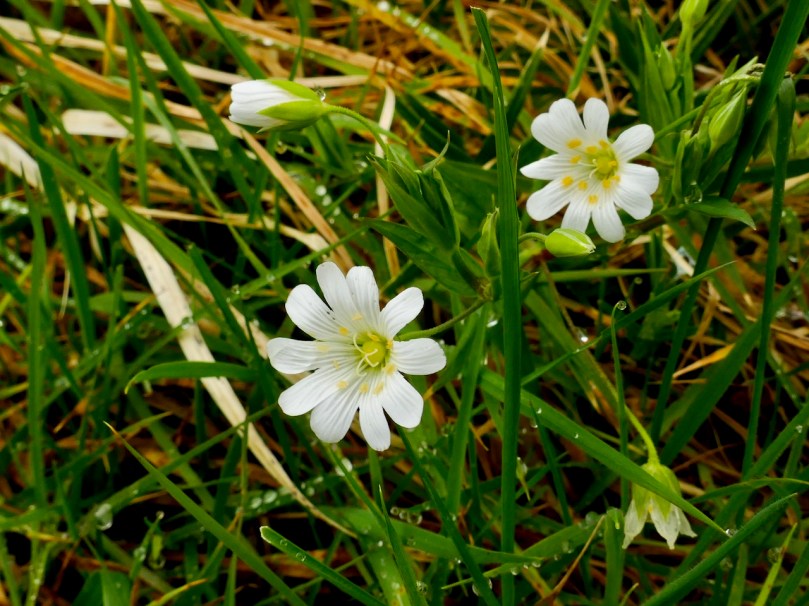
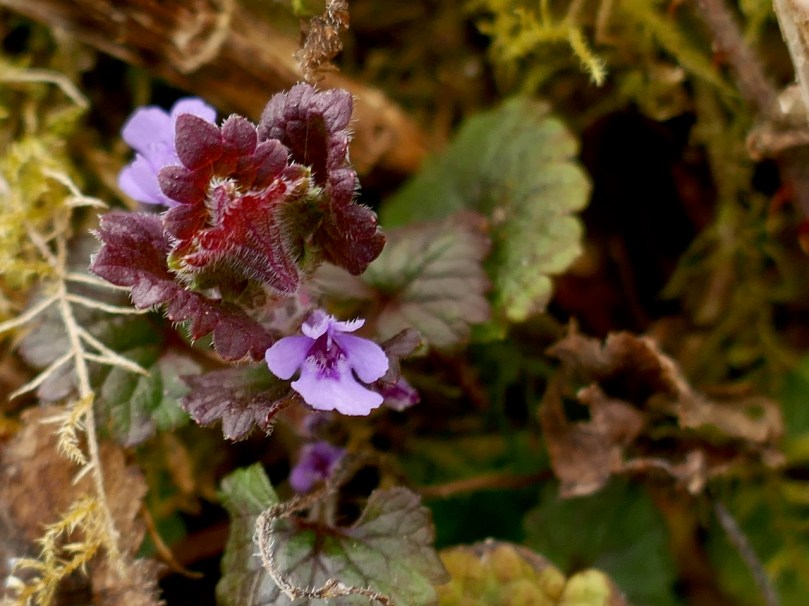
From the top: Herb Robert, Greater Stitchwort and Ground-ivy
There is archaeology and history all around us too, from a wedge tomb to a tower house, from mining complexes to ring forts and standing stones.
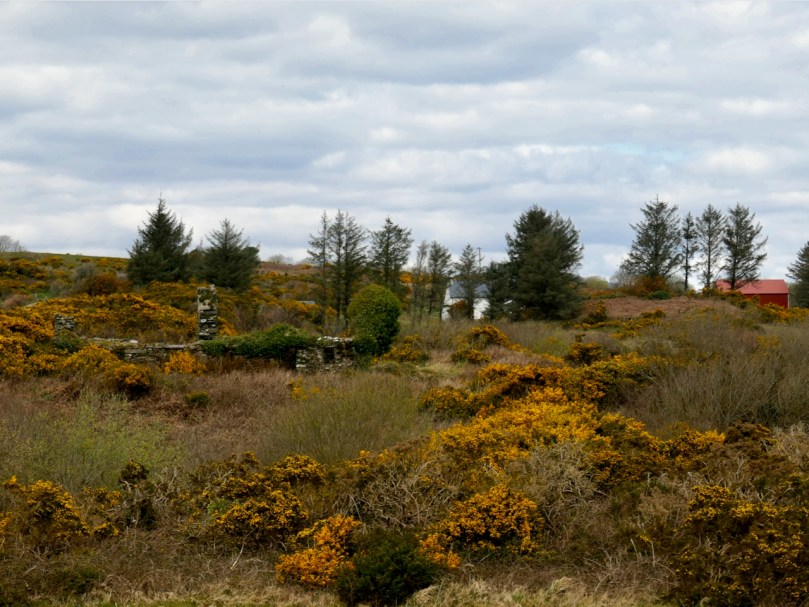
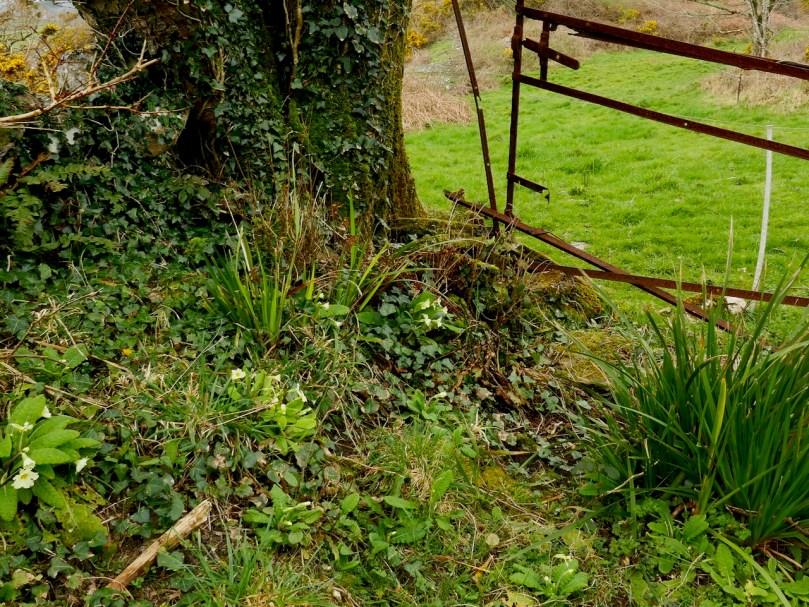
From the top: a ruined farmstead bears witness to population decline; Mount Gabriel looms over a pastoral scene; the old gate once led into a mine
We miss our friends, The Chat in Budds, our Irish lessons and conversation group, the Book Club and Art House Cinema and Talks at the Vaults and all the other events that get us out into the community and keep us curious and learning. We miss our long drives, our Holy Well and Stone Circle hunting trips – and our lattes!
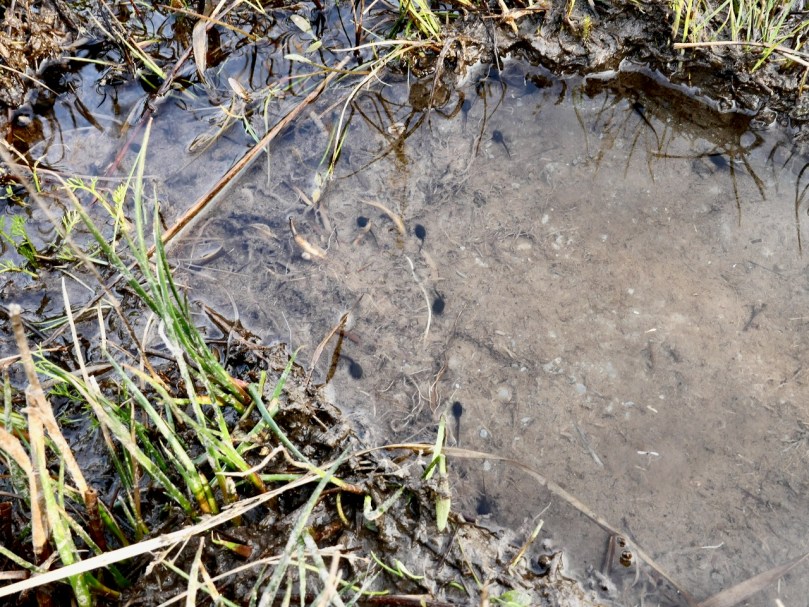
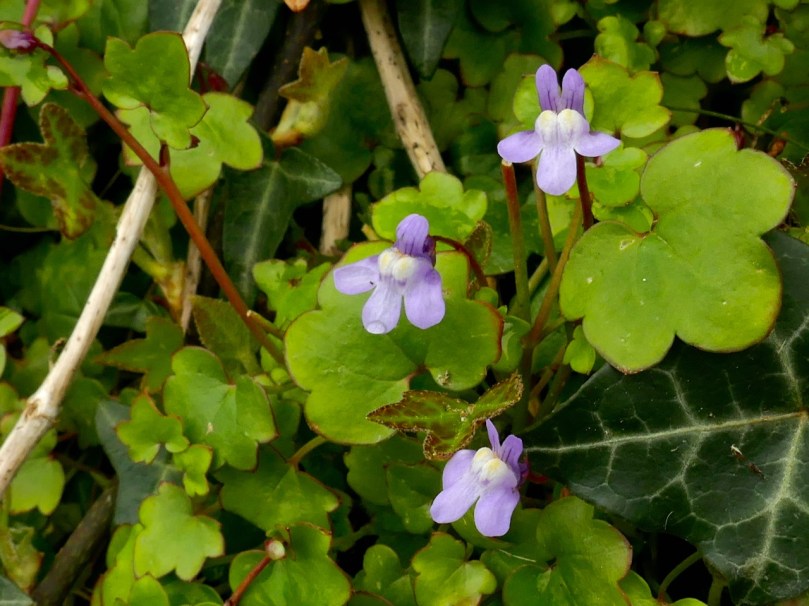
From the top: Tadpoles; Ivy-leaved Toadflax on an old stone wall
But these are small, first world, complaints and we do know how privileged we are to be well, to be able to buy groceries online, not to have small children to entertain and educate at home, and most of all to live in such incredible surroundings. It’s a good reminder not to take those privileges for granted.
I think I have barn envy
Meanwhile, we want to support everyone’s efforts to flatten the curve and we are in awe of the selfless dedication of so many people and desperately sympathetic to those who have lost income. The best way we know to do this is to be cooperative and follow the rules. And that’s what we are doing, mostly staying at home and when we go out keeping our walks to a 2km radius.
From the top: Contrasting textures – bark and barn; Distant view of Castle Island with the remaining castle wall and the abandoned farm houses
So herewith is a selection of what we’ve seen in the past few days as we walk several different 2km routes that present themselves from our front gate. Many of the wildflowers are tiny and only lots of practice enables me to spot them in the verges or the fields.
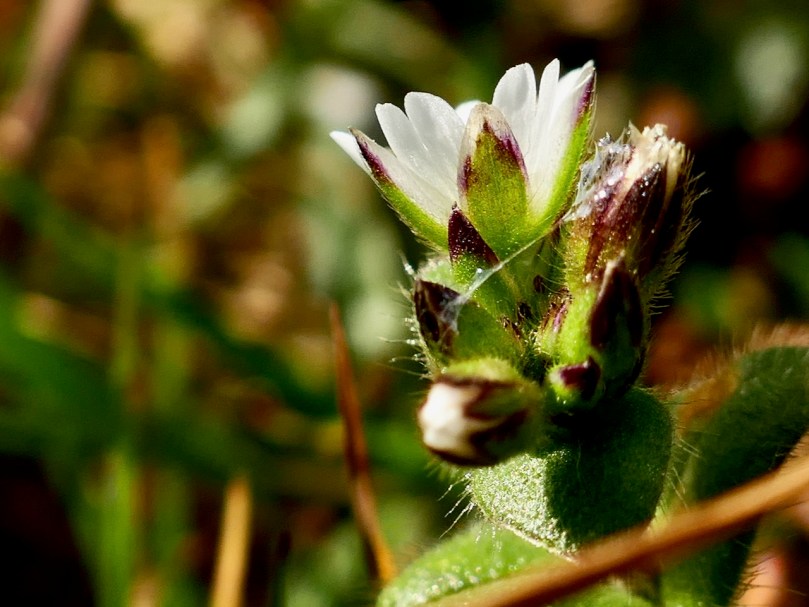
From the top: Dandelions and Celandine; Common Mouse-ear; Thrift and Scurvygrass
It seems like spring has been slow to come this year although when I look back at previous years I see much the same assemblage of flowers for late March and early April. But beyond a golden day or two, it hasn’t warmed up yet so there is no sense of spring suddenly ‘bustin’ out all over’. Nevertheless the hedgebanks are slowly coming to life and I see something new every day.
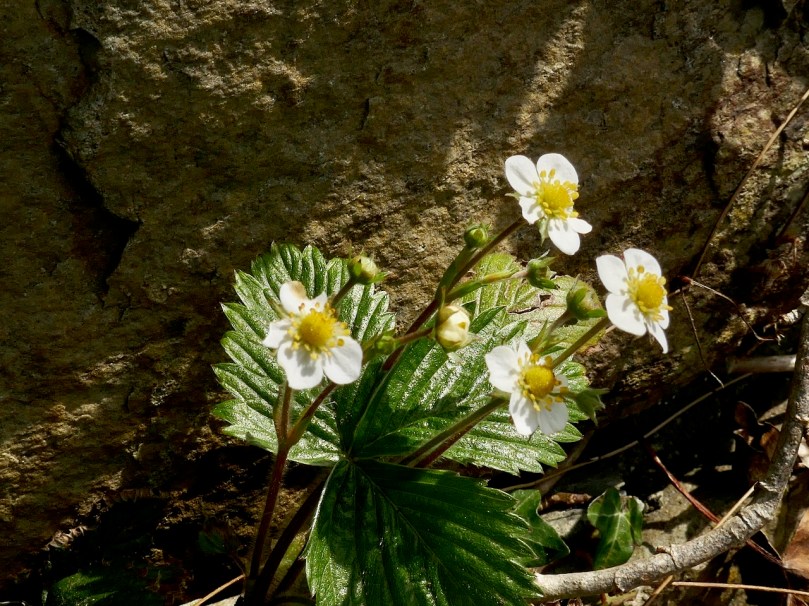
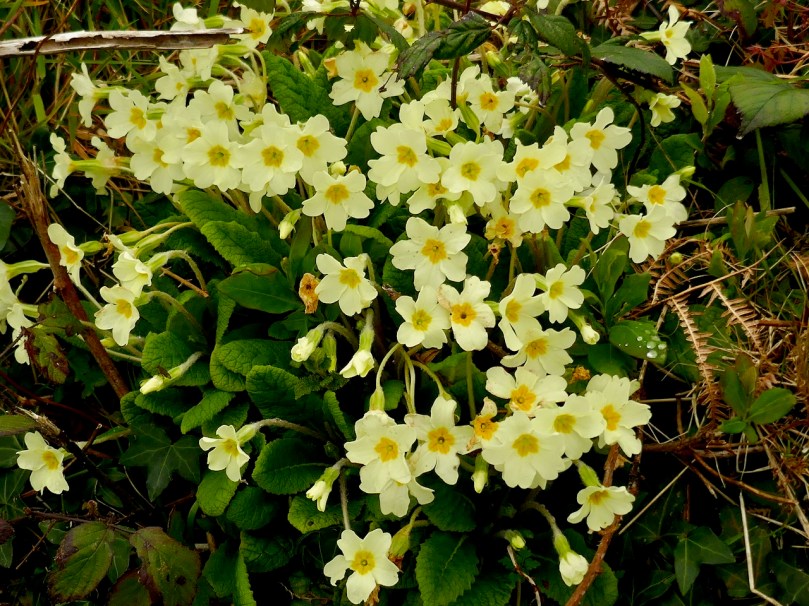
From the top: Wild Strawberry; Three-cornered Garlic (AKA Three-cornered Leek); Scarlet Pimpernel; Primrose
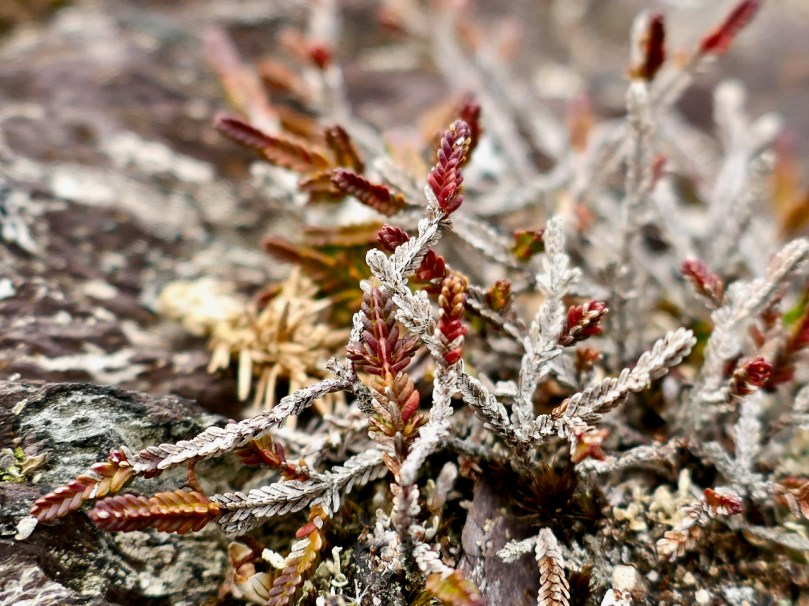
The rock faces at my favourite bog soak are always fascinating, although you have to lie flat with your face an inch from the surface to really grasp the miniature world that teems on its surface. I’m still determined to improve my knowledge of lichen and mosses, but I can’t pretend I’ve advanced much.
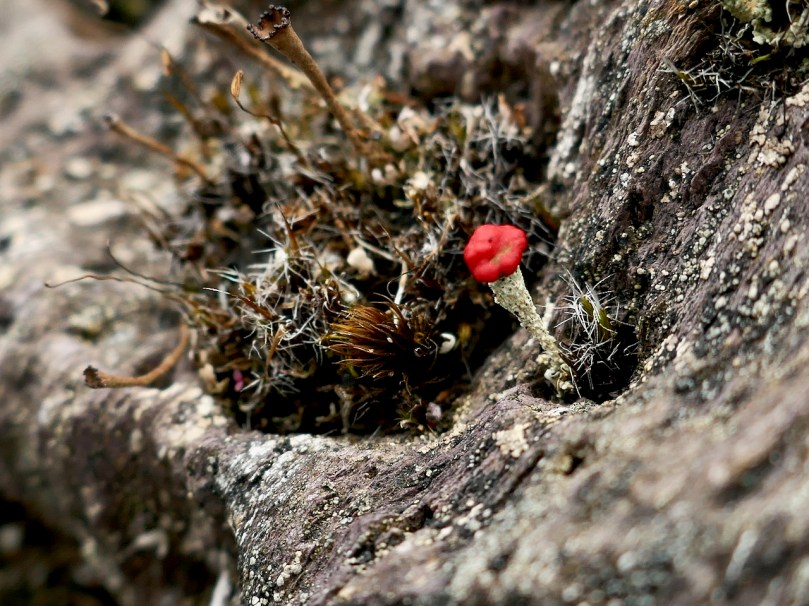
From the top: Devil’s Matchstick, a type of Cladonia lichen: I don’t know
How are you all doing out there? Leave a comment and let us know – we want all our dear readers to stay safe and well!
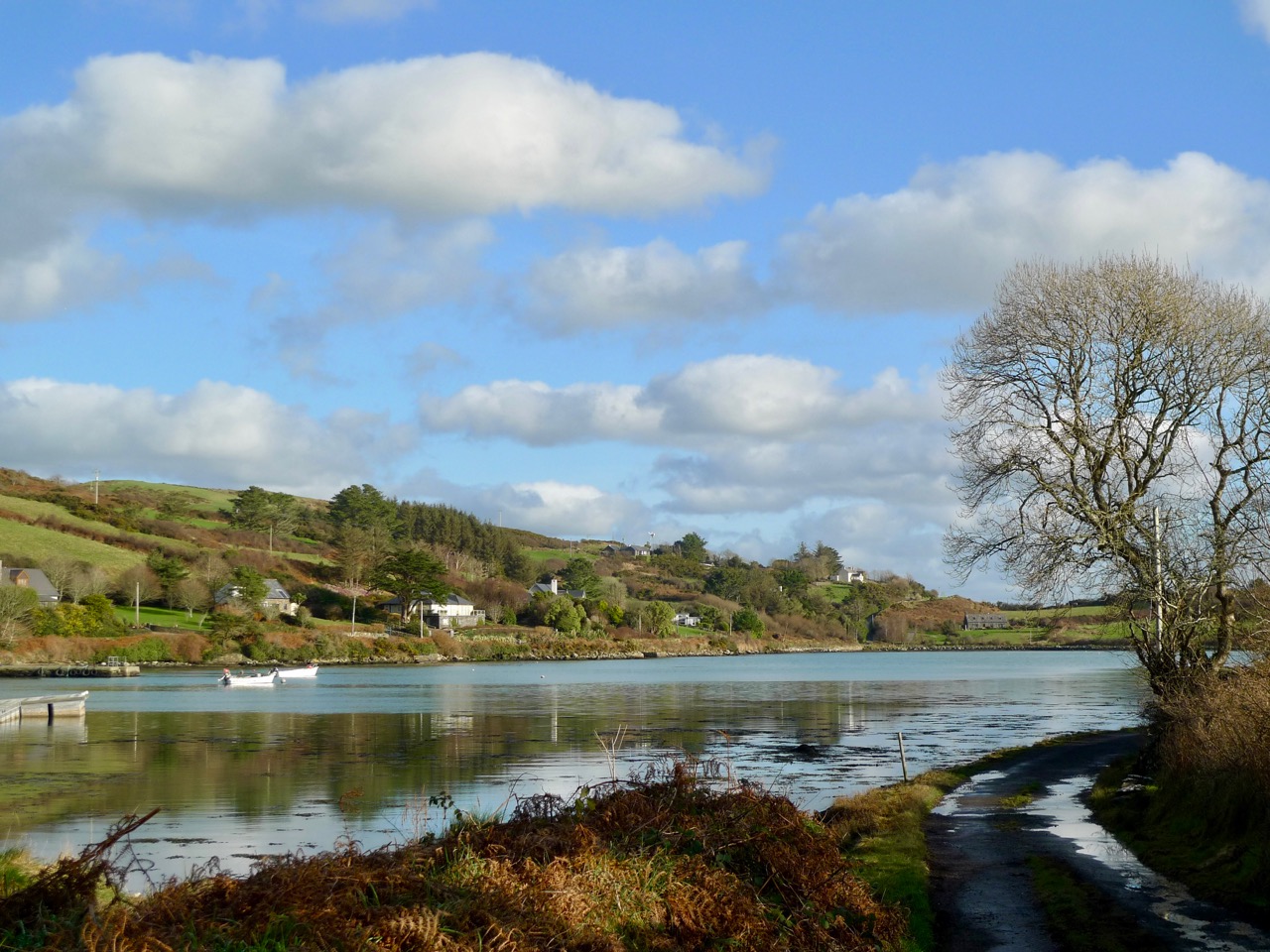
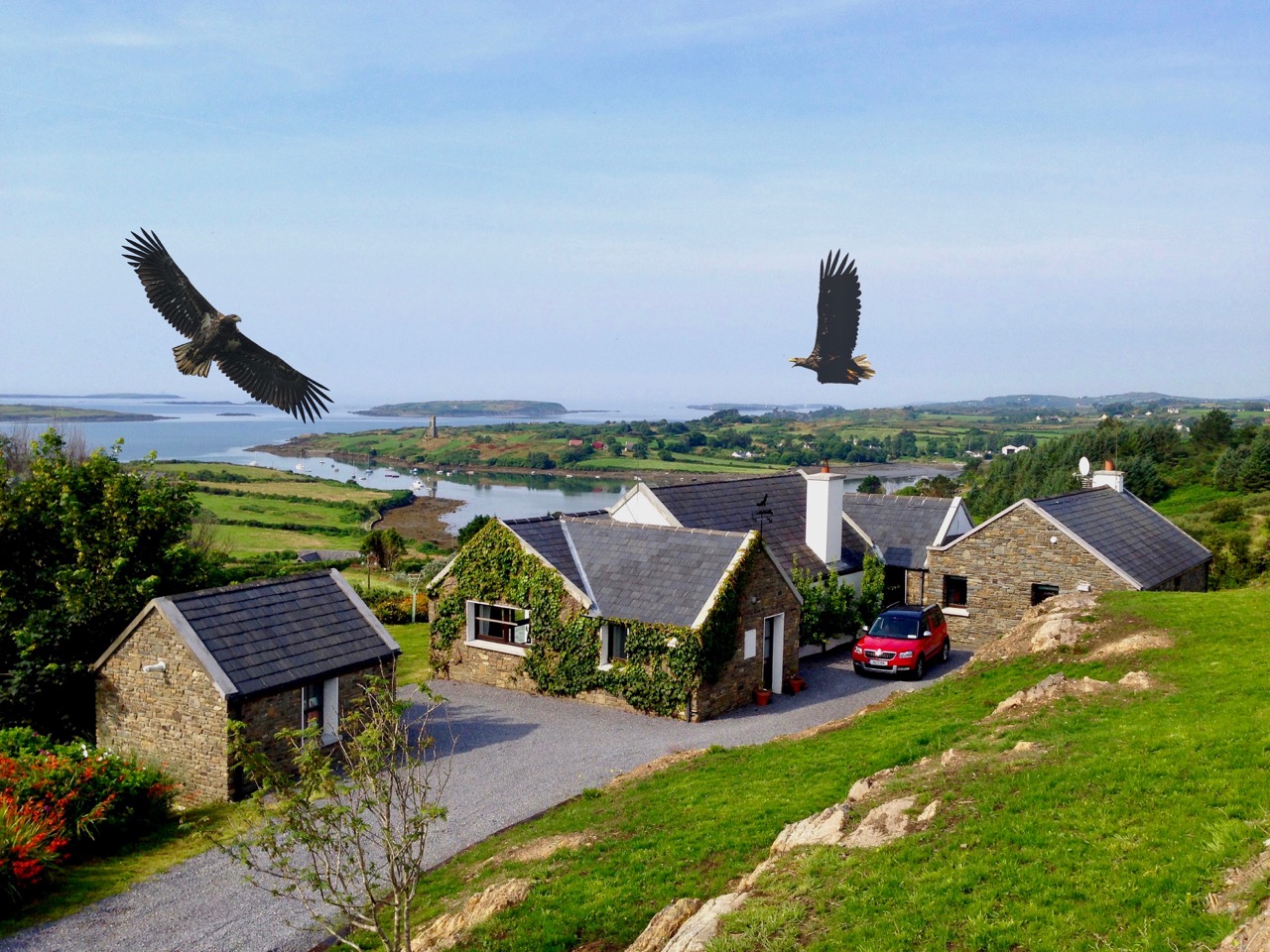
Last week we talked a little about the history of Rossbrin’s medieval castle, and the importance of this natural inlet as a historical centre of fishery, scholarship and European culture. Rossbrin Cove stills serves as an anchorage and refuge for sailing boats on the edge of Roaringwater Bay, but is now a peaceful haven, with only the sounds of the shore birds and slapping masts to lightly disturb an overriding tranquility that gives the place a very particular atmosphere. Our photograph (above) is taken on the boreen going to the castle; on the skyline in the centre is a wind turbine, and just below that is Nead an Iolair (Irish for Eagle’s Nest). The picture below shows the eagles wheeling over our house, with Rossbrin Castle and our view to the Cove beyond.
I have been exploring images of the Cove and its castle – some historic photographs and a few artists’ impressions. As it’s right on our doorstep, we have taken many pictures of Rossbrin during our years here. I am also sifting through a few of these.
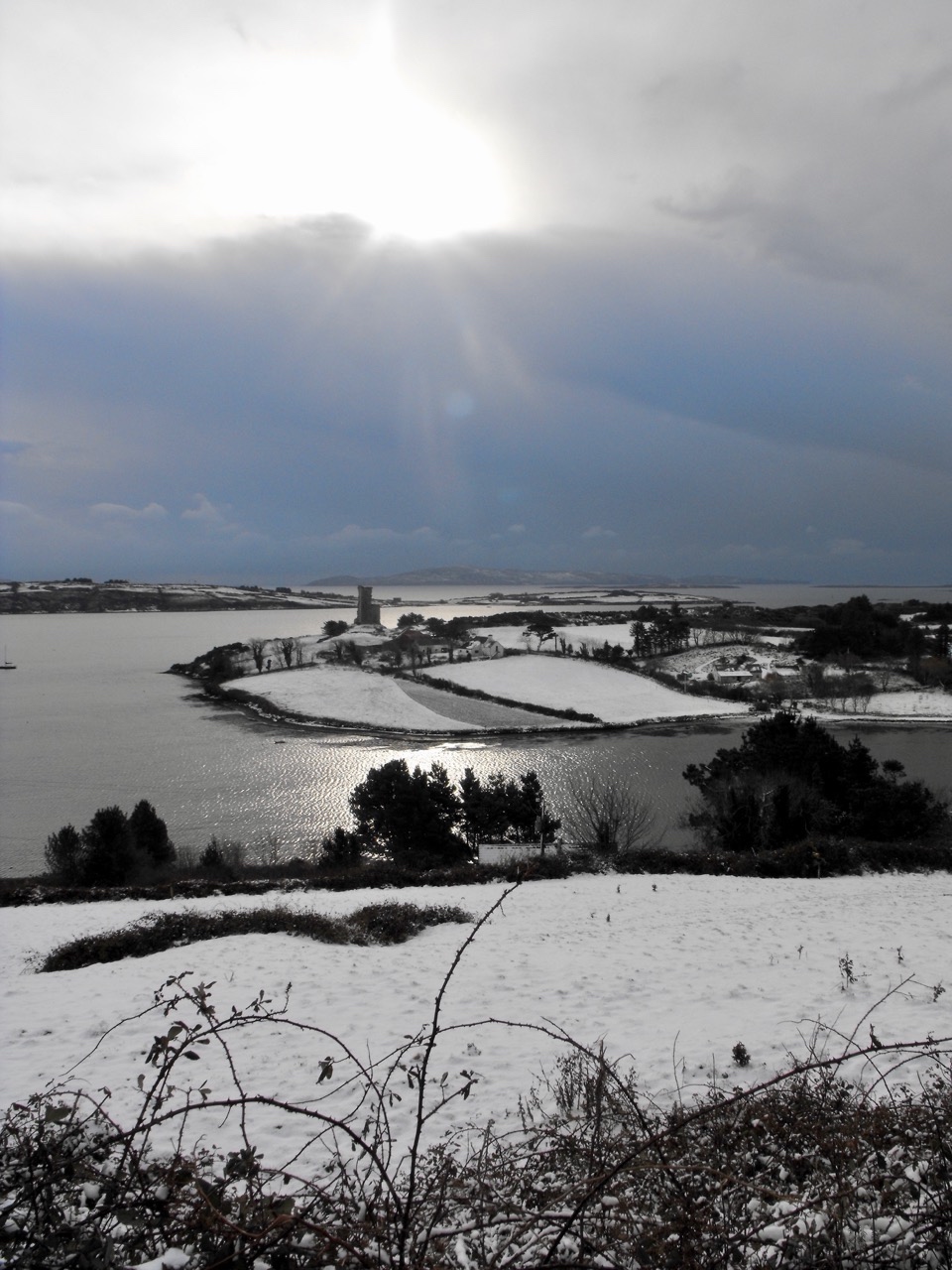
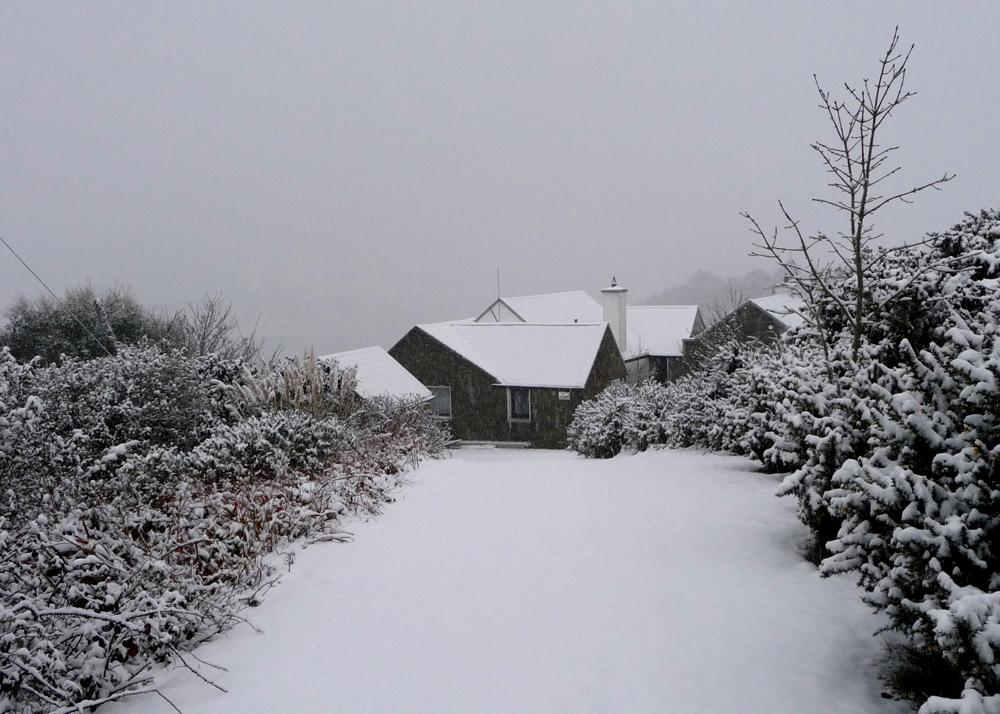
Ten years ago, the west of Ireland experienced an exceptional snowfall, and above is a photograph taken by our near neighbour, Julian van Hasselt, before we arrived. Mostly, our weather is relatively mild due to the effects of the gulf stream on the south-western coast. The castle can clearly be seen here, beyond the fields of Castle Farm. This view of our house (below) was also taken in 2010 by our neighbours Dietrich and Hildegard Eckardt:
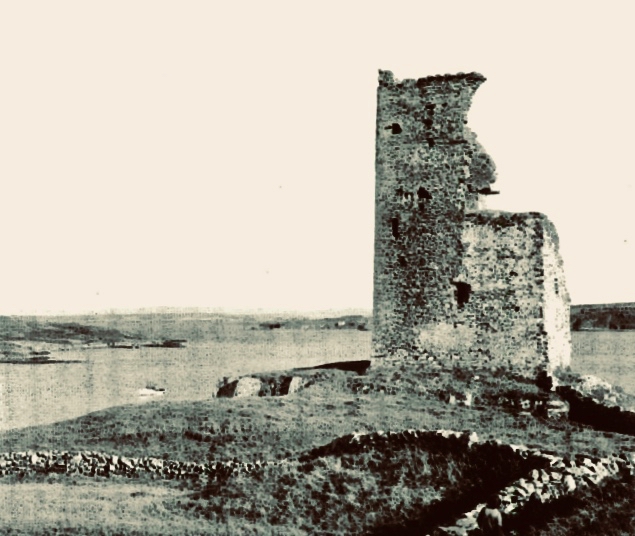
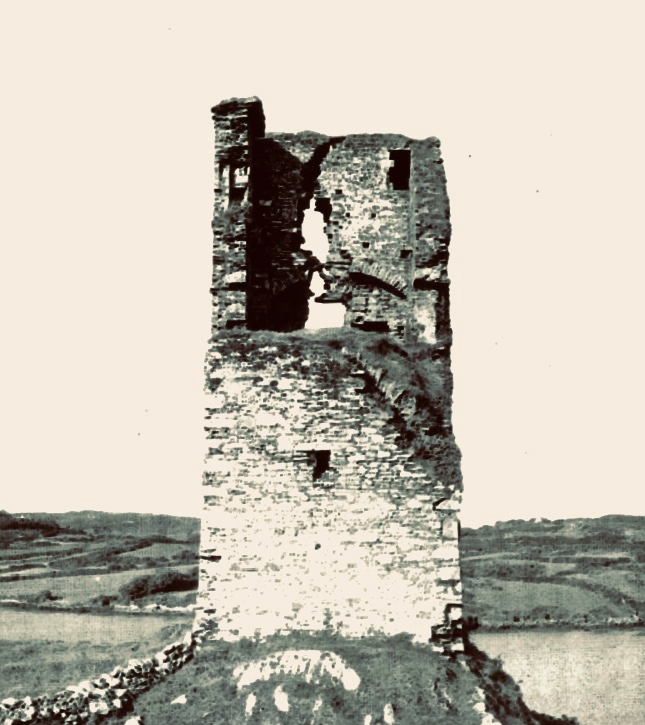
I showed a couple of early photographs of the castle last week. Here are two more taken before a substantial part of the ruined structure was toppled by a storm in the 1970s:
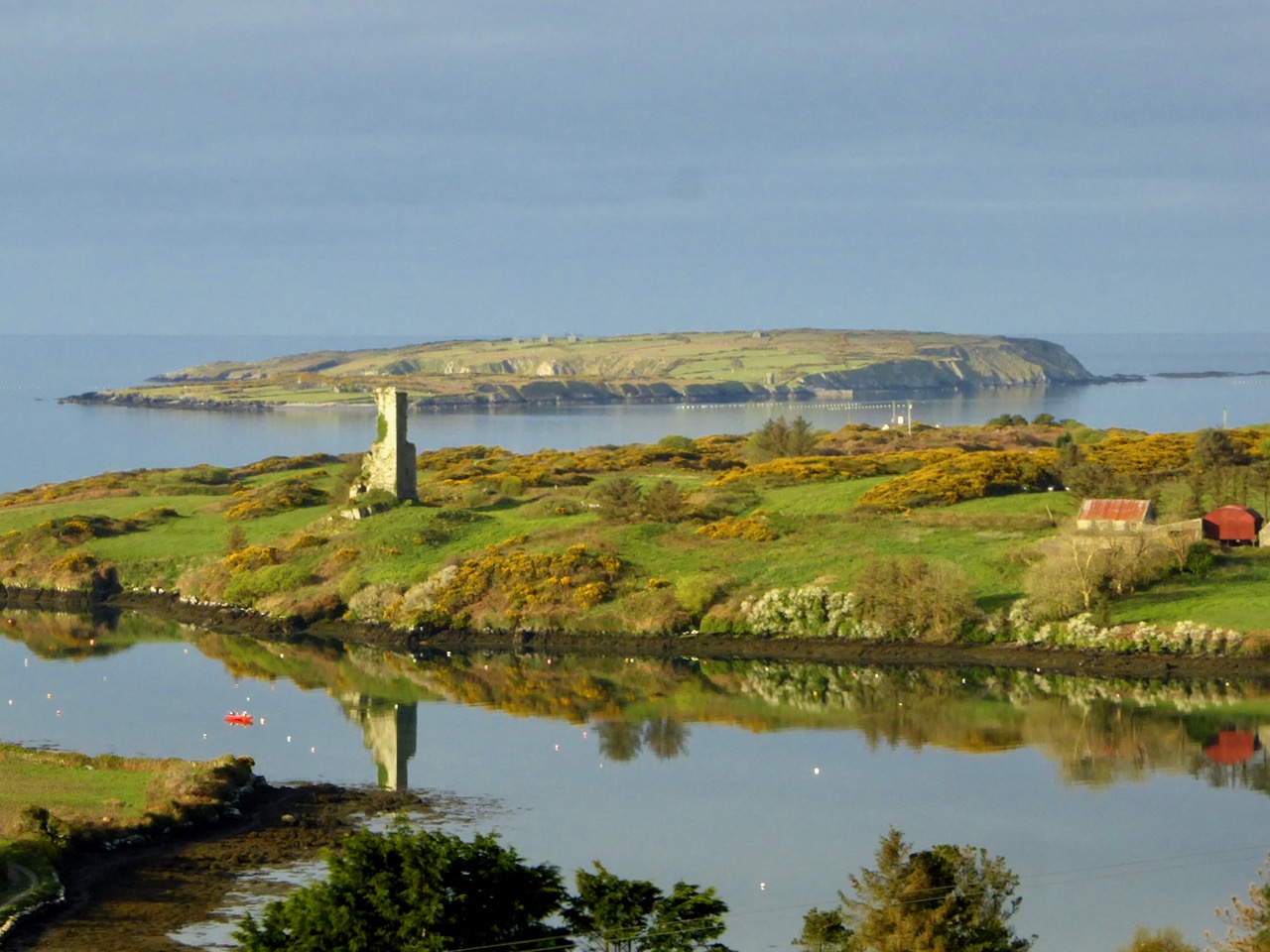
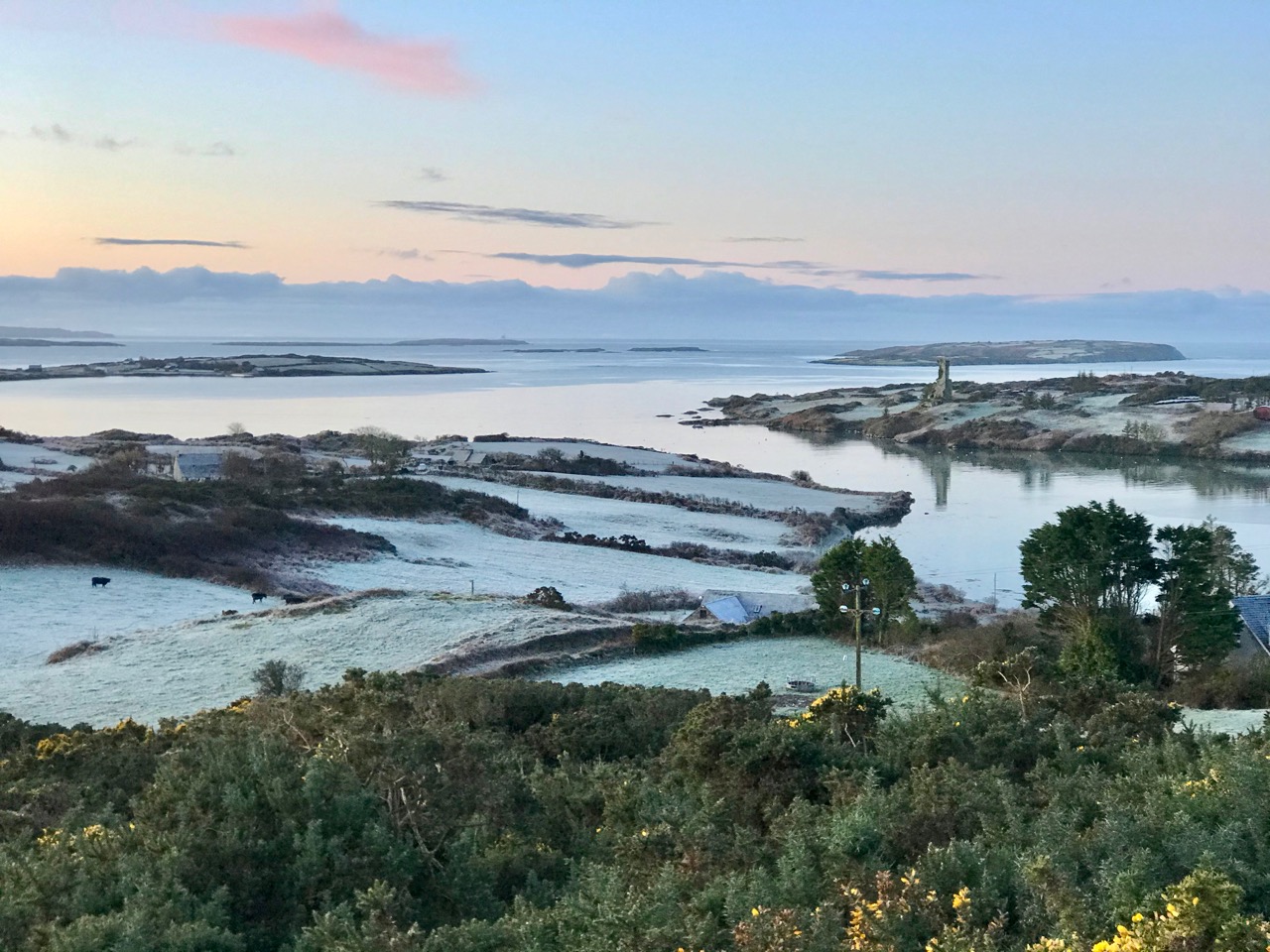
It’s good to see a bit of context, so here is another winter view of the castle on its rock with Castle Island behind. That island was also part of the O’Mahony territory. It is farmed by its present owner but no-one lives there now. You can make out the ruined castle on the island by the shore, just to the right of centre; it’s one of many that can be seen on, or close to, the shores of the Bay.
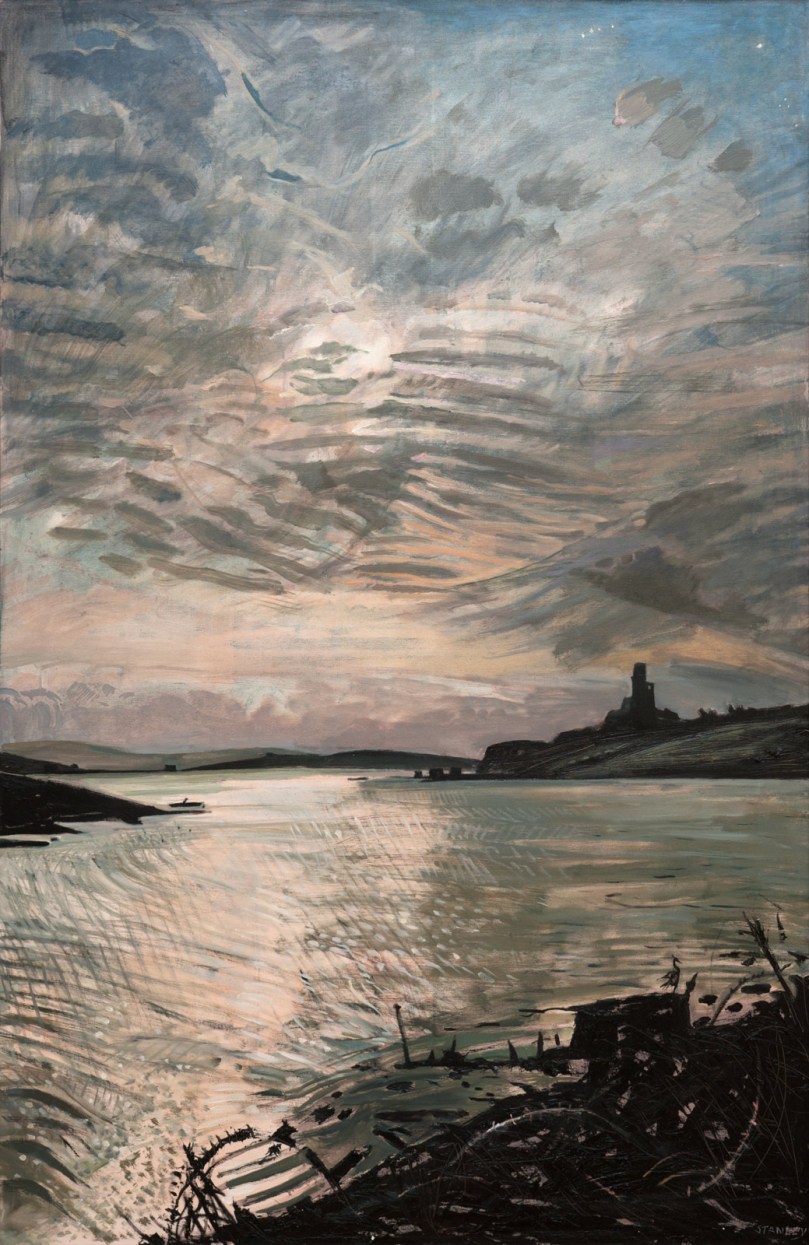
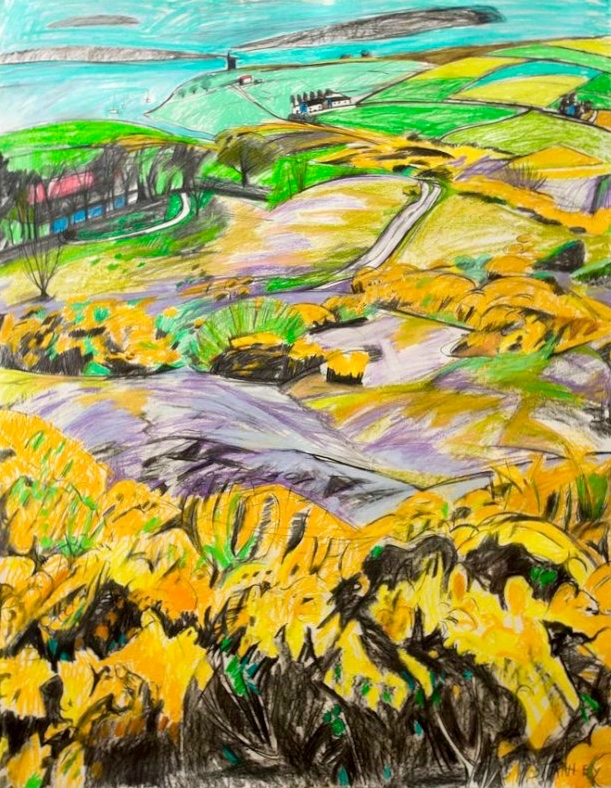
Let’s have a look at some of the art works that feature the Cove and the Castle. Jacqueline Stanley was one of many artists who was attracted to the beauty of West Cork. Now in her nineties, she moved from England to Ireland in the mid 1970s and purchased the old School House at Rossbrin as a country retreat: it has only recently changed hands.Here are two of her works, depicting Rossbrin. You can find more on her website.
I particularly like this view (above) which was painted by Jackie from the vantage point above the high road going down to the Cove, close to the remains of the copper mine at Ballycumisk. Last week I showed a painting by Geraldine van Hasselt, Julian’s mother, also from the 1970s. Every painting or photo is a historical document – and important to retain, in view of the fragile nature of the structure today.
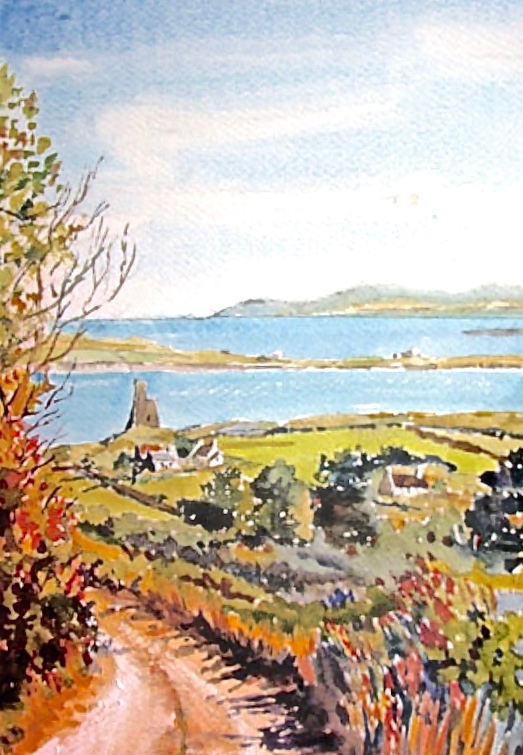
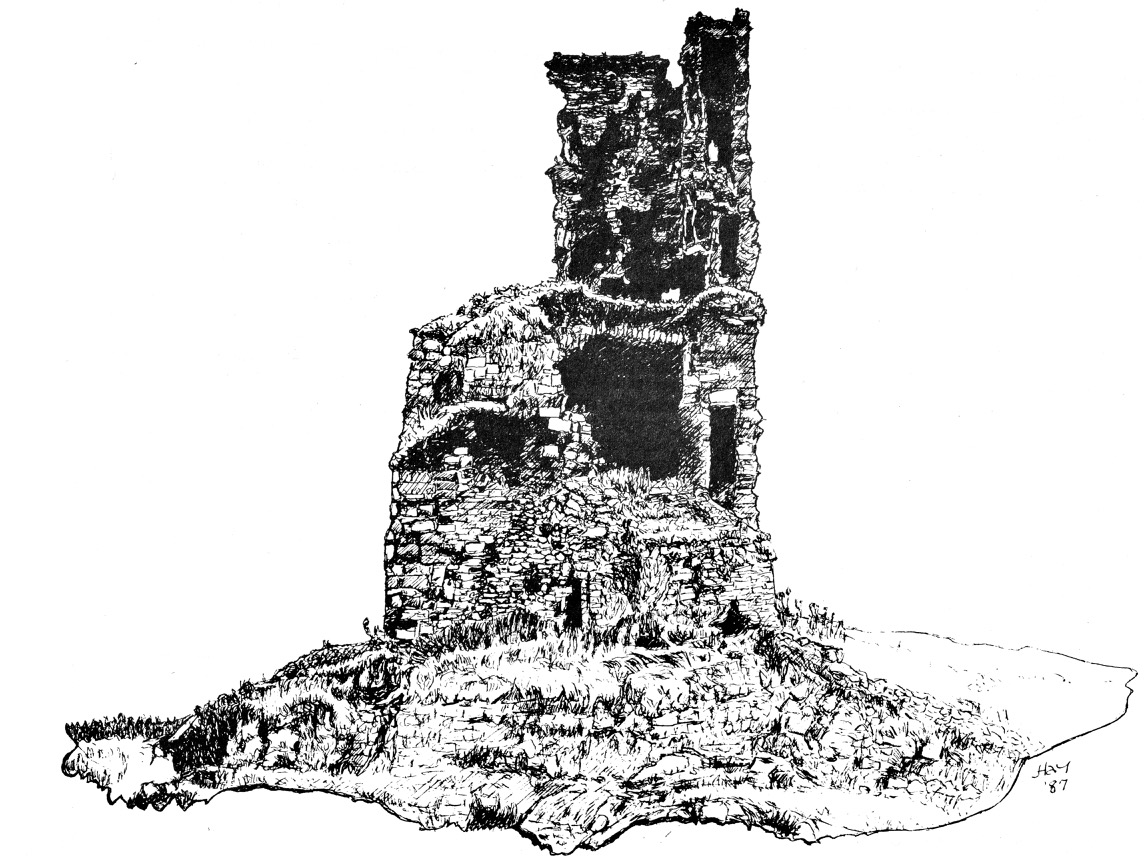
Our friend Peter Mabey is an architect and artist. He has lived in West Cork for a long time: he and I were at college together in Kingston, Surrey, and were surprised to meet each other by chance in Skibbereen market a good few years ago now. Above is one of his attractive watercolours looking down towards the Cove. The vantage point looks remarkably like the one chosen by Jackie Stanley. Below is a drawing of Rossbrin from the monumental work The Castles of County Cork by the late James N Healy, published in 1988 by Mercier:
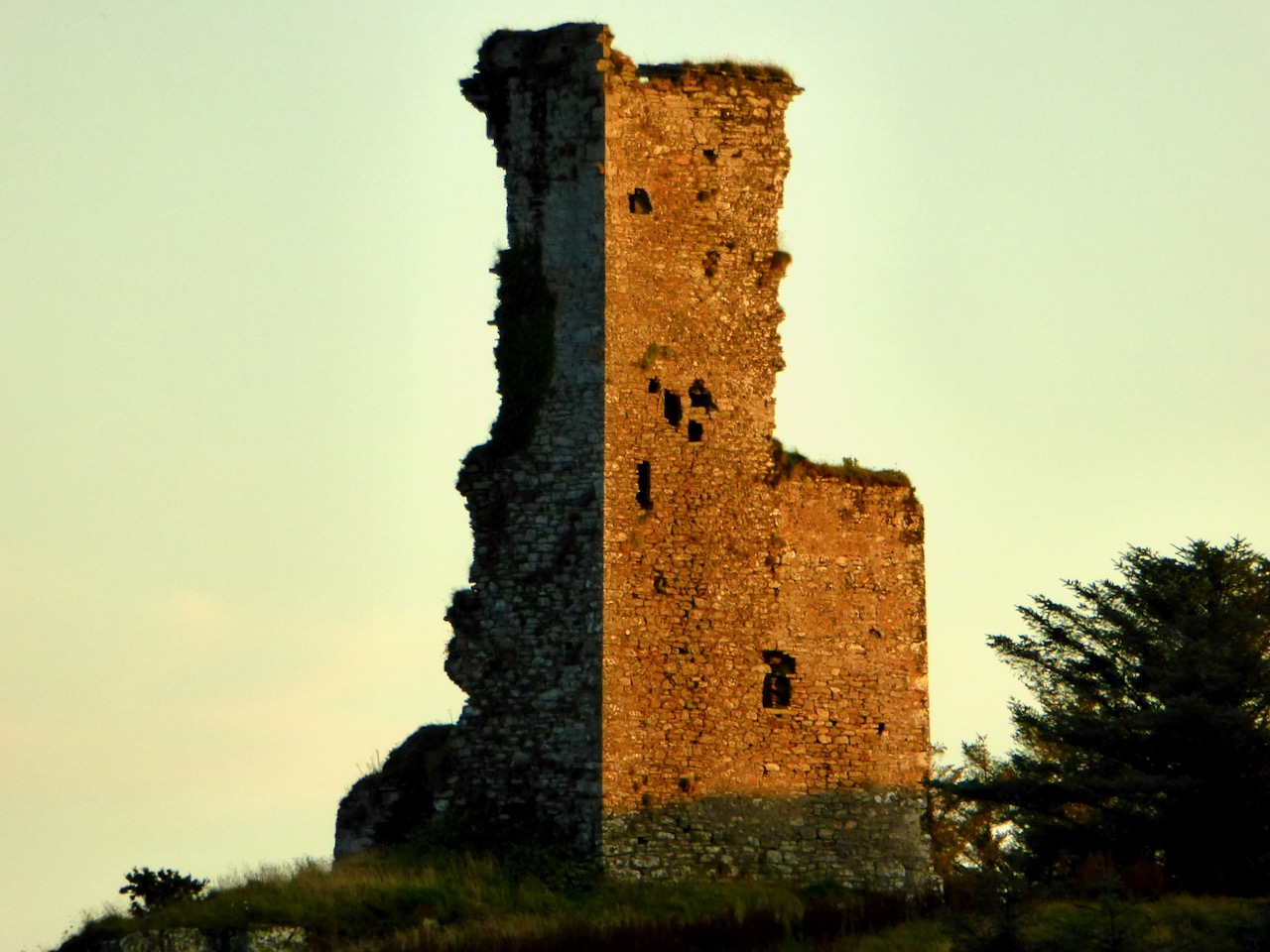
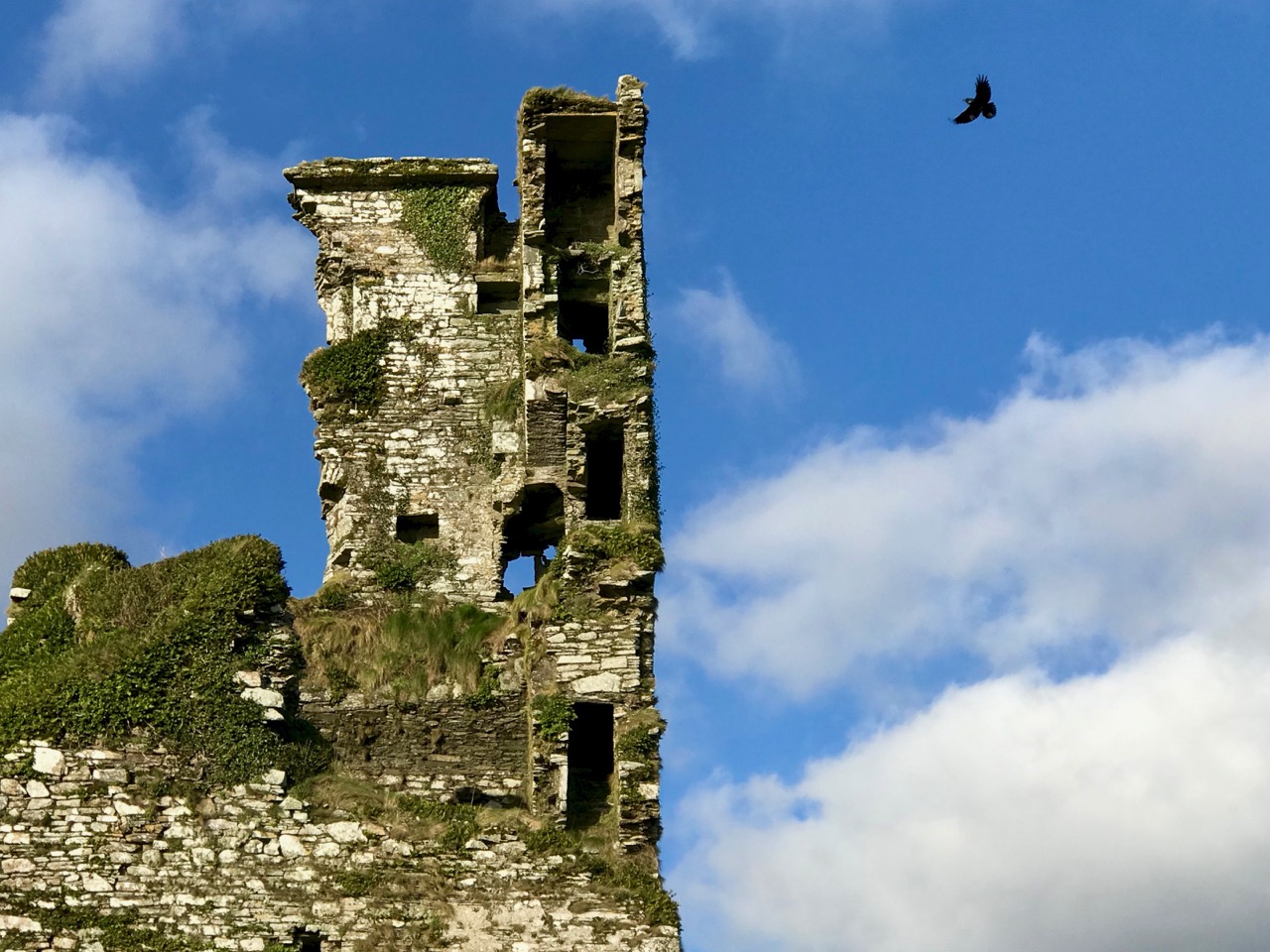
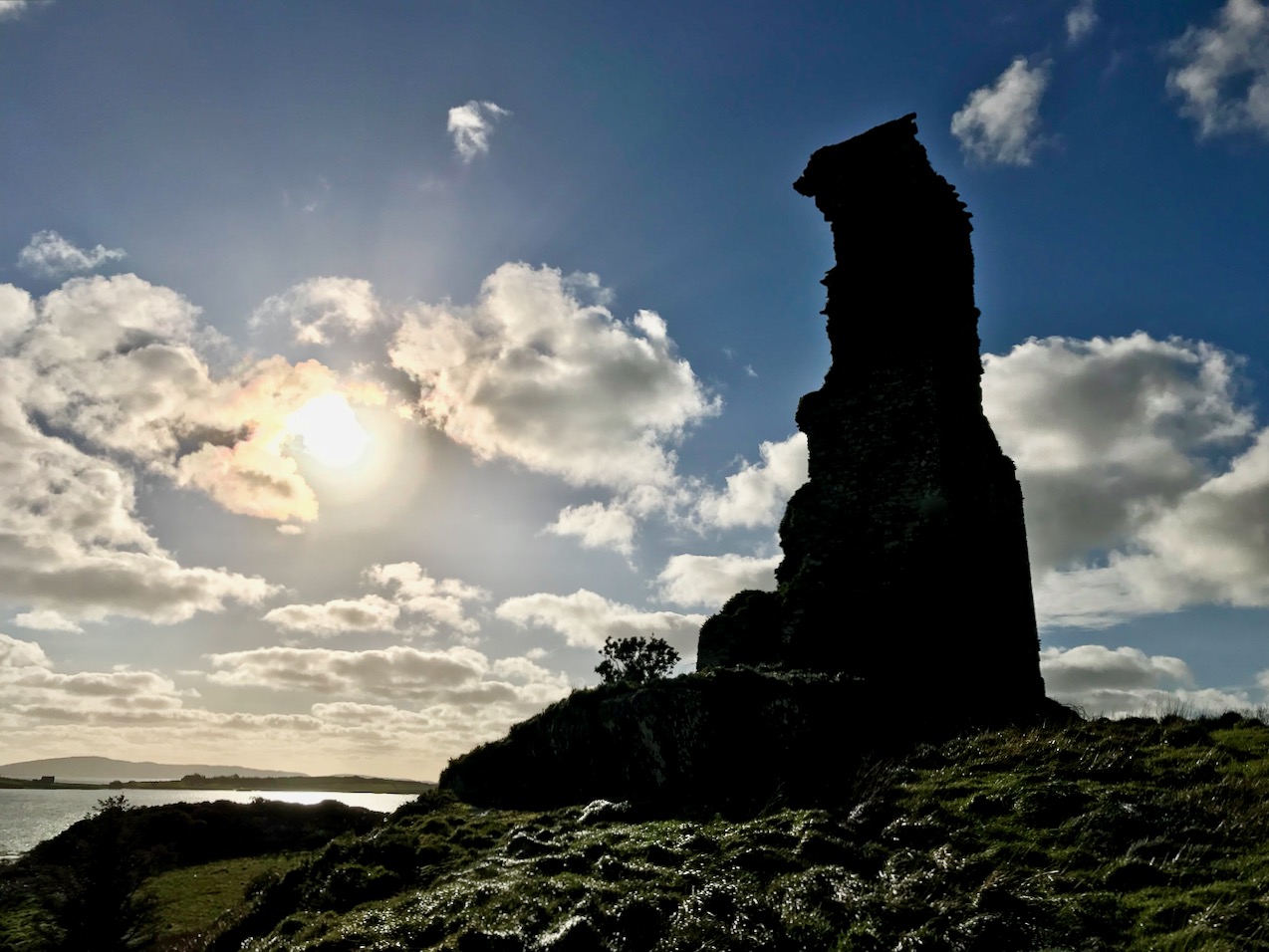
The ruin is a romantic reminder of past times, enhanced by the changing weather moods of Roaringwater Bay. This photograph, by Finola, emphasises the character of the place:
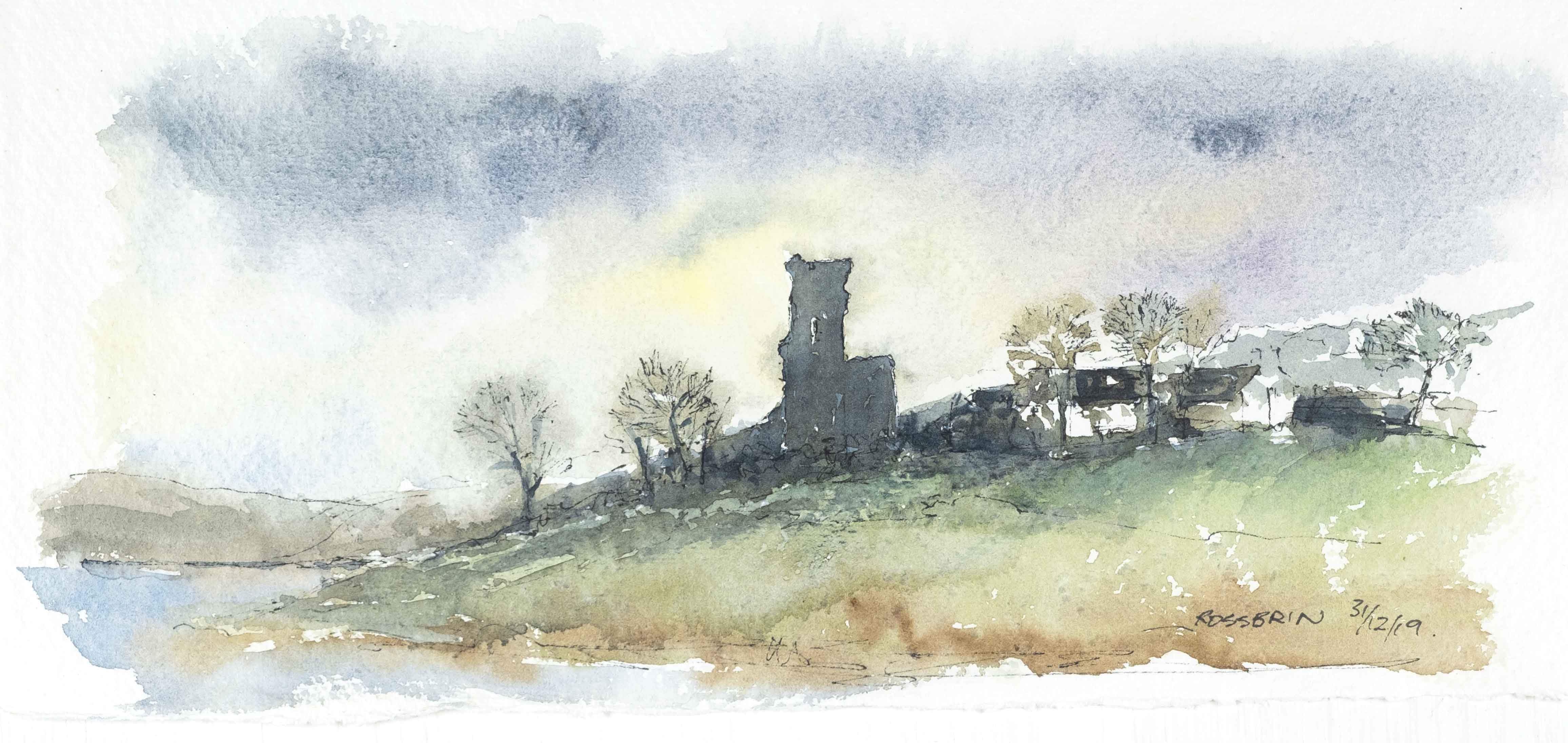
I can’t resist finishing this little two-part foray into the medieval remnants of our historically significant ‘centre of culture and learning’, which now languish on the edge of the waters below us with an artist whose work we admire: Peter Clarke, who writes and illustrates the Hikelines blog. His watercolour sketches are exquisite and always atmospheric. He has kindly allowed me to use his portrayal of Rossbrin Castle as my tailpiece. Thank you, Peter – and thank you to all the other artists who have been inspired by this remote and beautiful part of Ireland.
It was just Raven and I, down at Rossbrin today. We were both inspecting the O’Mahony stronghold which has stood here for, perhaps, 800 years in one form or another. Peter Somerville-Large explored the area and its history in the early 1970s:
Down beside a narrow inlet which empties at low tide stands Rosbrin, the most easterly of the O’Mahony castles. Like the O’Driscolls, the O’Mahonys had a passion for building castles: they built twelve, and six survive, all overlooking or right on the edge of the sea. They shared with the O’Driscolls one of the finest fishing grounds in Europe, controlling the waters and exacting dues from visiting fishing boats in much the same way. ‘None of the fisheries of Munster are so well known,’ wrote an observer in 1688, ‘as those of the promontory of Ivaha, whereto a great fleet of Spaniards and Portuguese go, even in the midst of winter . . .’
The Coast of West Cork, 1972
Neither Raven nor I would be deterred by the winter weather. On a day of hard frost followed by blue skies and sunshine, nowhere could be more beautiful than Rossbrin, and nothing could be more poignant than the quiet remoteness of this western corner of Ireland, once considered ‘the greatest centre of learning in Europe’. I walked in the company of the wisest of the corvids over the vanished ruins of a great university.
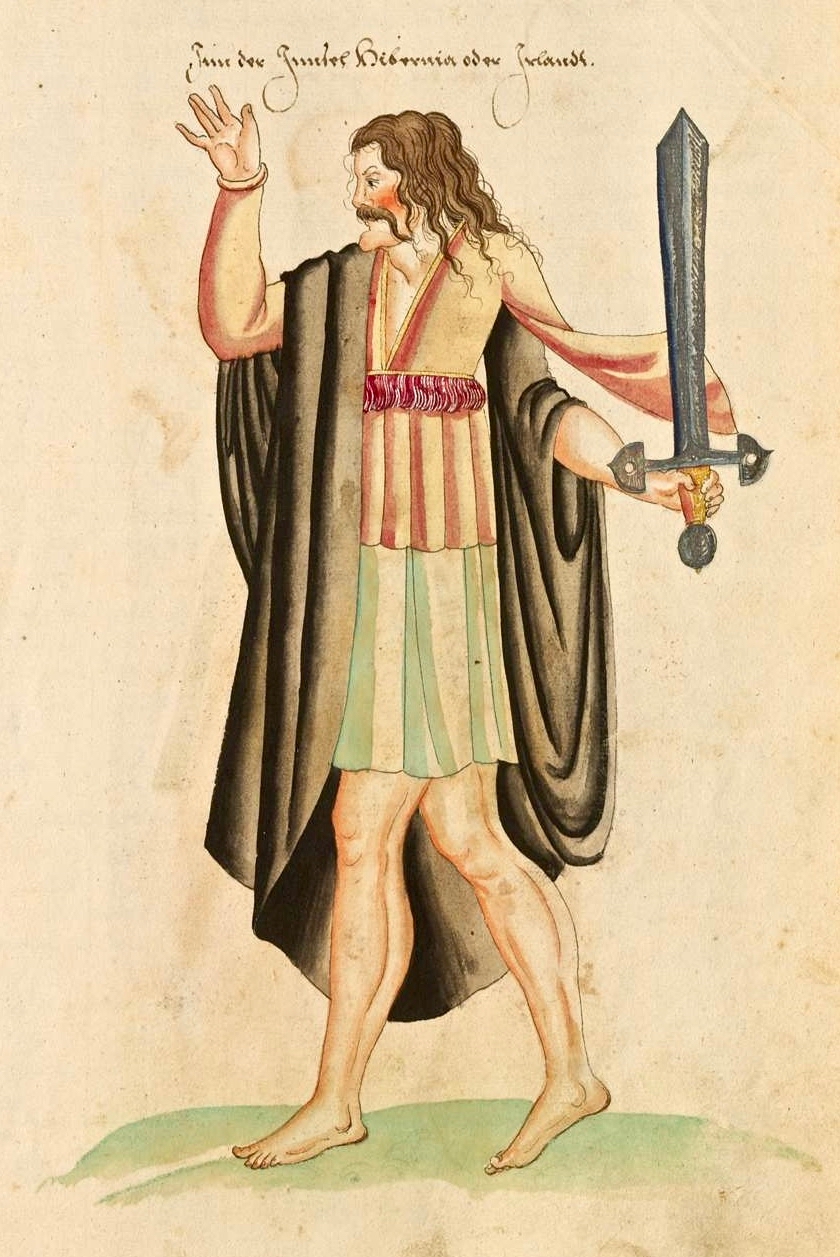
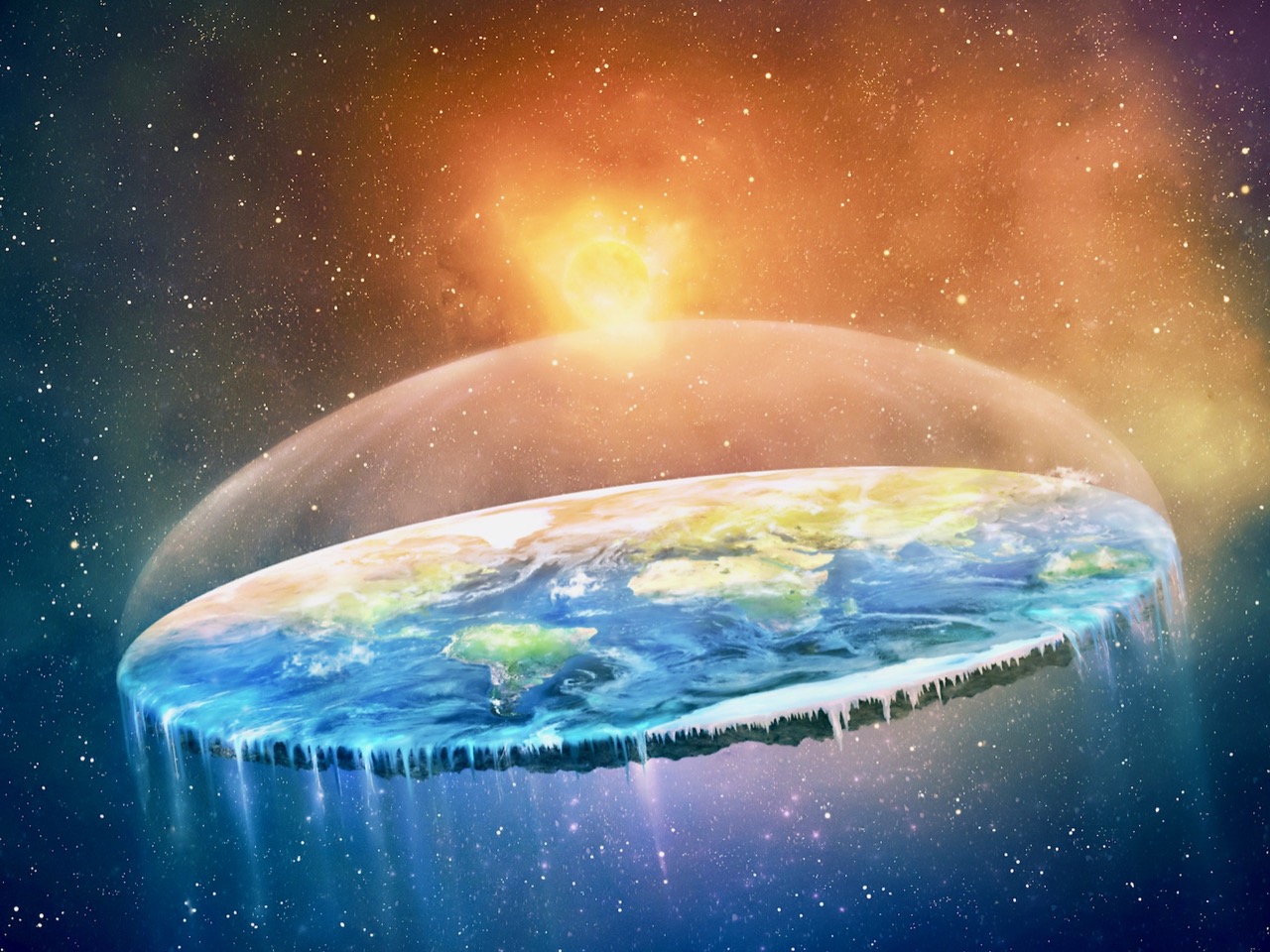
Finnin O’Mahony – Taoiseach, or chieftain, of the clan – as he may well have looked in the latter part of the fifteenth century (above): cultured, fashionable, flamboyant even, and powerful. It’s sobering to think that, while Columbus was following in the footsteps of Saint Brendan to rediscover the New World, scholars and scribes were busy on the shores of Roaringwater Bay writing and translating treatises, medical manuscripts and historical accounts of travellers busy in their quests to prove the earth may not be flat after all . . .
The Annals of Ulster tell us that Finghinn Ó Mathúna of Rossbrin Castle who died in 1496 was an acclaimed historian of the then known world. And, the Annals of Connaught lauded him as ‘a great scholar in Irish, Latin and English’. The Annals of the Four Masters referred to Finghinn Ó Mathúna as being unmatched in Munster for hospitality and scholarship. The O’Mahony territory was inclusive of today’s parishes of Dromore and Caheragh and all the lands westwards to Mizen Head. Finghinn made Rossbrin Castle both his residence and a rendezvous for Irish scholars . . . Most writers who laud the scholarship of Finghinn Ó Mathúna lament the loss of many of Rossbrin Castle’s manuscripts . . .
From an article by Alfie O’Mahony in the Skibbereen and District Historical Society Journal, Volume 6, 2010
Roaringwater Bay – the view to the south, today, from Rossbrin. In the foreground is Horse Island, and beyond is the profile of Cape Clear, also a place of learning to this day: students of the Irish language spend time on the island, one of the Gaeltacht areas where Irish is still the native tongue. One of the reasons for Finghinn being so expert in languages himself was the desire to communicate with the visiting fishermen whose needs provided him and his clansmen with a good living. As well as a celebrated place of learning, Rossbrin Cove would have supplied fish palaces and all the trappings of the industry: barrels and salt for preserving, victuallers, alehouses, brothels . . . It must have been a boisterous and vibrant place.
Peter Somerville-Large gives a commentary on the more recent history of the castle:
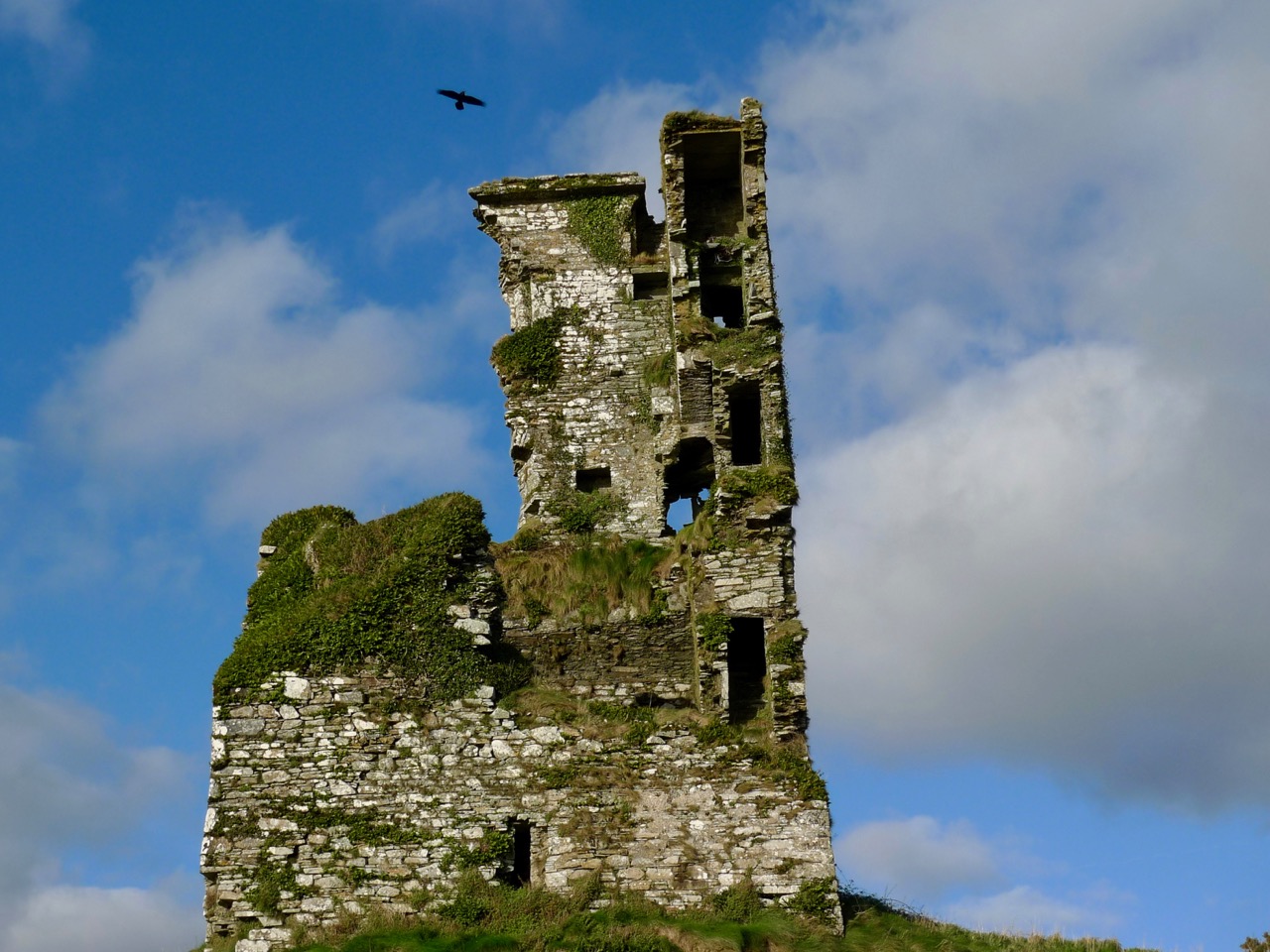
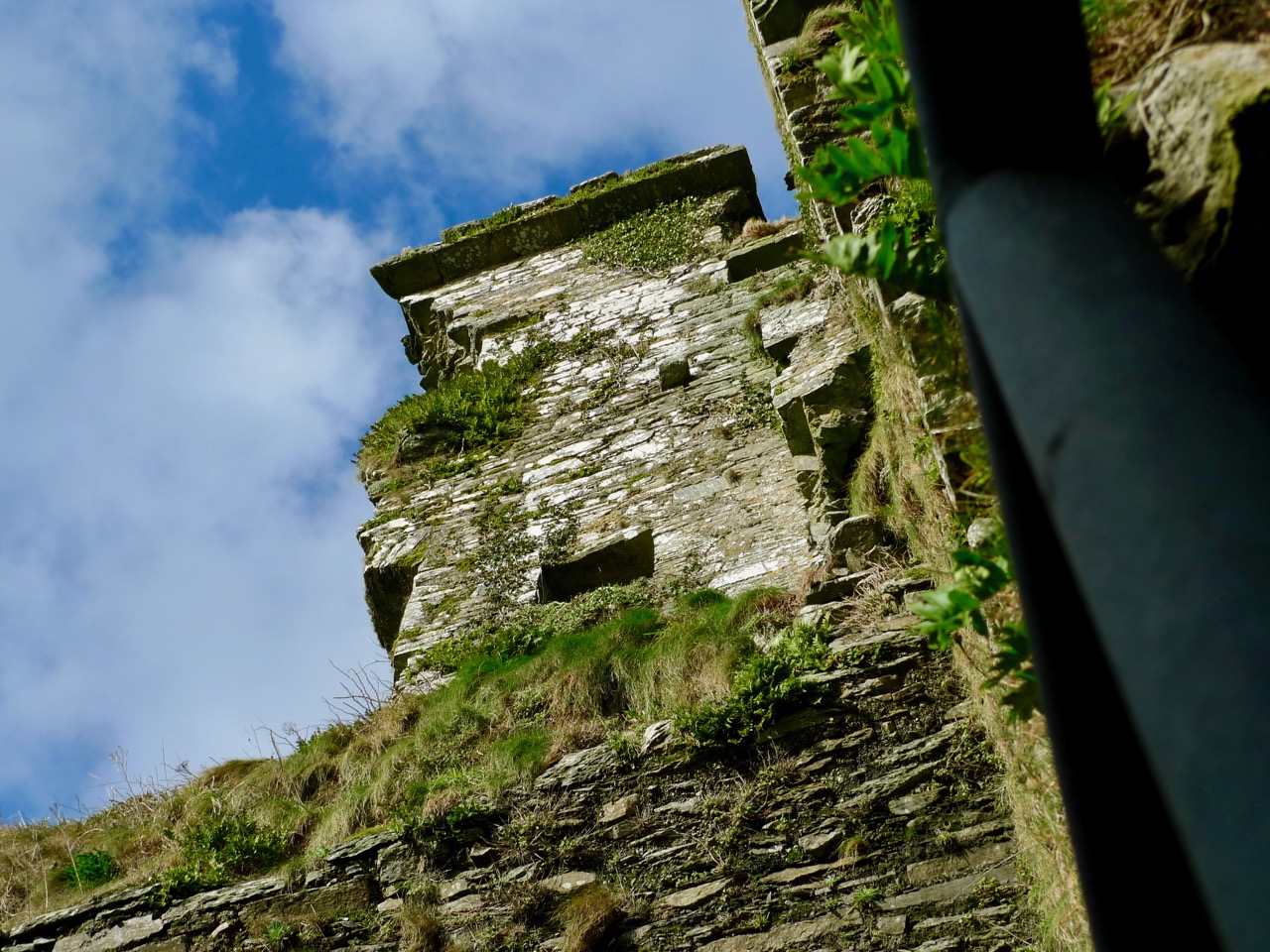
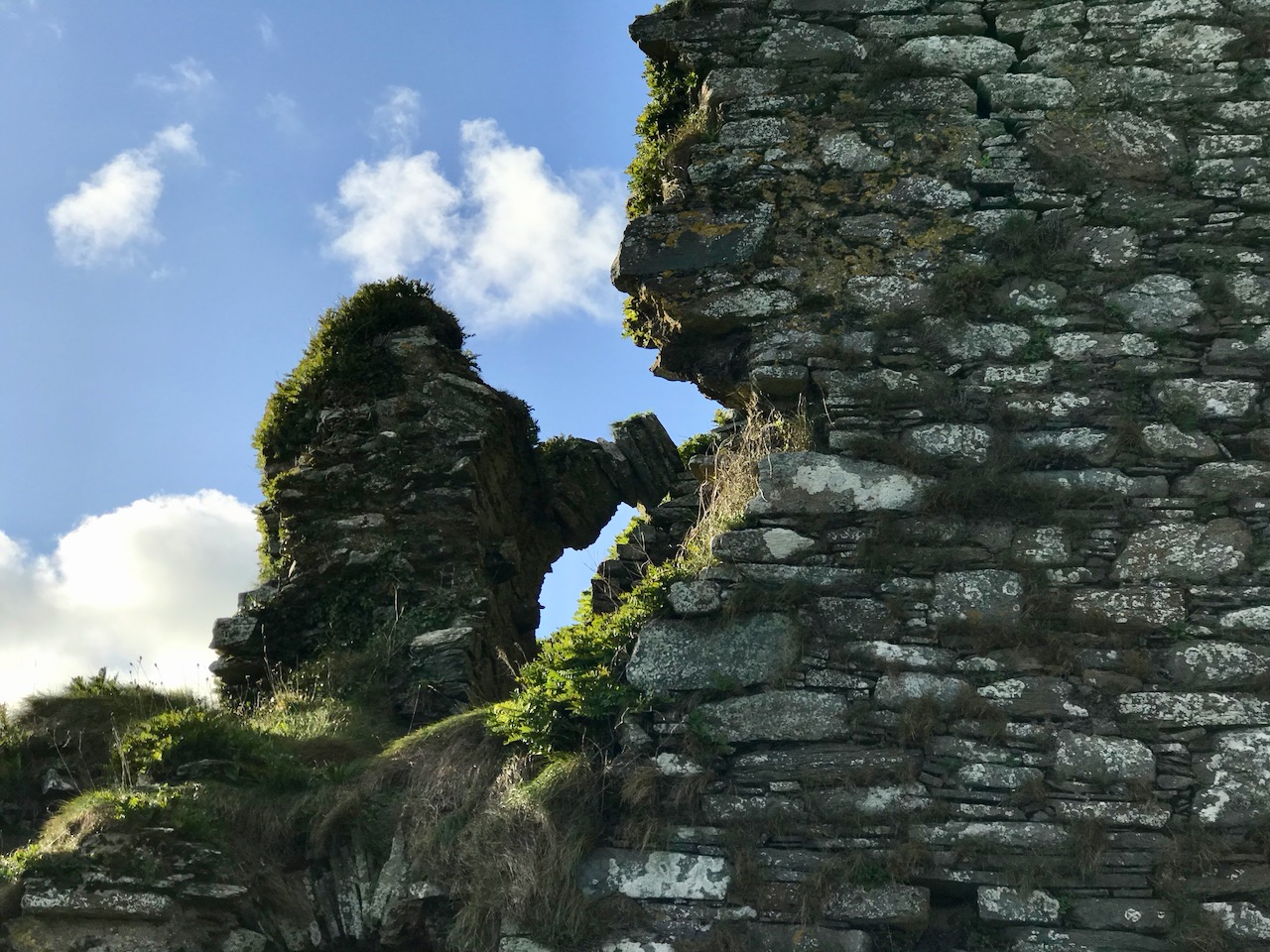
One wall of the splintered tower has a crack running down the side. Another was partly blown down by a storm in 1905. If there is another great storm like that one, Rosbrin might well disappear without trace, like the O’Mahony castles at Ballydevlin, Castle Meighan and Crookhaven. It is sited on an area which is very difficult to approach from either land or sea, standing on a rock. Contrary to what might be written in Holy Scripture, buildings on rocks have little in the way of foundation, and when they fall down or are swept away there is nothing left of them except a memory . . .
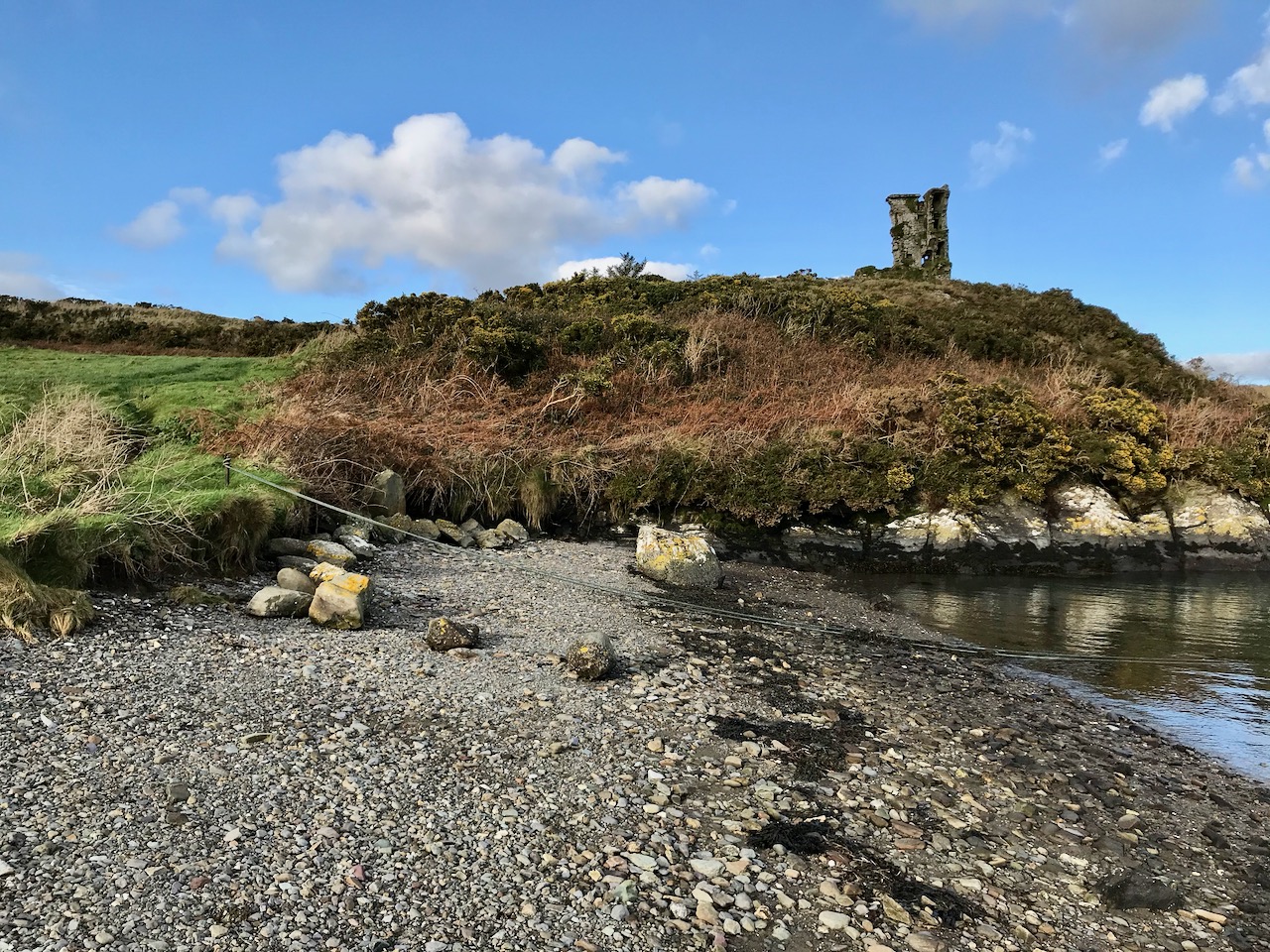
To the south of the rock on which the castle stands are the vestigial remains of an ancient stone quay (above), still in use as a landing place. The Cove itself – a natural haven – would have been the main harbour area serving the fishing fleets. The castle stands sentinel above the harbour entrance, ensuring that no-one could approach unseen.
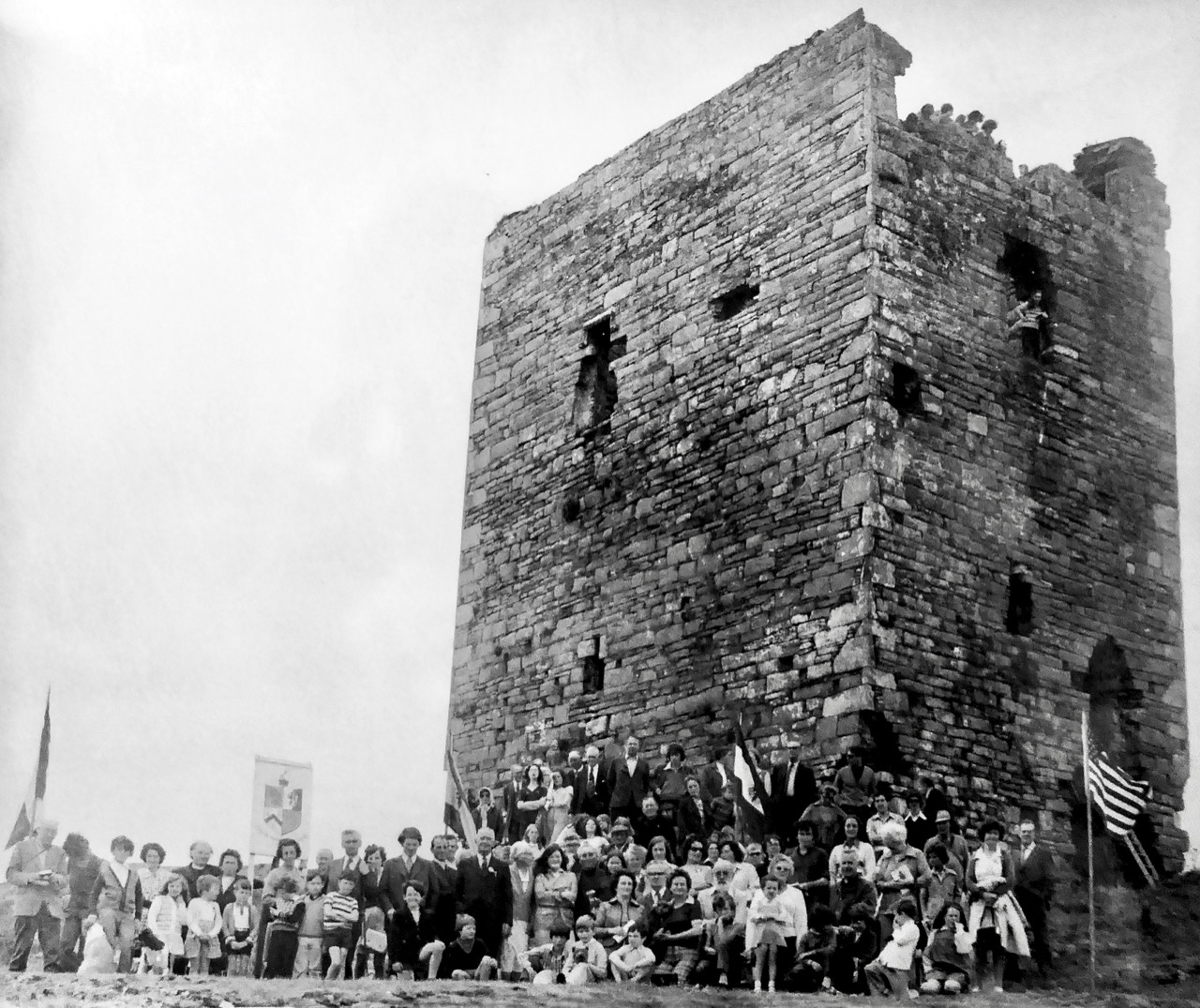
I have been looking for older illustrations of the castle, in order to ascertain how much erosion is taking place as the years go by. Here’s a fascinating record of an O’Mahony Clan Gathering, photographed in 1975 by Michael Minihan of Skibbereen. There is a lot more of the building intact at that time. Can you see the spectators high up on the walls and roof? [Note: I was mistaken – this is actually Leamcon or Black Castle before reconstruction. I am leaving it in to illustrate what Rossbrin may have looked like before it started to fall apart.]
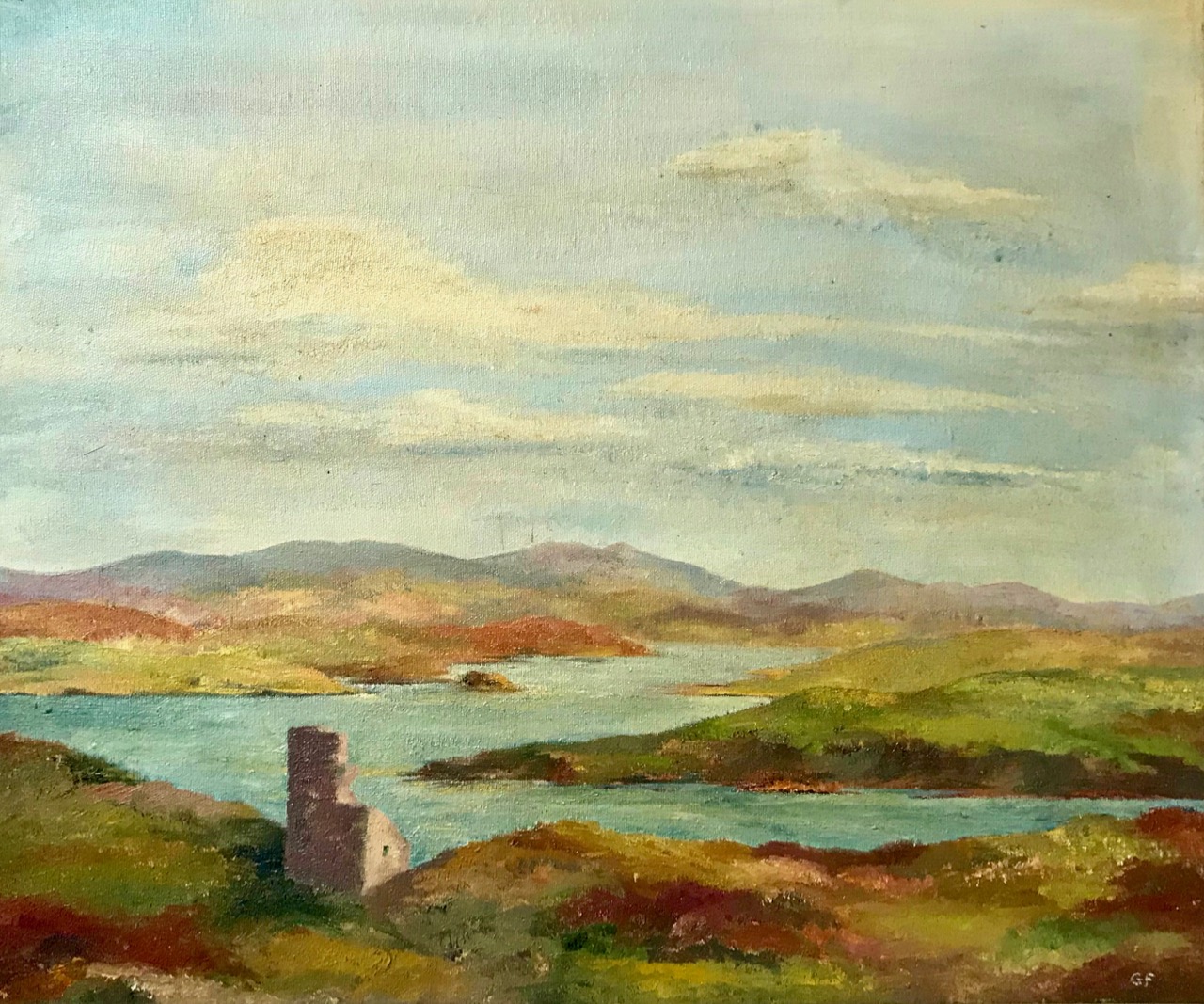
As most of you will know, we look down on Rossbrin Cove and Castle from our eyrie up at Nead an Iolair. We consider anyone living on or by the Cove a neighbour. One of these is Julian, the first to welcome us when we arrived here many years ago. On my walk today I called in on him – he lives next door to the Castle Farm. I was over the moon when he showed me a portrayal of the Castle which his mother, Geraldine, painted in the 1970s, only a year or so after the gathering at Leamcon, above. A substantial part of the Rossbrin castle walls has collapsed in relatively recent times.
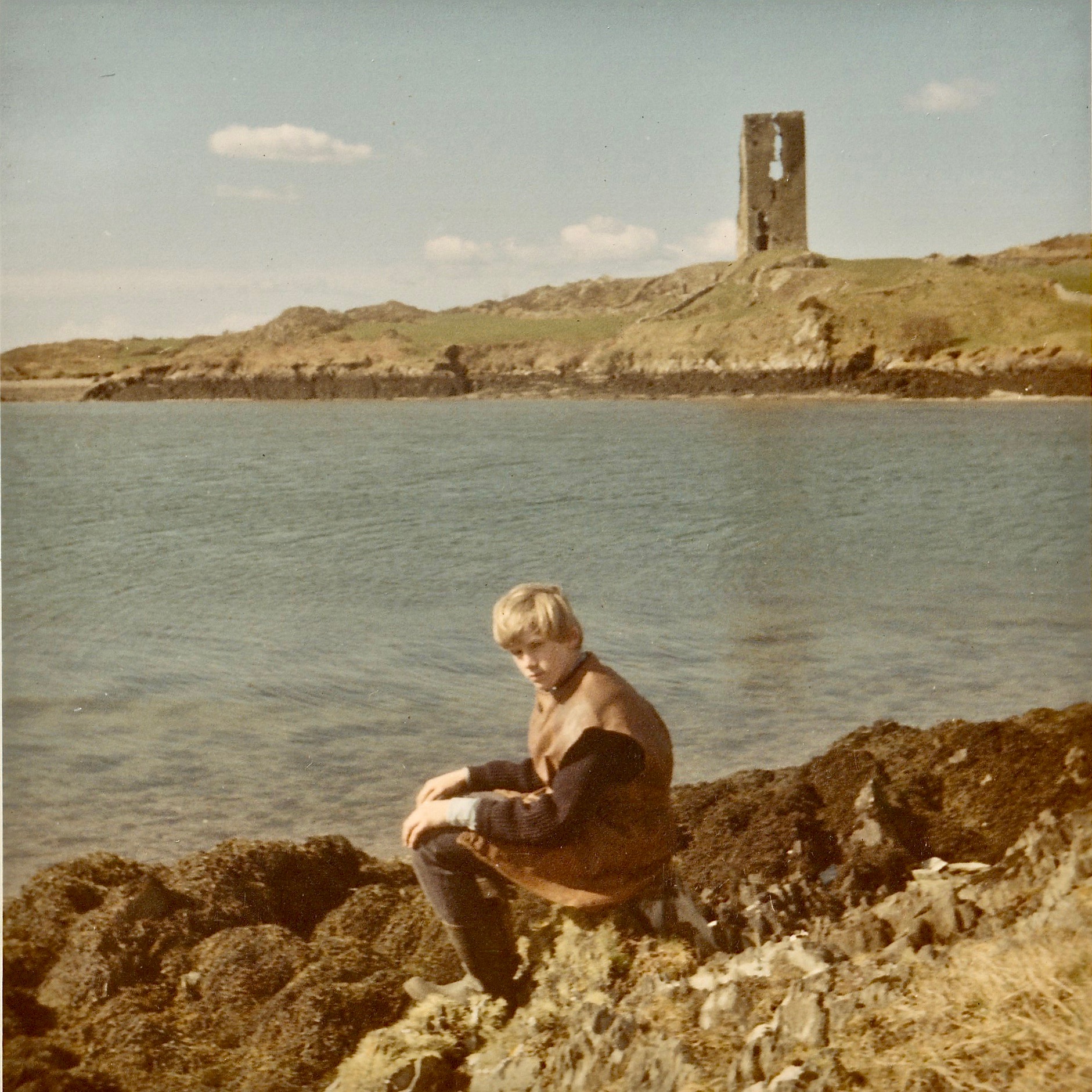
Rossbrin Castle, painted by Geraldine van Hasselt in the 1970s (above). Best of all, though, is a photograph of Julian – her son – taken at Easter, 1969: significant parts of the walls have collapsed since this picture was taken.
Julian van Hasselt on Rossbrin shore: behind him is a clear view of the castle. You can see the vertical crack which eventually led to the collapse of half the tower.
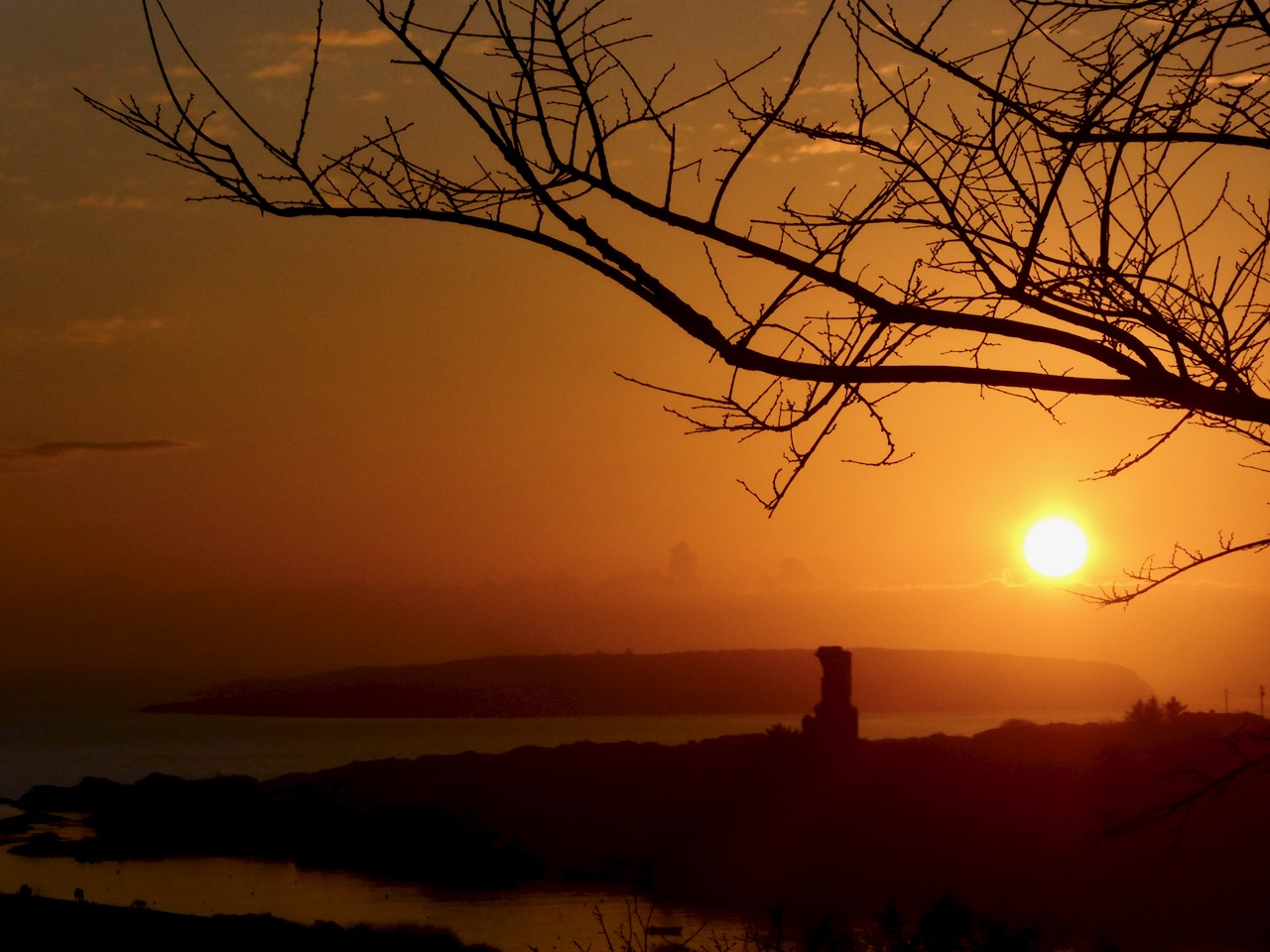
At this time of the year we get excellent sunsets when the weather is right. Today’s was a good one! I reluctantly said goodbye to Raven, my companion whose constant cronking seemed to follow me as I perambulated this place of deep history. I wonder: was it just Raven? Or might it have been Finghinn himself, speaking to me in yet another of his languages? I think I’ll have to return to Rossbrin to find out!
With many thanks to friends Julian and Raven . . .
If the wind is in the south-west at Martinmas (10 November), it keeps there till after Candlemas (2 February) . . .
I’m writing about St Martin again! I’ve already put up posts about this character and his fascinating legacy over the past few years. He can take another – after all, we celebrate St Patrick year after year and that’s ok, because this is Ireland . . . But St Martin never set foot in Ireland (as far as we know) although he is well remembered in many Irish traditions, including that piece of weather-lore above. And here – as elsewhere in Europe – there’s a phenomenon known as St Martin’s Summer, or Martin’s Little Summer, which describes an unseasonable spell of warm weather, sunshine and clear blue skies that occurs around about now, in mid-November. In fact today – Martinmas or St Martin’s eve – has dawned warm and clear.
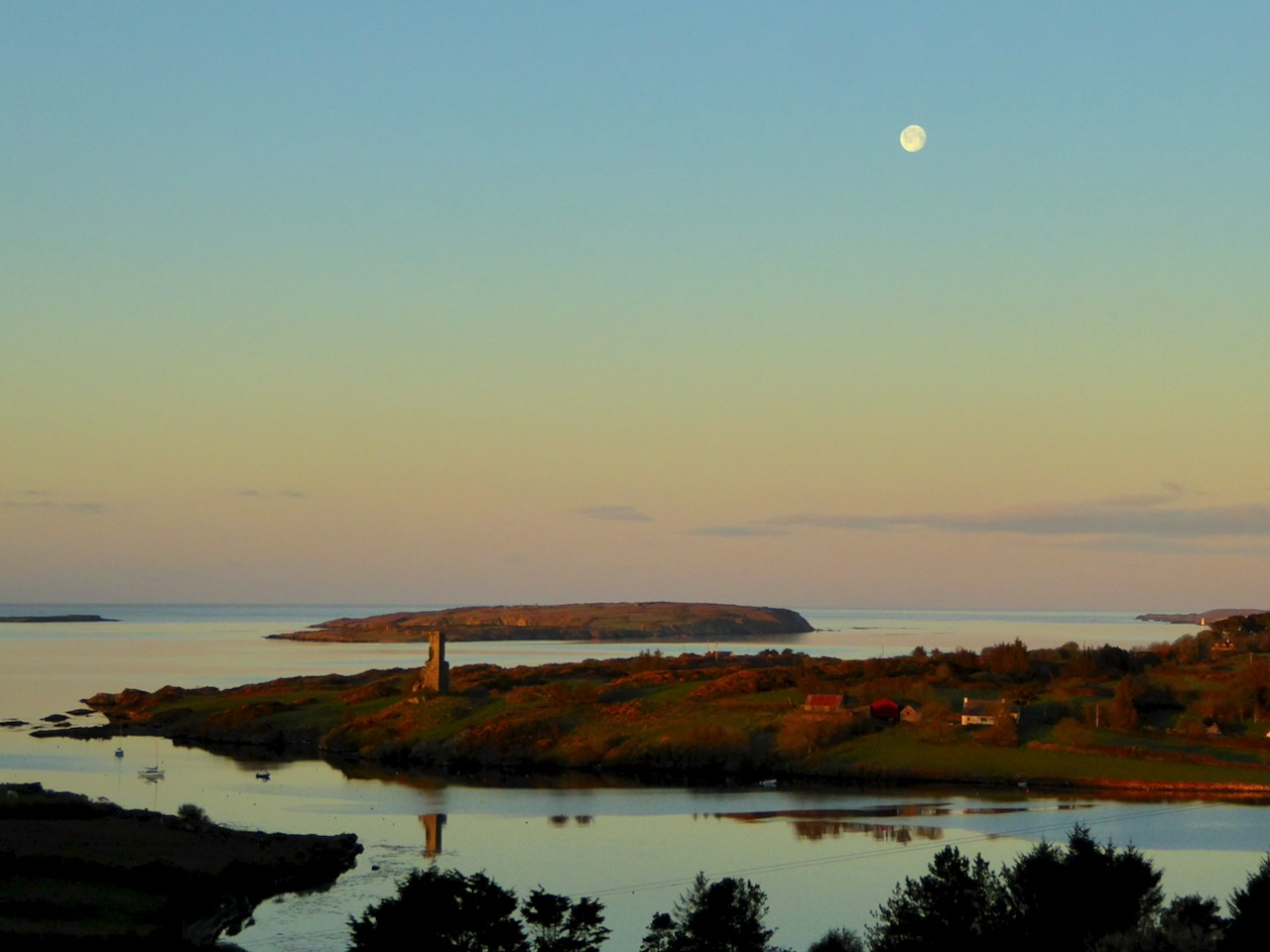
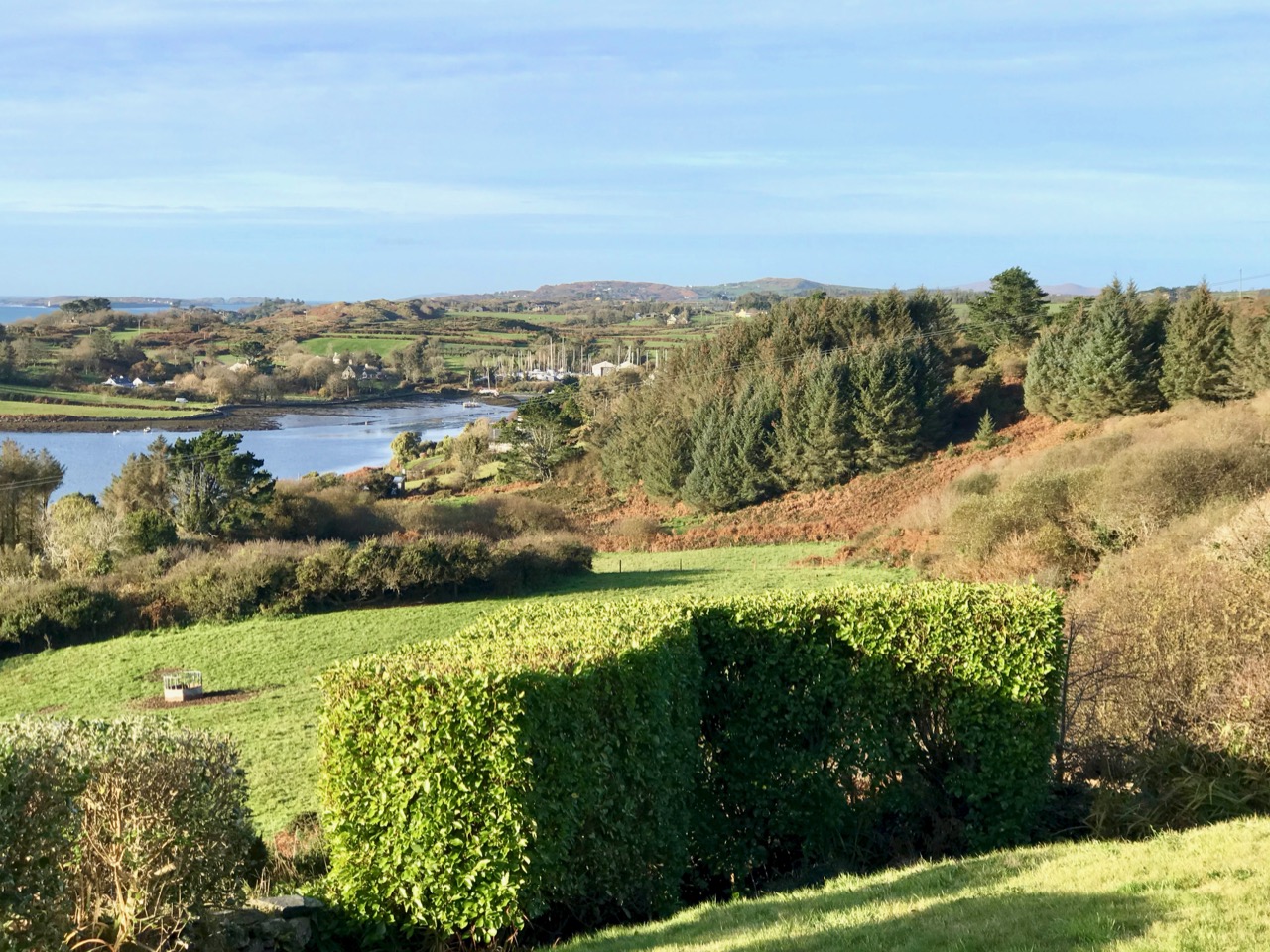
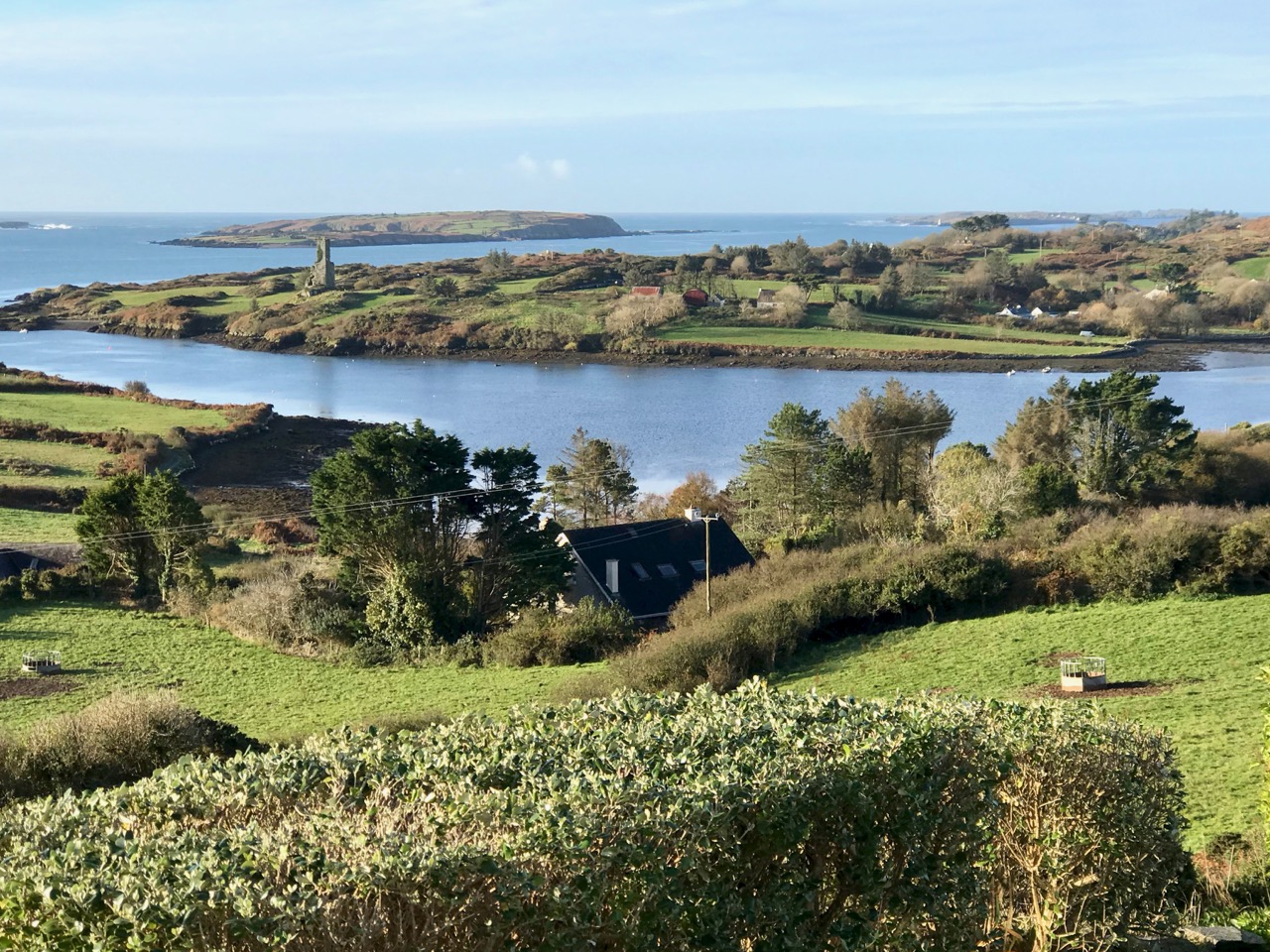
Header and above – looking across Rossbrin Cove from the garden of Nead an Iolair early this morning – St Martin’s Eve – conforming with the tradition of ‘Little Summer’ associated with the saint
The English poet John Clare (1793 – 1864) – sometimes called the peasants’ poet – wrote a very long poem about St Martin’s Eve: I’ll quote some verses as we go along. It’s worth noting that Clare was a great champion of traditional rural life, and was known as “. . . the greatest labouring-class poet . . . No one has ever written more powerfully of nature, of a rural childhood, and of the alienated and unstable self . . .” That’s according to his biographer Jonathan Bate. Although some of his work was well received in his lifetime, he was unable to make enough to keep him, his wife and seven children – and his alcohol consumption – on an even keel. He suffered from ‘strange delusions’ and spent the last twenty seven years of his life in asylums where, nevertheless, he continued to write.
Now that the year grows wearisome with age
& days grow short & nights excessive long
No outdoor sports the village hinds engage Still is the meadow romp and harvest song That wont to echo from each merry throng
At dinner hours beneath high spreading tree
Rude winds hath done the landscape mickle wrong
That nature in her mirth did ill foresee Who clingeth now to hope like shipwrecked folk at sea . . .
(John Clare, St Martin’s Eve, 1823)
Here’s St Martin, looking every inch a medieval knight – although in fact he lived in the fourth century. He was St Patrick’s uncle – possibly accounting for his popularity in Ireland. In this Italian representation he is shown cutting his cloak in two and giving half to a beggar: the act that has made him famous. He was a Roman soldier but gave up that calling to be consecrated as Bishop of Caesarodunum (Tours) in 371. Although he lived a long life, he is said to have died a martyr by being thrown into a mill stream where he was crushed by the wheel. He achieved acclaim as the patron saint of soldiers, but also managed to become the patron saint of conscientious objectors!
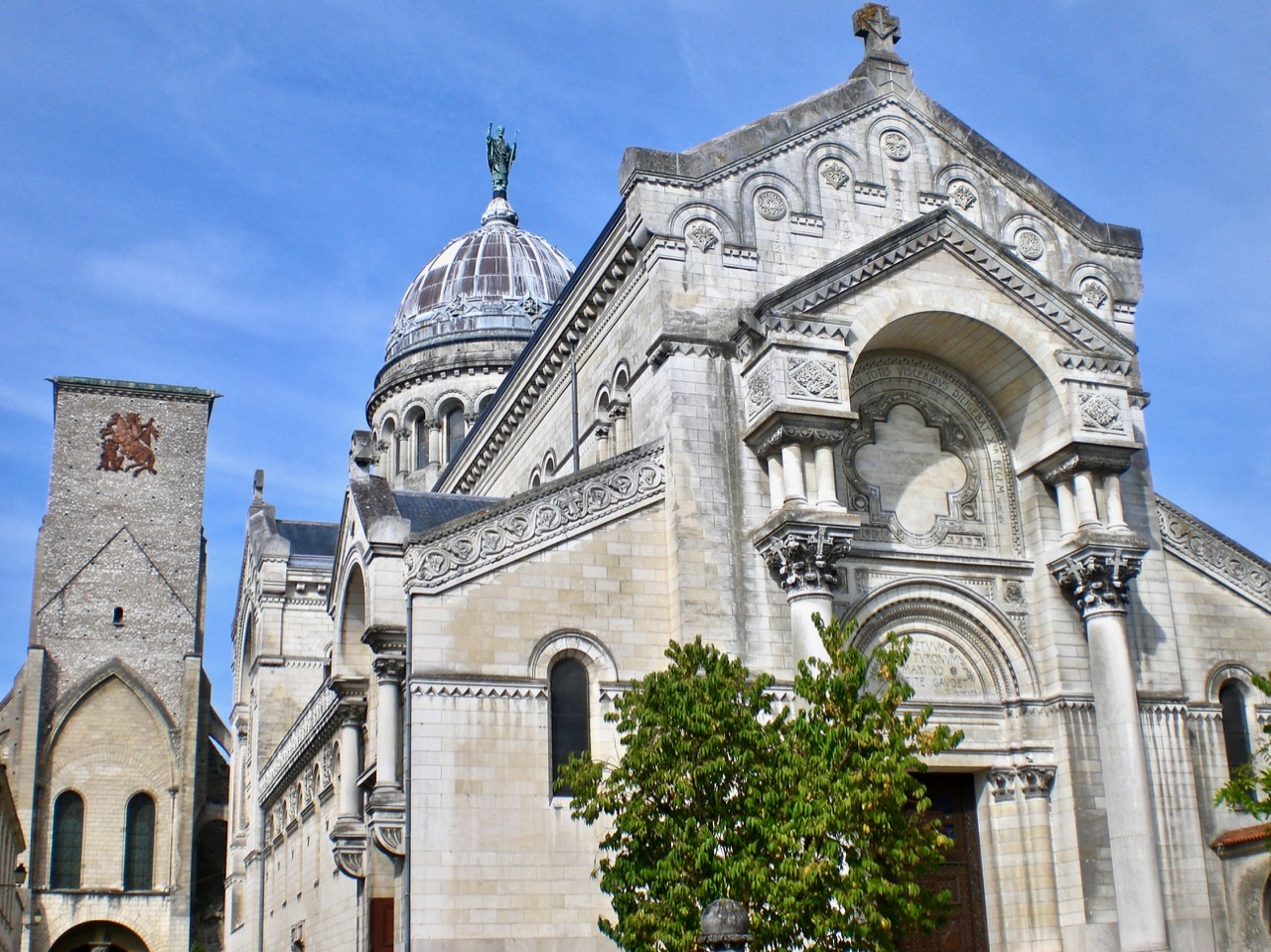
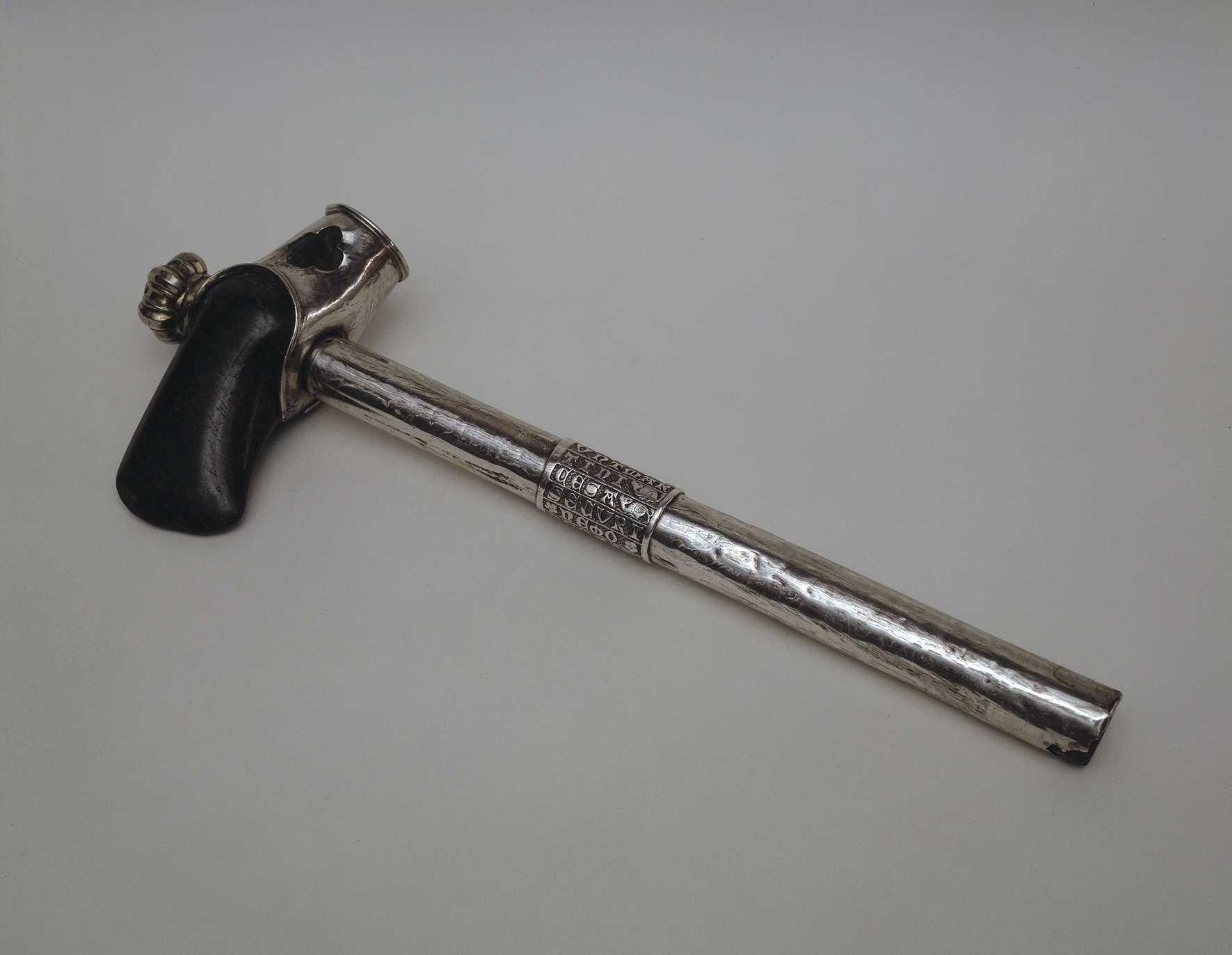
The Basilica at Tours, France (above). St Martin served as Bishop here from 371 – but reluctantly. It is said that he tried to hide from those who wanted to install him as Bishop, but his hiding place was given away by the cackling of geese – which have been associated with the saint ever since. Other stories tell how the saint destroyed pagan temples and cut down sacred trees: in one instance, the pagans agreed to fell their sacred fir tree, if Martin would stand directly in its path. He did so, and it miraculously missed him. There’s a relic in the St Catherine’s Convent Museum of Religious Art in Ultrecht, the Netherlands, which claims to be a hammer which St Martin used to fell pagan sites including sacred trees. Archaeological analysis has shown it was probably made in the 13th or 14th century from a late Bronze Age stone axe dating from c 1,000 – 700 BC. The handle contains a Latin text saying Ydola vanurunt Martini cesa securi nemo deos credat qui sic fuerant ruicuri (‘the pagan statues fall down, hit by St Martin’s axe. Let nobody believe that those are gods, who so easily fall down’). Here it is:
Beside the fire large apples lay to roast
& in a high brown pitcher creaming ale
Was warming seasoned with a nutmeg toast
The merry group of gossips to regale
Around her feet the glad cat curled her tail
Listening the crickets song with half shut eyes
While in the chimney top loud roared the gale
Its blustering howl of outdoor symphonies
That round the cottage hearth bade happier moods arise . . .
(John Clare, St Martin’s Eve, 1823)
It seems a little incongruous, perhaps, to come from a world of basilicas and silver hammers to ancient folk-customs in rural Ireland, but not so long ago Martinmas was greatly celebrated here. Kevin Danaher quotes Mason’s Parochial Survey:
On the eve of St Martin (who is one of the greatest saints in their calendar) in November every family of a village kills an animal of some kind or other; those who are rich kill a cow or a sheep, others a goose or a turkey; while those who are poor, and cannot procure an animal of greater value, kill a hen or a cock and sprinkle the threshold with the blood, and do the same in the four corners of the house; and this ceremonious performance is done to exclude every kind of evil spirit from the dwelling where this sacrifice is made, till the return of the same day in the following year . . .
Danaher also mentions a writer, Amhlaoibh Ó Súilleabháin, commenting in 1830 from County Kilkenny:
The eleventh day, St Martin’s Day. No miller sets a wheel in motion today, no more than a spinning woman would set a spinning wheel going, nor does the farmer put his plough team to plough . . .
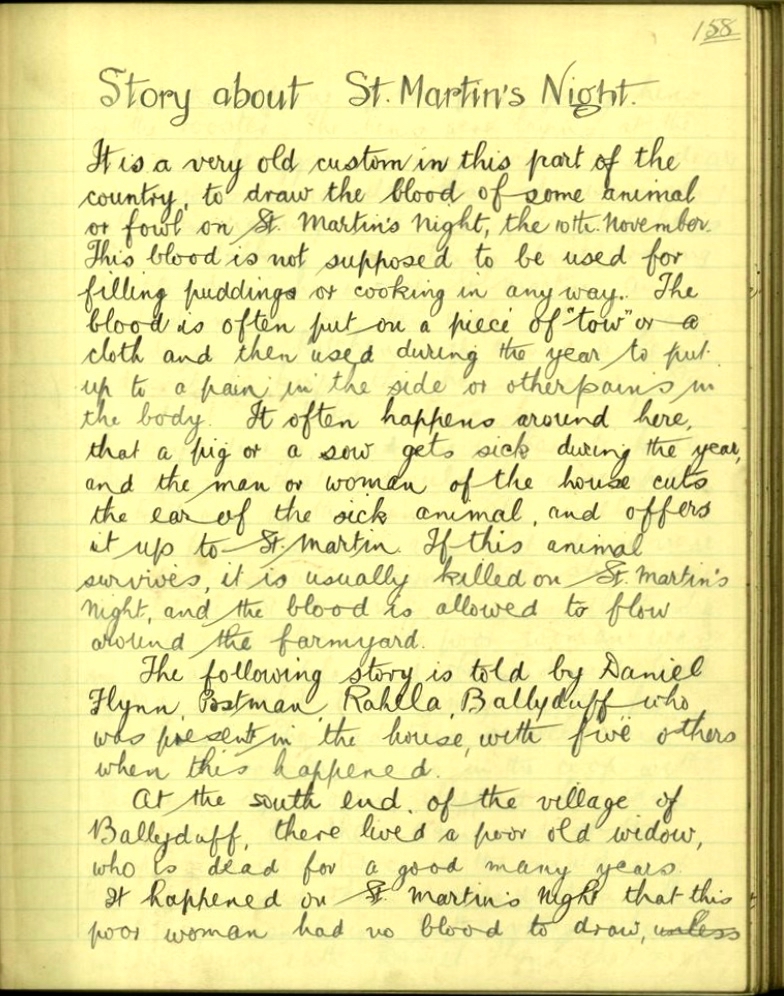
The tradition undoubtedly refers back to St Martin’s death from being ‘ground by a mill wheel’. Significantly, there are numerous entries in the Dúchas Folklore Collection, dating from the 1930s, which show that these customs were still remembered and – on occasion – practised:
One of many examples from the Dúchas Folklore Collections which remember the importance of Martinmas customs
Martin King used kill a fowl every St Martin’s night in honour of St Martin. One year Martin forgot it and when he awoke in the morning the floor from his bedroom to the kitchen was covered with blood. Martin washed out the floor, but when he awoke again the following morning the floor was covered with blood again. This went on for three nights. Martin was very troubled about it so he told his story to an old woman that lived near him. The old woman told him it was because he had not killed something in honour of St Martin. Every year after that till he died Martin killed a hen or something in honour of St Martin . . .
(Eileen Donegan, Knockane, Listowel – collected for Dúchas 1935)
Another from Co Kerry:
St Martin’s day is held on the 11th of November. It is held as a feast day in honour of St Martin. The night before St Martin’s day people kill a goose or a chicken or some other kind of fowl, and they draw the blood and dip a piece of flax in it. They keep the piece of flax because it is said to be a cure for a pain in one’s side.
St Martin was a saint who was ground in a mill for his faith.
In olden times the mills used not work on that day The women in olden times used not work. No one would turn a wheel not even of a car.
(Mrs Walsh, aged 90 years – Tullamore, Co Kerry – collected for Dúchas)
The next piece is particularly interesting as it mentions St Martin’s association with a white horse:
It is a custom in Ireland to kill a cock on Saint Martin’s Night.
There was a man who emigrated to America. On St Martin’s night he was very sad. He was telling his friends that he would like to be home in Ireland, because if he were home he would kill a cock in honour of St. Martin.
He went outside and he went down the street. He met a man on a beautiful white horse. The man asked him would he like to go home. He said he was just wishing to be at home. He told him to get up on the horse. He did so and the next place he found himself was at his own door in Ireland.
The man told him to come out at a certain hour. He killed the cock and came out at the hour that he was told to do so. The man was waiting for him at the door. He got up on the horse and rode away. It was said that it was St Martin who brought him home.
(Maura Keating, aged 82 years, Passage East, Co Waterford)
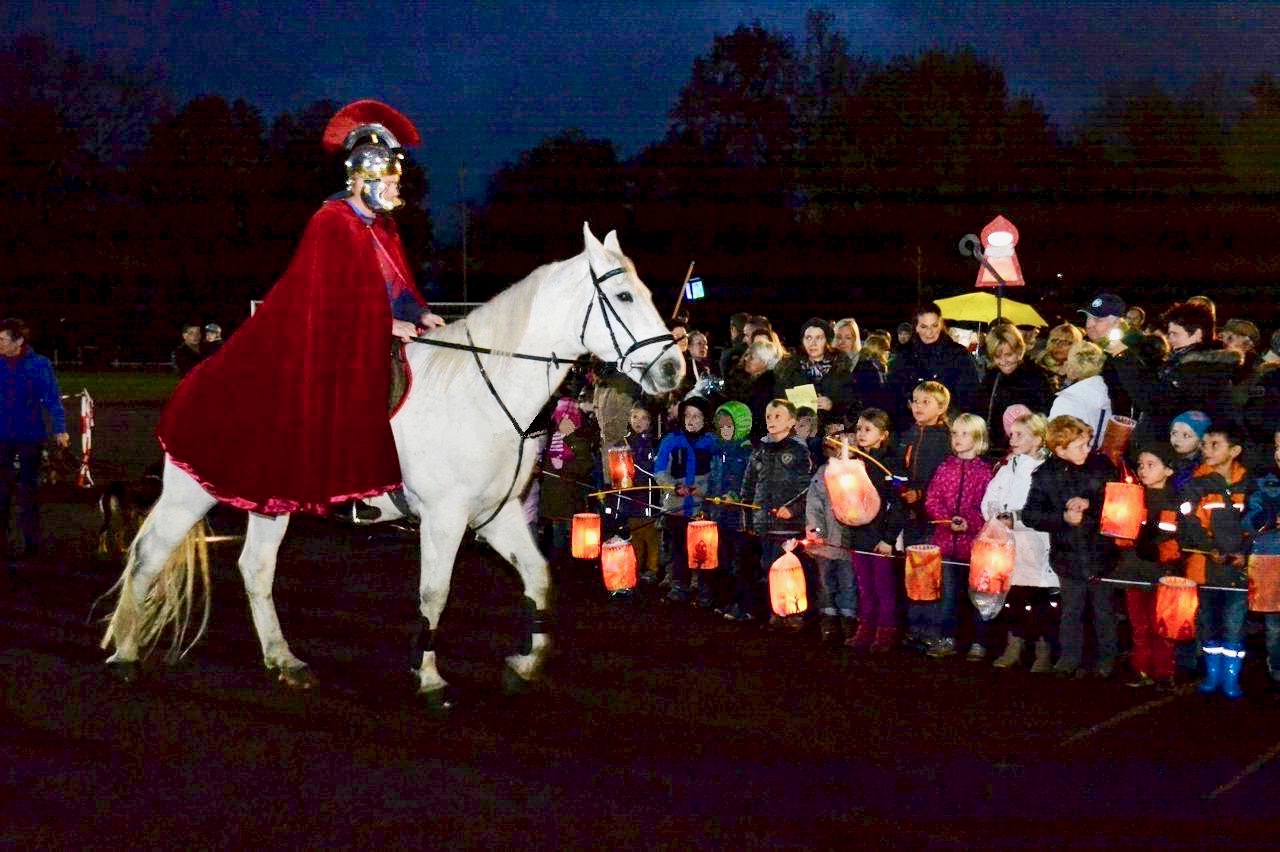
St Martin’s Eve celebrations are still observed all over Europe. This is a festival in Italy, where children carrying lanterns watch out for the saint arriving on his white charger
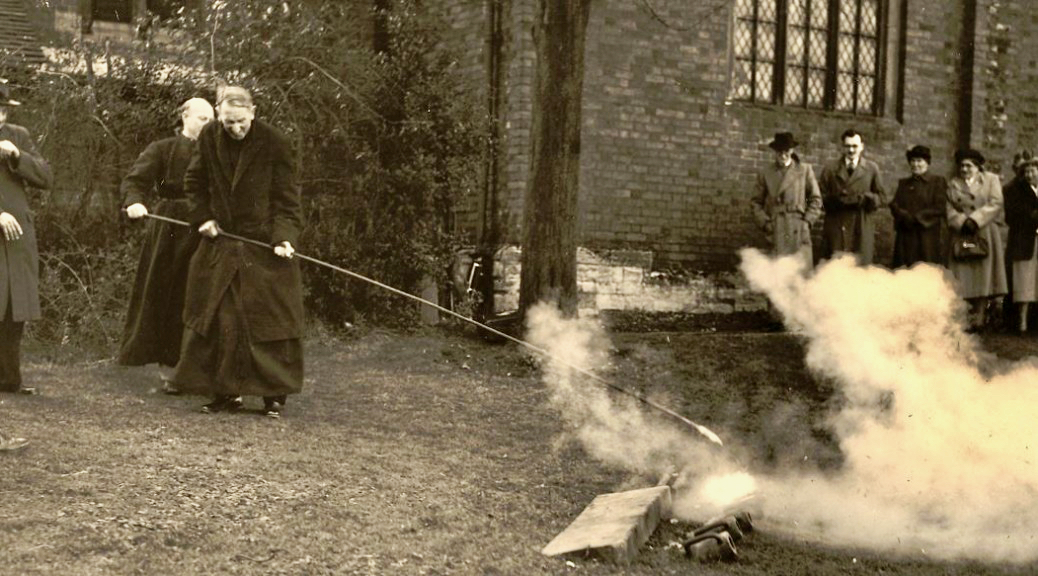
What about Fenny Poppers? I hear you ask . . . Well, we have to go across to Northamptonshire, in England, for this surviving – and most curious – custom. St Martin’s Church, Fenny Stratford is to this day the scene of an event which has no apparent origin, nor any particular purpose. I won’t try to offer you an explanation – just to point out that it happens every Martinmas come hell or high water. Here’s a somewhat eccentric account of the event from a Movietone News snippet c 1950:
That’s probably enough about St Martin and his special day to last you another year. The subject is by no means exhausted!
Welcome to the UCD Library Cultural Heritage Collections blog. Discover and explore the historical treasures housed within our Archives, Special Collections, National Folklore Collection and Digital Library
























 Roaringwater Journal