Northern Exposure

Robert and Finola

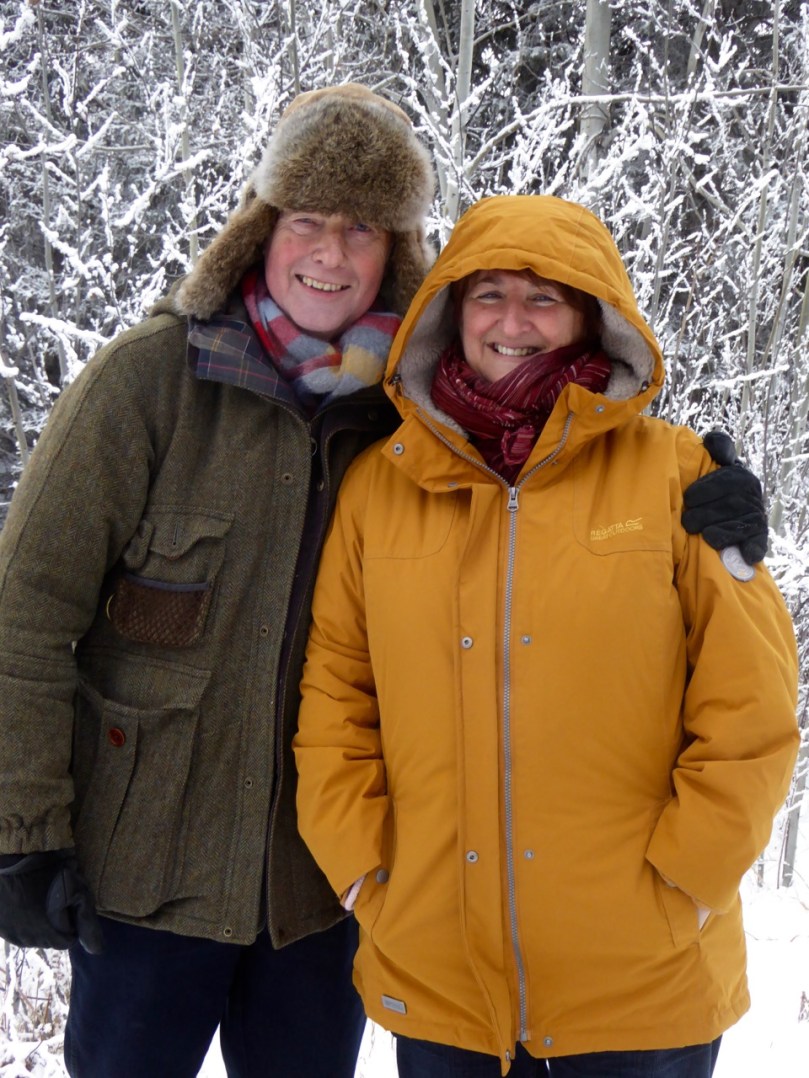
Roaringwater Journal has been to Canada! Both of us have family in Canada and this was the Christmas to see them. We’ve had a truly fabulous time with all of them, much of it spent in deepest winter conditions. Herewith a few pictures just to give you the flavour of the landscape we encountered.

Northern British Columbia was a wonderland of hoar frost and wildlife.

The farms in winter were fascinating and everywhere the vistas were entrancing.

Pemberton, beyond Whistler, retains a pioneering charm and embraces outdoor pursuits no matter what the weather.

Vancouver (city) and Vancouver Island enjoy a temperate climate – but glimpses of snow and ice are never far away.

Mount Baker

See Robert’s post on Pioneers for more musings on our time in Canada. Our normal focus on West Cork will resume shortly – as soon as we recover from the jet lag. We hope you have all had a great holiday season and wish you the very best for 2016.Blue jay

Beyond the Mizen: Top 14 West Cork Pics of 2015

We were heading home from Hare Island after a Fit Up Theatre Performance, when this happened

We were heading home from Hare Island after a Fit Up Theatre Performance, when this happened

Many of our top Facebook photographs this year were from the Mizen, but not all. You also liked and shared photographs that captured the essence of other parts of West Cork.

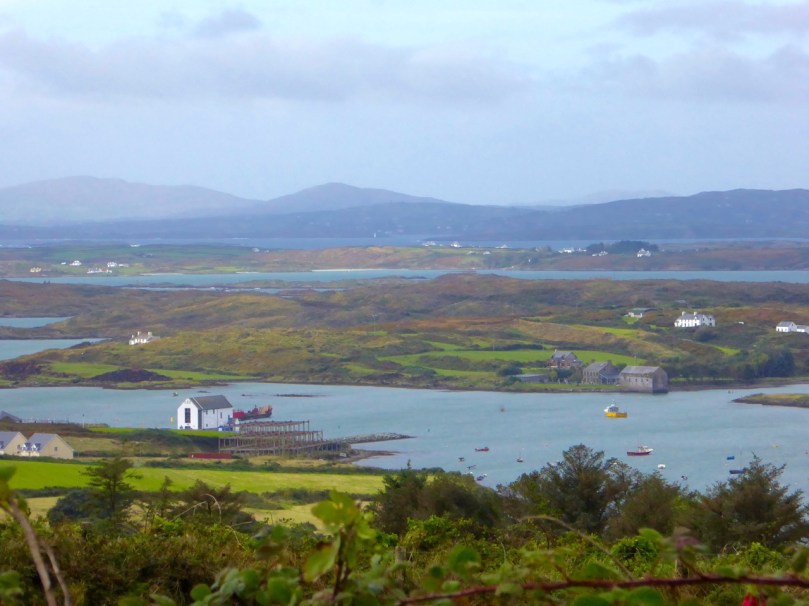
Baltimore Bay and Ringarogy Island

Baltimore Bay and Ringarogy Island

I think the Baltimore Bay one was so popular because the colours are SO west Cork. When you get blue sky and clouds, the sea turns this amazing Caribbean blue and the contrast with the green fields and wilder high ground is gorgeous.

Lighthouse Loop, Sheep's Head

Lighthouse Loop, Sheep’s Head

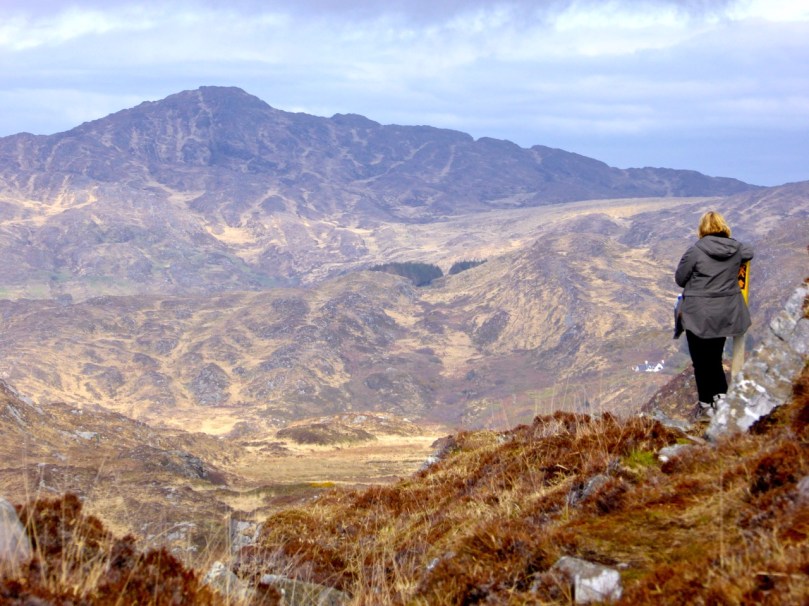
This photograph of our friend Susan Byron of Ireland’s Hidden Gems is one of my favourites this year because of the impression it creates of sheer wildness.

Occasionally we get lucky with the local wildlife. Ferdia, the fox, used to be a regular around our place but has forsaken us recently for neighbours with higher quality leftovers.

Bantry House in winter

Bantry House

It’s possible to get good shots of Bantry House in winter, when the trees don’t obscure it from view.

Kilcoe Castle

Kilcoe Castle is such an icon on the landscape. This photograph shows the neighbourly way it interacts with the other houses around it.

Bardic School Loop, Sheep's Head

Bardic School Loop Walk, Sheep’s Head

This tiny abandoned cottage may have been part of the 17th Century Bardic School near Lake Faranamanagh on the Sheep’s Head. We’re looking across at the Mizen in this shot.

The Beara, from the Sheep's Head

The Beara, from the Sheep’s Head

And here’s the view from the other side of the Sheep’s Head, across to the Beara Peninsula, with the instantly-recognisable bulk of Hungry Hill to the far right.

Priest's Leap Valley

Priest’s Leap Valley

The long climb up to Priest’s Leap starts near Ballylickey and ends at a high mountain pass that separates Cork and Kerry. The views are spectacular from the top, but this shot of a colourful house and farms in the valley on the way up seemed to express something typical of West Cork.

Farm, Sheep's Head

Farm, Sheep’s Head

This farm appears to be carved out of the mountain land behind it.

Barloge Bay, at the entrance to Lough Hyne

Barloge Bay, at the entrance to Lough Hyne

This was taken in November. I love the contrast of the turquoise water with the autumn colours of the bracken-covered hillside.

F

A final sunset to end this post. This was taken last February from the lay-by overlooking Roaringwater Bay on the N71. The light was extraordinary – a once in a blue moon kind of shot. The mussel beds make the water look like floating ice packs.

A big thanks to Celia Bartlett for helping us improve our photographic skills this year. We loved our workshop with her.

Happy New Year to all our faithful readers!

Snakes Alive!

Year of the Snake 66 barabara trott

It’s about as far away as we can get from St Patrick’s Day, so it’s probably ok to talk about snakes in Ireland…

Ah yes – the old fable that he banished all the snakes out of the land…

That’s enough of the ‘old fable’ – there’s no doubt about it: there are no snakes in Ireland at all, so it must be true that St Patrick sent them packing! Although I was a bit alarmed when, out walking in the Mayo hills a while ago, I came across this…
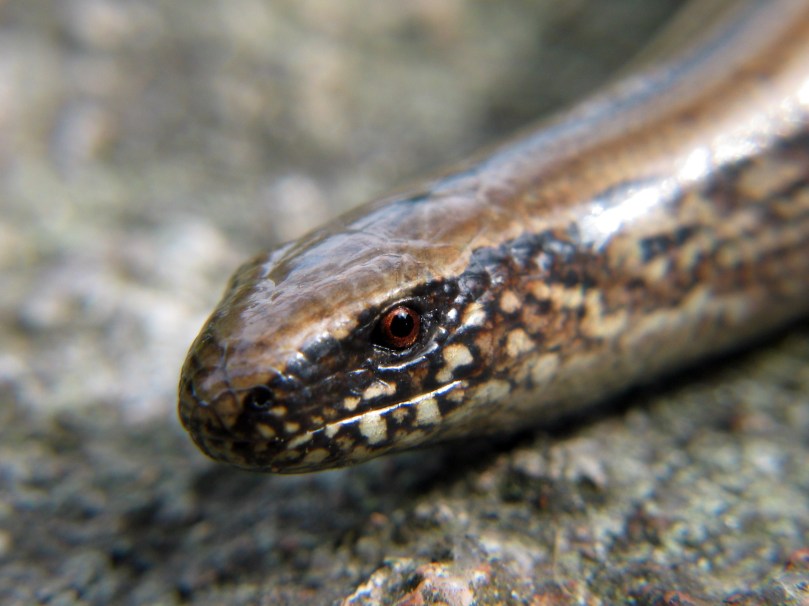
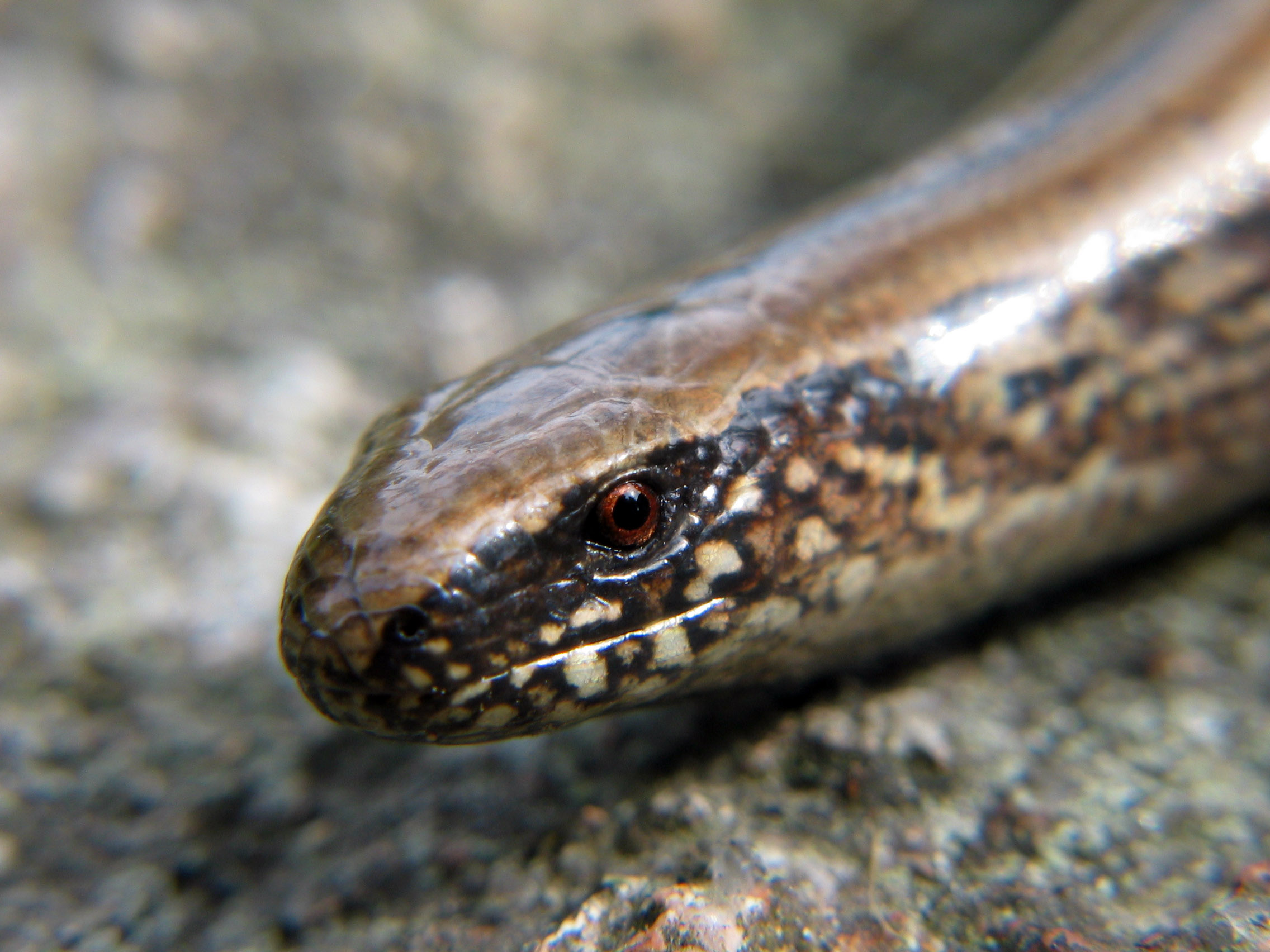
Slow-worm (Jonas Bergsten)

A slow-worm? Anguis Fragilis… How does that fit into the St Patrick story?

Well, there shouldn’t be any slow-worms here really – as the Saint expelled all the reptiles and lizards – and that’s a lizard. But evidently someone introduced them into County Clare illegally back in the twentieth century, and they’ve survived there. (Frogs were also introduced, incidentally, as a food source by the Normans).  My sighting in Mayo, however, is something of an anomoly…

But didn’t I hear that these serpenty creatures couldn’t actually live on Irish soil because of Ireland’s purity?
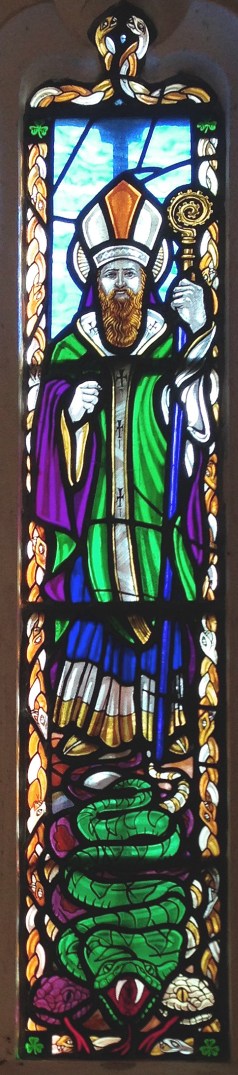
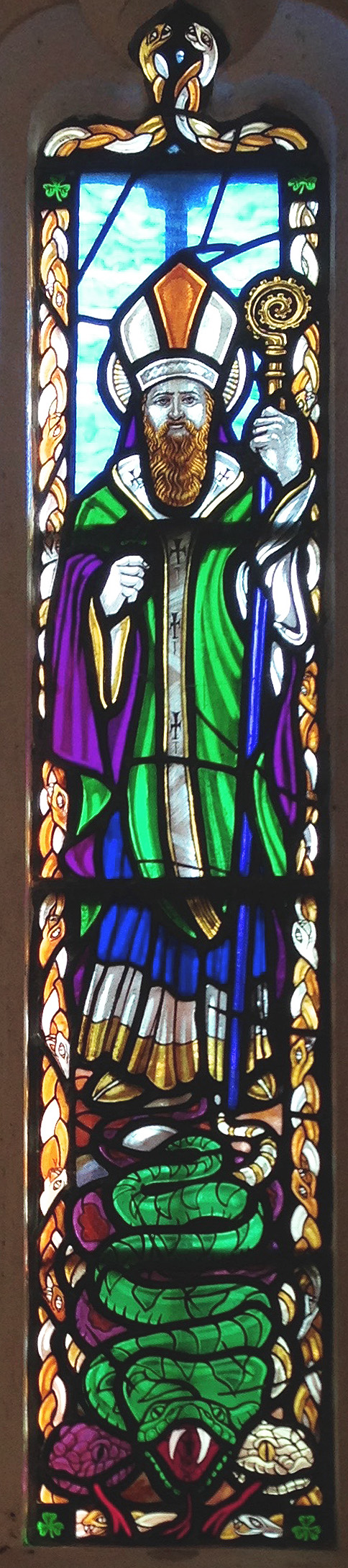
St P window GlastonburyNow you’re talking. It’s perfectly true that if you try to bring a snake into Ireland it drops dead as soon as you enter Irish waters…

Oh? Has that been proven?

Indeed – by Gerald of Wales. He lived in the twelfth century and states that ‘…it is a well-known fact that no poisonous thing can live in Ireland and if Irish soil is taken and scattered elsewhere it will expel poisonous things from that vicinity…’ Other stories mention toads brought to Ireland by accident (having, presumably, stowed away in the holds of ships) ‘…which when thrown still living onto the land, turn their bellies up, burst in the middle and die…’ Perhaps you’ve heard of the Fir Bolg?

I think so – aren’t they one of the early races who inhabited Ireland?

They are – and the name means Men of the Bags. They carried bags of Irish soil around with them when they travelled all over the world, because they would be kept safe by its serpent slaying properties…

I like that idea – remind me to go and do some digging in the garden. Where are you getting all this information from?

Much of it out of a most wonderful book: Ireland’s Animals by Niall Mac Coitor (The Collins Press, Cork 2010), but there are plenty of other early sources, many of which Mac Coitor admirably collects together. Perhaps the best of these is the old medieval Irish text Lebor Gabála Érenn – the Book of Invasions. I have already quoted from that in my story of Cessair, the very first person to set foot on Ireland in 2680 BC…

Yes, I remember that. She was Noah’s grand-daughter. Wasn’t it the case that Ireland was supposed to have been a land without sin, which is why she went there to escape the flood?

That’s her. And it’s a nice bit of symbolism that Ireland was without sin because it had no serpents…

But hang on – that was Old Testament times – long before the saints…

You do have a point there. And, you know, in archaeological terms there are no fossil records of any reptiles having ever been here in Ireland – except for one: the common lizard Lacerta (Zootoca) Vivipara which has always been here, and still is…
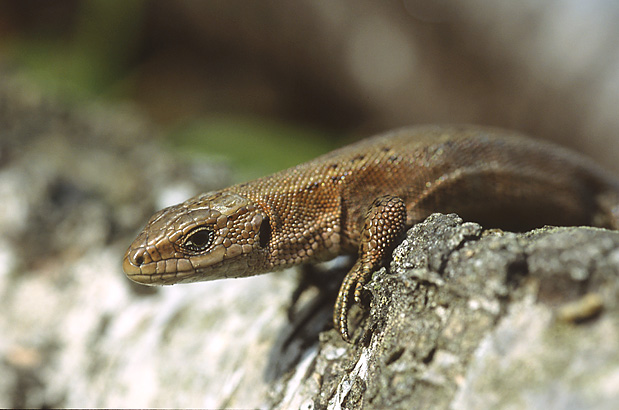
Common Lizard (Marek Szczepanek)

Now I’m getting very confused about St Patrick…

Don’t worry about it – it’s a grand story…

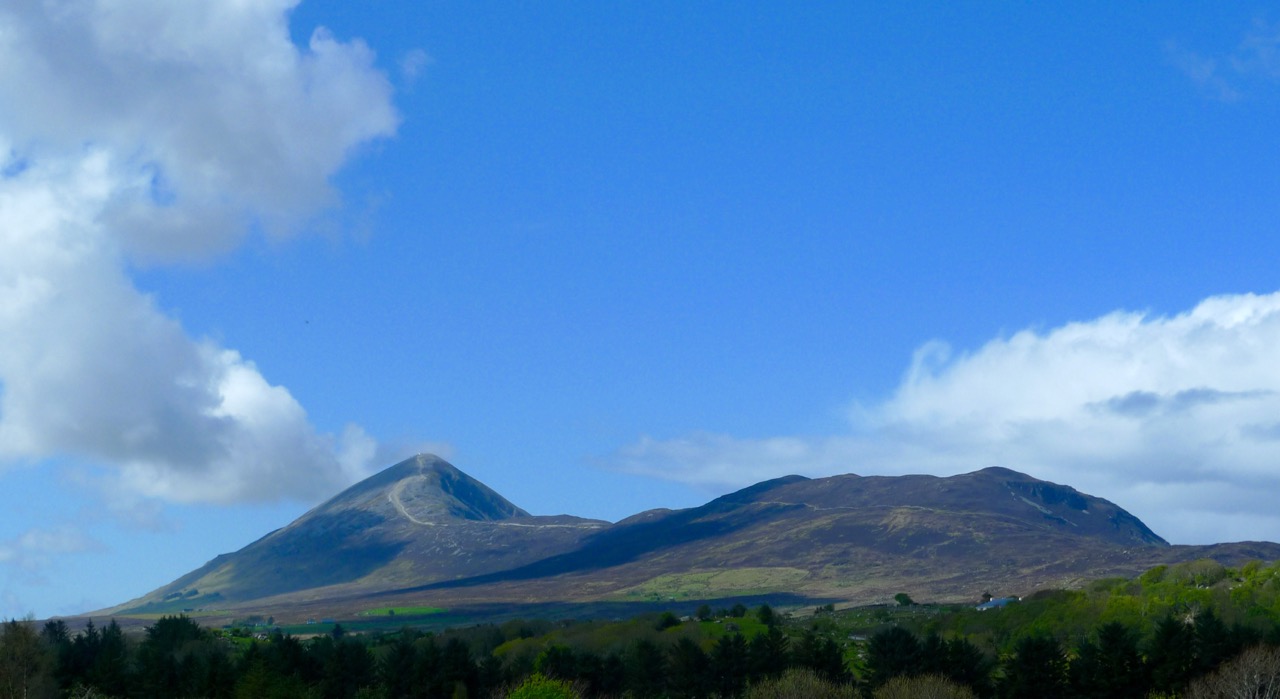
Yes, I have this picture of our good saint standing on the top of Croagh Patrick in Mayo and all the crowd of little snakes and reptiles climbing up there to surround him, only to be cast down to their doom by a sweep of his crozier…

Hmmm… but surely they would have just rolled and bounced down to a soft landing at the bottom? It’s only a hill, after all…
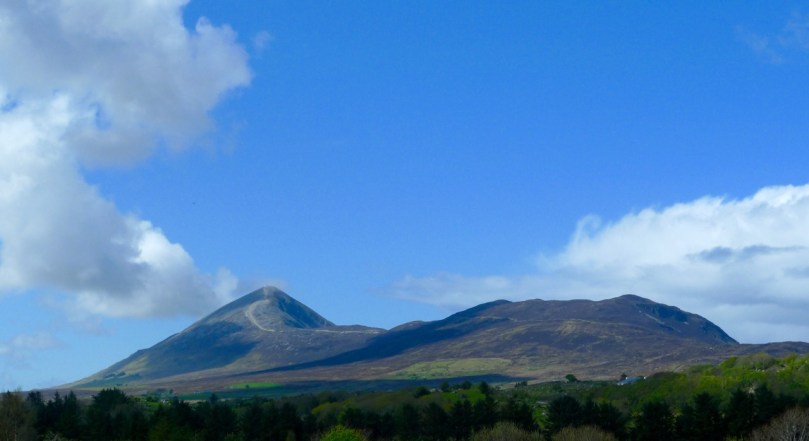
Croagh Patrick

You’ve obviously got something else in mind?

Well I like the story of St Patrick’s Chair, which is at Altadaven, Co Tyrone. The Chair is a huge boulder which seems to have been carved into the shape of a chair or throne. Beside it is a holy well – also ascribed to St Patrick – which appears to be a bullaun stone: offerings are made at the well and the trees around it are hung with rags and tokens. Altadaven means Cliff of the Demons, and it was evidently where all the snakes, serpents and reptiles once lived. The saint went there, sat on his chair (presumably) and cast them all down the cliff and into Lough Beag below…

Which is a bit different to just rolling down the hill at Croagh Patrick…
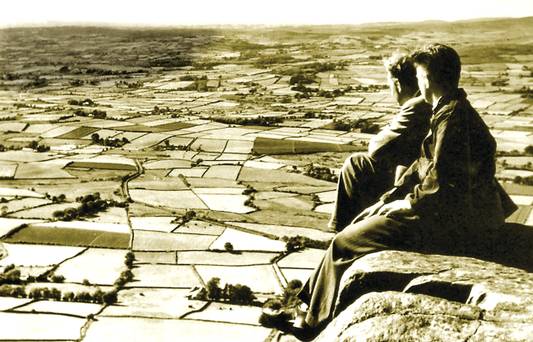
Wishing Chair Slemish

Another St Patrick’s Chair at Slieve Mish, Co Antrim – this one looks like a good candidate for the place where the snakes were cast down… (Irish Times 1956)

And there was a tradition at Altadaven of an annual gathering known as Blaeberry Sunday or ‘The Big Sunday of the Heather’, probably connected with Lúnasa customs. People would climb the rock to sit in the chair and make a wish which, of course, always came true. Then they visited the well and left pins and pennies behind…

Anything else we should know about reptiles in Ireland?
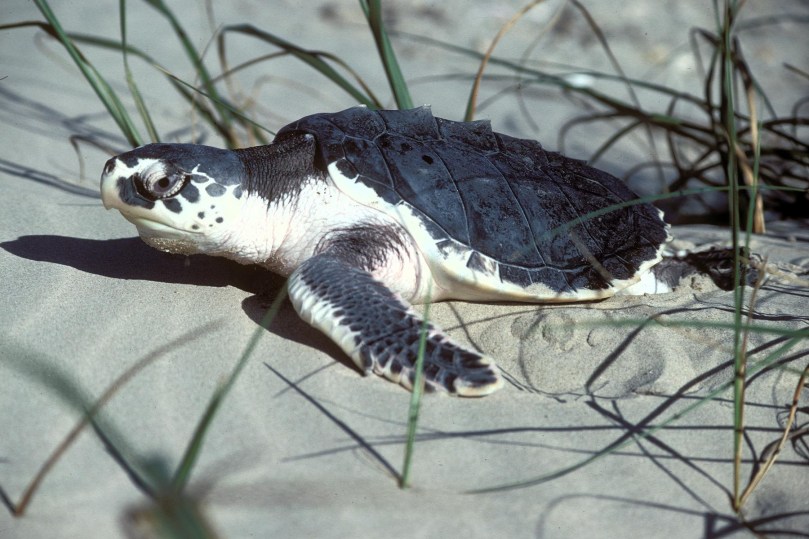
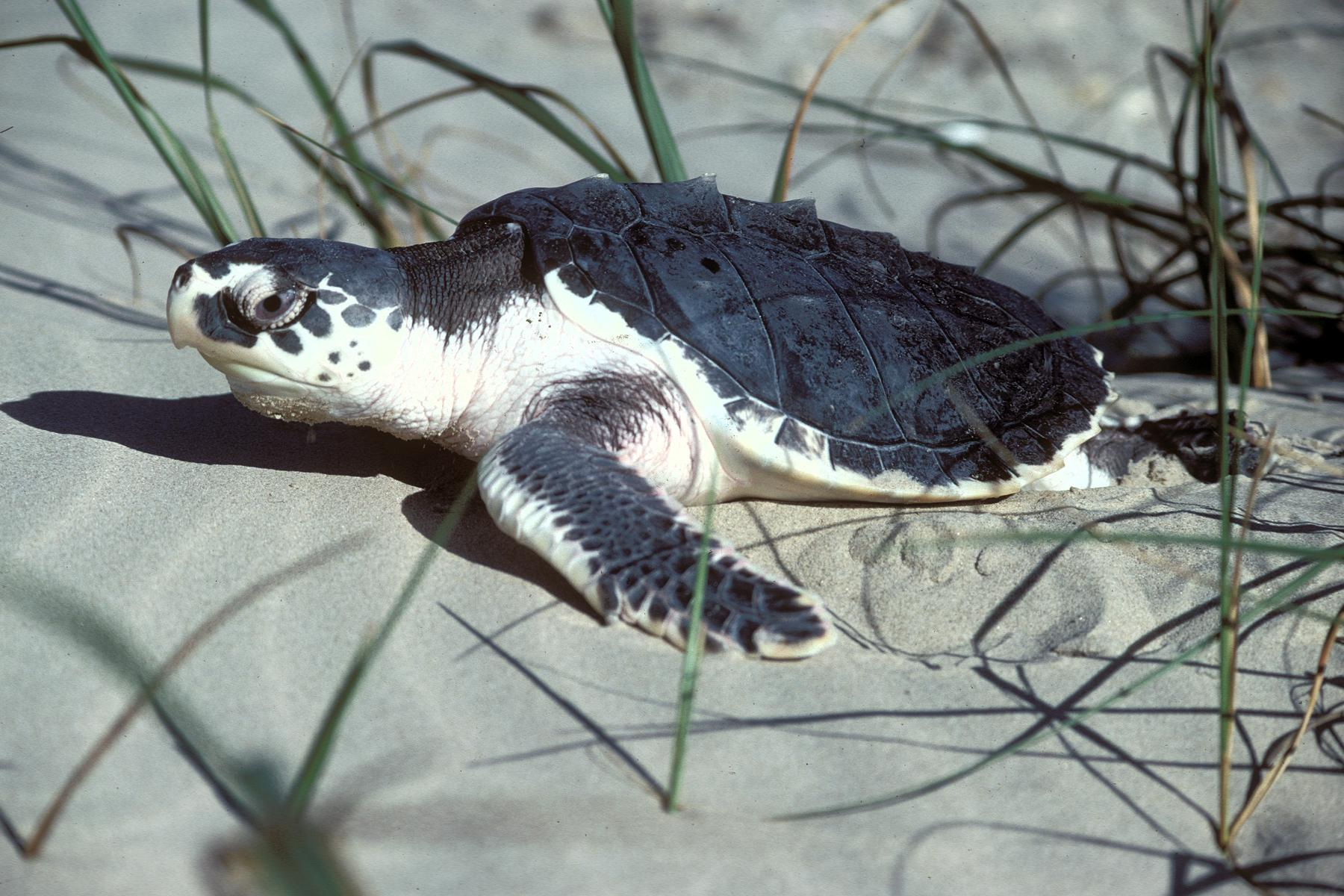
Kemps turtle

Well, earlier this year one of the world’s rarest turtles – the Kemps Ridley Sea Turtle – appeared in Donegal. Unfortunately it was dead – washed up on the beach. But there are also other small turtles which do inhabit Irish waters.

The exception to the rule, possibly. But perhaps being in the water isn’t quite the same as being on the land…
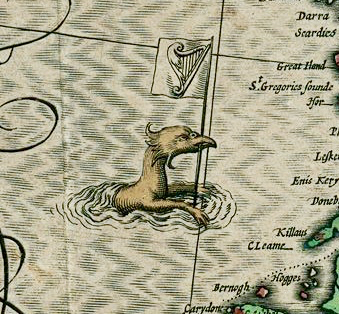
Peist 1611

I’m always keeping my eyes open. I had a ‘serpent’ experience once, in Devon. On my first visit to St John’s holy well up on Hatherleigh Moor I opened the door to the well (which was surrounded by a stone built enclosure) and there inside was an eel swimming around!

I heard that’s a very good omen – to see an eel in a holy well?

Oh yes – why wouldn’t I be a total believer in such things? In Celtic Brittany holy wells are always protected by a ‘Fairy’ who has the form of an eel, and is a benign spirit. Interestingly, though, there is no stream or watercourse near to the Hatherleigh well, so the eel must have travelled some away across the moor to get there – on dry land!

So – I have to ask: are there eels in Ireland?
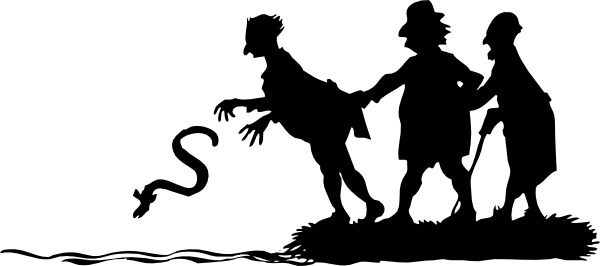
eel

There are – Anguilla Anguilla – It’s a fish, so not a problem to the saint. Eels have been eaten in Ireland since the earliest human times and have been found in association with Mesolithic sites such as Mount Sandel, Co Derry.

Thank you – you’ve taken us on a serpentine tour through Irish history and mythology…
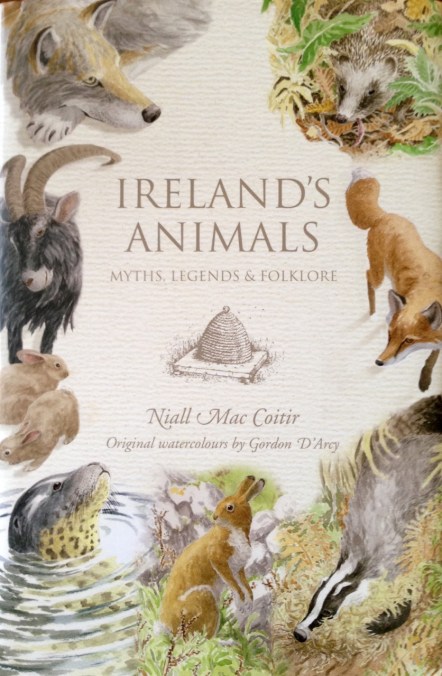
Mac Coitor


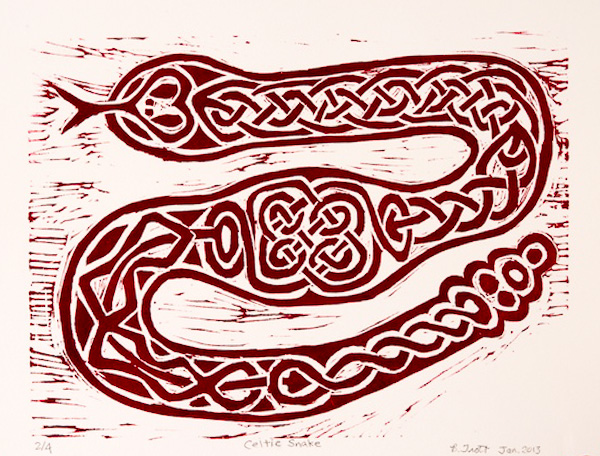
The heading picture Celtic Snake is by Canadian artist Barbara Trott; the Slow-worm is from Jonas Bergsten; the long window is in St Patrick’s Chapel Glastonbury; St Patrick in Bandon Cathedral is by Finola; the Lizard is by Marek Szczepanek; the Peist is from Speed’s Map of Ireland 1611; and Drowning Eels is courtesy of images.all-free-download.com

Hares in Abundance

exhibition poster

“And now, Sir Hare, good-day to you. God guide you to a how-d’ye-do with me…” (from the Middle English poem – Names of the Hare – translation by Seamus Heaney)

You may know that I am a Hare fanatic. Every day as I travel along through West Cork – driving, cycling or walking – I am scouring the fields and hedgerows in the hope of seeing one of these shy and elusive animals: very occasionally my watchfulness is rewarded. Last year I kept a Hare Diary… on the last day of December I counted up: I had seen only six, and two of these were in other parts of Ireland. Yet, when I first visited Ballybane West – just over the hill from here – back in the early 1990s I saw them on most days; one early morning then I looked out of the window and there was a whole luck of Hares running around the field beyond the house – at least ten of them.

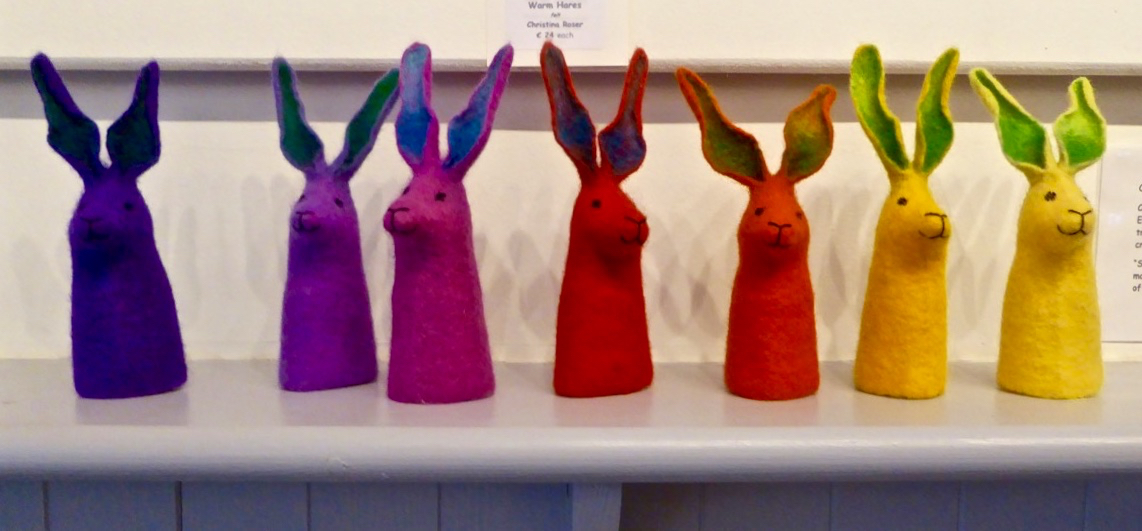
felt hares

A luck of Hares by Christina Jasmin Roser, feltmaker

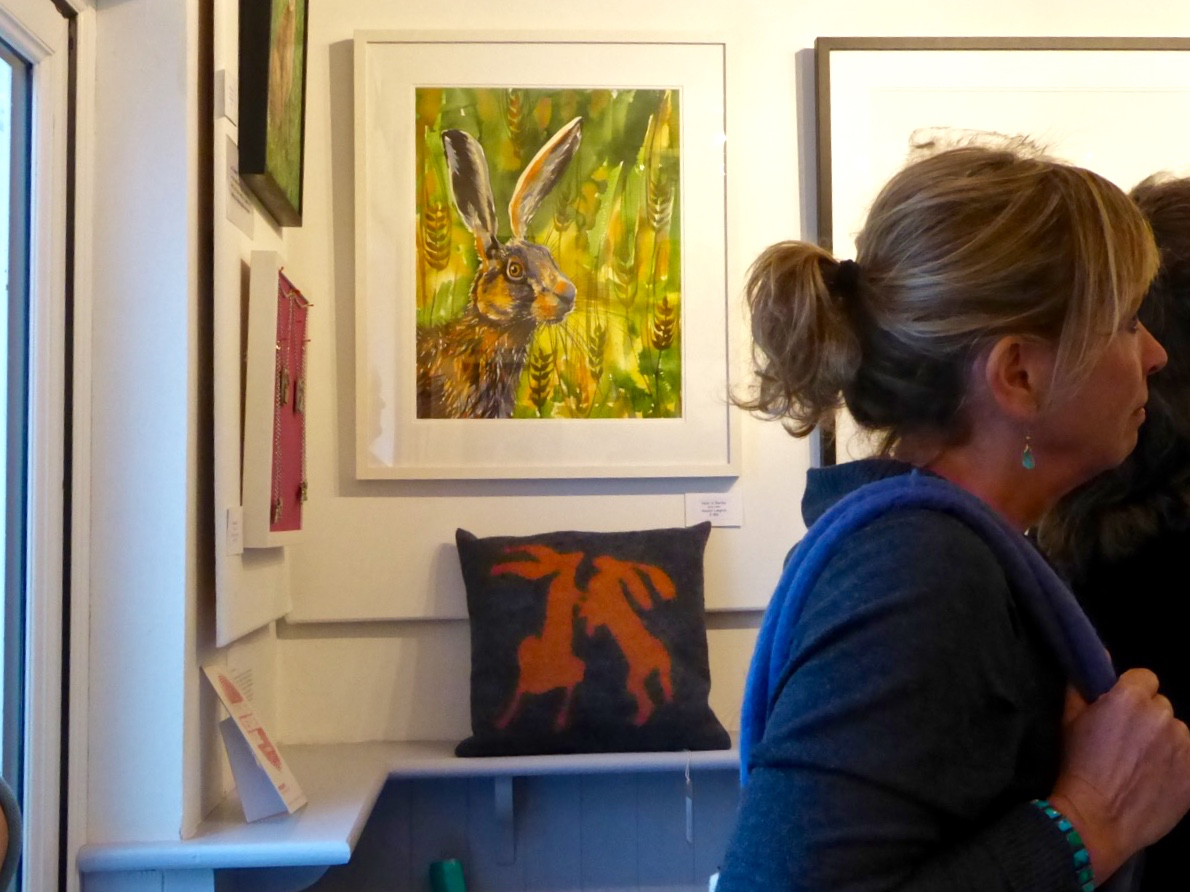
Where have all the Hares gone? I can’t answer that, but I can tell you that there are a whole lot of Hares in the Heron Gallery, Ahakista at the moment: Annabel Langrish and her husband, Klaus have mounted an excellent exhibition of art and craft works based around images of the Hare.

The exhibition brings together the work of several artists from the West of Ireland: paintings, drawings, feltwork, fabrics, papier mache, jewellery and ceramics. The whole makes a really attractive assemblage, but any one of the works on display – all of which are for sale – would be an elegant addition to your own art collection! I would readily bring them all here to Nead an Iolair but – as we already have numerous images of Hares around the house – Finola has put an embargo on further Hare imports (just for the moment).

Robert talking

Yours Truly was asked to say a few words about Hares at the exhibition opening: a wonderful portait of William the Hare by Sylvia Parkinson looks on

All the works in the Heron Gallery show bring out the magical qualities of this special animal. Mostly it is Lepus Timidus Hibernicus which is depicted: the Irish Hare. This belongs to the Mountain Hare species, related to Arctic Hares. Irish Hares don’t turn white in the winter but they do moult to a paler colour, and sometimes they have white patches then. There are also Brown Hares in Ireland: these were imported from Britain to add to the game stock on landlord estates from medieval times onwards.

Three ceramic Hares by Annabel Langrish, from the exhibition

Although the Irish Hare has been ‘legally protected’ since 1930 – and is listed as a protected species under EU legislation – it can be hunted under license, and Hare coursing is still permitted. This seems anomalous to me: those who support Hare coursing claim that the animals do not suffer. They are captured from the wild, caged (usually for several weeks), and released onto a course where they are chased by muzzled Greyhounds. After this they are put back into the wild. As their name would suggest (Lepidus Timidus), Hares are nervous animals and there can be little doubt that they do suffer stress through the ordeal. Many die before being released. Coursing has been banned in the UK since 2005. There have been moves to have Hares fully protected in Ireland.

The Hare’s Revenge: Dean Wolstenholme’s painting of Greyhounds coursing a Hare (right), while in the medieval woodcut (left) a Hare plays a tabor. The tabor is the forerunner of the Irish bodhran: I am reliably informed that the best skin to use for a bodhran is that of the Greyhound!

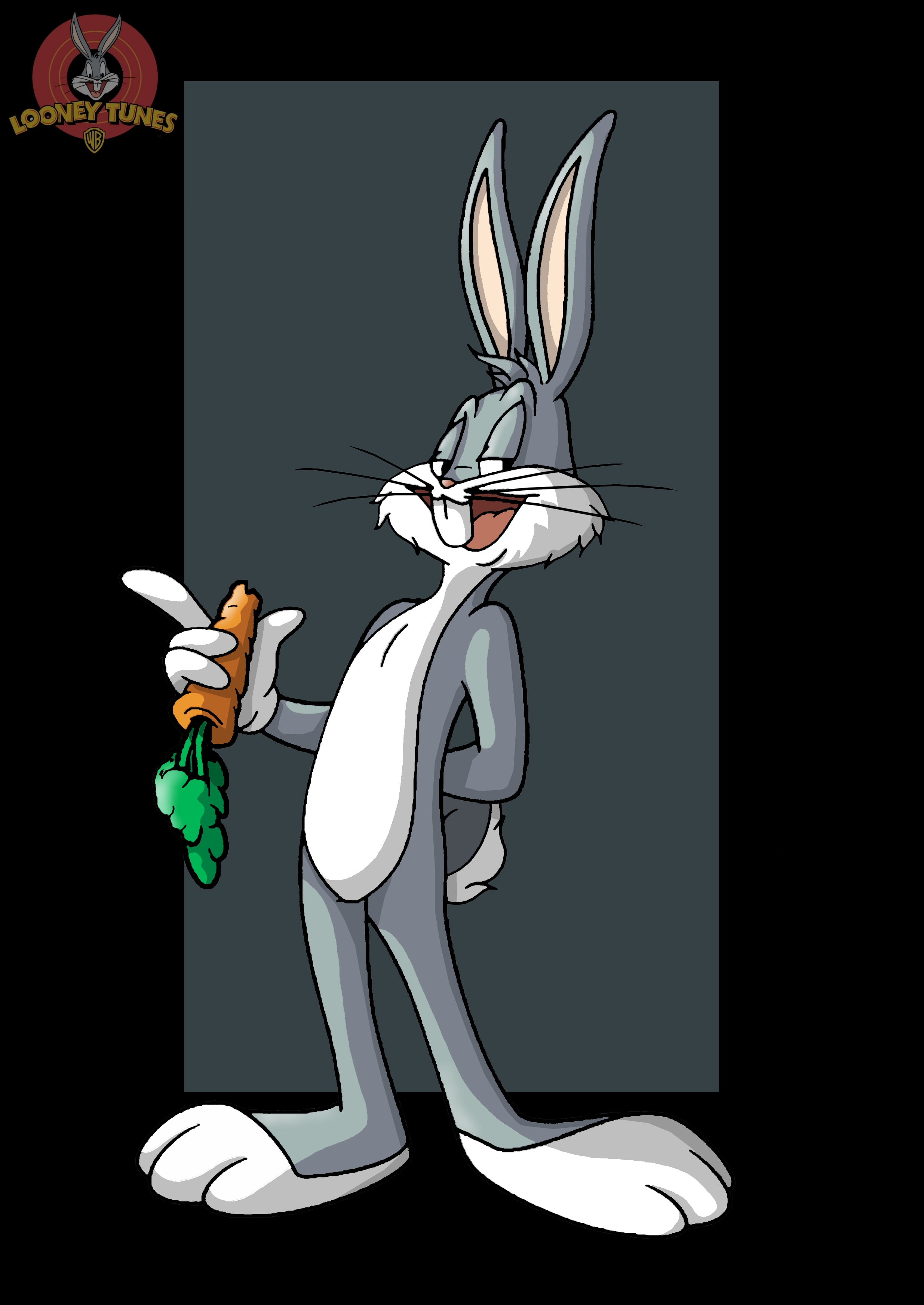
bugs_bunny_by_nightwing1975The Hare is a most ancient animal. Fossils have been found dating from Pleistocene times showing that the Hare has not changed or developed in three million years: presumably it is just so perfectly integrated to its environment. It also occupies a prime place in our own mythology. Hare is the archetypal Trickster figure in many cultures – helping to create the world, to bring fire to humans, generally being mischevious and getting into hopeless scrapes, but always coming out on top: just like Warner Brothers’ Bugs Bunny in fact – who is, of course, a Hare! Bugs (my favourite cartoon character) is loosely based on the Br’er Rabbit stories by ‘Uncle Remus’ – collected in the 1870s by Joel Chandler Harris from the oral tradition of the plantation slaves in the Southern United States. Br’er Rabbit (in America Hares are known as Jackrabbits) has his origin as a Trickster figure in African folk tradition.

I have gleaned most of my Hare lore from this much thumbed edition of The Leaping Hare by George Ewart Evans and David Thomson – published by Faber – which I acquired when it first came out in 1972. If you have an evening or three to spare I will happily regale you with tales of Hares gathered from far and wide and recorded in these pages.

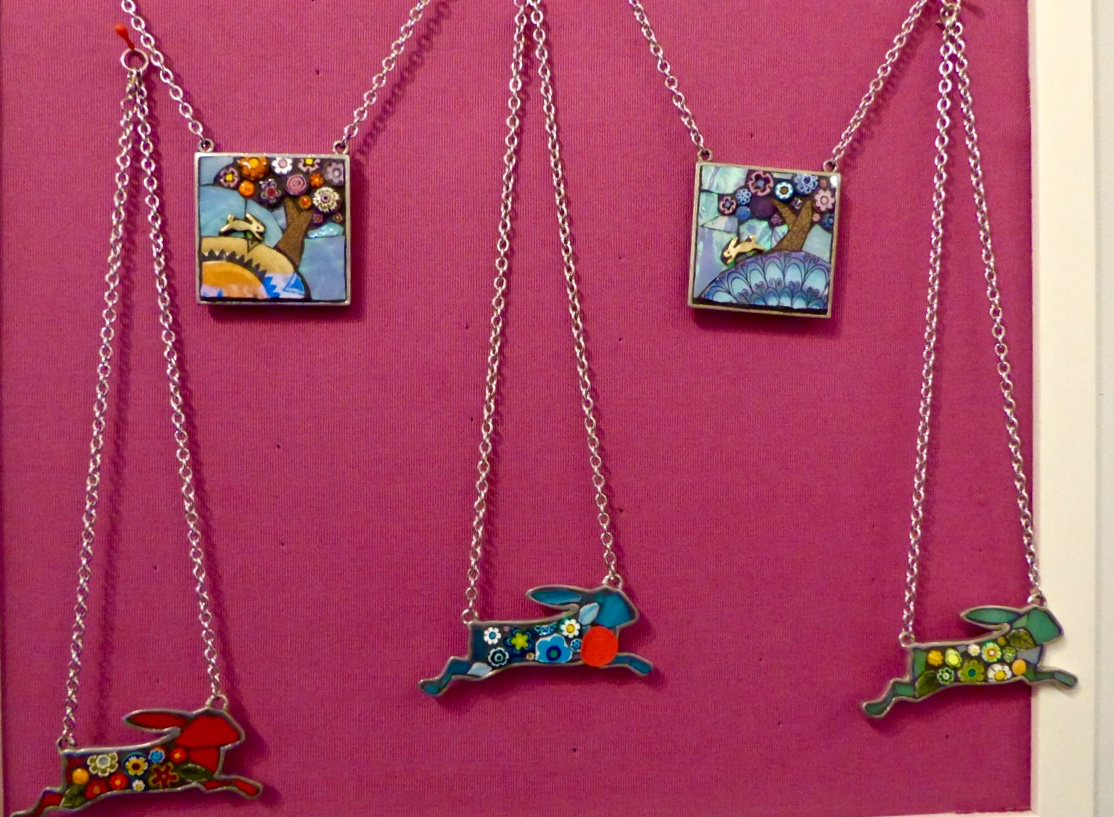
pendants

Jewellery by Alison Ibbs

When I lived in Devon, on Dartmoor, I was fortunate to have around me many examples of a symbol known as The Tinners’ Rabbits. Chagford was a Stannary Town – a place where refined tin was assessed, coined, and sold and there was a story that the symbol was a badge of the tin miners. It depicts three Hares (not Rabbits) in a circle: each Hare has two ears, yet there are only three ears in total. A bit of a riddle, perhaps – but one which has been found all over the world, as a project carried out by Chris Chapman reveals. In Chagford’s medieval church (and in several others in Devon and elsewhere) there is a roof boss carved with the image.

There doesn’t seem to be any real evidence to connect the Tinners’ Rabbits symbol to the tin miners – however, there is a surviving superstition in Cornwall and in Ireland that if you meet a Hare while on your way to the mine (or, in some places, when you are going fishing) you turn around and go home!

Some of Annabel’s Hares in the exhibition (left) and (right) our own view of the Hare in the Moon seen from Nead an Iolair last week

Part of the universal folklore of Hares reminds us that it’s the Hare in the Moon we are seeing above us, not the Man in the Moon. And… I know you thought it was an Easter Bunny that brings the chocolate eggs – in fact it’s the Easter Hare! The Saxon spring festival of Ēostre celebrated a hero-Goddess who had a Hare as a companion… Well, that’s one of the many interpretations you will find of this moon-based festival.
Hare eggs and Hare ceramic by Etain Hickey

It’s not Easter now – it’s July – but you can go and see this exhibition on the Sheep’s Head for the rest of this month, and enjoy the beautiful gardens there as well. If, like me, you are a Hare fan, then don’t miss it!

Looking on

Window on our World…

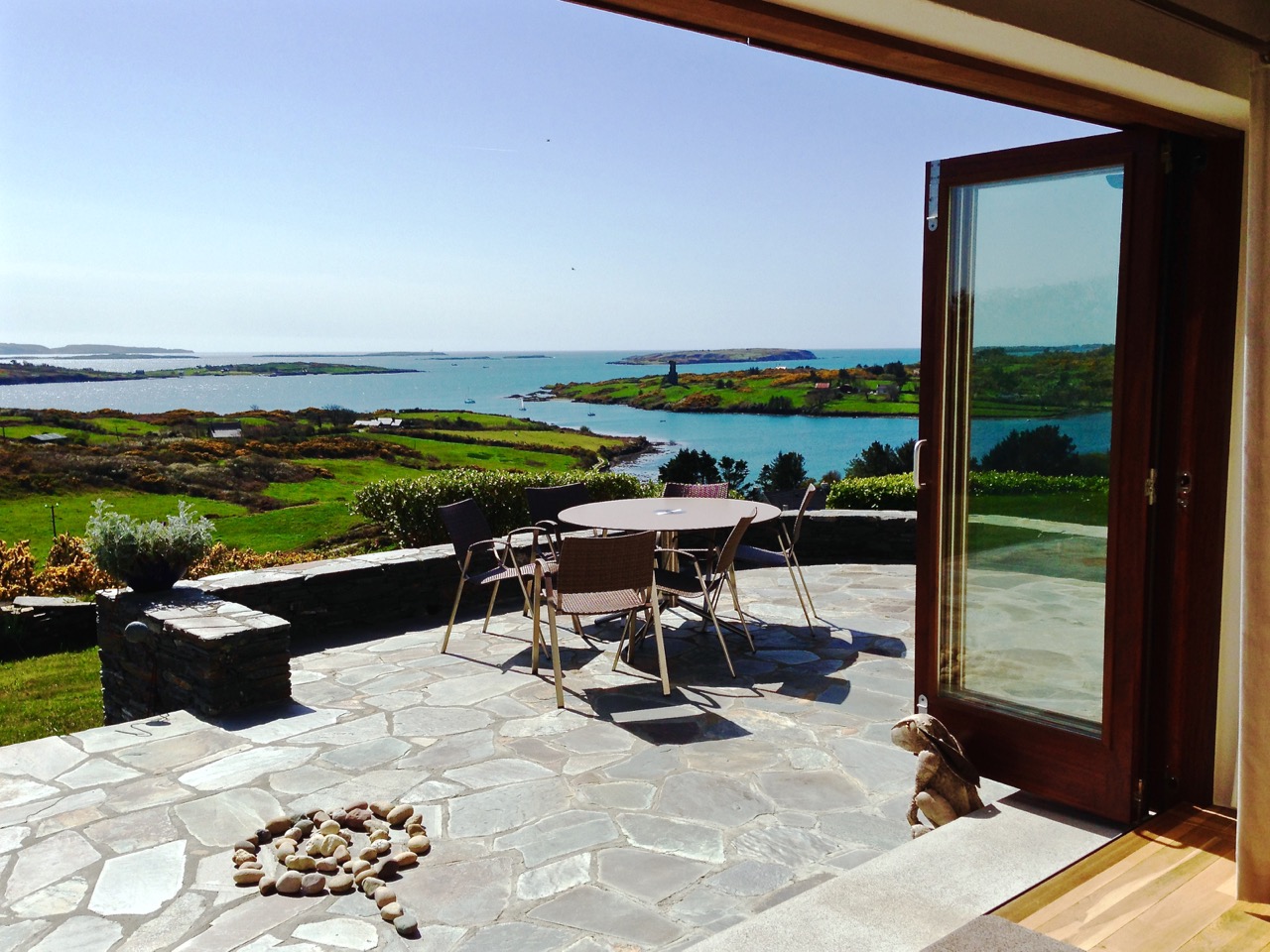
Our View to the Islands

Our view to the Islands

Sunlight and drama have been the key elements of the view from Nead an Iolair this week. The drama began at coffe time on Monday: whenever we are sitting having breakfast, lunch, tea, supper – or maybe just sitting – we are looking out over the scene you see above. Central in that prospect is our bird feeder, where we keep a constant eye on the comings and goings.

Suddenly, a bomb dropped out of the sky! It scattered the birds and there was such a twittering and chattering – squawks and alarm calls. The ‘bomb’ was a Kestrel – who had singled out a juicy victim from among the avian throng… I’m pleased to say that it missed its target and crashed ignominiously into the adjacent gorse bush. Seconds later it extricated itself and sloped off, trying not to look too foolish. I have to say I admire birds of prey, although I’d rather not see them lunching on our garden friends. In the past we have also had sight of a Sparrowhawk on our stone boundary wall.

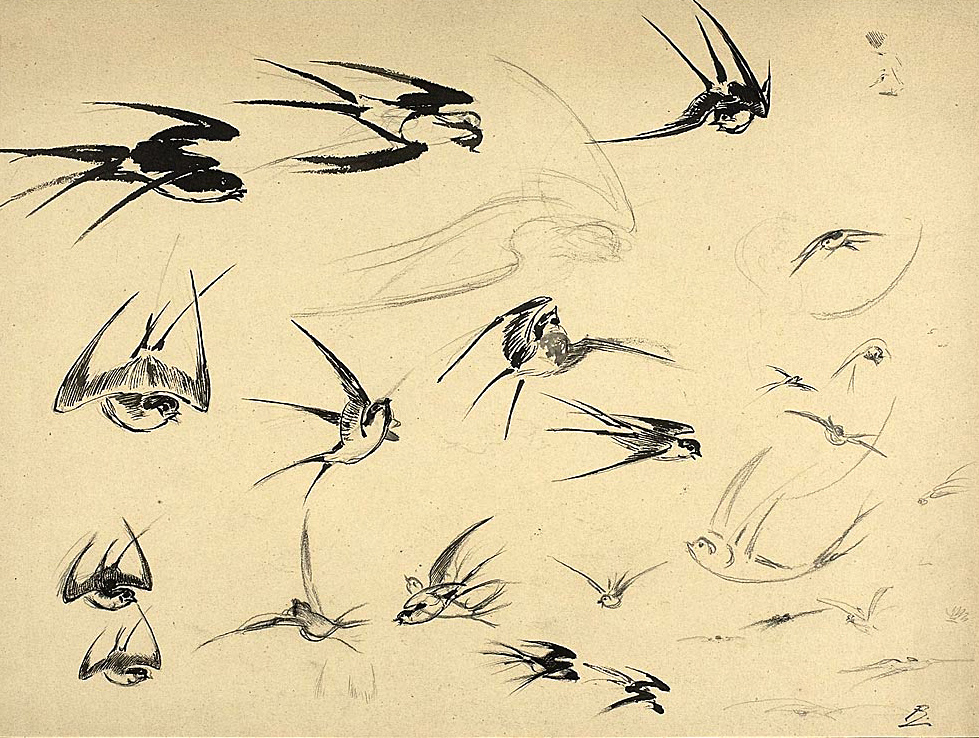
The Swallows: Felix Bracquemond, 1881

The Swallows: Felix Bracquemond, 1881

As I write this there are Swallows wheeling in the air above us: although we have had cloudless skies for several days the wind is in the east and it’s pretty chilly – however these harbingers of the Summer seem happy enough to have arrived on our shores in late April.

The Choughs are always with us!

The Choughs are always with us!

The Choughs are good friends of ours – they sit on the roof or tumble about in front of us, showing off their bright red bills and claws. At the moment they are foraging in the rocky land behind the house, pulling out roots and twigs for nest building. Another nester is the Starling family which inhabits the space in our eaves, creating a lot of noise and mess.

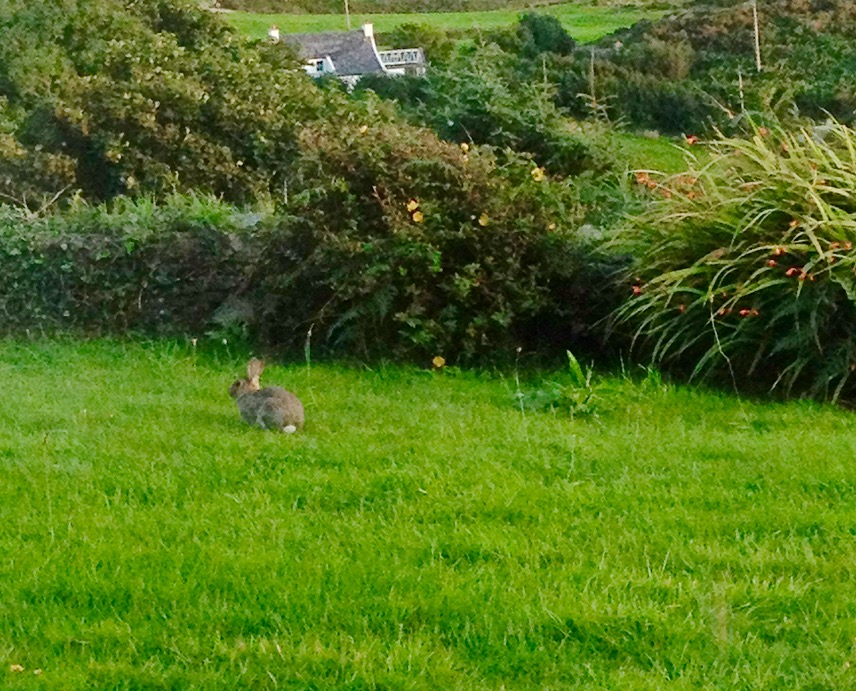
rabb

I was pleased to see a Rabbit in the garden: there has been an outbreak of mixomatosis in the surrounding countryside in recent times and over the last year we have hardly come across any of these mammals in the fields locally. Mixomatosis was introduced into the UK in the 1950s – apparently by accident – and then was used as a deliberate Rabbit control measure, by placing sick animals in burrows (then and now an illegal practice). By 1955 95% of Rabbits in the UK had been wiped out. I remember those days: seeing dead and dying animals every time I went out as a sensitive nine year old made me sickened and appalled, especially when I learned that we humans had initiated such cruelty. The virus recurs cyclically every few years, as has happened around here: I am still sickened and angered by it.

The next visitor was a female Pheasant. Although less colourful than her male counterpart she is nevertheless a handsome addition to our menagerie. The good weather has enabled us to have our doors open every day, but this does mean an influx of smaller guests, which have to be carefully rounded up and ejected before we go to sleep. They include spiders and flies, but also Native Irish Honeybees from our neighbour’s hives. Apis Mellifera Mellifera has evolved over thousands of years with a large body and long dark abdominal hairs which make it uniquely suited to survive in a harsh Irish climate. It will be found foraging early and late in the season and will fly in dull, drizzly and cold weather. I gleaned this information from the comprehensive website of the Native Irish Honeybee Society.

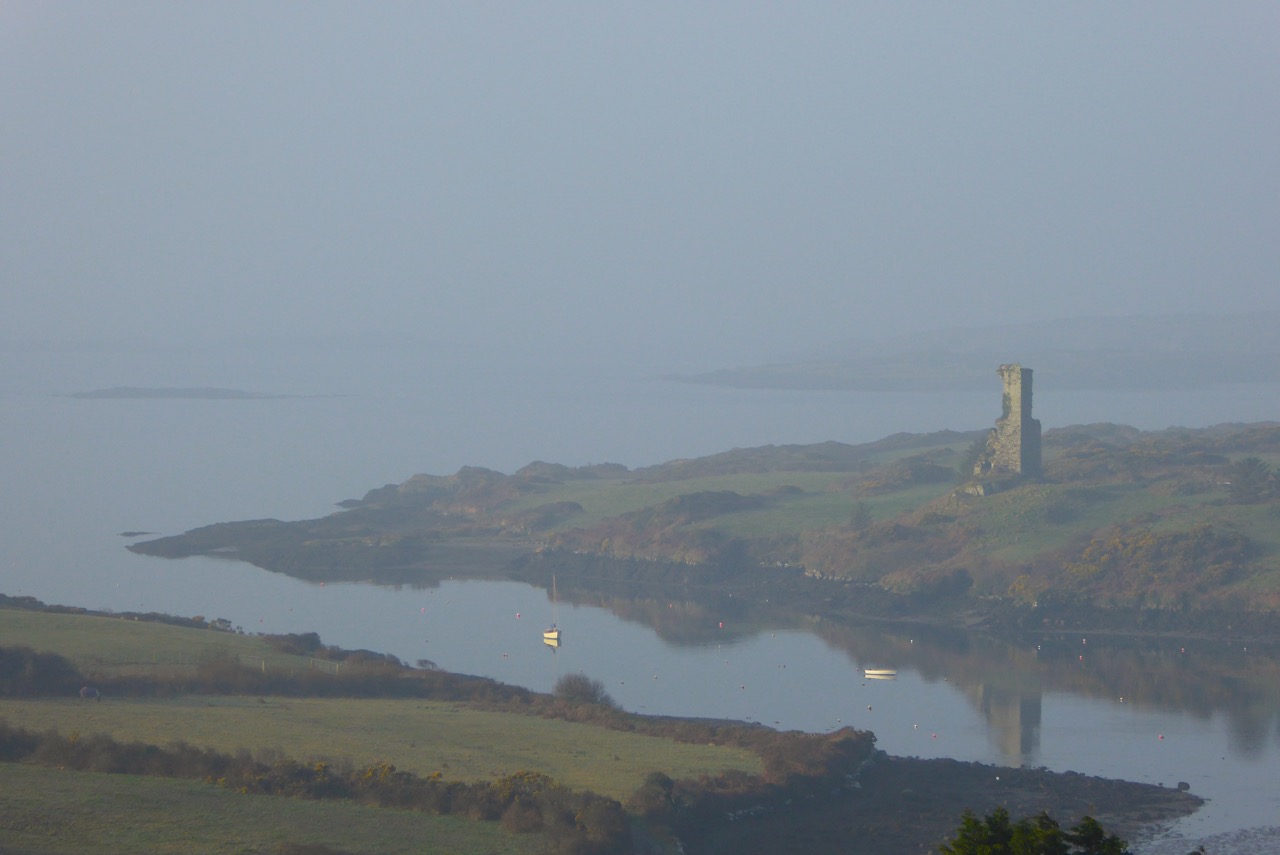
Castle in the Mist

Castle in the Mist

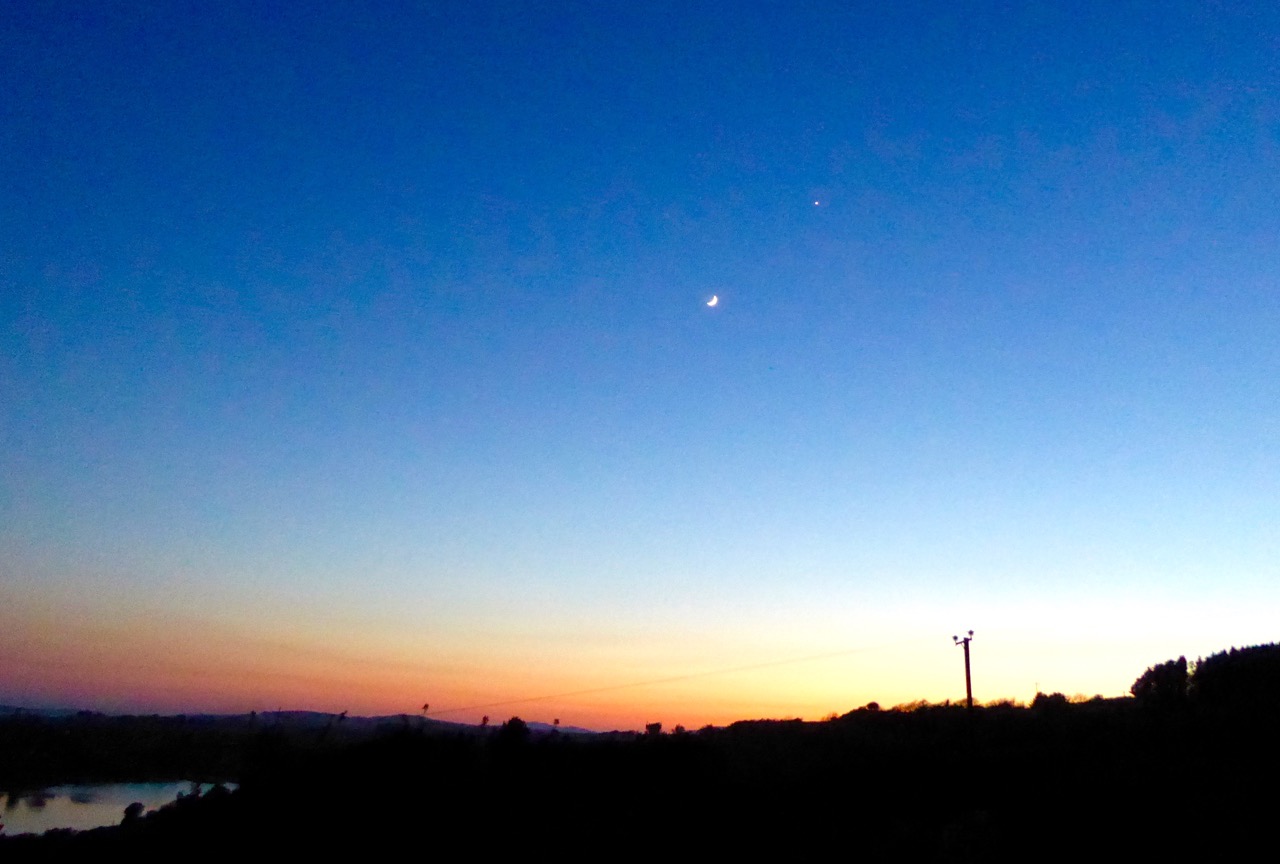
These wonderful spring days have been heralded by misty mornings. Evenings have been clear, with the crescent moon and Venus prominent over the western horizon. This is the time when we see our Bats. They might be either Common Pipistrelles or Soprano Pipistrelles: I’m sure you know that the former echolocates at a peak frequency of 45kHz while the latter echolocates at a higher frequency peaking at 55kHz. I keep listening out but can’t quite decide which is which… Anyway, they are both indigenous – and are probably sharing our eaves spaces with the Starlings.

crescent moon

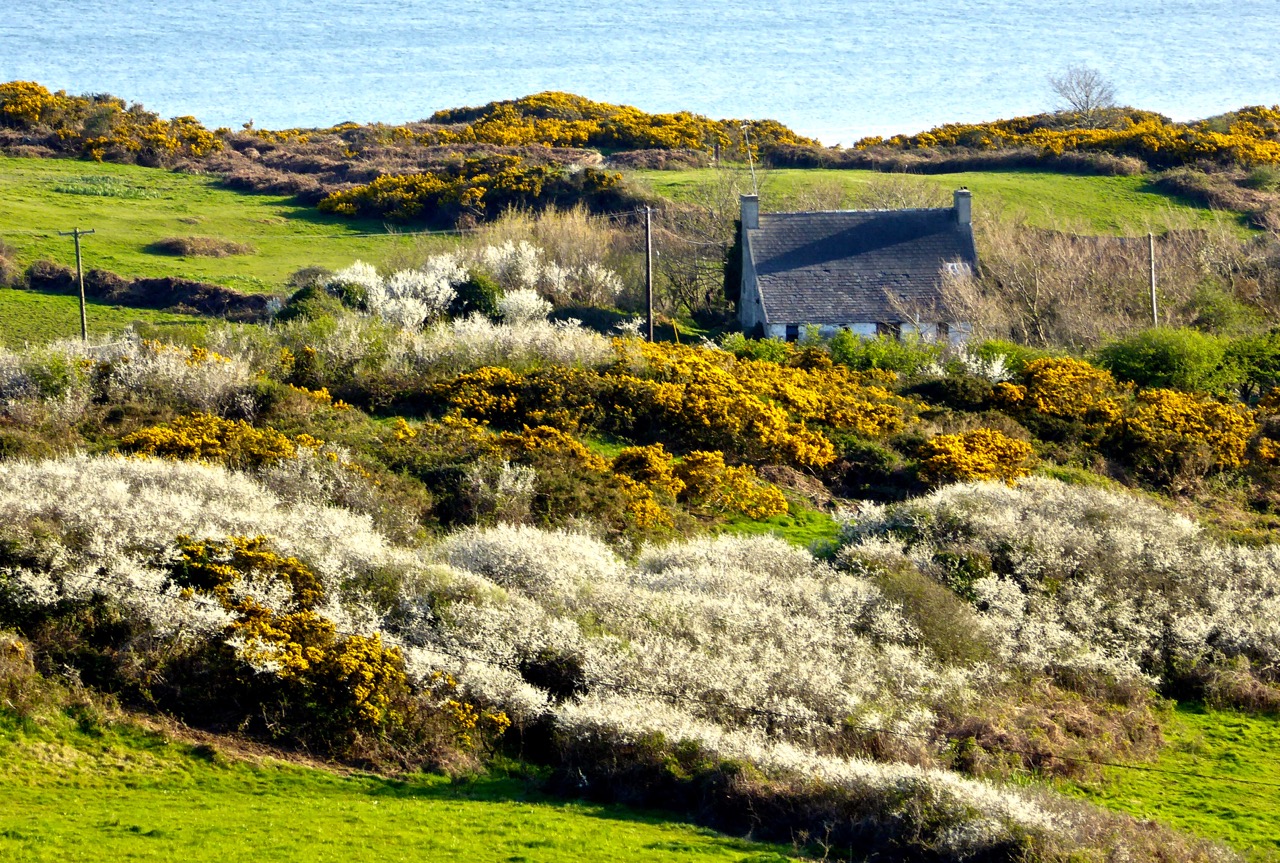
The gorse is in full bloom, as are the blackthorn hedges. Any picture of our surroundings at this time of the year has to show off the yellow and white – and, of course, the emerald green and azure blue.

looking out

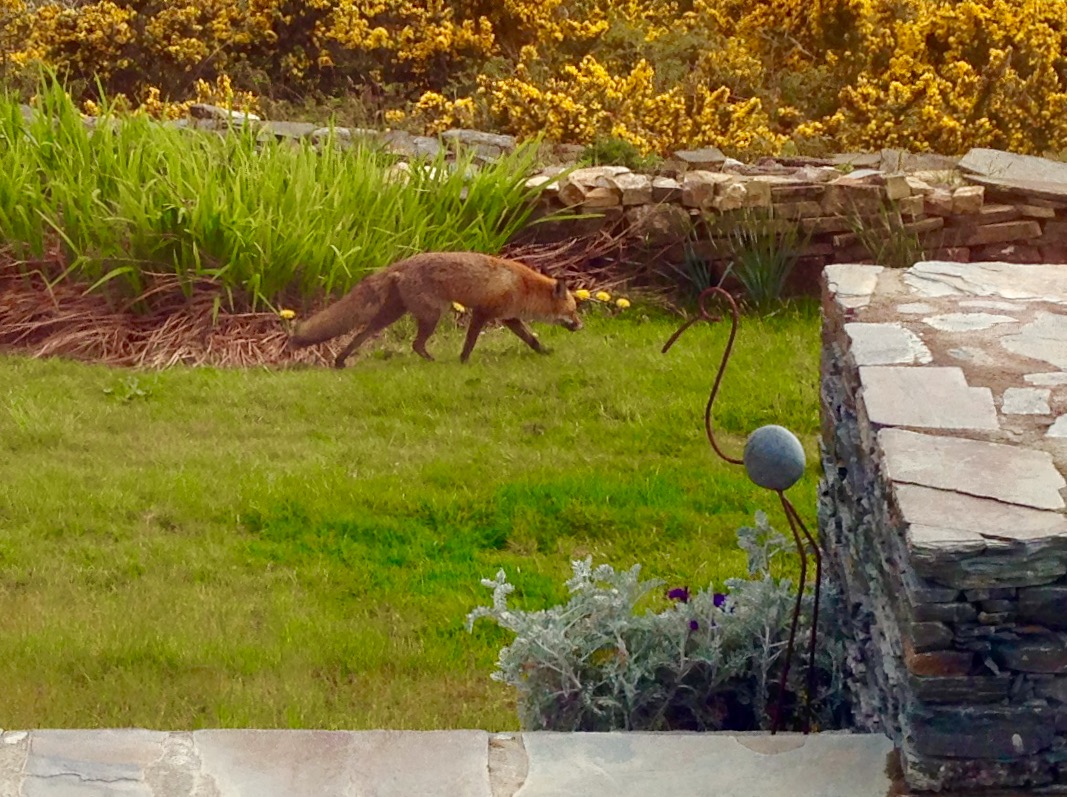
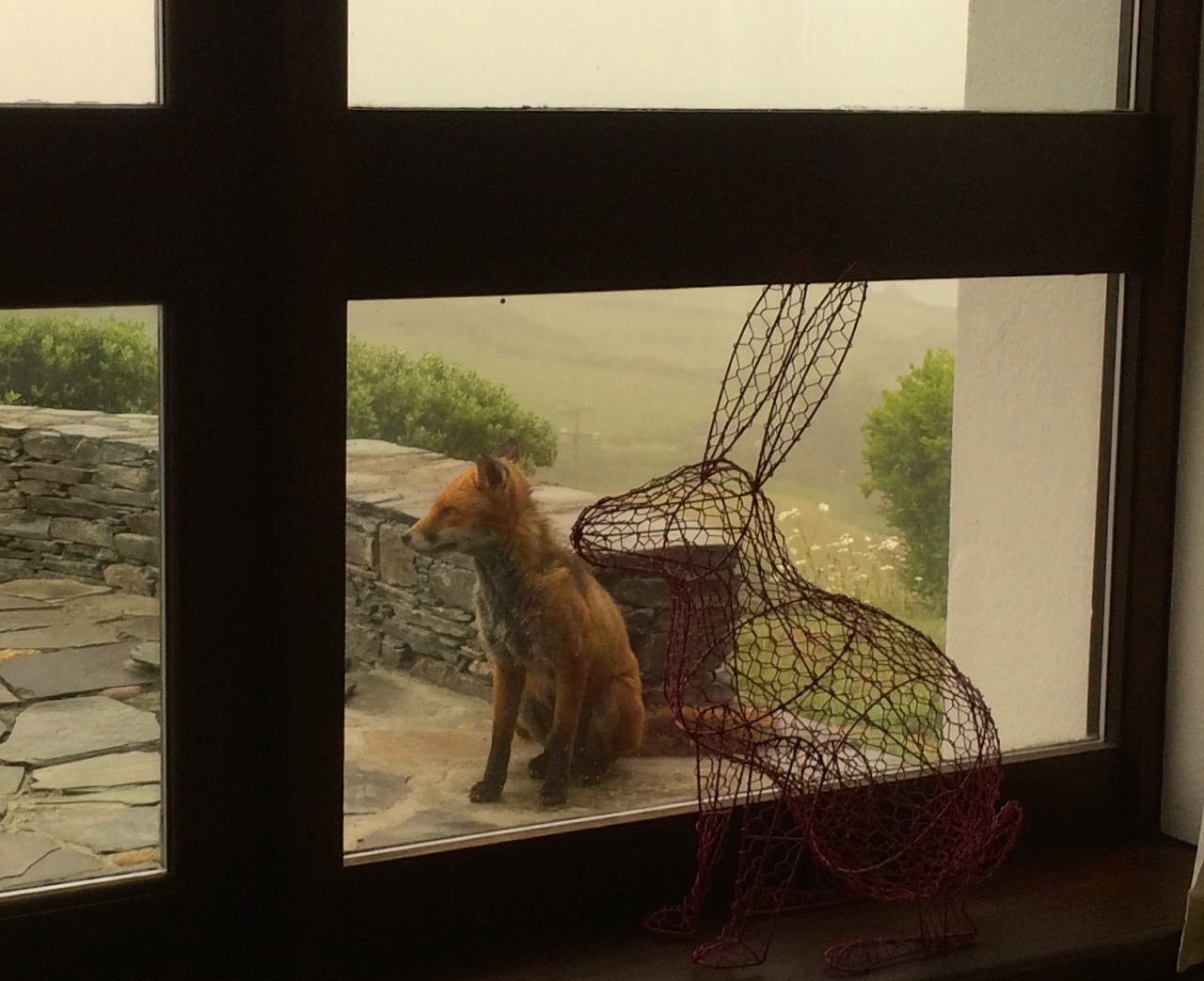
No ‘nature post’ here would be complete without mention of our own Red Fox, Ferdia. In fact, part of the drama of the week was the appearance of another Fox! As we hadn’t seen Ferdia for quite some time we worried that he might have gone the way of all Foxes: the average life of a Red Fox in the wild is only around five years – and our neighbours claim to have been hosting Ferdia for more like ten… The new Fox only made the briefest of appearances, just enough to be photographed. I think it is a Vixen – smaller and thinner – and very nervous. We couldn’t help thinking that she had come on to the scene because of Ferdia’s demise – but no! Yesterday evening, there was Ferdia knocking on the window, cocky as ever – although he does look a bit bedraggled at the moment, possibly because he’s beginning to lose his fine thick winter coat. Perhaps now we will have to find scraps for two foxes…

Fresh on the scene: a female Red Fox

Fresh on the scene: a female Red Fox

Seen through the window: a bedraggled Ferdia posing with one of our many household Hares!

Seen through the window: a bedraggled Ferdia posing with one of our many household Hares!

Finally, I was fascinated by another visitor to Nead an Iolair this week: a female Emperor Moth took up residence on our bedroom window cill. As you can see, her appearance is very striking. I wish I had been able to observe her all day, as evidently these Moths stretch themselves out in the sun waiting for a mate to arrive. The males are even more spectacular, but alas I didn’t see one. You’ll find this lady in an Irish folk tale: The Children of Lir.

Female Emperor Moth

Female Emperor Moth

I have to give a special word of thanks to Finola, who expertly took most of the photographs in this post with her excellent Leica-lensed camera

The Deer Stalkers

Young Sika stag in the Glendalough Highlands

Sika stag in the Glendalough Highlands

Having spent many years in Northern Canada, surrounded by moose, elk, caribou and deer, I was intrigued to learn that Ireland also has a significant population of deer. The Red Deer is our only native species, preserved thanks to the work of private conservationists in Kerry and now reaching healthy population numbers. Fallow Deer are the ones you see in parks (like Dublin’s Phoenix Park), although there are lots of wild ones too, descendants of those introduced by the Normans in the 12th Century. Finally, there are Sika Deer, introduced by Lord Powerscourt in Wicklow for his demesne, but now numerous in wild herds in the Wicklow Mountains and elsewhere. Here in West Cork there are occasional sightings of both Red Deer and Sika Deer – including narrow misses by drivers.

Deer hunting has become a sport in Ireland and the licensing laws are constantly being examined and refined. Deer in parks are generally protected, and Red Deer may not be hunted at all in County Kerry. The Wild Deer Association of Ireland, an ‘independent, national organisation for deer management and conservation,’ represents ‘those involved  in deer management, deer stalking and people with an interest in the conservation and well-being of Ireland’s wild deer herds.’ Their excellent website is packed with information for any questions you might have about wild deer. Deer management is not uncontroversial in Ireland, as attested by a recent article in the Irish Times by naturalist Michael Viney.

Upper Lake, Glendalough

Upper Lake, Glendalough

Having grown up in Wicklow, I had become interested in the work of Fran Byrne, a wildlife and landscape photographer of the highest calibre, and when we saw that he was leading a Deer Photography Workshop in the Wicklow Mountains we jumped at the chance to enrol.

Deer on the horizon!

Deer on the horizon!

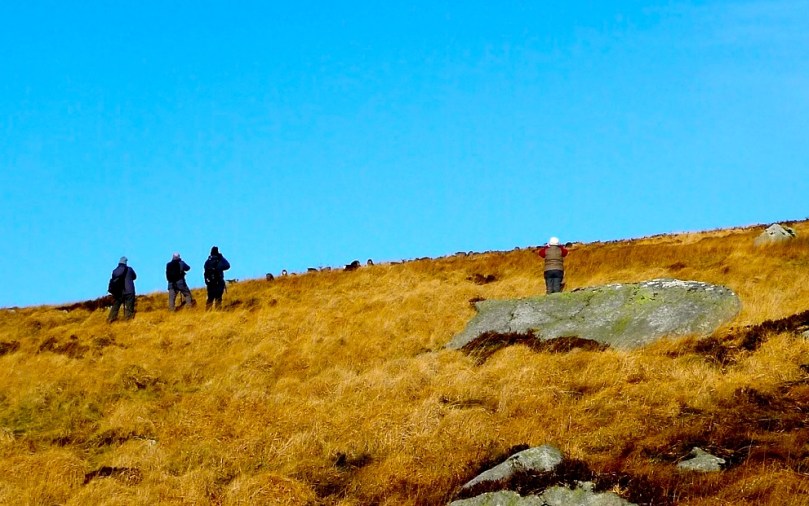
The word ‘workshop’ conjures up an image of earnest participants wearing name badges and writing on flipcharts, but Fran had warned us that this was not what we were signing up for. Having met our fellow participants (great group!) on Friday night, we gathered on Saturday morning, picked up our packed lunches from the hotel and set out, equipment in hand, to hike up to the highlands above the Upper Lake at Glendalough. (Glendalough, one of the most historic and beautiful places in Ireland, deserves its own post some day.) Once I saw our route I was glad to be carrying my tiny Panasonic Lumix camera rather than the enormous equipment of the other enthusiasts, because this was a HIKE.

Getting up to the head of the glen was arduous enough, but then we struck out across the trackless wild country. It was rough and wet, there was a biting wind (this was January, after all!) but Fran promised us that the deer, after recent snowfall, would be down from the higher ground and we had a good chance of sightings. And suddenly, there they were!

Stag and pricket

Stag and pricket

At this time of year the stags are rejoining the females and hanging out in herds. We saw male-only groups, females with young ones, and mixed groups. Our eyes gradually tuned in to the tell-tale white rumps moving through the bracken and rocks as we scanned the hillsides. Some of the deer, particularly one doe, seemed unbothered by our presence, others ran skittishly when we approached. I was grateful for the long lens on the Lumix, which allowed me to get some good shots where we couldn’t get too close.

Martin in full camouflage

Martin in full camouflage

Back at the hotel we downloaded our photos, Fran gave us pointers on processing the images and we admired each other’s captures. An excellent dinner and lots of chat later, we were all yawning after our exertions. But back we went again the next day, groaning and stiff but determined to get up to the high ground again.

After the clear blue skies of the previous day, we were presented with a mist that descended on us and worsened during the morning. Nevertheless, having taken  a different route we were rewarded again by good sightings.
Hind feeding

Hind feeding

We were particularly lucky to be joined by Joe Murphy, a deer expert and leading member of the Wild Deer Association. He filled us in on the current state of Irish deer populations, what threatens them (their only predator is humans), modern management practices and hunting regulations. He also volunteered to climb above one small herd to see if they would move away from him and towards us. Unfortunately, a lone hiker heading up into the hills scattered them before they started down.

Two prickets

Two prickets

Browsing near the stream

Browsing near the stream

I’m not sure when I was last as footsore and achy as I was last Monday morning, but it was worth every creaking bone and every throbbing muscle. If you’d like to do the same, contact Fran Byrne through his Facebook page. And don’t worry, you won’t have to slog up the mountain to take a workshop with him as he also does woodland rambles and garden walks. Mind you, he did describe our exertions as “leisurely” at one point, so be prepared!

There are wild goats on the cliffs too

There are wild goats on the cliffs too