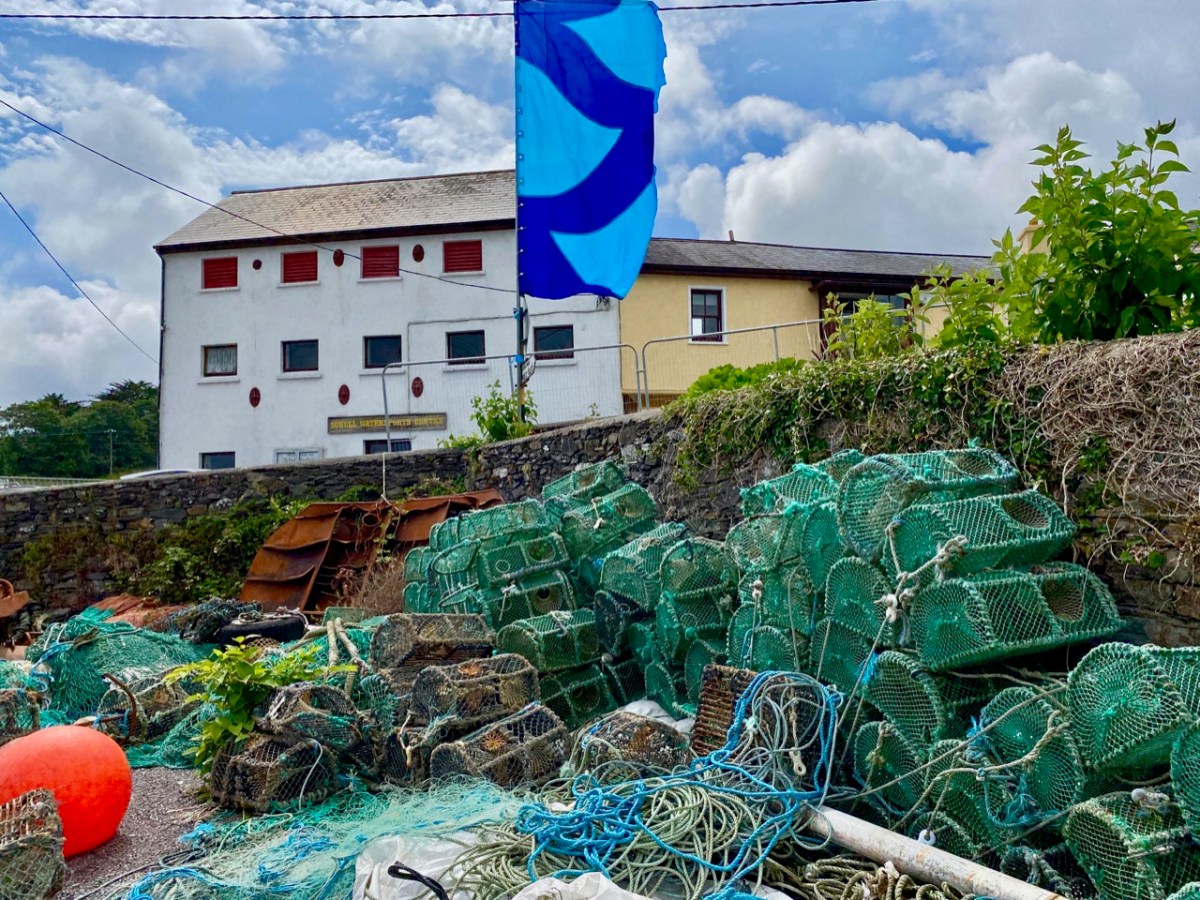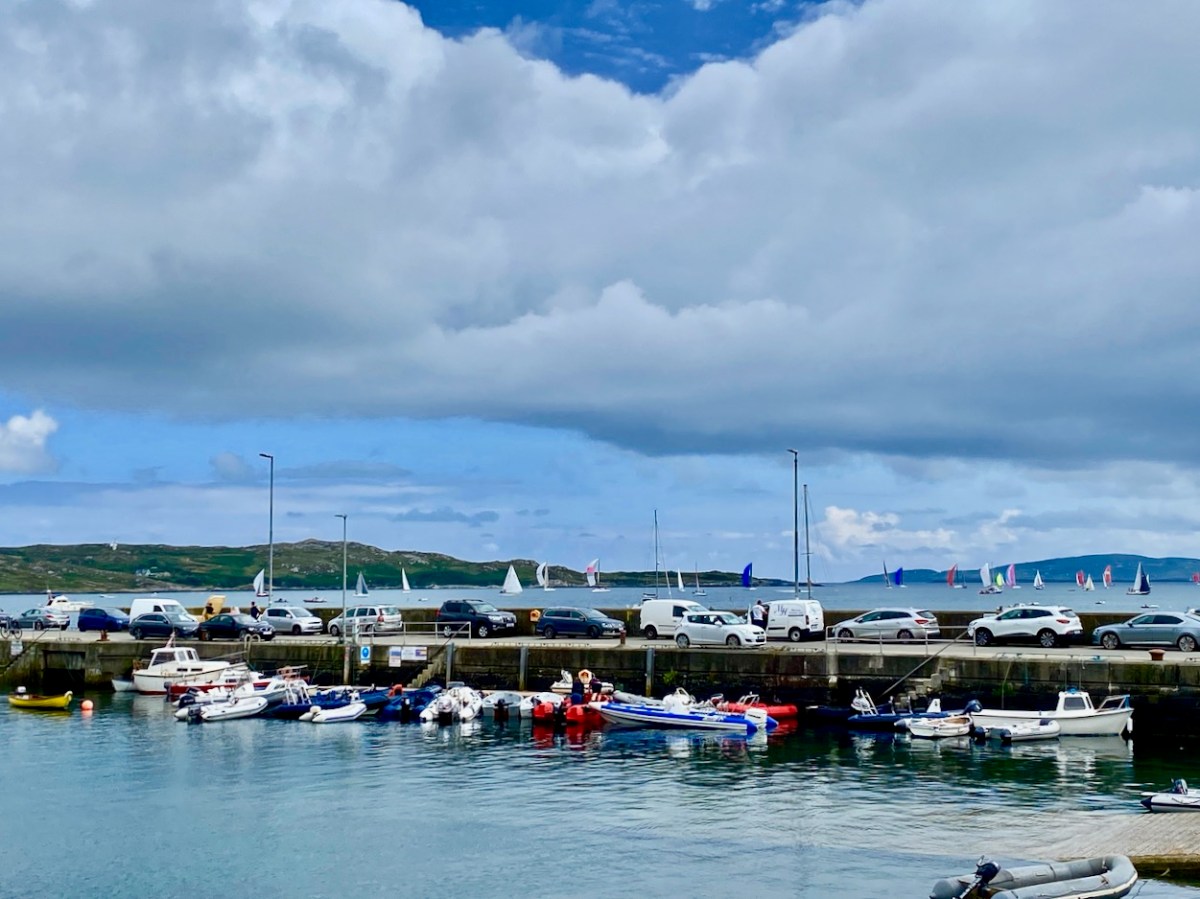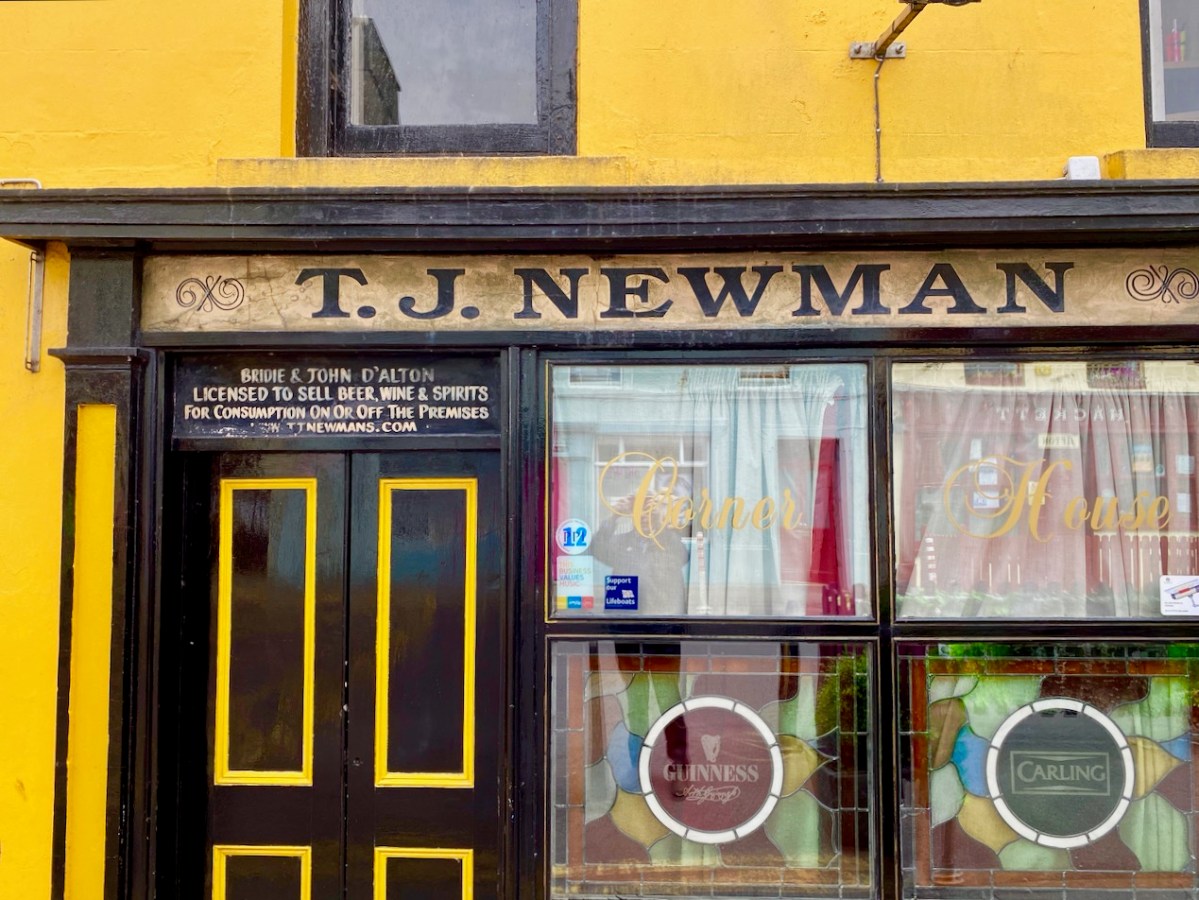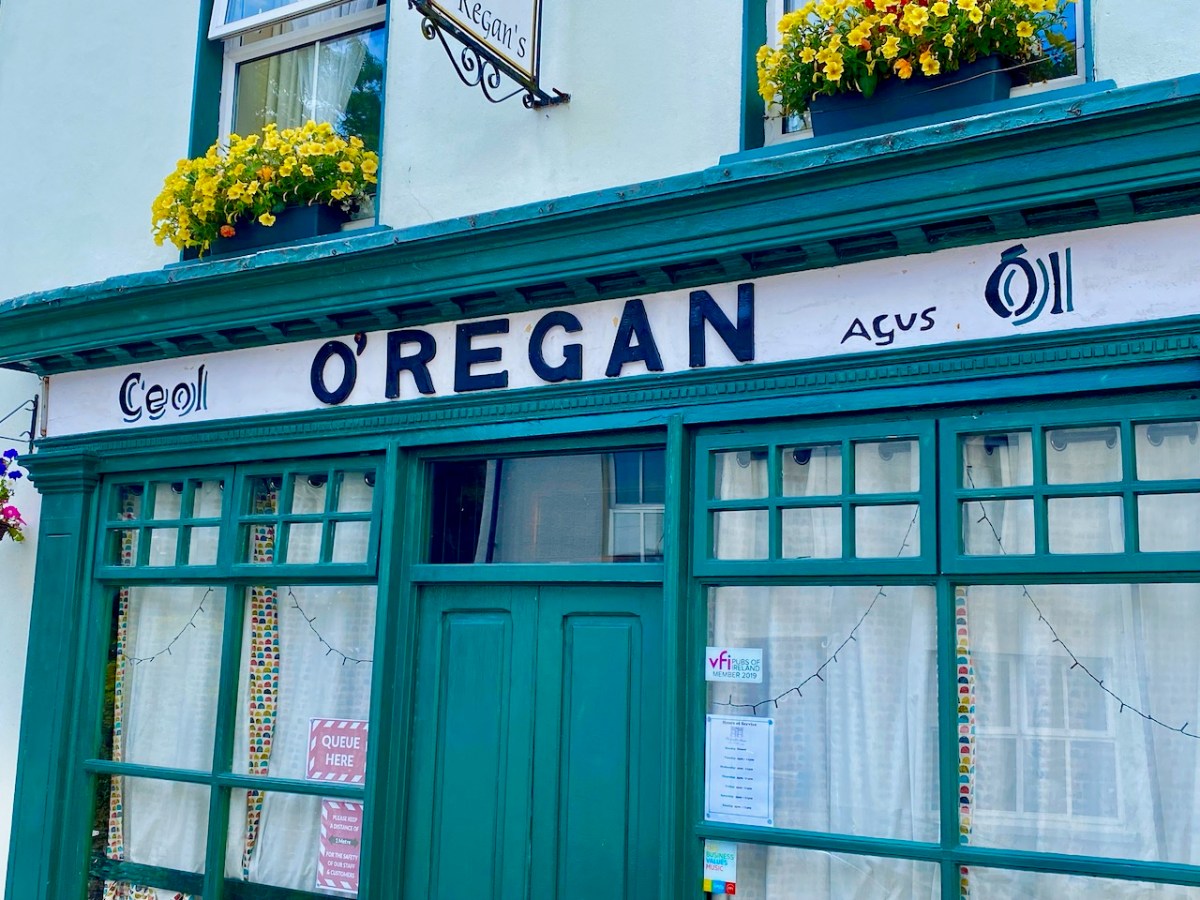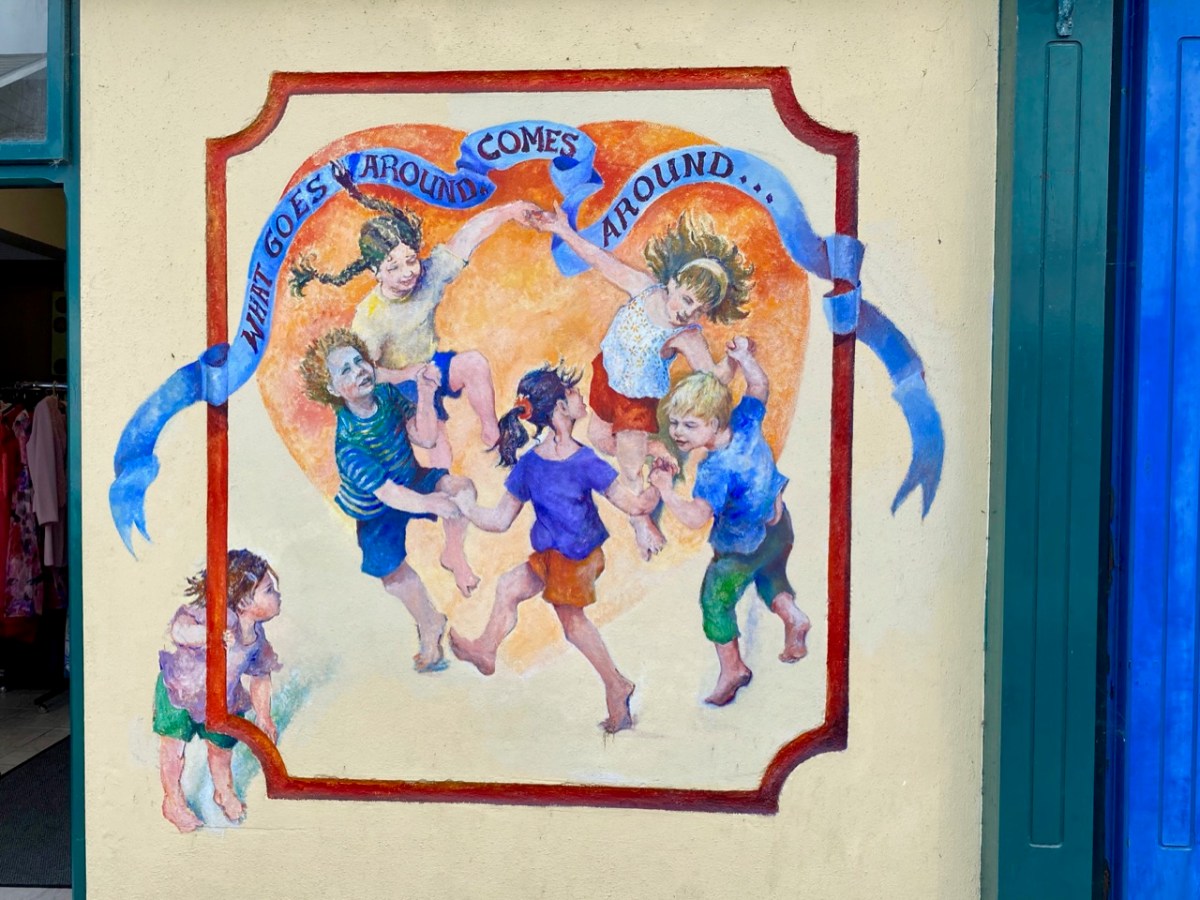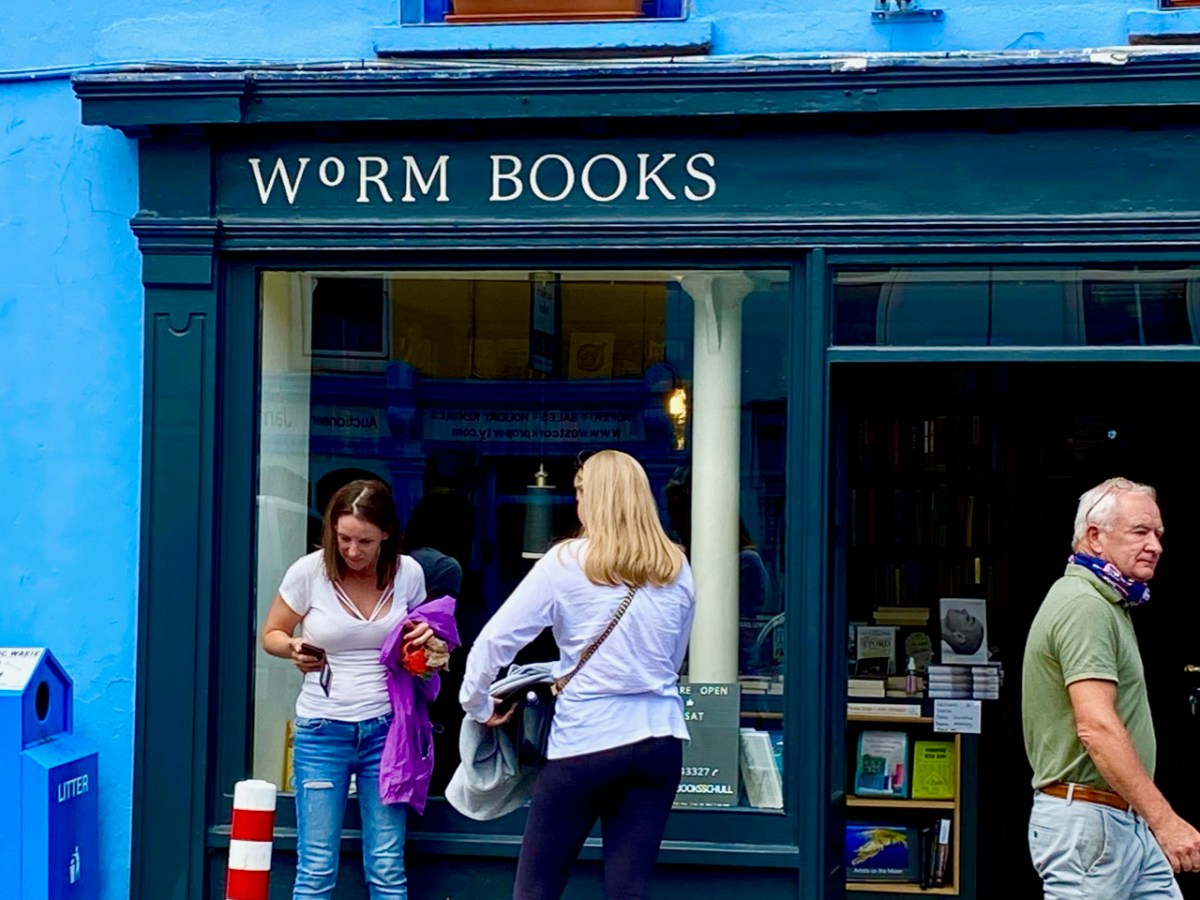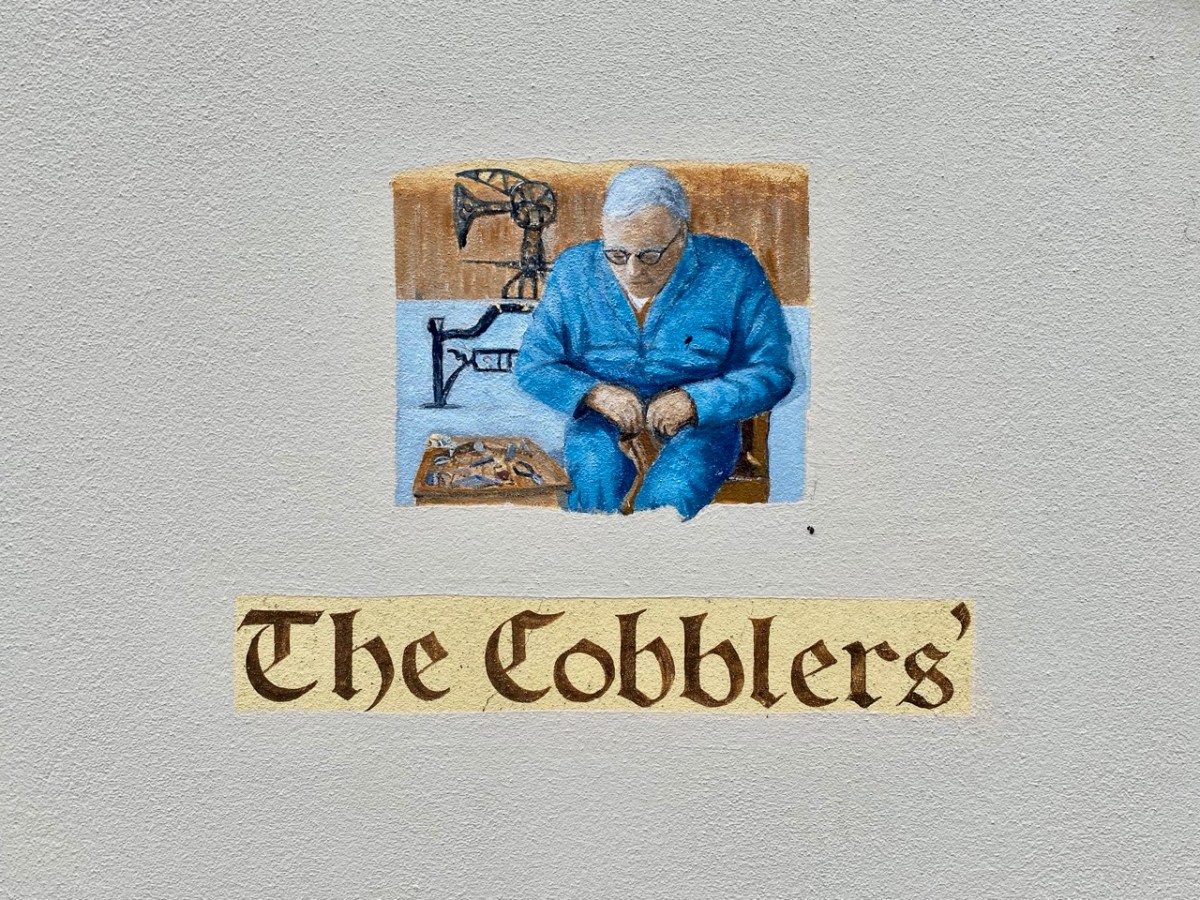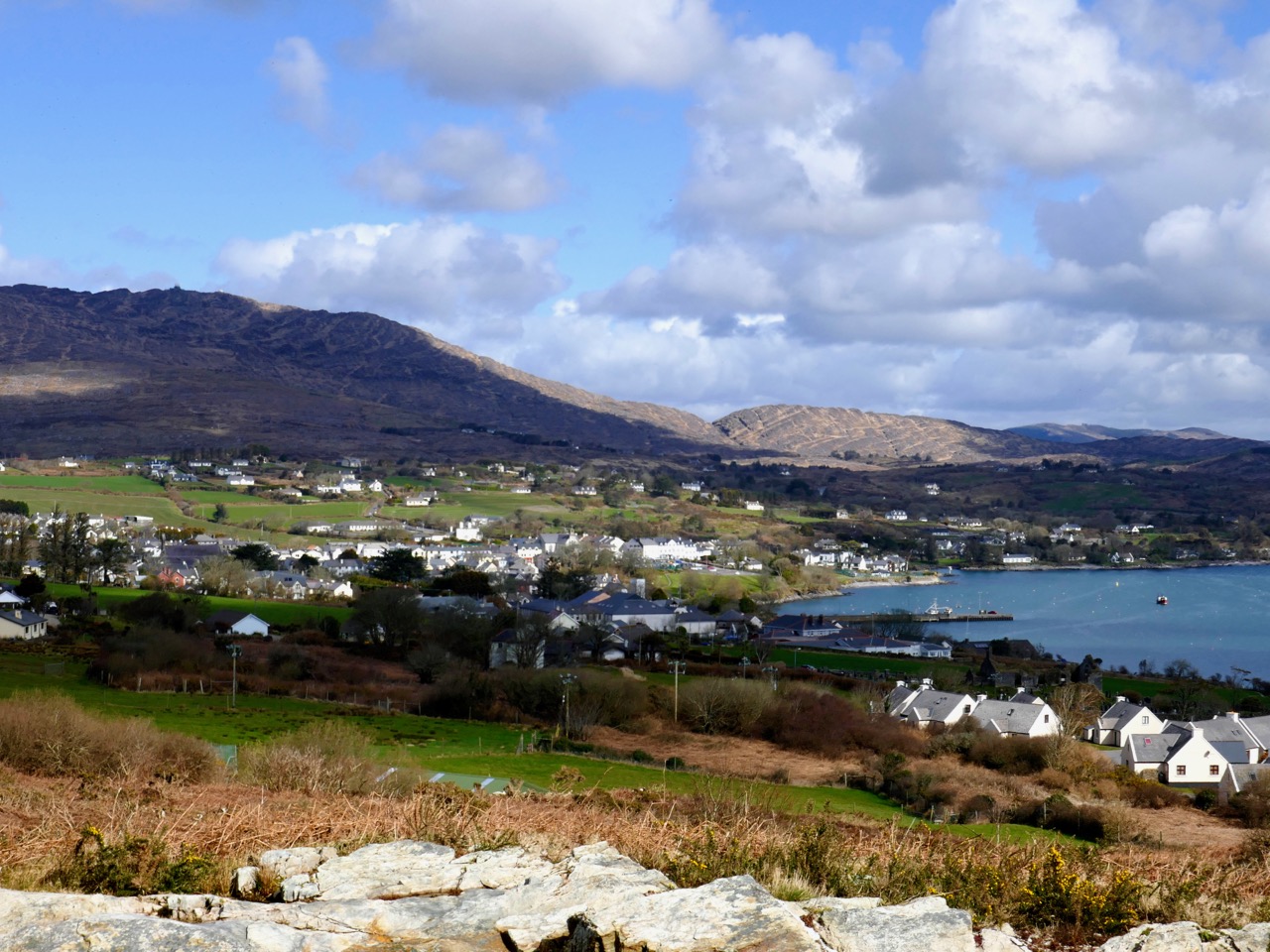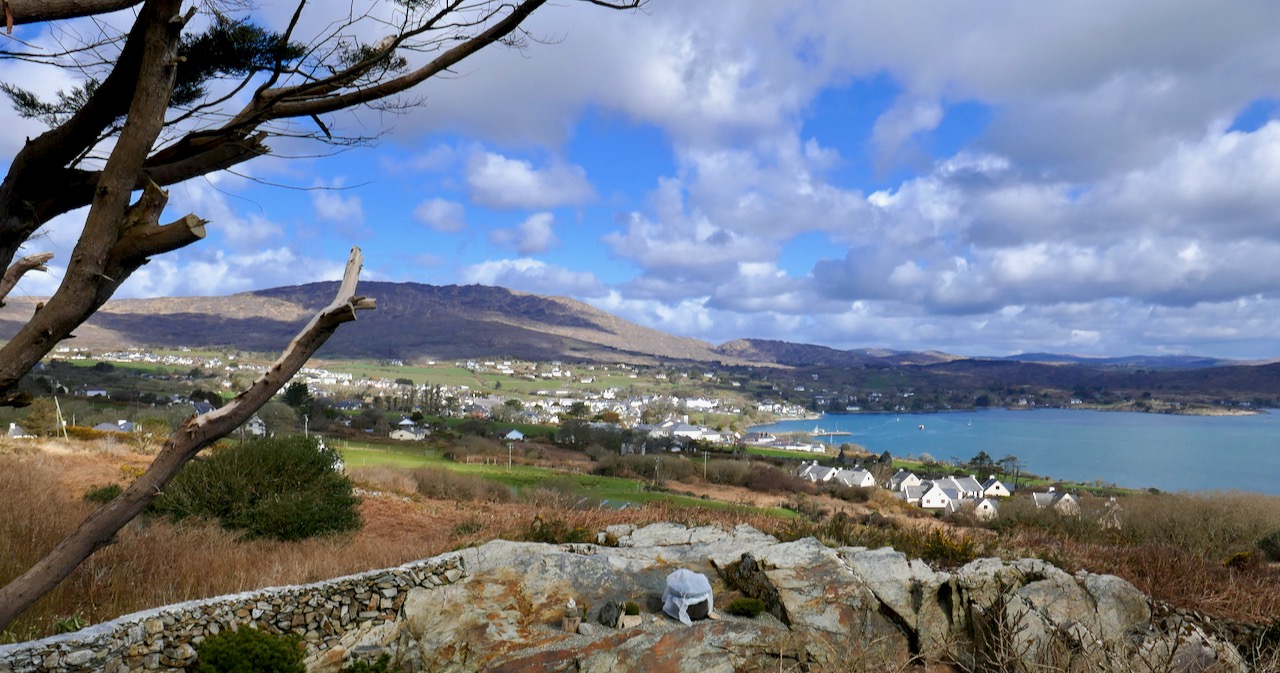
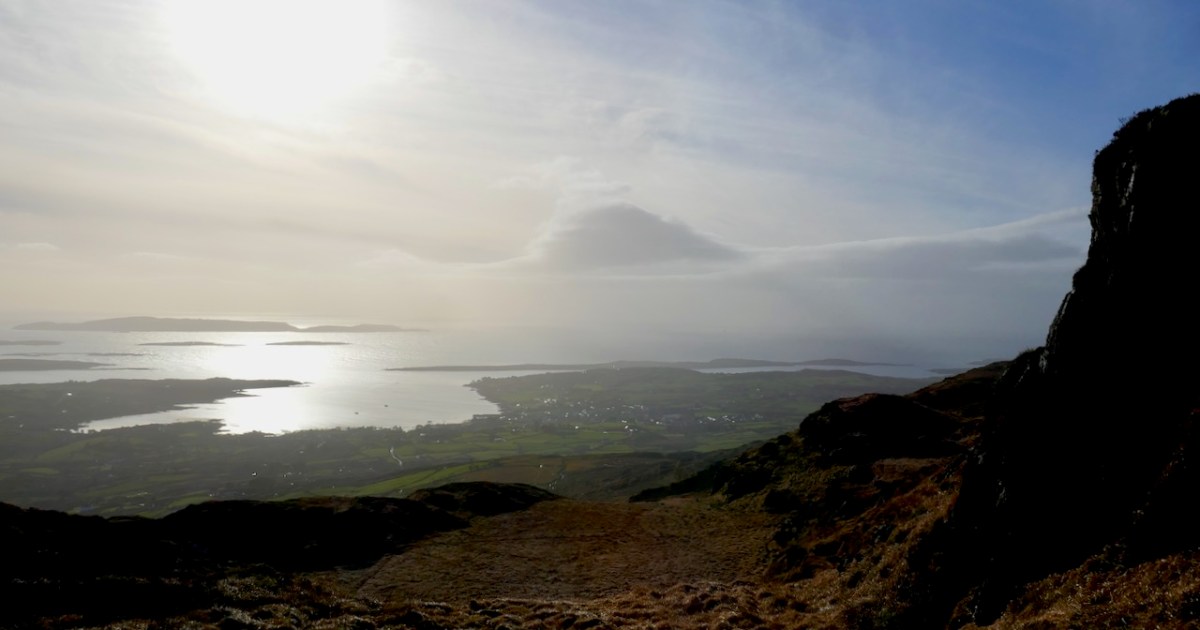
. . . And Hello Schull!

First of all, a HUGE thank you to all the readers who sent me such kind messages of support on my last blog. I am normally very good about responding to comments, but moving house took its toll on my time and energy and I just never got to it. But I want you all to know that I read and appreciated SO MUCH every single message and I felt totally supported by this Roaringwater Journal community we have built together. 
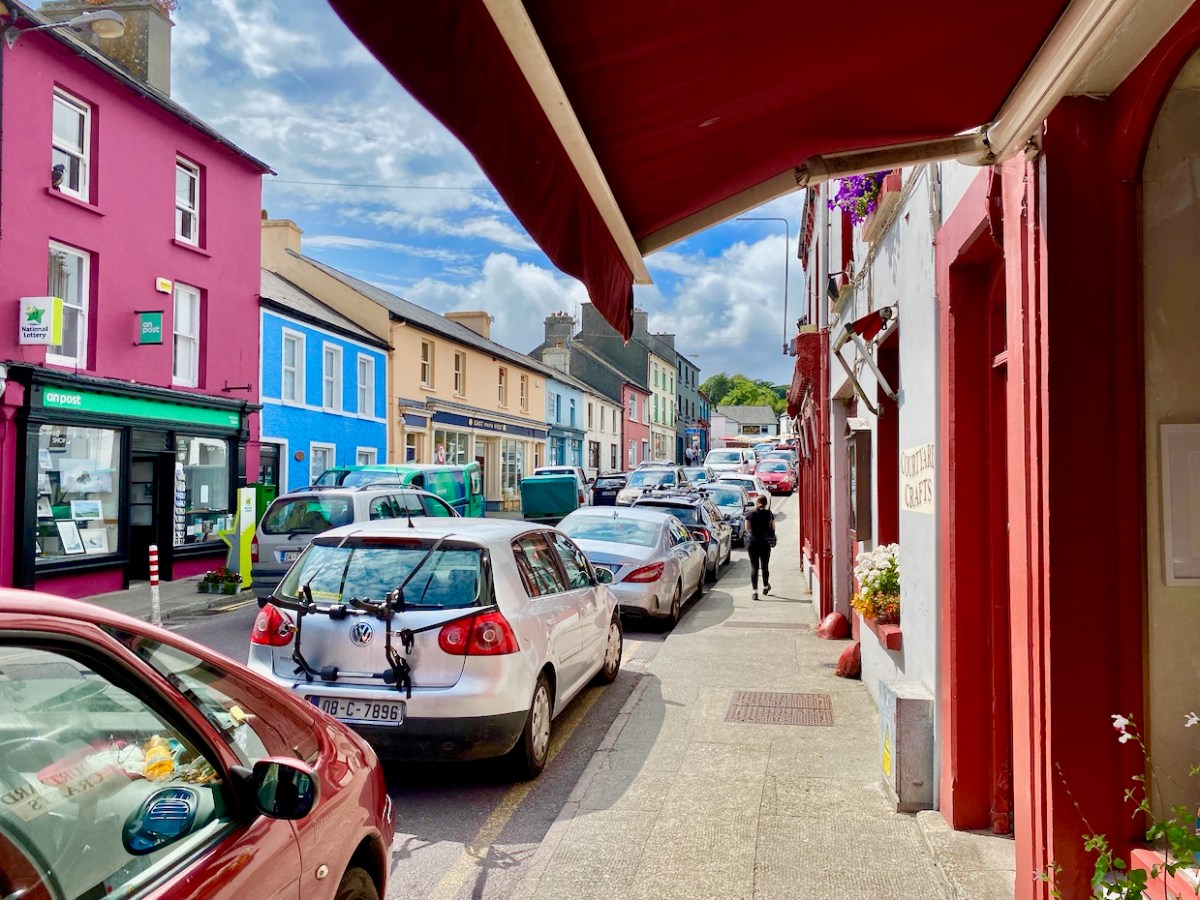
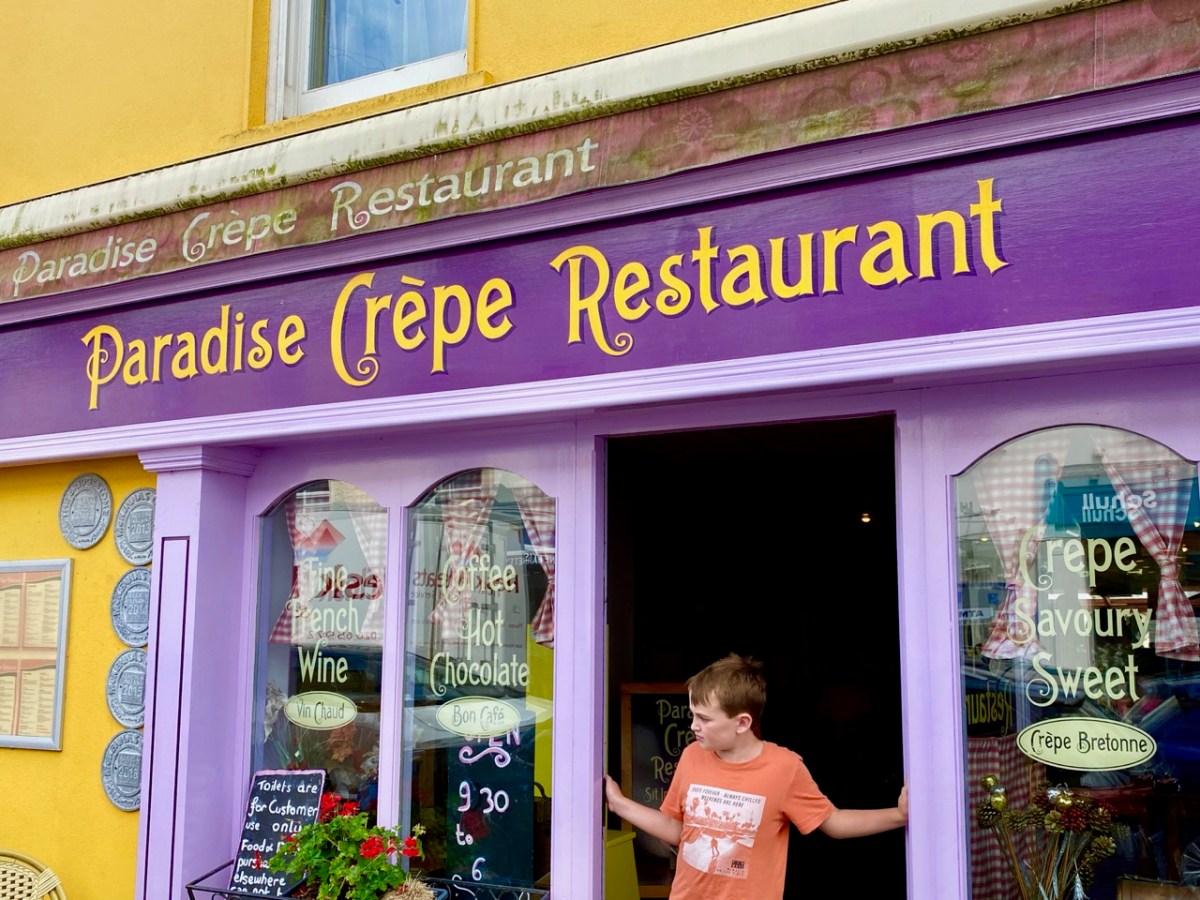
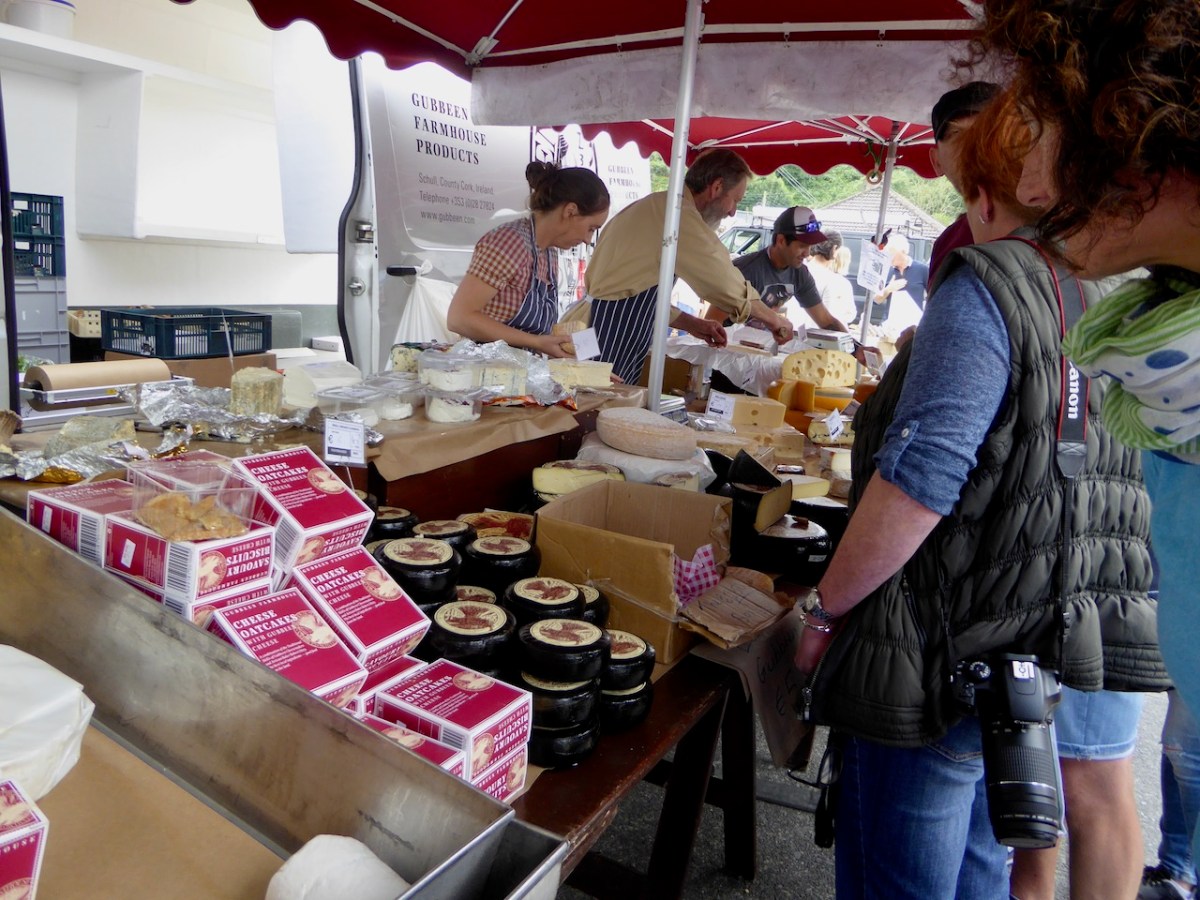
So here I am now, happily settled in Schull, looking back on what we have written about this wonderful village over the years. And what we have eaten as well.
Robert did a series called West Cork Towns and Villages and he wrote about Schull in 2021. (Don’t be confused, by the way, by the fact that the author is given as “Finola” on the top of many of these posts: now that I am the sole administrator of the website, WordPress has automatically assigned all authorship to me and I can’t seem to change it back.) It was during Calves Week in August and Schull was en fete and looking sunny and busy and gorgeous – as it is all summer anyway.
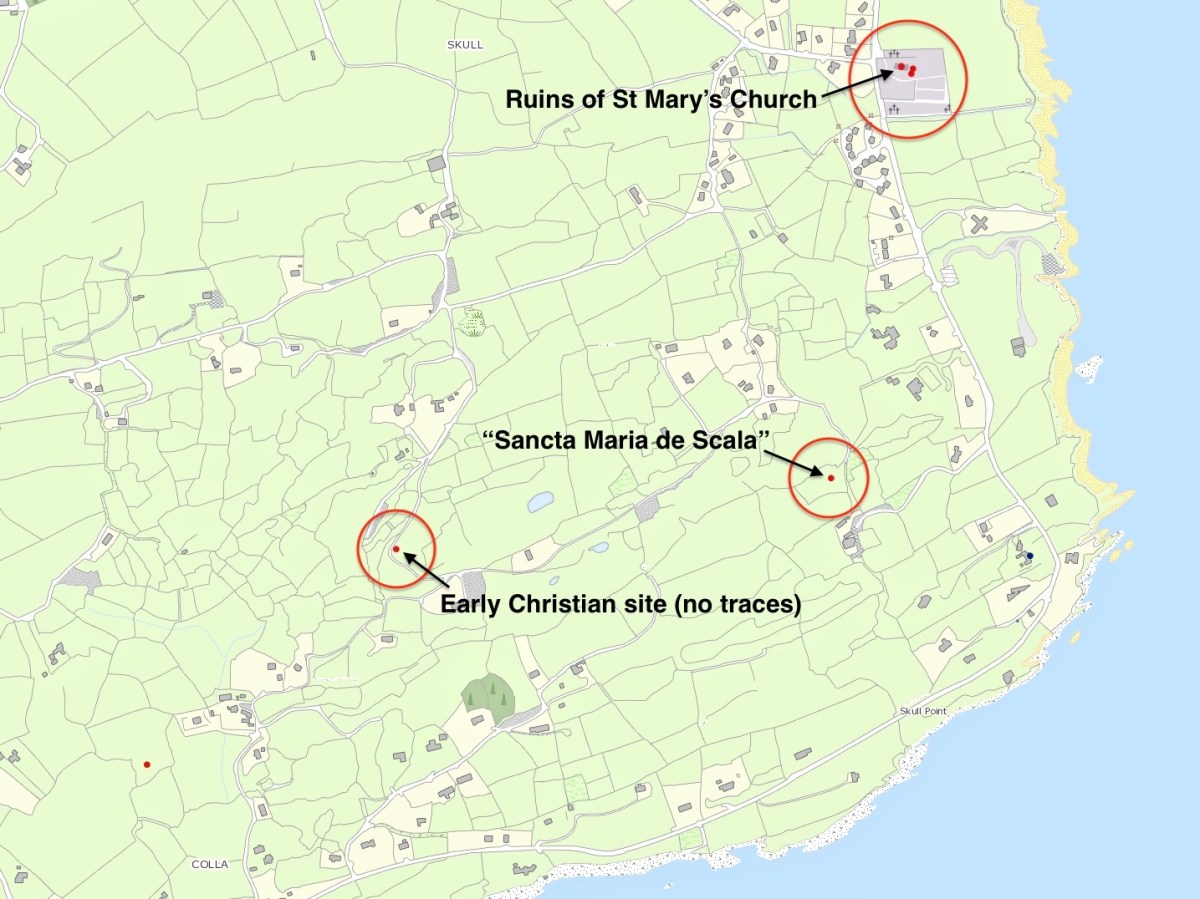
One of the topics Robert tackled was the name – Schull, or Skull as it is invariably given on old maps. In two posts he traced the possibility that somewhere around here was an ancient ecclesiastical settlement named for Mary. In the first one, he referred to the The National Monuments record which states: According to local information, this is the site of Scoil Mhuire or Sancta Maria de Scala, a medieval church and school that gave its name to this townland and to Skull village . . .
In the second, Schull – Delving into History, he charts the various evidence, or mythology, that gave rise to the ‘local information.’ As a corrective, he urged the reader to also look at John D’Altons’s sceptical take on the placename. I also urge you to do so: it’s here.
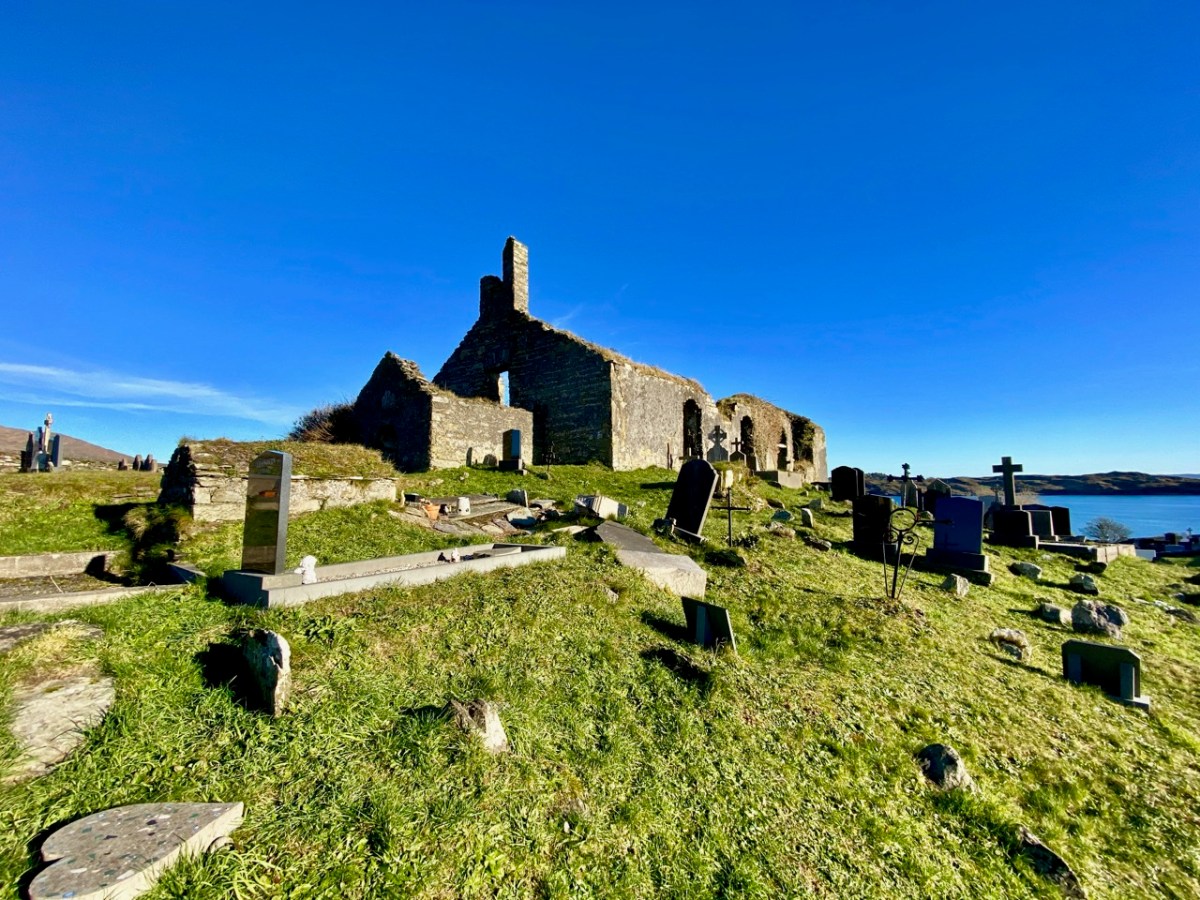
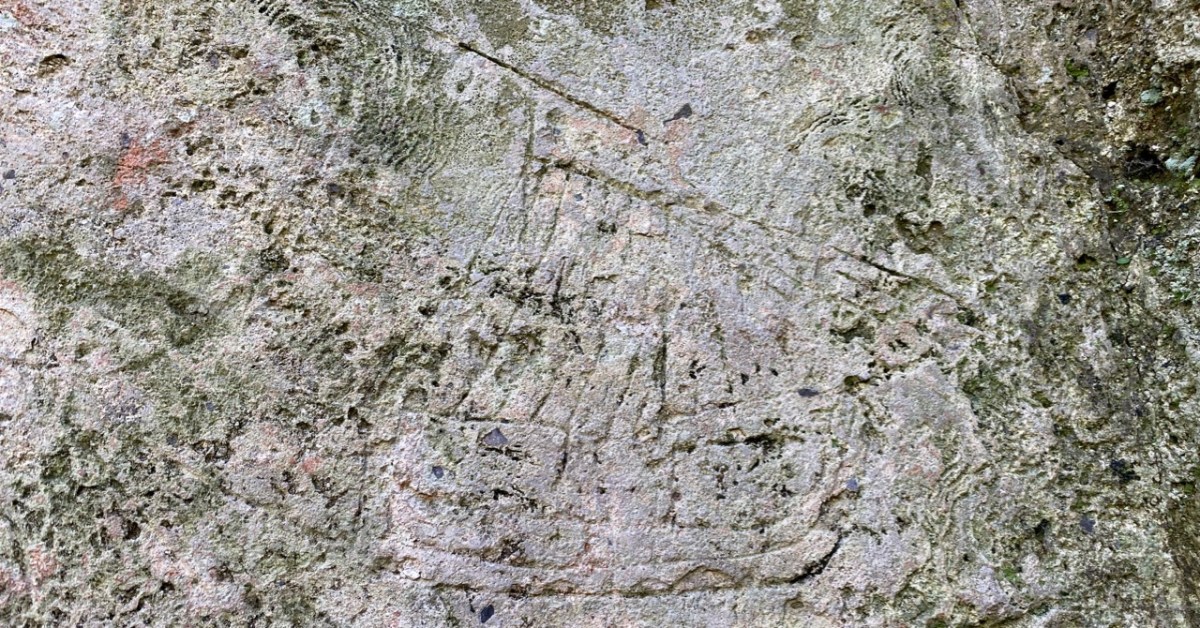
Robert re-visited St Mary’s church in 2022 to write about the ship graffiti in the porch. Subsequently our friend Con Manning wrote an erudite piece for the 2025 Skibbereen Historical Journal on the same graffiti: The ruined church at Schull, Co. Cork, and its ship graffiti
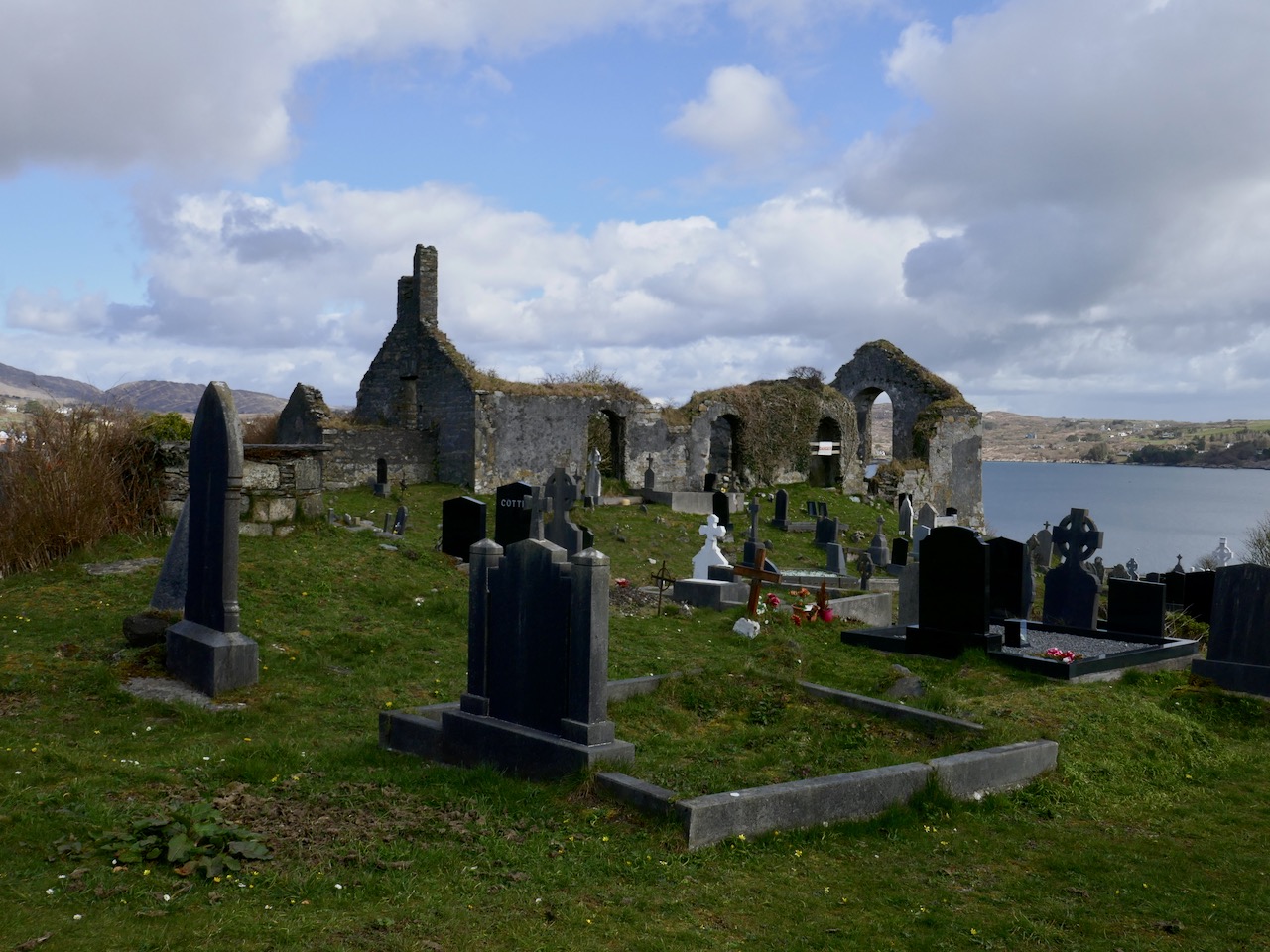
Before we leave St Mary’s I will mention it is the final resting place of many anonymous souls who died during the famine, as well as the Rev Robert Traill, about whom I wrote in my series Saints and Soupers. Traill’s story in Schull started out as that of a typical evangelical clergyman, despising the Catholics and railing against Popery and its thousand forms of wickedness, but ended heroically as he laboured night and day to feed the hungry all around him, dying himself of famine fever. Read more about Traill here and here.
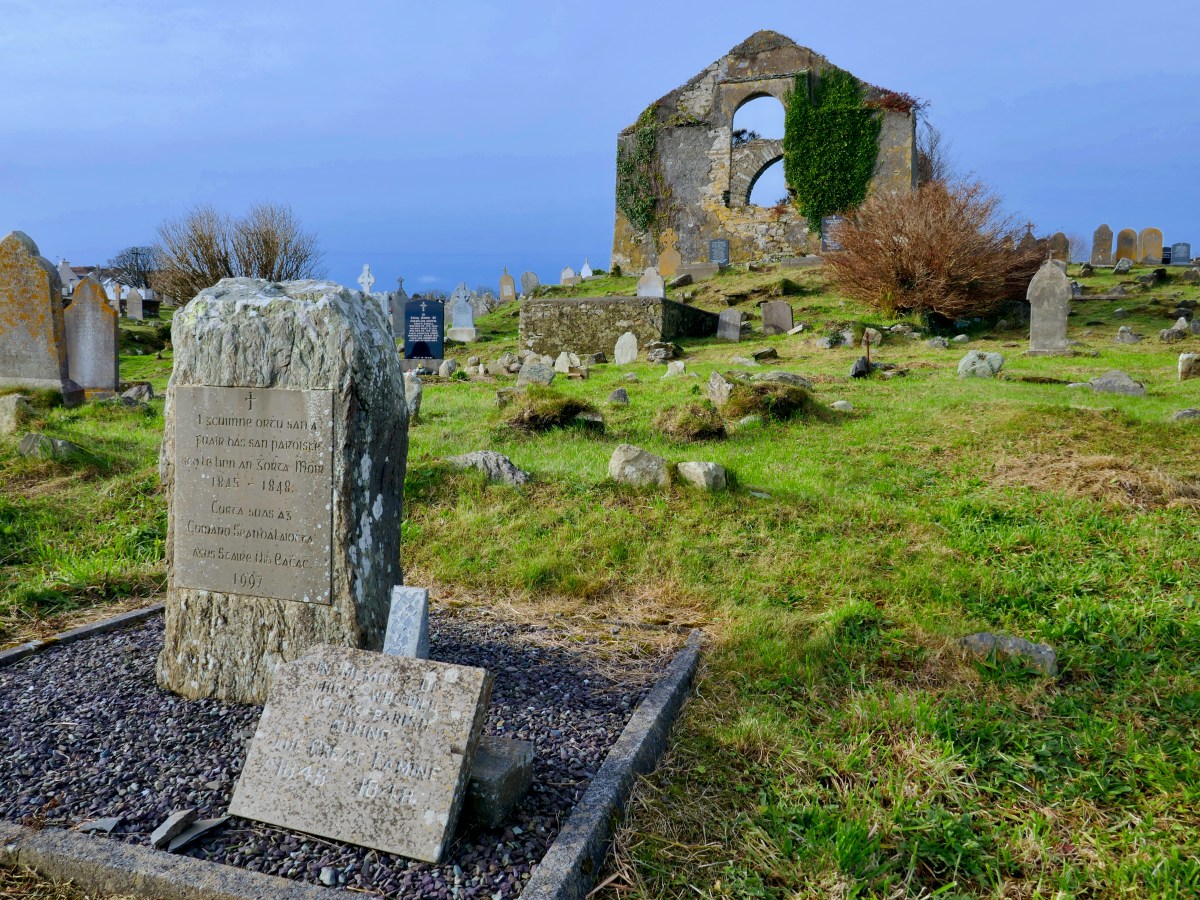
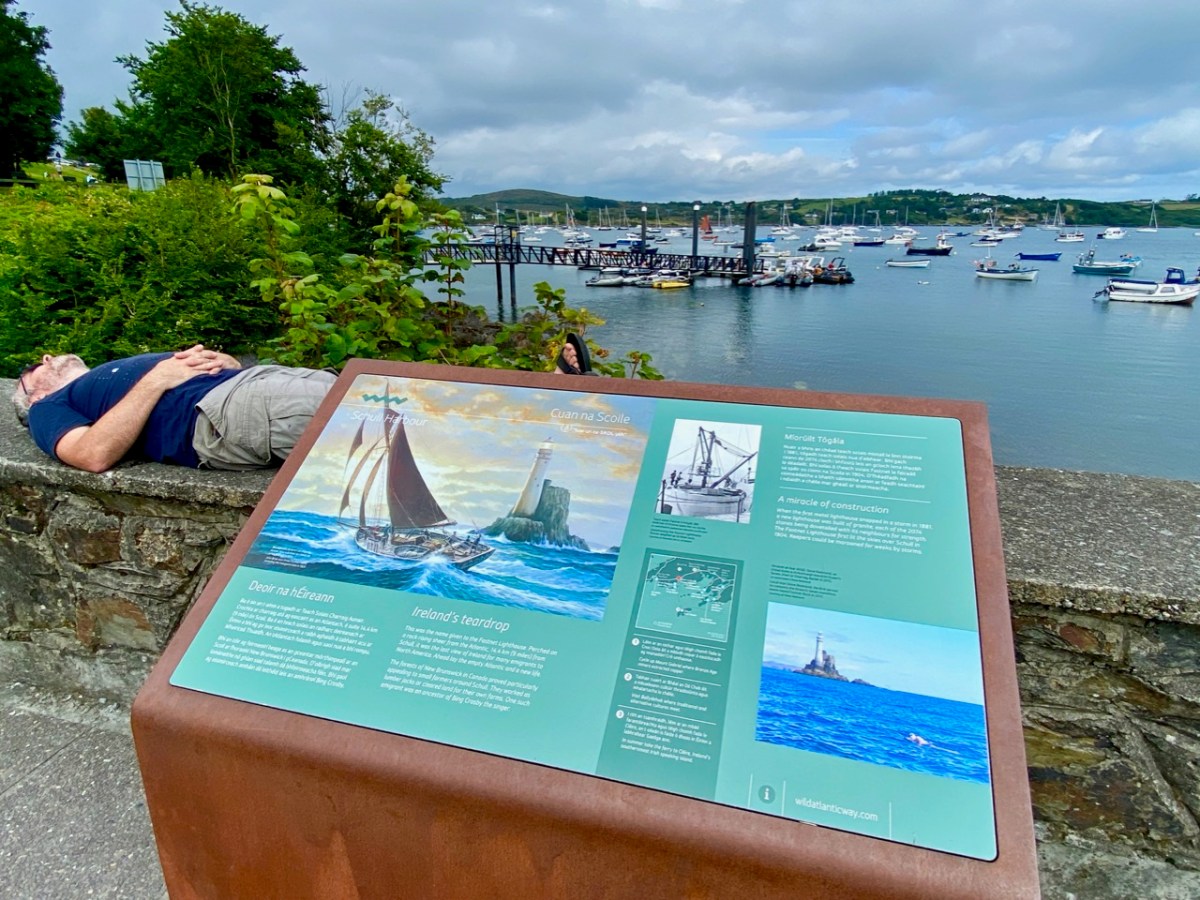
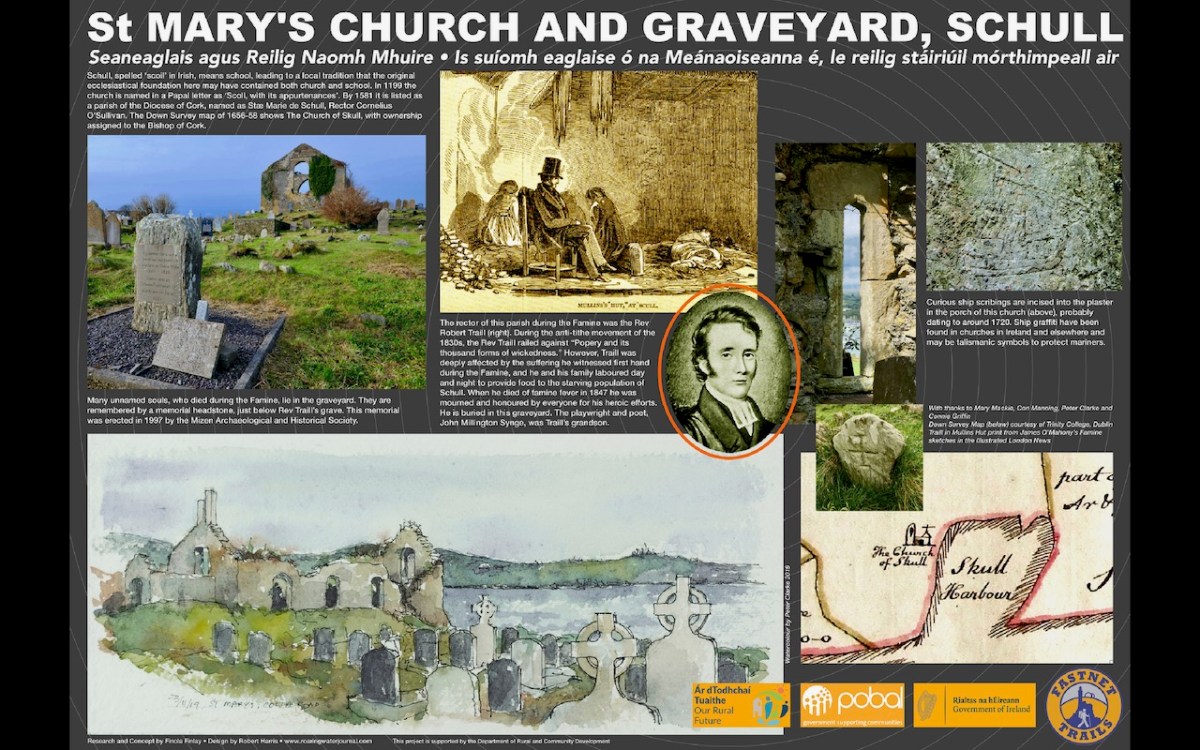
And of course, this is Robert’s final resting place also, with his beautiful hare headstone. I love it that, at the entrance to the Graveyard, is a Fastnet Trails informational board written by me and designed by Robert, about the history of this important place. The watercolour is by Peter Clarke.
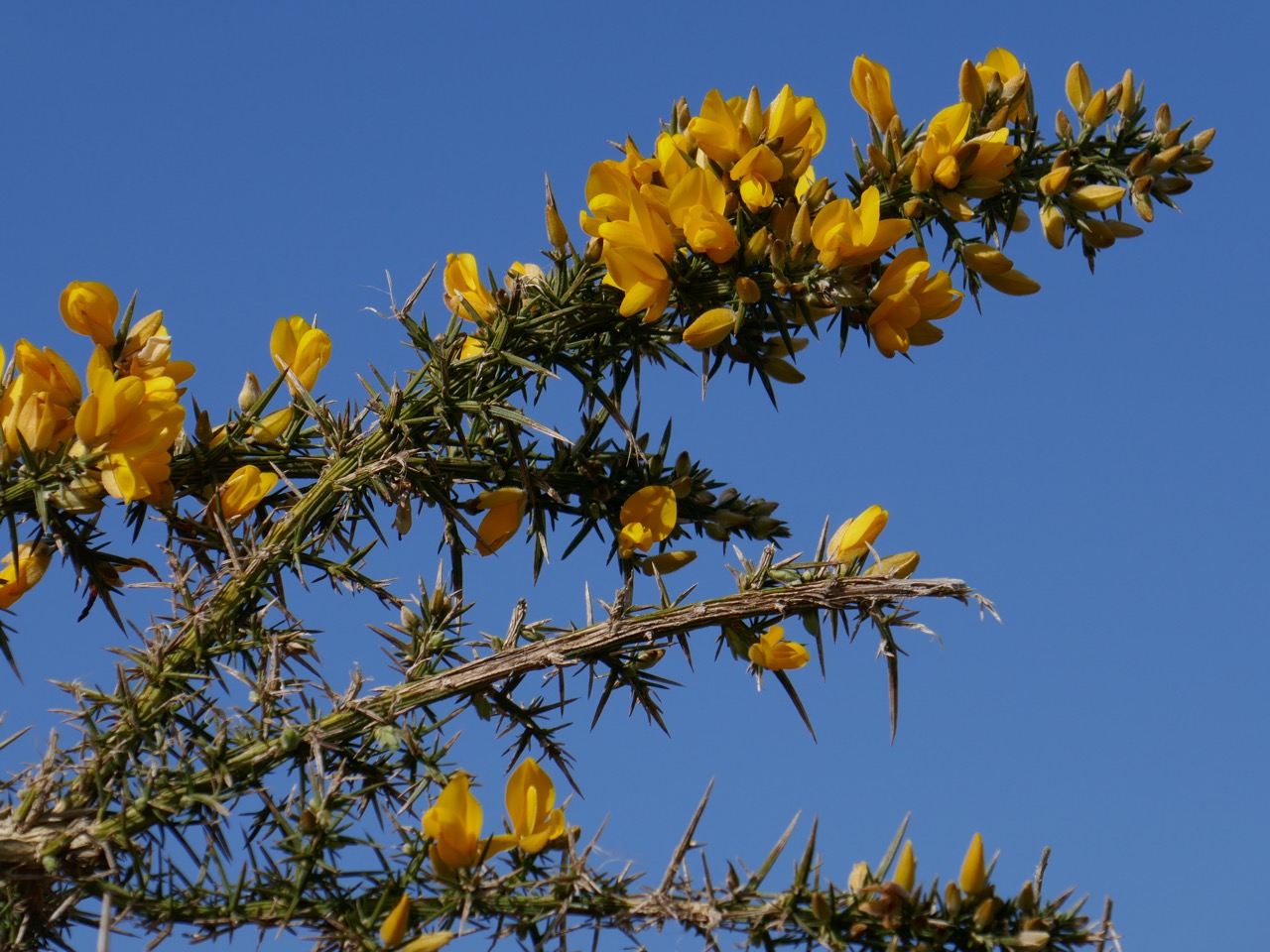
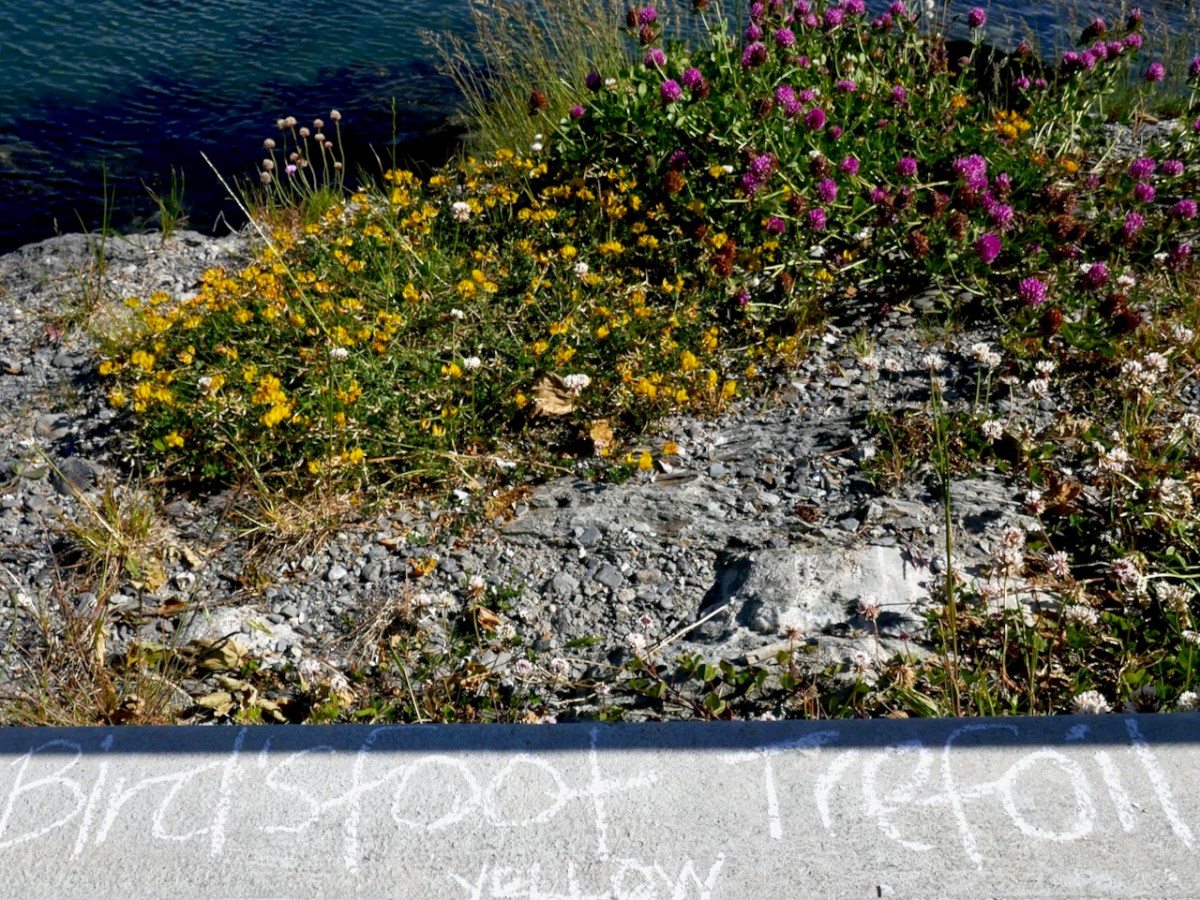
Like all the West Cork villages, Schull is also a haven for wildflowers, although you might think they are only weeds. We had a very enjoyable Guerrilla Botany session in early June in 2020 wandering around and chalking in the names of all the plants we found. Time to do that again this spring, I think – who’s up for joining me?
The train used to come to Schull – the Schull and Skibbereen Light Railway came all the way down the Pier and Robert wrote about this rail line in a series of posts. The Schull-related one is here – a set of reminiscences about the stops, the engines, the buildings and the people who made it all run. My personal favourite was Gerry McCarthy who was known as ‘Vanderbilt’ from the careful way he had with money

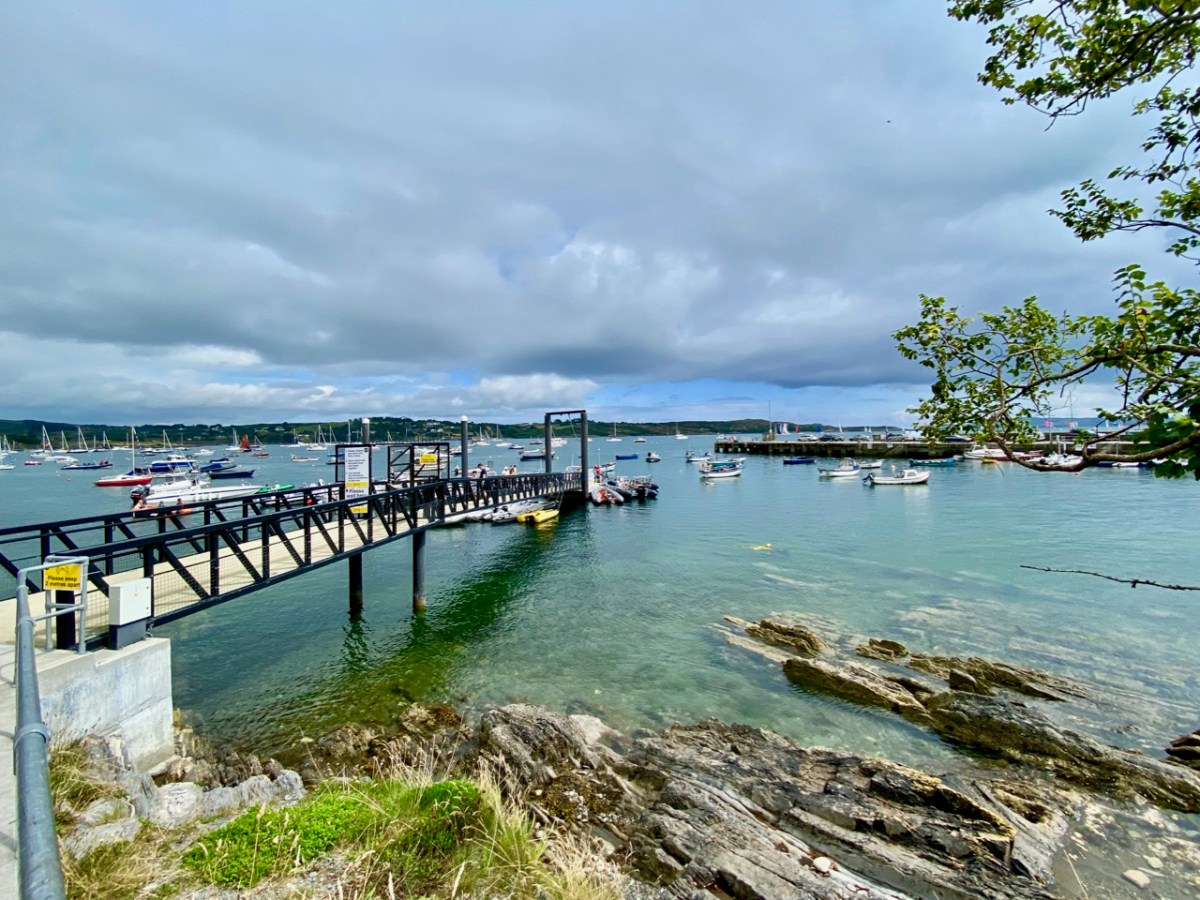
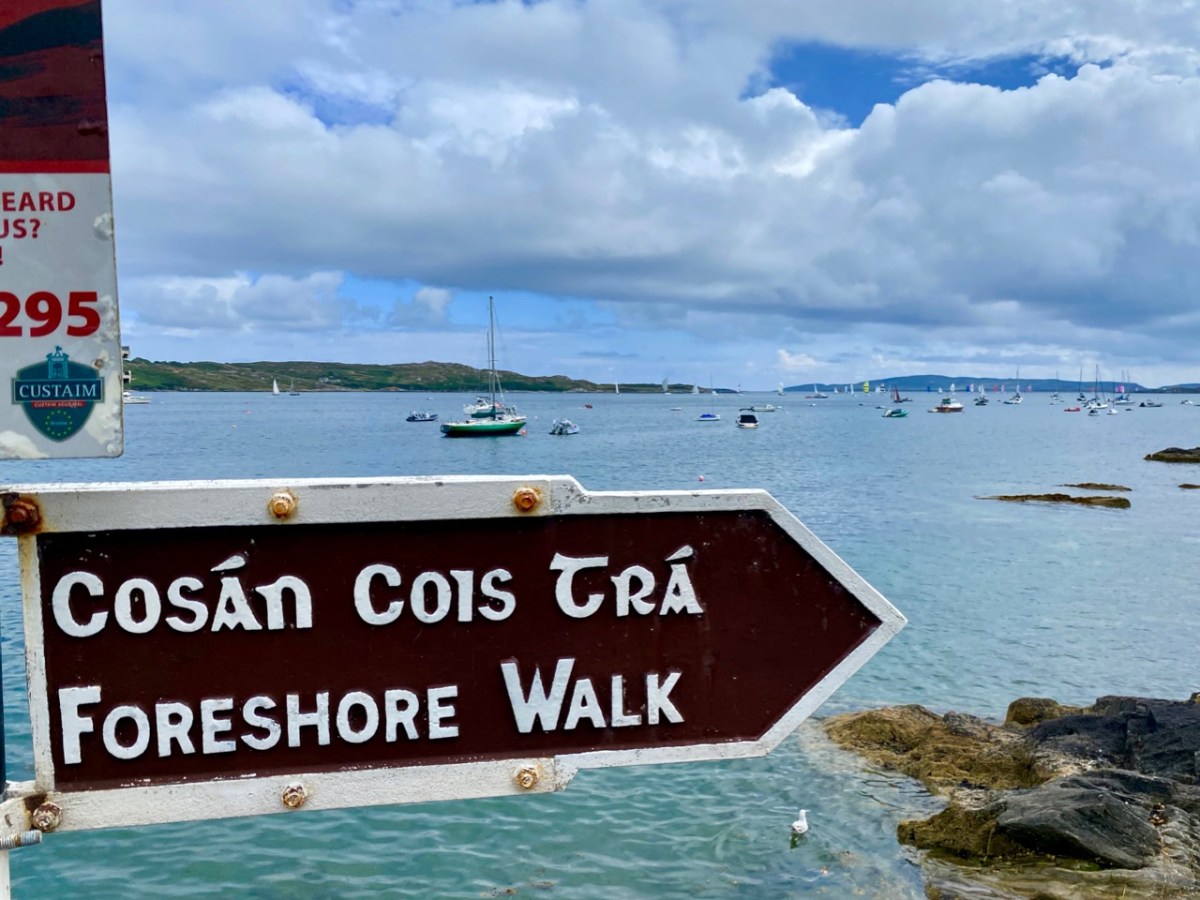
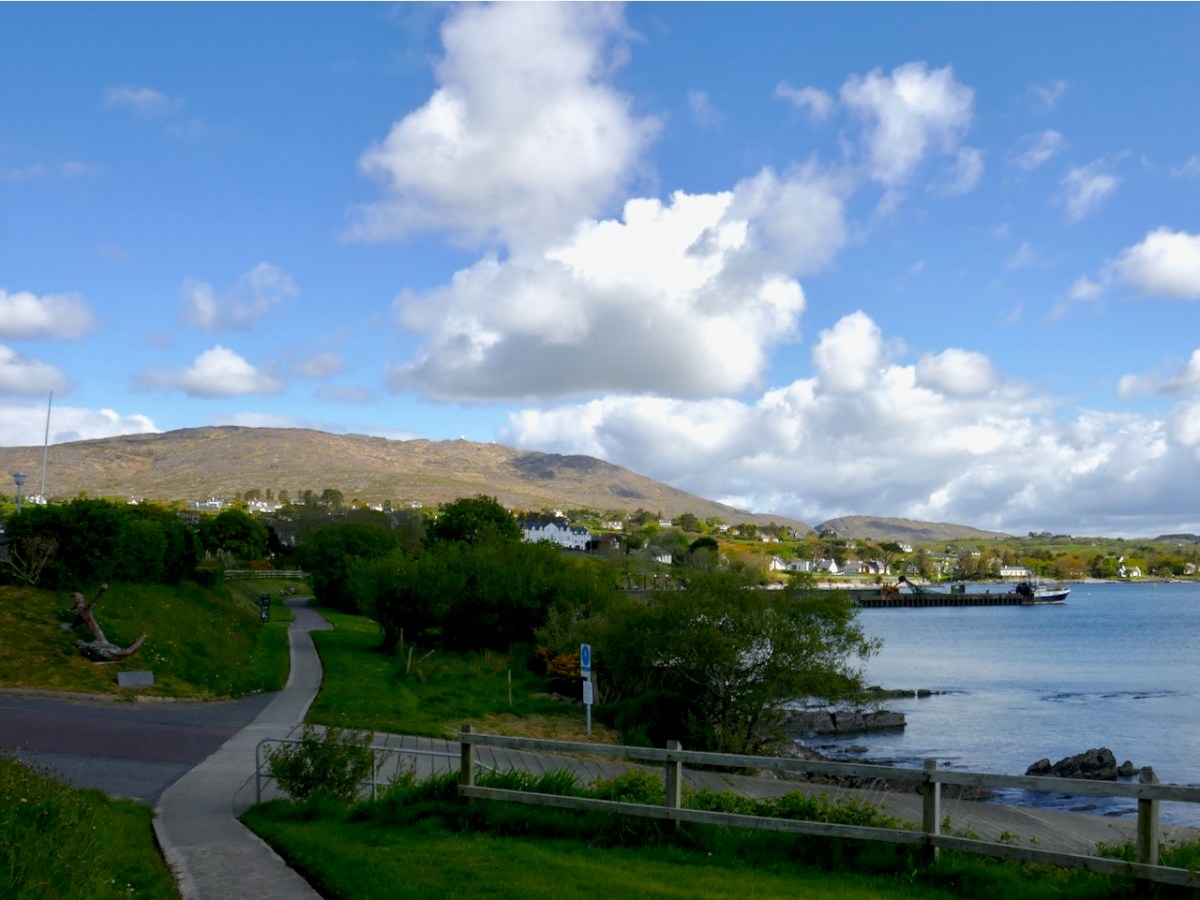
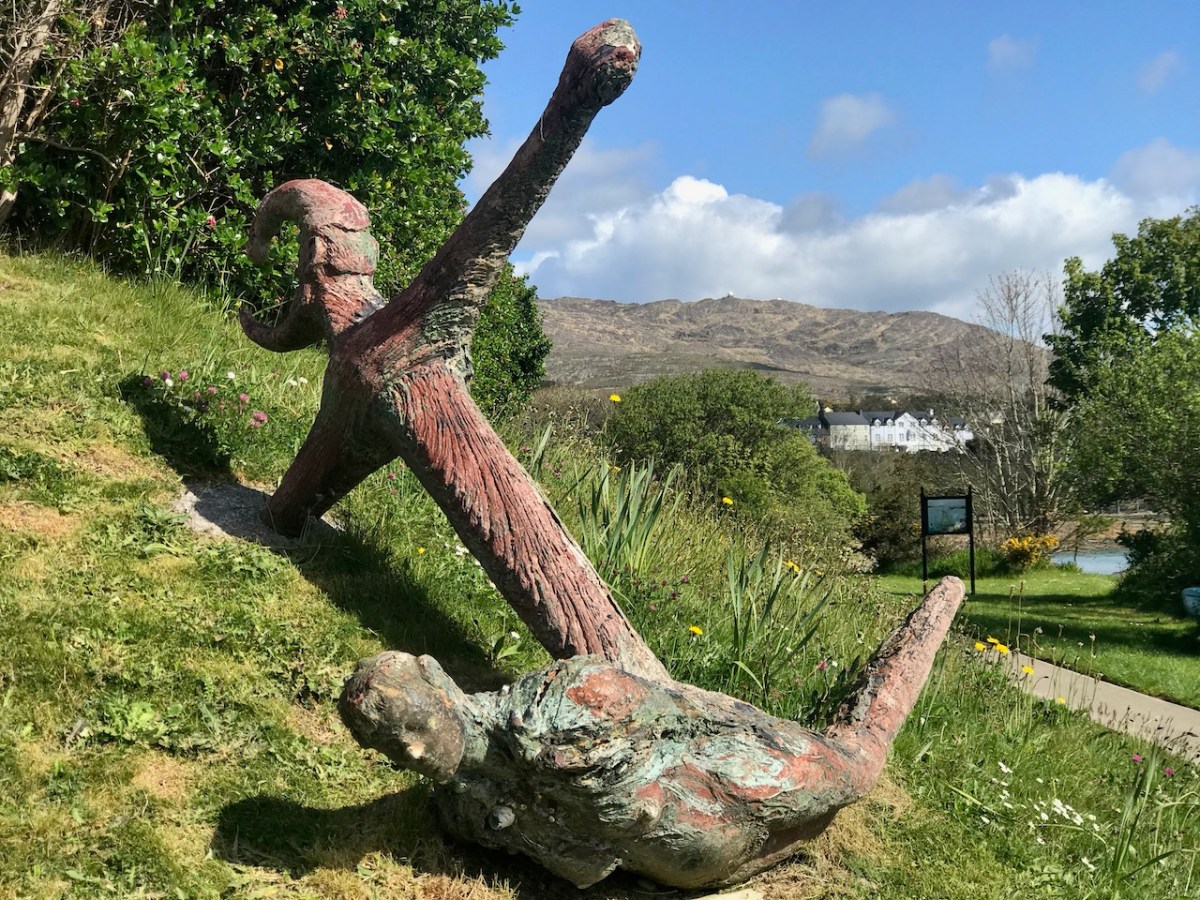
One thing Schull people love to do is walk and there are several lovely walks that start or end right in the village. You can walk from Schull to Castlepoint, or from Rossbrin to Schull. You can do the Butter Road – a green road for much of the way. If you have limited time, you can do the foreshore walk from the Pier out to the graveyard and back (below). Or just keep going out to Colla Pier.
Best of all – you can do Sailor’s Hill, and hope to Catch Connie Griffin so he can explain his stonehenge to you, or lean over the wall and admire Betty’s garden.
Regular service will return soon – I’m already planning my annual Brigid post.
Our Lúnachán.

West Cork Villages and Towns – Schull

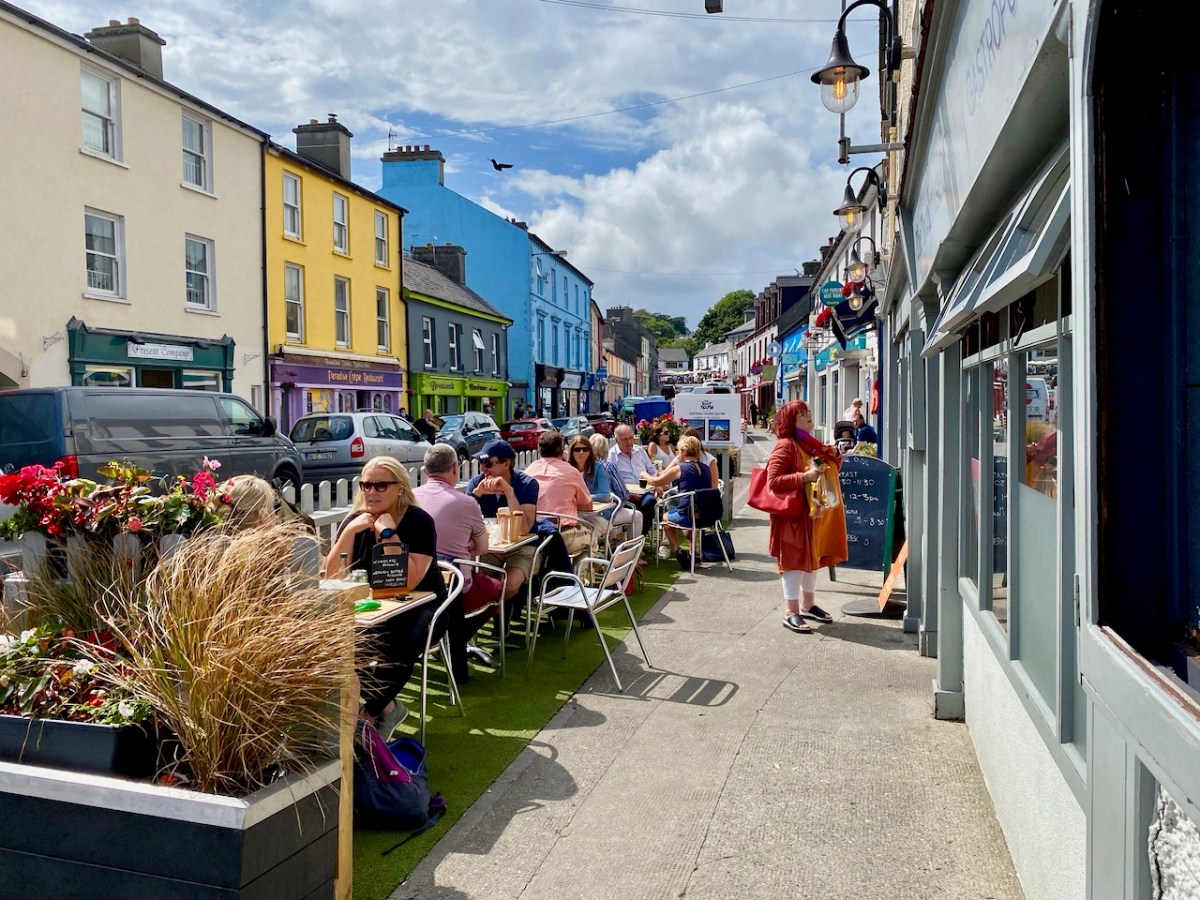
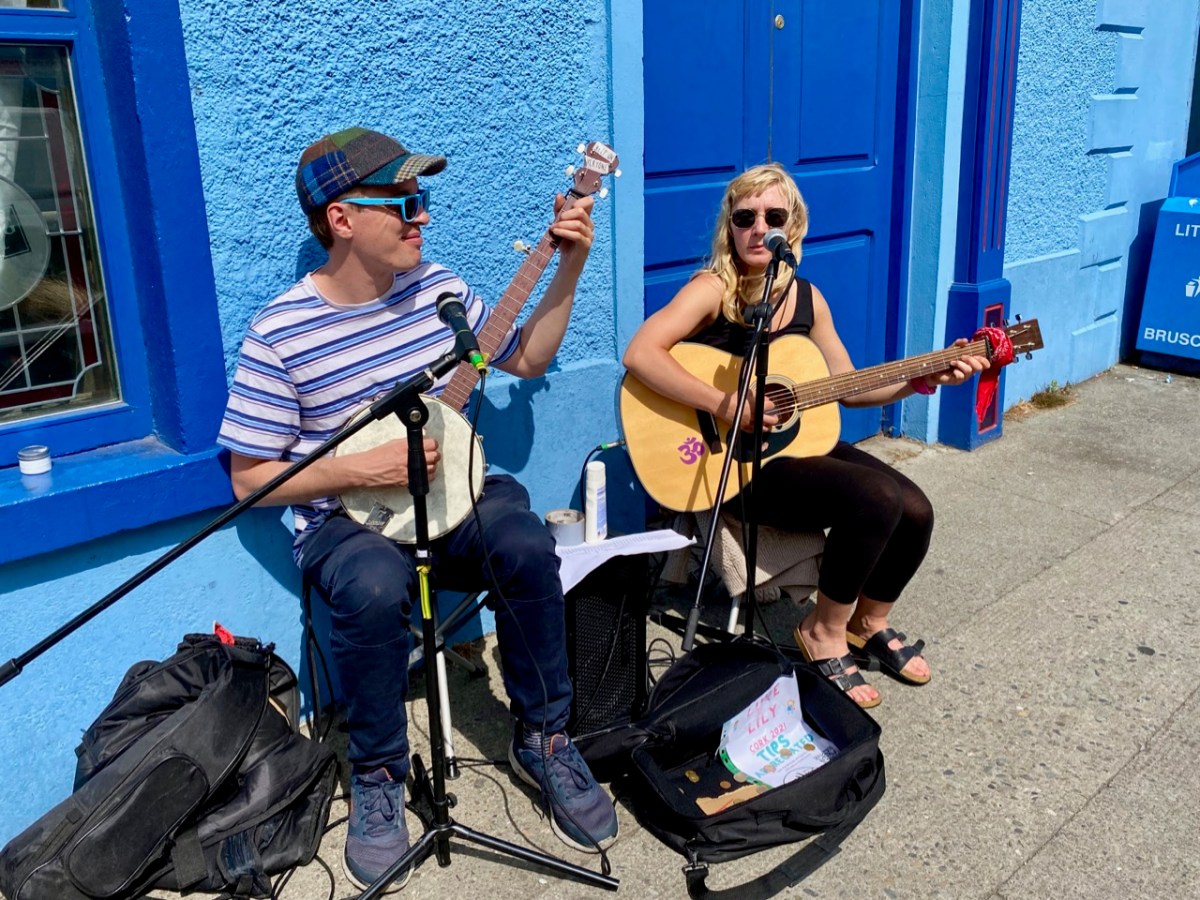
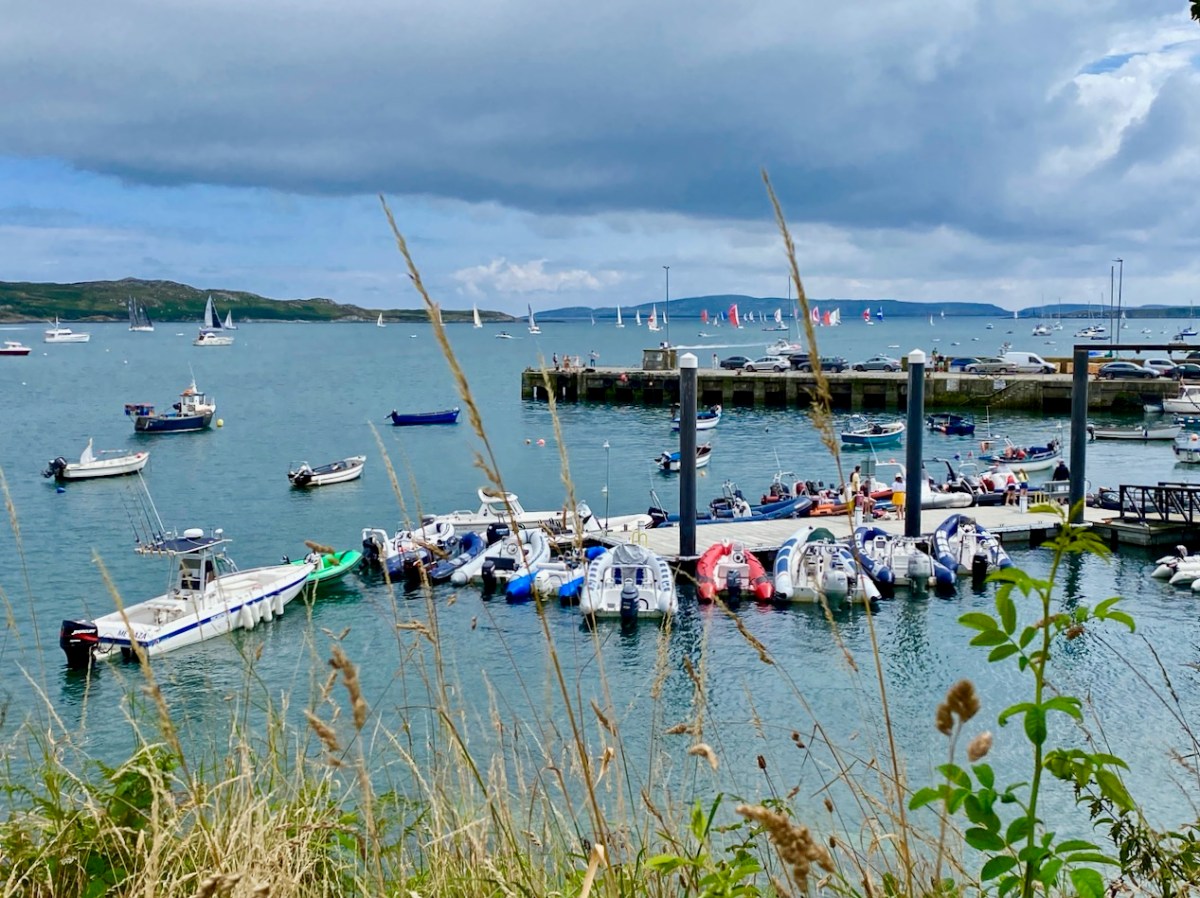
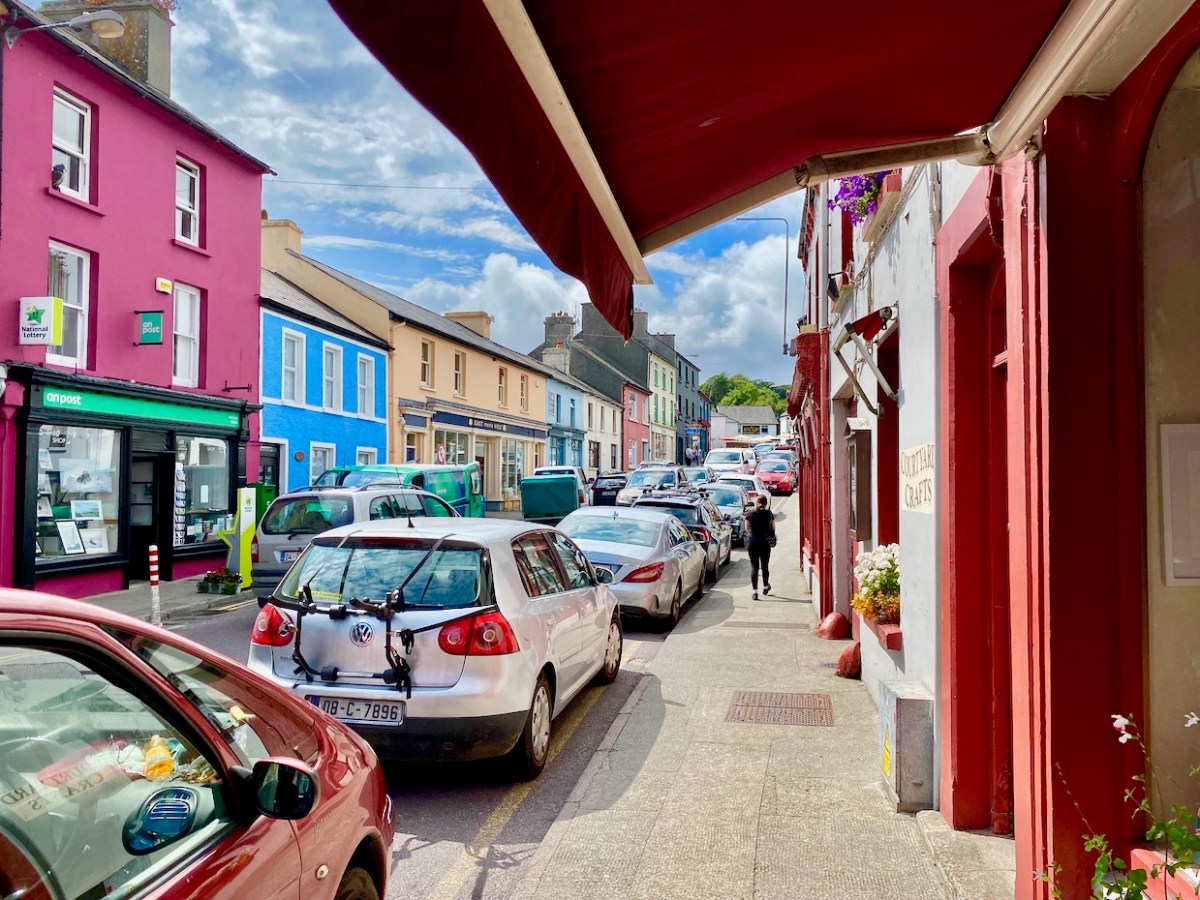
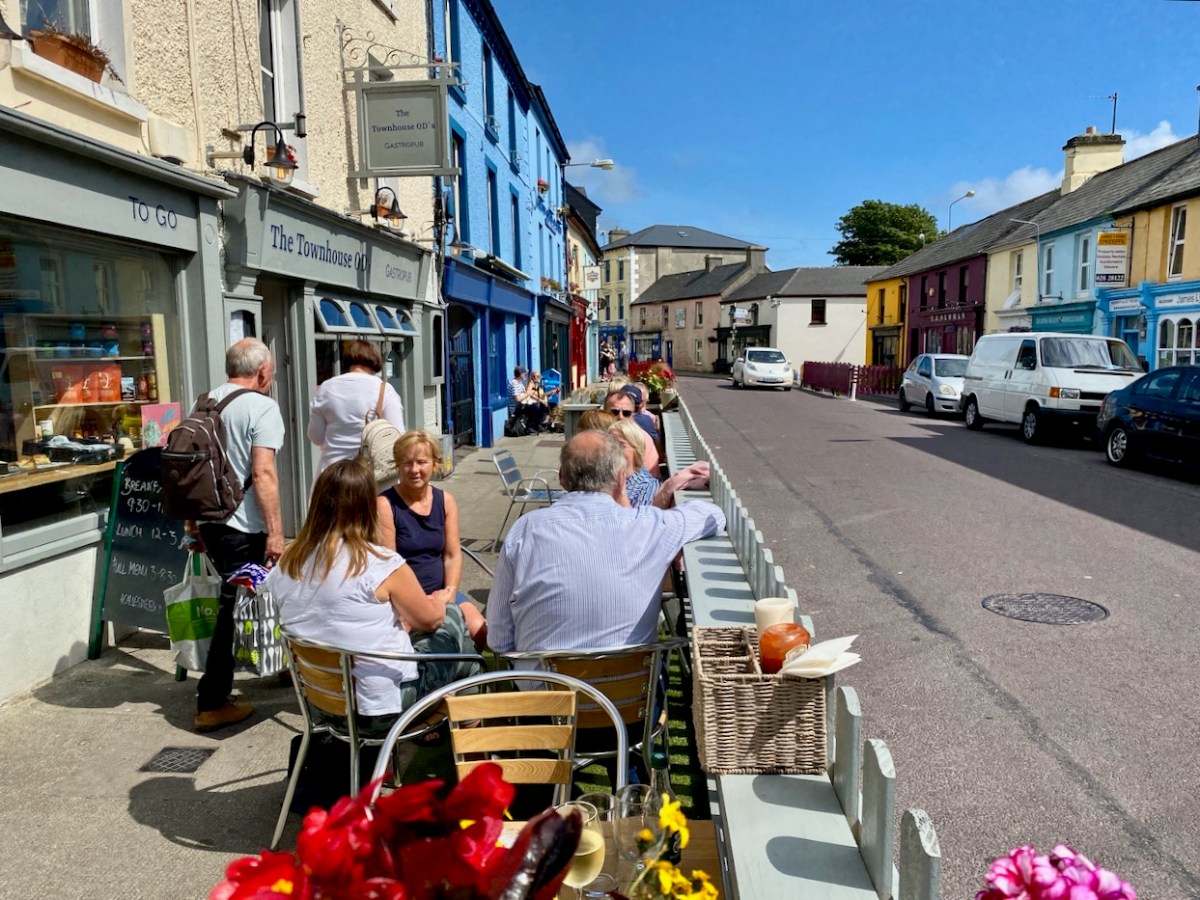
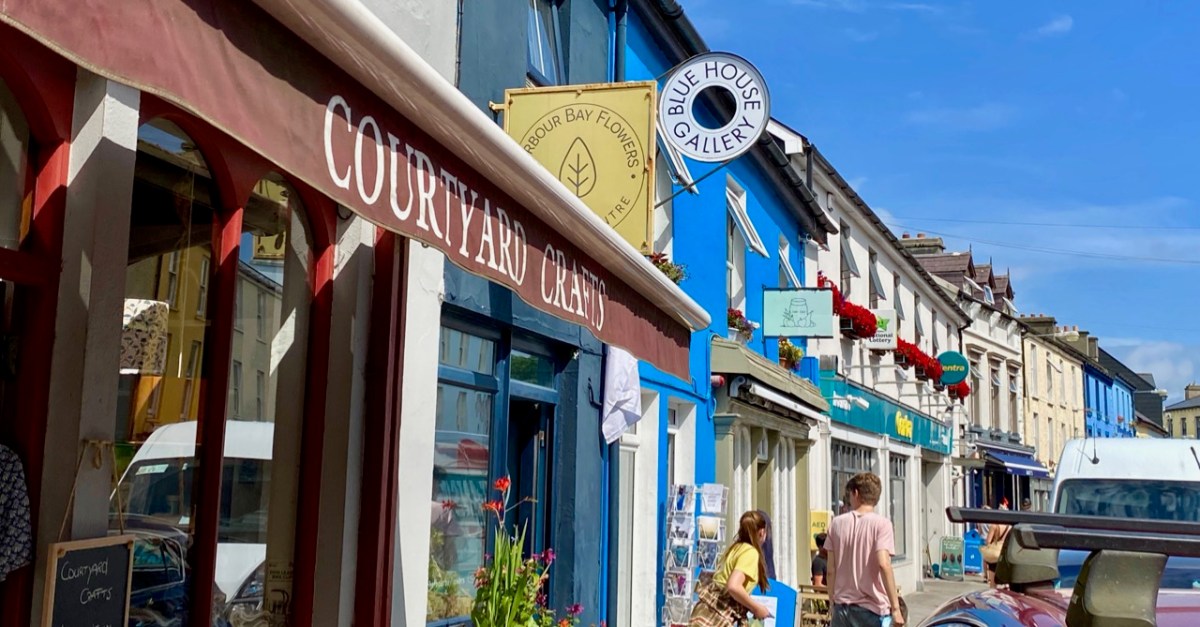
What better time to visit Schull than during Calves Week? That’s a big sailing festival at the beginning of August every year, and you have to be a sailor to understand the nuances of its title. It’s held at the same time as the UK’s premier sailing event – Cowes Week, ‘…the world’s longest running sailing regatta…’ and is focussed around the three Calf Islands in Roaringwater Bay. So there you have it – Cowes and Calves! What it means, of course, is that the village of Schull is at its busiest and, since Covid has given a boost to outdoor socialising, the streets are crowded with visitors enjoying the shops, pavement cafés and galleries.

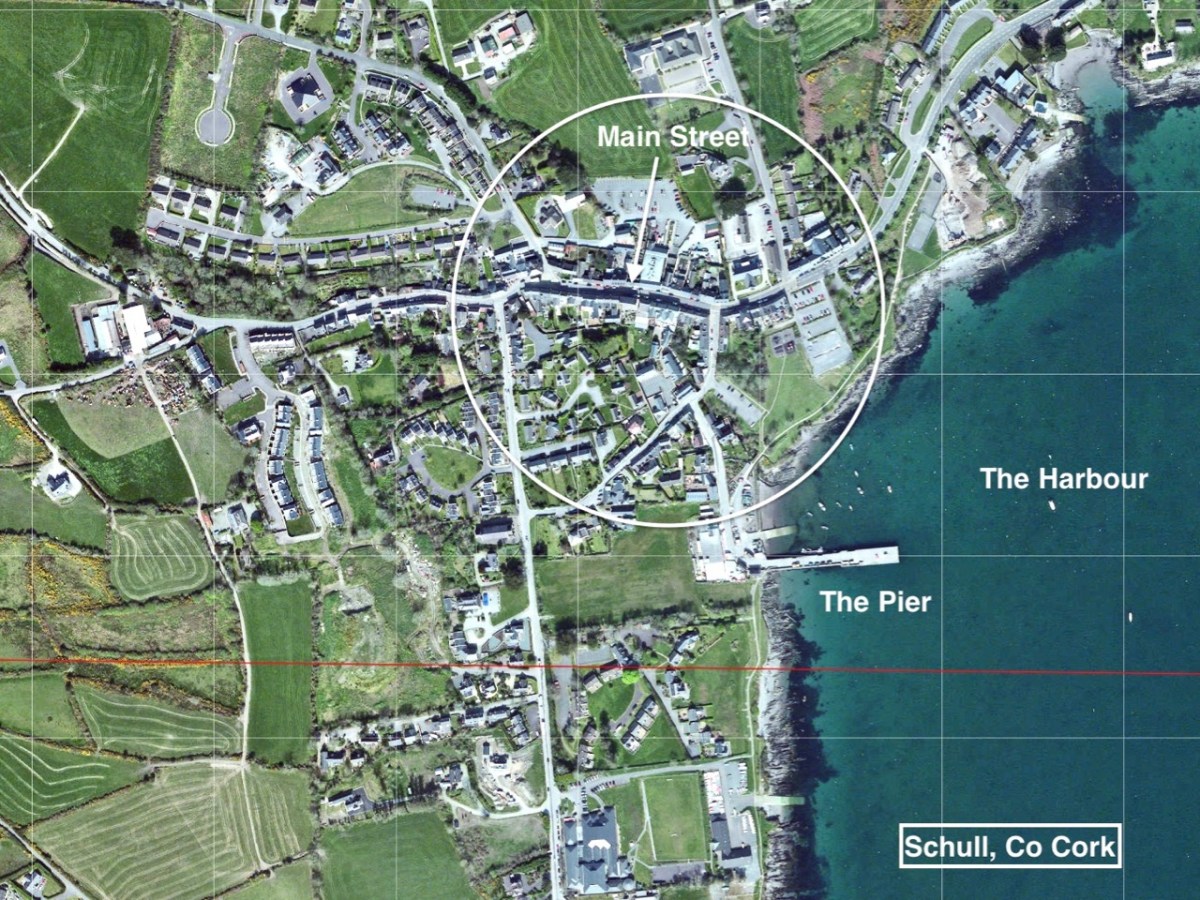
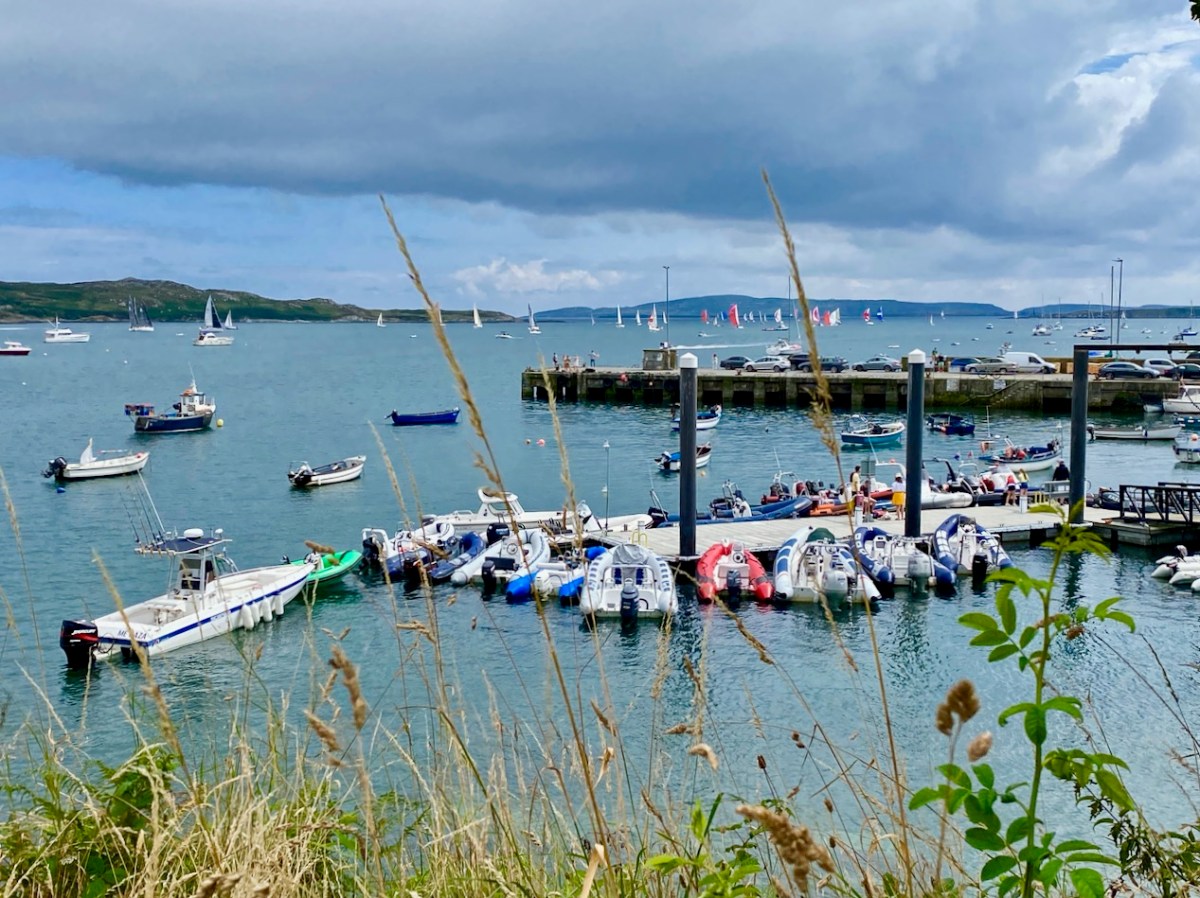
In this occasional series on the Towns and villages of West Cork we will take one community and try to discover why and how it has developed through history, and how it fares in the present day. A snapshot of the place will be presented – hopefully – in the best possible light (although this won’t always be on a sunny summer’s day!) From the aerial view above, you can see how Schull has been built up around its connection with the water. Schull Harbour is at the head of a long sheltered inlet, and the pier today is always busy with fishing and pleasure boats, ferries and yachts.

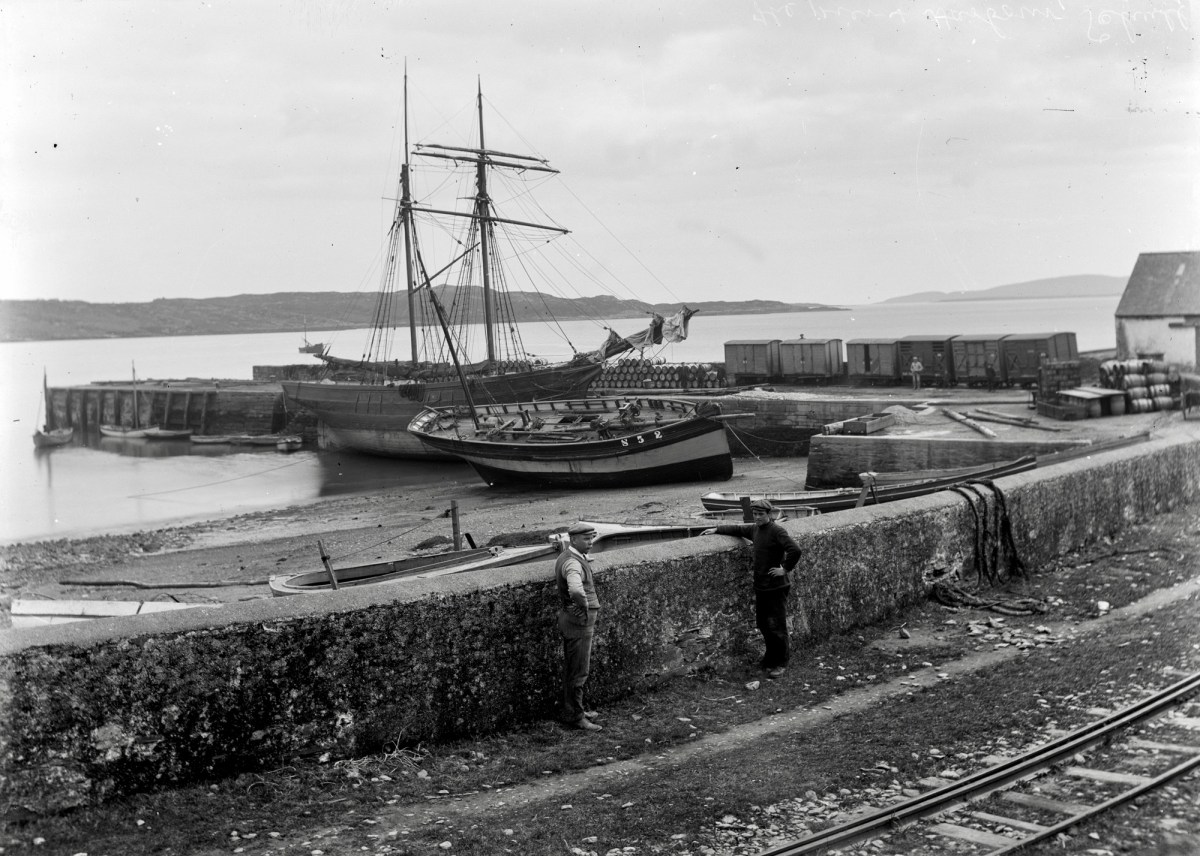
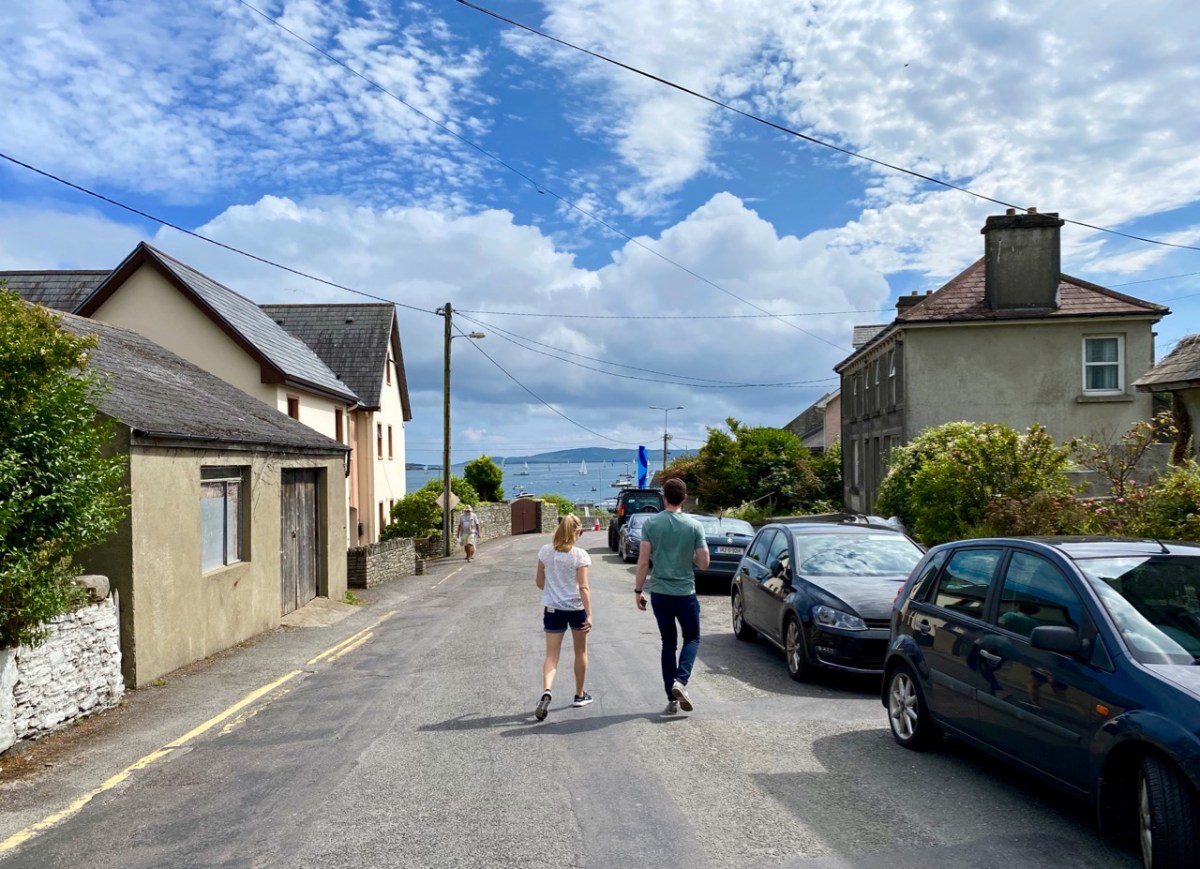
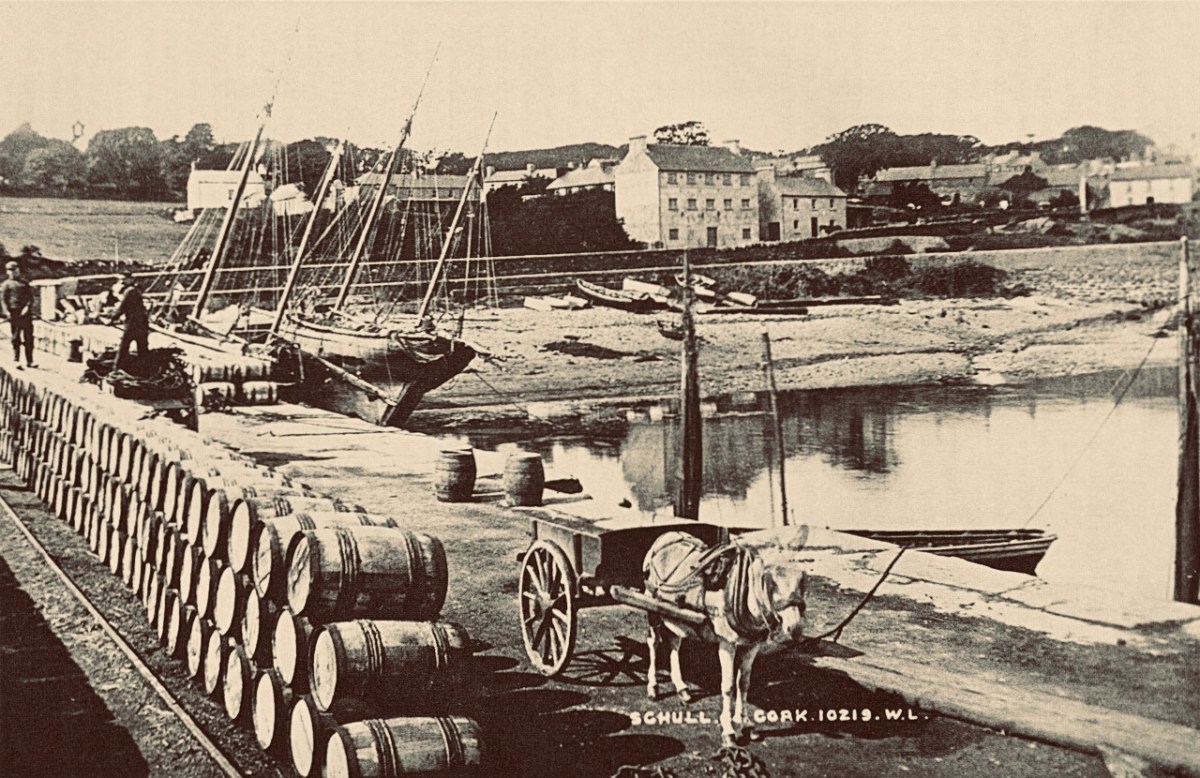
That’s the road to the pier, above, and it’s just a few steps from the village centre. If you are a visitor, you may have no idea that Ireland’s most south-westerly railway line once ran right on to this pier! The narrow gauge Schull, Ballydehob & Skibbereen Tramway and Light Railway was in service between 1886 and 1947, connecting these remoter parts of the county to Skibbereen and then, via the main line, Cork city. Although never considered a commercial success, it was a valuable element of infrastructure enabling local passengers to get to shops and markets, and fishermen to send their catches to distant merchants as hastily as possible (bearing in mind there was a speed limit of 15 miles per hour on most of this rural line). This photograph from the NLI Lawrence Collection (below) dates from the 1890s, and shows barrels of fish stacked up next to the railway track on Schull pier, awaiting despatch. They are likely to contain salted pilchards and herrings.

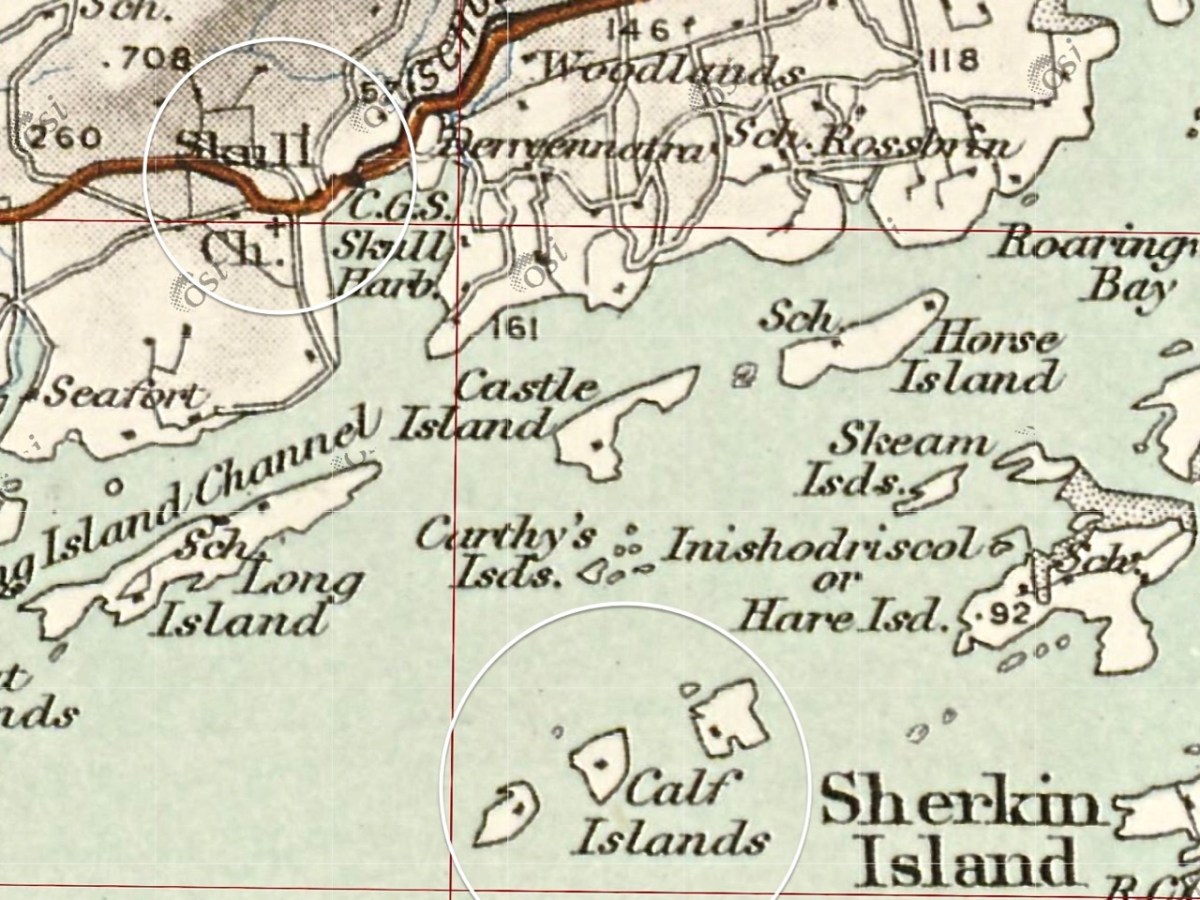
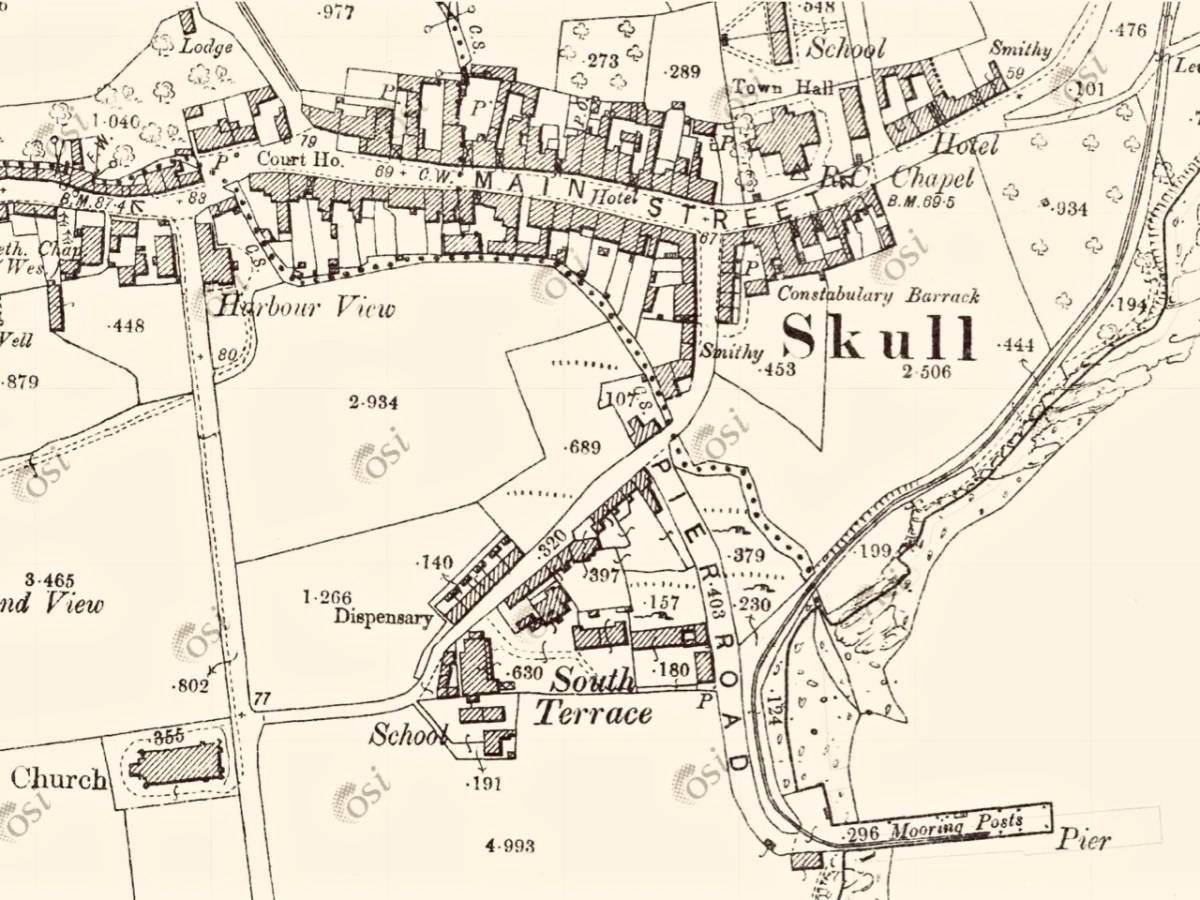
In all these pictures of the pier and pontoon areas above you can see the lively sailing activity in the background. Below are two extracts from early OS maps, one showing Schull and its location to some of the offshore islands, and the other showing the town centre, probably around 1890. It’s thought-provoking to see on the latter the various facilities which the town offered at that time, as well as the railway: Court House, Constabulary Barrack, Smiths, Schools, Hotel and Dispensary.

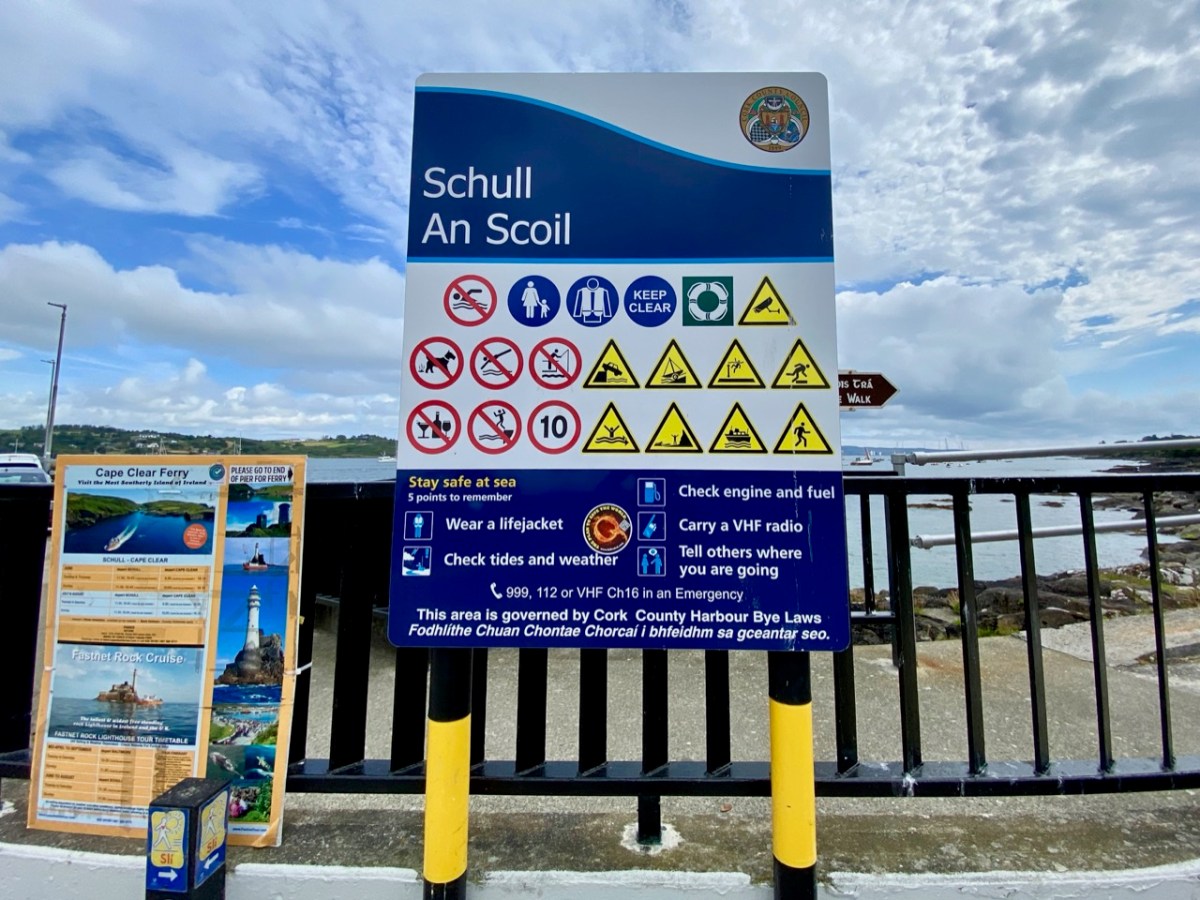
Note that on both the maps above, which date from more than a century ago, the settlement’s name is given as Skull: it still is on all OS Ireland maps up to the present time. Mostly today it’s known as Schull, or in Irish An Scoil, which translates as The School. Some of you may remember my posts earlier this year when I looked in to the possible origins of this village name – and the earliest ‘School’: a site described on Archaeology Ireland as a ‘possible early Christian settlement’:  . . . the ancient school of Sancta Maria de Scholia, ‘a place known in early times as a centre of learning’ . . . There’s a fair bit of local lore surrounding the subject, and you need to read Schull resident John D’Alton’s article on this to find an alternative view to the perhaps romanticised ideas of an ancient monastic site: I’m sitting on the fence!

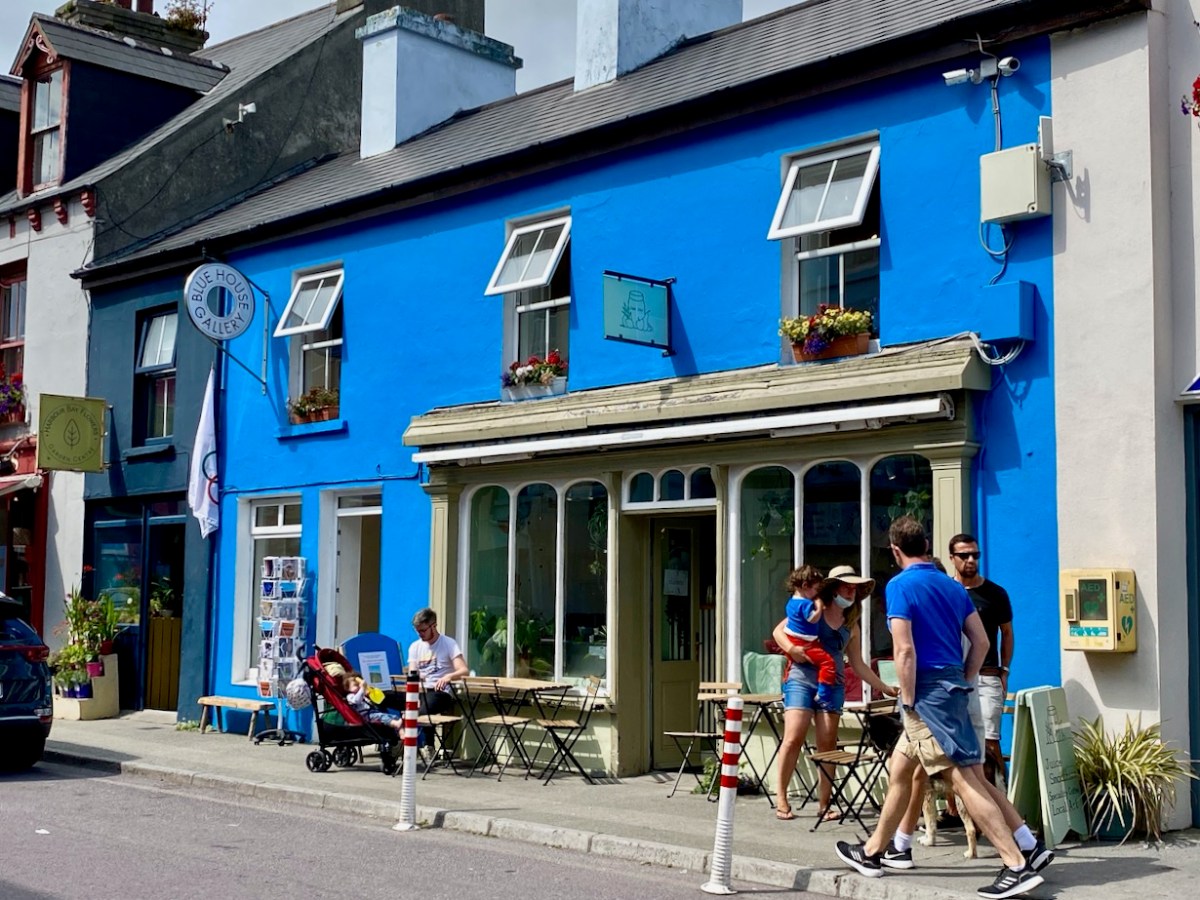
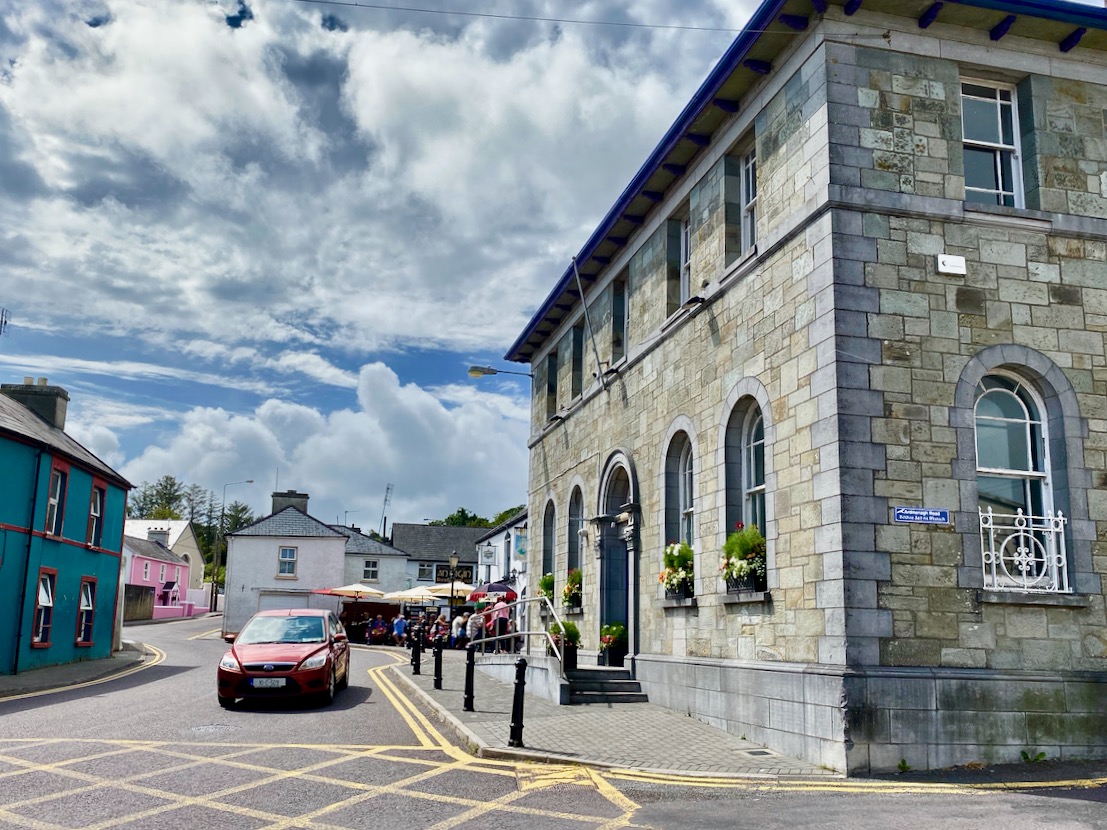
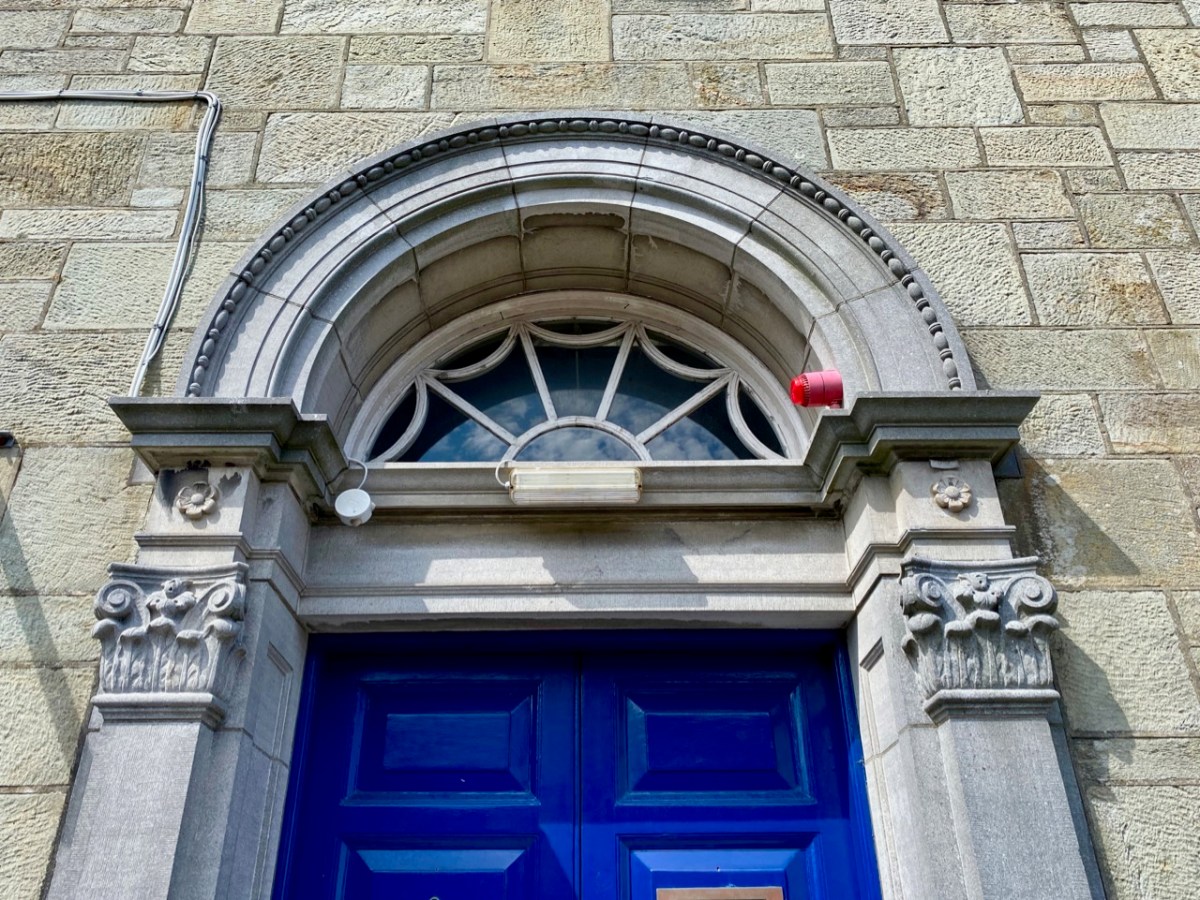
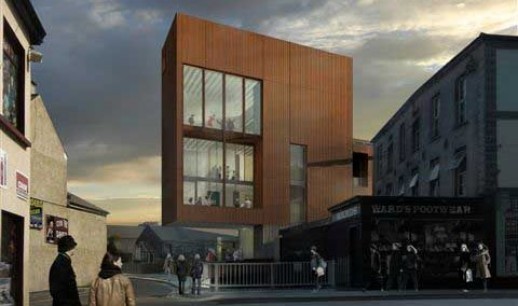
Historic village – perhaps with medieval origins – to vibrant sailing centre and colourful streets in the 21st century. Schull has come a long way, and has far to go. Today the resident population numbers around 1,050: this is boosted substantially with the influx of summer visitors. It’s good to see long established names and new businesses on the streets, contributing to the colourful palette of the architecture. Great things are happening in the future: the old bank building (below) is to become a cinema and film centre: a focal point for the acclaimed annual Fastnet Film Festival.

Year round, Schull is worth exploring. Mount Gabriel, the area’s highest point, is above the village and offers superb vistas over the bay and islands. Finola has looked at the many legends associated with this peak and there is ancient history there, too: the remains of Bronze Age copper mines on its slopes. Good walks can be had on the high ground and on the coastal footpaths – see the Explore West Cork website.

Mizen Magic 10: Sailor’s Hill

Fancy a walk? One with just enough elevation to get the heart going and with the reward of spectacular views at the top? It will take about an hour, maybe a bit longer if you stop to chat, or just gaze.

We’ve mentioned Sailor’s Hill before in the course of other posts – this one and this one. But it deserves a post of its own, because it’s a complete experience. Start from Schull and walk out along the Colla Road until you get to the old St Mary’s Church and graveyard. The National Monuments listing tell us that this was originally a medieval structure, although what we see in ruins now is mainly an eighteenth century church, situated in a picturesque burial ground. Turn right at that point.
You will notice the waymark signs. This is one of the newer extensions of the Fastnet Trails, and an initiative of a committed group in Schull. The walk up Sailor Hill is actually part of a larger walk, the Colla Loop – we are planning to do that one soon but only had time for this stretch of it today.
The road meanders gently upwards. Take the first left and then the next left. Views of Schull Harbour start to open out as the road rises. Looking back, you can see how Schull nestles at the foot of Mount Gabriel (see the photograph at the top of this post).

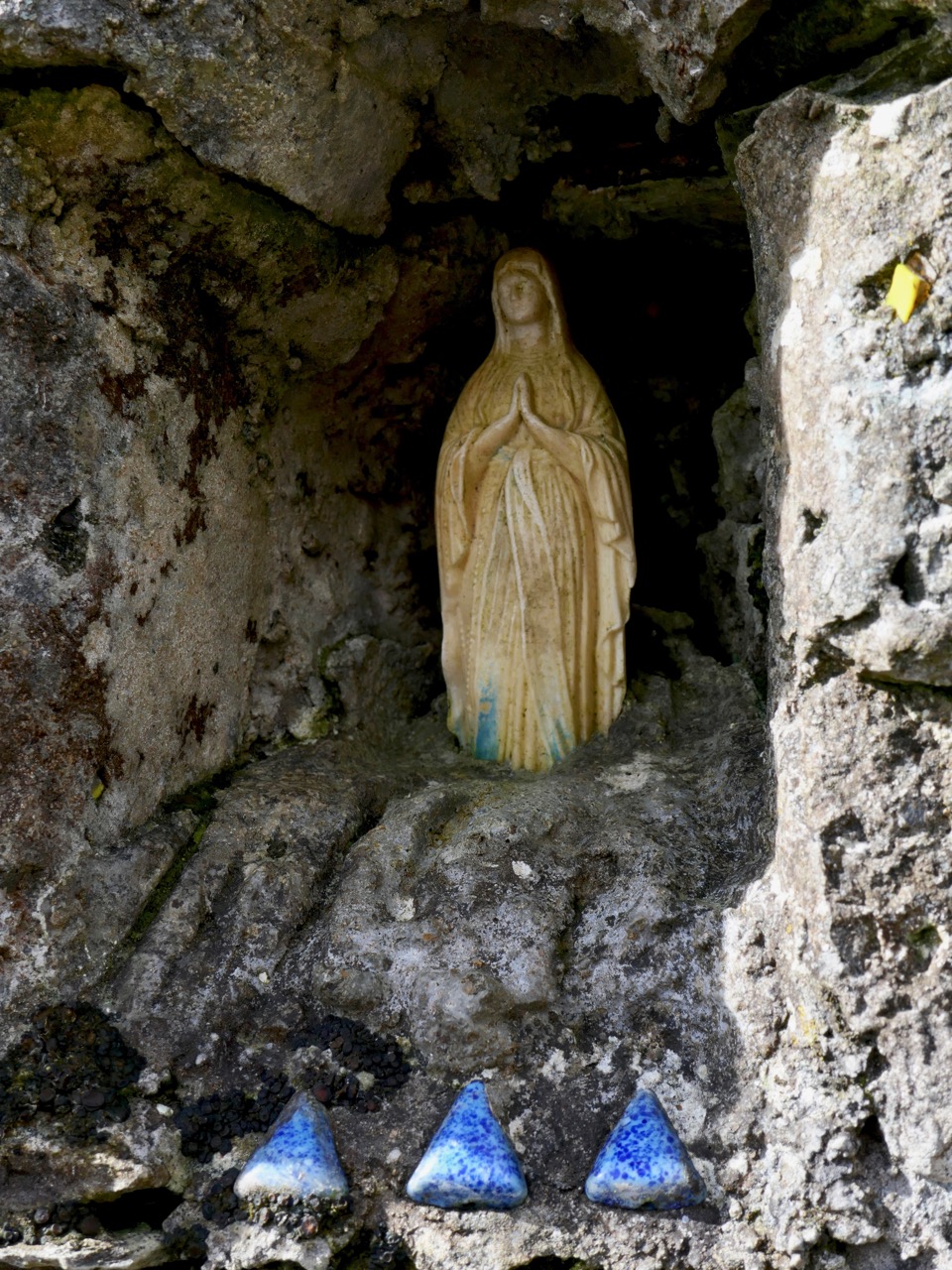
A tiny shrine in a gatepost

Later on, this boreen will be heady with Foxglove and Loosestrife and Oxeye Daisies, and later still the purple heather will dominate, but this is early spring and it’s been a long cold winter. 

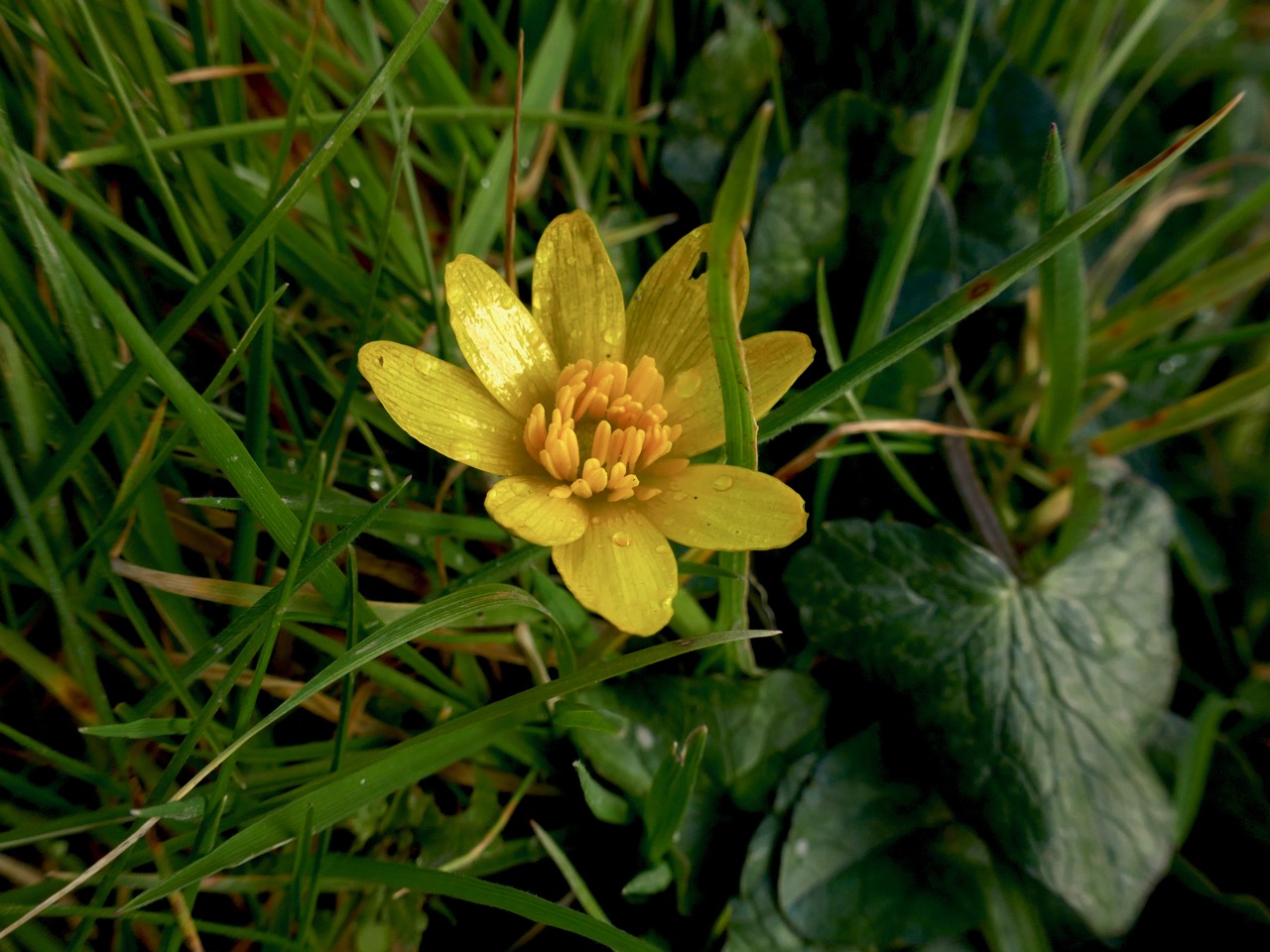
Everything is late this year, so I am happy to see the ever-reliable Celandine in profusion.

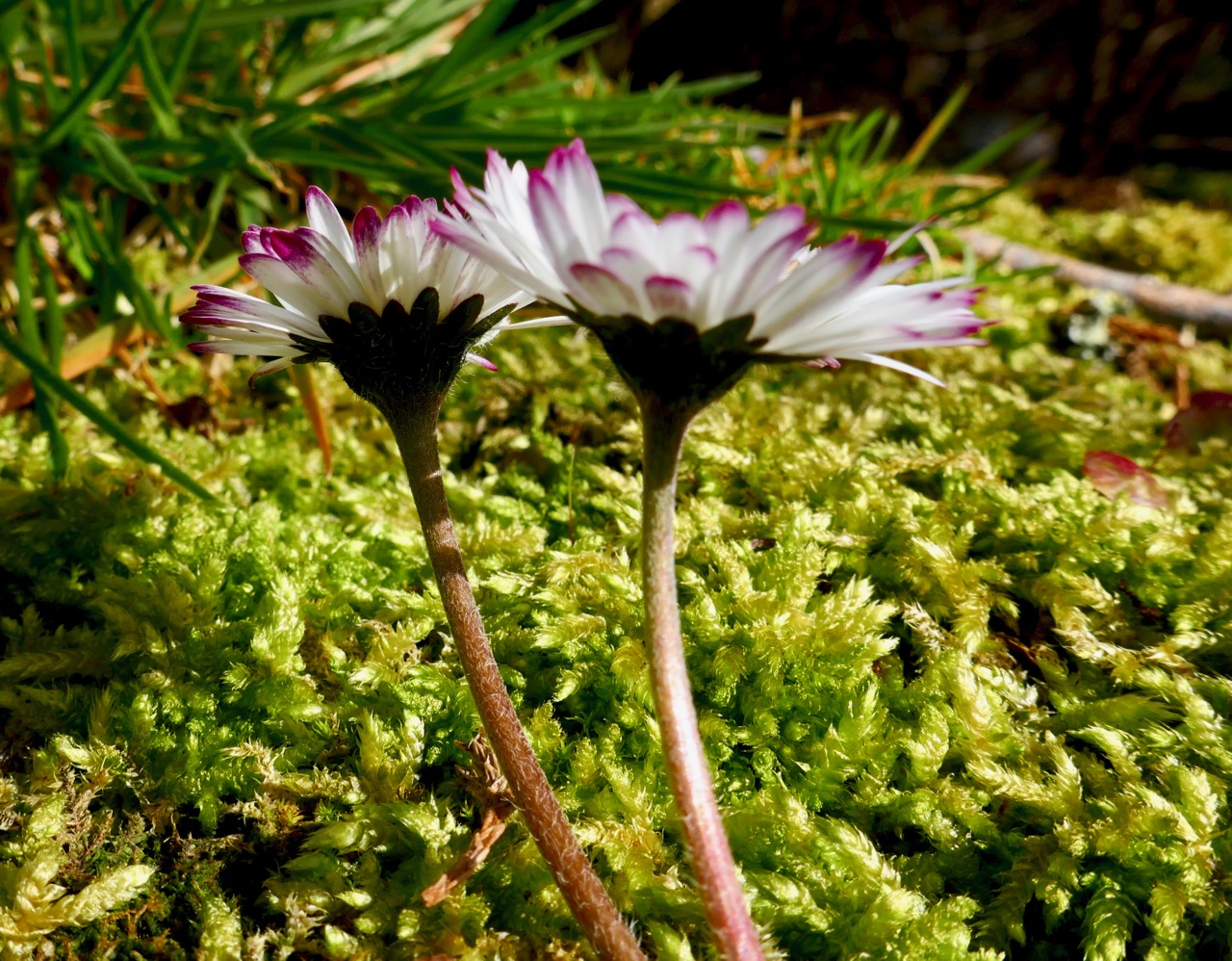
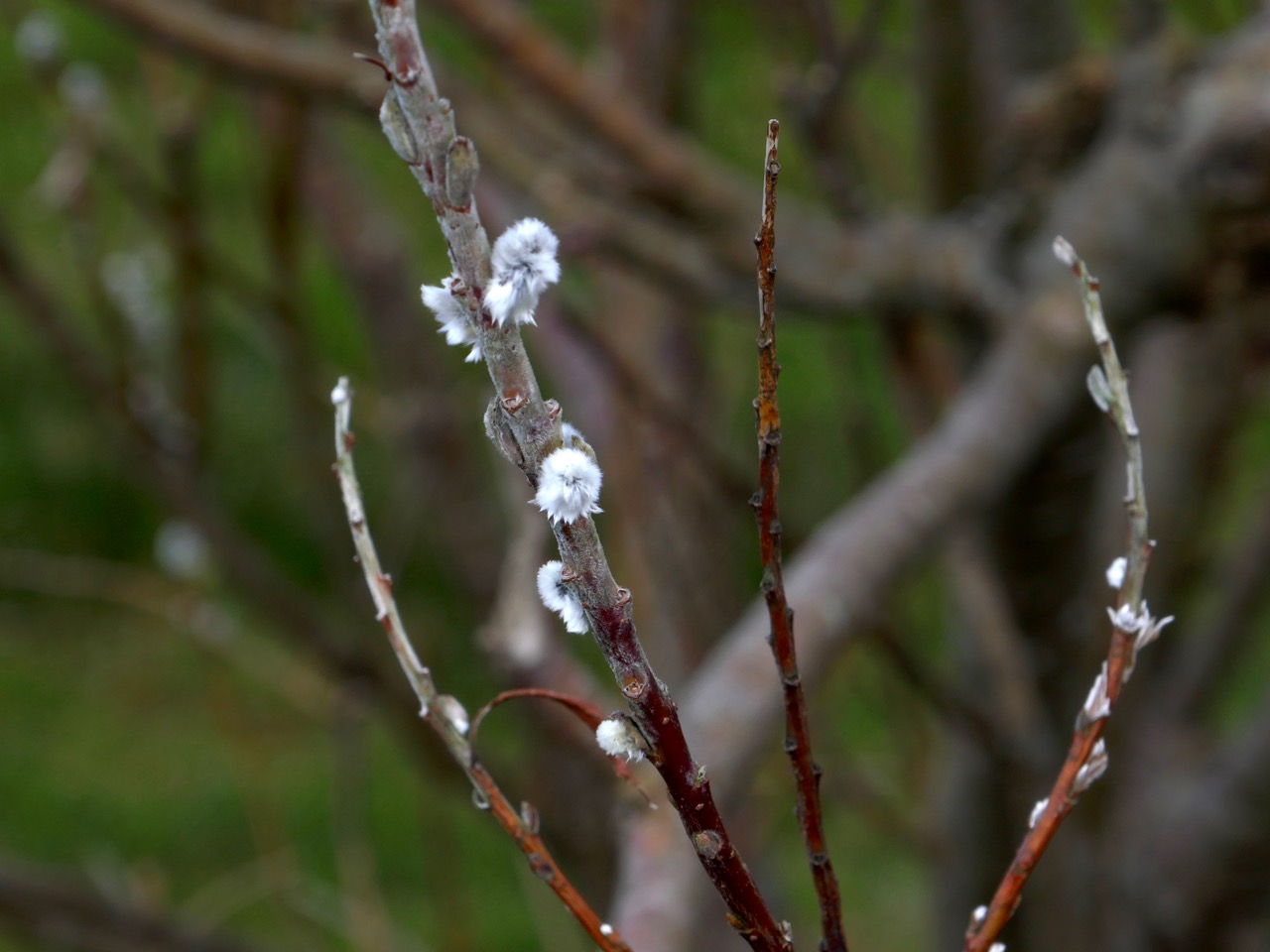
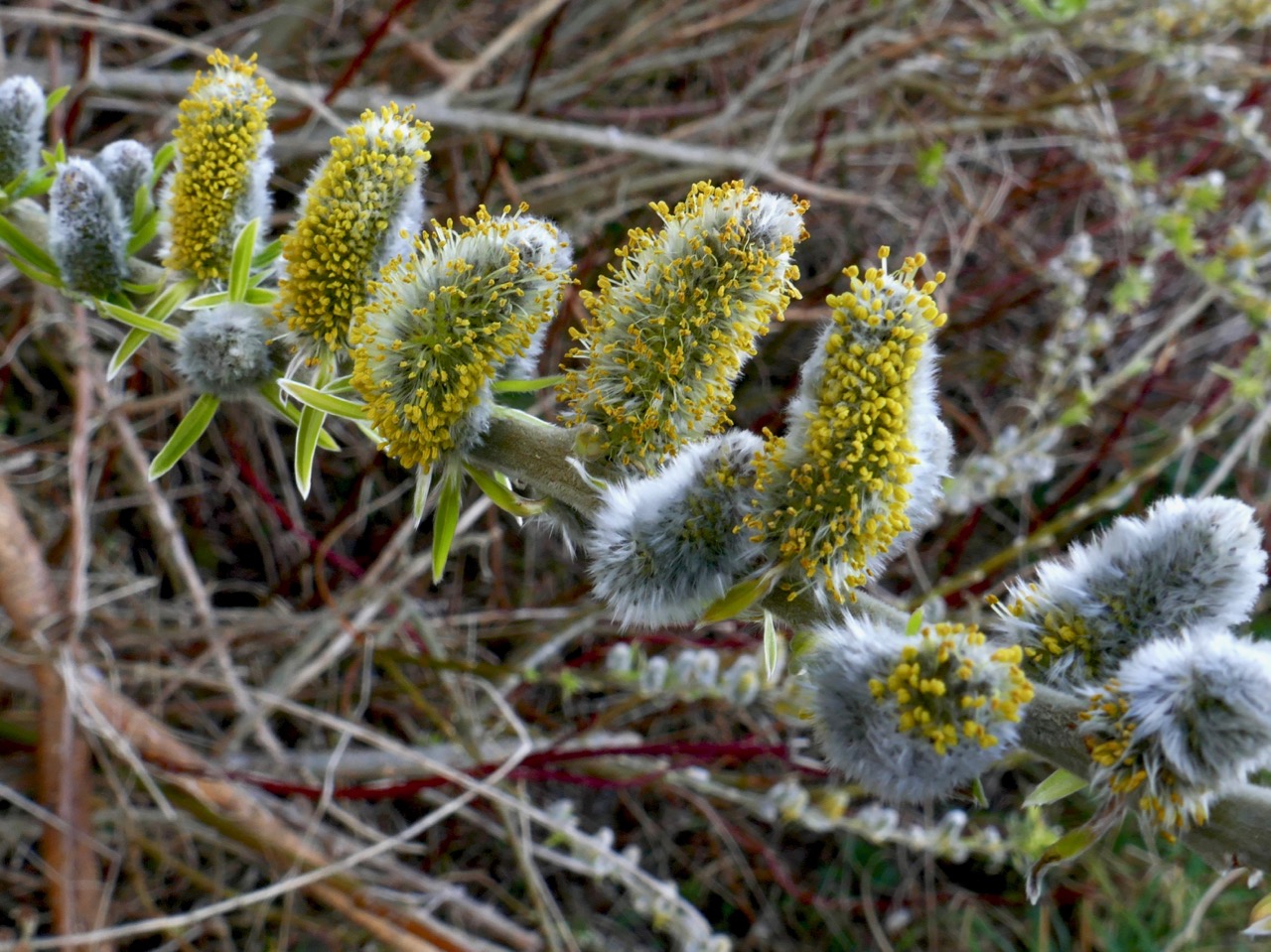
The willows are starting to bud out too, but apart from that, it seems that dandelions and lawn daisies are the only wildflowers brave enough to flourish along the way. Not that we disdain these humble flowers – they provide early and important nourishment for the insects and the bees. Must feed those pollinators!

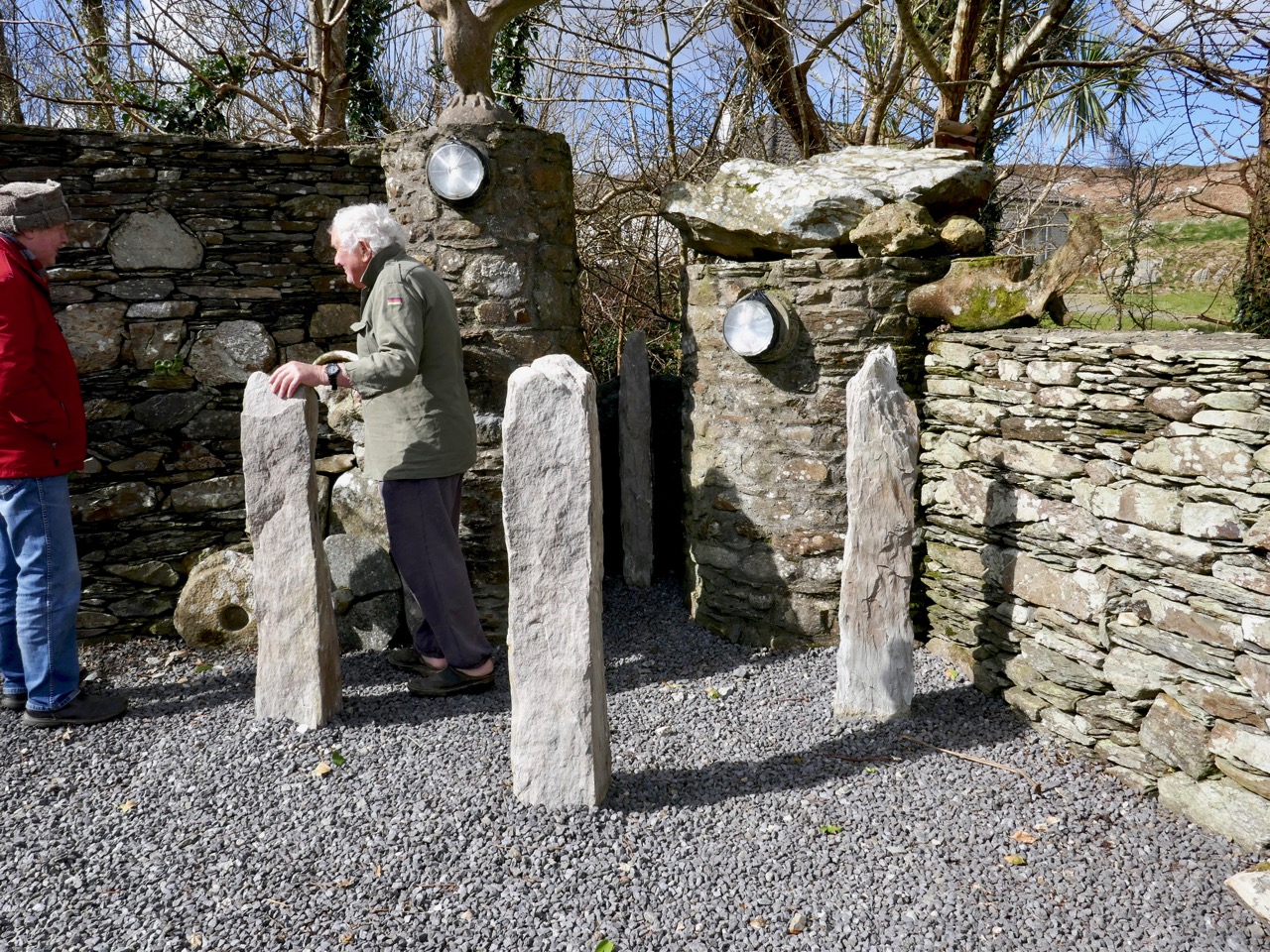
Connie and Betty Griffin have built a house with magnificent vistas near the top of the hill. They never stop adding to it, Betty with flowers and Connie with quirky additions, sculptures and walls. This time, he showed us his Sailor Hill Newgrange, a nifty arrangement of standing stones that respond to the rising sun by capturing the morning light in a stone recess.

Connie demonstrates his sun calendar to Robert

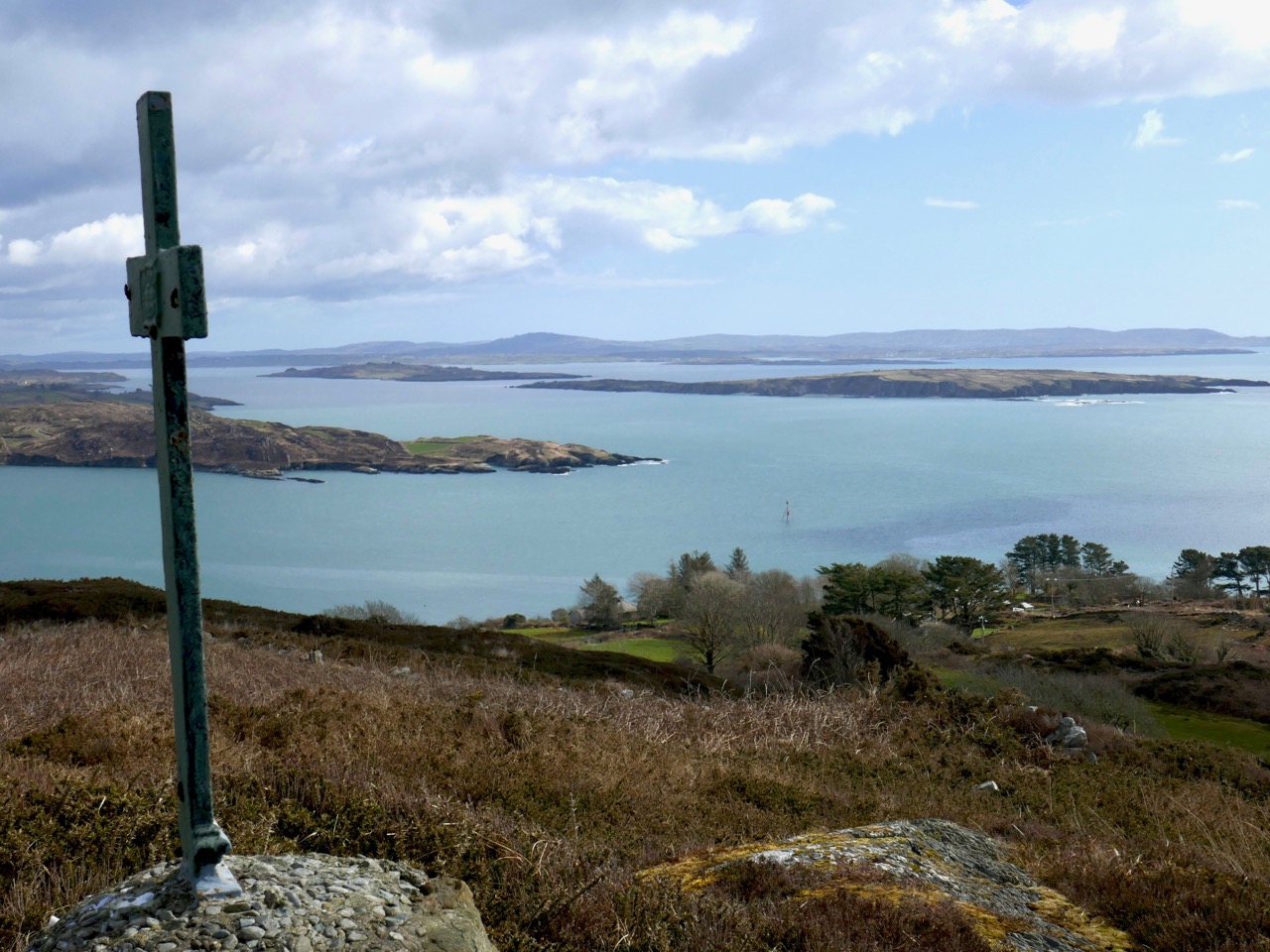
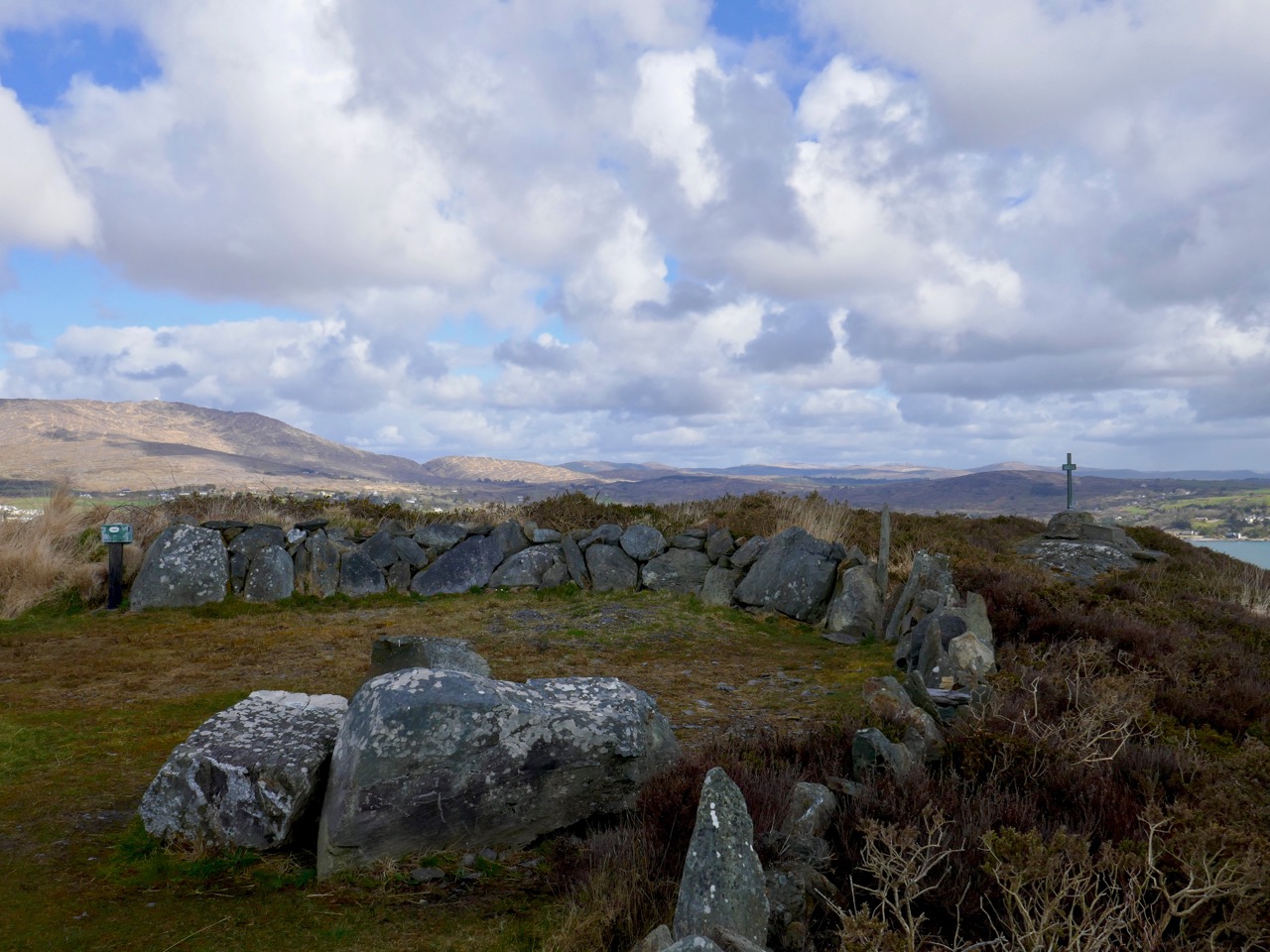
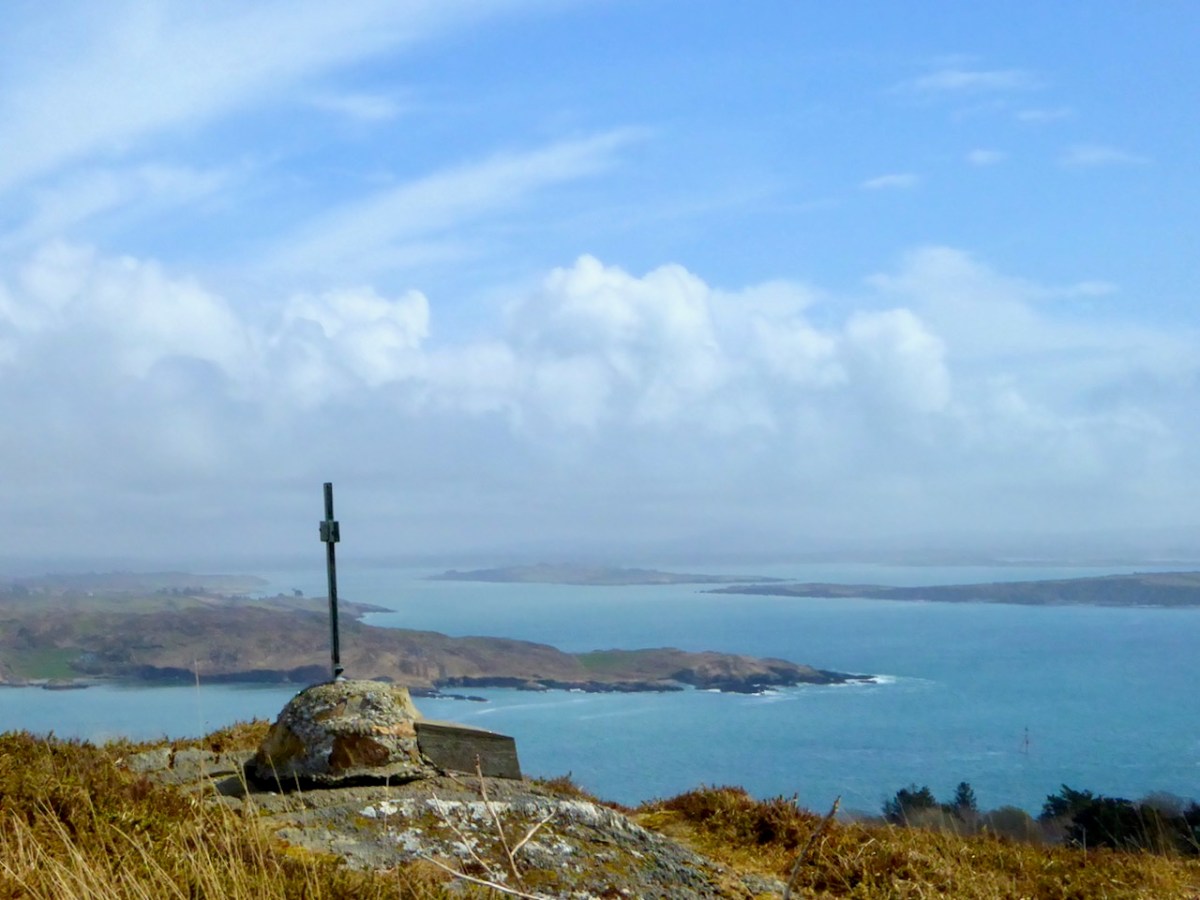
Up to the top then, and there it is – a breathtaking panorama that encompasses the whole of Roaringwater Bay and Long Island Sound to the south, and Mount Gabriel and its foothills to the north. Cape Clear, the Fastnet, Sherkin Island and all the smaller islands are laid out in front of you.

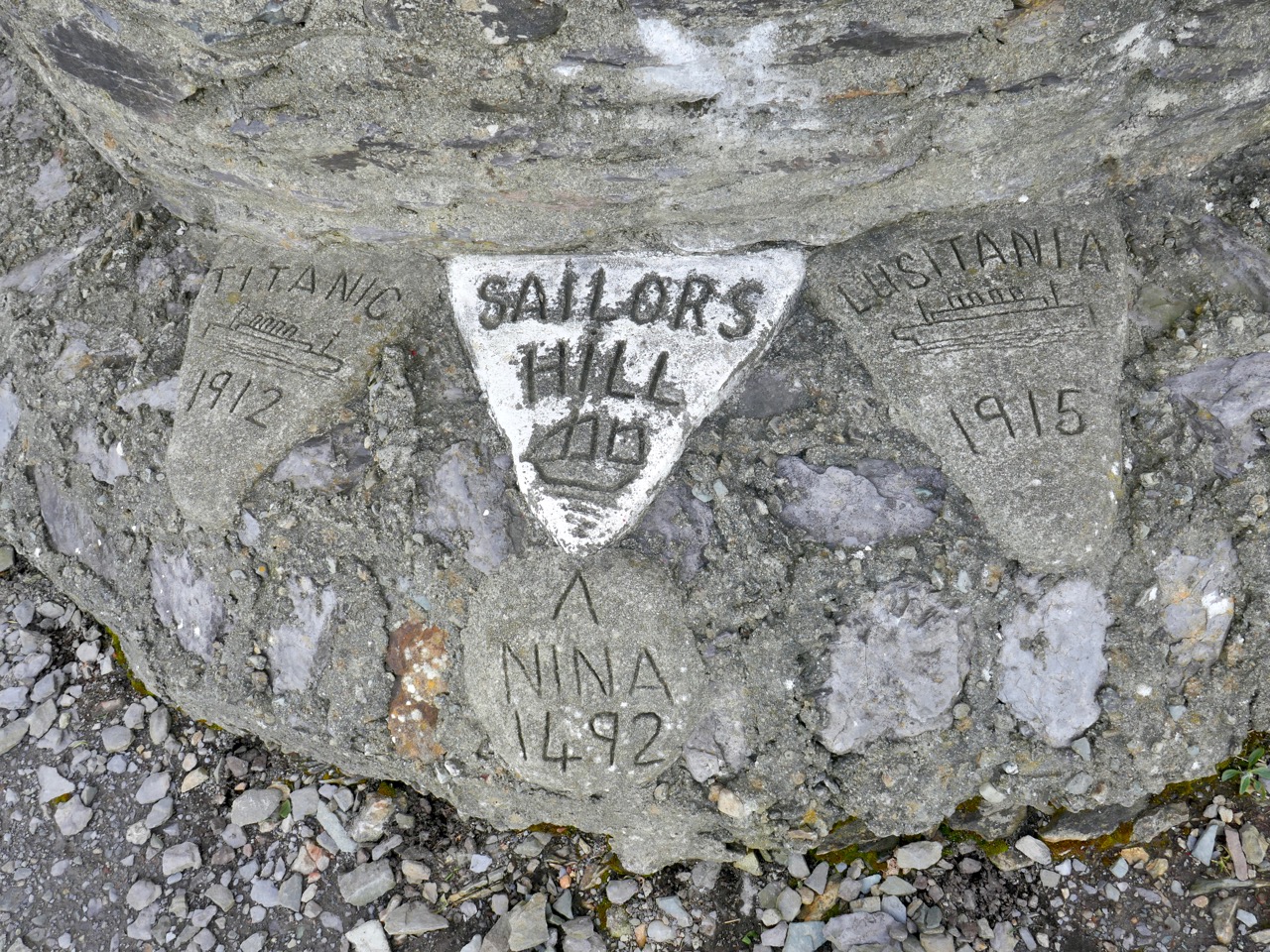
And there’s a cross and inscriptions, so you begin to realise that this site is about more than those views. Connie, who designed and built it, wants us to think about those who lost their lives at sea. It’s his own personal mark of respect and a reminder to us in the midst of all this grandeur to take a moment to contemplate on the power of the ocean and the fleeting nature of life.

I had to look up The Niña, 1492, and of course it was one of Columbus’ ships. He took the Santa Maria, the Niña and the Pinta on his voyage to the New World, but the Niña was his favourite. To learn why, take a look at this. But why is it here? Well, I’m not sure, but there is a tradition around here that Columbus may have visited West Cork on his way. His last provisioning stop may have been with the hospitable, learned and Spanish-speaking Fineen O’Mahony, Scholar Prince of Rossbrin

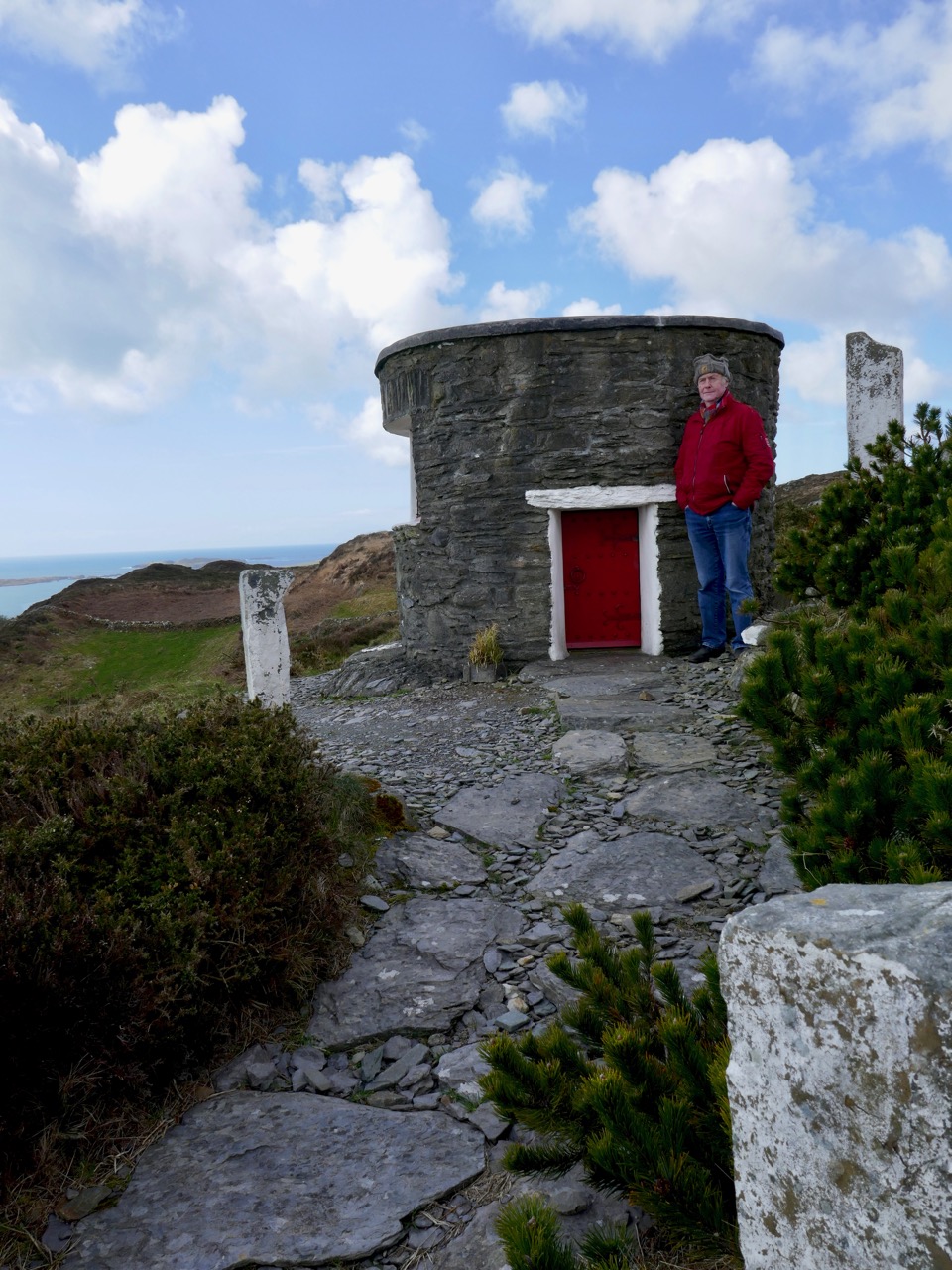
Connie has built his own tiny belvedere (he calls it his folly) perched to take maximum advantage of the view. It’s the perfect spot to sit, munch an apple, and enjoy a companionable chat before the walk down again.

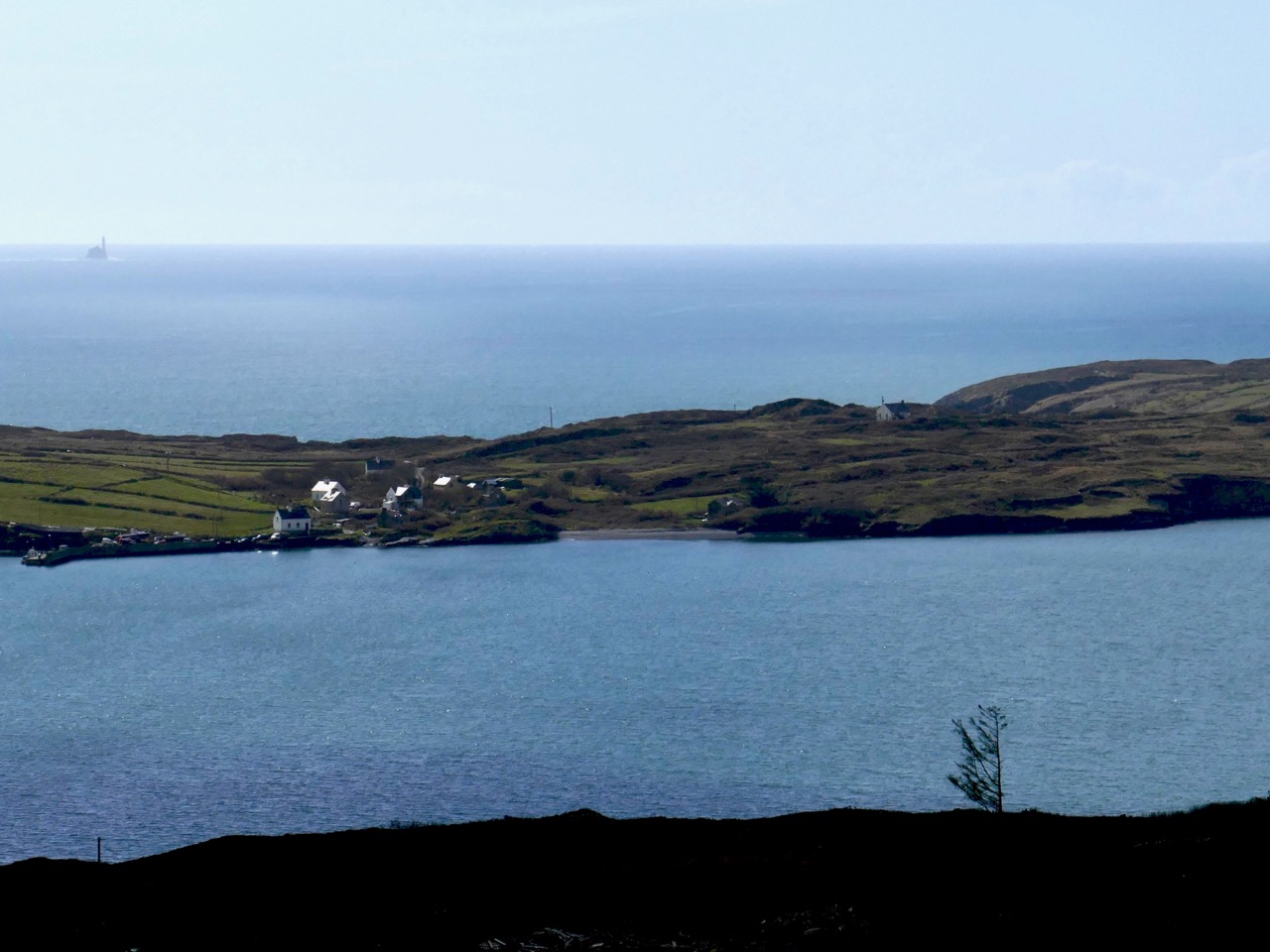
A final look out to sea. There’s Long Island and beyond it the Fastnet Rock with its iconic lighthouse.

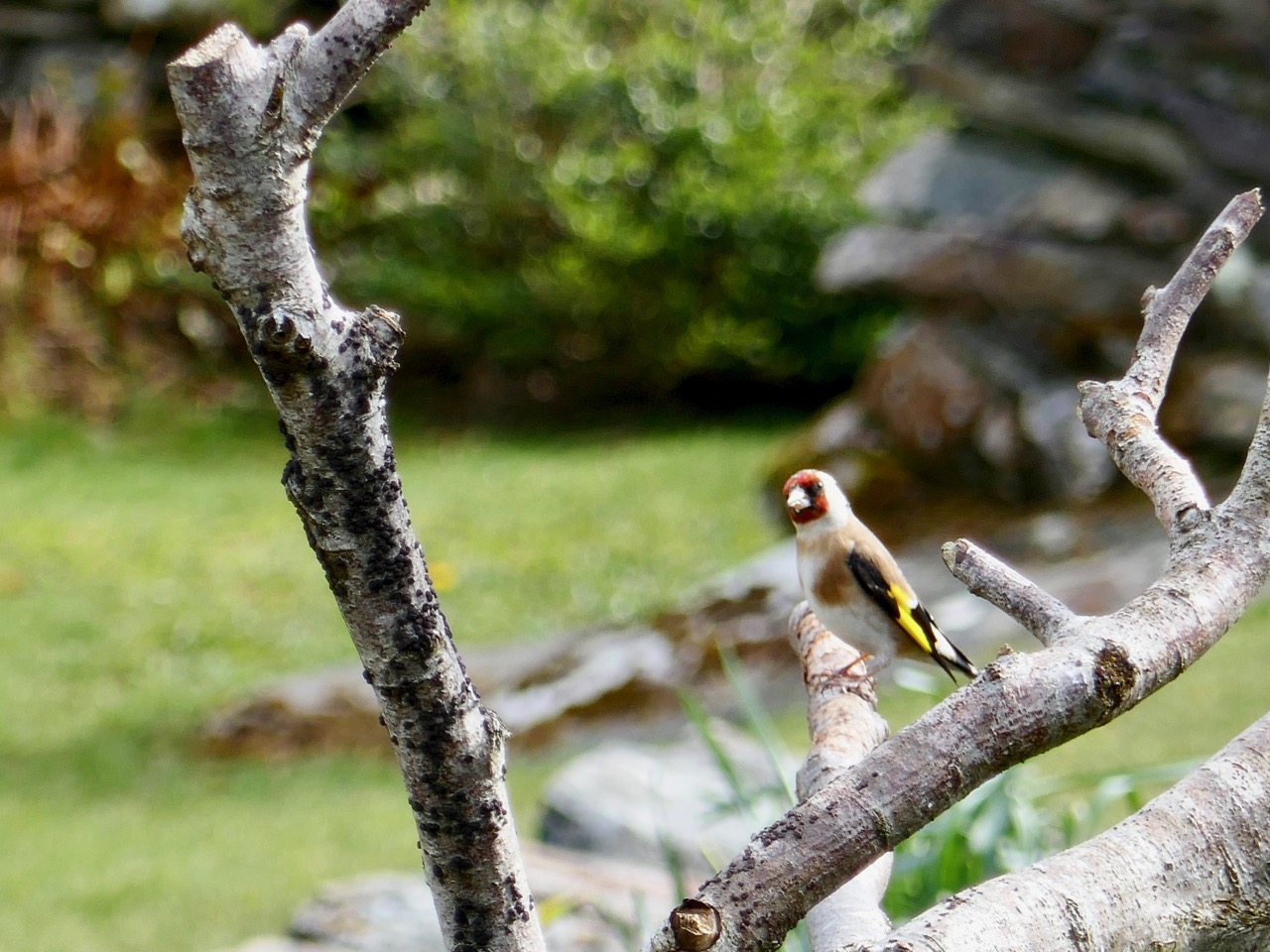
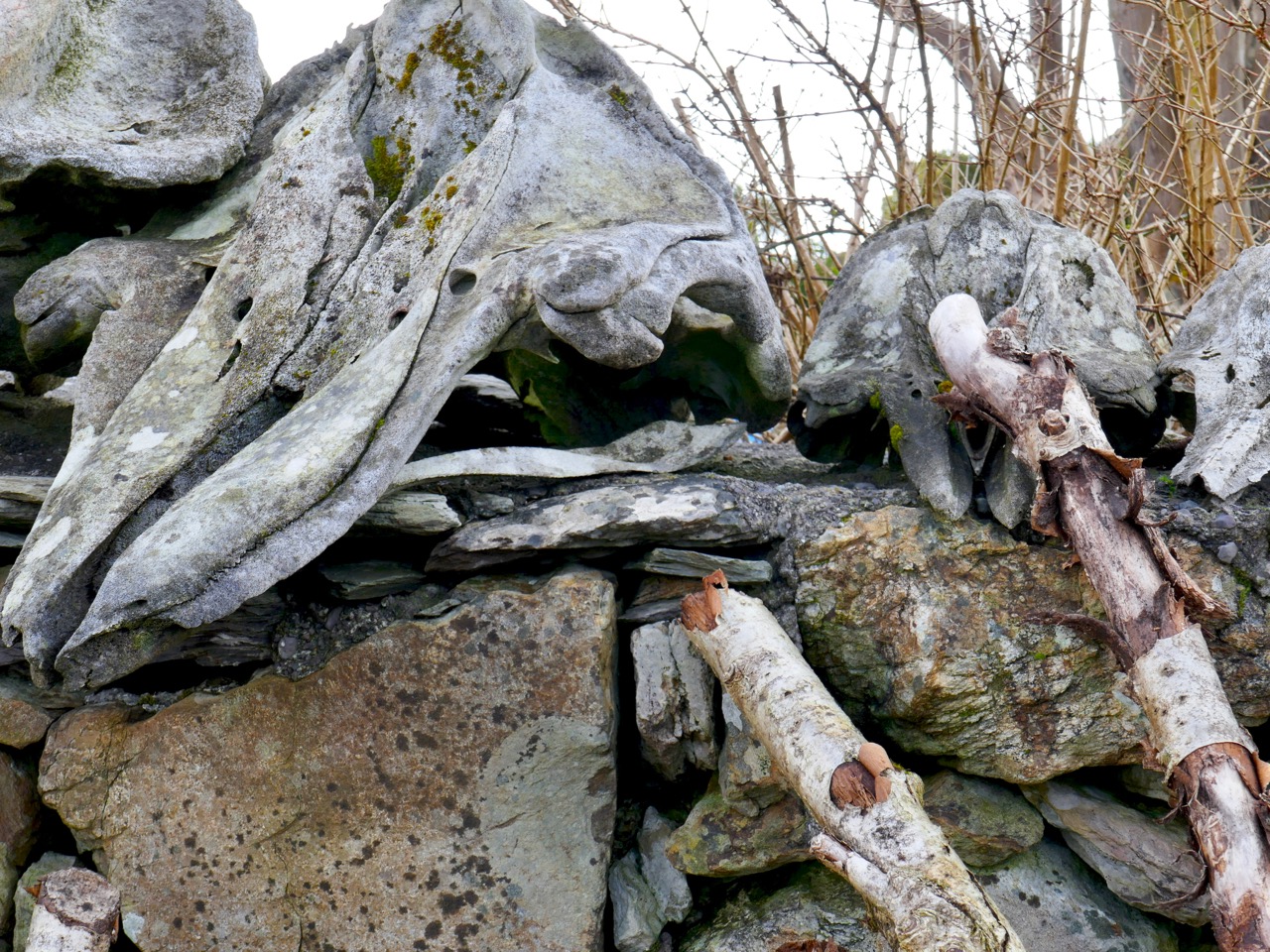
We paused to admire a Goldfinch in Connie’s garden, as well as his wonderful textural arrangement of sticks, stones and whalebones.

Thank you, Connie and Betty, from two happy walkers.

Mizen Magic

We’ve done several posts on the Sheep’s Head and the marked hiking trails that crisscross that peninsula. But we actually live on a different peninsula, The Mizen, and it is just as glorious and wild and beautiful.

Map of Mizen and Goleen

The road to the Mizen Head starts at Ballydehob, runs along the southern side of the peninsula through Schull and Toormore and on to Goleen and Crookhaven. At the far or western end are the beaches of Barley Cove and the Mizen Head Lighthouse and Visitor Centre. There are no villages on the northern side of the peninsula until you reach Durrus, which also marks the start of the Sheep’s Head Peninsula. It is bounded on the south by the waters and islands of Roaringwater Bay and on the north by Dunmanus Bay. The whole peninsula is rich in history and archaeology and we plan future posts about many aspects of life here.

For the moment, a flavour in photographs of what The Mizen landscape has in store for visitors.

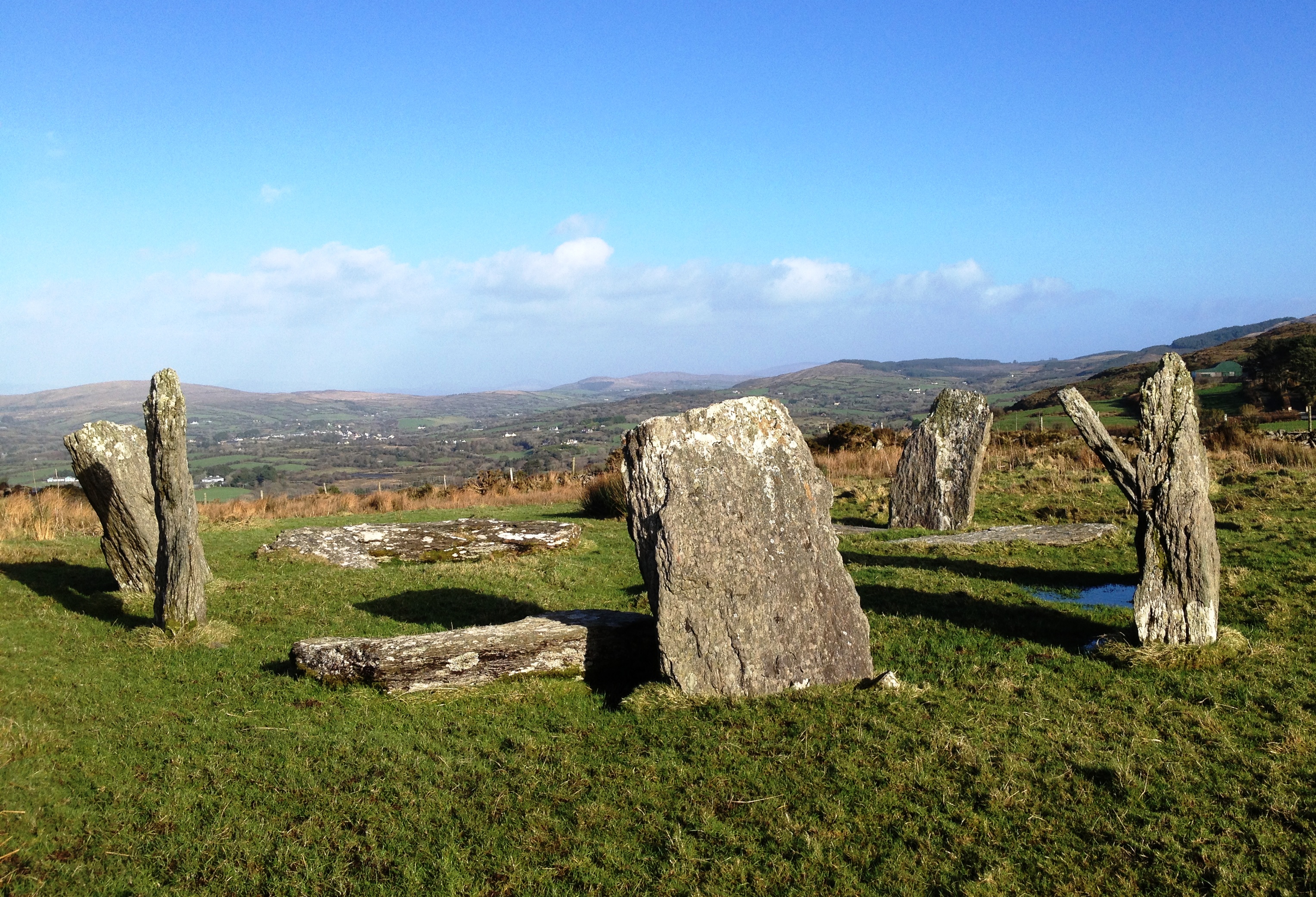
Dunbeacon Stone Circle

Dunbeacon Stone Circle

Ballyrisode Beach

Ballyrisode Beach

Dunmanus Bay

Dunmanus Bay

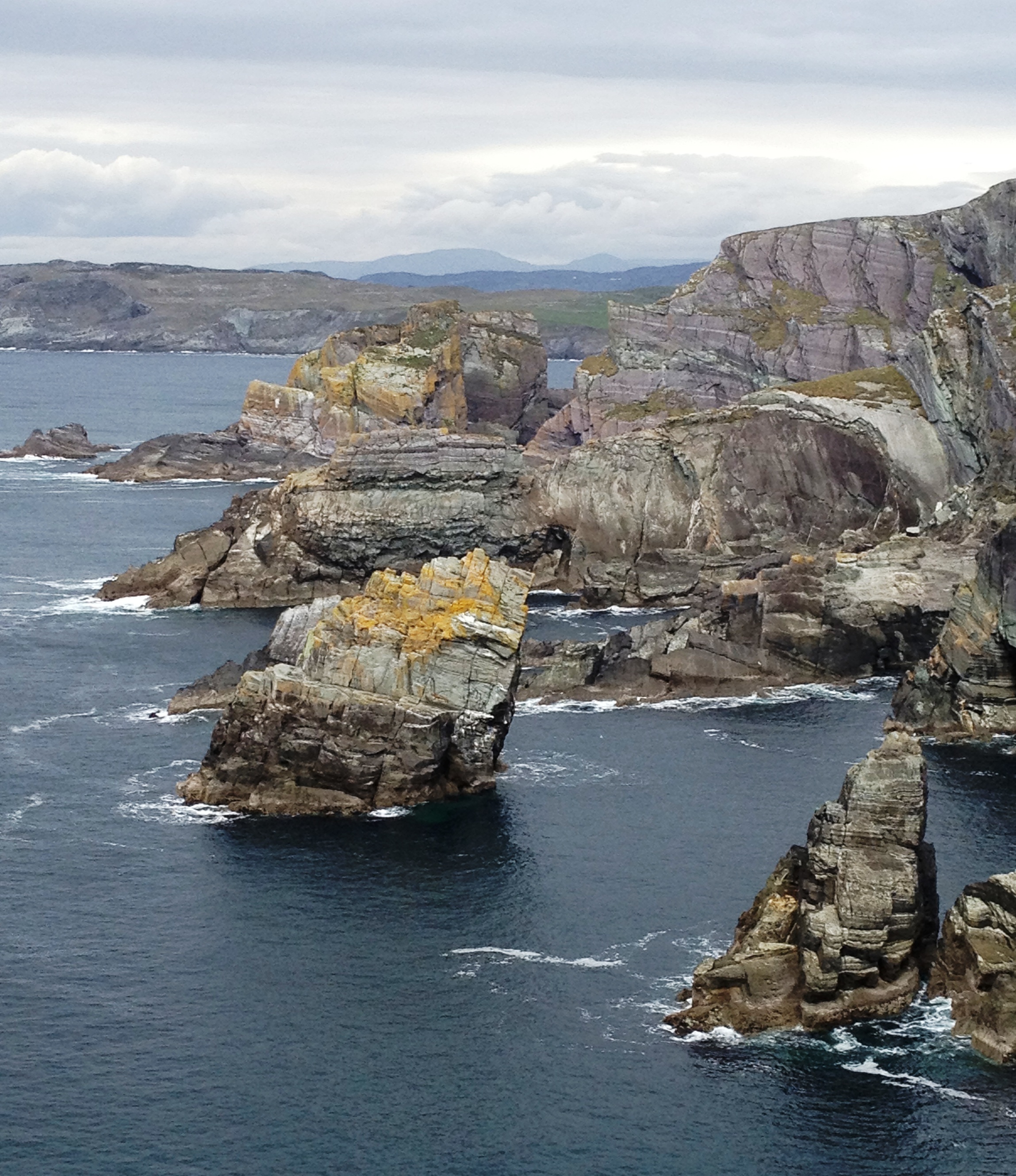
Mizen Head

Mizen Head

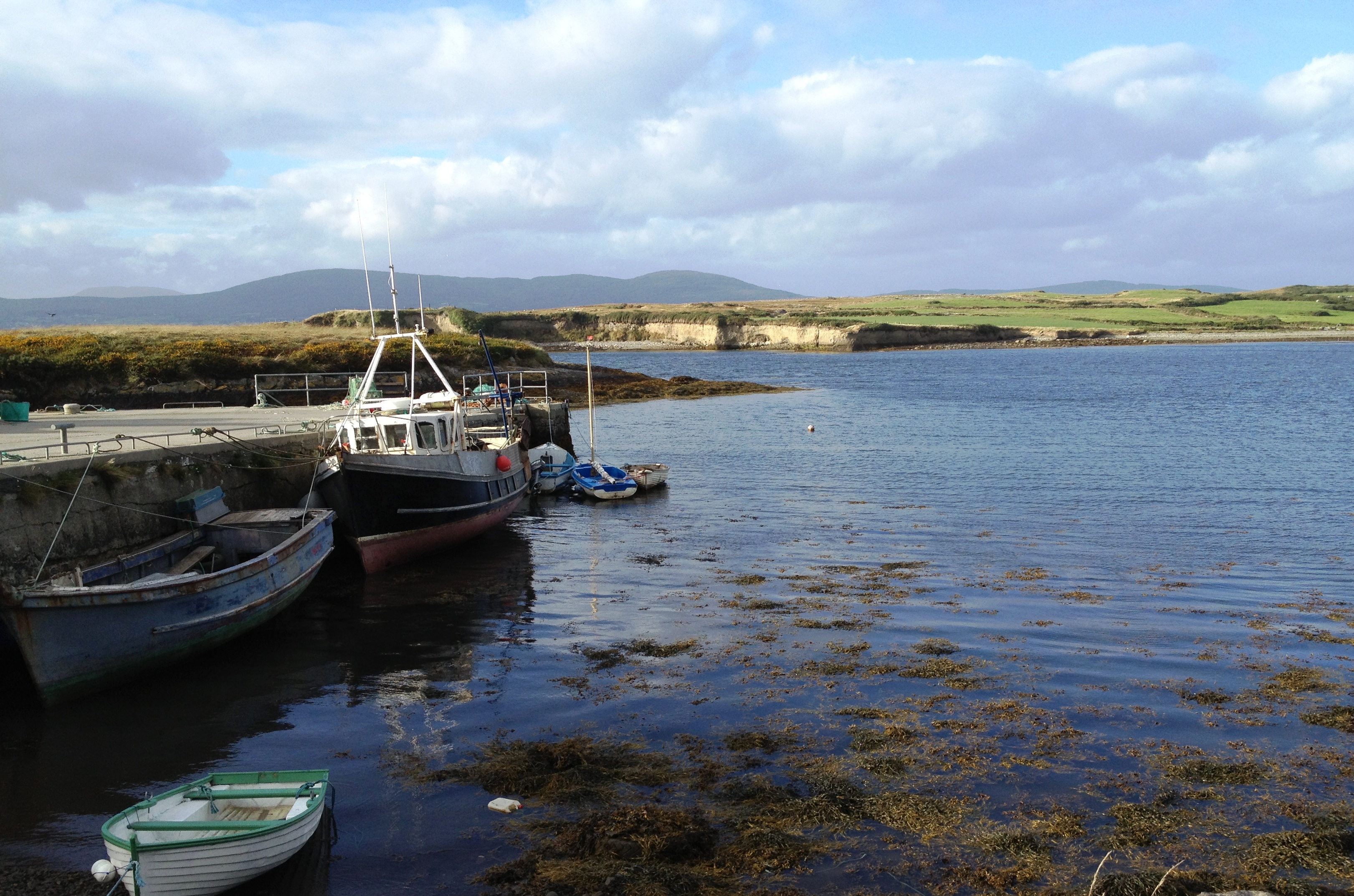
Dunmanus Harbour

Dunmanus Harbour

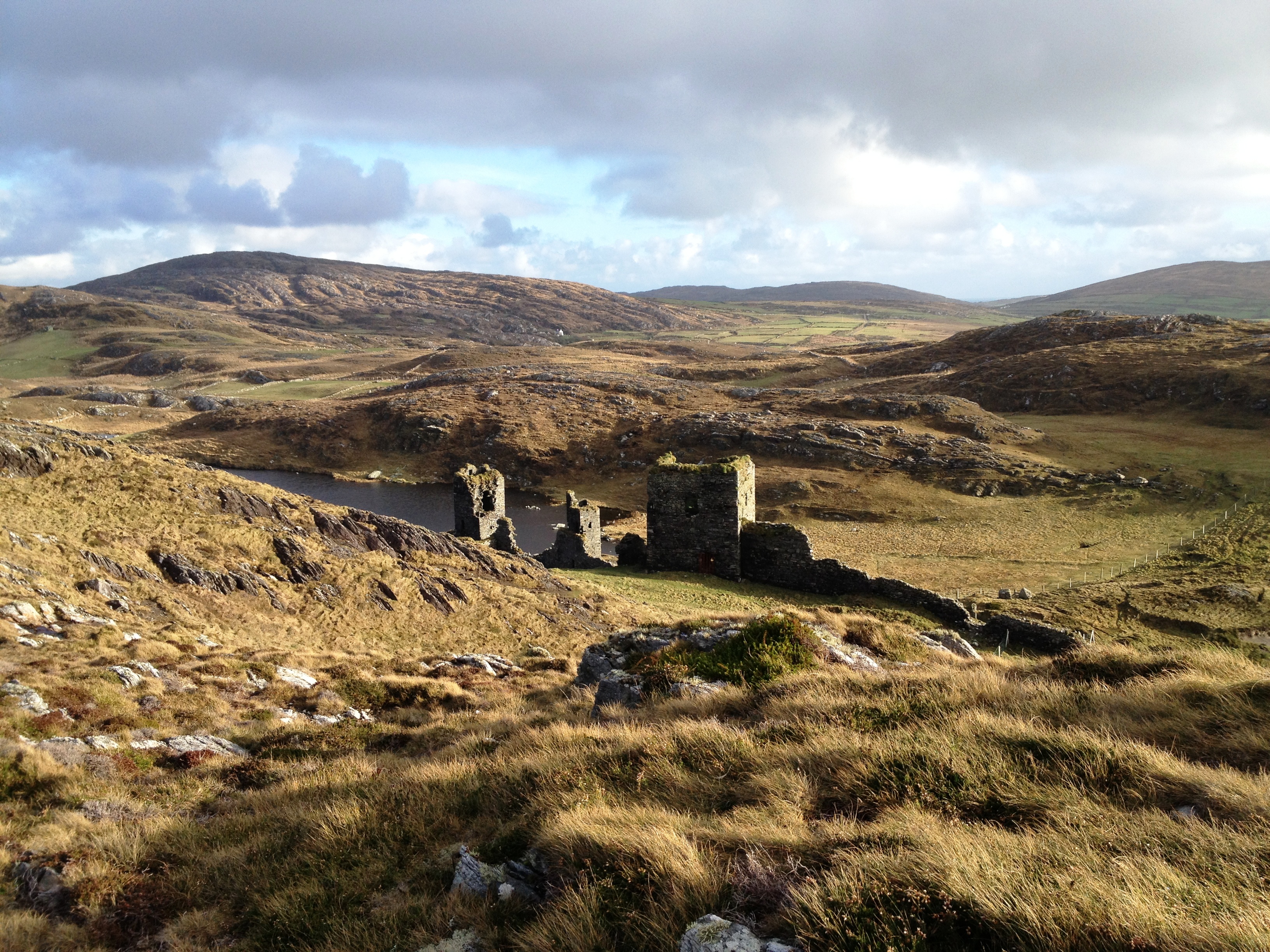
Three Castle Head

Three Castle Head

Relaunching

Image

Nead an Iolair

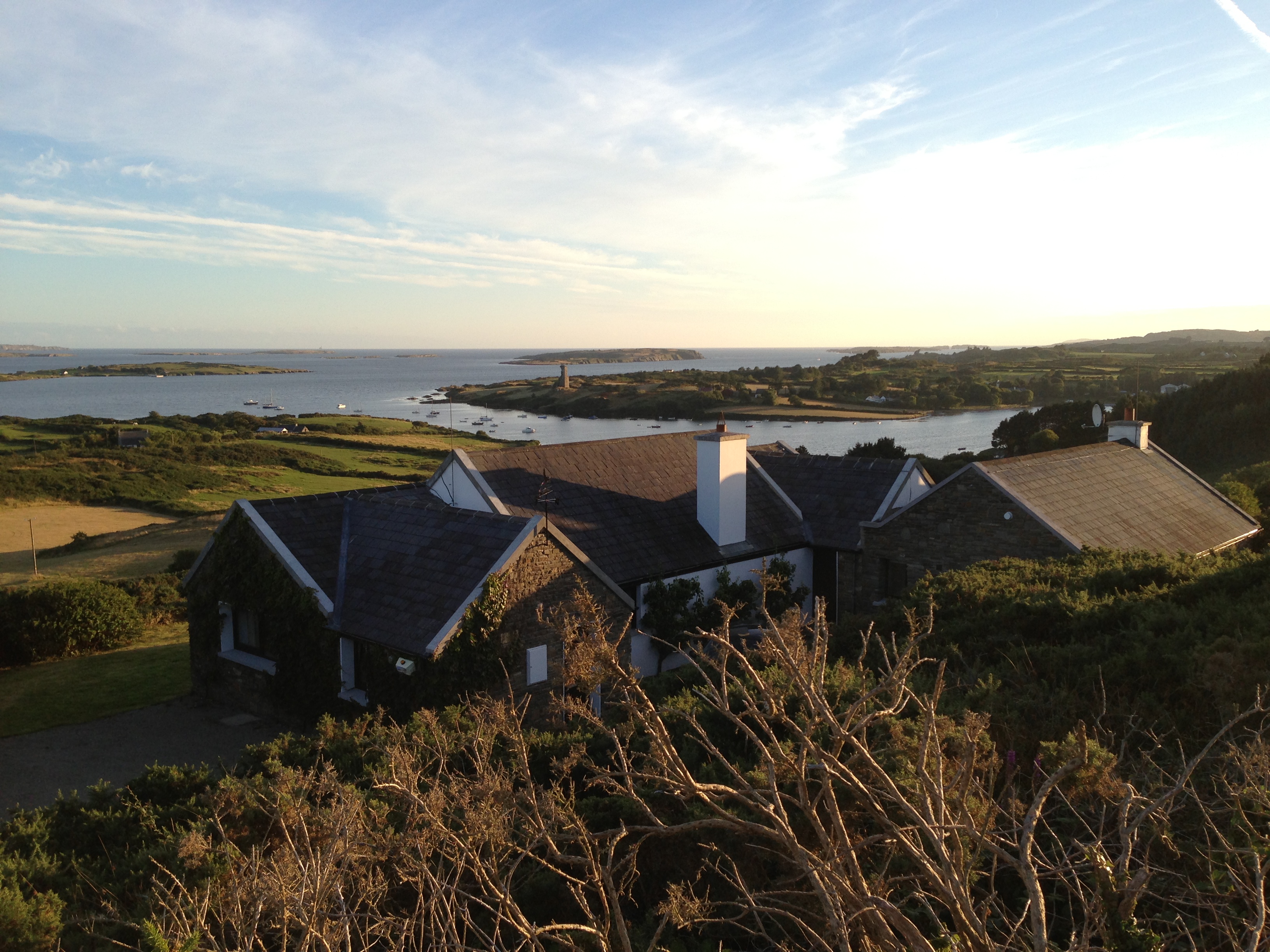
We have returned to West Cork, to the house we bought overlooking Roaringwater Bay, and this time it’s for keeps. Our first month has been a whirlwind of unpacking, sorting, making the house our own, meeting neighbours and friends from our winter stay, and taking in everything West Cork has to offer in the summer. Within a few days of arriving we had been to markets, a play, and several concerts; spent a day at an agricultural fair and another on a beach; attended gallery openings and a classic boat gathering; participated once again in the Friday night music sessions in Ballydehob; hosted dinner parties and been hosted in return; in short – settled back into the marvellous rhythm of West Cork life, but this time as permanent residents.

 Cruinniú na mBád: Ballydehob boat gathering

Cruinniú na mBád: Ballydehob boat gathering

We will be writing in Roaringwater Journal about aspects of life and why we love it here. An enormous part of it all, of course, is the people we meet – their open welcome and friendly acceptance has made us feel at home. But it’s more than that: people here are still close to the land, fiercely proud of this area, keepers of the lore and the history and uniquely expressive. Everyone loves to talk, so you’d better not be in a hurry. Today, for example…

After a late night at the session (made exceptional by the addition of a group of French musicians) we had slept in a bit and decided to head into Skibbereen to breakfast and the market. But even though it’s Saturday here comes Ger, the electrician, with the replacement bathroom fan. Abandoning the plan, we made breakfast for all of us and Ger, having installed the fan, regaled us with stories of the townland he comes from, a mile down the road. We told him we had tramped up and down the roads there, the other day, looking for a piece of rock art, a large boulder with cupmarks on the top, and couldn’t find it. He grinned, “’Tis in my yard,” he said. “The legend is that Finn McCool threw it down from Mount Gabriel.” We made a date to go next week to record it and moved on to discussing the theatre. Ger is an actor and knowledgeable dramatist and, over the eggs and toast, he gave us an insightful review of the recent “Fit Up Theatre” productions (excellent!) we had been going to.

West Cork Arts Centre

West Cork Arts Centre

Then it was off to Skibb, to see if Richard, the cable guy, could come back and finish installing the wireless network in the house. In the store, the manager, who turned out to be Richard’s father, explained to us that Richard was on a hurling team that had just won the County finals for their division and needed to celebrate. With a twinkle in his eye, he suggested that we not look out for him before Wednesday. And while we were waiting, he added, why didn’t we take in this great presentation on Tuesday night, for which he would be delighted to sell us tickets. Half an hour later, we left the store, having been brought up to date on the plans for a new Arts Centre and been told the history of his name, family and business.

First Visitors

First Visitors

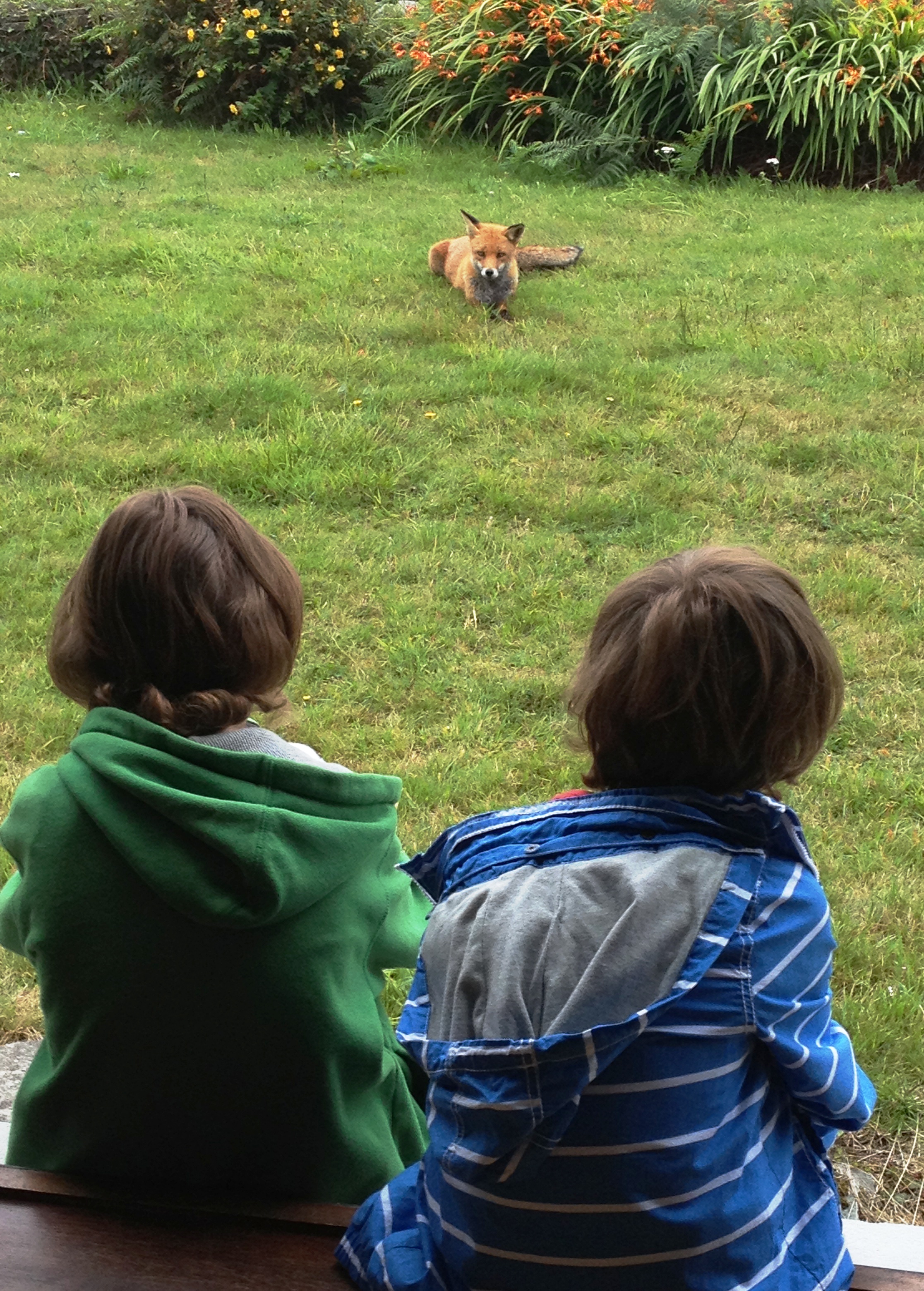
And so go our days. The summer is winding down and the villages will soon lose the tourist-mecca bustle. Already many of the houses in our little cove have the blinds down as their owners return to the city. There’s a slight hint of autumn in the evenings. Our walks are slowed by the temptations offered by the blackberry brambles, our mornings enlivened by visits from Ferdia, our friendly fox.

From Canada and from England, from cities, from careers and responsibilities, from vastly different lives, we have come together to this extraordinary place.

And now here we are – at home in West Cork.

Buckets of Culture

Željko Lučić as Rigoletto. Photo by Metropolitan Opera

Željko Lučić as Rigoletto. Photo by Metropolitan Opera

-What we love about being here – the scenery, the history, the people, the hiking, the markets, the food, the opera…

-What? The opera?

-Yes, and the theatre. And very good cinema too.

-Wait – seriously? I thought you were there to get back to nature?

-Well, er, yes, but…

-But?

-West Cork is also a Mecca for artists of all kinds – musicians, actors, painters, poets, photographers – and part of being here is taking advantage of cultural events. As one local told me last year, “if it’s culture you’re after, we have buckets of it.”

-Oh, OK…tell us all about it, then.

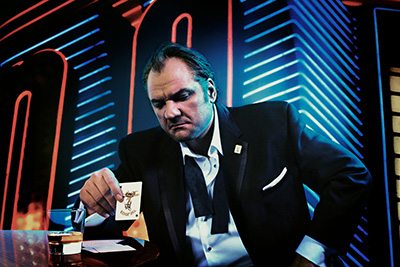
The weekend started with a trip to Cork to stay overnight with my cousin and to go to the Metropolitan Opera Live Broadcast of Rigoletto. This was a stylish production with the action moved to 1960’s Las Vegas and the singers modelling themselves on Rat Pack characters. The Duke of Mantua made a wonderful fist of Old Blue Eyes, and Marilyn Munro made an appearance as Ceprano’s wife. The singing was glorious, with the German soprano Diana Damrau as a transcendent Gilda and Željko Lučić suitably tortured and barrel-voiced as Rigoletto.

The following day we visited a friend in his beautiful and very modern house in Kinsale, ate a huge Sunday lunch and then got into The Music, with Alastair on the fiddle and Robert on his melodeon.

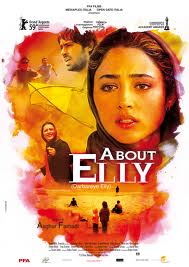
about EllyThe Cinemax in Bantry has all the latest releases and comfortable seating. They run an Arthouse Tuesday and this week we saw ‘About Elly’ by the Iranian Director, Asghar Farhadi. I had seen his movie ‘A Separation’ and was struck then, as I was now, by how much these films challenge our stereotypes of Iran. This one featured an ensemble cast of outstanding actors as young professionals from Tehran. The plot revolves around the disappearance of one of the group during an outing to the Caspian Sea, and the disintegration of cohesion as white lies and deceptions are compounded and revealed. The exploration of the dynamics of man-woman relationships was particularly riveting in what is apparently a time of transition between traditional and modern notions of gender roles.

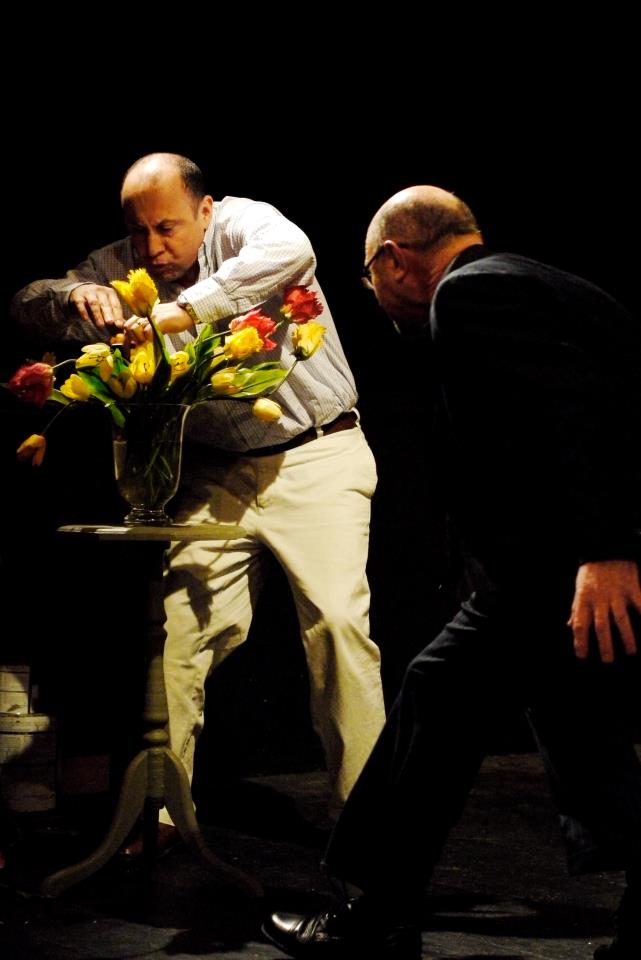
Photo from Schull Drama Group Facebook Page

Photo from Schull Drama Group Facebook Page

On Friday night we attended the Schull Drama Group’s production of The God of Carnage, a play by French actor and playwright, Yazmina Reza. This is the same company of players that was responsible for the broad comedy and slapstick of the traditional pantomime we had seen in January and this comedy/drama was a testament to the depth of their talent. Two couples, Veronique and Michel and Annette and Alain, meet to discuss a contretemps between their sons. Their plan to do this in a civilized manner, over coffee and clafoutis, quickly descends into chaos, as accusation and counter-accusation reveal the fault lines of each marriage and the assumptions and veneers of middle-class privilege.

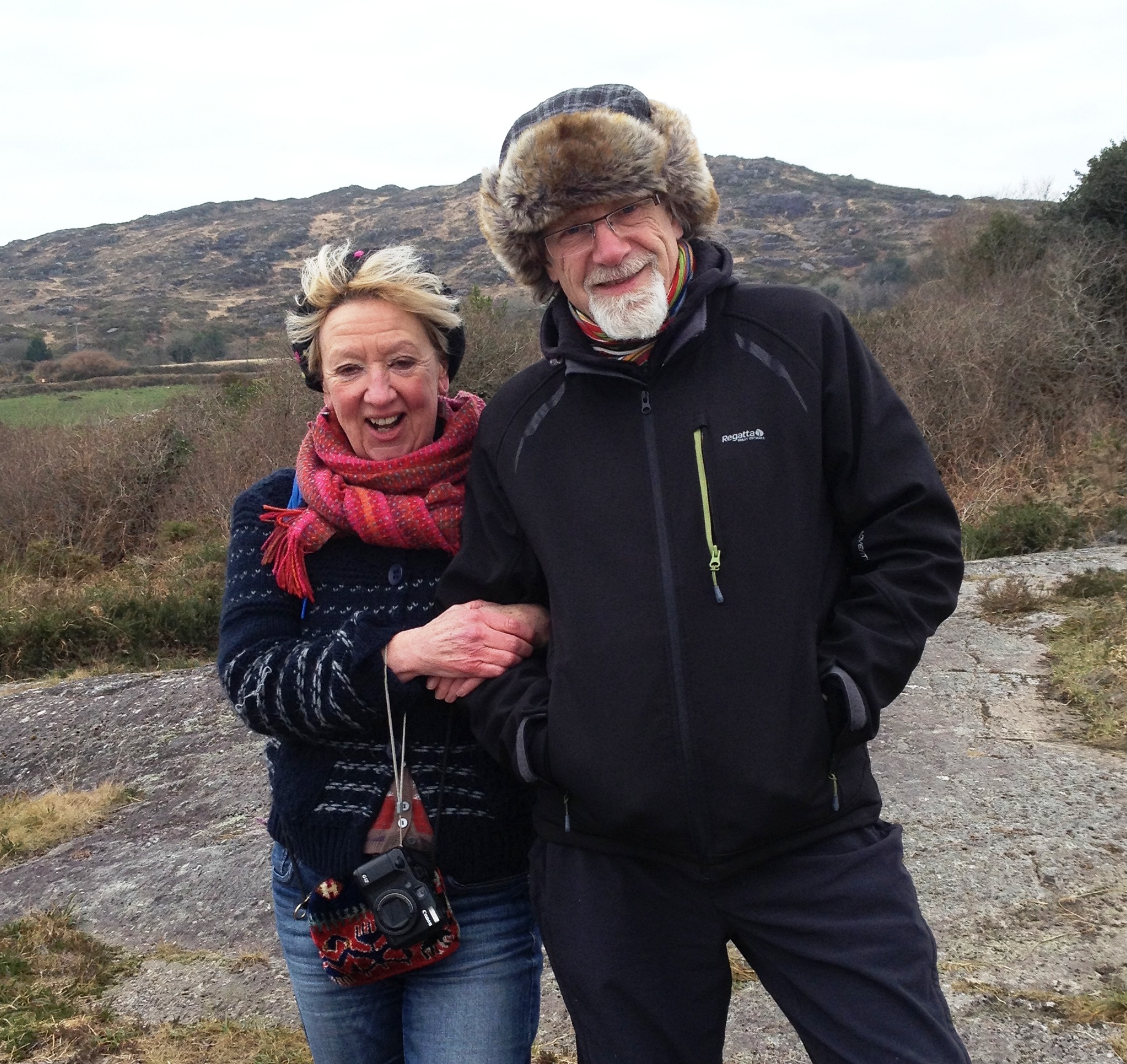
Amanda and Peter on our Rock Art Day

Amanda and Peter on our Rock Art Day

Finally, Saturday saw us in the company of two new friends, Amanda and Peter Clarke on a Rock Art Day of tramping through the countryside. Peter and Amanda are the talented couple behind two websites: Sheep’s Head Routes and Sheep’s Head Places, both invaluable resources for exploring this part of West Cork. Amanda is also a keen photographer with a wonderful eye. You can read her description of our day, and view more of her beautiful photography at her Blipfoto site.