I”m going to try to be slightly less detailed this time (I find that hard!) or we will never explore the rest of Cork. This post will concentrate on the area north of the Mizen – our two other peninsulas, Sheeps Head and Beara.
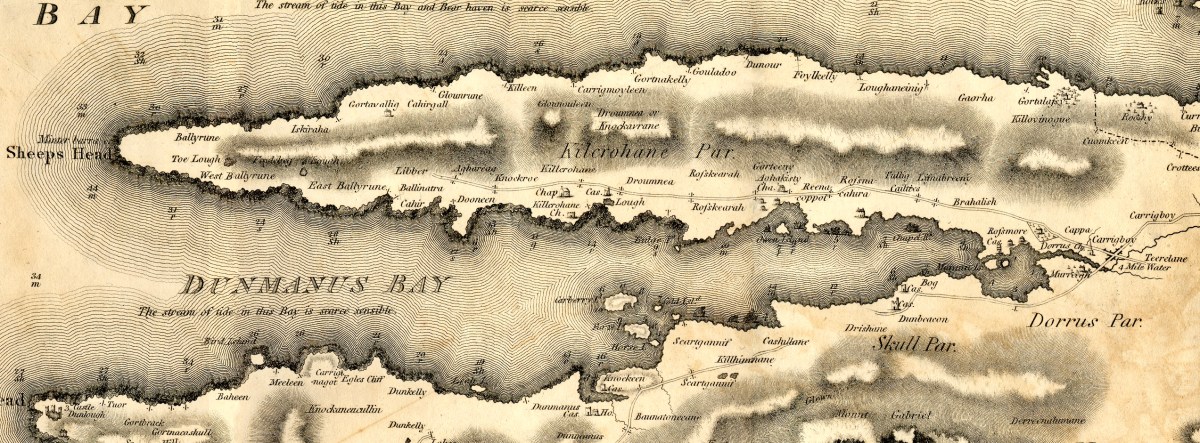
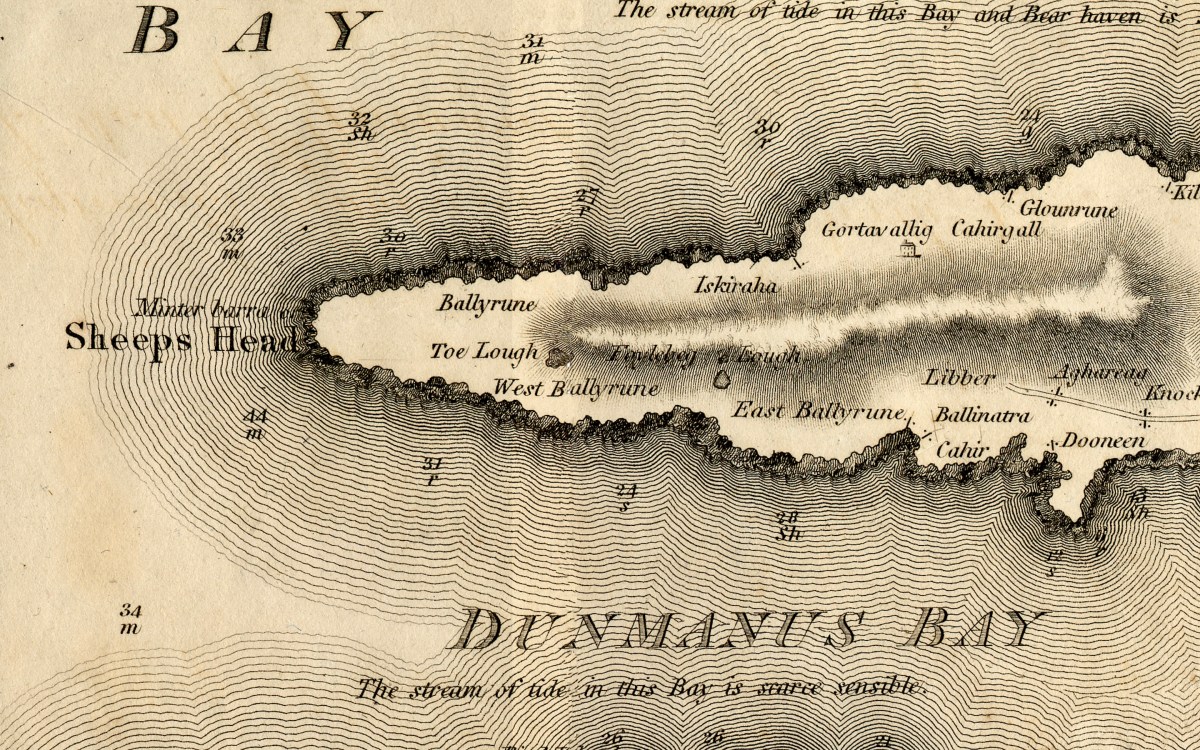
Sheeps Head (and it has an apostrophe in some maps and not in others, so I’m leaving it out) is given here as the head at the westernmost extent of the peninsula. But of course, we now call the whole Peninsula Sheeps Head. Or, if you prefer, by its Irish name of Muintir Bheara (Mweenter Varra) which means, confusingly, the people of Beara.
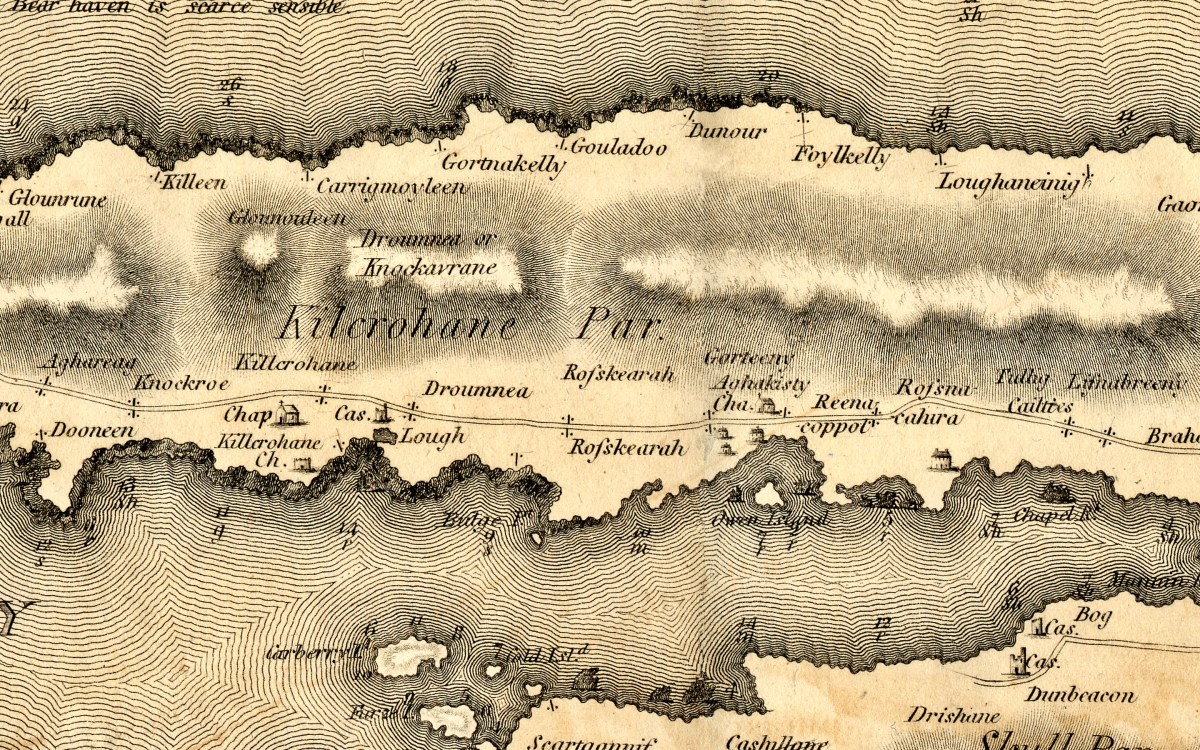
Besides a single house at Gortavallig, the only words on the east end of the map refer to placenames. The road does not extend beyond Dooneen. Nowadays, of course, this is a well-walked, prize winning set of trails that will bring you off road for the most part into wild and scenic country.
KIlcrohane and Ahakista have churches and chapels but no real communities in the 1790s. The castle near Kilcrohane is the vestigial one built by the O’Daly clan, the famous bards, at Lake Farranamanagh. There are no roads on the north side, and none crossing the Peninsular.
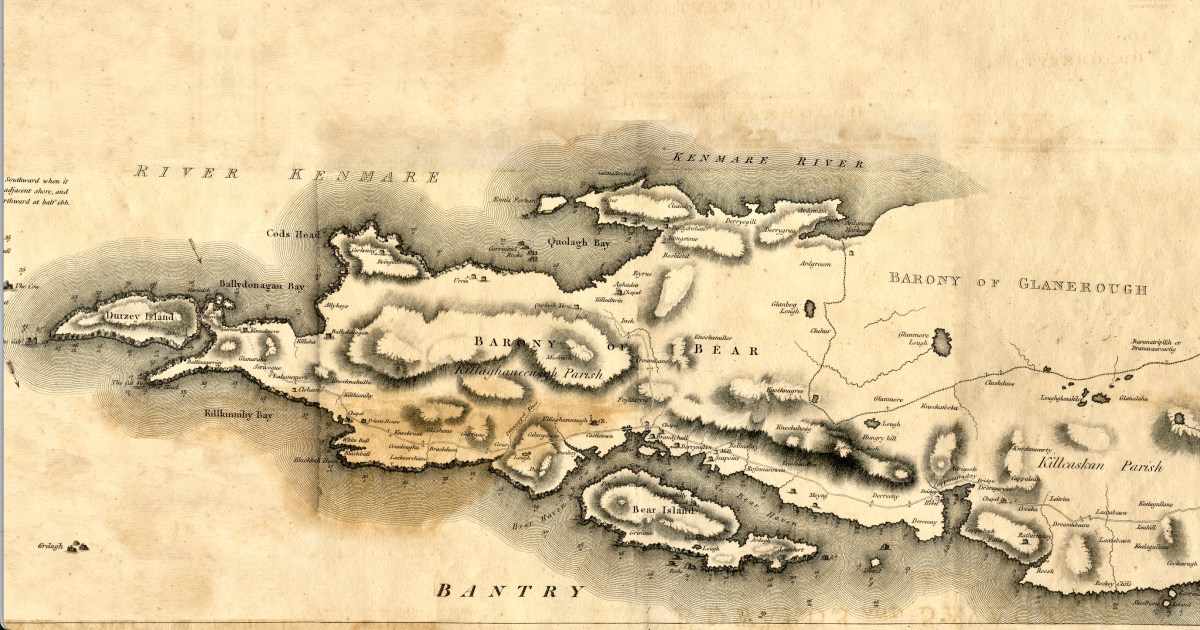
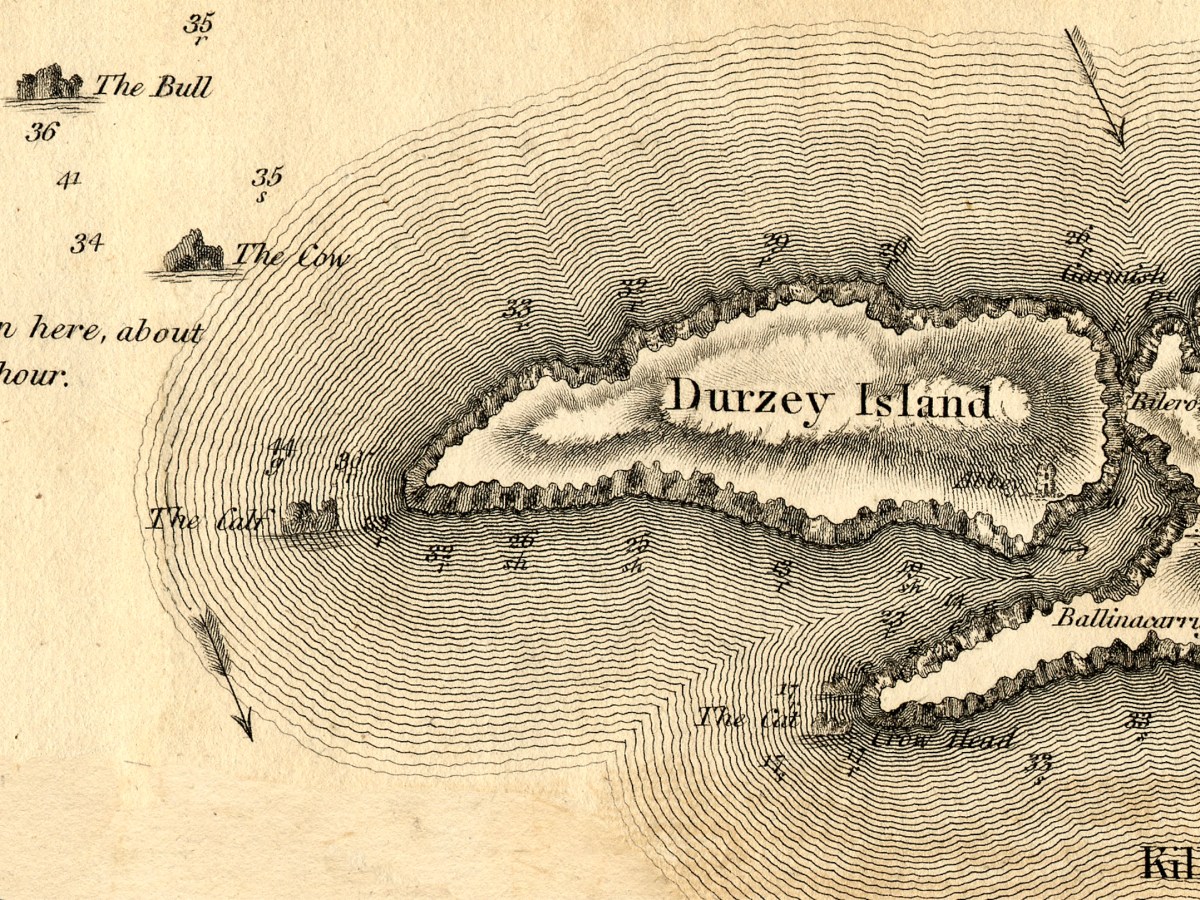
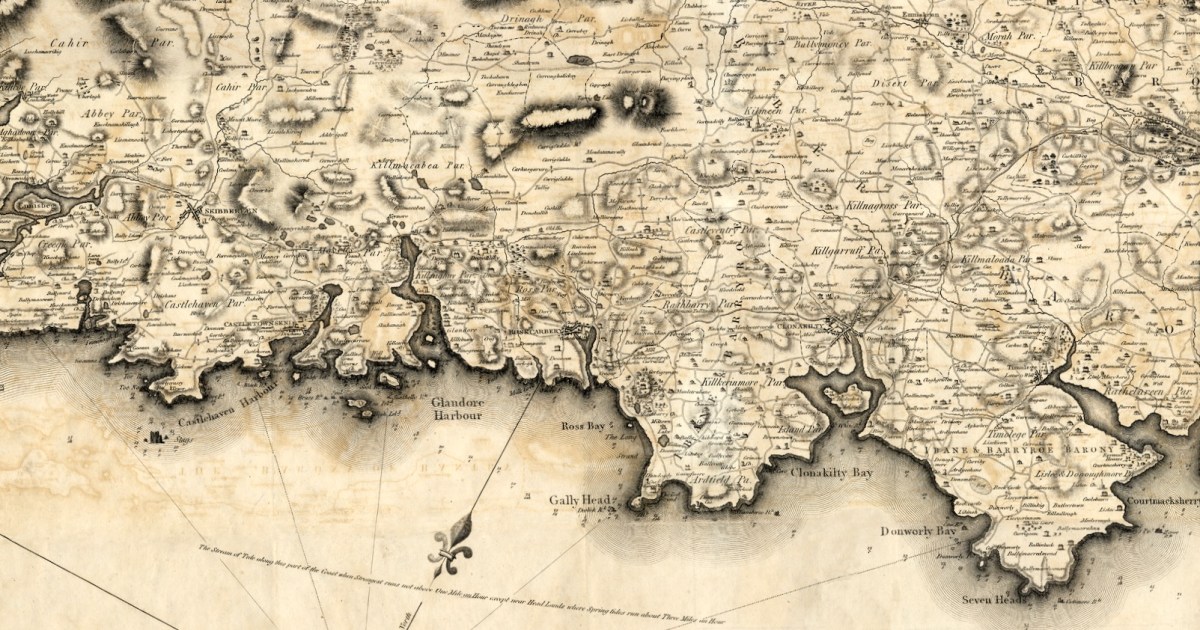
Let’s leap now, as Fionn MacCuamhaill might have done, to the next peninsular up – Beara. The full extent of it is shown in my lead photograph, and above is the eastern end and specifically Dursey Island. The Calf Rock is offshore, with the Cow further put and the storied and spectacular Bull Rock further out again. I do plan to visit it one day! Dursey is the only place in Ireland that you get to by cable car and has a tragic history. An Abbey is shown on the eastern shore. National Monuments tell us that “According to the soldier-writer and native of Dursey, Philip O’Sullivan-Beare, writing in 1621, it was a ‘monastery, built by Bonaventura, a Spanish Bishop, but dismantled by pirates'”.
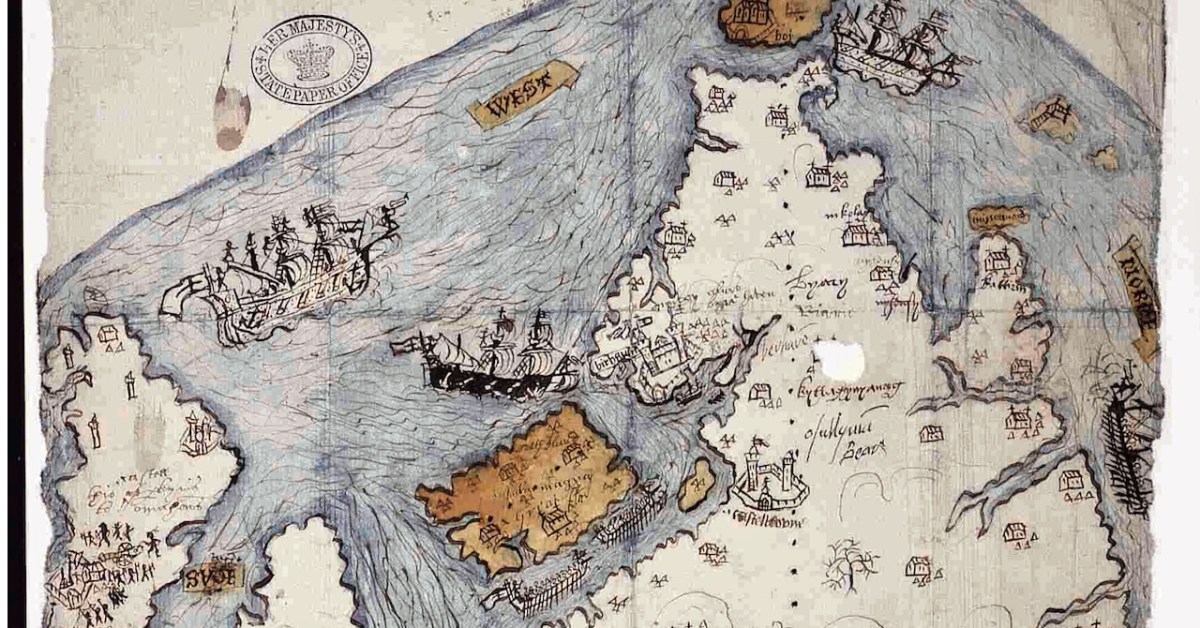
The western end of the Peninsula is mountainous. A road extend along the southern side but not the northern. This is one of the few places in Ireland we have a very old map to make comparisons. Take a look at my post Elizabethan Map of a Turbulent West Cork and Elizabethan Map of a Turbulent West Cork 2: The Story, for a lively take on mapping this part of Ireland 200 years earlier.
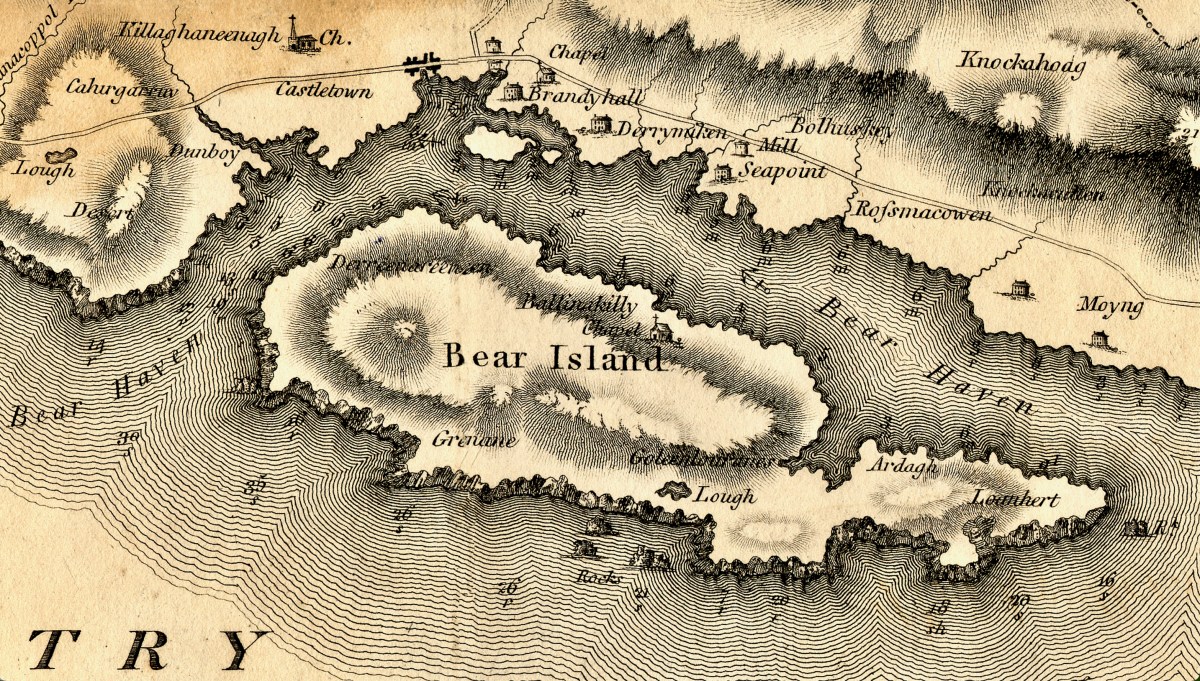
Bear Island is featureless apart from a chapel but Castletown (more properly known as Castletownbere or Castletown-Berehaven) is shown as having a town or village and several substanital houses, a mill, and a church with a steeple. Interestingly, the castle at Dunboy, the siege of which is chronicled in the older map, is not shown at all in this one.
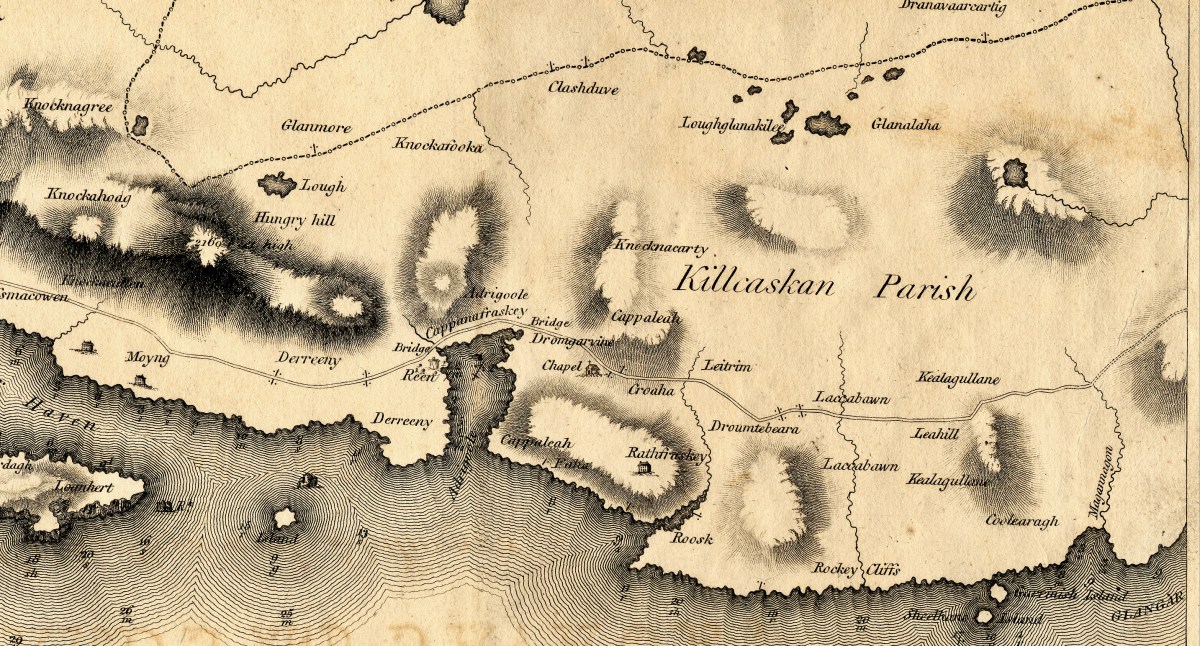
Moving eastward, very little human activity is noted on the map, but Hungry Hill is there and Adrigole Harbour. The dotted line marks the division between Cork and Kerry.
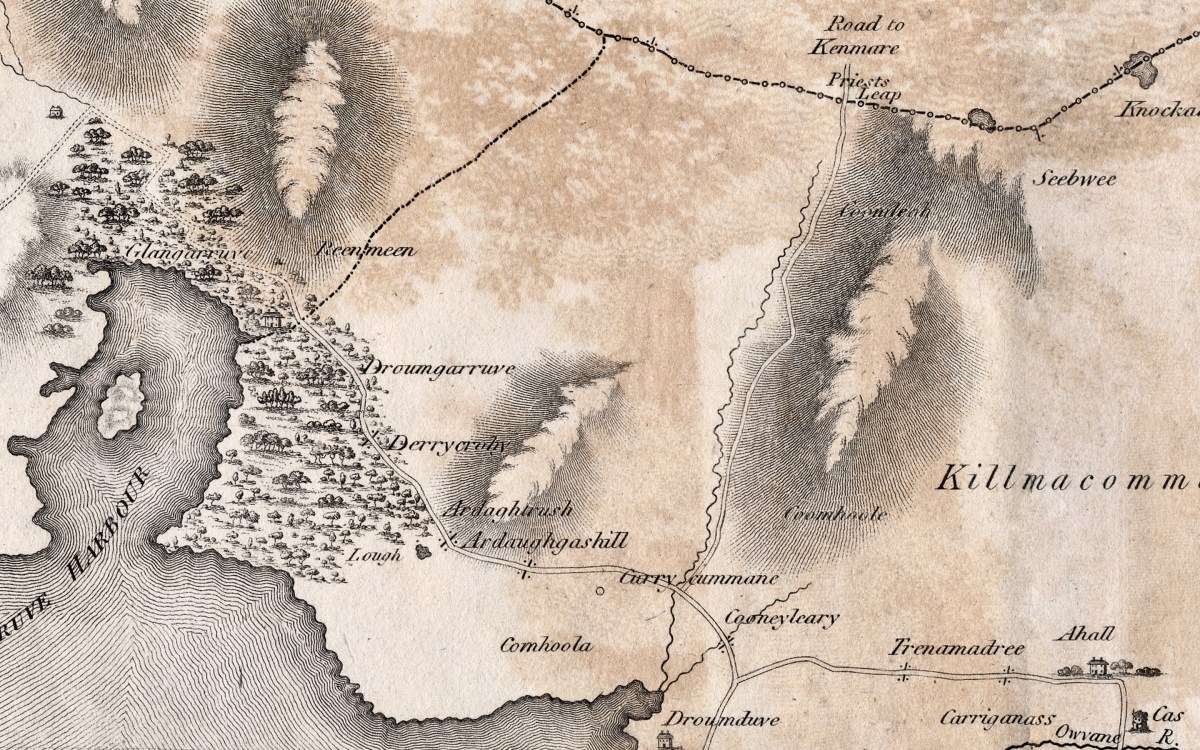
Then, there seems to be a bit missing – Glengarriff (or here, Glengarruv) Harbour is surrounded, then as now, by substantial forests. The only road to Kenmare at that time was the Priest’s Leap, even now a death-defying and vertiginous climb.
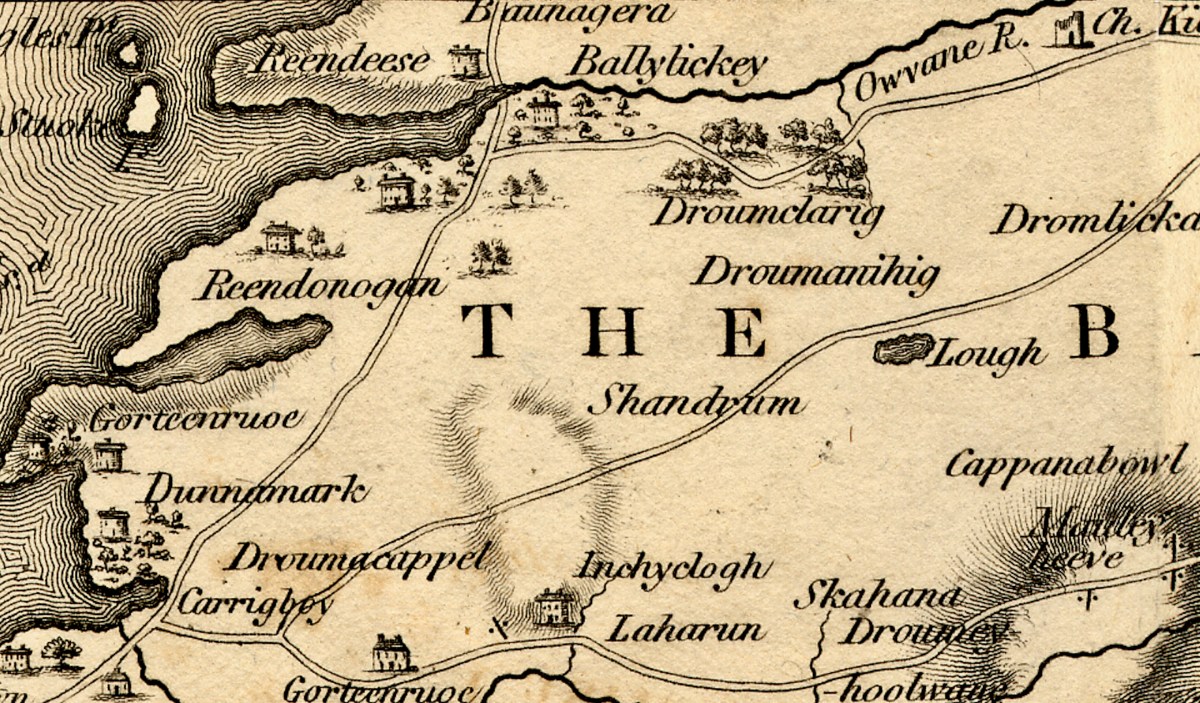
I’ve blown up the Ballylickey section as it holds particular interest for me – here depicted is the home of Ellen Hutchins! There’s a large house, surrounded by trees, on the banks of the Ouvane River. This is especially exciting as Ellen was living here at exactly that time! Born in 1785, she was botanising and making all kinds of discoveries until her untimely death at only 29 in 1815. After the sparsely annotated Peninsulas, it’s interesting to see more houses noted as we near Bantry.
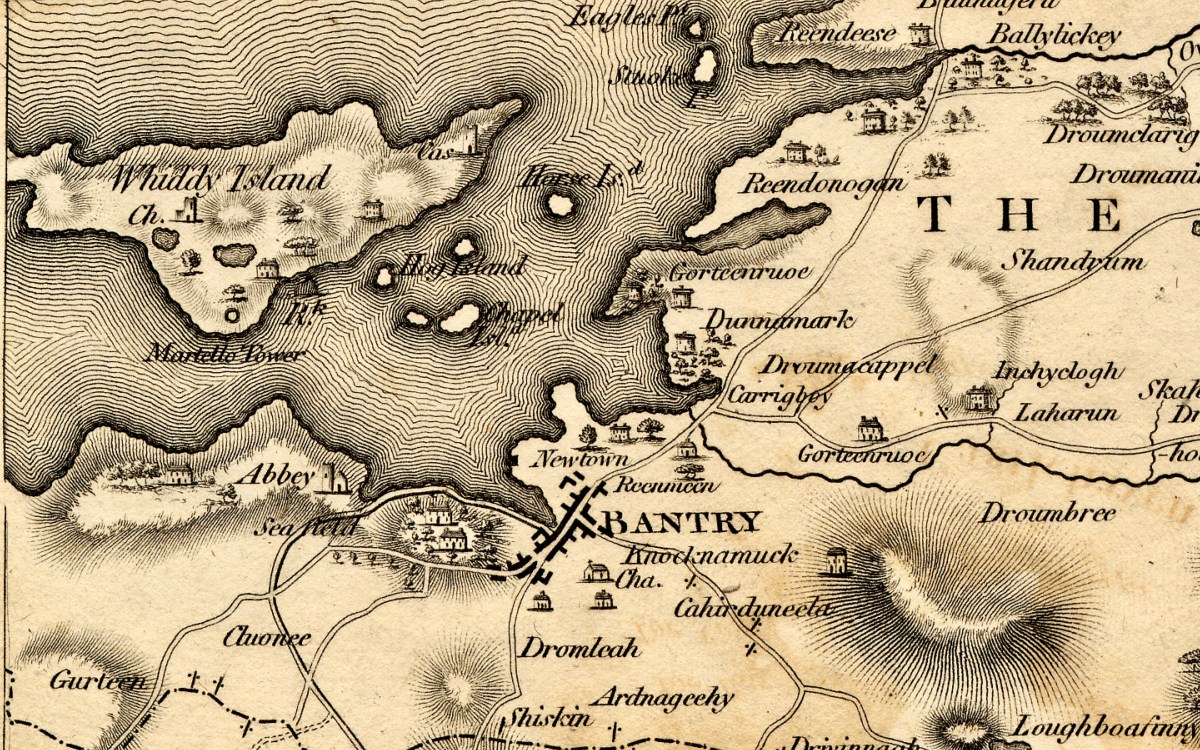
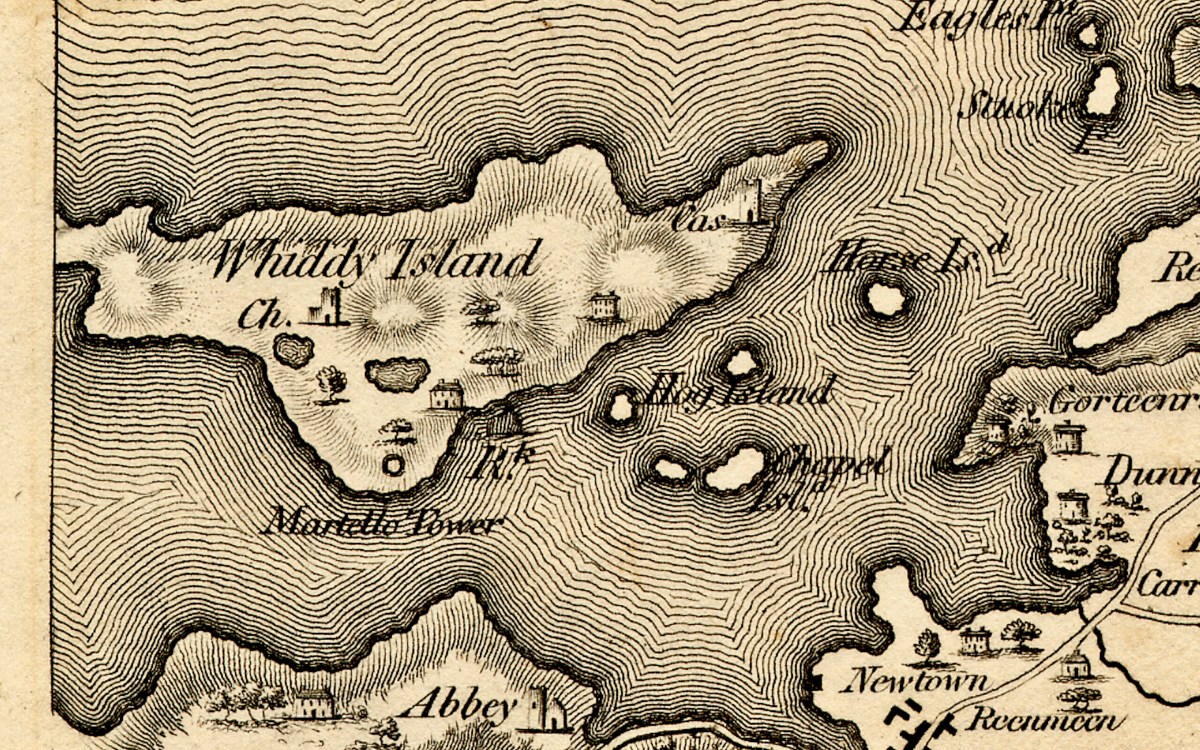
Bantry is shown as a large town – with Bantry House, built on the early 1700s, dominating the landscape just as it does today. The Abbey has disappeared (it was a Franciscan establishment) but has given its name to the Abbey Graveyard at the southern end of town. We’ll finish with Whiddy Island and a genuine mystery – note the Martello Tower (below). There were actually three circular fortifications constructed on Whiddy after the abortive invasion by the French in 1796. Known as the West, East and Centre Batteries (or ‘redoubts’); this is probably the Centre one. They were very solidly built and can still be seen.
We know this map was done in the 1790s, and these redoubts, like the Signal Towers dotted along the coast, were built to warn of another French incursion and to defend Bantry Bay. The signal towers were built around 1804 and abandoned by 1815 after the Battle of Waterloo. None of them is noted on the Bath map, consistent with our understanding that the Cork map was completed in the 1790s. Martello towers date to the same period – the first of them were built in 1804, mostly along the east coast. The only actual Martello tower in this area is on Garnish Island. It was built in 1804/5 and does not show up on the island in the Bath map – see Glengarriff Harbour, above. The Whiddy Batteries are shown on the National Monuments records as dating to 1804 to 1807. They are round – more like the shape of a martello than the tall rectangular signal towers that were built around West Cork. But was the term Martello common at this time? Might this be a later addition to the map? Although it was completed in the 1790s it was not published until 1811, allowing for the possibility of editing and changes. Anybody have any comments on this – it’s a head-scratcher!
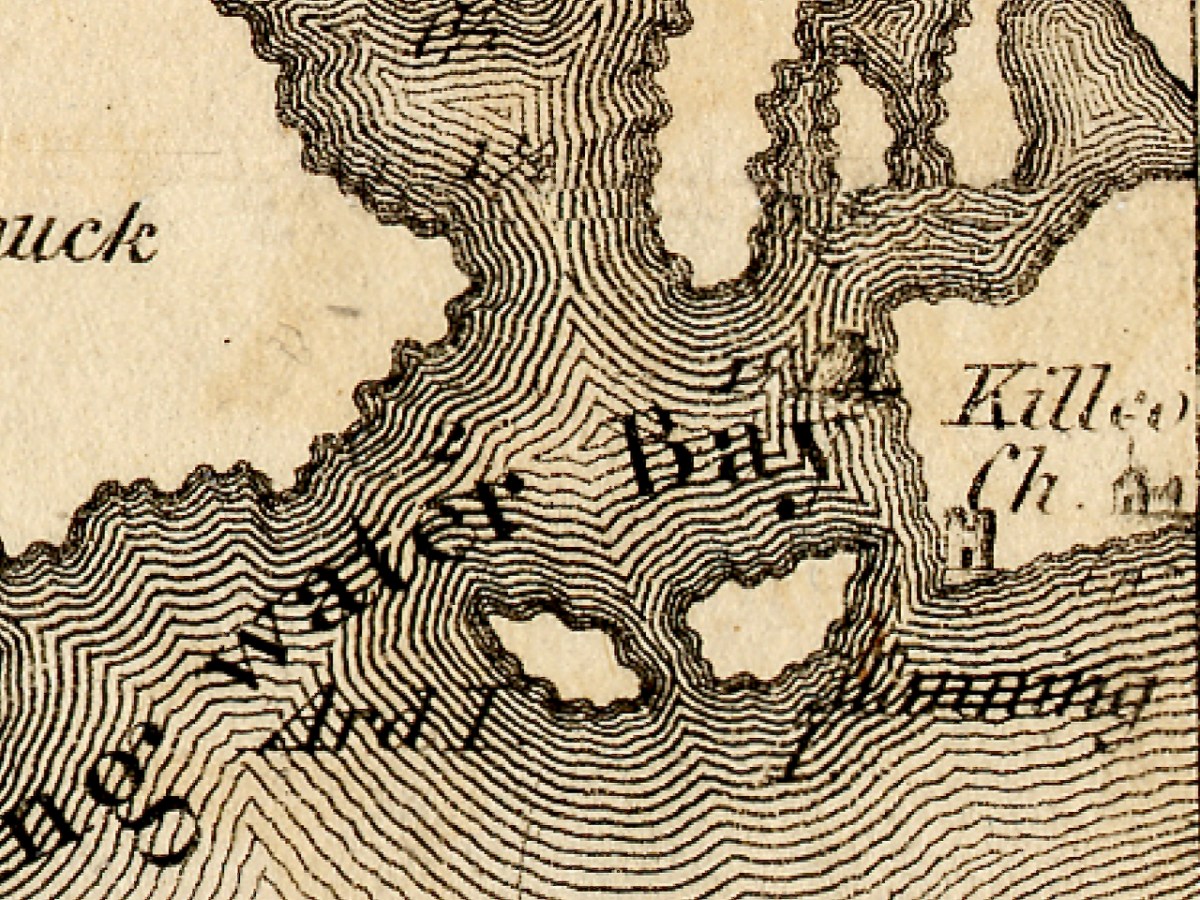
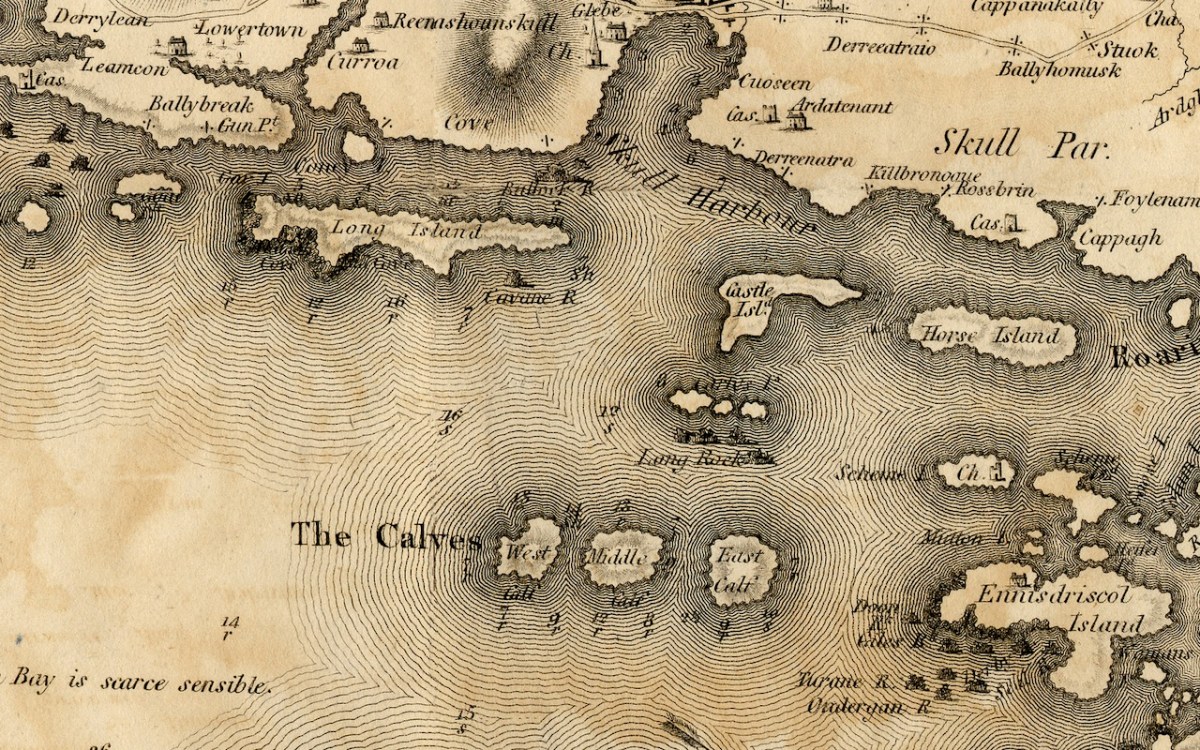
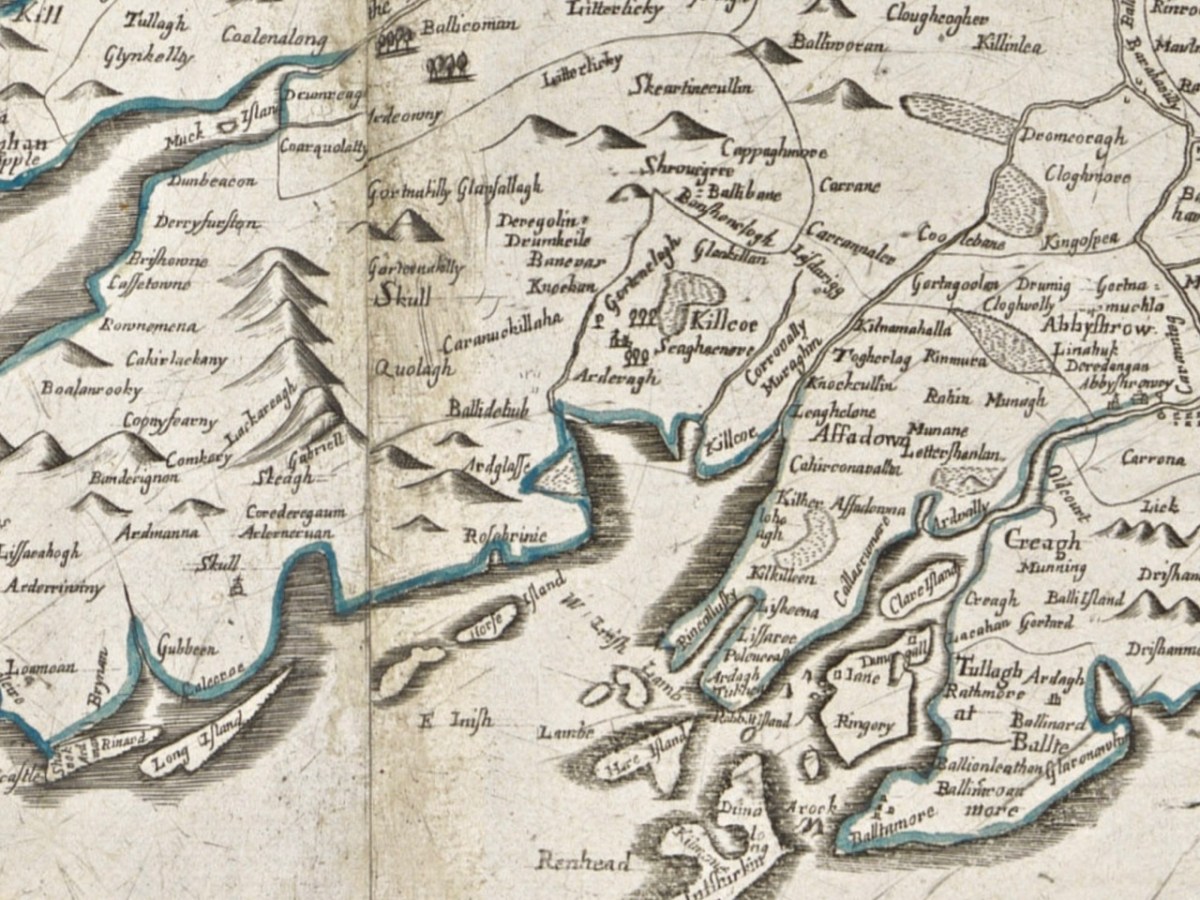
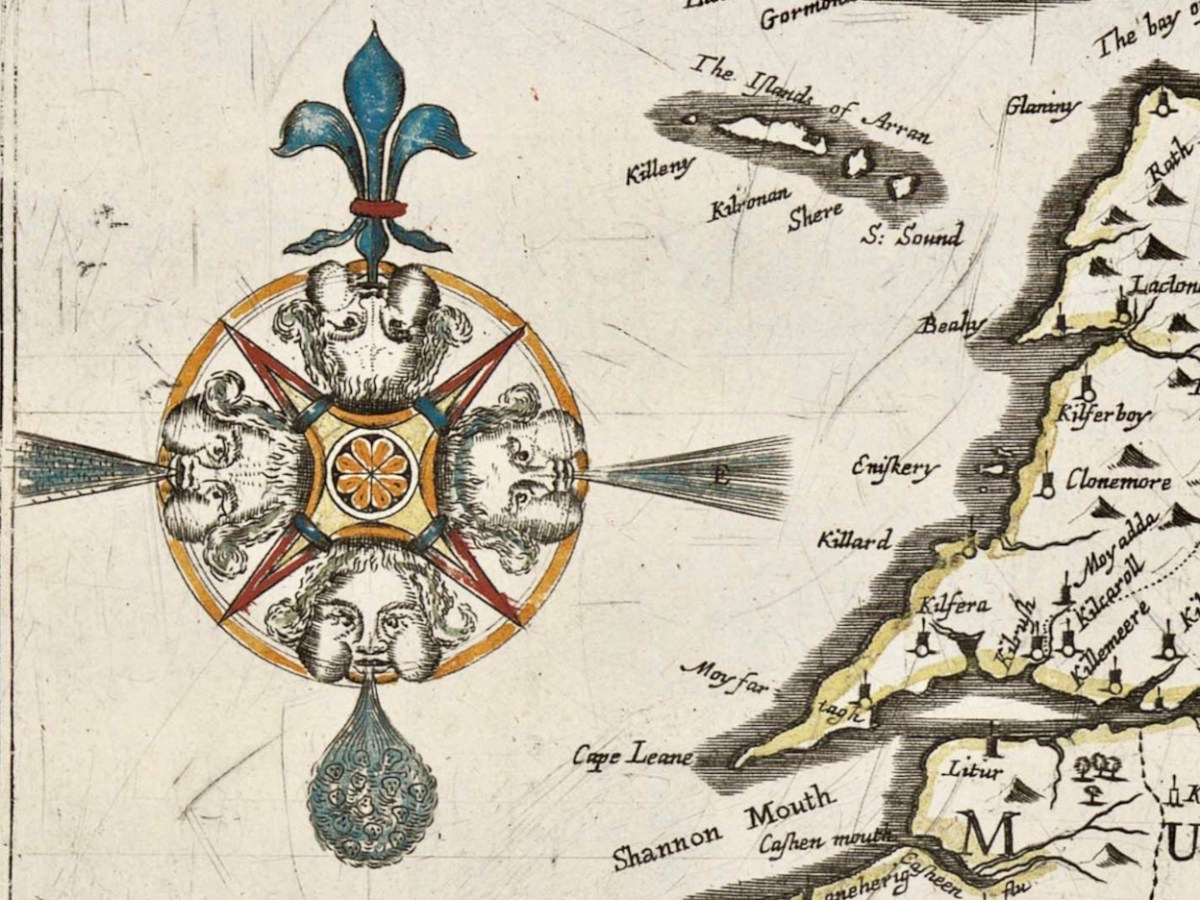
The first thing to say about this map is that on it the name Roaringwater Bay is assigned to a restricted area area eastwards from Horse Island, up to the entrance to Ballydehob Bay, and across to Skeaghanore, Kilcoe and Turk Head. This, in fact, is still how modern maps are labelled.
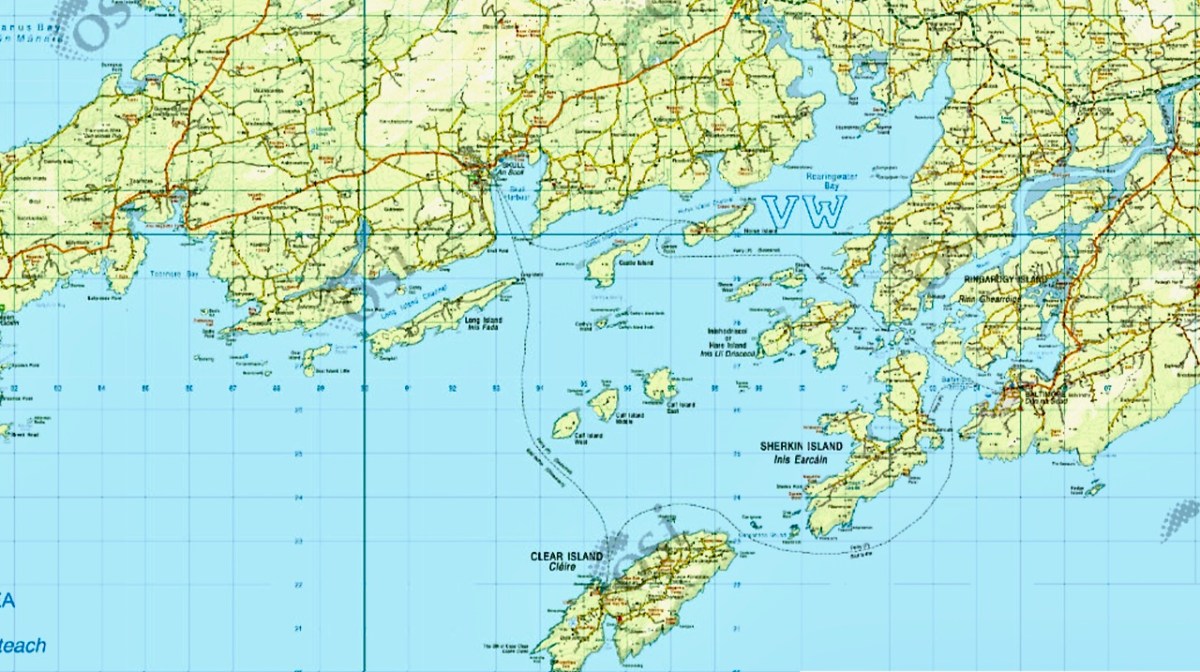
However, when you live here, you realise the term Roaringwater Bay is used to refer to the whole area that encompasses all the Islands, right out to Cape Clear. In Irish, Roaringwater Bay is called Lough Trasna, which simply means Lake ‘Across’ – a term which carries the implication of a body of water you have to cross over.
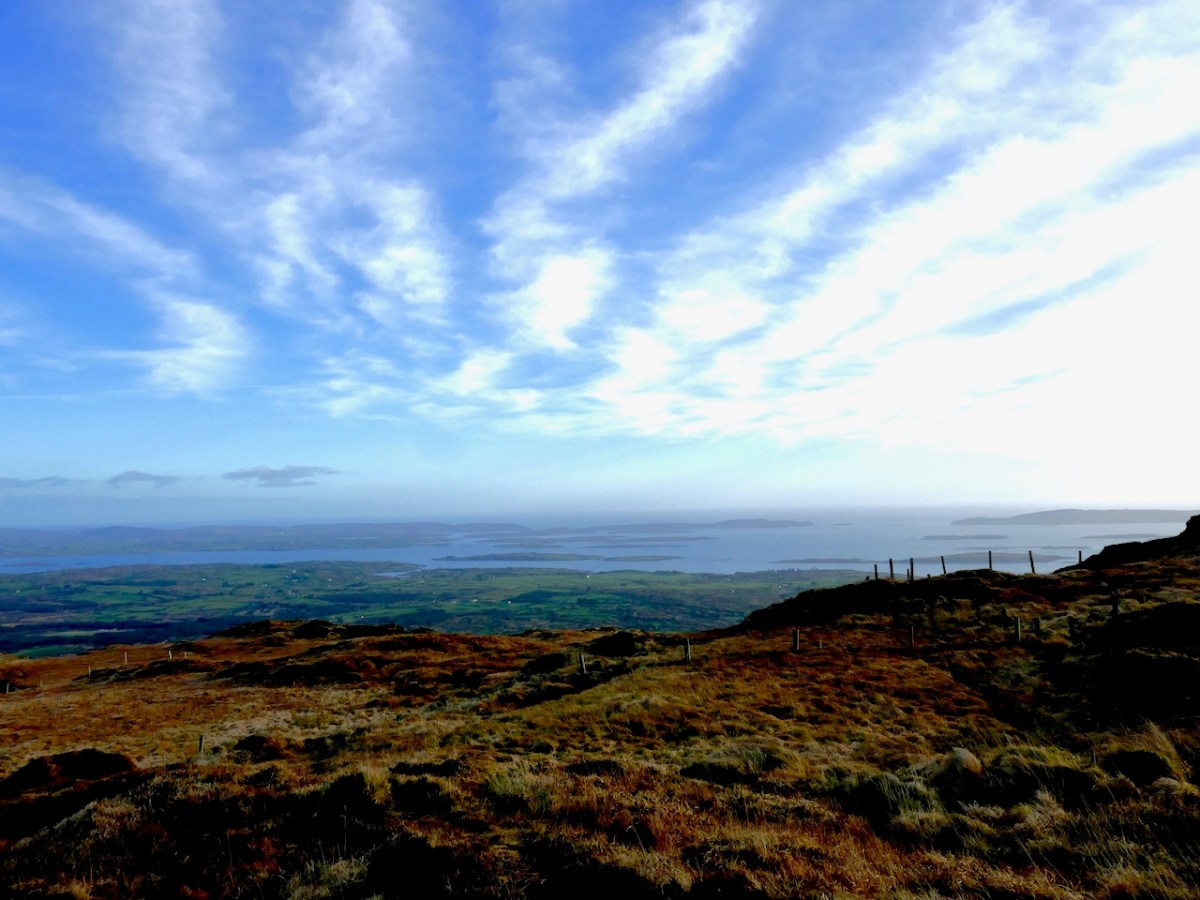
And how did it get the name Roaringwater – the official version is that it’s called after the Roaringwater River, which in turn gets it name from the way the water roars as it tumbles over rocks. But read my post from way back in 2014, The Roaring, and you will realise that there is a much more sensible explanation. So I will use the term Roaringwater Bay in this post as we use it every day around here – to include everything you see from the top of Mount Gabriel, looking south and east, as below. Before I move from the image above, however, let me point out Kilcoe Church, and Kilcoe Castle, both of which I have written about.
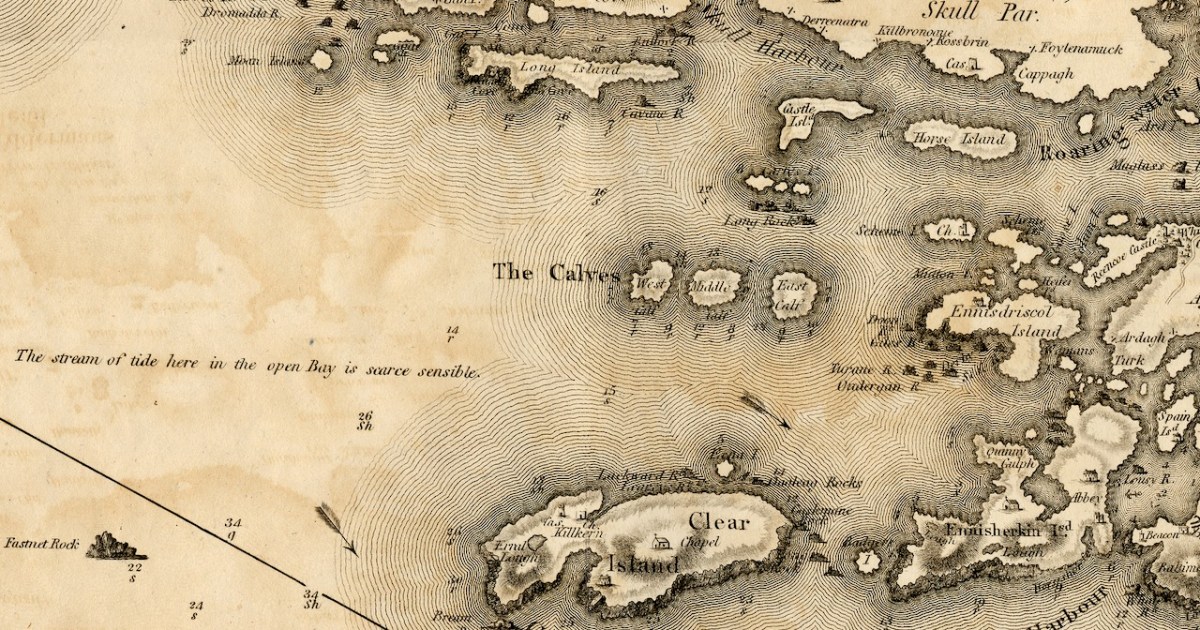
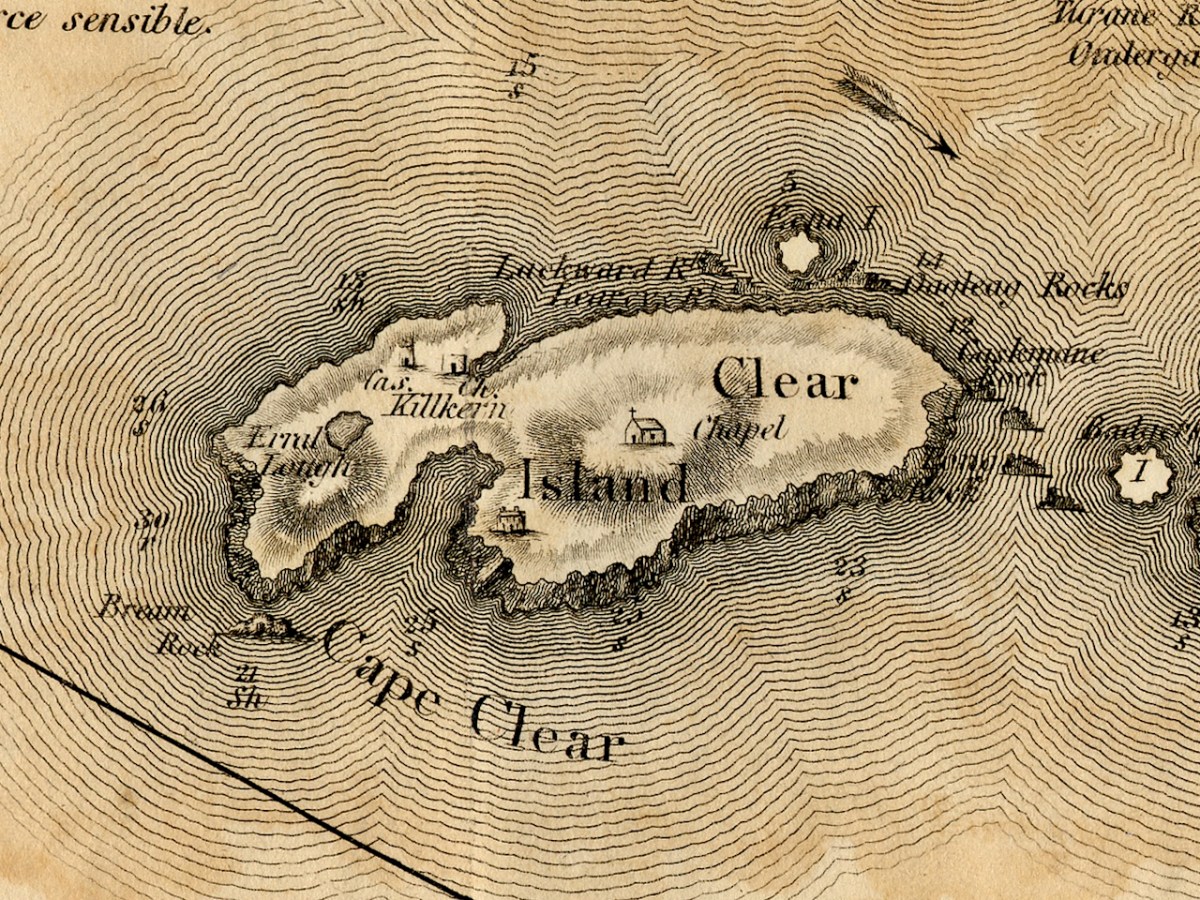
Let’s start with the biggest island – familiarly known locally as Cape Clear. Clear Island, as it is properly called (Oileán Cléire) and as it is labelled on this map, shows the name Cape Clear reserved for its southwestern tip.
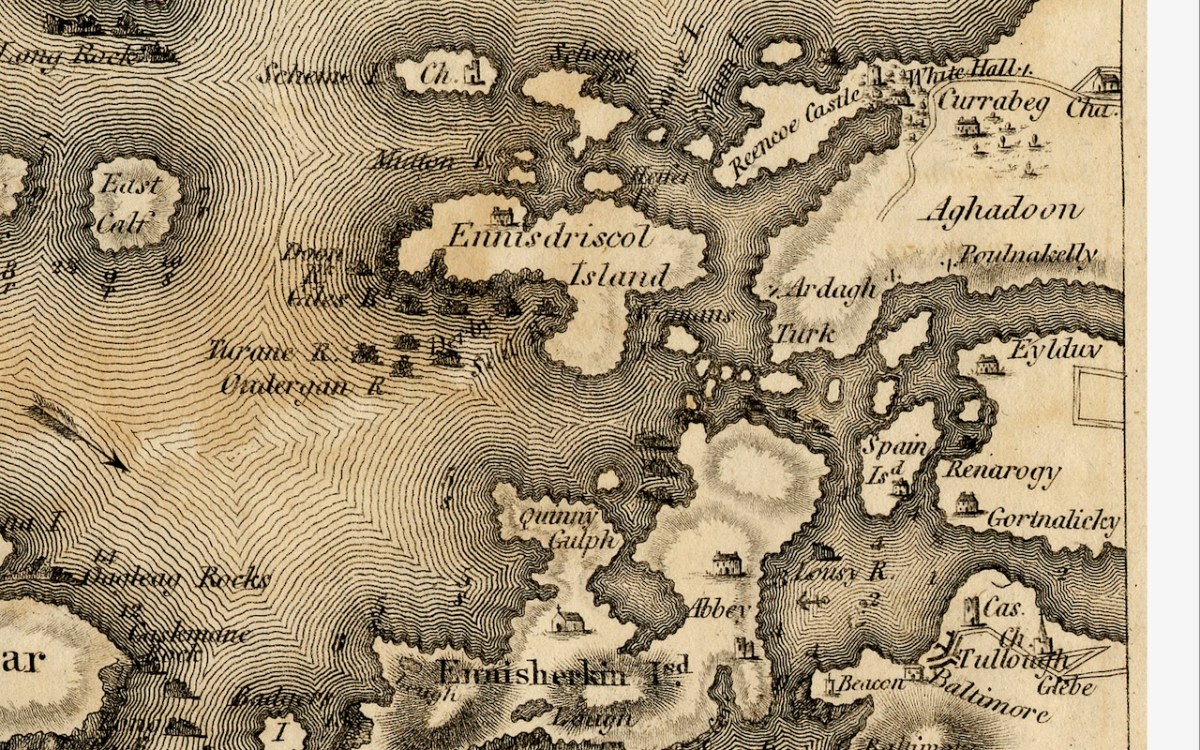
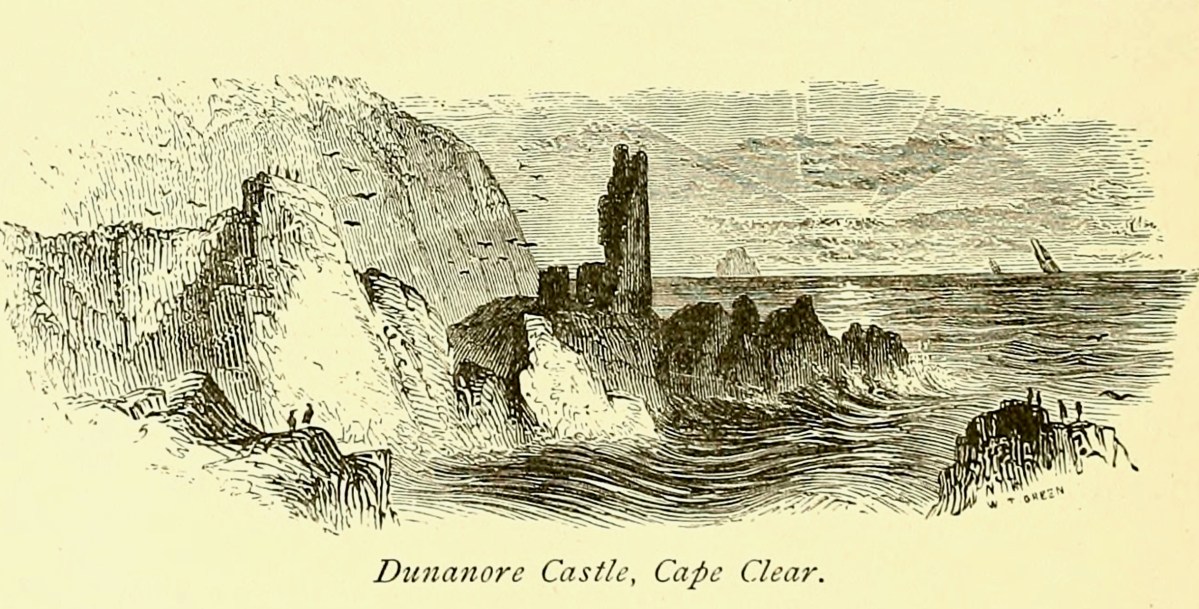
Dún an Óir Castle (see this post, and this one) is clearly shown, as is St Kieran’s Church, which was a ruin even then. Intriguingly, there is a Catholic Chapel shown which must have been in place before the current church was built in 1839, approximately in the same area. Even more strange is a building shown as a ‘Gentleman’s Seat’ – that is, a Big House, on the south side of the Island. Can anyone help us with that this might have been?
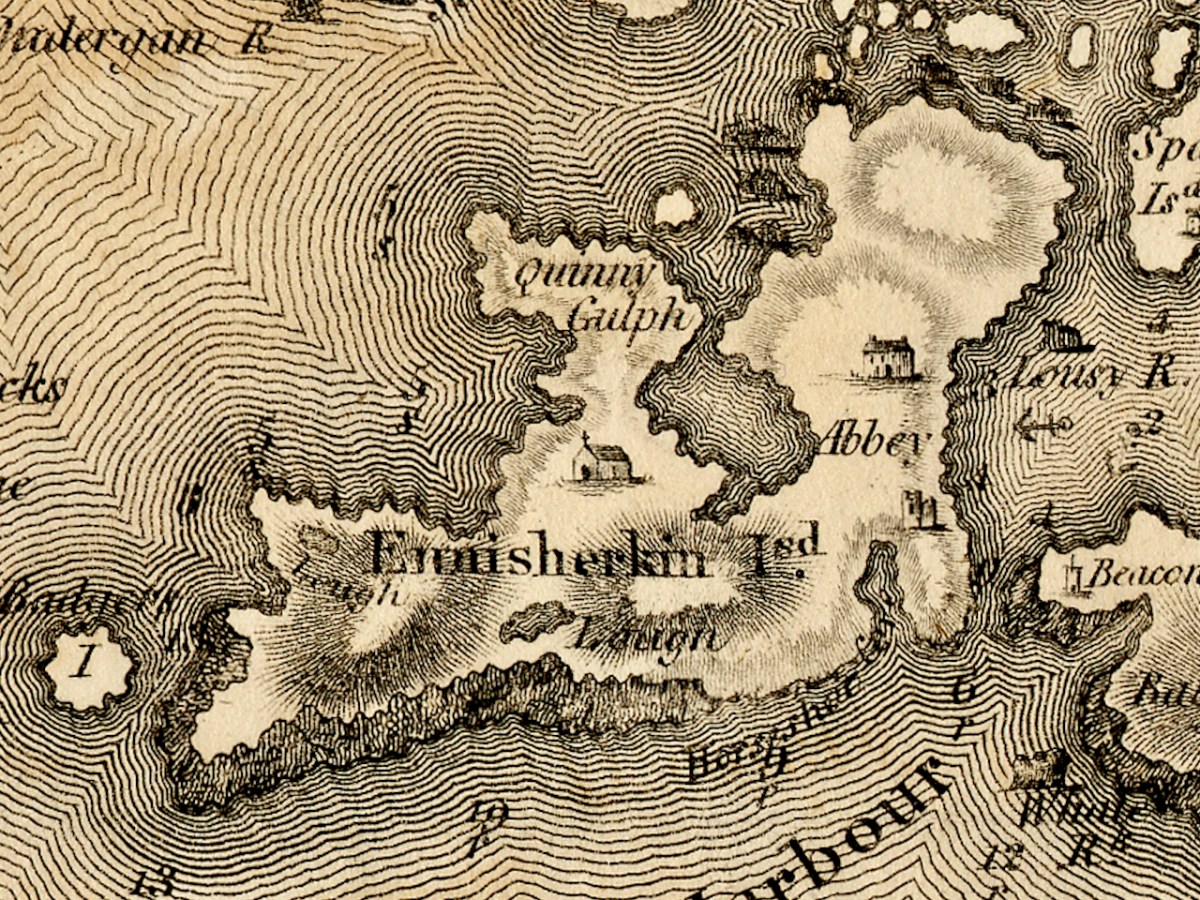
Sherkin Island is shown as Ennisherkin. This is from the Irish Inis Arcán, translating literally as Piglet Island, but likely from the Irish word for porpoise, which is muc mara, or sea-piglet. Anyone who has boated in the area will know how prevalent porpoises are in the seas around the islands. Once again, we have a catholic chapel, and of course the ruined Abbey and castle. Take a look at my post A Walk on Sherkin Island for a taste of what that’s all about. The term Quinny Gulph, by the way, must be Kinnish Harbour, the large bay in the centre of Sherkin. Once again, we have a ‘gentleman’s seat’ on Sherkin, and once again I am asking readers to identify this.
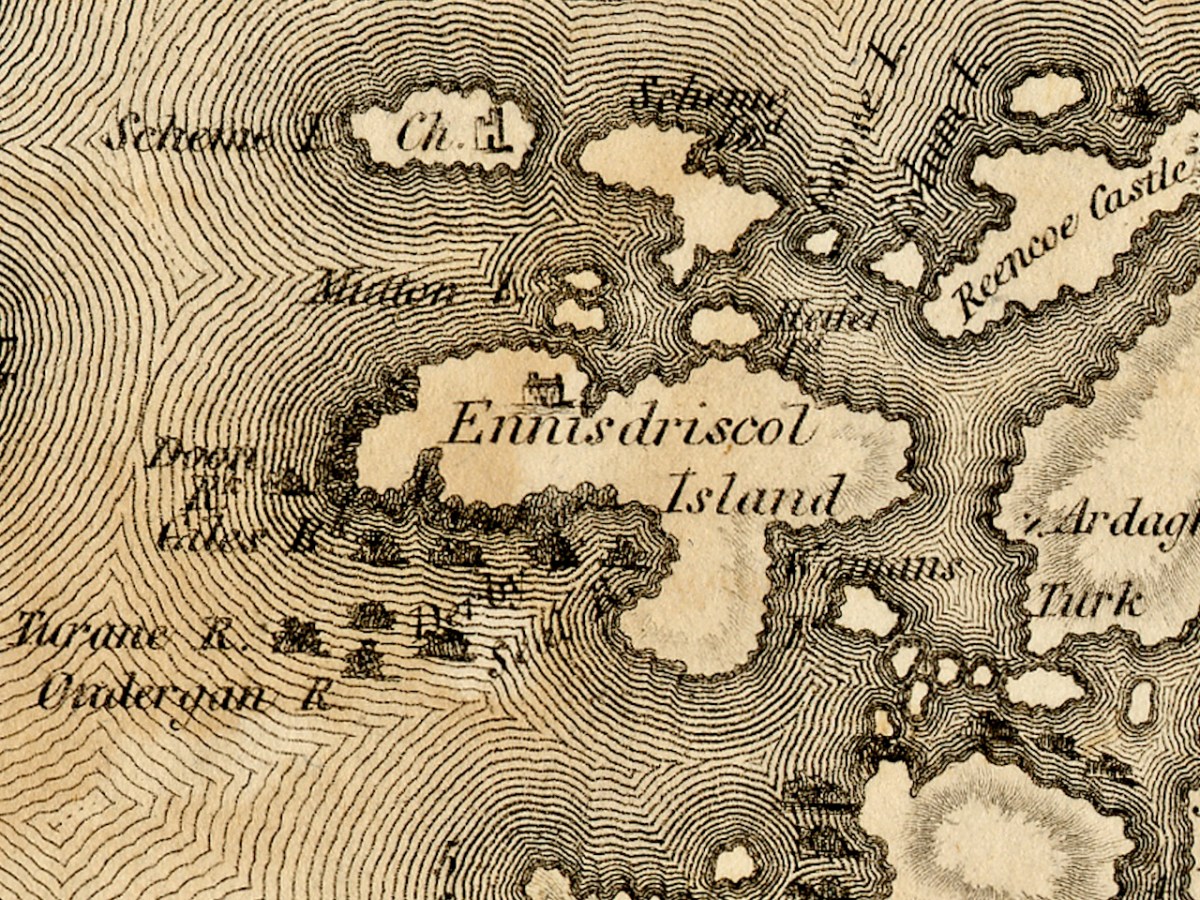
Ennisdriscol Island is of course now called Heir Island – the older name indicating that it was very much the domain of the O’Driscolls in the past. It’s curiously featureless on this map, apart from yet another large house. Right above it are the Skeams, East and West, or the Schemes, as Bath has it. West Skeam has a pre-Romanesque church on it which I have yet to explore – a new blog post one day! I’d better hurry – it’s in a perilous position on the edge of a cliff and much of it has already been swept away.
The Calves, now uninhabited, occupy the middle ground of Lough Trasna between the mainland and Cape Clear, while Long Island, Castle Island and Horse Island parallel the coast. Horse Island and Castle Island are each now owned by a single individual, while Long Island still has a resident population of several owners. The vestigial castle on Castle Island is not shown. To the east of Long Island is Goat Island and Goat Island Little – the cleft between them is actually much narrower than appears on Bath’s map and only navigable with care by kayak. It is home to a herd of feral goats.
And finally Spain Island, now called Spanish Island, and the western end of Ringarogy. Note that the only one of the small islands scattered between Sherkin, Turk Head and Heir Island that is named on this map, is Woman’s. In fact, there is a tiny rock in this area labelled on modern maps as Two Women’s Rock. The largest island in this group is actually called Sandy Island and the smaller ones are The Catalogues. Note also that the castle now called Rincolisky, is here labelled Reencoe. And let’s include Baltimore, with its castle and – the beacon!
I know we have been a bit forensic about the area I call home – my next post will take a much broader look at West Cork. Here’s a sneak peak.
As readers know, I love old maps and there’s a map of Cork I haven’t written about yet. This is a truly beautiful piece of work, and a huge step forward on some of the older maps of Cork I have described – for the list, see my page The Magic of Old Maps.
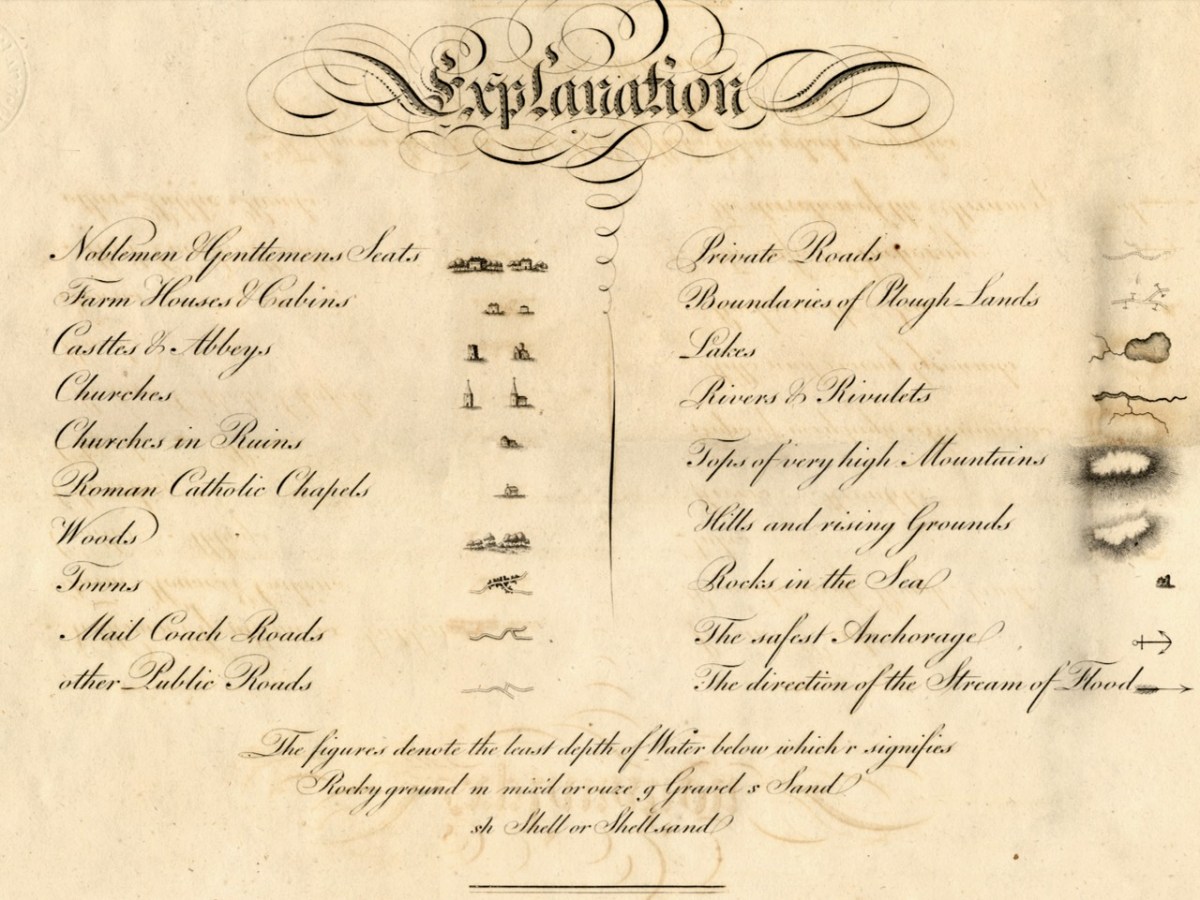
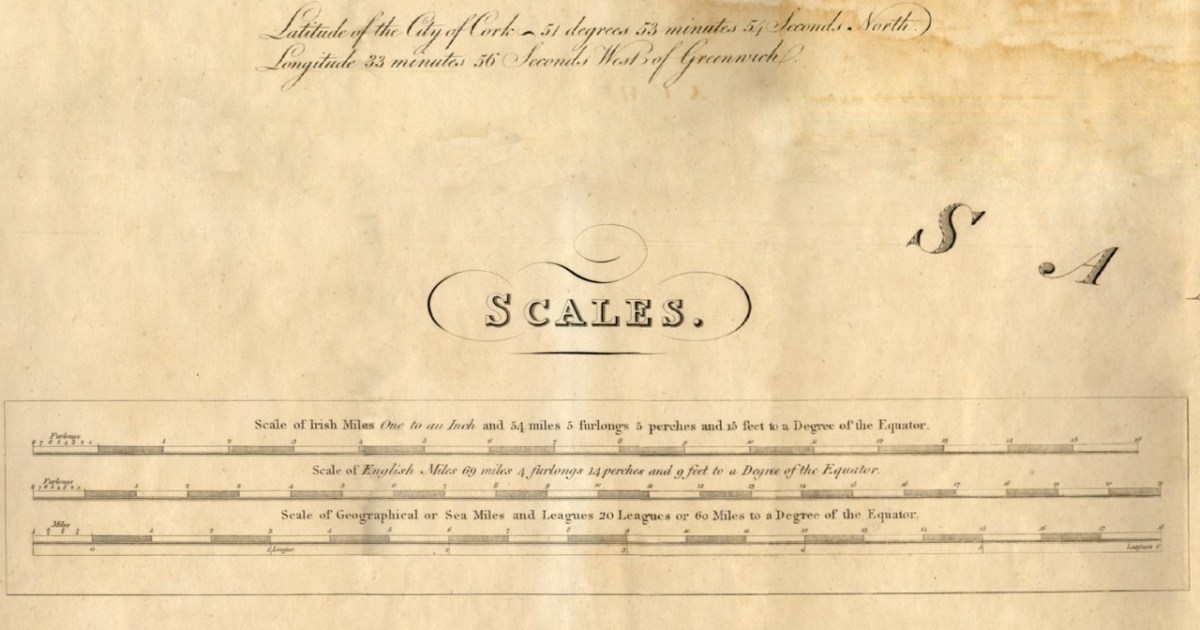
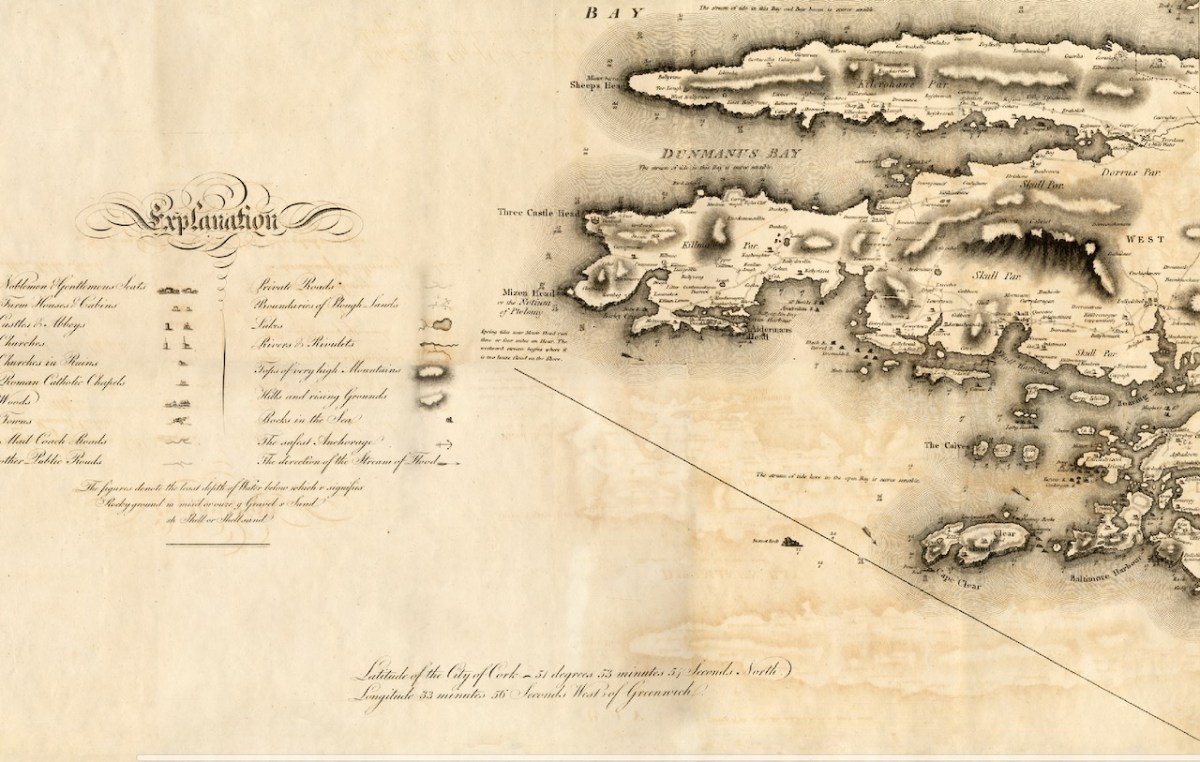
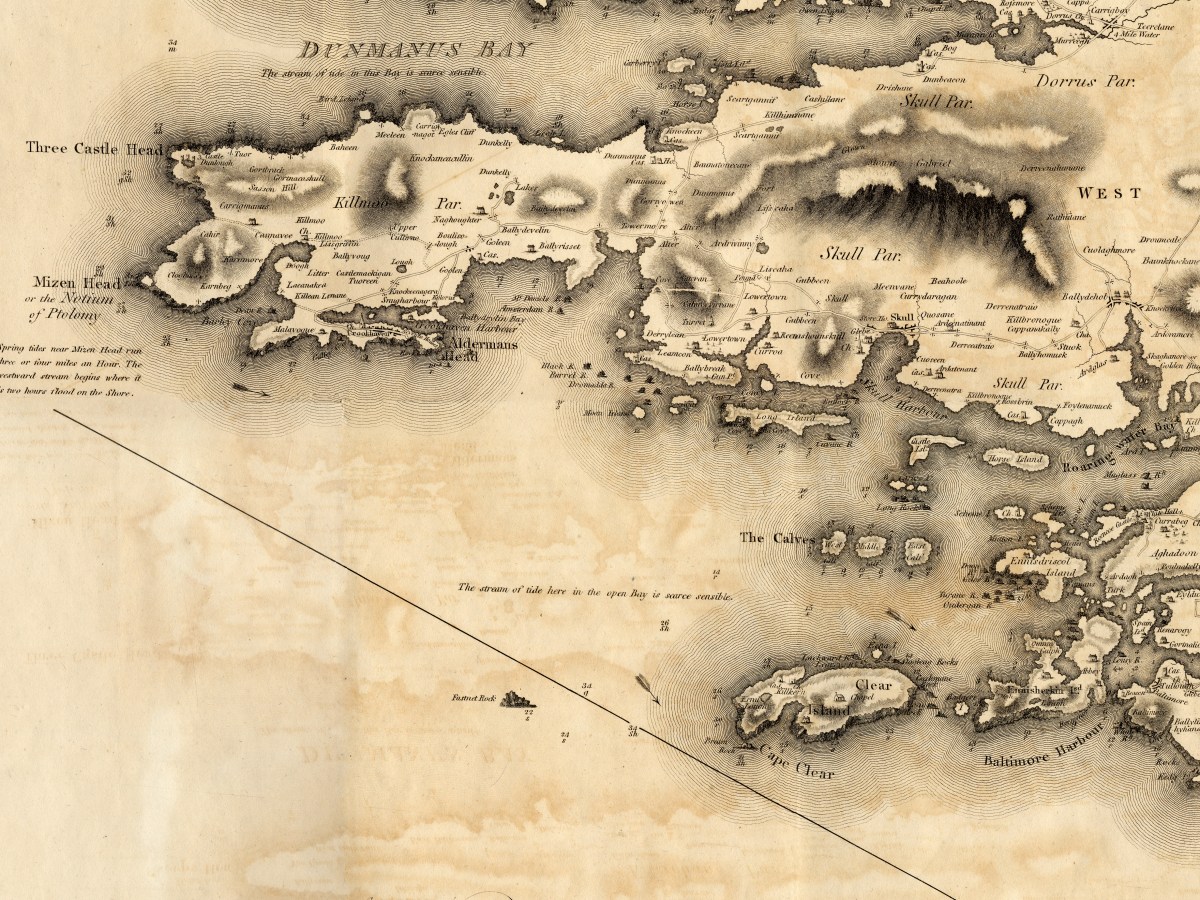
Since it will take me more than one post to talk about this county map properly, I will start today by concentrating on Map 4, and stick to the Mizen Peninsula. The map is in 6 parts and I am able to share it with you today through the generous assistance and permission of the Cork County Library. You can view their hi-res images here – they may be sharper than mine, as I do have to compress images for the blog.
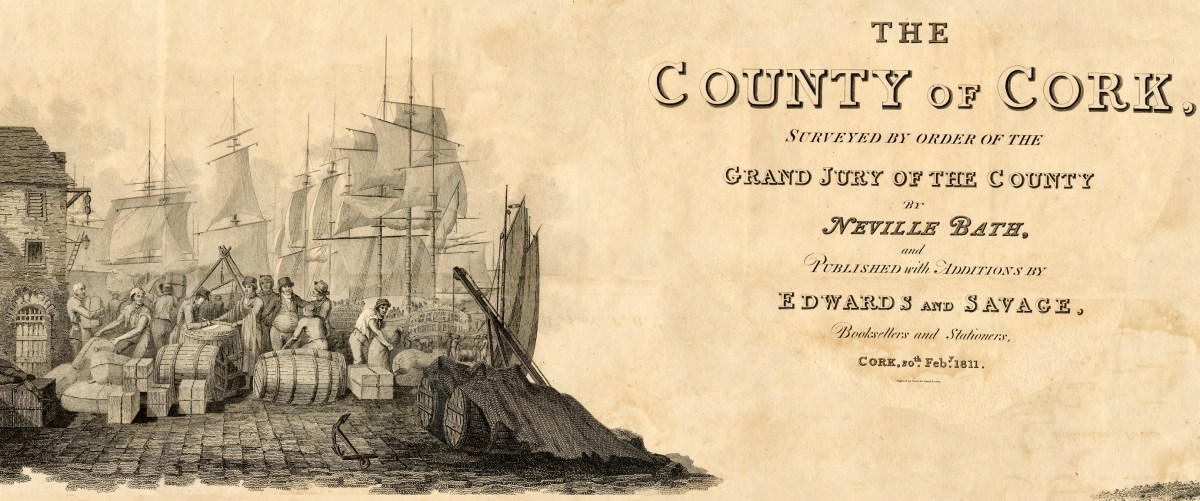
But first, some context… We assume that proper, professional mapping really got underway with the Ordnance Survey in the 1830s, but indeed there were competent cartographers in Ireland before then. Neville Bath was one. In an essay by J H Andrews (see reference in the final quote) he is described as English but spending his whole cartographic career in Ireland, starting off by drawing estate maps in Kerry. He finished a map of Cork City in 1788, so was well placed to be awarded the contract for the county map, when the Irish parliament allowed public money to be spent on producing Grand Jury barony maps as well as county maps, but only for official purposes and only in the form of manuscript ‘protractions.’ Bath tried to arrange for the manuscript protraction to be turned into a proper published map by selling subscriptions – that did not go well, and it wasn’t until 1811 that the map was finally published, engraved by the London firm of S J Neele, acknowledged as the finest artists in the Kingdom.
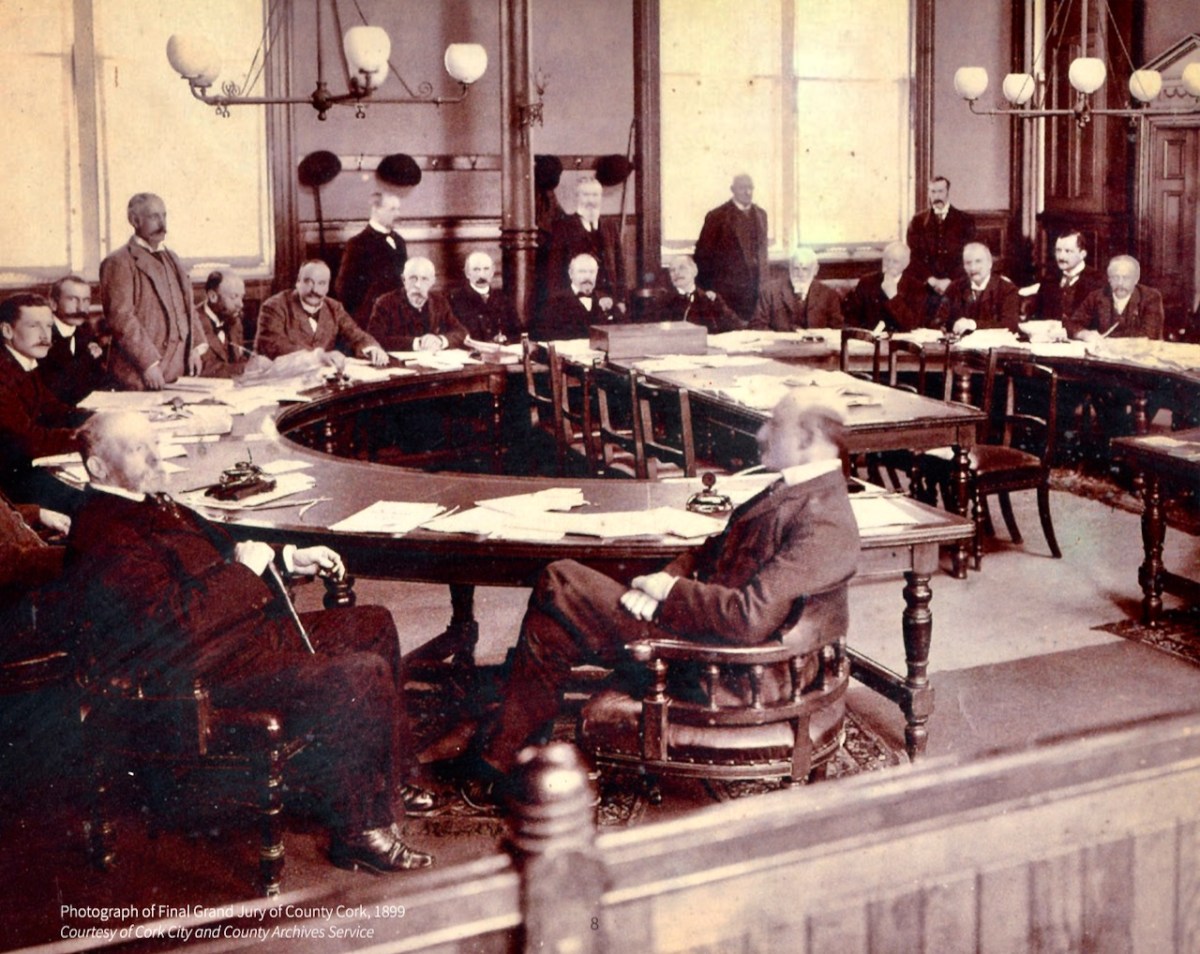
What was a Grand Jury and why were they commissioning maps? As the name suggests, Grand Juries were initially conceived as groups of 24 men (yes, only men) who wielded authority for the administration of the criminal justice system in Ireland. The exclusive domain of wealthy landlords, the Juries exerted enormous power over the whole population – a population with which they had little in common, including economic status but also language, religion and cultural affiliation. Over time, the Grand Juries accumulated other responsibilities, for roads, bridges, hospitals, schools and tax collection.
Eventually, all those duties were taken over by other bodies – County Councils, the Poor Law Union, a proper legal system. Above is the final sitting of the Cork Grand Jury in 1899. But while it lasted it was already an archaic system, deeply unfair and rife with corruption. It also became highly competitive, with one Grand Jury after another building more and more elaborate courthouses*. The same thing happened with maps:
Almost inevitably, the maps enabled each grand jury to convey its own prestige to its neighbours, and the ‘Grand Jury map’ project took on an increasingly expensive and stunningly elaborate life of its own. William Larkin was the greatest exponent of the genre and produced maps for six out of the twenty-six counties that made it into print using the public purse. Larkin produced maps for Westmeath (1808), Meath (1817), Waterford (1818) and Galway, Leitrim and Sligo (1819). From 1784 grand juries were required to have their county map ‘put up, and kept constantly during the assizes in the grand jury room of said county’.
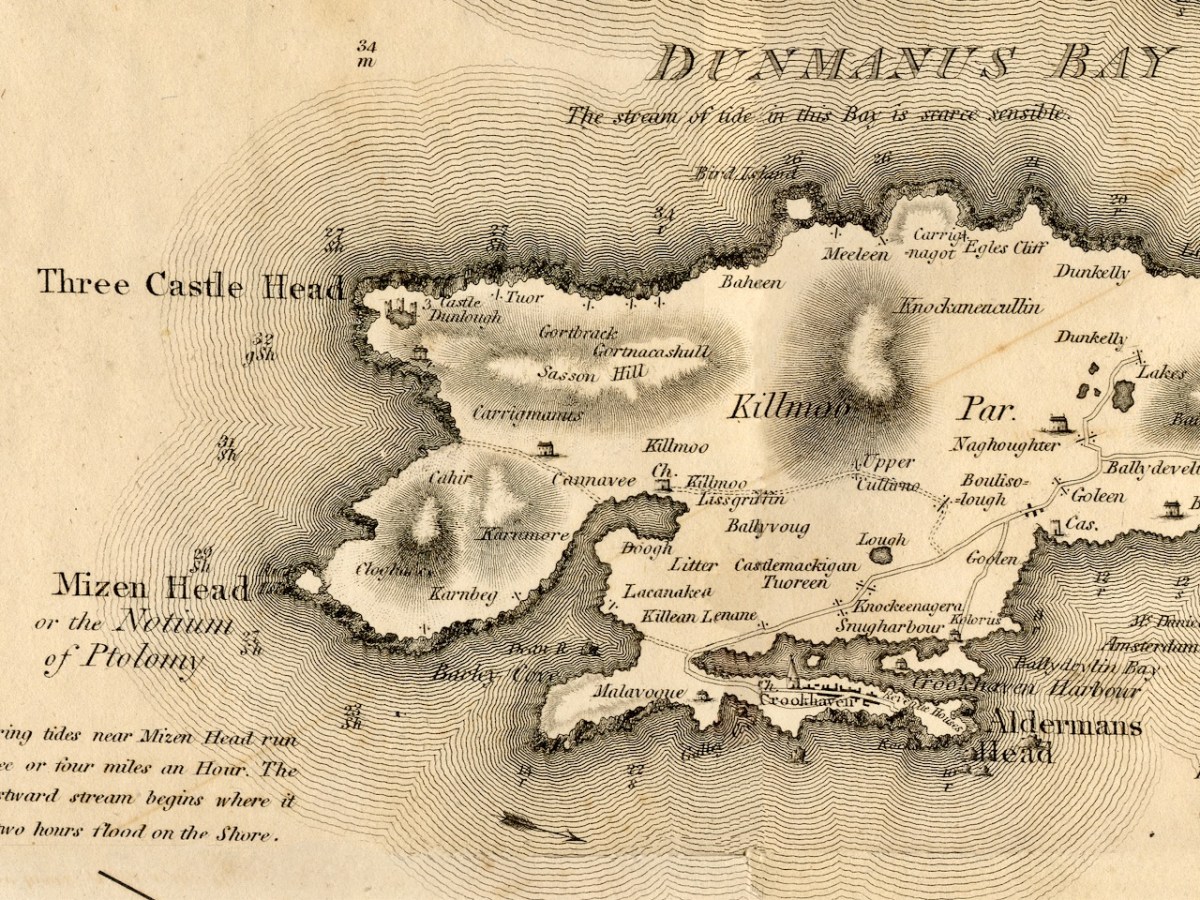
Let’s take a look at Neville Bath’s map now, working from west to east along the Mizen Peninsula. you will have your own favourite spots to check out – I am just going to point out a few of interest to me.
This map pre-dates Richard Griffiths road-building along the Mizen, but nevertheless it shows a road going all the way to Crookhaven. I love the little depiction of Dunlough/Three Castles, and also that a church is shown at Lissagriffin – we can see the ruins still. Alderman’s Head is called Streek Head on the early OS maps, while the rocks offshore at this point are called Alderman’s rocks. (Who was the Alderman, I wonder?)
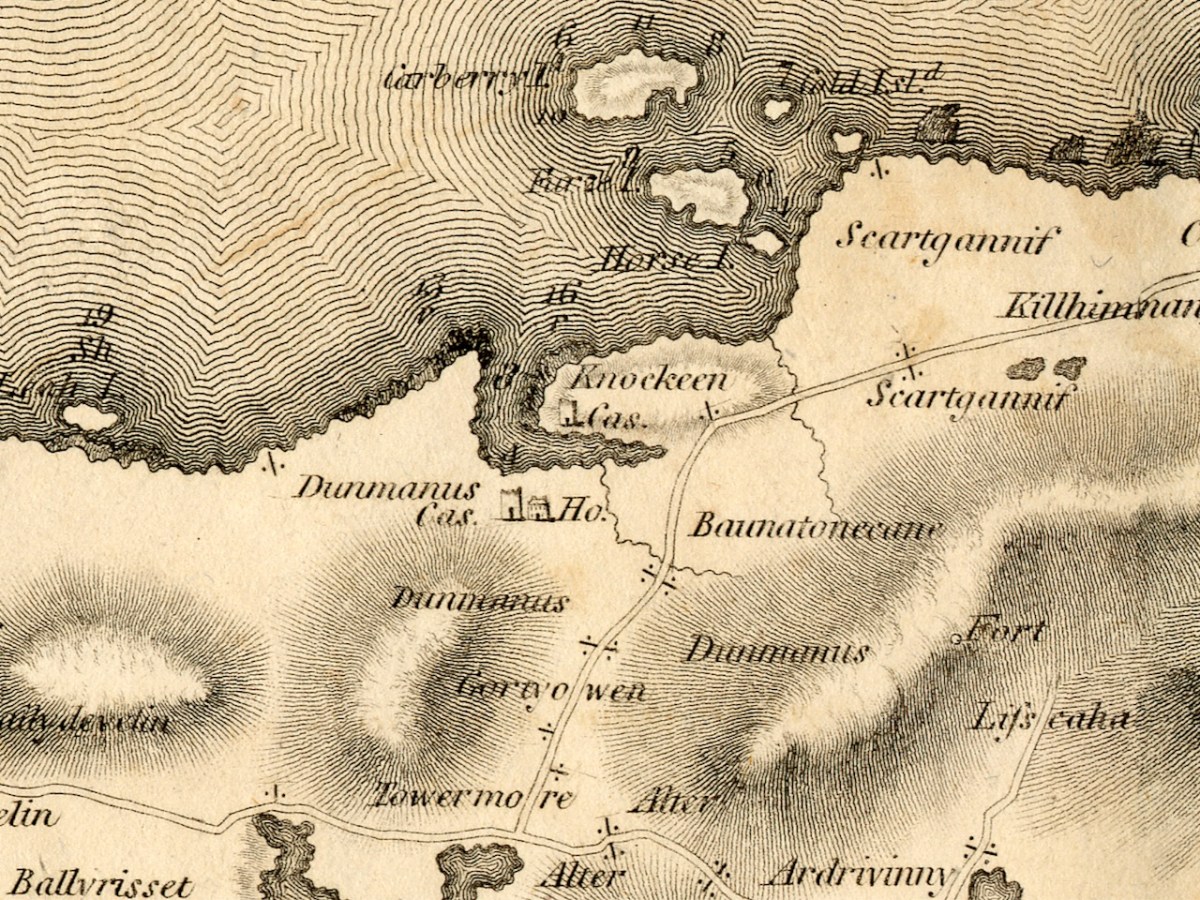
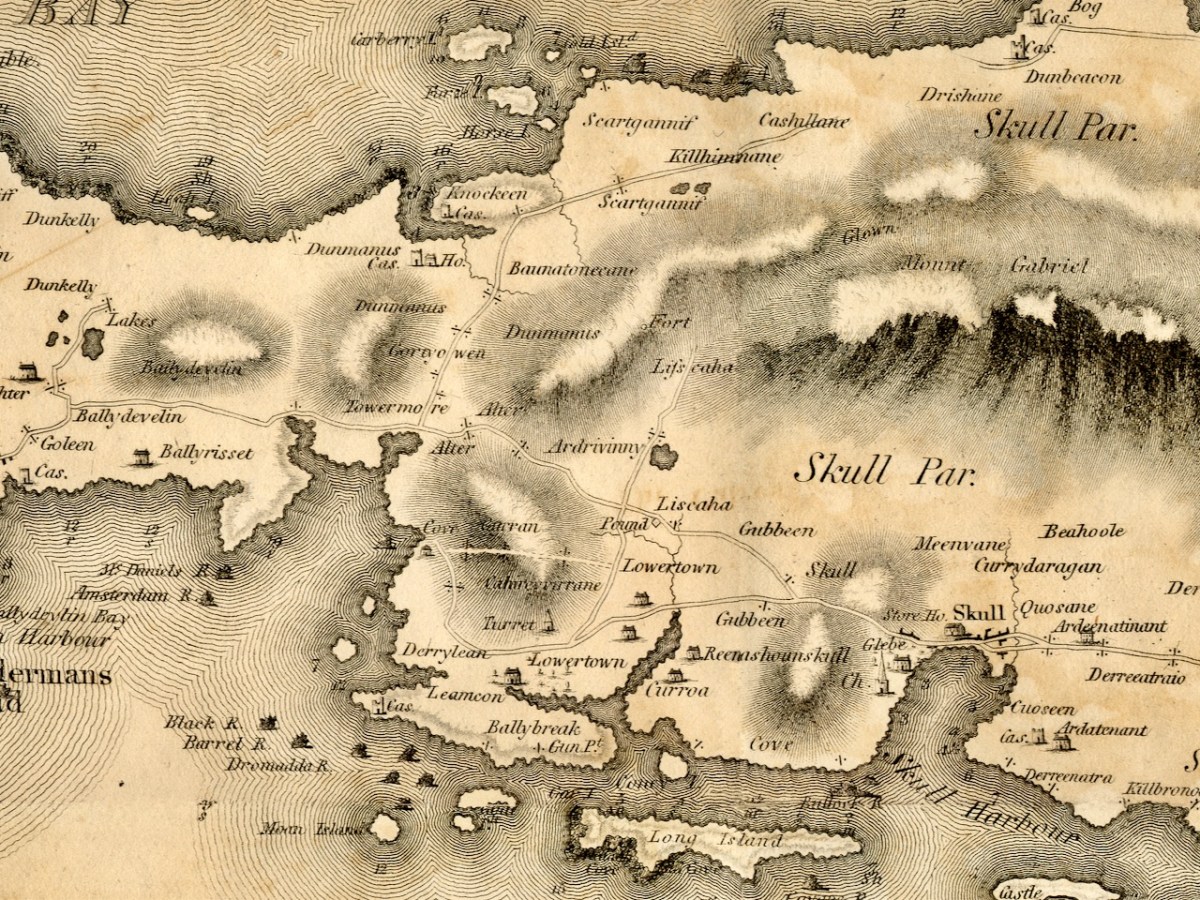
Before we move East to Schull, I just want to highlight Dunmanus. The ‘castle’ at Knockeens is clearly shown. As I discussed in my post Dunmanus Castle 1: The Cliff-Edge Fort, there is much much local folklore about this site. There may have been more to see when Bath was mapping this area.
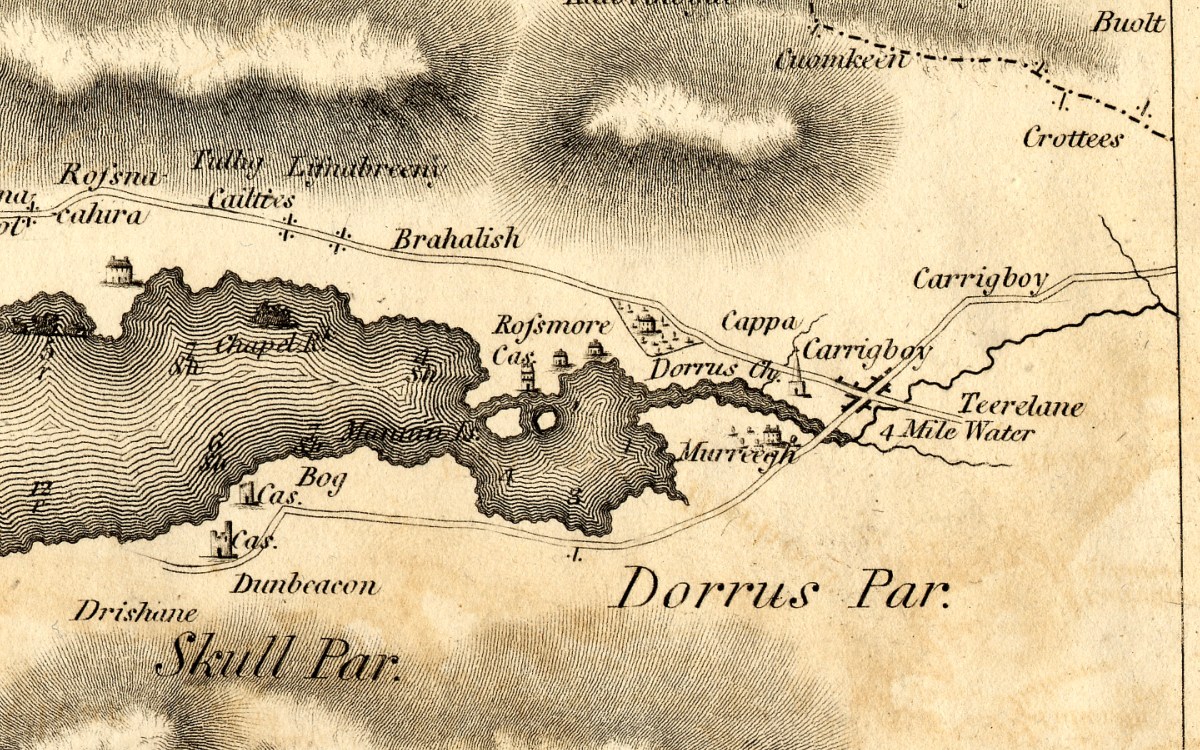
Moving towards Schull, I am intrigued by the noting of a ‘pound’, which does not occur on later maps. A pound was used to secure animals seized by the landlord’s agents for payment of rent. Note also the ‘Fort’ at the end of the Lisscaha road. While I haven’t written about this fort, I have visited it, and very impressive it is.
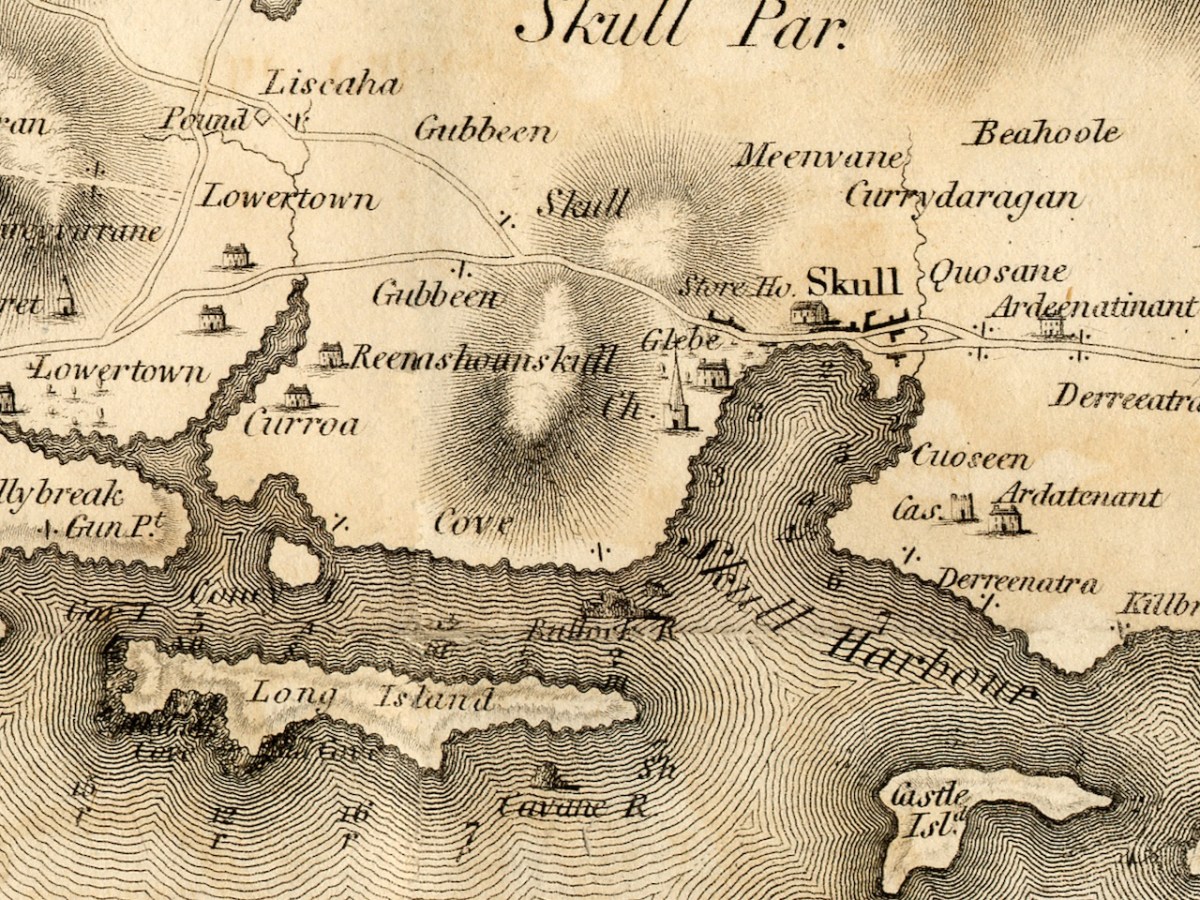
Schull is shown as a sizeable settlement, with a storehouse, Glebe, and Church – St Mary’s Church, now replaced by Trinity Church. A number of Gentlemen’s Seats are shown in the vicinity.
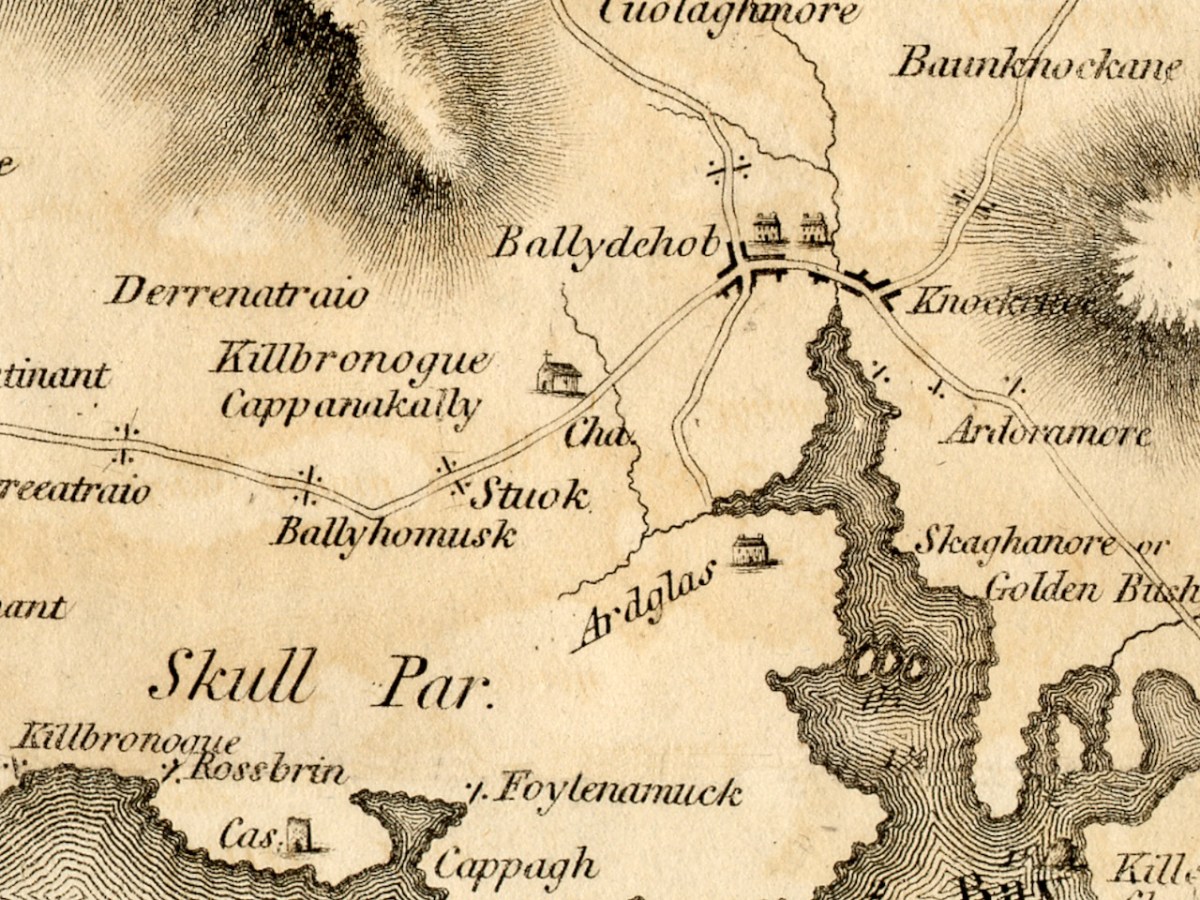
And finally we arrive at our own Ballydehob, shown as a town. Note the church to the south west of the town – I wonder if this is the church that once stood in Stouke Graveyard. It hadn’t occurred to me that Skeaghanore was the Irish for Golden Bush – there must be a story there! We will cover other parts of West Cork in subsequent posts. This map is an incredibly valuable resource dating as it does from well before the Ordnance Survey. We are lucky that it was published and copies saved. But what happened to Neville Bath? As JH Andrews tells us, Bath
may well have been dead by the time his work was officially published on 20 February 1811, and the map itself was only just in time. Irish cartography was about to pass into the hands of a new elite, engineers rather than land surveyors, whose most distinguished members were immigrants from Britain like Alexander Nimmo and William Bald. This later generation had a low opinion of Bath, and within fifteen years of his departure the counties of Limerick, Tipperary and Kilkenny had all decided to have his work done again. Not surprisingly, none of his manuscript county surveys appears to have been preserved. The map of Cork is available in a number of Irish libraries, however, and only awaits the judgement of the county’s own historians.
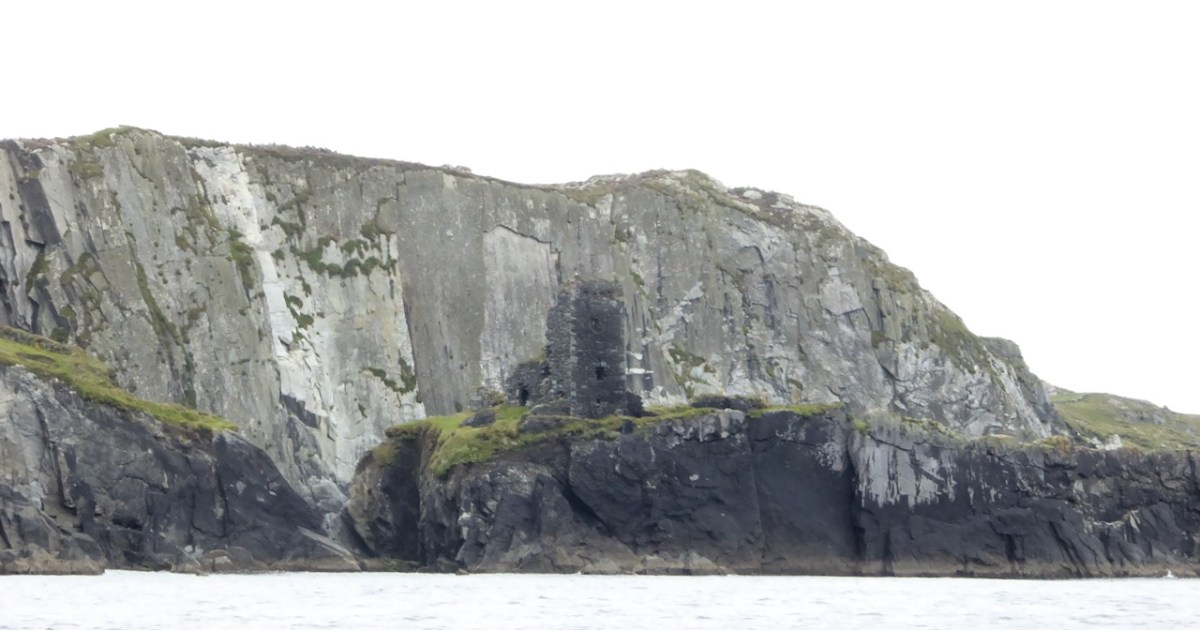
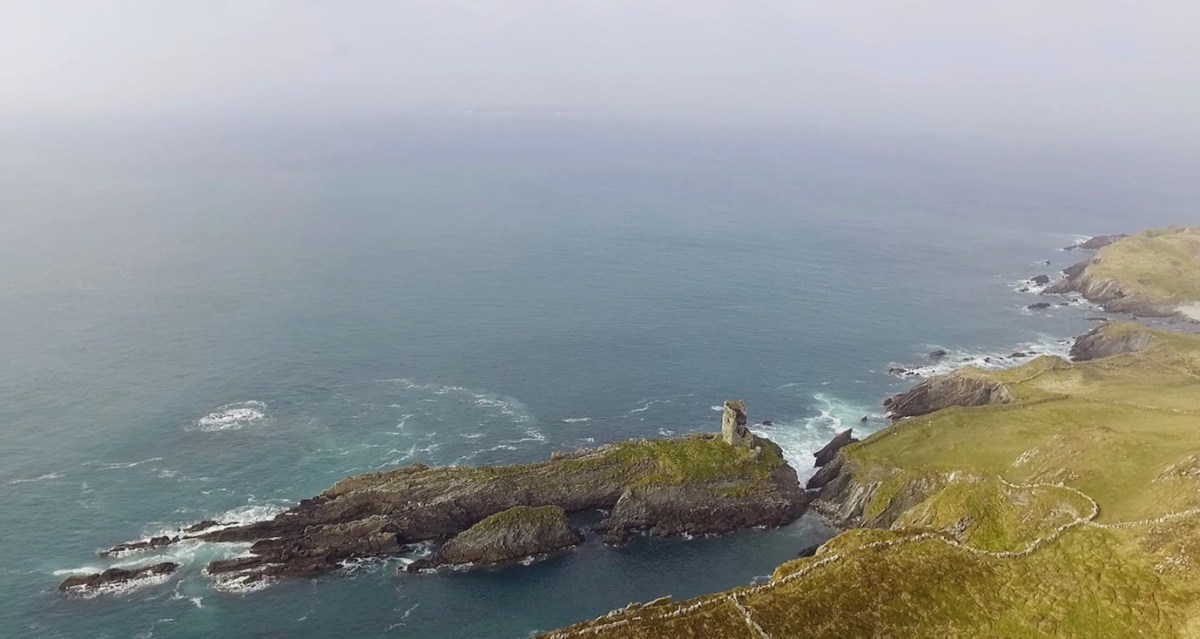
I have been gifted with a marvellous set of photographs of Dunanore, or Dún an Óir – an O’Driscoll Castle on Cape Clear. The gift came from one of our readers, Tash, and I am very grateful indeed. Regular readers know that I like to use my own photos, and I do have some that I took from the sea (like the one below) but I have none of Dún an Óir from the land, let alone from the castle itself!
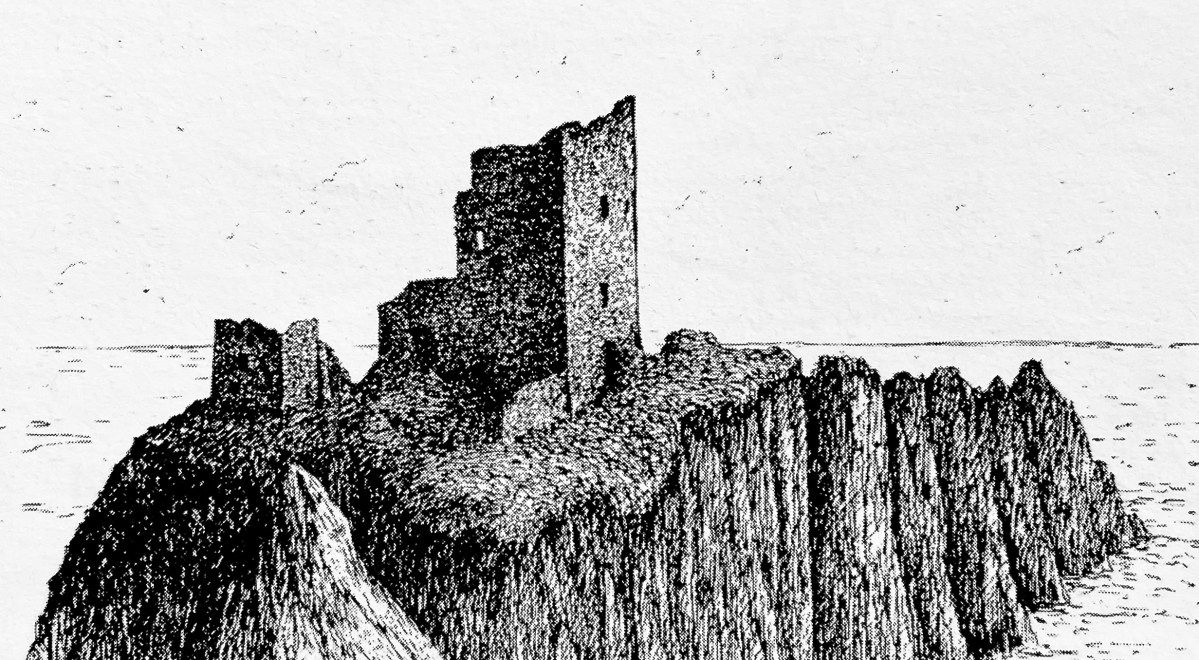
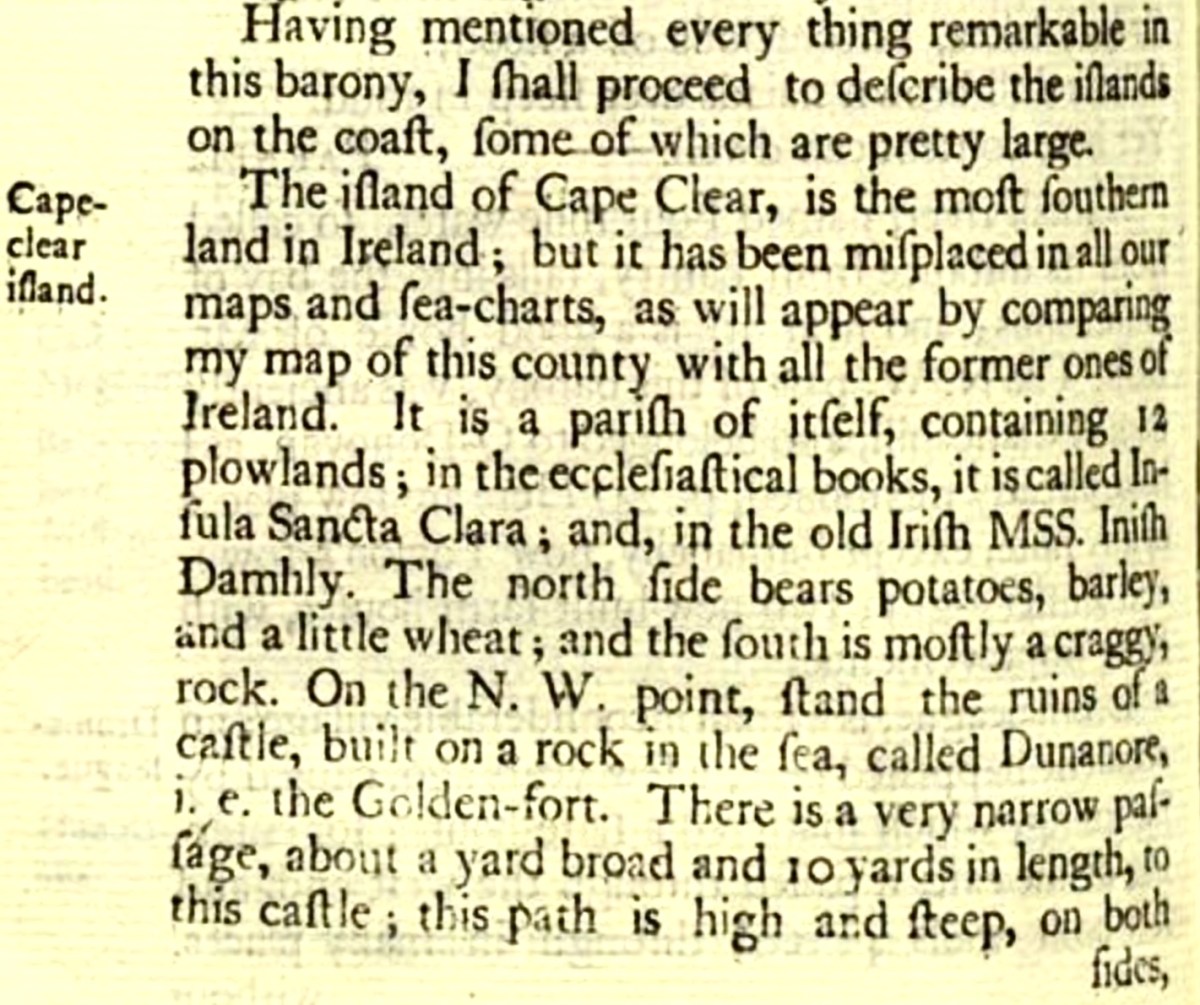
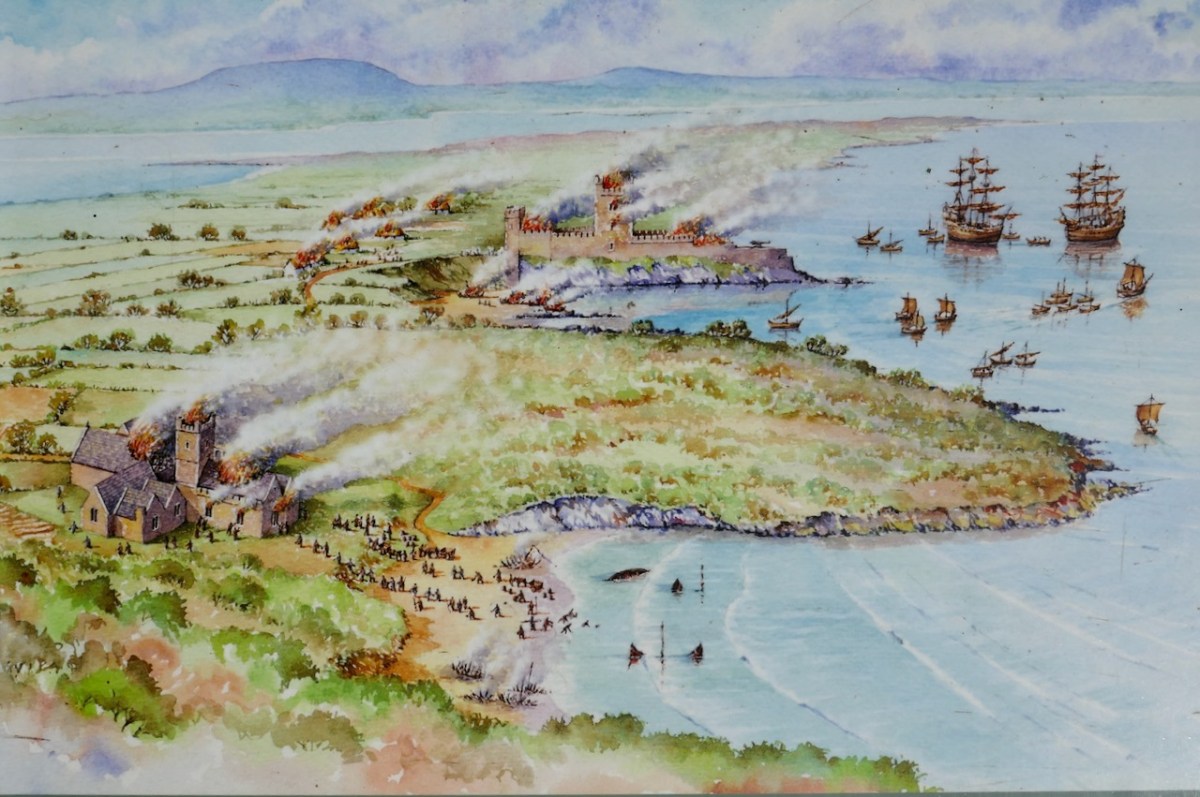
And that’s because, as you can see from the drawing by Jack Roberts at the top of this post, this castle is situated in a very perilous location, on the edge of a cliff, on a small island, essentially, making access a hazardous scramble up from a rocky beach. It was once connected to the rest of Cape Clear by a narrow causeway but this has long collapsed. It was still there in the 1770s when Charles Smith visited. In his The Ancient and Present State of the city of Cork Vol 1, he wrote:
And this brings us to the name – Dún an Óir. It means, of course, Fort of Gold, and some of the old legends about this place talk about the name coming from stories of buried treasure. But in fact, this has been the name of this fort since the first maps of this area were made in the fifteen hundreds and it speaks to the wealth of the O’Driscoll clan who built it. Remember, their other stronghold, now called Baltimore, was Dún na Séad, or Fort of Jewels (on at least one map given as Castle of Perles). On Sherkin, their castle was Dúnalong – or the Fort of the Ships – that’s it as it is now, below.
There are many accounts of their fleets of ships, and the battles they waged against the Waterfordmen in which they came out the worst for wear when Dunalong was attacked. The scene below, from an information sign on Sherkin, shows the Battle of the Wine Barrels, 1537, with both Dunalong and the Friary on Sherkin in flames
Dún means ‘fort’ but seems to be especially applied to promontory forts in the southwest. Before the castle was built, therefore, it is likely that the O’Driscolls fortified the headland, which may date well back to the Early Medieval period (400-1200) or even to the Iron Age (500BC to 400AD, or 500BCE to 400BC for those who prefer the secular version). The Illustration below is taken with permission from Dún an Óir Castle: an uncertain future, by Dr Sarah Kerr, and shows the present state of the castle, marooned on what was once a promontory connected to the Island.
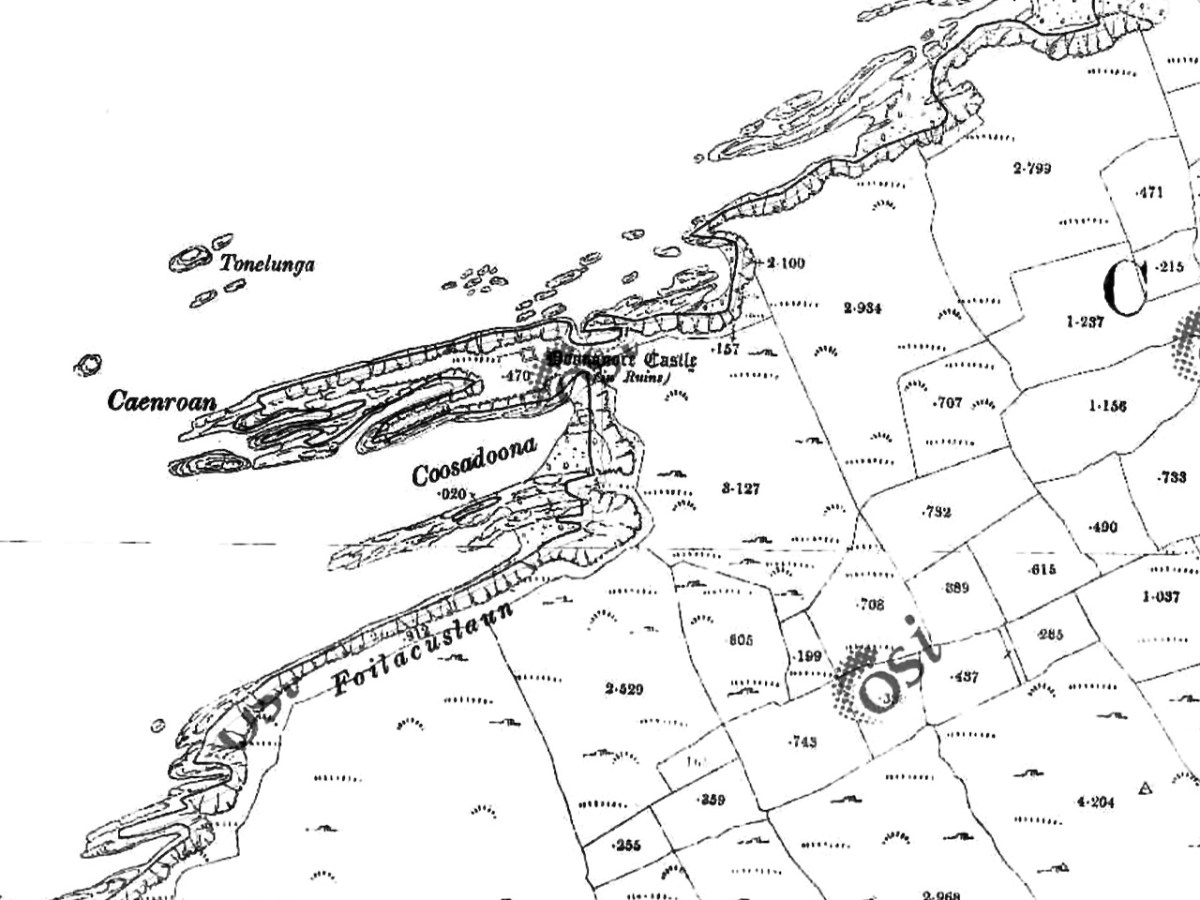
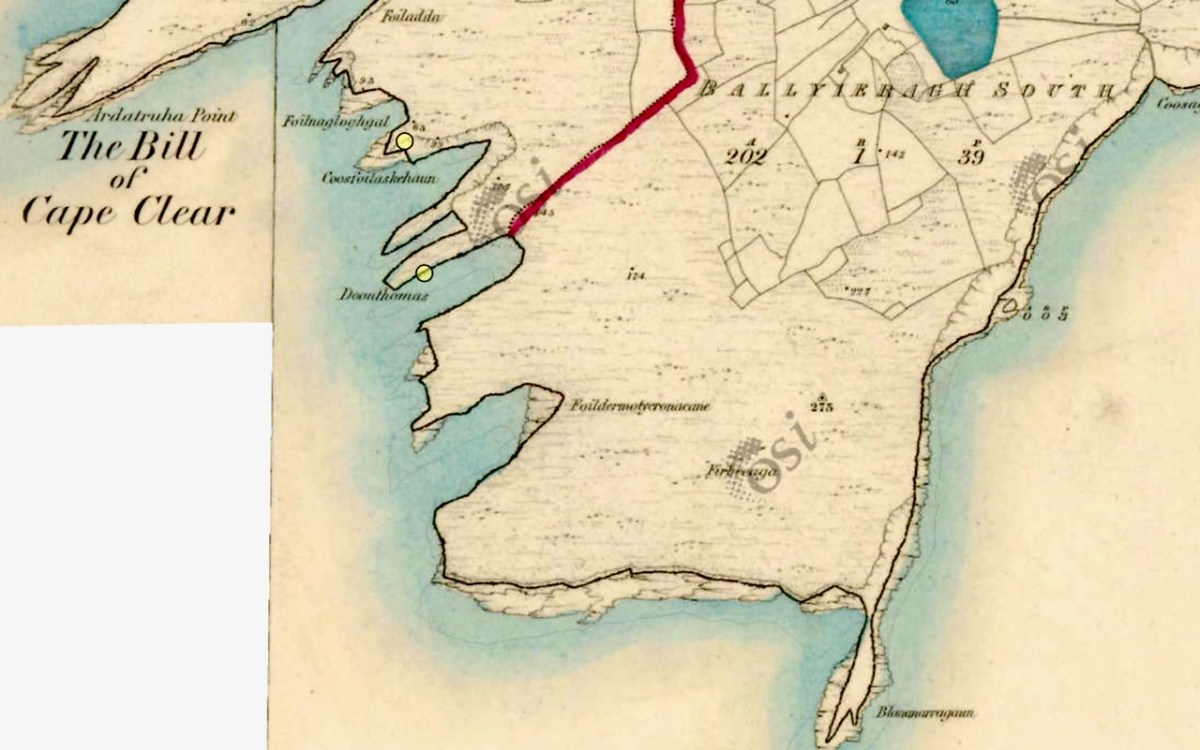
Our Promontory Fort man is Thomas Westropp (see here and here), and he wrote about Dún an Óir in his 1914-16 paper for the Royal Irish Academy, Fortified Headlands and Castles in Western County Cork. Part I. From Cape Clear to Dunmanus Bay. He visited the site, but like many a good explorer before and after him, did not venture out onto the promontory, but satisfied himself with what he could see from the high ground above it. That included the promontory and ruined castle, the rather ominously named Tonelunga (The sea-bed of the Ships), the end of the promontory called Caenroan (quay of the Seals), the inlet between the promontory and the cliffs, Coosadoona (the Little Harbour of the Fort) and the high cliffs behind the fort, Foilacuslaun (Cliffs of the Castle). All of these are marked on the 19th century twenty-five inch map.
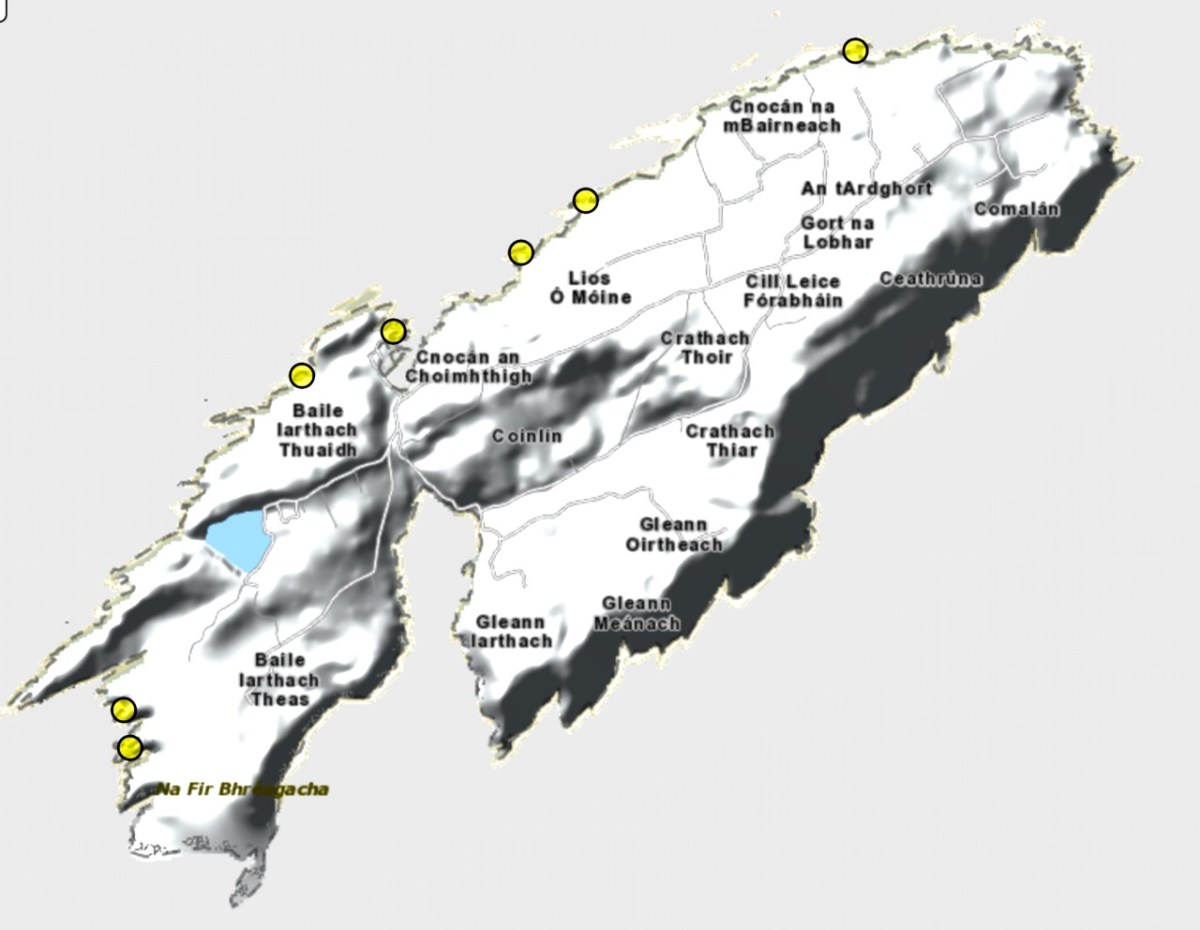
Westropp writes about Dún an Óir as one of three Promontory forts on Cape Clear Island, although in fact there are more than that, as identified by the National Monuments Record – each yellow dot below is one.
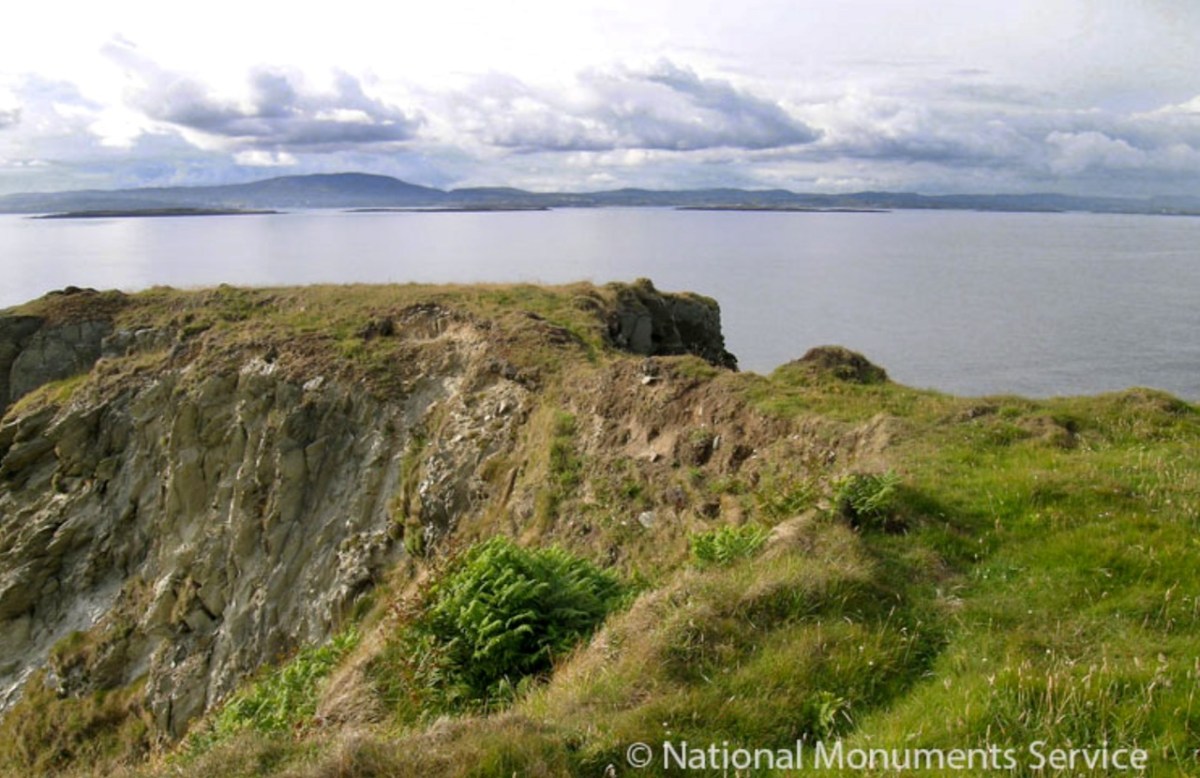
Here’s one of them (below), Lios Ó Móine (the Fort of the Meadow – lios is usually used to designate an earthen ring fort): the description and then the photo are by National Monuments Service (NMS). In the photo you can see the narrow neck of land leading out to the promontory. This is likely what the spit leading out to Dún an Óir may have looked like.
Description: In rough pasture, at the foot of a steep N-facing slope on Stuckaunfoilnabena, a headland on the NW coast of Clear Island. A narrow eroding neck of land (Wth 3m; L 15m) leads to the roughly anvil-shaped headland. Across this neck of land are the remains of three earthen banks and the shallow remains of three fosses. Further examination of the remains was not possible for safety reasons.
Curiously, the NMS does NOT identify Dún an Óir as a promontory fort – here is what it says:
Description: The location of the tower house ‘Doonanore Castle’ (CO153-015002-) on a promontory, on the NW shore of Clear Island, suggested that it may have been built on the site of a promontory fort. However, there are no visible surface traces of an earlier defences across the promontory. The promontory is now isolated at high tide but was connected to mainland by causeway until 1831.
However, it has this to say about the earthwork identified on the high ground:
In pasture, on a steep N-facing slope to the E of the tower house known as Doonanore Castle . . . An earthen bank . . .extends upslope in a S to SW direction from a modern E-W field boundary wall on the cliff-top at N and ends at a large outcropping rock on the edge of another cliff. This bank appears to have formed part of the defences on the land approach to the castle from the E. The bank has three contiguous linear stretches [and] there is an entrance near the N end. There is a possible hut site near the centre of the enclosed area. The short promontory on which Doonanore Castle stands is a possible coastal promontory fort.
So, as you can see, although the NMS declines to label it a promontory fort because there are no longer any signs of banks or walls, it does concede that it is possible. It also extends the defences of that fort to the higher ground above it.
Back to Westropp – He quotes:
the poem of O Huidhrin, before 1418, tells how “0 hEidersceoil assumed possession of the Harbour of Cler.” It was of some importance to the foreign traders in wine and spices, and so figures in all the early portolan maps. Angelino Dulcert, in 1339, calls it Cap de Clar ; the subsequent portolans, Cauo de Clara, 1375 and 1426 ; Clarros, 1436 ; C. d’Clara or Claro, 1450 and 1552, and, to give no more, Cauo de Chlaram, in 1490. The 0 Driscolls’ Castle probably dates between 1450 and the last date. It was probably on an earlier headland fort, as it is called Dunanore. In 1602 it surrendered without resistance to the English, who burned it.
Westropp goes on to say
Dr. O’Donovan, in his ” Sketches of Carbery,” gives a few notes on the later history. He says there was a garrison at the Castle in Queen Anne’s time, and mentions the huge iron ring-bolt, set in the rock, to which the O Driscolls formerly moored their galleys in the creek. The last is improbable, even to impossibility: no one could moor galleys in the dangerous wave-trap, open to the most stormy and unsheltered points. The islanders regard the ruin as haunted, and tell of the singing of ships’ crews in its vaults. One “Croohoor” (Conor) O’Careavaun (Heremon’s grandson) lived as a hermit there in the eighteenth century. Another legend tells how, in 1798, the inhabitants painted the Farbreag Rocks and pillars so as to resemble soldiers in uniform to keep away the French ! If any truth underlies this, it is probably based on the idle act of some revenue or other officers, in the endless leisure of their island station.
In the map above, of the southwest end of the Island, you can just make out the name Firbreaga, almost covered by the O of OSI. Fir Bréaga means The Lying Men, an apt translation given Westropp’s story. No doubt the name is older than 1798, and may refer to the cliffs at that end seeming to be less dangerous from the sea than they actually were. Note also the two yellow dots for two more promontory forts- Doonthomas (Thomas’s Fort) and Coosfoilaskehaun (the Small Harbour of the Knife-Edge Cliff).
Westropp’s description of the promontory upon which Dun an Óir sits is poetic:
The path runs up a very slight ledge, flaking away and high above the creek, along the face of a cliff of polished silvery slate. The low neck joined it to the mainland, and the nearly perpendicular strata make the dock-like creek of Coosadoona, fort-cove, to the south Beside this cove, opposite to the castle, an enormous precipice rises high above the tower top. In the other direction is a noble view across the wide, porpoise-haunted bay, and its low islands to the blue, many-channelled Mount Gabriel, and on to Mizen Head.
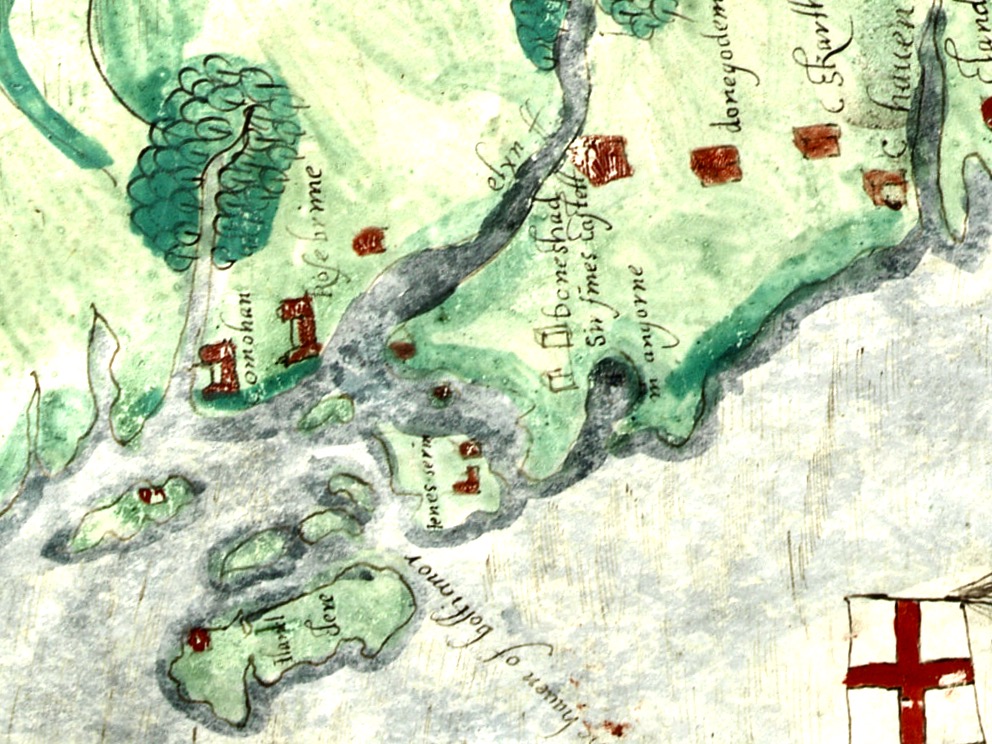
In fact, very little is known about the history of Dún an Óir before the Battle of Kinsale in 1601. We can deduce from its strategic location that the O’Driscolls used it to keep an eye on every ship that sailed in and out of Roaringwater Bay, to exact fishing dues before the rival O’Mahonys could get to the incoming vessels, to curb the power of those O’Mahonys, and to establish their dominance over the land of Cape Clear Island. (See this post for more on the map above.) Because the castle would have been rendered, probably in some shade of white or near-white, it would have been visible from all around Roaringwater Bay, and have represented a potent statement of supremacy.
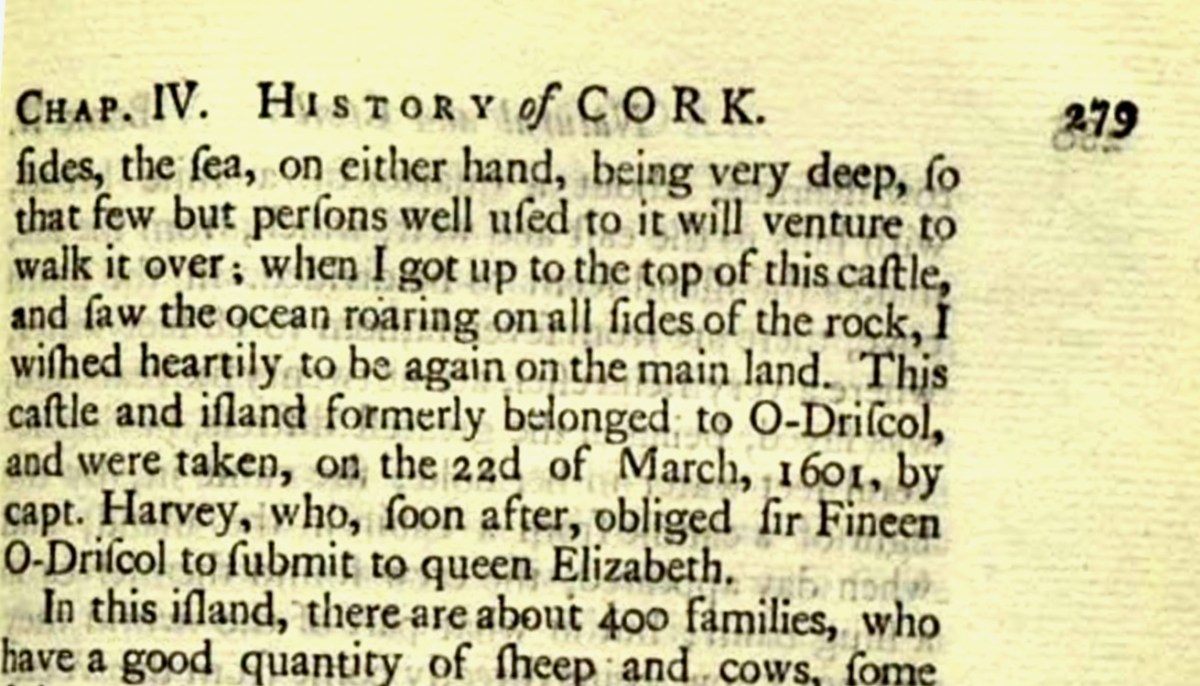
After the Battle of Kinsale the Castle was seized by Captain Harvey, as described in Pacata Hibernia:
‘While these things were on doing, Captain Roger Harvy sent a party of men to Cape Clear,the castle whereof being guarded by Captain Tirrell’s men, which they could not gain, butthey pillaged the island and brought thence three boats; and the second day following therebels not liking the neighbourhood of the English, quitted the castle, wherein Captain Harvy placed a guard. At this time Sir Finnin O’Driscoll came to Captain Harvy and submitted himself.’
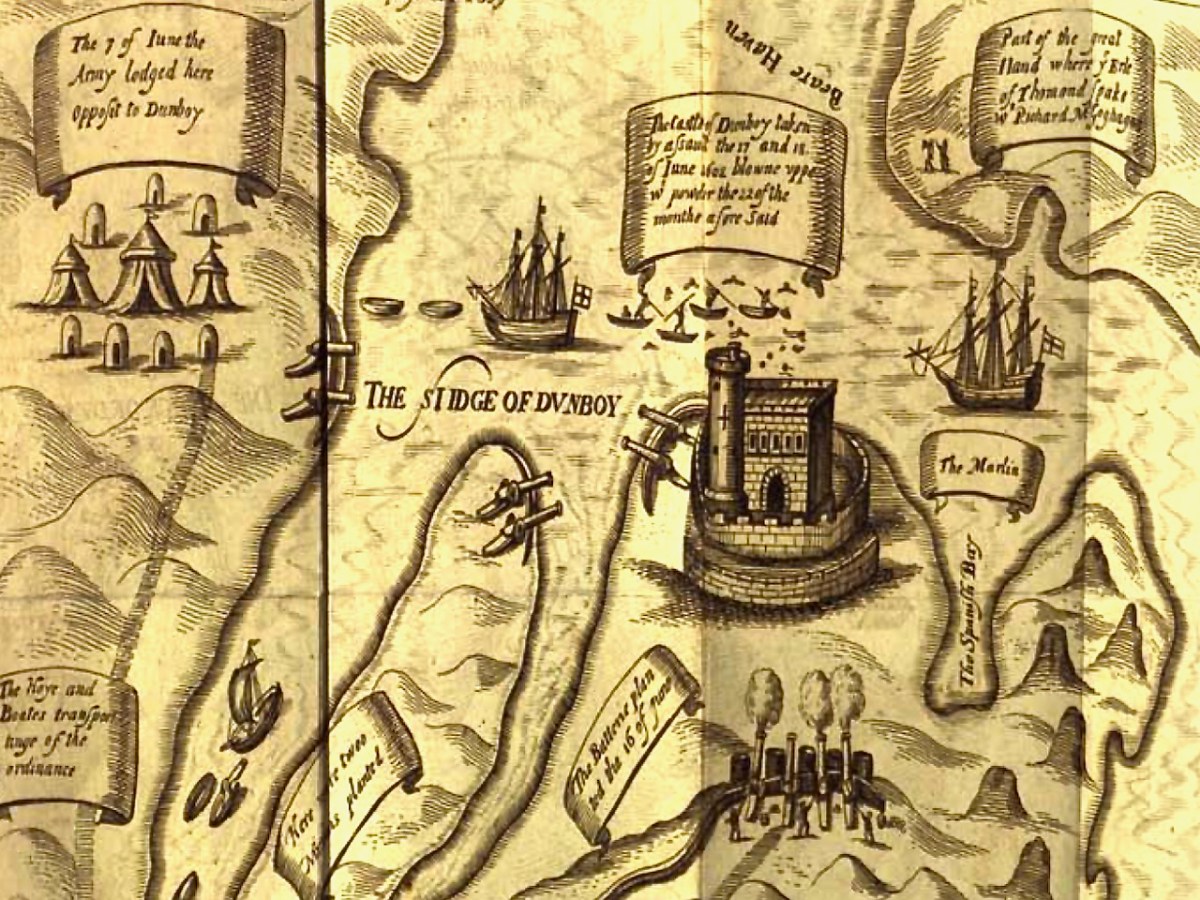
This illustration, from Pacata Hibernia, is of the siege of Dunboy Castle, the stronghold of O’Sullivan Beare, on Beara Peninsula. The destruction of Dún an Óir is described by James Burke in his article Cape Clear Island in the Journal of the Cork Historical and Archaeological Society Journal of 1908. Rather than Harvey simply taking over the castle, Burke relates the following:
Its central arch and the steps leading to its upper portion remain; but the huge pieces of its eastern wall now lying about show how severely it has suffered from the havoc of war. This wholesale destruction occurred when Dunanore Castle, together with the island, was captured on the 22nd of March, 1601, by Captain Roger Harvey, following on the defeat of the Spaniards at Kinsale. By means of the artillery he planted on the high ground adjoining it, he battered down the eastern wall and compelled the garrison to surrender, for which and other services (as Dr Donovan writes in his “Sketches of Carbery”) he was granted at the time a commission by Lord Deputy Mountjoy as Governor of Carbery.
It is far more likely that the ruined state of the castle is a result of the natural passage of time than the ‘havoc of war.’ For one thing, it would have been a monumental task to deploy artillery overland on Cape Clear. Any cannon fire would have come more naturally from the English warships we know were in use during this period and therefore, the damage would have been to the seaward side of the castle – but this side is actually intact.
A romantic view of the ruins of Dún an Óir above, by W Willes.* Next week we will look at what is left of the castle and what we can tell from that. I’ll be using the marvellous photos from Tash in that post.
We’ve done quite a few posts over the years about old maps – we are both fascinated by them. So I’ve decided to draw all those posts together into a new Menu Page, so you can easily find any post you’re interested in.
Several posts went into detail about maps from the Elizabethan period. The Elizabethans were map-makers and they had a special interest in drawing up maps of Ireland – to confiscate tracts of land from the rebellious Irish and assign them to colonisers. Jobson was the cartographer who mapped Munster: two posts detail the maps drawn up for that purpose.
There’s a mysterious map in the British Public Record office – nobody knows who did it, but it was obviously done in the period following the Battle of Kinsale in 1601. While some of the elements are obvious, others are not, and pouring over a map like this raises as many questions as it answers. I titled the two posts Elizabethan Map of a Turbulent West Cork.
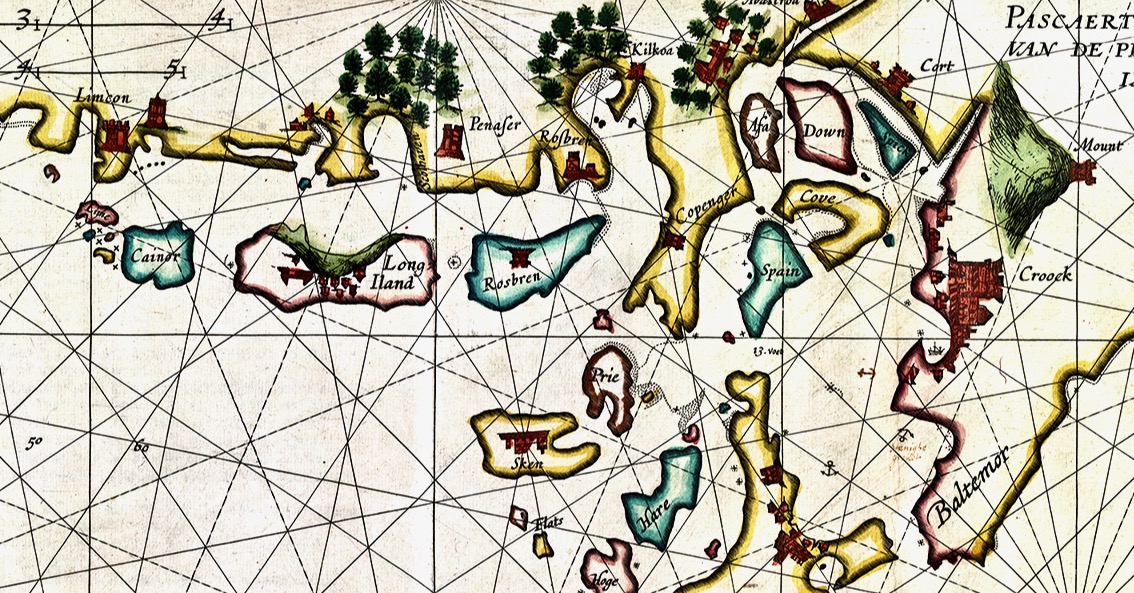
Two posts, Mapping West Cork, drew on maps from the David Rumsay Map Collection – a man who has done the world a great service by collecting and digitising maps from all over the world. These are very early maps by famous cartographers Mercator (done in the late 1500s) and Blaeu (from his 1655 Atlas). I’ve updated this post recently.
John Speed’s map, dating to 1611, although largely based on Mercator’s work, is more detailed and adds all kinds of interesting details about people and cities.
Robert’s post Roaringwater Bay in 1612 is about the Dutch Pirate Map. As he says in his post: The thing that sets the 1612 map apart, however, is that it was made in secret, and largely from surveys only carried out at sea. Also, it was specifically intended to enable a Dutch fleet to assail the pirate strongholds which became numerous around the area from Baltimore to Crookhaven, centred on Roaringwater Bay and ideal for forays into the wider Atlantic trade routes.
A series of three posts, all written by Robert, explored the world of the Down Survey – conducted by William Petty under the instructions of Oliver Cromwell, and like the Jobson maps, done for the purposes of assigning land to colonisers.
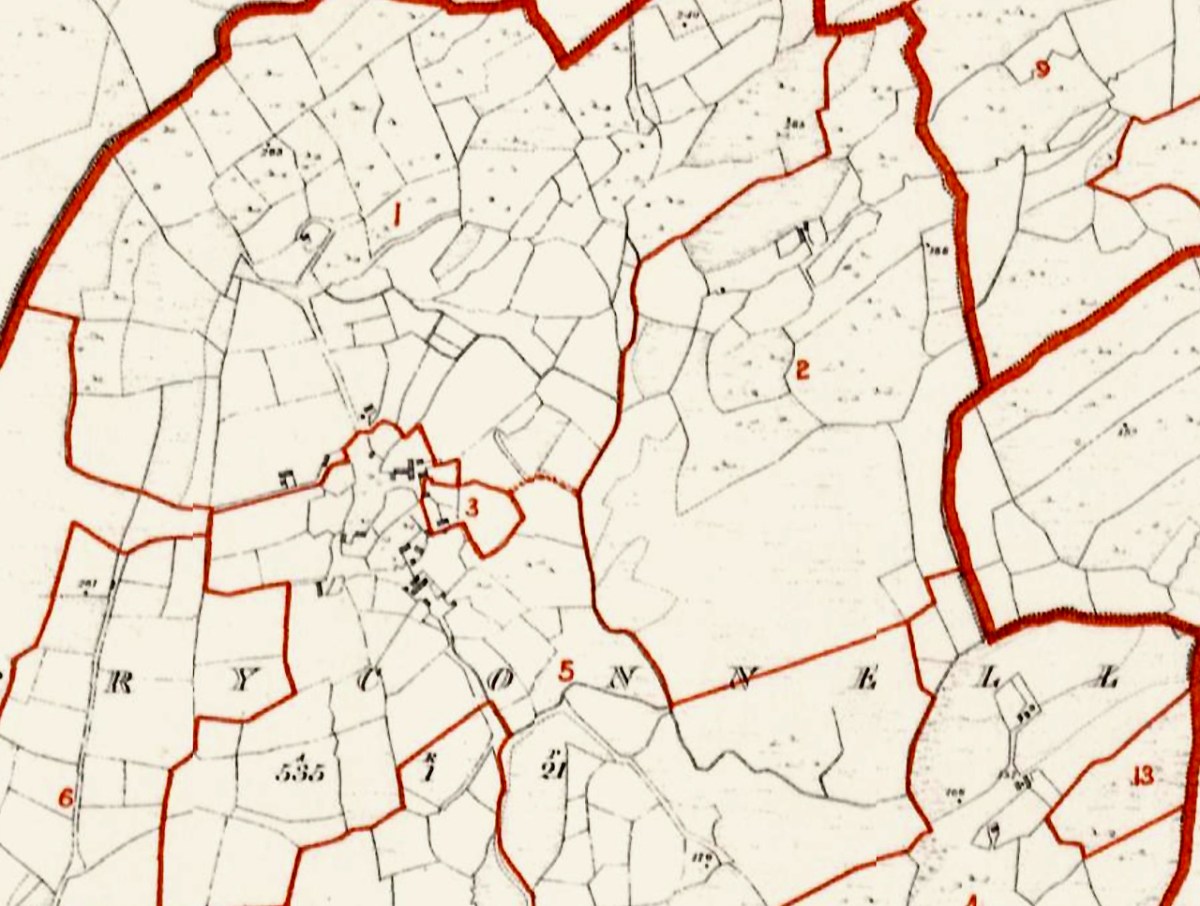
Finally, there’s Griffith’s Valuation – a series of detailed maps done by Sir Richard Griffith in the 19th century for the purpose of putting values on every square perch of land. Robert wrote about Griffith in The Rocky Road to Nowhere, and I used the Valuation in my post What the Forest Was Hiding.
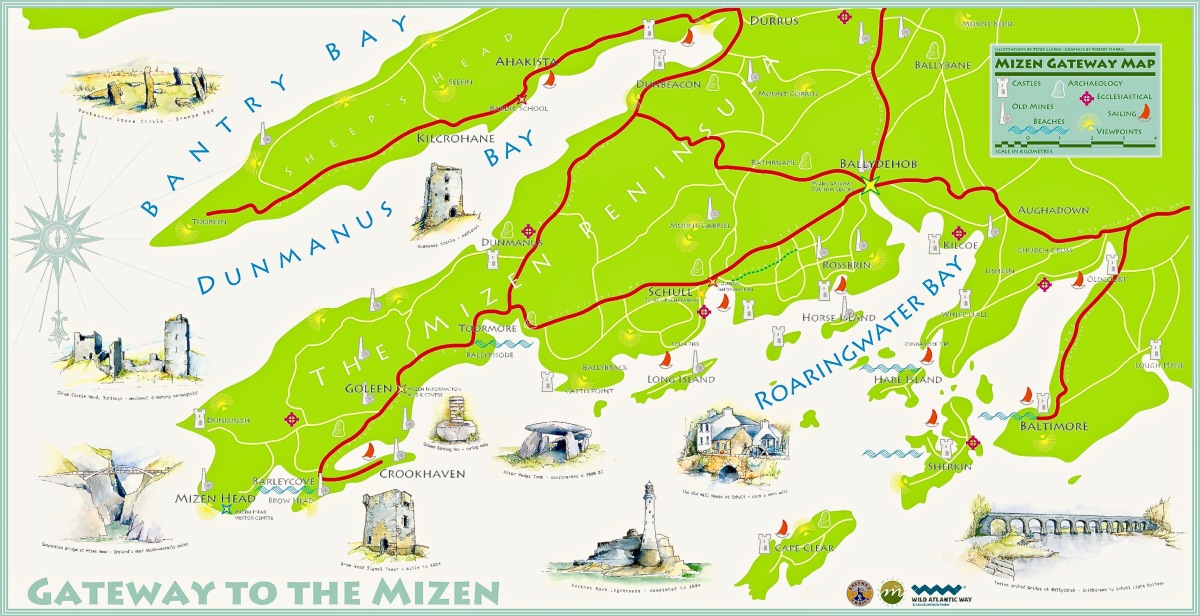
We will update The Magic of Old Maps page as we write any new posts. I am leaving you with a new map – it’s the joint work of Robert and Peter Clarke, and the original hangs in the Bank House, Ballydehob’s Tourist Information Centre.
If you want to browse the David Rumsey map collection for yourself, it’s here.
This post was originally published several years ago, but I have edited and updated it, so am giving it another airing.
Old maps are magical places to get lost in. Pouring over them, trying to identify what I know now, attempting to look at the territory with a seventeenth or eighteenth century mindset – well, several hours have gone by and I realise it’s dinner time. I’m going to share some of my favourites with you in a couple of posts. Mostly, the maps I am using are from the marvellous David Rumsey Map Collection where the maps are free to use for non-commercial use under the Creative Commons license. We are very grateful to you, David Rumsey – what a service to mankind!
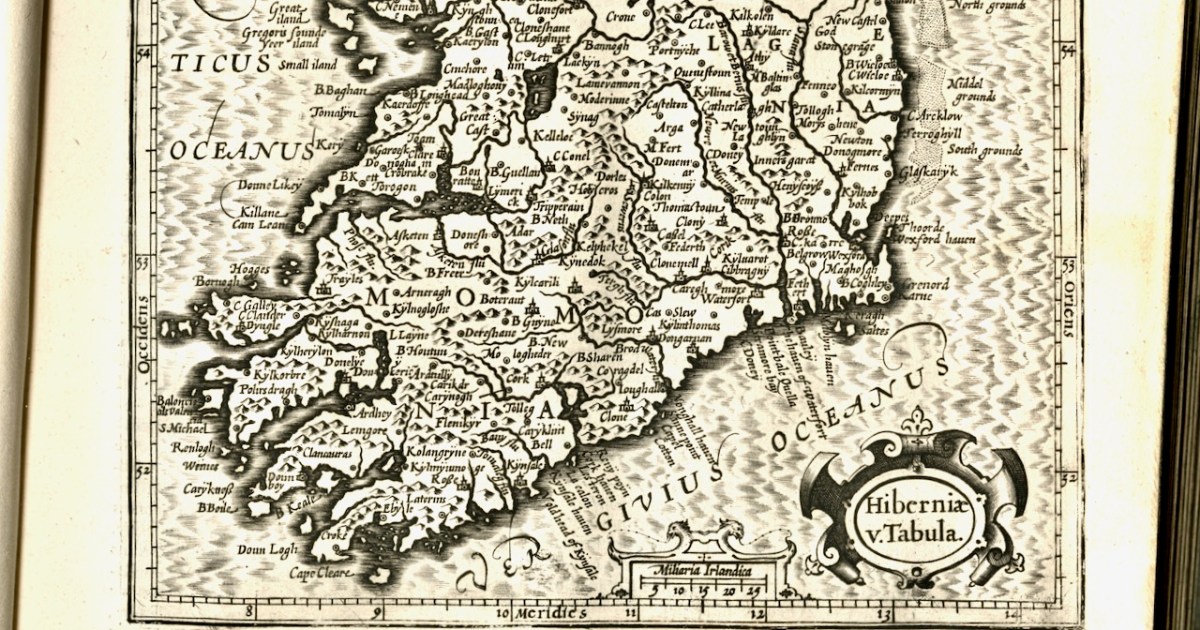
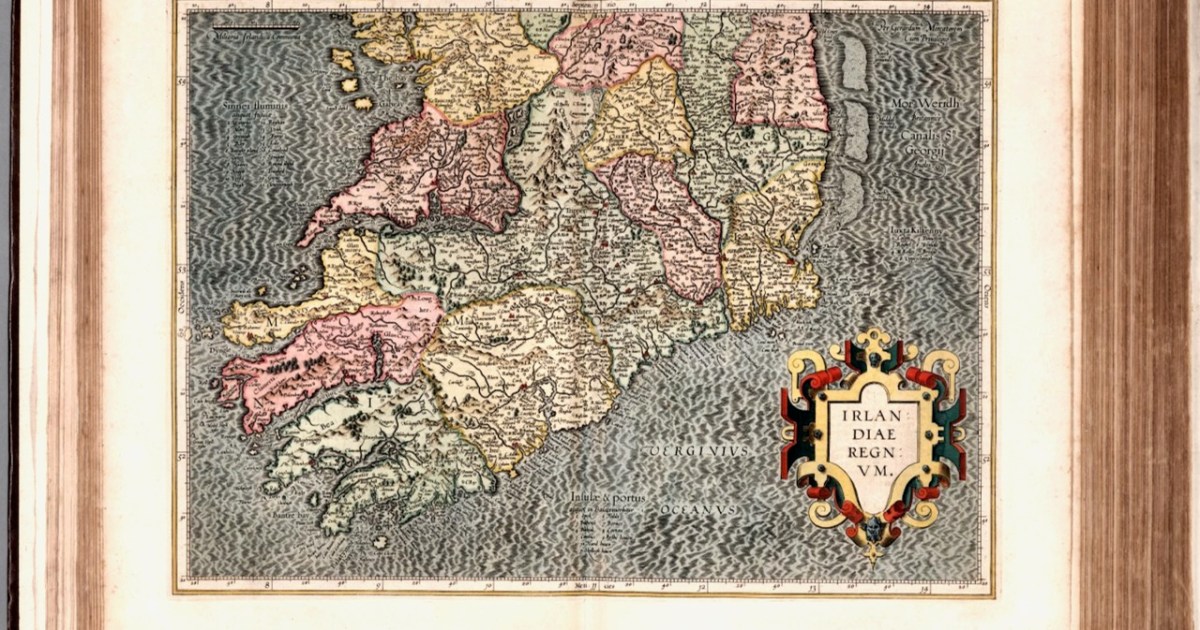
The first map here is by the famous Gerhard Mercator (1512-1594) and Iodocus Hondius (1563 to 1612) and it was published in an Atlas in 1607, after Mercator’s death. The map, therefore, predates the Atlas and was probably done in the late 1500s.
Who was Mercator? This is him, courtesy of Britannica, and his influence on mapmaking was incalculable – he really was the father of modern cartography.
In the 1500s, globe-making was a precise and difficult art. Mapmakers often etched their maps onto paper that they then painstakingly pasted onto paper mache spheres. Old maps had problems, however. Mapping a three-dimensional globe onto a two-dimensional map always involves some distortions, but early maps had serious issues for navigators. They were mostly elliptical and struggled to capture the curvature of the Earth for sailors who were plotting a course. Sailors using them were constantly twisting, curving, and recalculating to compensate for their maps’ deficiencies.
In 1569, Mercator developed a better, more accurate projection. Although the execution was difficult, the basic idea was simple: Imagine a globe with a paper cylinder wrapped around it — Mercator projected that globe onto the paper and then unwrapped it. He then expanded degrees of latitude as they approached the poles, which distorted land, but allowed the directions to be clearer.
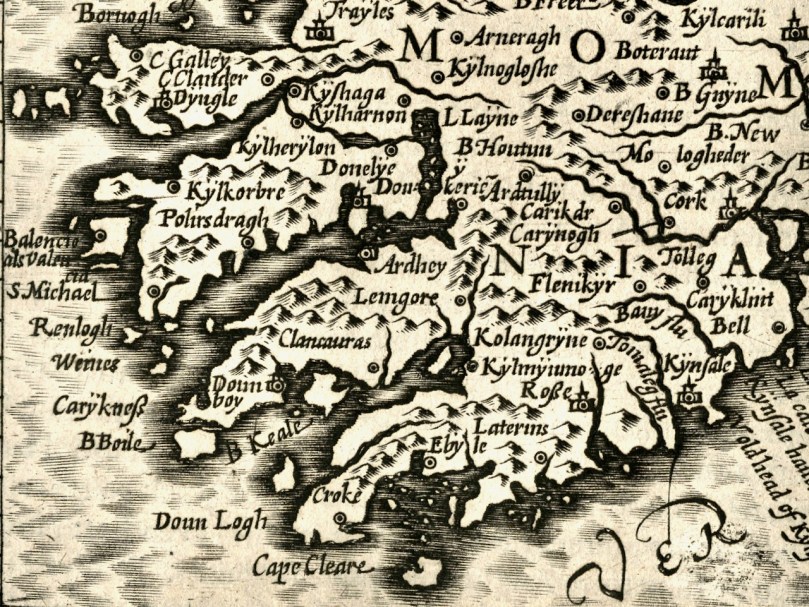
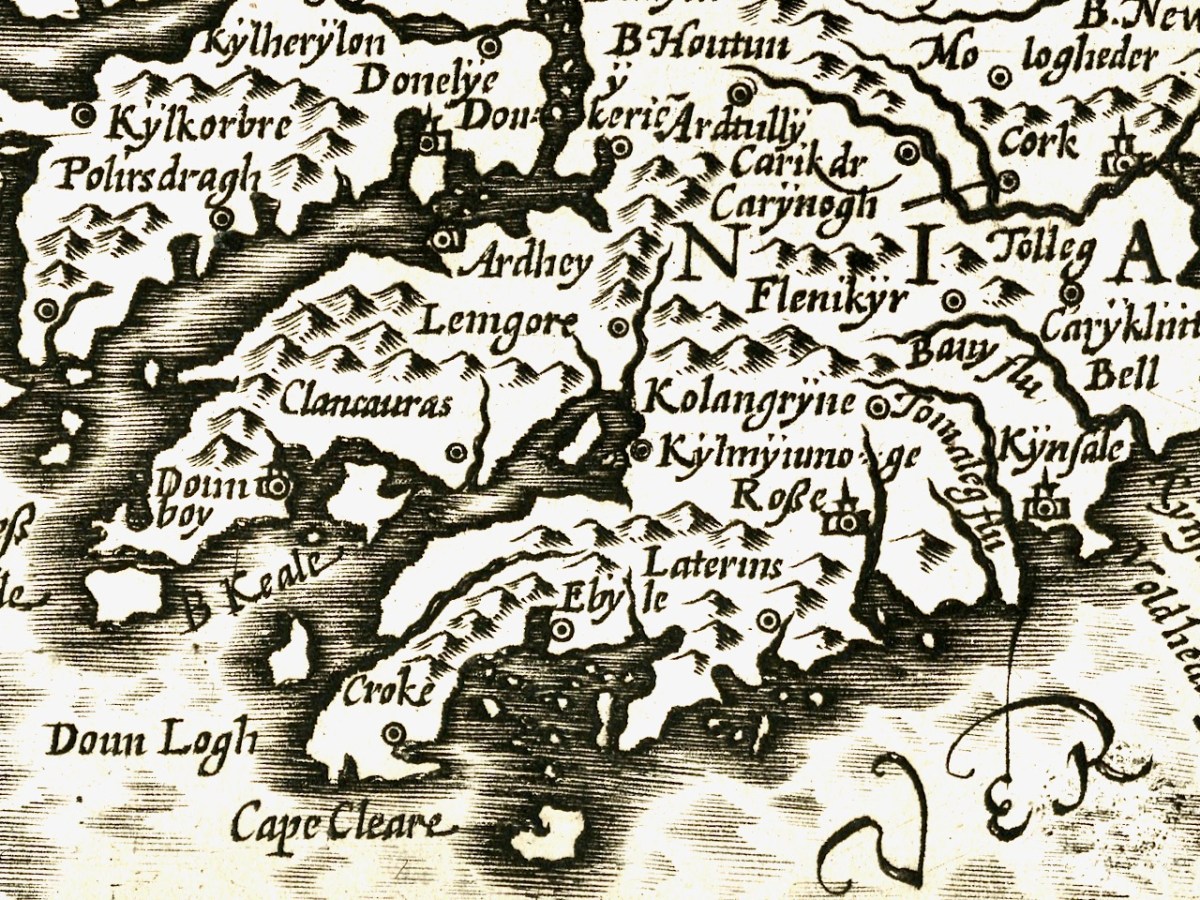
We can recognise some things in this map and not others. Croke is Crookhaven, Doun Logh is Dunlough (or Three Castle Head) and Doun boy is Dunboy Castle home of the O’Sullivan Beares. We can also see Roße – this is Rosscarbery, with the symbol of a church, and Kynsale. But after that I was stumped. However, one clever reader (thank you, Philippa Barry!), when I published this first, added Currently doing some reading on Bantry and O’Sullivan Bere, so getting familiar with placenames. In the first map Kylmyiunoge might be Kilmacomoge, Ardhey is Ardea Castle on the Kenmare River. Looks like Timeoleague is in there too.
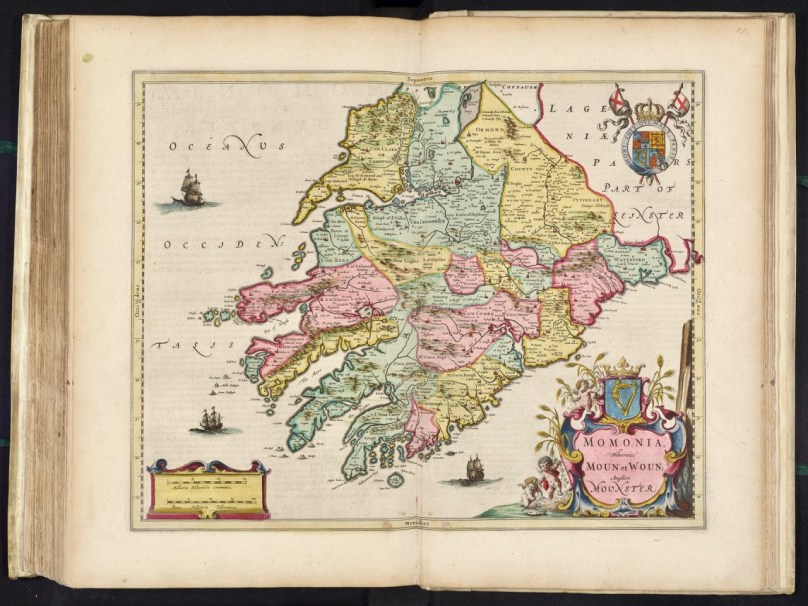
The second map is from 1655 and it’s from Joan Blaeu’s Atlas Major. Blaeu, a Dutch cartographer, lived from 1596 to 1673 and this map is from his Atlas Maior of 1665, considered one of the greatest achievements ever in Atlas publishing. It was also the most expensive book you could buy in the 17th century – worth a year’s wages for a skilled craftsman. The first thing we notice, of course, is that this version is in colour, but you could also buy an uncoloured version for a hundred guilders less. Given printing capabilities of the time, each copy must have been hand-coloured.
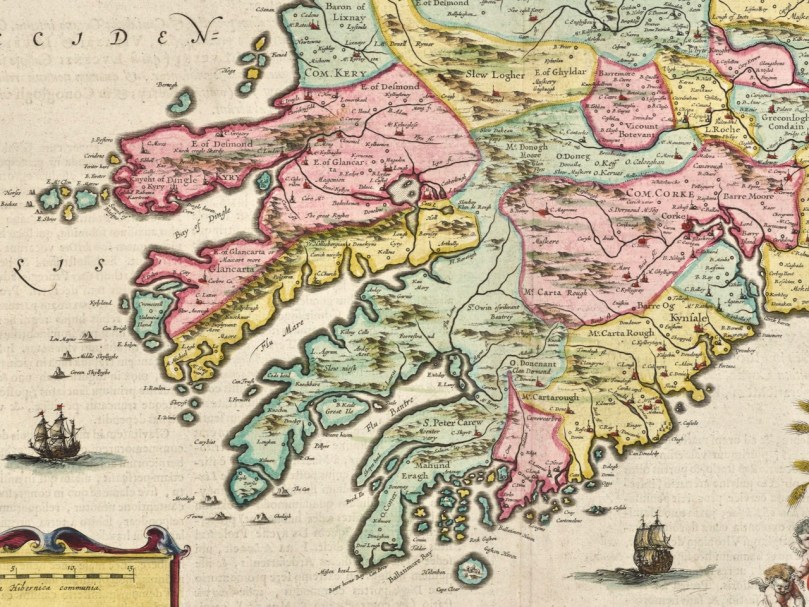
There is much more detail now, and more recognisable elements. It’s a wonderful record of what the major sites were then – sites which nowadays hardly exist, or exist as ruins. Let’s take it from east to west.
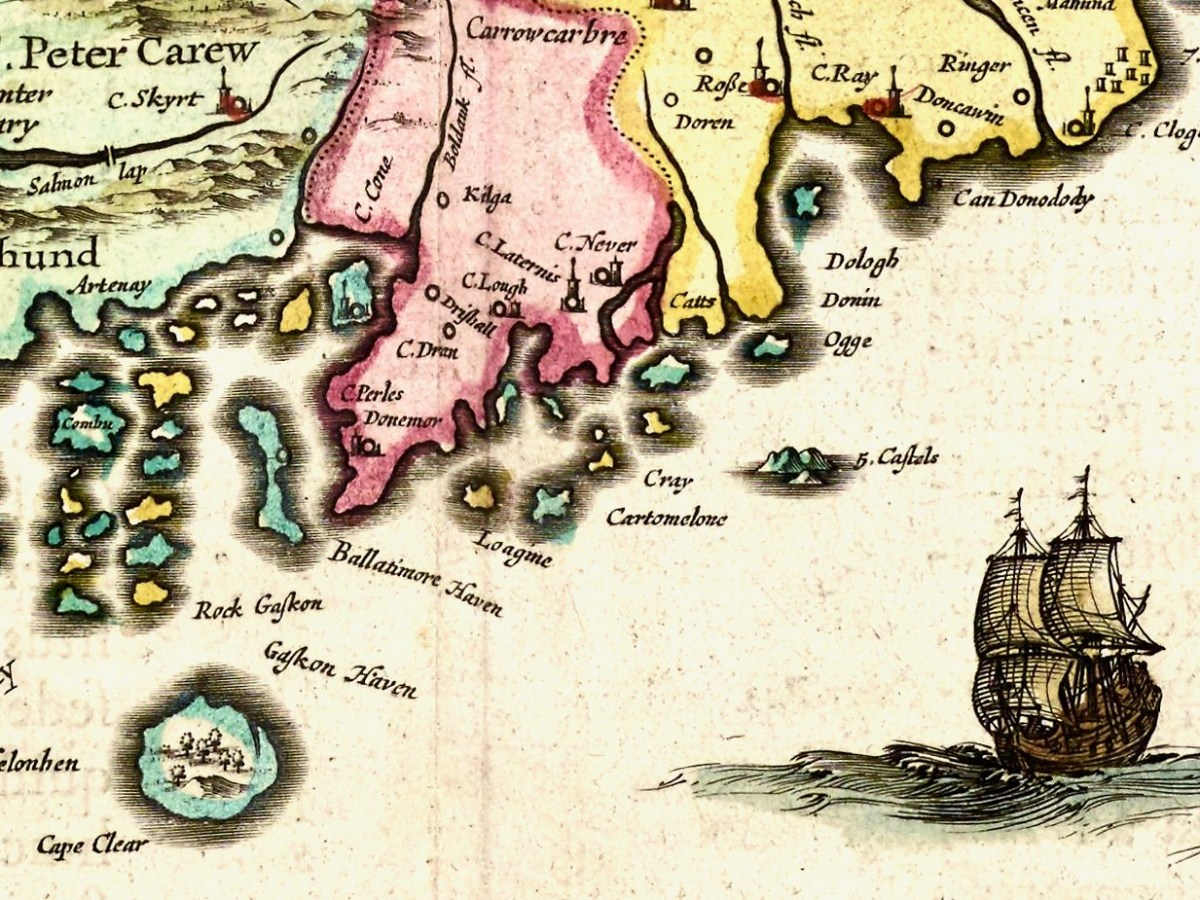
I recognise Dunowen and Dundeedy, and Ringer must mean the area now known as Ring. The letter C denoted a Castle (or Manor House) as in C Perles. or Castle of Pearls, which is Dun Na Séad (Fort of the Jewels), the O’Driscoll Castle at Baltimore. But what is C Ray? There was a tower house at Castlefreke built by Randal Oge Barry in 15th century, maybe that’s it? And, even more intriguingly, what is C Never?
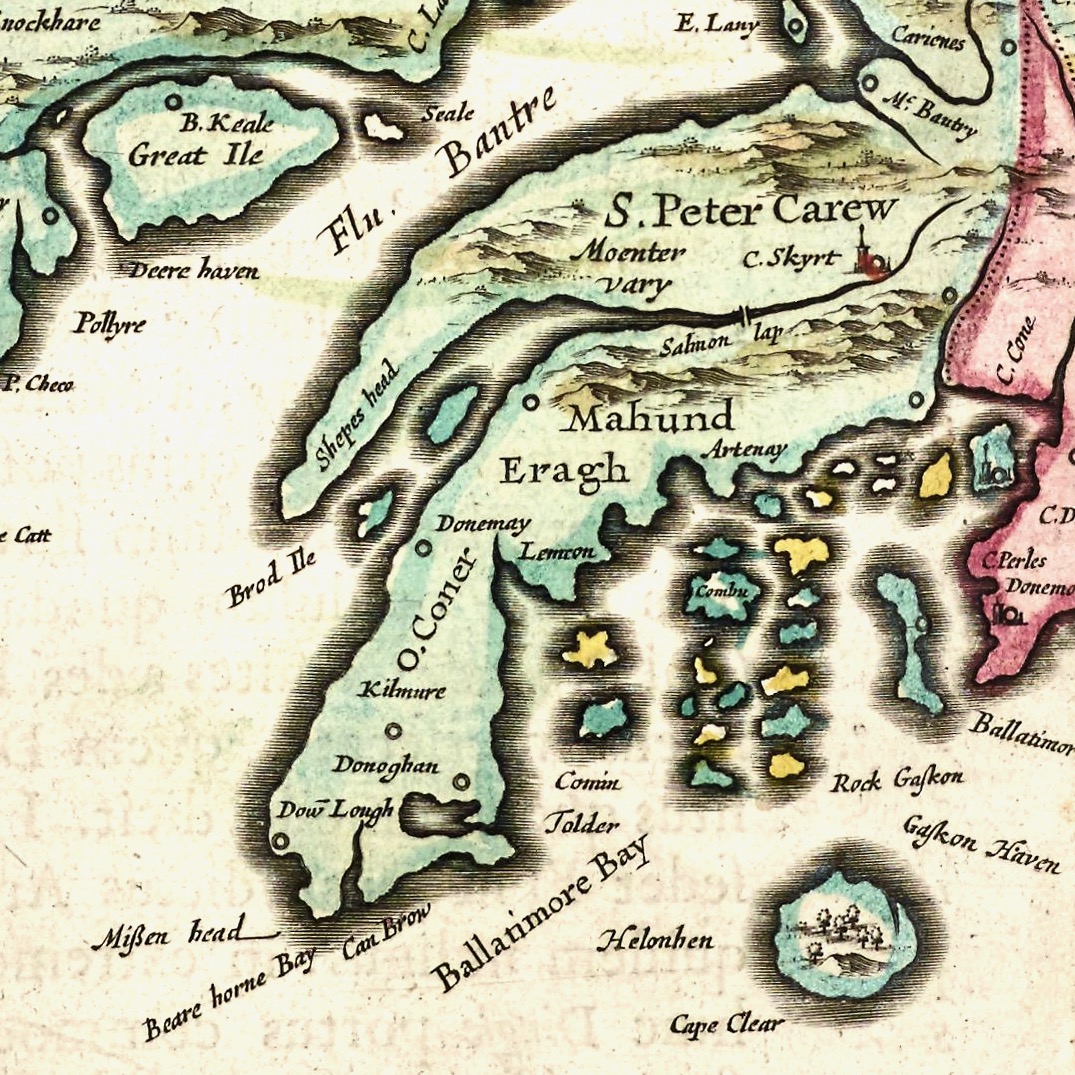
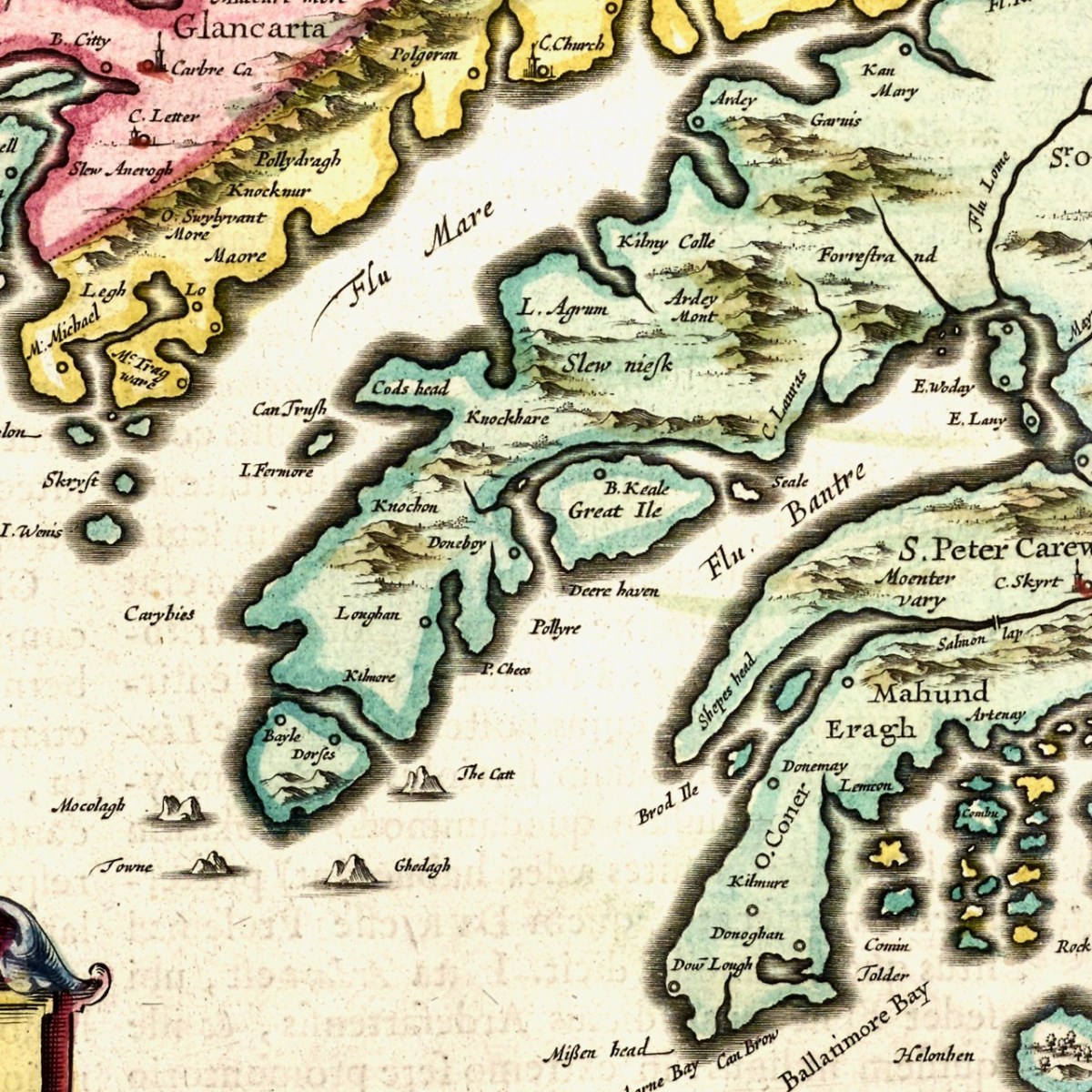
Moving on to Roaringwater Bay and its hinterland, we find Artenay, now known as Ardintenant Castle, one of the ruins of what was once a string of O’Mahony Castles. Ardintenant was the home of the Taoiseach, or clan chief, which is why it would be marked on the map. Other O’Mahony Castles are Dunmanus (Donemay), Dunlough (Dow lough) and Leamcon. Territories of the McCarthy’s, the O’Donovans, Sir Peter Carew and O’Mahonys are given, but also an O’Coner clan, about whom I have no knowledge. The Sheep’s Head is divided into Moenter vary (Muinter Bhaire) at the north end and Shepes head at the south end. Mizen Head has already acquired its name, although I suspect Eragh is a form of Ivaha, the old name for the Mizen Peninsula. Could C Skyrt be Castle Donovan – no other castle is located in this general area?
Finally, on to Beara – we immediately recognise Bear Island, or the Great Island, as it was known historically, and Dunboy Castle, as well as Dursey Island. C Lauras, may be Lauragh, although Lauragh is on the north, not the south side of Beara. I need an expert here, to find other place names that equate to modern sites. So take a browse dear readers, and let me know what you find.
Welcome to the UCD Library Cultural Heritage Collections blog. Discover and explore the historical treasures housed within our Archives, Special Collections, National Folklore Collection and Digital Library





 Roaringwater Journal