The Wild One

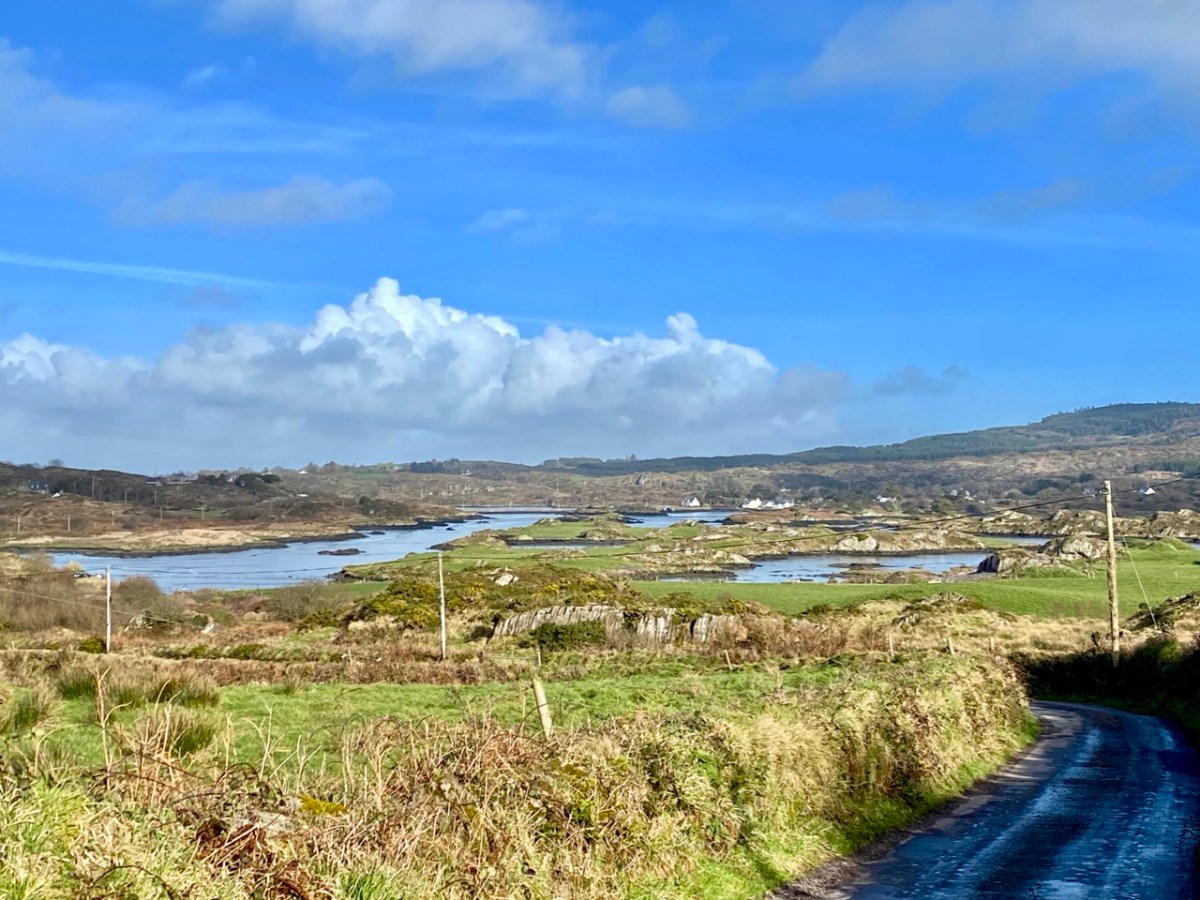
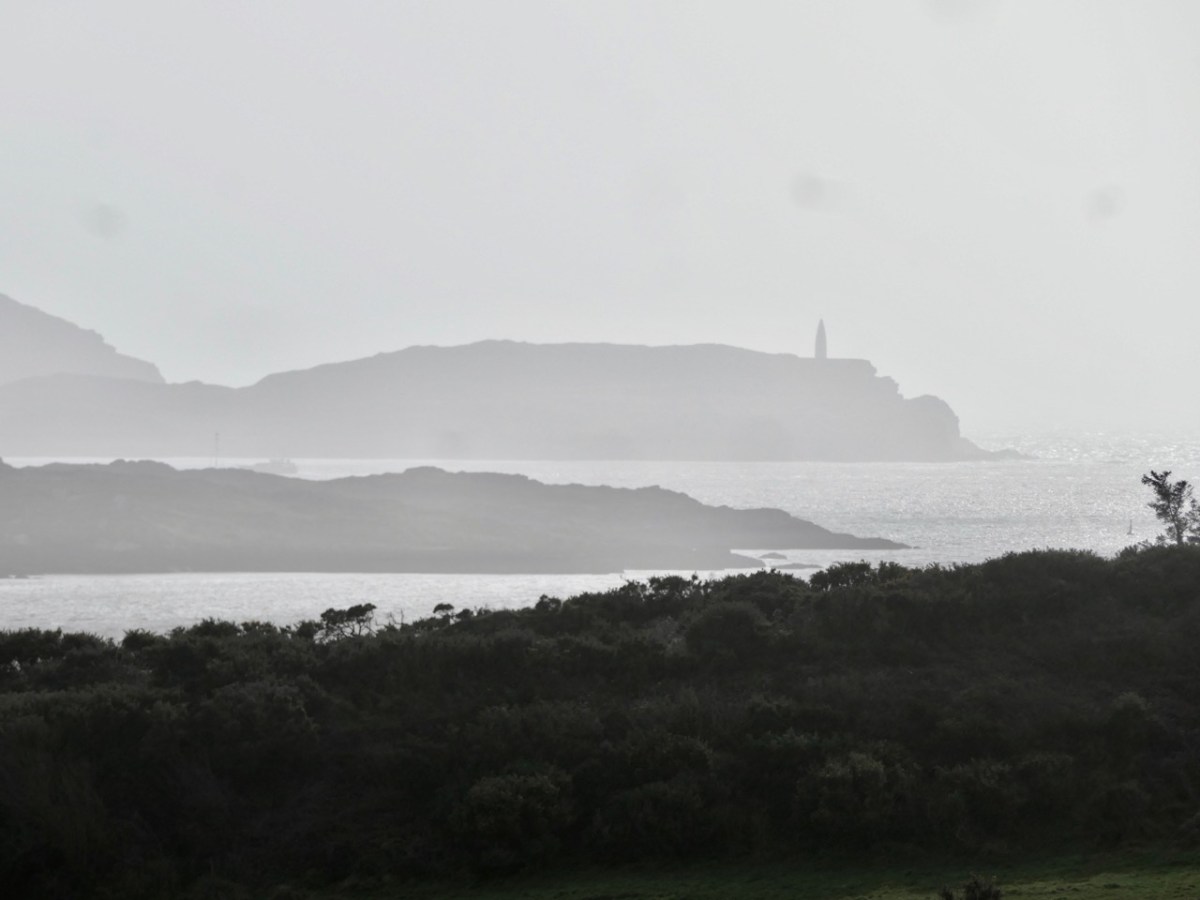
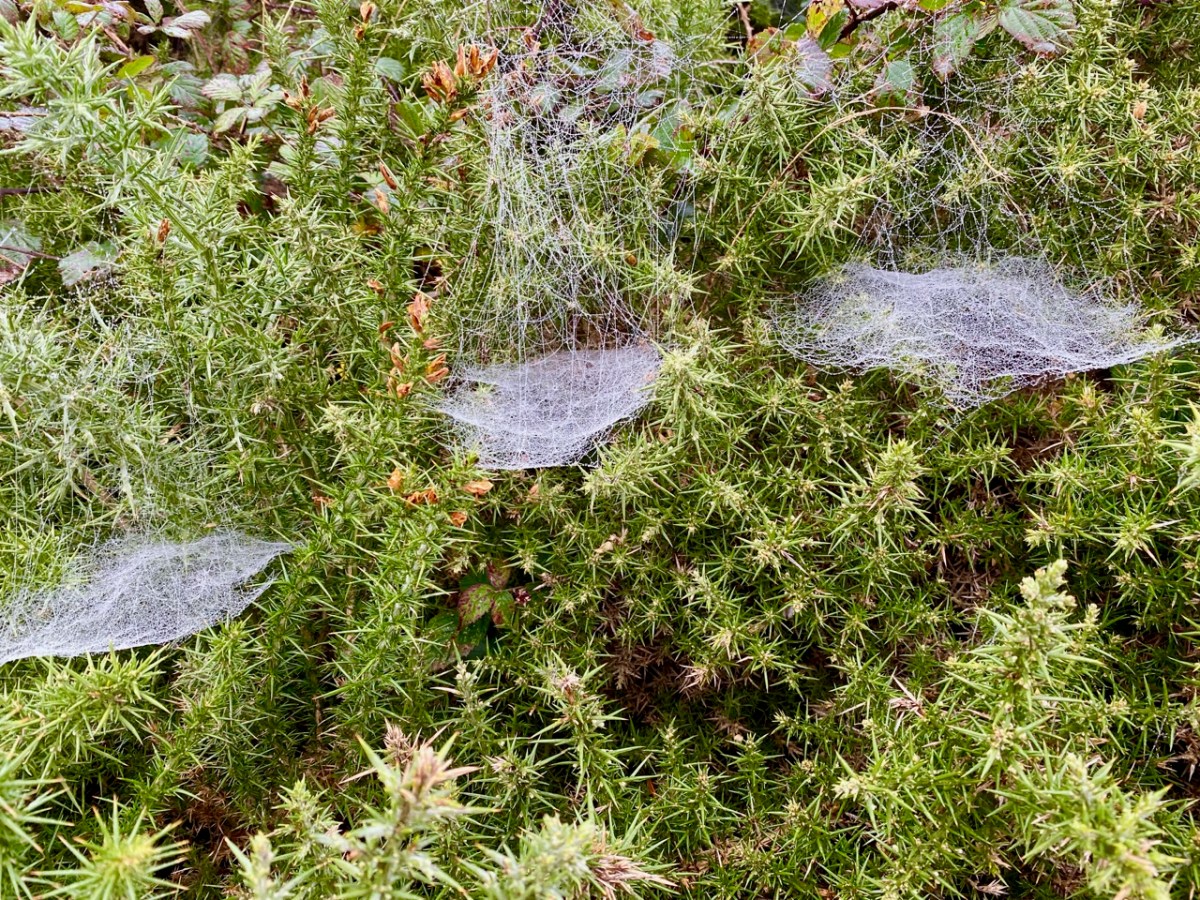
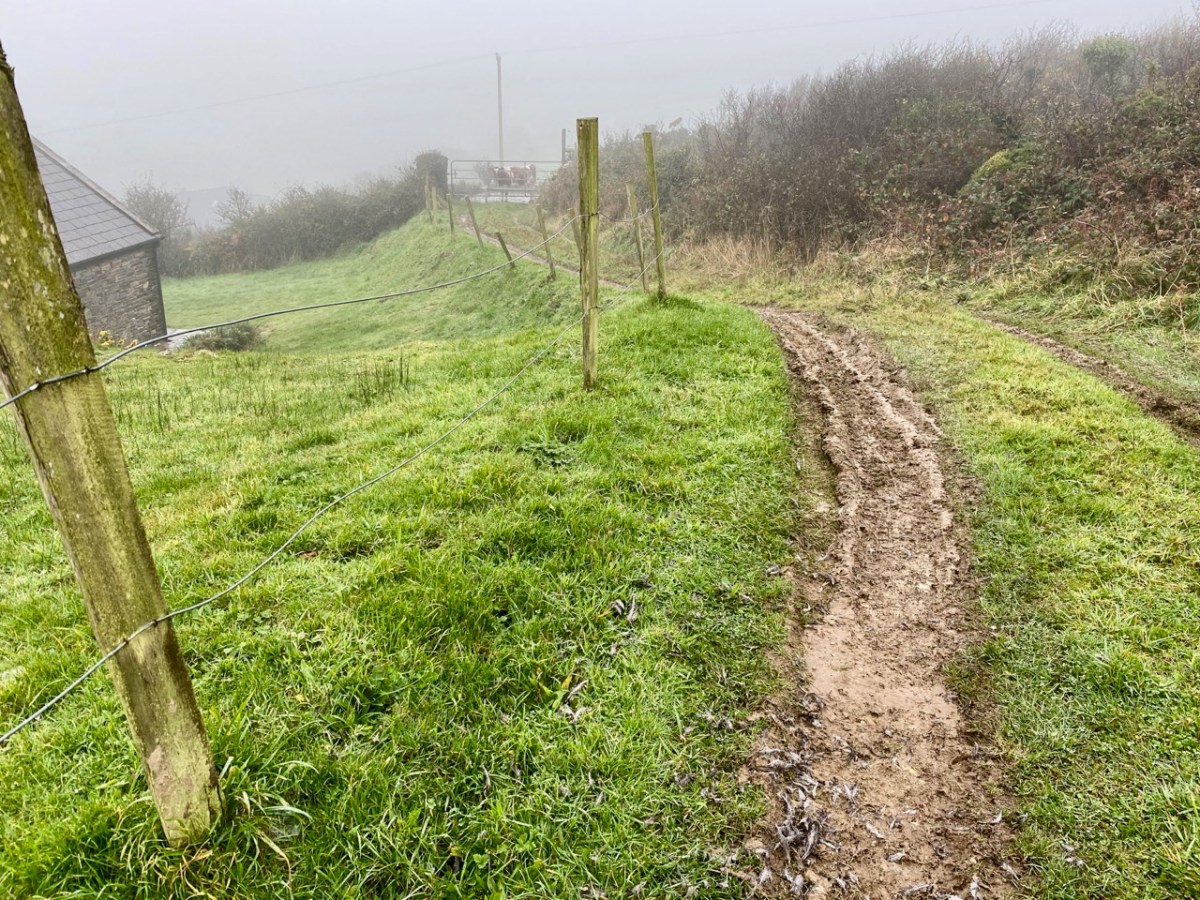
We are past November Dark – traditionally a ‘low’ time of the year when the effects of the approaching cold months begin to displace autumnal skies and spectacular sunsets: the term traditionally refers to the appearance of the new moon of the month (which happened this year on the 4th), but is probably inspired by the preceding nights when no moon is visible. For us at the moment, on the shores of Roaringwater Bay, the dark time is emphasised by a constant pervading mist which clings and covers everything in films of moisture, especially the myriad cobwebs on the gorse bushes which surround us. Gone – for now – are our fine views out across to the islands, and there is a feeling of being marooned and suspended in a lifeless grey tract which encompasses sea and sky.
November Dark has brought with it tragedy to our garden. In explanation, I should first paint the idyllic picture of what we like to call our ‘peaceable kingdom’. For many years we have considered this domain a haven. Do you remember our fox – Ferdia – who was a constant companion to us in the first few years here at Nead an Iolair? He visited on a daily basis – often waking us by barking outside our bedroom window at dawn, and presided over a mixed community of birds and animals who share our territory – without any conflict.
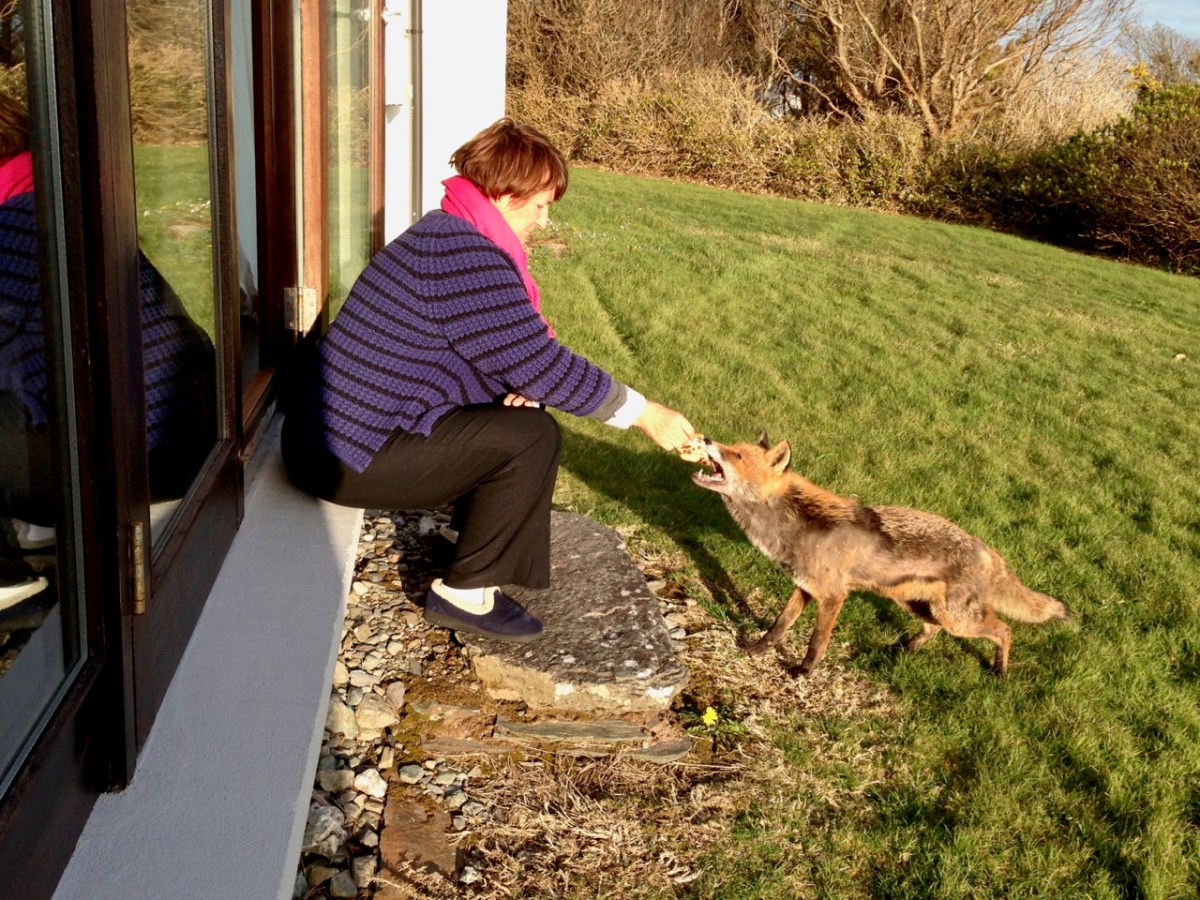
Ferdia was happy enough to co-exist with the bird and pheasant families, the rats and mice, and the occasional cat that dropped in. I have a memory of fox and cat sitting side by side on our terrace, clearly having a conversation with each other: I would like to have eavesdropped, but whatever mutual language they share was not available to me! Ferdia vanished from our garden a few years back – gone to his happy hunting grounds no doubt; but the pheasants have remained with us through much of the decade we have been here.

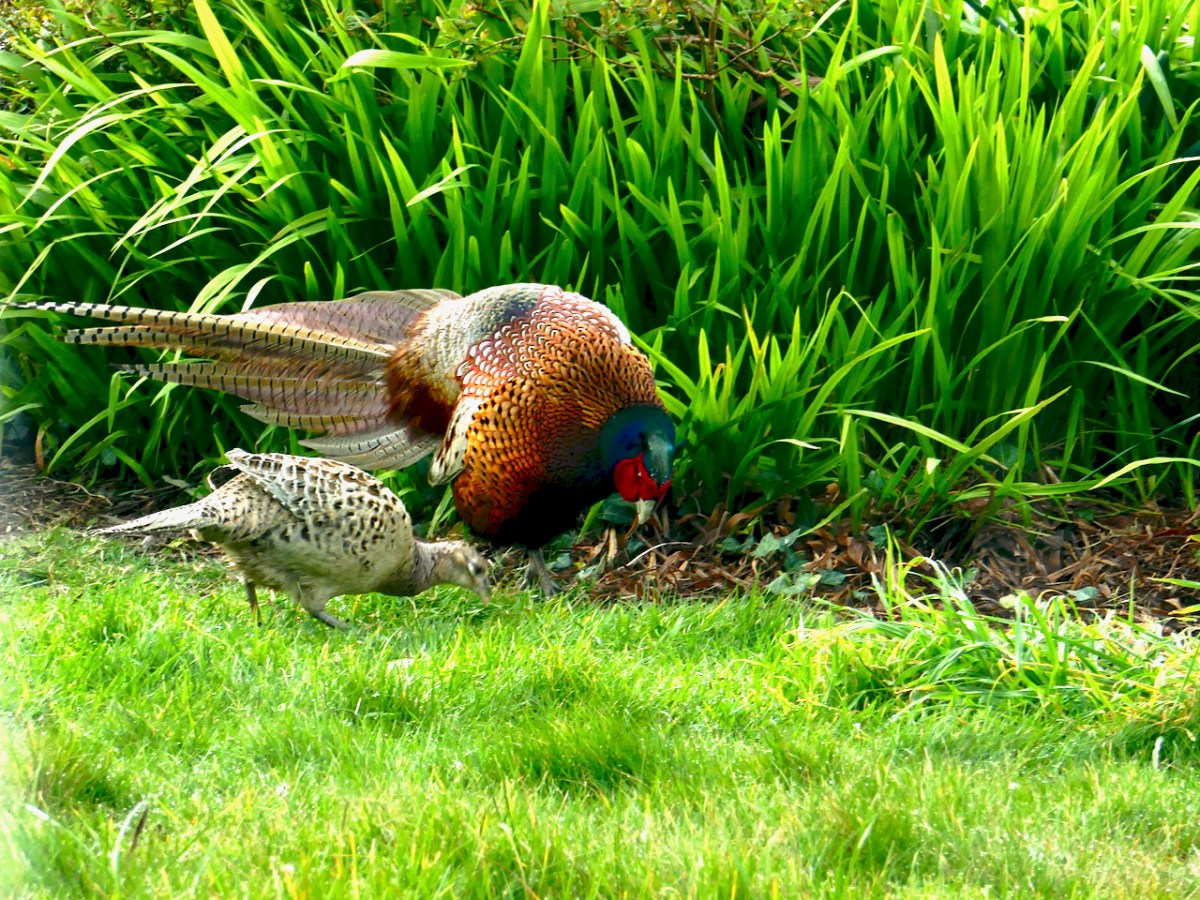
In the upper picture Finnbarr and his young wife, Fidelma, patrol our garden some five years ago. The lower picture was taken just before the start of the Pandemic, in March 2019. The couple have been a daily feature of life outside Nead an Iolair. They always appreciated feeding time, when they got a share of the seeds I put out on our patch for the many bird visitors, small and large. The picture below taken during the summer of last year shows a family group: pheasant chicks have been seen but rarely.
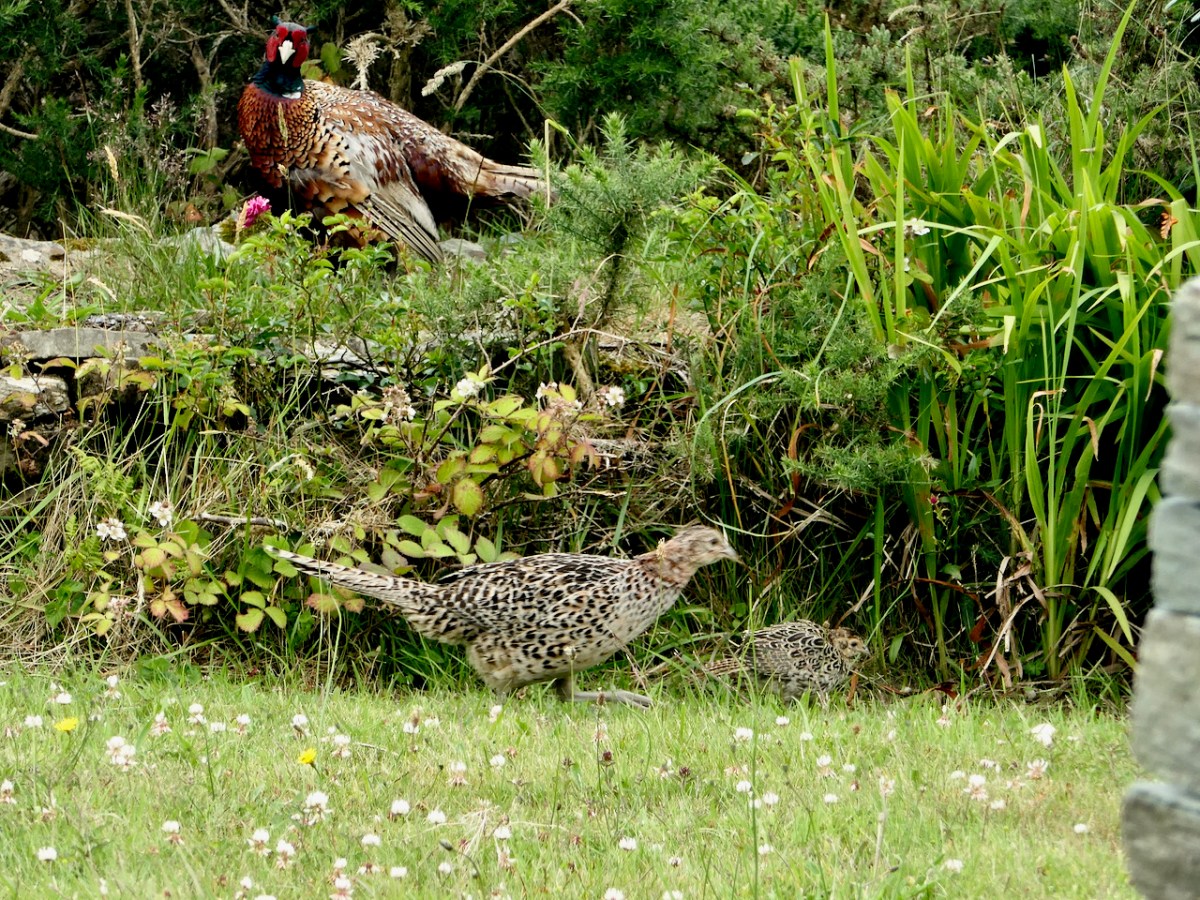
The idyll abruptly ended yesterday, when a bomb hit the garden – in the form of a small but fierce force of nature: only inches long but terrifying. I glanced out of the window where, minutes before, the two pheasants had been foraging as usual along the stone boundary wall. I was shocked to see Fidelma lying on her back, wings flapping, being dragged along the ground: there was a commotion among the small birds and Finnbarr had vanished. At first I could not see the attacker, but as I rushed outside I caught a glimpse of brown fur with a hint of white and black. My first thought – a rat! – could not have been borne out: we have lived side by side with rat families for years: they only ever appear to share the bird food, and are never aggressive.
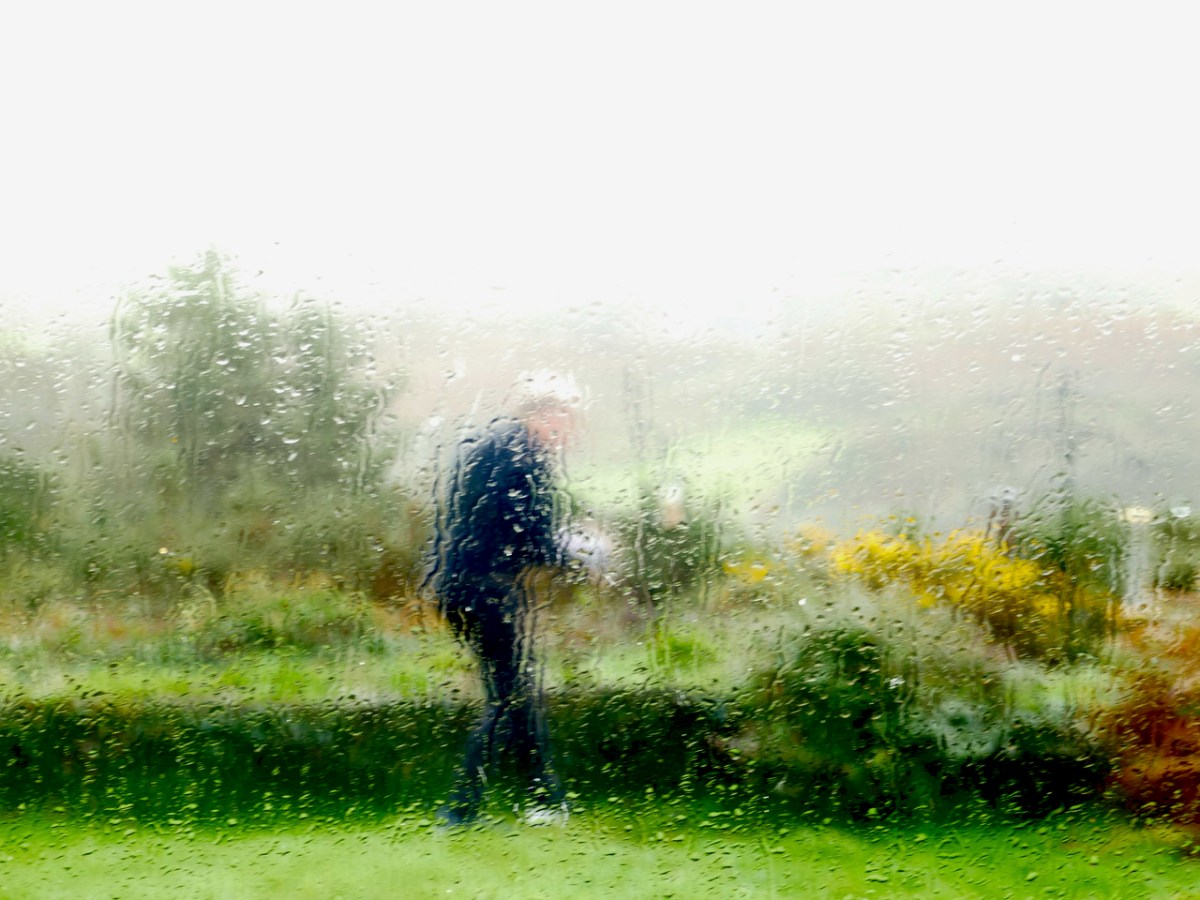
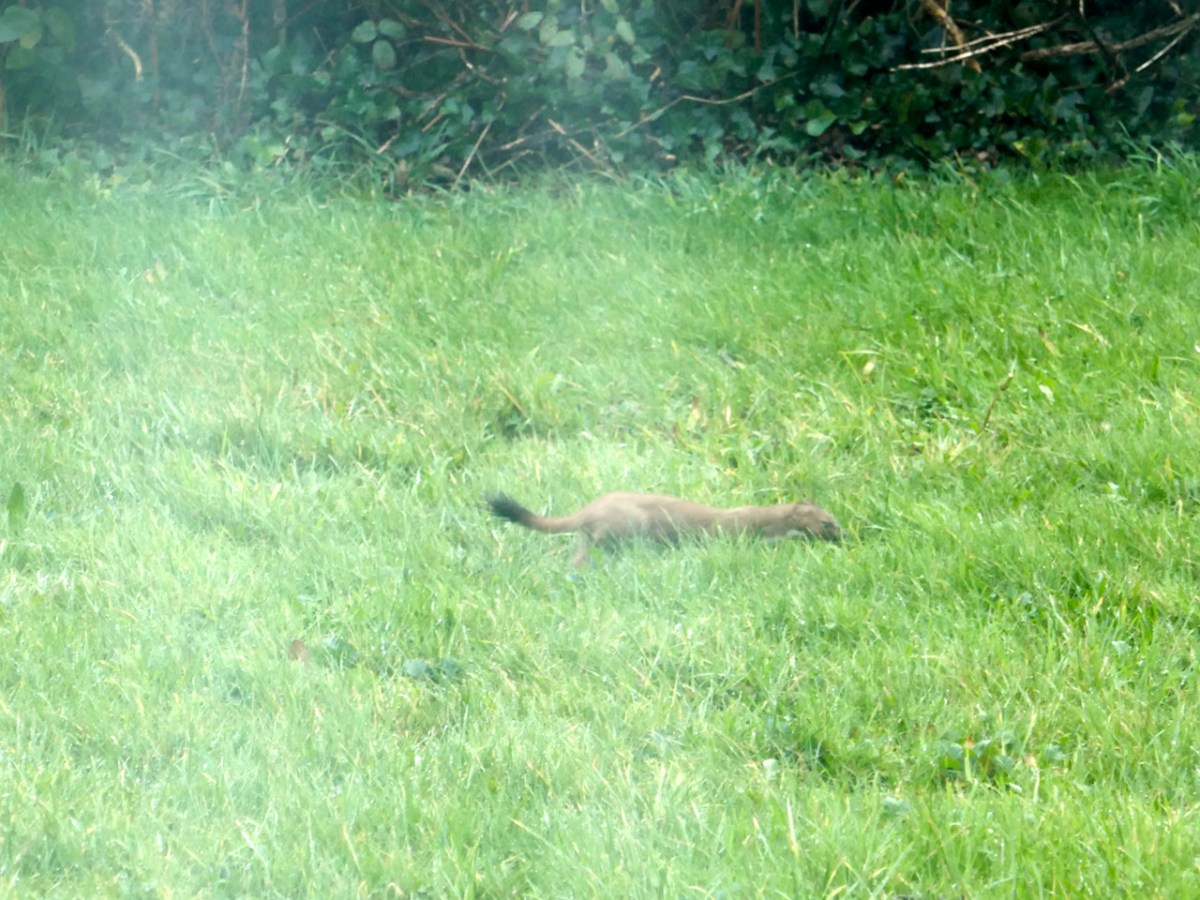
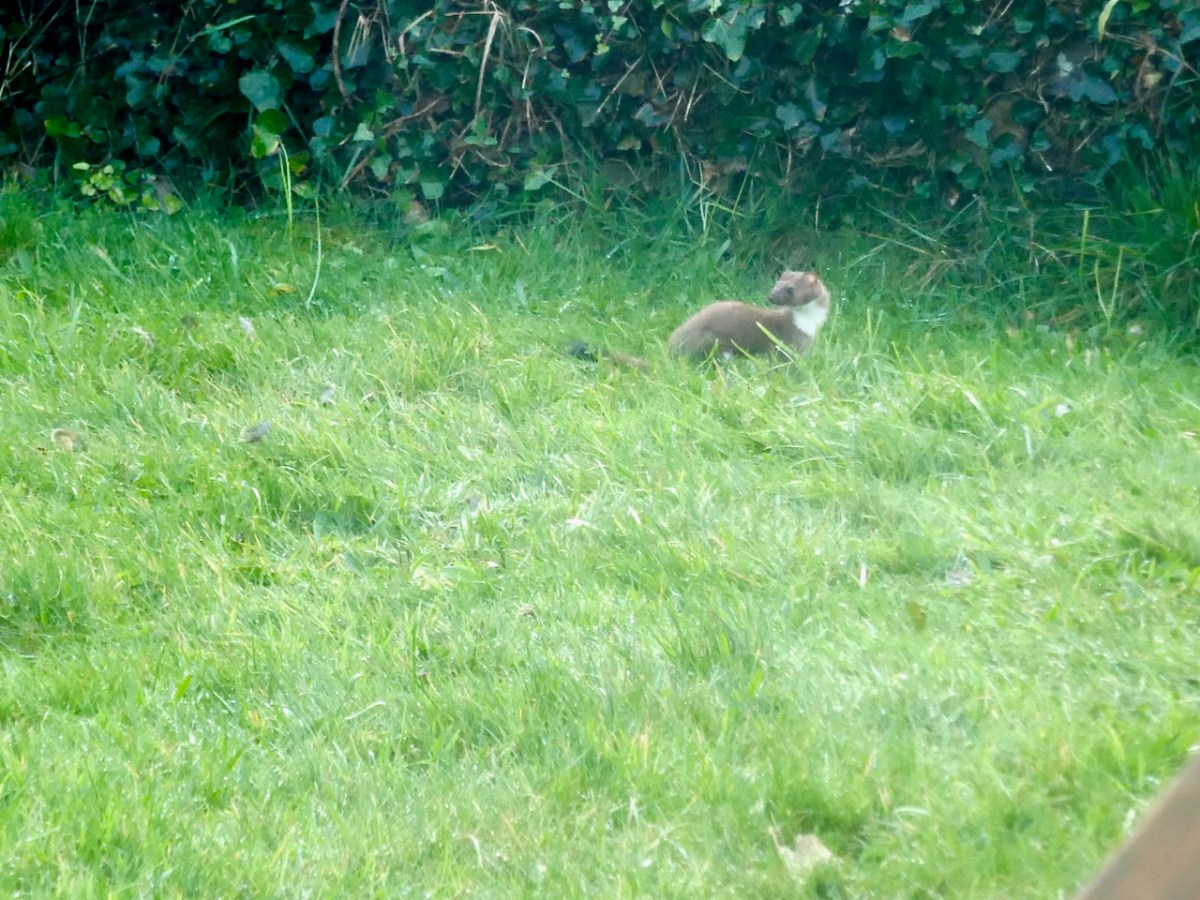
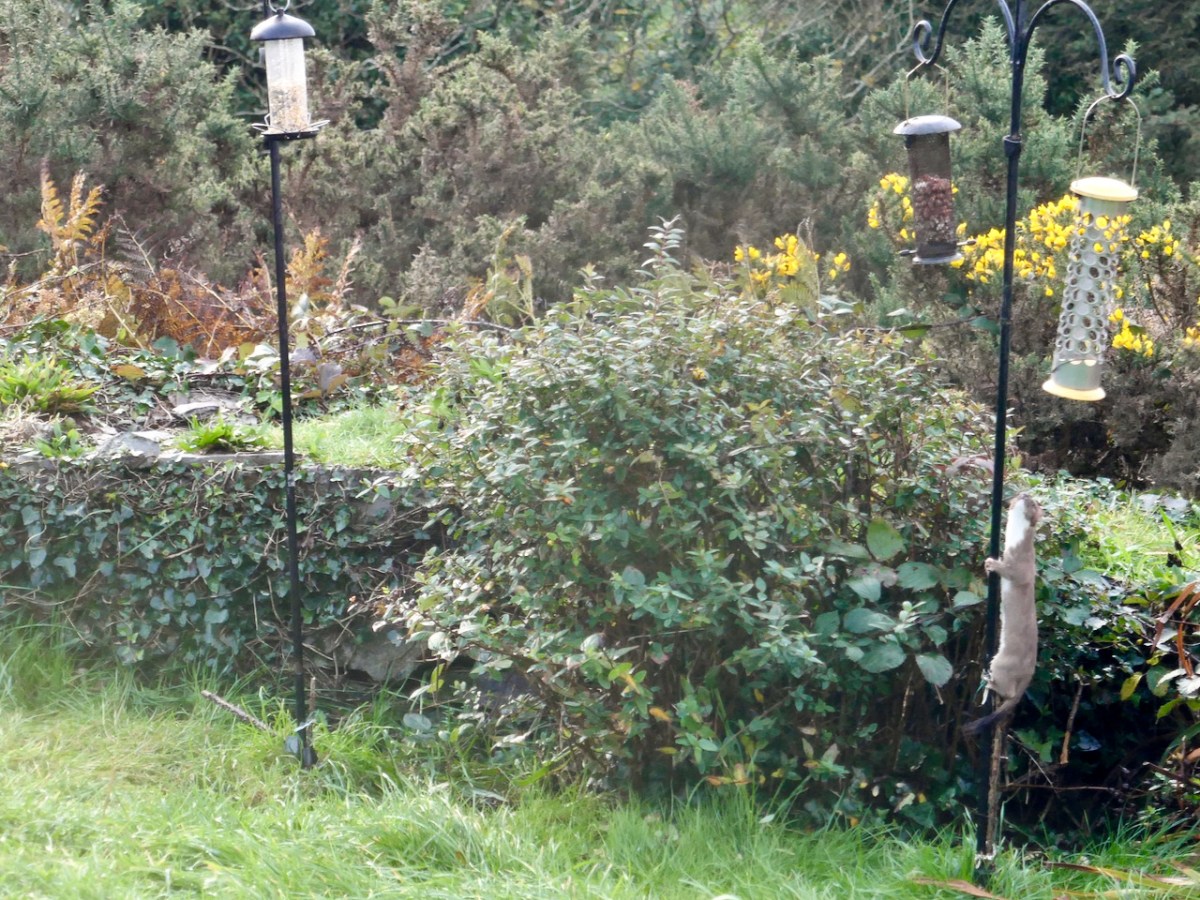
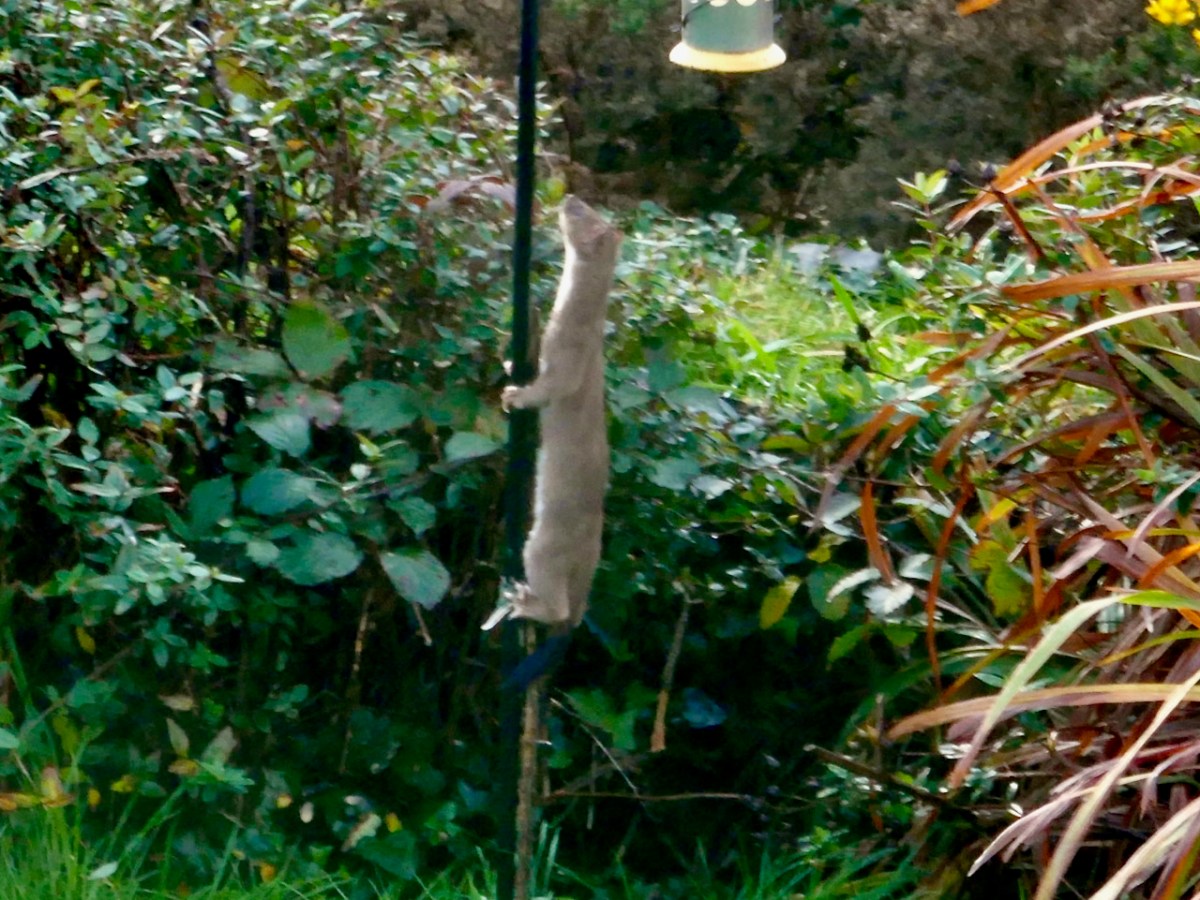
You can see the conditions that prevailed on this worst of days from Finola’s picture (top), taken from indoors through the windows. And – below that – the brazen culprit, who danced around the garden at breakneck speed, very ready to threaten me if I made a wrong move! It was our first sighting here on our land of an Irish Stoat. Having now read the books, I know in hindsight what a shocking phenomenon had hit us. Although fearing the worst, I quickly removed Fidelma to an indoor refuge and then watched the rampaging of this fur powerball traversing our territory at lightning speed; leaping from walls, trees and bushes and aiming for any likely food source.

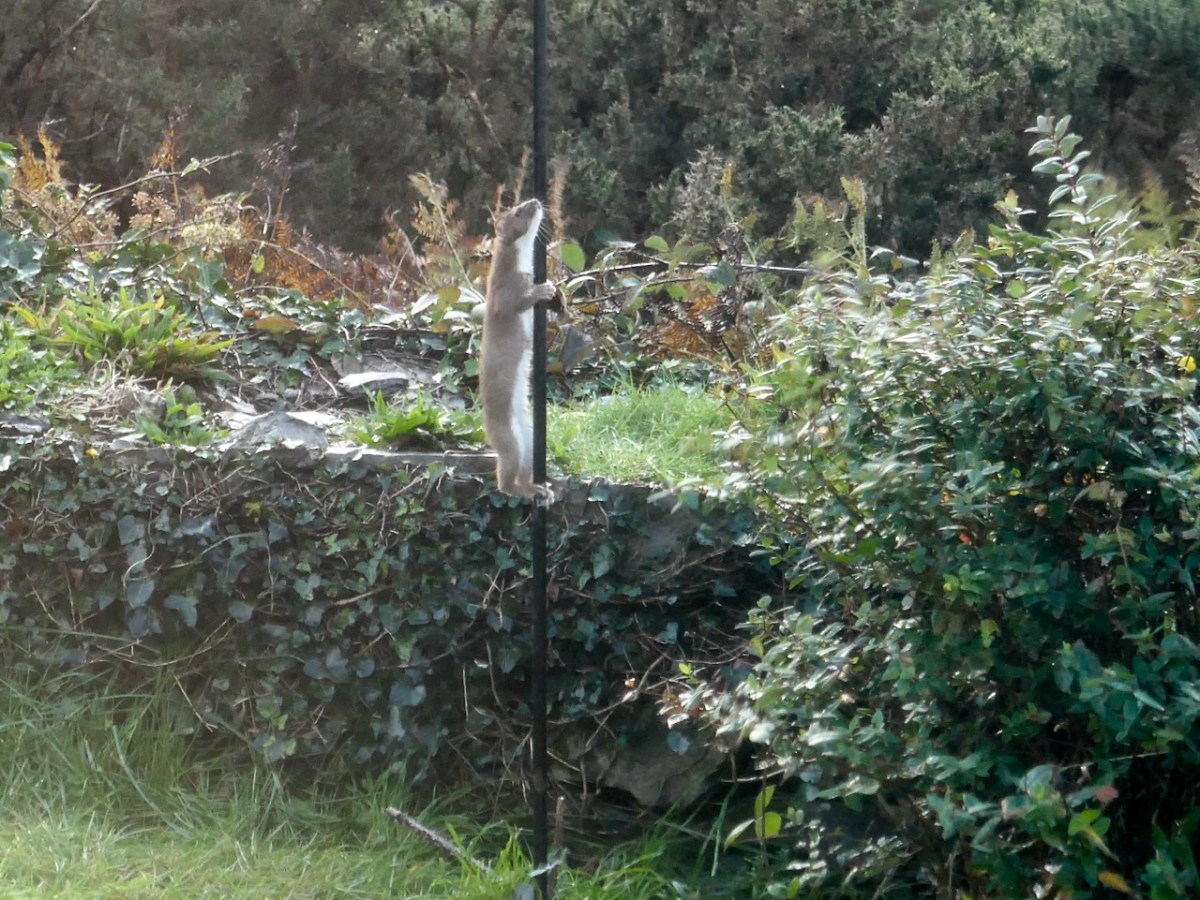
Finola has done her best to clarify the images in the photos she rapidly took through streaming wet glass (above) on this appalling day. The weather did not in any way impede the progress of the animal which circumscribed our whole acre, it seemed, in record time.

. . . The Stoat is often called the Weasel in Ireland, but although the weasel (Mustela nivalis) is very similar in appearance to the stoat, it is not native to Ireland and has never been introduced here. In Ireland the stoat or ‘weasel’ was regarded as a very intelligent animal, but also vengeful. For example, since they were believed to understand human speech, if a stoat was encountered the correct thing to do was to greet them politely. In County Clare the custom was to raise one’s hat in greeting, or even to bow. The person who insulted them, on the other hand, or pelted them with stones, could expect to lose all their chickens before too long. Deliberately killing a stoat was most unwise, since it caused all the deceased animal’s relations to descend on the house of the culprit and attack with great savagery . . .

Ireland’s Animals – Myth legends and Folklore, Niall Mc Coitir, The Collins Press, Cork 2010

The Duchas Schools Folklore Collection – gathered in the 1930s – has numerous entries referring to the stoat. Above is an example from Co Carlow. When I was sifting through these, I was struck by the fact that similar stories about stoats are repeated over and over again, but from different parts of Ireland. I could write a volume based on these accounts, but will choose only a few:

. . . One time there was a girl who was very fond of going to the seaside. One day she went to the seaside and lay down and fell asleep. Ten weasels went down her throat. So she awoke when the last one was going down. She went to the doctor and the doctor said she would need to undergo an operation and then she would die. One day she was going to the shop and her granny knew all about cures. So she went into the granny. Her granny told her to get two pounds of salt and eat all the salt and go to the seaside and drink no water and keep her mouth open and the weasels would have to come out for a drink. So this she did. The weasels came out for a drink. The girl counted them. There were ten in it and the girl came home cured . . .

William O’Donnell, Cabra Glebe, Co Donegal

. . . One day long ago two men went to cut the meadow with scythes. They cut away for a while until they came to a weasel’s nest where there were four young weasels out of the nest and left them near by on the ground. After a while the mother of the weasels came home and found her young on the ground and was very angry, She hesitated for a moment and then understood what the men had done. Now the men had had a can of milk with them for a drink which they left near the weasel’s nest, the old weasel saw the can and went to see what in it. When she saw what was in it she spat into it because a weasel’s spit is poison. When the men saw this they were terrified and put back the young weasels into the nest, and the old weasel was pleased and went back and upset the can and spilt the milk from fear the men would drink of it and be poisoned . . .

James Gormley Senior, Aged 82, Commeen, Co Roscommon

Note that the term ‘Weasels’ is used far more often in these accounts than ‘Stoats’. There can only be the one animal, however, as there have never been true ‘weasels’ in Ireland. The story above, from Co Roscommon, is the most common of all ‘weasel’ tales in Ireland, and variants of it have been recorded from all parts.

. . . Many years ago an old woman lived by herself. There was a nest of weasels under the hearth in the house in which she lived and every day the old woman fed them until they became quite tame. When the young weasels were reared they went off but the old one remained in the hearth. One day the woman was sitting by the fire when the old weasel came out and sat with her. The weasel was continually looking up the chimney and at last the woman said “What the dickens are you looking at?” and at the same time looking up herself. She saw a little bag hanging in the chimney and took it down. To her surprise and joy she found it was full of gold. This was the weasel’s reward for her kindness to her and her family . . .

Mrs L Millett, Fiddaun Lower, Inistioge, Co Kilkenny

. . . The Swarm or Drove of Weasels: the following story or rather fact come from a reliable source to wit a teacher in Ballyshannon. In the end of August or about that time some distance outside Ballyshannon a great whistling was heard as if a number of little birds and a mighty drove of Weasels was seen heading for the mountains. An old man said that he heard that weasels used make for the mountains during the Grouse Season. The Priests housekeeper saw or heard of the same thing in Antrim . . .

J Clarke, Navan, Co Meath

. . . Some time about forty years ago there were children playing on the side of a hill and they saw a few weasels. They started to run and cry. They looked round and saw thousands coming after them. Only they got away the weasels would have devoured them . . .


Written by Kathleen McKenna Bragan, Co Monoghan 25th November 1938

I couldn’t resist that little foray into weasel stories from the Folklore Collection. There are many many more pages full of them! Interestingly, stoats are a fully protected species in Ireland. If stoats are proving a problem, by killing chicks or other domestic animals, you must solve the problem by using good fencing; it is illegal to kill a stoat.

A possible reason for the attention which stoats attract in folklore is the fact that they can change colour, which adds a sense of the supernatural to them. In countries which have harsh winters the coat of the stoat becomes white in those months, offering a level of protection in the open landscape. The fur from the white – or ‘winter’ – stoat we call ermine, and the white fur is considered so precious that only royalty or nobility traditionally wear it. In the drawing above, the white stoat is wearing a cloak on which are printed the symbols of the flag of Brittany (below), which was an independent kingdom in medieval times. The white background represents the ermine fur, and the black markings are said to be based on the black tip of the tail which the animal retains, even in the winter.
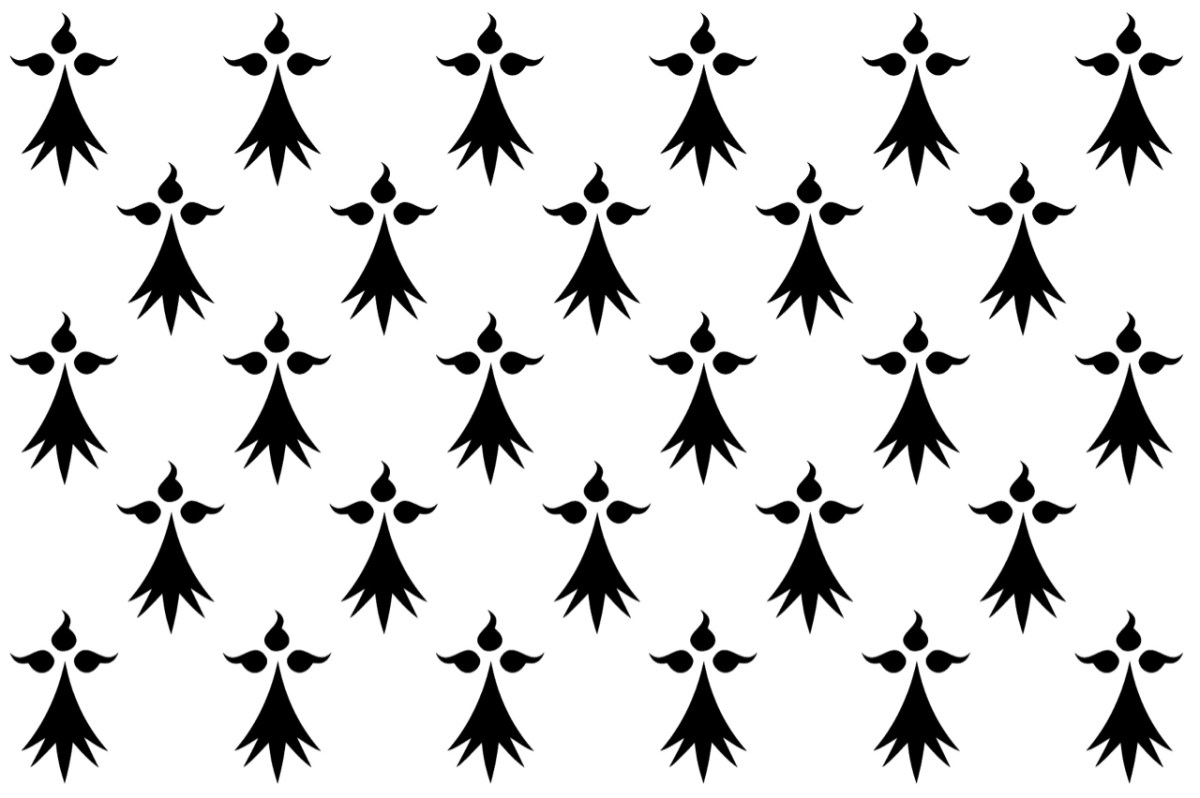
Here (above) is another example of the Breton ermine representation: a finely worked silver antique brooch. In Ireland, the species of stoat which has evolved – Mustela erminea hibernica – does not usually turn white in winter, although examples have been noted. The animal is said to have been resident in Ireland from the post-glacial period and, in the present day, the population numbers are unknown: it is not a threatened species.

In spite of our attempts to care for Fidelma, she did not survive. Sadly, I decided to let Nature have her way and laid the body close to a fox-track above the house. Later, I noticed an assembly of corvids gathered in the area. When I returned there in the evening all traces had gone – just a few scattered feathers told the tale.
This morning, Finnbarr was absent from the garden. I did catch a glimpse of him wandering the distant pastures – forlorn and bereft. At least, those are the feelings my human soul projects onto him. He will find another mate, of course, and we hope they will continue to share our little bit of paradise. We will keep a lookout for unwelcome visitors, but we will always have to pay our respects to the ‘weasels’. If our stoat does return we will have to honour him with an Irish name: I am inclining towards Fiáinín – which means Little Wild One.

Lady with an Ermine, painted 1489–1491 by Leonardo da Vinci. The subject is said to be Cecilia Gallerani, the mistress of Leonardo’s Milanese employer, Ludovico Sforza. The Ermine is symbolic, rather than realistic – in fact it is pictured much larger than in real life. It has been suggested that the ermine in classical literature relates to pregnancy, sometimes as an animal that protected pregnant women. Around the time of the painting’s creation, Cecilia was known to be pregnant with Ludovico’s illegitimate son.
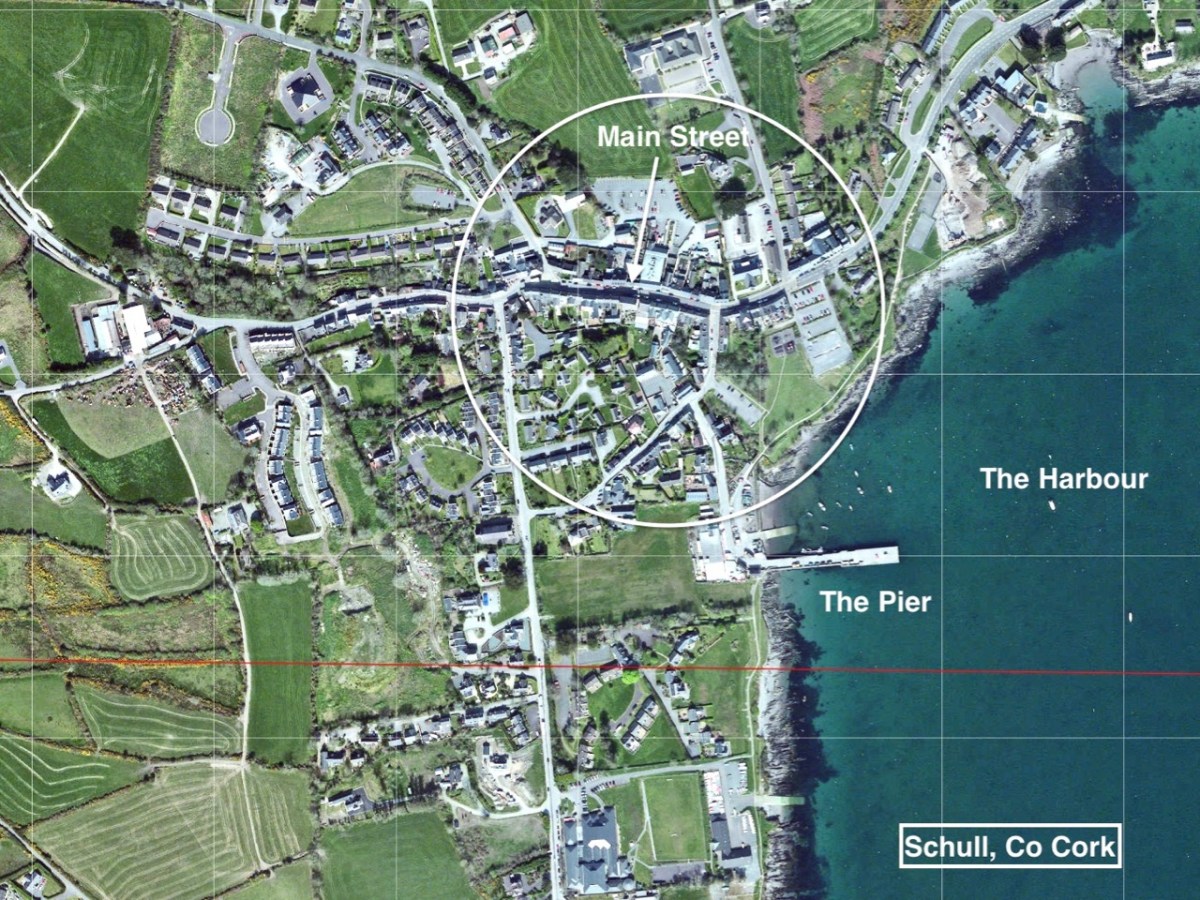
West Cork Villages and Towns – Schull

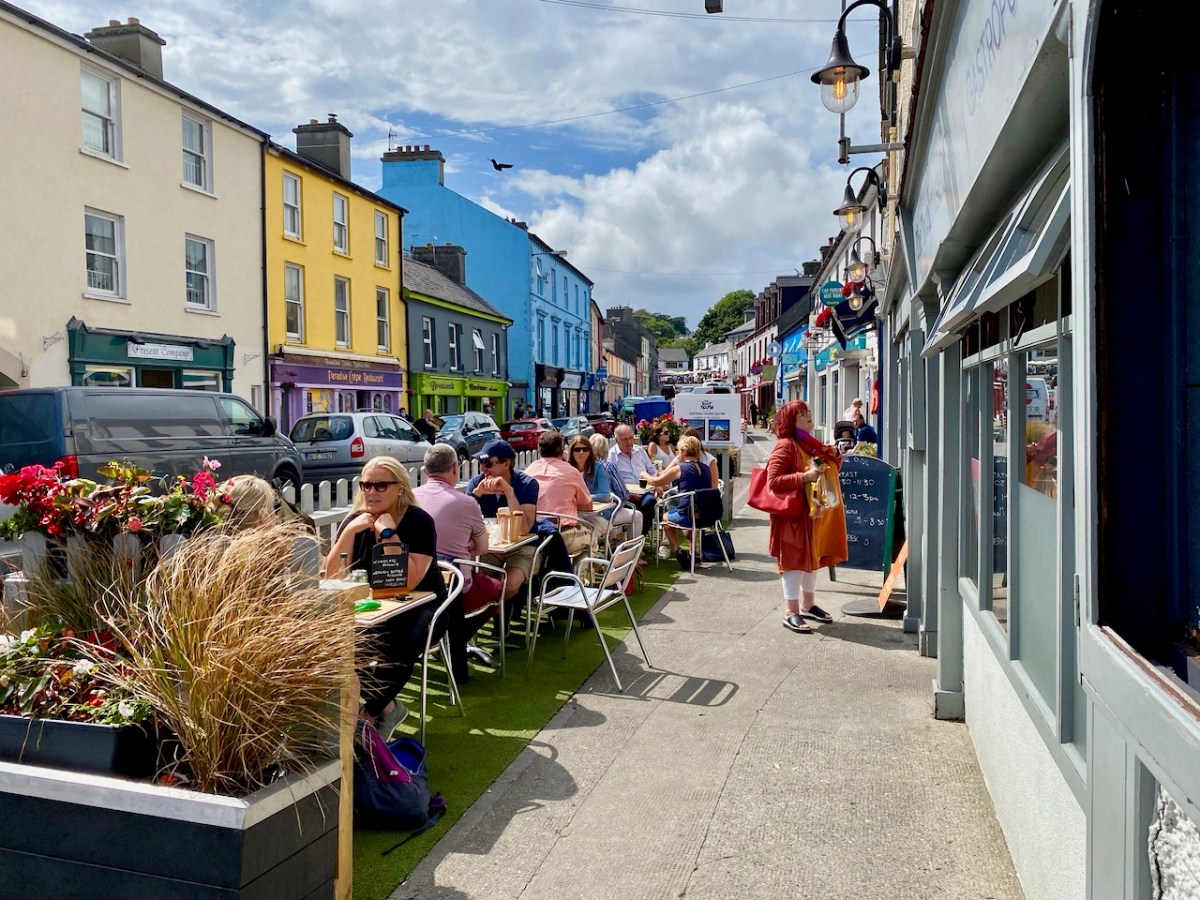
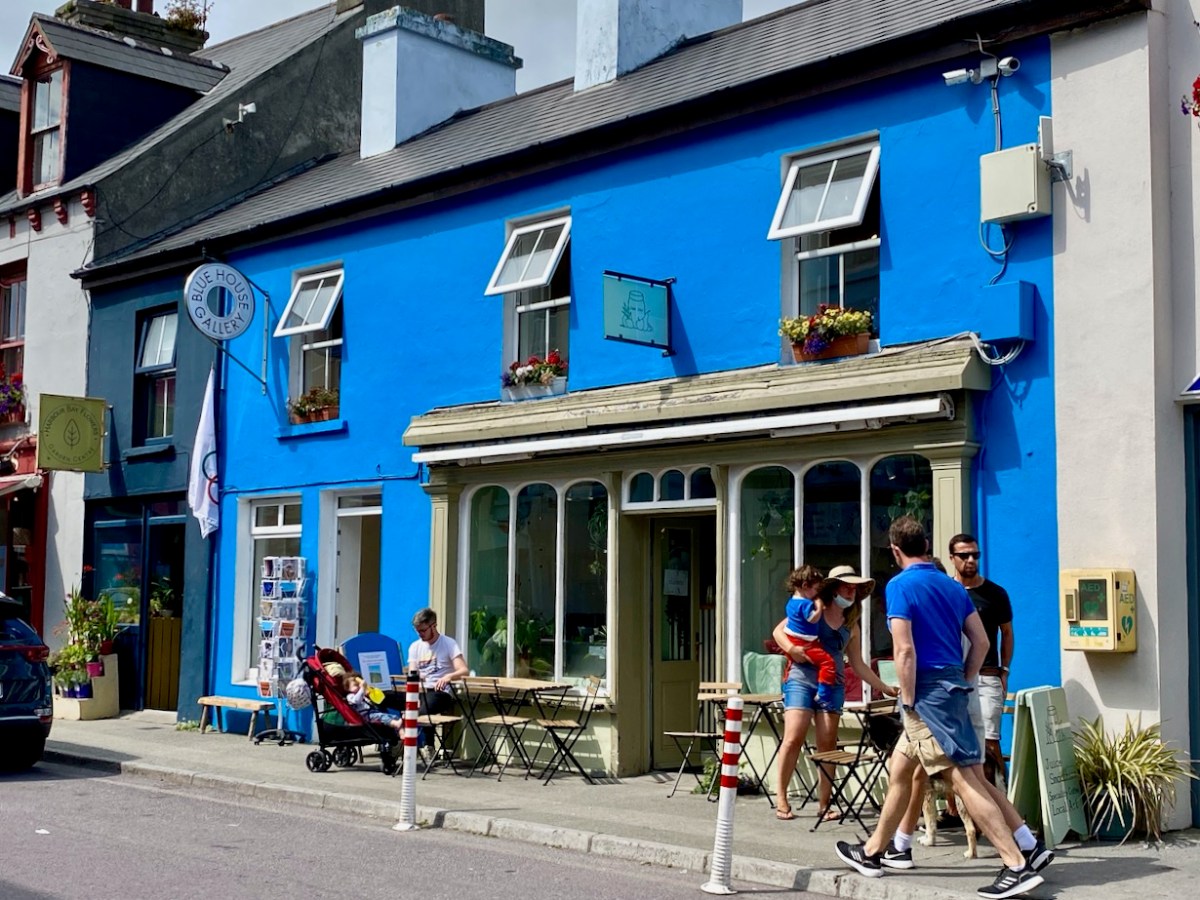
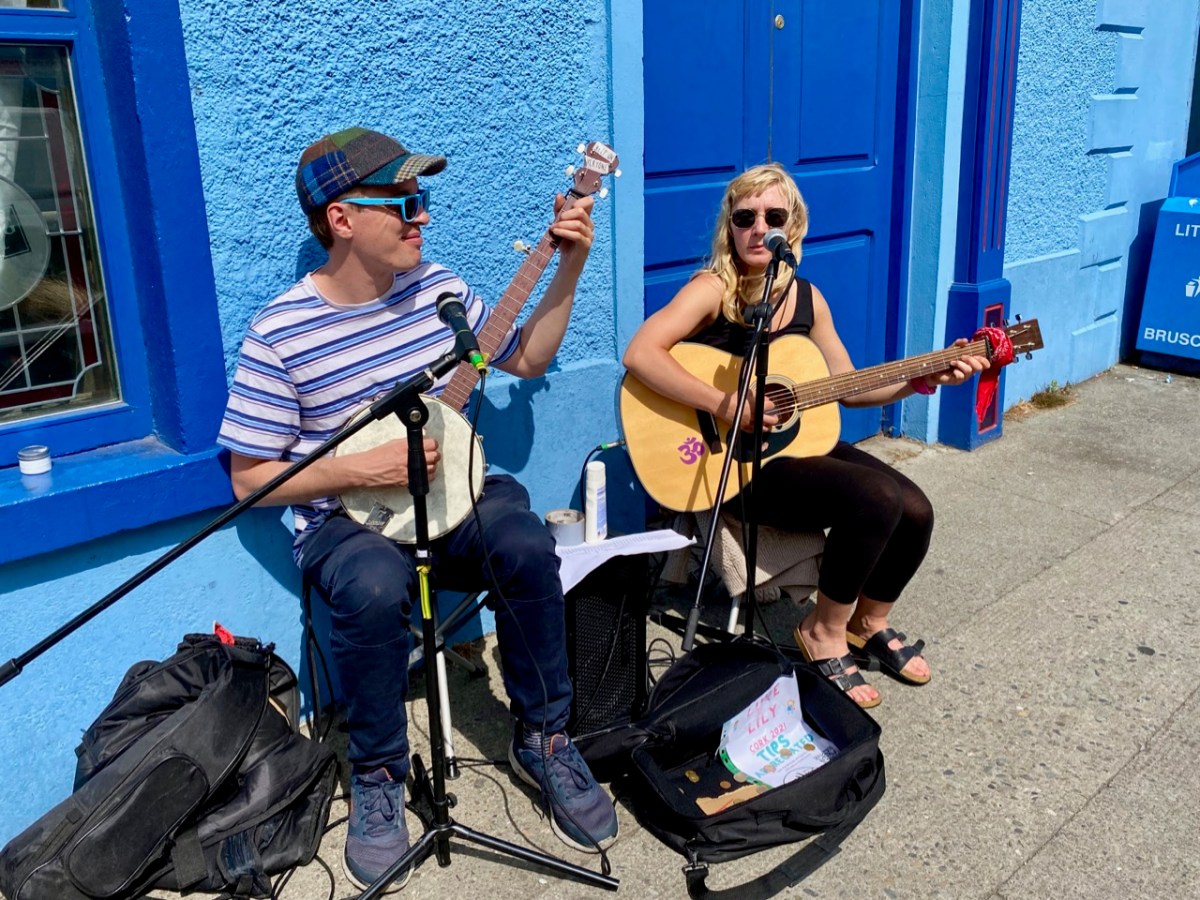
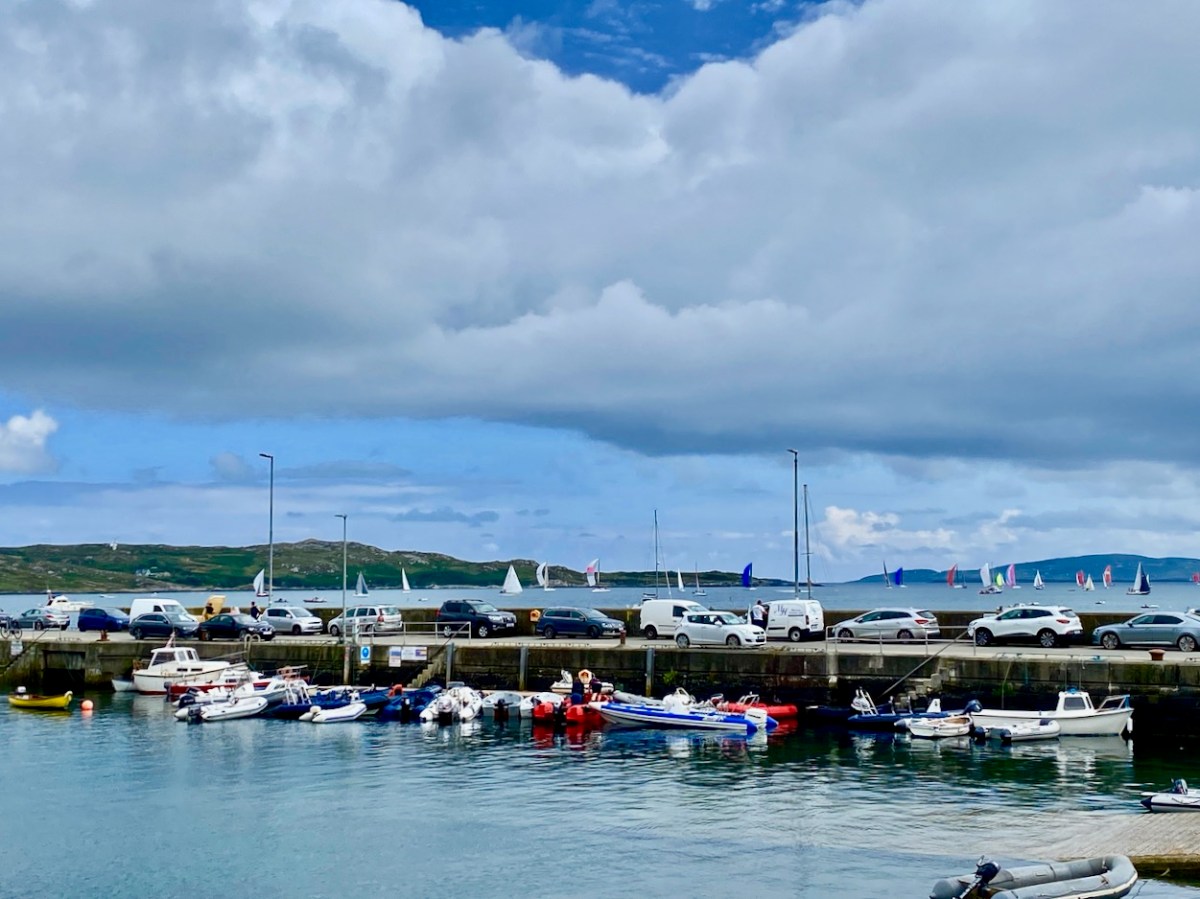
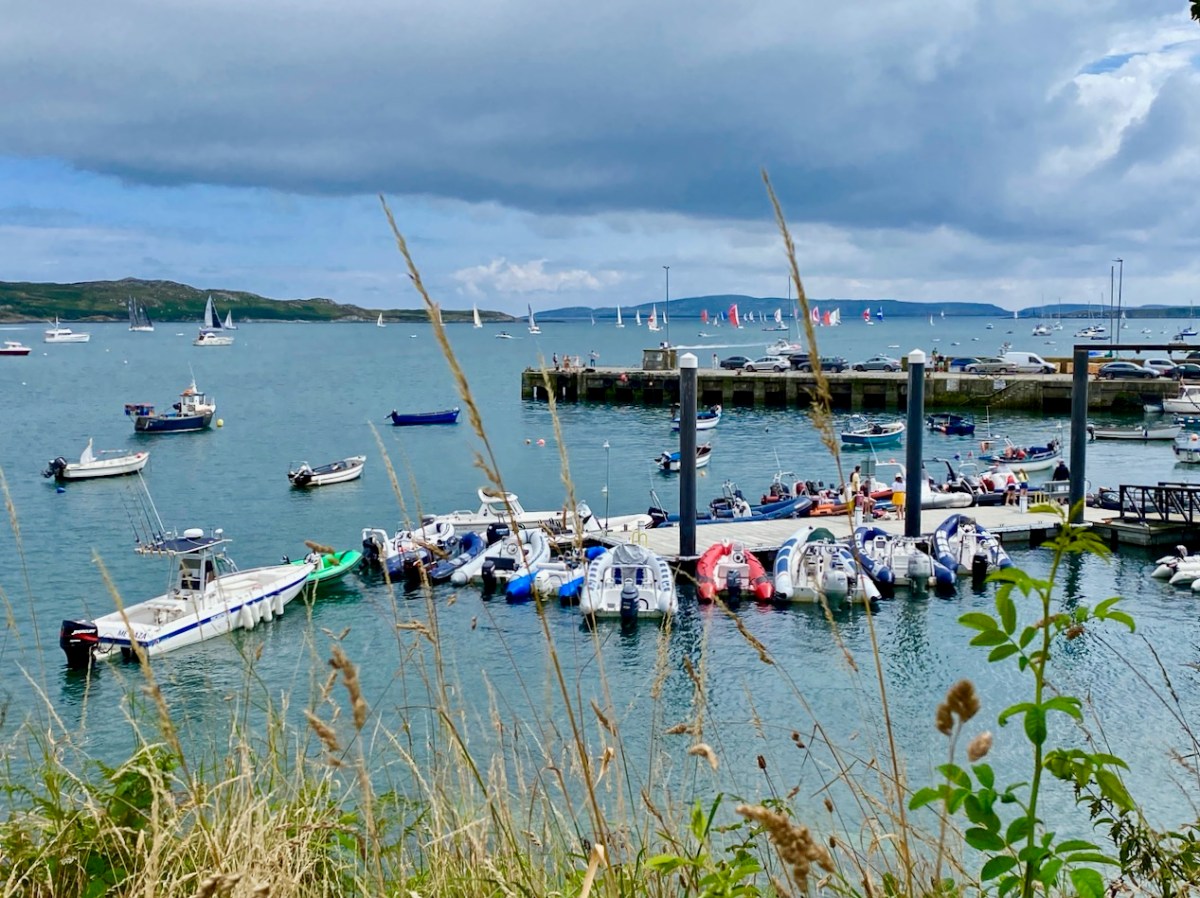
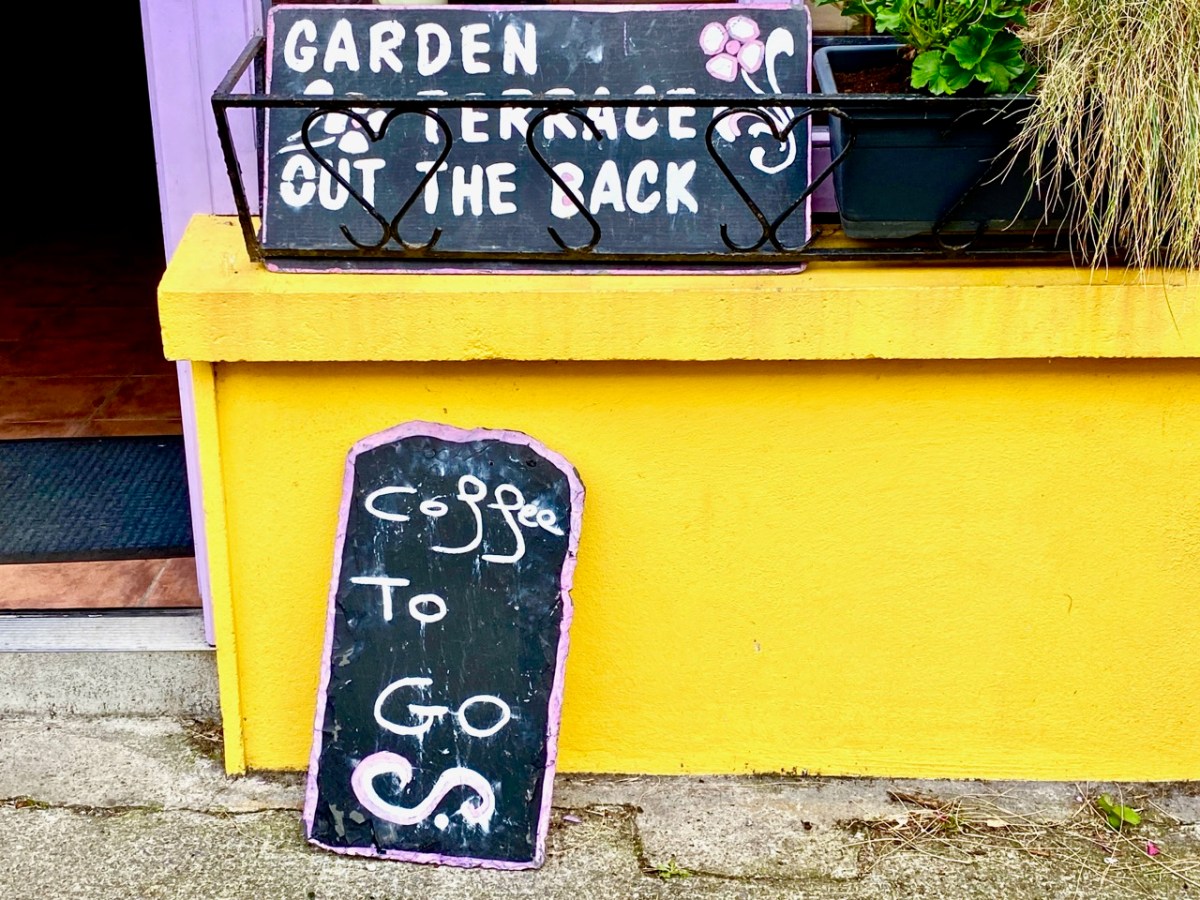
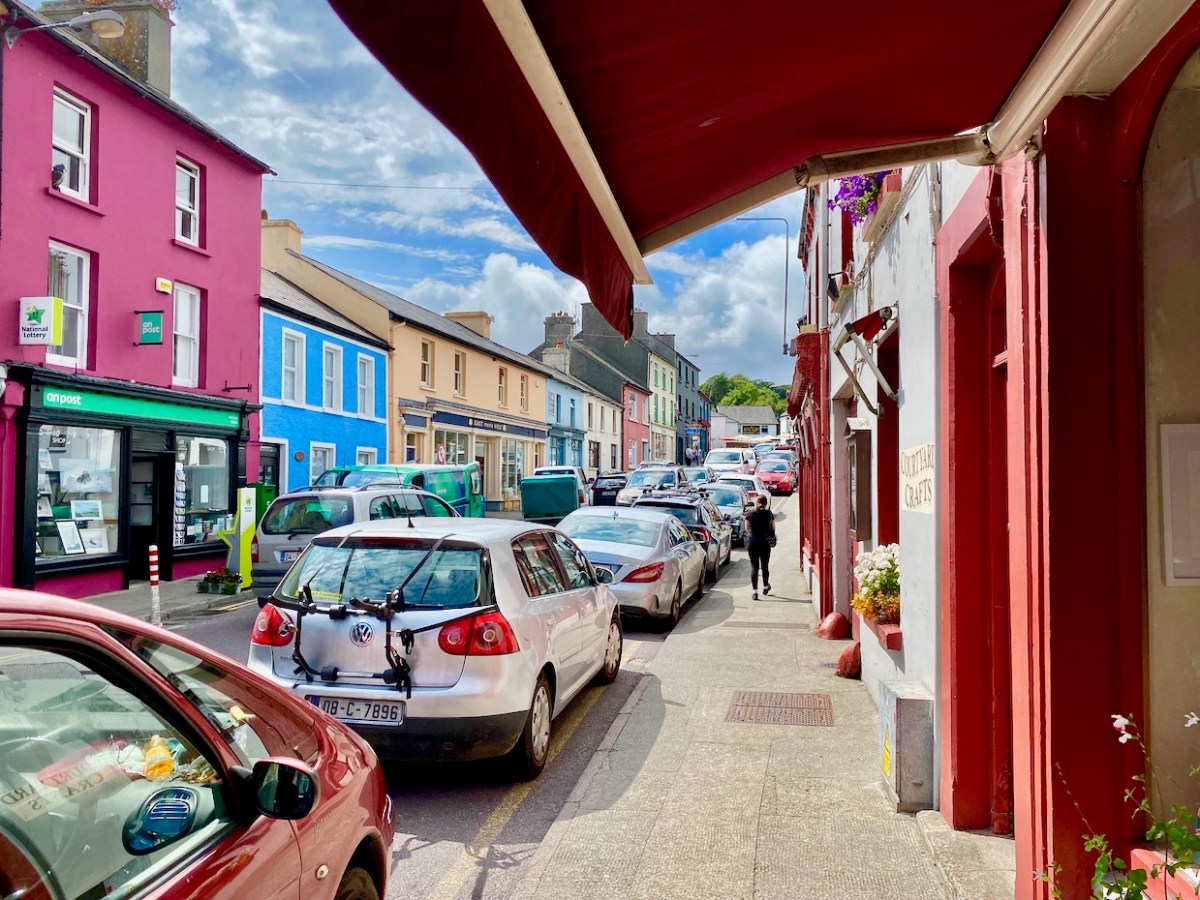
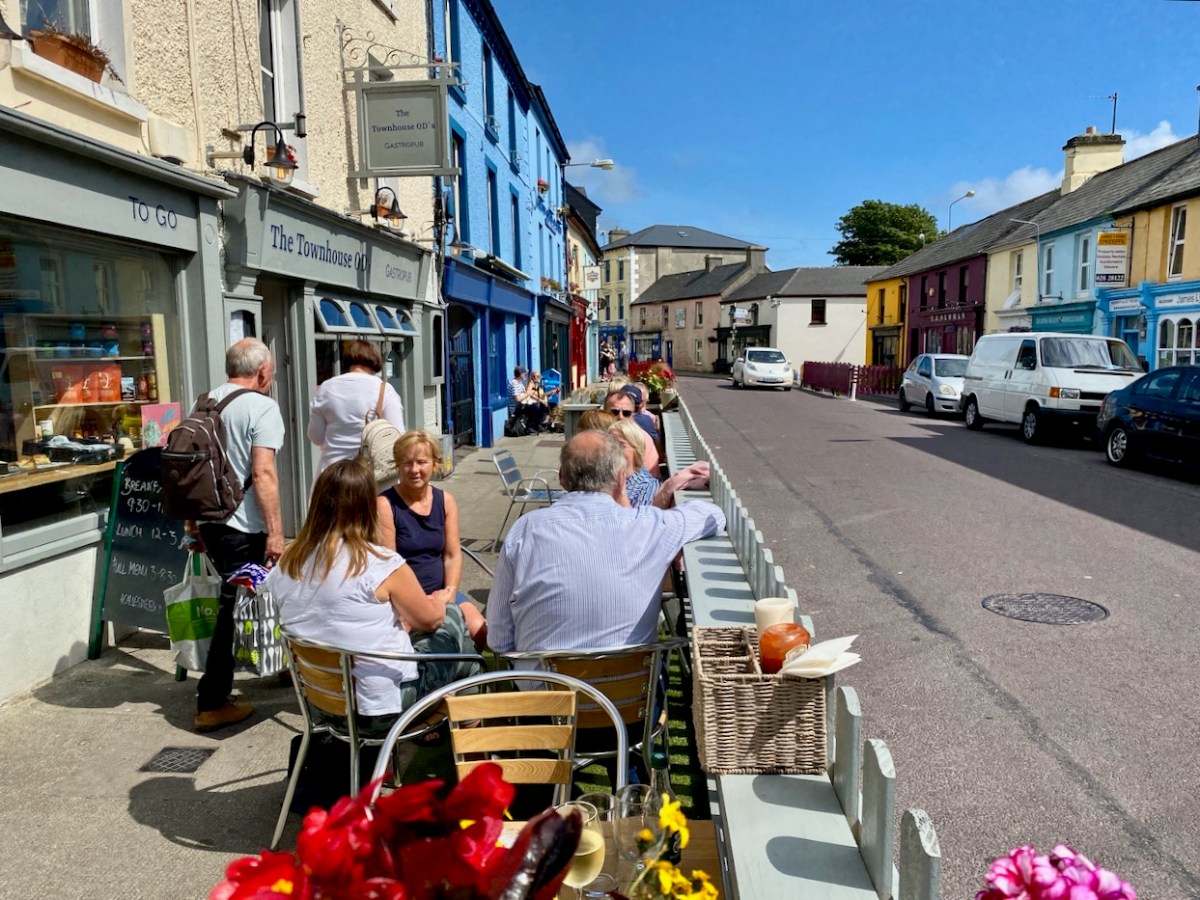
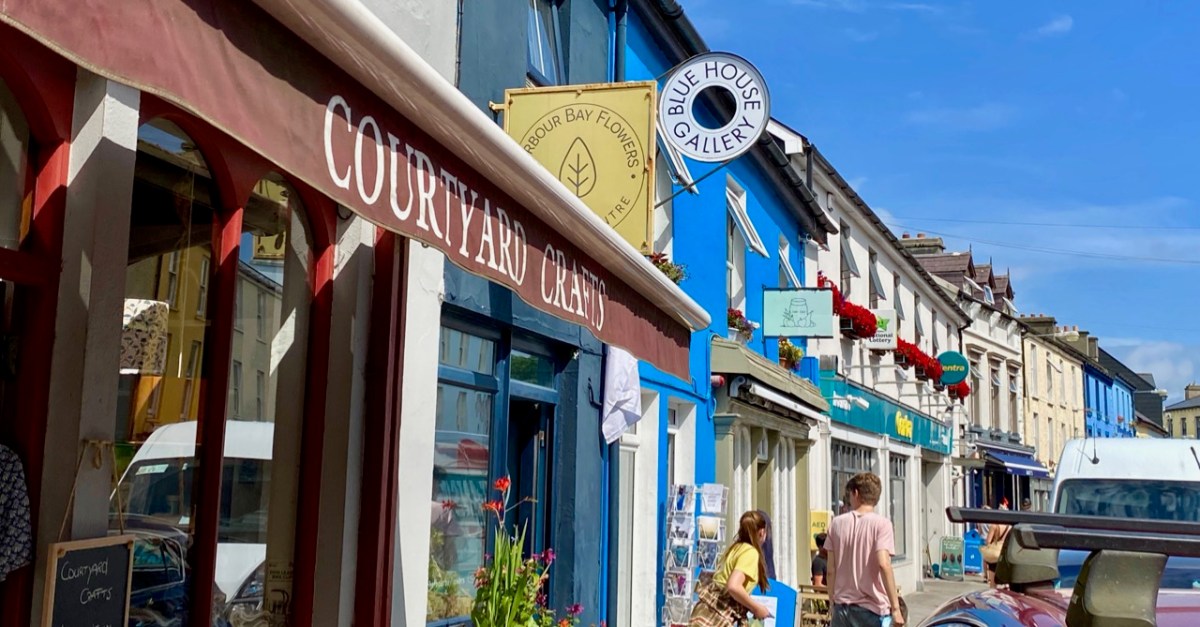
What better time to visit Schull than during Calves Week? That’s a big sailing festival at the beginning of August every year, and you have to be a sailor to understand the nuances of its title. It’s held at the same time as the UK’s premier sailing event – Cowes Week, ‘…the world’s longest running sailing regatta…’ and is focussed around the three Calf Islands in Roaringwater Bay. So there you have it – Cowes and Calves! What it means, of course, is that the village of Schull is at its busiest and, since Covid has given a boost to outdoor socialising, the streets are crowded with visitors enjoying the shops, pavement cafés and galleries.

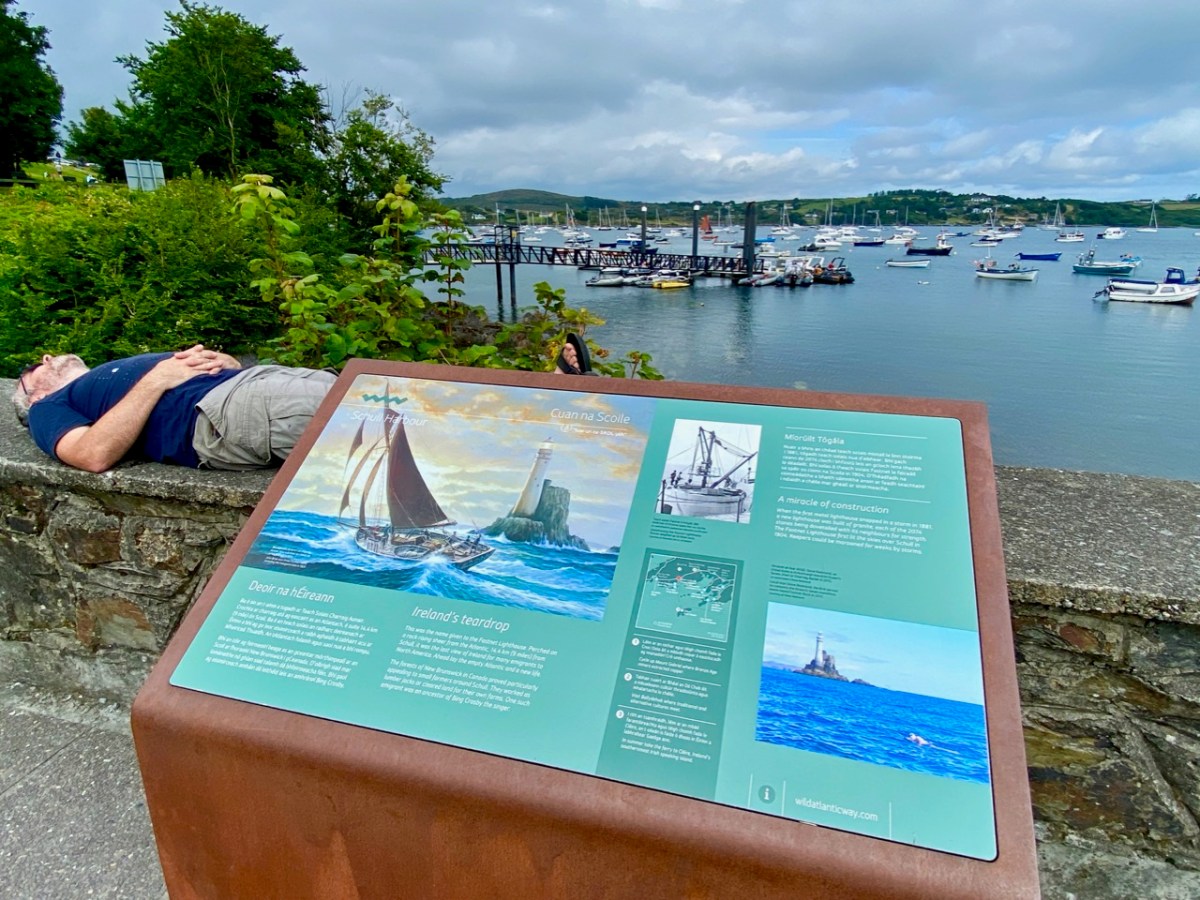
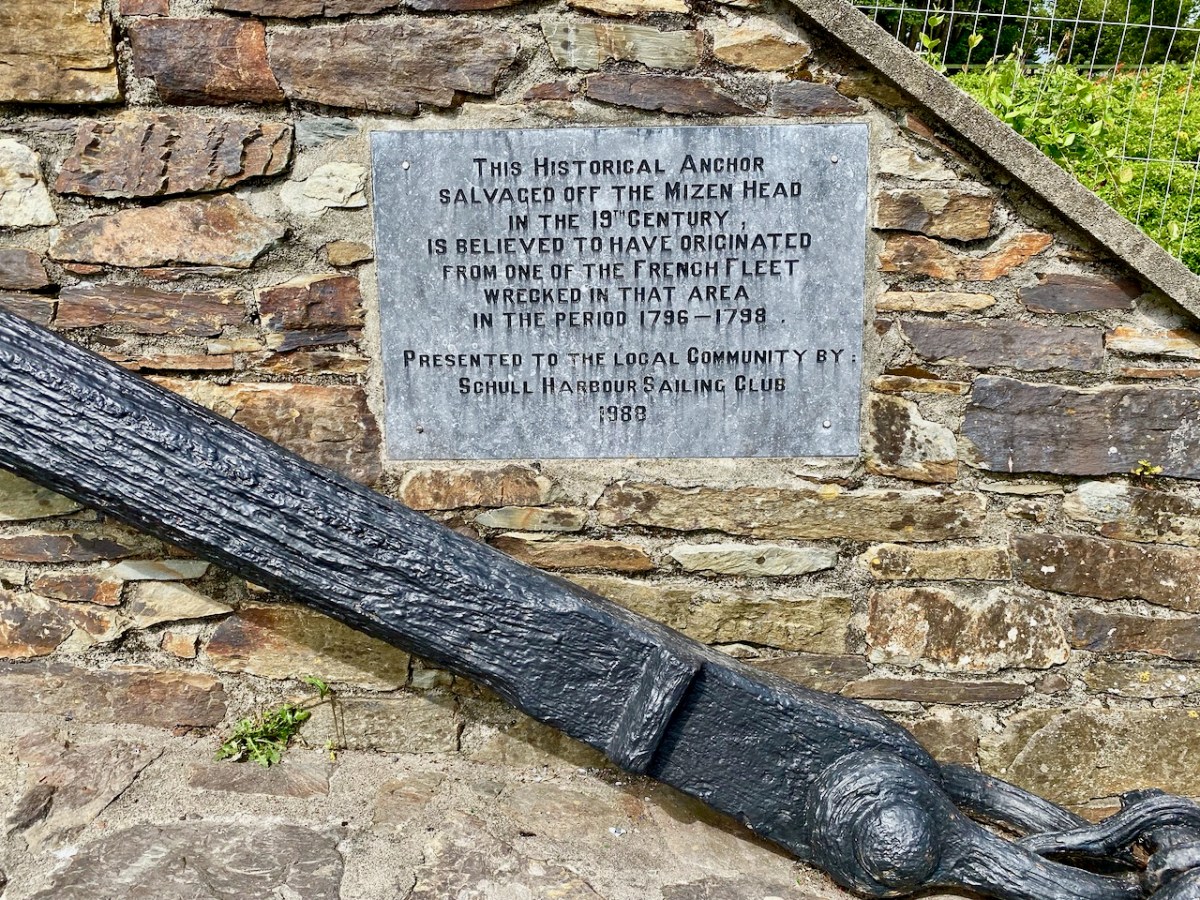
In this occasional series on the Towns and villages of West Cork we will take one community and try to discover why and how it has developed through history, and how it fares in the present day. A snapshot of the place will be presented – hopefully – in the best possible light (although this won’t always be on a sunny summer’s day!) From the aerial view above, you can see how Schull has been built up around its connection with the water. Schull Harbour is at the head of a long sheltered inlet, and the pier today is always busy with fishing and pleasure boats, ferries and yachts.

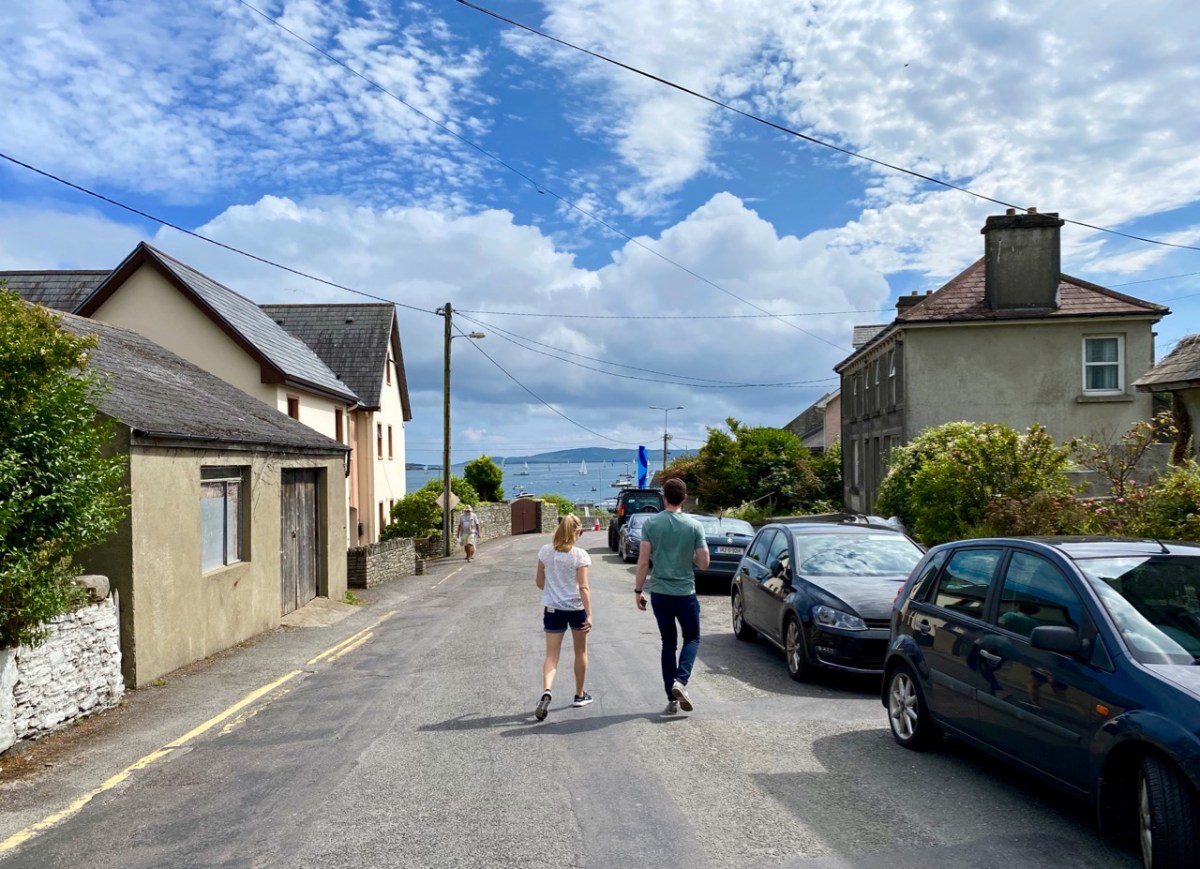
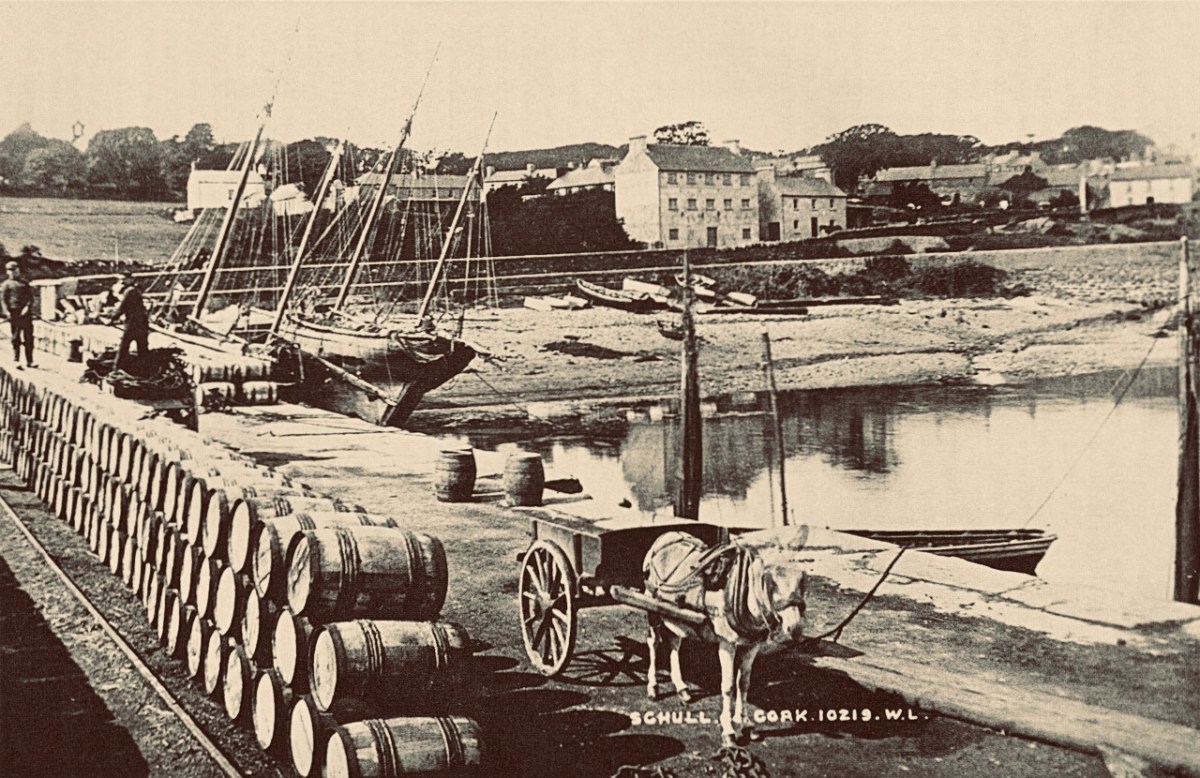
That’s the road to the pier, above, and it’s just a few steps from the village centre. If you are a visitor, you may have no idea that Ireland’s most south-westerly railway line once ran right on to this pier! The narrow gauge Schull, Ballydehob & Skibbereen Tramway and Light Railway was in service between 1886 and 1947, connecting these remoter parts of the county to Skibbereen and then, via the main line, Cork city. Although never considered a commercial success, it was a valuable element of infrastructure enabling local passengers to get to shops and markets, and fishermen to send their catches to distant merchants as hastily as possible (bearing in mind there was a speed limit of 15 miles per hour on most of this rural line). This photograph from the NLI Lawrence Collection (below) dates from the 1890s, and shows barrels of fish stacked up next to the railway track on Schull pier, awaiting despatch. They are likely to contain salted pilchards and herrings.

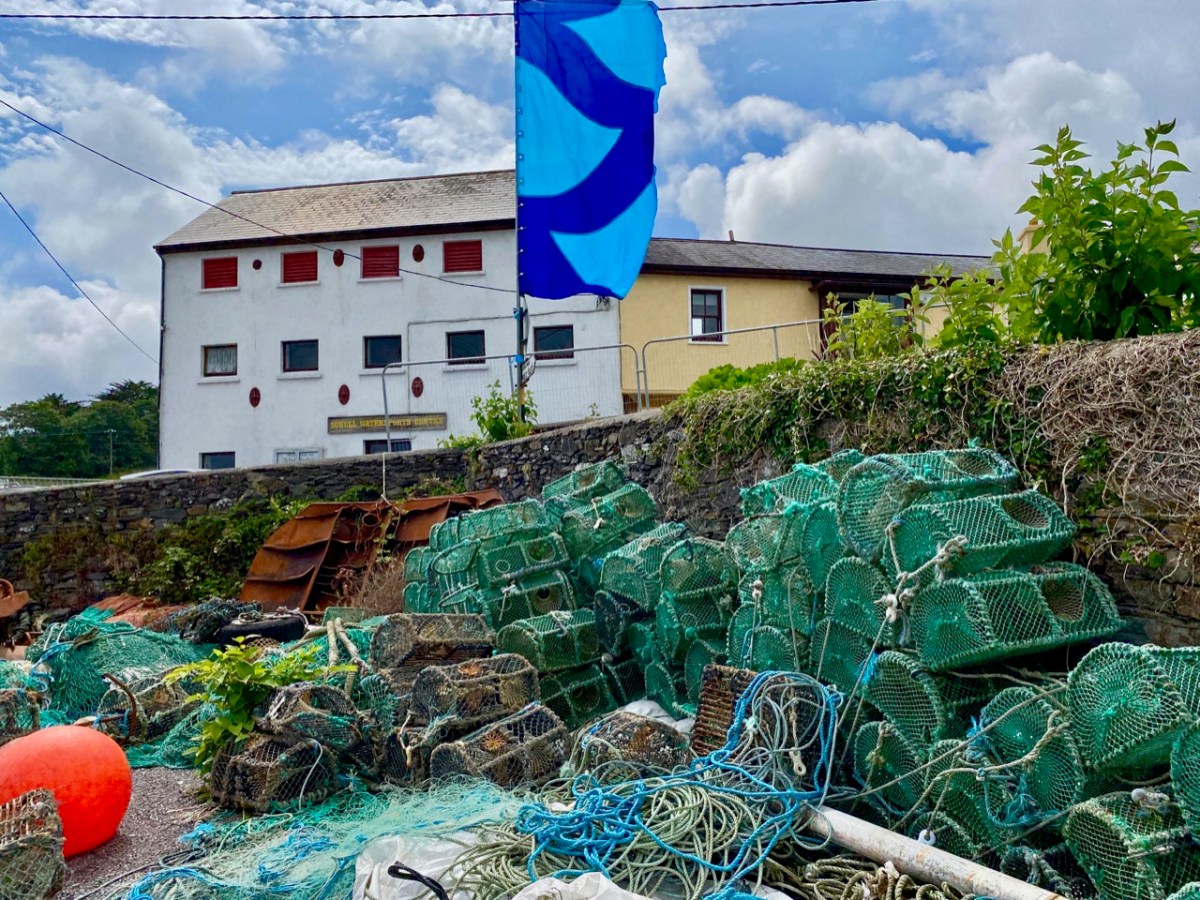
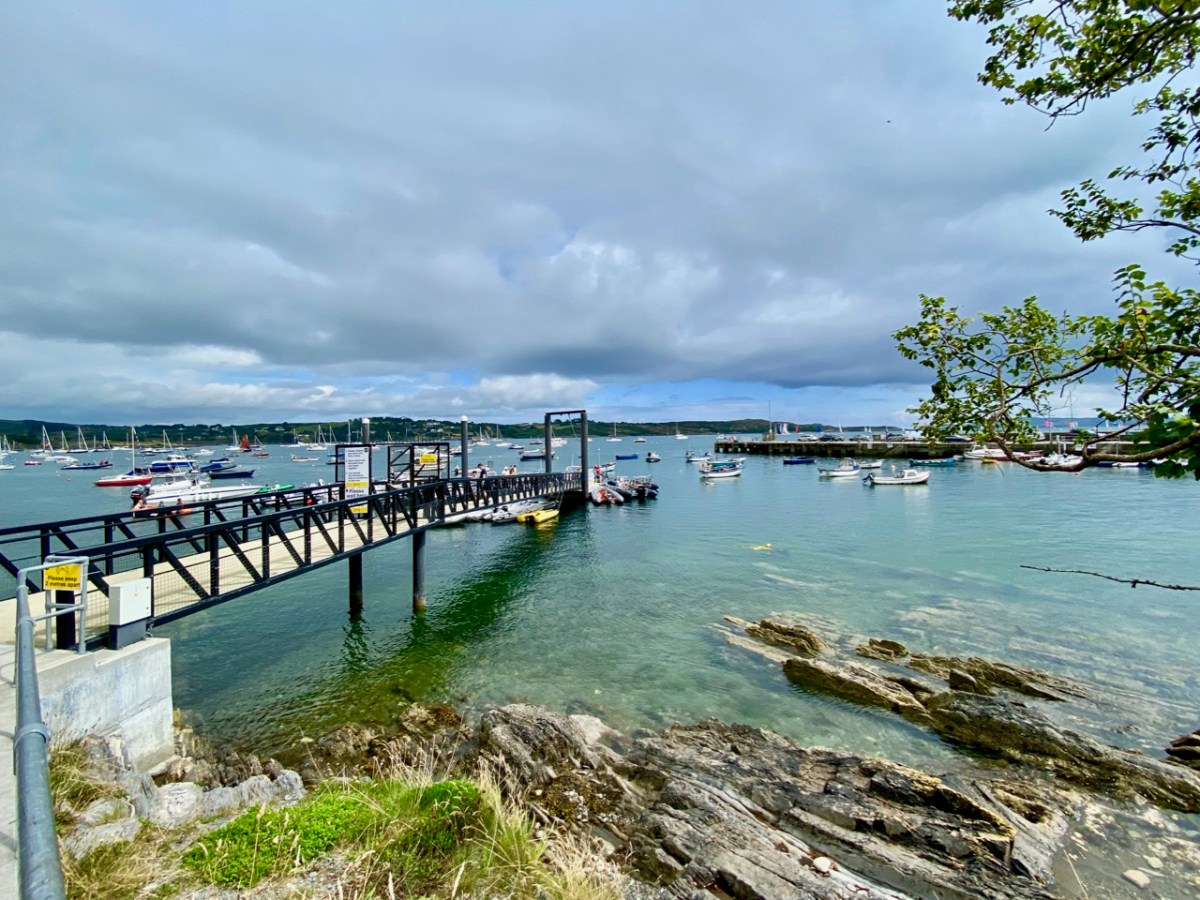
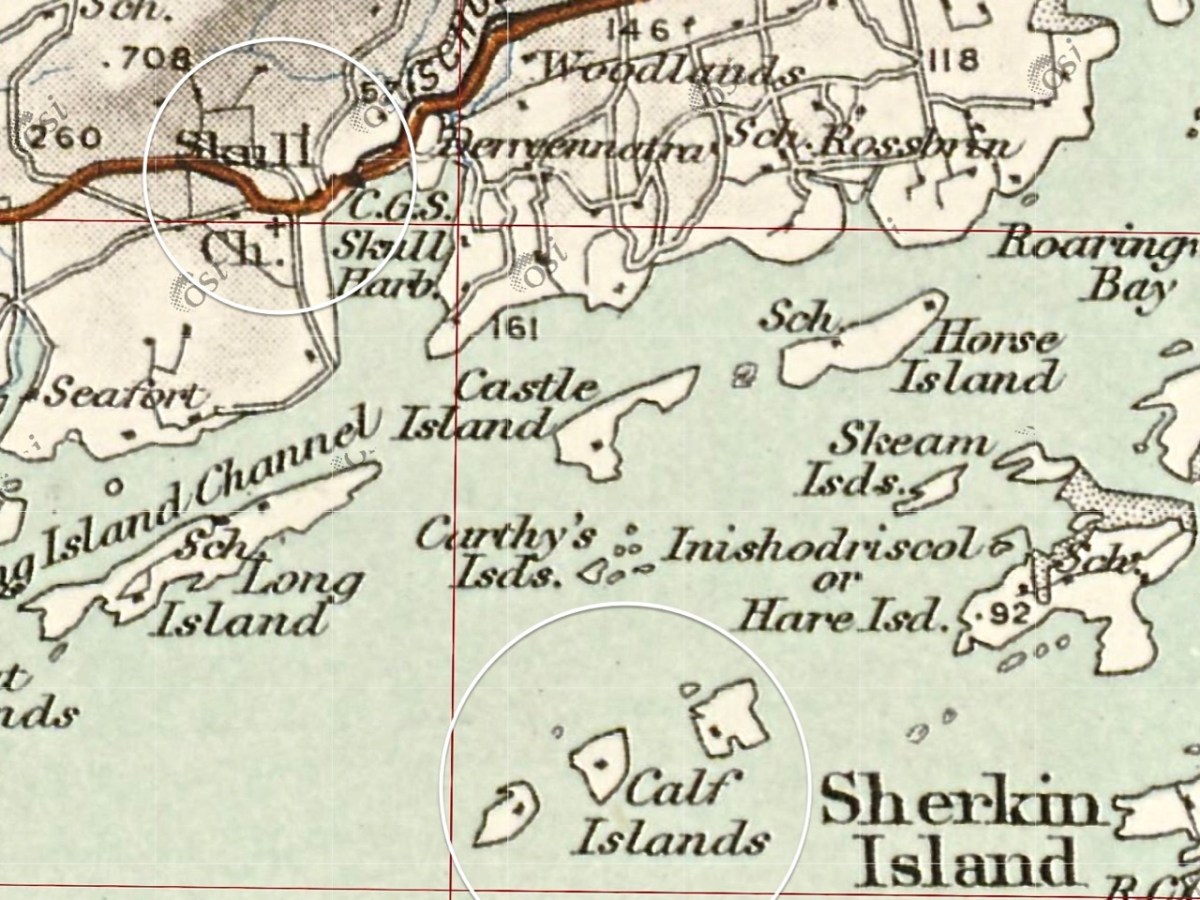
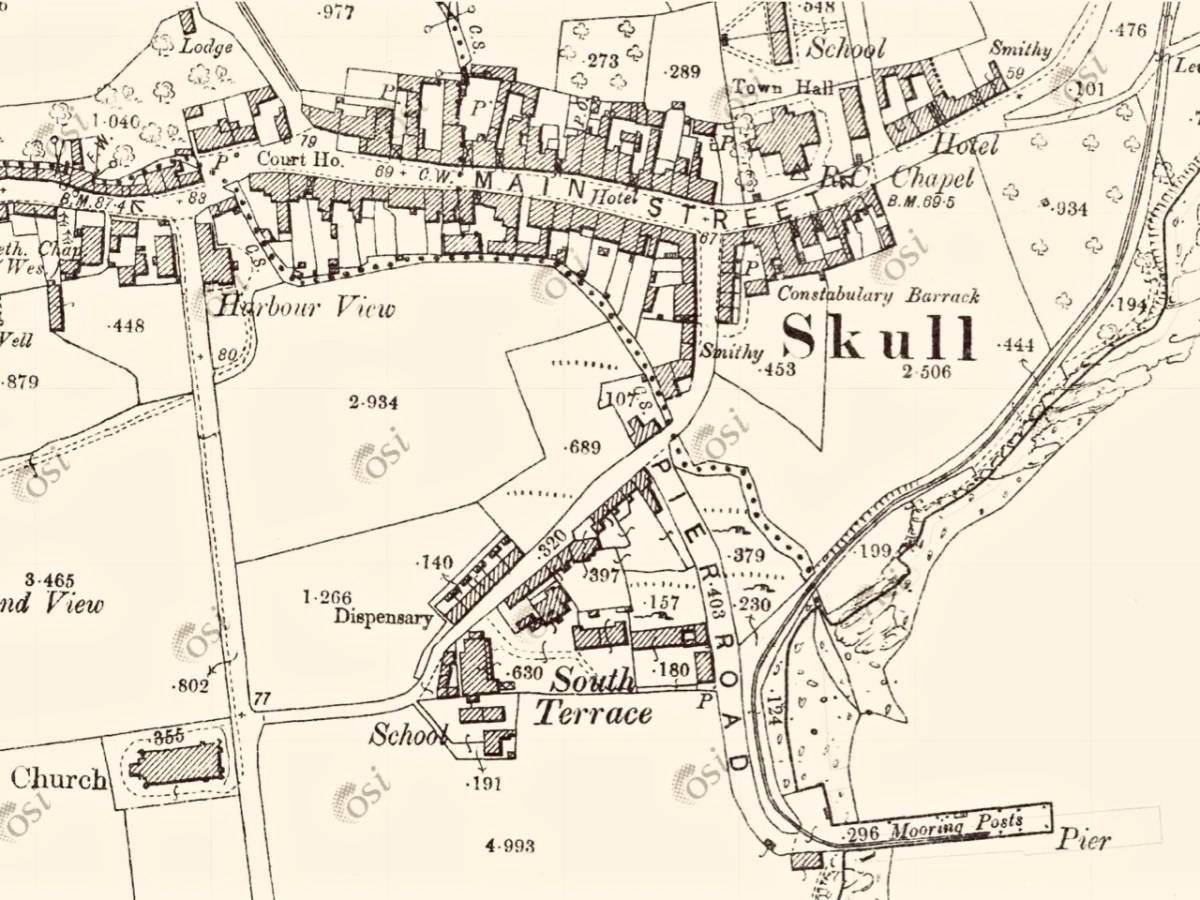
In all these pictures of the pier and pontoon areas above you can see the lively sailing activity in the background. Below are two extracts from early OS maps, one showing Schull and its location to some of the offshore islands, and the other showing the town centre, probably around 1890. It’s thought-provoking to see on the latter the various facilities which the town offered at that time, as well as the railway: Court House, Constabulary Barrack, Smiths, Schools, Hotel and Dispensary.

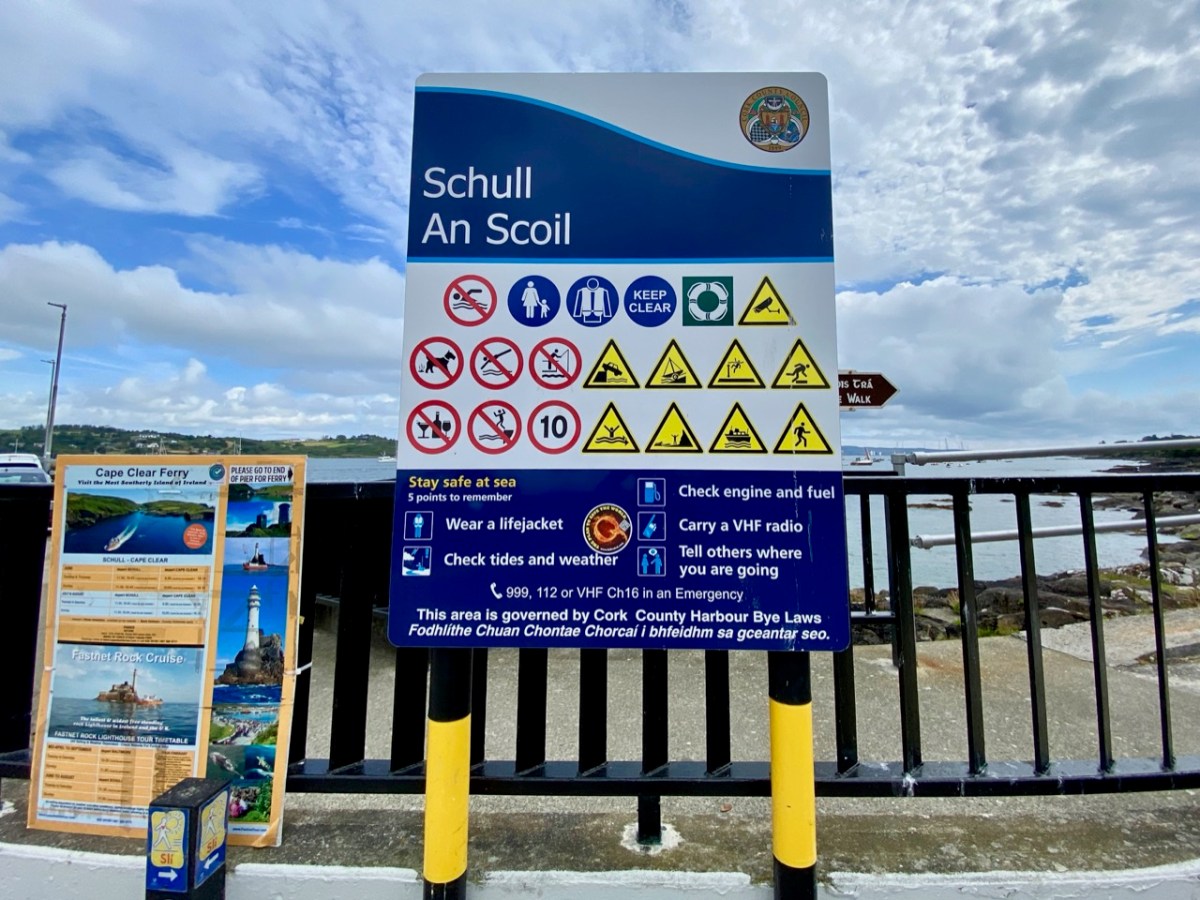
Note that on both the maps above, which date from more than a century ago, the settlement’s name is given as Skull: it still is on all OS Ireland maps up to the present time. Mostly today it’s known as Schull, or in Irish An Scoil, which translates as The School. Some of you may remember my posts earlier this year when I looked in to the possible origins of this village name – and the earliest ‘School’: a site described on Archaeology Ireland as a ‘possible early Christian settlement’:  . . . the ancient school of Sancta Maria de Scholia, ‘a place known in early times as a centre of learning’ . . . There’s a fair bit of local lore surrounding the subject, and you need to read Schull resident John D’Alton’s article on this to find an alternative view to the perhaps romanticised ideas of an ancient monastic site: I’m sitting on the fence!

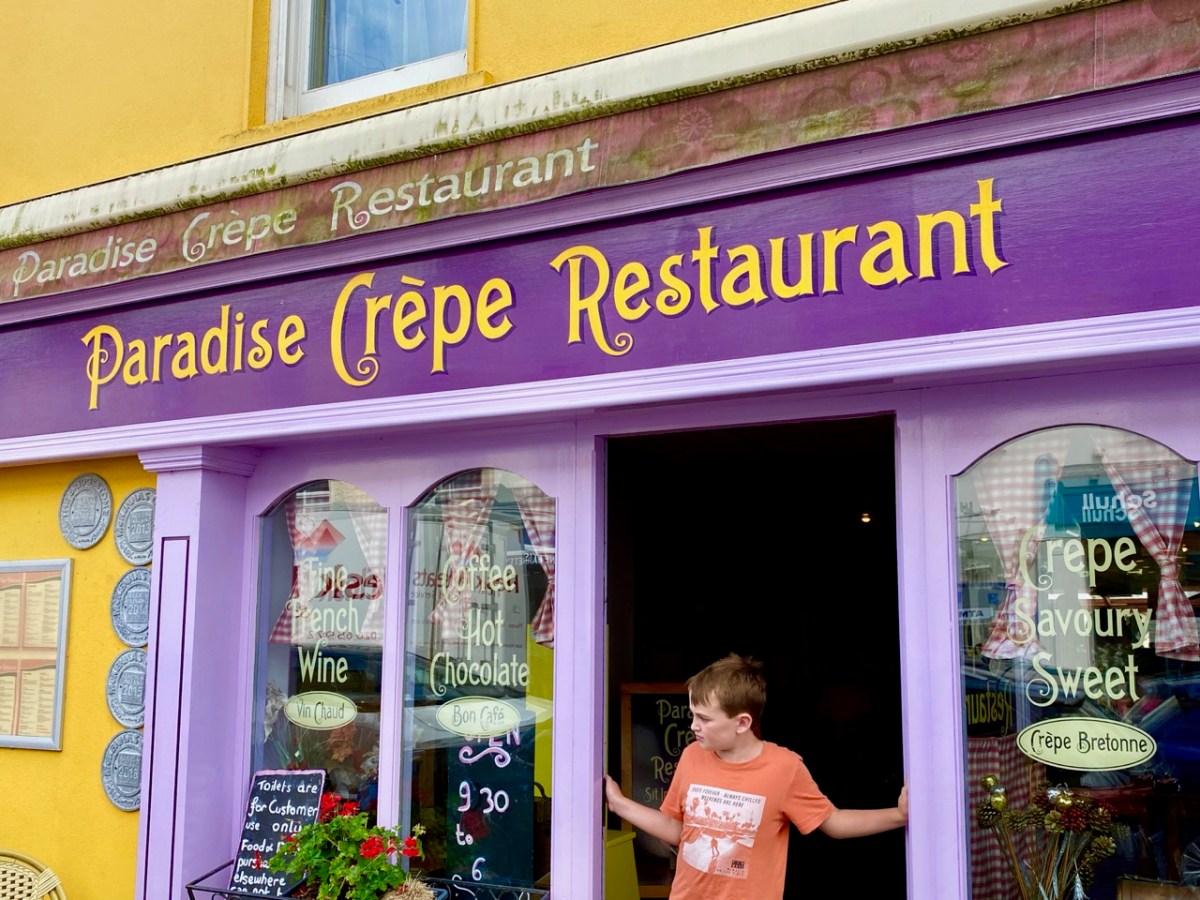
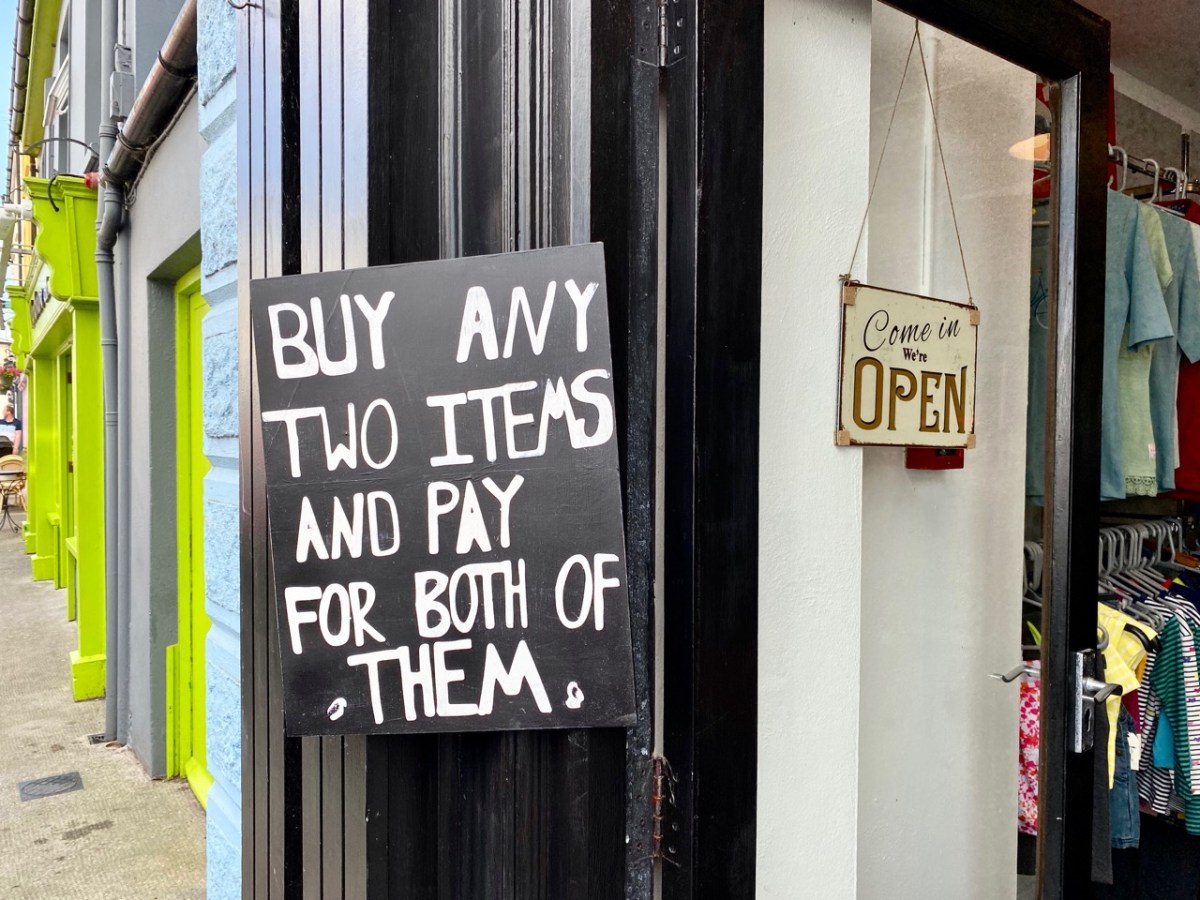
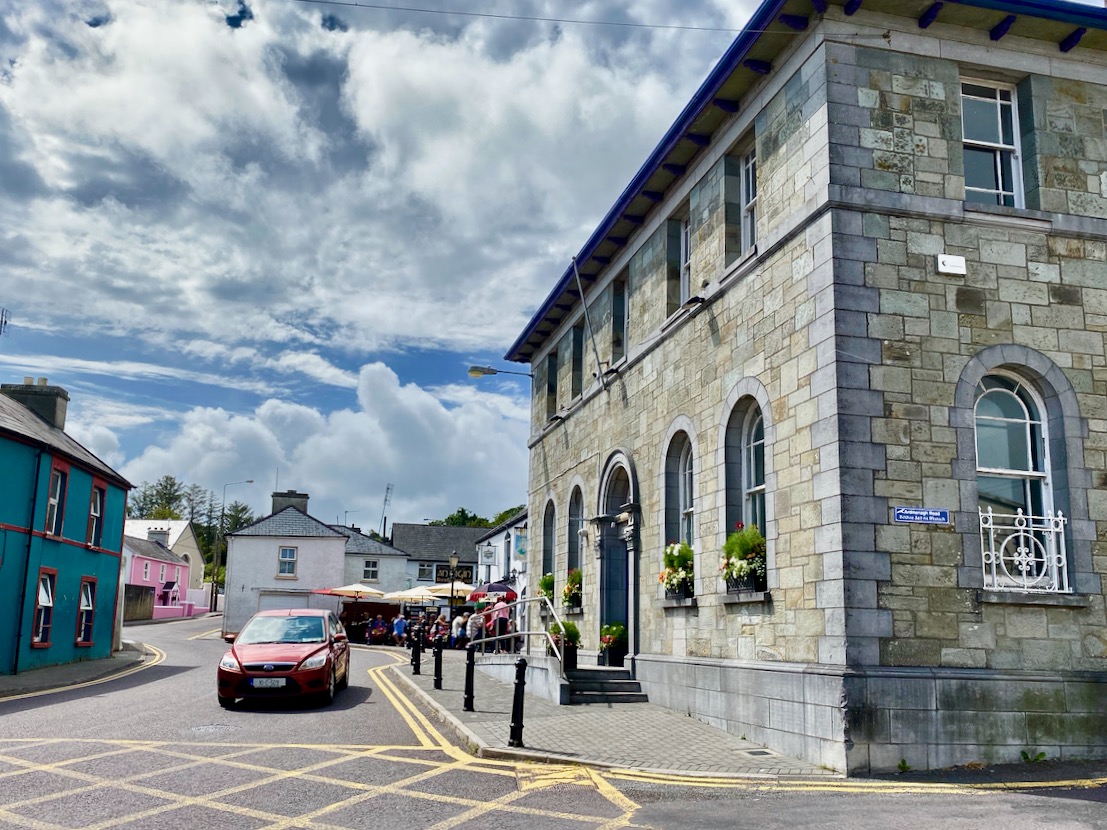
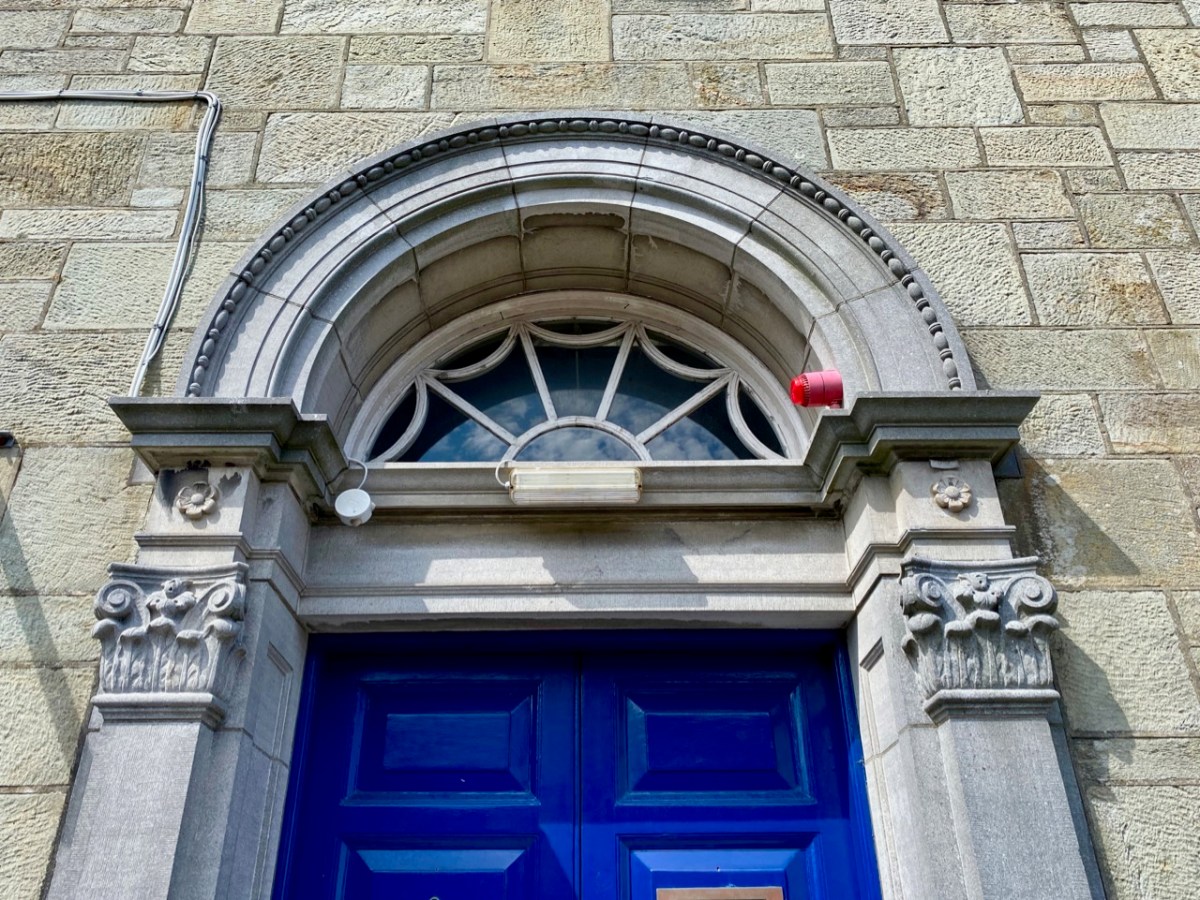
Historic village – perhaps with medieval origins – to vibrant sailing centre and colourful streets in the 21st century. Schull has come a long way, and has far to go. Today the resident population numbers around 1,050: this is boosted substantially with the influx of summer visitors. It’s good to see long established names and new businesses on the streets, contributing to the colourful palette of the architecture. Great things are happening in the future: the old bank building (below) is to become a cinema and film centre: a focal point for the acclaimed annual Fastnet Film Festival.

Year round, Schull is worth exploring. Mount Gabriel, the area’s highest point, is above the village and offers superb vistas over the bay and islands. Finola has looked at the many legends associated with this peak and there is ancient history there, too: the remains of Bronze Age copper mines on its slopes. Good walks can be had on the high ground and on the coastal footpaths – see the Explore West Cork website.

Long Island Wildflower Walk

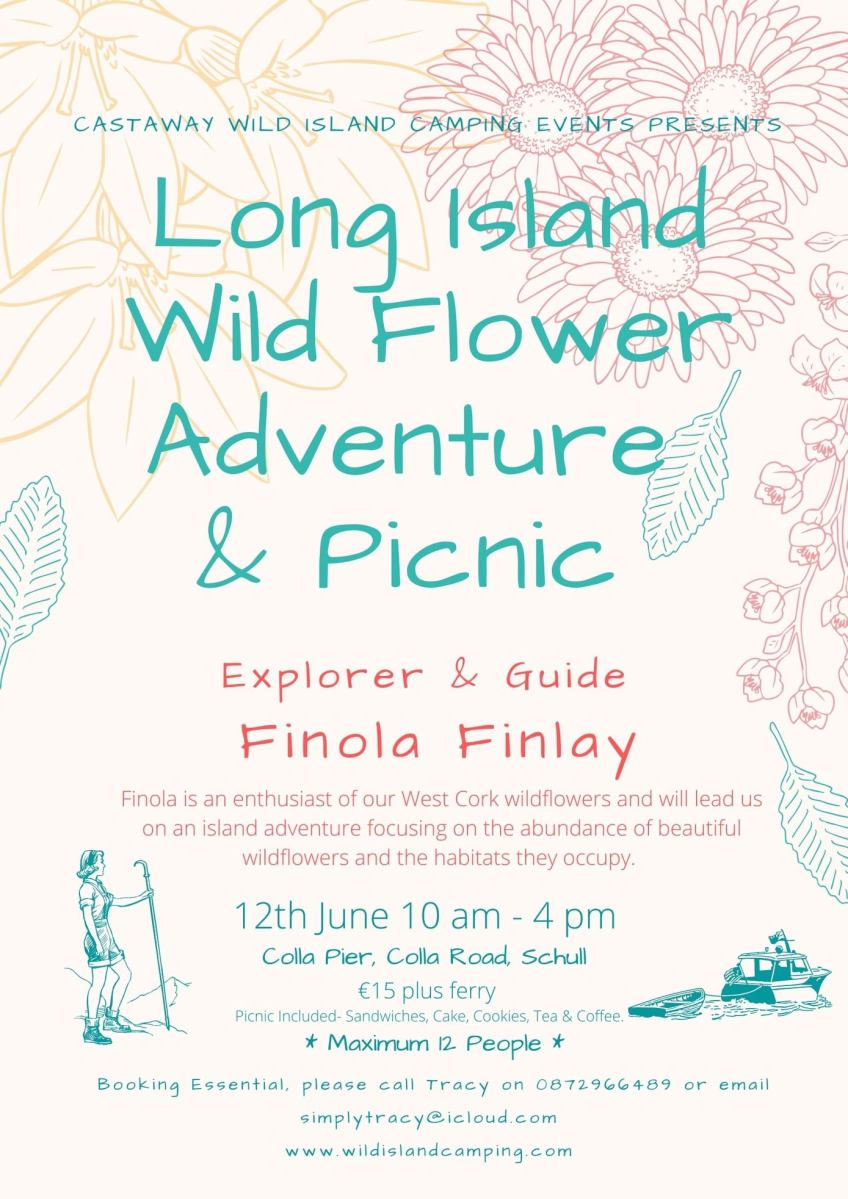
Tracy and Peter Collins are the charming and enterprising couple behind Castaway Wild Island Camping on Long Island in West Cork. When they asked us if we’d like to help with a collaborative island adventure we jumped at the chance to lead a wildflower walk.

But who knew there would be such a demand? Our first date (yesterday) filled up overnight with a waiting list, so we put on a second and it filled from the waiting list! 

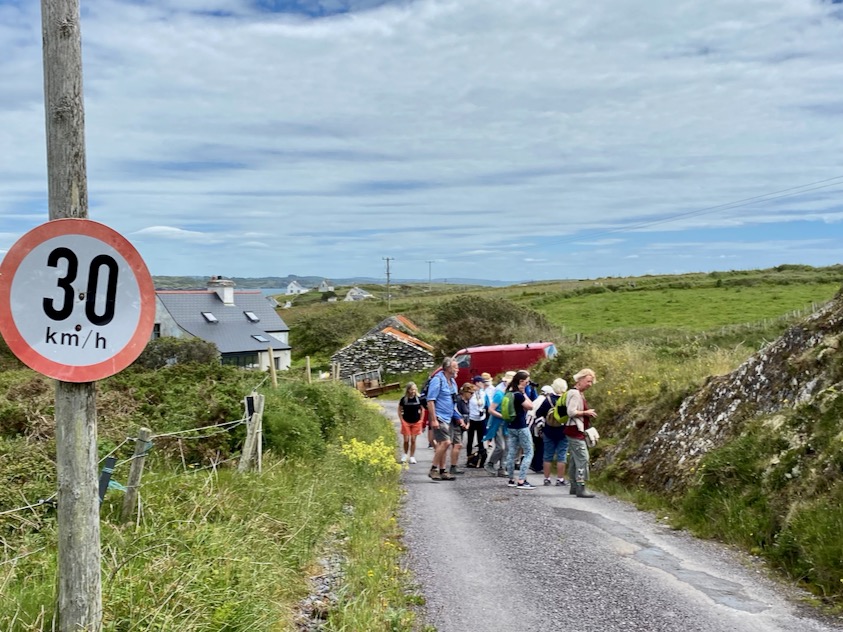
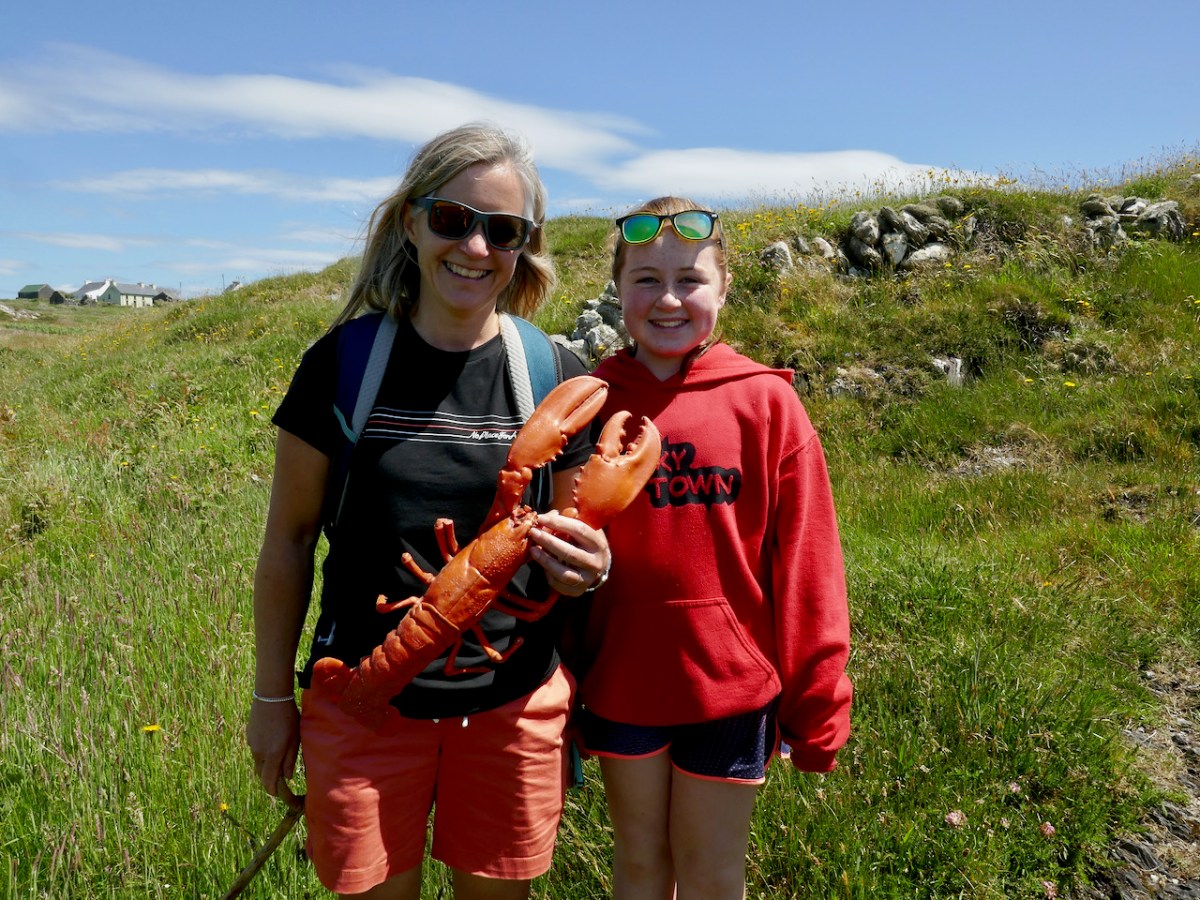
People are hungry, it seems, for experiences like this – and who can blame anyone for wanting to spend time on Long Island! We’ve been there several times and we know that the place, as my mother used to say, is Falling Down with Wildflowers. And so, yesterday, we met with our first group – and what a lovely and talented bunch of people it turned out to be, including an archaeologist, a fish biologist, an ecologist, a professor of Pharmaceutics, teachers, fellow-blogger Amanda from Holy Wells of Cork and Kerry, and an assortment of Long Island and wildflower lovers.

We started off at East House, home of Castaway Wild Island Camping for coffee and possibly the most delicious biscuits I’ve ever tasted, and then started our walk westward along the spine of the island, stopping as we went to talk about the habitats we were passing through, and the different flowers that had successfully adapted to those habitats. Hedgebank, field margins, stone walls and rock faces, old gardens – all carry their own assortment of plants.

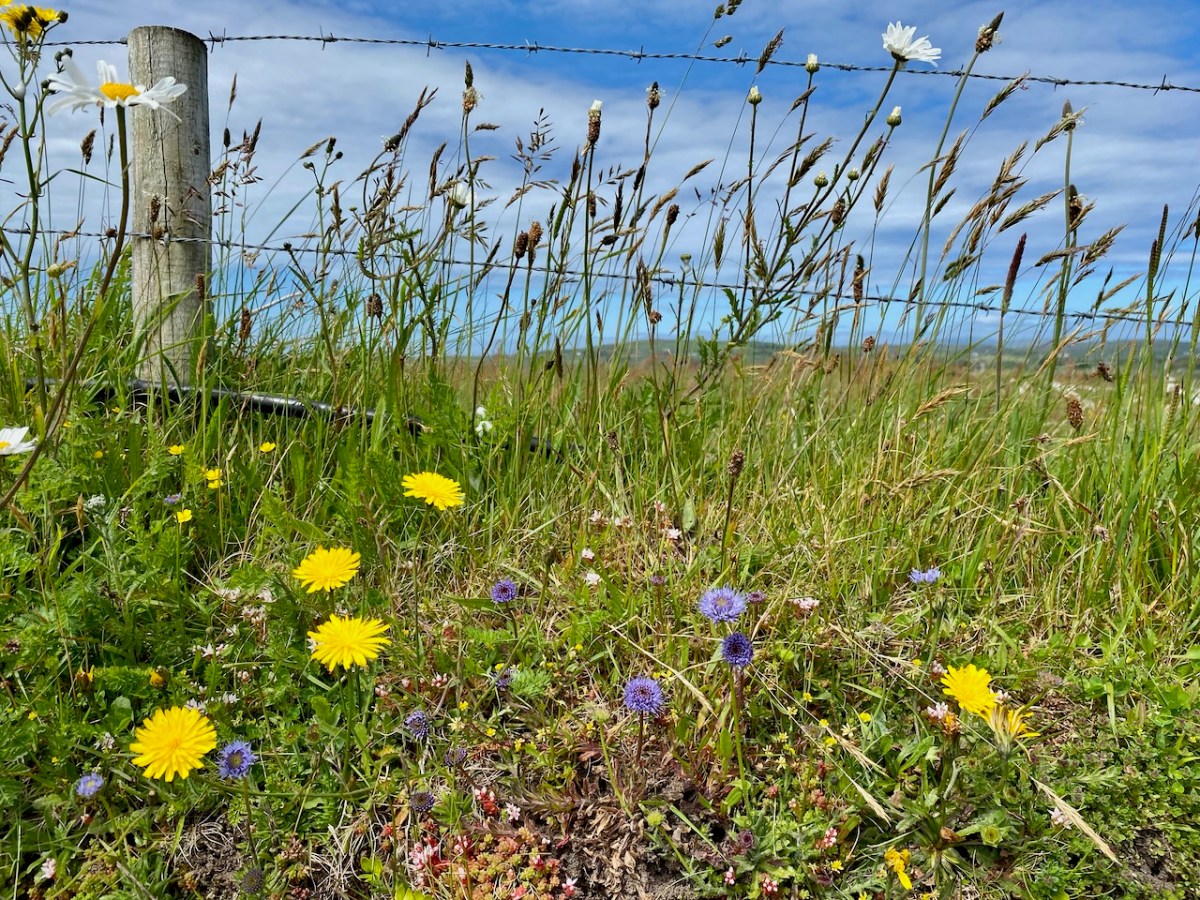
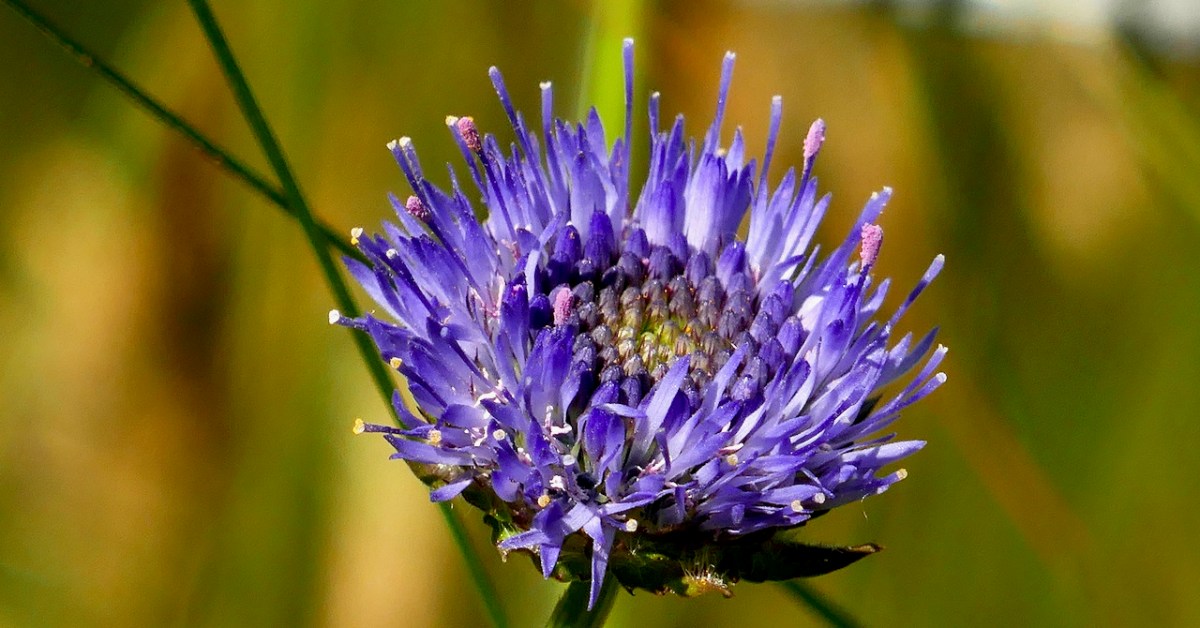
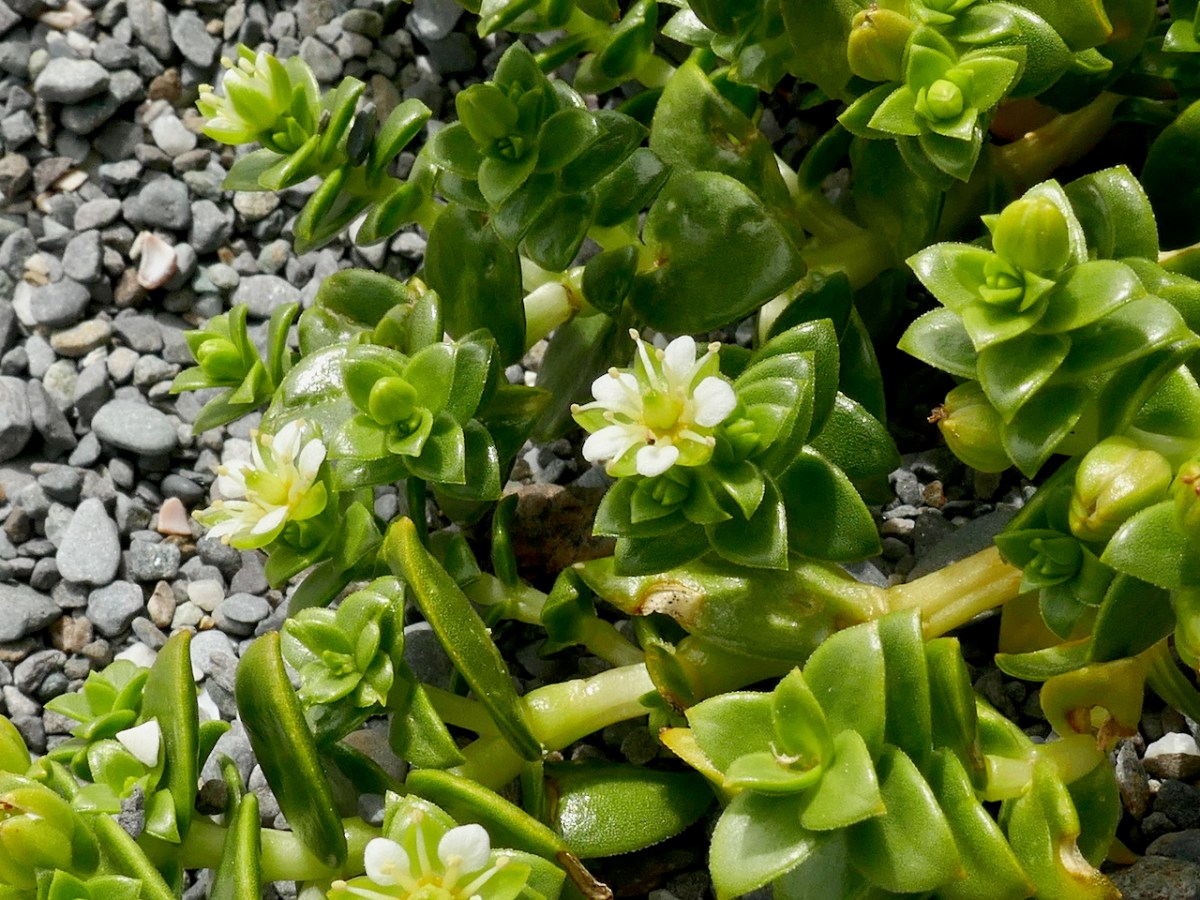
From the top: Cat’s-ear and Sheep’s-bit on a hedgebank; close up of Sheep’s-bit; English Stonecrop, Navelwort and lichen on rock face

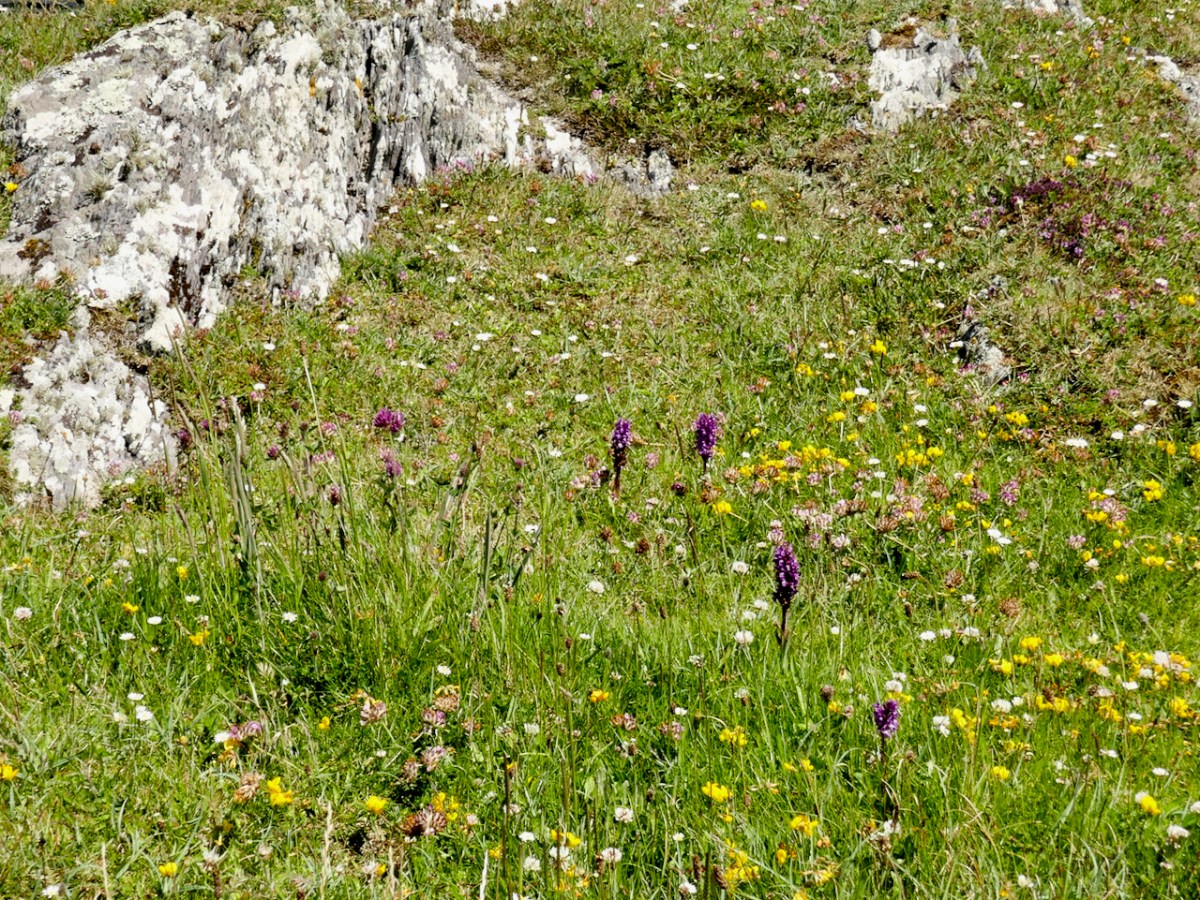
I never thought I would be blasé about orchids, but there are so  many at this time of year on Long Island that we soon ceased to stop and exclaim over each new group (below). Mark, the ecologist, was very knowledgeable about plants and pointed out the presence of Yellow Rattle, something that’s quite hard to find in the wild in West Cork but really important for creating good conditions for a wildflower meadow.

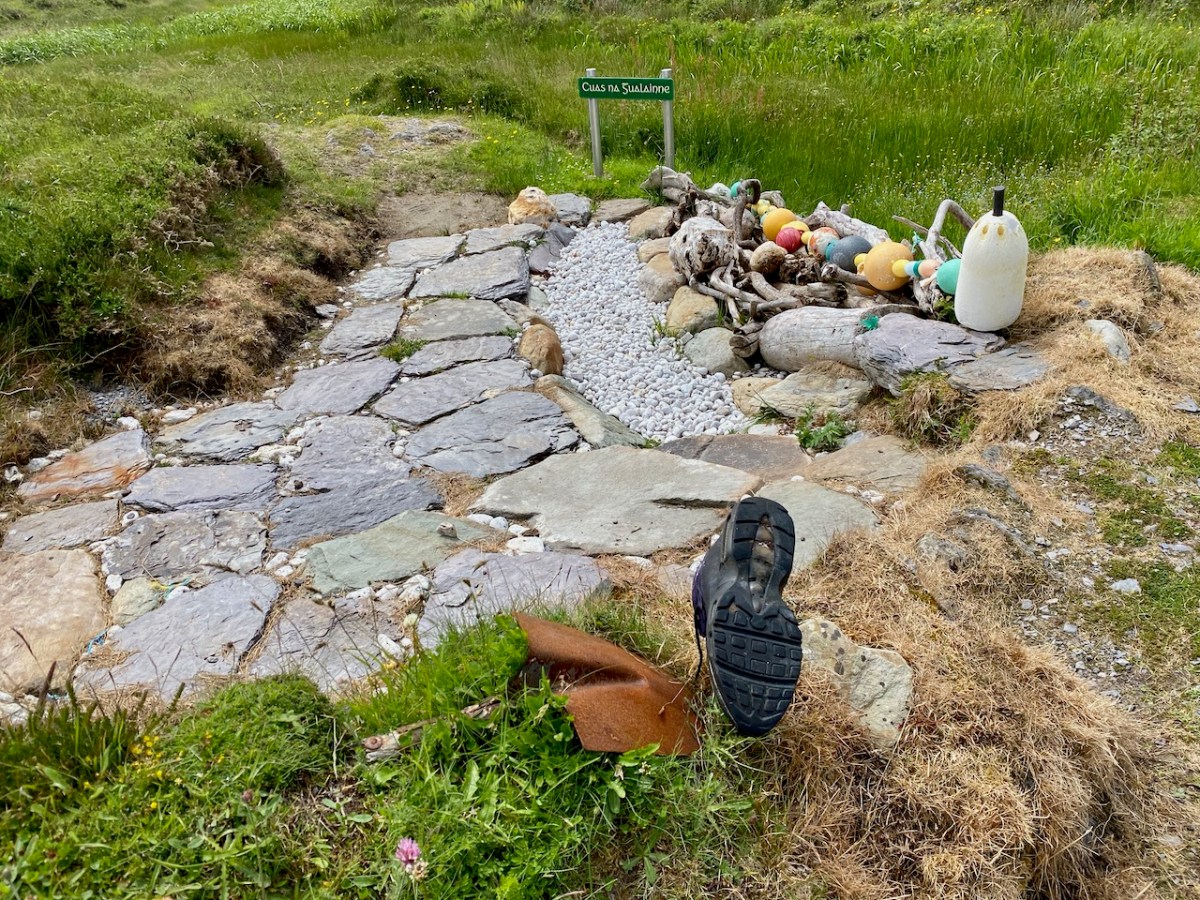
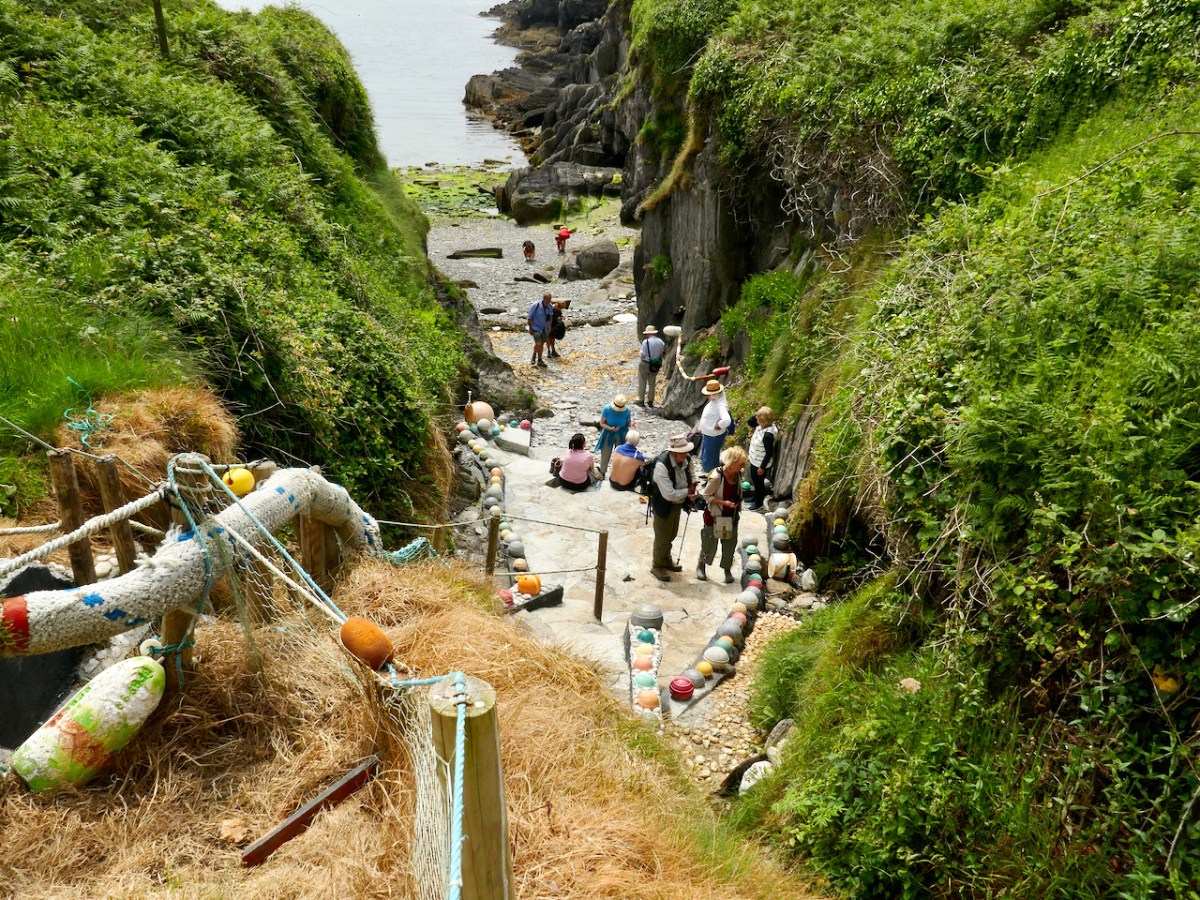
An island man, Joe Whooley, lovingly maintains the well at Cuas na Gualainne (the Little Inlet of the Shoulders – a reference, we think, to the shape of the tiny bay) and it was looking even better than the last time we were there. Amanda shared her knowledge of holy wells in general and told us about this one in particular. She’s not sure what the source of the holiness is, but is investigating. Meanwhile, the water was found to be clear and tasty. 

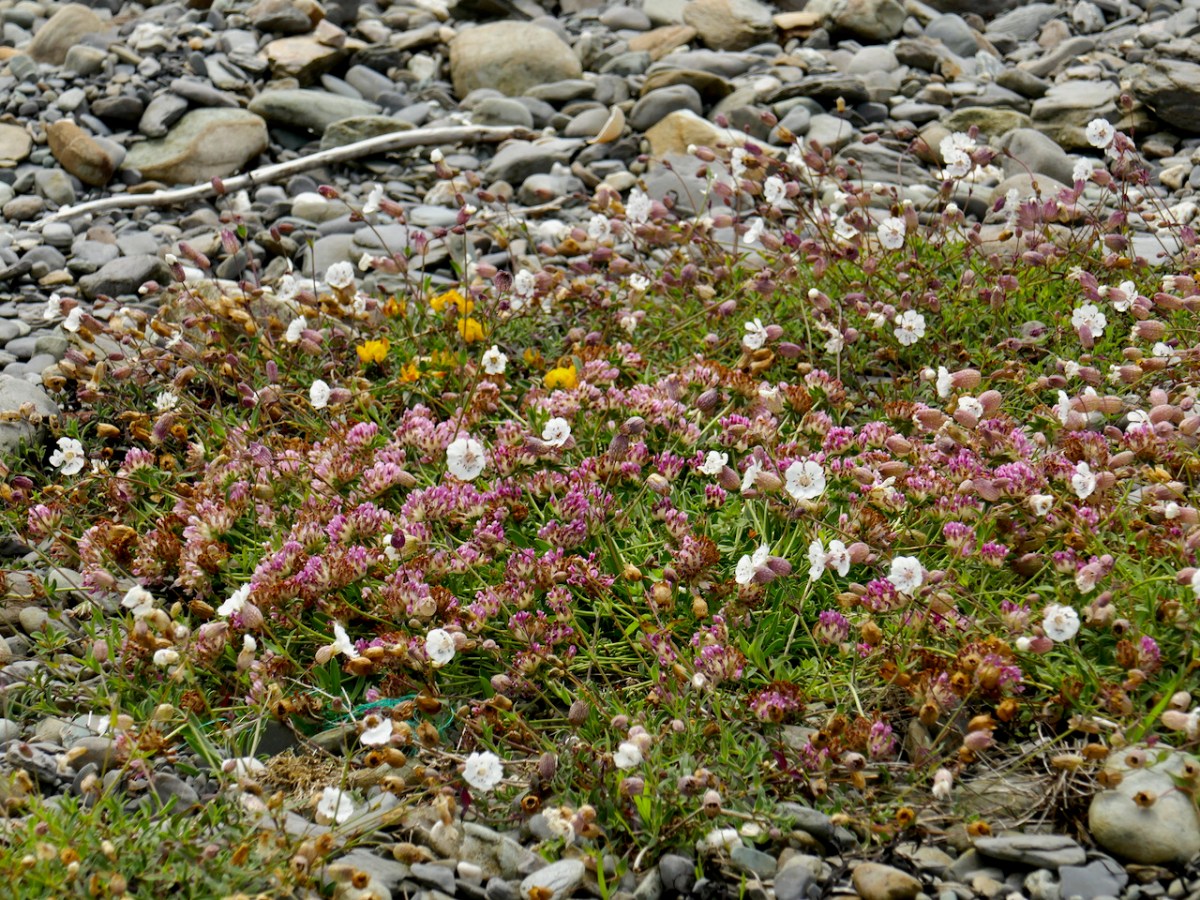
Reaching the Westlands pier, we concentrated on a whole new habitat, one in which marine-adapted plants flourish in what looks like unpromising conditions of shingle and bare rock..

From the top: a colourful patch of Kidney Vetch (pink), Sea Campion (white) and Bird’s-foot Trefoil (yellow); the delicate white flower of Sea Sandwort

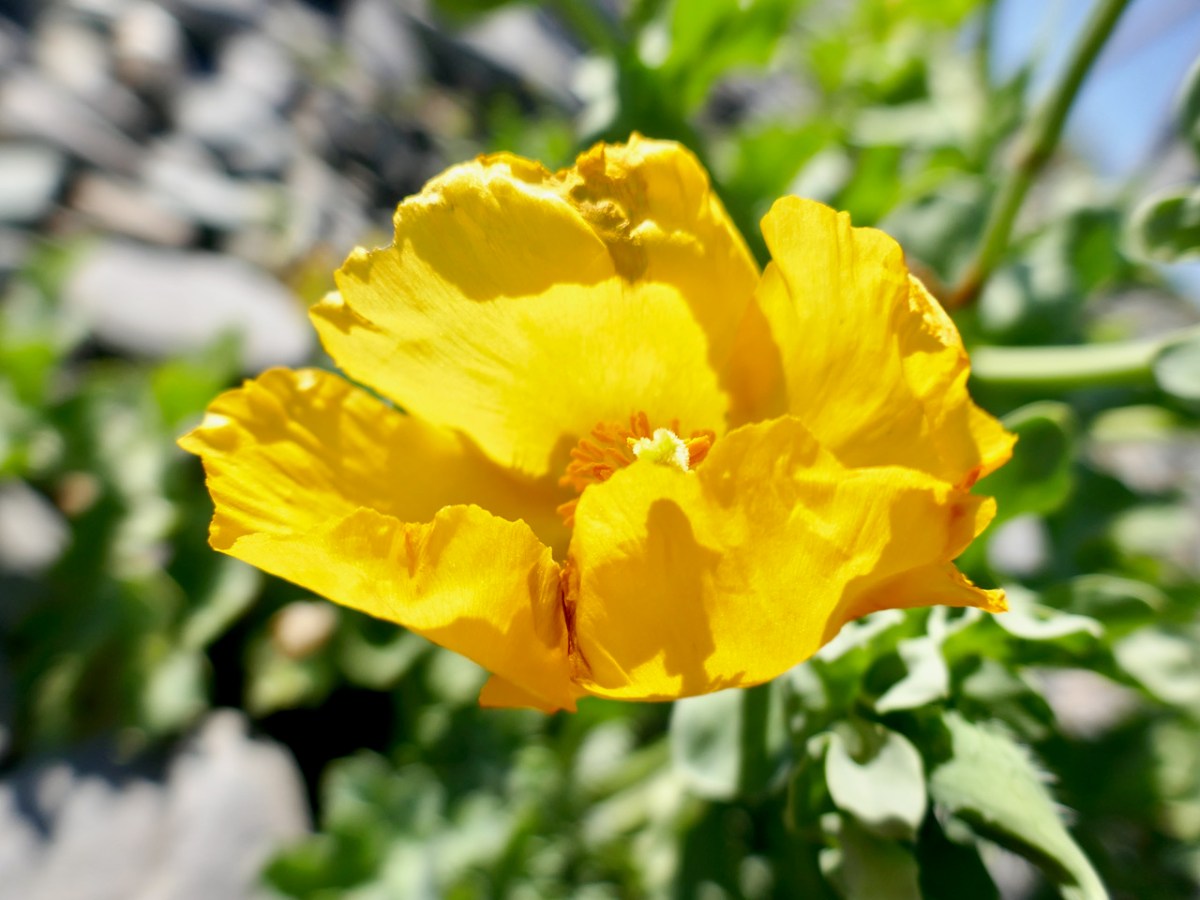
And here was one of the prizes – the Yellow Horned-poppy. It’s rare – classed as near threatened in the Red Data List of Vascular Plants – and strikingly beautiful. It’s wonderful to see a flourishing community of this exotic-looking flower on Long Island and I was thrilled to find some blooming already as I thought we might be too early for them.

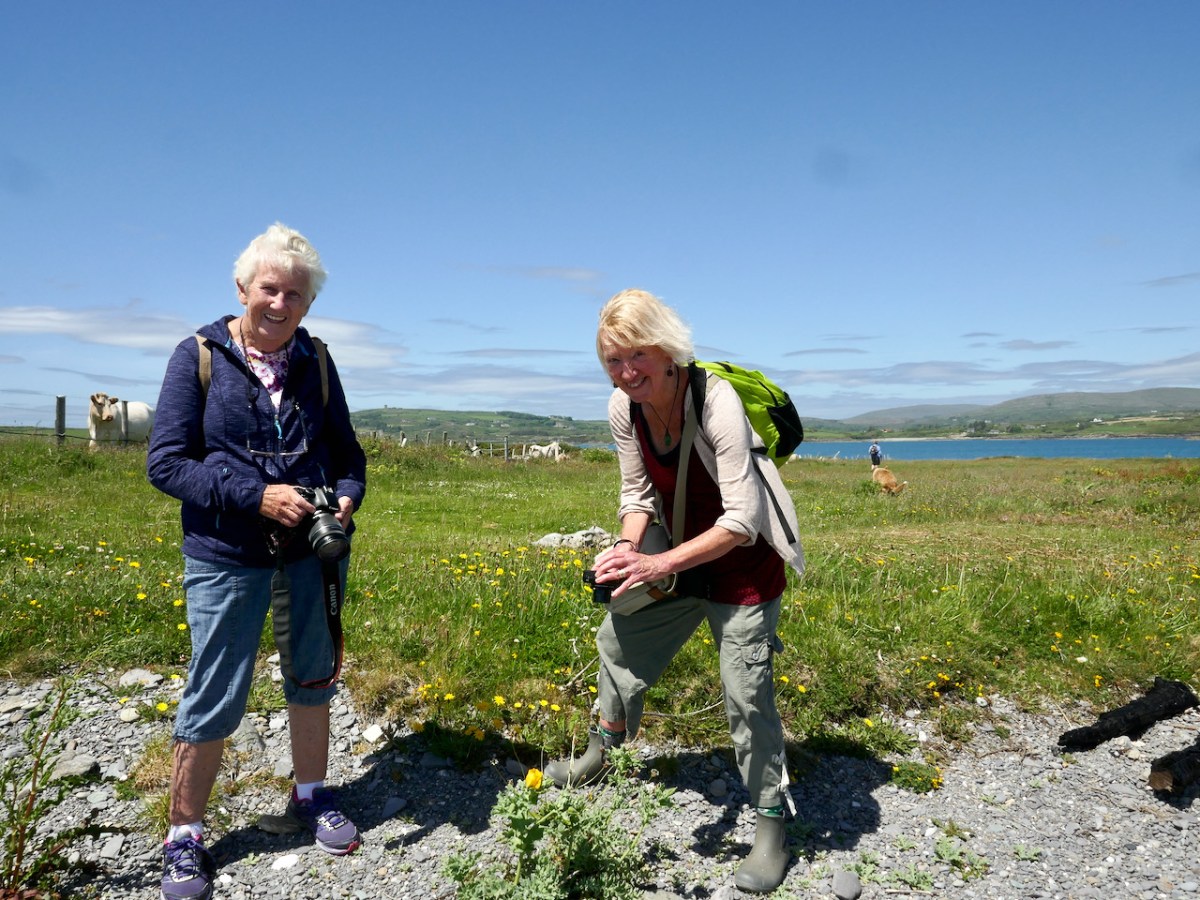
From the top: Teresa and Amanda with one of the poppies: a poppy close-up

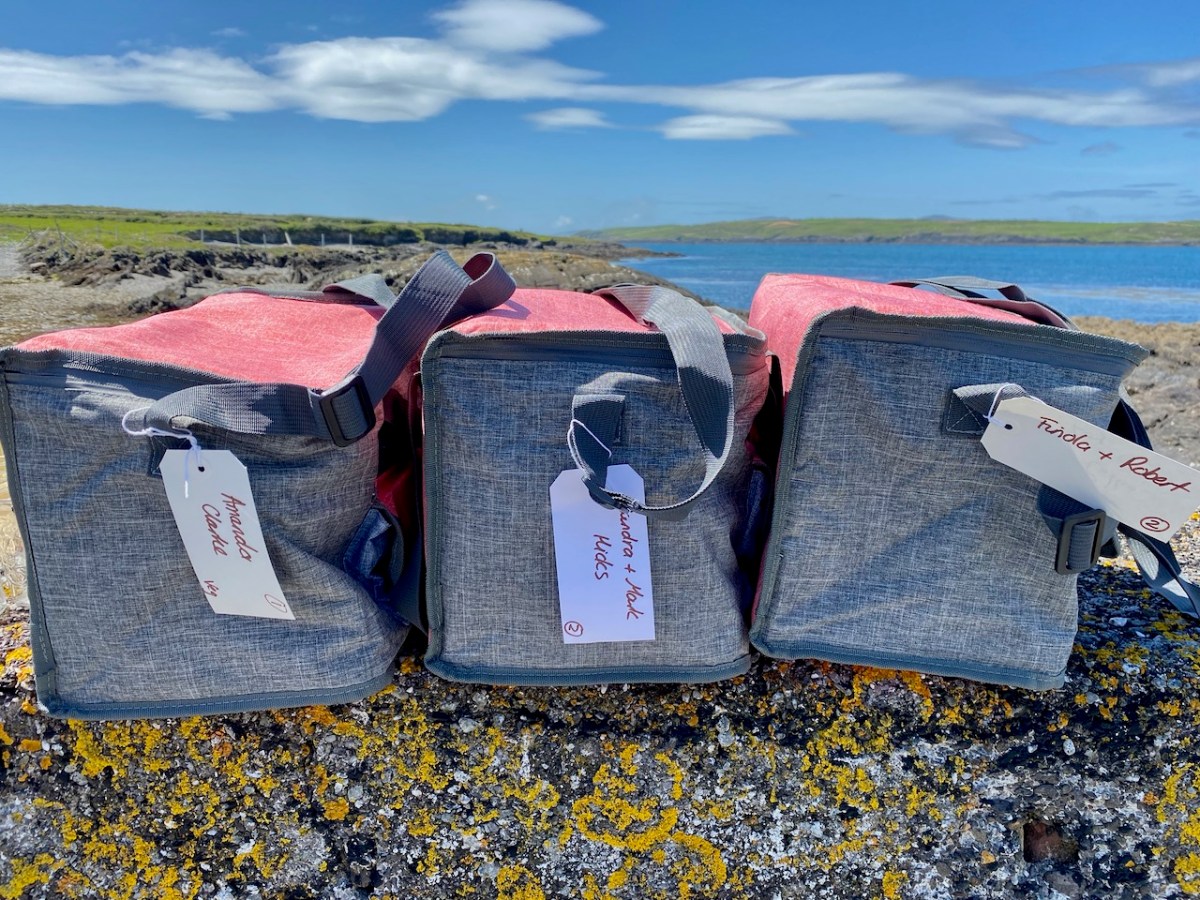
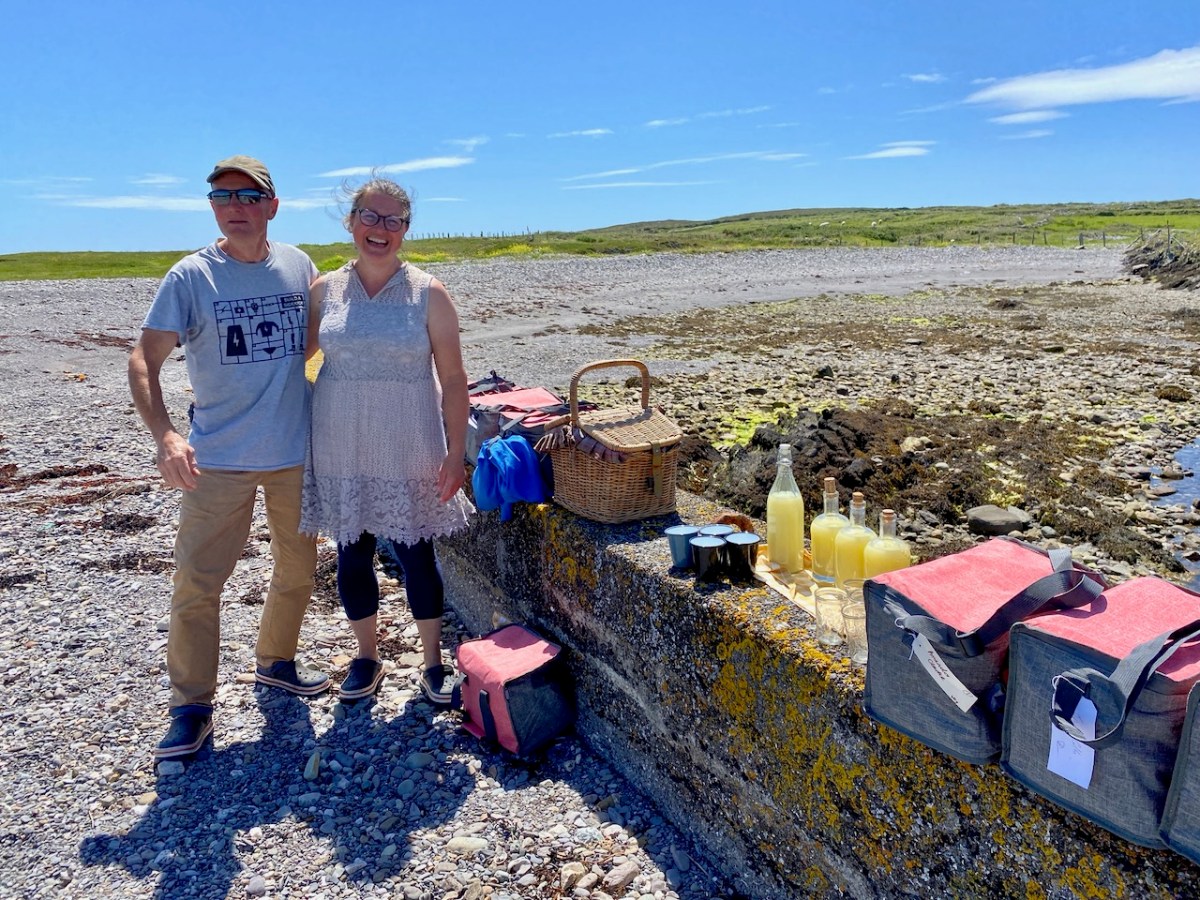
After a while exploring the shingle beach and the sandy beach we were all ravenous and like magic Tracy and Peter appeared with a fabulous lunch box for everyone. Home-made everything, some of it from their own garden (chocolate-dipped strawberries!) and delicious lemonade.

Tracy and Peter and the superb lunch

Mark gave us an impromptu talk on the island environment, reminding us all it was an essentially man-made habitat, and on the importance of this coastal strip of south west Ireland for so much flora and fauna. A possible future national park? That’s a huge YES from us!

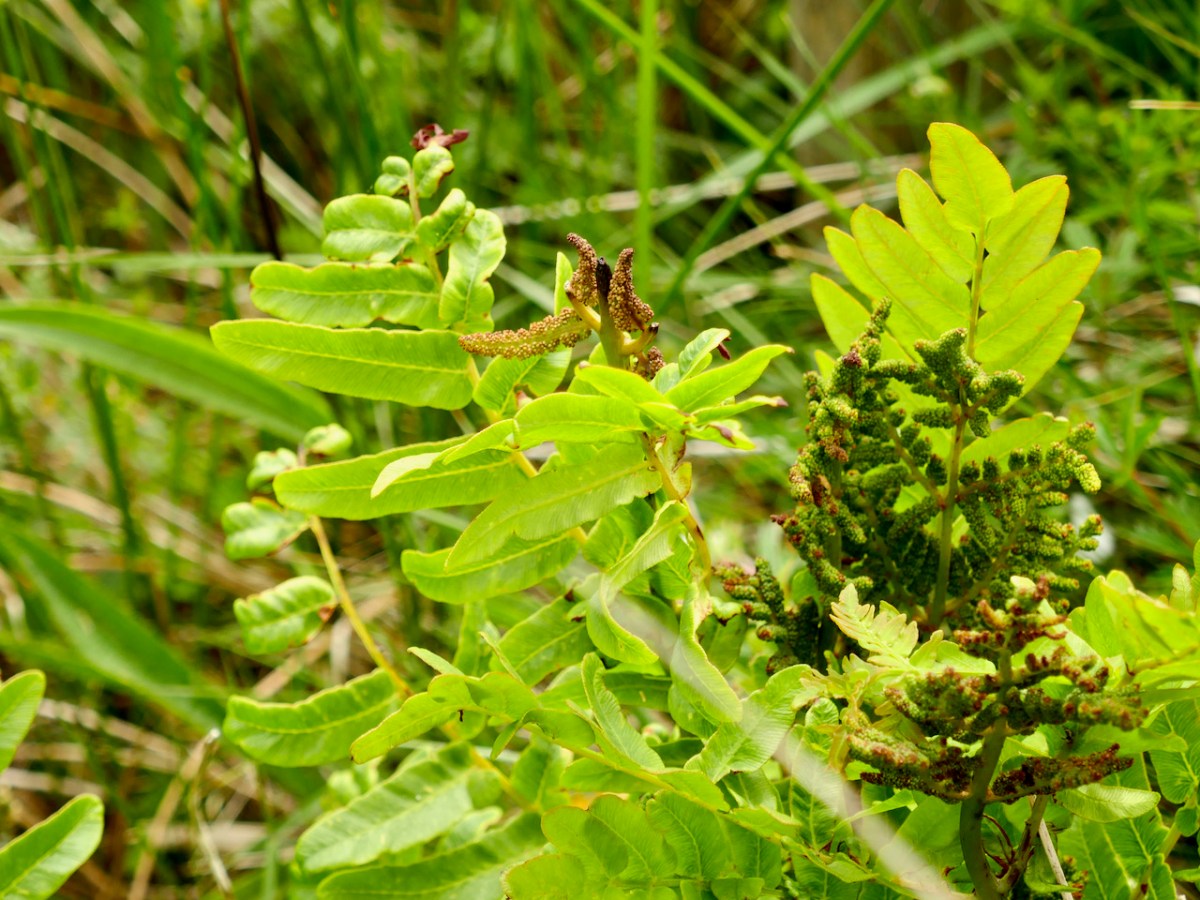
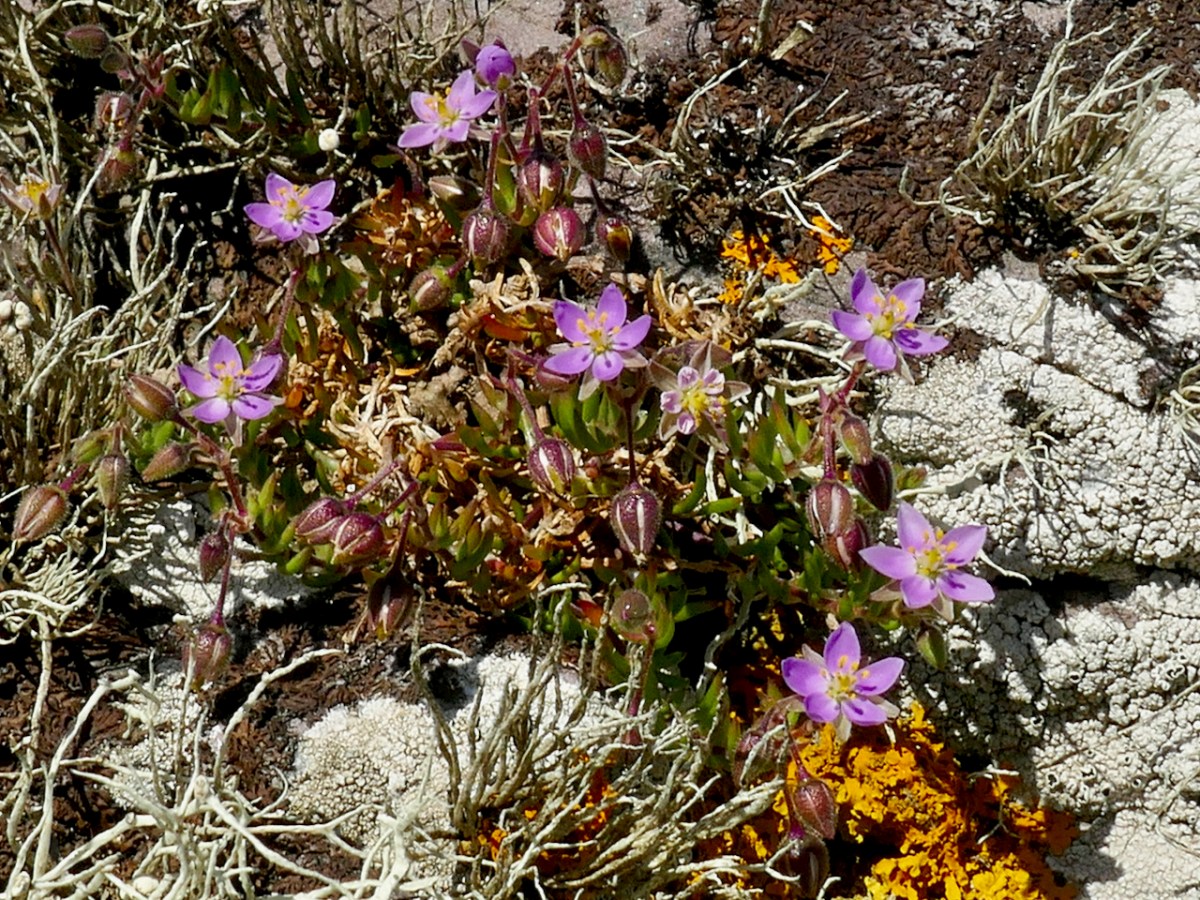
From the top: The Royal Fern – the spore-bearing fronds are starting to appear – this species is an indicator of a healthy environment and Mark told us it it getting to be quite rare in some parts of Europe and needs protection; Rock Sea-spurrey – a beautiful and tiny pink flower that likes to grow on rocks by the sea

Well fuelled, we made our way back to the ferry. The chat was mighty along the way, with old friends catching up and new friendships being forged. 

We’ll be doing it again next Saturday – all full up already, so sorry. But why not go on a do-it-yourself wildflower ramble on Long Island any time? Check the ferry schedule, pick up a copy of Zoe Devlin’s The Wildflowers of Ireland (she’s just brought out a new edition – the best and easiest way to teach yourself how to wildflower)  and treat yourself to a day in Paradise! Better still – book in with Castaway Wild Island Camping for a true island adventure.

Ilen’s End (Sweet Ilen – Part 5)

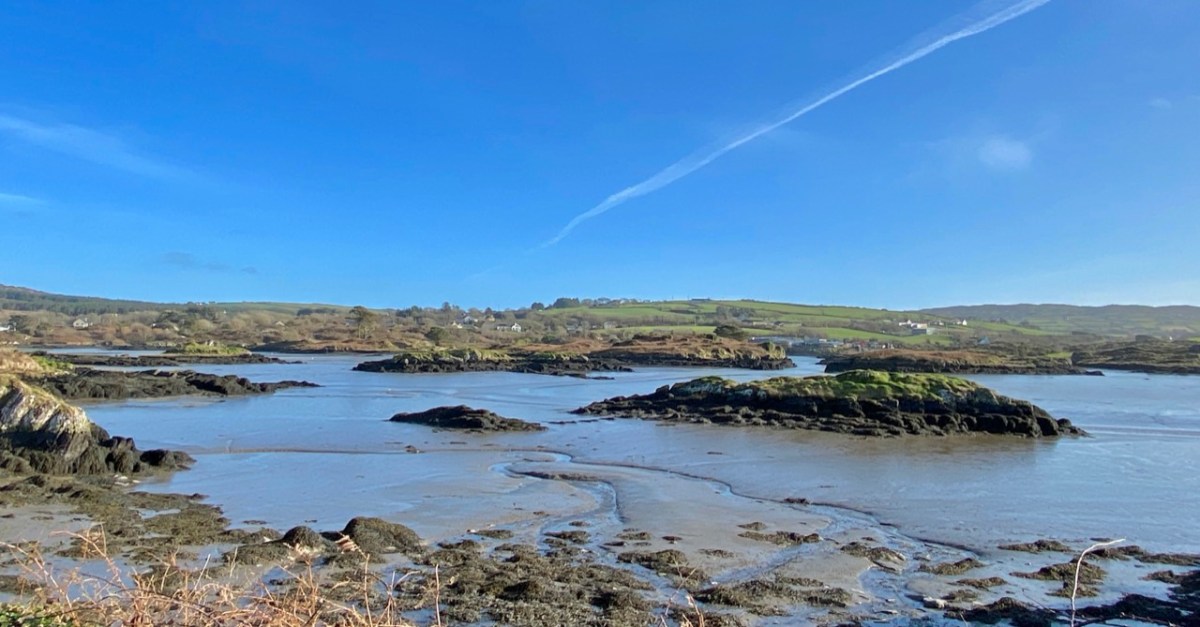
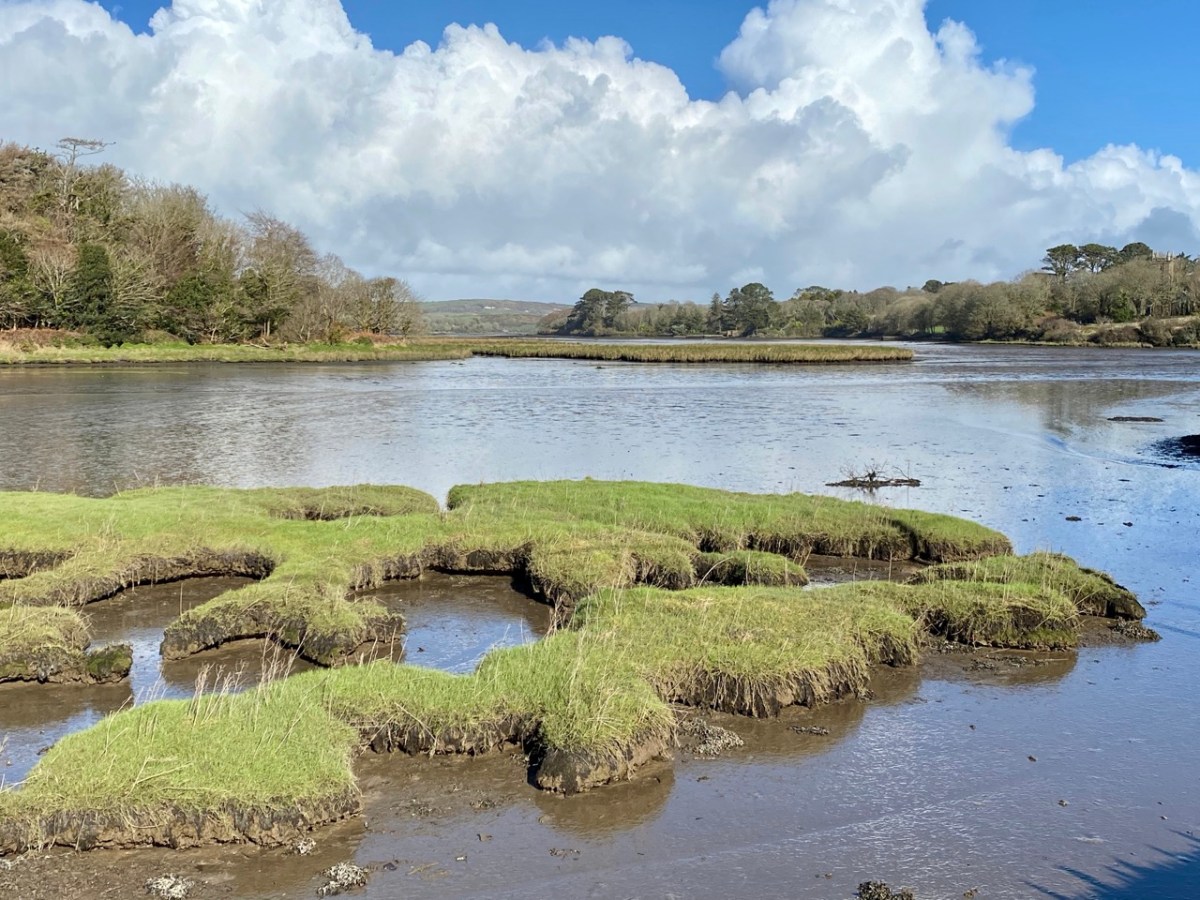
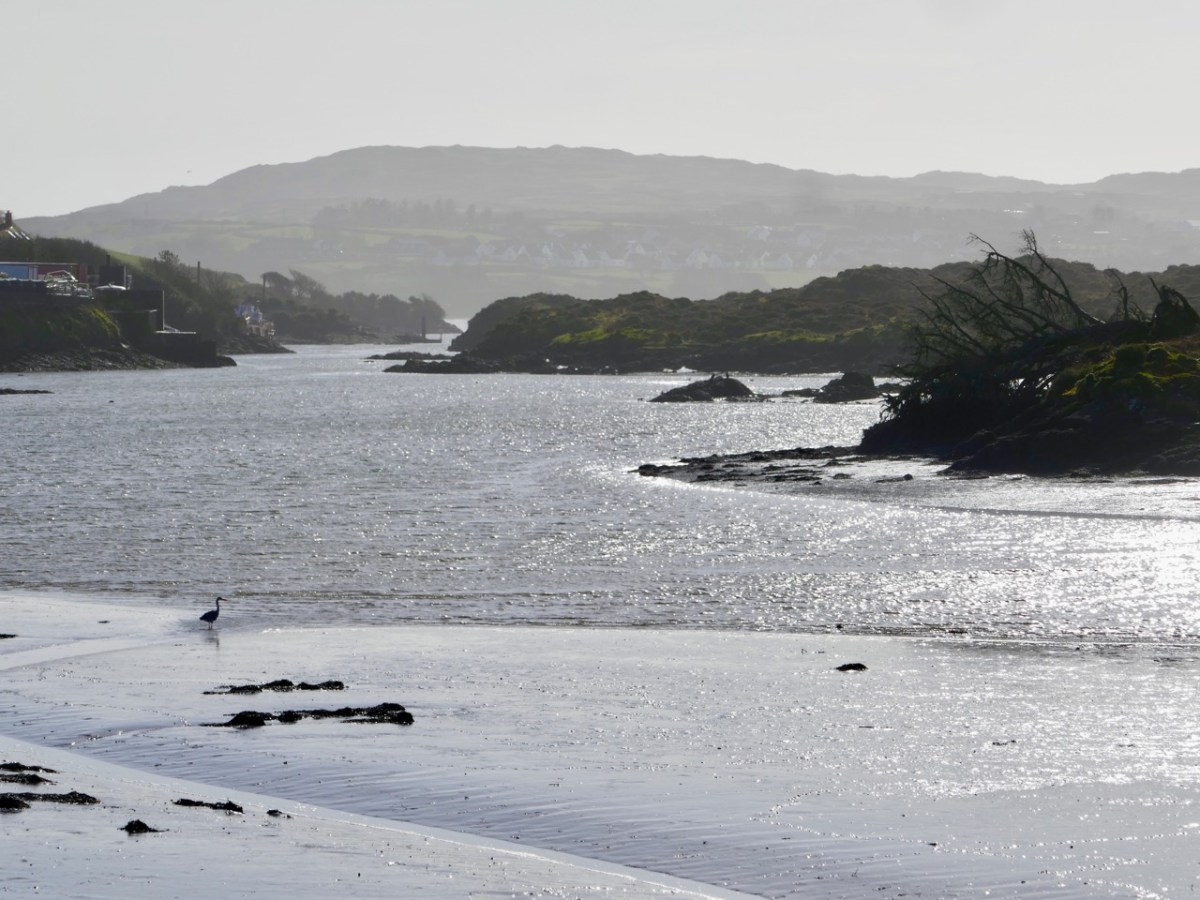
It rises on a remote mountain-top in the wilds of Mullaghmesha townland and falls 500 metres from there to the Atlantic, over a length of 34 kilometres. I think it’s time to establish exactly where the river ends, and the ocean begins. As you can see from the photo above, the lower reaches are wide and shallow, and the estuarial waters are dotted with islands and islets, some of which are only revealed at the ebb of the tide.

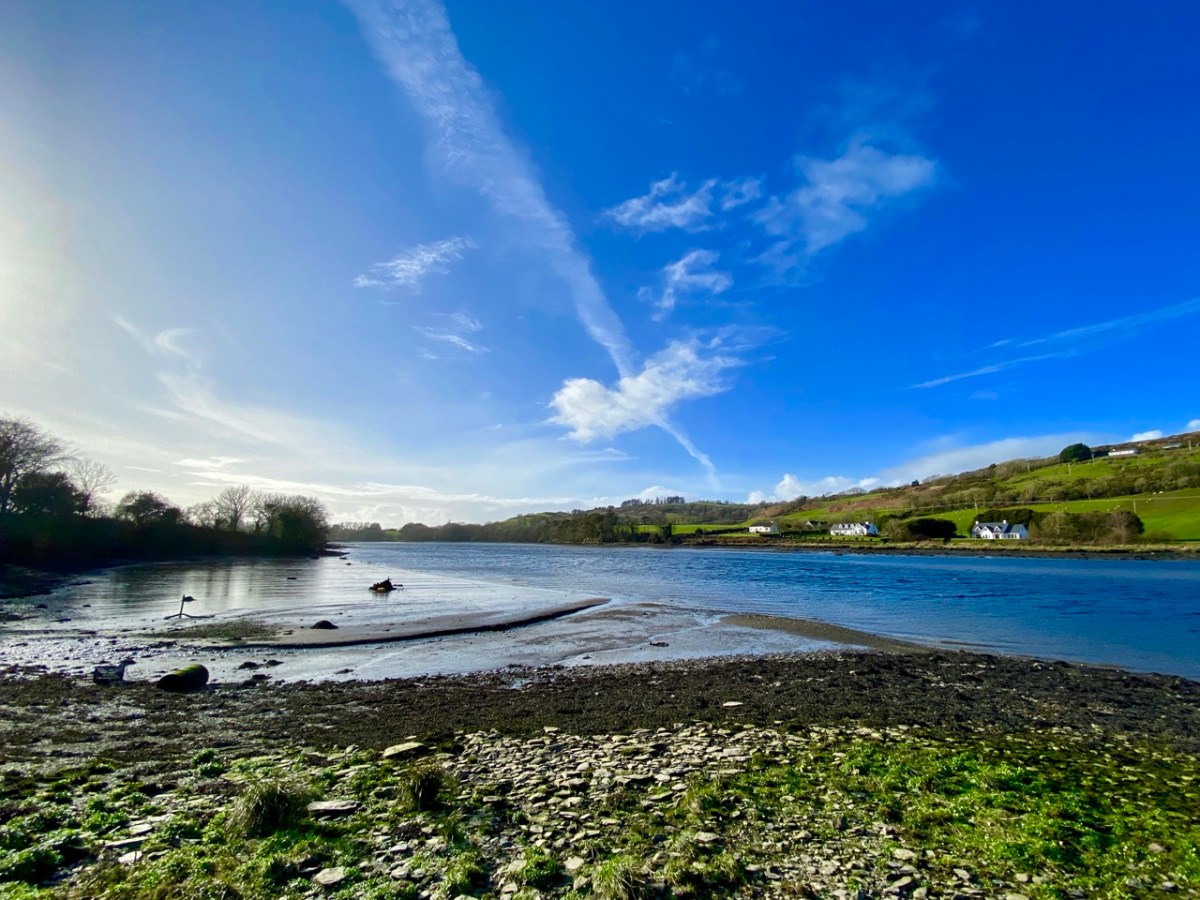
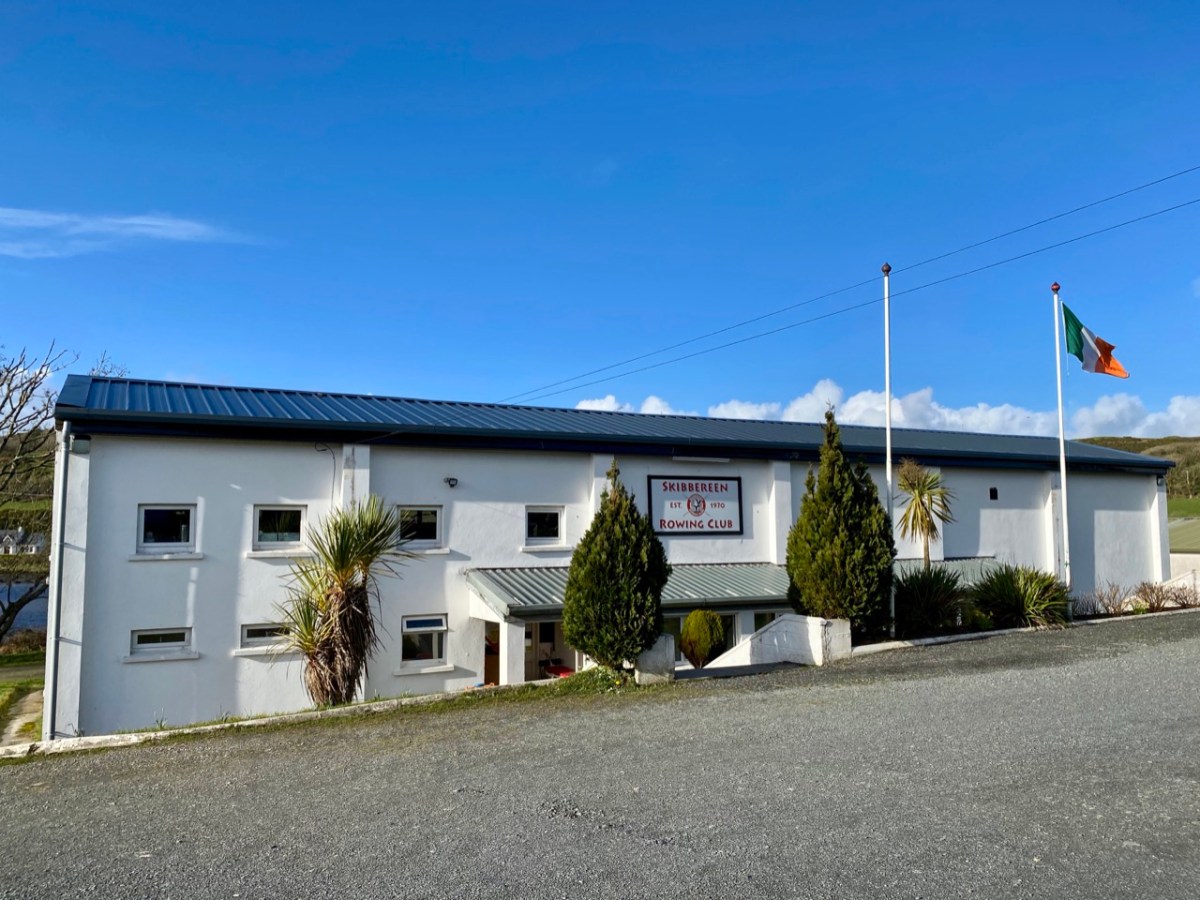
Below Skibbereen, the river is fully tidal – and its character is constantly changing. The history of the waterway has also seen an evolution, from a busy highway carrying lighters filled with cargoes to the wharves in the town (in the 19th century there were five of them – and a Customs House), to the present day where it is a tranquil scene, only busy – in normal times – with the skiffs and light craft based at the Rowing Club (above): that establishment has produced some celebrated champions!

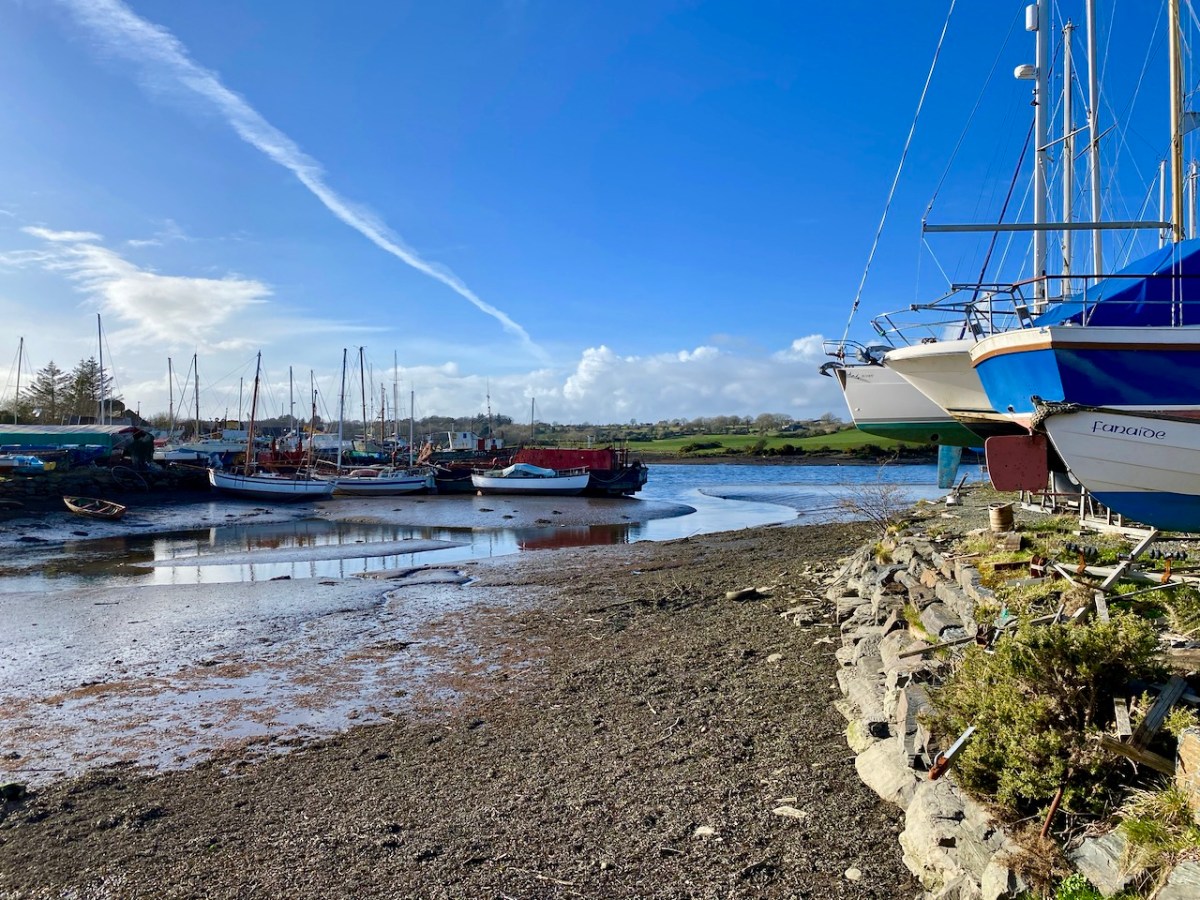
Oldcourt (above) was the transhipment point where laden ships from distant shores would leave their loads into the shallow draft barges that would take them upstream into the town. Today it is still a busy hub where vessels are stored, built and repaired – and also left to decay. The disorder of the place has a picturesque informality, and there is medieval history also: a rickety tower house stump stands guard over the apparent chaos. We have written about the boatyard (and the castle – and a ketch named Ilen) in a previous post.

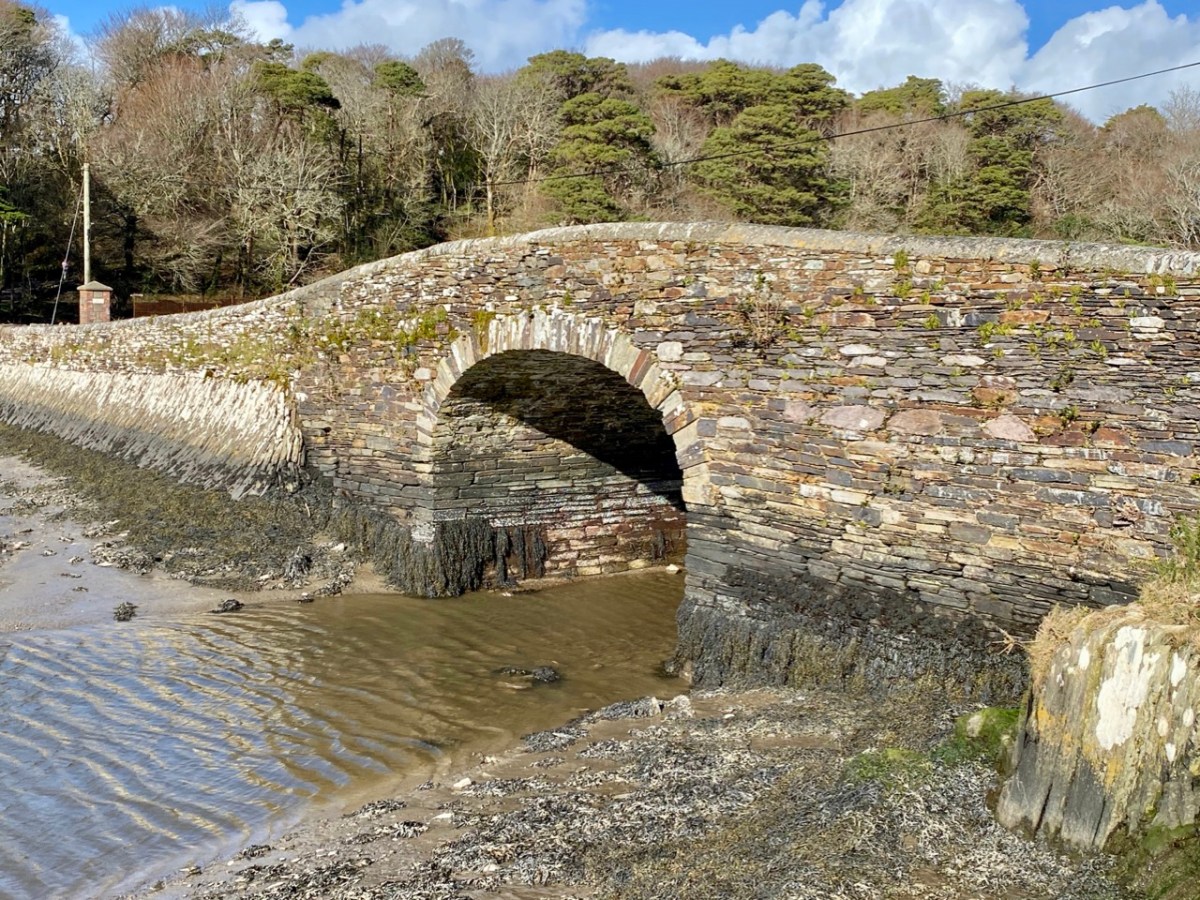
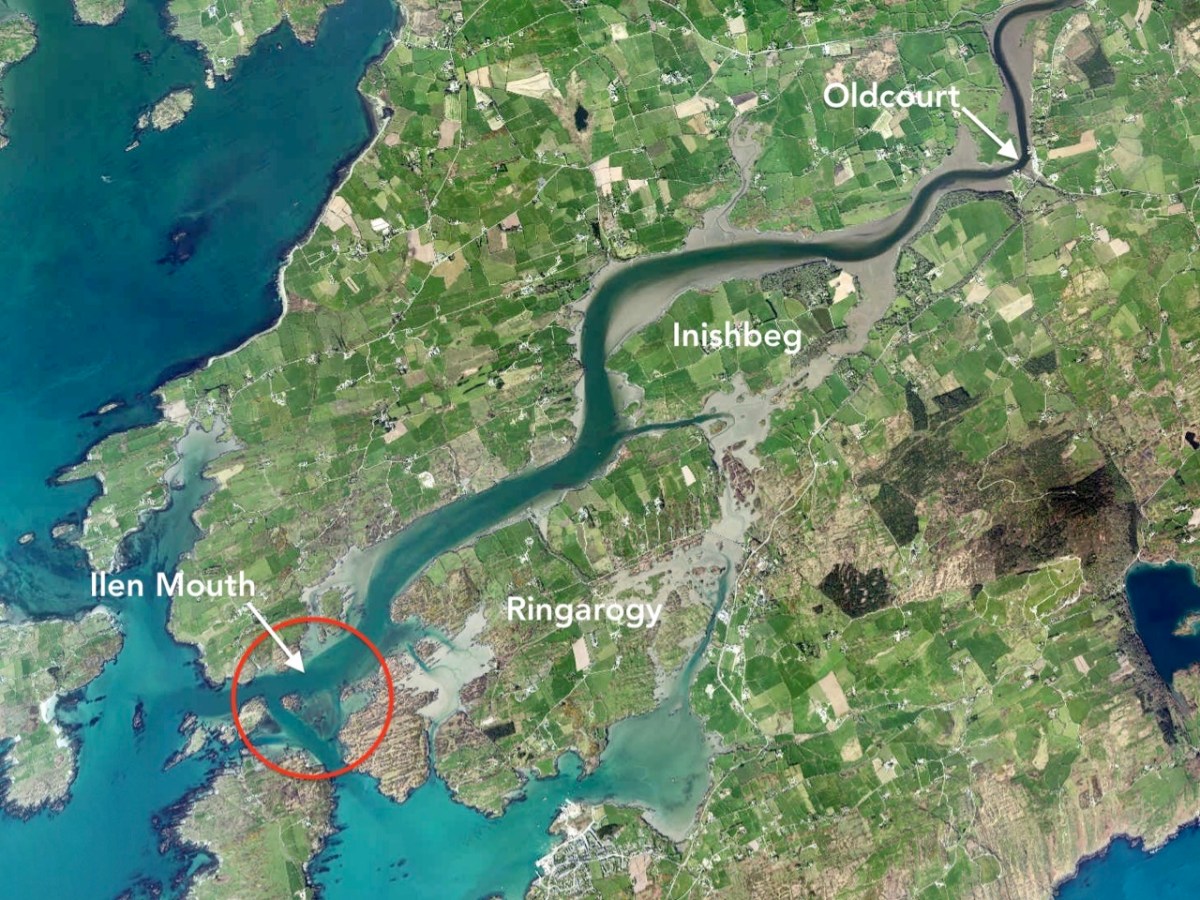
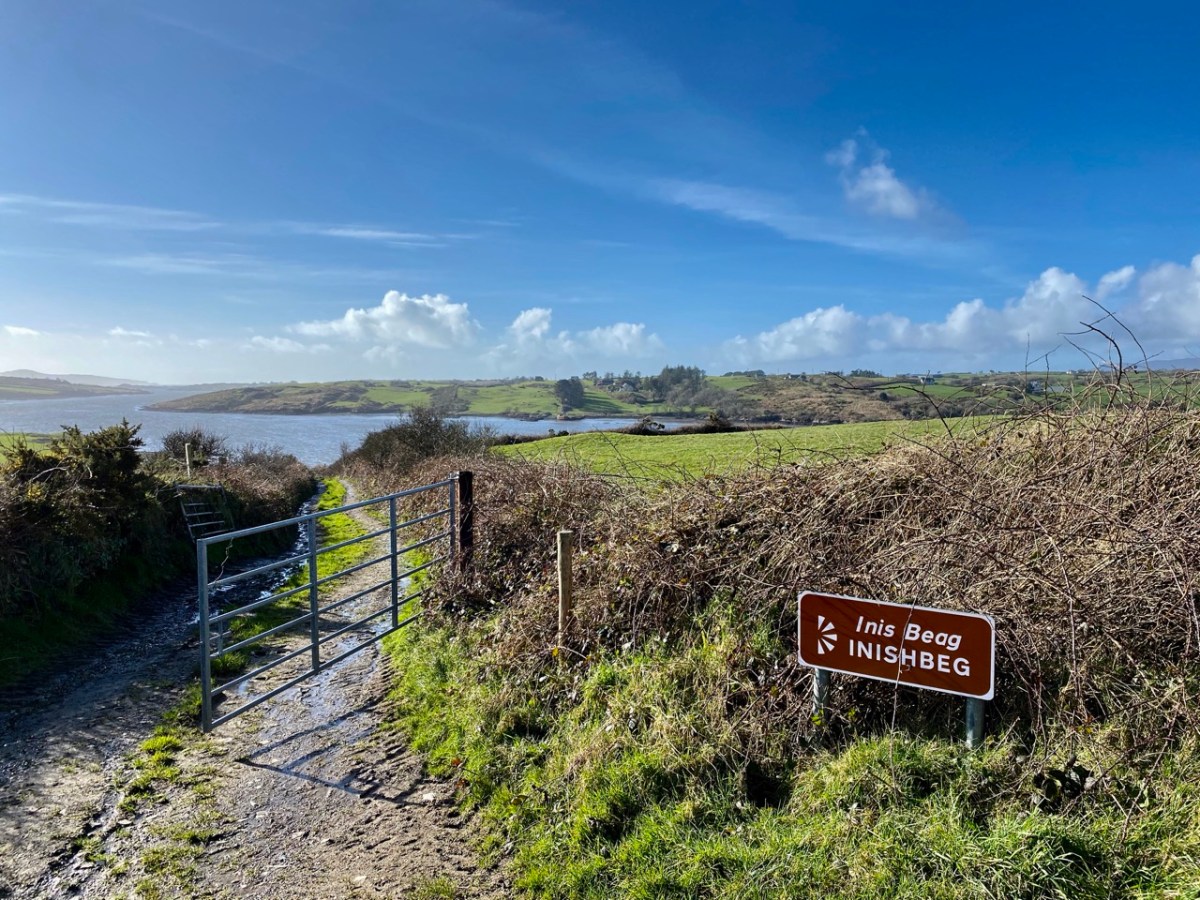
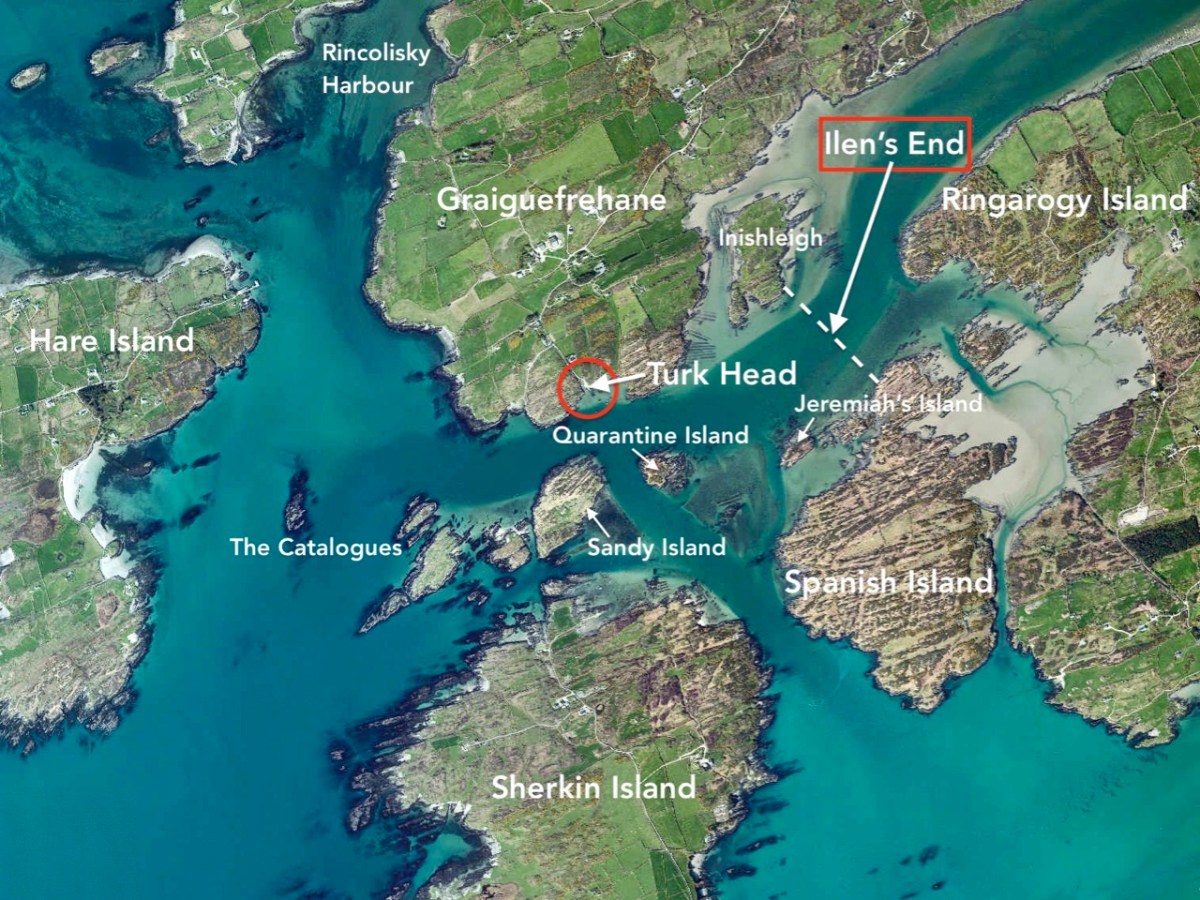
You can cross a bywater of the Ilen by bridges at Inishbeg (above) and Ringarogy. Exploration of those two islands will reveal a number of view points over the main channel of the river to the north. The marked aerial map below shows the lie of the land, while the photos following show the wide views of the river in both directions from Inishbeg.

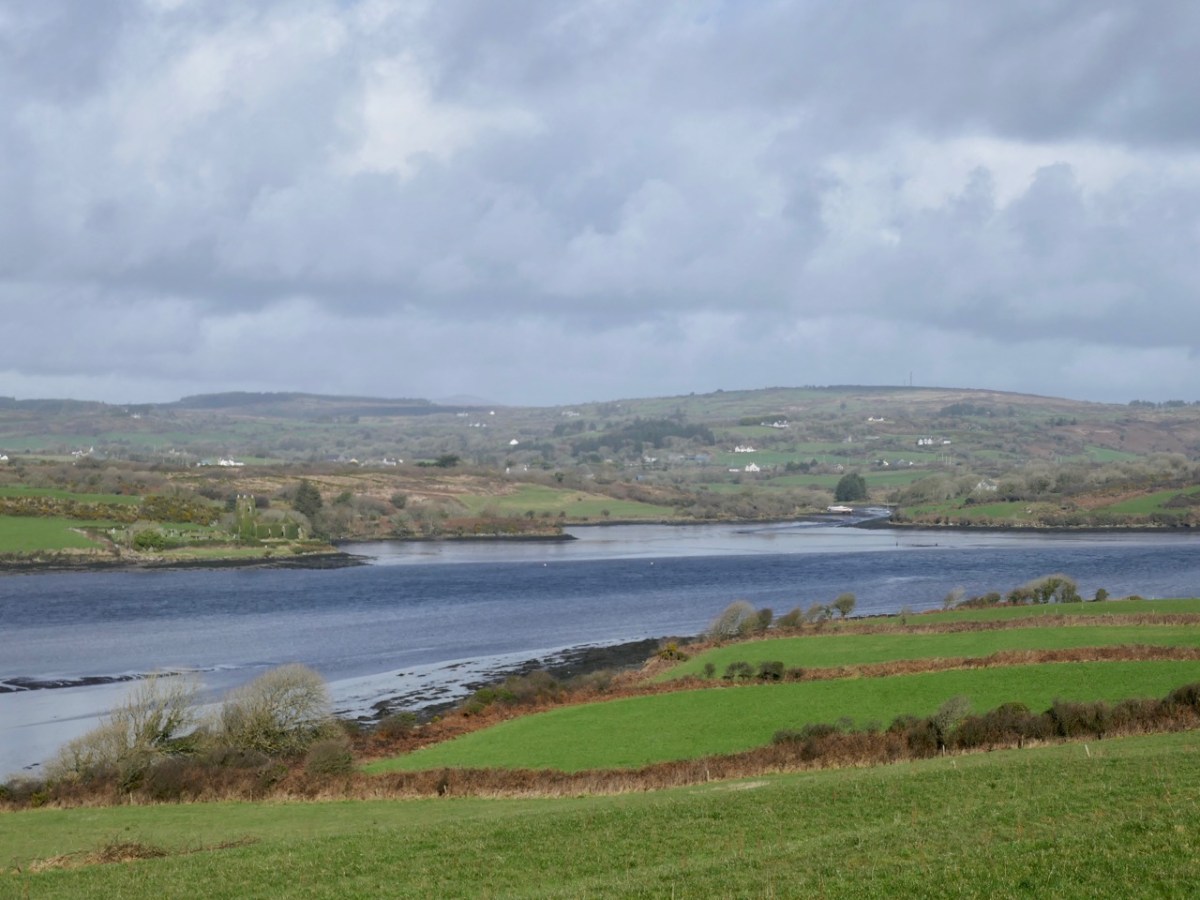
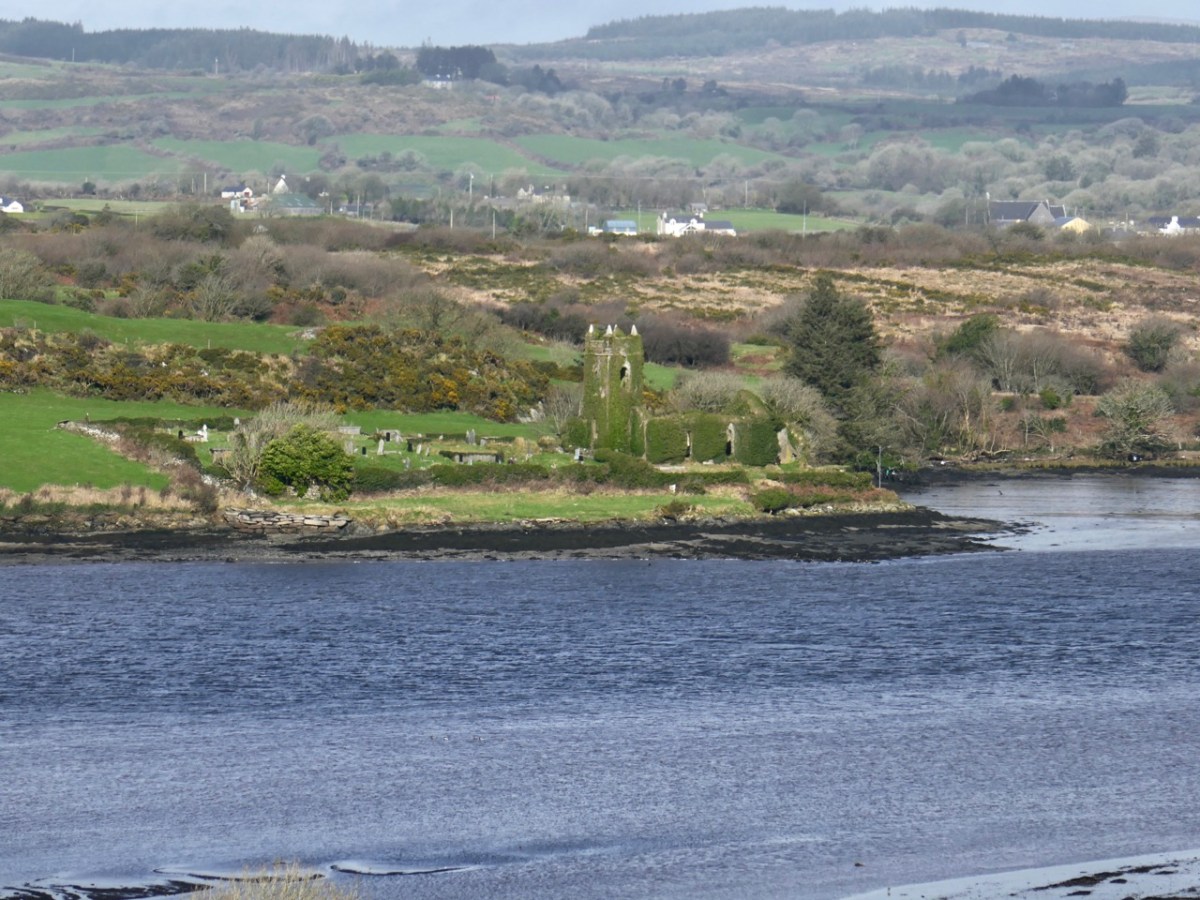
(Upper) looking upstream from Inishbeg, and (lower) a close view of The Glebe Burial Ground, also seen from across the main river at Inishbeg.

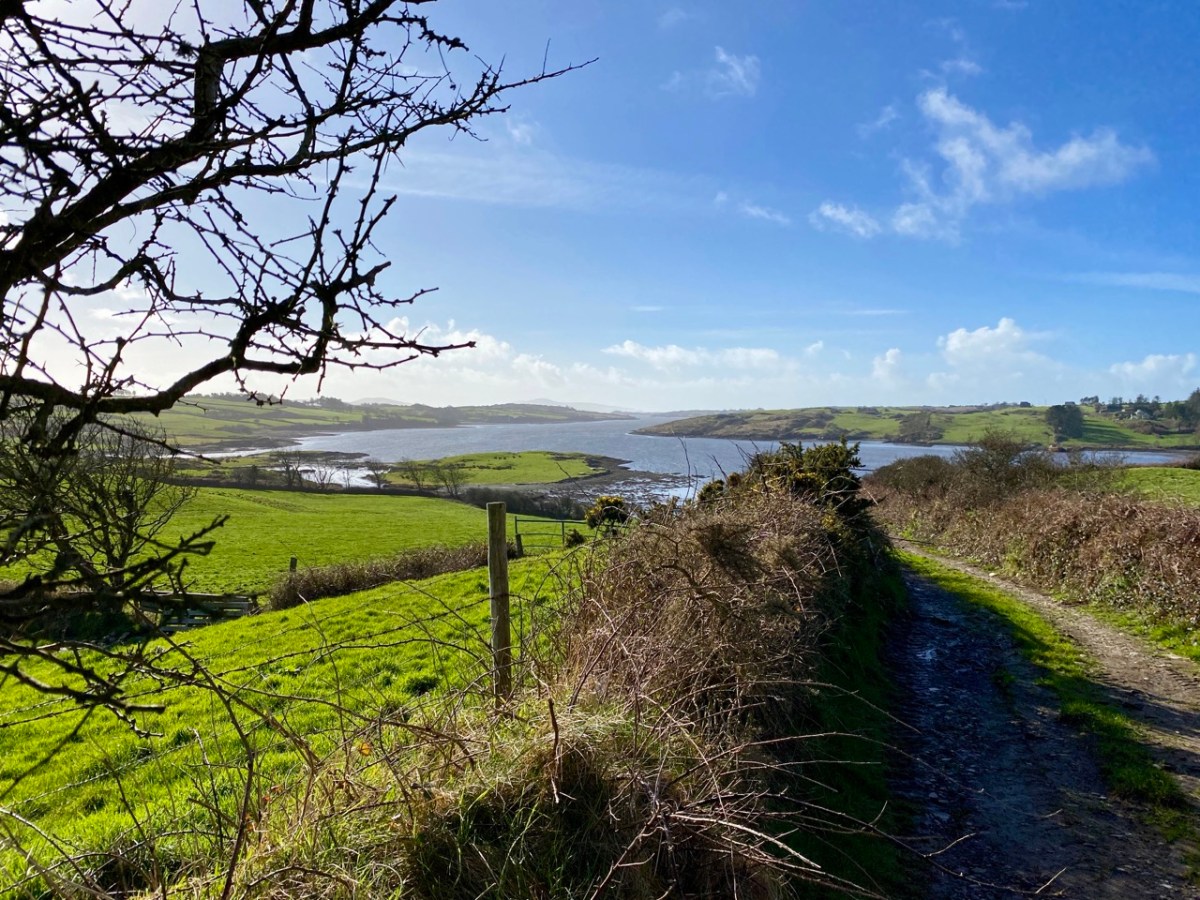
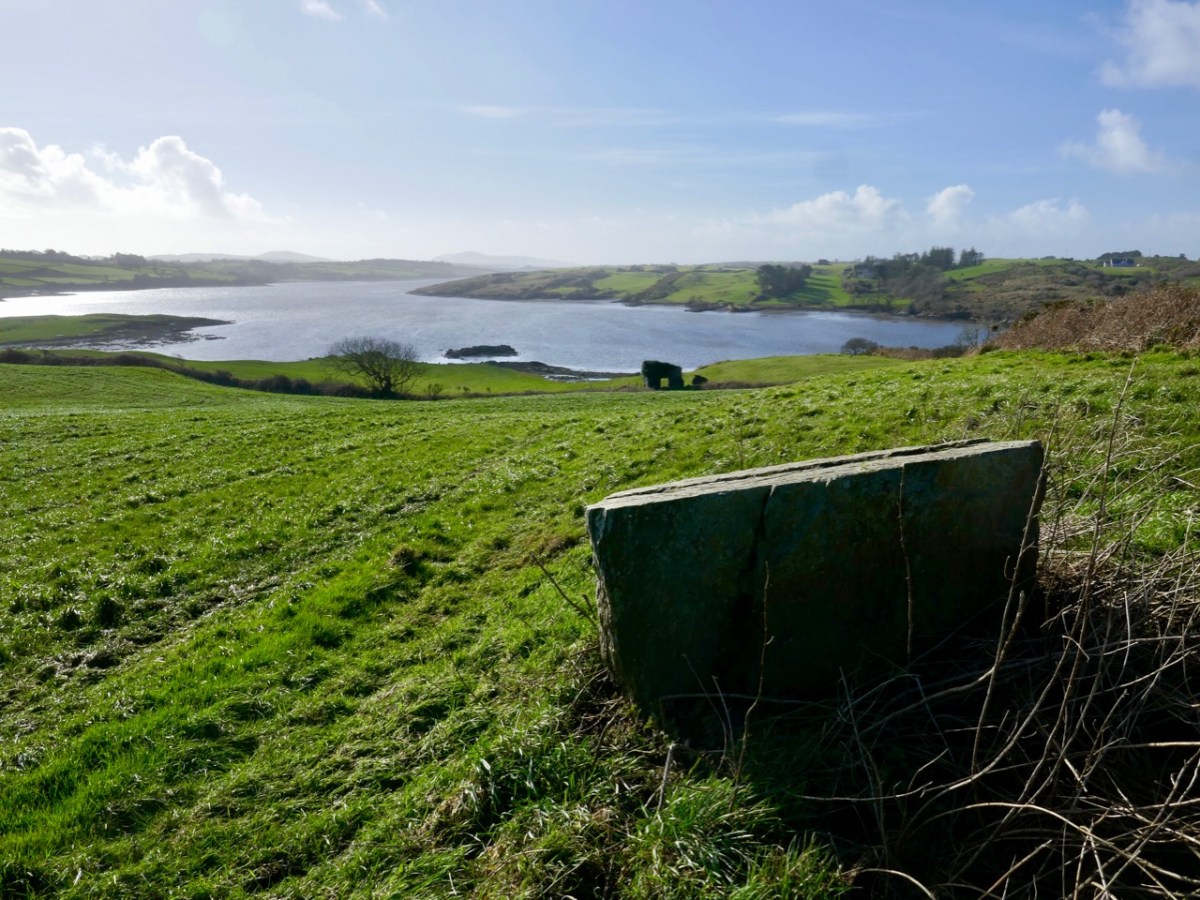
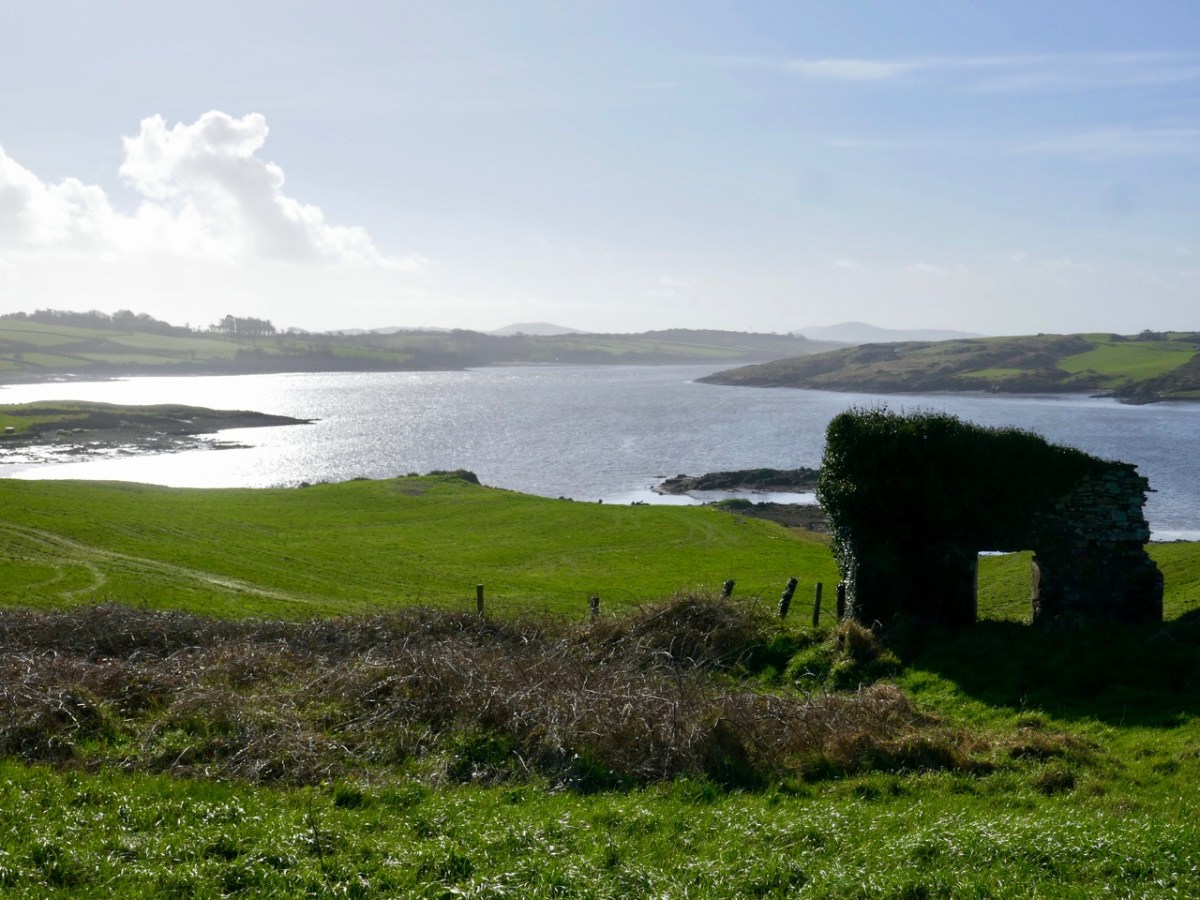
Downstream from Inishbeg: at the east end of the island we found an unusual large rock which appears to have a worked surface and a possible cup-mark. Below that rock is the lonely ruin of a structure which must have had a remarkable aspect over the whole width of the river. It would be easy to suppose that this ruin could have been part of a defence system, but there is no mention in the archaeological records of this, or of the rock. For now, they remain enigmas – but perhaps there is an alert reader out there who can shed some light?

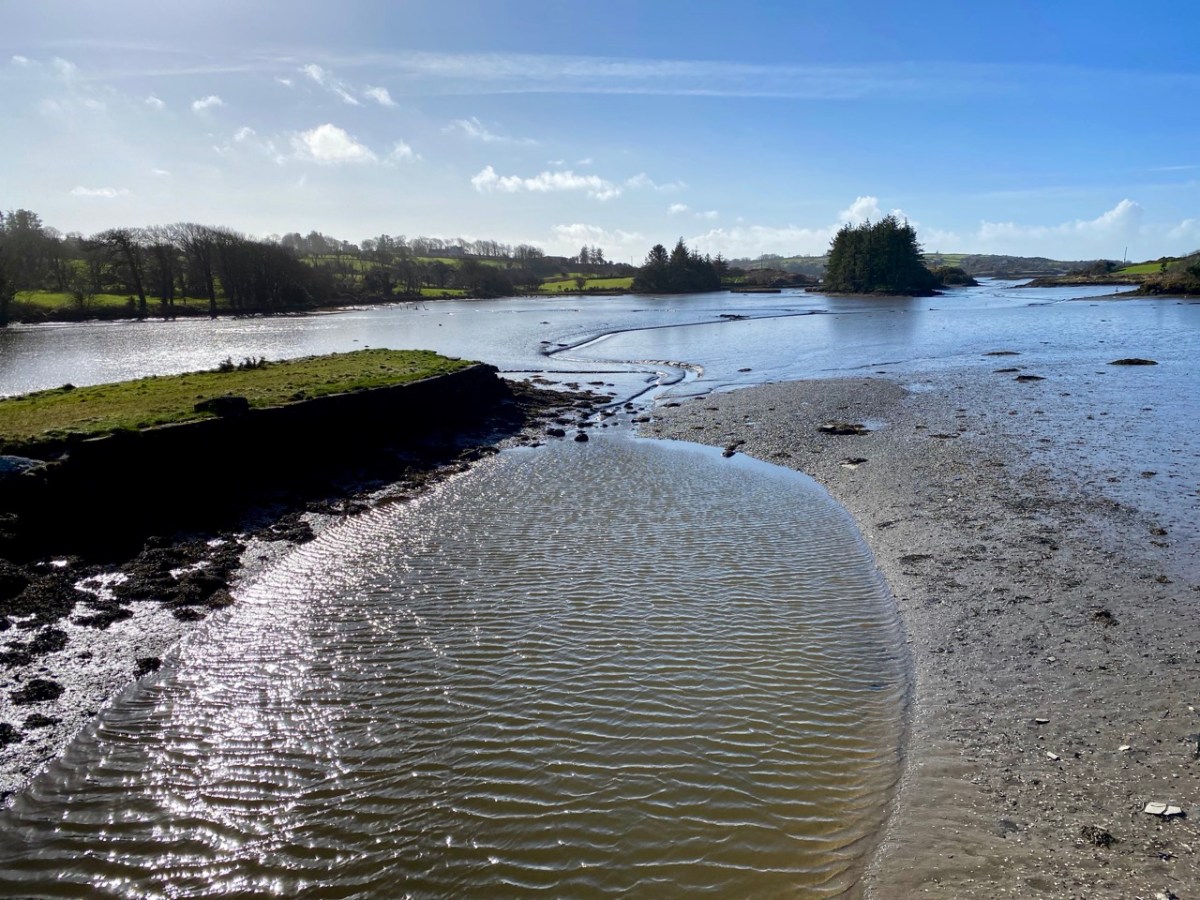
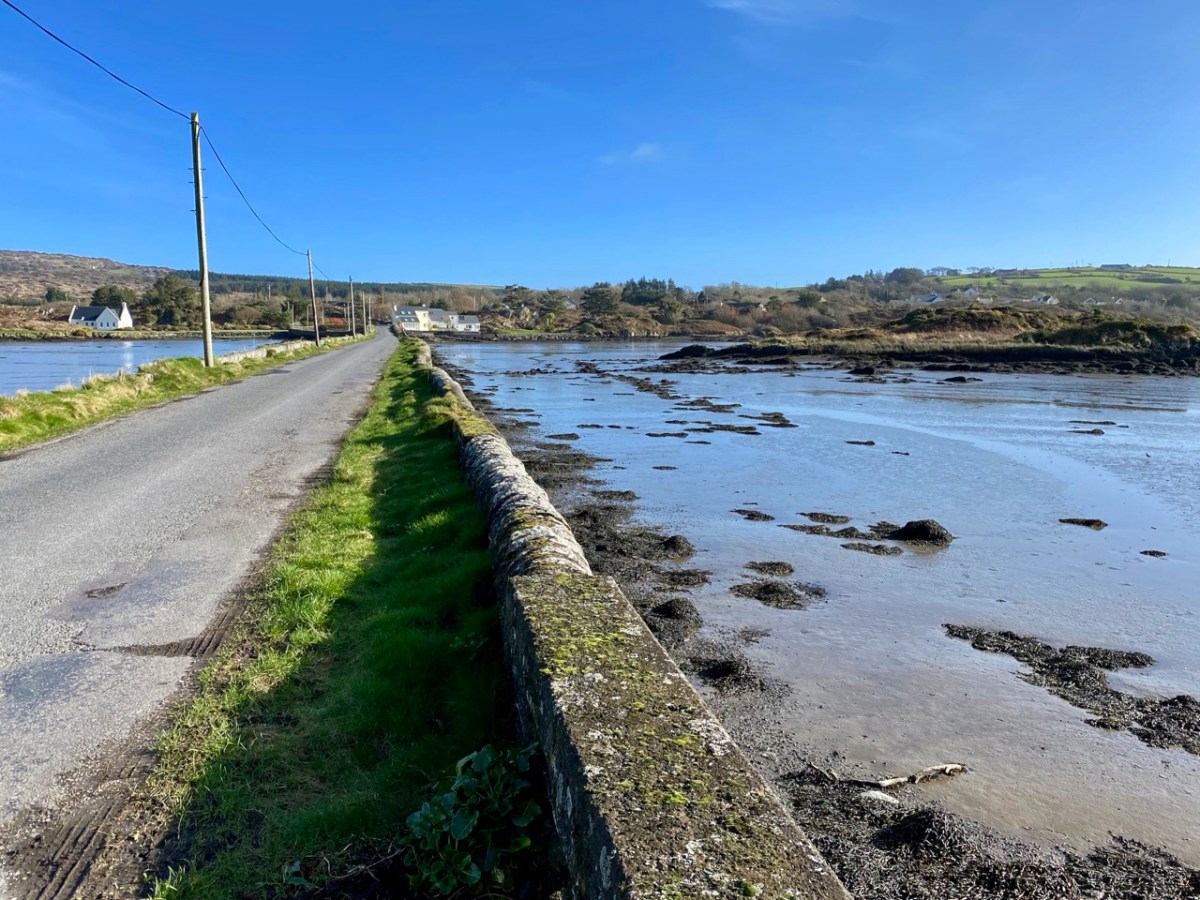
Ringarogy has fewer accessible viewpoints than Inishbeg, but the long causeway and some prospects from high land indicate how the lower course of the river is punctuated with small, barren landfalls (above).

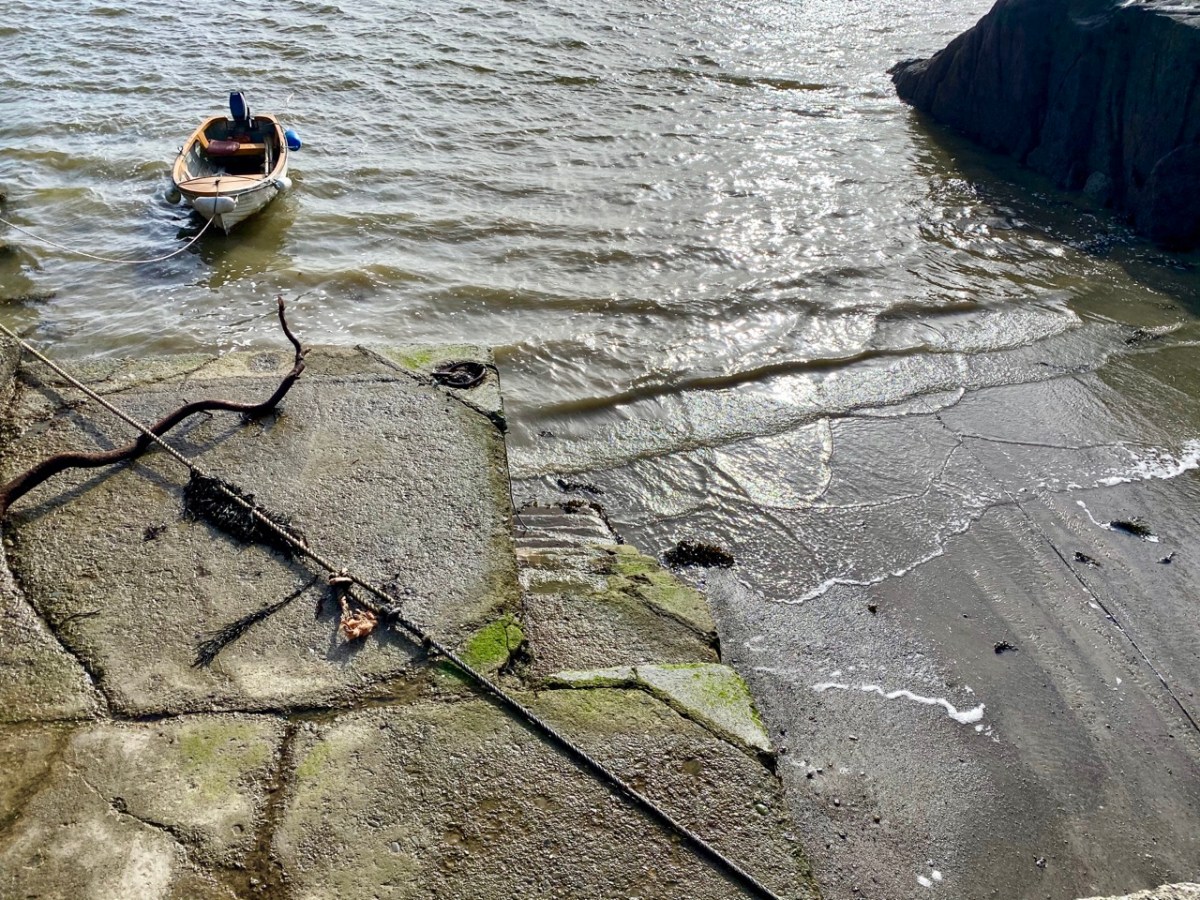
I have made up my mind that the Ilen proper must ‘end’ at Turk Head – the pier, above, is looking towards the main channel of the river. It is also a small but substantially built harbour – partly hewn out of the low cliffs – which can shelter a few light fishing craft.

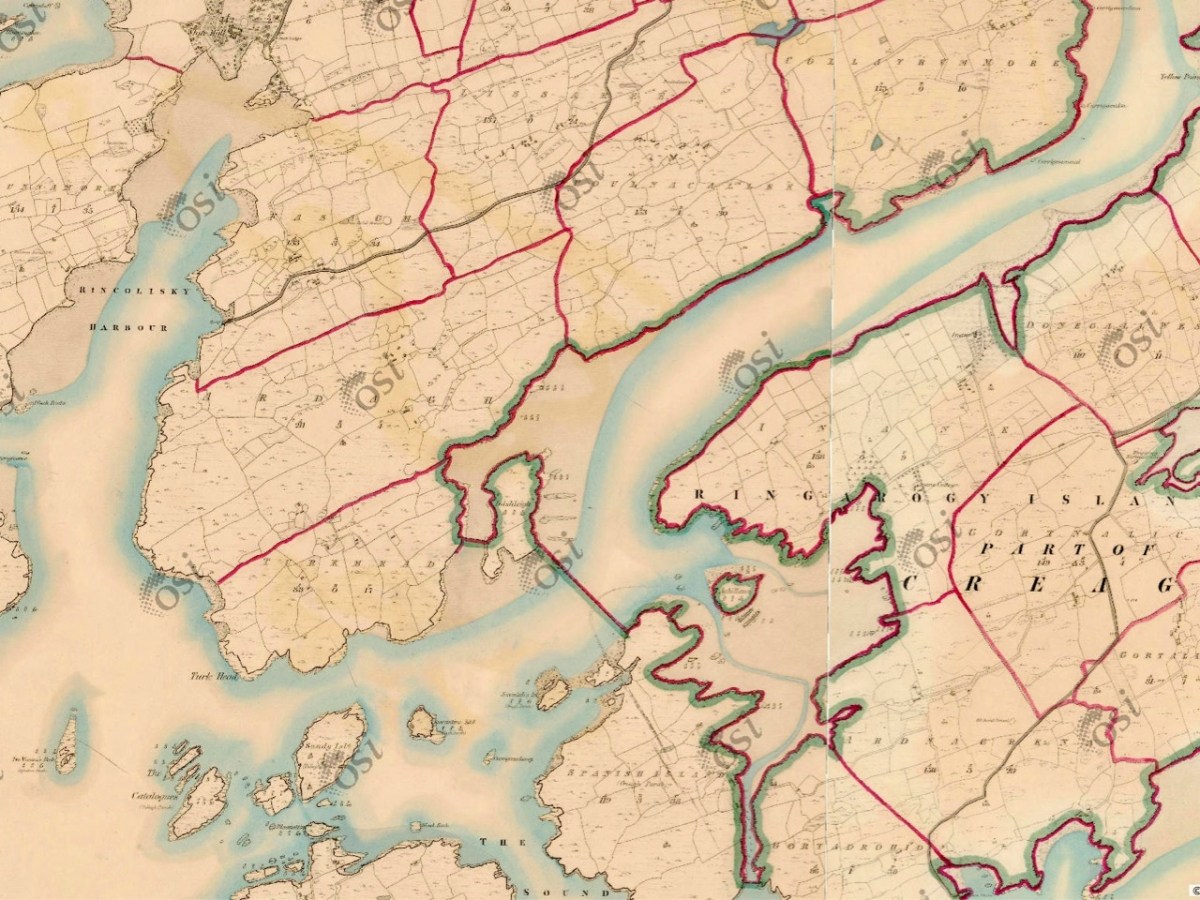
But the reality of the downstream ‘end’ of the river seems to be defined on the 6″ OS map above, which dates from the early 19th century and shows the townland names and boundaries as they were recognised at that time. There, a clear line is drawn between the island of Inishleigh to the north, and Spanish Island to the south. To the east of that line, apparently, is the Ilen, while to the west is the edge of Roaringwater bay, which leads into the ocean, but first skirting a myriad of rocks and small islands, only some of which have names.

There may be traditions – unknown to me – that define where the river mouth lies. Perhaps it doesn’t really matter. If you are a seafarer carrying goods bound for Skibbereen you will have to negotiate your way safely through a fairly convoluted channel before entering a contrasting world of wide, calm water and rich, smooth meadowlands: Sweet Ilen.

Previous episodes in this series: Sweet Ilen : Sweet Ilen – Part 2 : Sweet Ilen – Part 3 : Sweet Ilen – Part 4

Robáird an Tuairisceoir Fáin

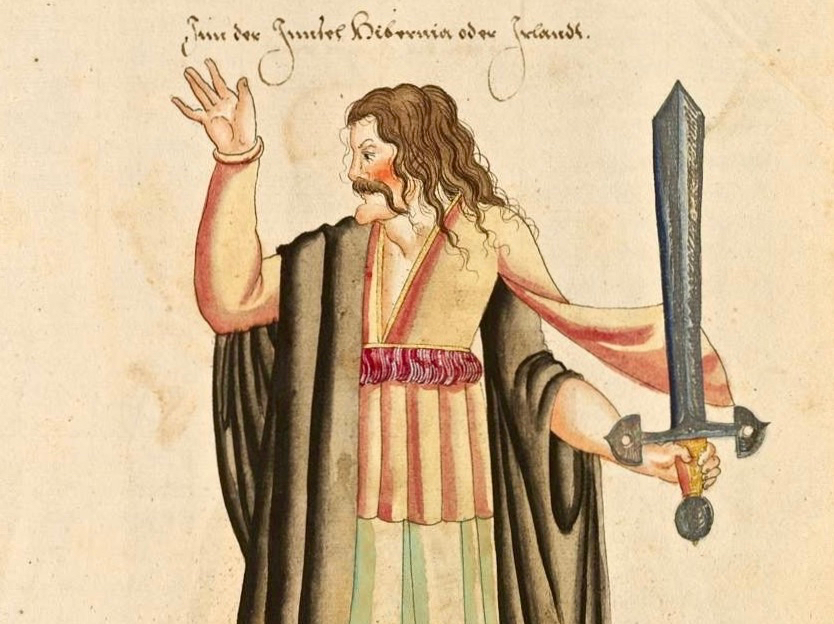
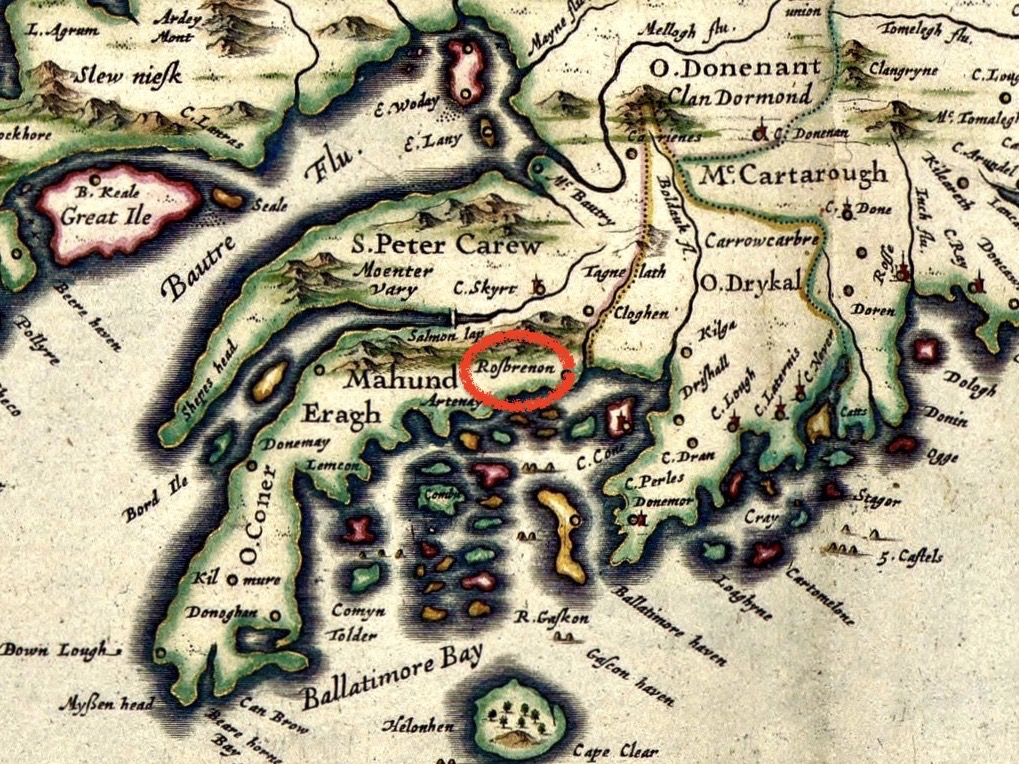
Exciting news! Recent land improvement works around Rossbrin Castle have uncovered the fragments of an old manuscript – tucked away in the crack of a rock probably 530 years ago. We all know about the Scholar Prince of Rossbrin – Finghinn O Mathuna – who was Tánaiste of the great West Cork O’Mahony clan, and who lived in the castle during the second half of the fifteenth century. He gathered around him historians, bards and scribes. Many books were written there and some survive to this day. They are learned treatise, but the new discovery is something different – a piece of pure journalism written by a visitor to the castle, Robáird an Tuairisceoir Fain (Robert the Roving Reporter), for the Rossbrenon News, a worthy forerunner to our own Roaringwater Journal. In the article, Robáird interviews Finghinn, and gives us a unique insight into how life was lived in those far-off days.

Upper – possibly Finghinn O Mathuna, the 15th century Scholar Prince of Rossbrin; lower – John Speed’s 1611 map of Roaringwater Bay, showing the Tánaiste’s territory of ‘Rossbrennon’

The manuscript is written in a mixture of Latin and Irish, and I have done my best to translate. The format is a dialogue between Finghinn and Robáird. You will have to excuse any errors:

RanTF: Tánaiste, thank you for talking to us today, and for entertaining me in this splendid castle solar which looks out over the waters of Roaringwater Bay. It’s such a busy place – the water is crowded with ships: where do they all come from and why are they here?

F O’M: Poiyou, Guyenne, al-Andalus, Castile, Flanders… all the coasts of Oceanus Occidentalis and an Mheánmhuir. They are here because we have the best fishing grounds in the whole of this world! Our warm waters have an abundance of cod, herring, pilchards – enough to feed all the great cities…

RanTF: So all this commerce that’s out there in Roaringwater Bay – it’s just about fish?

F O’M: Well, no. If you’ve got ships coming up here from places like an Mheánmhuir they might as well be bringing you some of their fine wines! Look below us, around the castle: you see all those warehouses? Some are ready with barrels and salt for preserving the fish before their long journey back, but those over there are doing very nicely for the wine trade…

RanTF: Is this an illicit trade?

F O’M: I’m certainly not going to be telling you that if you are going to publish it in that damnable broadsheet of yours. The Customers and Searchers do well enough out of us, but they seldom get down to these parts. If we do see them, we welcome them with open arms, and fill those arms with a good helping of Burgundy! We are seldom troubled by them after that – until they run out, of course.

RanTF: I understand that fish – especially pilchards – have to be preserved very quickly or they go bad?

F O’M: That’s why all those people are working out there. Look at the place – every one of those huts and cabins is occupied by large families, all of whom – women, children and men – are employed every waking moment. They do get a couple of hours off on the Sabbath, so that they can hear the sinners being denounced: that entertainment lasts them the week…

RanTF: Such a dense population must lead to some hygiene problems?

F O’M: There’s certainly an excess of pestilential exhalations – but that’s why I spend most of my time up here in the solar: I’m above all that. Besides, from here I get a very good view of what’s going on all around.

RanTF: So what is it that sets you apart? They do call you ‘The Scholar Prince’…

F O’M: They do – and they say that Rossbrenon is ‘The greatest centre of learning in the world’! That’s what really interests me. You see those houses down there, just below the castle? That’s where the scribes work. We are producing the finest literature, which is going to the most important libraries in Europe : London, Rennes…

RanTF: And what are they writing about?

F O’M: Whatever is in demand – and topical. We produced the standard work on the life of Sir John Mandeville, for example: that contributed considerably to the current debate on what happens when you reach the edge of the world – do you fall off? We have also come up with volumes on state-of-the-art medicines. Invaluabe for when the next plague strikes…

RanTF: Ah yes – very topical. But where does your knowledge come from?

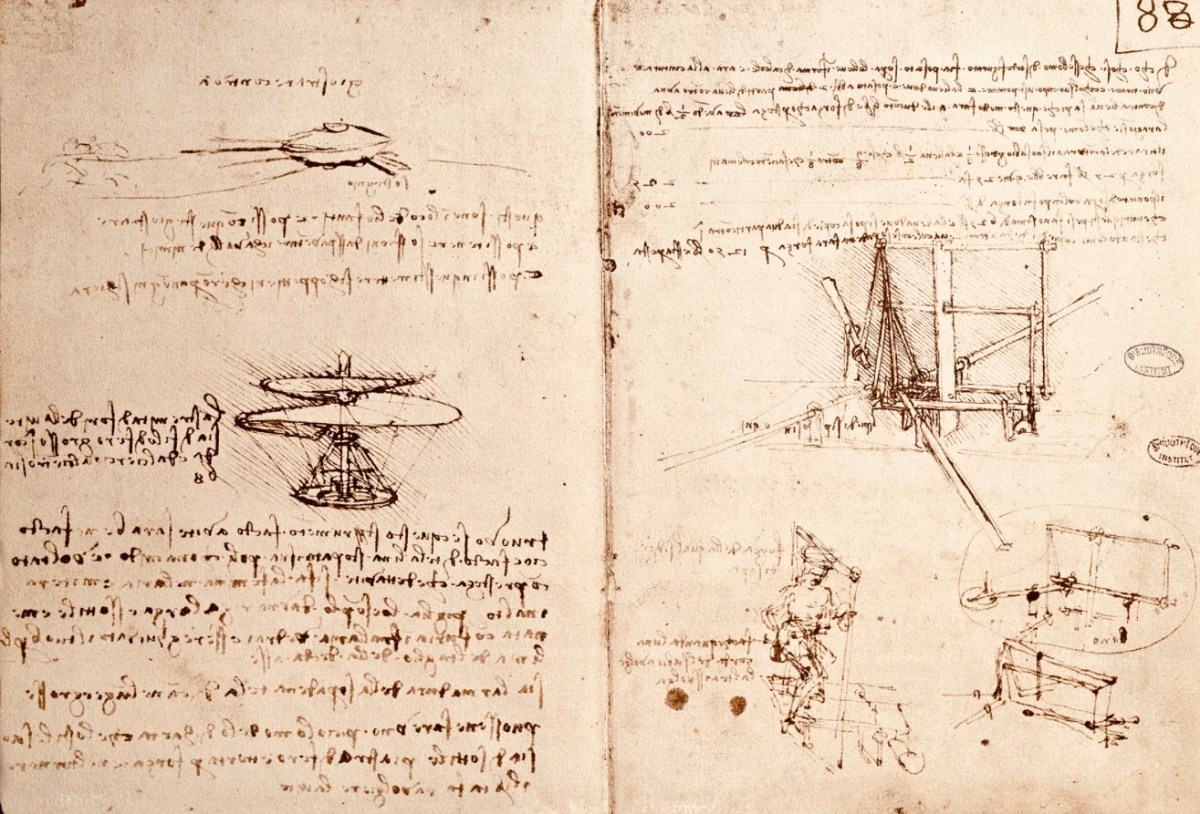
F O’M: I learn a lot from the seafarers: I entertain them royally with their own Burgundy and, in return, I find out what the latest thinking is. D’you know, there’s a young lad from Italia who is coming up with all sorts of ideas: he reckons that, very soon, we humans will be able to fly like birds! We’ll just equip ourselves with wings made from timber struts and skins, climb up the round towers, and jump off the top!

RanTF: Remarkable! What else does he say?

F O’M: He’s absolutely sure that if you keep sailing west, you will one day find yourself coming back from the east… I don’t understand it myself. What’s more, he claims to know exactly how babies are made!

RanTF: He’s obviously a genius, or a charlatan! So, Tánaiste, with all this knowledge you are gaining from your trading partners, what predictions can you make for us. What will this little bit of our Irish Empire look like in – say – five hundred years time?

F O’M: Ha! Well, I think there’s little doubt that the young community we are creating here in this sheltered cove will expand and become a huge city. There will be town walls, a Cathedral of Rossbrenon, a university and palaces to house the princes and the citizens. And, beyond the boundaries, there will be extensive coney warrens, enough to feed everyone, and keep them warm in winter. And – if that young Italian has his way, we’ll all be flying everywhere: who knows – perhaps we can even fly across the world and find where its edge is. As we’ll have wings, we won’t fall over it!

RanTF: Tánaiste, it’s been a privilege to talk to you. You have certainly widened my horizons. I would give anything to be able to see that city of Rossbrenon…

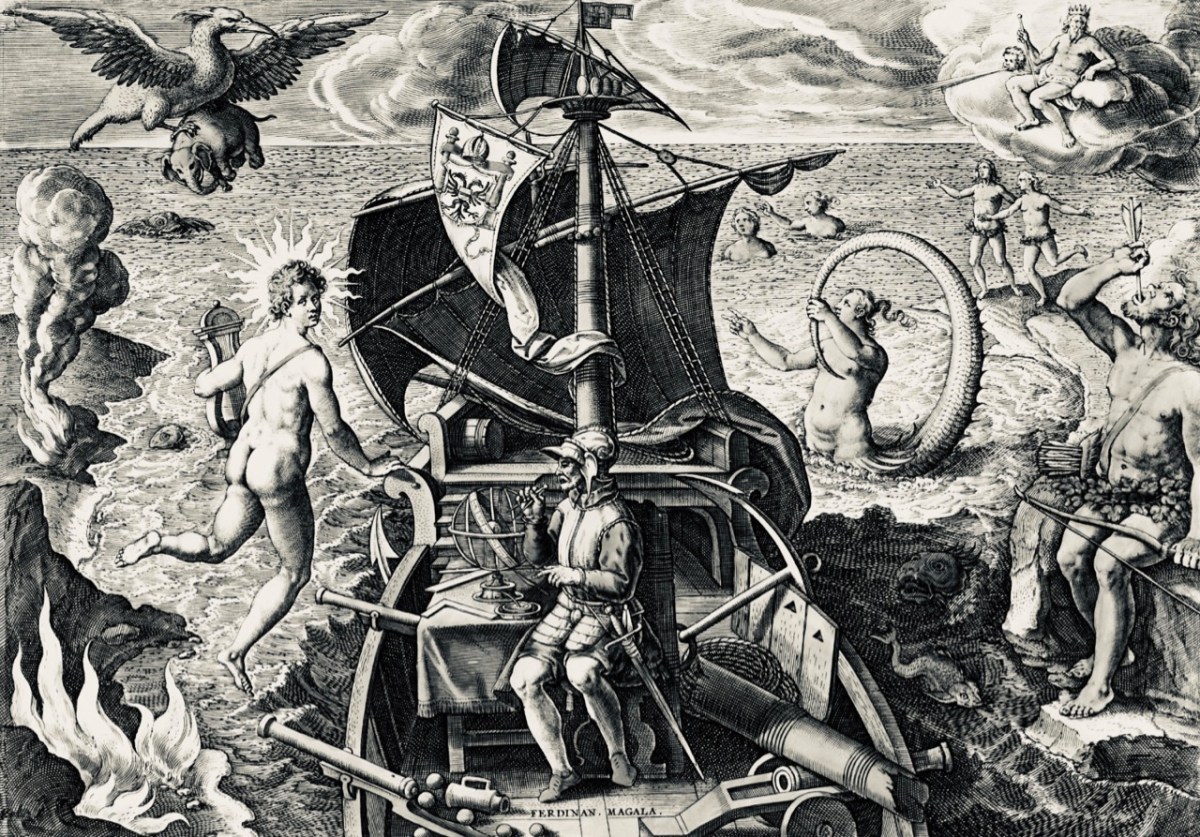
Christopher Columbus set foot in America in 1492 (above). Finghinn O Mathuna died in 1496. Ferdinand Magellan was the first to circumnavigate the earth, in 1522:

Glossary

An Mheánmhuir – The Meditteranean; Oceanus Occidentalis – The Atlantic Ocean; Customers and Searchers – Customs and Excise; Tánaiste – second-in-command of the Clan (the Taoiseach is the Clan leader).

The drawing of ‘Flying Machines’ by Leonardo da Vinci (1452 – 1519) is courtesy of the Museo Leonardo da Vinci, Florence. Note the ‘mirror writing’ that he always used in his private notes.

O’Mahony Clan Rally at Rossbrin Castle, 1975. Photo by Michael Minihane

West Cork Rocks

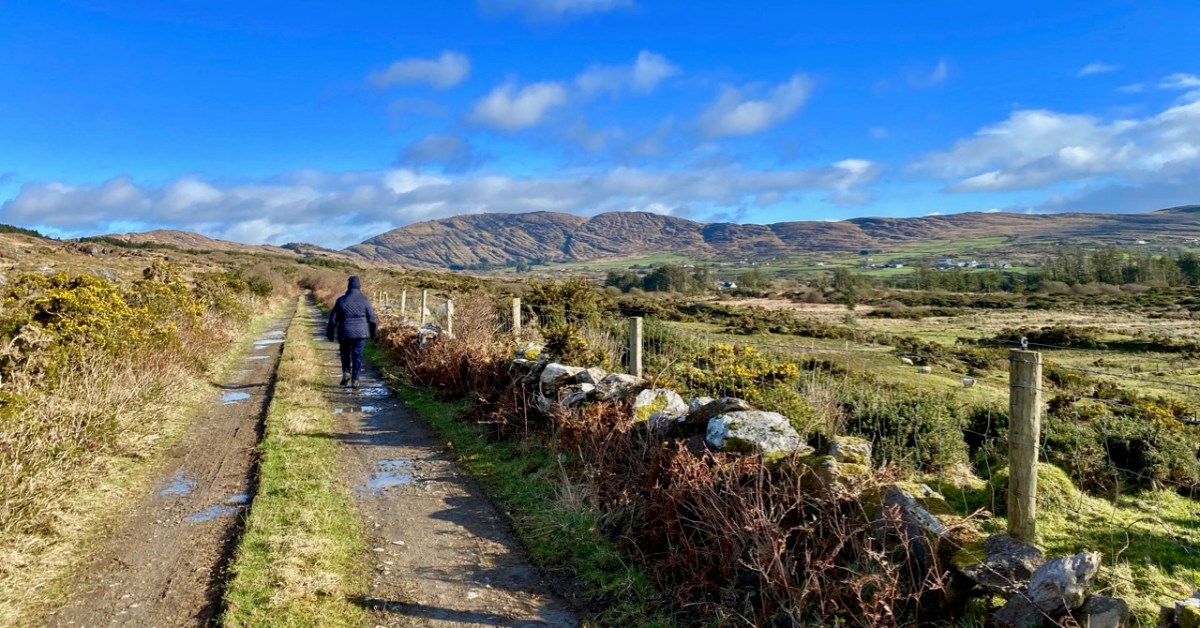
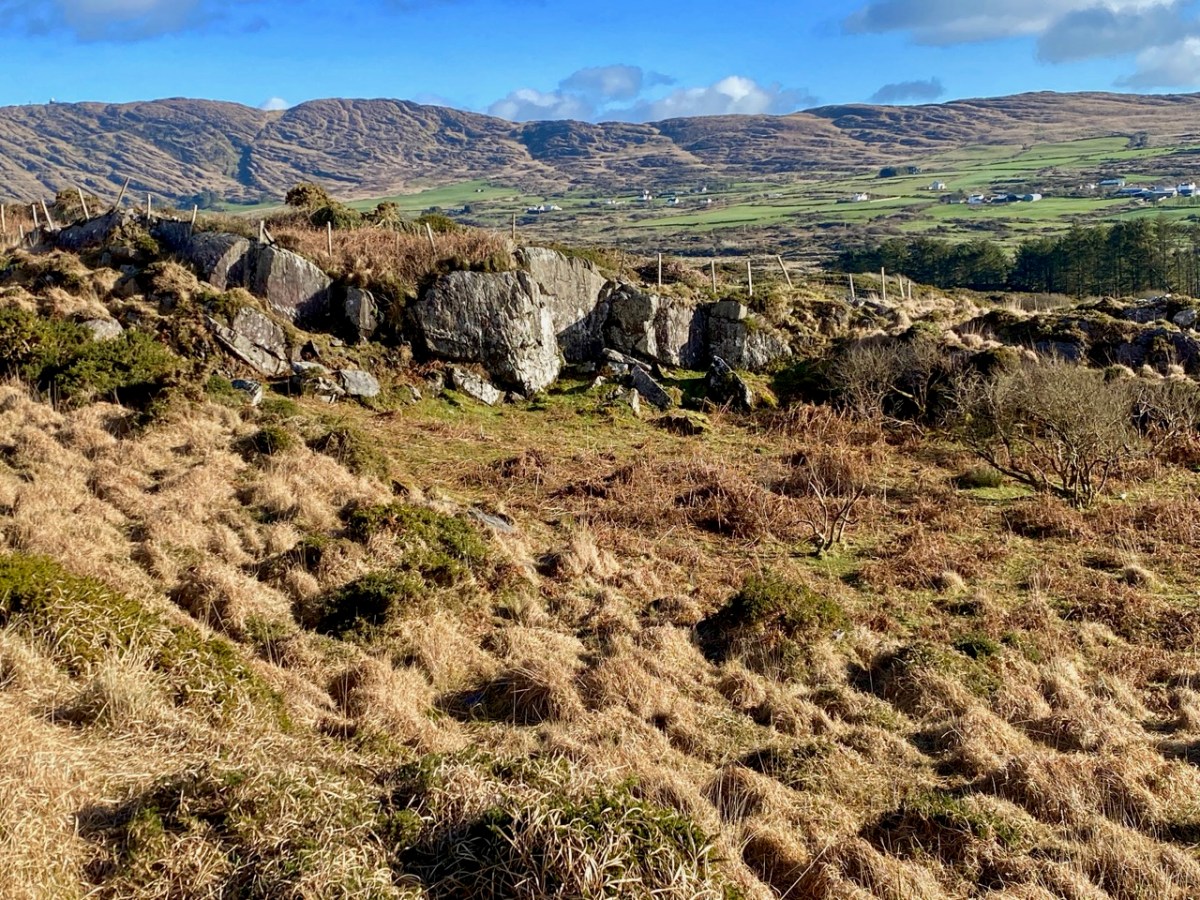
It certainly does! But this post is – literally – about rock: the hard, knobbly kind that is underneath us, surrounds us, and which has historically built our environment. In the picture above, taken on a clear February day during the most severe Covid lockdown, Finola is walking through beautiful West Cork. Beyond her is the great, gaunt outcrop of Mount Gabriel. Beside her is a traditional stone wall: its design unchanged over centuries. In the landscape all around her are rocks – large and small – scattered in the rough pasture.

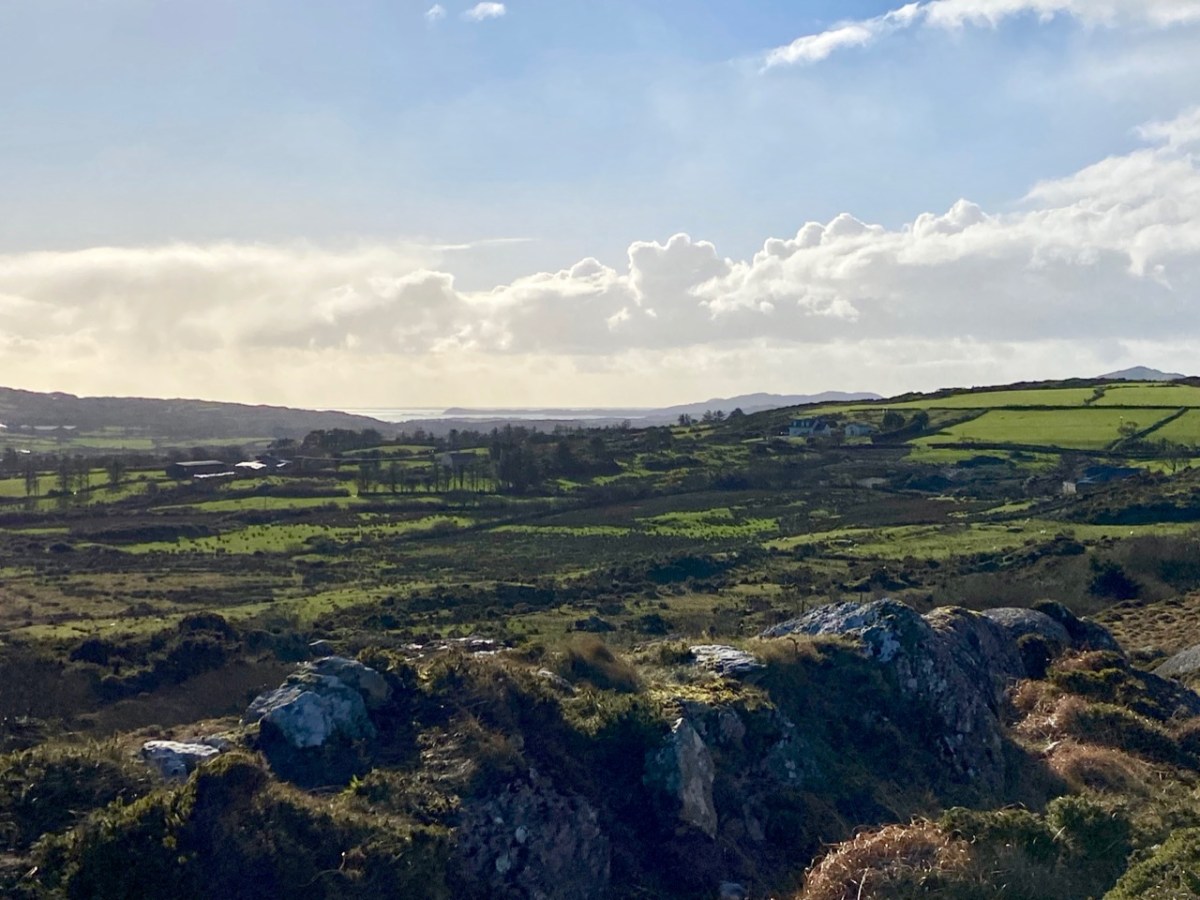
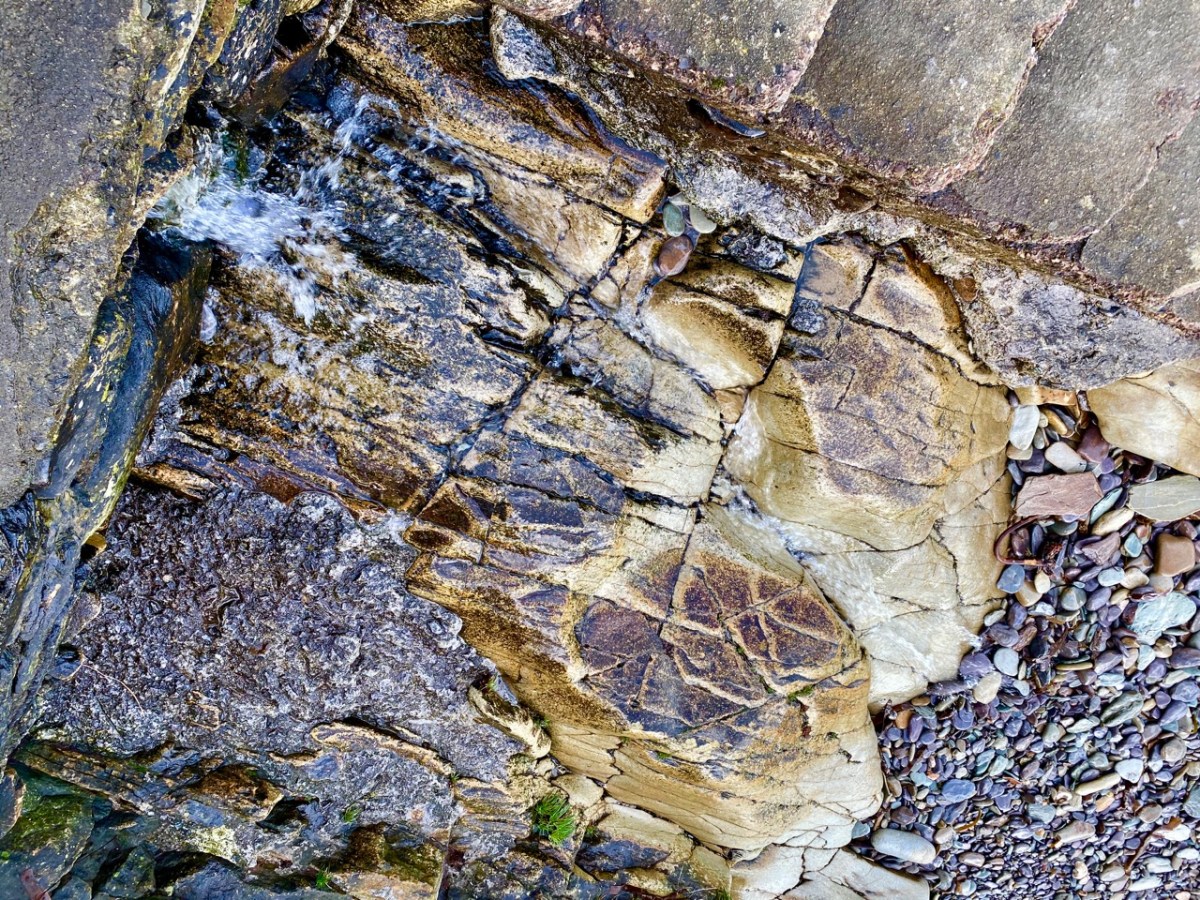
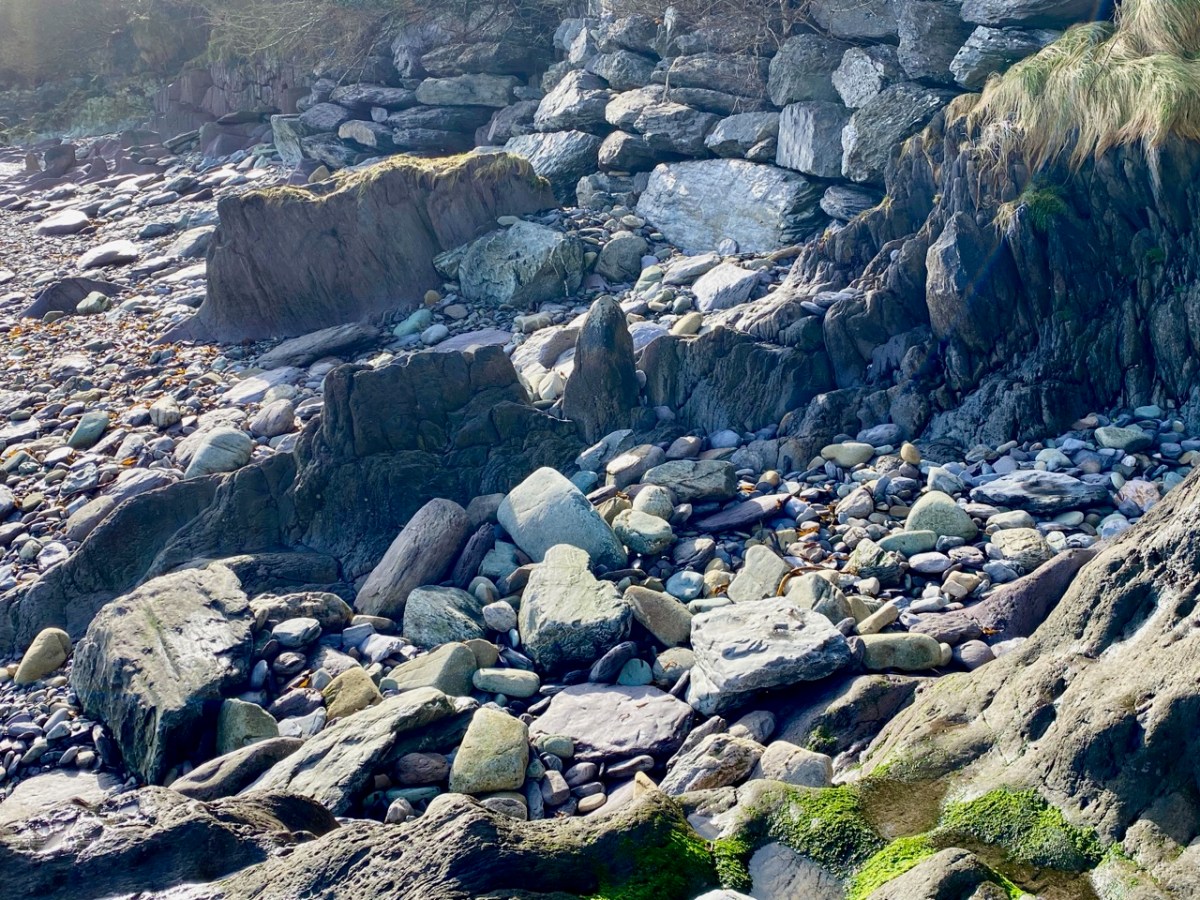
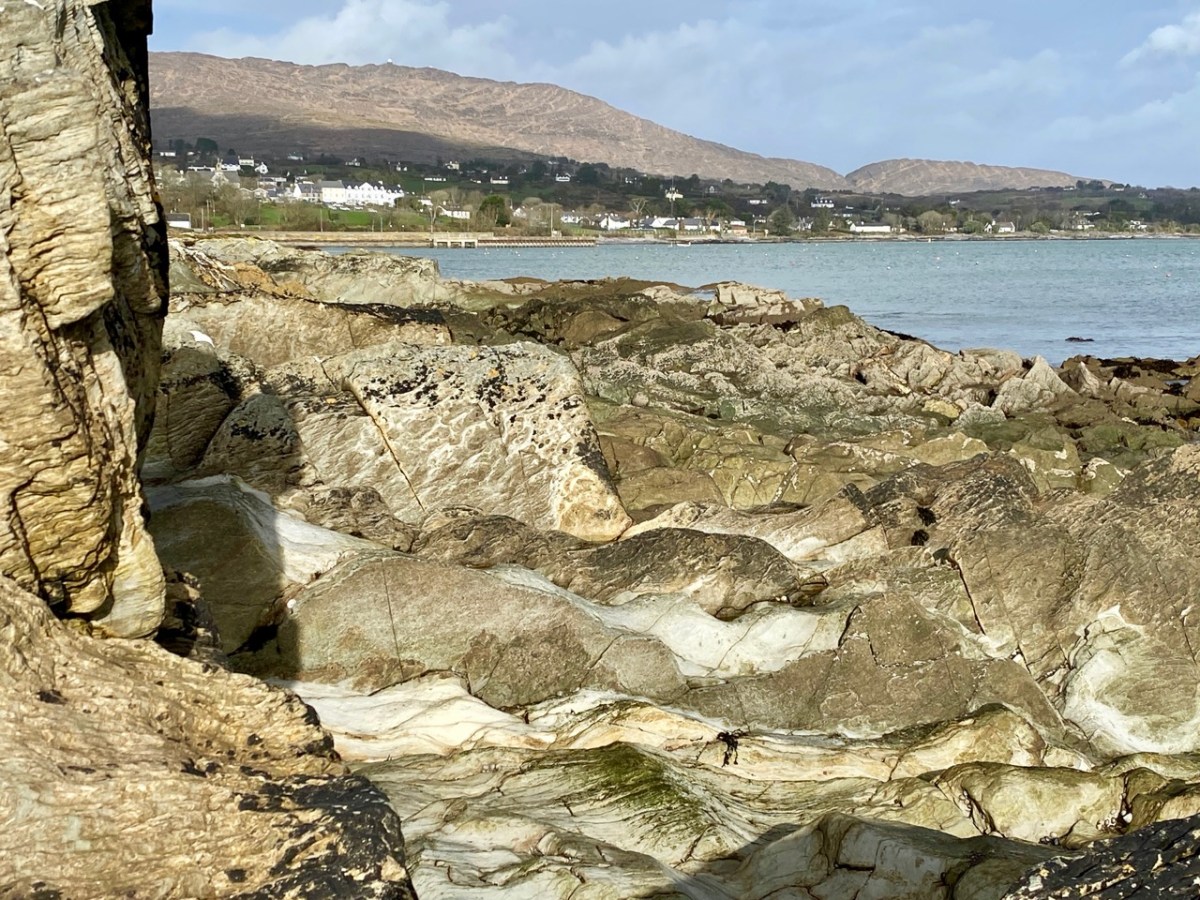
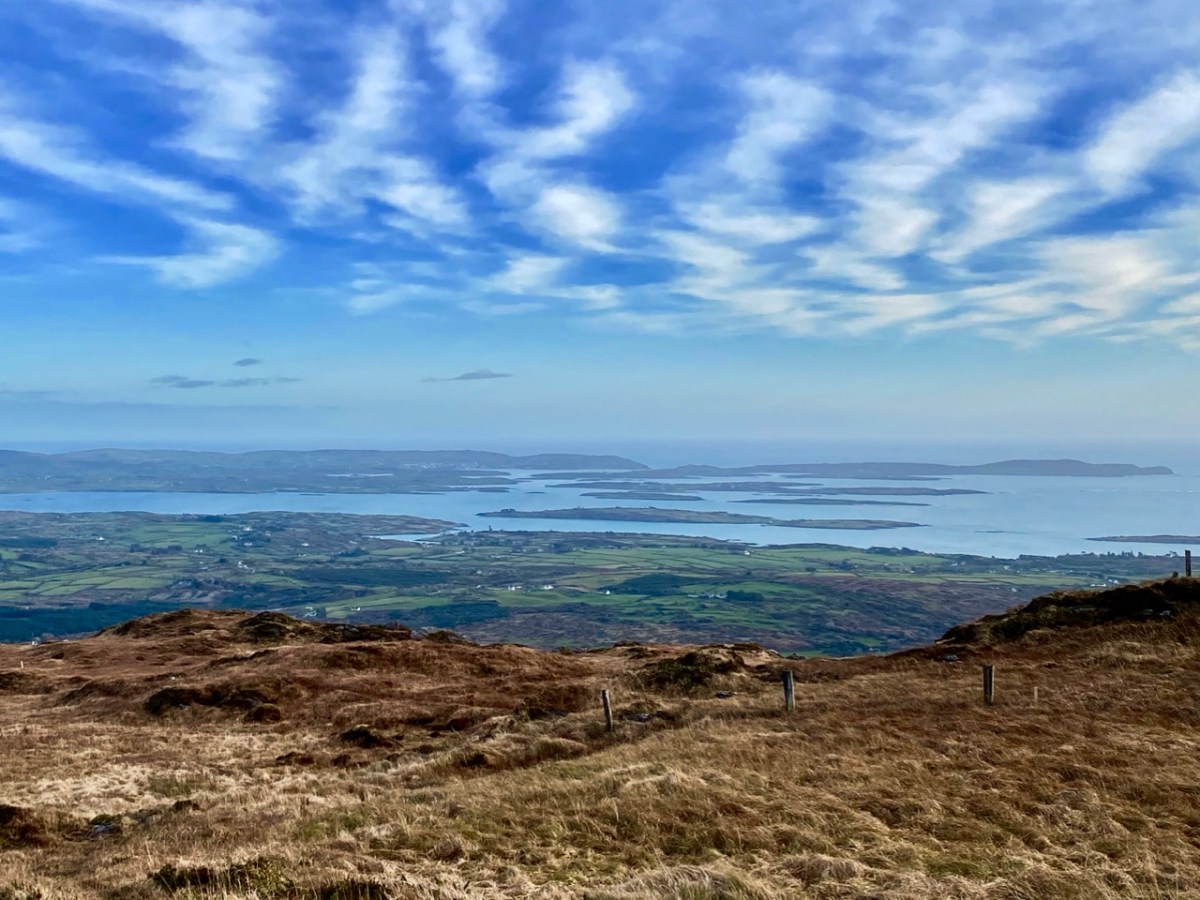
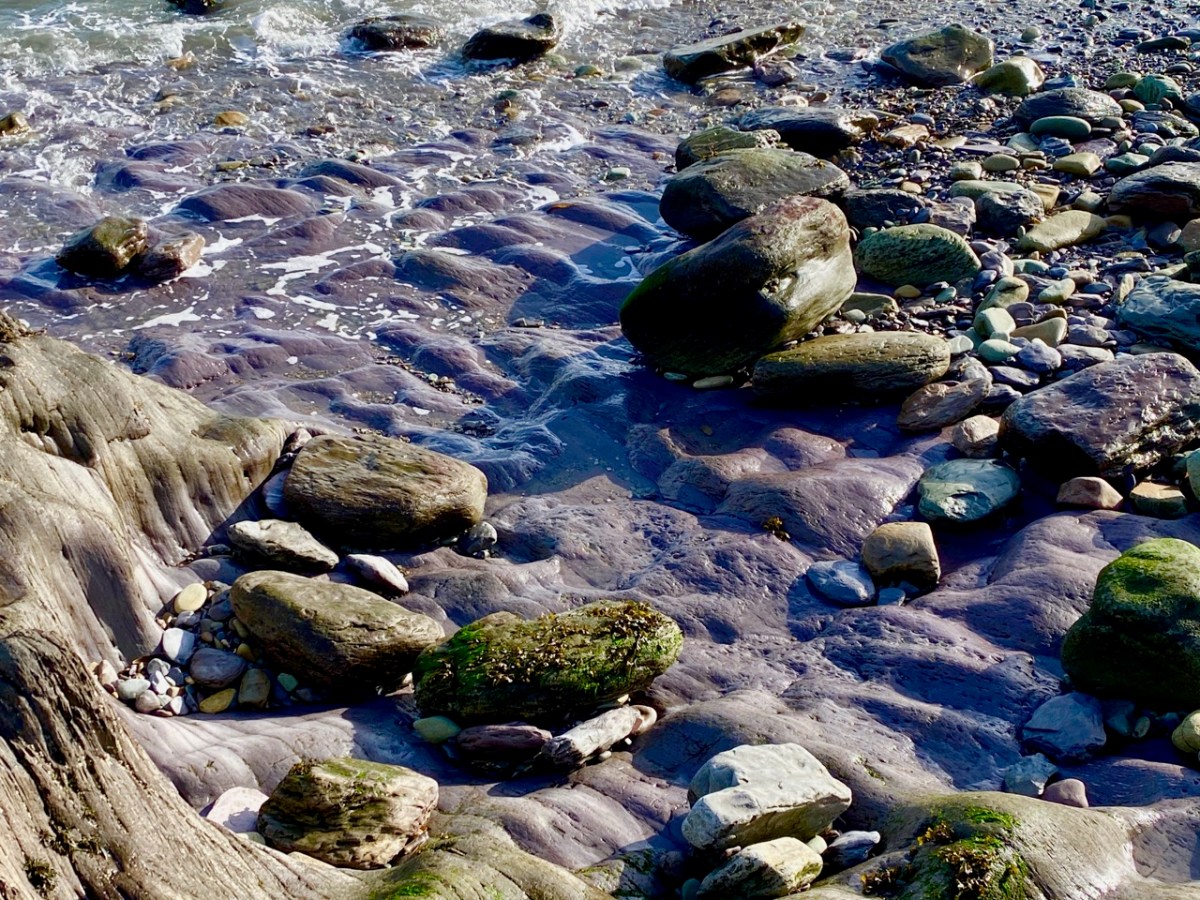
In the distance, of course, is the coast: there are very few places in West Cork where you cannot, at least, catch a glimpse of the sea – and so many where you can immerse yourself in it, or stand on its shore and admire the infinite textures which those same rocks display. It’s mostly Old Red Sandstone: that’s the correct geological term. It was laid down in the Devonian period – a while ago now: between 400 and 300 million years, in fact. This followed an era during which our mountains were built, known as the Silurian times. Continents were shifting and separating, and what was to become Ireland was a great arid desert – deserted: there was no-one around to see it!

Old Red Sandstone: in fact it varies in colour depending on its local history. Broadly, some of the mountain rocks are purple-grey, while those closer to the sea could be greeny-red, but that is probably far too wide a generalisation. The sheer beauty is in the infinite shapes and colours. What artist needs any finer palette?
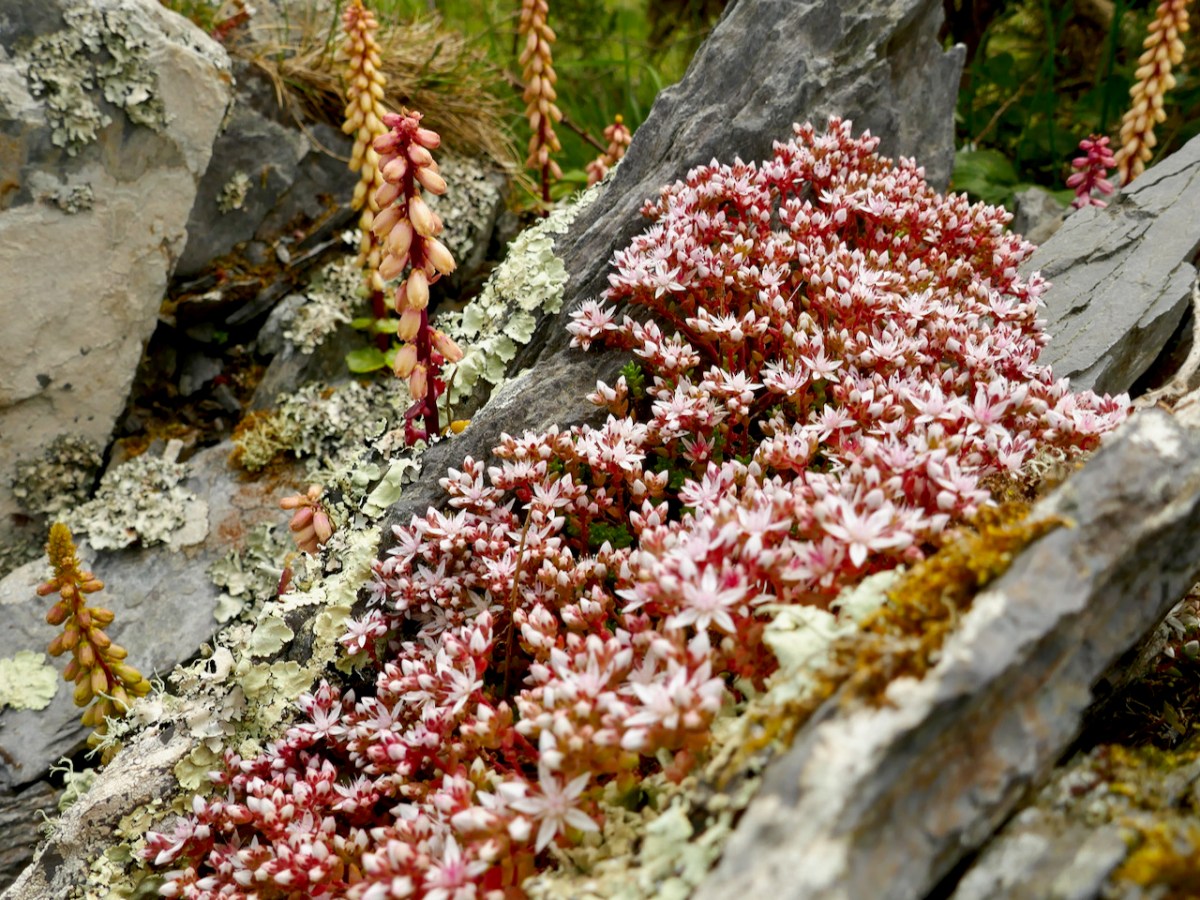
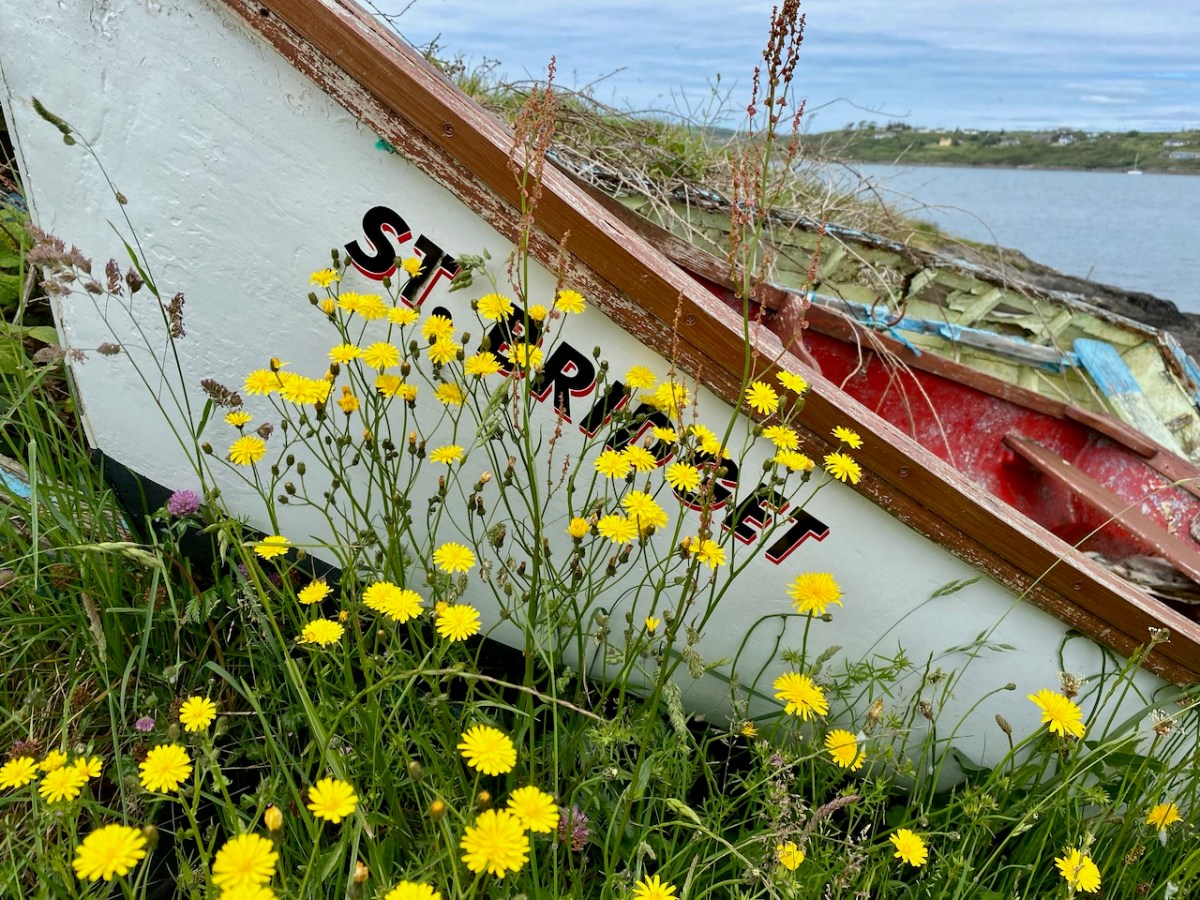
In those deserted times, an ‘Old Red Sandstone Continent’ extended over what is now northwest Europe, but it is worth noting that in ‘our’ part of it – the Munster Basin, covering today’s Kerry and Cork – we have one of the densest masses of this rock in the world: at least 6 kilometres thick. And we have to appreciate what it has given to us – high mountain spines sweeping steeply down to an indented shoreline of coves, creeks and inlets, with the myriad mottled islands that we oversee. An unparalleled, unfolded world.

After the ‘desert’ period, but much later – only about a million and a half years ago – came the Pleistocene Epoch. the word is from the Greek polys and cene – meaning ‘most recent’ – and that brings us almost up to date. That was a time of great climate events: deserts were inundated and then covered in ice sheets 3 kilometres thick, while moving glaciers tore up the rock surfaces, advancing and retreating several times. Eventually, what had been desert became arctic tundra. It is supposed that the ancestors of our present day life forms happened along during this epoch, and managed to survive. But we don’t find any traces of them until after the last ice sheet retreated in our part of the world – only about 12,000 years ago. The landscape that was left behind was inundated by rising sea levels, and the very last land bridge (between Cornwall and the eastern tip of Wexford) was washed away after that, but not before the Giant Elk and its mammal relations had got a foothold on the western side. The snakes, however, didn’t make it. And what of the humans?

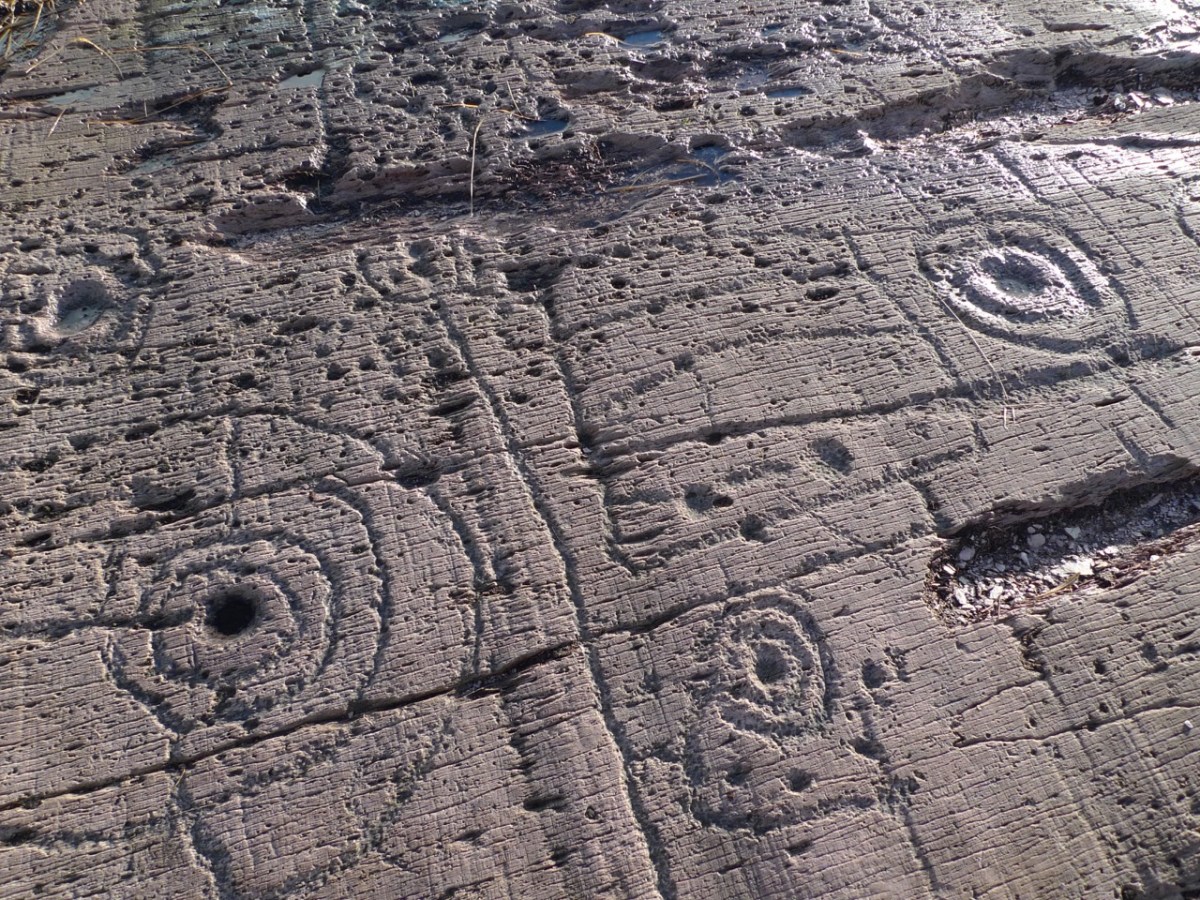
Well, the humans embraced the rocky landscape. They made their marks on the outcrops; then they moved the rocks about, and made architecture from them. We can still see their efforts, some 5,000 years later.

These Neolithic carved motifs could be the earliest human interventions on the natural Irish landscape: they might date from 3,000 BC. These examples are from West Cork, and were only discovered a few years ago. Finola wrote the definitive thesis on Rock Art when she studied at UCC in the 1970s, and we have staged exhibitions and given talks on the topic.

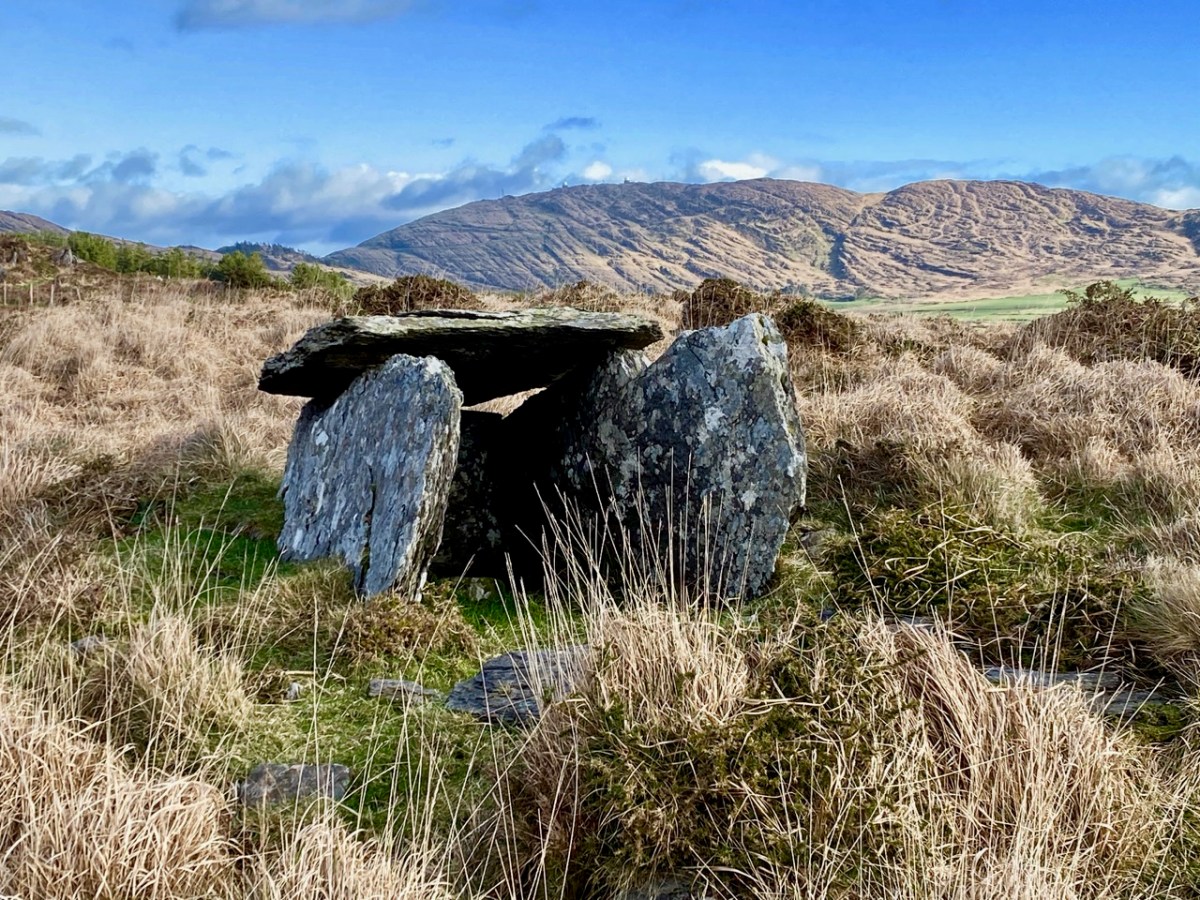
A couple of thousand years later, Irish people started to build things with the stones they found around them. This wedge tomb under the backdrop textures of Mount Gabriel at Ratooragh has rested here since the Bronze Age. Finola’s post today uncovers the fascinating folklore stories that generations have told about such artefacts. But restlessly working the fabric of the landscape – Old Red Sandstone – into walls, shelters, tower houses, temples and towns has never ceased.