Foto Mizen!

Hydrangea and Montbretia

Montbretia and Hydrangea (Ava)

Sunday August 7th is The Mizen on a Sunday Project Day. The what? 

Robin

This young robin was curious about our activities in the woods

The organisers of the new Photo Mizen Festival, which launches next year in Schull, have come up with a great fundraising idea. Here it is: a photo book of life on the Mizen Peninsula during the 24-hour period of a single day, Sunday, August 7, 2016.

Stream

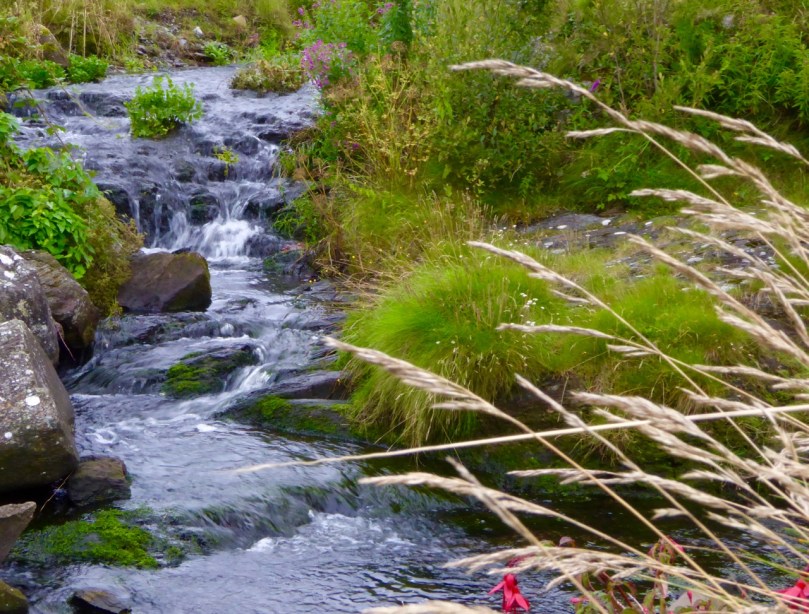
This little stream flows into the sea at Derreennatra

Derreenatra Bridge

The stream flows under this picturesque bridge (Ava)

My niece, Ava, and I decided to participate. Ava is almost 12 and she has a great eye and her parents’ camera. She and I rose at dawn this morning and set off to see what we could capture of life around us in Rossbrin.

My nephew Hugo, my sister Aoibhinn, and Marley, were happy to be photographed

Within three hours we had 250 images. Oh dear! We spent several hours deciding on the ones to submit to the Foto Mizen project and of course we had lots left over – we can only submit 5 each. So here is a selection of images that didn’t make the final cut.

Kilbronogue Wedge Tomb

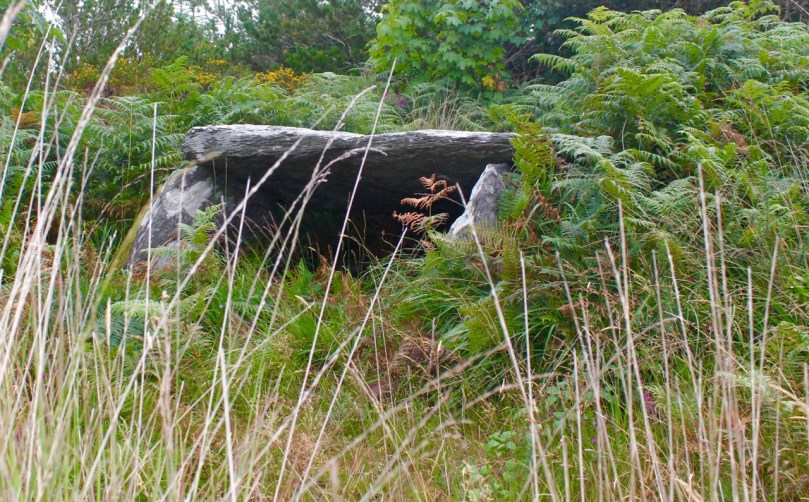
We walked up through the woods to the 3,000 year old wedge tomb at Kilbronogue (Ava)

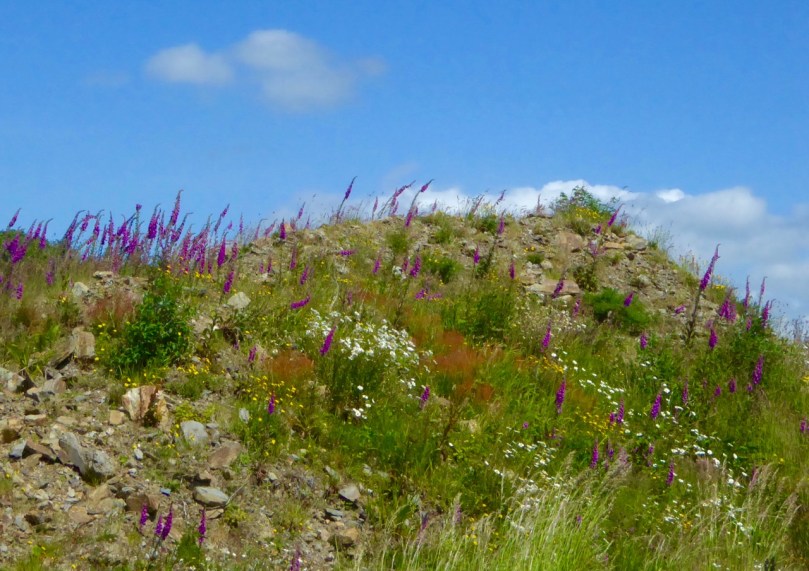
The wildflowers were everywhere in abundance, some blowing in extravagant crowds and some tiny and hidden.

St John’s Wort, heather and gorse, and blackberry flowers

Ava took lots of photos but was a bit shy of having me take photos of her! Here she is doing her best imitation of a Jawa.

Ava the Jawa

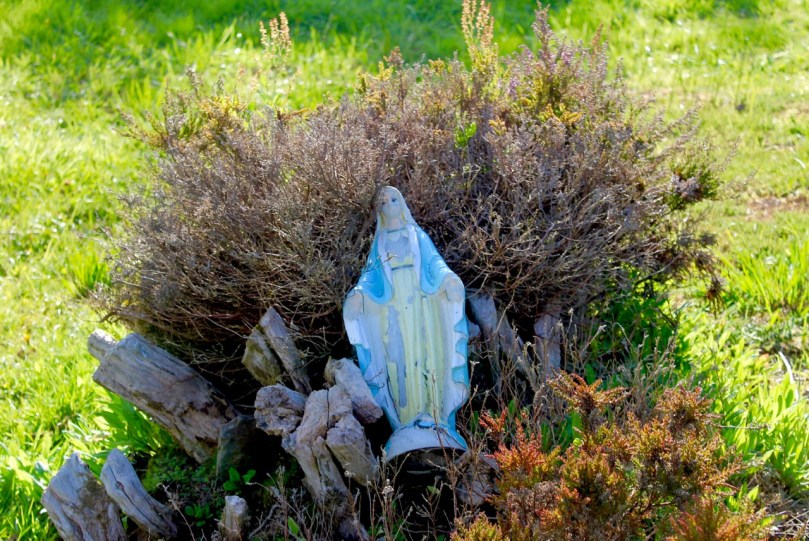
She was a little puzzled when I said our next stop was a graveyard, but got into the spirit of things right away when she found this statue.  She labelled it Creepy Mary, and I have to admit, those eyes are a little weird.

Creepy Mary

A tiny reminder from Stouke Graveyard that The Mizen is still a place where the past is sacred (Ava)

But she loved this little gate with its colourful postbox.

Gate and Post Box

And she took several photographs of the disused postbox at the old Rossbrin National School.

Rossbrin Post Box

It was a lovely way to spend time together, wandering companionably around the incredible Mizen countryside, snapping away at whatever took our fancy.

Rock wall with Montbretia

We didn’t have to go far – this is Ava’s picture of the little boreen outside our house 

Her younger brother, Hugo, got in on the act too, helping us to decide on our final five photos, which we will submit for the Photo Book Project. Turns out he has a great eye too – so next year there’ll be three of us roaming the hills of West Cork in the wee hours.

Fennel

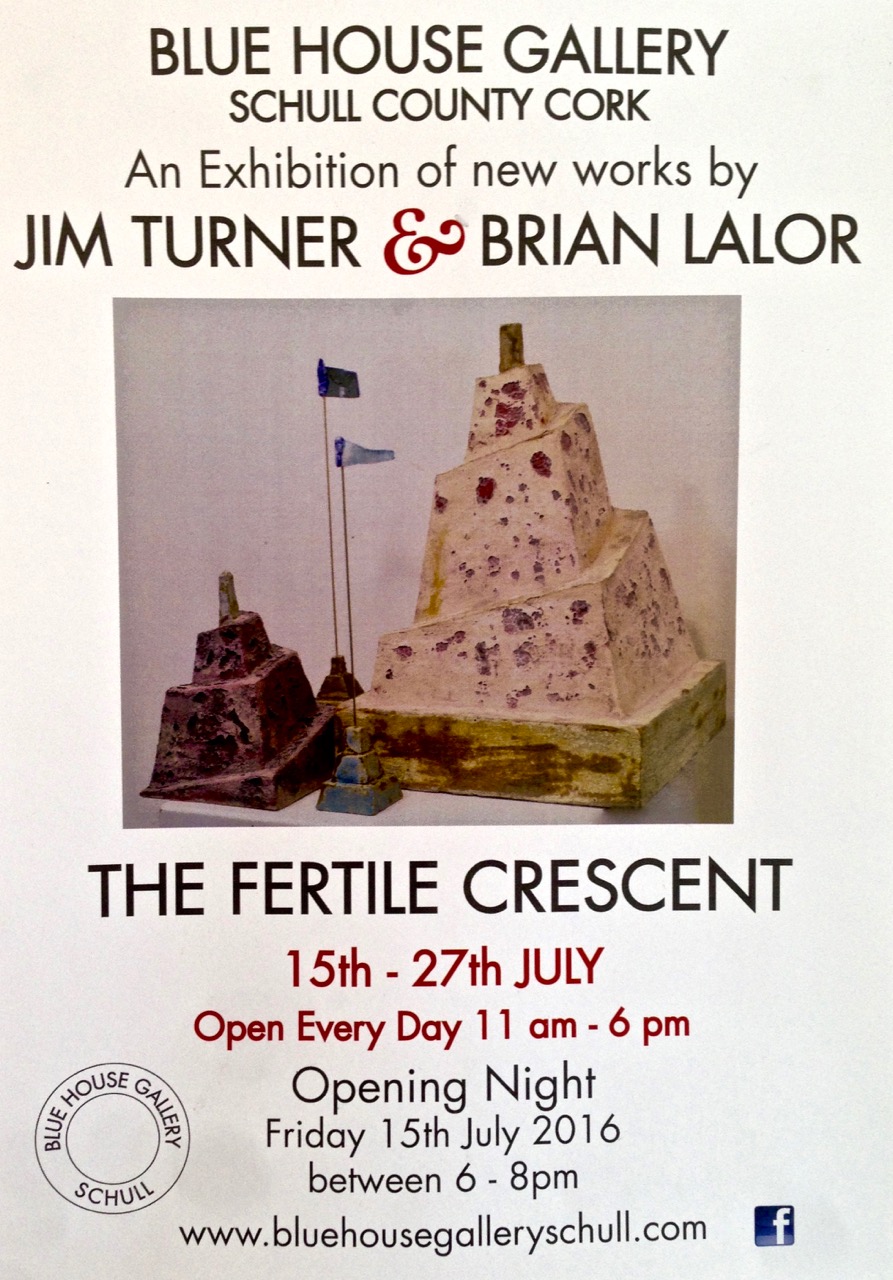
The Fertile Crescent – A Review

Just about a year ago I reviewed a most stimulating exhibition which was running in Skibbereen: West Cork Creates. It featured collaborations between local craftspeople, visual artists, photographers and designers – combining their skills and expertise to produce exciting, original work. In my review I asked if there was a difference between an artist and a craftsperson, and this sparked off a lengthy online debate. My favourite sentence from this exchange was penned by Colin Murray, an artist printmaker who had taken part in the Skibbereen exhibition:

…I think all creative workers share the essence of making a lingering dream and the effort of sharing one’s dreams with others is an urgent business of us humans…

All the work in the Skibbereen exhibition was outstanding, but I was drawn more than anything else to the collaboration of artist and writer Brian Lalor and ceramicist Jim Turner. They have continued to collaborate, and the current exhibition at the Blue House Gallery, Schull is an extraordinary display of their combined talents.

One of Brian and Jim’s larger works currently showing in the Blue House Gallery in Schull – a gold capped obelisk

The exhibition has the title The Fertile Crescent, a phrase that might seem strange, at first, encountered on the small main street of a village in the far west of rural Ireland. It conjures up, of course, the images we had in our school text books of the beginnings of human society, including the development of writing, the invention of the wheel, the use of glass – and irrigation which enabled settled agriculture to develop. This led gradually to the exploration of metalworking – some of the earliest figurative bronze work is from the area:

fertile crescent bronze

Not in the Schull exhibition – but original bronze figurines from Tell Judaidah, Turkey. These are the oldest examples of true bronze (combination of copper and tin) known. They are dated to around 3000 BC (photo – University of Chicago)

At school we learnt about this land and its features and I remember the romance of the names that were conjured up: Mesopotamia, Assyria, Egypt, Tigris, Euphrates… geographically far away but important enough to be titled The Cradle of Civilisation. That’s where our ancestors came from, we were told: that’s where our religions began.

great mosque

Minaret of the Great Mosque of Samarra, an etching by Brian Lalor

That geography today is at the forefront of our news. We now think of Iraq, Syria, Lebanon, Jordan, Israel and Palestine as well as the older names. We now think of idealogical war zones, we think of suffering, of displaced people; we think of bombs, human carnage, ruined ancient sites – and refugees. The mission statement for the exhibition begins:

…In this exhibition Jim Turner and Brian Lalor have devoted their attention to the current tragedy unfolding in the Middle East where the ruins of the civilisations of the past are being destroyed, and the present-day populations forced to flee their homes in fear of their lives, to become refugees in adjoining countries and in Europe. Our world heritage is under threat of total destruction as the cycles of violence recorded by history continue to occur…

It’s this modern view of what is going on in The Fertile Crescent that occupies this exhibition, and for that alone this work is as important on the main street of Schull as it would be in any major world capital.

Children pot

The ceramics – pots and bowls: the decorations on these utilitarian objects portray urgent messages for our society today. Jim Turner is the potter and Brian Lalor provides the illustrations

In the exhibition there are references everywhere to the cultural history of the Fertile Crescent. Jim Turner has made a series of cylinder seals, which involve inscribing a clay roller which is used to impress calligraphy on to a clay tablet; the same techniques have been used to decorate ceramic plaques.

cylinder seal

(Top) one of many ‘cylinder seals’ by Jim Turner on display in the gallery; (above) two of the ceramic plaques with impressed patterns

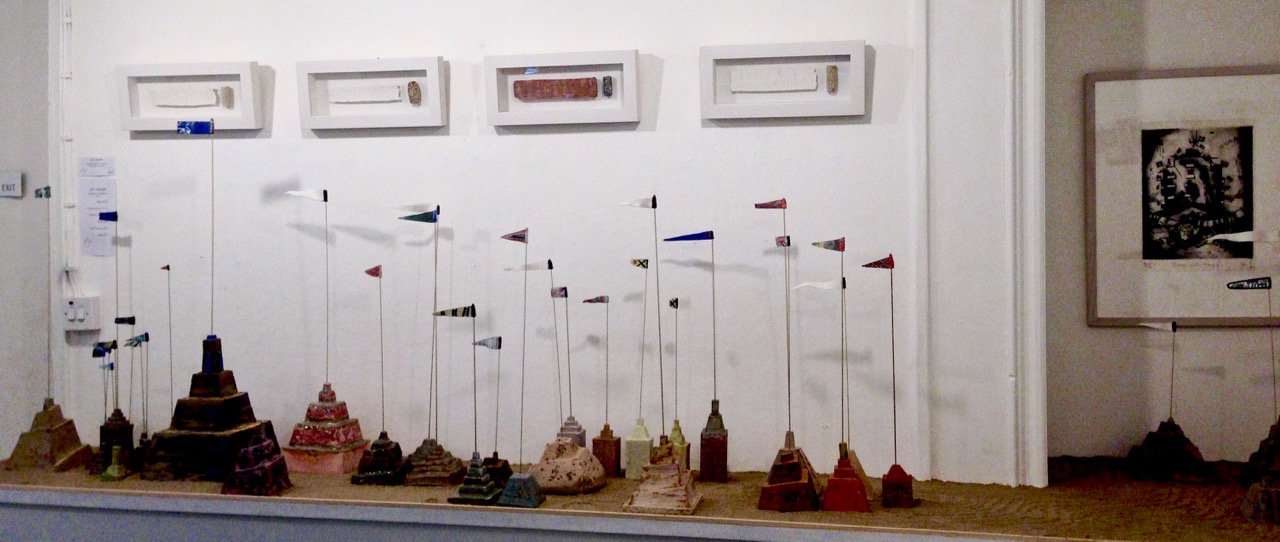
Obelisks and ziggurats are architectural features which we associate with the history of the Middle East. The two artists have produced a huge array of artefacts using these distinctive forms. Some stand in serried rows like an army (top picture), while other are decorated by Brian with motifs ancient and contemporary. The juxtaposition perhaps sometimes perplexes the viewer but the overall effect within the galleries is arresting and we are left in no doubt that these artists are giving us – Europeans – clear and deep messages, not only about our endangered world heritage, but our own responsibilities towards the chaos that is engulfing The Fertile Crescent in our own time.

Try to catch this exhibition: it deserves a wide audience. Perhaps West Cork is a long way for some of you to come? I hope there will be chances for this work to be seen elsewhere. I know the artists are collaborating on a further venture later on this summer: doubtless that may well reach the pages of this Journal. Congratulations to The Blue House Gallery for providing us with this most thought-provoking and dynamic work.

panorama

poster

Foxglove Fever

Foxgloves in our own boreen

Nobody can remember a year like this one for the foxgloves. In fact, all wildflowers seem to be crowding out the boreens and invading the fields everywhere you look, including our own little patch of paradise, above.

ragged robin and oxeye daisies

Ragged Robin, Oxeye Daisies, Buttercups and Thistles

Back Road to Schull

Along the back road to Schull from Ballydehob

Last year I wrote a post, Close Reading, about the June wildflowers. The theme of the piece was that to really see what was in the hedgerows you should slow down, stop and seek.

Massed foxgloves

Not this year! This year we cycle or walk along fragrant, colourful paths that threaten to overwhelm the senses. The bounty is simply laid out before us.

Half way there

Foxgloves can have as many as 75 blooms on one stem. This one’s half way there

Foxgloves, tall and straight, are everywhere, singly or in masses. Nobody knows why it’s called foxglove, beyond the obvious explanation which doesn’t seem to quite fit the size of the flower in relation to a fox’s paw. But we do know its latin name, digitalis, was based on the idea of the flower easily slipping over a finger. It’s an important medicinal plant used in heart treatments but highly toxic if ingested raw or improperly, earning it the nicknames dead men’s bells or witches gloves.

They are a native to Ireland, quickly colonising waste ground and common near moorland. Sometimes called fairy thimbles or fairy bells here, they were associated with the little people and it was considered unlucky to have them in the house. That’s good, as they are an important source of nectar for bees and other insects.

Wasteland

This patch was cleared last year and looked barren. Here’s what’s happening now!

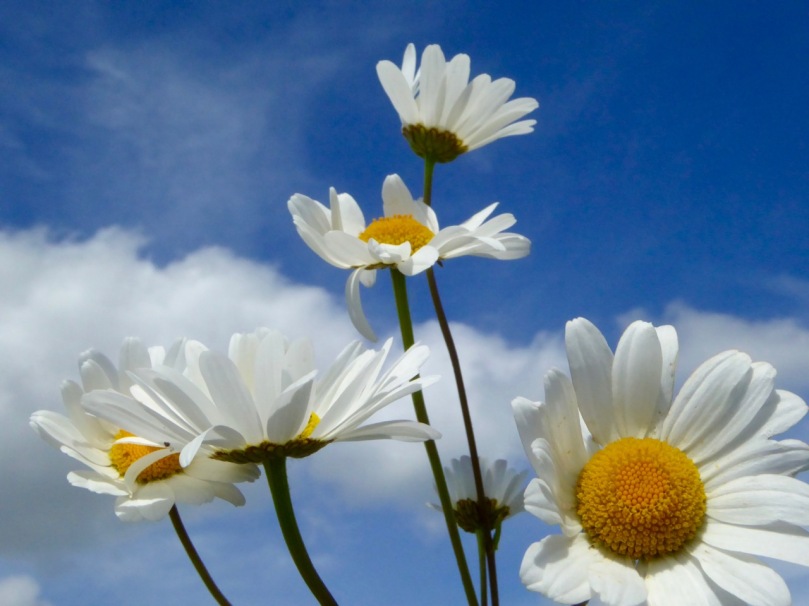
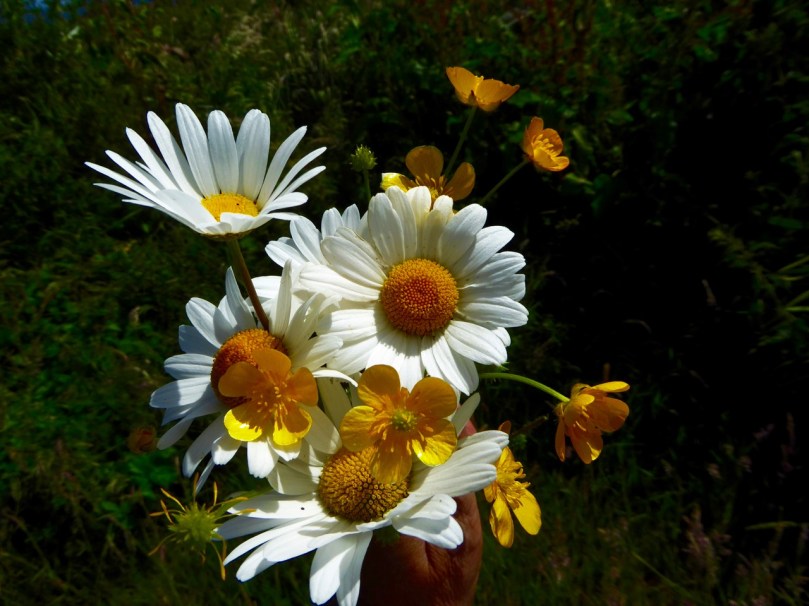
The other ubiquitous flowers of June in West Cork are the Oxeye Daisy and the Buttercup, often growing together in a riot of white and yellow. Both are native plants and, like the foxglove happily and quickly colonise any ground that’s been recently cleared. We grew up calling them dog daisies and bringing them home in great bunches for our mother, who would quietly dispose of them once we’d gone to bed – their perfume didn’t match their good looks.

oxeye daisies blue sky

And Buttercups – is there another such yellow? We held them under each other’s chins to see the yellow reflection. If it was there, it meant you liked butter. It never occurred to us to question the validity of the predictive method.

oxeye daisies and buttercups darker

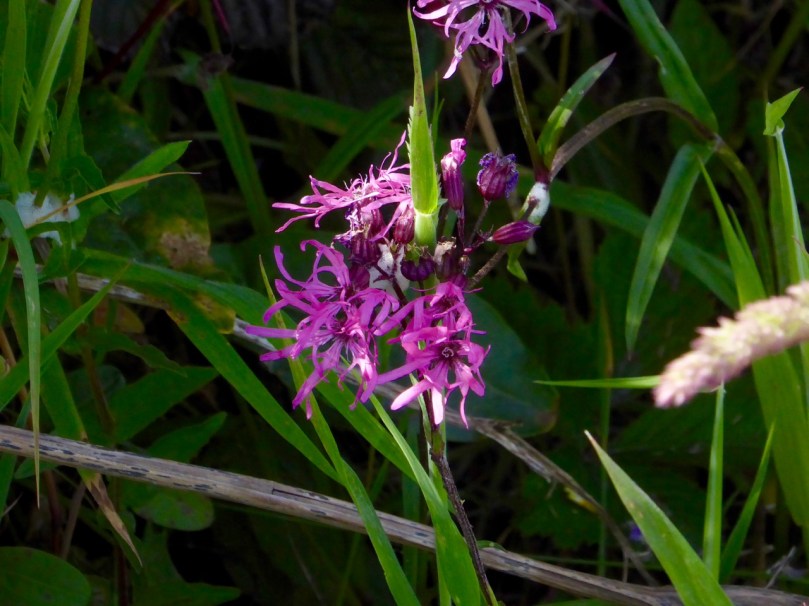
Ragged Robin – such an apt name for this native! A tiny haggard near us is full of them, much visited by butterflies. This lovely flower used to be more common, but the draining of wetlands and boggy areas has left less of their preferred habitat for them.

Ragged robin

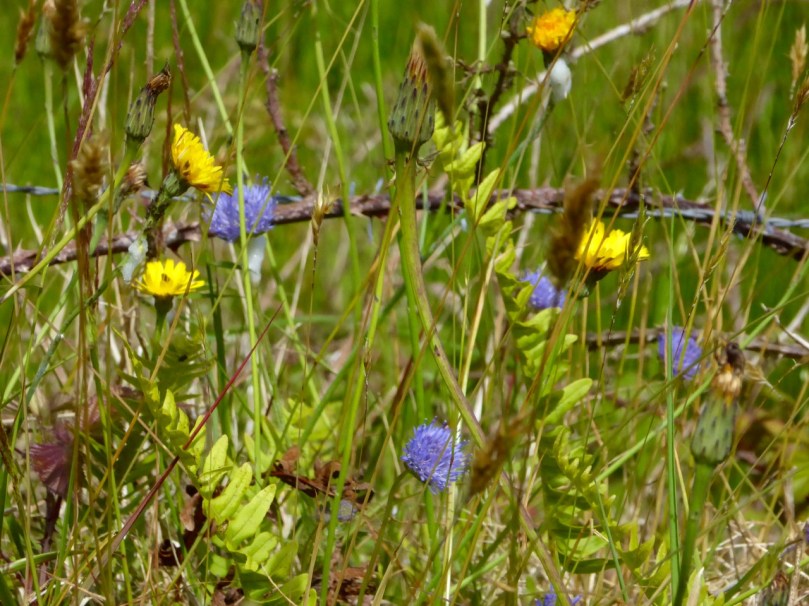
Scabious is everywhere and its brilliant periwinkle blue plays off beautifully against the yellow of the humble dandelion. The bane of gardeners everywhere, the dandelion was used in Ireland to make a tea that was supposed to be a great tonic for one of ‘consumptive habits.’ As kids, we delighted in blowing the seed heads to see what o’clock it was, and rubbing the milk on our warts as a cure. On a less charming note, we called them piss-a-beds and teased each other that touching them would result in wetting the bed.

Scabious

Scabious and DandelionsThe honeysuckle and the fuchsia are just starting to make their presence felt now. The bramble flowers and the wild roses are punctuating the hedges and the bird’s foot trefoil has taken over part of our lawn. My father waged war on anything but grass on his lawn, especially the little lawn daisies. He didn’t mind us pulling those up to make daisy chains, or to play he loves me, he loves me not.

Clockwise from top left: Birdsfoot trefoil, Wild Rose, Lawn Daisies, Campion, Foxglove and bramble flower

Of course, there is still a bit of seeking and peering involved for the tiny flowers in the hedges or fields. Speedwell, Herb Robert and Campion (below) reward the slow down and look closely approach.

Flaming June, some people call it (although the original Flaming June is actually a painting), and perhaps this year it’s a better description than ever.

colourful haggard

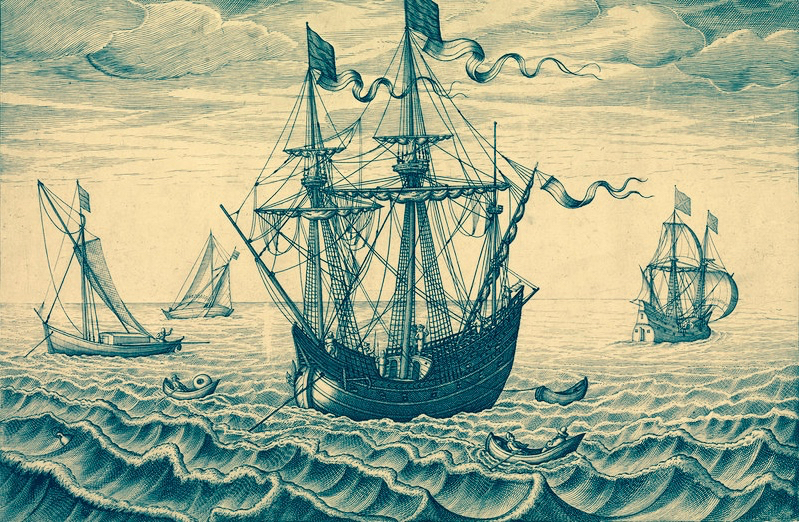
Here Be Pirates!

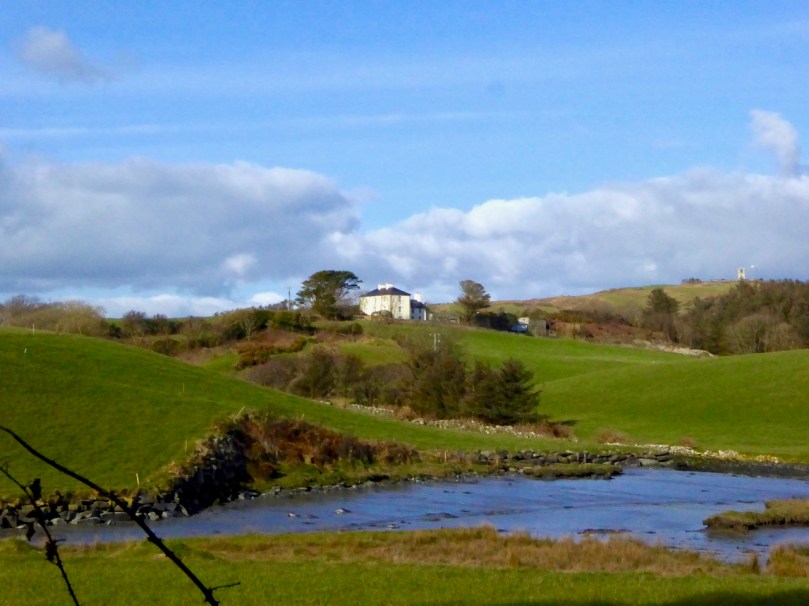
Crough Bay in the townland of Leamcon – one of the sheltered and hidden moorings which became known as a pirates’ nest in the late sixteenth and early seventeenth centuries. This is a view of part of the former estate of Sir William Hull who, as Vice Admiral of Munster, was charged with routing the pirates but in fact connived with them for his own financial gain

…Ireland may well be called the nursery and storehouse of pirates… wrote Sir Henry Mainwaring in a manuscript now in the British Museum (A Discourse of Pirates, on the suppression of piracy 1618). He had first-hand knowledge: this adventurer who was born in the time of Elizabeth spent most of his life at sea, survived the English Civil War – although on the losing side – and had been privateer, pirate and Royal Naval captain. He died at the age of 66 with his feet on dry land, although in poverty and exile in France.

map of baltimore

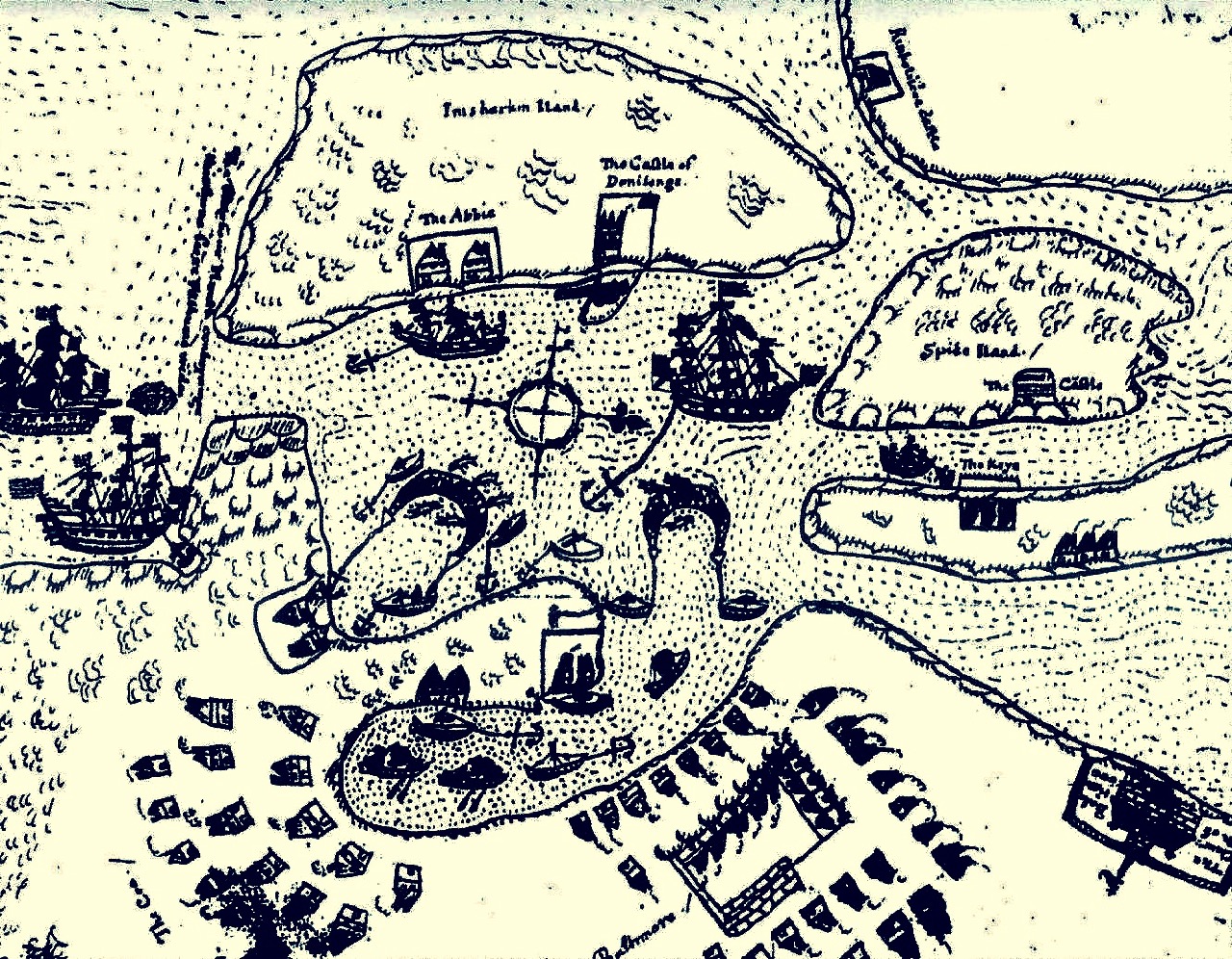
The Earl of Cork’s map of Baltimore,1628 –  following well-founded fears of ‘Turk’ raids he petitioned the Admiralty to fortify the coastal settlements. He was ignored and in 1631 the town was sacked and burned by Barbary pirates who carried away over 100 of the residents to the slave markets in Morroco

My possible ancestor Captain James Harris of Bristol died with his feet in the air: he was hanged at Wapping, in the estuary of the Thames, with 16 other pirates in December 1609. They had been captured in Baltimore, in sight of Roaringwater Bay. Why was it that Ireland – and, in particular, this coastline of west Cork was the notorious harbourer of pirates from all over Europe?

behold leamcon

According to Mainwaring, the west of Ireland was enticing because food and men were abundant; fewer naval ships patrolled the coast [than in England]; many of the local inhabitants were willing to trade with the pirates; and there was a …good store of English, Scottish, and Irish wenches which resort unto them… 

1611 John Speed map – Roaringwater

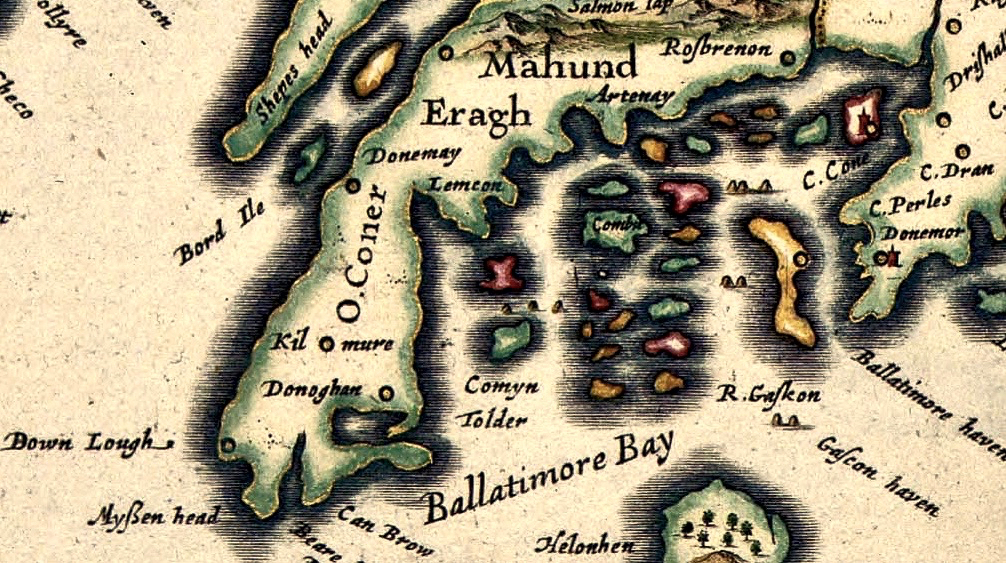
John Speed’s map of 1611 which portrays ‘Ballatimore Bay’ and Carbery’s Hundred Islands – ideal territory for concealing pirates. Note the curious geography, the names of the Irish clans and some of the places we recognise today: Rossbrenon (Rosbrin); Lemcon; Shepes Head and Myssen Head

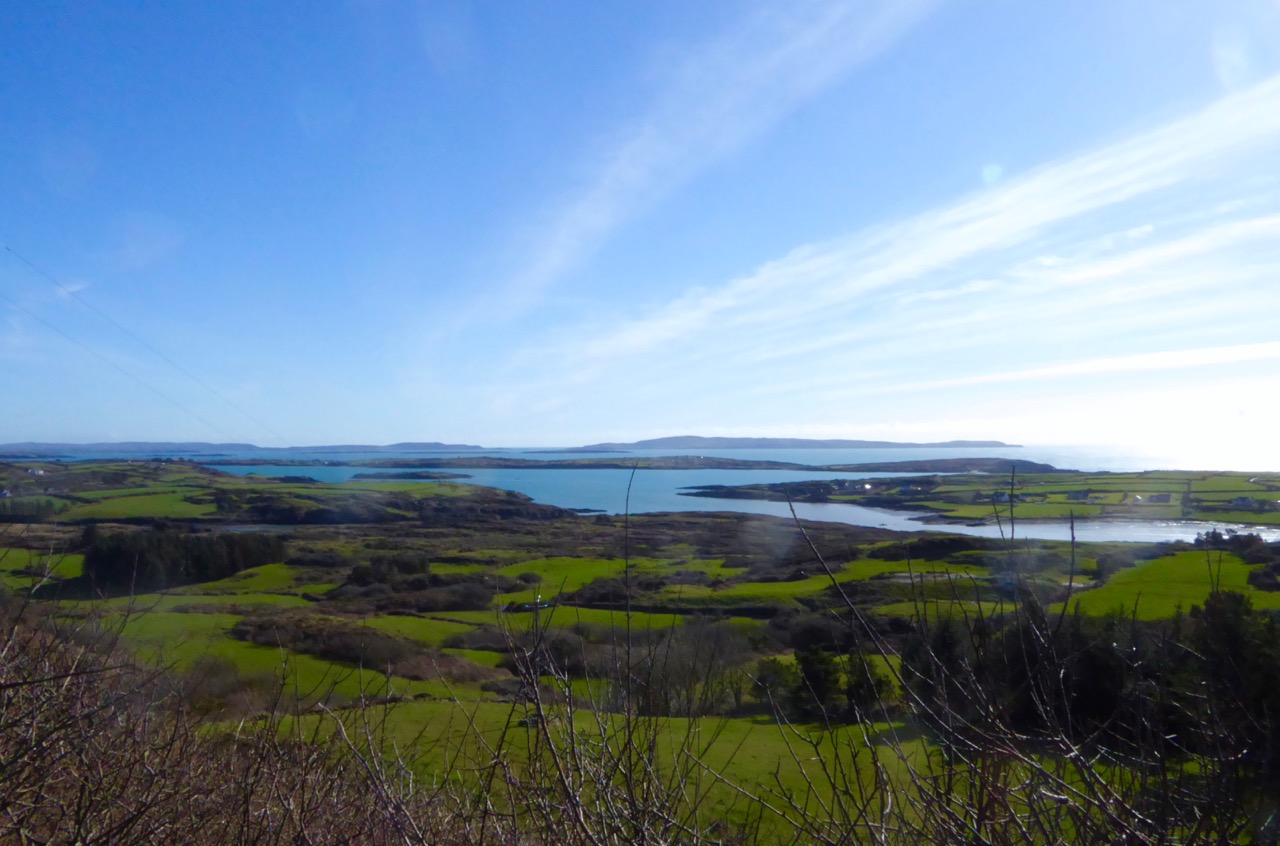
The coast of west Cork, in particular, was eminently suitable for sheltering ships in need of careening and victualling: bays, coves, inlets and estuaries abound and Carbery’s Hundred Isles (in fact many more than a hundred but it depends on what you count as an island) offer refuges a-plenty. In Captain Harris’s time there was only one naval ship patrolling the whole area from Kinsale around to Bantry and beyond – and this was the Tremontane – an ancient leaky pinnace which could be easily outrun by any respectable pirate crew. All the more unfortunate, then, for my forebear and his band who fell into the hands of the authorities, no doubt through some act of treachery or double-dealing.

Captain Harris’s family paid to retrieve his body from the gallows at Execution Dock (above left) and gave him a Christian burial. It was more usual for the bodies to be immersed by ‘three high tides’ before being disposed of. In particularly notorious cases the corpses were tarred and then hung in gibbets (iron cages – above right) to remain in public view. Captain Kidd was displayed this way for at least forty years after his death in 1701.

pirate ship

…The Irish folk surreptitiously colluded with pirates. When a captain needed supplies, he sent word of his needs. The reply to his note told him where he might find “so many Beeves or other refreshments as he shall need” on a specific night. When he and his men came ashore, they were to fire upon those who tended the herd, which allowed the herders to claim that they had been forced to hand over the cattle. Later on, he secretly landed “the goods or money in exchange, which by custom, they expect must be 2 or 3 times the value” If the pirates desired arms and/or ammunition and the Irish had any, they traded those items, too… (from Pirates and Privateers – The History of Maritime Piracy – an excellent online resource compiled by Cindy Vallar).

If you would like to learn more about Pirates in west Cork (and to listen to some great music) come along to the Fastnet Maritime + Folk Festival in Ballydehob this weekend 17th – 19th June: Robert is giving an illustrated talk on William Hull and the Leamcon Pirates’ Nest on Saturday 18th at 2.30pm in the Old Bank Building

Boulder Burials: a Misnamed Monument?

Rathruane Boulder Burial

The term boulder burial was coined in the 1970s by Sean O’Nualláin, an archaeologist with the Ordnance Survey, to describe a class of monument that was quite prevalent in the south west, consisting of a single large boulder sitting on three or four support stones. The support stones lift the boulder off the ground and provide a small chamber-like area under the stone. Previously, this type of monument was known as a dolmen, a boulder dolmen or a cromlech, but O’Nualláin was convinced that the main purpose of these boulders was to mark a burial.
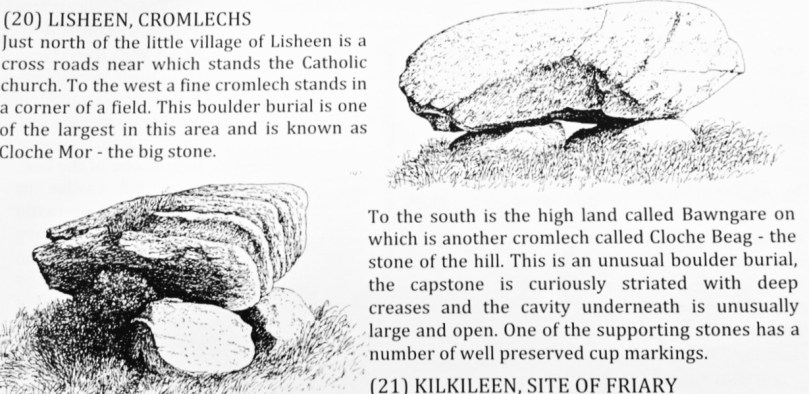
Lisheen Cromlechs by Jack Roberts

Illustrations from Jack Robert’s book Exploring West Cork

He based this belief partly on his extensive experience with other megalithic monuments, but also on the findings of the excavation of the Bohonagh complex, where Fahy found fragments of cremated bone in a pit under the boulder.
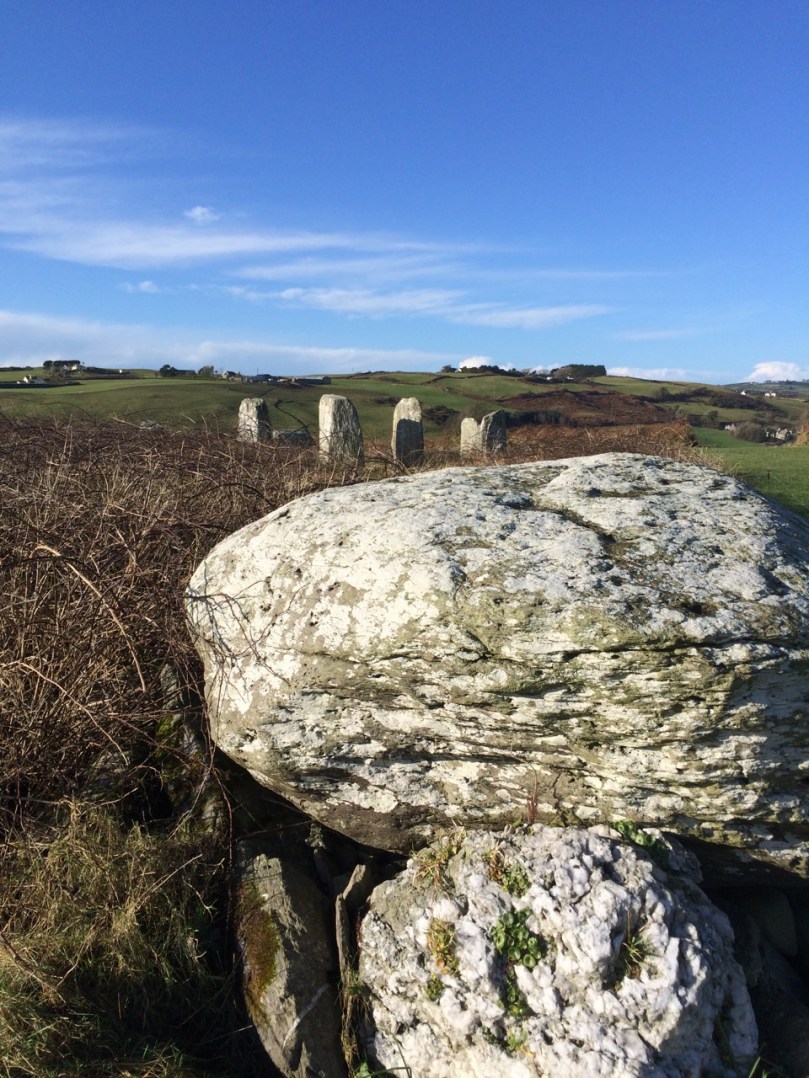
Bohonagh Boulder Burial
The Bohonagh complex includes a multiple-stone circle, a boulder burial and a cup-marked stone. A standing stone stood close by but has disappeared. Note the quartz support stone

However, William O’Brien excavated three boulder burials in the late 1980s and found no evidence of burials. In his book, Iverni, he comments in an understated way, “The absence of human remains at Cooradarrigan and Ballycommane does pose some questions as to their use.” His findings dated the sites to the Middle Bronze Age, between 3000 and 3,500 years ago.
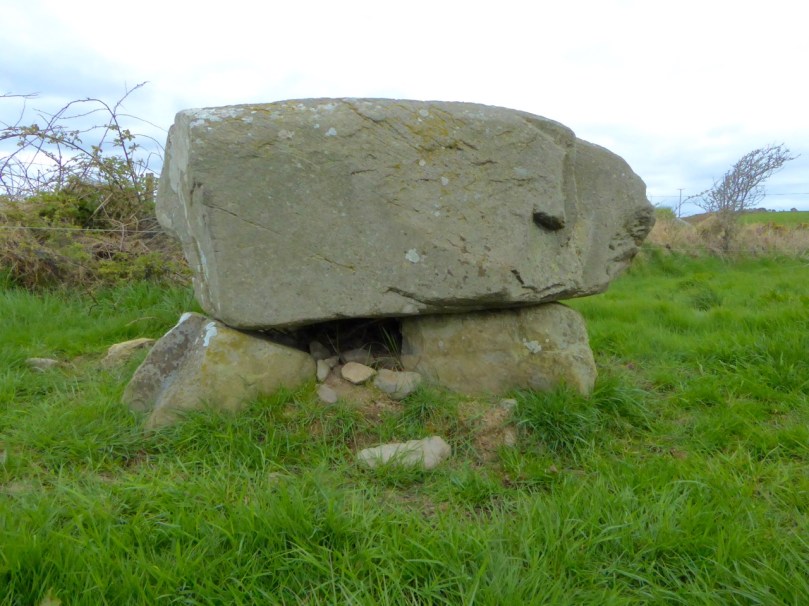
Lisheen Lower boulder Burial

A boulder burial from Lisheen Lower

What is unquestioned, though, is that they are predominantly found in the south west, especially in Cork, and that, while most occur alone, they are often found in groups, and/or in association with stone circles or standing stones.
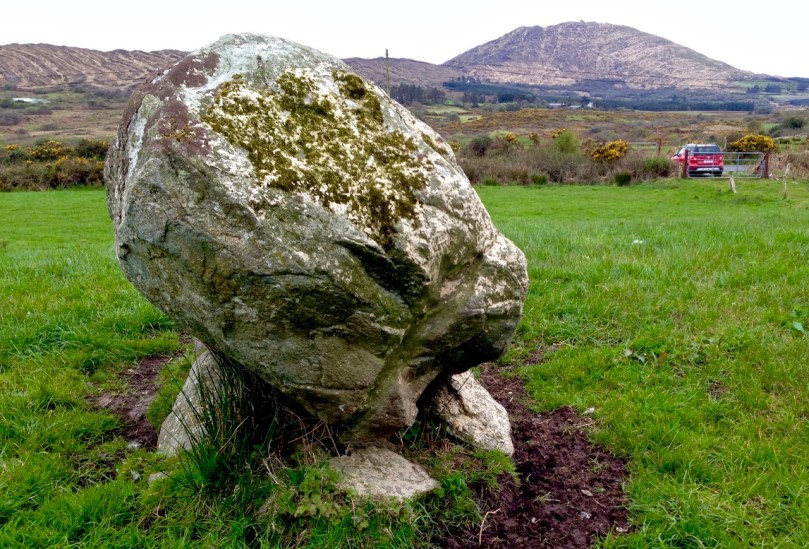
rathruane boulder

This one is at Rathruane More, close to a significant rock art site and with views of Mount Gabriel and Mount Corrin

A boulder burial is a striking and unmistakable sight. Often situated on a high point or ridge it can be seen silhouetted against the sky – a large glacial erratic standing proud in the landscape. There are lots of examples around us here and most of them command extensive and often panoramic views. These are monuments that were built to be seen and to see from.
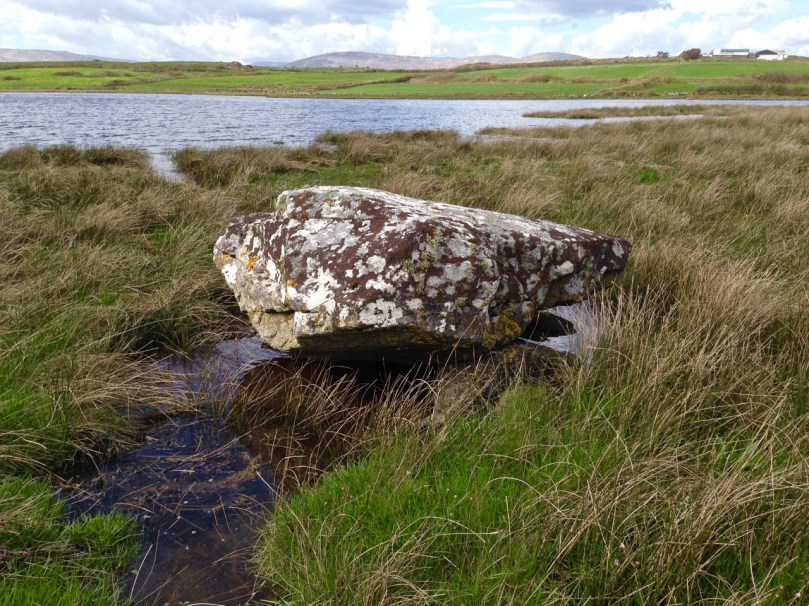
dunmanus boulder burial

An exception to the high ground location is found at Dunmanus on the north side of the Mizen Peninsula. This boulder-burial is so low-lying, in fact, that one can only reach it at low tide
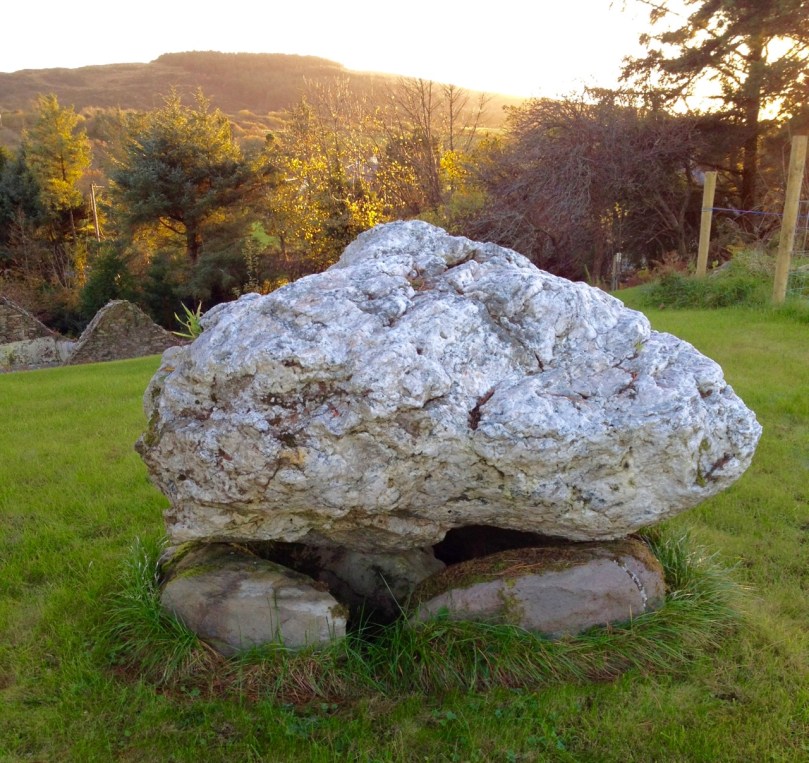
Ballycommane Bouder Burial quartz

Ballycommane – the boulder is of white quartz

William O’Brien has pointed out that quartz is a feature of West Cork prehistoric sites and this is particularly evident in the case of boulder-burials. At Bohonagh, for example, some of the support stones are of gleaming white quartz, while at Ballycommane, Cooradarrigan and Cullomane the boulder itself is quartz. The sun was low in the sky when we visited Ballycommane and the sight of the quartz boulder gently gleaming was truly memorable.
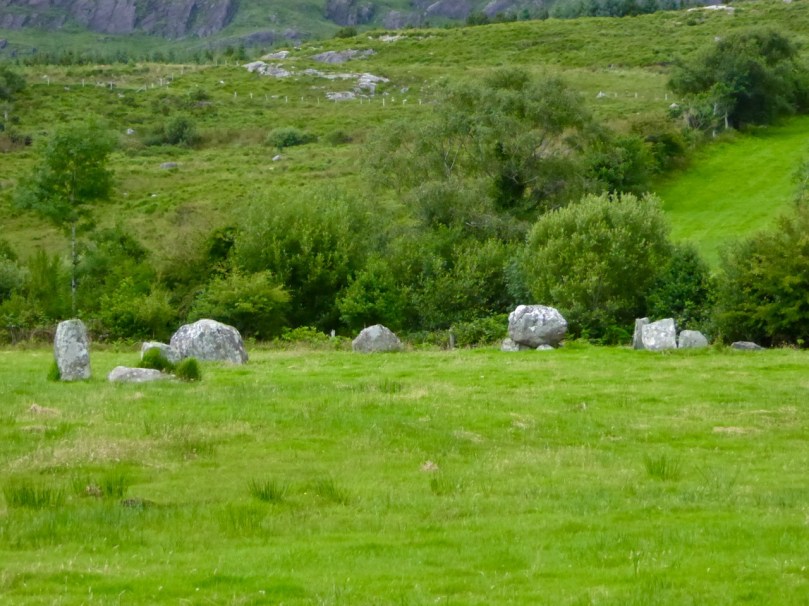
Mill Little Complex 2

The Mill Little complex

Boulder burials often occur in groups and in association with other monuments. Mill Little is a good example of this: three boulder burials are in a line with a standing stone pair at one end and a five-stone circle at the other. See our post Family-Friendly Archaeology Day for more photos of the Mill Little Complex.
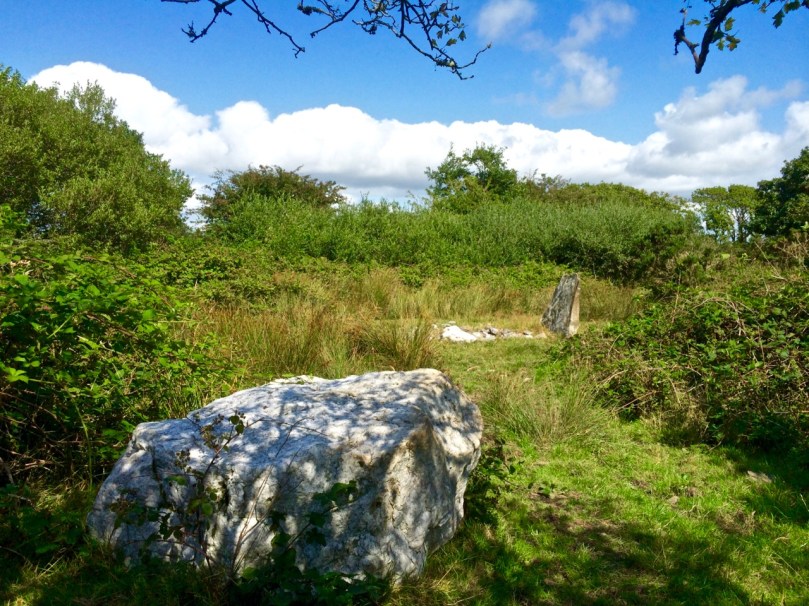
Cullomane boulder burial

This photograph shows the Cullomane boulder burial in the foreground, and a ‘penitential station’, in the background. This ‘station’ was part of a pilgrim round that involved prayer and penance – see Holy Wells of Cork for more detail on this site

At the Cullomane site, east of Bantry, the quartz boulder is surrounded by a variety of other monuments: a small stone circle, an ‘anomolous’ group of stone, a stone row, and standing stones all lie within a few fields of each other. Intriguingly, this site has seen continued ritual use through the millennia – there are also ring forts, burial grounds, a holy well and a ‘penitential station’ within the same small area.
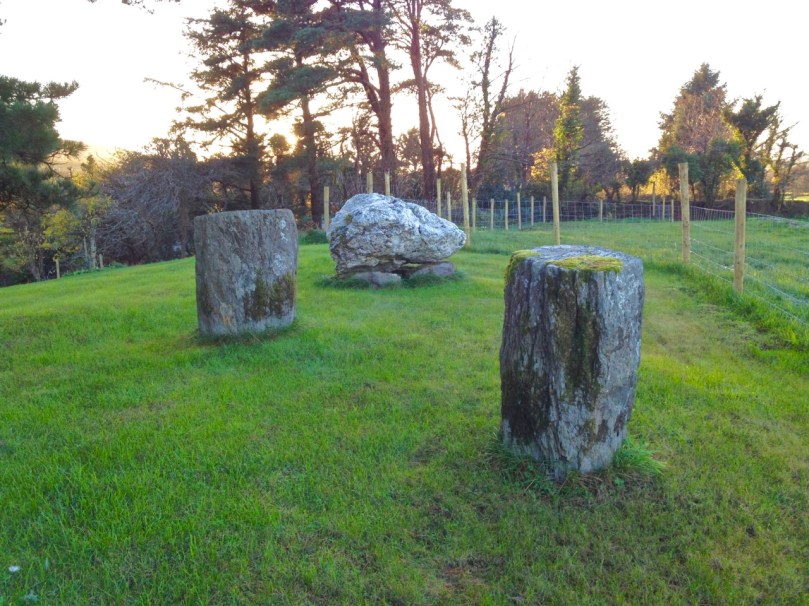
Ballycommane boulder burial and standing stone pair

The Ballycommane boulder is in close proximity to a standing stone pair
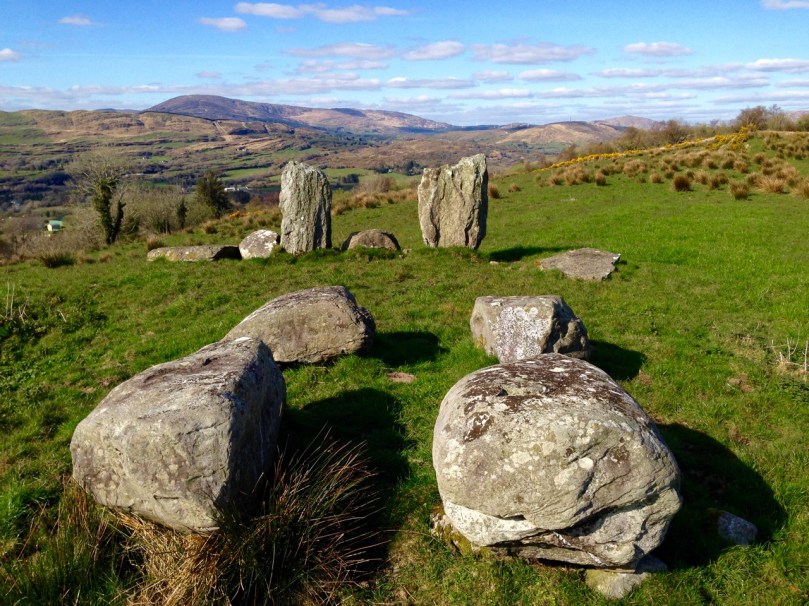
Breeny More 4

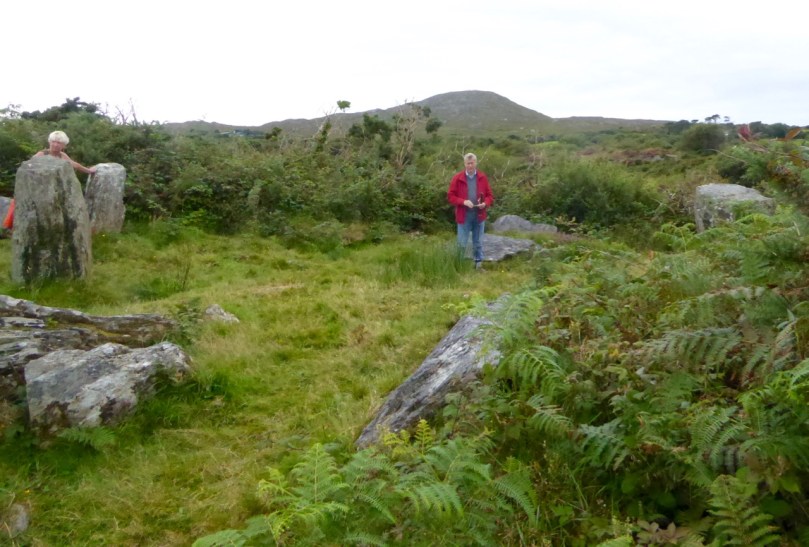
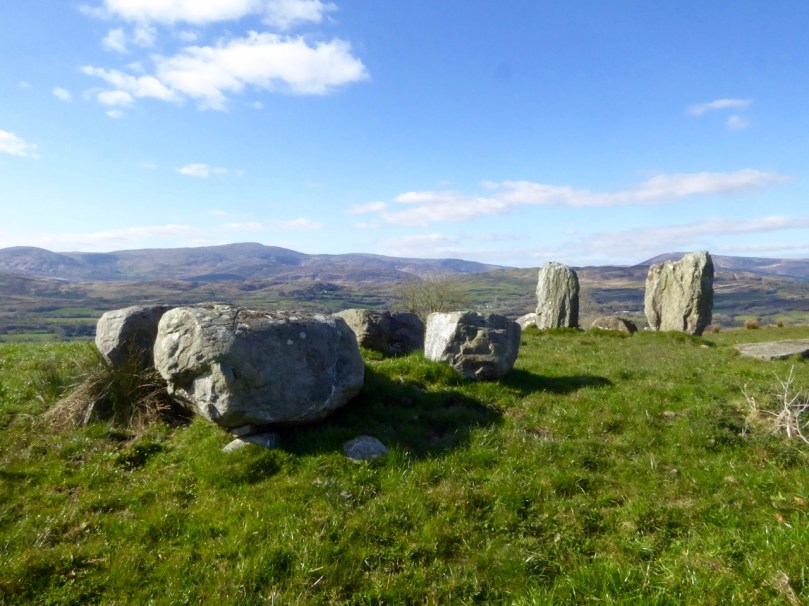
At Breeny More, near Kealkill, four boulder burials in a square pattern lie inside what remains of a large multiple-stone circle. This is an awe-inspiring site – you feel you are on top of the world with mountains all around and stunning views out to the end of the Beara and Sheep’s Head Peninsulas. See Robert’s post Walking the Past for a sense of what this site offers.
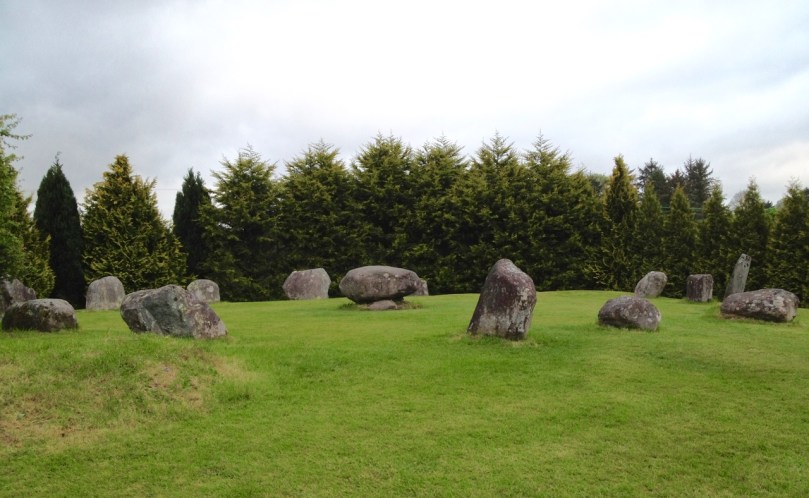
Kenmare Stone Circle and boulder burial

The Kenmare stone circle, above, has a boulder burial in the middle of it, while the Gorteanish stone circle on the Sheep’s Head, below, has at least one and possibly two boulder burials
Gorteanish

So – if they weren’t tombs, or weren’t solely tombs – what was the purpose of these striking boulders? Their association with stone circles and rows provide evidence that they fit the calendrical pattern that we find in so many monuments of this era. Mike Wilson, the archeo-astronomer of the Mega-What site, has surveyed many of the West Cork boulder burials and has this to say: This survey shows that boulder-monuments were functional objects marking astronomically important places in the landscape. They cannot generally define an azimuth as accurately as a stone row or circle but capstone shape and orientation are usually significant, helping to indicate directions of interest.
Breeny More

At Breeny More the square layout of the four boulder burials within the stone circle provide many possible alignments

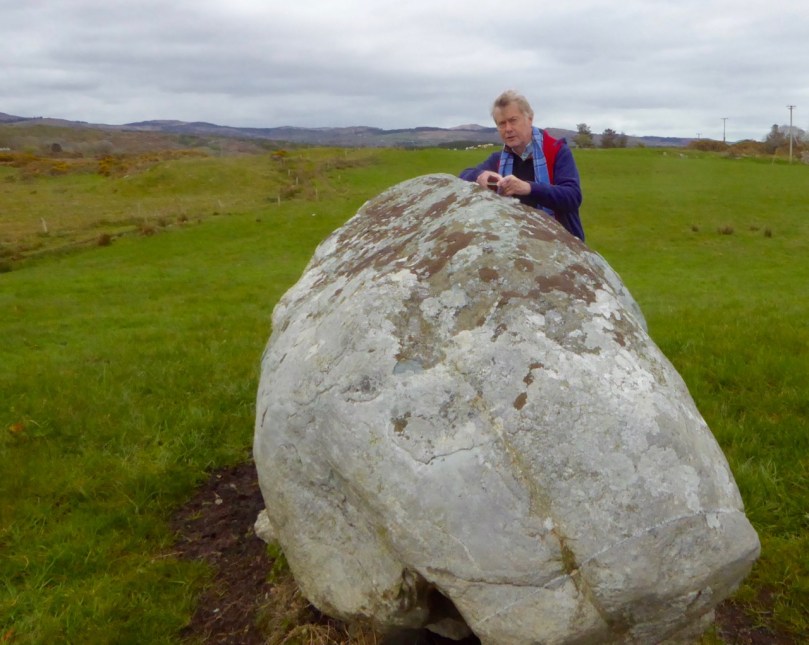
In several of the boulder burials we have observed, capstone shape and direction certainly seem to be a deliberate feature of the monument.
Rathruane boulder Burial Orientation

Robert checks the orientation of the long axis of the capstone at Rathruane More

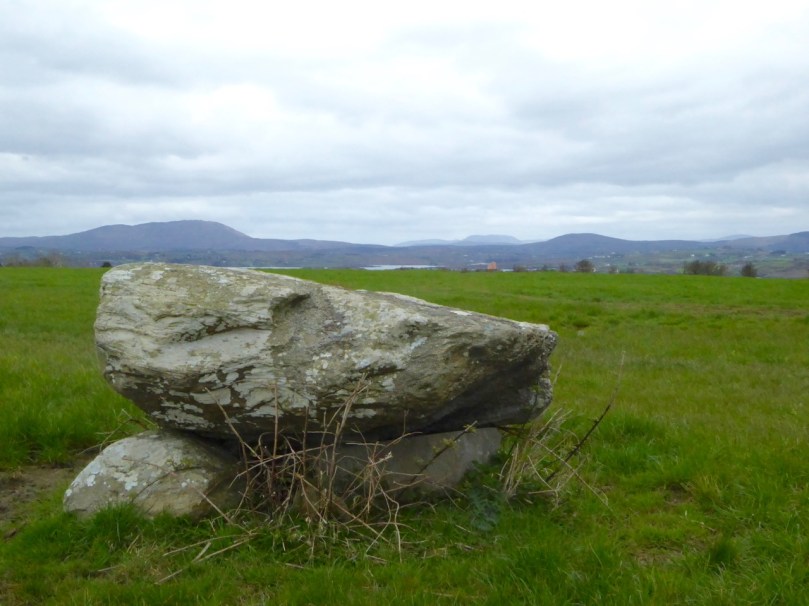
But perhaps the best example we have of how a boulder burial can have an orientation was drawn to our attention by local historian Brigid O’Brien – and she even sent us the evidence! If you stand at Bawngare, your attention is immediately drawn to the spectacular views to the west and north west – views that include Mount Gabriel, Mount Corrin and between them, faraway Hungry Hill on the Beara Peninsula, as well as the Sea in Roaringwater Bay. Interestingly, one of the support stones has several small shallow cupmarks (cupmarks are found on the capstones of several boulder burials).
Barngare Boulder Burial and view

The view west from Bawngare boulder burial

However the capstone with its distinctive long furrow holds the real secret, and Brigid’s persistence in braving the cold to visit at exactly the right time has unlocked that secret for us now.
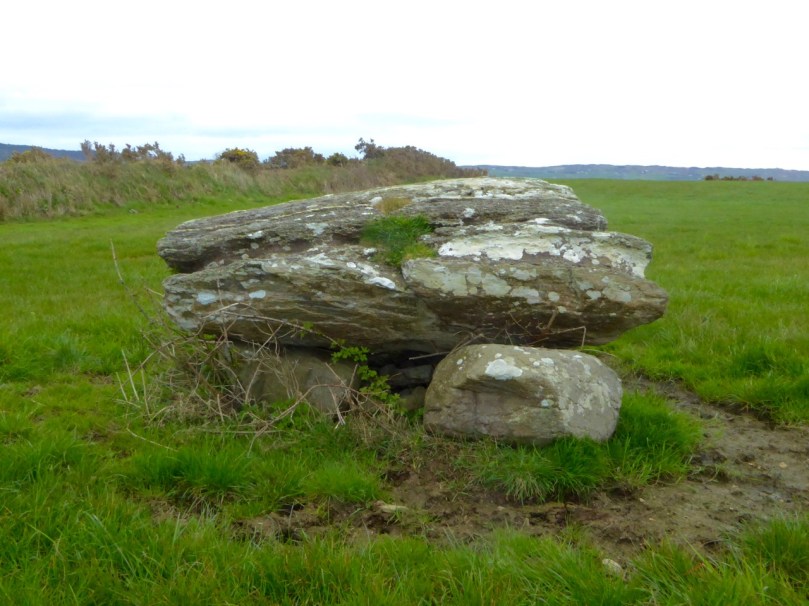
Bawngare boulder burial general

From the other side the long furrow can be seen running the length of the capstone

Brigid visited it last year at the winter solstice and took this photograph of the setting sun. It seems the capstone was deliberately positioned to mark this alignment.
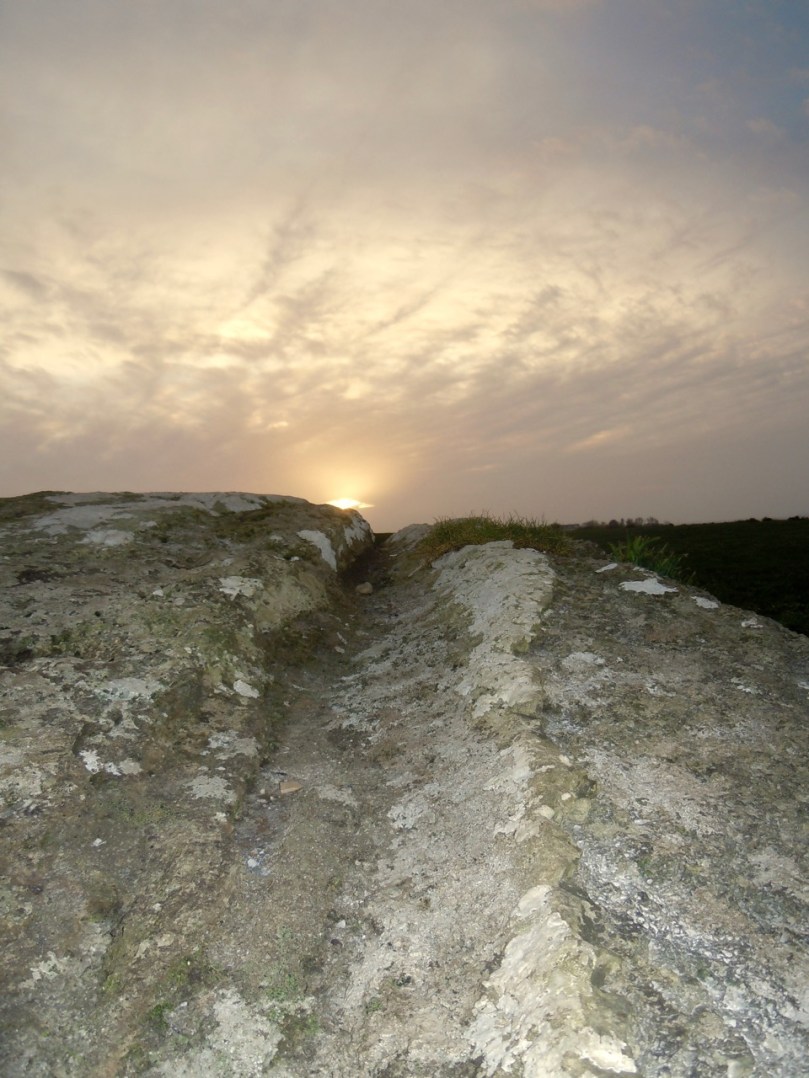
Bawngare boulder burial winter solstice sunset

Brigid’s photograph, taken on December 21st, 2015

Perhaps it’s time to go back to calling them something other than burials – I rather fancy the old term boulder dolmens. What do you think?

Say Cheese!

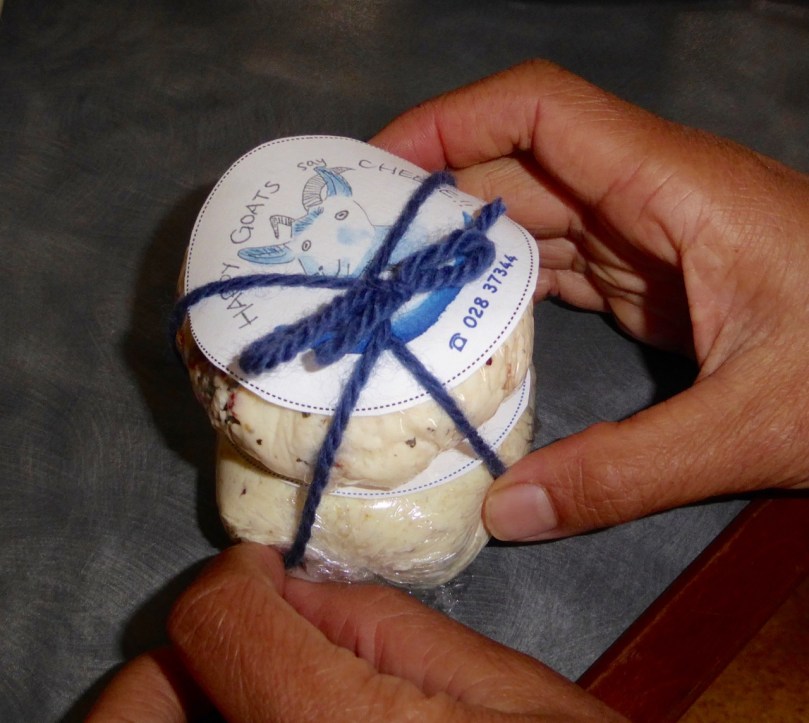
Cheese Bundle

Goats Cheese, that is: creamy, delicious – and home-made! Goats cheese is what I made today at our friend and neighbour Nick’s Rossbrin Permaculture Farm on the shores of Roaringwater Bay. The ingredients? Happy goats, a couple of ingenious WWOOFers and eager students.

Nick and Goats 2

Nick bringing the goats home in the evening

Nick has a smallholding and tries to be as ecologically sensitive, environmentally friendly and sustainable as possible. His WWOOFers seem to like the place and some stay for extended periods or keep coming back. (For those of our readers who are not familiar with the concept of WWOOFing – take a look at the WWOOF Ireland website.) Jasmine from Taiwan has become a keen forager and cheesemaker, and Helene from France loves to experiment with natural flavours. Recently there was a Slow Food event on the farm (wild garlic pesto – forage and make) which we couldn’t attend, so when this opportunity came up I jumped at the chance to sign up to learn how to make goats cheese.

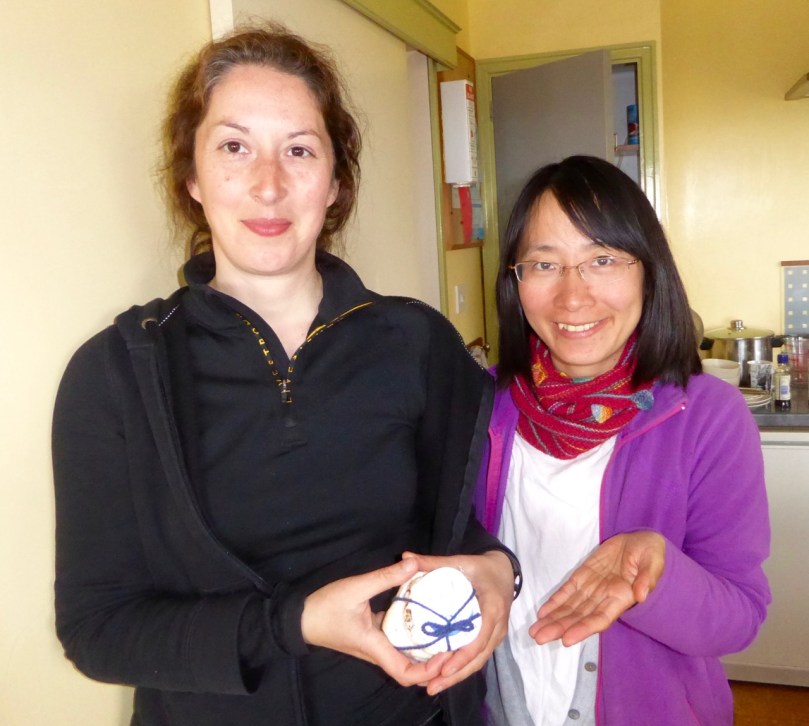
Helene and Jasmine

Helene and Jasmine – cheese makers extraordinaire!

I had this idea that cheese was a long slow process involving ageing in caves and something called rennet so I was intrigued that we would make and take away goats cheese in one afternoon.
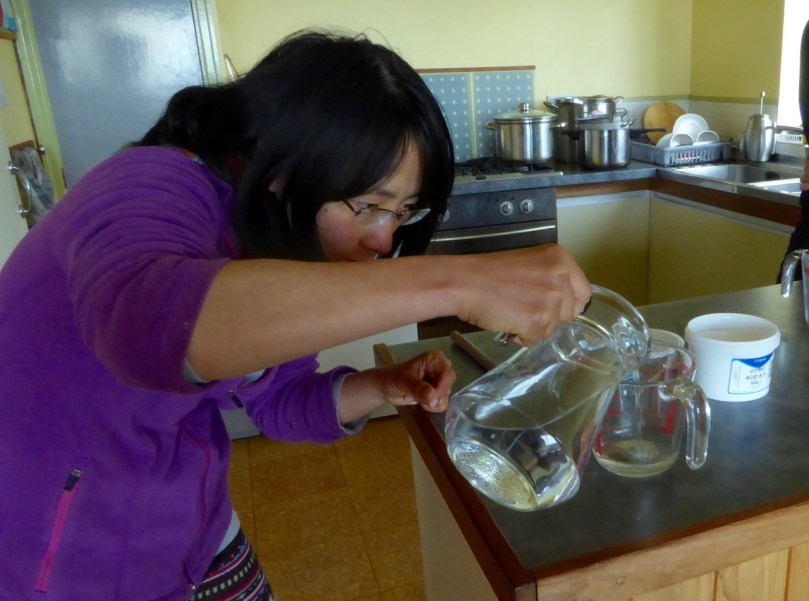
Diluting the citric acid

Jasmine dissolves the citric acid – available in any pharmacy

Jasmine and Helene had milked the goats that morning so the milk was fresh, although it can also be a few days old – the older the milk the stronger the distinctive chèvre taste. We started by adding dissolved citric acid to the milk, drop by drop, and stirring, while it sat on a moderate heat. The idea is to add the citric acid very slowly while the temperature rises to 180-190F. This process pasteurises the milk and starts the process of making curds.

Left: Jasmine and Helene and students Manon, Bríd and Maria. Right: adding the citric acid drop by drop and patiently stirring

Once it has reached the proper temperature the milk is allowed to cool a little then poured into cheesecloth-lined colanders to separate the curds and the whey. Since the next step is to let it drip slowly through the cheesecloth, we enjoyed some tea and cake and then we took ourselves off for a wander around Nick’s farm.

Julian straining

Through the cheeseclothUpper: Julian strains the heated milk. Lower: left to drain

We walked down to Jasmine’s seaweed-gathering beach and made a quick inspection of Nick’s ingenious vegetable island. Why grow vegetables on an island? Easy – no rabbits and no slugs! Nick practices Hügelkultur on this plot.

Once back in the kitchen we inspected the cheese and saw that the whey had drained away to our satisfaction. To continue the process we tied the cheesecloth up to make a ball and suspended the cheese over pots for a while longer.
All tied up

During the next wait period Jasmine and Helene showed us how to make seaweed appetisers. Jasmine had harvested sugar kelp and sea spaghetti that morning and together we made seaweed crisps and sea-spaghetti bruschetta. It sounds a bit weird, I know, but honestly, they were delicious.

Jasmine had washed the sugar kelp and hung it out to dry along with the other washing. The recipe for the crisps and bruschetta is at the end of the post

By then, we were ready to finish the cheese. First we added a little salt and then decided on the flavouring. On Helene’s advice we selected cumin and mustard for one and sundried tomatoes and basil for the other. A little tasting, a final lesson in wrapping, and we were done!

I love goats cheese and have several favourite recipes so I’ll be trying out a couple this week. It’s going to feel really good to casually drop into the conversation that, oh yes – I made it myself. And if that’s not totally and strictly true, I’m sure none of you will tell on me. Right?

Recipes