Biodiversity Ballydehob

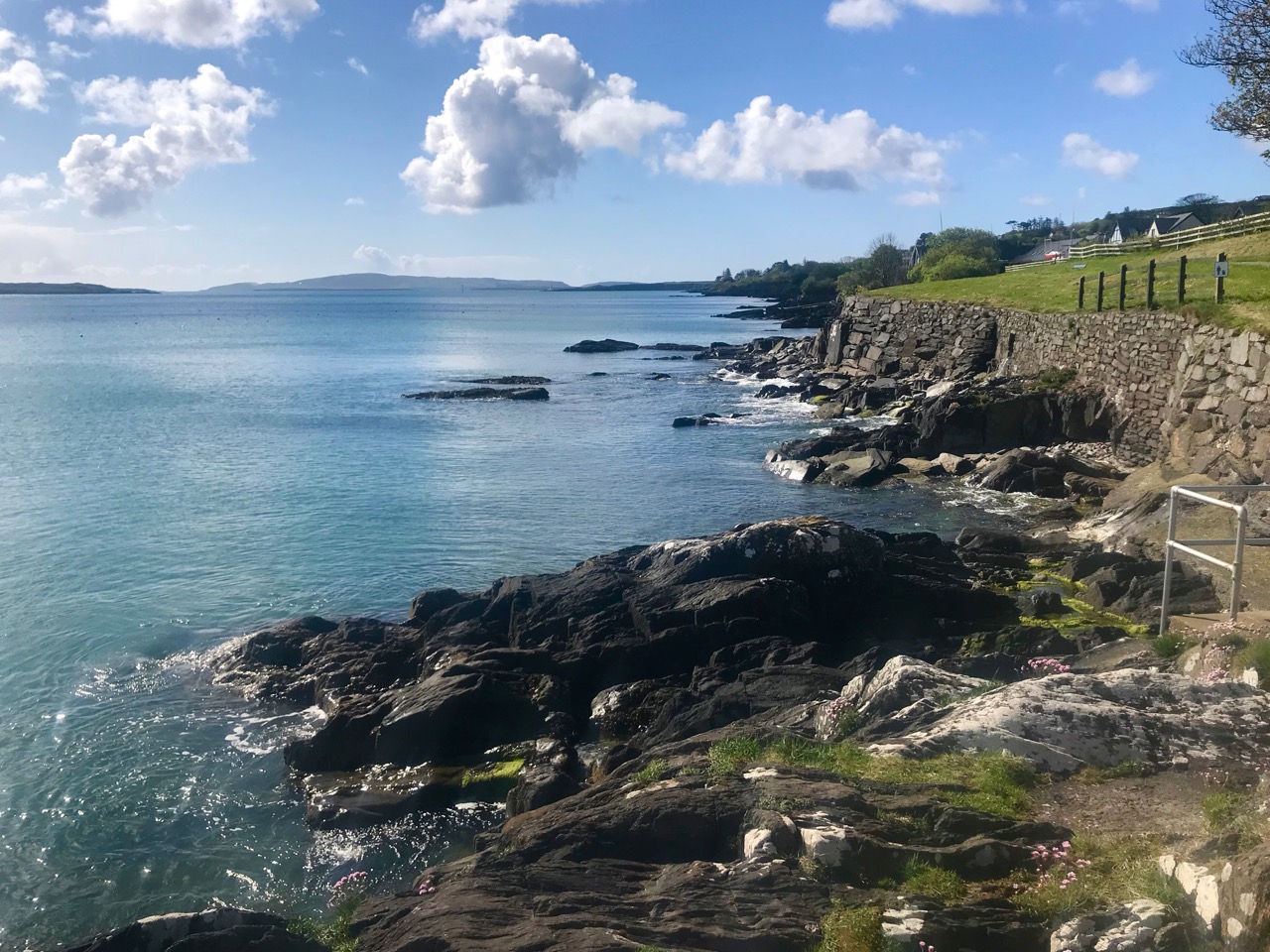
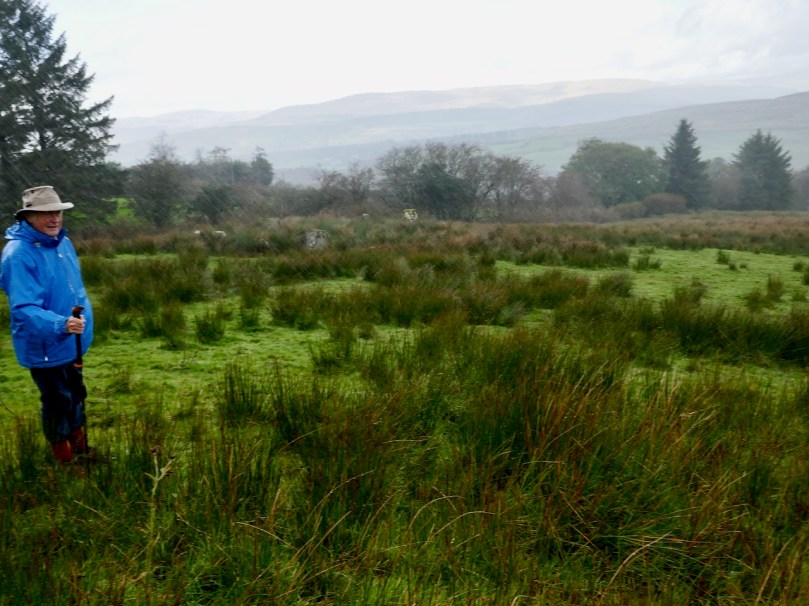
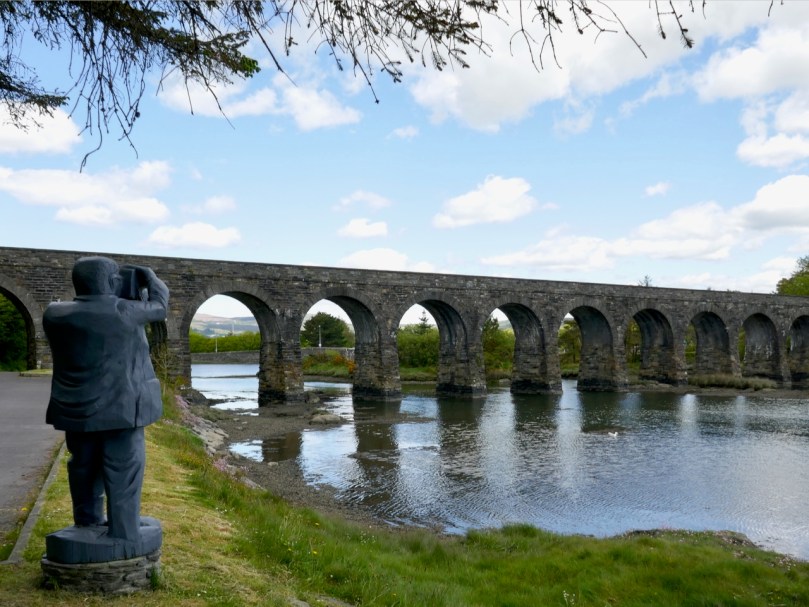
In the same way that strangers are friends you haven’t met yet, weeds are wildflowers you haven’t yet come to know and love. So come with me to the Ballydehob estuary and meet the dazzling array of wildflowers that call it home. That’s me, by the way, with my trusty camera, at the always-scenic Twelve-Arch Bridge. All the photos in this post were taken within 100 metres of the bridge, on the west side of the estuary.
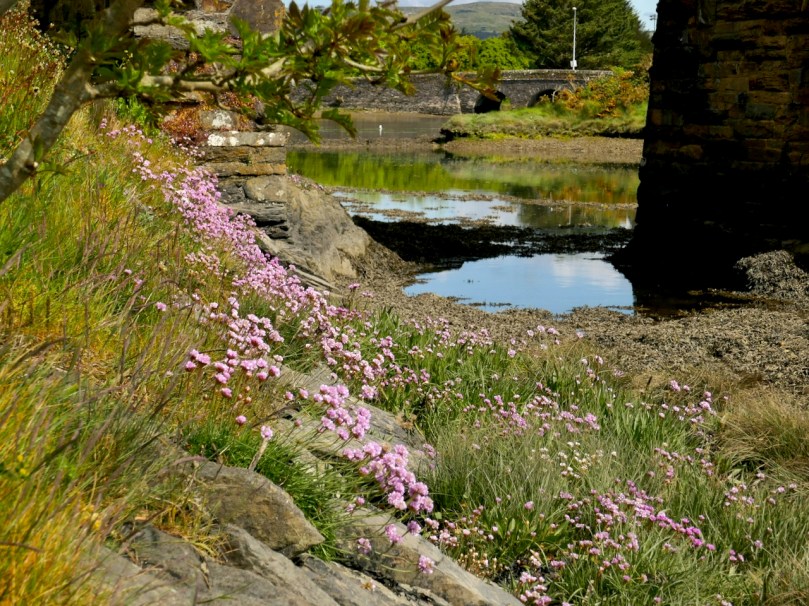
Thrift, or Sea-pinks, is the most visible flower at the moment, in pink drifts along the shore. There’s a lot more than Thrift in this photograph, but before we move on, let’s take a closer look at them.

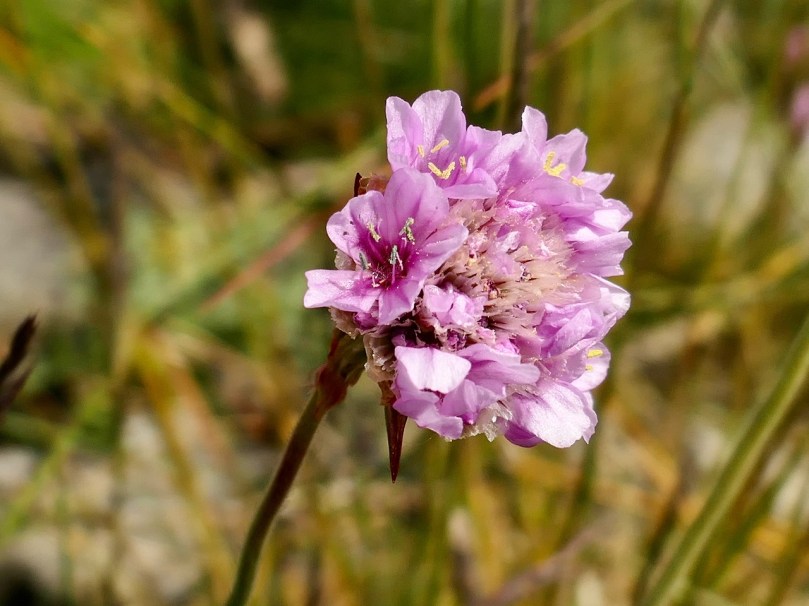
In Irish Thrift is called Rabhán (pronounced ravawn) and this word means an outburst, as in rabhán gáire, a sudden fit of laughing. Pretty apt, isn’t it, for a flower that is suddenly everywhere at this time of year. By ‘everywhere’ I mean all along the coast, although in Great Britain it is also found in a few mountainy places too.
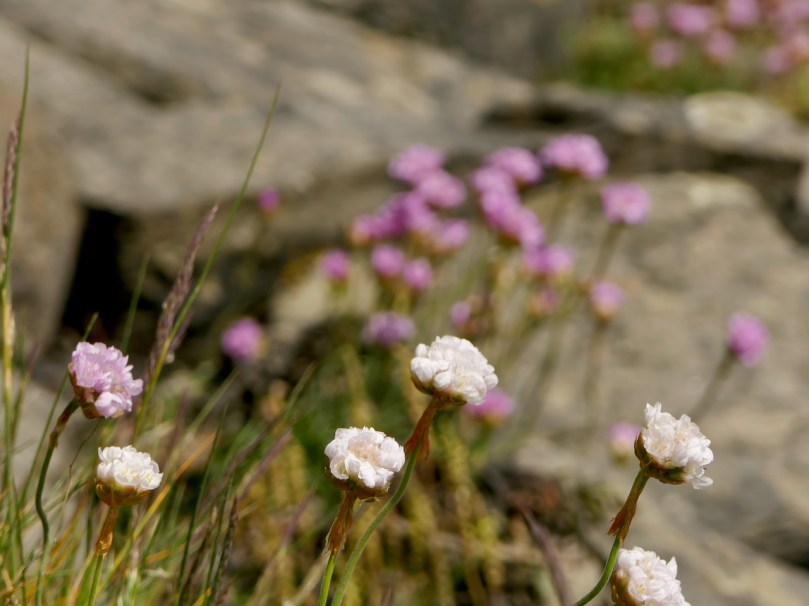
Ballydehob has some white Thrift too, fairly unusual. According to Niall MacCoitir in his wonderful Ireland’s Wild Plants, Thrift has many alternative folk-names, such as Lady’s Cushion, Sea Daisy, and Sea-July Flower.

As there is everywhere at this time of year, there’s lots of Ribwort Plantain (did you use it to play Soldiers as a kid?) but there’s also Buck’s-horn Plantain (above). The stalk and flower look very Plantain-like, but the leaves of the basal rosette are what give the plant its name – look at all those tines. In Irish the plantains are called Slánlús, which means health plant as they are used liberally in folk medicine. But be careful – in regards to Ribwort Plantain (below, with Oxeye Daisy and Cat’s-ear), Mac Coitir warns us, . . .while it could be used to cure many ailments, there was also a danger that if the wind changed wile you were collecting it, you would lose your mind.

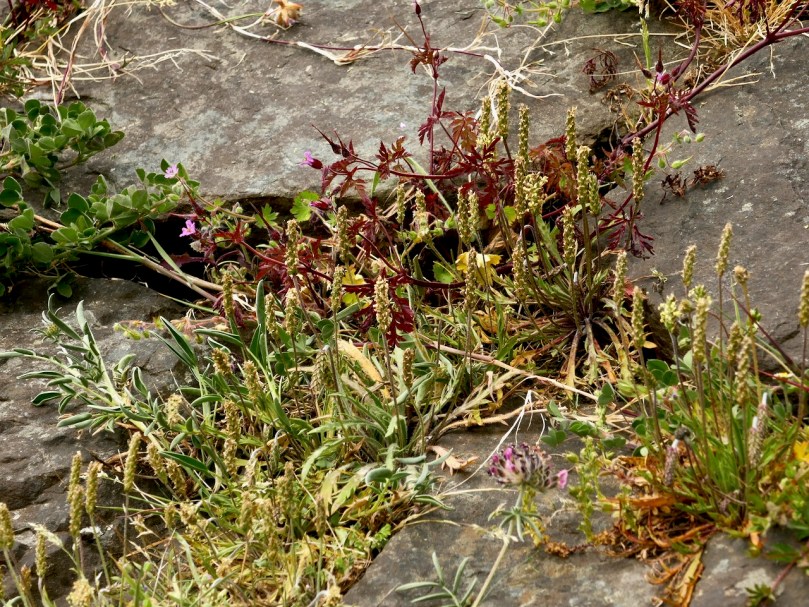
Here’s Buck’s-horn Plantain again (above), along with three different pink flowers – can you make them all out? I’ll talk about each one and then you can go back and look at his photo again and see if you can see them this time.

Here’s the first one, Dove’s-foot Crane’s-bill. The dove’s-foot comes from the shape of the leaf, and the crane’s-bill from the shape of the seed-pod – you can see both in this picture.
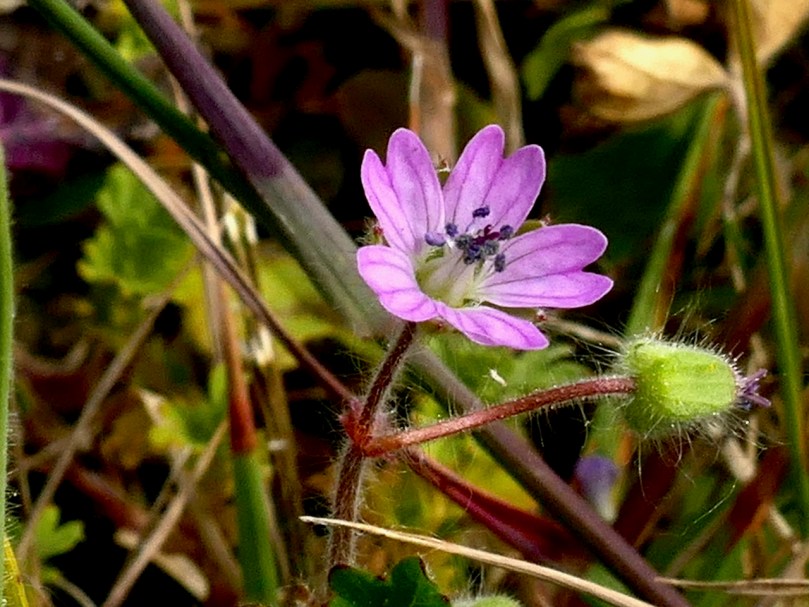
The flower is tiny and very sweet, deep pink with purple anthers. It’s a member of the Geranium family, and that makes it first-cousin to the next little pink flower, Herb Robert, below.
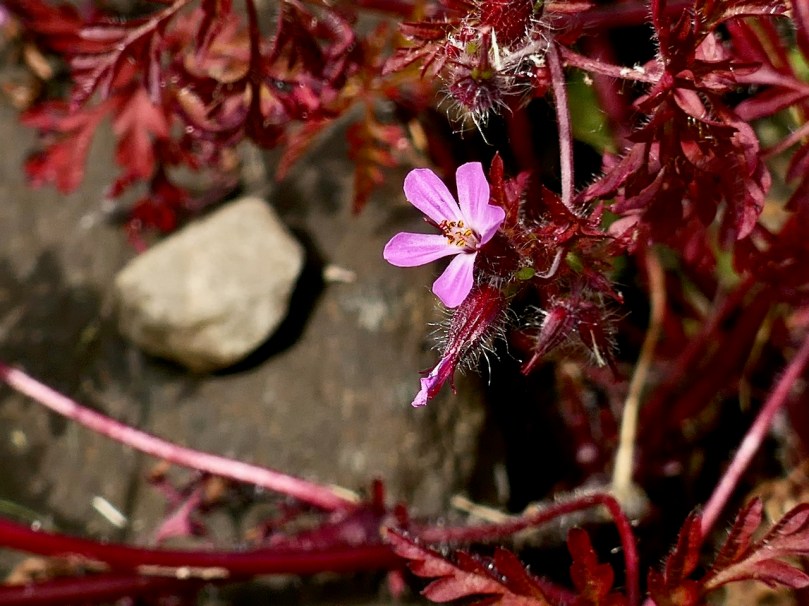
It’s one of my favourites, not just for its attractive flower, but for the leaves that turn a deep red as the plant matures. Himself, of course, is very pleased to have a plant named after him, although a more boring explanation could be that the Robert comes from the latin ruber, meaning red. It’s got lots of alternate names but my favourite Irish one is Eireaball Rí, means the King’s Tail. It’s another powerful herb, used traditionally to stop bleeding.
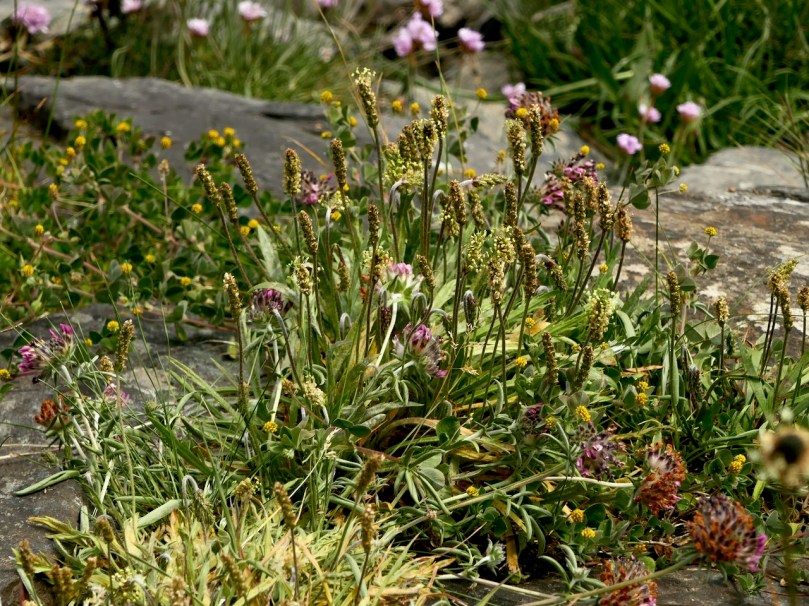
The last of the pink flowers is Kidney Vetch, although it also comes in other colours. It’s actually more common in yellow around here, but I have read that it can be orange, purple, or even pure white. In the photograph above it’s mixed in with the Buck’s-horn Plantain, but here it is on its own, below.

Kidney Vetch is a member of the Pea family but the funny thing about it is that each little pink petal is embedded in a tuft of what looks like cotton wool. It’s a bit otherworldly, but it makes it easy to identify. It’s also known as Lady’s-finger (or in Irish as Méara Muire, which translates as The Virgin’s Finger) and as Stanch, which comes from its reputation as being able to staunch blood flow.
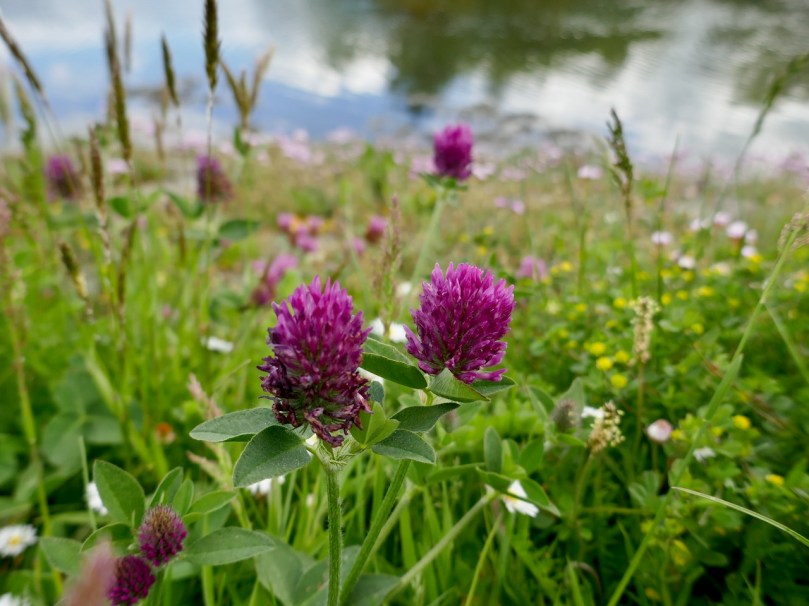
Another member of the Pea family is Red Clover, beloved for its nectar by bumble bees, which have longer tongues than honey bees and can get at the goodness.

This is one of those flowers that are so familiar we hardly notice them, but a really close look reveals a beautiful flower indeed. The leaves are the familiar shamrock shape, but much larger and often with pale patches, and another reason to look closely is to see if you can find a four-leaved clover, considered lucky all over the world. In Irish myth and legend the clover is a symbol of prosperity and the fertility of the land. Among Mac Coitir’s many examples is the story of St Brigid who decided to make her home in the Curragh of Kildare because when ‘she saw before her the delightful plain covered in clover blossom, she determined to offer it to the lord’.

Above is Trailing Tormentil. Although this is a widely-distributed plant in Ireland I haven’t seen a lot of it around here. In fact it’s much more common to see its first cousin, simply called Tormentil, especially on heath, among the heathers and gorse. Tormentil has only four petals on its yellow flowers, whereas Trailing Tormentil can have five, as in the patches I found along the estuary. The name seems to relate to its potency as a cure for stomach torments – the root was boiled in milk as a cure for colic. Add in a little wine and it was good for what ailed you. Add in some St John’s wort and it was a sleeping draught. This is reflected in the Irish name Néalfartach: néal has several meanings which can related to depression and to sleep.

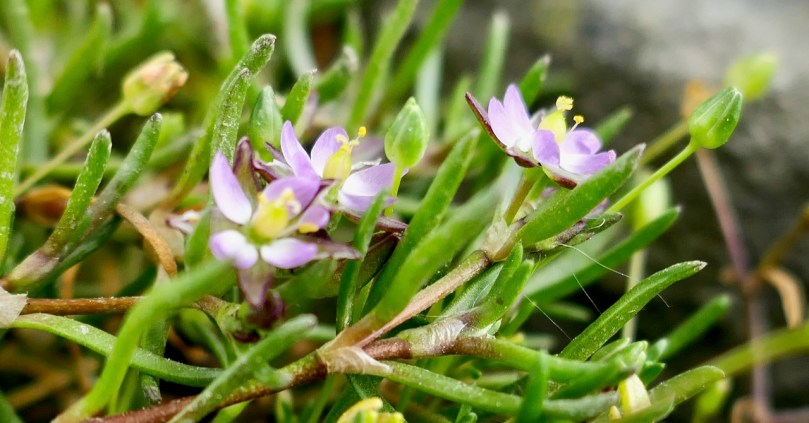
A very exciting find for me now (above) as it’s the first time I have seen it. Look how tiny it is – it’s very possible I’ve walked over it many times without noticing, especially as the old eyes aren’t what they used to be. It’s one of the Sea-spurreys (the others are Rock Sea-spurrey, Greater Sea-spurrey and Sand Spurrey, all of which are found in West Cork) but this one is Lesser Sea-spurrey.
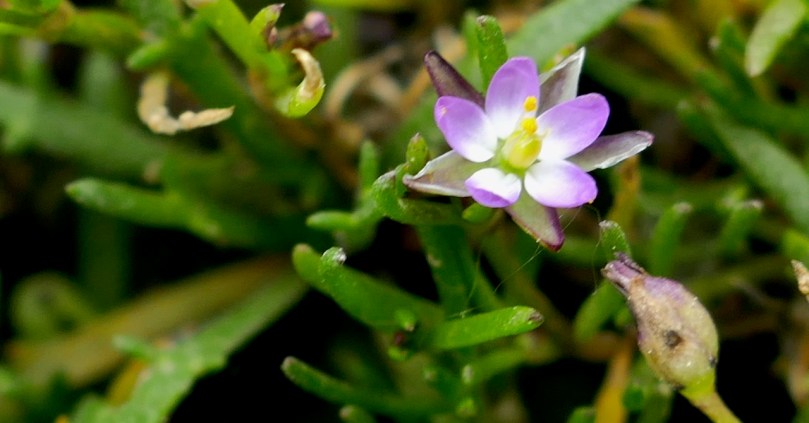
It’s very like Greater Sea-spurrey but several factors distinguish it – it’s tiny, the sepals are longer than the petals (see above) and it has far fewer stamens. The distribution of all the Sea-spurreys is coastal, as you would imagine, but strangely Lesser Sea-spurrey is also found all over Britain, inland as well as by the sea. In Ireland, it is only coastal. Is it weird to get this excited over a tiny plant? (Okay, don’t answer that.)

Moving right along, this is Cuckoo-flower – so called because it appears about the same time as the Cuckoo does. It’s also called Lady’s Smock and it can vary from pure white to a mauvey pink and if you look closely at the stems you might see tiny eggs – they are white when laid but turn orange with time. They are laid by the Orange-tip Butterfly and the larva feeds on the stem of the flower.
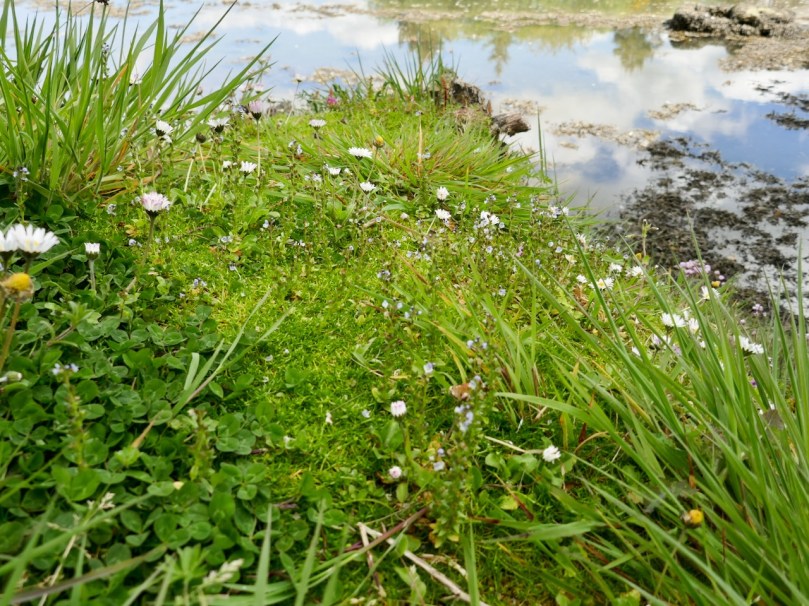
There’s a little patch of grass jutting out into the estuary and at first I thought it was just covered in daisies. Daisies are important little flowers for our pollinators too, but what caught my eye was smaller so I had to lie down to get close enough to see the little blue ones.
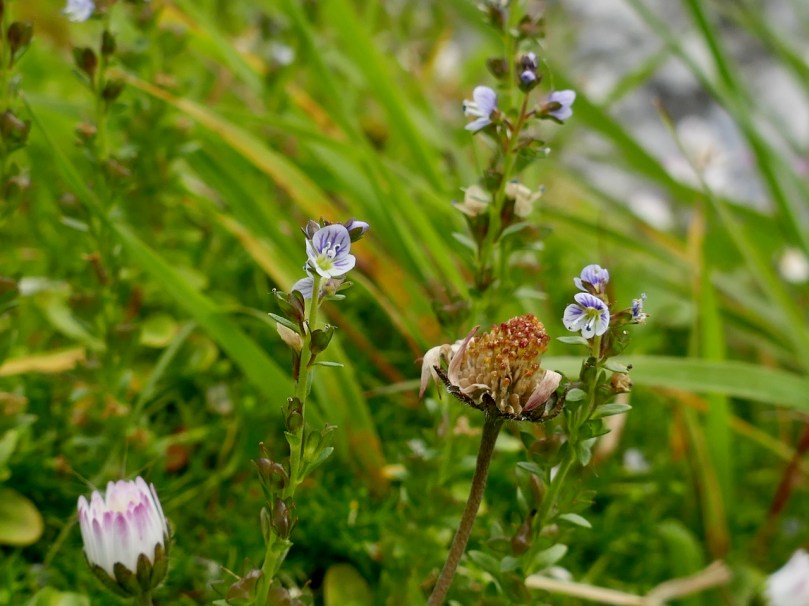
This is Thyme-leaved Speedwell, one of the many Speedwells you can find in West Cork, and one of the smallest ones. Right across the road is another one – much more visible. In fact, if your eye is caught by a flash of blue in the grass in West Cork, this is likely to be what’s causing it.
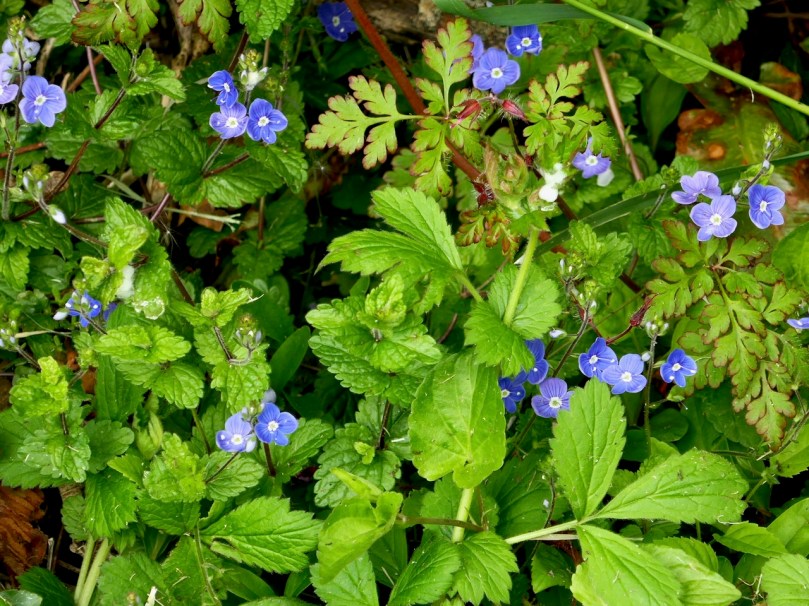
It’s Germander Speedwell – a closer look below. Speedwell looks a bit like a Forget-me-not but it doesn’t have the yellow centre and only has four petals to a Forget-me-not’s five.

It belongs to a different family too – the Veronica family, which includes the next flower, Ivy-leaved Toadflax, which I found growing all over the bridge pillar.

This is one opportunistic little plant – it will find a crack in a wall and dig right in. In fact, walls are its favourite habitat. Here’s what Zoë Devlin’s Wildflowers of Ireland (my go-to resource) has to say about this adaptable genius: The seed-planting mechanism of this plant is very clever indeed.  The flowers turn their heads to the sun until they have been fertilised at which stage they turn about towards the wall on which they are growing and in this way they plant or push the seeds into any little crevice possible on the wall. They also have very long roots which help them to hang on, like the Ivy for which they are named, and thereby ensure their survival.  This plant was introduced in the seventeenth century from the Mediterranean countries.

As Zoë says, it arrived here from the Mediterranean – but how? During the craze for importing marble from Italy, including marble statues, the plant hitched a ride, jumped ship once it got to Britain, and flourished from then on. Even though it’s not a native plant it’s adapted well to the Irish climate and has proven to be a good neighbour, unlike many other alien species.

Just glancing along the bank, it’s hard to take in how many plants are here, and what a variety there is. I will finish with a couple from across the road. First, the Hawthorn is now in full bloom.

It’s also known here as the Whitethorn and it comes into flower after its leaves have arrived and after the Blackthorn has faded. Beautiful – but considered to be very unlucky. Woe betide anyone cutting a Whitethorn or bringing its flowers or branches into the house – except in the month of May when it was customary on some counties to bring the flowers to the house, or even into it, to honour Mary (it’s the May Tree) or to ward off evil. That’s a bit confusing – it’s May now so should you gather some blossoms? Better to take no chances, I say, and leave it to bloom outside for all our enjoyment.
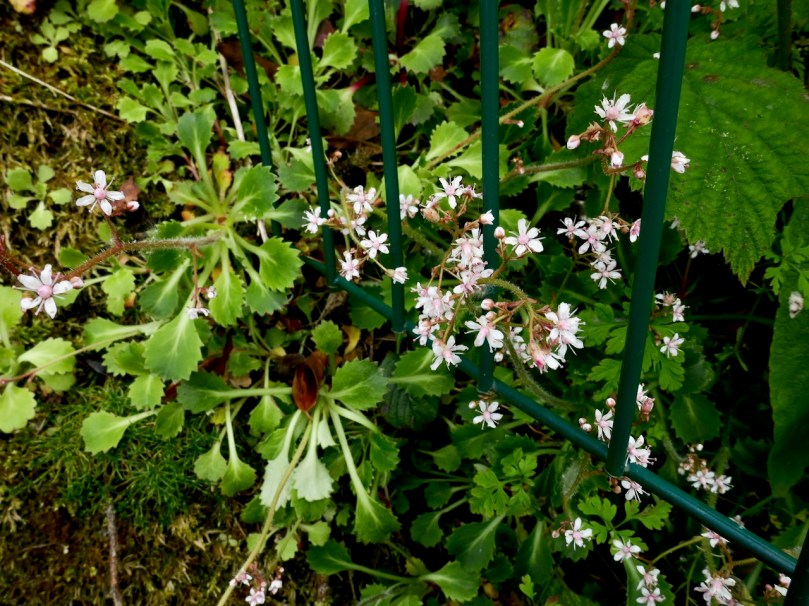
And what’s this I spy? It’s St Patrick’s Cabbage and you will only find this plant in southern or Western Ireland and in Spain and Portugal. Called the Lusitanian Flora, there is a group of plants who seem to have flown, as if by magic, across the Bay of Biscay, France and Britain, to land in West Cork, and this is one of them.

If you’re a gardener it might look familiar – the popular garden plant, London Pride, is a hybrid of this and another member of the Saxifrage family.

There’s more – lot’s more – but I’d better leave it at that (except I couldn’t resist that image of the Scarlet Pimpernel, above, with the Dove’s-foot Crane’s-bill). Here’s what I want you to take away from this post – with the exception of the Ivy-leaved Toadflax, which has been here for hundreds of years, every single one of the plants I have written about here is native. Every. Single. One. Why is that important? Because this is what a wildflower patch looks like and should look like. These are the flowers to which our native insects and pollinators have adapted over millennia and therefore these are the ones which are critical to our ecology here in Ireland.
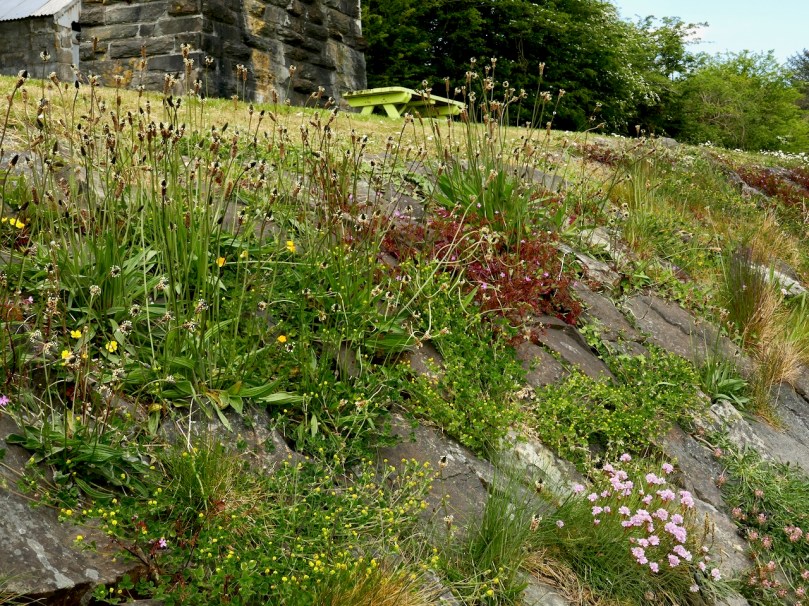
We’ve been fed images of colourful meadows full of poppies and cornflowers and told that’s what a wildflower meadow looks like – it’s not. THIS is what our pollinators need – a wide variety of native plants left undisturbed. It’s wonderful to see this in Ballydehob, but every village and town in Ireland has areas like this. Let’s make sure they flourish!
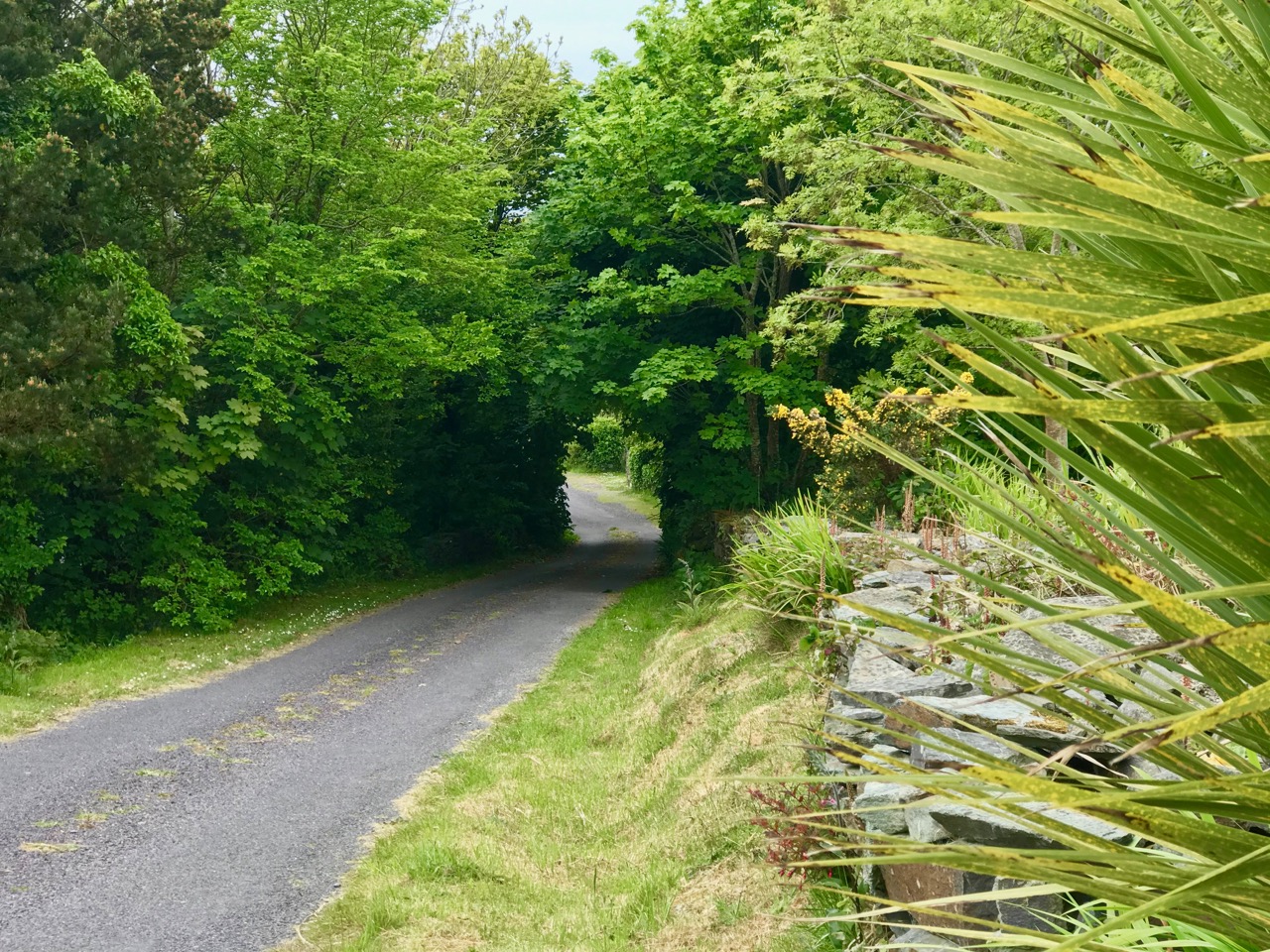
 

Wending the Boreens

Only in Ireland can you wend your way along boreens. The Irish word is bóithrín, – a small bóthar (road). We are surrounded by them in our West Cork townlands. In these days of Covid19 restrictions, they are our whole world. With a maximum walk of 5 kilometres allowed, we can only ever be on boreens. But that’s no hardship – mostly they are beautiful (in fact they are all beautiful), and we enjoy every step we can take. So today’s post is simply a celebration of what is around us. But I have also combed the RWJ archives to look for boreens outside of our local area, for a bit of variety and comparison. Rest assured that any illustrations beyond our present limits were taken in other – normal – times!
Of course a ‘boreen’ or small road doesn’t have to be in a rural location, This fine boreen in Eyries, on the Beara Peninsula, is in fact a well used highway through the town, but you can’t deny that it is as atmospheric and picturesque as many of the rural byways shown here. It’s a moment in time captured for all time.

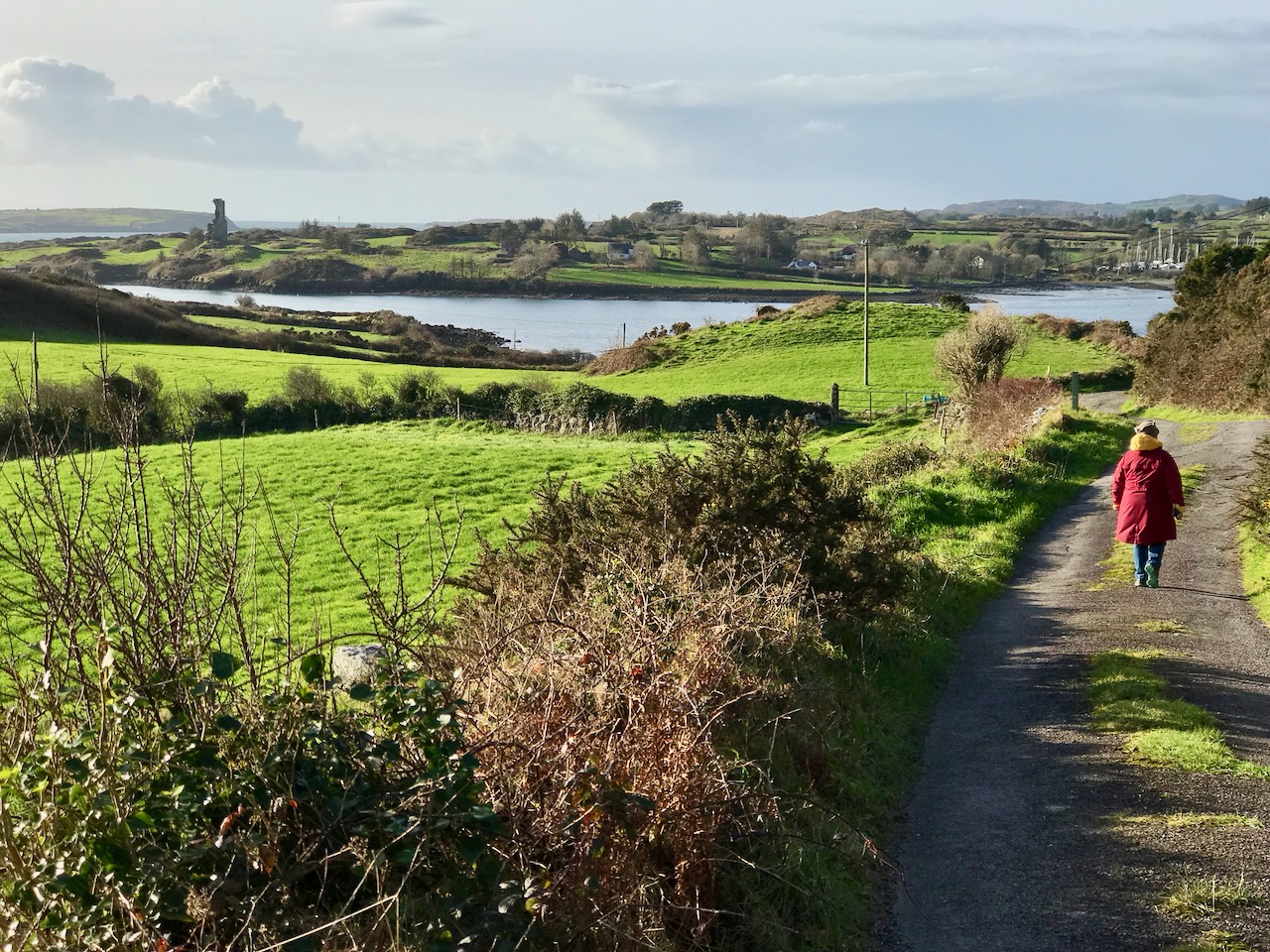
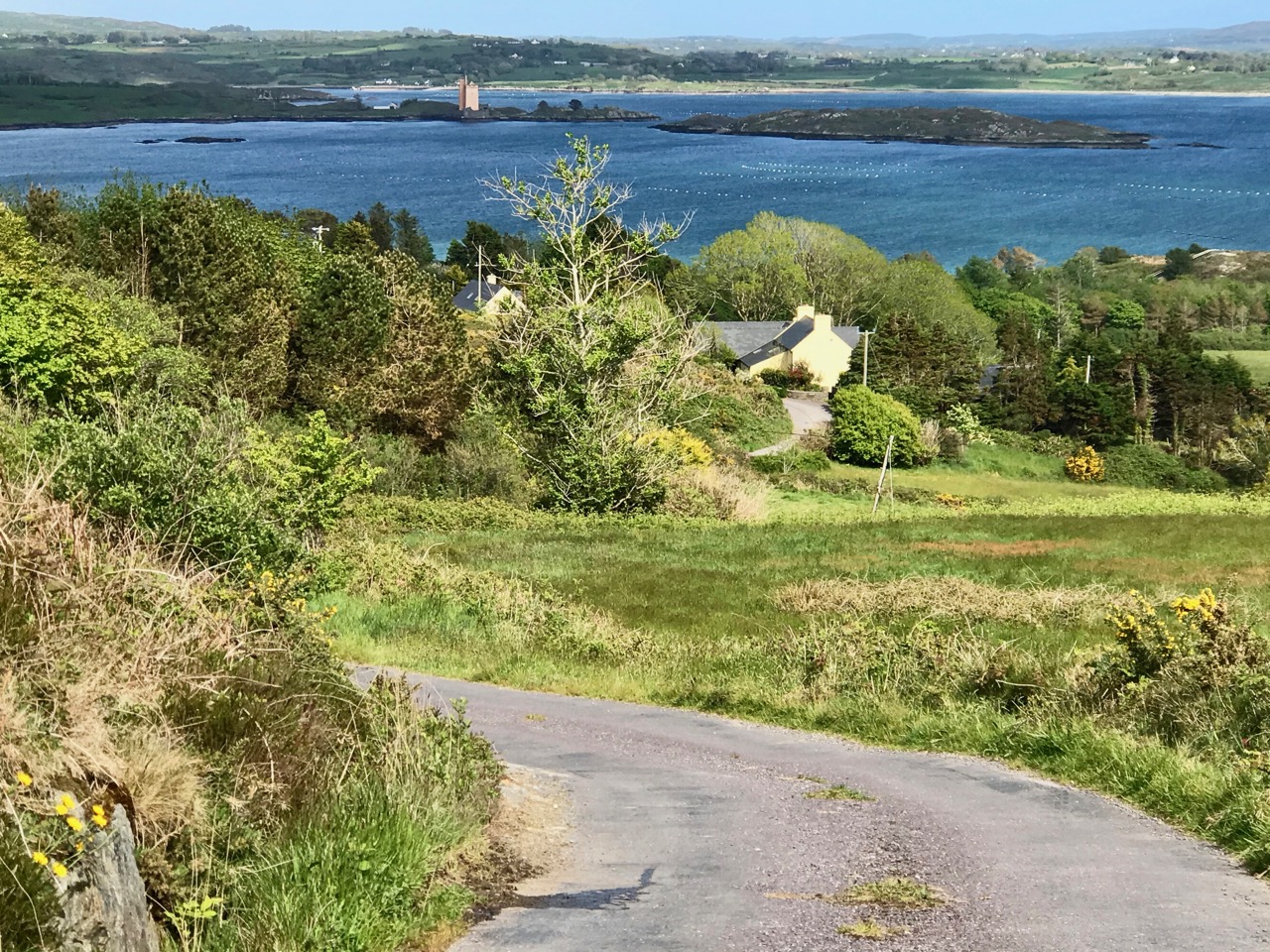
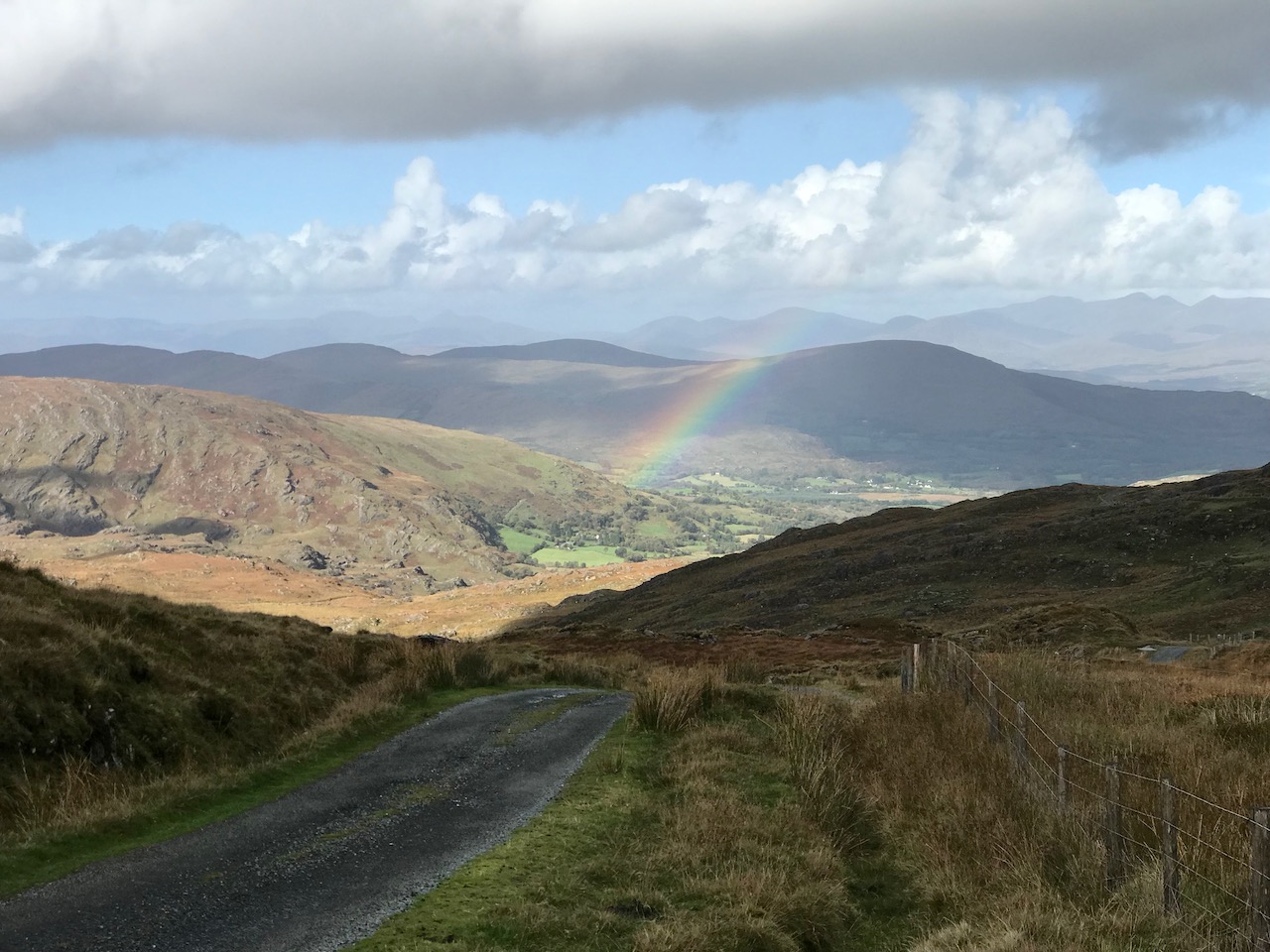
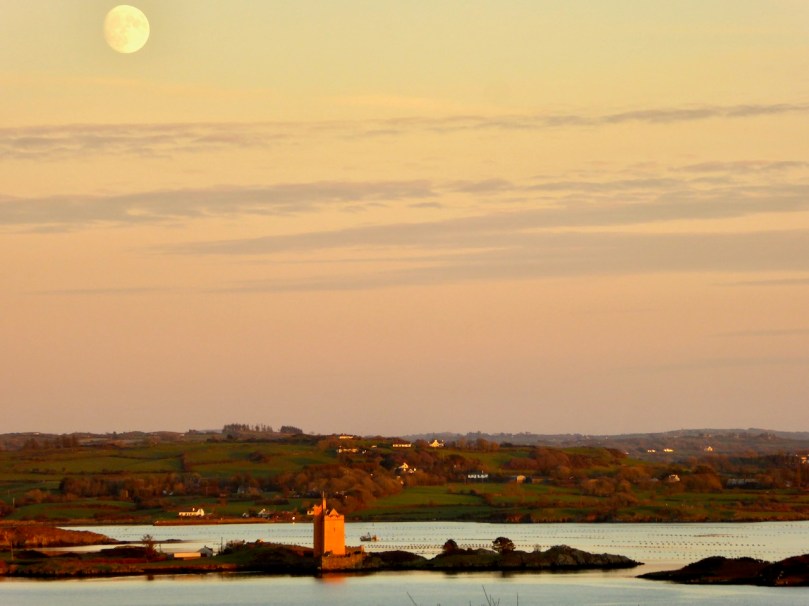
The photo at the top of the page is special for us: it’s the view we get when we turn out of Nead an Iolair, heading down towards Rossbrin Cove. And there (above) is our first glimpse of the sheltered harbour, overlooked by the medieval castle that was the home of Clan Chieftain Fininn O’Mahony in the 15th century. Not only do we have all the wonders of West Cork’s landscape on our doorstep, but we also have deep history as well…

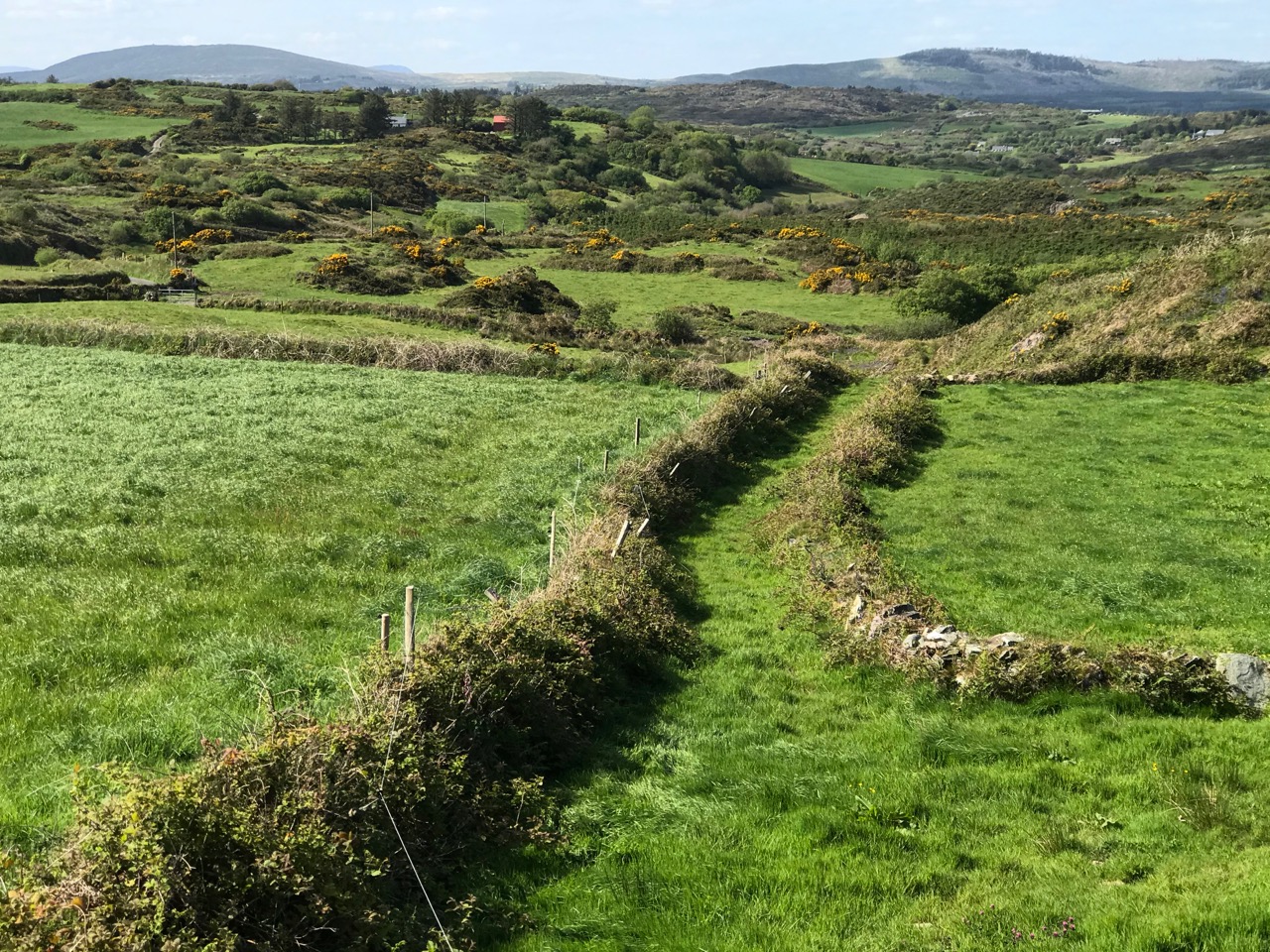
How much closer can you get to nature than this ‘green’ boreen just a short walk up the road from where we live in Cappaghglass? The stone hedge banks have become completely assimilated into the surroundings, and are a haven for so many native species of wildflowers, as Finola will readily point out to us!

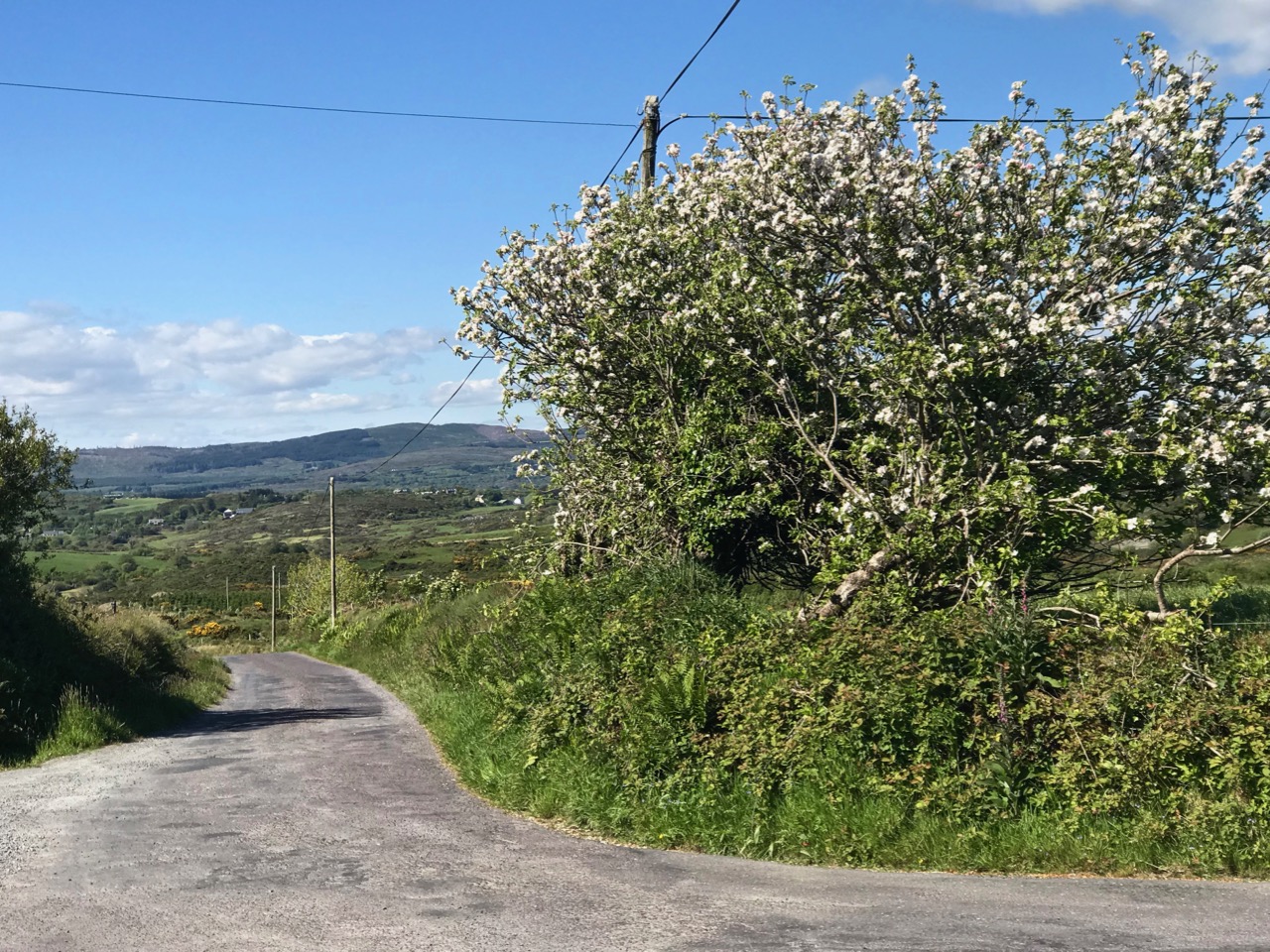
And just a few yards from that last green trackway is the boreen that takes us down into our village of Ballydehob. Those are apple trees flourishing as part of the natural hedgerow.

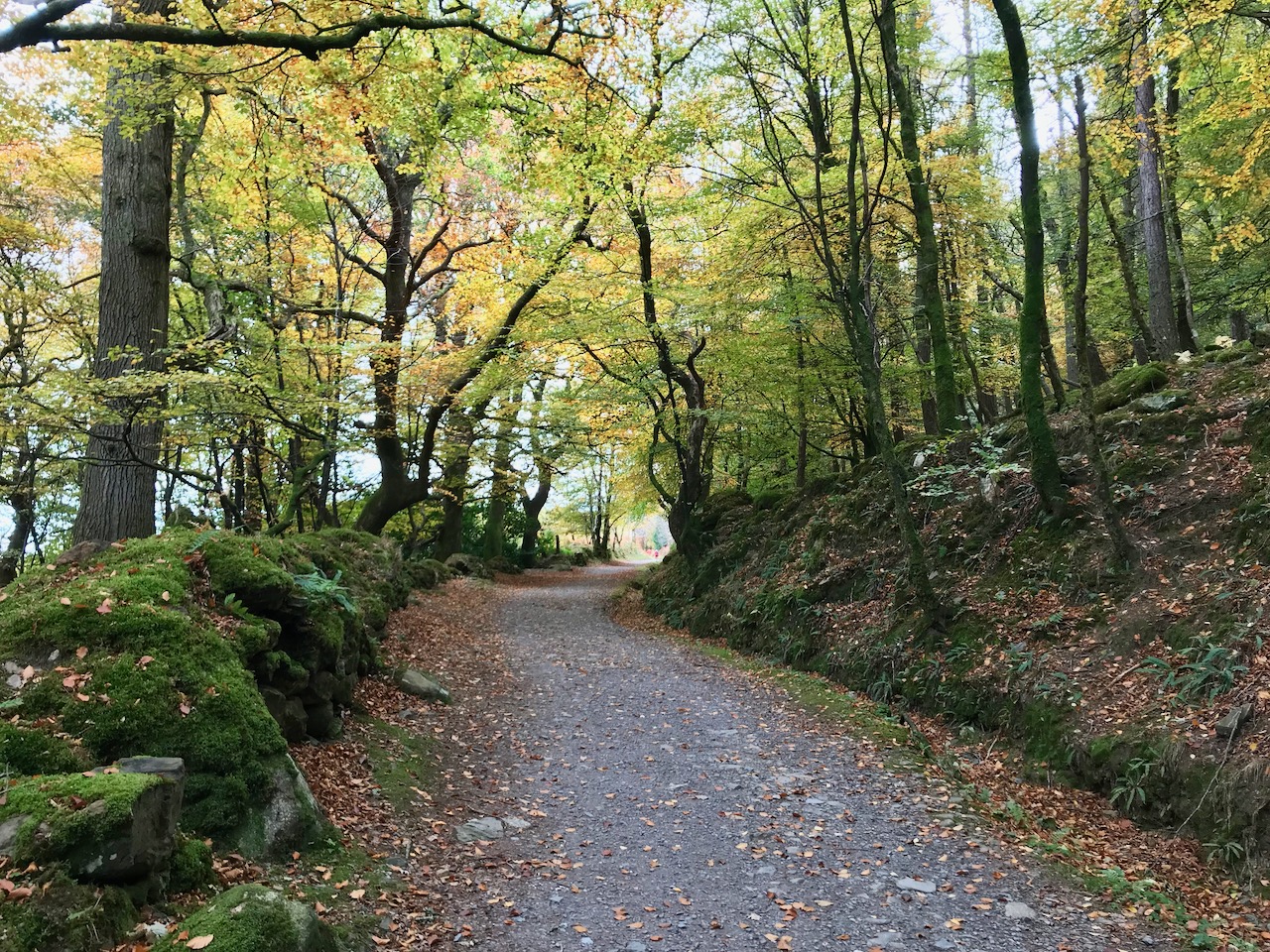
We have very little woodland around us here. This slightly mysterious tree-lined boreen was found on our travels near Glendalough, in County Wicklow, last year.

Close by the little harbour of Glandore (in Irish Cuan D’Ór – Harbour of Gold) in West Cork, we found a secluded boreen which pointed us towards an oddity: a pyramid in a graveyard – well worth a visit. Read about it in this post from two years ago.

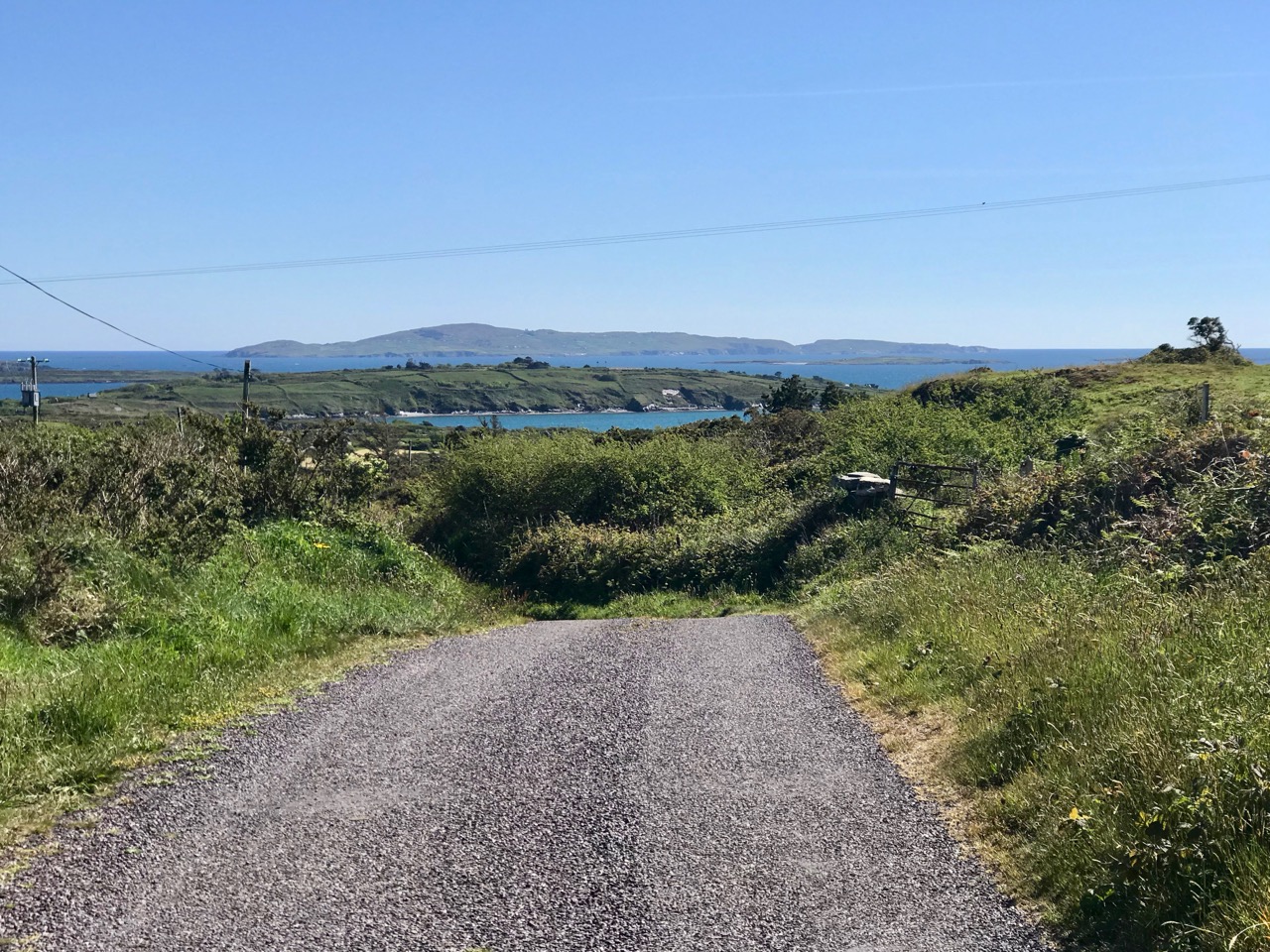
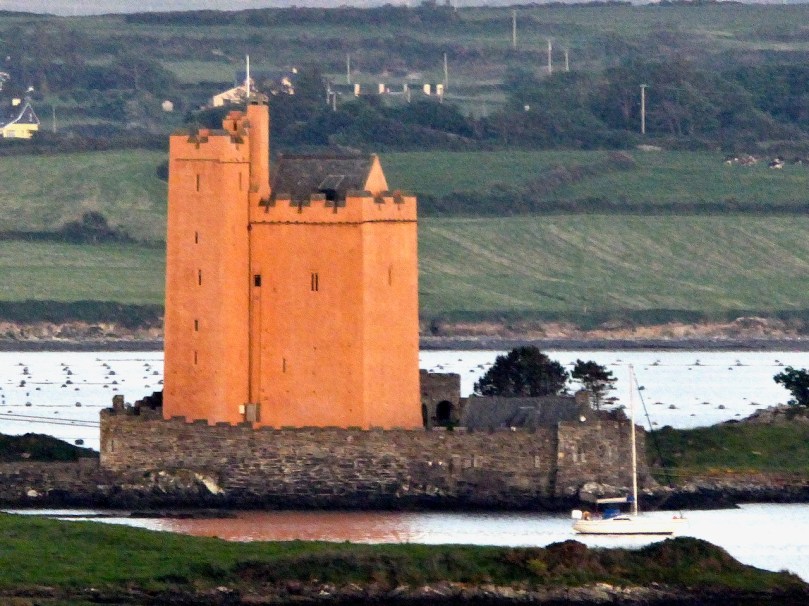
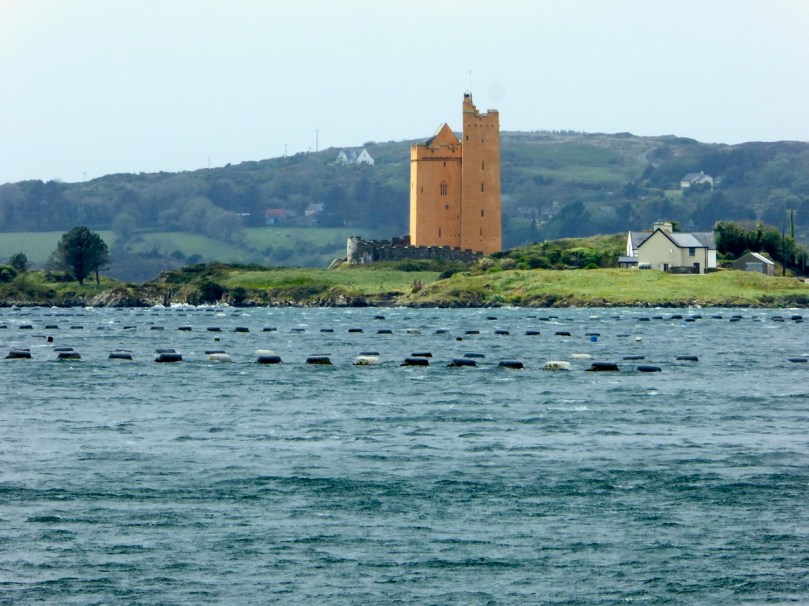
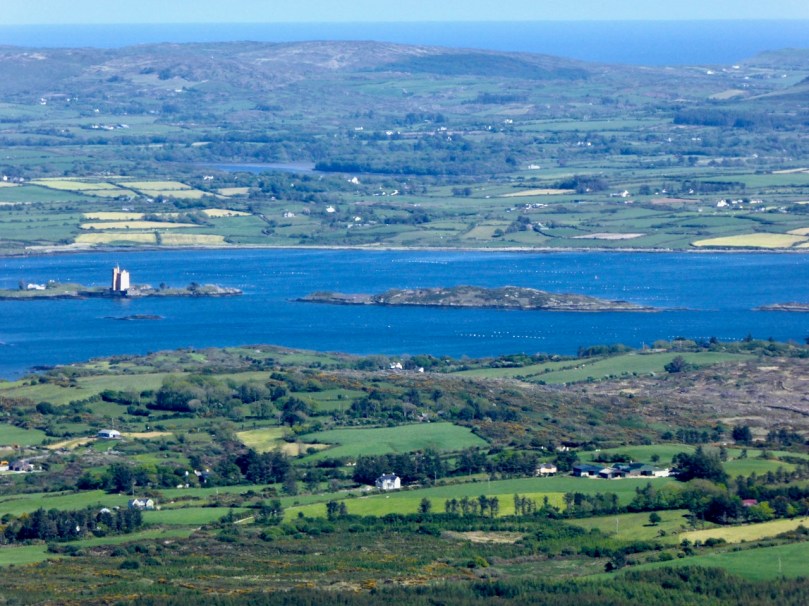
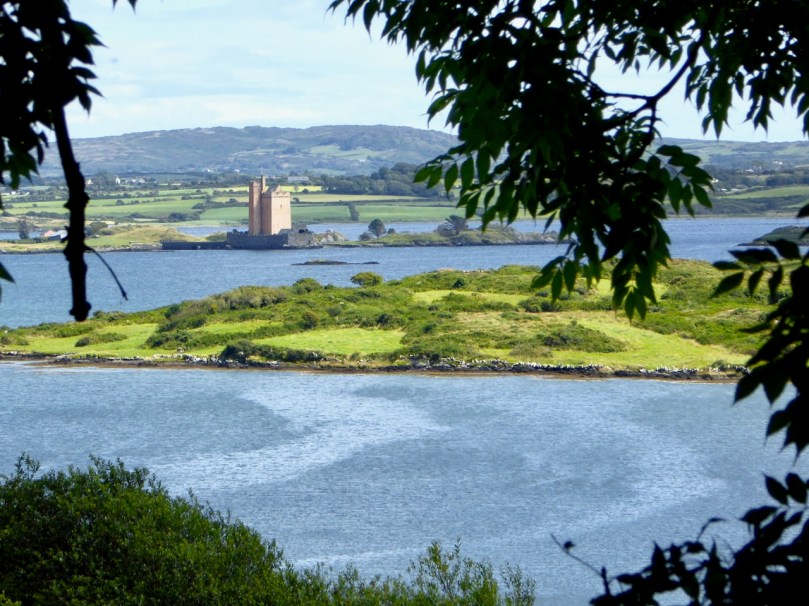
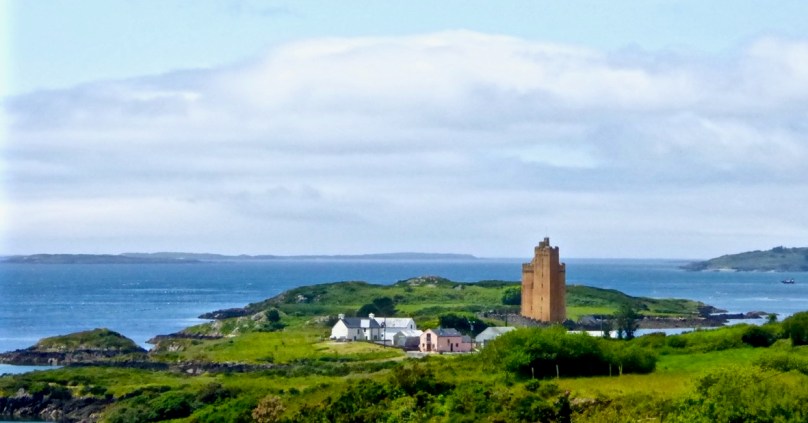
Returning to our own neighbourhood these two recent photos, taken only a couple of days ago, show how you can never quite know what you are going to find just around the corner or over the brow of the next hill. That’s Jeremy Irons’ Kilcoe Castle in the upper picture, and Cape Clear Island (on the horizon) in the lower one.

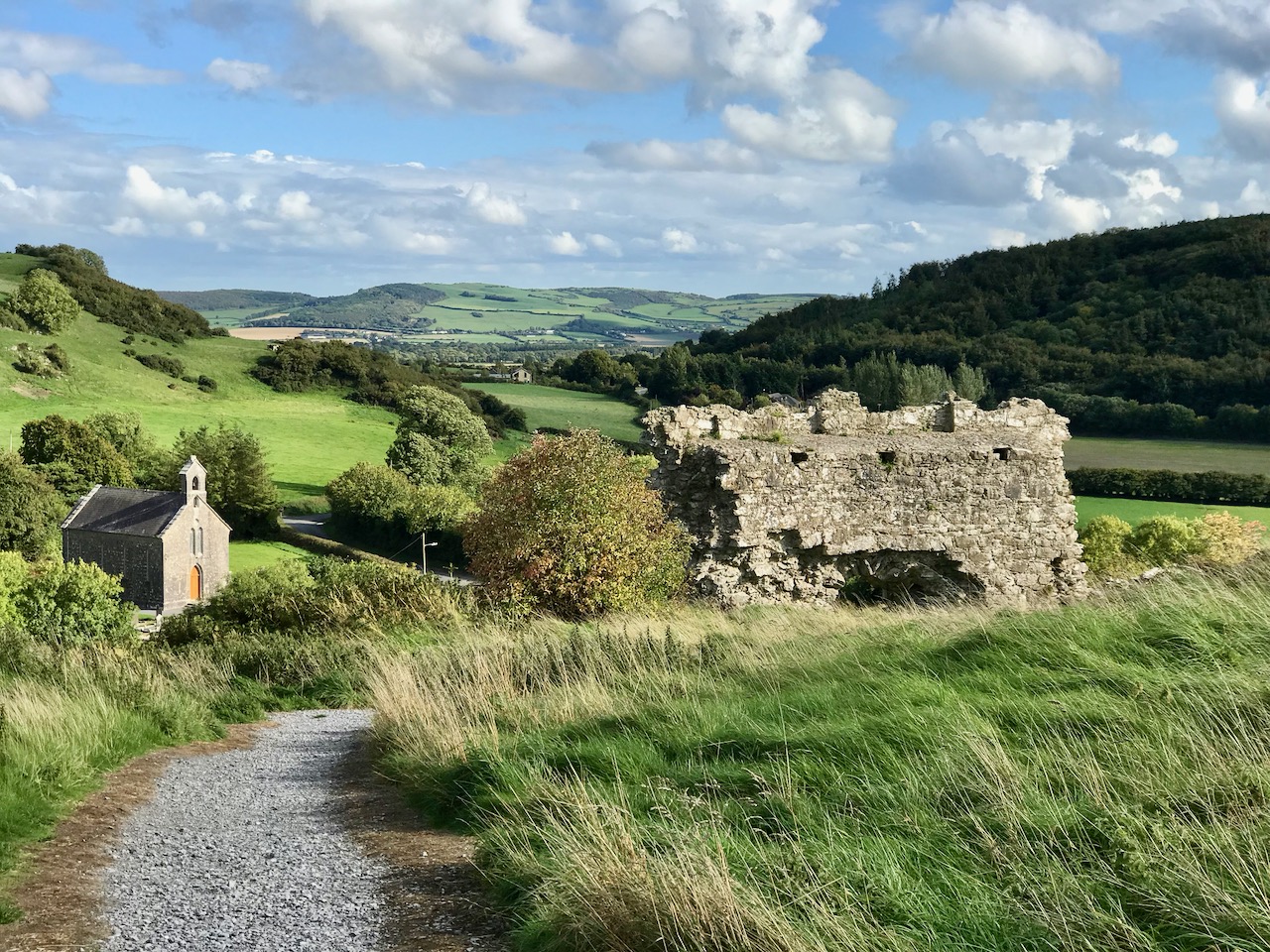
In contrast, here’s a little trackway that takes you up to the summit of the Rock of Dunamase in County Laois. This historic site with a view is associated with momentous events in the history of this country: in the painting by Daniel Maclise that hangs in the National Gallery of Ireland, The Marriage of Strongbow and Aoife is depicted as taking place at the now ruined Great Hall on the Rock. You can find the whole story of this most critical juncture in Ireland’s history in Finola’s post here.

Even further afield – in Ballymoney, Co Antrim – is this spectacular avenue of beech trees planted on the entrance driveway leading to an eighteenth century Georgian mansion, Gracehill House. This boreen – open to pedestrians – is known as the Dark Hedges, and we visited it when we explored the North of Ireland three years ago.

Although in normal times we travel a lot – on major roads and motorways, as well as boreens – the places we like the best are near to home. How could we not be impressed by the winding boreen that climbs to the top of Mount Gabriel, the highest point on the Mizen? Look at the spectacular views (above). The preacher Caeser Otway travelling in this area in 1822 wrote:

. . . On my way to Bantry I passed the dark and lofty Mount Gabriel and took my way over a dreary, comfortless tract of country. Let no one say after looking at these moors , studded over with cabins crowded with children, pigs, goats, cocks and hens that an Irishman is not an industrious creature . . . Men, women, boys and girls toiling up the mountainside with seaweed and sea sand in baskets on their backs . . . See them reclaiming from amidst rocks and bogs, patches of ground on which to cultivate their only food, the potato; and no one witnessing this struggle of human industry against nature, but must acknowledge that the Irish are a most industrious race . . .

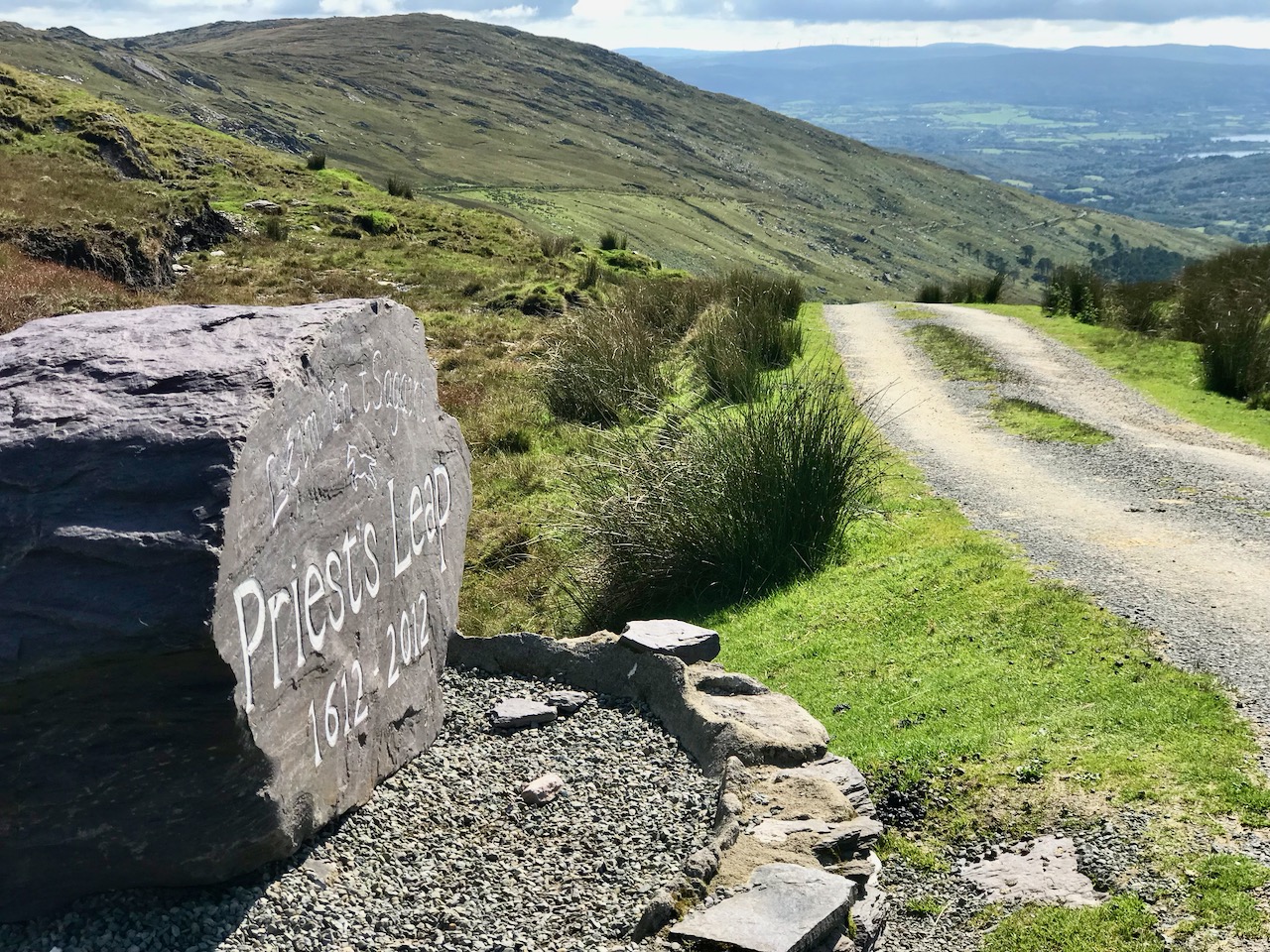
The 400 year old road that crosses the mountains from Cork into Kerry north of Bantry has to count as a boreen, as it’s single track for much of the way. The Priest’s Leap sign (above) marks the point at which the two counties meet. Although we have travelled all over Ireland in our explorations, this is still one of our favourite routes, and always will be. We so look forward to being able to go there again, when the present ‘lockdown’ is lifted.

Another glimpse of the Priest’s Leap ‘boreen’.

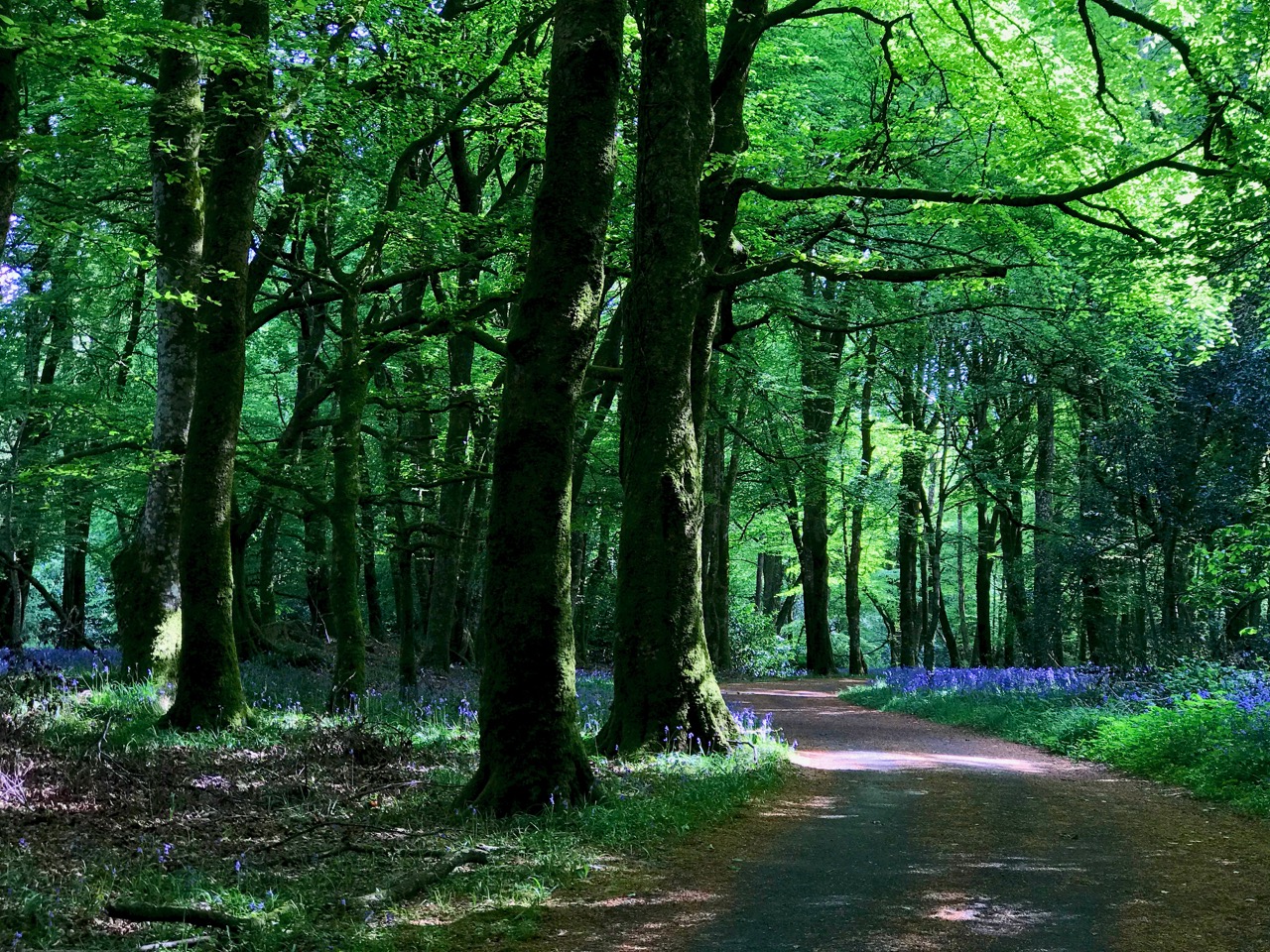
This elegant woodland boreen is a fine example of regency landscaping, being part of the Ballyfin Demesne in Co Laois. Like so many of Ireland’s fine luxury hotels, Ballyfin remains closed until the Covid19 restrictions are lifted.

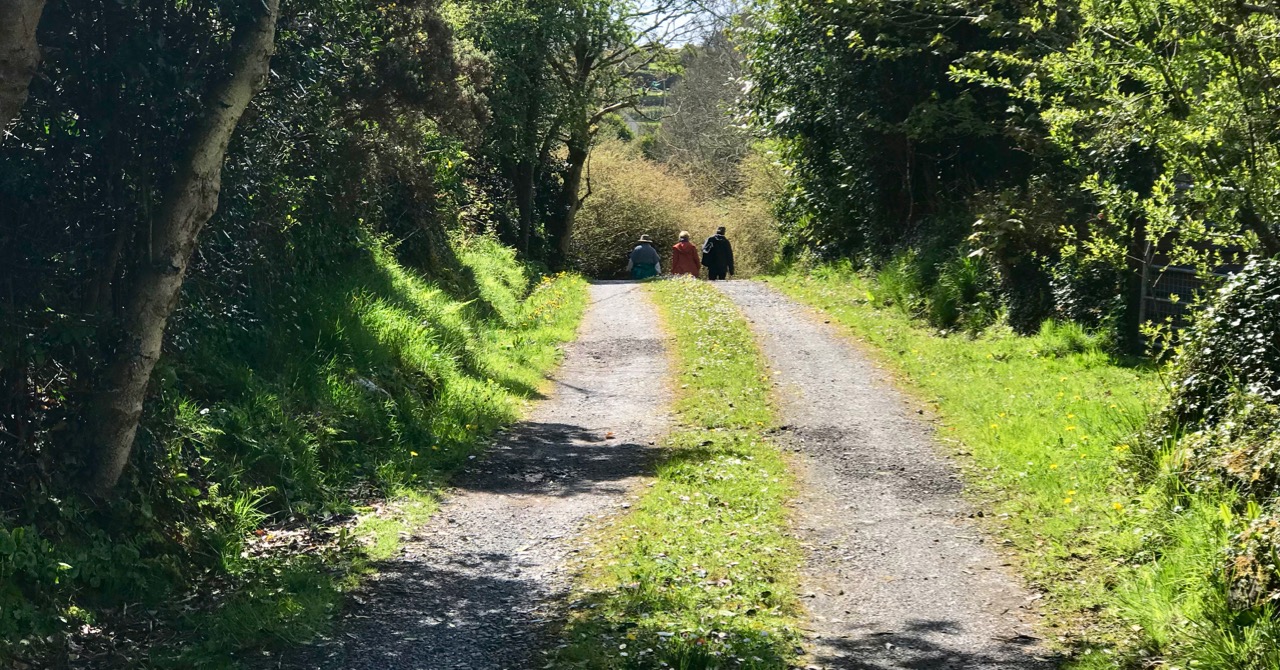
We’ll finish this post where we started – near to home in West Cork, with happy memories of unrestricted rambles with friends along the quietest and most beautiful of Ireland’s boreens . . .

Schull Sculpture – Anchor, Mermaid and Lunachán

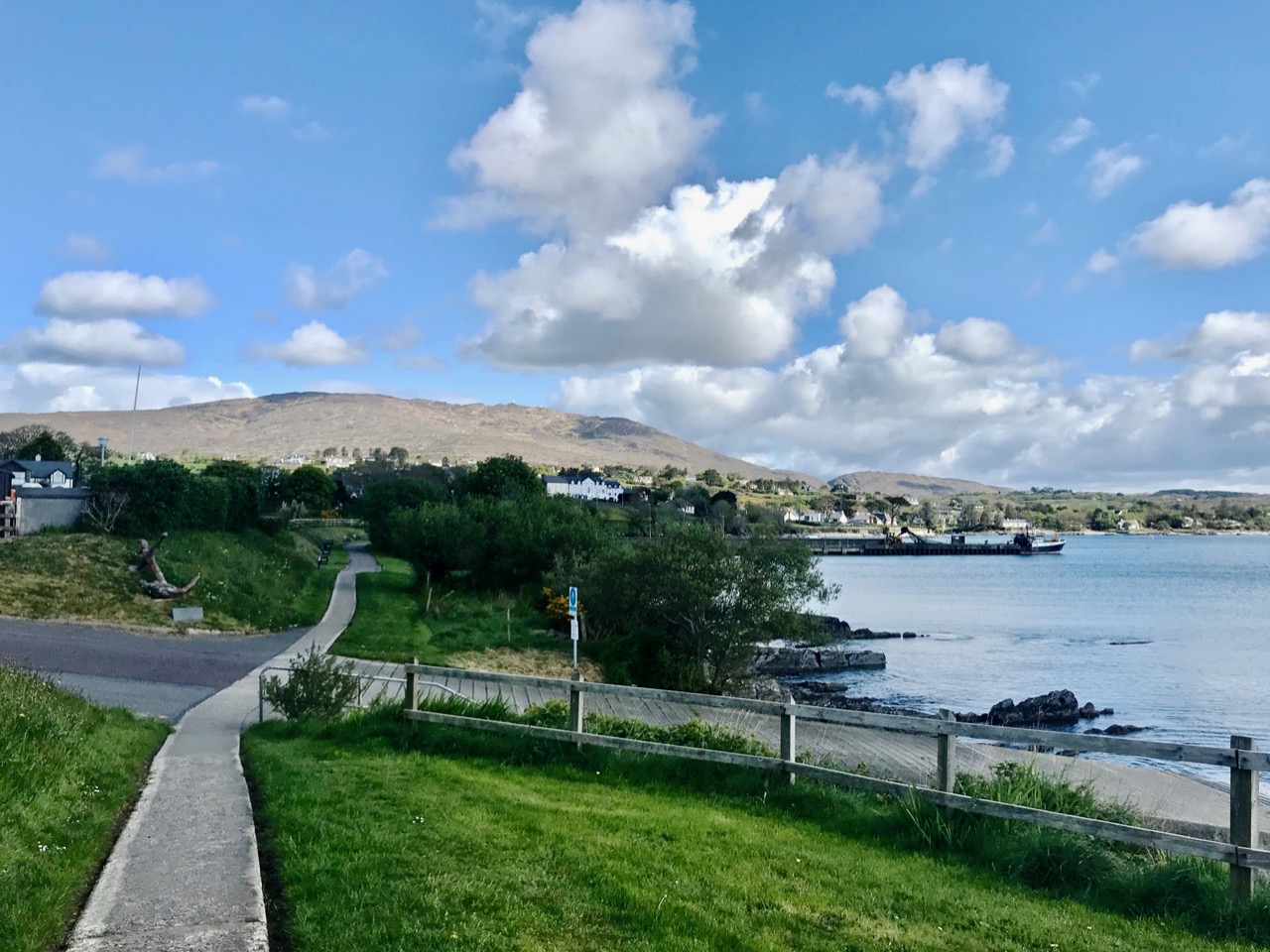
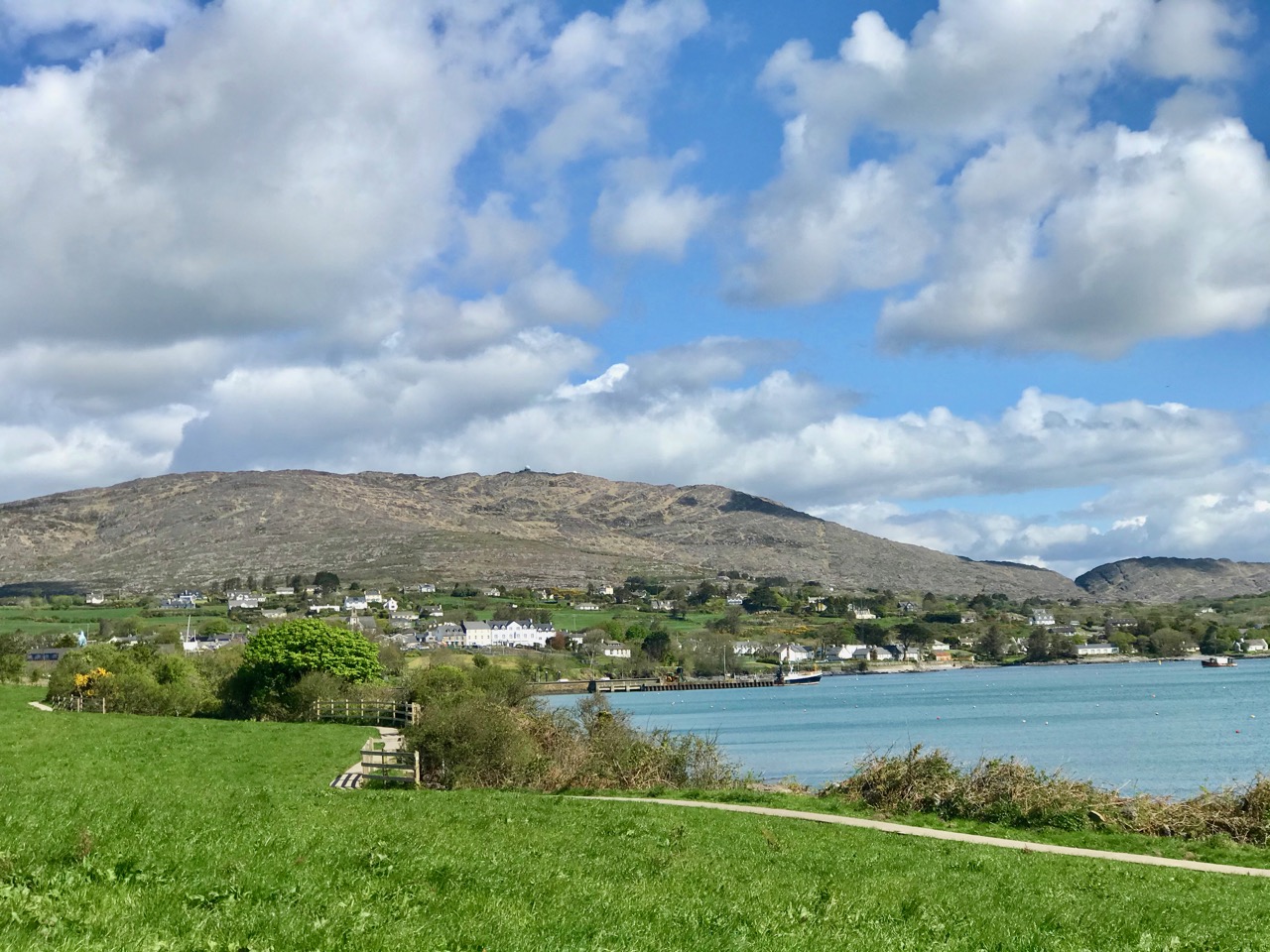
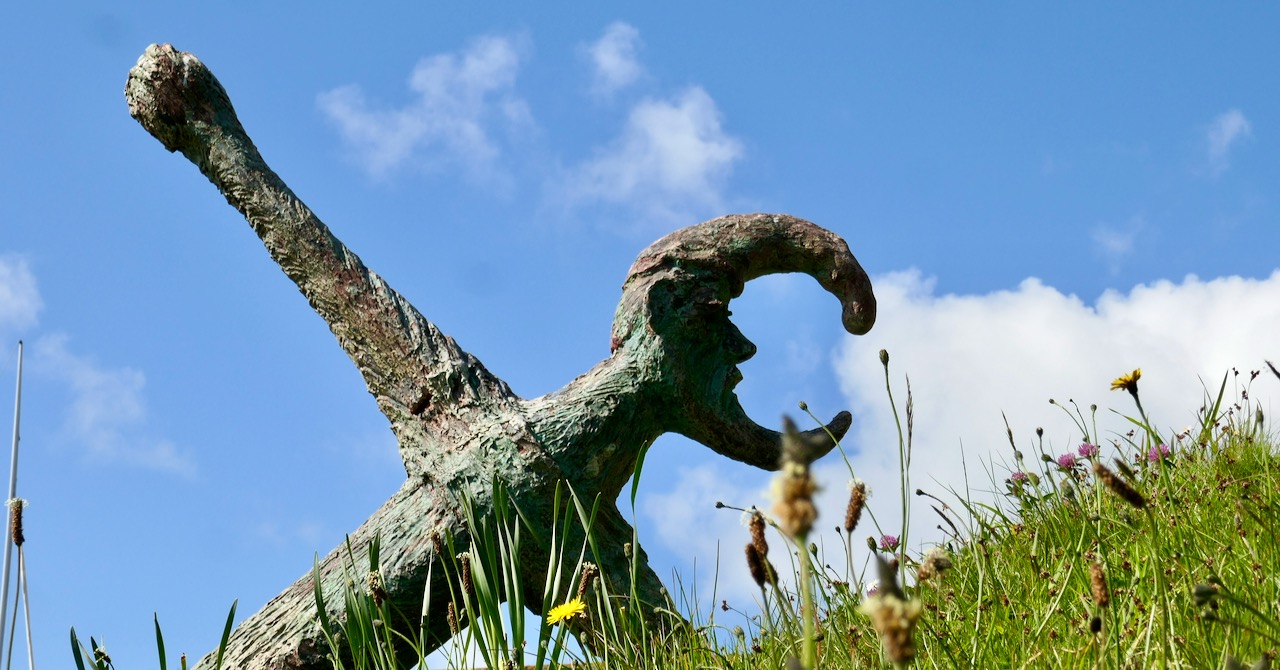
The harbour town of Schull, in West Cork, is wonderfully located on a naturally sheltered inlet looking out to Long Island Bay and ‘Carbery’s Hundred Isles’. From the pier you can take the Foreshore Walk (above) – a significant community asset – and follow a route which encircles the settlement, passing, on the way, another surviving piece of sculpture from the West Cork Arts Centre Living Landscape exhibitions, dating from the 1980s to the 1990s and masterminded by Cóilín Murray. We are indebted to Cóilín for providing an archive of photographs to the Ballydehob Arts Museum, and for being willing to contribute his own memories of the installation of the West Cork Sculpture Trail, which has greatly helped in putting together the story of this venture, over a quarter of a century later.

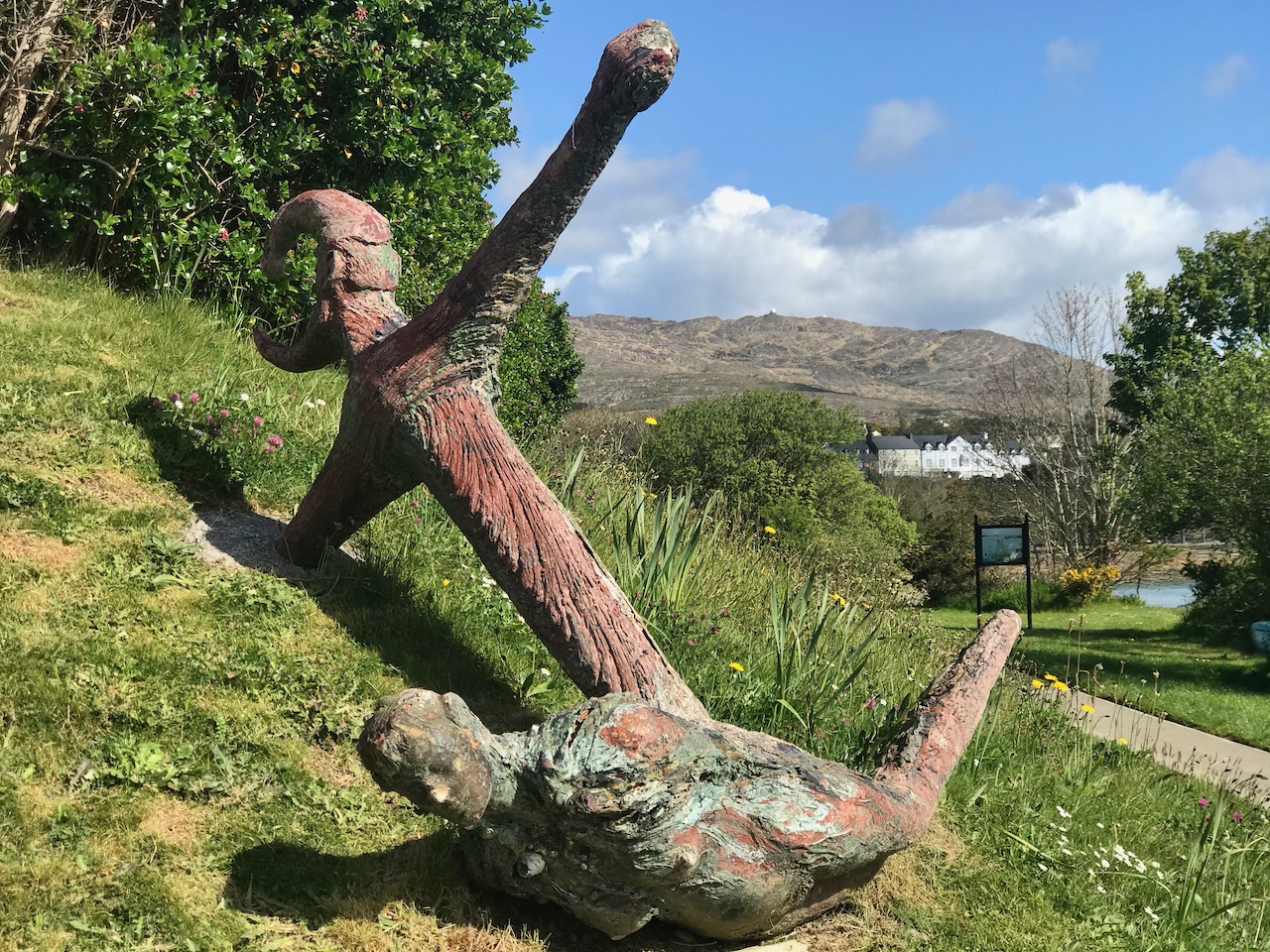
This is the second in a series of posts being published simultaneously by Roaringwater Journal and the Ballydehob Arts Museum, celebrating an important aspect of art history in West Cork. The first article – Behold, Their Bright Shining Future Rising Before Them – discussed Michael Bulfin’s ‘Pyramid’ sculpture beside the N71 road at Skeaghanore East between Skibbereen and Ballydehob. That work can still be seen, but is in a very overgrown state. The subject today is a piece by Mick O’Sullivan, titled Anchor, Mermaid and Lunachán. This is at present a well preserved surviving work from the Sculpture Trail although, like many others, it has suffered in the past from vandalism.

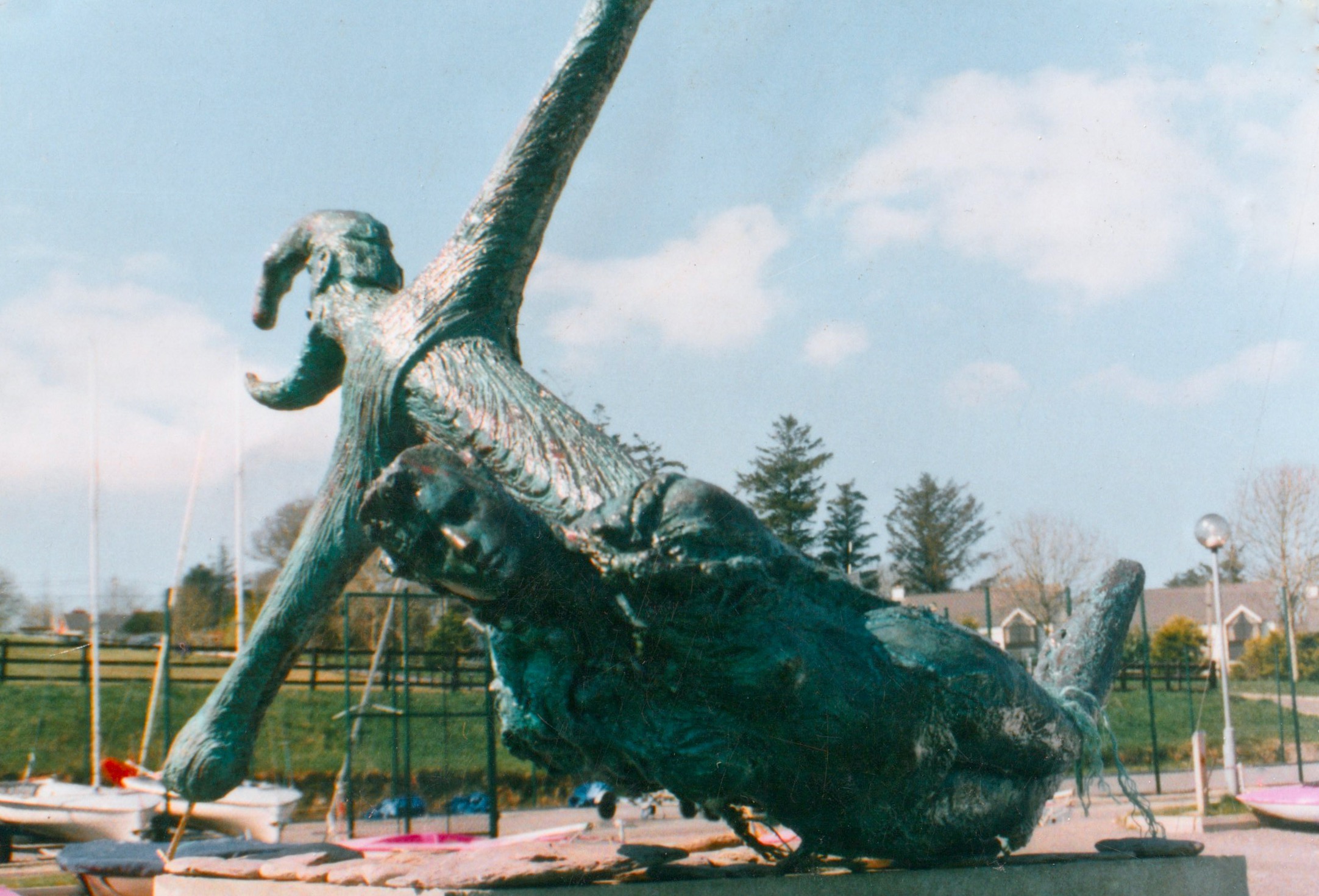
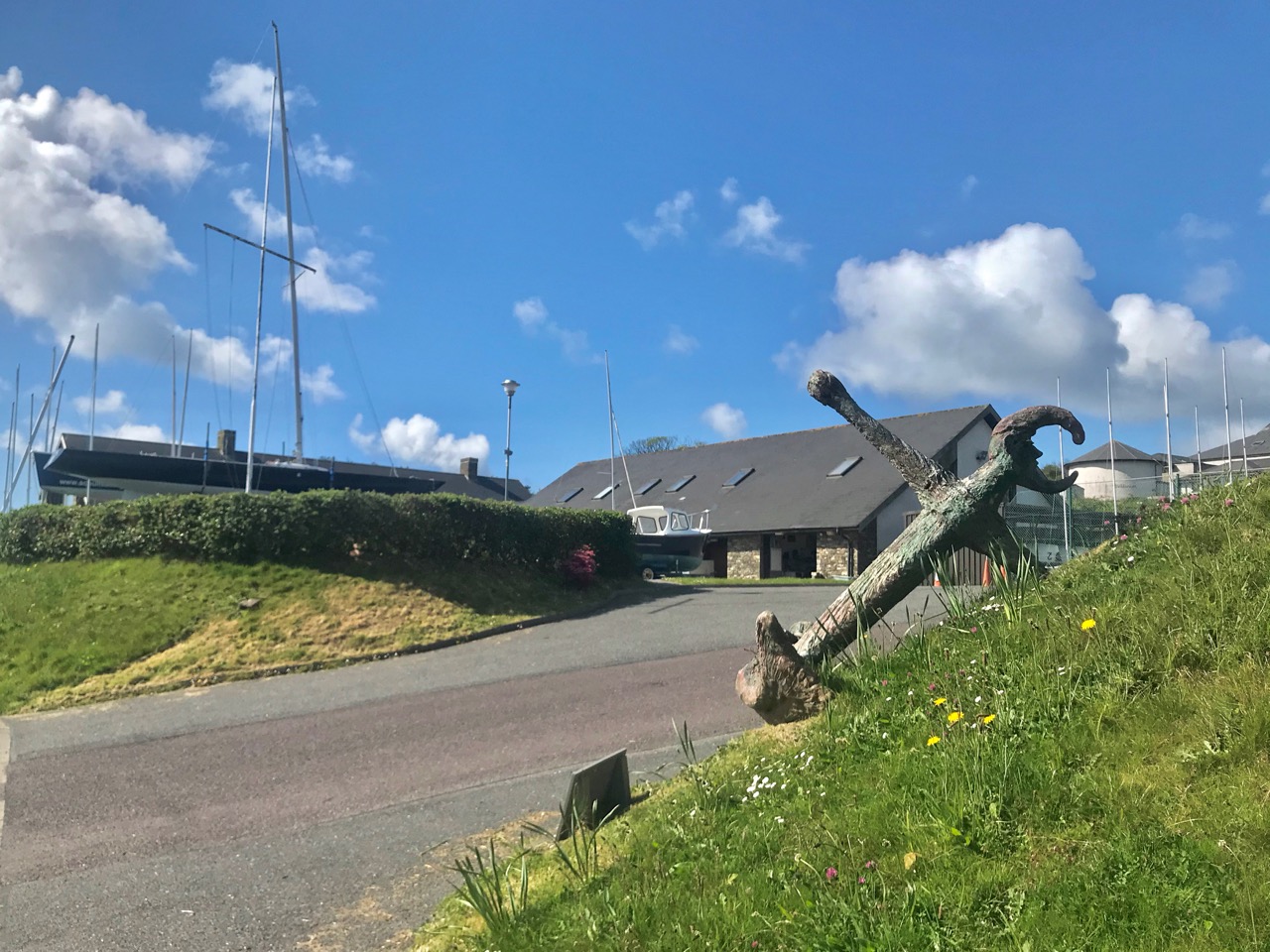
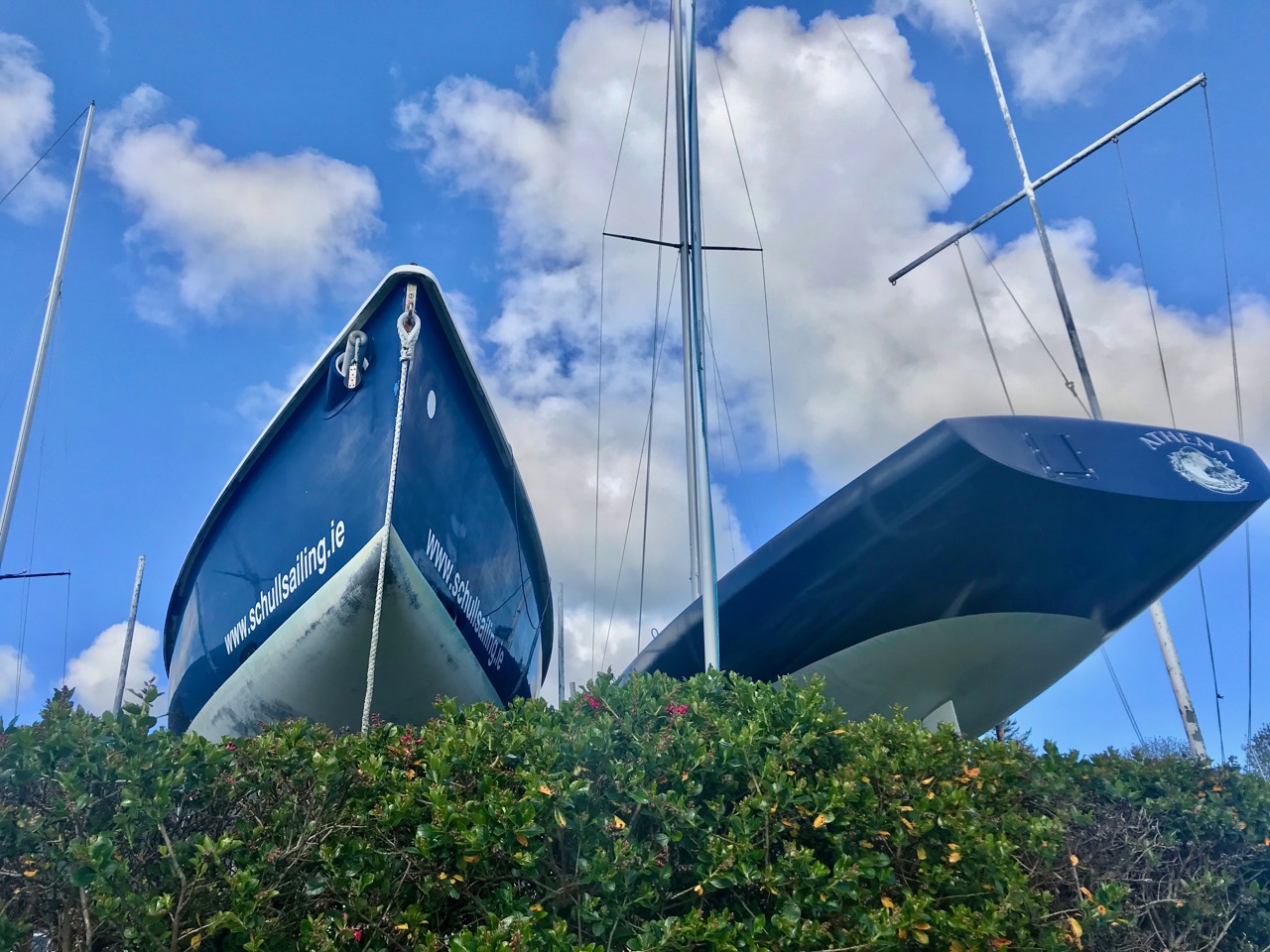
Upper – this photograph dates from the time of installation of the Anchor sculpture in Schull: it was originally situated close to the water below the Sailing School. Lower – the restored Anchor sculpture (far left of picture) is now sited above the Foreshore Walk, by the top of the slipway

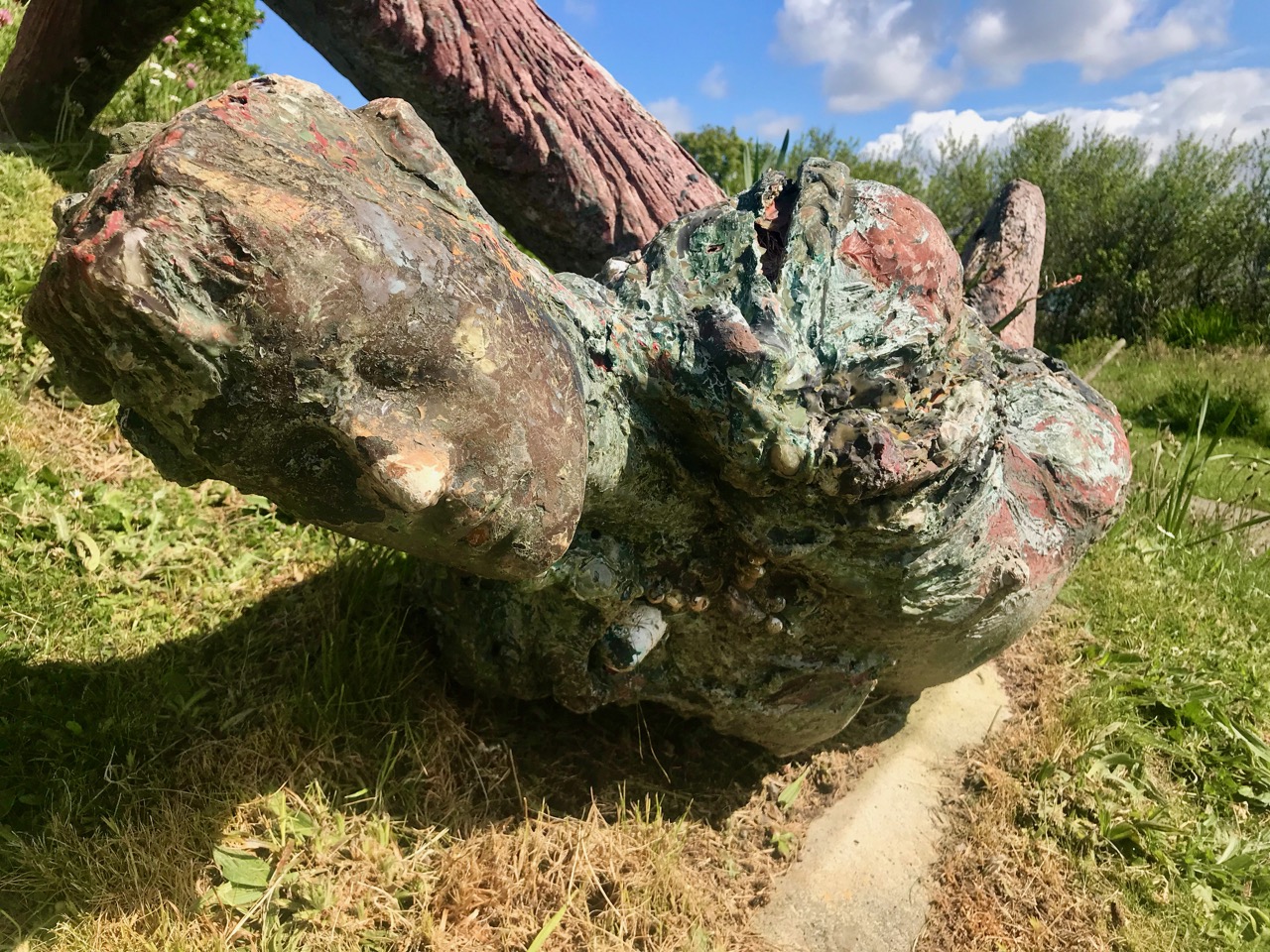
The Anchor has the remarkably realistic texture of a corroded and barnacle-encrusted ancient piece of ironwork which might have rested on the ocean bed for countless years… In reality, it is fabricated from glass-fibre resin and – if dropped into the sea – it would float!

It was, in fact, sent out to sea… Deliberately damaged in the late 1990s, it was broken into two parts and thrown in the water. The two sections ‘sailed’ side by side towards Long Island until they were rescued by one of the Schull fishing boats. Eventually the remains of the artwork arrived in Cóilín’s garden in Skeaghanore, awaiting a saviour.

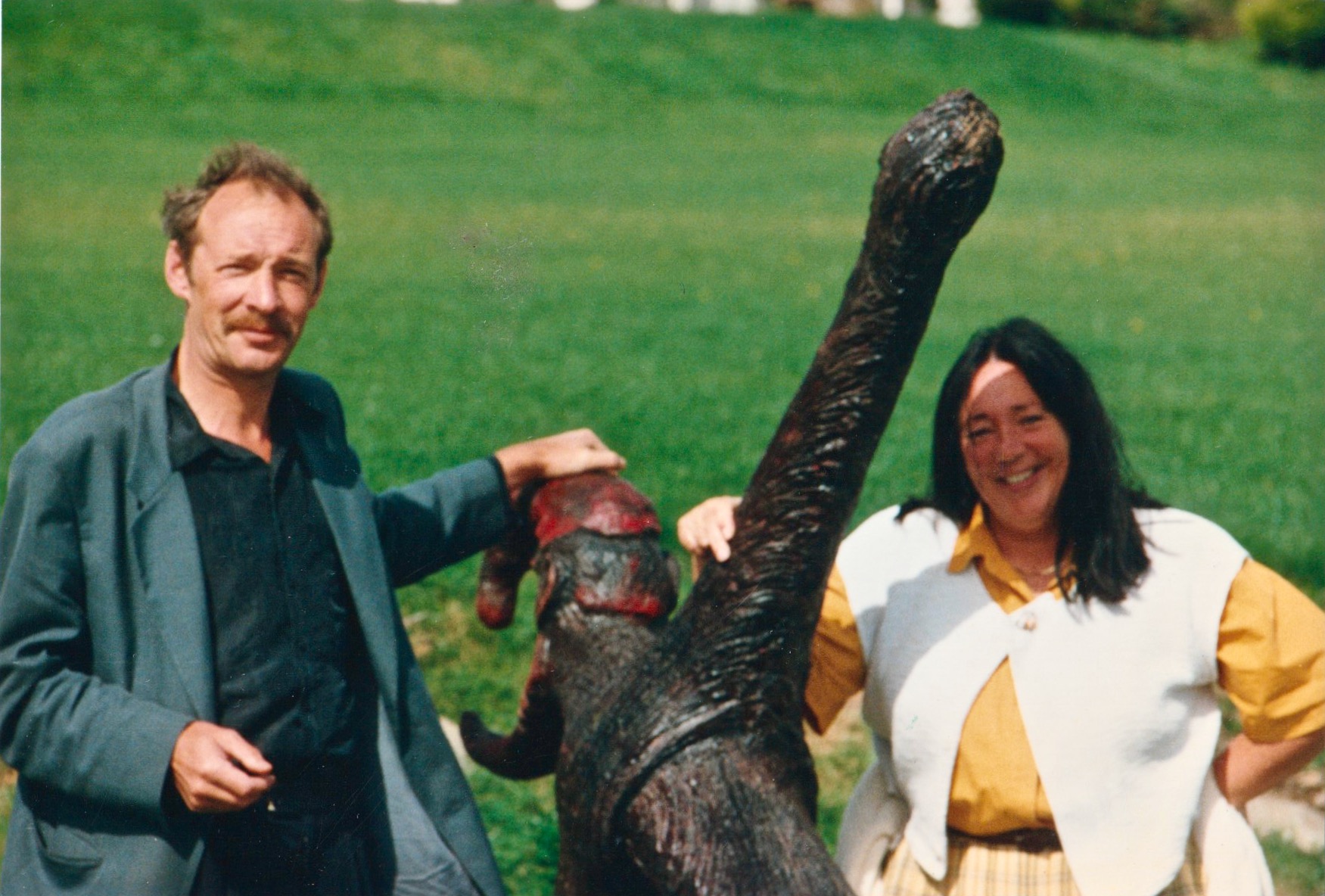
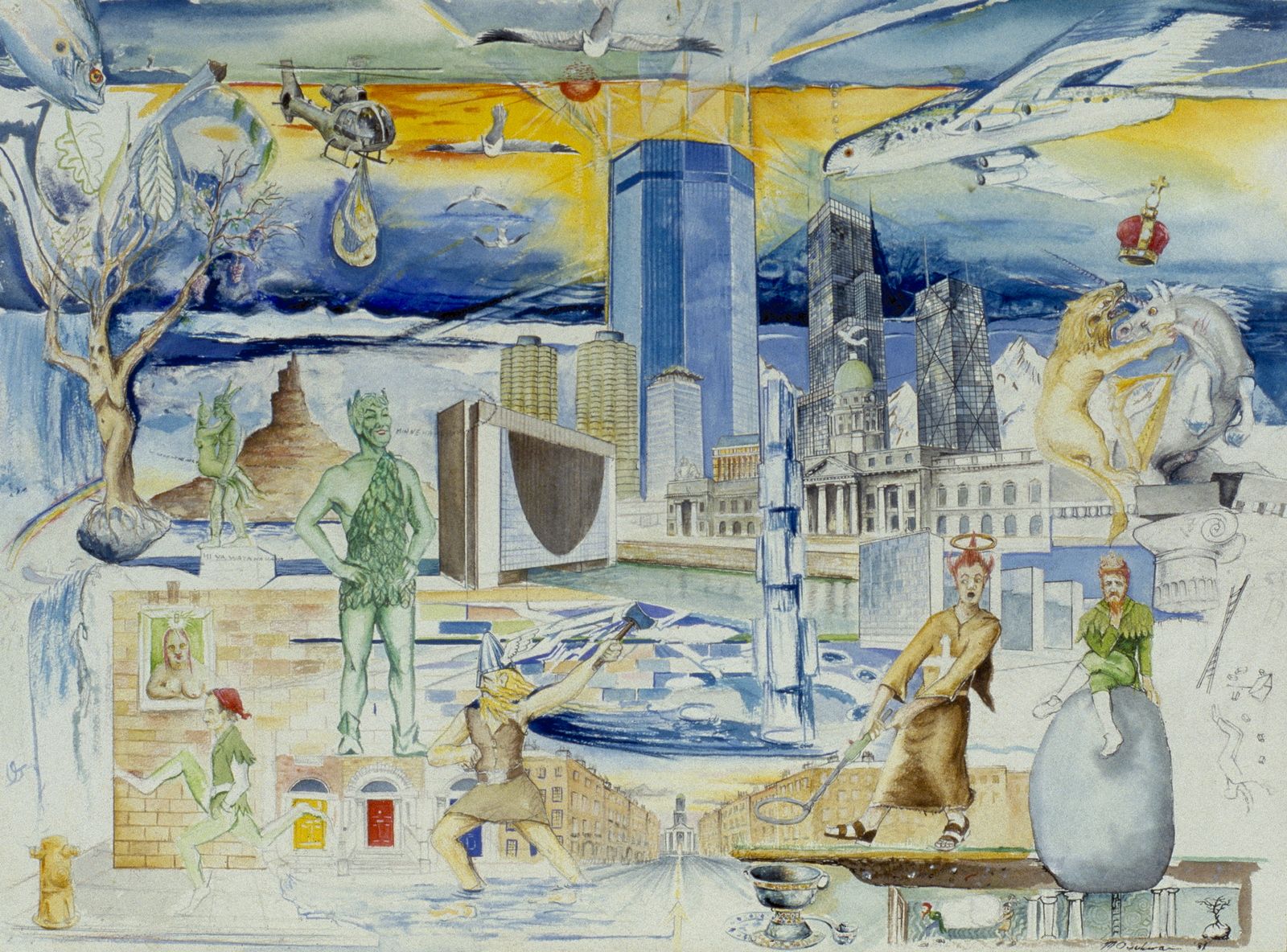
Upper – Michael O’Sullivan at the launch of his ‘Anchor’ sculpture, together with Christine Choice, board member of WCAC. Lower – a 1982 watercolour by Michael O’Sullivan: St Brendan Discovers the Crystal Pool (IMMA Permanent Collection)

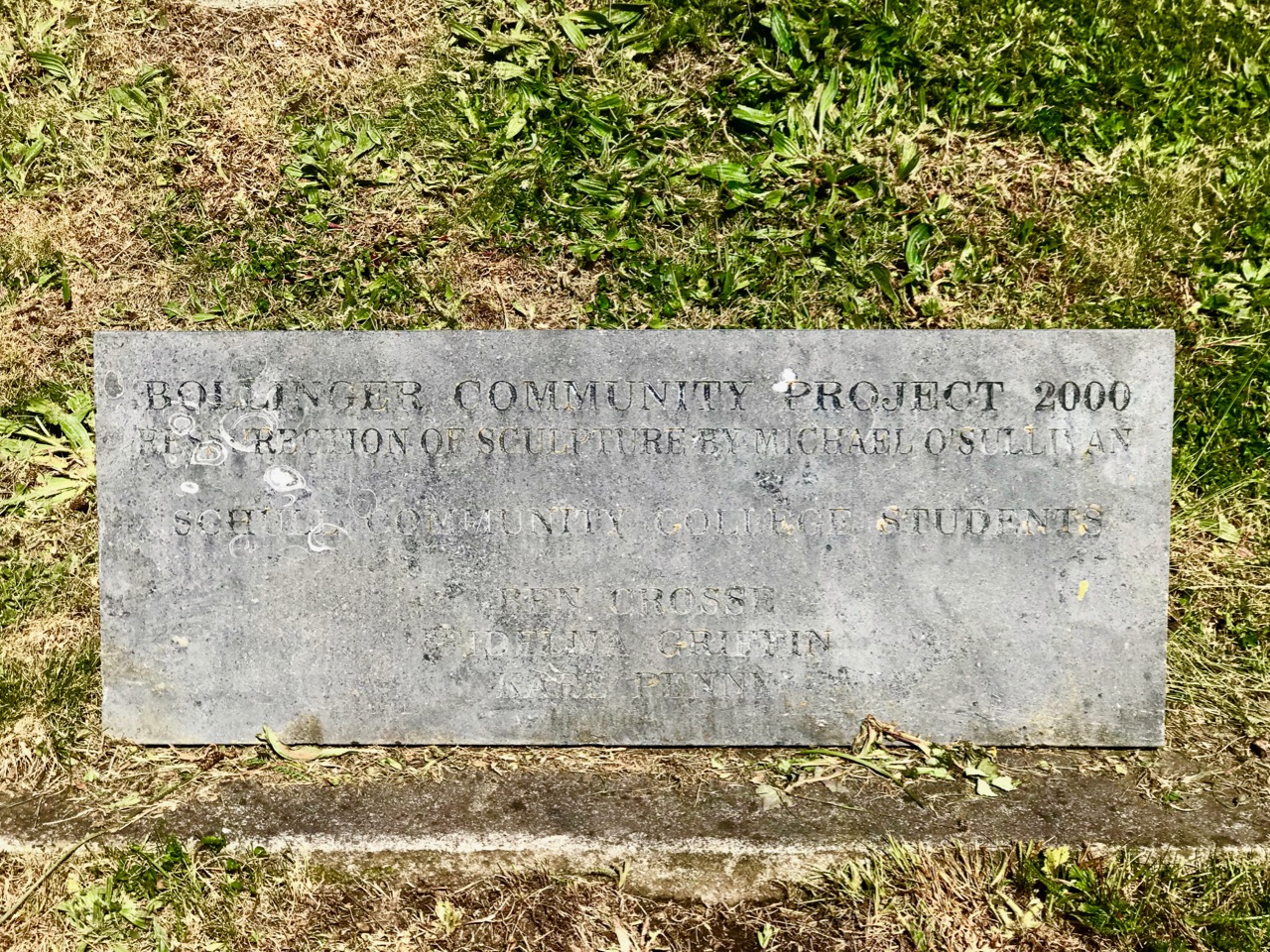
Michael O’Sullivan was born in Dublin in 1945. He gained a Diploma in Sculpture from the National College of Art and Design (NCAD), and was a lecturer there until his retirement. He has been greatly influenced in his life and art by the works of James Joyce, and is a noted scholar and lecturer on Joyce. Cóilín Murray and Michael O’Sullivan remain good friends and when the pieces of the anchor were recovered Michael came back to Schull to help in a restoration project on the sculpture instigated by a staff member at Schull College. The Anchor was reassembled and placed in its present position, where it is hopefully less vulnerable. A plaque there commemorates the 2000 ‘resurrection’ project and gives the names of the students who were closely involved in the reconstruction work.

The restored Anchor is appropriately located in the context of the Schull Sailing Centre

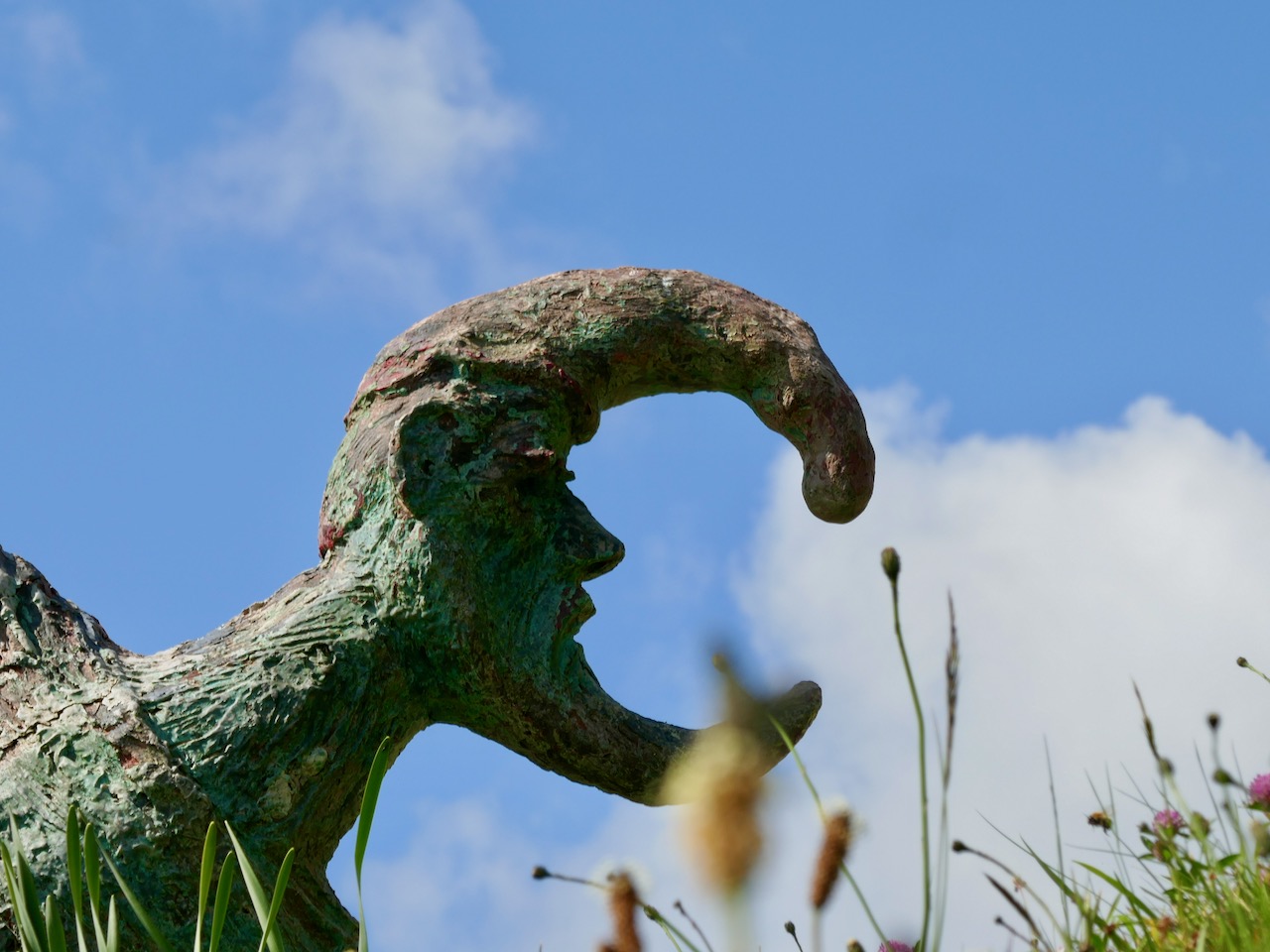
The word Lunachán – referring to the topmost part of the Anchor sculpture – is made up (by Michael)! I asked Cóilín for clarification and here is his response:

The word is an invention of his …Witty? ….
Amadán …in Irish …a bit of a fool …
Luna …the moon …
Lunachán …the reference to the moon and the howling at the full moon etc … Most of Mick’s work has layers and riddles…

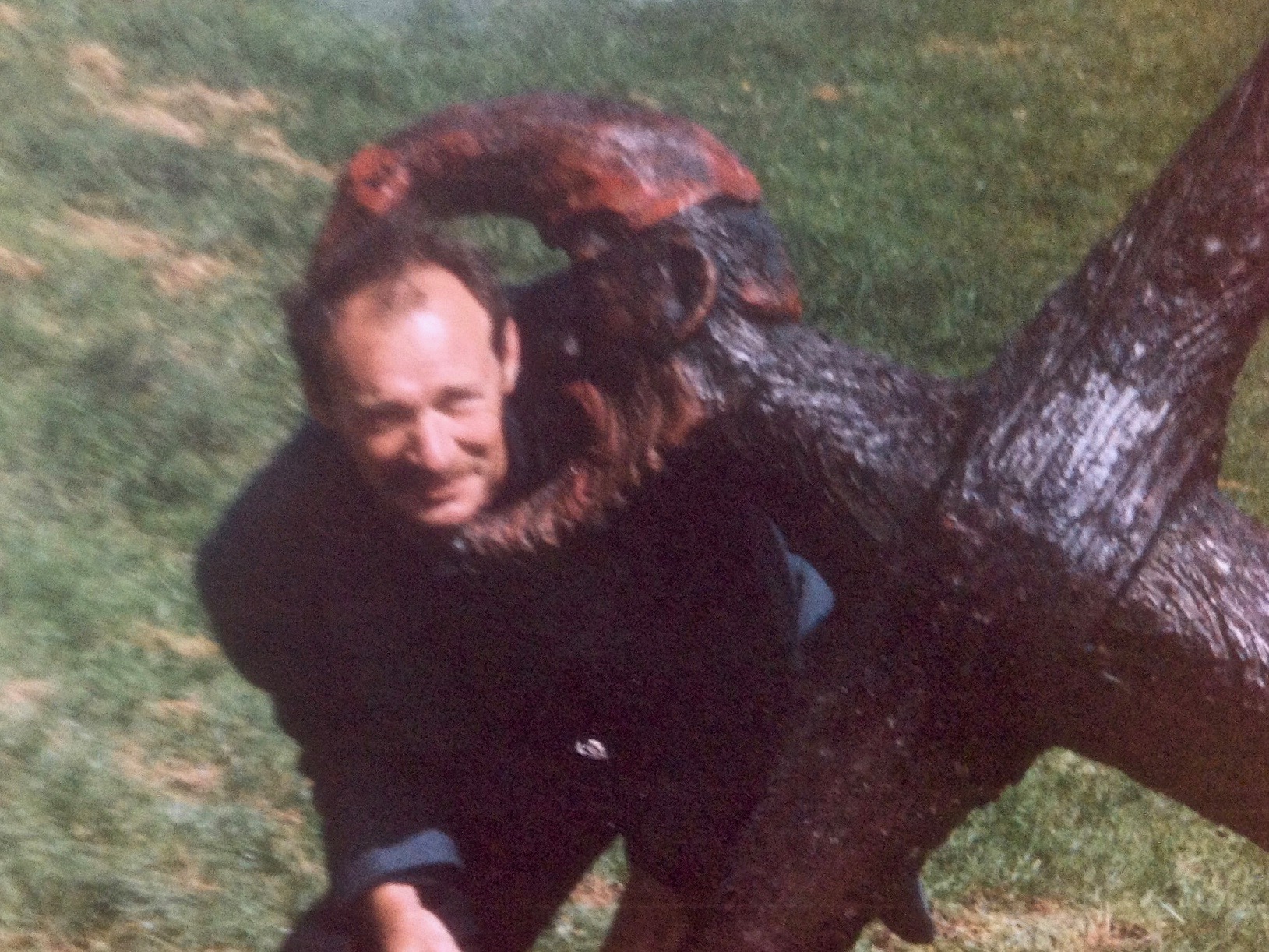
Upper – the Lunachán today. Lower – Michael O’Sullivan and Lunachán – shortly after the sculpture was first installed in Schull

It’s good that the community in Schull was sufficiently enthusiastic about the restoration of this sculpture to support its reinstatement in the Millennium year. Twenty years later, perhaps we should consider a revival of the West Cork Sculpture Trail with new artwork to link in to the few surviving pieces? The overall Living Landscapes project – of which this was just one part – helped to give the West Cork Arts Centre its still vigorous identity and national reputation. Surely – when tourists return to the Wild Atlantic Way post-Covid – such a venture could provide a stimulating cooperation between art and landscape?

Schull-Under-The-Mountain, spring 2020

Kilcoe Castle – A Magnificent Reconstruction

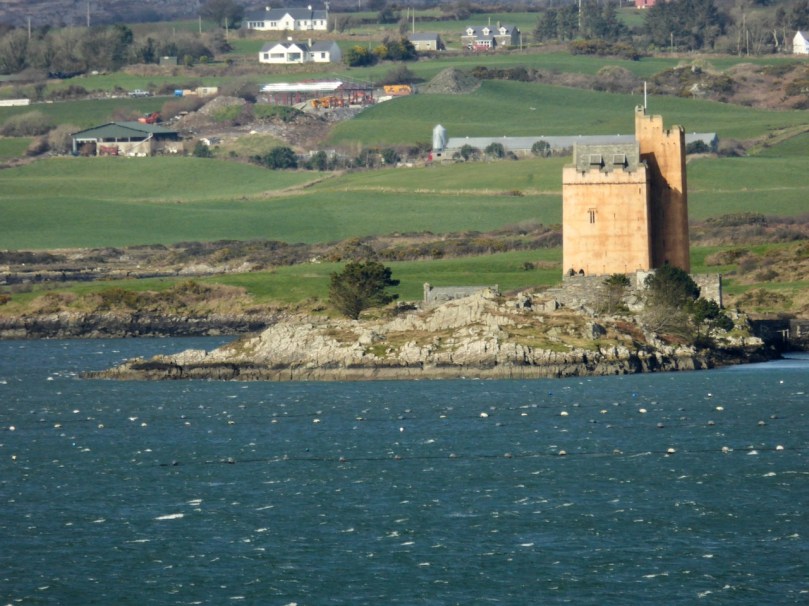
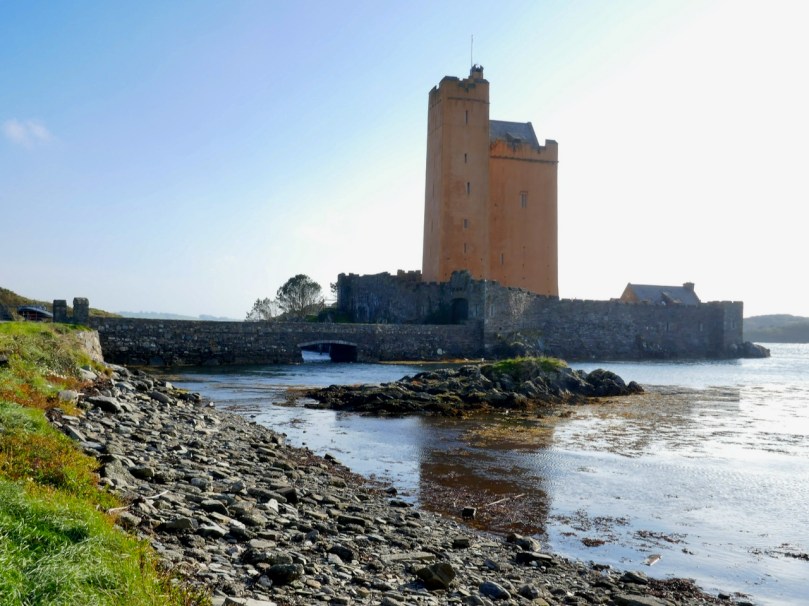
Kilcoe Castle has been wonderfully restored and conserved by Jeremy Irons. His work allows us to see what a 15th century castle would have looked like in the landscape and has saved a precious piece of our heritage. This is important as there are so few castles that have been conserved here and lots that have disappeared or are in danger of doing so. Before you read on you might like to refresh your understanding of our West Cork castles, or Tower Houses, by reading When is a Castle?; Tower House Tutorial, Part 1; Tower House Tutorial, Part 2; or Illustrating the Tower House: A Guest Blog (sort of)

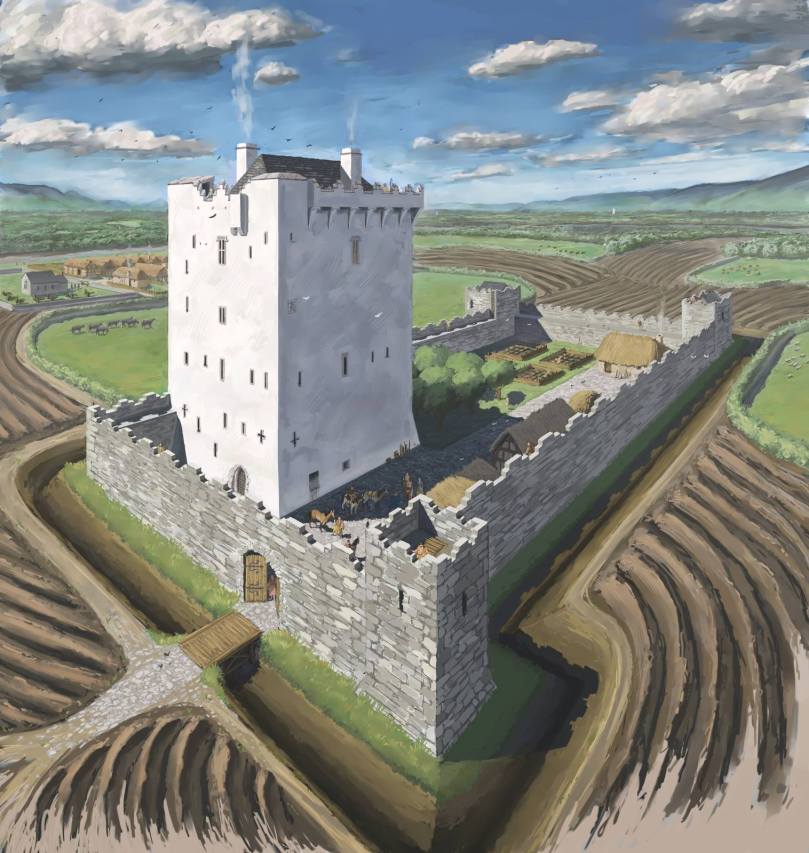
First of all, let’s address the issue of the colour of the exterior lime render, since this has been controversial. In fact, the only reason it’s been criticised is that people are not used to seeing castles as they originally stood, since the lime render has long ago disappeared from them, leaving the familiar bare stone walls that people have assumed was how they looked from the start. But all castles were rendered – without that they would have been porous and running with water inside and out.

This is JG O’Donoghue’s reconstruction drawing (used with permission) of what a fifteenth century tower house would have looked like. It was based on Kilcrea Castle. Note the white render and note also that another white castle can be seen in the distance

And the render was coloured! There is evidence of all kinds of additions that would have added colour, including animal fats, blood and hair, flour, shell, sand and stone rubble. The plasterer had his formula and also used what was available locally, materials that would increase cohesion and improve drying time. Irish places names abound in references to coloured castles – just Google the words “castle Ireland” and then put white, black, red, green in front of it and see how many there are. Or look for Irish equivalents, such as Castlederg – for Caisleán Dearg, meaning Red Castle. There’s even a Castleboy in Meath that comes from Caisleán Buí, meaning yellow castle. So the choice of colour was not idiosyncratic or random but well grounded in historical precedents. The render was essential to keep the castle dry and will have to be renewed occasionally as it does eventually wash away – which is why very few examples have survived from the fifteenth century.

The other reason to include colouring elements in the render was to make the castle stand out in the landscape. These were statement residences and the statement was one of power and prestige. They were meant to be seen from a long way off so that nobody could be in any doubt who was the most important person in the neighbourhood. In West Cork, they were also meant to be seen from other castles – those built either by members of the same or another family (the McCarthys, O’Mahonys, O’Driscolls, O’Sullivans or O’Donovans). Kilcoe was a McCarthy castle: the McCarthys were the overlords of all the West Cork clans and this castle was inserted right into the middle of territory controlled by the O’Mahony’s and the O’Driscolls as a constant reminder of the hierarchy. Accordingly, Kilcoe is the largest castle in Roaringwater Bay and has a unique design that incorporates an additional corner tower, distinguishing it from all the other castes around it. There is only one other West Cork castle of the same design – Dunmanus Castle on Dunmanus Bay, a castle of the O’Mahonys.

It was also important that castles could be seen from the water, because control of the fisheries was what gave the great West Cork families their vast wealth. Salted herring and pilchards were staples of the European diet in the Middle Ages because there were so many fasting days on which eating of meat was forbidden and because fresh food wasn’t always readily available in the winter. The O’Mahonys and O’Driscolls catered to the huge fleets of Spanish, French, Portuguese and British fishing boats that plied the waters of Roaringwater Bay, providing, for hefty fees, permission to fish in ‘their’ waters, fish processing facilities and salt in several ‘fish palaces’ along the shore, fresh water, and taverns with fine wines and (sorry) accommodating women. The McCarthy’s must have been involved in this lucrative trade too, but it is also likely that their objective in building Kilcoe was to keep an eye on the the ‘take’ so that they could extract, as befitted those at the top of the food chain, their due share from those who owed them submission and therefore were obligated to yield up hefty donations on a yearly basis.

Castles such as Kilcoe were heavily fortified. Mostly the inhabitants were worried about incursions by other Irish families. It was not until after the Battle of Kinsale in 1601 that the forces of the British Crown came to lay siege to Kilcoe. Thanks to its defensive features and siting Kilcoe was able to hold out longer than any other West Cork castle. The McCarthys abandoned it after Kinsale but an O’Driscoll held on until finally surrendering in 1603. What were the features of this castle that allowed it to resist so successfully?

Fist of all, it was sited on a small island. Like a few other West Cork castles, it was connected by a causeway that could be destroyed at will, cutting off access to the castle. It was surrounded by a strong bawn wall, which is clearly visible now as it has been reconstructed. The wall was punctured by arrow loops and had a wall walk at the top where crenellations provided cover for archers. The roof of the tower also had a wall walk and crenellations – in this case they took the form of what became known as Irish Crenellations. These were stepped or ‘toothed’ battlements, with tall parts (merlons) behind which defenders could take cover and shorter parts (crenels) for shooting from. The crenellations have been expertly reconstructed as part of the restoration of the castle.

Heavy ordinance such as cannons were not yet staples of siege warfare in Ireland – it was Cromwell who unleashed their destructive force half a century later. When the castle finally surrendered, it was intact. Over the years, of course, it fell into disrepair and finally into ruin. It was shored up and some work was done by the Samuels family, but when they sold it to Jeremy Irons the restoration program got underway.

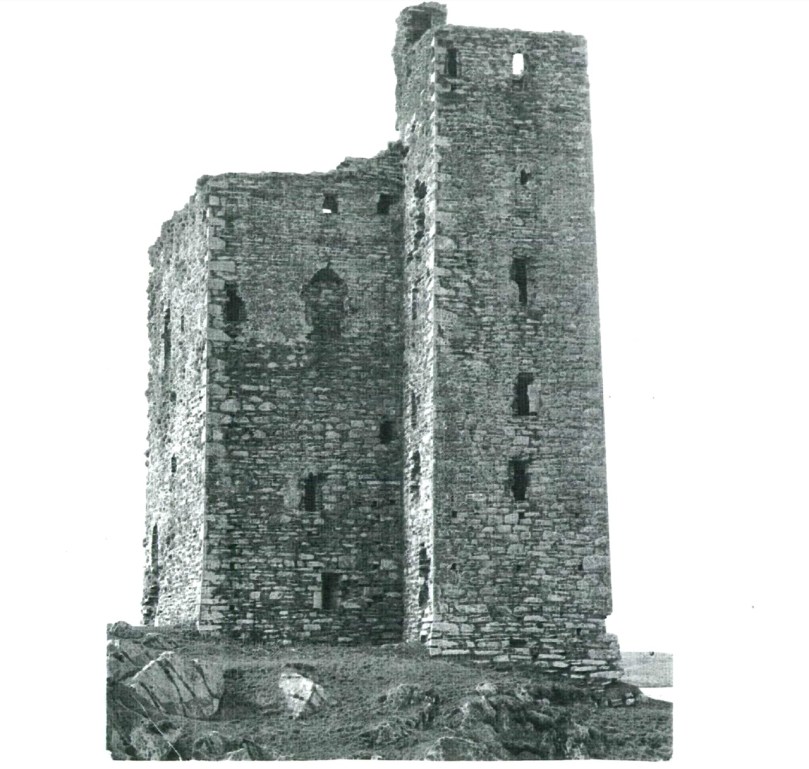
What Kilcoe Castle looked like before reconstruction

This is a private home and I have never been inside it. But if you are curious you can see lots of interior photographs here: https://jeremyirons.net/category/kilcoe-castle/. My objective in this post has been to emphasise the importance of the restoration of this magnificent tower house so that it will be a highlight of West Cork heritage for generations to come, as well as to acknowledge the solid research that went into the reconstruction program, resulting in a spectacular structure that is a superb and historically-accurate addition to our West Cork landscape. Thank you, Jeremy Irons and your team, from all of us in West Cork.


The Stone Circles of West Cork: Multiple Stone Circles

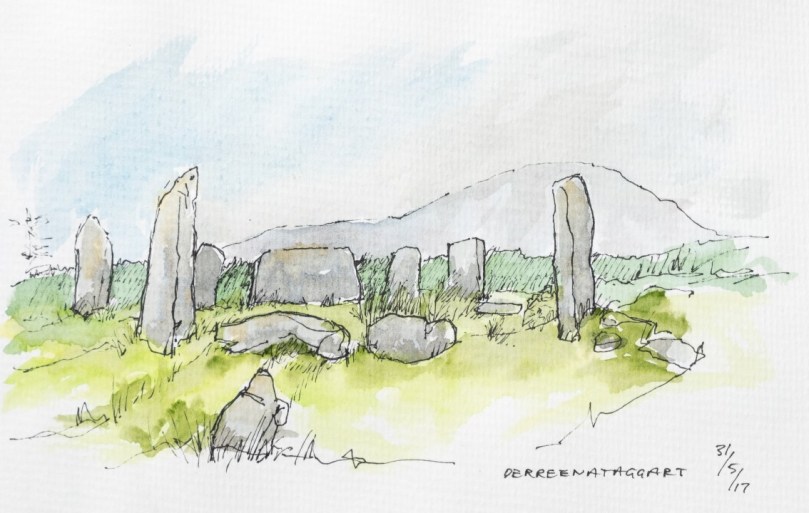
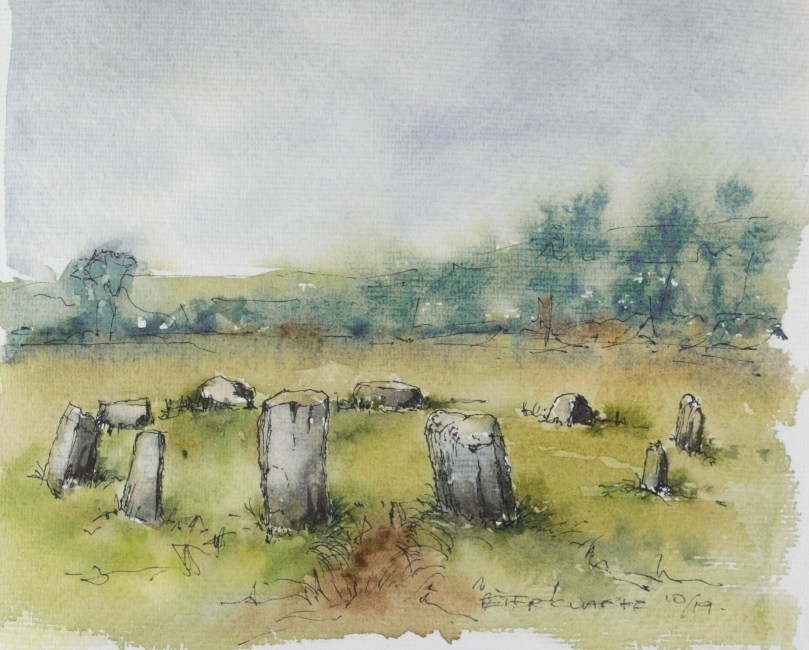
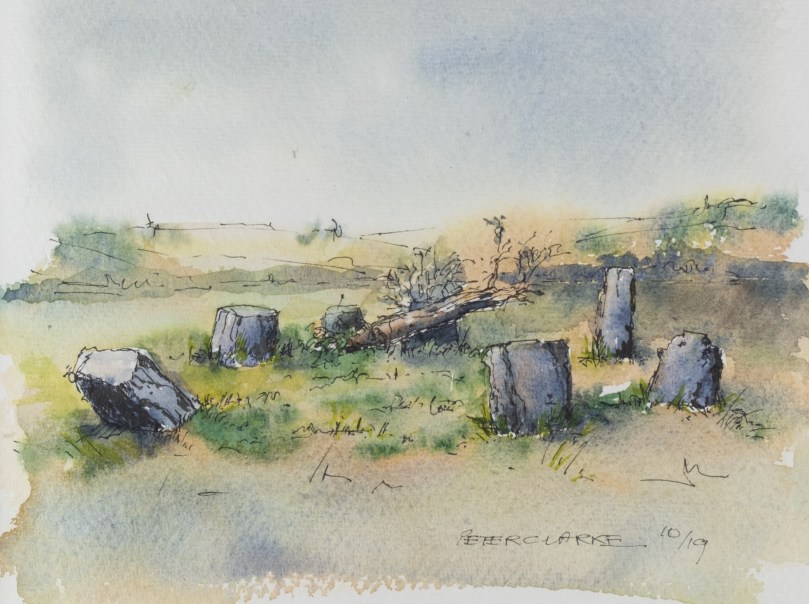
West Cork is home to a great concentration of prehistoric stone circles. While all of them share certain characteristics, there is a clear division between those containing only five stones and the multiples stone circles that contain seven or more, such as the Derreenataggart stone circle on the Beara, sketched by Peter Clarke, above. This post is about the multiple stone circles – I am leaving the five stone circles until next time. If you haven’t yet read The Stone Circles of West Cork: An Introduction, you might like to do that now before reading further.

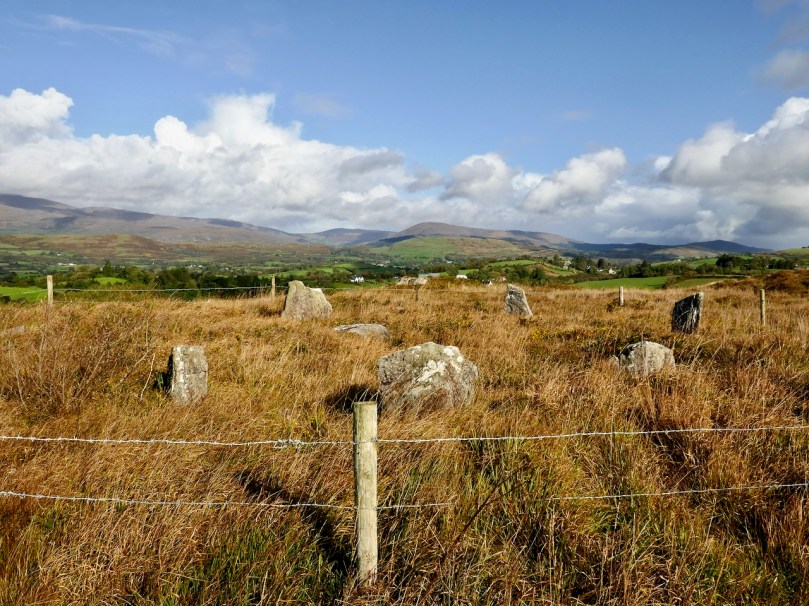
Although we love getting out in the field and visiting ancient monuments, such as this stone circle at Maughnaclea, we have to confess that the sun doesn’t always shine

Although this post covers some of the same ground as the Introduction, my aim here is to concentrate on the larger circles and show you what they actually look like on the ground*. An online search for ‘West Cork Stone Circles’ will bring you to many pages of information about Drombeg but precious little else. Drombeg is a marvellous site and its excavation yielded much-needed information about stone circles, but it’s only one site – the one with the signposts and car park.

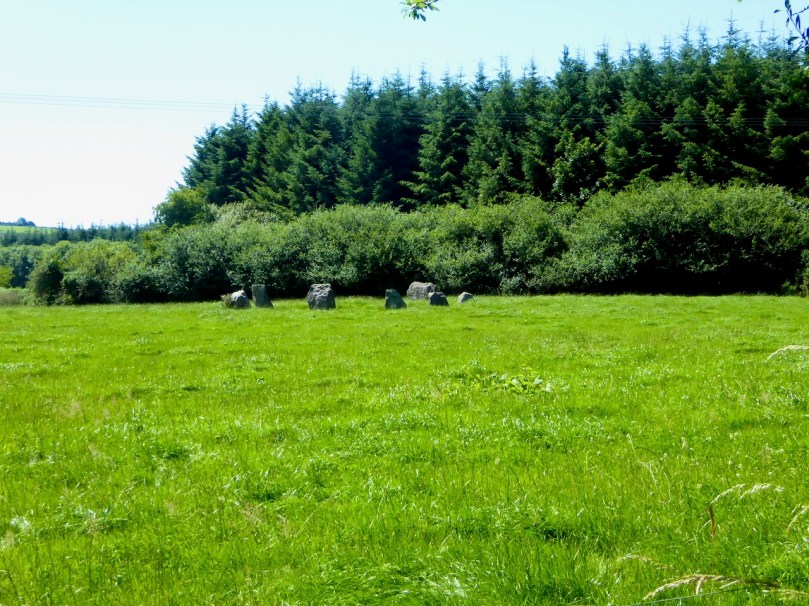
How about this one, for example, at Cappanaboule – it’s a bit of a hike and there’s no car park – but what a place!

Multiple stone circles in West Cork all fall under the heading of recumbent or axial circles, in which two portal stones (usually the tallest in the circle) stand opposite a recumbent and the line that passes through the portals and over the recumbent is considered to be the axis of the circles. However, within this predominant design, there are variations in how the builders decided to construct their circles.

A closer look at the Cappanaboule stone circle: ten of the original thirteen stones are still there and there’s a boulder burial in the middle

The most noticeable variation, of course, is the size of the circle and the number of stones it contains, from seven to an estimated nineteen. We don’t know why the builders made these choices, although as with most construction, size can be equated with wealth: building a stone circle was an arduous undertaking necessitating the ability to commandeer a significant labour force. Perhaps also a larger circle with more stones permitted finer gradations of alignments, if this was the purpose of the circle, or more expansive ceremonials within the boundary of the circle.

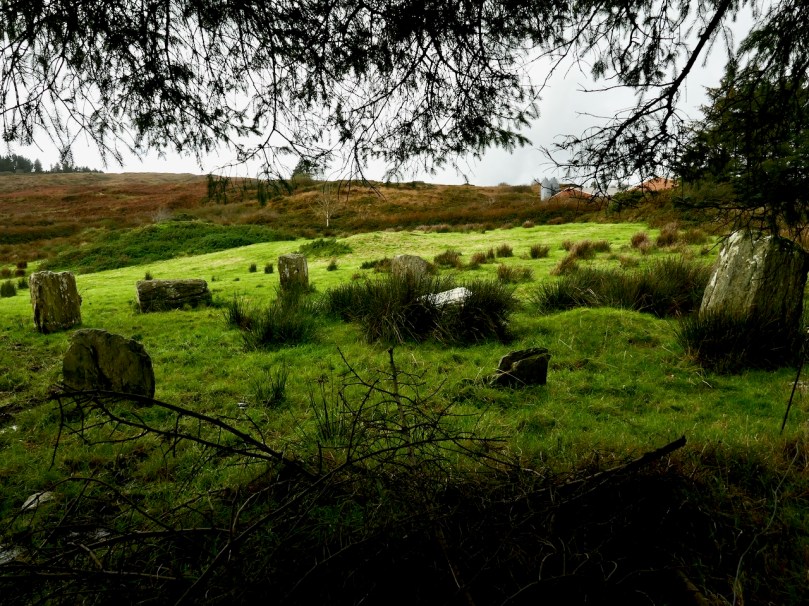
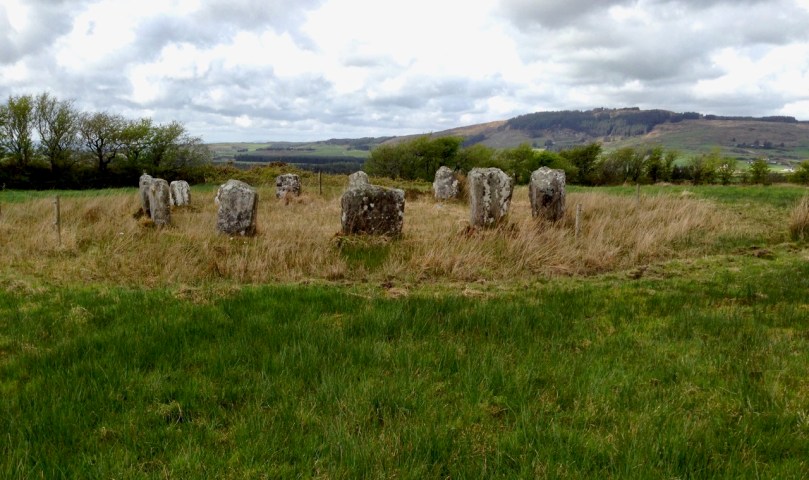
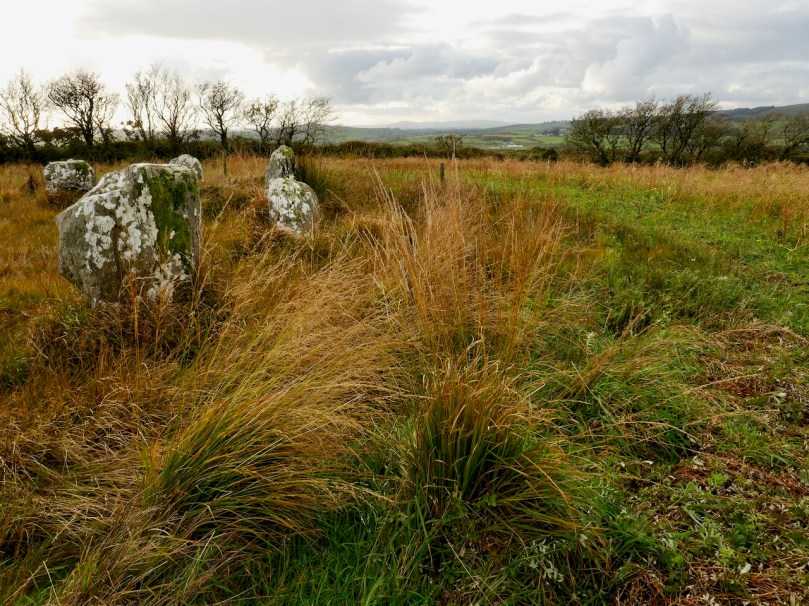
This is Gorteanish stone circle on the Sheep’s Head, only discovered in the 1990s when the Sheep’s Head Way trail was being cut. It’s hard to see what’s here because it’s so overgrown but it probably included 11 stones, four of which are still standing and two possible boulder burials, one inside and one outside the circle

The portals are normally the tallest stones in the circle but occasionally they are also set radially, or edge-on, to give the impression of a natural entrance.

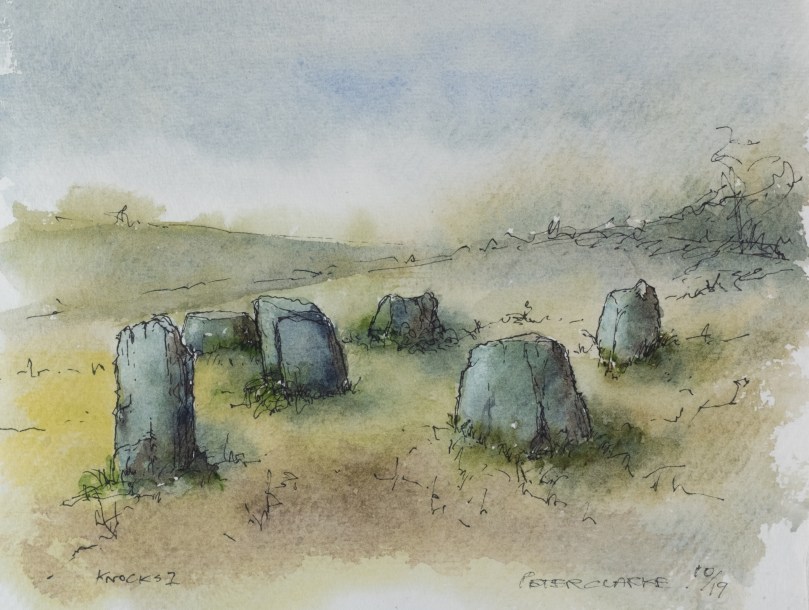
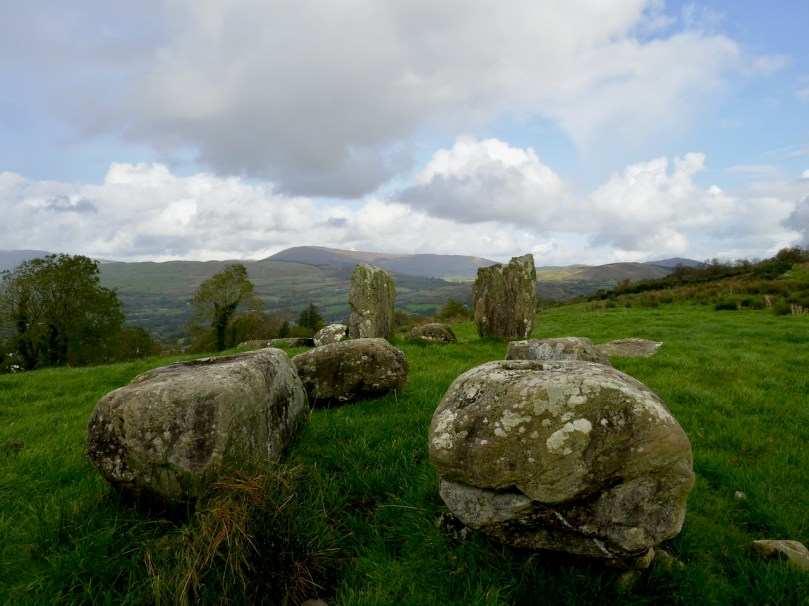
This is one of the two stone circles in the townland of Knocks. It illustrates well the portal stones being radially set and being the tallest stones in the circle. In my photograph you are looking across the recumbent to the portals and in Peter’s sketch you are doing the opposite

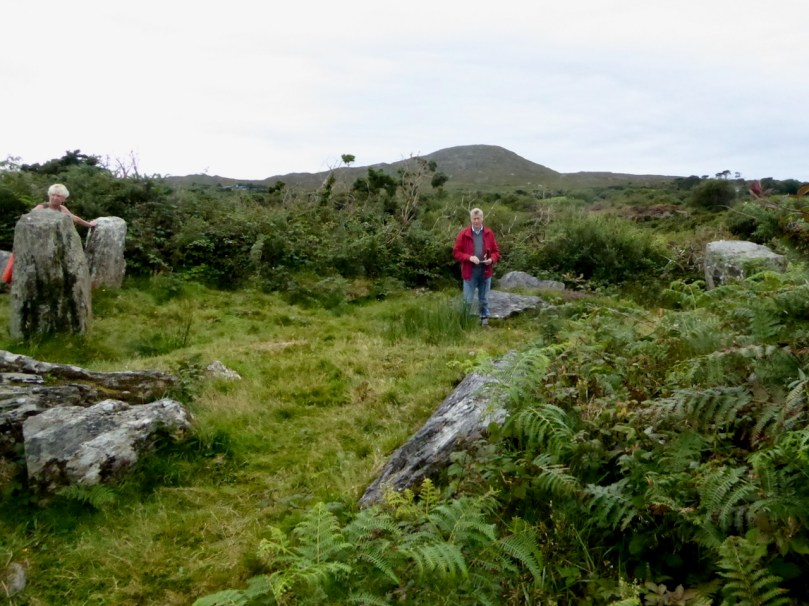
In only three cases an extra pair of stones helps to emphasise the entry point by creating a short passage. One example of this is Carrigagrenane, which is also one of the largest circles at nineteen stones.

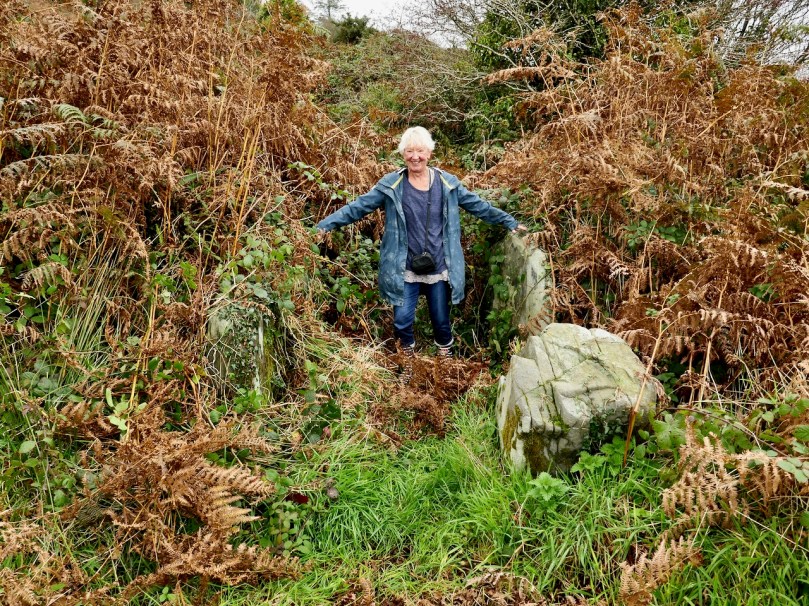
Carrigagrenane stone circle has double portals, creating a funnel or passage into the circle. This site is very overgrown and hard to locate so a lot of bracken-bashing was necessary to get this shot. Amanda is standing between the two outer portals

Conversely, the recumbent or axial stone is normally the lowest stone in the circle and the broadest (since it is set with its long axis parallel to the ground) but even here variation occurs. The axial stone at Ardgroom Outward, for example, is a pillar stone. Indeed, it can sometimes be difficult to decide where the axis line of the circle runs, if stones have fallen or are missing.

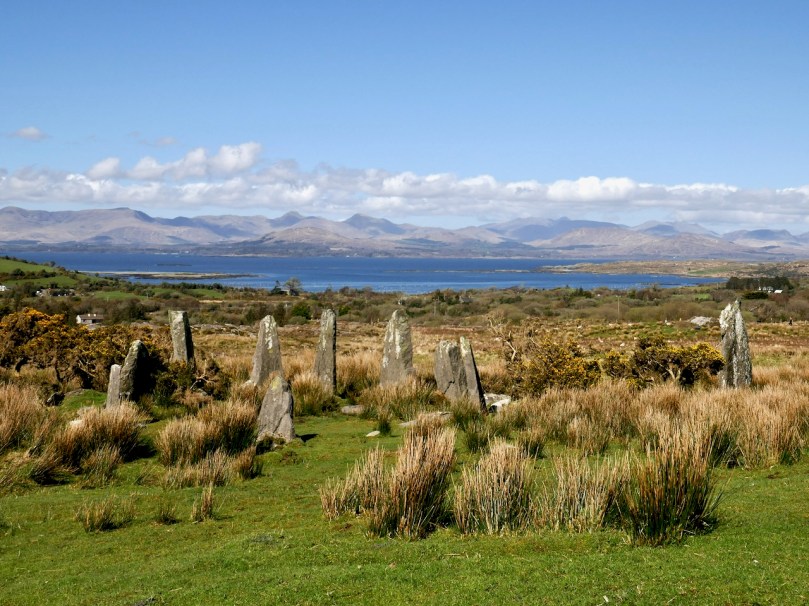
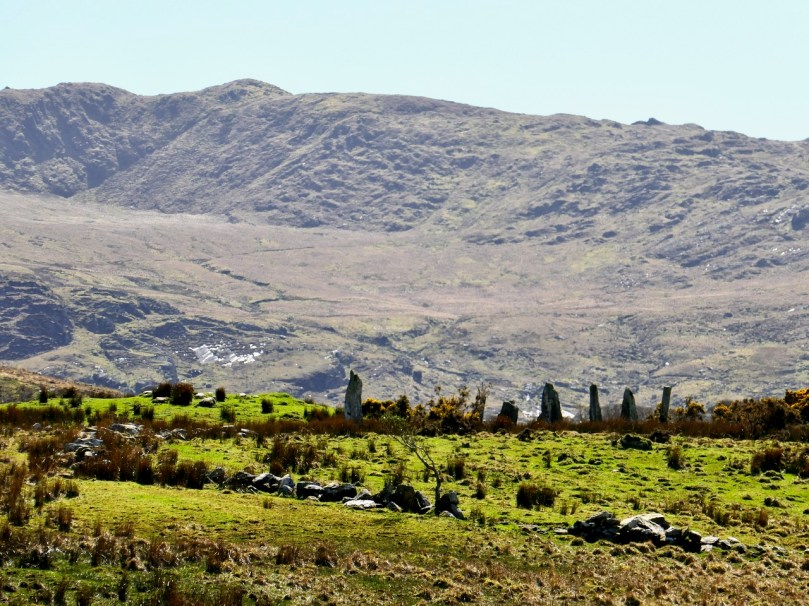
Ardgroom Outward stone circle, on the Beara is spectacularly sited. The axial stone, along with all the others in the circle, is a pillar stone rather than a recumbent. Note also the large monolith outside the circle to the right. The natural view-lines are to the north

Monoliths (single standing stones or blocks set on the ground) are present at some sites, either inside or outside the circle (as at Ardgroom Outward, above). Where they are inside they are placed off-centre. Where they are outside, they can be close to the circle or some way off but visible from it. These are usually called outliers.

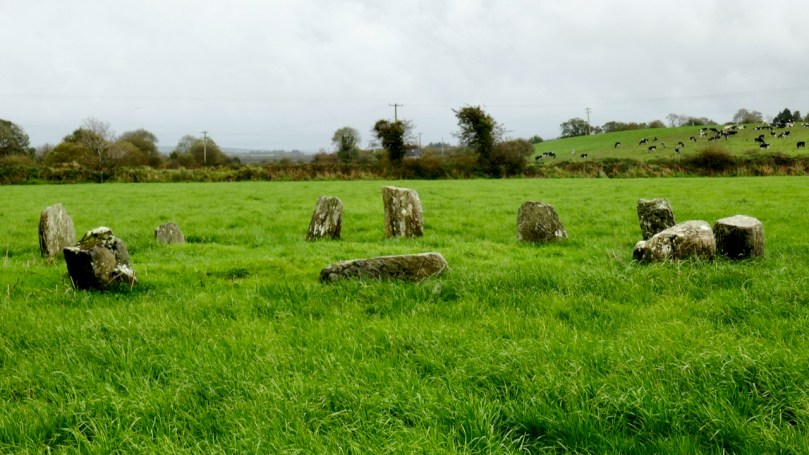
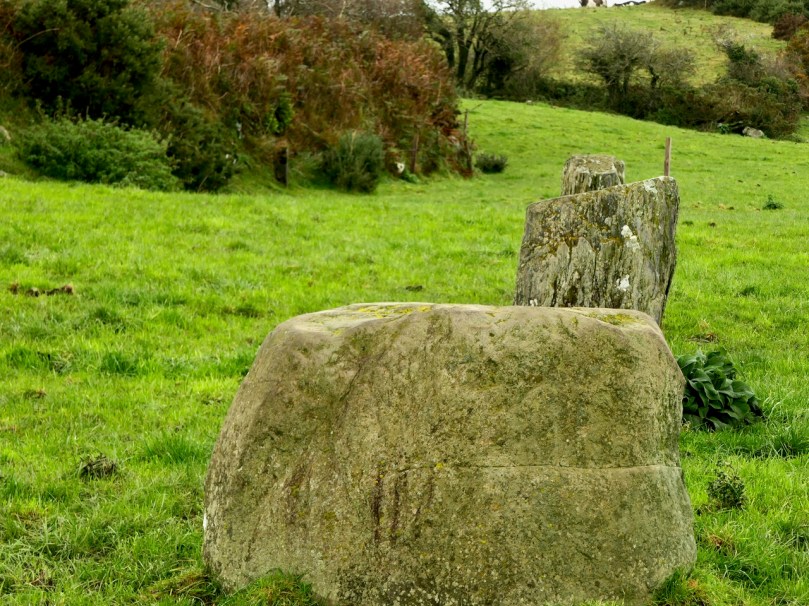
This is the second stone circle in the townland of Knocks, the more southerly of the two. My photograph illustrates the line of sight over the recumbent, across a slightly off-centre monolith, to a radially set portal. Peter’s sketch illustrates the whole circle

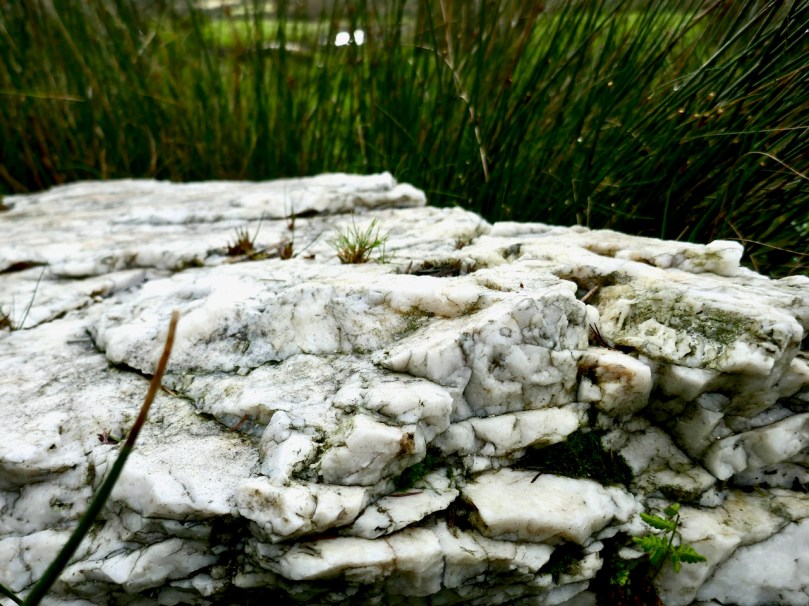
Quartz is a stone of choice for some of these monoliths but it is interesting that quartz is never in use as a circle orthostat. 

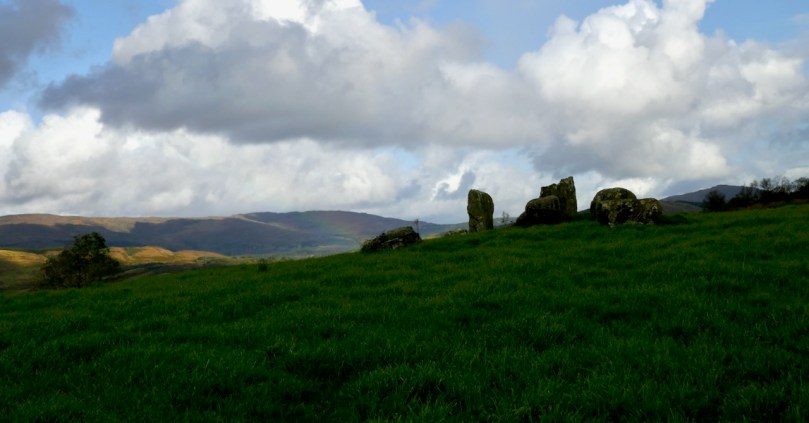
The stone circle at Maulatanvally includes a large quartz conglomerate block within the circle. I was struck by how it was gleaming on a dull day

Standing stone pairs can also function as outliers to a multiple stone circle. At Dunbeacon this outlier pair is almost half a kilometre from the circle across the valley, but each is clearly visible from the other. Originally a third standing stone also stood within 50 metres of the standing stone pair, but it has now disappeared.

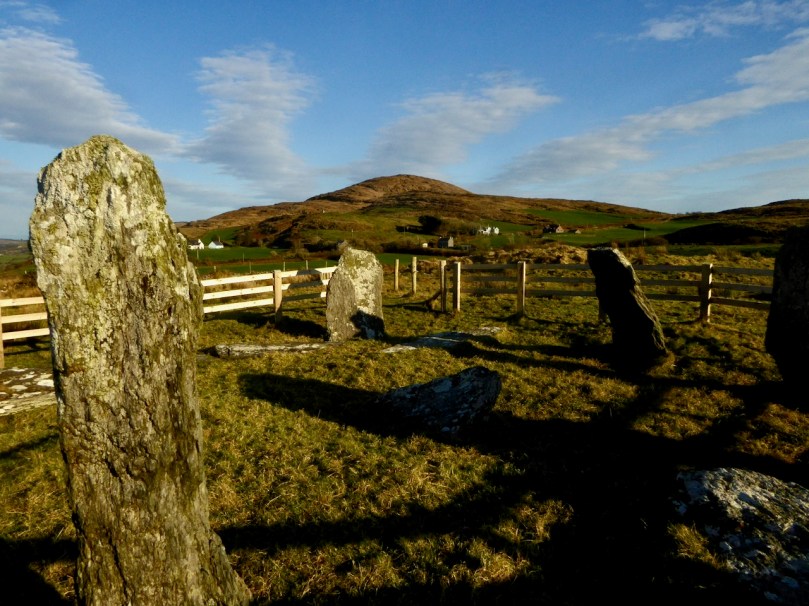
Dunbeacon stone circle, recently corralled inside a wooden fence. The natural view-line from this circle is to Mount Corrin to the east, rather than the south or west. The standing stone pair in Coolcoulaghta are located in front of the furthest house to the left in the photograph.

Another association is with boulder burials, sometimes found outside the circle, as in Bohonagh (see An Introduction) where the boulder burial capstone is quartz and contains cupmarks. At Ballyvacky (below) a boulder burial stands about 50 metres from the circle and a standing stone once stood beside it.

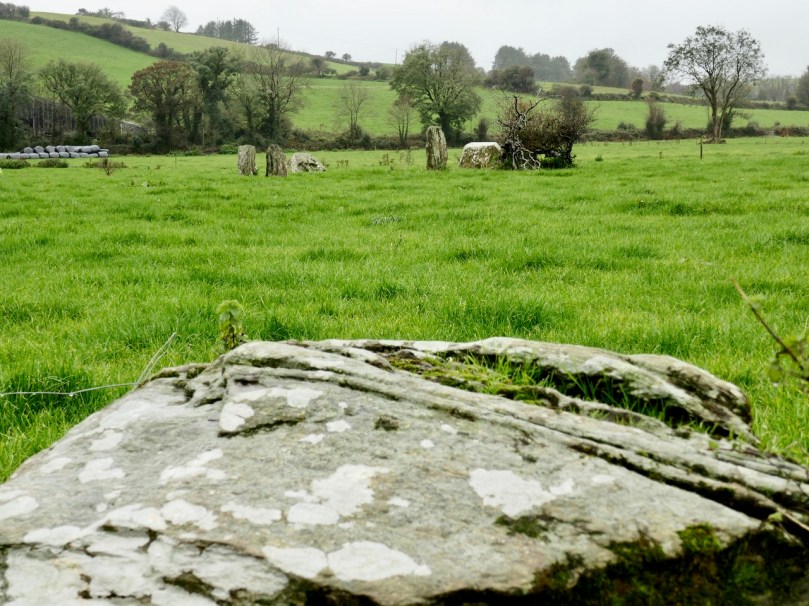
My photograph is taken from the Ballyvacky boulder burial, looking across to the stone circle. Peter’s sketch shows what is still standing – seven of the original nine stones. You can see that the remaining portal is radially set and that the recumbent is the largest stone in the circle

Boulder burials, as we have seen, are also found inside the circle: one of the most spectacular examples of this is at Breeny More (below) where a group of four boulder burial are set in a square within a large circle from which most of the stones are missing.

Finally, occasional stone circles will be surrounded by a fosse or shallow ditch. The most striking example is at Reenascreena, below.

Visiting stone circles, I am struck by features which appear to be similar at all or most of the sites. Many are situated on elevated sites with expansive views to the south and west. While this has been well documented by archaeologists, it’s one thing to read about it and yet another to visit several circles on one day and find yourself expecting a certain set of circumstances as you tune in to patterns in the sites themselves. What the orientation descriptions don’t mention, for example, is that the choice of location often features rising ground behind the circles which obscures the horizon to the north.

The rising ground behind Dunbeacon stone circle cuts off the view of Dunmanus Bay and concentrates the view-lines towards the east and south-east

Occasionally the higher ground obscuring the horizon is not to the north at all, but to the south or south-west – confounding our expectations that the obvious view-lines will be to the south and west. Cappanaboule is strikingly situated thus, as is Ardgroom Outward.

And then we have examples in fairly flat country with no really obvious view-lines. This can be complicated by surrounding forestry, as at Knockaneirk (above) where, if there was an obvious orientation over the recumbent it has long been hidden by tall tree.

Ardgroom Outward stone circle is dramatically silhouetted against the mountains of the Beara peninsula as you walk up the track towards it

Next time I will write about the five stone circles – there are as many of them as there are the multiple stone circles and while they share most of the same features they have their own special character.

*Most of these photographs (like the one of Breeny More, above) were taken last year or in previous year, and many of them in the company of Amanda (Holy Wells of Cork and Kerry) and Peter (Hikelines) Clarke. I am indebted to Peter for the sketches. Not being able to get out into the field to visit and photograph more circles has been frustrated this year by Covid19 travel restrictions, so I have decided to go ahead and use what I have, rather than wait to add to my collection. 

A Hobby Horse in Ireland?

Surviving tradition in Ireland – a May garland seen on a threshold in Schull, West Cork. on May Day this year

We are in the month of May. How significant is that here in Ireland? Well, if it’s any indication, it’s a fact that Irish folklorist Kevin Danaher (1913 – 2002) gives far more space in his writings to May and traditional May customs than to any other single subject or season.

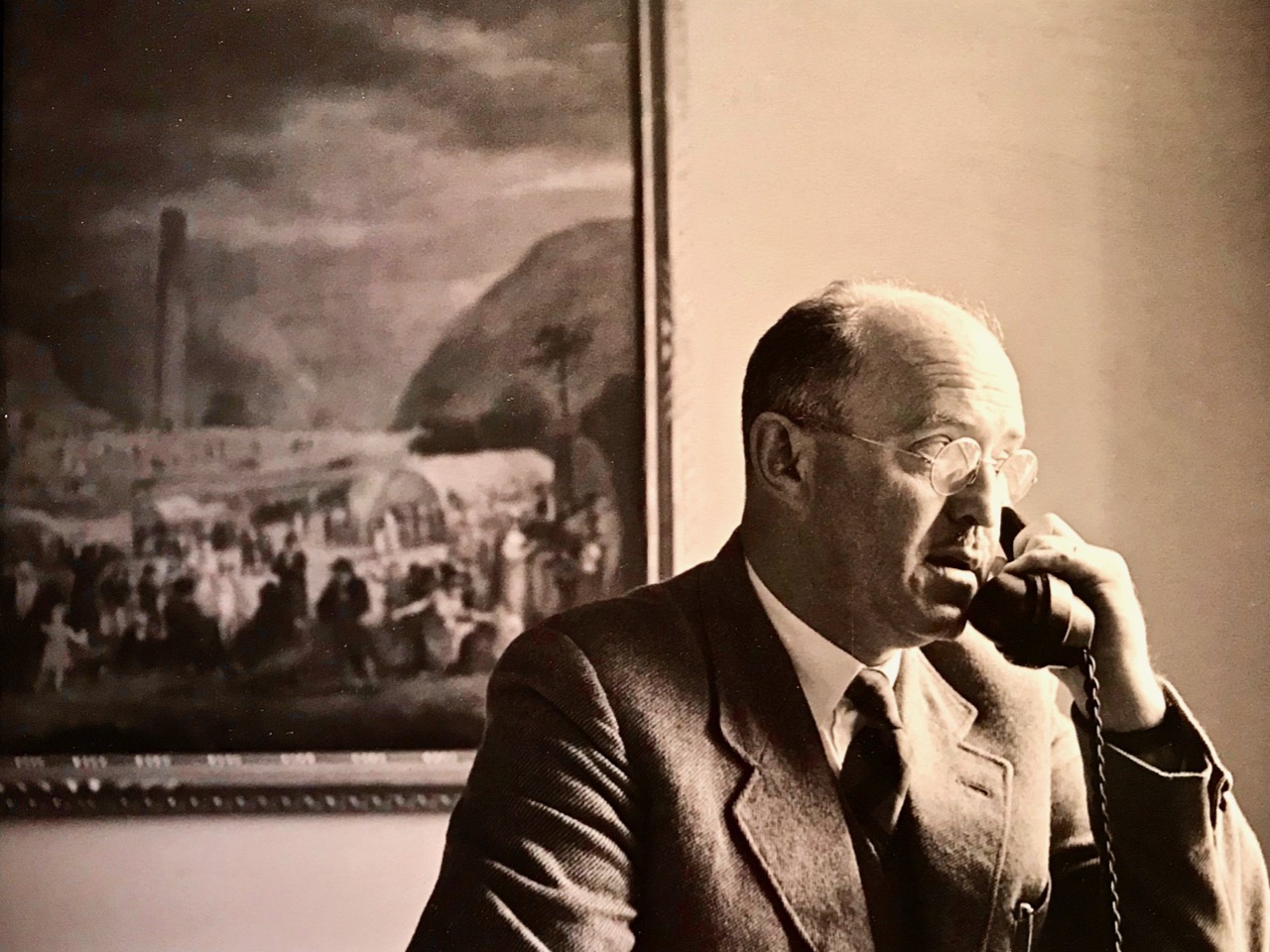
Kevin Danaher of Athea, Co Limerick, at the Irish folklore Commission in 1954. the photographer was Dorothea Lange, who features in this post

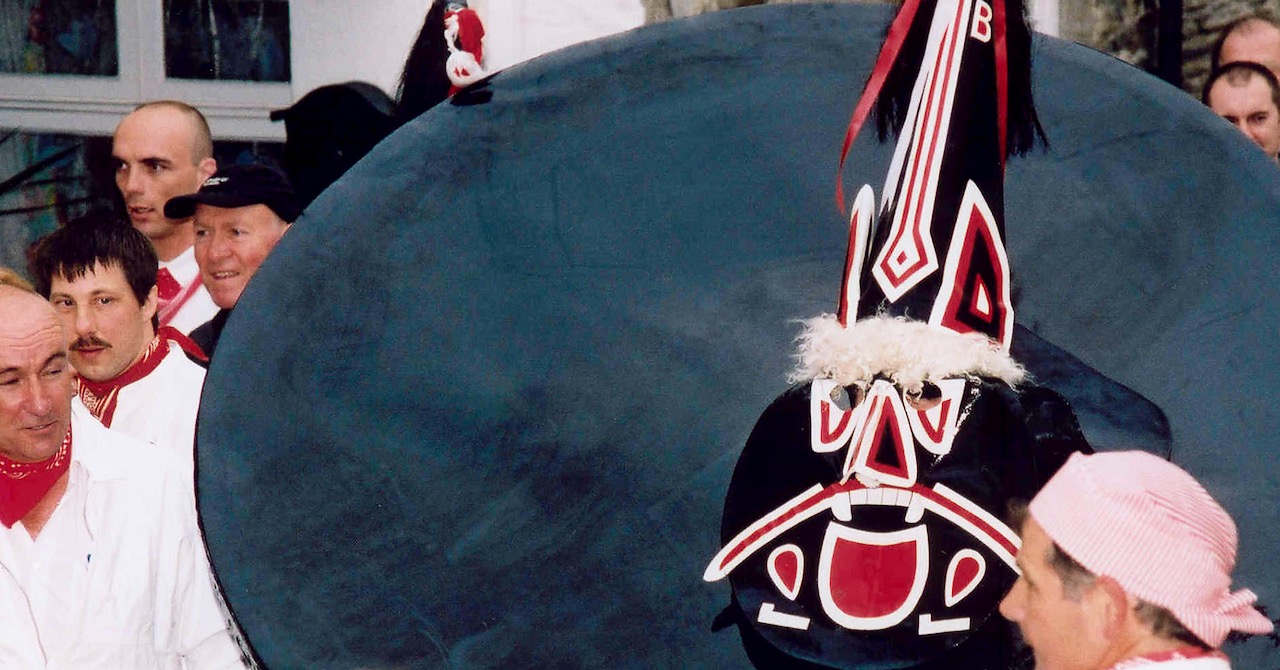
In the west of England, which has always had close links with Ireland in terms of language, culture and industry – the month of May has long been celebrated with a strong focus on the ‘Hobby Horse’, a phenomenon which bridges the worlds of superstition, spectacle and folklore. In two places – Padstow in Cornwall and Minehead in Somerset – Hobby Horse (or, colloquially ‘Obby Oss’) festivals are huge events – usually. In 2020, sadly, both had to be cancelled due to Covid19 restrictions: probably the first time in hundreds of years that they have not taken place. The Minehead Oss has a recorded history that goes back to at least 1465, while in Padstow they will tell you that the Obby Oss has been revered forever on the First of May with never a break.

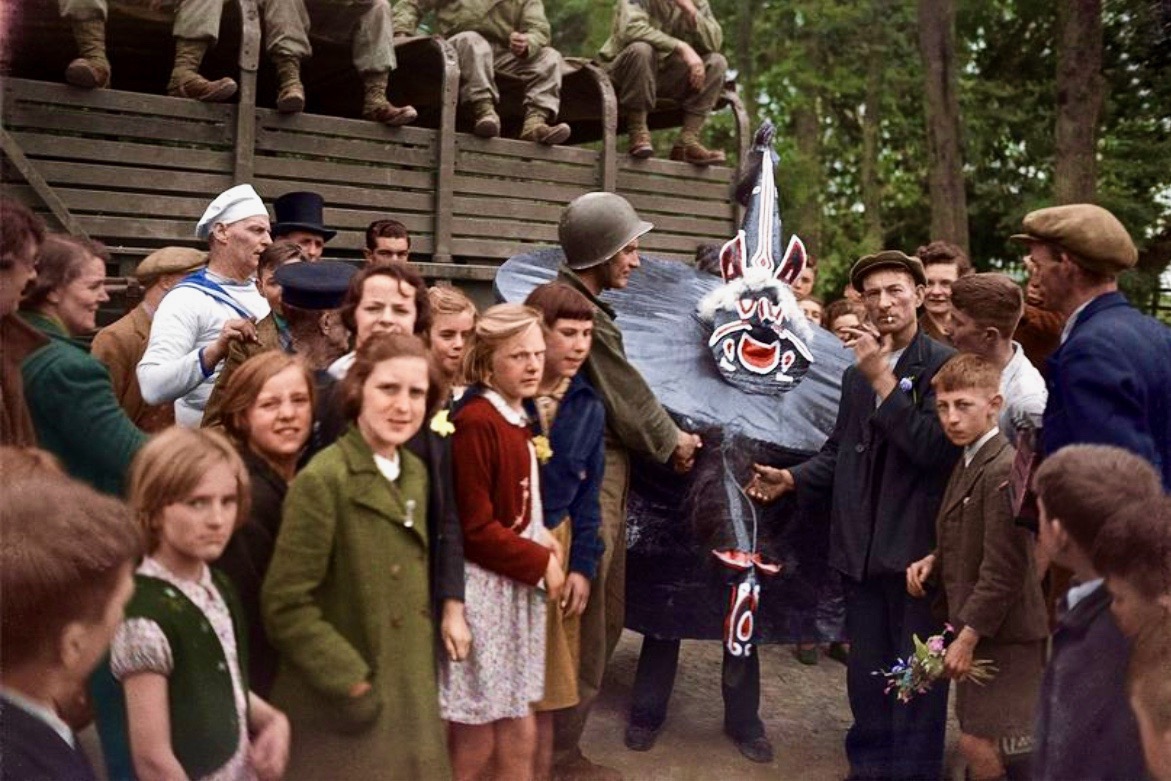
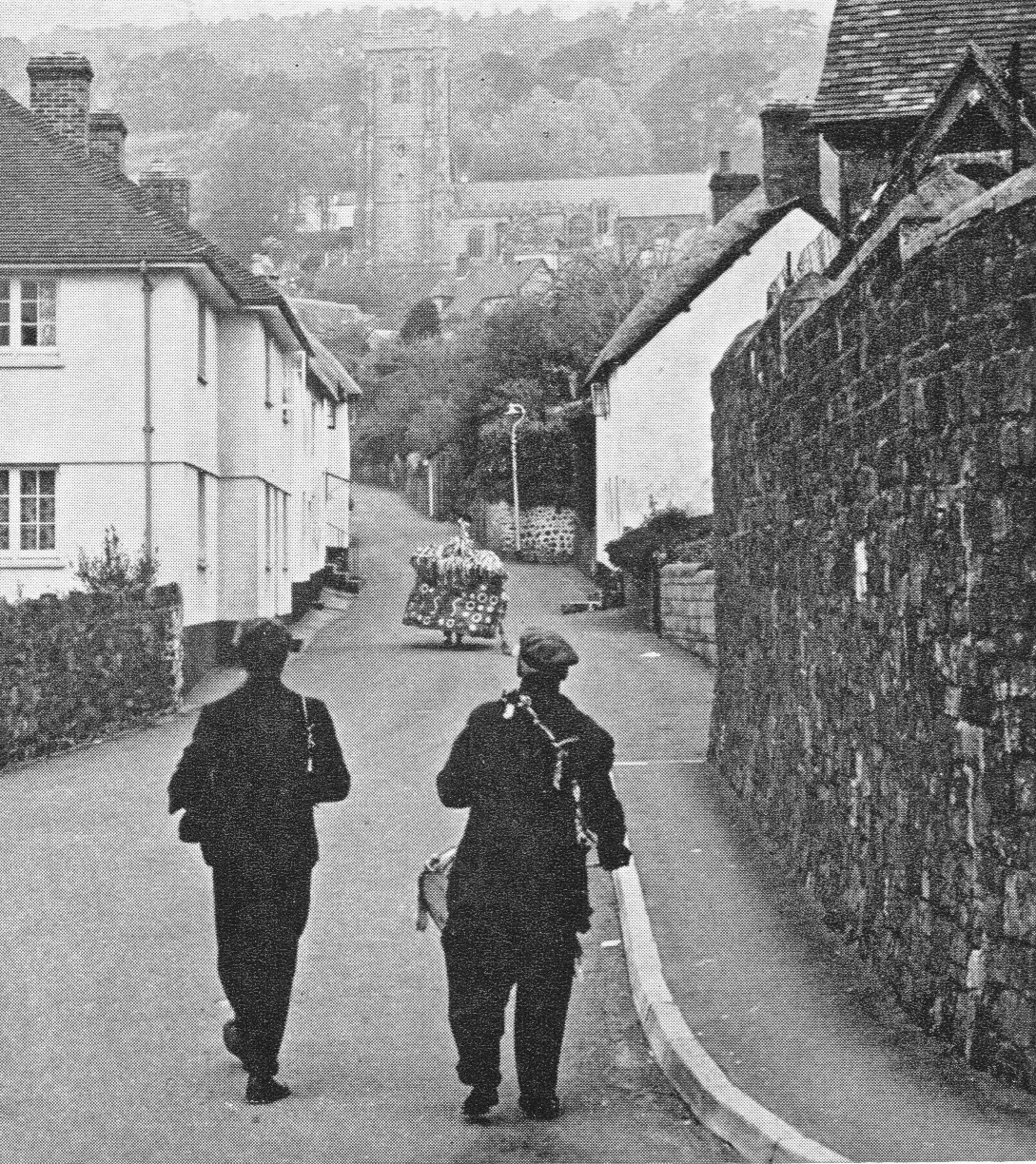
The Padstow Oss has survived through peacetime and wartime. This rare photograph (above) – attributed to Joshua Barret – was taken in 1944, while the early 20th century photograph (below) of the Minehead Oss is my all time favourite of a folk custom: the Oss always has and always will perambulate the town every year, even if no-one is interested in watching it!

As we find this very strong May tradition thriving (usually) in the west of England, we might expect to see an equivalent in Ireland, but you can’t immediately think of a Padstow or Minehead equivalent. Oh, yes – the Hobby Horse is purely Irish, in that there was once a now extinct breed – called a Hobby – which is said to have been the genetic source of all race horses since pre-Roman times!

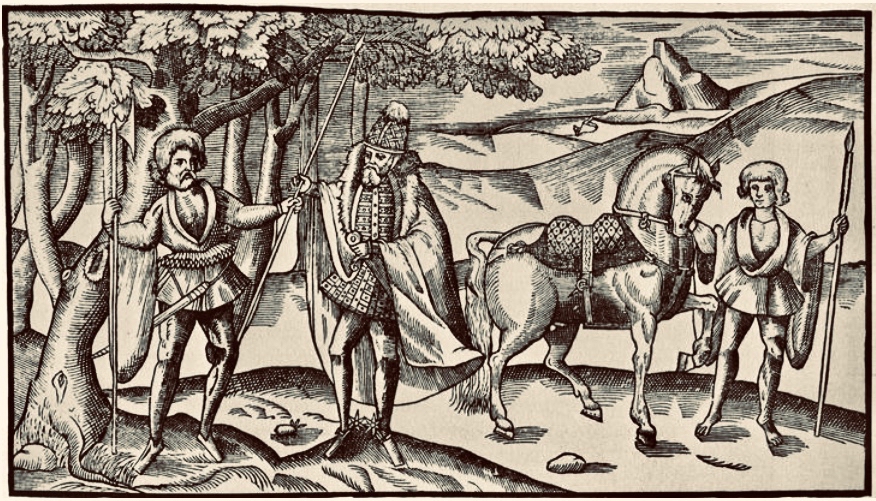
. . . It is possible to trace the root of the Irish Hobby back to the northern Iberian Peninsula where this peculiar population of horse seemed to first be recognised about 700 BC, identified as the Celtic Horse. It was a small horse, gaited and exceedingly fast. It was the fastest horse in the known world back then, by 400 BC the Greeks called them the Thieldones and immortalized them on the frieze of the Parthenon, and this breed was already the Roman’s preferred steeds for racing. Pliny even writes about them in 77 AD, and we know when the Romans invaded Britain they brought those horses with them. But the Romans found that when they arrived they were met by the natives who had Celtic Horses already–horses which had been brought to Britain centuries earlier in trade from Spain by the Phoenicians for the metal mined there . . .

(Source – Sport Horse Breeder.com)

I won’t dwell on this idea that the Irish Hobby Horse was the ancestor of all modern pure bred sports horses – and was probably responsible for the innate Irish love of everything to do with horses and sport – as I am getting completely out of my depth here, and it’s all a bit off-topic anyway! Although, who knows how and where that name might have migrated over the centuries?

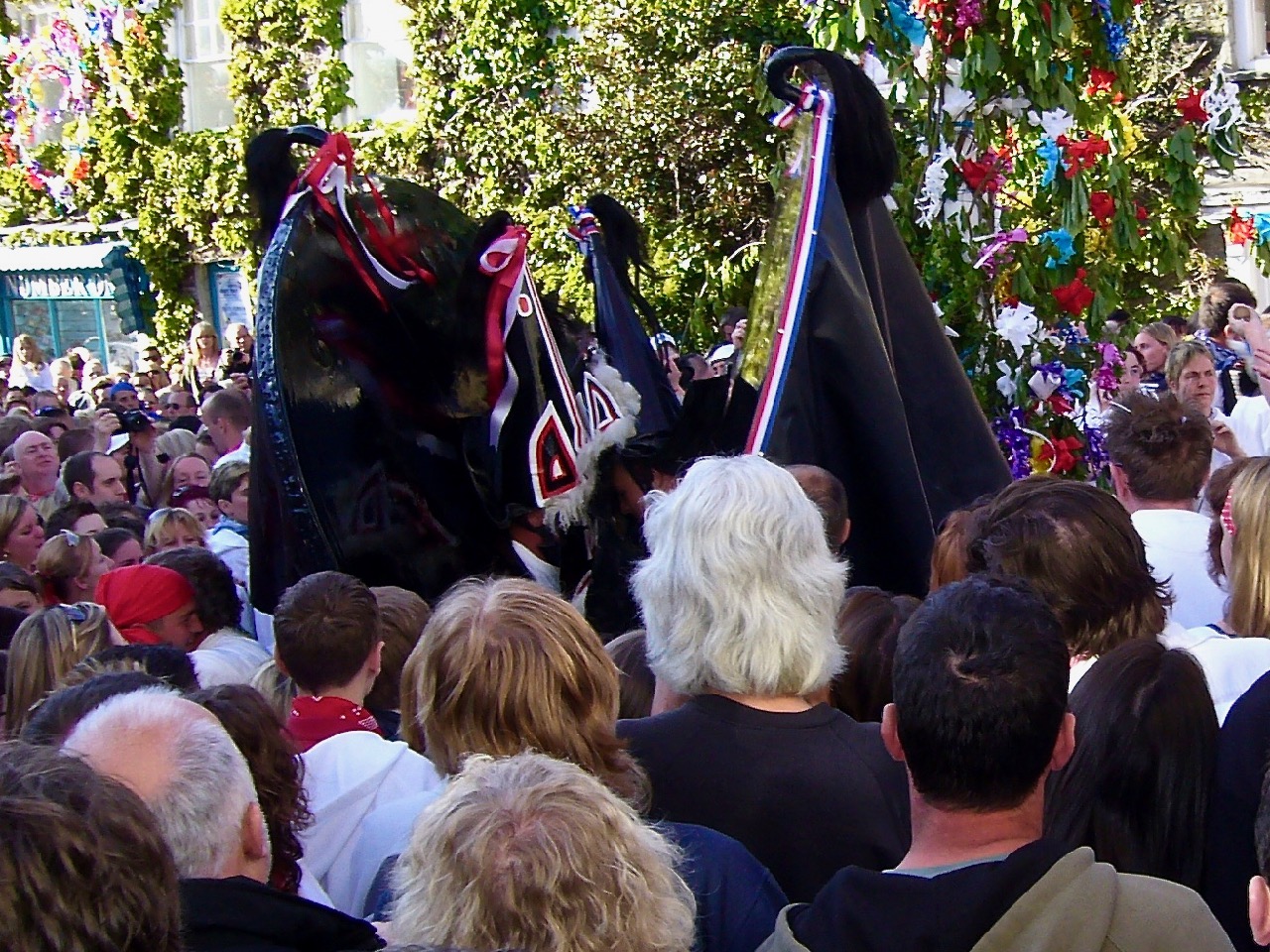
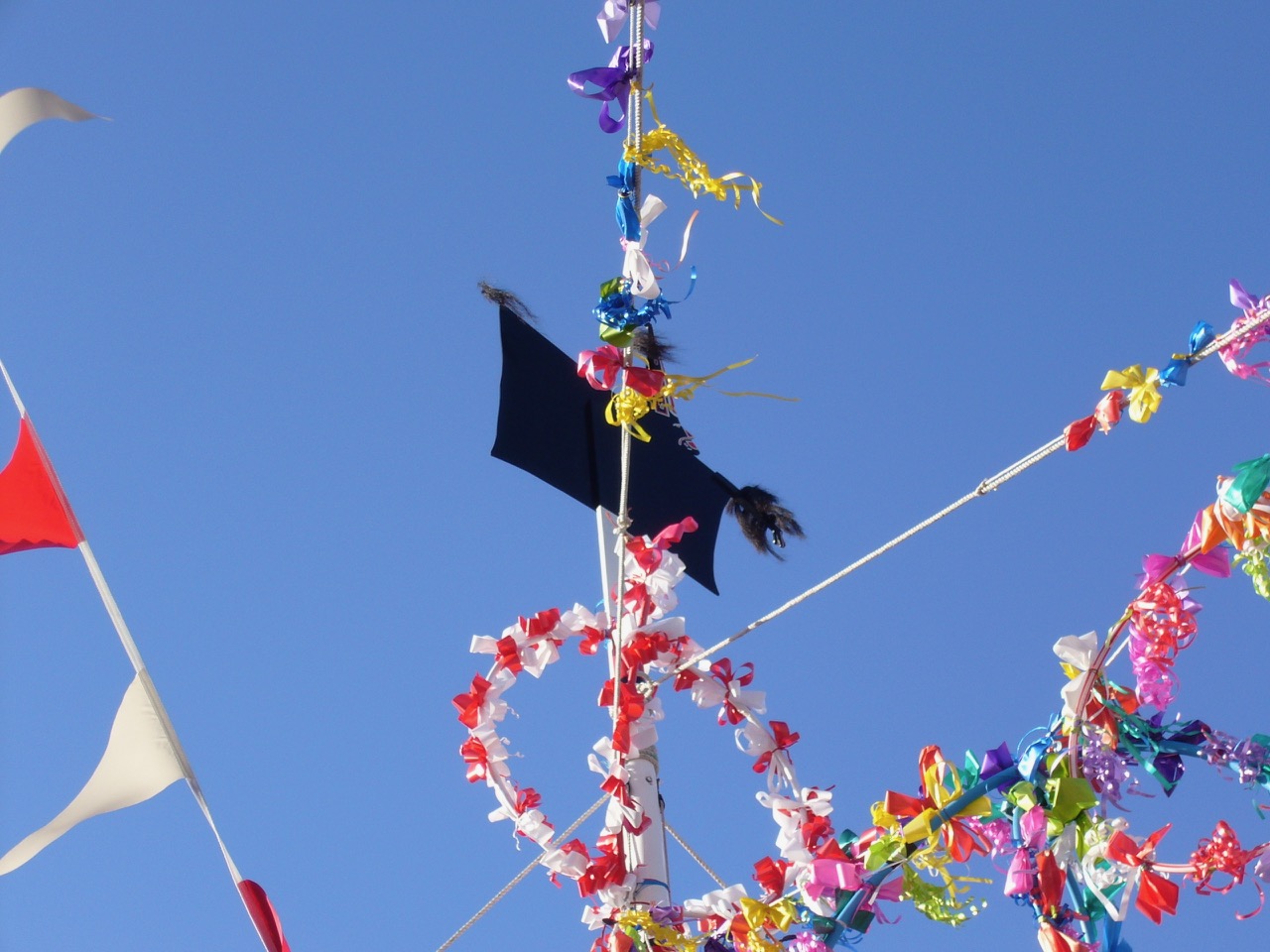
The culmination of the Padstow ceremony on May Day is the ‘meeting’ of the Red and Blue Oss at the huge maypole in the Town Square on the evening of the day (above). They have to close the town to all traffic because of the enormous crowds who attend, and you can see why the ‘social distancing’ rules could never have been applied to the event. Let’s hope that in future years ‘normality’ will have returned sufficiently to our lives to ensure that these ancient customs continue. In my lifetime I have been to Padstow on May Day at least thirty times, and also to Minehead on many occasions: I have good memories of them both.

In order to find a precedent in Ireland for a traditional Oss, I have mined the enormous archive that Kevin Danaher left behind in the Irish Folklore Commission, and I am pleased to report a whisper of success! Danaher uses various sources to summarise an account of traditions taking place in Ireland on May Day:

From the diary of Joshua Wight, a Quaker, we learn that so late as the middle of the eighteenth century, propitiatory rustic processions took place in the south of Ireland. The observer records, that about noon in the month of May, 1752, there passed through the streets of Limerick many thousand peasants marshalled in companies, representing various branches of agriculture…


And Thomas Crofton Croker (1825) tells us of what he calls mummers:


‘They consist of a number of the girls and young men of the village or neighbourhood, usually selected for their good looks, or their proficiency, – the females in the dance, the youths in hurling and other athletic exercises. They march in procession… Two of them bear each a holly-bush, in which are hung several new hurling-balls. the bush is decorated with a profusion of long ribbons which adds greatly to the gay and joyous, yet strictly rural appearance of the whole. The procession is always preceded by music; sometimes of the bagpipes, but more commonly of a military fife, with the addition of a drum or tambourine. A clown is, of course, in attendance: he wears a frightful mask, and bears a long pole, with shreds of cloth nail to the end of it, like a mop, which ever and anon he dips in a pool of water, or puddle, and besprinkles such of a crowd as press upon his compassions, much to the delights of the younger spectators… The Mummers during the day parade parade the neighbouring villages, dancing and receiving money. The evening, as might be expected, terminates with drinking’.


Patrick Kennedy, in The Banks of the Boru, describes a similar procession:


‘After a reasonable pause we had the delight of seeing twelve young men come forth, accompanied by the same number of young women, the boys dressed much more showily than the girls… To heighten the beauty of the spectacle, out sprung the fool and his wife, the first with some head-dress of skin, a frightful mask, and a goat’s beard descending from it. Though we knew that the big bluff, good-natured countenance of Paudh himself was behind the vizard, we could scarcely refrain from taking flight, not being able any more than other children to look on an ugly mask without extreme terror. His wife (little Tome Blanche, the tailor) was in an orange-tawny gown, flaming handkerchief and mob-cap, and had a tanned, ugly female mask, fitting pretty close to her face. Paudh’s first salute to his friends was a yell, a charge in various directions, and a general thrashing of the crowd with his pea-furnished bladder suspended from a long stick. Mrs Clown had a broom, and used it to some purpose when she found her friends disposed to crowd her.’


There is also mentioned by Sir William Wilde, together with something like a hobby horse (Popular Irish Superstitions, 67):


‘From Monaghan we have a graphic account of a somewhat similar proceeding: there the girls dressed up a churn-dash a s a “May babby” and the men, a pitchfork, with a mask, horse’s tail, a turnip head, and ragged old clothes, as a “May boy” but these customs have, we believe, long since become quite obsolete.’

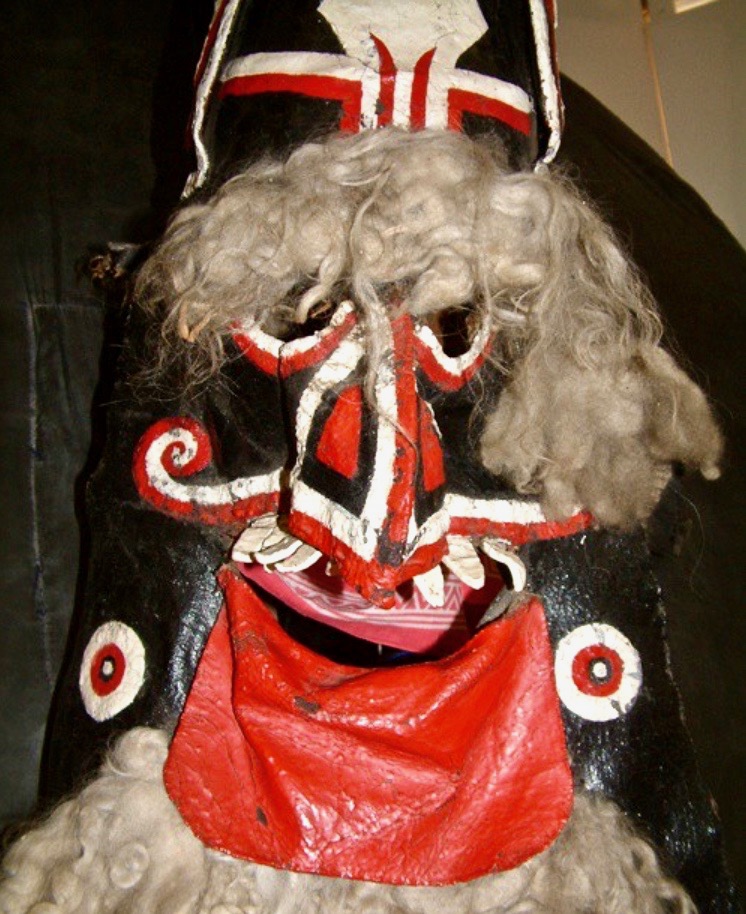
The mask worn by the Obby Oss at Padstow could have evoked the description by Patrick Kennedy, above: some head-dress of skin, a frightful mask, and a goat’s beard descending from it . . . This particular representation, once used in the Padstow processions, is now a museum piece. So here I present my argument that we can find descriptive evidence of traditional Hobby Horses in Ireland as part of the May festivities. If anyone finds other instances or has direct personal experience or stories passed down which involve Hobby Horses, or activities which sound like the examples described in Danaher’s reports, above, please let me know.