The Lusty Month of May

The month of May was come, when every lusty heart beginneth to blossom, and to bring forth fruit; for like as herbs and trees bring forth fruit and flourish in May, in likewise every lusty heart that is in any manner a lover, springeth and flourisheth in lusty deeds.  For it giveth unto all lovers courage, that lusty month of May.

–  Sir Thomas Malory, Le Morte d’Arthur 

One of our local roads is lined with Ragged Robin

Walking the boreens in May there is a sense of potency, urgency even, in the landscape. We’ve been asleep long enough, the flowers are saying – it’s high time we put in an appearance.

Another one has pignut on both sides. Pignut? Yes, there is such a flower – it’s widespread and the rounded roots which are said to taste like hazlenuts were a food source for pigs, and sometimes for humans too

After a long dry spring, everything is early this year in West Cork this year – and earlier than in the rest of Ireland too, thanks to our southerly location and mild climate. The big flowers are happening – the irises and the foxgloves in all their boldness and drama, as well as the tiny ones that are peeping out along the hedgebanks.

Glimpsed along the way: Yellow Iris is a bold native plant that likes damp places; St Patrick’s Cabbage grows extensively around the Cork and Kerry Peninsulas; this Spotted Orchid was one of several at the Heron Gallery Garden; Red Campion grows just across from my house

The Big Event in May for us was the launch of the Wildflower Trail, which I wrote about a couple of weeks ago. The launch was lovely – it was a great honour to have Zoë Devlin come and declare the trail open, and then lead us in a wildflower walk. The brochure is now in the Tourist Centres and already people are picking it up and wandering the boreens.

Zoë had participants spellbound – she just knows SO much!

For me it was a special opportunity to learn from Zoë when we walked the course before the launch. It was a great experience and I learned very quickly that for Zoë the wildflowers are just one aspect of an interdependent whole that includes butterflies, moths, bees, birds, and flora and fauna of all descriptions.

Clockwise from top left: Green Veined Butterfly; bee in foxglove; Painted Lady Butterfly; Red Admiral

I also learned how dedicated she is to recording all the flowers she sees for the National Biodiversity Centre Database. This is not a difficult thing to do, but it does take a little practice and a little time. I am resolved to up my own game in this regard and start sending in more records.
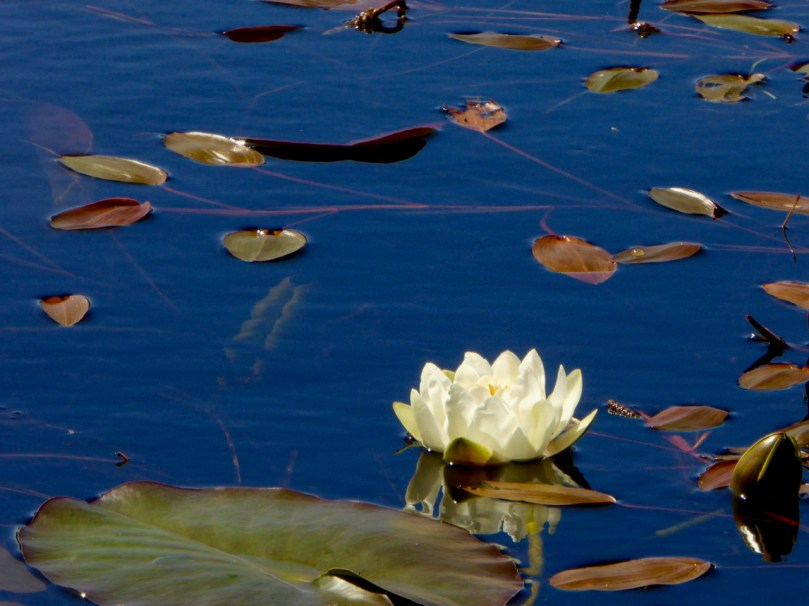
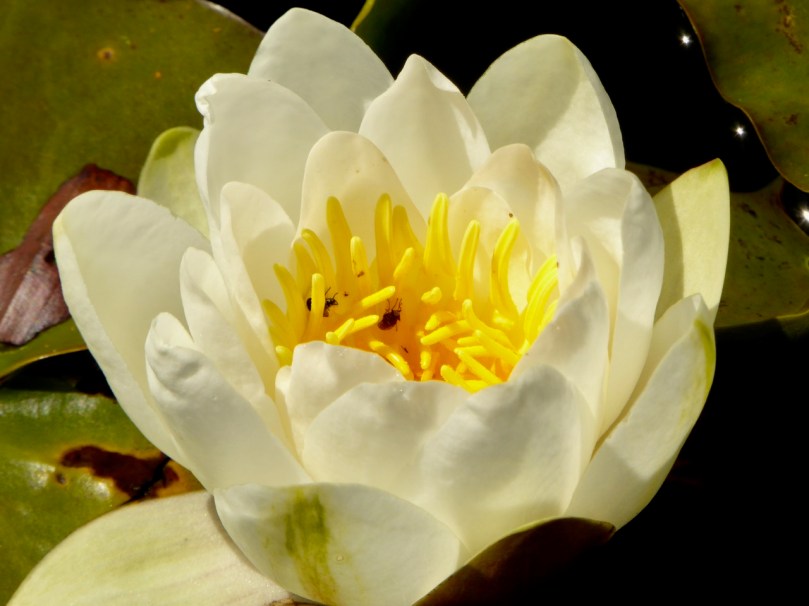
Our native – and gorgeous – White Water-lily

But mostly I just want to spread the joy – and help people to see the incredible beauty and diversity of wildflowers that we have in West Cork. Our boreens should be celebrated as National Treasures!
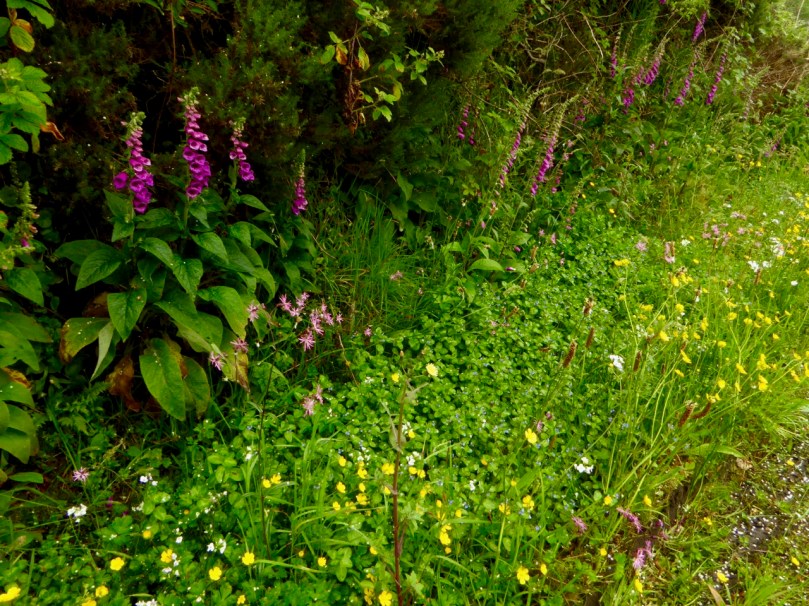
This boreen leads out of Ballydehob – it’s alive with an enormous variety of flowers.
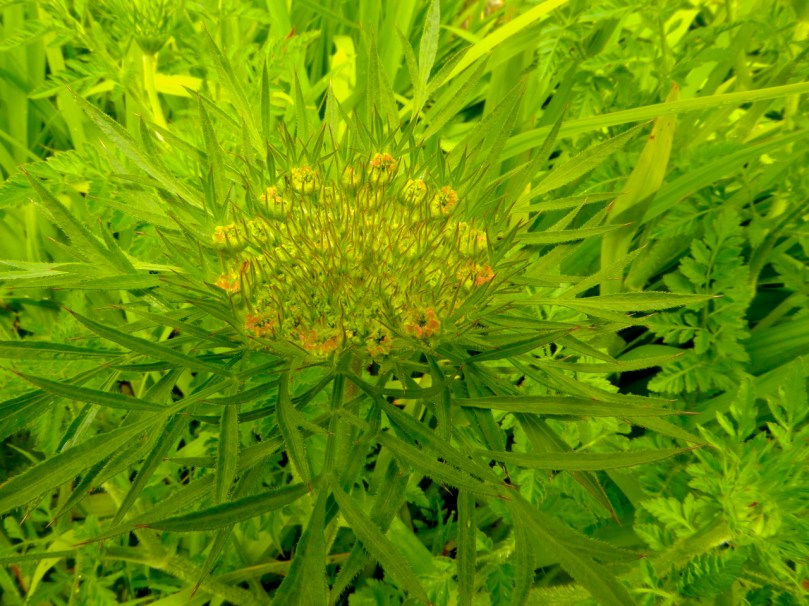
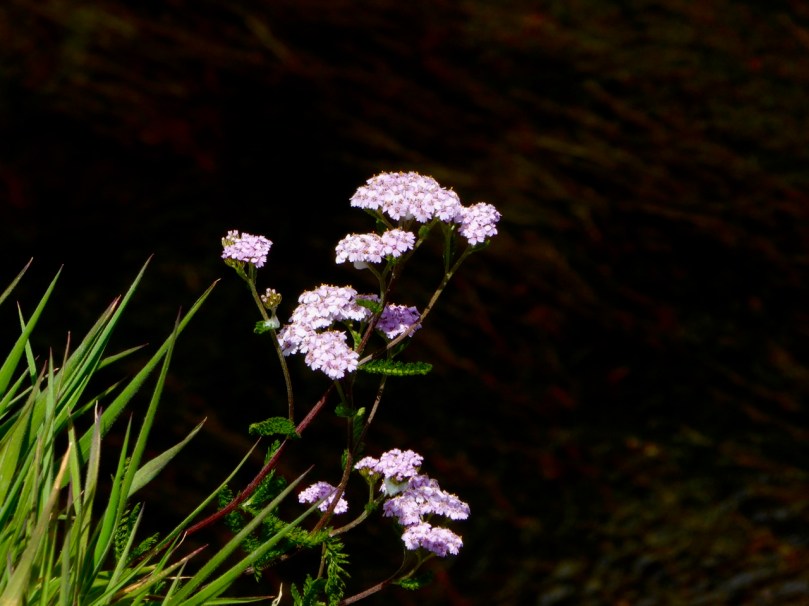
Above is Wild Carrot -as its name suggests, this is the wild version of our cultivated carrot. Very young wild carrots are edible, but you must take extreme care as the plant is very similar to Hemlock Water-dropwort (below) which is very poisonous. This one is growing along a stream in Skibbereen – also the location of the Yarrow in my lead image (top of post).

Irish Spurge, above, is an intense yellow green in April. In May it acquires this little yellow spaceship flower heads. You have to get in really close to see them.
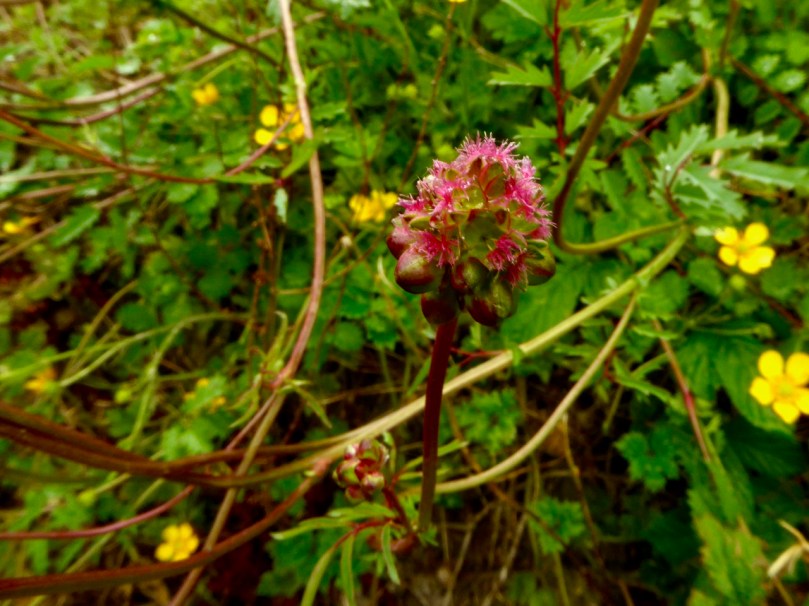
Salad Burnet (above) was grown in kitchen gardens from Medieval times as a salad vegetable and herb. The leaves, they say, taste like cucumber. I’ve tried them, and I have to say you’d need a vivid imagination to get a cucumber taste out of them.
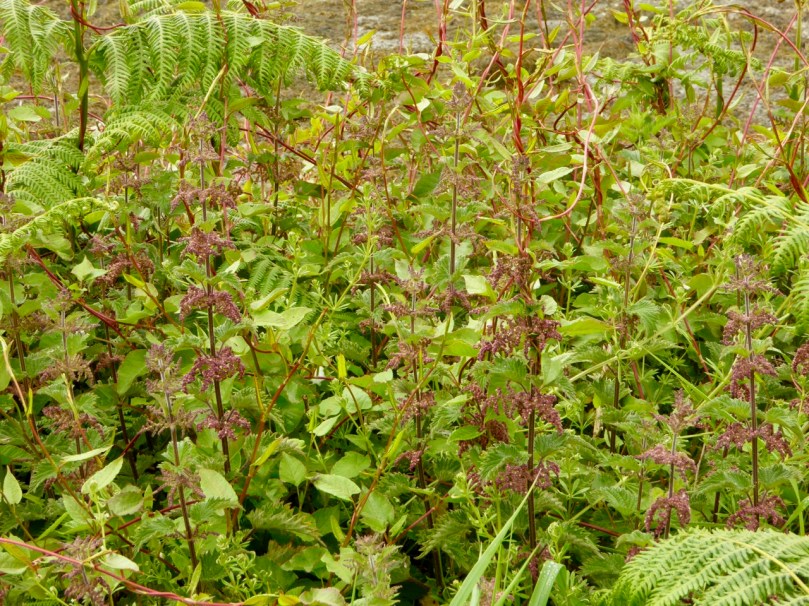
Zoë alerted us to Russian Vine (above, wrapping around flowering nettles) down at Rossbrin Cove. Also known as Mile a Minute, it’s an introduced plant that acts like Bindweed (only worse) and is related to Japanese Knotweed, so very difficult to kill. Bad news!
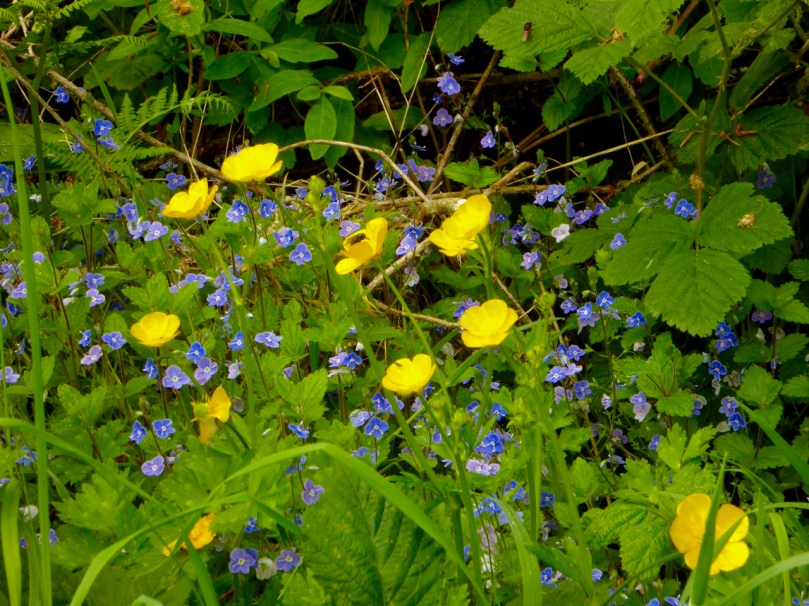
I love the colour combinations you find in the hedgebanks. Wouldn’t this – buttercup and speedwell – make a great dress material?

A baby waterlilly – I was struck by how it looks, as if lit from within.

A final, tiny, flower of the hedges – appropriately name Mouse-ear
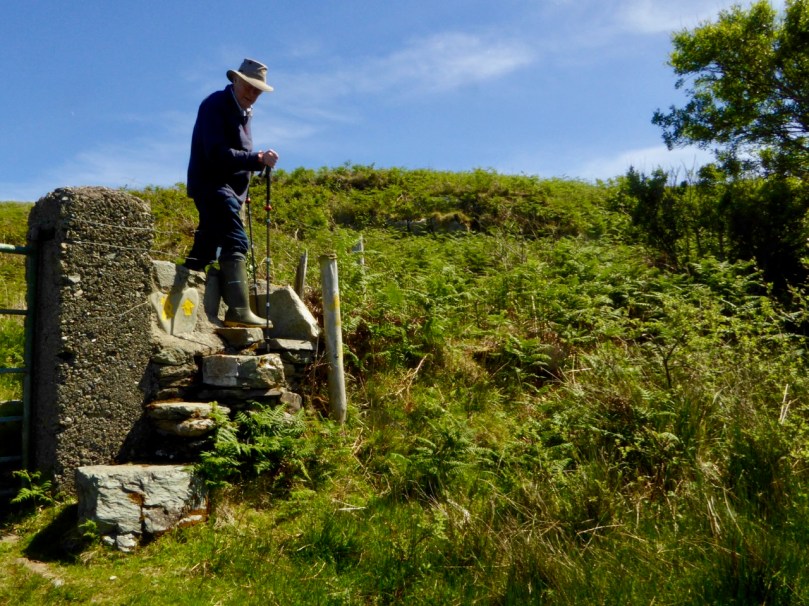
Sheep’s Head: Searching for Cornish Miners

 Yesterday we did our favourite walk, along the Cahergal section of the Sheep’s Head Way. We had a goal – the remnants of the Gortavallig Mining Company which operated here briefly in the 1840s. Robert was researching this as part of all the West Cork/Cornwall connections related to the West Meets West Art Exhibition, which opens at Uillinn in Skibbereen next Friday (June 2).

Walking the Sheep’s Head Way, by Amanda Clarke, is our go-to book for everything on the Sheep’s Head. It’s an excellent resource and most of the information in this post comes from it. The stretch of the walk we did is described in two sections (as it’s part of the Way and also part of a loop walk), on pages 27 to 31, and pages 98-99 (Second Edition).

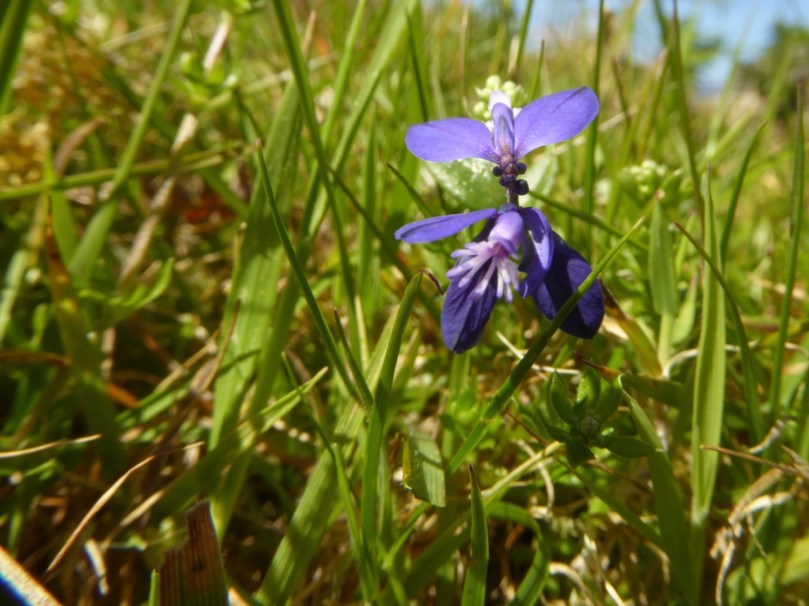
It was a fabulous day, sunny but not too hot – perfect for walking. The wildflowers were out in abundance – a serious hindrance to brisk walking as I cannot resist the temptation to photograph. At one point Robert thought he had lost me, but found me stretched out on the ground trying to get a close up of the tiny, exquisite, Heath Milkwort.

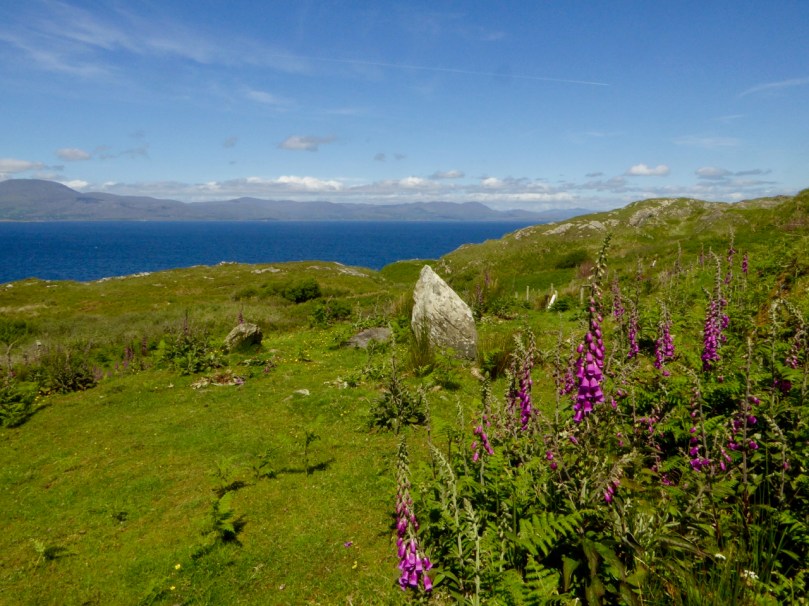
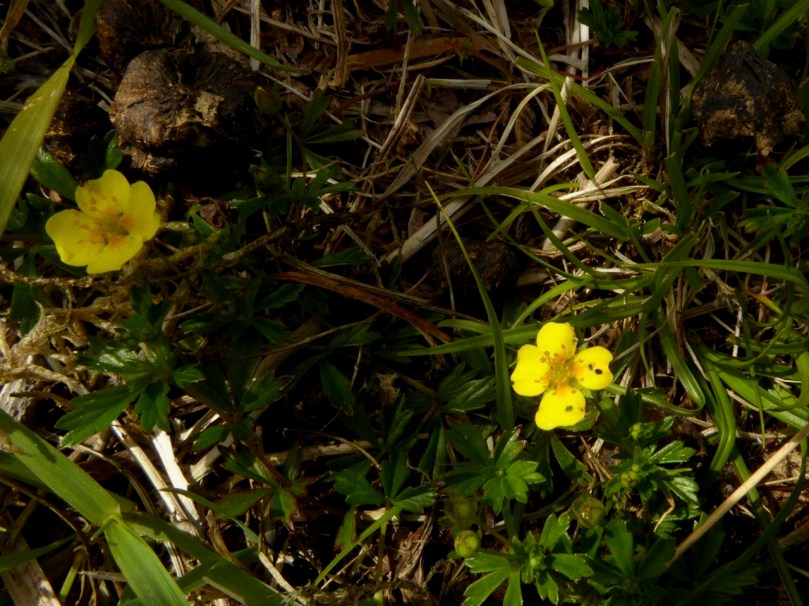
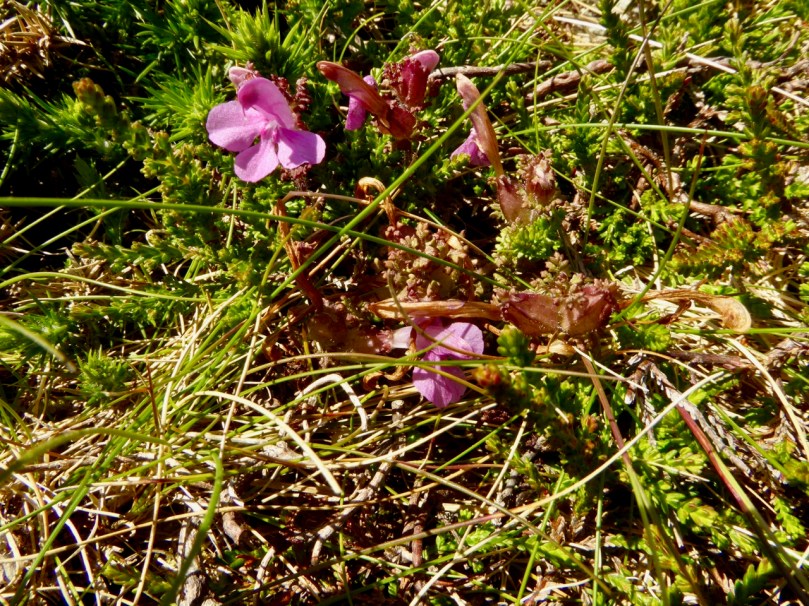
Later on, this hillside with be awash with pink Heather, but now the Foxgloves are everywhere, in all their purple glory, while Tormentil and Lousewort peep out from the among the grasses and heather.

Tormentil, above and Lousewort, below

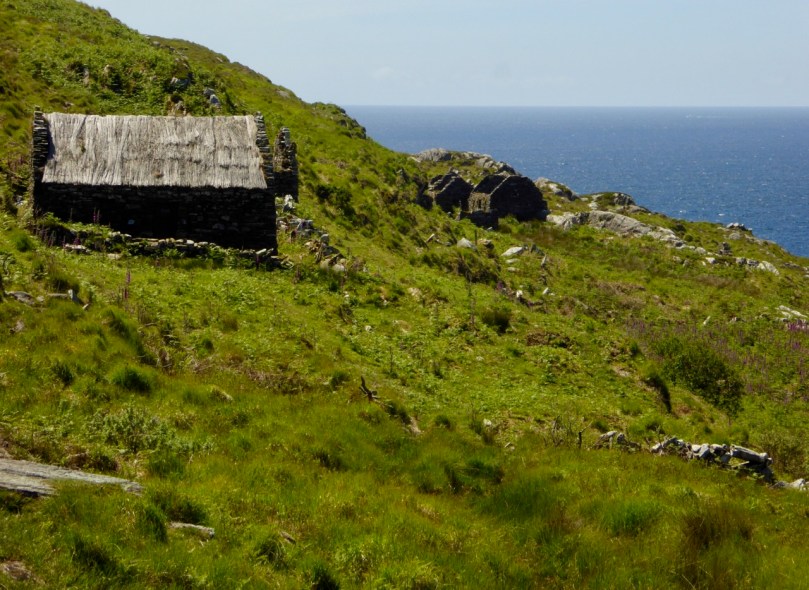
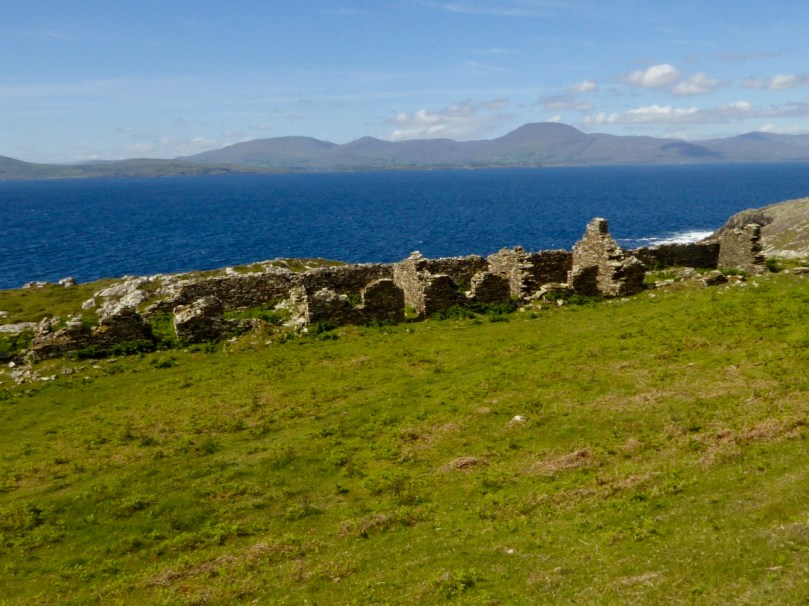
This was once a populated part of the world and there’s a tiny abandoned settlement known as Crimea. This may be a reference to an ongoing feud between families, or a corruption of an Irish place name. There’s no denying the dramatic scenery, but life must have been very hard indeed. A cluster of houses like this was known as a clachán (kla-hawn) – the land was held in common by the inhabitants, with each family having a potato patch and the rest being for grazing and whatever crops would grow.

The Crimea: Tade Carthy’s cottage in the foreground

One of the houses has been recently partially restored. According to Amanda:

It was done partly to show people what living conditions were like not so long ago, and in part to honour the last surviving occupant of the Crimea, who recently celebrated his 100th birthday. Jerh (Jack Owen) Daly grew up in one of these cabins which were family homes until the late 1940s.

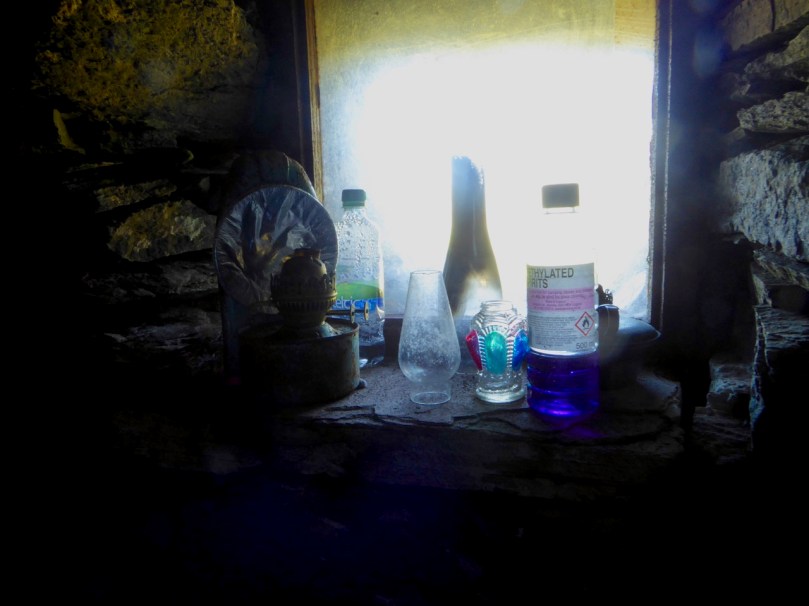
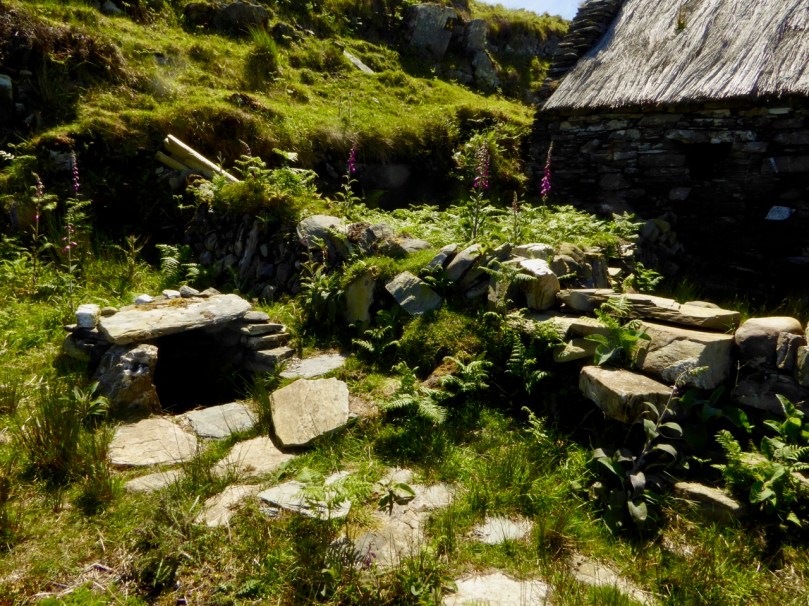
This old house belonged to Tade Carthy’s family and has been sensitively restored, the original flagstones and well discovered whilst working on it, Inside there is no fireplace but an open hearth built against the wall with a hole in the roof to let out the smoke. Doors positioned east and west allowed a through draught to also deal with the smoke. Little oil lamps fitted into niches provided additional lighting and a bed platform gave extra space for sleeping.

The recently re-discovered well

It was from this clachán, and from all over the Sheep’s Head, that local people trekked, during the height of the famine, to the mine. They also built the road, for which they were paid in food, rather than money.

Approaching the 1840s mine – the reservoir is in the foreground and the Cornish Miners cottages on the far side of the cliff

Amanda quotes from the Report of the Gurtvallig Mine, by William Thomas, June 1847:

A complete wilderness and barren cliff, which for the past age has been the undisturbed resort of the Eagle, the Hawk and the Wild Sea Birds, has by our labours for the past 16 months been changed into a valley of native industry, giving reproductive employment, food and a comfort, to numbers of the hitherto starving, but peaceable inhabitants of one of the wildest districts in the United Kingdom. For you can hear now, on our well secured dressing floor (mingled with the roar of the Atlantic) the busy voices of men, women, boys and girls, all engaged in breaking, dressing and preparing the ore for market.

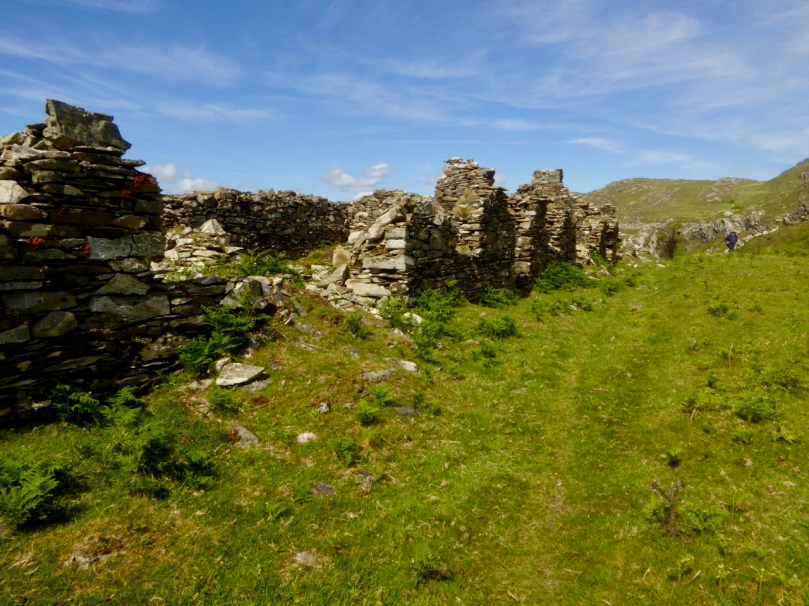
Ten or eleven small houses stood here to house the specialist miners recruited from Cornwall

The mine was an actually an outpost of Cornwall in Ireland. The two Mine Captains, William Thomas and James Bennett, were Cornish, and the miners – 24 of them – had been recruited in Cornwall. A row of houses was built to house them, while the Captains had more comfortable quarters in nearby Cove (a story for another day).

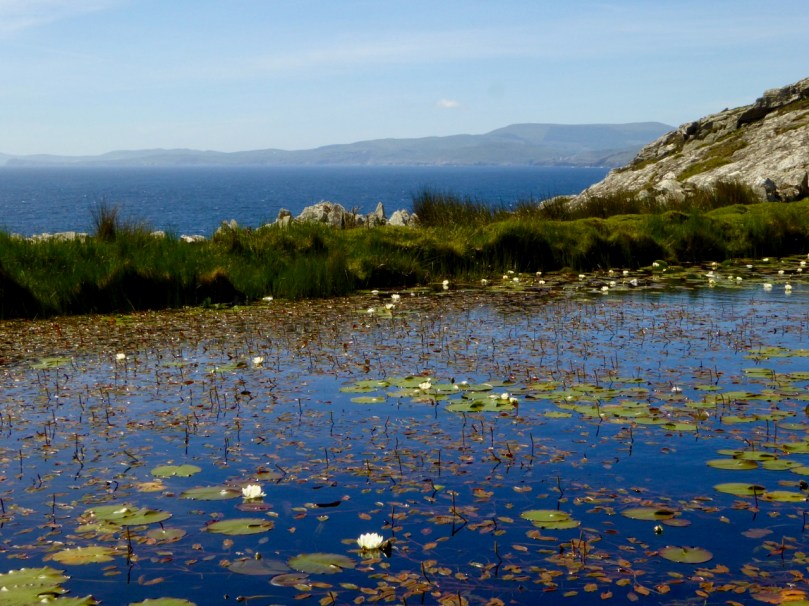
A retaining wall was build to hold the reservoir

It was a busy place during its short life (it close in 1848 after only a year of full operation), with a forge, a carpenters shop, a reservoir, and below, a dressing floor and a quay to transport the ore.

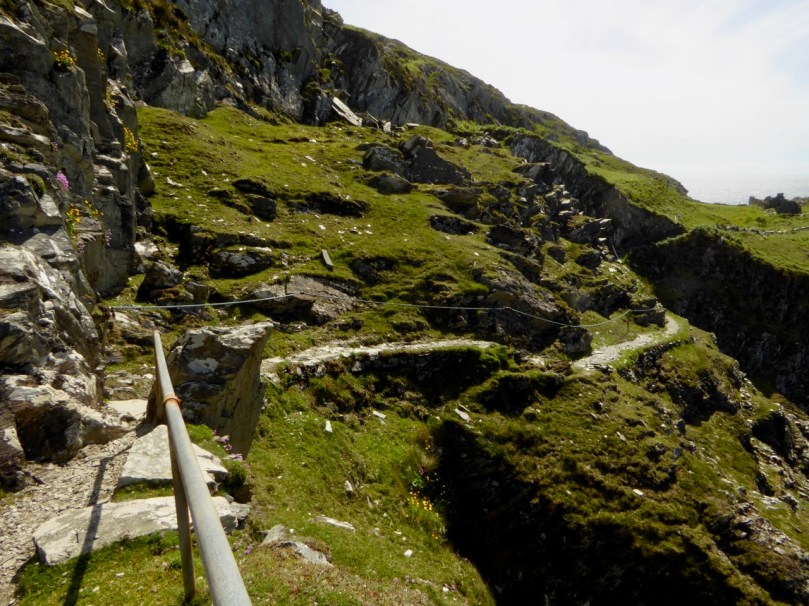
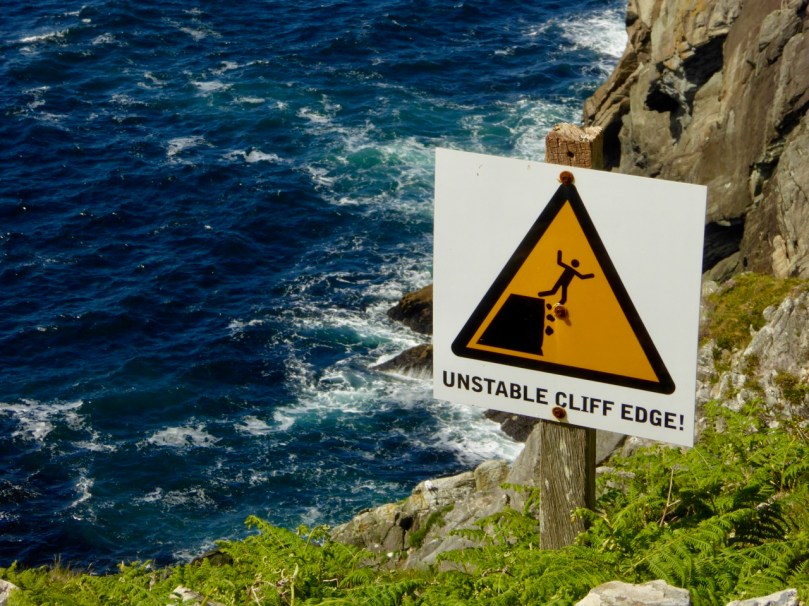
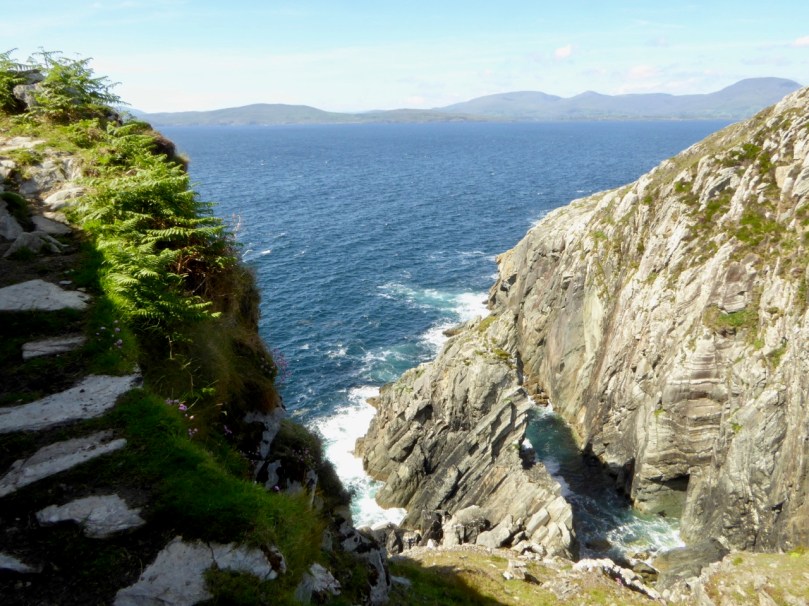
Now the reservoir is home to floating water-lilies, a native plant that was in full bloom yesterday and looking indescribably exotic. The tiny quay has disappeared, but its location can be glimpsed from the rope walk. This part of the hike is not for the faint of heart or vertigo-sufferers: the path is narrow, there’s a rope to hang on to one one side and on the other a yawning cliff falls dramatically away to the wild and roaring Atlantic described by William Thomas.

The rope walk and signage. The lowest photograph shows the location of the quay, reached by means of a steep path but no longer accessible

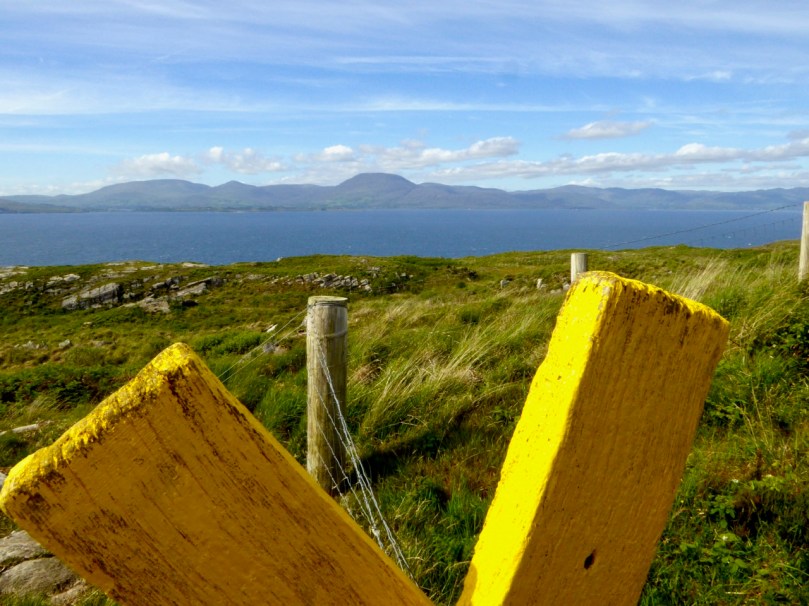
Our walk back, with the sun behind us, was splendid. To the north was Bantry Bay and beyond it is the remote and beautiful Beara Peninsula. I think I can safely say that this will remain our favourite walk – at least until we discover one even more remote, scenic, historic and thrilling. But then, that’s not difficult in West Cork.

A Wildflower Trail for West Cork

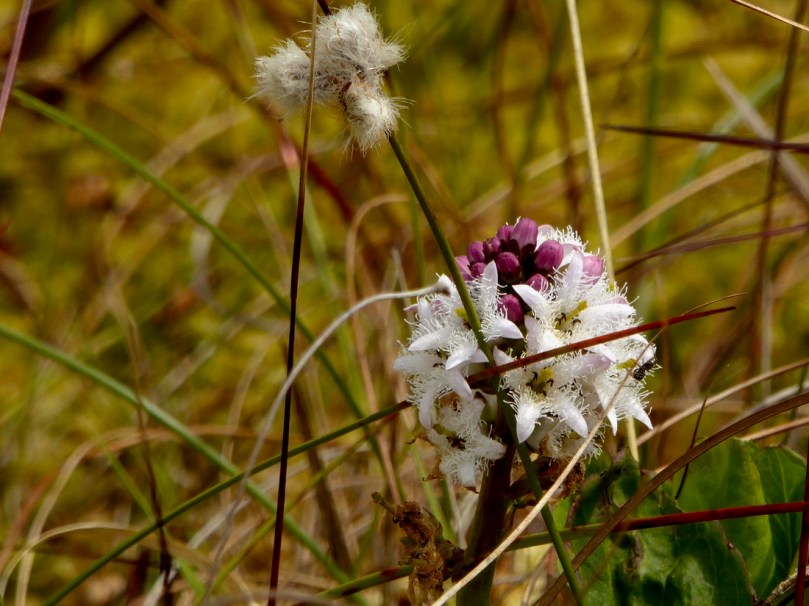
Wildflowers are a spectacular part of our environmental heritage in West Cork. Many of us are aware of them in the background, although we couldn’t name more than half a dozen. It’s only when visitors come along and swoon over the abundance of colour in the hedges that we realise what an incredible natural resource we have on our doorstep. We have a little patch of bog beside us, for example, and a few days ago Bog Cotton and Bog Bean (above) were merrily blooming side by side there. I had never realised how attractive they were until I lingered for close observation. 

St Patrick’s Cabbage is part of the Lusitanian Flora we wrote about in our post Into the Woods. It grows abundantly on the North Side of the Mizen.

We at Roaringwater Journal are exceptionally pleased to have been involved with developing West Cork’s first ever Wildflower Trail System – it launches this Tuesday, but it’s been a while in the planning. The Trail System and its associated brochure is an educative tool that helps us appreciate and learn more about the wildflowers that surround us.

These little beauties are called Mexican Fleabane, but also known as Wall Daisies. The opposite of lawn daisies, they go pink as they age, rather than when they emerge. They’re an introduced species but have naturalised widely. These ones are on the wall of the stream that runs through Drimoleague.

We are particularly happy to welcome Zoë Devlin to do the honours of launching the trails. When I first got interested in wildflowers our friend Amanda (yes, she of Holy Wells of Cork fame) gave me a copy of Zoë’s book, The Wildflowers of Ireland, and it instantly became my bible. It’s laid out by colour, you see, and then by form (four petals, five petals, round clusters, etc) so it’s easy to navigate and to find what you’re after. The illustrations are clear and there’s lots of information about each plant to help you figure out what you’re looking at.

Better still, there’s Zoë’s website. Because it’s constantly updated, it has even more flower species in it, and more information on each one – including herbal uses, folklore references, and details on whether it is native or alien. And finally, there’s her Facebook page where she posts news, recent finds or currently blooming flowers, using her own superb images.

This is Yarrow. I didn’t recognise it at first because I thought Yarrow was always white, but apparently it can be this colour too. In addition, it’s supposed to like dry ground, but this one was overhanging a stream

The Wildflower Trail builds on the fact that there is already a system of waymarked trails around Ballydehob and the Mizen. Robert wrote about the Fastnet Trails in our post Closer Encounters – Fastnet Trails, and I followed up with a two-part post on the Rossbrin Loop Trail, here and here.

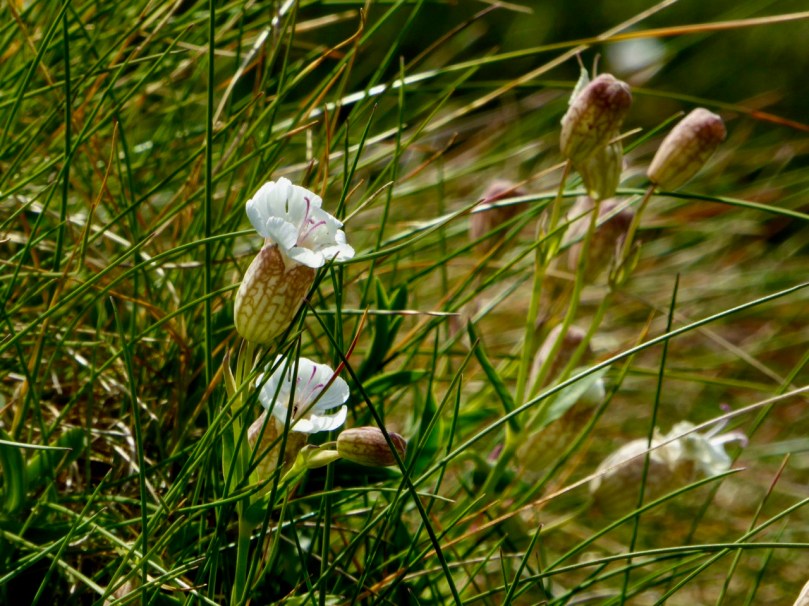
Sea Campion, a native plant adapted to a coastal habitat. It often occurs in drifts.

Using the specially-designed brochure, walkers can identify wildflowers along their chosen trail, then return to the Tourist Office and add their finds to the Master List on the wall. The Tourist Centres at Ballydehob and Schull will have resources available to help them identify any other flowers they have found. If you can’t pick up a brochure, you can find a link to it here.

May belongs to the May Tree – AKA the Hawthorn or Whitethorn. Online forums this year reveal it has been an exceptional year for Hawthorn right across the country

To support the Trails we have started a new Facebook Page – Wildflowers of West Cork – where we will post updates and images of what’s in bloom and what to look out for. If you’re a Facebook user, head over and give us a Like and a Share.

Water Cress, seen on the Colla Road just beyond Schull. Wild Water Cress is edible but you have to be very careful where you gather it as it can be infected with parasites

Everyone is welcome to the Launch – 5PM at the Rossbrin Boatslip on Tuesday the 23rd – and to join Zoë afterwards on a Wildflower Walk. If you can’t make the launch, we hope you’ll go for a stroll along one of the trails soon, brochure in hand, and try your luck at identifying a few wildflowers. Our trails are spectacular right now and will only get better as the summer advances.

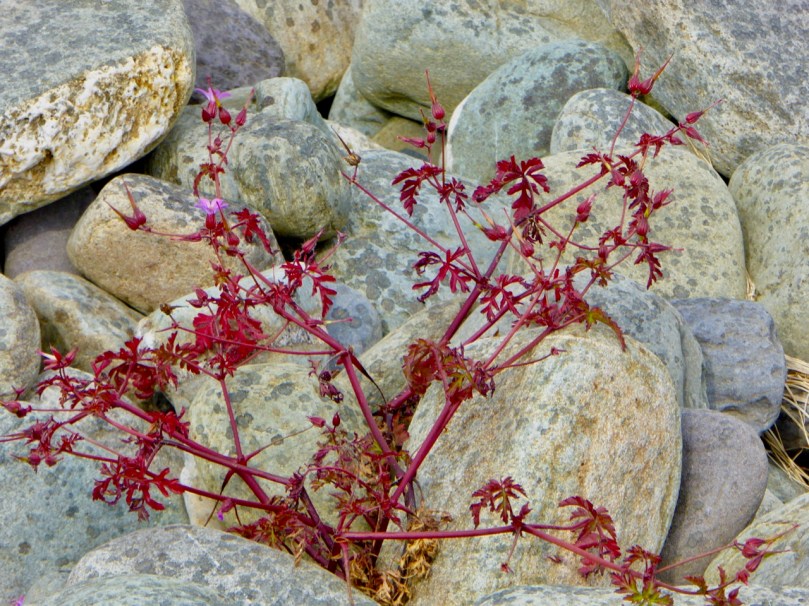
Herb Robert – I love those red stems and leaves as much as the little pink flower. Hard to believe there’s enough soil between those rocks to nourish a plant

But you don’t even need to walk a trail – in West Cork the wildflowers are everywhere. Here’s a photo taken right by Fields of Skibbereen – just look over the fence at the stream.

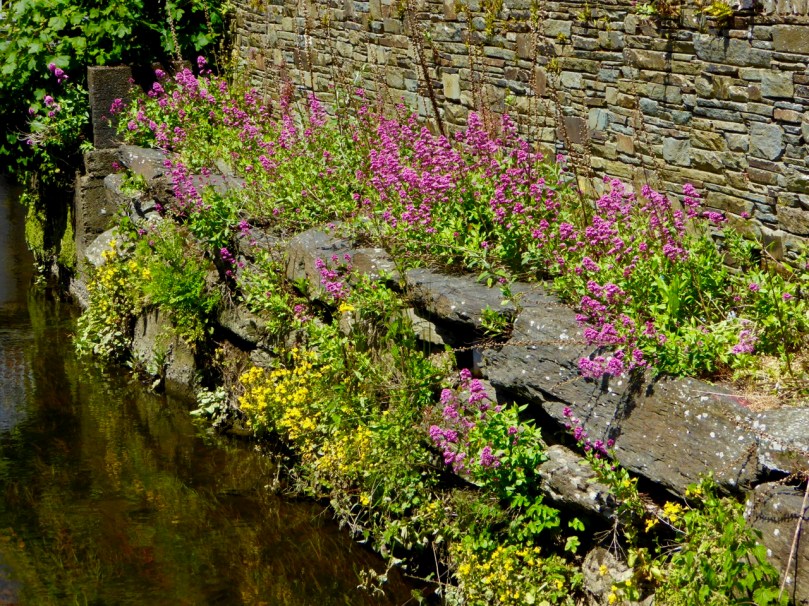
Red Valerian and yellow Monkeyflower. Both are introduced species but obviously right at home on the walls of the Caol Stream in Skibbereen

All the other images were taken in May, all in West Cork, and many of them in unpromising places such as waste ground, urban streams, old walls and rocky shores. Every day, we walk right by a wealth of beauty without really stopping to look.

Mouse-ear Hawkweed and Ivey-leaved Toadflax on the wall containing a stream in Drimoleague. Below in the water is Stream Water-crowfoot

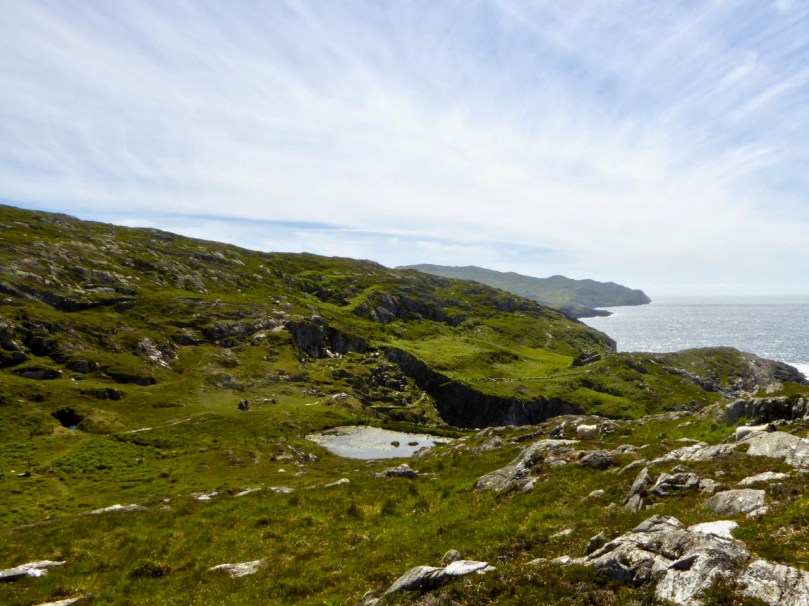
Happy wildflowering! (Start by seeing how many kinds of flowers you can see in the image below – photo taken at Lake Faranamanagh on the Sheep’s Head.)

Ways West!

Many of you will know that I was a frequent traveller between Cornwall and West Cork from the 1990s and onwards – until I happily met with Finola and we came and settled permanently here in Nead an Iolair just a few years ago. We have never looked back! But I have often wondered about the various ways in which that journey was made – not just in the last century, but three or four thousand years ago… For we do know that tin mined in Cornwall was brought across to the west of Ireland then, in order to manufacture Bronze – the ‘supermetal’ of those advanced times: it symbolized strength and gave wealth and status.

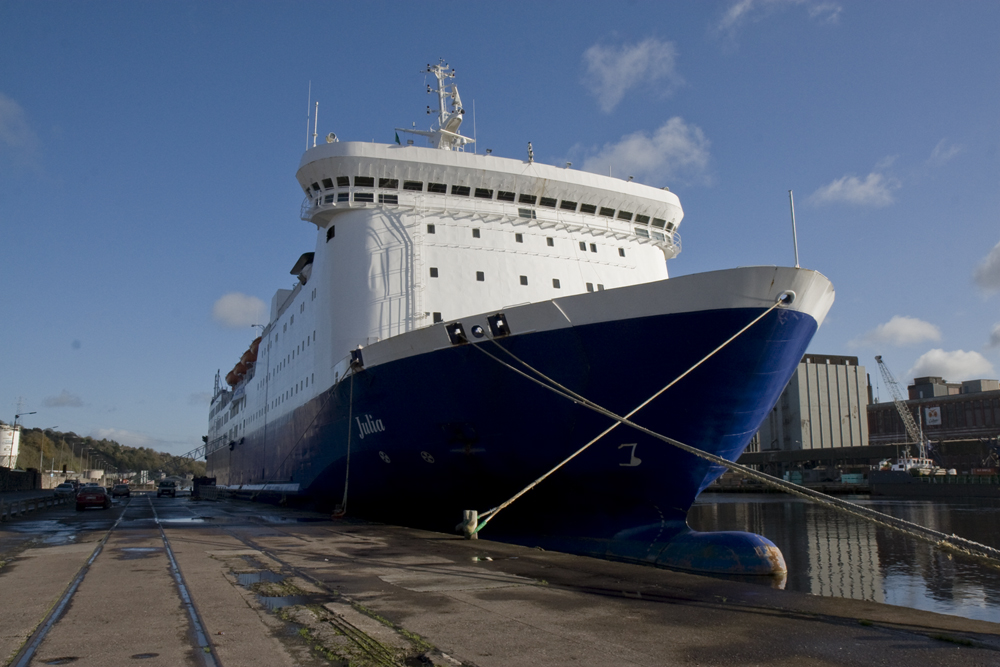
MV Julia, the car ferry which plied between Cork and Swansea: top picture – in her heyday, when she operated throughout the year. Above – Julia leaving Cork in 2012 after the closure of the Fastnet Line. Her name was changed to Wind Perfection and she became a floating dormitory for workers on the offshore wind farms in the North Sea

Not only tin was brought from Cornwall. A study carried out in 2015 by universities in Southampton and Bristol – (using laser ablation mass spectrometry) – concluded that many of the gold artefacts in the National Museum of Ireland and dating from the Bronze Age were manufactured from gold imported from Cornwall – even though there were rich supplies of gold being extracted in Ireland. Author Chris Standish suggests: 

…It is probable that an ‘exotic’ origin was cherished as a key property of gold and was an important reason behind why it was imported for production…

Gold artefacts from Ireland: left – Tyrone Lunula, early Bronze Age; right – Gleninsheen gold gorget, late Bronze Age (photos courtesy National Museum of Ireland)

I would really like to know what type of boat was used all that time ago to bring that precious metal across the Irish Sea. Some have suggested that it would have been a forerunner of the currach – implying a small hide-covered boat. But metal was heavy – even if it was smelted into ingots before the journey: something larger than a currach must surely have been needed. My own not-too-distant memories of having survived a night crossing in the MV Julia, from Swansea to Cork, in a Force 9 storm – with the thudding of huge waves against the steel hull and ominous creakings and crashings coming from the car decks below – lead me to think that any craft that had to traverse those seas in all weathers had to be substantial and sturdy.

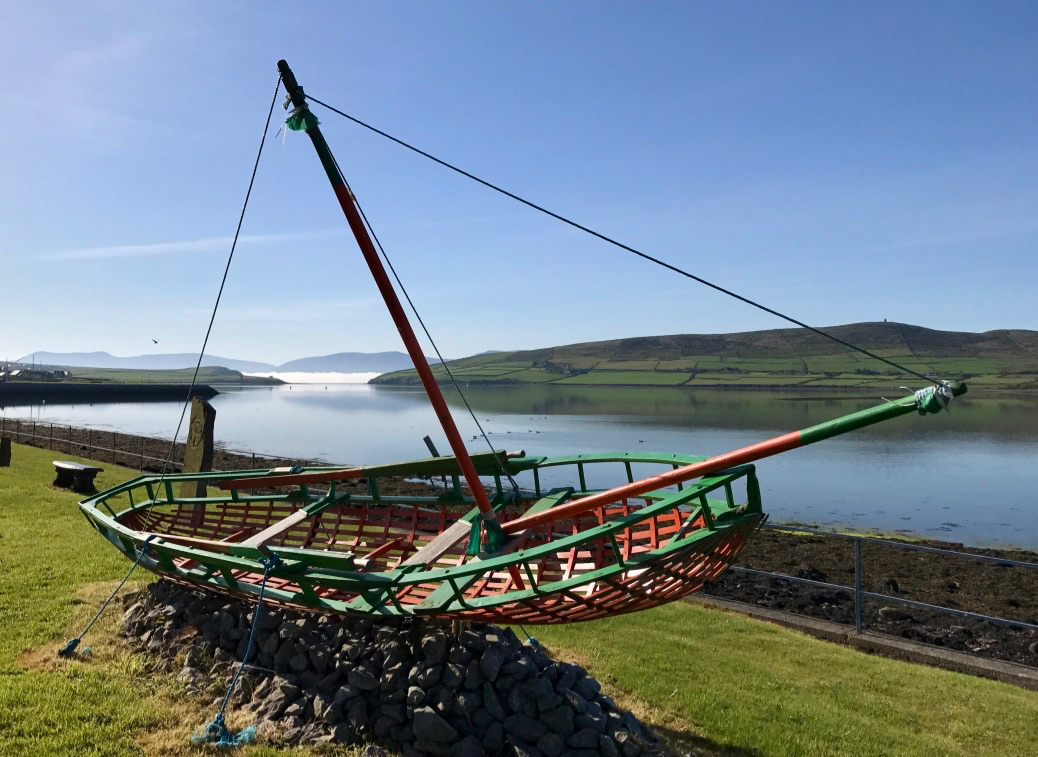
A traditional currach in Dingle, Co Kerry – without its covering skin of hide or canvas

I began to research types of craft that were used in the Bronze Age: examples have been found, some preserved underwater or in bogs. These included ‘log boats’ such as the 14 metre long Lurgan Canoe in the National Museum, which doesn’t seem ideally suited to cargo carrying – especially on open sea. The most likely candidate comes from the Mediterranean: the Uluburun Shipwreck, found underwater in Turkey in 1982.

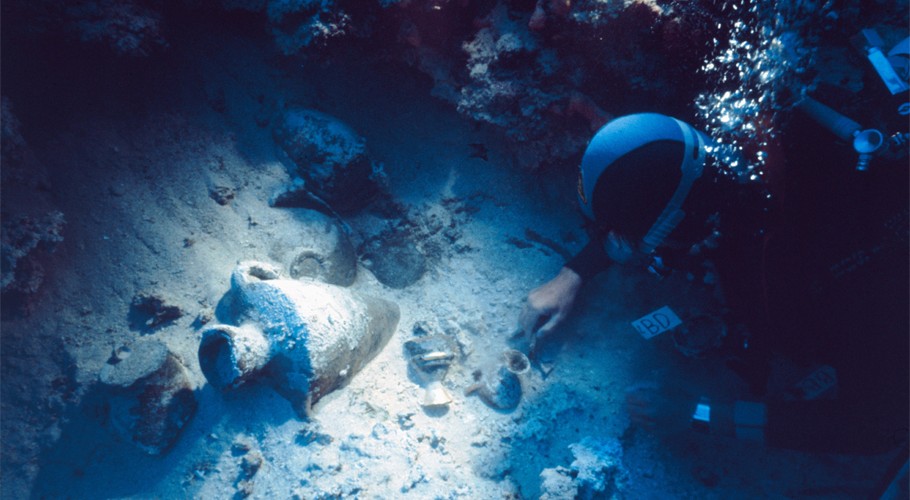
The Uluburun was a cargo boat: we know this because much of its load was intact when the wreck was found. Amazingly, archeologists were able to pinpoint its route: the ship set sail from either a Cypriot or Syro-Palestinian port and was probably heading for a Mycenaean palace on mainland Greece. It was wrecked in the late 14th century BC. The boat was constructed of cedar planks with morticed and tenoned joints and carried a huge cargo: 500 copper ingots; one ton of tin (which when alloyed with the copper would make around 11 tons of bronze); around 150 Canaanite jars, some filled with glass beads, many others with olives and some with an ancient form of turpentine; 175 glass ingots; African blackwood (ebony); ivory; tortoise-shells; ostrich eggs; Cypriot pottery and oil-lamps; a trumpet; quartz, gold, faience, amber, weapons, tools, pan-balance weights and a gold scarab… The list goes on.

Underwater archaeology: it took ten years to excavate and recover the cargo of the Uluburun vessel

This was in the Mediterranean, not in the Irish Sea. But it’s perfectly possible that the marine technology of those times extended to the northern outposts of Bronze Age Europe. We have to be very clear in our minds that we are looking at a sophisticated society capable of metallurgy, communication and long-distance travel.

Coming back to my own journeys from Cornwall to Ireland, I mourn the passing of the Swansea Cork Ferry, in those days by far the best way to get me and my car to the west of Ireland: I have good memories of arriving in the Lee estuary at daybreak and, excited to be here, watching the sun rise as we sailed up through Cobh to Ringaskiddy. On other journeys I also came over by air: there was a wonderful flight in a small aircraft from Exeter going to Cork. The homespun Devon airport in those days was unsophisticated: on one occasion I lined up to have my luggage checked by security and was asked to take my concertina (a constant travelling companion) out of its case for inspection. I was then asked to play it – in front of the queue – and everything stopped so that the serenade could be heard! It was a small aeroplane – about a dozen seats in the cabin, with the pilot up front – no partition. As he started the engines his broad Cork accent came over the speakers: “…let’s see if we can get this thing off the ground…” He succeeded and – once in the air and cruising at a lowish altitude – got out packs of sandwiches and passed them around. I thoroughly enjoyed watching the outline of Cornwall (exactly as it’s shown in the atlas!) passing below us, to be replaced shortly by the distinctive – and similar – geography of south-west Ireland, soon followed by a sketchy and invariably bumpy landing on Cork’s runaway – especially in any sort of stiff breeze.
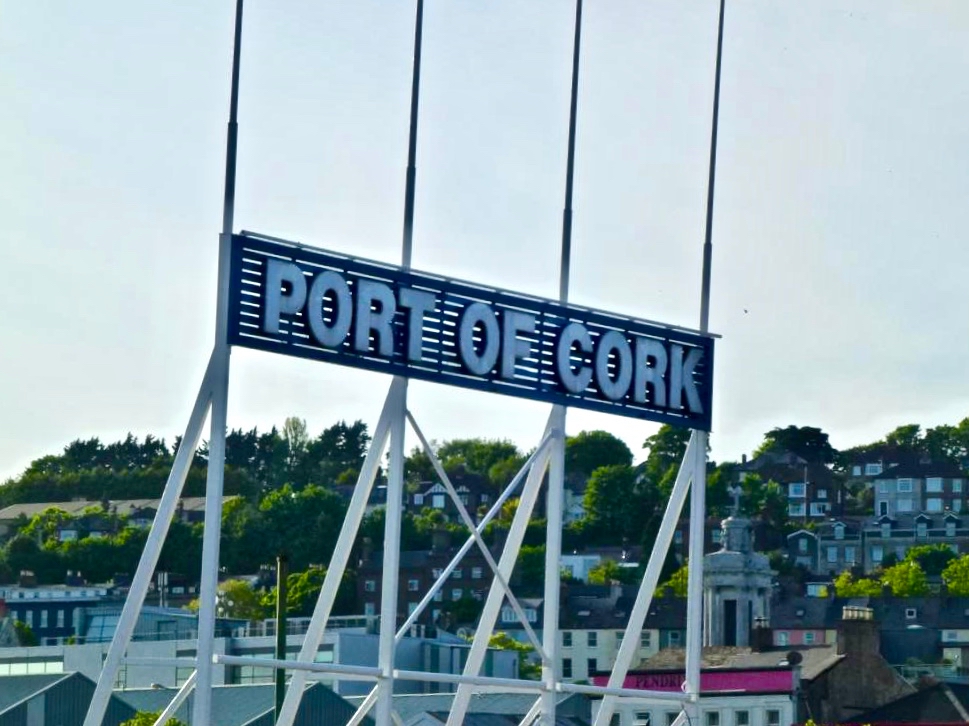
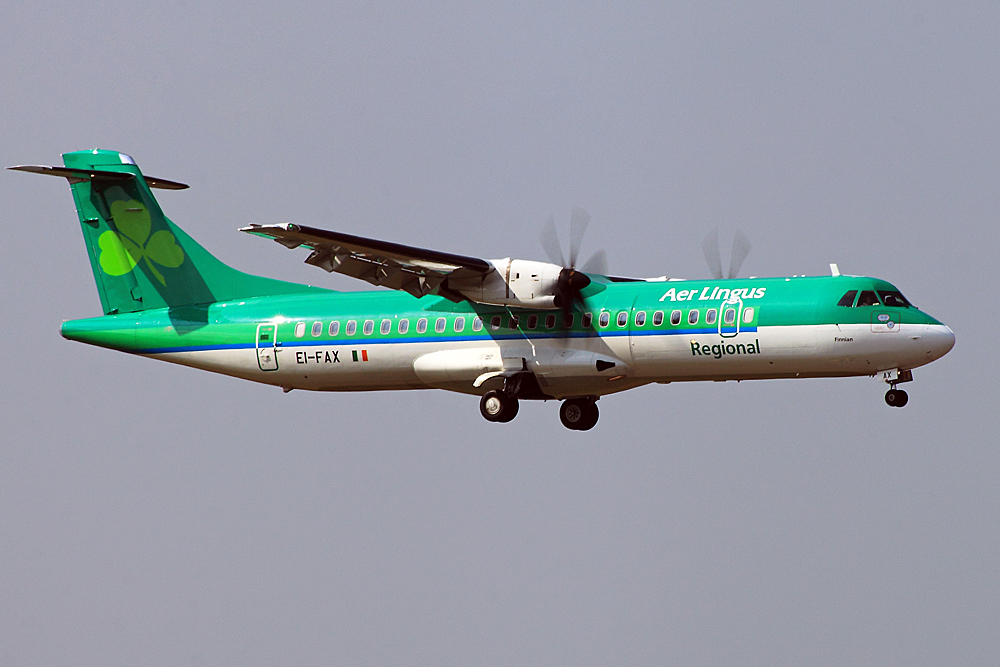
Air Lingus Regional flights – operated by Stobart Air – now directly connect Cornwall with Cork. Photo – Trevor Hannant

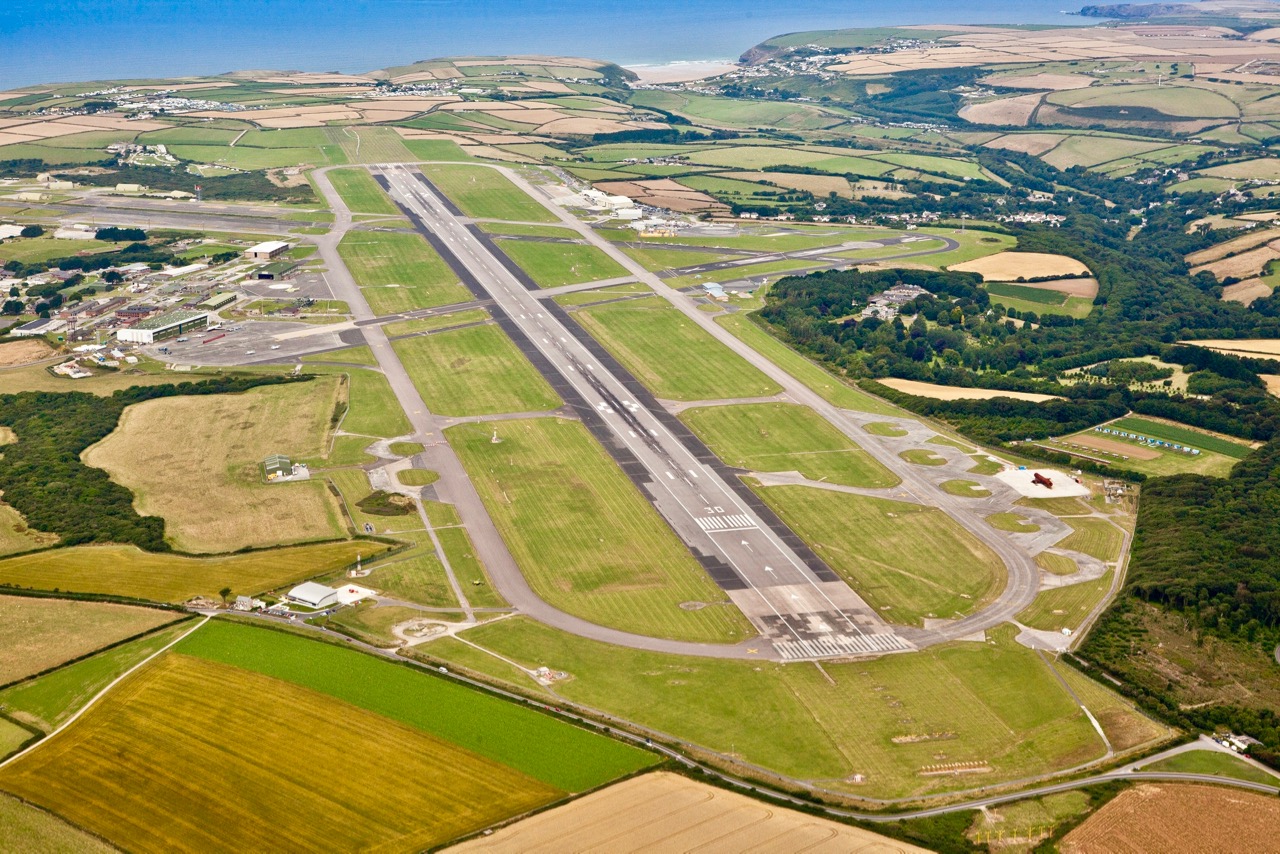
It’s exciting that – just in time for Uillinn’s West meets West exhibition of Cornish artists, there is finally a direct link from within Cornwall to Cork! A new Air Lingus Regional flight – operated by Stobart Air started operating this month and it’s already popular: extra flights have been added to the planned timetable to cater for higher than expected demand. These flights leave from Newquay Airport and are very reasonably priced. I wish them every success… Back in the day, my journey from Newlyn to Skibbereen via the ferry took all day and a night: the new flight barely takes an hour.

Depart here for West Cork! Newquay Airport, in Cornwall

When the Swansea to Cork ferry stopped running the West of Ireland felt the loss: tourism numbers dropped significantly and businesses which relied on visitors suffered. Things have improved since then, particularly with the Wild Atlantic Way initiative. Hopefully the new air link will lead to increased business between the two western outposts of Britain and Ireland, hearkening back to historical times when close links were first forged. Meanwhile, please don’t forget to come along to West meets West and see the work of contemporary artists from Cornwall. The artists (some of whom will have flown over on the Newquay service!) will be speaking about their work at 12 noon on Saturday 3 June, and I will be giving a gallery talk on Saturday 10 June – also at 12 noon – about the many historic links between Cornwall and the West of Ireland. West meets West – the work of contemporary Cornish artists, at Uillinn, Skibbereen, from 3 June to 8 July. Opening at 6pm on Friday 2 June.

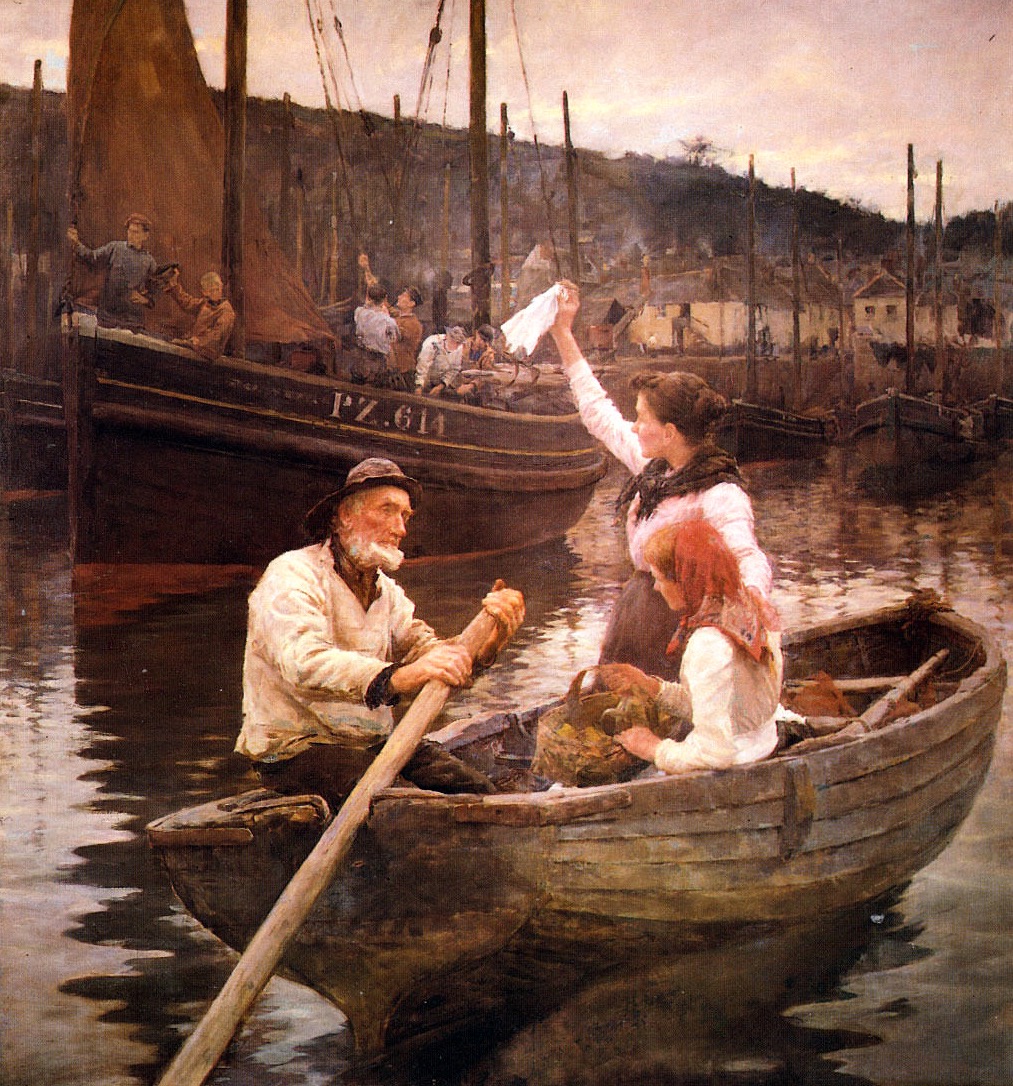
Travelling from Cornwall to Cork: Off to Skibbereen – painted by Newlyn Artist  (and Irishman) Stanhope Alexander Forbes in 1901

A Watery Tale

Last year I got myself into trouble by saying how much I admired the new corten steel signs marking significant spots on the Wild Atlantic Way. My post – Showing the Way – produced howls of protest from many readers who had taken a dislike to them. I may well ruffle the same feathers again when I say that I’m impressed with the information boards which have now appeared to supplement those markers.

Wild Atlantic Way signage at Colla Pier, opposite Long Island

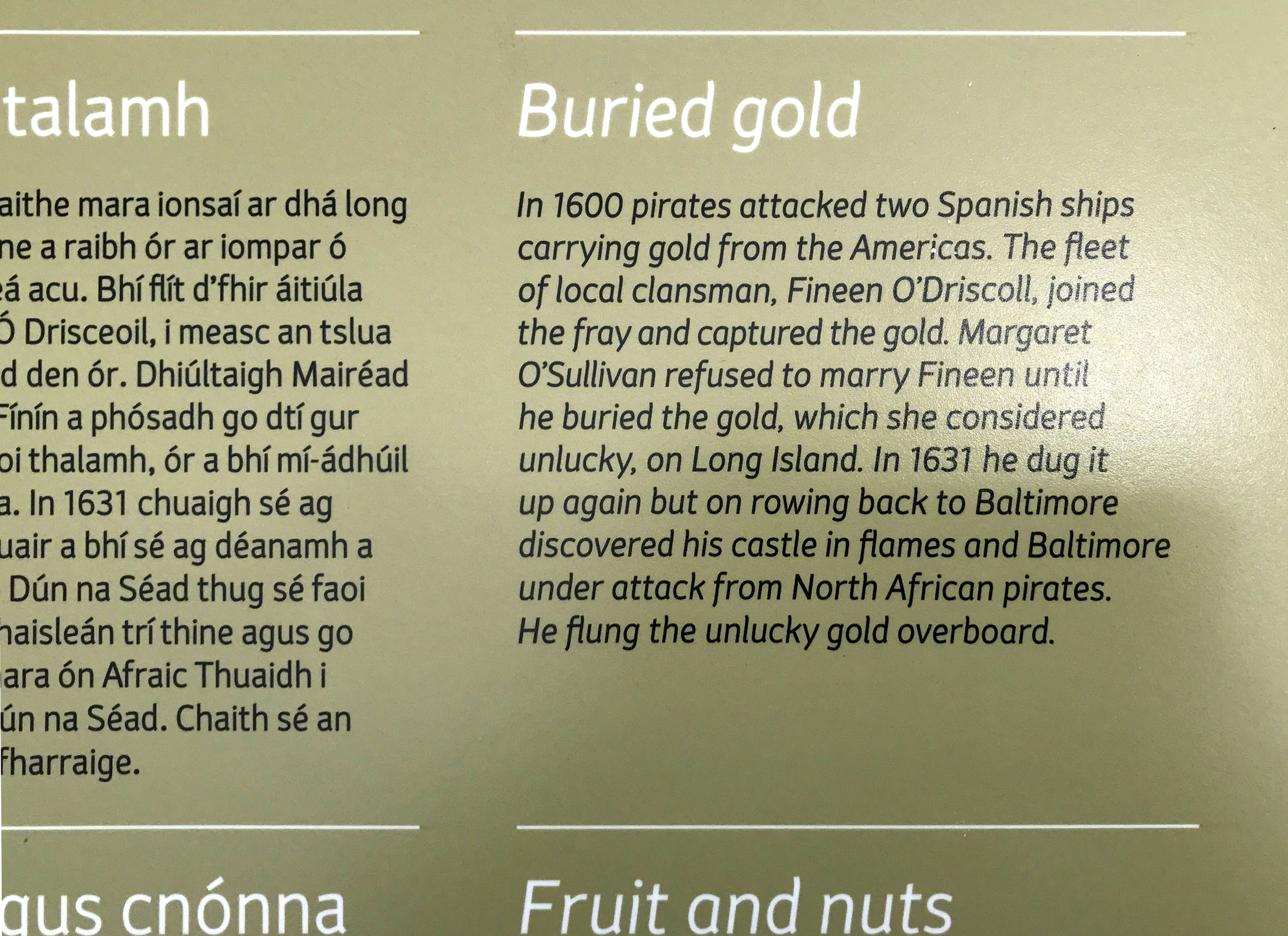
The example above, which we saw today, has appeared at Colla Pier, on the coast road running from Schull round to Crough Bay. The ferry serving Long Island sails from this pier. The board is mounted on a sturdy corten steel frame which should withstand all the elements. The illustration used on the new board (seen in our header picture) is by Sam Hunter and (to my eye, at least) is colourful and attractive. Overall, the panel manages to convey a significant amount of information in a compact design. There is a little Irish lesson (top picture, right-hand corner) and a local ‘story’ pared to the minimum. I was delighted, because I hadn’t come across this tale before. Here it is…

A more detailed version of this story can be read here

So in this short paragraph we find an unusual angle on a very well-known piece of local history: the sacking of Baltimore by Barbary Pirates, which took place 386 years ago, on June 20. Here in West Cork everyone talks about that incident as if it had happened yesterday: it resulted in the decimation of the population of the little fishing village overnight. A hundred and seven people were carried off to slavery in Algeria, and every house was burned.

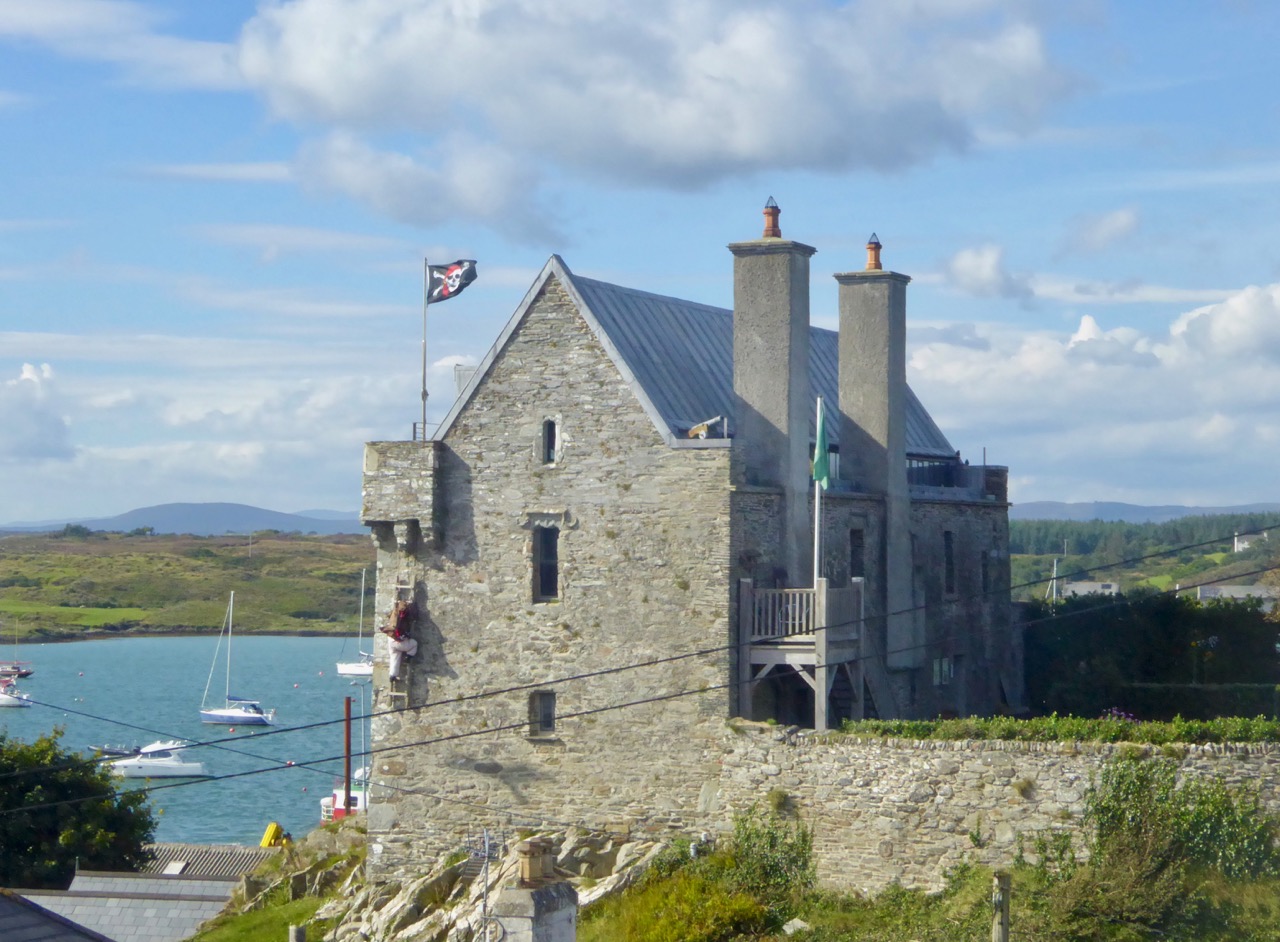
Upper picture: Long Island Sound, with the white houses of Long Island itself in the middle distance; Cape Clear is beyond. Lower picture: Fineen O’Driscoll’s castle at Baltimore – Dún na Séad (Fort of the Jewels). The clan chieftain was not at home to give help to the beleagured village when the Barbary pirates arrived because he was rowing across from Long Island with the ill-fated treasure stowed on board!

In one version of the story about Fineen O’Driscoll and his pirate treasure, the horde of gold is buried under a house on Long Island – a house where strange lights are seen at night! Presumably it’s still there – or under the sea out in Roaringwater Bay. It’s probably best left wherever it is!

Baltimore at dawn, seen in Finola’s beautiful picture above, reminds me that I have to tell you about another Irish – Cornish link. The village grew around a small settlement of religious dissenters from the west of England established around 1600 and led by Sir Thomas Crooke, a man with Calvanist and Puritan connections. Most of the settlers came from Cornwall and were seeking a haven where they could practice their religion unhindered. It was these people who were stolen away nearly 400 years ago, and ended their days in North Africa. Are you interested in the many historic links between the two westernmost counties of Britain and Ireland – Cornwall and Cork? You can find out much more at the exhibition coming up shortly: West meets West – the work of contemporary Cornish artists, at Uillinn, Skibbereen, from 3 June to 8 July

All That Jazz

The Ballydehob Jazz Festival gets better every year! There was a marvellous program this year – eclectic and varied, and our little village was buzzing with locals and out-of-towners.

The great thing about a festival like this is that there’s something for everyone. The Big Acts take place in the “Festival Hall” (AKA Community Hall) where there’s big band sounds and dancing till the wee hours. There are workshops for kids (this year’s line-up featured archery tag and circus skills) and a Sunday Market with a continuous bandstand of acts.

The East Coast Jazz Band are effortlessly cool

But a lot of the action takes place in the intimate venues. The pubs and restaurants all host entertainers so you can have lunch and dinner accompanied by soulful crooners, or crowd into one of the pubs to listen to a piano duo or a swing band or a funk quartet. There’s a good mix of West Cork and come-from-away groups and every venue is packed to the scuppers.

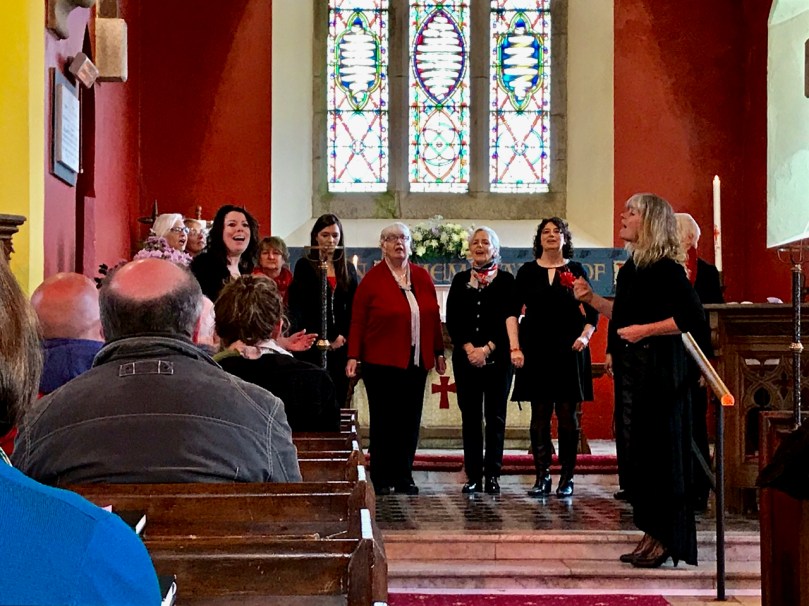
Above: Stephanie Nilles and Thomas Deakin were one of THE acts of the Festival. Their sound (and her lyrics!) left us gasping. Below: The Eileen and Marilyn Experience, perennial favourites in West Cork, and Grace Notes, a new vocal performance group under the direction of Caz Jeffreys 

This year there was a first – a Jazz Mass. Actually it was a Church of Ireland Service, with gospel provided by the choir I (try to) sing with, Acapella Bella. Something tells me this could well become an annual event.

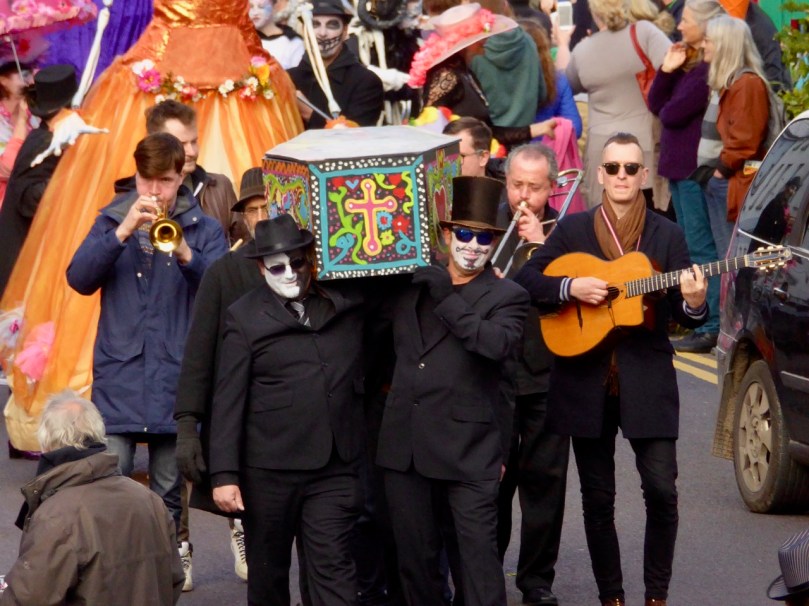
But the highlight of the festival for everyone is the New Orleans-style Jazz Funeral. Ballydehob is a hotbed of creativity at the best of times and the idea of a Jazz Funeral has galvanised the community. This is only the third year we’ve done it and it’s been improved and expanded every year.

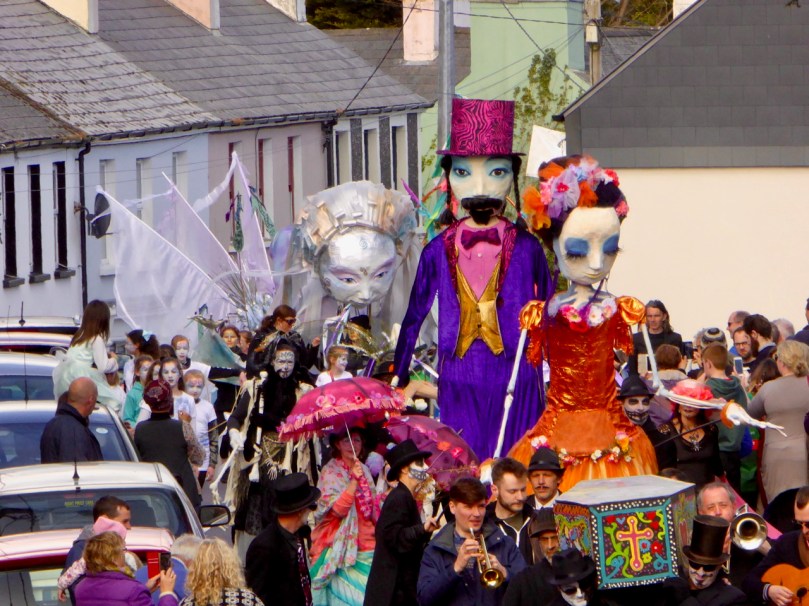
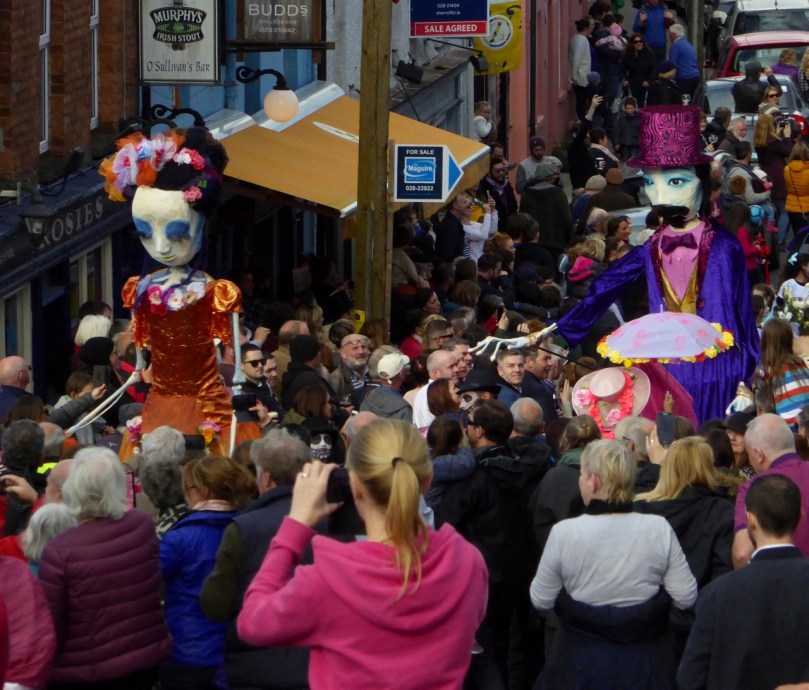
Last year the giant puppet, Katrina, made her first appearance, and this time she was joined by a mate. Billed as Mexican Day of the Dead meets Bealtaine, the parade wound its way up the village, stopping along the way so the puppets could wow us with a dance. It was a marvellous spectacle.

Almost, you could forget you were watching dolls and feel the emotion flowing between them and they put their arms around each other and kept time to the music.

A stilt walker, a giant centipede, a pair of gangsters on a penny farthing, and a whole army of children in costume completed the parade of mourners. The weather held off (the Gods of Bealtaine must have been appeased) and the streets were thronged with cheerful festival-goers, all swearing to be back again next year and this time to bring all their friends.

Tara Brandel performed her dance Car at the end of the parade. Finola cosies up to a gangster

The tagline for the Festival is…drum roll, please…THE BOUTIQUE FESTIVAL IN THE BACK OF BEYOND PACKING A BOMBASTIC ARTISTIC PUNCH. Take a look at the program and see for yourself – great descriptor, or what!