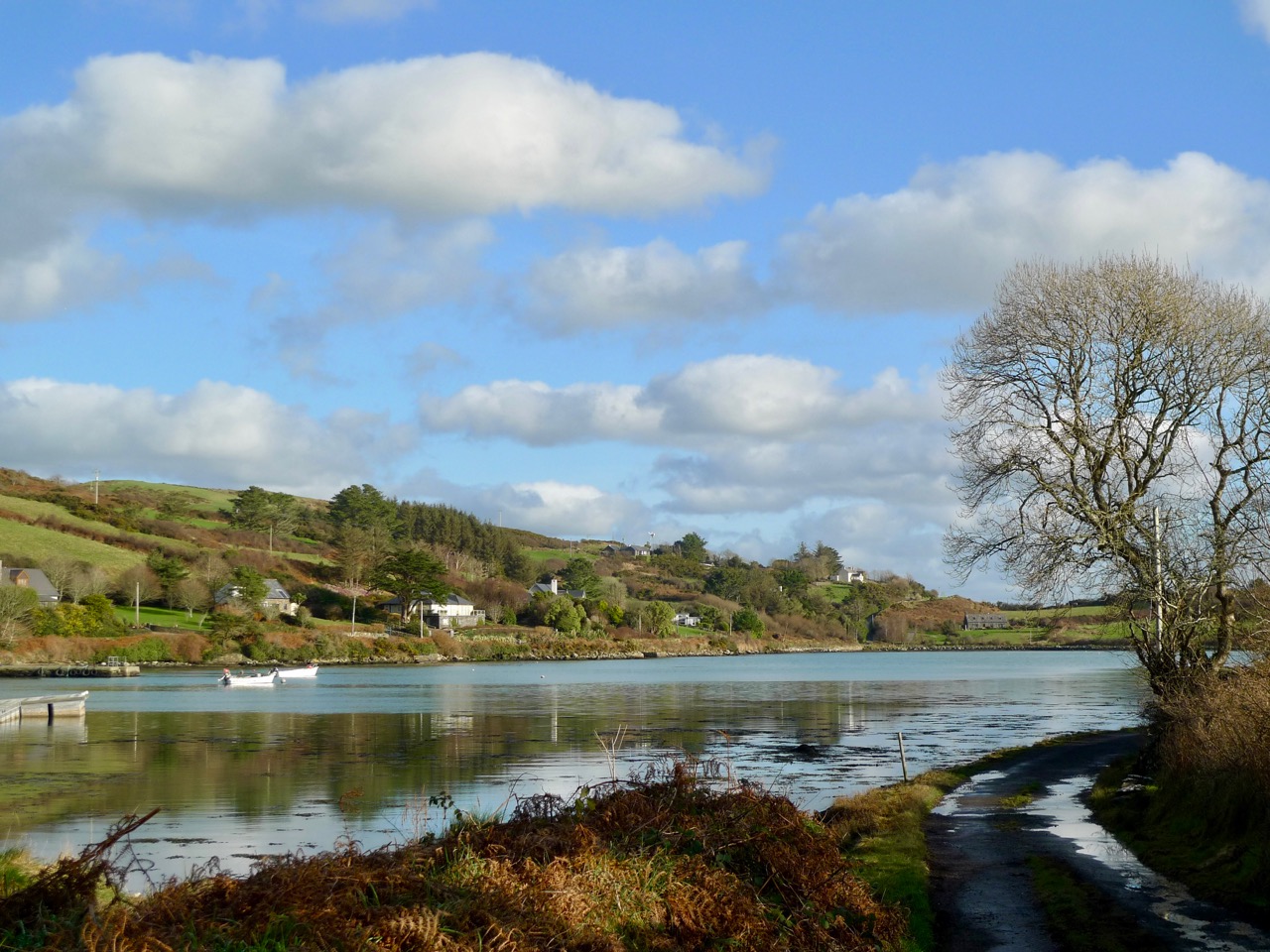
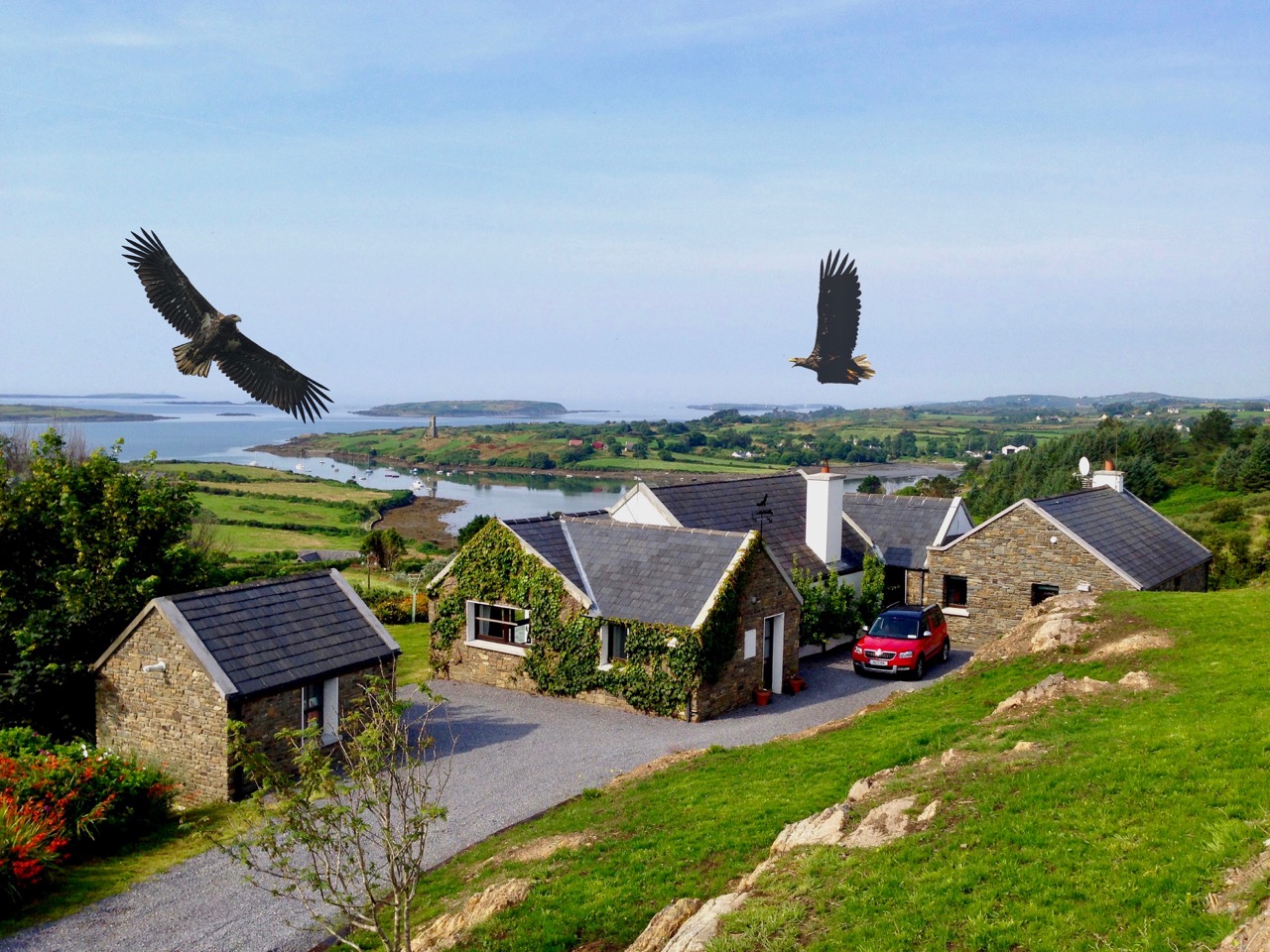
Last week we talked a little about the history of Rossbrin’s medieval castle, and the importance of this natural inlet as a historical centre of fishery, scholarship and European culture. Rossbrin Cove stills serves as an anchorage and refuge for sailing boats on the edge of Roaringwater Bay, but is now a peaceful haven, with only the sounds of the shore birds and slapping masts to lightly disturb an overriding tranquility that gives the place a very particular atmosphere. Our photograph (above) is taken on the boreen going to the castle; on the skyline in the centre is a wind turbine, and just below that is Nead an Iolair (Irish for Eagle’s Nest). The picture below shows the eagles wheeling over our house, with Rossbrin Castle and our view to the Cove beyond.
I have been exploring images of the Cove and its castle – some historic photographs and a few artists’ impressions. As it’s right on our doorstep, we have taken many pictures of Rossbrin during our years here. I am also sifting through a few of these.
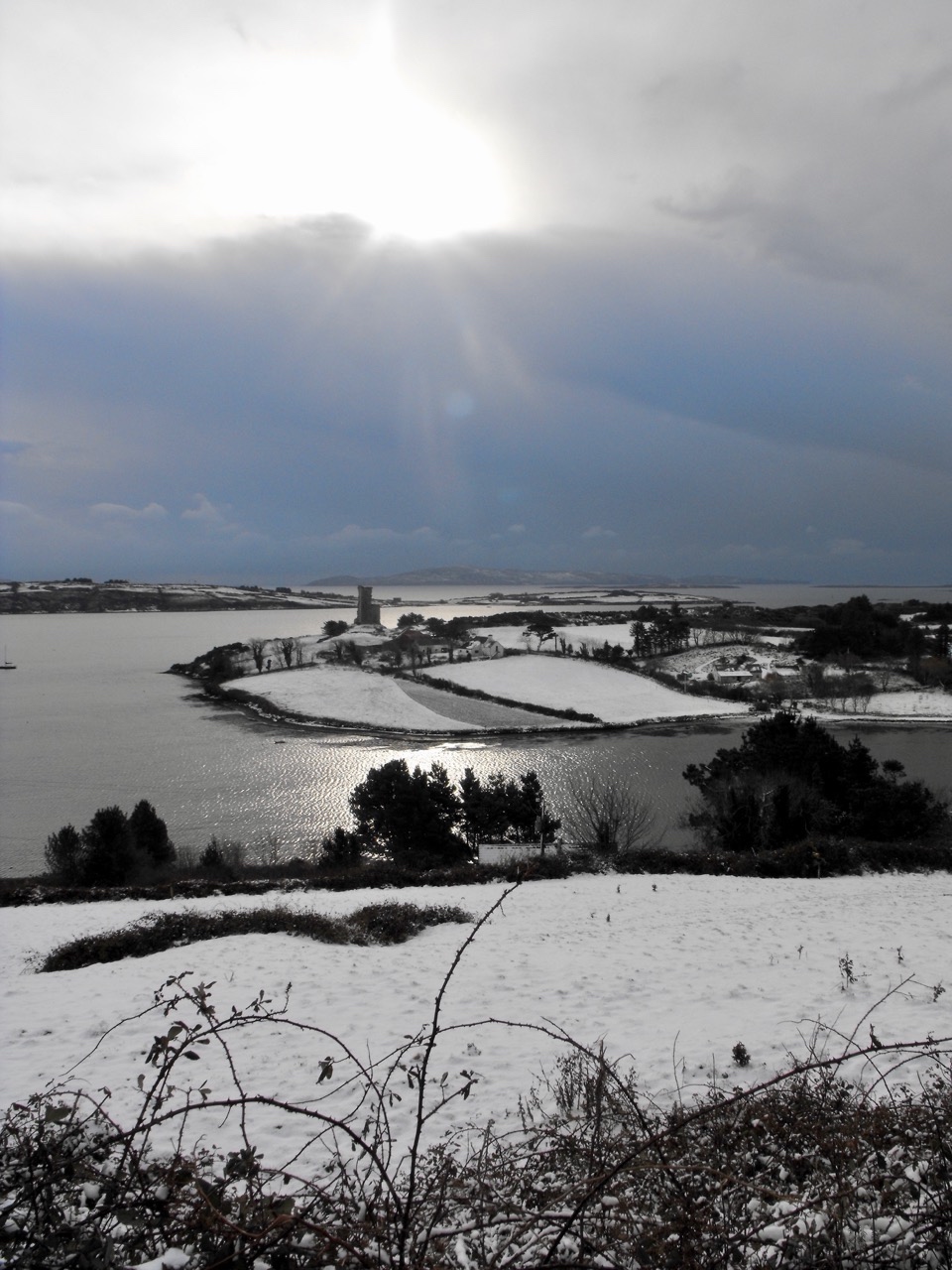
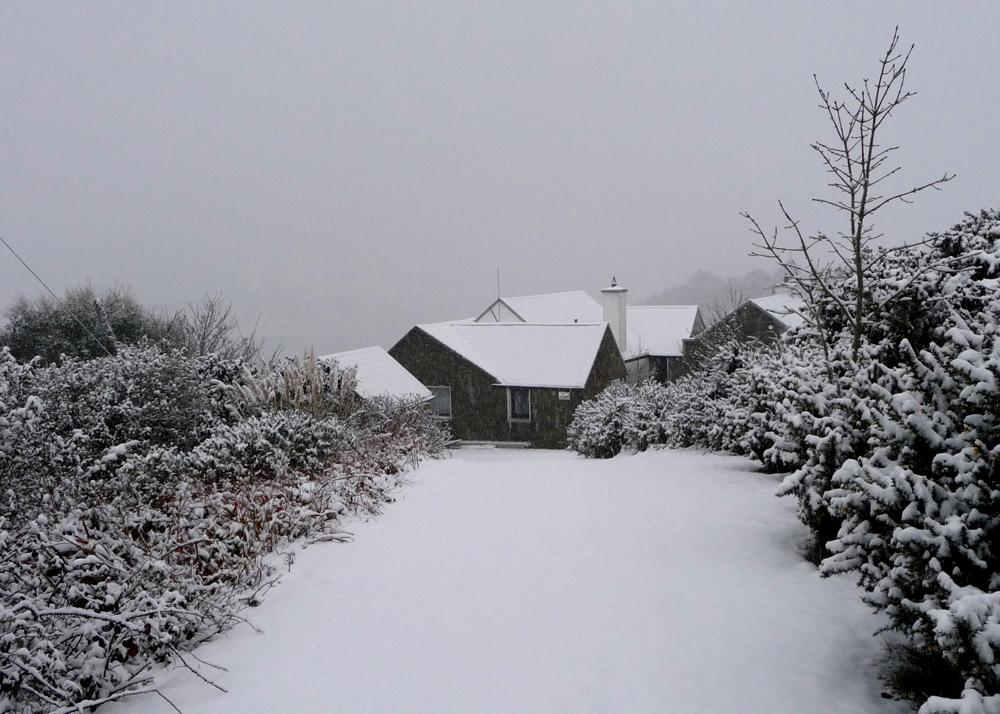
Ten years ago, the west of Ireland experienced an exceptional snowfall, and above is a photograph taken by our near neighbour, Julian van Hasselt, before we arrived. Mostly, our weather is relatively mild due to the effects of the gulf stream on the south-western coast. The castle can clearly be seen here, beyond the fields of Castle Farm. This view of our house (below) was also taken in 2010 by our neighbours Dietrich and Hildegard Eckardt:
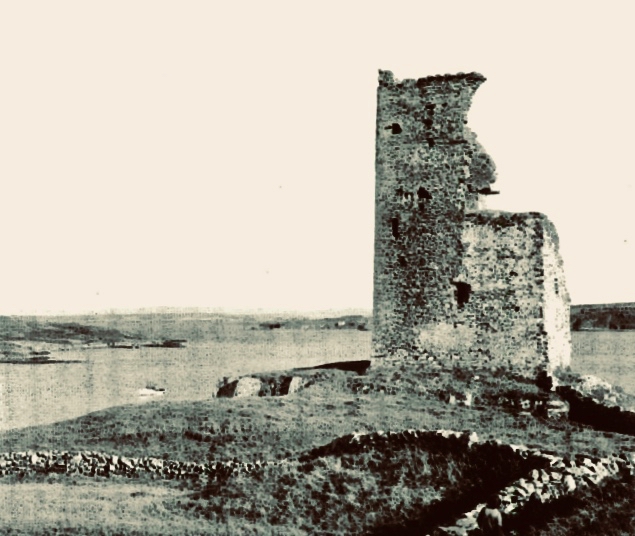
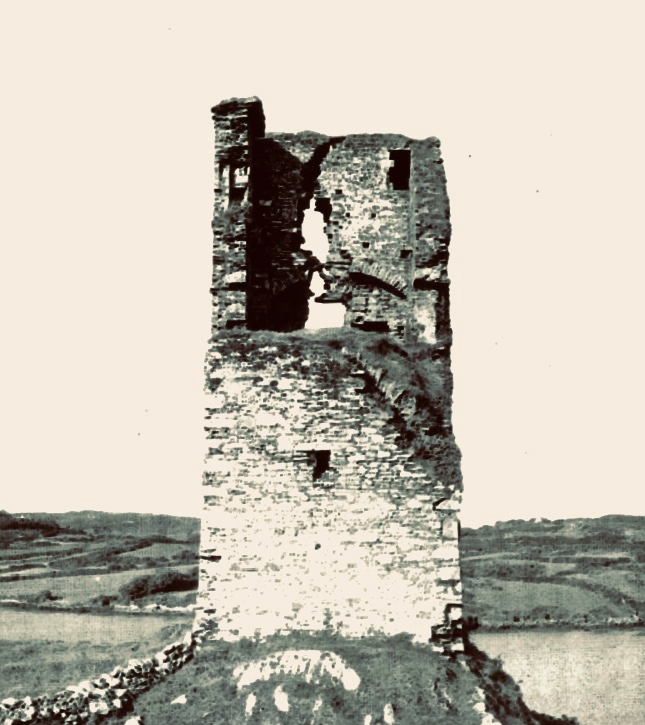
I showed a couple of early photographs of the castle last week. Here are two more taken before a substantial part of the ruined structure was toppled by a storm in the 1970s:
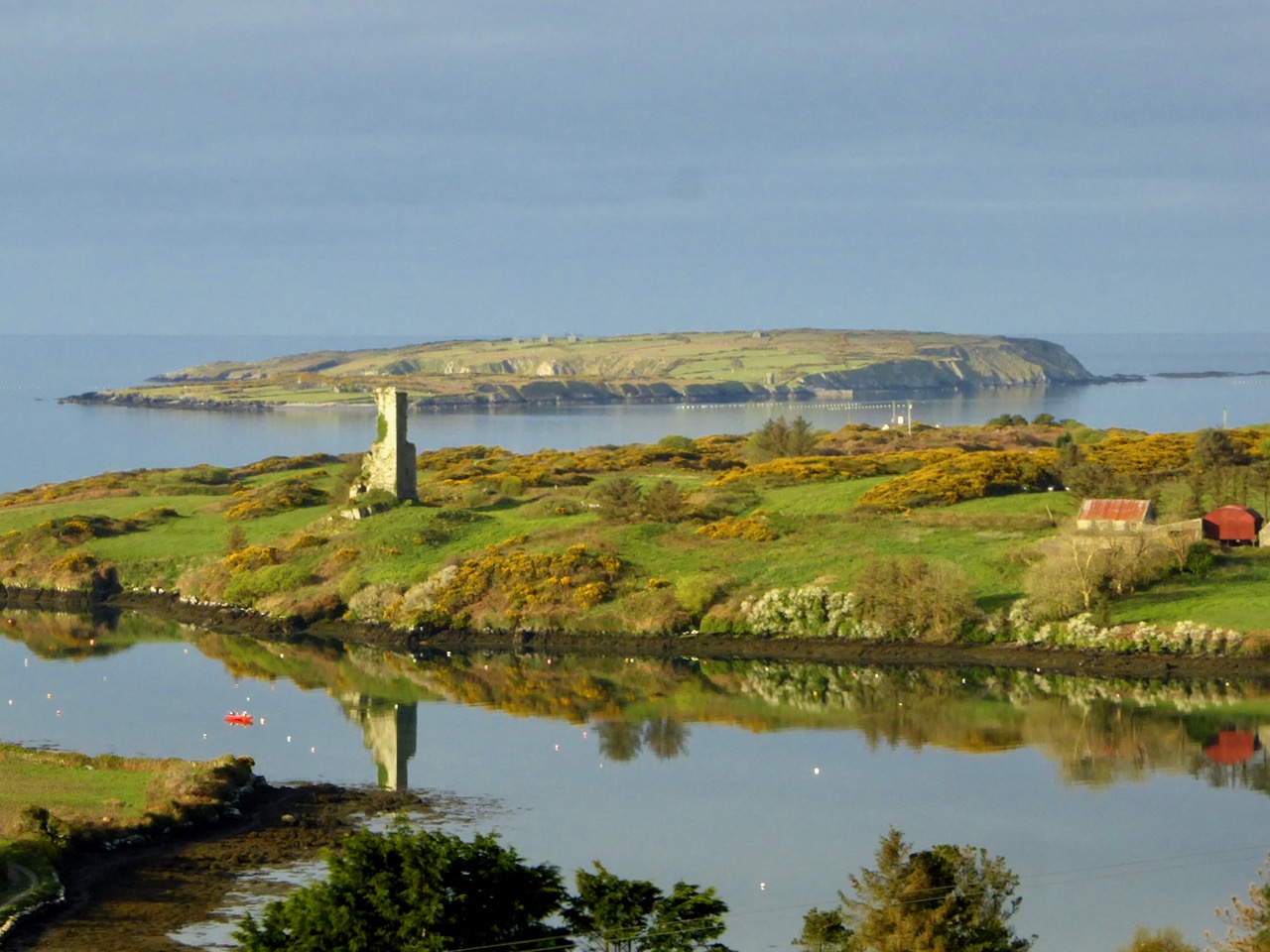
It’s good to see a bit of context, so here is another winter view of the castle on its rock with Castle Island behind. That island was also part of the O’Mahony territory. It is farmed by its present owner but no-one lives there now. You can make out the ruined castle on the island by the shore, just to the right of centre; it’s one of many that can be seen on, or close to, the shores of the Bay.
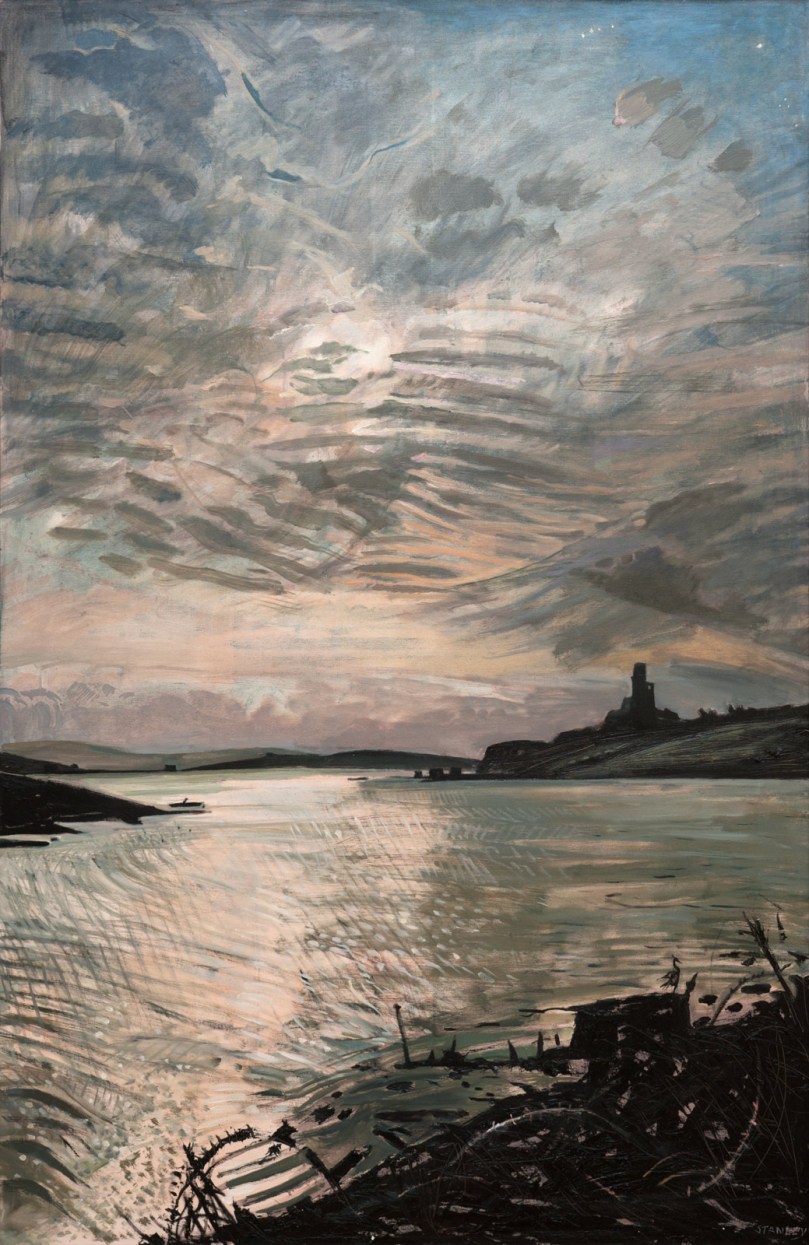
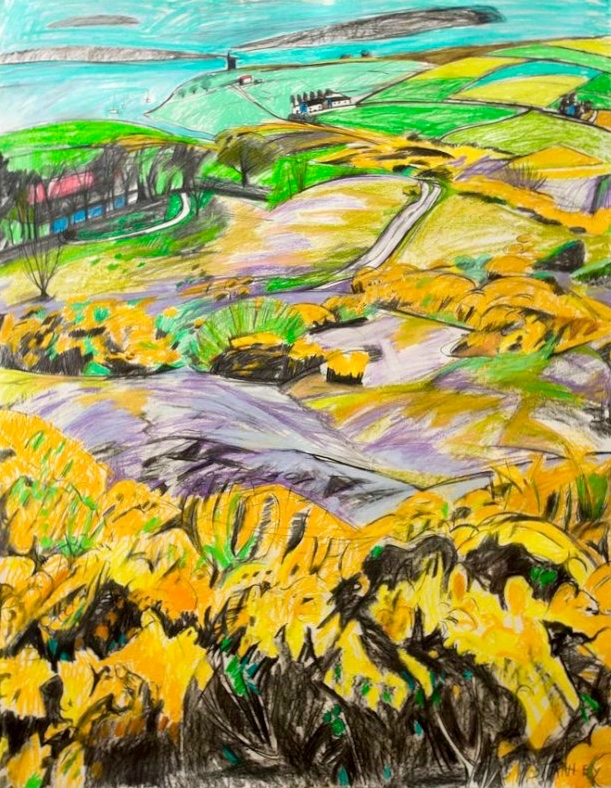
Let’s have a look at some of the art works that feature the Cove and the Castle. Jacqueline Stanley was one of many artists who was attracted to the beauty of West Cork. Now in her nineties, she moved from England to Ireland in the mid 1970s and purchased the old School House at Rossbrin as a country retreat: it has only recently changed hands.Here are two of her works, depicting Rossbrin. You can find more on her website.
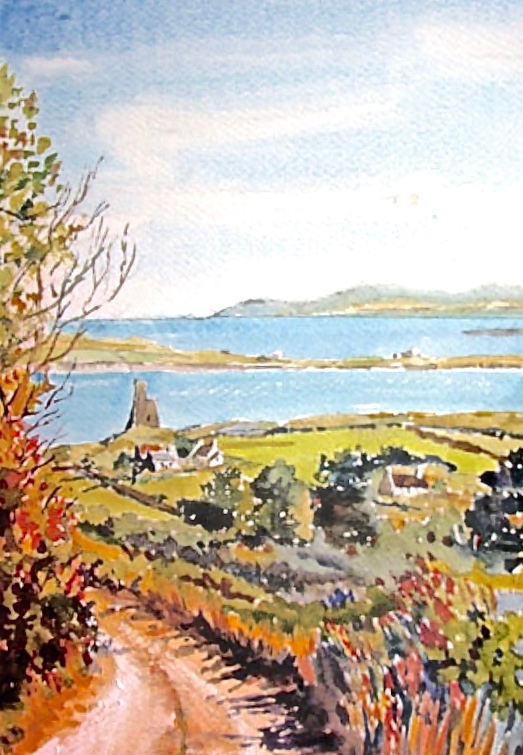
I particularly like this view (above) which was painted by Jackie from the vantage point above the high road going down to the Cove, close to the remains of the copper mine at Ballycumisk. Last week I showed a painting by Geraldine van Hasselt, Julian’s mother, also from the 1970s. Every painting or photo is a historical document – and important to retain, in view of the fragile nature of the structure today.
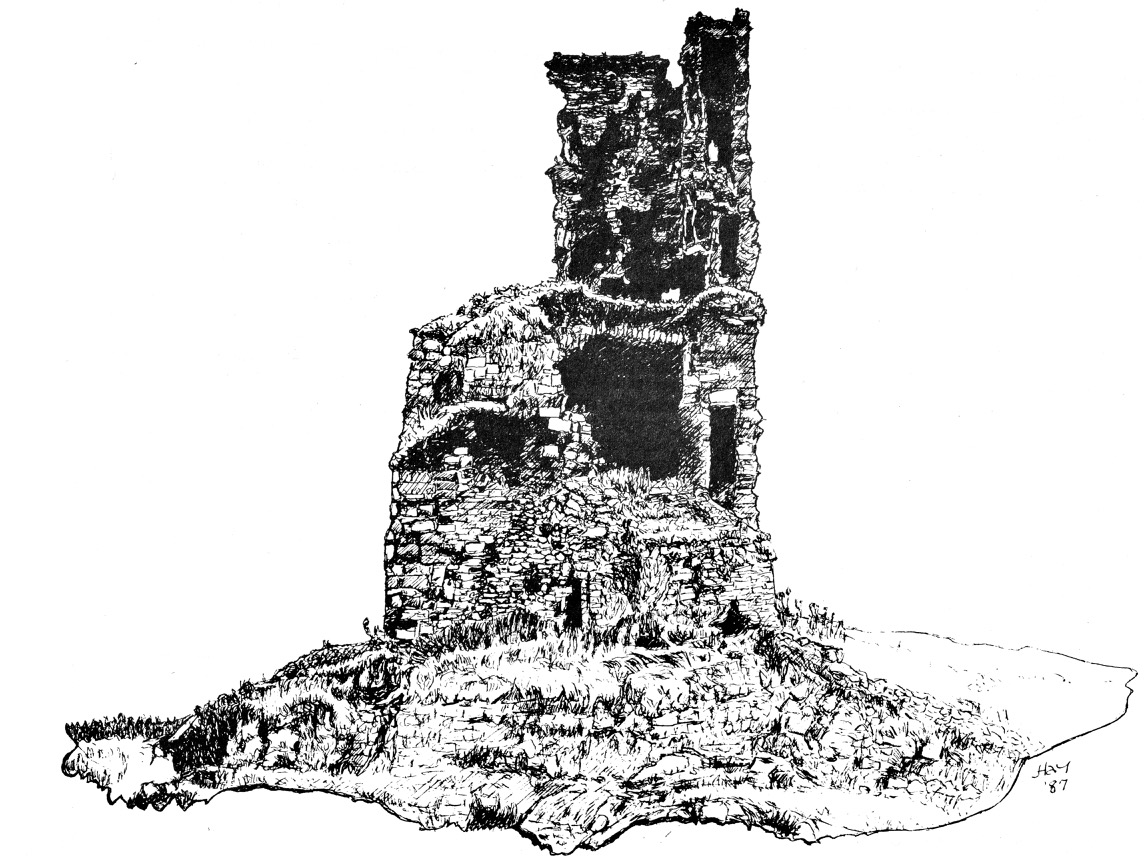
Our friend Peter Mabey is an architect and artist. He has lived in West Cork for a long time: he and I were at college together in Kingston, Surrey, and were surprised to meet each other by chance in Skibbereen market a good few years ago now. Above is one of his attractive watercolours looking down towards the Cove. The vantage point looks remarkably like the one chosen by Jackie Stanley. Below is a drawing of Rossbrin from the monumental work The Castles of County Cork by the late James N Healy, published in 1988 by Mercier:
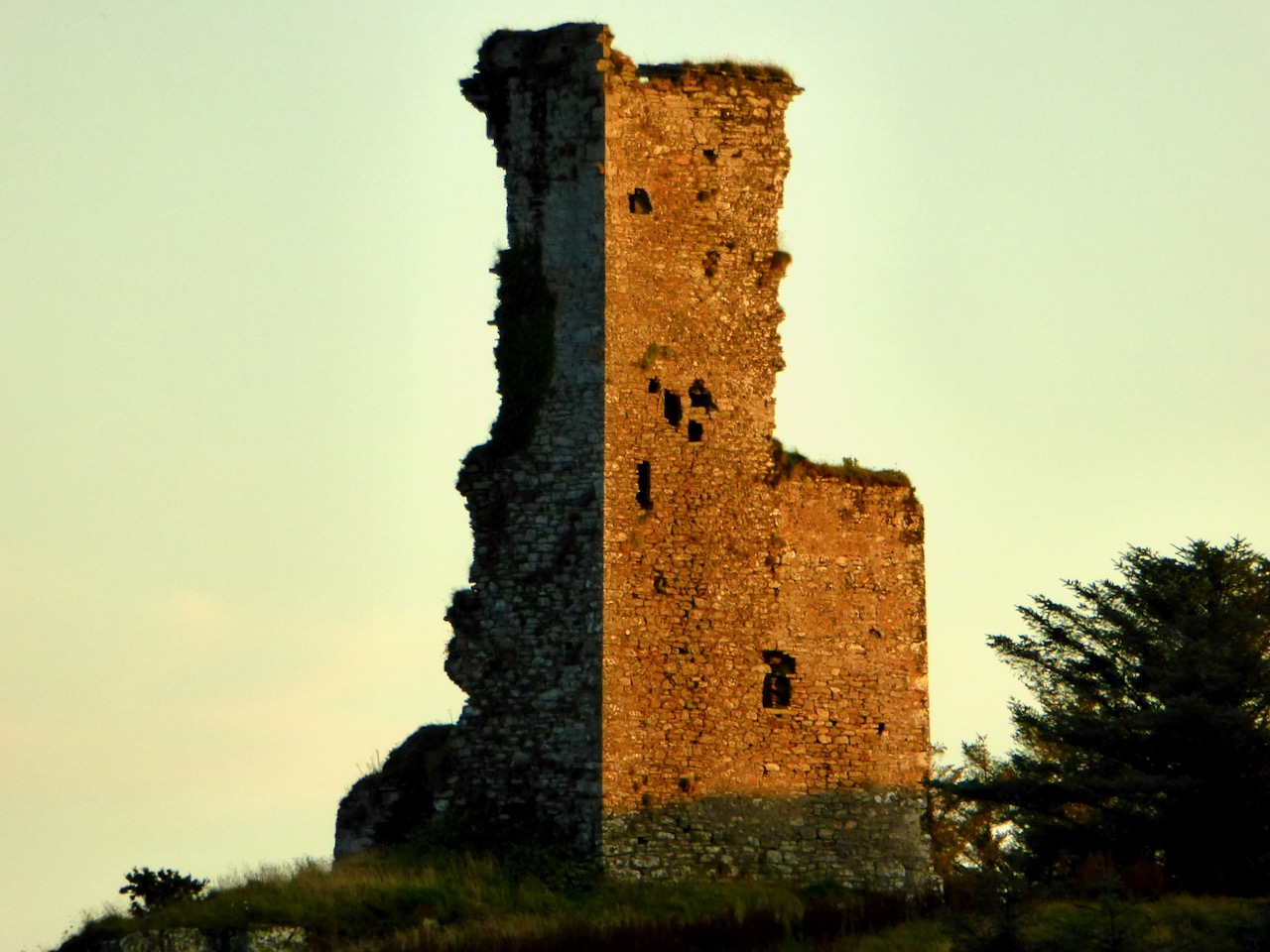
The ruin is a romantic reminder of past times, enhanced by the changing weather moods of Roaringwater Bay. This photograph, by Finola, emphasises the character of the place:
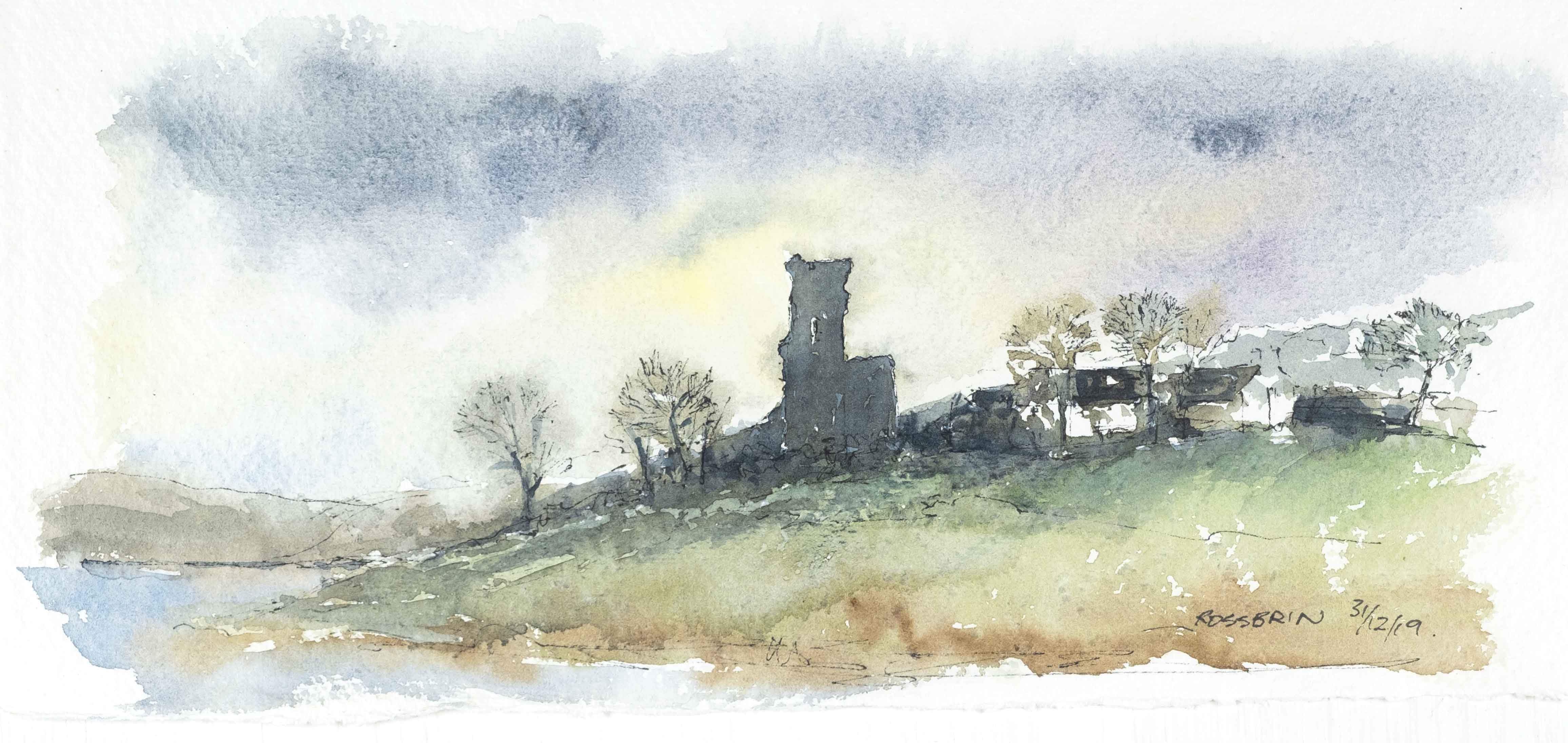
I can’t resist finishing this little two-part foray into the medieval remnants of our historically significant ‘centre of culture and learning’, which now languish on the edge of the waters below us with an artist whose work we admire: Peter Clarke, who writes and illustrates the Hikelines blog. His watercolour sketches are exquisite and always atmospheric. He has kindly allowed me to use his portrayal of Rossbrin Castle as my tailpiece. Thank you, Peter – and thank you to all the other artists who have been inspired by this remote and beautiful part of Ireland.
As a student of rock art I am often asked whether a cupmark, the central motif of all Irish rock art, could be just idle ‘doodling’. In response I have usually asserted that making a cupmark is quite a lot of work and therefore unlikely to be the result of simply whiling away time. But I must admit I based that answer on my own guesswork about of the time and difficulty involved, rather than on solid evidence. Well, no more! The scientific evidence is in – read on to see what we found.
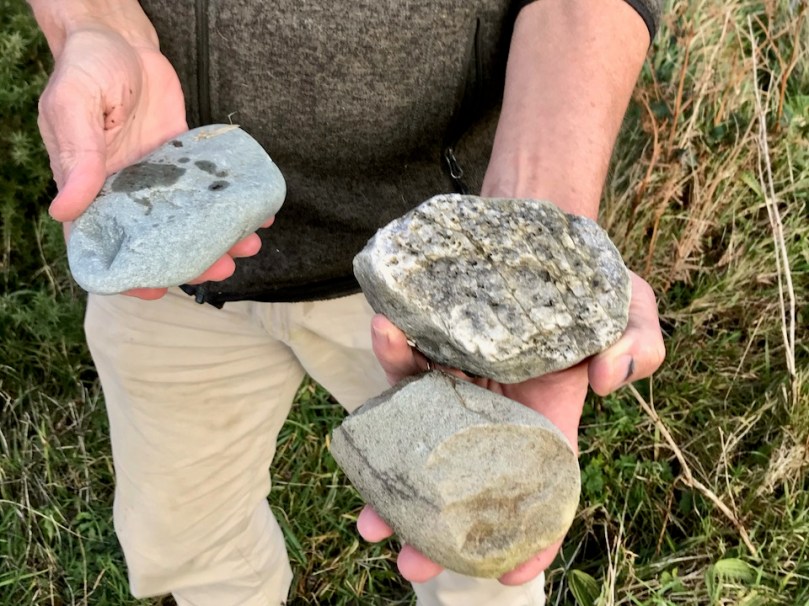
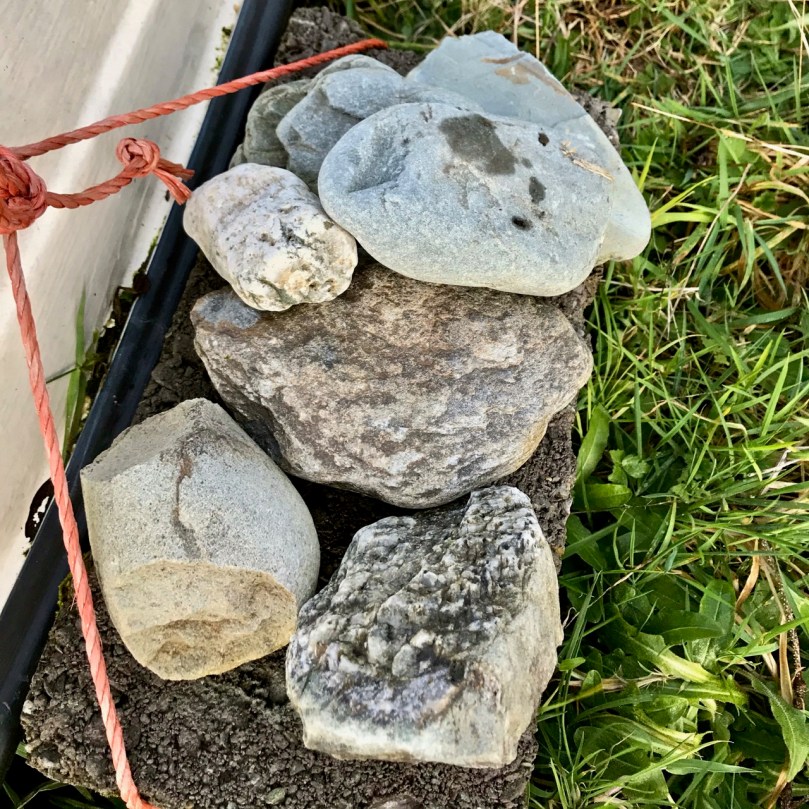
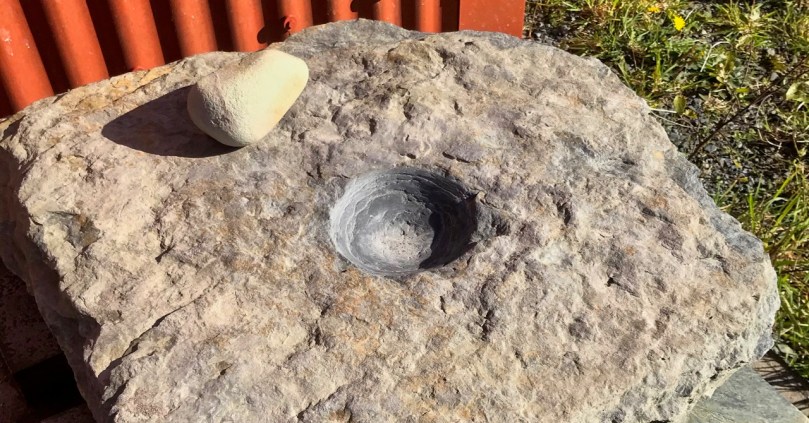
Before he started – Oliver chose a piece of local sandstone and a variety of water-rolled cobbles as picks
First of all, let’s recap what a cupmark actually is. It’s a semi-hemispherical indentation on a rock surface which has been made by a human in the past. In Ireland it’s the most common motif found in prehistoric rock art, often on its own, and also associated with one or more concentric rings, lines extending from the cupmark through the rings, and other lines and grids. It’s usually circular in outline, sometimes perfectly so and sometimes rough and approximate. For a thorough discussion of Irish cupmarked stones, take a look at our post The Complex Cupmark, which has lots of illustrations of cupmarks, both on their own and with cup-and-ring marks. It’s a good introduction to what we are talking about and where they are sited in the Irish landscape.
Oliver found that the first part was the hardest – almost, he said, as if there was a skin you had to break through
Grand so – now you know all about cupmarks except for how, really, they were made. Our friend Oliver Nares became interested in this topic having read our blog posts, and decided that this question should be answered once and for all. In doing so, he has provided a real service to science.
Once through the ‘skin’ things went a little faster and the hammering action raised lots of dust. In some ethnographic studies of cultures that carve cupmarks it appeared that the dust was one of the desired outcomes and played a part in whatever rituals were involved
Believing that he should replicate as closely as possible local conditions, Oliver selected a piece of local sandstone as his base. The technique used to carve is often described as ‘picking’ – that is, repeated taps on the surface of the rock by a stone ‘pick’. No metal was used: the cupmark tradition, although it persisted in time well into the Bronze Age, started in the Neolithic before the invention of metal tools. Copper or bronze would not have been strong enough anyway.
Oliver started with a quartz pick, reasoning that, as one of the hardest local minerals, this would be the ideal stone. However, he soon realised that the quartz stones he could find were not large enough to make a serious impact on the sandstone surface.
He gathered a variety of water-rolled cobbles from a local beach and worked away until they became too chipped, or until they broke. In this way he went through at least a dozen cobbles, perhaps as many as twenty.
On one visit to watch progress I took a turn. What I found hard was maintaining the round shape – as you can see my hammering was turning Oliver’s lovely circle into an egg-shape
A pick is generally a pointed tool – a bit like a hammer but with a pointed tip that allows a geologist, say, to split rock to take samples. Modern picks are made of very hard steel. In practice, it is almost impossible to find a stone that will mirror the pointy-ness and the hardness of a steel pick. Oliver found that hammering or bashing with a cobble was actually the only way he could make headway on carving out the cupmark. Perhaps picking, in fact, is not quite the right was to describe the technique.
Once the cupmark was as deep and round as he wished, his next step was to smoothen the inside. We have noted this as a feature of cupmarks – when you run your fingers around the inside they do feel more smooth than rough. In fact, a rough surface is often an indication that the ‘cupmark’ is actually a naturally occurring geological anomaly or solution pitting rather than the product of human labour.
At first Oliver used only water to grind away at the surface (above), but soon added beach sand (below) and saw an immediate improvement. His finished product – a cupmark 12cm across and 3.5 com deep – was nice and smooth inside. In terms of size, this cupmark falls well within the normal range of variation in the cupmarks we have seen.
So, how much time did this actually take, and how much work was it? Oliver estimates that he putbetween 20 and 25 hours into making this cupmark. Despite being tall and strong, he couldn’t work on it for too long at a stretch because, as is obvious in the videos, repetitive strain and muscle damage was a real hazard.
The other thing that smoothing did was bring out the dark colour of the rock under the surface
What Oliver has shown is that nobody would carve a cupmark unless they were deeply motivated to do so. It must have been an important activity associated with some aspect of the culture that required the kind of labour involved. Perhaps long practice enabled prehistoric carvers to make a cupmark in less than the time that Oliver took but there’s no denying that even for an expert this is a significant undertaking.
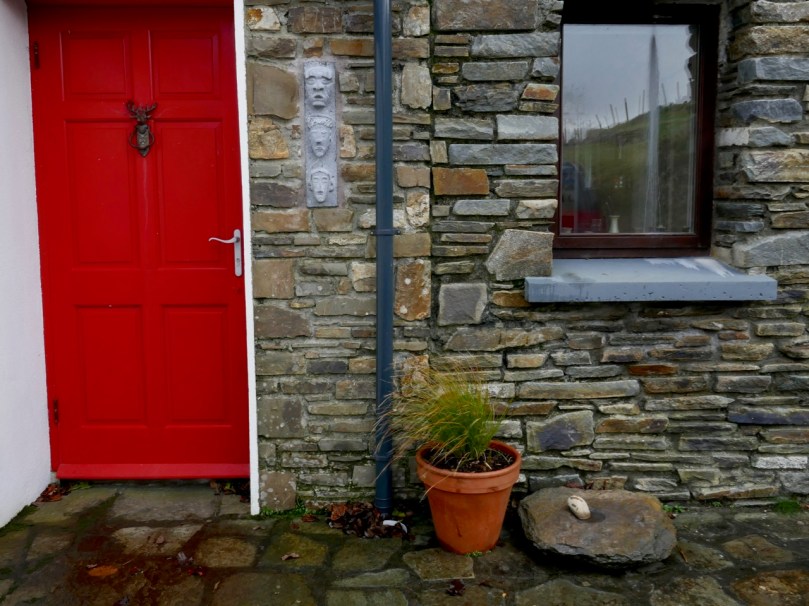
Thank you, Oliver, for all that effort! And thank you too for the cupmarked stone itself, now occupying a space outside our door. it looks great – but more than that it is a constant reminder of both your generous donation of your time in the cause of science and the age-old tradition of cupmark carving and the mysteries that lie at its heart.
You may remember my excitement when – a few years ago now – I found out that the real St Valentine is interred in the Carmelite Church in Dublin. But here’s a palpable marvel: at Jerpoint, Co Kilkenny, the bones of St Nicholas are reputed to be buried. Yes – the Santa Claus St Nicholas! Tradition has it that a band of Irish Norman knights from Kilkenny went to the Holy Land to take part in the Crusades. As they headed home to Ireland, they ‘seized’ St Nicholas’ remains, bringing them back to Jerpoint, where the bones were buried – some say – under the floor of the Abbey (others say they repose nearby at the old church of St Nicholas).
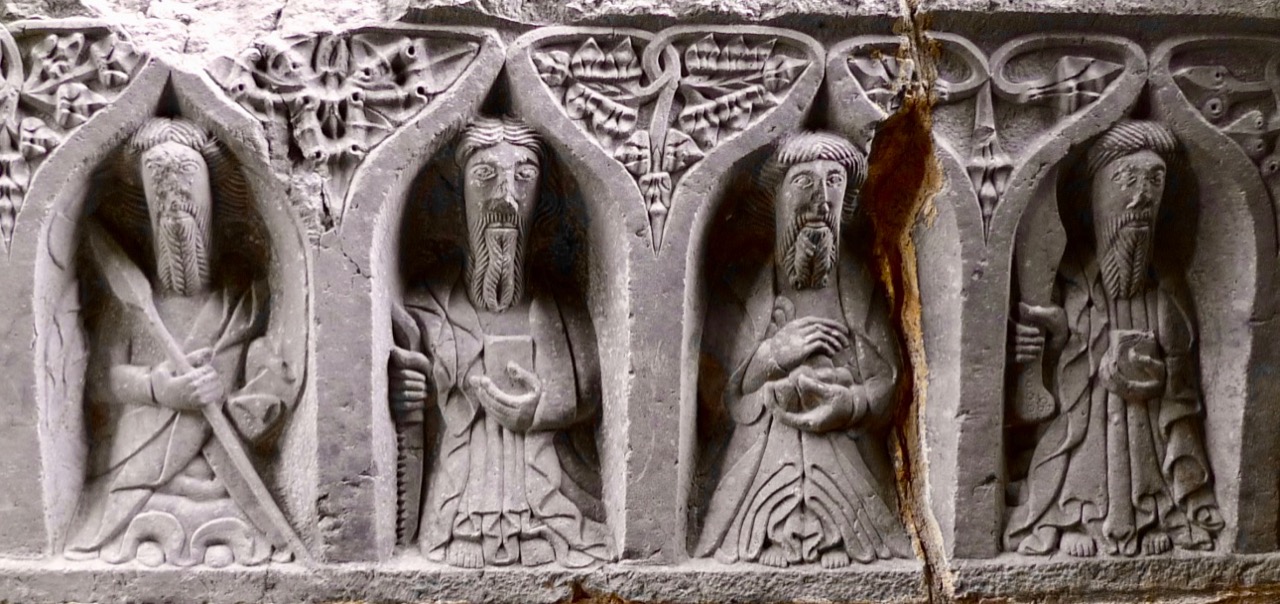
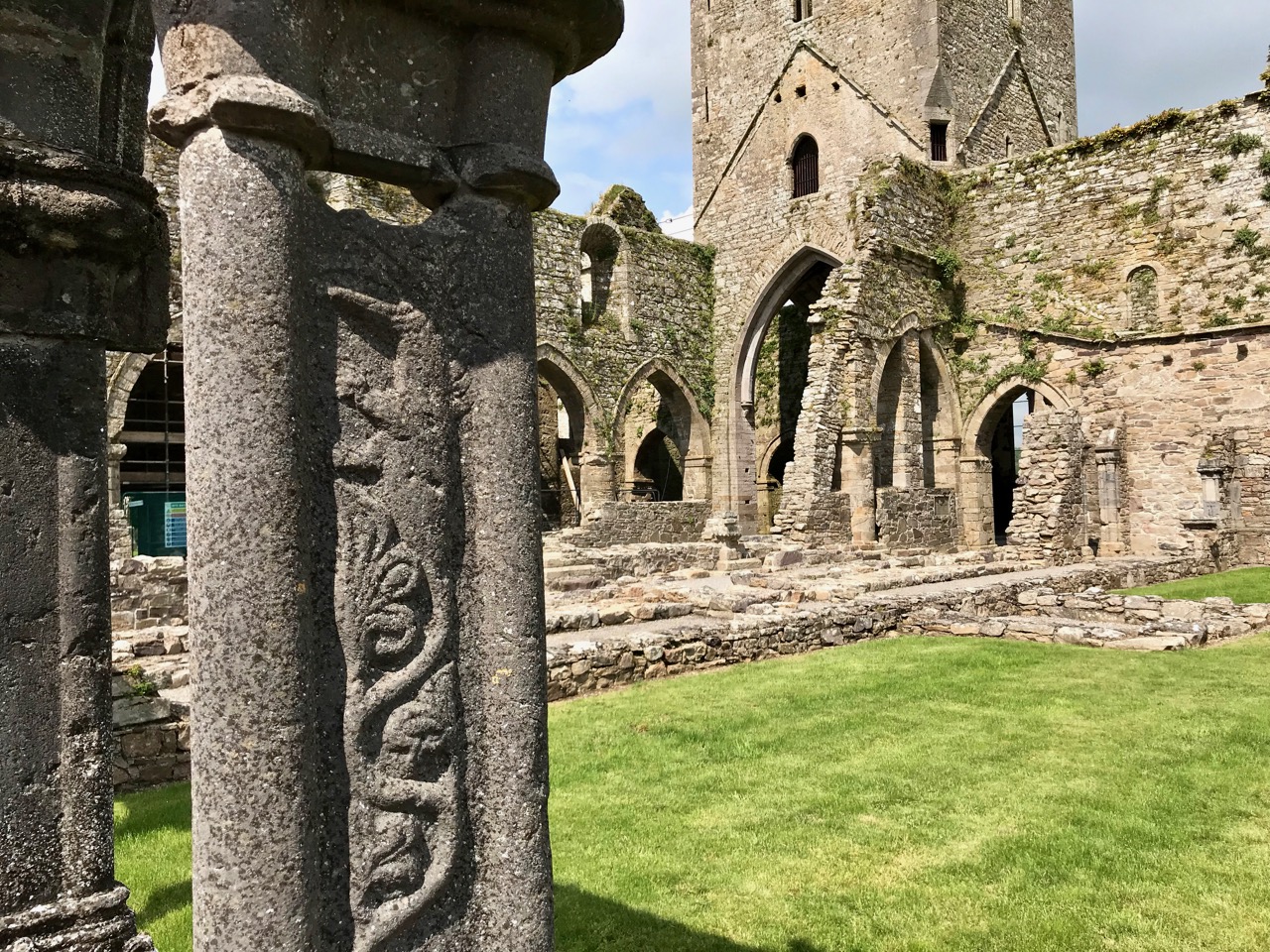
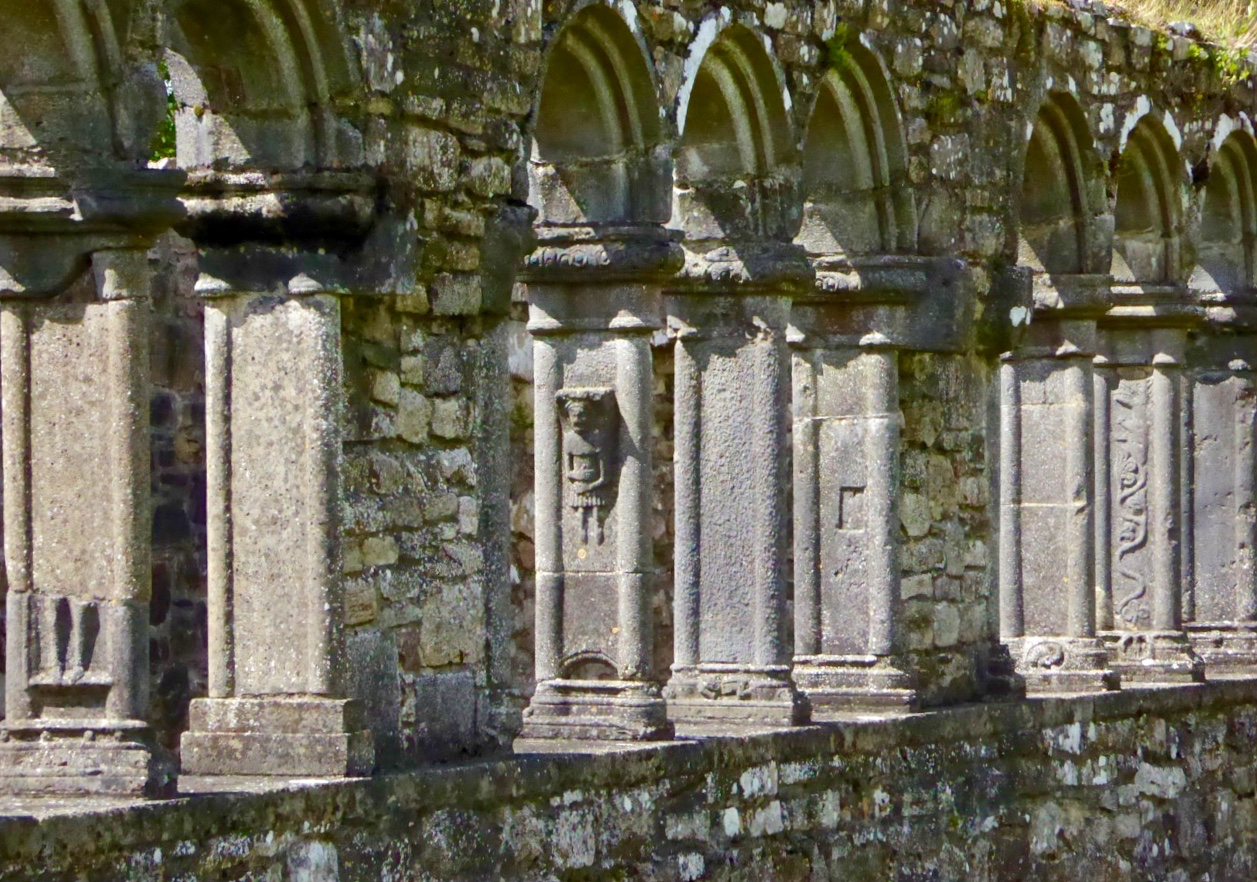
We first visited Jerpoint back in 2015, on a trip that took us to County Meath where we explored the monastic city of Kells (the famed book was written and illustrated there) and also where we found the medieval image of Santa’s reindeer in the header of this post! It is carved on to the base of the town’s Market Cross. We also visited Kells Augustinian Priory – a different Kells but in County Kilkenny – and Jerpoint Abbey itself, a Cistercian monastery rife with carved figures, some up to 900 years old. Look at the ‘Weepers’, above, carved by members of the O’Tunney family – sculptors from Callan who worked in the 15th and 16th centuries. These four represent saints and show how they were martyred: St Thomas with a lance (left), St Simon with a saw, St Bartholomew holding a skin (he was flayed to death) and St Paul with a sword.
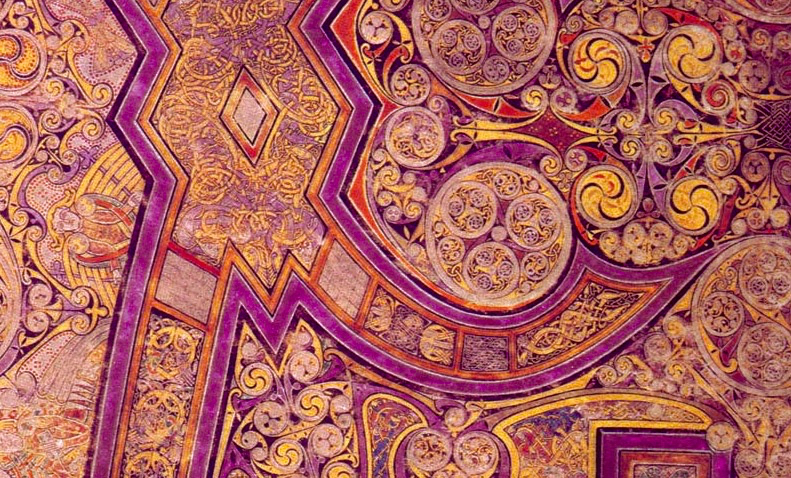
The Book of Kells is worth more than a passing mention, especially as some commentators have likened the medieval carvings at Jerpoint and other contemporary monastic foundations in Ireland to ‘illuminated manuscripts cast in stone’, because of the richness of the characters, the decoration and the detail. The Book (that’s just one example of the incredibly detailed capitals on a single page, above) probably dates from the 8th or 9th centuries and may either have been written in its entirety in Kells, or started by St Columba’s community in Iona and completed in the Scriptorium in Kells. That building still exists! In fact it (or something very like it) is illustrated in the book. It’s known as St Colmcille’s House – we went to have a look at it, and were fortunate to have a tour by its guardian.
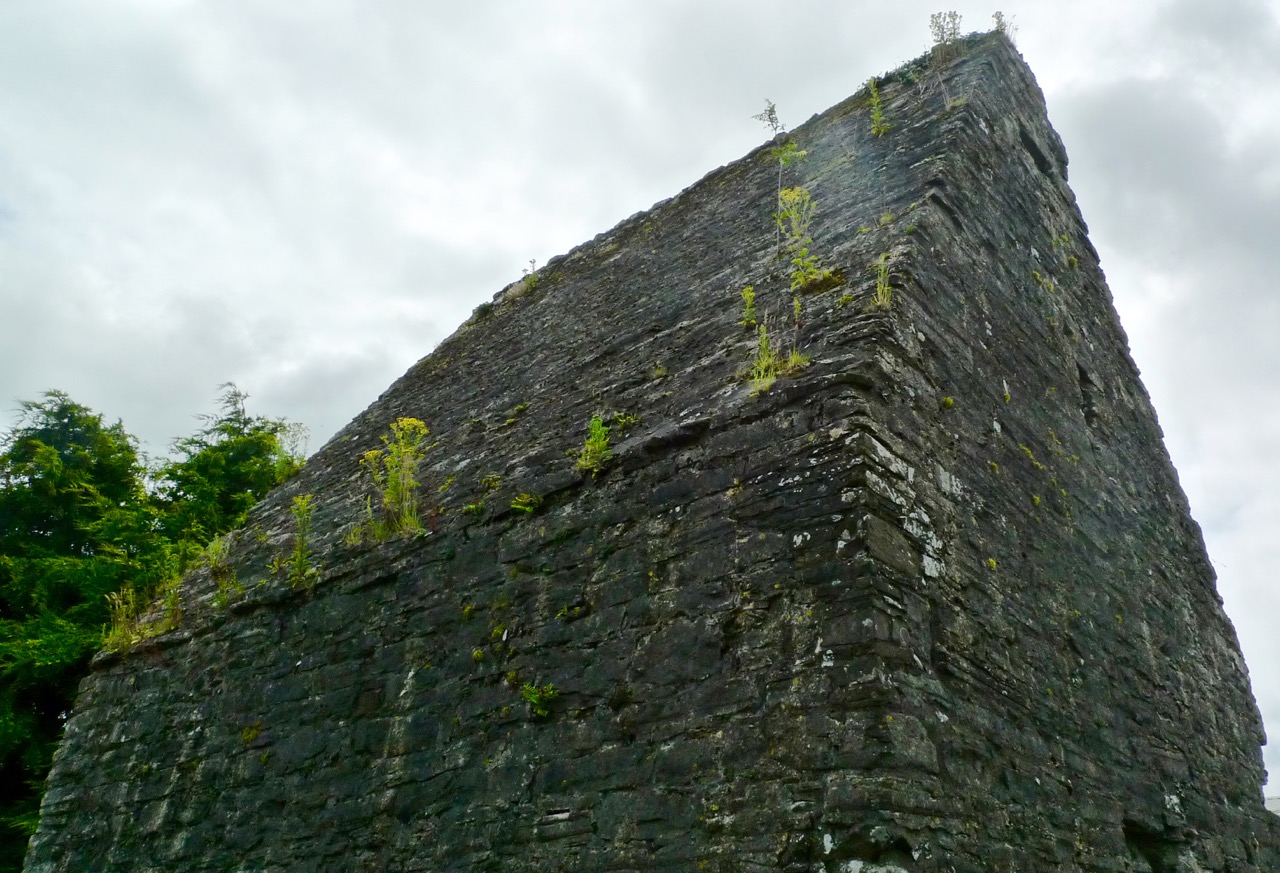
Here is the ancient stone roofed oratory of St Colmcille’s House (above), supposedly the place where the Book of Kells was written – or, perhaps, completed. The upper floor of the building has a small window oriented to focus sunlight on the writing table. St Colmcille’s bed was also kept here – a large and heavy stone slab – until it was stolen in the 1950s! A few hundred years earlier (in 1007) the Book itself was stolen from Kells and eventually found in a nearby bog. It stayed in Kells until 1654, when it was sent to Dublin for safekeeping: it is now on permanent display in Trinity College.
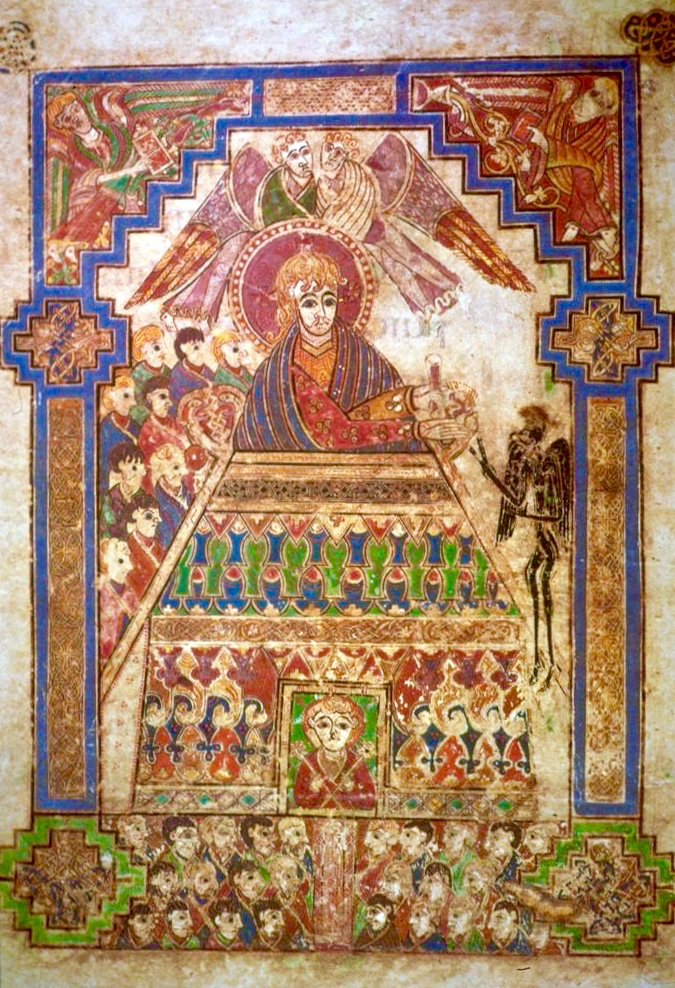
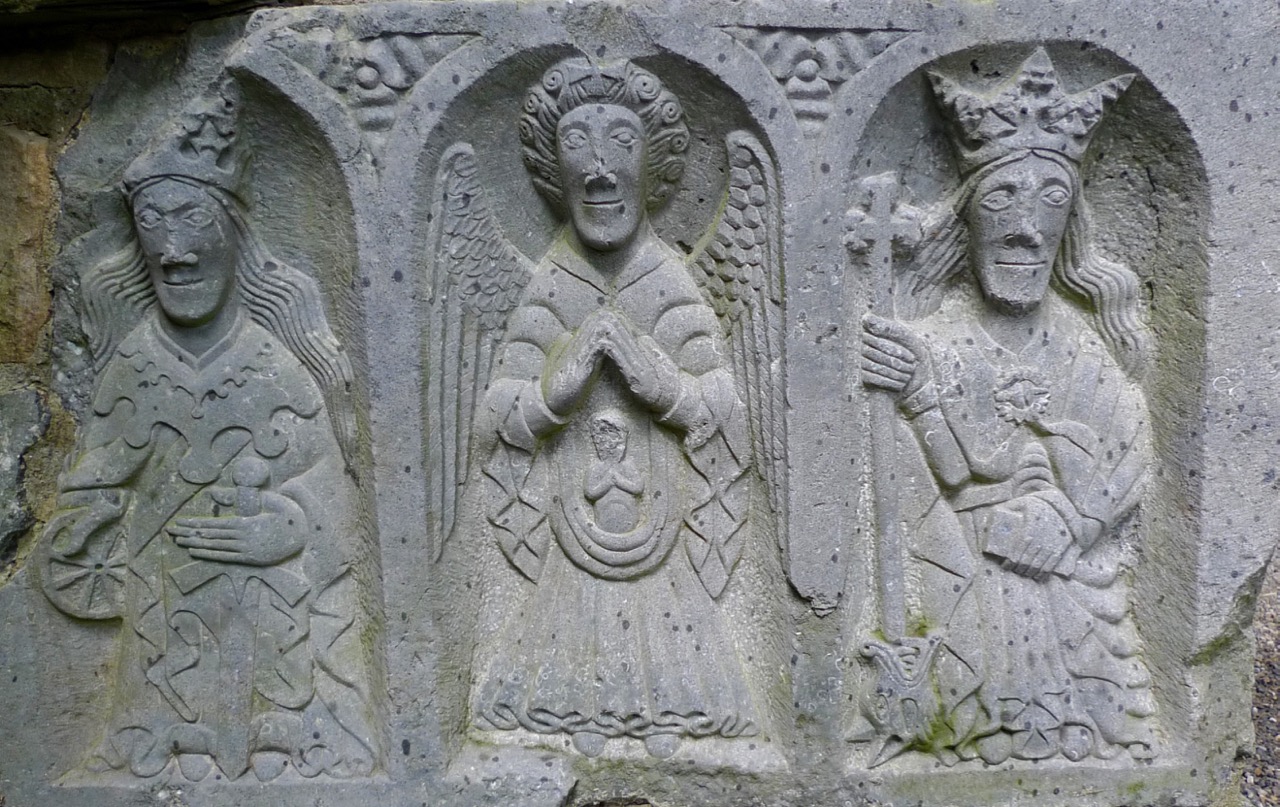
(Above) another page from the Book of Kells, which may be an illustration of the Scriptorium at Kells, and – perhaps – a self-portrait of the writer: see him sitting in the doorway to the house working away with his quill pens. Back to the medieval feast at Jerpoint: the trio below, from Jerpoint, are St Catherine – with her wheel, Michael the Archangel and St Margaret of Antioch – who is conquering a Dragon.
At Jerpoint it’s not just the tombs and the Weepers which fascinate: there is a 15th century cloister which, in its heyday, displayed a riot of carvings both saintly and secular. Some of these are in situ; some are partially destroyed and others have been recovered during archaeological excavations, and placed on display in a little museum. Among them we identified knights, ladies, animals fantastic and real, and ‘ordinary folk’ – including a man with stomach ache!
‘The Bones of Santa Claus’(Author Bill Watkins)
Where lie the bones of Santa Claus, to what holy spot each pilgrim draws Which crypt conceals his pious remains, safe from the wild wind, snows and rains?
It’s not in Rome his body lies, or under Egypt’s azure skies Constantinople or Madrid, his reliquary and bones are hid.
That saint protector of the child, whose relics pure lie undefiled His casket safe within its shrine, where the shamrocks grow and rose entwine.
Devout wayfarer, cease your search, for in Kilkenny’s ancient church Saint Nicholas’ sepulchre is found, enshrined in Ireland’s holy ground.
So traveller rest and pray a while, to the patron saint of orphaned child Whose bones were brought to Ireland’s shore, safe from the Vandal, Hun and Moor.
Here lie the bones of Santa Claus, secure beneath these marble floors So gentle pilgrim, hear the call, and may Saint Nicholas bless you all!
I hope this topical little foray into some of our archives demonstrates once more how easy it is to find history (and legend) wherever you go in this special land. In fact, it’s very difficult to travel far here without tripping over the past. It’s often fairly low-key. Most sites are protected as scheduled monuments; some are in the good care of the Office of Public Works and have guides and visitor centres. Many are remote, open to the wind, rain and sunshine and free for us all to visit: very often you will have the history all to yourself.
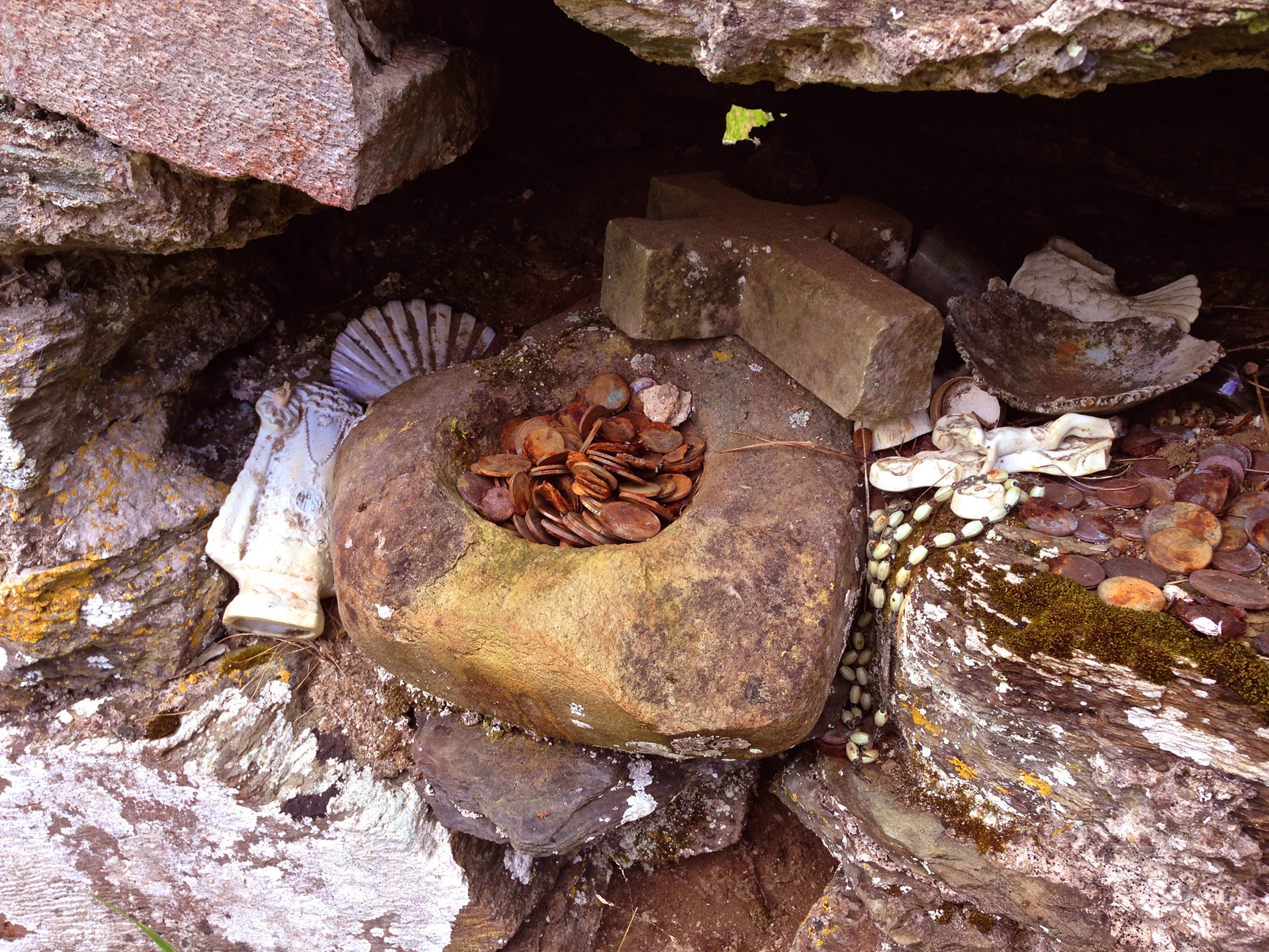
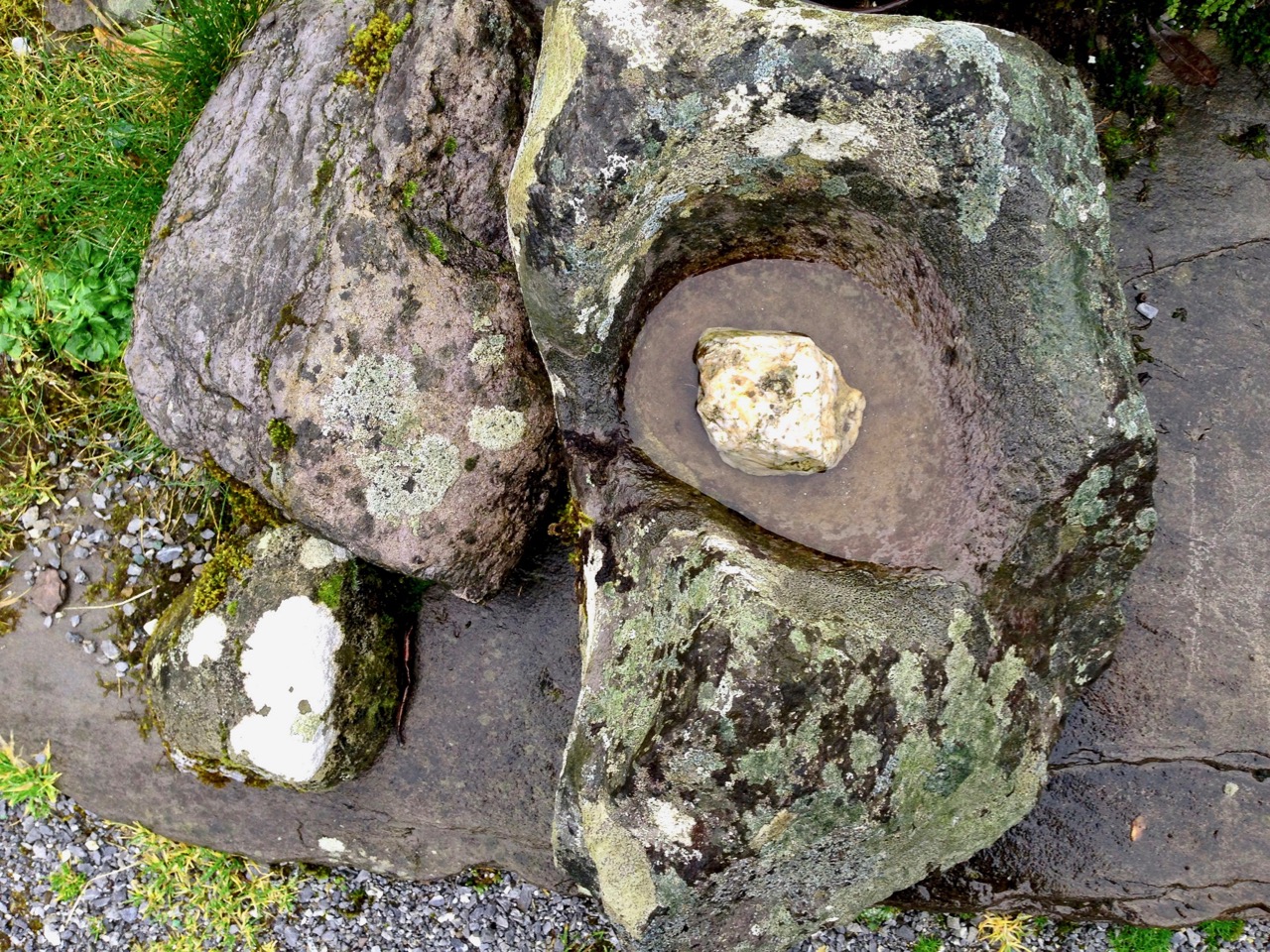
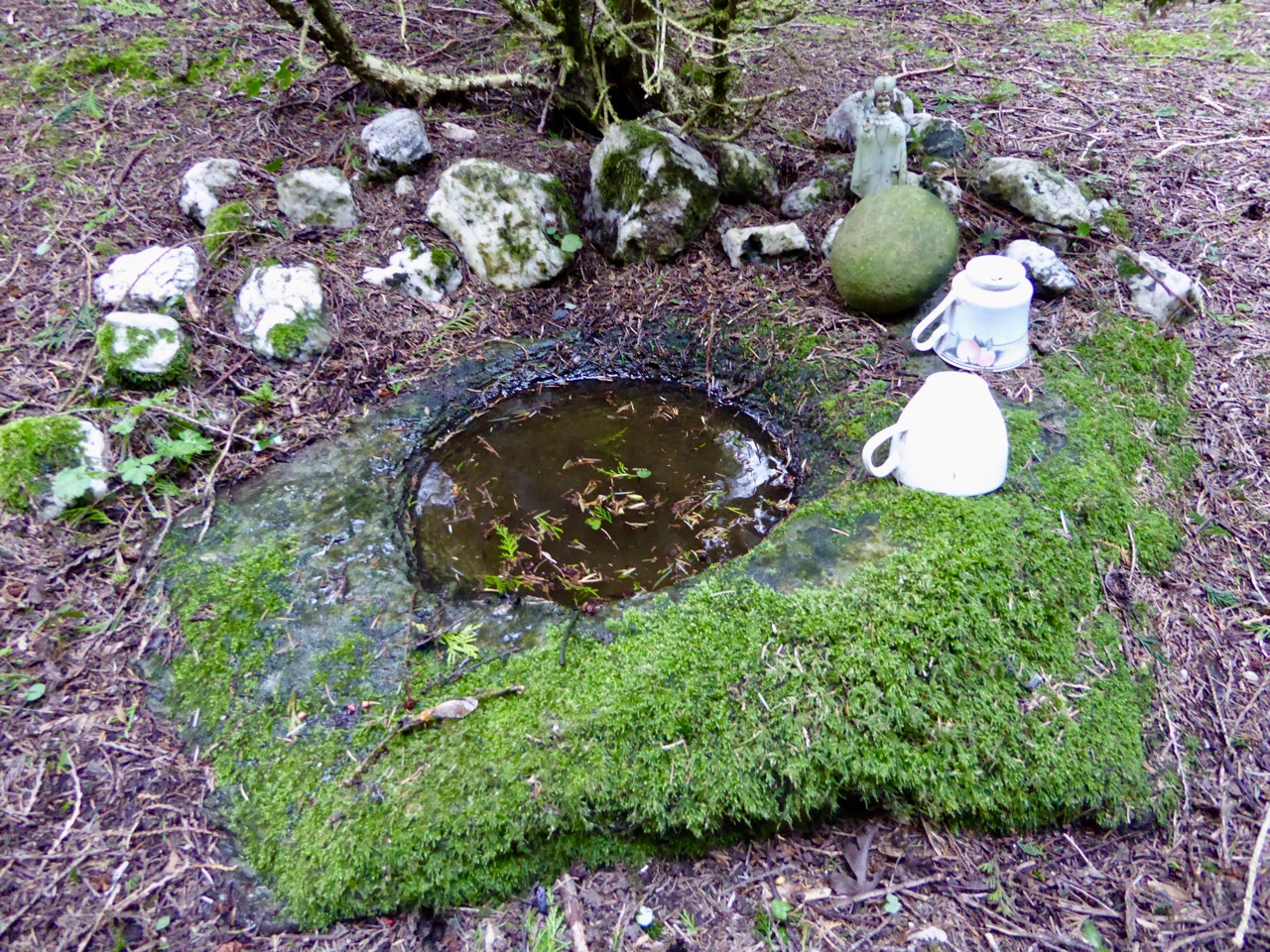
Bullaun Stones abound in Ireland. They are usually found nowadays at sites with ecclesiastical connections, as in the example above at Maulinward, an ancient West Cork burial ground. This association does not reduce or affect their traditional uses – according to folk convention – to cure or to curse. The Irish word Bullán means ‘bowl’ – a water container. At pilgrimage sites, such as St Gobnait‘s, Ballyvourney (below), the bullaun stones often hold quartz fragments or smooth, rounded pebbles – perhaps incised with a cross – which are turned around each time a pattern or procession is completed.
The Maulinward example on the header picture shows how the tradition of making offerings at some of these locations continues to this day. At other sites, such as the one below, the hollowed-out stone filled with rainwater takes on the properties of a holy well, and is visited for cures or simply good fortune.
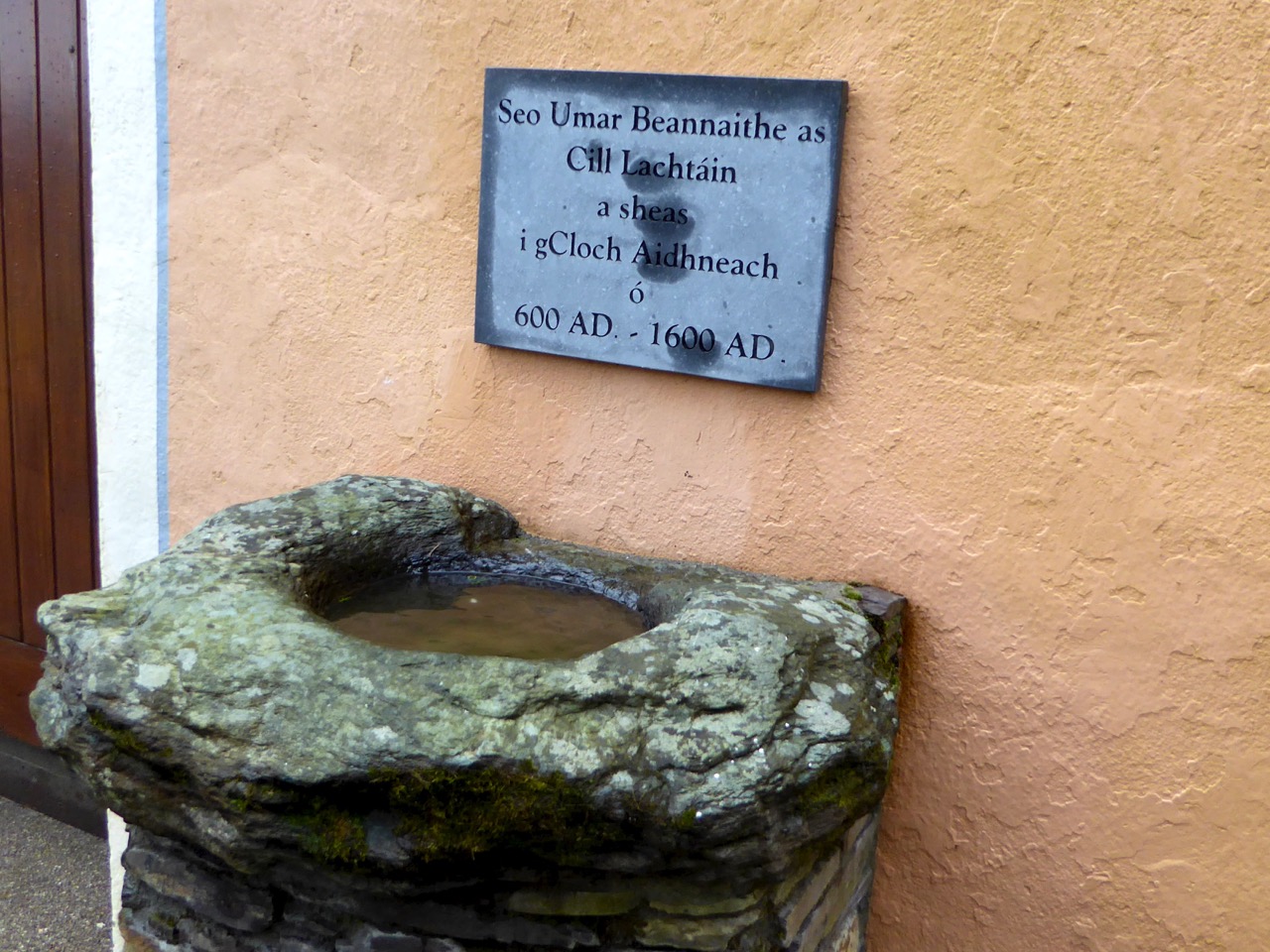
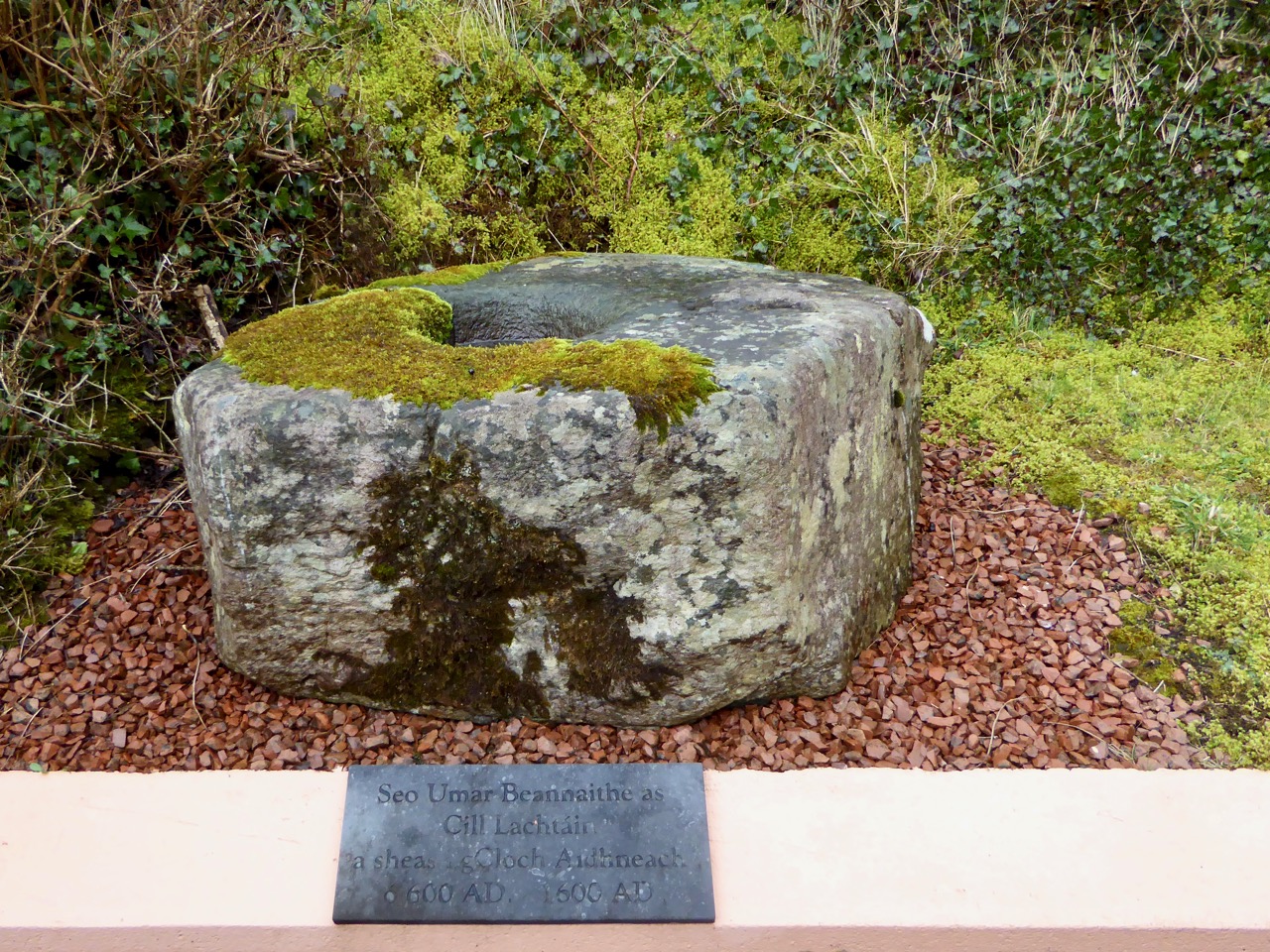
This example, outside the door of the church at Cill Lachtáin, Co Cork seems to have been mounted to perform as a holy water stoup: the plaque reads ” . . . This blessed font of Cill Lachtáin was standing in Cloch Aidhneach from 600AD to 1600AD . . . “ Others resemble fonts and are similarly associated with places of worship. Look at this striking stone from Timoleague Friary, whose purpose – according to tradition – is clearly stated:
In the sixth century, the Council of Tours ordered its ministers ” . . . to expel from the Church all those whom they may see performing before certain stones things which have no relation with the ceremonies of the Church . . . ” Such an order doesn’t seem to have prevented folk customs of curing continuing into the twenty-first century.
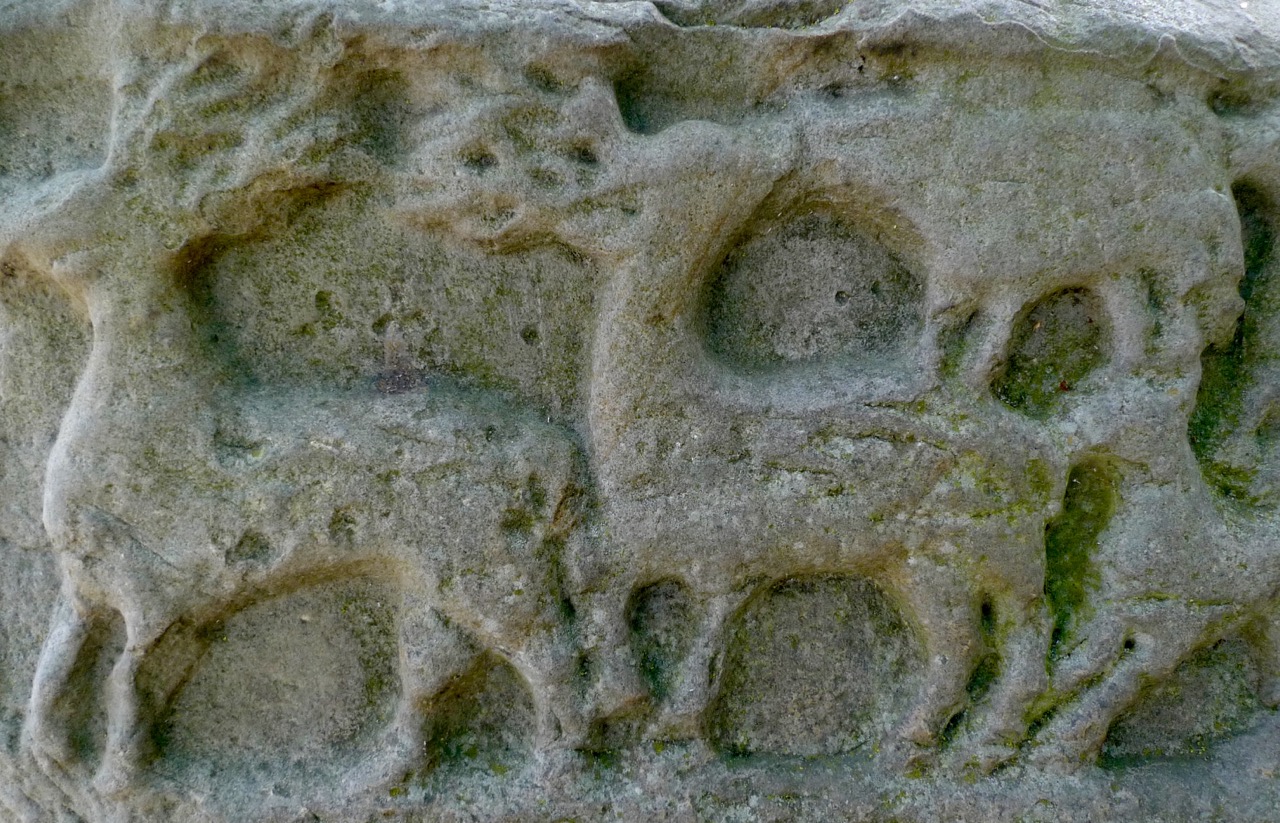
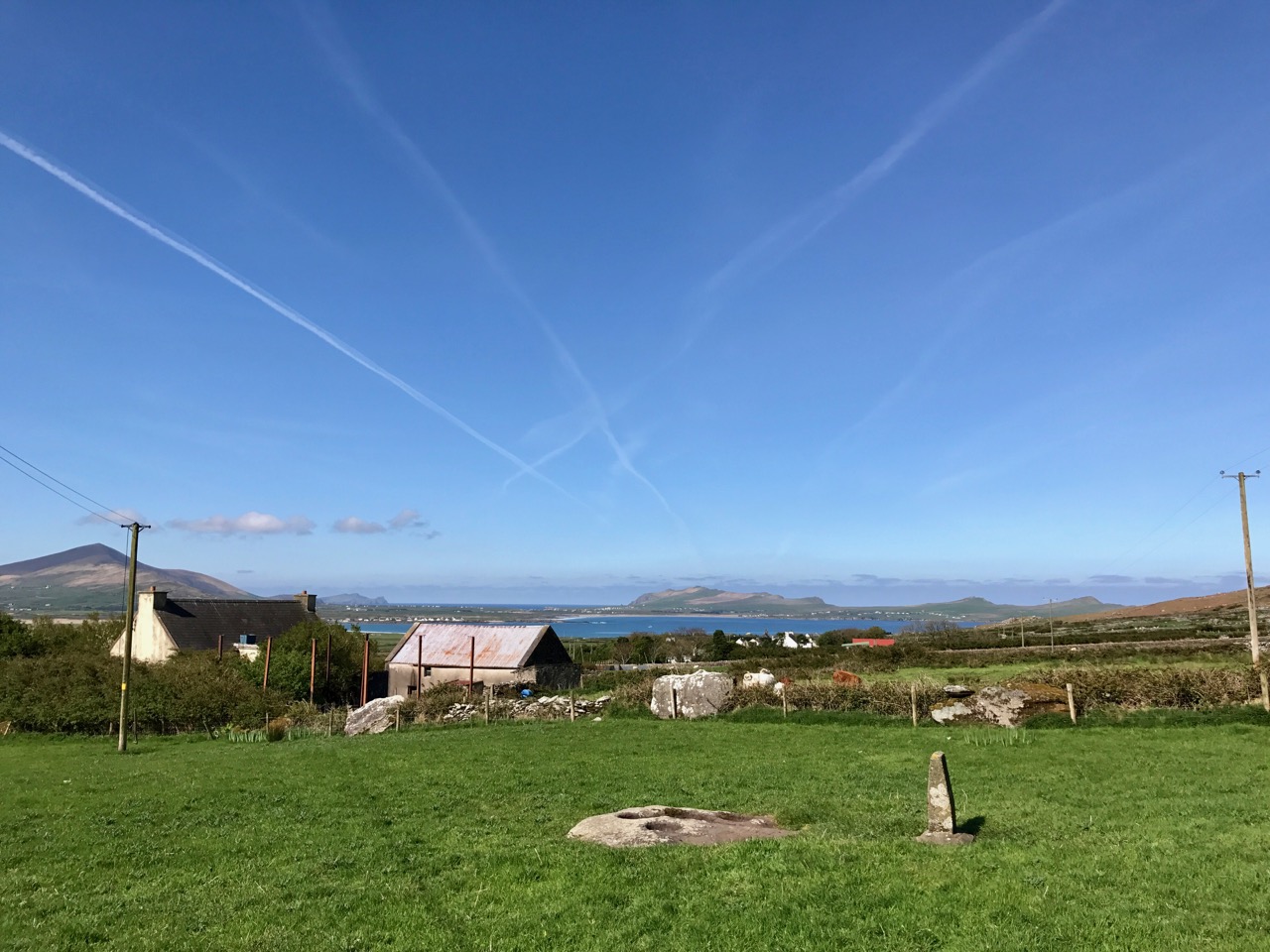
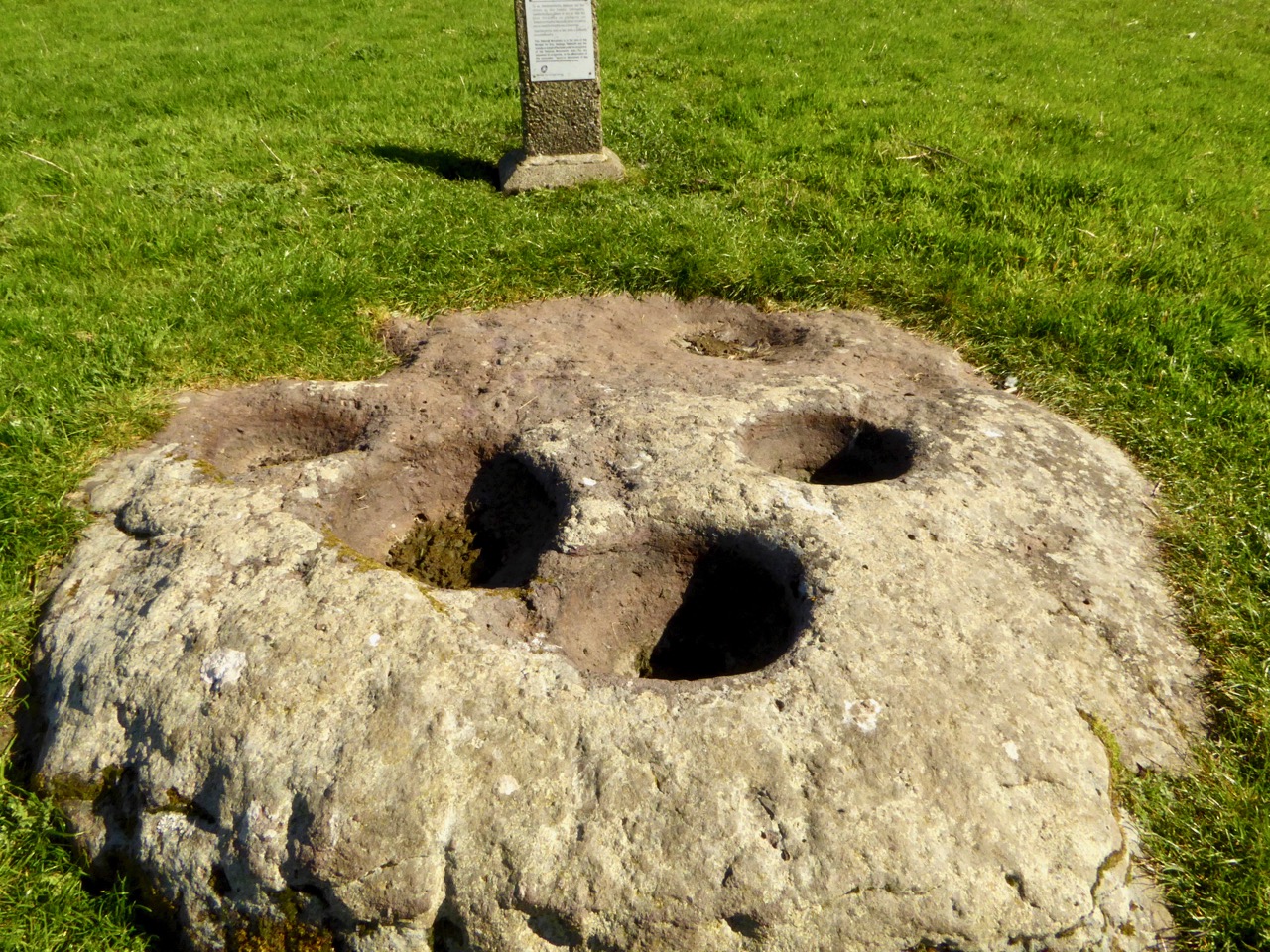
The ongoing use of bullauns as fonts, stoops or holy wells does not explain their original purpose (which is probably pre-Christian: here’s an interesting conjectural world view of the phemomenon), and it’s quite likely that we will never fathom for sure what they were for. The example above, at Kilmalkedar, Co Kerry is as enigmatic as they will get, with its multiple ‘basins’ carved into a large earth-fast boulder isolated in the middle of a field, although not far from a remarkably complex ecclesiastical site. But the one I find the most fascinating can be found along the Priest’s Leap road, a mere few steps away from our own home in West Cork . . .
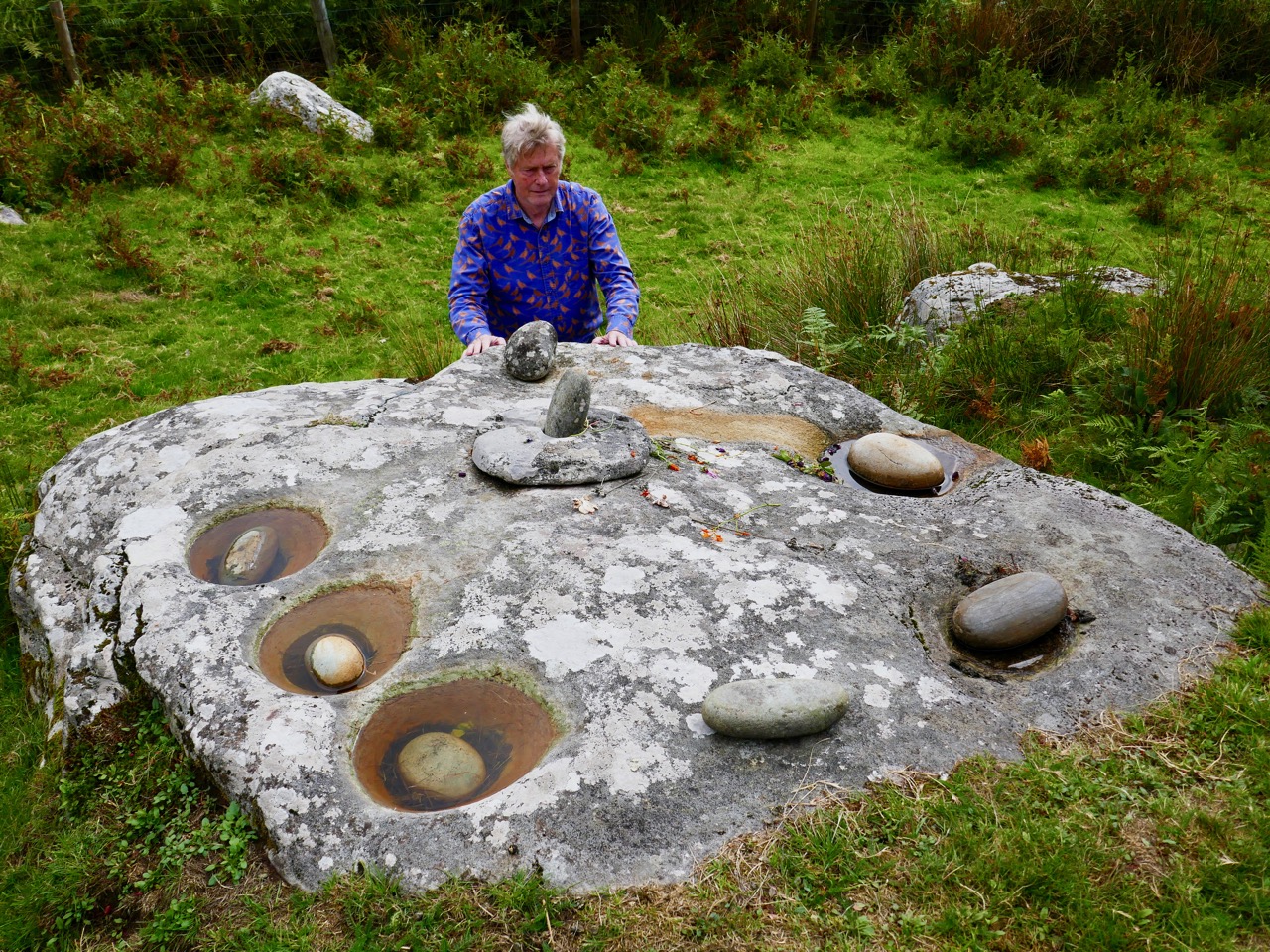
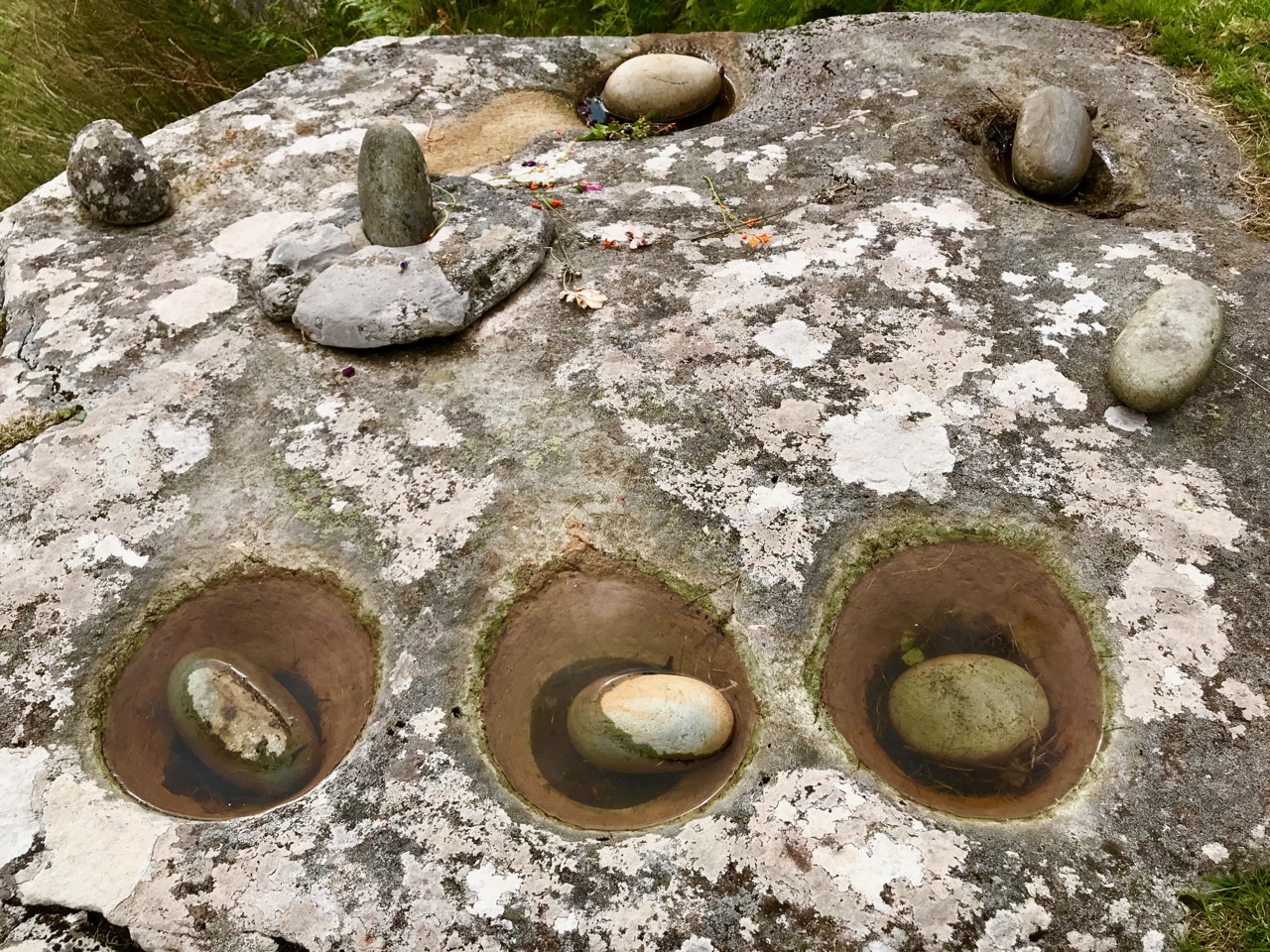
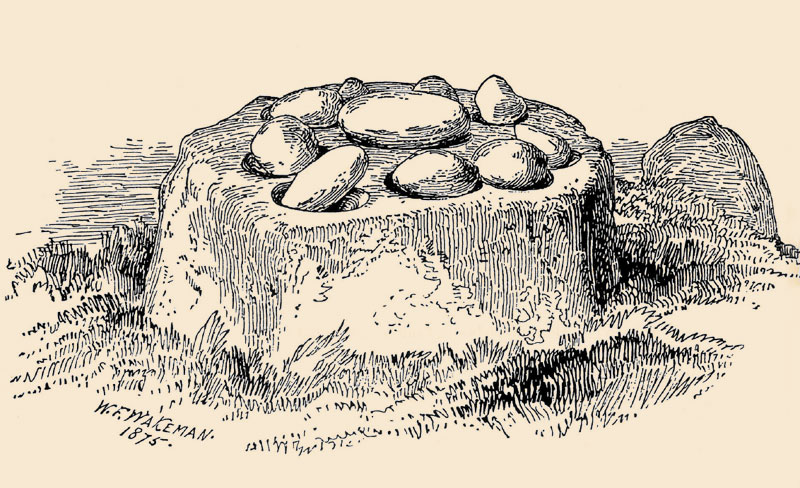
This rock outcrop – known locally as The Rolls of Butter – is large (I’m there to give it scale!) with seven scooped-out bullaun like basins and a somewhat phallic central upright stone. The basins each contain a large, smoothed pebble. Some folk traditions in Ireland identify such pebbles as ‘cursing stones’: “. . . if you wanted to put a curse on someone, you turned the stones anti-clockwise in the morning . . . ” However, the curse had to be ‘just’ otherwise it came back to curse you in the evening! The illustration below – of ‘cursing stones’ at Killinagh, Co Cavan was made by antiquarian W F Wakeman in 1875. He also noted the similar local folk traditions of these examples.
Many bullaun stones or stone groups around Ireland have been included in the National Monuments records, and number in the hundreds. Functional, magical, sinister? Who knows . . . Your guess is as good as anyone else’s. But one thing is certain – they are intriguing and mysterious. Keep a look out for them – as we do – in your travels around this land.
Note: this is a re-run of a post I published five years ago – but it’s been augmented, updated and – hopefully – improved!
If the wind is in the south-west at Martinmas (10 November), it keeps there till after Candlemas (2 February) . . .
I’m writing about St Martin again! I’ve already put up posts about this character and his fascinating legacy over the past few years. He can take another – after all, we celebrate St Patrick year after year and that’s ok, because this is Ireland . . . But St Martin never set foot in Ireland (as far as we know) although he is well remembered in many Irish traditions, including that piece of weather-lore above. And here – as elsewhere in Europe – there’s a phenomenon known as St Martin’s Summer, or Martin’s Little Summer, which describes an unseasonable spell of warm weather, sunshine and clear blue skies that occurs around about now, in mid-November. In fact today – Martinmas or St Martin’s eve – has dawned warm and clear.
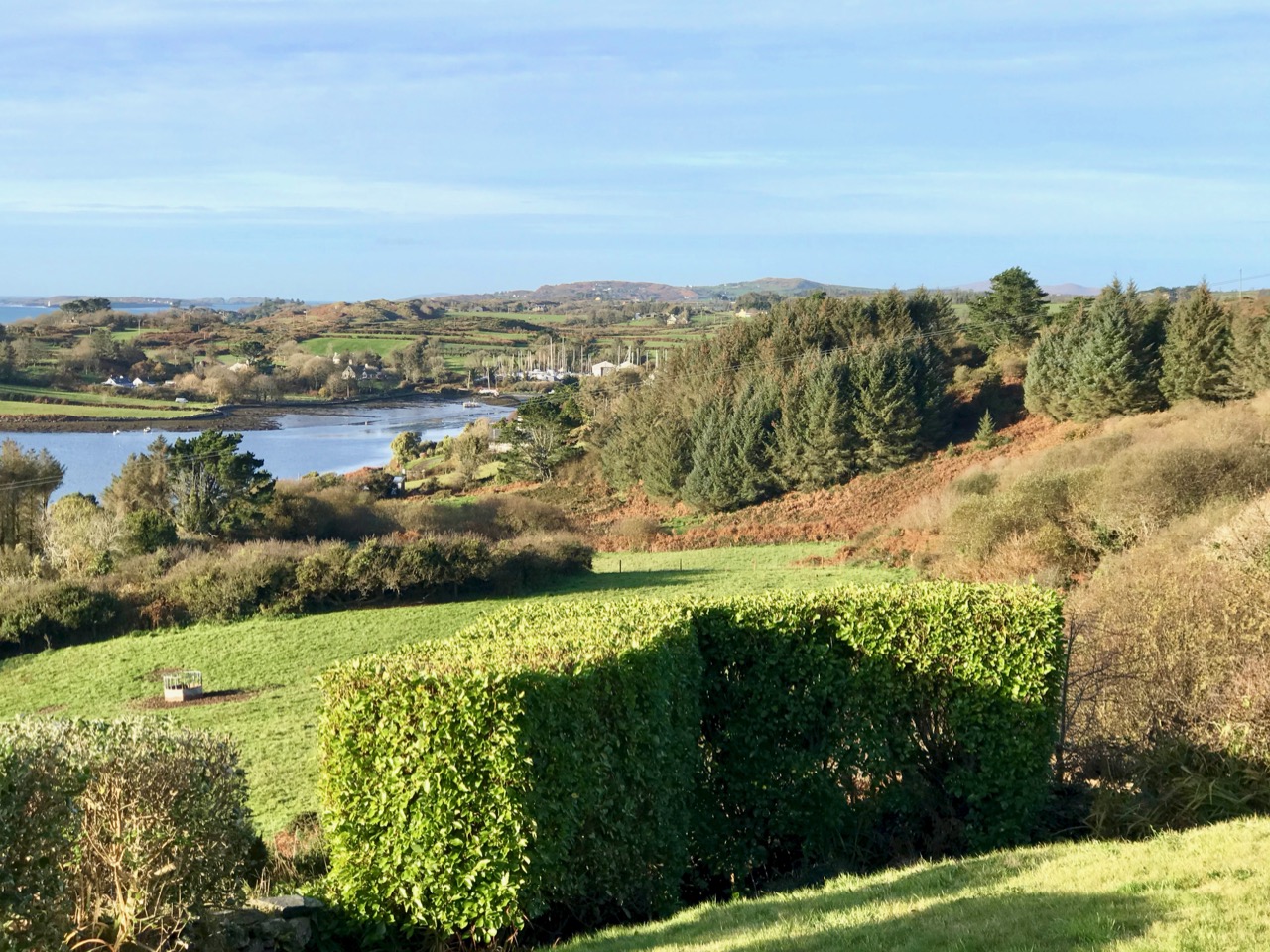
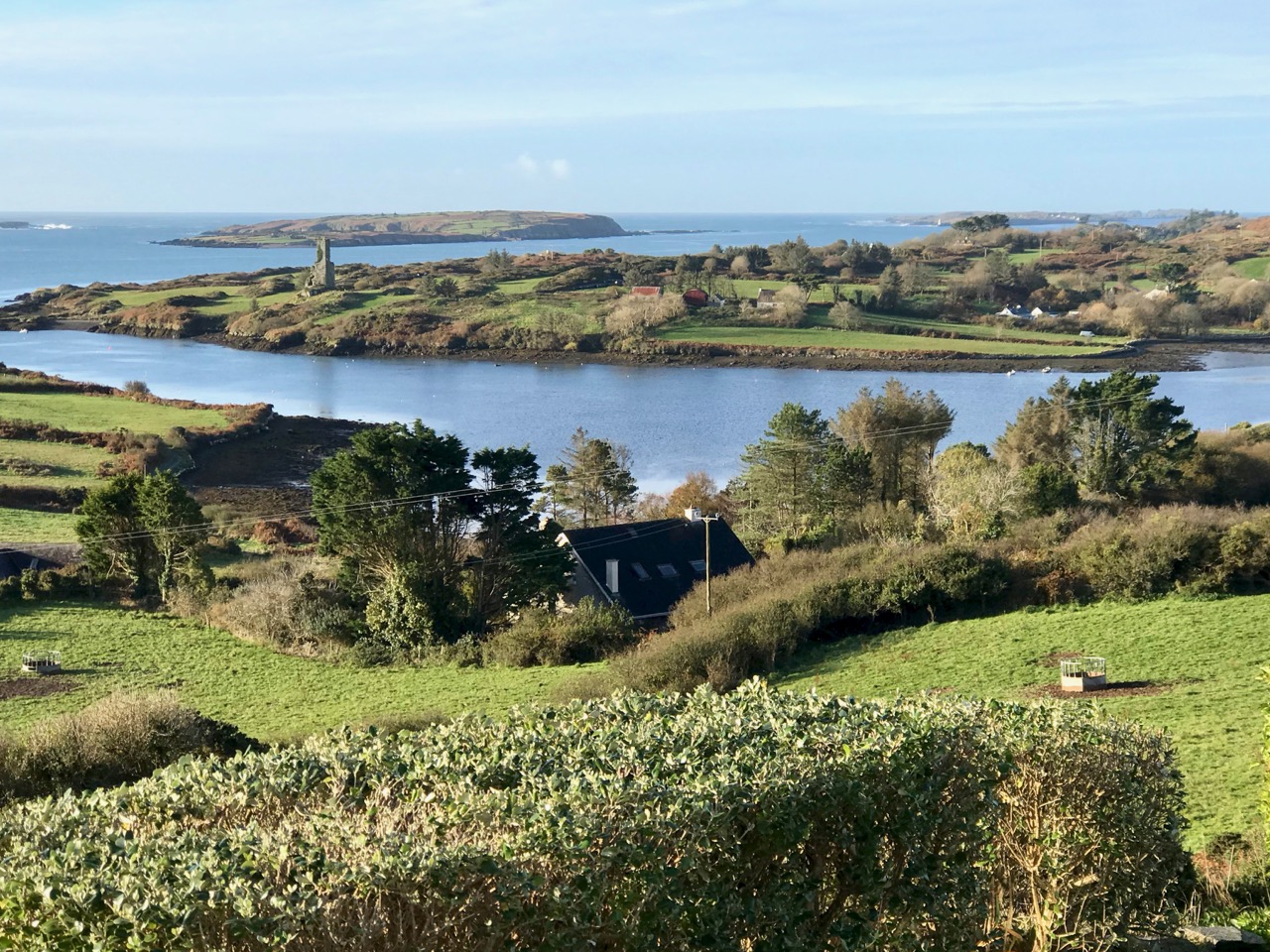
Header and above – looking across Rossbrin Cove from the garden of Nead an Iolair early this morning – St Martin’s Eve – conforming with the tradition of ‘Little Summer’ associated with the saint
The English poet John Clare (1793 – 1864) – sometimes called the peasants’ poet – wrote a very long poem about St Martin’s Eve: I’ll quote some verses as we go along. It’s worth noting that Clare was a great champion of traditional rural life, and was known as “. . . the greatest labouring-class poet . . . No one has ever written more powerfully of nature, of a rural childhood, and of the alienated and unstable self . . .” That’s according to his biographer Jonathan Bate. Although some of his work was well received in his lifetime, he was unable to make enough to keep him, his wife and seven children – and his alcohol consumption – on an even keel. He suffered from ‘strange delusions’ and spent the last twenty seven years of his life in asylums where, nevertheless, he continued to write.
Now that the year grows wearisome with age
& days grow short & nights excessive long
No outdoor sports the village hinds engage Still is the meadow romp and harvest song That wont to echo from each merry throng
At dinner hours beneath high spreading tree
Rude winds hath done the landscape mickle wrong
That nature in her mirth did ill foresee Who clingeth now to hope like shipwrecked folk at sea . . .
(John Clare, St Martin’s Eve, 1823)
Here’s St Martin, looking every inch a medieval knight – although in fact he lived in the fourth century. He was St Patrick’s uncle – possibly accounting for his popularity in Ireland. In this Italian representation he is shown cutting his cloak in two and giving half to a beggar: the act that has made him famous. He was a Roman soldier but gave up that calling to be consecrated as Bishop of Caesarodunum (Tours) in 371. Although he lived a long life, he is said to have died a martyr by being thrown into a mill stream where he was crushed by the wheel. He achieved acclaim as the patron saint of soldiers, but also managed to become the patron saint of conscientious objectors!
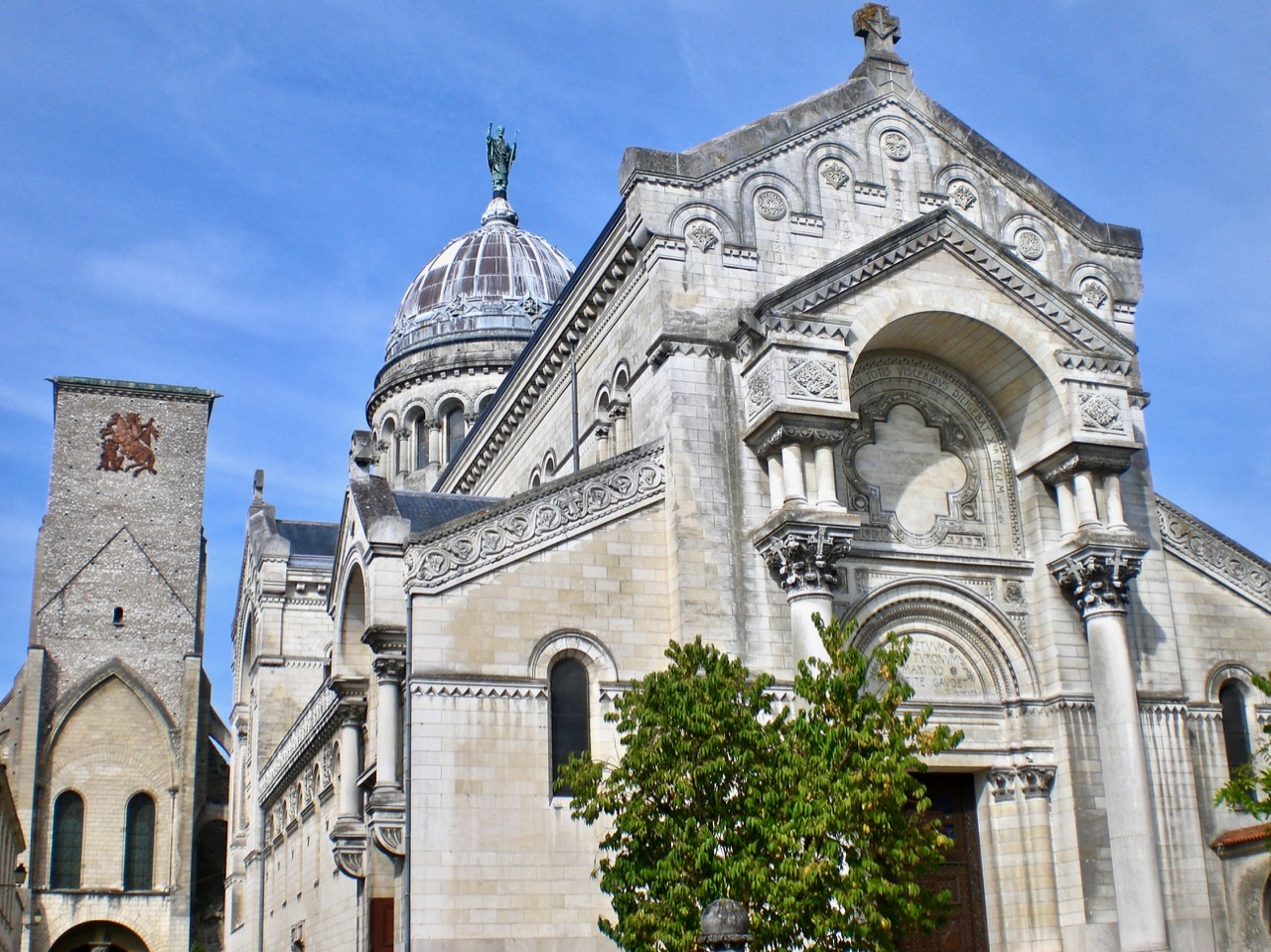
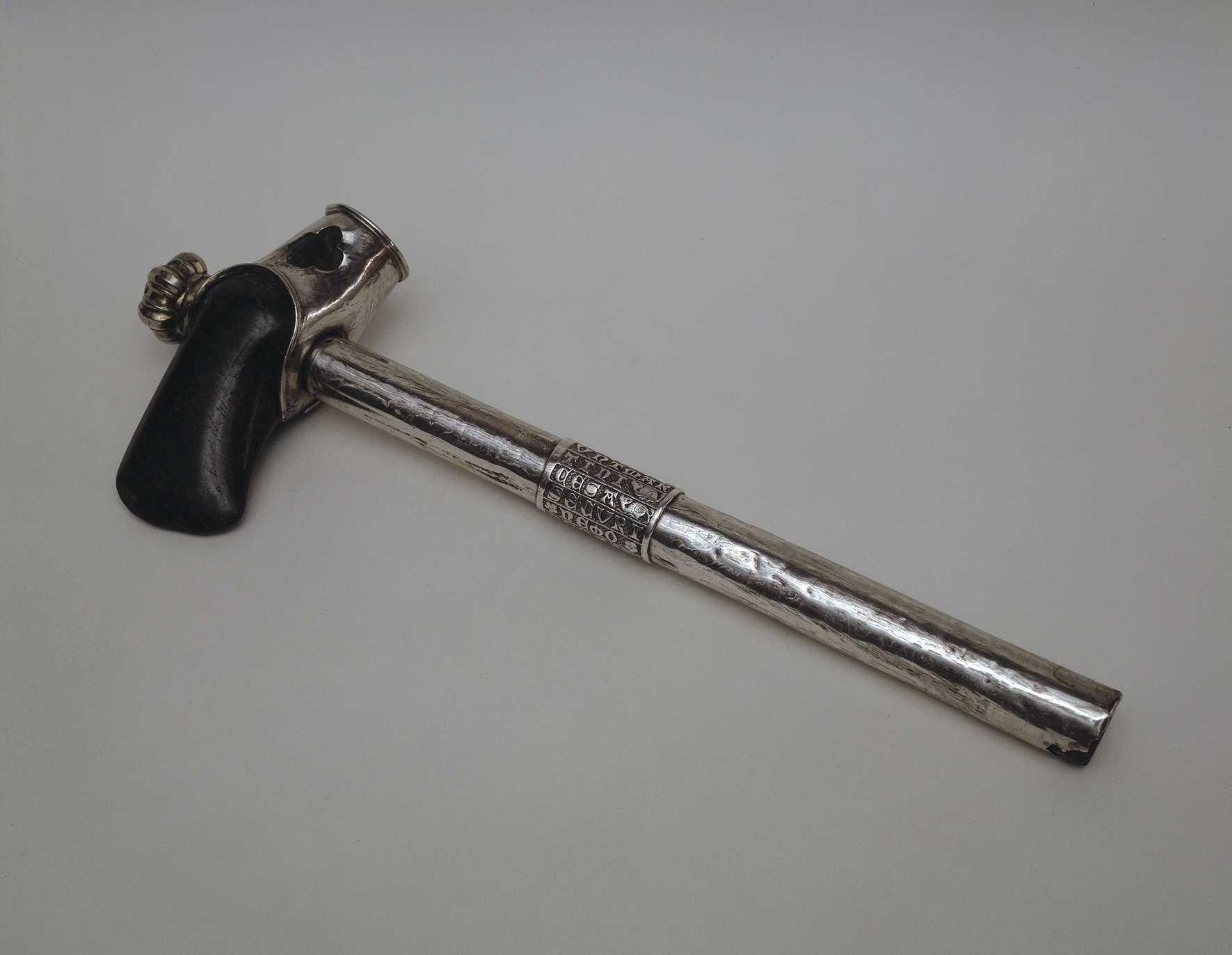
The Basilica at Tours, France (above). St Martin served as Bishop here from 371 – but reluctantly. It is said that he tried to hide from those who wanted to install him as Bishop, but his hiding place was given away by the cackling of geese – which have been associated with the saint ever since. Other stories tell how the saint destroyed pagan temples and cut down sacred trees: in one instance, the pagans agreed to fell their sacred fir tree, if Martin would stand directly in its path. He did so, and it miraculously missed him. There’s a relic in the St Catherine’s Convent Museum of Religious Art in Ultrecht, the Netherlands, which claims to be a hammer which St Martin used to fell pagan sites including sacred trees. Archaeological analysis has shown it was probably made in the 13th or 14th century from a late Bronze Age stone axe dating from c 1,000 – 700 BC. The handle contains a Latin text saying Ydola vanurunt Martini cesa securi nemo deos credat qui sic fuerant ruicuri (‘the pagan statues fall down, hit by St Martin’s axe. Let nobody believe that those are gods, who so easily fall down’). Here it is:
Beside the fire large apples lay to roast
& in a high brown pitcher creaming ale
Was warming seasoned with a nutmeg toast
The merry group of gossips to regale
Around her feet the glad cat curled her tail
Listening the crickets song with half shut eyes
While in the chimney top loud roared the gale
Its blustering howl of outdoor symphonies
That round the cottage hearth bade happier moods arise . . .
(John Clare, St Martin’s Eve, 1823)
It seems a little incongruous, perhaps, to come from a world of basilicas and silver hammers to ancient folk-customs in rural Ireland, but not so long ago Martinmas was greatly celebrated here. Kevin Danaher quotes Mason’s Parochial Survey:
On the eve of St Martin (who is one of the greatest saints in their calendar) in November every family of a village kills an animal of some kind or other; those who are rich kill a cow or a sheep, others a goose or a turkey; while those who are poor, and cannot procure an animal of greater value, kill a hen or a cock and sprinkle the threshold with the blood, and do the same in the four corners of the house; and this ceremonious performance is done to exclude every kind of evil spirit from the dwelling where this sacrifice is made, till the return of the same day in the following year . . .
Danaher also mentions a writer, Amhlaoibh Ó Súilleabháin, commenting in 1830 from County Kilkenny:
The eleventh day, St Martin’s Day. No miller sets a wheel in motion today, no more than a spinning woman would set a spinning wheel going, nor does the farmer put his plough team to plough . . .
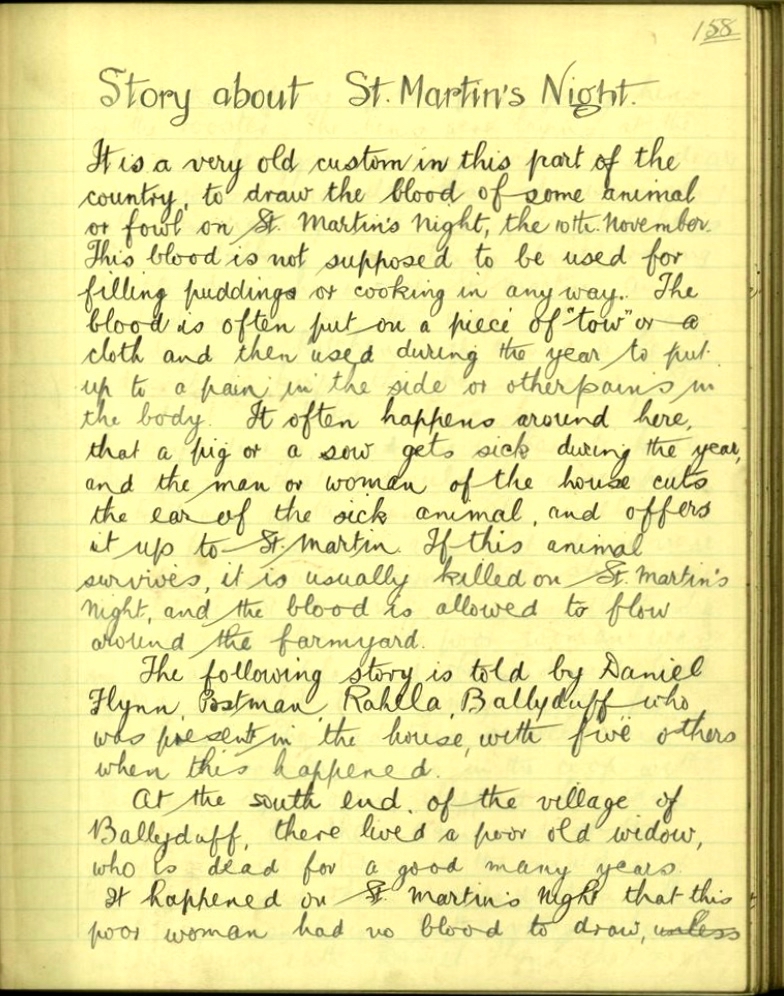
The tradition undoubtedly refers back to St Martin’s death from being ‘ground by a mill wheel’. Significantly, there are numerous entries in the Dúchas Folklore Collection, dating from the 1930s, which show that these customs were still remembered and – on occasion – practised:
One of many examples from the Dúchas Folklore Collections which remember the importance of Martinmas customs
Martin King used kill a fowl every St Martin’s night in honour of St Martin. One year Martin forgot it and when he awoke in the morning the floor from his bedroom to the kitchen was covered with blood. Martin washed out the floor, but when he awoke again the following morning the floor was covered with blood again. This went on for three nights. Martin was very troubled about it so he told his story to an old woman that lived near him. The old woman told him it was because he had not killed something in honour of St Martin. Every year after that till he died Martin killed a hen or something in honour of St Martin . . .
(Eileen Donegan, Knockane, Listowel – collected for Dúchas 1935)
Another from Co Kerry:
St Martin’s day is held on the 11th of November. It is held as a feast day in honour of St Martin. The night before St Martin’s day people kill a goose or a chicken or some other kind of fowl, and they draw the blood and dip a piece of flax in it. They keep the piece of flax because it is said to be a cure for a pain in one’s side.
St Martin was a saint who was ground in a mill for his faith.
In olden times the mills used not work on that day The women in olden times used not work. No one would turn a wheel not even of a car.
(Mrs Walsh, aged 90 years – Tullamore, Co Kerry – collected for Dúchas)
The next piece is particularly interesting as it mentions St Martin’s association with a white horse:
It is a custom in Ireland to kill a cock on Saint Martin’s Night.
There was a man who emigrated to America. On St Martin’s night he was very sad. He was telling his friends that he would like to be home in Ireland, because if he were home he would kill a cock in honour of St. Martin.
He went outside and he went down the street. He met a man on a beautiful white horse. The man asked him would he like to go home. He said he was just wishing to be at home. He told him to get up on the horse. He did so and the next place he found himself was at his own door in Ireland.
The man told him to come out at a certain hour. He killed the cock and came out at the hour that he was told to do so. The man was waiting for him at the door. He got up on the horse and rode away. It was said that it was St Martin who brought him home.
(Maura Keating, aged 82 years, Passage East, Co Waterford)
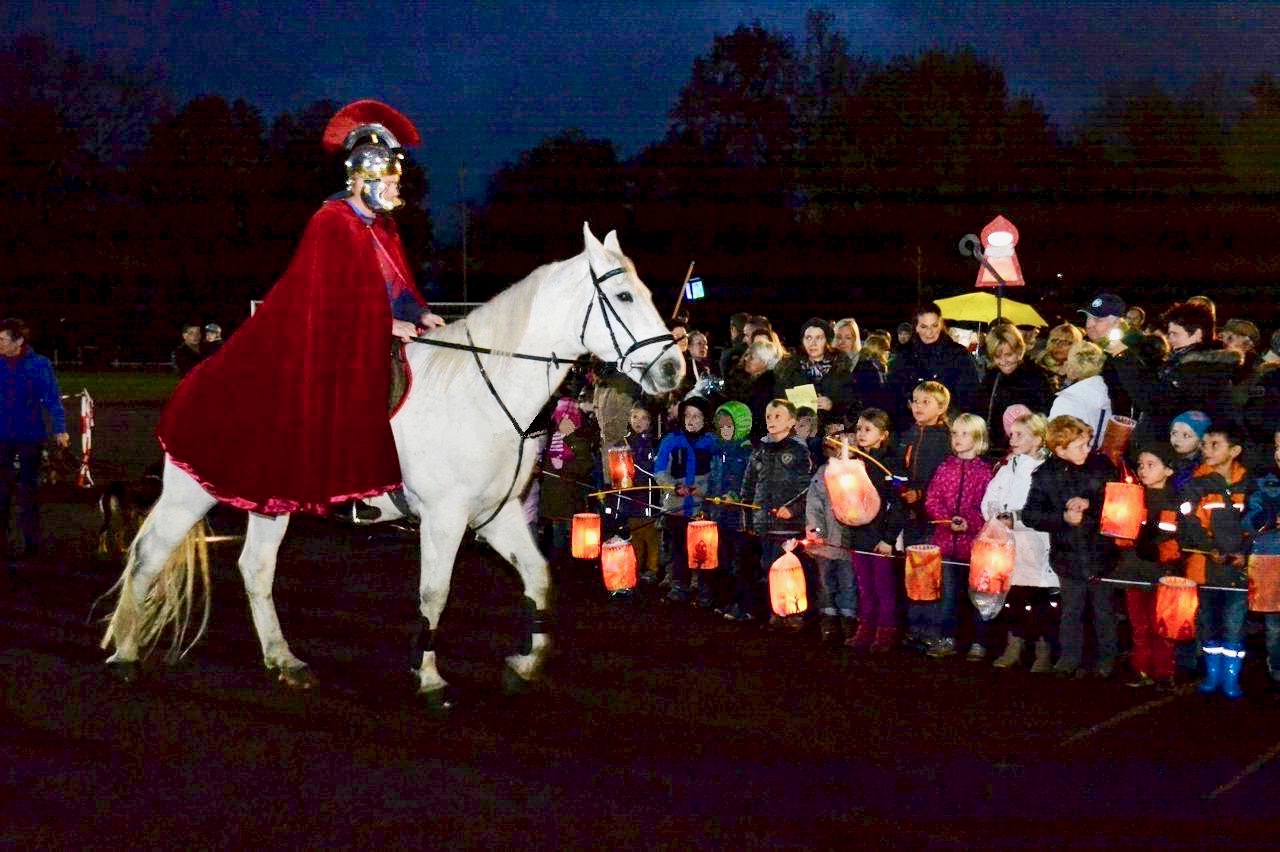
St Martin’s Eve celebrations are still observed all over Europe. This is a festival in Italy, where children carrying lanterns watch out for the saint arriving on his white charger
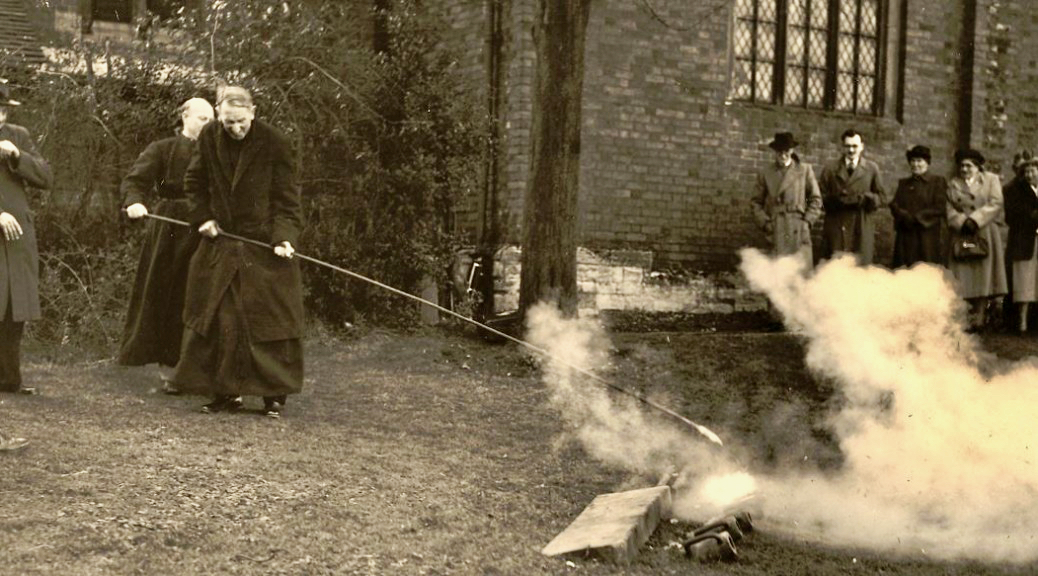
What about Fenny Poppers? I hear you ask . . . Well, we have to go across to Northamptonshire, in England, for this surviving – and most curious – custom. St Martin’s Church, Fenny Stratford is to this day the scene of an event which has no apparent origin, nor any particular purpose. I won’t try to offer you an explanation – just to point out that it happens every Martinmas come hell or high water. Here’s a somewhat eccentric account of the event from a Movietone News snippet c 1950:
That’s probably enough about St Martin and his special day to last you another year. The subject is by no means exhausted!
We’ve been thinking lots lately about Northern Ireland and how much we enjoyed our time there. One of our truly memorable experiences was a trip to Boa Island in Fermanagh to see the mysterious carved figures in the Caldragh graveyard.
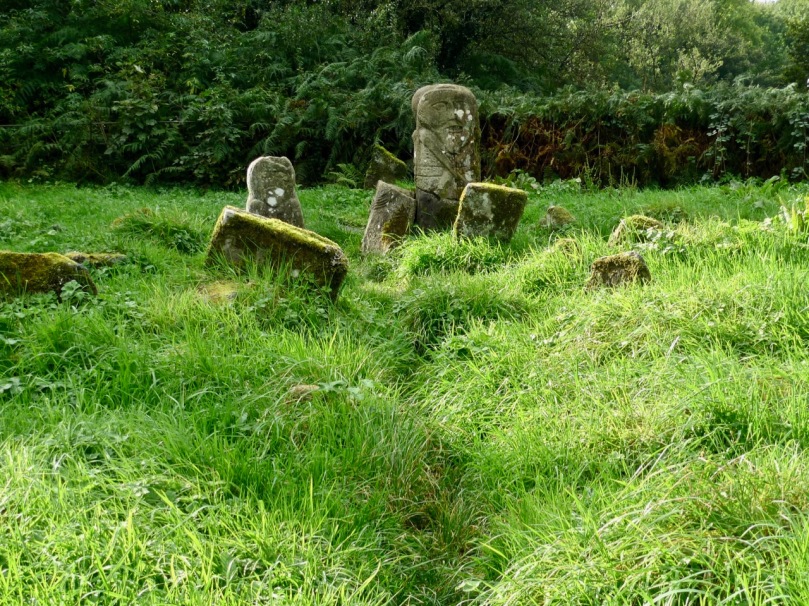
Despite the fact that this is one of Northern Ireland’s most important archaeological sites, we had the place to ourselves when we were there, in October 2016. In fact, it looked like any peaceful rural graveyard, with higgledy piggledy gravestones behind a hand-forged iron gate, lush grass, and an air of benign neglect.
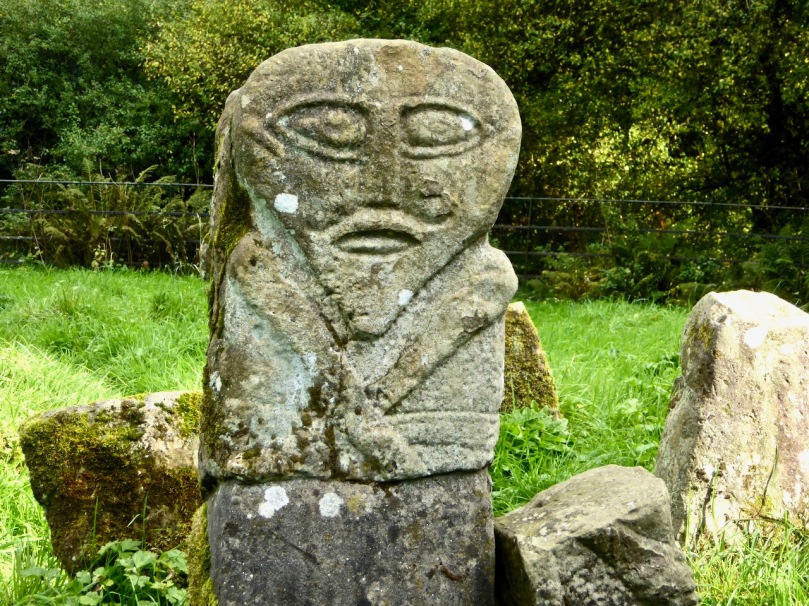
But there’s one big difference – in this remote place are two of the most enigmatic carved figures on the Island of Ireland. The first one has two faces – it’s been called a Janus figure, or simply bilateral, carved in a style that is reminiscent of Early Medieval carvings, but also different. Different enough so that one can see these as pre-Christian figures, and that is how they are most often interpreted.
Boa Island itself may be named for the Goddess Badhbh (pronounced Bov), a potent character in Irish mythology. The figures do not bring saints or clerics to mind – there are no croziers, no fingers raised in blessing, no tonsures or crosses. We’ll look at the bilateral figure first. It has two faces, back to back, with a groove in between. The groove collects water and in recent years people have started to leave coins in the puddle formed by the groove, perhaps echoing its original purpose. The heads are joined at the side by herringbone or plaited lines that may represent hair.
One side has been interpreted as male and some point to a stylised penis that rests between the legs. Although I have seen photographs of this side when it had been recently cleaned, where a carved element is denoted as the penis, it is not in any way obvious now that the statue is once again covered in lichen and badly weathered, with moss growing in this area. The face is long and triangular, the mouth open and the eyes wide and staring. Two arms cross across the body, over a belt which runs around both figures.
On the other side the mouth is open and a tongue protrudes. Apart from that, the figures are almost identical. The statue is broken just below the belt on this side, so it is impossible to say that there are any female, or indeed male attributes present.
The carving has been mounted on a plain base but leaning against it is what might be the original base, or part of it. If it is, then the arms extended down into hands, resting on either side of the base.
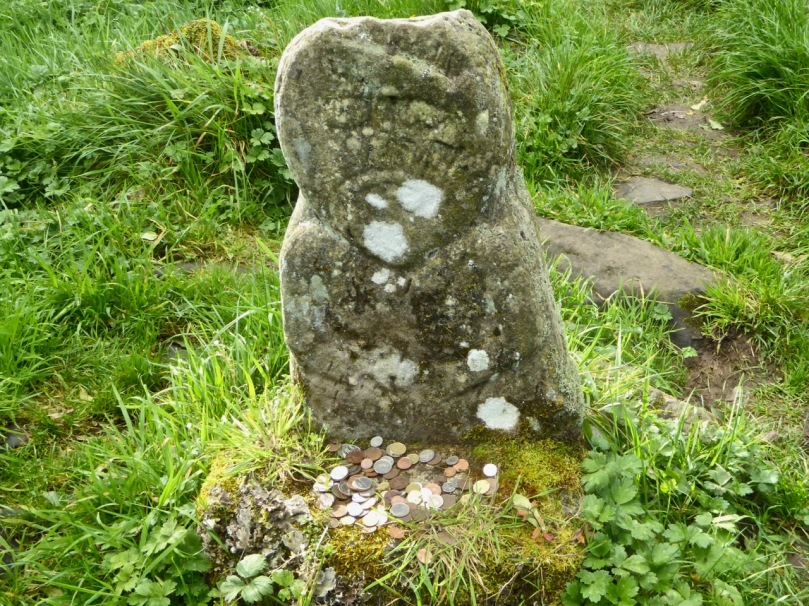
There is a second figure, brought here from nearby Lusty More Island. This one is much more worn, or perhaps not even totally finished, but it’s possible to see that it bears a strong resemblance to the others in its triangular face. The arms are not crossed but appear to be holding something. Visitors leave coins in front of this one.
What does it all mean? In short, we don’t know, but current consensus appears to fall in the area of calling these figures representations of pagan deities. The smaller figure, rather than holding something, may be female and pointing to her genitals. This would place it in the tradition of the sheela-na-gigs, although presumably much earlier than the majority of sheelas, which are thought to be medieval.
Whatever they are, they have inspired poets and artists – even filmmakers. One of our favourite films, the marvellous Song of the Sea, has taken much of its artistic design from prehistoric Irish art, including the Boa Island figures. Watch this teaser for the movie and see if you can spot the Boa Island figure at 46 seconds.
And the poetry? Seamus Heaney, of course, himself from Northern Ireland, drew inspiration from the landscape around him and often wrote about archaeological themes. His poem, January God, captures the mysterious sense of the two-faced God and makes a shift to summon the idea of Cernunnus, the antler-headed pagan god of wild things depicted on the Gundestrup Cauldon.
Welcome to the UCD Library Cultural Heritage Collections blog. Discover and explore the historical treasures housed within our Archives, Special Collections, National Folklore Collection and Digital Library


















 Roaringwater Journal