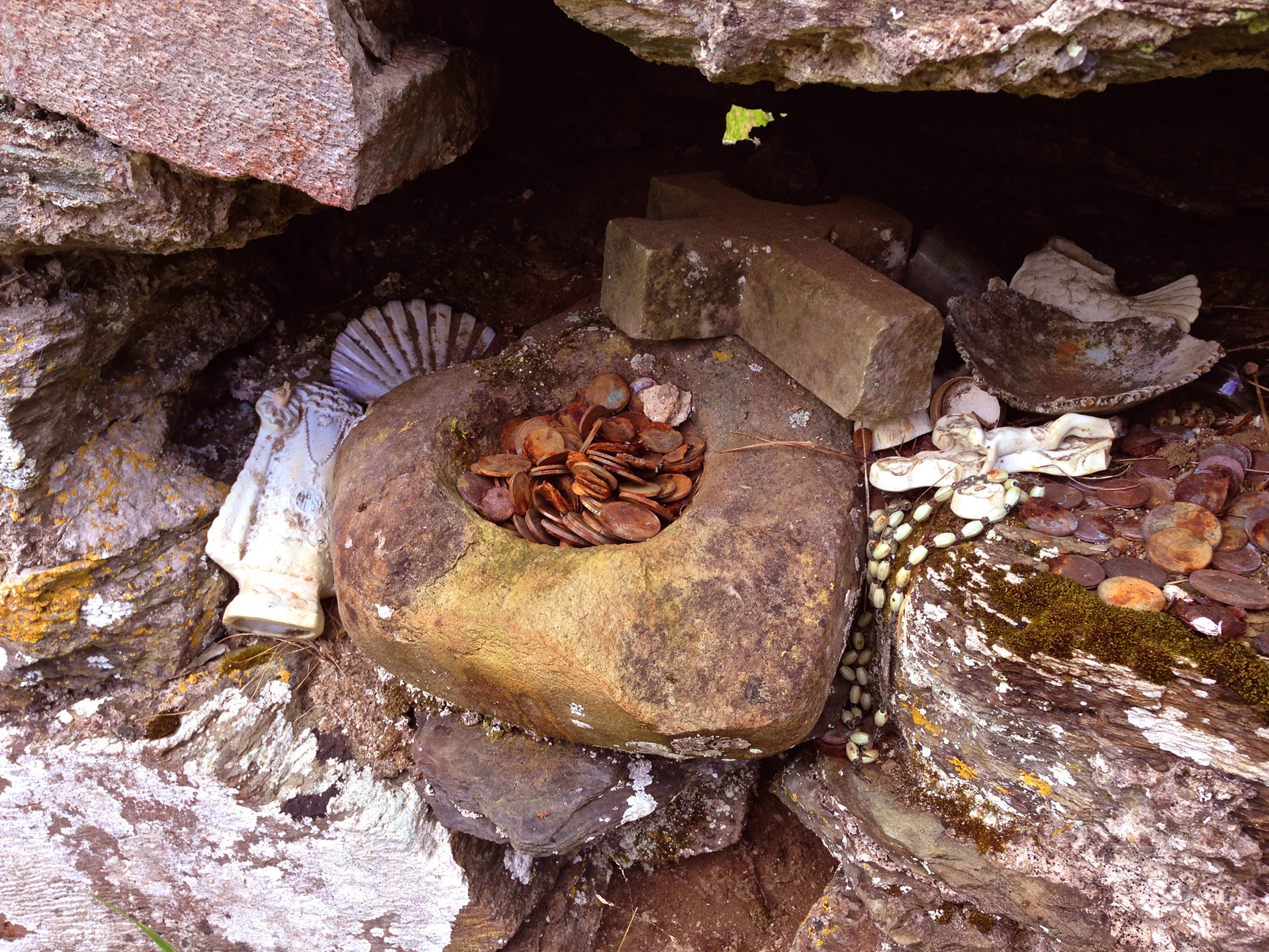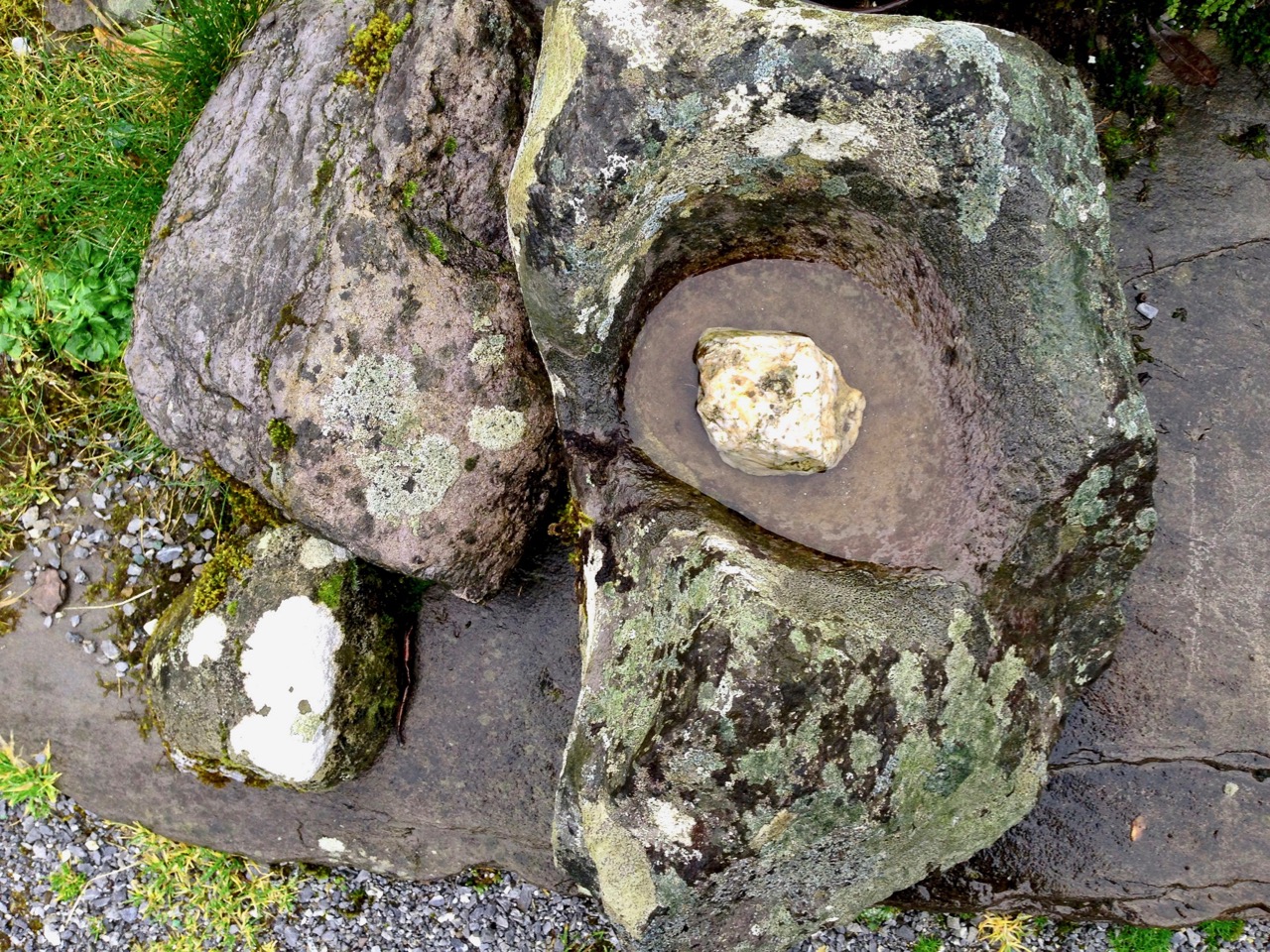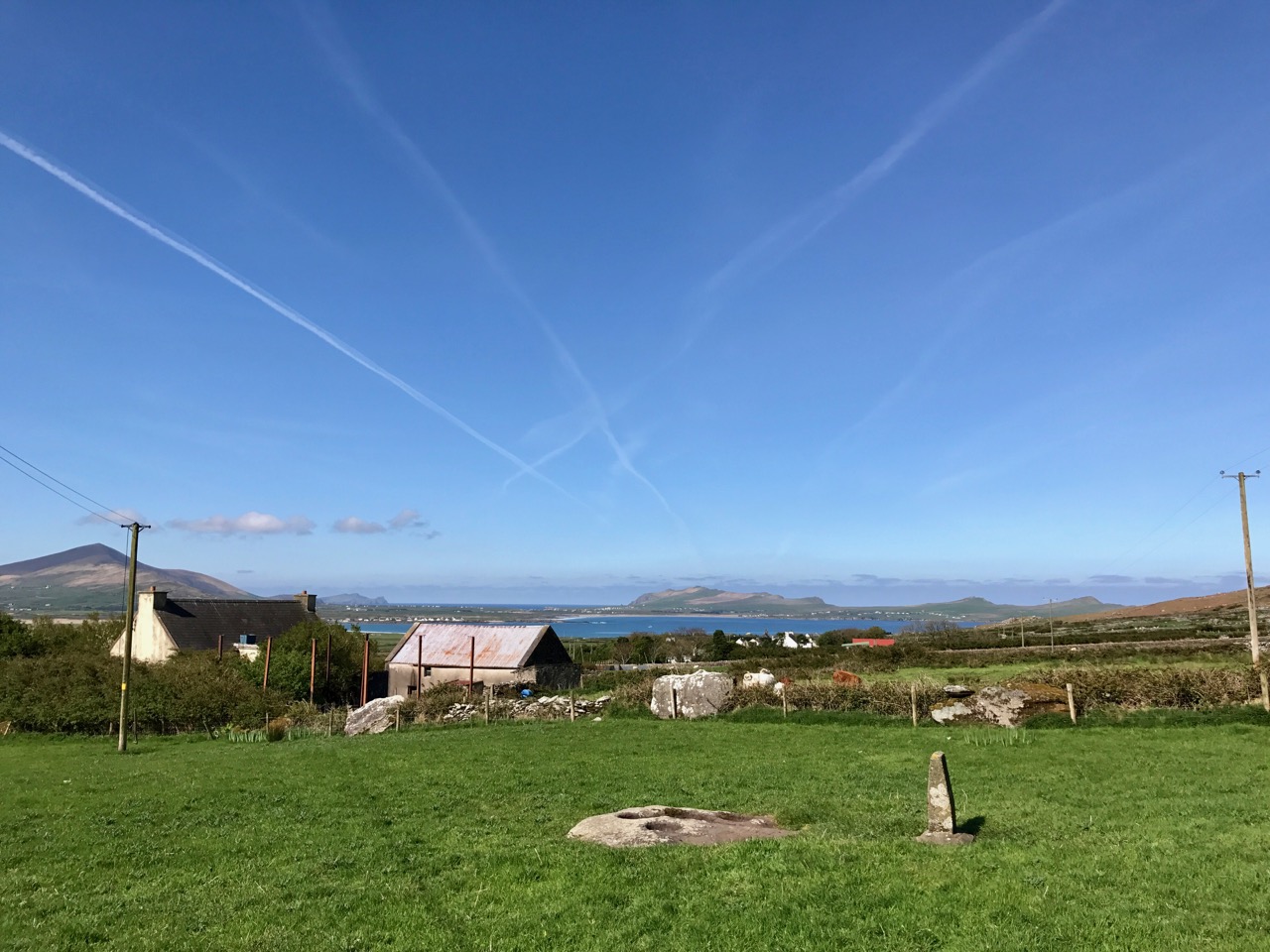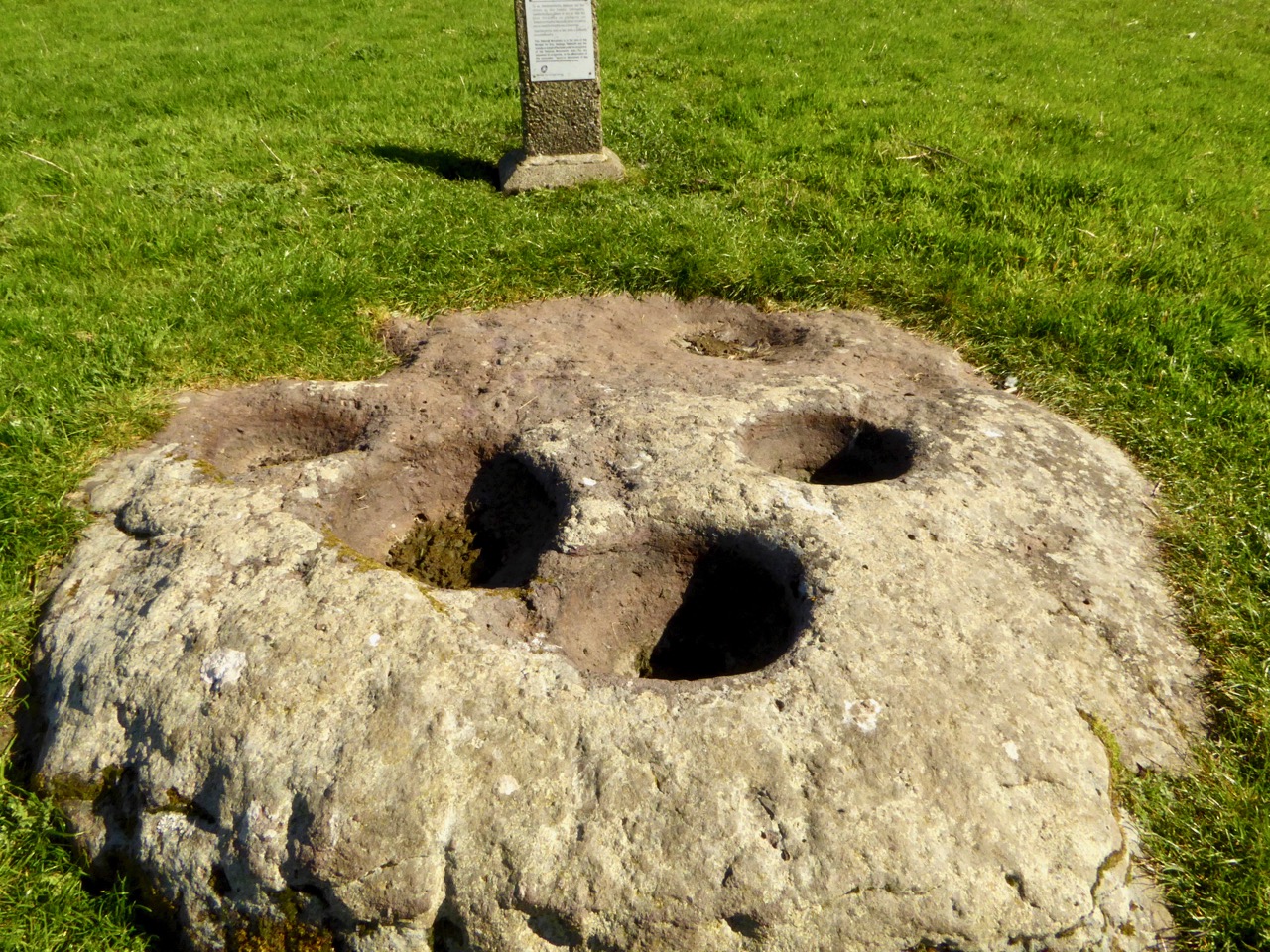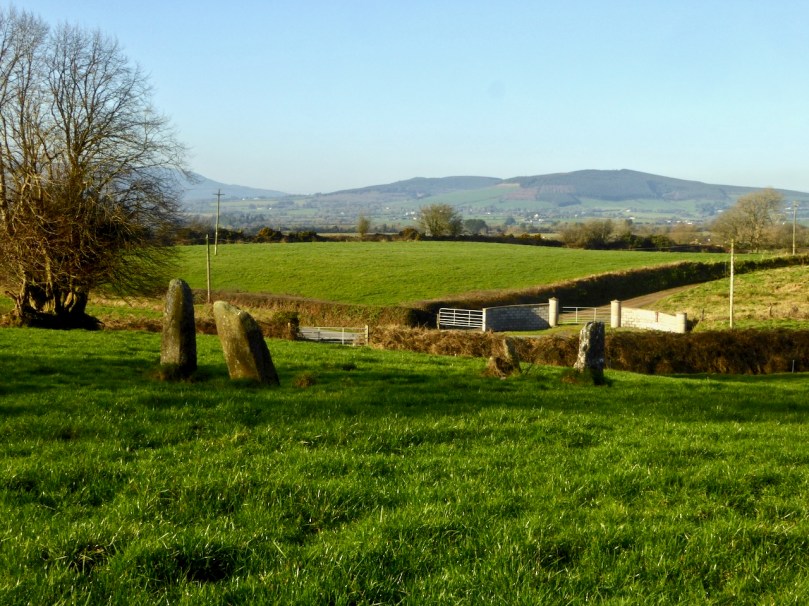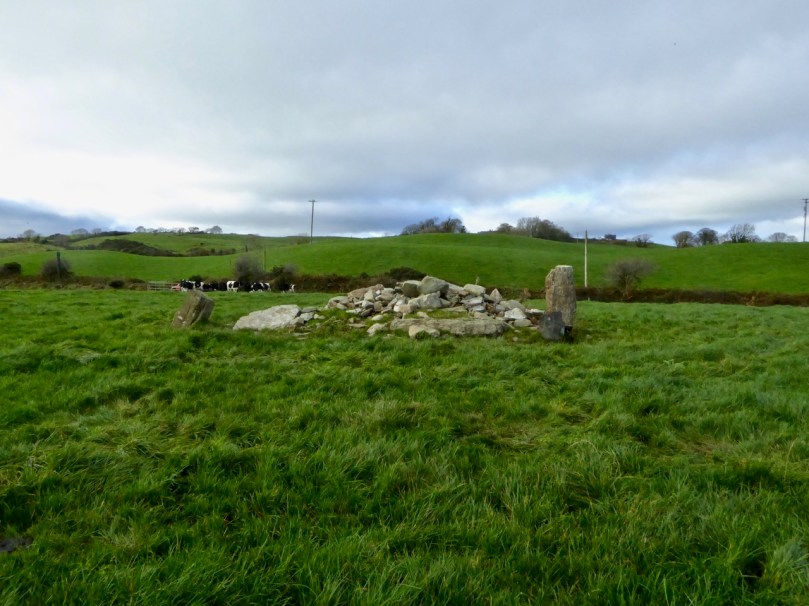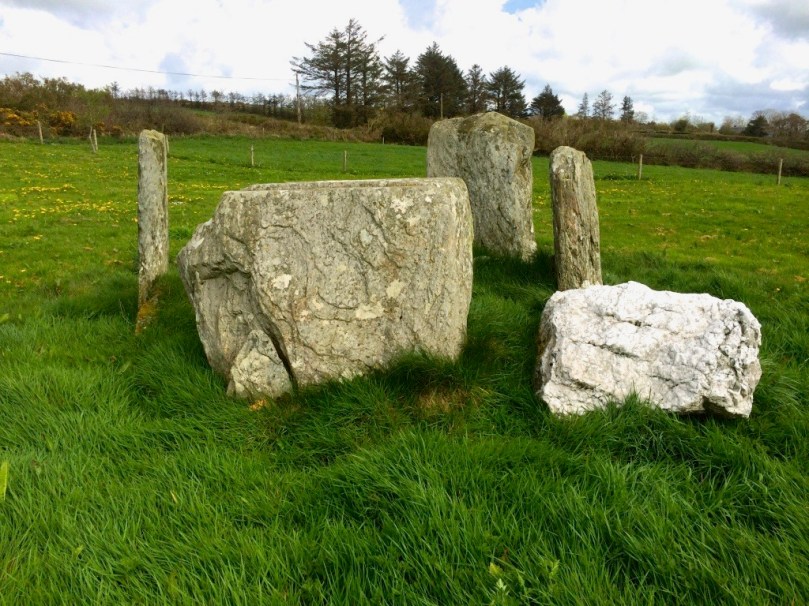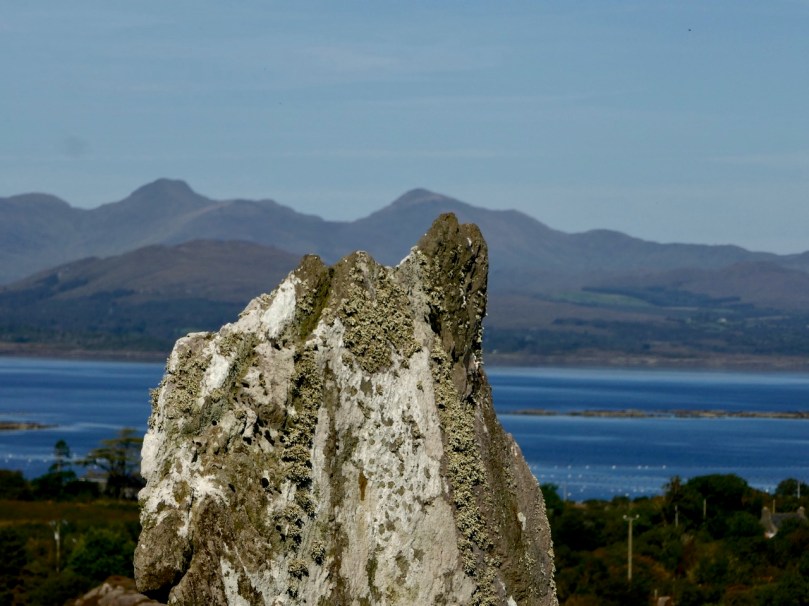
Bullaun Stones abound in Ireland. They are usually found nowadays at sites with ecclesiastical connections, as in the example above at Maulinward, an ancient West Cork burial ground. This association does not reduce or affect their traditional uses – according to folk convention – to cure or to curse. The Irish word Bullán means ‘bowl’ – a water container. At pilgrimage sites, such as St Gobnait‘s, Ballyvourney (below), the bullaun stones often hold quartz fragments or smooth, rounded pebbles – perhaps incised with a cross – which are turned around each time a pattern or procession is completed.
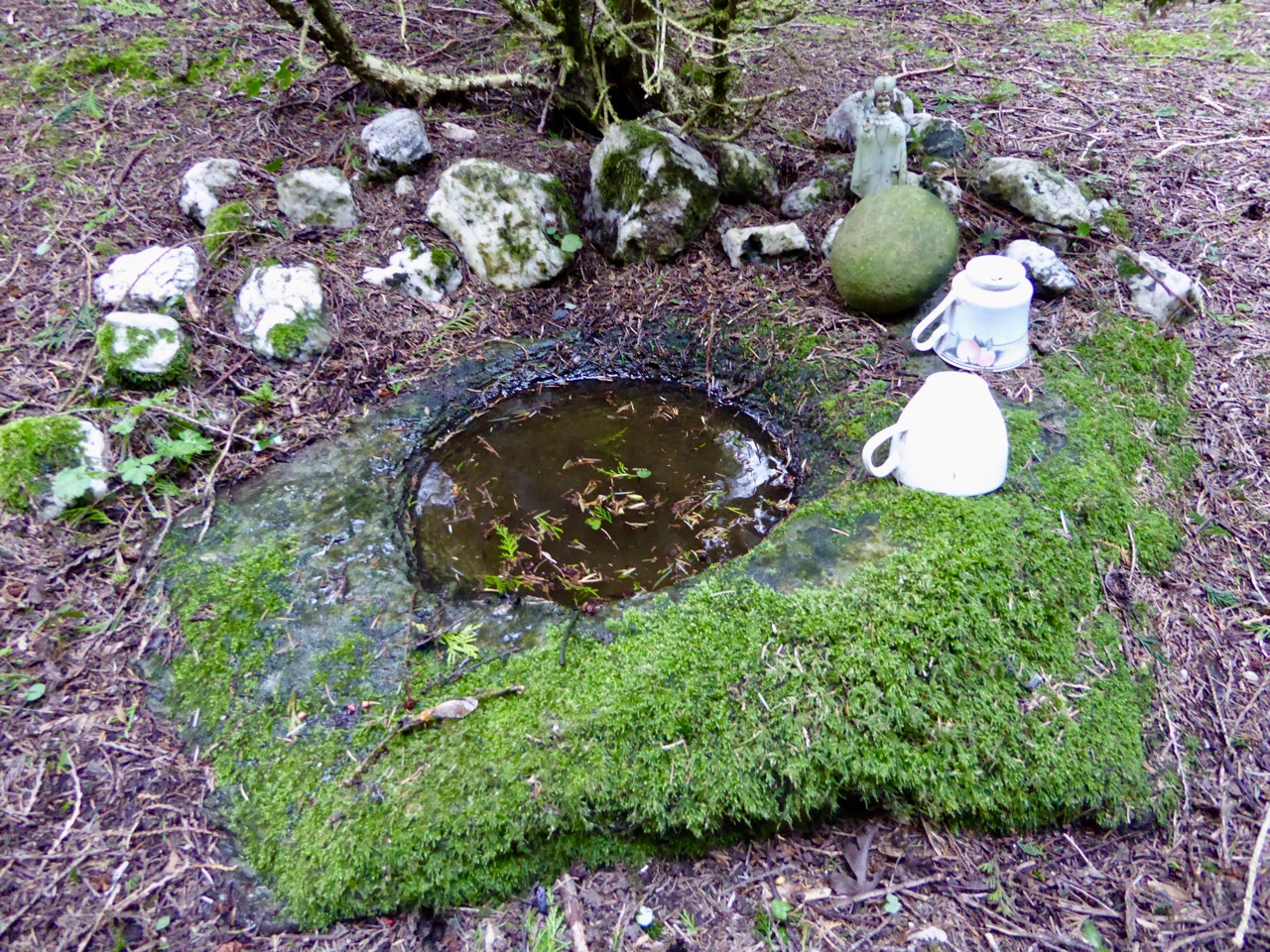
The Maulinward example on the header picture shows how the tradition of making offerings at some of these locations continues to this day. At other sites, such as the one below, the hollowed-out stone filled with rainwater takes on the properties of a holy well, and is visited for cures or simply good fortune.
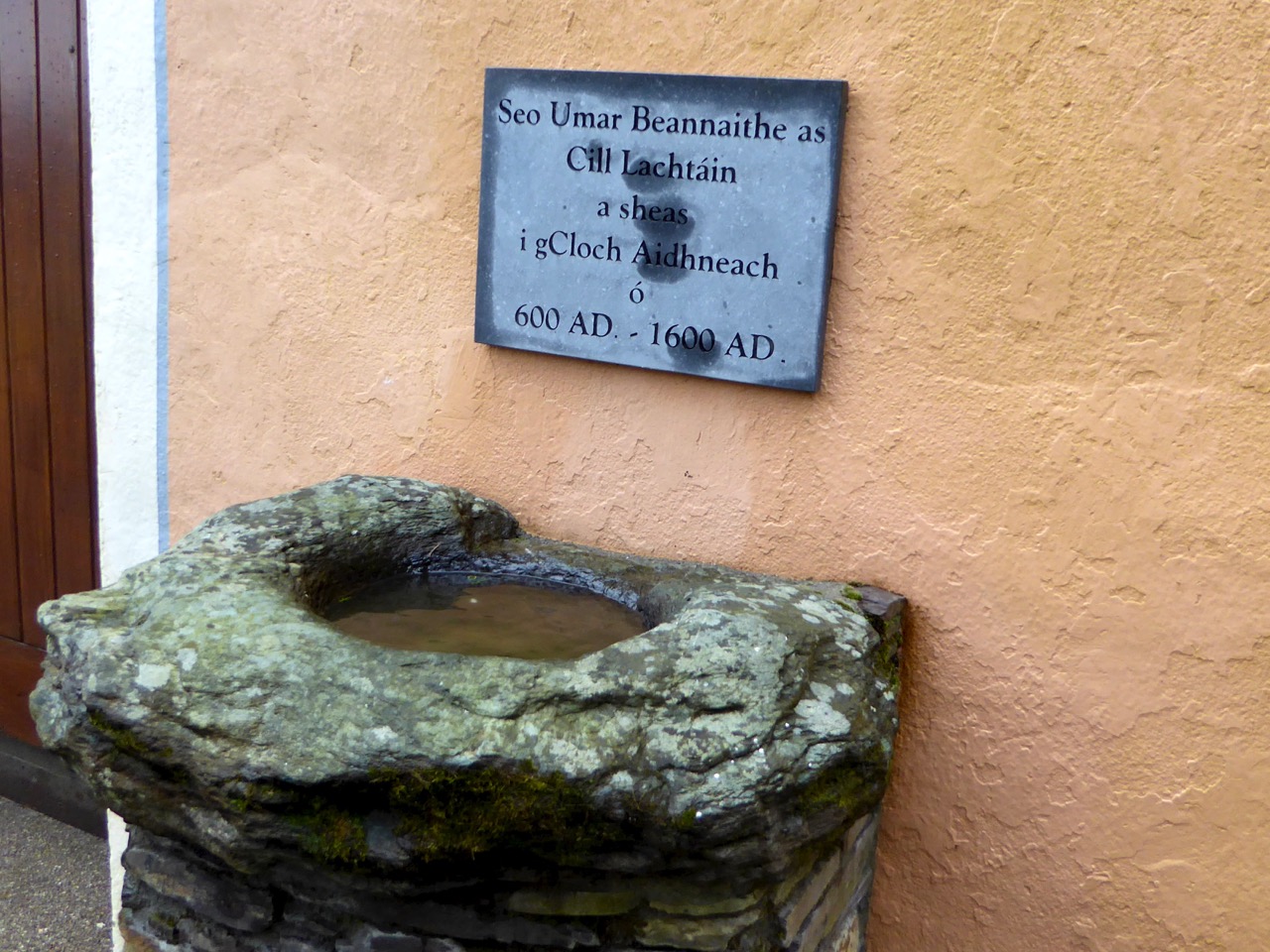
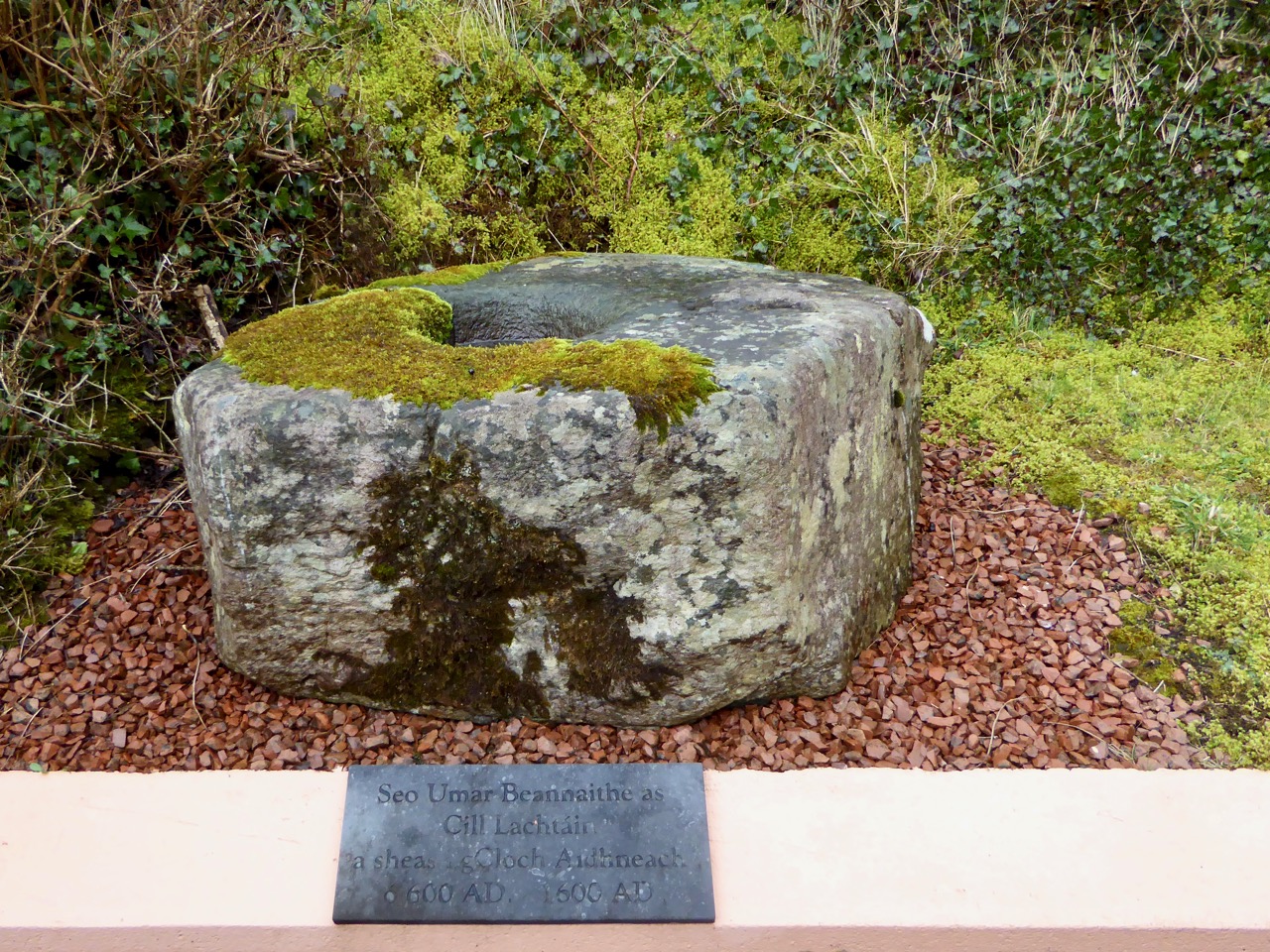
This example, outside the door of the church at Cill Lachtáin, Co Cork seems to have been mounted to perform as a holy water stoup: the plaque reads ” . . . This blessed font of Cill Lachtáin was standing in Cloch Aidhneach from 600AD to 1600AD . . . “ Others resemble fonts and are similarly associated with places of worship. Look at this striking stone from Timoleague Friary, whose purpose – according to tradition – is clearly stated:
In the sixth century, the Council of Tours ordered its ministers ” . . . to expel from the Church all those whom they may see performing before certain stones things which have no relation with the ceremonies of the Church . . . ” Such an order doesn’t seem to have prevented folk customs of curing continuing into the twenty-first century.
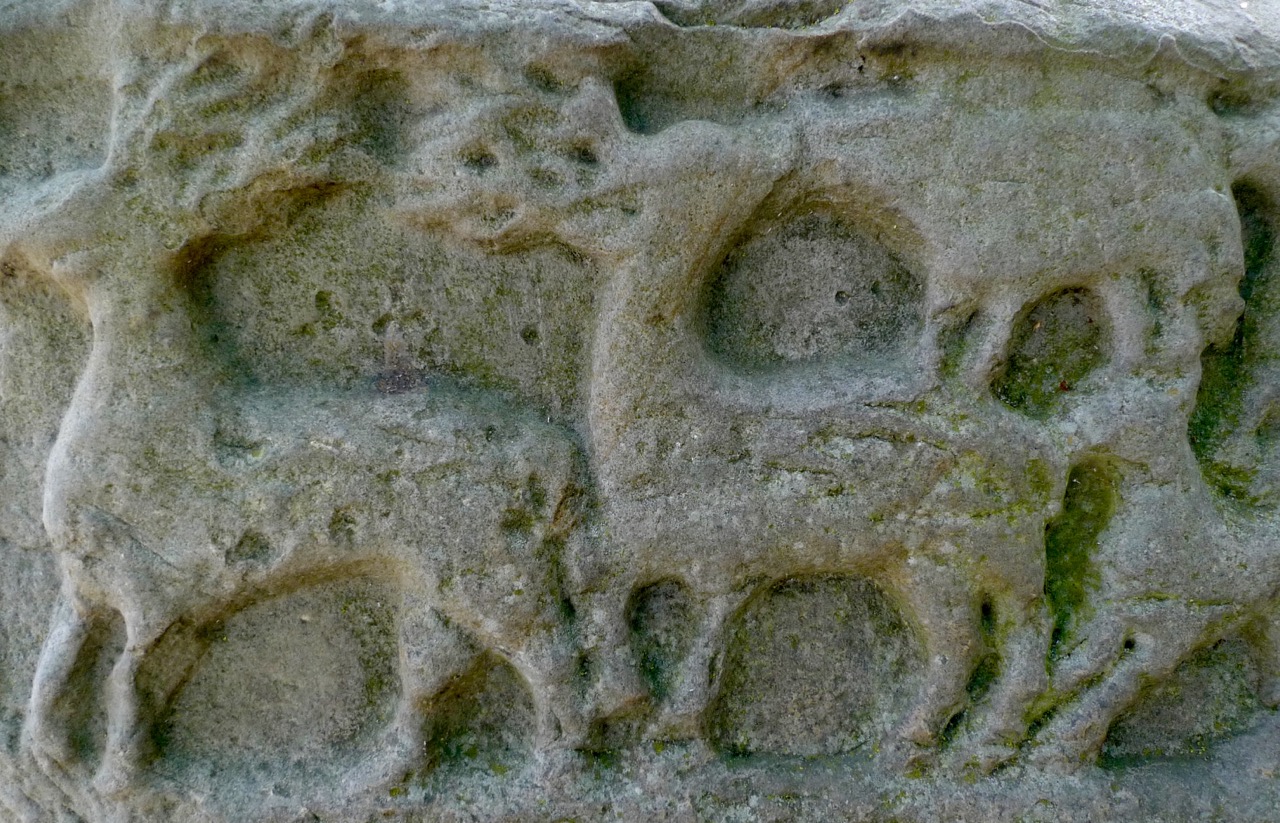
The ongoing use of bullauns as fonts, stoops or holy wells does not explain their original purpose (which is probably pre-Christian: here’s an interesting conjectural world view of the phemomenon), and it’s quite likely that we will never fathom for sure what they were for. The example above, at Kilmalkedar, Co Kerry is as enigmatic as they will get, with its multiple ‘basins’ carved into a large earth-fast boulder isolated in the middle of a field, although not far from a remarkably complex ecclesiastical site. But the one I find the most fascinating can be found along the Priest’s Leap road, a mere few steps away from our own home in West Cork . . .
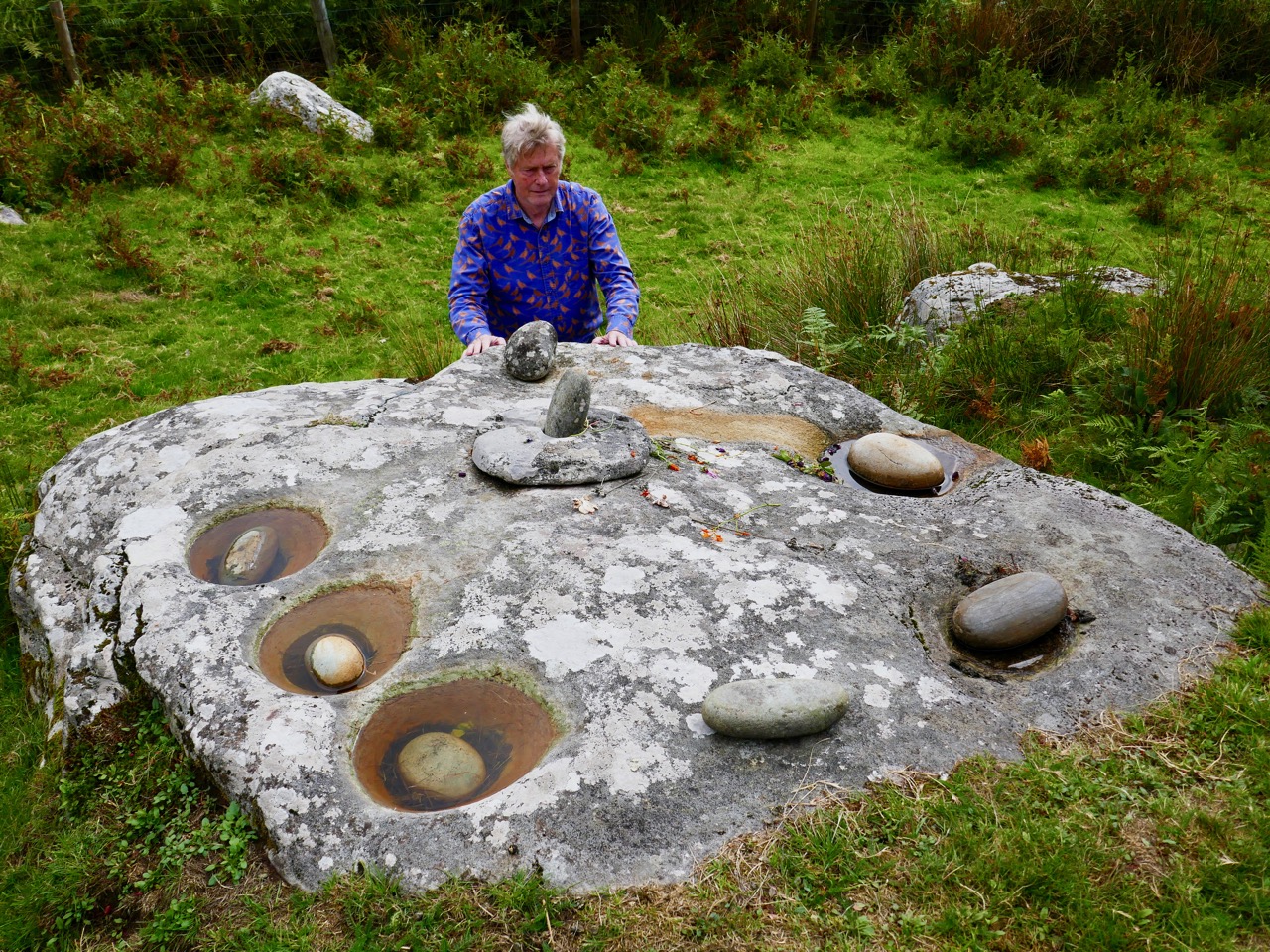
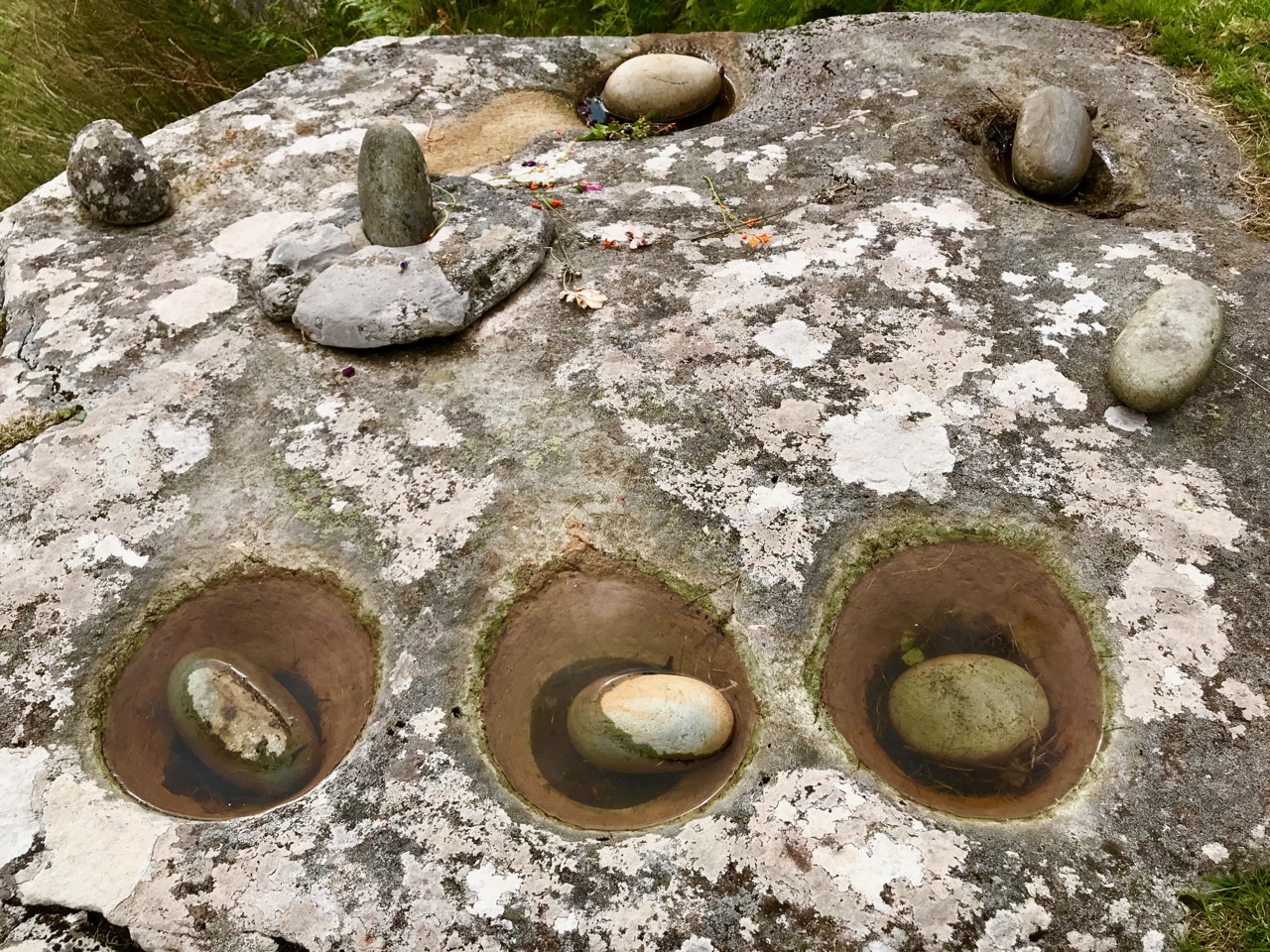
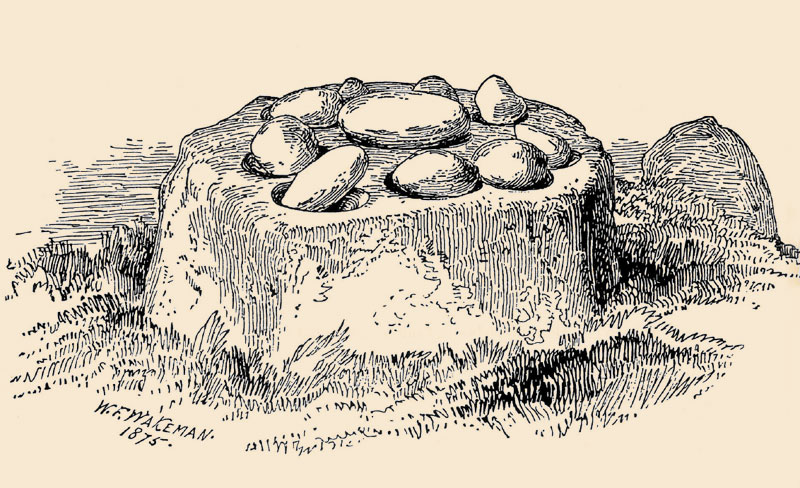
This rock outcrop – known locally as The Rolls of Butter – is large (I’m there to give it scale!) with seven scooped-out bullaun like basins and a somewhat phallic central upright stone. The basins each contain a large, smoothed pebble. Some folk traditions in Ireland identify such pebbles as ‘cursing stones’: “. . . if you wanted to put a curse on someone, you turned the stones anti-clockwise in the morning . . . ” However, the curse had to be ‘just’ otherwise it came back to curse you in the evening! The illustration below – of ‘cursing stones’ at Killinagh, Co Cavan was made by antiquarian W F Wakeman in 1875. He also noted the similar local folk traditions of these examples.
Many bullaun stones or stone groups around Ireland have been included in the National Monuments records, and number in the hundreds. Functional, magical, sinister? Who knows . . . Your guess is as good as anyone else’s. But one thing is certain – they are intriguing and mysterious. Keep a look out for them – as we do – in your travels around this land.
Note: this is a re-run of a post I published five years ago – but it’s been augmented, updated and – hopefully – improved!
If the wind is in the south-west at Martinmas (10 November), it keeps there till after Candlemas (2 February) . . .
I’m writing about St Martin again! I’ve already put up posts about this character and his fascinating legacy over the past few years. He can take another – after all, we celebrate St Patrick year after year and that’s ok, because this is Ireland . . . But St Martin never set foot in Ireland (as far as we know) although he is well remembered in many Irish traditions, including that piece of weather-lore above. And here – as elsewhere in Europe – there’s a phenomenon known as St Martin’s Summer, or Martin’s Little Summer, which describes an unseasonable spell of warm weather, sunshine and clear blue skies that occurs around about now, in mid-November. In fact today – Martinmas or St Martin’s eve – has dawned warm and clear.
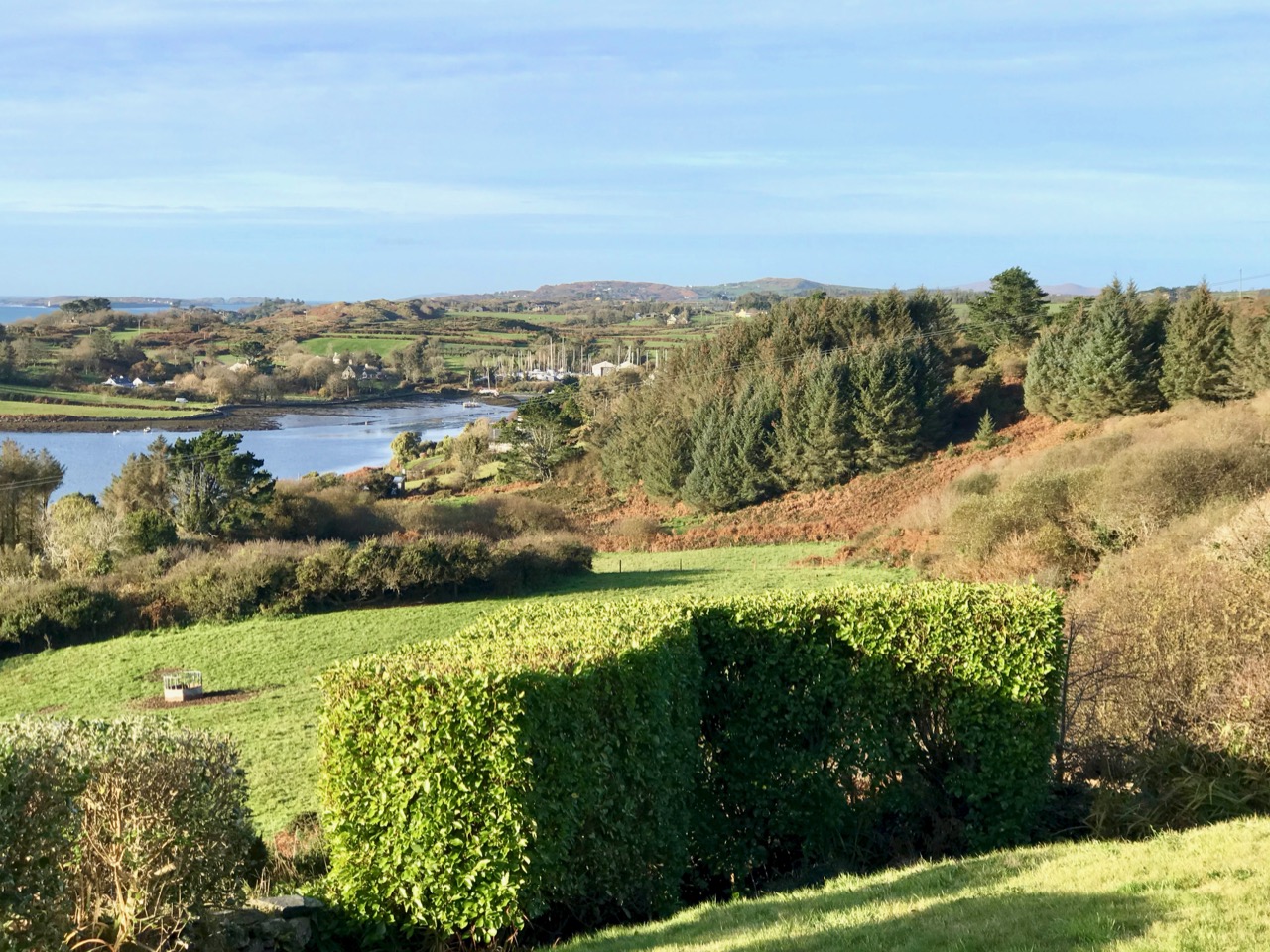
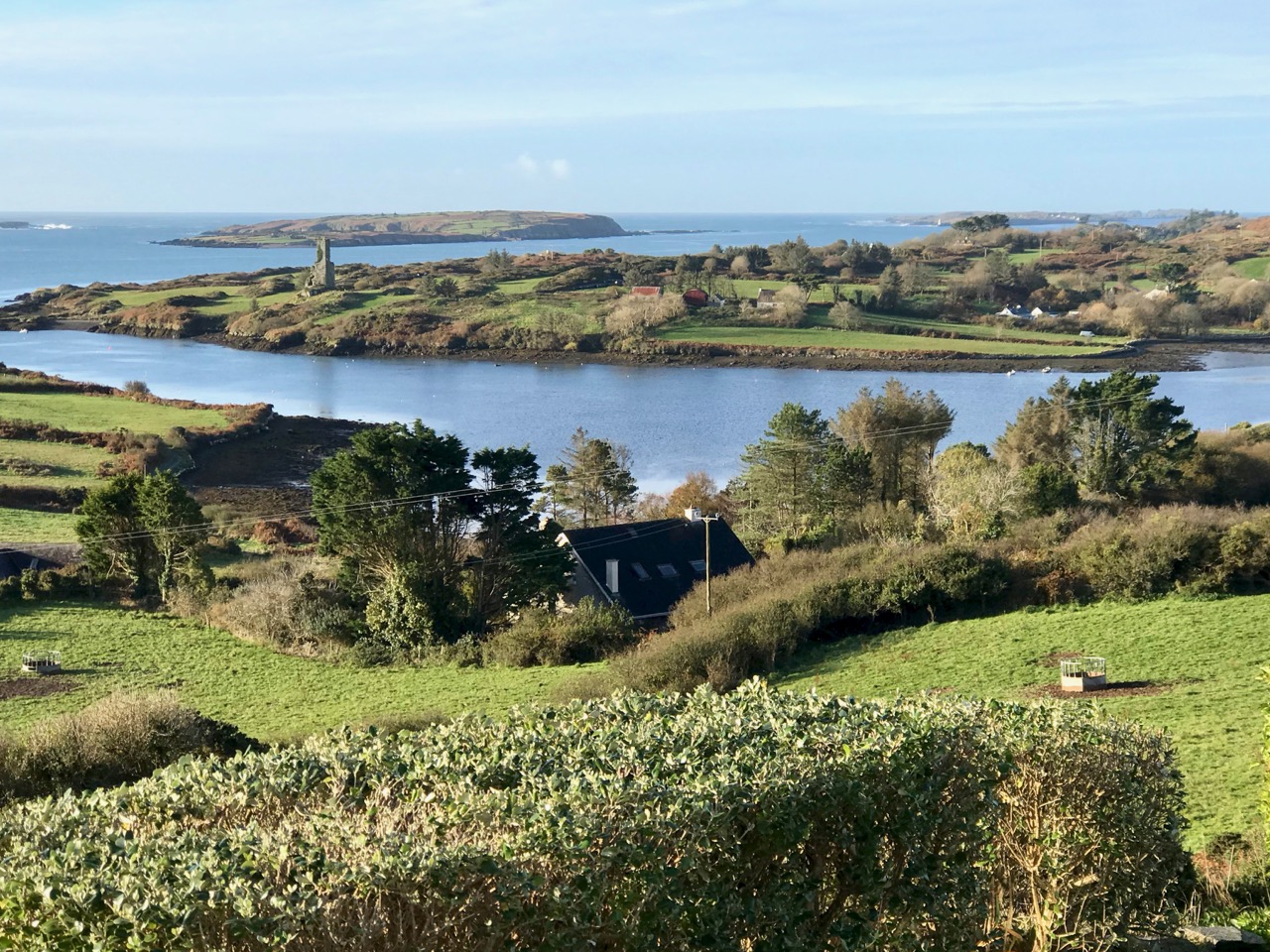
Header and above – looking across Rossbrin Cove from the garden of Nead an Iolair early this morning – St Martin’s Eve – conforming with the tradition of ‘Little Summer’ associated with the saint
The English poet John Clare (1793 – 1864) – sometimes called the peasants’ poet – wrote a very long poem about St Martin’s Eve: I’ll quote some verses as we go along. It’s worth noting that Clare was a great champion of traditional rural life, and was known as “. . . the greatest labouring-class poet . . . No one has ever written more powerfully of nature, of a rural childhood, and of the alienated and unstable self . . .” That’s according to his biographer Jonathan Bate. Although some of his work was well received in his lifetime, he was unable to make enough to keep him, his wife and seven children – and his alcohol consumption – on an even keel. He suffered from ‘strange delusions’ and spent the last twenty seven years of his life in asylums where, nevertheless, he continued to write.
Now that the year grows wearisome with age
& days grow short & nights excessive long
No outdoor sports the village hinds engage Still is the meadow romp and harvest song That wont to echo from each merry throng
At dinner hours beneath high spreading tree
Rude winds hath done the landscape mickle wrong
That nature in her mirth did ill foresee Who clingeth now to hope like shipwrecked folk at sea . . .
(John Clare, St Martin’s Eve, 1823)
Here’s St Martin, looking every inch a medieval knight – although in fact he lived in the fourth century. He was St Patrick’s uncle – possibly accounting for his popularity in Ireland. In this Italian representation he is shown cutting his cloak in two and giving half to a beggar: the act that has made him famous. He was a Roman soldier but gave up that calling to be consecrated as Bishop of Caesarodunum (Tours) in 371. Although he lived a long life, he is said to have died a martyr by being thrown into a mill stream where he was crushed by the wheel. He achieved acclaim as the patron saint of soldiers, but also managed to become the patron saint of conscientious objectors!
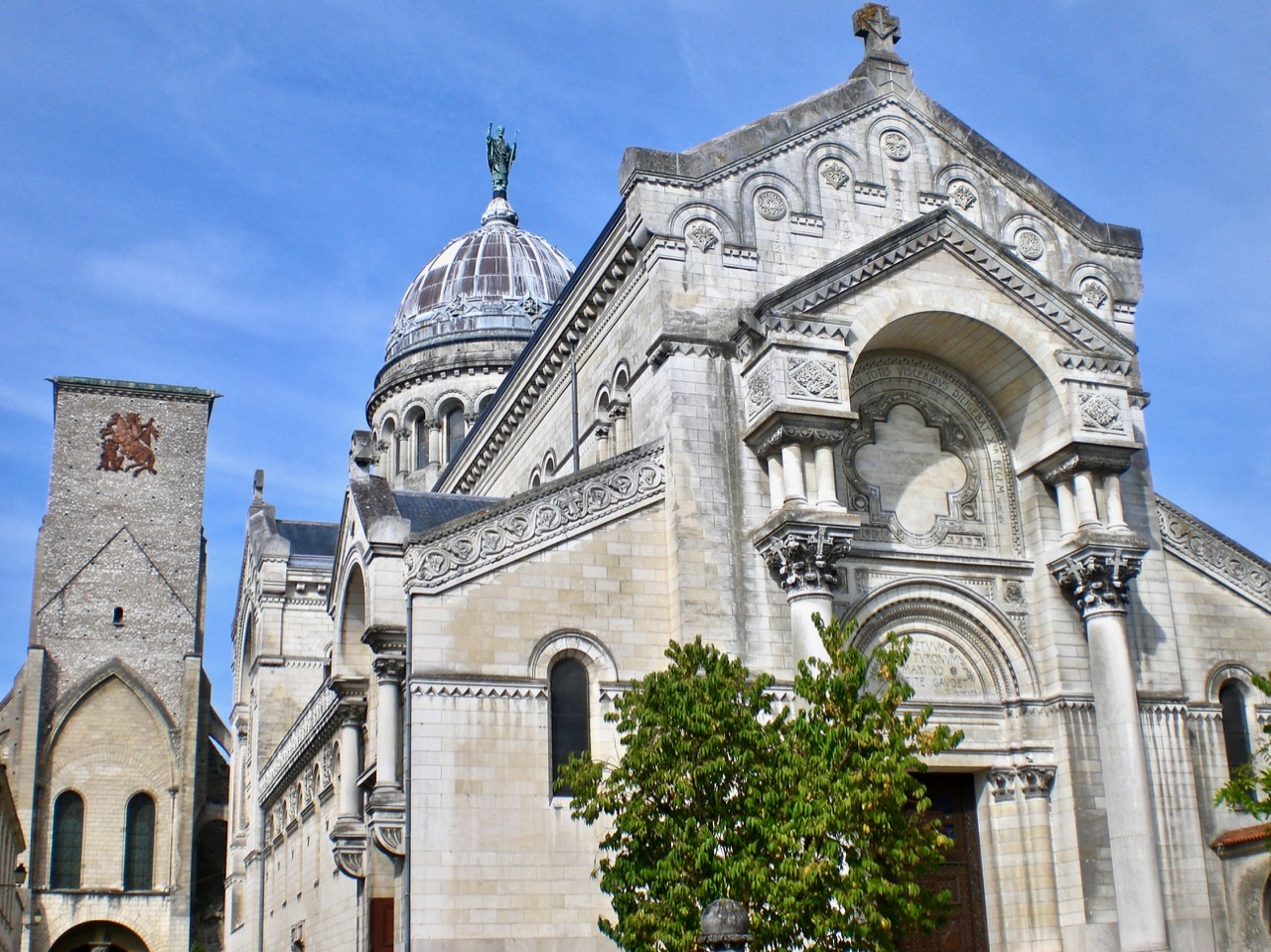
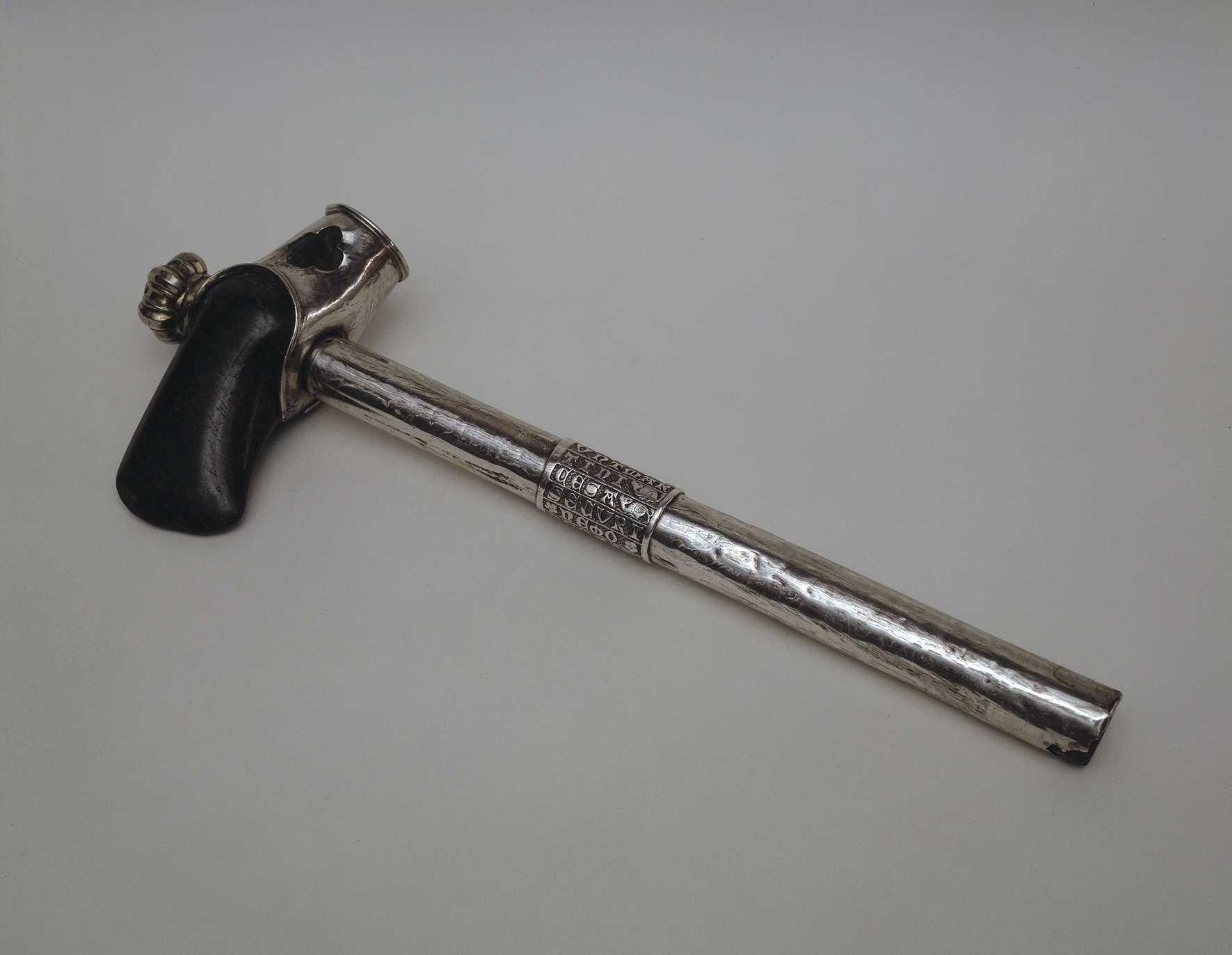
The Basilica at Tours, France (above). St Martin served as Bishop here from 371 – but reluctantly. It is said that he tried to hide from those who wanted to install him as Bishop, but his hiding place was given away by the cackling of geese – which have been associated with the saint ever since. Other stories tell how the saint destroyed pagan temples and cut down sacred trees: in one instance, the pagans agreed to fell their sacred fir tree, if Martin would stand directly in its path. He did so, and it miraculously missed him. There’s a relic in the St Catherine’s Convent Museum of Religious Art in Ultrecht, the Netherlands, which claims to be a hammer which St Martin used to fell pagan sites including sacred trees. Archaeological analysis has shown it was probably made in the 13th or 14th century from a late Bronze Age stone axe dating from c 1,000 – 700 BC. The handle contains a Latin text saying Ydola vanurunt Martini cesa securi nemo deos credat qui sic fuerant ruicuri (‘the pagan statues fall down, hit by St Martin’s axe. Let nobody believe that those are gods, who so easily fall down’). Here it is:
Beside the fire large apples lay to roast
& in a high brown pitcher creaming ale
Was warming seasoned with a nutmeg toast
The merry group of gossips to regale
Around her feet the glad cat curled her tail
Listening the crickets song with half shut eyes
While in the chimney top loud roared the gale
Its blustering howl of outdoor symphonies
That round the cottage hearth bade happier moods arise . . .
(John Clare, St Martin’s Eve, 1823)
It seems a little incongruous, perhaps, to come from a world of basilicas and silver hammers to ancient folk-customs in rural Ireland, but not so long ago Martinmas was greatly celebrated here. Kevin Danaher quotes Mason’s Parochial Survey:
On the eve of St Martin (who is one of the greatest saints in their calendar) in November every family of a village kills an animal of some kind or other; those who are rich kill a cow or a sheep, others a goose or a turkey; while those who are poor, and cannot procure an animal of greater value, kill a hen or a cock and sprinkle the threshold with the blood, and do the same in the four corners of the house; and this ceremonious performance is done to exclude every kind of evil spirit from the dwelling where this sacrifice is made, till the return of the same day in the following year . . .
Danaher also mentions a writer, Amhlaoibh Ó Súilleabháin, commenting in 1830 from County Kilkenny:
The eleventh day, St Martin’s Day. No miller sets a wheel in motion today, no more than a spinning woman would set a spinning wheel going, nor does the farmer put his plough team to plough . . .
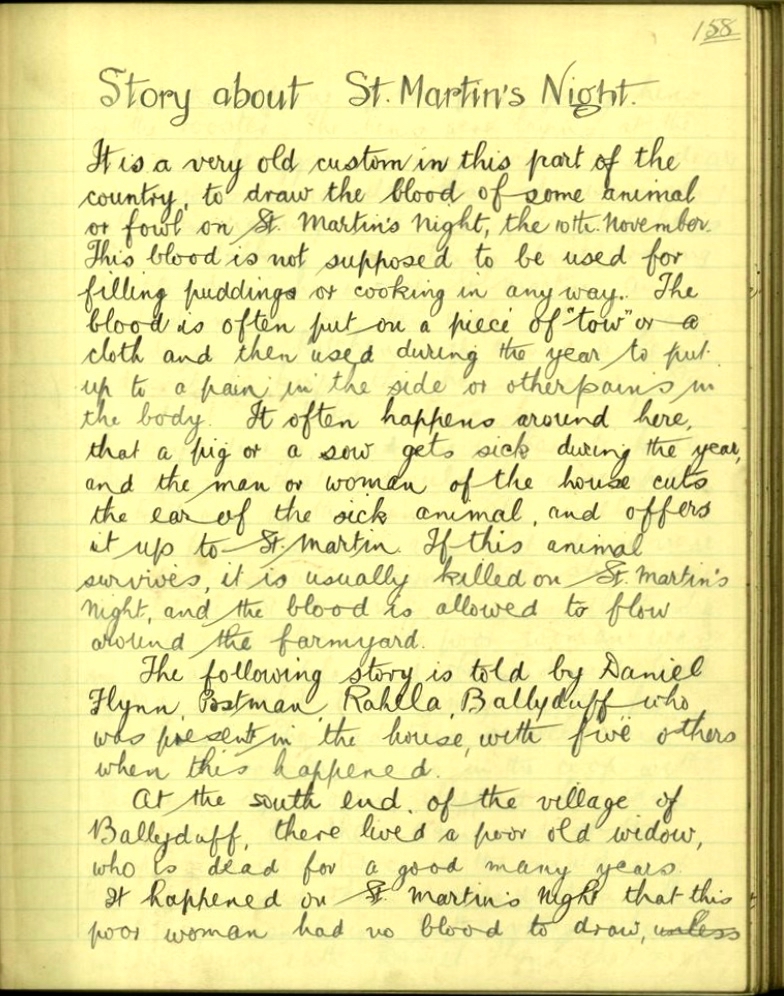
The tradition undoubtedly refers back to St Martin’s death from being ‘ground by a mill wheel’. Significantly, there are numerous entries in the Dúchas Folklore Collection, dating from the 1930s, which show that these customs were still remembered and – on occasion – practised:
One of many examples from the Dúchas Folklore Collections which remember the importance of Martinmas customs
Martin King used kill a fowl every St Martin’s night in honour of St Martin. One year Martin forgot it and when he awoke in the morning the floor from his bedroom to the kitchen was covered with blood. Martin washed out the floor, but when he awoke again the following morning the floor was covered with blood again. This went on for three nights. Martin was very troubled about it so he told his story to an old woman that lived near him. The old woman told him it was because he had not killed something in honour of St Martin. Every year after that till he died Martin killed a hen or something in honour of St Martin . . .
(Eileen Donegan, Knockane, Listowel – collected for Dúchas 1935)
Another from Co Kerry:
St Martin’s day is held on the 11th of November. It is held as a feast day in honour of St Martin. The night before St Martin’s day people kill a goose or a chicken or some other kind of fowl, and they draw the blood and dip a piece of flax in it. They keep the piece of flax because it is said to be a cure for a pain in one’s side.
St Martin was a saint who was ground in a mill for his faith.
In olden times the mills used not work on that day The women in olden times used not work. No one would turn a wheel not even of a car.
(Mrs Walsh, aged 90 years – Tullamore, Co Kerry – collected for Dúchas)
The next piece is particularly interesting as it mentions St Martin’s association with a white horse:
It is a custom in Ireland to kill a cock on Saint Martin’s Night.
There was a man who emigrated to America. On St Martin’s night he was very sad. He was telling his friends that he would like to be home in Ireland, because if he were home he would kill a cock in honour of St. Martin.
He went outside and he went down the street. He met a man on a beautiful white horse. The man asked him would he like to go home. He said he was just wishing to be at home. He told him to get up on the horse. He did so and the next place he found himself was at his own door in Ireland.
The man told him to come out at a certain hour. He killed the cock and came out at the hour that he was told to do so. The man was waiting for him at the door. He got up on the horse and rode away. It was said that it was St Martin who brought him home.
(Maura Keating, aged 82 years, Passage East, Co Waterford)
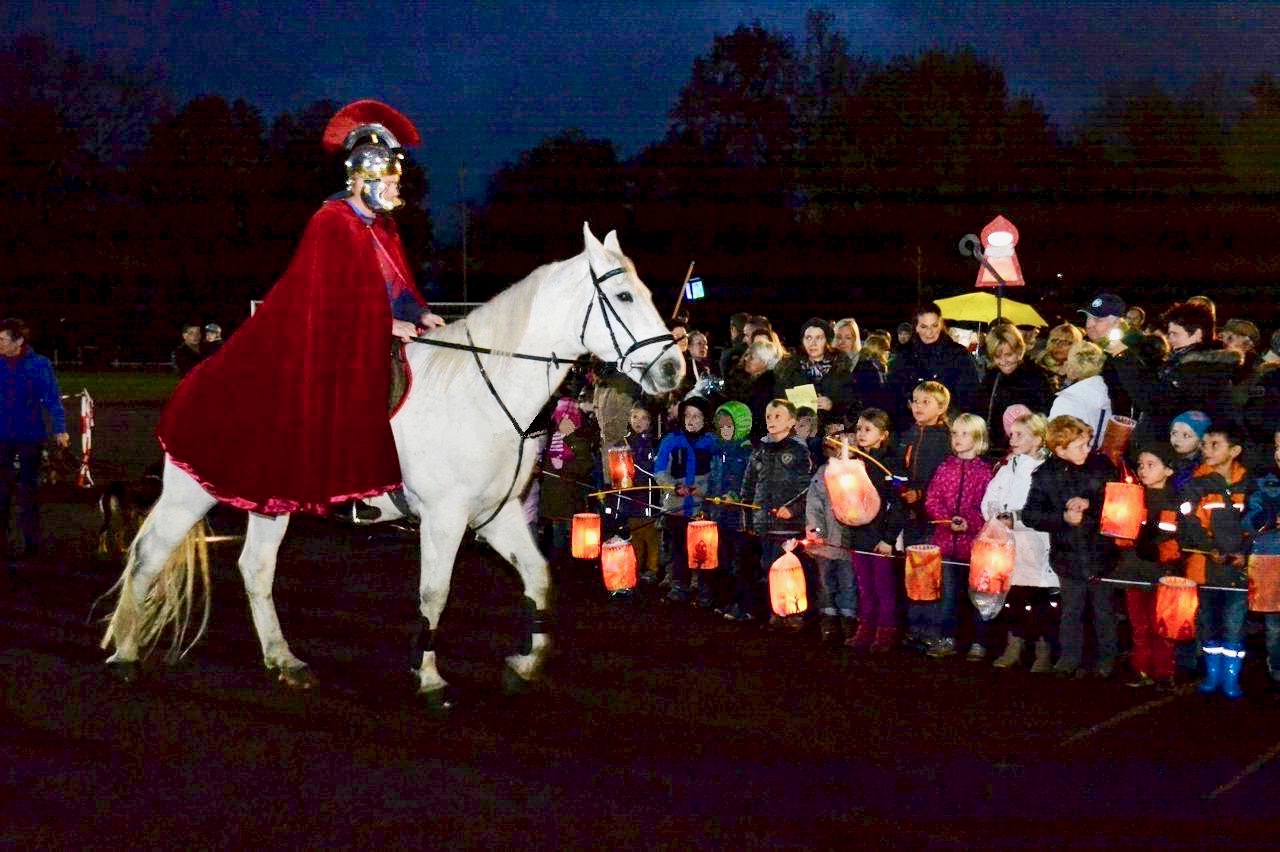
St Martin’s Eve celebrations are still observed all over Europe. This is a festival in Italy, where children carrying lanterns watch out for the saint arriving on his white charger
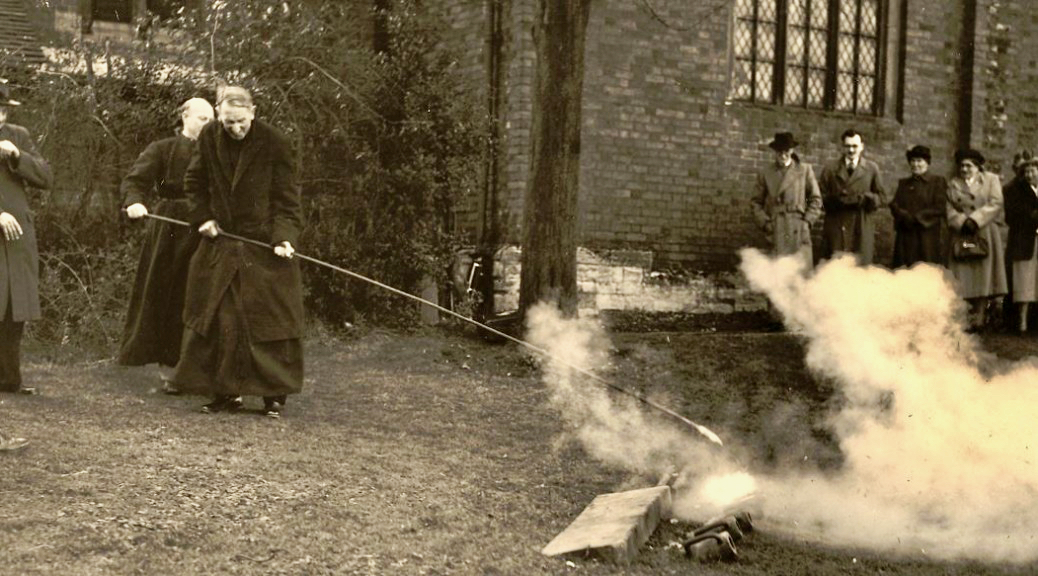
What about Fenny Poppers? I hear you ask . . . Well, we have to go across to Northamptonshire, in England, for this surviving – and most curious – custom. St Martin’s Church, Fenny Stratford is to this day the scene of an event which has no apparent origin, nor any particular purpose. I won’t try to offer you an explanation – just to point out that it happens every Martinmas come hell or high water. Here’s a somewhat eccentric account of the event from a Movietone News snippet c 1950:
That’s probably enough about St Martin and his special day to last you another year. The subject is by no means exhausted!
We’ve been thinking lots lately about Northern Ireland and how much we enjoyed our time there. One of our truly memorable experiences was a trip to Boa Island in Fermanagh to see the mysterious carved figures in the Caldragh graveyard.
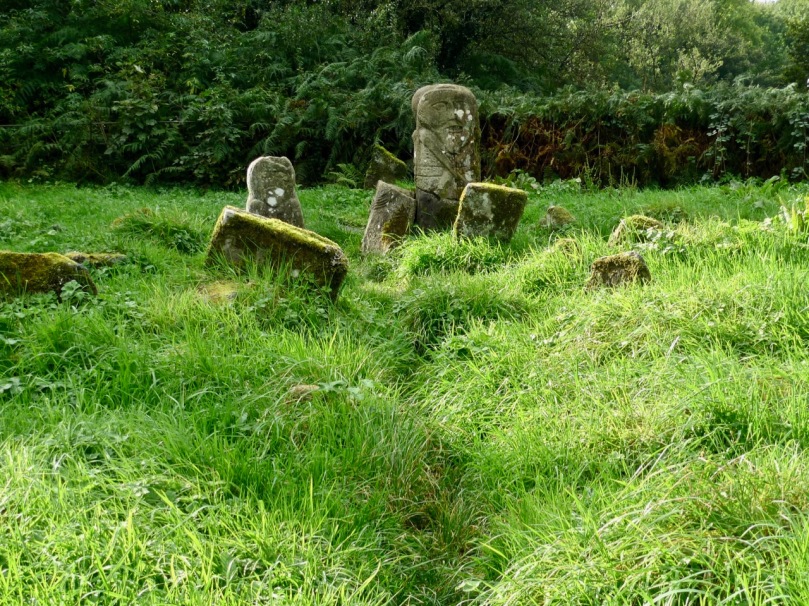
Despite the fact that this is one of Northern Ireland’s most important archaeological sites, we had the place to ourselves when we were there, in October 2016. In fact, it looked like any peaceful rural graveyard, with higgledy piggledy gravestones behind a hand-forged iron gate, lush grass, and an air of benign neglect.
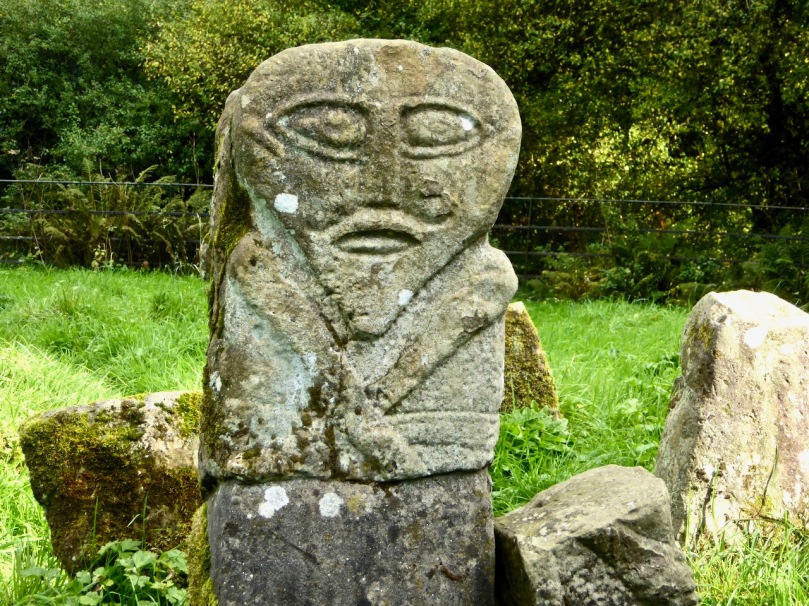
But there’s one big difference – in this remote place are two of the most enigmatic carved figures on the Island of Ireland. The first one has two faces – it’s been called a Janus figure, or simply bilateral, carved in a style that is reminiscent of Early Medieval carvings, but also different. Different enough so that one can see these as pre-Christian figures, and that is how they are most often interpreted.
Boa Island itself may be named for the Goddess Badhbh (pronounced Bov), a potent character in Irish mythology. The figures do not bring saints or clerics to mind – there are no croziers, no fingers raised in blessing, no tonsures or crosses. We’ll look at the bilateral figure first. It has two faces, back to back, with a groove in between. The groove collects water and in recent years people have started to leave coins in the puddle formed by the groove, perhaps echoing its original purpose. The heads are joined at the side by herringbone or plaited lines that may represent hair.
One side has been interpreted as male and some point to a stylised penis that rests between the legs. Although I have seen photographs of this side when it had been recently cleaned, where a carved element is denoted as the penis, it is not in any way obvious now that the statue is once again covered in lichen and badly weathered, with moss growing in this area. The face is long and triangular, the mouth open and the eyes wide and staring. Two arms cross across the body, over a belt which runs around both figures.
On the other side the mouth is open and a tongue protrudes. Apart from that, the figures are almost identical. The statue is broken just below the belt on this side, so it is impossible to say that there are any female, or indeed male attributes present.
The carving has been mounted on a plain base but leaning against it is what might be the original base, or part of it. If it is, then the arms extended down into hands, resting on either side of the base.
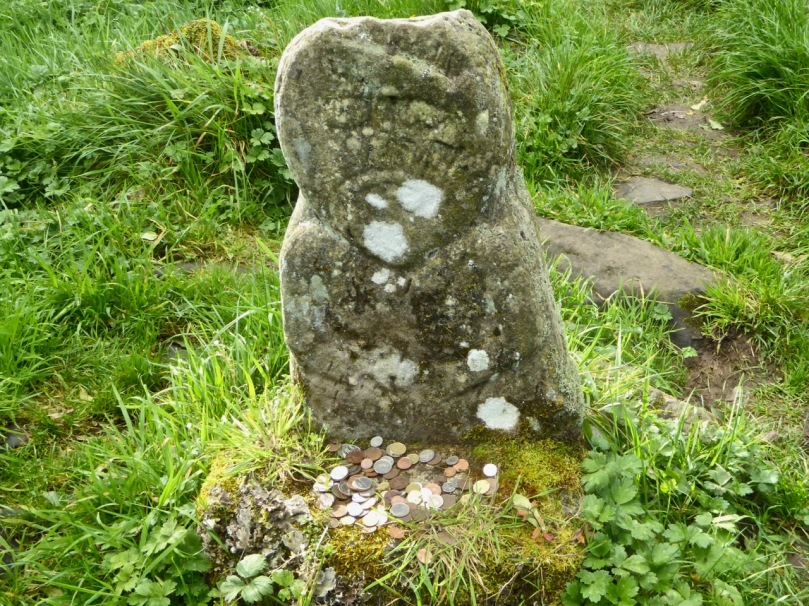
There is a second figure, brought here from nearby Lusty More Island. This one is much more worn, or perhaps not even totally finished, but it’s possible to see that it bears a strong resemblance to the others in its triangular face. The arms are not crossed but appear to be holding something. Visitors leave coins in front of this one.
What does it all mean? In short, we don’t know, but current consensus appears to fall in the area of calling these figures representations of pagan deities. The smaller figure, rather than holding something, may be female and pointing to her genitals. This would place it in the tradition of the sheela-na-gigs, although presumably much earlier than the majority of sheelas, which are thought to be medieval.
Whatever they are, they have inspired poets and artists – even filmmakers. One of our favourite films, the marvellous Song of the Sea, has taken much of its artistic design from prehistoric Irish art, including the Boa Island figures. Watch this teaser for the movie and see if you can spot the Boa Island figure at 46 seconds.
And the poetry? Seamus Heaney, of course, himself from Northern Ireland, drew inspiration from the landscape around him and often wrote about archaeological themes. His poem, January God, captures the mysterious sense of the two-faced God and makes a shift to summon the idea of Cernunnus, the antler-headed pagan god of wild things depicted on the Gundestrup Cauldon.
Southwest Munster, and West Cork in particular, is home to the greatest concentration in Ireland of stone circles. There are two main kinds recorded in the National Monuments website, each making up about half the total number of circles – the multiple-stone circle and the five-stone circle. (There are also a small number of enigmatic monuments called ‘four posters’ which share some features with stone circles, but I will write about them some other time.)
The division based on the number of stonesis somewhat arbitrary, since both share most other features. Both have uneven numbers of stones – five in the case of the five-stone circle, and seven or more (up to 19) in the multiple-stone circles.
Our old friend Du Noyer loved to illustrate antiquities. We’re not quite sure which stone circle this one is**
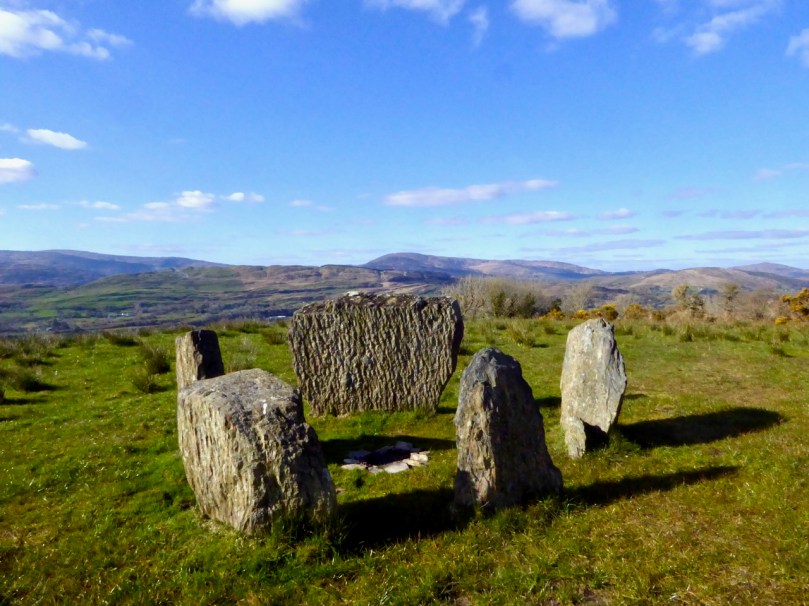
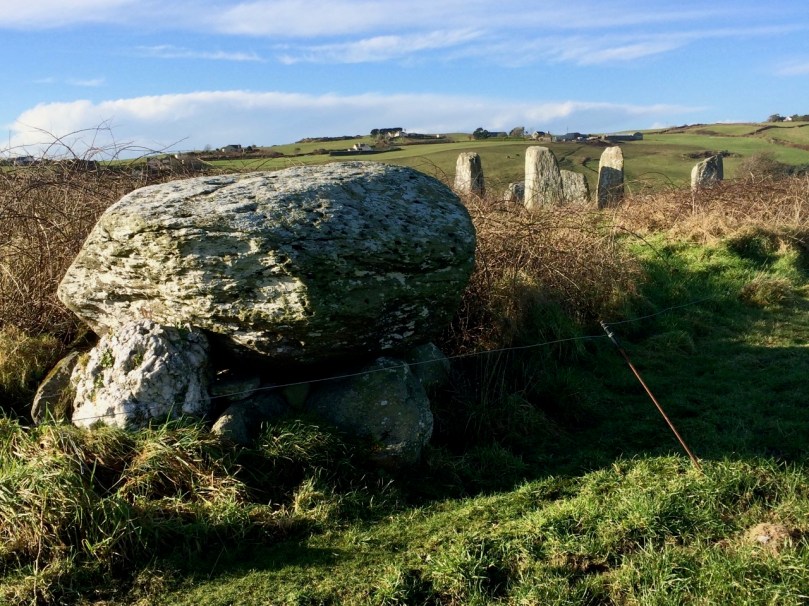
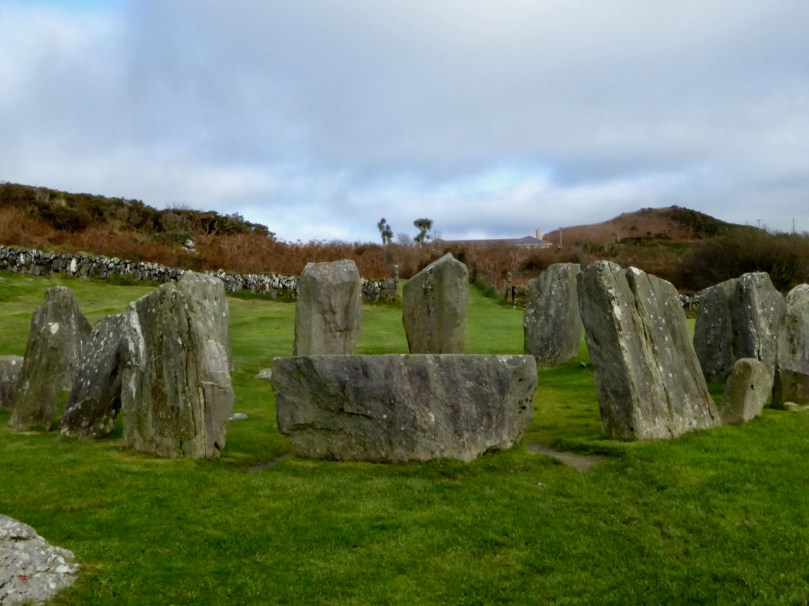
Both types are axial or recumbent stone circles. The name recumbent comes from the lowest stone in the circle, the only stone set on its side, with its long axis parallel to the ground. All the other stones are set upright and they often increase in size from the recumbent to the portal stones. The portals appear to form an entrance into the circles and are sometimes set end-on to the circle. An axis drawn from the point between the portals to the middle of the recumbent bisects the circle – hence the name axial stone circle. All these features can be seen in the photograph of Drombeg Stone Circle (below).
While the multiple-stones circles appear roughly circular, they may have been laid out using more complicated geometry than the string-marking-out-a-circle technique. Some are more elliptical than truly circular. The five-stone circles, given the dominance of the recumbent, are actually D-shaped.
Many of our stone circles have disappeared over time, with only folkloric memory indicating that here was once a circle of stones. Some have lost stones over time, while in others uprights have collapsed. Whole monuments have vanished into forests or dense undergrowth. Even where we still have partial circles it can be difficult to make out which are the portals and which the recumbent.
Upper: Labbamolaga – we think this was a stone circle but so few stones remain that it’s hard to be definitive. Lower: This sad little heap of stones is all that remains of the Ahagilla Stone Circle. The recumbent is to the left and a portal to the right.
The circles are constructed from local stone and in some cases it is easy to see where they have been quarried from nearby rock outcrops. There is no evidence of the builders transporting the stones from elsewhere, with the exception, perhaps of the quartz blocks which are found occasionally either as uprights or associated with the circle inside or outside it. Although quartz is found in abundance in West Cork a large block of it may have been especially prized and reserved for such a situation.
This sizeable quartz block lies beside the Lettergorman Five-Stone Circle
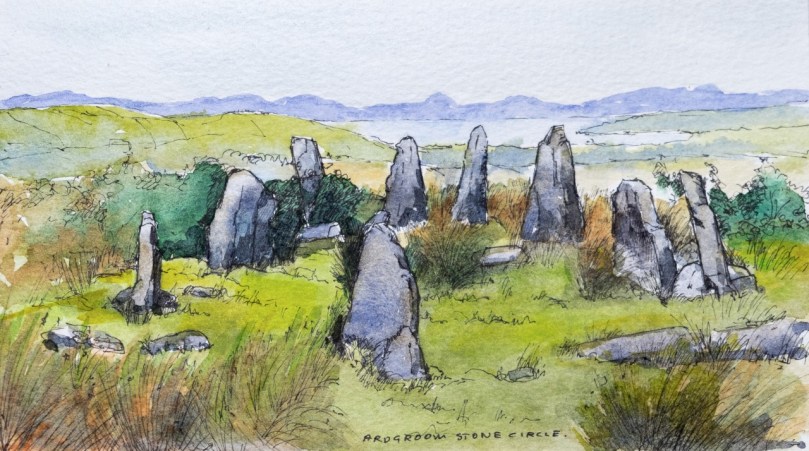
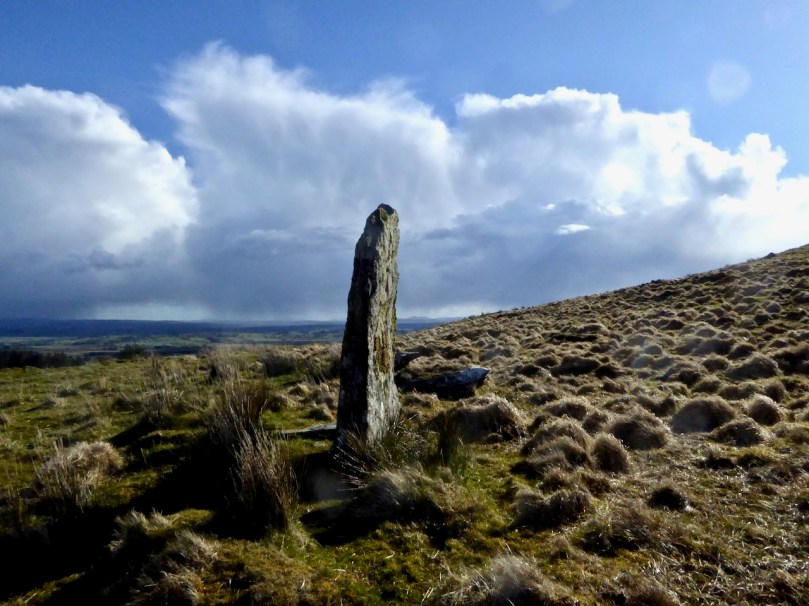
The circles were carefully and deliberately constructed: Fahy’s excavations at Drombeg and Reenascreena shows that the ground was levelled.Stones were, it seems, selected for shape as well as size. The recumbent is usually flat on top, which may indicate the side closest to the parent rock from which it was split. Some may well have been deliberately shaped by knocking or splitting off sections – we often notice, for example, how well certain uprights mirror the landscape behind them, like the one at Ardgroom, below.
Stone circles are often associated with other monuments, most commonly boulder burials and standing stones, and at least two have radial stone cairns beside them. Some of the standing stones appear to function as outliers to the circle, extending alignments towards solar or lunar orientations (more of that next time).
Upper: This boulder burial is part of a complex of monuments at Bohonagh which also includes a stone circle (visible behind the boulder burial), a cupmarked stone and a standing stone which is no longer to be found. Lower: A standing stone pair (one fallen) at Knocknakilla with (behind it) a five-stone circle (recently fallen over) and a radial stone cairn – of all the elements of this complex only this standing stone is really visible in the landscape
West Cork stone circles, from the sparse excavation evidence, date from the middle to late Bronze Age (about 1500 to 600BC). They are commonly found on elevated ground with a clear and expansive view southwards, but stretching from the northeast to the southwest – that portion of the sky in which both the sun and the moon rise and set.
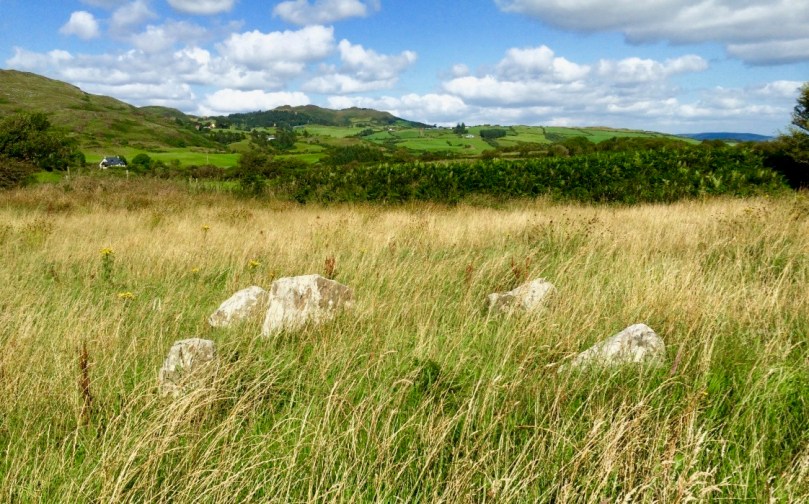
This tiny monument is a five-stone circle at Inchybegga. When the grass grows tall enough you can’t see it at all
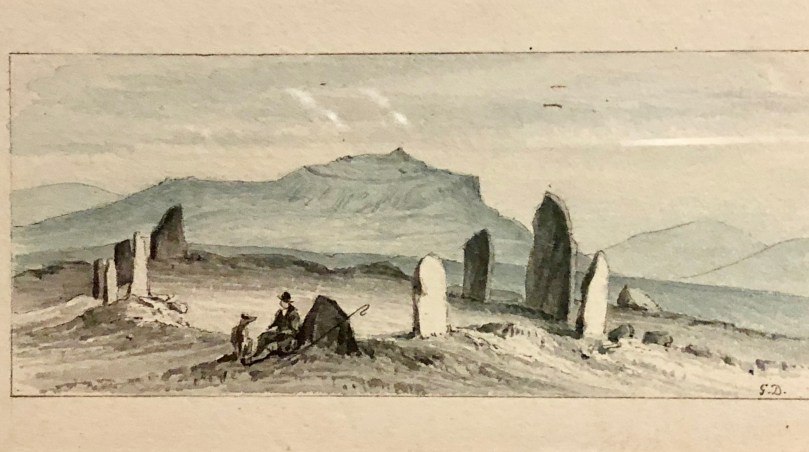
Our stone circles have always fascinated antiquarians, happy to label them ‘druidic temples’ or make outlandish claims about their construction by visiting Egyptians. Some of the older illustration owe more to the imagination than to accurate depictions.
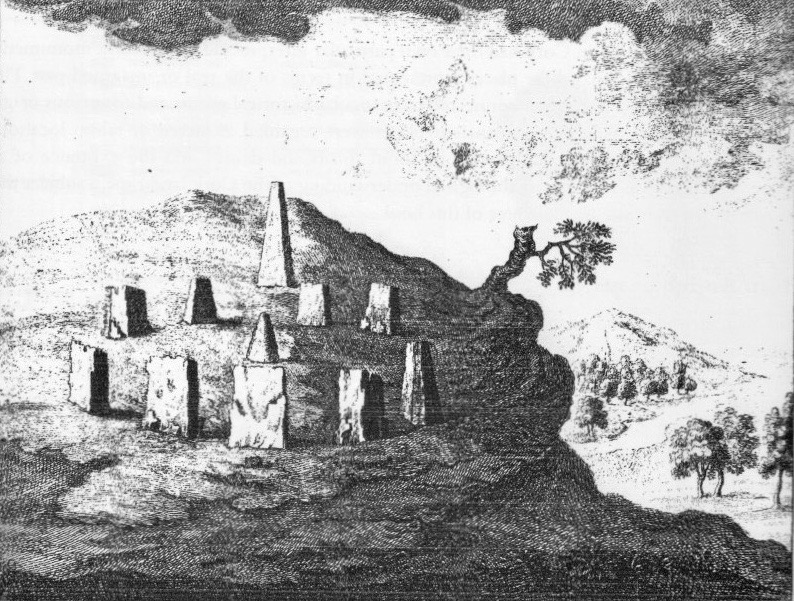
Templebryan Stone Circle as it actually is (lower) and as depicted by the antiquarian, Clayton, in 1742 (upper). The illustration for Clayton, done by Ann la Bush, shows the fashionable preoccupation at the time for Egyptian-type obelisks. Nevertheless it is important in that it shows that there were more stones in the circle than there are now. Note the central block of quartz
In more recent times, they have been the subject of a great deal of new-age speculation about long-distance ley lines, mystical ‘energies,’ extra-terrestrial builders, associations with pagan goddess cults and the like. As an archaeologist, I think this is a pity, in the sense that these stone circles are fascinating enough as they are – they embody so much that we need to understand about the scientific knowledge, advanced construction technology, and social organisation of the builders. The belief systems that underlie their reasons for constructing these monuments are equally important and more difficult to discern after the passage of millennia, but should be based on close and serious study of the monuments themselves.
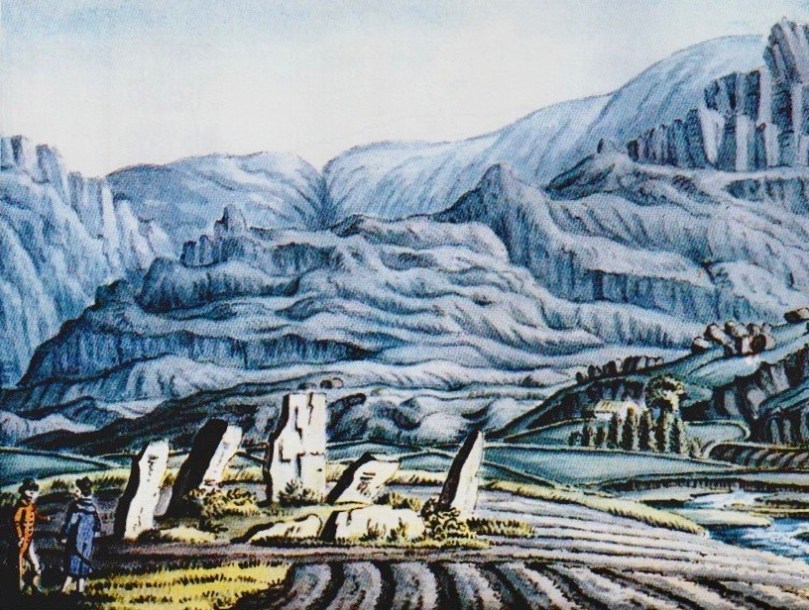
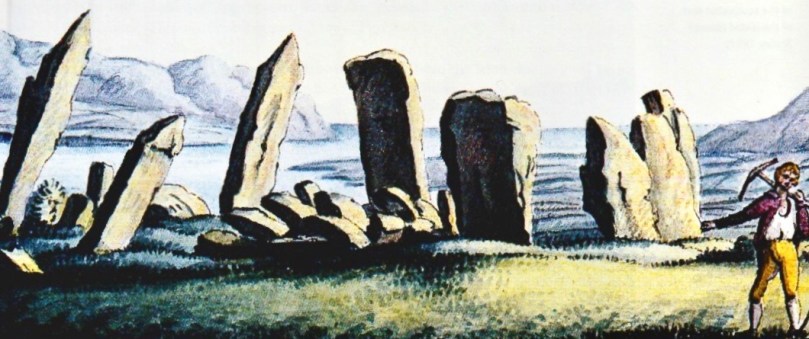
Above is the Derreenataggart Stone Circle on the Beara, and below is a much more romantic and monumental rendering of it from Francis Grose’s Antiquities of Ireland (1790s), illustrated by Daniel Grose. My lead image is also a Daniel Grose illustration, this time of a stone circle that once stood on the slopes of Hungry Hill, but which has since disappeared*
The next post in this series will be about the multiple-stone circles.
*The two illustrations by Daniel Gross are from Daniel Grose (c.1766-1838). The Antiquities of Ireland, a supplement to Francis Grose, by Roger Stalley, Irish Architectural Archive 1991
**I now know that this is almost certainly not a West Cork example but Boleycarrigeen in Wicklow (thanks to Ken Williams for the ID)
I had time to pass in East Cork on Saturday, so I went off to Youghal (pronounce it ‘yawl’), a substantial town with a great deal of history. I had a purpose in mind: to check out a recently opened museum, dedicated to the way that the time of day was chronicled here over a number of centuries.
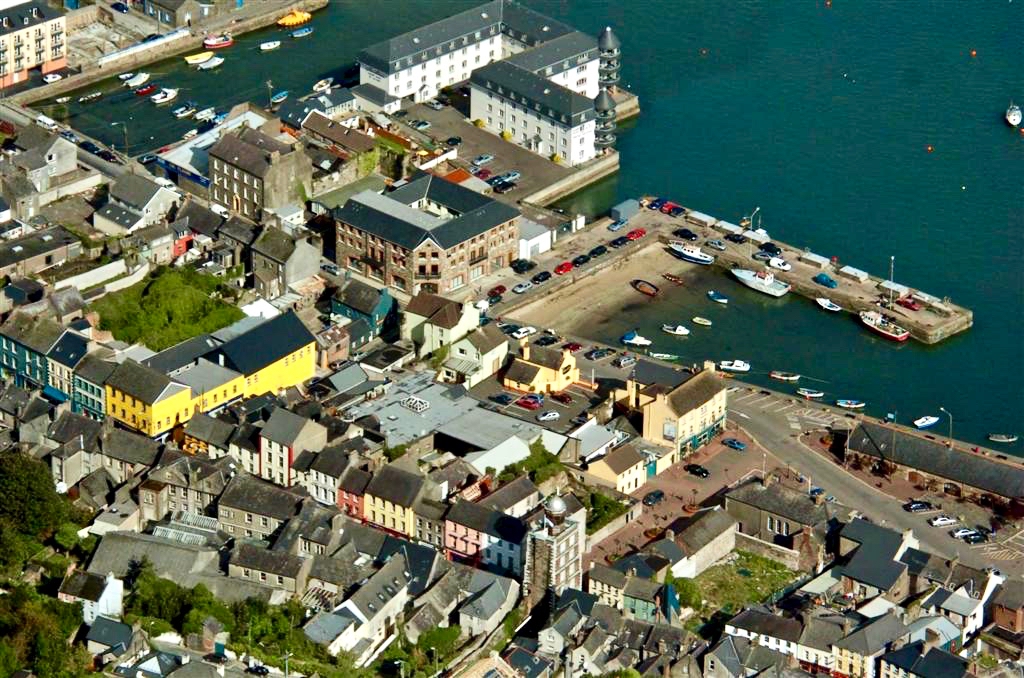
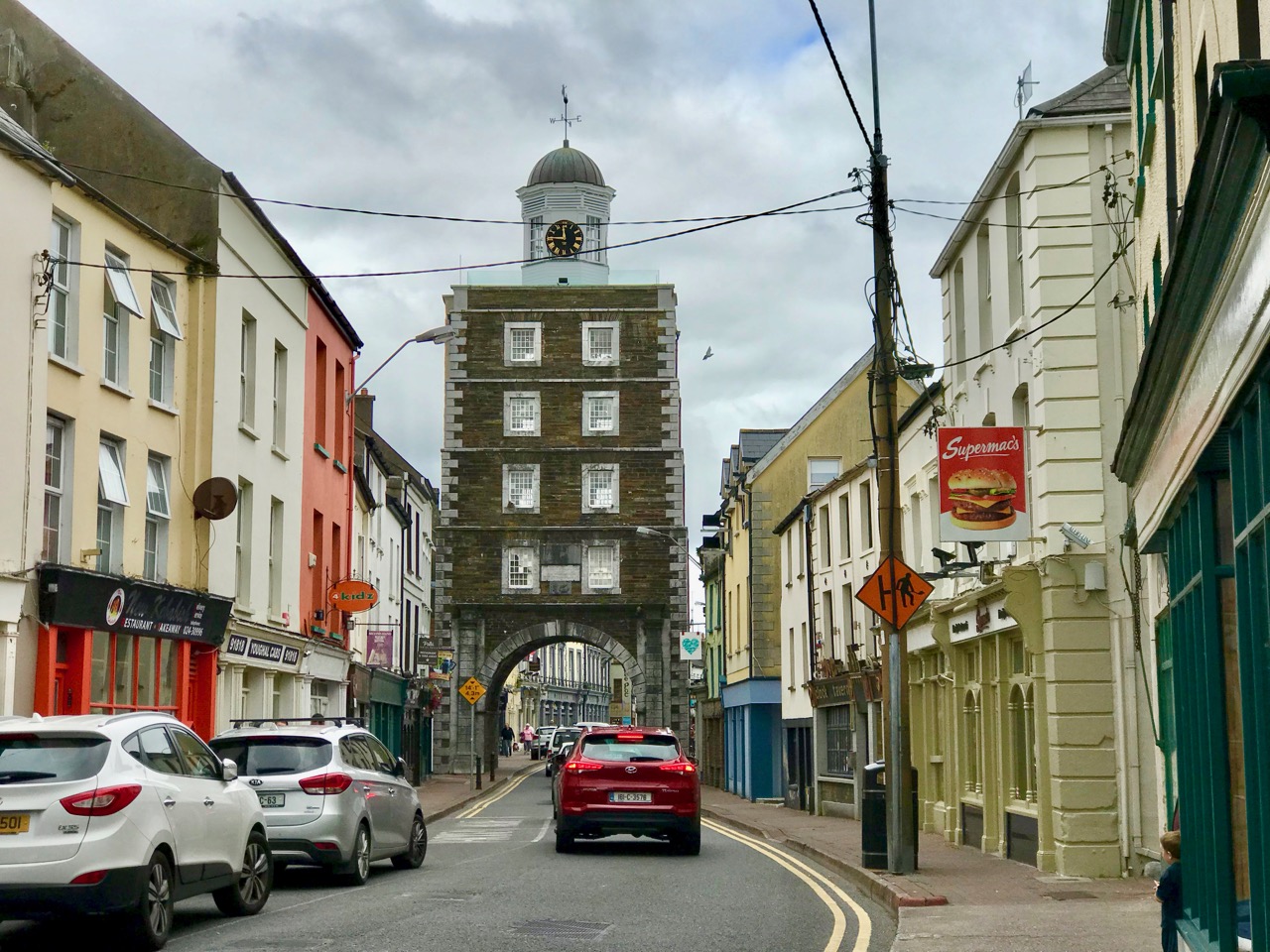
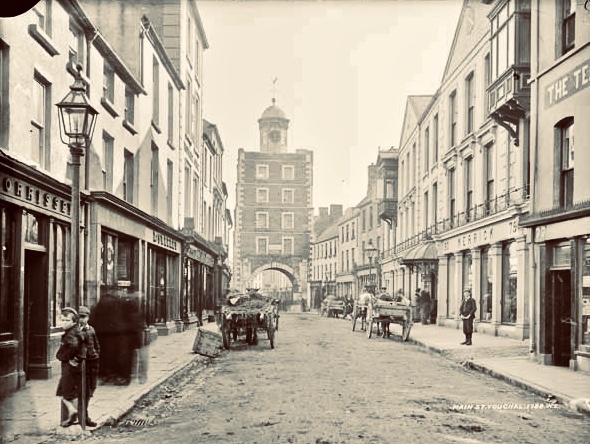
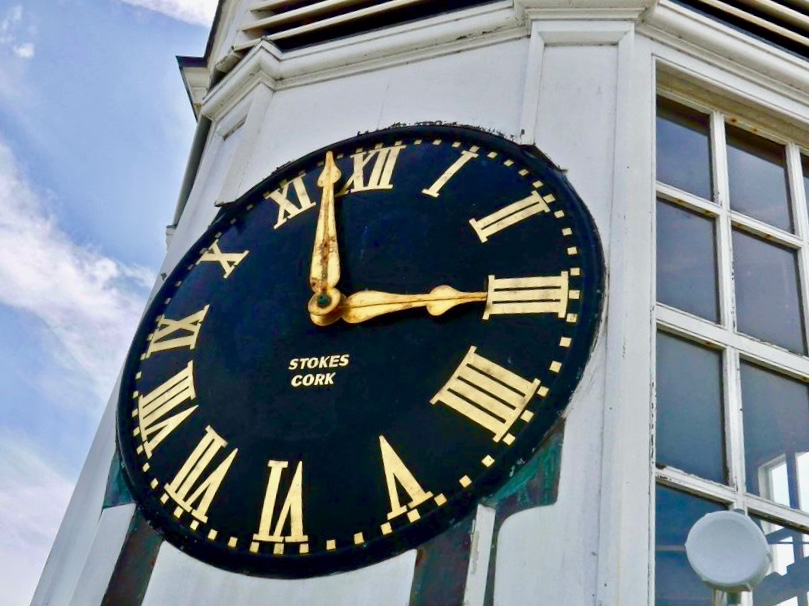
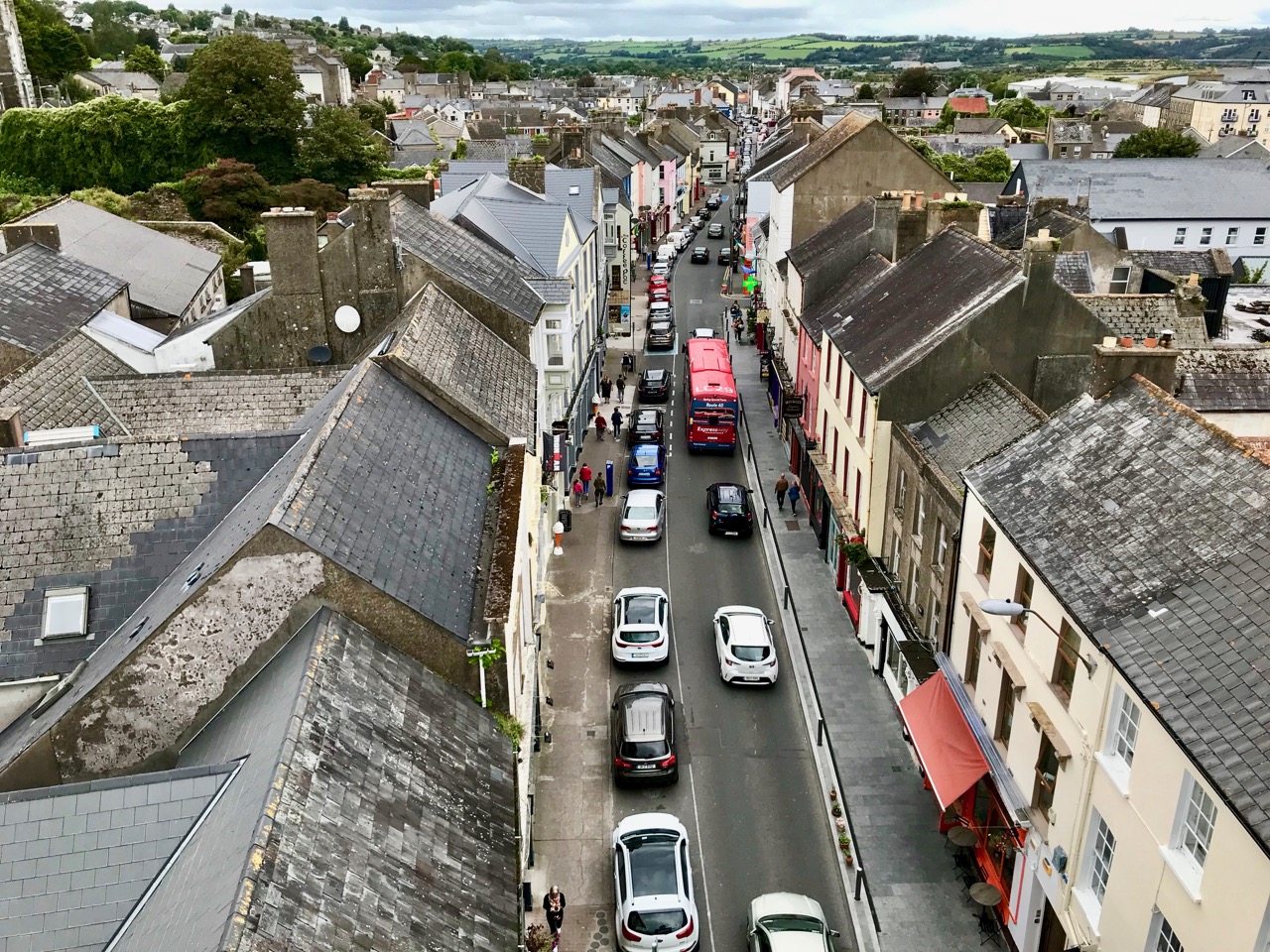
The museum is housed in an iconic building that has spanned the main street of the town for 250 years: the Clock Gate Tower. That’s it bottom centre in the aerial view below, and underneath that is the more usual view of it, from the road. It’s the most visible building in Youghal town, and you can see one of its three clock faces (which all show exactly the same time) in this photograph.
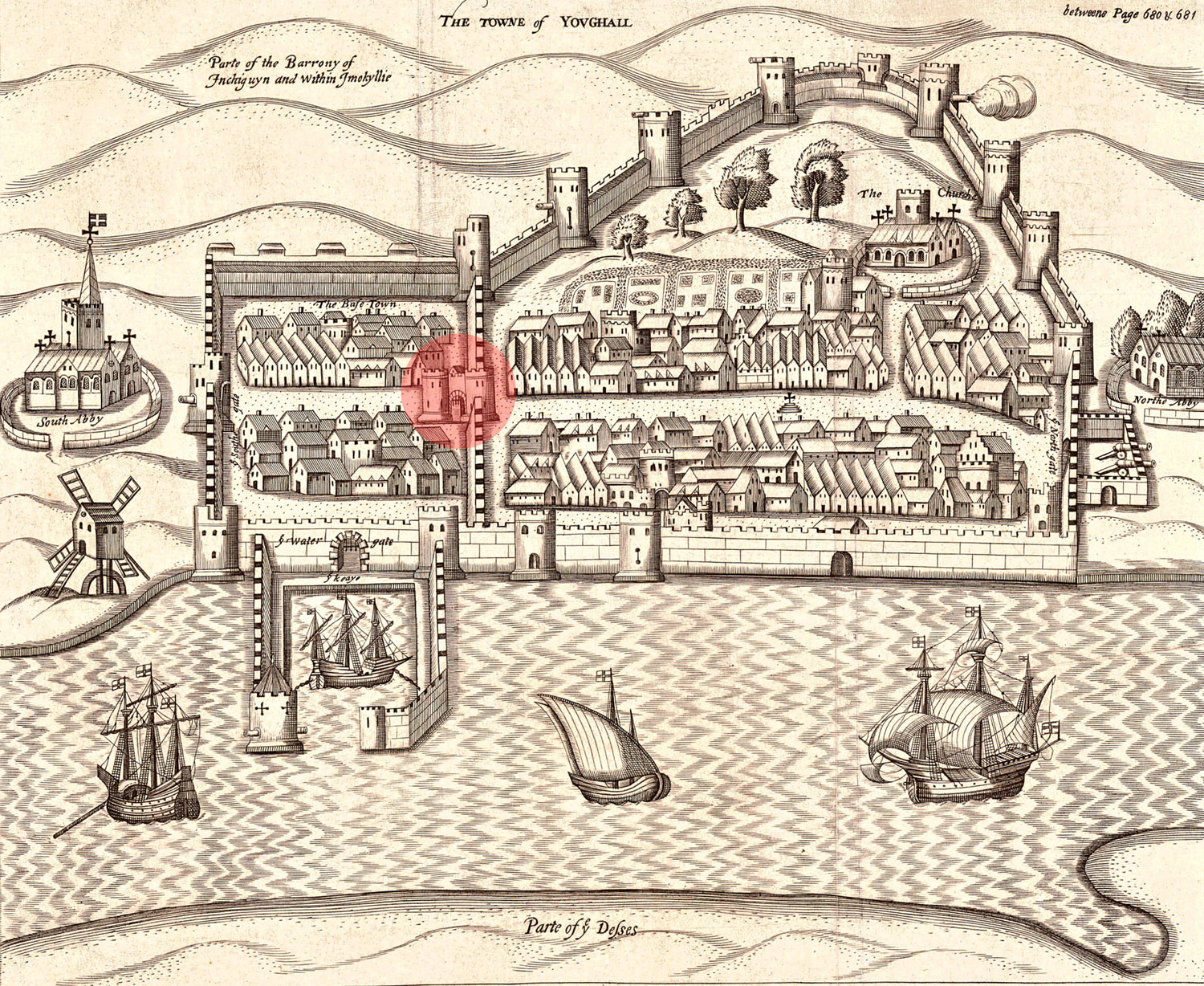
In medieval times Youghal was a walled town, and the site of the Clock Gate Tower was one of the defended entrance points at the south end of the enclosed settlement; Finola has written about the walls here. Masonry walls were fine in the days of bows and arrows but became obsolete when heavy artillery took over: by the late 1700s the town had expanded beyond the walls and the southern gate was redundant: before the Clock Gate Tower was completed in 1777 a medieval gateway known as the Iron Gate stood on the site.
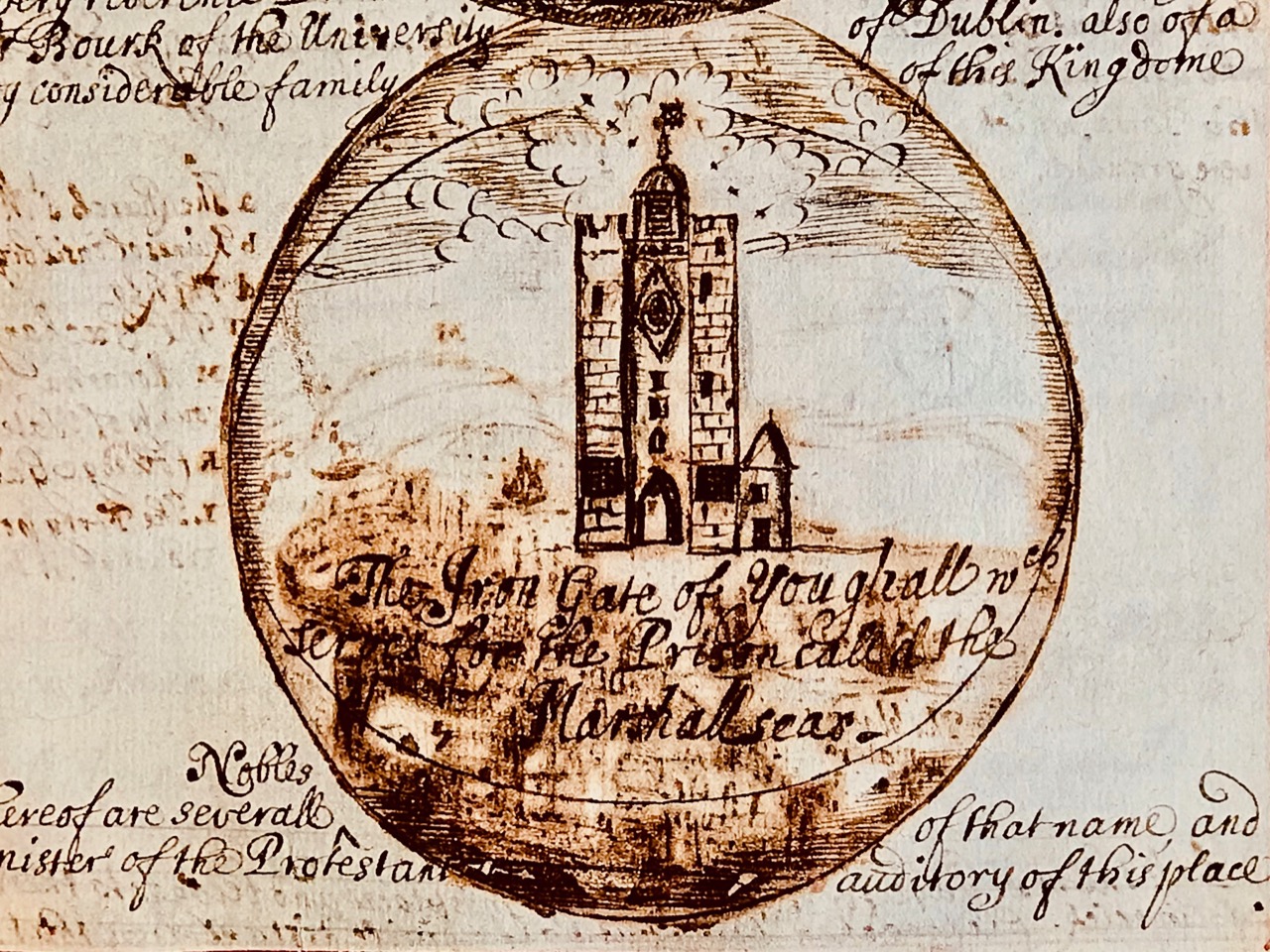
Upper – a map from the Pacata Hibernia showing Youghal – first published in 1633: we are looking at the town from the east. The Iron gate is highlighted: even then the town had expanded beyond the original walls. Lower – the Iron Gate in 1681: by that time the original defensive towers had been embellished with a clock and bell tower
It was perhaps whimsical – in the 18th century – to replace the earlier gate with a building which could be seen as a pastiche of what was there before, but it has certainly succeeded in creating a distinctive landmark which has lasted to the present day, and continues to fulfil the function of a clock and bell tower central to the town.
This early photograph of Youghal’s main street with the Clock Tower probably dates from around 1900
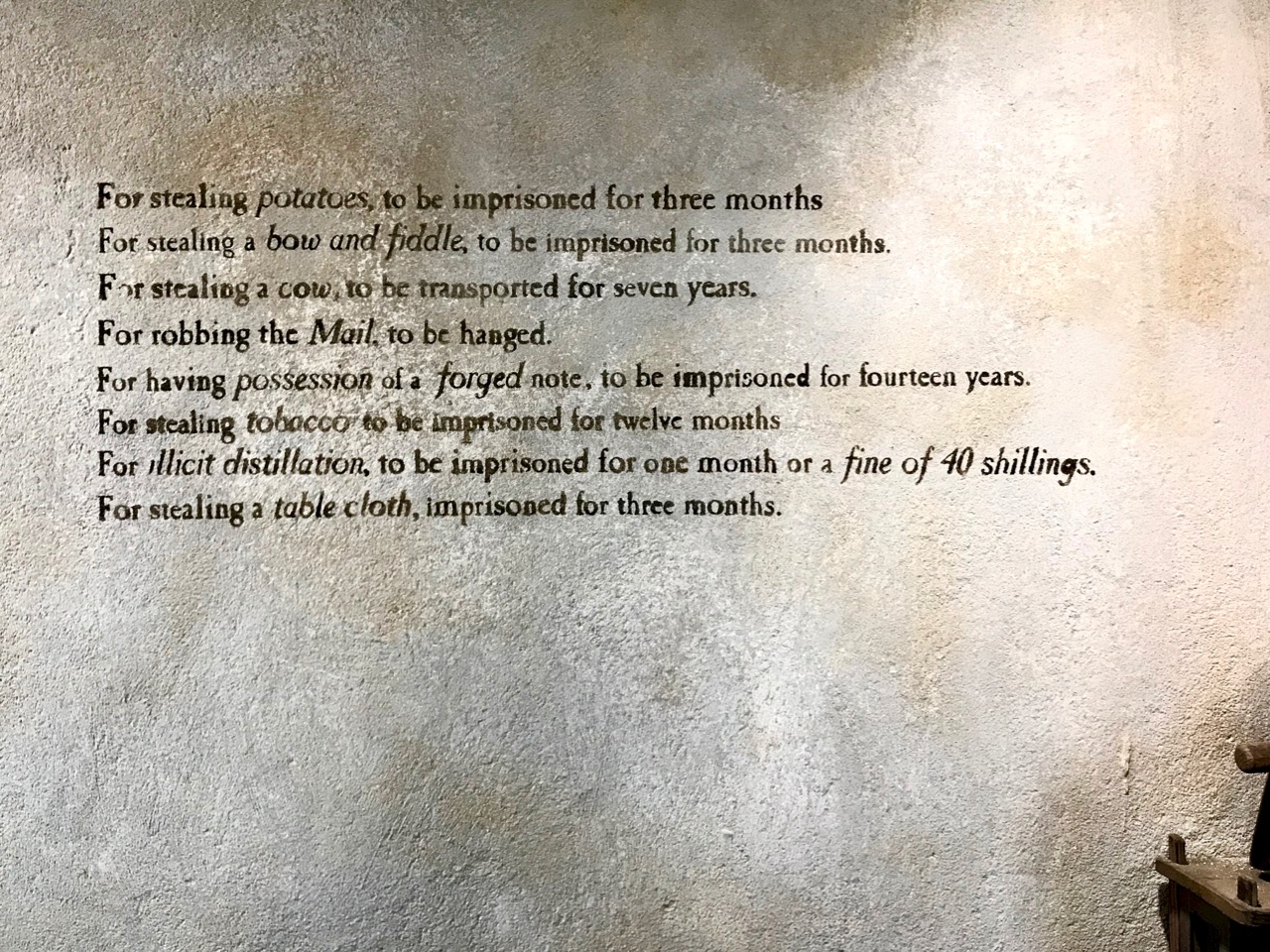
I took the Clock Gate Tower Tour and can assure you that a great time was had by all who were on it. Before you go, however, make sure you are able for climbing the six flights of steps from street level to the very top: there were no lifts in the 1770s, and no way that any mechanical assistance could now be fitted into the restricted spaces in the building. However, the staircases are safe and easy, and there is plenty of time to pause on each floor to see the fascinating displays that have been installed. I’m not going to reveal everything that the tour includes, or you might think you don’t need to take part! Just a few tasters will suffice.
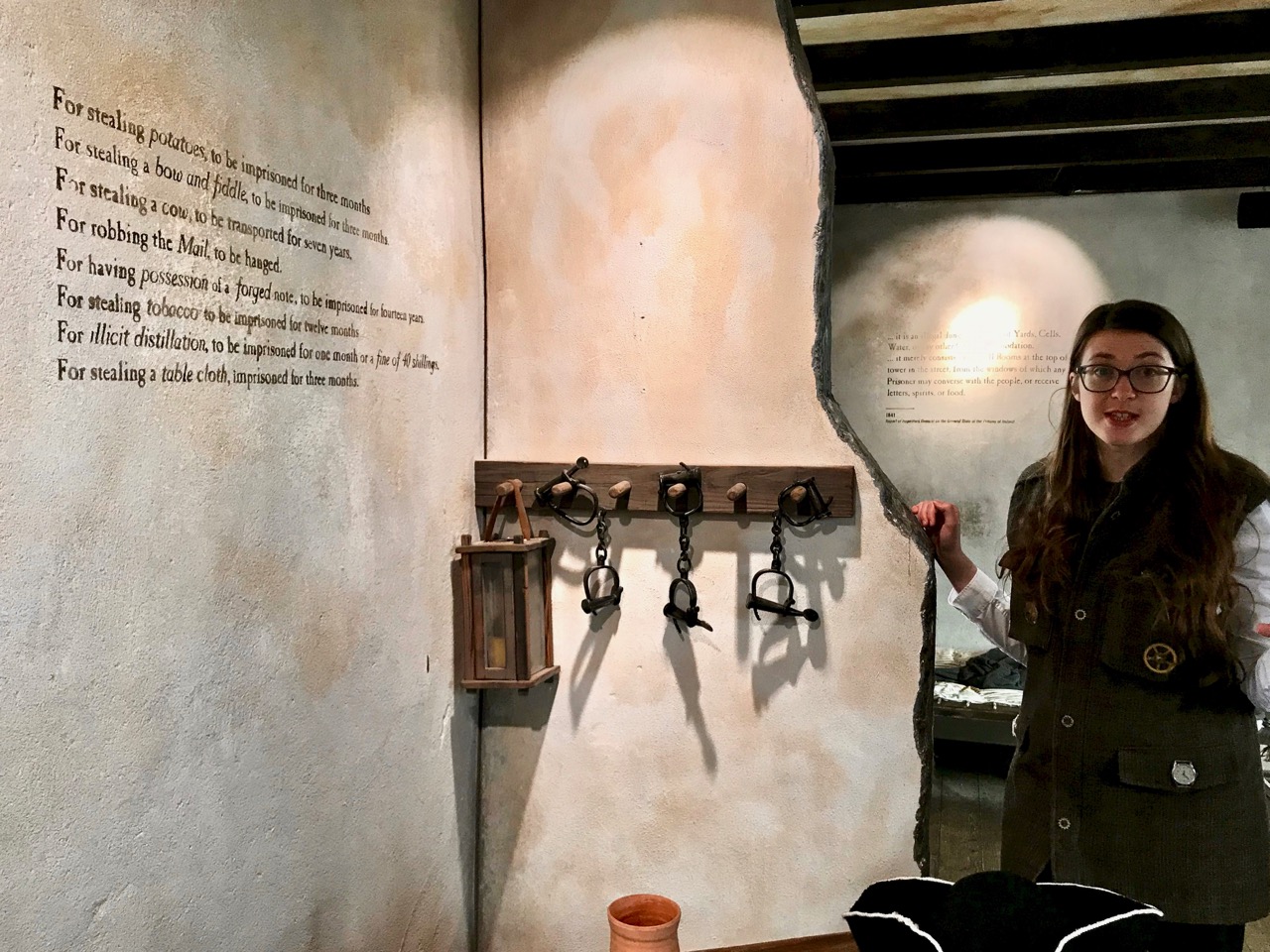
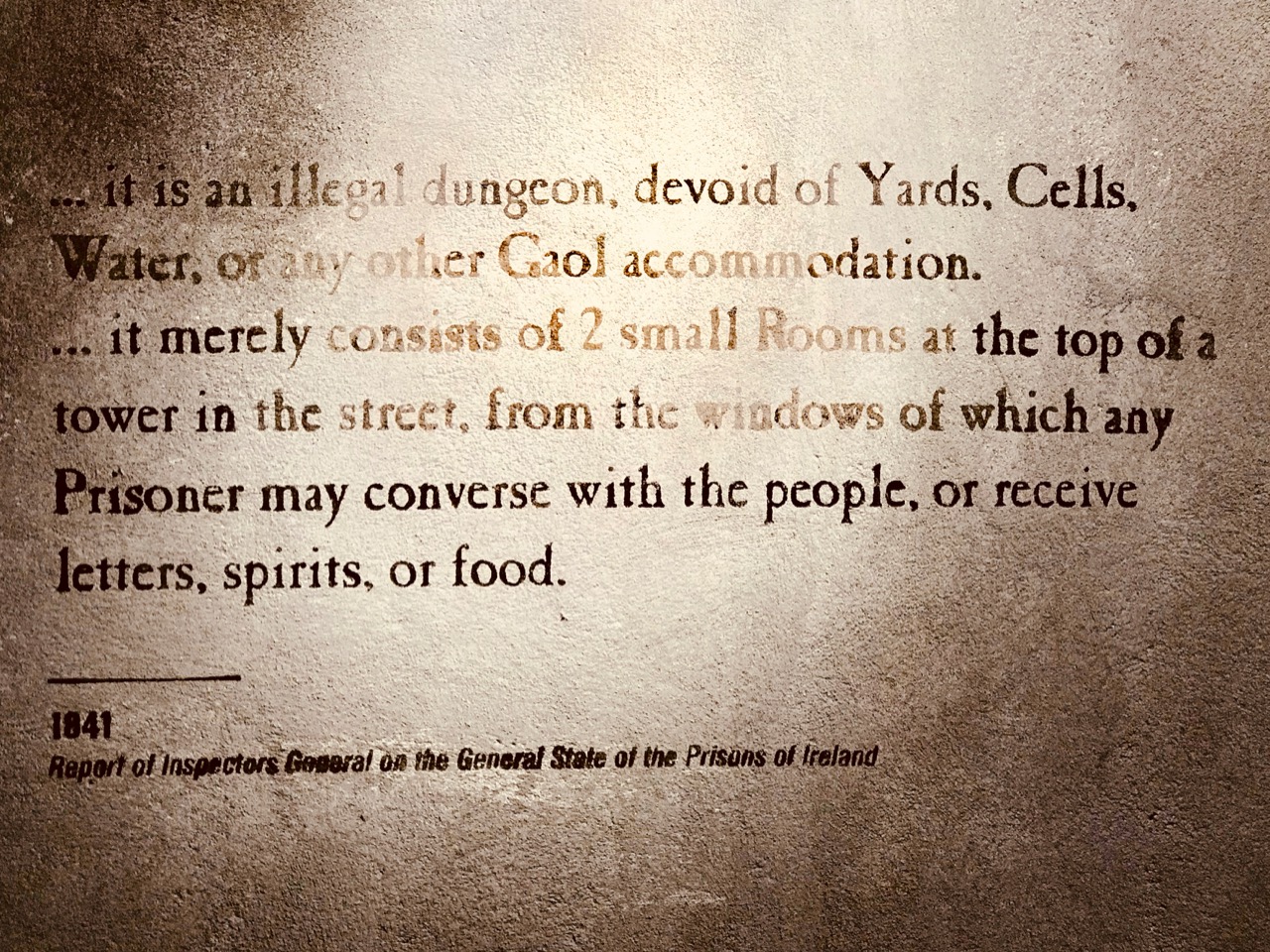
I will disclose that you will get a feeling for what prison life was like two or three hundred years ago, as this was then one of the main functions of the tower, and one of the floors has been set out as a cell. Our enthusiastic ‘storyteller’ guide, Katy (above) pointed out that the restricted space could have held a large number of inmates, unsegregated and crowded together with no sanitation (other than a window). Prisoners had to pay for their own food, which was hauled up through the same window from friends outside. Even in 1841 the conditions that prevailed here were considered appalling – and Youghal was specifically mentioned in the Report of Inspectors General on the General State of the Prisons of Ireland of that year:
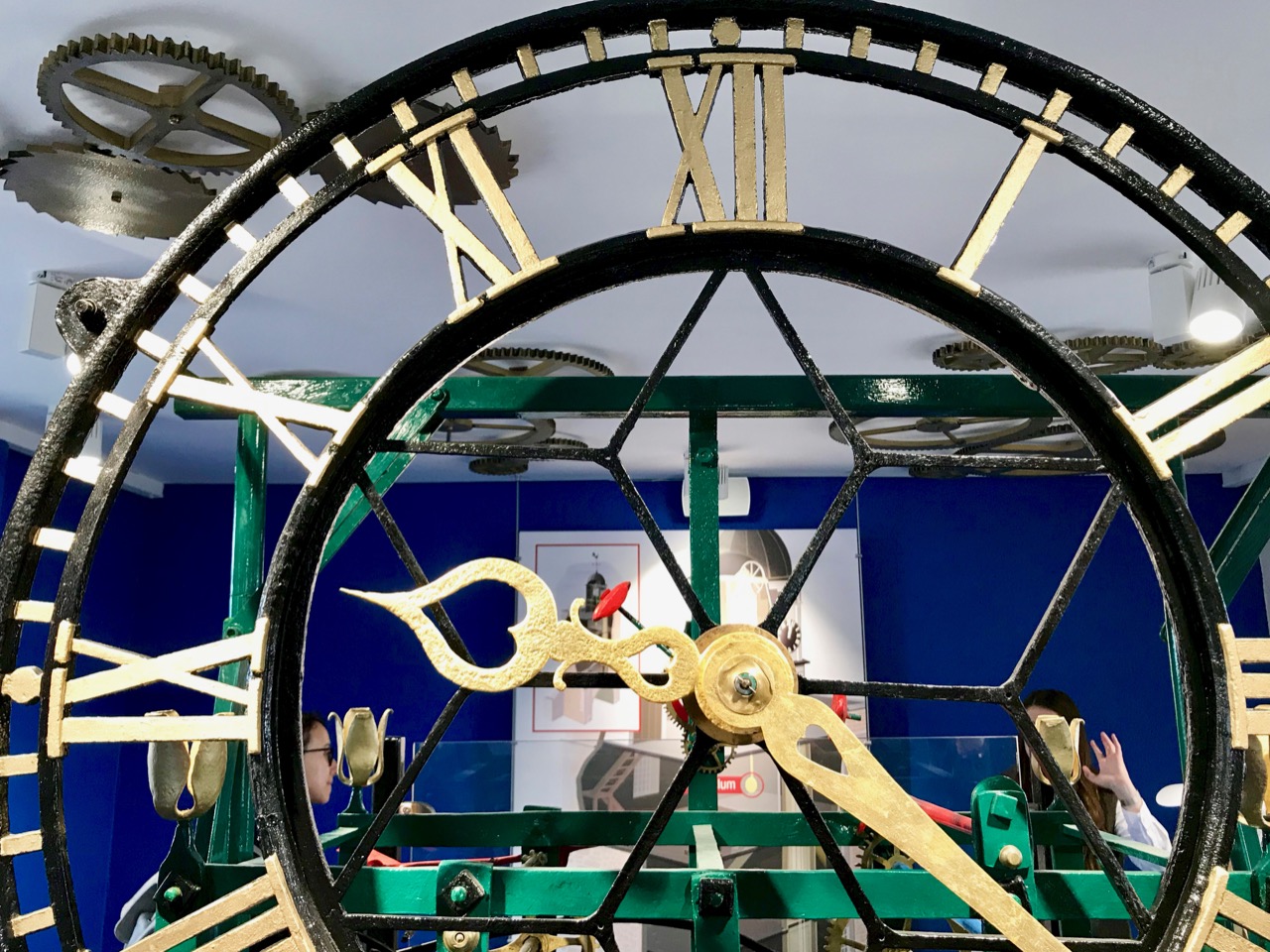
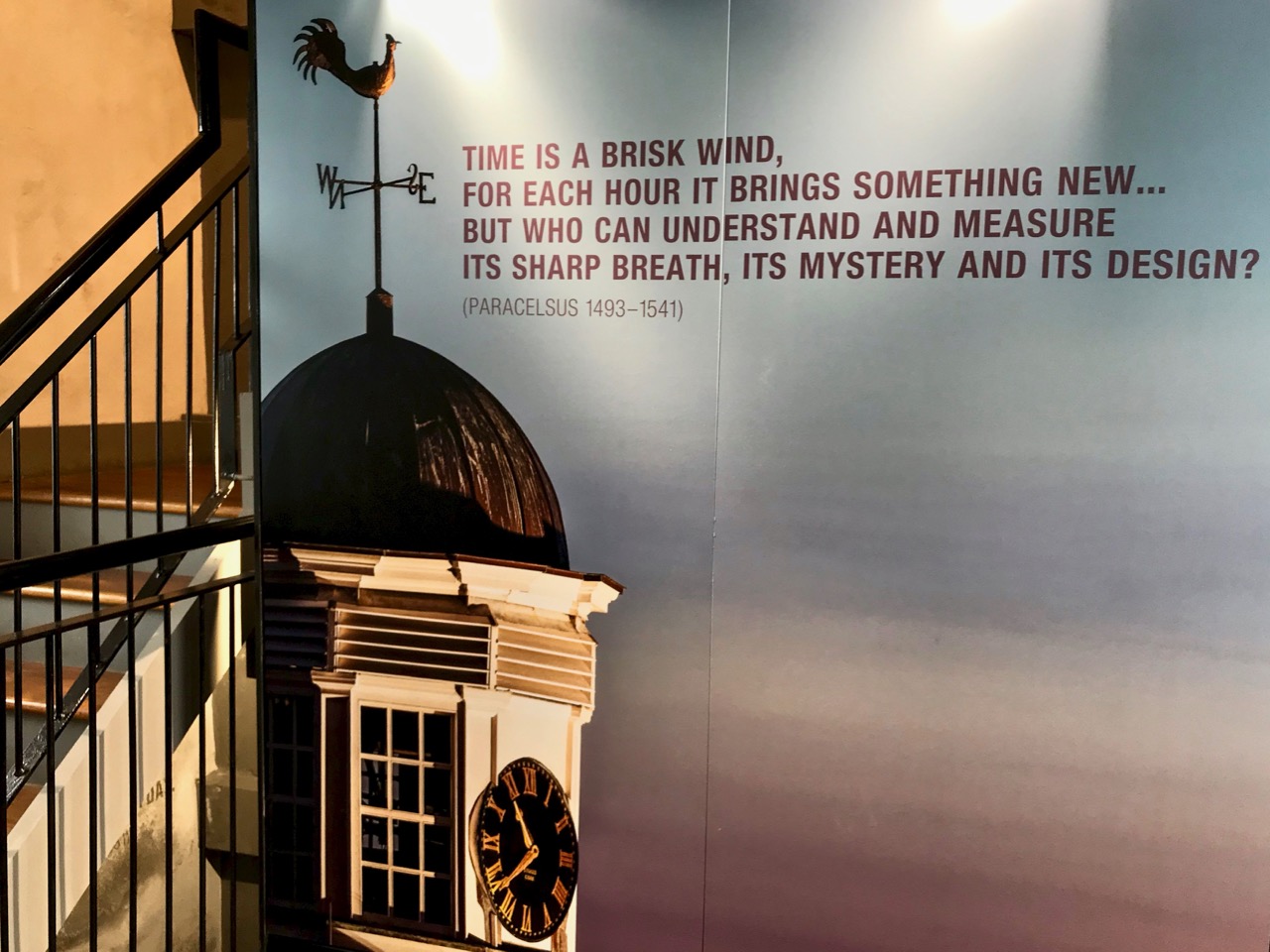
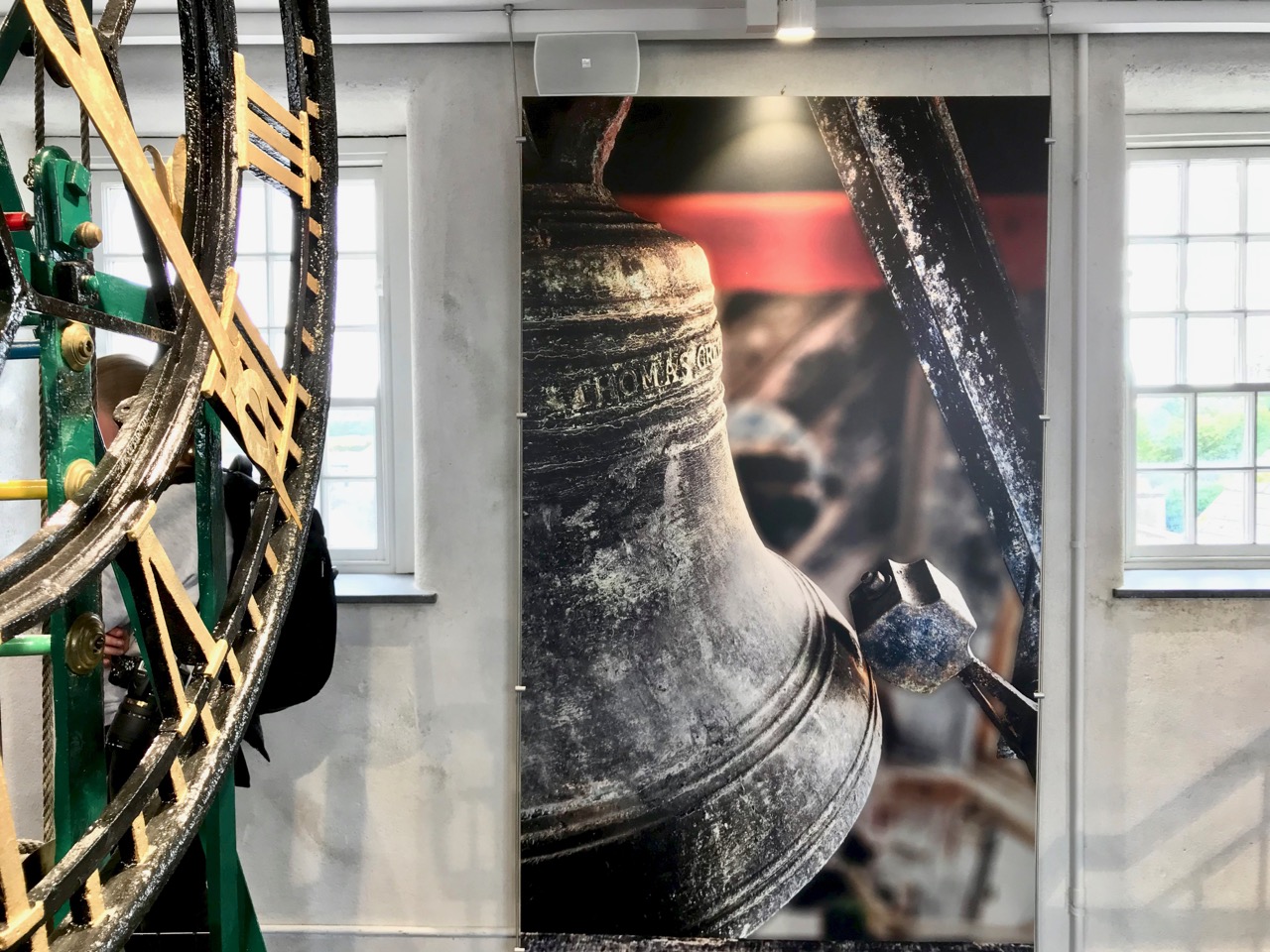
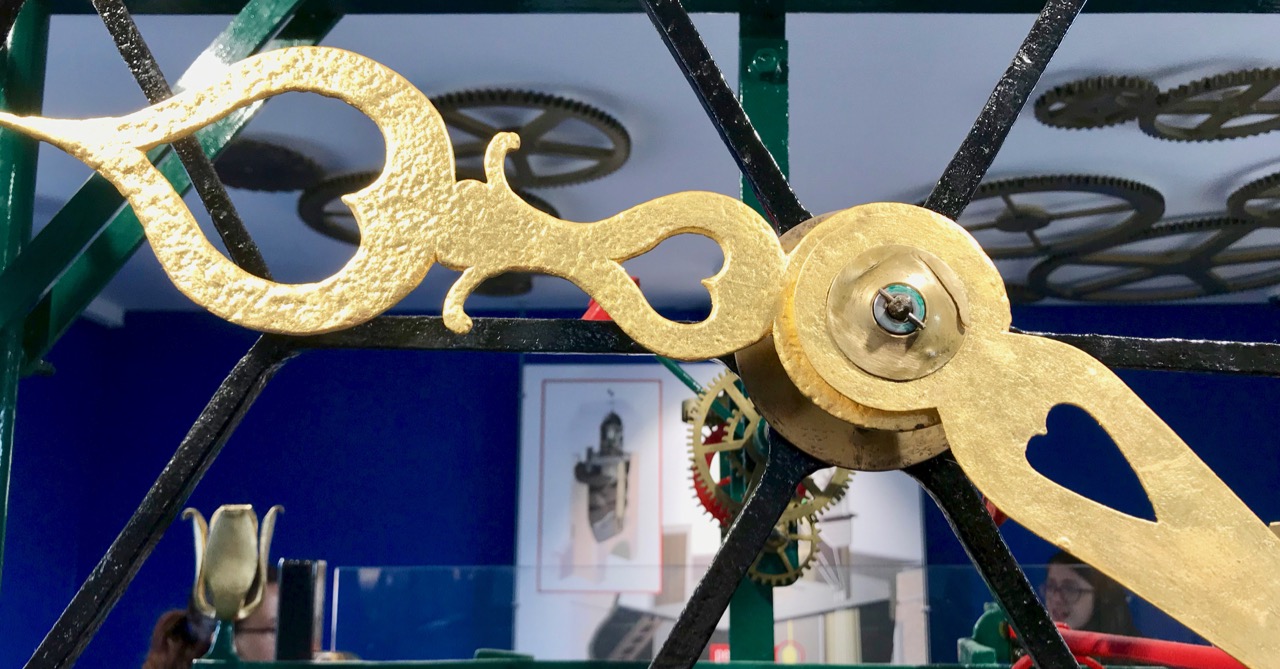
My favourite room was one dedicated to the workings of the clock (header picture and above). From the earliest days the Clock Keeper was also responsible for ringing the town bell:
. . . In 1622 Balltazar Portingale was appointed as clock-keeper and was given free quarters in return for ringing the clock at four in the morning from Easter to Michaelmas, and at five in the morning from Michaelmas to Easter, and at nine at night all the year. . .
In more modern times the bell was also employed to summon the fire brigade. Following complaints from some outlying residents of the town that it could not be heard, the original bell was replaced with a larger version, still in use today and connected to the clock mechanism for striking the hours.
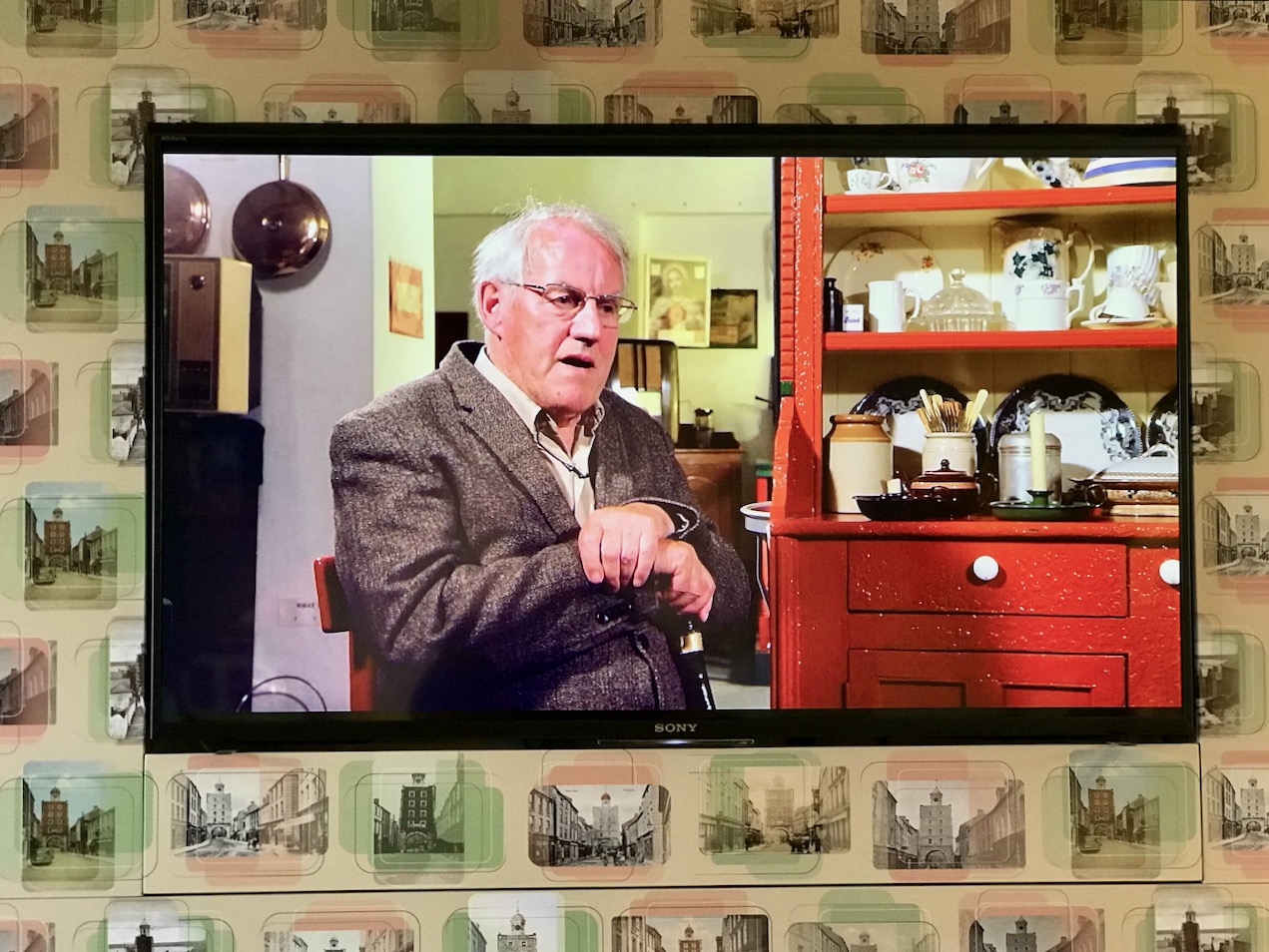
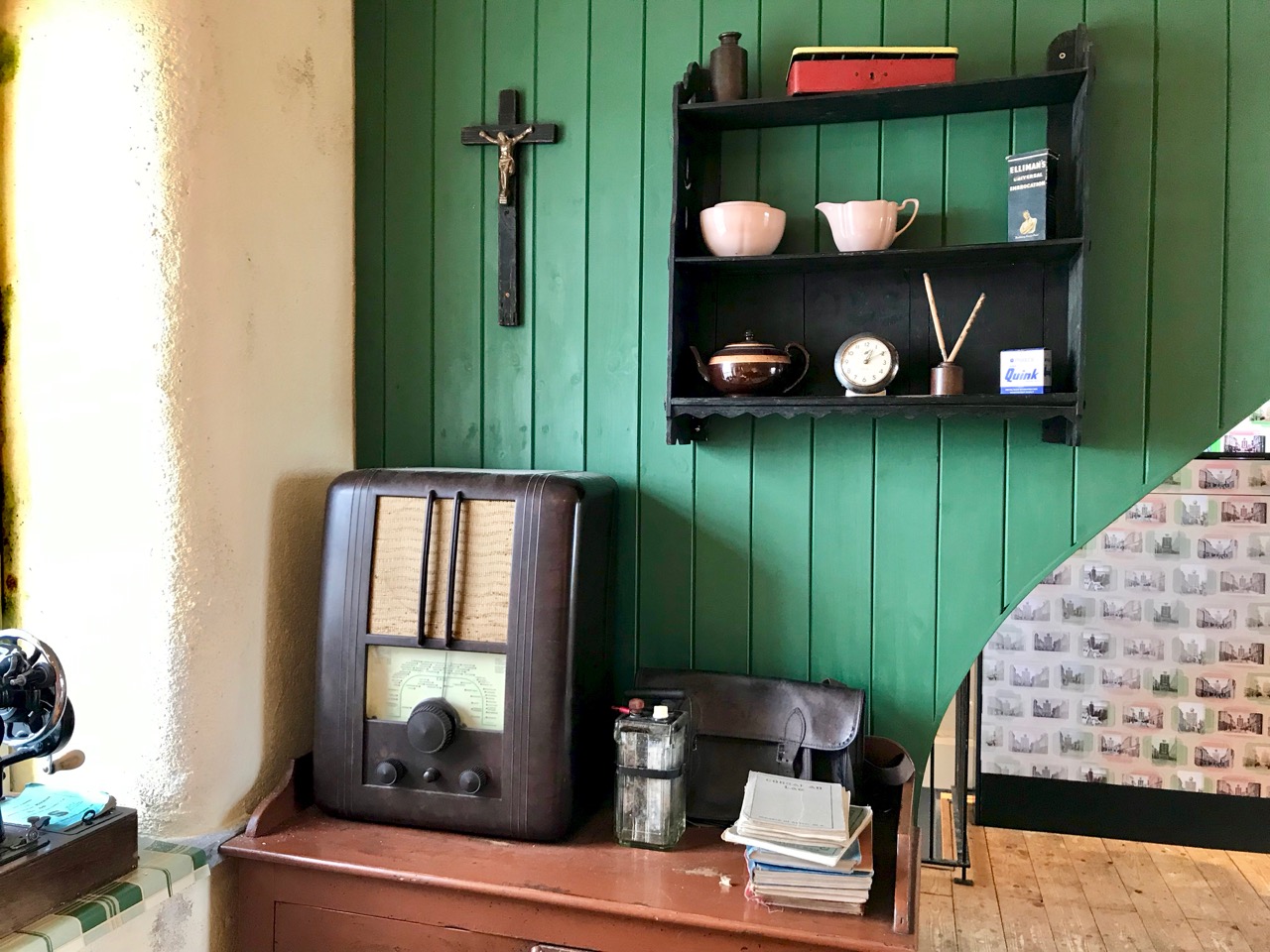
From 1915 to 1955 three generations of the McGrath family lived as tenants in the tower: they had responsibility for winding its clock and announcing a death by ringing the town bell. John McGrath, now 80, was born in the Clock Gate and has great memories of his childhood there: he provided a lot of the information to help fit out the fourth floor of the museum as a 1950s interior, and he can be heard talking about his youthful experiences on one of the audio-visual screens:
As someone who also grew up in the 1950s (but not in a clock tower!) I can confirm the authenticity of some of the exhibits in the highest room of the museum
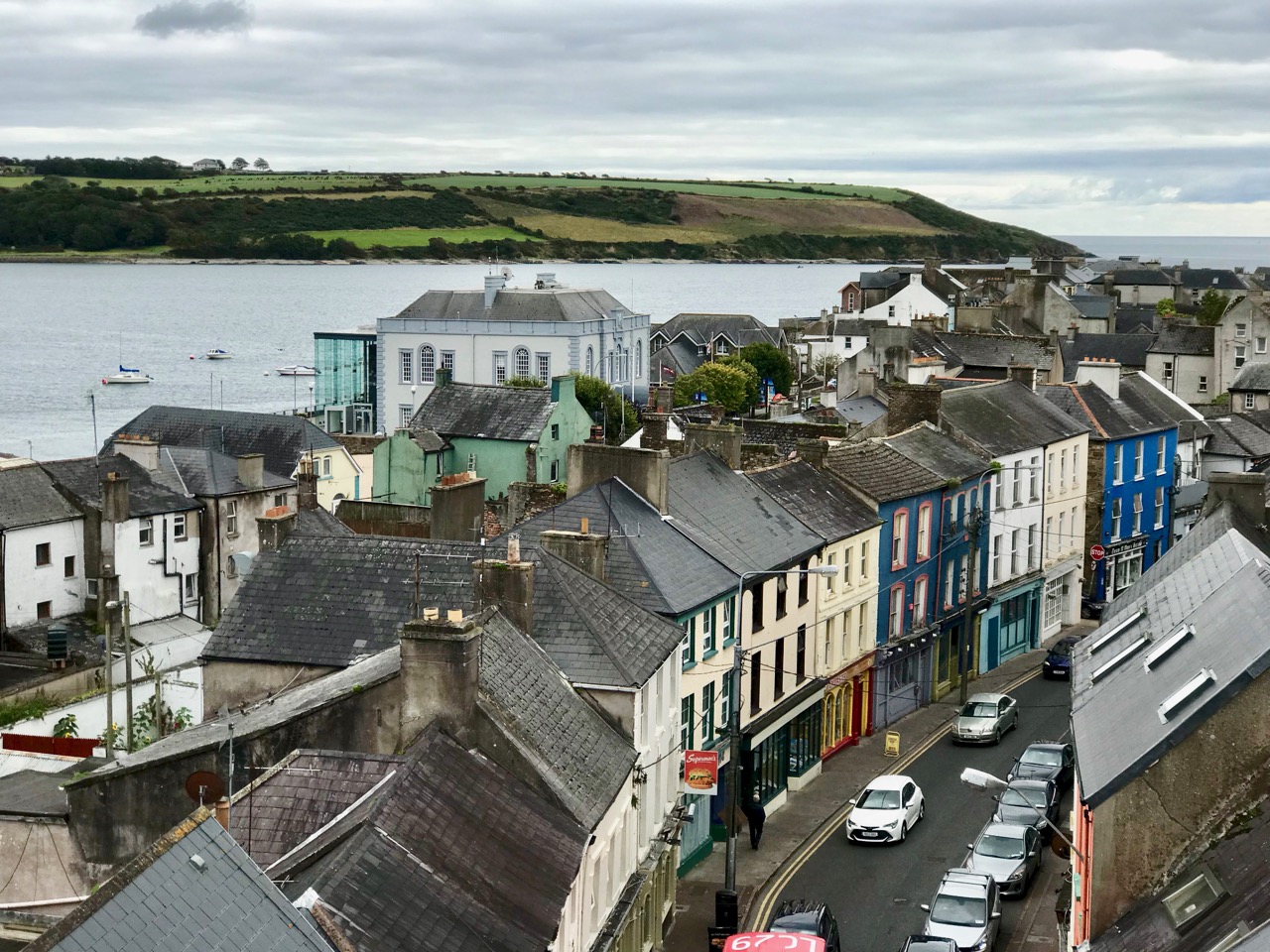
Probably the most exciting part of Youghal’s Clock Gate Tower Tour is the culmination: being allowed to ascend to the viewing platform at the very top. It’s a small area, but safely enclosed with unobtrusive glass balustrades. From it you get a panoramic vista in all directions over the whole town and the sea beyond. And, knowing how much history you are standing above, it’s well worth the modest tour fee. It will be time well spent!
This museum experience is proving justly popular: if you plan a visit check in advance with the Clock Gate website. In the summer tours are run seven days a week – I believe winter opening hours are being assessed; there is a phone number on the website. Have a great time . . .
You will all know about Finola’s interest in stained glass, and in particular her admiration of the work of artist George Walsh: she wrote an article about him in the Irish Arts Review this year. So I hatched a plan, together with George, to give her a window of her very own! Here it is, just installed in our house, Nead an Iolair. Not so long ago, Finola wrote another Irish Arts Review piece about Ireland’s newest stained glass window, and there’s a Roaringwater Journal post about it here. I think it’s safe to say – as of today – we have in our house Ireland’s new ‘newest stained glass window’! It’s an artwork with a story – several stories, in fact. I’ll tell you some of them.
This is George Walsh. He apprenticed in the world of stained glass under his father – also George – who apprenticed under Harry Clarke, so he has an eminent lineage. He worked with his father in the United States and Ireland, and eventually set up his own Dublin studio, where he has been prolific. Finola is currently visiting and cataloguing every one of his publicly accessible projects which can be seen on the island of Ireland: it takes us to some far-off and fascinating places. To date her list includes 61 buildings which have George Walsh windows, and it’s certainly not complete. While most of George’s work can be found in churches, he has also produced a secular opus and our window has now added to that. George says that he enjoyed this commission because it was very different from so much of his work, but I guess that he always enjoys his work – you can tell by the exuberance, dynamism and sumptuous colouring of his pieces.
The Finola Window tells the story of our Finola, but is also about a famous Finola (or Fionnghuala – fair-shouldered) in Irish mythology: she is the heroine of The Children of Lir, one of Ireland’s most well-known ancient wonder-tales. Fionnghuala (above, being transformed into a swan) is the eldest of the four children of King Lir – the others are Aodh and twins Fiachra and Conn. Their mother, Aobh, died when they were young and the King remarried. Unfortunately, this is where the story turns into a wicked stepmother tale, as the King’s new wife, Aoife, becomes jealous of the children, and casts a magic spell on them. I hope you are keeping up with these names! Our Finola – a stepmother herself – has always been sensitive about negative portrayals of that position, so I asked George to play down the role of Aoife and in fact he has left her out of the window altogether. I’ll just let you know, however, that she received full punishment for her malice by being turned into a Demon of the Air – and she still hangs around on dark, haunted nights. Watch out!
All four children were turned into swans by Aoife, and their fate was to spend three hundred years on Loch Dairbhreach (a lake in Co Westmeath), followed by three hundred years on Sruth na Maoilé (the stormy Straits of Moyle between Ireland and Scotland), and a further three hundred on Inis Gluairé (an Atlantic island in Erris, Co Mayo). The swans kept their human voices and they spent much of their exile singing beautiful songs which became all the traditional music of Ireland.
George has skilfully woven into this window many elements of our Finola’s life: in the details above you can see Newgrange – where Finola dug as a student; Irish rock art – which was Finola’s main area of study as an archaeologist; my hands playing my concertina (all the musical notes are descending from the swans); eagles flying over Nead an Iolair; the Scholar and his Cat Pangur Bán (the Irish medieval poem is one of Finola’s favourites); St Brendan’s voyage (Finola is a great teller of the tales of Irish Saints) and – of course (at my specific request) a golden hare! George Walsh has always been a master of detail, something we have particularly admired in his work. We feel he has excelled himself here. These images are some of the resources given to George while he was making the window:
Image gallery for George – top: Finola’s 1973 drawing of a piece of Kerry rock art; centre – the flight of the eagles over Nead an Iolair; lower – my hands playing music from the swans through my concertina!
I was privileged to see some of the work in progress in George’s studio earlier in the year. He showed me how he uses ‘flashed glass’ where a thin layer of coloured glass is melted on to clear glass. Acid etching is used to take off the coloured surface leaving a design. You can see where the etched piece (below) is being prepared to fit in the ‘jigsaw puzzle’ of glass shapes that will be joined by leading to form the final window.
Above – George’s ‘cartoon’ design sketch together with his explanation of the subject matter: these now hang close to the completed window in our house
The culmination of the Children of Lir story comes when St Patrick’s bell is first heard on the shores of Ireland (detail below), and Fionnghuala and her brothers are released from the spell. As they regain human form their bodies are aged and they have time only to receive baptism into Christianity before they crumble to dust.
Decorative borders, details and motifs abound in George’s windows and ours is no exception. It’s a bit like the marginalia in a medieval illuminated manuscript: your eye is constantly drawn to all the minutiae. We will never tire of looking at it. The panel is mounted in a west facing window in our study: when the sun comes around to that side in the evenings the whole room becomes alive with flowing colour.
Thank you, George, for so wonderfully fulfilling my vision of a window especially for Finola. I couldn’t imagine anything more fitting and she is – of course – over the moon! Here we are in George’s studio on the day of the ‘reveal’.
Welcome to the UCD Library Cultural Heritage Collections blog. Discover and explore the historical treasures housed within our Archives, Special Collections, National Folklore Collection and Digital Library