The Monster of Red Strand!

Last week we investigated Castlefreke, the tallest High Cross in Ireland,  and the Long Strand. Not far away – and ripe for another day of exploration – is the intriguingly named Red Strand.
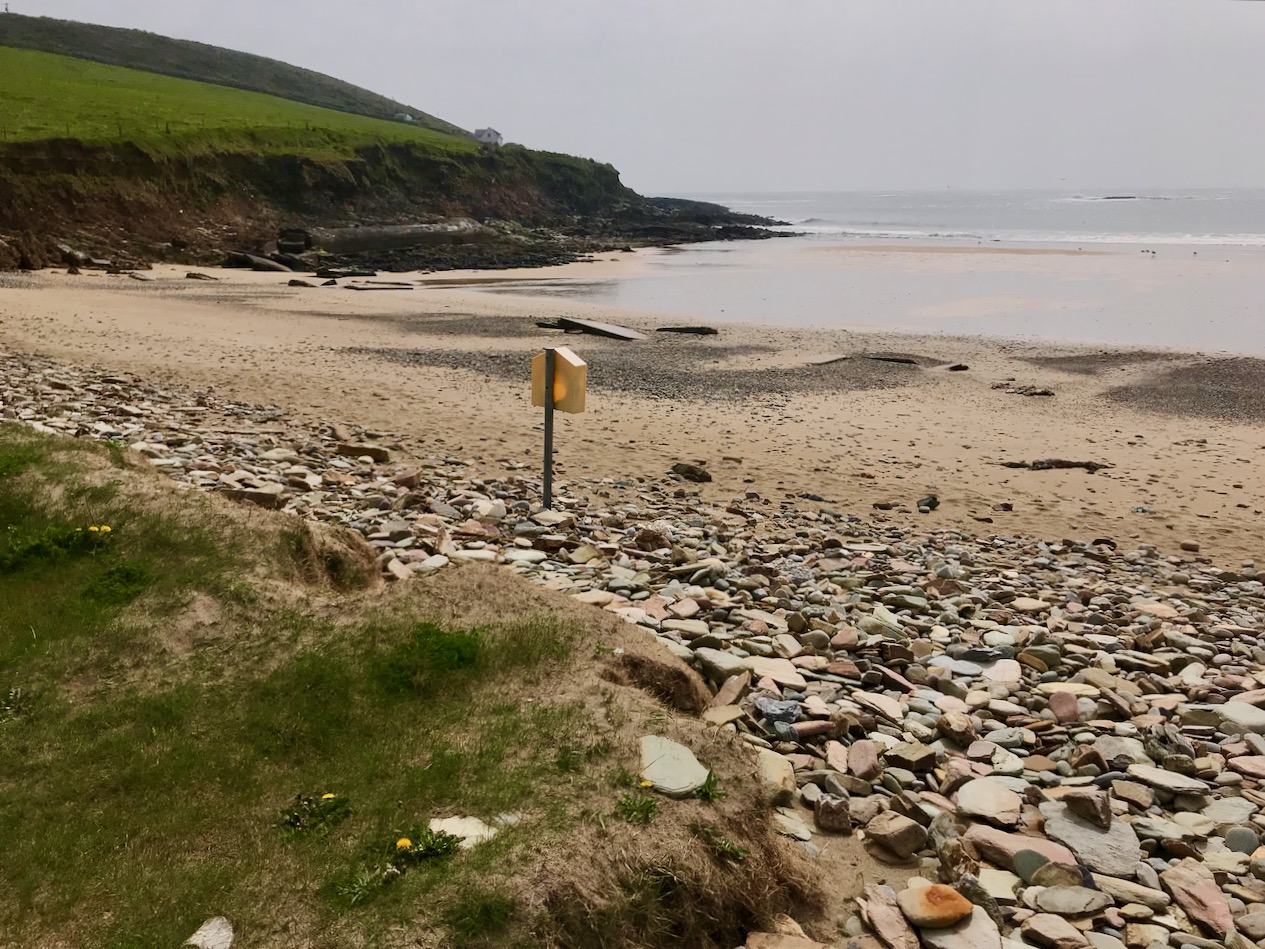
Header picture – looking across Red Strand towards Galley Head. Upper – Red Strand beach; lower – red stones are prolific on the beach at Red Strand: it is said the beach ran with blood after the battle between the Barryroe army and John Barry’s army

Tales abound as to how or why that West Cork beach got the name. A good source of such stories is the Schools Folklore Collection – an invaluable resource of memories recorded by local people about their own townlands. Although the collecting project took place in the mid 1930s, the schoolchildren were interviewing members of their own families who might have lived in the same location through several generations, and were probably retelling stories that had in some cases been passed across hundreds of years.

. . . There is an old ruin of a castle in Dundeady which is about eight miles s.w. of Clonakilty. It is about 20 ft high. During the last storm a part of the top was blown off. There are holes in the walls where the guns were kept to shoot from. It was built by an anglo Norman named John Barry. One night they went east to Barryroe and stole cattle from another Norman named “Barry Bán”.

John Barry had a white horse which would not drink water of any well only the well in “Cráig Gaimhne”. Next day he went to the well with his horse and left him grazing in a field near by called “Pairchín Caol” whilst himself fell asleep near the fence.

It was not long until “Barry Bán” and a great army came attacking his castle. The horse ran to the fence where John was sleeping and started to screech into his ear and woke him.

When he saw the Barryroe army attacking his castle he jumped on his horse and off with him over the fields and fences as fast as he could. When he was crossing the “Góilín” he struck the horse with a magic wand. The horse jumped the “Góilín” which is about 15 yds. He struck the horse a second time and the horse fell dead.

The signs of the horses feet are plainly visible on the rock. That day there was a terrible battle fought between the Barryroe army and John Barry’s army and this battle is called the “Battle of the Red Strand”. They fought all the way across the “Red Strand”. They fought and fought across the “Red Strand” and up “Ballira Hill” as far as “Ballira House”. John Barry and his army slew and killed all of Barry Bán’s army nearby. John Barry and his army won the battle that day.

For months after there were bones and pieces of bones throughout the place where the battle was fought . .

Collected from Master Pat Hayes, Donour, by Duchas Schools Folklore Project 1937
Another collected tale also centres around the Lady Well at Dunowen (lower right on the aerial view, above):

. . .There is a well situated in a field belonging  to Michael Feen in the townland of Dunowen not far from the sea coast. It is said that the Blessed Virgin appeared there long ago and was seen by some fishermen when fishing near the coast. She appeared as a big swan and pitched on the edge of the boat. Then she flew eastwards and flew in a circle over the well. Then she knelt down and left the prints of her fingers and knees on the flag, But some 20 years ago  a young boy about 12 years who was blind from birth went to the well with his father, after being taken to the well he left a scream at his father to look at the frog. Then they both thanked god and went home cured . . .

Amanda fully describes and illustrates this well in Holy Wells of Cork and Kerry after her own visit to the area three years ago.

But – what’s this? Marooned on the beach is a strange, dismembered creature… Or, at least, the remains of a creature. I’ve labelled it monster on the aerial view, because I can’t think of a better way to describe it: alien, amorphous, slightly sinuous. It has a mouth, too.

Is it spewing out or sucking in? Will it swallow you or I if we are not careful with the tides? Why is it here, and who made it? Be careful, Robert . . .

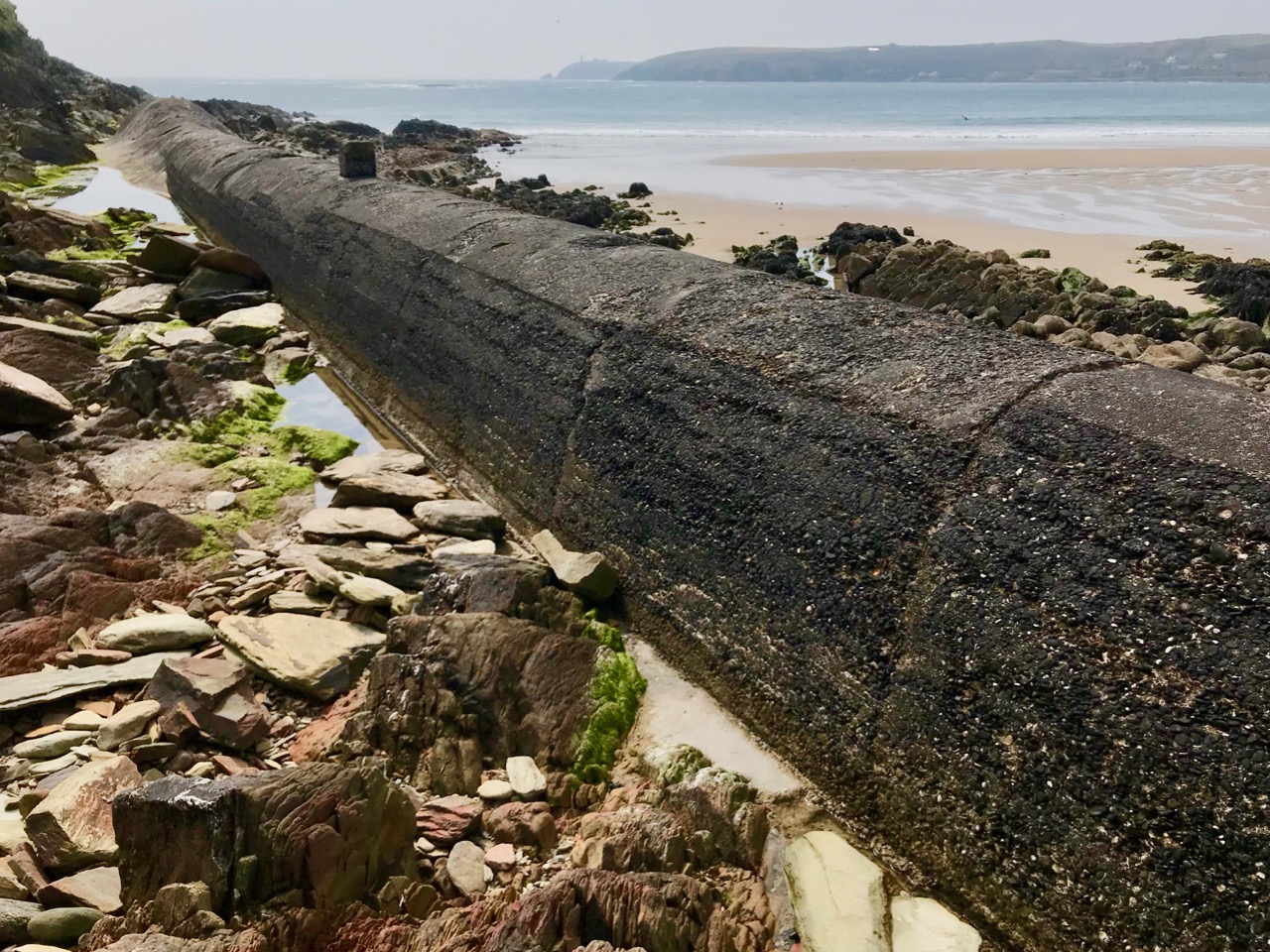
It’s enormous! It runs the length of the west end of the beach: you can just make it out in the second picture from the top, lying along the bottom of the cliff face. It’s like a great, marine creature with a fin and blowholes.
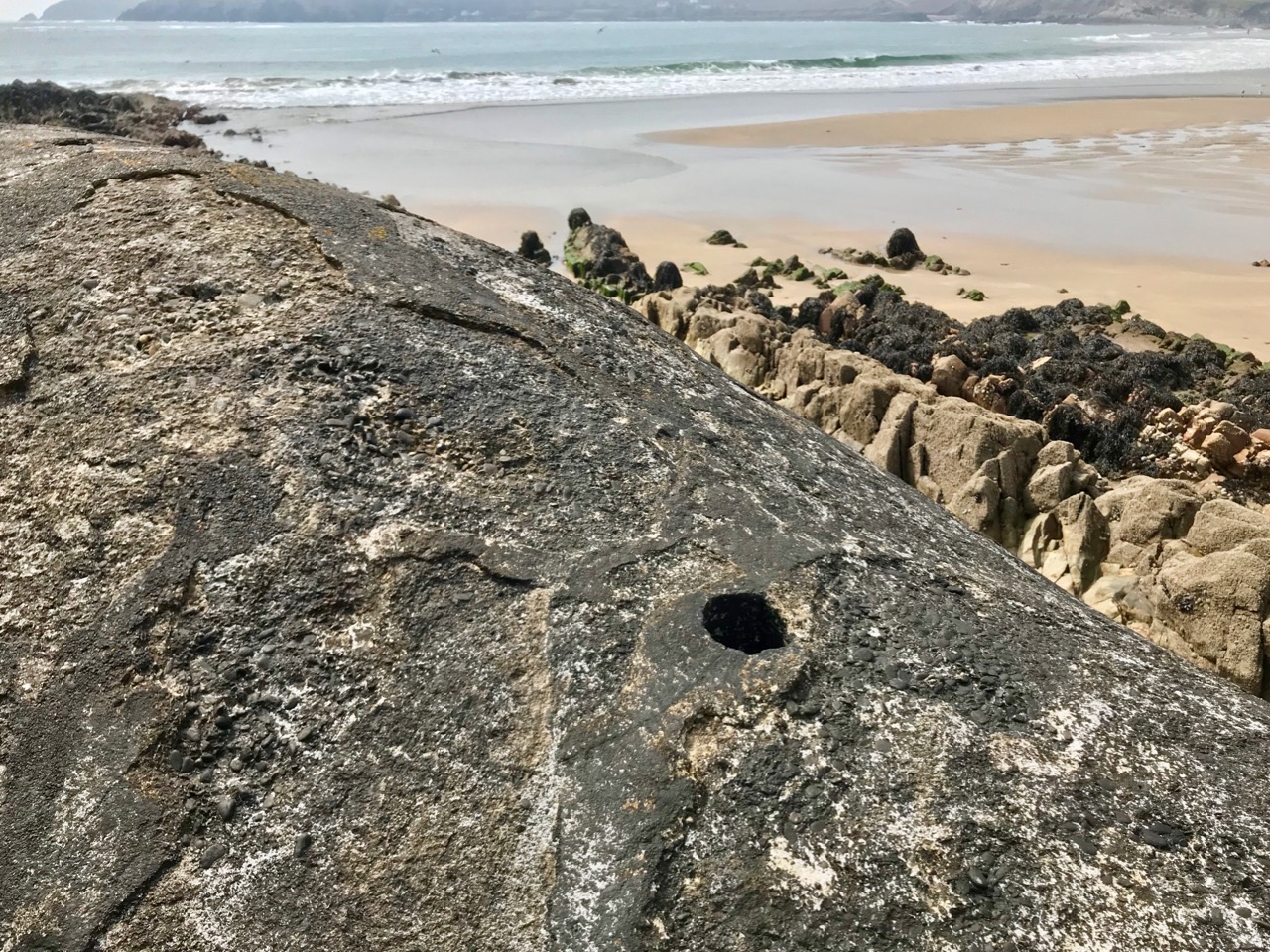
But, if that is its mouth facing out to sea, then its tail seems to have exploded. Look at this more detailed aerial view:
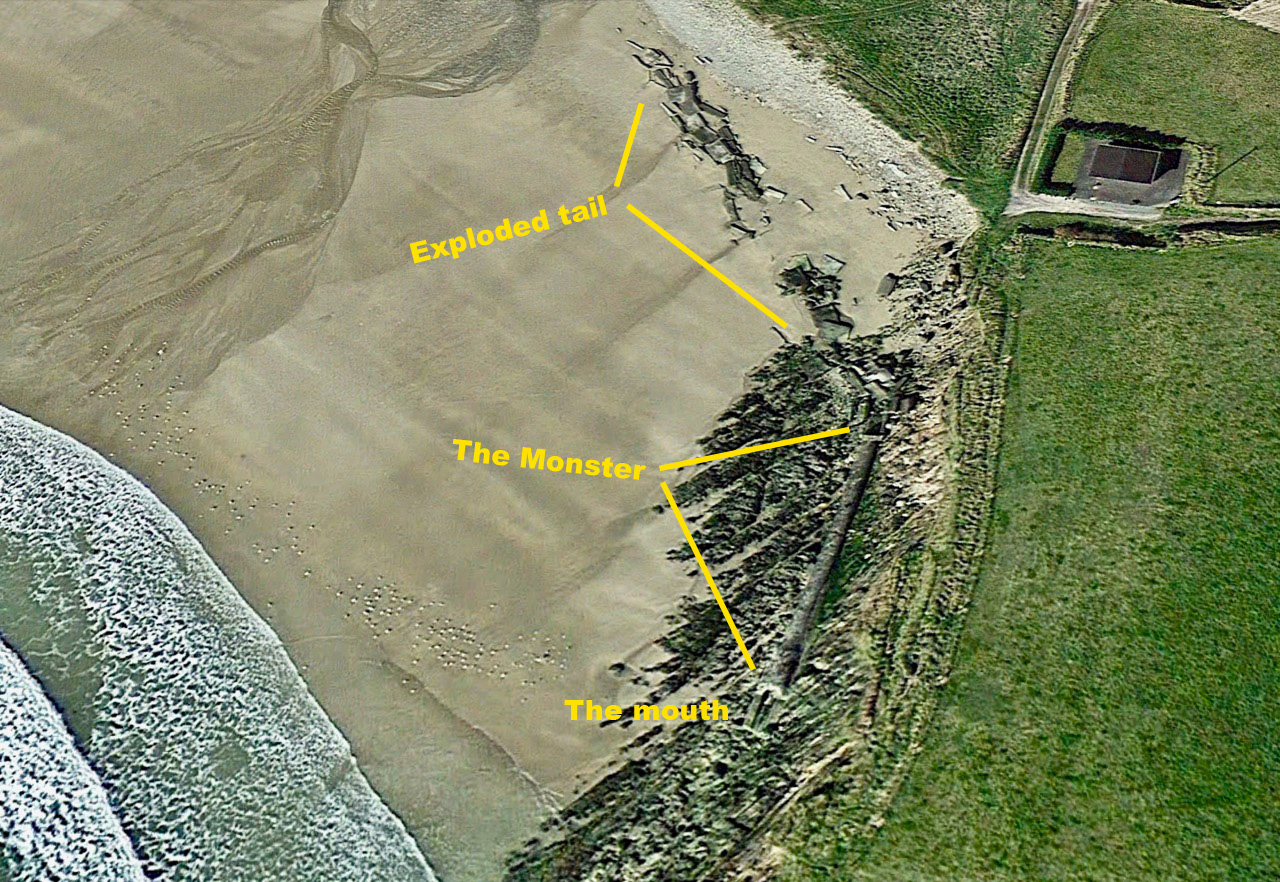
This Google Earth image dates from 2009. Ten years later, much of the debris from the exploded part of the monster is disappearing under the shifting sands.
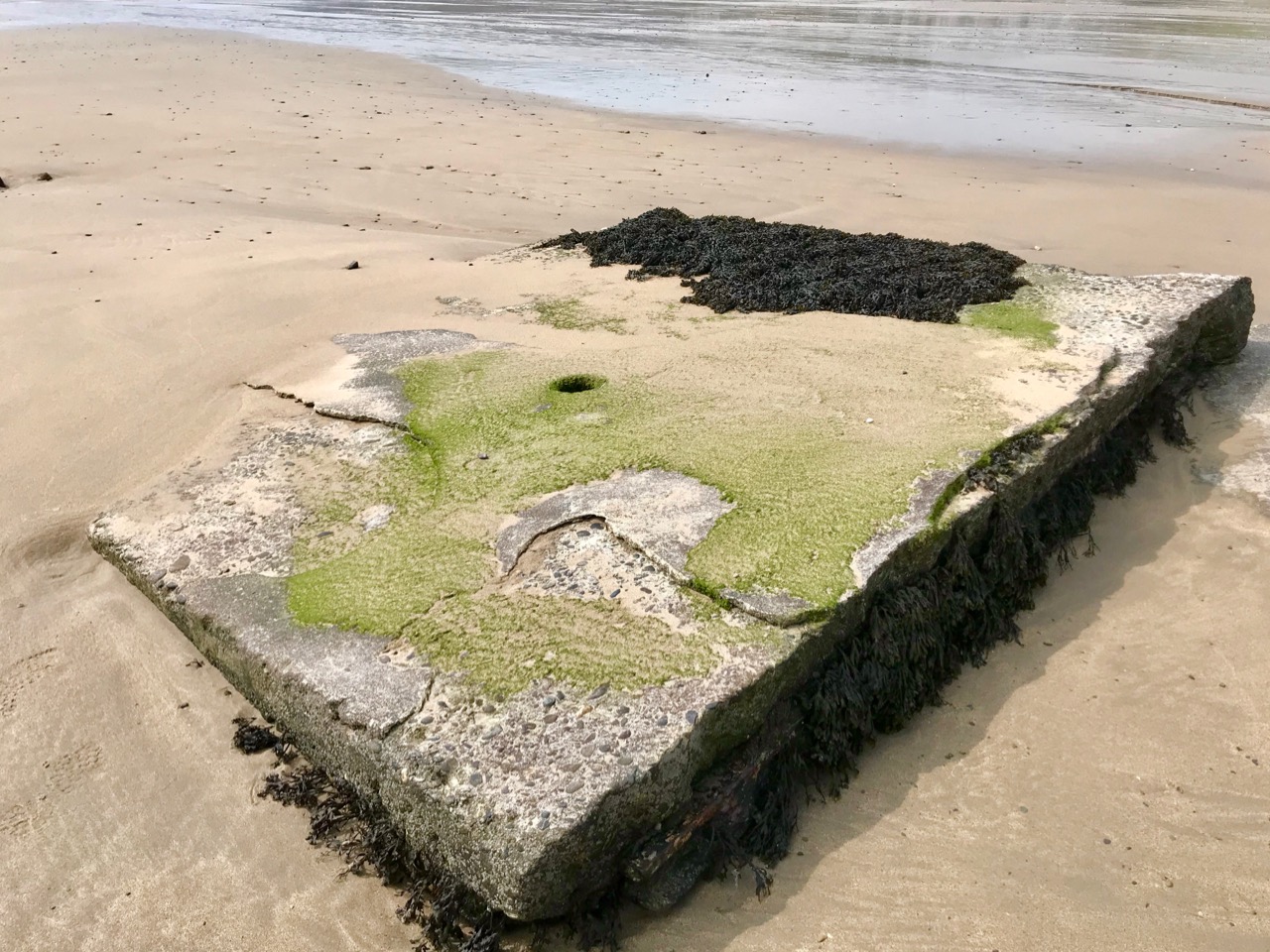
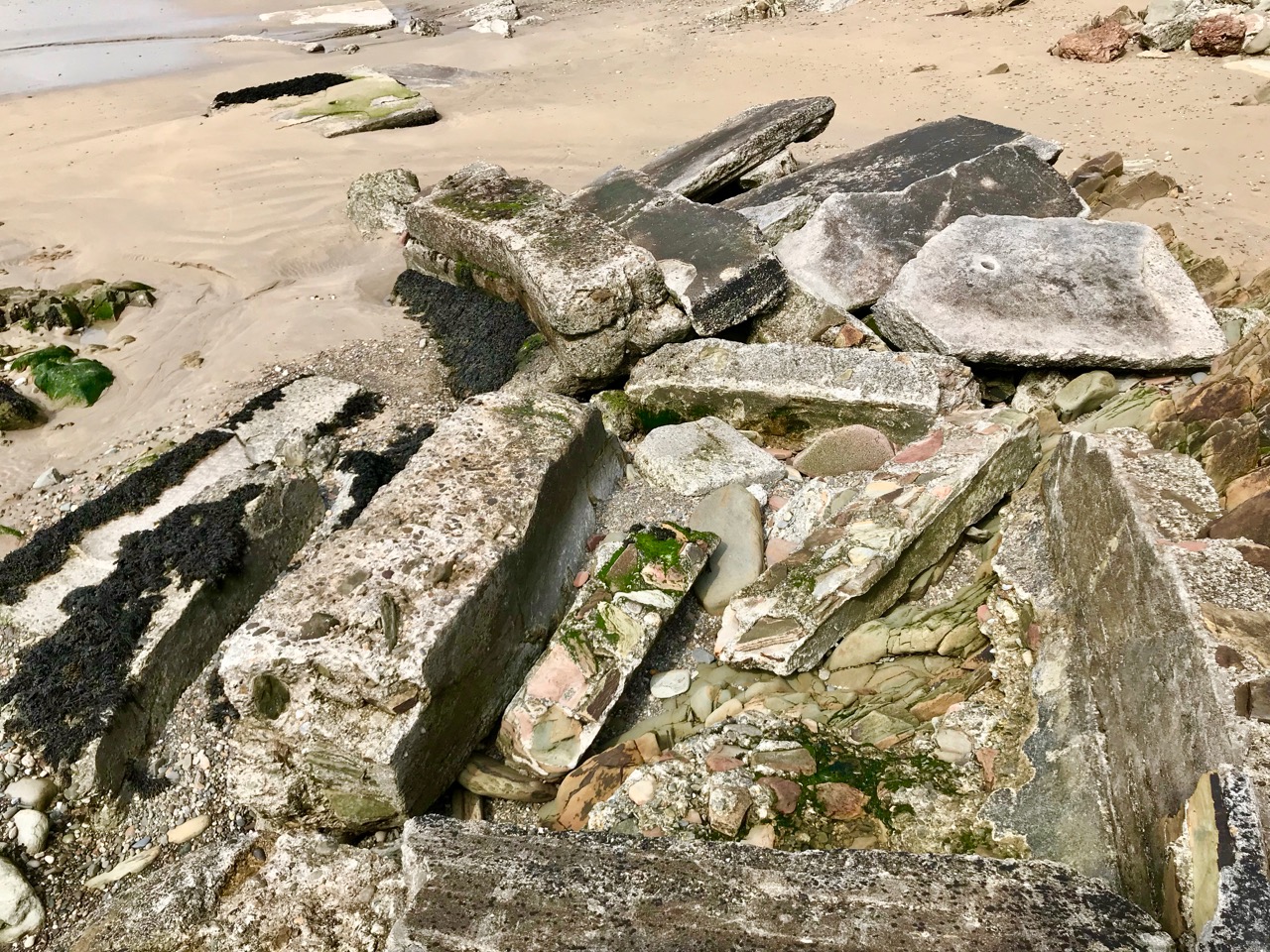
Those huge slabs now scattered over the west end of Red Strand are reinforced with steel girders: whatever has been here in the past was a massive and heavy structure. Is there any record of it? I found only one slightly oblique mention, after searching high and low, written by Noel Baker in the Irish Examiner in February 2014 – following one of the most severe storms ever recorded on the coast of West Cork:

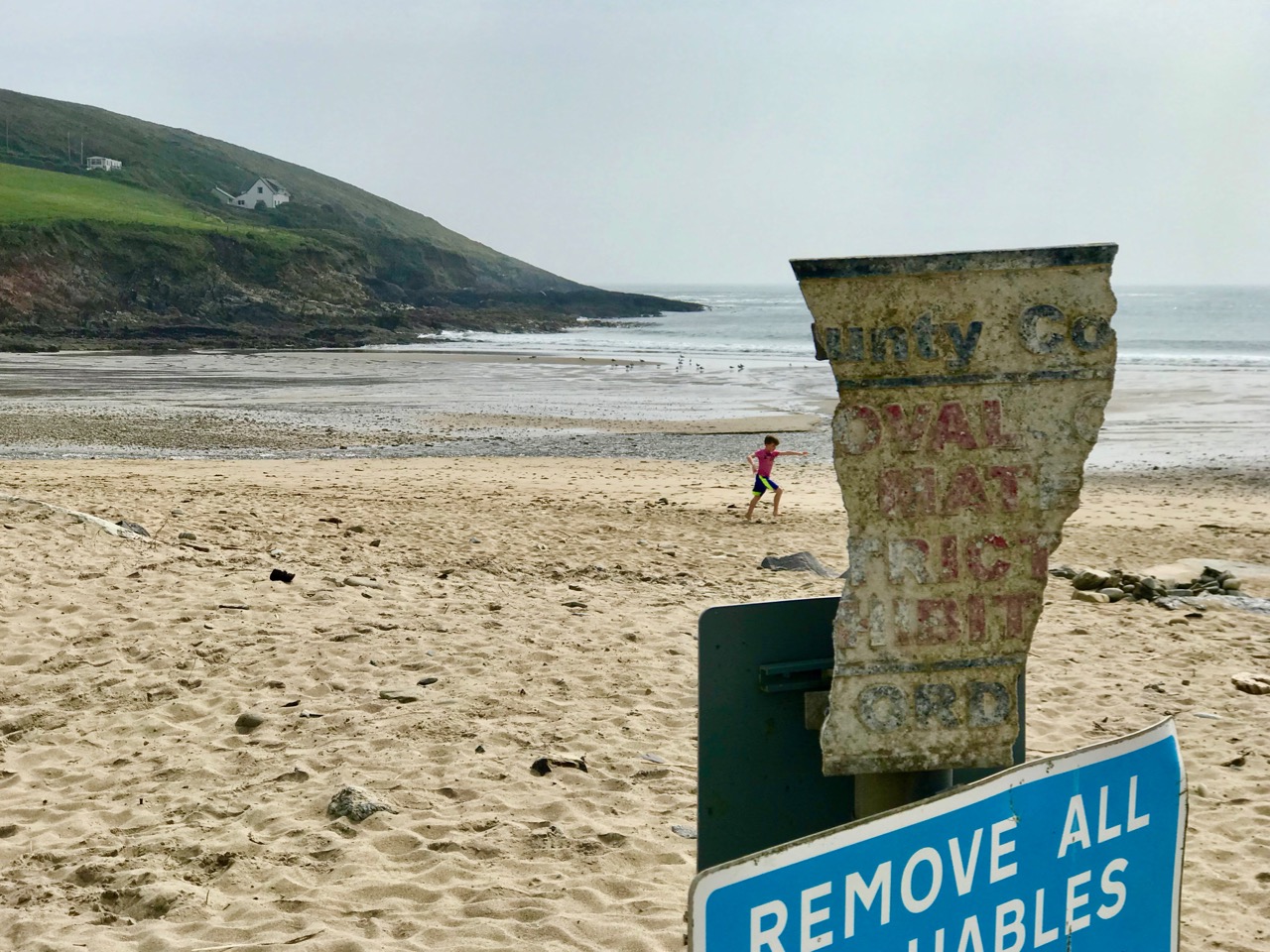
. . . So much of what happens is hidden from plain sight. Take the beautiful beach area of Red Strand near Clonakilty. The recent storms have caused serious damage to counties from Mayo to Wexford and beyond. Sometimes the extent of the damage is obvious, other times not so much. Red Strand, not far from the villages of Rathbarry and Ardfield, has clear evidence of damage. One of the walls alongside the road has been knocked, the sands have been shifted, along with rocks and stones, and the pillar displaying the Red Strand plaque lies knocked on the sand. Local man Cornelius ‘Con’ Scully is a veritable historian of Red Strand. He has photos of the area dating back to the 19th century and knows every nook and cranny.

“The face of the strand has totally changed in a very short time,” he says from his conservatory overlooking the sea.

He remembers back to the 30s when a tunnel, a section of which is still visible to the left of the strand as you look from the road, was laid. “When that was built the high water [mark] was 20 ft further out to sea,” he says. “It’s coming in the whole time” . . .

So there we have it – a tunnel, ‘laid’ in the 1930s.
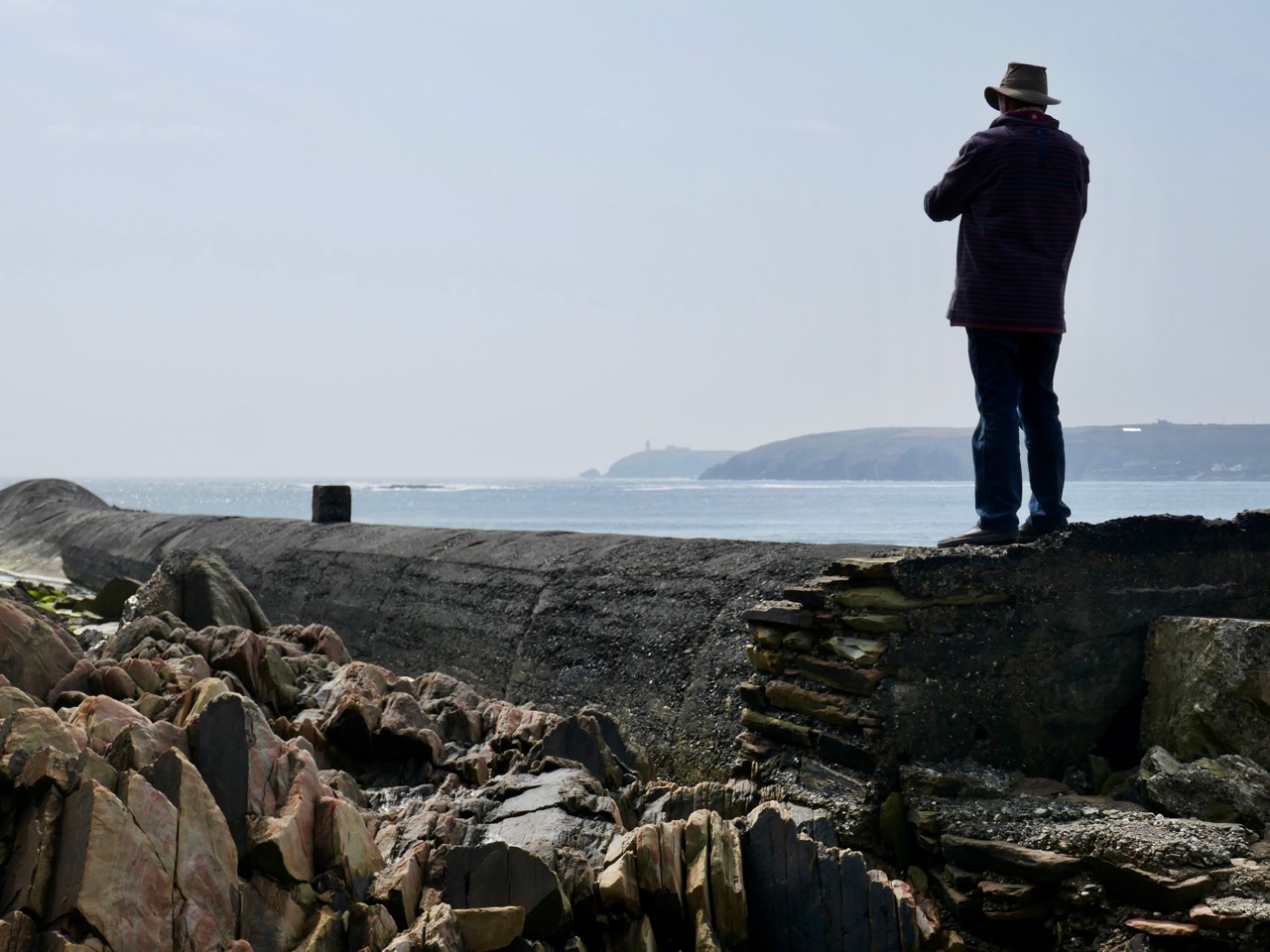
But we still have an enigma. Why was the tunnel built then? And while the term ‘tunnel’ would adequately describe the remaining long section of the monster, it gives no clue as to its purpose. The ‘exploded’ bit intrigues me the most. From what you can see of the debris today, there must have been some sort of box-sectioned structure running along the higher part of the beach. A number of possibilities spring to mind: a sea-bathing pool, fed from the high tide through the ‘tunnel’? Fish tanks? A sewage system? Settling beds (but for settling what)?

Let’s do a little more detective work by looking back at another aerial photograph from Google Earth. You can see that I have placed the beach – and the monster – in a broader context:
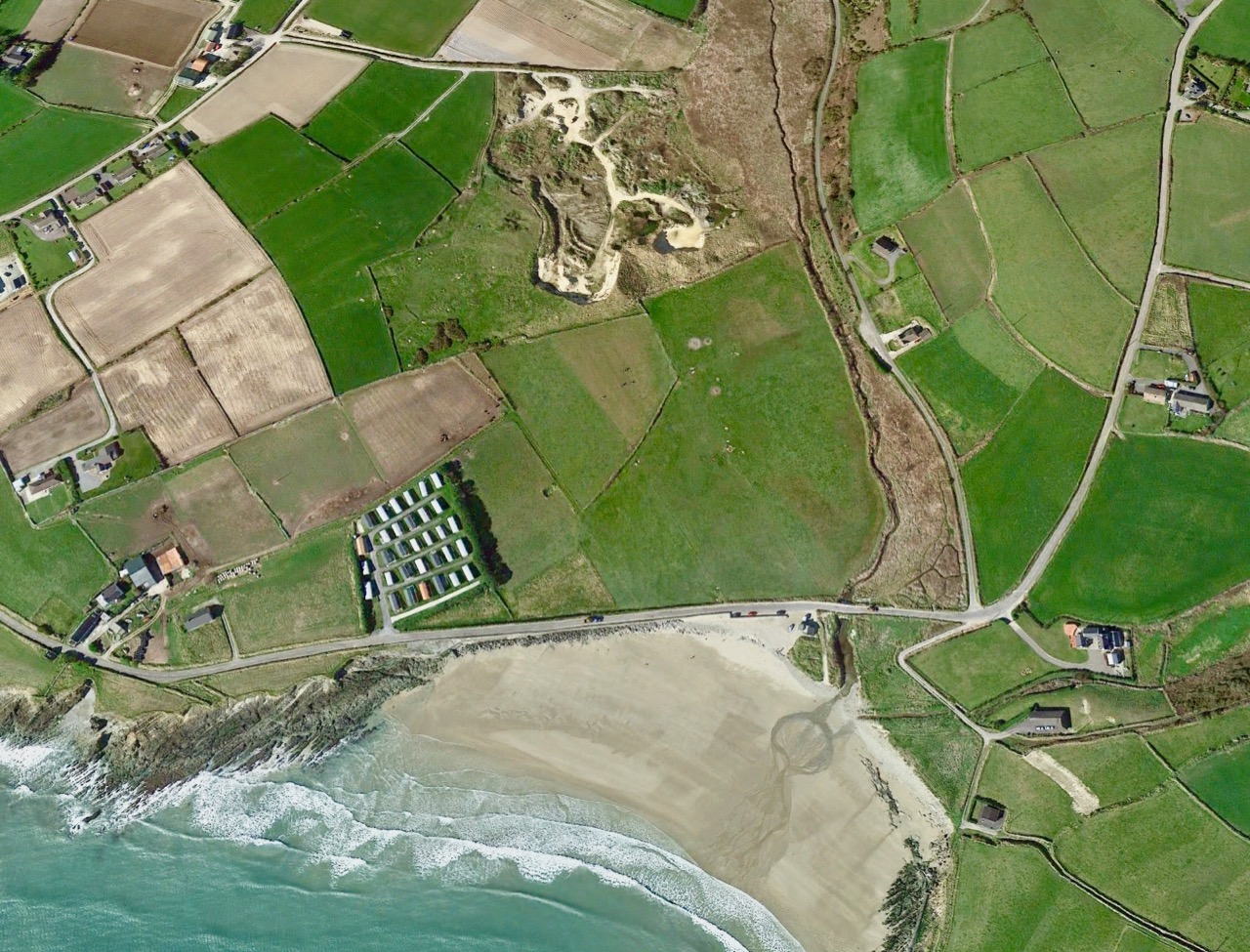
You can trace the snaking line of the monster, starting in the bottom right (ish) and heading up the beach: follow the disintegrated section, which heads for the outlet on to the beach of a stream, which passes under a road bridge. It might be reasonable to assume that whatever passed through the monster’s stomach (the ‘tunnel’) came from that stream.

This picture is looking over the wetlands that are beyond the road running along the top of Red Strand. In the middle distance are ‘old workings’, seen more closely below: these appear to be in the townland of Ganniv Beg.

Whatever those workings might be – or might have been (extraction of sand, minerals?) – any run-off could have been carried into the stream on the right and then spilled out over the beach. This could have been detrimental to the amenity of the beach, and the ‘monster’ might have been constructed to contain and carry the outfall away at high tide. Pure speculation on my part: I’m happy enough to be proved either right or wrong. I would just like my curiosity to be satisfied. So – who has the story? It’s a recent enough construction to be within living memory . . . Hopefully, this post will stir someone to comment: if they do, I will report back.

Mizen Magic 13: Dunmanus Promontory

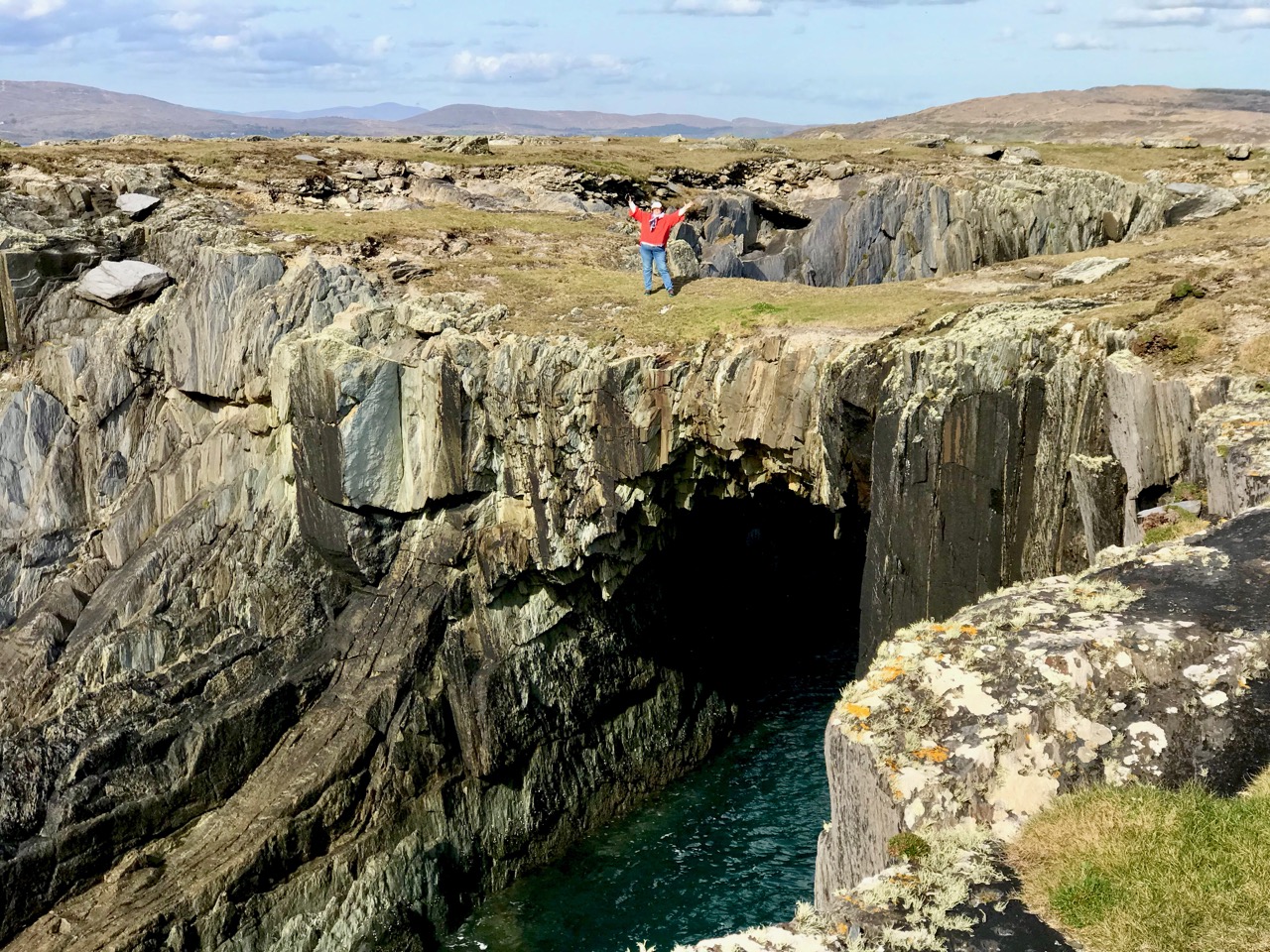
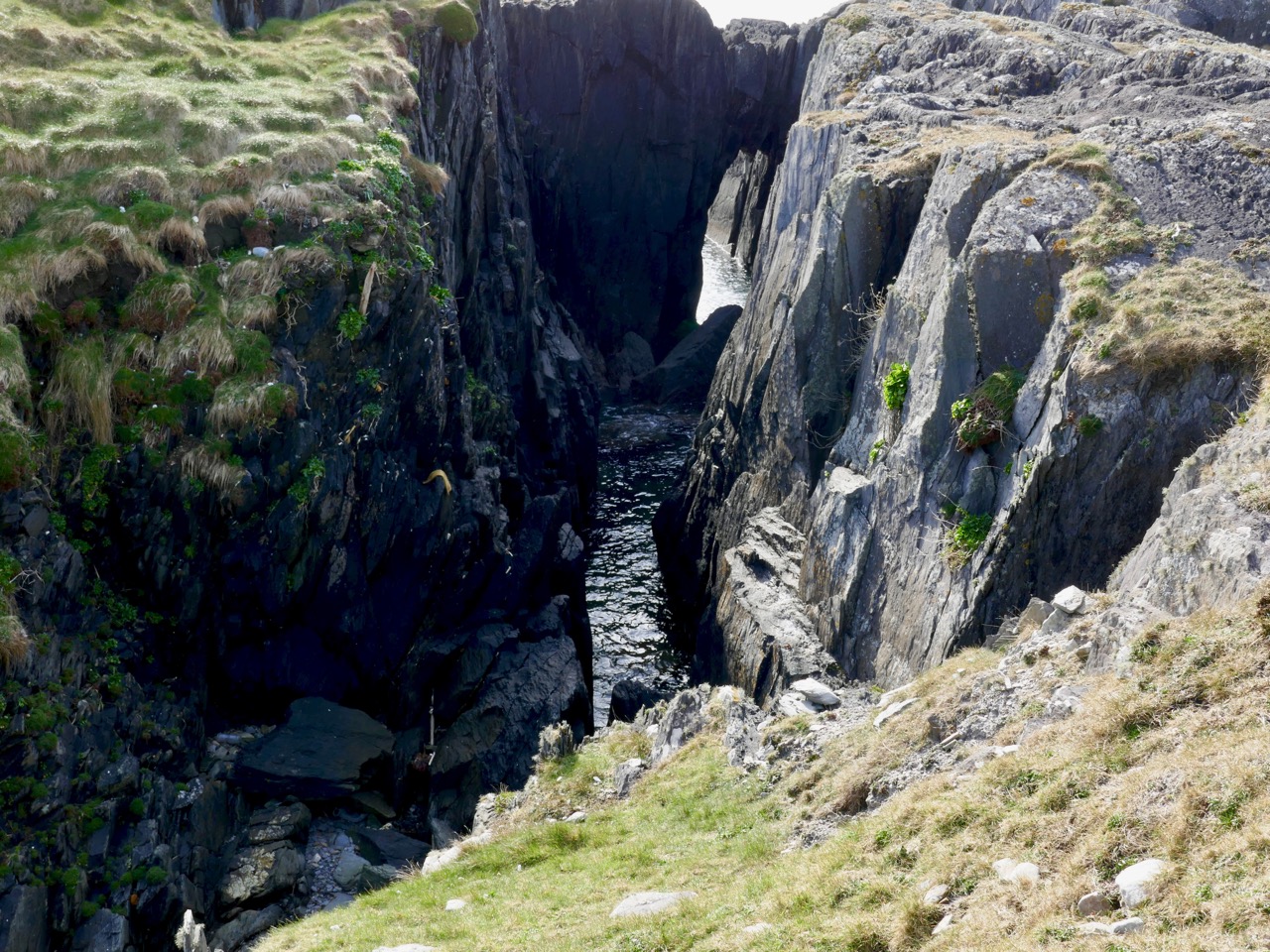
It’s geologically and archaeologically fascinating – a substantial natural promontory just to the north of Dunmanus Castle: well worth an exploration. But, do be warned – there are cliff edges, exposed fissures, ankle-wrenching undulations and bogs to overcome. Also – it’s private, so please seek permission before crossing the land.

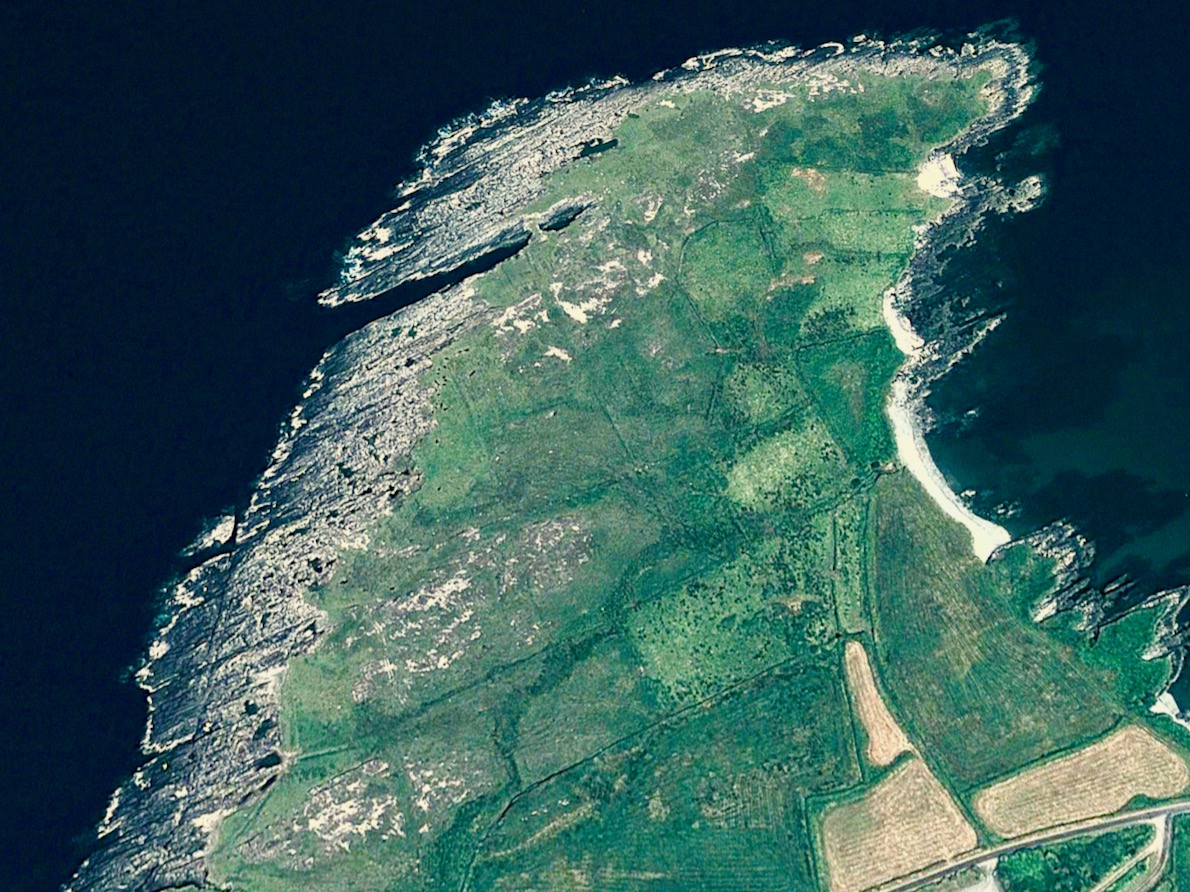
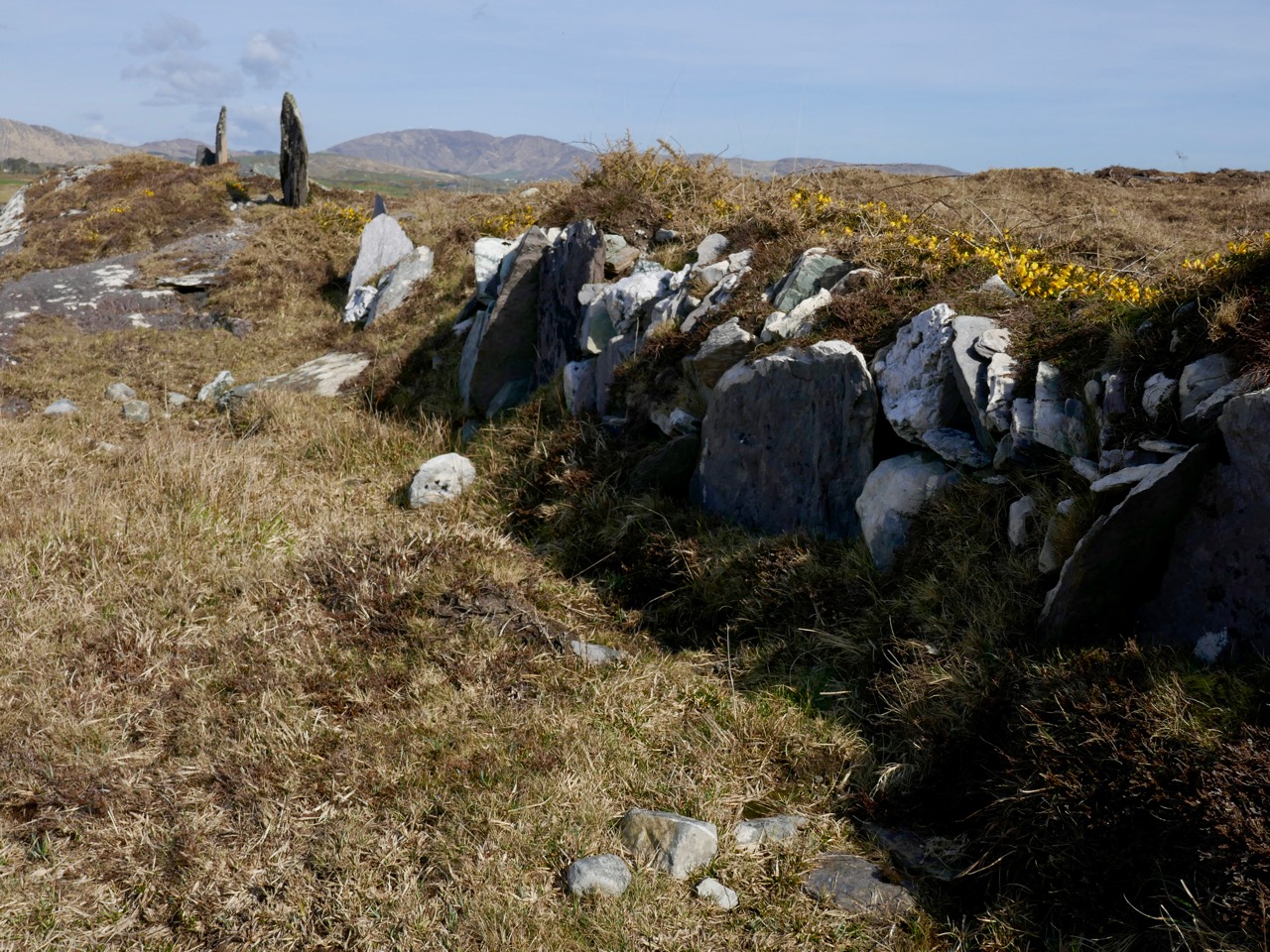
The west side of this shark’s fin-shaped promontory is wildly exposed to the ocean and its gales. You can see from the aerial views, above, how the rock bed is bare and visible, and the vestigial fields which occupy – or once occupied – the east side peter out, and the walls and banks which once formed them fade away altogether over on the left. In fact, these Google Earth images give a better impression of the oddly shaped enclosures than can be seen on the ground.

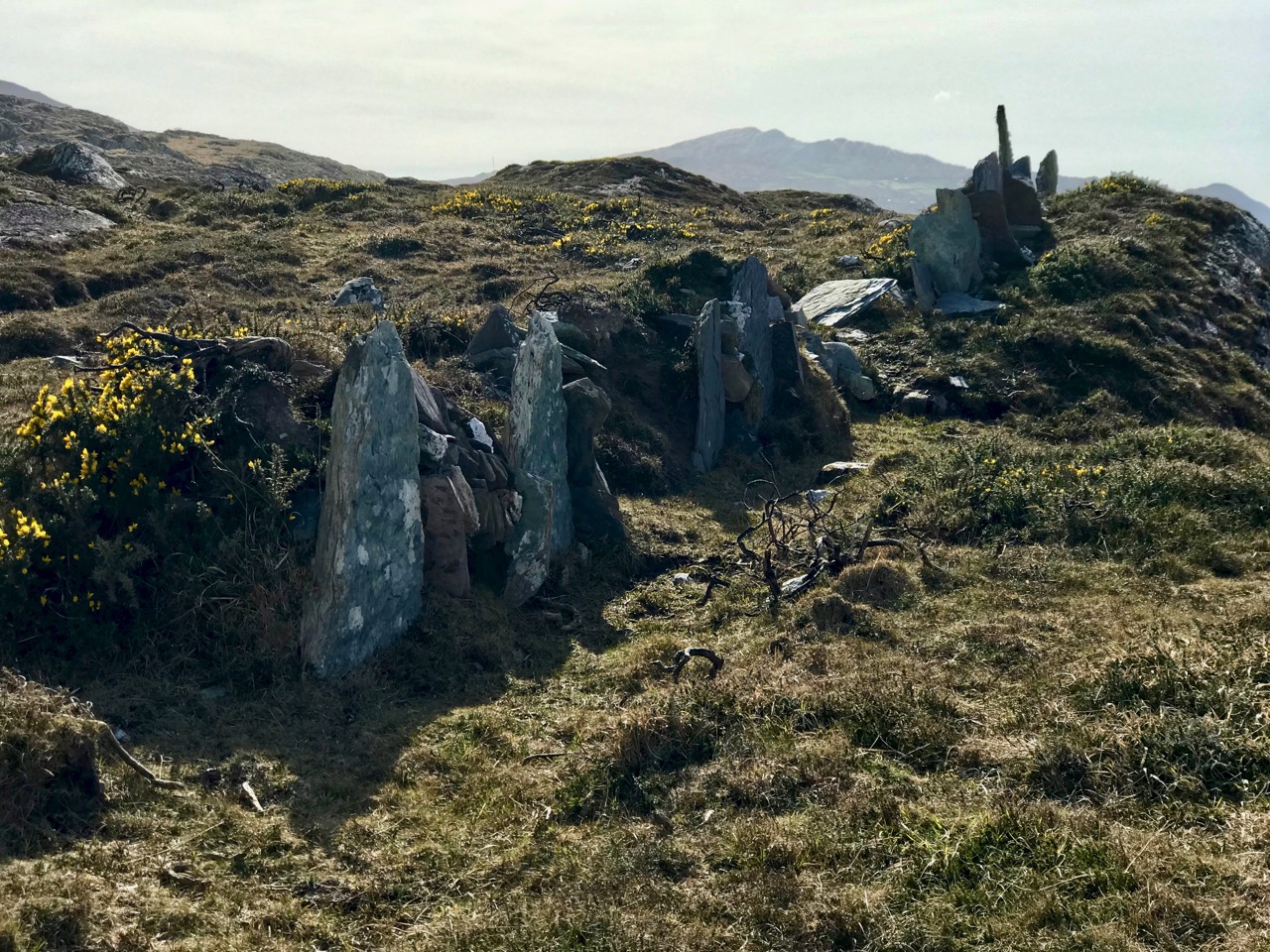
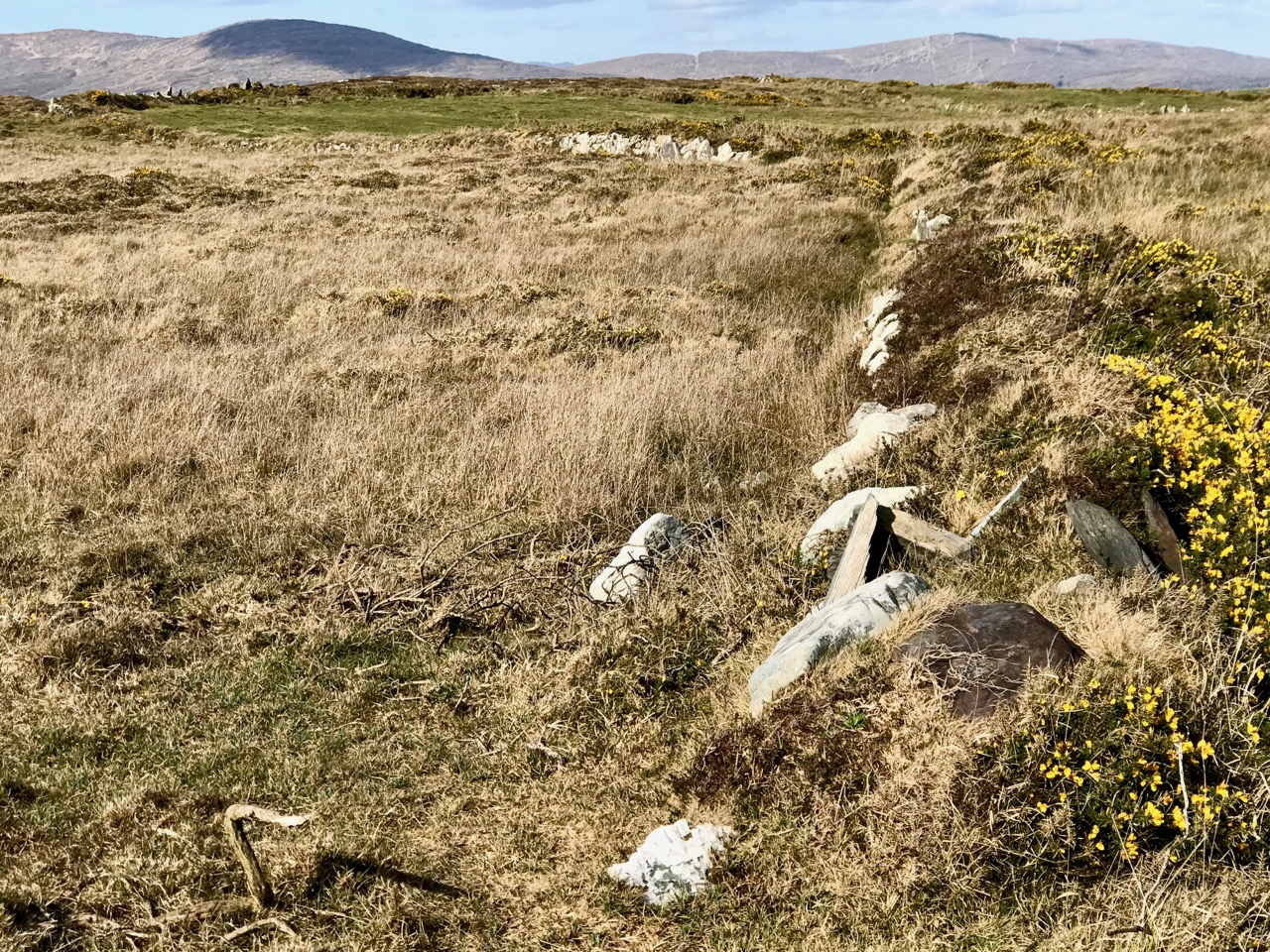
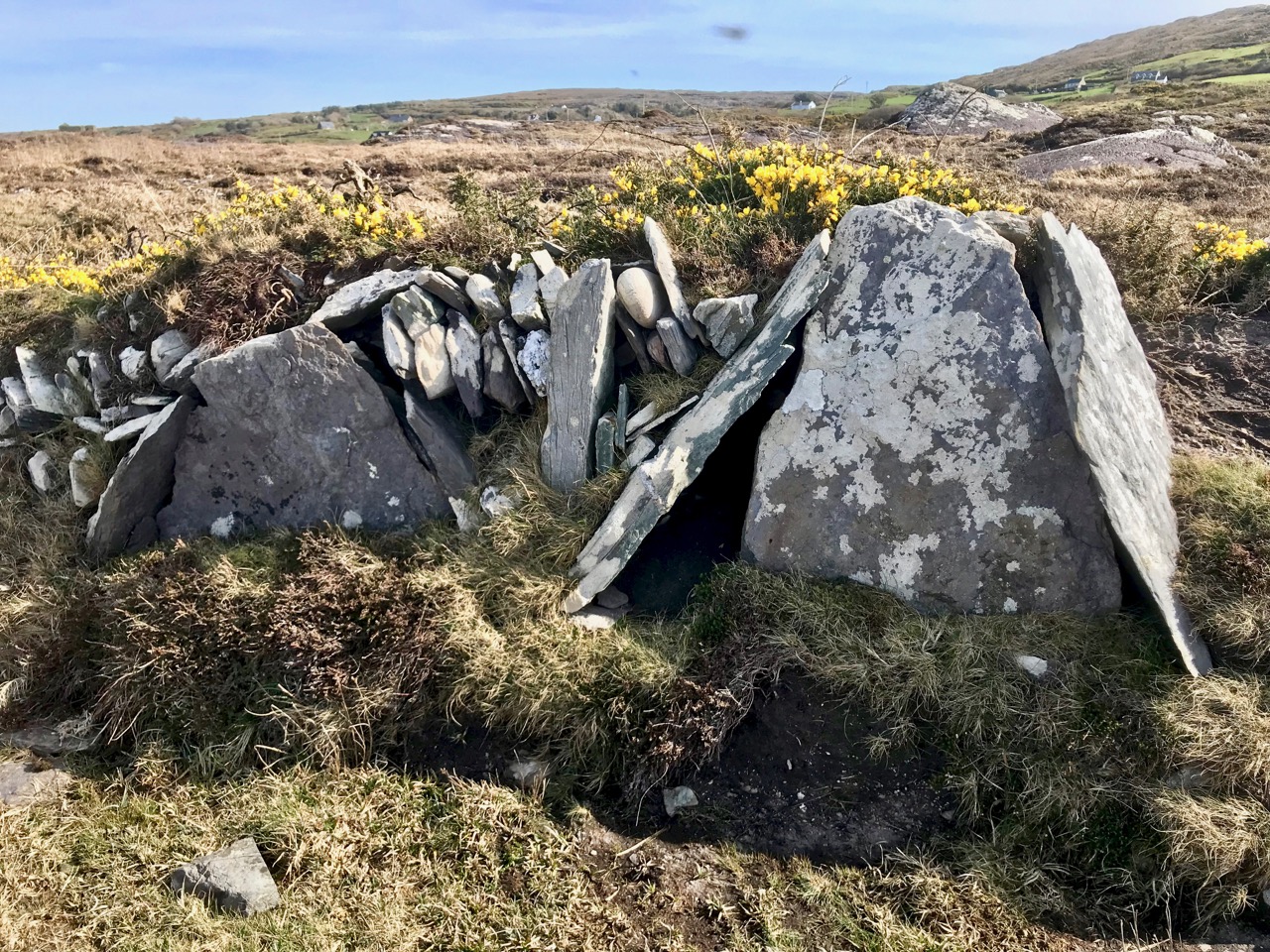
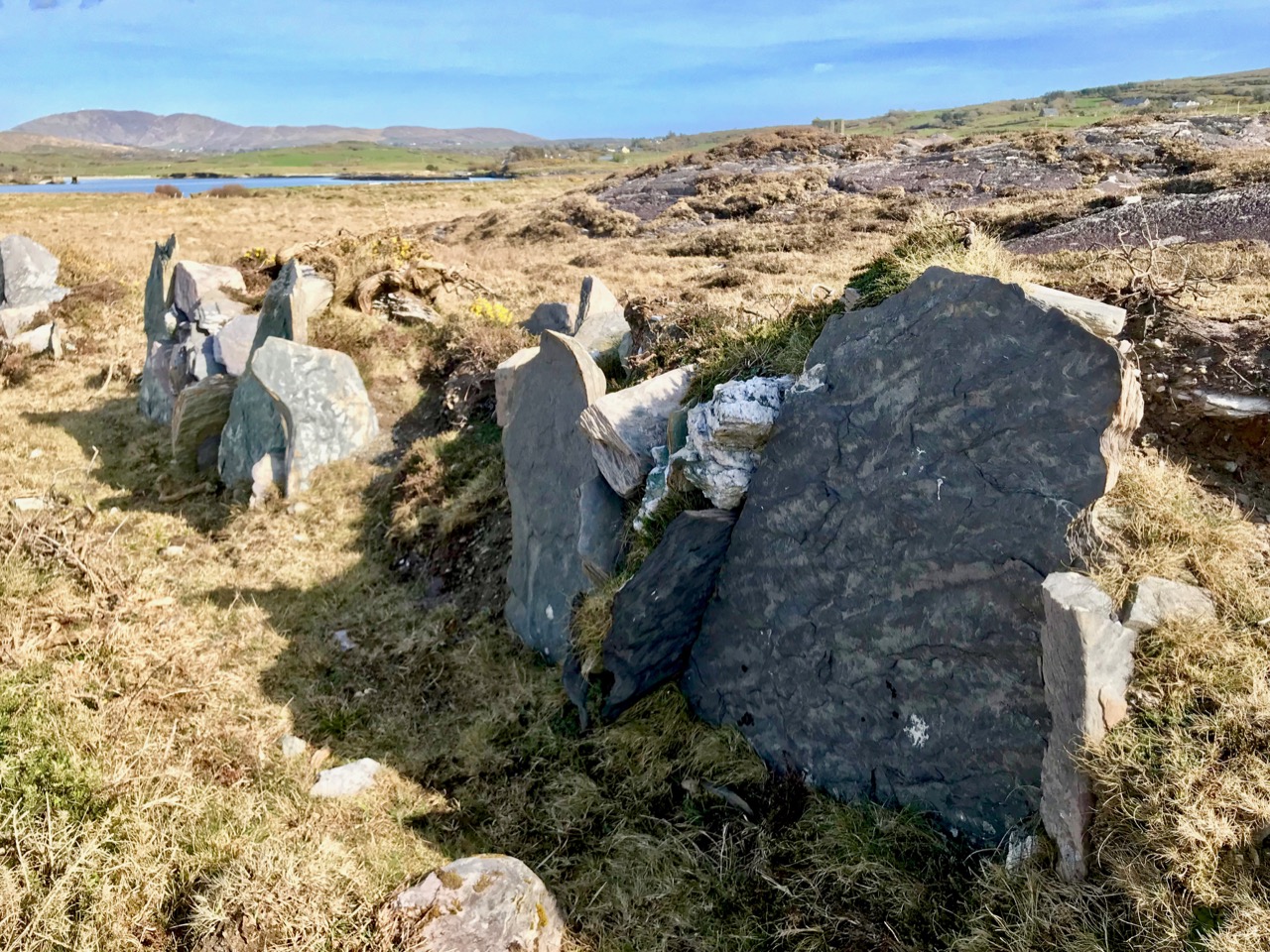
Three examples of many varied boundary features on the promontory are shown above. Each is differently constructed and they range from a series of vertically-set slabs to rocks-and-rubble and a raised bank reinforced with stones. In the picture below, follow with your eye the boundary as it traverses the scrub and makes a large S-bend on to the ridge facing the distant horizon.

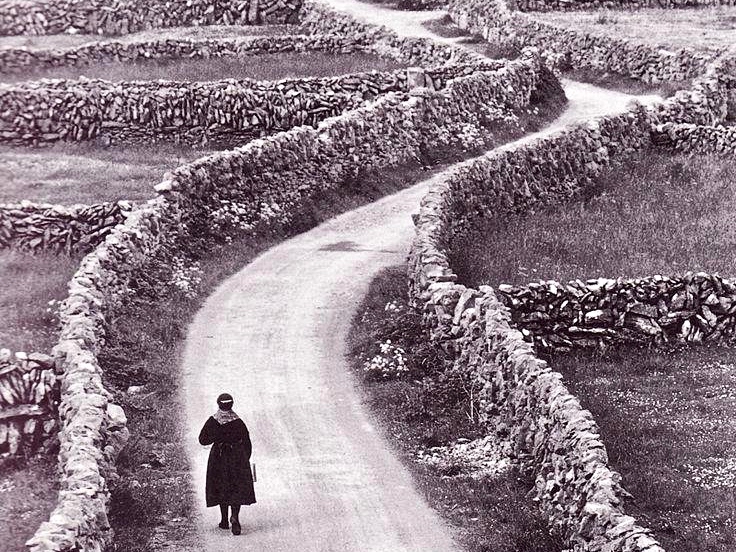
Ireland – especially the west of it – is a huge stone landscape. Wherever people have settled, they have moved the stone and used it. To make fields, or any enclosures, they have had to clear the land. The stone taken from the land is used – sometimes to build shelter, often to build myriad walls to define the holdings. Here’s a striking example from the Aran Islands:

Nothing is recorded on the National Monuments Survey about these land boundaries at Dunmanus – or the significance of the promontory as a whole. Was it once a promontory fort? There are others on this coast. It could easily have been defended along the line of the present road running across the south. However, the land is flat and low, and there is no shelter.

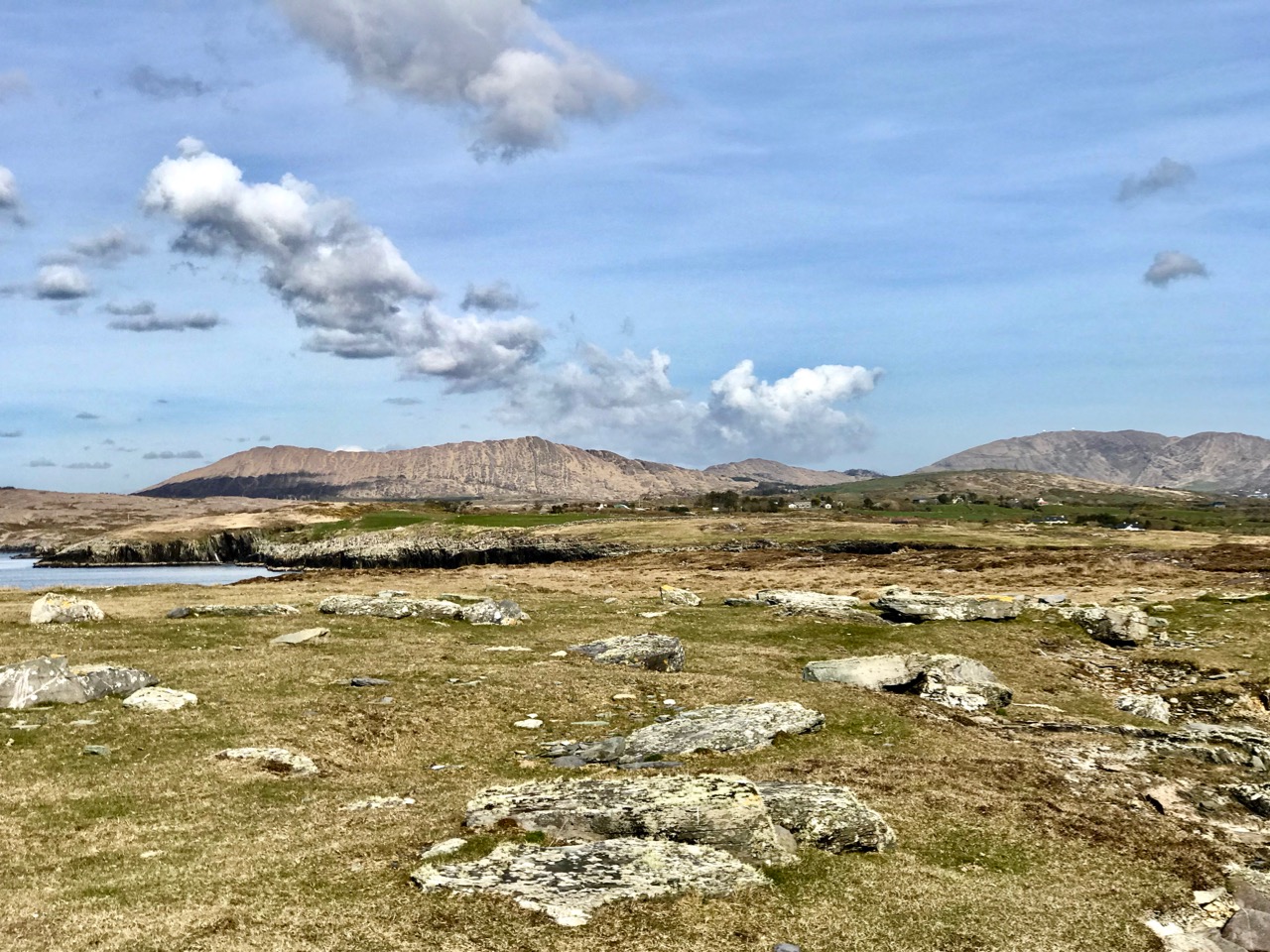
Flat stone surfaces – of old red sandstone – remind us of the Burren landscape in Clare, and we can suppose that the present windswept bog and scrub could once have supported agriculture. But when? In medieval times, perhaps, when the nearby Dunmanus tower house was a thriving centre of occupation and, probably, commerce. In the shelter of the bay the little quay at Dunmanus survives and is still used by small boats searching out shellfish and scallops.

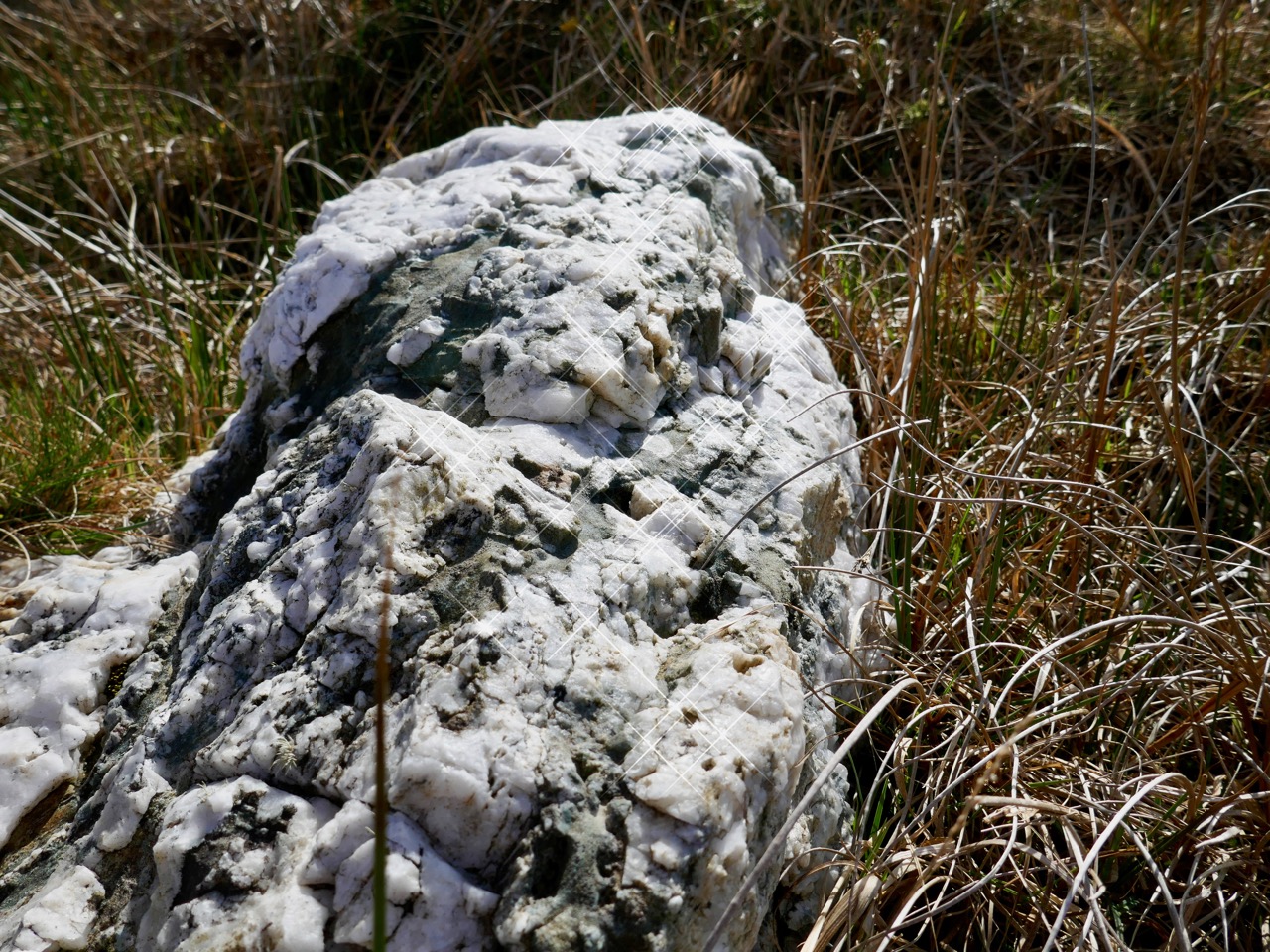
In some places the old walls seem to have a prehistoric feel: the use of slabs embedded vertically like standing stones is quite unusual in West Cork. The presence of large quartz rocks, too, is reminiscent of ancient sites, although they are natural geological occurrences here.

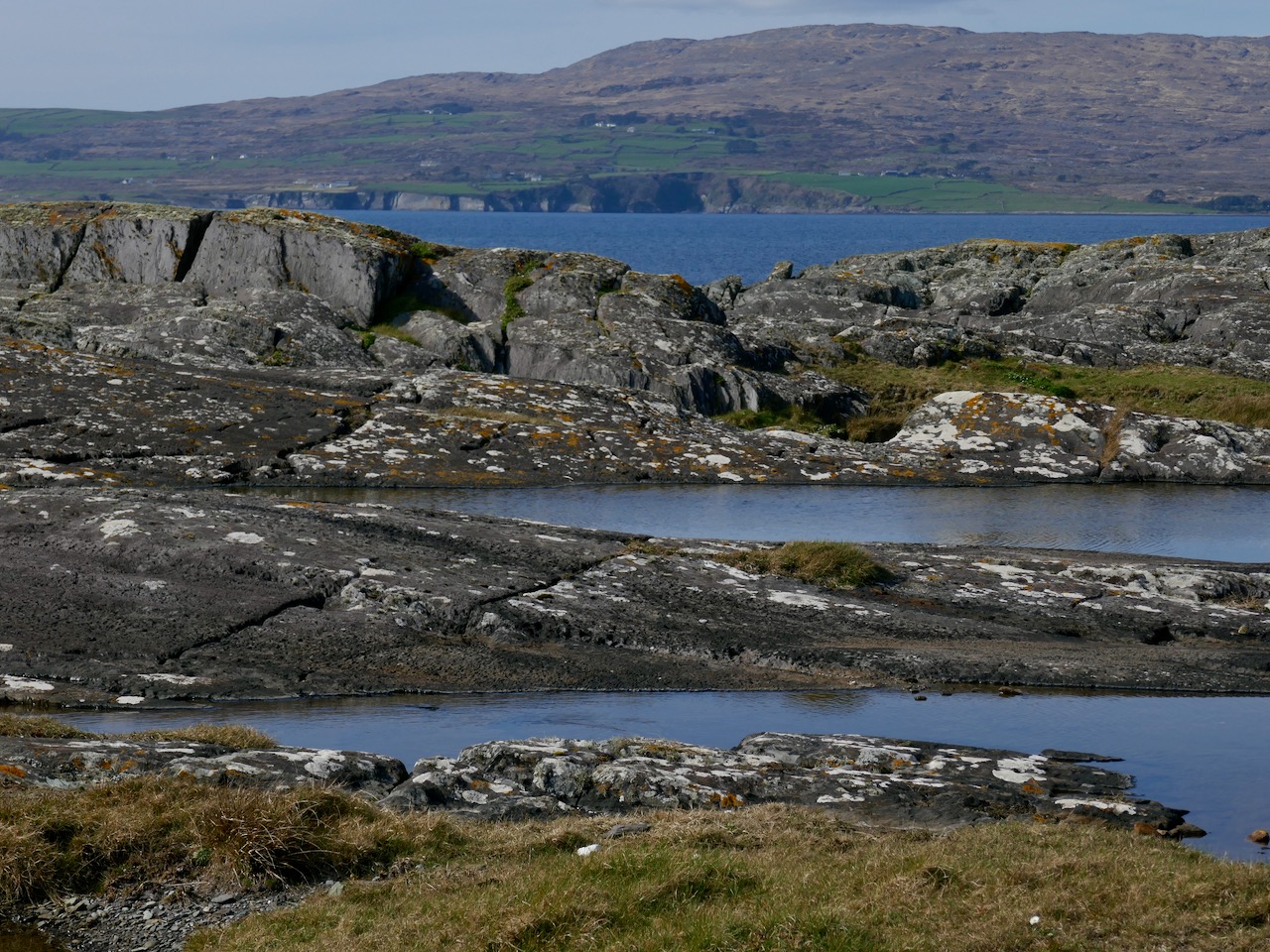
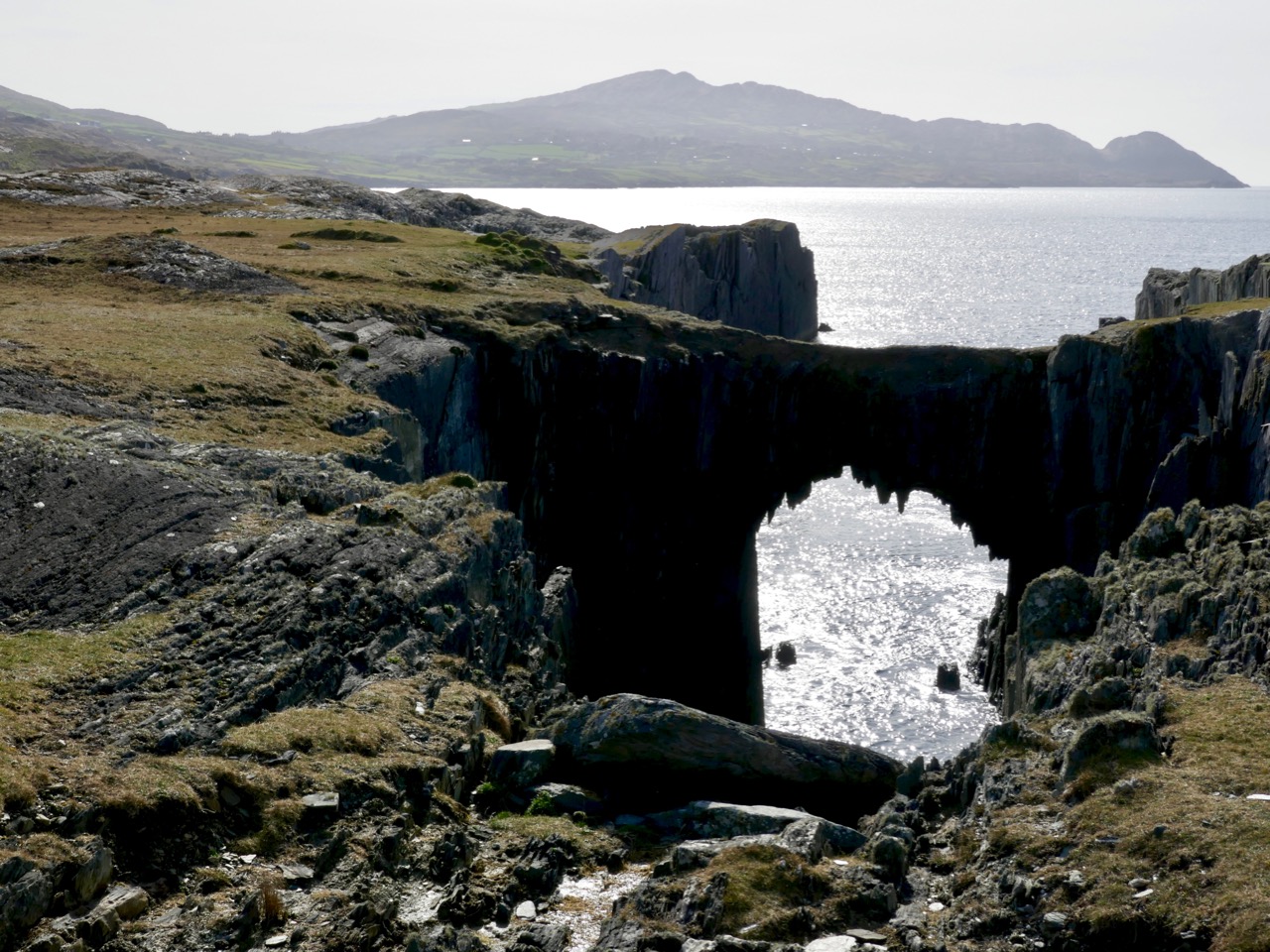
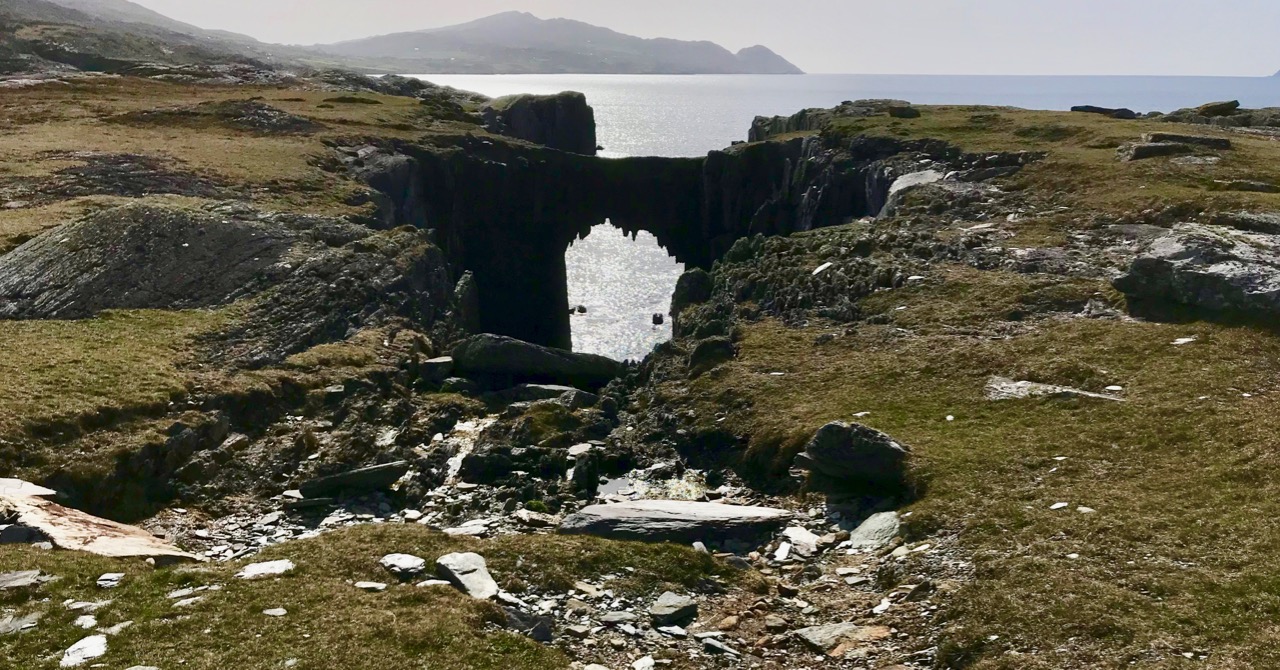
Other natural features on the peninsula include two ‘sea arches’ – bridges formed through erosion of the rocks and chasms by the ocean.

It’s a landscape of vestigial fields, sea – and stones. Nothing more. But I find it a mesmeric place; partly because we can see that it bears the marks of human toil, and we want to know more about who was there and how they lived. It’s a remote piece of Ireland to call ‘home’. Those marks remain after how many years – hundreds, thousands? They intrigue us, and compel us to explore.

Drawn to the Beara

The spectacular landscapes of the Beara Peninsula draw us again and again: have a look at some of our past explorations here and here. There’s no doubt that for fine, distant views, tranquil coastlines and variety in geology, history and archaeology this part of Ireland takes some beating. And, for us, it’s ideal: near enough that we can have a full day out absorbing all these things, yet still being home in time for tea!

This is the weekend when clocks ‘spring forward’ – giving us longer evenings. But also the sun is getting noticeably stronger, colours are getting more intense, and the shadows are hardening. It’s a great time to be out on our travels.

That’s Hungry Hill above – highest peak in the Caha Mountain range, Co Cork – and the background setting for Daphne du Maurier’s 1943 novel of that name. The story is based on the real-life Puxley family who set up and ran Allihies copper mines in the first half of the nineteenth century. Du Maurier weaves the tale to give the name of the hill a symbolic meaning – the mines ‘swallow up’ the lives of those who work them and the plot is charged with tragedy and unhappiness.

We crossed the peninsula on the Healy Pass, one of Ireland’s great road journeys, with breathtaking views towards Bantry Bay in the south and the Kenmare River to the north as you traverse the 334 metre summit. The road, known in Irish as Bealach Scairte, was originally cut as a nineteenth century famine relief project, and improved in the 1930s, when it was named in honour of Tim Michael Healy, a Cork man who served as the first governor general of the Irish Free State.

We had a mission: to visit Dereen Garden, which is open all year round. We were there before the tourist season got going, and we mainly had the beautiful walks and vistas to ourselves. The woodland garden was laid out 150 years ago with sub-tropical plants from around the world and has been improved and added to since then; it is famous for its huge Arboreum rhododendrons. Evidently there is a variety of wildlife to be seen, including red squirrels, sitka deer and hares, but they were all keeping out of the way when we visited.

We were hoping to sample some of the fine eateries which have been set up on the Beara but, again, we were a little too early in the year: an excuse for another trip when they open up. So we reluctantly turned our way back towards the Healy Pass – to get the views from the other direction – and were stopped in our tracks by a sign pointing to ‘stone circles’. This is in a townland named Cashelkeelty and is near Lauragh, Co Kerry. Finola had a look at her archaeological records on the phone and found it was somewhere we had to go! It involved a long, uphill walk through a forest, but was very well worth it. Read Finola’s post to find all the details.

I will show only one picture as a taster (above) – but also to point out the proximity of the high grade overhead powerline which runs right by the ancient stones. Does it add or detract from the monument itself?

There were many more vistas to be taken in on our few hours spent on this dramatic peninsula, where mountains so spectacularly meet the sea. We can never tire of this, our own little part of the world.

Cashelkeelty – More Than Meets The Eye

It’s on the wild and remote Beara Peninsula and it’s a bit of a trek to get up to it – but so worth it. We are fortunate that we know quite a lot about Cashelkeelty, which is in the Kerry section of the Beara, not far from Lauragh. There were excavations here in the 70s and 80s led by old friends, John Barber and Anne Lynch. Pollen analysis in the region has added to our understanding of the environment during the Bronze Age.

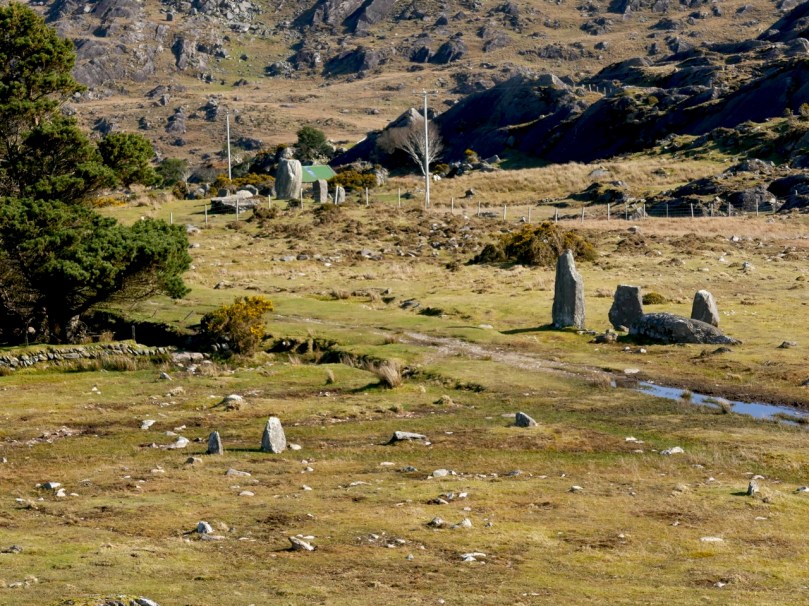
You can see both the multiple stone circle (the closer set of stones) and the 5-stone circle and stone row from the knoll near the site

But none of this is obvious on the ground and there are no explanatory signs, so I’m going to lay out what we know about this marvellous complex of monuments, so that when you go (Yes, do go!) you’ll know a bit more about what you are looking at. Make it part of a day trip, like the one that Robert is describing this week.

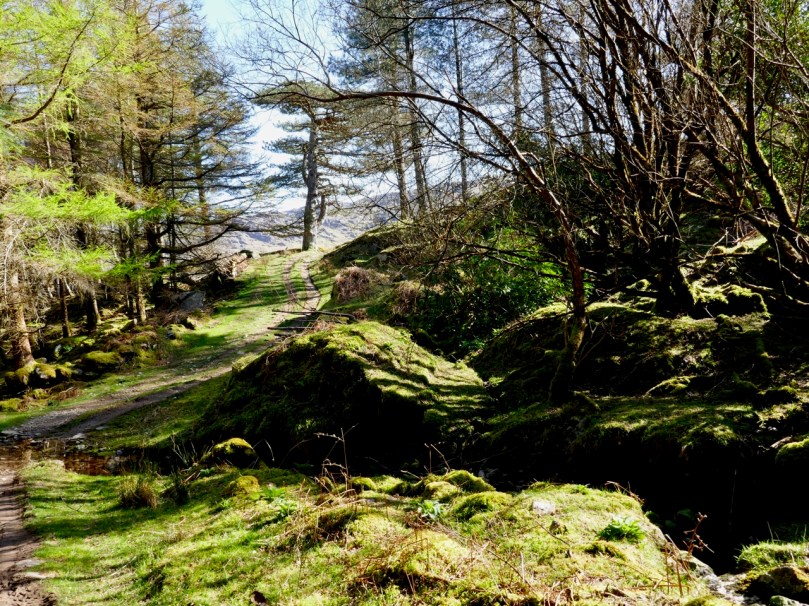
Park in the little car park about 2 km west of the turn off for Derreen Garden. Someone has handily marked it on Google Maps as ‘Parking Place Stone Circle’ and take the path that runs upwards through the woods, turning left (and ever upwards) when you come to another path. It’s a Robert Frost experience – the woods are not only lovely, dark and deep but also mossy and mysterious, with hints of old walls here and there.

When you emerge into open country, you are actually on the Beara Way and this stretch was beautifully described by Peter Clarke in his Hikelines blog.

Peter Clarke’s sketch of the 5-stone circle and stone row ©Peter Clarke/Hikelines

In fact, you are walking now along or beside a medieval road that once ran from Kenmare to Castletownbere. Once you know this, you can pick it out and imagine walking or riding along it in rough woollen garments, or perhaps the  flowing robes of a monk, or the full armour of a knight. But this road is actually one of the newer items in this landscape.

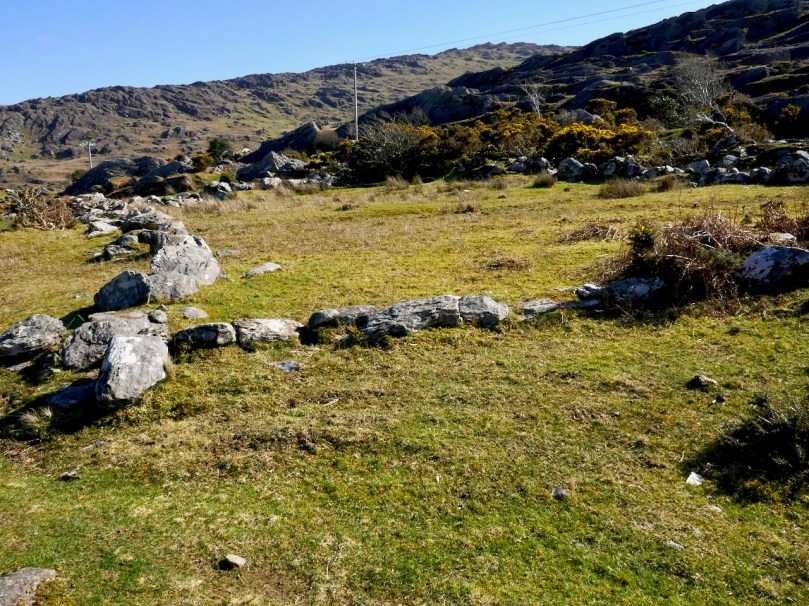
The landscape itself is Bronze Age. People made their living here by growing some cereals (probably barley and emmer wheat) and by herding cattle and sheep. Pollen analysis tells us that forest cover declined – that is, it was cleared by the early agriculturalists – beginning about 1500BC and intensifying around 1100BC. Pre-bog field systems are everywhere here – look for the lines of upright boulders defining walls and small fields as you walk.

According to Billy O’Brien in his Iverni (got your copy yet?) deterioration in the climate and higher rainfall about 1000BC led to increased acidification and the spread of bogs in many areas. So what we are looking at here, in the Mid to Late Bronze Age, is an open pastoral landscape. This is important because the views from here are panoramic and significant, and they would not have been obscured by trees.

Ancient fields

And in this open landscape these early farmers lived in houses of which no traces remain, probably of wood and thatch. What does remain are the monuments they built of stone – they meant them to endure and endure they do. There’s a five-stone circle, and a stone row right beside it, and about 30 metres to the west another set of upright stones.

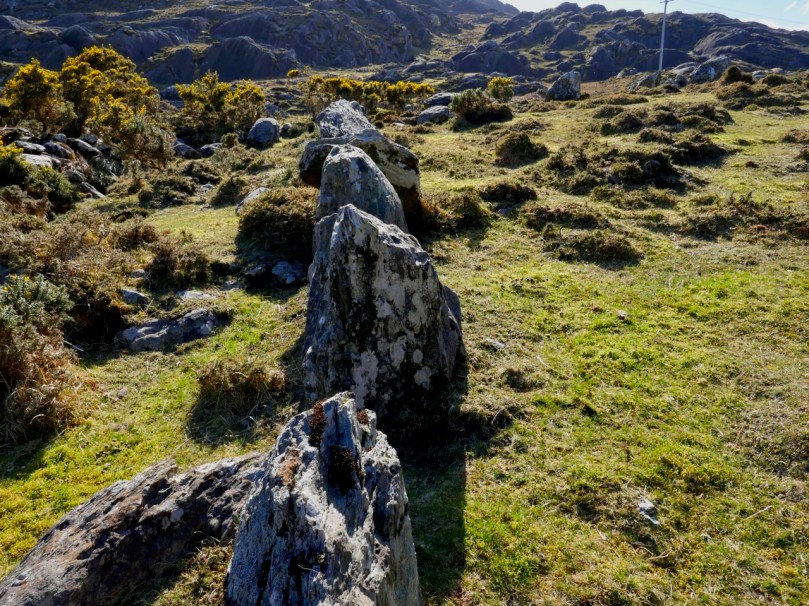
The stone row was built before the 5-stone circle, possible hundreds of years before. There are three stones now, but the Lynch excavation established that there had been a fourth. Like most of  the stone rows on this part of the world it is oriented ENE/WSW, or towards the morning and evening horizons in summer. As regular readers know, I am always intrigued by the way the shapes of the stones seem to mirror the landscape behind it and this is no exception.

The 5-stone circle now only has three stones, but the sockets for the remaining two were found in the course of the excavations. In the centre, covered by a stone slab, was the cremated remains of a person in his or her 20s. Radio carbon dates (later re-calibrated) established the construction to about 1300 to 700BC, placing it in the Late Bronze Age. Mike Wilson of the Mega-WHAT site has analysed the orientations of both the stone row and the 5-stone circle – you can see the results of that here.

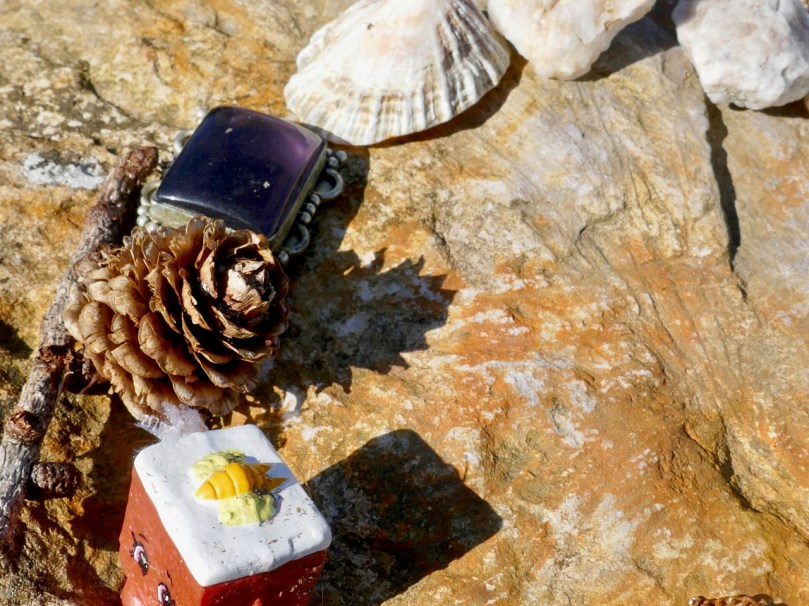
Visitors love to leave little offerings at sites like this. You are looking into the 5-stone circle, towards the recumbent. The slab is more or less where the cremated remains were discovered in the excavation

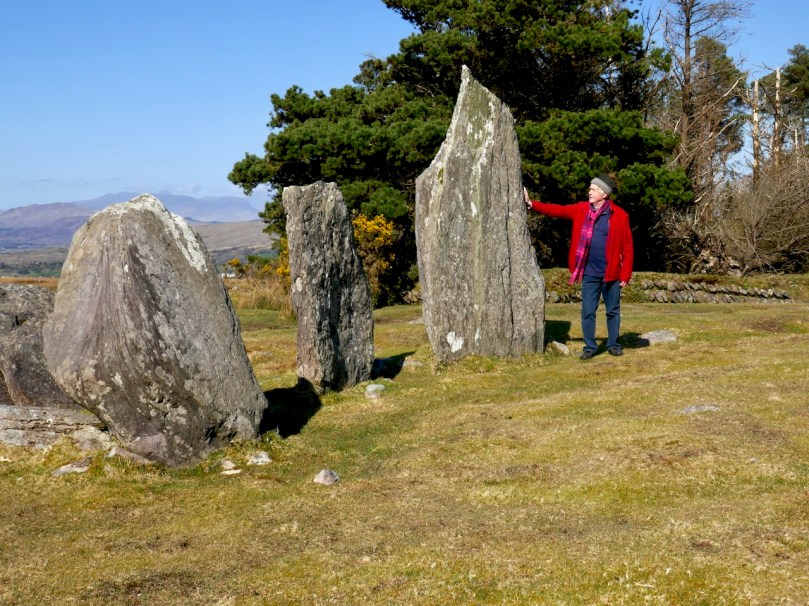
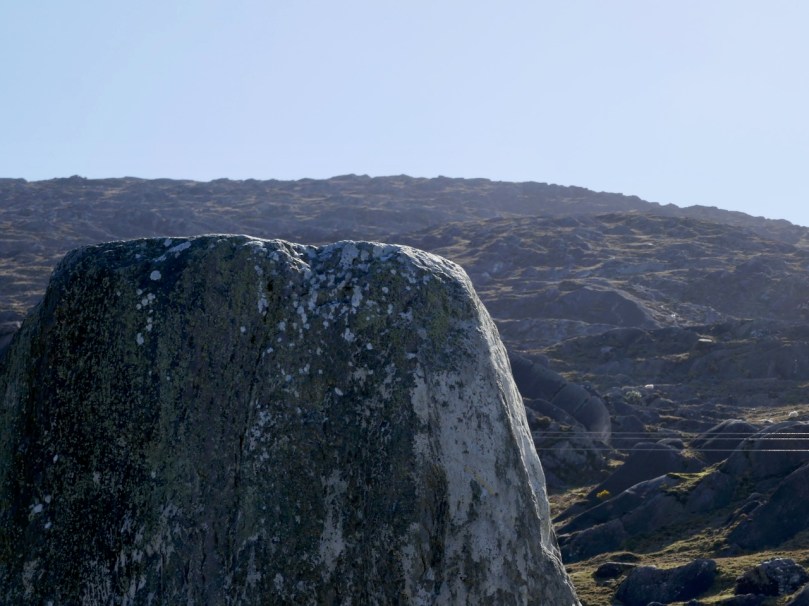
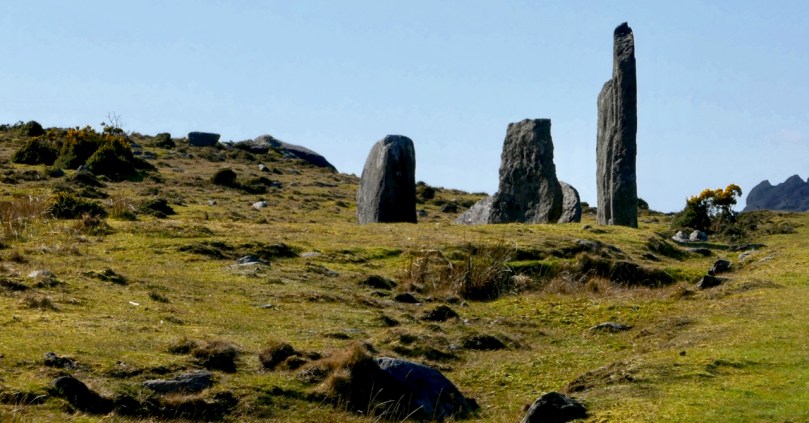
From here you can clearly see another set of stones to the west. What looks like another stone row is actually the remaining uprights of a multiple stone circle, as Anne Lynch documented in her account of the excavation. There were either 11 or 13 stones originally. The tallest stone now standing must have been one of the portals. The middle stone was originally lying down but was re-erected in the course of the excavation.

Once again, I am struck by how these three stones appear to mirror the horizon behind them. Can this really be a coincidence? If so, it’s a an eerie one. To understand how and why multiple stone circles were built, start by reading The Stone Circles of West Cork: Discussion. That post will point you to others as well.

To round out the Bronze Age monuments, there’s a Fulacht Fia just south of the 5-stone circle – you can read more about these ancient cooking places in my post Ballyrisode Fulacht Fia.

This little road leads to a stone building, perhaps originally a cottage. It’s the green roof you can see in the second photograph

Cashelkeelty is an amazing site – so many monuments, such evidence of Bronze Age activity from daily living and farming to monument-building. We still have their stone edifices to remind us that these people were sophisticated builders who wanted certain of their practices and rituals to endure for centuries. What we no longer see easy signs of, we can imagine – the forest clearing, the planting and herding, the communal feasting. Take a little while at this site and ask whether our own efforts will endure for thousands of years.

Local Heroes: Ballycommane Gardens – and Bronze Age Site!

This week we were privileged to meet with Andy Stieglitz and Ingolf Jungmann at their home, Ballycommane House, between Durrus and Bantry. We’d been once before, several years ago, when we had met Andy, then busily engaged in renovating one of the sheds. Now the house has been extended and modernised, along with various outbuildings. Andy and Ingolf, both retired and living here full time, are running the house as a bed and breakfast, with an adjacent self-catering cottage, and have opened their garden to the public.

I don’t know the names of most of these flowers, although the one above is from one of their heritage-variety fruit trees

They have taken a few acres of scrubland and pasture – and turned it into a little piece of paradise! Both keen gardeners, they have been working now for fifteen years to develop their arboretum and lay out different areas of the garden connected by meandering paths. Here and there open spaces invite you to lounge and simply take in the sights and the scents.

This Gunnera is, thankfully, the non-invasive variety

Or you can keep strolling and discovering. They specialise in plants from the Azores, where they like to winter, and have discovered that many Azorean species flourish in this mild climate. Of course they have had to learn to deal with the wind, as parts of the site are quite exposed, and with the unpredictable Irish climate.

But Andy and Ingolf value all plants and also celebrate the humble wildflowers that are my special interest. Ingolf has learned to propagate the wild primroses and the colourful borders he has created are a joy.

Wild Primroses are generally pale yellow, but pink varieties also occur. Ingolf tells me the pink ones are a little harder to propagate 

Wild spurges mix with the Azorean ones – the Euphorbia genus is one of the largest and most variable on earth, and while we know it mainly from our wild Spurge varieties they can range from tiny to huge and from colourful (Poinsettias!) to shades of green.

A native Euphorbia (top) is flourishing while below an Azorean import looks very comfortable also. Note the tiny native spurge that has sprung up underneath it – a study in contrasts

Now in March, the garden hasn’t quite come into its own yet. Nevertheless, there is plenty to see and surprising hits of colour here and there. Wherever you look, the eye is caught.

Above: We decided it was an Azorean daisy. Below: I think it’s Green Alkanet, a garden escape that has naturalised widely in Ireland

Ballycommane House is part of the marvellous West Cork Garden Trail and is open from March to October. Andy and Ingolf love to welcome visitors so plan a trip to see this treasure. And when you do, there’s a surprise in store – Ballycommane is also home to a Bronze Age Boulder Burial and Standing Stone Pair!

Andy (left), Ingolf and I contemplate the boulder burial

Regular readers of this blog will know that Robert and I worry about loss of and damage to our ancient monuments due to neglect, lack of knowledge, and occasional wilfulness. That’s why I am calling this post Local Heroes because Andy and Ingolf, quite apart from the enormous work involved in developing their house and garden, have embraced the challenge of celebrating and safeguarding these monuments for all of us.

The Boulder Burial is a large erratic of quartz. Quartz was highly prized in prehistory and was used in various ways. Not surprising, given how it gleams and sparkles in the sun. This one is visible from across the valley

Today was the official unveiling of their Visitor Centre – a converted piggery now in use to display a set of explanatory posters developed by Prof Billy O’Brien and Nick Hogan of UCC. Billy has excavated this site and two other Boulder Burial sites and is more responsible than any other researcher for what we know about the age and possible functions of Boulder Burials. You can read my posts, Boulder Burials: a Misnamed Monument? and Standing Stone Pairs: A Visit to Foherlagh for more about these kinds of monuments.

The standing stone pair is of the local slatey sandstone, chosen to be flat on top – no doubt this served some kind of purpose

Billy was there to do the honours and to give us a talk on the site. When he excavated here in 1989 it rained, he told us, every day of the dig. Although no carbon-datable material turned up he was confident in assigning a mid-to-late Bronze Age date – it’s about 3,000 years old.

Cutting the ribbon to officially open the Visitor Centre

He asked us (there was quite a crowd!) to consider the setting of the boulder burial and standing stone pair in the landscape, and spoke about their use to memorialise high-status individuals and to mark locations from which sunrises and sunsets might be observed at solstices and equinoxes.

Unfortunately tree plantings have obscured the view from the boulder burial, but this is what it looks like. You can see all the way down the Sheep’s Head to Seefin Mountain

Ballycommane is a very special place indeed and we are very fortunate that Andy and Ingolf are committed to being good stewards of the prehistory they have inherited. Thank you, Andy and Ingolf – and for that yummy cake too!


Inspired by Stone

One of the many archaeological excitements in Ireland last summer was the discovery of a hitherto unknown passage grave with significant carvings beside Dowth Hall in the Bru na Boinne area of County Meath. These carvings are likely to date from around 5,500 years ago. In the picture above (courtesy of agriland.ie) from left to right are Minister for Culture, Heritage and the Gaeltacht Josepha Madigan; agri-technology company Devenish’s lead archaeologist Dr Cliodhna Ni Lionain; Devenish’s executive chairman Owen Brennan; and Professor Alice Stanton.

As you know, we are Rock Art addicts, so this week went along to this year’s Stone Symposium in Durrus, West Cork, to hear Cliodhna, above, give a fascinating illustrated talk on the finds at Dowth. Have a look at this post on the inaugural Stone Symposium from 2017. It’s great that the event is thriving and attracting interest and participants from far and wide.

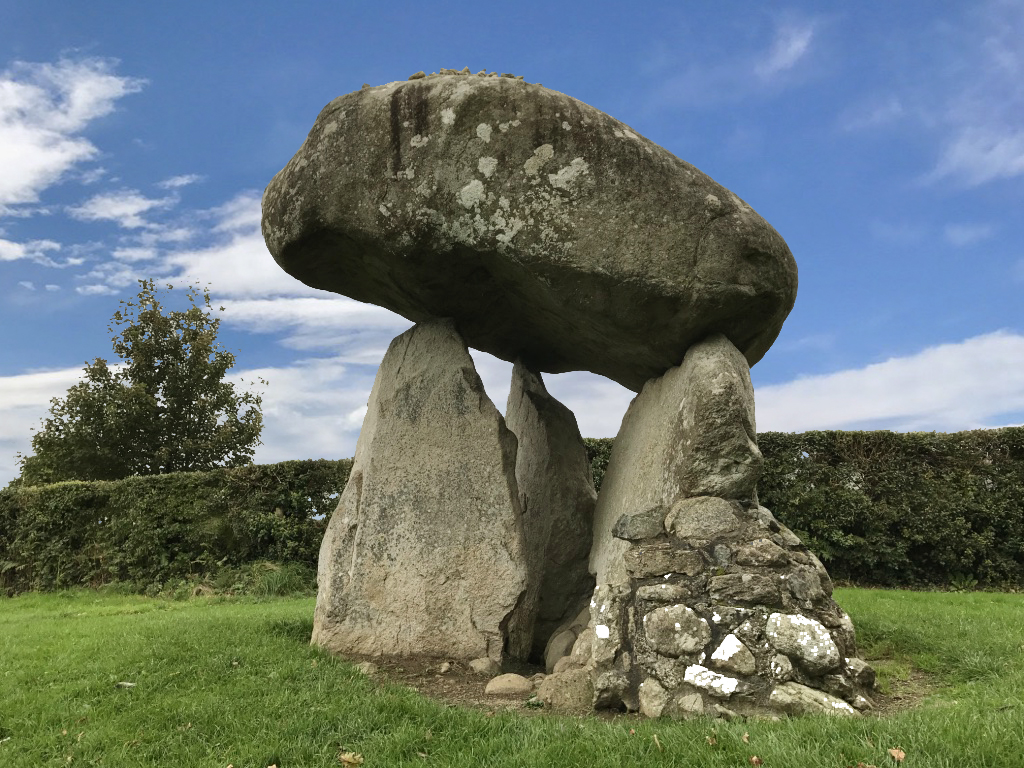
Our attendance at the Symposium set me thinking about the whole subject of stone. It’s the most basic of creative materials, as relevant today in construction and art as it was to our Neolithic ancestors. Proleek Dolmen in County Louth (above) is an example of the early use of stone to create a structure which made a huge impact on the landscape. It’s a portal tomb over 3 metres high, and the supporting stones are around 2 metres high: the capstone is estimated to weigh 35 tons. It’s probably a more visually impressive structure today – in its ‘naked’ state – than it was when completed, as it is likely to have been covered over with a mound of earth and / or stones. There is folklore attached to this monument: it is known locally as the Giant’s Load, having been  carried to Ireland by a Scottish giant named Parrah Boug McShagean, who is said to be buried in the tomb or nearby.

Here’s another portal tomb – the largest in Europe – which I discussed in this post from last year. It’s known as Brownshill Dolmen, and is in County Carlow. Finola is in the picture to give the scale. This capstone is said to weigh 103 tons. The portal tombs demonstrate the use of stone in its rawest and most spectacular state: they are examples of Ireland’s earliest architecture, and we don’t really know what they were for. Perhaps it’s to do with status, either of the builders or of the chiefs or priests who might have been buried in them. They certainly make mighty marks on the landscape…

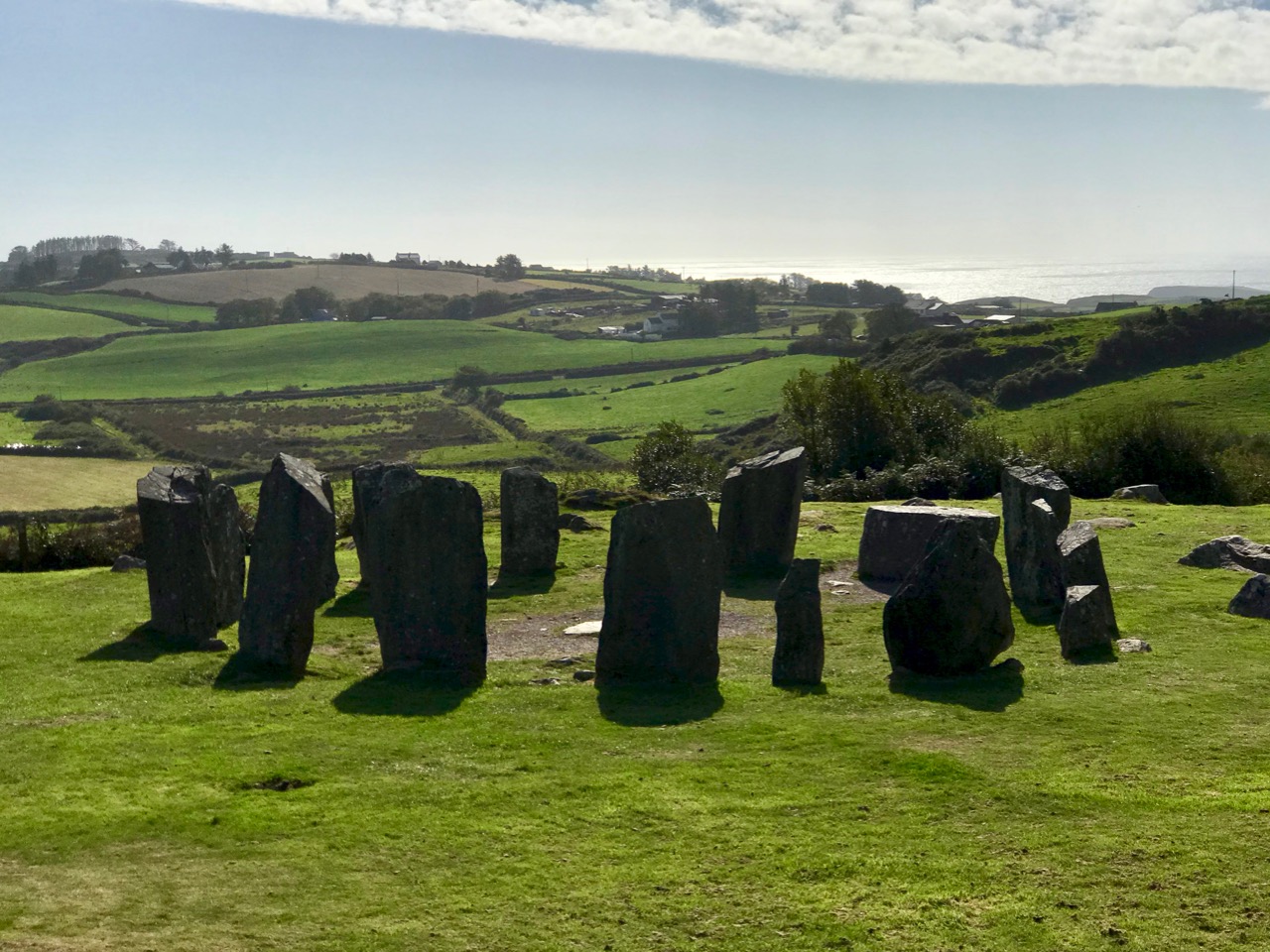
…As do all the other stone monuments which celebrate their makers – although perhaps they remain enigmatic to us today. Bronze Age stone circles have always fascinated, and at least we know that they have orientations which must have been significant. Drombeg in West Cork (above) is much visited at the winter solstice, when the path of the setting sun falls over the recumbent stone when observed through the two portal stones at the east side of the circle.

While the earliest dwellings of the inhabitants of Ireland thousands of years ago were probably constructed from organic materials  – earth, sticks and furze – stone began to play a part in architectural construction in Christian times. The remarkable Gallarus Oratory (above) on the Dingle Peninsula, County Kerry, was long thought to have dated from around the 8th century, although an early commentator – antiquarian George Petrie, writing in 1845 – suggested:

I am strongly inclined to believe that it may be even more ancient than the period assigned for the conversion of the Irish generally by their great apostle Patrick . . .

It’s a fascinating discussion to follow – Peter Harbison sets it out in detail here, and concludes that the Oratory could have been built as late as the 12th century, even after the great Romanesque flowering which included the building of monastic settlements and round towers.

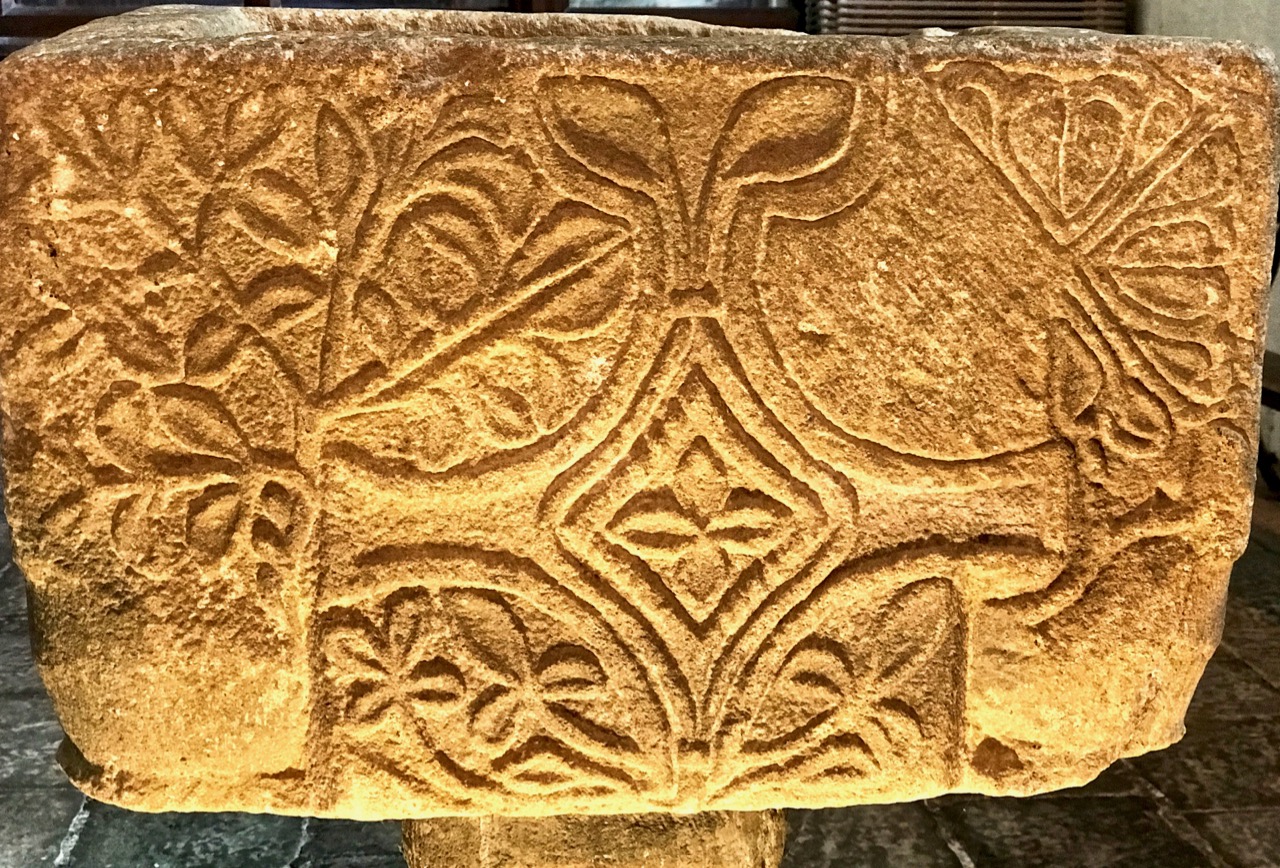
The 12th century cathedral and (possibly earlier) round tower at Ardmore, County Waterford (above), should be a Mecca for stone enthusiasts because of its monumental architecture and carvings: St Declan founded the site in the 5th century, and his monastic cell survives. The Romanesque period in Ireland has many other examples of stone craftsmanship to show, proving that working with stone had become a high art in those medieval times. The examples below are from Killaloe Cathedral in County Clare.

One of the finest Romanesque sites is the Rock of Cashel in County Tipperary. Finola has written in detail on this architectural gem here and here. Suffice it for me to illustrate only one of its treasures – Cormac’s tomb, a sarcophagus beautifully carved in the ‘Urnes’ style – a Scandinavian tradition of intertwined animals.

For centuries, stone has also been a ubiquitous utilitarian building material all over Ireland. ‘Castles’ or – more properly ‘Tower Houses’ – date from roughly 1400 to around 1650, and many remain in a ruined condition, particularly on the coastline of West Cork: we can see five of them from Nead an Iolair. Some have been restored in modern times, including Jeremy Irons’ Kilcoe Castle. The example below is from Conna, East Cork.

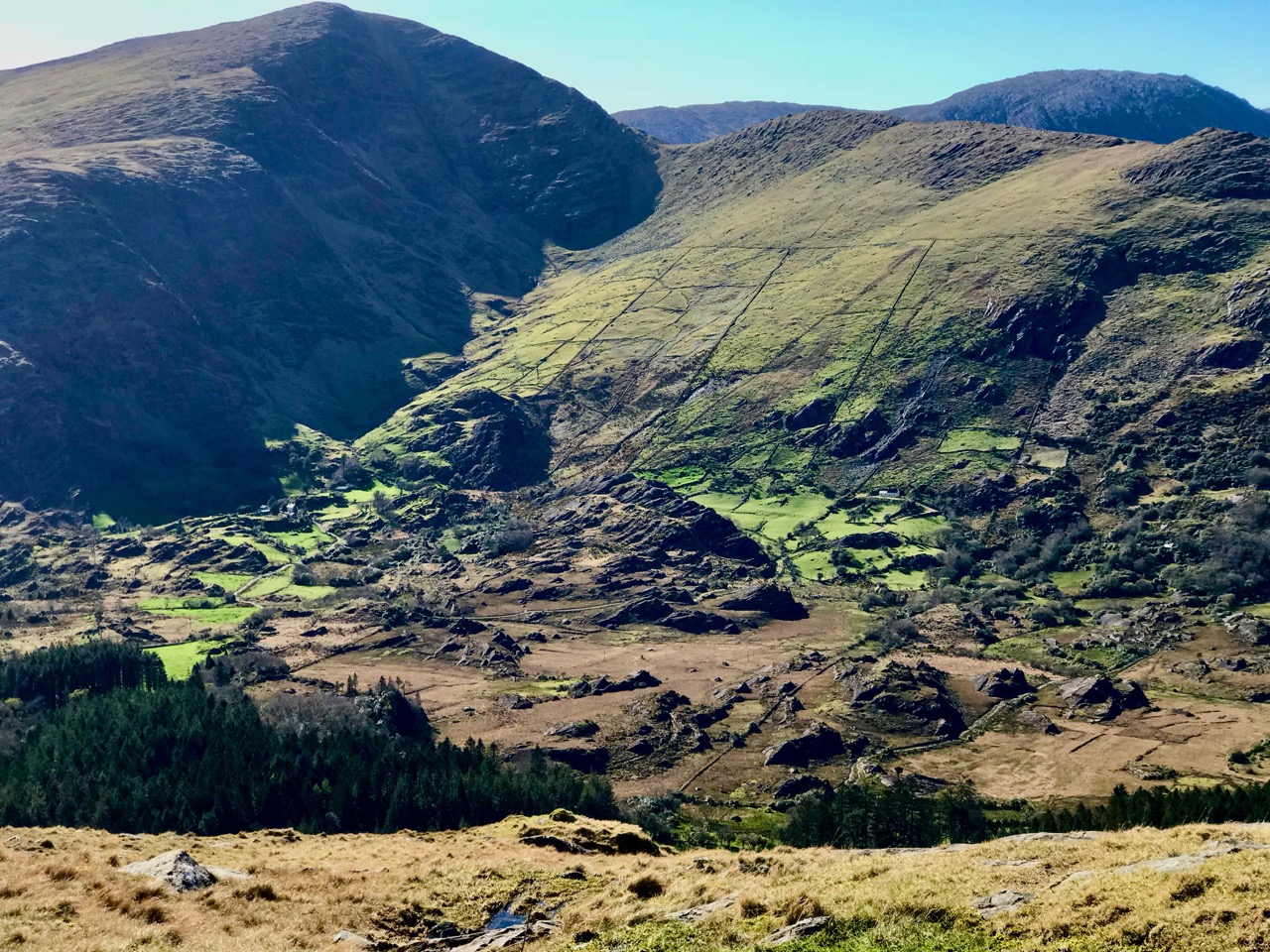
Ireland’s landscape is sculpted from stone. Drystone walling is an ancient tradition still practiced for dividing up land, and varies considerably in style regionally, reflecting the differing geology across the island. Two examples from the Beara Peninsula (below) show the essential geometry of field patterns which stone wall building has created over the centuries.

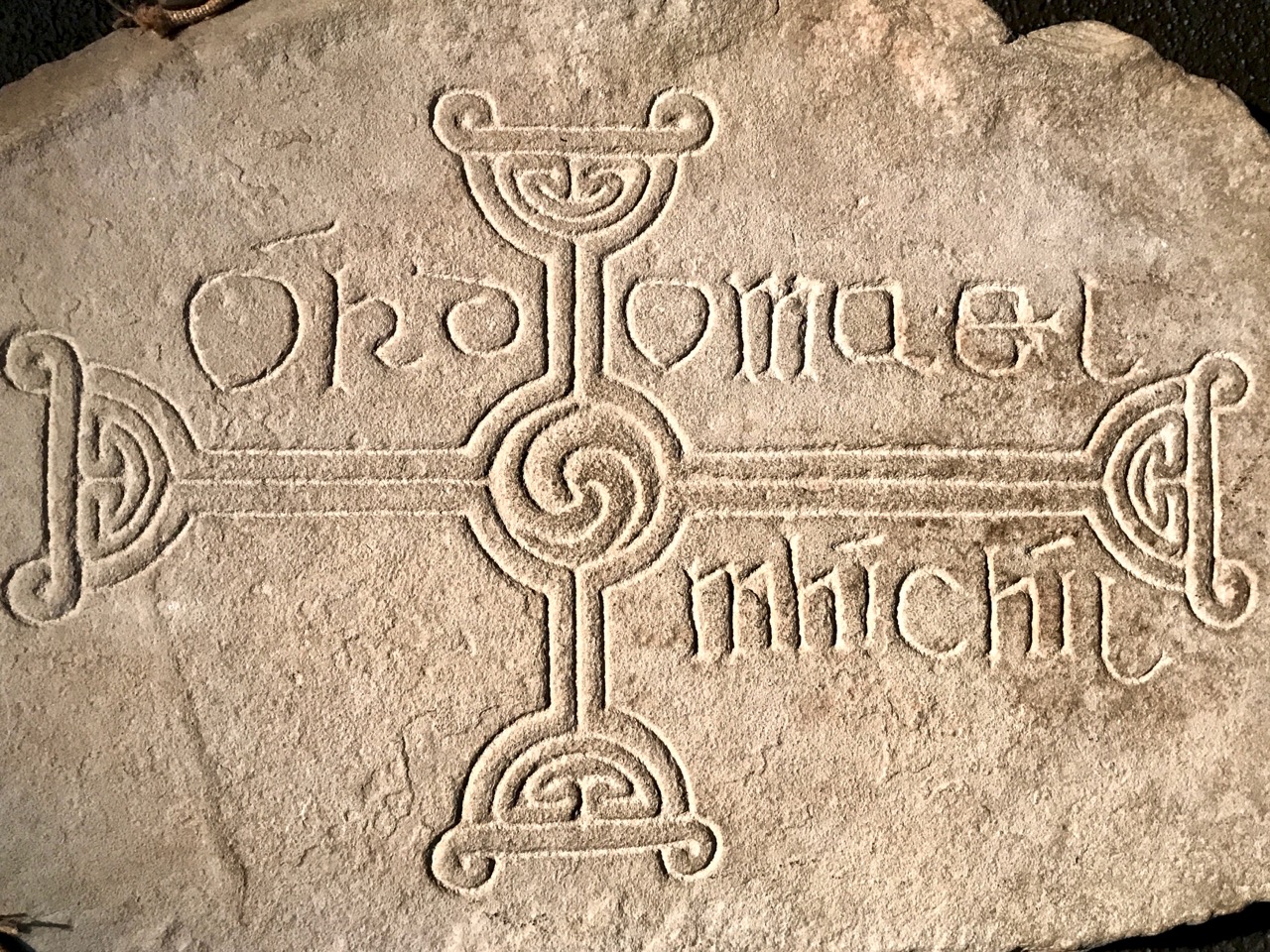
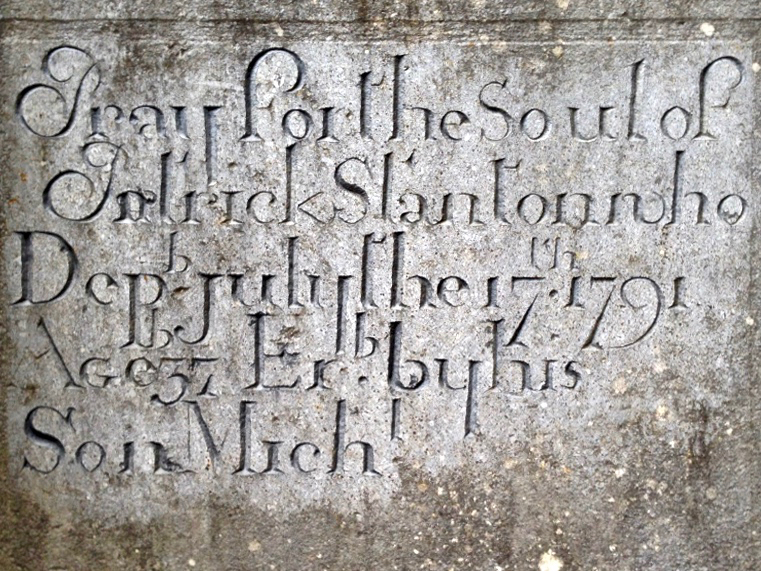
Stone has also long been a medium for communication. We have commemorated our ancestors for centuries with grave markers, often with elegantly carved lettering. Of the two examples below, the first is from Clonmacnoise, and is likely to be early medieval, while the second is an inscription from 1791.

This is just a brief history of our use of stone, dating over thousands of years: I have chosen many examples – almost at random – but hope that I have demonstrated how important it is to continue this ancient craft. The West Cork Stone Symposium is doing sterling work in promoting it today: long may this continue!