The Irish Elk

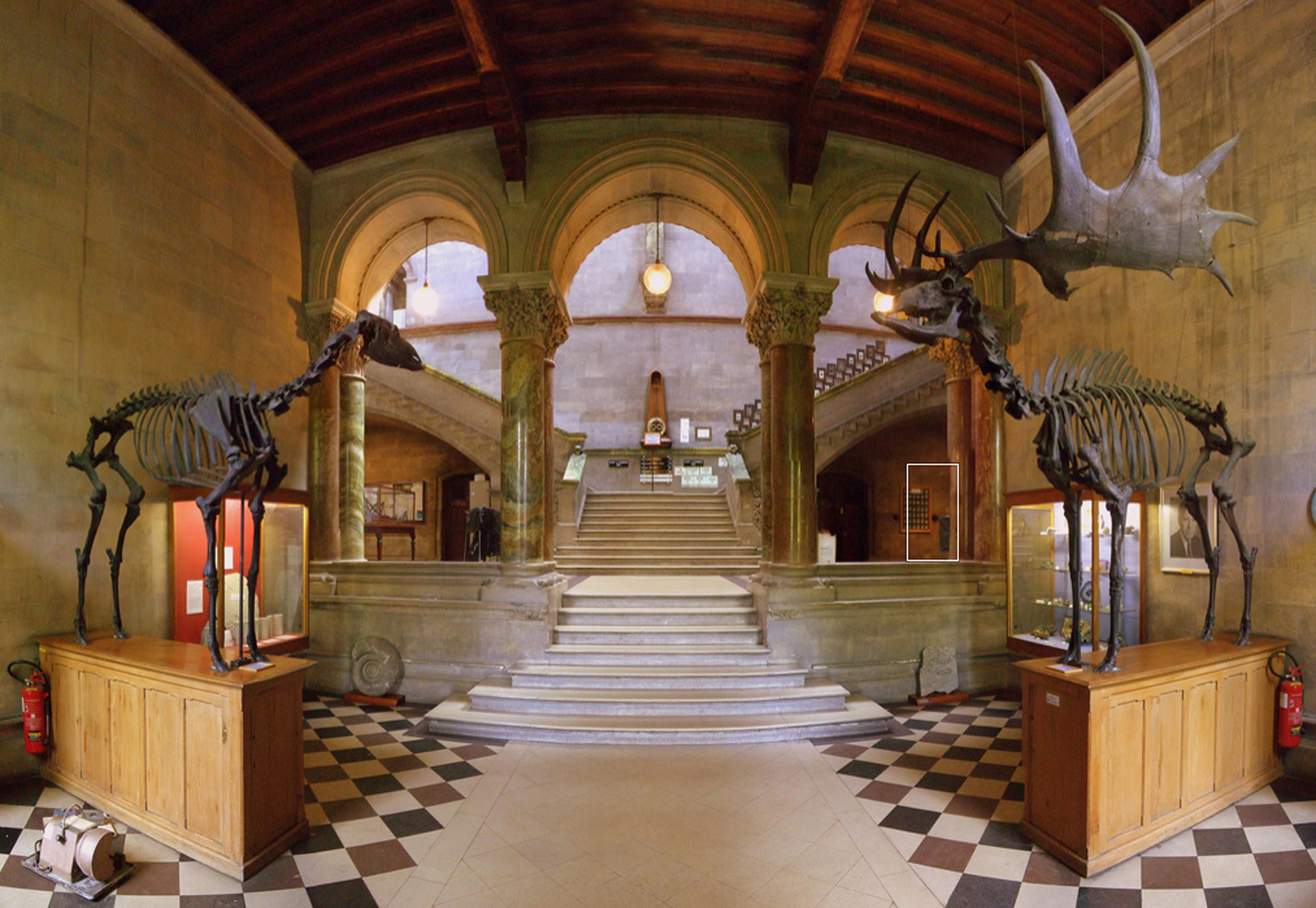
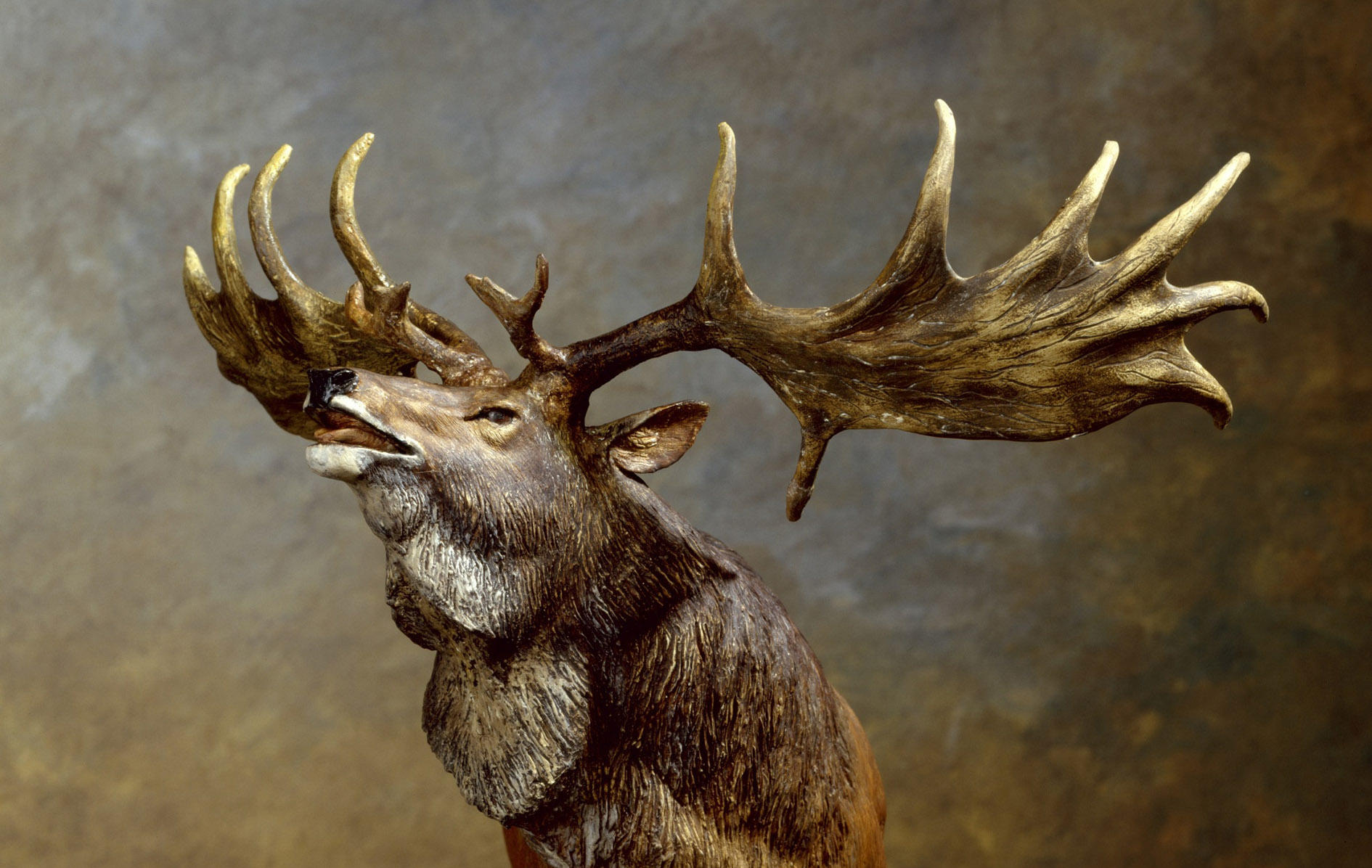
Megaloceros seen in Cahir Castle

Megaloceros seen in Cahir Castle

Have you seen an Irish Elk? It’s not something I’ve bumped into…

You’d know it if you had! Megaloceros Giganticus stood over two metres high at the shoulders and had antlers up to four metres wide. It was the largest Deer that ever roamed the Earth.

And it was Irish?

It actually lived all over Europe – and in Russia and China. But the best fossilised examples have been found in Ireland, preserved in the peat bogs.
Giant Elk

Have you seen an Irish Elk?

I certainly have: there are some whole skeletons in the wonderful Natural History Museum in Dublin, but their antlers hang in many a hall – by which I mean a ‘Baronial’ hall or castle. They seem to have been popular trophies to have mounted on the wall along with all the Foxes and Salmons that didn’t get away… And these ‘trophies’ became sought after in the boom years: Christie’s sold a pair of antlers for £52,850 in 2001, and another pair from Powerscourt, Co Wicklow, sold for £77,353 in 2005.

largeelk

Dublin’s Natural History Museum

Trinity's pair of irish Elks - female and male

Trinity’s pair of Irish Elks – female and male

But trophies means that someone would have hunted them. Surely they were never around at the same time as people?

It’s a good chance they were. The latest dating of Megaloceros is around 5,000 BC, although others assert that they died out several Millennia before that. The first humans are supposed to have settled in Ireland around 8,000 BC – the Mesolithic period.

Lascaux Cave Painting - estimated to be 17,300 years old

Lascaux Cave Painting – estimated to be 17,300 years old

And why did they die out?

There are a few theories: being hunted – not being able to adapt to changing climates and environments – or simply that their antlers were too big…

I like that theory…

Yes. We saw this one at Ballymaloe – but it wasn’t on the menu!

Ballymaloe Trophy

Ballymaloe Trophy

Such a shame that it doesn’t still exist.

True… although it might be a bit scary if you met it on the slopes of Mount Gabriel!

Along with Ireland’s last Wolf?

Exactly.

Closest relation: Canadian Bull Moose (Robert Bateman)

Closest relation alive today: Canadian Bull Moose (Robert Bateman)

But you know…

Yes?

I read that some scientists believe that if they found a good enough specimen – preserved in the permafrost perhaps – they could extract enough DNA to re-establish the species through cloning. And others, too: Mammoths maybe, and Sabre-Toothed Tigers.

So, one day, our view from Nead an Iolair could be enhanced by a herd of grazing Giant Elks.

Now, there’s a thought…

I’ll give the last word to Seamus Heaney – who found inspiration in Megaloceros:

We have no prairies

To slice a big sun at evening–

Everywhere the eye concedes to

Encrouching horizon,

Is wooed into the cyclops’ eye

Of a tarn. Our unfenced country

Is bog that keeps crusting

Between the sights of the sun.

They’ve taken the skeleton

Of the Great Irish Elk

Out of the peat, set it up

An astounding crate full of air.

Butter sunk under

More than a hundred years

Was recovered salty and white.

The ground itself is kind, black butter

Melting and opening underfoot,

Missing its last definition

By millions of years.

They’ll never dig coal here,

Only the waterlogged trunks

Of great firs, soft as pulp.

Our pioneers keep striking

Inwards and downwards,

Every layer they strip

Seems camped on before.

The bogholes might be Atlantic seepage.

The wet centre is bottomless.

(Bogland, Seamus Heaney 1969)
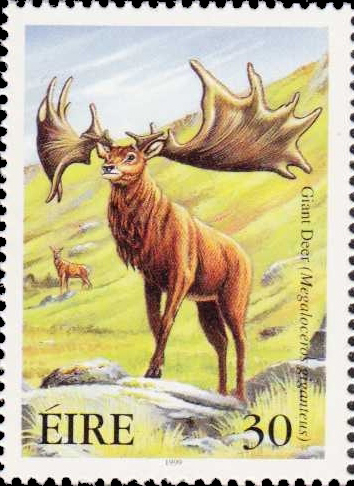
meg stamp

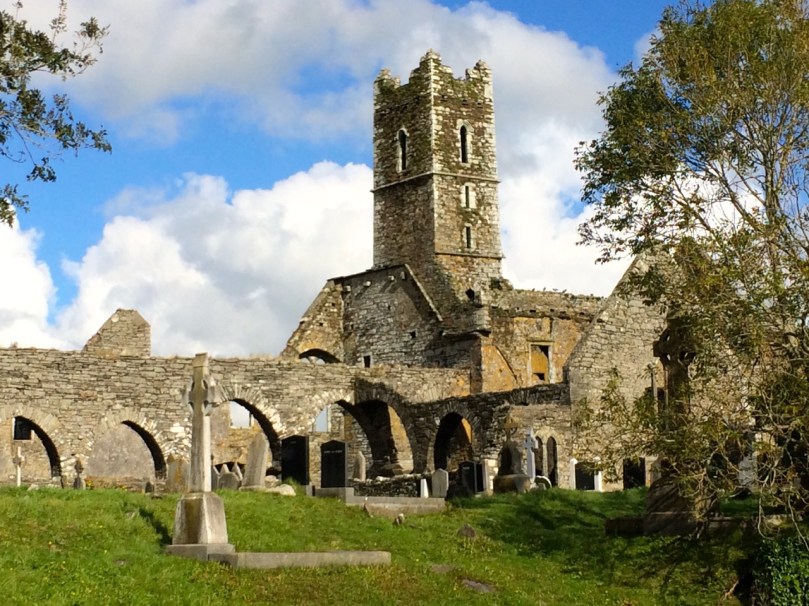
Timoleague Friary

Timoleague Friary

If you take the coast road from West Cork to Cork City, you go through Timoleague, a beautiful village at the top of Courtmacsherry Bay. This little town has a main street of colourful houses and shops, a large and imposing Catholic church with notable stained glass windows, a medieval bridge spanning the inlet, and lovely walkways by the Arigideen River.

Looking across the river to the Friary

Looking across the river to the Friary

What makes us stop, though, no matter how often we have visited it before, is the Friary. Perched on a knoll overlooking the river, this Franciscan establishment was built in the 13th or 14th Century, and subsequently enlarged and extended. It somehow managed to survive the reformation but was finally abandoned when it was burned in 1642.

The Franciscans first arrived in Ireland about 1230. The order spread quickly and in time there were many Franciscan houses in Ireland. Followers of the Rule of St. Francis, they lived in fellowship in the friary, but went out every day to work among the people. Unlike monks in abbeys or monasteries, they did not shut themselves away to follow a strict regimen of prayer and work. Instead, the friars depended upon their parishioners for sustenance, devoted themselves to their flock during the day and returned to the friary for their simple meals and prayers.

The Cloisters

The Cloisters

Despite this avowed simplicity, the friary is large and imposing. The remains of the cloisters give evidence of the daily meditation and recitation of the Divine Office. Their living quarters included a chapter room, refectory and infirmary.

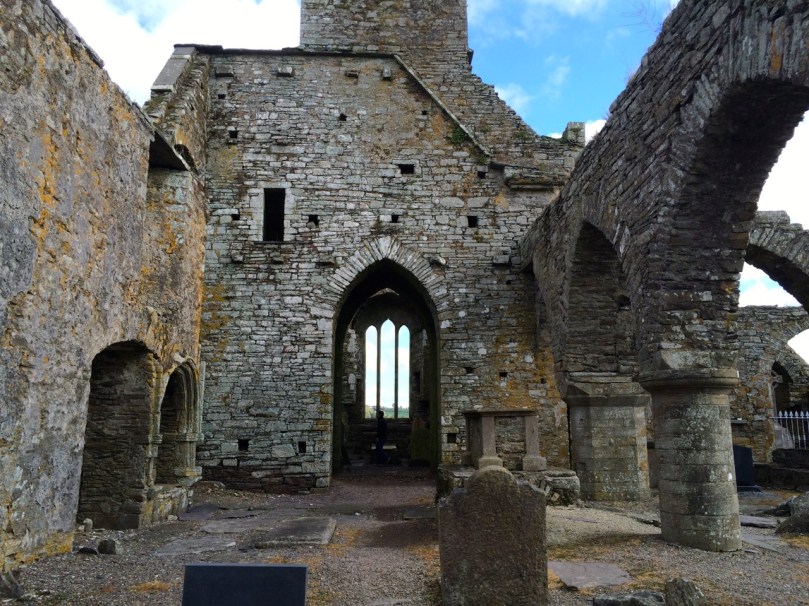
Nave and choir

Nave and choir

The church would have been impressive in its day, with large and elaborate windows, a long nave and a sizeable transept. The columns between the nave and the transept are massive: the cut stone demonstrates the high quality of masonry that went into the building of the Friary.

A wander through the ruins is a delight. There is a wart well, old gravestones (while away half an hour deciphering some inscriptions!) and niches that would have held the tombstones of dignitaries. Lichen of every colour clings to the stones while low archways appear around every corner, with inviting vistas of further corners to explore.

Timoleague is named for St Molaga, who is also associated with other locations in Ireland. Many stories are told of St Molaga. Here is one, recorded by Colonel James Grove White and provided online by Cork City Librarians.

Close to Temple Molaga is a copious spring well, which was always held sacred by the people and should be used only for drinking and curative purposes; but on one occasion, the lady of the manor, an unbeliever, would insist on cooking her husband’s dinner in the water of the sacred spring. When the water had time to boil, the cook remarked it was icy cold; more logs were placed on the fire, still to no effect. The logs were still being piled on, the fire blazed, but when the dinner hour arrived, the water was still as cold as ever. The lord waxed hungry, and, like other mortals, became angry; he rushed into the kitchen to ascertain for himself the cause of the delay, had the cover lifted off the huge pot, and, although the fire was crackling and blazing high about it, he felt the water was quite cold; but what astonished him more was to behold a beautiful trout swimming about in it, without apparently suffering the least inconvenience. He became wonder-stricken, and had his advisers called in. They told him to take the water back to the well without delay and pour it in. This being done, the trout again became invisible, and is since rarely seen, except by certain votaries.

In the district it is a common saying when water is slow to boil, “perhaps the Molaga trout is in it.”

Timoleague Friary, as the largest medieval religious ruin in West Cork, is a unique and special part of the West Cork landscape.

friary silhouette

Rock Art Ramblings… away from home!

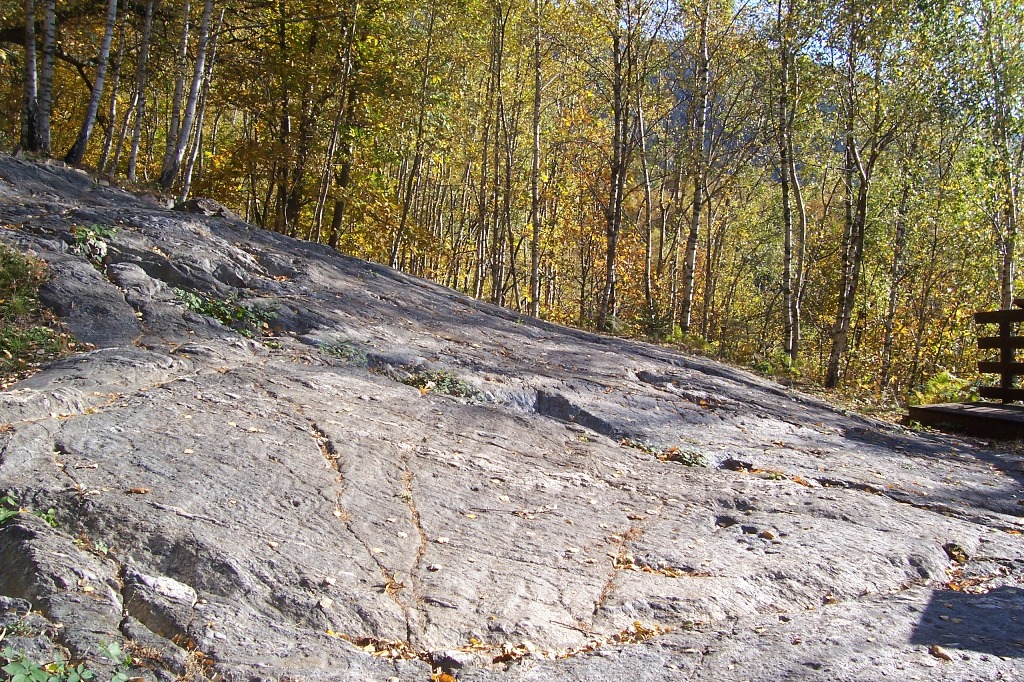
Ireland? No - it's Rock Art in Italy

Ireland? No – it’s Rock Art in Italy

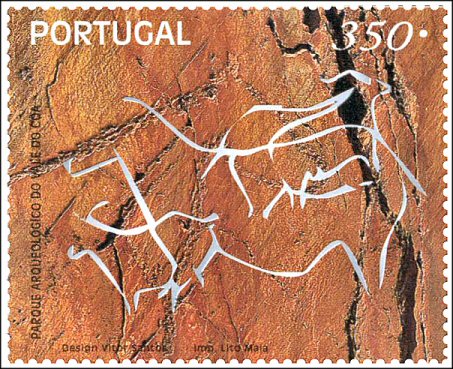
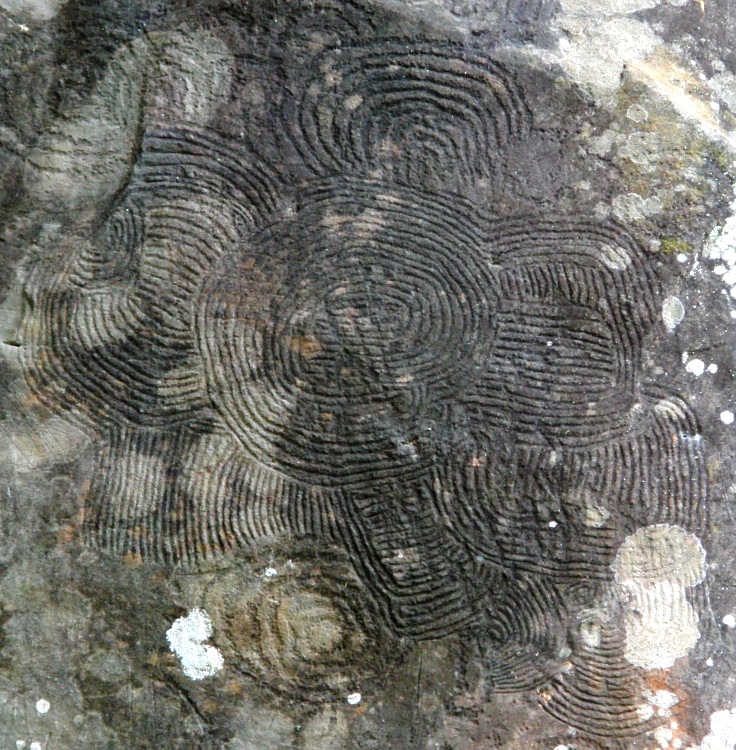
At our talk in Ballydehob yesterday I mentioned briefly the world-wide context of Rock Art: this generated a lot of interest during and after the event so I thought it worthwhile to write a post about non-Irish Rock Art. portugal stamp The carvings in Ireland appear to be part of a cultural phenomenon that runs down the Atlantic coast – from Scandinavia to Iberia – taking in Ireland and Britain on its way. However, Rock Art is widespread across the world, and over the whole time spectrum of human occupation of land. There is a UNESCO World Heritage site in Portugal – the Côa Valley Archaeological Park – which is based on finds of Rock Art. When the project was opened in 1996 its Director stated: “…The Upper Paleolithic art of the Côa Valley is an exceptional illustration of the sudden development of creative genius at the dawn of human cultural development…” That’s quite an announcement! The Park is home to some 25,000 carvings created at various periods over the last 10,000 years. Some of it is visually similar to our own Neolithic / Bronze Age examples (which were probably made within the last five Millennia) but other earlier examples seem – surprisingly – more sophisticated: mainly very beautiful representations of animals.

Canary Island example

Canary Island example

Where do we find the oldest Rock Art? Possibly in India: the Bhimbetka Caves show evidence of human habitation dating back more than half a million years, and in one particular site – known as the Auditorium Cave – carved cupmarks were found under human debris deposits that could be dated to at least 290,000 years ago. This means that the cupmarks must be as old as that date. Some scientists claim that they could be twice this age. Those cupmarks are exactly the same as the ones we have in Europe – and when found they contained traces of red pigments, suggesting that the carvings might have been painted.

India – Norway – Africa – Europe – the Americas – Australia… Ancient rock carving has been found in all continents of the world excluding Antarctica. It’s not all the same as Irish prehistoric Rock Art – where the simple motifs are familiar to regular readers of this blog – but cupmarks do seem to predominate as a common occurrence, and are usually apparently carved in the same way wherever you find them: shallow circular indentations are picked out using one hard stone tool striking another.

What does it all mean? Finola did a good job of sidelining that question during yesterday’s talk but came up with some plausible pointers: it is, of course, impossible to be certain when we are so out of touch with the peoples who produced the marks. We should also be careful of making any assumptions based on our own cultural ways of thinking. An archaeologist (Mountford) witnessed cupmarks being carved in central Australia in the 1940s: he reports that these were made as an increase ritual for the Pink Cockatoo (Kakatoe leadbeateri). The particular rock the cupmarks were hammered into was thought to contain the life essence of these birds, so the mineral dust rising from the activity was believed to fertilise the female cockatoos and thus increase their production of eggs, which the Aborigines valued as food.

I have mentioned before the cupmarks which are found carved into the lava stone in Hawaii’s Volcanoe National Park: it’s worth noting again that they are very similar to those we find in Ireland and Britain – even to the extent of having concentric rings around some of them. Hawaian families who go a long way back will tell you that they are made to receive the umbilical cords of newly born babies – to ensure health, long life and fertility. The carvings are known as ‘Puka’.

Rock Art is fascinating. I want everyone to be excited by it. It’s a ‘poor relation’ archaeologically speaking: it’s very easy to miss. It’s also an ‘endangered species’: in Ireland, some examples which have been recorded in the past can no longer be found. Perhaps our exhibition and talk will at least have raised awareness.

Our Rock Art Exhibition!

A joint post by Robert and Finola…

Derrynablaha A2.PC9

For all of you who are fortunate enough to live within reach of our beautiful part of West Cork we are pleased to invite you to our exhibition, which is being shown as part of the Ballydehob Art and Culture Weekend, running from 17th to 19th October. The exhibition is being held in the West Cork Gourmet Store (go left at the statue of Danno and it’s just up on the right, behind the Post Office), and it will continue to run there during opening hours for the two weeks after the Art and Culture event.

Finola studied for her Archaeology degree at the University of Cork, and her thesis was written on the Rock Art of Cork and Kerry. For her research – in the early 1970s – she travelled across the two counties on a borrowed Honda 50, visiting every piece of Rock Art known at the time, and recording each piece using a tracing technique which would not be allowed today. The thesis is a unique and valuable archive of the rock carvings, which date back anything from three to five thousand years. We believe that this is the first time a comprehensive exhibition of Irish Rock Art has been shown.

knockdrum detail.PC9

Regular readers of Roaringwater Journal know that we are still working on Rock Art: Robert has recorded some more recently found examples using a ‘non-invasive’ technique, and we are involved with CRAG – the Cork Rock Art Group – under the aegis of the University, where our aim is to produce a website which lists and illustrates all known examples of Rock Art in the west of Ireland. Eventually the work may extend further afield: there are Rock Art sites elsewhere in the Republic. Similar carvings are found on the Atlantic coast, from Scandinavia down to Iberia.

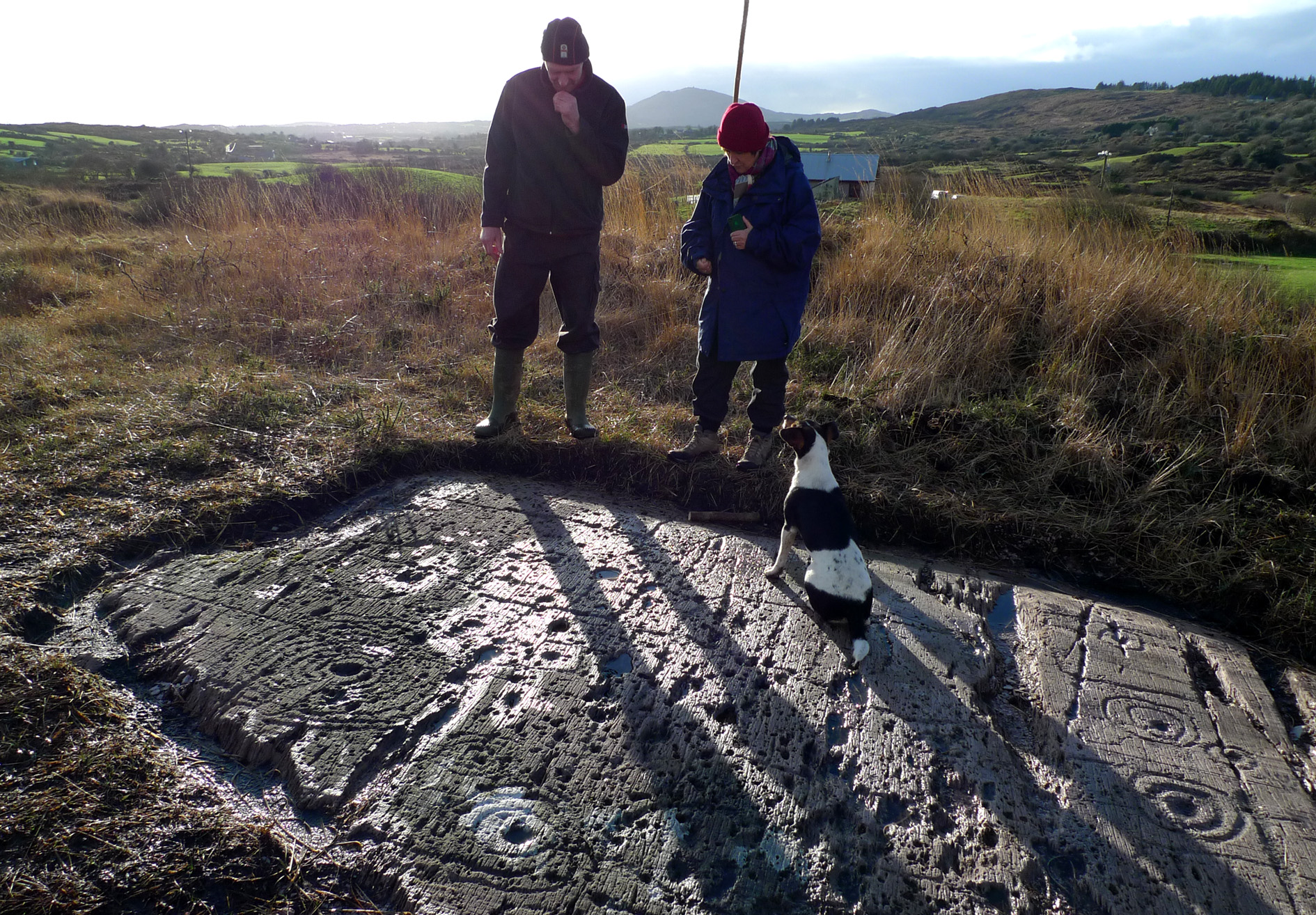
Finola, Gary and companion study the Art

Finola, Gary and companion study the Art

On Saturday 18th October the exhibition will be formally opened at 4pm, and we will be giving a talk on the subject and on our adventures studying it. Some refreshments will be on hand: please come if you can!

Title poster.PC9

Were You at the Rock?

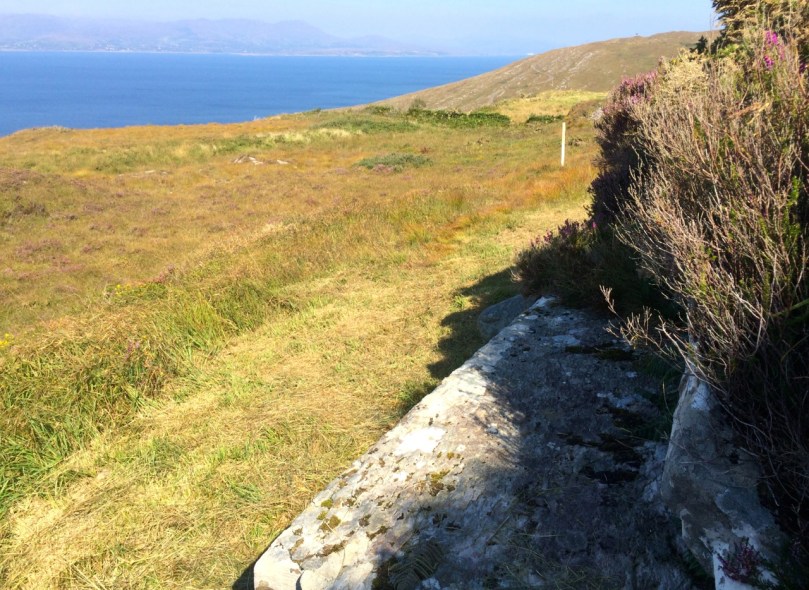
Mass rock along the Beara Way (see the look out above)

Mass rock along the Beara Way (see the lookout above)

An raibh tú ag an gCarraig? / Were You at the Rock?

nó a’ bhfaca tú féin mó grá / Or did you yourself see my love,

nó a’ bhfaca tú gile, / Or did you see a brightness,

finne agus scéimh na mná? / The fairness and the beauty of the woman?

This beautiful song speaks to a revered tradition in Irish history and folk custom – the mass rock. During the period of the Penal Laws (late 17th and first half of 18th Century) when the practice of Catholicism was outlawed, parishioners would gather at a secret location to attend mass. The priest travelled from community to community in disguise, a lookout was posted, and mass was celebrated on a lonely rock far from the reach of the law. The song encodes the message that the people still find ways to attend mass, despite the harsh prohibition against it.

Mass rocks are often in remote locations

Mass rocks are often in remote locations

Dr. Hilary Bishop, in her excellent website Find a Mass Rock says, “As locations of a distinctively Catholic faith, Mass Rocks are important religious and historical monuments that provide a tangible and experiential link to Irish heritage and tradition.” She also points out that, because of the imperative for secrecy, mass rocks are difficult to find. We certainly experienced this when we set out for a day of mass rock hunting recently. Working from a list generated from the National Monuments Service database we spent a day on the Sheep’s Head and the Mizen and had trouble finding all the rocks on the list. One, if it was still there, had disappeared under impenetrable layers of gorse. A second rock was last recorded in the 1980s: residents were no longer familiar with it.

Beach Holy Well and mass rock

Beach holy well and mass rock

Knowledge of mass rocks has passed down from generation to generation. In the deep countryside, the sites maintain a mystique and a sense of the sacred. Last year we wrote about the mass rock and holy well at Beach, where Mary conjured up a blanket of fog to confuse the English soldiers and allow the priest to escape. At Beach and at our first stop, the mass rock at Glanalin on the Sheep’s Head Way, mass is still celebrated occasionally.

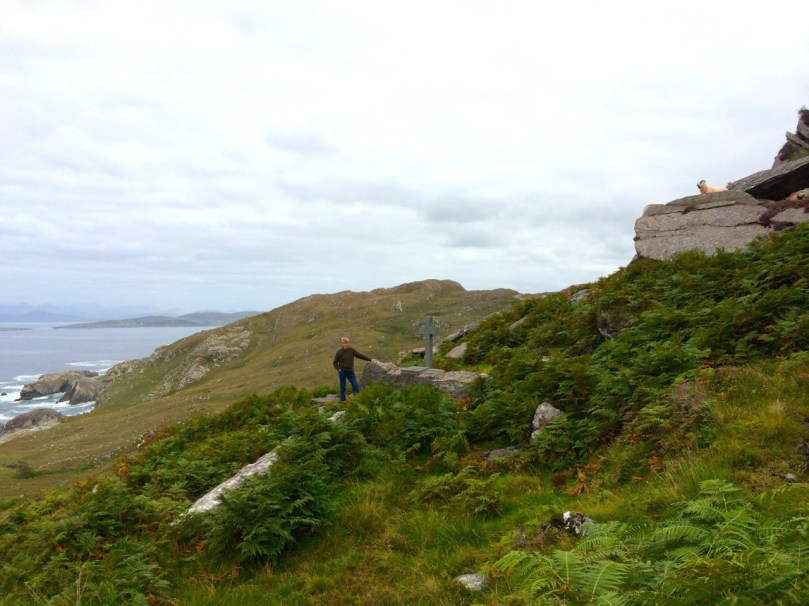
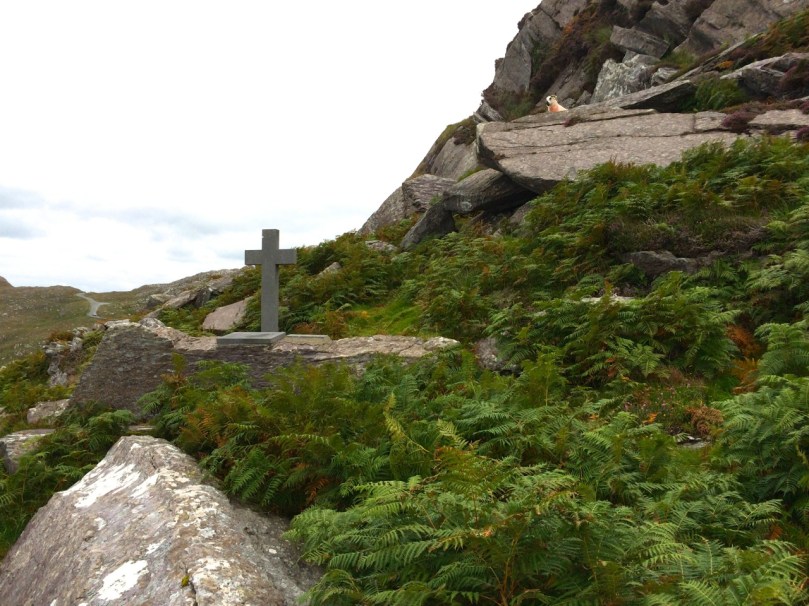
The Glanalin rock, and the one we visited on the Beara Peninsula, are good examples of the remote locations typical of many mass rocks, high on a hillside or hidden in an isolated valley. You can picture the procession of worshippers, in ones and twos, slipping silently through the bracken, pausing to make sure they are not being watched, climbing higher, following an overgrown trail, arriving at the meeting place where the hushed crowd awaits the arrival of the priest.

Beara mass rock

Beara mass rock

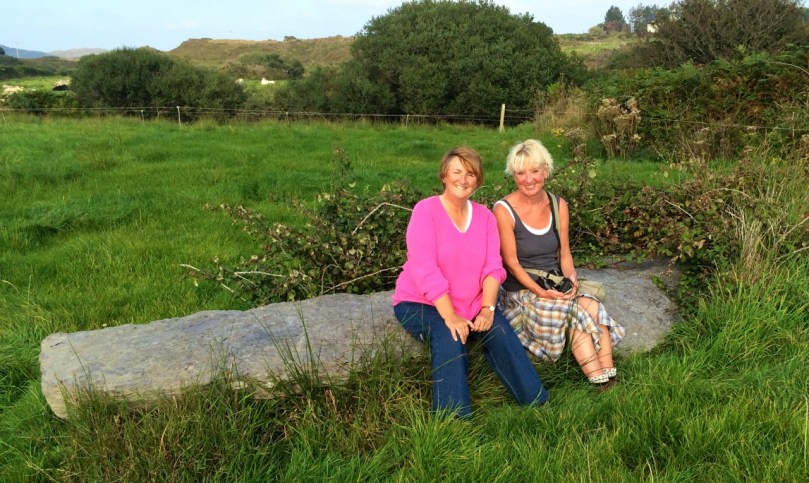
One of the rocks we found looked for all the world like a fallen standing stone – and that’s probably what it was. (I wonder if I should go to confession, though – I’m sure that sitting on a mass rock would qualify as at least a venial sin.)

Fallen standing stone?  Mass rock? Both?

Fallen standing stone? Mass rock? Both?

A mass rock that is easily visited is the one at Cononagh Village, right at the side of the main road into West Cork, the N71. This site is beautifully maintained – Cononagh is obviously proud of its heritage: signage and flowers invite the passerby to take a closer look.

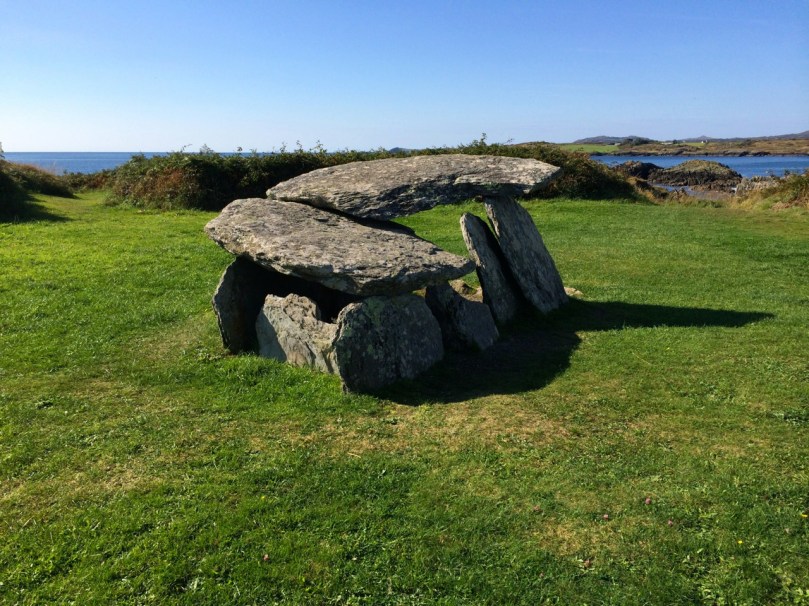
Another easily accessible site is Altar, at Toormore. This is a wedge tomb, probably over 4,000 years old and excavated in 1989. It remained in use through the Bronze Age and into the Iron Age. Dr. William O’Brien, in his book on the archaeology of County Cork, Iverni, says of this site: “…over time this tomb came to be regarded as a sacred place, housing important ancestral remains in what was a type of community shrine.” How fitting, then, that the flat capstone of the Altar wedge tomb became, in the Penal Days, a mass rock. And how intriguing to think of the continuation of this sacred space over the course of thousands of years.

Altar Wedge Tomb, later used as a mass rock

Altar Wedge Tomb, later used as a mass rock

Holy Relics + Masons’ Marks

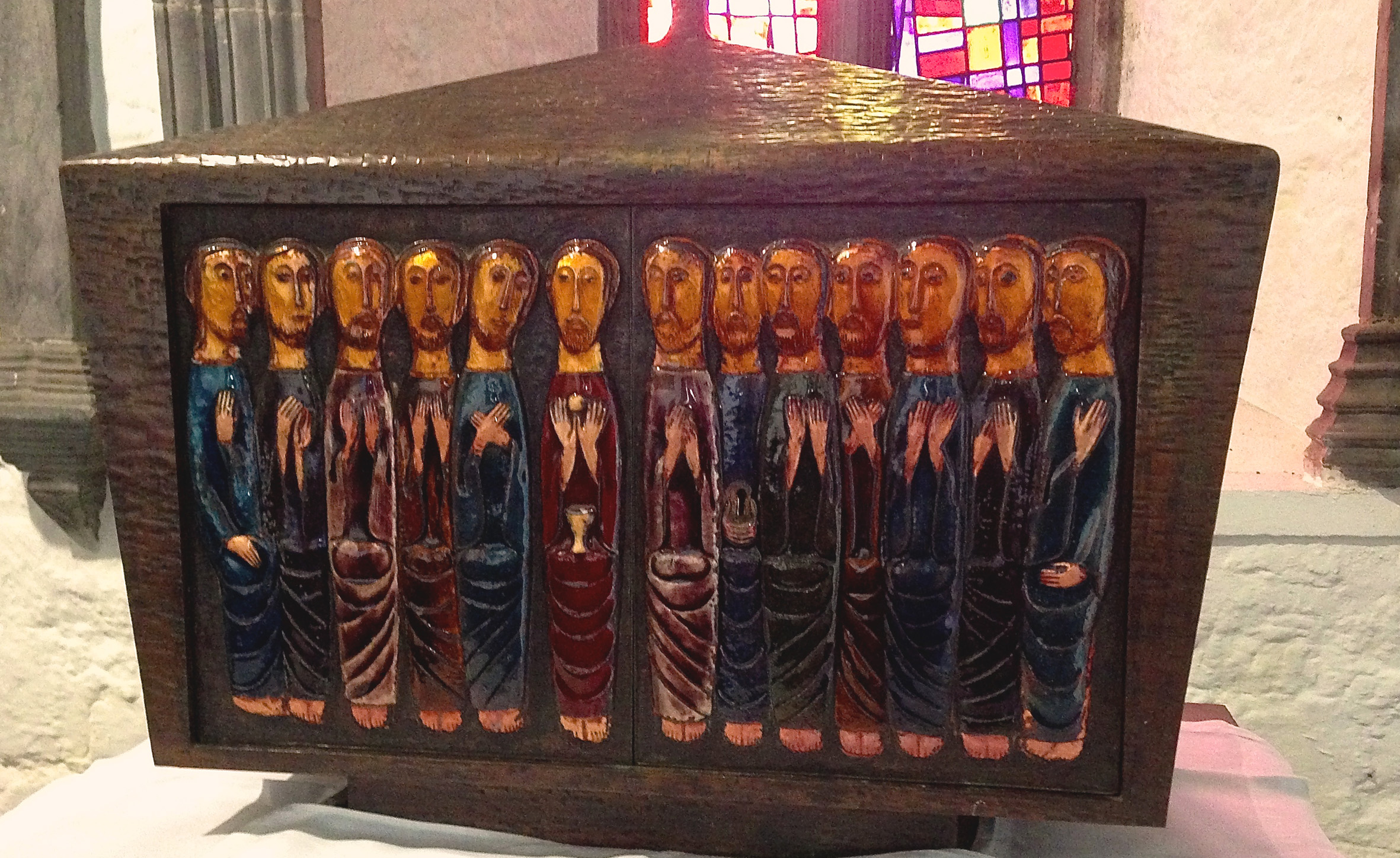
tabern

Modern Tabernacle at Holy Cross

Ireland is full of surprises. We are always coming across unexpected feasts for the eyes and the senses: often this arises from simply looking at the map for names that might hold a promise of history – or just ‘story’ – and head that way. Returning home from Dublin recently we diverted into Tipperary, for an investigation of the name Holy Cross.

the Abbey 2

The medieval abbey occupied an extensive site beside the River Suir

What we found was a thousand years of turbulent Irish history: a ‘Celtic’ hermitage dating from the first millennium became a Benedictine Abbey in the second, was refounded as a Cistercian Monastery in the twelfth century by a King of Limerick, Domhnall Ó’Briain, went through Henry VIII’s decimation of the Irish religious houses in the 1530s but survived as a pilgrimage centre until the Williamite wars of 1690. (Incidentally, in my anxiety to try to understand the fine detail of Irish history around this time, I discovered that the Protestant King William’s campaigns in Ireland were funded by Pope Innocent XI to the tune of 150,000 Scudi, which in today’s money is around four and a half million Euros! Can someone explain, please?) By the beginning of the 18th century Holy Cross was in ruins and, like so many other destroyed sites, the remains of the Abbey became a local burial ground.

Following the Reformation the Anglican Church of Ireland became the established church and the entire population – overwhelmingly Catholic – had to pay tithes to the Church of the Ascendancy. English Prime Minister William Gladstone declared “My mission is to pacify Ireland” on being elected in 1868, and his Irish Church Act became law in 1871. This disestablished the Church of Ireland: no-one paid tithes thereafter, and Catholics were free to worship wherever they wanted. At the same time ruins such as Holy Cross became scheduled National Monuments ‘…to be preserved and not used as a place of worship…’

The ruins of the abbey became a burial ground

The ruins of the abbey became a burial ground (Bartlett)

http---www.tara.tcd.ie-jspui-bitstream-2262-40632-1-ertk2528

A rare fresco - depicting a hunting scene - was found in the church

A rare fresco – depicting a hunting scene – was found in the church

On the 50th anniversary of the Dáil, on 21 January 1969, special legislation was enacted to enable Holy Cross Abbey to be restored as a place of Catholic worship: the only exception to the 1871 Act ever granted.

Now, in the third Millennium, Holy Cross is fully restored as a functioning Catholic Church and a pilgrimage centre which, every September, hosts around 65,000 pilgrims.

Why do so many people come to Holy Cross? Possibly because it was important enough, originally, to house a relic of the True Cross. In 1586 the English antiquarian William Camden wrote of the ‘…famous abbey to which the people still come to do reverence to the relic of the Holy Cross…’ He went on to say ‘…It is incredible what a concourse of  people still throng hither out of devotion. For this nation obstinately adheres to the religion of superstition of their forefathers…’  This relic disappeared in the 1630s.

After the restoration of the church in the twentieth century an authenticated relic of the True Cross was provided by the Vatican, and placed on display there. Unhappily, in 2011 masked raiders descended on Holy Cross and, using angle grinders, hammers and screwdrivers, stole the relic. The story has a happy ending however, as it was duly recovered the following year and was safely back in place when we visited.

Reliquary containing a fragment of the True Cross displayed in the North transept

Reliquary containing a fragment of the True Cross displayed in the North transept

There is an intriguing piece of folklore surrounding this building. An English prince of royal blood – the Good Woman’s Son – came to Ireland to collect Peter’s Pence (a tithe) but was murdered and buried in a wood near the Abbey. Following a vision, a blind monk discovered the boy’s body and carried his ring to his mother, the Queen. In gratitude she presented to the Abbey a large piece of the True Cross which had recently come to England.

pictures

The Abbey Shop