Off the M8: Fethard Walled Town

Fethard is nestled snugly in Tipperary’s Golden Vale, famously rich agricultural land, and is nowadays well-known for raising legendary race horses. But it also happens to be the town in Ireland with the most intact set of medieval walls. The map above (taken from Fethard’s Conservation and Management Plan) shows how the town would have looked in the 1850s when George Victor du Noyer came through.

We drive the M8 often and we’re always looking for ways to vary the journey, so this post is part of our ‘Off the M8’ series. Fethard is an easy detour: if you’re heading north, leave the M8 at Exit 10 just after Cahir and re-join it at Horse and Jockey or at Urlingford. You’ll be travelling along lovely quiet roads parallel to the motorway and depending on how much time you spend in Fethard, the whole detour should add a couple of hours (or maybe three) to your journey.

Fethard also happens to have some lovely old shop fronts. This one dates to 1770

We started off at the visitor centre in the old Tholsel, or Town Hall. It’s been nicely restored and features an excellent audio-visual presentation, and upstairs many colourful explanatory panels. The staff was friendly and very informative, with an obvious passion for their town and its history.
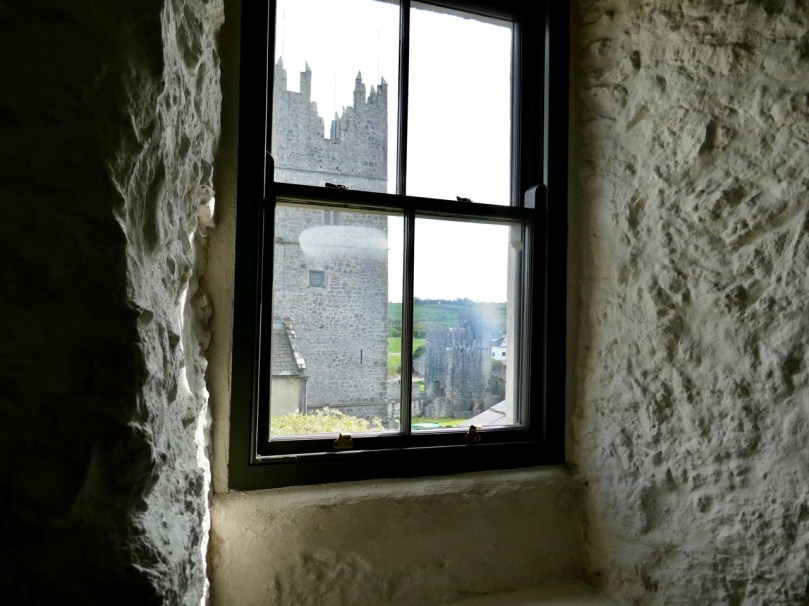
From the Tholsel Visitor Centre, you look down over Trinity Church and the walls

The town was founded around 1200, and walled soon after, when Edward I granted the right to raise money through what was known as ‘murage grants’. This continued over the next couple of centuries, in fact most of the walls were built (or rebuilt) in the 15th century. We tend to think of town walls as primarily for defensive purposes, and indeed the town was attacked on more than one occasions. But walls were also important demarcations of commerce. The market was held within the walls and according to Tadhg O’Keefe (in the Irish Historic Towns Atlas):

The walls were a barrier through which those wishing to trade in Fethard had to enter, so they articulated, especially with guarded gateways, the differences of privilege and opportunity between those who lived within and those who entered from without.

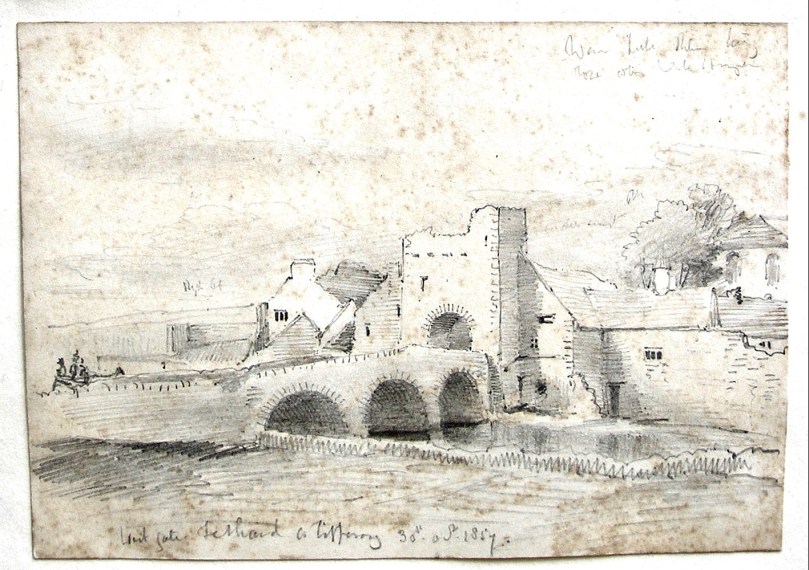
There is only one gate left, the North Gate, which we actually didn’t see. But when our old friend Du Noyer came through in the 1850s there was still a gate at the west end of the town (below). It guarded the entrance at the bridge known as Madam’s Bridge and had what O’Keefe describes as a rare type of Gate incorporating a three story fifteenth century tower house.
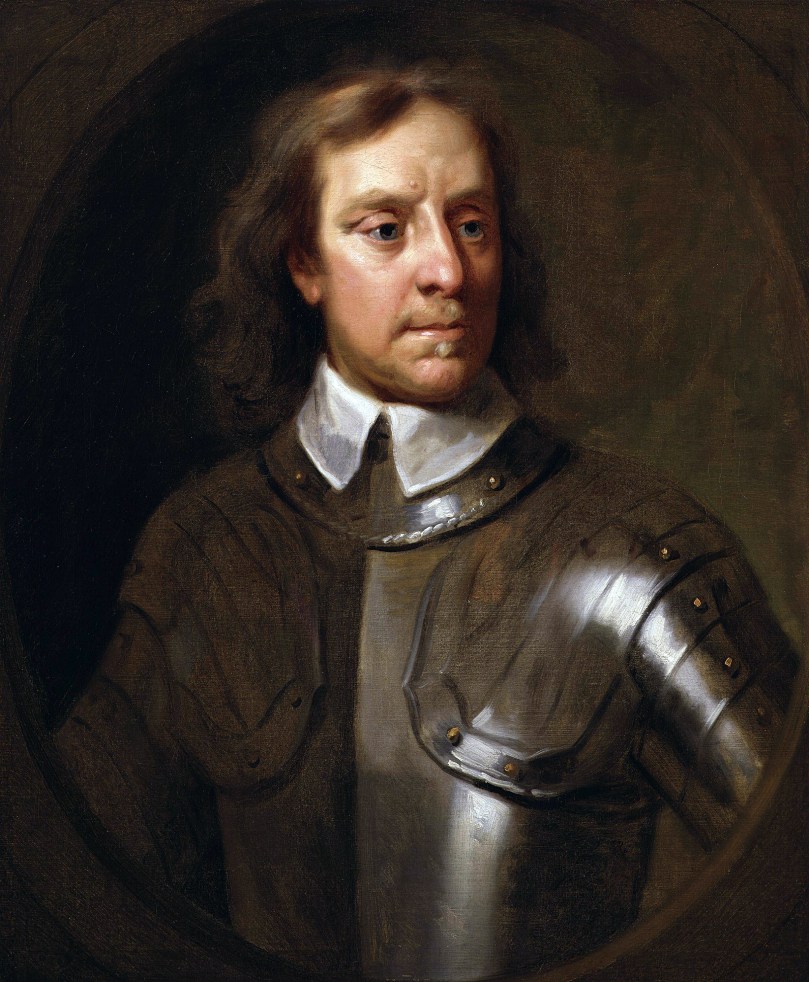
Despite the walls, the town was attacked and burned on several occasion – but not (unlike so many Irish towns) by Cromwell! In fact, the town surrendered, under terms, and was spared the violent destruction that the Parliamentary army visited on so many other Irish towns. This doesn’t exactly make Cromwell popular in Fethard, in fact there is still a tradition in the town that ‘people will not go out the way that Cromwell came in’ so that funerals, for example, take a circuitous route to the cemetery to avoid retracing his tracks.
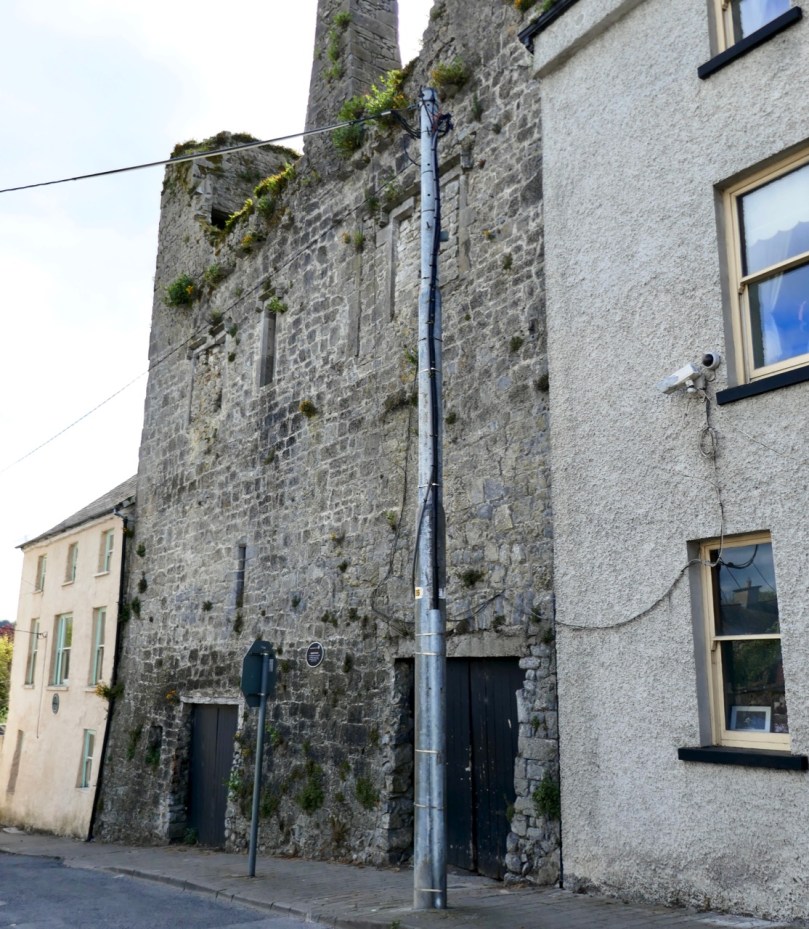
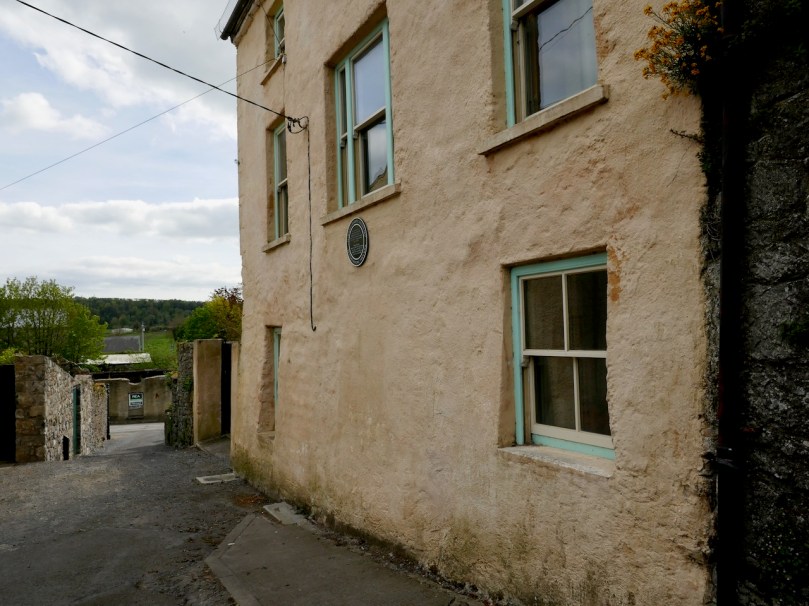
Like Youghal, the other Irish town with a significant extent of wall, there were tower houses along the wall, and within the town there were fortified town houses. Some are obvious and some are hidden behind more modern facades. Court Castle is one of the obvious ones, but the house next to it, known as the Watergate House, has a base batter that marks it out as fifteenth century (both images, below).
Within the walls and behind the Tholsel is Trinity Church. Because there is so much going on in and around it, I will quote the Buildings of Ireland summary in full:

Like the Town Hall and the Augustinian Abbey, the medieval parish church is a multi-period building of outstanding architectural, archaeological and historical importance. The church stands at the heart of the medieval walled town and the focus for the extraordinary number of late medieval structures arranged around the sides of the graveyard with rear entrances allowing direct access to the graveyard. The size and design of the church reflect Fethard’s prosperity in the medieval and early modern periods, the different types of windows, from different eras, emphasise the continuity of use. The impressive tower, that is highly visible for a considerable distance, is a particularly important and dramatic example of fifteenth-century craftsmanship, and is especially evocative of the medieval era as it stands picturesquely and appropriately inside the almost entirely intact medieval town wall and close to a impressively rare grouping of late medieval houses and almshouses. The interior has a finely crafted timber screen to the vestibule, and at the east end a stained-glass window with Eucharistic motifs, both highly decorative, and showing care and attention in the design as well as the execution. The recently timber roof to the nave, recently dated to of c.1489, is of exceptional importance as it is one of a small number of medieval roofs surviving in Ireland and is almost entirely intact.
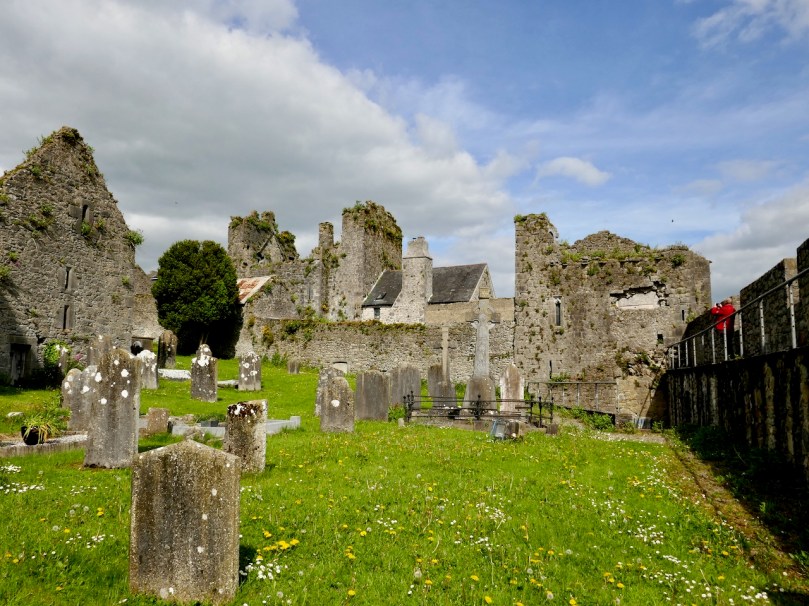
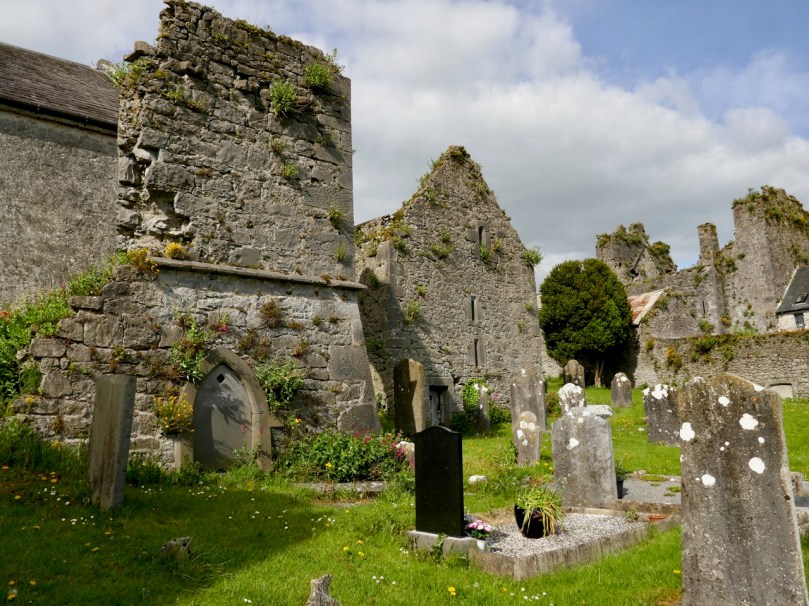
Trinity, the graveyard and medieval church remains on the left and the town walls on the right

Unfortunately, the church itself was closed when we were there. It’s still very much in use, though, and there was some tidying up taking place in the graveyard. I’d like to go back for another poke around sometime.
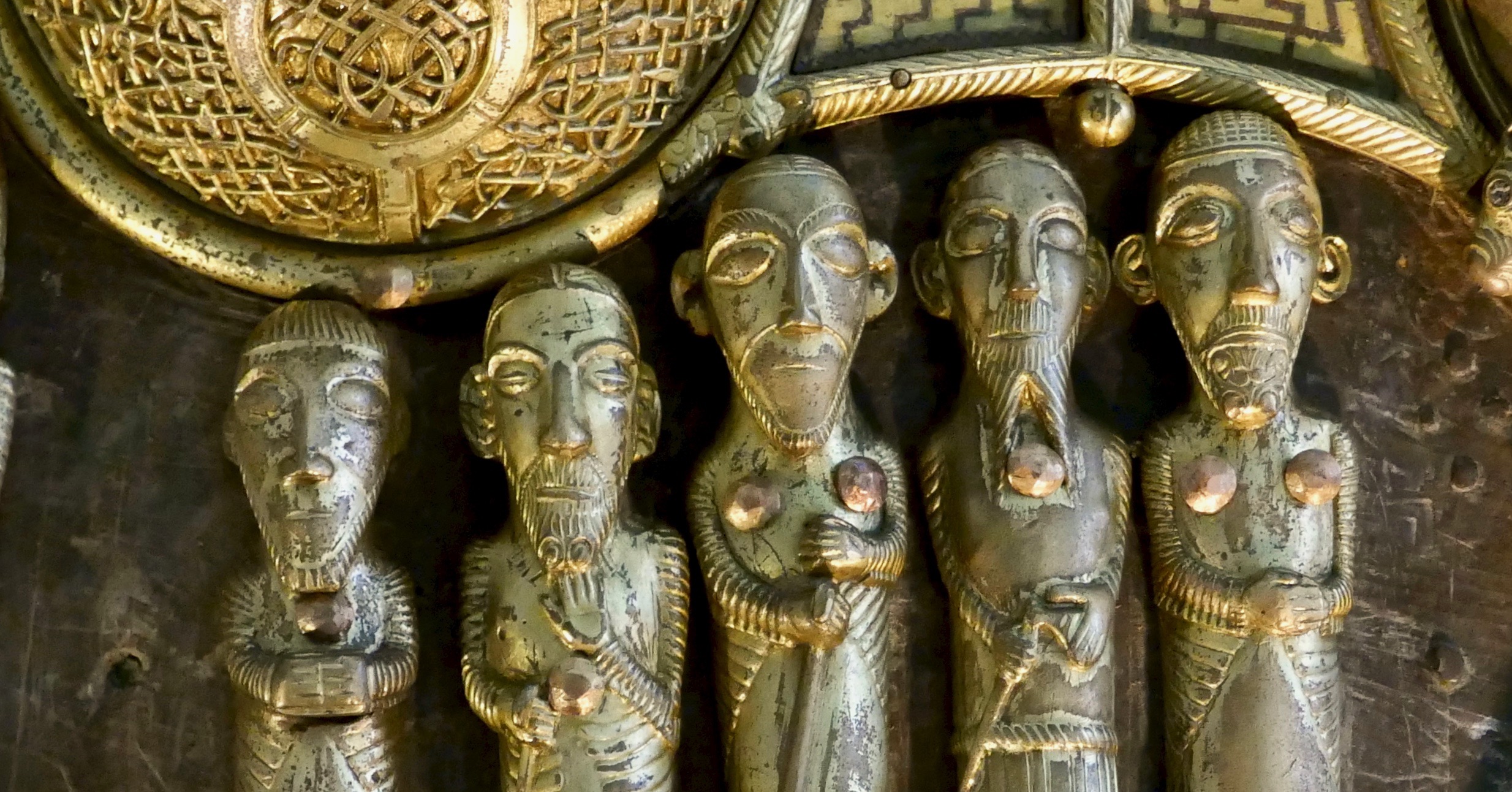
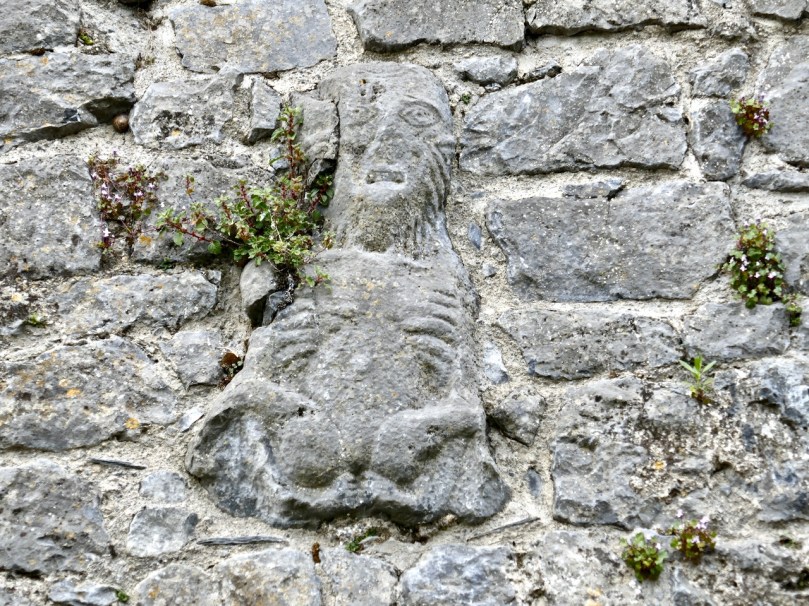
Down by the Watergate we came across one of Fethard’s two Sheela-na-gigs. (See this post for more about the Sheelas). This one is typical – a female figure displaying her genitalia, but unusual in her emaciated form with ribs clearly shown, staring eyes and a grimace. We didn’t have time to see the other one, which means a) you (yes, you, Dear Reader) have to, and let us know and b) we have to go back.
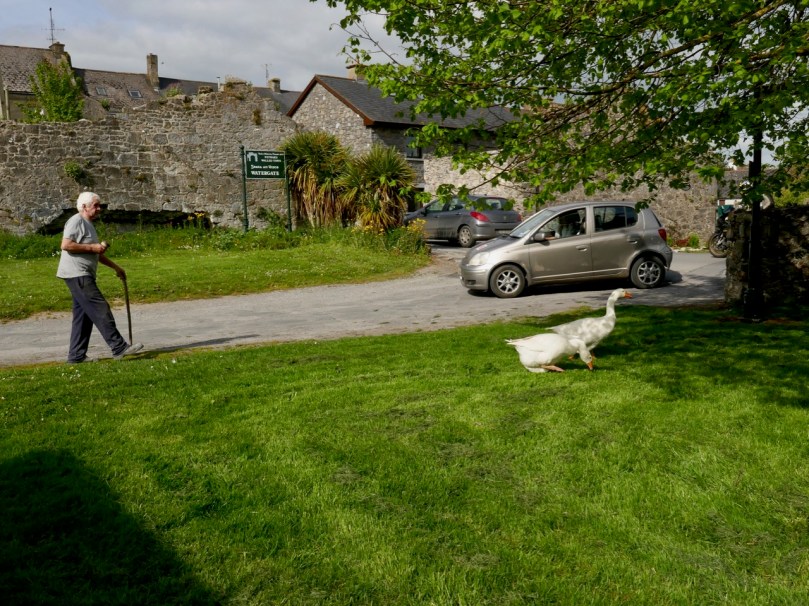
We also met Fethard’s famous geese down here too, along with their owner. They are pets, he told us, but don’t go too near the male as he is guarding the female carefully at the moment as she is just taking a little break from sitting on eggs.
The walls are extensive, with long stretches very much intact. Edmund’s Castle and a mural tower known as Fethard Castle punctuate the wall on the river side.

I was fascinated by the flowers growing all over the walls. I expected Ivy-leaved Toadflax and Wallflowers, but it was fun to see Fairy Foxglove also: it’s an alpine plant and so it likes high rocky places. The only other place I have seen it here is on the Martello Tower at Illnacullen/Garnish Island, off Glengarriff.
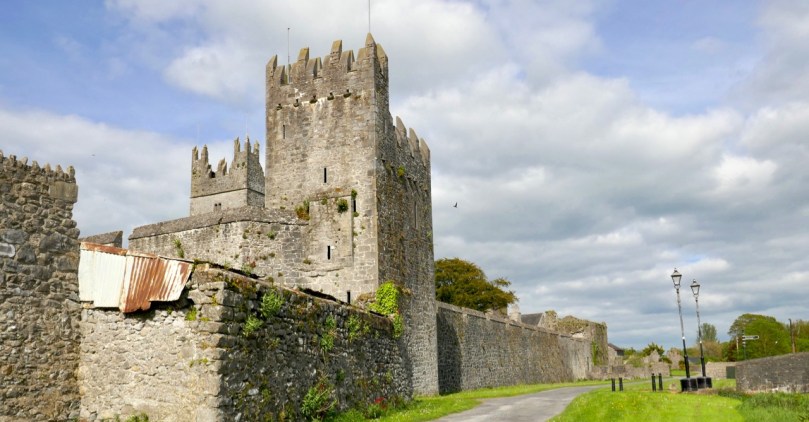
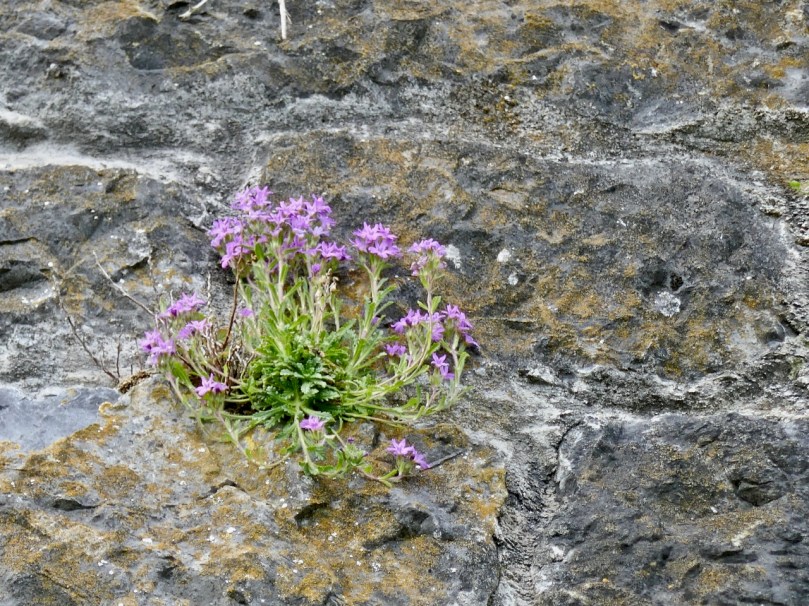
Upper: Fethard Tower, with Trinity Church bell tower behind the wall. Lower: Fairy Foxglove growing high on the wall

Because it also happens to be the end wall of people’s gardens, the wall is breached here and there by entries to residences – not something I was expecting to see, and probably not something that would be allowed nowadays.
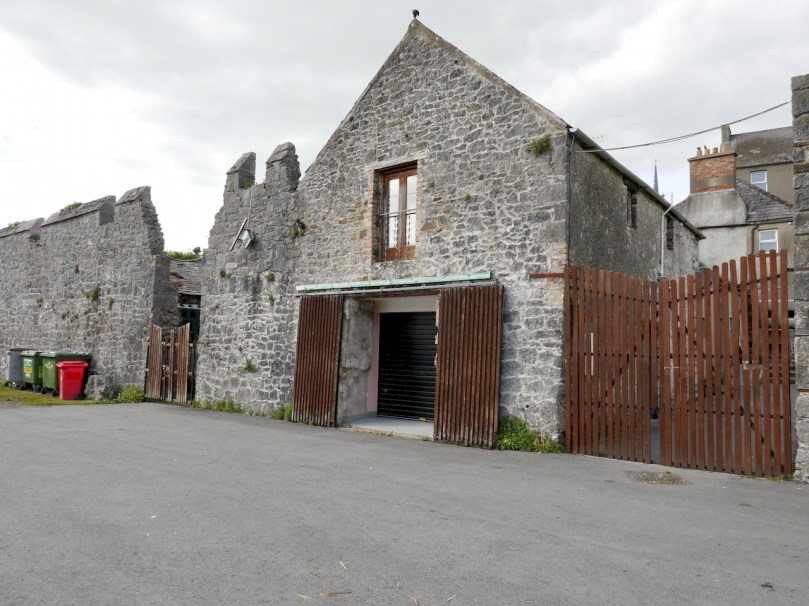
The wall is part of a living town, so it has not always been considered untouchable

We rounded out our visit with an excellent lunch at Emily’s Tea Room before resuming our journey. Fethard was a surprise – an amazingly intact slice of medieval history!

nnnn

Mizen Magic 13: Dunmanus Promontory

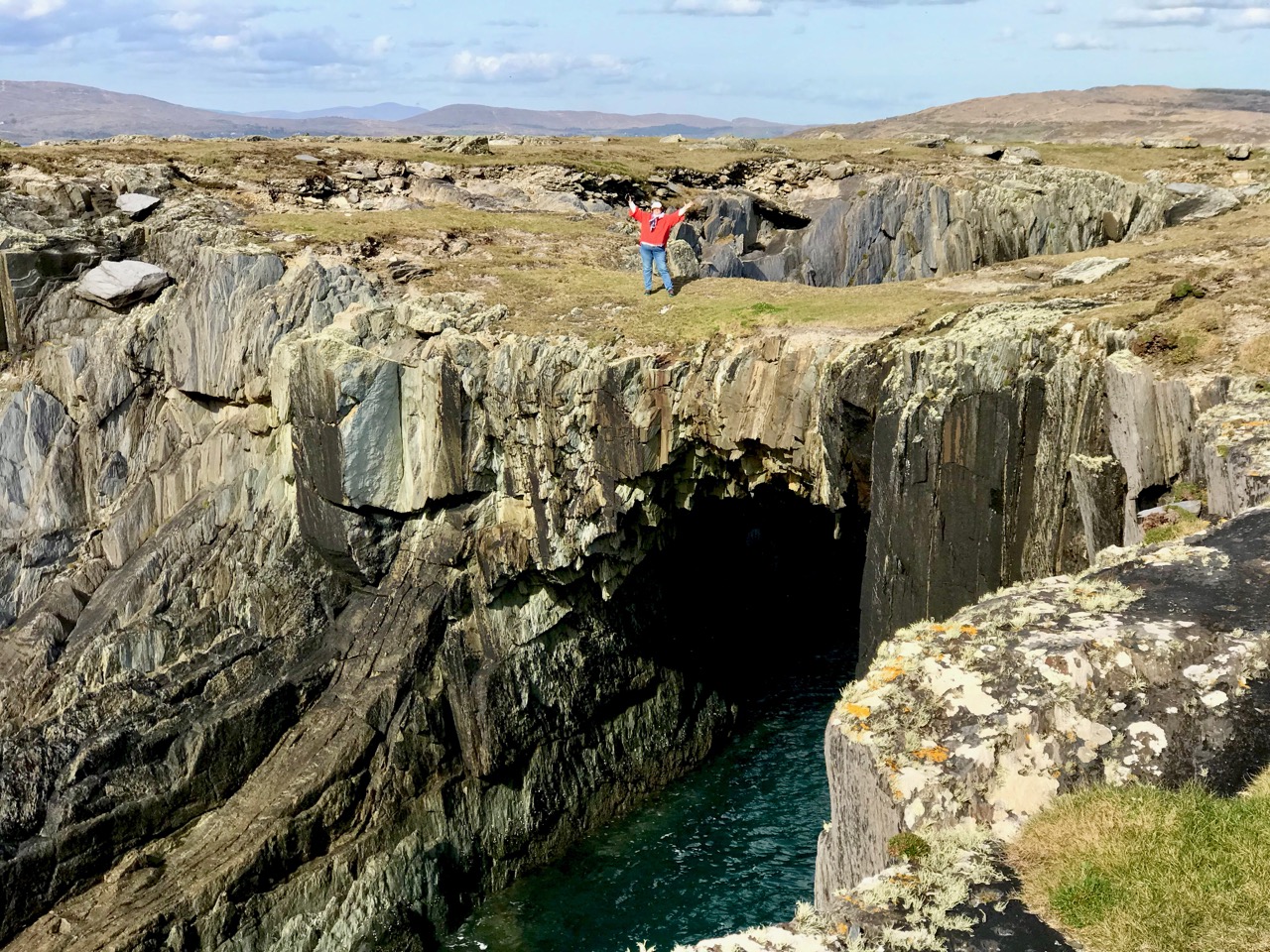
It’s geologically and archaeologically fascinating – a substantial natural promontory just to the north of Dunmanus Castle: well worth an exploration. But, do be warned – there are cliff edges, exposed fissures, ankle-wrenching undulations and bogs to overcome. Also – it’s private, so please seek permission before crossing the land.

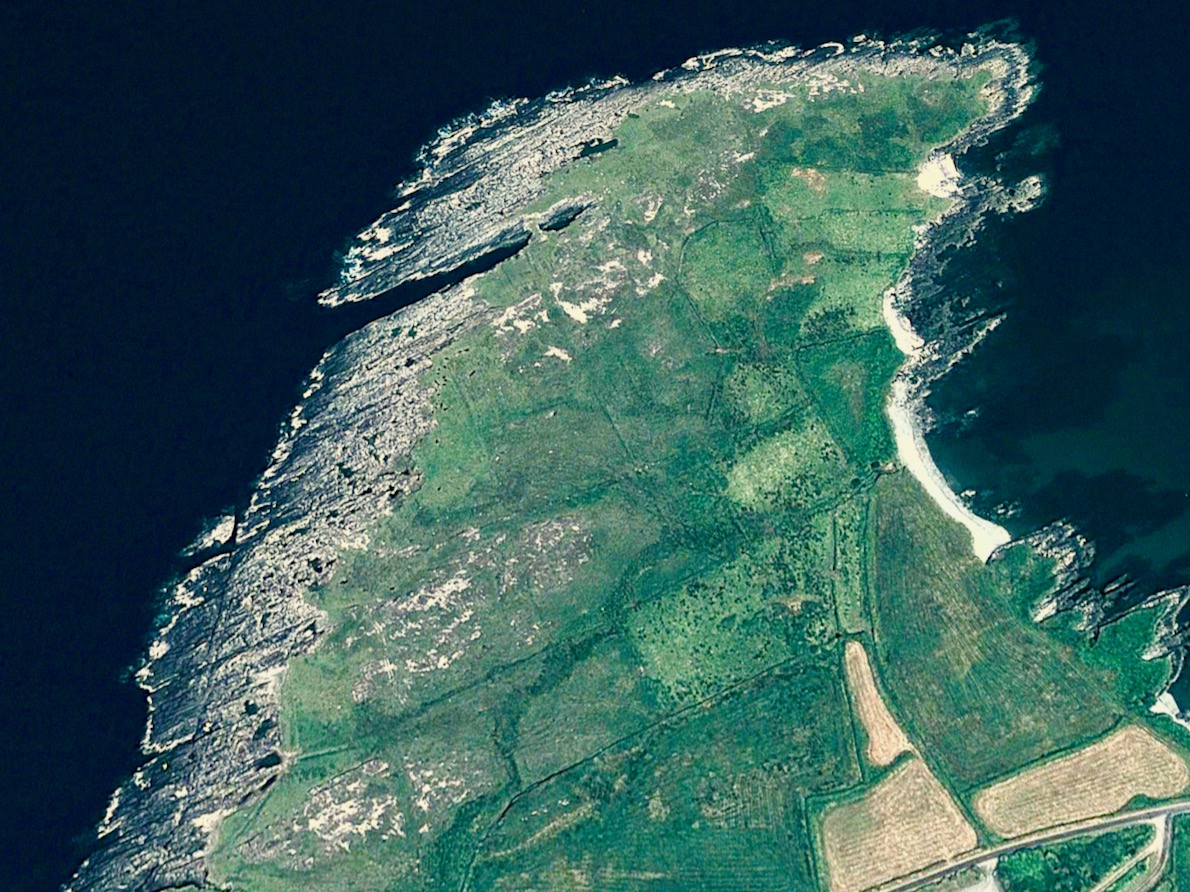
The west side of this shark’s fin-shaped promontory is wildly exposed to the ocean and its gales. You can see from the aerial views, above, how the rock bed is bare and visible, and the vestigial fields which occupy – or once occupied – the east side peter out, and the walls and banks which once formed them fade away altogether over on the left. In fact, these Google Earth images give a better impression of the oddly shaped enclosures than can be seen on the ground.

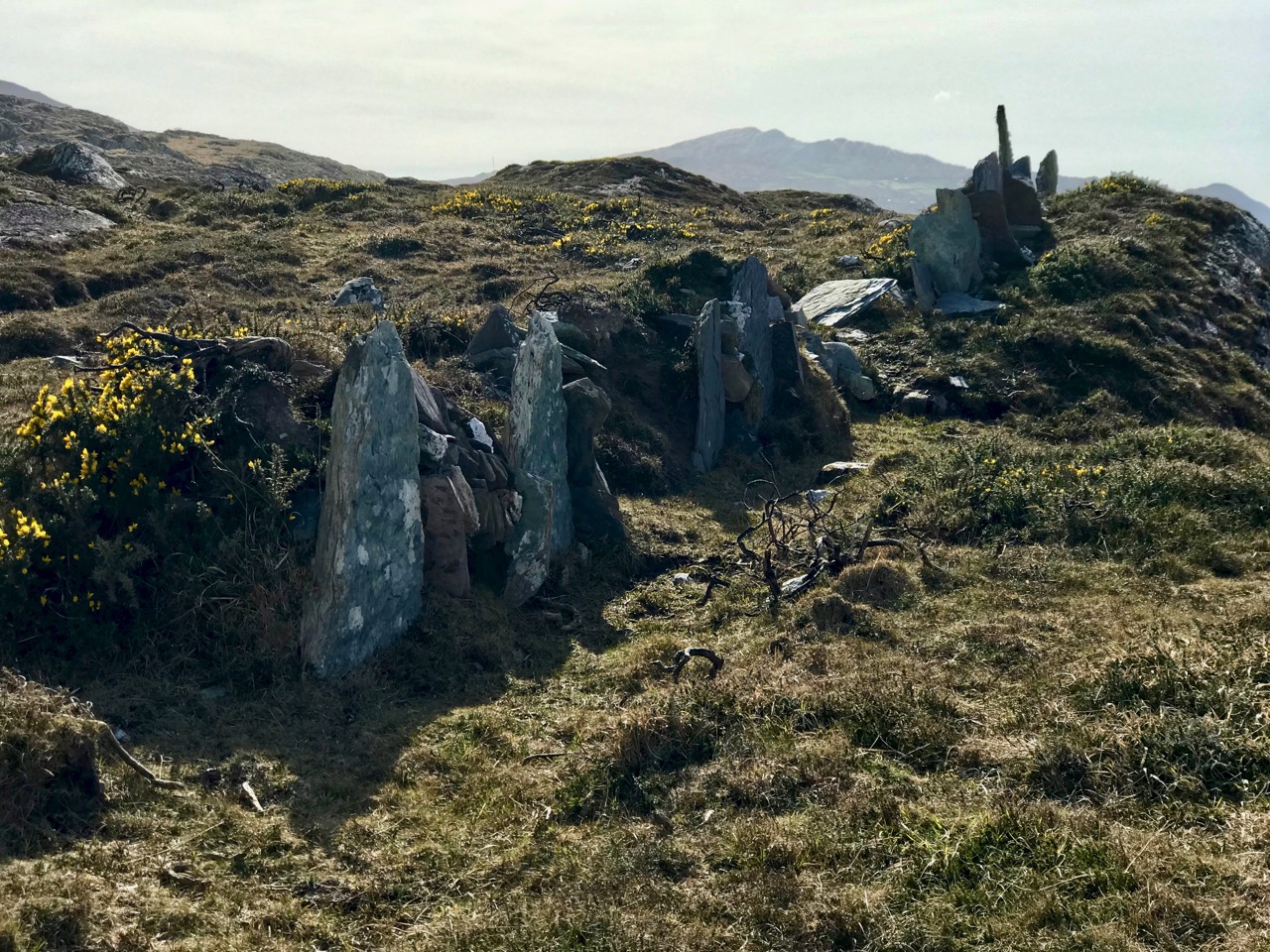
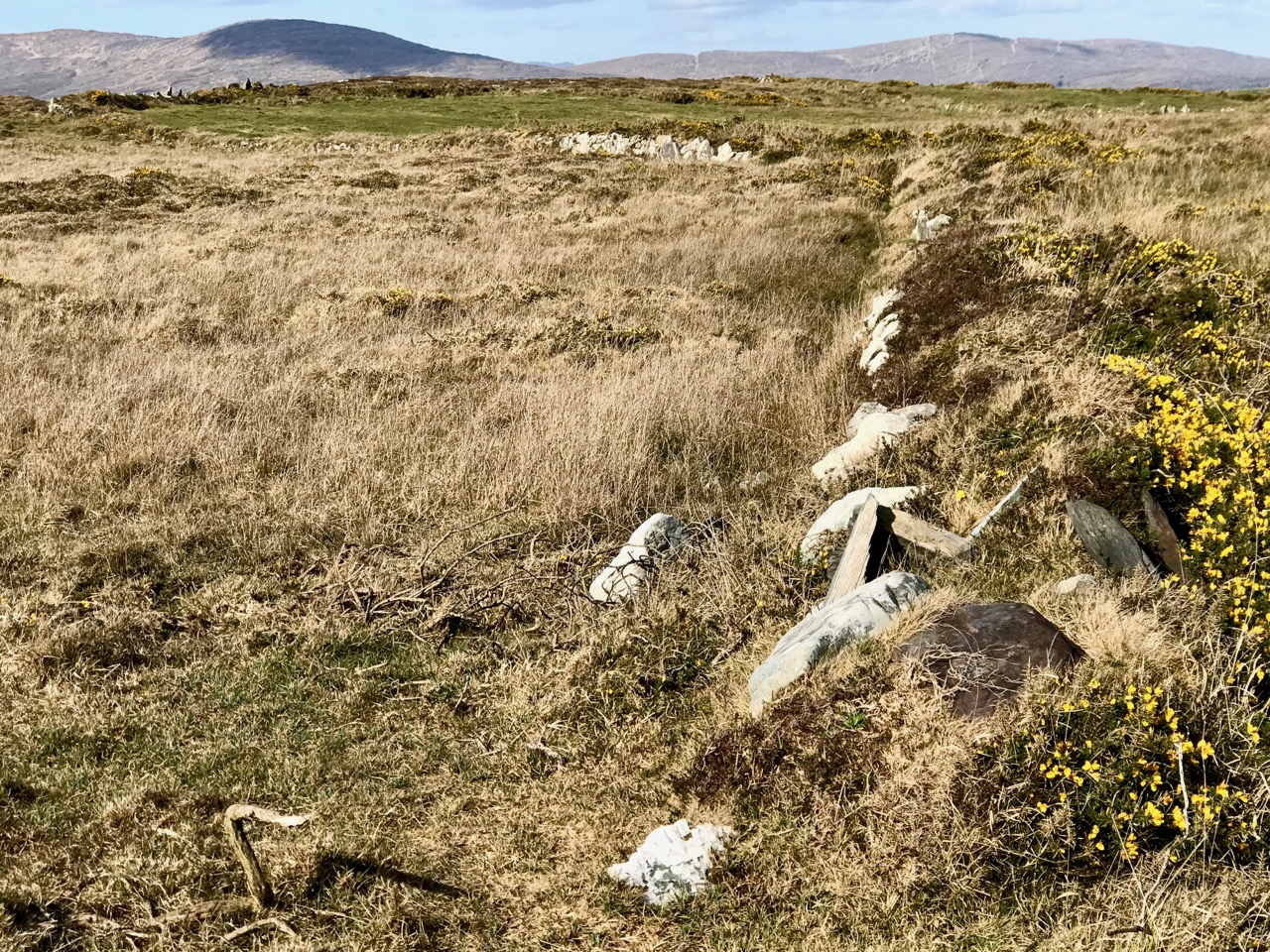
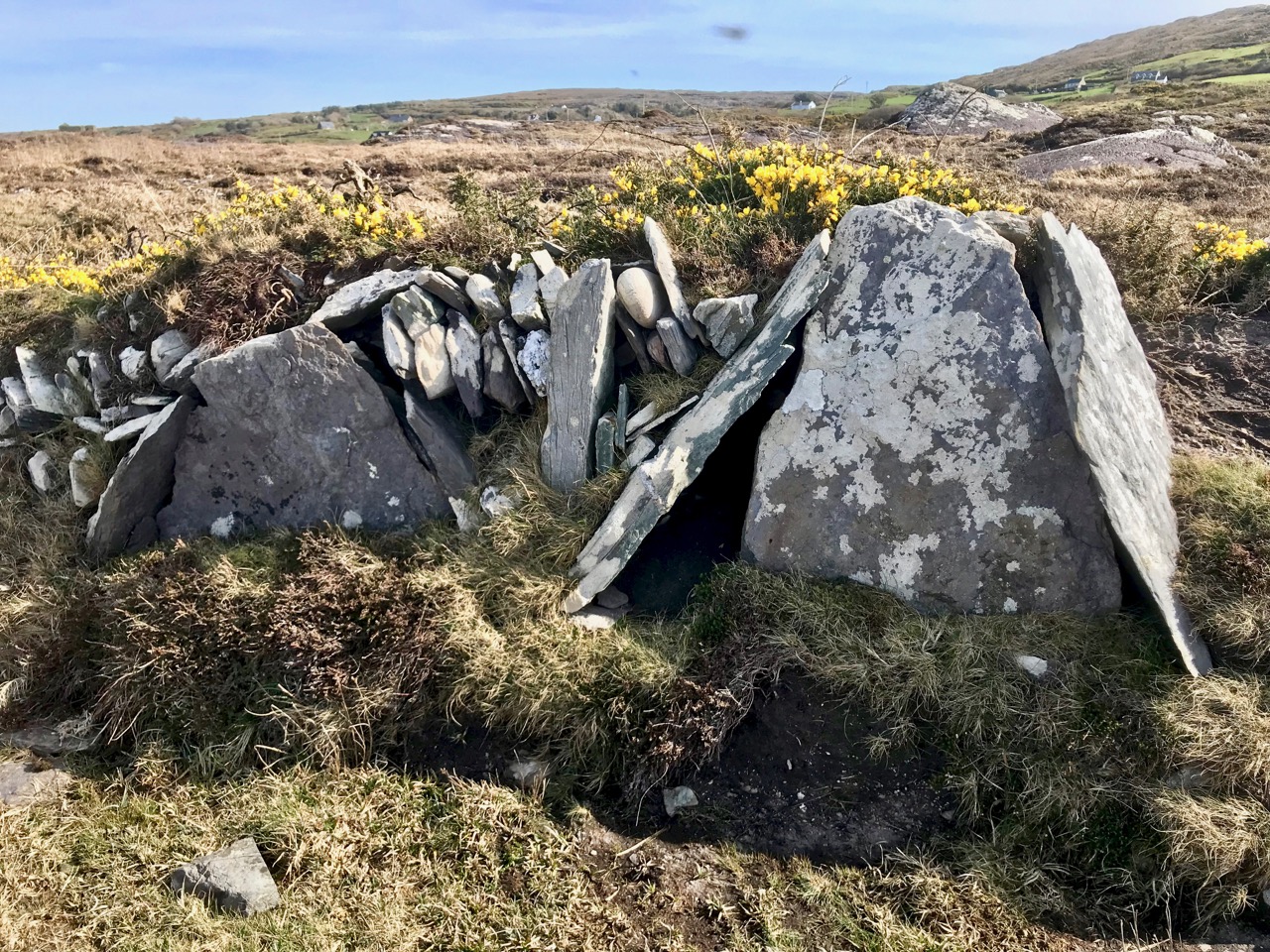
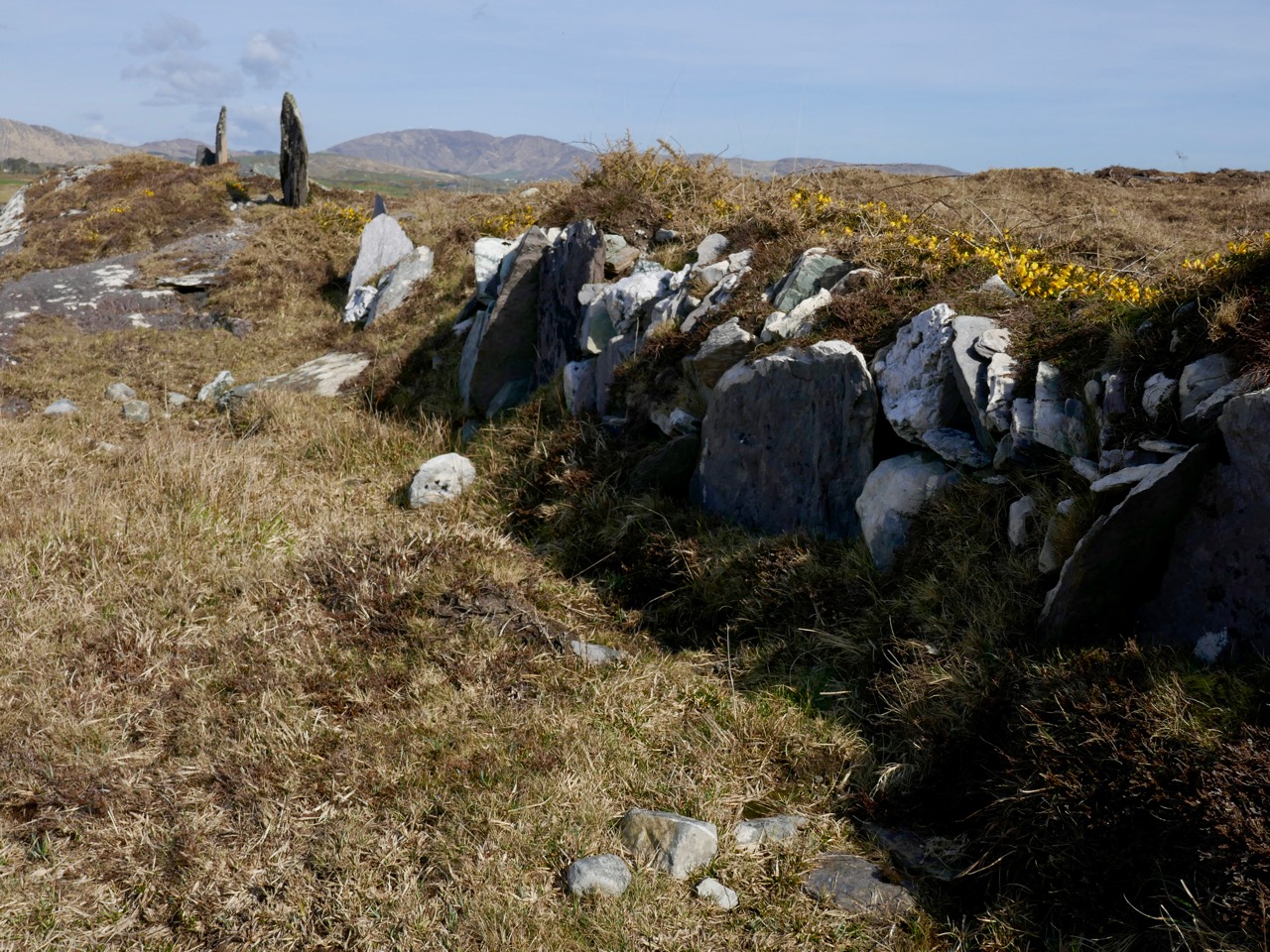
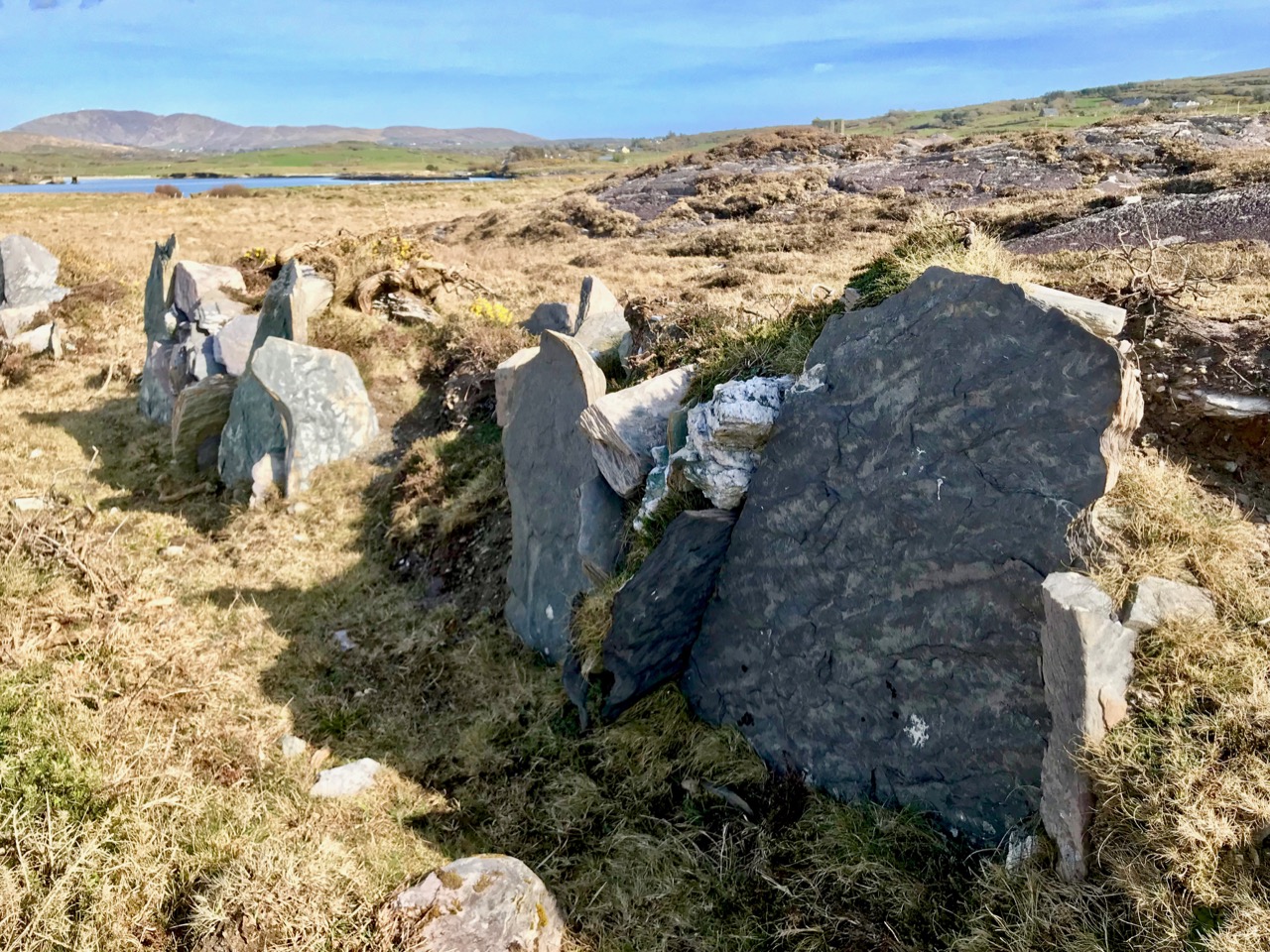
Three examples of many varied boundary features on the promontory are shown above. Each is differently constructed and they range from a series of vertically-set slabs to rocks-and-rubble and a raised bank reinforced with stones. In the picture below, follow with your eye the boundary as it traverses the scrub and makes a large S-bend on to the ridge facing the distant horizon.

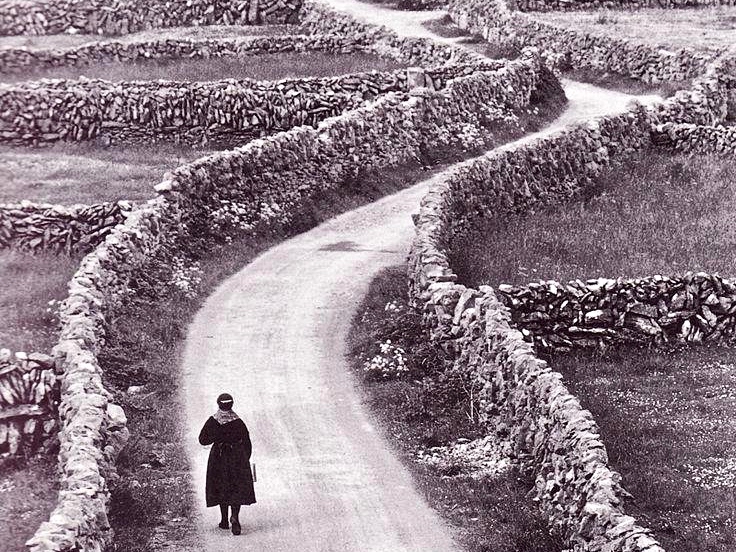
Ireland – especially the west of it – is a huge stone landscape. Wherever people have settled, they have moved the stone and used it. To make fields, or any enclosures, they have had to clear the land. The stone taken from the land is used – sometimes to build shelter, often to build myriad walls to define the holdings. Here’s a striking example from the Aran Islands:

Nothing is recorded on the National Monuments Survey about these land boundaries at Dunmanus – or the significance of the promontory as a whole. Was it once a promontory fort? There are others on this coast. It could easily have been defended along the line of the present road running across the south. However, the land is flat and low, and there is no shelter.

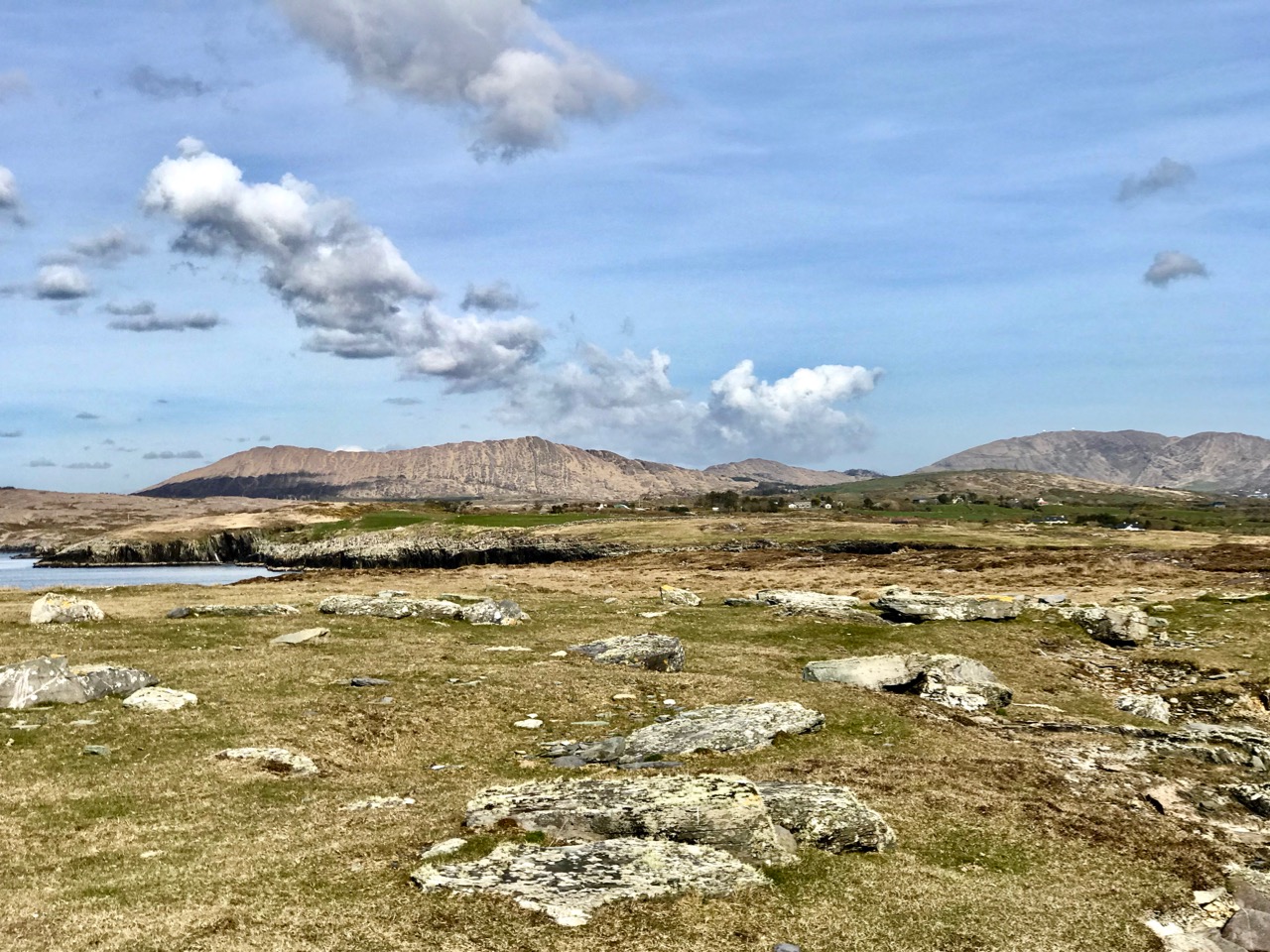
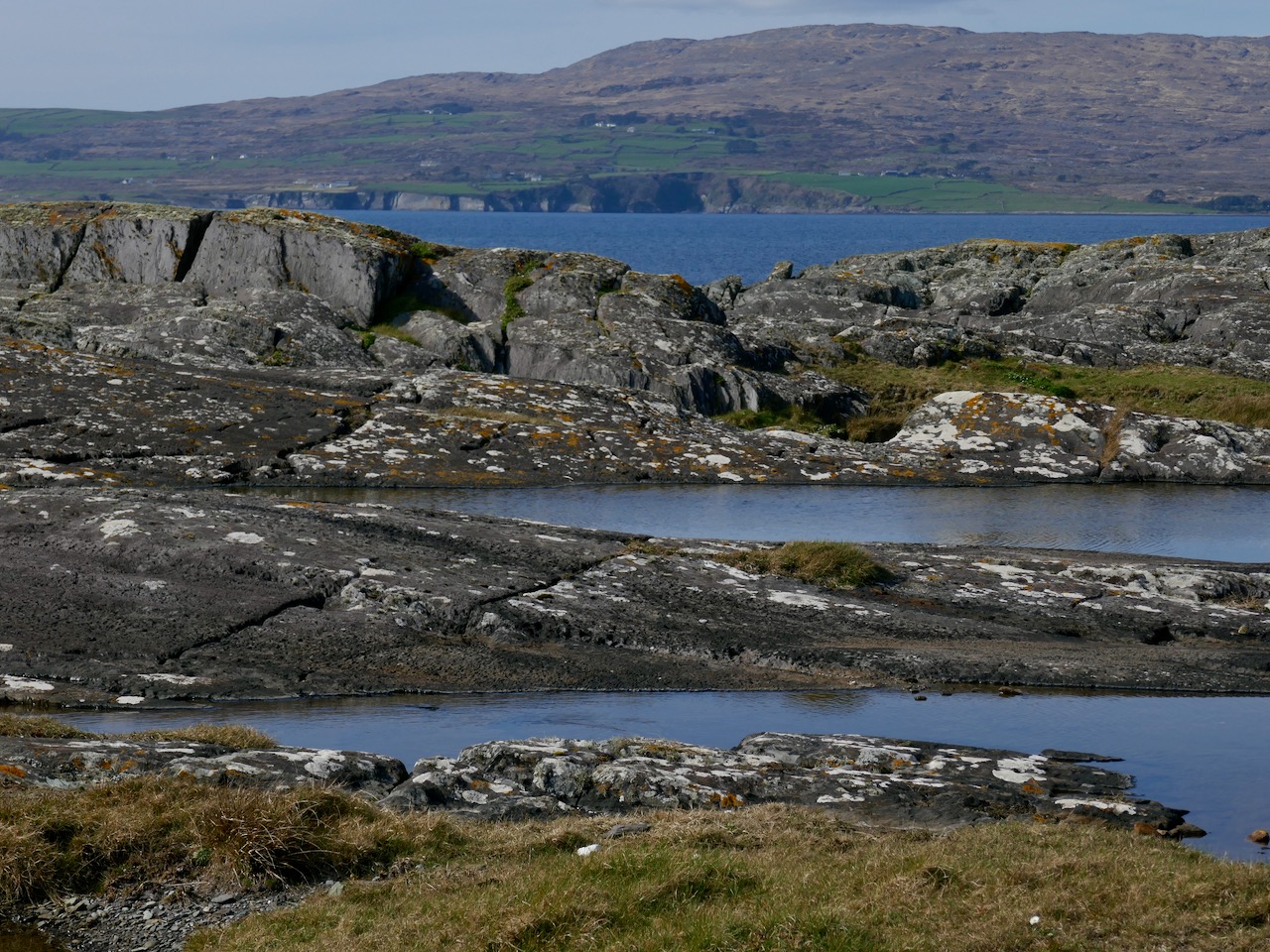
Flat stone surfaces – of old red sandstone – remind us of the Burren landscape in Clare, and we can suppose that the present windswept bog and scrub could once have supported agriculture. But when? In medieval times, perhaps, when the nearby Dunmanus tower house was a thriving centre of occupation and, probably, commerce. In the shelter of the bay the little quay at Dunmanus survives and is still used by small boats searching out shellfish and scallops.

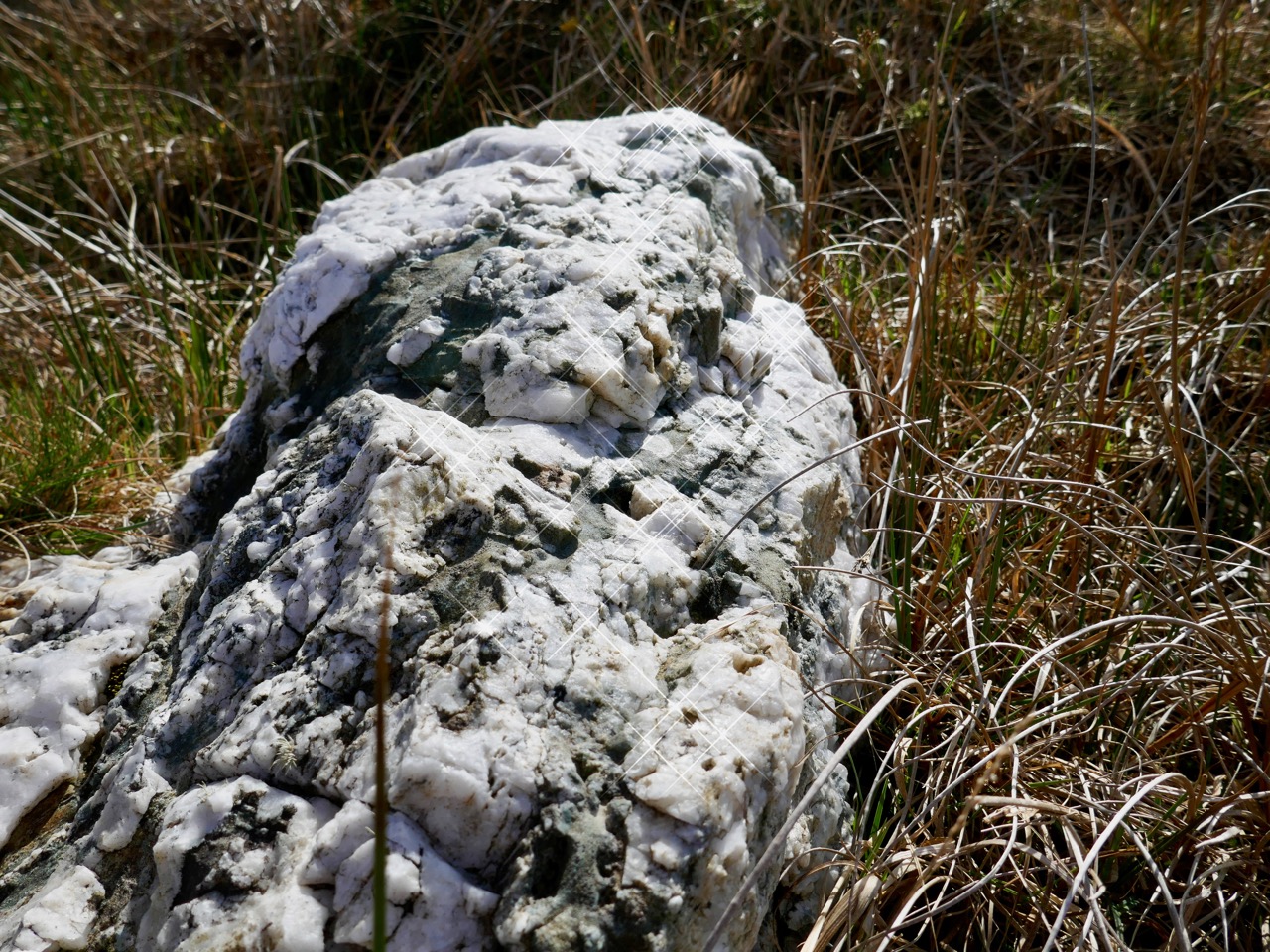
In some places the old walls seem to have a prehistoric feel: the use of slabs embedded vertically like standing stones is quite unusual in West Cork. The presence of large quartz rocks, too, is reminiscent of ancient sites, although they are natural geological occurrences here.

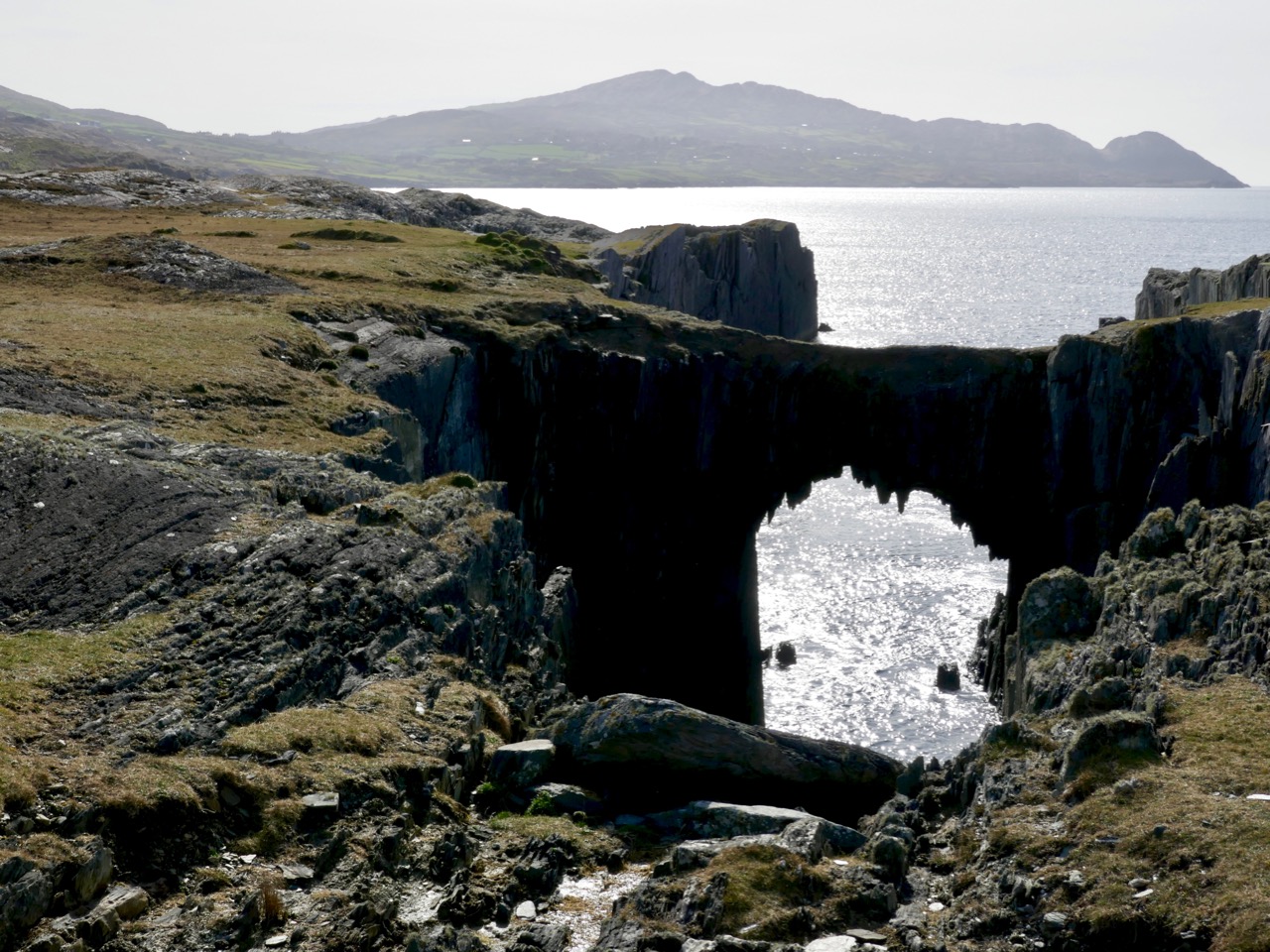
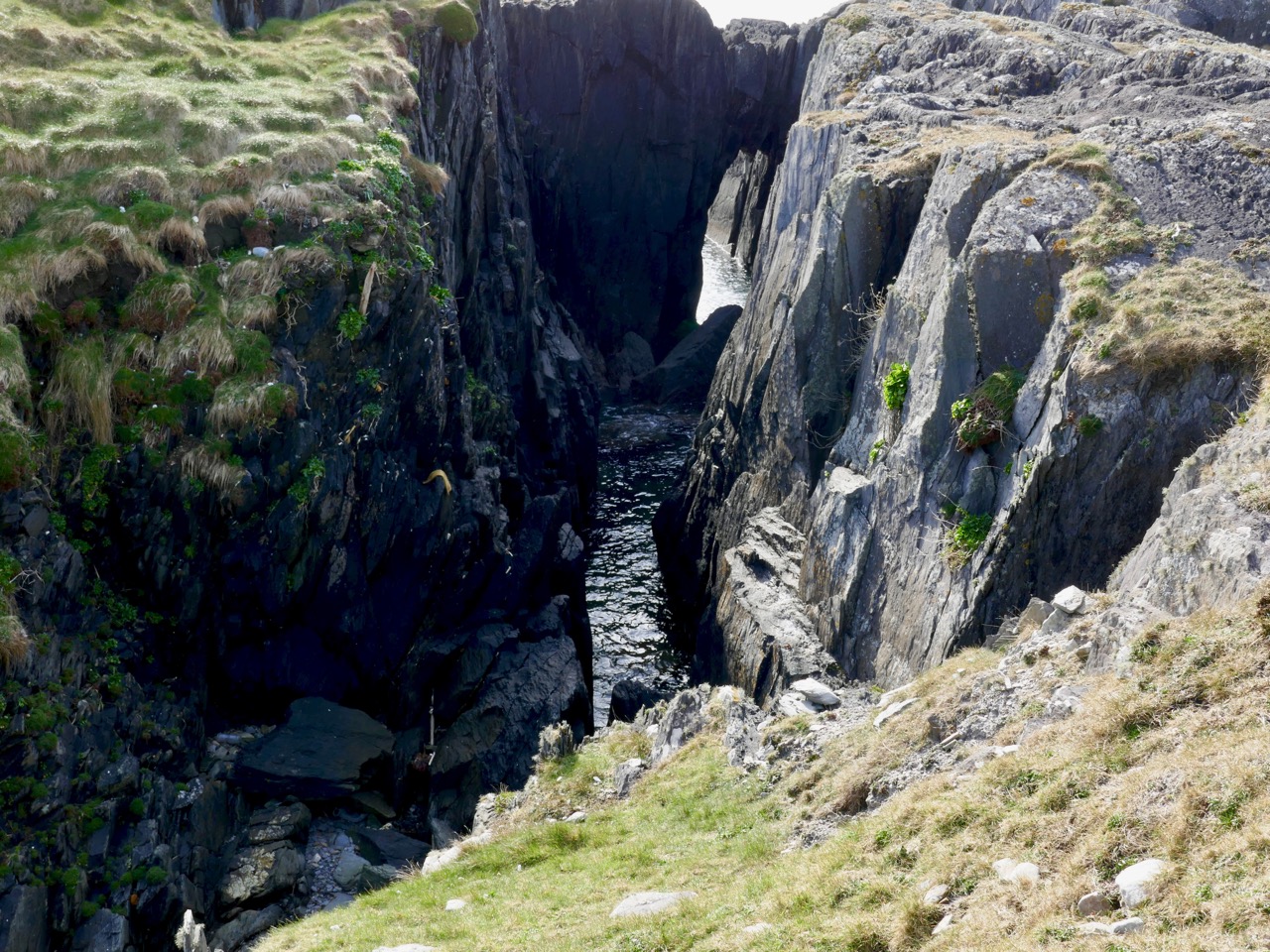
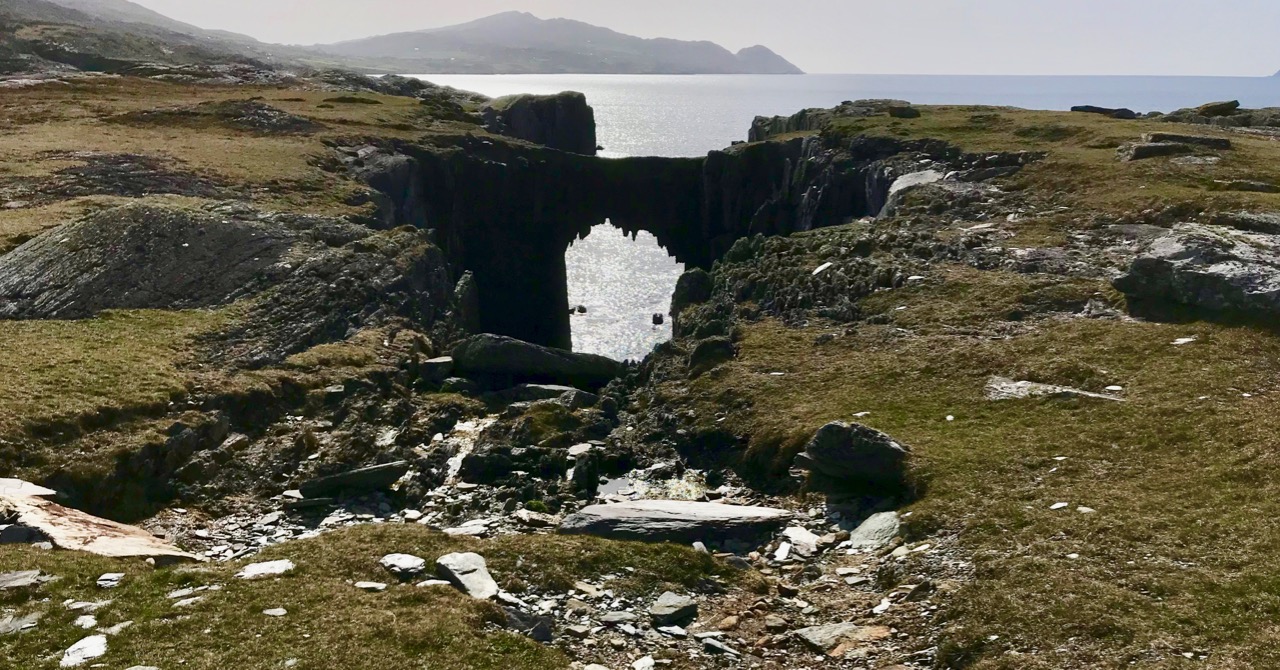
Other natural features on the peninsula include two ‘sea arches’ – bridges formed through erosion of the rocks and chasms by the ocean.

It’s a landscape of vestigial fields, sea – and stones. Nothing more. But I find it a mesmeric place; partly because we can see that it bears the marks of human toil, and we want to know more about who was there and how they lived. It’s a remote piece of Ireland to call ‘home’. Those marks remain after how many years – hundreds, thousands? They intrigue us, and compel us to explore.

Inspired by Stone

One of the many archaeological excitements in Ireland last summer was the discovery of a hitherto unknown passage grave with significant carvings beside Dowth Hall in the Bru na Boinne area of County Meath. These carvings are likely to date from around 5,500 years ago. In the picture above (courtesy of agriland.ie) from left to right are Minister for Culture, Heritage and the Gaeltacht Josepha Madigan; agri-technology company Devenish’s lead archaeologist Dr Cliodhna Ni Lionain; Devenish’s executive chairman Owen Brennan; and Professor Alice Stanton.

As you know, we are Rock Art addicts, so this week went along to this year’s Stone Symposium in Durrus, West Cork, to hear Cliodhna, above, give a fascinating illustrated talk on the finds at Dowth. Have a look at this post on the inaugural Stone Symposium from 2017. It’s great that the event is thriving and attracting interest and participants from far and wide.

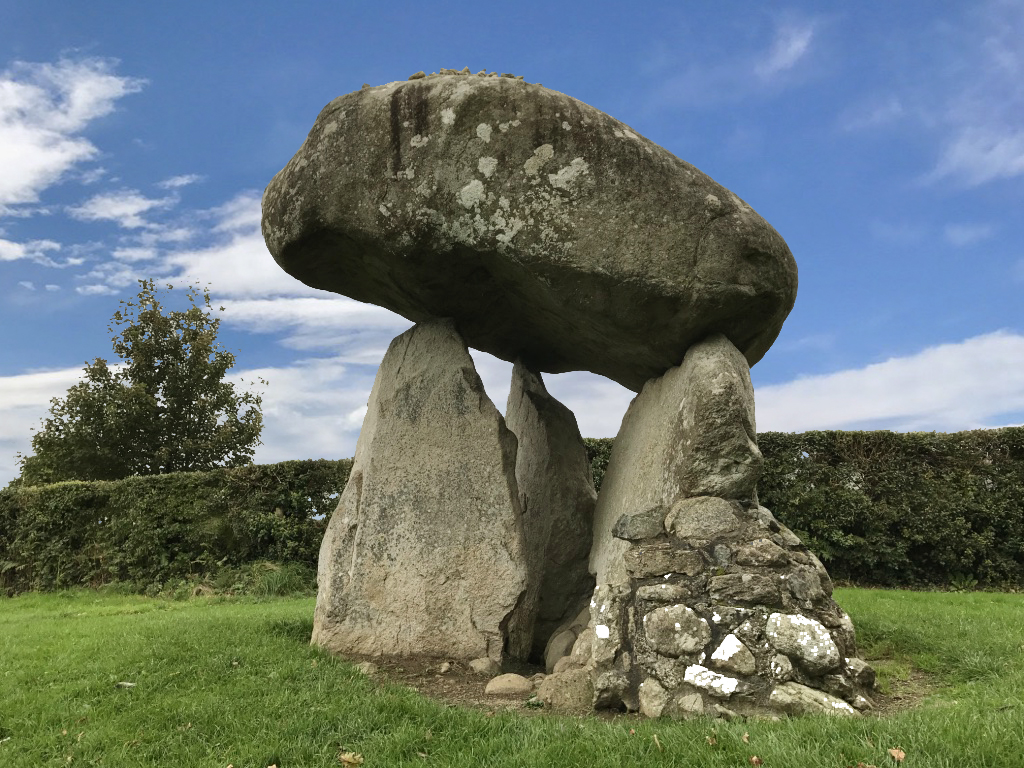
Our attendance at the Symposium set me thinking about the whole subject of stone. It’s the most basic of creative materials, as relevant today in construction and art as it was to our Neolithic ancestors. Proleek Dolmen in County Louth (above) is an example of the early use of stone to create a structure which made a huge impact on the landscape. It’s a portal tomb over 3 metres high, and the supporting stones are around 2 metres high: the capstone is estimated to weigh 35 tons. It’s probably a more visually impressive structure today – in its ‘naked’ state – than it was when completed, as it is likely to have been covered over with a mound of earth and / or stones. There is folklore attached to this monument: it is known locally as the Giant’s Load, having been  carried to Ireland by a Scottish giant named Parrah Boug McShagean, who is said to be buried in the tomb or nearby.

Here’s another portal tomb – the largest in Europe – which I discussed in this post from last year. It’s known as Brownshill Dolmen, and is in County Carlow. Finola is in the picture to give the scale. This capstone is said to weigh 103 tons. The portal tombs demonstrate the use of stone in its rawest and most spectacular state: they are examples of Ireland’s earliest architecture, and we don’t really know what they were for. Perhaps it’s to do with status, either of the builders or of the chiefs or priests who might have been buried in them. They certainly make mighty marks on the landscape…

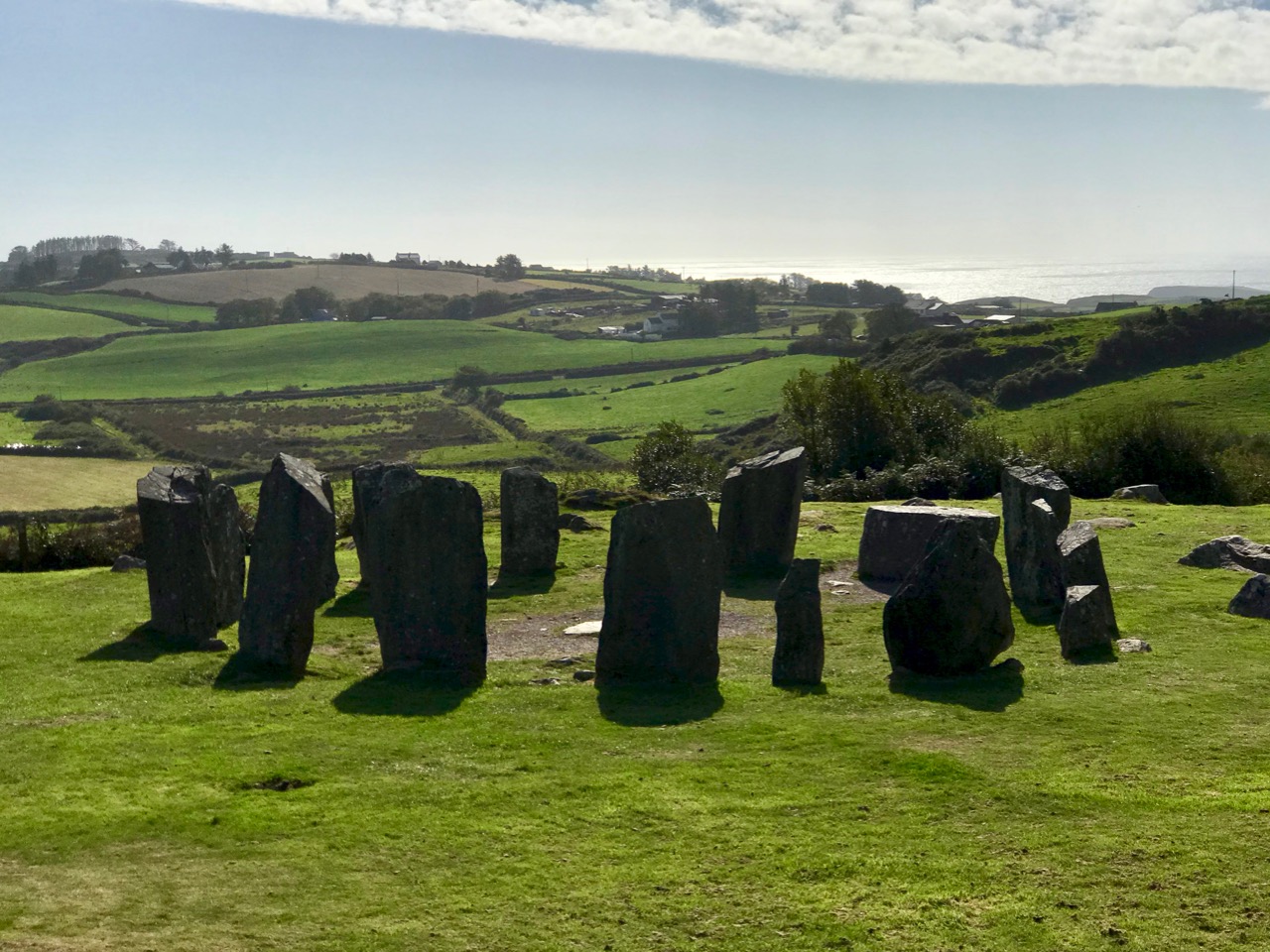
…As do all the other stone monuments which celebrate their makers – although perhaps they remain enigmatic to us today. Bronze Age stone circles have always fascinated, and at least we know that they have orientations which must have been significant. Drombeg in West Cork (above) is much visited at the winter solstice, when the path of the setting sun falls over the recumbent stone when observed through the two portal stones at the east side of the circle.

While the earliest dwellings of the inhabitants of Ireland thousands of years ago were probably constructed from organic materials  – earth, sticks and furze – stone began to play a part in architectural construction in Christian times. The remarkable Gallarus Oratory (above) on the Dingle Peninsula, County Kerry, was long thought to have dated from around the 8th century, although an early commentator – antiquarian George Petrie, writing in 1845 – suggested:

I am strongly inclined to believe that it may be even more ancient than the period assigned for the conversion of the Irish generally by their great apostle Patrick . . .

It’s a fascinating discussion to follow – Peter Harbison sets it out in detail here, and concludes that the Oratory could have been built as late as the 12th century, even after the great Romanesque flowering which included the building of monastic settlements and round towers.

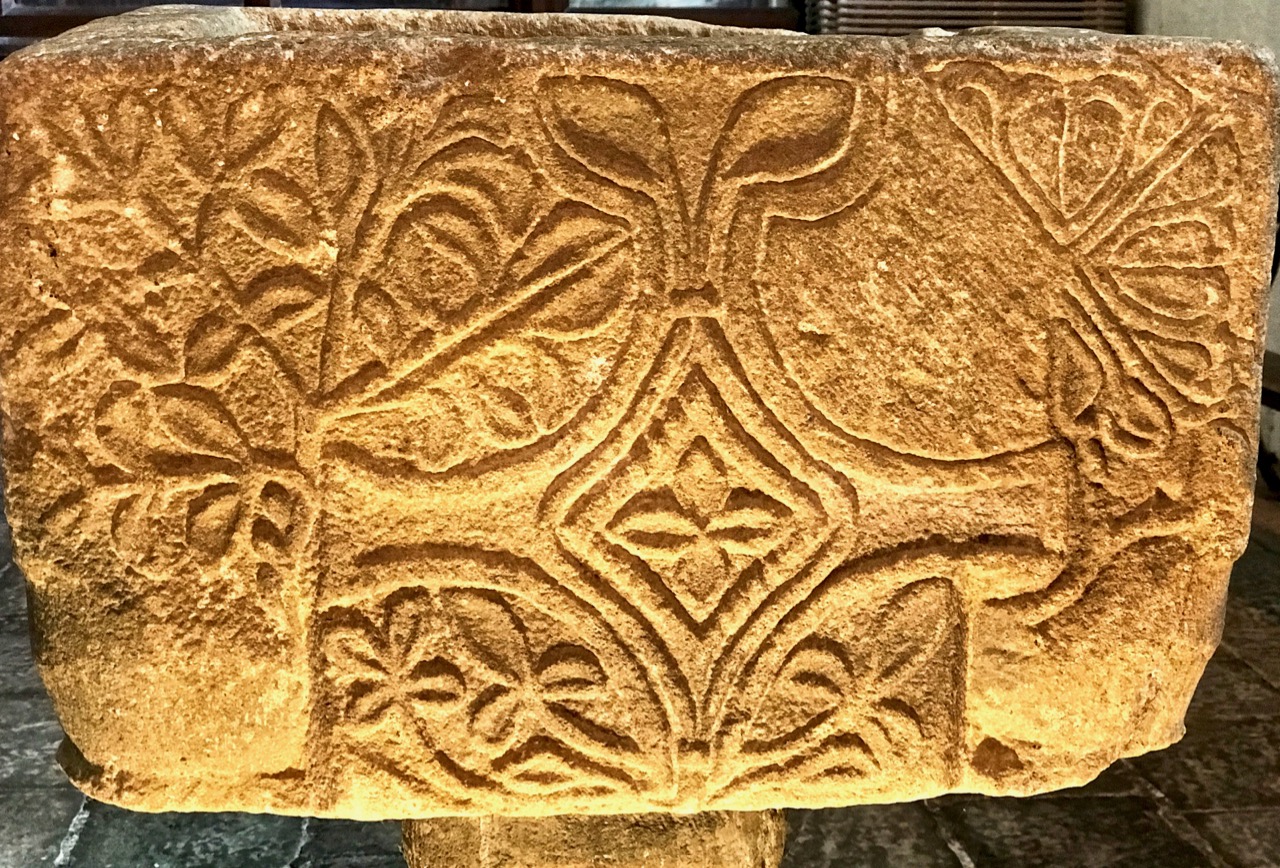
The 12th century cathedral and (possibly earlier) round tower at Ardmore, County Waterford (above), should be a Mecca for stone enthusiasts because of its monumental architecture and carvings: St Declan founded the site in the 5th century, and his monastic cell survives. The Romanesque period in Ireland has many other examples of stone craftsmanship to show, proving that working with stone had become a high art in those medieval times. The examples below are from Killaloe Cathedral in County Clare.

One of the finest Romanesque sites is the Rock of Cashel in County Tipperary. Finola has written in detail on this architectural gem here and here. Suffice it for me to illustrate only one of its treasures – Cormac’s tomb, a sarcophagus beautifully carved in the ‘Urnes’ style – a Scandinavian tradition of intertwined animals.

For centuries, stone has also been a ubiquitous utilitarian building material all over Ireland. ‘Castles’ or – more properly ‘Tower Houses’ – date from roughly 1400 to around 1650, and many remain in a ruined condition, particularly on the coastline of West Cork: we can see five of them from Nead an Iolair. Some have been restored in modern times, including Jeremy Irons’ Kilcoe Castle. The example below is from Conna, East Cork.

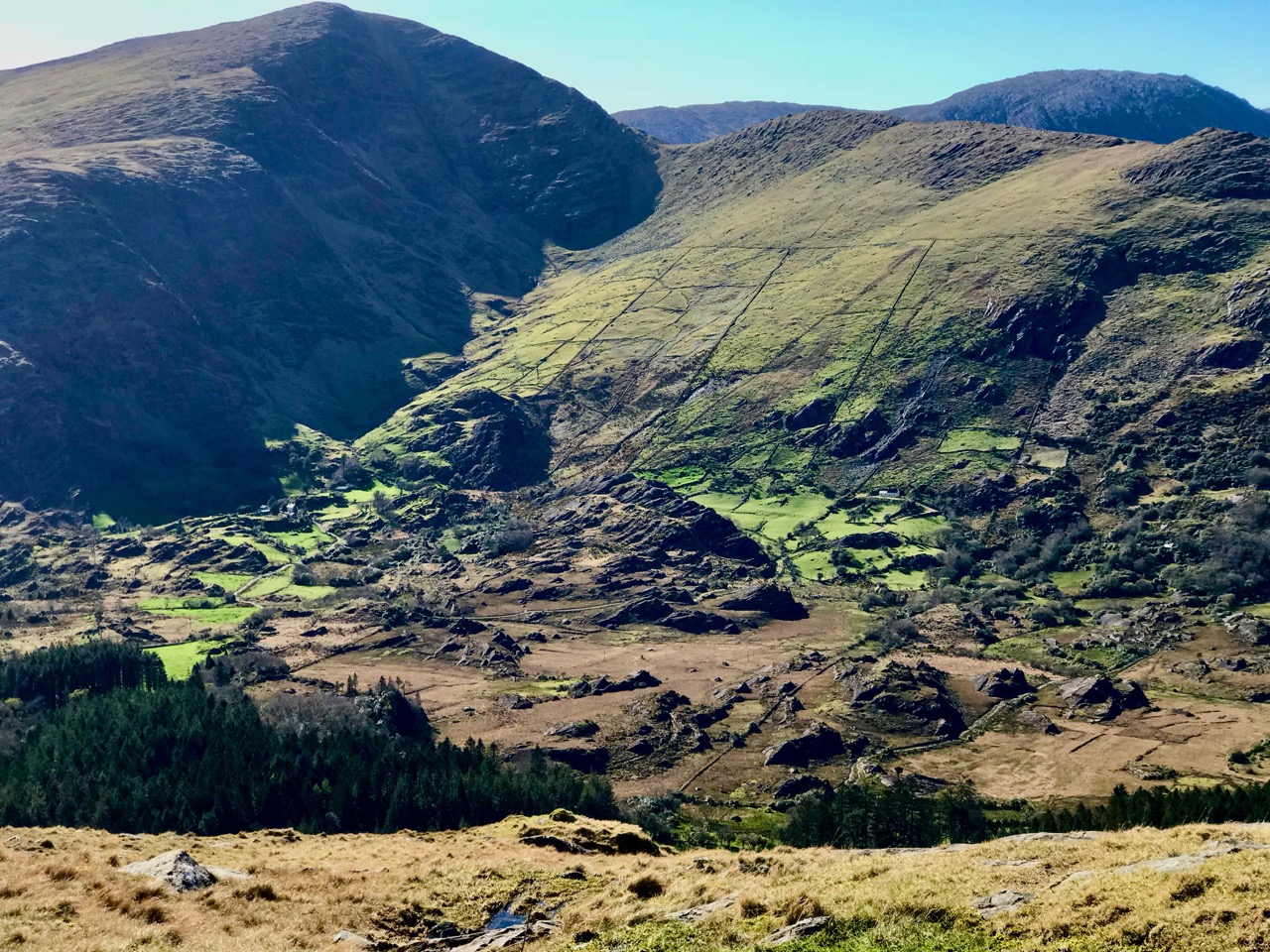
Ireland’s landscape is sculpted from stone. Drystone walling is an ancient tradition still practiced for dividing up land, and varies considerably in style regionally, reflecting the differing geology across the island. Two examples from the Beara Peninsula (below) show the essential geometry of field patterns which stone wall building has created over the centuries.

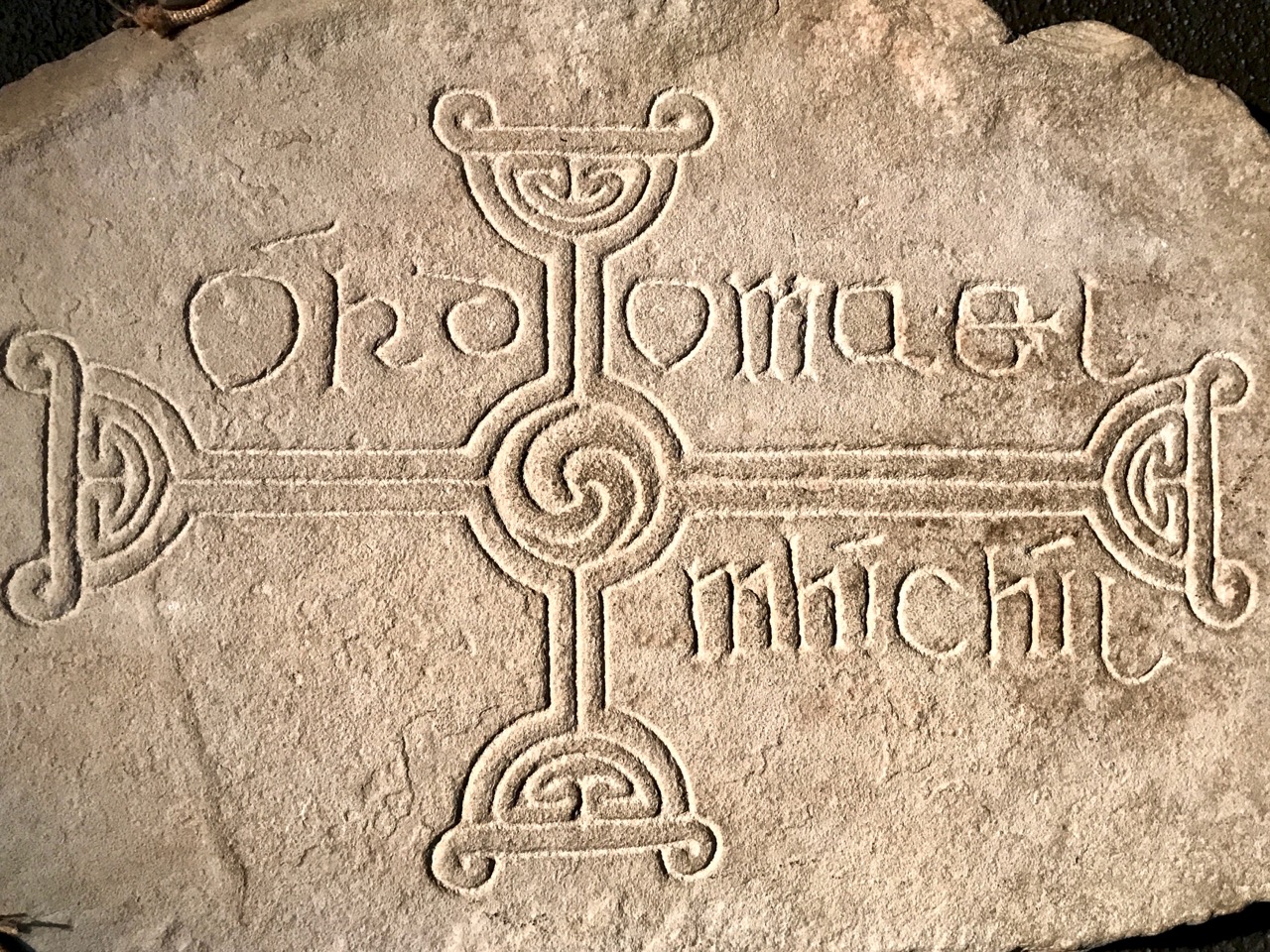
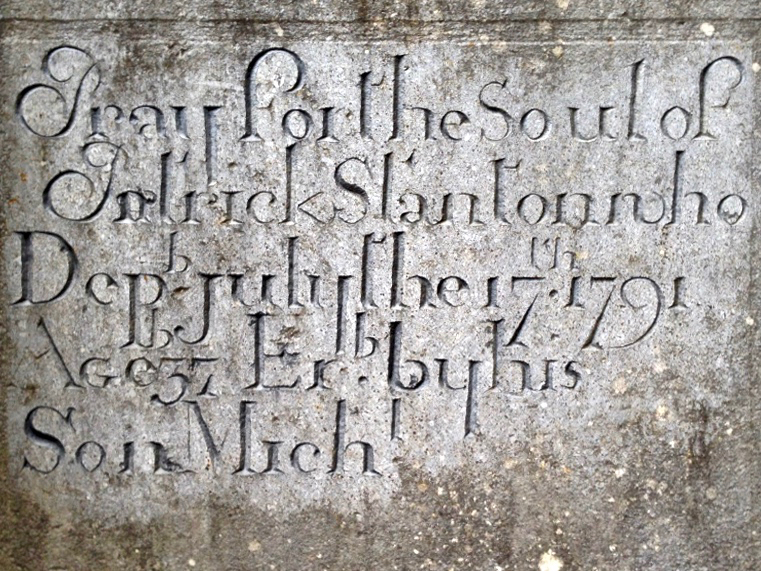
Stone has also long been a medium for communication. We have commemorated our ancestors for centuries with grave markers, often with elegantly carved lettering. Of the two examples below, the first is from Clonmacnoise, and is likely to be early medieval, while the second is an inscription from 1791.

This is just a brief history of our use of stone, dating over thousands of years: I have chosen many examples – almost at random – but hope that I have demonstrated how important it is to continue this ancient craft. The West Cork Stone Symposium is doing sterling work in promoting it today: long may this continue!

Saint Manchan, his Miraculous Cow, and his Shrine

I was in the little two-horse train which labours west from Clara to Banagher and the outlook was desolate. There was another chap in the carriage. He sat hunched up in the corner with his nose to the window. One glance convinced me that it was useless to say anything and there the two of us kept on staring rather lovingly at a wilderness of bog stretching away to the Slieve Bloom Mountains. It seemed to me that there was a kind of promised land on the other side. On past a few scattered farm houses some grey boulders and the ruins of a church. I found myself thinking dismally enough of the tourists. After all what do they get? Just ruins, ruins and more ruins – the saddest ruins in Europe. Then suddenly I heard my friend of the opposite corner speak in a mournful kind of way with his nose still glued to the window – “That’s Leamanaghan, a quare kind of place, decent people, too, the best in the world, people who’d give you all the milk you could drink but wouldn’t sell a drop of it for all the gold in Ireland and it’s all by raison of a cow, Saint Manchan’s cow.”


(St Manchan By Tomas O’Cleirigh, Midland Tribune 27th April 1935)

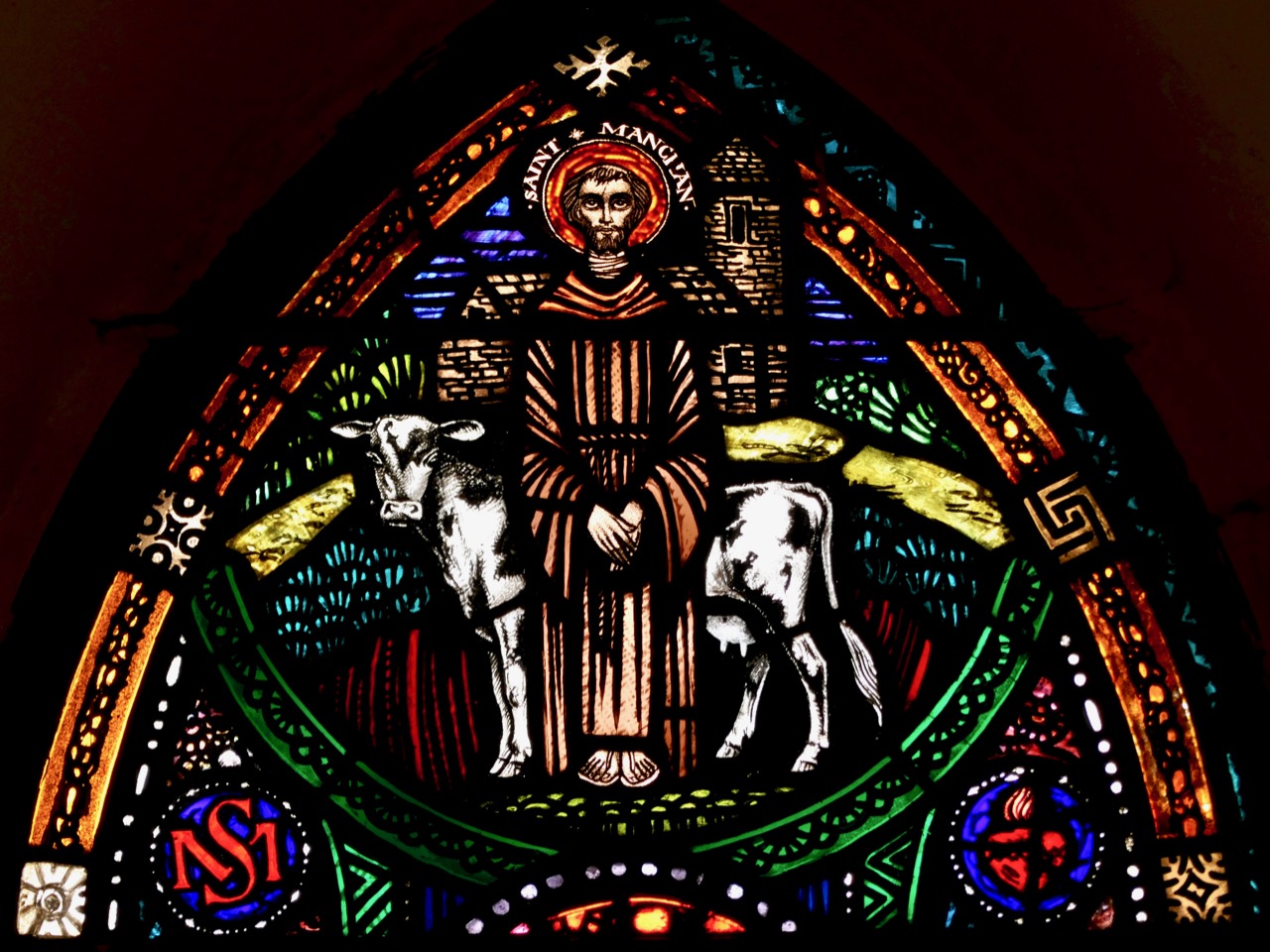
Upper – Finola is featuring the work of stained glass artist George Walsh this week. We were fortunate to find his portrait of Saint Manchan and his cow in the  little church at Baher , Co Offaly, on our travels. Centre – The Church of Saint Manchan

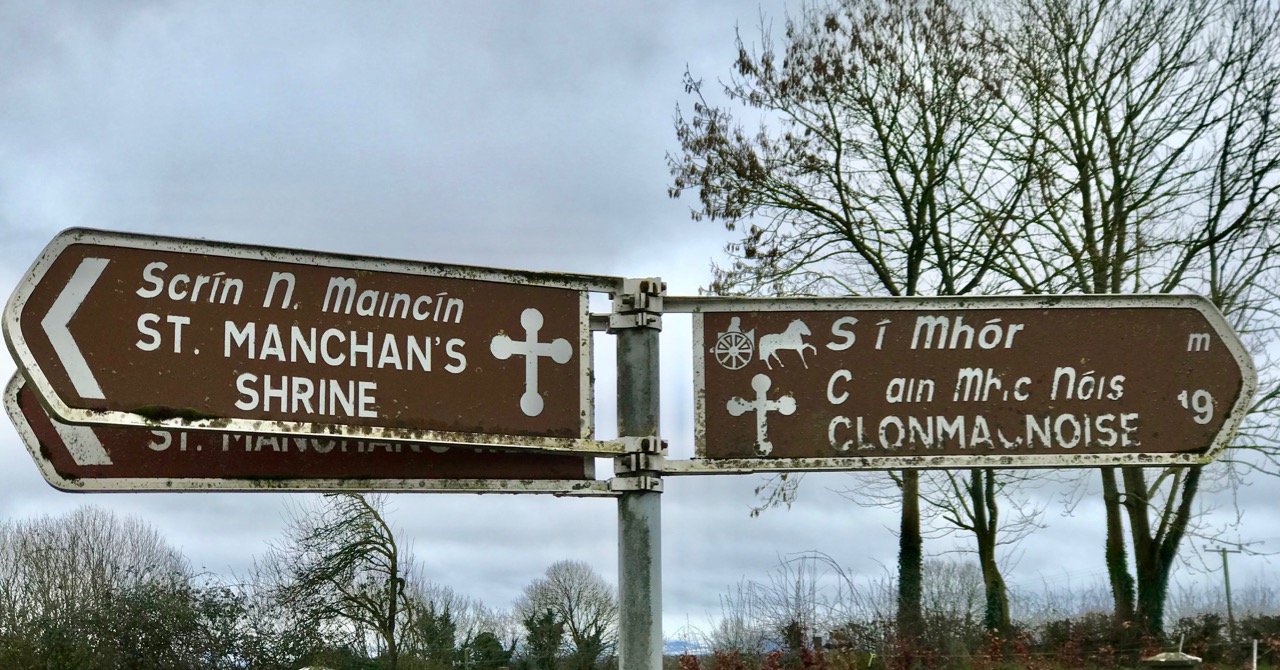
(From Robert’s diary, 2012) – St Manchan had a Cow, a miraculous animal that was always in milk, and the people of Leamonaghan had the milk for free (and, to this day, will not charge anyone for a pint straight from the herd). We tramped through a field of cows as we searched for St Manchan’s holy well: they gazed at us with some disdain. The well is a curious affair – old stones, concrete and rather ugly. The water is alive with tadpoles. We were tentative as we sampled the rank, slow moving stream – but it gave us the gift of credulity!

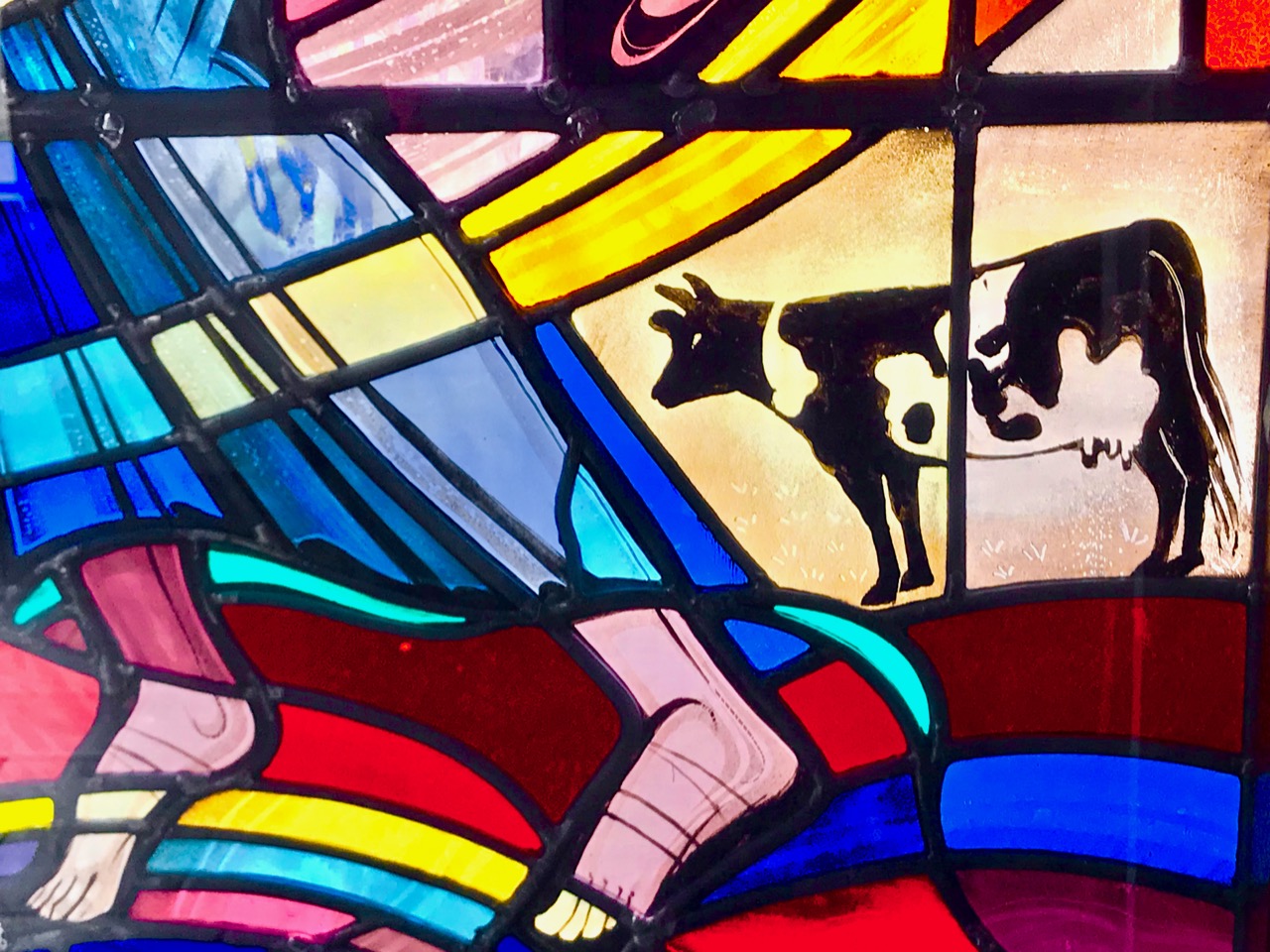
This detail from the Harry Clarke Studio window at St Manchan’s Church (dating from 1931) shows the miraculous cow

I went through a storm of real Irish rain to see Leamanaghan that very evening. It is four miles from Ferbane in County Offaly and hidden away in a vast bog region which is dotted with scattered boulders of magnesian limestone. The general depression is summed up in the name – Liath Manchan – the grey land of Manchan. Aye! The grey, lonely, chill land of Manchan. Saint Manchan lived here and died in AD 664. That might have been only yesterday, however as far as the good neighbours are concerned because he is the one subject over which every man, woman and child can get really voluble. I was taken to see the ruins of his church and then down to his well and heard how when you are sick you should pray here, walk three times round it and then go back and leave a little present for the saint himself in the window of the church . . . I was told that on the 24th January when all the rest of the world works, the people of Leamanaghan just take a holiday and make merry because it would be the unpardonable sin to think of work on their Saint’s day.


(Tomas O’Cleirigh, 1935)

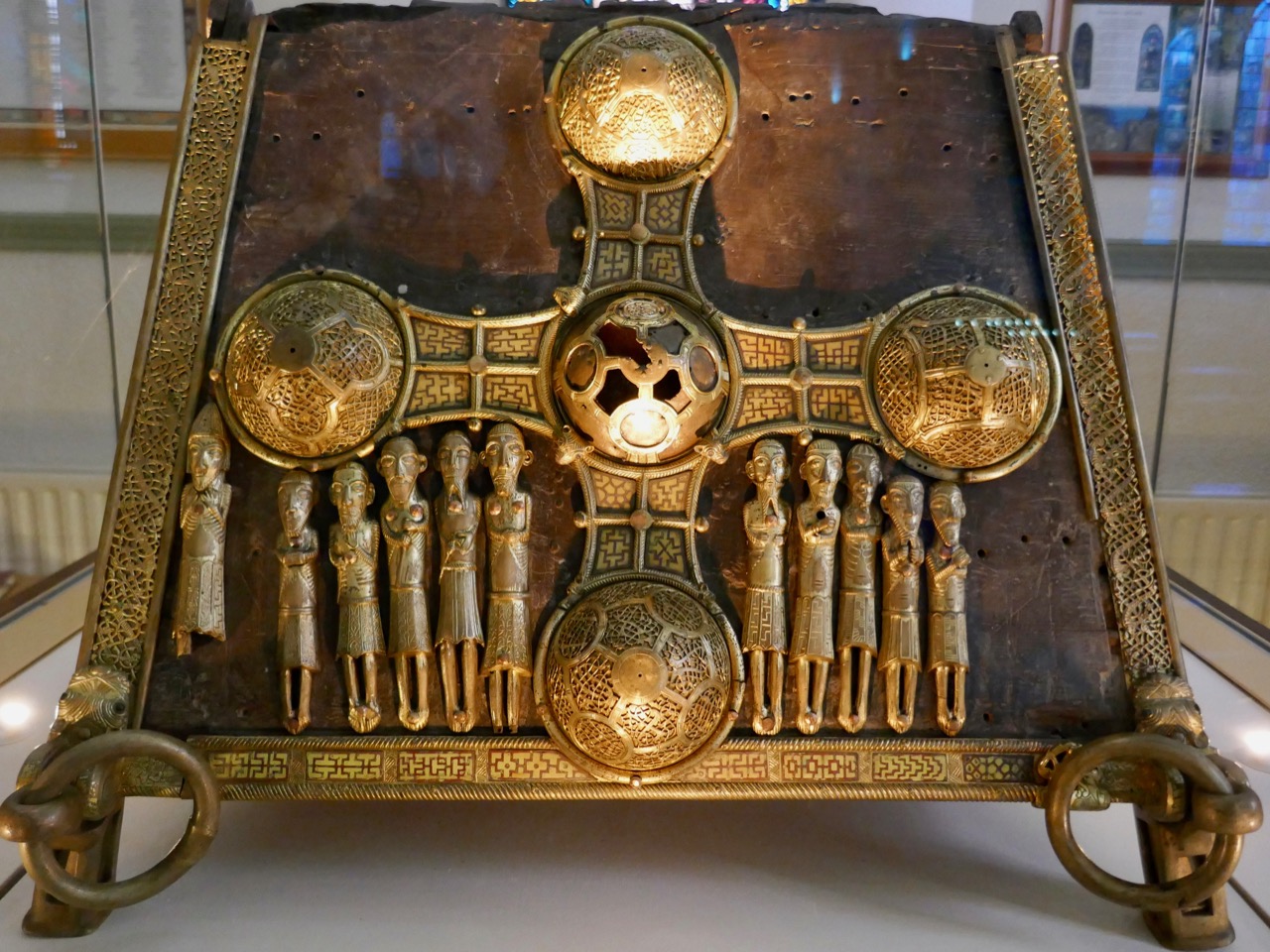
The twelfth century shrine of St Manchan securely displayed in the church today, with the Harry Clarke Studio window behind it

St Manchan died in a plague which he had asked God to bring on his sinning people. After his death, his herdsmen – Bohooly (from which the name Ua Buachalla – or Buckley – is derived) found it necessary to call upon the Saint to help recover the Community’s cattle, which had been stolen by raiders. Manchan duly appeared, but one of his faithful herdsmen was so overjoyed to see his old master again that he threw his arms around him. This he should not have done, as he was a mortal sinner: the Saint fell into a heap of dry bones, but the cattle were recovered. We learn that Manchan’s bones were gathered up and taken to Clonmacnoise, where a fine casket was made to house them, out of yew wood, bronze and gold. Nearly a thousand years later we stumbled on this same shrine in the little church at Boher which carries the Saint’s name, with a glorious representation of itself shining out from a Harry Clarke Studio window set behind it. It resided in a case of armoured glass, alarmed and watched by cameras  – incongruous…. and ineffective: the day after we saw it there the shrine was stolen in broad daylight, evidently after only a few minutes’ work. (Robert’s diary, 2012)

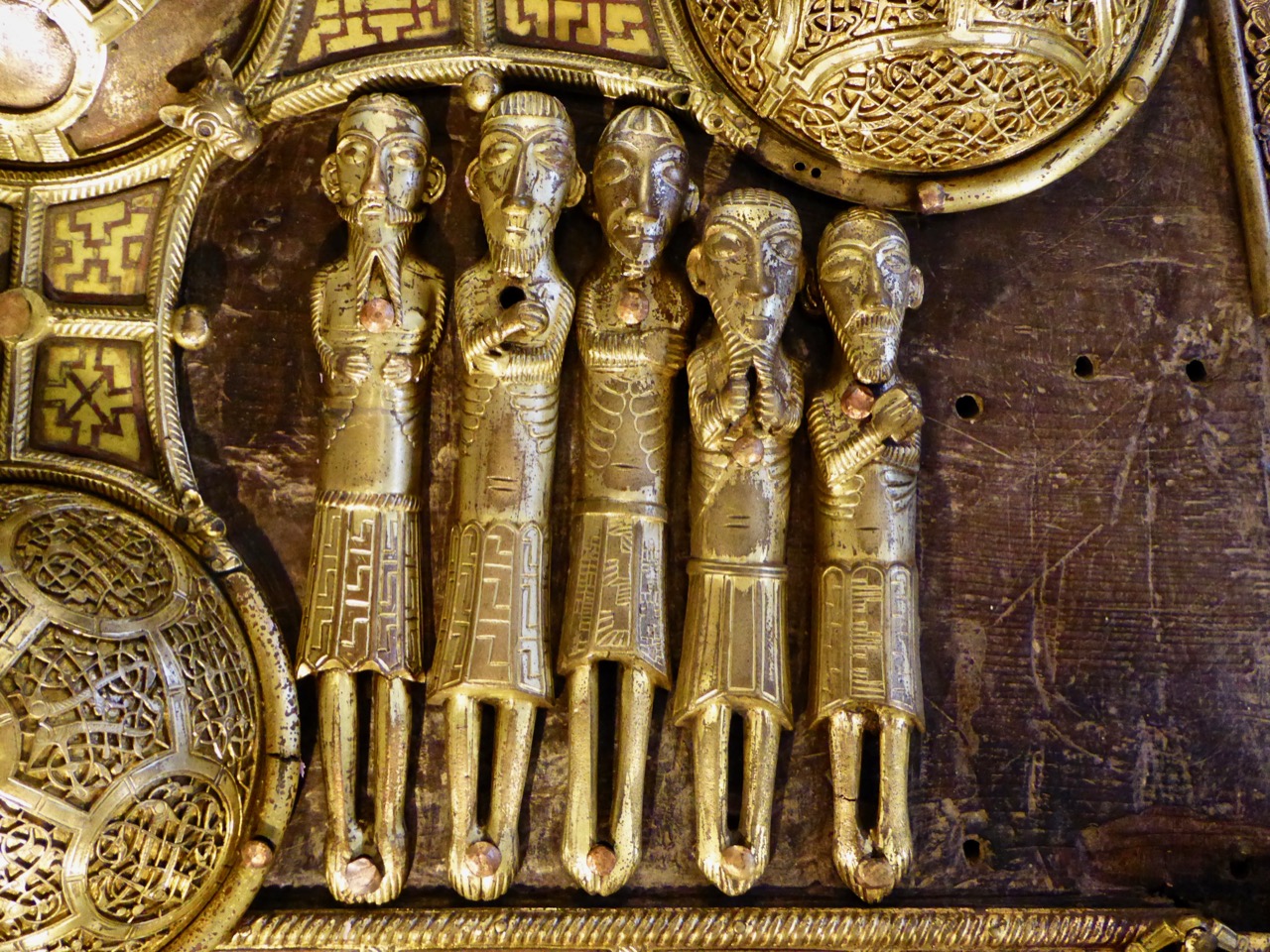
It’s wonderful that we can see the actual reliquary containing St Manchan’s bones returned to the church at Boher, Co Offaly, close to the ruins of the monastery at Leamonaghan which the Saint founded in the seventh century. Although it has suffered some damage over the centuries, the detailing is exquisite: it is one of Ireland’s finest medieval treasures 

They have all kinds of stories about the good saint but the best one of them all explains why Leamanaghan people don’t sell milk. Here it is: Saint Manchan had a cow – a wonderful cow that used to give milk to the whole countryside – good, rich milk for which no charge was ever made by the saint. Then, the people of the neighbouring Kil Managhan got jealous and watched for their chance. One fine day when Manchan was absent they came and stole the cow and started to drive her along the togher through the bog back home to Kil Managhan. The good cow, suspecting something was wrong, went backwards and most unwillingly, fighting, struggling and disputing every inch of the way. Now she’d slip designedly on the stones: again she’d lie down but every where she went, she managed to leave some trace of her rough passage on the stones of the togher. The marks are there to this day, – hoof marks, tail marks – every kind of marks and the chef-d’oeuvre of them all has a place of honour at the entrance to the little school. Alas! In spite of that very gallant resistance, the cow was finally driven to Kil Managhan. There, horrible to say, she was slain and skinned.


(Tomas O’Cleirigh, 1935)

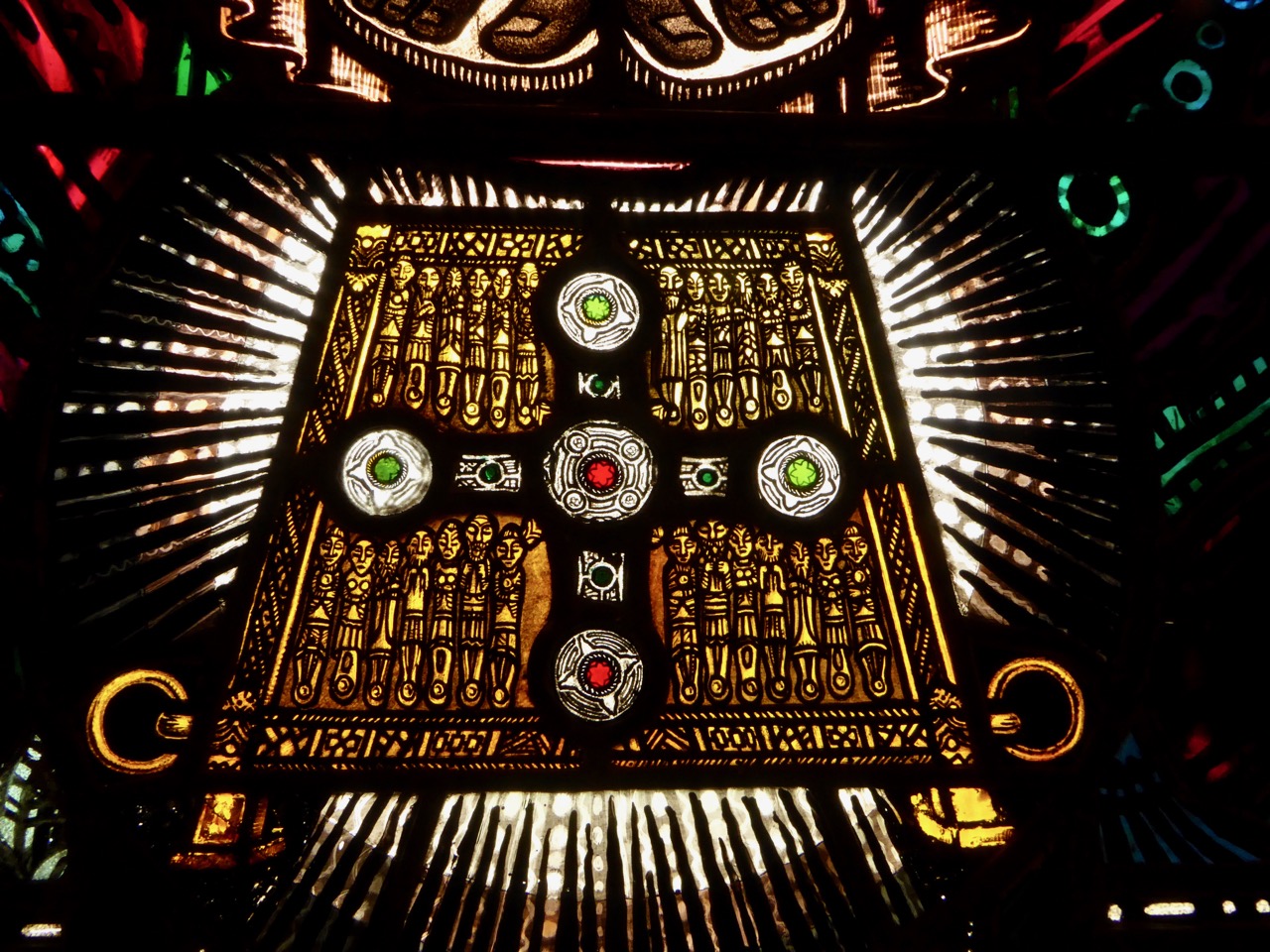
The shrine wonderfully depicted in the Harry Clarke Studio window at St Manchan’s Church, Boher

Prior to being housed in the church the shrine had rested in an ancient chapel. This burned down, but the shrine was rescued and then was kept in a thatched cottage nearby: legend has it that the ruin of this cottage became the unprepossessing holy well that we had found . . . Miraculous cows; plagues; holy wells; a modern theft – St Manchan’s bones do not rest lightly in his casket. The stories tell that Manchan was a tall man with a limp. When the shrine was sent to the British Museum some years ago for refurbishment, the experts examined the bones and proclaimed that they belonged to a tall male who had suffered from arthritis. (Robert’s diary, 2012)

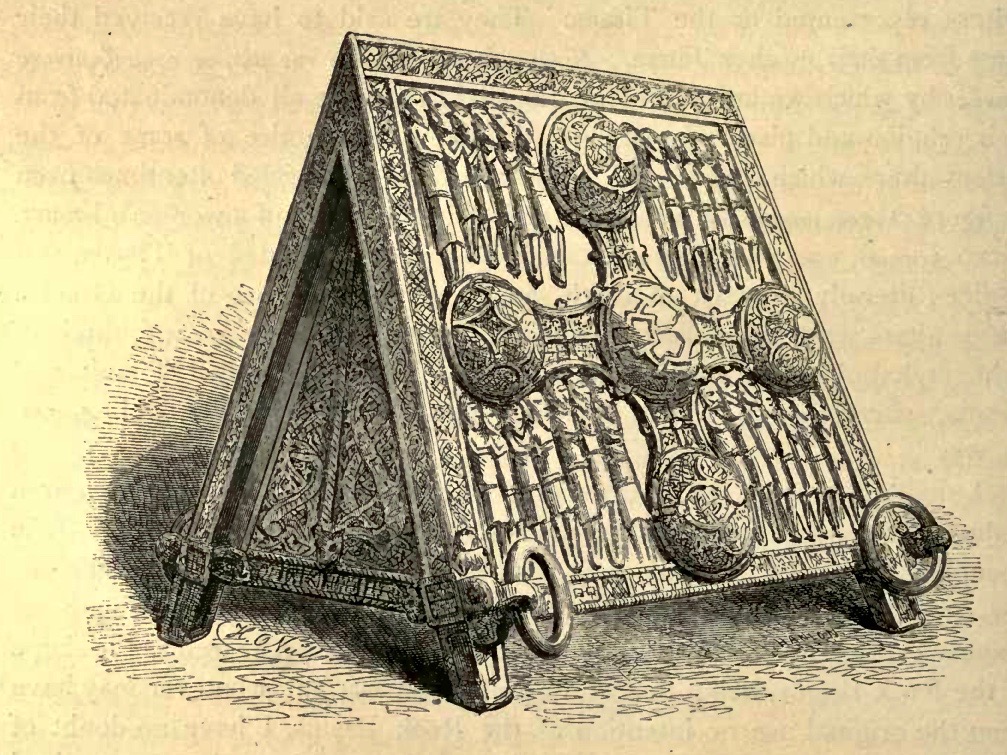
Remarkably, St Manchan’s Shrine has been exactly replicated. This full-sized copy of the reliquary is in the National Museum of Ireland: all the ‘missing’ figures and details have been restored. The drawing dates from 1867, and is a plate in a book titled The Towers and Temples of Ancient Ireland by Marcus Keane MRIA. In that book it is said that the copy belonged to Sir William Wilde, and it may well have been commissioned by him. It is likely that the Harry Clarke Studio modelled their version of the shrine on the replica, rather than on the original

In the meantime, the saint returned, missed his cow, and straightaway started in pursuit. He succeeded in tracing the thieves by the marks on the stones and arrived just at the moment when she was about to be boiled. He carefully picked the portions out of the cauldron, pieced them together, struck at them with his stick and immediately the cow became alive again. She was every bit as good as ever, too, except that she was a wee bit lame on account of one small portion of a foot which was lost. She continued to supply the milk as before, and, of course, no charge was made by the saint. Ever since the famous custom still lives on, and good milk is given away but never gold by the loyal people of Leamanaghan. Now, can any lover of the grand faith of Medievaldom beat that?


(Tomas O’Cleirigh, 1935)

A detail of the original Shrine in St Manchan’s Church

There’s one more piece to this Saint’s story: the fame of his miraculous cow grew and the people of neighbouring Kilmonaghan were jealous, and sent out some rustlers to drive the cow over into their own parish. The cow proved reluctant and stalled and slipped all the way, leaving hoof marks on the many stones that lay on the road. Those marks are still on the stones to this day (they say) and the Saint was able to follow her tracks and recover her. (Robert’s diary, 2012)

Saint Manchan, depicted in stained glass: Harry Clarke Studio (left) and George Walsh (right). Both can be seen in the church at Boher, Co Offaly

The very old vellum books state that Manchan of Liath was like unto Hieronomus in habits and learning. I can well believe it. Some distance away from the church is the little rectangle cell which he built for his mother – Saint Mella. Cold, austere and with no window, you get the shivers by even looking at it. There is also a large flag-stone on the togher leading from the well, and they say the saint and his mother used to meet here every day and sit down back to back without speaking a word because the saint had vowed never to speak to a woman!


(Tomas O’Cleirigh, 1935)

Fish Palaces – and How They Worked

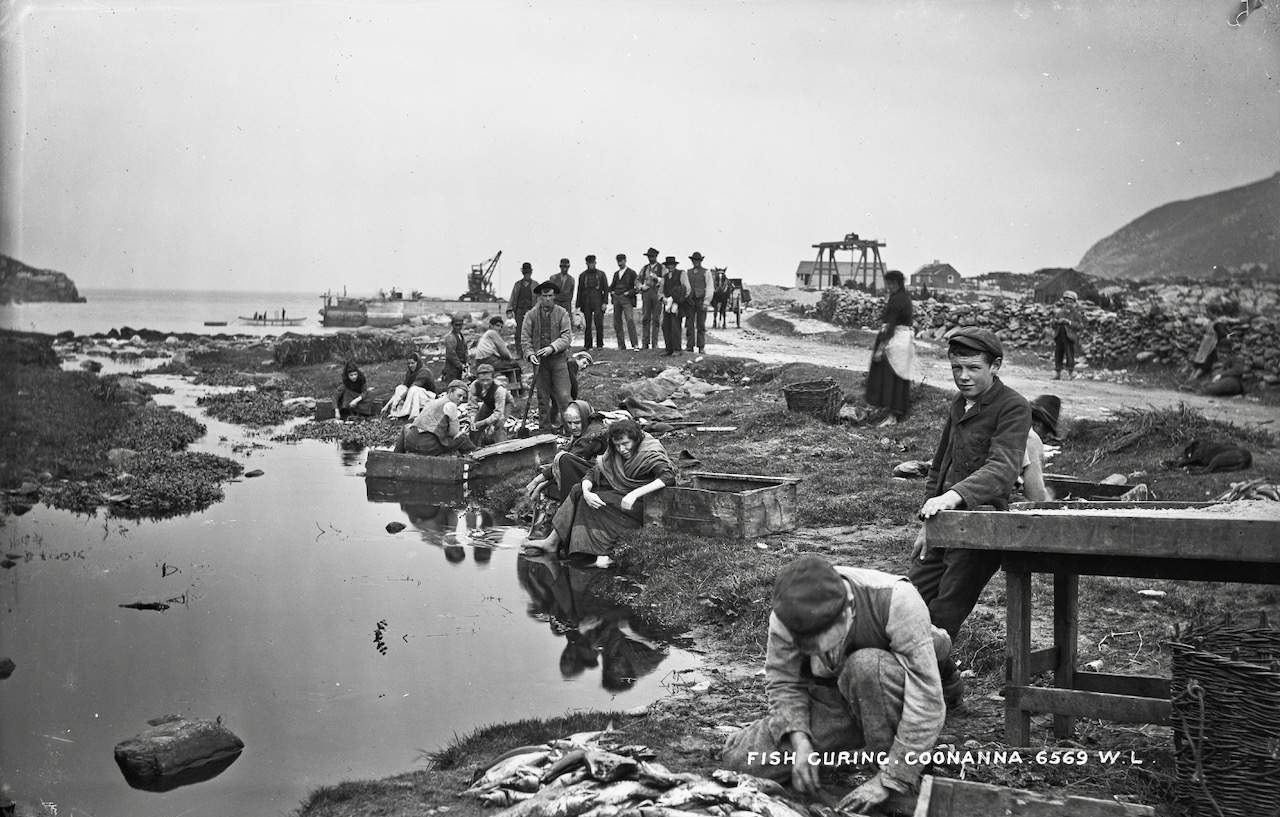
Four years ago I wrote about the fishing industry that once flourished on the shores of Roaringwater Bay (and around much of the west coast of Ireland): according to extant records it was active before 1500, and probably had its heyday in the seventeenth century, when it was heavily invested in by the Great Earl of Cork (Richard Boyle, sometimes described as ‘the richest man in the known world’). In those days, pilchards were the main catch: huge shoals of them came to the comparatively warm, sheltered waters of the islands during the summer months, along with other oily fish such as herring and mackerel. Seine boats were commonly used for this enterprise. Today, pilchards are rare: through a combination of overfishing and changing climate, the bountiful shoals no longer appear.

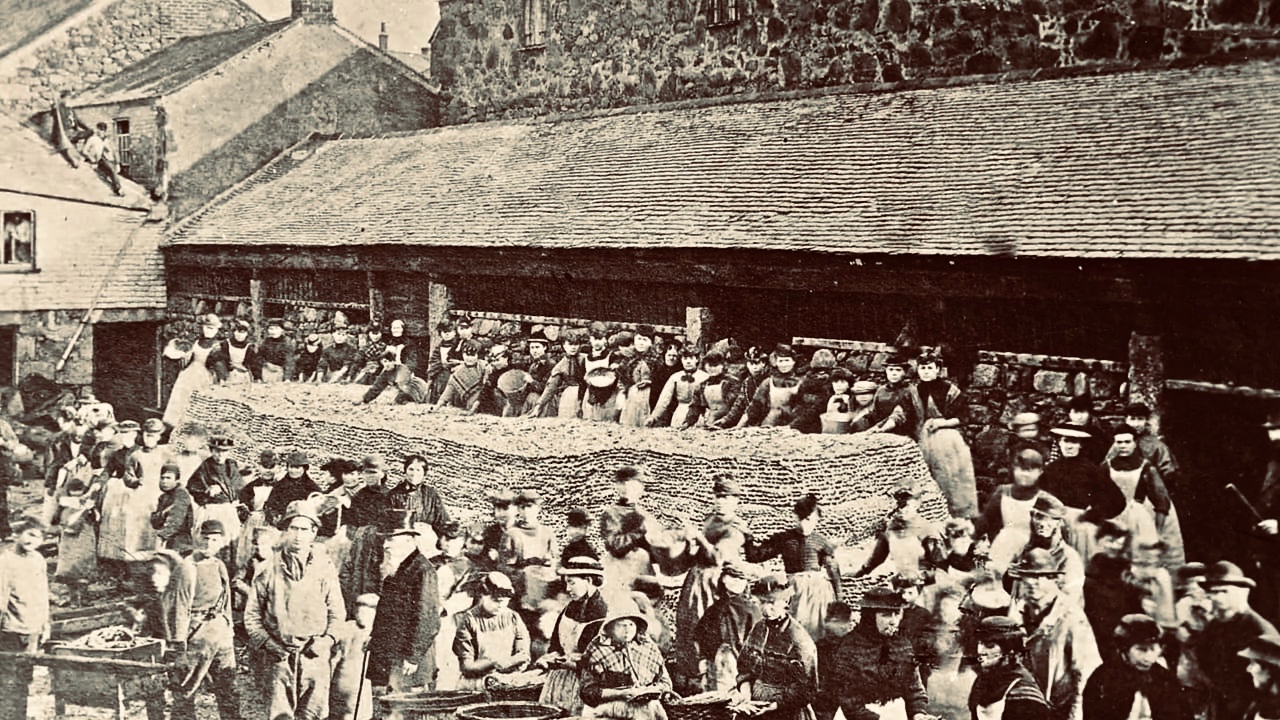
Header – pilchard curing in St Ives, Cornwall c1890: the pilchards are piled up in layers, forming the huge mound in the centre of the photograph. They are salted and weighted down. Above – curing the fish, Valencia Island, Co Kerry, early 20th century (Reddit / Ireland)

Shooting the Seine:

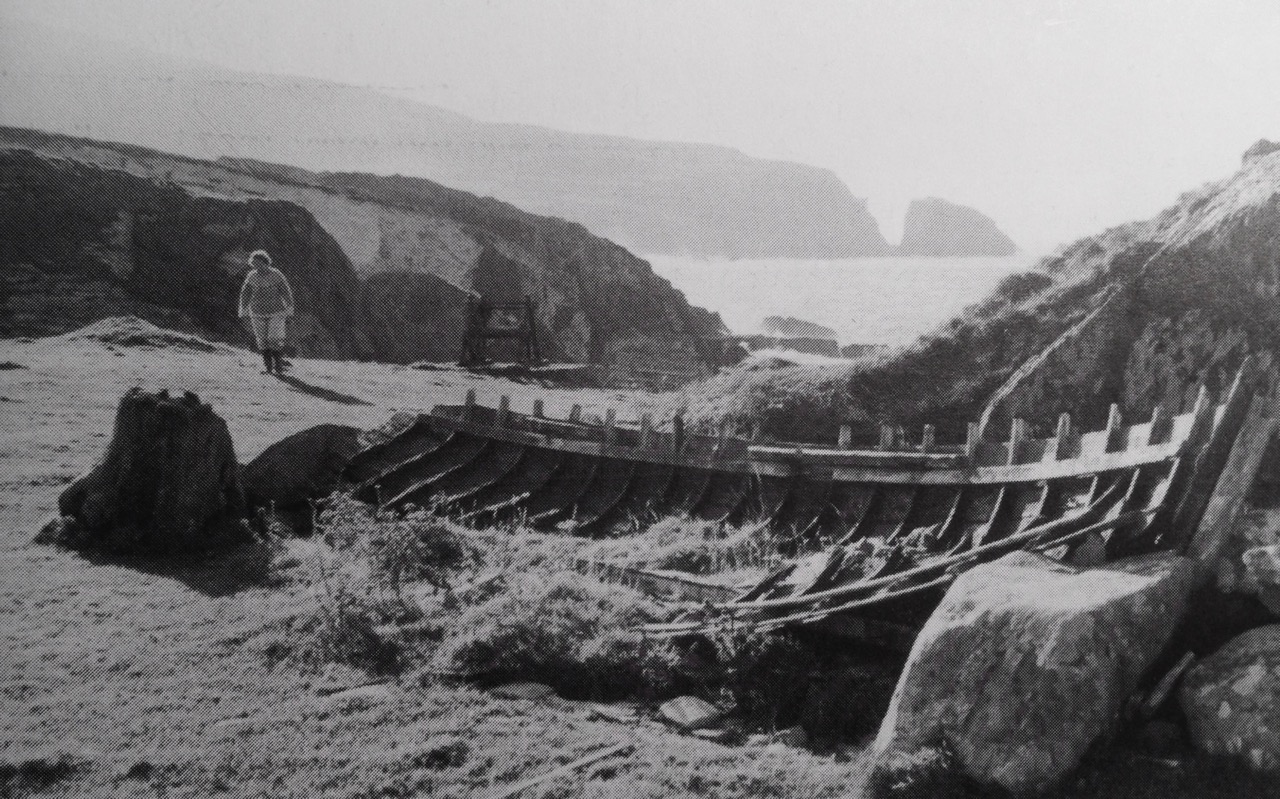
There were two boats per seine net, the seine and the faller. The seine boat was 27 foot long with a beam close to nine foot. The golden rule on the Northside was to never get into a boat whose beam was less than one third its length. The seine boat had five oars of about 17 foot (bow, Béal-tuile, aft, bloc and tiller oars). The crew of seven had to shoot the seine net; one man shooting the trip rope, another to feed out the bunt rope, four men rowing and the huer (master of the seine and captain of the boat) directing the operation. The faller (or bloc) boat was 24 foot long with a crew of five. Its job was stoning and to carry any fish caught. The largest load a faller could carry would be around 5,000 fish. All boats carried a Crucifix and a bottle of Holy Water.

(from Northside of the Mizen by Patrick McCarthy & Richard Hawkes, 1991)

Twentieth century remains of a seine boat, from Northside of the Mizen

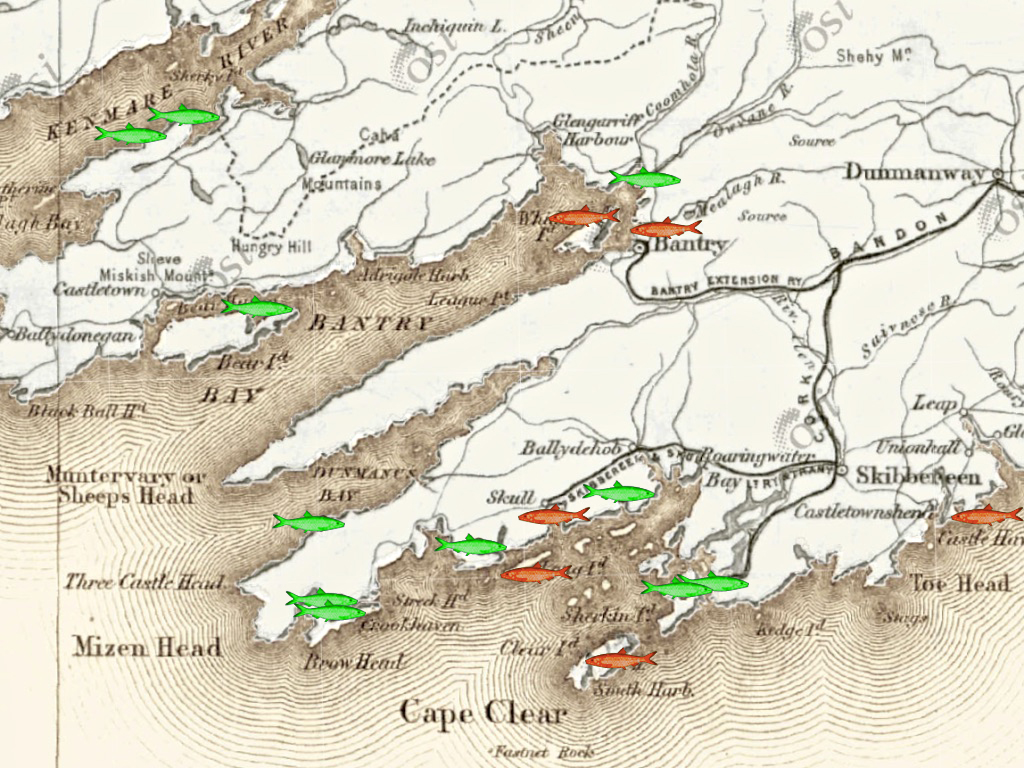
If the fish are gone, remains of the machinery of that industry are still to be seen. In particular, the sites of some of the curing stations – or Fish Palaces – are visible, and are recorded on the National Monuments Archaeological Survey Database. Take a look at the map below: I have drawn green pilchards to show the sites of fish palaces mentioned in the database – eleven in all on this section of the map. Also shown by red pilchards, however, are the sites of another six ‘curing stations’: these are mentioned in a long article by historian Arthur E J Went, Pilchards in the South of Ireland, published in the Journal of the Cork Historical and Archaeological Society in 1949: Volume 51, pages 137 – 157.

Known sites – or historical mention of – fish palaces (curing stations) in the South West of Ireland (information from  National Monuments database and  Arthur E J Went, Pilchards in the South of Ireland 1949)

The active fishing of pilchards on a large scale in Ireland has been discontinued for many years so that, unlike Cornwall, there is little left, apart from published records, to indicate its former importance. There is, however, published information as to the methods of fishing, and a few sites of old curing stations, frequently called pallices, can still be identified.

from Arthur E J Went, Pilchards in the South of Ireland, 1949

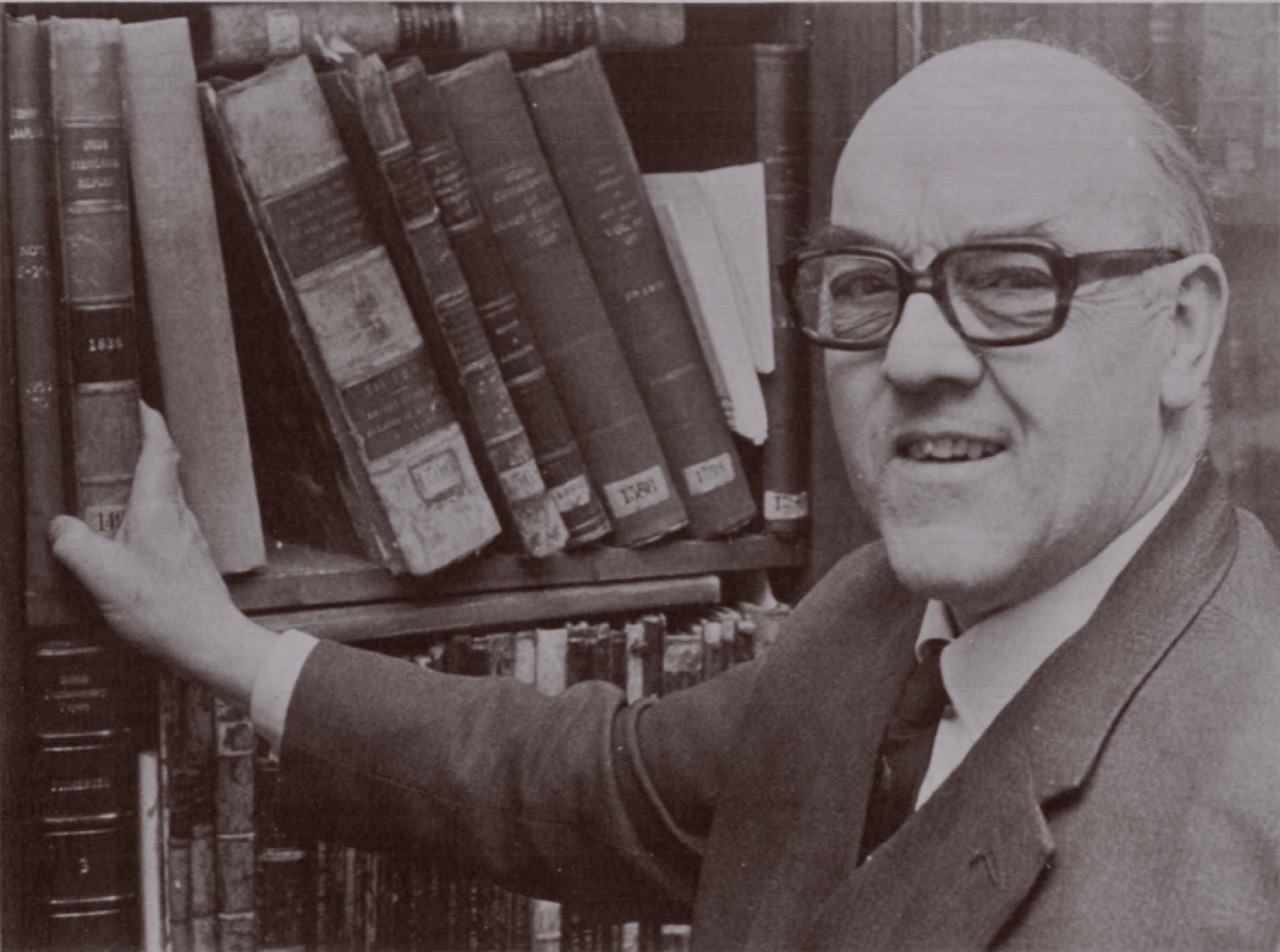
Arthur Edward James Went (1910–80), noted fisheries biologist and historian, lived at Sandycove, Co Dublin. In 1936 he was appointed Assistant Inspector of Fisheries in the Department of Agriculture, Dublin, and later was promoted to the position of Scientific Adviser and Chief Inspector of Fisheries

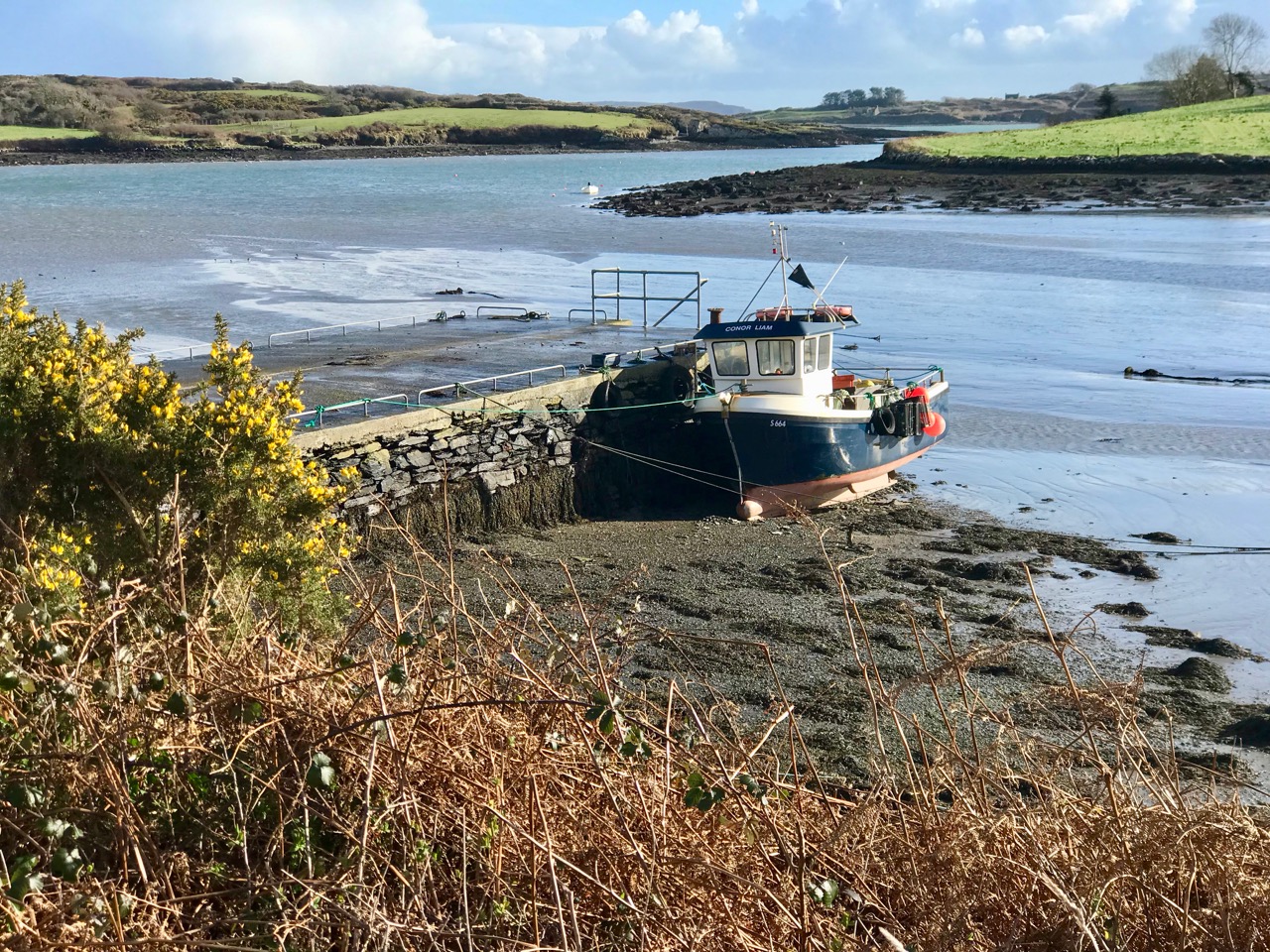
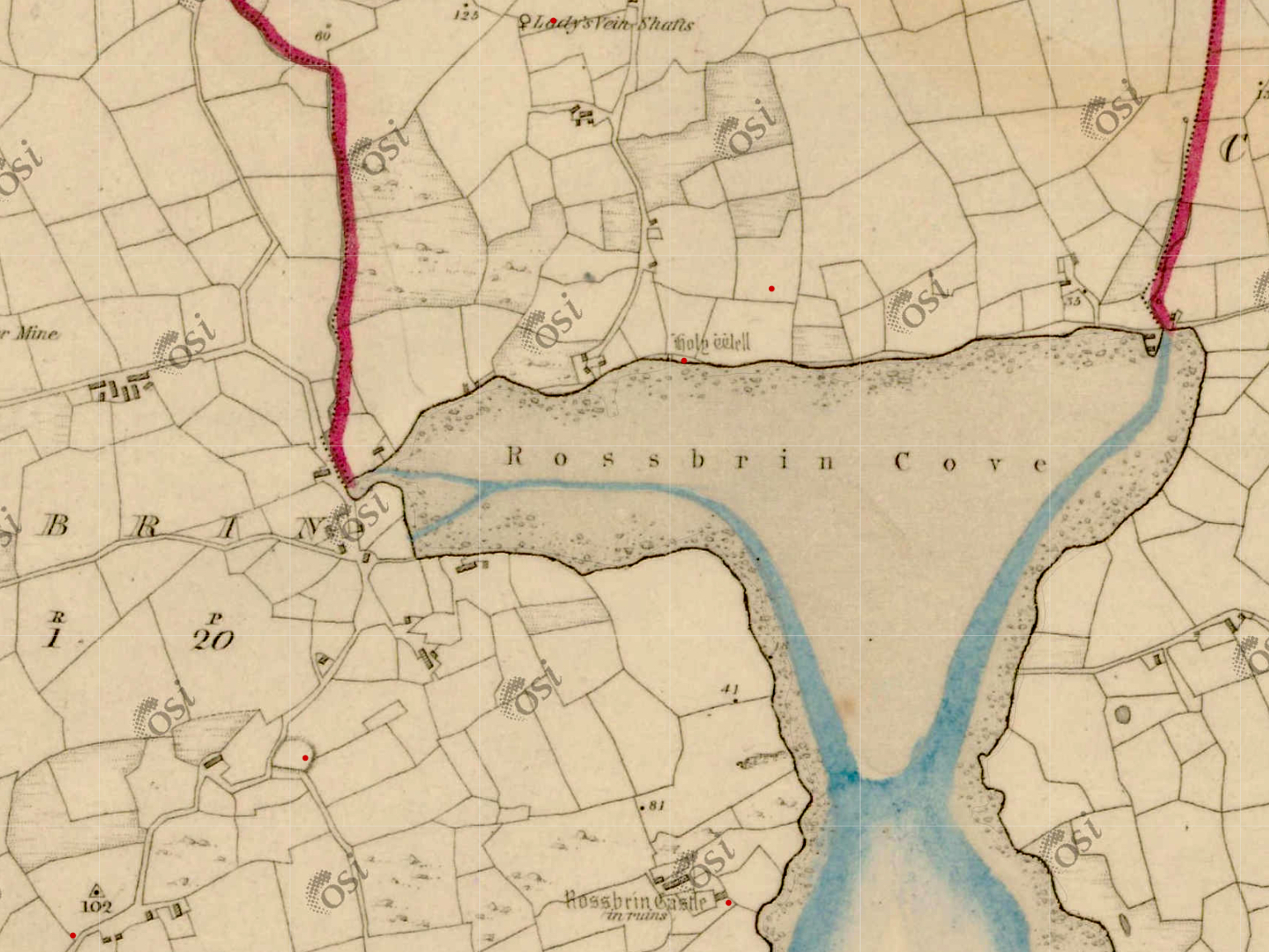
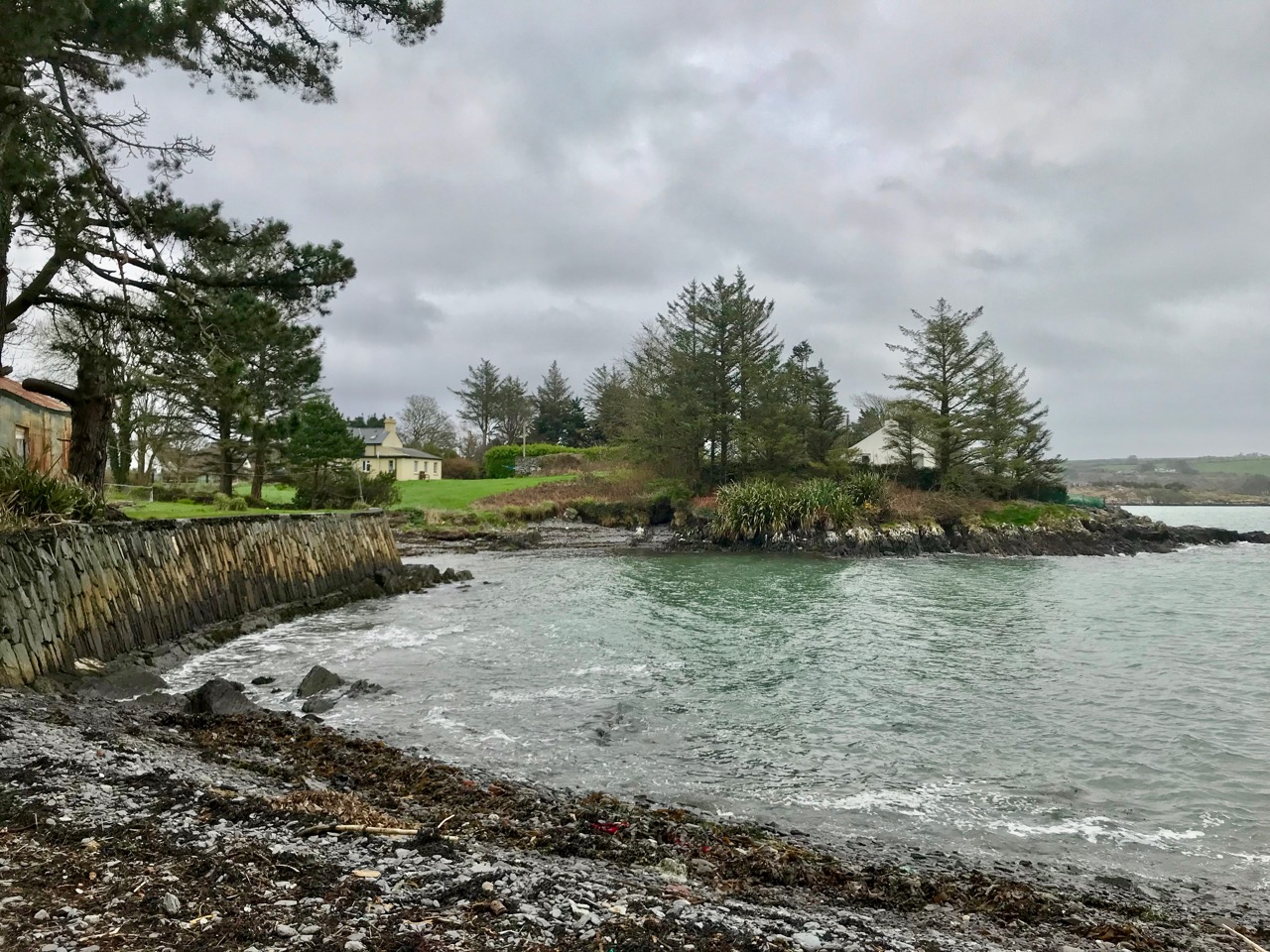
As explorers of all things historic and archaeological – particularly in West Cork – Finola and I couldn’t resist visiting some of the sites of Palaces – or Pallices – documented in these studies. We have always know about the one nearest to Nead an Iolair, in Rossbrin Cove – it’s just down the road: a perfect sheltered harbour, although it does dry out at very low tides. However, there seems to be some debate about exactly where this one is located. It would date from the time of William Hull and the Great Earl of Cork, so how much would be left after 500 years? There is a field on the north shore of the Cove with an old name: The Palleashes which, according to Arthur Went (quoting local tradition), was the site of a curing station for pilchards, operated by the ‘Spaniards’. There seems to be some difference of opinion locally as to which of the many small fields here is the actual site, although it is likely to be close to the large, now modernised quay, as this shows up on the earliest maps.

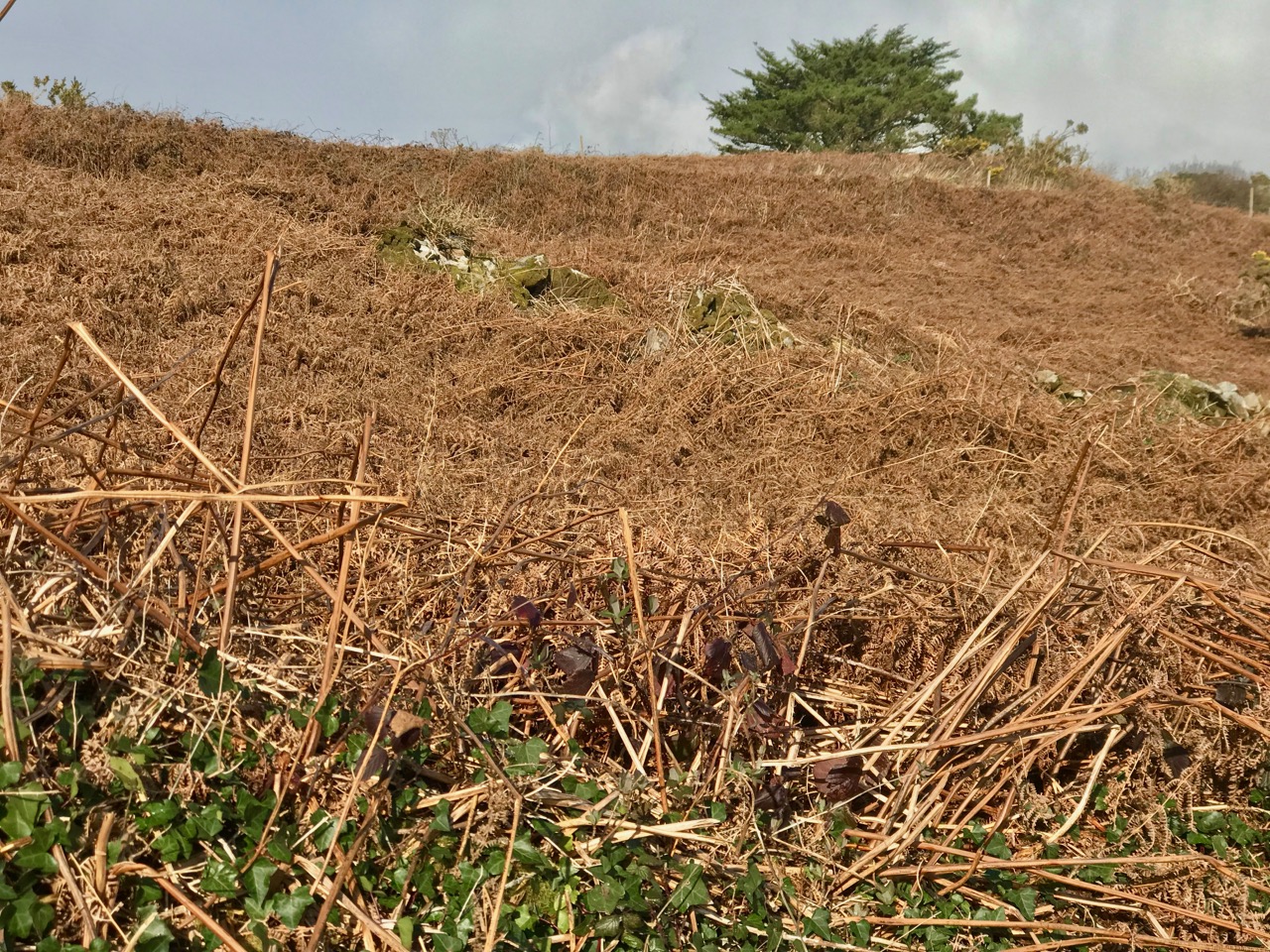
In the upper picture: the quay at Rossbrin is still used by small fishing boats today. Centre – the field above the present quay may be The Palleashes, and therefore could be the site of the medieval fish palace: there are very overgrown signs of stone walls here. Lower picture – the old 6″ OS map, surveyed around 1840, shows a lane accessing the area above the quay (to the left of the ‘Holy Well’ – that lane is no longer there today) and there are buildings close to the shore which could indicate the palace. In 1840 there was no road running along the north shore of the Cove, but the strand at low tide would have been used as a thoroughfare. Just above the ‘Holy Well’ indicated on the shoreline – and slightly to the right – is a small red dot. This is the area shown by Arthur Went as the possible site of the fish palace (and subsequently marked as such on the Archaeological Database); in my opinion it is more likely to have been directly accessed from the water.

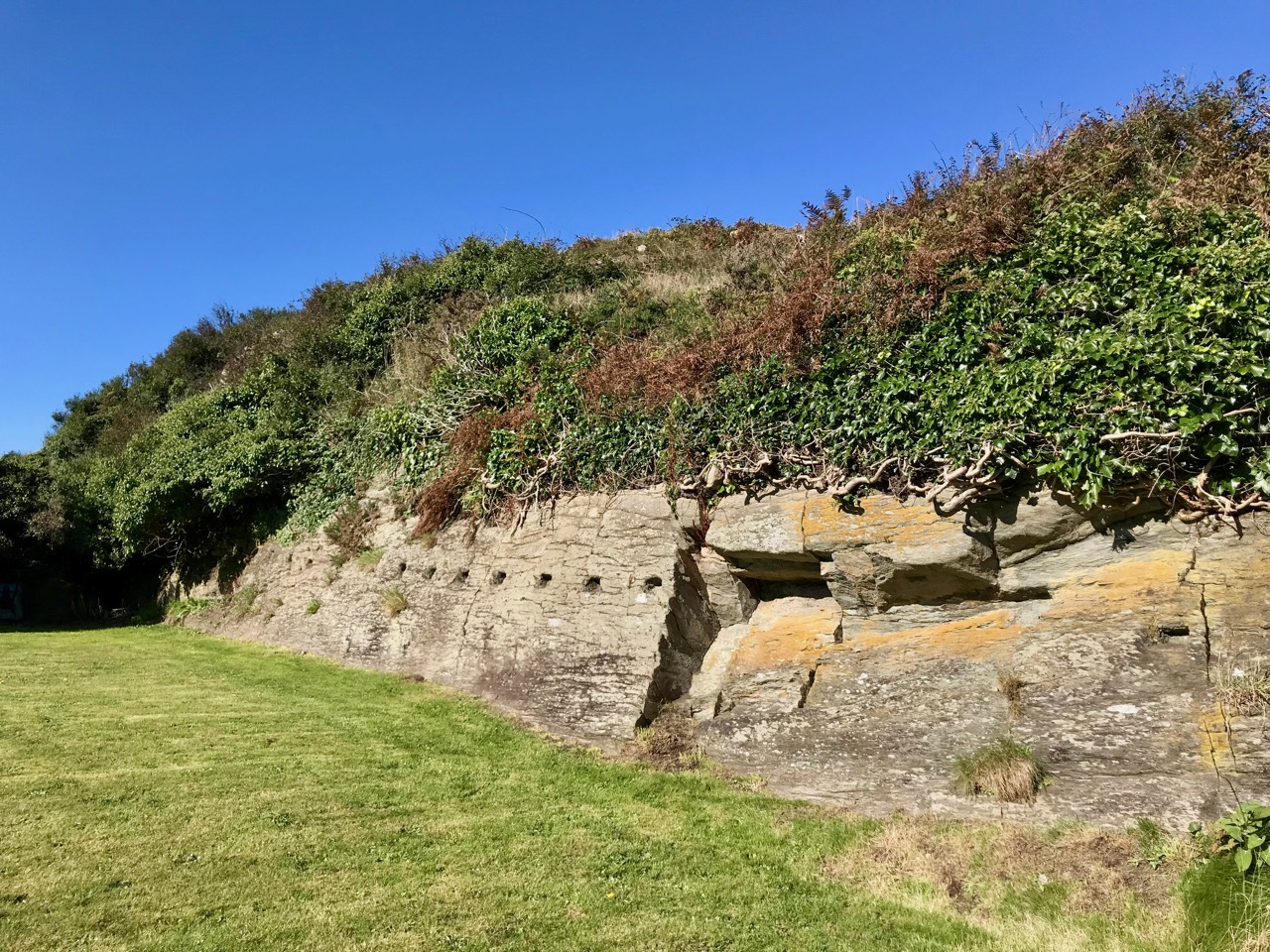
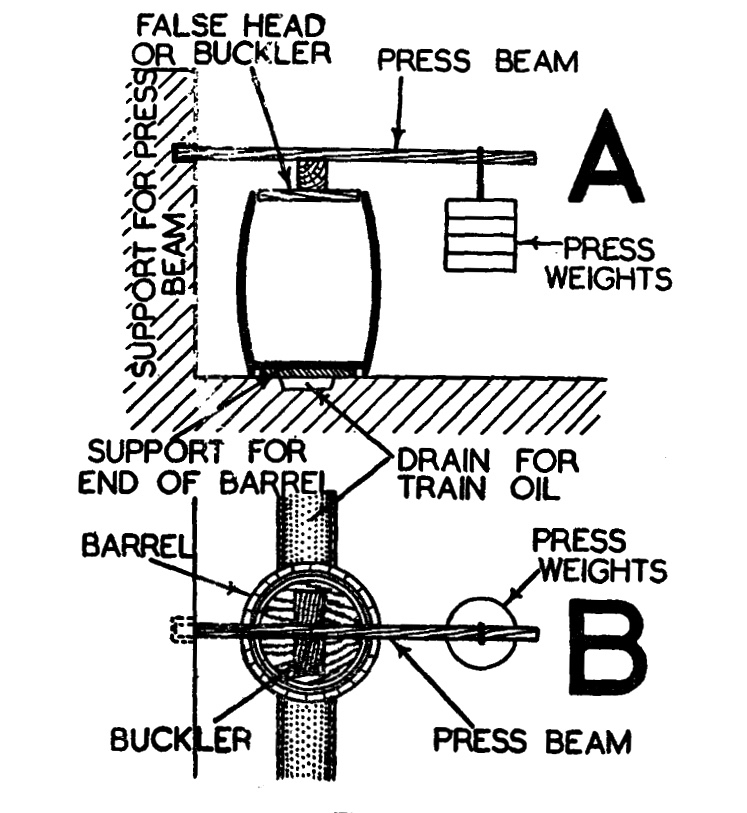
A sure sign of the site of a fish palace is a line of perforations or holes – as can be seen above at Baltimore, where a substantial curing station is recorded (although it may only date from the nineteenth century). Large timbers were inserted horizontally into these holes to form a ‘press beam’ to provide leverage for bucklers to squash out the oil from the salted pilchards, as shown in Arthur Went’s diagram, below:

The ‘Train Oil’ – produced from the compressed pilchards – was a valuable commodity, and was collected to be stored and used for treating leather, and as fuel for lamps. As a by-product of the pilchard industry it was said to be as valuable as the fish themselves.

Palace Strand, in Schull

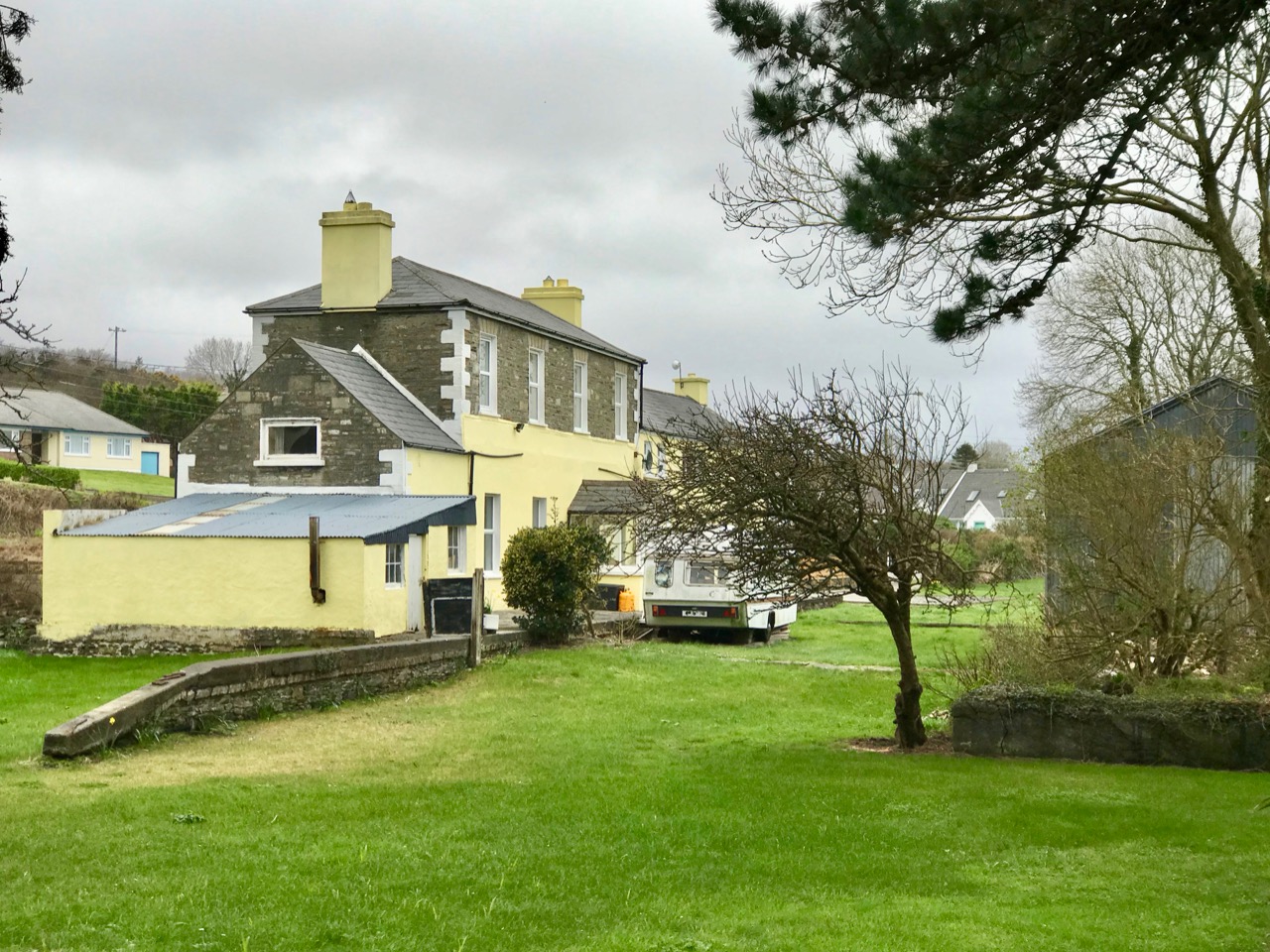
To continue my researches I went along to Schull, where Arthur Went mentions a ‘Palace House’ on ‘Palace Strand’ – an inlet just to the east of the main harbour. This is right beside the old railway station which was not quite the terminus of the Schull & Skibbereen Railway, as a spur went on from the station to serve the harbour itself. The station buildings and part of the platform are still there – now a private residence. I could not find anything in the area shown on Went’s map at the east end of the strand, but I did find something at the west end.

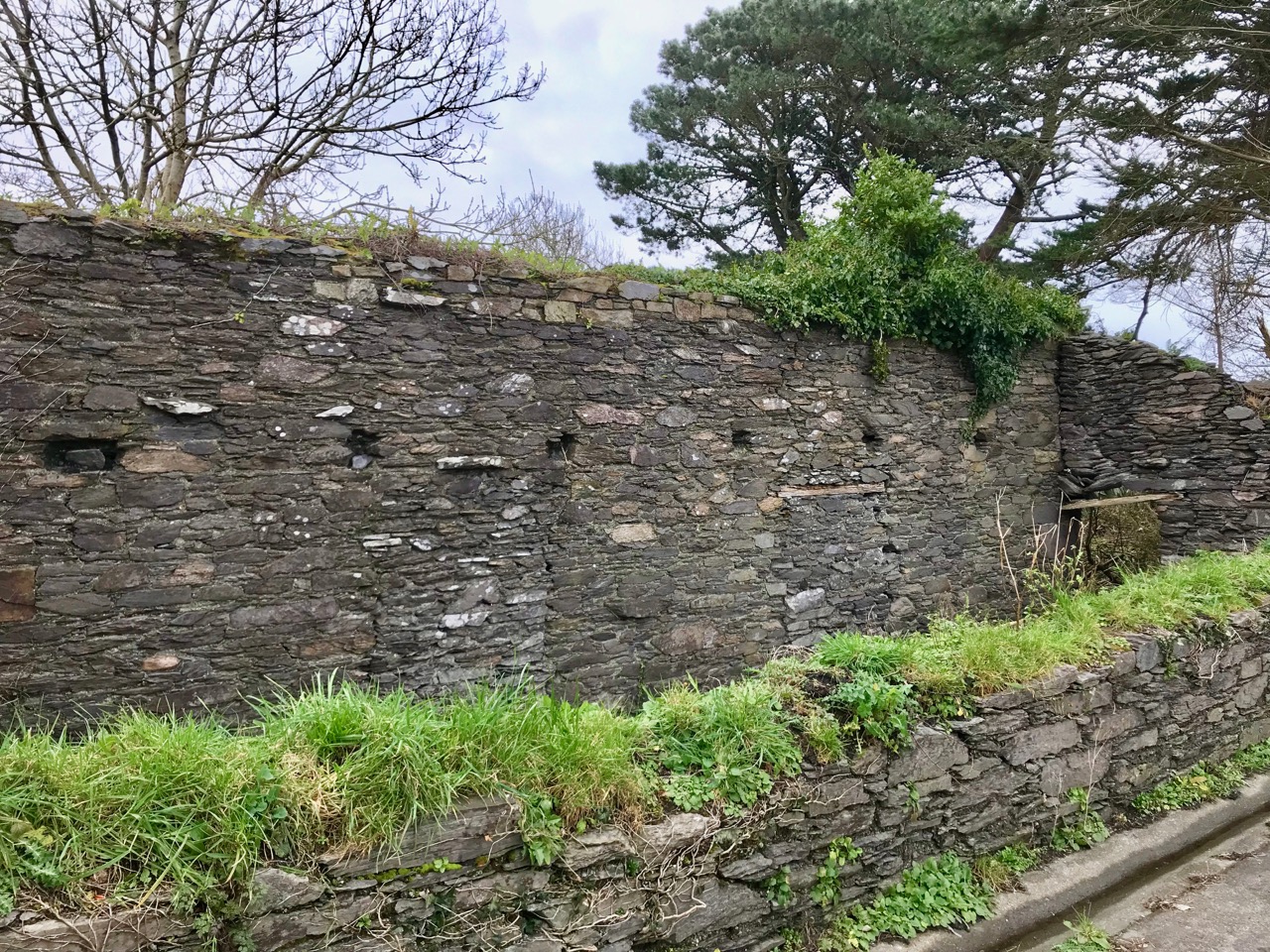
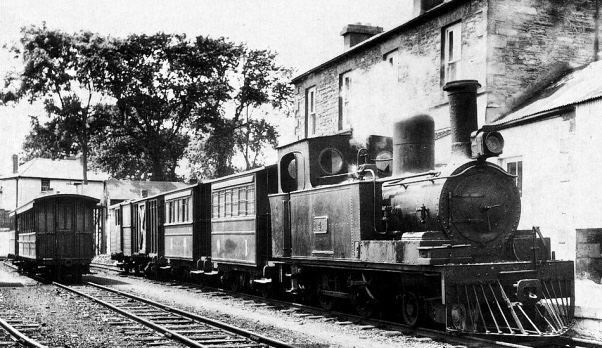
In the upper picture is a wall on the western boundary of the old station site in Schull. This contains beam holes very similar in size and spacing to those we have seen in fish palaces elsewhere: it’s very tempting to think that this wall – now part of a derelict building – may have had this purpose, as it is well situated close to the shoreline of Palace Strand. If this was a fish palace, it is also likely to date from the nineteenth century, as the early Ordnance Survey maps don’t indicate it. The centre picture shows the old station buildings today, and the lower picture taken at Schull Station in 1939 reminds us of past times: the railway closed in 1947.

This post is a ‘taster’ for a fully illustrated talk I’m giving at Bank House, Ballydehob, on Tuesday 26 February at 8pm: Pilchards & Palaces – 300 years of Fishing in South-West Ireland. It’s part of the Autumn series of Ballydehob’s ‘Talks at the Vaults’

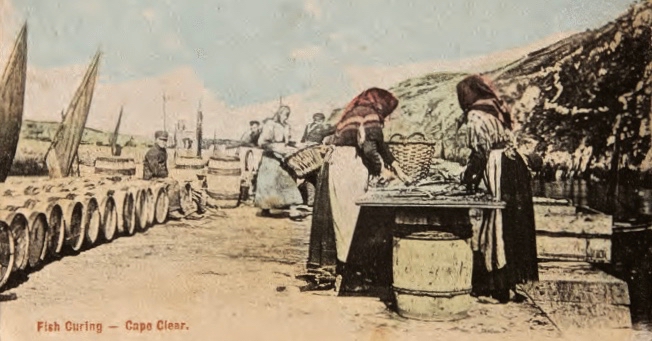
Below – a postcard showing fish curing on Cape Clear in 1906 (from Hely’s, Dublin)

Valentia Adventure

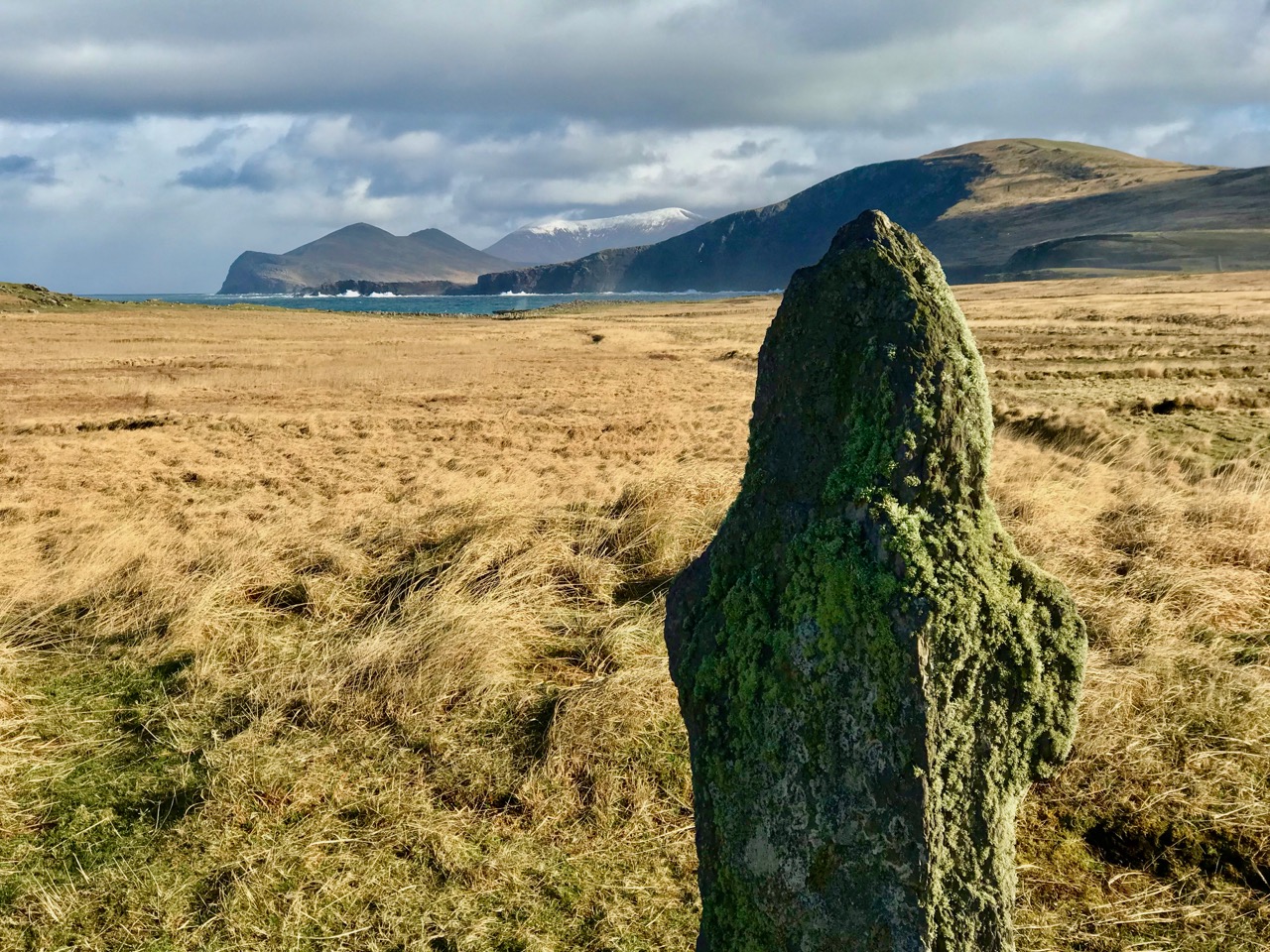
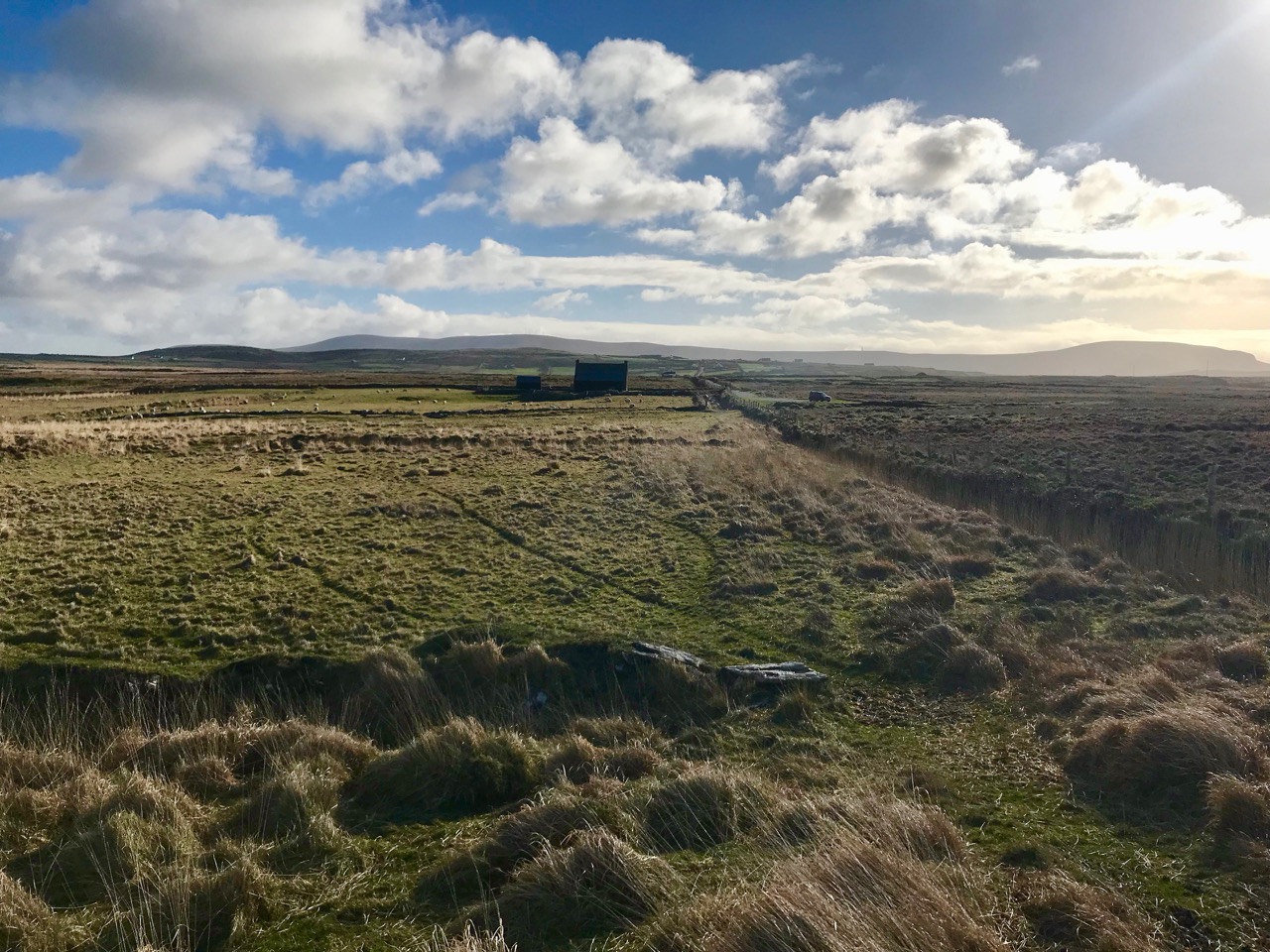
At the very end of January – when we should have been in the dark depths of winter – we headed off to Valentia Island in County Kerry, and enjoyed sublime golden sun. This time of the year often gives us the best light: we experienced this on our expedition through the Yellow Gap in West Cork a fortnight ago, and again during these three days in our neighbouring county last week. It’s to do with the low sun: somehow it enriches the amber hues of the landscapes, which are themselves enhanced by backdrops such as the one above. An ancient stone is set against a distant turquoise ocean and dark, snow-capped mountain peaks.

Holy wells were on the agenda (see Finola’s post here), as we were joining our friends Amanda and Peter Clarke from the Sheep’s Head. Amanda has nearly come to the end of her chronicle which records all the Holy Wells in County Cork, and she is now starting to explore those in County Kerry. I’m not going to say too much about the wells we saw, as Amanda will cover them in great detail, but the expedition certainly provided great opportunities for observation and photography, and caused us to wonder – again – at this unique aspect of Ireland’s history and traditions.

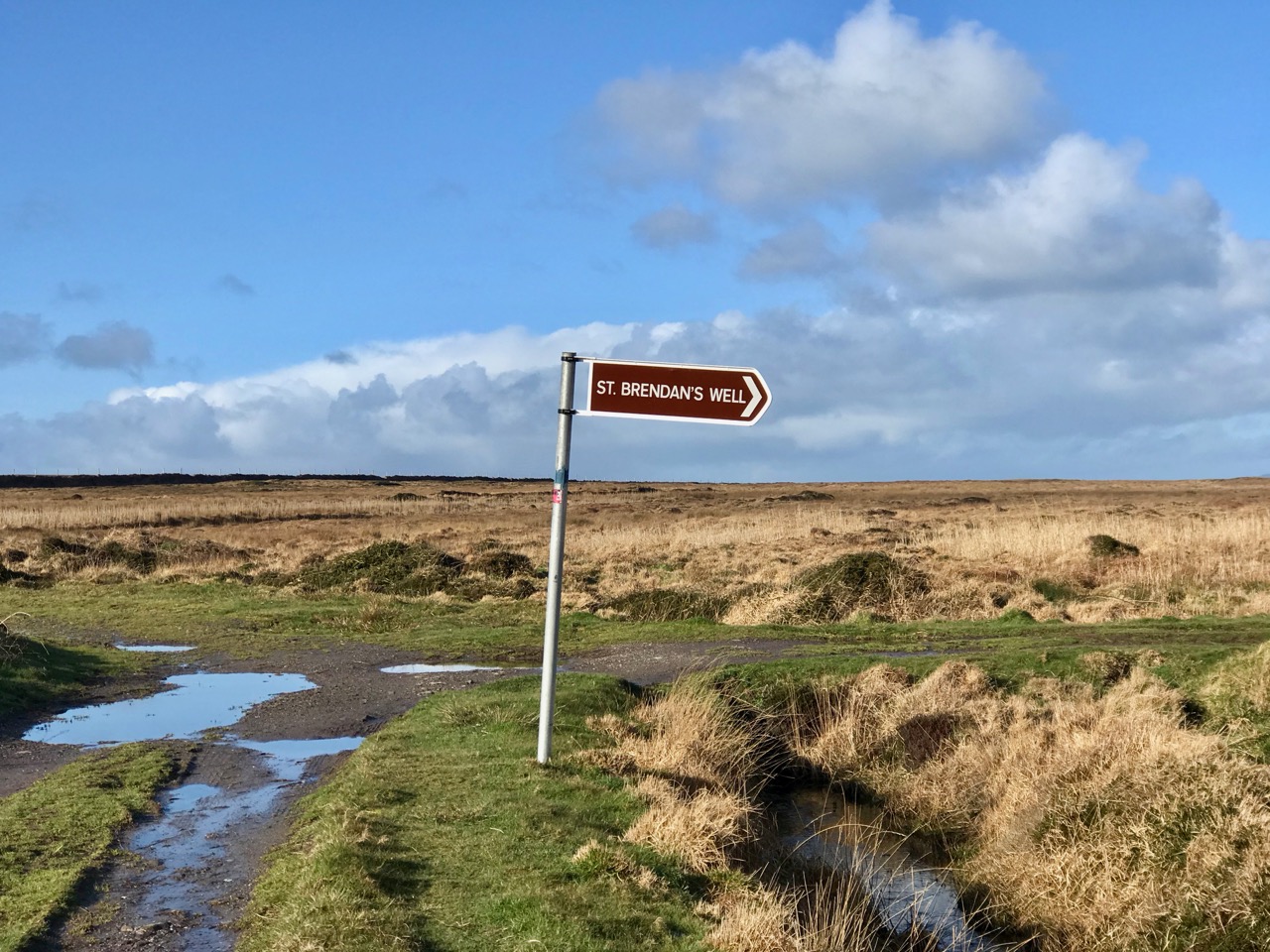
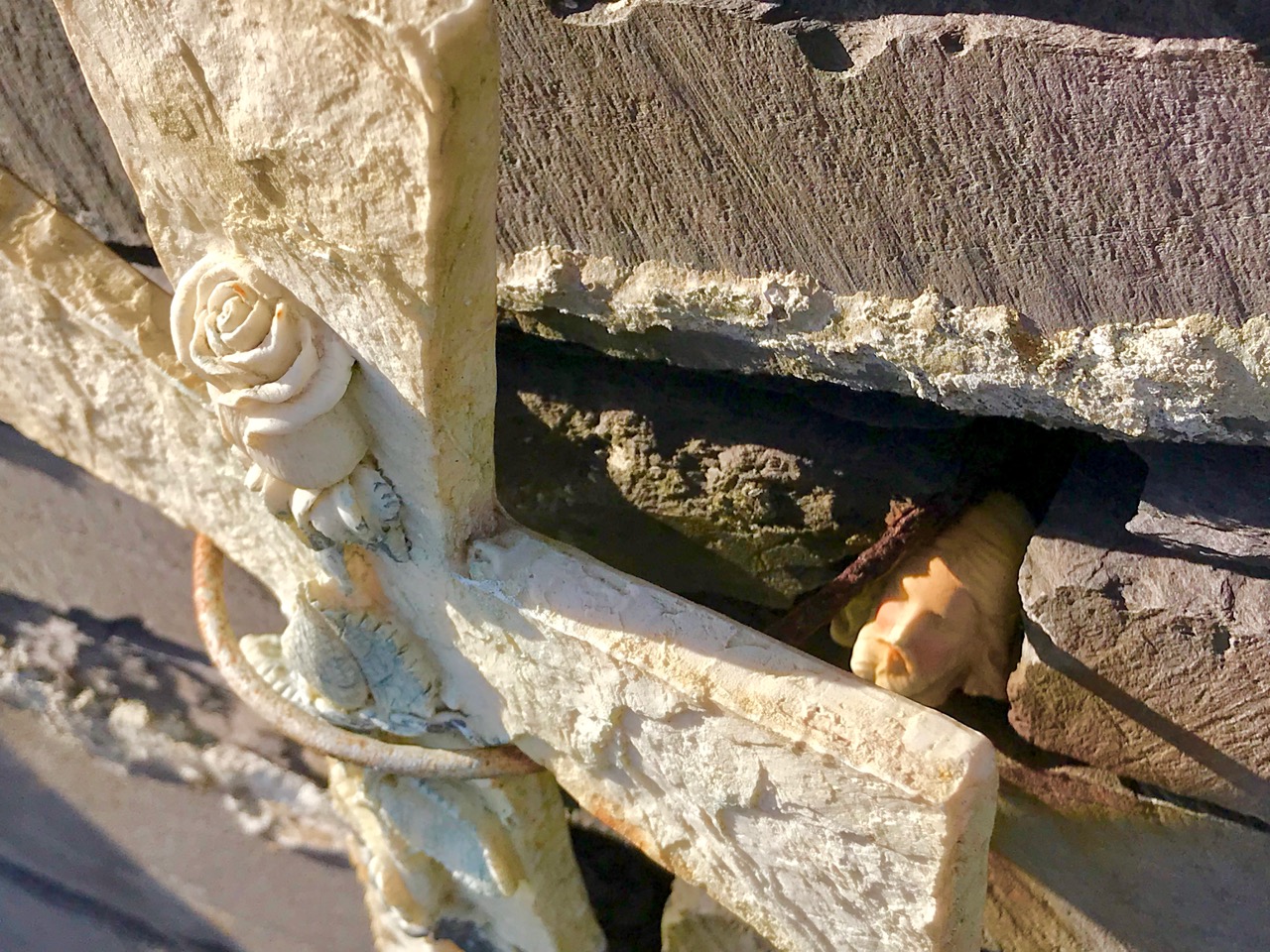
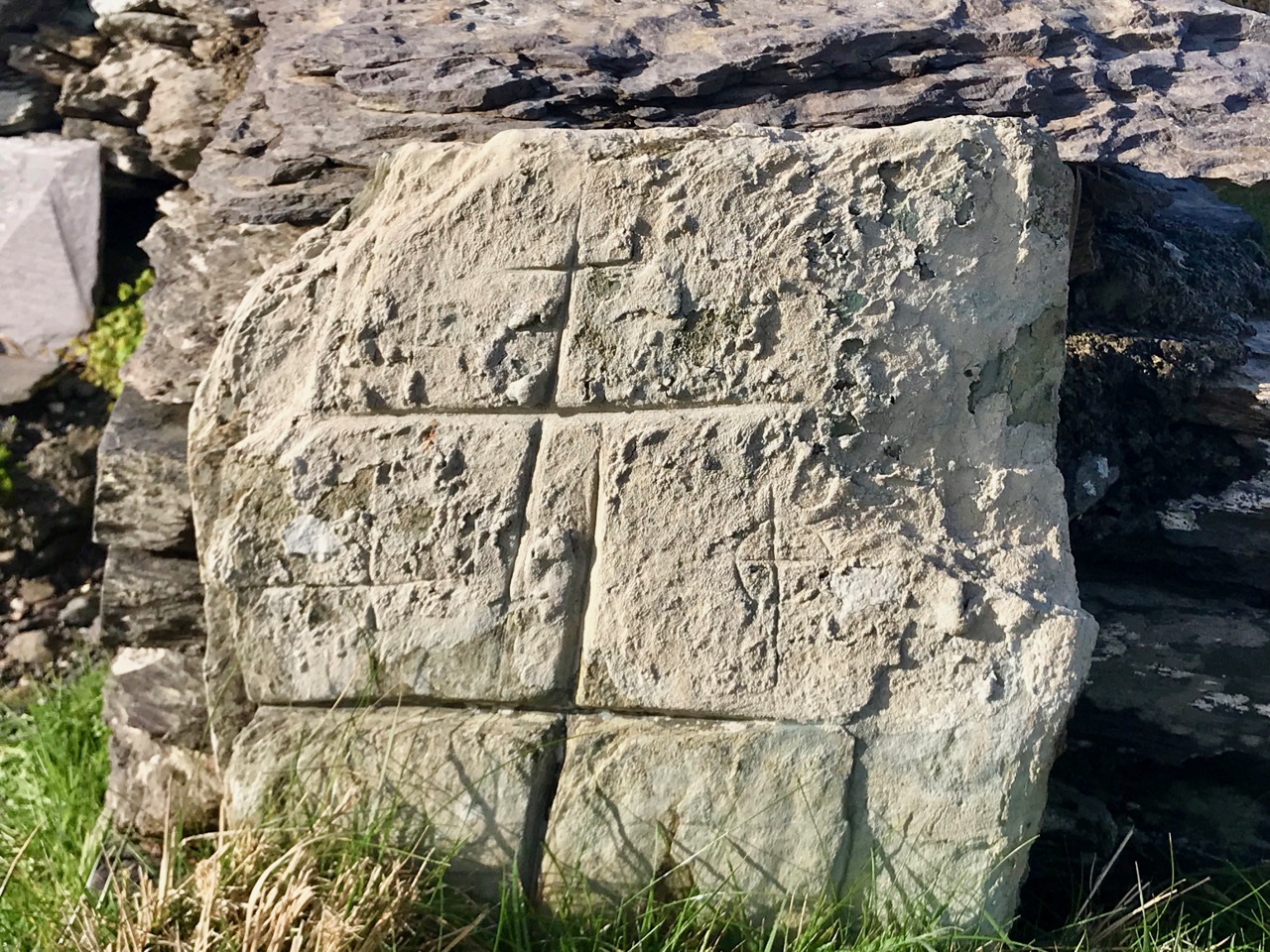
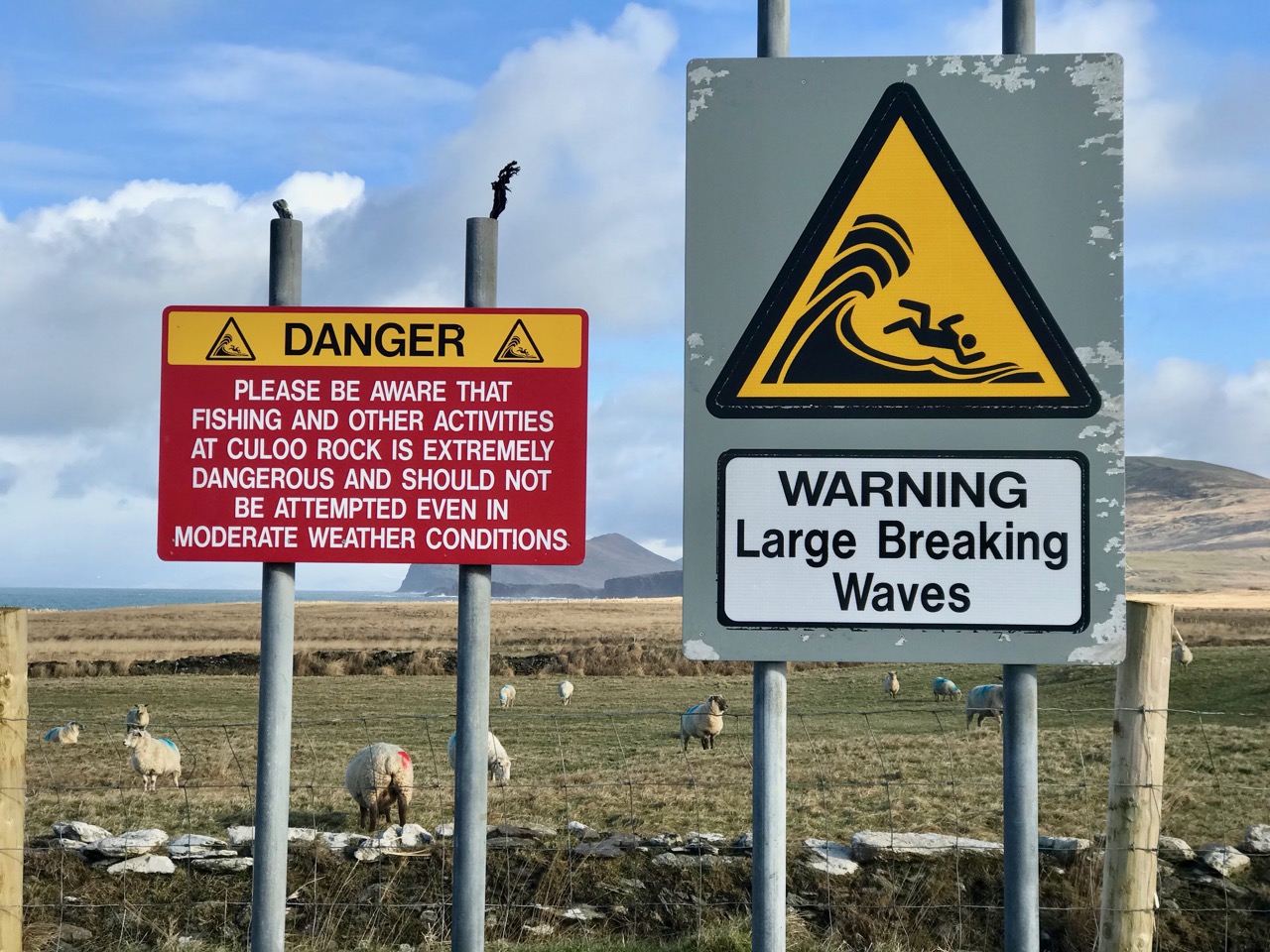
All the photographs above are from a remote and atmospheric site on the north west side of Valentia Island: St Brendan’s Holy Well. It’s a long way off the beaten track: desolate, bleak and boggy – but justifies making the effort. There are ancient stone crosses, carved slabs, cures to be had, and history. St Brendan himself journeyed there from Tralee in the fifth century, climbed the cliffs at Culoo, and found two dying pagans at the site: he anointed them and they became Valentia’s first Christian converts.

Above – the way to St Brendan’s Well, Valentia Island, passes by O’Shea’s Pub . . . one of the furthest flung bars in the world, that you can’t—and could never—buy a proper pint at . . . The story is here.

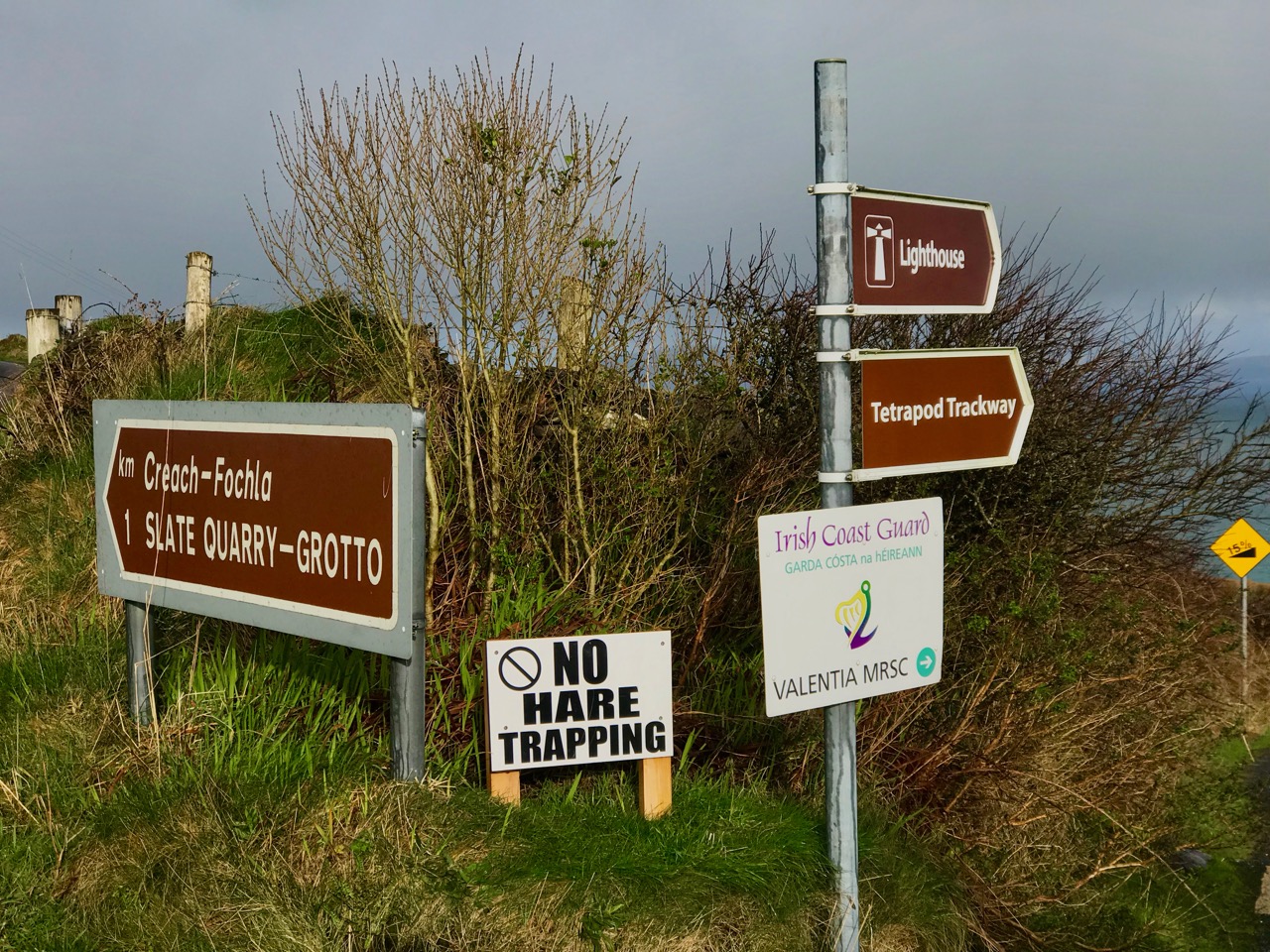
I certainly endorse that sign in the centre, seen on Valentia Island. Hare trapping in South Kerry is illegal – and so it should be! But – how could we not follow a sign that says: Slate Quarry – Grotto?

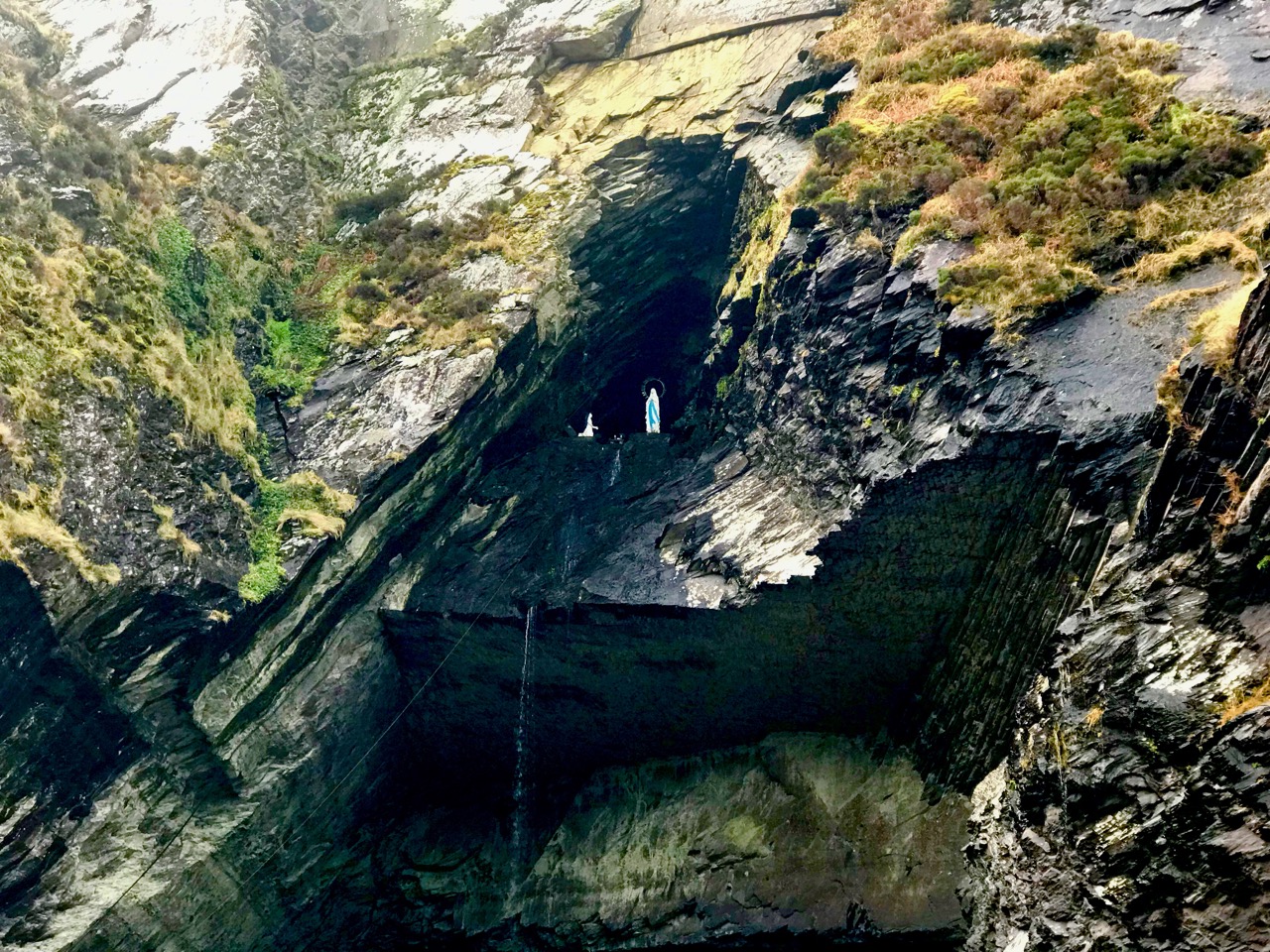
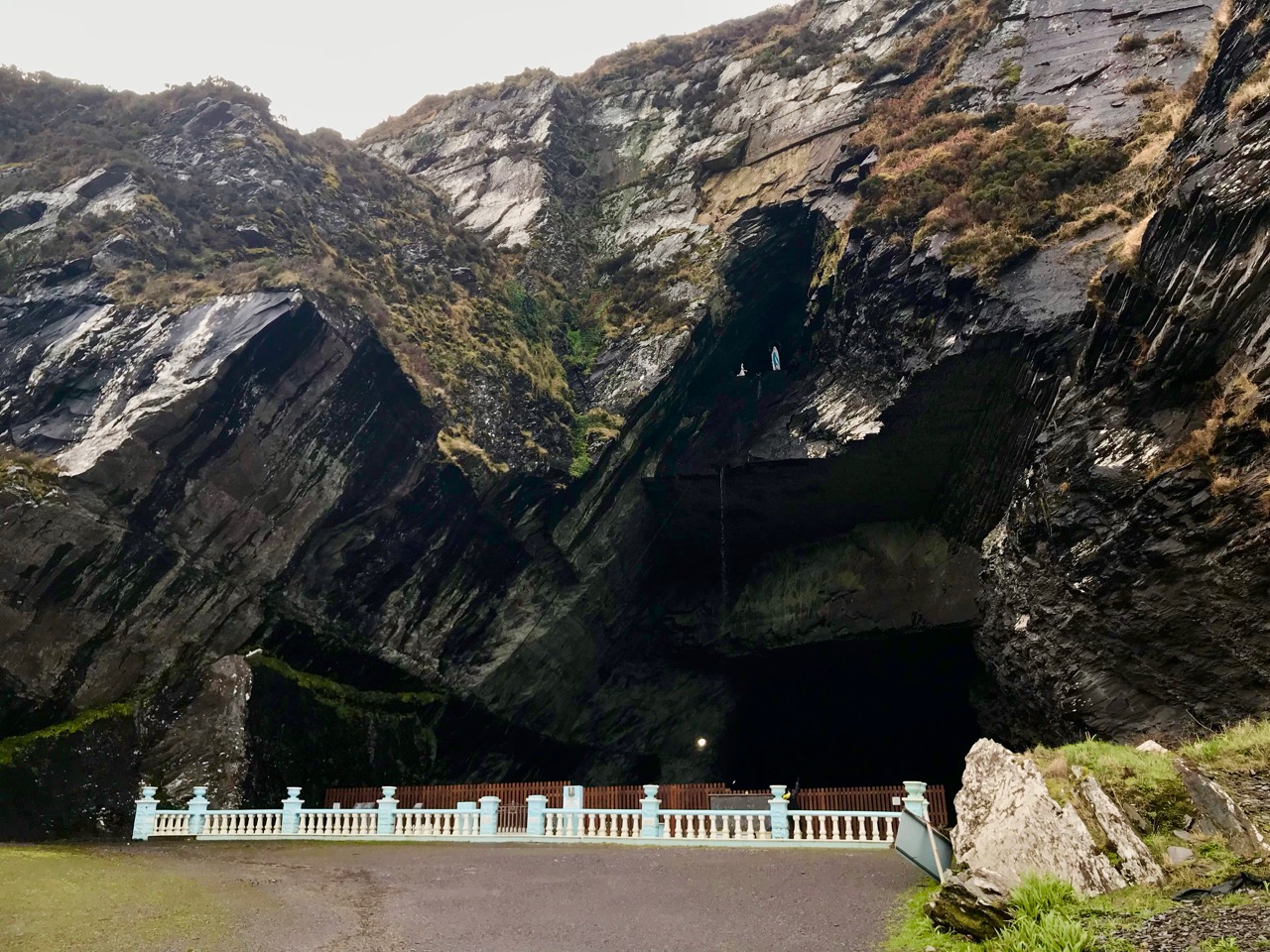
The Grotto – in this case a statue of the BVM together with Saint Marie-Bernadette Soubirous, the girl who witnessed Mary’s apparition in Lourdes – was installed in the Marian Year of 1954 in a cave high above the entrance to the Valentia Slate Quarry on Geokaun Mountain, at the north end of the Island. The Quarry had been opened in 1816 and supplied slate to the Palace of Westminster, Westminster Abbey, St Paul’s Cathedral, London railway stations and many another building project. The quarry excavated a huge cave into the mountainside, and closed after a major rockfall in 1910.

Fr James Enright, who was the PP of Valentia in the Marian Year, saw a golden opportunity in such a setting for a commemorative grotto. Fr Enright decided exactly where the statues were to be positioned, but the burning issue was how were these heavy items going to be put in place and worked upon at over 90 feet from ground level? The answer came in the building of a deal timber ladder.


Jackie Clifford , who was a blacksmith based in Gortgower, made the iron to bind and reinforce the ladder and was helped in his forge by Denny Lyne and subsequently aided by other islanders. Having been transported to the quarry in sections, it was assembled there and put in place by the volunteering islanders. The ladder was over 100 feet long, being four feet wide at the bottom narrowing to a foot. and a half on top. The sections of ladder were joined at the various points with a four foot lap. Many island volunteers were enlisted with each townland taking their turns to work. The initial work involved levelling a massive mound in order to form a proper base. This was quite labour intensive, being done with pick and shovel. The ladder was hauled into place by means of a block and tackle pulley system with people at the ends of ropes from above and to the sides in order to control it and put it in place. As one islander succinctly put it “The greatest miracle to happen there was the erection of the ladder”.


Subsequent to the ladder being put in place, a number of daring and intrepid islanders had to climb it for the purpose of erecting the statues. The statues were hoisted up by rope with other tools and building materials. The concrete for the base was mixed by shovel above.

(Quote from The Kerryman, January 2015)

The Quarry has recently reopened, and it’s quite surreal to stand in front of the grotto with the sound of heavy machinery reverberating at the huge cave mouth from deep within the mountain.

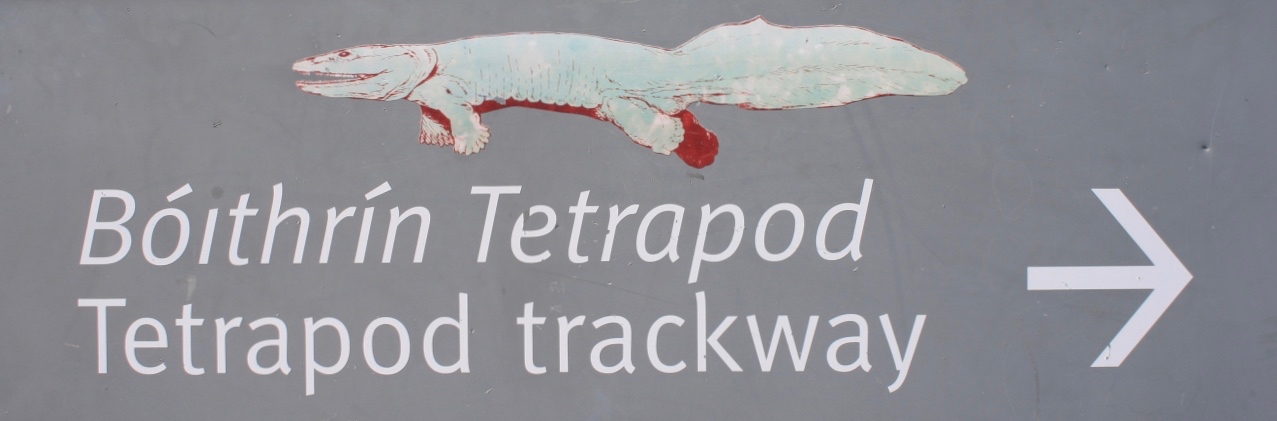
Have a look again at the signs above: one points to ‘Tetrapod Trackway’. This is surely a must-see for any visitor to Valentia Island as the fossilised Tetropod footprints here, representing the point at which life left the Devonian Seas 370 million years ago to begin to evolve on dry land, are the best examples of only four sites found to date in the world! We hurried to have a look – but the site was closed for repairs. You can see a picture of the tracks here.

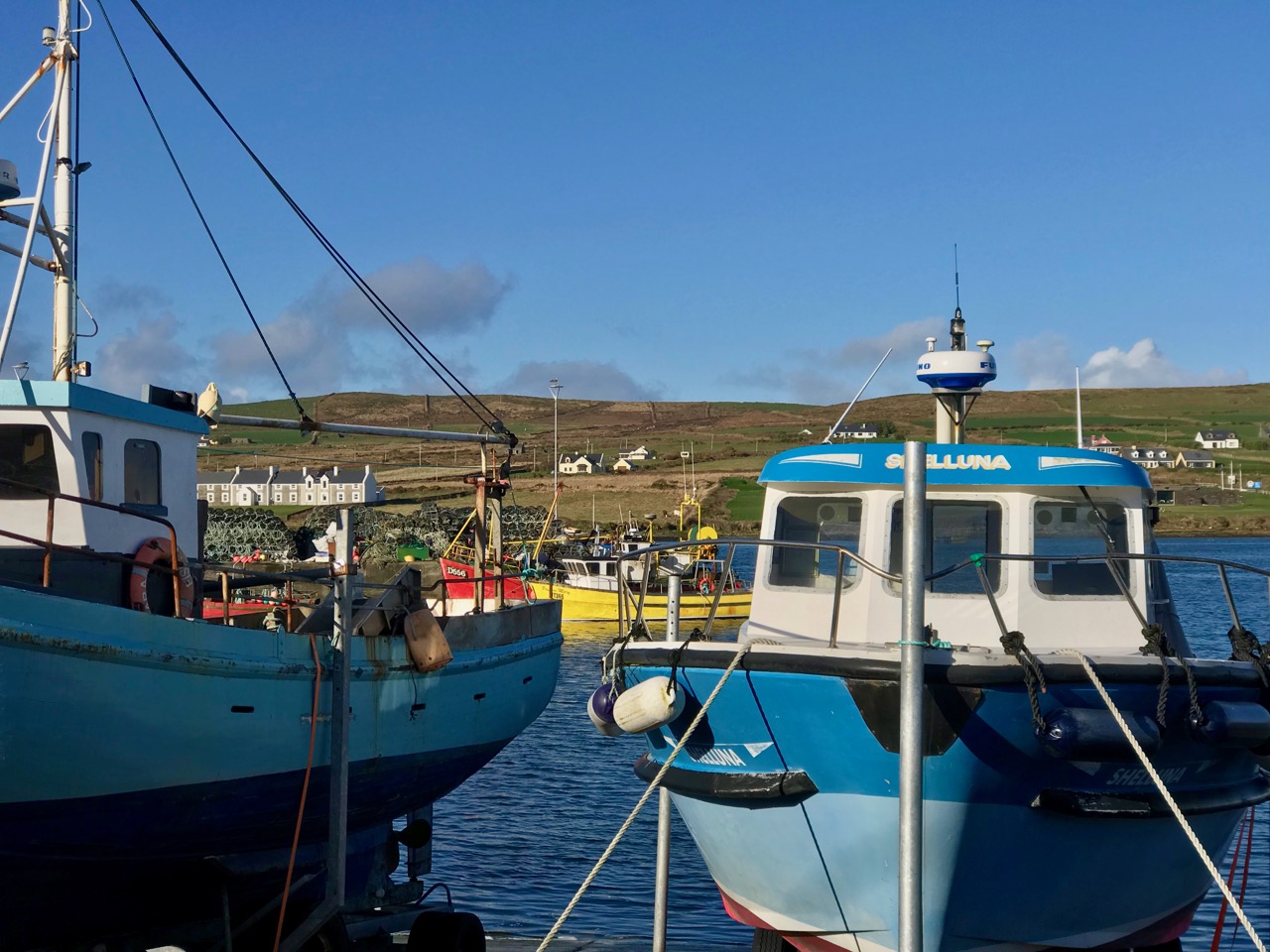
In the winter sunlight, the little village of Portmagee which stands at the threshold of Valentia Island and connects to it by a bridge opened in 1971, looks like a picture postcard. In fact, the bridge was opened twice – once on New Year’s Day, when it was blessed by the Bishop of Kerry – and again at Easter, because there was some debate about whether the first opening had been ‘official’ or not!

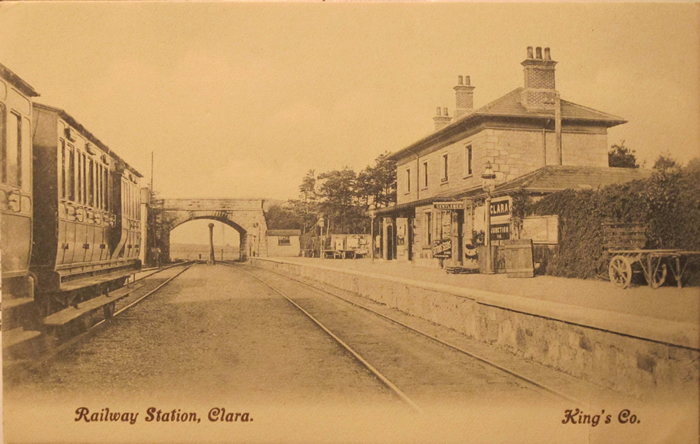
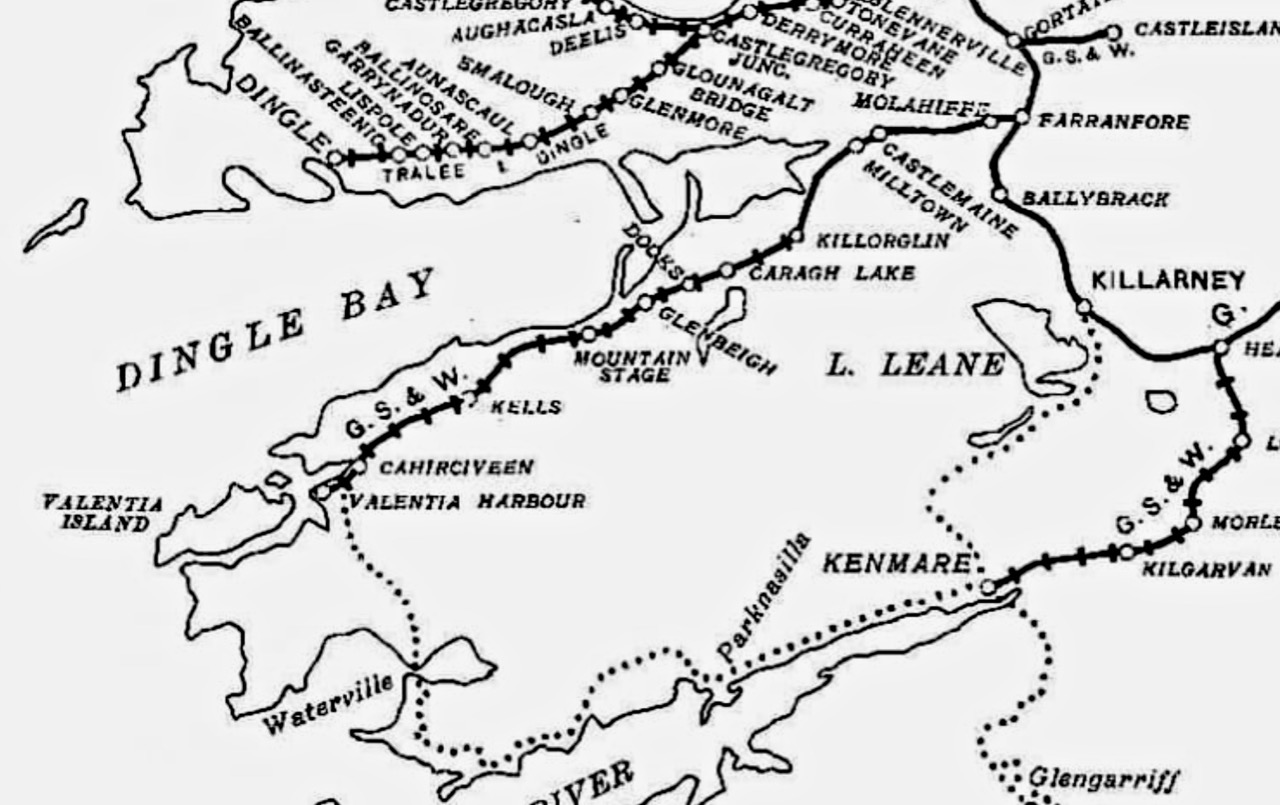
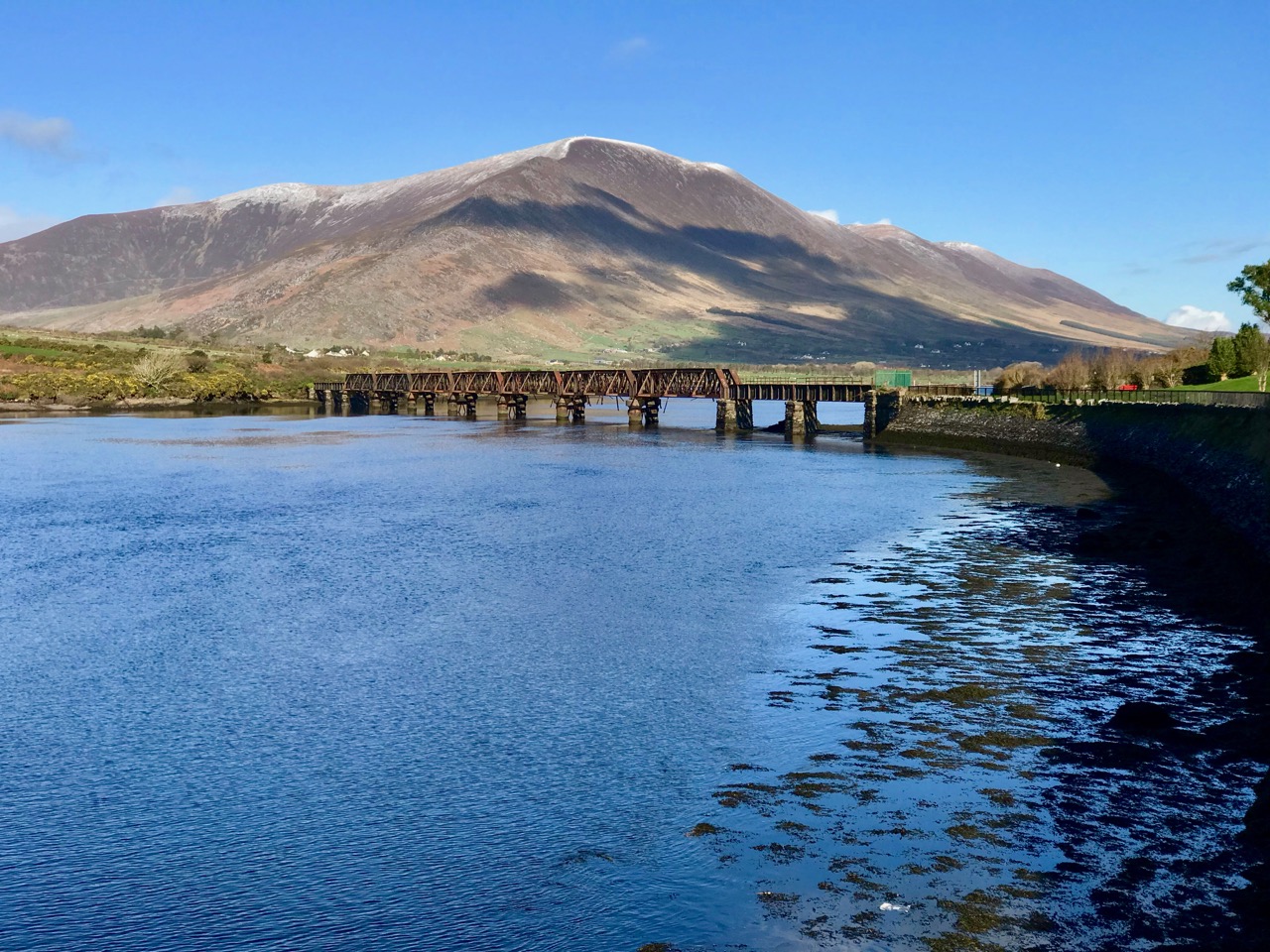
Here’s a railway map and photo dating from around 1901 showing ‘Valentia Harbour Station’. In fact, it’s not on the island at all, although Knightstown – the ‘planned village’ designed by Alexander Nimmo for the Knight of Kerry in the 1830s can be seen across the water. The station – the terminus of the most westerly railway in Europe – is on the mainland, to the east of  Valentia Island, which could be reached by a ferry. The Farranfore to Valentia Harbour Railway was 39½ miles long and operated from 1892 to 1960. The photo below shows the Valentia River Viaduct just outside Cahersiveen, now derelict but hopefully to have a new lease of life when a planned cycling greenway is developed along the old railway track.

Valentia Island has a great deal more to offer than I can show in a brief post. It’s well worth making the journey and staying for a little while: there is such varied landscape to be experienced – a microcosm of the West of Ireland, in fact – and much history if you want to delve under the surface.

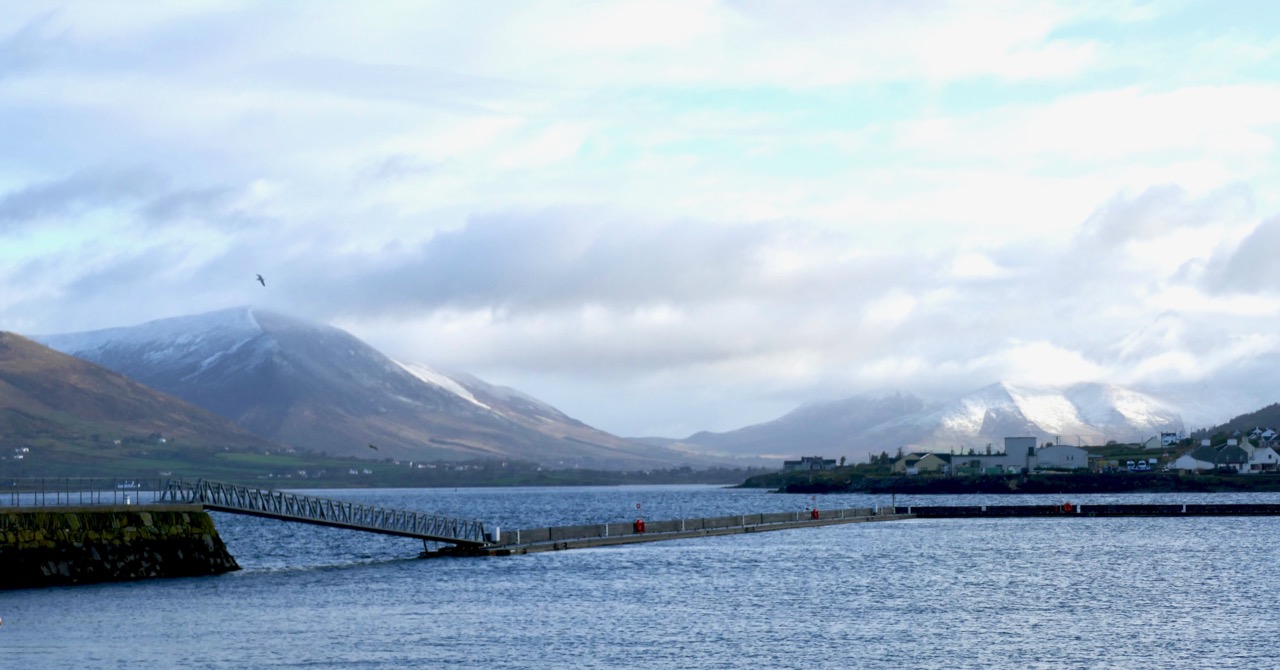
The tailpiece shows a view from Knightstown looking across to Valentia Harbour on the mainland and the site of the former railway terminus: