Tower House Tutorial, Part 1

Ross Castle, Killarney

Ross Castle, Killarney

Can you distinguish between a crenellation and a machicolation? How about a bartizan and a barbican? By the end of this tutorial on the architecture of tower houses you will amaze your friends at dinner parties by casually dropping such terms into the conversation. (Of course you might also be labelled as a hopeless nerd.)
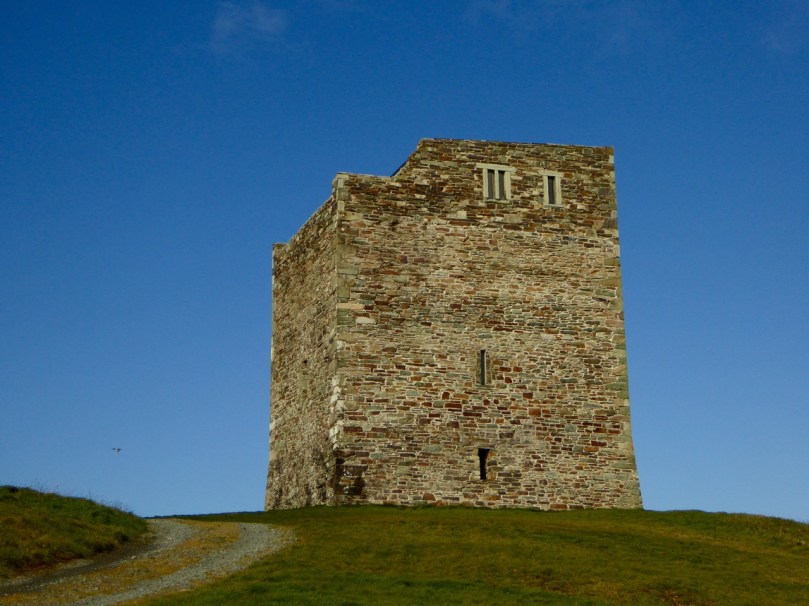
Rincolisky or White Hall Castle in West Cork - a good example of a basic tower house

Rincolisky or White Hall Castle in West Cork – a good example of a basic tower house

Start by reading, or re-reading, When is a Castle..? It goes over the basics of how the tower houses of West Cork were constructed and lived in. Essentially tall, square stone dwellings, they were built more for defence than comfort. Let’s look more closely at how exactly Medieval architecture coped with making such massive structures stable and workable. We’ll start with the outward appearance – walls, windows, roof and bawn. (In Part 2 we’ll go inside.)

Like many West Cork Castles, Castle Donovan is built on a rock outcrop

Like many West Cork Castles, Castle Donovan is built on a rocky outcrop

In West Cork, there’s a noticeable preference for building tower houses on rock outcrops. Since these are massive, heavy structures, building on rock is a good idea. The downside of that has been well expressed by Peter Somerville-Large in The Coast of West Cork: “Contrary to what may be written in Holy Scripture, buildings on rock have little in the way of foundation, and when they fall down or are swept away there is nothing left of them except a memory.” Somerville-Large reminds us that there were once castles at Ballydevlin, Castlemehigan and Crookhaven of which no trace now remains.
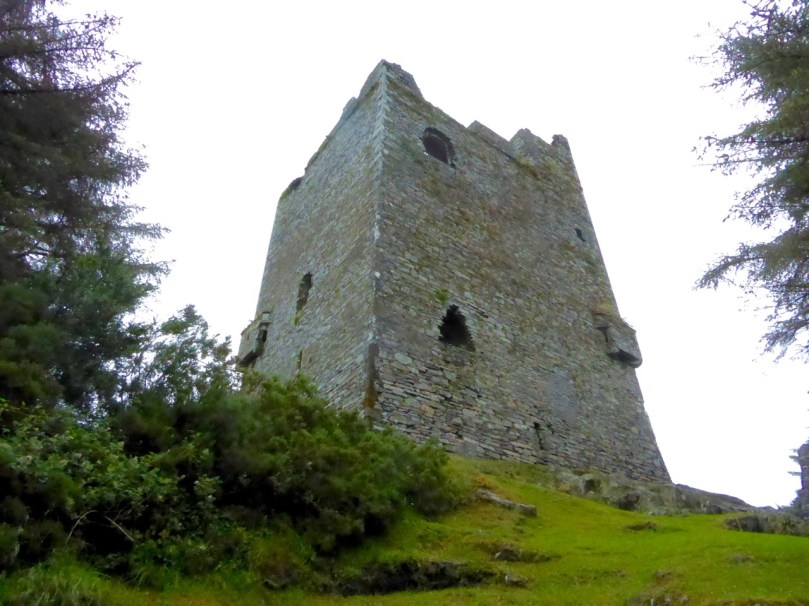
Ballinacarriga Castle. Note the splayed base batter and the unusual second floor bartizans

Ballinacarriga Castle. Note the splayed base batter and the unusual second floor bartizans

To support the tall walls, the lowest level was the thickest, splayed outwards in what is termed a base batterThe walls were constructed of stone and mortar. The mortar was lime-based – it wasn’t totally impermeable so these tower houses were damp places. Generally speaking, the cut stones were reserved for the outer and inner facings of the walls in fine castles, and in more basic ones they were reserved for quoins – the stones that were used in the angles or corners.  
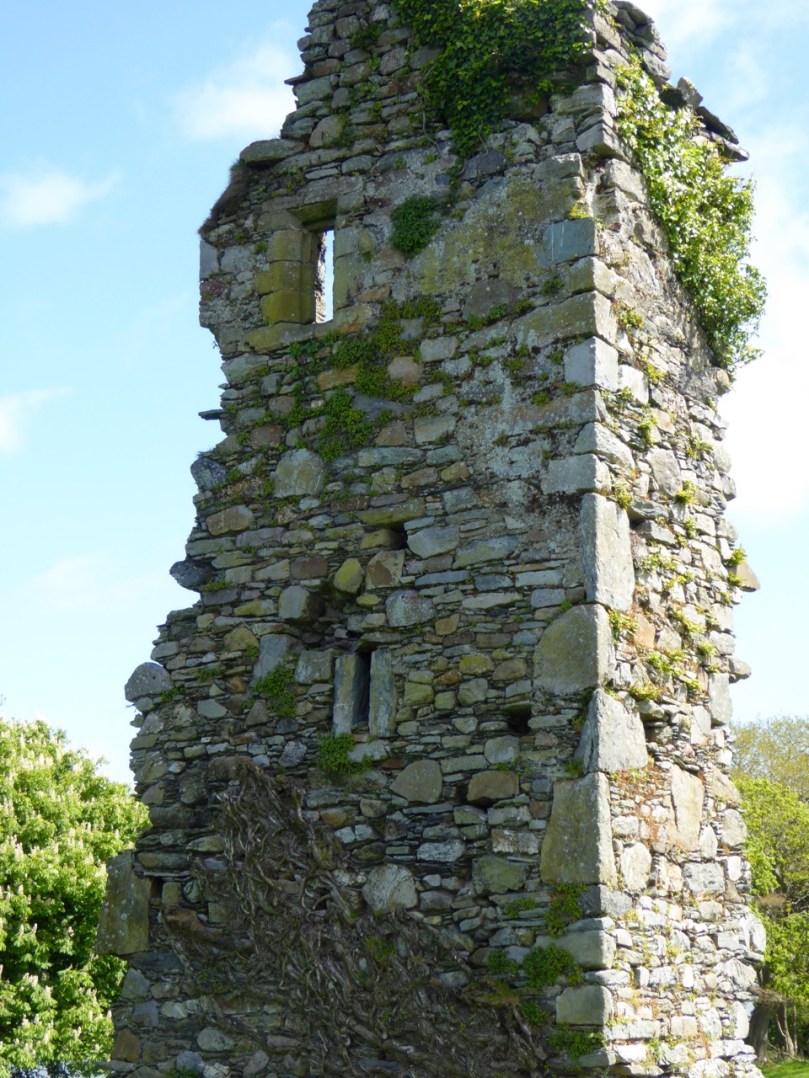
A vestige of a tower house at Abbeymahon, near Courtmacsherry, shows the best cut stones reserved for the quoins

A vestige of a tower house at Abbeymahon, near Courtmacsherry, shows the best cut stones reserved for the quoins

Where walls have collapsed it is often obvious that the interior of the wall could be filled with rubble, with the best stones with the flattest faces, or the cut stones, being reserved for the outside. Cut stones were, of course, prized and many have disappeared over the intervening years, adding to the potential instability of some tower houses.

At Carriganass Castle most of the quoins have disappeared

At Carriganass Castle most of the quoins have disappeared

The walls were rendered with plaster on the outside. They could be whitewashed, which made them visible from afar. One of our local castles is known as White Castle, another as White Hall – perhaps these were originally whitewashed. The plaster could also be tinted to produce various colours – Kilcoe Castle is a good example of a tinted render based on research into this practice.

Glashare Castle in Kilkenny still shows the rendering on the outside. Note the unusual corner arrow loop

Glashare Castle in Kilkenny still shows the rendering on the outside. Note the unusual corner and cross-shaped arrow loops

The walls were pierced at various points with opes – a technical term that simply means an opening of any kind. Opes came in three varieties: doors, windows and loops. We talked about doors (raised entrances) and windows (smallest at the lowest levels, largest at the top) in When is a Castle..? Loops, arrow loops or musket loops, were always small from the outside, presenting a tiny target to attackers and preventing anyone from squeezing through (think about the origin of the word ‘loophole’). Muskets had totally replaced longbows and crossbows by the end of the 16th century so any castle built after that time had gun loops, and some even had larger cannon loops.

Carriganass Castle has many loops - the tiny one in this pictures seems to small to be useful

Carriganass Castle has many loops – the tiny one in this pictures seems too small to be useful

Inside, the loops were deeply splayed to allow the head and shoulders of the archer/shooter into the space, or embrasure. Loops could appear in the walls of the castle, or of the bawn.
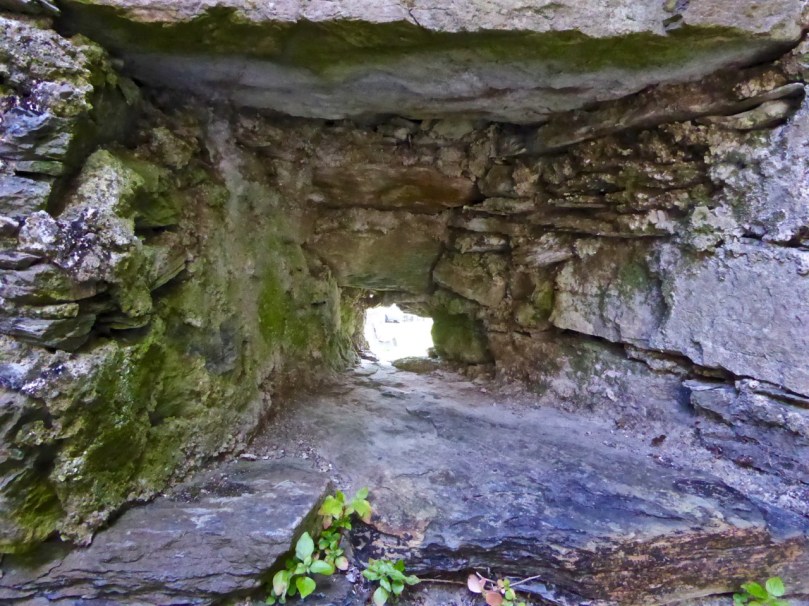
A deeply splayed gun embrasure at Carriganass

A deeply splayed gun embrasure at Carriganass

At the top of the tower was the roof and the battlements. The roof was made of various materials – slate, wood or even thatch. Between the roof and the outside wall was a wall walk, protected by a parapet.
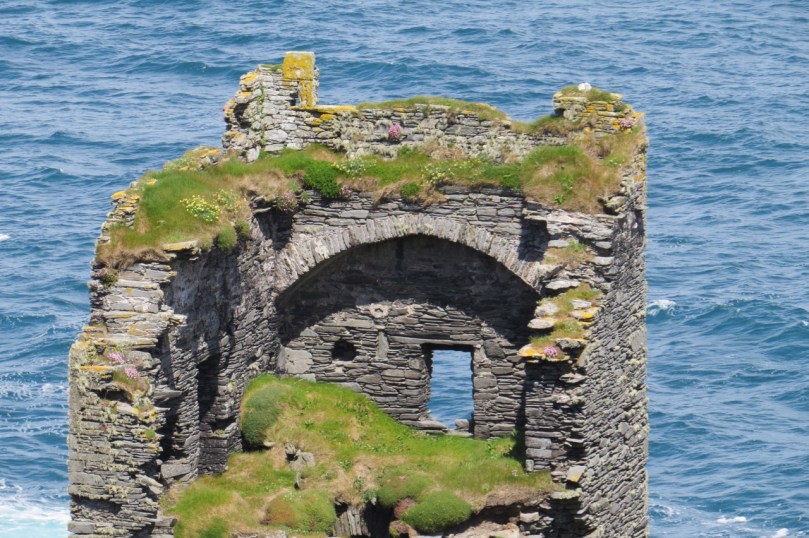
Dún an Óir, or the Fort of Gold, on Cape Clear Island. The wall walk can be clearly seen

Dún an Óir, or the Fort of Gold, on Cape Clear Island. The wall walk can be clearly seen*

In Ireland, this parapet most often took the form of what became known as Irish Crenellations. These were stepped or ‘toothed’ battlements, with tall parts (merlons) behind which defenders could take cover and shorter parts (crenels) for shooting from.
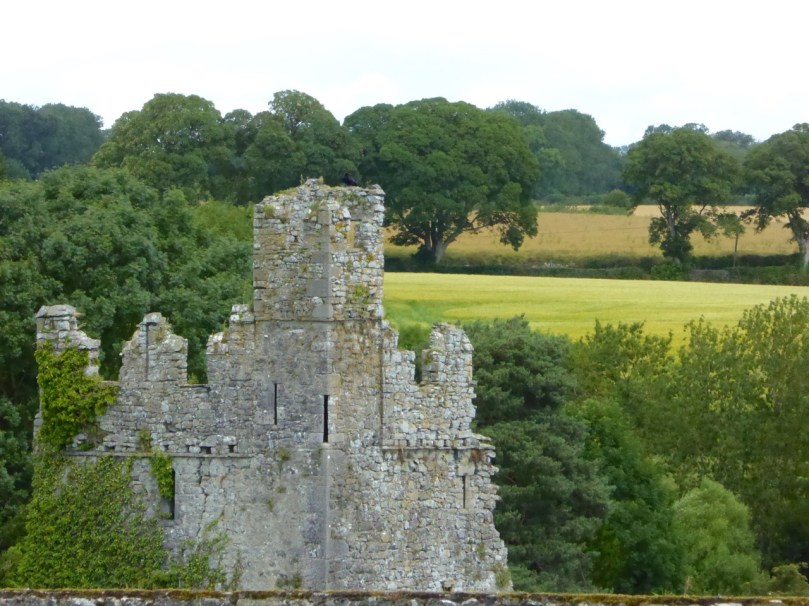
A good example of Irish crenellations from Kells Priory in Kilkenny

A good example of Irish crenellations from Kells Priory in Kilkenny

Another defensive feature was a platform that projected away from the walls, called a machicolation.  Defenders used the opening between the wall of the machicolation and the castle wall to hurl things down on attackers. Machicolations are often located above doorways, but also at corners which afford a view of two sides. When they are on corners they are called bartizans.
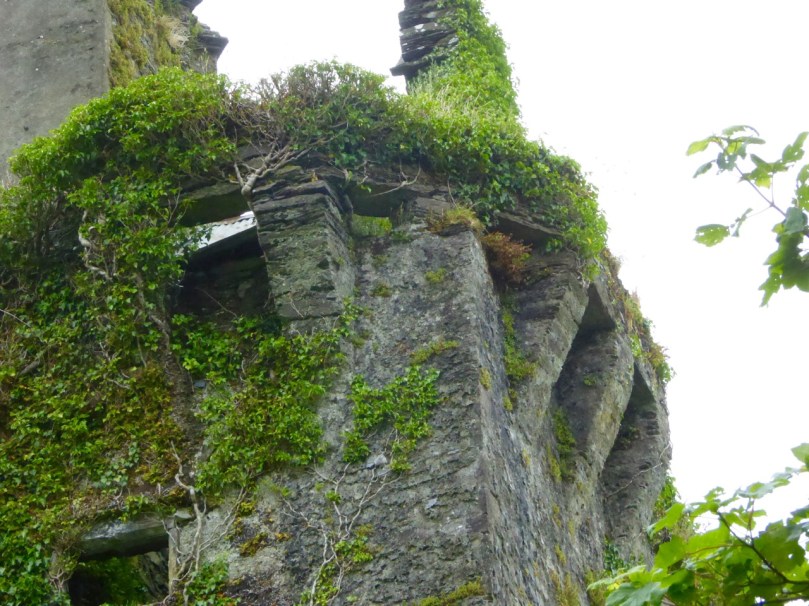
Corner machicolation, or bartizan, at Tocher Castle, north of Dunmanway

Corner machicolation, or bartizan, at Togher Castle, north of Dunmanway

The machicolation was supported by corbels which could be simple triangles or carved stone elements.
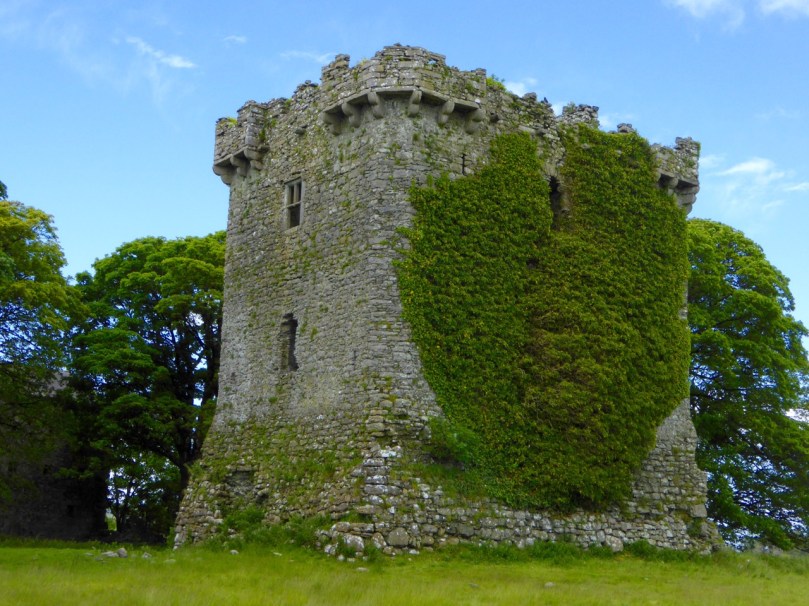
Shrule Castle in Mayo has decorative corbels. Note also the rounded corners of the castle which did away with the need for quoins

Shrule Castle in Mayo has decorative carved corbels. Note also the rounded corners of the castle which did away with the need for quoins

The bawn is the courtyard immediately surrounding the tower. Bawns could be restricted in size – little more than the immediate courtyard of the castle – or extensive. They are sometimes known as wards. The bawn wall was often fortified with loops and a wall walk.
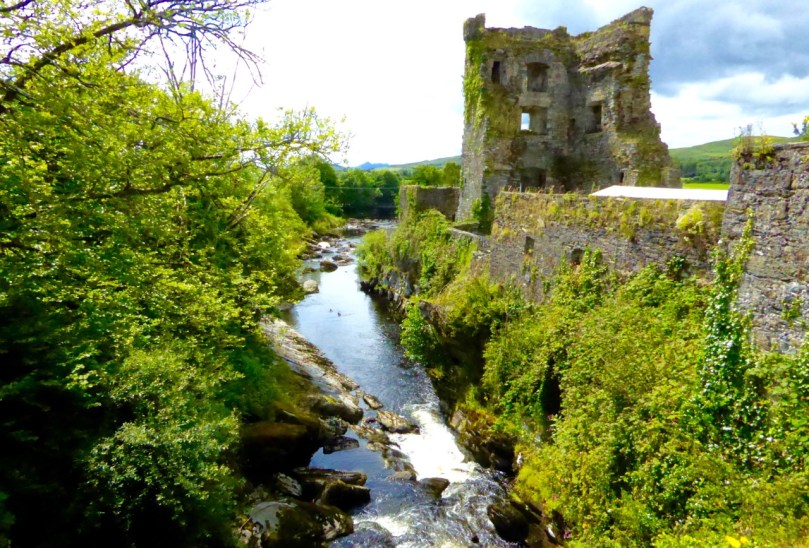
The bawn wall of Carriganass Castle at Kealkill hovers picturesquely over the river

The bawn wall of Carriganass Castle at Kealkill hovers picturesquely over the river

Bawn walls are often called curtain walls, but this term is also appropriate when the wall does not actually enclose a bawn, as at Dunlough Castle at Three Castle Head. Because the towers are situated between the lake and an impregnable cliff the curtain wall provides a barrier behind which defenders can shelter.
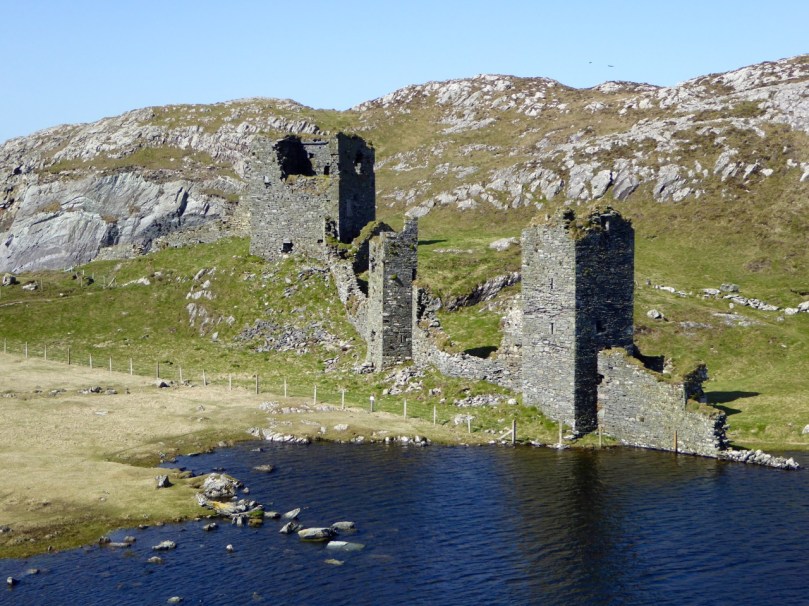
Dunlough, or Three Castles. The curtain wall presented a formidable barrier to attackers

Dunlough, or Three Castles: the curtain wall presented a formidable barrier to attackers

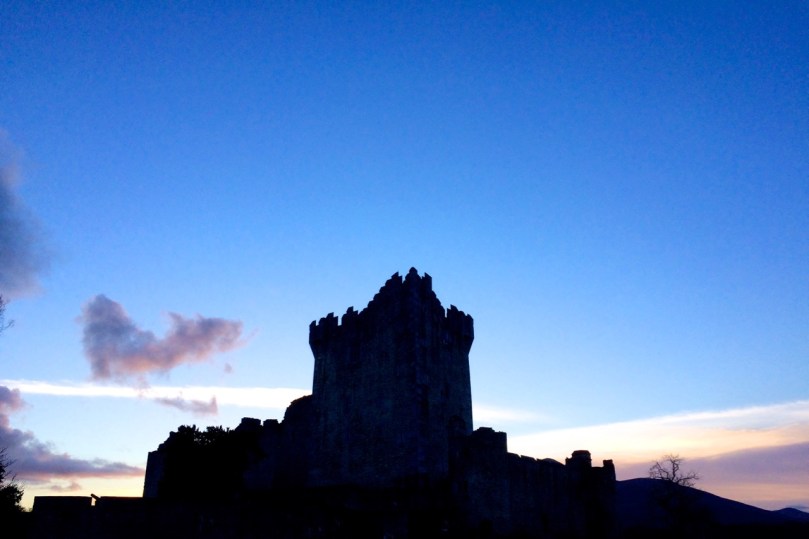
In the next tutorial we will cover the inside of the tower house. Meanwhile, here’s a pop quiz. Take a look at this photo of Ross Castle and see how many features you can identify. 
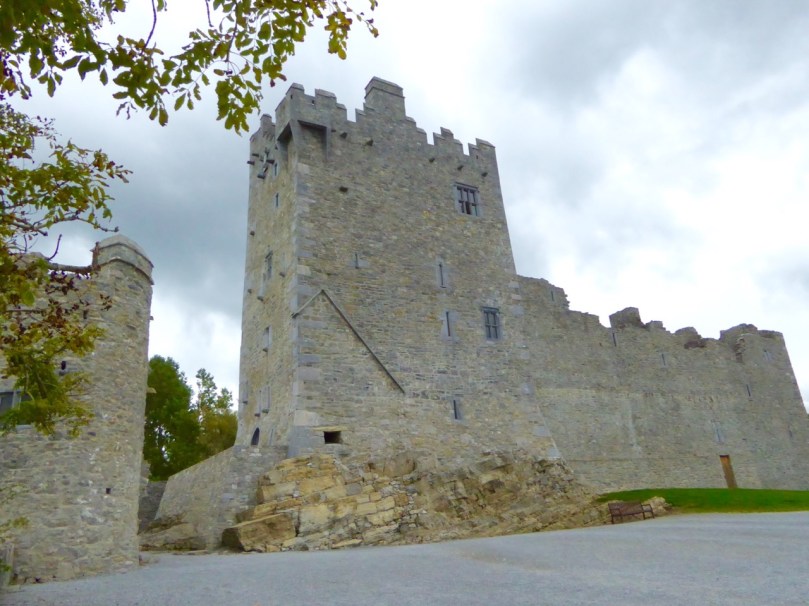
Ross Castle, in Killarney, is also built on an outcropping rock base

So – how did you do?

*Thanks to Lisa Scarff for the Dún an Óir photograph.
Castle Haven

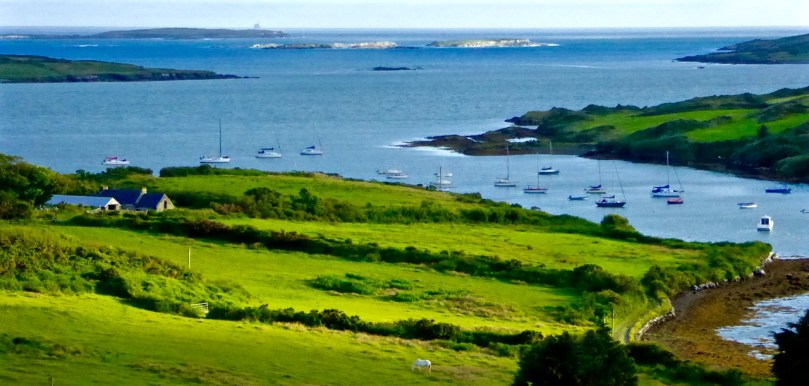
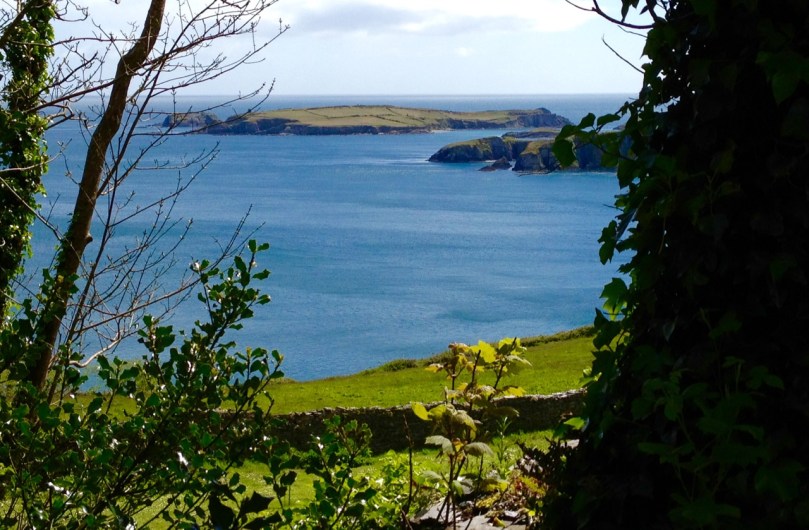
The entrance to Castle Haven. Horse Island is separated from the mainland by the charmingly named Flea Channel.

The entrance to Castle Haven. Horse Island is separated from the mainland by the charmingly named Flea Channel

South West of Skibbereen lies a deeply indented section of the coast known as Castle Haven. It is perhaps best known for the town that clings to the steep hill on its west side – Castletownshend. We have written much about Castletownshend itself, about Edith Somerviille and about the lovely St Barrahane’s Church and its Harry Clarke windows. But the whole inlet is an explorer’s paradise, yielding up its treasure to us on successive visits so this post will be about other things to see around the Haven.

Castle Haven

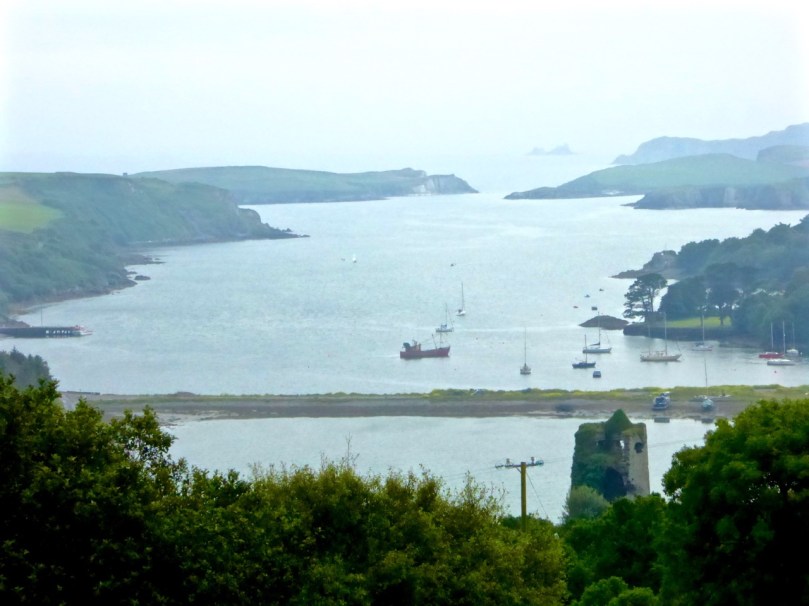
Catle Haven on a misty day. The inlet was guarded by two castles: this one at Raheen and another at the entrance to the Haven

The Haven is shallow at its top end, but up to the spit of land that runs across it near Reen Pier, it provides a deep and sheltered harbour for boats, and a popular sailing ground. We like to drive down the road that runs above the eastern side of the Haven. It’s twisty and a bit treacherous but at a certain point it presents a view of the whole inlet, dominated by Raheen Castle.

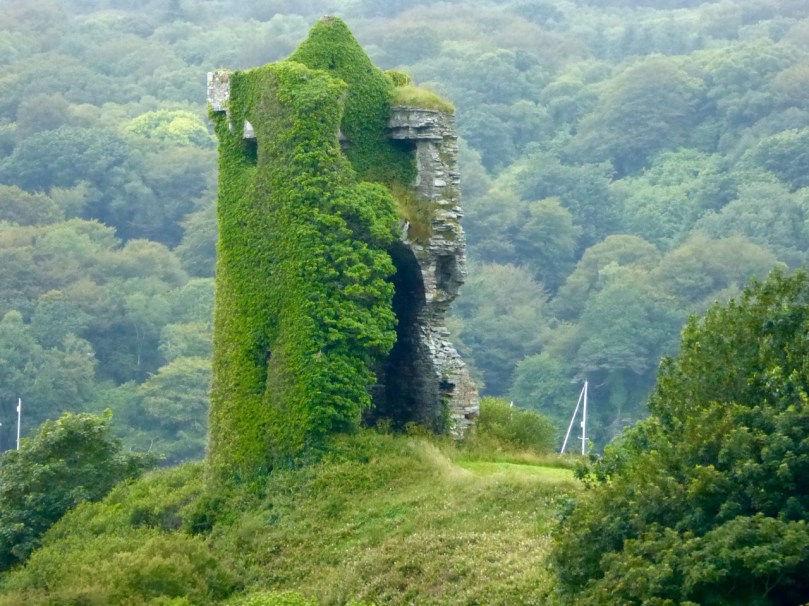
Raheen Castle

This was a castle of the O’Donovan clan, built in the late 16th or early 17th century. It didn’t last long – it was attacked by Cromwellian forces in 1649 and the collapsed upper stories may be the result of cannonball damage.

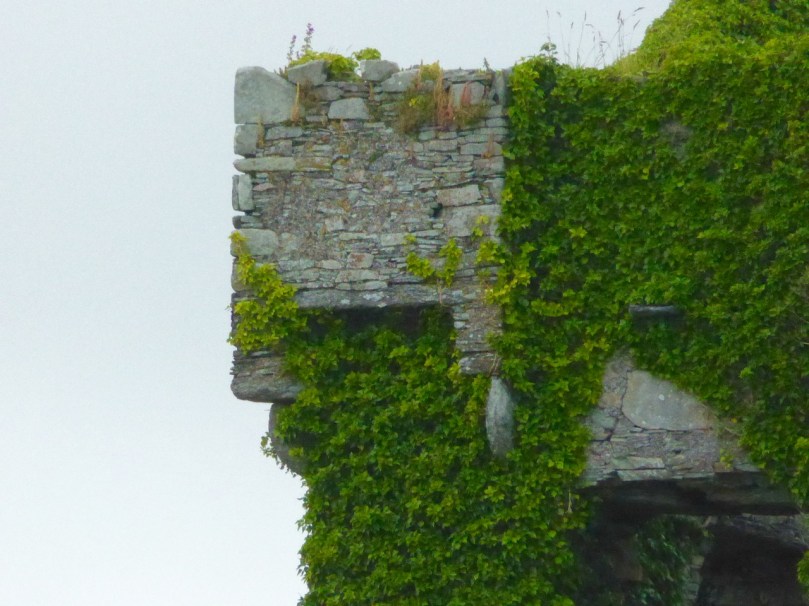
Raheen Corner machicolation

Continuing to the end of the east side brings you past Reen to the wonderful harbours of Myross and Squince, but that’s a post for another day. Now we’ll return to the west side of the inlet and visit two spectacular archaeological sites, Knockdrum Fort and the Gurranes Stone Row, before proceeding down into Castletownshend.

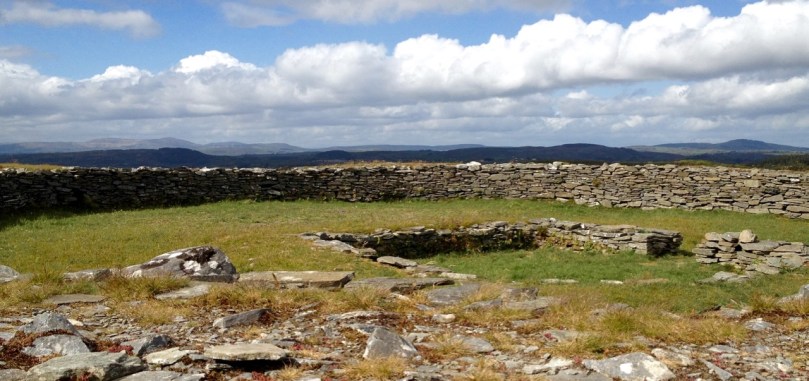
Knockdrum interior and views to north

The interior of Knockdrum Stone Fort, with square hut site in the middle. The fort commands panoramic views across the countryside and out to sea

To get to Knockdrum Fort, you have to park at the large church about 2km before the village. Walk downhill about half a kilometre until you get to the signposted green road to the fort. A pleasant trudge brings you to a set of steps and these lead up to the site. This is an excellent example of an early medieval stone fort – the kind of fortified homestead that marked the residence of a family of high status before the Normans taught us how to build tower houses.  From this site there are striking views across Castle Haven.

Entrance to Knockdrum

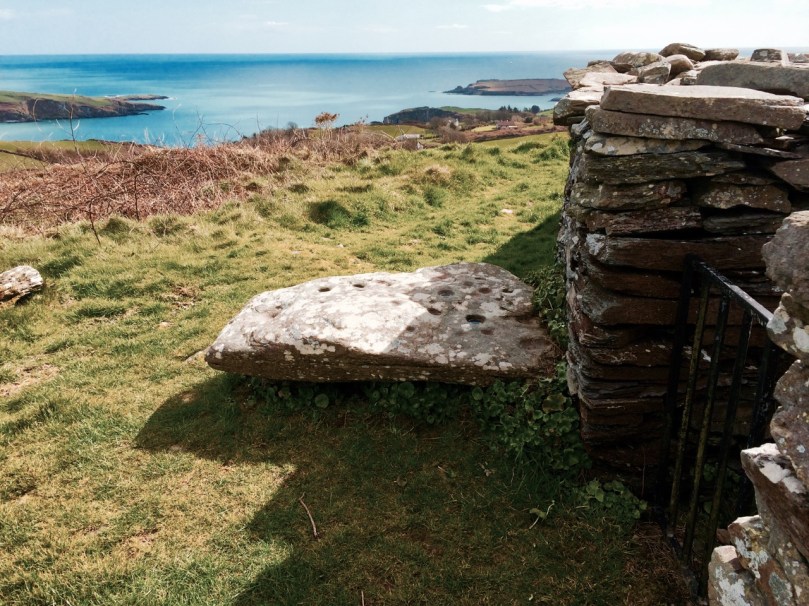
The entrance to Knockdrum Fort, looking towards the entrance to Castle Haven. Outisde the entrance is this large rock, covered in cup-and-ring art

But there’s more to this place than just the fort. There’s an early Medieval cross slab just inside the entrance, and a fine example of 4000 or 5000 year old rock art just outside it. There’s another piece, a cupmarked stone, inside the fort, lying on the ground. All three are here thanks to the activities of Boyle Somerville, a keen amateur archaeologist and brother of Edith Somerville who lived in Drishane House, just below the fort. Farmers who found such items would bring them to him and he placed them here for safekeeping. Also inside the fort you will see evidence of a souterrain – an underground passage used for storage when the fort was active.

Knockdrum cross slab

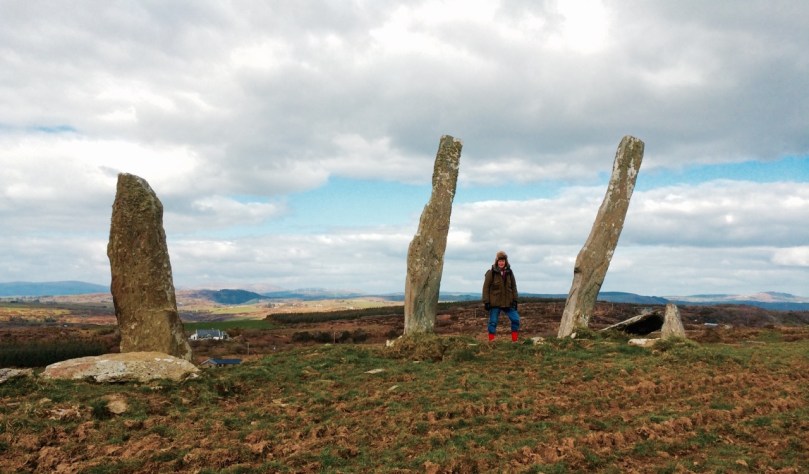
If you look north across the valley once at Knockdrum you will see a stone row on a nearby hill. These are the Garranes ‘Fingers’. (They are on private land so you should seek permission to visit and make sure there are no bulls in the fields.) The best way to access them is to tramp through the fields across the road from the entrance to Knockdrum. It’s well worth the effort – once you get up to them you will see that more uprights are now lying on the ground. This was originally an alignment of at least five stones, unusually tall and thin, positioned so that they would be visible on the skyline from many directions.

Gurranes Fingers

Drive down towards the village now, until you get to the entrance to Drishane House. To the right of the gate is a bench dedicated to Boyle Somerville. In 1936 he was shot dead by the IRA, who claimed he was recruiting local young men for the British Navy. He was liked and respected locally and, outraged by the deed, the people of Castletownshend raised money for this memorial. If the house is open (there will be a sign) this is a wonderful place to visit. For a small charge you can wander around the extensive grounds and visit the Edith Somerville Museum. We love to go in spring, when the bluebells provide a vivid carpet and a photographer’s paradise.

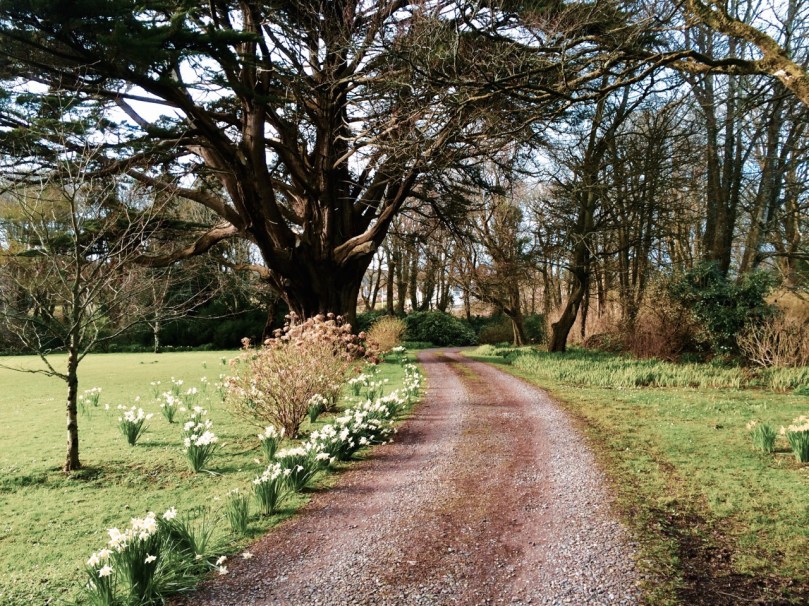
Drishane house driveway in spring

Drishane House driveway in the spring, with the giant macrocarpa (a Californian cypress tree)

Down to the village now and up to the church. But this time, instead of heading inside to see the Clarke windows, or behind the church to view the graves of Somerville and Ross, cross the graveyard until you find a gate at the far side and head east along the edge of the field towards the water. There you will find the remains of a structure labelled as a star-shaped fort on the OS map. Nowhere near as enormous as the massive star-shaped Charles Fort in Kinsale, nevertheless it is a reminder of a time when the sleepy village was not as peaceful as it is now. Dating to the 1650s, not a lot remains, just enough to confirm that this was a structure built for defence. Along the way you might also see a ruined square tower, known as Swift’s Tower. This was built as a belvedere, (a place to admire the view) and legend has it that Dean Swift visited and liked to write there.

Left is the remains of a bastioned fort, labelled as a ‘Star-Shaped Fort’ on the OS map. Right is the belvedere, where Swift is said to have written

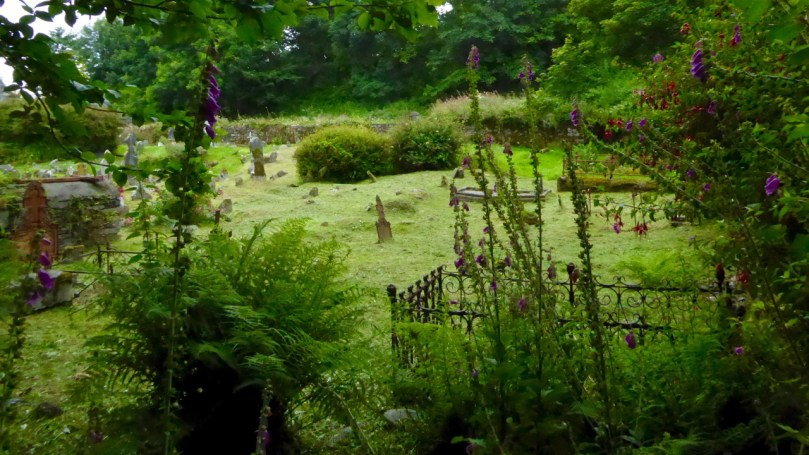
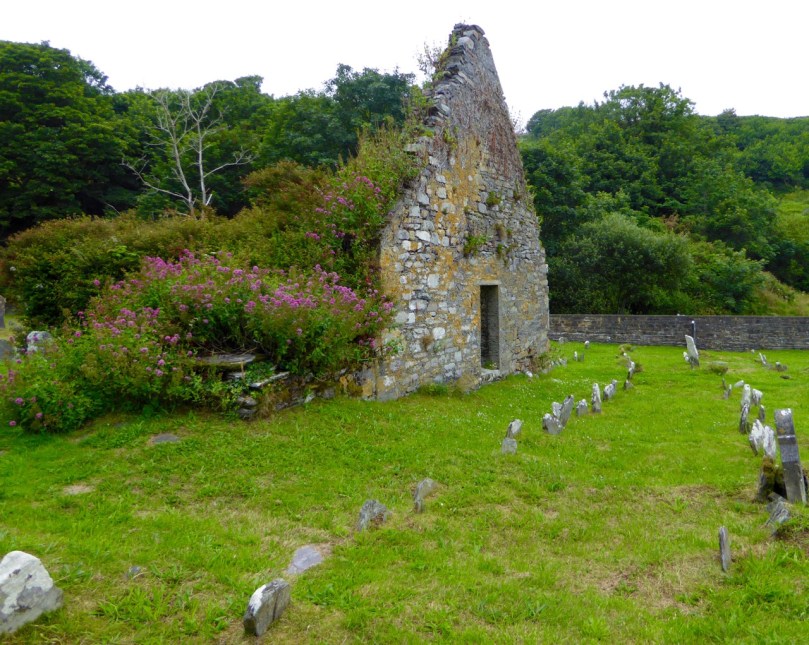
Drive back out of town now and take the left turn after the entrance to Drishane House. Follow this road for about a kilometre to a sharp left turn, just before a small crossroads and turn left down a narrow road that ends at the sea. A tower house used to guard this part of the Haven but nothing remains of it now except a stump covered in ivy and brambles. But wander around the graveyard and admire the picturesque siting of the old church, already in ruins by the mid-1600s. This is a good example of a classic West Cork graveyard. Most graves are marked by simple stones at the head and foot, with no inscriptions. 

Castlehaven Graveyard atmosphere

There are some family plots and some more elaborate memorials, including one for Ellen Buckley, second wife of O’Donovan Rossa (although his name, interestingly, does not appear on the headstone).

Castlehave graveyard, old church

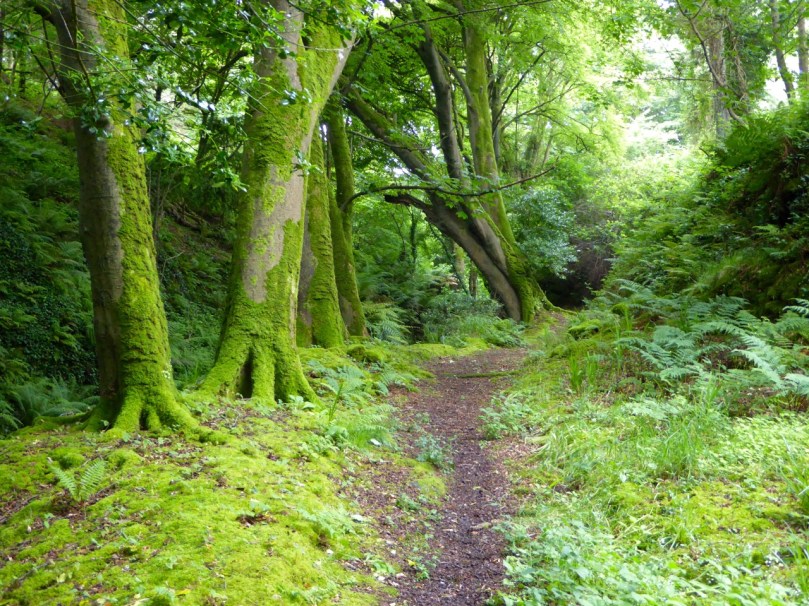
To the immediate left of the graveyard you will find a stile leading to a green path. Take this path and walk up though the luxuriant woods past a rushing stream until you come to a little wooden bridge.

Path by the stream

On the other side is a holy well, cut into the hillside and decorated with ribbons and fishing floats. Make a wish, or say a prayer – this is a special place and still visited and maintained by local people.

Take OS Discovery Map 89 with you. Most of the sites I describe are actually marked on it. But if you get lost, have fun, and let us know what you discovered!

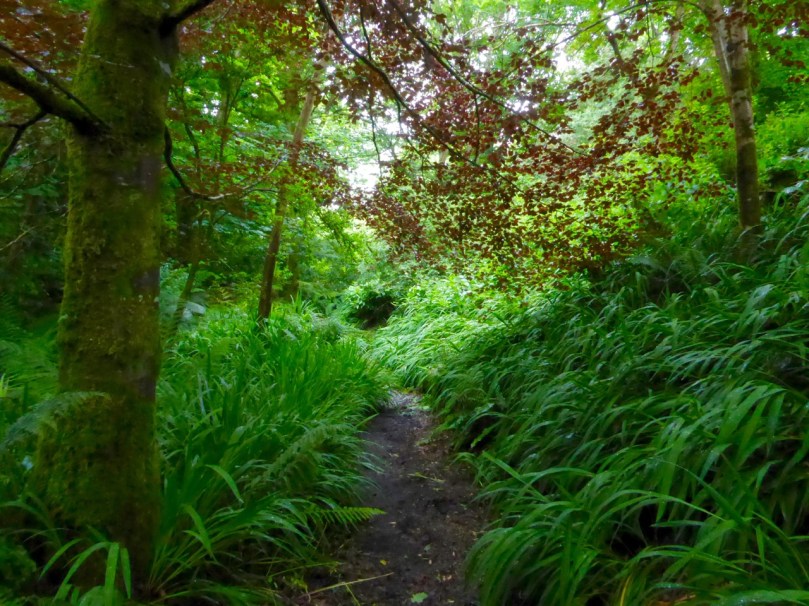
Path through woods

Infant of Prague

church shop

It may seem excessive to travel to the centre of Europe to check out an old Irish tradition, but we hope you’ll agree that this shows the dedication of your team here at Roaringwater Journal!

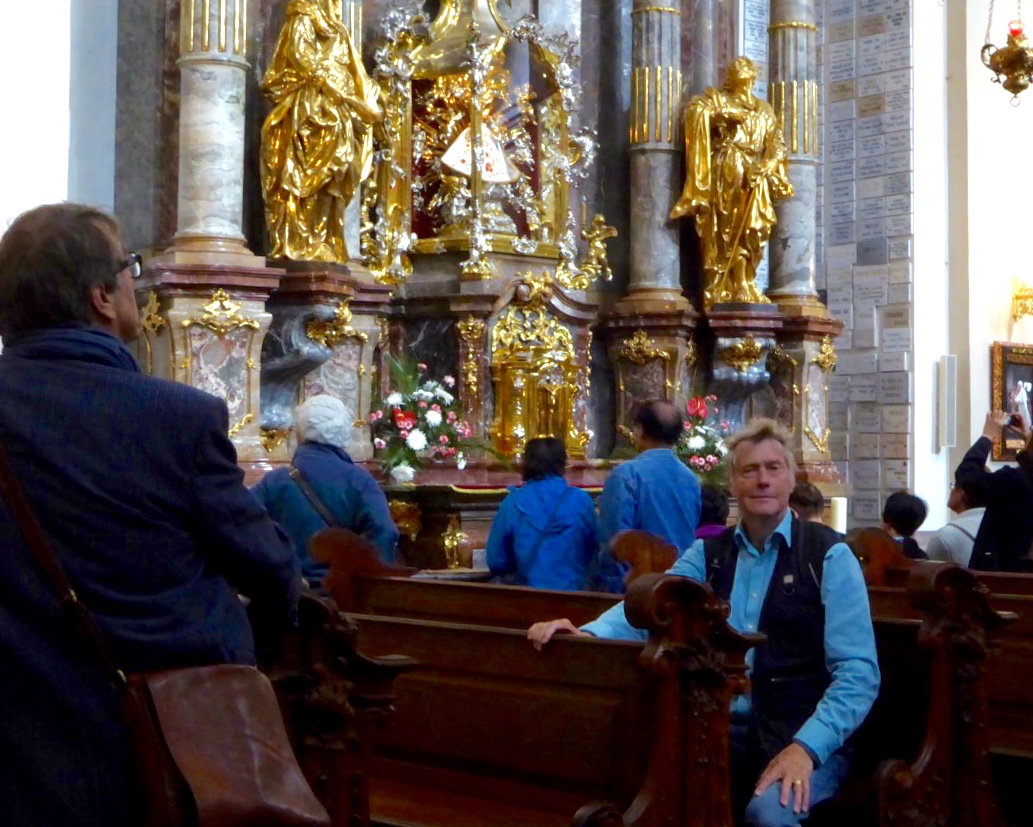
Robert and infant

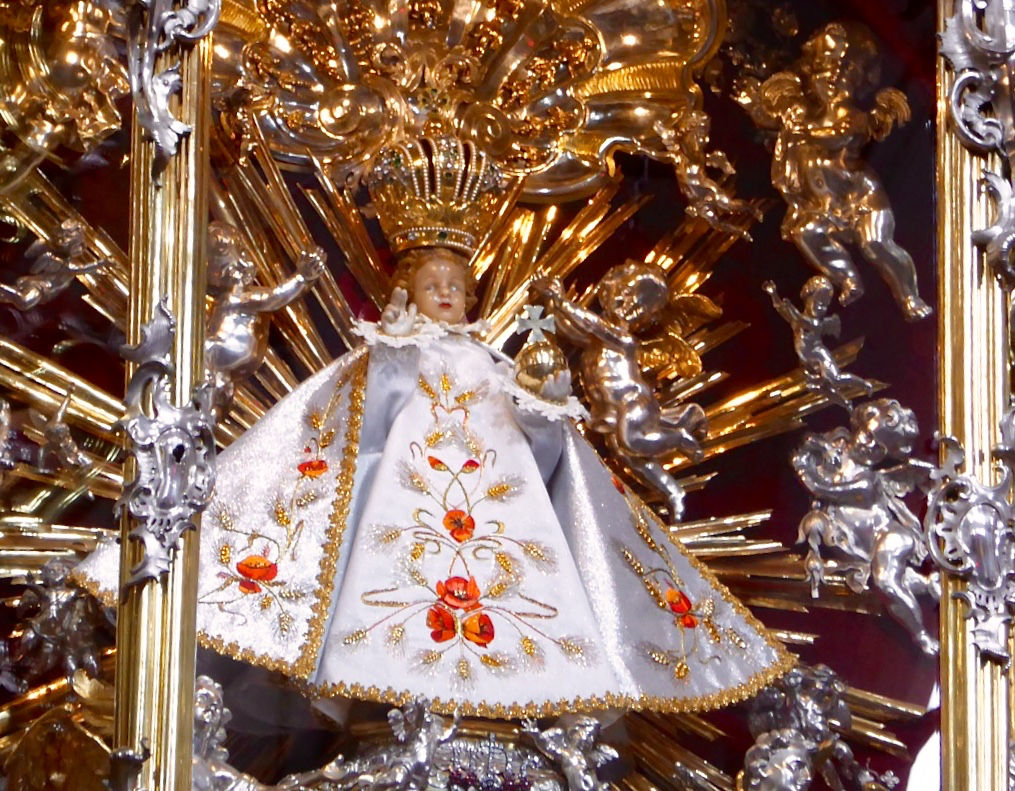
The Infant surveying a visitor from Ireland at the Carmelite Church of Our Lady Victorious in Prague

Prague, in old Bohemia (now the Czech Republic), is a beautiful historic city, once considered the cultural and economic hub of Europe. The architectural integrity of the medieval centre presents unparalleled vistas by day and by night.

Cathedral at night

The tourist trail in Prague takes you past palaces, cathedrals and embassies, through crowded squares and across ancient monumental bridges over the Vlata River. But no visitor from Ireland could miss the Carmelite Church of Our Lady Victorious located in Malá Strana – the ‘Lesser Quarter’ of the city. Why? Because that’s where you will find the original Infant of Prague – a statue which is ubiquitous in every traditional Irish household. 

The traditional Irish parlour invariably includes an Infant of Prague

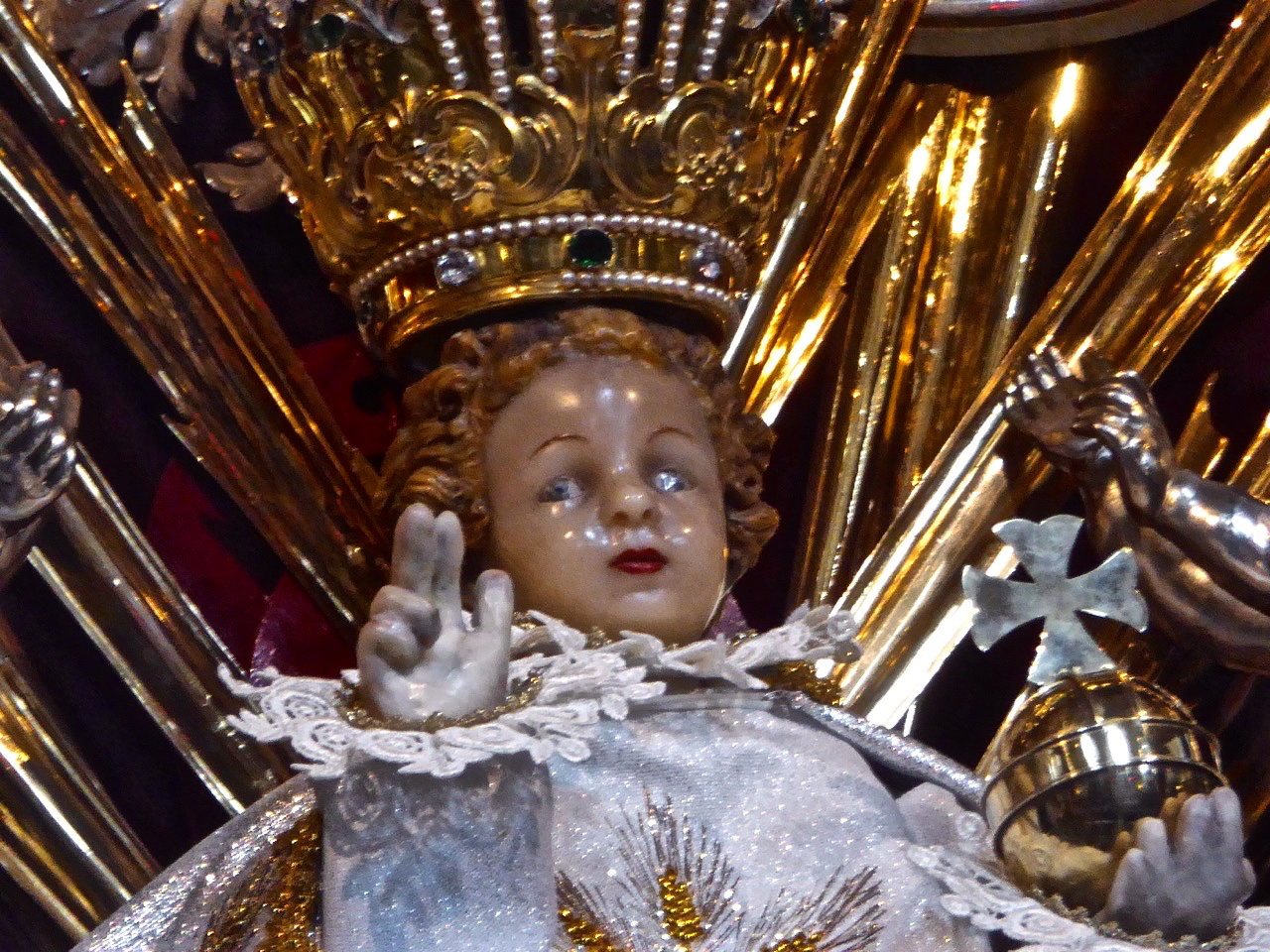
Nowadays the Infant – a 45cm high effigy of the Christ Child dressed as a king fashioned in waxed wood – is displayed in a glorious shrine of gold, glass and marble, but it has a long and complex history.

big infant

head detail

In 1556 Maria Manriquez de Lara, a Spanish princess, was engaged to Vratislav Pernstyn, a Czech nobleman and brought with her to the marriage the statue, a family heirloom which was said to have been made in Spain by a friar who had a vision of Christ as a king. 

Christ as King – images based on the Prague statue

Maria passed on the statue to her splendidly named daughter Polyxena, who was married to Baron Zdenek Vojtech Popel de Lobkowitz, Great Chancellor of the Kingdom, Knight of the Golden Fleece, and Prince of the Holy Roman EmpirePolyxena gifted the statue to the Carmelite Monastery and the adjoining church in Prague, stating “I bring you my dearest possession: honour the Infant Jesus and you shall never want.” The friars attributed miracles and blessings to the statue, which became an object of veneration.

the real infant

The chapel in the Church of Our Lady Victorious where the Infant is now venerated

During the Thirty Years War which devastated much of central Europe between 1618 and 1648 the monastery and church were sacked and the statue was broken and thrown on a rubbish heap. The Infant was forgotten until its remains were found by a Father Cyril many years later. The hands were missing and Fr Cyril heard the Infant say, “Have pity on Me, and I will have pity on you. Give Me My hands, and I will give you peace. The more you honour Me, the more I will bless you.” The statue was repaired and in 1655 the Infant was given a coronation and placed in the Carmelite Church where it has remained to this day, looked after now by an order of nuns who ensure that the statue wears vestments appropriate to the religious festivals. On every first Sunday in May a copy of the statue is carried in procession through the streets and re-crowned, implying perhaps that the Infant is now the centre of a seasonal custom.

dress detailExquisite detail of the vestments worn by the Infant on the day of our visit

We were surprised to find Prague so full of tourists – and of shops selling souvenirs for tourists. Prominent among these souvenirs are Infant of Prague statues: there are shelves, cabinets, whole shops full of them – just as there are in Ireland.

Gracious Jesus

Christian Shop close

Quite how the connection between the Infant, weddings and the weather has come about I’m not sure but there’s no doubt that an Infant of Prague statue is essential to an Irish wedding – to ensure good weather… Variously, you have to put your Infant of Prague outside the house, or outside the church – or even bury it in the garden to make certain that it won’t rain on the big day. I’m sorry that Finola and I were unaware of this custom at the time of our own wedding – but we were fortunate anyway in having a very good day (in every respect).  I have been told by Infant of Prague experts that’s it’s important to knock the head off the statue for maximum efficacy! Perhaps that’s some sort of confusion over the original statue having lost its hands?

wedding photo

Have a look at this Irish wedding photographer’s site

But it’s not just weddings: in Ireland the Infant of Prague is considered to bring good luck in many ways. Small coins are often kept under the statue to make sure that the house ‘never runs short of money’ and, in keeping with the older traditions of cures and miracles having been attributed to the Prague effigy, the Infant is also a bringer of good health. The presence of the statue over every Irish hearth seems to be as essential as a St Brigid’s Cross

coaster

Snakes Alive!

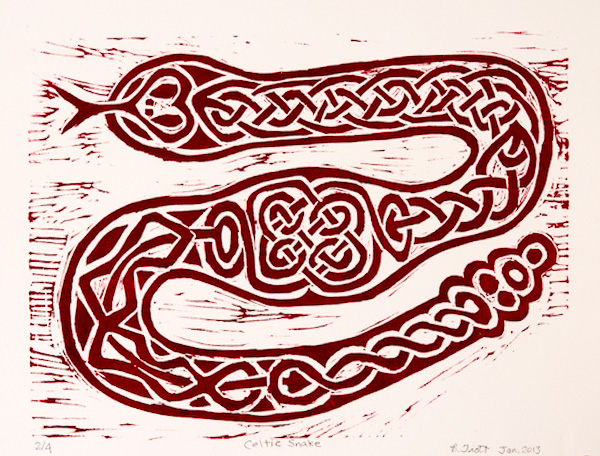
Year of the Snake 66 barabara trott

It’s about as far away as we can get from St Patrick’s Day, so it’s probably ok to talk about snakes in Ireland…

Ah yes – the old fable that he banished all the snakes out of the land…

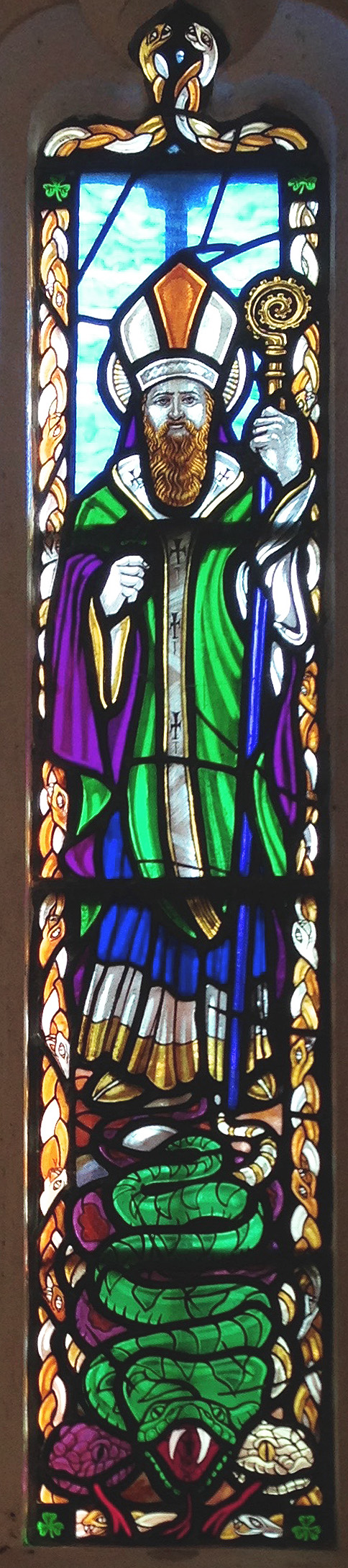
That’s enough of the ‘old fable’ – there’s no doubt about it: there are no snakes in Ireland at all, so it must be true that St Patrick sent them packing! Although I was a bit alarmed when, out walking in the Mayo hills a while ago, I came across this…

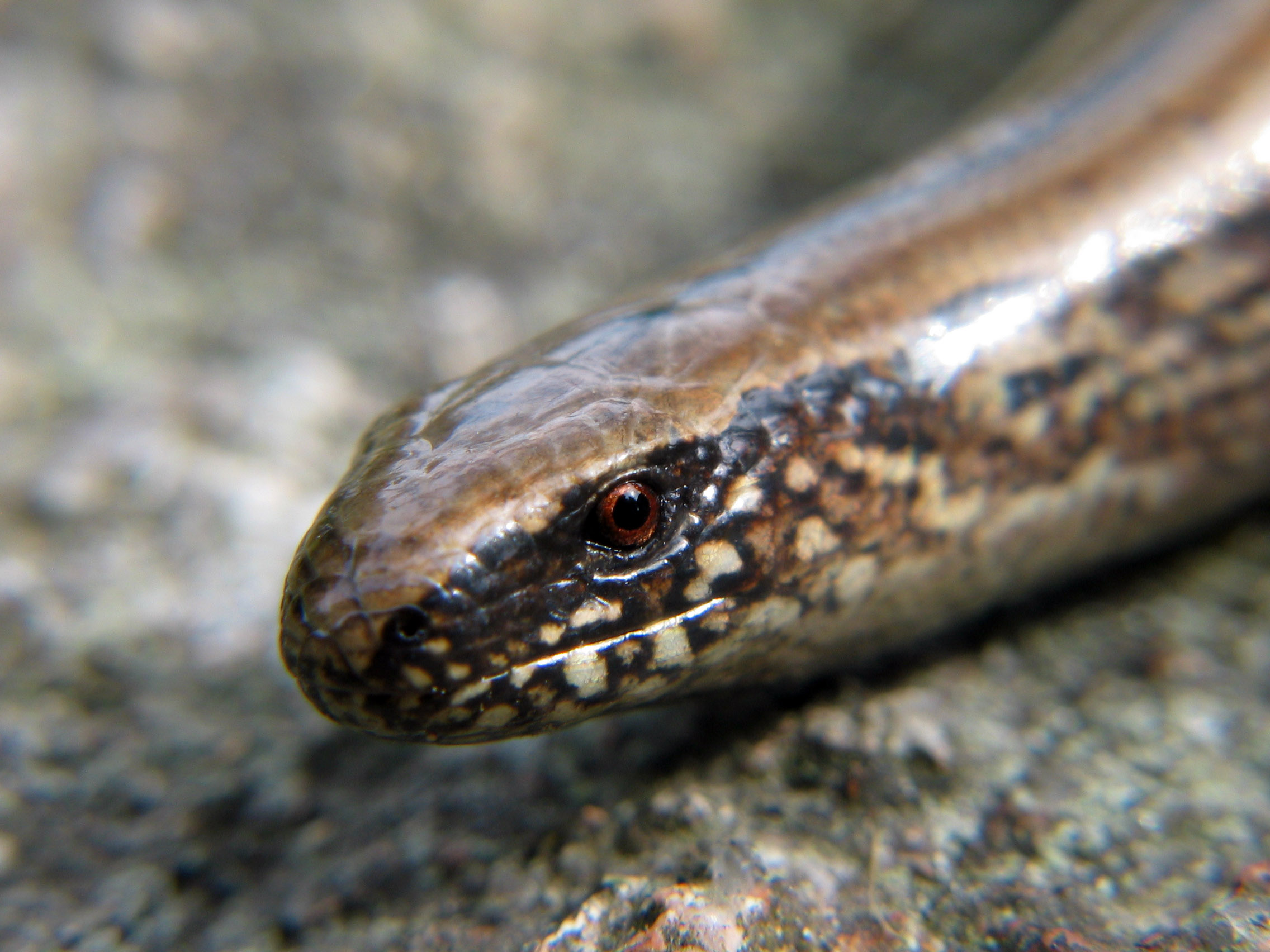
Slow-worm (Jonas Bergsten)

A slow-worm? Anguis Fragilis… How does that fit into the St Patrick story?

Well, there shouldn’t be any slow-worms here really – as the Saint expelled all the reptiles and lizards – and that’s a lizard. But evidently someone introduced them into County Clare illegally back in the twentieth century, and they’ve survived there. (Frogs were also introduced, incidentally, as a food source by the Normans).  My sighting in Mayo, however, is something of an anomoly…

But didn’t I hear that these serpenty creatures couldn’t actually live on Irish soil because of Ireland’s purity?

St P window GlastonburyNow you’re talking. It’s perfectly true that if you try to bring a snake into Ireland it drops dead as soon as you enter Irish waters…

Oh? Has that been proven?

Indeed – by Gerald of Wales. He lived in the twelfth century and states that ‘…it is a well-known fact that no poisonous thing can live in Ireland and if Irish soil is taken and scattered elsewhere it will expel poisonous things from that vicinity…’ Other stories mention toads brought to Ireland by accident (having, presumably, stowed away in the holds of ships) ‘…which when thrown still living onto the land, turn their bellies up, burst in the middle and die…’ Perhaps you’ve heard of the Fir Bolg?

I think so – aren’t they one of the early races who inhabited Ireland?

They are – and the name means Men of the Bags. They carried bags of Irish soil around with them when they travelled all over the world, because they would be kept safe by its serpent slaying properties…

I like that idea – remind me to go and do some digging in the garden. Where are you getting all this information from?

Much of it out of a most wonderful book: Ireland’s Animals by Niall Mac Coitor (The Collins Press, Cork 2010), but there are plenty of other early sources, many of which Mac Coitor admirably collects together. Perhaps the best of these is the old medieval Irish text Lebor Gabála Érenn – the Book of Invasions. I have already quoted from that in my story of Cessair, the very first person to set foot on Ireland in 2680 BC…

Yes, I remember that. She was Noah’s grand-daughter. Wasn’t it the case that Ireland was supposed to have been a land without sin, which is why she went there to escape the flood?

That’s her. And it’s a nice bit of symbolism that Ireland was without sin because it had no serpents…

But hang on – that was Old Testament times – long before the saints…

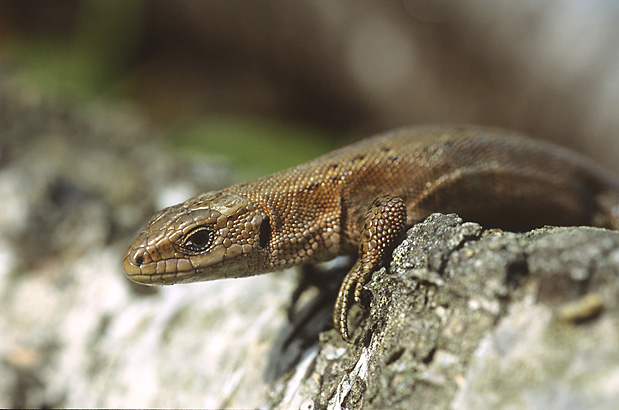
You do have a point there. And, you know, in archaeological terms there are no fossil records of any reptiles having ever been here in Ireland – except for one: the common lizard Lacerta (Zootoca) Vivipara which has always been here, and still is…

Common Lizard (Marek Szczepanek)

Now I’m getting very confused about St Patrick…

Don’t worry about it – it’s a grand story…

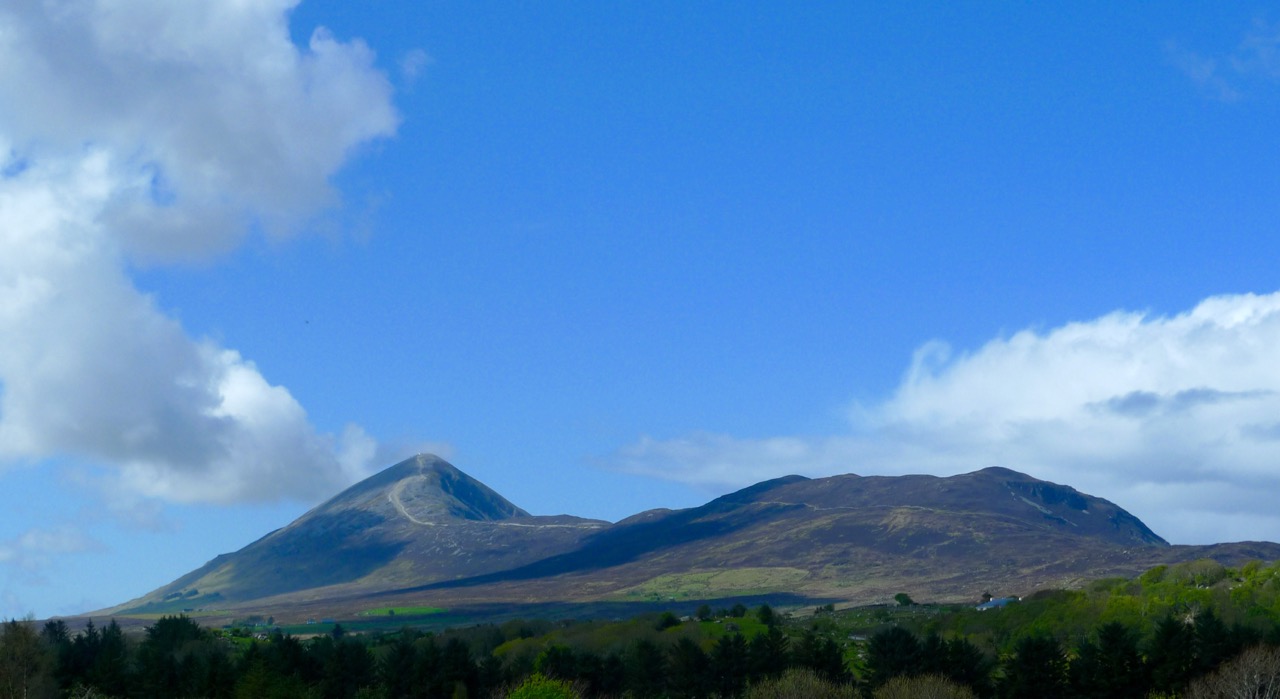
Yes, I have this picture of our good saint standing on the top of Croagh Patrick in Mayo and all the crowd of little snakes and reptiles climbing up there to surround him, only to be cast down to their doom by a sweep of his crozier…

Hmmm… but surely they would have just rolled and bounced down to a soft landing at the bottom? It’s only a hill, after all…

Croagh Patrick

You’ve obviously got something else in mind?

Well I like the story of St Patrick’s Chair, which is at Altadaven, Co Tyrone. The Chair is a huge boulder which seems to have been carved into the shape of a chair or throne. Beside it is a holy well – also ascribed to St Patrick – which appears to be a bullaun stone: offerings are made at the well and the trees around it are hung with rags and tokens. Altadaven means Cliff of the Demons, and it was evidently where all the snakes, serpents and reptiles once lived. The saint went there, sat on his chair (presumably) and cast them all down the cliff and into Lough Beag below…

Which is a bit different to just rolling down the hill at Croagh Patrick…

Wishing Chair Slemish

Another St Patrick’s Chair at Slieve Mish, Co Antrim – this one looks like a good candidate for the place where the snakes were cast down… (Irish Times 1956)

And there was a tradition at Altadaven of an annual gathering known as Blaeberry Sunday or ‘The Big Sunday of the Heather’, probably connected with Lúnasa customs. People would climb the rock to sit in the chair and make a wish which, of course, always came true. Then they visited the well and left pins and pennies behind…

Anything else we should know about reptiles in Ireland?

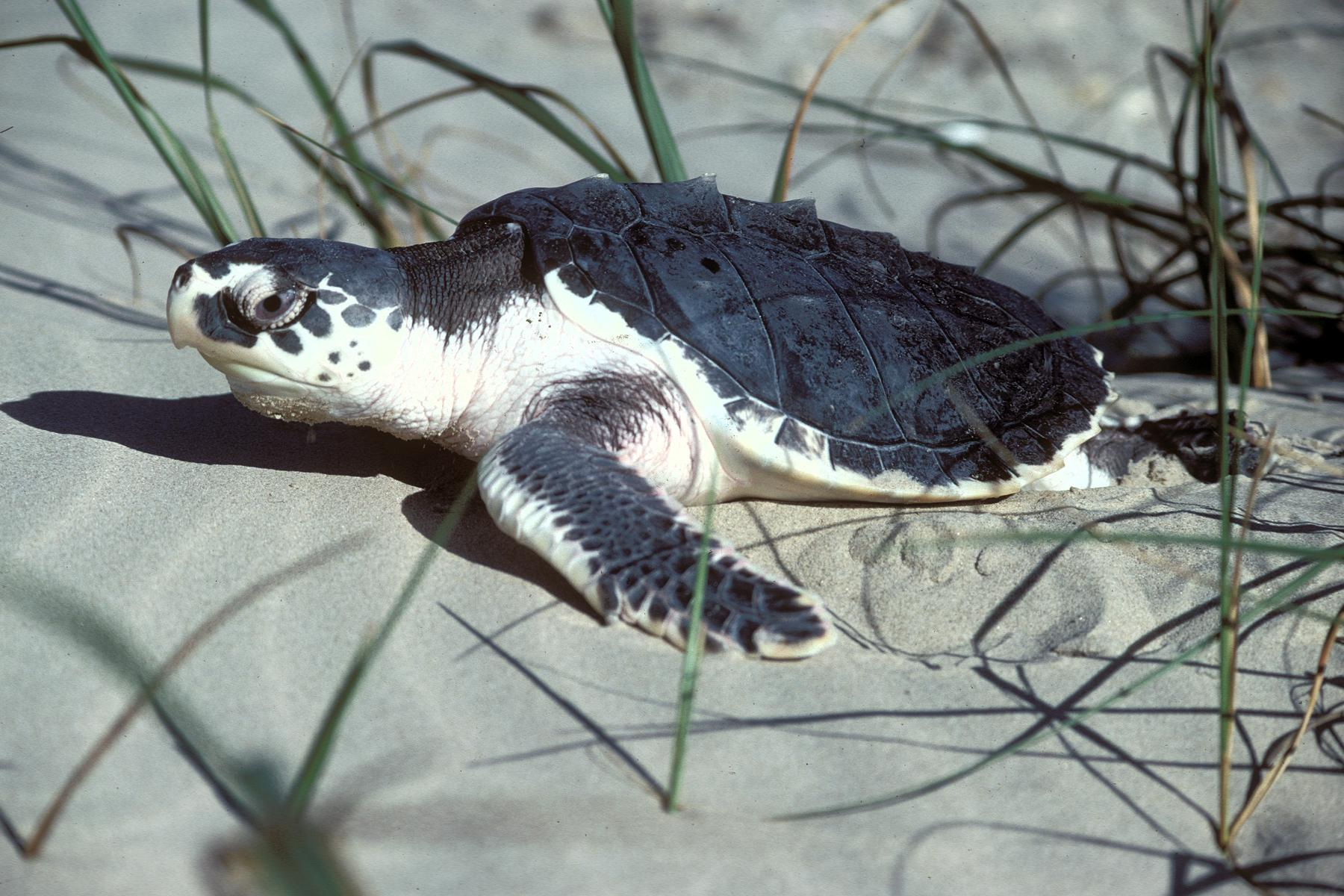
Kemps turtle

Well, earlier this year one of the world’s rarest turtles – the Kemps Ridley Sea Turtle – appeared in Donegal. Unfortunately it was dead – washed up on the beach. But there are also other small turtles which do inhabit Irish waters.

The exception to the rule, possibly. But perhaps being in the water isn’t quite the same as being on the land…

Peist 1611

I’m always keeping my eyes open. I had a ‘serpent’ experience once, in Devon. On my first visit to St John’s holy well up on Hatherleigh Moor I opened the door to the well (which was surrounded by a stone built enclosure) and there inside was an eel swimming around!

I heard that’s a very good omen – to see an eel in a holy well?

Oh yes – why wouldn’t I be a total believer in such things? In Celtic Brittany holy wells are always protected by a ‘Fairy’ who has the form of an eel, and is a benign spirit. Interestingly, though, there is no stream or watercourse near to the Hatherleigh well, so the eel must have travelled some away across the moor to get there – on dry land!

So – I have to ask: are there eels in Ireland?

eel

There are – Anguilla Anguilla – It’s a fish, so not a problem to the saint. Eels have been eaten in Ireland since the earliest human times and have been found in association with Mesolithic sites such as Mount Sandel, Co Derry.

Thank you – you’ve taken us on a serpentine tour through Irish history and mythology…

Mac Coitor


The heading picture Celtic Snake is by Canadian artist Barbara Trott; the Slow-worm is from Jonas Bergsten; the long window is in St Patrick’s Chapel Glastonbury; St Patrick in Bandon Cathedral is by Finola; the Lizard is by Marek Szczepanek; the Peist is from Speed’s Map of Ireland 1611; and Drowning Eels is courtesy of images.all-free-download.com

Irish Poldarks

black hole

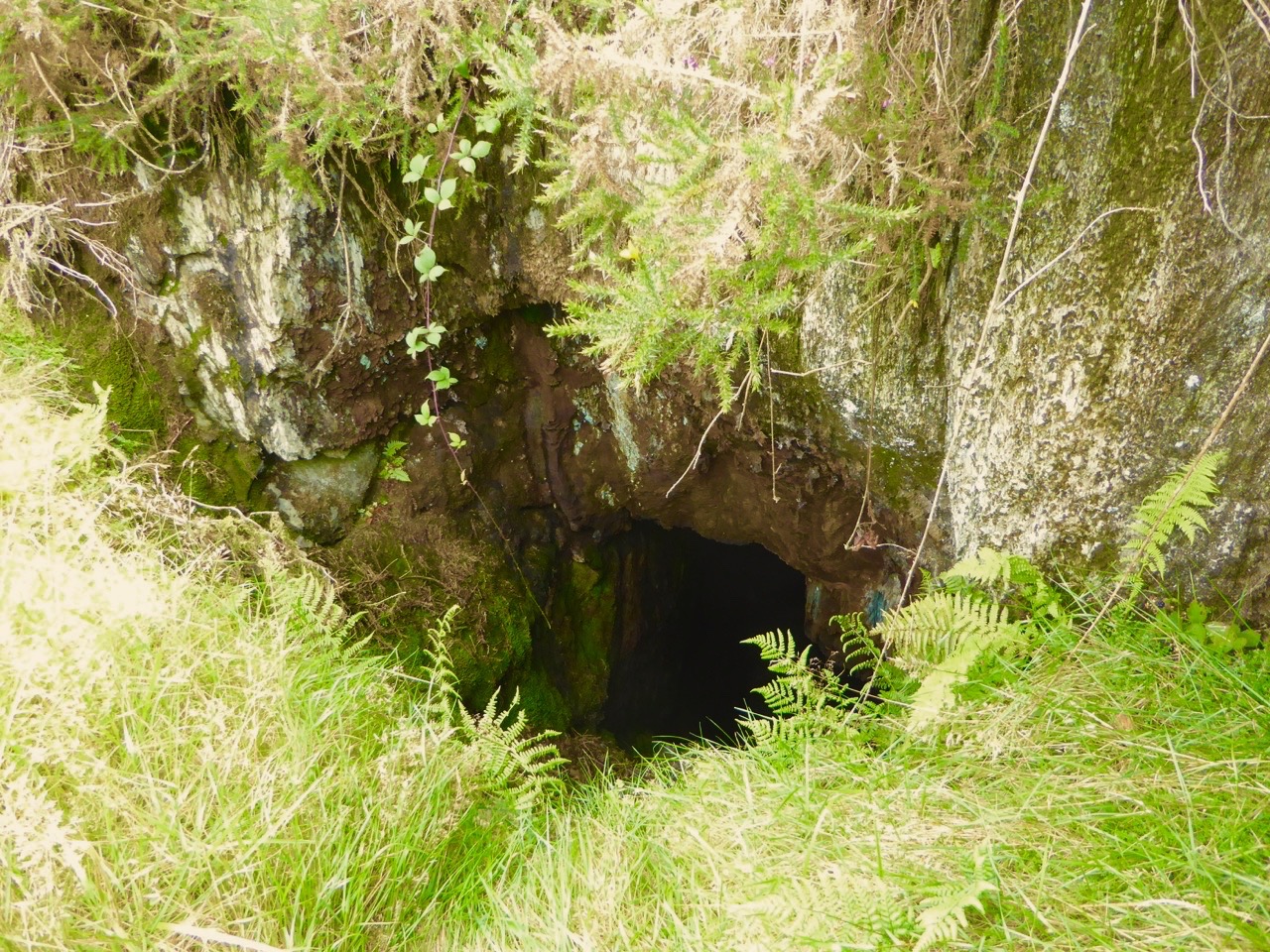
Derrycarhoon Mine

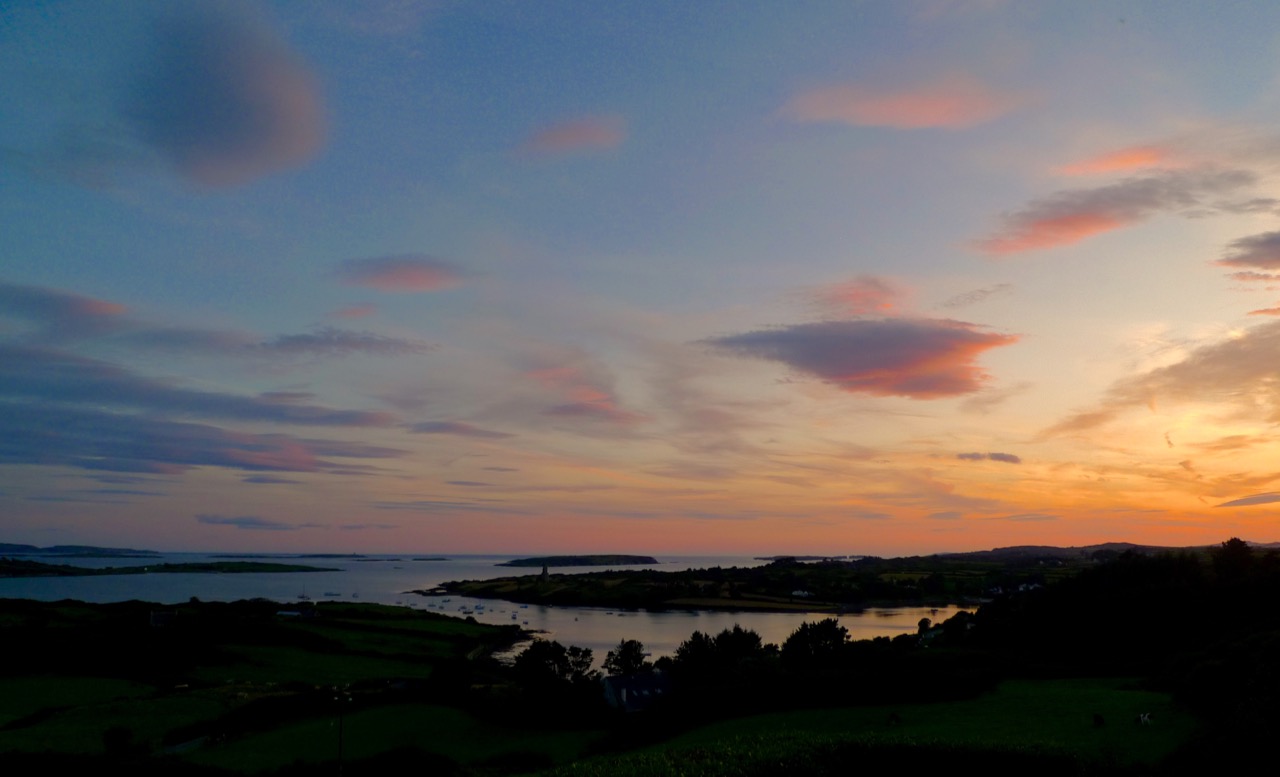
Schools are back; fields are being cut; the shutters are going down on the holiday houses around the Cove. And – the good weather has arrived! Hot days and red sunsets: West Cork is the place to spend autumn…

Full Sky

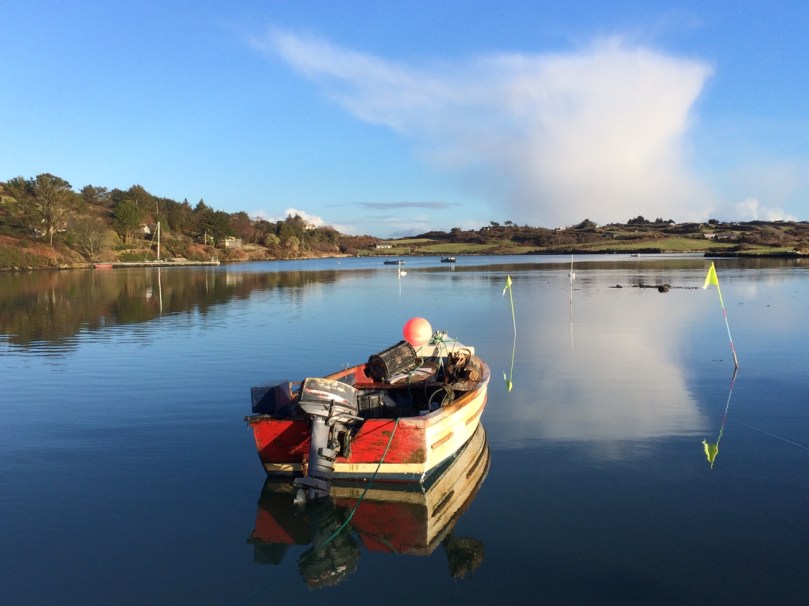
Autumn comes to Rossbrin Cove

It was just such a golden autumnal-feeling day when our friend (and Fastnet Trails mastermind) Eugene McSweeney called us to see if we would like a trip out to the old metal mine north of Ballydehob, in the townland of Derrycarhoon. Of course we would! Local farmer William Swanton led the expedition: William’s family had connections with mining – he told us that his grandmother’s father had been a Captain of the mine.

William

William Swanton at the South Shaft, Derrycarhoon

You will know that we live in the townland of Cappaghglass, and this has a mining history, as does the neighbouring townland of Ballycummisk. Also, there are ancient mines on the slopes of Mount Gabriel, not far away, and more mining activity in other parts of the Mizen, Sheep’s Head and Beara Peninsulas.

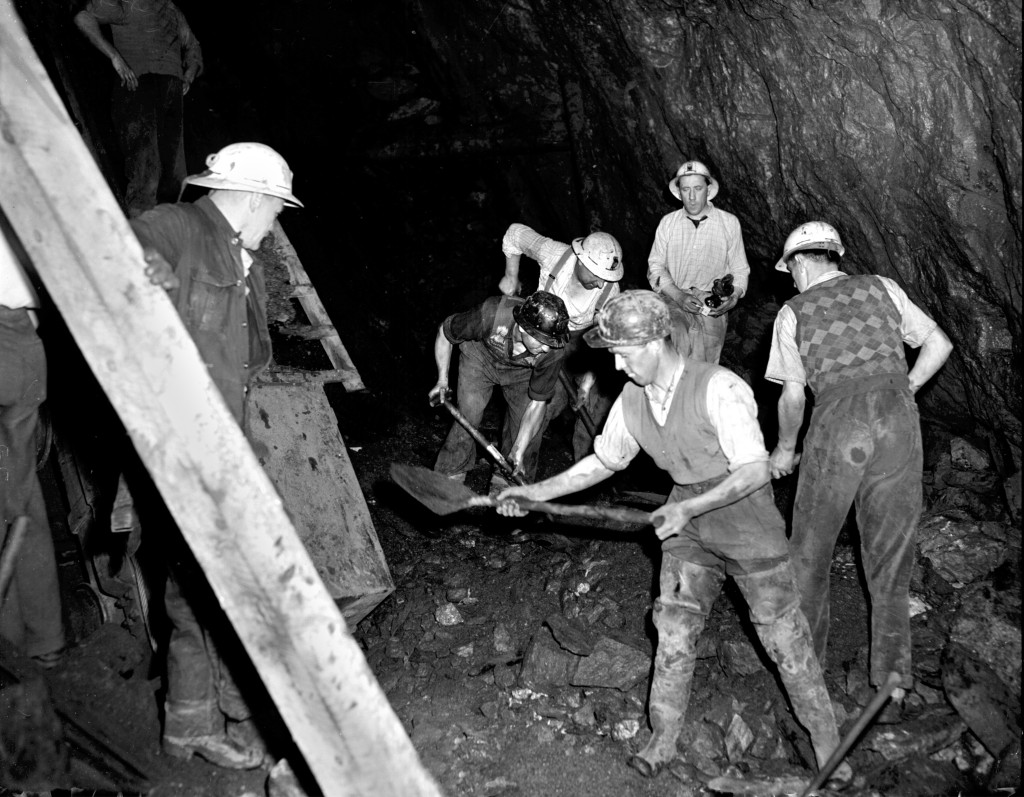
Allihies19571957 scene at Allihies Mine, Beara Peninsula

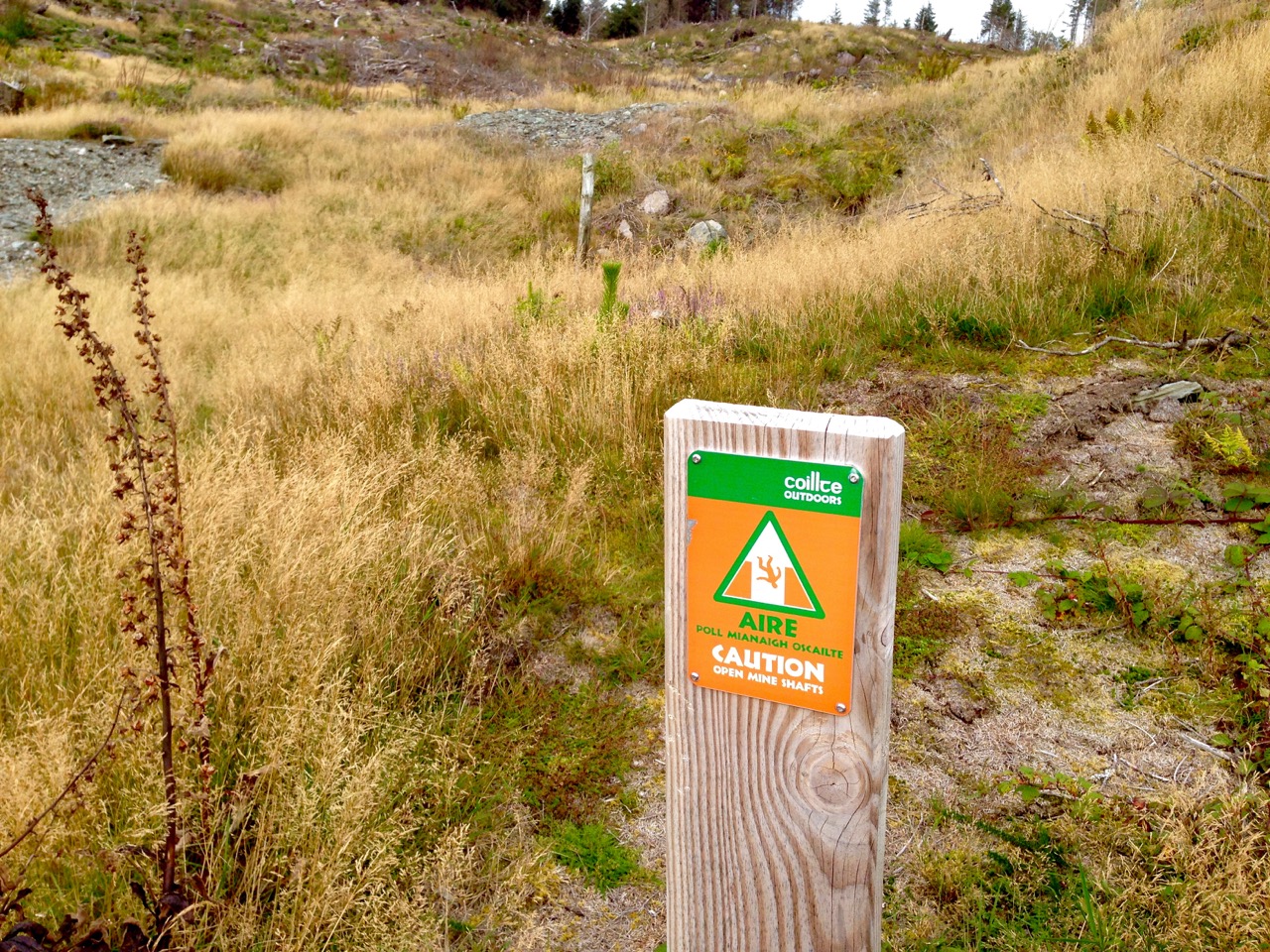
hodnett bookWhile many aspects of the 19th century history of the old mine at Derrycarhoon have been well recorded (I am indebted to The Metal Mines of West Cork by Diane Hodnett, The Trevithick Society, 2012), the site itself had for some time been difficult to reach and interpret as it was in a dense forestry plantation established in the 1960s and 70s. Now, however, much of the matured forest has been cleared (albeit leaving a devastated landscape) and it is possible to piece together the layout of the workings. Please remember that the mine is on land managed by Coillte and is subject to Coillte’s policies on access – permission must be sought from the landowner before visiting; also, a guide is essential – there is very rough ground and open and unguarded shafts and trenches.

danger

What is so special about this mine is that it has apparently been exploited firstly in prehistoric times, and then again in historic times – prior to its most recent incarnation in the 19th century. Professor William O’Brien of UCC recognises ‘…the recently-adduced evidence for early medieval operations at this site, which is quite unique in the history of Irish metal mining…’ (A Primitive Mining Complex at Derrycarhoon, County Cork – Journal of Cork Historical and Archaeological Society vol 94). While other mines on the Mizen Peninsula have shown evidence of being worked initially in the Bronze Age and then subsequently in modern times, Derrycarhoon is the only one to date which can confidently claim to have also been in use in between those times.

finola at the shaft

interior

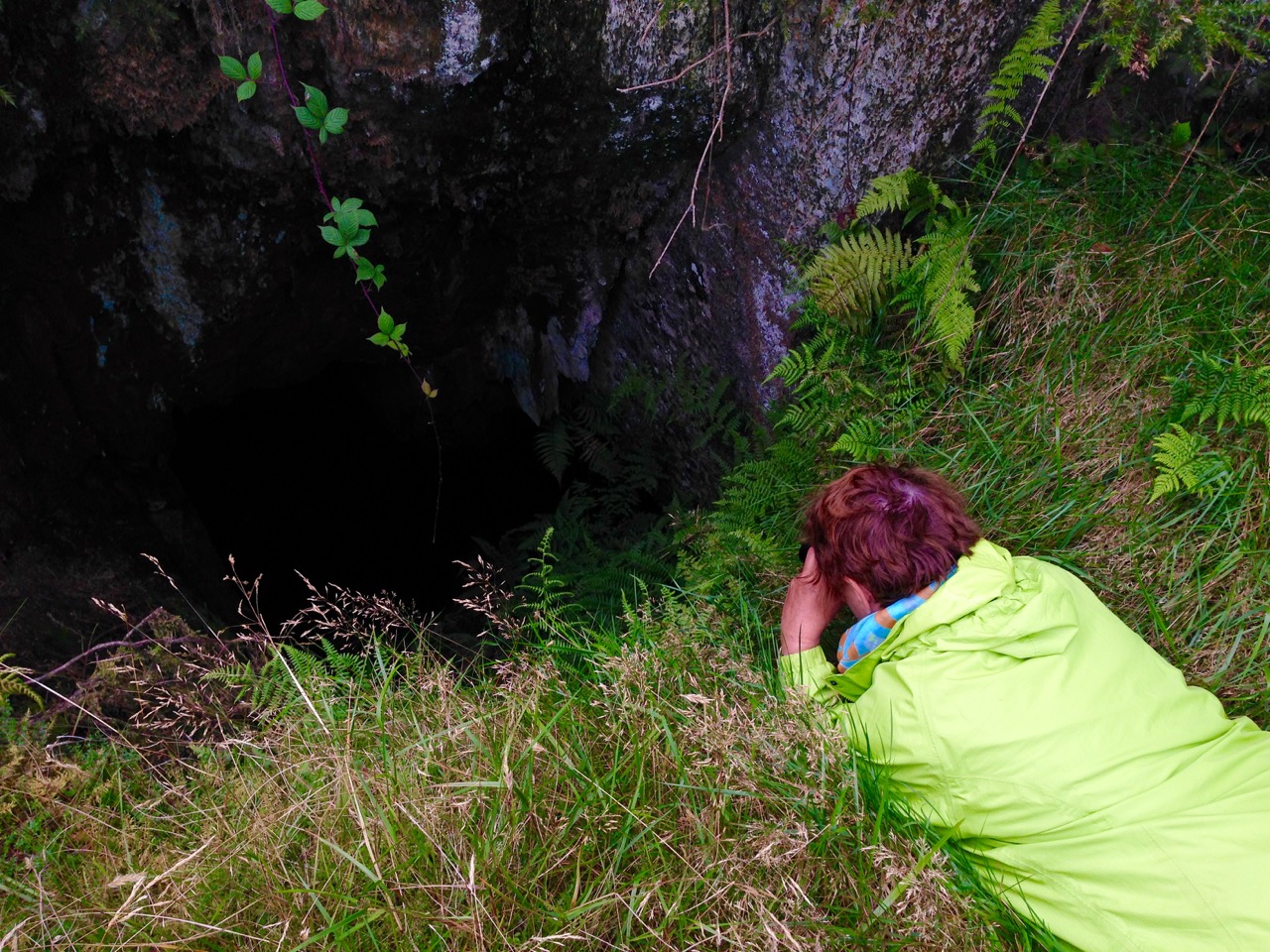
Intrepid Finola inspecting the deep shaft at Derrycarhoon, top, and her photo, below – note the copper staining

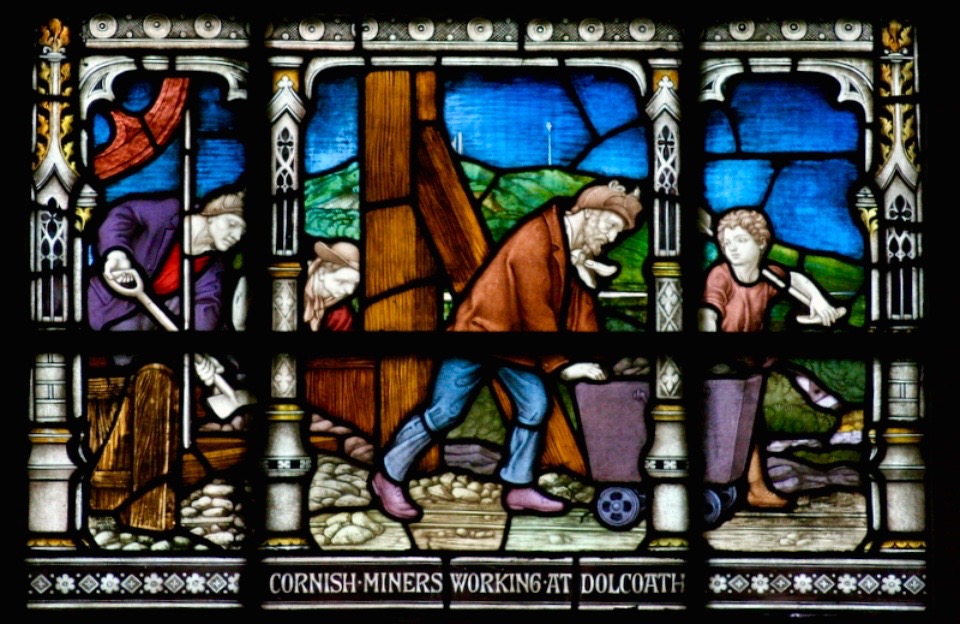
We have explored links between West Cork and Cornwall in previous blog posts (here, herehere and here). When it comes to metal mining anywhere in the world there’s usually a Cornishman involved and here is no exception to that rule. The mine agents – whose job it was to prospect and direct operations – were always known as ‘Captains’. A dynasty of Mine Captains was founded by Charles Thomas (1794-1868), a mining agent and share dealer in Camborne, Cornwall – responsible for the very successful development of the Dolcoath Mine in Camborne. Mineral rights here were established in 1588 and copper was being produced in some quantity by 1720. Thomas (who had started work in the seams of Dolcoath at the age of twelve) stepped in as Captain in 1844 after a period of considerable decline in metal production. Charles was a real-life Poldark – insisting that the apparently dwindling seams of copper be followed to the bitter or fruitful end – and his skills saw Dolcoath (known as the Queen of Mines) become the largest, deepest and most productive mine in Cornwall, with its principal shaft eventually reaching a depth of 3,300 feet (1,000 m) below the surface – and incidentally taking the miners between 2 to 3 hours to descend and ascend, significantly reducing their working shifts below ground. Thomas was succeeded at Dolcoath by his son Josiah and then his grandson Arthur, taking the mine well into the twentieth century. (Its successor, the South Crofty Mining Company went into administration in 2013).

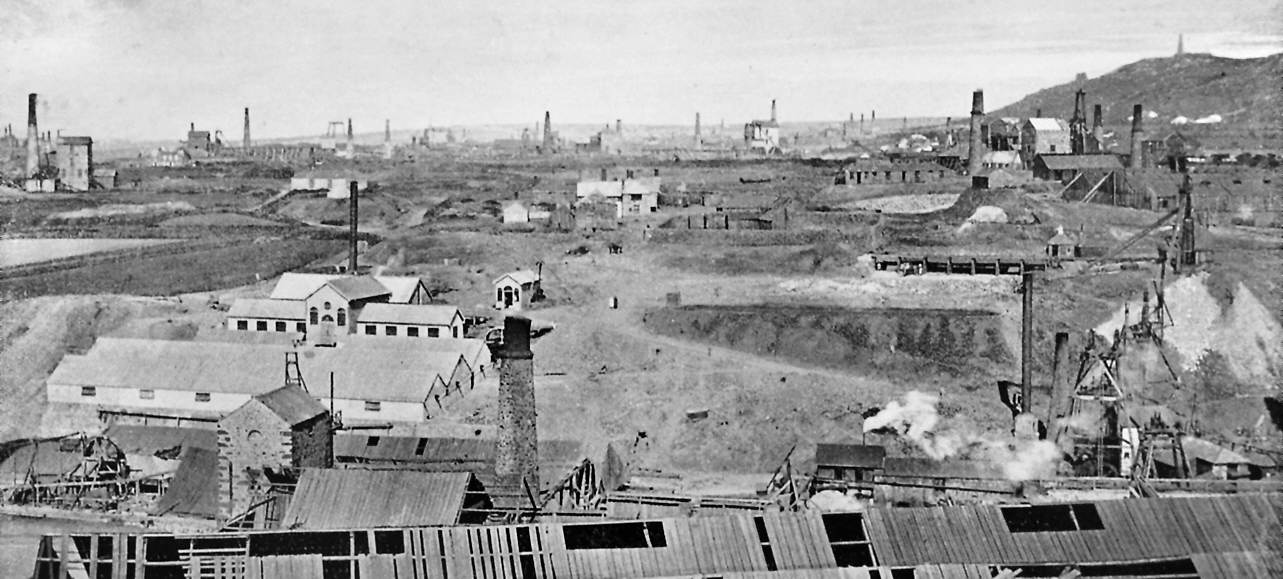
Dolcoath 1893

Dolcoath, Cornwall – Queen of Mines – 1893

The point of this digression into Cornish mining history is simply that three more sons of Charles Thomas, Captain of Dolcoath, came to the west of Ireland in the mid nineteenth century and were instrumental in the development of many of the mining activities here, including those on the Mizen. The brothers, Charles, Henry and William arrived by 1841 with their own families – yet more sons – who proceeded to populate, at one period or another, the Captaincies of most of the West Cork activities, including our own Cappaghglass workings and the Derrycarhoon venture.

West Cork Mine Captains: Henry Thomas (left) with his niece and William Thomas (right) with his daughter

The modern age of mining commenced at Derrycarhoon in 1846, under the management of Captain Charles Thomas. Charles discovered no less than six old mines during his preliminary explorations, and recognised similarities between them and the shallow workings of medieval tinners which he knew from his childhood home on the moors of Bolenowe, near Camborne, where such workings were extensive and visible. That’s how we know that this mine had been active in those times. But also, as his brother Captain William records in an article dated 1853:

…In the Derrycarhoon Mountain some excavations have been found, which no doubt were made at a very remote period, as they are invariably designated by the country people ‘Danes’ or ‘Danish Works’, but whether these ancient works were carried on or not by the Danes is not easy to determine: it is, however, an historical fact that the Danes visited Ireland many hundreds of years ago…

1843 drawing danish implements

Nineteenth Century Archaeology: Excavated ‘Danish Implements’, 1843 – in fact these finds are likely to be Bronze Age or Iron Age – have a look at  Umha Aois, a Roaringwater Journal post about early metalworking

(Thomas 1853) …One of these singular excavations at Derrycarhoon was a few years ago cleared of water and rubbish; it was found to be 60 feet deep and about 120 feet in length… the lode or vein appears to have been literally pounded away by stone hammers, a great many of which were found in the old works and which were evidently brought from a considerable distance, there being no rock of the same character within some miles…

Hand-held stone maul used at Derrycarhoon in prehistoric times

We found evidence at Derrycarhoon of these stone tools, generally known as ‘cobble stone hammers’ and probably originating on the beaches below us: their presence almost certainly confirms that the earliest workings here were Bronze Age, as confirmed by Timberlake and Craddock in a paper of 2013: …The distribution of known occurrences of this type of cobble stone hammer at or near to mining sites in the British Isles correlates with some (but not all) of the areas of near-surface copper deposits, particularly along the west coast of Britain… Recent fieldwork suggests good survival of tools at mine sites, even where these have become dispersed as a result of redeposition by later mining… Hammer stones, or fragments of hammer stones, are more or less indestructible, surviving any amount of later reworking. In most cases the fragments of these tools never disperse far from source, even when redeposited several times. Experience has shown that if a range of these can be found, then the approximate site(s) of prehistoric mining can usually be identified…

derrycarhoon trumpet

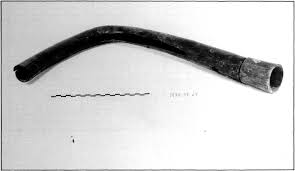
Further intriguing finds were made at Derrycarhoon in the nineteenth century, including a ‘notched pole’, a ladder and a trumpet-like wooden tube 75cm in length. Whether these artefacts were medieval or earlier we do not know but, remarkably, the tube still exists and is kept in the spectacular Pitt-Rivers Museum in Oxford (why not here in Ireland?). I could only find a poor quality early photograph of this.

Pitt Rivers Museum, Oxford, UK

Pitt-Rivers Museum, Oxford – where the Derrycarhoon Trumpet (above) is stored

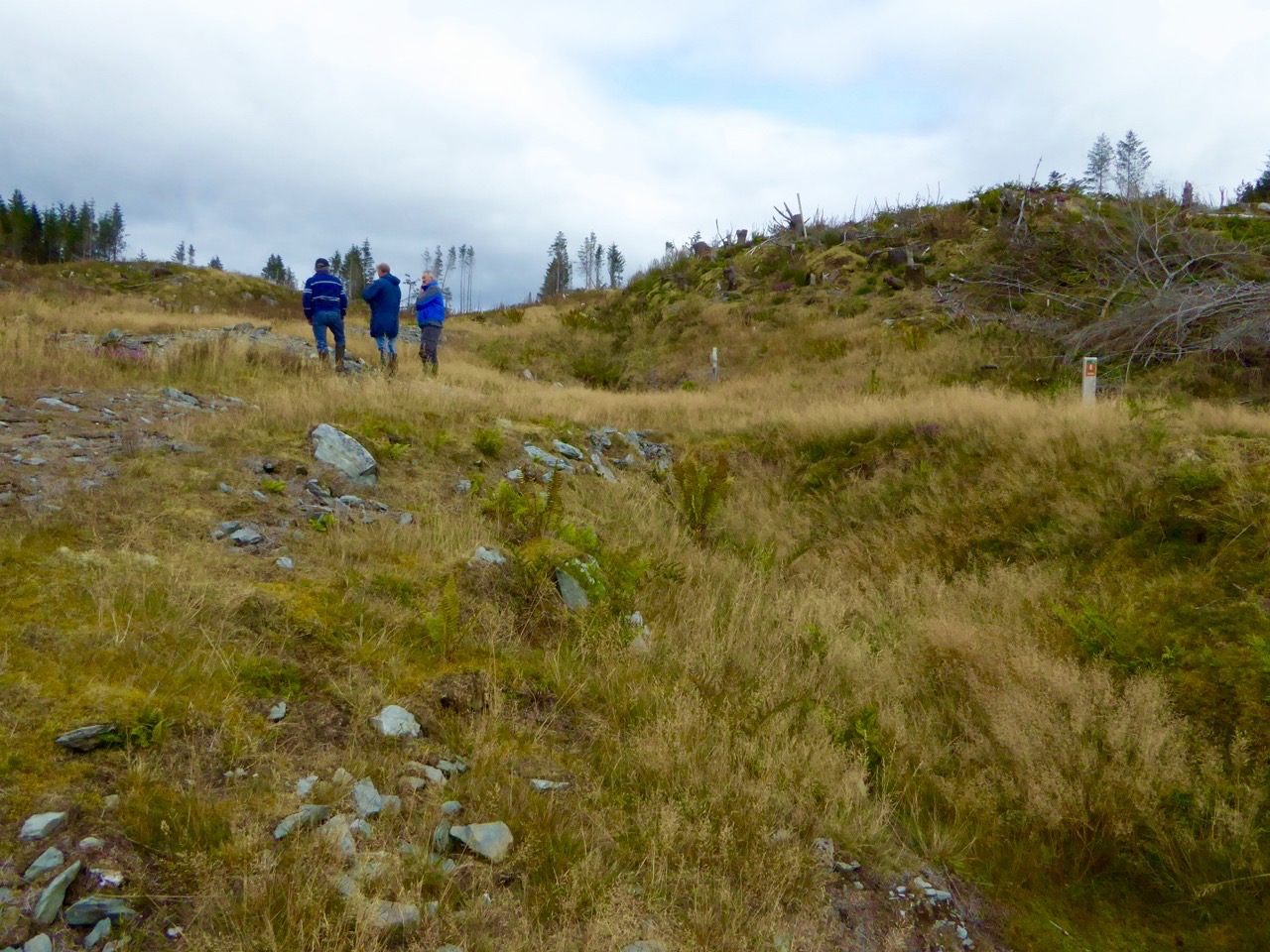
The topography at Derrycarhoon – which is reappearing now that the forestry plantation has been cleared – is very similar to the Bronze Age mining sites on Mount Gabriel: long, shallow trenches interspersed with pits and shafts. However, the superimposition of medieval and modern interventions clouds the issue. William Swanton pointed out to us a drainage adit driven horizontally for some distance through the bedrock. We assume this is probably the work of the Victorian speculators.

three figures

portal

Mine explorers (top) and portal (below)

Captain Charles Thomas evidently raised some 30 to 40 tons of ‘rich grey copper ore’ after the ‘old workings’ had been cleared during the 1850s. Derrycarhoon Mine was listed from 1862 to 1873 under the ownership of Swanton and Company but there is no record of any production at this time nor afterwards, although prospecting trials were made in 1912 by a John McArthur of Glasgow and again in 1965 by the Toronto Mining Company. We found part of a core sample on site, presumably dating from that trial. Then the trees took over…

Landscape of spoil: copper traces in the discarded rubble; baryte – and views west to other Mizen mining sites, Mount Gabriel and Mount Corrin

Today, the rough landscape is marked only by green-stained spoil heaps, earthwork undulations and a few recognisable pits and shafts. The litter includes traces of barytes, sometimes a by-product of copper production. If you are not interested in mines or the history of them you will be pretty unimpressed. But, as a microcosm of our own local history, we were fascinated by our exploration of Derrycarhoon and are very grateful to William and his ancestors (were they the Thomases – our own Irish Poldarks?).

Cornish Miners Window

Fastnet Trails: Rossbrin Loop, Part 2

Start this walk at the Rossbrin boat slip

Start this walk at the Rossbrin boat slip

A joint post by Finola and Robert

In Part 1 of this trail post, we took you around the first leg of the Rossbrin Loop trail, which we have broken into two shorter rambles.

This one is steeper and climbs higher, but it’s full of interest and you can take it as easy as you like. For this walk, you park at the Rossbrin boat slip, at the eastern end of Rossbrin Cove.

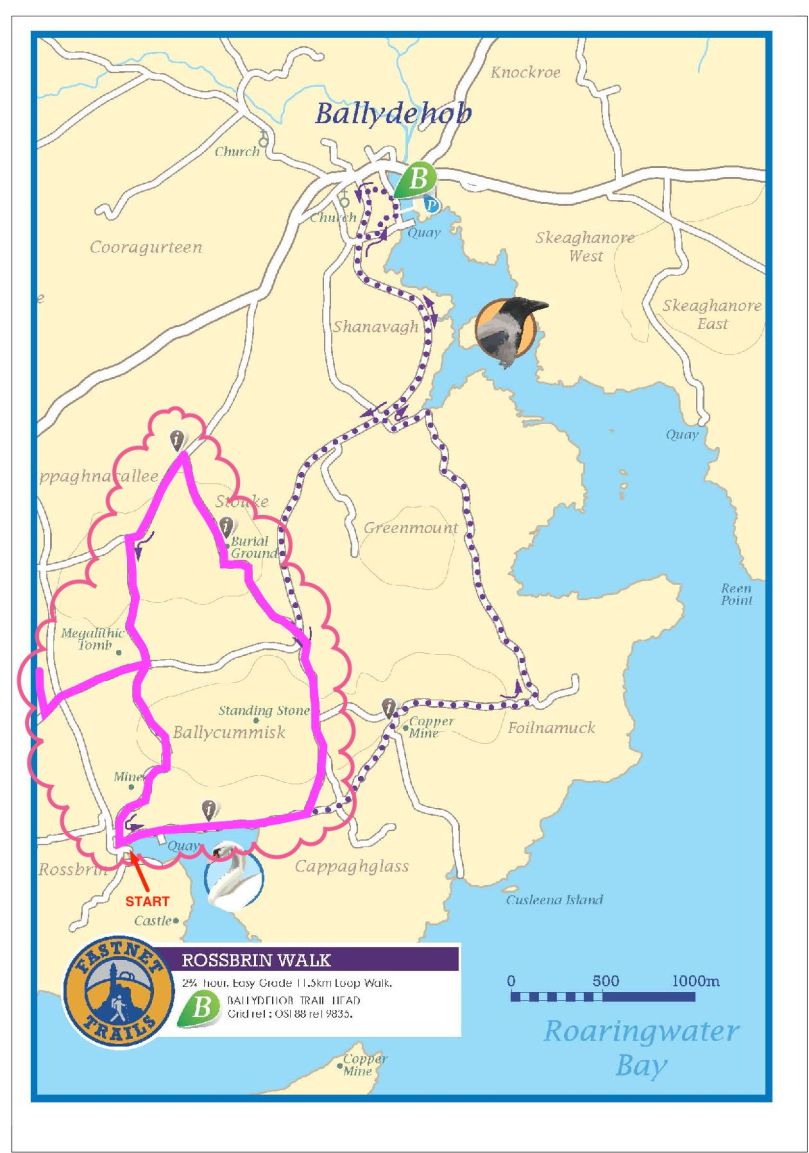
Rossbrin trails route revised Export

You won’t need off-road boots and you can take the dog. Give yourself two to three hours, depending on whether you decide to do the detour to see the wedge tomb. This is a nice, rambling pace, with lots of time to stop and chat to anybody you meet, admire the wonderful views, take lots of photographs, and maybe indulge in a picnic along the way. 

The first hill affords lovely views back to Rossbrin Castle

The first hill affords lovely views back to Rossbrin Castle

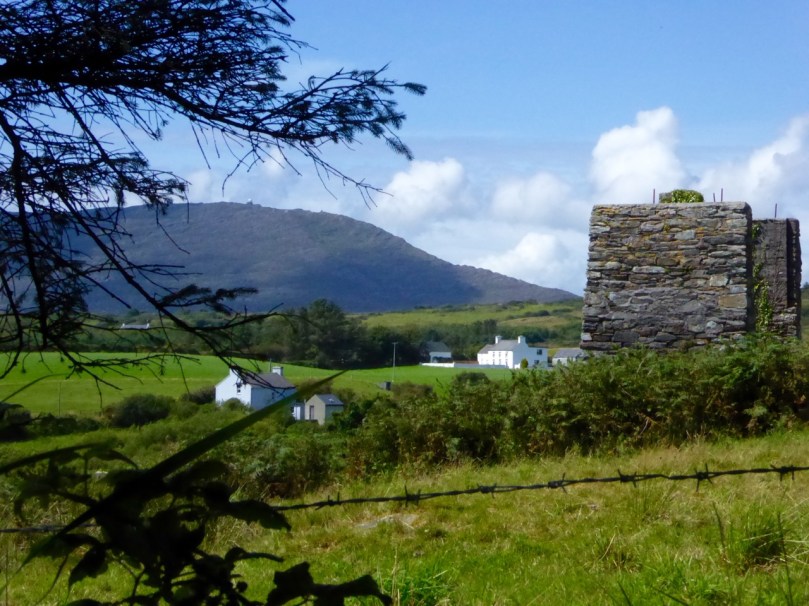
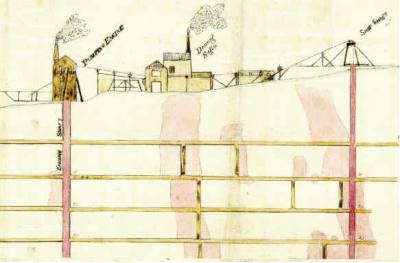
Set off north and turn right after the boat yard and then left up the hill. As you ascend you will see the remains of old mine workings to your left. The earliest records of mining at Ballycummisk refer to 16 tons of ore raised in 1814 and 42 tons in 1815. In 1838 a shaft was sunk 20 fathoms, mainly through barytes and shale. In 1857, 174 tons of ore were sold, mainly copper. By 1861 the mine was recorded as being ‘one of the best developed and very satisfactorily worked.’ The ‘Lady’s Vein shafts’ are marked on the OS 6” map. The Ballycummisk Mining Company worked the mine from 1872. In 1878 a section down to 228 fathoms was noted, but in the same year the mine was recorded as ‘abandoned’. Nowadays some concrete pillars and the slag heap are the most visible remains of the once thriving mine-site.

Old Mine site

There are extensive views over the countryside beyond the old mines

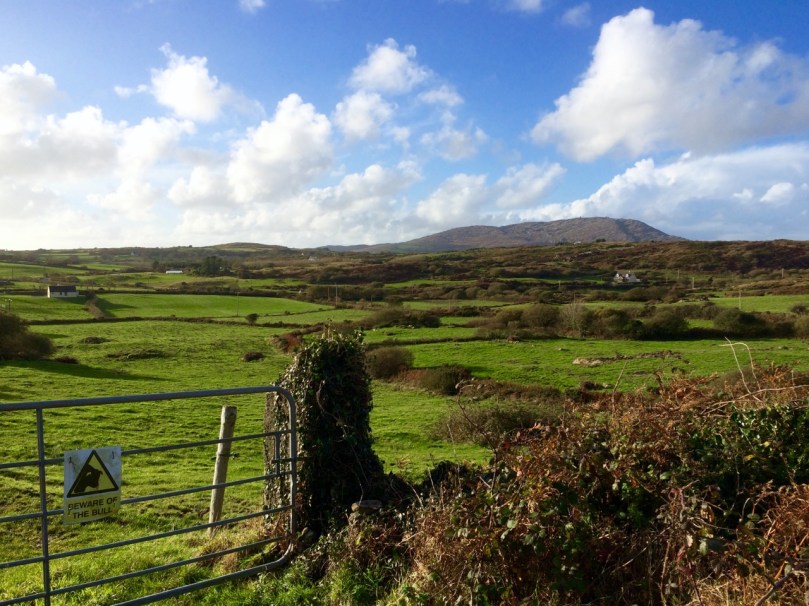
At the top of the hill, where you will find a sign to the riding stables, turn left and head through the townland of Ballycummisk with pleasant country views to the west. Once you get to the crossroads you may see a little wayside stall selling vegetables on the honour system. If you’ve brought a backpack, this would be a good place to stock up on carrots, potatoes, or yellow tomatoes.

Beware of the bull

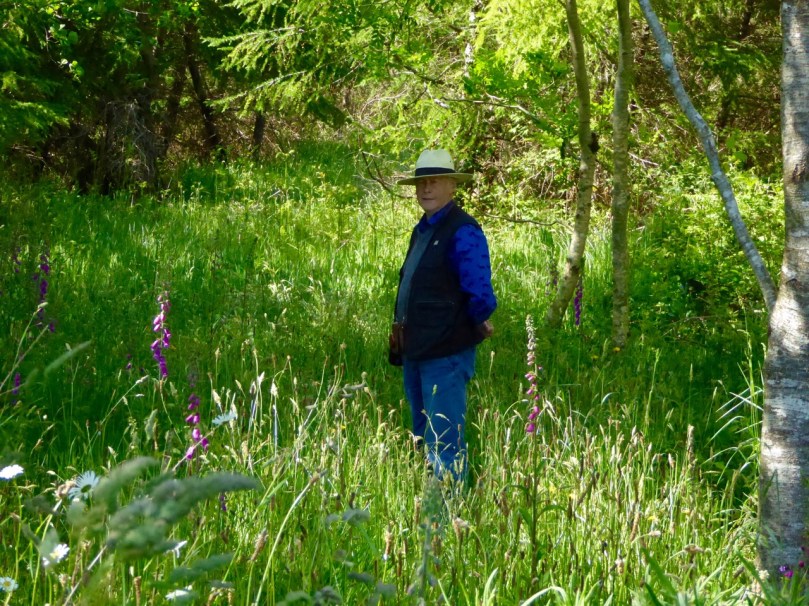
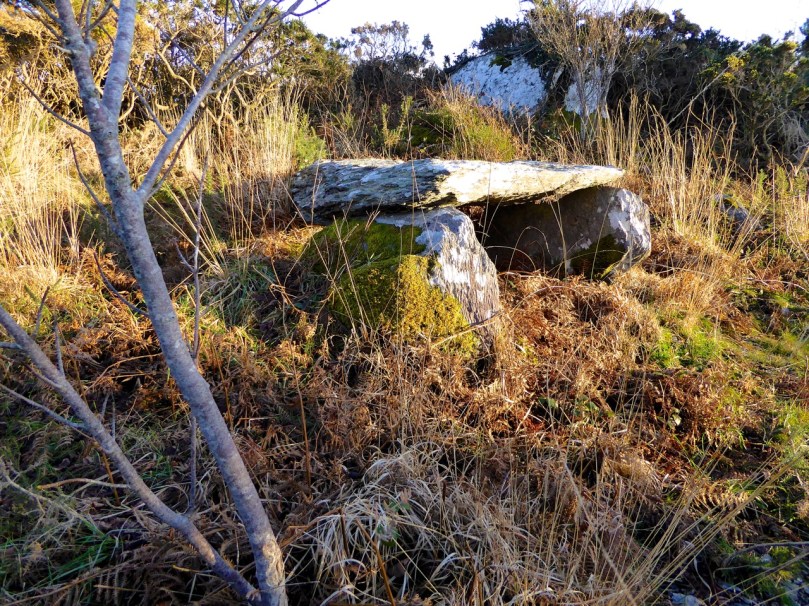
Wayside StallAt this point, we recommend a detour to see the Kilbronogue wedge tomb. Turn left and walk until you reach the next crossroads. Go straight through the crossroads and a short distance on you will see a lay-by on the right side of the road. Step over the wire and find your way up the path that has been generously maintained by the landowner. In early summer this path is awash with ox-eye daisies. It meanders up through a birch plantation until you emerge in a small clearing to find the wedge tomb.

Path to wedge tomb, Kilbronogue

Like most wedge tombs, this one is orientated to the west – take a look at our post Wedge Tombs: Last of the Megaliths for lots of information on this class of Bronze Age monuments. This is a lovely example, and we are grateful to Stephen Lynch for ensuring its wellbeing and providing access to it.

Kilbronogue Wedge tomb

Retrace your steps to the second cross roads and turn left up the hill, turning right when your reach a T junction, and then take the left fork at the Y. This is a pleasant country road – farmland stretches on either side, with ruined or abandoned houses dotted here and there among the neat modern farmhouses with their colourful paint and bowery entrances.

In spring and summer the hedgerows are heady with wild flowers of every variety.

Turn right again at the next junction and you will come shortly to the beautiful and atmospheric Stouke burial ground. Although we have read that there are the ruins of an old church in this graveyard, we have never found it. But there are other items of great interest here, the traditional burial place of many island dwellers. In the centre you will find the grave of two priests, Fathers James and John Barry, who were parish priests here during the time of the famine. According to the Historic Graves listing for Stouke  “Sarah Roberts who is buried here in this tomb, died at an early age… worked as a housekeeper for the parish priest… When his sister died and was also buried here, Sarah’s coffin was in perfect condition. She was reburied with the parish priest even though she was not a Catholic. People of the parish come to pray at this tomb on the 24th June at John’s Feast Day.”

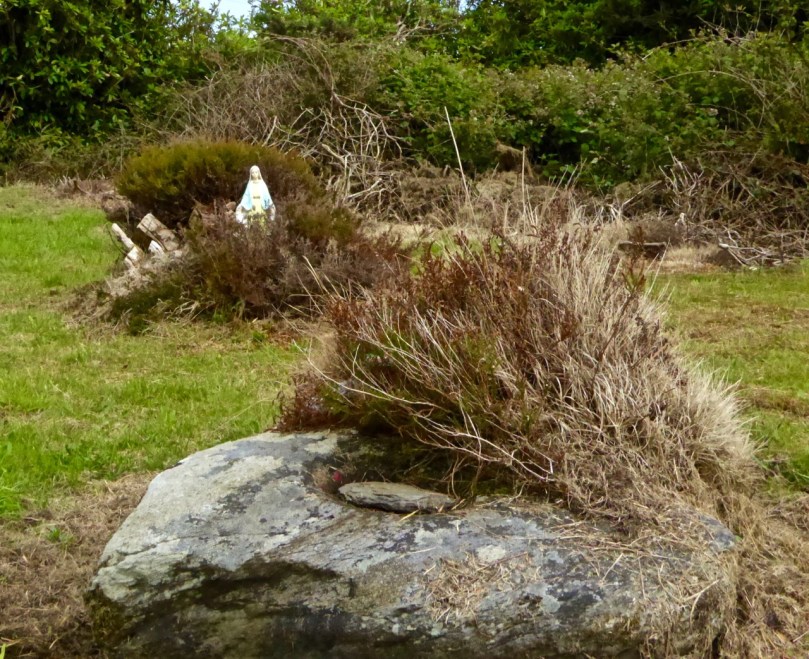
A little way to the right of this grave is a rock, partially covered by heather, that contains a bullaun stone, known locally as the Bishop’s Head. Once again, according to the Historic Graves entry, “The bishop was confirming children in a nearby church. Red coats came in and beheaded the bishop.”

Amanda photographs the bullaun stone

Amanda photographs the bullaun stone

There are offerings of coins in jars at the bullaun stones, and at the priests’ grave. Leave one too, along with a prayer or wish for a loved one.

Bishops Head bullaun stone, Stouke Graveyard

Bishop’s Head bullaun stone, Stouke Graveyard

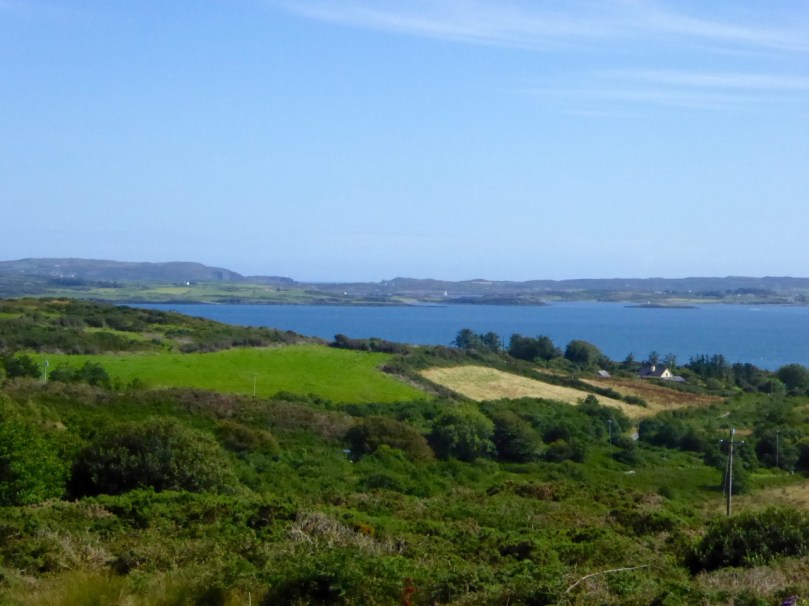
From Stouke the road drops down to a cross roads. Go straight through and start to climb again up to Cappaghglass. Ignore the left turn and carry on until you reach a Y junction. Take the right fork, pass all the ripe blackberries (if you’re able) and as you crest the hill the whole of Roaringwater Bay is laid out before you. Few views in the country can equal this one for sheer scope: all the islands in Carbery’s Hundred Isles come into view, The Baltimore Beacon gleams on its rocky outcrop to the east, while the Fastnet Rock sits sturdily on the horizon, and the Mizen Peninsula stretches away to the west.

Roaringwater Bay from Cappaghglass

Descend the steep hill, turning right at the T junction, and meander down to Rossbrin Cove.

Shaft of Sun

Now a peaceful boat harbour, Rossbrin in the 15th Century was the domain of Finghín O’Mahony, the Scholar Prince of Rossbrin, a man who used the riches extracted from taxes paid by Spanish and French fishermen to fund a centre of learning here in Rossbrin where scribes and learned men wrote and translated books which still exist today. The ruined section of the castle still standing gives little evidence of the erudite court that was once respected throughout Europe. A fish ‘palace’ for processing pilchards once provided employment to the people of Rossbrin, but little trace remains of it, or the holy well at the shore that once attracted those seeking cures for their ailments.

Kayaks at Rossbrin Cove

If the weather’s warm and the tide’s in, this is a good spot for a dip. No? Well, a photograph, then. 

We hope you’ve enjoyed the two Rossbrin Loop walks – do let us know how you got on.

Ballycummisk Mine

Ballycummisk Mine