Moments on Heir

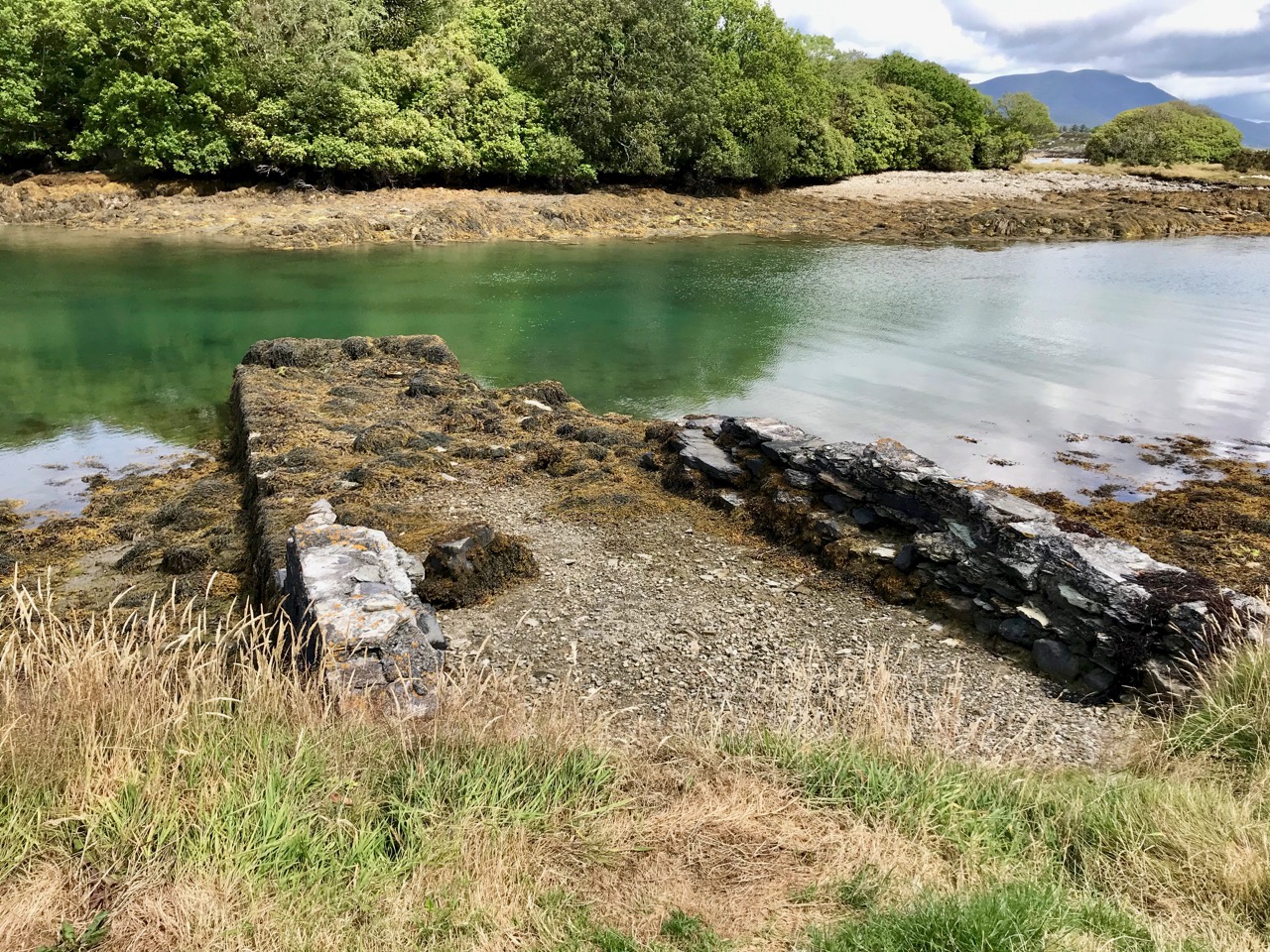
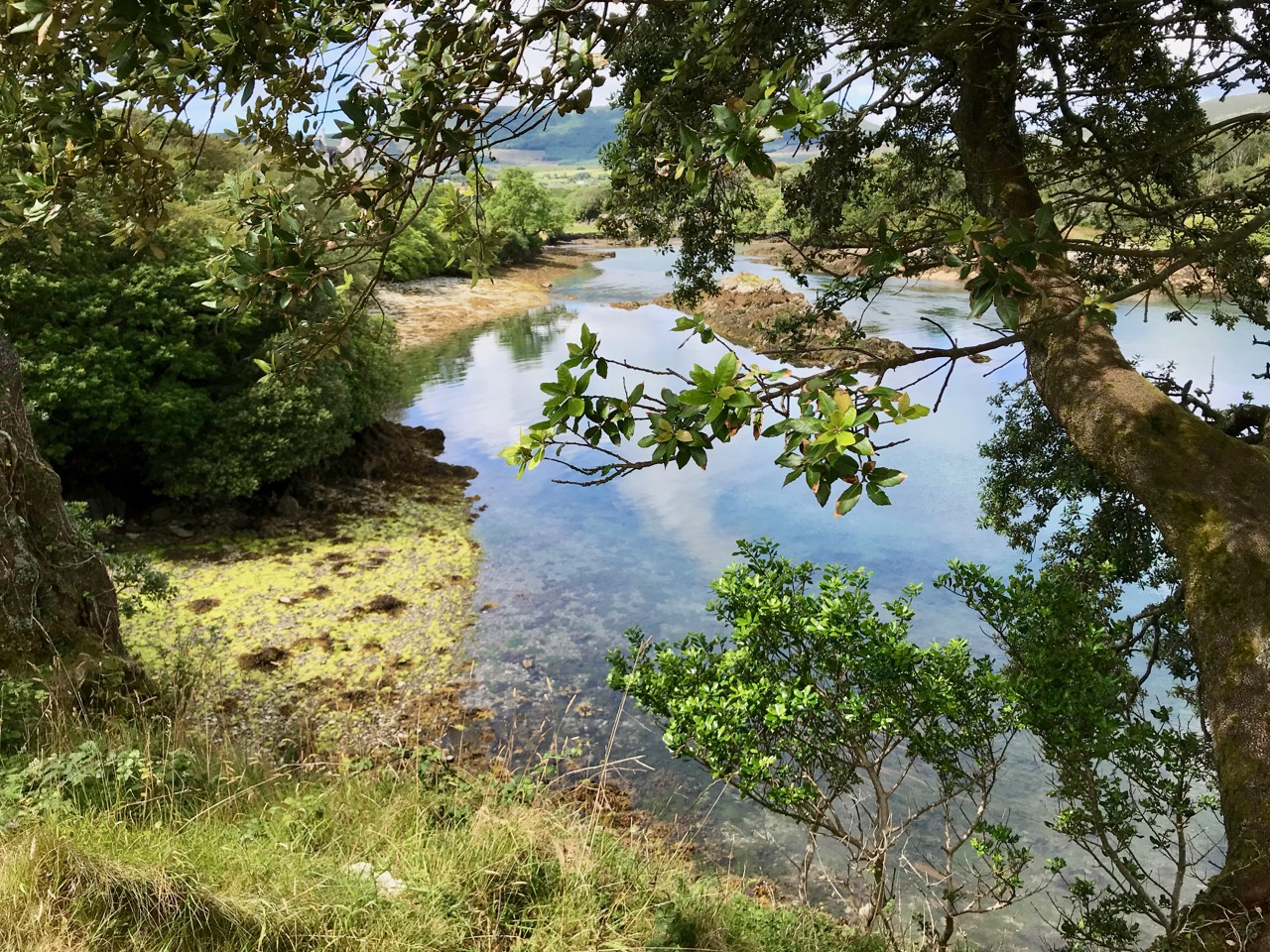
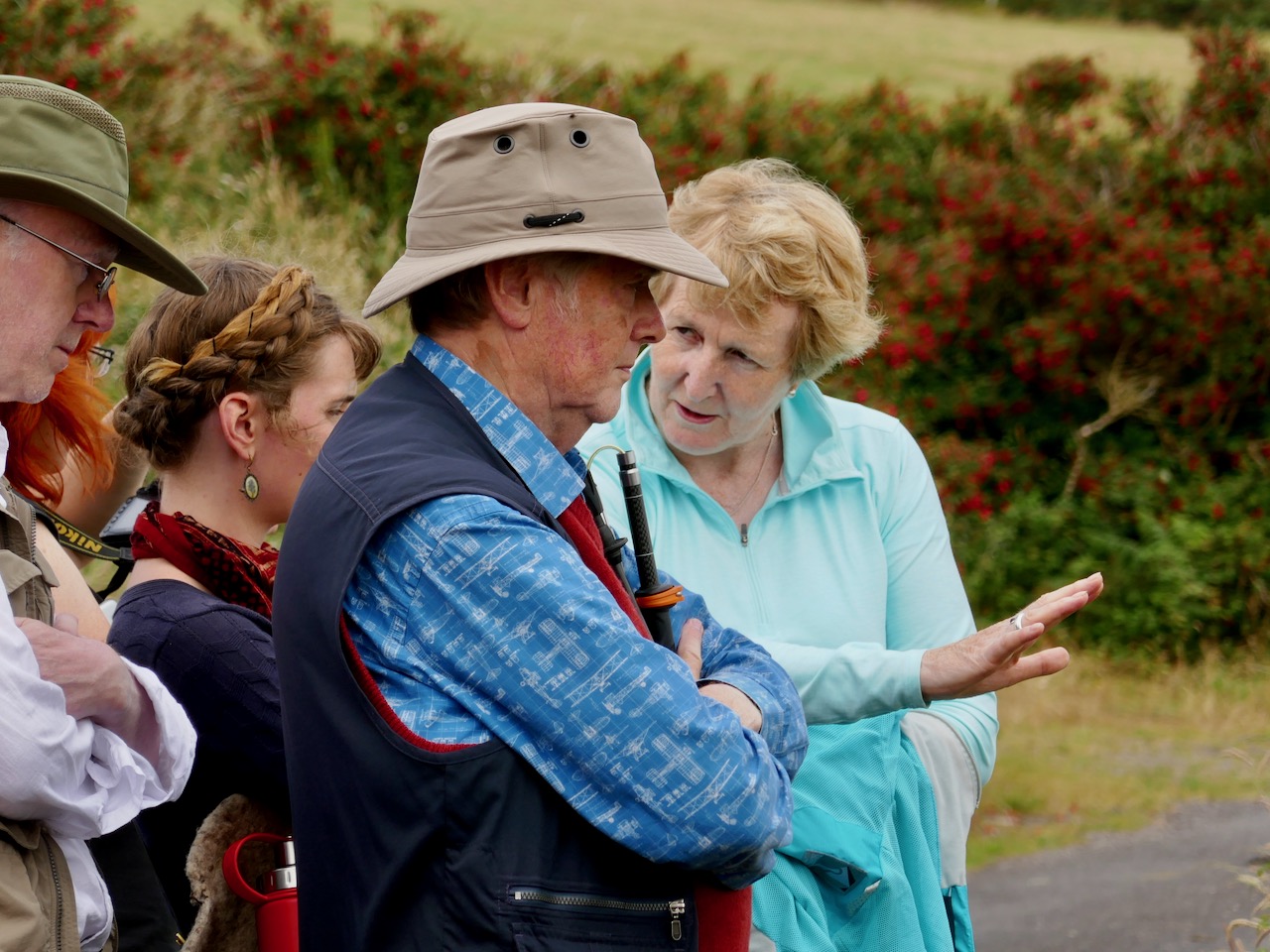
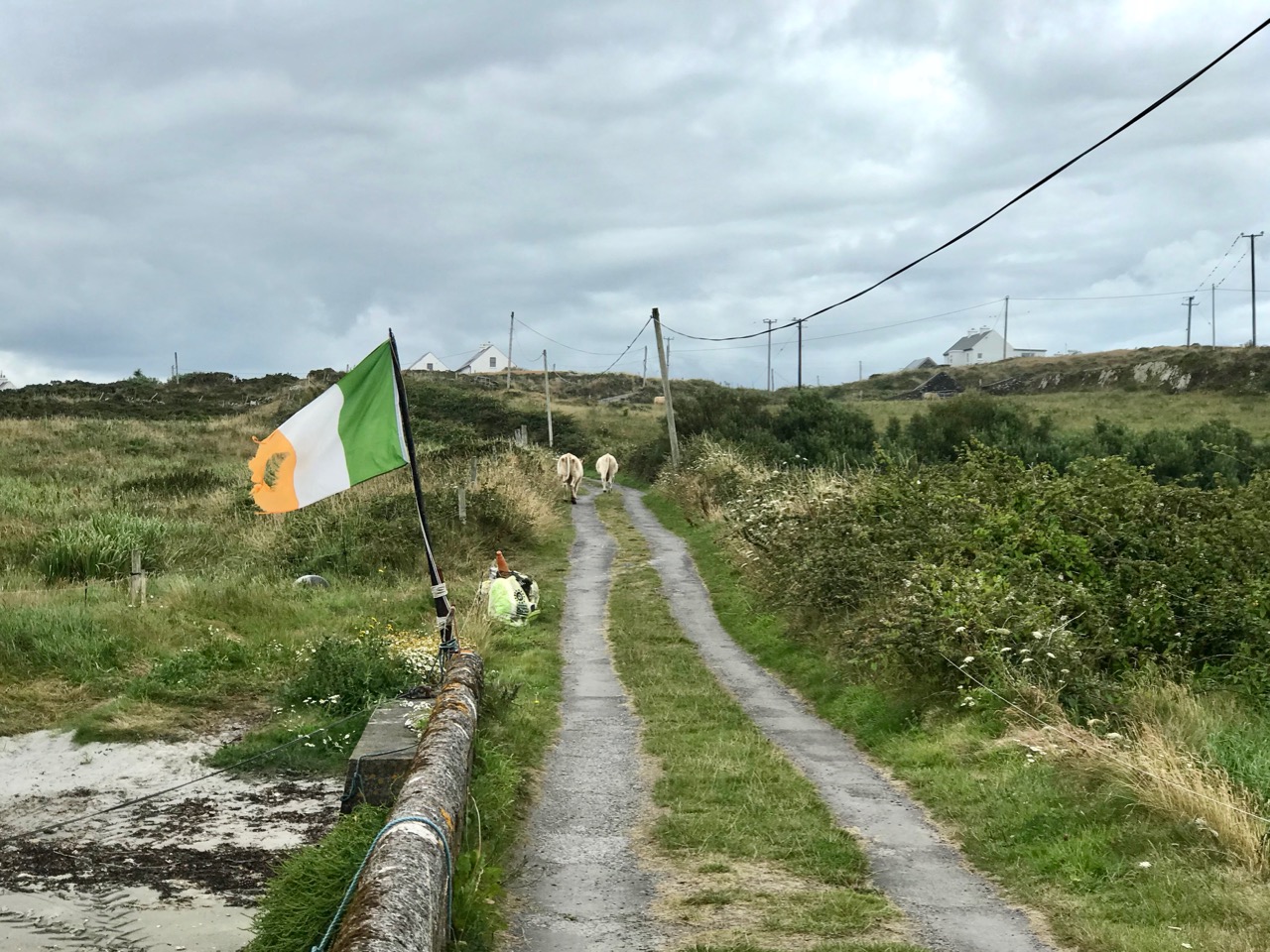
You will often find us visiting the inhabited islands of Roaringwater Bay. They are, after all, in full view of the panorama we see from our perch up here in Nead an Iolair (Eagle’s Nest), and easily accessible by regular ferry services. We like them because – who doesn’t enjoy a boat trip? Also, that little step from the mainland removes you to another world: places where life is lived a little differently, where you can feel slightly remote from the the most pressing issues of life, a little bit ‘on the edge’. Cape Clear, Sherkin, Long island – we have written about them all. And, today’s subject, Hare, or Heir: we have been there before but last week Finola was leading a wildflower walk on the island, and I went along for the ride, and a further exploration.

Colour on Heir: upper – Heir hedgerow, where wildflowers and garden escapees mix happily together; lower – Finola’s band of wildflower enthusiasts get caught up on the minutiae of the beach flora

It was a mixed, breezy day on the island, but dry for the group – two ferry loads and some furry four-footed minders to keep us all in order. Much time was spent poring over a myriad of plant species, some of which flourish on the West Cork islands more prolifically than on the mainland. I was interested in the land- and sea-scapes which changed quite dramatically with the movements of the tides.
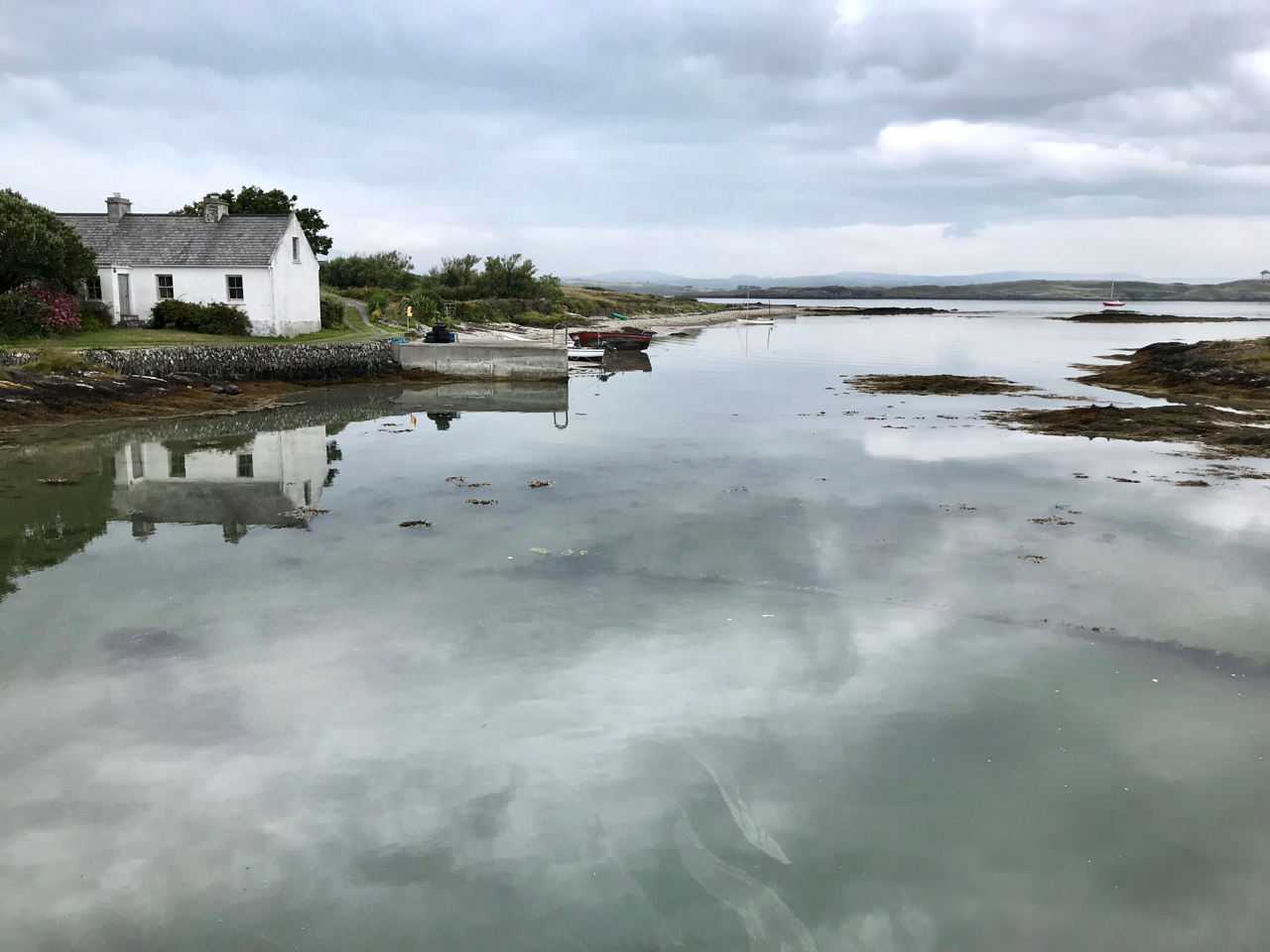
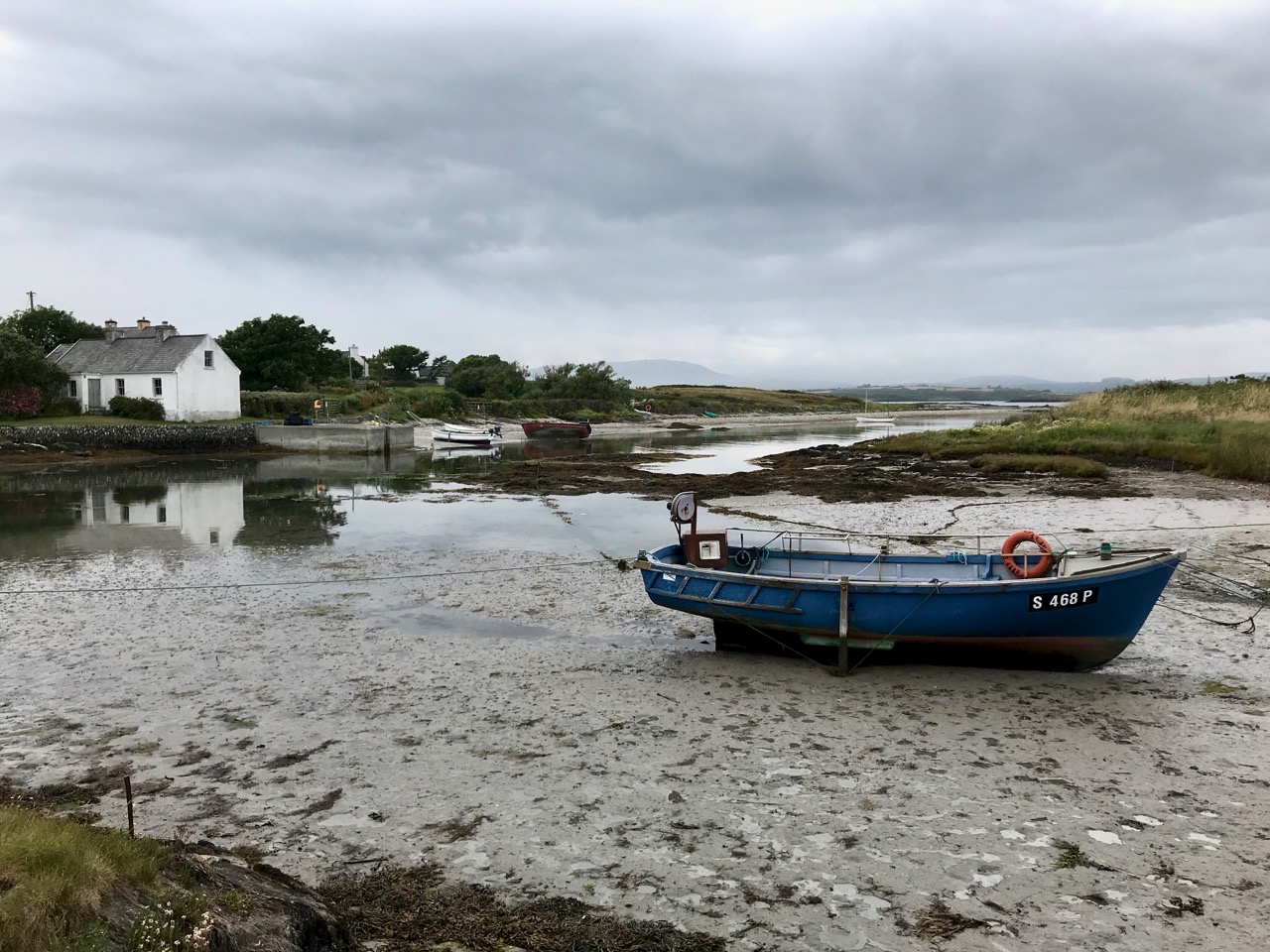
Tides in and out: these two pictures near the wester end of Heir Island were taken within four minutes of each other!

A word about the island’s name: often seen on maps and signposts as ‘Hare Island’ (which of course makes my own long ears prick up!) it is supposed to have nothing to do with the animal. Today, the islanders will tell you that it derives from the past ownership of the lands by the O’Driscoll clan, and should be called Inis Uí Drisceoil (O’Driscoll Island) or Inis an Oidhre (Island of the inheritance – ie, of the O’Driscolls – or heir), hence the more usual modern name.
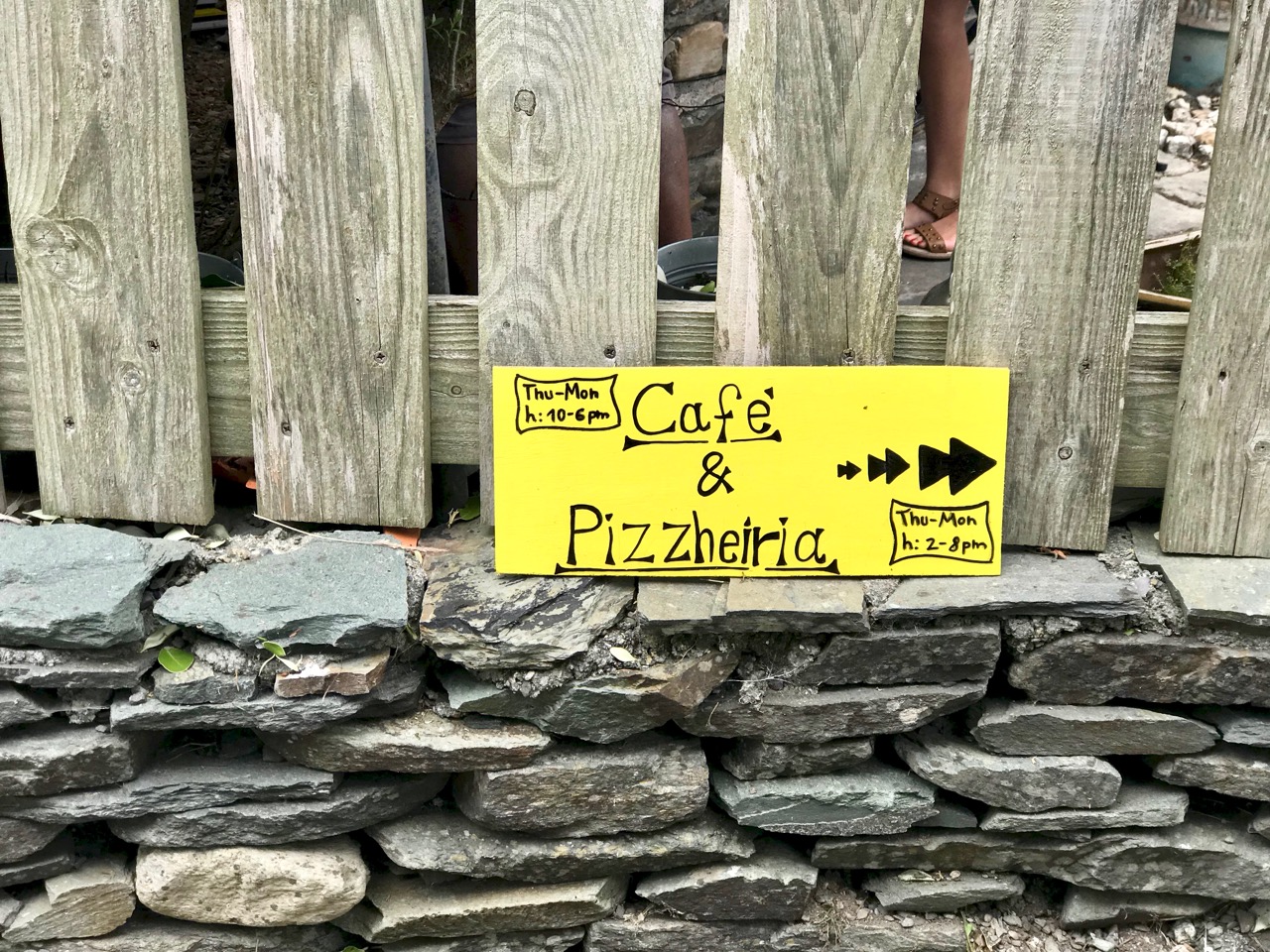
Yes, you can get pizzas and coffee on the island in the summer!

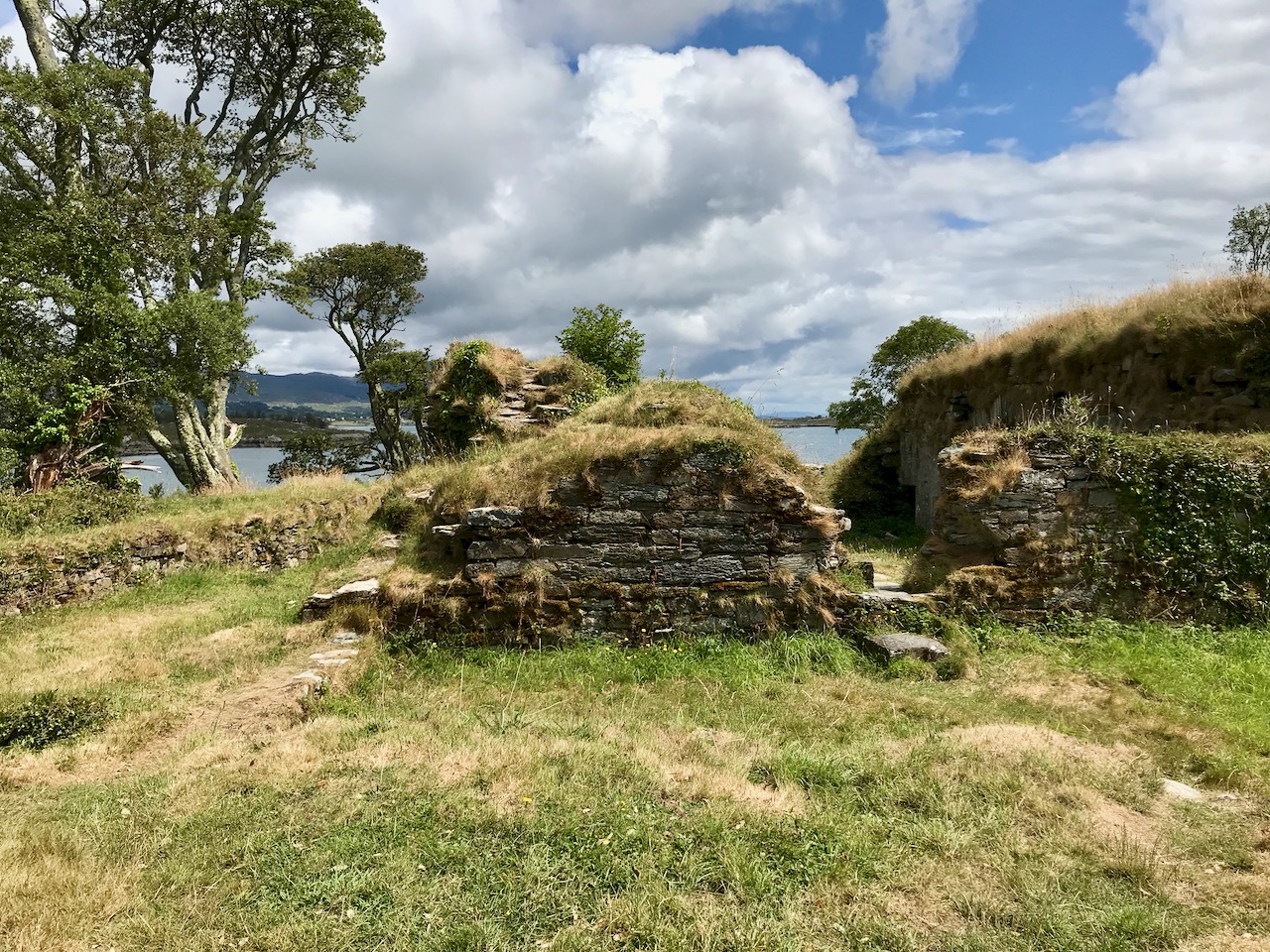
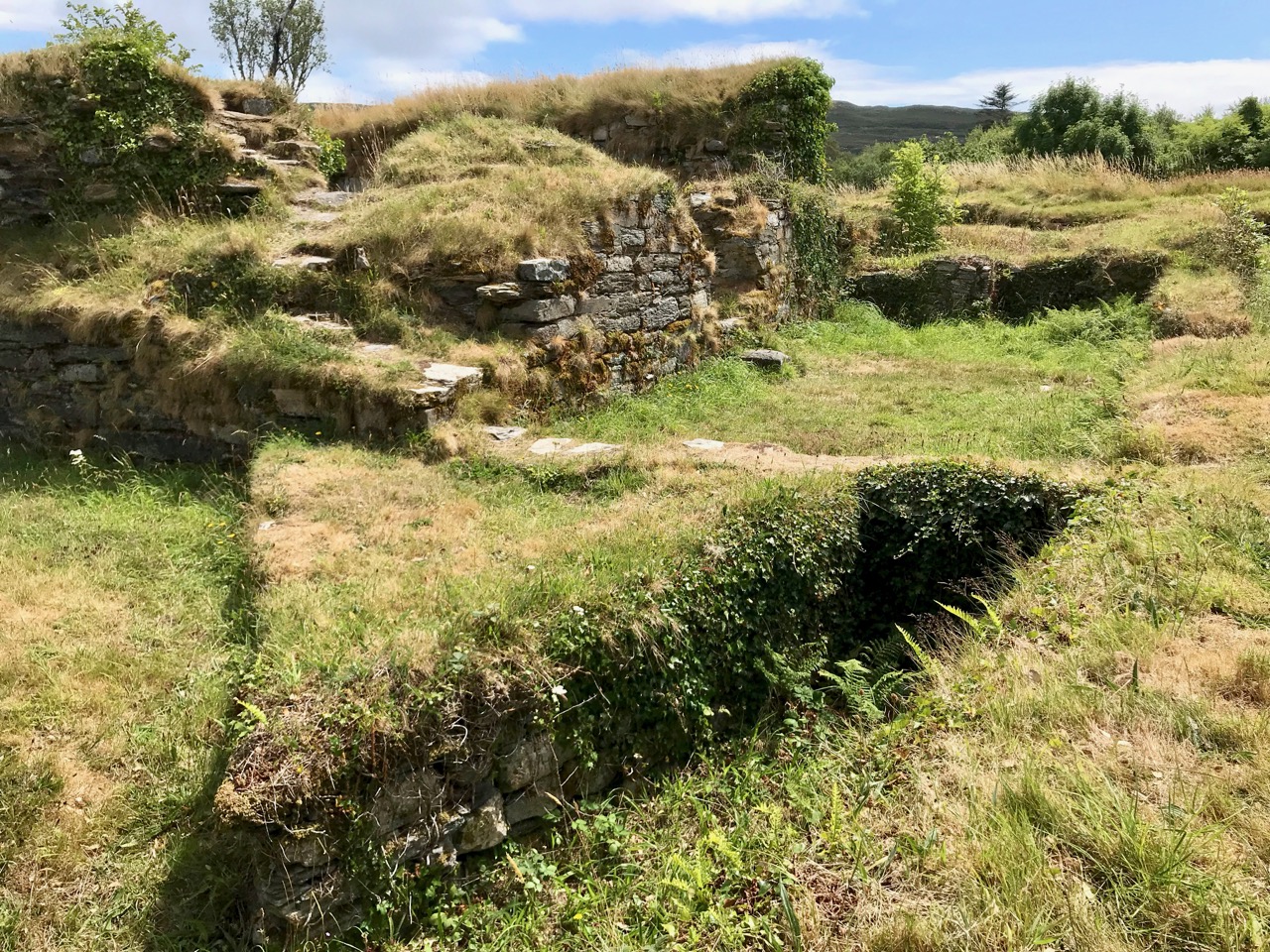
So is this island really a ‘Paradise’, as Finola called it in her earliest post? Undoubtedly! Away from the busy harbour it’s profoundly peaceful: bees, butterflies and wild birds are abundant. But it’s also haunted – as are the other islands of Roaringwater Bay. The past is always around you: reminders of a time when the population was far greater. The first official Irish census of 1841 showed a population of 358. The famine years caused fluctuations but in 1901 there were still 317 people living permanently on the island. Today this number has reduced to around 30 full-time residents, although there are many holiday homes on the island, and the summer population in present times can approach 150. This helps to support a cafe (above) and a restaurant (Island Cottage).
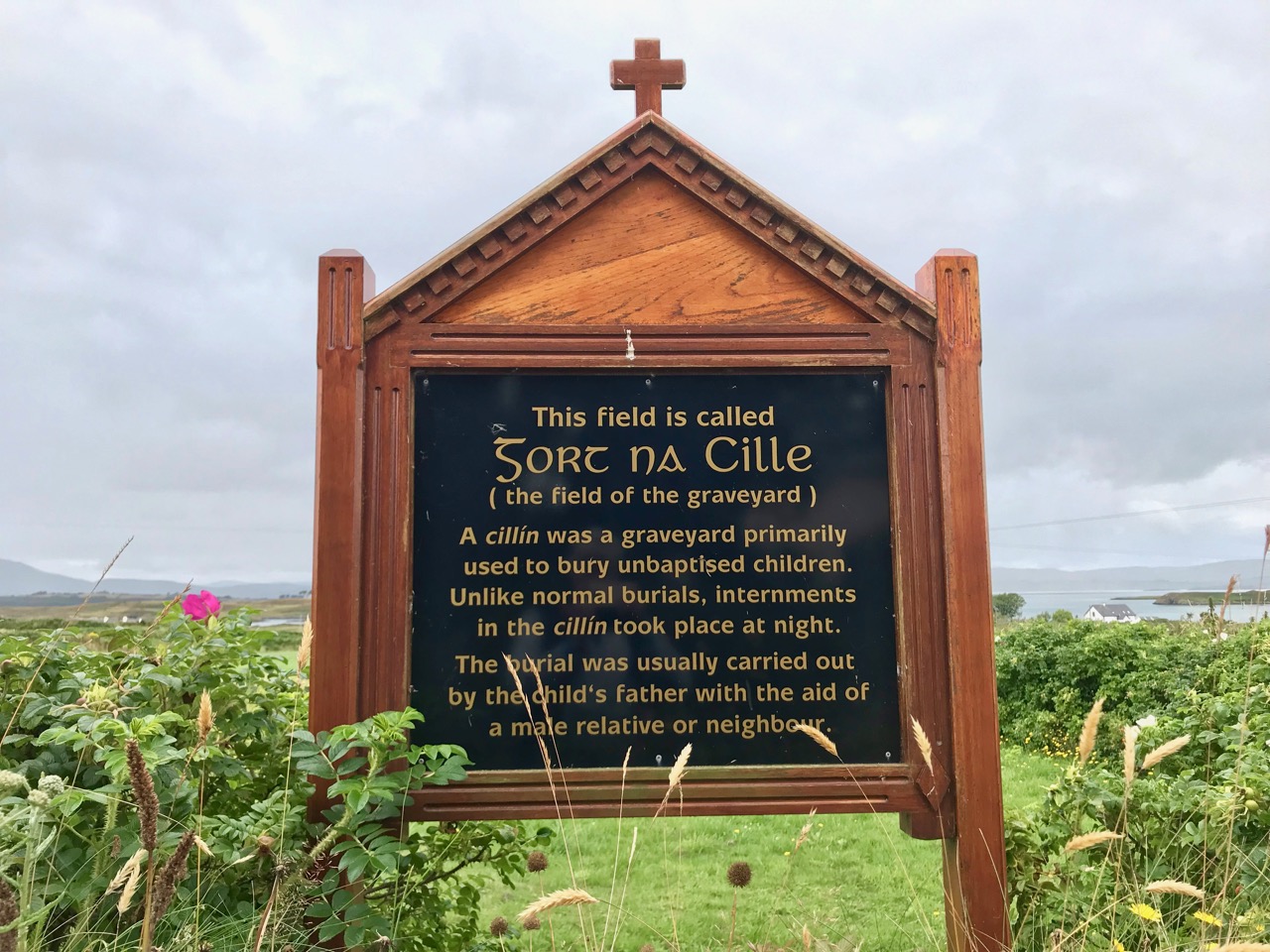
Island history: upper – Field of the Graveyard commemorates the burial of unbaptised children; lower – the Island School closed in 1976, when the resident population was around 50

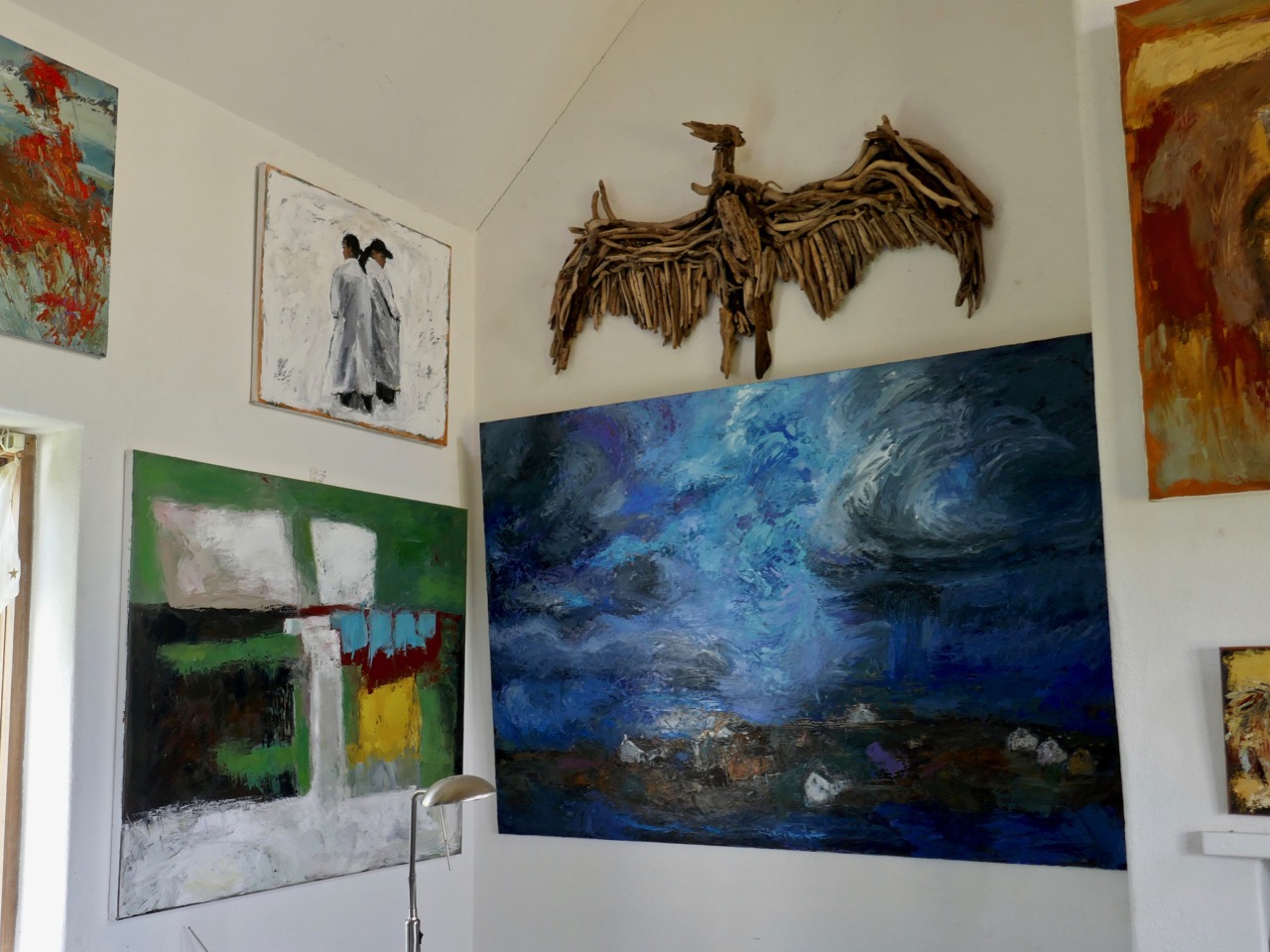
Artist Christine Thery has been a full-time resident on the island for many years; her husband Gubby Williams helps with the ferry and has designed and built ‘Heir Island Sloops’. Christine is an active environmentalist and keenly involved in ensuring that Heir is sustainable and responsible in caring for its natural habitats; she was instrumental in organising Finola’s Wildflower Walk. Here is some of her work in her studio:
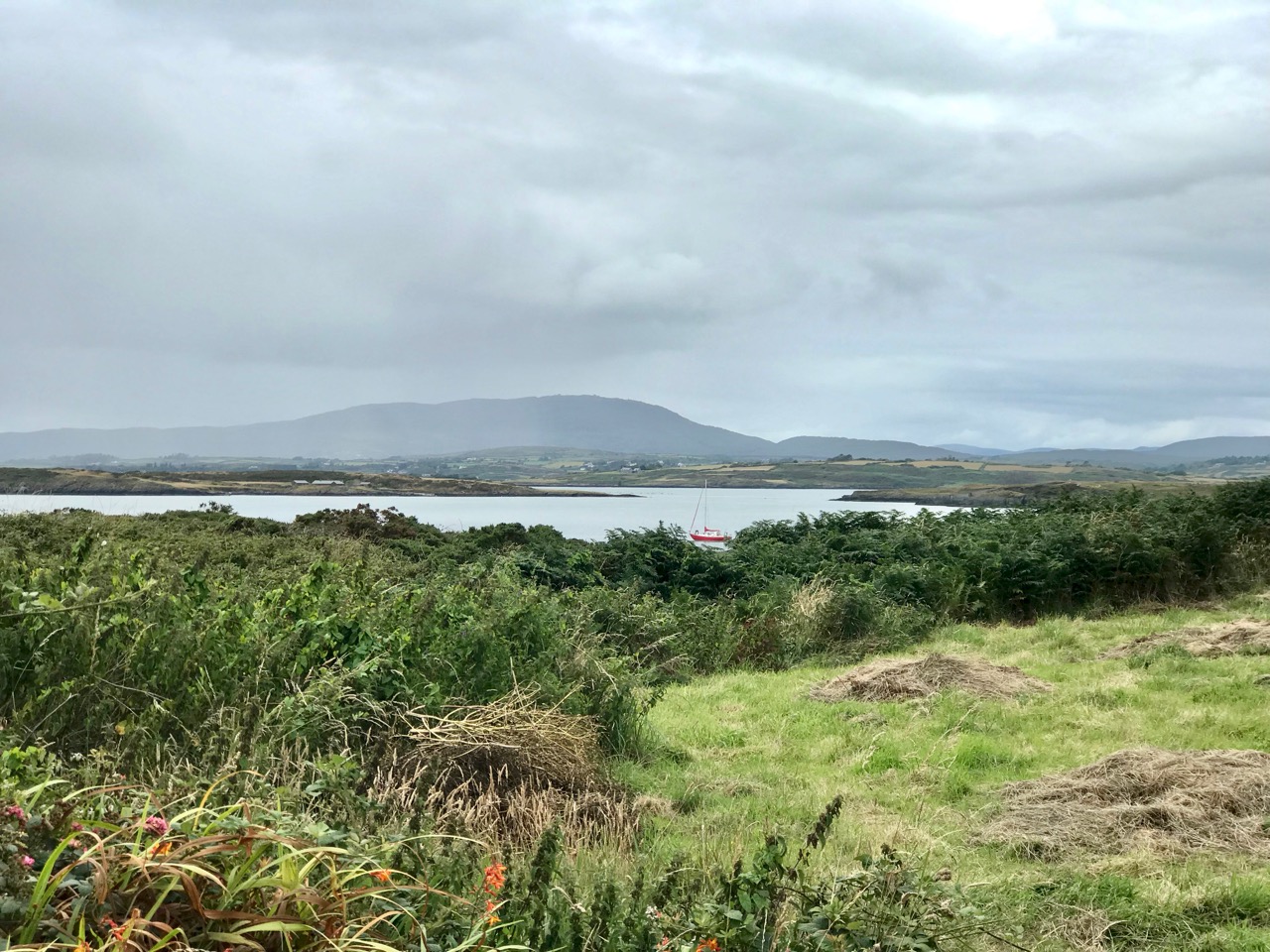
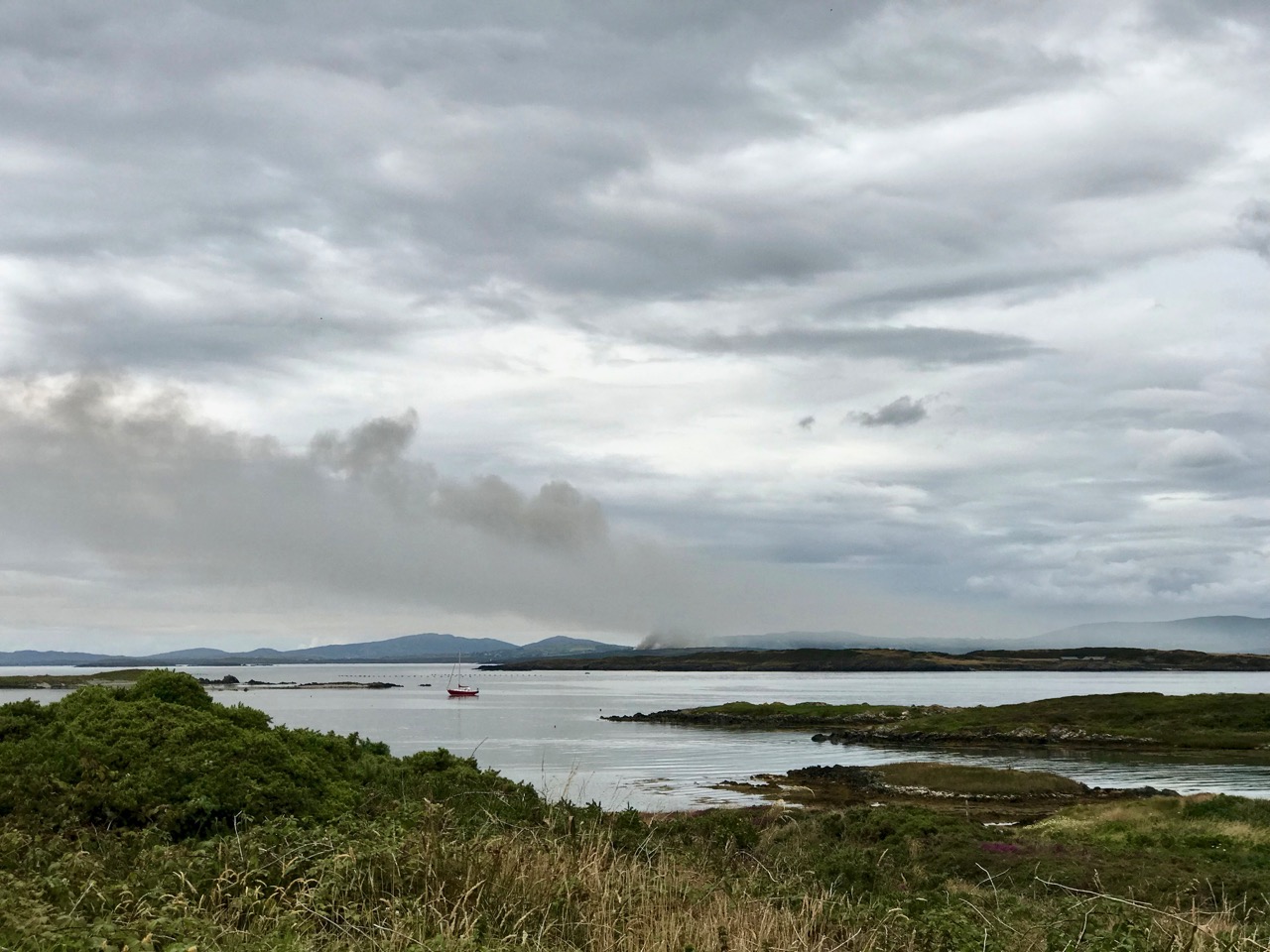
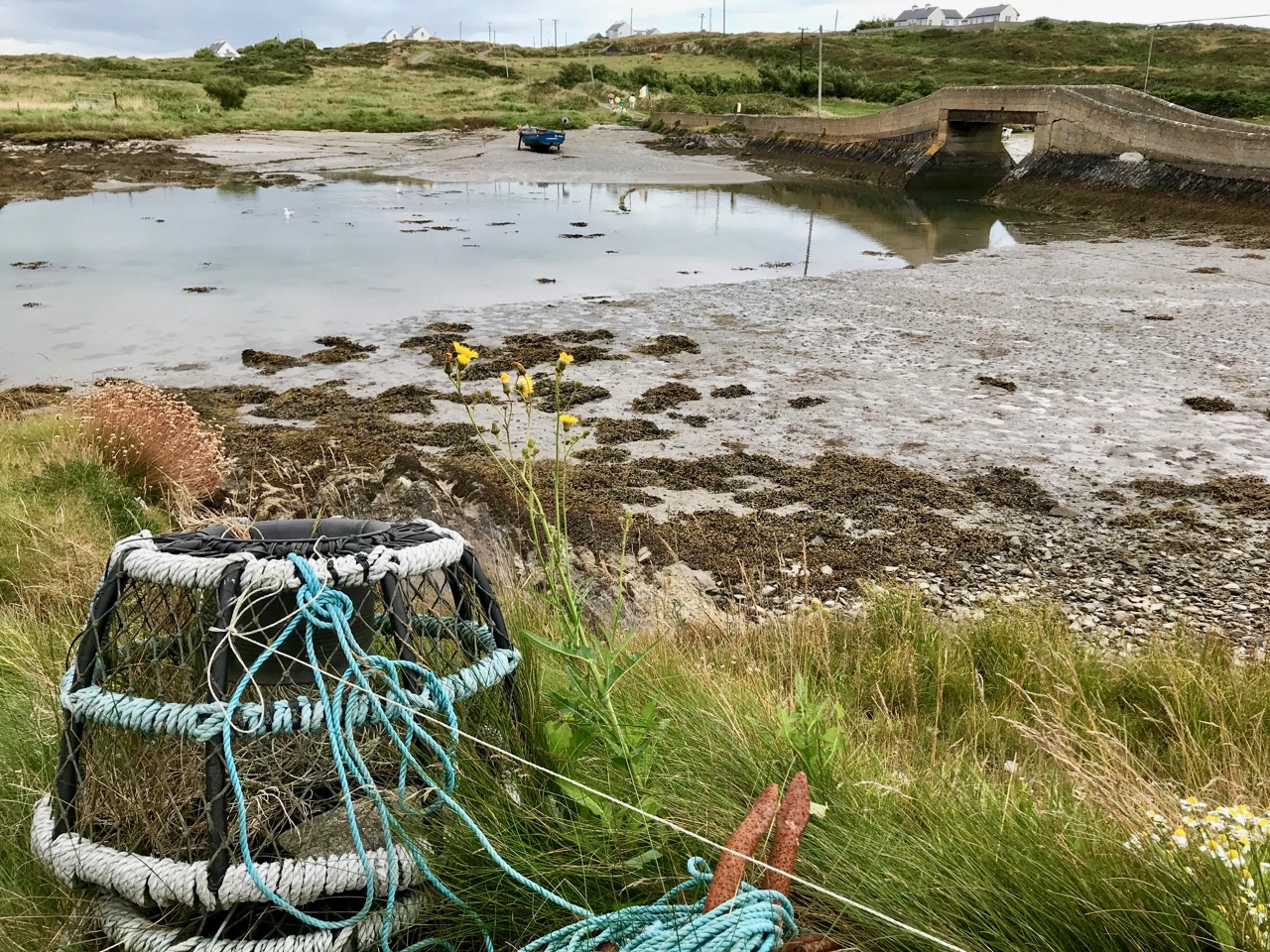
Heir is only a five minute ferry ride from Cunnamore Pier, yet the mainland seems a distant place once you are imbued with the innate atmosphere of island existence. The views from the north side of the island are dominated by Mount Gabriel, (pictures above). Five minutes – yet it seems such a step away from everyday life: long may beautiful Heir continue to support its fragile but tenacious resident population.
The Finola Window

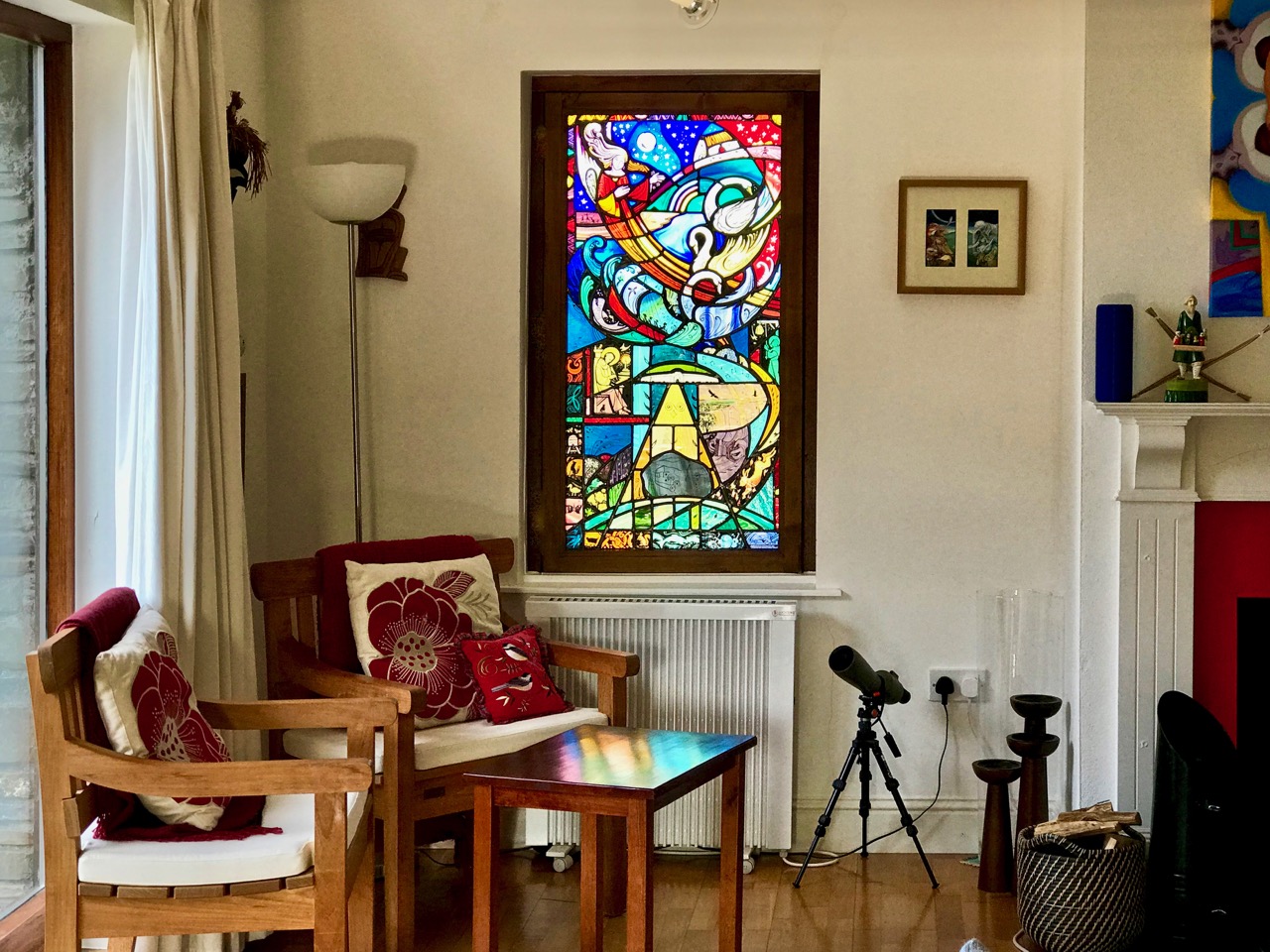
You will all know about Finola’s interest in stained glass, and in particular her admiration of the work of artist George Walsh: she wrote an article about him in the Irish Arts Review this year. So I hatched a plan, together with George, to give her a window of her very own! Here it is, just installed in our house, Nead an Iolair. Not so long ago, Finola wrote another Irish Arts Review piece about Ireland’s newest stained glass window, and there’s a Roaringwater Journal post about it here. I think it’s safe to say – as of today – we have in our house Ireland’s new ‘newest stained glass window’! It’s an artwork with a story – several stories, in fact. I’ll tell you some of them.

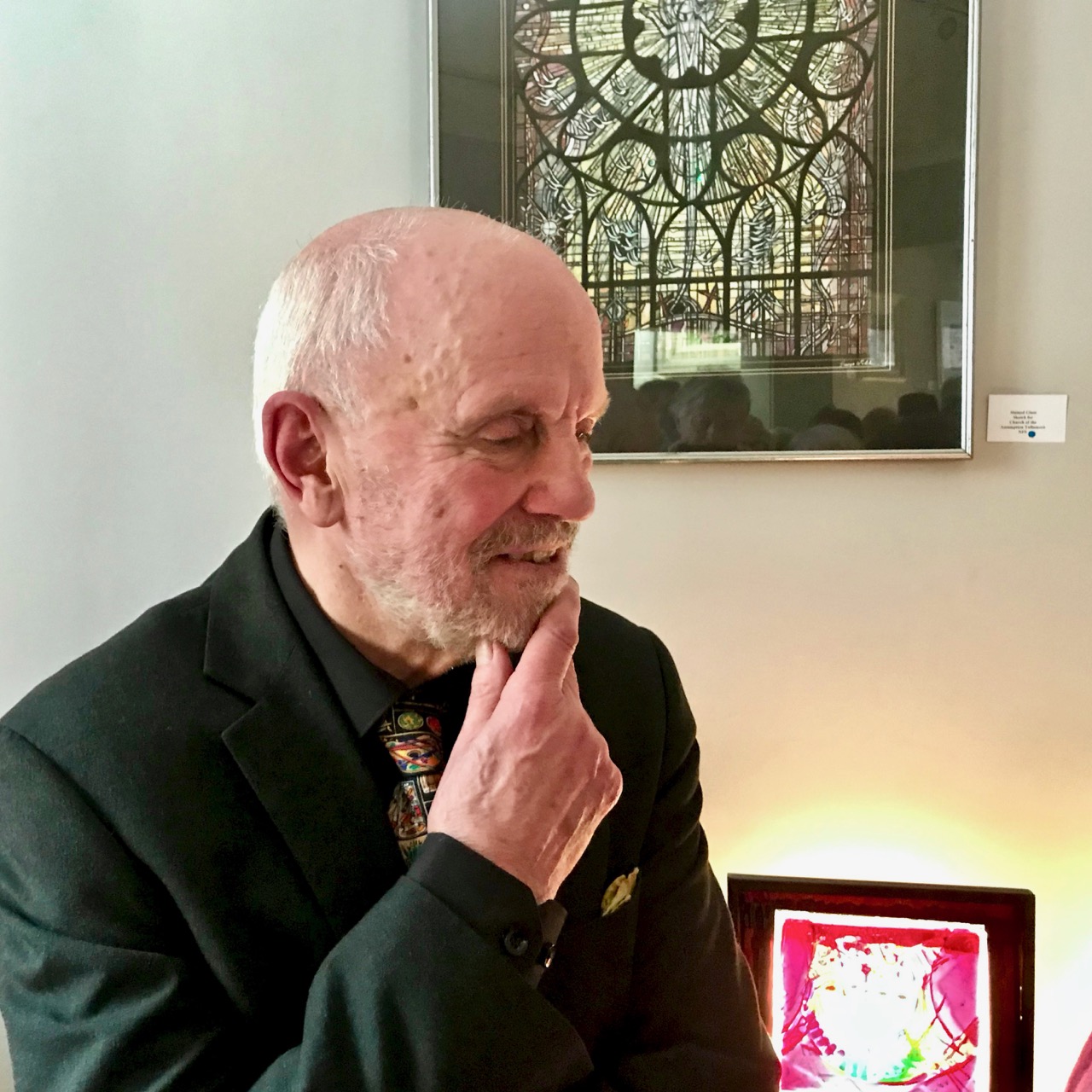
This is George Walsh. He apprenticed in the world of stained glass under his father – also George – who apprenticed under Harry Clarke, so he has an eminent lineage. He worked with his father in the United States and Ireland, and eventually set up his own Dublin studio, where he has been prolific. Finola is currently visiting and cataloguing every one of his publicly accessible projects which can be seen on the island of Ireland: it takes us to some far-off and fascinating places. To date her list includes 61 buildings which have George Walsh windows, and it’s certainly not complete.  While most of George’s work can be found in churches, he has also produced a secular opus and our window has now added to that. George says that he enjoyed this commission because it was very different from so much of his work, but I guess that he always enjoys his work – you can tell by the exuberance, dynamism and sumptuous colouring of his pieces.

The Finola Window tells the story of our Finola, but is also about a famous Finola (or Fionnghuala – fair-shouldered) in Irish mythology: she is the heroine of The Children of Lir, one of Ireland’s most well-known ancient wonder-tales. Fionnghuala (above, being transformed into a swan) is the eldest of the four children of King Lir – the others are Aodh and twins Fiachra and Conn. Their mother, Aobh, died when they were young and the King remarried. Unfortunately, this is where the story turns into a wicked stepmother tale, as the King’s new wife, Aoife, becomes jealous of the children, and casts a magic spell on them. I hope you are keeping up with these names! Our Finola – a stepmother herself – has always been sensitive about negative portrayals of that position, so I asked George to play down the role of Aoife and in fact he has left her out of the window altogether. I’ll just let you know, however, that she received full punishment for her malice by being turned into a Demon of the Air – and she still hangs around on dark, haunted nights. Watch out!

All four children were turned into swans by Aoife, and their fate was to spend three hundred years on Loch Dairbhreach (a lake in Co Westmeath), followed by three hundred years on Sruth na Maoilé (the stormy Straits of Moyle between Ireland and Scotland), and a further three hundred on Inis Gluairé (an Atlantic island in Erris, Co Mayo). The swans kept their human voices and they spent much of their exile singing beautiful songs which became all the traditional music of Ireland.

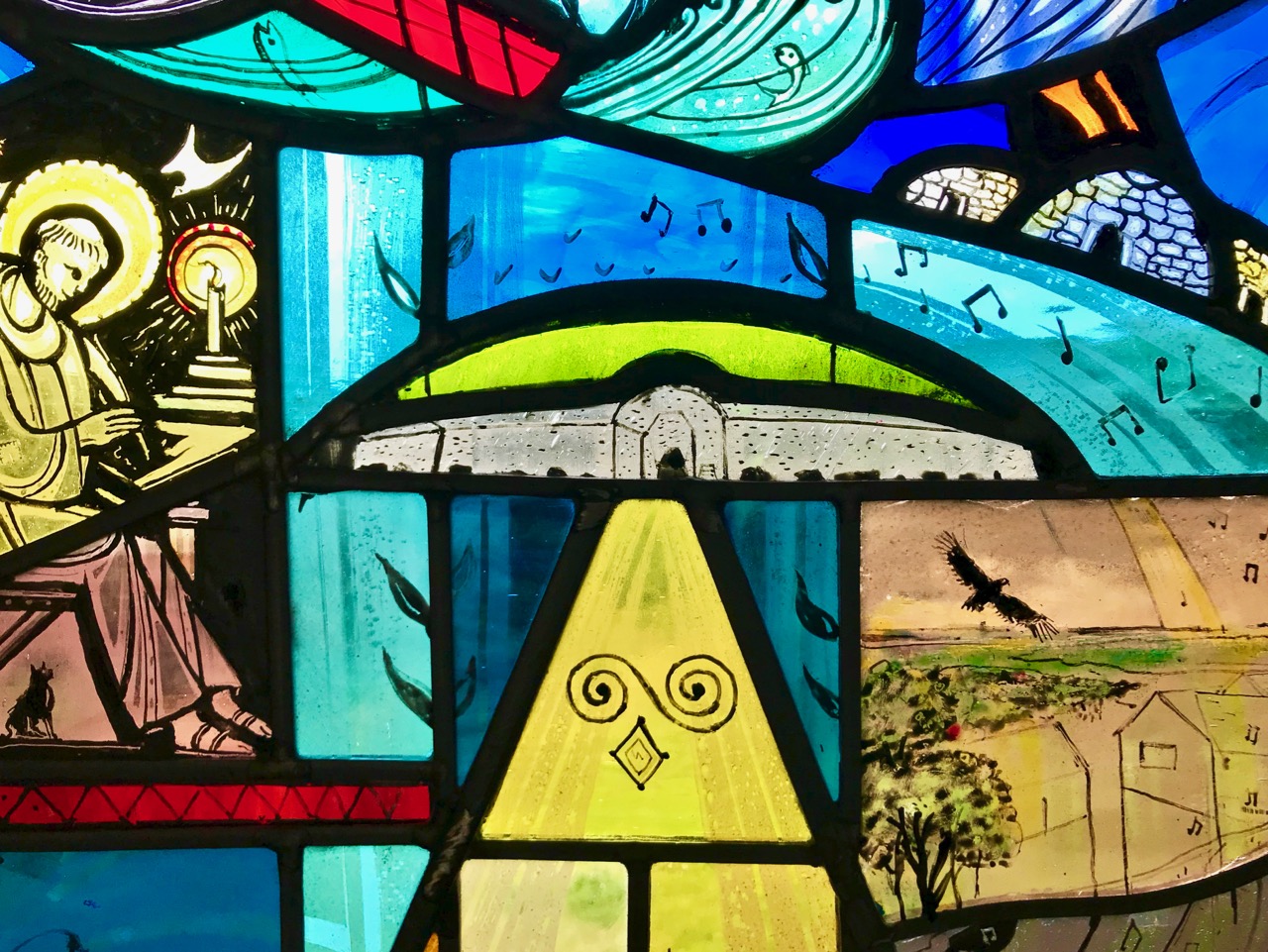
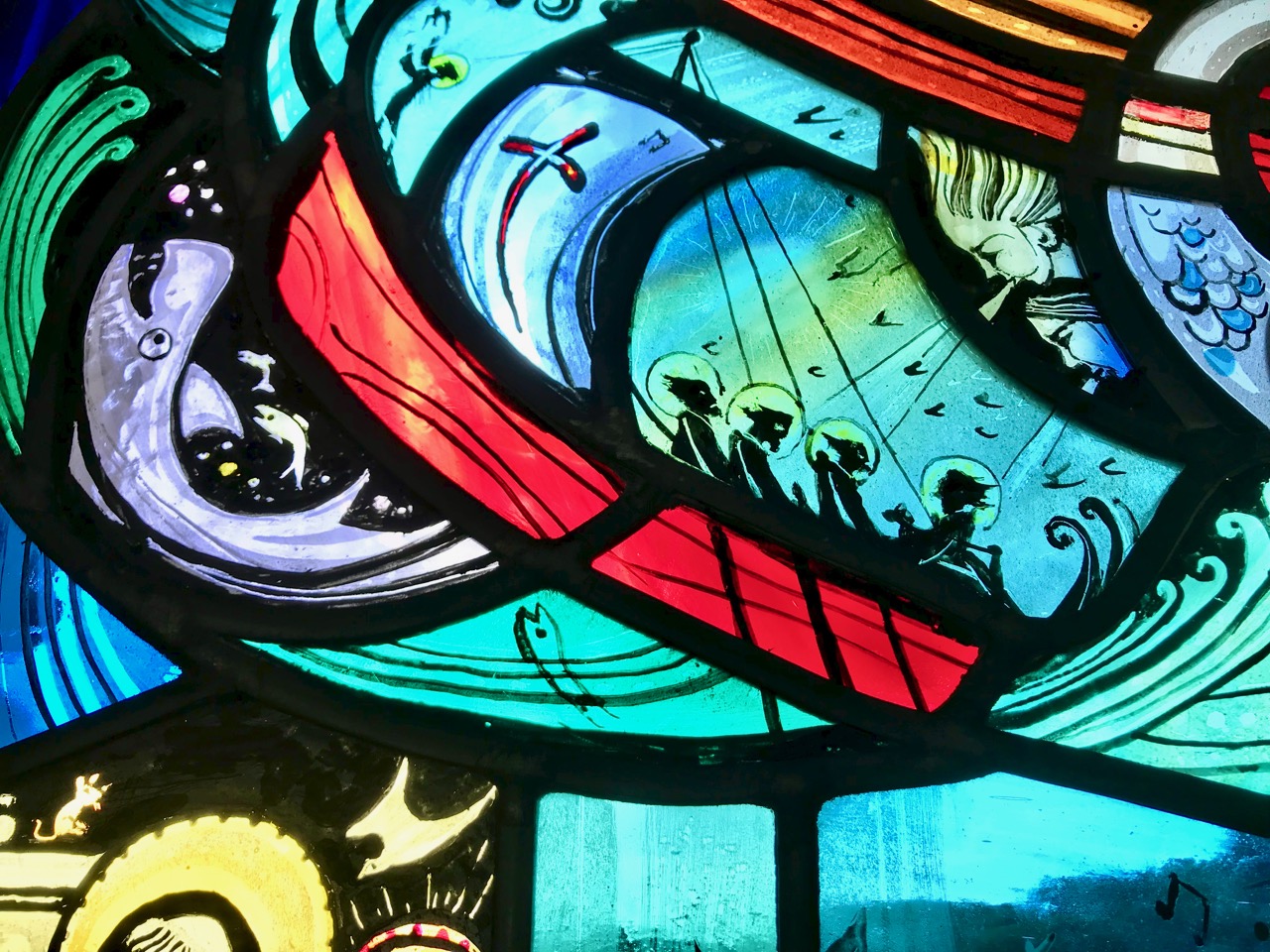
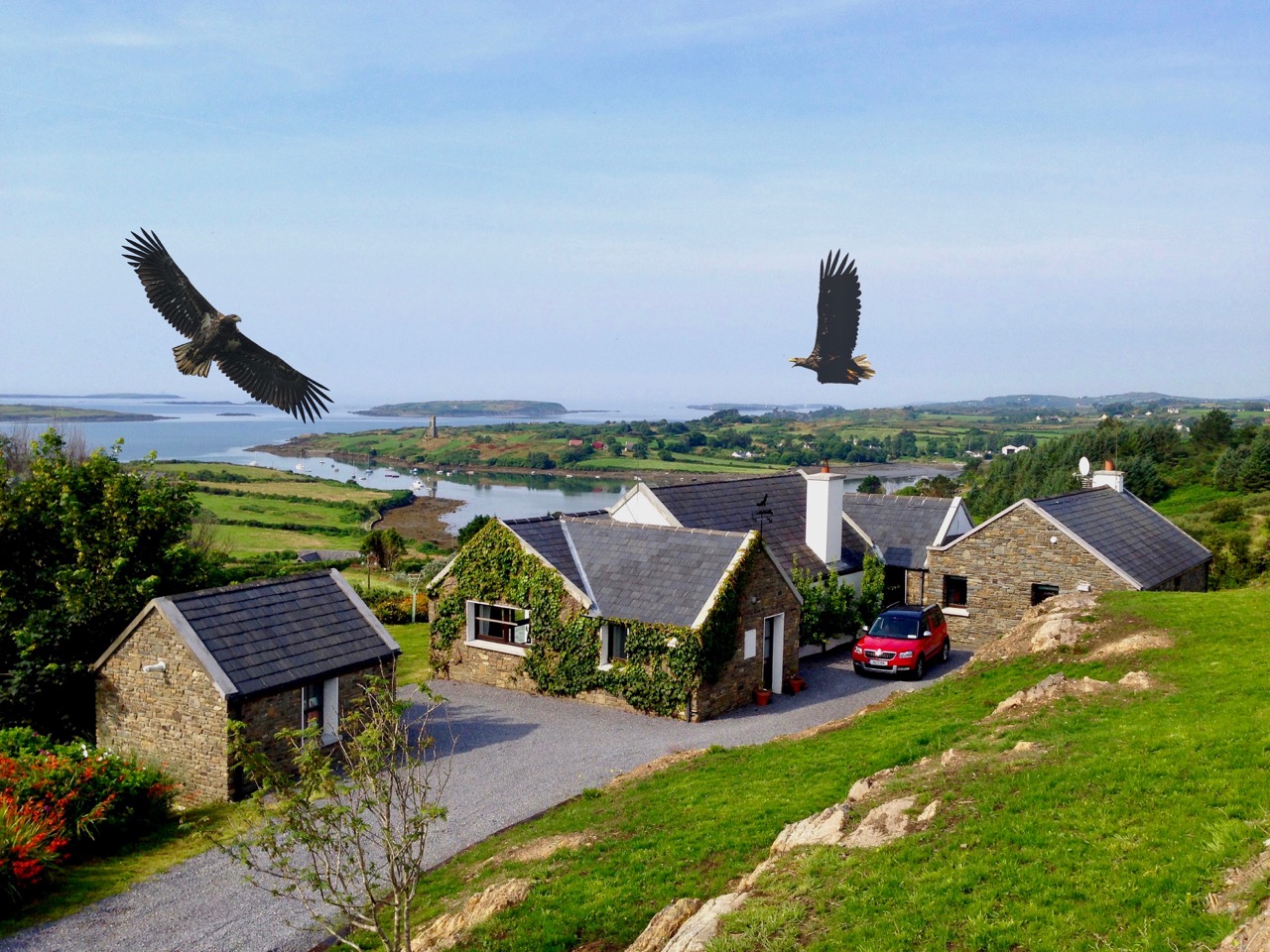
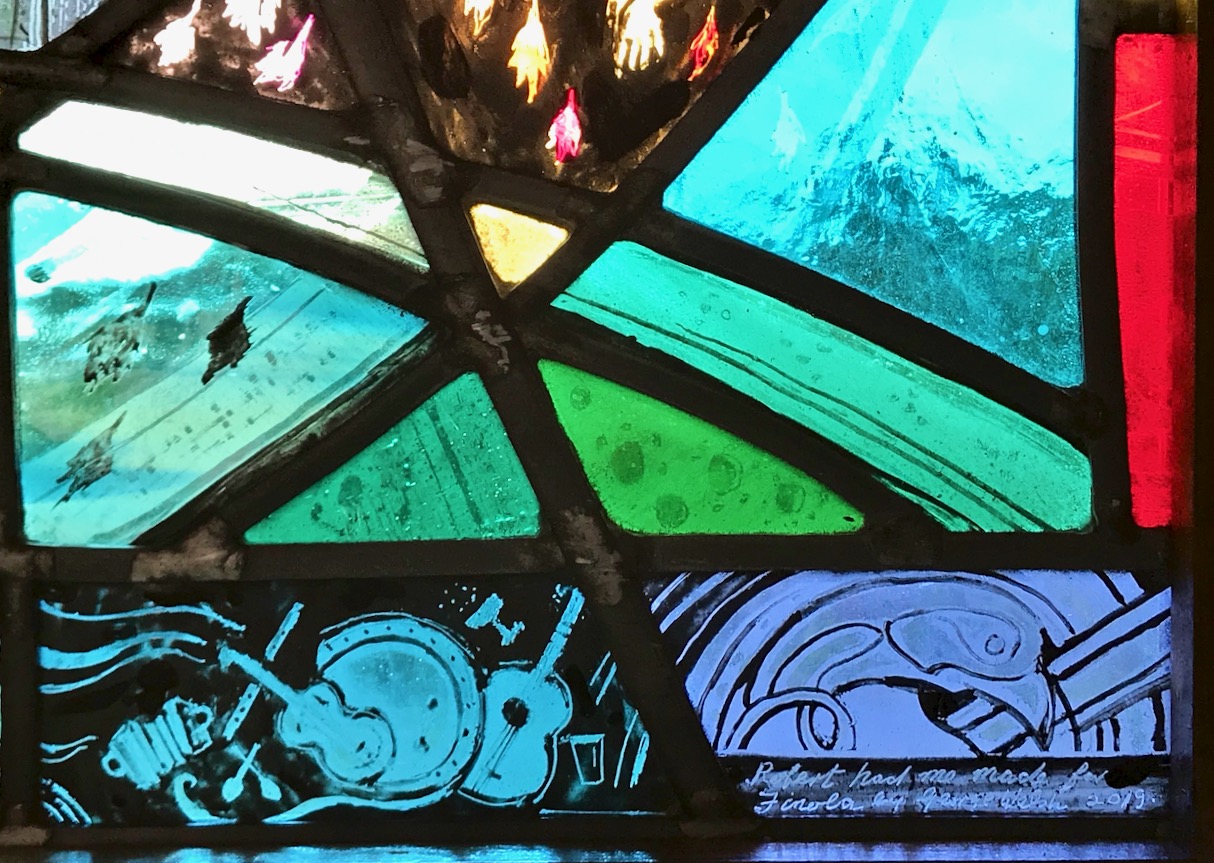
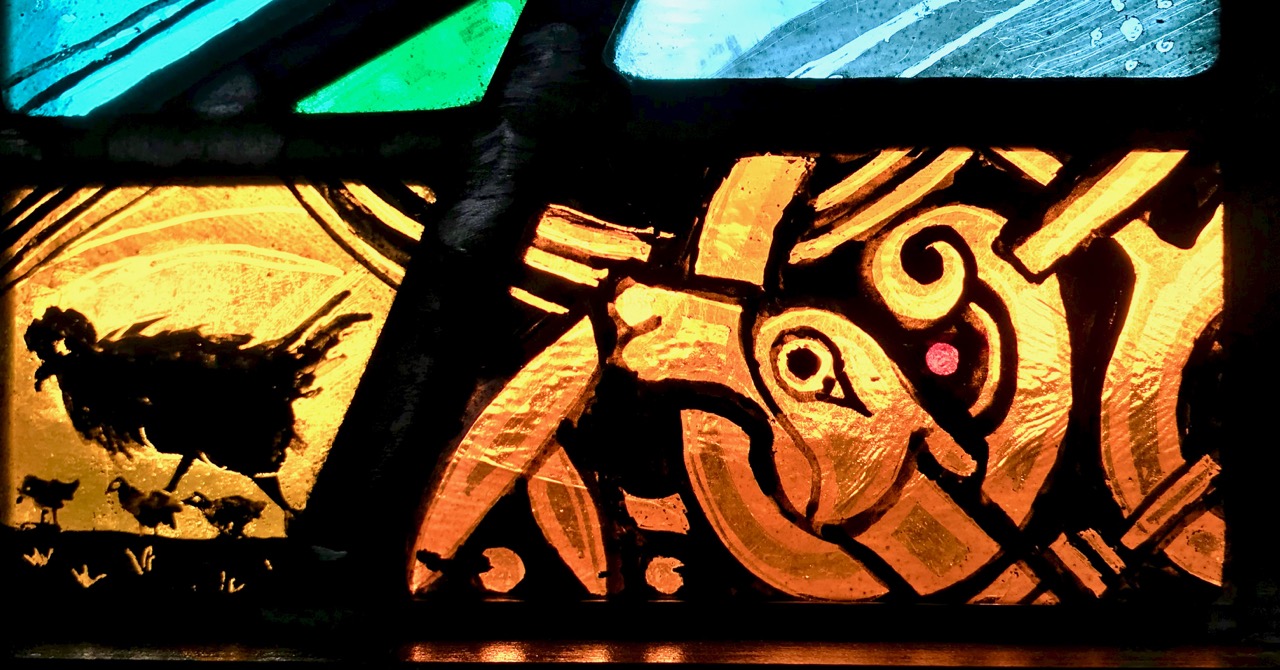
George has skilfully woven into this window many elements of our Finola’s life: in the details above you can see Newgrange – where Finola dug as a student; Irish rock art – which was Finola’s main area of study as an archaeologist; my hands playing my concertina (all the musical notes are descending from the swans); eagles flying over Nead an Iolair; the Scholar and his Cat Pangur Bán (the Irish medieval poem is one of Finola’s favourites); St Brendan’s voyage (Finola is  a great teller of the tales of Irish Saints) and – of course (at my specific request) a golden hare! George Walsh has always been a master of detail, something we have particularly admired in his work. We feel he has excelled himself here. These images are some of the resources given to George while he was making the window:

Image gallery for George – top: Finola’s 1973 drawing of a piece of Kerry rock art; centre – the flight of the eagles over Nead an Iolair; lower – my hands playing music from the swans through my concertina!

I was privileged to see some of the work in progress in George’s studio earlier in the year. He showed me how he uses ‘flashed glass’ where a thin layer of coloured glass is melted on to clear glass. Acid etching is used to take off the coloured surface leaving a design. You can see where the etched piece (below) is being prepared to fit in the ‘jigsaw puzzle’ of glass shapes that will be joined by leading to form the final window.

Above – George’s ‘cartoon’ design sketch together with his explanation of the subject matter: these now hang close to the completed window in our house

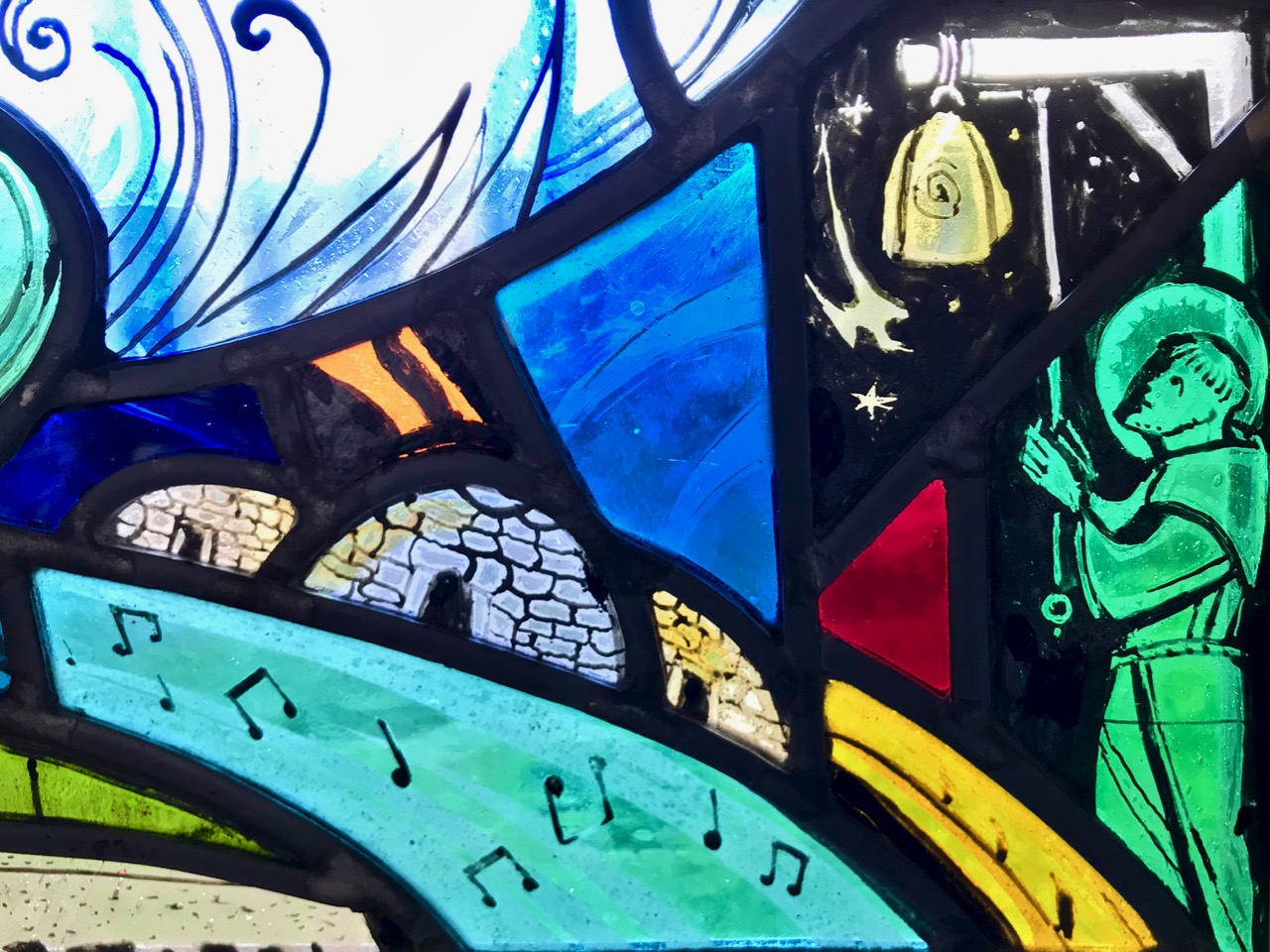
The culmination of the Children of Lir story comes when St Patrick’s bell is first heard on the shores of Ireland (detail below), and Fionnghuala and her brothers are released from the spell. As they regain human form their bodies are aged and they have time only to receive baptism into Christianity before they crumble to dust.

Decorative borders, details and motifs abound in George’s windows and ours is no exception. It’s a bit like the marginalia in a medieval illuminated manuscript: your eye is constantly drawn to all the minutiae. We will never tire of looking at it. The panel is mounted in a west facing window in our study: when the sun comes around to that side in the evenings the whole room becomes alive with flowing colour.

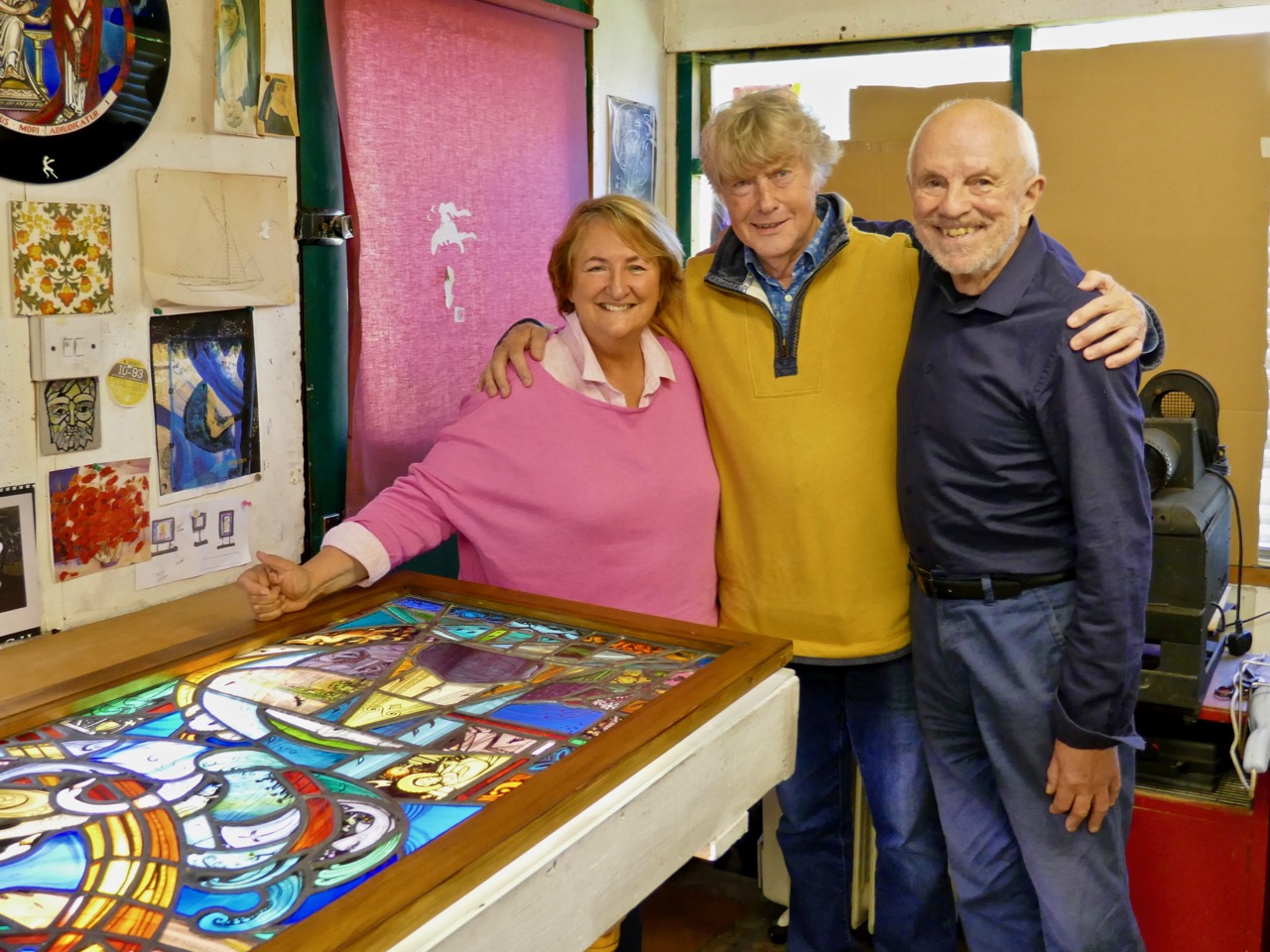
Thank you, George, for so wonderfully fulfilling my vision of a window especially for Finola. I couldn’t imagine anything more fitting and she is – of course – over the moon! Here we are in George’s studio on the day of the ‘reveal’.

West Cork in High Summer – Festival Central!

West Cork has festivals all year long, but right now we are gearing up for some of our favourites and they are looking terrific!

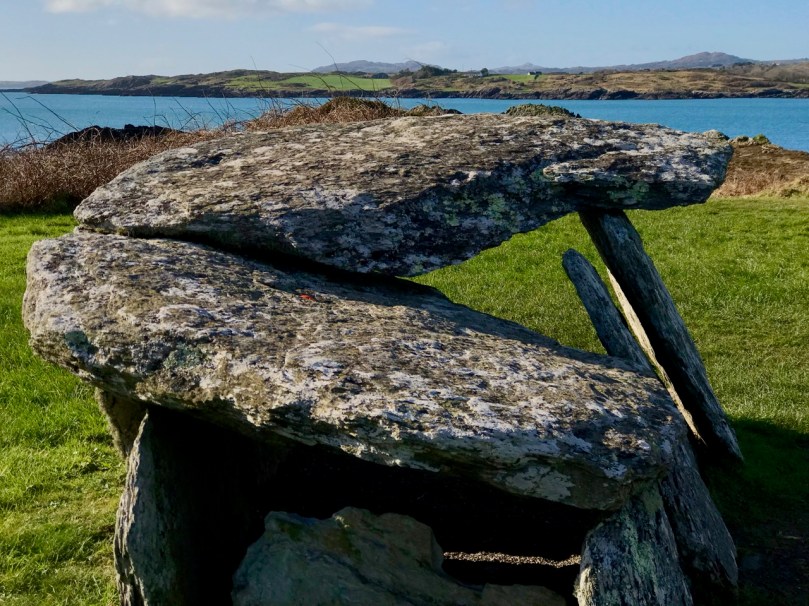
We’re planning the field trips. for the History Festival. Top photograph is of last year’s tour of Reen Farm, John Kelly’s Sculpture Garden and above is the Bronze Age Altar Wedge tomb, which this year’s Mizen field trip will visit

For us, the most significant is the West Cork History Festival, because we are very involved. Have you ever thought you might like to go along on one of our field days?  Well, here’s your chance as we will be leading two field trips on Aug 8 and 9 and Carina Jeisy of Beara Baoi Tours is leading another. All the details are here and you can buy tickets there too – if you hurry.

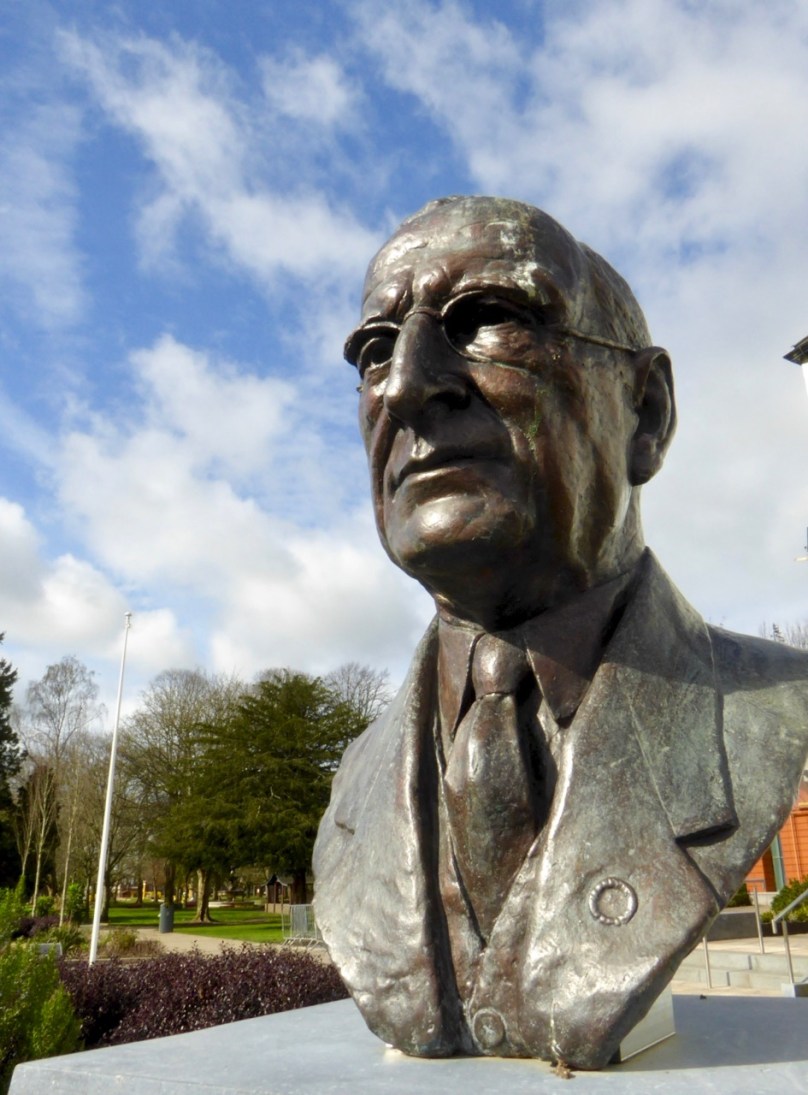
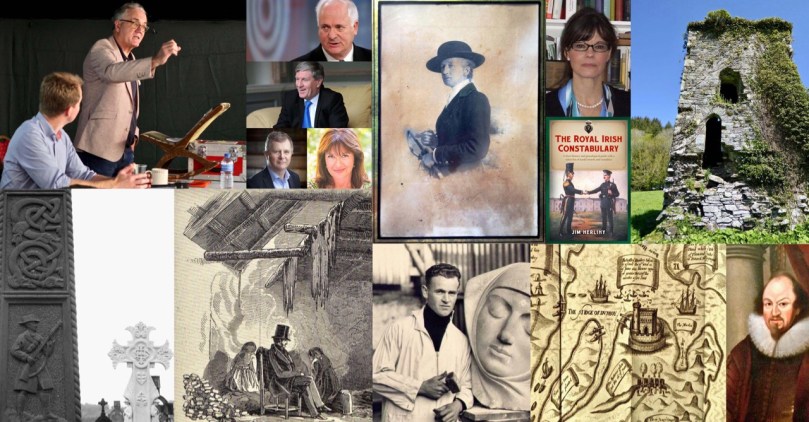
Dev, by Seamus Murphy. Seamus’s daughter, Orla Murphy, will be at the Festival to speak about her father and his legacy. Dev? Well, he’s part of the reason Irish history will never be uncontested

The Festival is now in its third year and this year’s line-up of speakers and events is looking particularly engaging. From former Taoiseach John Bruton, to current Ambassador to the USA Dan Mulhall, to professors from many of the major institutions, to TV and news media presenters, online ‘public’ historians and local experts – there’s sure to be lots of food for thought and discussion. If the two past festivals are anything to go by, some controversy is sure to arise, since not everyone has the same take on historical events – especially in the hotly contested fields of Irish history!

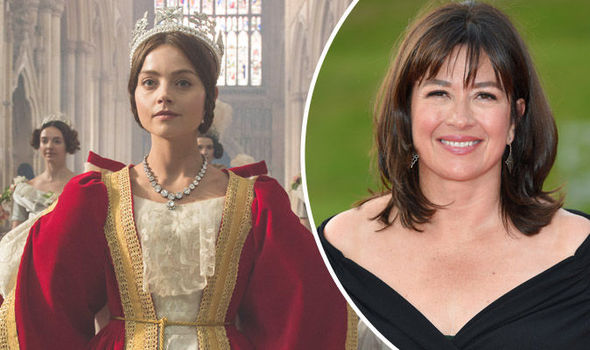
The closing speaker will be Daisy Goodwin, the writer of the hit TV series, Victoria. Daisy also happens to be the great-great-great-granddaughter of Robert Traill, who gave his life trying to feed the hungry around Schull during the famine. He was a complex character: see this post and this one in my series Saints and Soupers. Daisy gave him an active role in the episode in which Victoria finally finds out about the full horrors of the Famine. It was an episode that shocked British people, who had never been taught about the Famine and Daisy will talk about that, writing Victoria and her West Cork connections.

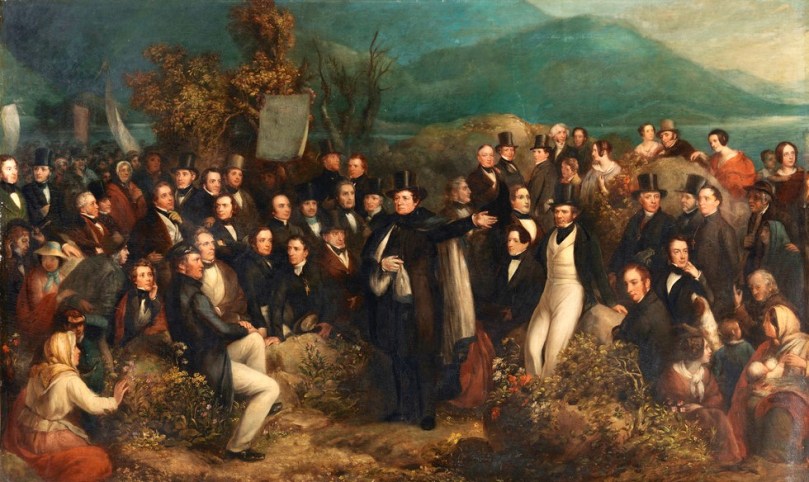
Esteemed local historian Gerald Butler, in conversation with one of last year’s speakers, William Casey, will talk about Daniel O’Connell’s Skibbereen Monster Meeting

This being West Cork, there’ll be lots of food on offer over the whole weekend and music too – I’m really looking forward to the Saturday night concert, exploring the music of Canon Goodman (who is also the subject of one of the talks). Wander over to the website and take a browse through the programme. If you enjoy our blog, you will love this Festival.

Taking us up to the History Festival is the superb Skibbereen Arts Festival. I have rhapsodised about this tour de force of culture and variety in previous posts (see this one and this one) and I feel the same way about the offerings this year.

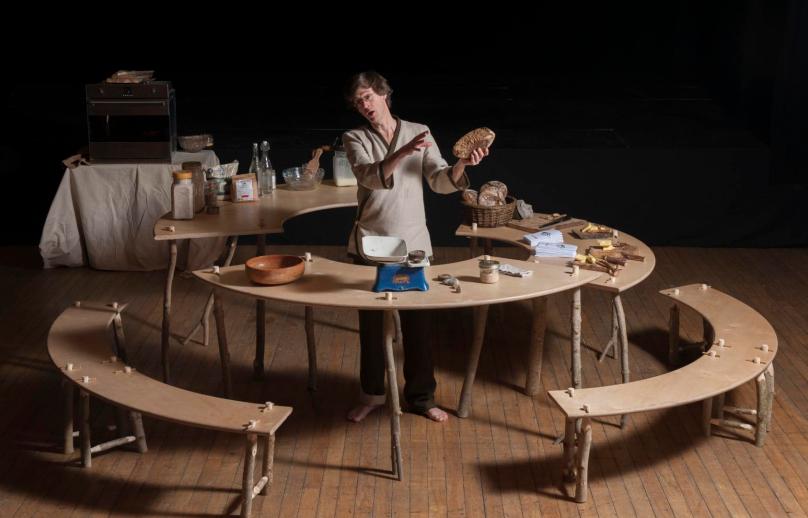
We have tickets to several events and we know we will be dropping in to some of the exhibitions, galleries and shows that are running all over town. I am looking forward to Manchán Magan’s Aran agus Ím (below)- billed as a show that celebrates the Irish language in an engaging, accessible bilingual way, through sourdough bread and home-churned butter and that takes place in a Bakery.

For some time Skibbereen has hosted the Speakeasy Sessions once a month, and there’s a special edition during the Festival. It’s part of a significant Spoken Word programme at the Festival this year. Speakeasy is hosting a Story Slam Competition where 12 people will compete for a prize. One of the judges is our own Cormac Lally, popular local poet: here he is with his Ninja Baby Moves Number 214.

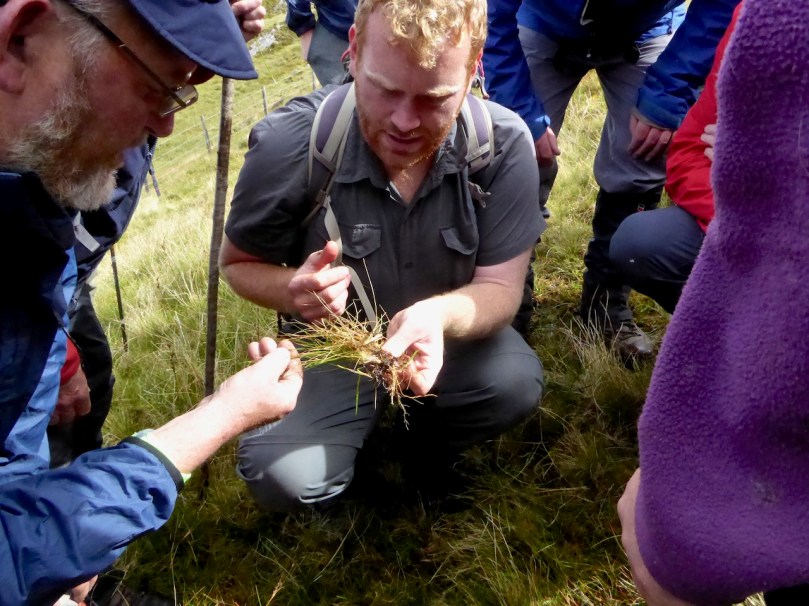
And for something totally different, at the end of the month is the Ellen Hutchins Festival with a brilliant program of events focussed on the natural world of flowers, seaweed and lichens and with lots of stuff for kids. If you’ve never heard of Ellen Hutchins, take a look at my post Ellen Hutchins: The Short and Remarkable Life of Ireland’s First Female Botanist. I wrote it four years ago and in that time the Festival has turned into an annual affair and there have been major exhibitions on Ellen’s life.

Botanist Rory Hodd on an Ellen Hutchins field trip

At about the same time in Bantry is the annual Masters of Tradition Festival, with formal and informal concerts, talks and sessions, many in the wonderful setting of Bantry House. With Martin Hayes as the Artistic Director, this annual festival is always a treat. Here he is playing the Sailor’s Bonnet.

This is actually just a drop on the bucket of all the things going on in West Cork from now until the end of August. I’m seriously going to need a holiday in September! No – wait – that’s the Taste of West Cork Food Festival! I’d better go into training. . . 

A taste of the History Festival

Harry Clarke, Brendan, Judas – and Matthew Arnold

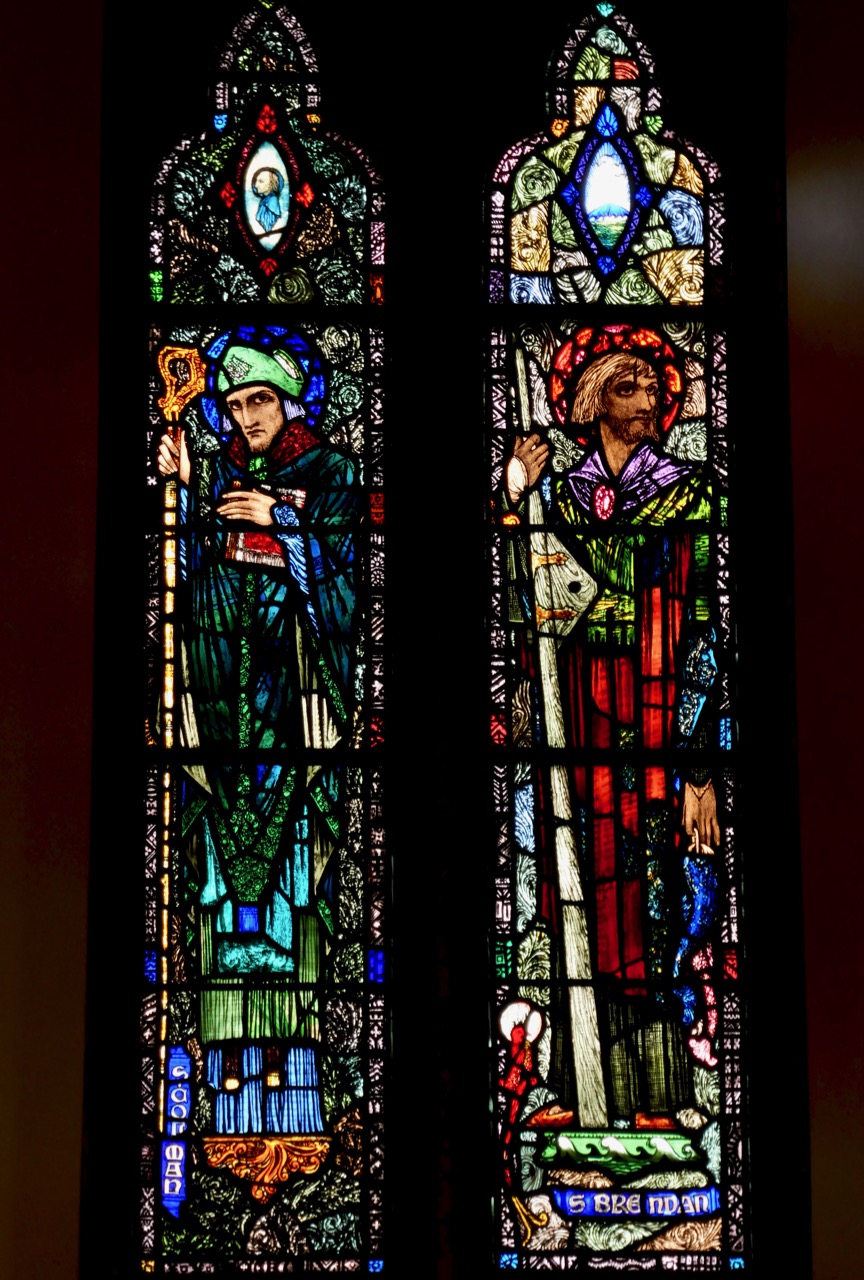
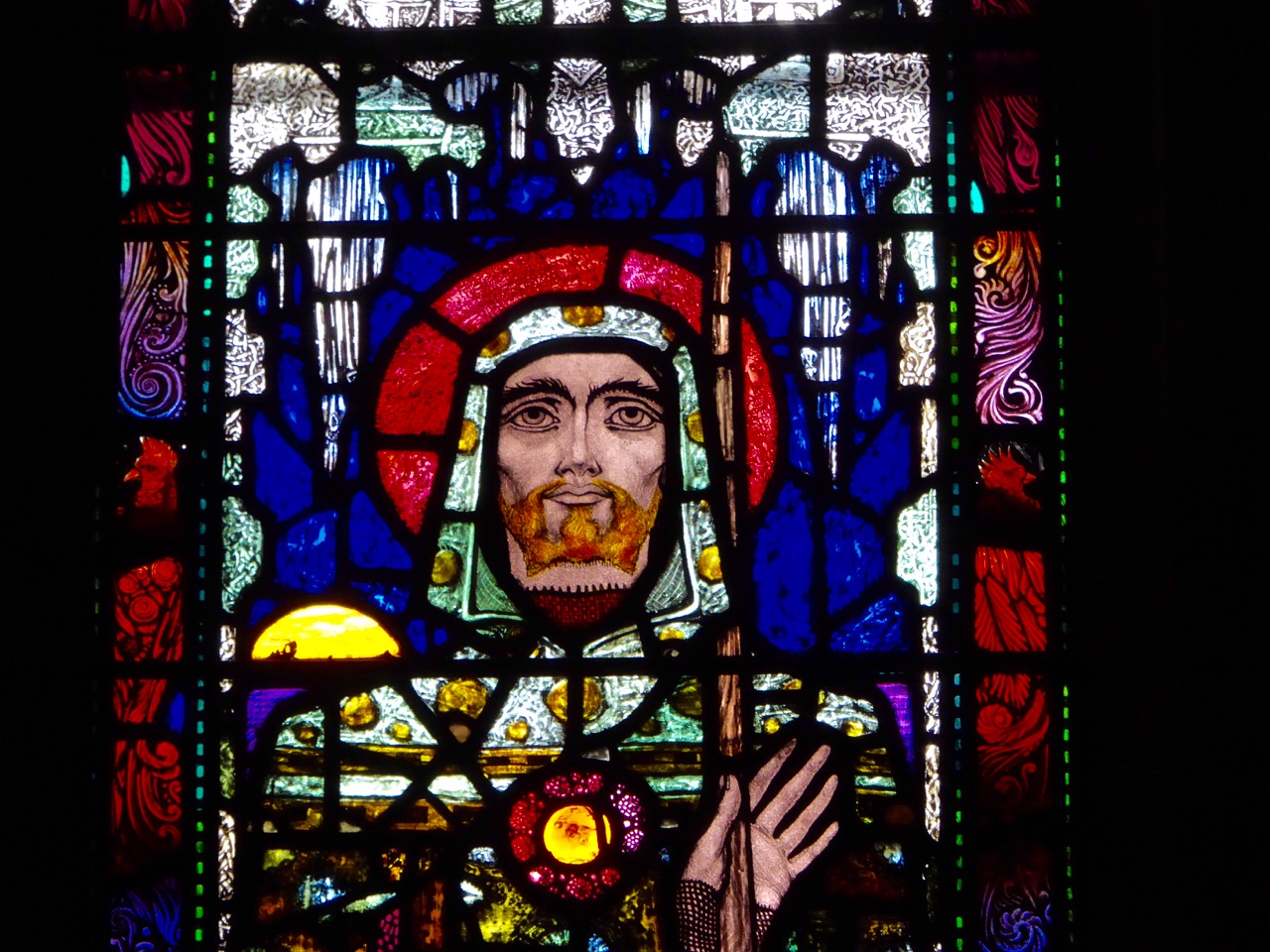
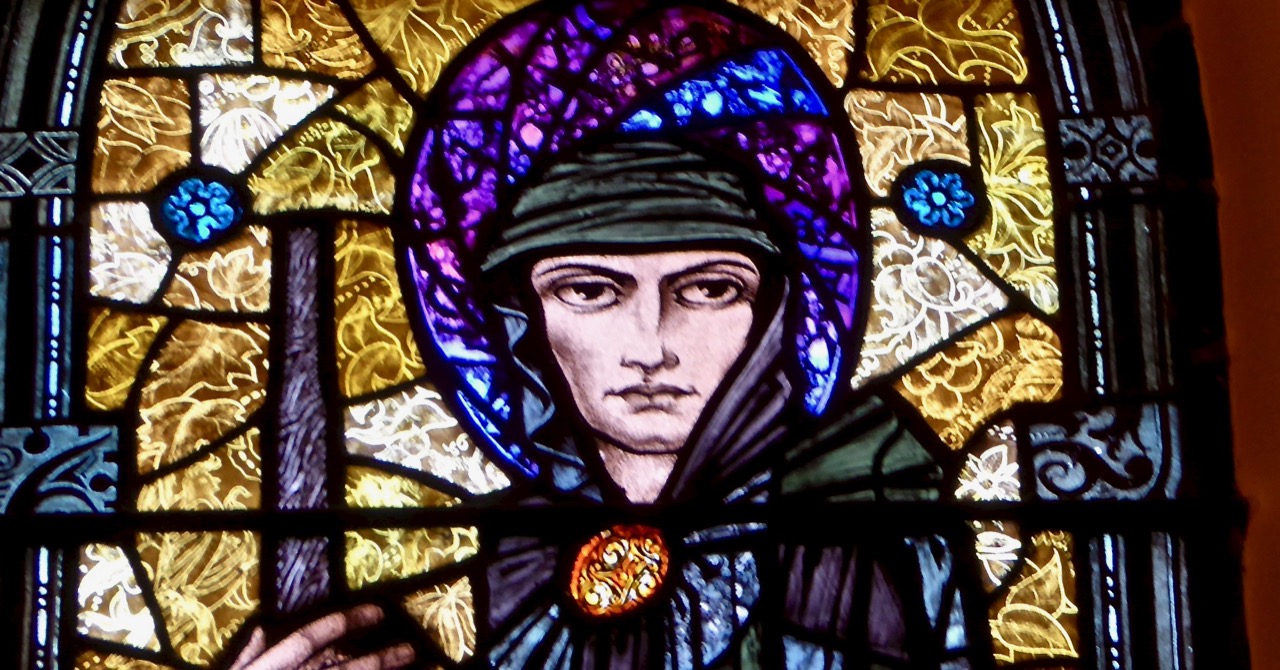
St Brendan was a favourite subject for Harry Clarke.

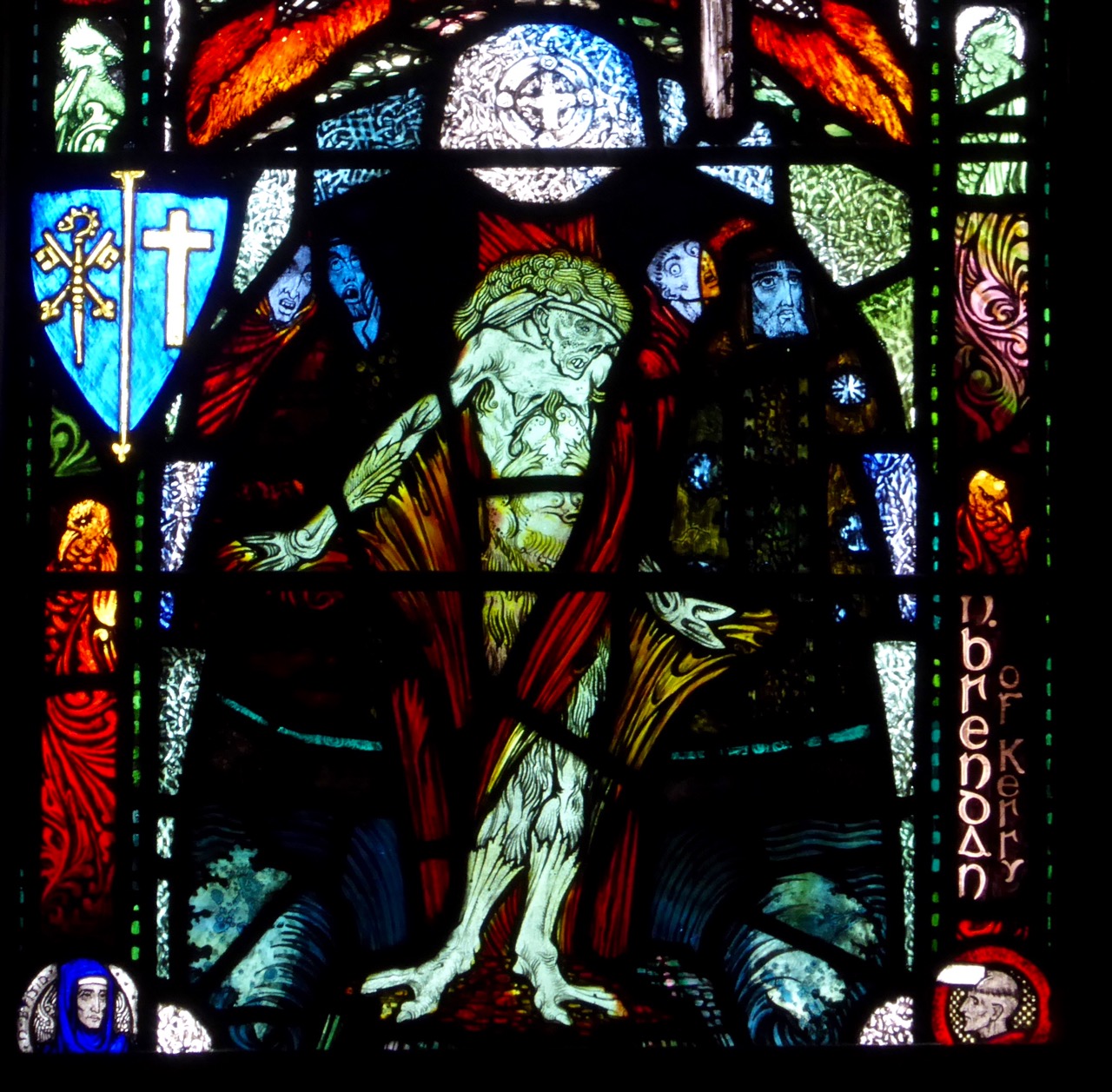
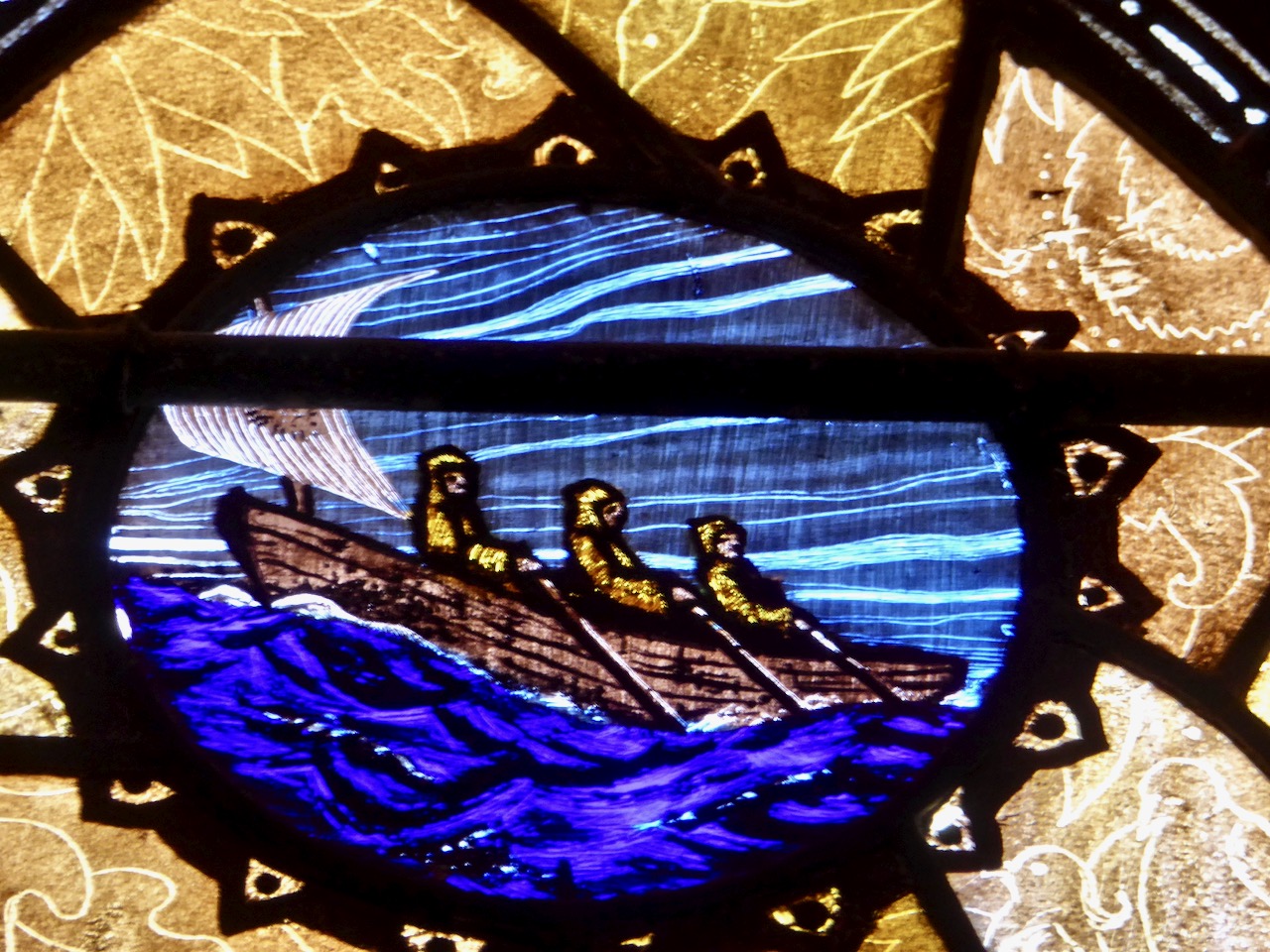
Four of his windows depict the saint: a prizewinning student piece from 1911; his Honan Chapel commission of 1916; the Ballinrobe windows from 1924-25 (pictured above); and the windows designed for the Rathfarnham Jesuit Retreat in 1928 and subsequently relocated to Tullamore (pictured below).

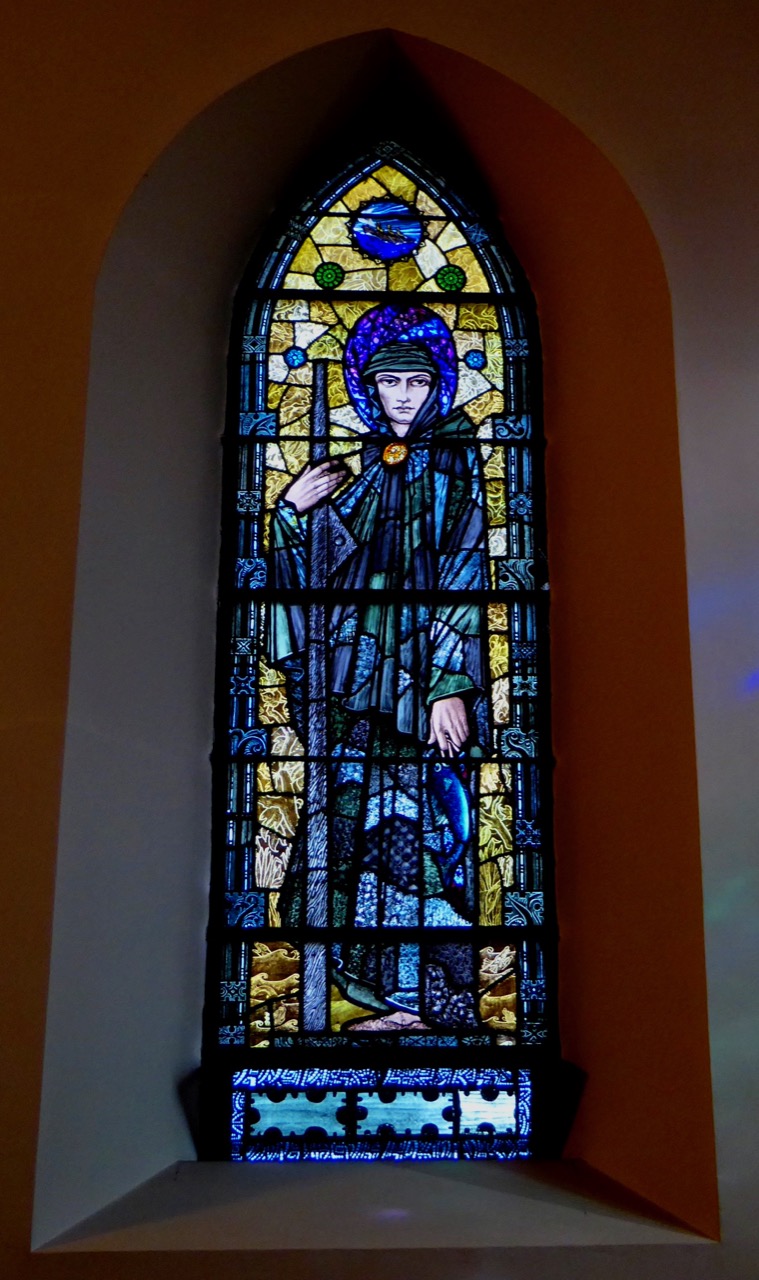
The Tullamore Brendan (above) is recognisably based on that from Ballinrobe, but in this window a youthful Brendan, as described by Paul Donnelly, ‘engages the viewer directly with a penetrating look’  

Harry researched his subjects extensively and ensured that anyone working on his windows did too. Paul Donnelly, in his fascinating essay Legacy and Identity: Harry Clarke, William Dowling and the Harry Clarke Studios (in Harry Clarke and Artistic Visions of the New Irish State) tells how he sent his apprentice, William Dowling, off to the National Library to read all that was available on his subject when he was working on the Rathfarnham window (above and below).

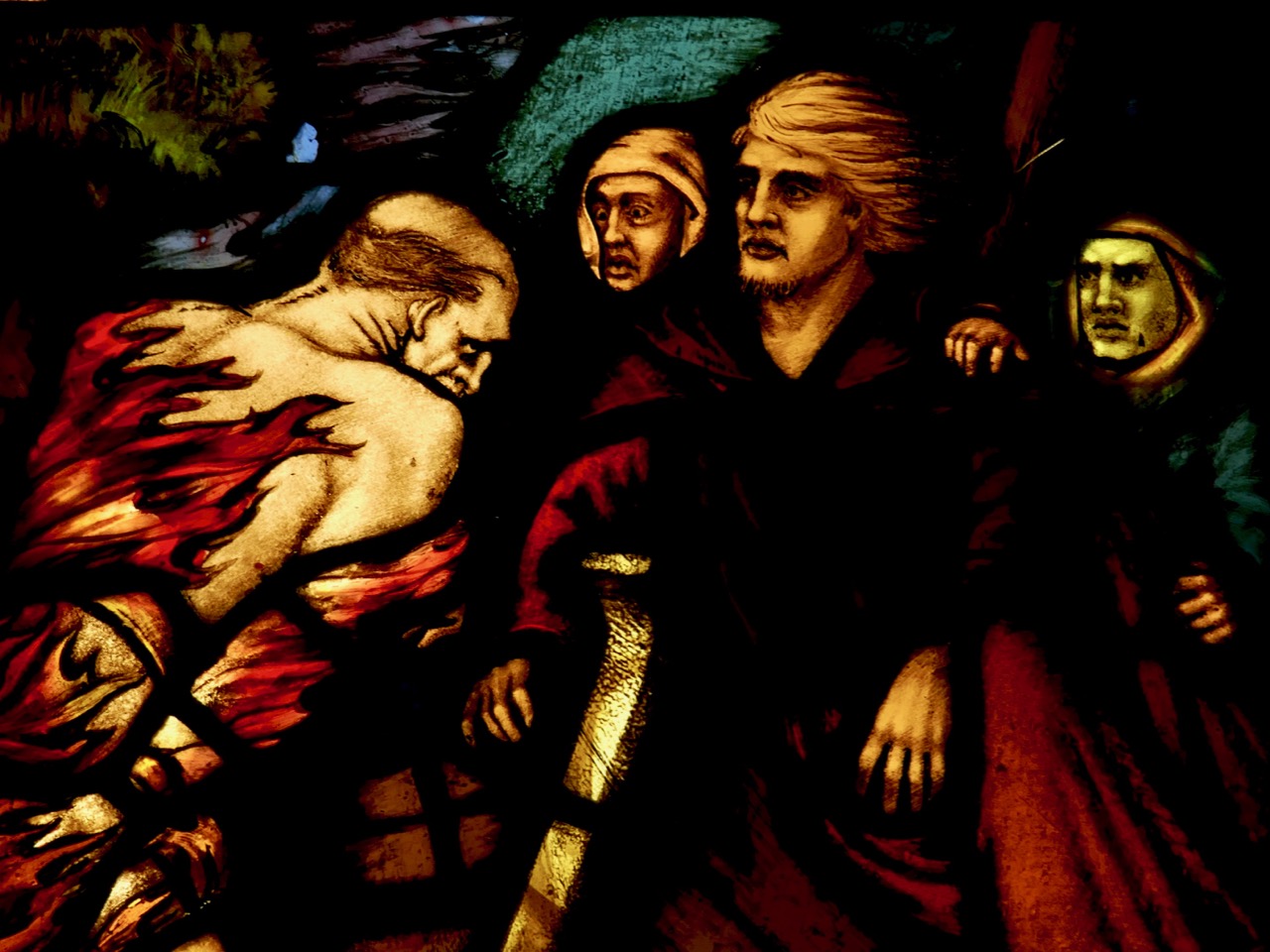
Nicola Gordon Bowe, in the Life and Work of Harry Clarke, felt that Harry was influenced by Matthew Arnold’s poem, St Brandon, when he set about designing his student piece, now in the Crawford Art Gallery. Based on the Medieval best-seller (there are over 100 versions still extant and many translations) Navigatio Sancti Brendani Abbatis, Arnold’s poem tells of an incident on the voyage in which the Saint meets with Judas, tied to an iceberg in the ocean. There are several slightly different accounts of this part of the voyage, but Arnold’s poem is compelling, and beautifully told.

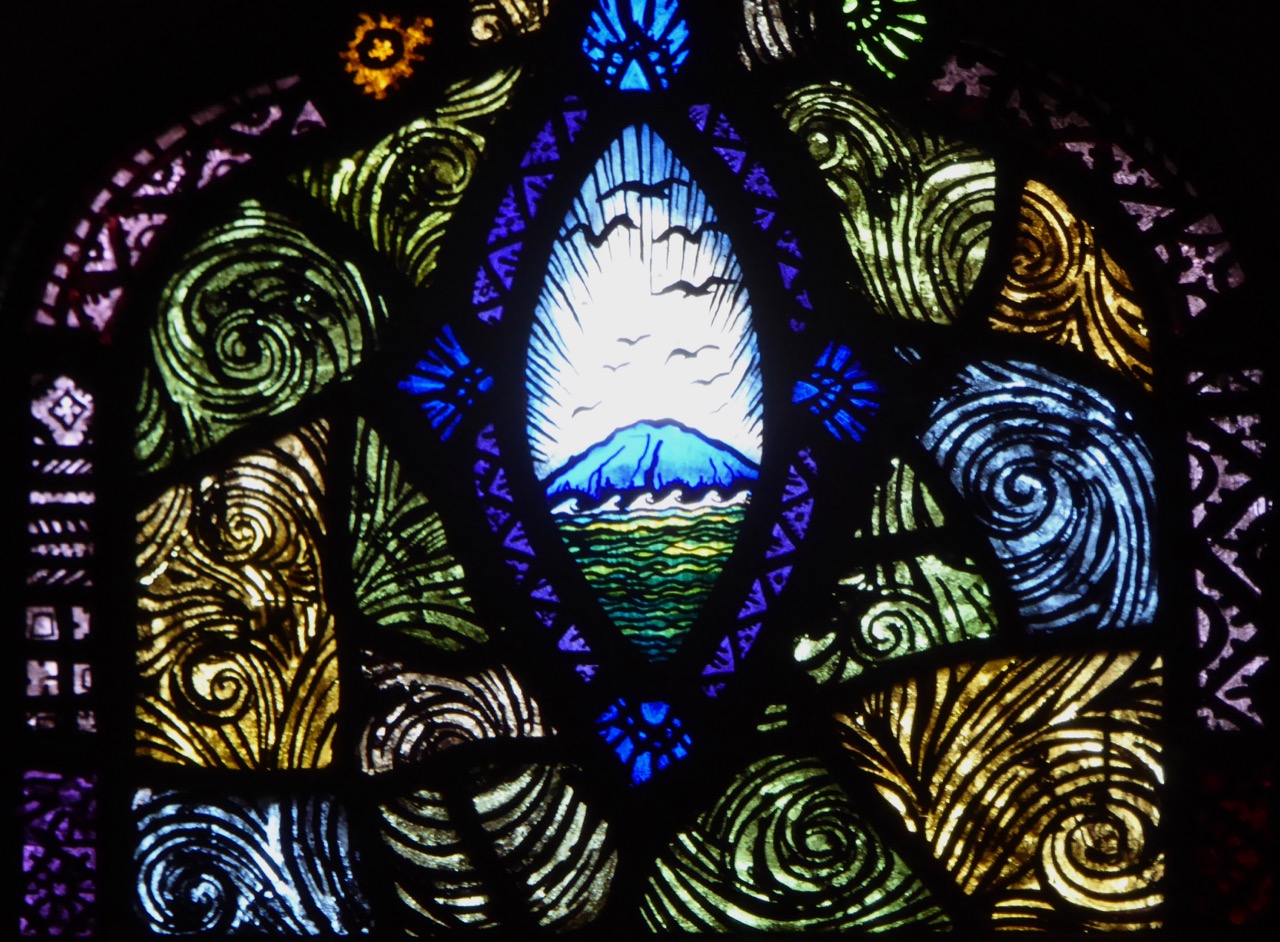
From the Ballinrobe window, a detail showing what Brendan was seeking – the Land of Promise

Both in his poetry and criticism, Arnold explored issues of morality versus religion, and themes of alienation and redemption. Clarke was constrained to work on religious subjects since most of his stained glass commissions came from churches, but revelled in the chance to introduce details from mythology and ancient hagiographies (such as O’Hanlons Lives of the Irish Saints which he consulted exhaustively) and to use those details as a springboard for his own imagination.
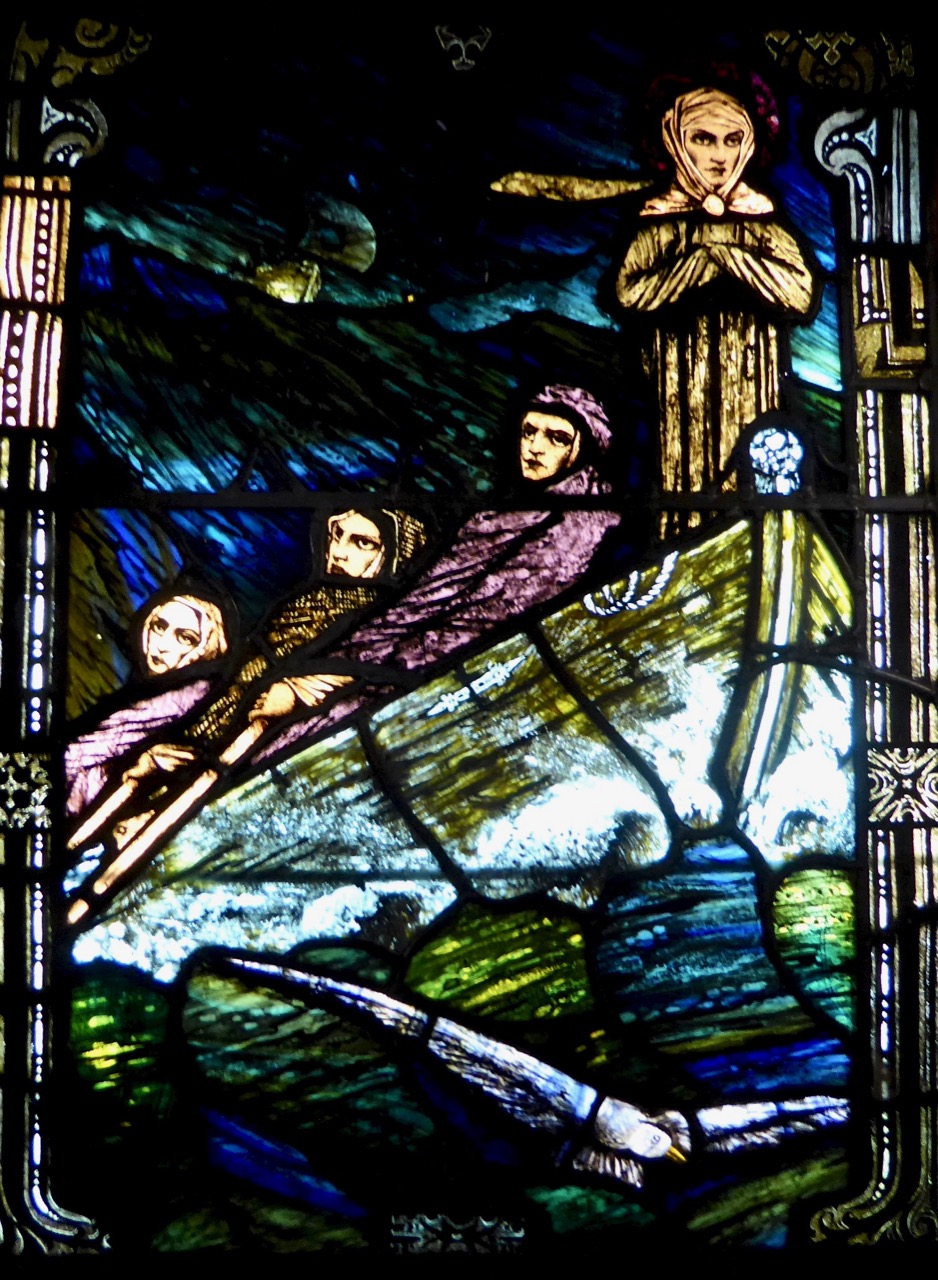
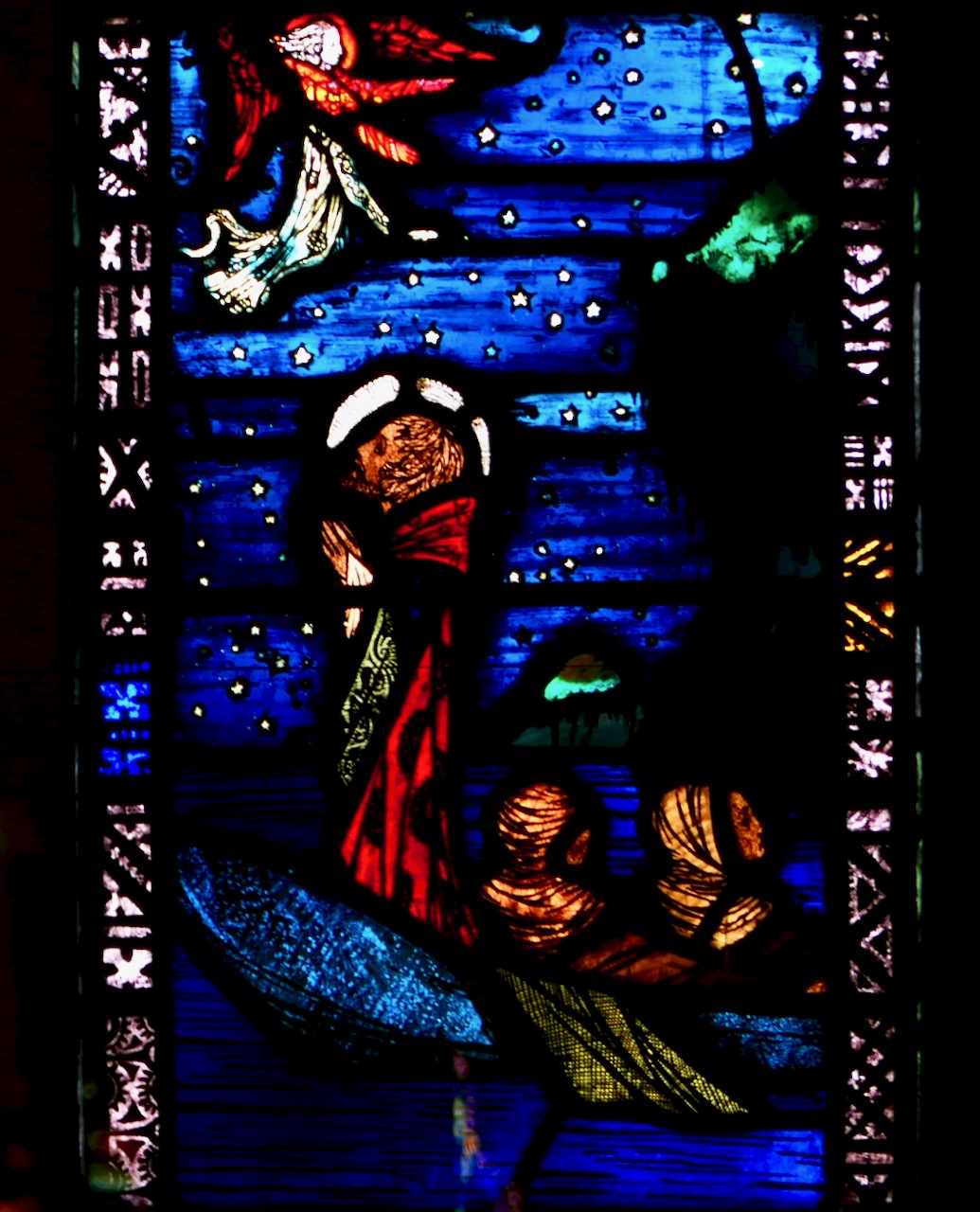
Also from the Ballinrobe window, the bottom panel shows Brendan praying  at the bow of the boat and an angel appearing

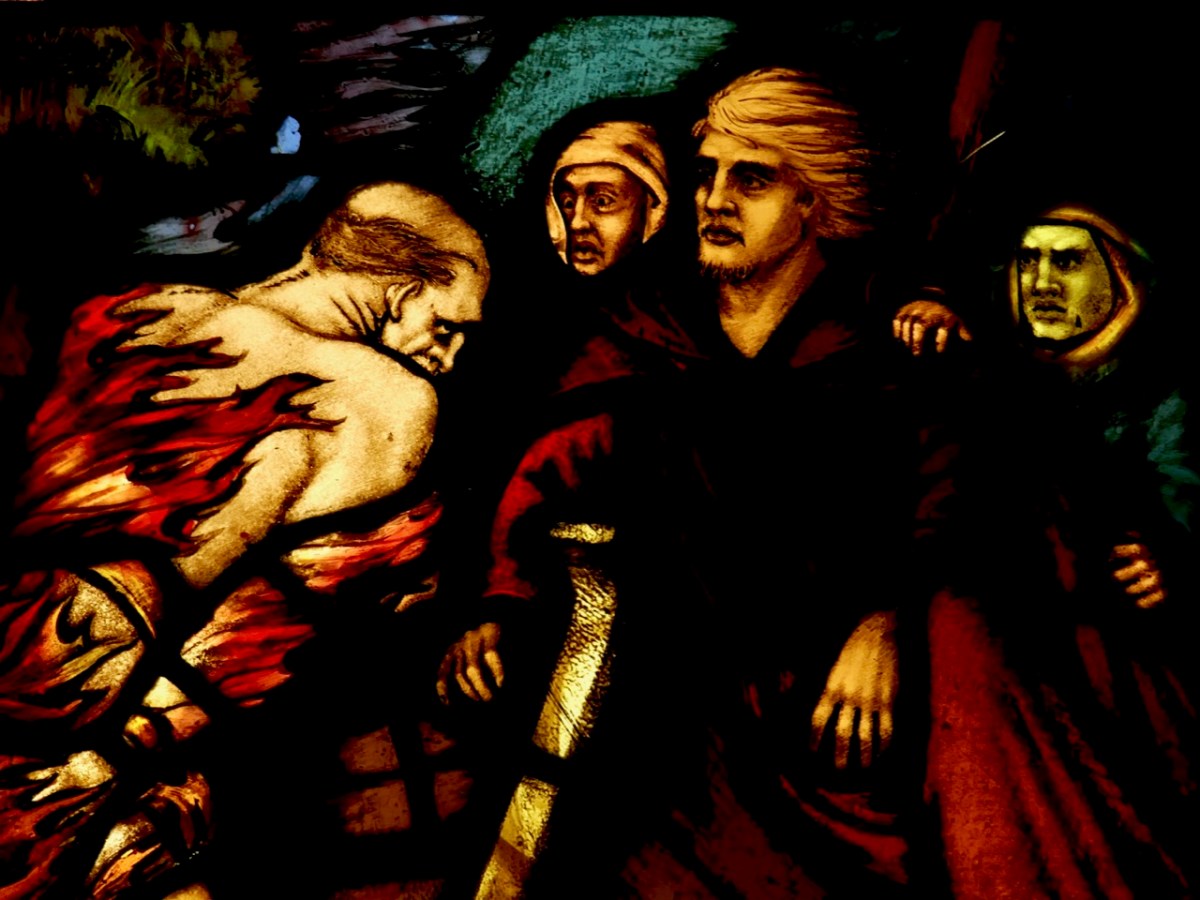
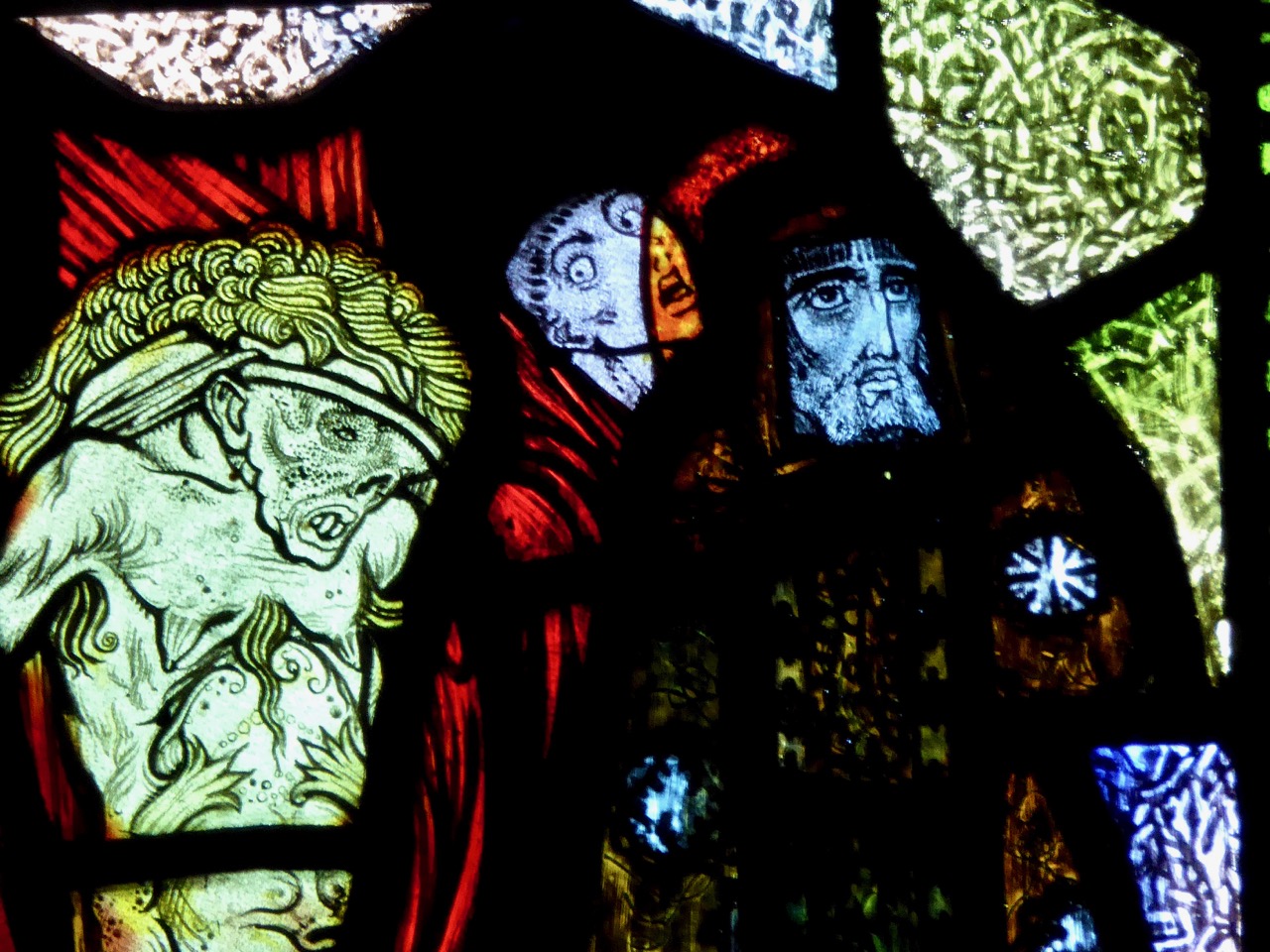
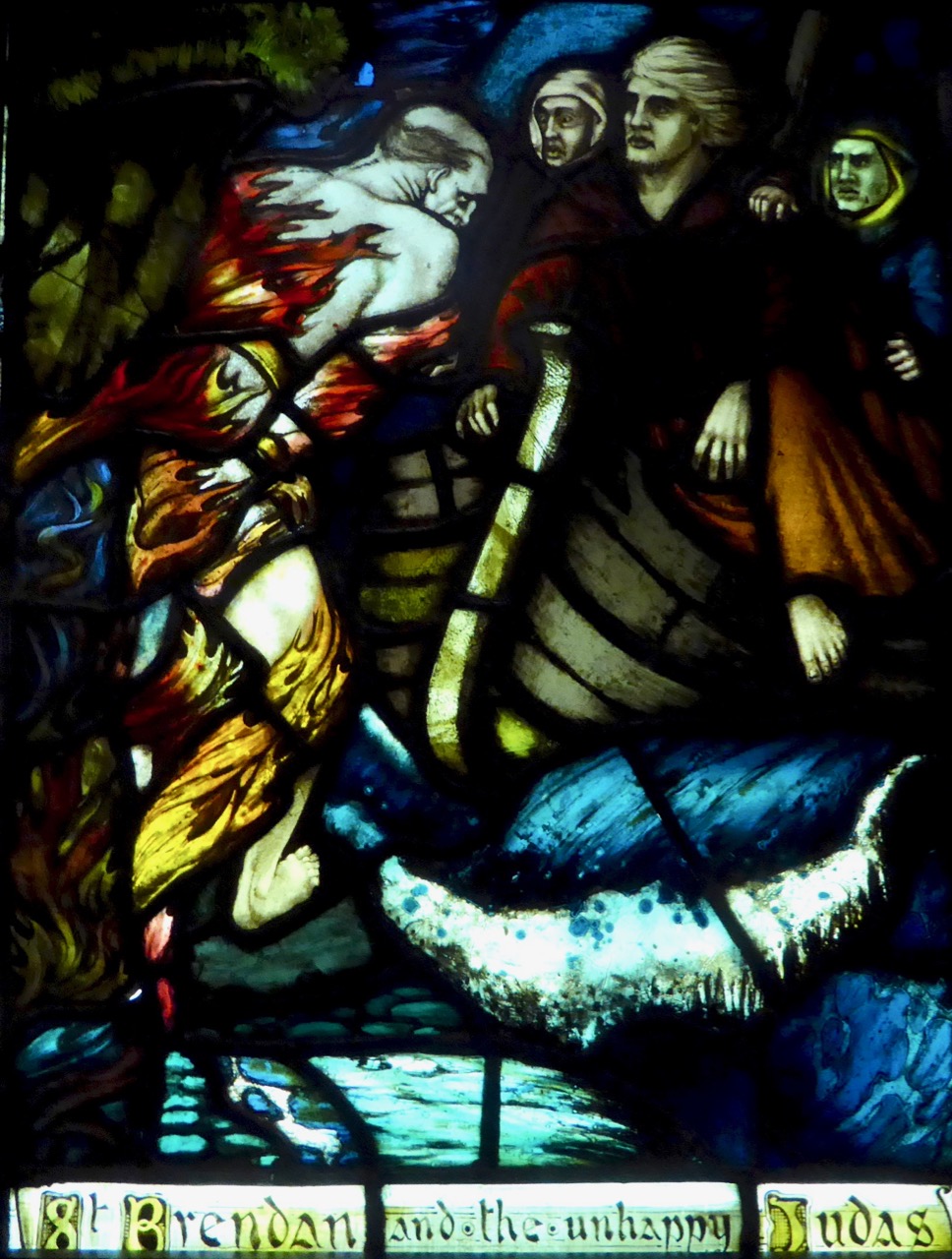
We can see the progression of his art, and his growing interest in the macabre, in the two depictions of Judas. Both are emotive and powerful, but in the first, from 1911, Judas is shown as a fully human, tortured man. In the Honan window, from 1916, he has turned into a monster with scales, feathers, fur and claws. One constant is that Brendan’s companions look on in shock and horror in both pieces, while the saint remains unmoved, gazing thoughtfully and perhaps compassionately on the scene.

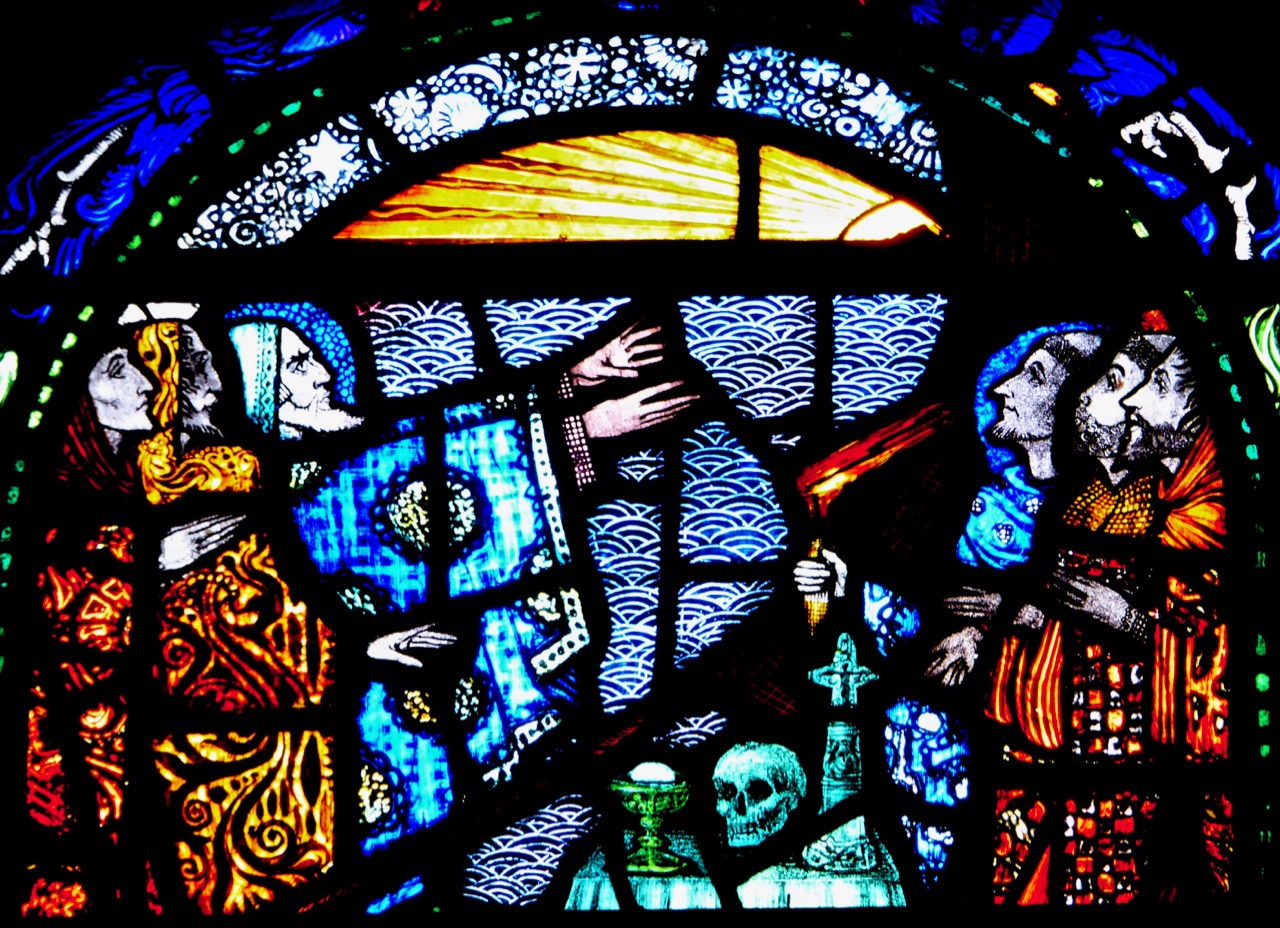
From the Honan window, according to Gordon Bowe: ‘The upper panel which perhaps represents Brendan’s vision of Paradise, is spanned by a golden hemisphere and depicts the saint at sea in his coracle, preaching to his companions as they approach the skull-ridden coastline of America in their search for the Islands of the Blessed’

Harry went on to design two more Brendan windows, but chose different details for them. In fact, he wrote to Monsignor D’Alton at Ballinrobe, ‘The meeting with Judas I have done too often to do again with enthusiasm.’  Arnold’s poem was first published in 1860. He died in 1888 and Harry was born in 1889, so their lives did not overlap. But Harry was very well read and Arnold, at the turn of the century, was still considered one of the major poets of the Victorian era. I think you will find that the poem and the windows are a successful collaboration between two iconic figures of art and literature. I give the poem now in its entirety, illustrated by Harry Clarke. [The first image is from a panel in Tullamore, originally part of the St Brendan window but separated from it when the windows were relocated. The second and third image are from the 1911 student piece; the next three from the Honan Chapel 1916 window.]

Saint Brandan sails the northern main;

The brotherhood of saints are glad.

He greets them once, he sails again;

So late!—such storms!—The Saint is mad!

He heard, across the howling seas,

Chime convent-bells on wintry nights;

He saw, on spray-swept Hebrides,

Twinkle the monastery-lights;

But north, still north, Saint Brandan steer’d—

And now no bells, no convents more!

The hurtling Polar lights are near’d,

The sea without a human shore.

At last—(it was the Christmas night;

Stars shone after a day of storm)—

He sees float past an iceberg white,

And on it—Christ!—a living form.

That furtive mien, that scowling eye,

Of hair that red and tufted fell—

It is—Oh, where shall Brandan fly?—

The traitor Judas, out of hell!

Palsied with terror, Brandan sate;

The moon was bright, the iceberg near.

He hears a voice sigh humbly: ‘Wait!

By high permission I am here.

‘One moment wait, thou holy man

On earth my crime, my death, they knew;

My name is under all men’s ban—

Ah, tell them of my respite too!

‘Tell them, one blessed Christmas-night—

(It was the first after I came,

Breathing self-murder, frenzy, spite,

To rue my guilt in endless flame)—

‘I felt, as I in torment lay

‘Mid the souls plagued by heavenly power,

An angel touch my arm, and say:

Go hence, and cool thyself an hour!

”Ah, whence this mercy, Lord?’ I said.

The Leper recollect, said he,

Who ask’d the passers-by for aid,

In Joppa, and thy charity.

‘Then I remember’d how I went,

In Joppa, through the public street,

One morn when the sirocco spent

Its storms of dust with burning heat;

‘And in the street a leper sate,

Shivering with fever, naked, old;

Sand raked his sores from heel to pate,

The hot wind fever’d him five-fold.

‘He gazed upon me as I pass’d

And murmur’d: Help me, or I die!—

To the poor wretch my cloak I cast,

Saw him look eased, and hurried by.

‘Oh, Brandan, think what grace divine,

What blessing must full goodness shower,

When fragment of it small, like mine,

Hath such inestimable power!

‘Well-fed, well-clothed, well-friended, I

Did that chance act of good, that one!

Then went my way to kill and lie—

Forgot my good as soon as done.

‘That germ of kindness, in the womb

Of mercy caught, did not expire;

Outlives my guilt, outlives my doom,

And friends me in the pit of fire.

‘Once every year, when carols wake,

On earth, the Christmas-night’s repose,

Arising from the sinner’s lake,

I journey to these healing snows.

‘I stanch with ice my burning breast,

With silence balm my whirling brain.

Oh, Brandan! to this hour of rest

That Joppan leper’s ease was pain.’—

Tears started to Saint Brandan’s eyes;

He bow’d his head, he breathed a prayer—

Then look’d, and lo, the frosty skies!

The iceberg, and no Judas there! 


An Excursion to Dunboy

We have often visited the Beara Peninsula: it’s not too far away and makes a good day’s outing for us. Have a look at some recent posts here and here to get the feel of the geography. Yesterday we had a mission – to discover more about Donal Cam O’Sullivan Beare (1561 – 1618) and his connections with Dunboy Castle, over by Castletown-Bearhaven – often known as Castletownbere or just Castletown – in the far west of County Cork.

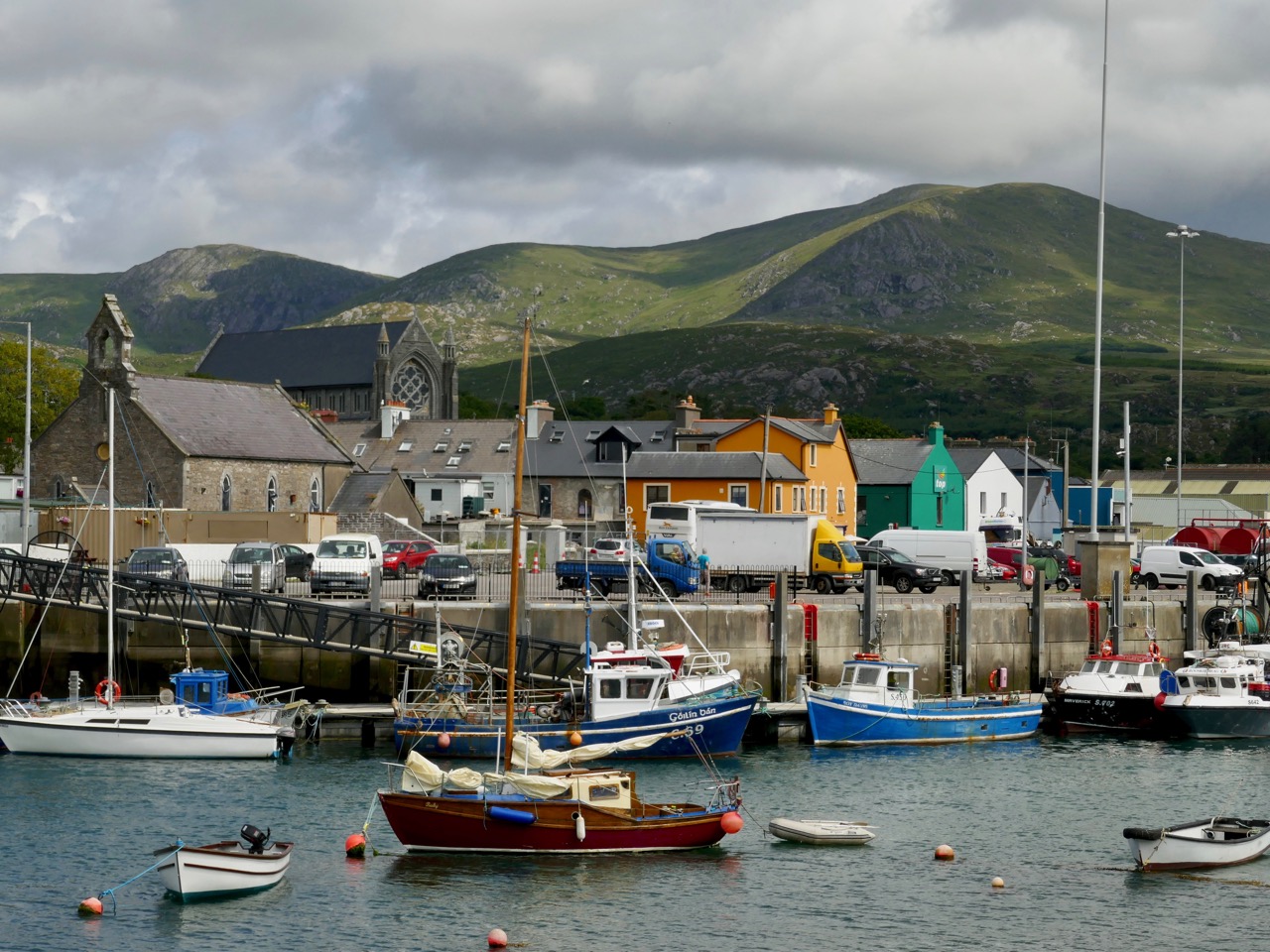
Our first stop was at the bustling harbour of Castletownbere which sits at the foot of the Caha Mountains. …Where land and sea collide, untamed beauty abounds… – that’s the apt heading on the website of the town’s Development Association, and it most certainly seems a lively and flourishing community, a good base from which to explore the wealth of history and archaeology on the Beara. Daphne du Maurier’s novel, Hungry Hill, is set in the area and is a family saga loosely derived from the history of the Irish ancestors of du Maurier’s friend, Christopher Puxley.

We paused only for a much-needed coffee and a quick look in the Sarah Walker Gallery (precariously and picturesquely situated on the end of the town’s slipway – it’s the white building in the picture above) before setting out to find Dunboy. I had read a little of the history of the place, and knew that it had been a centre of rebellion following the Battle of Kinsale in 1601 – 1602, when allied Irish and Spanish forces were defeated at the culmination of the Nine Years War between England and the Gaelic lordships.

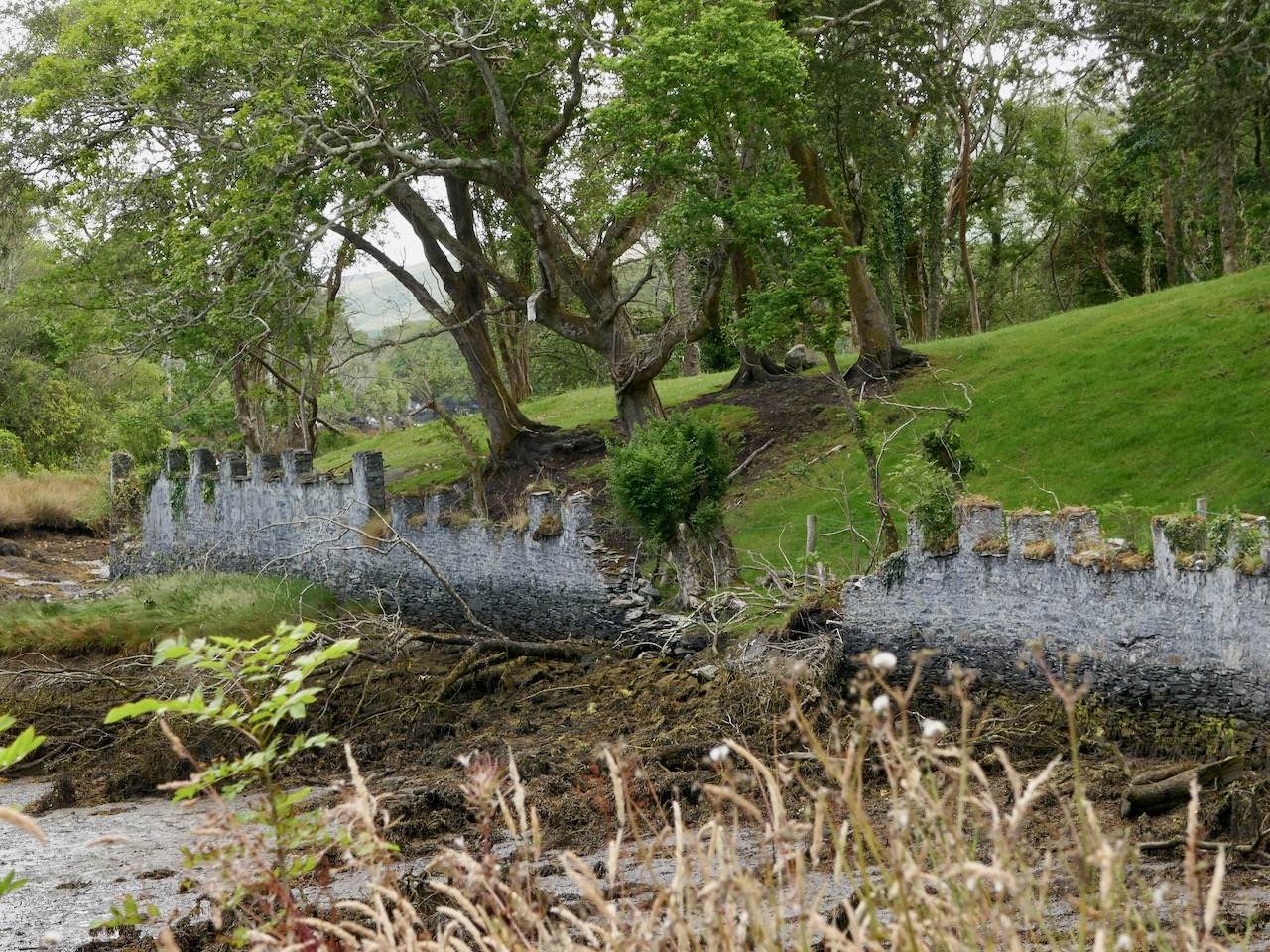
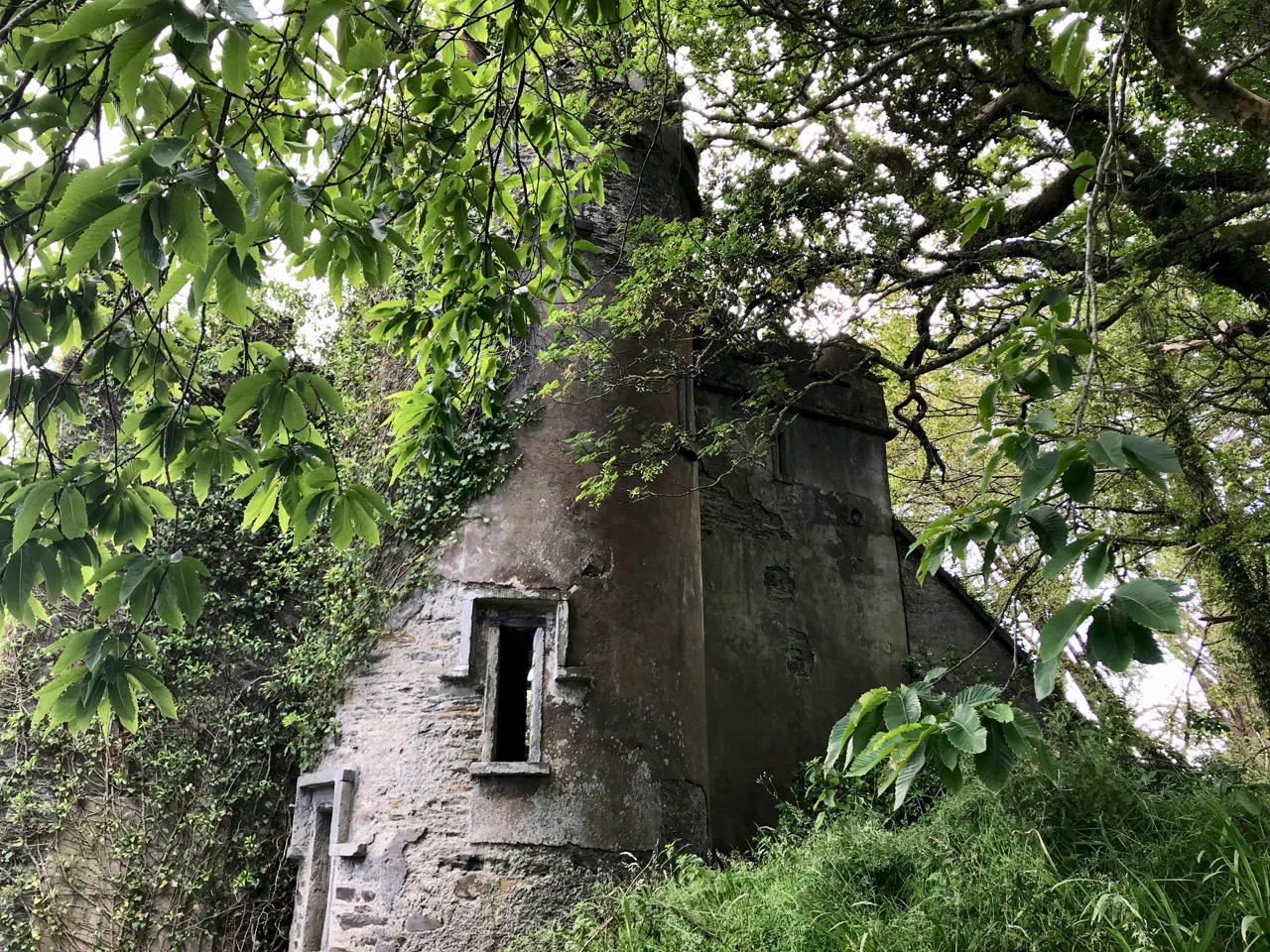
At the edge of the Dunboy Demense are traces of a castellated sea-wall and a gatehouse (above).  The territory was a stronghold of the O’Sullivan Beare clan leader, and was built to guard and defend the harbour of Berehaven. Its presence enabled O’Sullivan Beare to control the sea fisheries off the coast and collect taxes from Irish and continental European fishing vessels sheltering in the haven. It was also a centre for trade to and from the continent. In the aftermath of the Battle Of Kinsale Donal Cam O’Sullivan Beare’s followers retreated to Dunboy Castle, which was considered an impregnable stronghold.

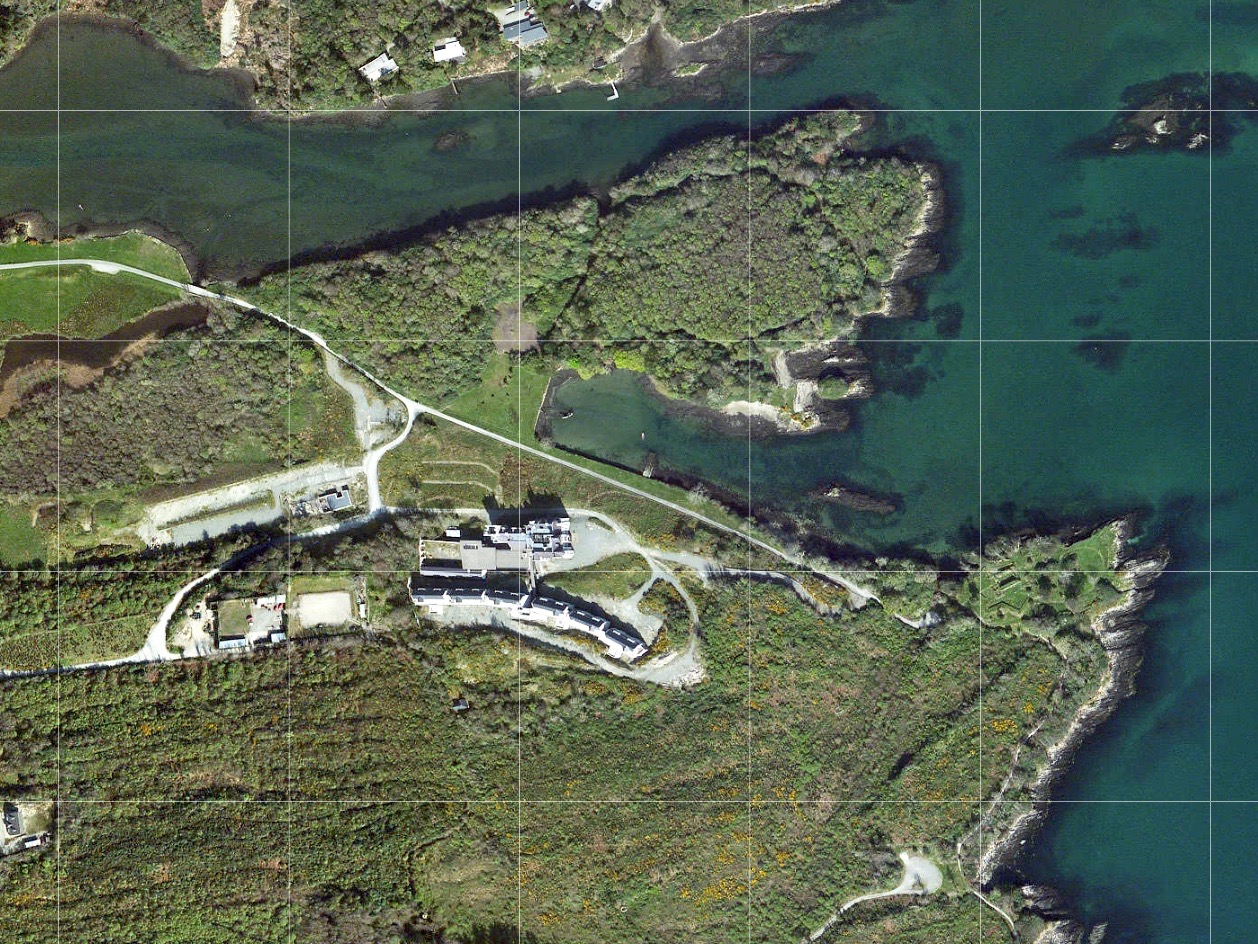
The 25″ historic Ordnance Survey map (upper picture) shows the location of the O’Sullivan Beare fortress, circled in red. Don’t be confused by the ‘Dunboy Castle’ label: this is a later building added to an existing tower house that stood on the hill above the promontory. The estate came into the hands of the Puxley family who invested significantly in the Allihies copper mines in the 19th century. The development in the centre of the aerial view above is Puxley Manor, and is a 21st century incarnation of the huge neo-gothic family mansion created by the family, which was burnt out by the IRA in the 1920s.

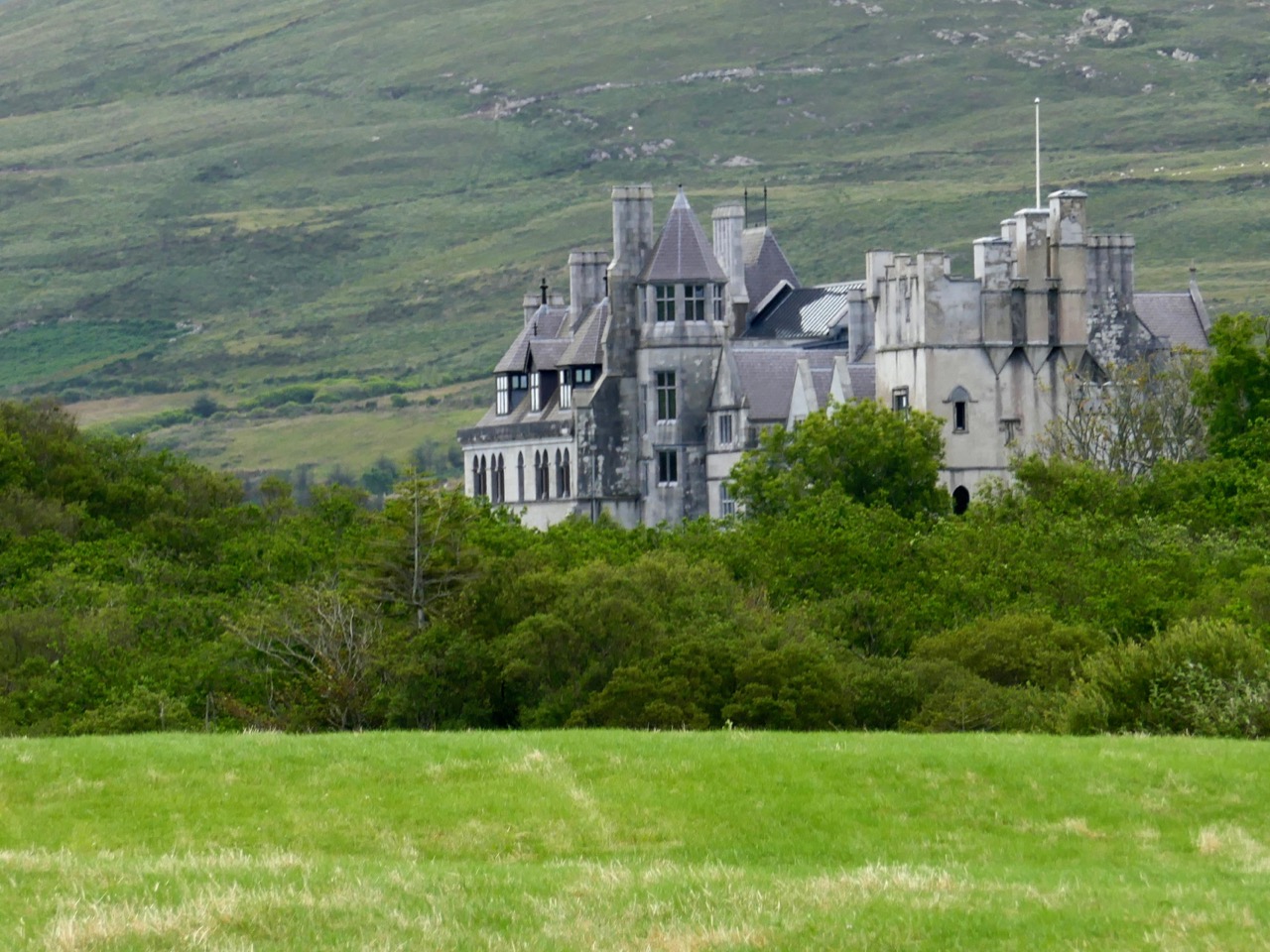
These pictures show the mansion after its destruction and today. In the lower photograph you can see the original tower house in the foreground: the buildings were fully restored as part of a high-profile ‘Celtic Tiger’ project to create a 6-star hotel which could have brought employment and significant economic benefits to the area. Unfortunately the project collapsed before completion, and the future of this decaying leviathan is uncertain.

We could only look in awe at the very evident and lavish quality of the restoration and development, even in its present state, and speculate how its fortunes might have fared in more stable times. But all this was a bit of a diversion, as our goal was a much less audacious – but far more historically important – site: the original ‘Dunboy Castle’. We followed the trackway along the inlet, which looks as though it was artificially constructed to form a quay serving the demesne.

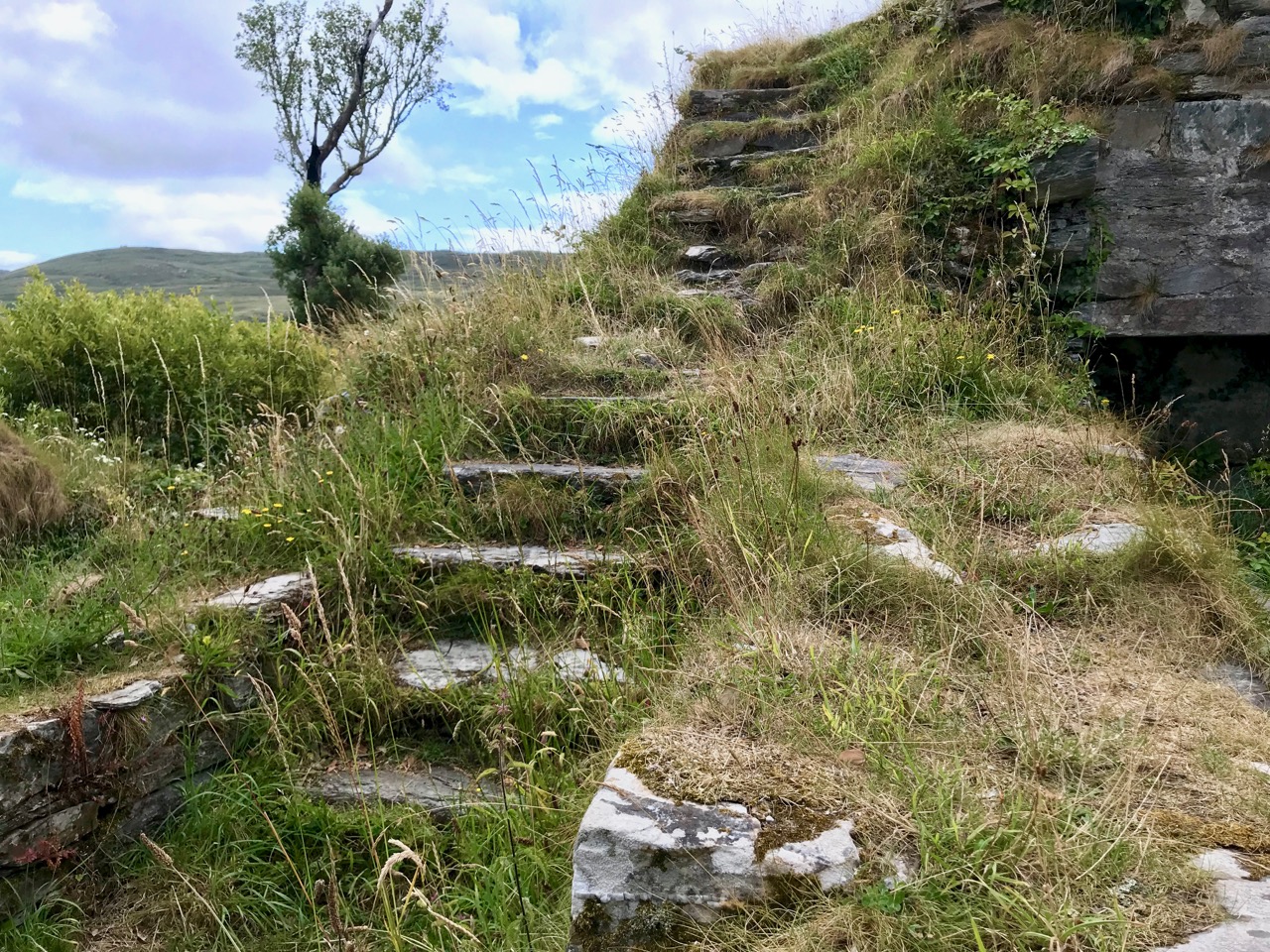
The ruin itself is unassuming: thick stone walls barely a few metres high. However, the ground plan is clear to see – a typical ‘tower house’ design with splayed openings and steps contained in the thickness of the outer walls. Also visible in the surroundings, however, are the clear ‘star’ shapes of an enclosure, complete with salient angles. These outer defences, reminiscent of ‘star-shaped forts’ evidently date from Cromwellian times, constructed after the castle was destroyed.

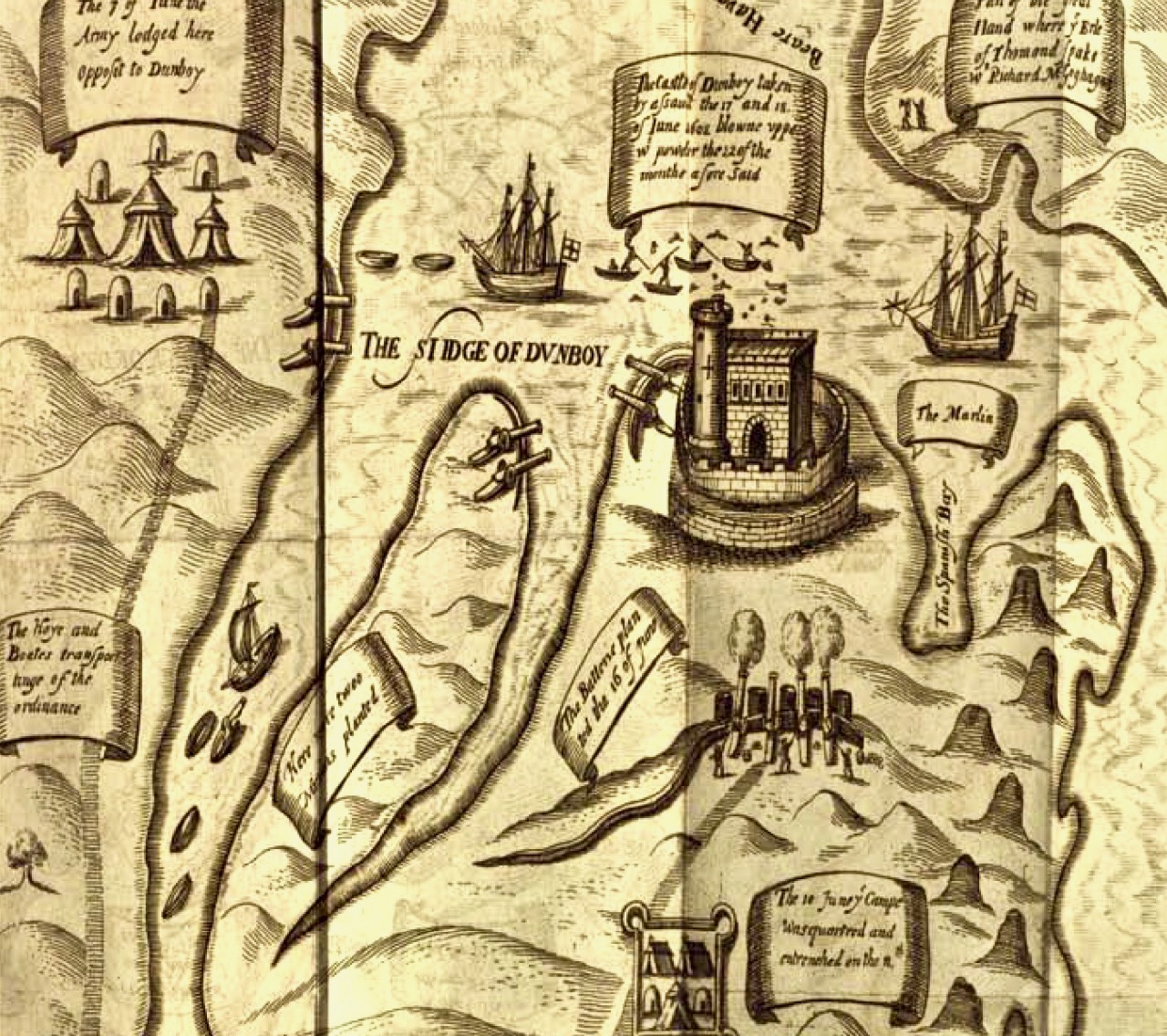
These ruins conceal an unhappy tale. At Kinsale the clan chiefs had been joined by a large force of troops sent by King Philip III of Spain, who considered that a federation with Ireland would assist his aspirations against Elizabethan England. After the surrender, a number of O’Sullivan followers retreated to Dunboy, where they found the small Spanish force stationed there  preparing to hand the castle over to the queen’s Lord Deputy, Mountjoy. O’Sullivan overpowered and disarmed the Spaniards and later released them to return to Spain, having kept kept all of their arms, ordnance and munitions. Inevitably, an English force under George Carew set out for Dunboy: it is said that this force numbered between 4,000 and 5,000 troops. O’Sullivan Beare established defences at the castle, but set off himself with most of his own army to consolidate in the north of the Beara Peninsula. Only 143 of his men were left behind at Dunboy, together with Friar Dominic Collins to look after their spiritual welfare. The siege of Dunboy began with an artillery bombardment by land and sea. Owen O’Sullivan of Carriganass, a cousin of Donal Cam, had allied himself with the English and informed them of a weak point in the castle walls. The guns were directed to that point, and the walls were eventually breached. After a ten day siege, Dunboy was reduced to the ruin we see today.

Above is a wonderful graphic illustration of the Siege of Dunboy Castle from Pacata Hibernia or A History of the Wars in Ireland during the Reign of Queen Elizabeth first published in 1633. Only 72 of the Irish defenders survived the siege: they were all hanged, including Friar Dominic Collins. Most of the hangings took place in the bustling square of Castletown-Bearhaven, close to where we had enjoyed our coffee at the start of our excursion.
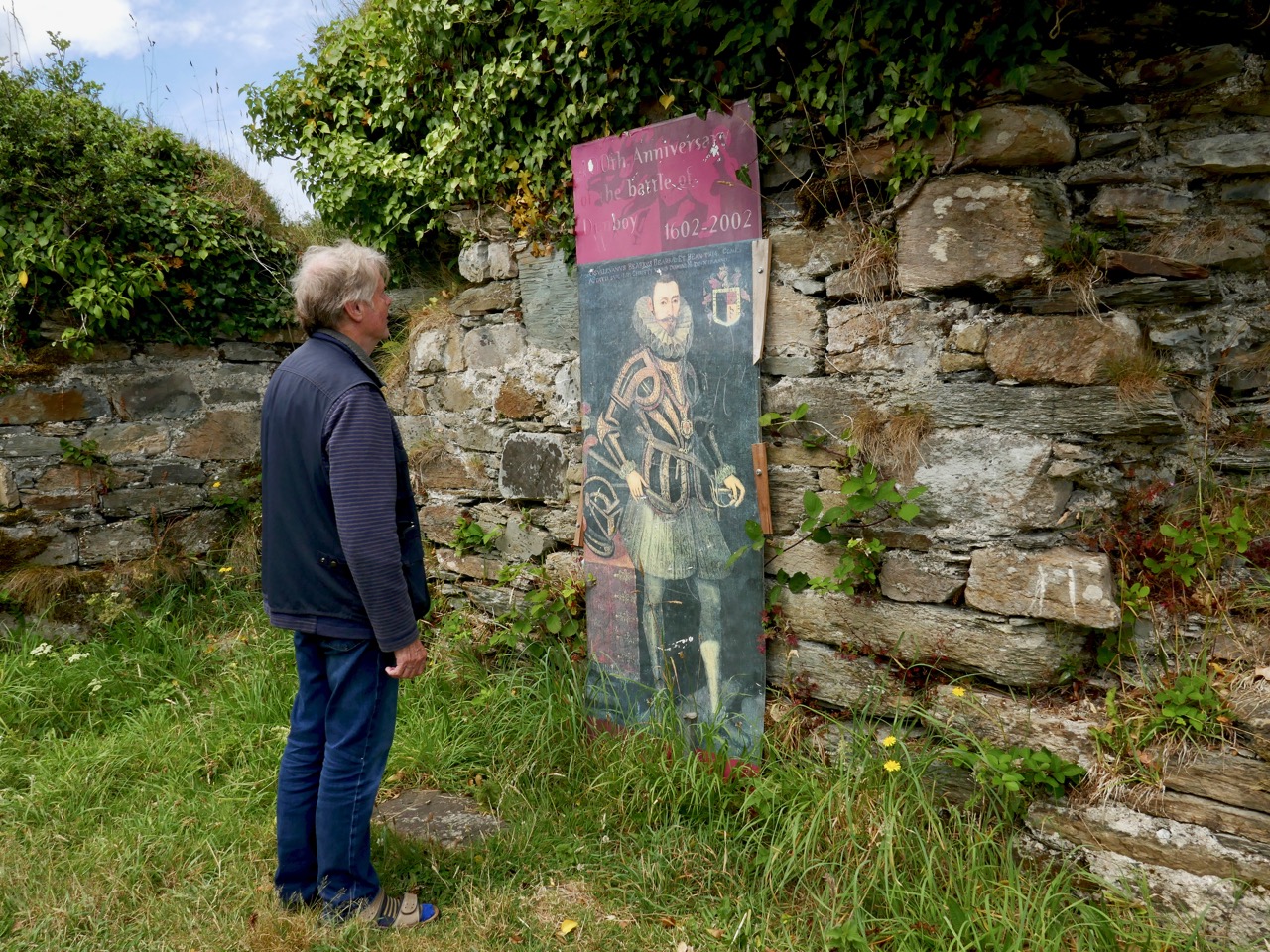
Here I am meeting Donal Cam himself in the ruins of his former stronghold. My account of the Siege of Dunboy is a very condensed version. Much more has been written about the details. As for O’Sullivan Beare, he eventually embarked on a long march to Leitrim with a thousand of his followers – but that’s a further unhappy story, best kept for another day!
Dunboy Castle and its immediate environs are publicly accessible and there is plenty of parking within easy reach. We finished our day on the Beara by following a rural loop walk from the castle ruin back to the gatehouse – about 5 kilometres in idyllic surroundings.

Irish Immersion!

We traversed the Dingle Peninsula on the way to our week-long ‘Irish Immersion’ course. Our route included the Conor Pass (above) – possibly Ireland’s highest mountain pass with a summit of 456m: not to be missed, as the views from it are spectacular in all directions. Do be careful, though, as it’s included in the list of ‘the World’s most dangerous roads’. That’s because in places it is only a winding single track, with the way almost tunnelled out of steep rock faces: don’t try it in a bus!

Once over the pass, however, it’s plain sailing and sunshine all the way down to Dingle itself, a busy waterside town (which sells the best ice-creams!),  where we stayed while we were on our course. Here’s the view from Coastline House, our very well-appointed B + B:

So why would I want to learn the Irish language? And how easy is it? The answer to the second question is: it’s fiendishly difficult – especially for an ear that’s been attuned to English for a lifetime! But – here I am in my eighth decade, an Irish citizen and a permanent resident of West Cork – so what would be more natural (and good for the ageing brain) than being able to communicate in the native tongue? Finola, of course, learnt Irish right through her schooldays (it’s been compulsory since the founding of the Irish State) and can hold her own in conversation, but she wants to improve her knowledge and took a course at a higher level: I was in the raw beginners’ class, together with our good friends Amanda and Peter Clarke, with whom we enjoyed great craic in our free time.

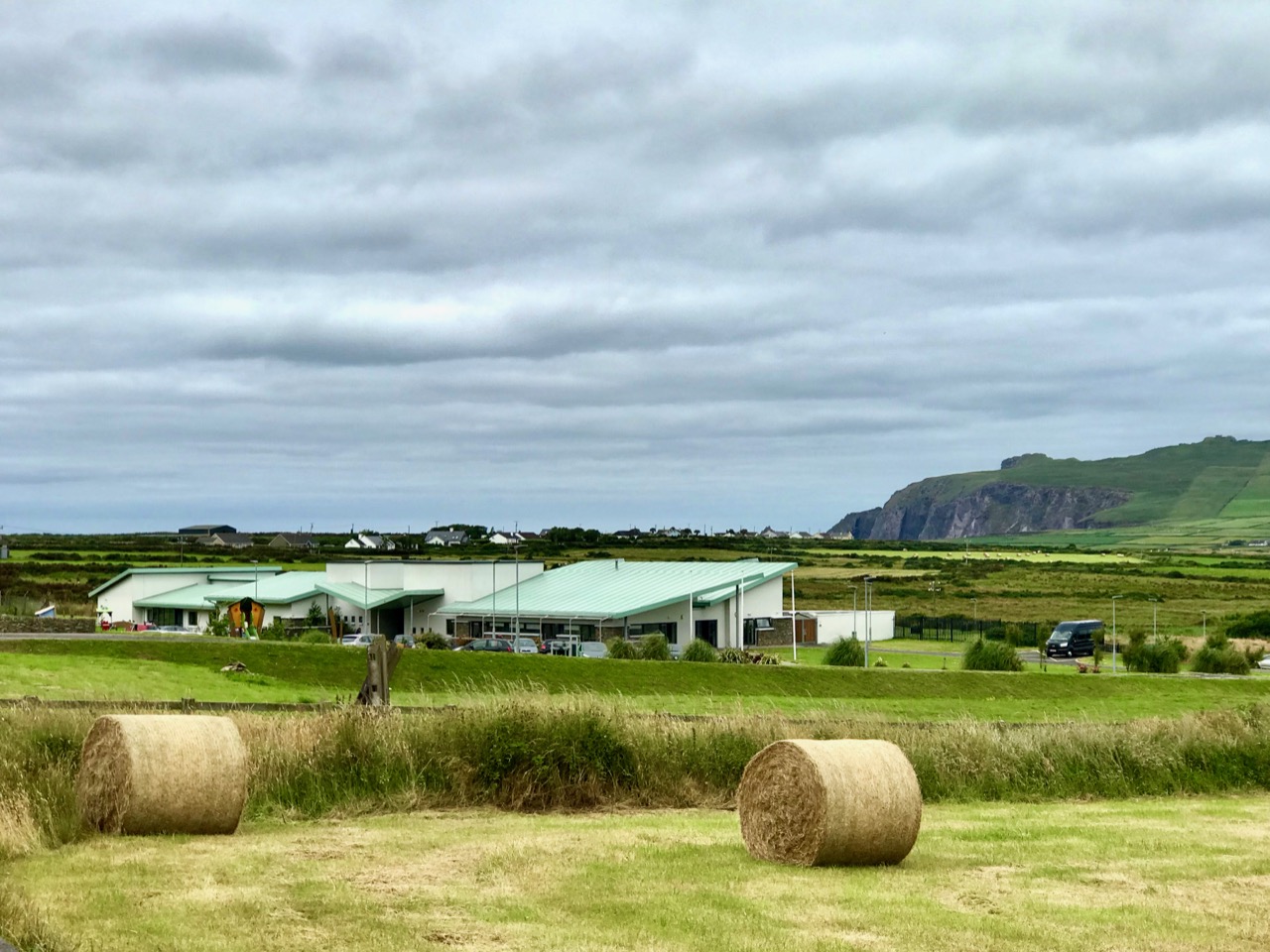
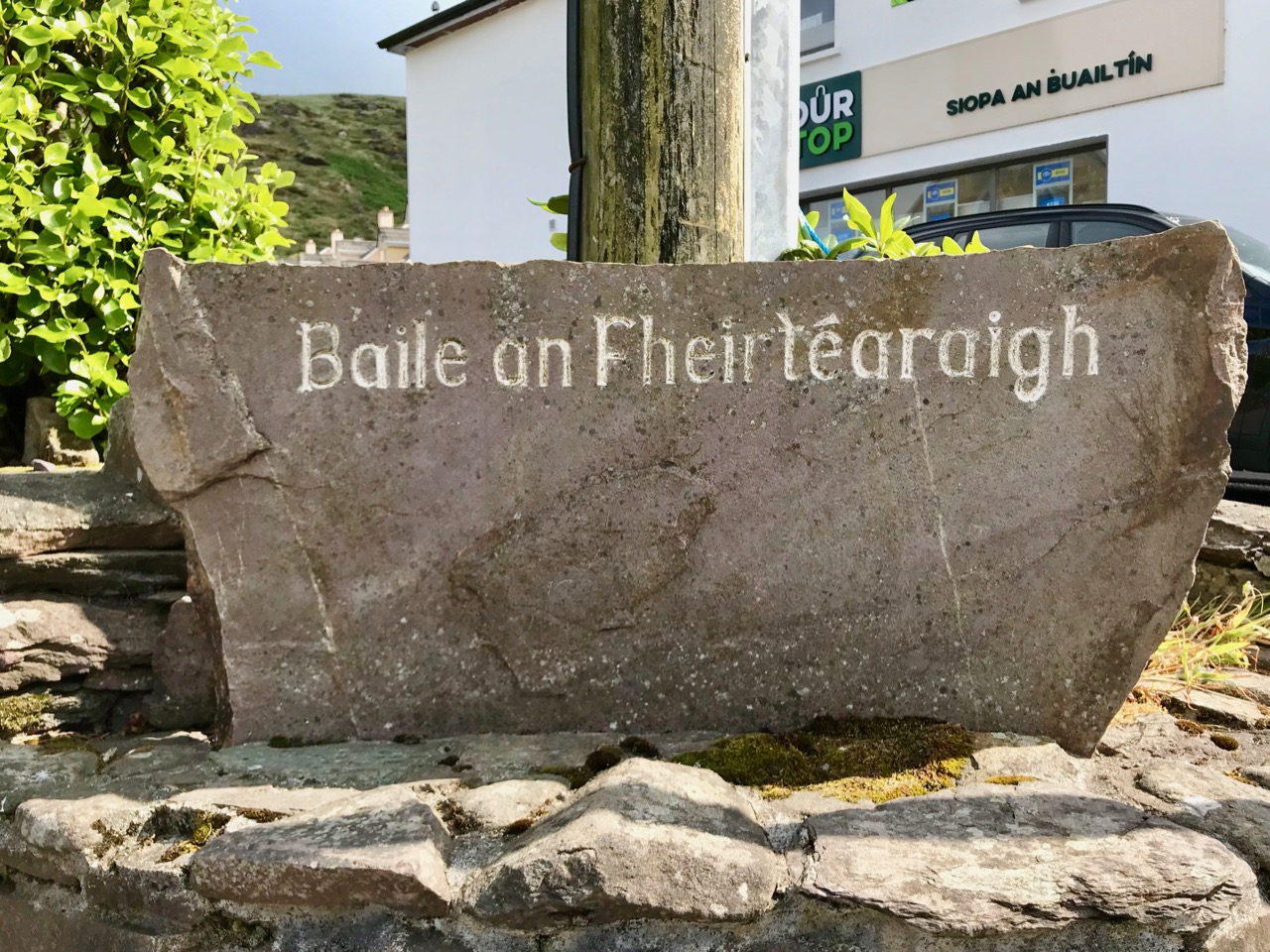
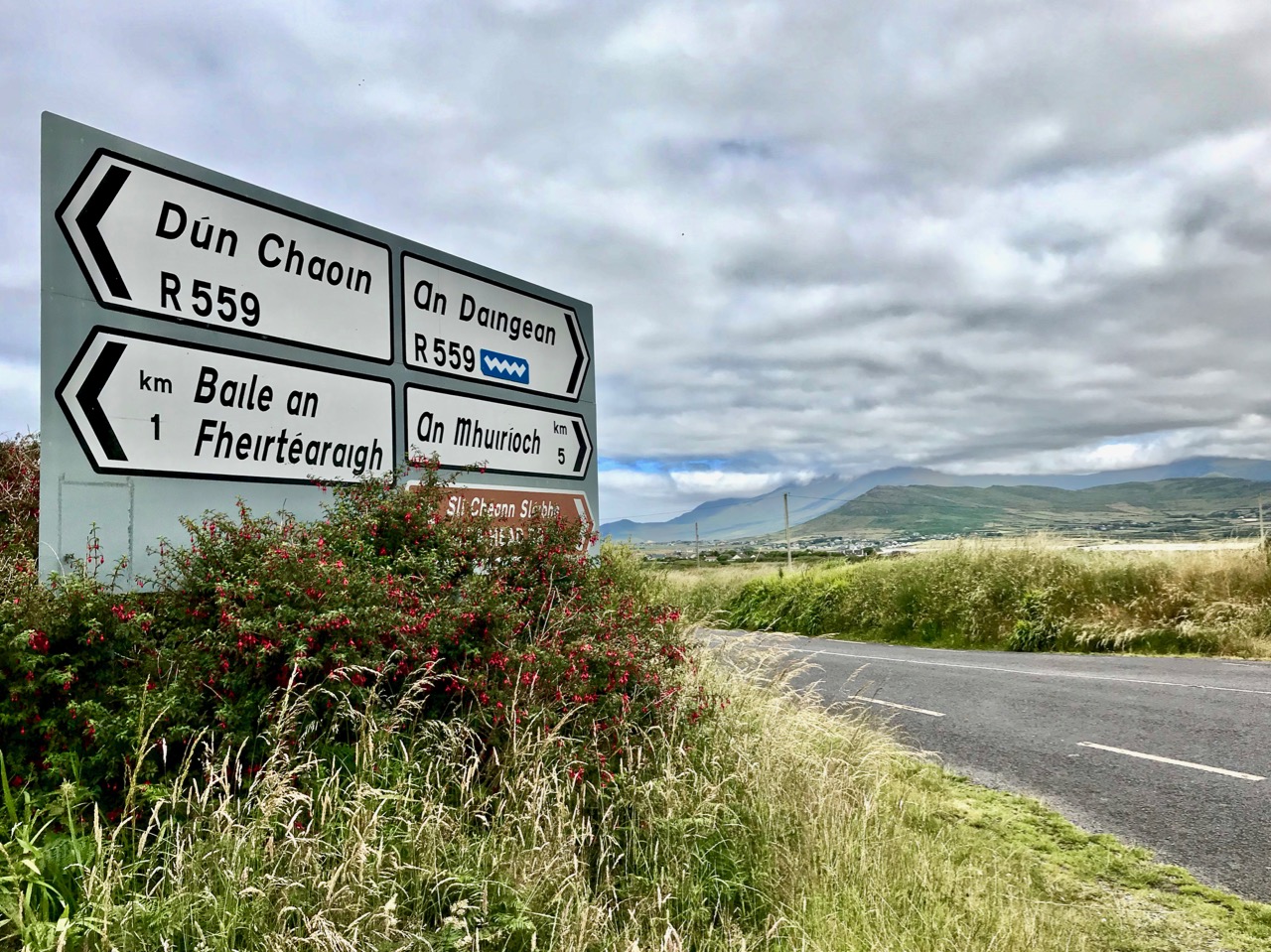
The western part of the Dingle Peninsula is a Gaeltacht area: that means it is a place where Irish is the dominant language; all street signs, traffic signs etc are in Irish only; anyone in shops, businesses etc is likely to speak in Irish, and there are a number of schools where teaching is all in Irish. Our courses were based in Baile an Fheirtéaraigh (in English it would be known as Ballyferriter) – to the west of Dingle town (which is, in Irish, An Daingean). You can tell from many of the photographs in this post how stunningly beautiful the landscape is in this part of Ireland. The upper picture above shows the very fine school building of Coláistí Chorca Dhuibhne, which hosts all the Irish classes. The ones for adults are run by the Oidhreacht Chorca Dhuibhneyou can find all the details here if you’ve a mind to give it a try yourself.

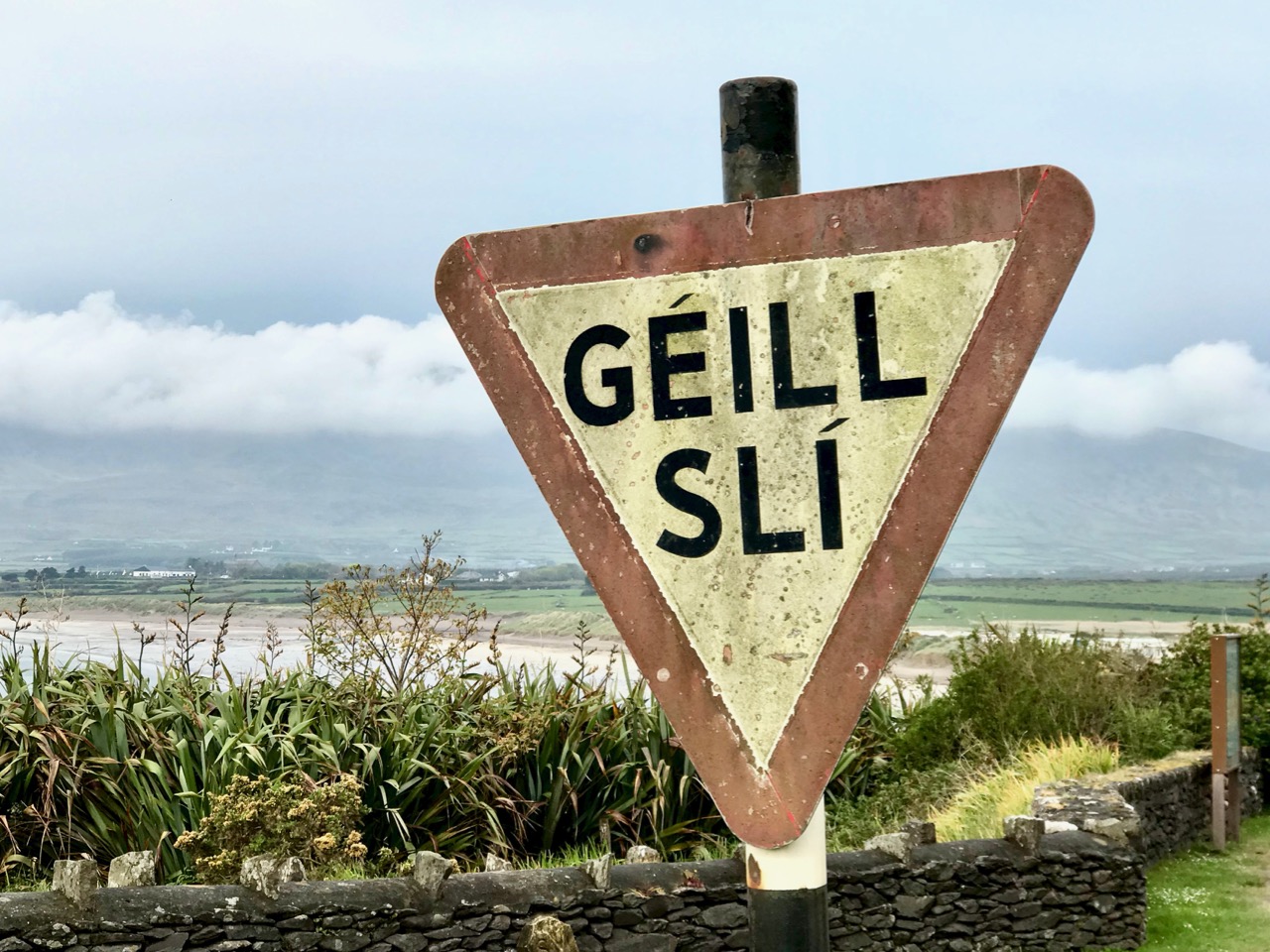
It’s a different world in the Gaeltacht areas: can you guess what the sign above is saying?

You ought to know, also, that the Gaeltacht area here is known as Corca Dhuibhne, which translates literally as ‘the seed or tribe of Duibhne’ and derives from the clan who anciently lived in this part of County Kerry. Try saying ‘Corca Dhuibhne‘ . . . How did you get on? This is what I should have heard:

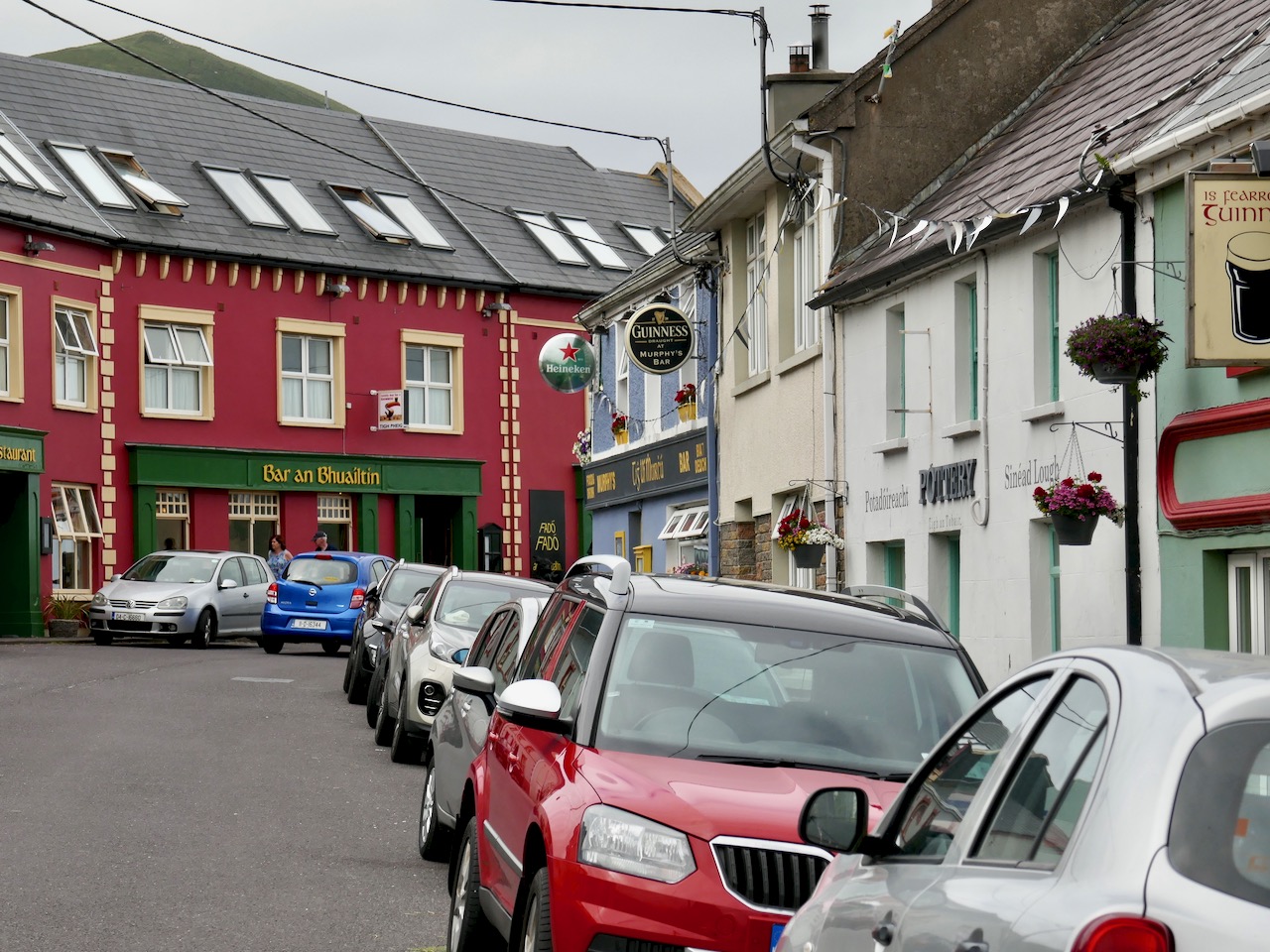
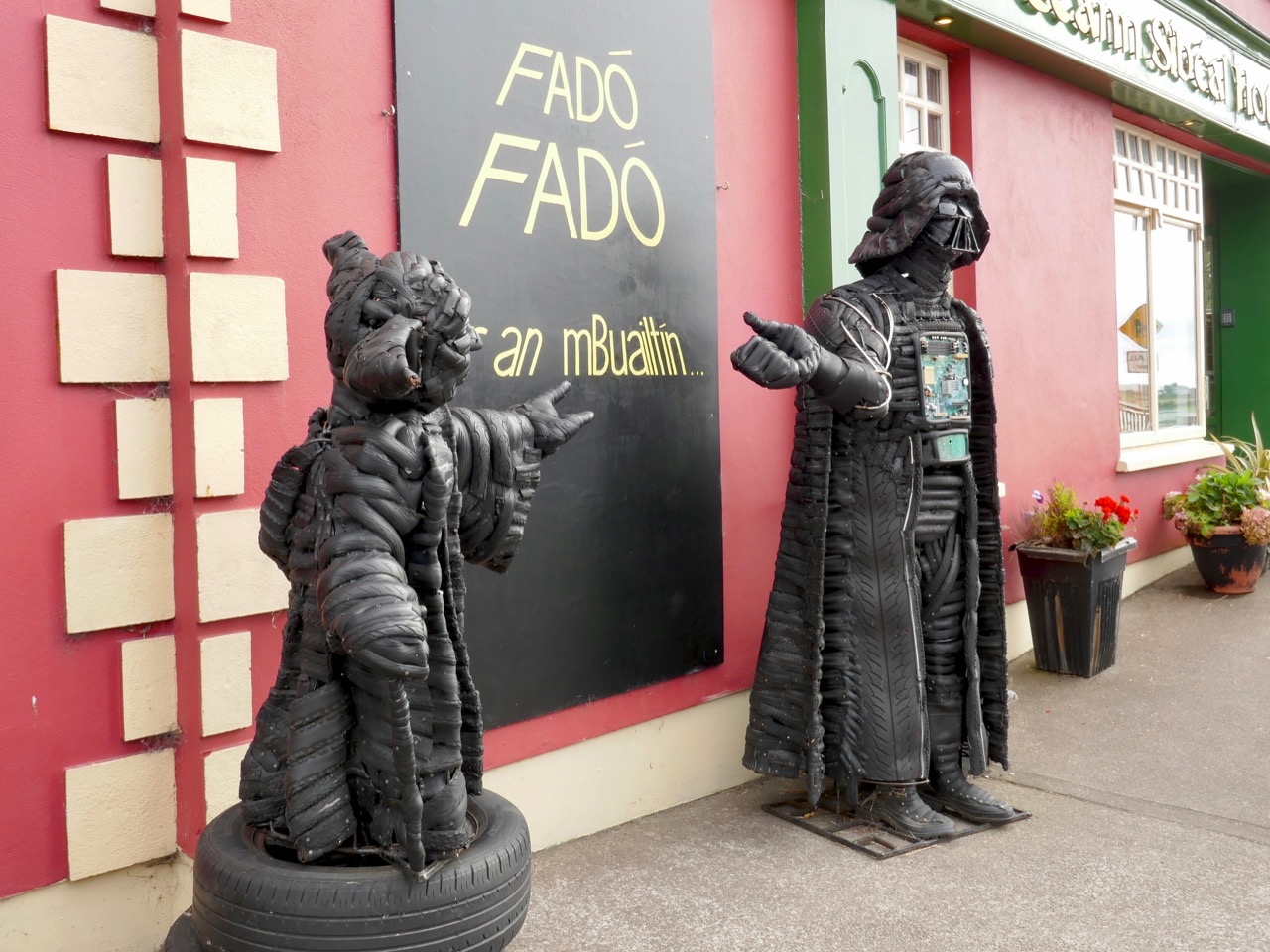
Above – streetscapes in the lively village of Baile an Fheirtéaraigh (Ballyferriter). Note the signage in the upper picture. The lower picture will be self-explanatory to Star Wars fans: the film series is set “A long time ago in a galaxy far, far away….” – Fadó Fadó is the Irish way of beginning a fairy-tale, meaning literally “long long ago….”. And – just to confuse you (and me) – Ar an mBualtín means “in Ballyferriter”! I know – I just told you that the town is Baile an Fheirtéaraigh in Irish, but the townland is known as an mBuiltín, which is in fact another way of describing a “booley” which, you will no doubt remember from my post here, is the place where cattle are taken up to the hill pastures in the summer. So, all things Irish are often not straightforward. Just to explain a connection: parts of the latest Star Wars episodes have been filmed on the promontories above Ballyferriter – a great ‘selling point’ for the local tourism industry!

Green roads lead to the hillside pastures which dominate the Dingle Peninsula

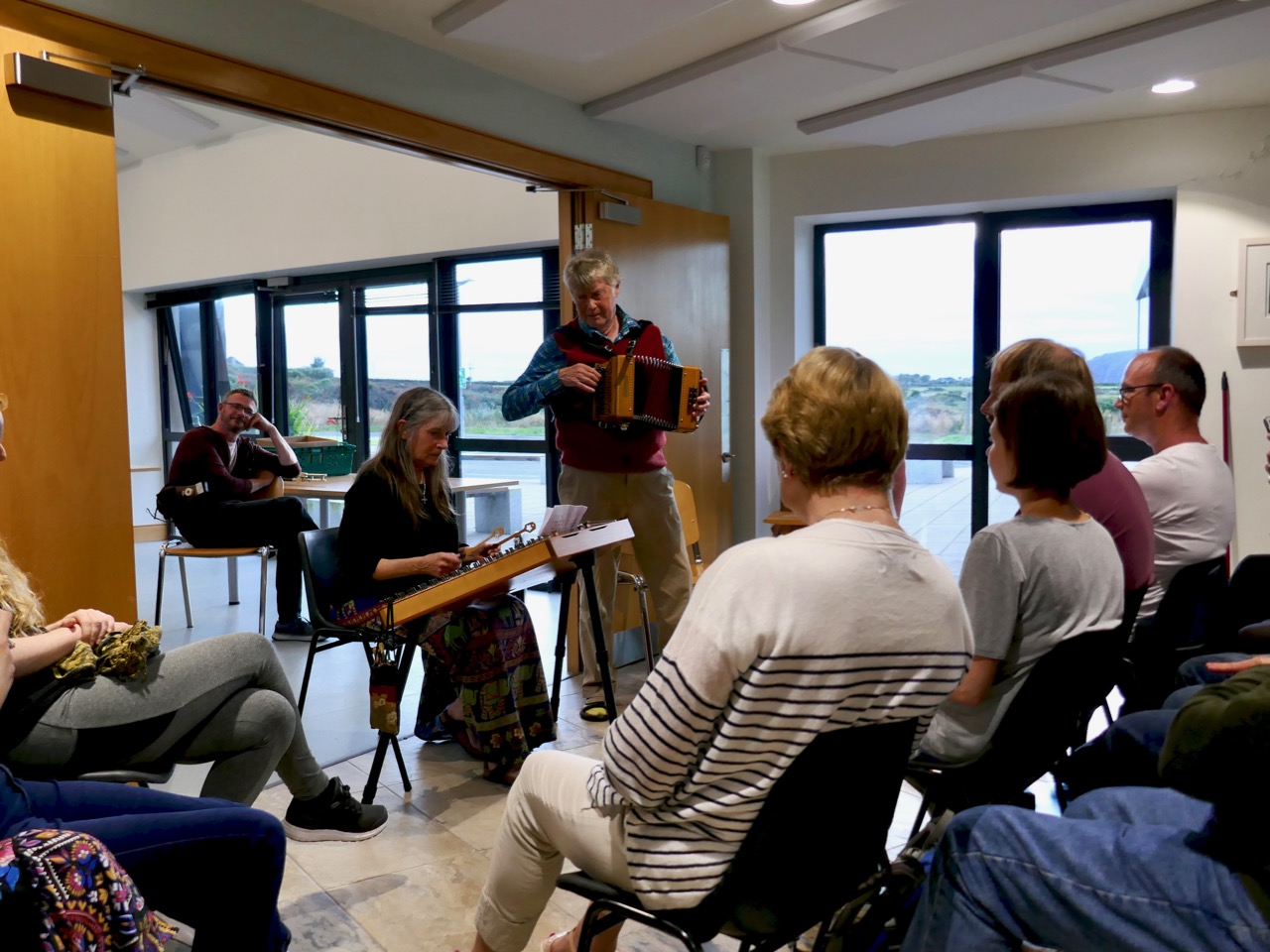
Our course was taxing, and I have the greatest admiration for our múinteoir (teacher), Caitríona Ní Chathail – a wonderful lady of infinite patience, and great enthusiasm for the language which she shared with us throughout the six days. We were allowed some treats – Caitríona took us out on a walk and introduced to us some of the history of the area (kindly, she spoke bilingually); on one evening we were given a talk on archaeology by Isabel Bennet, the very knowledgable curator of the museum in Baile an Fheirtéaraighand on the final evening we combined our various talents to give a concert to all the students, Oíche Airneáin – literally a “night of visiting”, and we each had to introduce ourselves in Irish!

Upper – Caitríona’s history walk around the locality; lower – my contribution to the Oíche Airneáin was some tunes played with Christy Martin on hammered dulcimer. Christy, a fellow student, is a professional travelling musician from California

How do I feel after the course? Exhilarated by the experience of having concentrated for a week on one fundamental aspect of Irish culture, but daunted by the very long path upon which I have embarked – and uncertain as to how to make sure to build on that grounding. One thing that impressed me above all is the obvious passion that the people of Baile an Fheirtéaraigh and Coláistí Chorca Dhuibhne have for their particular Gaeltacht: Caitríona made sure that we realised that the Irish which she taught us is specific to Corca Dhuibhne: each of the Gaeltacht areas has its own dialect, although – whichever version of Irish you learn – you will be understood by speakers from the other areas.

Traditions and stories are abundant in the Corca Dhuibhne Gaeltacht: upper picture – the Wren is hunted on the Peninsula at Stephen’s Day (26 December), and I caught a glimpse of some ‘straws’ hanging behind a door: part of the costumes worn by one of four ‘Wran’ groups who keep the tradition alive in Dingle. Lower picture – two of many gullauns (standing stones) dating from ancient times and which remain in the landscape of the Peninsula: the backdrop is Mount Brandon, named after the 5th century saint – Brendan – who discovered America long before Christopher Columbus!

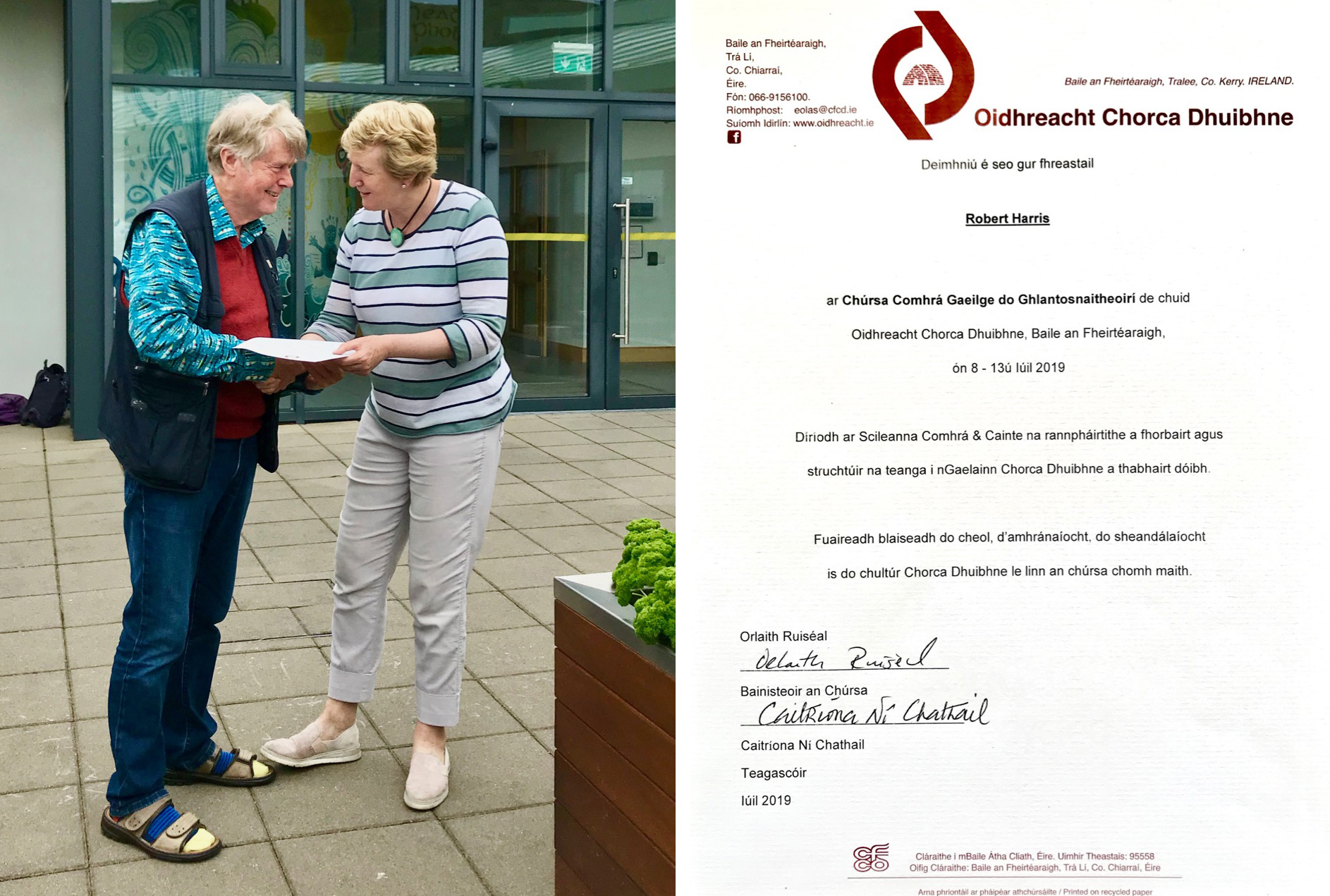
I was pleased to be presented with a certificate by Caitríona at the end of the course! We all had one, and mine will serve as a reminder of the intensive week. Hopefully, it will also serve as an incentive to delve further into the mysteries of Gaeilge. I am already determined to revisit the wonders of Corca Dhuibhne as soon as possible!