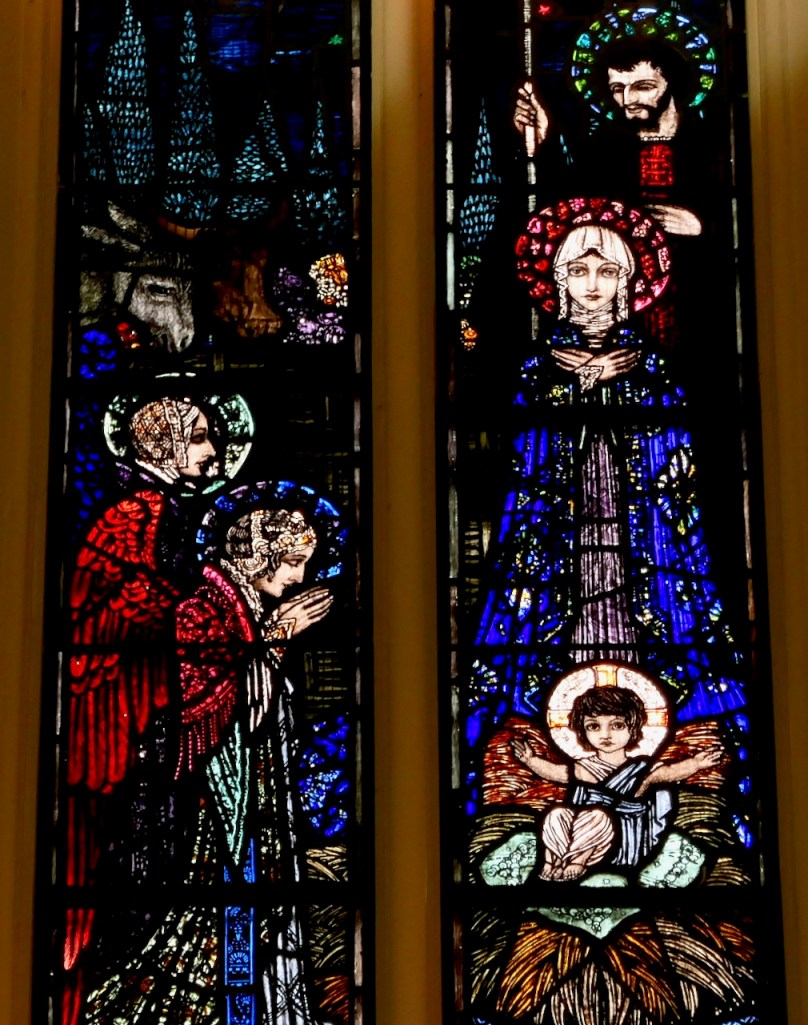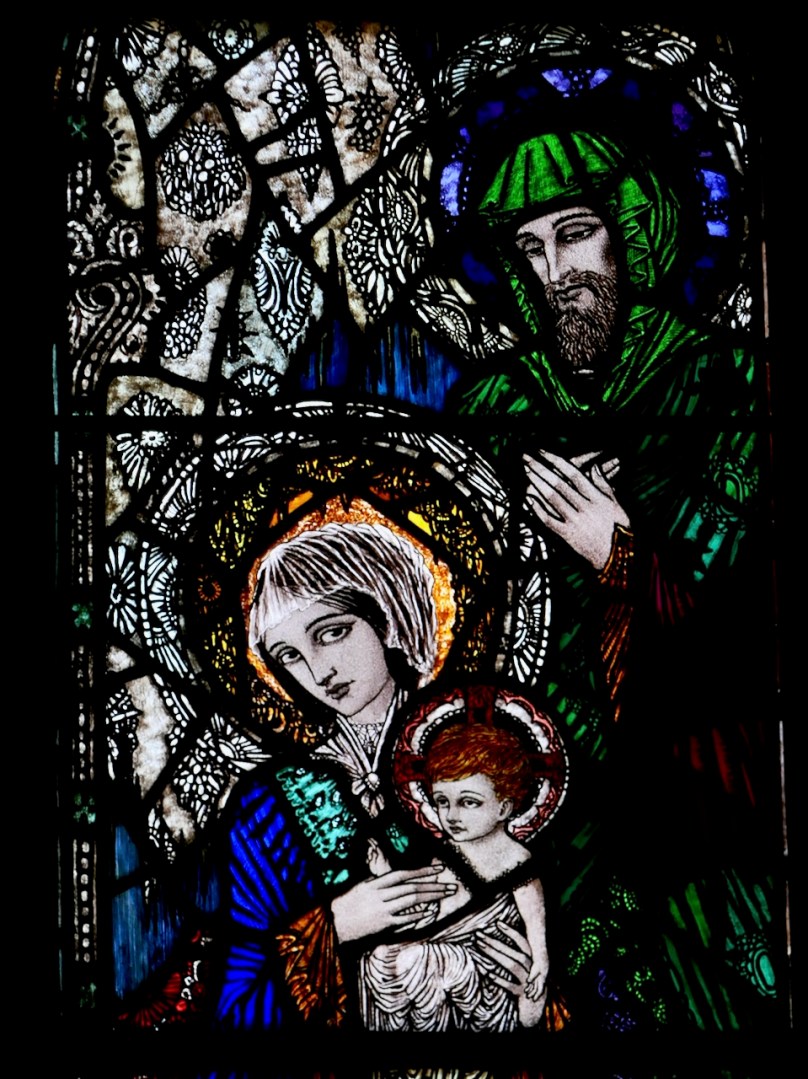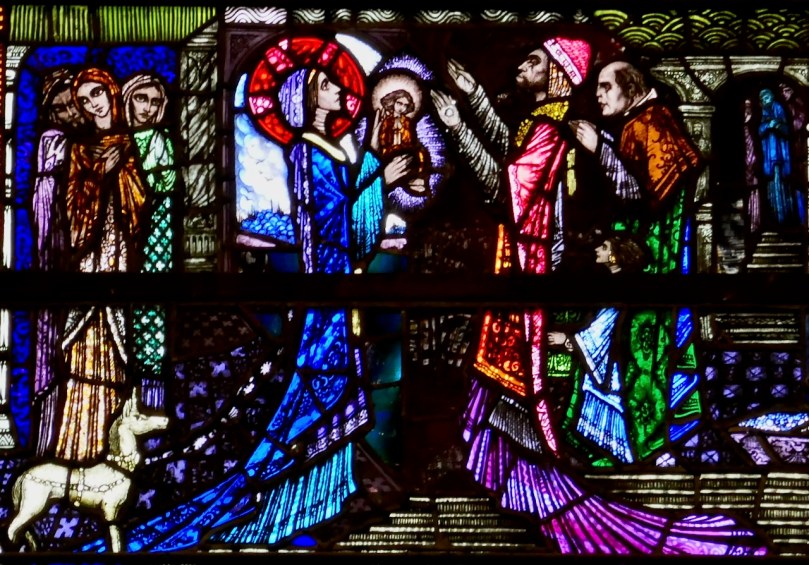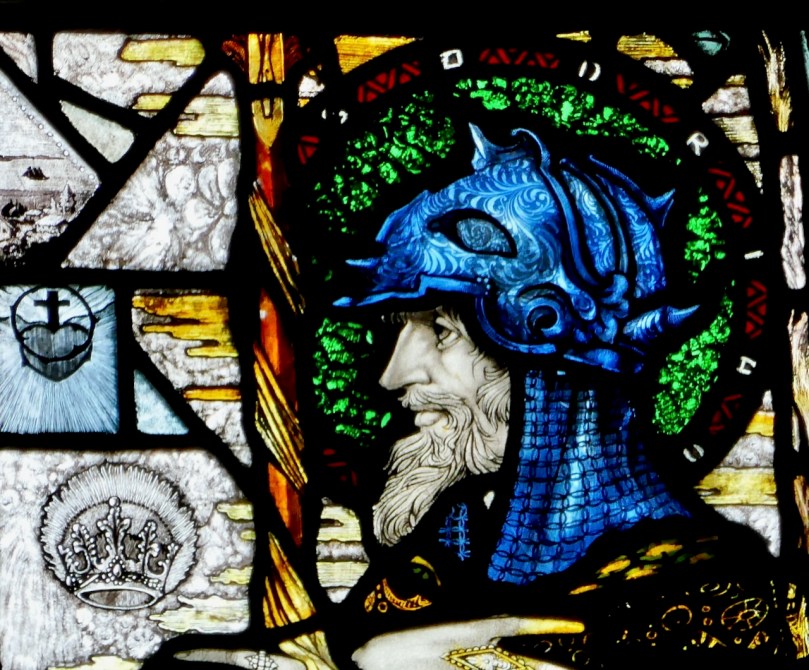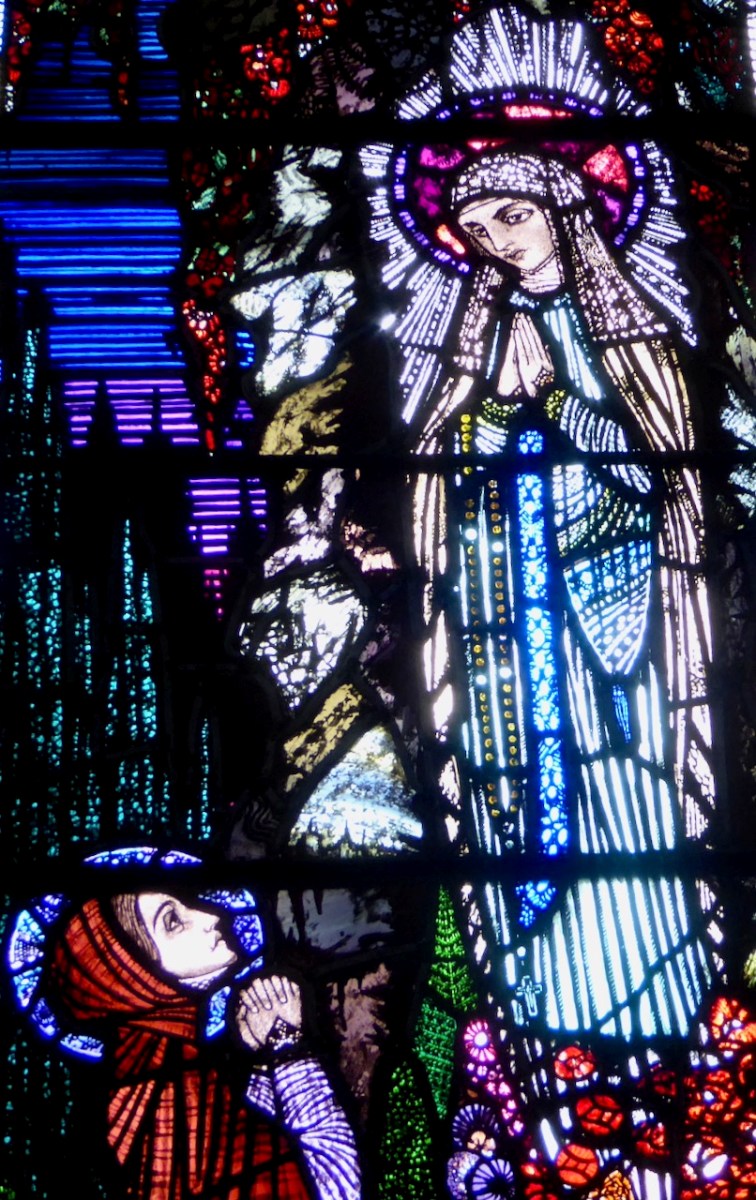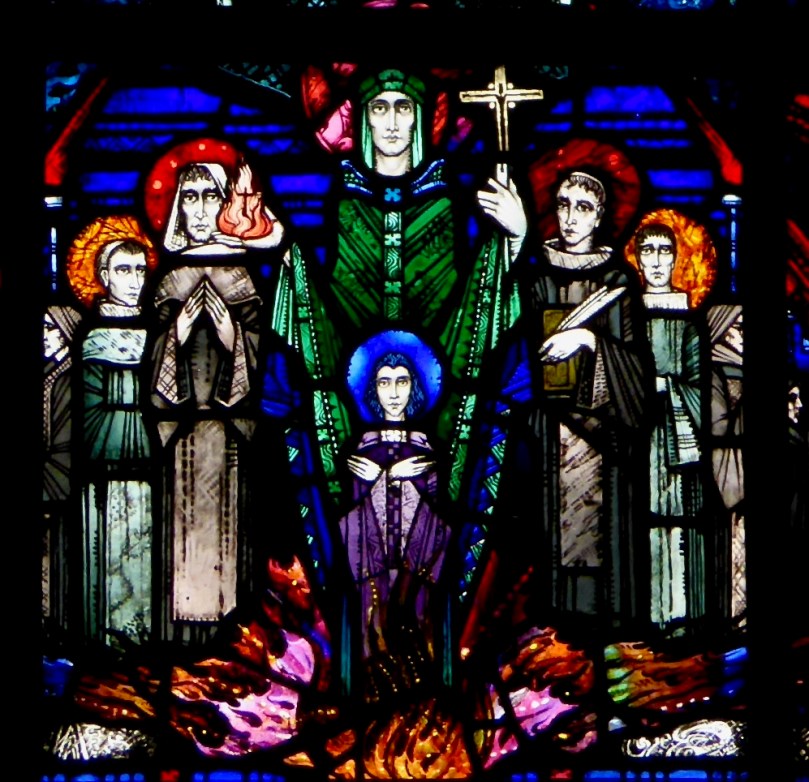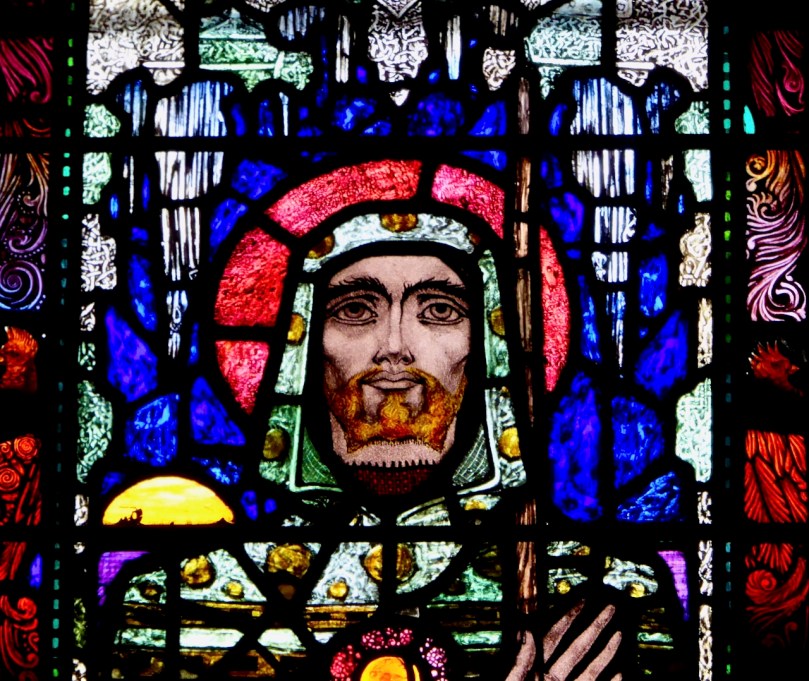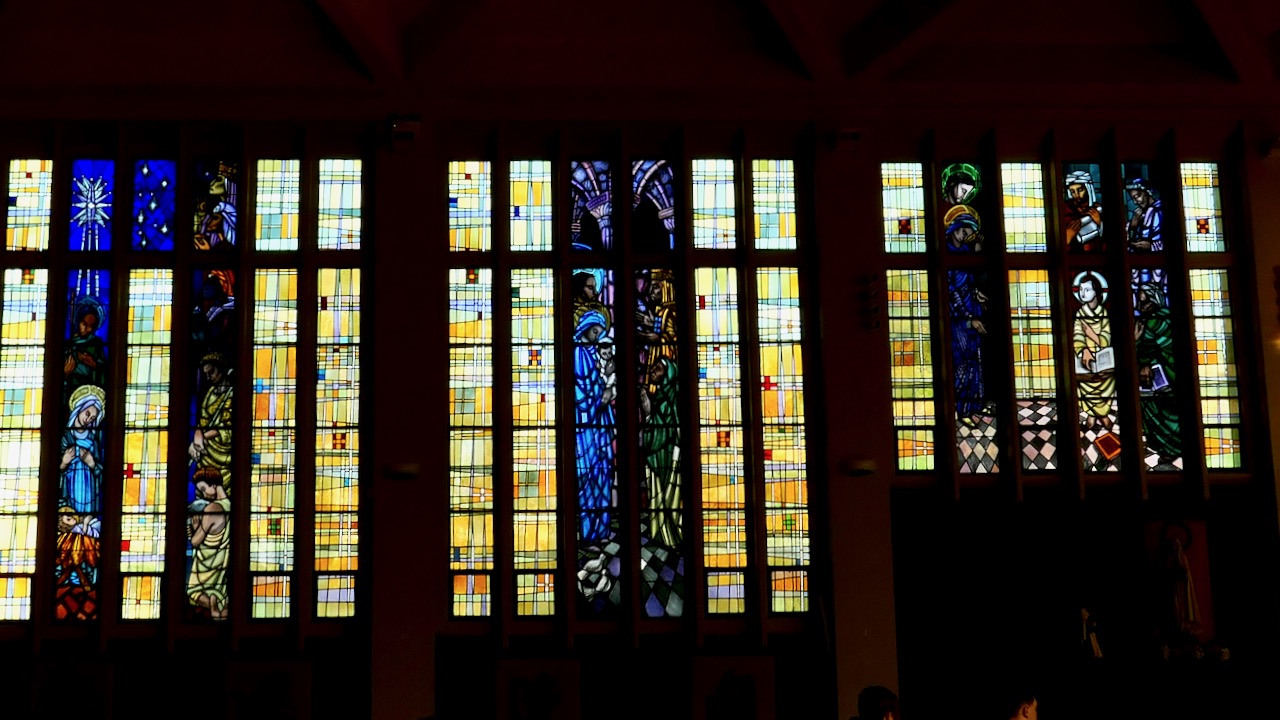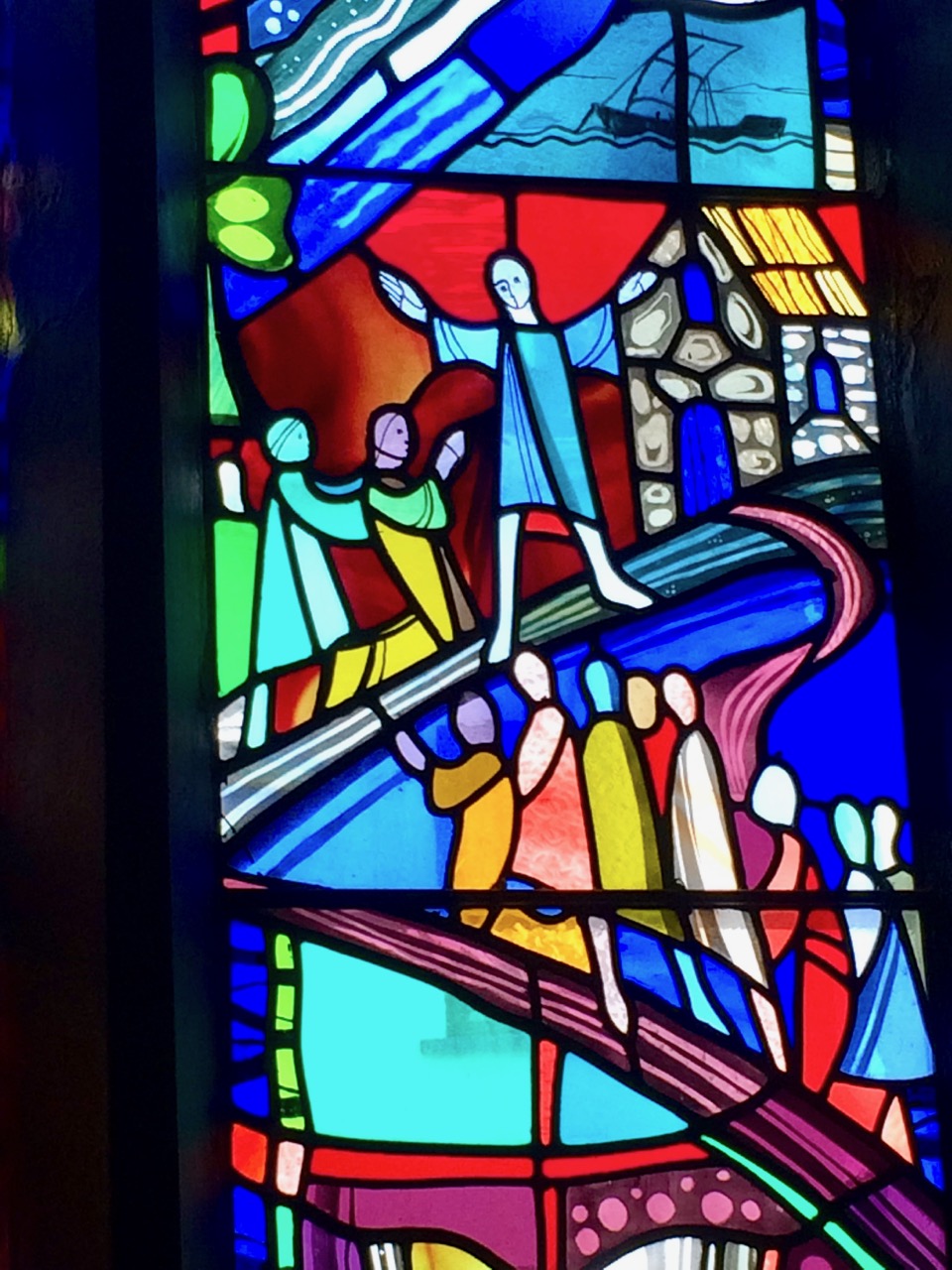
The House Style: William Dowling and the Harry Clarke Studios

In the years before he died (in 1931), as he was ill and overburdened with commissions, Harry Clarke came to rely on a stable of brilliant young assistants in his studios. Austin Molloy, Kathleen Quigly, Millicent Girling, George Stephen Walsh, Philip Deegan, Richard King, William Dowling and others were all trained by Harry to execute his designs according to his exacting standards. This post is about the work of one of those artists, William Dowling.
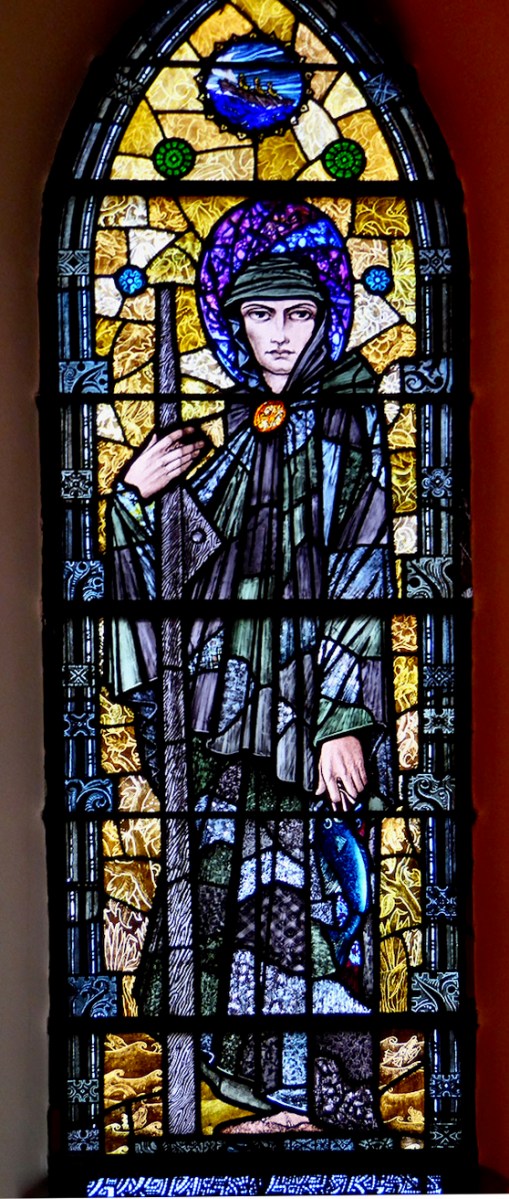
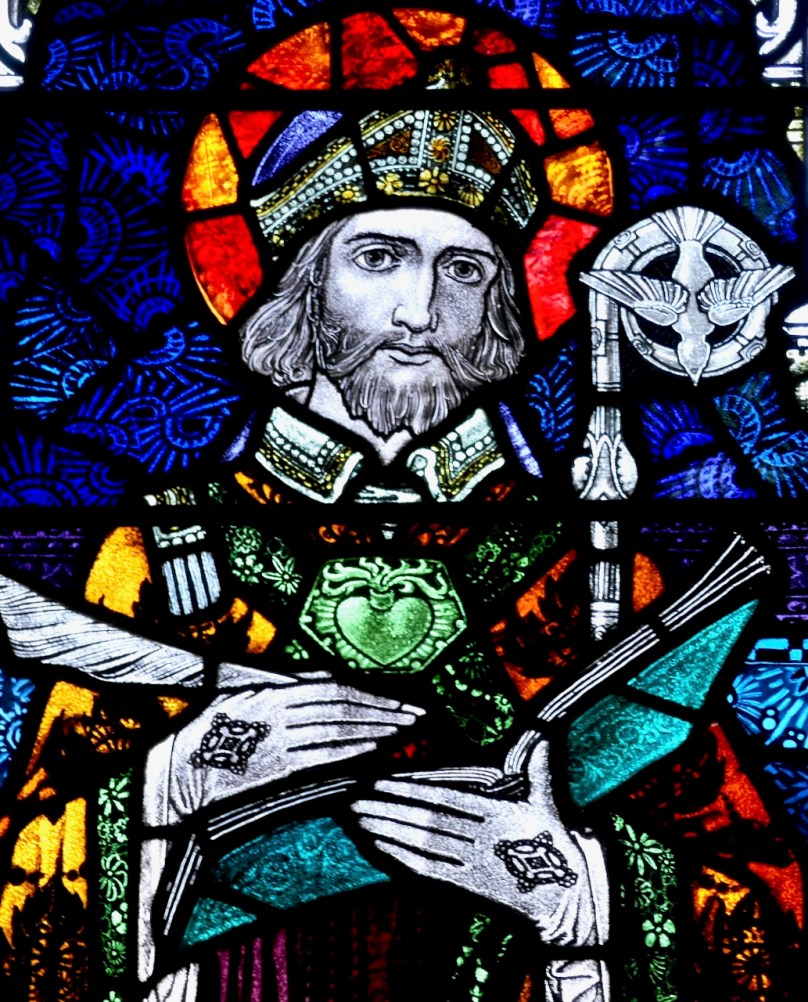
As I explained in my Harry Clarke Quiz post, according to Nicola Gordon Bowe’s classification scheme,  a stained glass window can be labelled a Harry Clarke if it was designed and executed entirely by him, if it was designed and partially executed by him (A), or if it was designed by him and the execution was done under his close supervision (B).  An excellent example of this is the Tullamore St Brendan window (above and below). This is one of Harry’s (B) windows: he designed it but it was executed by William Dowling in 1928 under Harry’s close supervision. Compare it to the St Brendan in my lead image, which was done by Dowling for Knockainey Church in Limerick in 1939.
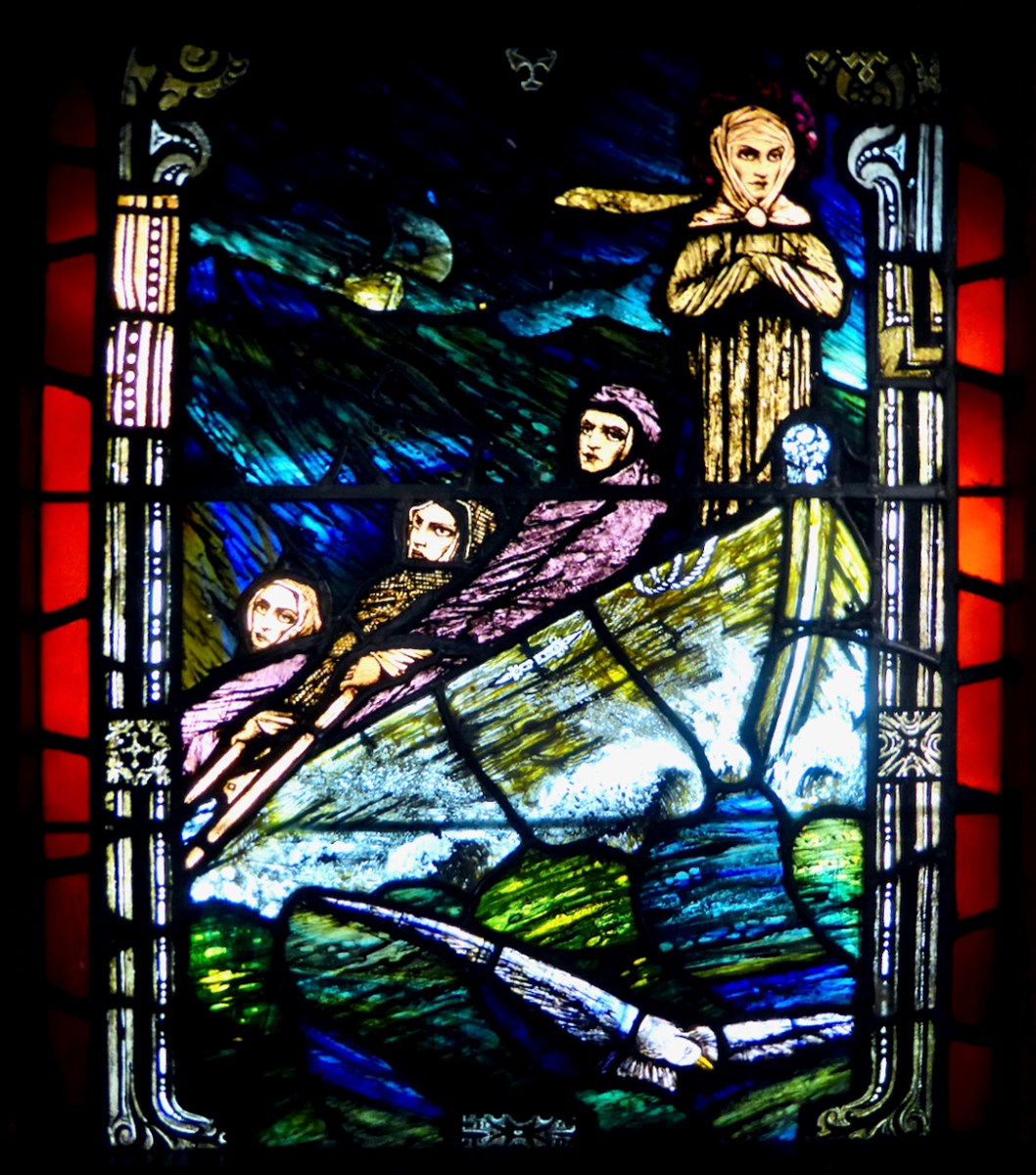
This is the predella (lowest panel) of the Tullamore Brendan window. When the window was relocated from Rathfarnham, the predella was separated from the main window and is now backlit, in a dark corner.

Harry researched his subjects extensively and ensured that anyone working on his windows did too. Paul Donnelly*, in his fascinating essay Legacy and Identity: Harry Clarke, William Dowling and the Harry Clarke Studios (in Harry Clarke and Artistic Visions of the New Irish State) tells how he sent his apprentice, William Dowling, off to the National Library to read all that was available on his subject when he was working on the Rathfarnham windows. He would come by every day to deliver encouragement – his assistants all adored him and although he was demanding he was also supportive and kind.
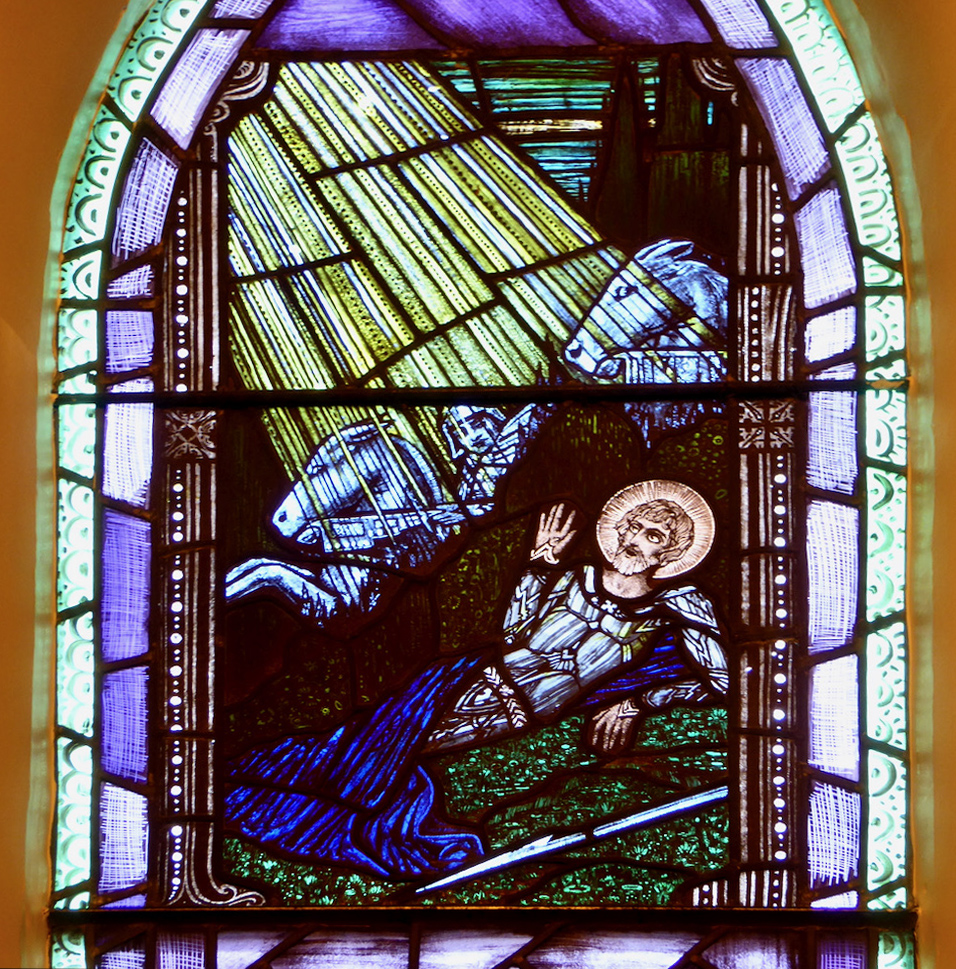
While the three Tullamore windows (originally in Rathfarnham) are credited to Harry Clarke, all the other windows in this post are credited to William Dowling

William (everyone called him Willie) Dowling was recommended to Harry by Austin Molloy, who was his teacher at the Dublin Metropolitan School of Art. Having himself worked with Harry, Molloy recognised the special talent that Willie brought to his painting, a talent that he felt would be well used at Harry’s studio. Willie probably worked on this one (above) too – it’s the predella of the St Paul window now in Tullamore. You can see that it is the inspiration for the predella of a St Paul window from Knockainey in Co Limerick (below), done in 1930 while Harry was in Davos. The full Peter and Paul window is below that one.
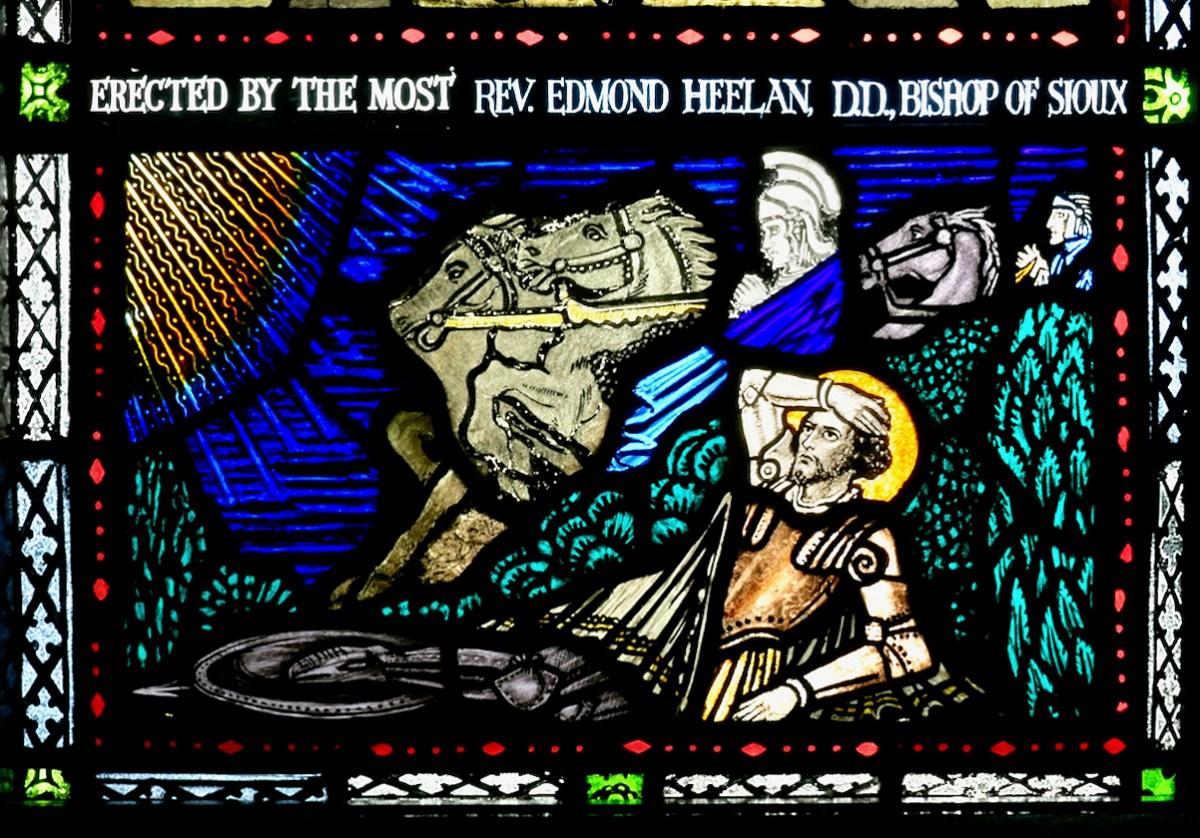
How right Molloy was! Not only did Harry come to rely on him greatly while still alive, but Willie was one of the group of artists (along with Richard King) who stayed on after Harry’s death in 1931, filling the many outstanding commissions still on the books and the new ones that continued to pour in. He eventually took over as manager when Richard King left in 1940, while continuing also as chief designer, and stayed until the Studio closed in the 1970s.
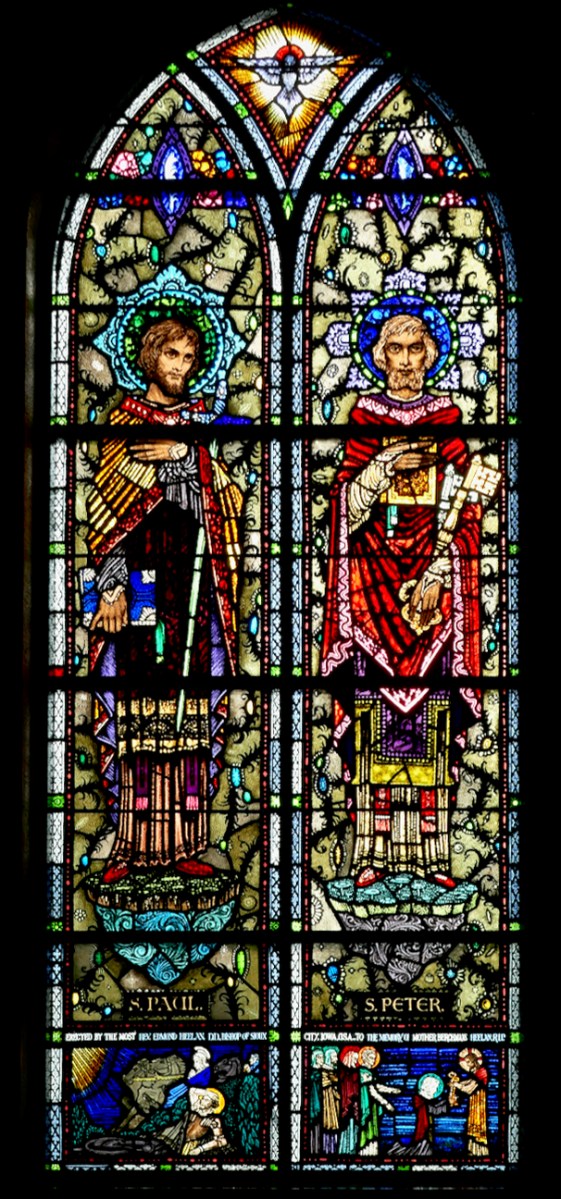
Peter and Paul from Knockainey Church in Limerick, dating to 1930

From the moment he arrived at the Studio in 1927 Dowling was committed to Harry’s style. As Paul Donnelly puts it, 

Dowling worked with Clarke, learning the craft of making stained glass according to his standards and design aesthetic. He had the benefit of Harry Clarke’s direct instruction for more than a year before ill-health force Clarke to seek medical treatment in Switzerland.

. . .In his role as principal designer, Dowling was charged with delivering work which was derived from the distinctive artistic legacy left by Harry Clarke. Dowling wrote that the aim of Clarke Studios was to ‘avoid the mundane and commonplace. That was the ideal of Harry Clarke and one which we have done our very best to follow.’

Paul Donnelly, Biographical Sketch of William Dowling
Gazetteer of Irish Stained Glass
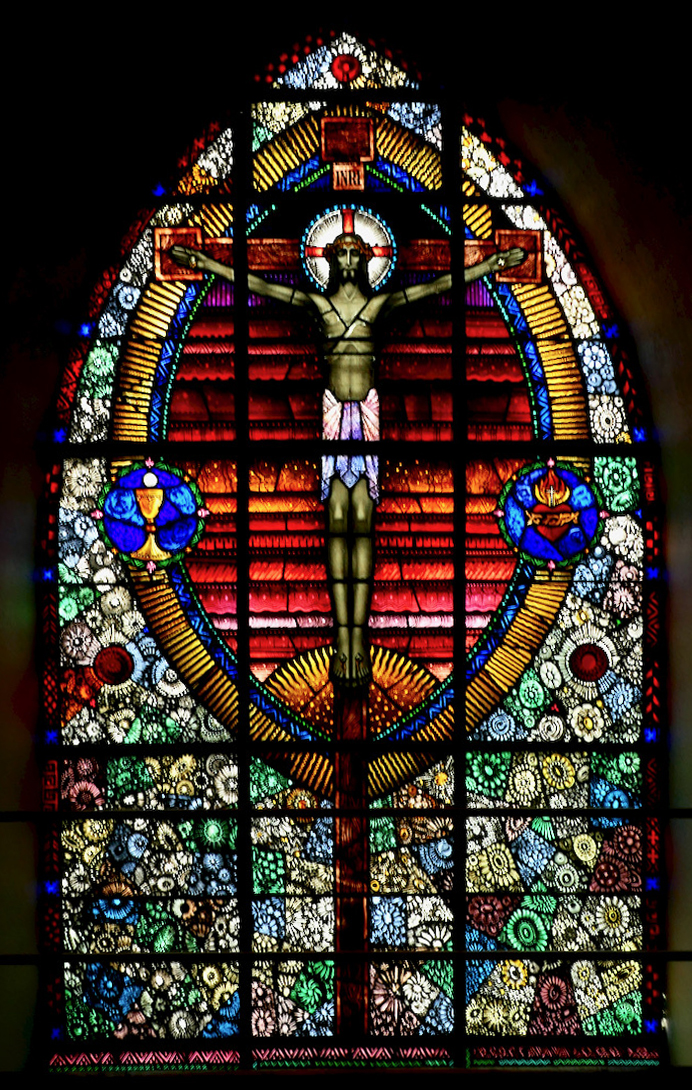
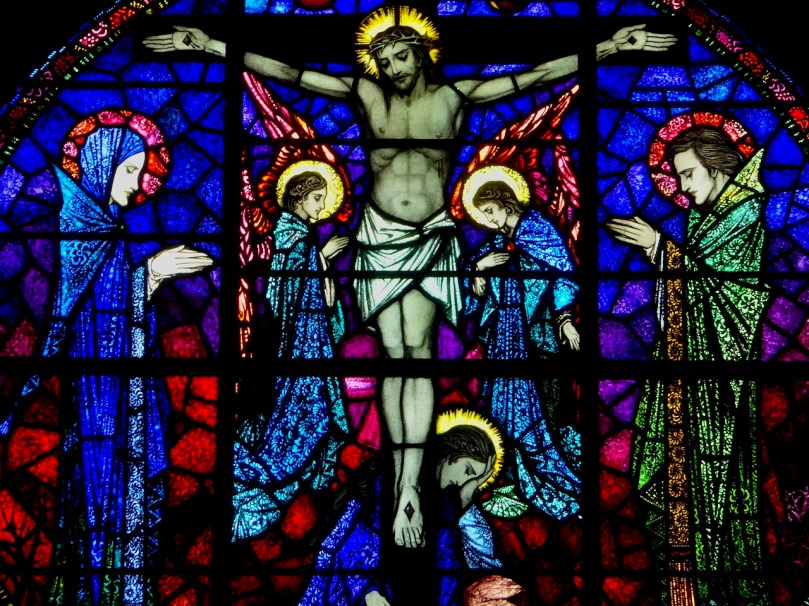
Christ Crucified, Patrickswell, Co Limerick, by William Dowling, 1943. This window is above the balcony and is a brilliant example of the mixture of figurative and non-figurative elements, specially designed for the space it occupies

After Harry’s death the demand for Clarke-style windows was relentless and the studios delivered. Well into the 40s they were still producing windows that, to the untrained eye, looked very like ‘a Harry Clarke.’ During that time, the quality of the glass, the art and the workmanship was superb and the busy studios were exporting their windows world-wide. 
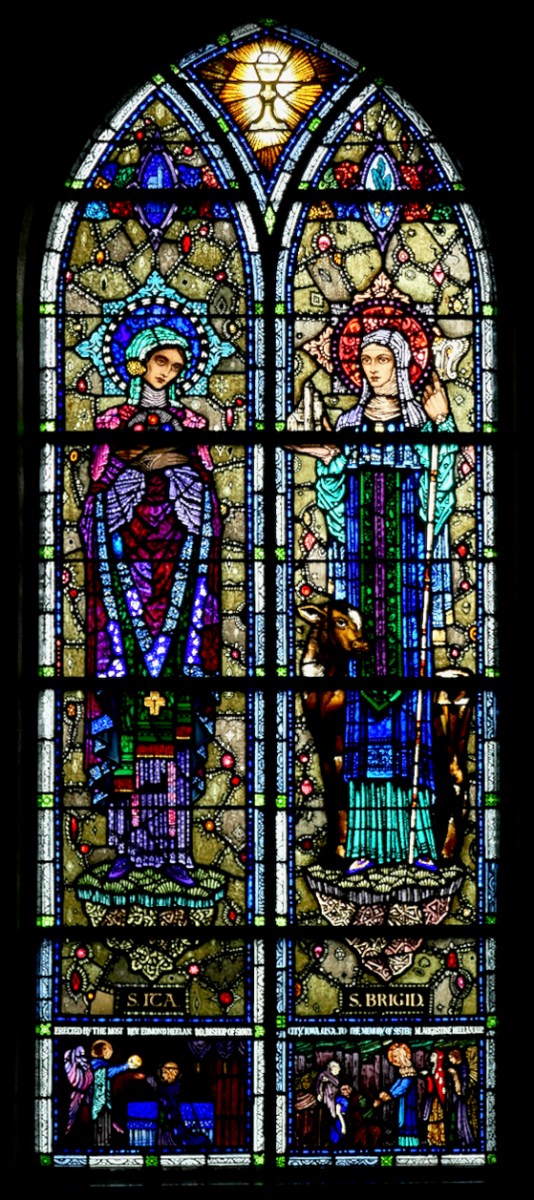
Ita and Brigid, Knockainey, 1930. The predella panels are below.

Then, and for many years to come, the Harry Clarke Studios did not allow individual artists to sign their work – all windows were signed Clarke or Clarke Studios. Strict adherence to the House Style and refusal to allow signatures, while understandable as marketing decisions, had several unfortunate consequences.
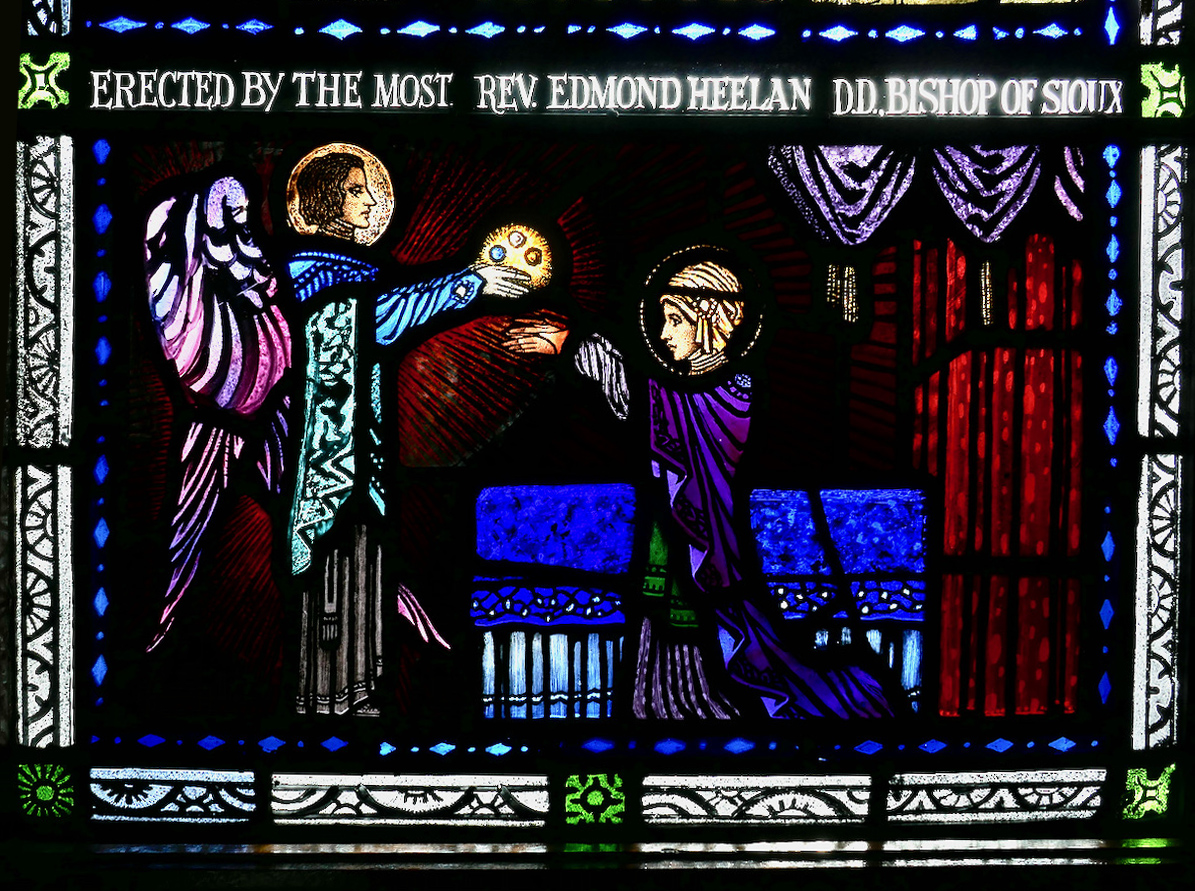
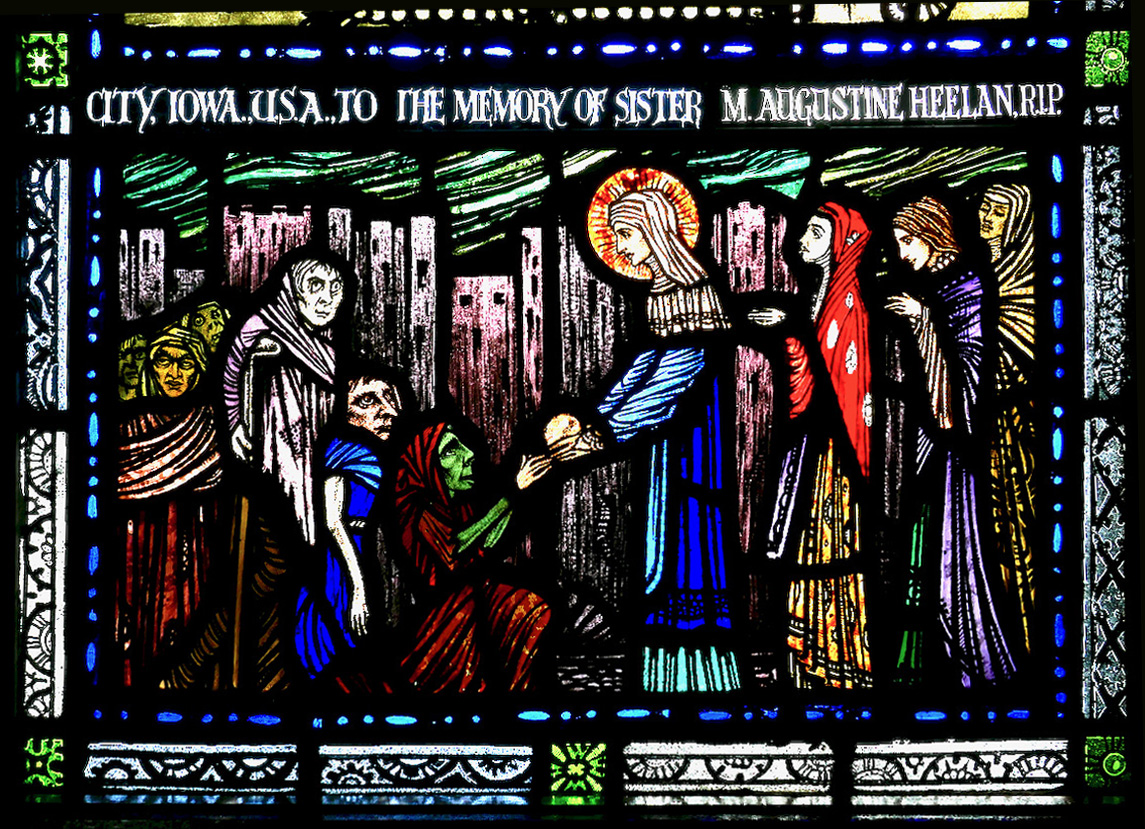
The predella panels from the Ita and Brigid windows. Upper: The vision of St Ita, in which an angel appeared to her in a dream, offering her three glowing gens, representing the Father, Son and Holy Spirit. Lower: St Brigid looking after the people of Kildare- the figures on the left are clearly inspired by, as Nicola Gordon Bowe puts it “Harry’s unique ability to depict the gruesome, macabre and palsied in an exquisite manner.”

First of all, it is difficult to identify individual artists with their work, and this includes Dowling himself. Herculean efforts, though, by Ruth Sheehy and Paul Donnelly have allowed us to acknowledge in some cases the work of Richard King, William Dowling, and occasionally others (such as Charles Simmonds and Terry Clarke, Harry’s nephew).
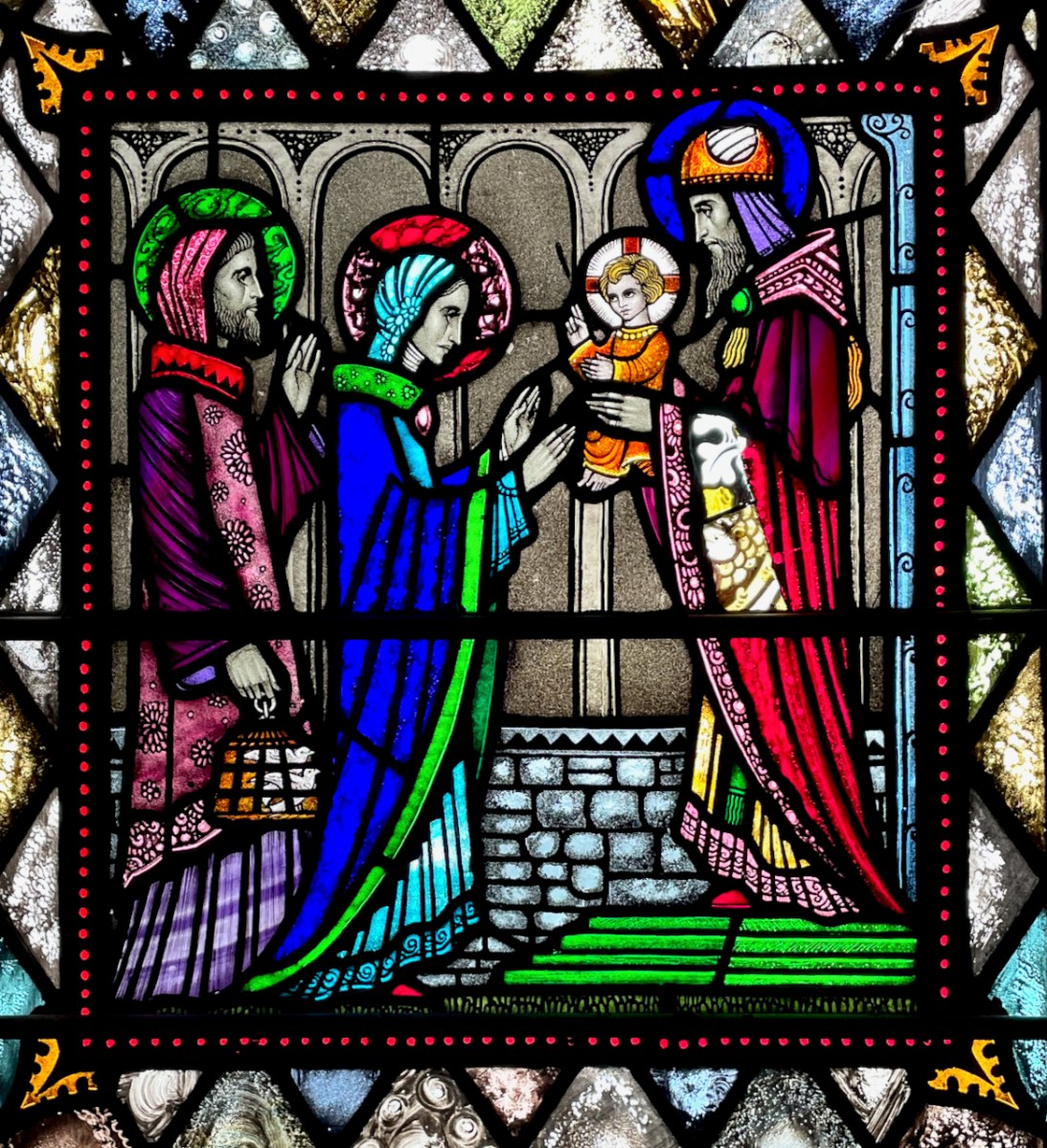
The Presentation, Patrickswell, 1943. By this time the style was becoming less ornate. This window might remind you of the Dowling windows Robert showed in his post about the Seamus Murphy church in Cork, which dated to 1945

Secondly, the lack of clarity caused by all windows being labelled simply Clarke Studios causes enormous confusion about what is a true Harry Clarke, versus a Harry Clarke Studio. See my Quiz posts (the Quiz and The Answers) for more on this. If I had a euro for every time I have seen a window falsely claiming to be a Harry Clarke, I would be wealthy by now. Conversely, those who buy stained glass  panels labelled “Harry Clarke” when they are manifestly not by the master himself, might be poorer.
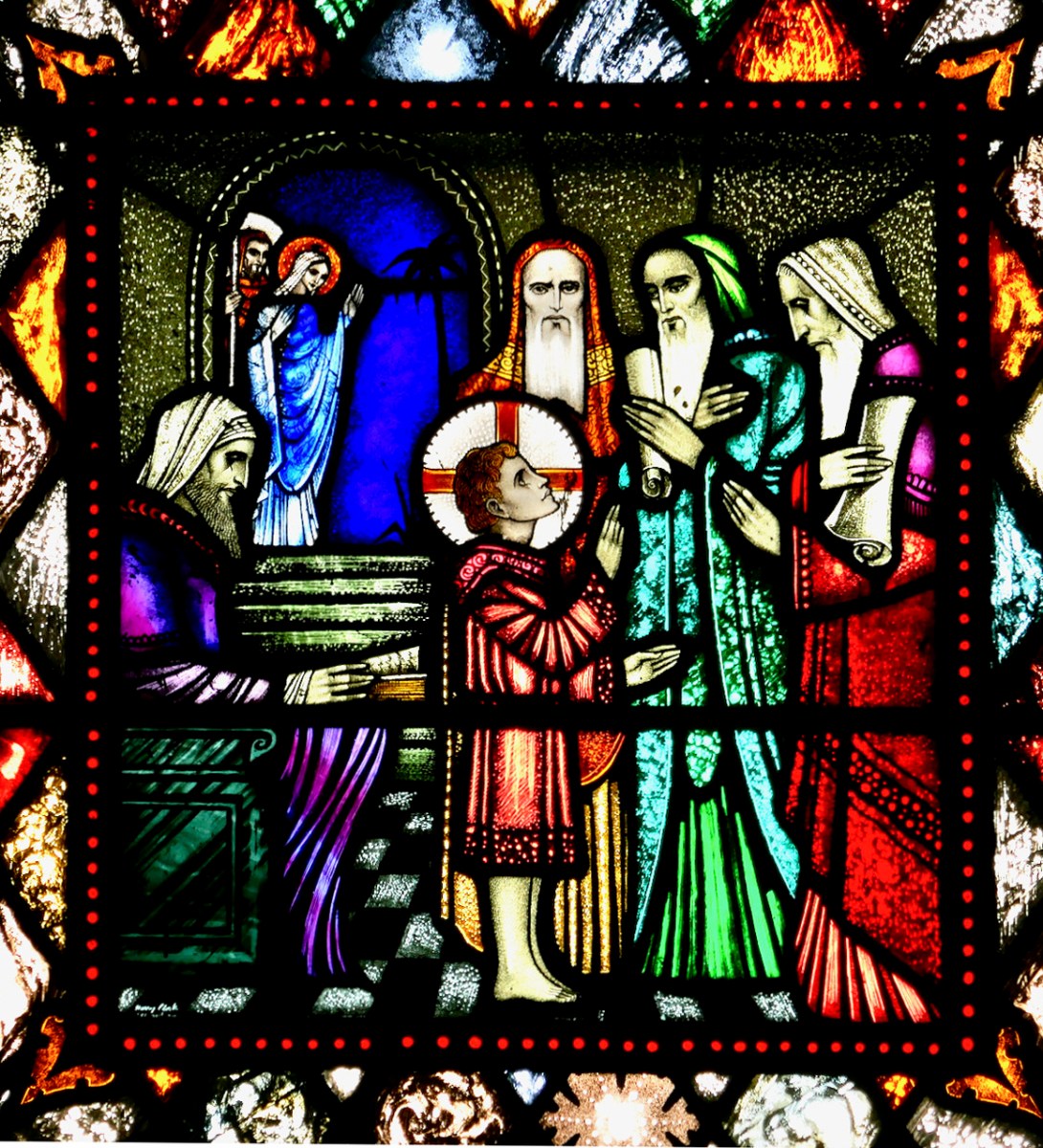
Jesus Found in the Temple (or Christ Among the Doctors), Patrickswell, 1943

Thirdly, the policy caused some artists, in frustration, to leave. While it is possible that they had other motivations as well, both Richard King and George Stephen Walsh left to go out on their own, eventually shaking off the constrictions of the house style to follow their own artistic visions under their own names.
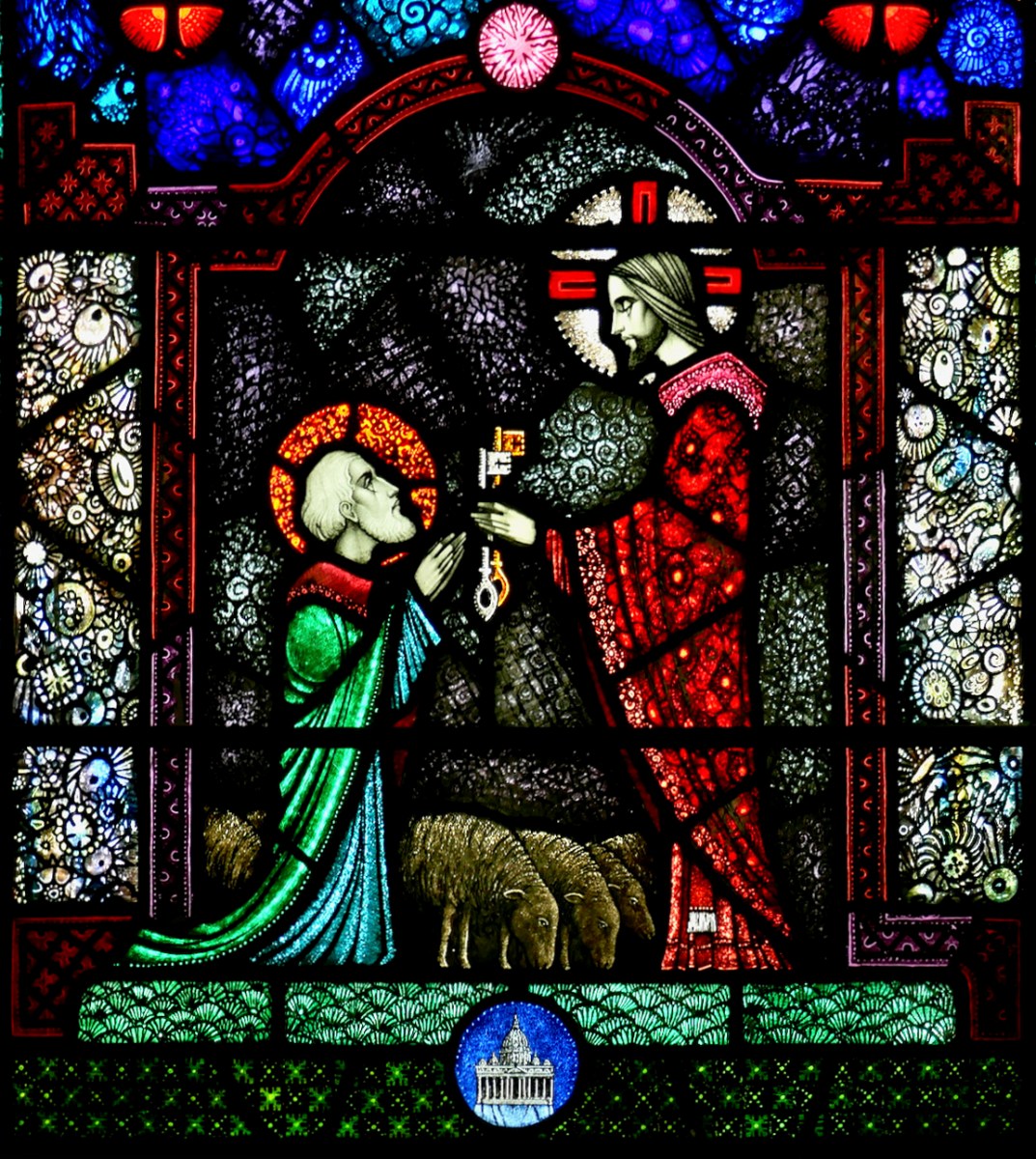
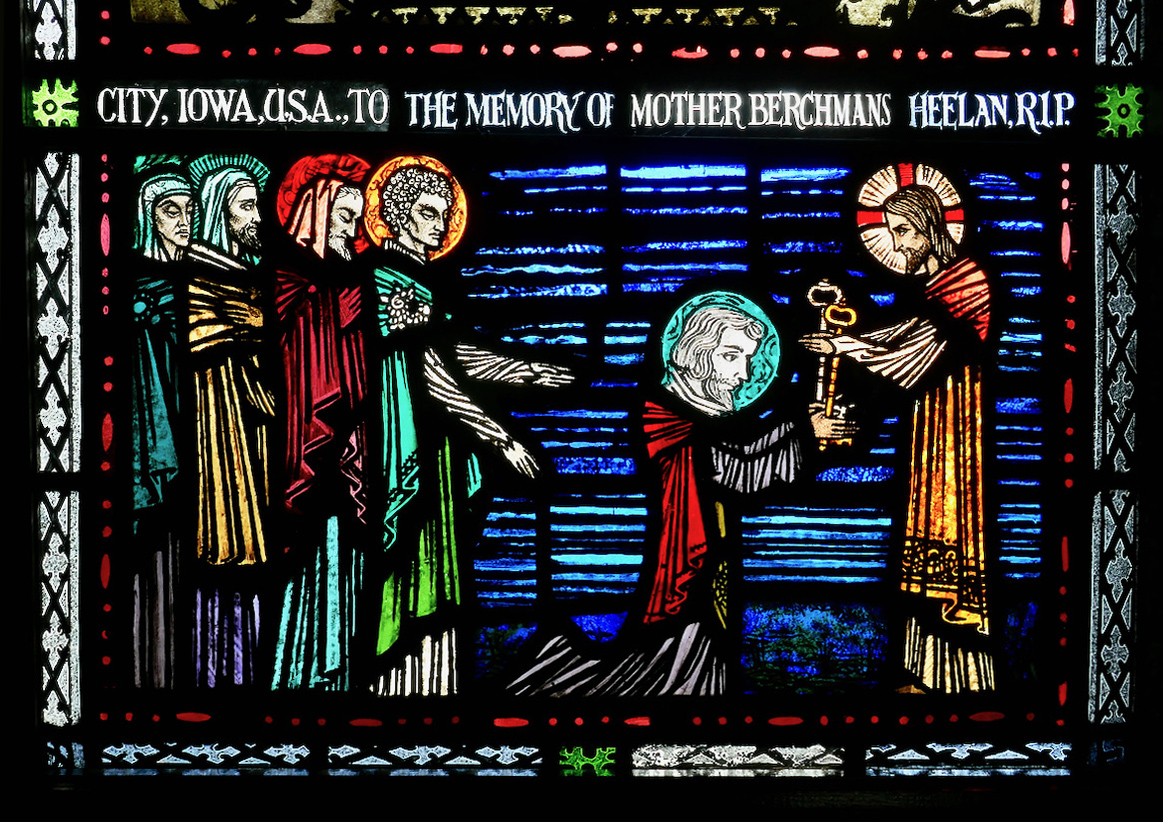
Two version of Peter receiving his keys. Upper from Patrickswell, 1940 and lower from Knockainey, 1930

Finally, all artists deserve credit for their work. William Dowling is a case in point – while he spent many years producing windows in the House Style, they were not simply imitations, copies or reproductions of Harry’s designs. Willie brought his own genius to each window and when you’ve seen several you begin to recognise his stamp – the way he does faces, for example, or how he loves cascading folds of drapery, or his clever juxtaposition of Harry’s dark ‘floral ornamentation’ device (known as FO’s by assistants, or even as Fried Onions) with bright figurative scenes, such as in the Patrickswell Crucifixion, further up.
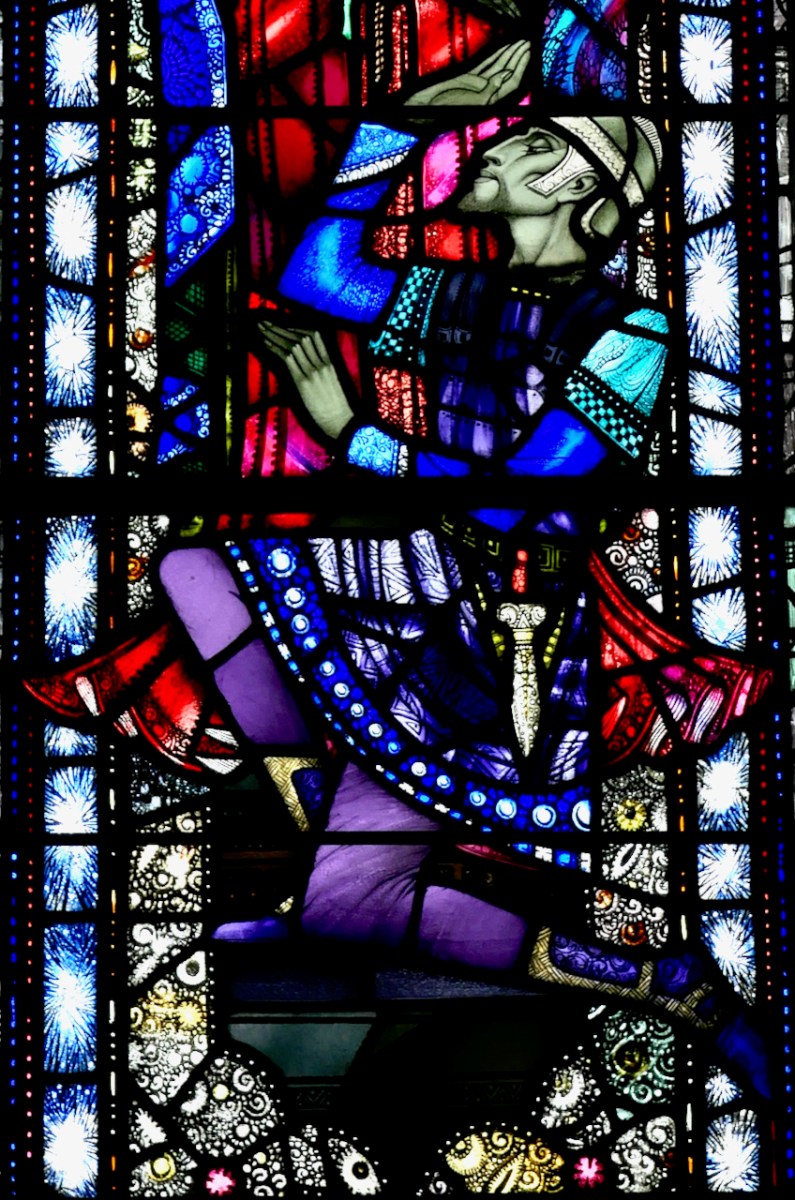
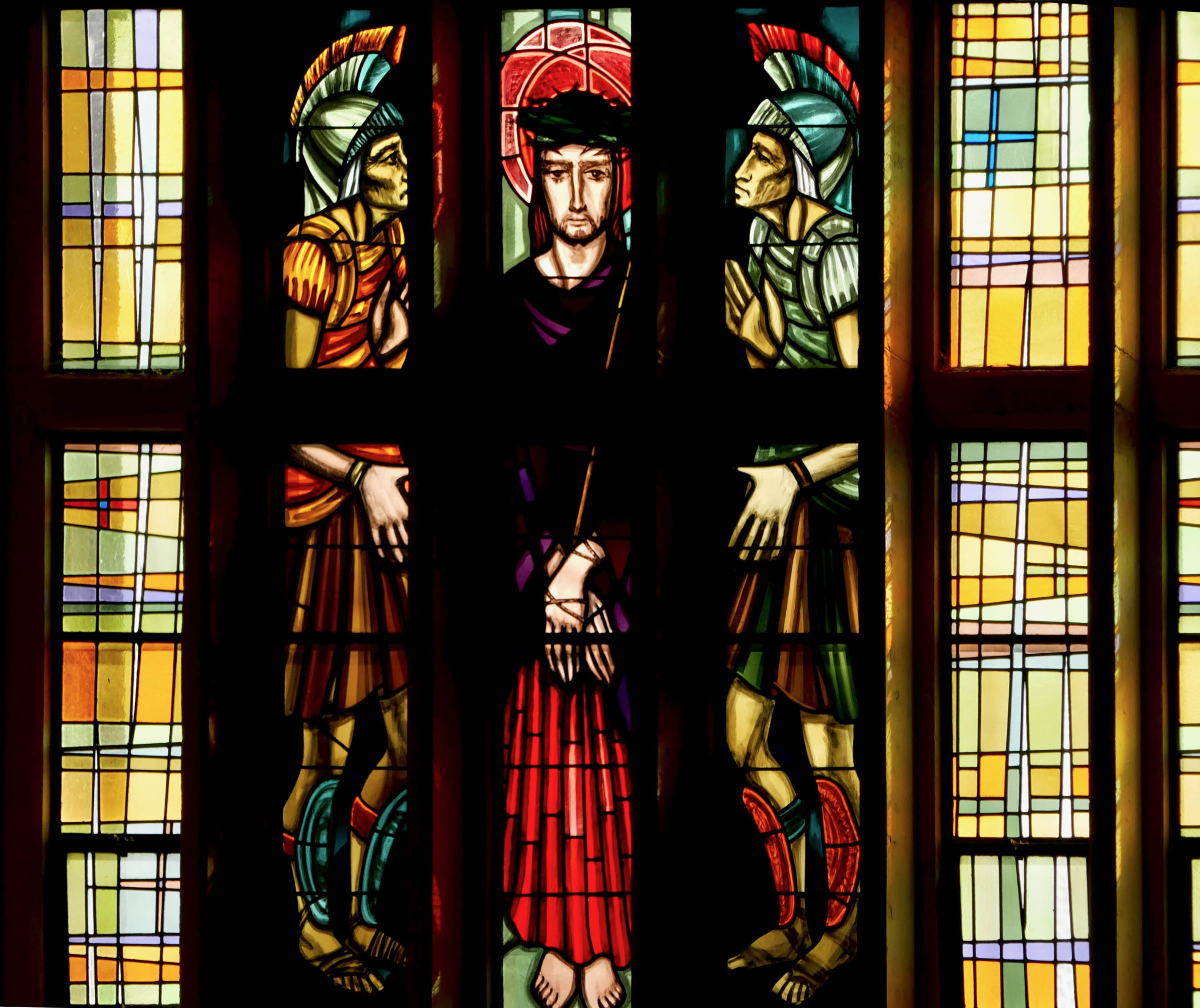
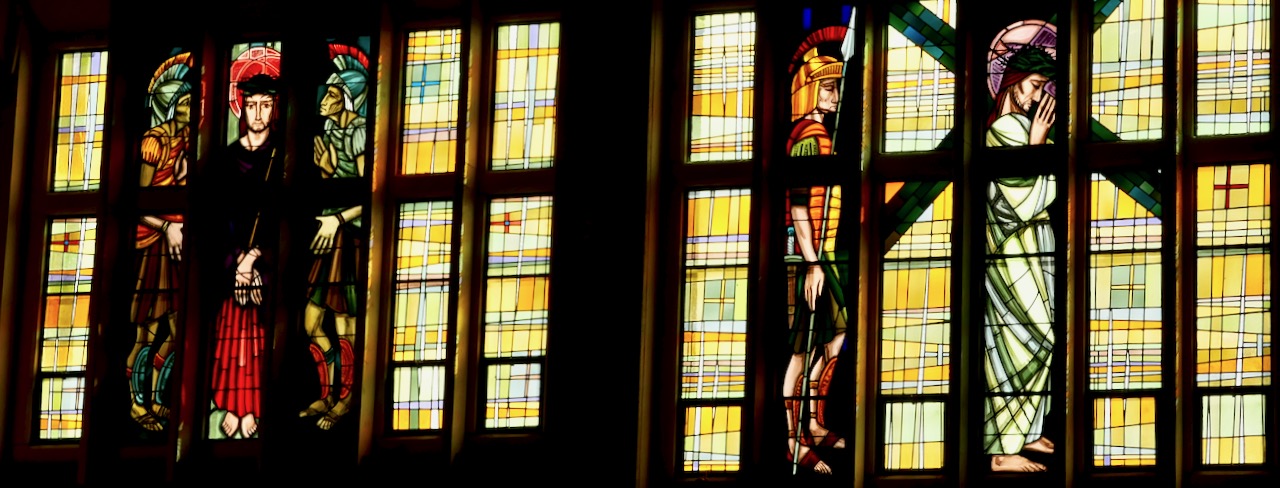
Above is a detail from one of Dowling’s Mysteries of the Rosary windows in the Dominican Convent in Wicklow, done in 1938. This is a mocking soldier from a Christ Condemned window and it comes from Dowling’s own artistic imagination, not from a Harry Clarke design

I recently visited two William Dowling Churches in Limerick, Patrickswell and Knockainey, and I have mainly used images from these two churches to illustrate this post, along with a few from the wonderful Mysteries of the Rosary windows by him in the Dominican Convent in Wicklow which date from 1938/39. The windows in Knockainey were done for an older church in the 30s and 40s and then relocated to the new church in 1973. While relocating windows is not always successful (Tullamore is a case in point), in this case the relocated windows (with two minor exceptions) create a startlingly beautiful interior, and an interesting counterpoint to their modern surrounds. The Patrickswell windows are original to the building, dating from 1940 to 1943, although an awkward balcony obscures some of them to the detriment of the overall effect. I, and my companions, were bowled over by these two churches – it felt like we were stepping inside a glowing gallery full of stunning artworks.
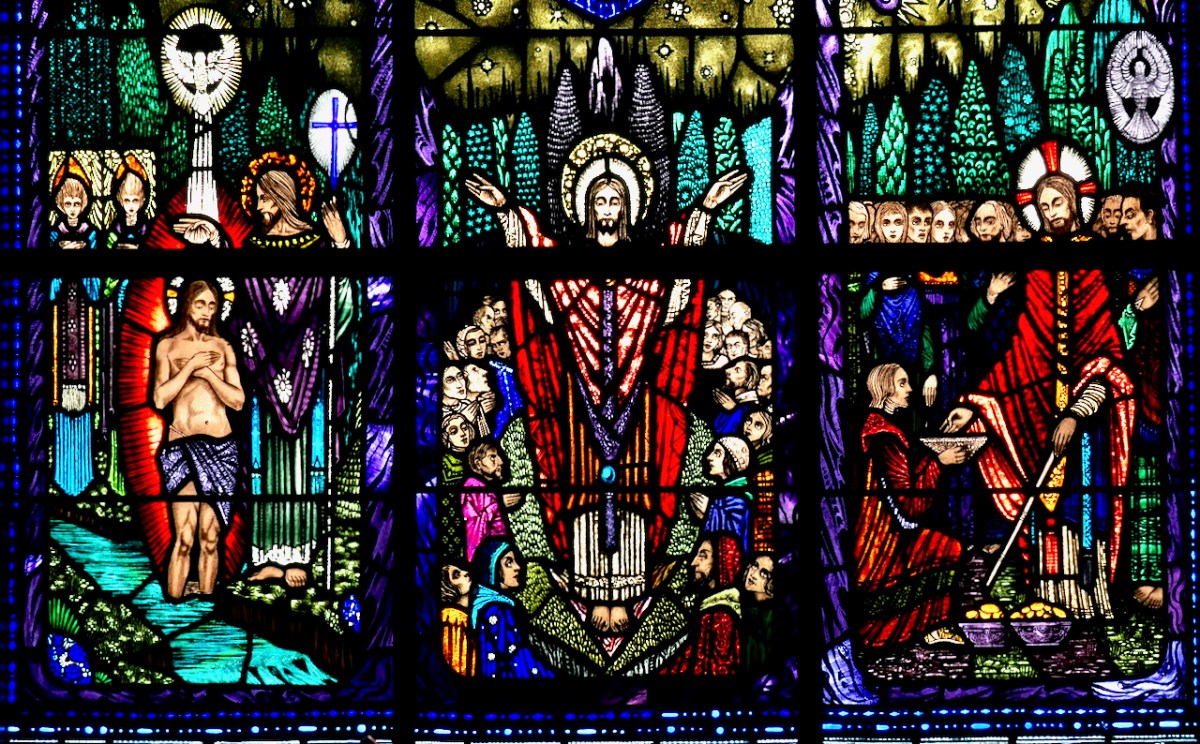
The predella from the large Christ the King window in Knockainey (1931) showing three scenes from the Life of Christ

Willie continued to manage the studios right until it closed in 1973. In the end, the Studio’s adherence to the House Style meant that its stained glass, once so in-demand, was seen as not really evolving with the times. Other artists with more modern aesthetics started to win commissions from architects looking to build contemporary churches that fitted post-Vatican II liturgical changes. Ironically, by the 60s and 70s Willie had started to design (and sign!) windows with a very different look to the House Style. His later output could form another post, but for now I wanted to concentrate on the early House Style period.
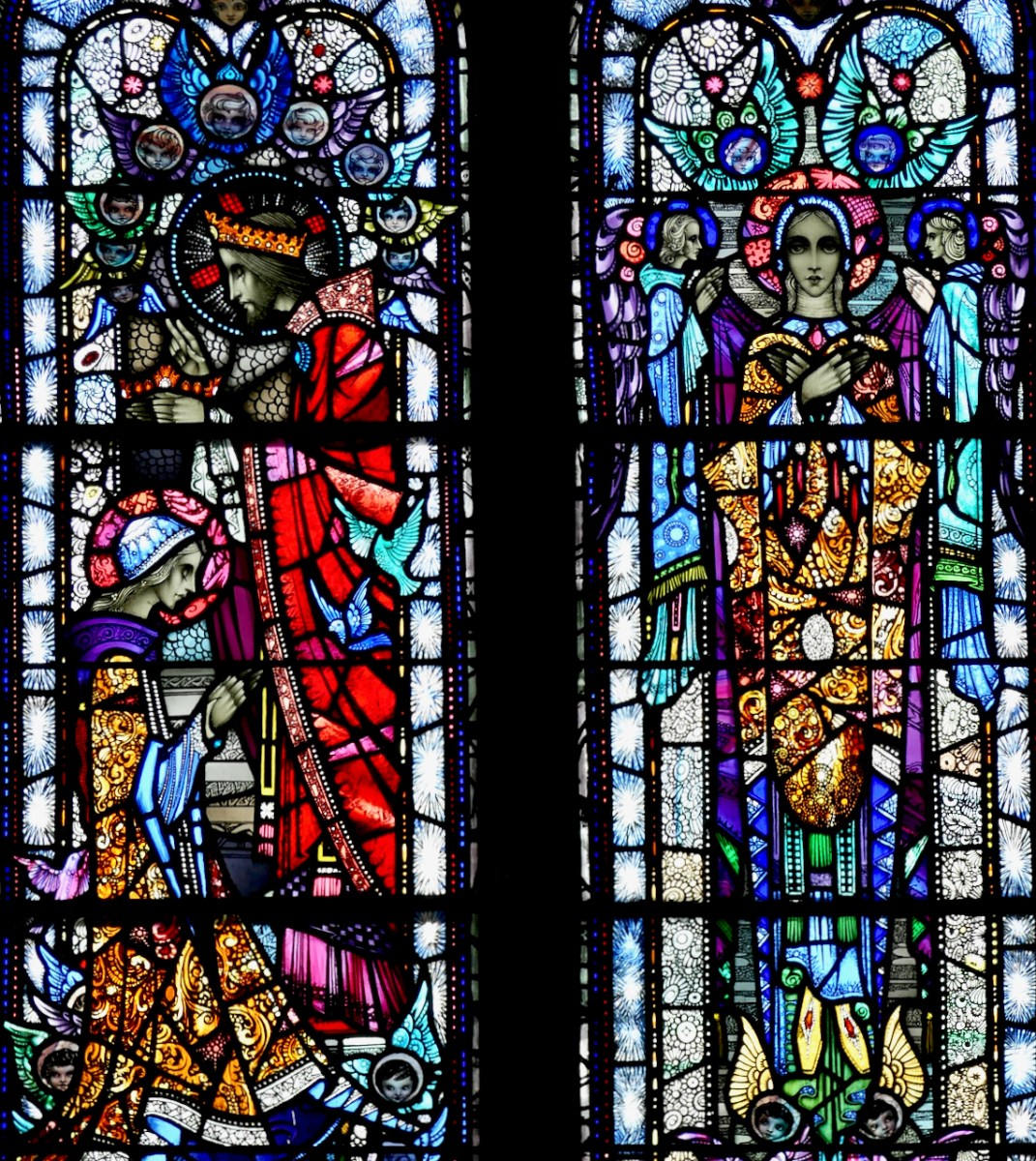
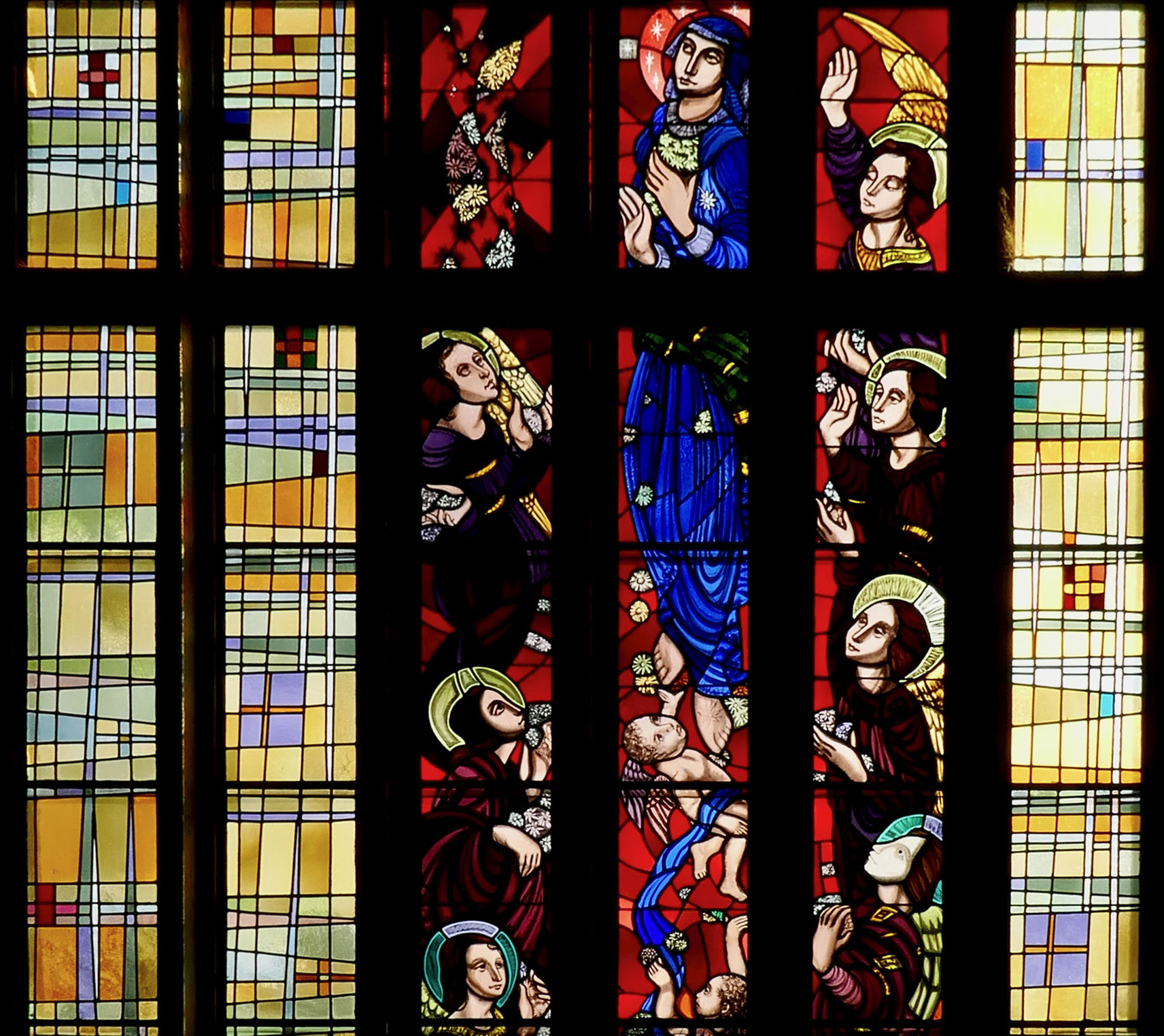
The 4th and 5th Glorious Mysteries from the Dominican Convent in Wicklow, The Crowning of Our Lady as Queen of Heaven and the Assumption. 1938/39

I want to finish with some personal memories of Willie Dowling. He lived until 1980 and he is remembered fondly by Etain and Veronique Clarke, Harry’s granddaughters. “He was a very lovely man,” Veronique told me, “Soft spoken and shy. Always dressed in his suit with a dressy wool coat and scarf. I believe he wore a fedora as well.” He was patient and kind (a bit like Harry) and he never minded them around the studio. Etain says “I remember going into the glass room with him – It was right by his office at the studios. He was pointing out to me how much antique glass was in there. French and German I remember particularly. Incredible colour, and textures. Handmade glass, so beautiful!” It was his dedication they both remembered, and how he helped their father, David, to keep the Studios running as long as possible.
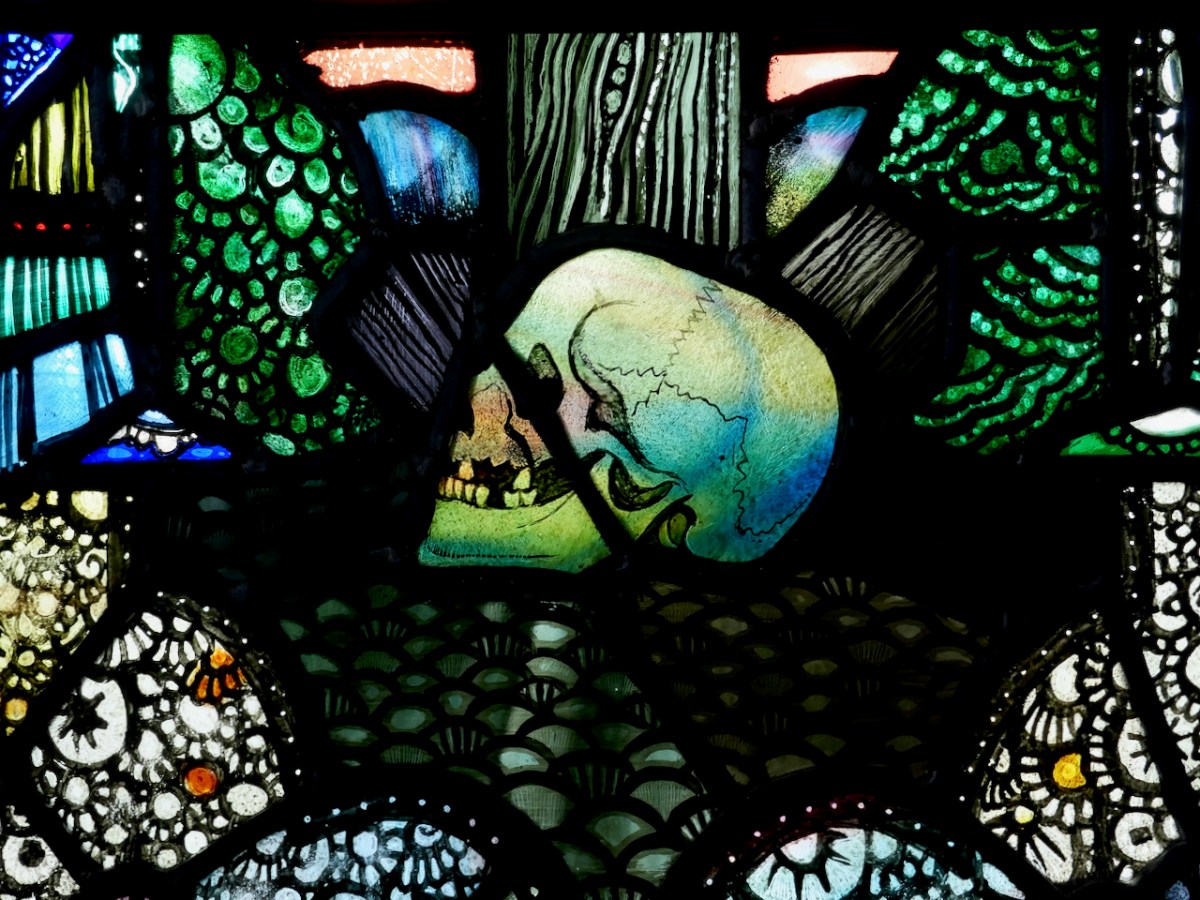
This is a tiny detail from a crucifixion window in Wicklow, showing Willie’s mastery of technique: achieving the multiple colours in the skull calls for extraordinary skill

* I am indebted to the scholarship of Paul Donnelly for this post. Paul has conducted in-depth investigation into the work of the Harry Clarke Studios and has identified many windows in the Gazetteer of Irish Stained Glass based on his research. Thank you, Paul for your erudition and generosity.
Harry Clarke Quiz – The Answers

Well done to everyone who took part and I hope you enjoyed it. (And it’s not too late – you can always try the Quiz, if you haven’t already done so, before proceeding.) It wasn’t easy. In fact, if I had tried to answer it myself, as opposed to setting it, I don’t think I would have got them all right. That’s important, as it illustrates the very conundrum posed by the question of what is, in fact, a genuine Harry Clarke, designed by him and either at least partially executed by him or executed under his very close supervision, as opposed to a Harry Clarke Studios, that is one done by other artists working in his studio, especially after his death. I hope you remember your answers, as the poll only tells me the percentage of people who answered correctly. OK – here goes.
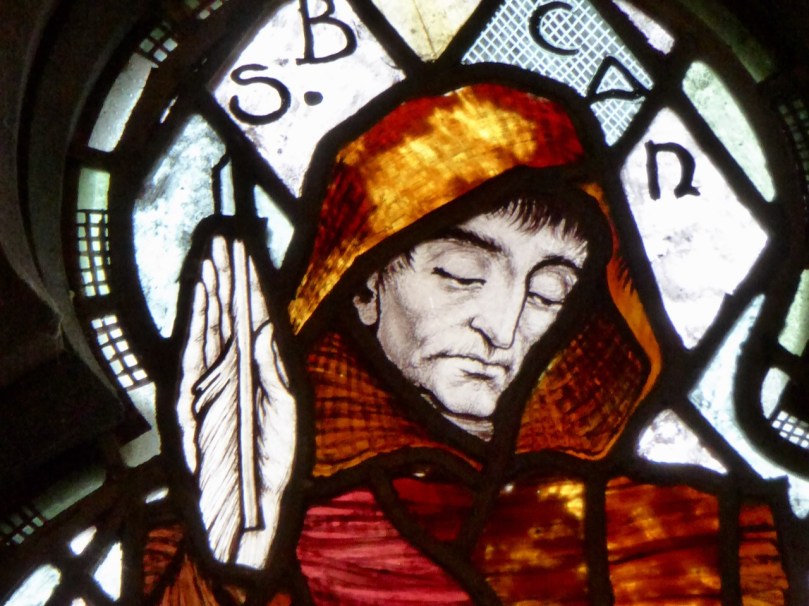
Saint with Hood 1
Yes: 70% No: 30%
Correct Answer: Yes

In fact it was designed and totally executed by him. It depicts St Fachtna, Patron Saint of Rosscarbery, and is a detail from the 1919 Nativity at St Barrahane’s Church of Ireland in Castletownshend, West Cork. The window was commissioned by Edith Somerville and her siblings in memory of their parents and was one of Harry’s first private commissions after he burst on the scene with his triumphal set of windows for the Honan Chapel at University College, Cork. Harry was still trying to find his feet as a stained glass businessman at this point with the artist in him taking precedence over the need to make money at this. He lavished such care and attention on this window that his father, Joshua Clarke, despaired of their ability to recoup what it was costing. In the end he and Harry had to come to an arrangement whereby Harry paid for workshop time and the use of his father’s glaziers. It was an important lesson in the need to balance his drive as an artist with making a living and led to his taking on assistants and artists to help him with the volume of work. To see the whole window, take a look at my post The Nativity – by Harry Clarke.

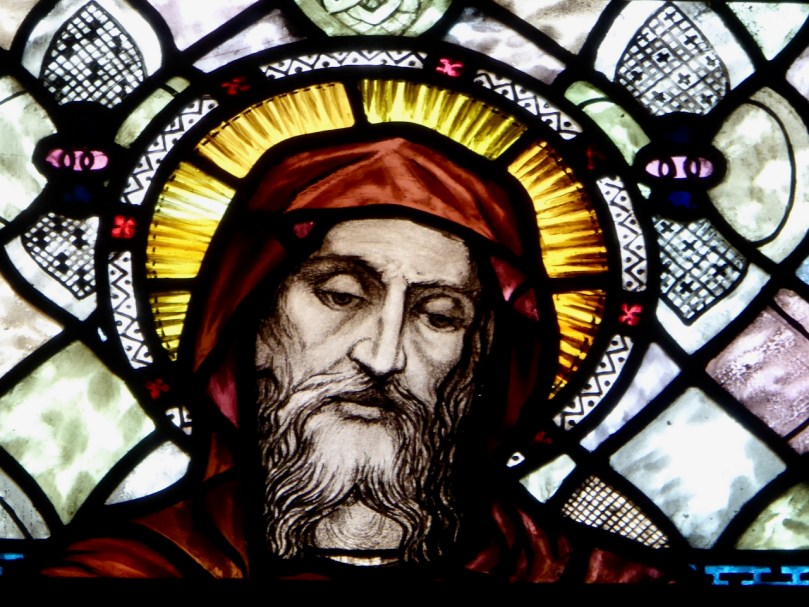
Saint with Hood 2
Yes: 33%  No: 66%
Correct Answer: No

Two thirds of you knew at once that this is not a Harry Clarke – in fact, it isn’t even a Harry Clarke Studios. This is the head of St Colman from the Honan Chapel, but it is not one of the 11 windows that Harry supplied, but rather one of the windows done by An Túr Gloine (The Tower of Glass), the cooperative studio established by Sarah Purser and Edward Martyn to promote the use of Irish windows by Irish artists. Read more about An Túr Gloine in this post: Loughrea Cathedral and the Irish Arts and Crafts Movement. The St Colman window was the work of A E Child, who mentored many of the Túr Gloine artists and who taught Harry at the Dublin Metropolitan School of Art.

Nativity 1
Yes: 80% No: 20%
Correct Answer: No

Four out of every five of you thought this was a Harry Clarke, but in fact this was the work of one of the Harry Clarke Studios artists, probably in the period immediately following Harry’s death, when there was pressure on them to produce Harry look-alikes. The window, which is very difficult to photograph, is high up in the wall of a transept in St Patrick’s Church in Wicklow Town. I think this is one I would have identified as a Harry Clarke, as it is such a close reproduction of his style.

Nativity 2
Yes: 58% No: 42%
Correct Answer: Yes

Yes, this is indeed a Harry Clarke. However, it’s not as straightforward as the Nativity window described in Saint with Hood 1, above, in which every aspect of the project was the work of Harry himself. It’s one of the collection of windows in the Diseart Centre in Dingle, in what was formerly the Presentation Convent. These windows were commissioned in 1924. Nicola Gordon Bowe assigned a status of Harry Clarke (B) to this one, that is ‘initially conceived and designed by him but executed by his Studio under his close supervision’. She wrote: 

At the beginning of 1924 Harry Clarke was at the peak of his career, in both stained glass and illustration. However, his health was beginning to deteriorate, among the causes being the extreme pressure of work, the extra responsibility his father’s death had put on him, and the upheaval in his life caused by the reconstruction of the Studios and the conversion of the two extra houses acquired in North Frederick Street. . . He engaged Austin Molloy to help him with cartoons, probably those required for a series of windows illustrating The Life of Christ at the Presentation Convent, Dingle. . . Although the Studios were responsible for most of the work on the Dingle windows. . . this series of six pairs of lancets is notable for some passages either worked or directed by himself. These include the sensitively painted head of the oldest king in the Nativity light. . .

In The Nativity – by Harry Clarke, you can see the whole window and a detail of the three kings. Five years after he had expended such personal concentration on the Castletownshend Nativity, Harry was under so much pressure from incoming orders that he could no longer handle all the work himself. By this time he had employed a small but brilliant contingent of assistants and artists and rigorously trained them to reproduce his style and bring his designs to fruition.

Presentation
Yes: 38% No: 62%
Correct Answer: No

This is a detail from an enormous Harry Clarke Studios Window in St Mel’s Cathedral in Longford, installed in 1932, after Harry had died. The Cathedral burned down on Christmas Day 2009 but was rebuilt and the windows were wonderfully restored by Abbey Stained Glass Studios for the 2014 re-opening. If you search online for ‘St Mel’s Cathedral stained glass’ most of the results will simply refer, erroneously, to ‘the Harry Clarke windows’. The scene of the Presentation is in the predella (lowest panel) of the St Anne window. 

St Augustine
Yes: 53% No: 47%
Correct Answer: No

This depiction of St Augustine is in the Holy Cross Catholic Church in Charleville, Co Cork, which is packed with interesting stained glass, including a series of twelve from Joshua Clarke and Sons erected between 1919 and 1922. Harry was working in his father’s studio at the time, doing his own windows and also assisting with the supervision of work under his father’s imprint. In a letter to Holy Cross, Joshua says, “Harry will look to the new windows and see you get very good ones.” And they are good, but the only one that looks (to me, that is) like Harry took an active hand in it is this one of St Augustine. It has the large expressive eyes, sensitive mouth, compassionate expression and long tapering fingers that we see in the full development of his style. I suspect that’s what those of you who answered Yes were responding to. However, it cannot be called a Harry Clarke, or even a Harry Clarke Studios – instead, it bears the stamp of J Clarke and Sons and remains an interesting question.

Crucifixion
Yes: 52% No: 48%
Correct Answer: No

A round window above the altar in Ballydehob Church in West Cork. While the style is reminiscent of the windows produced by the HC Studios after Harry died, in fact this window is by Earley and Co, and specifically by Leo Earley. Leo was very inspired by Harry and emulated his use of colours and his embellishments and decoration. While the faces and figures in this window are not convincing, the flow of the ornate garments are an echo of the fantastical and imaginary faux-medieval costumes Harry loved. 

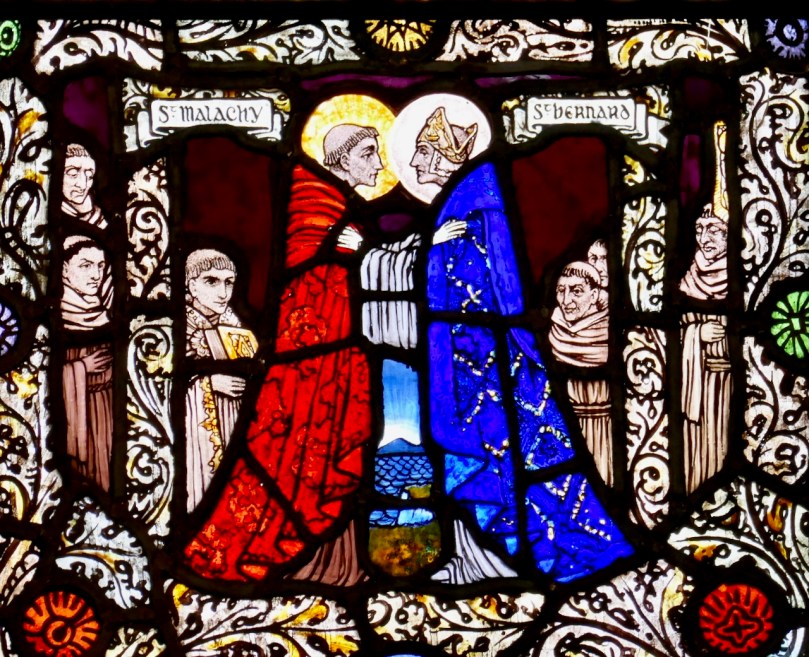
Malachy Meets Bernard
Yes: 48% No: 52%
Correct Answer: Yes

The predella from the right hand light of a three light window, this small scene show St Malachy meeting his mentor, St Bernard. Of the three lights, the St Bernard and St Rita windows are by Harry Clarke and the central light is by William McBride. They date to 1924 and are in the Sacred Heart Church in Donnybrook, Dublin.

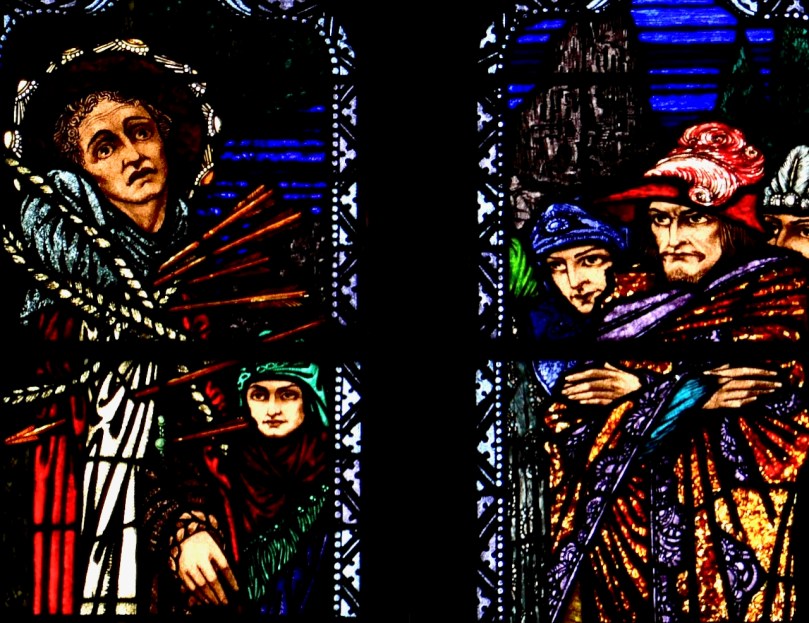
St Sebastian
Yes: 71% No: 29%
Correct Answer: No

John the Baptist Church in Blackrock, South Co Dublin, is full of interesting stained glass, including an Evie Hone. There are several windows by the Harry Clarke Studios and the St Sebastian is one of them. This is one I would have voted yes to myself, as the faces of the onlooking soldiers are so Harry Clarke.

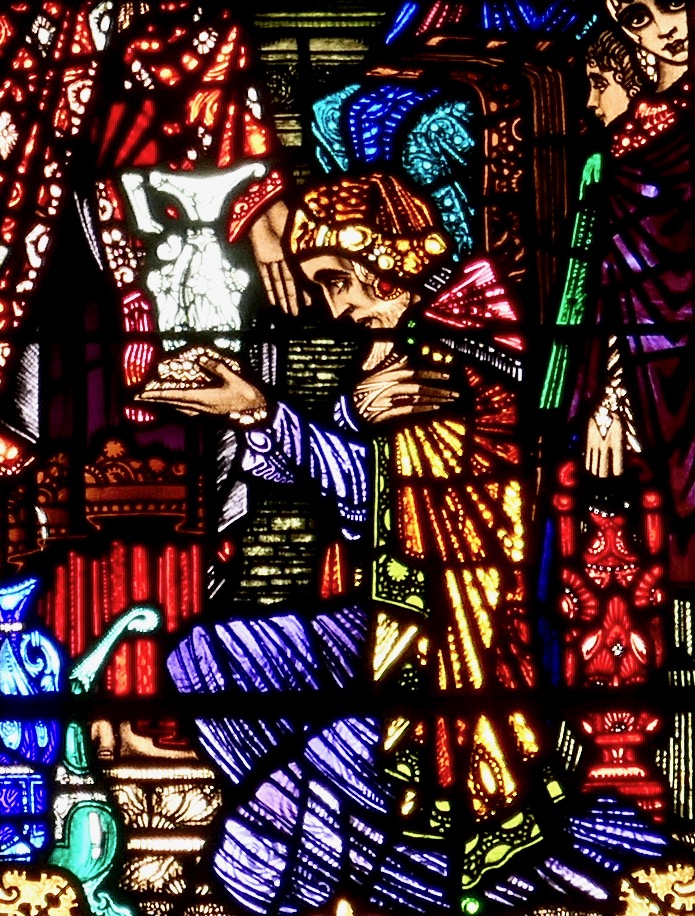
Scene from Wedding Feast at Cana
Yes: 80% No: 20%
Correct Answer: No 

Although officially this is not listed as a Harry Clarke window, you can certainly be forgiven for thinking it is, as everything about it shouts Clarke, including the sheer richness of detail. In fact, this window was one of the last to be worked on on his studio while he was still alive (although mostly absent at a sanatorium in Davos, Switzerland) and he did indeed have some input (although we don’t know how much) into the design of parts of the window, including this scene. It is a detail from one of three lights, which together incorporate seven Scenes from the Life of Christ in the Catholic Church in Timoleague, West Cork. The whole window is very fine indeed and I will be writing a future post about it as it is the subject of some excellent research by Clarke scholars, and a good example of the complexities of ascribing the label ‘Harry Clarke’. 

Saint with Helmet
Yes: 61% No: 39%
Correct Answer: Yes

No ambiguity here – this is the head of St Adrian from the O’Keefe Memorial Window by Harry Clarke in the Church of the Assumption, Wexford. You can view the full window and read more about this window in my post That He Might Better Rest. Harry designed and executed this window in 1918/19 having first travelled to Wexford to meet with the fallen soldier’s grieving mother.

Lourdes Apparition
Yes: 56% No: 44%
Correct Answer: Yes

I might have been tempted to say no to this one as I find it ultra-conventional, but it is indeed a Harry Clarke, designed by him and executed under his supervision. It is one of two windows in a small country Church in Duhill, Co Tipperary. The other window is a startling contrast to the piousness of this one but I will leave that discussion for another day.

Patrick at Slane
Yes: 34%  No: 66%
Correct Answer: No

Good eye! This image is a detail from the huge Patrick window in the Church of Sts Peter and Paul in Athlone and it’s by Richard King, done in the Harry Clarke Studios in 1937 several years after Harry died. It’s unusual for any HC Studios window to be signed – that’s part of the difficult of  identifying which of the Studios artists worked on their windows – but in this case we do know that Richard King made several of the Athlone windows. Read more about those windows in my post Discovering Richard King, where you will also find a link to images of all the Athlone windows.

Brendan the Navigator
Yes: 68% No: 32%
Correct Answer: Yes

This is the head of Brendan the Navigator from the Honan Chapel series which propelled Harry Clarke into the forefront of Irish design when they were installed in 1916.

So – how did you do? Want to argue about any of the answers?

Quiz! Do You Recognise a Harry Clarke?

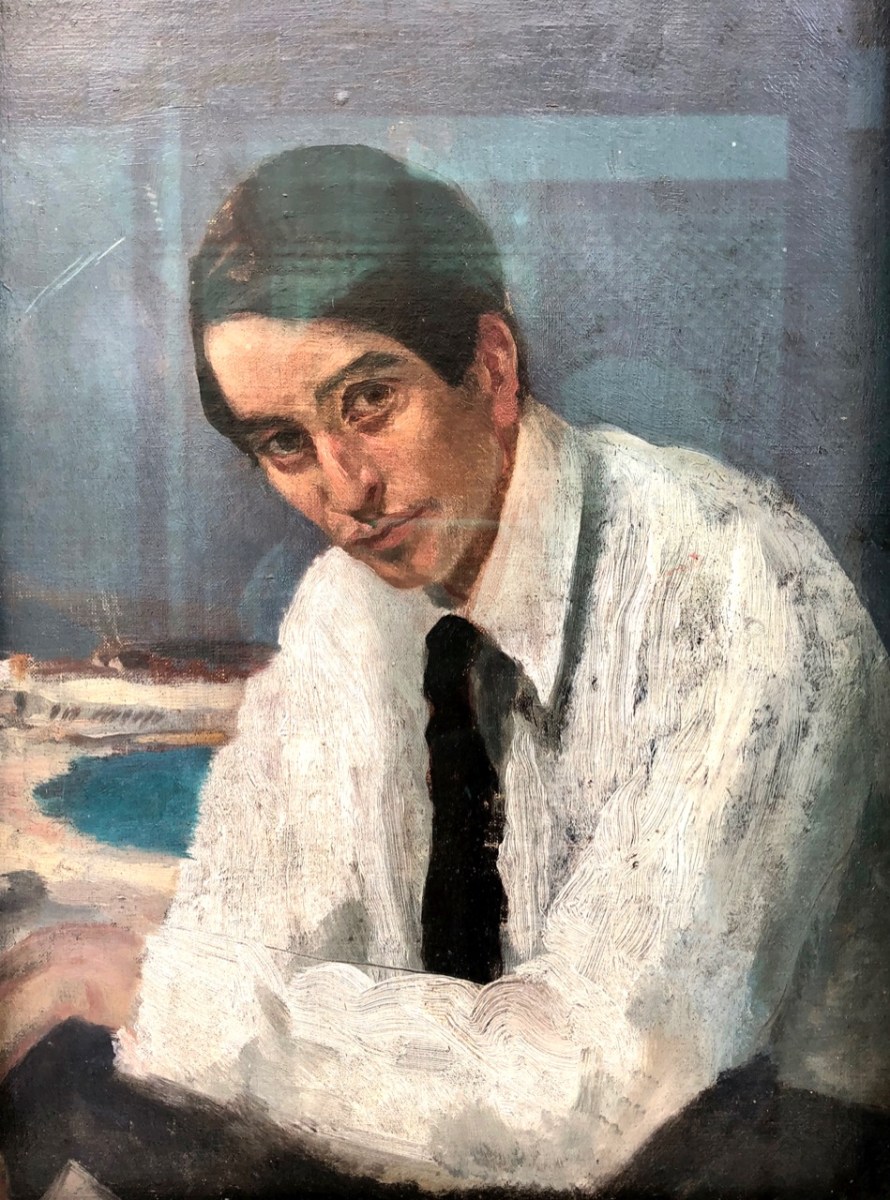
A stained glass window can be labelled a Harry Clarke if it was designed and executed entirely by him, if it was designed and partially executed by him, or if it was designed by him and the execution done under his close supervision. The portrait above was done by his wife, Margaret Crilly Clarke, in 1914 when Harry was only 25 and not yet plagued by the consumption that was to carry him off in 1931 at only 41 years of age. For the last few years of his life, Harry was increasingly hampered by illness, and also busy with illustration work. He employed a very talented group of artists to execute windows of his design and trained them rigorously to reproduce his unique style, for which there was a huge demand. After his death, those same artists continued to work in the Harry Clarke Studios and to produce windows in that style because that’s what people wanted, and so it can be difficult to know whether a window is a true Harry Clarke or a Harry Clarke Studios. For some windows, only research in the extensive Studios archives (housed at Trinity College) can establish the answer for certain. There are excellent reasons to be proud of many Studios windows, and it shortchanges the outstanding artists who worked on them if we keep insisting that everything was done by Harry himself. I want to explore this topic further, but I’d like to start off with a quiz to see if we’re as good as we think we are at recognising a Harry Clarke from a non-Harry Clarke. So polish up your glasses and take the quiz! Answer YES if you think this is a Harry Clarke (according to my definition) and NO if you believe it is not. I might even have thrown in the odd image that is neither Harry Clarke nor Harry Clarke Studios. Answers next Sunday.

Good luck everyone!

If you’re desperate, here are the answers

Murphy Devitt in Cork, Part 1

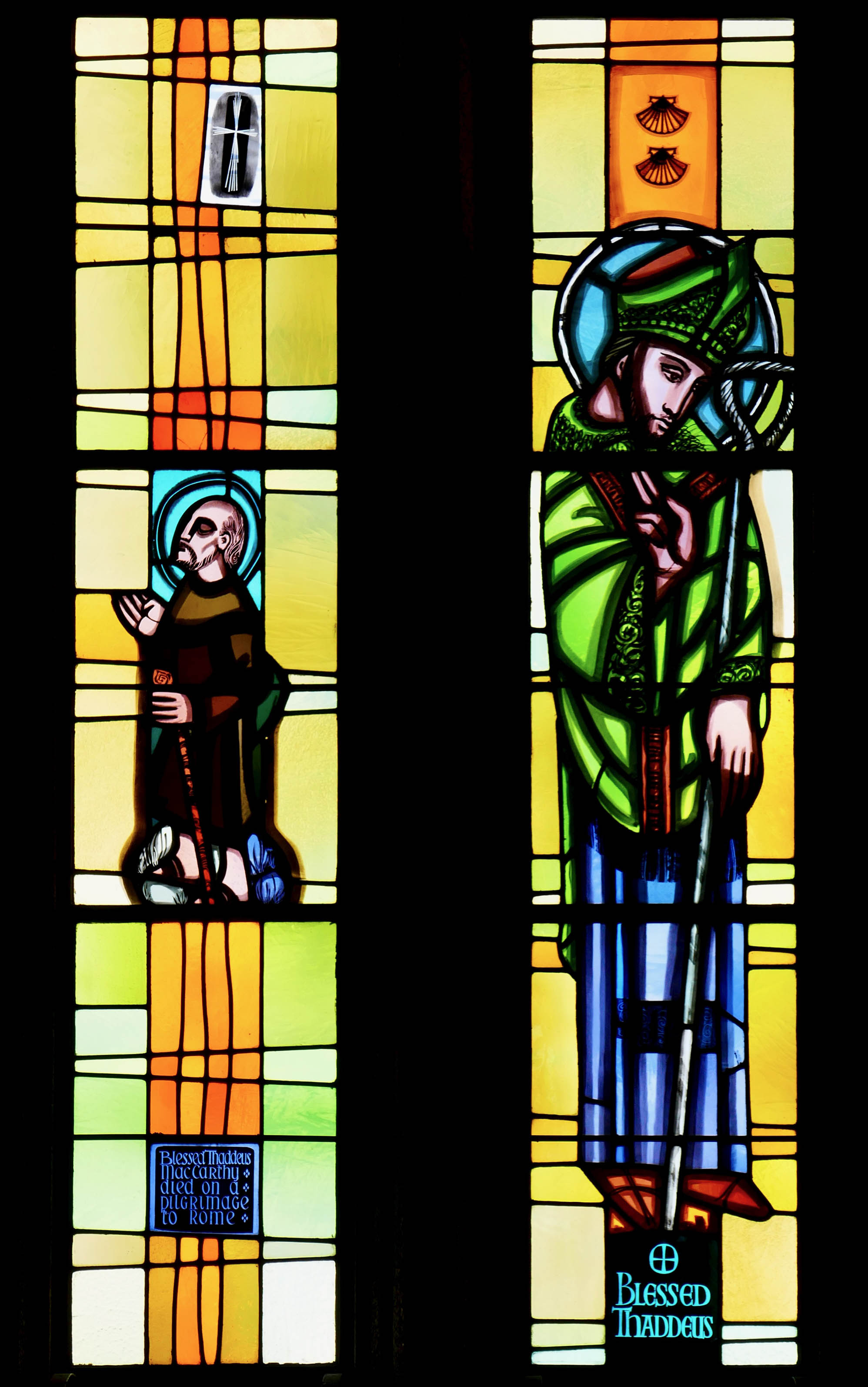
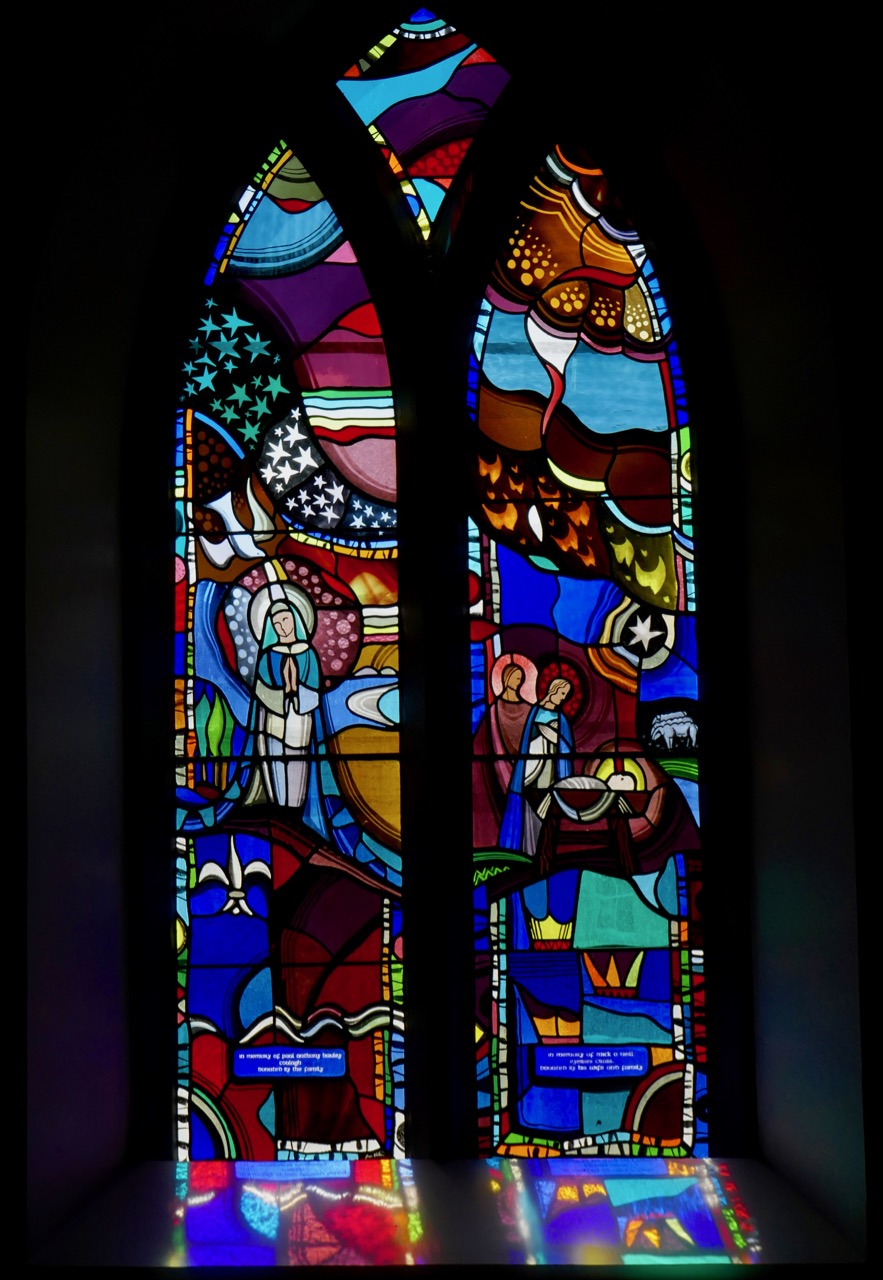
A couple of years ago I visited the Catholic church in Caheragh, just north of Skibbereen, specifically to look for an image of Thaddeus McCarthy about whom I was researching at the time (see my post Thaddeus McCarthy, the Bishop Who Never Was). As I stepped into the church it was immediately obvious that the stained glass was not the usual traditional images based on renaissance paintings that I had been seeing in most of the churches I had been in. No, what greeted me (above is the Thaddeus window) was something entirely new and different – modernist, colourful, idiosyncratic, painterly, beautifully designed and expertly executed windows, each one identified as the work of Murphy Devitt of Dublin and installed in 1963. I fell in love.

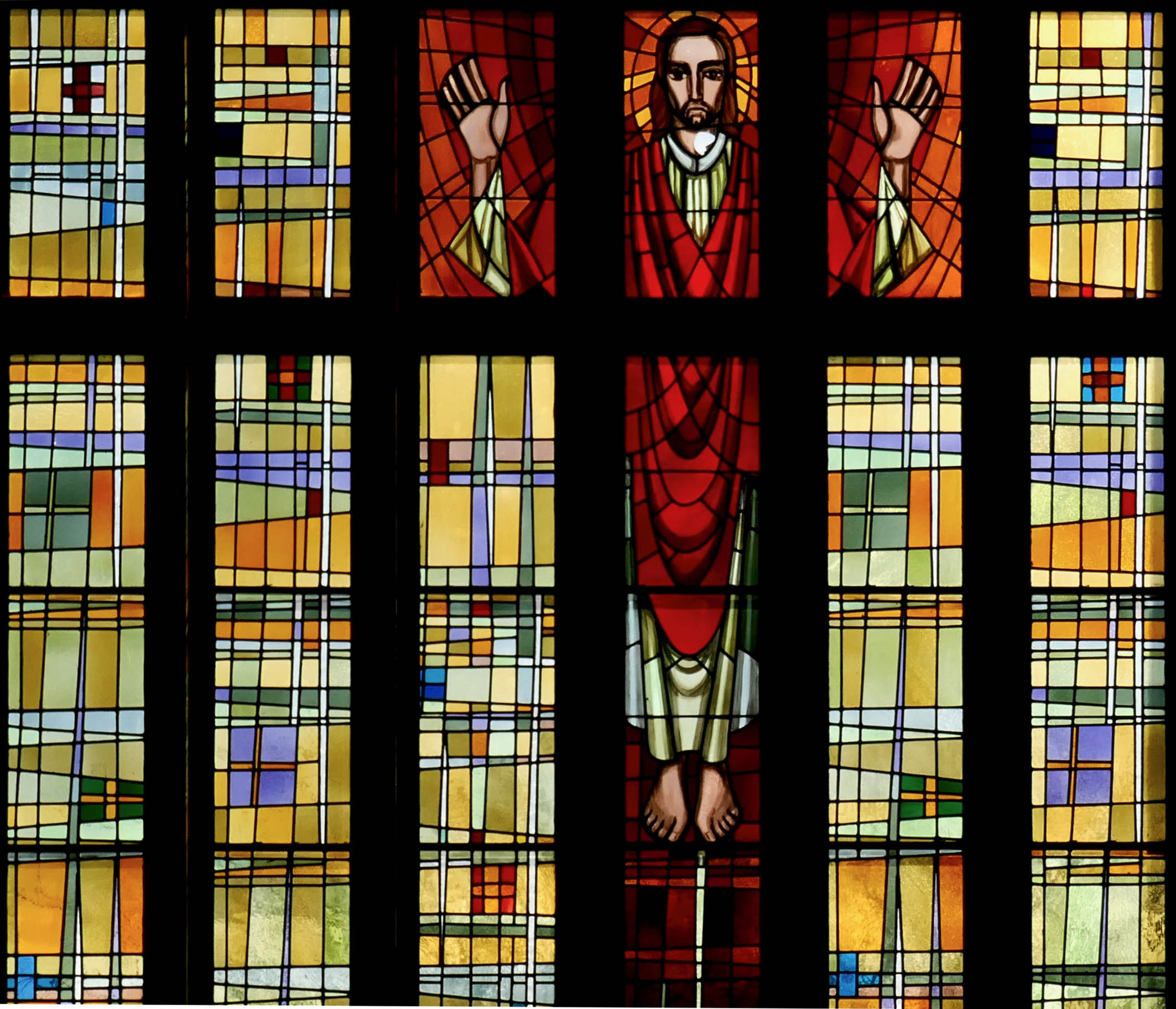
The stained glass windows in the rest of this post (except for one) are all from the Church of Our Lady Crowned, in Mayfield, Cork. This one represents the Risen Christ

There are Murphy Devitt windows in ten Cork churches, and why not? Johnny Murphy, after all, was a Cork boy, brought up in the city and starting his art education at the Crawford School of Art in the 1940s when the life-drawing classes still revolved around the Canova casts. He was a standout student, winning a scholarship to the National College of Art in Dublin. There he met a fellow student, the beautiful Róisín Dowd, whose parents had fled the Belfast blitz to settle in Dublin. Together and separately, they travelled to Paris and Rome, doing what art students do – visiting galleries and studios, studying centuries of European painting, absorbing and responding to those influences (think Botticelli for Róisín, Klimt for Johnny), finding their artistic voices and refining their own styles.

The Presentation in the Temple (detail)

Returning home, they had to wait for several years to marry. Their daughter Réiltín suspects that Grandfather Dowd insisted on Johnny having gainful employment and that may have been why he joined the Harry Clarke Studios in 1952 and began to seriously study the craft of glass painting. Harry Clarke died in 1931 but his studios carried on making stained glass until the 1970s. There was plenty of work for anyone in the ecclesiastical provisioning business as new churches were going up all over the country to serve the burgeoning, and pious, population.

Dessie Devitt, Paddy McLoughlin, Mickey Watson and Johnny Murphy in their busy studio in the 60s

One of the glaziers Johnny worked with at the Harry Clarke Studios was John Devitt, universally known as Des or Dessie. Becoming fast and lifelong friends, they decided to strike out on their own, taking some of the men from the HC Studios with them. It was the late 50s and they couldn’t have picked a better time. Working from a mews in Monkstown and later a custom-built studio in Blackrock, they started to tender successfully for new commissions. This also allowed Johnny and Róisín, who now joined them as well when she could escape motherly duties, to develop their own unique approach to designing and painting stained glass, very different from what had become a somewhat hidebound atmosphere at the Harry Clarke Studios. For an example of what I mean by that, and to illustrate the contrast with MD, take a look at my post Time Warp, featuring a set of Harry Clarke Studio windows from the late 1950s. Below is a detail from one of them – far, indeed from the genius of Harry Clarke himself.

Detail from a Harry Clarke Studio window in Drimoleague. Although this window is interesting for lots of other reasons, the quality of the glasswork and the artistry of the painting had declined over the decades since Harry’s death. 

What Johnny always called their ‘first big break’ came with the Church of Our Lady Crowned, in Mayfield, Cork, completed in 1962. According to The National Inventory of Architectural Heritage:

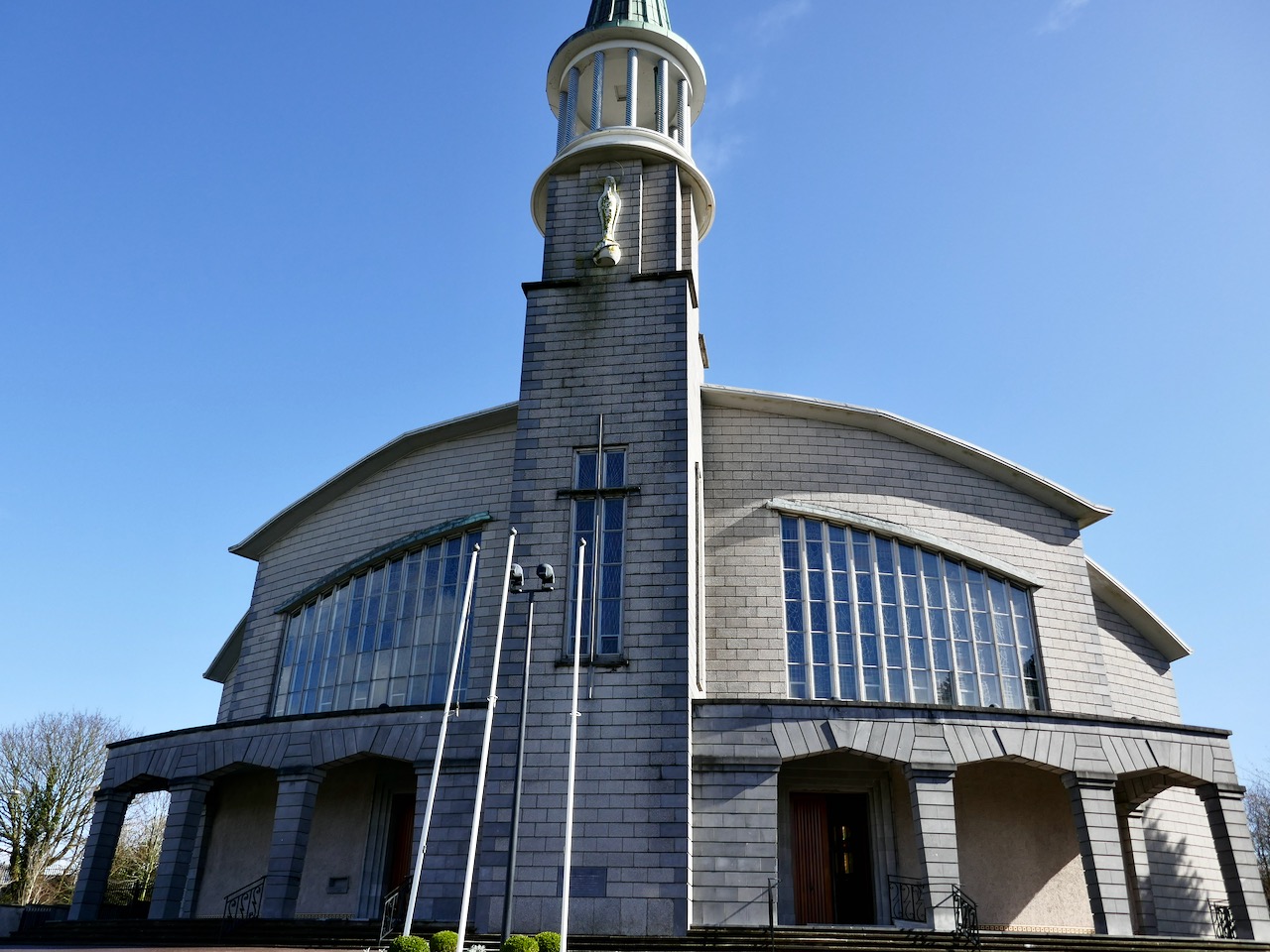
Our Lady Crowned Roman Catholic Church was built to the design of J.R. Boyd Barrett’s firm and when completed in 1962 comprised the final of five new churches constructed to the north side of Cork city and named after the five Glorious Mysteries of the Rosary. The design and construction of the roof is of technical importance while the extensive stained glass windows, from the workshops of Murphy & Devitt in Dublin, are of particular artistic merit.

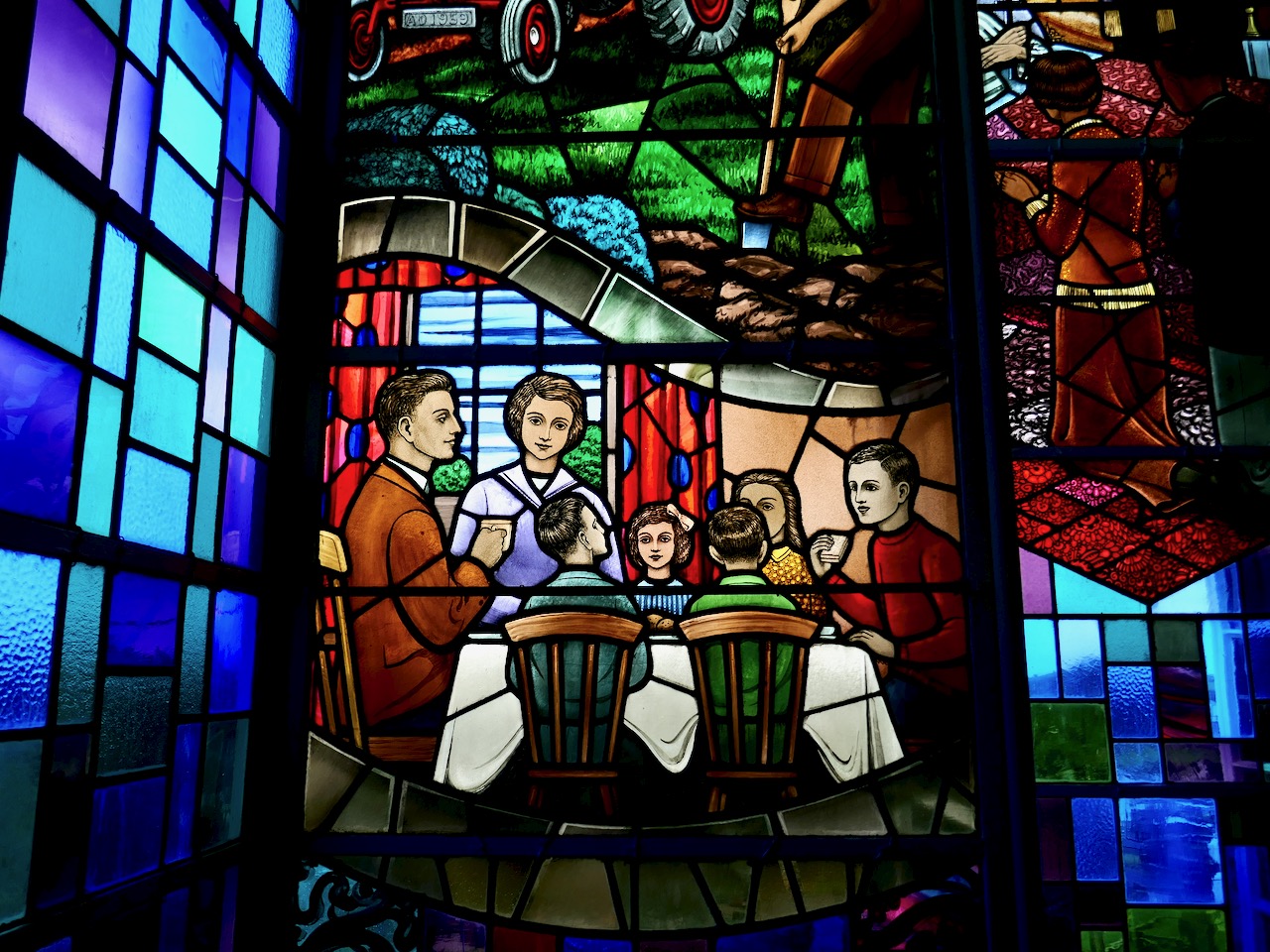
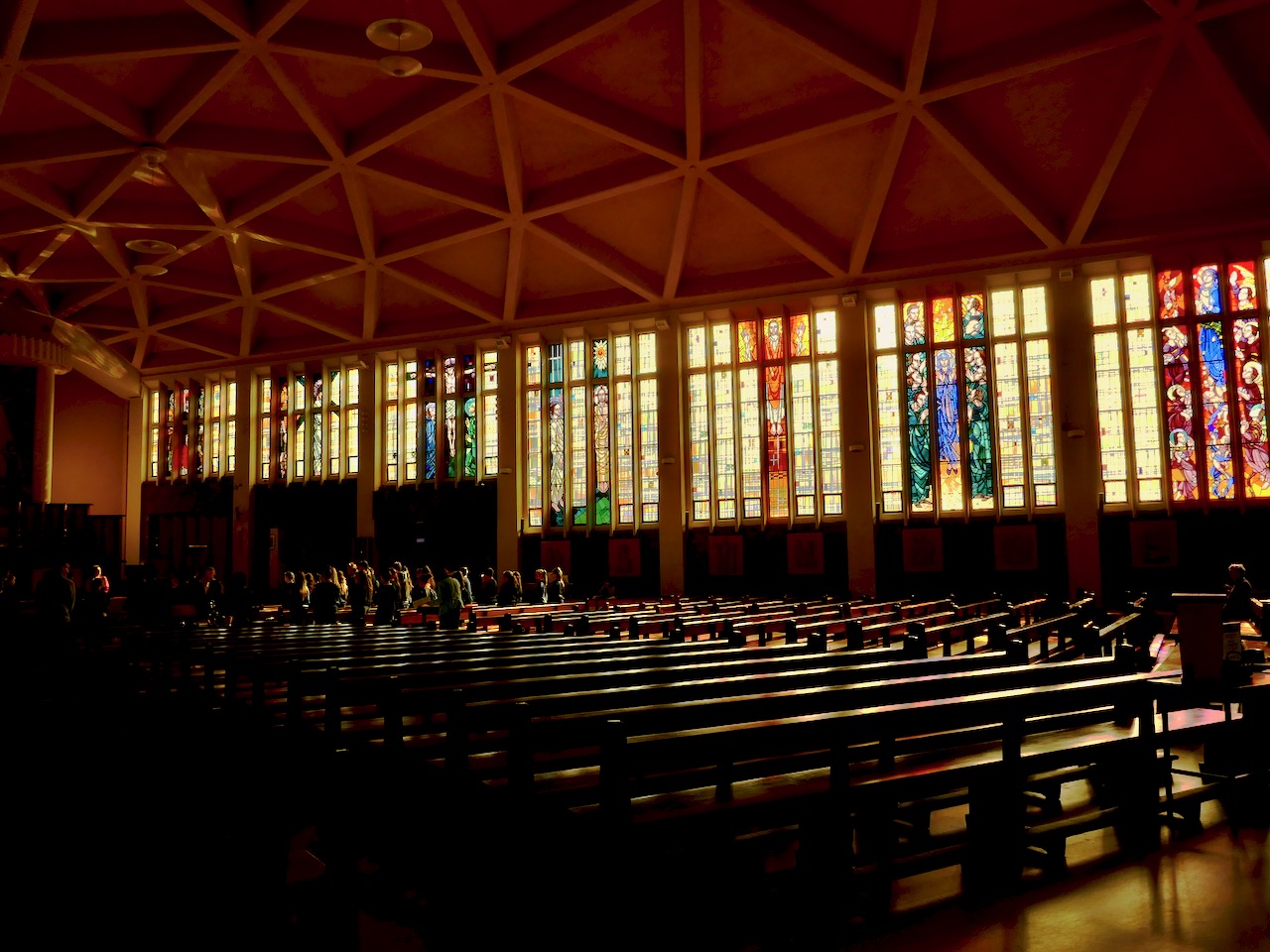
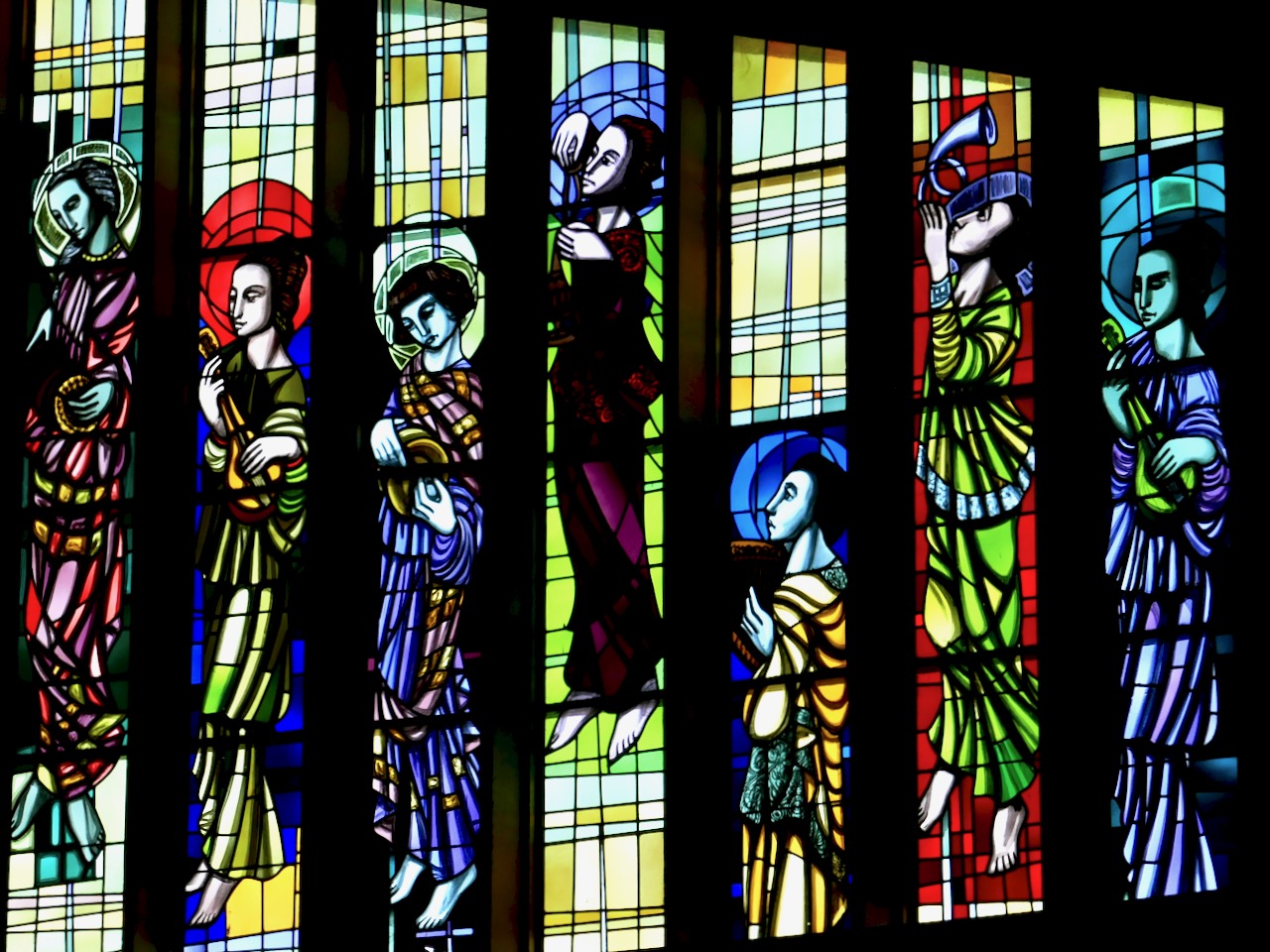
Too often, stained glass windows are one-off commemorative objects, mounted in an available opening. But when you see a whole scheme of windows in one church, designed to fit and complement the architecture throughout the building, the effect can be breathtaking. And so it is with Our Lady Crowned. The church is wedged-shaped, with enormous glass panels occupying at least half the space. Scenes from the Life of Christ range around the walls, from the Annunciation to the Crucifixion and Epiphany, with the huge area over the main door taken up with a choir of angels heralding the crowning of Mary on one side and Christ on the other.   

The day we visited the church was full of children preparing for their Confirmation

When I told Réiltín Murphy*, Johnny and Róisín’s daughter, that Our Lady Crowned was my favourite of the Cork MD churches, she responded that it was her parents’ favourite too. It’s not hard to see why – it’s a triumph of imagination, artistic vision, craftsmanship and above all collaboration. As I get more familiar with MD windows the distinction between a Johnny Murphy window and a Róisín Dowd Murphy window is sometimes quite clear: Johnny’s style is more angular, with loose dark brushstrokes, strongly marked facial features, heads tilted at an angle, while Róisín’s figures are more curvy and flowing, with greater attention to fabric and to musical instruments. Réiltín characterises the difference thus: Róisín’s figures, I always think, are too busy to pose for their photo while Johnny’s are usually quietly aware of just who they are and what they symbolise.

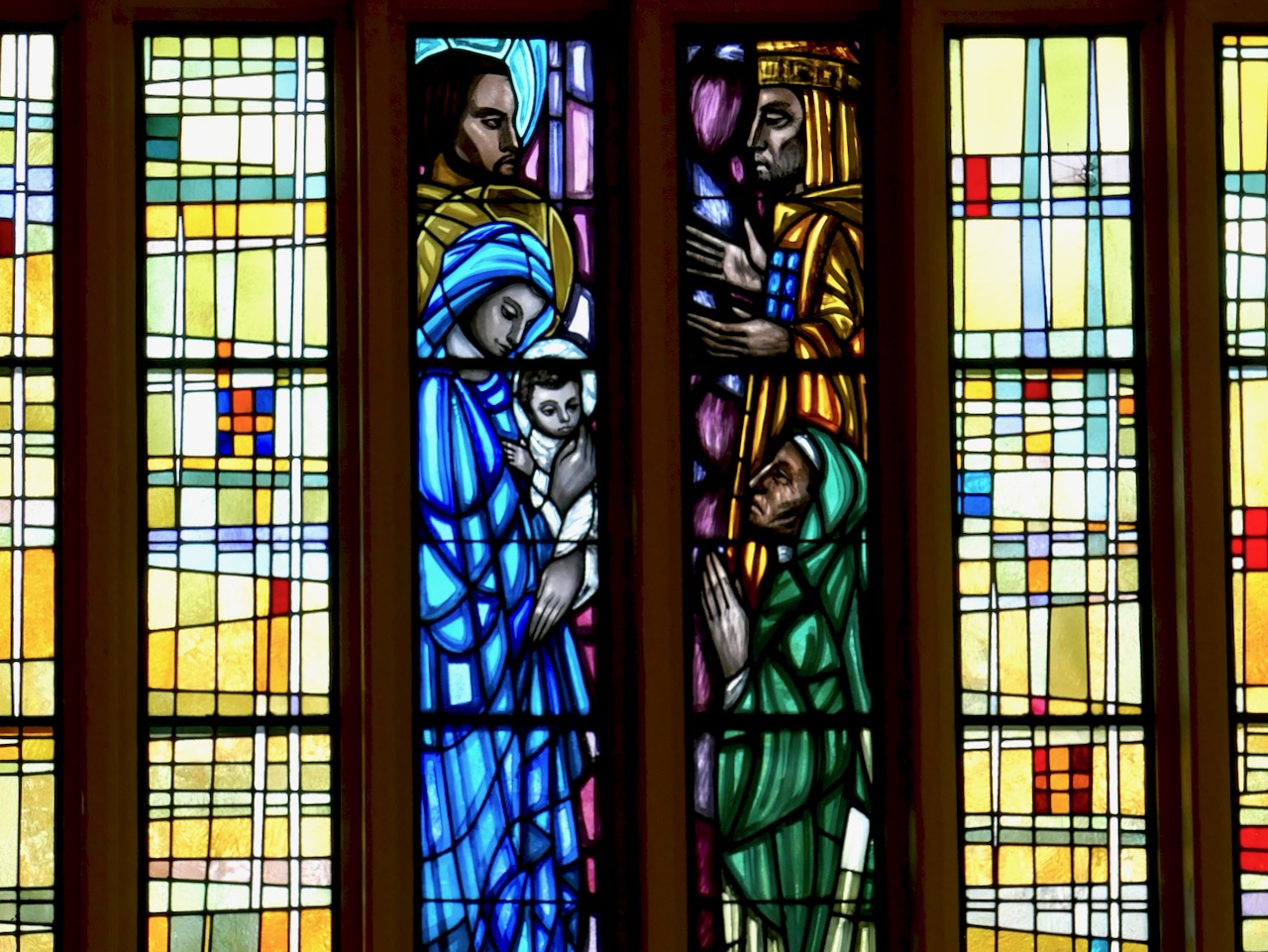
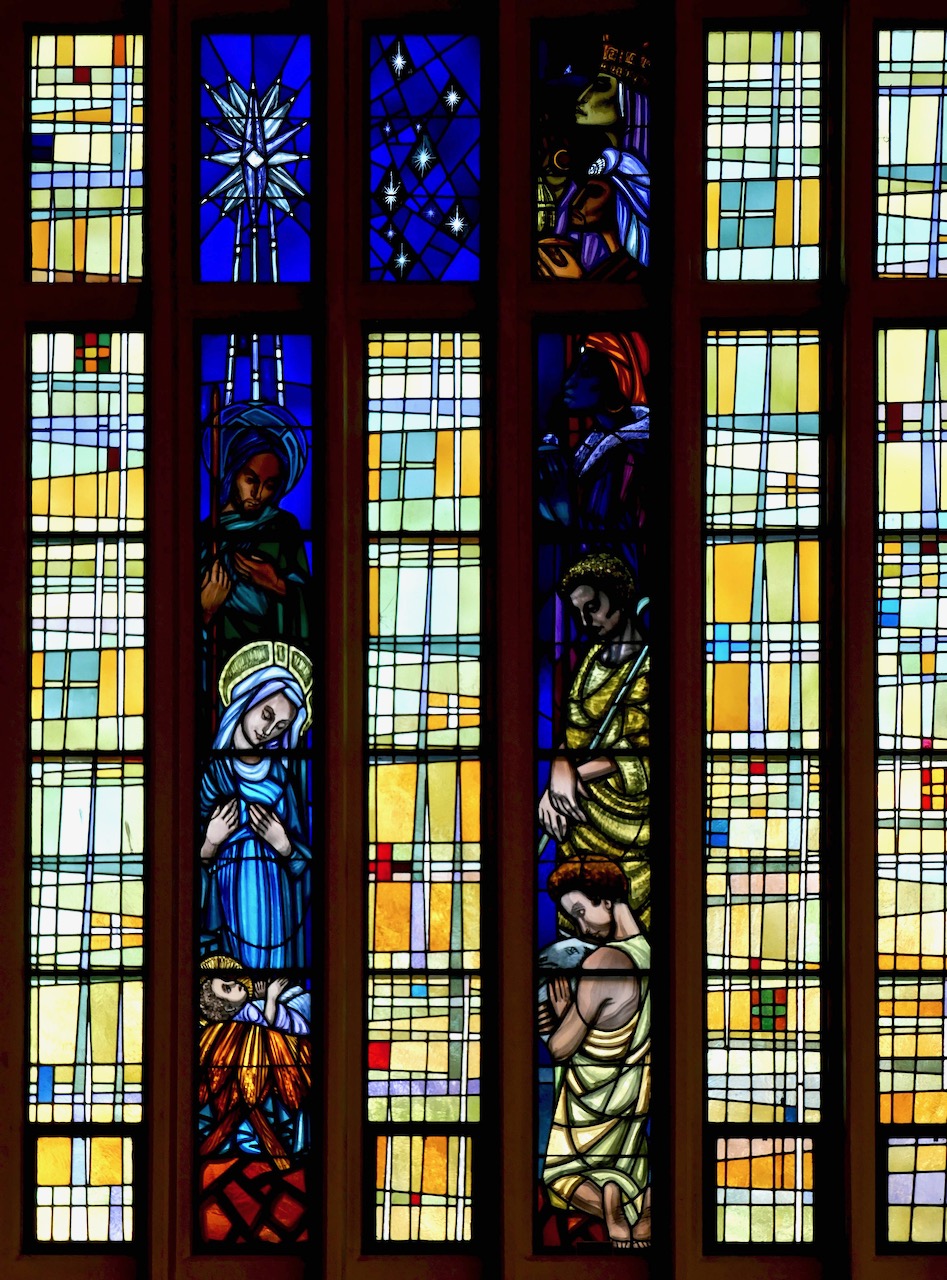
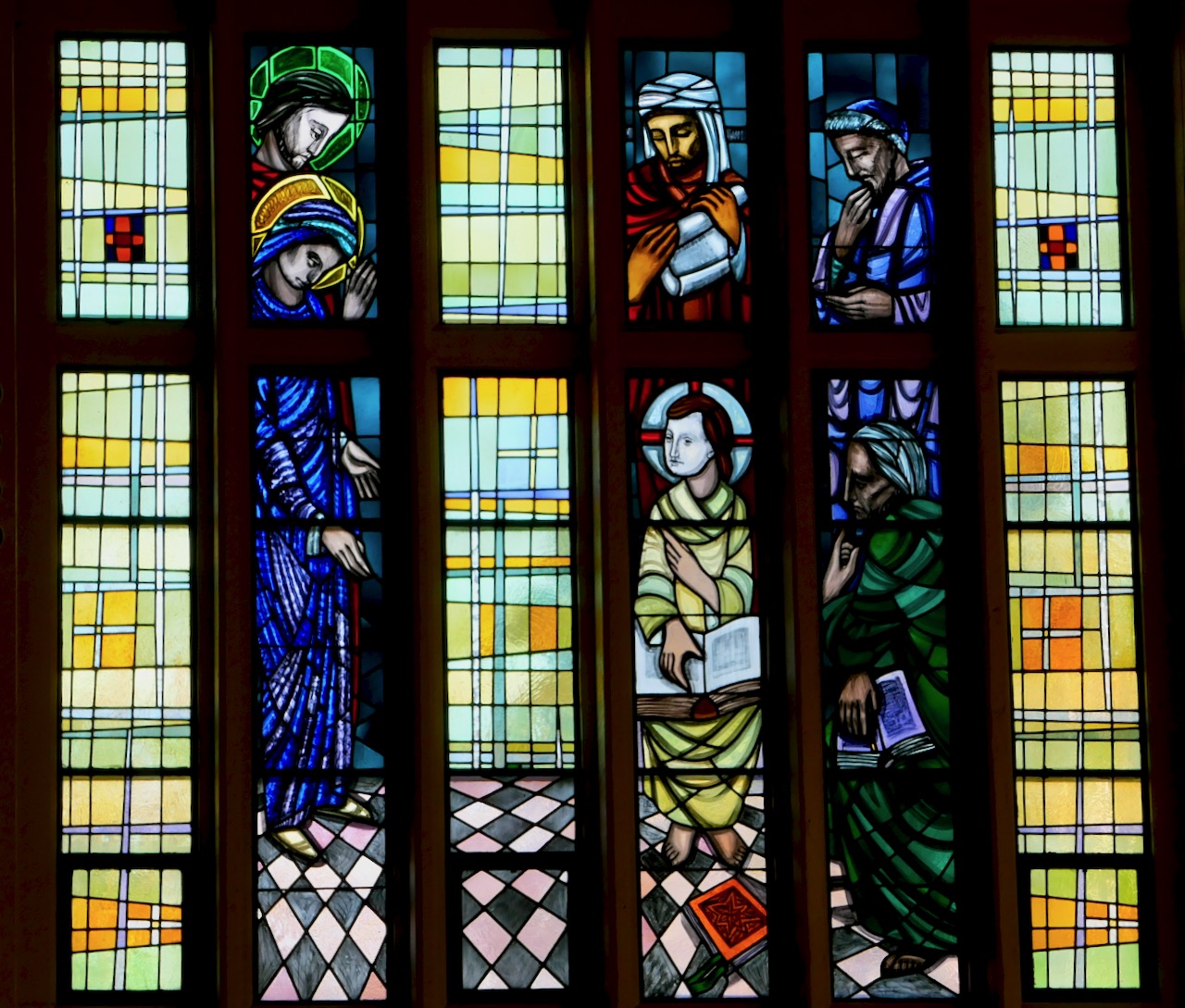
Nativity, Presentation and Jesus in the Temple windows

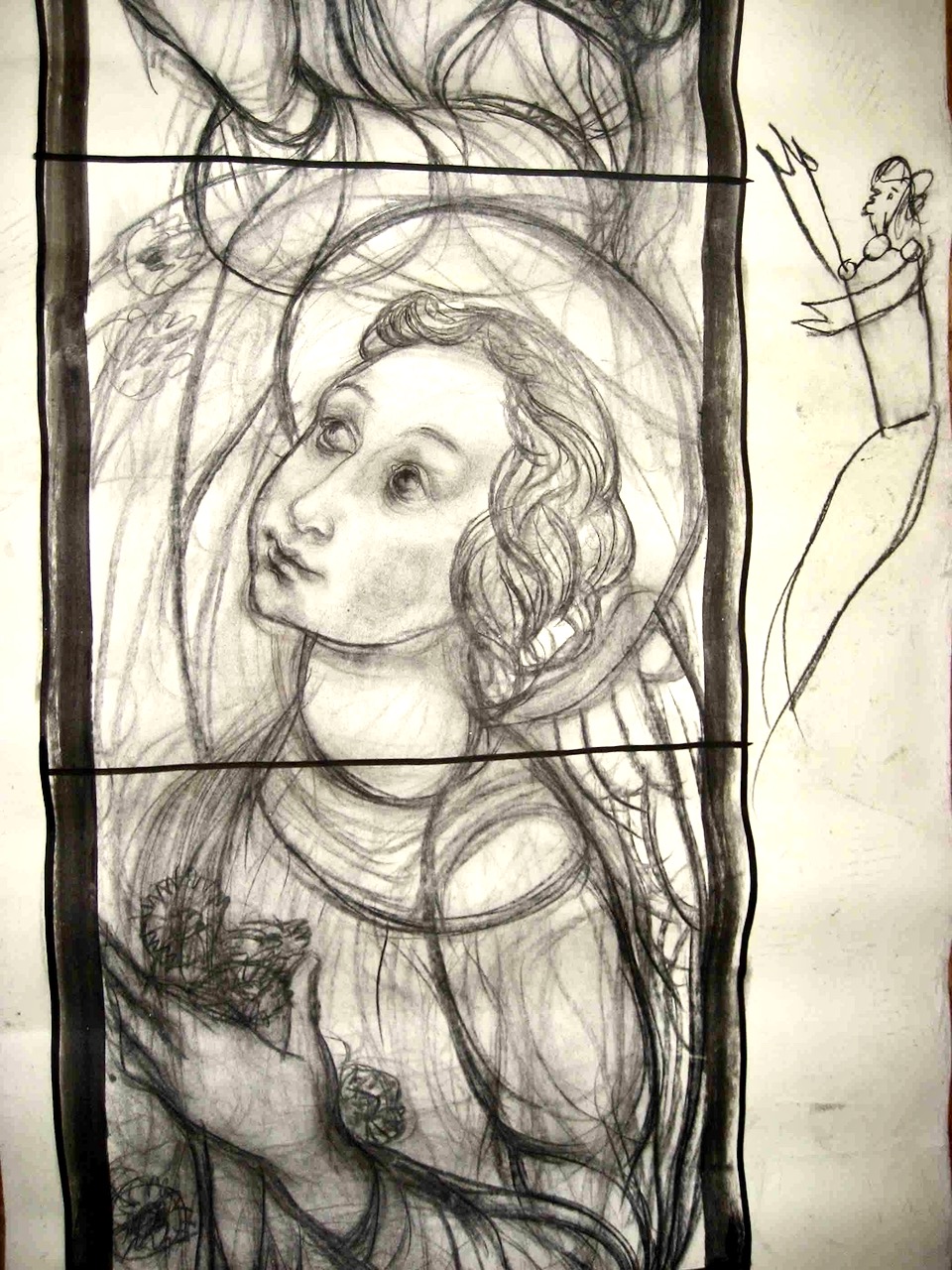
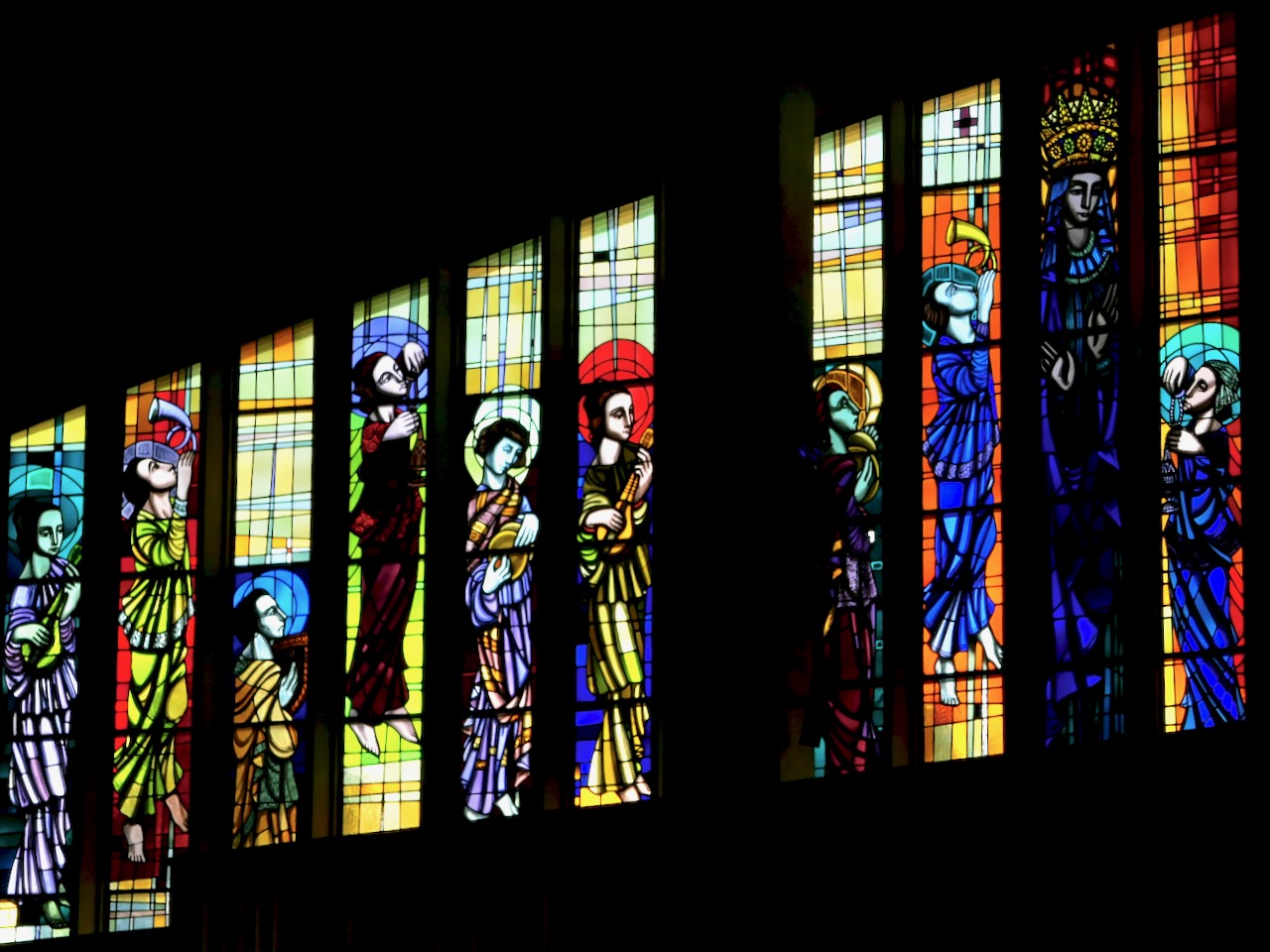
In Mayfield, all those elements are present: at first glance it’s impossible to tell where Johnny leaves off and Róisín begins. But we do have evidence, in the form of an original cartoon, that links Róisín directly to the Assumption window and once you see that, you see her hand in other places too – the heavenly choir, for example, has many of her hallmarks.

Róisín’s cartoon for the second angel from the bottom on the right, and the finished window

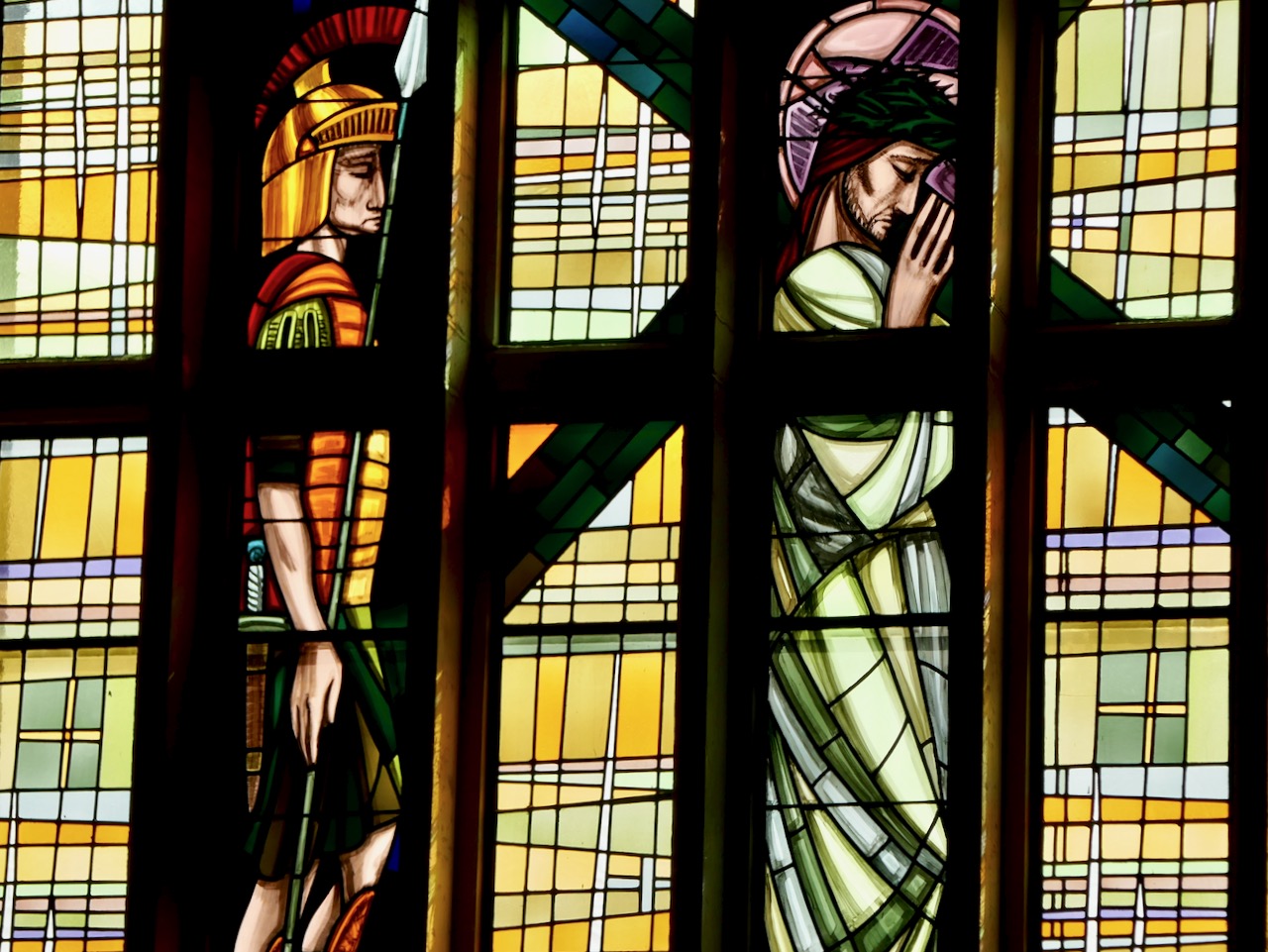
I am tempted to see Johnny in the passion images – the sombre figure of the suffering Jesus (below) exudes a quiet power alongside the mocking soldiers.

But many of the windows defy easy analysis. Look at the Nativity window (below), for example, and see if you can figure out whose hand is where. Complicating all this in Murphy Devitt windows is that when times got busy they took in extra artists to help with the workload.

In this window note how the ‘break-outs’ (the areas of coloured glass) are used to separate two long panels, which are then unified at the top. The composition, which manages to include all the major figures in two tall narrow panels, is impressive, as is the integration of those panels with the break-outs.

As with most of their commissions, Johnny was the one who sketched out the overall design and decided on the ratio of figurative panels to ‘break ups’, those areas of coloured glass that allow the eye to rest between scenes, to register the passage of time between events. Non-figurative schemes became important elements in the Murphy Devitt style – more about  them later, but for the moment note the highly original way in which the expanse of coloured glass are treated. Nobody else was doing anything like this at the time – it was a unique and beautiful Murphy Devitt innovation.

In this window, the Finding of Jesus in the Temple, the separating device is the break-out panel and the unifying device is the floor

Not for Murphy Devitt the regular quarry glass with its dependable lozenge shapes, or static grids of straight lines. Johnny loved the wobbly, the wavy and and the irregular. Réiltín says, He was interested in music: the fugue, he said, whereby the same melody/image is played in different keys – his abstracts are often flipped, turned, twisted to be similar but not identical. He loved glass as a painting medium. He loved its kinetic effect in its flaws, its trees moving outside, its changing light/colours from passing clouds, its seeming to be alive.

A window where the break-outs serve as background, with the two main figures occupying panels and the cross stretching across the space

It’s a lot easier to cut regular shapes and fit them together, of course, but you don’t need an expert for that. This is where Dessie Devitt came into his own as a master glazier. Choosing the glass to match the colour scheme, assembling it all harmoniously, cutting and leading the thousands of pieces that went into a scheme like this – none of it would have been possible without Dessie Devitt and the men who worked alongside him.

The heavenly choir, above  one side of the main door, with Our Lady Crowned on the right. Below is a detail from the other side

By all accounts it was a charmed workplace, a happy environment where everyone worked hard but where laughter and The Chat abounded. Des in particular was gifted with the ability to recognise the absurd and could hardly leave the studio without coming back with an entertaining story.

About the same time as Mayfield, Murphy Devitt won the commission to design a set of windows based on the Canticle of St Francis for another Cork church, this one attached to a Cappuchin Friary. We’ll take a look at that one and some others next week. For the moment, the Mayfield church will serve as an introduction to Johnny, Róisín and Des, their modern aesthetic and their collaborative approach.

*Many thank to Réiltín Murphy for much of the background information, for answering all my questions and for additional photographs, including the people pictures and Róisín’s cartoon.

West Cork Obscura – Finola’s Picks

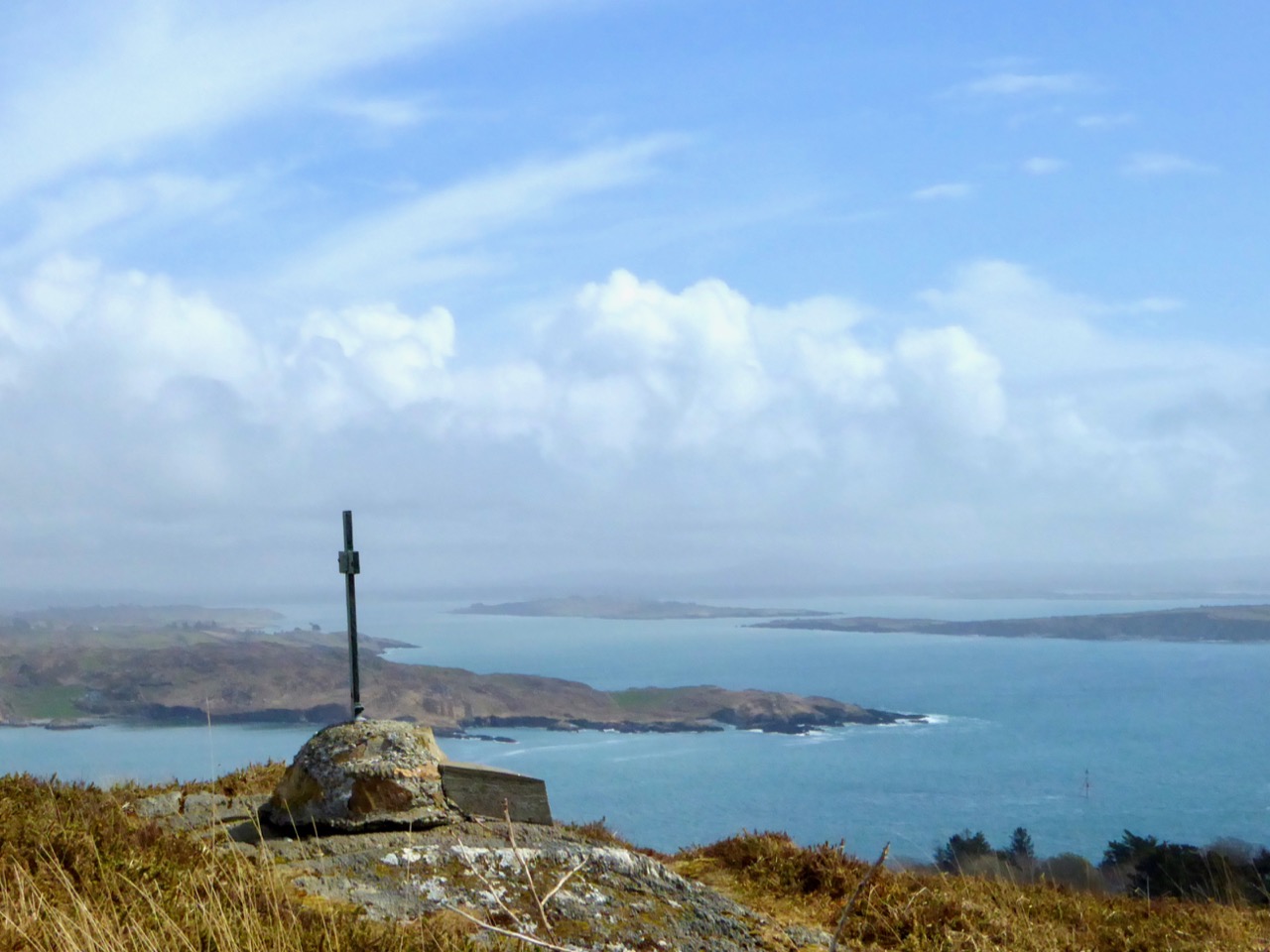
The popular Atlas Obscura defines itself as the definitive guide to off-the-beaten-track and little known wondrous places. So we’ve captured that idea and, as our Christmas present to our readers, bring you our own carefully-curated, slightly eccentric, Roaringwater Journal Guide to West Cork’s Hidden Wonders. Robert’s selection is here. No well-know tourist spots for these posts! No car parks and visitor centres! You may need wellies for some, a good map for others, and, although all are accessible, some may require permission.Each place I recommend will link to a blog post with more information. As an example, Sailor’s Hill, just outside Schull (above) is an easy walk and look what you get at the top! 

This is the view from Brow Head, looking back towards Crookhaven, and Mount Gabriel in the distance. Brow Head is much less visited than Mizen Head, but just as spectacular

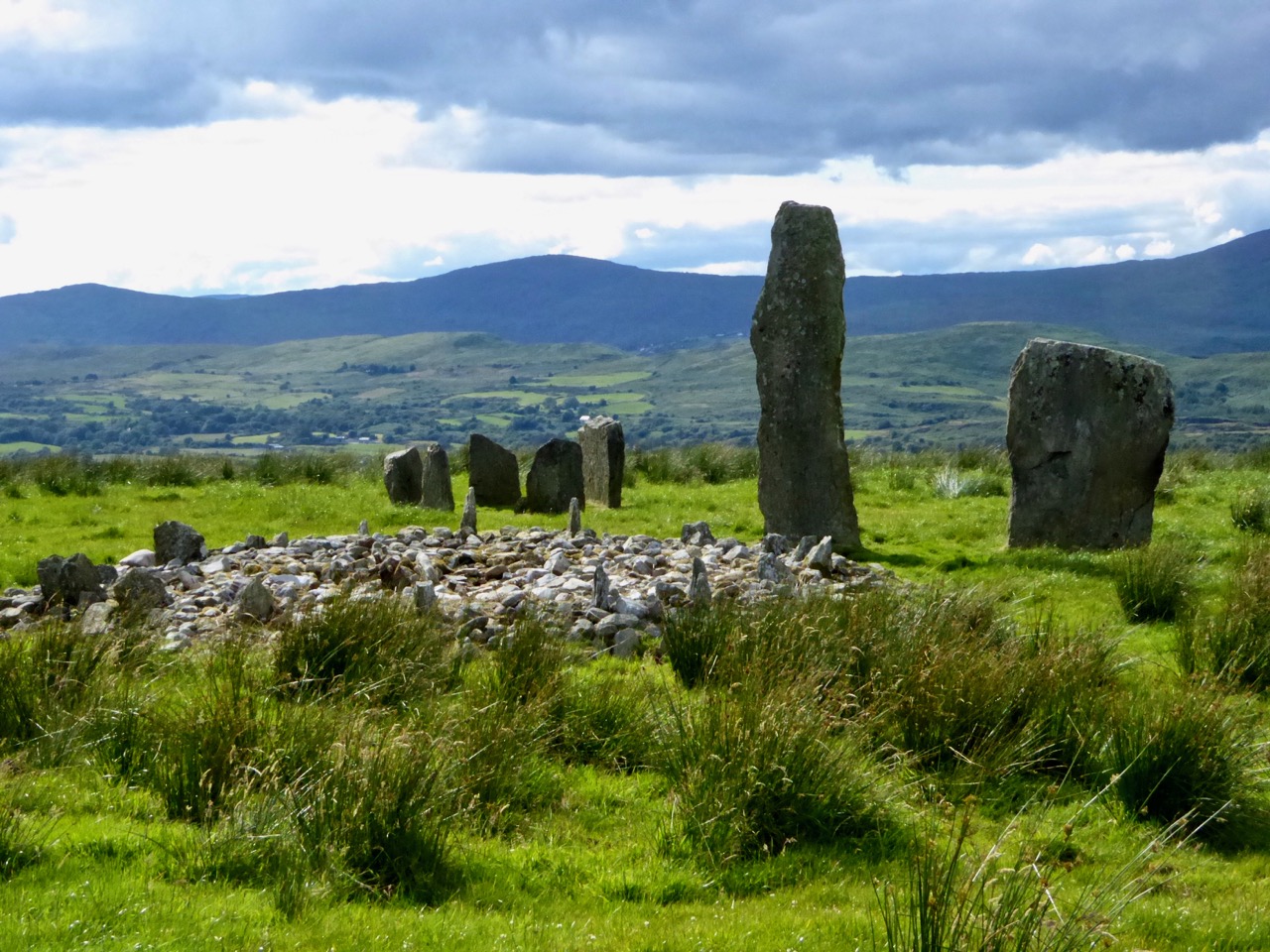
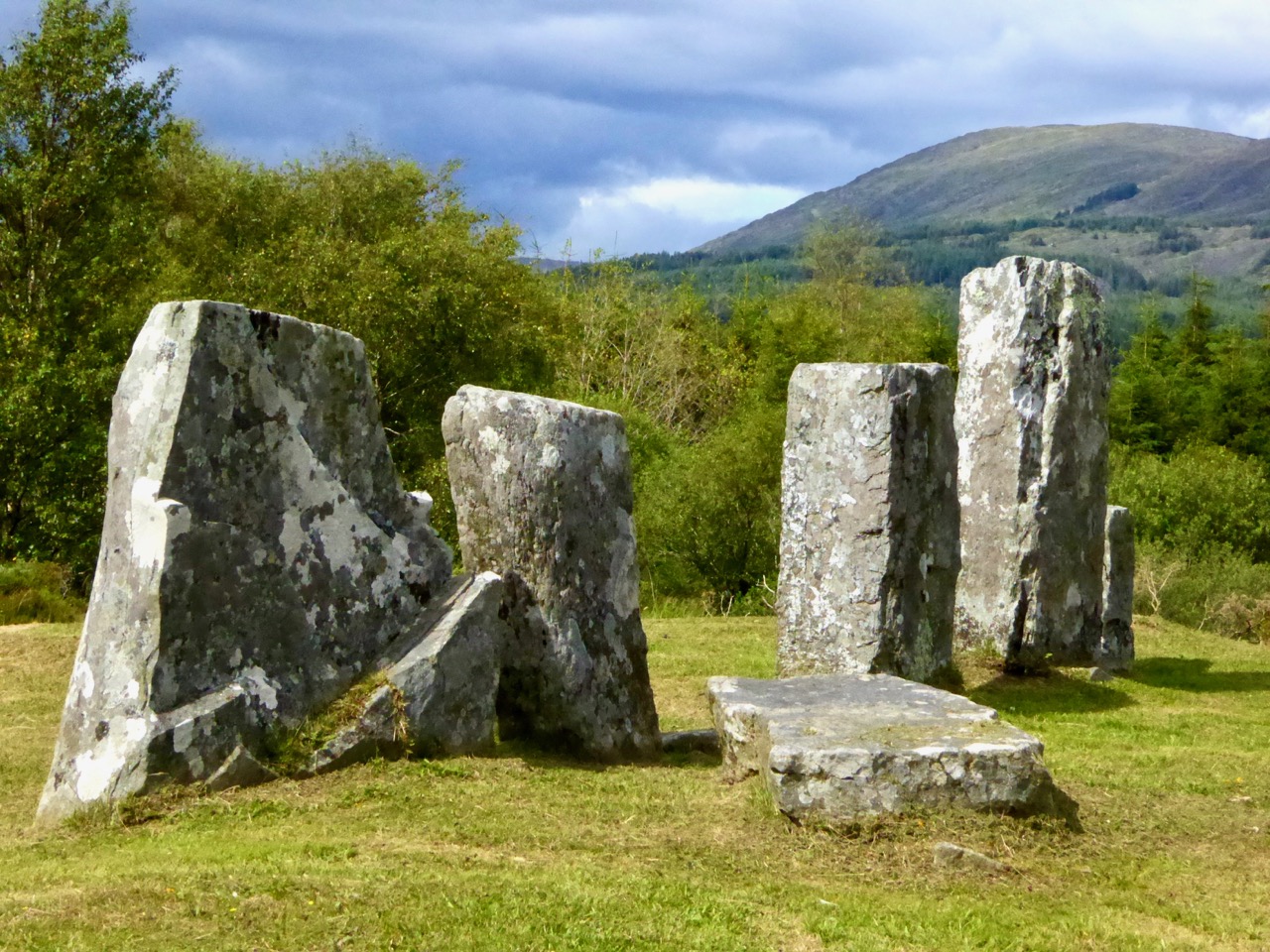
I’m going to start with some archaeology and a couple of spectacular sites. The first is the Kealkill Stone Circle – but this isn’t just a stone circle, it’s a complex of monuments that includes a five-stone circle, a radial cairn (very rare in this part of the world) and two enormous standing stones. The views are immense in every direction, and the site is easy to find.

We all know about Drombeg – and we love it when the sun goes down at the midwinter solstice, and even when it doesn’t. But fewer people know about another stone circle, equally spectacular, with a spring equinox orientation. It’s called Bohonagh and it’s quite a complex. First of all, there’s a boulder burial, with quartz support stones and cupmarks on the boulder. Then there’s a cupmarked stone, partly hidden in the brambles between the boulder burial and the stone circle. Finally, there’s the circle itself, almost complete, with views in all directions.

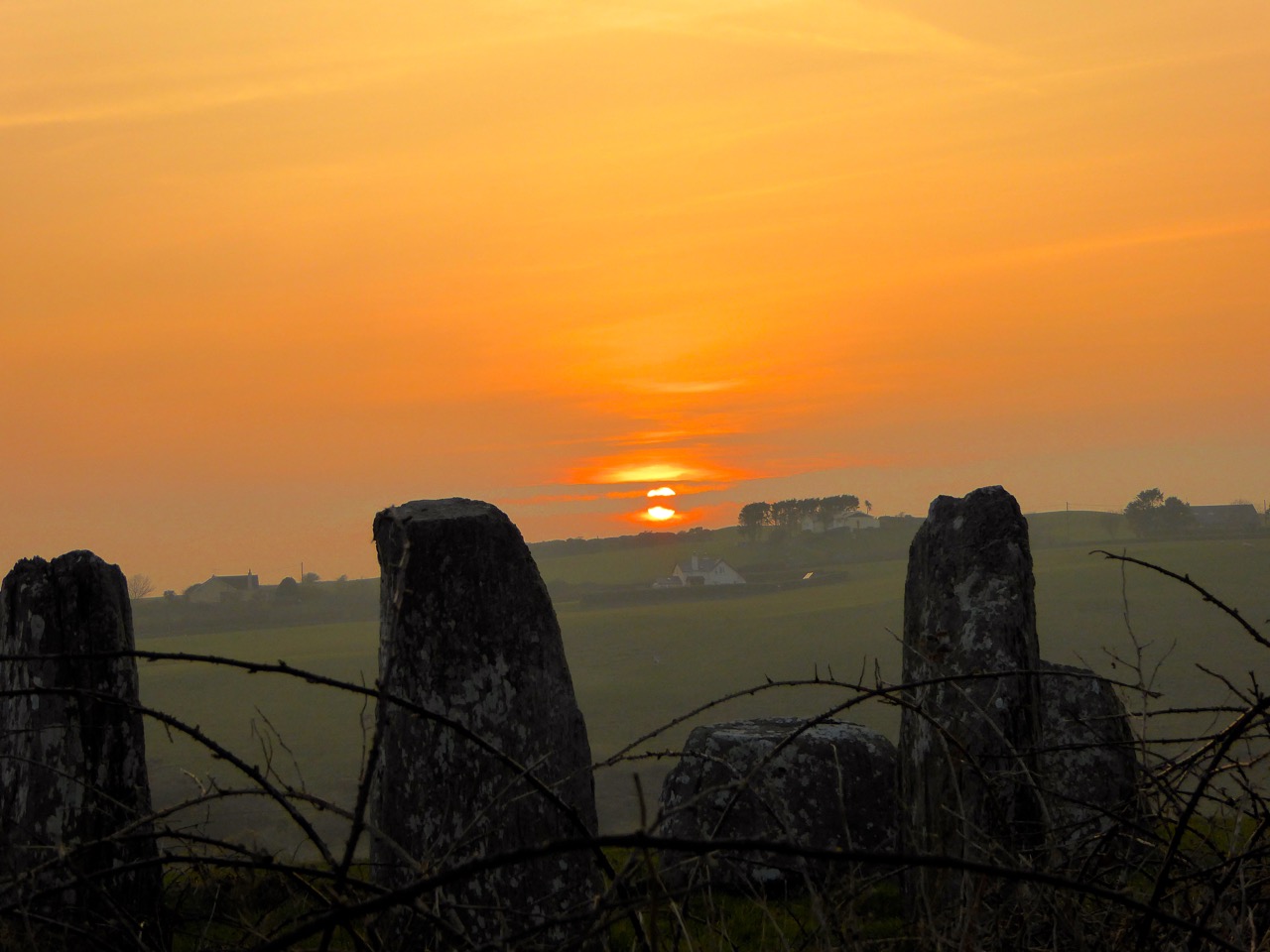
Equinox sunset at Bohonagh

We were lucky to have a session there one equinox, and another one with Ken Williams of Shadows and Stone. For access, park just off the main road, across from the salmon coloured house 4.5km east of Rosscarbery and walk up the farm road to the barns and from there to the top of the hill. This is a working farm – please close all gates and be respectful of animals!

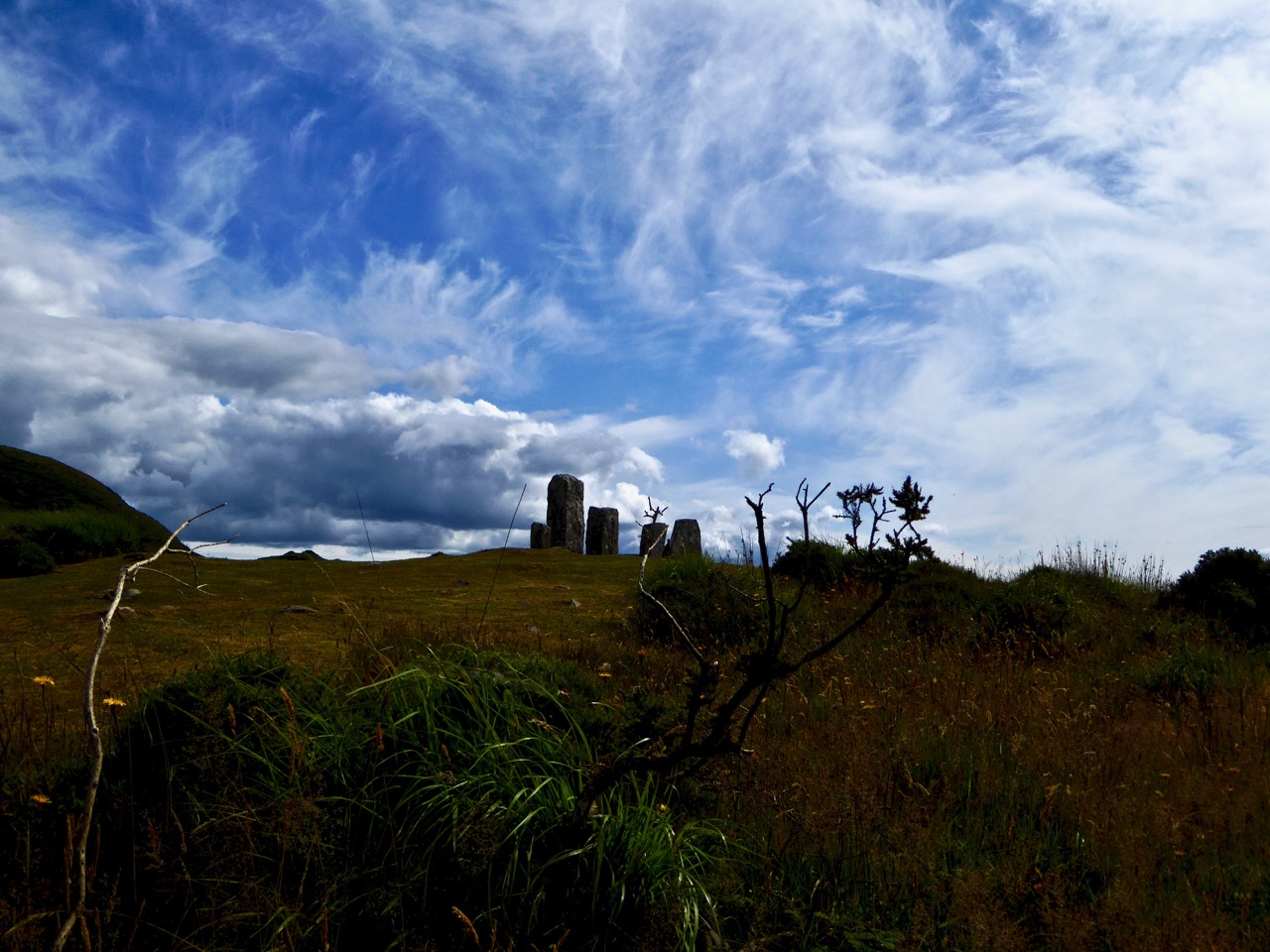
Maughnasilly Stone Row broods on the hilltop

A stone row to round out the archaeology sites – this one is at Maughnasilly and I chose it because it’s been excavated, so there’s an informative sign, access is easy and it’s a beautiful, atmospheric site, overlooking a small lake. The row has been calculated to have both lunar and solar alignments.

And from the ground…

A couple of churches now, beginning with the Church of Ireland Church of the Ascension in Timoleague. This is one of those places that is dripping with unexpected stories. As soon as you go through the door your jaw will drop – the whole church, floor to ceiling, is covered in mosaic, partly paid for by an Indian Maharajah. Read the story here and here – and look carefully at the stained glass windows, some of them are among the oldest stained glass we have in Ireland. The key used to be at the grocery store on the main street, but I’m not sure where it is now, so you may have to ask around. Let us know if you find out.

The interior of the church, and one of the beautiful Clayton and Bell windows

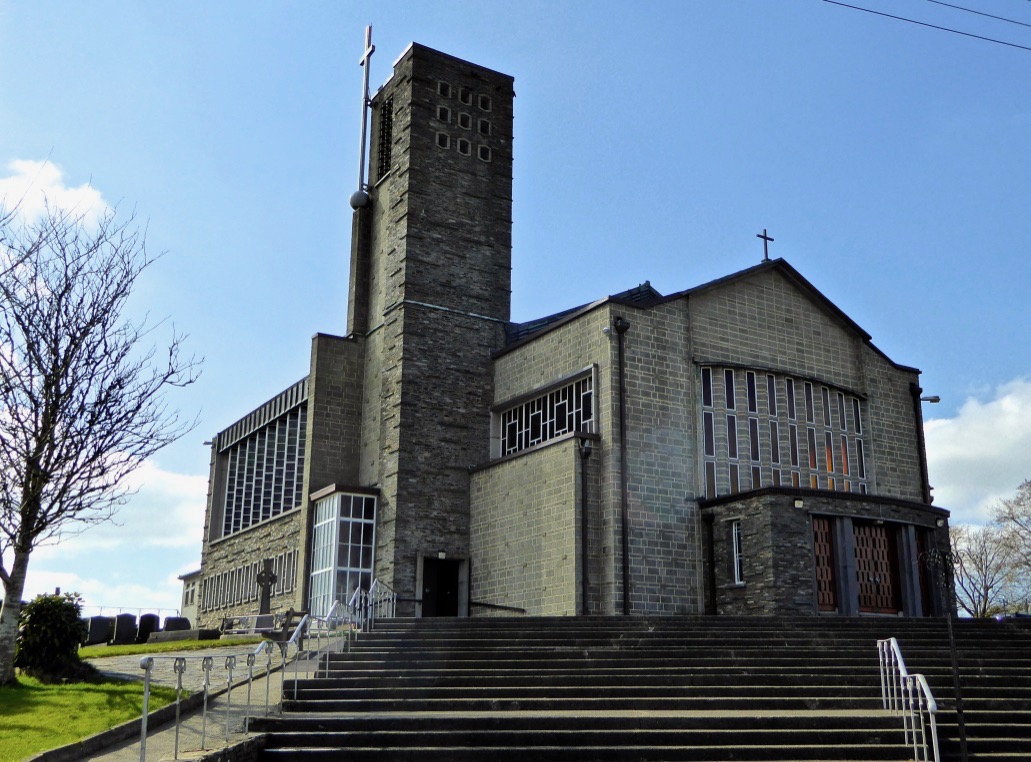
You may wonder at my next choice – it’s not everyone’s cup of tea – but the modernist church in Drimoleague is the work of Frank Murphy, the architect hailed as Cork’s ‘Unsung Hero of Modernism’.

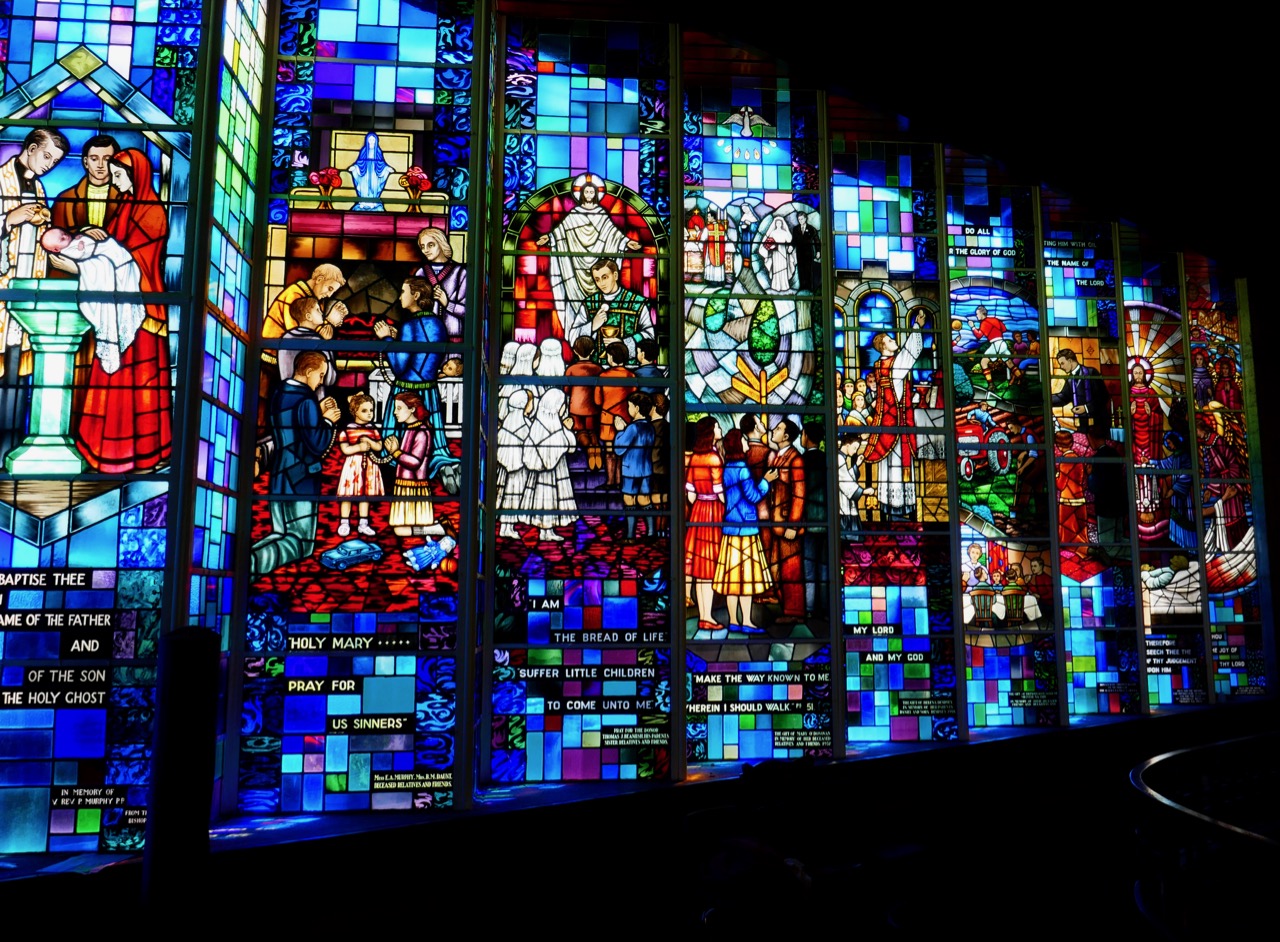
I love the spare minimalist space, very rare in West Cork, but it’s the stained glass windows that drew my attention. It’s not that they are particularly beautiful or skilfully done: they’re by the Harry Clarke Studios long after Harry himself had died. It’s that they fascinate me as a social document – they are, in fact, a prescription for how to live your life as an Irish Catholic in the 1950s. As such, they will resonate with anyone of my vintage. Research by the brilliant young scholar, Richard Butler, has revealed that the design was practically dictated by Archbishop Lucey, still a name to invoke an image of the all-powerful churchman of the 20th century.

And a final church, but this one strictly for the windows. (No – not St Barrahanes in Castletownsend for the Harry Clarkes – everyone knows about them already, and this is a selection of lesser-known wonders.) Do NOT go through Eyeries, on the Beara Peninsula, without stepping into the little church of St Kentigern. Here is where we were first introduced to the work of the stained glass artist, George Walsh.

The Annunciation and Nativity window

When Robert wrote his original post, we couldn’t find out much information on George Walsh, but now he has become a friend and I have written about his work for the next issue of the Irish Arts Review (due out in March, 2019) and spent many happy hours photographing his windows and his artwork around Ireland. It’s bold, graphic, modern and incredibly colourful, and the windows in Eyeries, along with the religious themes, tell the story of Ireland and the Beara through time.

Some places to visit now for a good walk or a swim. First, one of my favourite walks is to hike up to Brow Head, at the end of the Mizen Peninsula (you can drive up too, but pray you don’t meet a tractor coming down) and then walk out to the end of the Head (see the second photo on the post for the view from the top of the road). Stop first to explore the ruins of the old Marconi Station – there’s also a Napoleonic-era  signal station and a WW2 Lookout Post. Then wander through the heather and the low-growing gorse until you get to the part where the sea is crashing below, with vertiginous drops off either side. I will leave it to you how far you go from there!

Brow Head showing the signal station and Marconi station silhouetted against the evening sky

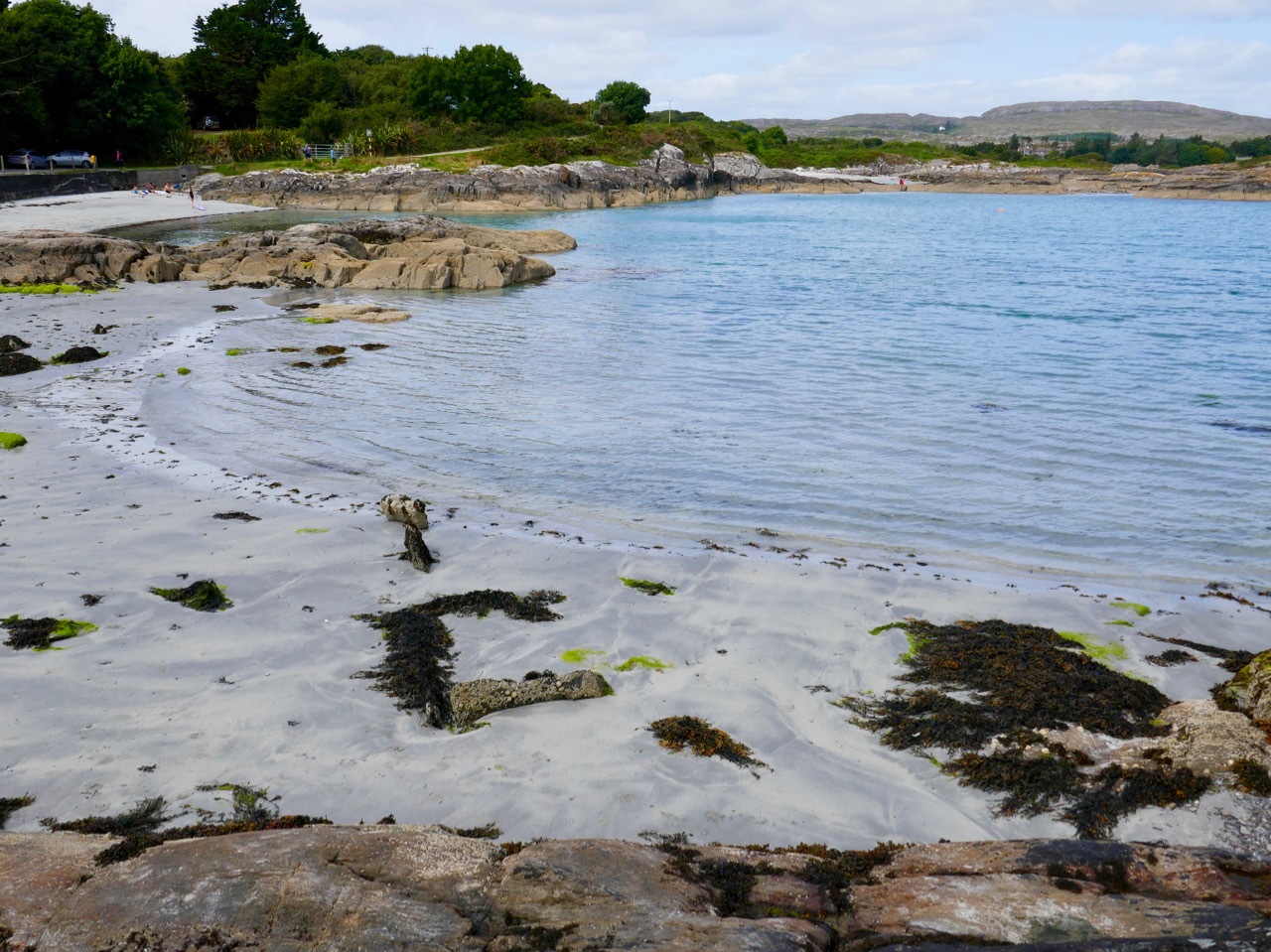
Although Barley Cove is well known, Mizen locals love Ballyrisode Beach for a swim or a lounge in the sun. White sand, sheltered bays, and water warmed by running over the shallow bay. The final little beach holds a secret – a Bronze Age Fulacht Fia or Water-Boiling Site, that Robert and I recorded for National Monuments this summer. It was an exciting find, hiding in plain sight. The beach has an association with pirates too!

Ballyrisode Beach – yes, the water really is this colour. The three sided rectangular stone thing is the fulacht fia

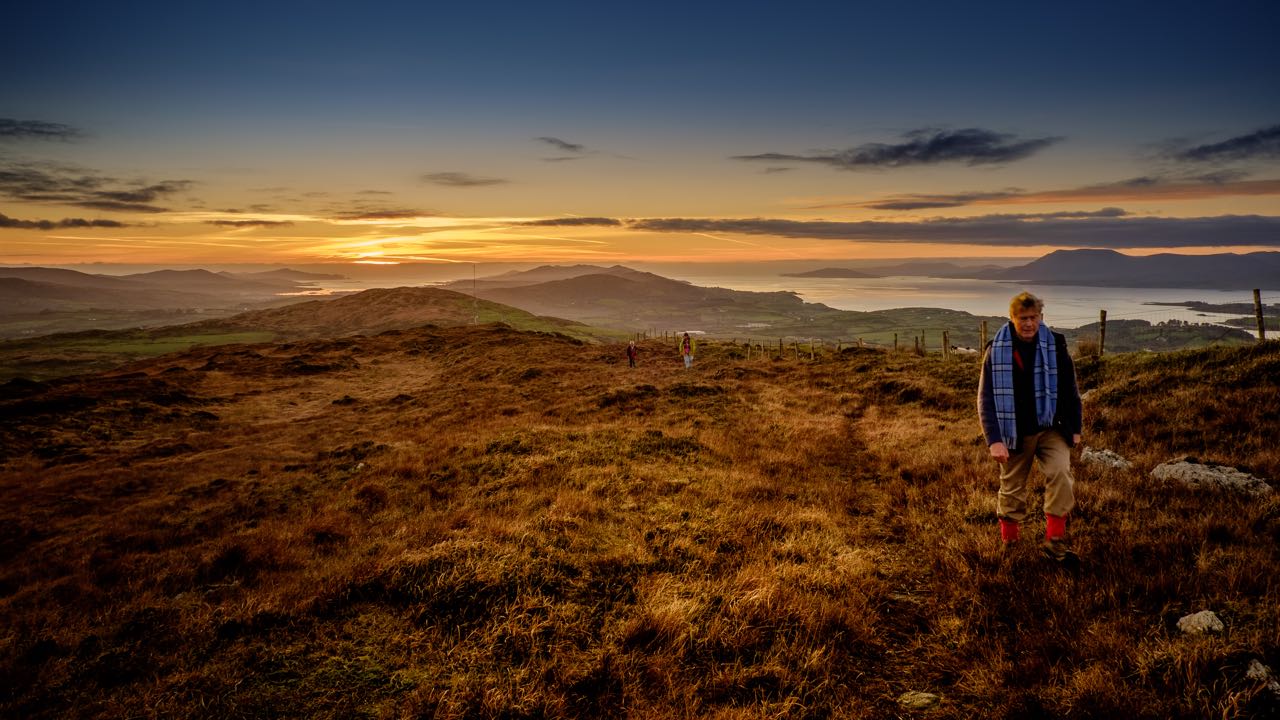
The final choice for a walk is Queen Maev’s tomb, a short hike up from Vaughan’s Pass car park, up behind Bantry. For this photograph I am indebted to Peter Clarke, of the wonderful Hikelines blog. He and Amanda (with whom we have explored SO many holy wells)  were our companions that day. When you reach the top there is a small wedge-tomb, but this is one place where the journey is the real story, with the Mizen, the Sheep’s Head and the Beara all spread out before you.

Photograph © Peter Clarke

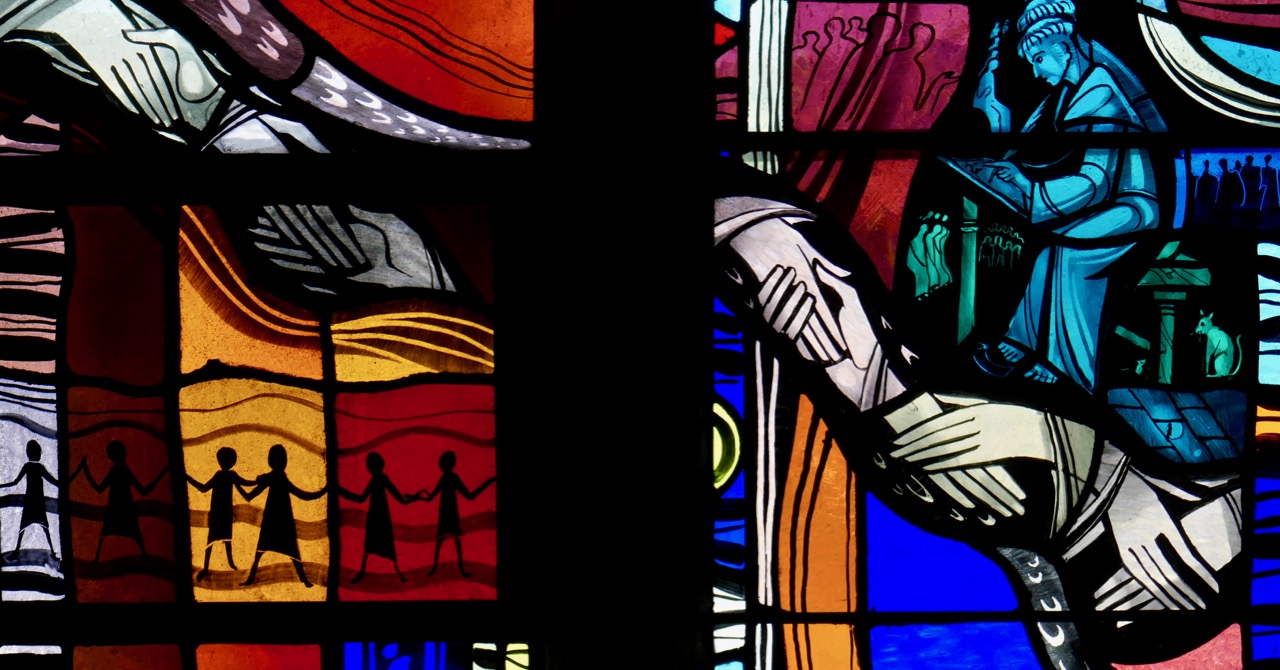
I leave you with a detail from the George Walsh windows in Eyeries, together with the poem the scene is based on, Pangur Bán, written in the 9th century by an Irish  monk labouring away in a scriptorium in Europe. Here is the poem read, at a memorial service for Seamus Heaney, first in the original Old Irish and then in Heaney’s translation.

Merry Christmas from us! If you live here, get out and about this year to some of our picks, and if you don’t, come see us soon!

Looking for Patrick

Patrick lights the Paschal Fire on the Hill of Slane. Richard King window, Church of St Peter and Paul, Athlone

A joint post – text by Robert, images by Finola

Last week we talked about Ireland’s very first saint – Ciarán (or Piran), who was born on Cape Clear. His aim in life was to convert the heathen Irish to Christianity, but they were having none of it: they tied him to a millstone and hoisted him over the edge of a cliff. Fortunately – and miraculously – the wondrous millstone floated him over to Cornwall where he became their Patron Saint and is celebrated with great acclaim on March 5th every year.

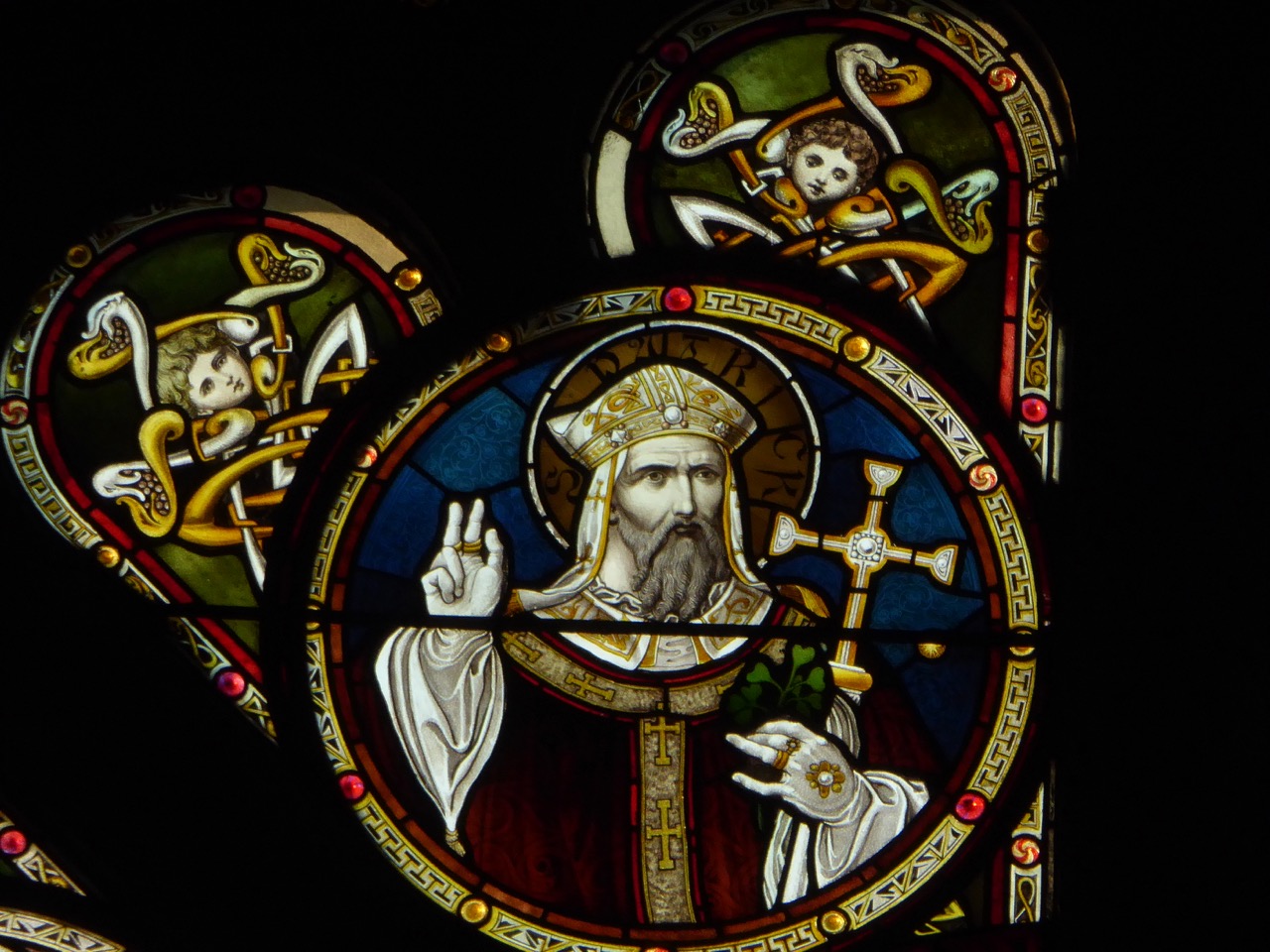
A typical representation of Patrick, older and bearded, in bishop’s robe, holding a shamrock in one hand and a crozier on the other. Skibbereen Cathedral

To return the favour of gaining an important saint from Ireland, the British have given Ireland their special saint – Patrick – and he is being celebrated this week in similar fashion. So here’s the story of Saint Patrick, seen through the eyes of an Englishman (albeit one with Cornish connections) and illustrated by Finola with a series of images from her collection.

Still traditional – looking fierce – but this one has beautiful detailing, including the interlacing surrounding the cherubs. St Carthage Cathedral, Lismore

Of course, there’s the real Patrick – the one we know through his own Confessio. The best summary we’ve come across of what can be deduced from the historical documents is the audio book Six Years a Slave, which can be downloaded from Abarta Heritage, and which is highly recommended (be warned – no snakes!). But what you’re going to get from me today is the good old-fashioned Patrick, with all his glamour and colour and centuries of accrued stories – just as he’s shown in Finola’s images.

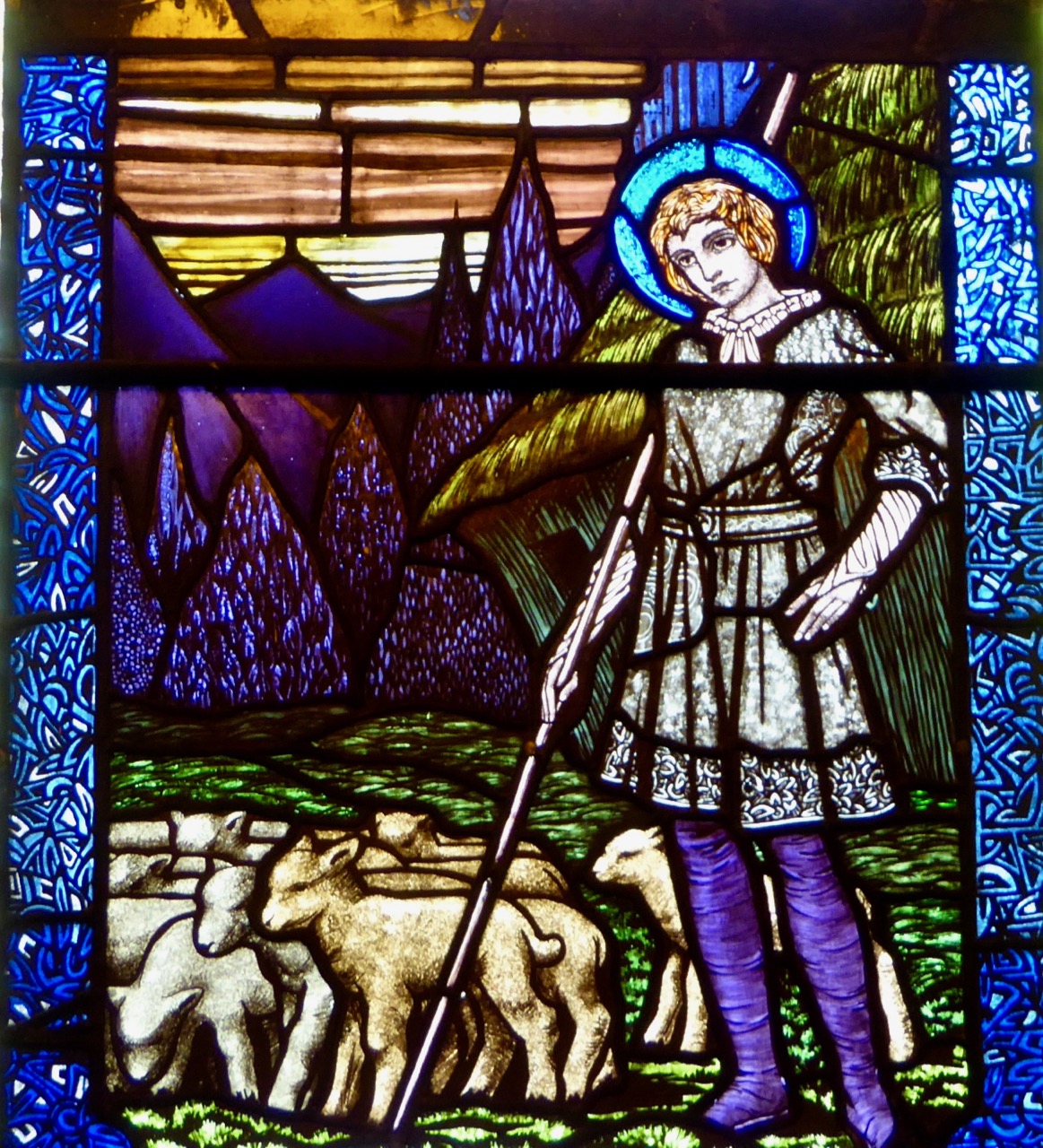
Six Years a Slave – this Harry Clarke window in the Church of The Assumption, Tullamore, seems to depict Patrick tending sheep during the period of his captivity

Patrick was born and brought up somewhere in the north west of Britain. He was of Romano British descent: his father was a a decurion, one of the ‘long-suffering, overtaxed rural gentry of the provinces’, and his grandfather was a priest – the family was, therefore, Christian. In his own writings Patrick describes himself as rustic, simple and unlearnèd.  When still a boy, Patrick was captured by Irish pirates and taken to be a slave in Ireland. He was put to work on a farm somewhere in the west and spent the long, lonely hours out in the fields thinking about the Christian stories and principles he had been taught back home.

Patrick is visited by a vision – the people of Ireland are calling to him to come back and bring Christianity to him. Richard King window, Church of St Peter and Paul, Athlone.  Read more about Richard King and the Athlone windows in Discovering Richard King

After six years he escaped from his bondage and made his way back to Britain – apparently by hitching a lift on a fishing boat. Because he had thought so much about Christianity during those years away, he decided to become a bishop which, after a few years of application, he did. Although he had hated his enforced capture he was aware that Ireland – as the most westerly outpost of any kind of civilisation – was one of the only places in the known world that remained ‘heathen’, and he was nagged by his conscience to become a missionary there and make it his life’s work to convert every Irish pagan.

Detail from Patrick window by Harry Clarke in Ballinasloe

When you see Patrick depicted in religious imagery he always looks serious and, perhaps, severe. You can’t imagine him playing the fiddle in a session or dancing a wild jig at the crossroads. In fact he was well know for his long sermons: on one occasion he stuck his wooden crozier into the ground while he was preaching and, by the time he had finished, it had taken root and sprouted into a tree!

Patrick with his hand raised in a blessing, accompanied by his symbols of the Paschal Fire and the shamrock. Harry Clarke Studio window, Bantry

Perhaps it was his severity that caused him to be respected: while giving another sermon (at the Rock of Cashel) he accidentally and unwittingly put the point of his crozier through the foot of the King of Munster. The King waited patiently until Patrick had finished sermonising then asked if it could be removed. Patrick was horrified at what he’d done, but the King said he’d assumed it was all part of the initiation ritual!

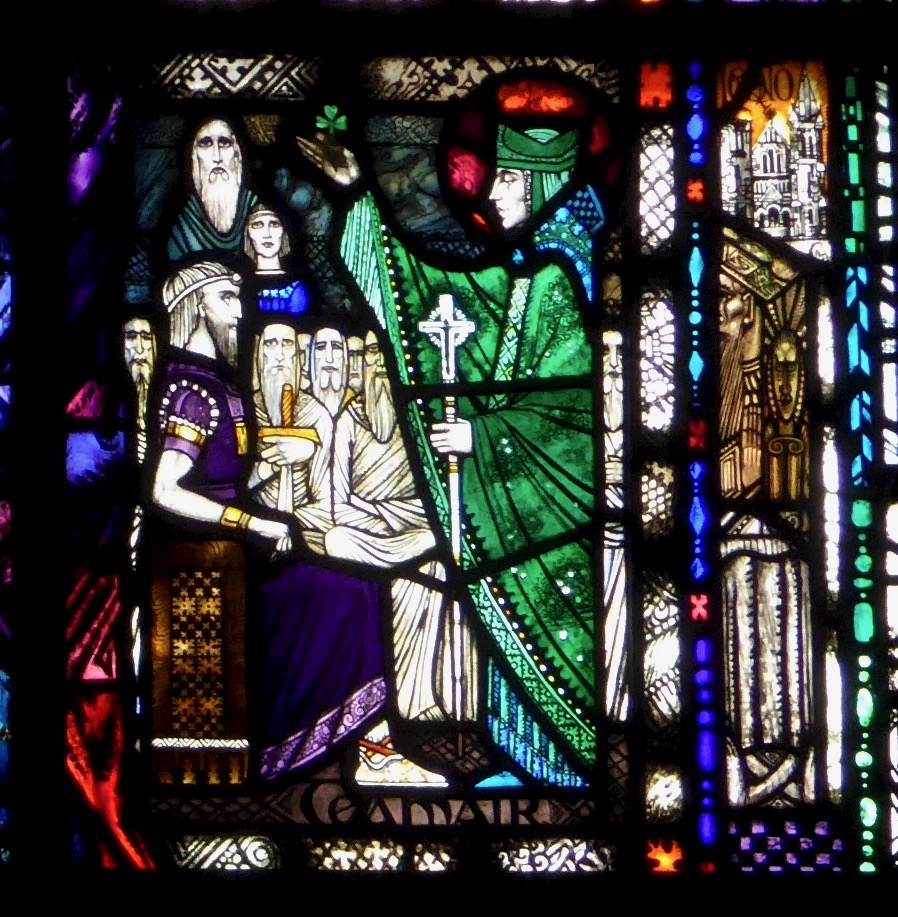
In Richard King’s enormous Patrick window in Athlone, the saint is depicted as youthful and clean-shaven. Here he is using the shamrock to illustrate the concept of the Trinity

Patrick first landed on the shores of Ireland just before Easter in 432 AD and established himself on the Hill of Slane – close to the residence of the High King. In those days the rule was that only the King himself was to light the Bealtaine Fire to celebrate the spring festival, but Patrick pre-empted this by lighting his own Paschal Fire on the top of the hill, thus establishing his authority over that of the High King (see the first image in this post). Somehow, he got away with it – and the fire has been lit on the top of the Hill of Slane every Easter from that day to this.

Another panel from the Richard King window – Eithne and Fidelma receive communion from Patrick. They were daughters of the King of Connaught; Eithne was fair-haired and Fidelma a redhead, and they were baptized at the Well of Clebach beside Cruachan

St Patrick seems to have been everywhere in Ireland: there are Patrick’s Wells, Patrick’s Chairs (one of which in Co Mayo – the Boheh Stone – displays some fine examples of Rock Art), Patrick’s Beds and – on an island in Lough Dergh – a Patrick’s Cave (or ‘Purgatory’) where Jesus showed the saint a vision of the punishments of hell.

Patrick blesses St Mainchin of Limerick. Detail from the Mainchin window in the Honan Chapel, by Catherine O’Brien for An Túr Gloinne

The place which has the most significant associations with Patrick, perhaps, is Croagh Patrick – the Holy Mountain in County Mayo, on the summit of which the saint spent 40 days and 40 nights fasting and praying, before casting all the snakes out of Ireland from the top of the hill – an impressive feat. To this day, of course, there are no snakes in Ireland – or are there? See my post Snakes Alive for musings on this topic (it includes a most impressive window from Glastonbury!)

Like many Patrick windows, this one, By Harry Clarke in Tullamore, shows Patrick banishing the snakes. This one has all the gorgeous detailing we expect from Clarke, including bejewelled snakes

When Patrick considered that he’d finished his task, and the people of Ireland were successfully and completely converted, he returned to Britain and spent his retirement in the Abbey of Glastonbury – there’s a beautiful little chapel there dedicated to him.

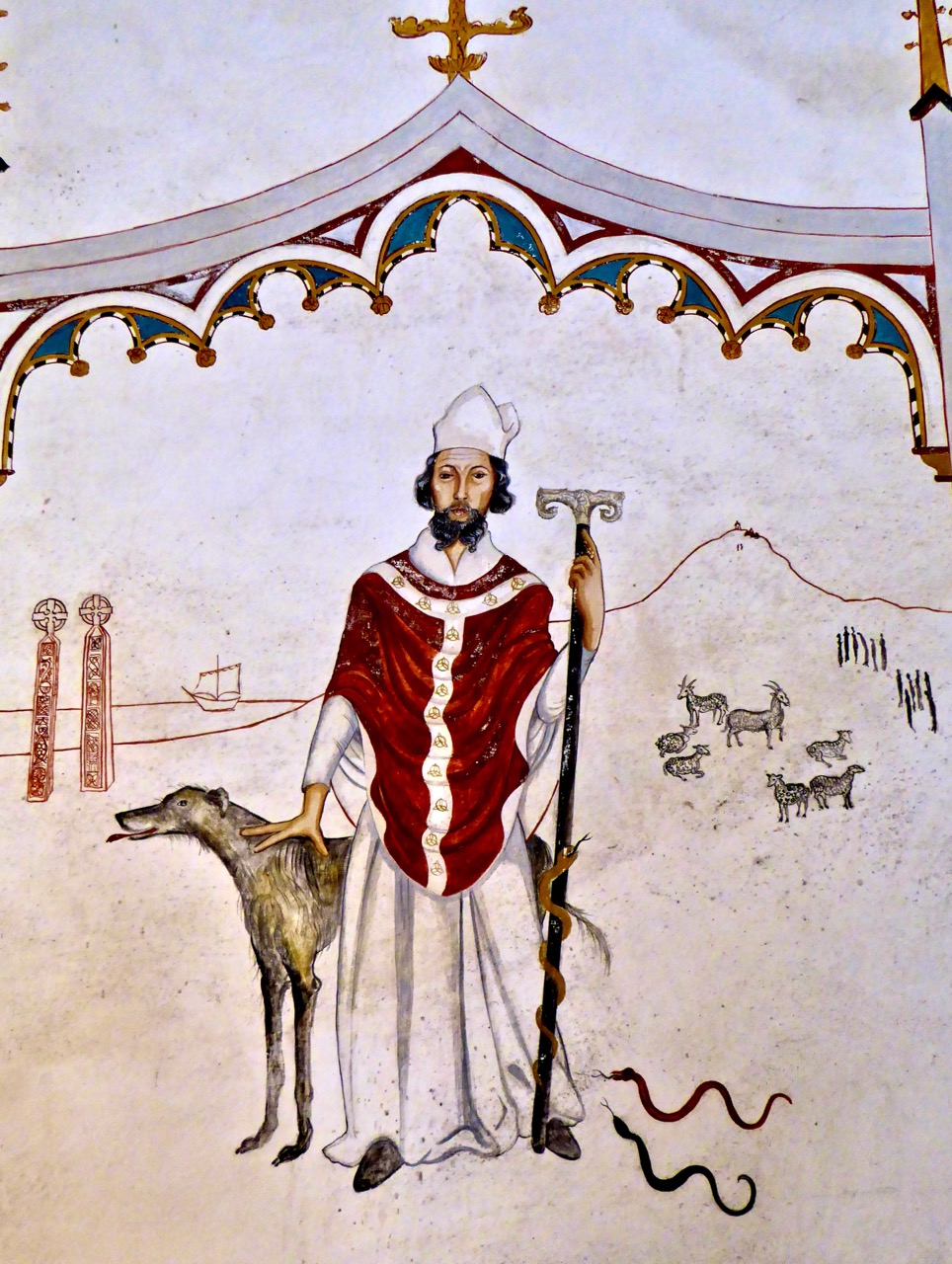
This depiction of Patrick on the wall of his Glastonbury chapel shows him with familiar symbols but also several unusual symbols – an Irish wolfhound, high crosses, and Croagh Patrick, the holy mountain

It’s logical he should have chosen that spot to end his days as it must be the most blessed piece of ground in these islands, having been walked upon by Jesus himself who was taken there as a boy by his tin-trading uncle, Joseph of Arimathea. St Bridget joined Patrick there in retirement and they are both buried in the Abbey grounds, along with the BVM who had preceded them to that place a few centuries earlier.

From the George Walsh window in Eyeries, Patrick returns to convert the Irish

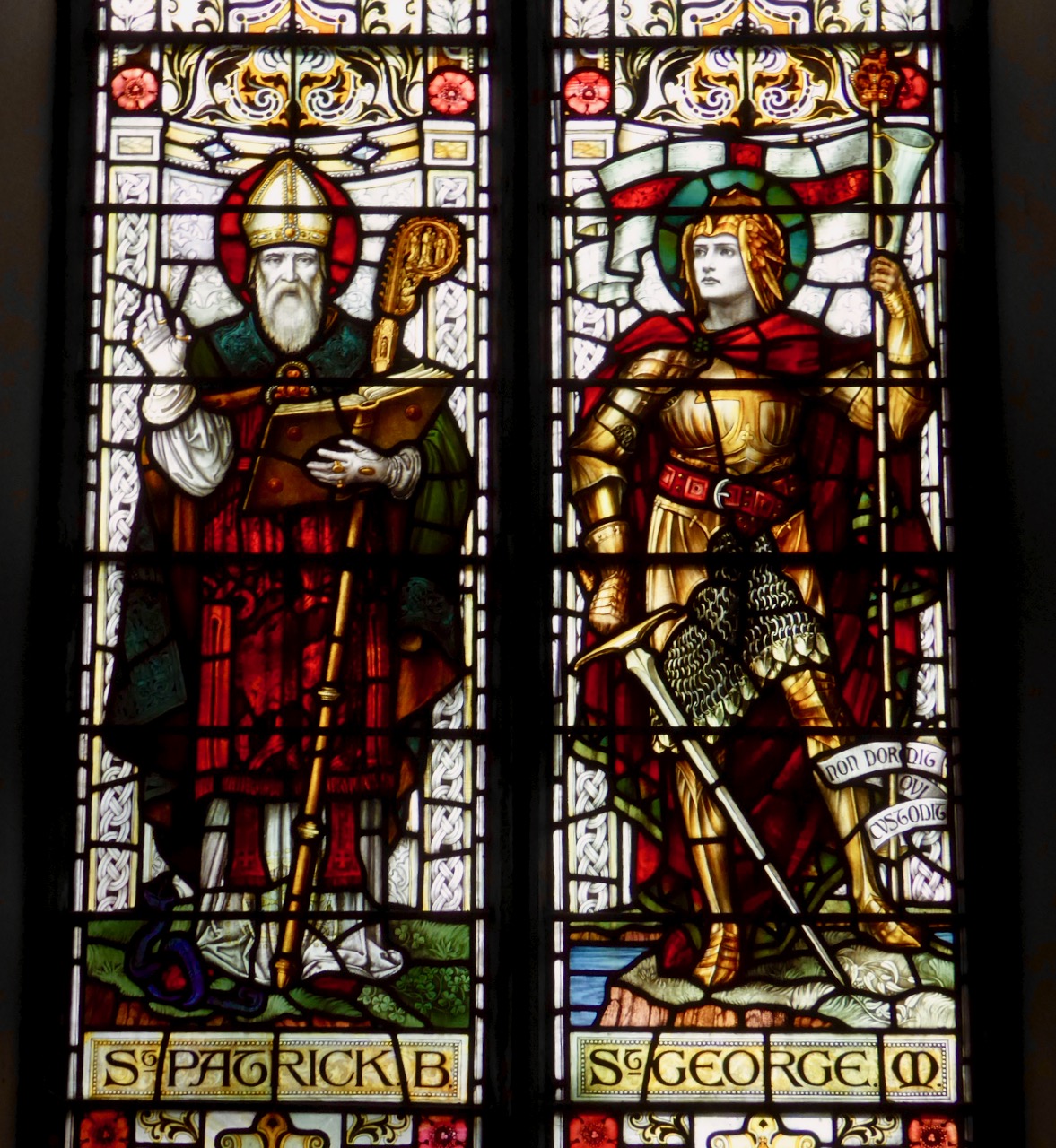
A depiction of Patrick below comes from St Barrahane’s Church of Ireland in Castletownsend where he is shown alongside St George. The window dates from before Irish independence and is an attempt to show the unity of Britain and Ireland through their respective patron saints. Perhaps meant to represent friendship between the countries, nevertheless nowadays it seems to display a colonial overtone that is an uncomfortable echo of past mores.

The window is by Powells of London and dates to 1906

So let’s leave Patrick doing what he came back to do – a last panel from the Richard King window in Athlone shows him performing his saintly task of converting the Irish – one chieftain at a time.