Seán Keating – Escaping the Storm

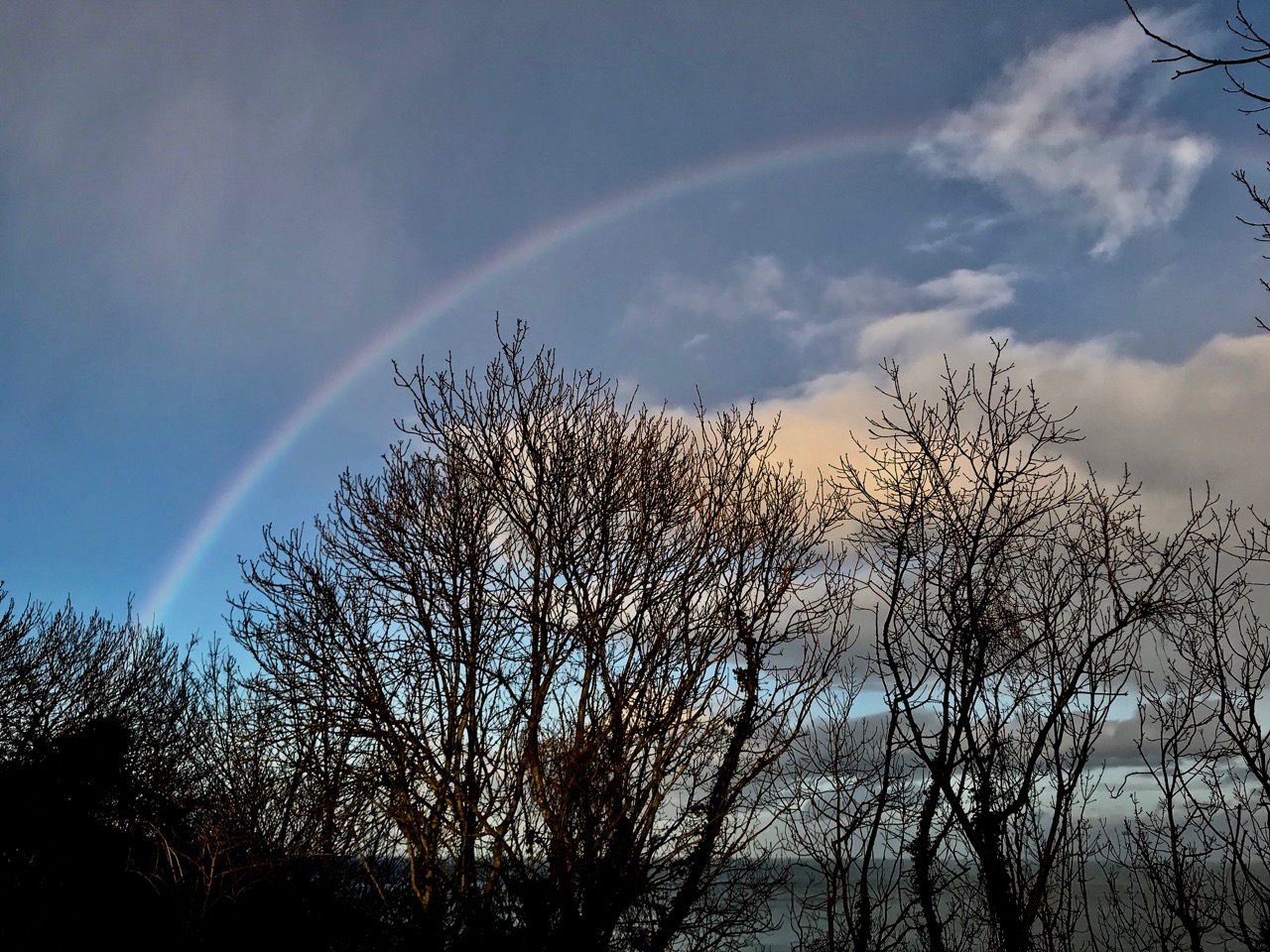
Storm Ciara was upon us as we headed over to the east coast – a mere few hops from Nead an Iolair. But it wasn’t all black clouds and thunder and lightning: winter storms here in Ireland feature high winds and spectacles such as this rainbow (above) which seemed to hang in the sky over County Wicklow for hours. When the rain comes, we often find refuge in a church – especially if it helps Finola’s quest for new stained glass windows. Sometimes they seem to reflect the weather patterns:

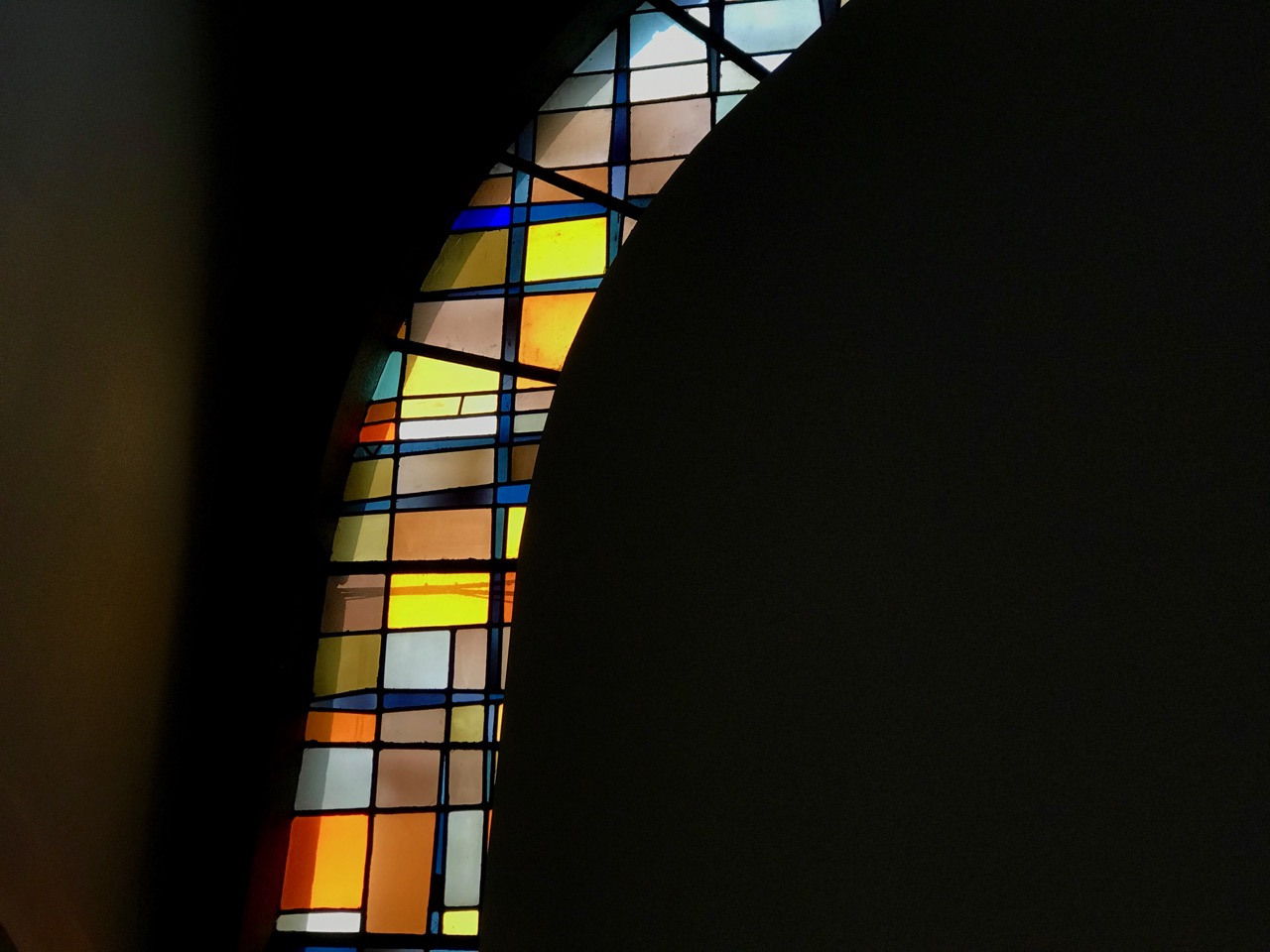
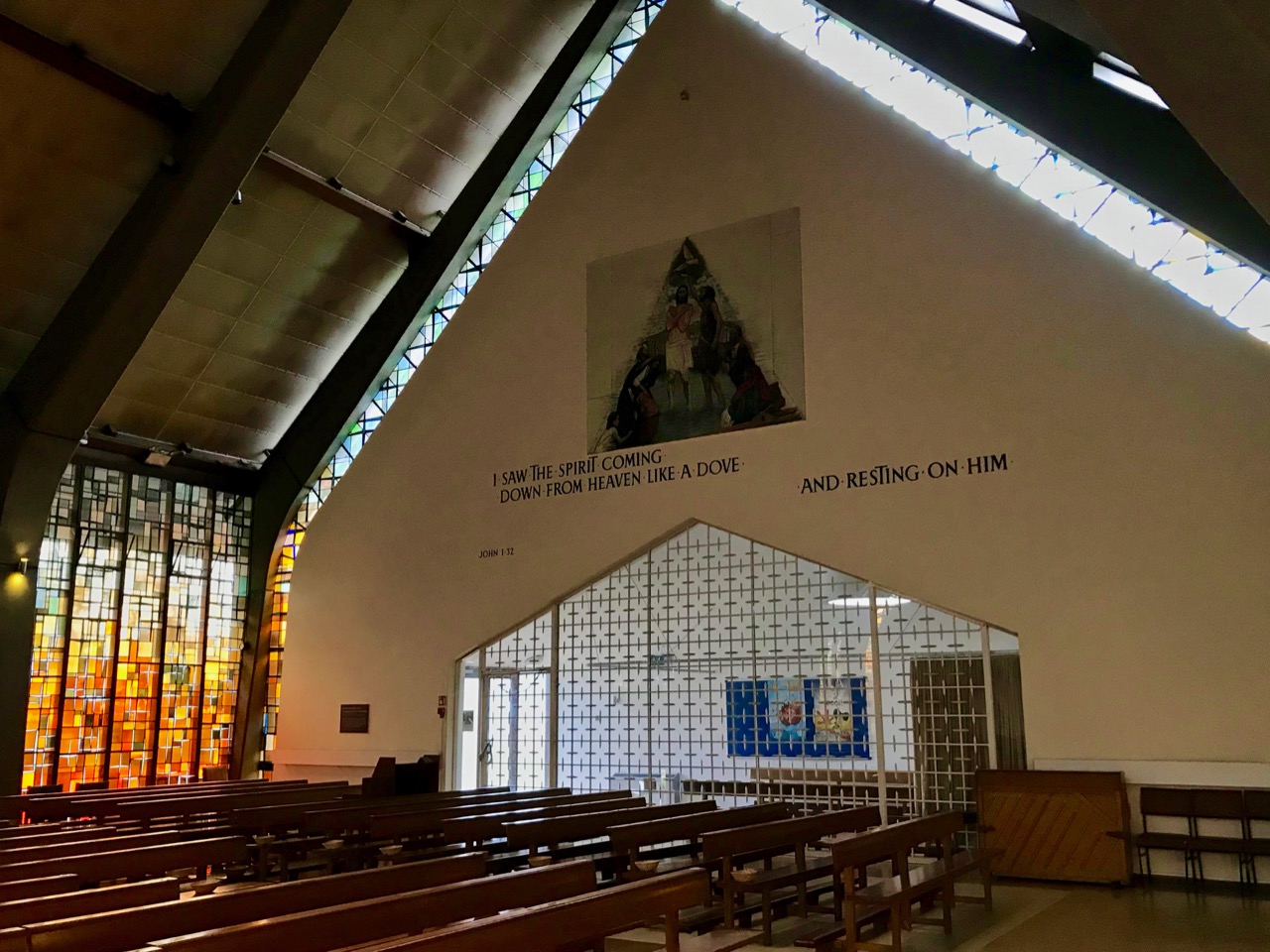
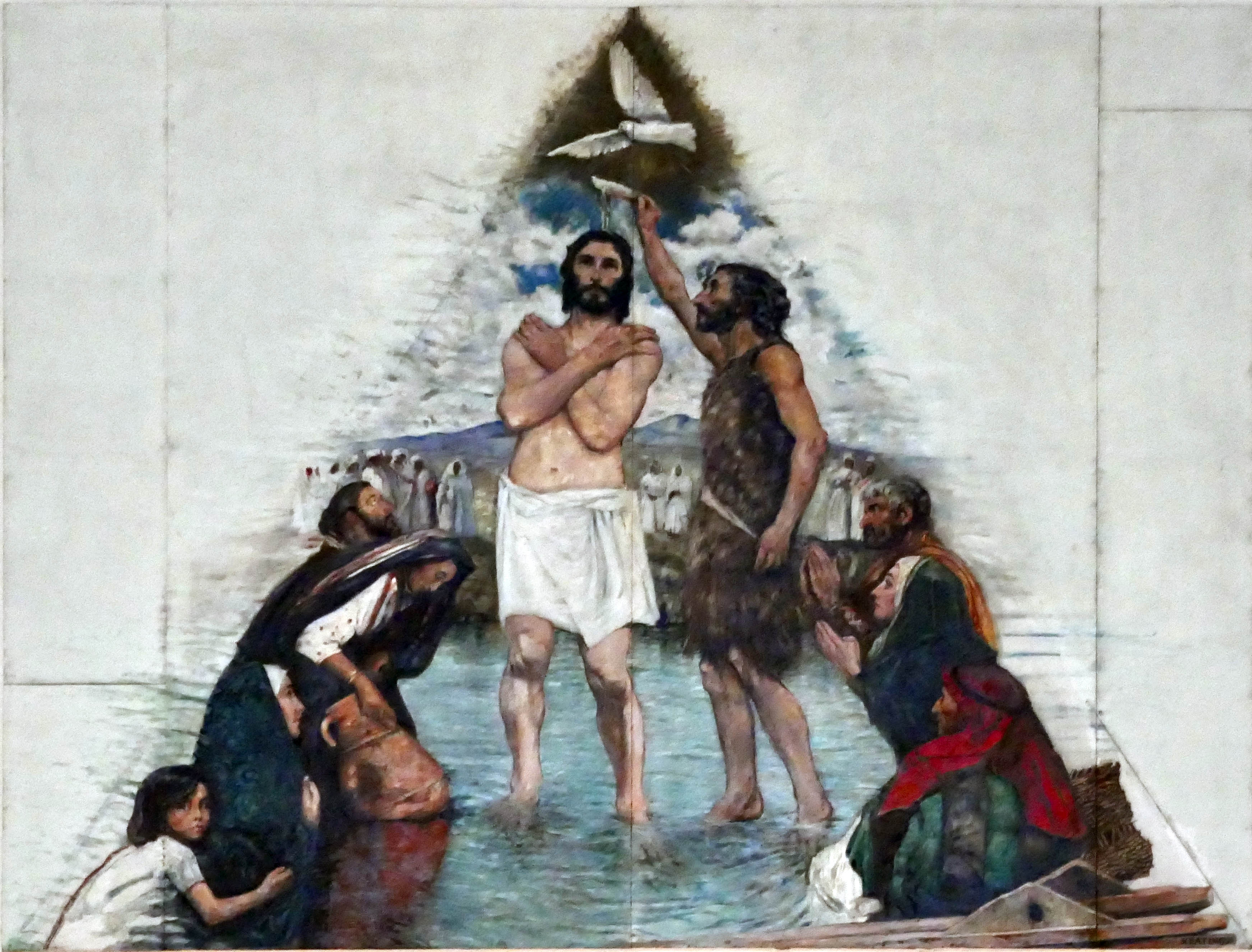
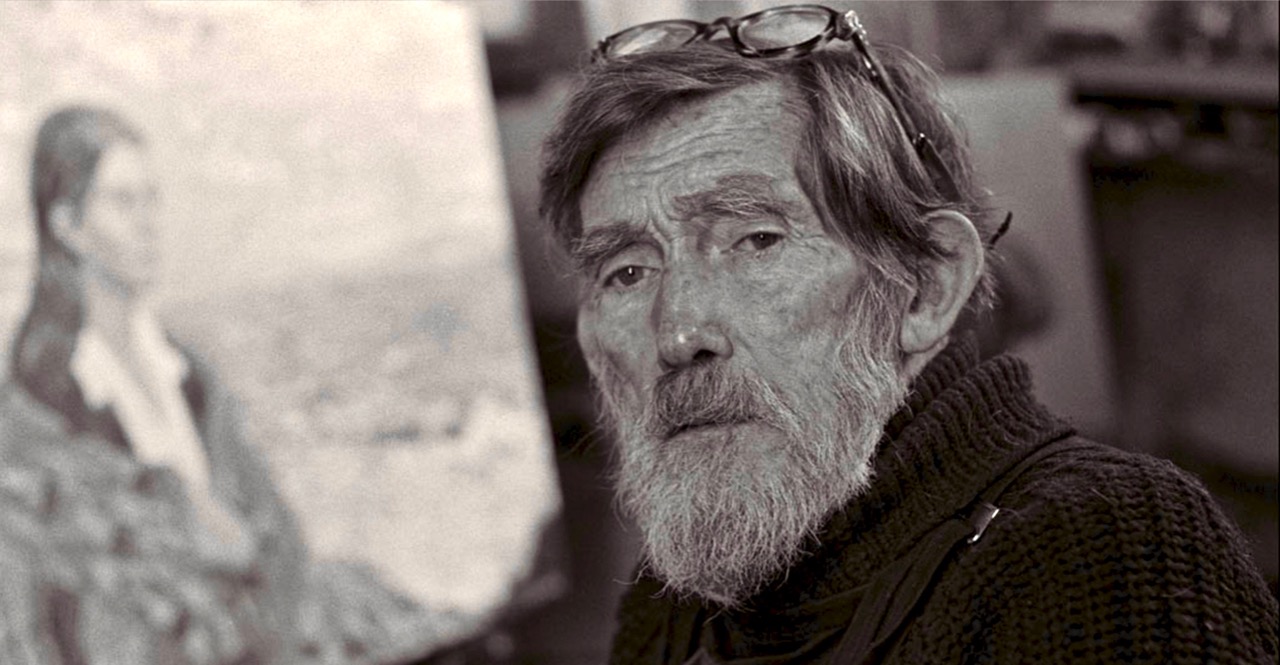
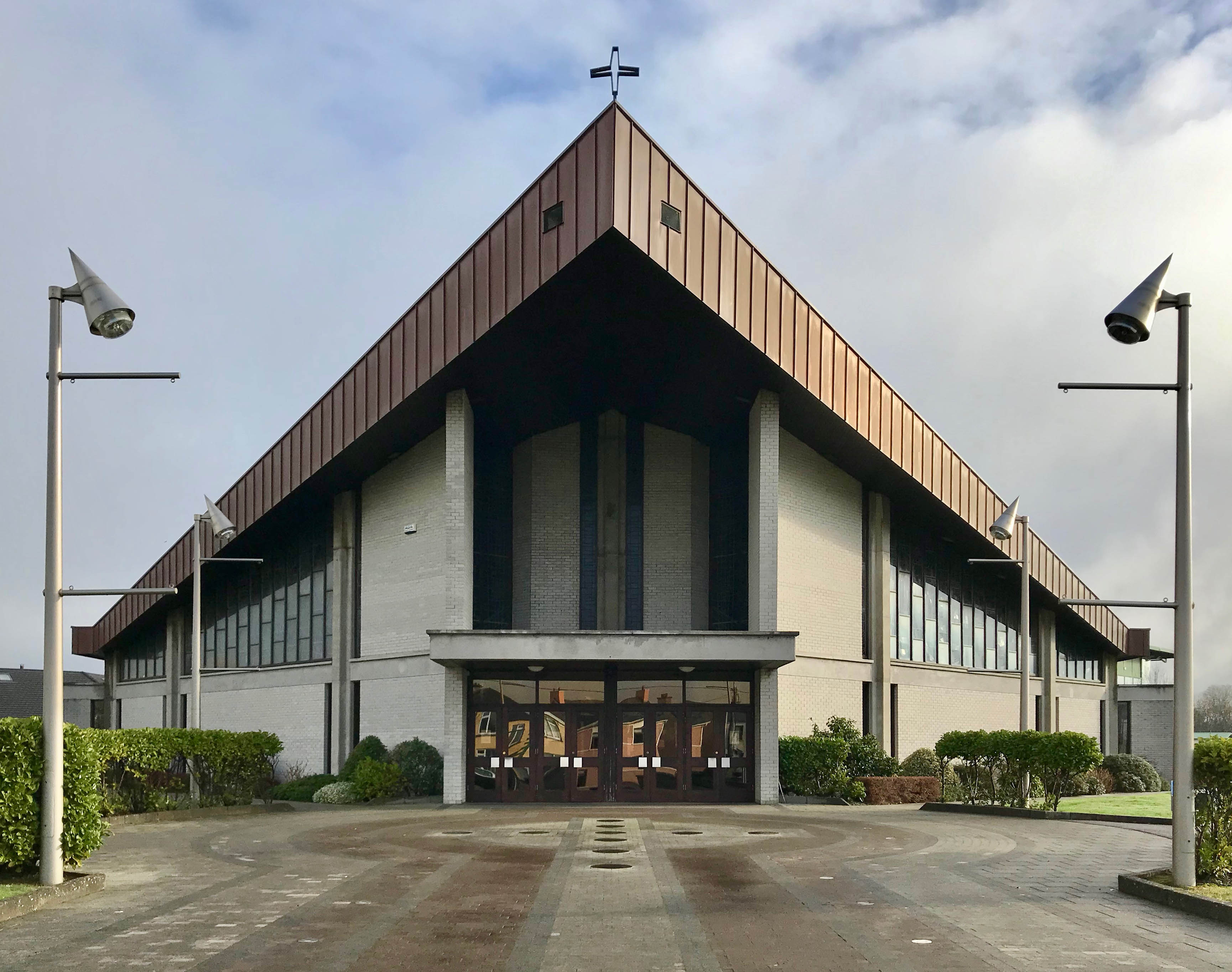
This panel, which could be seen as an indoor rainbow, is in an impressively large church in Ballyroan, Rathfarnham Parish, County Dublin: it was built in 1967 to seat a thousand. What caught my eyes was not the array of windows by Murphy Devitt (Finola has written extensively about this creative partnership), but two murals high on the walls of the crossing. I was delighted to find that these were painted by one of Ireland’s great artists working through the turbulent twentieth century – Seán Keating.

Seán Keating’s ‘Baptism of Christ’ mural in the Church of the Holy Spirit, Ballyroan

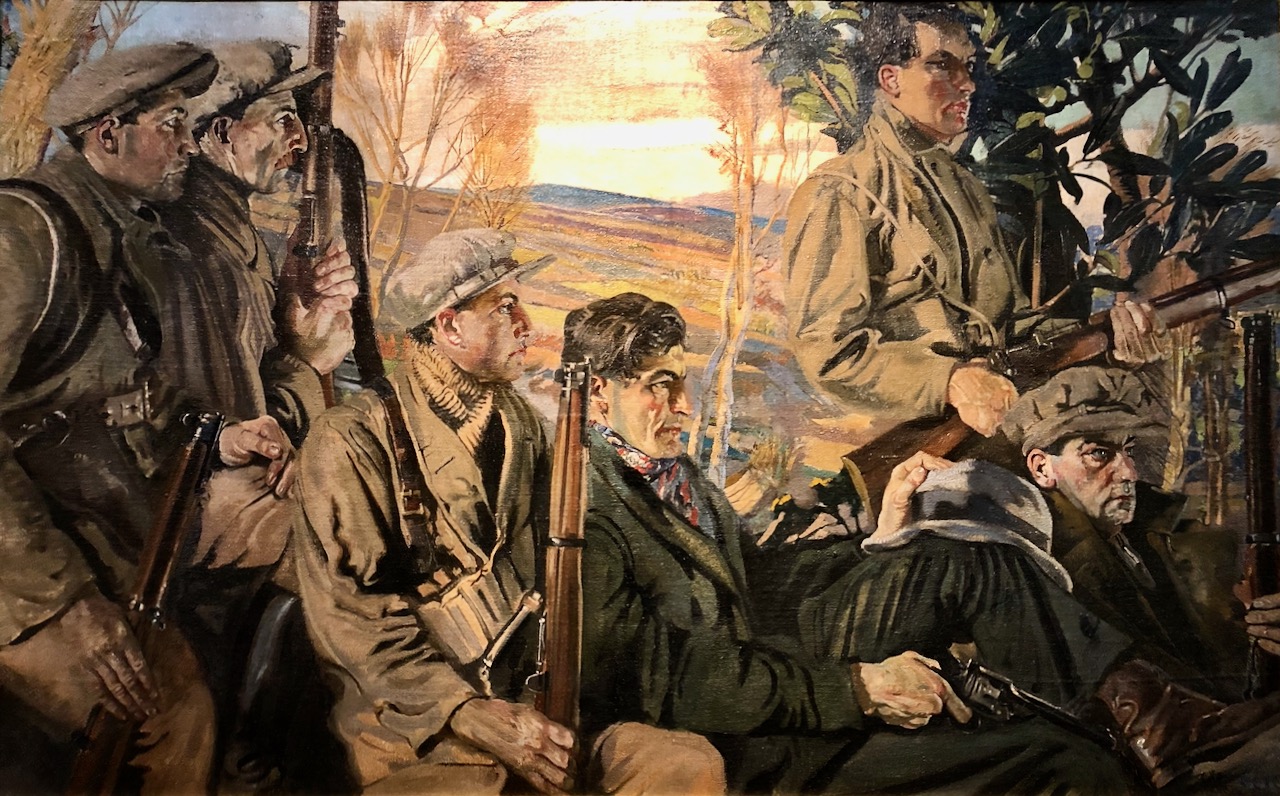
I am always surprised to find that Keating is under-appreciated: yes, he gets mentioned in books of art history, and is reasonably well represented in the state’s galleries. Yet you will also find terms such as ‘not great art’ applied to his work by critics and commentators. This is possibly because he is best known for his documentary work and, particularly, for his raw representations of the tempestuous years of Ireland’s struggle to gain independence. Here is ‘Men of the South’, dating from 1921 when there was a ceasefire in the Irish War of Independence while the Anglo-Irish Treaty was being negotiated and out of which the Irish Free State was born.

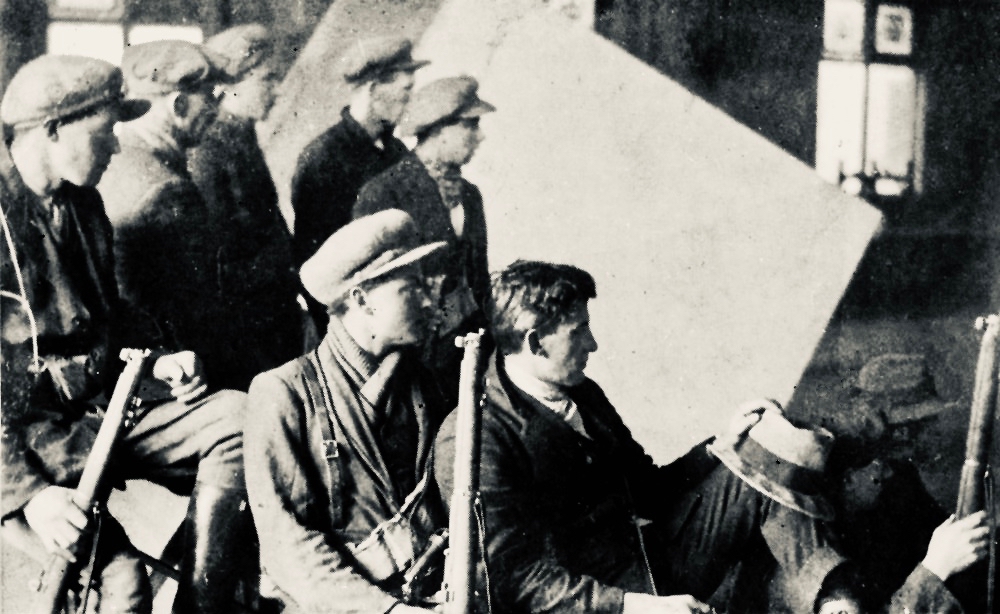
Top: Men of the South – Seán Keating’s documentary portrayal of the North Cork Brigade of the Irish Republican Army. Below the painting is one of the photographs taken in Keating’s Dublin studio in preparation for the work. Two versions of this painting were made by the artist: the one above is in the Crawford Gallery, Cork City, while the other (which depicts eight men) is now in Áras an Uachtaráin, the official residence of the President of Ireland.

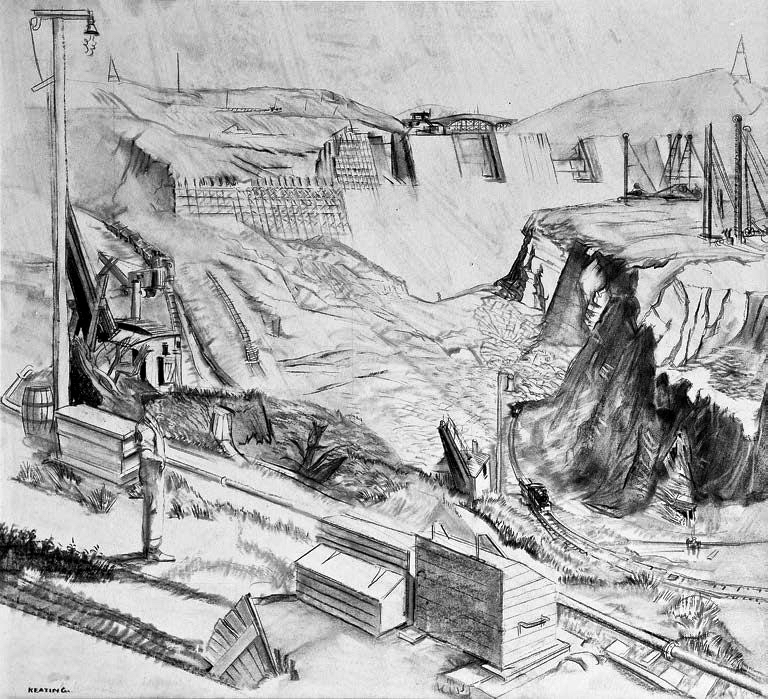
After the War of Independence and the abhorrent Civil War which followed it, Keating’s work concentrated on documenting the founding and burgeoning of the new State. Scenes of conflict were replaced by works showing industrial development, such as Ireland’s largest ever civil engineering contract: harnessing the power potential of the State’s major waterway, the River Shannon. The construction of a dam and hydro-electric generating station at Ardnacrusha, County Clare, together with a country-wide electric distribution infrastructure, was a symbol of major importance to the nation’s fledgling government. Keating began recording the work in 1926, soon after inception. No-one had commissioned him – he saw the significance of making dramatic documentary work of this nature, but his vision was eventually recognised by the Electricity Supply Board (ESB) – which now owns the largest collection of Keating’s paintings in Ireland. Above is one of the artist’s working sketches of the dam under construction.

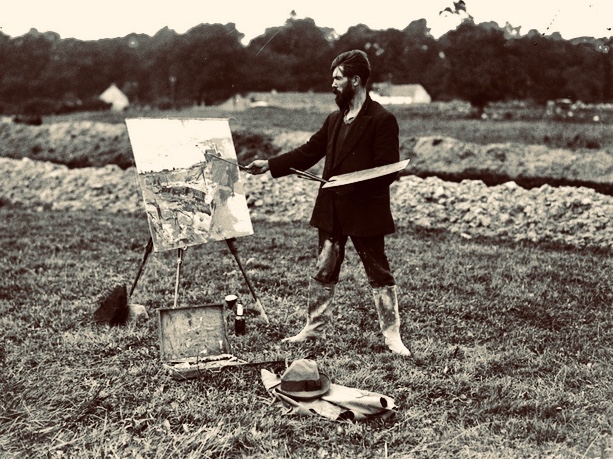
Seán Keating painting en plein air at Ardnacrusha, 1920s

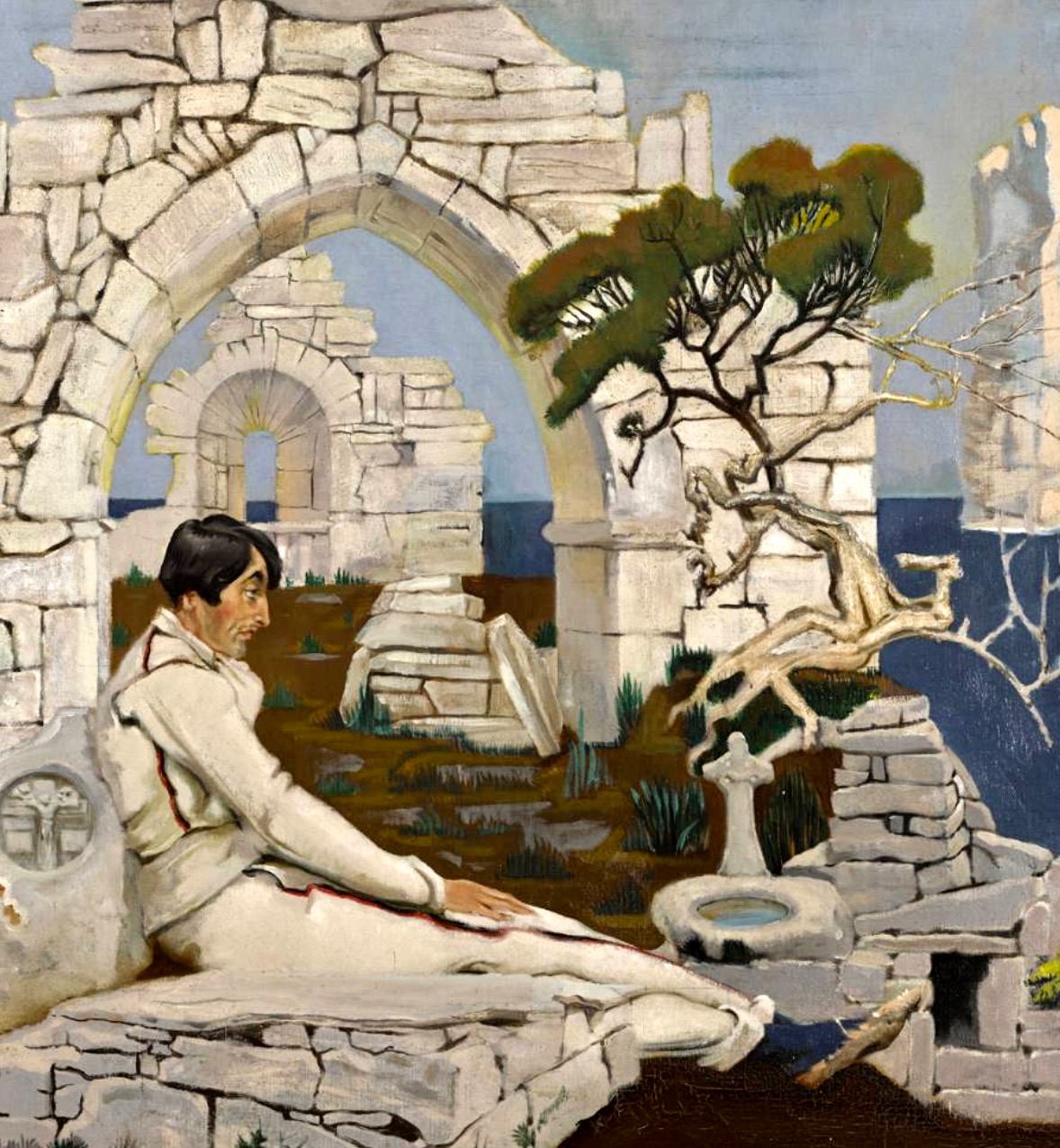
Keating studied under William Orpen in Dublin. He was to become one of Orpen’s important pupils (and, latterly, his assistant) and his documentary painting style owes a debt to his teacher. One of his famous early paintings is Thinking Out Gobnet (below), a portrait of his good friend Harry Clarke, dating from 1917. Keating and Clarke frequently visited the Aran Islands together. The painting shows Clarke sitting on a grave slab within the ruins of Teampall Chaomháin (St Kevin’s church) on Inis Oírr, along with a holy water font at his feet, and a holy well to the bottom right of the image. The suggestion is that Clarke is finding inspiration for his series of eleven windows for the Honan Chapel, Cork, which include a fine representation of St Gobnet. The ‘healing’ symbolism of the holy water and well are deliberate references to Clarke’s TB, the illness which ended his life at the age of 41.

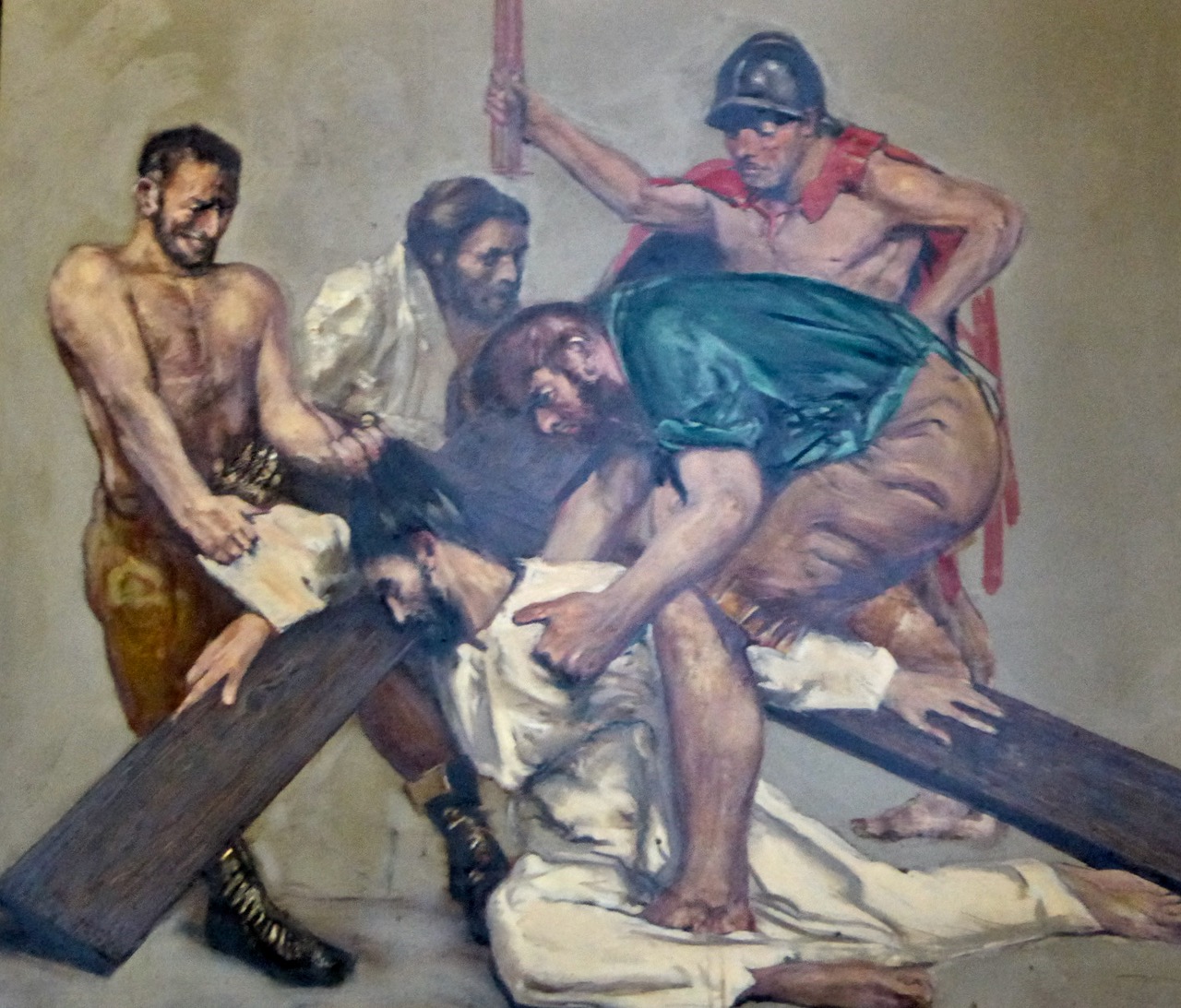
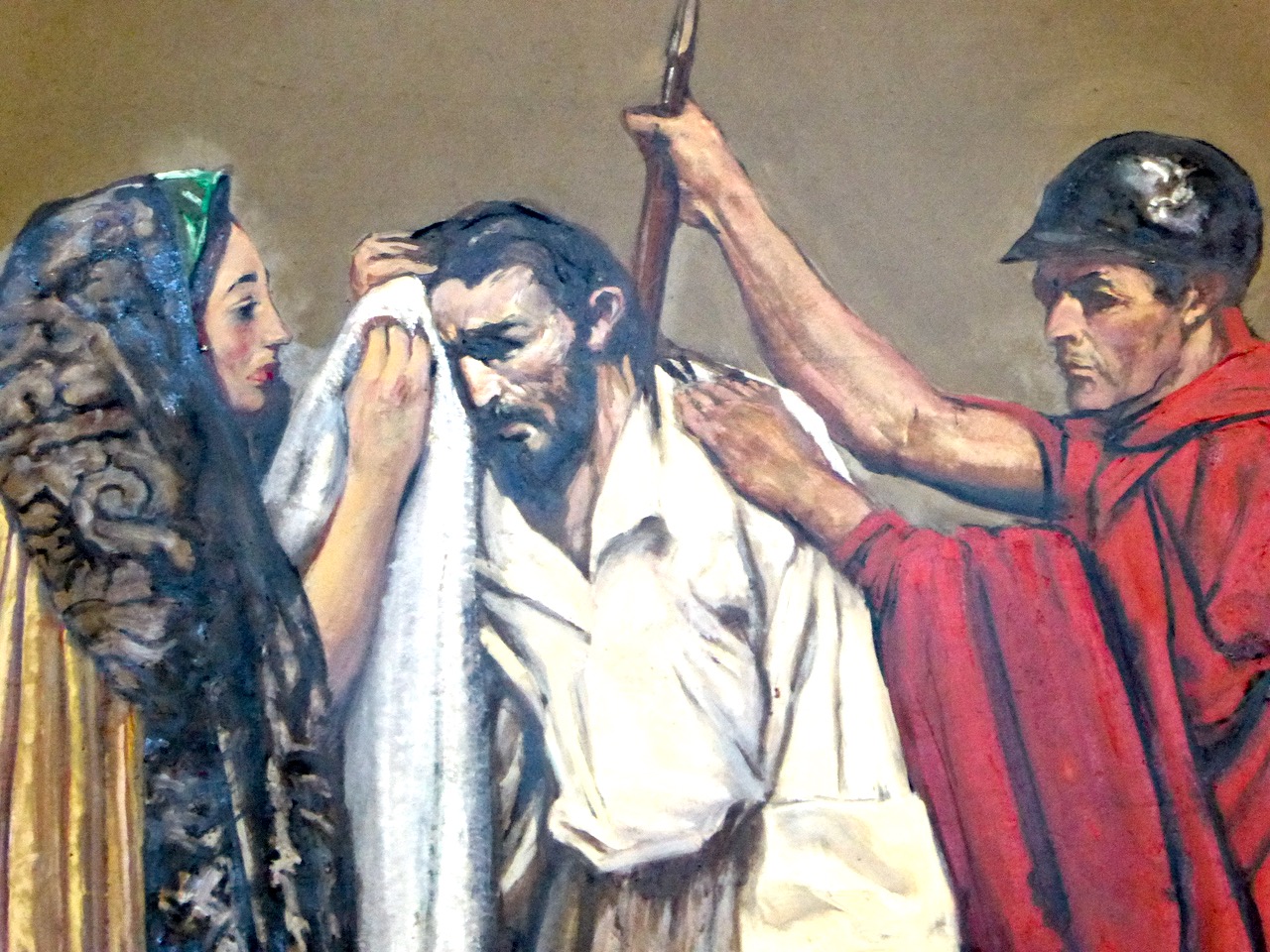
Seán Keating was always a committed Catholic, and we have seen many examples of his artwork in churches, including the murals at Ballyroan. Most striking, perhaps, are the Stations of the Cross which he painted for St John’s Church, Tralee – the church which features in Finola’s wonderful Irish Arts Review article (and RWJ blog post) about Ireland’s Newest Stained Glass Window.

Stations of the Cross by Seán Keating in St John’s Church, Tralee, County Kerry

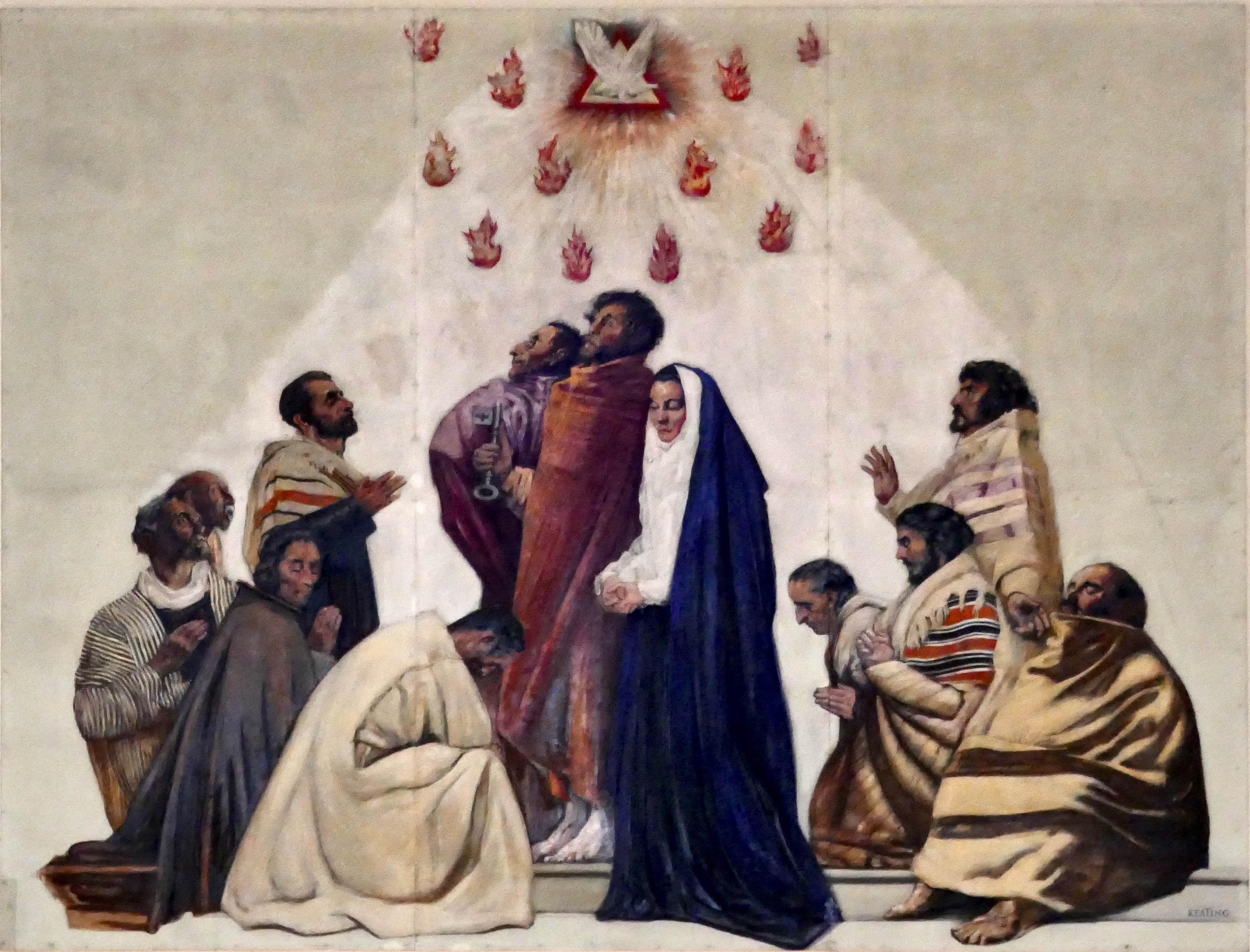
Back to Ballyroan: while we were sheltering from the tempest and admiring the church architecture, and the murals, I was delighted to find out that Seán Keating had lived for much of his life just down the road, in Ballyboden, in a house which he had designed himself. He attended mass regularly at Ballyroan until his death in December 1977, aged 88.

Keating’s mural The Descent of the Holy Spirit in his own church of Ballyroan, Parish of Rathfarnham, installed in 1967

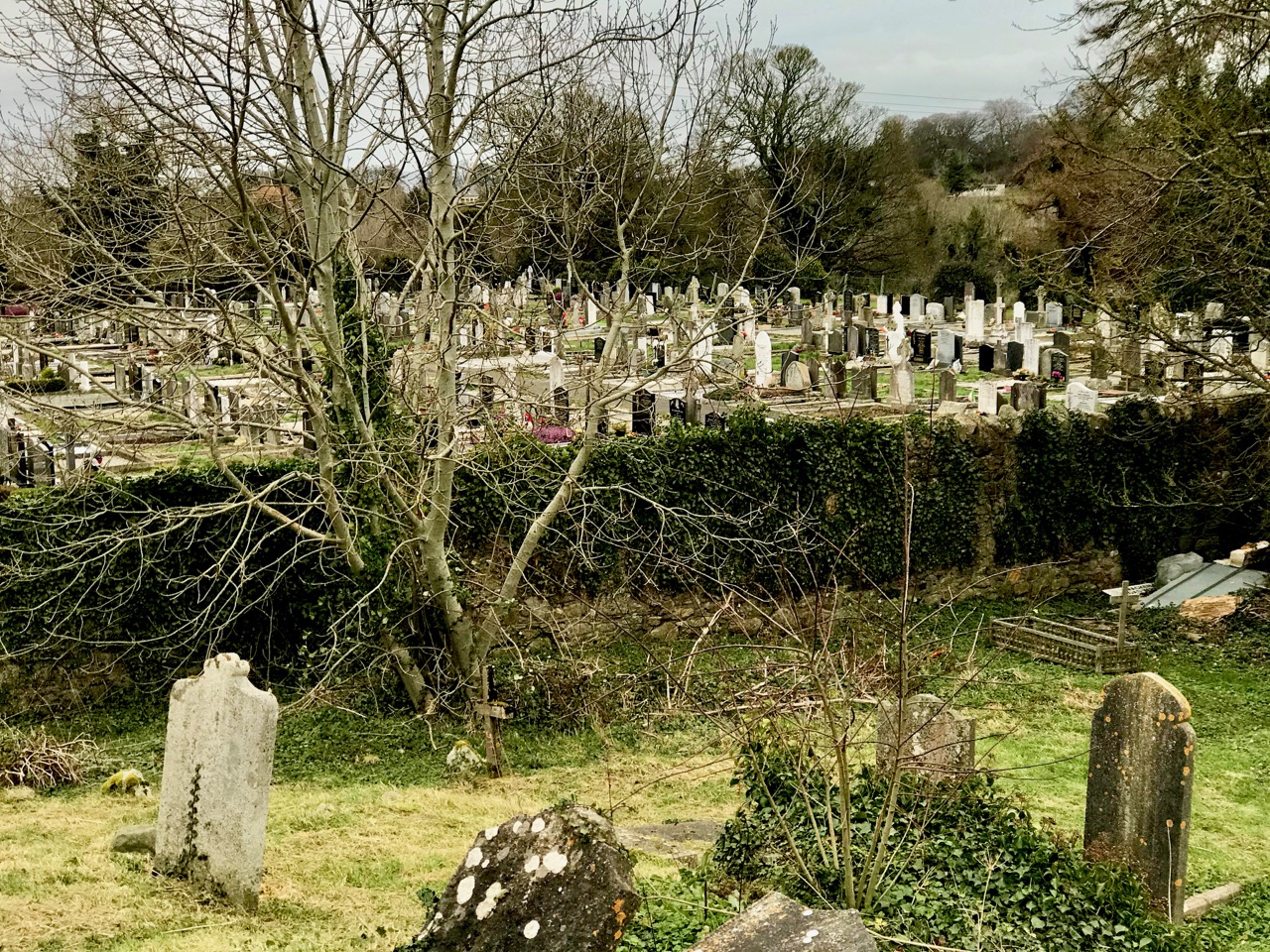
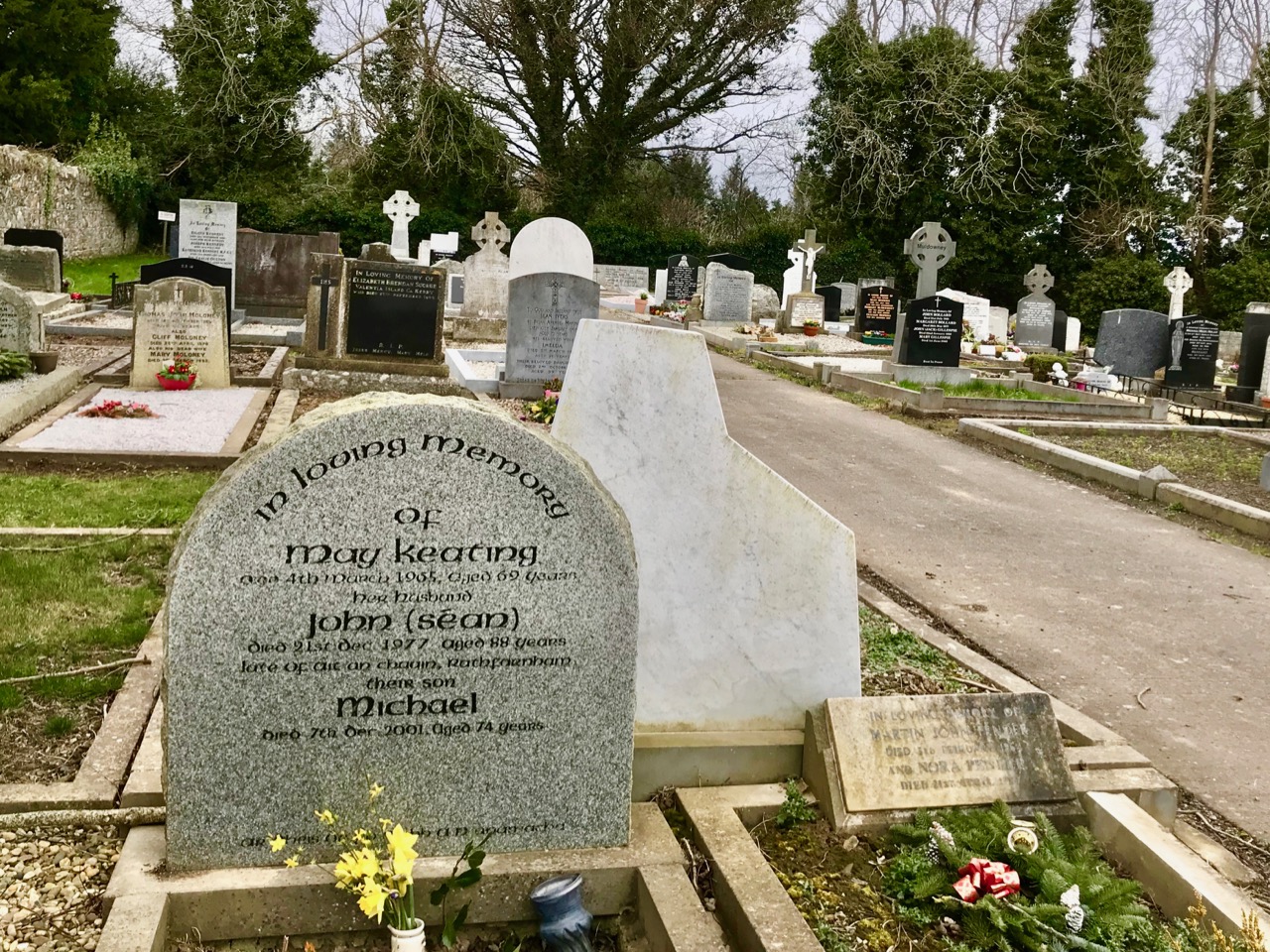
We discovered that Keating is buried in the nearby Cruagh Cemetery, so we had to head out into the storm again to find his grave. It is as unassuming as he apparently was in life: a visitor would not be aware that herein lies one of modern Ireland’s greats.
Cruagh Cemetery, Co Dublin (top) is the resting place of Seán Keating. His grave is shared with his wife, May, and son Michael

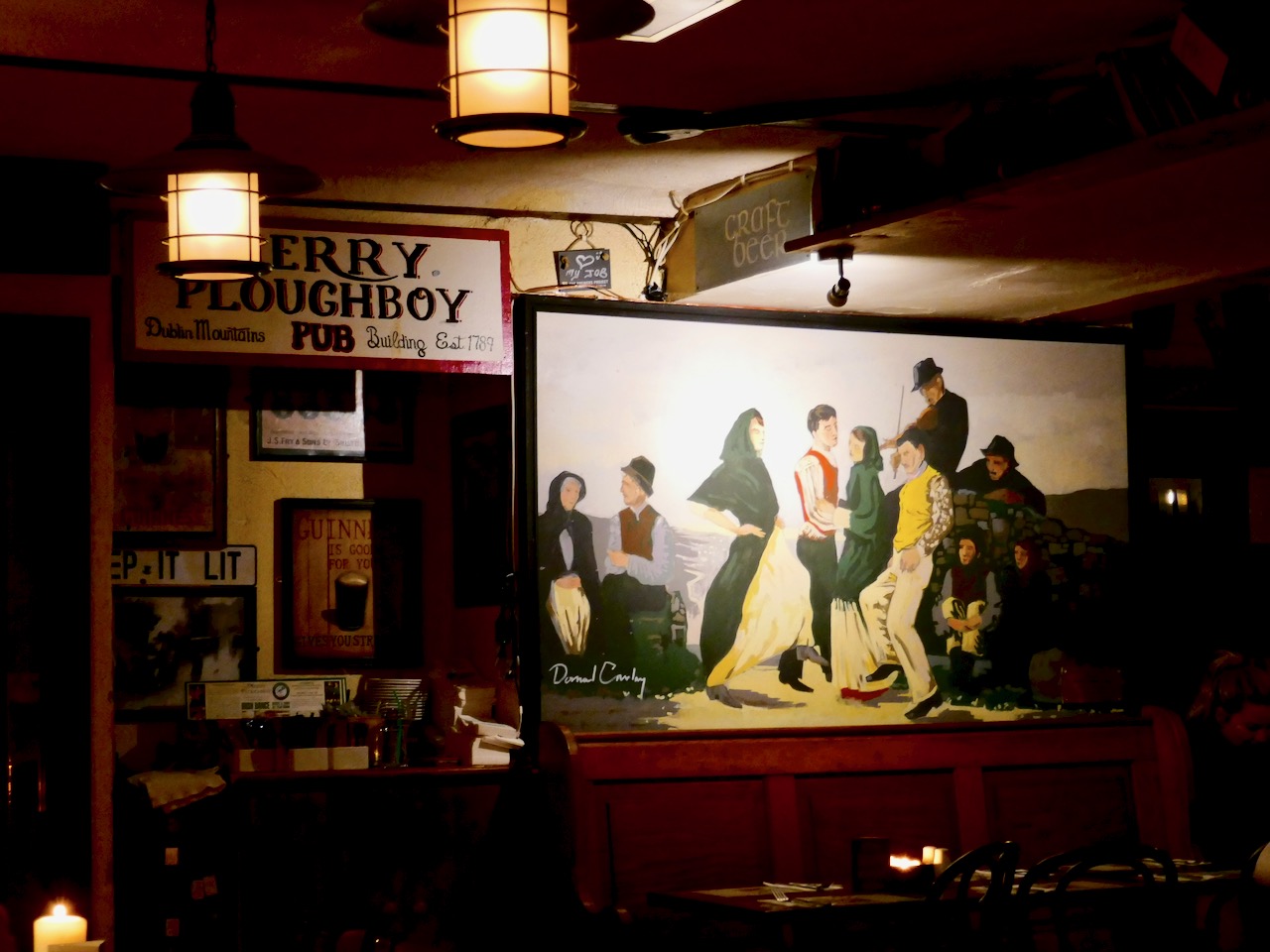
Our little artist’s memoir is almost over. The gale continued with ferocious lashing rain: cold and hungry we made a beeline for the local pub – the Merry Ploughboy, evidently a famous music venue. It was warm and welcoming, and full of a crowd watching Six Nations Rugby on the big screen (Ireland won the match).
In the lounge we were intrigued to find an oblique reference to Seán Keating – a painting which has a nod to his style but is by a different artist!

We agreed that our day trip to the east, in the teeth of the gale, was a memorable way to discover the life, work and death of one of Ireland’s significant artists.

Brendan in Bronze

Do you know the story of St Brendan? He – ‘The Navigator’ – went to North America long before Columbus. Nearly a thousand years before, in fact: Brendan was born in the fifth century. The story of his voyage, and his remarkable adventures with his fellow monks, has inspired art, music and song ever since then. Here’s the beginning of Christy Moore’s version:

A boat sailed out of Brandon in the year of 501
’twas a damp and dirty mornin’ Brendan’s voyage it began.
Tired of thinnin’ turnips and cuttin’ curley kale
When he got back from the creamery he hoisted up the sail.
He ploughed a lonely furrow to the north, south, east and west
Of all the navigators, St Brendan was the best . . .

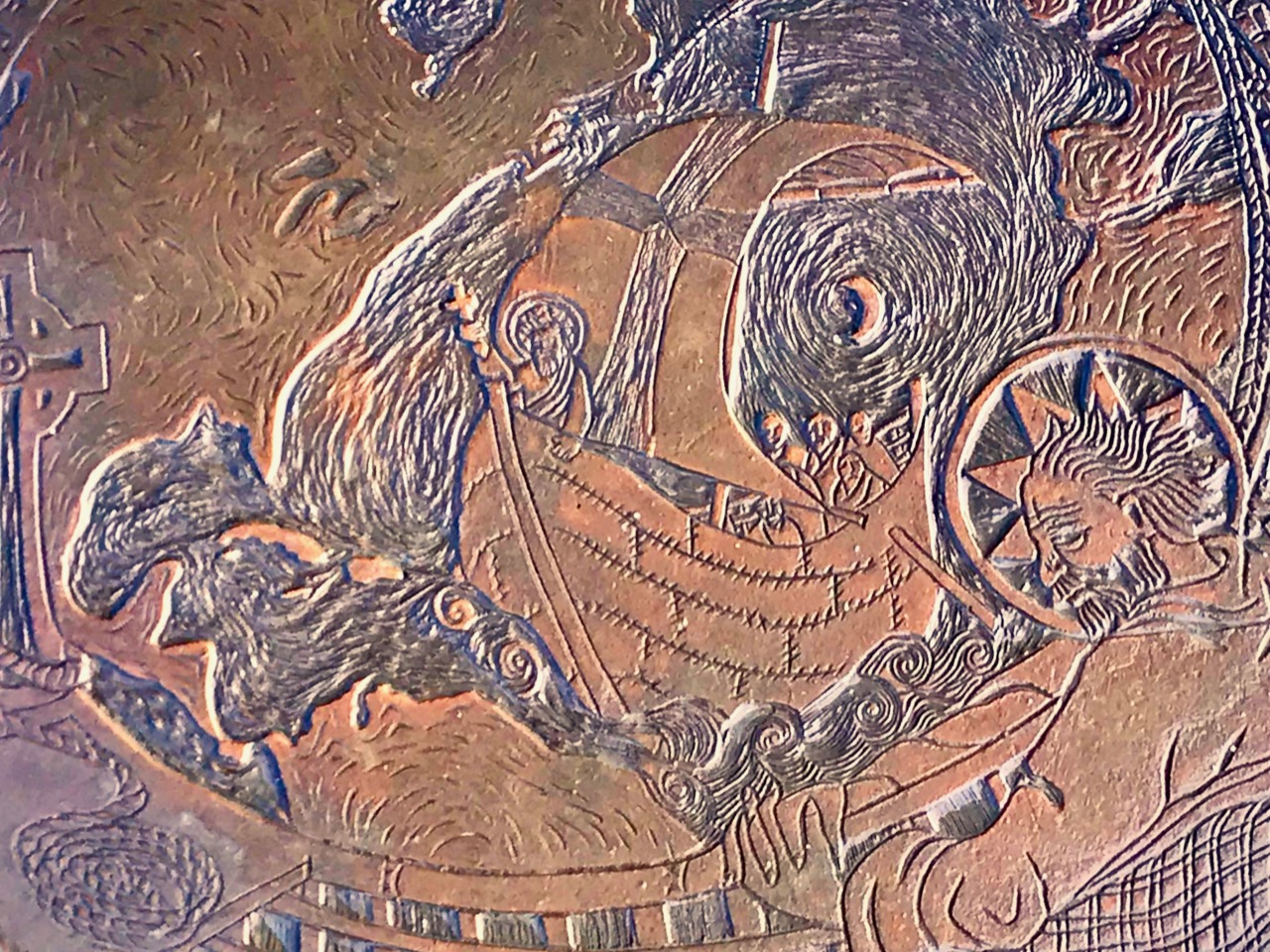
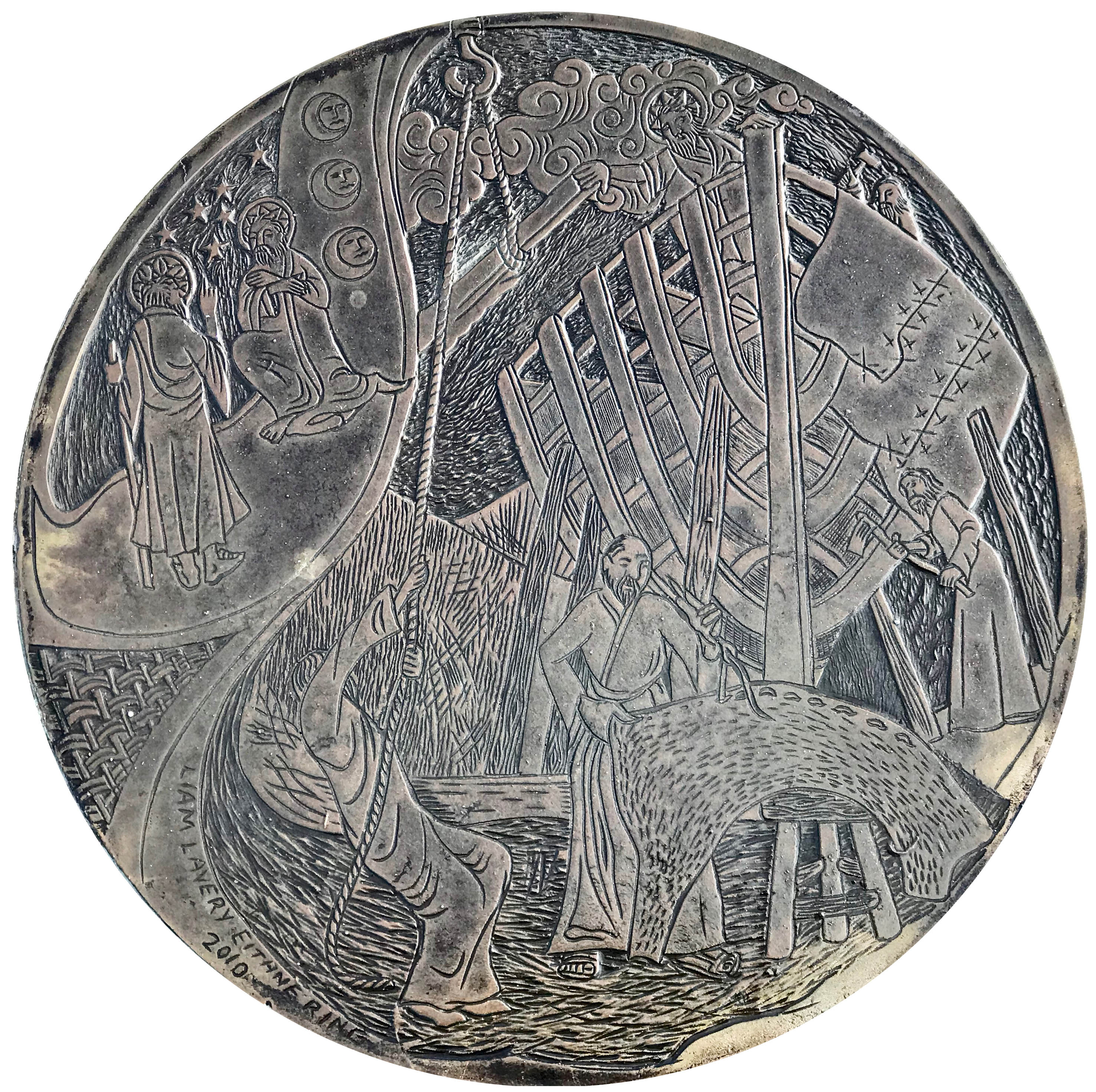
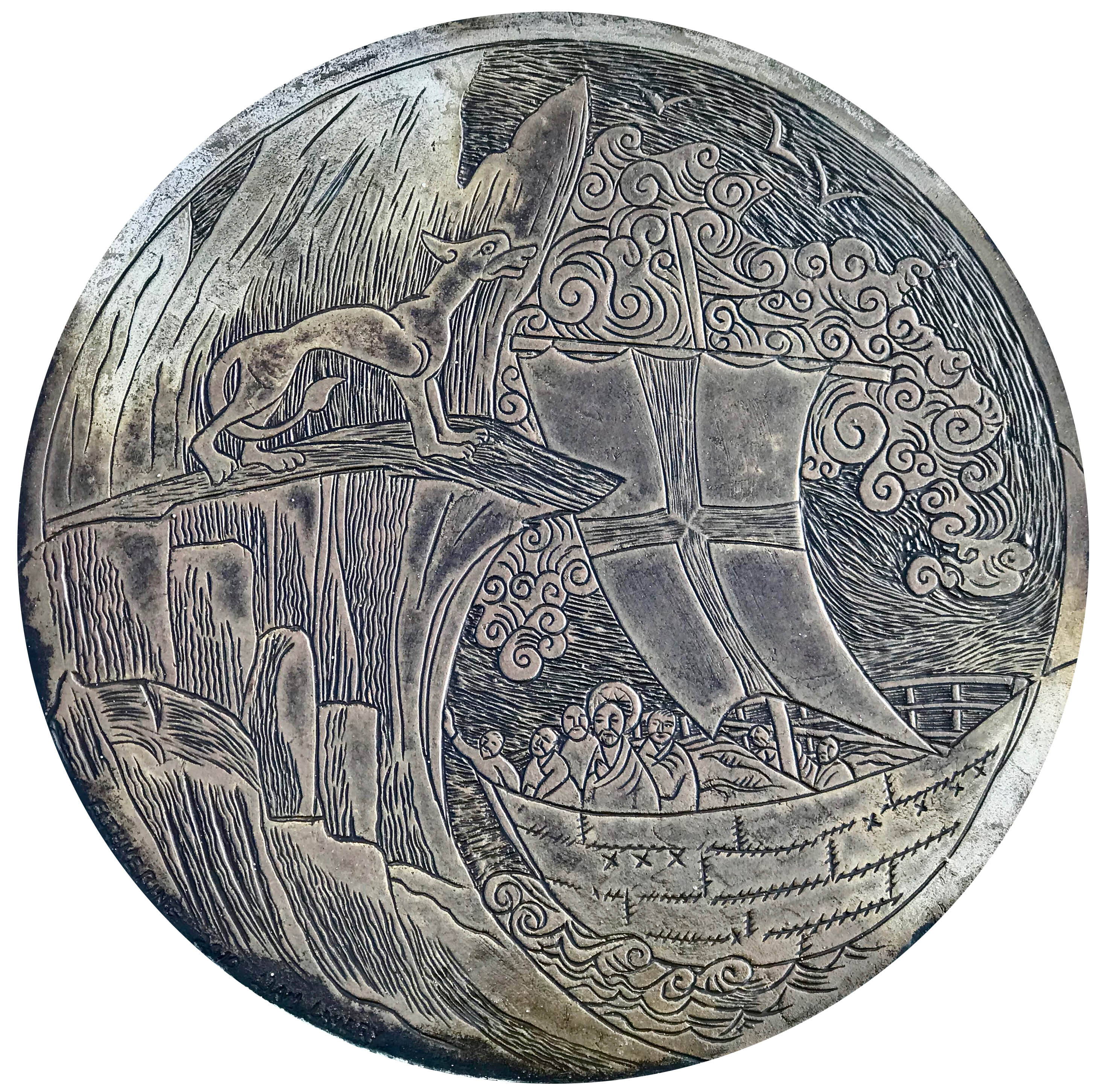
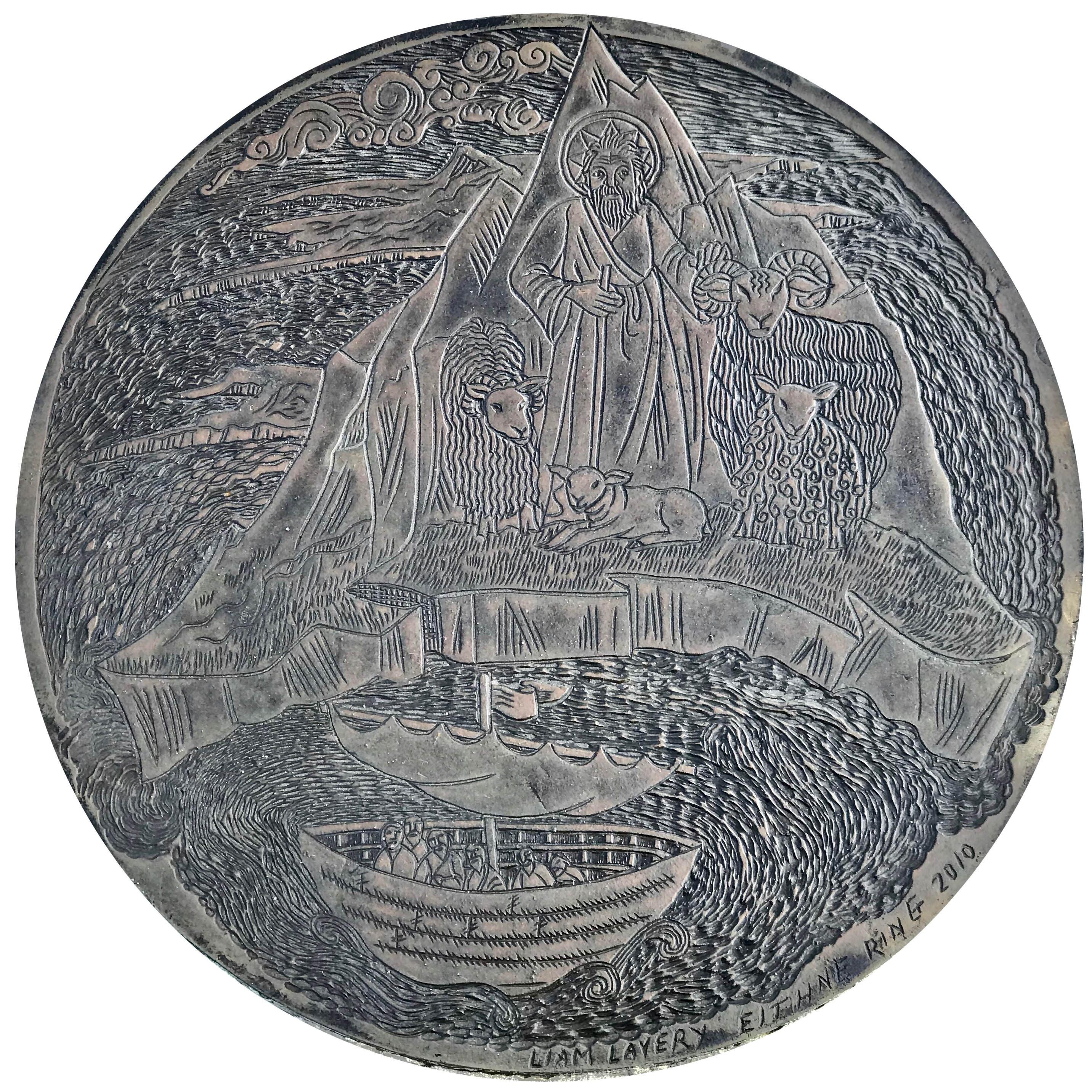
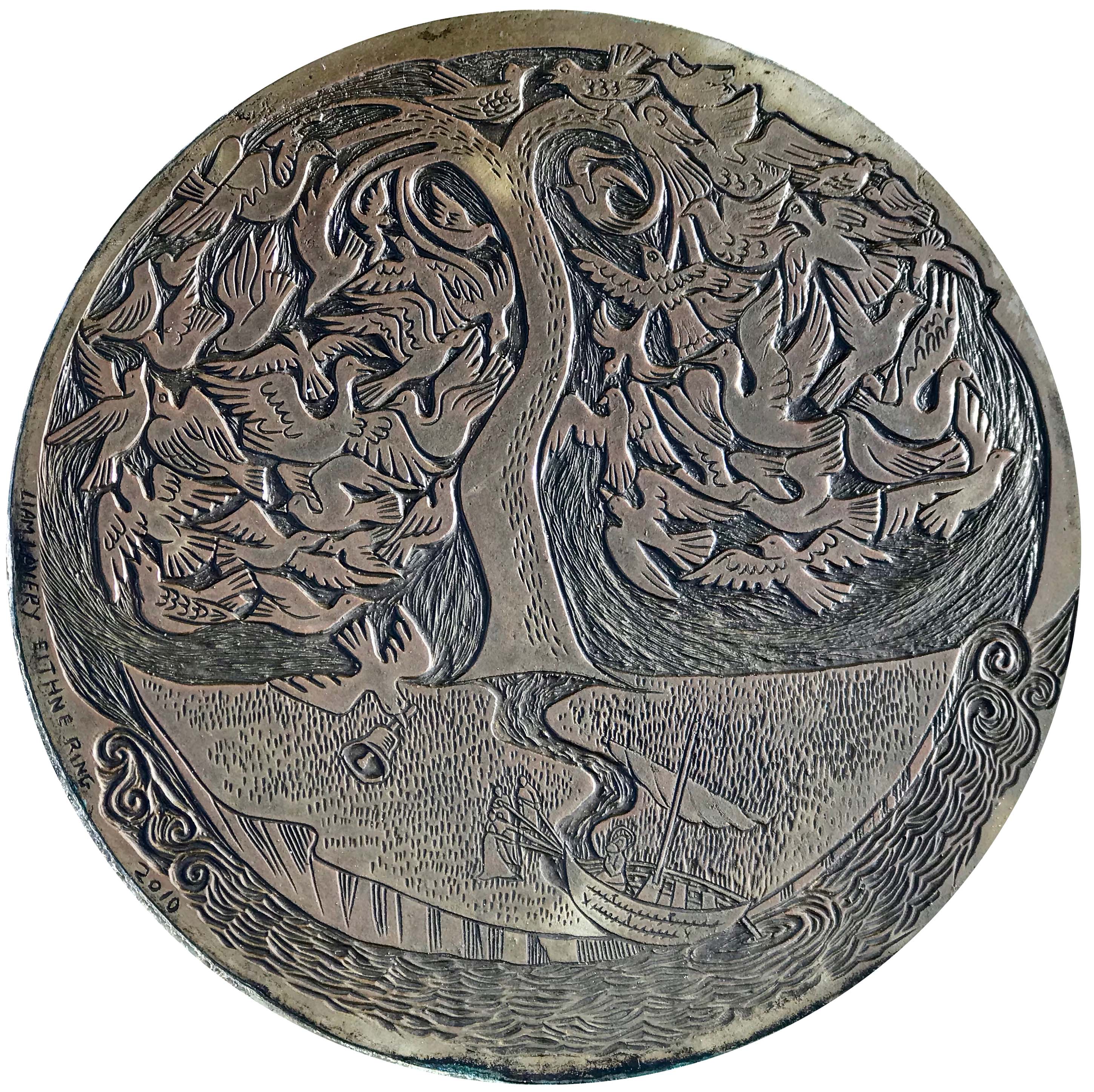
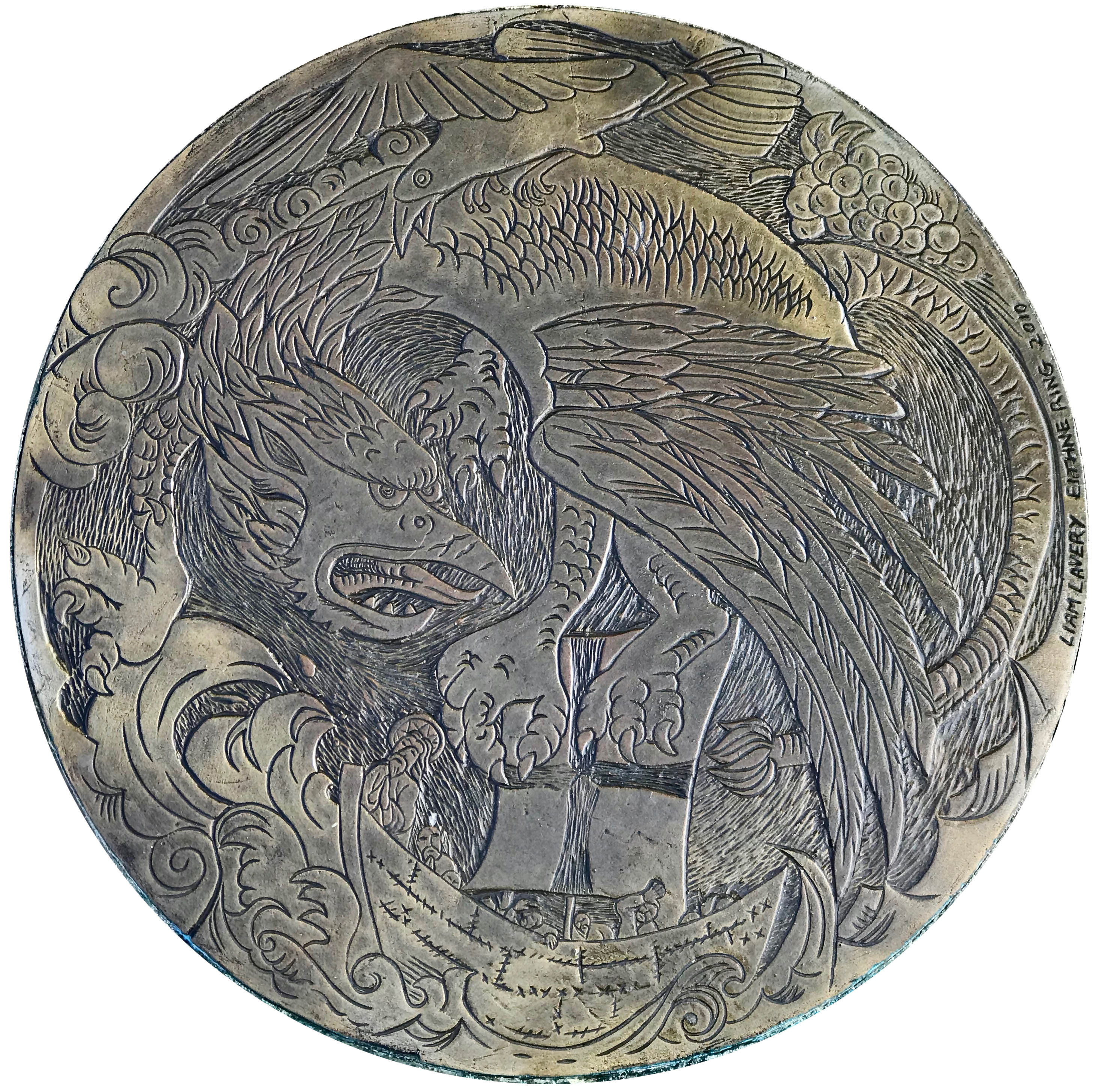
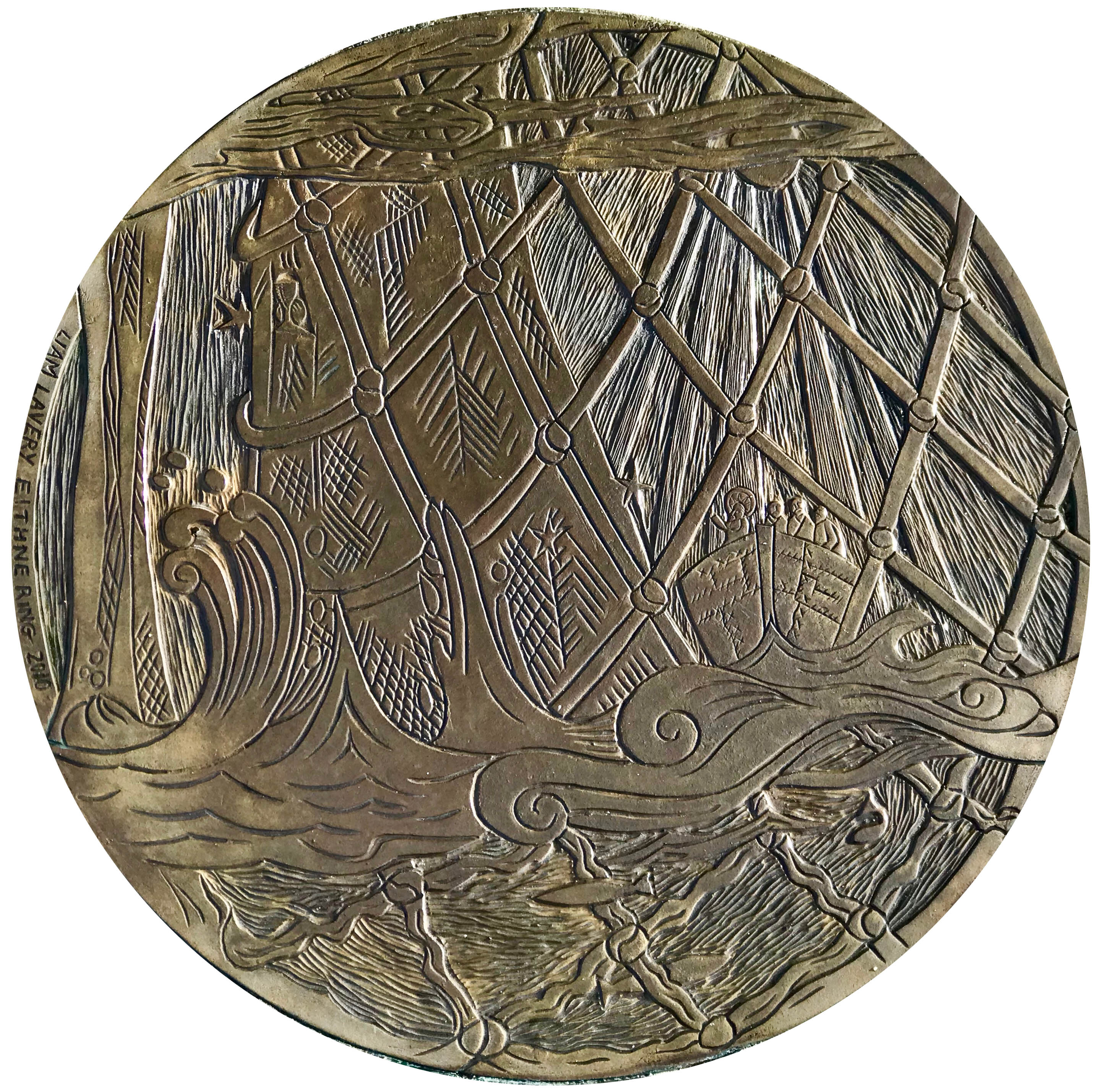
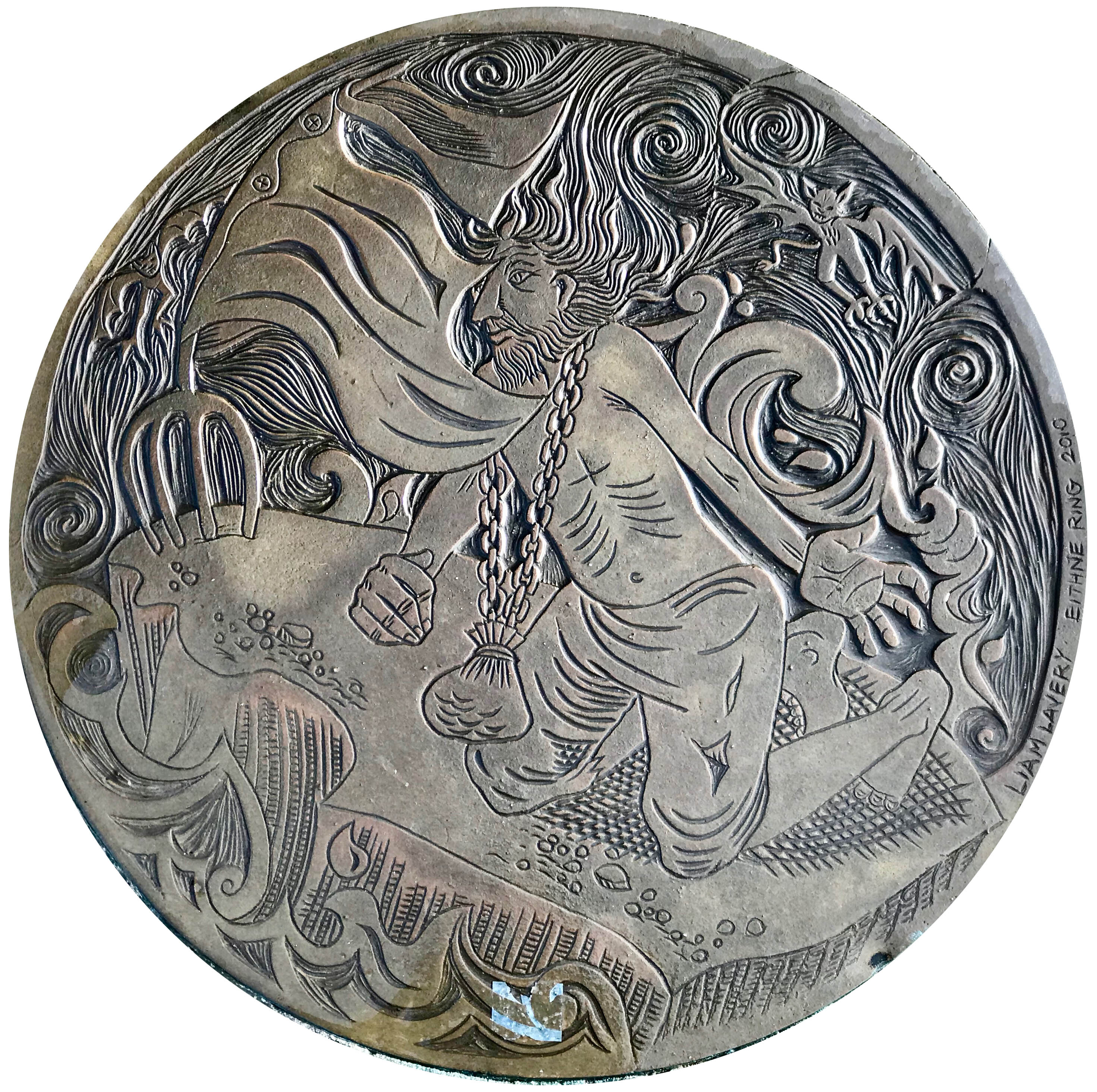
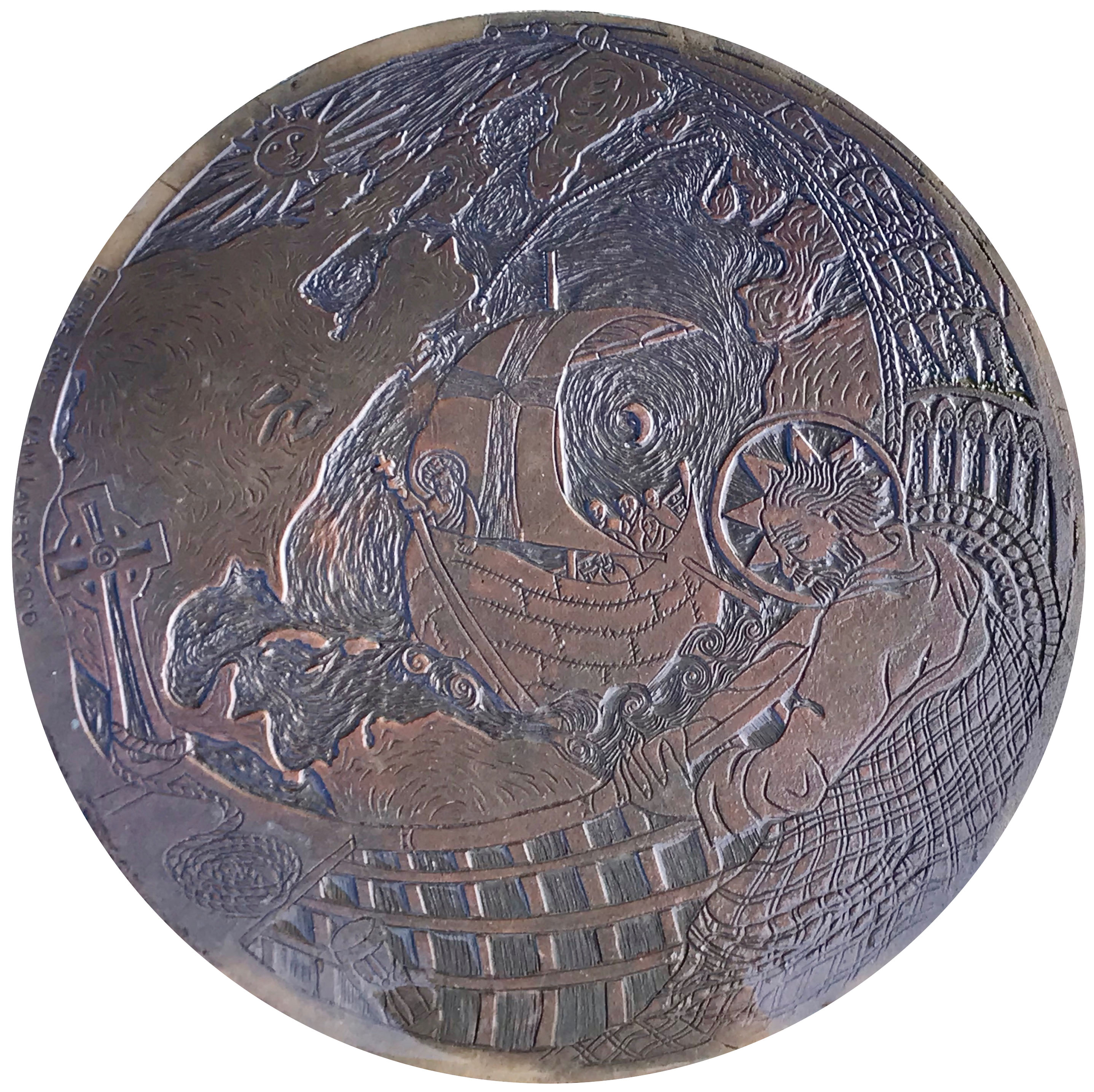
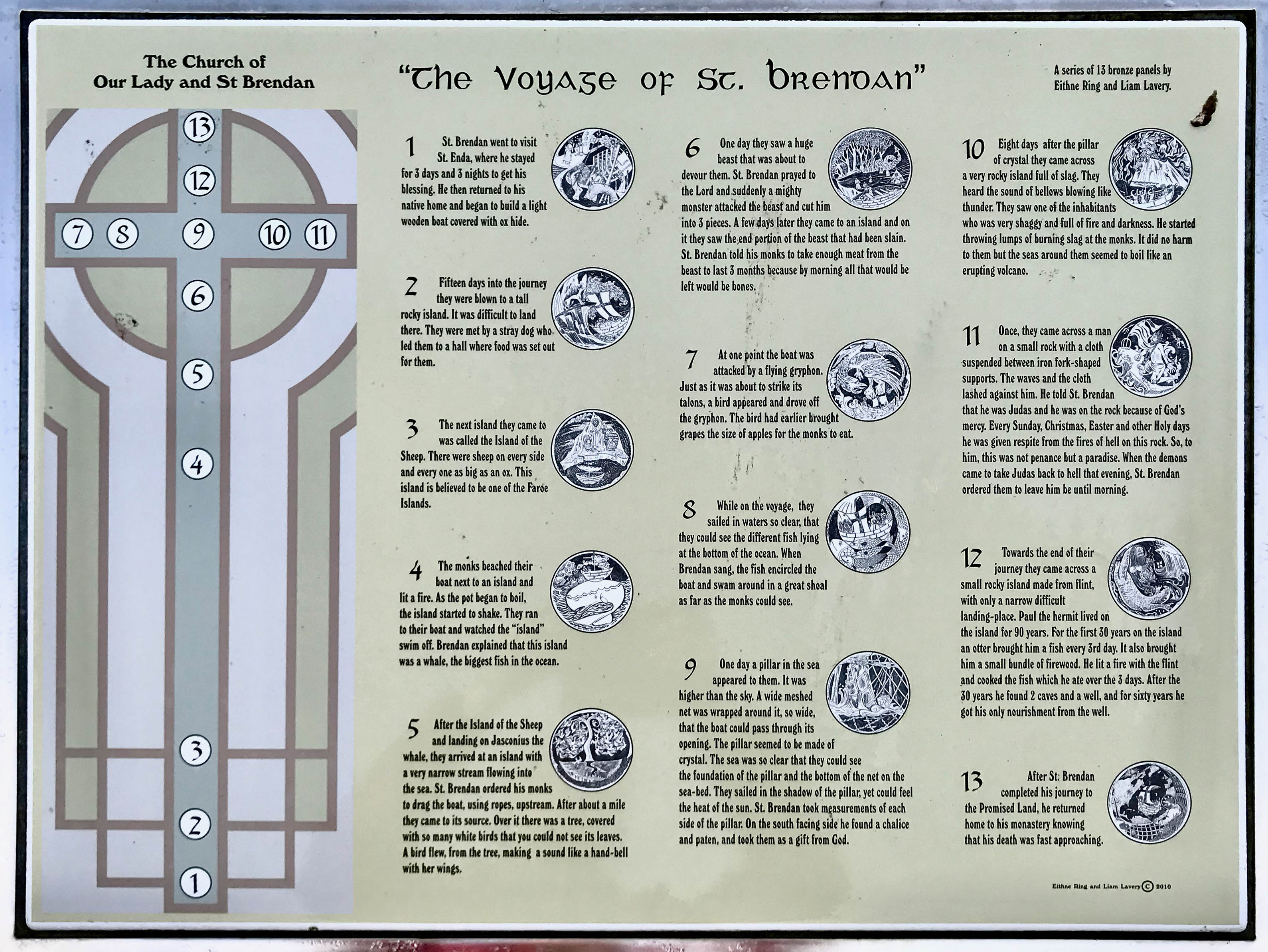
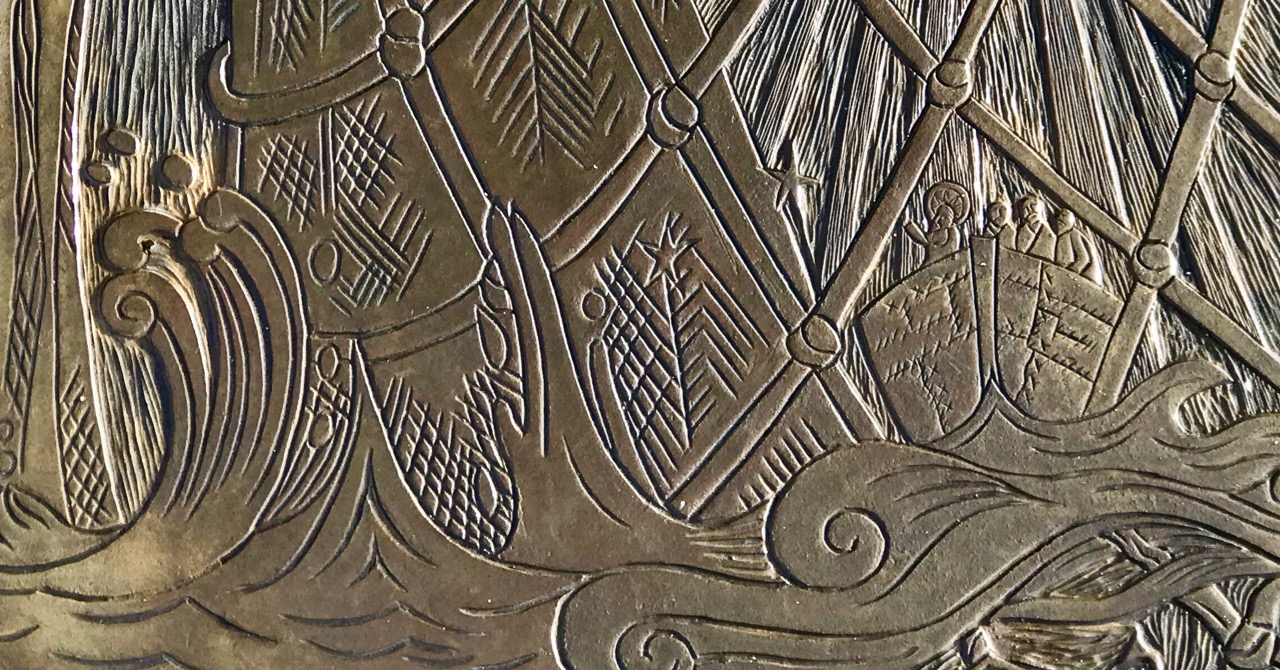
We went to Tralee, Co Kerry, to visit the Church of Our Lady and St Brendan: Finola was looking for windows by Murphy Devitt (which are spectacular) and I chanced upon a set of bronze roundels laid into the paving leading up to the main entrance (above). I felt I had to record them here, as they illustrate and tell the whole story of the Saint so wonderfully well. The large medallions were designed and made by Eithne Ring and Liam Lavery, and were installed in 2010. As far as I know this is a unique record of the voyage: well worth a visit – but don’t miss the windows!

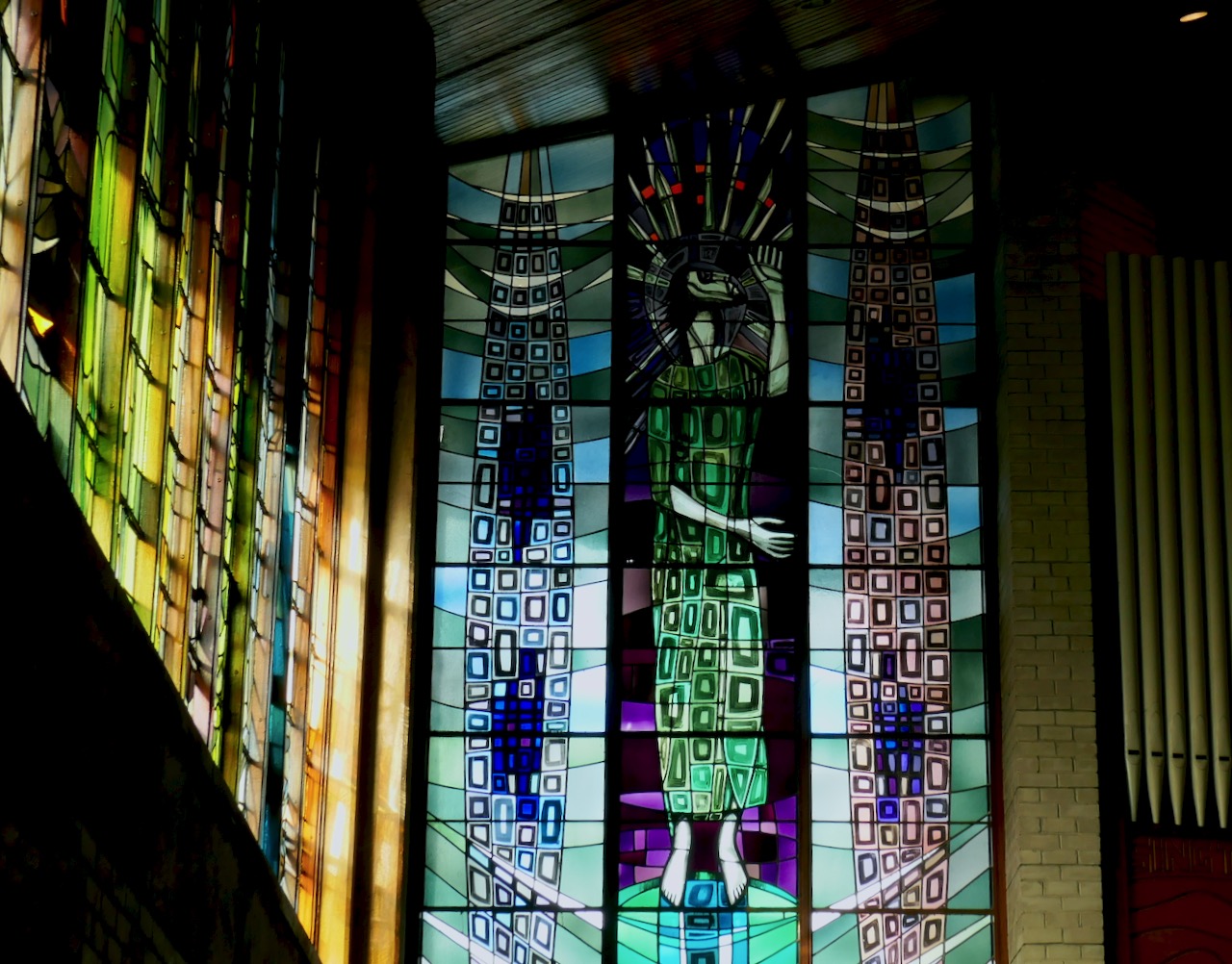
St Brendan: part of a huge stained glass installation by Murphy Devitt in this Kerry church

I’m showing the roundels in the order in which you encounter them as you approach the main doors to the church, and giving a very brief description of the subject of each. At the end you will find a commentary provided by the designers, which gives more detail.

1 St Brendan visits St Enda prior to building his boat

2 On a rocky island, Brendan’s crew are led by a hound to a miraculous hall of food

3 The monks find an island inhabited by giant sheep

4 Brendan and his companions land on an island, light a fire and celebrate Mass; they discover that they are on the back of a whale!

5 An island of white birds: one is ringing a bell

6 The monks take meat from a beast that has been slain by a monster

7 On the Island of Grapes the monks witness a battle between a gryphon and a bird: the bird is victorious

8 All the fish in the ocean come to listen to Brendan while he sings

9 Brendan finds a huge crystal pillar rising out of the sea

10 The sea is boiling like an erupting volcano

11 Brendan and his companions meet the unhappy Judas chained to a rocky island

12 The travellers find a hermit who has been fed by an otter for forty years

13 Brendan returns to Ireland to prepare for his death

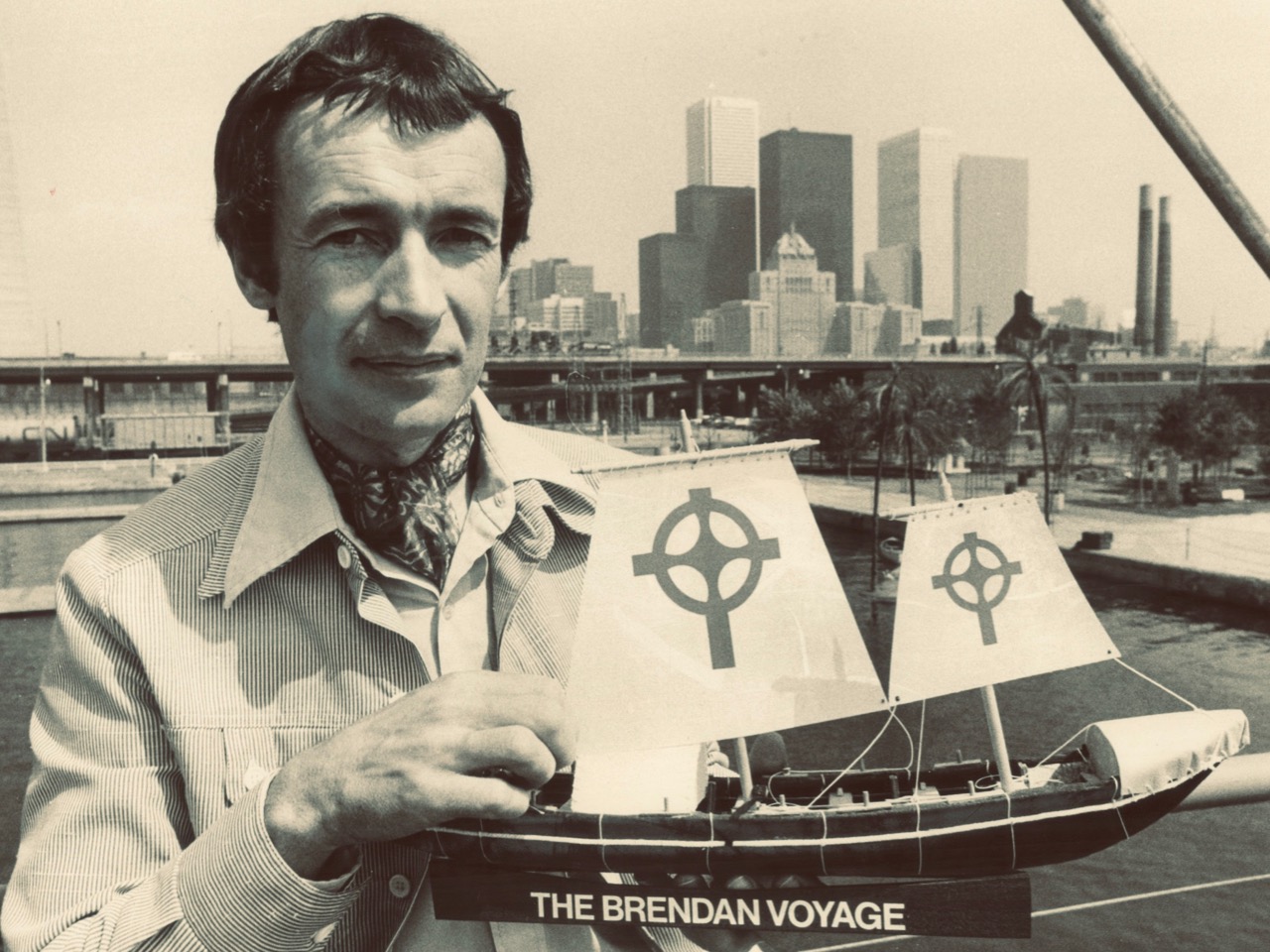
So now you know the bones of Brendan’s story. Now listen to the music! Saun Davey’s Brendan Voyage, a suite for uillinn pipes and orchestra, is a masterpiece inspired partly by the Saint himself, but also by Tim Severin’s 1976/77 recreation of the journey across the Atlantic in a leather clad boat:

Tim Severin pictured with a model of the boat in which he recreated the Saint’s journey

Let’s give the last words to Christy Moore, and the chorus of his Brendan song (you can find all the lyrics here):

“Is it right or left for Gibraltar?”
“What tack do I take for Mizen Head?”
“I’d love to settle down near Ventry Harbour”,
St Brendan to his albatross he said . . .

Looking at Rossbrin

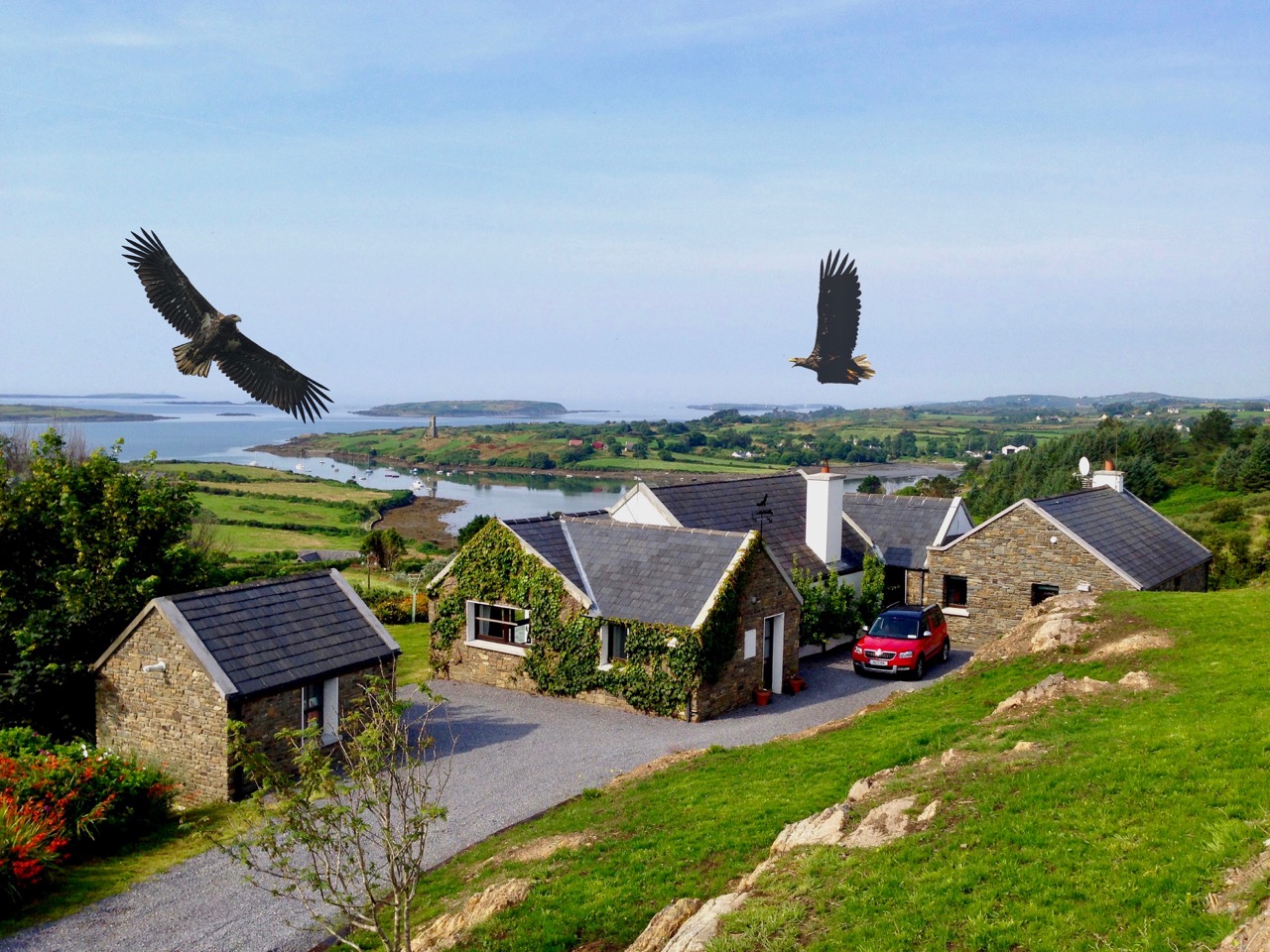
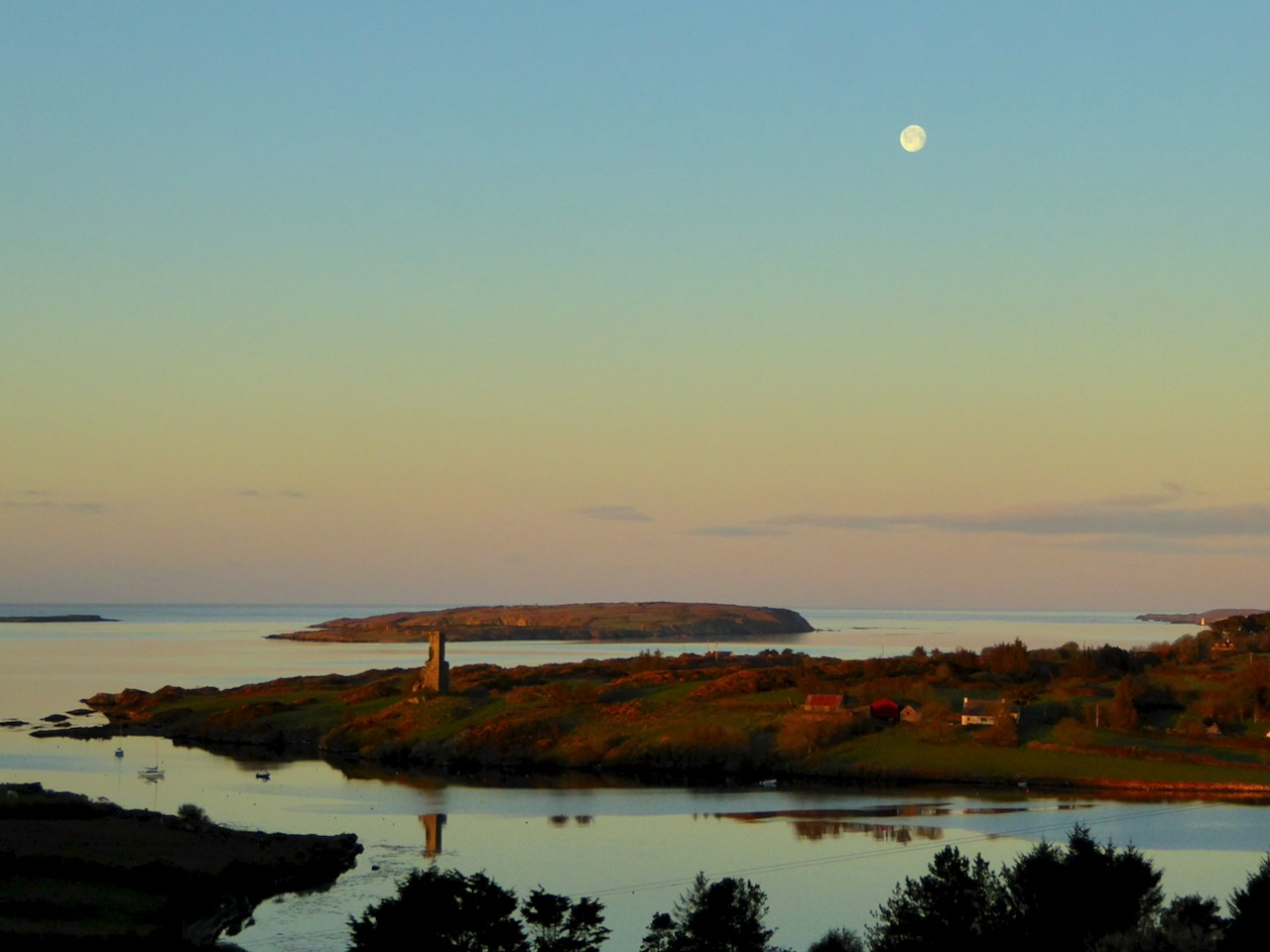
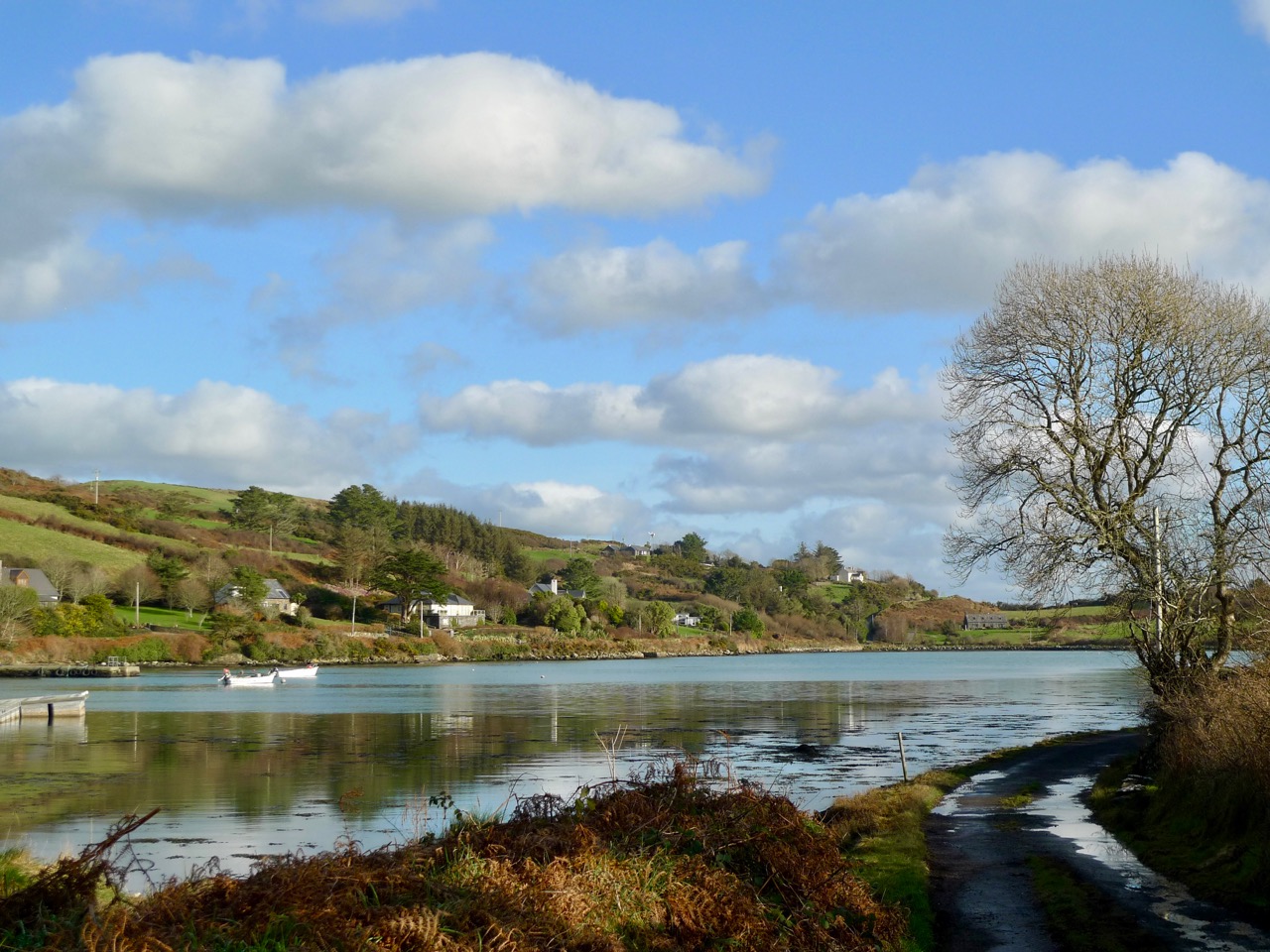
Last week we talked a little about the history of Rossbrin’s medieval castle, and the importance of this natural inlet as a historical centre of fishery, scholarship and European culture. Rossbrin Cove stills serves as an anchorage and refuge for sailing boats on the edge of Roaringwater Bay, but is now a peaceful haven, with only the sounds of the shore birds and slapping masts to lightly disturb an overriding tranquility that gives the place a very particular atmosphere. Our photograph (above) is taken on the boreen going to the castle; on the skyline in the centre is a wind turbine, and just below that is Nead an Iolair (Irish for Eagle’s Nest). The picture below shows the eagles wheeling over our house, with Rossbrin Castle and our view to the Cove beyond.

I have been exploring images of the Cove and its castle – some historic photographs and a few artists’ impressions. As it’s right on our doorstep, we have taken many pictures of Rossbrin during our years here. I am also sifting through a few of these.

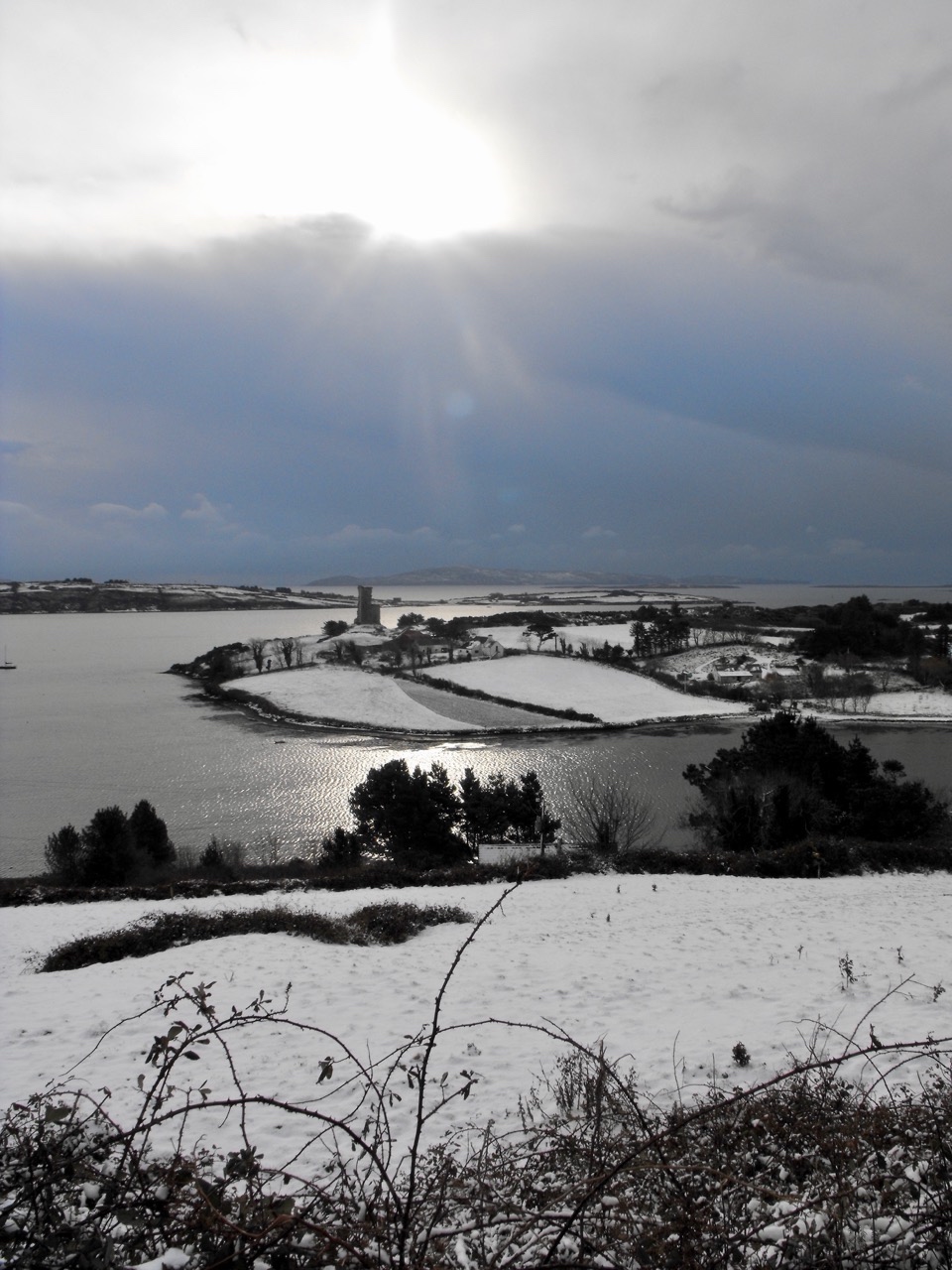
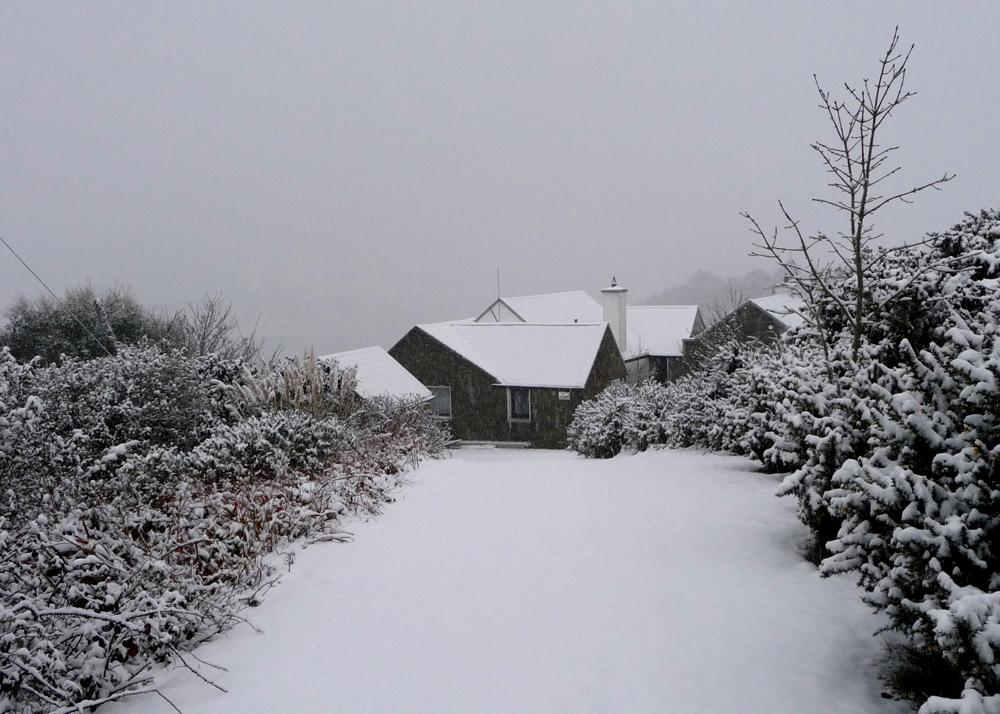
Ten years ago, the west of Ireland experienced an exceptional snowfall, and above is a photograph taken by our near neighbour, Julian van Hasselt, before we arrived. Mostly, our weather is relatively mild due to the effects of the gulf stream on the south-western coast. The castle can clearly be seen here, beyond the fields of Castle Farm. This view of our house (below) was also taken in 2010 by our neighbours Dietrich and Hildegard Eckardt:

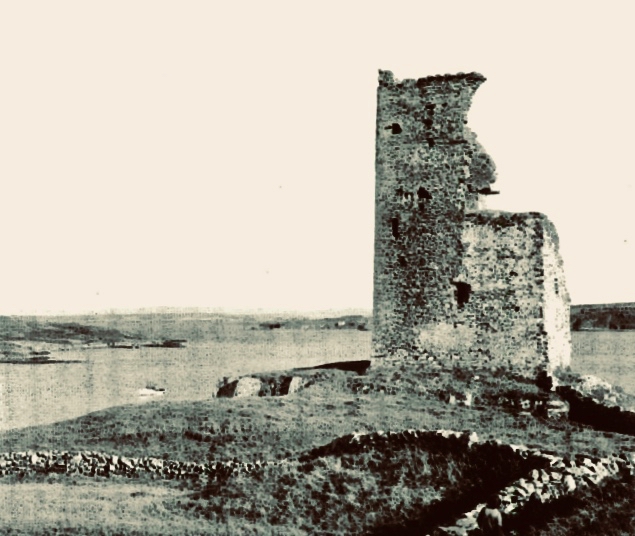
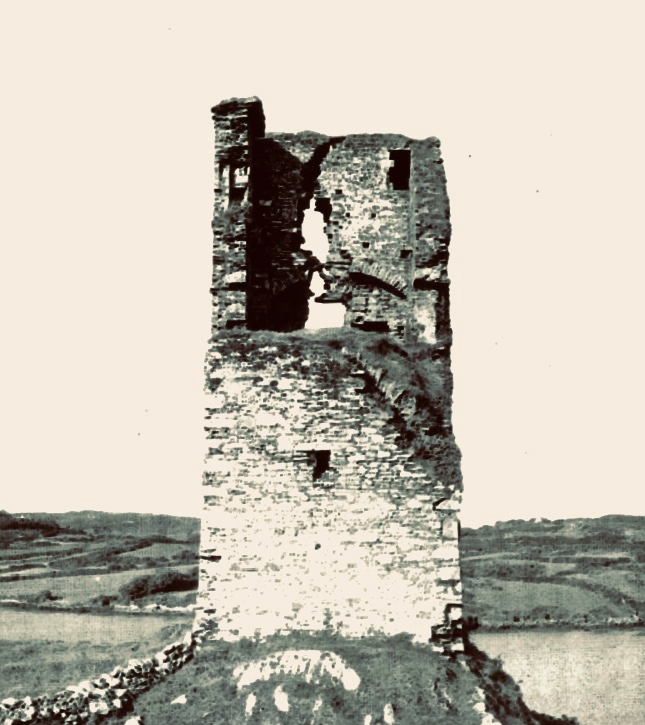
I showed a couple of early photographs of the castle last week. Here are two more taken before a substantial part of the ruined structure was toppled by a storm in the 1970s:

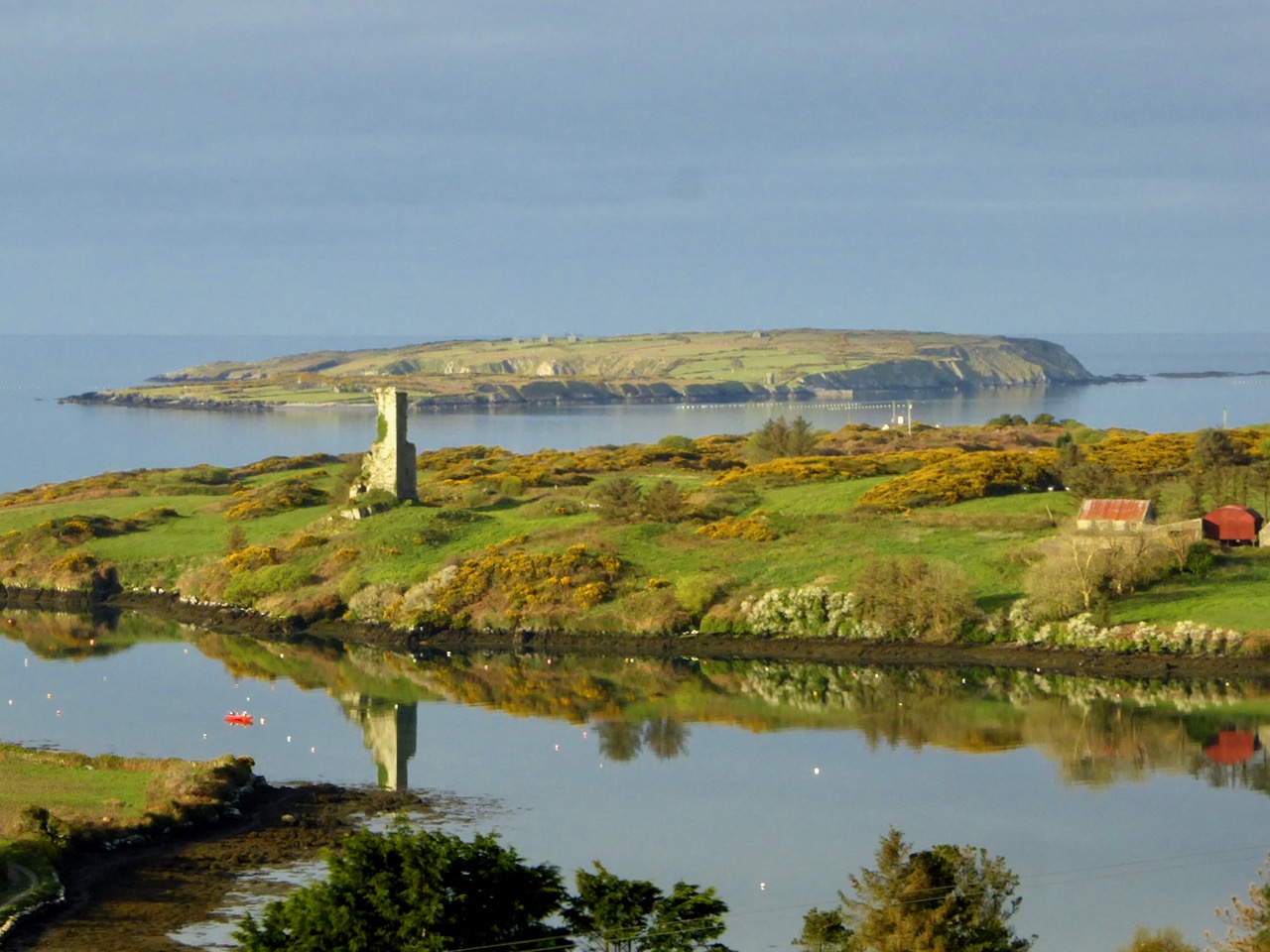
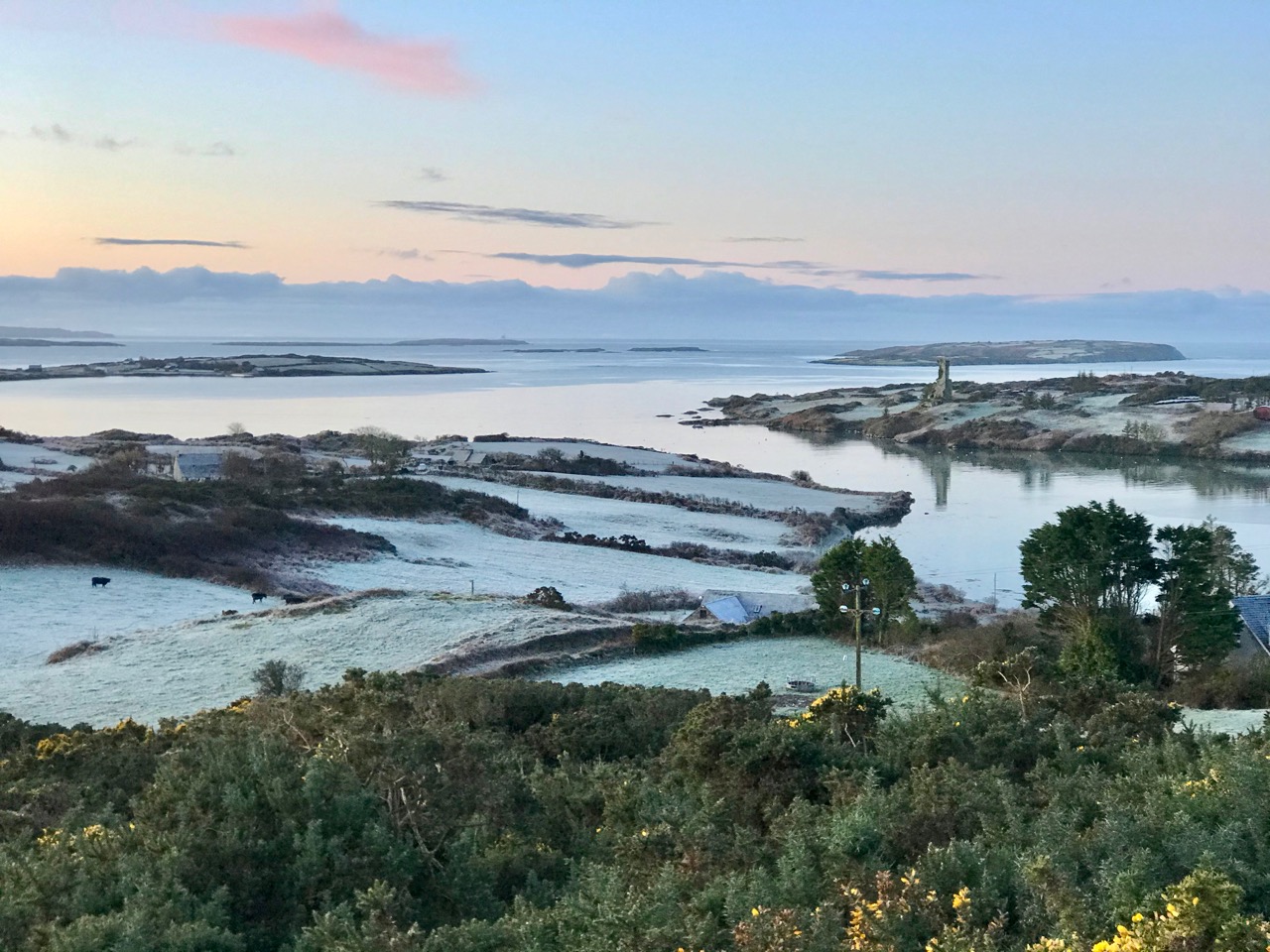
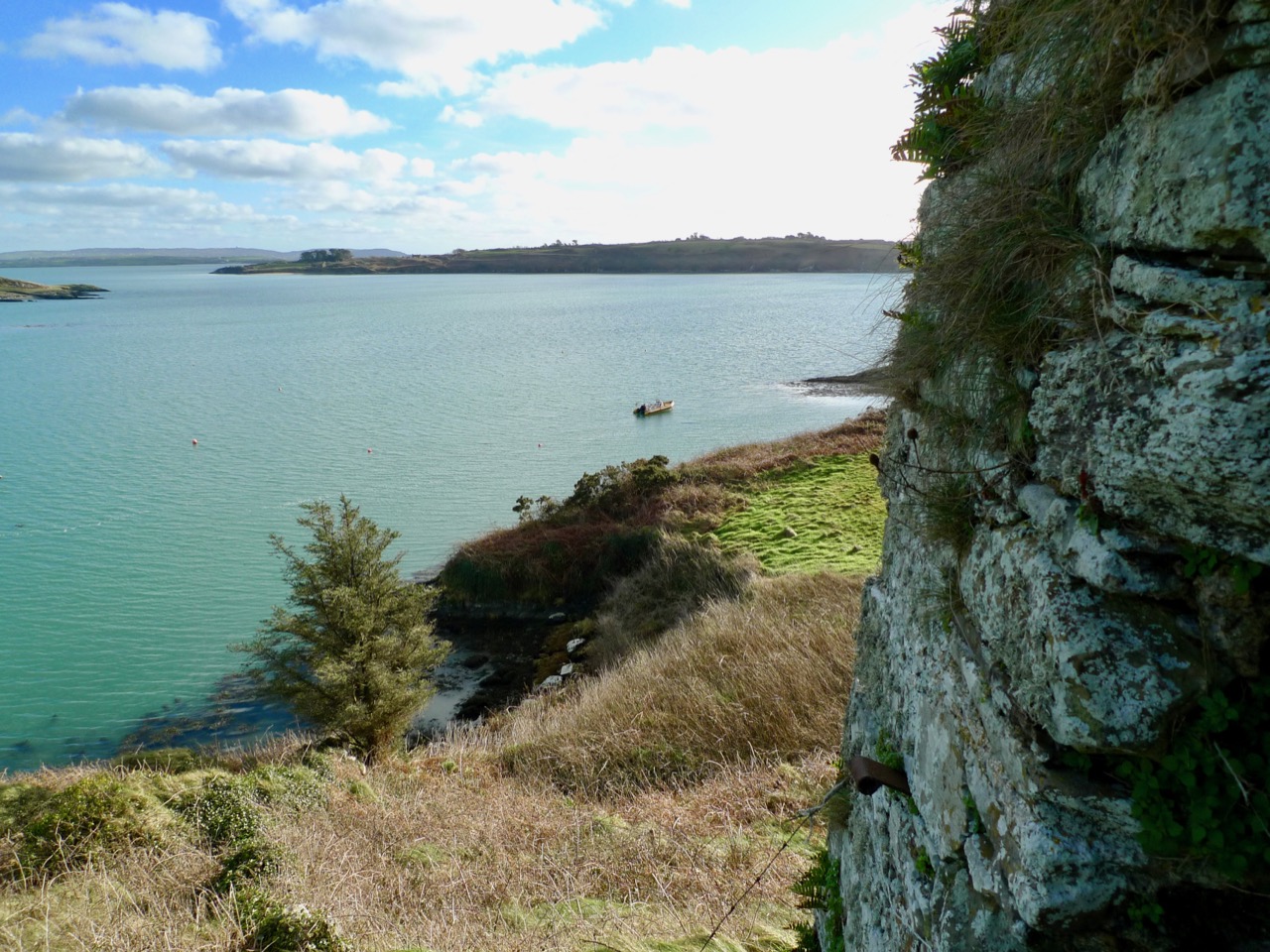
It’s good to see a bit of context, so here is another winter view of the castle on its rock with Castle Island behind. That island was also part of the O’Mahony territory. It is farmed by its present owner but no-one lives there now. You can make out the ruined castle on the island by the shore, just to the right of centre; it’s one of many that can be seen on, or close to, the shores of the Bay.

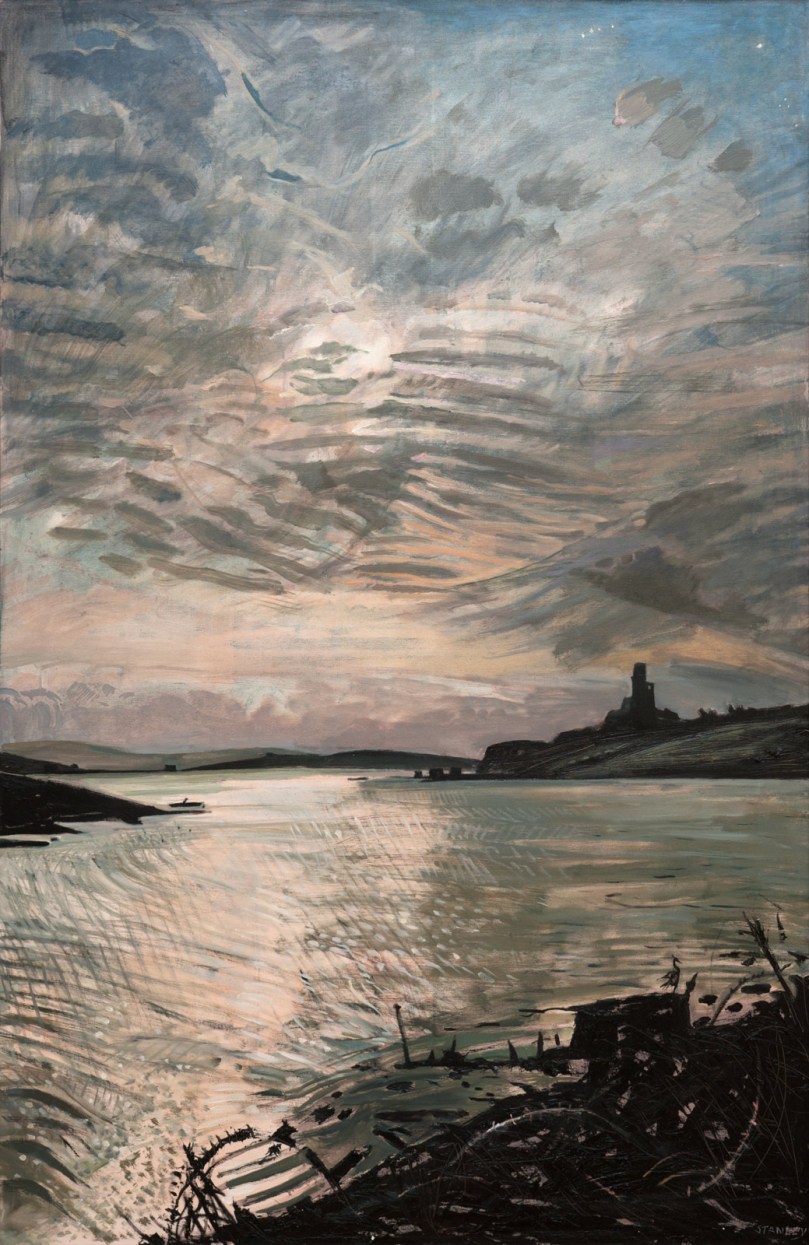
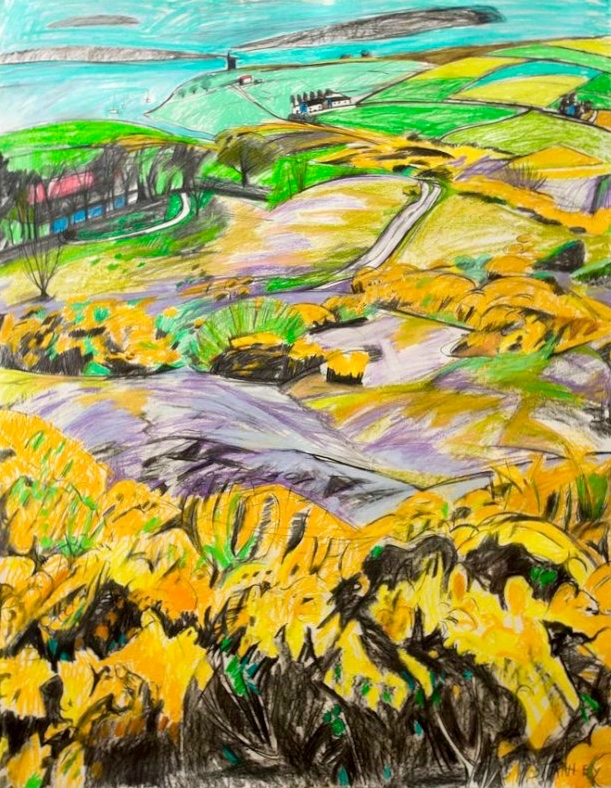
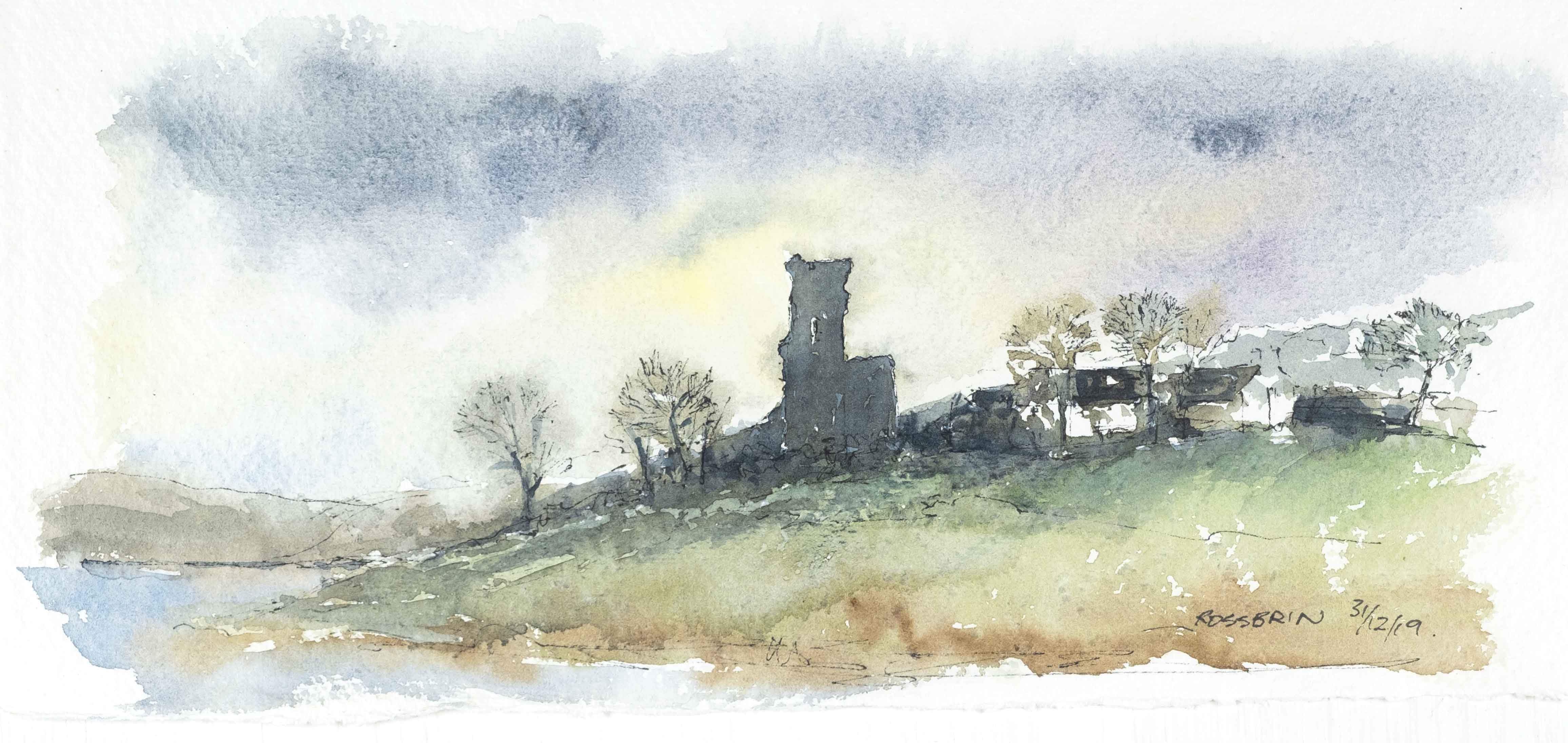
Let’s have a look at some of the art works that feature the Cove and the Castle. Jacqueline Stanley was one of many artists who was attracted to the beauty of West Cork. Now in her nineties, she moved from England to Ireland in the mid 1970s and purchased the old School House at Rossbrin as a country retreat: it has only recently changed hands.Here are two of her works, depicting Rossbrin. You can find more on her website.

I particularly like this view (above) which was painted by Jackie from the vantage point above the high road going down to the Cove, close to the remains of the copper mine at Ballycumisk. Last week I showed a painting by Geraldine van Hasselt, Julian’s mother, also from the 1970s. Every painting or photo is a historical document – and important to retain, in view of the fragile nature of the structure today.

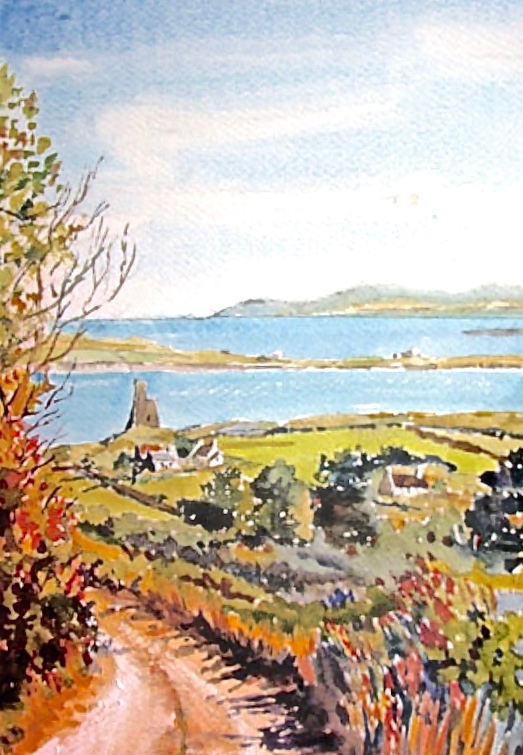
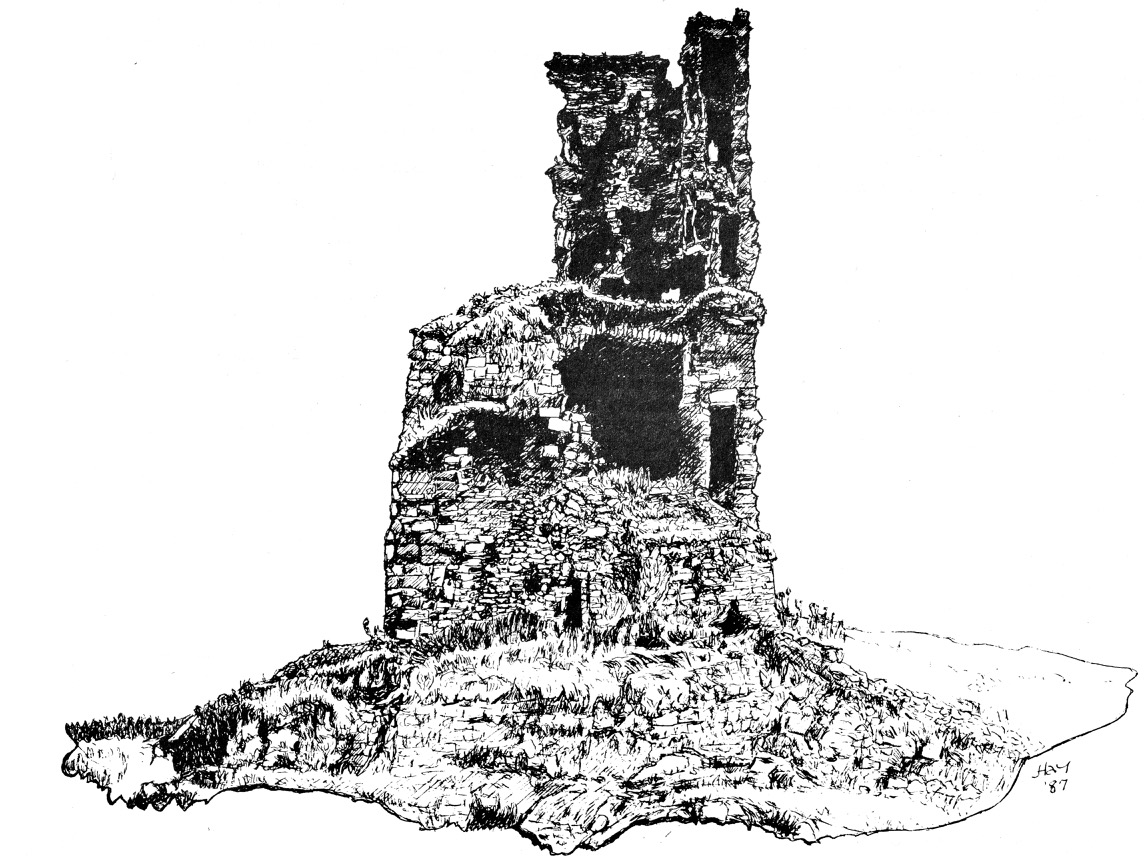
Our friend Peter Mabey is an architect and artist. He has lived in West Cork for a long time: he and I were at college together in Kingston, Surrey, and were surprised to meet each other by chance in Skibbereen market a good few years ago now. Above is one of his attractive watercolours looking down towards the Cove. The vantage point looks remarkably like the one chosen by Jackie Stanley. Below is a drawing of Rossbrin from the monumental work The Castles of County Cork by the late James N Healy, published in 1988 by Mercier:

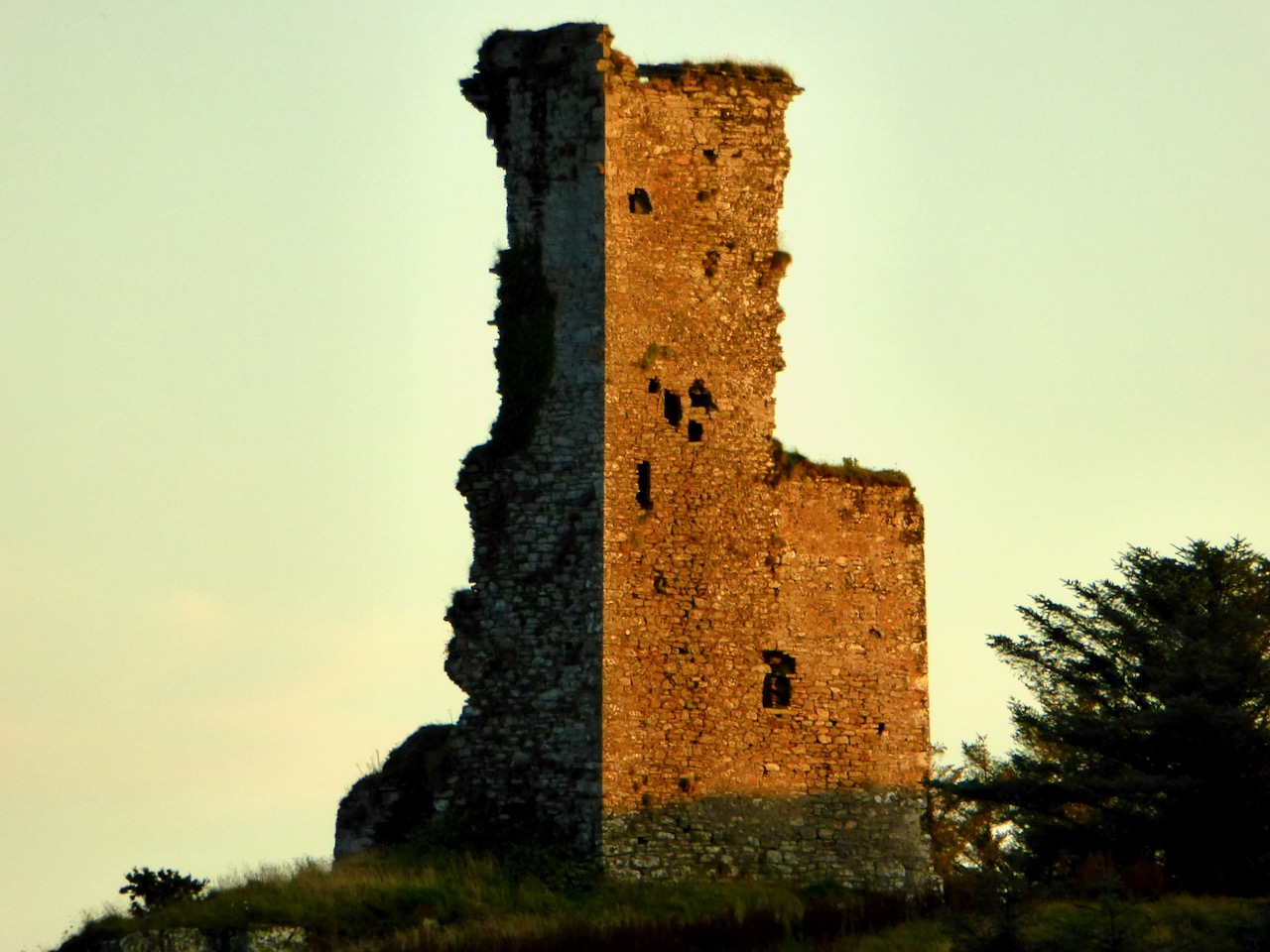
The ruin is a romantic reminder of past times, enhanced by the changing weather moods of Roaringwater Bay. This photograph, by Finola, emphasises the character of the place:

I can’t resist finishing this little two-part foray into the medieval remnants of our historically significant ‘centre of culture and learning’, which now languish on the edge of the waters below us with an artist whose work we admire: Peter Clarke, who writes and illustrates the Hikelines blog. His watercolour sketches are exquisite and always atmospheric. He has kindly allowed me to use his portrayal of Rossbrin Castle as my tailpiece. Thank you, Peter – and thank you to all the other artists who have been inspired by this remote and beautiful part of Ireland.

The Castle of Rossbrin

It was just Raven and I, down at Rossbrin today. We were both inspecting the O’Mahony stronghold which has stood here for, perhaps, 800 years in one form or another. Peter Somerville-Large explored the area and its history in the early 1970s:

Down beside a narrow inlet which empties at low tide stands Rosbrin, the most easterly of the O’Mahony castles. Like the O’Driscolls, the O’Mahonys had a passion for building castles: they built twelve, and six survive, all overlooking or right on the edge of the sea. They shared with the O’Driscolls one of the finest fishing grounds in Europe, controlling the waters and exacting dues from visiting fishing boats in much the same way. ‘None of the fisheries of Munster are so well known,’ wrote an observer in 1688, ‘as those of the promontory of Ivaha, whereto a great fleet of Spaniards and Portuguese go, even in the midst of winter . . .’

The Coast of West Cork, 1972

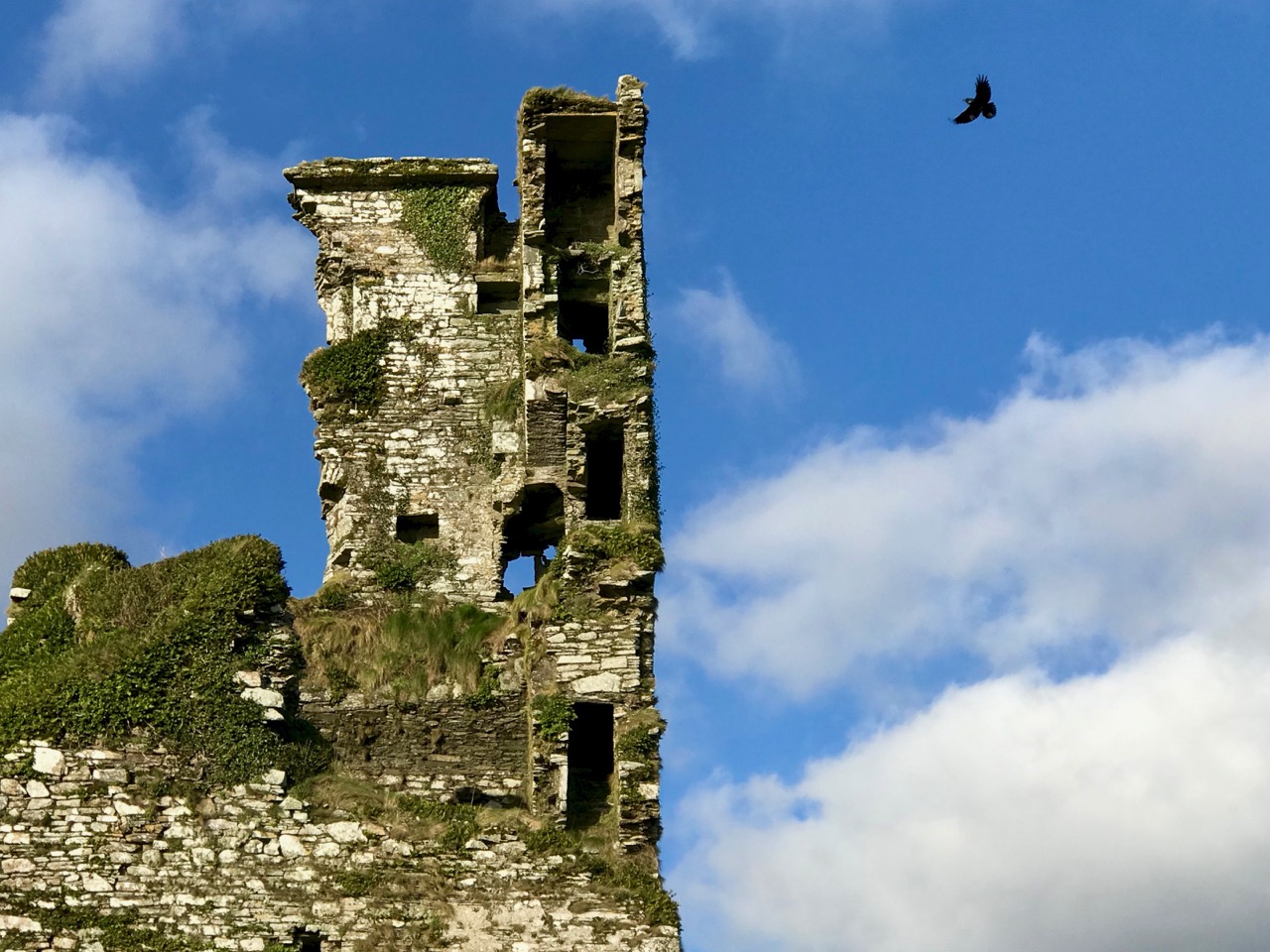
Neither Raven nor I would be deterred by the winter weather. On a day of hard frost followed by blue skies and sunshine, nowhere could be more beautiful than Rossbrin, and nothing could be more poignant than the quiet remoteness of this western corner of Ireland, once considered ‘the greatest centre of learning in Europe’. I walked in the company of the wisest of the corvids over the vanished ruins of a great university.

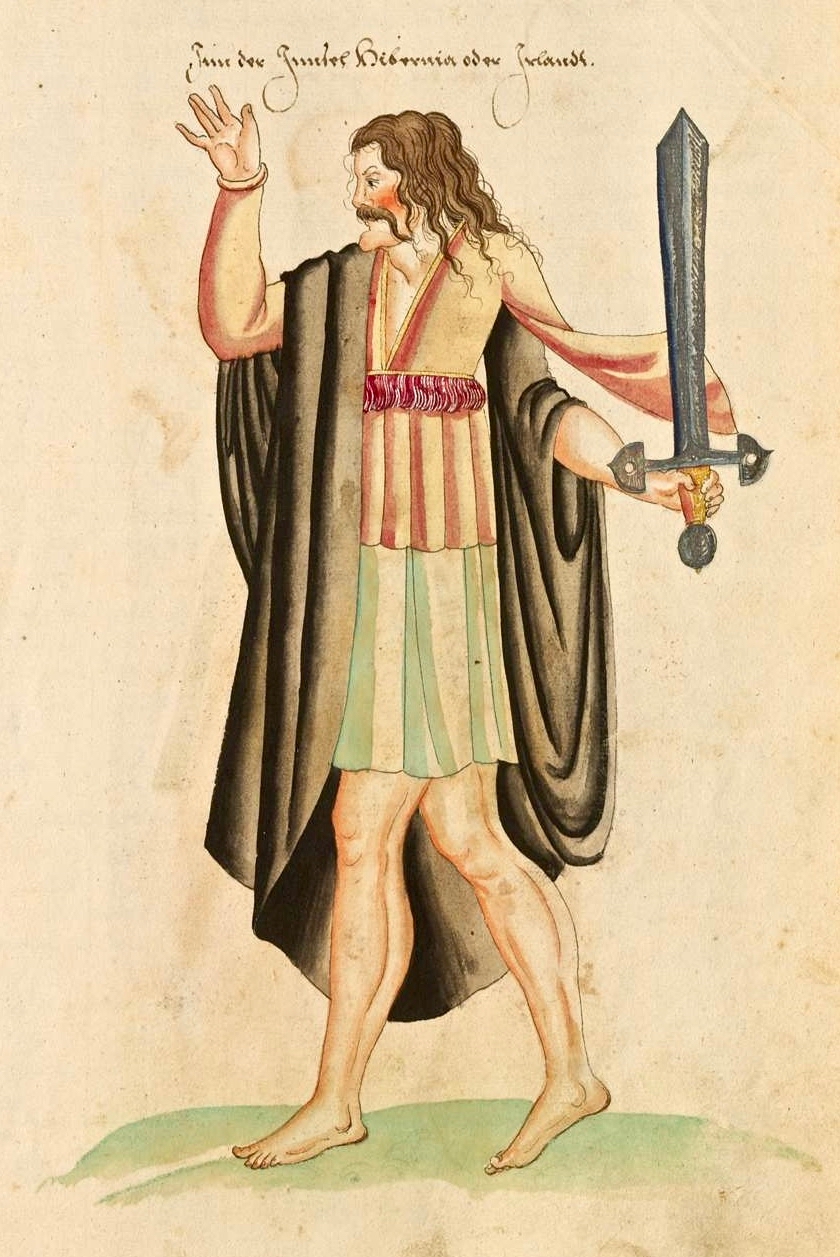
Finnin O’Mahony – Taoiseach, or chieftain, of the clan – as he may well have looked in the latter part of the fifteenth century (above): cultured, fashionable, flamboyant even, and powerful. It’s sobering to think that, while Columbus was following in the footsteps of Saint Brendan to rediscover the New World, scholars and scribes were busy on the shores of Roaringwater Bay writing and translating treatises, medical manuscripts and historical accounts of travellers busy in their quests to prove the earth may not be flat after all . . .

The Annals of Ulster tell us that Finghinn Ó Mathúna of Rossbrin Castle who died in 1496 was an acclaimed historian of the then known world. And, the Annals of Connaught lauded him as ‘a great scholar in Irish, Latin and English’. The Annals of the Four Masters referred to Finghinn Ó Mathúna as being unmatched in Munster for hospitality and scholarship. The O’Mahony territory was inclusive of today’s parishes of Dromore and Caheragh and all the lands westwards to Mizen Head. Finghinn made Rossbrin Castle both his residence and a rendezvous for Irish scholars . . . Most writers who laud the scholarship of Finghinn Ó Mathúna lament the loss of many of Rossbrin Castle’s manuscripts . . .

From an article by Alfie O’Mahony in the Skibbereen and District Historical Society Journal, Volume 6, 2010

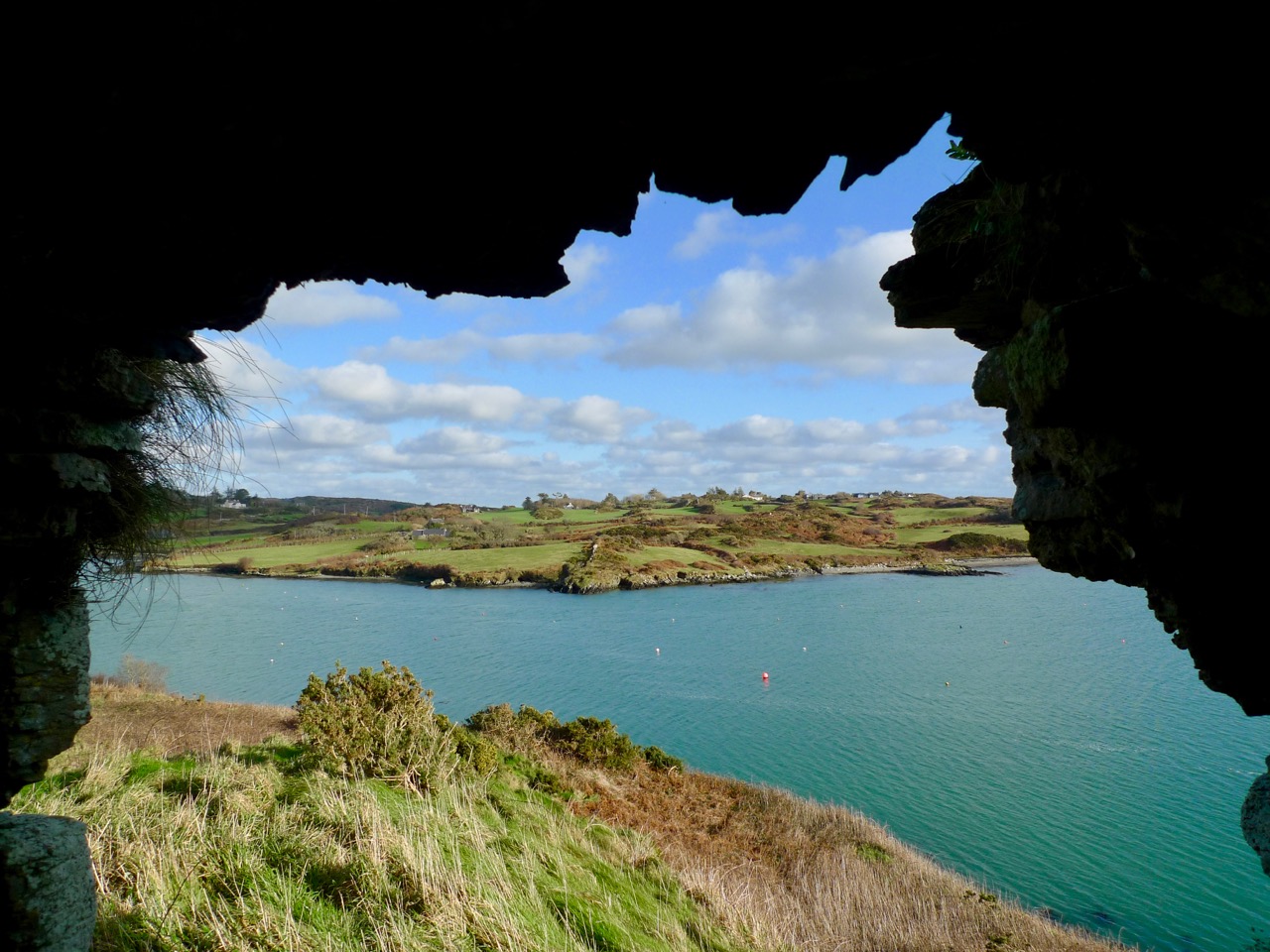
Roaringwater Bay – the view to the south, today, from Rossbrin. In the foreground is Horse Island, and beyond is the profile of Cape Clear, also a place of learning to this day: students of the Irish language spend time on the island, one of the Gaeltacht areas where Irish is still the native tongue. One of the reasons for Finghinn being so expert in languages himself was the desire to communicate with the visiting fishermen whose needs provided him and his clansmen with a good living. As well as a celebrated place of learning, Rossbrin Cove would have supplied fish palaces and all the trappings of the industry: barrels and salt for preserving, victuallers, alehouses, brothels . . . It must have been a boisterous and vibrant place.

Peter Somerville-Large gives a commentary on the more recent history of the castle:

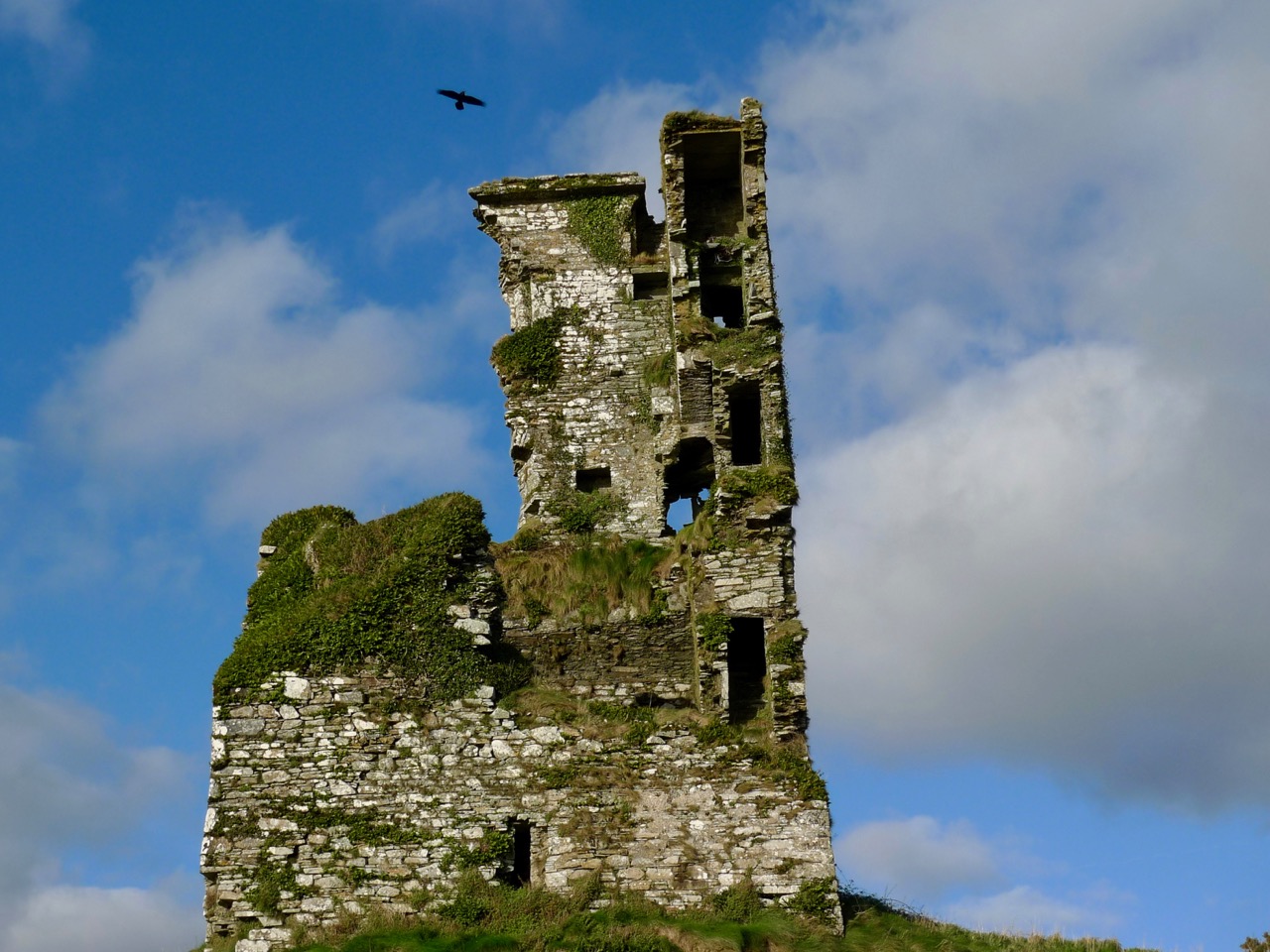
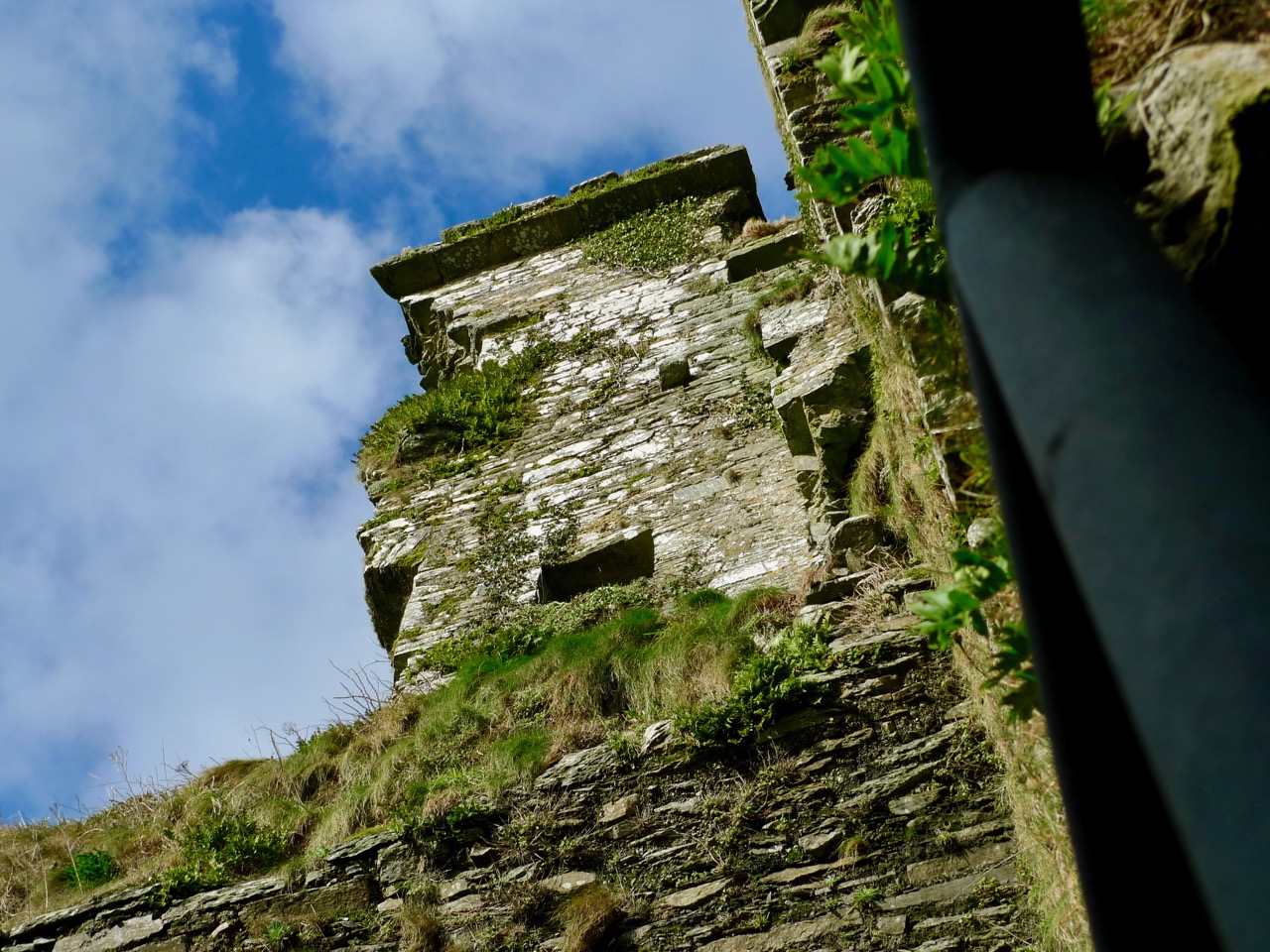
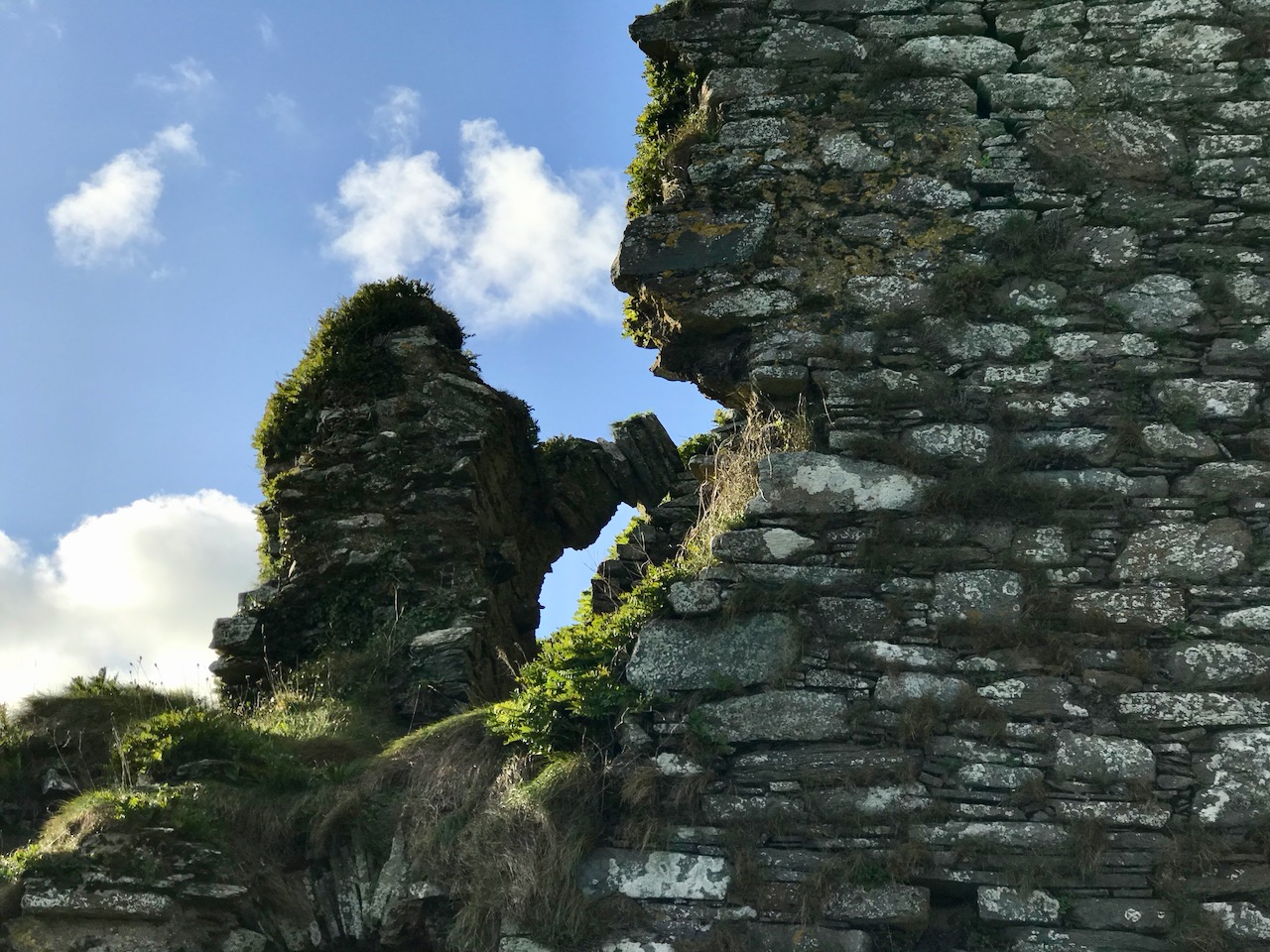
One wall of the splintered tower has a crack running down the side. Another was partly blown down by a storm in 1905. If there is another great storm like that one, Rosbrin might well disappear without trace, like the O’Mahony castles at Ballydevlin, Castle Meighan and Crookhaven. It is sited on an area which is very difficult to approach from either land or sea, standing on a rock. Contrary to what might be written in Holy Scripture, buildings on rocks have little in the way of foundation, and when they fall down or are swept away there is nothing left of them except a memory . . .

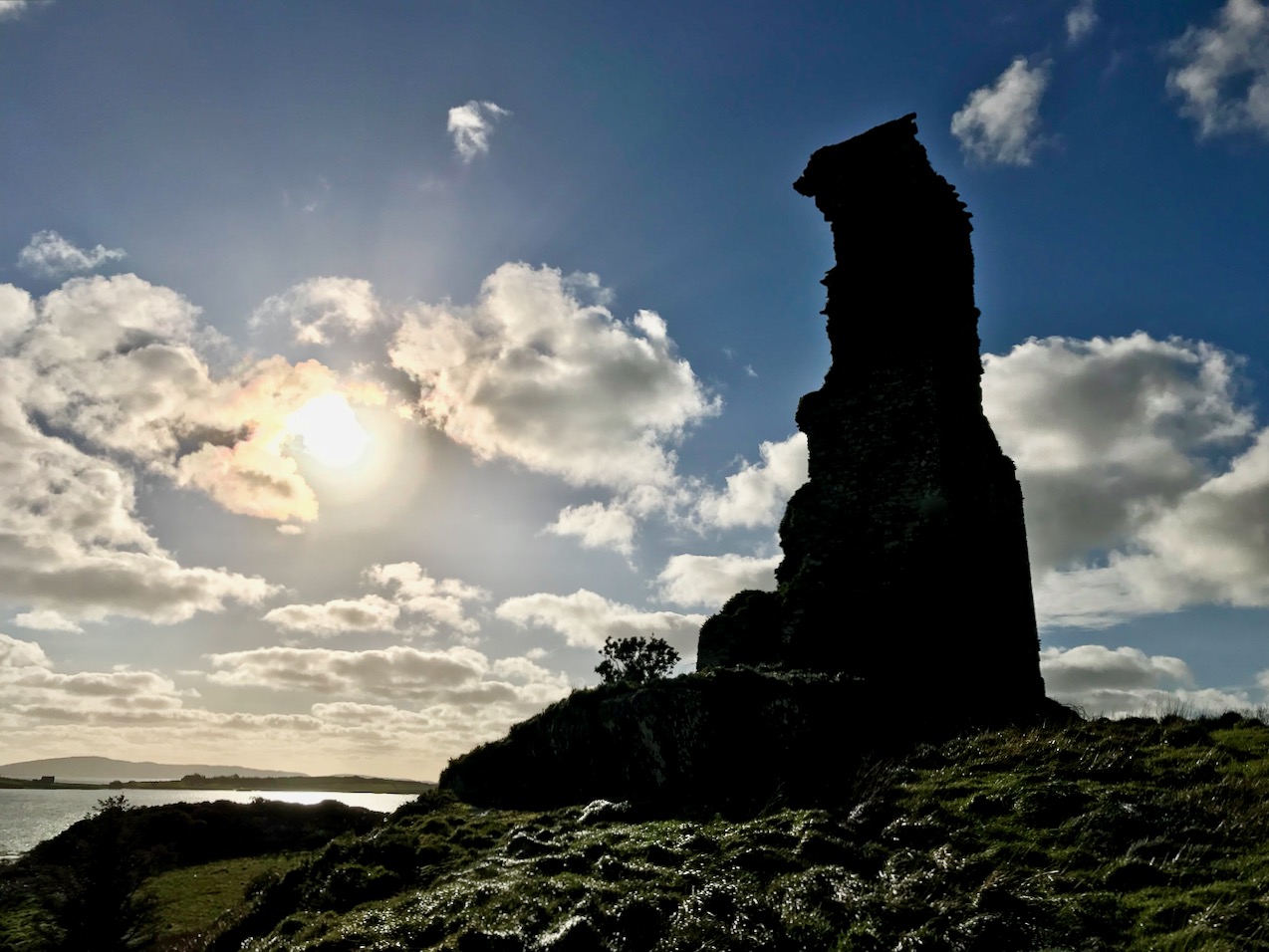
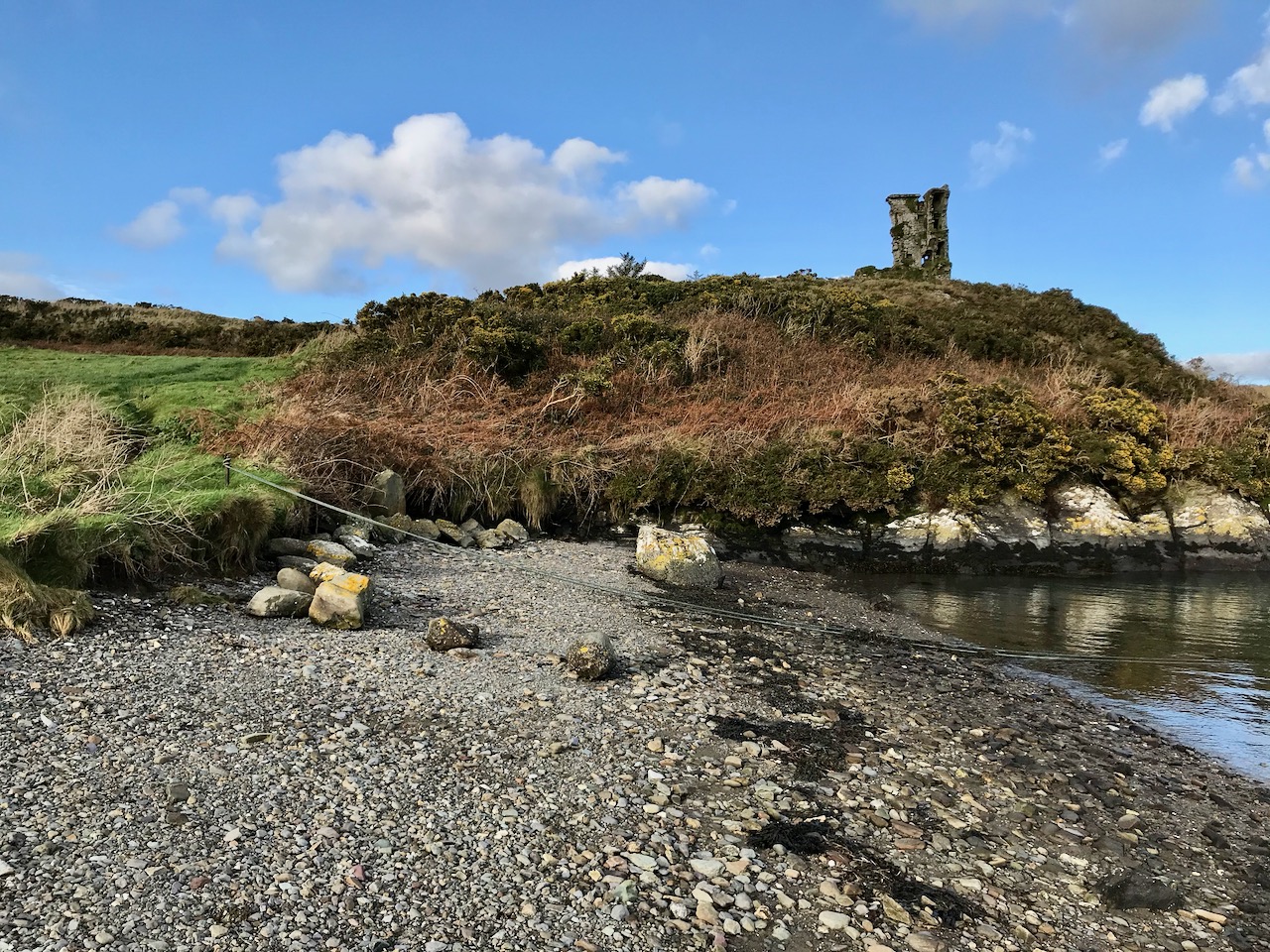
To the south of the rock on which the castle stands are the vestigial remains of an ancient stone quay (above), still in use as a landing place. The Cove itself – a natural haven – would have been the main harbour area serving the fishing fleets. The castle stands sentinel above the harbour entrance, ensuring that no-one could approach unseen.

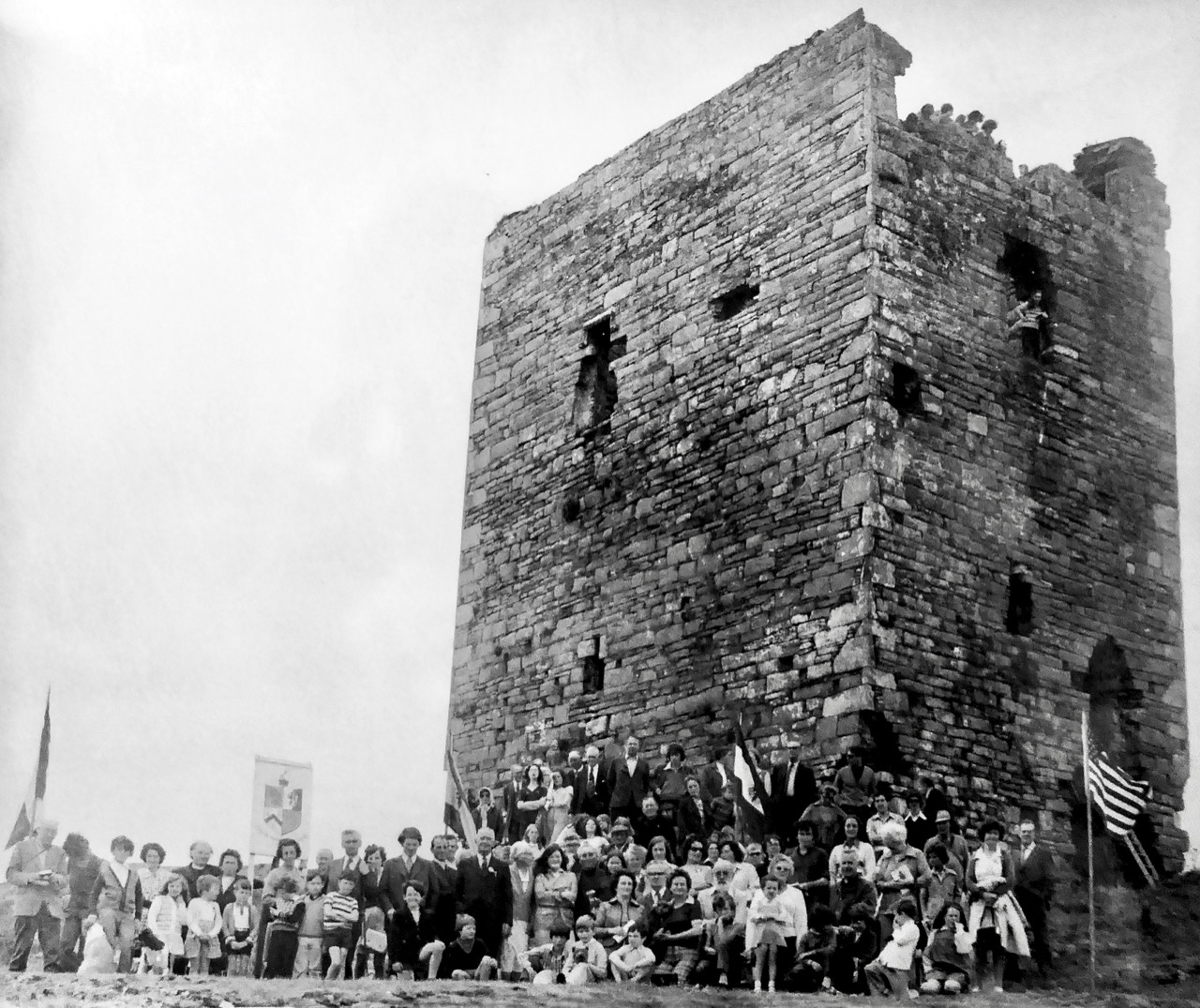
I have been looking for older illustrations of the castle, in order to ascertain how much erosion is taking place as the years go by. Here’s a fascinating record of an O’Mahony Clan Gathering, photographed in 1975 by Michael Minihan of Skibbereen. There is a lot more of the building intact at that time. Can you see the spectators high up on the walls and roof? [Note: I was mistaken – this is actually Leamcon or Black Castle before reconstruction. I am leaving it in to illustrate what Rossbrin may have looked like before it started to fall apart.]

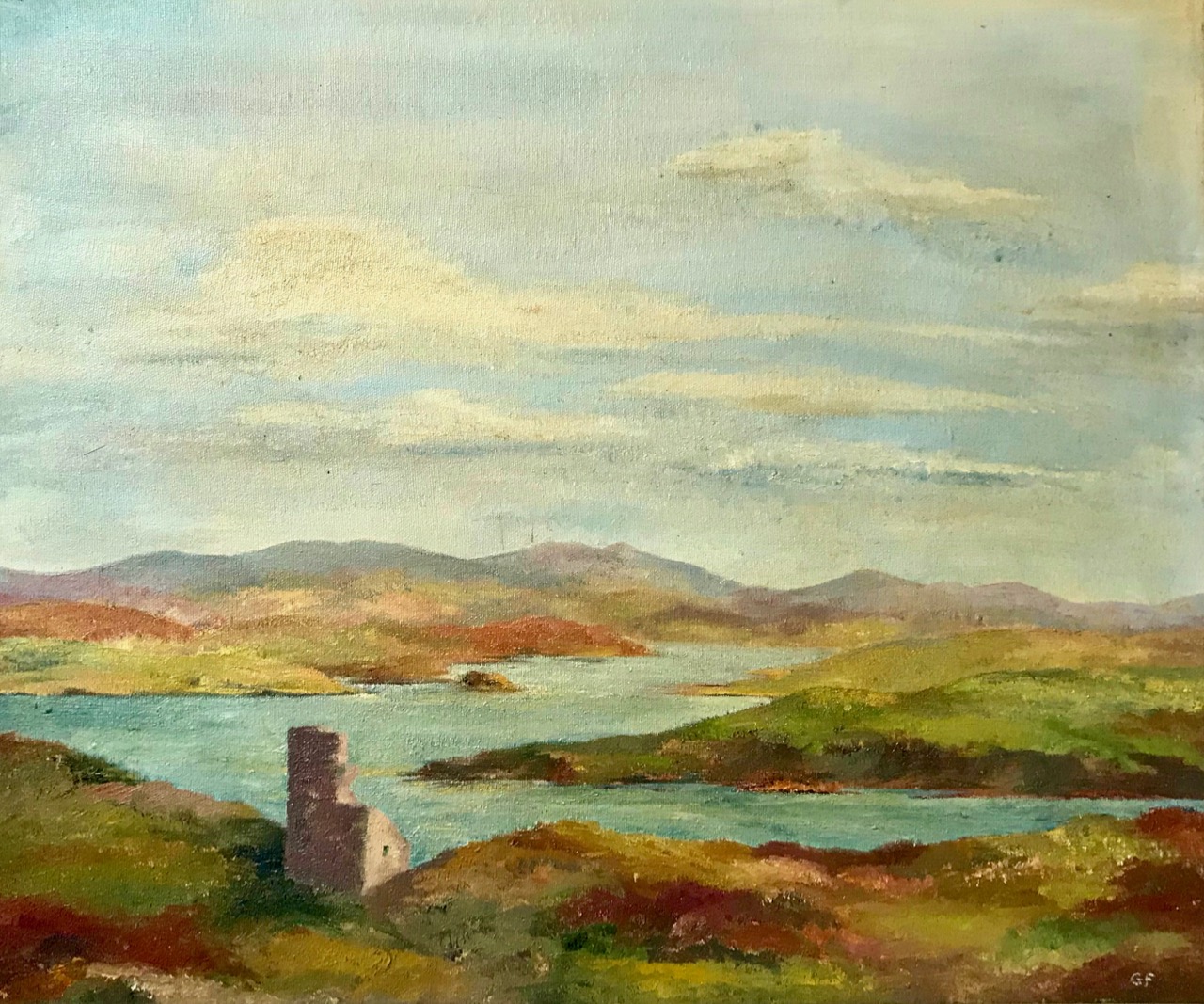
As most of you will know, we look down on Rossbrin Cove and Castle from our eyrie up at Nead an Iolair. We consider anyone living on or by the Cove a neighbour. One of these is Julian, the first to welcome us when we arrived here many years ago. On my walk today I called in on him – he lives next door to the Castle Farm. I was over the moon when he showed me a portrayal of the Castle which his mother, Geraldine, painted in the 1970s, only a year or so after the gathering at Leamcon, above. A substantial part of the Rossbrin castle walls has collapsed in relatively recent times.

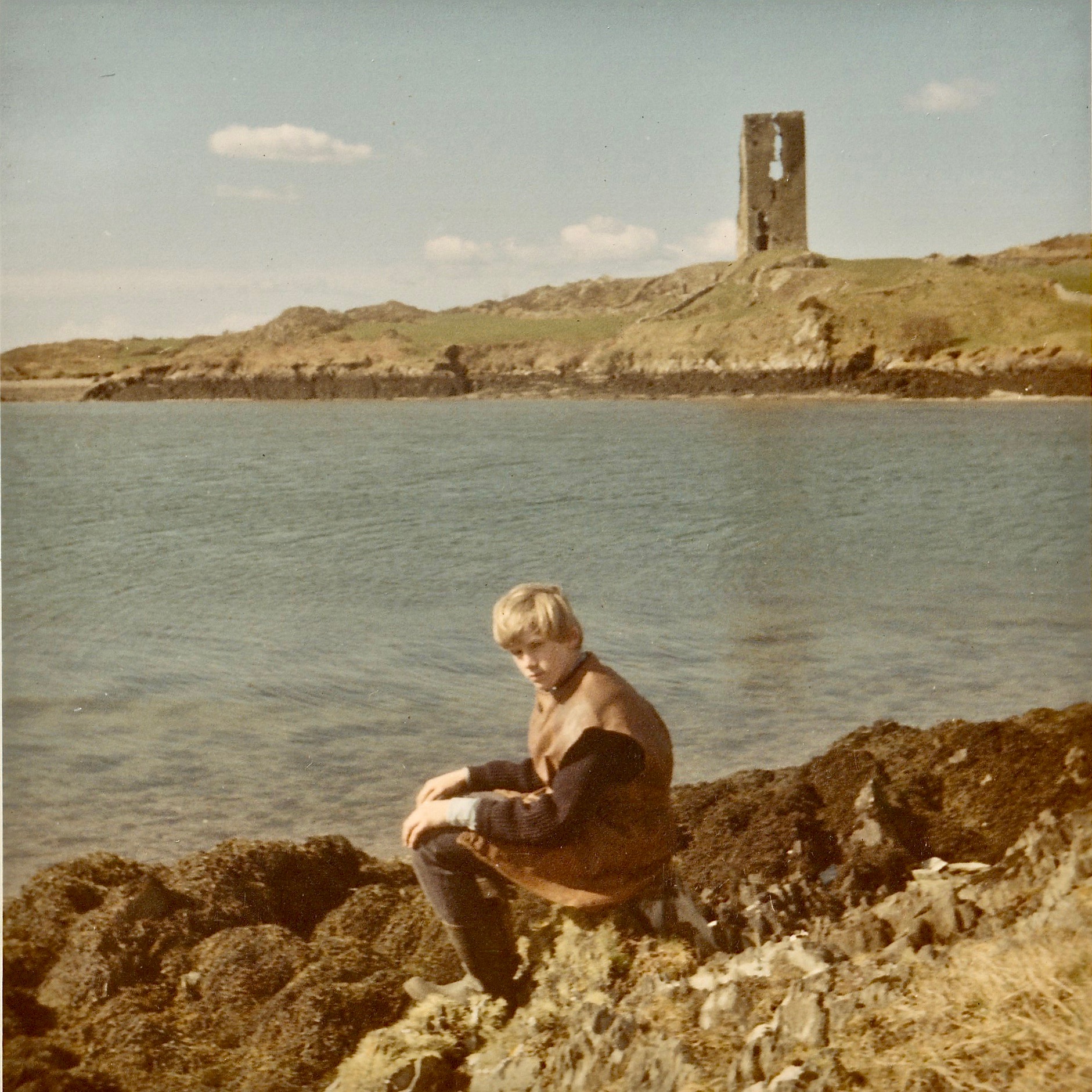
Rossbrin Castle, painted by Geraldine van Hasselt in the 1970s (above). Best of all, though, is a photograph of Julian – her son – taken at Easter, 1969: significant parts of the walls have collapsed since this picture was taken.

Julian van Hasselt on Rossbrin shore: behind him is a clear view of the castle. You can see the vertical crack which eventually led to the collapse of half the tower.

At this time of the year we get excellent sunsets when the weather is right. Today’s was a good one! I reluctantly said goodbye to Raven, my companion whose constant cronking seemed to follow me as I perambulated this place of deep history. I wonder: was it just Raven? Or might it have been Finghinn himself, speaking to me in yet another of his languages? I think I’ll have to return to Rossbrin to find out!

With many thanks to friends Julian and Raven . . .

Fingal Mummers

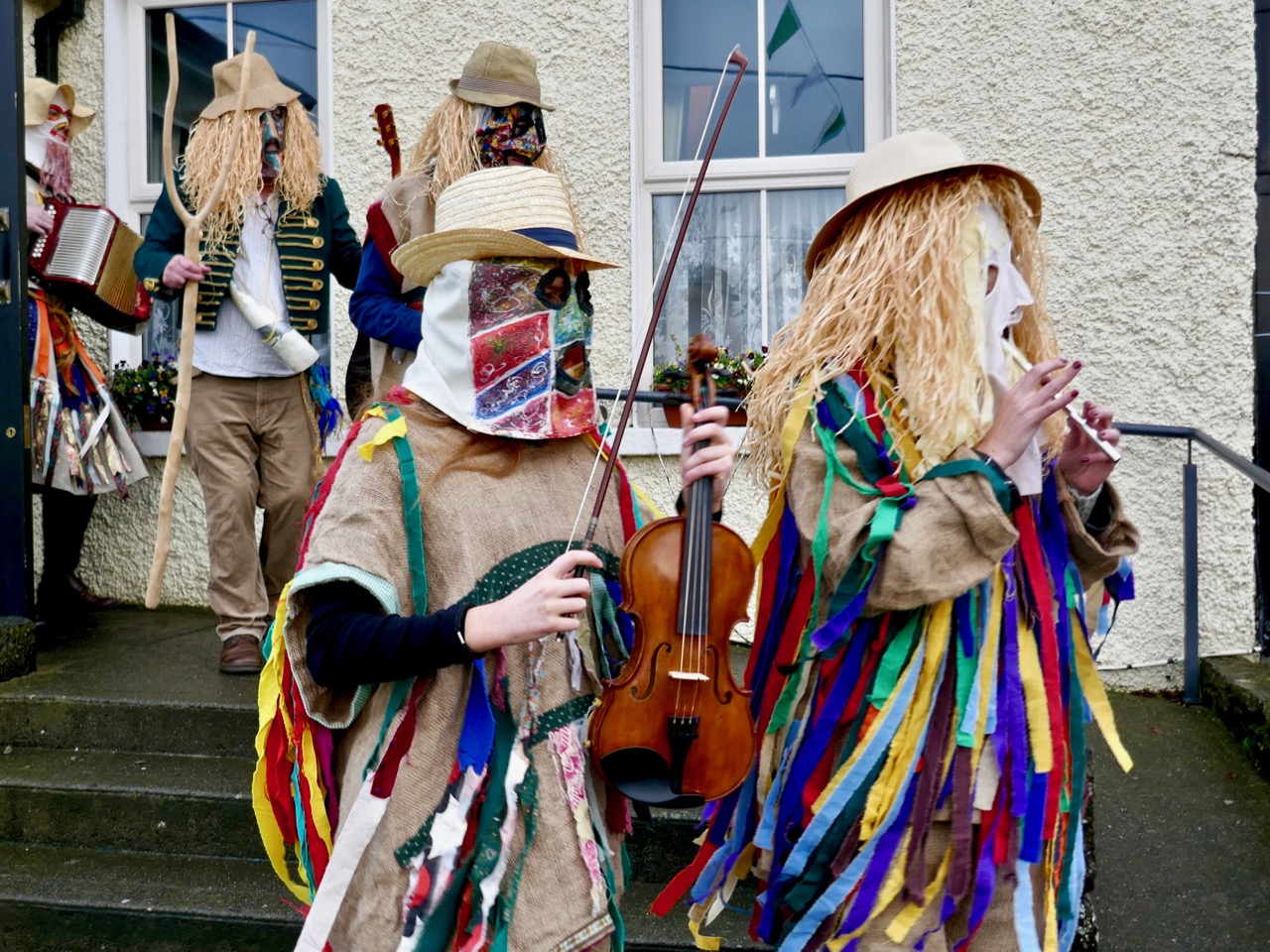
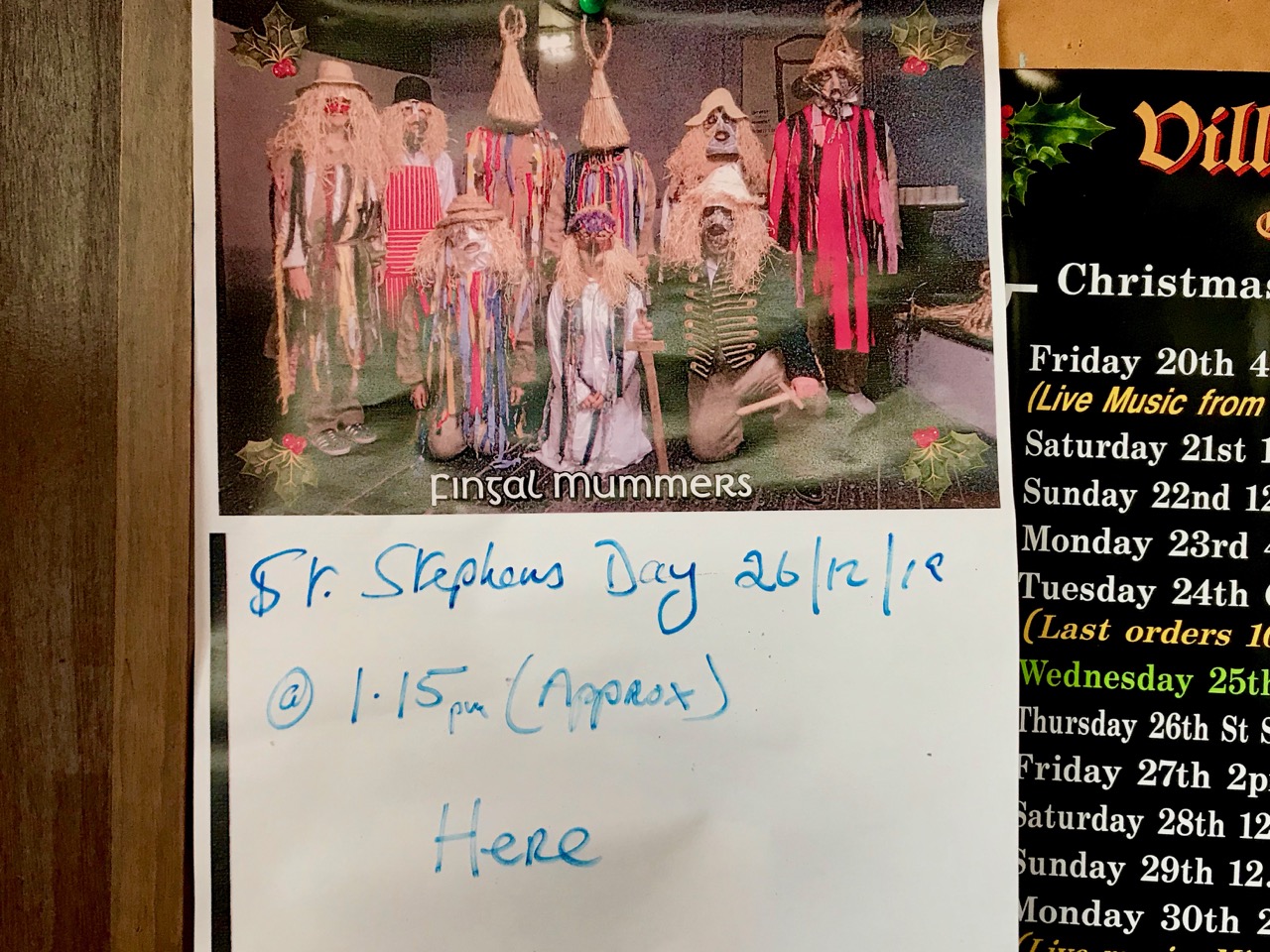
On Stephen’s Day we went up to Fingal County to see the Mummers – it’s a mere hare’s leap from Nead an Iolair. Until 1994 there was no county of Fingal: the area was part of Greater Dublin. Since that time this county has recorded the highest birth rate and population increase of any community in Ireland. Why? I would like to suggest that it’s because Fingal has , for countless generations, been the home of a Mummers tradition.

On our new green last evening here was presented the drollest piece of mummery I ever saw in or out of Ireland. There was St George and St Dennis and St Patrick in their buffle coats and the Turks likewise and Oliver Cromwell and a doctor and an old woman who made rare sport till Beelzebub  came in with a frying pan upon his shoulder and a great flail in his hand threshing about him on friends and foes, and at last running away with the bold usurper whom he tweaked by his gilded nose – – and then came a little Devil with a broom to gather up the money that was thrown to the Mummers for their sport. It is an ancient pastime they tell me of the citizens . . .

This account of Mummers in Cork is supposed to date from 1685, and is found in a manuscript collection in the Library of Trinity College Dublin, lodged by Thomas Crofton Croker in the 1840s. It is probably the earliest recorded portrayal of the custom in Ireland or Britain. Three hundred and thirty four years after this description of ‘an ancient pastime’ was written down, recognisably the same ‘mummery’ is happening every year across these islands around midwinter.

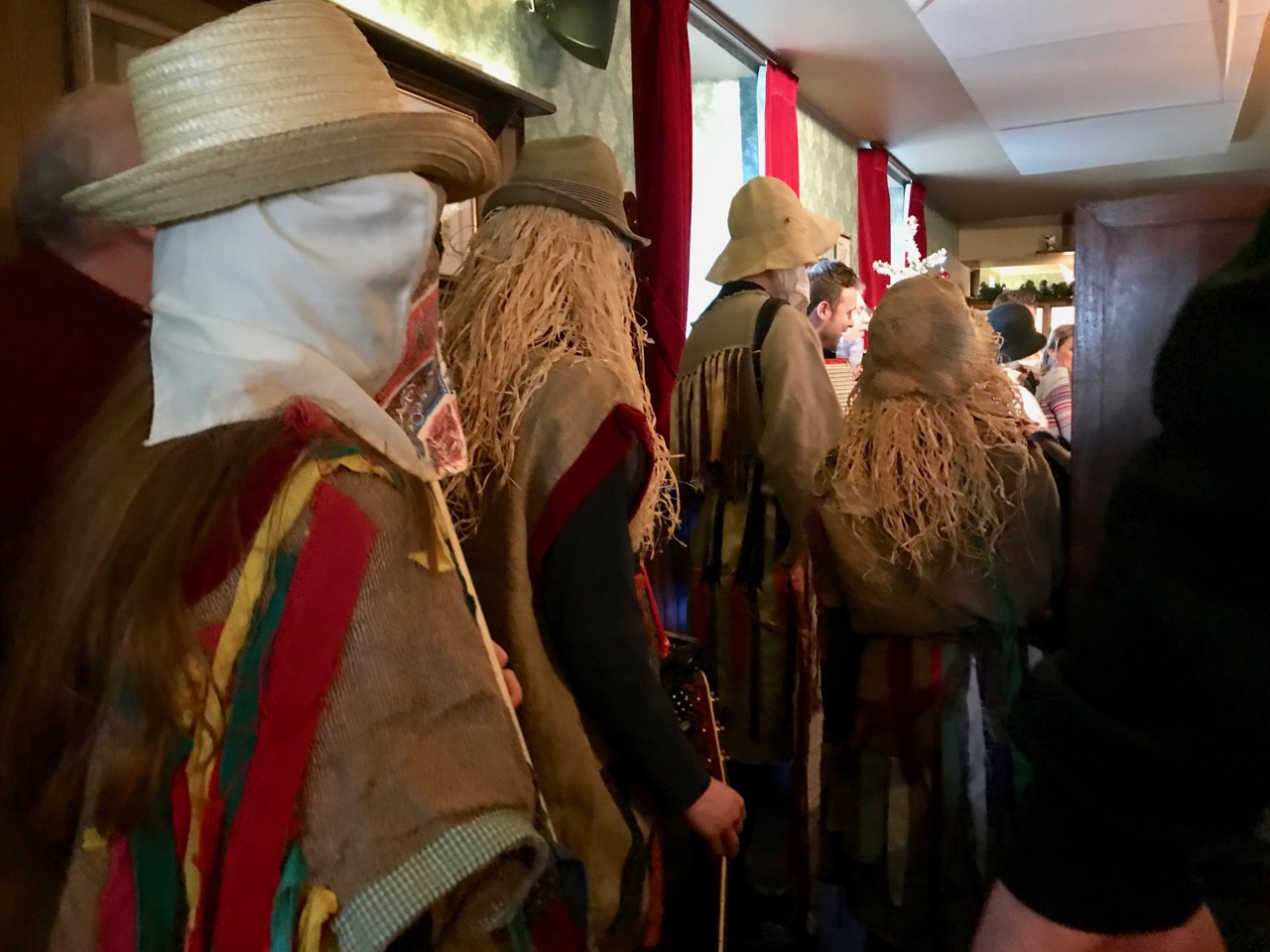
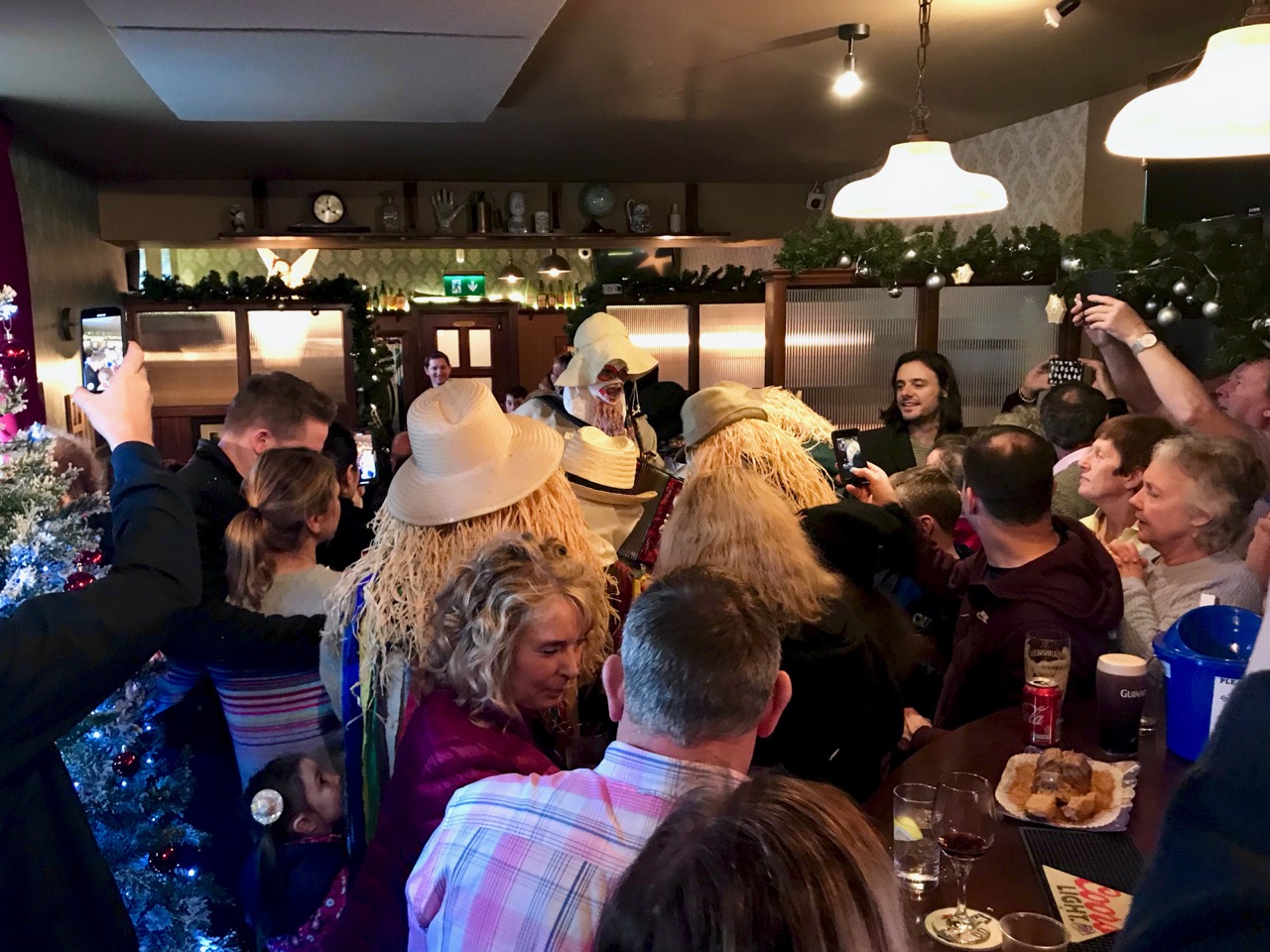
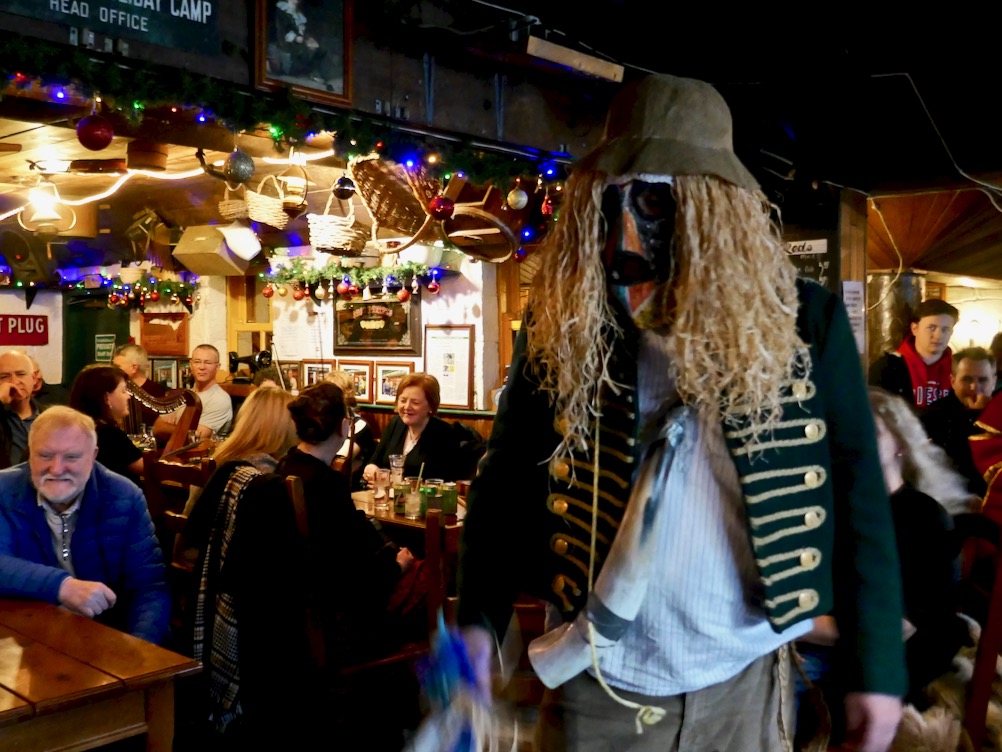
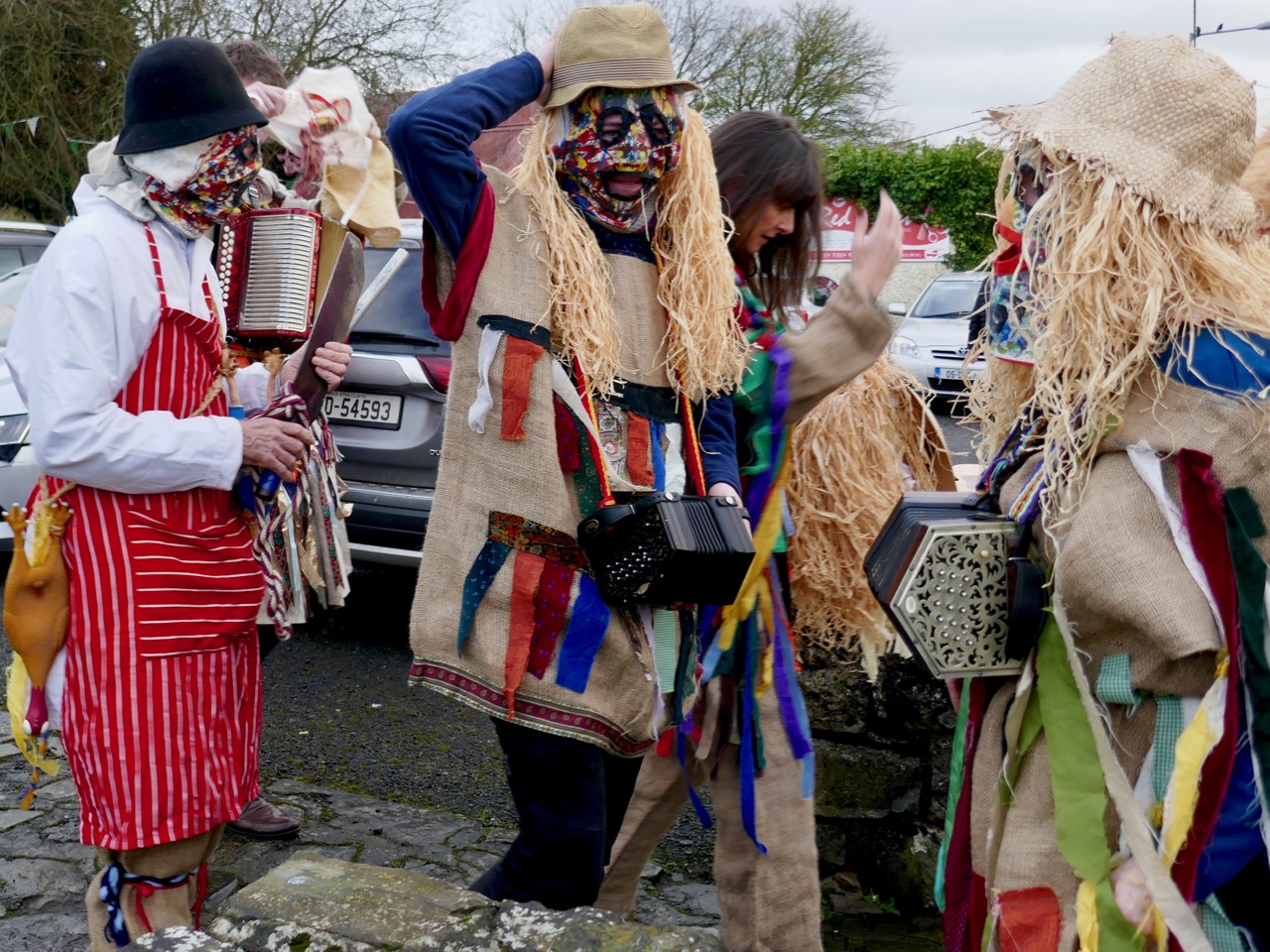
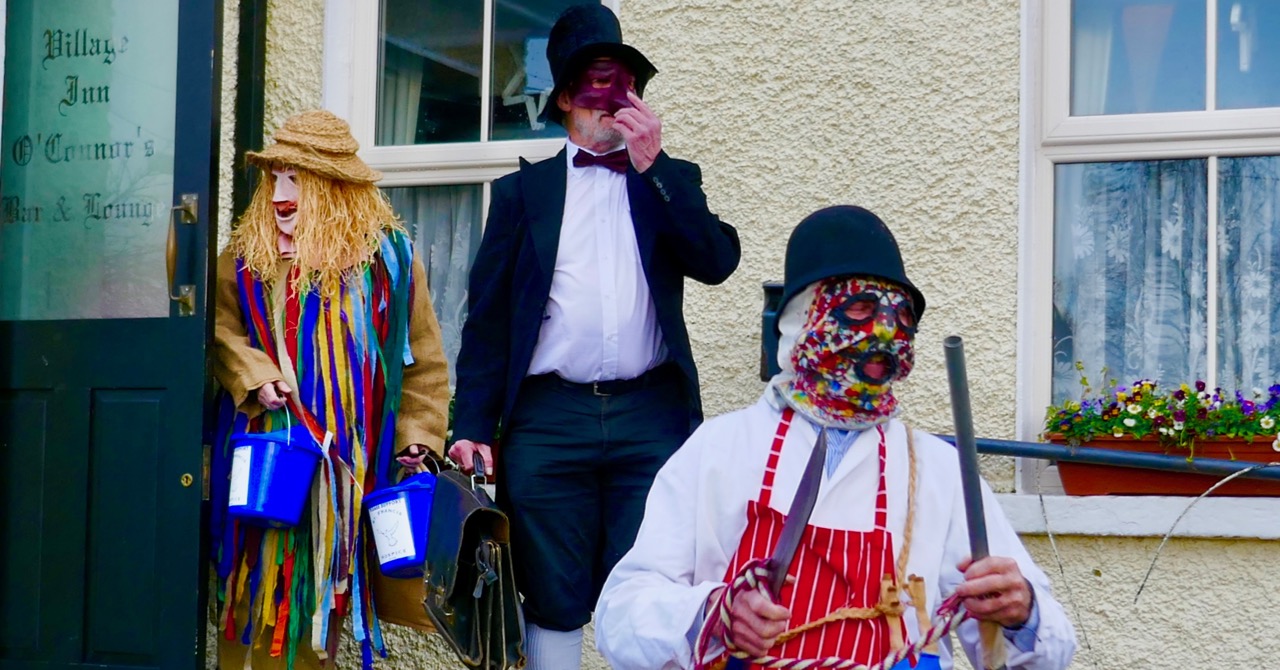
The Fingal Mummers ‘entering in’ (above). Following a revival in the 1950s, this group travels around several towns and villages on Stephen’s Day, performing their play to crowds who gather to see them. We tracked them down to their starting point, O ‘Connors Inn, Ballyboughal, which seemed a quiet little settlement until we walked through the door of the pub and realised that every resident of the village – and quite a contingent of visitors – was crammed inside waiting expectantly for the visiting players. The excitement was tangible, and everyone was in good spirit, enjoying the Christmas cakes, puddings and treats that were being freely handed around.

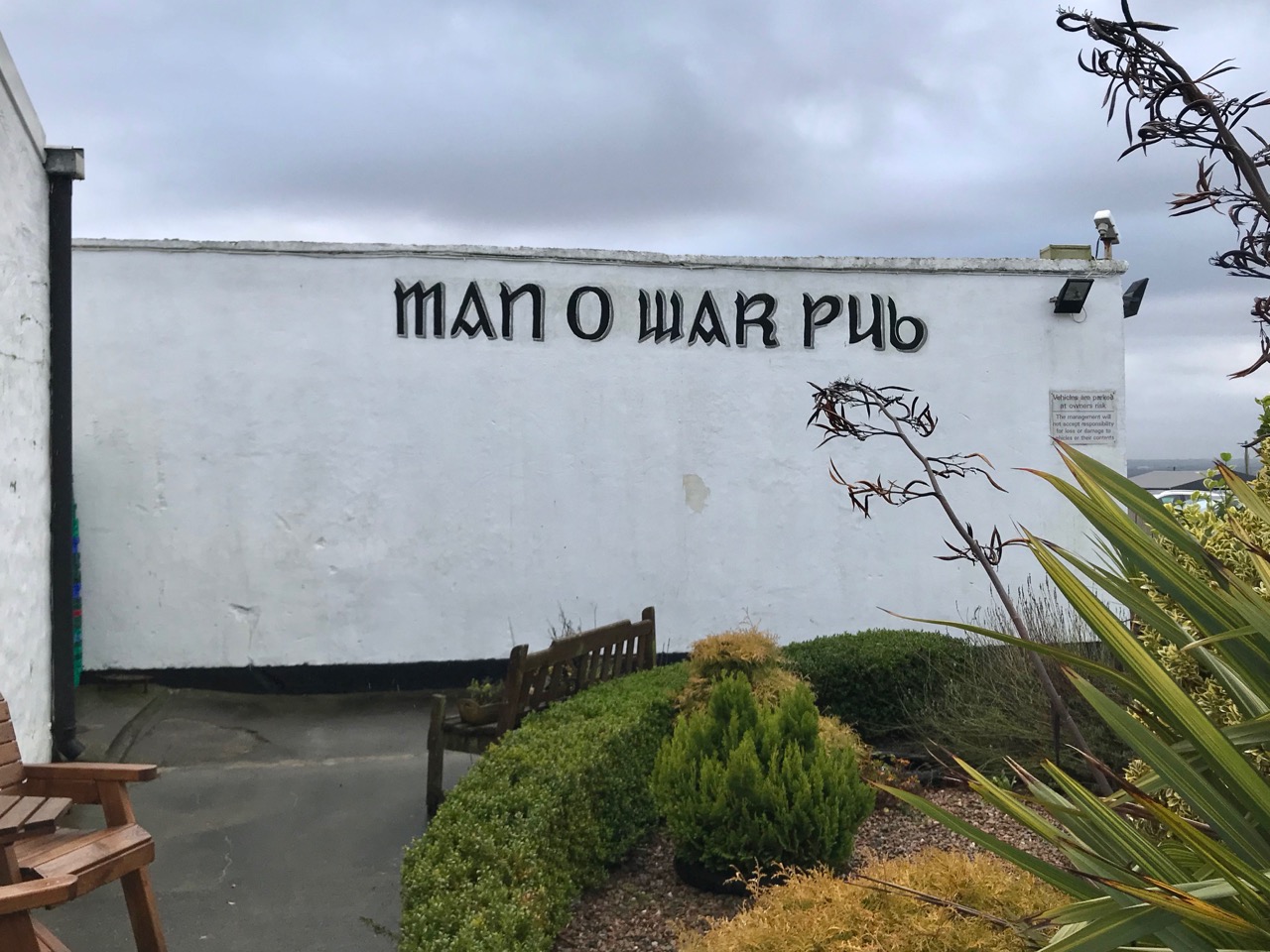
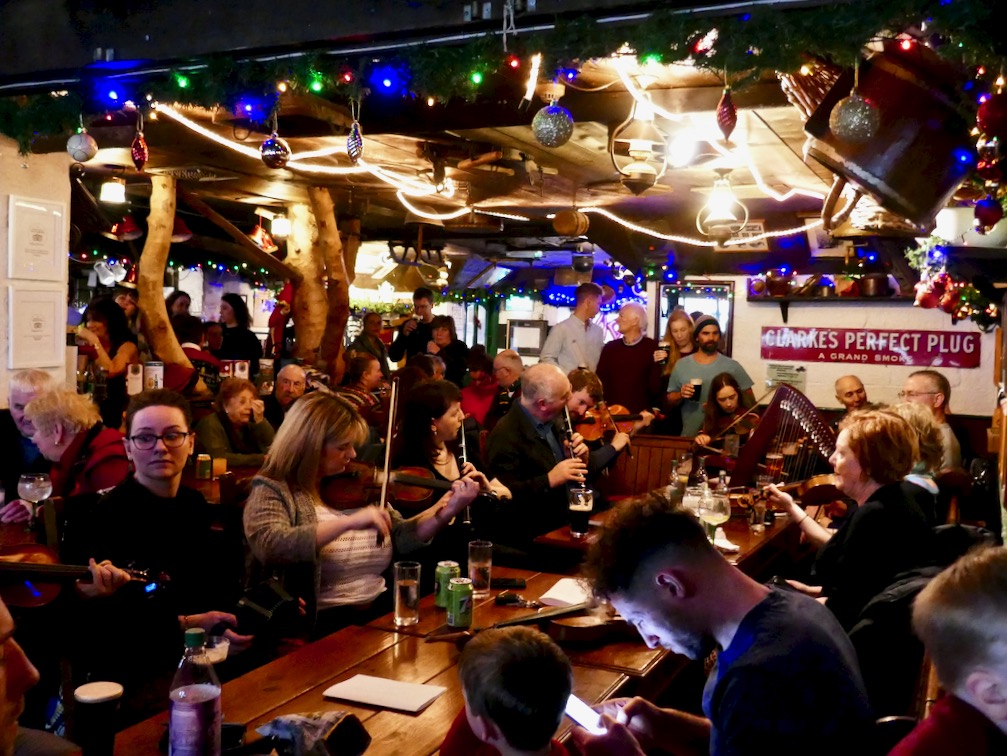
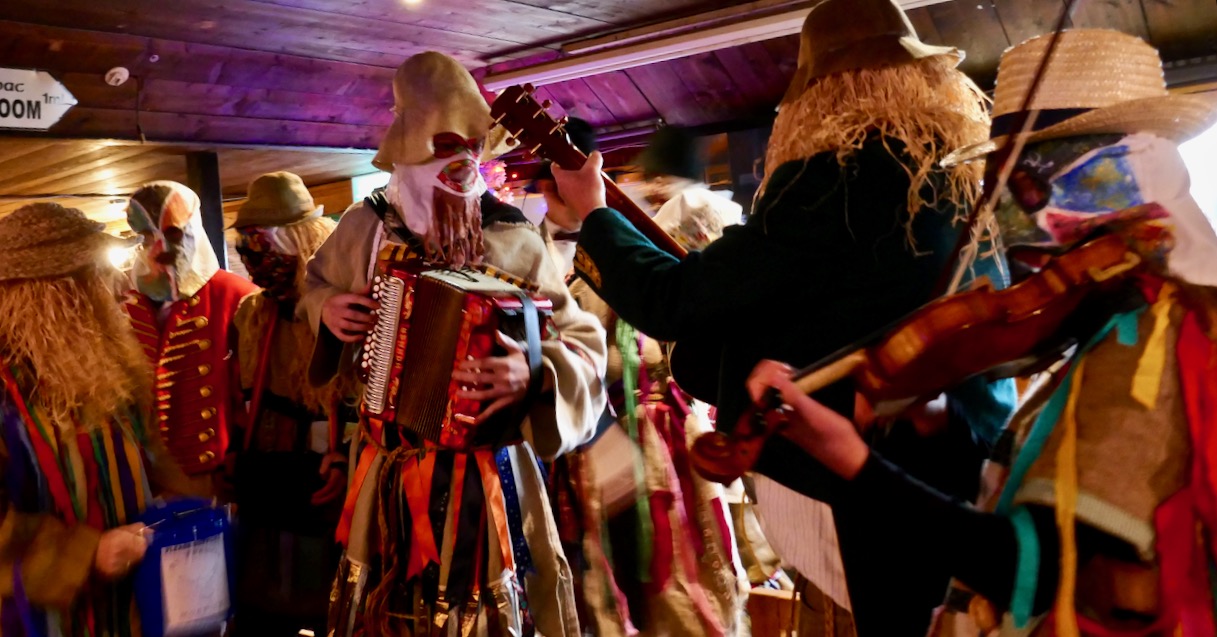
It seemed that the visit to O’Connors was a purely ritual appearance, as the crowds and the noise were too overbearing to permit a performance of the play. There was music and singing, but the group eventually moved on – with us following – to the next venue: Man O’War! This bar, which also gave its name to the scattering of houses around it, was evidently established in 1595 and became a toll point on the turnpike section of the main Dublin to Belfast road in the 1700s. The road has long since been superseded and is now a quiet lane. The pub, however, has grown in size and reputation and, on Stephen’s Day was packed: a large number of musicians was seated around an enormous table, and post-Christmas festivities were in full swing, with an air of expectancy leading up to the arrival of the Mummers.

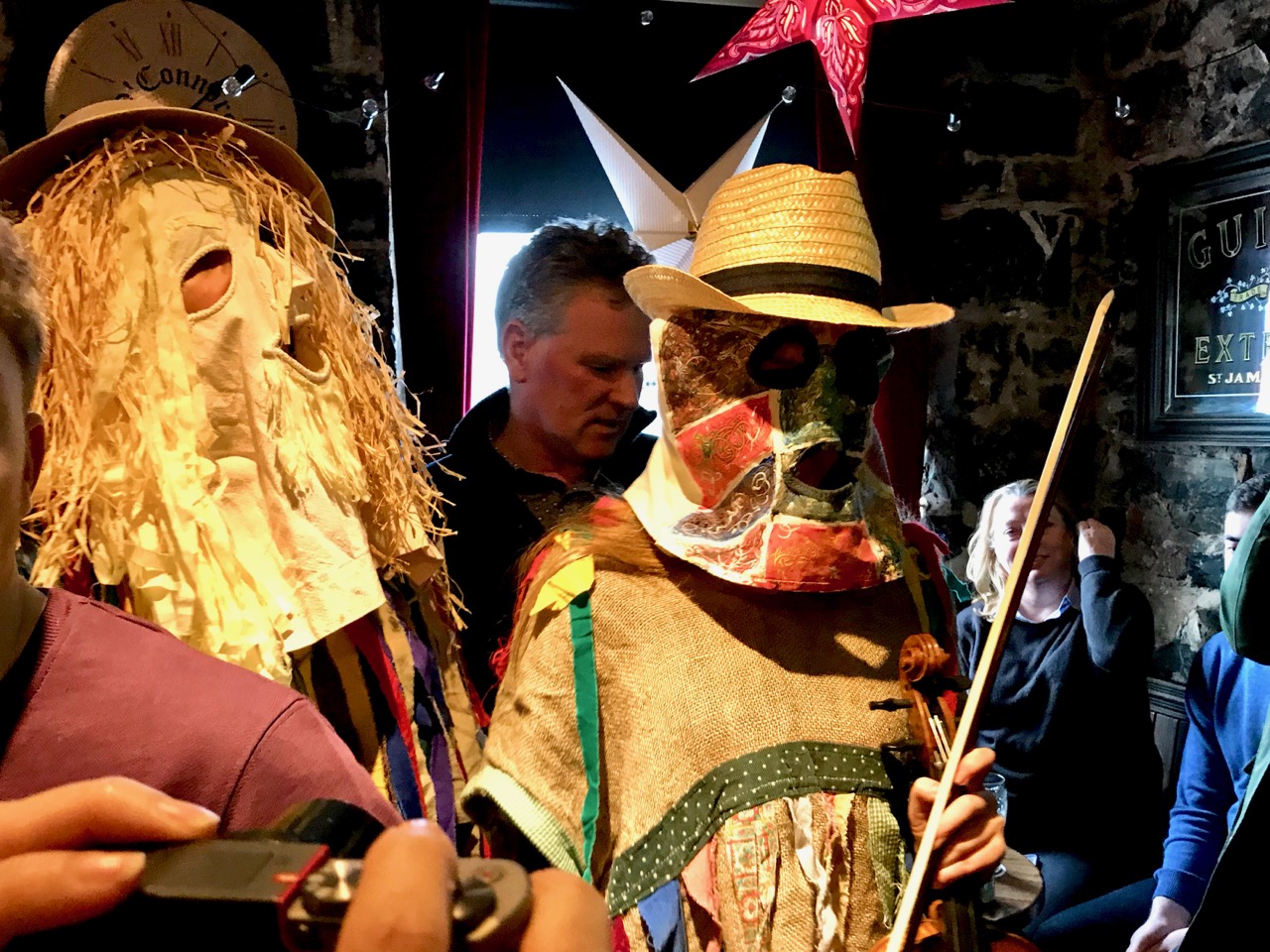
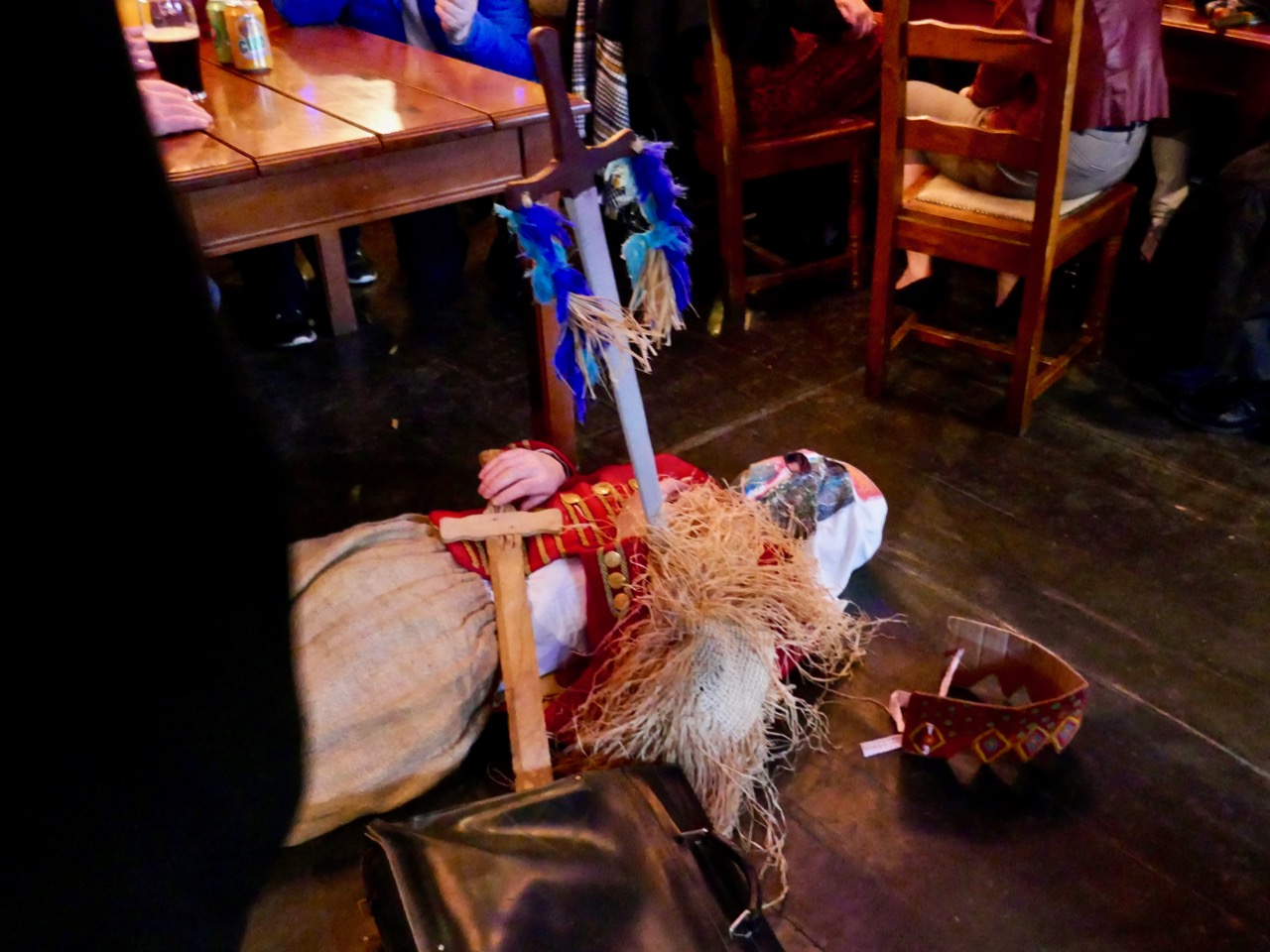
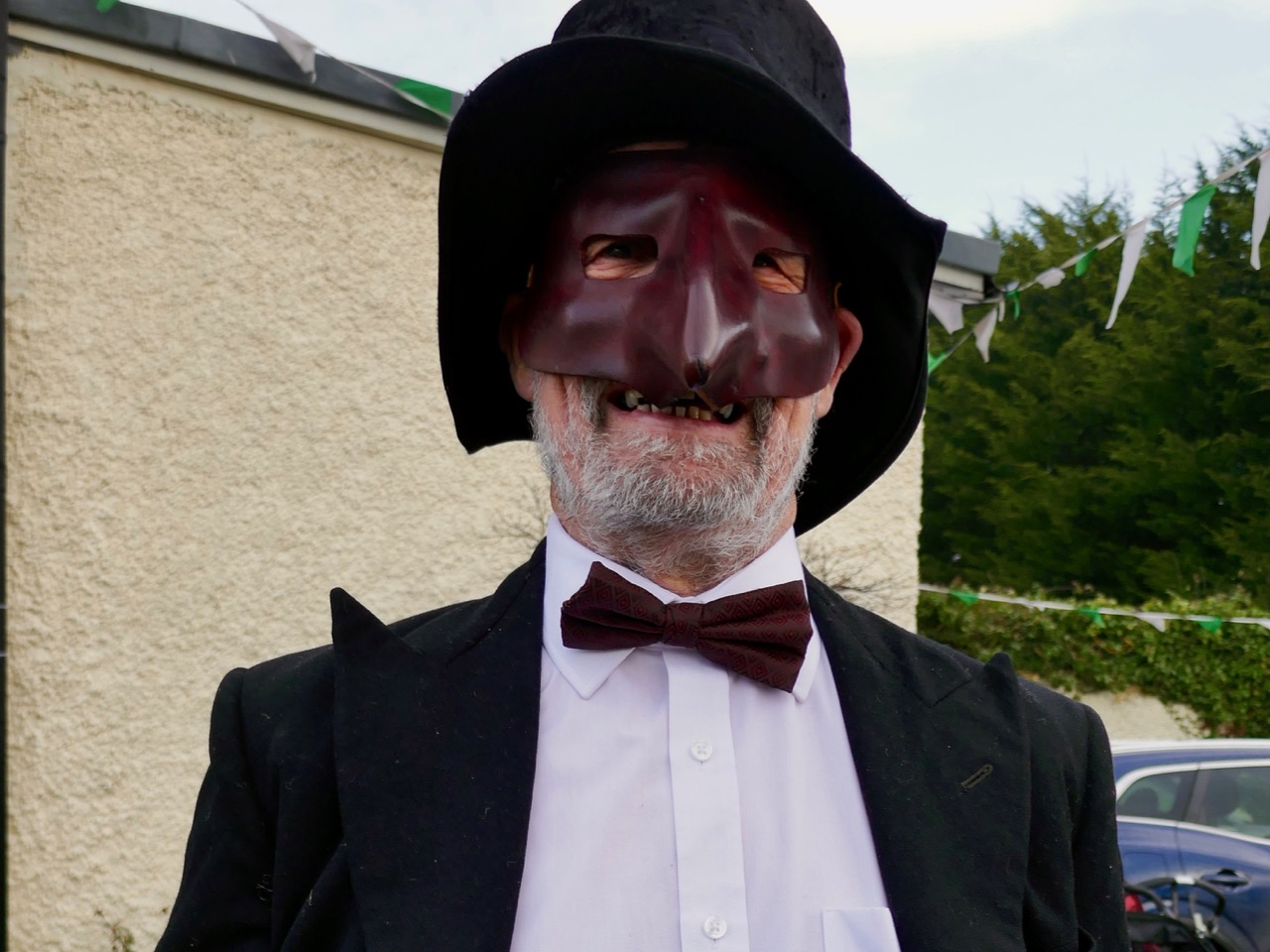
It was at Man O’War that we saw the Fingal play performed. There are around a dozen characters, which include St Patrick, Prince George, The Doctor, The Butcher, Jenny Wren and Beelzebub. The main protagonists, Patrick and George, fight with swords until the former kills the latter (obviously!). A quack doctor is brought in and raises George to fight another day. There is considerable humour, innuendo and – always – music and dance. A most important aspect, however, is the appearance towards the end of the play of a character – Slick-Slack – who carries a large family on his back (usually dolls and teddy bears).

From upper picture – heroes Patrick and George, fiercesome Doctor and musicians

For me, it was just slipping back to old times: from when I could barely walk we attended the Mummers play at Crookham Village in Hampshire, England, every Boxing Day, and I absorbed the tradition into the rhythm of 1950s life. Here are the Crookham Village Mummers around that time:

A mid 20th century photograph of the Crookham Mummers, Hampshire: could the little boy on the right be me? The characters in this play, left to right – Roomer, Slasher, Trim Tram, Doctor, Turkish Knight, King George, Old Father Christmas

Into adulthood I never questioned the existence of the Mummers: they were just an essential part of Christmas – like carols, bells and reindeer. As soon as I was able, I joined the Mummers myself and now, after decades of performing it, carry the complete play in my head (the Hampshire version of it, anyway). It was only when my interest in folklore became academic that I asked myself: what is all this about? And then I became aware of the significance of mummery in the traditional cultures of northern Europe, Scandinavia – and beyond – and saw its place and relevance to the season when the sun gets to its lowest point and then has to be encouraged back again: cold and darkness have to be replaced in the natural cycle with light, warmth and regeneration. The old spirit of winter has to be supplanted by the young fertility character who carries his wife and (large) family on his back. In Fingal that is Slick-Slack; in Hampshire it is Trim-Tram who rounds off the performance:

In comes I, Trim-Tram, left hand press gang: press all you bold fellows to sea to fight the French and Spanish. Although my name be Jolly Jack, wife and family on my back – although my family be but small, I thinks myself best man of all . . .

Trim-Tram fights with Old Father Christmas and kills him, causing some consternation to younger members of the audience. Trim-Tram concludes:

Ladies and gentlemen, see what I have done: killed my poor old Father Christmas, just like the setting sun. So, while I sits and takes my ease, good people – give us what you please . . .

At which point the hat is passed around, giving the watching crowd a chance to partake of the ‘luck’ which the Mummers bring to the communities they visit.

The Butcher is on the left – replete with carving knife and turkey!

Masks and straw headpieces are common in the Irish Stephen’s Day traditions. Remember the workshop we had in Ballydehob a few weeks ago? That was in preparation for a Wranning there this Christmas just gone. Unfortunately, we couldn’t magic ourselves to be in two places at once on the day, so we will have to wait for next year’s event. Meanwhile we were very happy to have the Fingal experience. Long may that county continue to hold on to the luck, and perpetuate its fecundity!

All Silver and No Brass

title page full

To celebrate St Stephen’s Day, I’m republishing this post from a couple of years ago. Both Mumming and Hunting the Wren were (and still are) traditional activities which take place on the day after Christmas in many parts of Ireland. I was pleased to find Henry Glassie’s volume on the Mumming Tradition in Northern Ireland in my younger days: as a Mummer myself, I was eager to search out any material on this then neglected subject, and was pleased to find this volume. It is written and illustrated by Henry Glassie, a Professor of Folklore at Indiana University Bloomington, and is the product of an extended field trip to County Fermanagh in the early 1970s. The title comes from the Mummers’ plea for the audience to put money in their hat or box – preferably silver coins!

Henry Glassie – born 1941 – has written many books about life and traditions in Ireland. His first was All Silver and no Brass, published by The Dolmen Press in 1976

…Winter nights in Ireland are black and long. A sharp wet wind often rises through them. Midwinter is a time to sit by the fire, safe in the family’s circle, waiting for the days to lengthen and warm. It is no time for venturing out into cold darkness. The ground is hard, the winds bitter. But for two and a half centuries, and possibly for many years before them, young men braved the chilly lanes, rambling as mummers from house to house, brightening country kitchens at Christmas with a comical drama. Their play, compact, poetical, and musical, introduced an antic crew and carried one character through death and resurrection…

(From the Preface to All Silver and no Brass by Henry Glassie)

here comes I

saint patrick

Glassie stayed in Ireland during the Troubles, and deliberately chose a community that was close to the upheavals of those days.

…Mumming was neither my project nor my goal. My project was the creation of an existentially grounded ethnography of people in trouble… We settled next to the barbed-wire bound barracks in the southwest Ulster town of Enniskillen, in the County Fermanagh, about twelve miles north and east of the burning border. I began quickly, luxuriously conducting my study on foot. I came to know every dog, bog, path and field in a small area south of the town, lying west of Upper Lough Erne, its waters as bright, its isles as green as promised in the old ballad of the Inniskilling Dragoon…

Enniskillen, from a photograph dated 1900, and Henry Glassie’s illustration of the mummers ‘Doin the Town’ as remembered in the 1970s

I like the way the book is set out. One section transcribes a number of conversations that Glassie has with people who remembered – and had been involved with – the mumming tradition.

…Most of the kitchens at the centers of those white houses were opened willingly, generously to me. My Americanness set me outside the local social categories, so I got on well with people of opposed political and religious persuasions. More of the people were Catholics than Protestants, more were men than women, more were old than young. Almost all had made courageous adaptations within the terrors that frame our lives. That was what interested me most: how daily life passed sanely, even artfully, despite armored cars hurtling down the country lanes, despite bombs that cracked the air and rattled the windows. I had forgotten all about mumming. Then one evening Mrs Cutler and I were chatting about Christmas and she mentioned the mummers’ arrival as the season’s high point. Suddenly excited, I asked if any of the play’s performers were still alive, and she listed people I knew well. All of them were men in their sixties and seventies who had begun to stand out in my thinking as exceptionally energetic, outgoing, and articulate. From that time on, I asked many questions about the drama, its performance, meaning, and purpose. I learned that the memory of mumming is cherished…

wren-boys

Upper picture – Wrenboys from Athea, Co Limerick, 1946 and below – ‘Mummers hunting the wren’ in Macroom, Co Cork, around 1950

Glassie talks at length to two brothers, Peter and Joseph Flanagan, who have very clear memories of taking part in the mumming.

“…We’d just take every house that we faced, whether we’d be admitted or not. We’d just take every house that we’d face. Of course, there was people on the other hand that wouldn’t admit them because it might frighten the youngsters, you see, or cause some confusion. That’s the way. That’s the way it goes now. So, You all stood at the door and…”

He twists and rapidly knocks five times on the table.

“…’who’s there?’

“…’Captain Mummer. Any admission?’ Yes, aye, or no: that was the way. ‘Any admittance for Captain Mummer and his men?’

“and if the person was pleased to admit you, well, they’d open the door. Throw it wide open for you.

“And Captain Mummer walked in.”

Peter moves quickly from his seat and down the kitchen. His heavy boots sound sharp on the floor. He closes the front door behind him, raps on it thrice, and re-enters. He strides ten feet into the kitchen and stands to deliver his lines, turning his torso to project to the audience assembled in a semi circle that runs from the front table past the hearth to the back table. Joe and I are fixed upon him…

“Here comes I, Captain Mummer and all me men.

Room, room, gallant room, gimmee room to rhyme,

Till I show you some diversion round these Christmas times.

Act of young, and act of age, the like of this were never acted on a stage.

If you don’t believe in what I say, enter in Beelzebub and he will clear the way.”

Frowning, Peter returns to his stool. It has been years since he has thought of the rhymes. “Let me see now,” he says, and sits repeating the speeches of Beelzebub and Prince George under his breath. Joe picks up the large turf out of the fire with the tongs and sets them at the front of the hearth. He sweeps the thick ashes off the iron to his side with a besom, places new turf against the backstone, and arranges the old coals next to them. The smoke and glow increase as the new turf ignite. Joe, too, went mumming, but he went out less often than Peter and cannot remember the part he played. He sits back as Peter starts in again…

Henry Glassie’s drawing of ‘how a mummer’s hat is made’ together with two examples from more recent times

Glassie’s writing goes on to describe the recollections of the play from those who undertook the performances. It is an invaluable record: his informants have now passed away. They would probably be surprised to know that their plays have not been lost: a new generation is performing in the north – and elsewhere on the island of Ireland. They would be even more surprised, perhaps, to learn that their own play breathes again: there is a Mummers Centre in Derrylin and the Aughakillymaude Community Mummers (Aughakillymaude translates as the wooden field of the wild dog) perform regularly in the area around Christmas time once more, while at other times they travel across Europe keeping the spirit of mumming in Ireland very much alive:

the performance

Henry Glassie’s reconstruction of the performance before the hearth – above. Below – Aughakillymaude Community Mummers in full cry

aughakillymaude-mummers

Aughakillymaude Community Mummers in full cry (above)  and (below) Henry Glassie’s reconstruction of the performance before the hearth