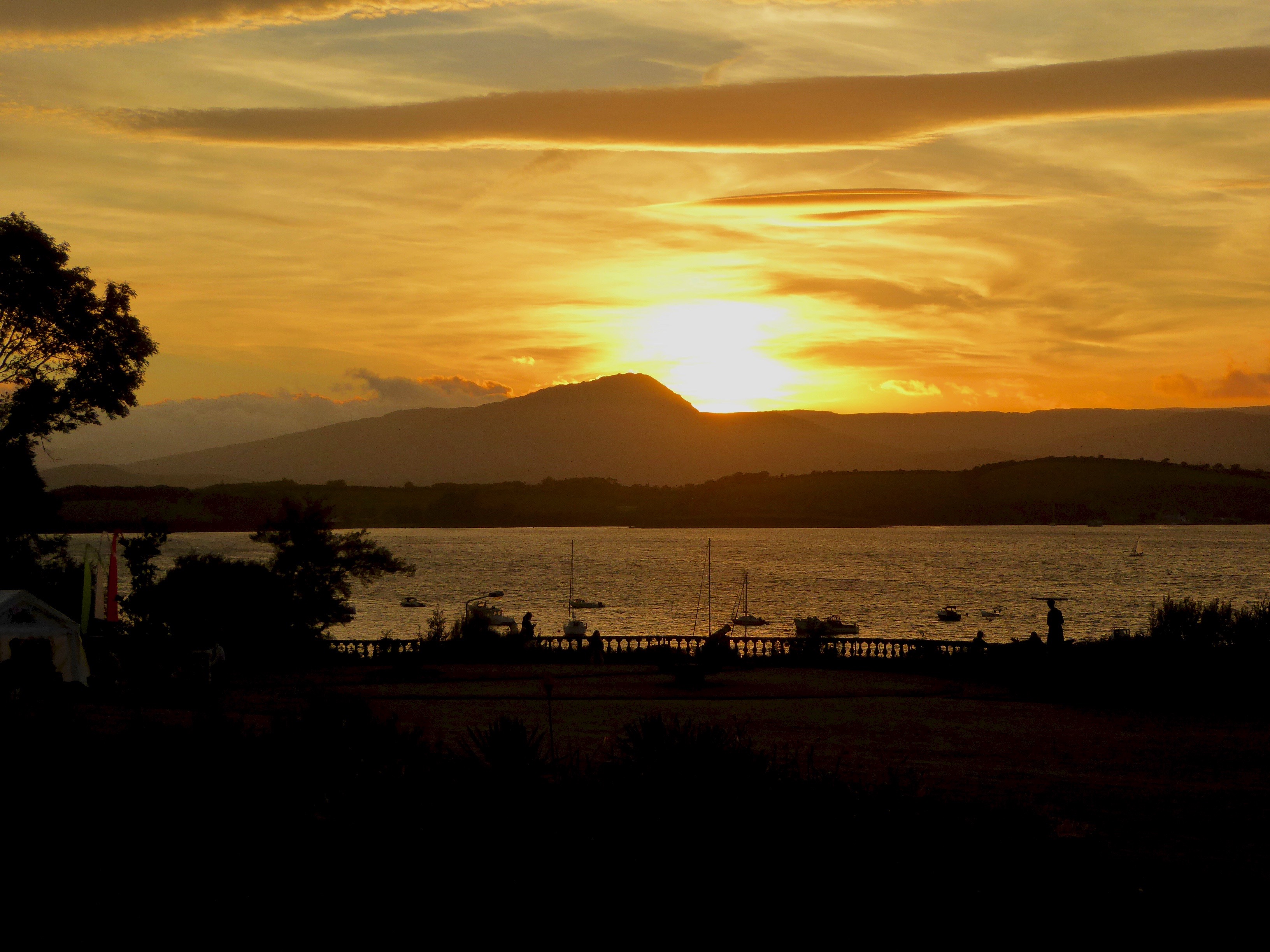
On the Passing of Poets

Ireland: ‘land of Saints and Scholars’ – and poetry, as we found on our travels. In just a few days we have discovered how three pre-eminent Irish poets – whose passing has spanned a century – are being celebrated and commemorated in their own townlands.
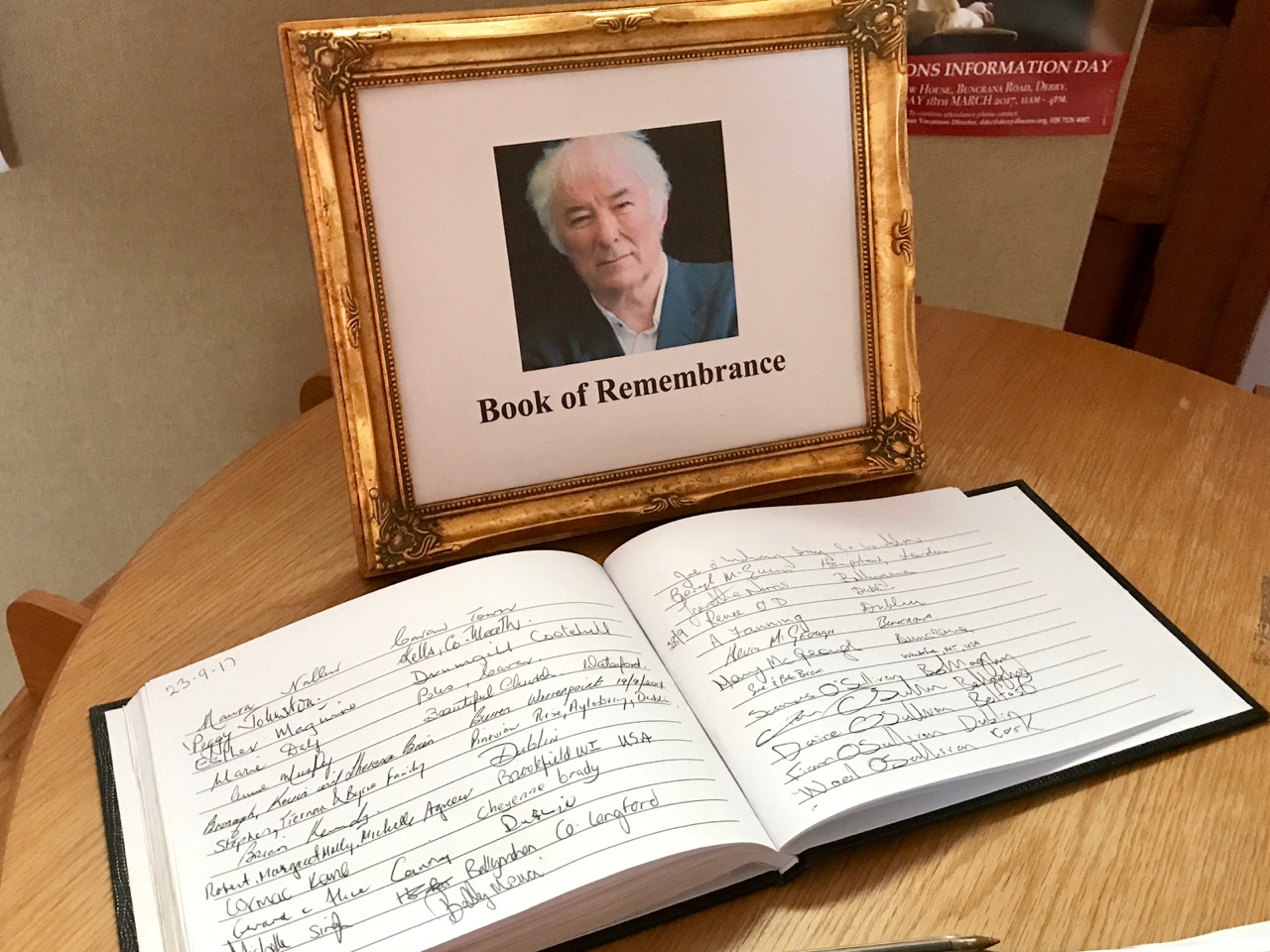
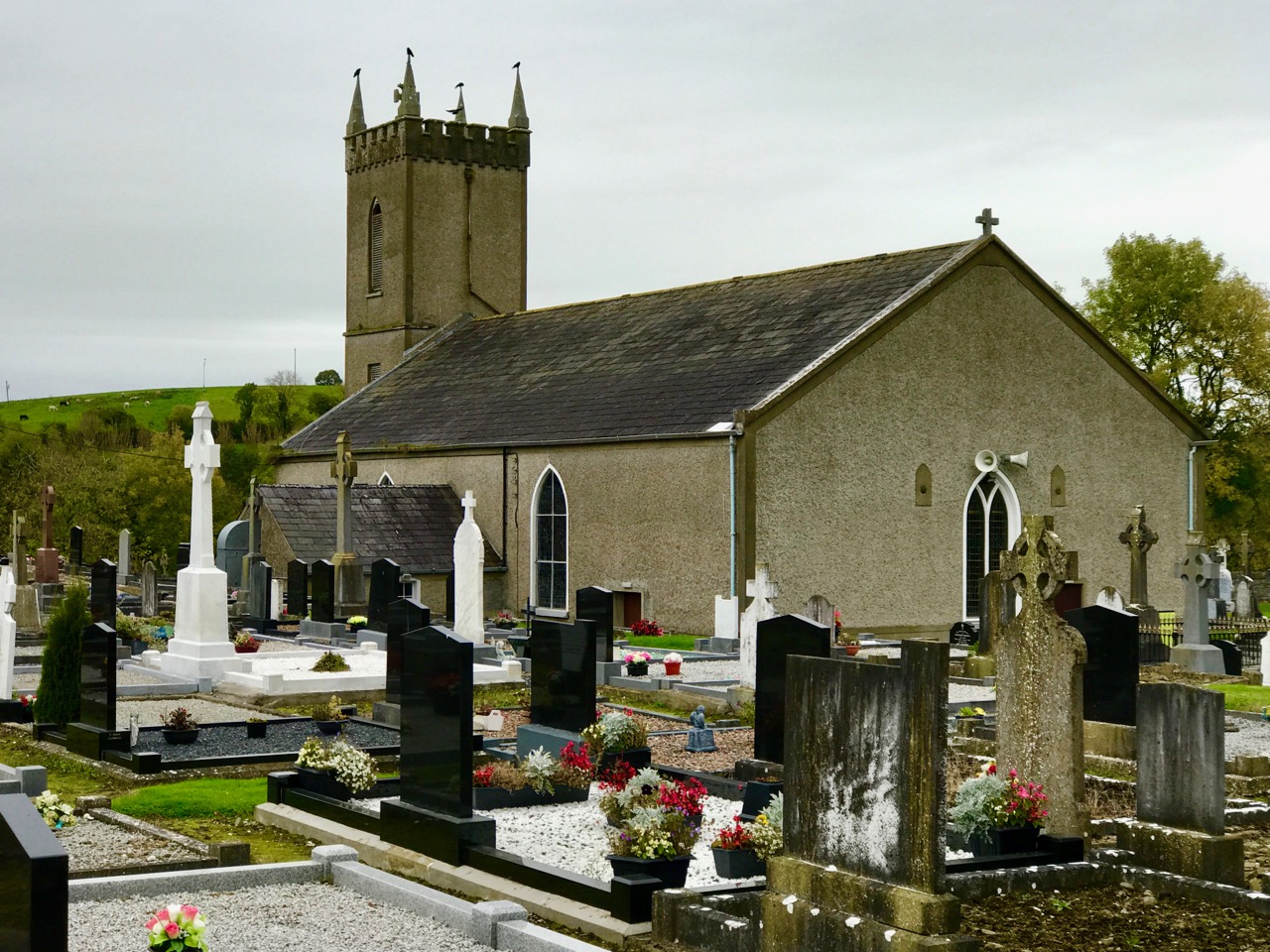
Bellaghy, County Londonderry, in Northern Ireland was the childhood home of Seamus Heaney  who was born at nearby Mossbawn on 13 April 1939, the eldest of nine children. Heaney passed away on 30 August 2013 and, in accordance with his own wishes, he is buried in the Cemetery of St Mary’s Church, Bellaghy. A Book of Remembrance is kept in the church, and on his headstone is a line: Walk on air against your better judgement, from one of his poems – The Gravel Walks.

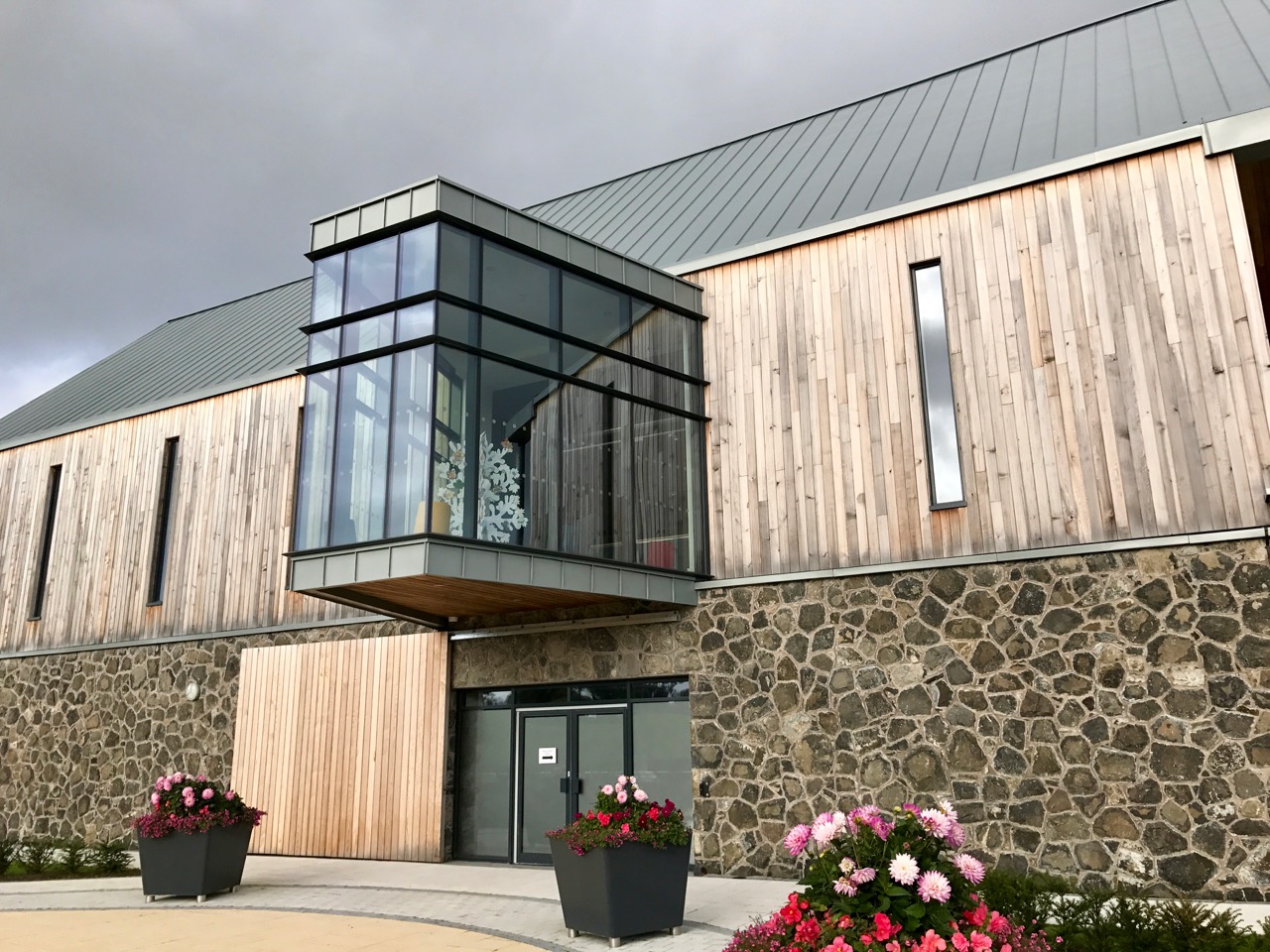
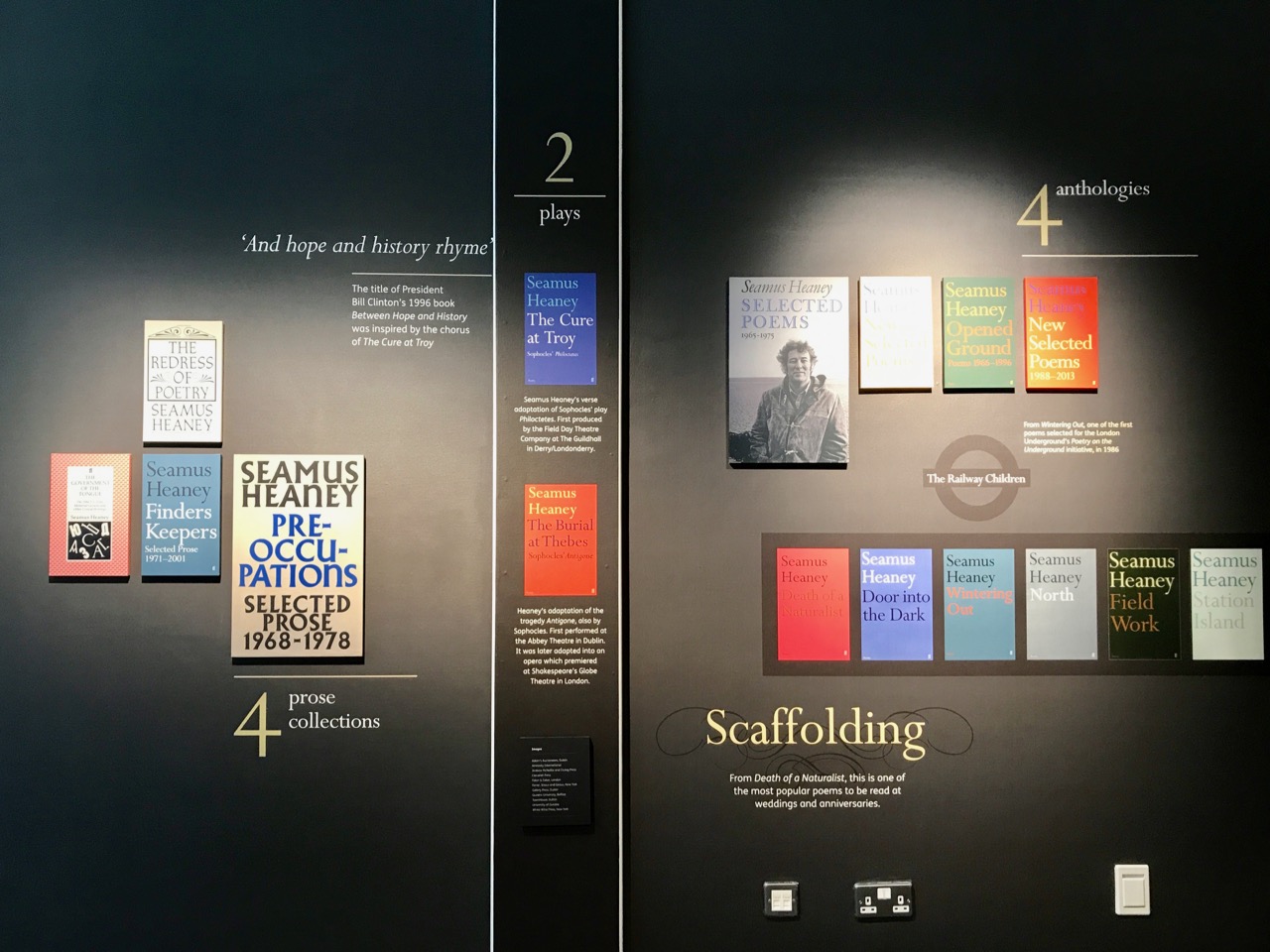
Exactly a year ago – October 2016 – a new building was opened to commemorate Heaney, the Nobel Prize winner, who has been described as ‘…the most important Irish poet since Yeats…’, ‘…the greatest poet of our age…’ and ‘…probably the best-known poet in the world…’ The quality of the HomePlace centre reflects this reputation and provides excellent facilities for the sheer exploration of words as well as performance, lectures and research.
This year sees the 50th anniversary of the death of another of Ireland’s country-born poets: Patrick Kavanagh. We visited Inniskeen, County Monaghan, to search out the old St Mary’s Church, which has been transformed to a Centre – open to the public – which displays information on the poet born and raised on a nearby farm in 1904, the fourth of ten children. The Centre also carries out research into the poet’s life and work, and organises an annual event to celebrate him. I am grateful to the staff of the Centre for allowing me to photograph the interior of the former church.

Appropriately, the grave of the poet can be found in the churchyard. Strangely, an elegant memorial to the poet and his wife (below left) vanished in 1989 and was replaced with a simple wooden cross (below right), said to have been carved by his brother, Peter. I could not get to the bottom of this matter: there are various reports to be found on the internet, including this one from RTE.

Like Heaney, Kavanagh’s strong influences came from his rural background. Some of his best-loved works portray country life, but without sentimentality. He remained on the farm in Monaghan until 1931, when he walked the 80 kilometres to Dublin. At first rejected by the literary establishment, his work eventually received appreciation. Seamus Heaney acknowledged that he had been influenced by Kavanagh.

When Kavanagh died on 30 November 1967, at the age of 62, he was recognised as …Ireland’s leading poet in English…

For our third commemoration we travelled to Slane, County Meath, to find the Francis Ledwidge Museum. This poet died exactly a hundred years ago, a victim of the Great War.

The Museum has been created in the cottage where Francis was born on 19 August 1887, the eighth of nine children. Again, he came from a rural background. His father died when he was only five, and he spent much of his life as farm hand, road builder, and copper miner. He was an active campaigner for better working conditions, became an early Trade Unionist, and attempted to organise strikes.
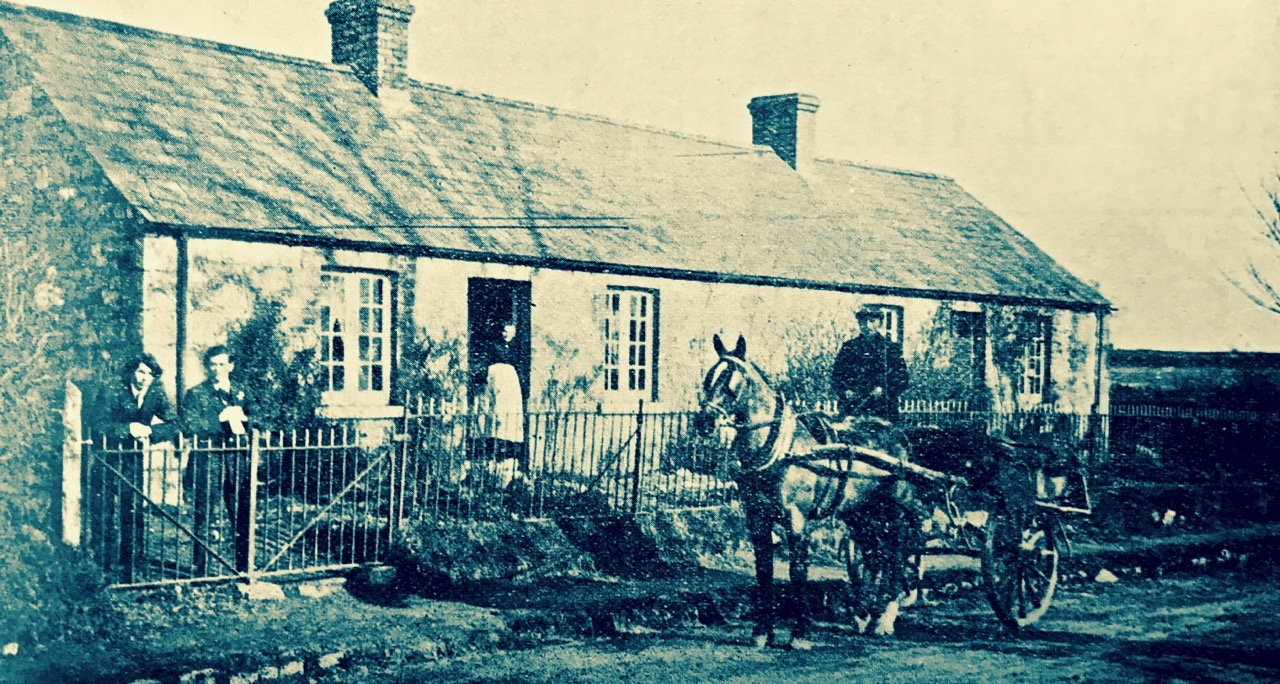
The Ledwidge cottage in Janeville, Slane, around the end of the nineteenth century (top), and the cottage – now the Francis Ledwidge Museum – today (lower)

Francis had written poetry all his life, and some was published in local newspapers when he was 14 years old. He attracted the patronage of Lord Dunsany, who introduced him to W B Yeats. Like many other artists, writers and poets, Ledwidge’s life was tragically cut short by the war. In the Third Battle of Ypres he and five companions were hit by an exploding shell. Father Devas, a Chaplain who was a family friend, recorded ‘…Ledwidge killed, blown to bits…’ A memorial was raised to him on the place of his death in Belgium, and a replica of this memorial can be found in the garden of the Janeville cottage.

Seamus Heaney also acknowledged Ledwidge as one of his influences

During our travels we have seen that poets in Ireland have respected the work of their compatriots. Wordsmithing is a time-honoured profession: there’s a common thread running from the Bards of old, who carried traditions, myths and genealogies through generations and over centuries.

Below – a portrait of Seamus Heaney by the Welsh artist Jeffrey Morgan hangs in the HomePlace Centre, Bellaghy

Edifying and Eccentric – The Earl Bishop

Finola had always wanted to visit Mussenden Temple and the ruins of the nearby great house on the Downhill Demense: it’s only a few stones’ throws from Nead an Iolair, so off we went on a stormy Sunday – the first day of October.

The house was built by the eccentric Frederick Augustus Hervey (1730-1803). Being the third son of the even more eccentric Lord John Hervey, he did not expect an inheritance and tried law (unsuccessfully) before entering the church. His eldest brother George was appointed Lord Lieutenant of Ireland in 1766 and, although he never set foot in the country, he managed to engineer Frederick’s appointment as Bishop of Cloyne then, shortly afterwards, Bishop of Derry, one of the wealthiest Irish sees. While in this post Frederick had the notion to establish a huge estate (apparently with the help of Diocesan funds) on a windswept clifftop overlooking the Atlantic Ocean in Dunbo, County Londonderry – now Northern Ireland.  Dunbo derives from the Irish Dún Bó, meaning ‘fort of the cows’.

It looks bleak today, and must have been in the Bishop’s time, although his plans for the new demense included classical landscaping and the planting of 300,000 trees: there’s not much sign of them now on that windswept terrain.

Both of Frederick’s older brothers died without leaving heirs and, in 1779, he found himself the Earl of Bristol and in control of a considerable fortune which helped greatly in the realisation of his plans for the Dunbo project, which he named Downhill Demense.

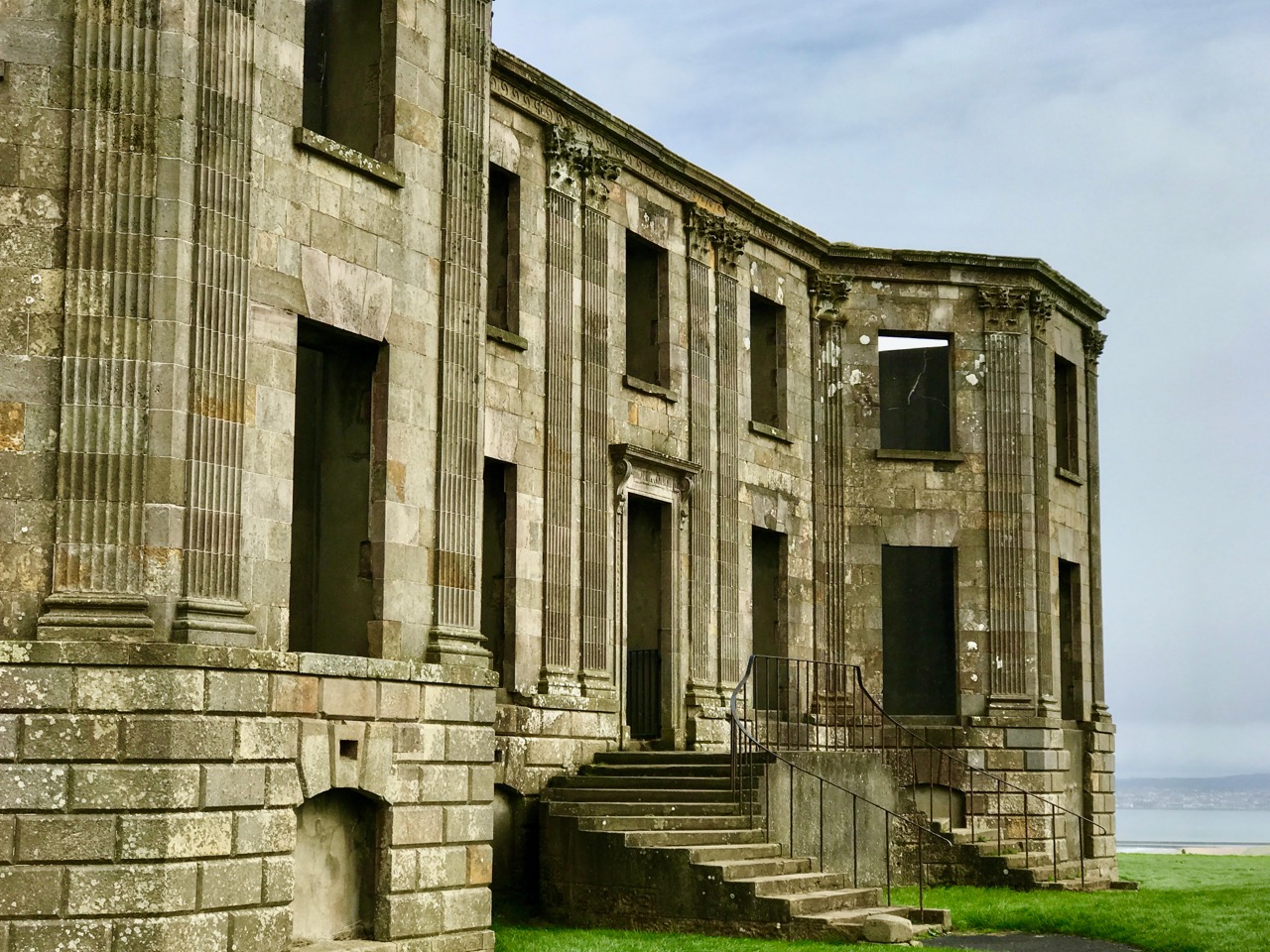
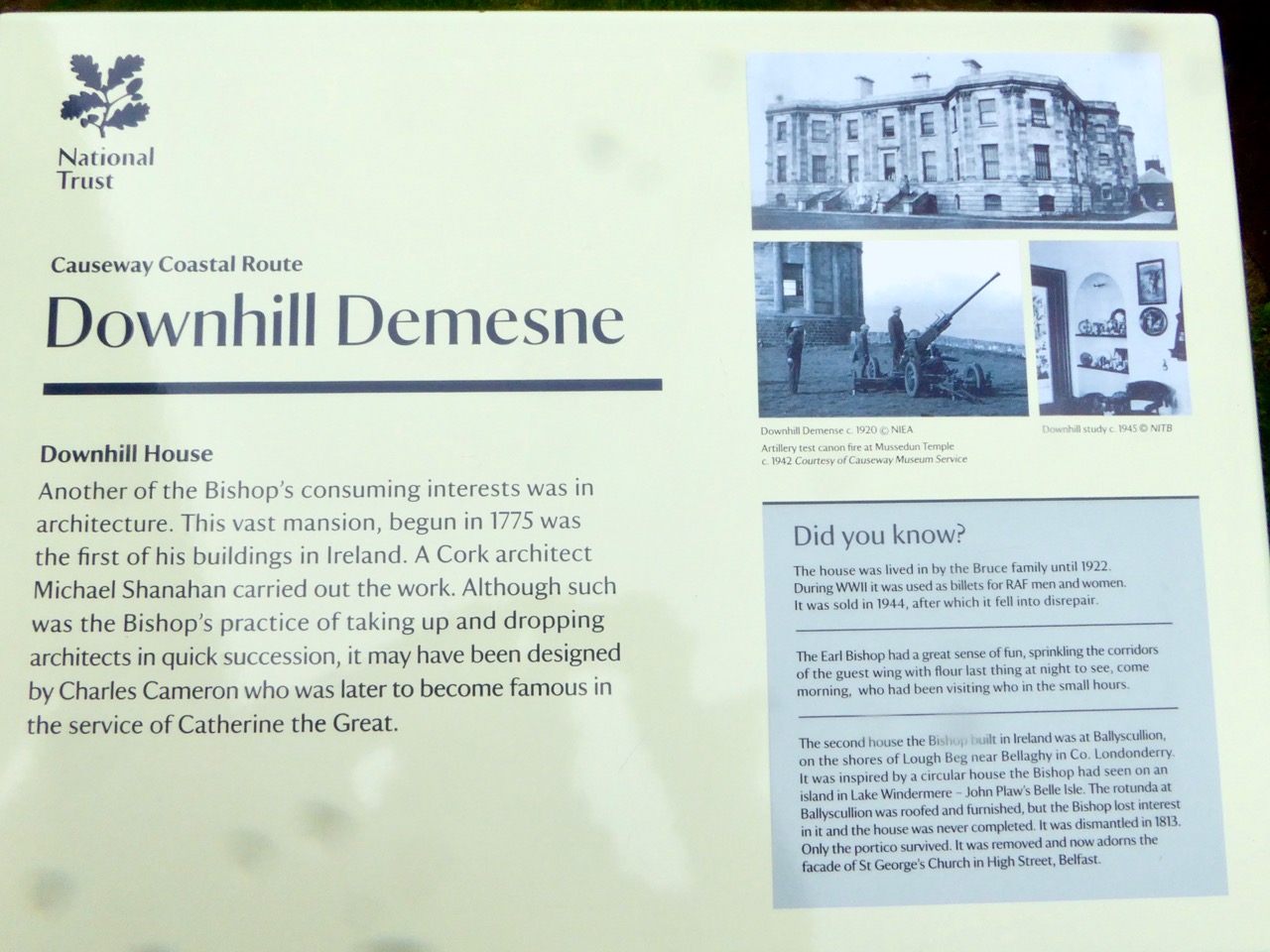
Everything about the Earl Bishop and Downhill Demense is ‘over the top’. Even though it is now a ruin, cared for by the National Trust, its former splendour is obvious. The residence was huge and grand, and Frederick went through a number of architects (beginning with Michael Shanahan of Cork) and including Placido Columbani from Milan, who was supervising plumbing and the installation of water closets – a considerable innovation at the time.

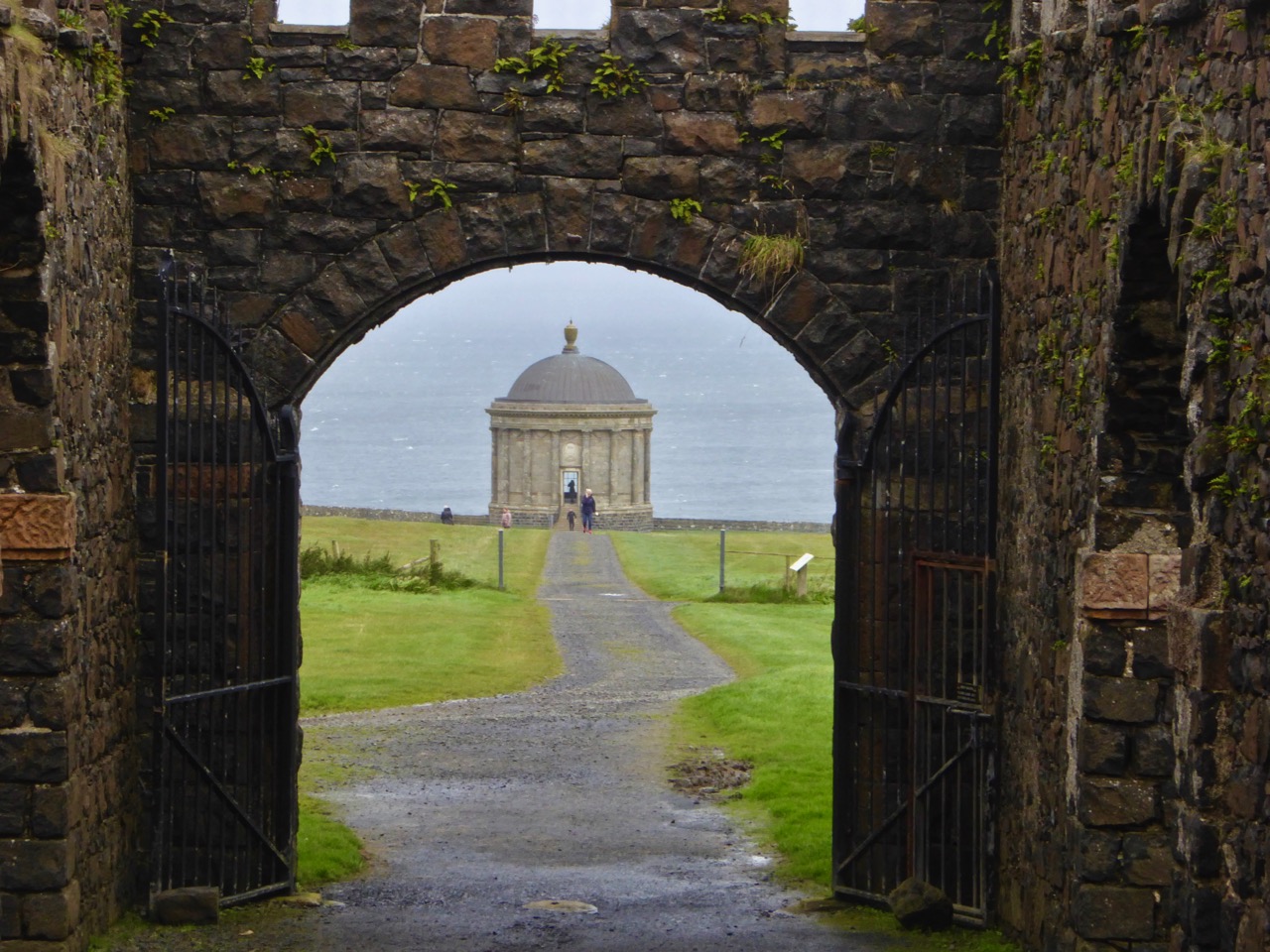
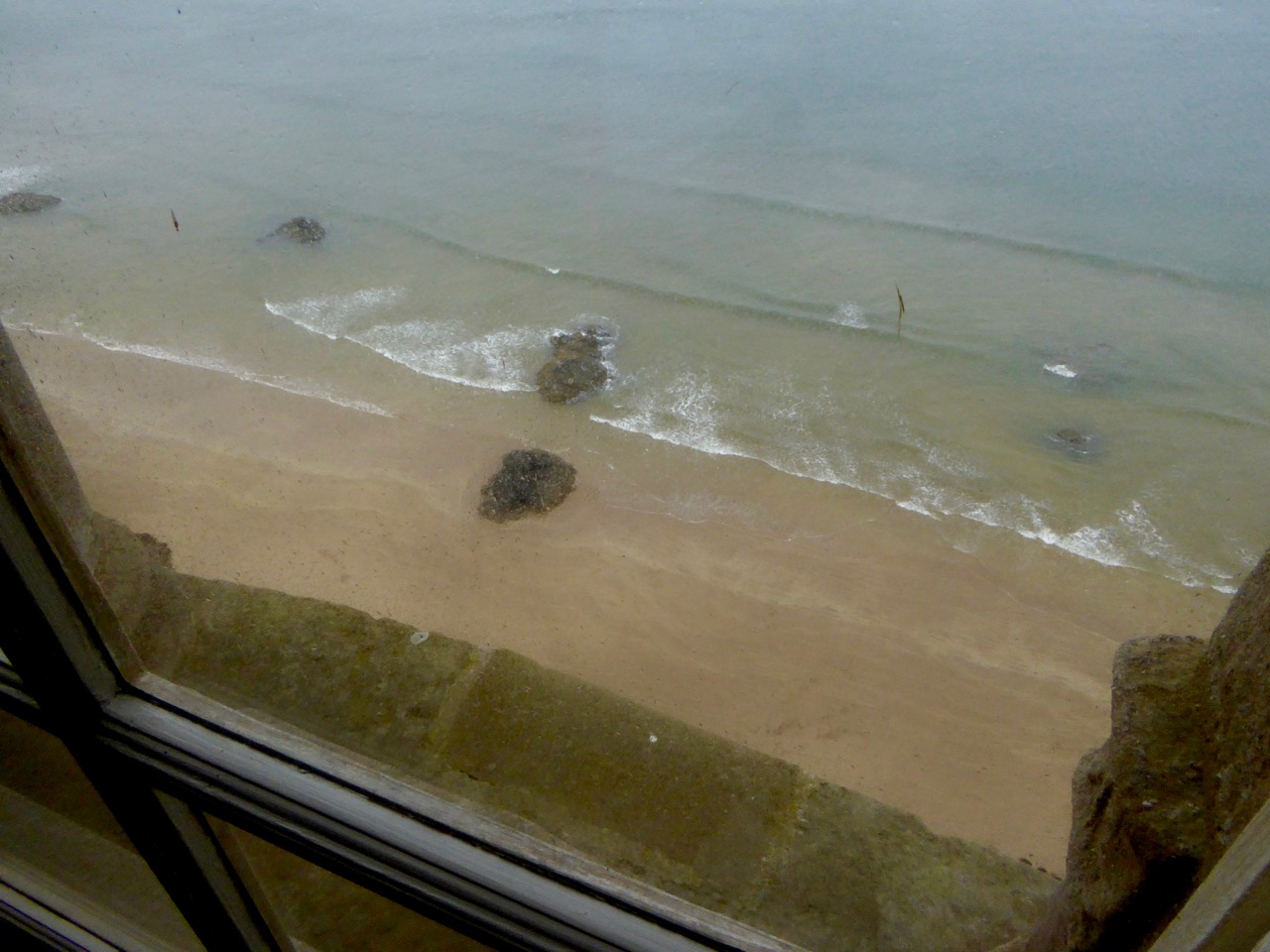
One of the most striking surviving buildings at Downhill is the Mussenden Temple, based on the Temple of Vesta at Tivoli, near Rome. It was built close to the cliff edge, but with enough land to enable a horse and carriage to be driven around it. When we looked out of the windows facing the sea we were shocked to see that the building is now teetering right on the cliff edge! Also, a railway line runs right underneath it near sea level, over 100 feet below – you can see the tunnel entrance in the header picture above.

The Temple was an ‘overflow library’ to the house, some distance away. It was constantly heated by a fire always burning in the basement room below, so the books didn’t get damp. The Earl Bishop was a great traveller and collector, and in its heyday the house was full of paintings, statuary and furniture. Students of the Northern Regional College together with the Arts Council of Northern Ireland, the University of the Third Age and the Earl Bishop Heritage Trail Group have put together a wealth of information and some reconstructions of the house, included here. Their website is a mine of good information.

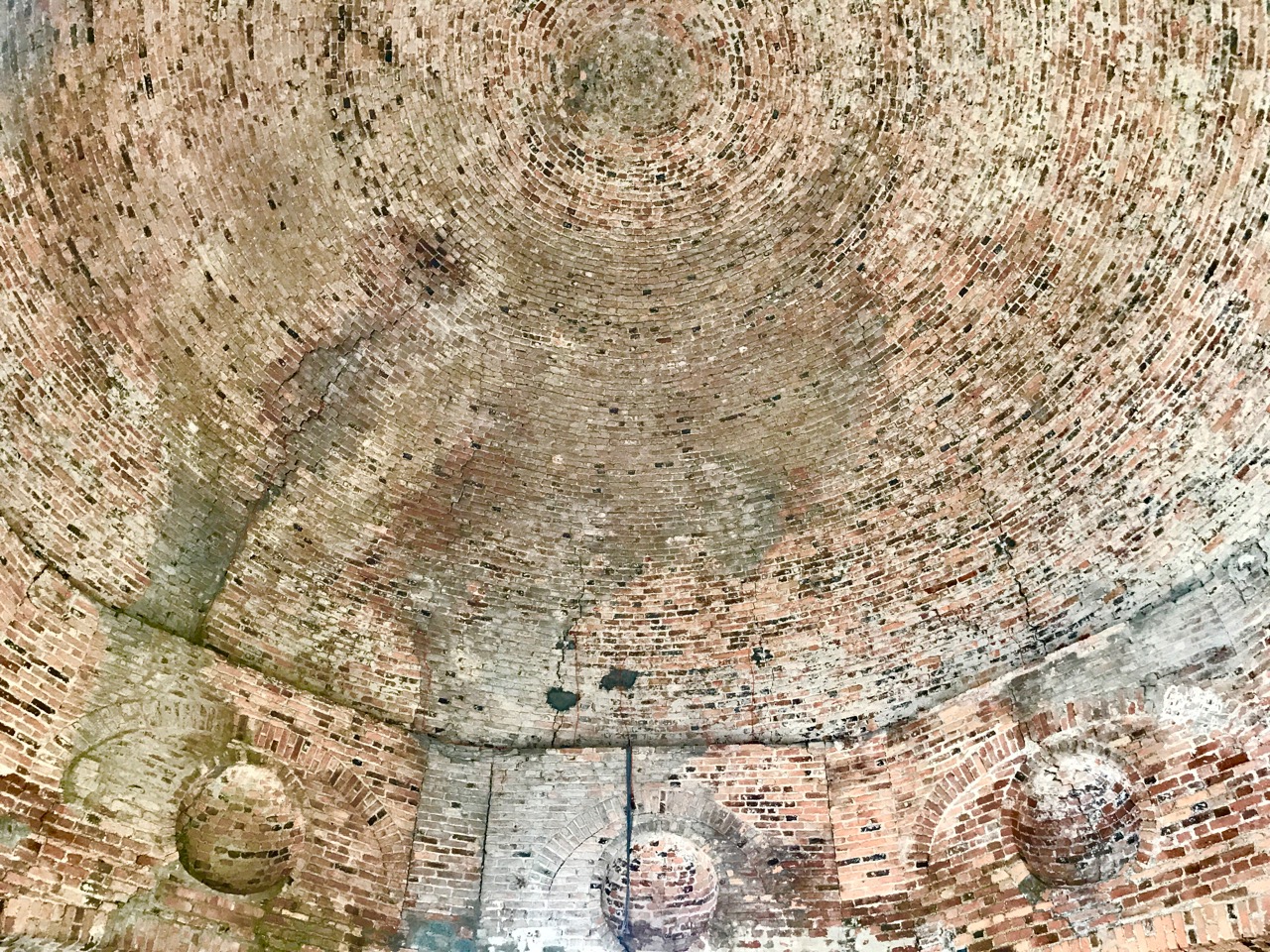
Reconstruction by the Earl Bishop Heritage Trail Group of the Temple dome (upper picture) and (lower) the ‘raw’ brick dome visible today

It’s sobering to stand in the driving rain – as we did today – on this deserted site and imagine the treasures that were once on display in this great edifice. On the Earl Bishop’s death the Demense passed to his cousin. It stayed in the family and survived a devastating fire in 1851, although restoration was not completed until 1876.

Upper picture – Earl Bishop Heritage Trail Group reconstruction of the main gallery in the house and (lower) poignant piles of rubble on the site today

The family left the house in the 1920s and in the 1930s the house was empty and had been stripped of furniture. During World War 2, Downhill was requisitioned and occupied by the Royal Air Force. In 1946 a request was made for permission to demolish the building, thus avoiding a large rates bill. Consent was refused because …the castle is of general local interest… A tenant was found – Mrs Belgrave – who was the last person to live in the house – but briefly; by October 1949 the entire property had been gutted and the windows and roof removed. The building was listed in 1977, and was acquired by the National Trust in 1980 which has been engaged in continual efforts to preserve the remaining fabric ever since.

Upper picture – Earl Bishop Heritage Trail Group reconstruction of the Temple interior and (lower) today the Temple is a significant landmark on Northern Ireland’s main tourist route

Wherever you are on the island of Ireland it’s just a hop and a step up to the North: the coastline is stunning, and a journey there will be punctuated, as always, with fascinating history. Well worth a visit!

An excellent detailed article by The Irish Aesthete on the Earl Bishop and his Downhill Demense can be found here

The Turning Year in Rossbrin

We are fortunate to live in a rural idyll: our immediate environment is immersed in the natural world. In fact, I suppose it is ‘Nature tamed’ – as we have pasture all around us as well as banks of gorse and rock: even a few trees which manage to cling on to the shallow soil all through the winter gales and (occasional) summer droughts. As the years go by we feel we become more closely entwined with the cycle of everything around us – we get to know personally the fox, pheasants and rabbits that pass by our window, and the myriad of birds that feed here, forage in the Cove or just show themselves to us on memorable occasions – Spioróg the Sparrowhawk is so handsome when she is resting on our terrace wall while on her deadly missions, and our choughs frequently perform wild dances in the air to entertain us. This year was special for me because, for the first time, I saw a hare amble around the house, alert with erect ears, before loping off into the next door field.

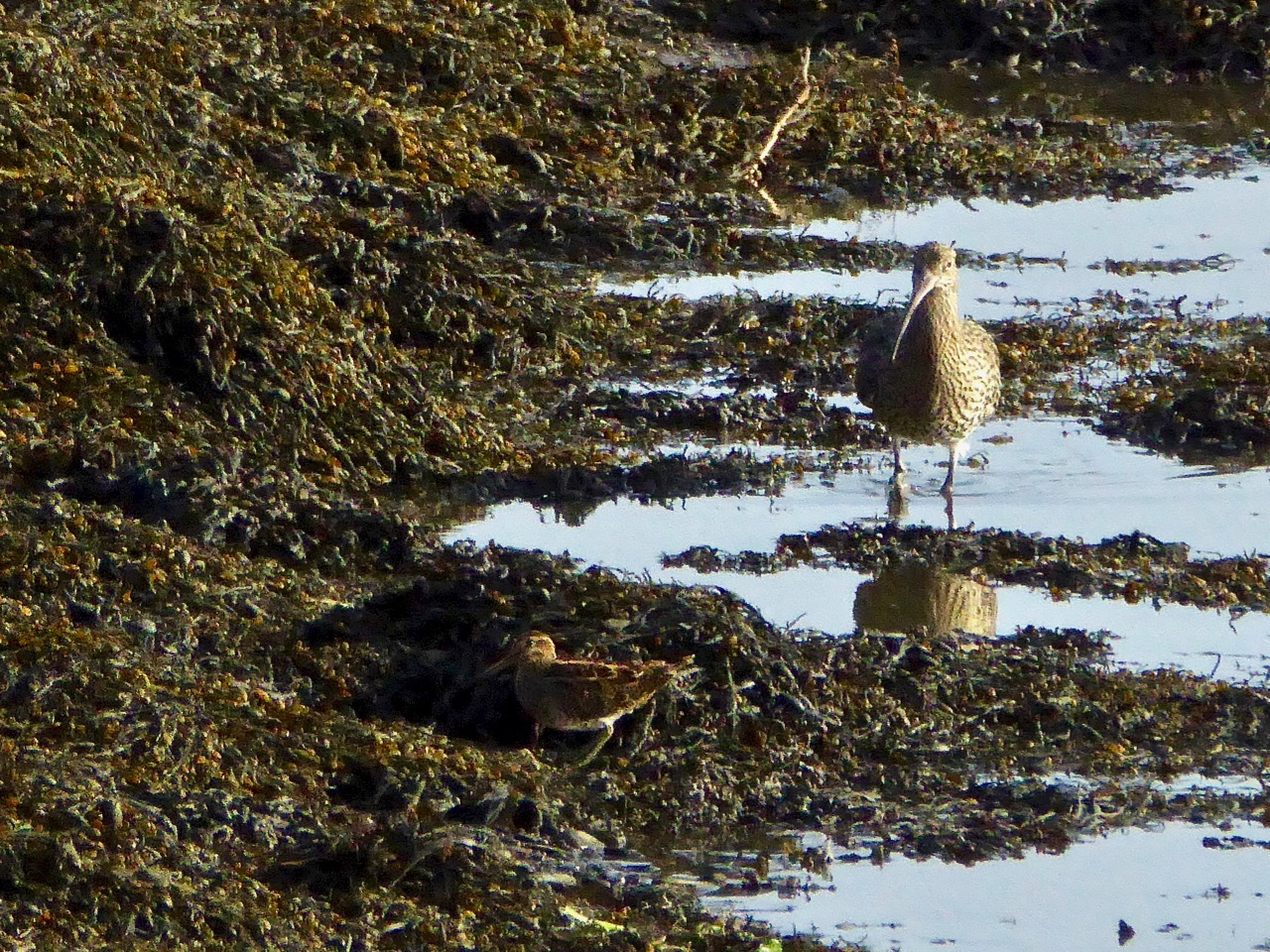
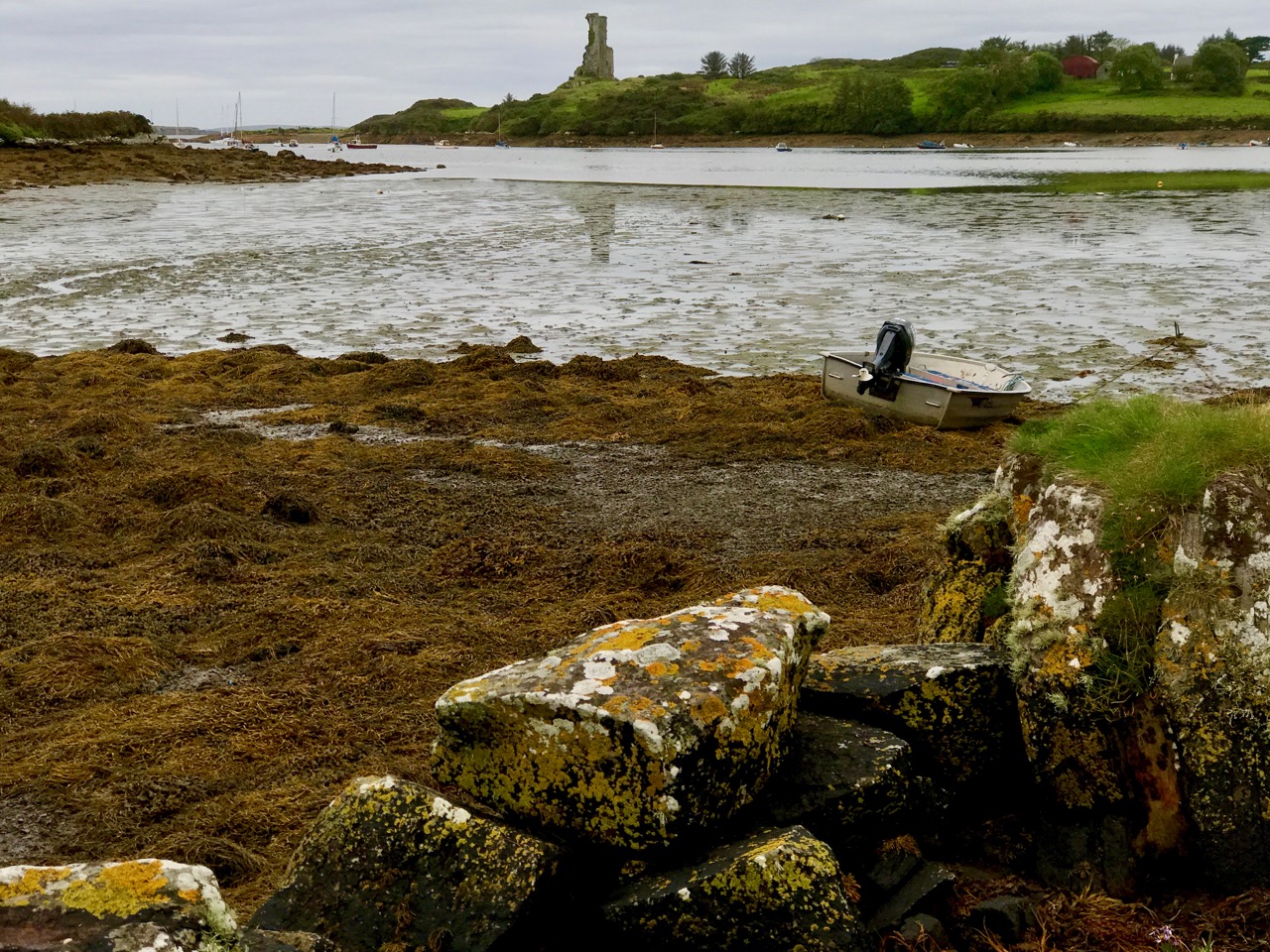
I have written about Rossbrin Cove many times before: look at A Moment in Time, Tide’s Out and Words on Roaring Water, for example. That sheltered natural harbour and the old mine road up on the hill above probably give us the most pleasure because we visibly see the year change and turn every time we walk there. Just now the days are rapidly shortening, and the autumnal influx of wading birds is returning. One we keep a particular eye out for is the curlew – a threatened breeding species here in Ireland. We see many on and close to the water, particularly at low tide, but these are probably migrants rather than resident breeders.

The year is turning – from late summer into early autumn, and the colours are changing from rich reds and purples – fuschia and heathers – to the more sombre yet equally attractive yellows and browns of furze and fern. Finola has closely followed the wildflowers right through from the spring – she is still finding and identifying every imaginable species – it’s a complete world of its own!

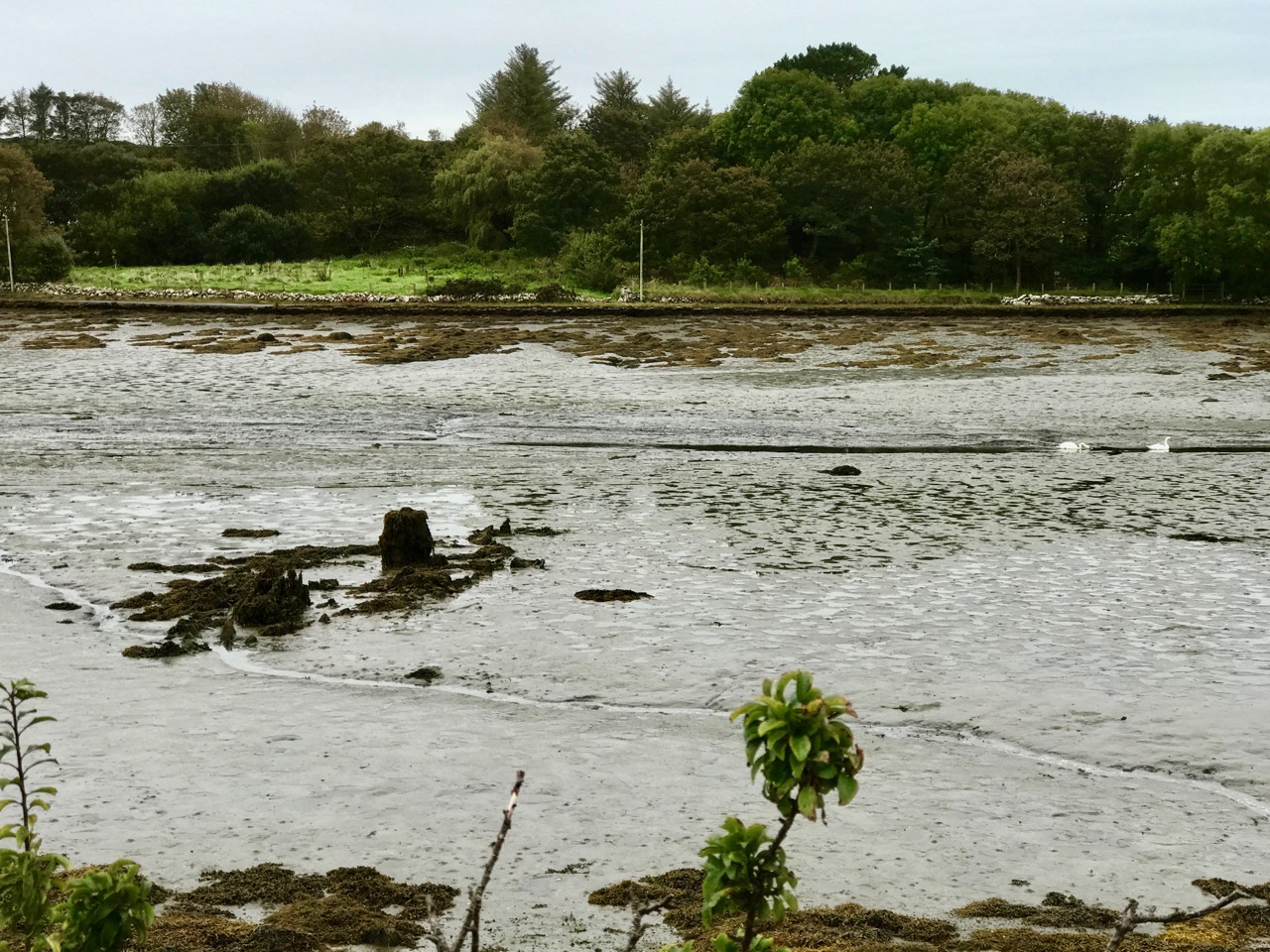
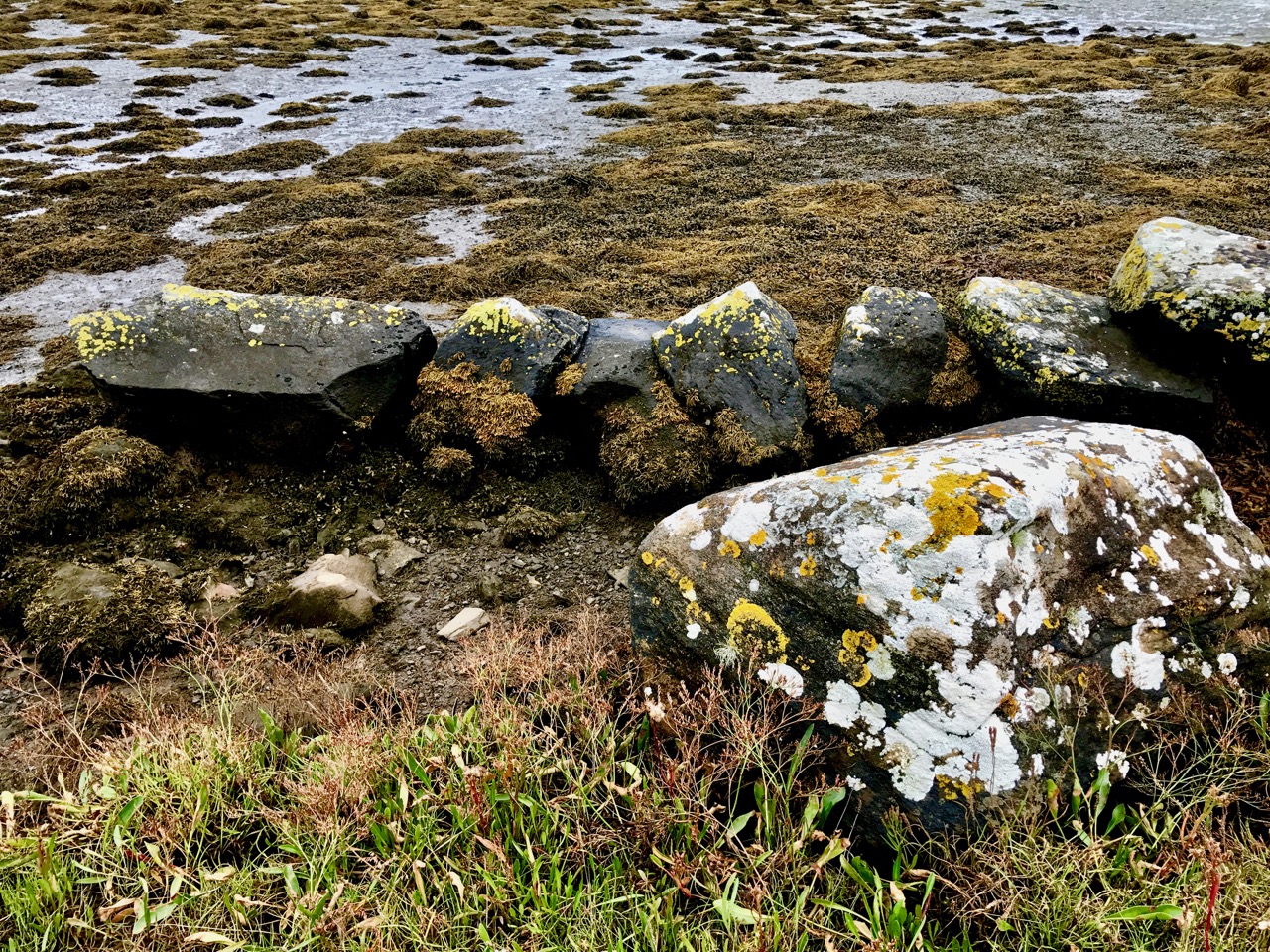
We have been seeing some exceptionally high and low tides here in Rossbrin. I’m always fascinated to see the mud-flats revealing bits of discarded history, while I am convinced that the huge remnants of dressed stonework on the north-east shore are the vestiges of once-busy quays, dating either from the medieval period, when Sir William Hull and the Great Earl of Cork owned the lands around here and set up thriving fish-processing ‘palaces’, or – at the latest – when the copper mines were active up on our hills and on Horse Island in the nineteenth century.

The real turning point comes at the end of October – Samhain – when the old calendar enters the ‘dark year’ (the ‘light year’ begins on May 1st –  Bealtaine). We know we have long, dark nights to come – time to huddle down by the stove – but there will be bright days as good as any in the year for walking, exploring and breathing in the Atlantic breezes. And the Rossbrin sunsets will be magnificent!

The Red Line – Bere Island

As part of the excellent Taste of West Cork food festival, we signed up for the Bere Island Cultural Taste Tour, and on a grey Saturday morning we drove off along the south side of the Beara Peninsula to Castletownbere. The Islands of West Cork are all fascinating to explore, in our experience, and each one is very different. This was my first visit to Bere Island, and I immediately want to go back there: this was, of necessity, a ‘whistlestop tour’, ably led by Ted O’Sullivan, probably a direct descendant of the famed O’Sullivan Bere (who deserves – and will get – a post of his own!) You may remember that the island – and the peninsula – has taken its name from the Spanish wife of Owen Mór, King of Ireland around 120AD.

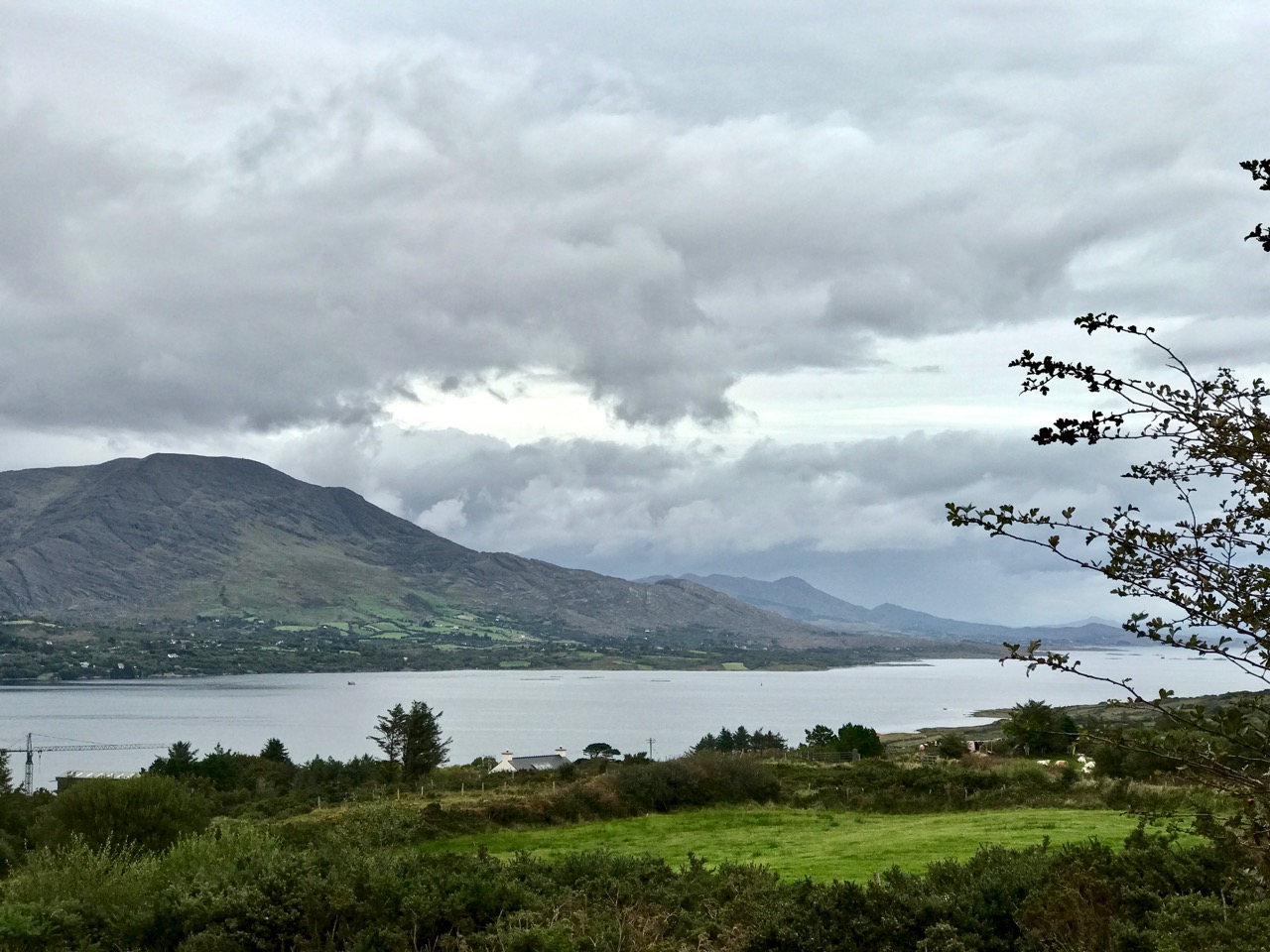
Bere Island lies off the coast of the Beara Peninsula, which was in constant view as our bus took us to the eastern end on the narrow island roads – towards the ‘Red Line’

While the history of the island takes us back to the Bronze Age and beyond, more recent events have been left behind on the landscape – and in the memories of the islanders.

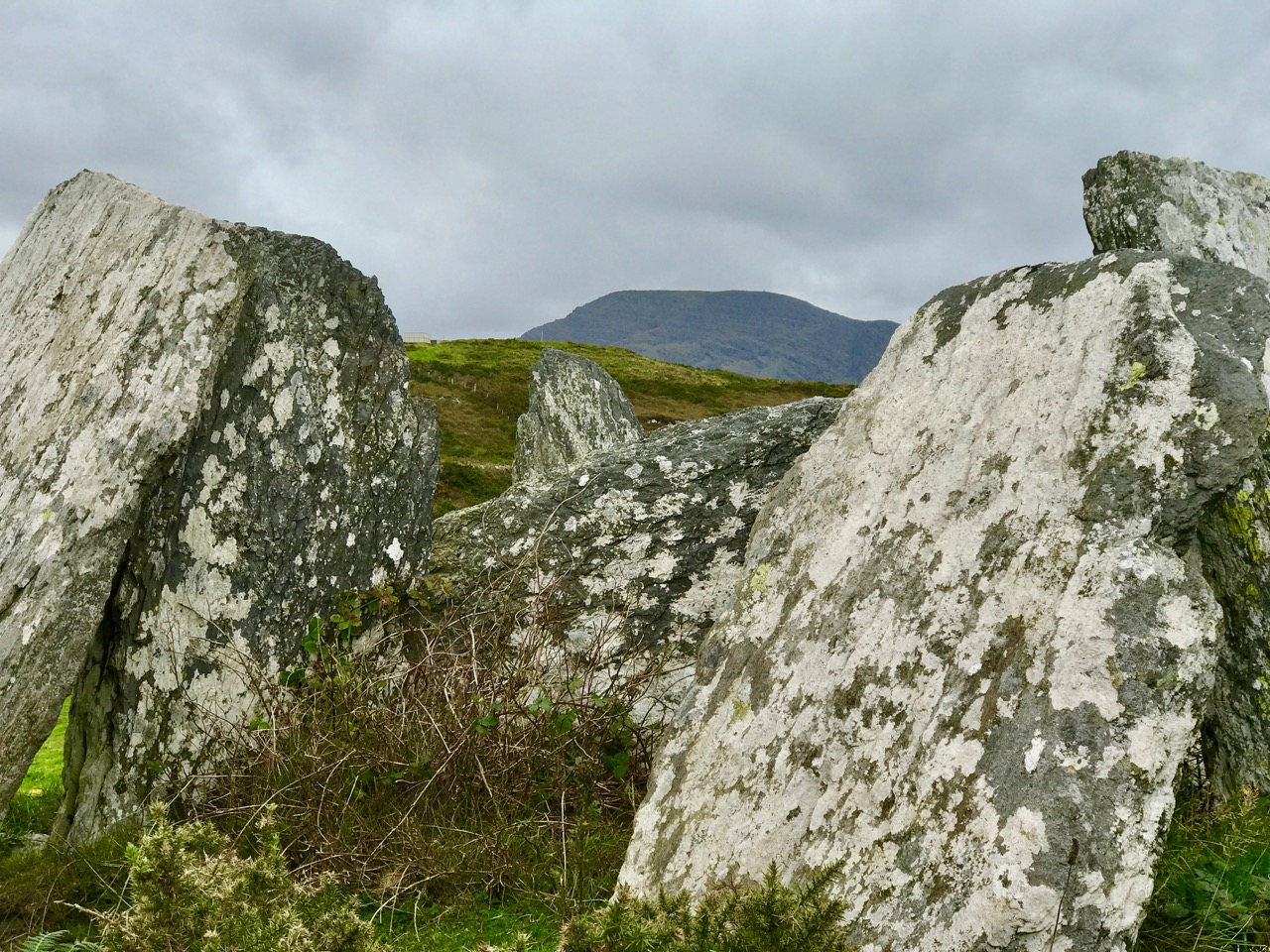
Upper – ancient history: Ardaragh Bronze Age wedge tomb beside the road to the east of the island with Hungry Hill beyond. In 1926 the tomb collapsed, and this was seen by some islanders as a ‘sign’ that the British might leave the occupied part of the island. Lower – modern history: looking from the island towards the Beara – British warships stationed in the bay circa 1914

Did you know that part of Bere Island remained in British hands well beyond the establishment of the Irish Free State in 1921? This was one of the three Treaty Ports that were retained by the United Kingdom following the First World War, when there were fears that there might be a recurring naval threat to the islands of Britain and Ireland. The other two ports were Spike Island, in Cork Harbour, and Lough Swilly in the far north of the Irish state. Relationships between Ireland and Britain remained uneasy for many years but finally, in 1938, it was agreed that these deepwater ports should be handed over to the Irish Republic. Winston Churchill was appalled by the decision, and in an address to Parliament in that year he called it a ‘folly’:

…When the Irish Treaty was being shaped in 1922 I was instructed by the Cabinet to prepare that part of the Agreement which dealt with strategic reservations. I negotiated with Mr Michael Collins, and I was advised by Admiral Beatty who assured me that without the use of these ports it would be very difficult, perhaps almost impossible, to feed this Island in time of war. Queenstown and Berehaven shelter the flotillas which keep clear the approaches to the Bristol and English Channels, and Lough Swilly is the base from which the access to the Mersey and the Clyde is covered… These ports are, in fact, the sentinel towers of the western approaches, by which the 45,000,000 people in this Island so enormously depend on foreign food for their daily bread, and by which they can carry on their trade, which is equally important to their existence…

Until the handover in 1938 the eastern end of the island lay beyond ‘The Red Line’. The position of this line was pointed out to us on the tour, although we couldn’t see a ‘line’. In fact, no physical line did ever exist but there was a point beyond which Irish people could not proceed, and British forces stationed over the ‘line’ could not cross. Ted, our tour guide, recounted some amusing stories of those strange times. With typical Irish inventiveness, there were many instances of how the difficulties created by the ‘line’ were overcome. For a short while there was a prison on the British sector, right beside the ‘line’. It was used to incarcerate mainly political prisoners. Every weekend there would be a party held on the Irish side of the line which always included singing, dancing and drinking, and the prisoners joined in! Many politically important prisoners managed to escape, and the prison was known as a ‘leaky bucket’ because of this. A number of the British governors of the prison were removed during its short life because of their inability to contain their charges.

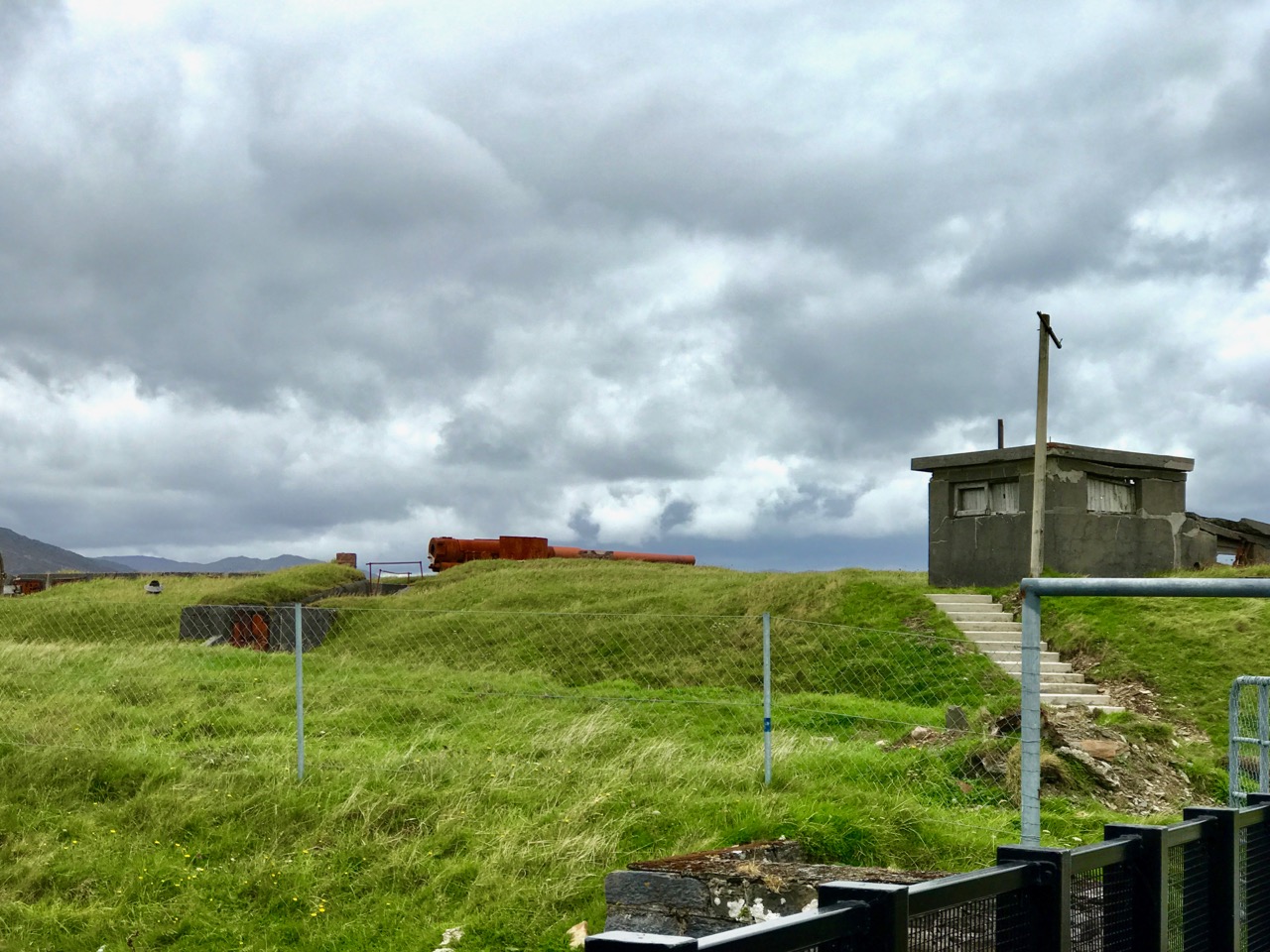
Lonehort Battery – built in 1899 by the Royal Engineers of the English army – housed two enormous 6-inch guns (still in place but very rusty) and is surrounded by a deep moat. There are plans to re-open the site as a historic monument

Lonehort is a natural harbour, believed to have been used by the Vikings. Archaeological excavations were carried out there in 1995 and confirmed the artificial breakwater as being Norse: there were also signs of a Viking shipyard here.

Lonehort – a Viking harbour and shipyard. The word means ‘Long Phort’, and is used to indicate Norse associations

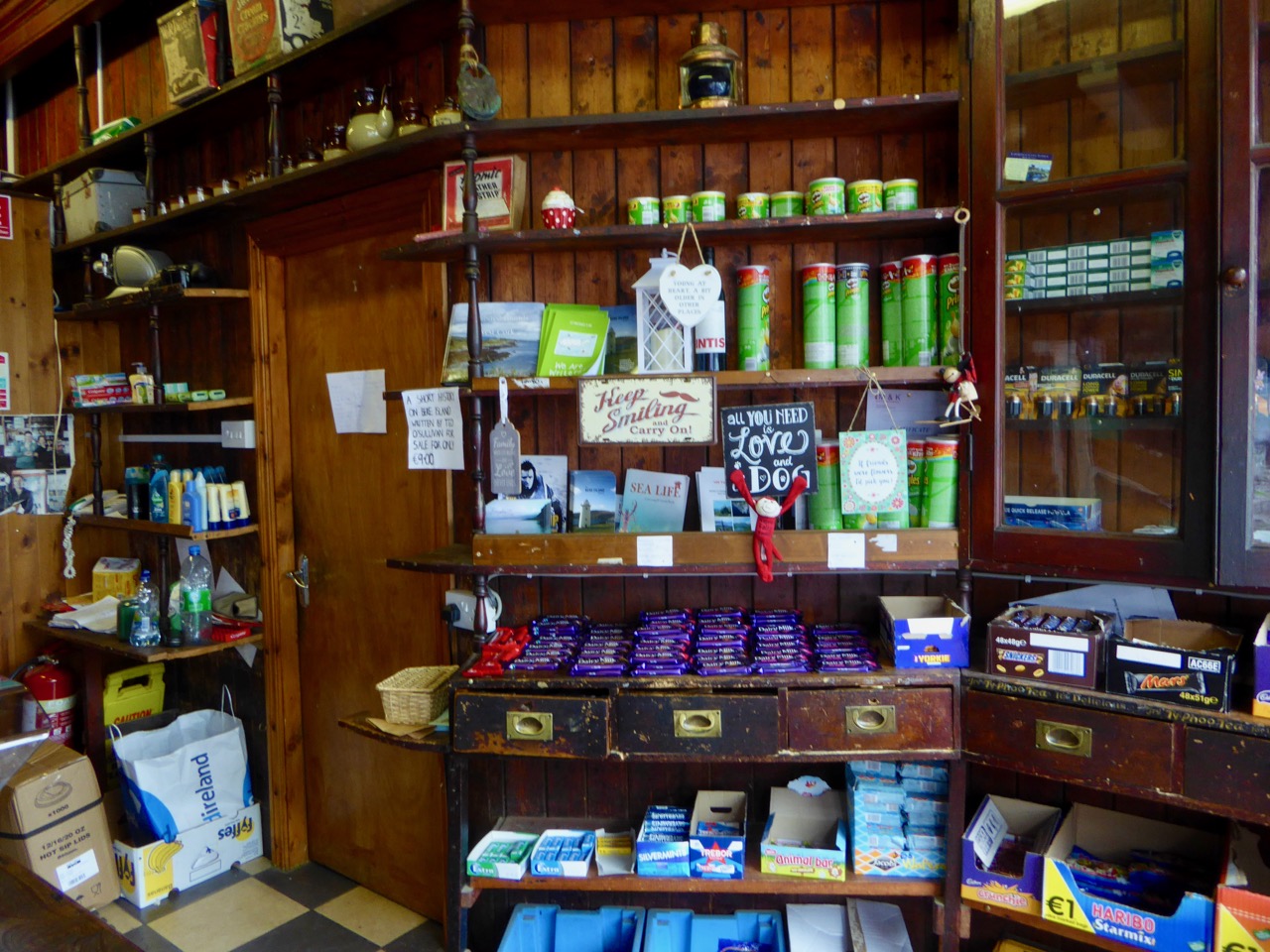
One of the purposes of our tour was to introduce us to food produced on the island, and we ate in three establishments: The Shop and Cafe in Rerrin for soup, The Hotel for a fishcake lunch, and the Heritage Centre for a dessert and coffee. All provided good, delicious fare.

Our three food destinations. Top – the wonderful Shop at Rerrin; centre – The Hotel, open all year round (it looks as though it has interesting fare!) and lower – the modern Heritage Centre which has a gallery displaying the island’s history and culture as well as a good eatery

All too soon our short tour came to an end: we had to get back to catch the ferry. We missed several things: St Michael’s Holy Well and Church; views from Knockanallig (the highest point) and several standing stones including Gallán, which is exactly in the centre of the island. And it’s a great place for walking! We will return, perhaps for a few days in the winter, and complete our explorations. But many thanks to Ted and the Bere Island Projects Group for giving us such a comprehensive introduction to an intriguing community and its history.

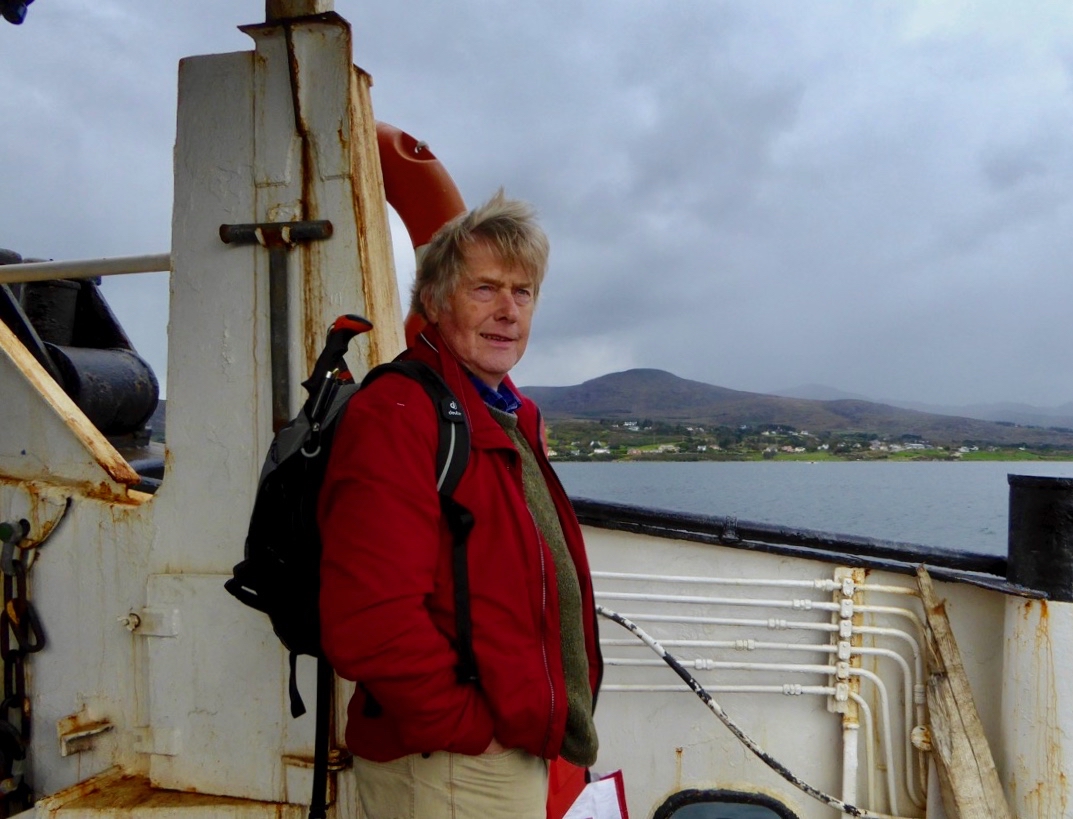
Robert heading home after a grand day out!

The Significant Rock Art of Clonfinlough

Whenever we stray from our home territory of West Cork, we are always on the lookout for archaeological wonders. When we set our course for Clonmacnoise, in County Offaly, last week (I like the possible translation of the Irish Cluain Muccu Nóis: Meadow of the Pigs of Nós, but there is an alternative Cluain Mhic Nóis: Meadow of the Sons of Nós), we were looking for Ireland’s most important medieval monastic site, but we were diverted only a stone’s throw from our destination by a sign that we couldn’t ignore…

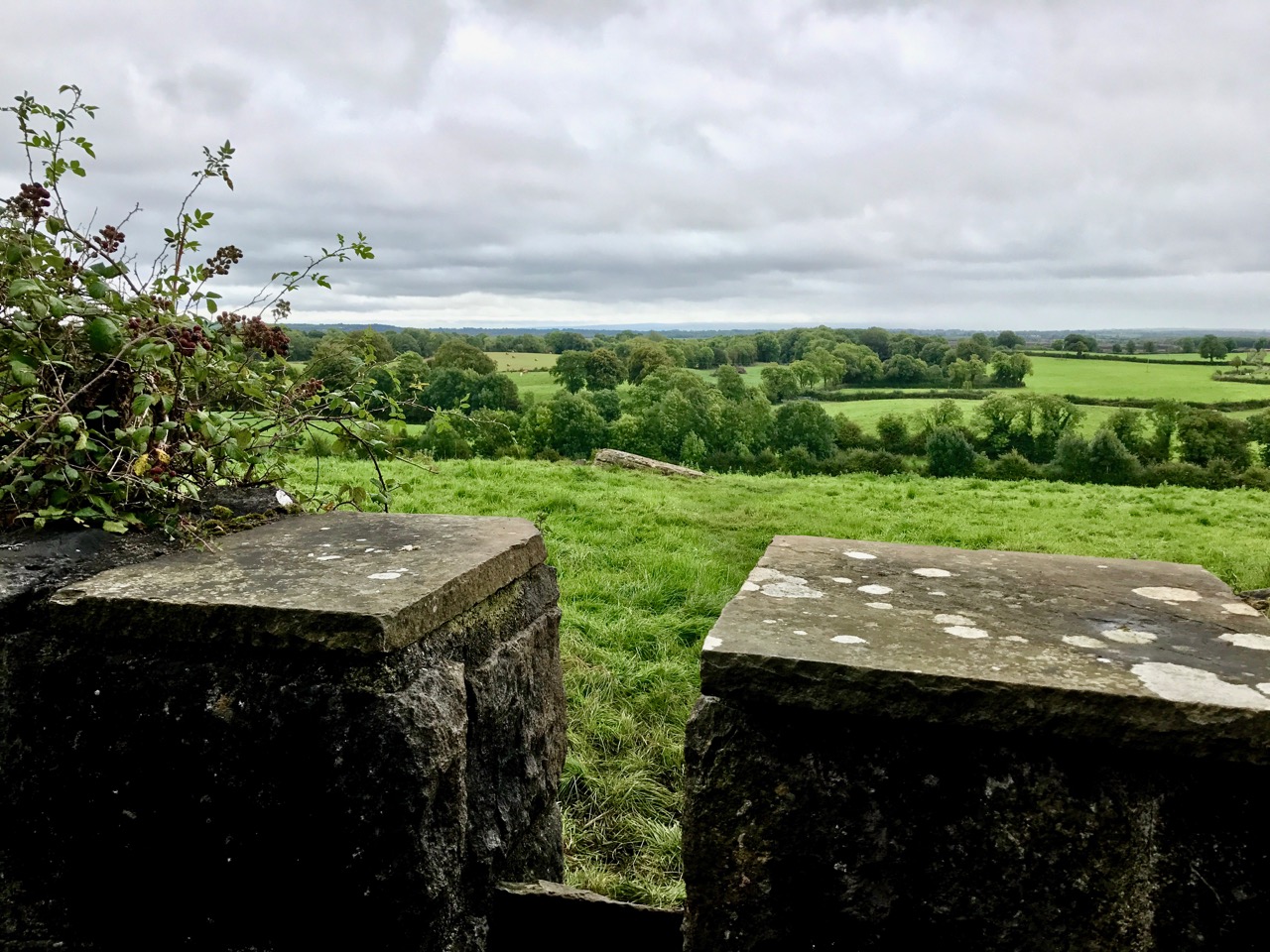
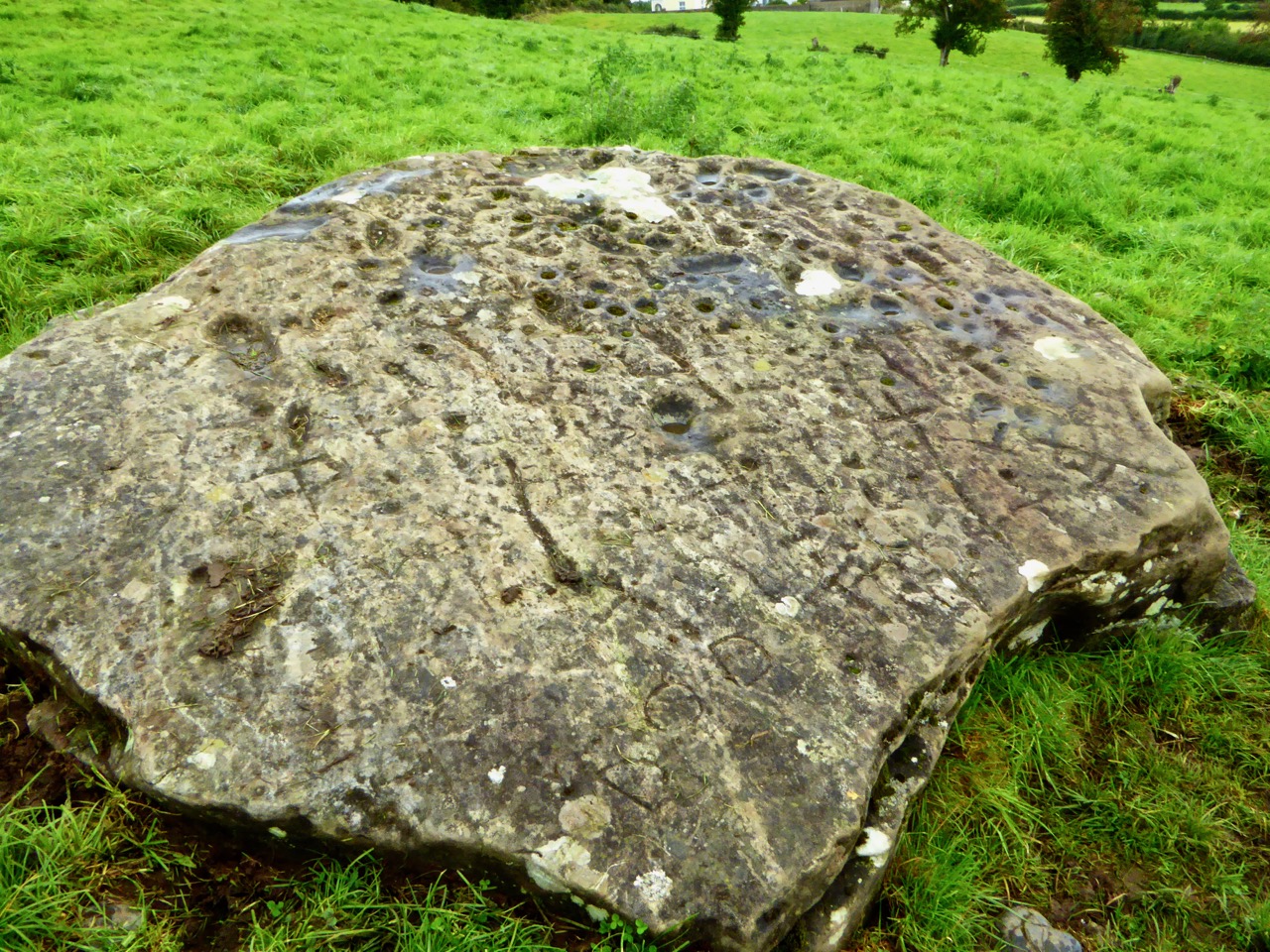
Tucked away to the south east of Clonmacnoise, on a by-road, sits an isolated church in front of which is a well defined and fenced pathway leading past the Priest’s house, through fields, over a stile and into a pasture where cows grazed and barely gave us a glance. There – open to the ravages of weather and cattle – is a large, earthfast slab of limestone bearing a remarkable array of markings.

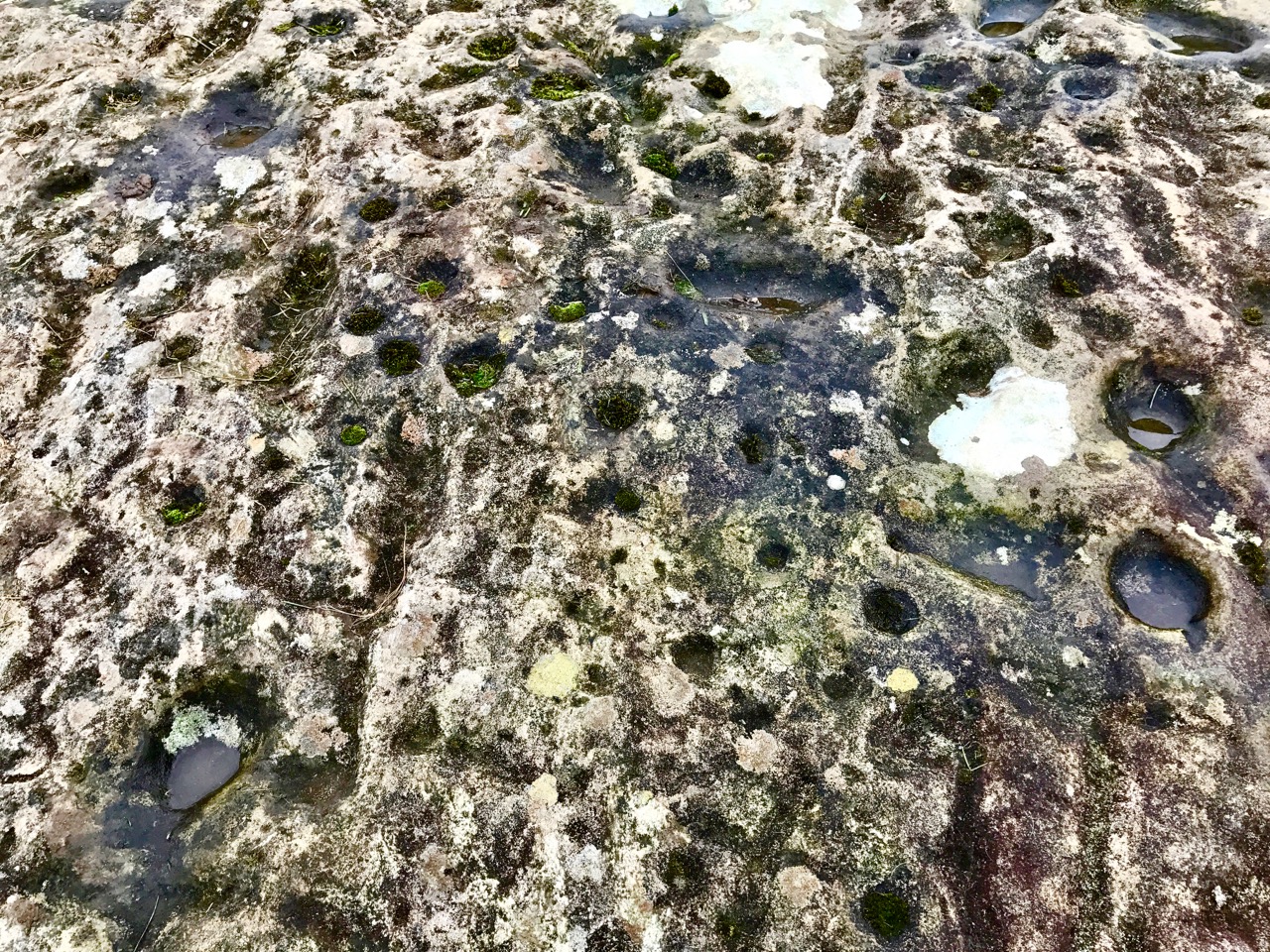
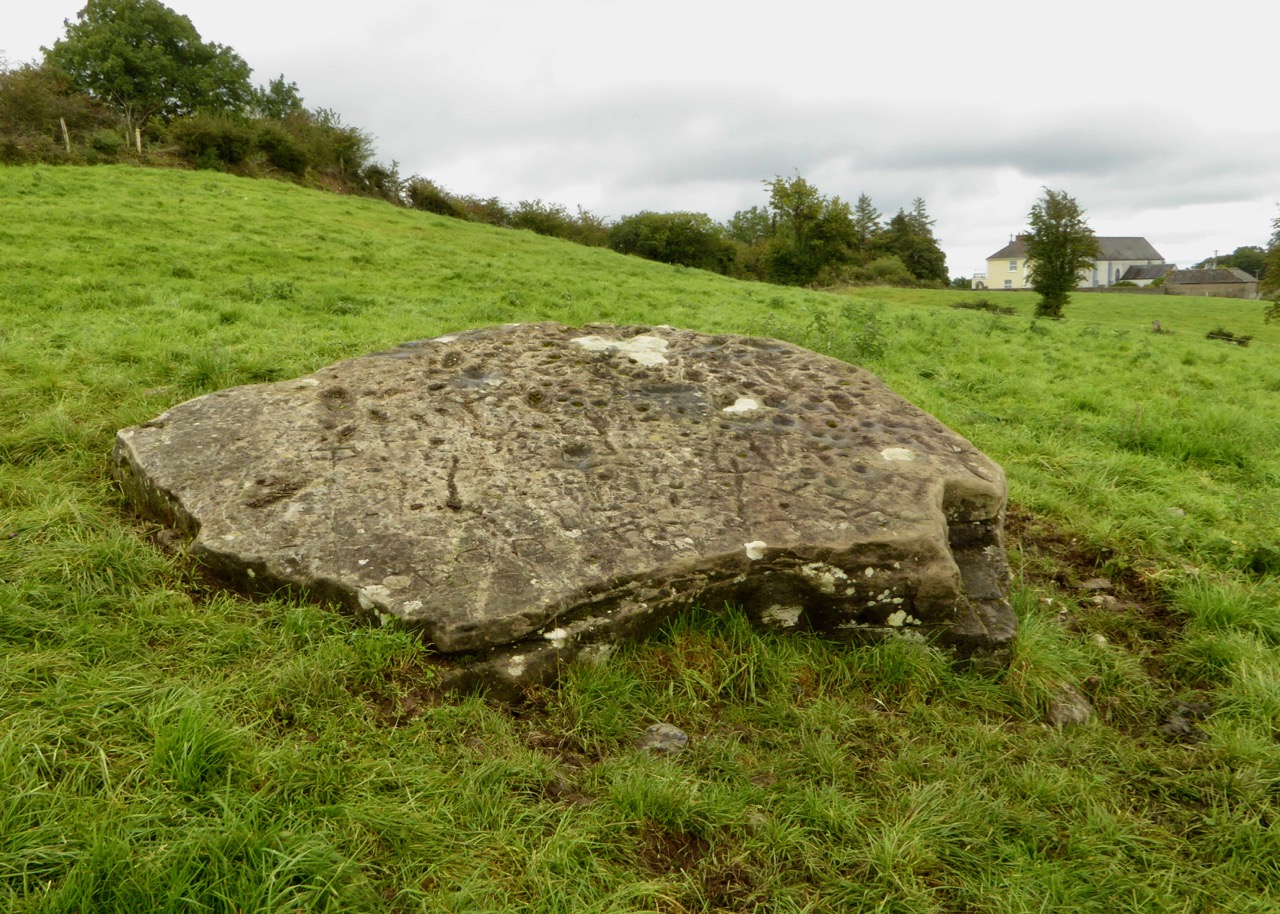
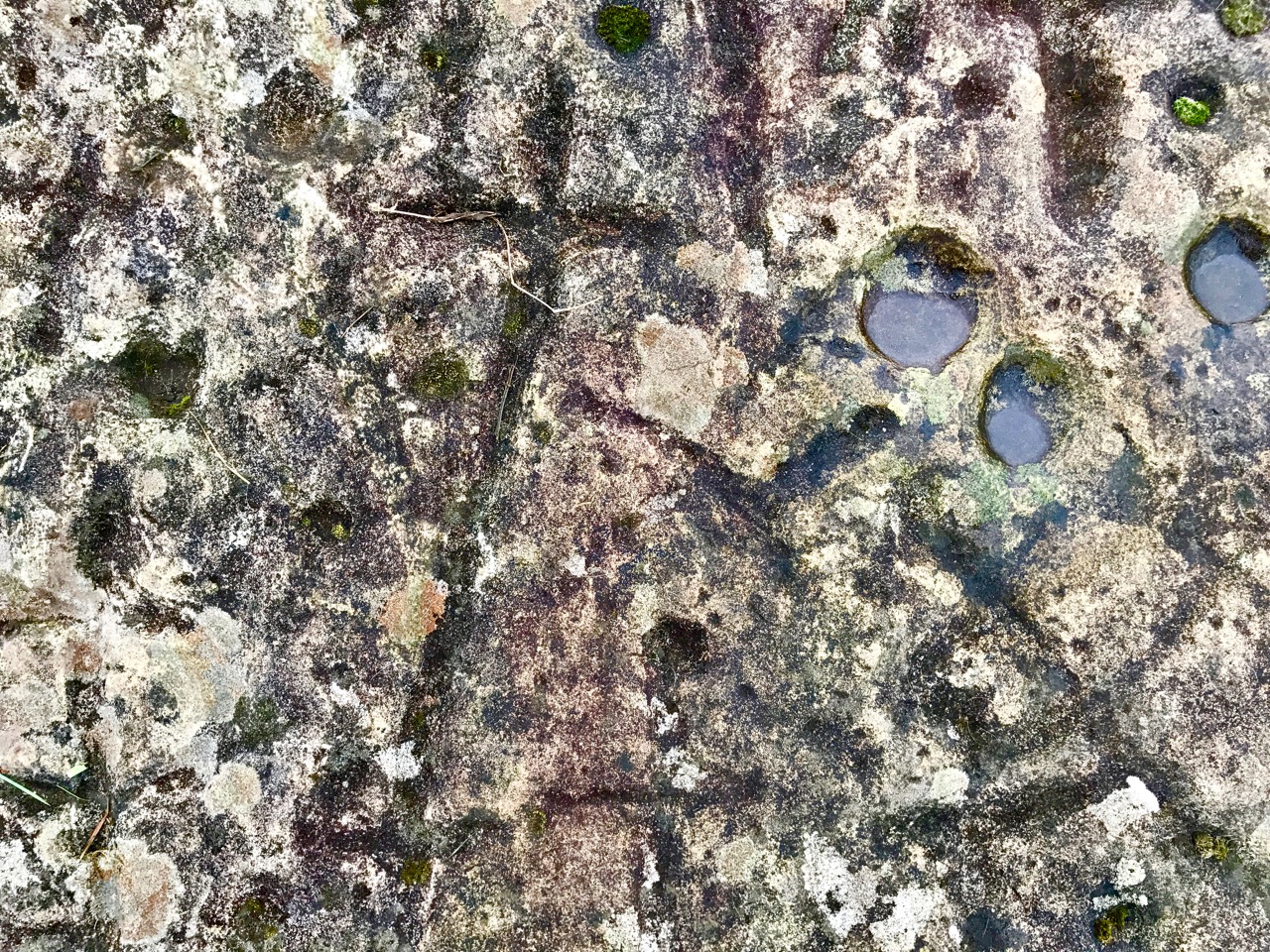
Header – a detail from the stone’s crowded surface. Upper – the well-defined path leading from St Kieran’s Church to the stone (don’t confuse this St Kieran with the one from Cape Clear). Lower – the limestone slab situated beyond the stile

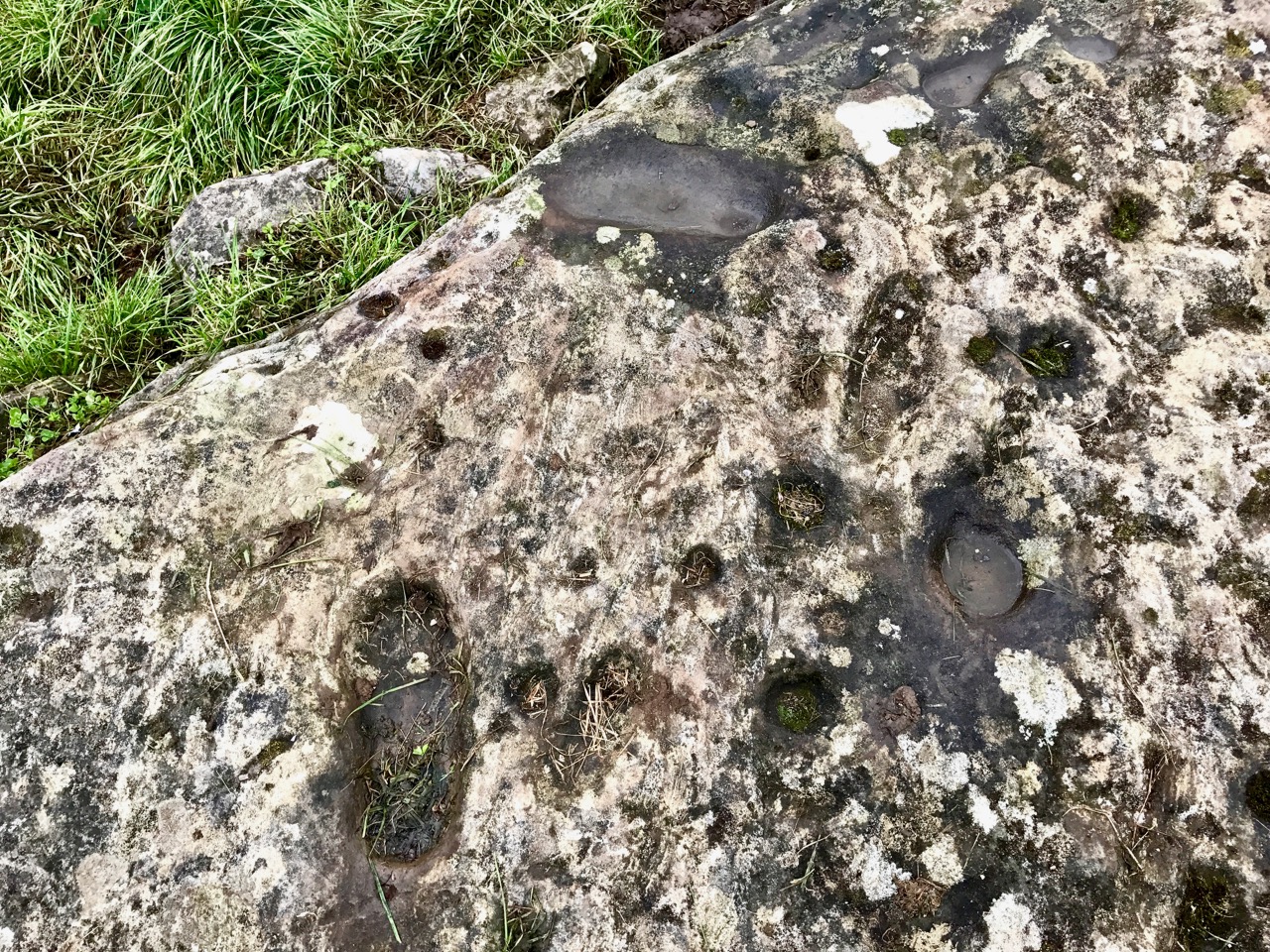
For Rock Art enthusiasts like us the stone was a wonderful find. The surface is teeming with rings, lines, shapes – and even lettering. In spite of the weathering, everything was deeply defined and easy to see. And the more we looked, the more we did see, and the more perplexed we became. I even noted footprints! Remember my search last week for the footprint left by Archangel Gabriel on his visit to his eponymous mountain in West Cork? Here I counted six, and my size nine feet fitted perfectly in them all.

Upper – two of the ‘footprints’ scattered on the stone’s marked surface. Lower – the stone in its landscape context: ‘footprints’ are also visible

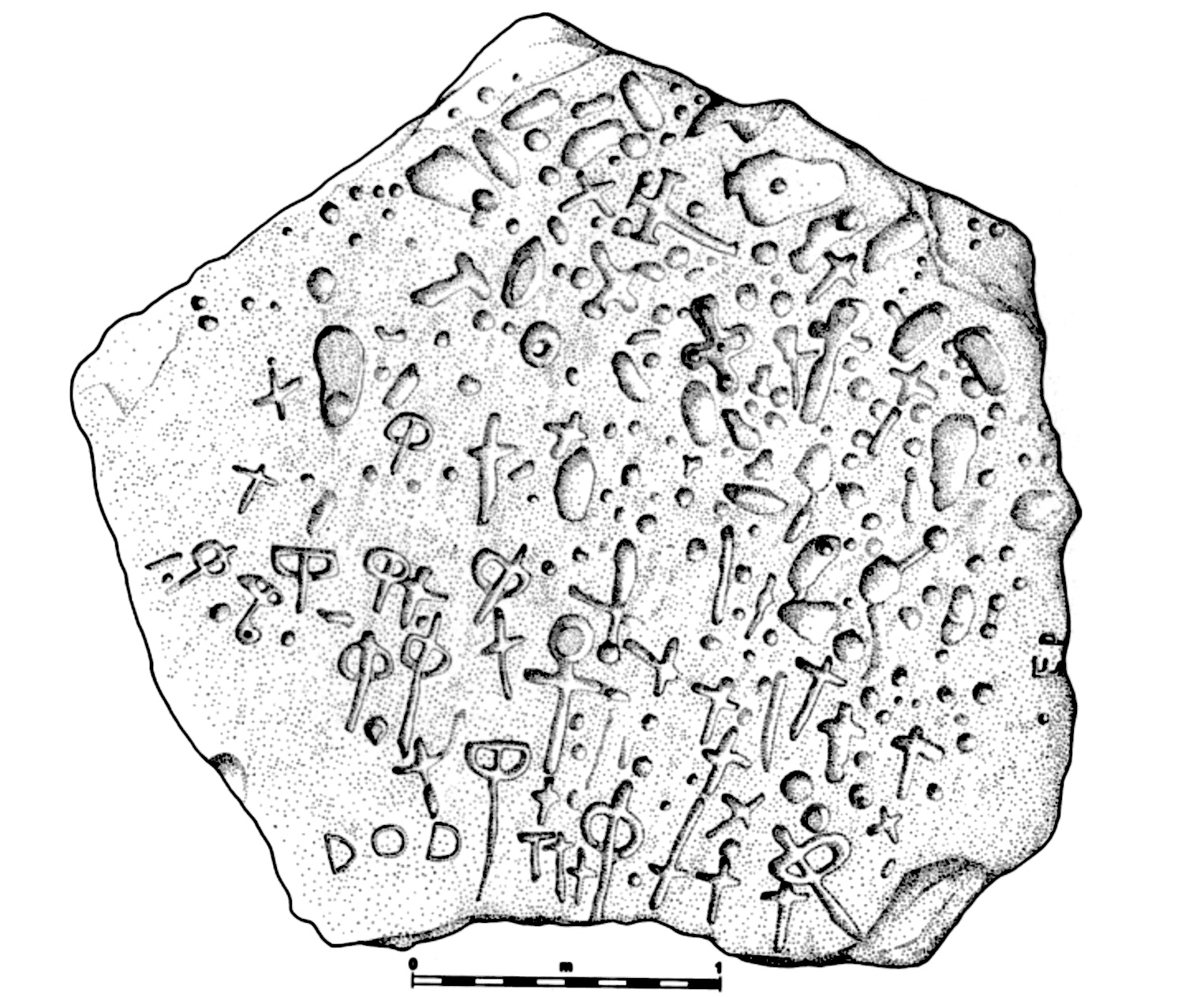
When we returned from our visit to Offaly I was able to research the available information on the Clonfinlough Stone and was delighted to find a very comprehensive study of it written by Finola’s old friend and Rock Art expert from UCC, Elizabeth Shee Twohig. The piece – Context and Chronology of the Carved Stone at Clonfinlough, County Offaly – was published in 2002 in The Journal of The Royal Society of Antiquaries of Ireland, Volume 132 pp 99-113. It makes the most enlightening read, outlining the ways in which the stone was regarded and drawn by early antiquarians and then opening up discussion on how much of the stone’s markings might in fact be natural formations, or natural forms which have influenced and been enhanced by ‘artists’ working with motifs which have become familiar to Rock Art researchers today, including cupmarks.

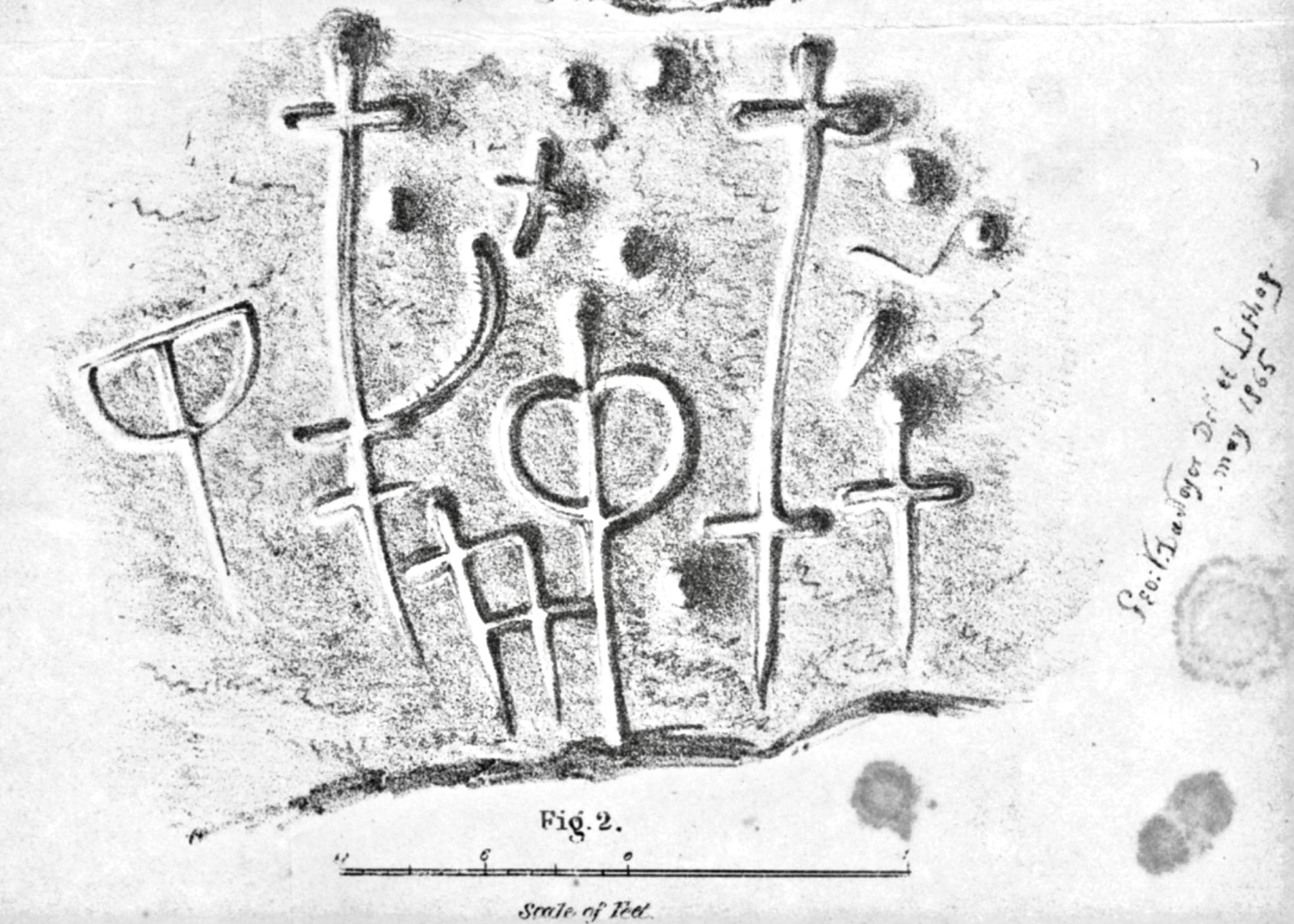
Engravings by George Victor du Noyer illustrating a paper published by James Grave in 1865. Note the emphasis that du Noyer has placed on recognisable ‘Greek’ style lettering (termed phi by Shee Twohig)

Elizabeth Shee Twohig quotes theories by RAS Macalister which evolved between 1921 and 1949, and which include the idea that the phi markings represent ‘…a possible depiction of a battle between the ‘loop men’ and the ‘cross men’ and suggested that the cupmarks …may even indicate the number of severed heads!…’ In his 1928 book The Archaeology of Ireland Macalister (quoted by Shee Twohig) suggests ‘…the carvings as showing a battle or pre-battle scene, the medicine men having prepared for their occult purposes a picture of the consummation desired…’ while in 1949 he saw it as a sign-manual of a hostile expedition from Spain which sailed up the Shannon: ‘…the battlefield, printed with the footmarks of the flying foe, strewn with weapons cast away in their flight and with missile stones…’

These are but brief extracts from the Shee Twohig account and discussions, which are essential reading – not just for possible enlightenment on the markings on this stone, but also for a well defined background on how ideas about Rock Art generally have developed since the time of the earliest antiquarians.

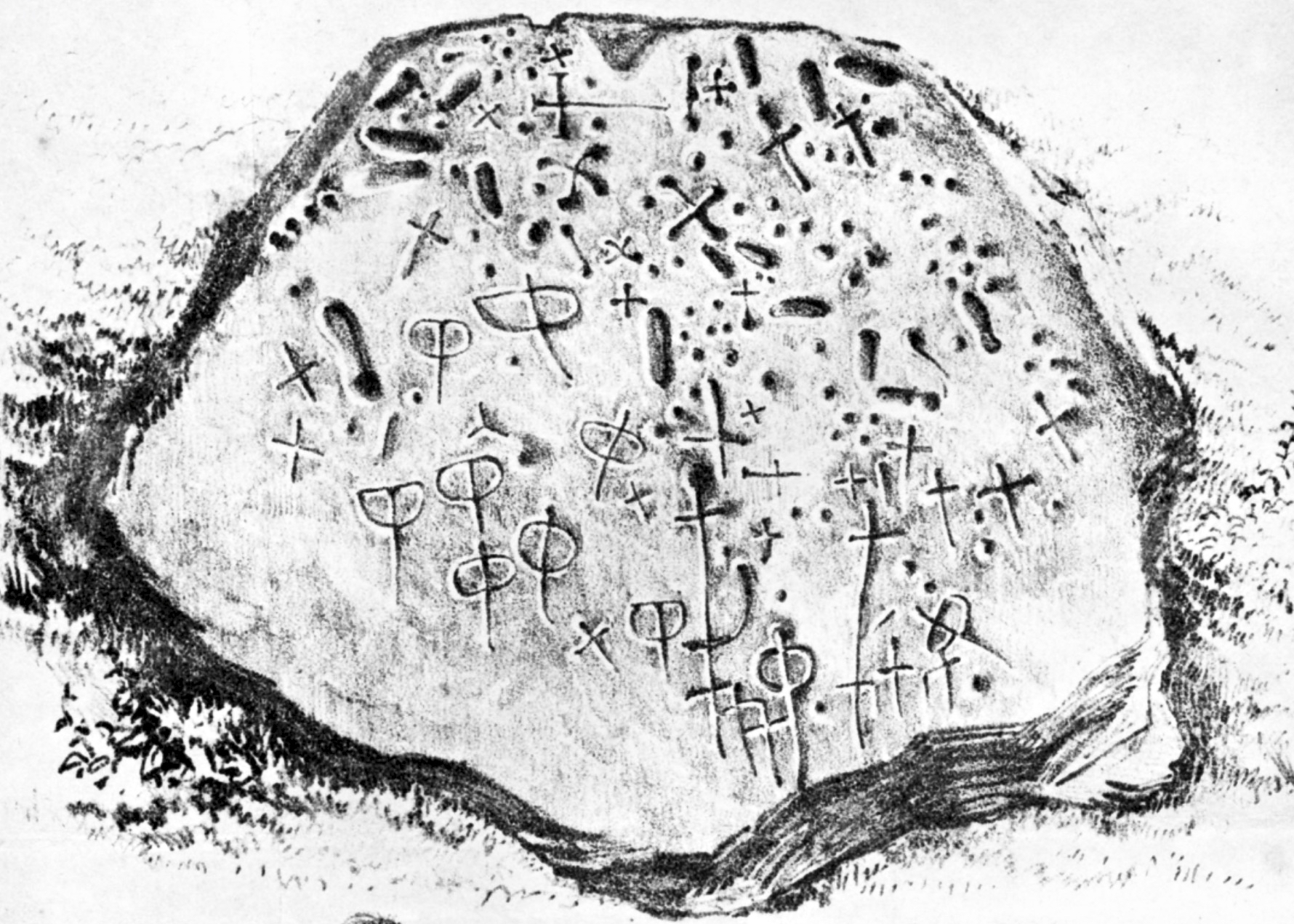
Elizabeth Shee Twohig has amplified her study of the Clonfinlough Stone with the first truly accurate drawing of the markings on it (above). It is certainly interesting to compare this with the 1865 engravings by du Noyer

Elizabeth Shee Twohig brings in to her study the possible significance of the stone’s positioning close to the great monastic centre of Clonmacnoise, which in medieval times was the prime pilgrimage destination in Ireland. There is evidence that one of the paved pilgrim routes passed close by the Clonfinlough Stone. It is plausible, therefore, that at least some of the markings on this limestone slab could have dated from those times: Clonmacnoise was active between the 6th and 12th centuries.

Upper – the many enigmatic markings on the stone: natural limestone solution pits, Bronze Age Rock Art, crosses carved by or for medieval pilgrims? Lower – the stone is within sight of the present day church

A trawl through the folklore records proves fertile. One legend says that at certain times of the year a horseman manifests and gallops around the stone. Another has it that a local boy named Michael used to play at the rock and there met another boy who gave him a silver knife. His mother made him take the knife back and leave it on the stone, for she said the boy was a fairy trying to entice him away. It is also said that another Michael will find the knife, and when he does he will find two big pots of gold under the rocks. Whatever the truth is about the rock and its meaning, I am struck by the path we found coming from the little church which is in sight of the Clonfinlough Stone: could there be something pagan in that stone which required the church to be built there – or is it a mutual guardianship?

In the church at Clonfinlough is a curious series of Stations: this one showing the ’empty tomb’ can be seen as a rock supplanted by a cross…

Anam Cheoil – The Music’s Soul

The Friday evening concert at this year’s Masters of Tradition Festival in Bantry House was a tour de force: in all, probably the best concert I have heard at this festival in recent times. We went because on the programme were two of our favourite musicians who have come from the Irish tradition: Iarla Ó Lionáird and Mícheál Ó Súilleabháin. They were both on top form last night, and certainly didn’t disappoint.

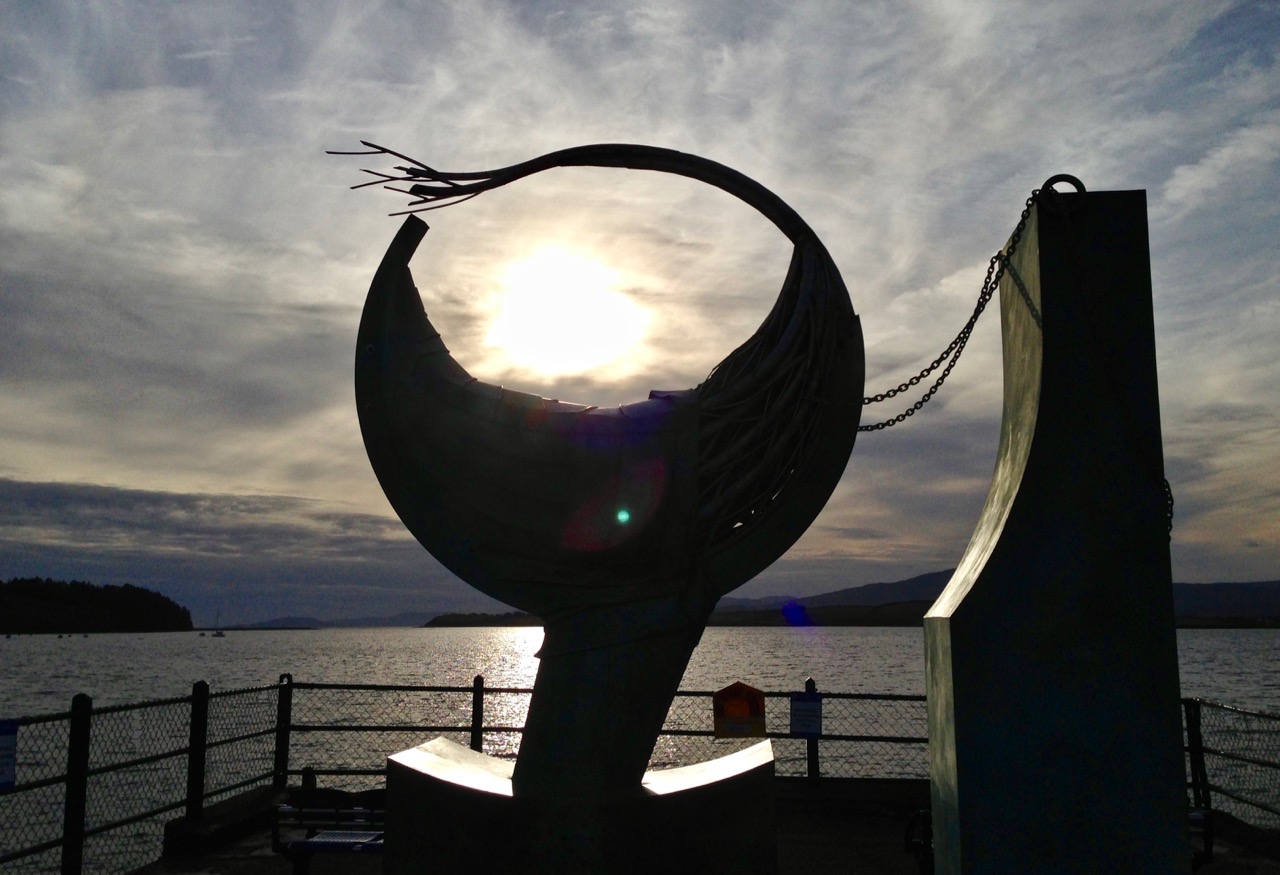
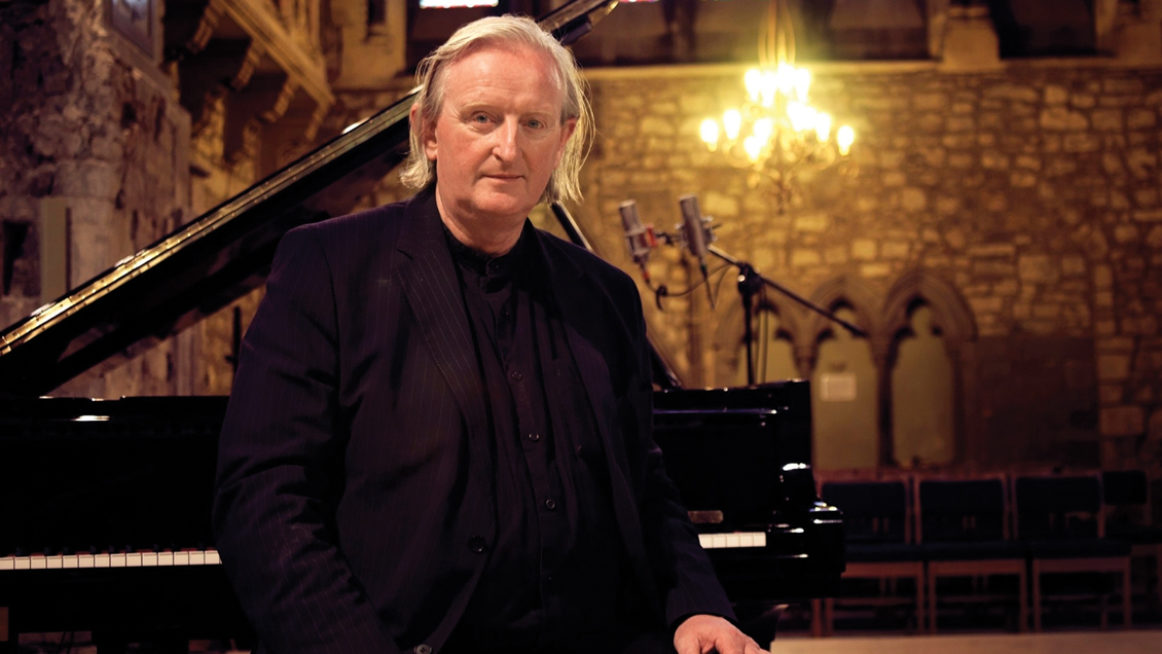
Header: ‘Odyssey’ by Barry Linnane  frames beautiful Bantry Bay – host to the Masters of Tradition Festival. Upper – Mícheál Ó Súilleabháin (RTE Orchestras) and Lower – Iarla Ó Lionáird (Fractured Air)

Using poetry, music and song, the two performers transfixed us. Both are imbued in the musical and poetic tradition of their country, which comes from deep, deep down. In my explorations of Ireland I am finding how much history is alive and embraced: this applies as much to the history of the culture here as it does to the physical relics of the ancestors in the landscape, whether it’s prehistoric rock art or medieval architecture.

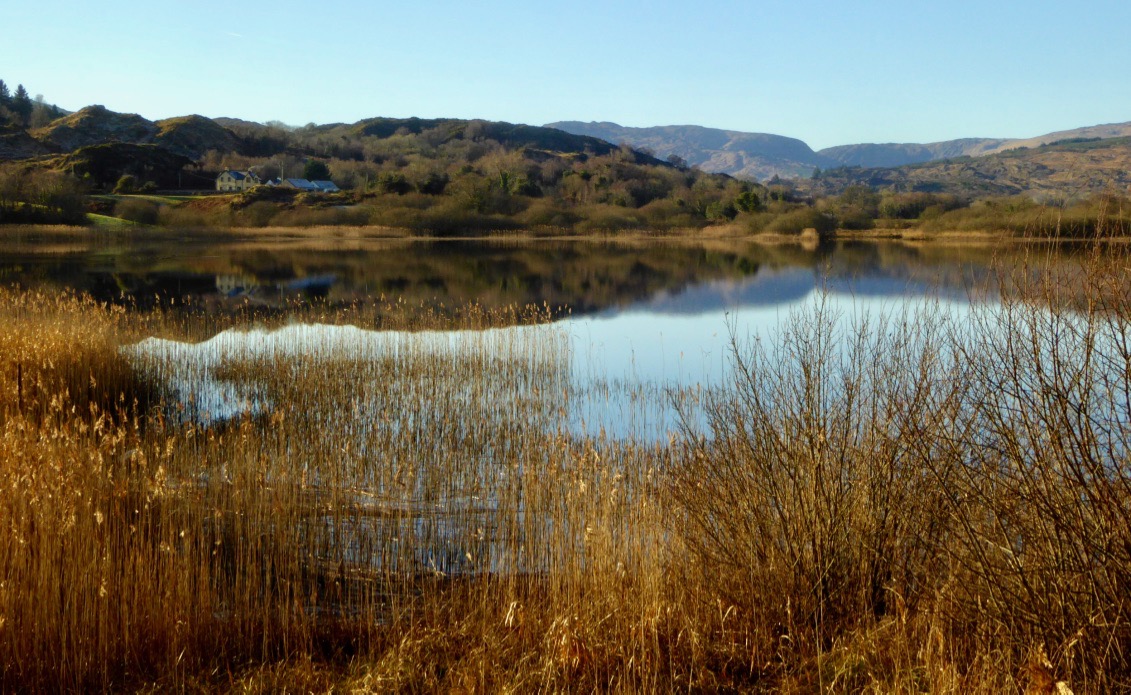
The rushy glens of the Sliabh Luachra country in the Muscraí Gaeltacht, where the Irish language is still very much alive
Iarla Ó Lionáird was born and raised in the Muscraí Gaeltacht, and imbued in the Irish language from birth. A near neighbour in his younger years was Seán Ó Riada, who lived in Ballvourney, and had established Cór Chúil Aodha, a male voice choir singing mainly in Irish, and which exists today under the leadership of Seán’s son Peadar. Iarla joined the choir as a child and sang with it until his early twenties. He now makes his living through his voice and is still very much involved in the Irish tradition while also exploring new grounds. Listen to this very beautiful rendition by Iarla of Caoineadh na dTrí Muire (the keening of the Three Marys):

Mícheál Ó Súilleabháin is best known for his unique expression of traditional Irish music on the piano. He claims that he was an introverted child, and that music was his saving grace. He went to UCC where he was also influenced – and taught – by Seán Ó Riada. Eventually he took over Seán’s job at Cork before founding and heading the Irish World Academy of Music and Dance at Limerick University. He wasn’t born into the Irish speaking tradition but came to it later in life. In a recent newspaper interview he gave this memorable quote: ‘…I wouldn’t like to be reborn as someone else, not even for a day, I’m so worn out trying to be myself…’ Here’s an example of Mícheál’s playing:

In the course of the Bantry concert the two musicians spoke of a little-known collector of Irish folk-songs – someone of whom I had not heard. Alexander Martin Freeman was …a retiring English scholar of private means… who travelled in the Muscraí Gaeltacht in 1913 and 1914. He wrote down no less than 84 Irish language songs, and his work has been described as ‘…incomparably the finest collection published in our time of Irish songs noted from oral tradition…’ This is all the more remarkable as Freeman spoke no Irish. He painstakingly wrote the words, exactly as he heard them, in phonetic spelling, based on his own native English. For this reason, the texts were apparently ignored initially by Irish folklorists. But now they are viewed with interest by scholars as they give a great insight into the word-sounds of Irish speakers from those years – apparently the West Cork dialect has been changing with time! Over the years both Seán Ó Riada and Iarla Ó Lionáird have brought the songs back into circulation, and we were treated to some examples. Freeman’s field notebooks from Ballyvourney are held in the National Folklore Collection, University College Dublin.

Winter scene in the Muscraí Gaeltacht

In the Library of Bantry House these two performers gave us a very special experience through music, song and poetry. Although I don’t speak or understand Irish, I appreciated the beauty of the sounds of the words – a music itself. We and the audience were transfixed by the whole experience. Walking out on the terrace of Bantry House afterwards, I looked to the west where the sun was dropping behind the mountains over the calm waters of the bay. I felt that we had, through the music, been given a privileged glimpse into the soul of Ireland.