Pilchards and Palaces

Black Castle, Leamcon

Black Castle, Leamcon – also known as ‘The Hound’s Leap’ – William Hull territory

A little while ago I described an outing we undertook exploring some of the archaeological sites on the Mizen Peninsula. We were out again a few days ago checking on some monuments off to the west of us. I had researched the Archaeological Survey Database, and determined to have a look at the ‘Fish Palace’ located in the townland of Leenane, close to Crookhaven – evidently a substantial establishment set up by Sir William Hull and his business partner, Sir Richard Boyle, first Earl of Cork, in 1616.

Leenane Fish Palace in 2015

Leenane Fish Palace in 2015

Hull was a notorious character – his family home was Larkbeare, near Exeter in Devon. He had been appointed Deputy Vice Admiral of Munster in 1609 under James I, and settled in Leamcon near Black Castle or ‘The Hound’s Leap’, one of the O’Mahony castles built along the coast of Roaringwater Bay. Set on a promontory into Toormore Bay, Leamcon  is one of the most defensible of these, only being reached by crossing a narrow bridge. Hull’s job was ostensibly to protect the southern Irish coastline against piracy. In fact, the post seemed to encourage collaboration with the pirates, where it would financially benefit both the Admiralty and Hull himself.

You probably want to know what a ‘Fish Palace’ is? I had seen the term on Irish Ordnance Survey maps, and had established that it is a class of monument in the Archaeological Inventory of County Cork 1992, where it is well described:

‘…Fish palaces: The fishing and curing (smoking, pickling and pressing) of pilchards (Sardinia pilchardis) became an important industry in West Cork during the 17th century. This industry suffered from the erratic pattern of pilchard shoals (some years none would appear in Irish waters) and was in serious decline by the middle of the 18th century. Today, all that remains are the ruins of curing stations, called “pallices” along the coast. The word “palace” is of uncertain derivation, but probably originated in the SW of England where it meant a cellar used for storing fish. Usually the “press wall” is the only standing structure, with its horizontal line of lintelled support niches. These held one end of a press beam; at the other end a heavy weight was suspended and in the middle was a wooden press or “buckler”. The buckler was placed over an open barrel of pilchards and the downward force of the press beam pressed the pilchards into the barrel. Also fish or “train” oil was squeezed out through a drain in the base of the barrel; this was valuable as a luminant and was used by the tanning industry…’

All this has been ringing bells with me: firstly, because I know from the map that a Fish Palace once existed down below Nead an Iolair – overlooking Rossbrin Cove and Castle – but no trace is left now, except that the field there is still known as ‘The Palliashes’; but secondly because when I lived in Newlyn in Cornwall I looked out over Mounts Bay, where a pilchard fishery had been active since the 16th century. This was a huge business, whose heyday was the middle of the 19th century. Pilchard quantities are measured in ‘hogsheads’ – one hogshead holding 3,000 fish: in 1847 the exports of pilchards from Cornwall amounted to 40,883 hogsheads or 122 million fish! By good fortune we have a pictorial record of the activities, as two of the Newlyn School of Artists chose seining as the subject matter for two impressive paintings.
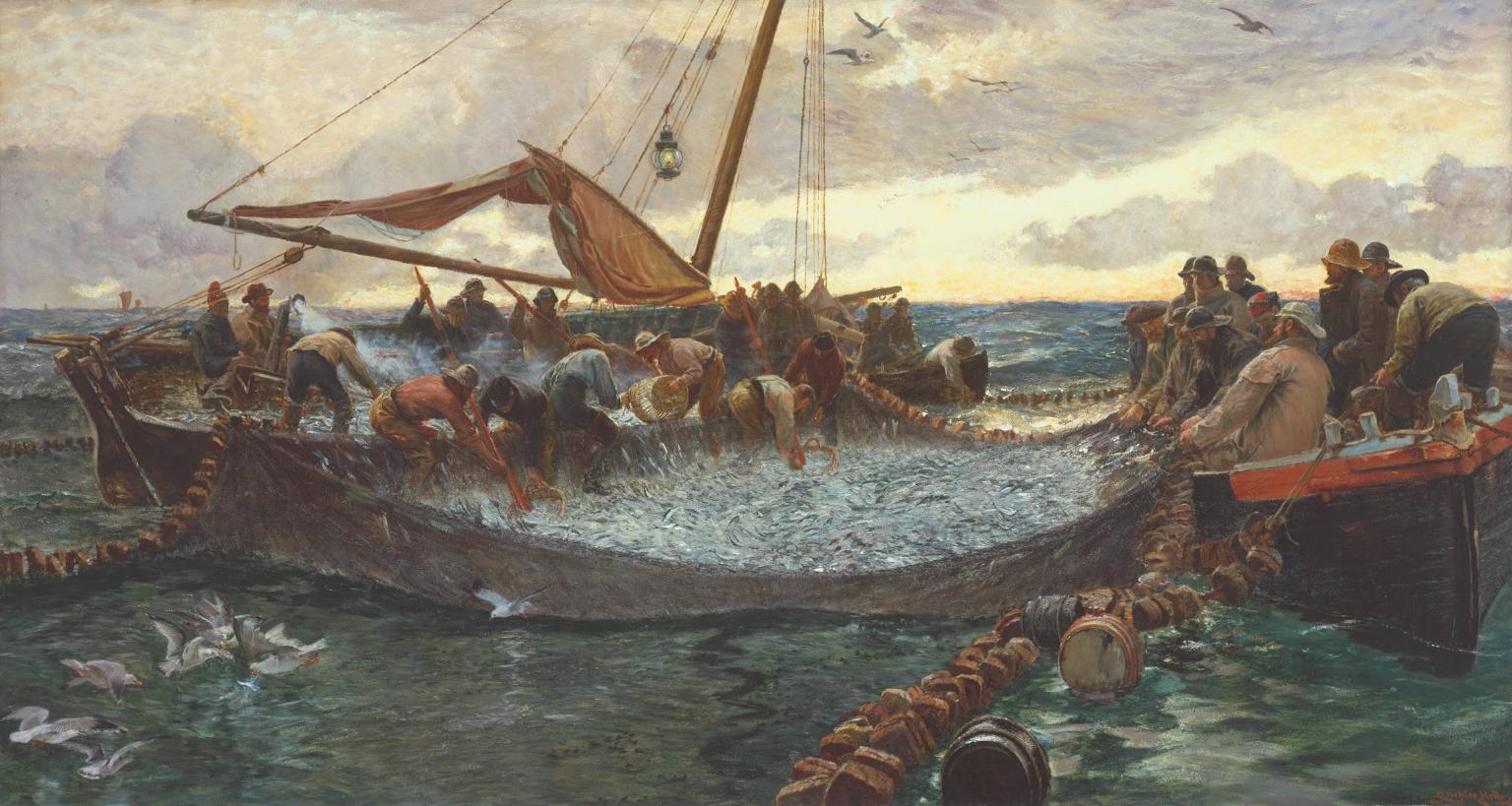
'Pilchards' - Charles Napier Hemy 1897 (Tate Gallery)

‘Pilchards’ – Charles Napier Hemy 1897 (Tate Gallery)

'Tucking Pilchards' Percy Craft 1897 - Penlee Gallery

‘Tucking Pilchards’ Percy Craft 1897 (Penlee Gallery)

*

In the good times Mounts Bay was brimming with seine boats. The pilchards were harvested during the summer when the shoals swam in close to the shore. Lookouts known as Huers were posted on the cliffs, from where the shoals could be seen and semaphore signals were sent out to the waiting boats who let out 400 yard long nets to surround and trap them. The nets were kept upright by floats at the surface and weights at the bottom, presenting an impenetrable wall to the pilchards. The pilchards were then removed by smaller tuck nets and loaded into punts and carried ashore. The seine net provided a convenient keep net in which the fish could be kept alive and fresh until they were processed.

Early photographs of seining, and the fishing fleets working out of Penzanace and Newlyn, Cornwall

During my time in Newlyn there was an active pilchard processing plant – now closed down – but I was fortunate enough to visit the works and see the pressing and preserving taking place, using exactly the same methods that William Hull’s workers employed four centuries before. Just as in those earlier times the main markets for the processed fish were in France and Spain.
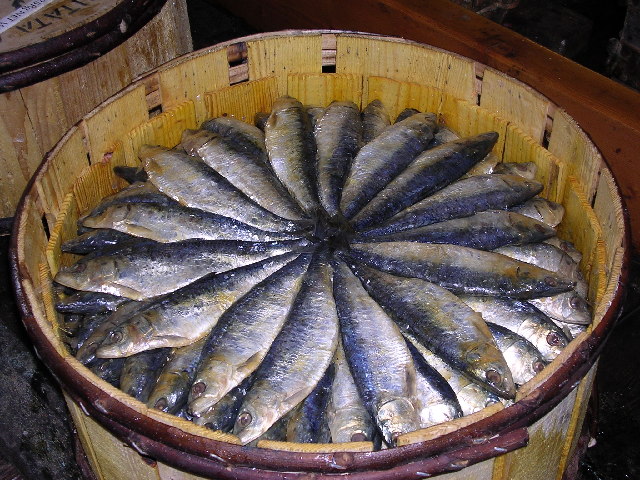
Pressed Pilchards (Richard Greenwood)

Pressed Pilchards (Richard Greenwood)

As in Ireland, the pilchard shoals severely declined – probably because of overfishing – and the industry followed. Nowadays there is a small amount of pilchard fishing taking place in Cornwall, but it is barely viable.
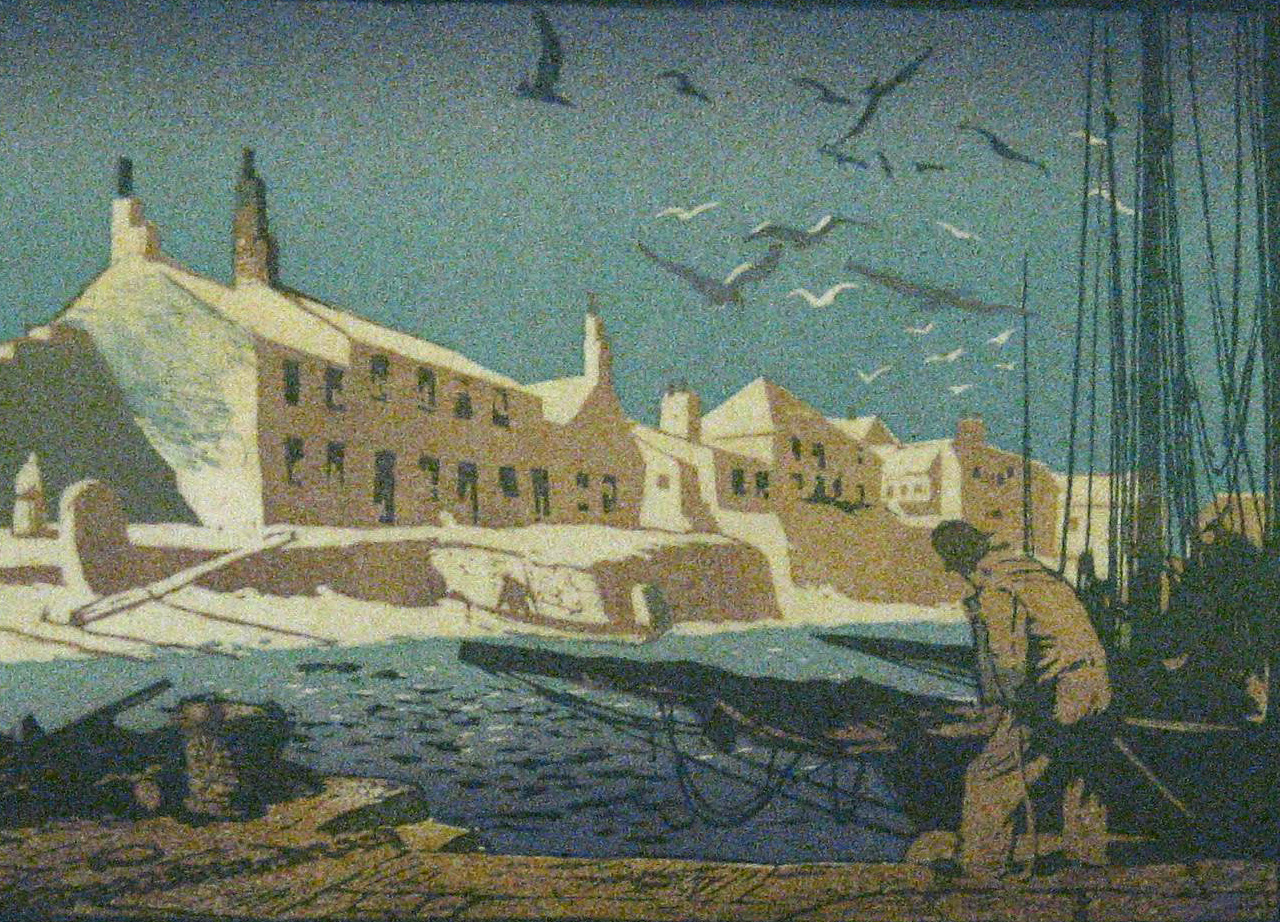
Mousehole, Mounts Bay - Ernest Watson

Mousehole, Mounts Bay – Ernest Watson

To the casual observer, our little expedition to the Crookhaven Fish Palace might have seemed pointless – a lot of scrambling through bracken and brambles to find a few old stone walls and the crumbling remains of an abandoned quay. Through our eyes, however, we saw the industry and energy of former days: Irish men and women labouring long and hard to put clothes on the back of a Knight and an Earl…
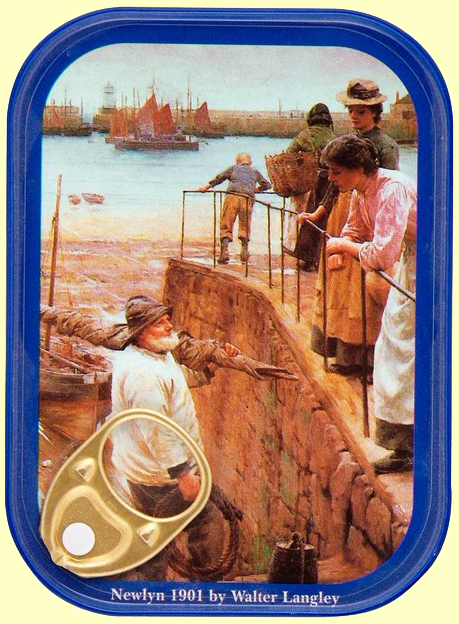
canned pilchards

Wedge Tombs: Last of the Megaliths

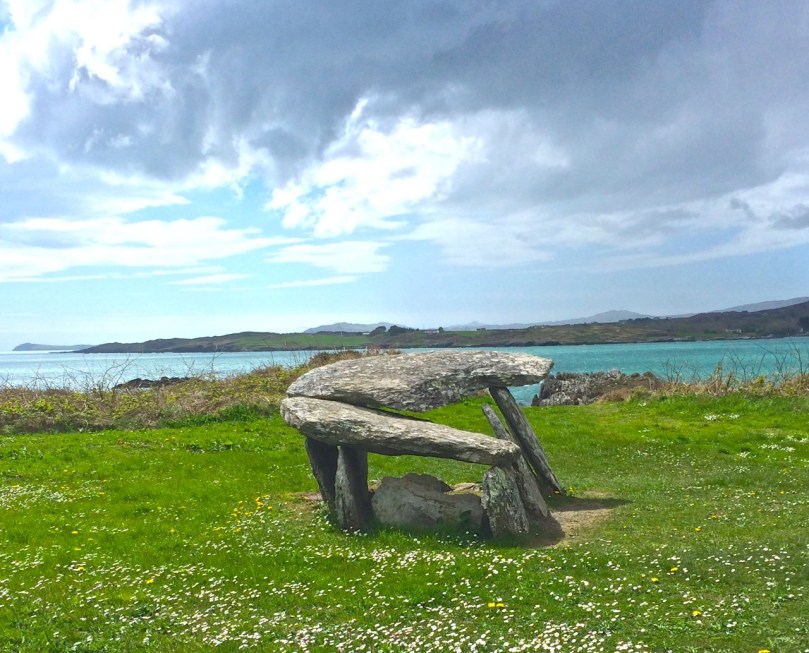
Altar Wedge Tomb on The Mizen Peninsula

Altar Wedge Tomb on The Mizen Peninsula

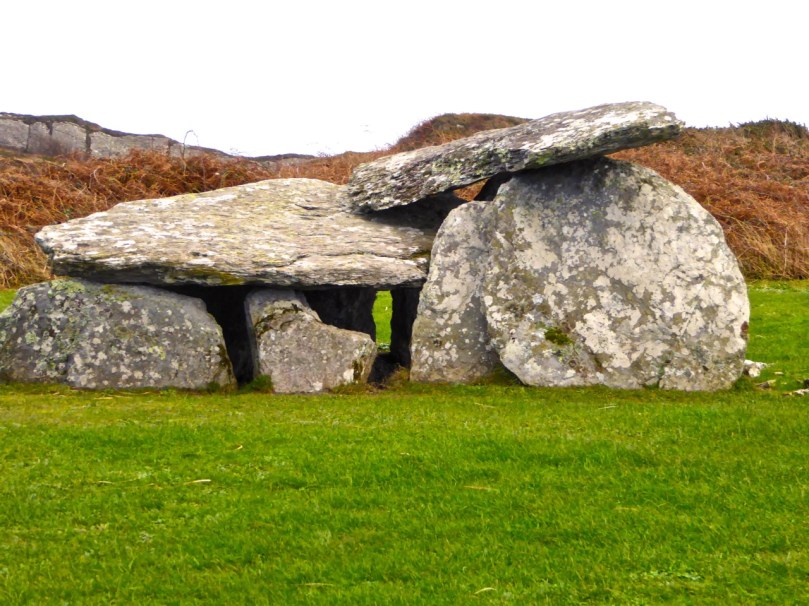
In Ireland, the tradition of building megalithic (mega=large, lithos=stone) structures that included chambers to house the dead (such as the Boyne Valley Passage Grave complex, or the Court Tomb of Creevykeel) belongs to the Neolithic period, which ended around 2500 BC. About this time, a new style emerged of stone ‘galleries’, oriented towards the setting sun. Their distinctive shape – narrower and shorter at the eastern end – gives them their common name, wedge tombs. This tradition appears to have flourished for about 500 years.

Altar, side view

Altar, side view

In other areas of Ireland wedge tombs were often covered by a mound, but there is little evidence for this in West Cork. The closest parallel to wedge tombs outside of Ireland are in Brittany where allées couvertes date from this period. They are associated in some parts of Ireland (although once again not in West Cork) with Beaker pottery, a distinctive kind of vessel widely distributed across Western Europe. This was a time in which the population was expanding, farming practices were intensifying and a brand new technology was being introduced – it was the dawn of the Copper Age. Thus, we can speculate that wedge tombs mark the confluence of two forces: the new continental technologies of pottery and metalworking and the indigenous tradition of erecting megalithic chambered tombs.

Wedge tombs occur mostly in the western half of Ireland, including many in County Clare such as the Parknabinnia tomb pictured below.

 The largest wedge tomb in Ireland is near Fermoy, north of Cork City. It is typical of many Irish wedge tombs in featuring double walling, evidence of a surrounding cairn, and a sealed end chamber. Interestingly its name, Labbacallee, means the Hag’s Bed – the hag, or wise woman crops up frequently in Irish mythology.

In contrast to Labbacallee, wedge tombs in West Cork are generally smaller and simpler, comprising only one chamber and lacking a covering cairn. However, the distinctive wedge shape is preserved along with one other defining feature: wedge tombs are invariably oriented towards the setting sun. The funerary rite was that of cremation. Votive offerings of white quartz pebbles and small deposits of metal have been found in excavations.

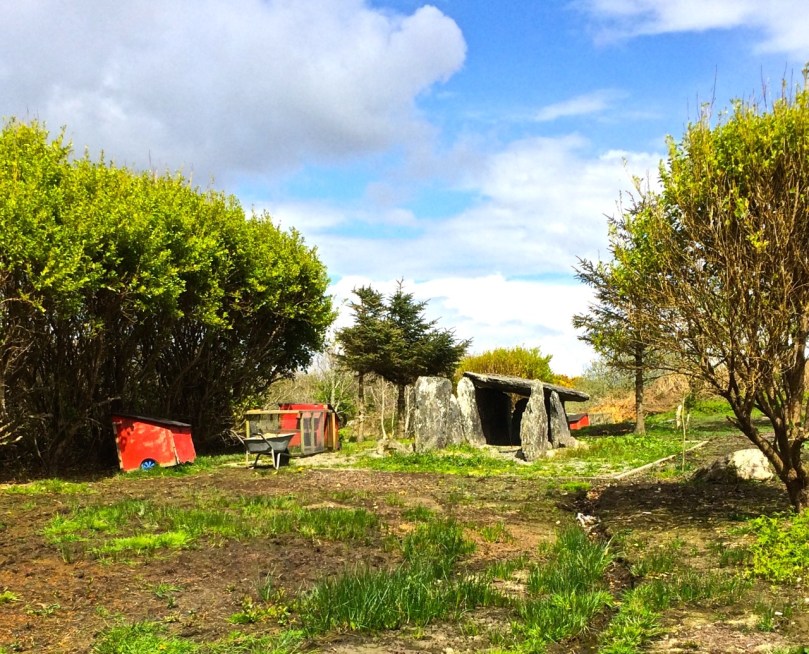
Toormore wedge tomb,  now in someone's garden

Toormore wedge tomb, now in someone’s garden

Prof William O’Brien has excavated wedge tombs in West Cork and studied them, and the culture in which they were built, extensively. Here’s what he has to say, in his book, Iverni, about the society that produced them:

Whereas monuments like Newgrange could only have been built with a large organised input of labour over a long period, the building of wedge tombs was undertaken by small kin groups…This was a small scale society, comprised of local, clan-like groupings…The tomb was a type of shrine, sanctified by an association with ancestors and used for periodic offering and sacrifice to supernatural powers.

A striking aspect of Neolithic, Chalcolithic (Copper Age) and Bronze Age monuments in West Cork is their consistent orientation towards solar events such as sunrise and sunsets on the equinoxes, solstices and cross-quarter days (see our post on Bohonagh stone circle, for example). In this regard, wedge tombs are remarkably consistent in being oriented towards the West. Here’s O’Brien again:

Wedge tombs served as funnel-shaped openings to the Otherworld, facing the descending or setting sun to emphasise the symbolic dualism of light/life and darkness/death.

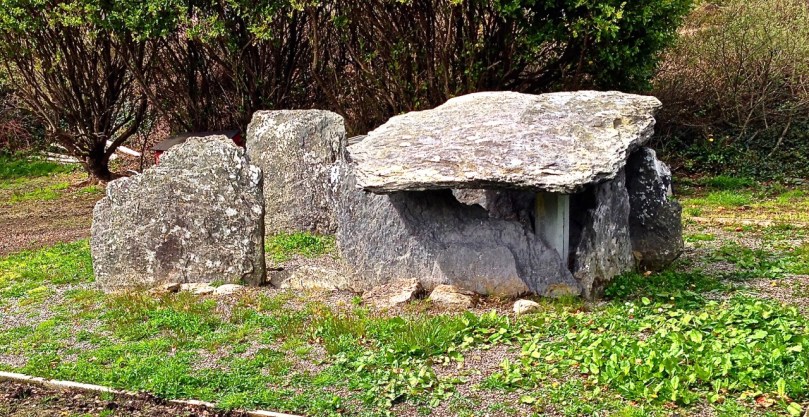
Toormore, side view

Toormore, side view

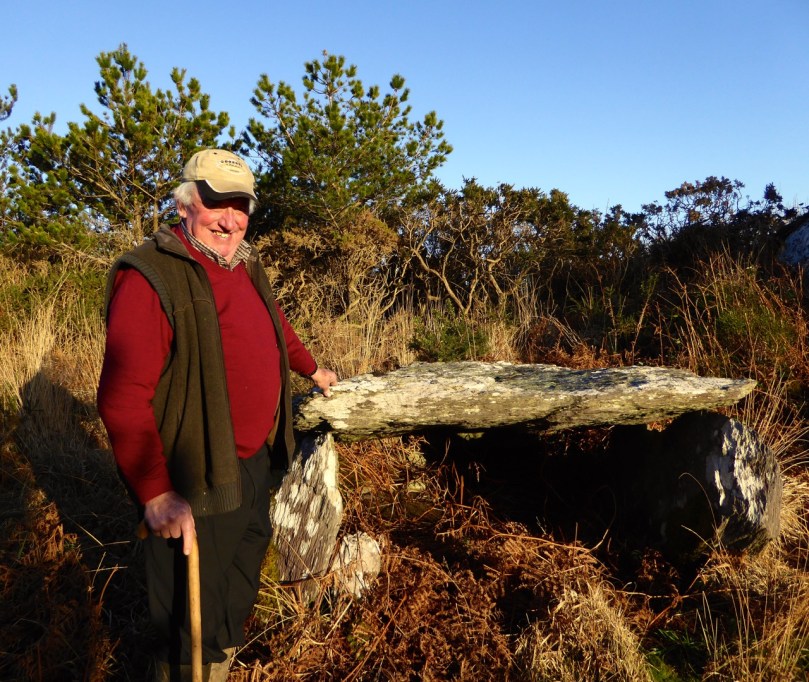
Looking for a wedge tomb closer to home, we set out yesterday to find the nearby Kilbronogue site, using the information from the National Monuments Service as a guide. We have found in the past that the mapping of sites is not always accurate and after an hour or two of tramping through a large and very muddy area with a helpful neighbour and his son we had to admit defeat – either the map was wrong, or the monument had disappeared in the recent fieldwork by a digger. Desperately hoping it was the former and not the latter, we found out who owned the land and went to call on him today. Stephen Lynch turned out to be a friendly, cheerful and very knowledgeable organic farmer – he assured us that the tomb would never be damaged in any way and not to worry, he would take us to it. Whew! Half an hour later we were trudging up a path that Stephen had had cut through his ash plantation – on we went and suddenly there it was in front of us – a classic wedge tomb, oriented to the west, built with large slabs that may have been cut from the rock face behind it.

Kilbronogue wedge tomb with its guardian, Stephen Lynch

Kilbronogue wedge tomb with its guardian, Stephen Lynch

Stephen told us the tomb had been used as a mass rock in penal times and that the Protestant farmers who owned all the farms that bordered on the rock had cooperated in allowing the masses to take place – an indication, Stephen said, of the long tradition of friendship between Catholic and Protestant farming families in this area. As with the Altar wedge tomb, also used as a mass rock, we marvelled at how a sacred site, built at least four thousand years ago, would retain its aura of veneration over the millennia, to be used again for religious purposes in the historic period.

Kilbronogue, side view

Kilbronogue, side view

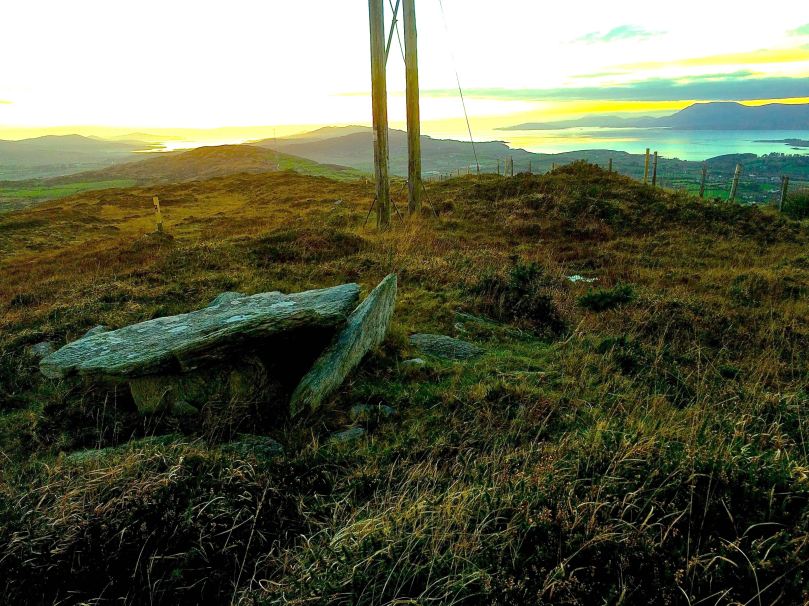
Perhaps the most spectacularly situated wedge tomb we have been to is high on a hill overlooking Bantry. This one is known as Queen Medb’s Tomb and from it there are expansive views of the Beara, Sheep’s Head and Mizen Peninsulas. Climb up to it on a clear day, as the sun is sinking into the sea: in the presence of such awe-inspiring scenery you will find yourself contemplating how the mysteries and the wonders of Irish history and prehistory are written on its landscape.

Queen Medb's Tomb

Queen Medb’s Tomb

Your Favourite Posts of 2014

Cape Clear Harbour

Cape Clear Harbour

What were your favourite Roaringwater Journal blog posts of 2014?

Our blogging software provides a running count of visitors to Roaringwater Journal and it’s always fascinating to see which ones receive the most views. Some of them are our own favourites as well, and some can attribute their high numbers to being re-blogged by others, or to being shared on social media. So tell us, Dear Reader – did the software capture it – or do you have a different favourite from our top posts of 2014?

From the Whiddy Island high point

From the Whiddy Island high point

The top two posts of 2014 were the ones we wrote about our trips to Cape Clear and to Whiddy Islands. We loved our time on the islands and intend to go back often – our enthusiasm probably shone through. But it may also be that islands hold a mystique for us that is hard to define – out there in the dawn mist, mysterious and peaceful, whole worlds unto themselves. The islanders of West Cork are worried at the moment by cuts to their development officer funding, and need all the support we can give them. So if you live here, or are planning a trip, include one or more of these beautiful islands in your plans.

Timoleague Friary

Timoleague Friary

Next in popularity was our post on the Timoleague Friary. It’s an iconic piece of West Cork history and architecture – the only sizeable medieval religious ruins we have, perched on a picturesque estuary of the Arigideen River.

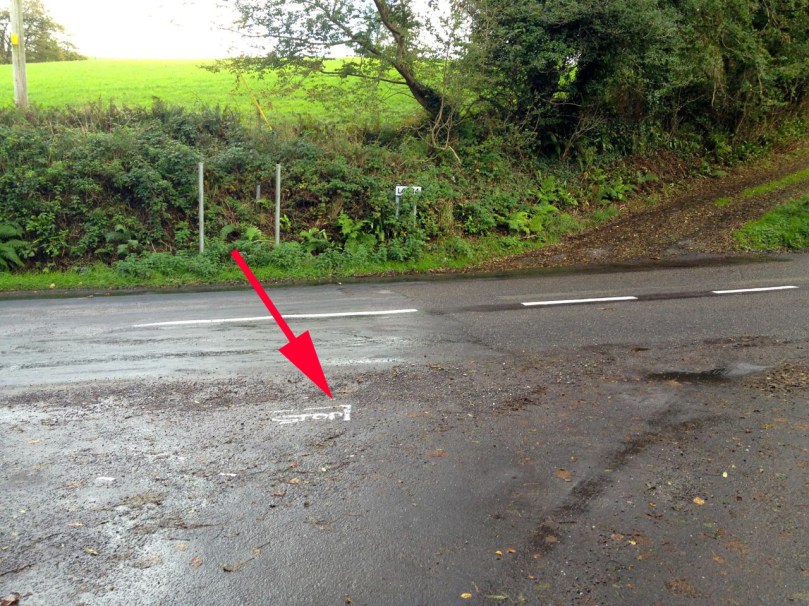
I've learned to look carefully for road signs

I’ve learned to look carefully for road signs

Finola’s frustration at the inflexible regulations that treated her like a novice driver, despite forty years of driving experience, must have struck a chord with you. Maybe you dropped by Driving Home the Point to sympathise with her plight, or maybe it was to chuckle over the numerous example of the routine flouting of the Irish rules of the road, or the bemusing driving conditions of many rural roads.

Evans of Bantry

Evans of Bantry

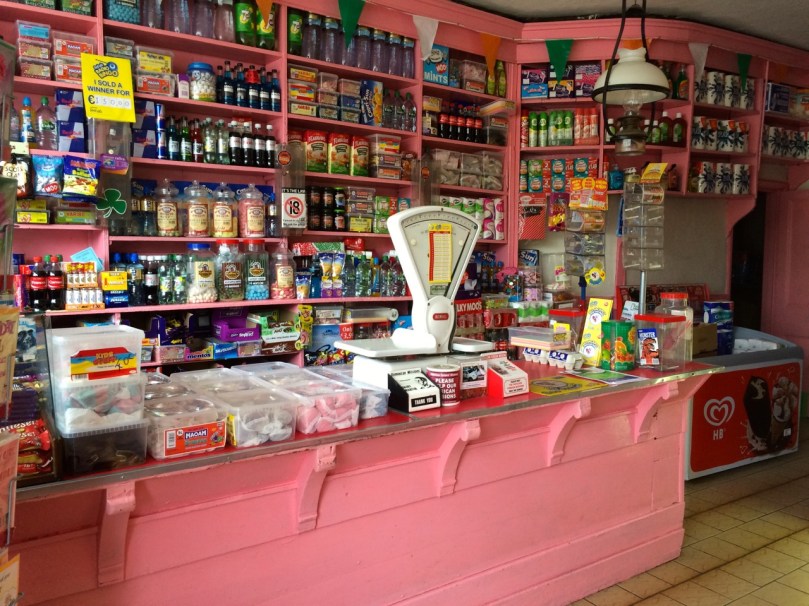
We have enormous nostalgia for the things we remember from our childhood, don’t we? In that vein, it’s not surprising that Shopping for Memories was such a popular post. These lovely old shops evoke a time when a whole variety of shops lined the main streets and our mothers went from the butchers to the greengrocers to the chemists to the haberdashers and, if we were lucky, to the sweet shop on a daily basis.

Carraig Abhainn Gardens

Carraig Abhainn Gardens

But sadly, the numbers of these old-fashioned shops are dwindling. This year we said goodbye to Wiseman’s in Durrus, no longer able to compete against the hardware shops of Bantry. Fortunately, their wonderful Carraig Abhainn Gardens are still open behind the shop – and our description of this hidden gem was one of your favourite posts of the year.

A group of posts on festivals came next. We wrote about the question our friends asked us when we decided to move here, What on earth will you find to DO? We answered in a series of posts describing some of the local events and festivals we have taken in this year – the Ballydehob Jazz Festival and Arts and Culture Festival (which included our own Rock Art Exhibition), traditional music Festivals in Baltimore, Bantry and Ballydehob, and a host of musical and theatrical events. One day all of you retirees out there are going to discover that moving to West Cork is the best decision you can make!

The next group of posts centred on the Mizen – the Mizen Magic posts where we concentrated on aspects of the Mizen Peninsula that delight us – the Beaches, Brow Head, the Butter Road, Mount Gabriel, the Gortnagrough Folk Museum, and the history and archaeology of this beautiful part of Ireland.

How are ye?

How are ye?

In fairness, like, it looks like ye would have enjoyed our take on how to speak like ye’re from West Cork. Those little posteens made you happy out.

Ye must be a fierce active crowd altogether because you really got a kick out of Finola’s description of her day of sailing and (perhaps her personal favourite in the activities department) her moonlight kayaking on Lough Hyne.

Happy New Year from Robert and Finola!

Happy New Year from Robert and Finola!

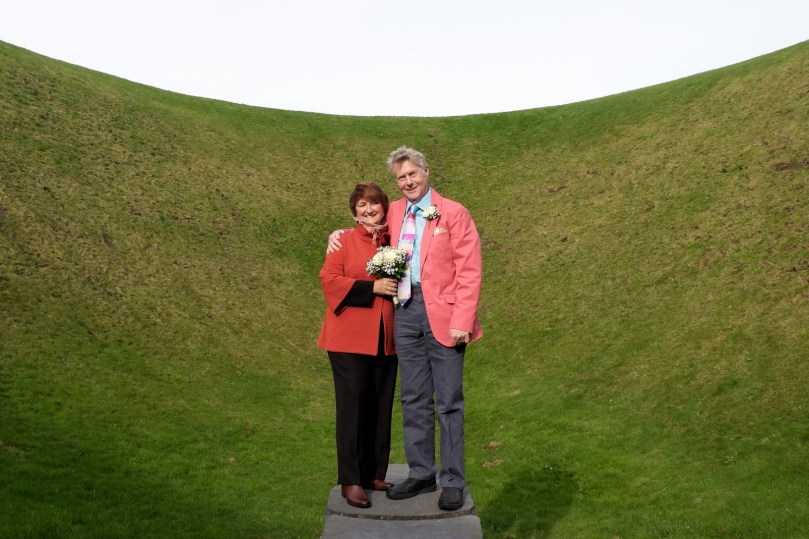
And our own personal favourite of 2014? Robert’s post on the Sky Garden, of course! If you haven’t read it yet, you’ll have to do so to find out why this was the highlight of our year in West Cork.

Mizen Mission

Tooreen Lake

Tooreen Lake

A joint post by Robert and Finola…

Finola

According to the forecast today could be the last fine day of 2014, so we decided to make the most of it and set off on a mission. And what a day it was! Cold, yes, but with that brilliant light that only happens on crisp winter days.

Looking across Roaringwater Bay

Looking across Roaringwater Bay

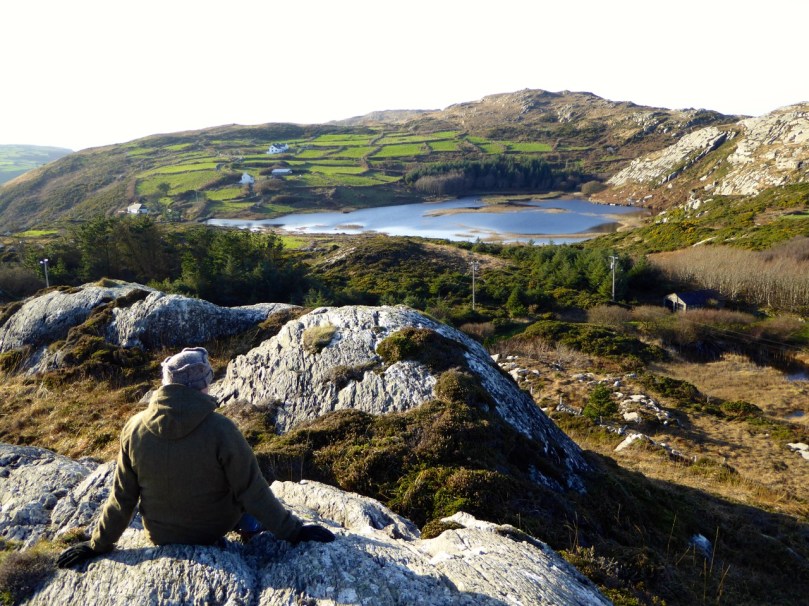
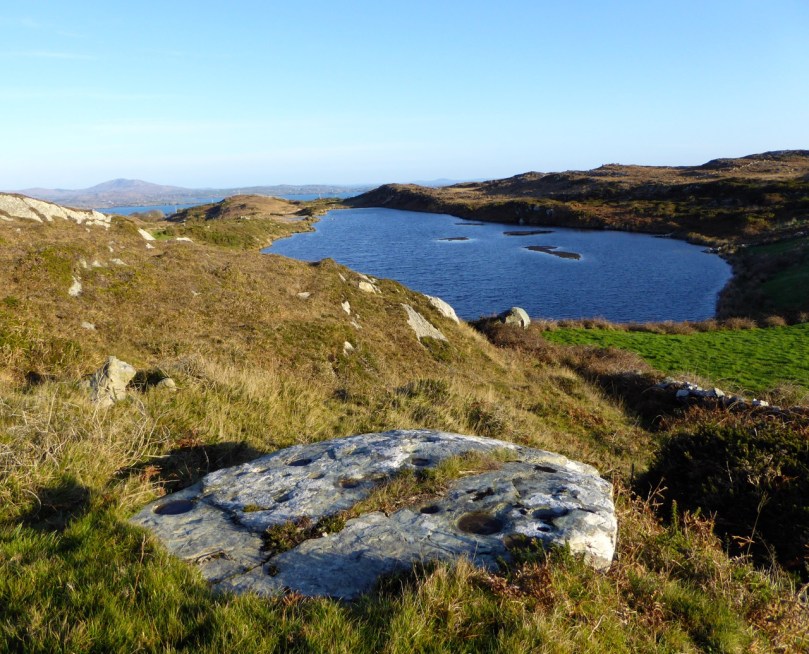
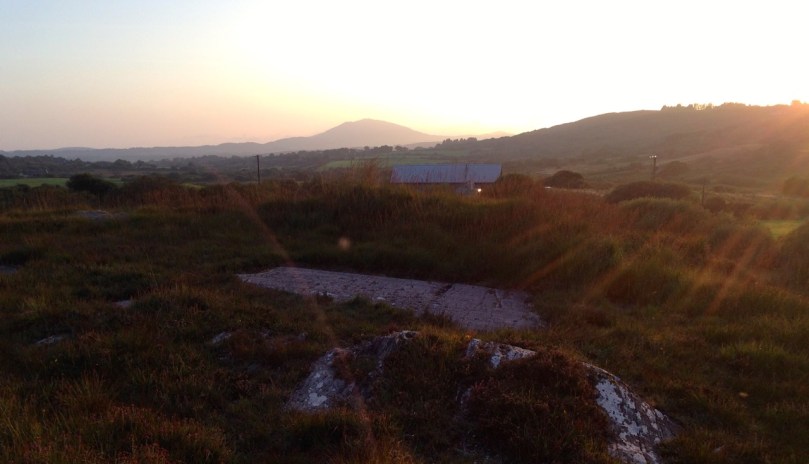
Our mission? it was to find a piece of prehistoric rock art I had last visited over 40 years ago in the townland of Castlemehigan, near the end of the Mizen Peninsula. But once in the vicinity of Castlemehigan we couldn’t resist continuing to the end of the tiny road, which climbed up the rocky hills on the northern side of Crook Haven. Parking the car, we climbed to the highest point we could find. We’re used, by now, to the jaw-dropping views around here, but even by Mizen standards, this was something special. 

Crookhaven Village

Crookhaven Village

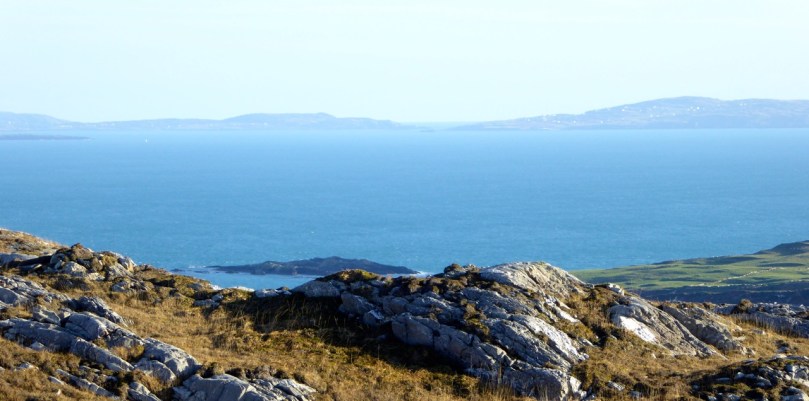
South of us, across the Haven was the village of Crookhaven nestled in its protective harbour. Looking north we could see across the Sheep’s Head to where the unmistakeable outline of Hungry Hill loomed on the Beara Peninsula. To the west was the White Strand and Brow Head, crowned by the historic Marconi telegraph station and to the east was the whole of Roaringwater Bay: Cape Clear Island, Sherkin, Baltimore, and the ring of hills that run down to the water.

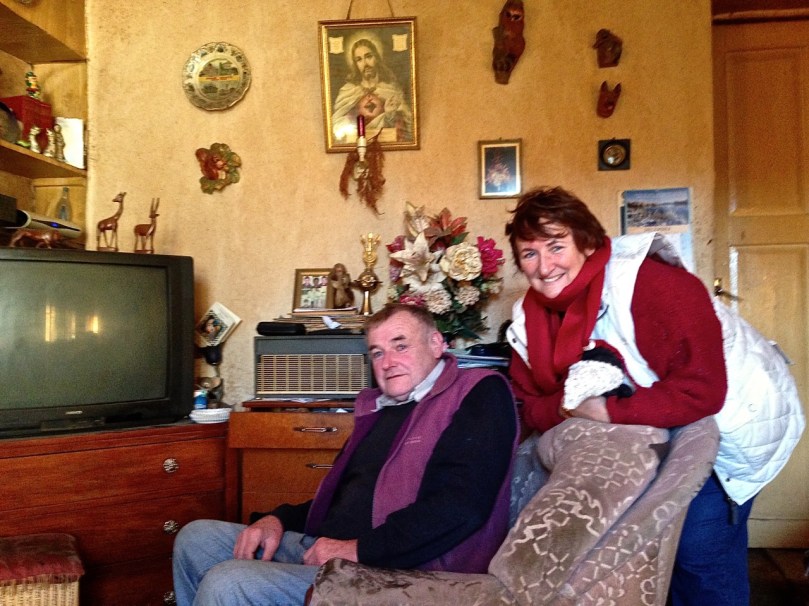
Back in the vicinity of the rock we knocked on the door of a farmhouse to ask directions and permission. Often when we do this we are met with a blank look – not every ancient monument location has survived in the folk memory of the local residents. But this time we hit it lucky, with Florence O’Driscoll – ah yes, he knew it – the mass rock is what we were looking for. I showed him a picture of the rock and he confirmed that was the one, it was on his land and he would take us there.

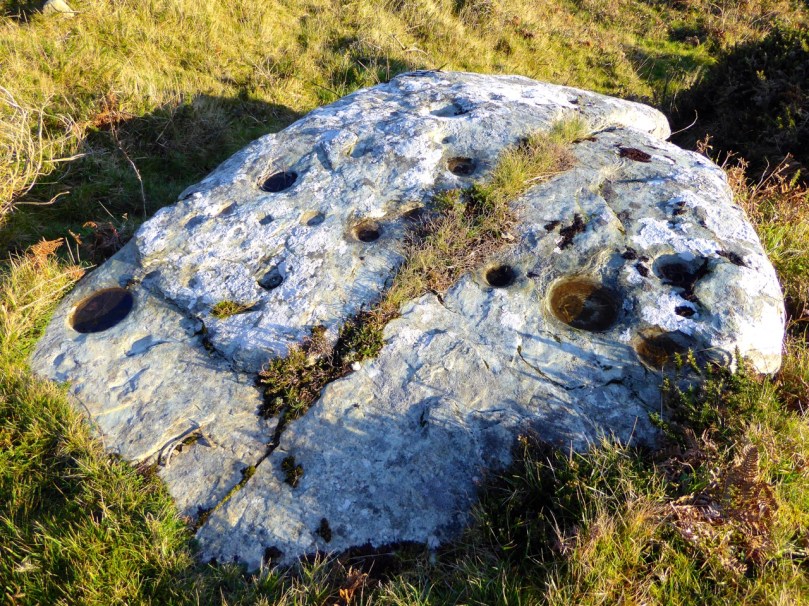
Castlemehigan Rock

Castlemehigan Rock

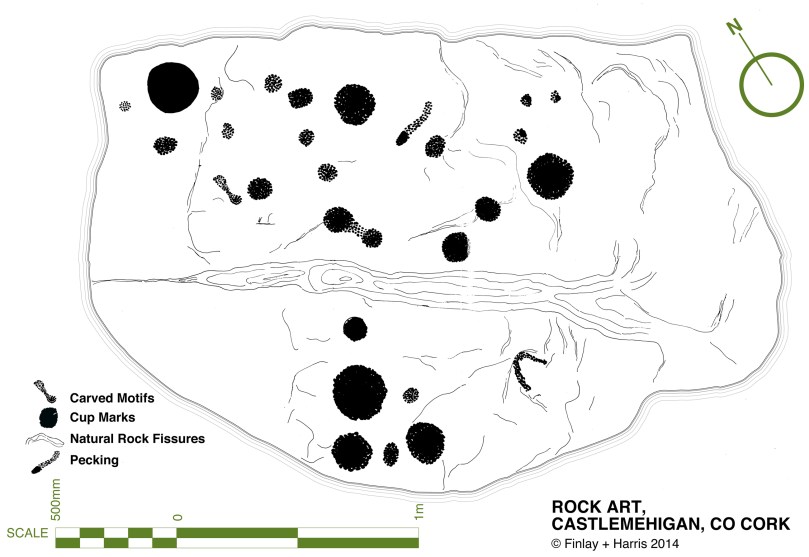
My write-up and drawing of the time brought back some memories of an unusual rock with very large depressions, almost more basins than cupmarks. I also had a very clear recollection of being taken to the site by Bernard O’Regan, a local (and well-remembered) amateur archaeologist who was very helpful to me at the time. Because the rock was very overgrown, he had arranged to have it cleaned for me and when we arrived there were two men on top of the rock hacking away the gorse and heather. Nowadays, rock art specialists abide by an ethic of zero surface contact – no clearing or scrubbing allowed!

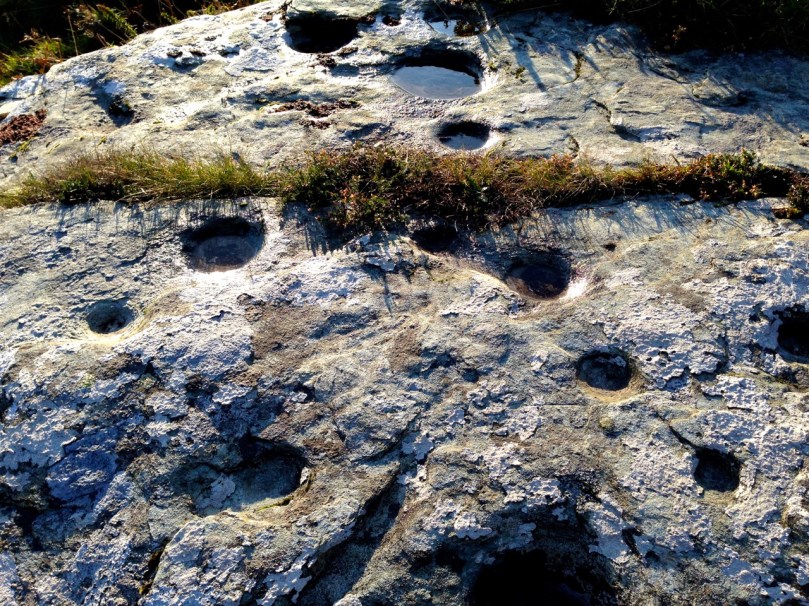
Castlemehigan rock surface

Castlemehigan rock surface

Although this rock lacks any of the circles, grooves and lines that add interest and appeal to many panels of rock art, it is special in other ways. Several of the cupmarks are unusually large, and one is basin-shaped (that is, with straight sides and a flat bottom).

Oriented to Mount Gabriel to the east

Mount Gabriel clearly visible

Some cupmarks appear to run in rows and the rows run in specific directions – one line of cupmarks run directly east/west pointing at the lake that lies about 100 meters away at the bottom of the field. Another line pointed to Mount Gabriel, about 15 kms away on the distant horizon. The two large basin-like depressions are directly north/south of each other.

row of cupmarks

Row of cupmarks

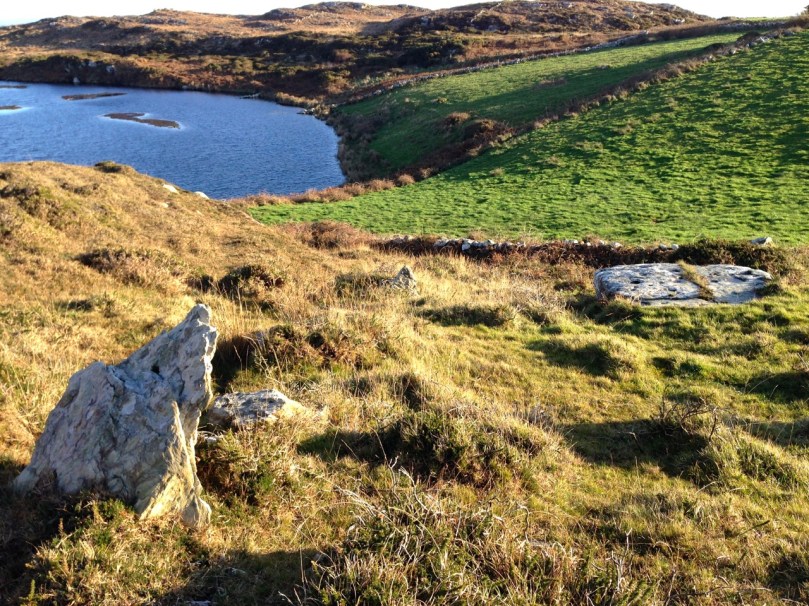
What could be a standing stone is located a few metres away.

Standing stone?

Standing stone?

In comparing my original drawing, done 42 years ago, there wasn’t much I would change. Some cupmarks appear to have pecked areas between them which conjoin them in a dumb-bell motif. My original decision was that there were two dumb-bells, but perhaps now I would be tempted to say there were three or even four. However, this just illustrates the subjective nature of the recording process. Especially where lichen obscures the surface, decisions like this come down to professional judgement and experience: drawings can differ from one recorder to another, or even from one visit to another when lighting conditions show up more or less of the carving detail.

Original drawing, updated by Robert

Original drawing, updated by Robert

Robert

This earthfast boulder is a beautiful object – not least because of its setting. I love these Mizen landscapes – they have a very particular character. Large areas of rock outcrop are interspersed with the tiniest fields, tracks and bog. Here there are lakes close by – once natural features, they have been turned into reservoirs to serve local communities. The marked rock overlooks one of these – this one supplying nearby Goleen.

Mount Gabriel clearly visible from the Derreennaclogh stones

Mount Gabriel clearly visible from the Derreennaclogh rock

This example reminds me in some ways of the Derreennaclogh rock – it’s of similar size and shape. Also, at Derreennaclogh Mount Gabriel is prominent on the western horizon, and we’ve been told that the setting sun towards the short end of the year appears to ‘roll’ down the slope of the hill at times. At Castlemehigan the rock also looks out to Mount Gabriel – this time to the east. This is a relatively isolated piece of rock art: the nearest recorded example is at Cooradarrigan, on the far side of Schull. It’s tempting to think that the flat, table-like surfaces of both Derreennaclogh and Castlemehigan were considered significant to those ancient people – who made them notable by marking them – because of their settings which relate to unmistakable landscape features. Otherwise, one might question why large areas of flat rock surface in the immediate vicinities – ideal for carving – have apparently been left untouched.

Florence and Finola

Florence and Finola

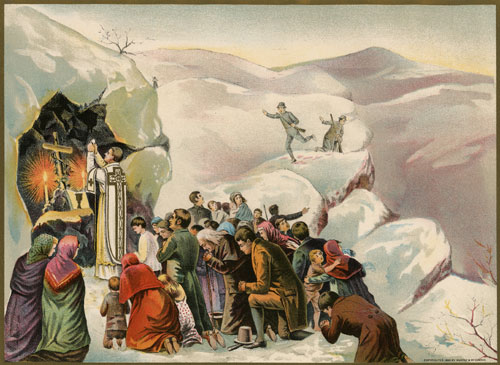
Florence O’Driscoll, our guide on this expedition, proved to be a fund of information. He had farmed the land which had been his father’s before him. Finola must have met his father when she explored the rocks over forty years ago. Florence carried the stories of the rock from his father’s generation, and probably from generations before that. He told us that the rock had been used as a mass rock in penal times – and that the hill above it was known as Cnocan an Aifreann (the hill of the mass): there is what certainly appears to be a cross carved into the rock surface, close to the large basin (Finola did not record this in her original drawing – she will add it when we update the records). Florence told of the time that the ‘Tans’ (the Black-and-Tans) caught red-handed the Priest celebrating the mass: the Priest threw the crucifix into the lake below the rock (the lake was then smaller than it is now). Ever since then, says Florence, the lake has never run dry – and never will.

Look for the possible cross carving on the right

Look for the possible cross carving on the right

It’s interesting that stories carried through local tradition pay no heed to time or history. They don’t need to: the ‘story’ is a part of the rock, as much as the carvings are. Florence told the tales as if they had happened yesterday. I hope they will continue to be told as long as the rock continues to display its enigmas.

Mass in penal times (Maggie Land Blanck Collection)

Mass in penal times (Maggie Land Blanck Collection)

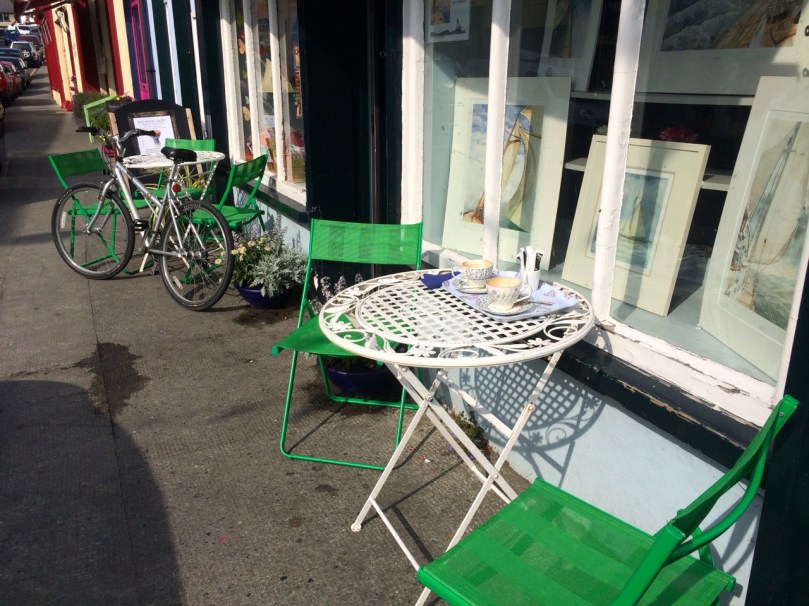
Whyte Books/Now AnnaB’s Bookshop

How inviting is this!

So inviting!

Since this post was published, Whyte Books has changed name and ownership. It is now AnnaB’s Bookshop – and we are happy to report it is as charming and wonderful as ever under its new owner, Katarina.

Do you have a favourite bookshop?

Of course you do! We all have one – THAT bookshop where you feel welcomed; where it never matters how long you browse or if you actually buy something; where knowledgeable staff can recommend a good book for your father or your grandchild; where you can sit with a nice cup of tea and a slice of something delicious as you browse through book reviews or escape from the rain; where they can order stuff for you and the process doesn’t feel like a soulless internet transaction.

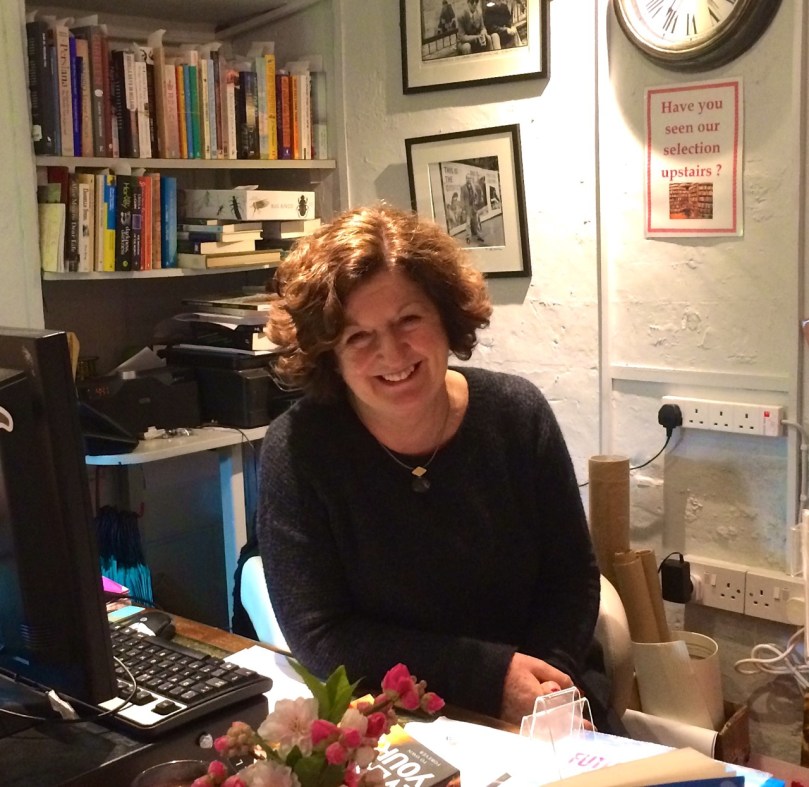
Sheila

Herself

We have THAT bookshop, here in Schull. It’s called Whyte Books, presided over by the charming and cultivated Sheila Whyte. Sheila is typical of many of us who have made West Cork our home. She grew up in Dublin but spent most of her adult life in Australia. She fell in love with Schull on a holiday here, she fell in love with bookstores wherever she travelled, and when the time came to put it all together, well, we were the winners.

Sheila had a vision of what she wanted – a place that would become a hub of reading and intellectual activity in the area and she has worked hard to create just that. There’s a nook for kids and a space for young adults, besides all the little corners and seating areas where you can while away a pleasant hour with your nose in a book and your hand curled round a cuppa. She holds poetry readings, promotes and launches local books (a recent example is Gubbeen by Giana Ferguson) and hosts a monthly book club.

This week Whyte Books hosted the first ever session of The Moth in the South West. The Moth is new to Ireland although story telling is definitely not! A cultural phenomenon, The Moth got started in New York but is based on the idea of neighbours getting together on the porch to tell stories after it gets dark and the moths come out. Stories must be first person narratives, true, told not read, and last no more than ten minutes. About 20 of us gathered upstairs: there were candles and wine and laughter and stories and a promise to make it into a regular event. All the ingredients, in fact, that make Schull such a vibrant community and locate Whyte Books at the beating heart of that community.

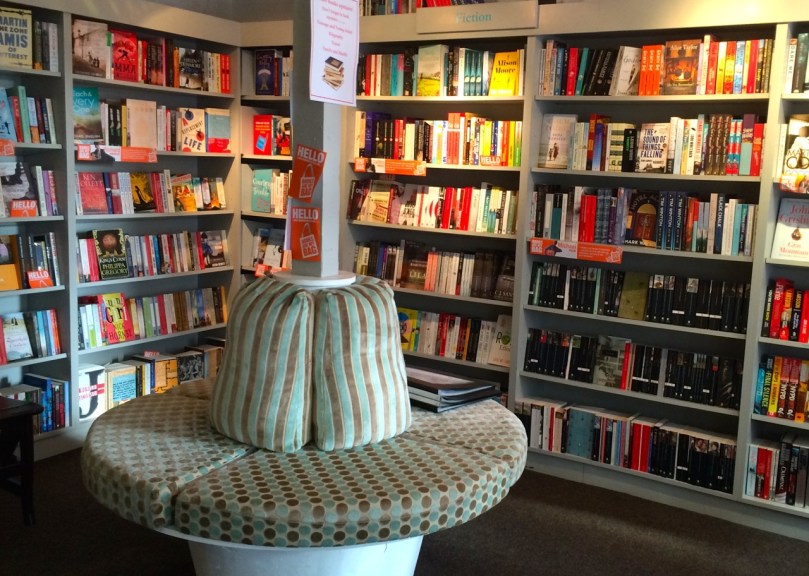
books and books

books and books

We are so lucky to have a great bookshop here! It’s a tough business these days, so take a break from buying online – go buy the latest Must Read at your local bookshop. At Whyte Books, I can guarantee that if it’s not on the shelves they can get it for you. And while you’re at it, have a coffee…and maybe one of those yummy little chocolate thingies.

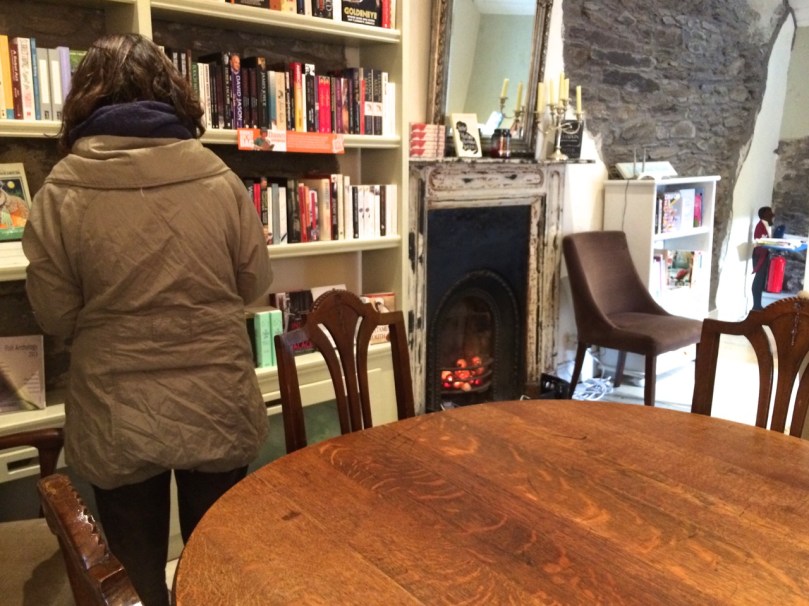
Browsing upstairs

Browsing upstairs

By the way, I’m not the only one who loves this shop. It’s been voted Best Bookshop in Munster, featured in a beautiful video,  and even people who happen by rave about it

Mizen Magic 4: The Beaches

Barley Cove Beach from Brow Head

Barley Cove Beach from Brow Head

If you’re not familiar with West Cork, you may be surpised to hear that we have some of the best beaches in Ireland. And no – they are not just to look at, and yes, people do swim here in the summer. In fact a surprising number of the people we know were still swimming well into October. The autumn weather was glorious, and they claimed the sea was still warm enough to be enjoyable. In fact, they raved about how delicious it was to be bobbing around in the stuff. (You know who you are.)

A little further east of us there are good surfing beaches but here on the Mizen our beaches feature the golden sand and the dunes of the classic swimming beaches. The most popular with holiday-makers is the incredible expanse at Barley Cove. These photos were taken in February – so we aren’t swimming, but we have the place almost to ourselves, apart from the horses, and we are loving it!

Around the corner from Barley Cove are the beaches of Galley Cove and the White Strand. When the sun goes down on one, you can just move to the next one.

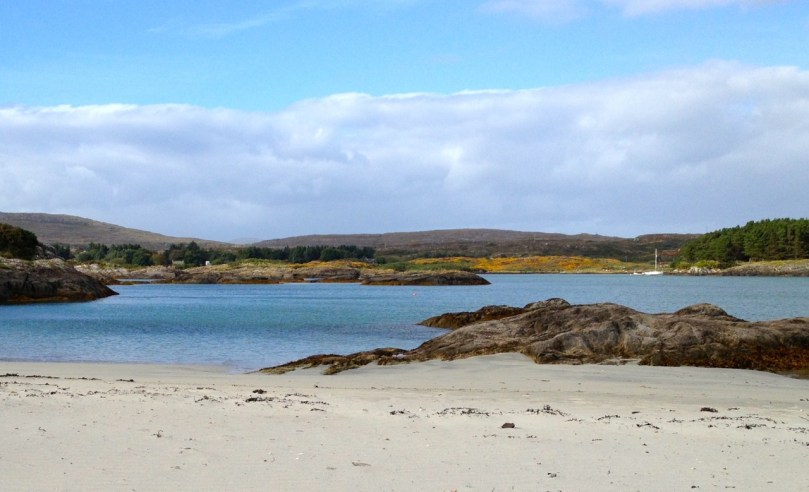
Ballyrisode

Ballyrisode

A local favourite is the beach at Ballyrisode, near Toormore. We strolled along it on a fine day in September, with nary another soul in sight.

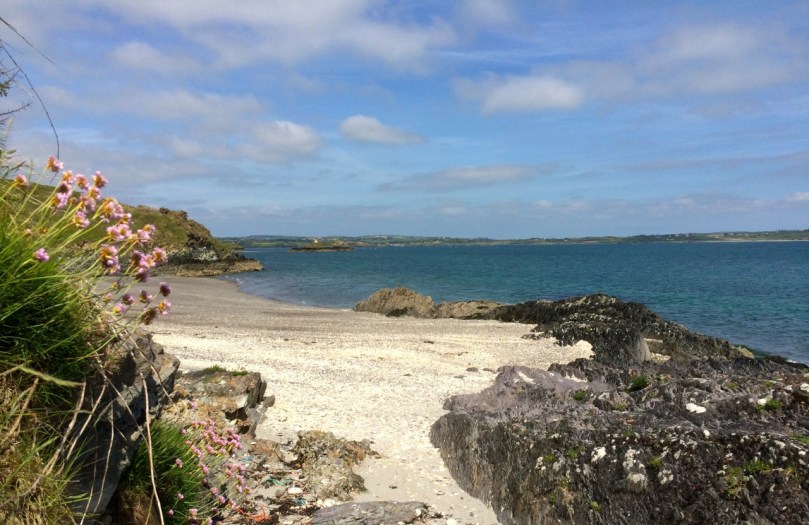
Shelly Beach

Shelly Beach

But of course we have our own little secret beach nearby. Those in the know call it Shelly Beach – for the reasons you might imagine. You can’t drive there – it’s only accessible on foot down boreens and over the fields – and it’s a beautiful, peaceful spot, perfect for that wind-in-the-hair, sun-in-the-face, contemplative experience.

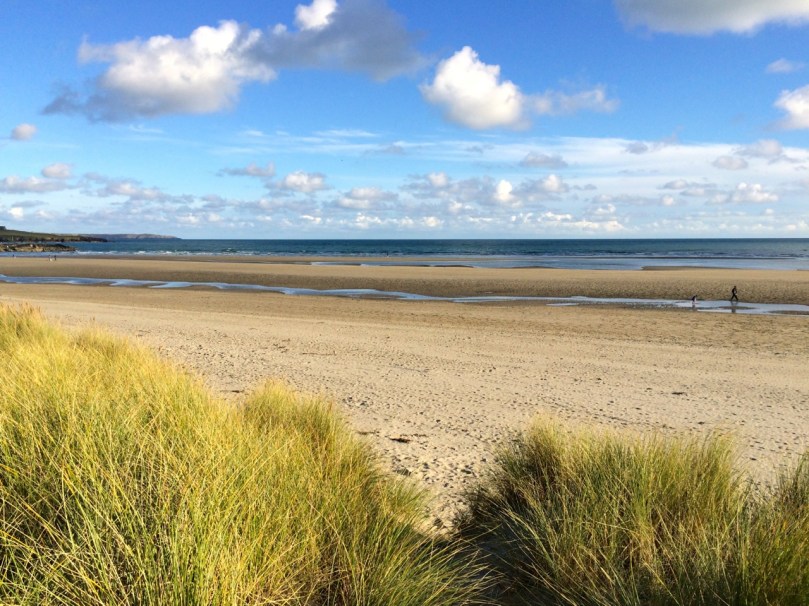
Inchydoney Beach

Inchydoney Beach

The last photo wasn’t taken on the Mizen, but it’s only a few miles to the east, so perhaps it’s not totally cheating to include it here. It was taken on a fabulous sunny day half way through October, and the beach was alive with activity.