Time Warp

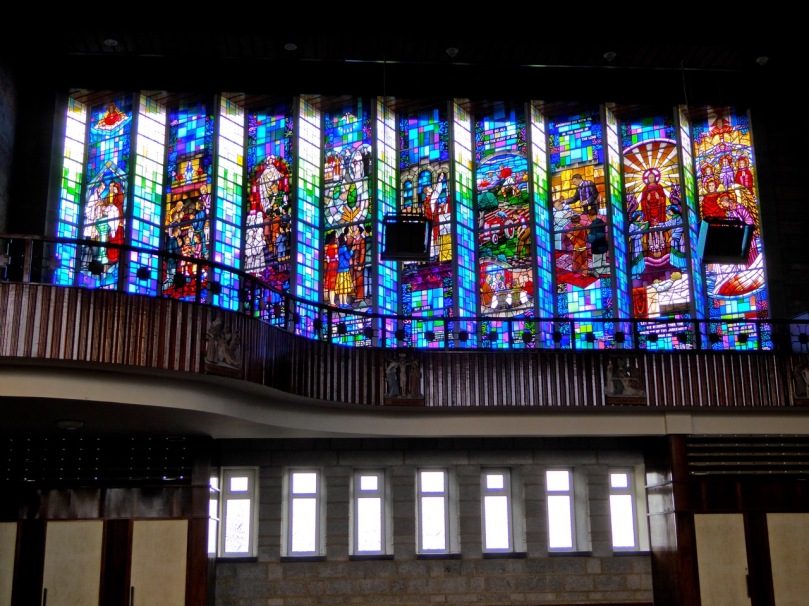
Stained Glass Wall in All Saints Church, Drimoleague

Stained Glass Wall in All Saints Church, Drimoleague

It was the early 1960s and I was sitting in class in my convent school while Mother Francisca explained the purpose of our education and gave us a glimpse of our futures. “What we want for you, girls,” she said, “is to be Good Wives or Nuns.” This week, I landed back in that classroom with a bang. Did I visit my old school? No – I strayed into a time warp. In doing so I rediscovered part of my heritage I had almost forgotten and I met a brilliant young scholar who helped me access those dim memories again.

All Saints, Drimoleague - 1950s modernist architecture

All Saints, Drimoleague – 1950s modernist architecture

All Saints Catholic Church in Drimoleague is one of the most extraordinary buildings in West Cork. First of all, it’s a fine example of mid-century modern architecture (and there aren’t a lot of those in West Cork) and an engineering triumph. Built in the 1950s of concrete and limestone, its cavernous interior has no need for pillars: nothing intrudes between worshippers and altar. It’s like stepping into an enormous, curiously bright, almost empty box. Secondly, it has extraordinary artwork in the form of a giant mural behind the altar and a panel of stained glass windows above the balcony on the south wall. It was the stained glass that stopped me in my tracks.

All Saints, the interior

All Saints, the interior

The glass is laid out in a series of frames that takes the viewer from birth to death – no, beyond death, to heaven. The church was built in the 1950s and each frame represents the values of rural Catholic Ireland of that time. In a strange way it reminded me of a High Cross, in that the illustrations that we see on High Crosses were meant to tell a story – a biblical one in that case – and to instruct the viewer in the tenets of the religion. The purpose of this wall of glass was also educational – to provide a primer to mass-goers on the aspirations and actions that should guide their lives.
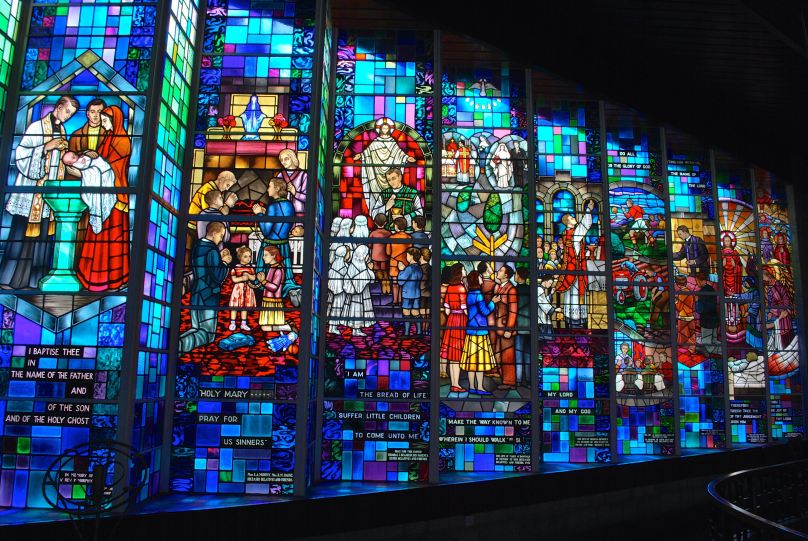
The Stained Glass panel, image © Richard James Butler

The Stained Glass panel, image © Richard James Butler

My parents, imbued with the message that the family that prays together stays together, developed an intermittent enthusiasm for saying the rosary. We would gather in the kitchen after dinner, each with our beads, and kneeling on the hard tiles we would tell off the Sorrowful or the Glorious Mysteries. The second frame shows just such a family, and I particularly love the toys on the floor and the statue of Mary on the mantlepiece. There’s a grandmother and a baby in a cot, and a little girl being inducted into the Mysteries by her older sister.

The next frame shows First Communion, with the girls in miniature bride outfits (as they are to this day) and the boys in their Communion suits with the short trousers and knee socks that all boys wore at that time. Since my godson in Dublin is about to make his First Communion I have been hearing about the process and I understand that apart from the length of the boy’s trousers not a lot has changed in 60 years.

First Communion

First Communion

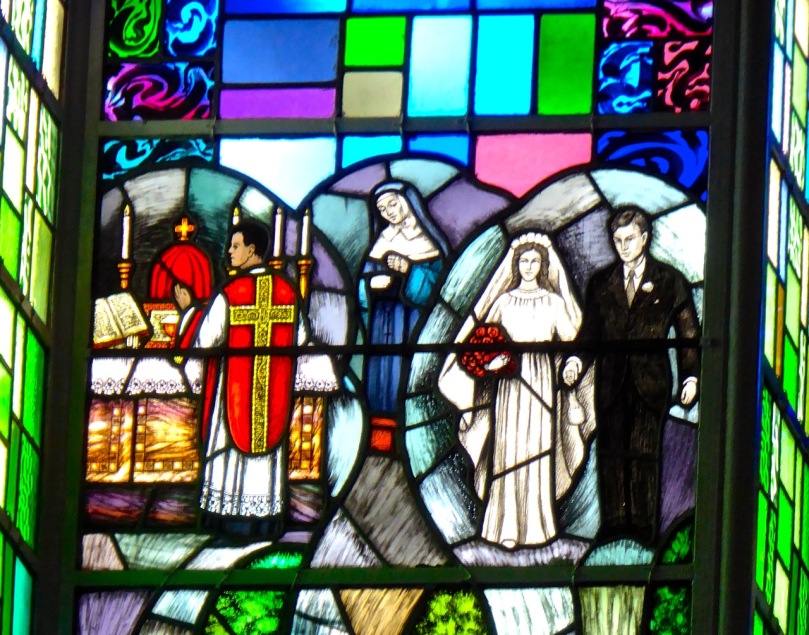
The one that brought me back to Mother Francisca shows earnest young men and women gazing at a directional sign which shows them their choices – marriage or the religious life. That was it! To hammer home the point the top of the panel shows a wedding, a priest and a nun. I’m casting my mind over the group of girls I went to school with – we didn’t produce any nuns and while most of us married I can’t think of a single one who hasn’t worked – we count among us an ambassador, teachers and principals, a town planner, an artist, a college dean, office administrators, a medical doctor, an international expert on child protection, a veterinary nurse, a parliamentary reporter, a lawyer…the list goes on. But none of this was discussed at school: we had no career guidance, no aptitude tests, no encouragement of any kind to think of ourselves as people who would work for a living. What’s curious is that we developed those careers in the complete absence of any kind of conscious preparation for them at the secondary school level.
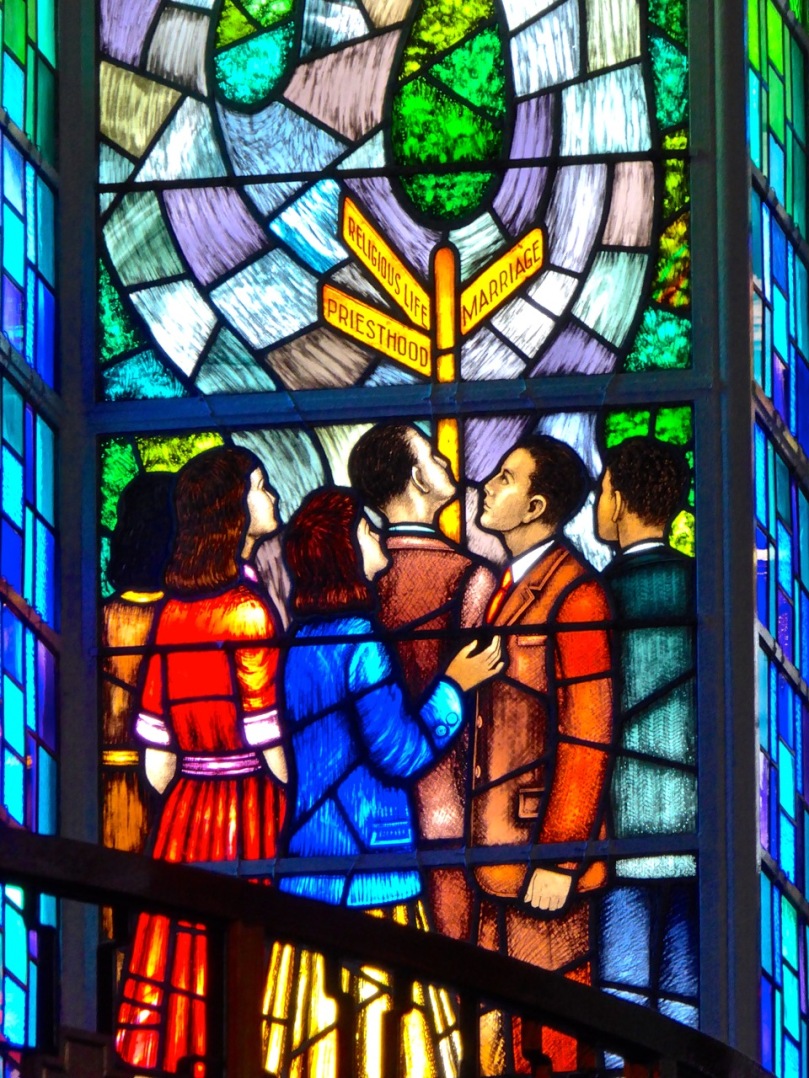
Choices
Choices

Choices made

Choices made

The sixth frame might be my favourite. It’s the ‘work, rest and play’ lesson. At the bottom of the frame a happy family sits around the tea table. Above them men work on the fields and on top those men are playing Gaelic football while their wives sit on a bench on the sidelines and chat to each other. Men were to head the family, work and play hard, and women were to provide the supportive role. I doubt if anyone foresaw when that glass was designed in the 1950s that in the next century (only a few days ago in fact) two Irish rugby squads – the men AND the women – would bring home the Six Nations Cup for Ireland.

The last three frames deal with end of life, including Last Rights, death, and reception into heaven – the reward for living the exemplary life presented in the stained glass wall.
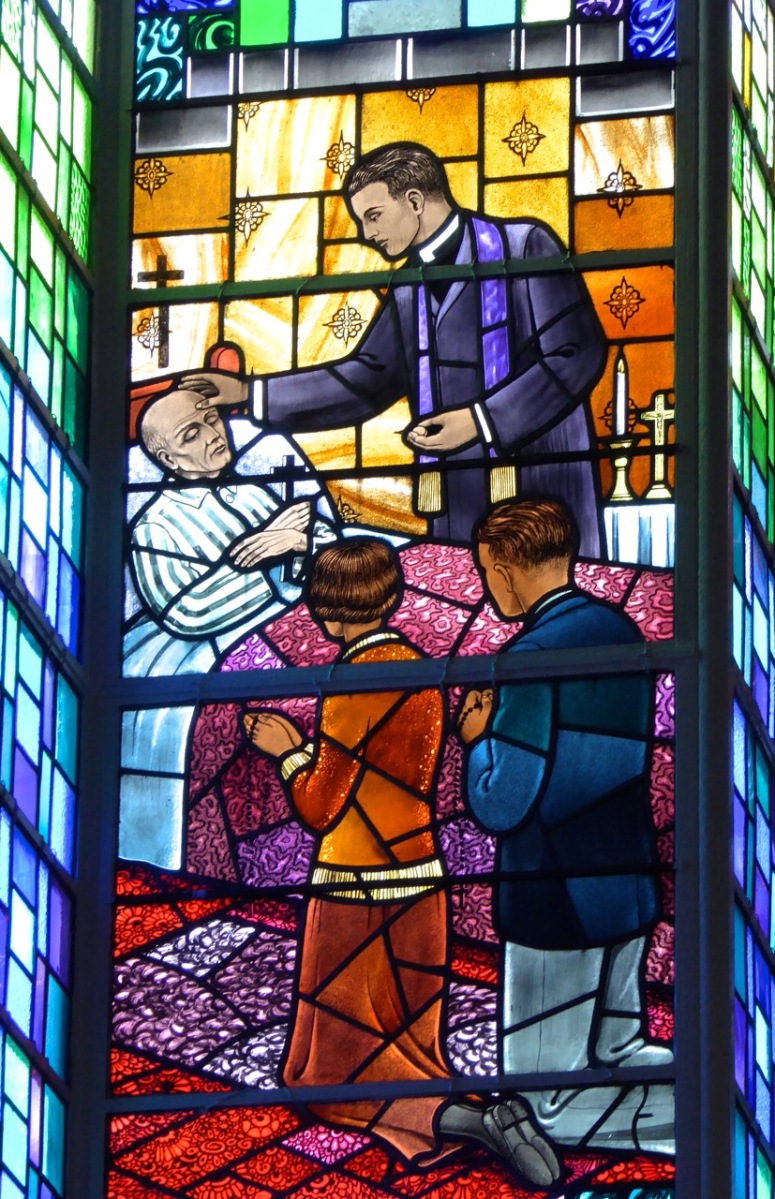
Last Rites

Last Rites

If you grew up like I did in 1950s Ireland, or if you are interested in the art and architecture or the social history of this period, the Church of All Saints in Drimoleague tells a fascinating story. There is little available online about this church – I couldn’t even find out who designed the windows. But my research revealed that one other person was as struck as I was by this church, although in a more scholarly way. Richard James Butler is a gifted young art historian from Bantry who is completing doctoral studies at the University of Cambridge. We were lucky to hear him speak at the Bantry Historical Society recently on the subject of the courthouses of West Cork – a topic we had no idea could be as interesting until we heard his erudite and engaging presentation. He has written a paper, All Saints, Drimoleague, and Catholic visual culture under Bishop Cornelius Lucey in Cork, 1952-9, which will be published in the next issue of the Journal of the Cork Historical and Archaeological Society. I’ve had a sneak peak, thanks to Richard’s generosity in sharing his findings with a fellow enthusiast. His paper deals with the Catholic ethos within which that era of church construction operated, with the role of the local community in commissioning such an unusual edifice, with the enormous mural, and with the windows. It was only after communicating with Richard that I learned that the windows were the work of the Harry Clarke Studios* and how unusual they were for their day in not being concerned solely with images of saints, the life of Christ, or Mary. If you get a chance to read his paper when it’s published, do so – it may make you take a fresh look at the legacies of 1950s Ireland by which we are still surrounded.
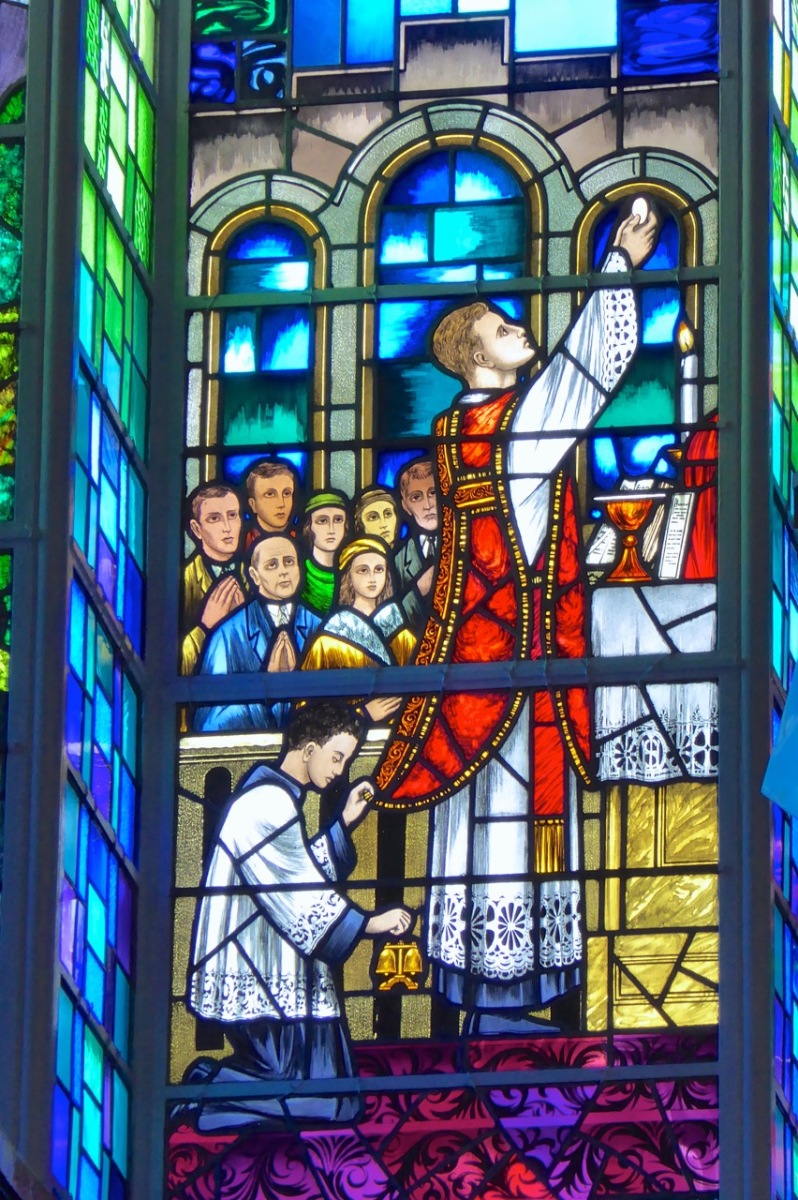
Devotion in 1950s West Cork

Devotion in 1950s West Cork

* For a discussion of the difference between Harry Clarke windows and Harry Clarke Studio windows, see this post.
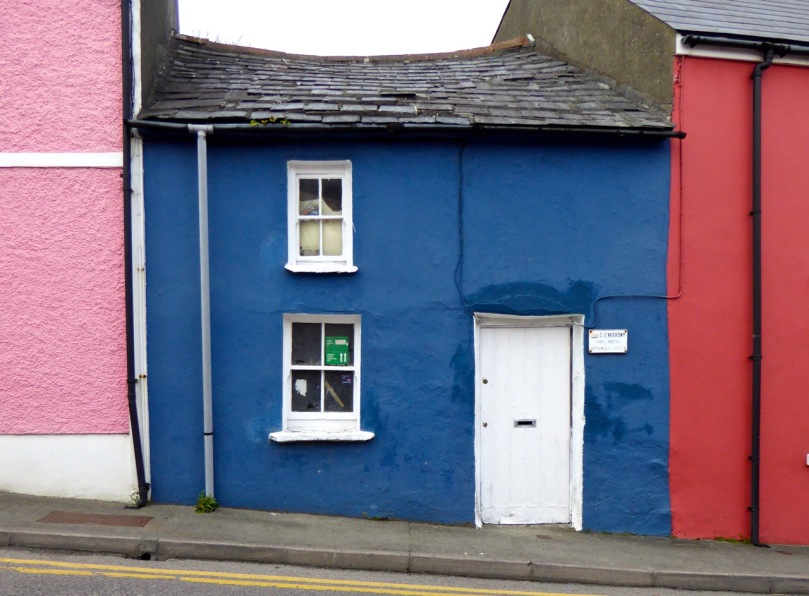
An Extra Lick of Paint

Old vet clinic, Schull

Old vet clinic, Schull

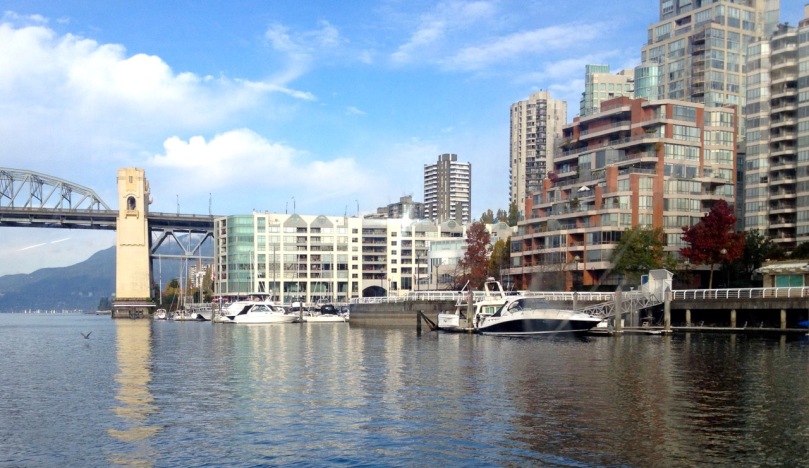
I used to live in Vancouver, on Canada’s west coast. It’s a beautiful city by any standards: gleaming high-rises, miles of seaside walkway, and snow-capped mountains lending a dramatic backdrop. I loved it, but when I looked through my window mostly what I saw was concrete and steel – and no colour! I had to escape up into the mountains or out to the Fraser Valley to get in contact with nature and feed my soul.

Where I used to live

Where I used to live

Where I live now

Where I live now

In West Cork, my soul is fed every day, every time I look out the window of our house, every time I stroll through our village of Ballydehob. That’s down to our rural setting, of course, and the magnificent scenery, but a huge part of it is about colour. I’m a colour person, I guess: I respond to it and crave it. I can certainly appreciate a quiet tasteful palate of greys or beiges, or any of the million variations of off-white when I see them. But left to my own devices I’d quickly have a chunk of candy apple red in there, or chairs the colour of daffodils, or a wall in a vivid pink. As Lady Gaga says, I was born that way.

Why is that woman taking my picture?

Why is that woman taking my picture?

And so I find living in rural Ireland a constant source of delight and inspiration. No country was ever this green, surely! Now the gorse is starting to bloom, turning the hillsides into a blaze of yellow. And every few kilometres along the road is another village or town full of colourful houses competing with each other for my attention. But before we get to the villages, here are some glimpses of houses just off the main roads as you drive those kilometres.

A Lick of Paint mainly featured houses out in the countryside, but for this post I wanted to show you some of my favourite houses in our nearby towns and villages: Ballydehob, Bantry, Skibbereen and Schull.

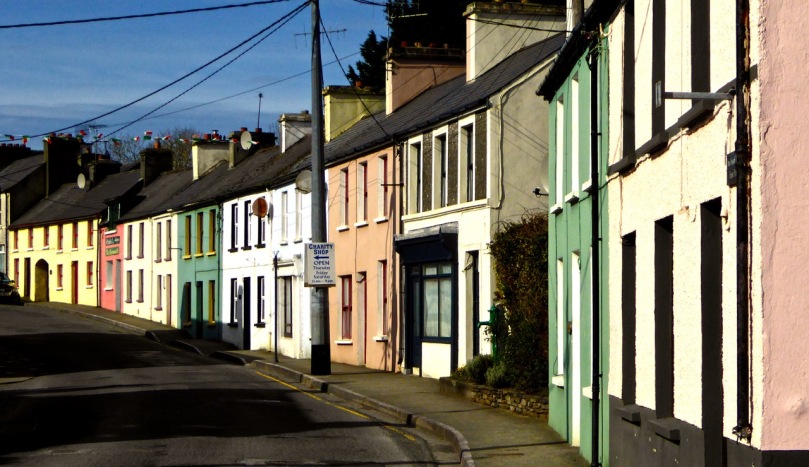
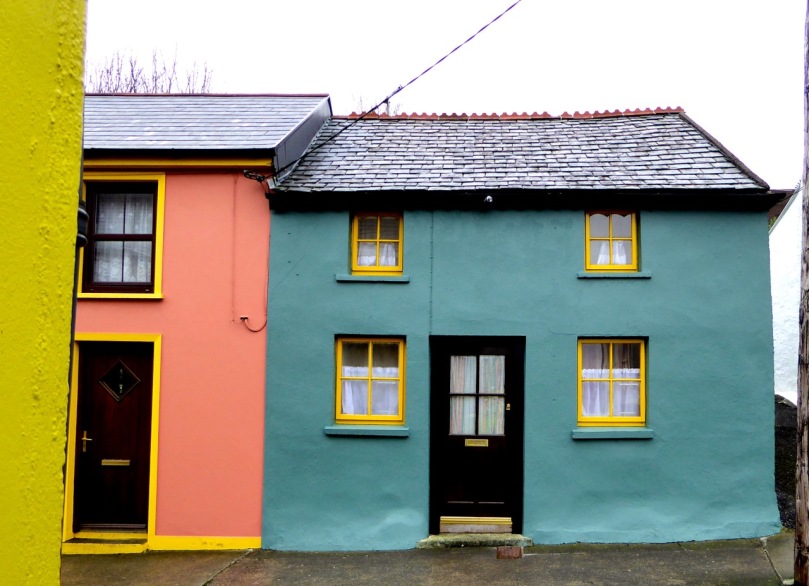
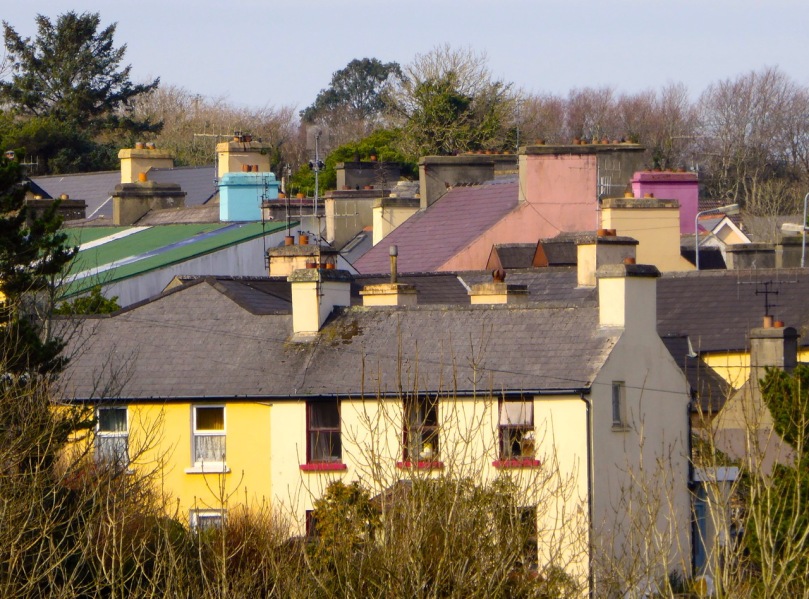
On the outskirts there are new estates of identical houses, of course, all painted in identical shades of cream. But in the steep and windy streets behind the shops you find little old terraced houses lovingly done up, the walls, doors and windows all in contrasting hues and with knife-edge divisions of colour between neighbours.

Skibb town house 2

Skibbereen townhouse

It can be like walking through a giant Rubik’s Cube (ok, that dates me) or one of those kaleidoscope tubes.

In his book, West of West, published in 1990, Brian Lalor captures my own experience growing up in a sea of grey. He says:

The nineteenth-century photographs of villages and farms show an unrelieved grimness of stone, cement and clay. Whitewash relieves this picture, though frequently this rendering has degenerated into a leprous greyness indicative of neither hope no prosperity. Colour has a symbolic relationship with the state of economics in rural Ireland. The last 20 years have seen the introduction of modern synthetics, bringing vivid tones not previously to be found here. Affluence and the EC have brought, as to the Aegean, a flight from the spartan virtues of white and cream…

Whatever the reason – prosperity, a sense of fun, a wish to lighten the spirits, the influence of the Tidy Towns Competition, an affinity with the colours of the wildflowers in the hedgerows, competition with the neighbours, the need to describe how to identify a house when street numbers are confusing or absent – I am grateful for it. It’s one of the things that makes rural Ireland unique and charming – and it feeds my soul.

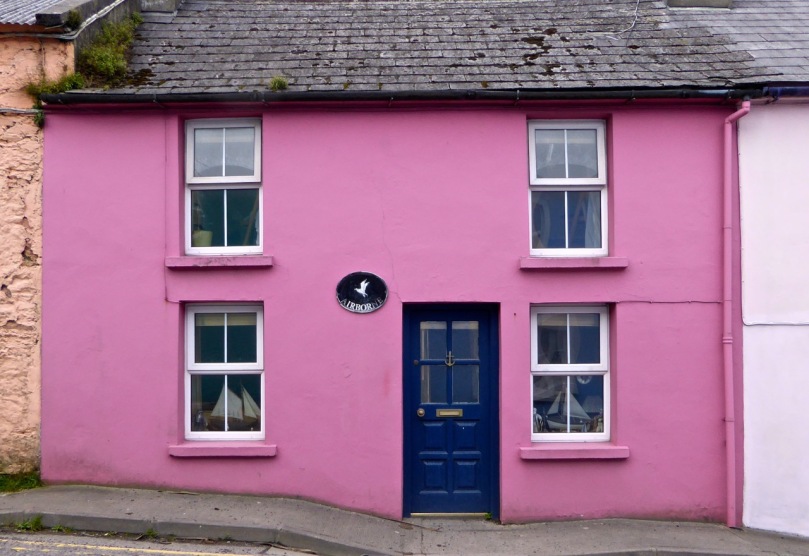
Airborne, Schull

Airborne, Schull

The Gables of Ballydehob

The Gables of Ballydehob


Celtic Cousins

Jonathan Ball (right) - Architect, Co-Founder of the Eden Project - and Chorus Master

Jonathan Ball (right) – Architect, Co-Founder of the Eden Project – and Chorus Master

This weekend, West Cork was invaded by Celtic Cousins from Cornwall! By longstanding tradition, a group from Bude and its environs visits Courtmacsherry and the area surrounding it to join Irish neighbours in a feast of music and song: the hospitality is reciprocated when the Irish contingent goes over to Cornwall. The reason? The lifeboat based in Courtmacsherry has long been ‘twinned’ with the lifeboat based in Bude.

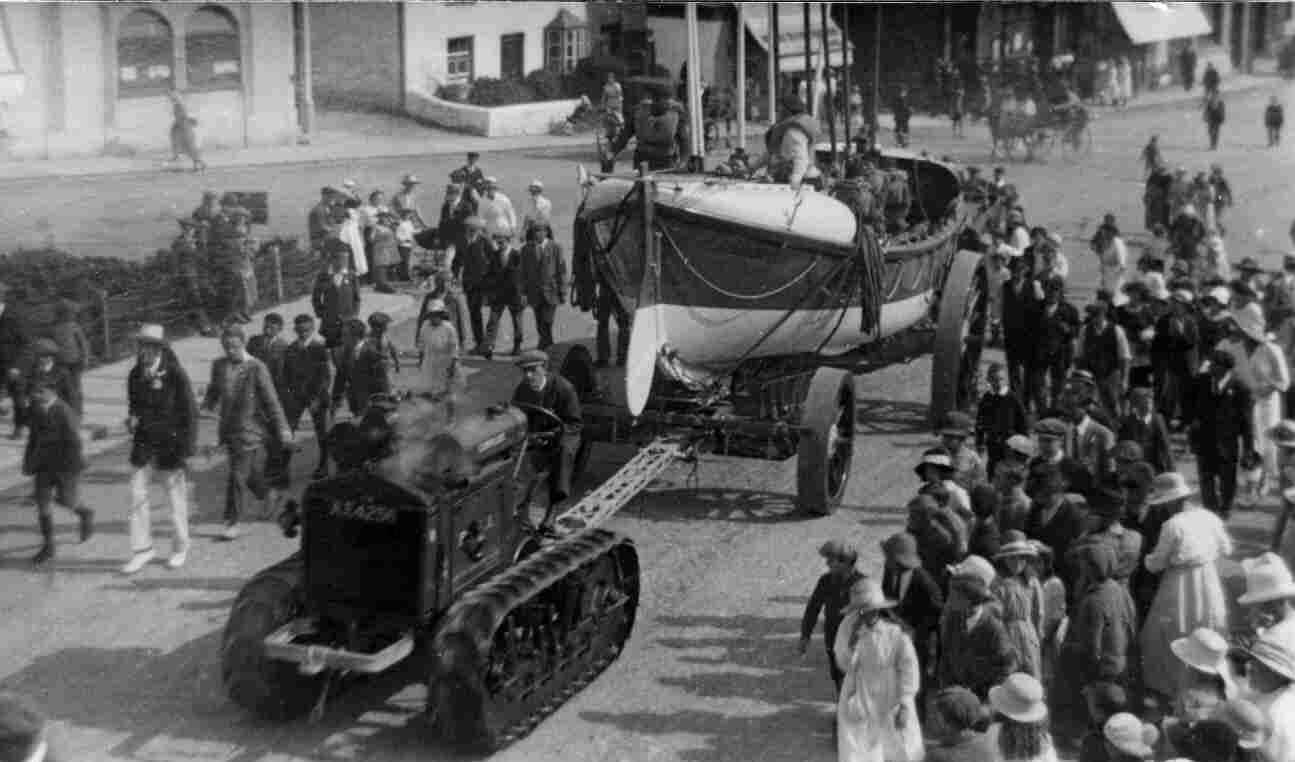
Images from the past: Bude’s Lifeboat in earlier years

Images from the past: Bude’s Lifeboat in earlier years (historic images courtesy of Bude RNLI)

The event is becoming an annual treat for us – because I worked in Bude for many years, with the Jonathan Ball Practice. The group that comes over is overseen by Jonathan himself, who won’t mind me saying that he is a Cornishman born and bred who believes that Bude is the centre of the Universe. I know, of course, that it’s actually West Cork that’s the centre of the Universe – so we have to have an annual get-together to sort out our differences…

logo-rnli

First, a bit of background. There are 236 lifeboat stations around the coasts of these islands, and 43 of these are in Ireland. The RNLI has operated life saving facilities in the Republic and the UK since 1824, when the National Institution for the Preservation of Life from Shipwreck was founded as a charity by Sir William Hillary, a soldier who lived on the Isle of Man. The Institution today is supported almost entirely by donations and legacies, and the crews are unpaid volunteers.

Bude, on the north coast of Cornwall, had its first lifeboat as early as 1837. This boat was presented to the town by King William IV and paid for by the Duchy of Cornwall: the cost was 100 guineas. The lifeboat at Bude was withdrawn in 1923, and not reinstated until 1966. At the same time the Bude Lifeboat Singers came into being: this was conducted by crew member Jonathan Ball, and over the next 25 years was much in demand across Britain and into West Cork, and during that time many thousands of pounds were raised for the RNLI and other charities.

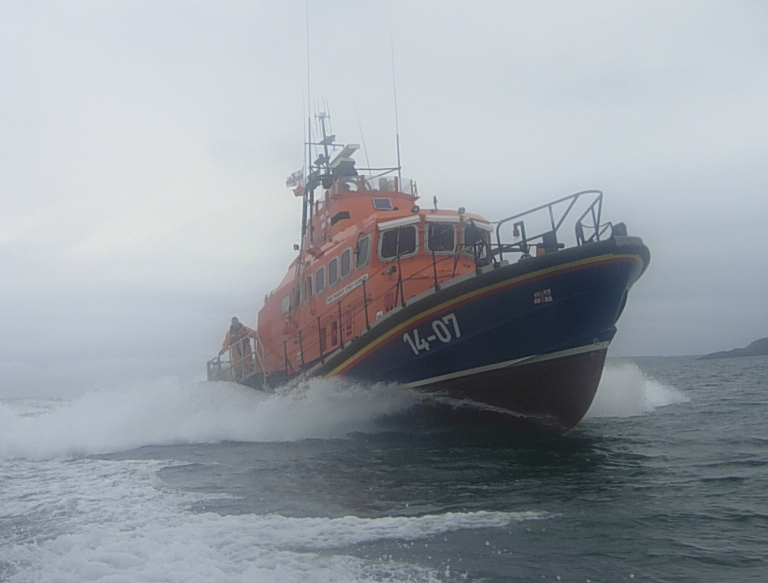
Meanwhile, the lifeboat station at Courtmacsherry was established in 1825 – one of the first to be founded in Ireland – and has been active ever since, its Trent class Lifeboat being on hand at all times to save lives and rescue mariners in trouble. The Trent lifeboats are true all-weather vessels in the RNLI fleet, and are exclusively designed to operate in Europe’s most hostile waters.

Courtmacsherry 'Trent' class Lifeboat: Frederick Storey Cockburn

Courtmacsherry ‘Trent’ Class Lifeboat: Frederick Storey Cockburn

As you know, West Cork is also home to many people steeped in music and tradition, so it was only natural that Bude and Courtmacsherry should get together to share tunes and songs – and hospitality.

four alls

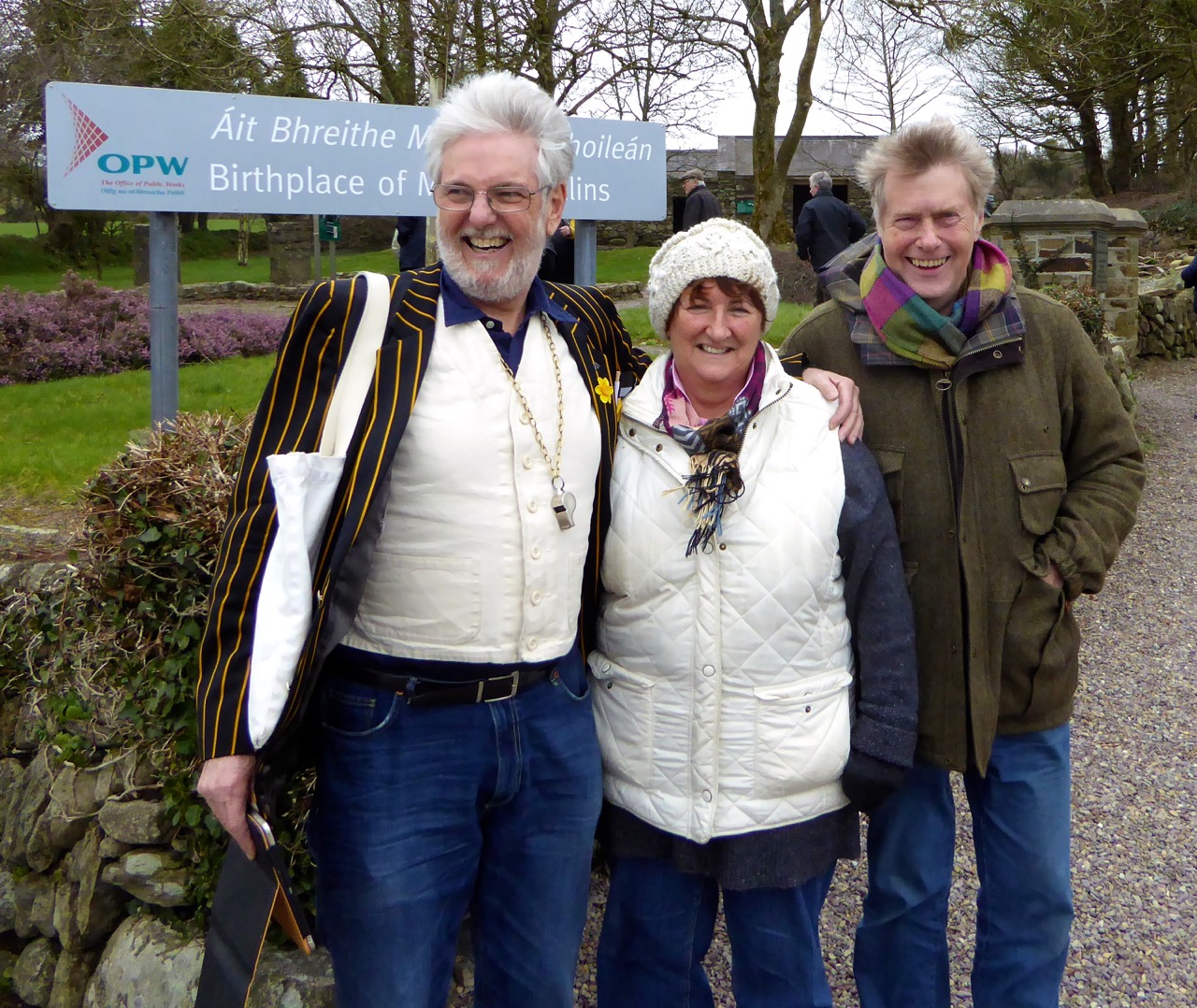
For us the ‘getting together’ happened on Friday, when we travelled up to Sam’s Cross: Michael Collins country. We had to visit his birthplace, of course – have a look at our previous post on this great Irish folk-hero. Collins’ local pub was the Four Alls, and that’s where the singers and musicians settled down for a lively session, joined by some of the pub regulars, who added their own contributions.

Jonathan, Finola and myself, having a Michael Collins moment...

Jonathan, Finola and myself, having a Michael Collins moment…

Although a little hoarse from the previous night’s revels, Cornwall gave of its best, with Jonathan himself still conducting – 48 years on! West Cork was well represented by Dan O’Donovan and colleagues – former show band members – and the locals. I felt privileged to be allowed to join in with my own European mixture of English / Irish / French dance tunes.

As dusk began to settle, the next venue beckoned, and we became part of a convoy snaking its way through the most remote parts of County Cork: we had no idea where we would end up! When we finally arrived at Hickey’s Bar in the fine village of Aherla we were completely disorientated.

hickeys

But at Hickey’s we were welcomed with open arms and led into a back room full to the brim with musicians! I counted well over twenty from the Irish contingent and, as the evening progressed into night and then morning, more locals came in to add to the entertainment with songs and recitations.

Somehow, we found our way back to Nead an Iolair – it was a drive of an hour and a half – exhausted, but thoroughly elevated by all the music and conviviality. Only in Ireland (and Cornwall) could you find such a sharing: we are all Celtic Cousins, of course…

RNLI1


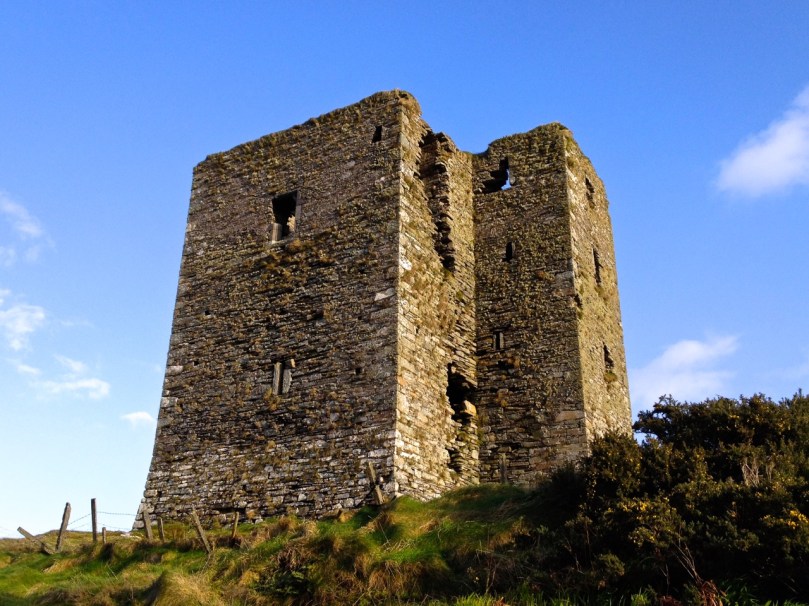
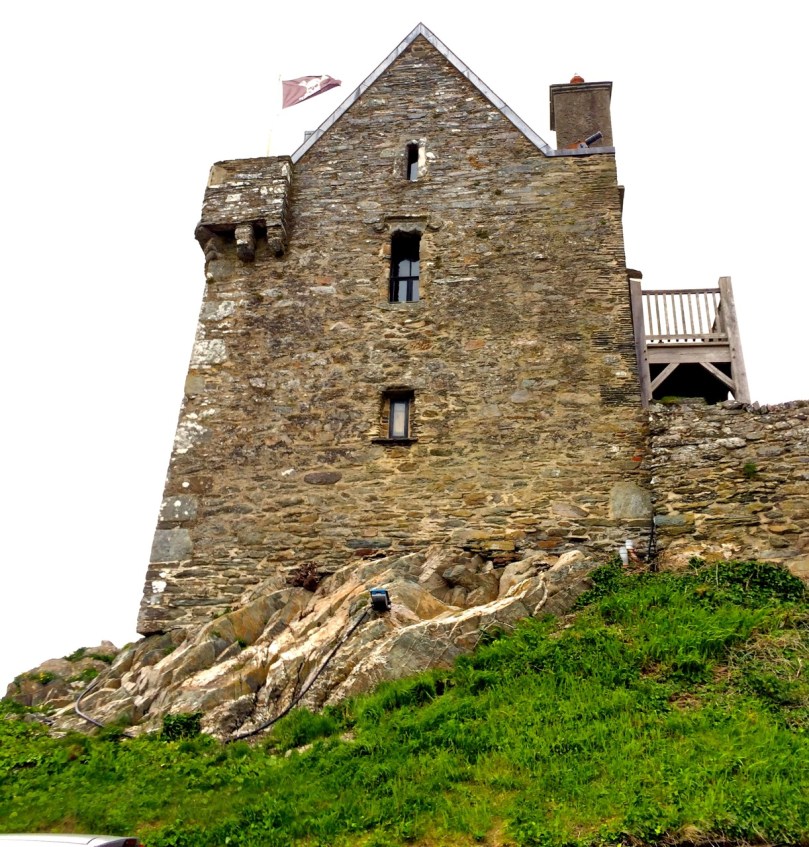
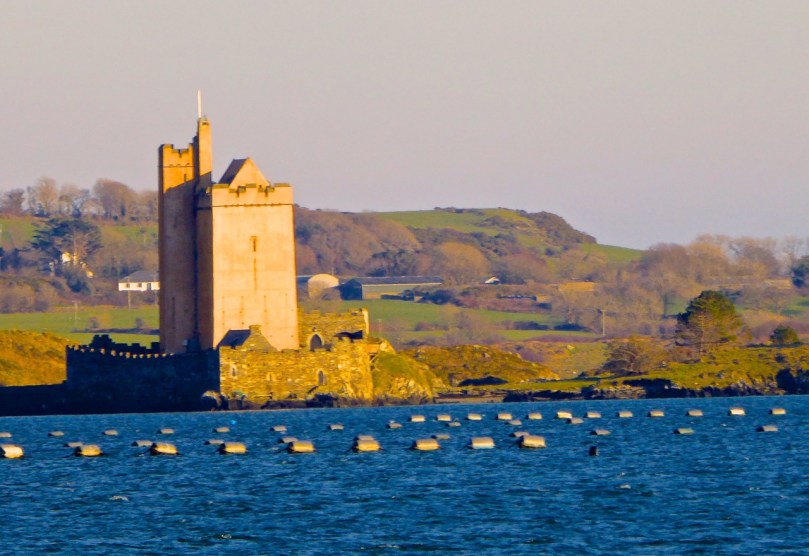
When is a castle..?

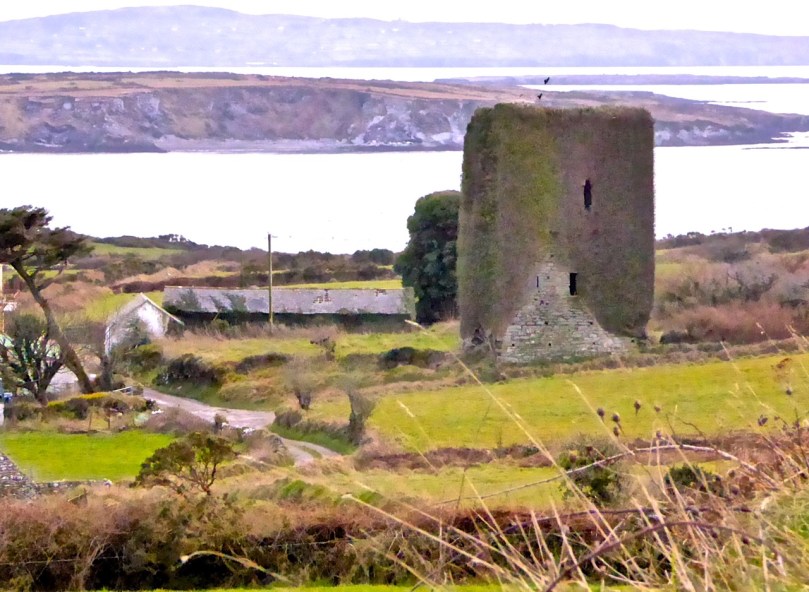
Leamcon Castle

Leamcon Castle (Black Castle)

…not a castle?

Answer: When it’s a Tower House. Maybe.

Harold Leask first published his classic Irish Castles in 1941, and it was subsequently revised and reprinted several times. My own copy was bought in the late 60s and accompanied me to Canada and back. Leask’s book was the first comprehensive work on the subject – a work of erudition but thoroughly readable with charming pen-and-ink illustrations. 

Leask insisted on the use of the term tower houses for small simple castles and described them thus:

They are simple oblongs with four walls, subtly battered, rising sheerly from a bold base-batter, to parapets which are crenellated in the Irish fashion. A small turret, at one corner, generally above the staircase, rises to a greater height than the rest of the building, while within the parapets are the two gables of the roof. Very often a small machicolation projects from the parapet and commands the entrance doorway below…

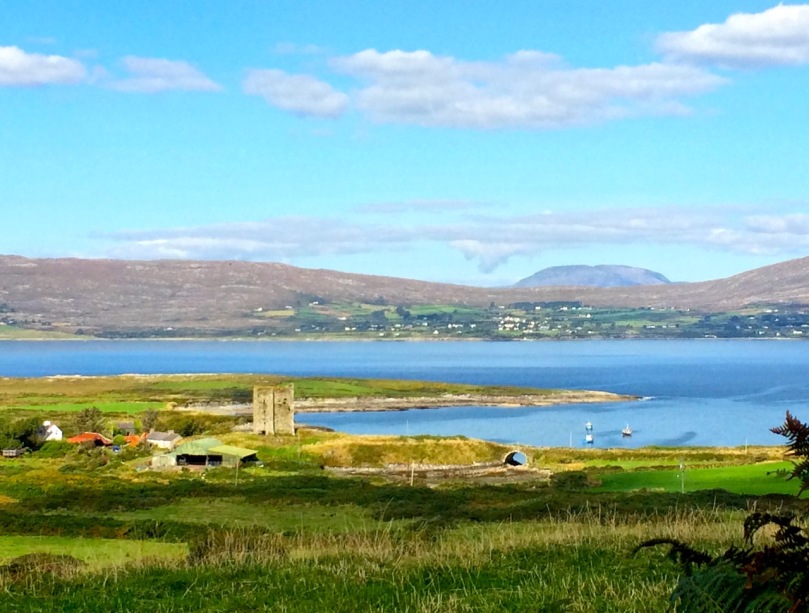
Ardintenant Castle

Ardintenant Castle (White Castle). It sits on top of an earlier ring fort.

In researching for this post the other main source I consulted was a doctoral thesis by Mark Wycliffe Samuel, The Tower Houses of West Cork. More recent (1998), it concentrated on the castles of this area and is packed with detail about the ones we see around us here in Roaringwater Bay and on the Mizen Peninsula, from Baltimore (Dún na Séad) in the east, to Cape Clear Island (Dún an Óir) to the south and Three Castle Head (Dunlough) to the west.

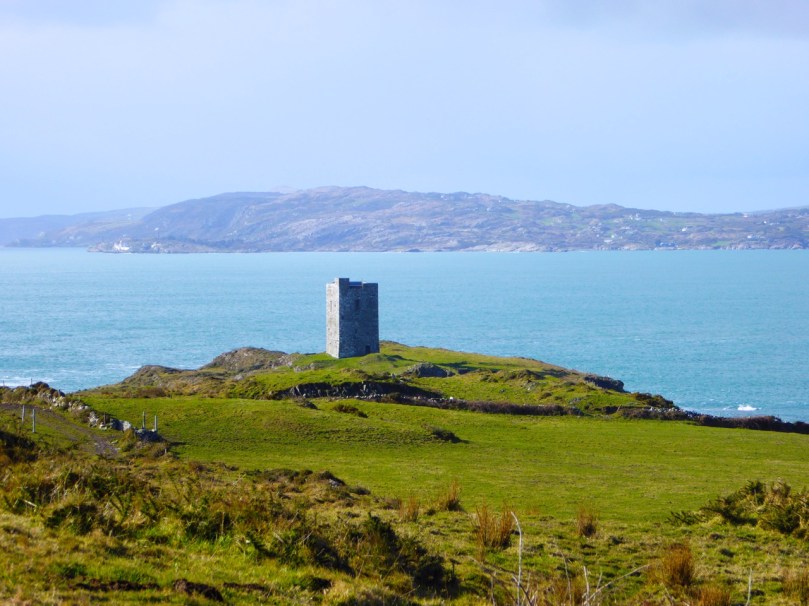
Dunlough Castle, known as Three Castle Head

Dunlough Castle, at Three Castle Head

These simple towers were quite different from the enormous and elaborate military castles that cemented Anglo-Norman power all over Ireland after the invasion of 1169, such as Trim in County Meath, or Cahir in Tipperary. Tower houses were built in what Leask calls a ‘great building revival’ from about 1440 into the 1600s. In what may be the forerunner of the European Grants system, Leask says many of the earliest ones were built as ‘£10 Castles’. A statute of 1429 offered every liege man of our Lord the King…who chooses to build a castle or tower sufficiently embattled or fortified..to wit twenty feet in length sixteen feet in width and forty feet in height or more, that the Commons of the said counties shall pay to the said person to build the said castle or tower ten pounds by way of subsidy. Although this statute seems to have been applicable only in certain counties (mainly around the Pale) it established a pattern for tower building which was adopted, with variations, all over Ireland.

Dunmanus Castle

Dunmanus Castle

The Roaringwater Bay and Mizen towers fit this pattern very well. They were not, however, built by the Anglo-Normans – West Cork was too remote and beyond their reach. They were built by the great Irish chiefs of the O’Mahoney, the McCarthy and the O’Driscoll clans and probably replaced earlier strongholds such as promontory forts (as at Dunlough), large ring forts (Ardintenant) and stone forts/cashels (such as the one at Knockdrum). These chiefs became wealthy through their control of the fisheries, through piracy, and through tribute exacted from those who occupied their traditional territory. At least one of them (Rossbrin) became famous as a centre of learning and scholarship during this time. Of the ones I will describe in this post, all are situated at the sea. or close to it, with commanding views over their territory and sometimes within sight of each other.

Leamcon, known as Black Castle

Leamcon, known as Black Castle. Notice the base-batter in this picture and the first one below.  The lowest level is the widest (battered) with the walls sloping in above this base

The power of these great Irish households lasted until the 1601 battle of Kinsale when the Irish forces under Hugh O’Donnel and Hugh O’Neill (with Spanish help) were defeated and an enormous re-conquest and re-colonisation began under Elizabeth and continued unabated under the Stuarts and, most disastrously, under Cromwell.

Each tower in this area was built in the same manner, which Samuel refers to as the Raised Entrance type of tower. There were two entrances, one on the ground floor and one on the first floor. The ground floor room was for cattle and the doorway was therefore as wide as would admit a cow.

A glimpse inside the raised entrance at Ardintenant

A glimpse inside the raised entrance at Ardintenant

The raised entrance (directly above it, or staggered to the left or right) was only wide enough to admit one person at a time – a defensive feature. This entrance either led into the first floor room or (since the ground floor room could have a lofty ceiling) onto a landing where a staircase led up to this room and then continued up through the wall (usually the thickest wall of the tower) to the upper floors. The first floor room was mainly used for storage and had either no windows or very small slits.

Dunmanus, with its additional turret. The top windows were always the largest.
Dunmanus, with its base-batter and additional turret. The top windows were always the largest

The second floor room was often the principle chamber, where all the main activities of the family took place – living, eating, meeting, administrating, celebrating (music and poetry were highly prized by these chieftains). If there was a third floor it contained the solar, or private chambers for the women of the household.

Barrel vaulted ground floor room at Dunmanus. Note access to stairwell.

Barrel vaulted ground floor room at Dunmanus. Note access to stairwell.

Construction techniques varied – some were superbly constructed of cut stone while others used a lot of rubble to build up the insides of walls. Putlogs, or holes where scaffolding timbers were insert, are clearly visible in several of the towers. The lowest floors were of course the thickest – the base-batter provided a solid foundation and the walls sloped inwards from it. The top of the tower allowed for thinner walls, and therefore also bigger windows (although none were large).

A garderobe (toilet) was a feature of the top two floors, with a chute out to the outer walls. In towers with additional turrets (Kilcoe, Dunmanus, Leamcon) the garderobe and sleeping chambers were sometimes contained in that turret, or the spiral stairs wound up through it. While most towers had stone spiral or straight staircase, some appeared to access each floor by means of ladders – there is no evidence for permanent wooden staircases.

The ground floor room (the byre) was often vaulted and this feature is still clearly visible in the most intact towers. Above that, the floors were of timber, sometimes with trapdoors for lifting up supplies. Presses (cupboards) consisting of niches in the walls may have contained lanterns or have been used to store valuable items.

There were no fireplaces in these towers. Fires were lit on flagstones laid on the wooden floors and the smoke rose to the tall ceilings and escaped out the small windows. In addition to this level of discomfort there is a contemporary account (quoted by Leask) which describe the primitive living arrangements in some of the towers: They have little furniture, and cover their rooms with rushes, of which they make their beds in summer and straw in winter. They put rushes a foot deep on their floors and on their windows [embrasure floors?], and many of them ornament their ceilings with branches.

But not all chieftains lived in a primitive way. Samuel uses the available evidence to construct a picture of life at Togher, one of the towers he studied, and it’s not hard to picture Fineen O’Mahoney, Scholar Prince of Rossbrin, in such a setting.

We can form a picture of the principal chamber in use: Tadhg an dúna or Togher’s principal chamber was probably furnished with imported furniture, pewter plate and cutlery and was panelled with ornately carved timber. His family, his bard, …clerk, lawyer, priest and physician, as well as members of the derbfine [extended clan] such as cavalrymen could eat there. They could sit with the chieftain to one side of the principal salt cellar, while others sat ‘below’ it… Servants prepared food out of sight ‘below stairs’. Bardic musicians, soothsayers, gamblers and others would be admitted as honoured guests, but the household ward and servants ate in the kitchen/ward room.

Although its name means Fort of Gold, today Dún an Óir on Cape Clear Island looks remote and forbidding

Although its name means Fort of Gold, today Dún an Óir on Cape Clear Island looks remote and forbidding

Similarly, Dún na Séad (Fort of the Jewels) Castle in Baltimore, seat of the wealthy O’Driscolls (they also had Dún an Óir (Fort of Gold) on Cape Clear Island), was

a centre of administration for trading activities and collection of taxes from foreign traders frequenting the port. In the middle and later-middle ages therefore, the O’Driscolls enjoyed a prosperous lifestyle. Lavish gatherings took place in the ‘great hall’ of Dún na Séad castle and a well-documented feast in 1413 is said to be one of the earliest records of people dancing in Ireland. This documentary evidence is supported by archaeological finds from recent excavations of the Dún na Séad site, which reveal the presence of late twelfth to fourteenth century pottery from the Saintonge region of France, and reflect the lucrative trade links between Baltimore and Europe at this time.

Dún na Séad Castle, Baltimore

Dún na Séad Castle, Baltimore. Note corner machicolation.

Defensive features were built into all the towers. Besides raised and restricted doorways and hard-to-manoeuvre narrow or spiral staircases, all had a roof ‘wall walk’. Three of the towers (Dún an Oir, Kilcoe and Leamcon) are either inaccessible or accessible by a bridge and there is evidence that connecting ground was deliberately demolished to accomplish this. Windows were small and could be boarded up. Projecting machicolations, especially above entrances or at corners were used, as can be seen at Dún na Séad Castle in Baltimore. Crenellations (notched or serrated ramparts) look like our traditional ideas of battlements. At Kilcoe they may have helped that castle withstand over a year of attack and siege after the Battle of Kinsale.

Kilcoe Castle. Note crenellated battlements and pitched roof.

Kilcoe Castle. Note crenellated battlements and pitched roof

So, should we call them Tower House, or Castles? How about £10 Castles? Archaeologists and historians prefer the more exact phrase tower houses, but castles they are on the maps and in our everyday speech. And if, like us, you are lucky enough to have one in your view, castles they are in our hearts and minds.

Our view to Rossbrin Castle

Our view to Rossbrin Castle

A Lick of Paint

blue long distance

What does it mean to say that a house is “set well into the landcape?” On the West Coast of Canada, where I used to live, it usually meant that a house was invisible, often made of wood and blending into the trees. But here in rural West Cork, buildings are more assertive – we ARE the landscape, they seem to say, or at least an important part of it. Therefore we should stand out and be seen. Part of being seen, for many houses in the countryside, is choosing a bright colour. Ah sure, they say, all it needs is a lick of paint.

Crookhaven

Crookhaven


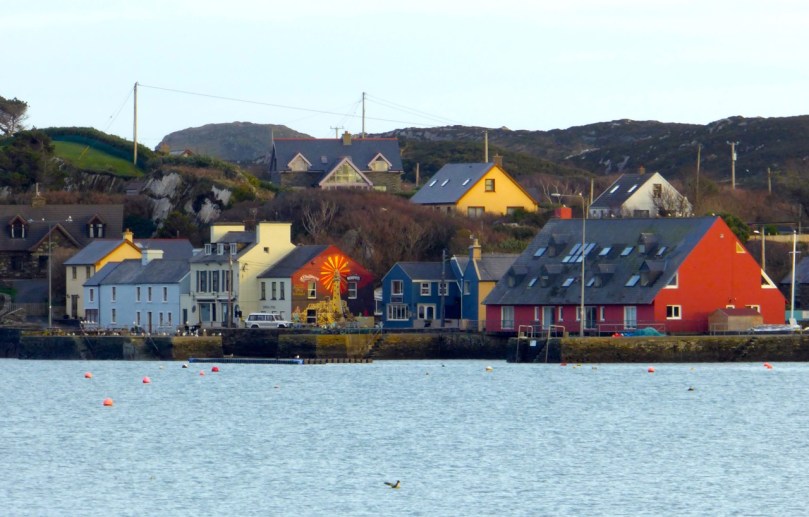
I’ve written before about the colourful towns and villages dotted all over Ireland. Coming around a bend in the road and catching sight of a village is a cheering experience: flashes of colour spread in a line across a backdrop of green fields or rugged mountains. But colour isn’t confined to towns – farmhouses in the deep countryside can suddenly demand attention – pops of colour in a predominantly green terrain. 

Blue seems to be a favourite – and we are not talking here about a pale blue or grey blue. No – duck egg or cobalt blues predominate. The blue is weathering and fading a bit in the house below but it still packs a punch in its isolated setting.

Sometimes blue is used on one side of the house only, or on selective aspects – a gate post or a shutter.

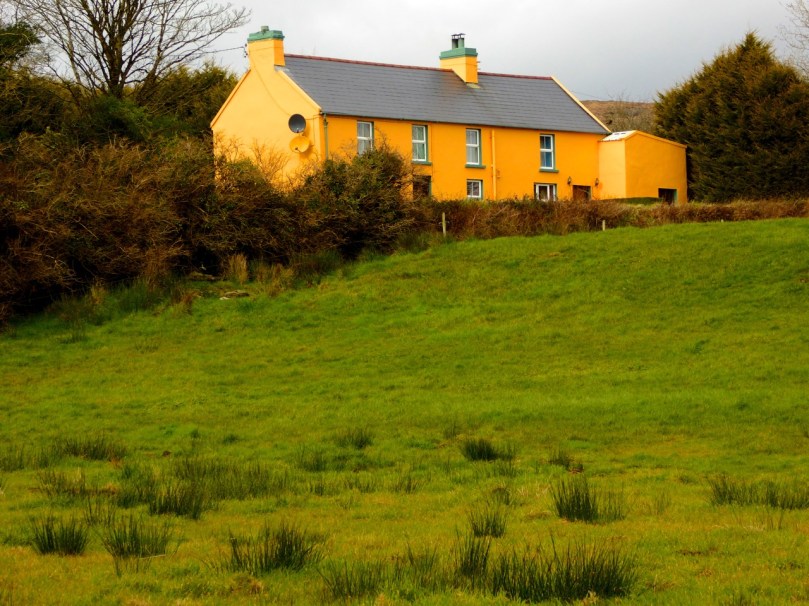
One of my favourites is this house, the colour of a ripe apricot. It is visible from a long way off and always seems to be incandescent on its hillside, as if permanently lit by a setting sun. Close up, I found it has jade green trim, making it even more handsome than it appears from a distance.

apricot distant

That colour is also one of the most recognisable in West Cork because it’s the colour of Jeremy Irons’ Kilcoe Castle. When the castle was being rendered, Irons used a lime mortar in order to waterproof the masonry: the mortar has a distinctive peach tone. Although controversial at the time, it is fair to say that West Cork folk have come to enjoy the sight of this wonderful restored 13th Century castle permanently glowing on its tiny island.

Kilcoe Castle

Kilcoe Castle

Pinks range from soft and pastel to the colour of fuchsia.

I particularly like the pink-on-pink trim of the farmhouse below left, and the candy-coloured house with its blue trim.

Yellow shows up well against a green hill. The first house below belongs to our friends the Camiers, who run the marvellous Gortnagrough Folk Museum. The second one is on the Sheep’s Head (photo by Amanda Clarke).

There are shades of salmon and coral that seem to suit old houses very well. Left, below, is the old school house in Rossbrin, now a private residence, and right is the Ballydehob Rectory, particularly attractive with its green trim.

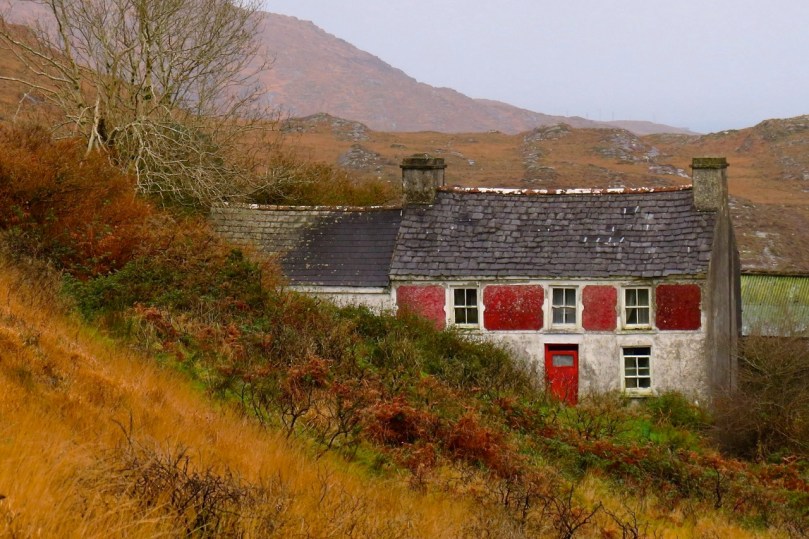
I’ve found red to be reserved mostly for doors, trim and spot colour, but my friend Amanda Clarke found this old farmhouse on the Sheep’s Head. Take a look at her site, Sheep’s Head Places for examples of vernacular farm buildings. 

Old farmhouse, Sheep's Head

Old farmhouse, Sheep’s Head*

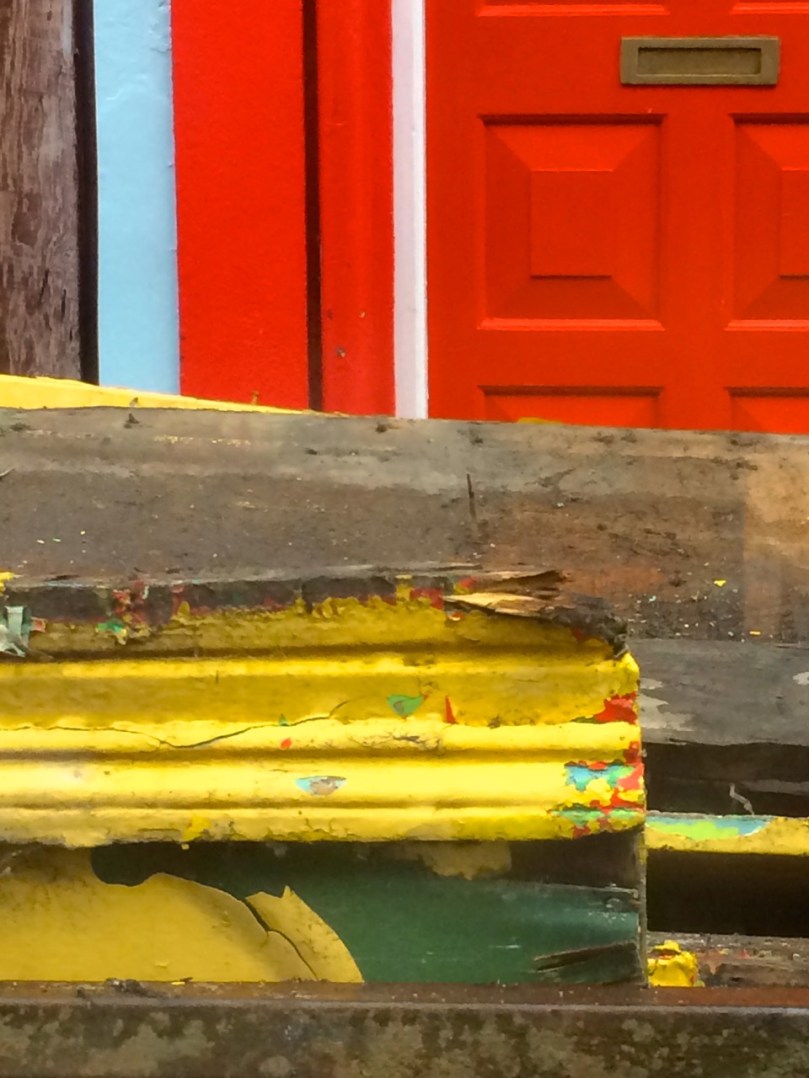
Renovations never stop – I did wonder what colour this one would end up. Now I know!

Going through the spectrum

Going through the spectrum

But this one, unless miracles happen, will see no more paint. Then again, it’s right beside a holy well, so maybe…

Generations of colour

Generations of colour

 *Many thanks to Amanda Clarke for the use of the asterisked photographs

The Love Which He Bare Her

Nothing beats a romantic walk in a graveyard

Nothing beats a romantic walk in a graveyard

In honour of the upcoming St Valentine’s Day, and of course because it’s now officially spring, my thoughts have turned to love. As we travel, here in West Cork, and in Ireland generally, we have a habit of dropping into churches. I’ve been struck by the eloquence – the purple prose – of memorial inscriptions in many Church of Ireland  (Protestant) churches, dating from the 18th and 19th Centuries. Why only in those churches? There weren’t many Catholic churches in Ireland until after the Catholic Emancipation Act of 1829. In the wave of Catholic church building that followed that Act there are few examples of individual memorial tablets on the walls: instead, the walls are filled with Catholic iconography, such as the Stations of the Cross and statues of saints.

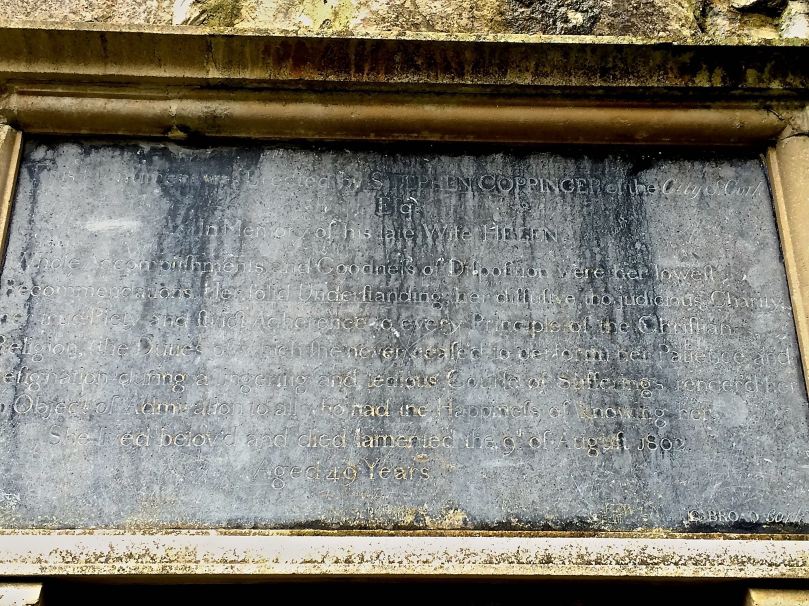
Although most memorial tablets commemorate men (particularly ministers, soldiers and noblemen) here and there you can find memorials to couples, or to beloved women, erected by their ‘disconsolate husbands’ or by a grateful parish. The first two below are from the ruined Muckross Abbey in Killarney. Here we found a stone erected by Stephen Coppinger of Cork, recounting the many virtues of his cherished Helen. The Coppingers were a Catholic family, one of whose members was the infamous Walter Coppinger of Coppinger’s Court.  Another, Elizabeth Coppinger of Barryscourt, in 1760 in defiance of the Penal Laws joined with Nano Nagle and five other Cork ladies in founding a Convent of the Ursuline order in Cork.

Helen Coppinger's memorial tablet

Helen Coppinger’s memorial tablet

Erected by Stephen Coppinger of the City of Cork in Memory of his late Wife HELEN Whose Accomplishments and Goodness of Disposition were her lowest Recommendations. Her solid Understanding, her diffusive, tho. judicious Charity, and strict Adherence to every Principle of the Christian Religion, the Duties of which she never ceased to perform, her Patience and Resignation during a lingering and tedious course of Sufferings, rendered her an Object of Admiration to all who had the Happiness of knowing her. She lived beloved and died lamented the 9th of August 1802. Aged 49 Years.

Also in Muckross Abbey we found this stone to Lucy Gallwey – so generally esteemed that the inhabitants of Killarney erected the memorial. A little sleuthing on my part discovered that Lucy was born Lucinda Grehan in Dublin, and that she and Christopher Gallwey had nine children.

Lucy Gallwey

Lucy Gallwey

Lucy

Wife of Christopher Gallwey of Killarney, Esq. This monument was erected By the inhabitants of Killarney and its neighbourhood to testify The deep sense of those amongst whom she lived And the Exemplary fidelity With which she discharged the relative duties of wife mother and friend as well as to perpetuate the recollections of the many benefits she conferred upon society and to hold up to the emulations of posterity her active useful yet unostentatious exercise of the most ardent charity directed by a singularly sound and well regulated understanding. She died the 14th of December 1829 aged 57

In St Patrick’s Cathedral in Dublin we came across this lovely plaque for Elizabeth, Viscountess Doneraile. (In the same Cathedral is an enormous memorial to the Boyle family built by Elizabeth’s great-grandfather Richard Boyle, Great Earl of Cork – but that’s a whole story in itself.) I love the wording of this one – not just that he loved her, but sincerely respected her.

Elizabeth, Viscountess Doneraile

Elizabeth, Viscountess Doneraile

      ELIZABETH, VISCOUNTESS DONERAILE

Wife of the Right Hon Hayes Sentleger, Lord Viscount Doneraile, Daughter of the Right Hon Joseph Dean, Lord chief Baron of the Court of Exchequer in 1715, and of Margaret Boyle, Daughter of the Hon. Roger Boyle, of Castlemartyr, in the County of Cork, Esq. She departed this life on the 3rd day of Dec, 1761, in the 59th Year of her age. She lived universally esteemed & died universally lamented. Her disconsolate husband, with whom she lived in perfect harmony forty Years, hath caused this Monument to be erected in testimony of the Love which he bare her, and as a memorial of his sincere respect for her many great & amiable Virtues.

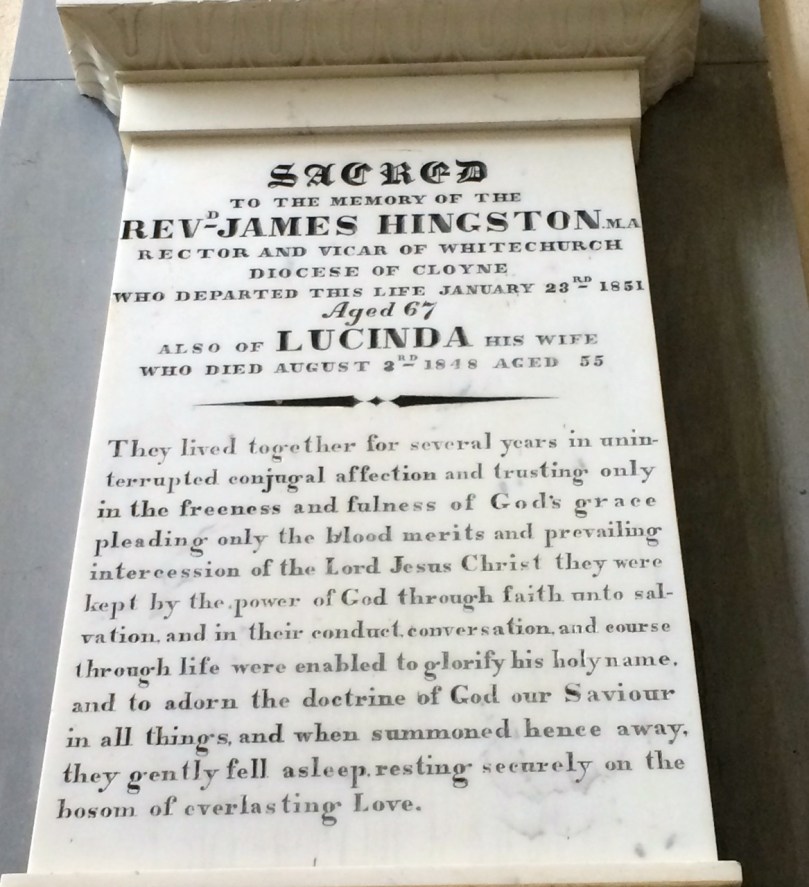
Here’s one from Cloyne. And what a lovely thought – to have years of uninterrupted conjugal affection and then to “gently fall asleep.”

James and Lucinda Hingston

James and Lucinda Hingston

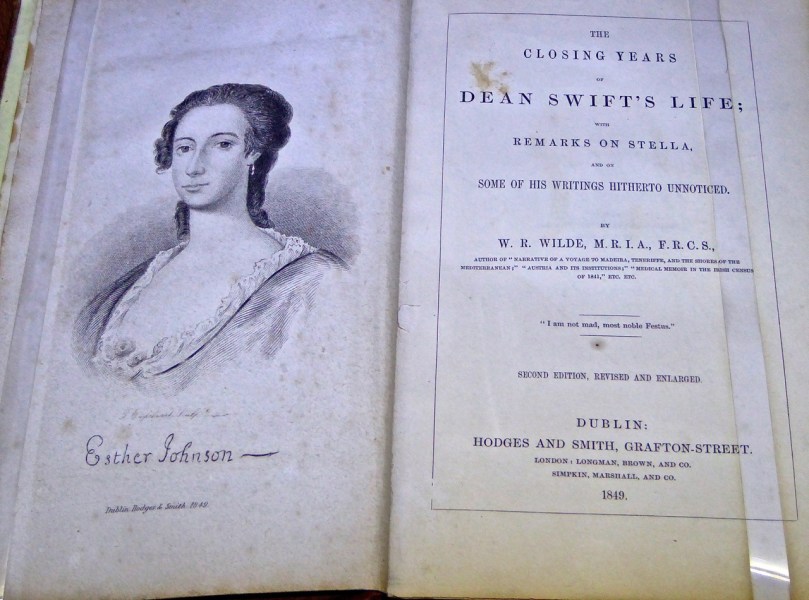
The final one is also from St. Patrick’s Cathedral in Dublin and it’s for Stella, whose real name was Esther Johnson, lifelong friend and companion of Dean Swift. At his request, he was buried alongside her.

Stella

Stella

Dear Reader, do you have a favourite memorial tablet erected by a disconsolate husband, or extolling conjugal affection? If you do, post them to our Facebook page – we’d love to see more of these.

Stella - Swift's Beloved

Portrait of Stella

I’m now busy composing a suitable epitaph for myself…let me see, er, amiable accomplishments Well regulated mind joined with admirable charity. The kindness of her disposition was matched only by the elevation of her thoughts. Natural perfections. Guess I’ll keep working on it. The emulations of posterity can wait a while.