Wild Wall

It’s a wall like hundreds of other such walls in the city, an old remnant of some enclosure long forgotten. It’s been heightened in a more recent period, although it’s not clear why.  ‘Round back’ of a plumbing supply place in Cork, people walk and drive by it every day without a second glance. But if you pause and take a close look it rewards with an astonishing variety of plant life.

In their magnificent book The Wild Flowers of Ireland:The Habitat Guide Declan Doogue and Carsten Krieger devote a chapter to Old Walls and Ruins. Here’s how they introduce that chapter: Walls, they say

. . .have over time been colonised by a number of plant species, some of which seldom live elsewhere in Ireland. . . . Buildings are completely artificial structures. Therefore the question arises as to where these colonising species lived before these walls were built. Some species were either deliberately or accidentally introduced by man into the country, usually for medicinal or ornamental reasons, within the past 1000 years and have become established or persist on walls. Another group of genuinely native Irish species made their own way, spreading from natural and usually rocky habitats within the Irish countryside onto the new buildings of the time. In both cases there were enough points of environmental similarity between the plants’ original natural habitats and the buildings of the Irish countryside to make it possible for them to extend their range and find new homes. In a sense an ongoing botanical battle between the native and newcomer was being fought on the fabric of these old buildings. This struggle comes complete with issues such as natural succession, colonisation, displacement, local extermination and sheer opportunism. The conflict continues to this day and can be observed in most older towns and cities.

Walls have other characteristics friendly to certain plants: the stones warm up in the sun and retain their heat into the evening, acting, as Doogue and Krieger put it, as a sort of storage heater. Lime-rich mortar allows lime-adapted plants to flourish even in non-lime areas. Microclimate and soil conditions on top of the wall can be different from those on the sides, or on south-facing versus north-facing walls.
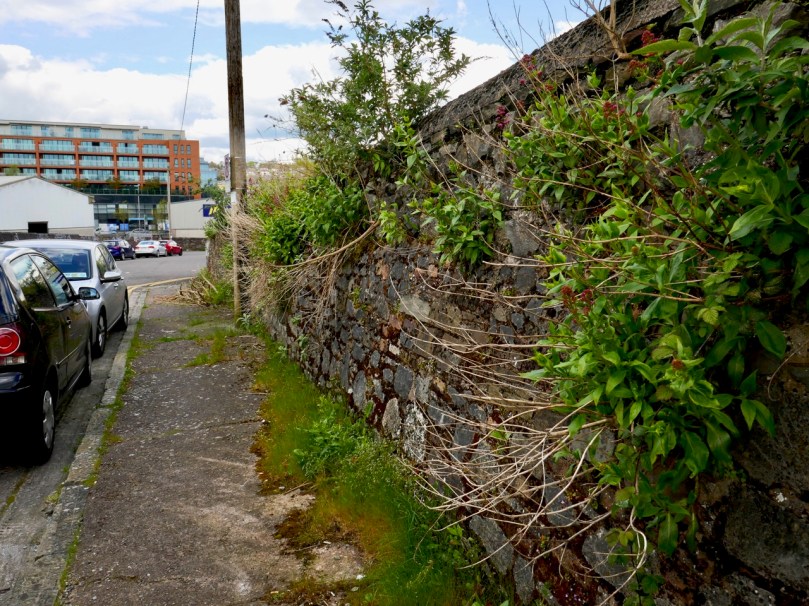
This wall in Cork exemplifies everything Doogue and Krieger describe – native and non-native species growing side by side in an environment where it seems impossible that enough nourishment could be supplied.

Oxford Ragwort

Some of the plants have intriguing histories. Take the humble Oxford Ragwort, the one that looks like a yellow daisy. (This is not to be confused with Common Ragwort, or Buachaláns as they’re known in Ireland, which are on the Noxious Weeds list – although that’s another story.) It was introduced into an Oxford botanic garden in 1690 from Sicily, but soon escaped and was seen all over the walls of Oxford. The University of Bristol takes up the story from there:

During the Industrial Revolution, Oxford became a thriving railway centre and Oxford ragwort found a new habitat in the clinker beds of the railway lines that fanned out of Oxford to all parts of the country. These ‘furnished the plant with a replica of the lava-soils of its native home in Sicily’, said Druce in his Flora of Oxfordshire. Referring to the fruits (achenes) of Oxford ragwort, he said ‘I have seen them enter a railway-carriage window near Oxford and remain suspended in the air in the compartment until they found an exit at Tilehurst’ (near Reading).

Because this species hybridises readily with other Senecio species (other Ragworts and Groundsel), this site adds, the introduction and spread of the promiscuous Sicilian S. squalidus has resulted in a great deal of evolutionary novelty among British Senecio – an amazing example of evolution in action. I love the idea of a promiscuous plant.

Herb-Robert – surely one of our most-loved wildflowers

Herb-Robert is among our most commonly seen (and known) native wildflowers – a dependable spot of brilliant colour almost all year round in a huge variety of environments, with its frondy leaves turning a brilliant red as the season wears on. However, on this wall it was joined by a cousin – Shining-Crane’s-bill.

And this is Shining Crane’s-bill!

In fact, I had to do a double-take, as I had never seen this flower before and at first I thought I was looking at a miniature Herb-Robert. While it might be easy to confuse the flowers, the leaves are totally different, with the Shining Crane’s-bill leaves being smooth and hairless, almost waxy, with a distinctive shape. I wish all similar species were this easy to tell apart upon close inspection!
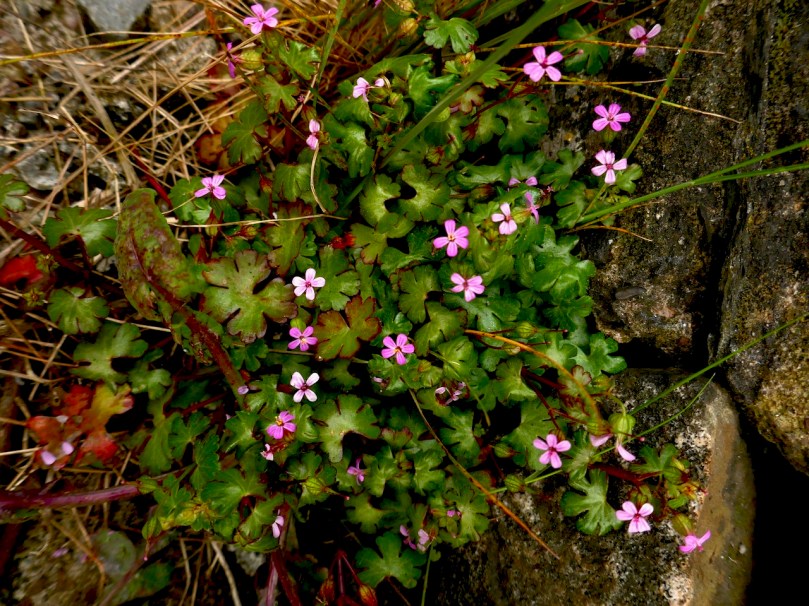
Shining Crane’s-bill – the flowers are smaller than Herb-Robert and the leaves are totally different

One of my favourite wall species has to be Ivy-leaved Toadflax – not a very pretty name for a truly spectacular flower. This is another Mediterranean plant, and we can blame Oxford for this one too, as it is thought to have hitched a ride on marble sculptures imported from Italy to Oxford in the seventeenth century. Once the flowers are finished, the seed heads bend away from the sun and towards the wall, dropping their seeds into the cracks – thus they are able to grow vertically up the wall.

Ivy-leaved Toadflax – every well-dressed wall should have some

At the bottom of the wall I thought I saw the ubiquitous dandelion, but once I looked closer I saw that the leaves were quite different. I think this is Smooth Sowthistle. Zoe Devlin of Wildflowers of Ireland tells me that the leaves can go this purplish colour in the absence of good soil. There are so many wildflowers that look, more or less, like dandelions – it has been a real journey of discovery to find out more about this large flower family.

Smooth Sowthistle and Ivy-leaved Toadflax in the act of climbing up the wall

Smooth Sowthistle is edible when young and has been used as fodder for animals. According to one authority I read, In Greek mythology Theseus is said to have eaten smooth sow-thistle to gain power before leaving to slay the Minotaur in its Cretan labyrinth, where it dined on human bodies, bull’s heads and young Atheneans.

Rue-leaved Saxifrage. It’s also pictured in the lead photograph at the head of the post, where you can see the basal rosette

Growing from the mossy ridges in the wall was a delicate little white flower with a reddish basal rosette, and this turned out to be Rue-leaved Saxifrage. Although it was new to me, this little native beauty is common in many parts of Ireland. As the season progresses the stem, leaves and rosette become redder – hence ‘rue-leaved.’

Red Valerian sprouting from the wall, with Oxford Ragwort and Ivy-leaved Toadflax. The tiny fern growing in the cracks glories in the name Maidenhair Spleenwort

We all know the plant known as Red Valerian, yet another Mediterranean import. I saw it growing in huge masses in the Burren a couple of years ago, meaning it’s one of those plants that enjoys the lime-rich environment provided by the mortar in the wall.

This is not, by the way, the Valerian that the sleep-aid tea is made from, the one that makes cats go loopy. It can also come in shades of pink and white, all growing side-by-side.

Keel-fruited Cornsalad (above) is also known as Lamb’s Lettuce, although it doesn’t look like the supermarket variety known by the same name. It is, in fact, very edible, with a kind of parsley after-taste and packed with vitamins (although you probably shouldn’t pick it anywhere near dog-height). The tiny blue/purple flowers reward examination through a hand-lens if you have one.

It took me a while to identify one little plant growing close to the pavement (above). It turned out to be Petty Spurge and, although it is not native to Ireland it’s been here a long time and has spread widely. It’s not usually as red-tinged as this when you see it in ID sources. It’s of huge interest to scientists at the moment because of the potential of its sap (a toxic latex substance) to treat common forms of skin cancer. Several rigorous double-blind studies have come to the same conclusion that it is an effective treatment for non-melanoma lesions. It’s a hardy little thing too – seeds found in excavations, dormant for a hundred years, can still germinate.
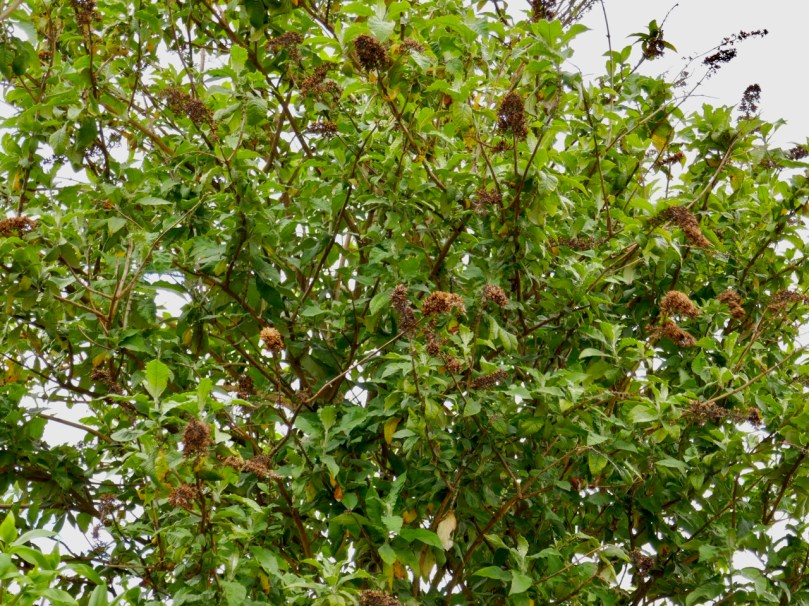
Finally, up on top of the wall is sprouting a Butterfly-bush (above); many of us know it as Buddleia. It’s well named, as butterflies love it. It was introduced into Europe by missionaries returning from China and it spread quickly as it will grow just about anywhere. What you see on this specimen are the remains of last year’s flowers: by June it will be hosting butterflies. Butterfly Bush may seem benign but like many other introduced species there is a dark side. First of all, as Tony O’Mahony points out in his Wildflowers of Cork City and County, it’s quite invasive and can take over and crowd out native species. The roots can do significant structural damage to the very walls it depends on for survival. More serious is the charge that, while it provides nectar for butterflies it is not a butterfly host plant – that is, one that butterflies can use to deposit their larva, which will then feed on the leaves. According to a spokesperson concerned about the destruction of chalk grasslands at Folkestone Warren in Kent: If left uncontrolled, then buddleia and other shrubs would have engulfed the chalk grassland. Clouds of butterflies used to be seen there, but now only common species can be spotted and even these are in decline, with the rarest ones disappearing altogether. Buddleia was eliminating butterfly habitat by killing off everything else, and while the shrub provided food for adults and larger insects, other plants were needed for butterflies in their larval stages.
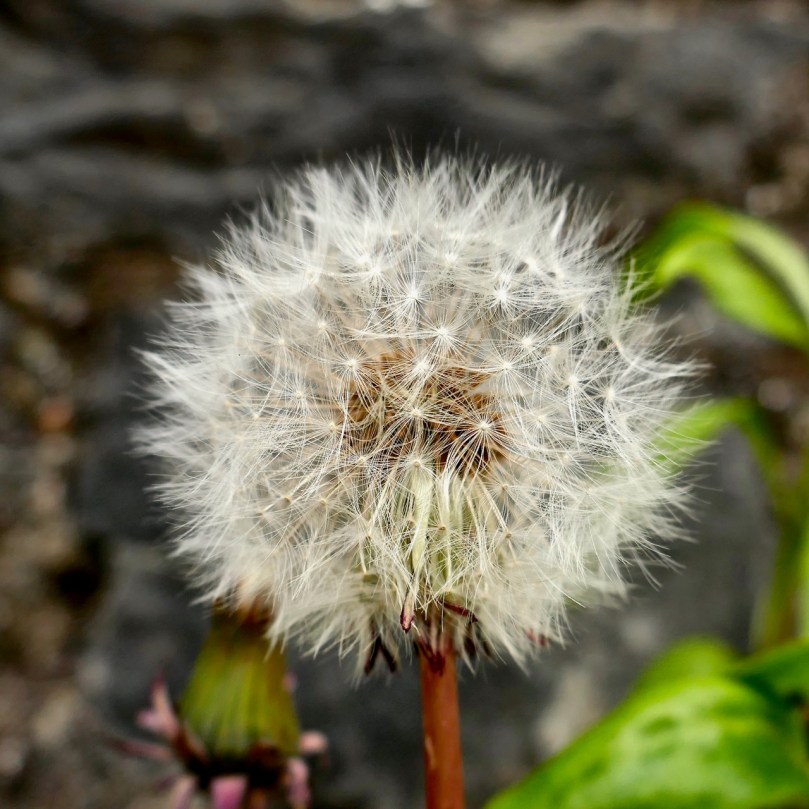
So there you have it – it’s just like the human history of Ireland, full of invasions, adaptations, displacements and resurgence. All in a Wild Wall.
The Rocky Road to Nowhere

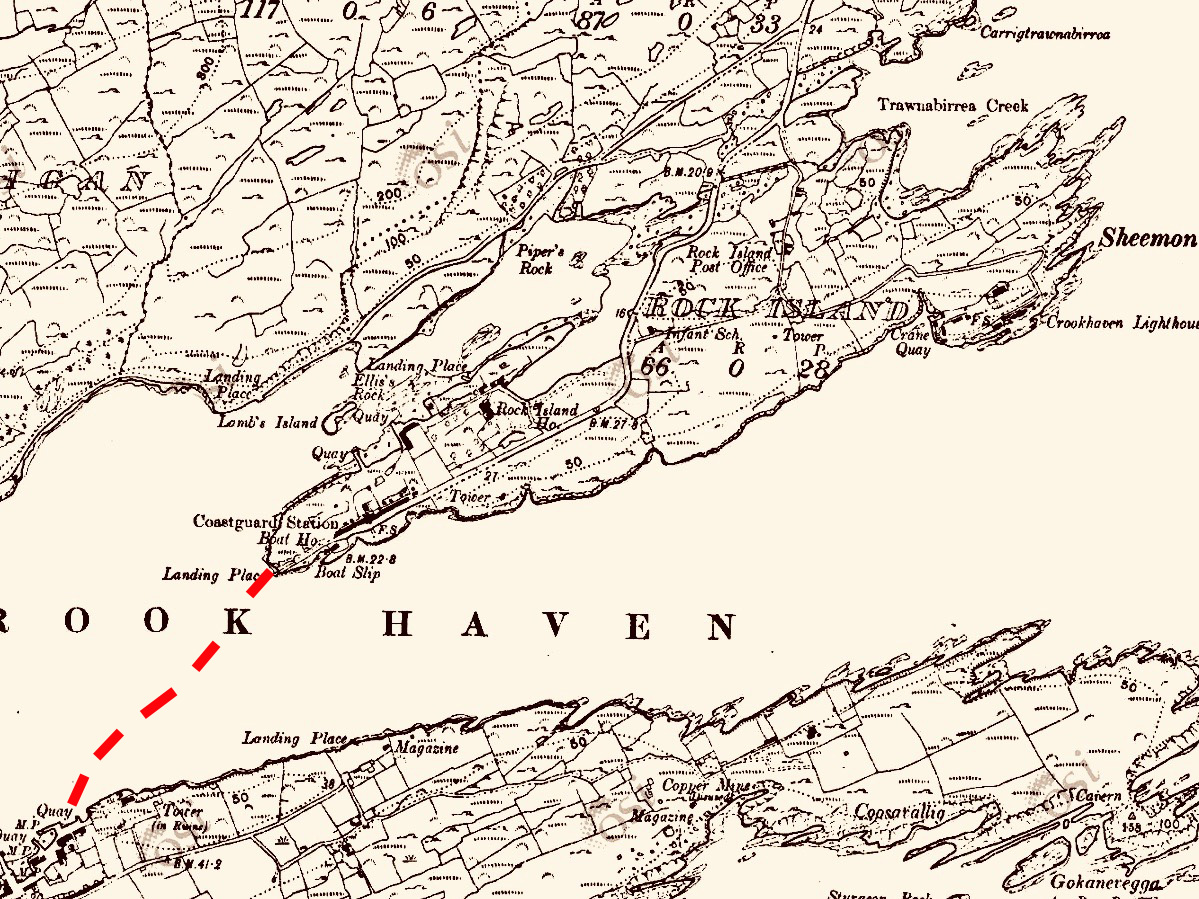
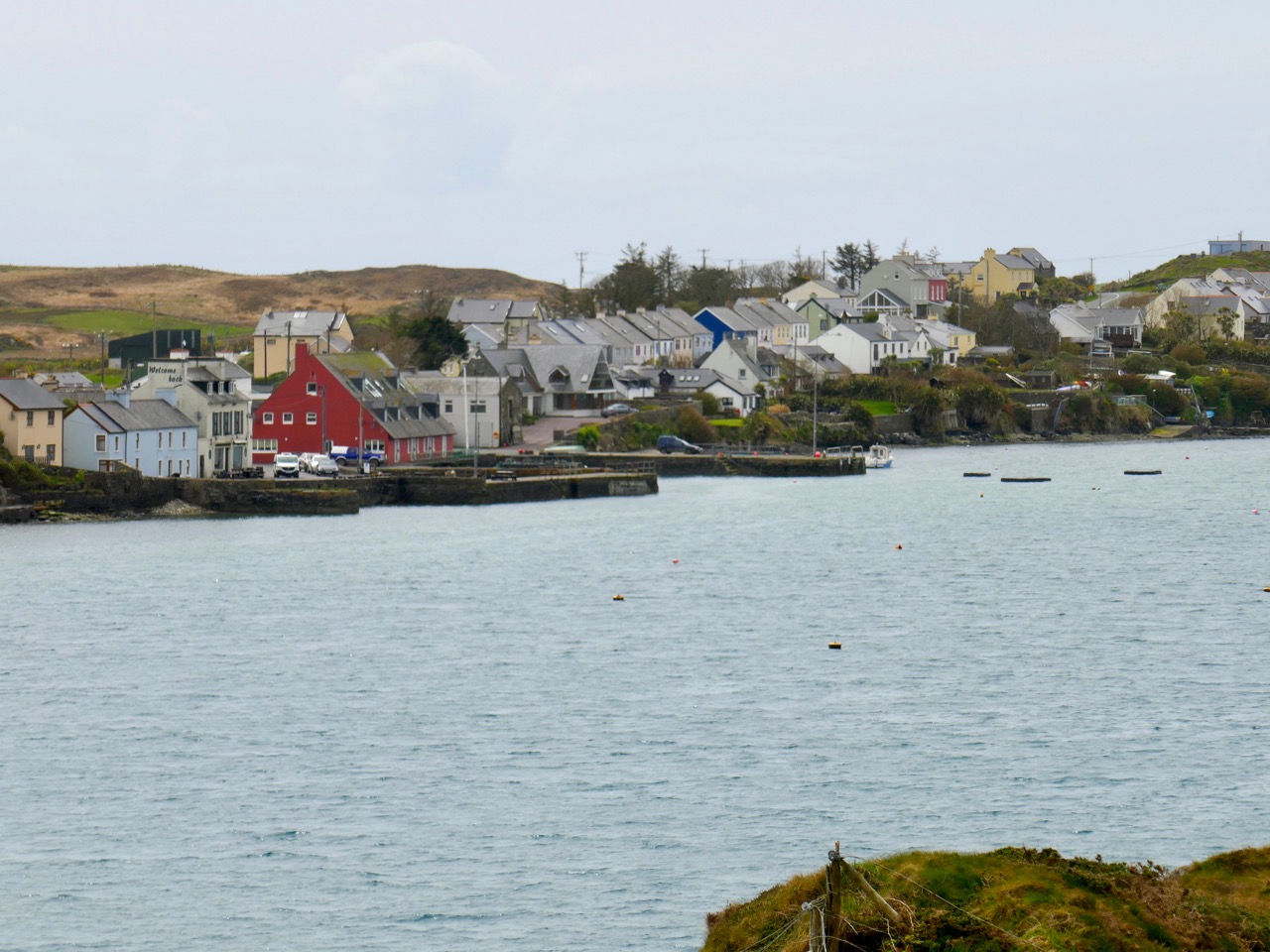
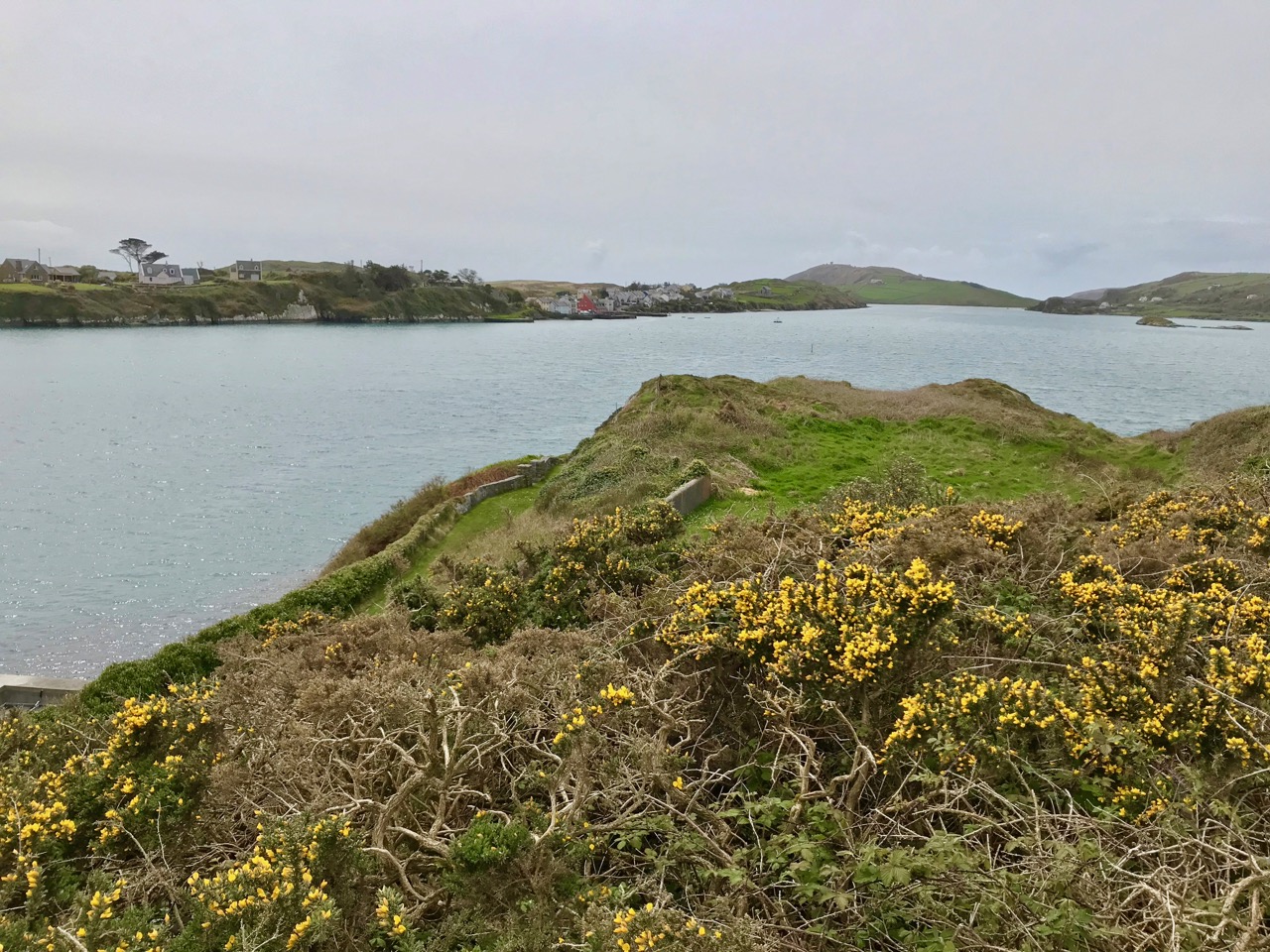
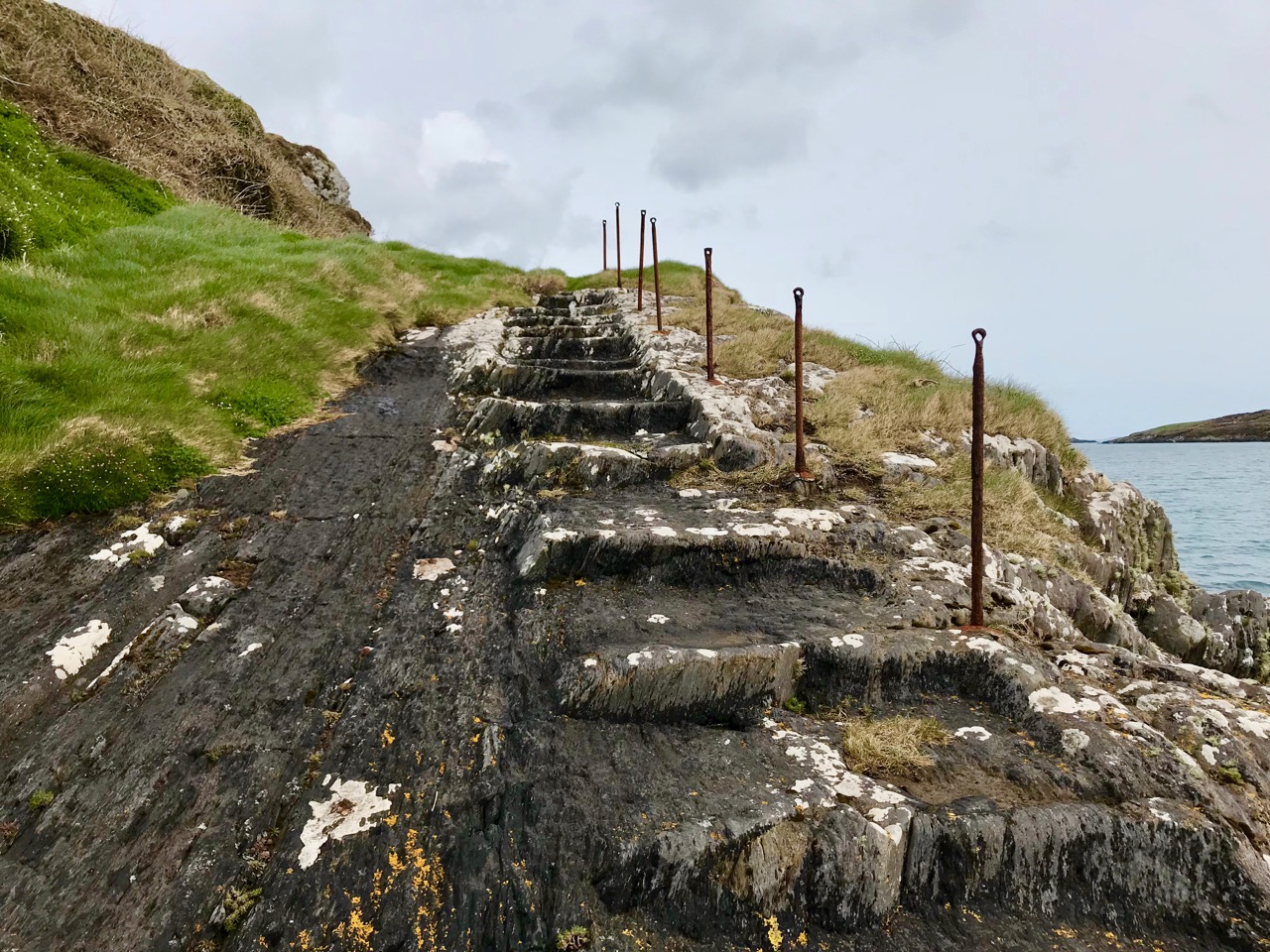
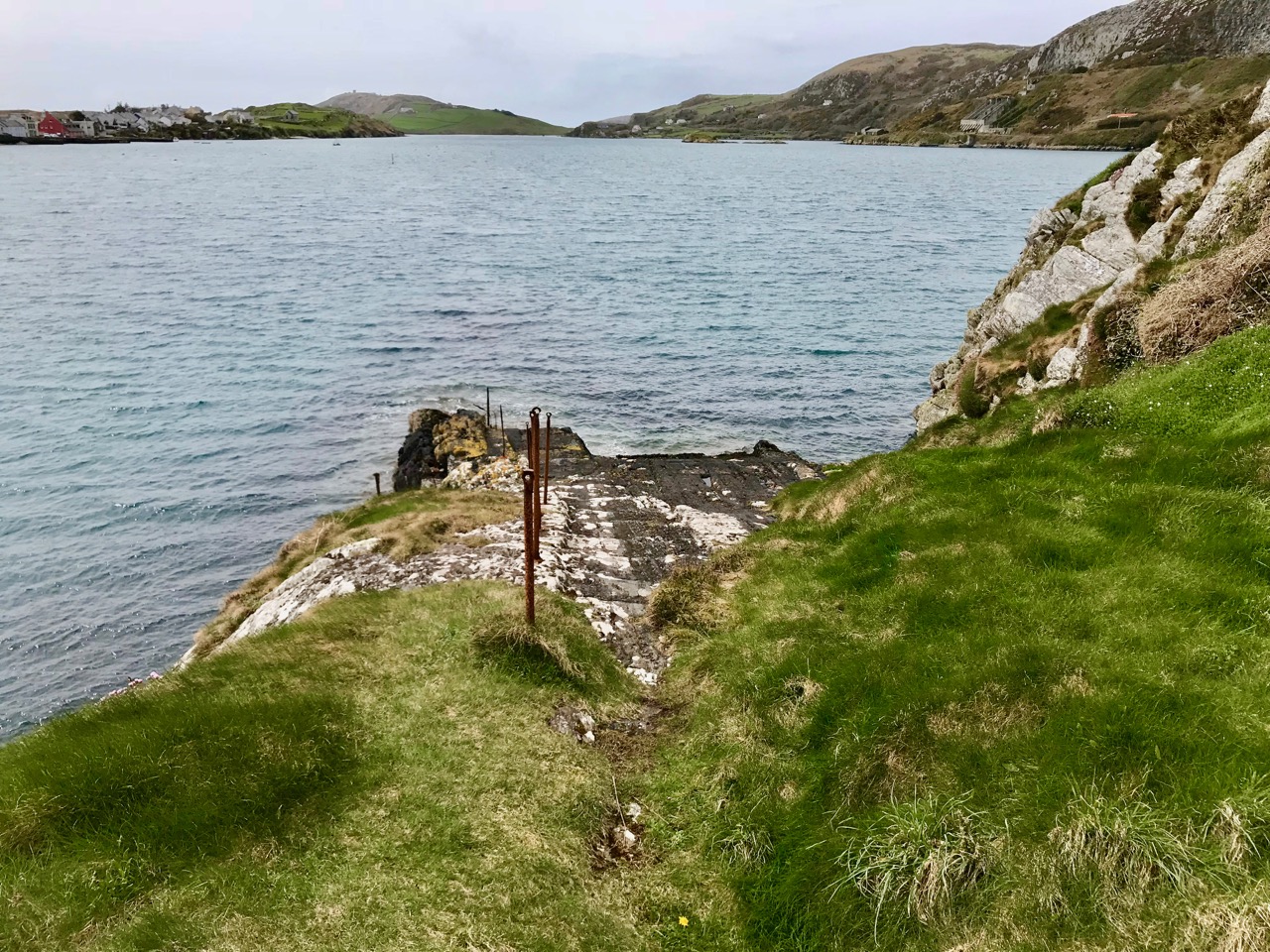
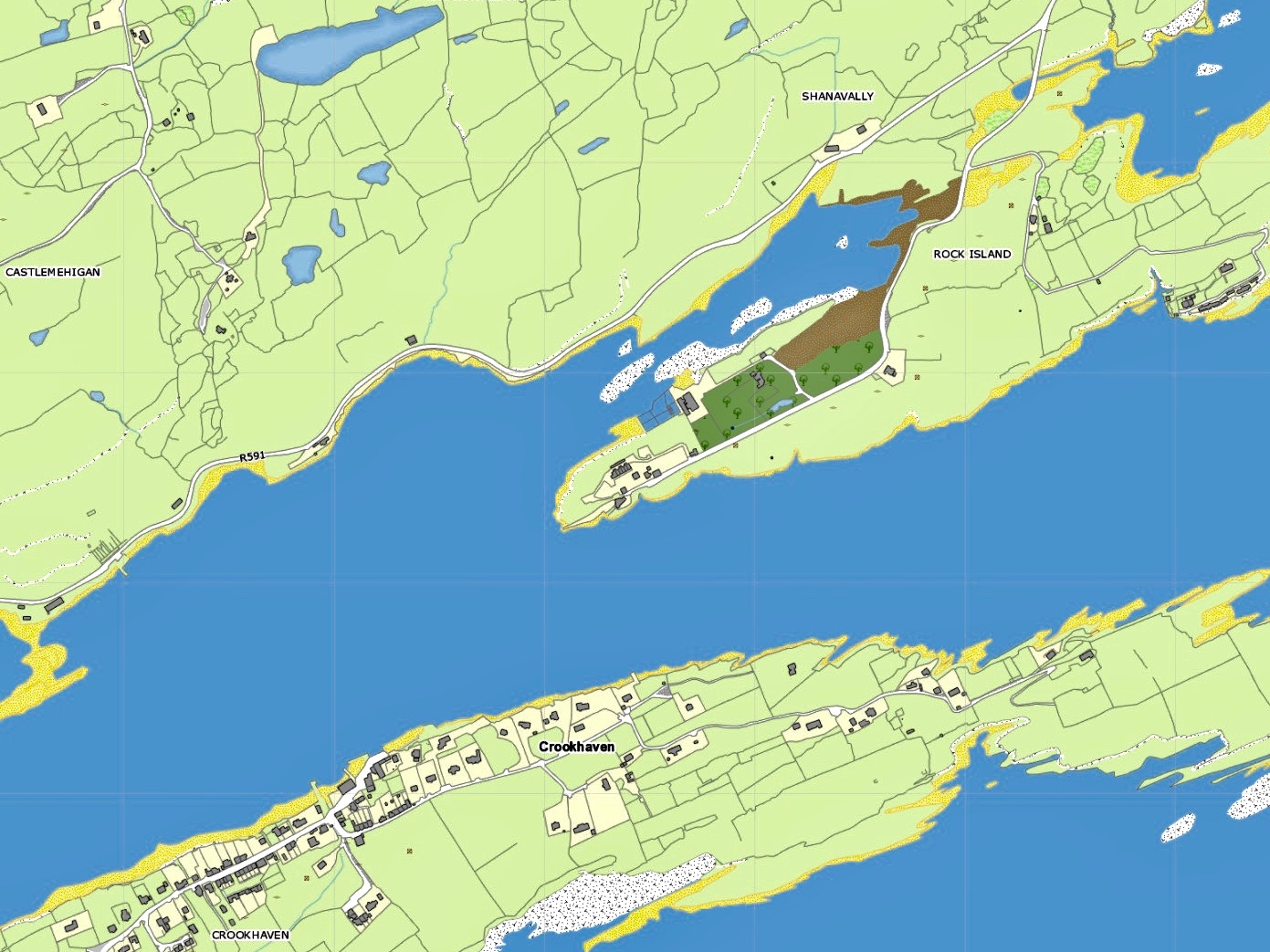
The road from Cork to Crookhaven – one of the most westerly communities in the whole of Europe – ran into the sea here at Rock Island. The picture above shows the remote settlement in the distance across an expanse of water, and the stone steps in the foreground are literally the end of the road that was laid out by Sir Richard John Griffith – Engineer of Public Works in Cork, Kerry and Limerick – between 1822 and 1830.

Upper – map showing Rock Island today: note the R591 road which now goes around the north side of Crookhaven Bay to reach the village. Lower – the Cassini map of c1848, showing Griffith’s Road – the direct route across Rock Island to the Landing Place at the western point: from there you went by water to Crookhaven Quay

Griffith’s brief as Engineer was to lay out many miles of new roads in some of the most inaccessible parts of the three counties. But even in his day travelling through the hinterland of Ireland was risky and uncomfortable: always far better to go by water along the coast – at least the passage was direct and relatively smooth in calm weather, while the byroads of the day were at best circuitous and muddy. Here’s an extract from a report by Griffith dated 1824:

. . . Richard Griffith, Road Engineer, Progress Report, Skibbereen to Crookhaven, Wheeled Carts now Appear, where heretofore Loads were carried on the Backs of Horses, New Entrance to Town Of Bandon, Road From Courtmacsherry to Timoleague, Road from Clonakilty to New Fishery Pier At Ring, New Road Skibbereen to Bantry, Macroom to Killarney, with a Note on The System of Labour Organisation Used . . .

Connections by water: a telephoto view of Crookhaven, taken from above the ‘Landing Place’ at the west end of Rock Island

A few years ago, Finola wrote about the Butter Roads, an eighteenth century venture to serve the hub of Cork – and its international Butter Market – from the wilds of Ireland’s rural hinterland. Griffith and his contemporaries improved on this network during the nineteenth century: what we have today – especially here in West Cork – is an updating of Griffith’s system, with a few improved main roads connecting up with the web of winding boreens which then accessed the scattered townlands and farms – and still do.

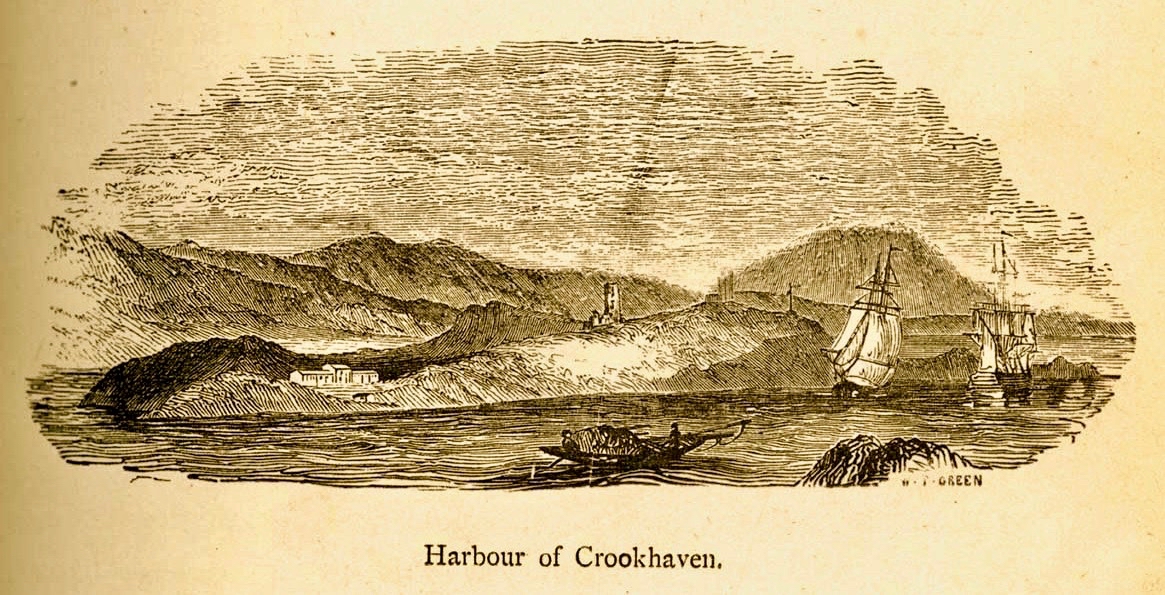
An engraving signed W T Green from A History of the City and County of Cork by Mary Cusack, Cork 1875

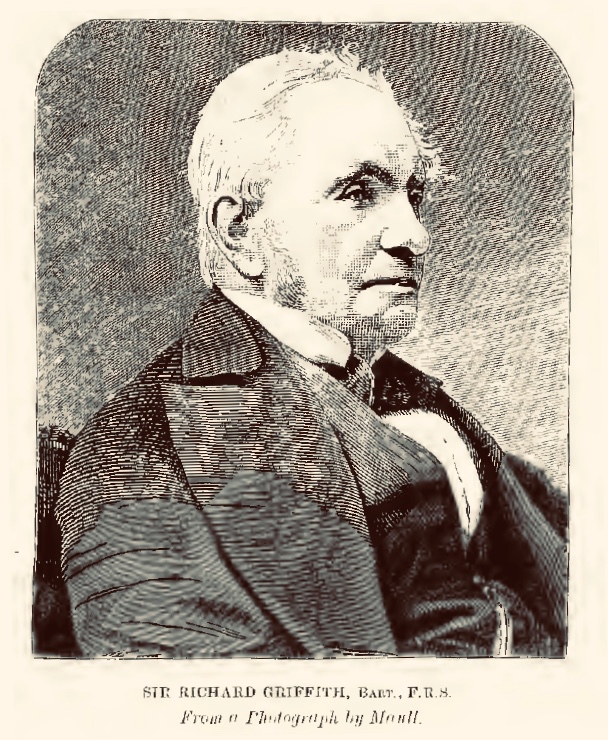
Born in Dublin in 1784, Richard Griffith exerted a great influence over the whole of Ireland during his lifetime. He was fascinated by the relatively new science of geology and studied in London and Edinburgh. I was particularly interested to see that he spent some time in Cornwall, studying mine engineering and mining techniques. Returning to Ireland in 1808, He was appointed Engineer to the Bog Commissioners and over the following four years wrote detailed accounts of the geology of various parts of the country, including Clare, Cork , Kerry, Leitrim, Mayo, Sligo and Wicklow. He became Professor of Geology and Mining at the Royal Dublin Society in 1812, and Inspector-General of His Majesty’s Royal Mines in Ireland at about the same time. The first edition of his Geological Map of Ireland was published in 1815.This was revised and republished a number of times over the following 40 years, and was the work he considered his major achievement.

Sir Richard Griffith 1784 – 1878

You will see from Finola’s post today that we visited Rock Island during the week in the good company of Aidan Power who has written an account of the place. It’s wonderful to get a guided tour with an enthusiastic expert. It was Aidan who sparked my imagination when he pointed out that a mail boat was rowed over from Crookhaven every day to the Landing Place at Rock Island – and was the regular and reliable means of communication between that village and the rest of Cork.

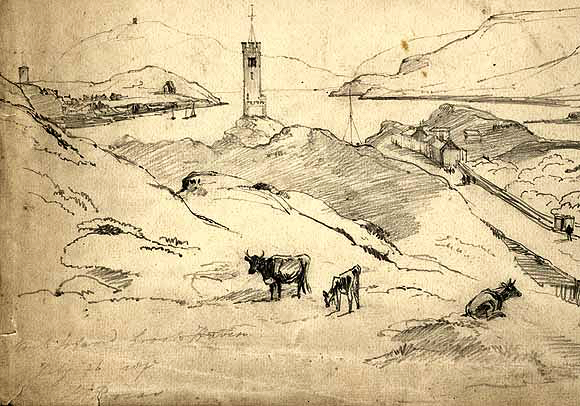
This drawing of Rock island by Brocas is dated 1837, and clearly shows, on the right hand side, Griffith’s Road leading down to the Landing Place, the principal connection with Crookhaven

There’s a lot more of Griffith’s story to be told: particularly his appointment as Boundary Commissioner in 1824, a post he held for 41 years. This resulted in the full recording of all townland boundaries and designations – although these were often anglicised at the time, resulting in the loss of many local traditional names. He died in 1878 at the age of 94. On his grave in Mount Jerome Cemetery is the epitaph . . . Not slothful in business, fervent in spirit, Serving the Lord . . .

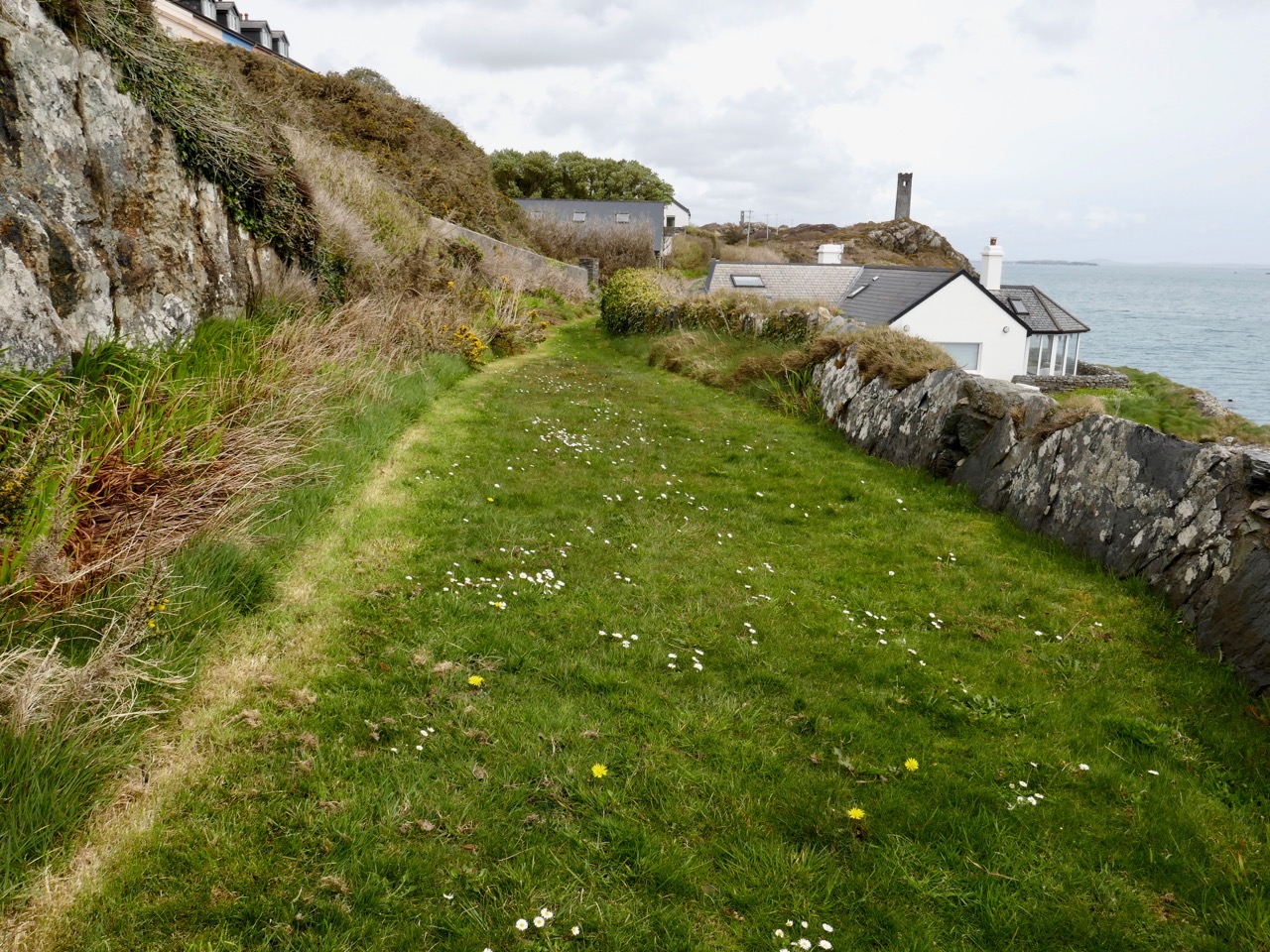
Griffith’s Road on Rocky Island is lost to a grassy track (upper picture and on the left in the lower picture) but is still traceable and remains theoretically a public highway! You can at least still follow it on foot to the point where it becomes a series of rocky steps that finish in the sea. You will have quite a wait for the Crookhaven mailboat today, however.

Thaddeus McCarthy: The Bishop Who Never Was

This is the story of a man from West Cork who was appointed a bishop not once but twice, by two different popes, but prevented from assuming his duties by warring clan factions; a man now venerated in two countries.

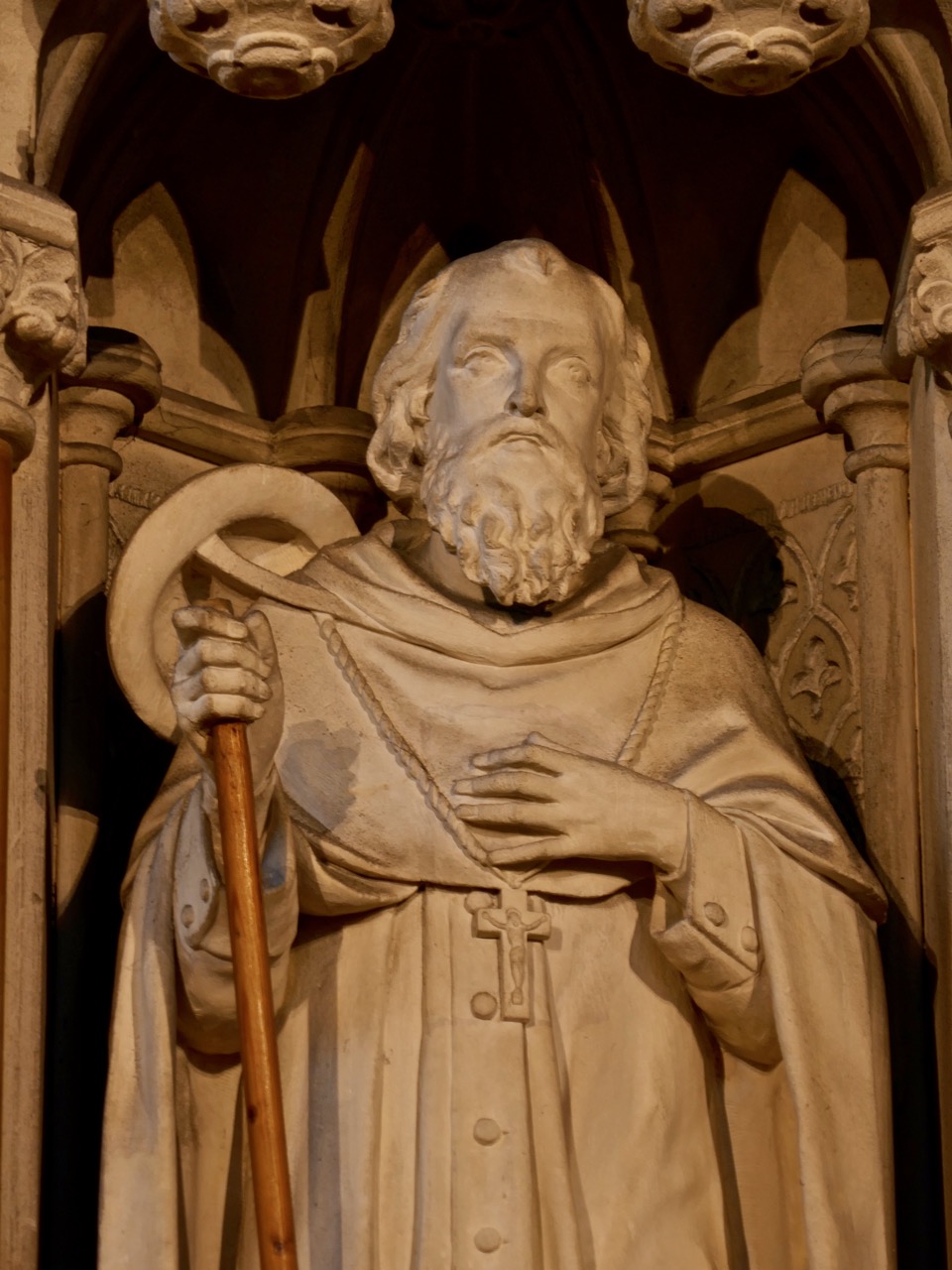
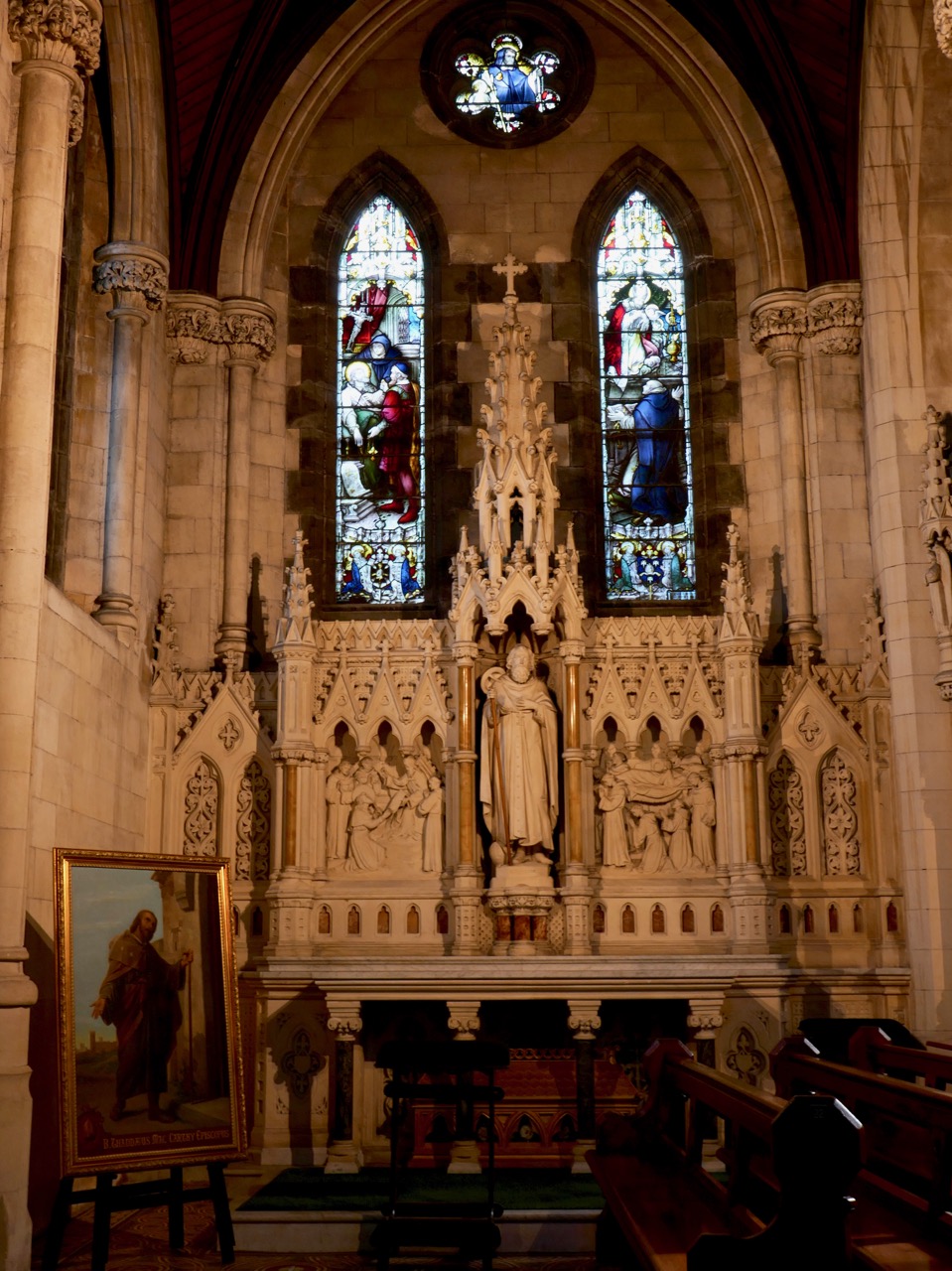
Thaddeus in his dedicated chapel in St Colmán’s Cathedral in Cobh

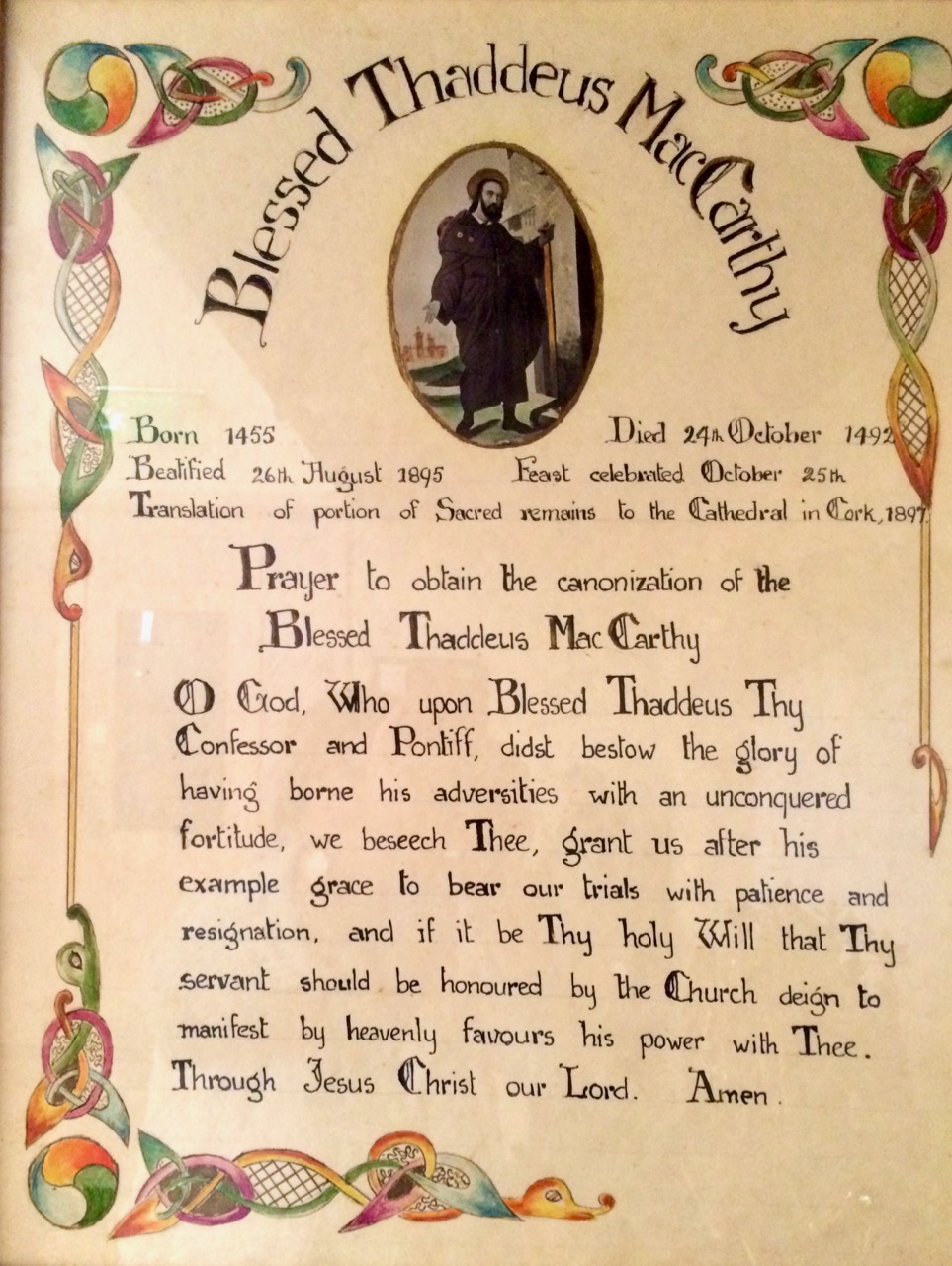
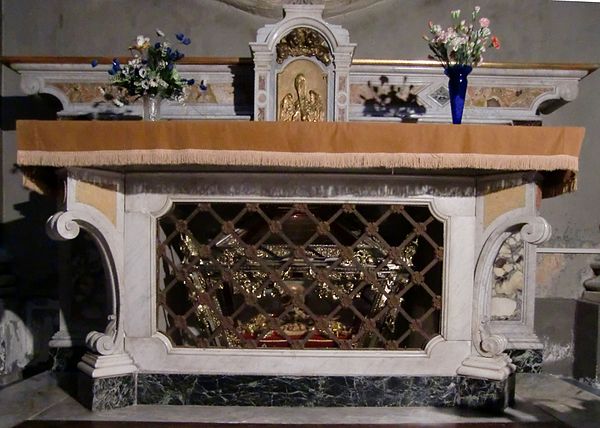
I had never heard of Blessed Thaddeus McCarthy until I stumbled upon his curious shrine in Cork’s North Cathedral. It’s a strange and glorious thing – two golden angels holding an ornate, bejewelled casket within which a glass tube contains, of all things, a leg bone. Nearby, a statue and a plaque provide more of the story.

The relic of Thaddeus’s leg bone and a prayer to him, both part of the shrine on the North Cathedral, Cork

Once I had seen the shrine in the North Cathedral, it seemed I met the Blessed Thaddeus everywhere I went, and I came to know about his life over time. It is as much a story of the struggle for supremacy of some of the great Irish houses – the McCarthy Reaghs, the FitzGeralds and the O’Driscolls – during the turbulent fifteenth century, as it is the story of a holy man.

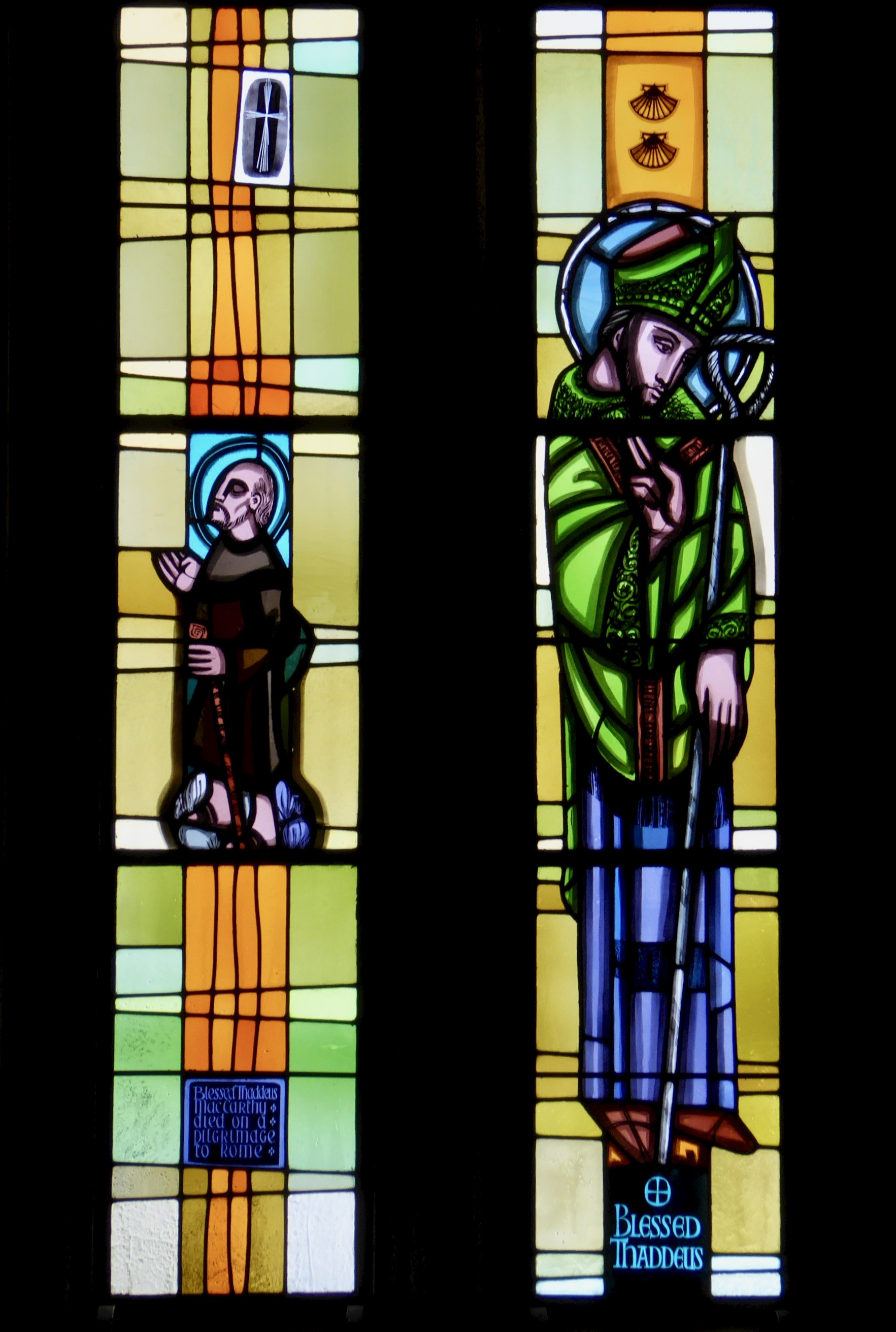
Thaddeus is often depicted wearing the scallop shell – symbol of a pilgrim

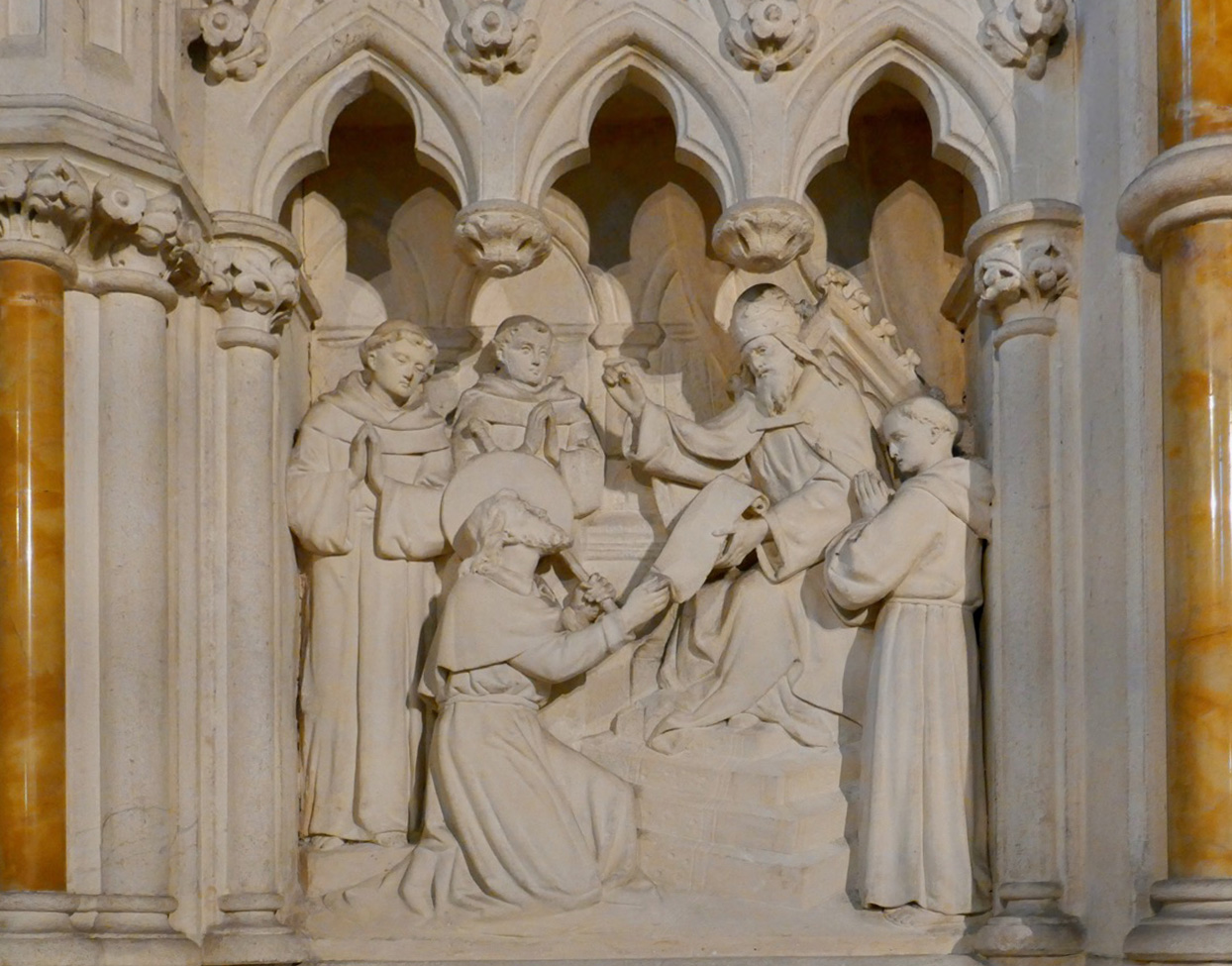
Thaddeus was born in 1455 in West Cork into the reigning Munster family of the McCarthy Reaghs, powerful lords who held sway in Carbery and Muskerry at the time and whose principal seat was in Kilbrittain. He studied under the Franciscans, probably at Timoleague Friary, and took holy orders before going off to Rome where he impressed the Pope (Sixtus IV) so much with his saintliness that he appointed Thaddeus Bishop of Ross (Rosscarbery See). Upon his return home, however, he found that an O’Driscoll was already Bishop of Ross (appointed by the same Pope – he had apparently forgotten, oops). The O’Driscolls were certainly not about to give up their hold on the See of Ross, so back went Thaddeus to Rome to ask the Pope to sort it out.

Thaddeus in Italy, dressed as a simple pilgrim, looking resigned and thoroughly saintly

After many inquiries and rumination, another Pope, Innocent VIII, appointed him Bishop of Cork and Cloyne. Once again, when he returned home, it was to find that the FitzGeralds had their own man in the position. Through all these trials Thaddeus bore himself with patience and dignity and encouraged his followers not to engage in violent behaviour on his behalf. His enemies worked to get him excommunicated and so off he went to Rome one more time, where the Pope confirmed his credentials.

A window dedicated to Thaddeus in the Catholic church in Caheragh, near Skibbereen

On his journey back to Ireland he travelled alone in the guise of a simple pilgrim. He was only 37 years old, but worn out by his many travails he died in the night in a hostel near Ivrea in Italy. In the morning a bright light was seen to shine from the room where his body lay and the monks found him bathed in this mysterious glow. When they examined his possessions they realised he was an Irish bishop.

Thaddeus appeals to the Pontiff (detail of the Thaddeus altar, Cobh)

The Rev Patrick Hurley has written a full, two part account of the life of Thaddeus, published in the Journal of the Cork Historical and Archaeological Society for 1896 (here and here). The occasion for the paper was that the Irish, who had essentially forgotten about Thaddeus (although the McCarthy’s held on to a tradition of a saintly ancestor) had recently become aware of his status in Italy. I will let Fr Hurley take up the story of what happened next when Thaddeus died:

On hearing the news people flocked from all parts to see the pilgrim-bishop, who they regarded as a saint, and many sick were here cured and restored to health. Seeing this the bishop ordered the body to be carried to the cathedral, which was accompanied with great solemnity, the chapter, clergy and religious orders all going with a great multitude of people more in the way of a triumph than a funeral.

Depiction of the funeral, based on Fr Hurley’s account  (detail of the Thaddeus altar, Cobh)

Thaddeus was placed under the altar alongside the body of St Eusebius and there he is to this day. Eventually the tombs of both saints were opened and Thaddeus’s remains were re-interred in a reliquary (he was found to have red hair). His feast day is celebrated in October every year in Ivrea and many miracles have been ascribed to him over the centuries.

Blessed Thaddeus’s Reliquary in Ivrea, Italy

There’s even a 15th or 16th century poem, in Latin, about him. Fr Hurley provides a translation. Since he gives no author, it may be his own work, which would not surprise me as this is obviously an erudite and talented scholar. He started his career as the parish priest of Schull, was the priest responsible for the chapel and stations at Gougane Barra and also established the Irish training college at Ballingeary. He was a frequent contributor to the JCHAS.

Fr Hurley had attended a ceremony in honour of Thaddeus in Ivrea ‘recently’ when he wrote his two pieces. He remarks in awe on the majesty of the ceremonial and the great crowds who took part. Above all, he says, the solemn procession when, as if in triumph, the remains of the poor unknown pilgrim were carried through the streets he passed so many years ago, will not be easily forgotten.

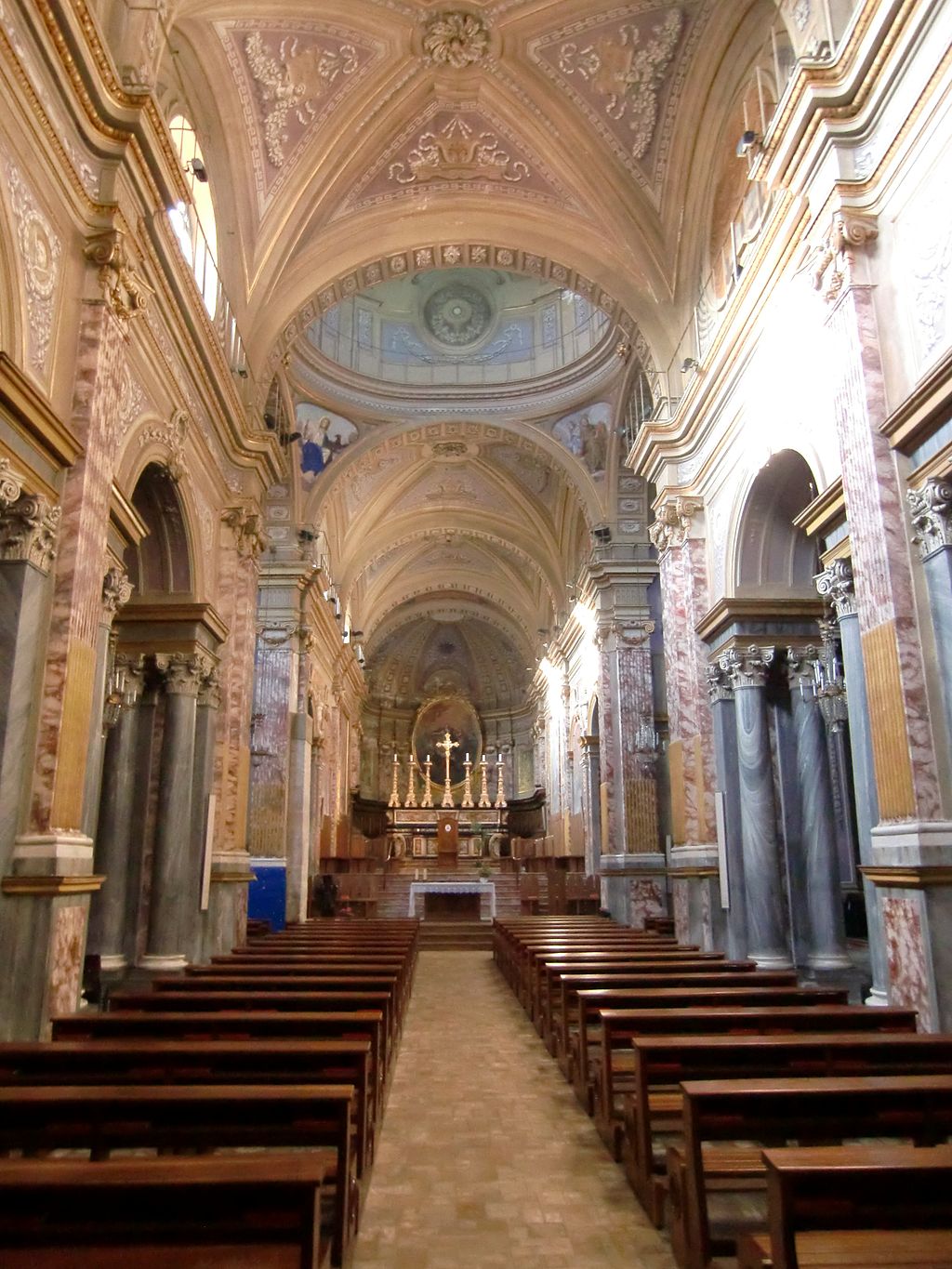
Above, the magnificent church in Ivrea, Italy, where Thaddeus lies and below, the equally magnificent side-chapel dedicated to his memory in St Colmán’s Cathedral, Cobh

In more recent times, it was agreed that some relics of the saint could be returned to Ireland – hence the leg bone that caught my attention in the North Cathedral. Ireland, and particularly Cork, had rediscovered their saint and veneration of this fifteenth century holy man spread rapidly. In St Colmán’s Cathedral in Cobh (the subject of Robert’s post this week) one of the side chapels is dedicated to him: this probably happened in a time of great enthusiasm for the revival of his cult following the rediscovery described by Fr Hurley. The design of the altar, the carvings, the mosaics and stained glass show that the artists were familiar with Fr Hurley’s account. 

The death of Thaddeus, St Colmán’s Cathedral, Cobh

In the years that followed, as new churches were built and older ones refurbished, Thaddeus lived on in stained glass and small shrines. I have no doubt that part of this comes down to his surname – we love the idea that the McCarthys, of a proud, ancient and powerful lineage, and the people of Cork, have our own saint.

A shrine to Thaddeus, including a reliquary (not sure what it contains) in the Catholic church in Clonakilty

Please read the comments for updated information

The Splendour of Cobh

My favourite sea voyage was on the (alas now defunct) Swansea to Cork Ferry. I travelled this route very many times while living in Devon and Cornwall, and most enjoyed the last leg of the journey to Ireland, when the ship entered the Lee estuary and made its way upriver to Ringaskiddy. In all weathers I was out on deck to watch the slowly changing scenery that welcomed my arrival in to Cork, knowing that it was surely the best place in all the world to be going!

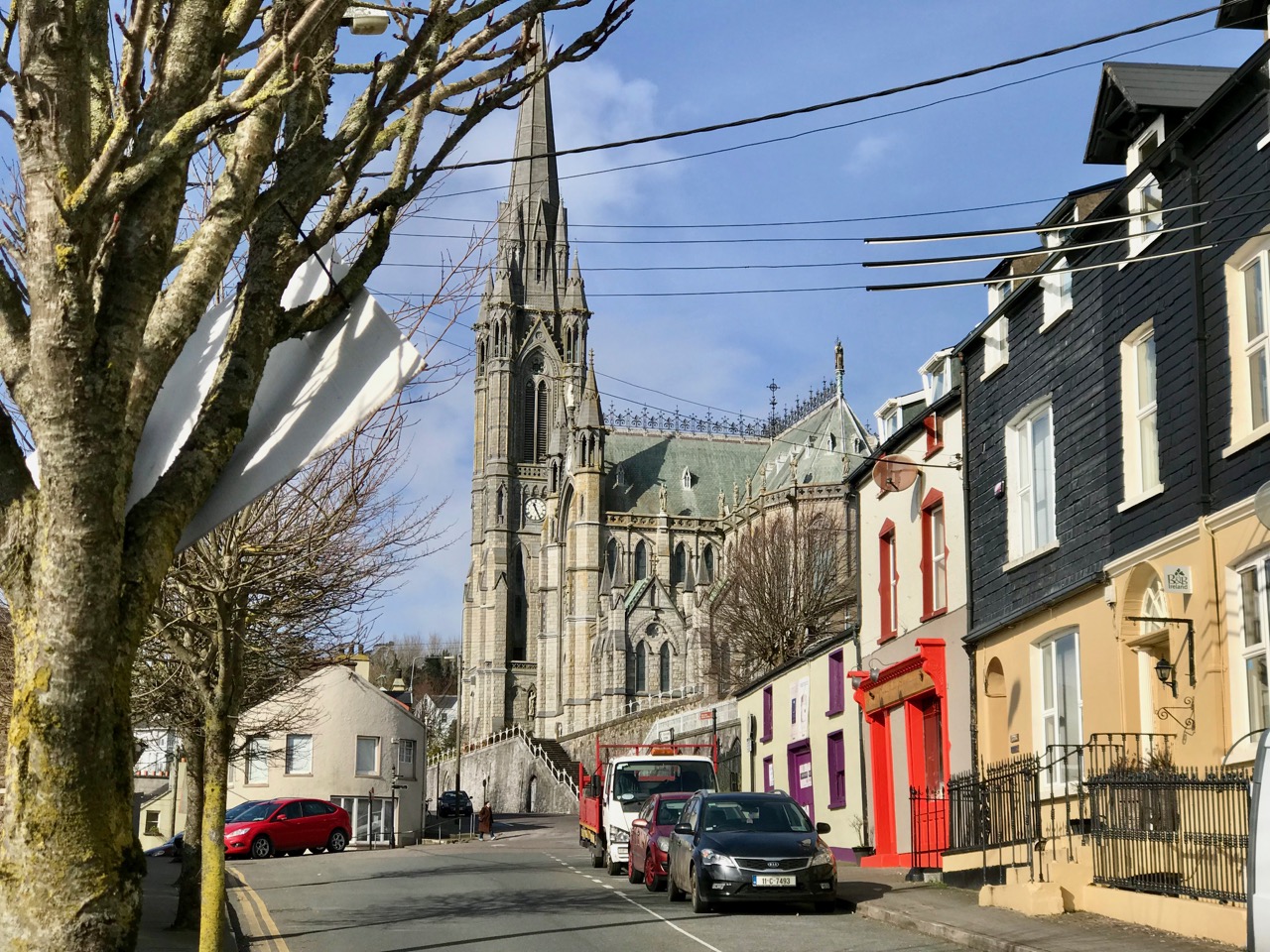
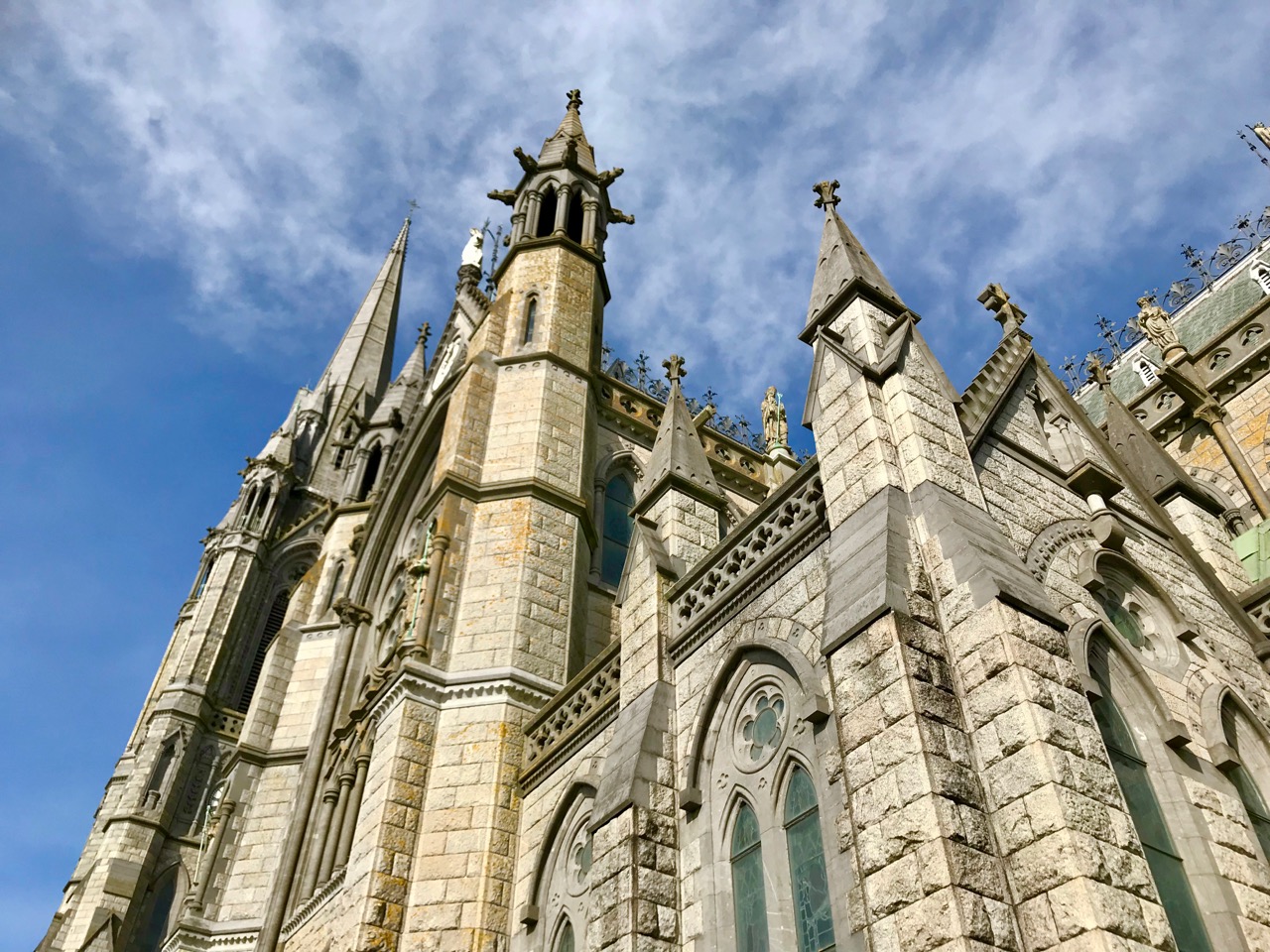
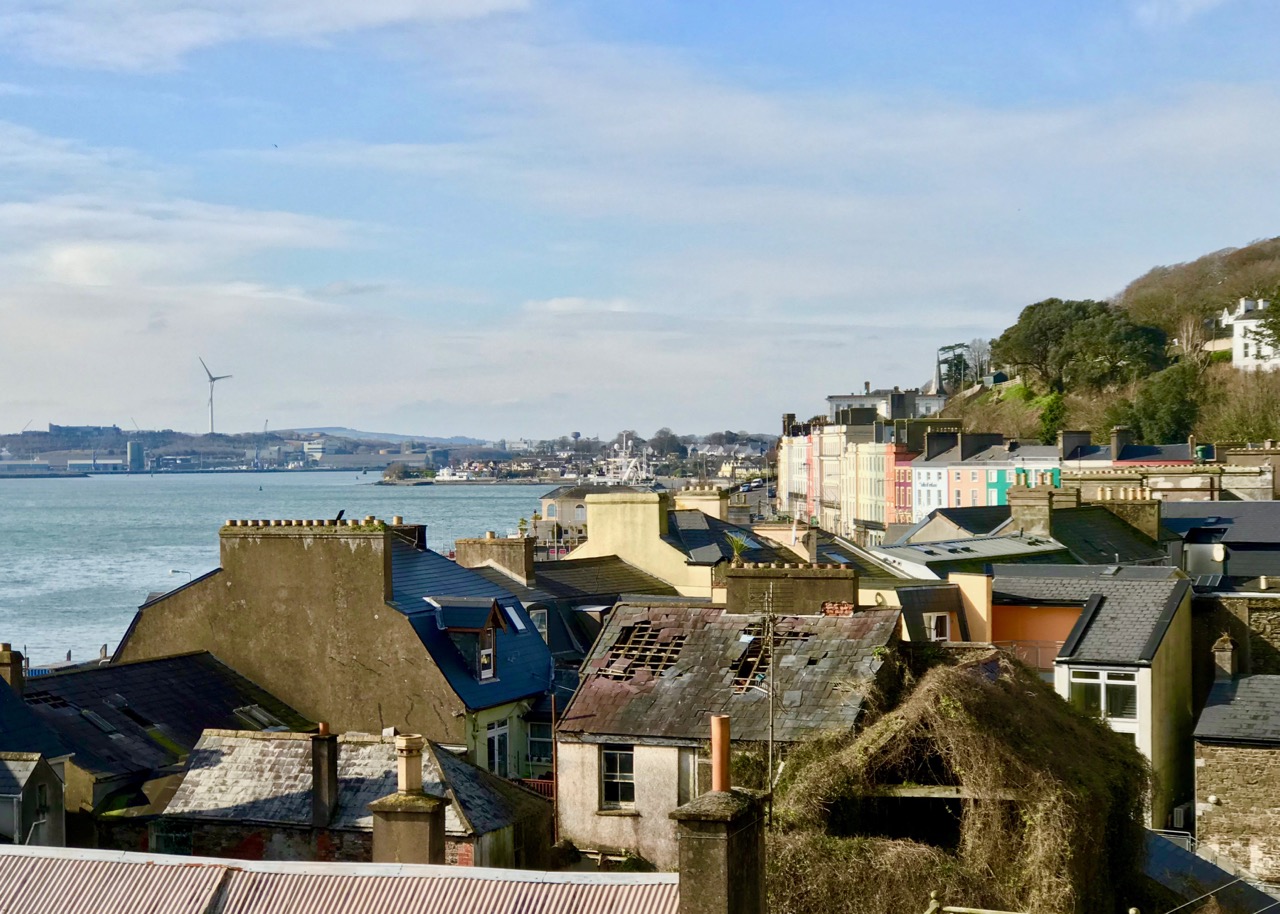
The excitement mounted when we steamed past the port town of Cobh, as the ferry terminal was then just around the corner. From afar I admired the way this settlement embraced the water with its long, colourful terraces lined up the steep hillside on which it was built, crowned atop by the magnificent Victorian edifice which I now know to be probably the finest architectural work of Edward Welby Pugin in Ireland: St Colman’s Cathedral.

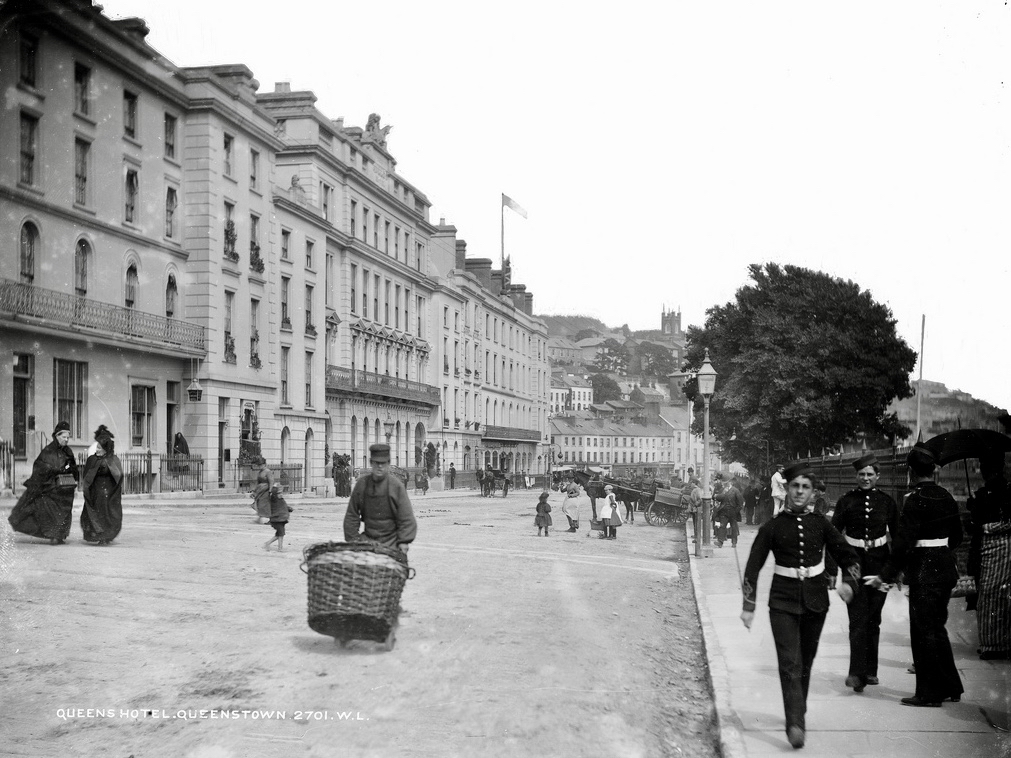
I am almost ashamed to confess, then, that I had never called in on Cobh until last week – and the visit was a relevation. First, let me clear up some possible confusions: the name is pronounced ‘Cove’ – and the word in fact comes from the English, but has been Gaelicised to Cobh, (Irish An Cóbh), the location having allegedly been known since around 1750 as ‘The Cove of Cork’. The name was changed to ‘Queenstown’ after a visit from Queen Victoria in 1849, and was then changed back to Cobh after the founding of the Irish Free State in 1922. Or – have I just contributed to the confusion? One thing is for sure: the strategic waterside location in the great natural harbour of Cork is the raison d’être of this grand town.

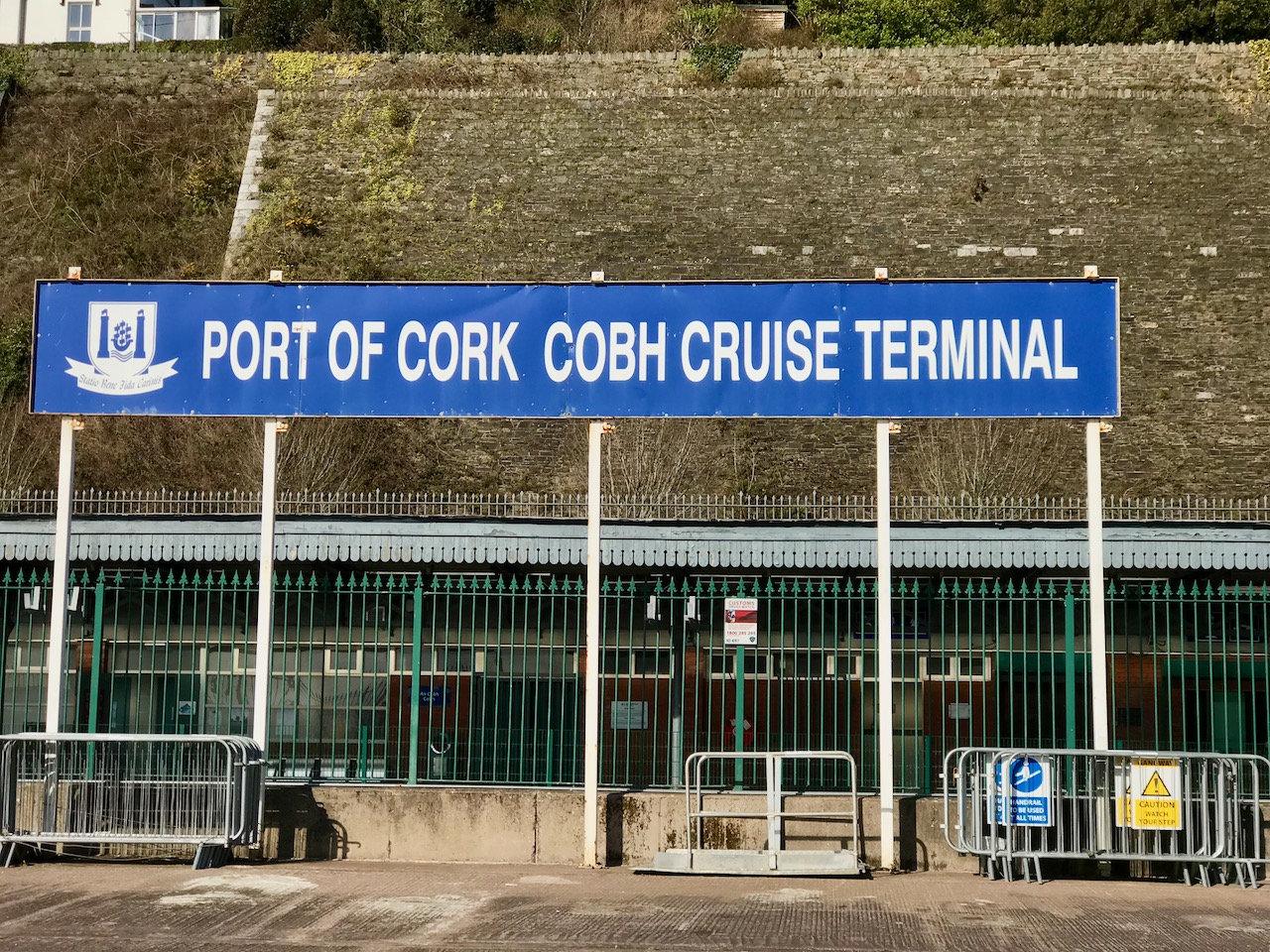
Yes, it’s all about the water, and the fact that it is located beside the “second largest natural harbour in the world by navigational area” (a claim also made, incidentally, by Halifax Harbour in Canada and Poole Harbour in the UK – the undisputed nomination for largest harbour is Port Jackson, Sydney, Australia). Cobh faces the wonderfully named Haulbowline Island and Spike Island, both of which have been established as defensive fortifications, and the former as an important naval dockyard since before Napoleonic times. Today, Cobh has the only dedicated cruise ship berth in Ireland.

Do you remember my telling of the story of Cessair and the first human footsteps on Irish soil in our own Bantry Bay? The story is recounted in the 11th century Lebor Gabála Érenn (The Book of the Invasions of Ireland). The same book tells us about Neimheadh and his followers the Muintir Neimhidh  – People of Nemed – who arrived soon after Cessair around 2000 BC, but in Cork Harbour and settled the islands there: Neimheadh, like Cessair, shared his genealogy with Noah and is said to be buried in a mound on Great Island, overlooking present-day Cobh.

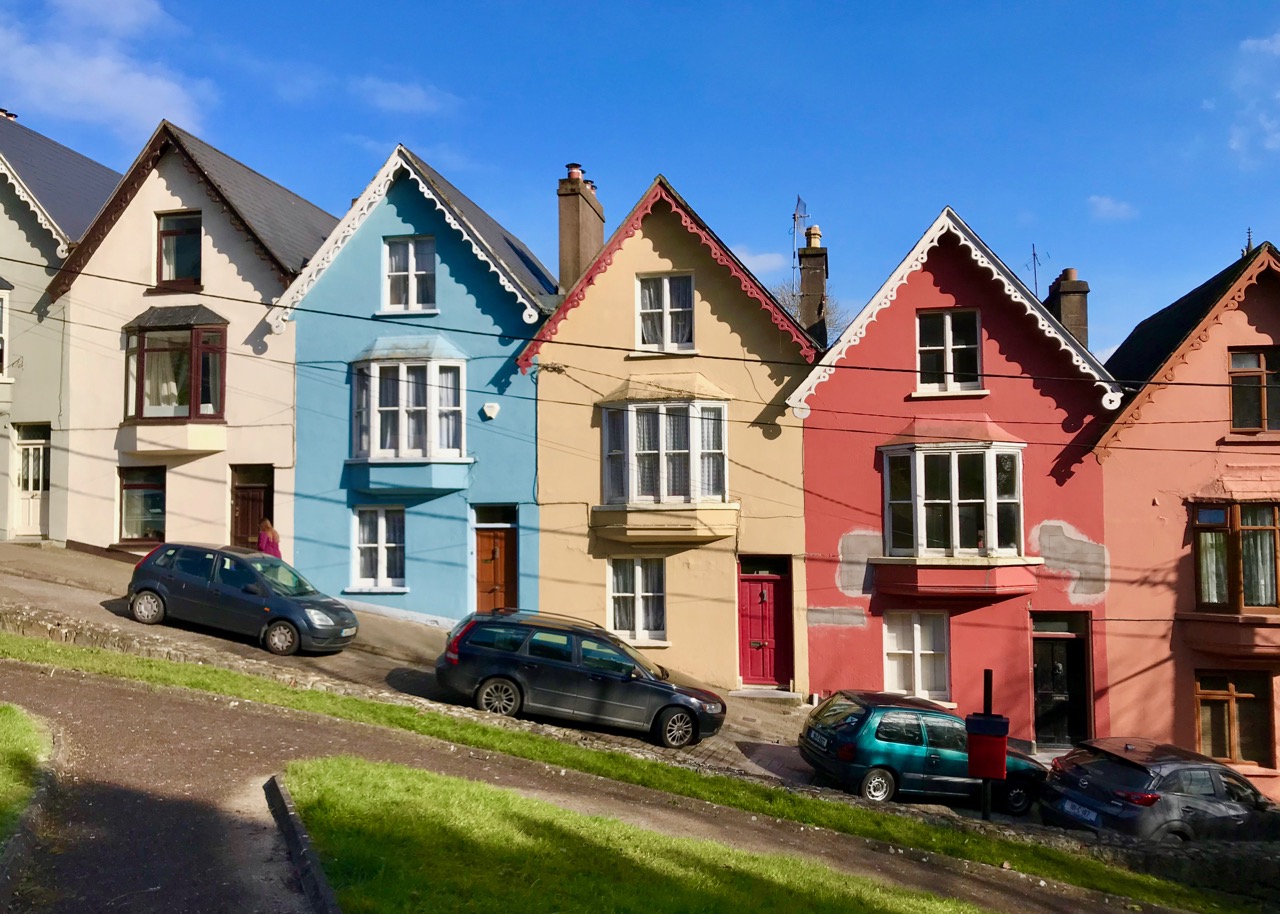
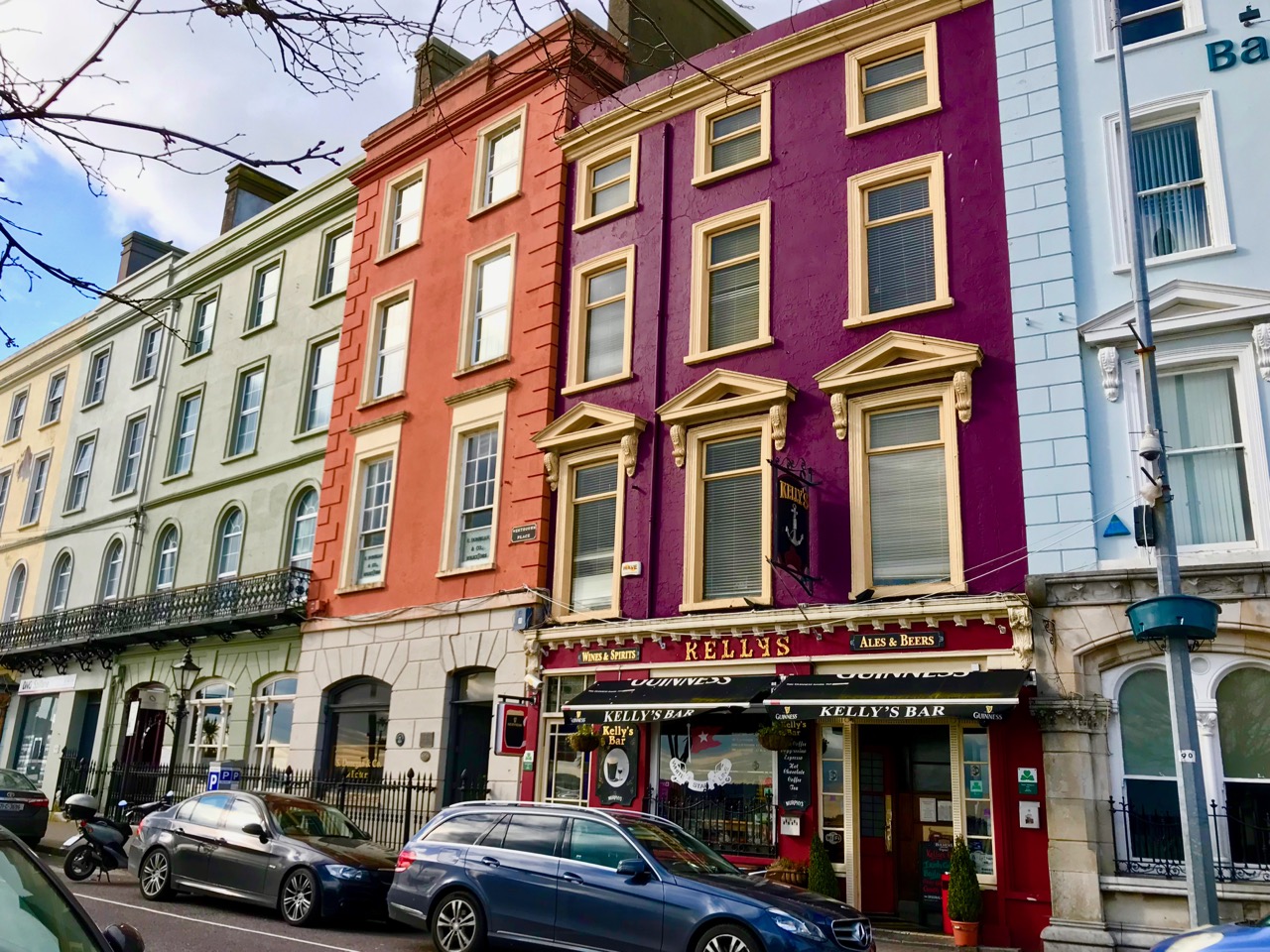
So why am I so impressed by Cobh? Perhaps it’s because – as an architect – I find the streetscapes so elegant, and quirky. For me it’s a cross between the horizontal graceful manners of Georgian Bath and the higgledy-piggledy uphill habitation of the steep lanes of Newlyn in Cornwall, where I lived for many years.

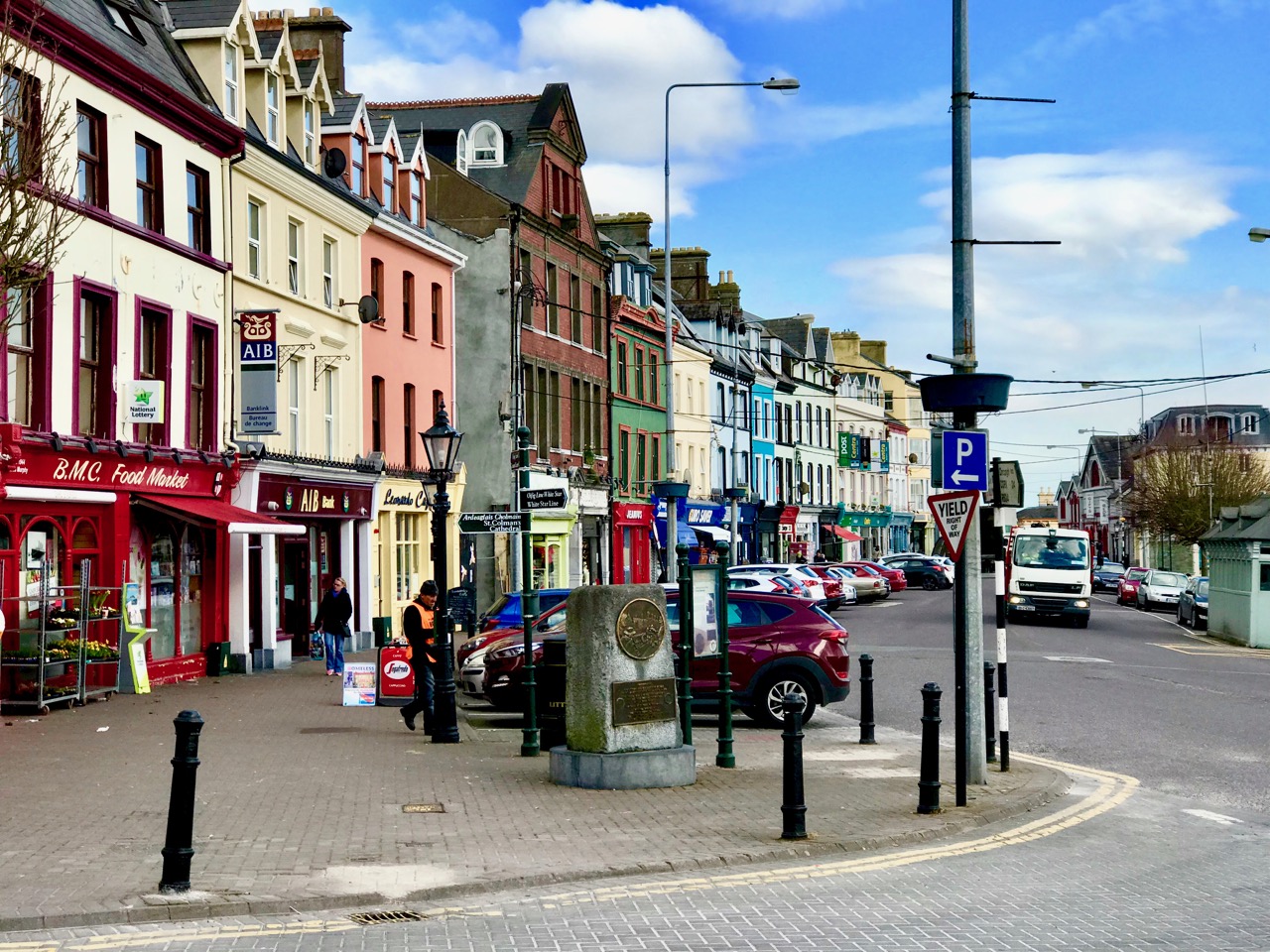
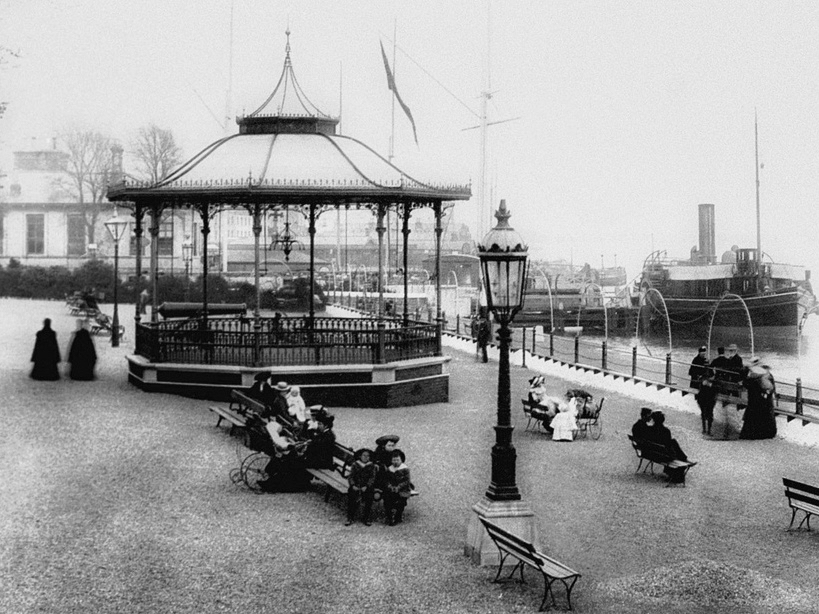
Above – Cobh yesterday and today, showing the elegance of the development of the town in the nineteenth century. Below – another side of Cobh: the steeply descending streets with some remarkable and picturesque terraces, crowned always by the glory of the Cathedral, which took half a century to build. Construction began in 1867.

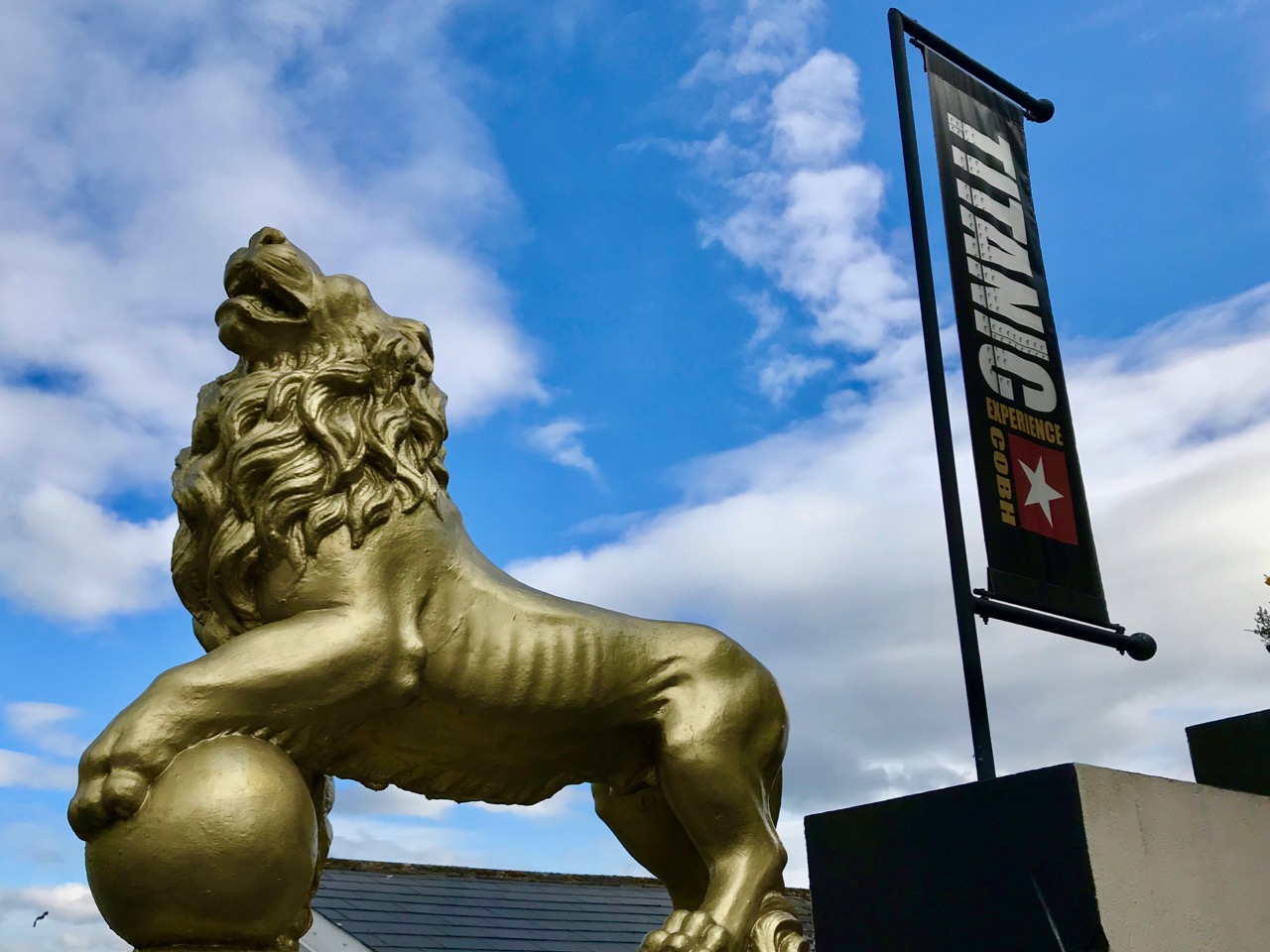
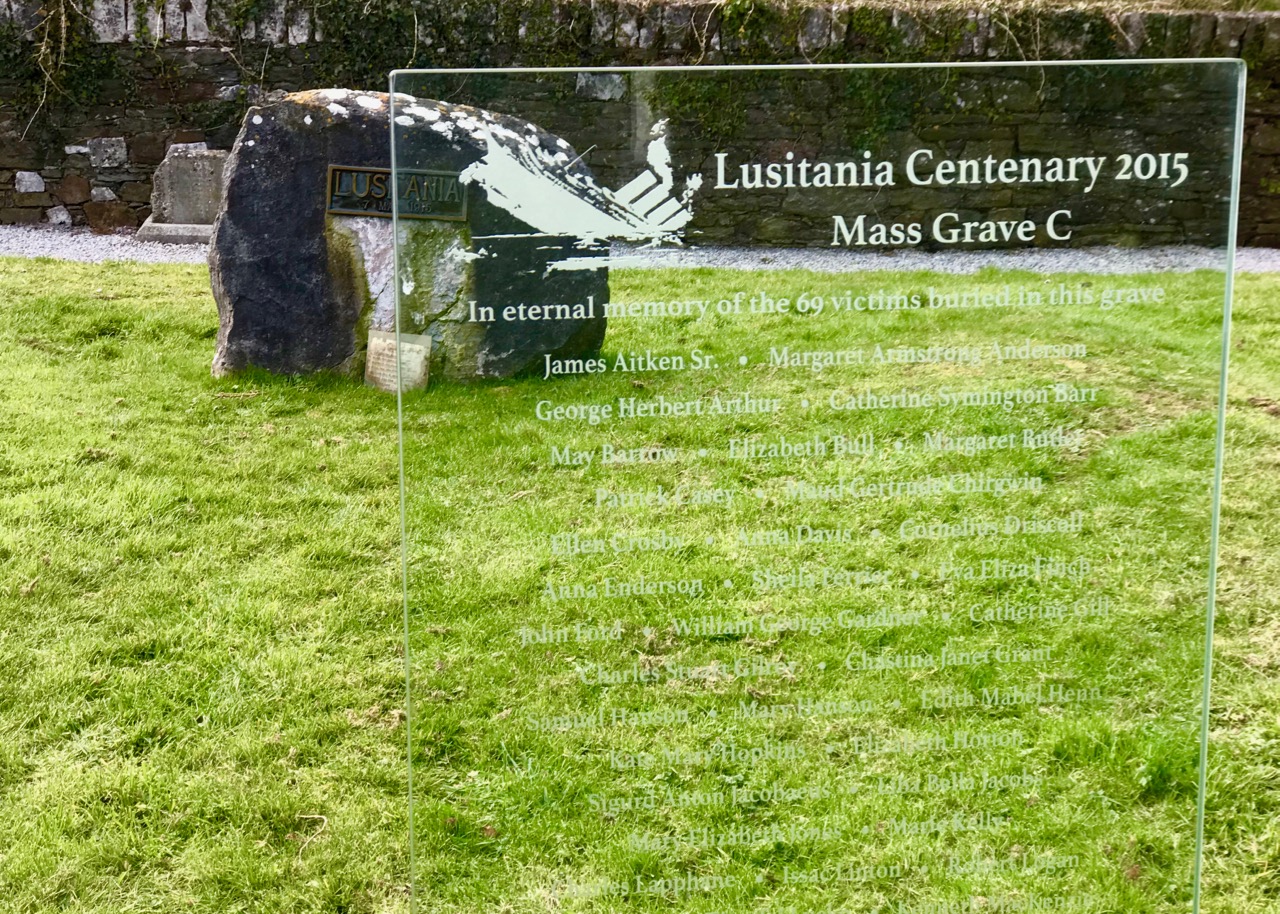
Cobh is such an attractive town to walk around: it should be the jewel on County Cork’s tourist trail. This post is a fairly minimalist photographic essay of what caught my eye on the day we visited. There is a lot more to explore: we never made it to the Heritage Centre, nor to the Titanic Experience, which has brought particular fame to the place in recent times: it was the final embarkation point on the ship’s fateful maiden voyage. All for another day. But we did get up to Cobh’s Old Church Cemetery, high on the hill, where the victims of the Lusitania sinking were buried in mass graves in 1915: a poignant place.

But it was the architecture that had me absorbed: well proportioned and detailed buildings – often simple – that may be overlooked except for the way in which they come together into such a dignified whole. And – such an exploration of colour!

There’s much more to tell of the story of Cobh, and – certainly – so much more to see. I will follow up this post in the coming weeks; the magnificent Cathedral can justify an article on its own. Hopefully you will visit yourself if you have not already done so: your eyes will be opened . . . Look out for the small details!


Mizen Magic 8: The Altar

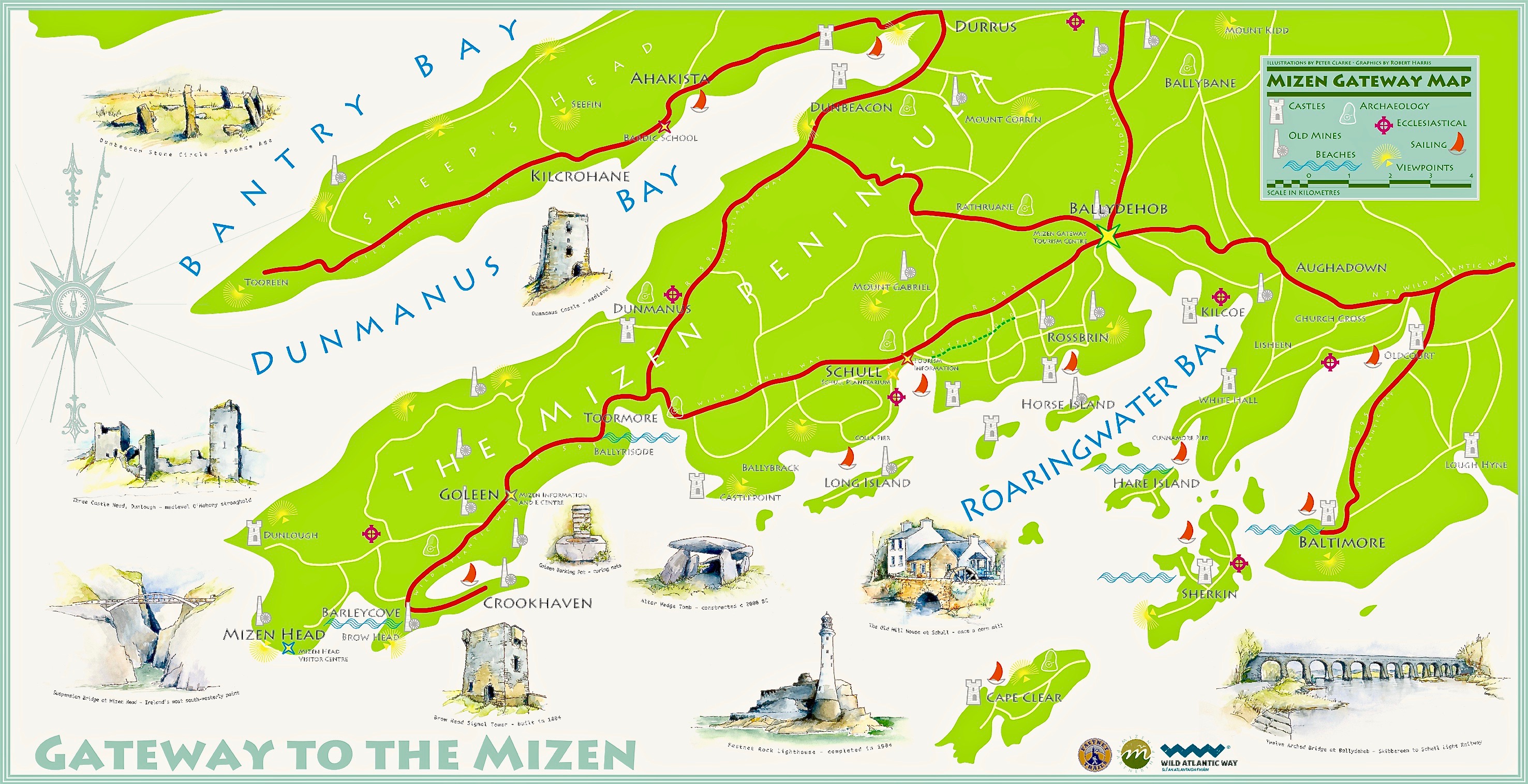
Here’s the Mizen Peninsula shown on a map drawn by Robert for the Bank House tourism centre in Ballydehob and embellished with Peter Clarke‘s exquisite watercolour sketches of just some of the places that should not be missed by visitors to West Cork . . .

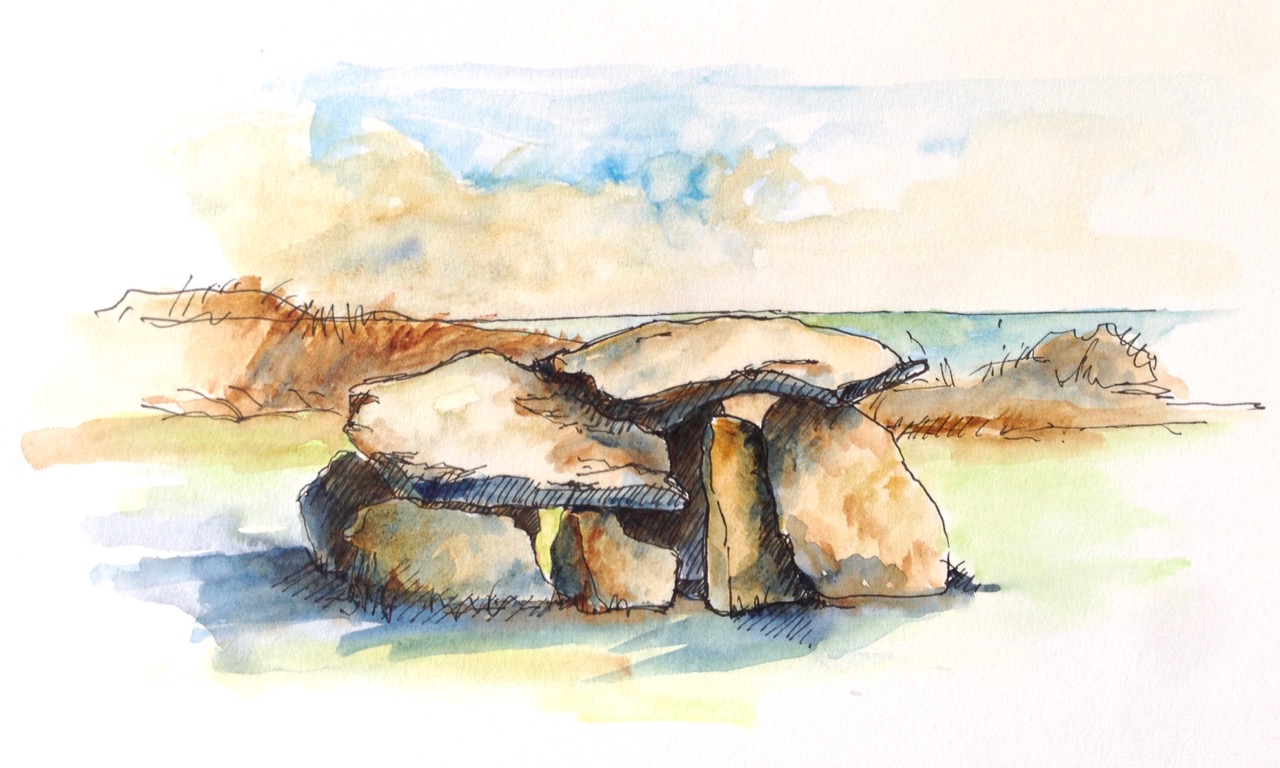
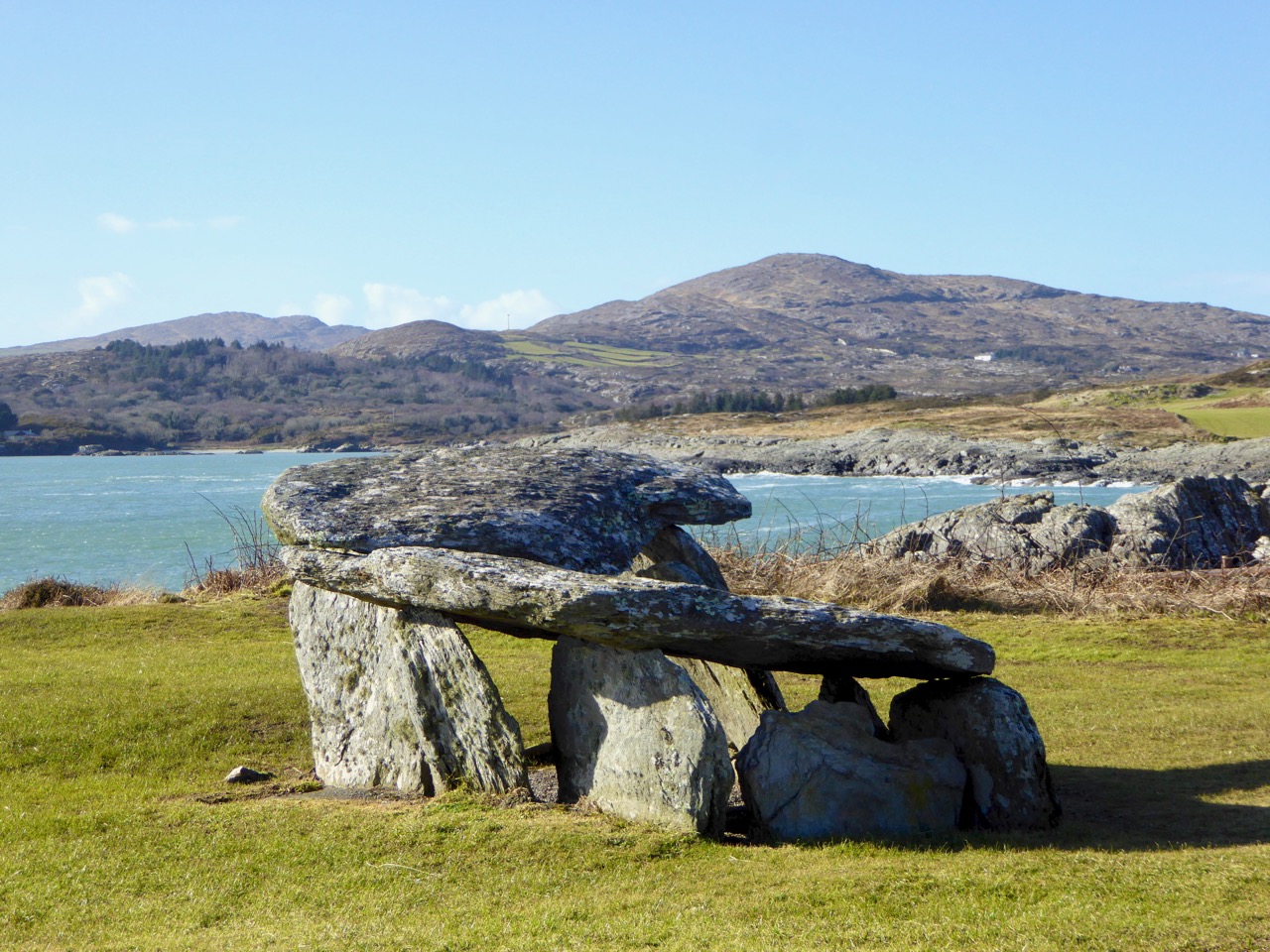
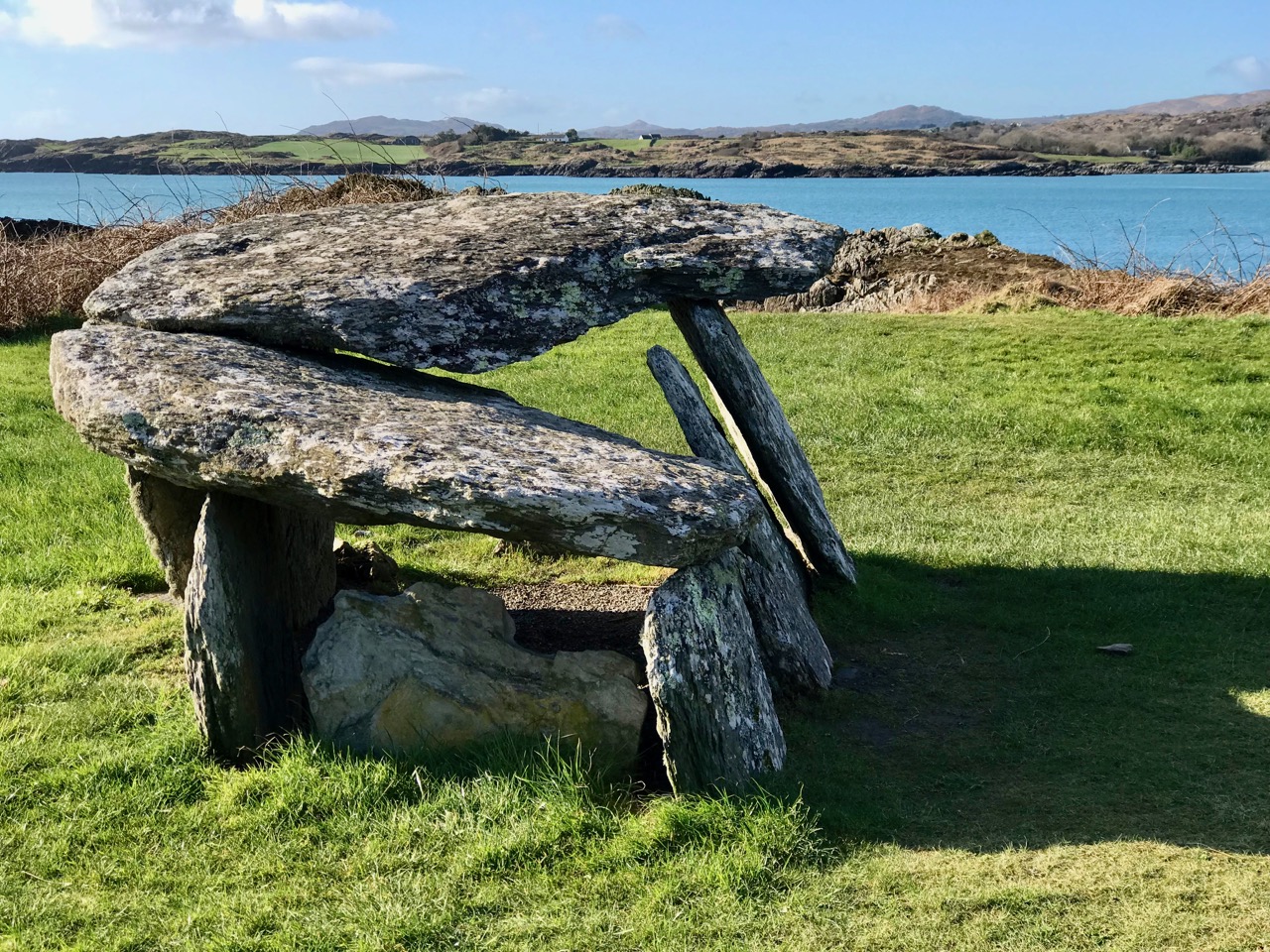
. . . And here is another rendering from Peter of one of the ancient sites that everyone goes past when travelling to the far west: possibly one of the most accessible pieces of archaeology on this section of the Wild Atlantic Way. It’s the Altar Wedge Tomb at Toormore Bay.

It’s early February, and Imbolc has passed. That means that Springtime has officially started here in Ireland. Sure enough, we looked out over a sunlit Roaringwater Bay this morning: soon we were heading out towards Goleen, Barley Cove and all points west. We stopped at The Altar and had it all to ourselves. You can see here that it’s orientated towards the Mizen Peak – that sharp little pyramid which is right on the centre of the picture – and lies to the west. For me, there’s a perfectly natural symbolism about placing the dead in a tomb that is aligned on the rising and the setting of the sun: that’s something we still do, several thousand years on!

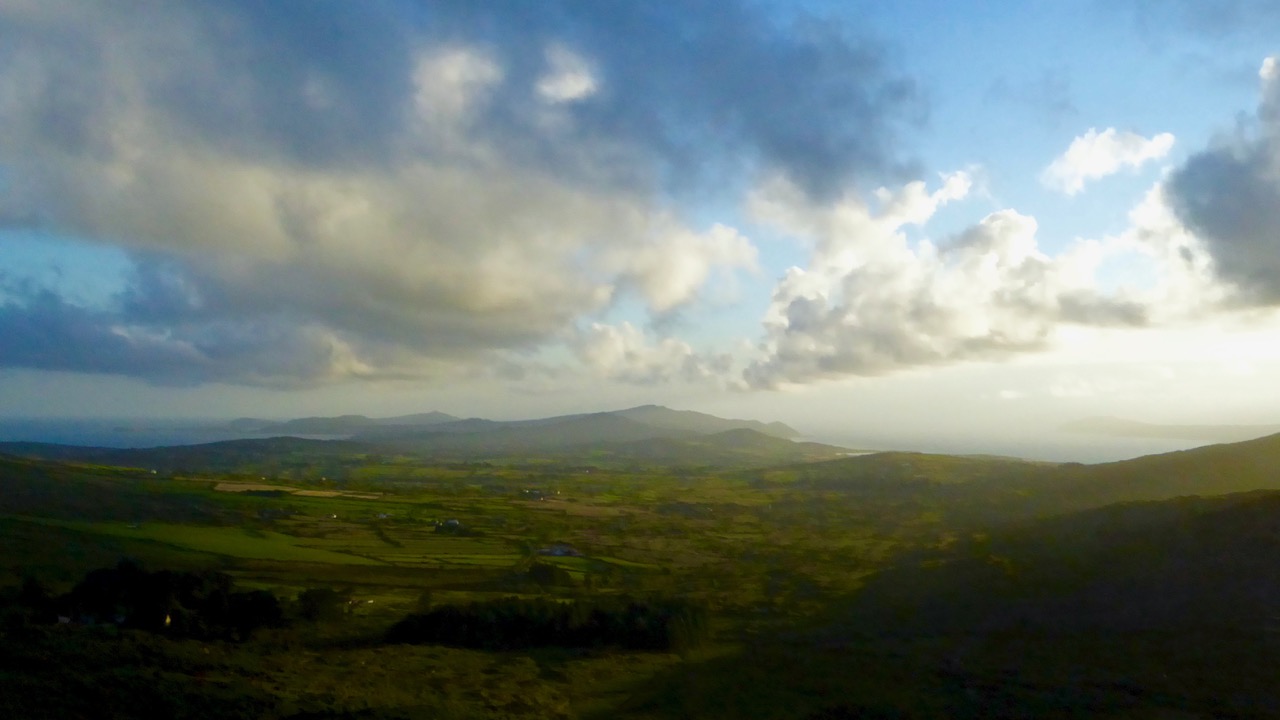
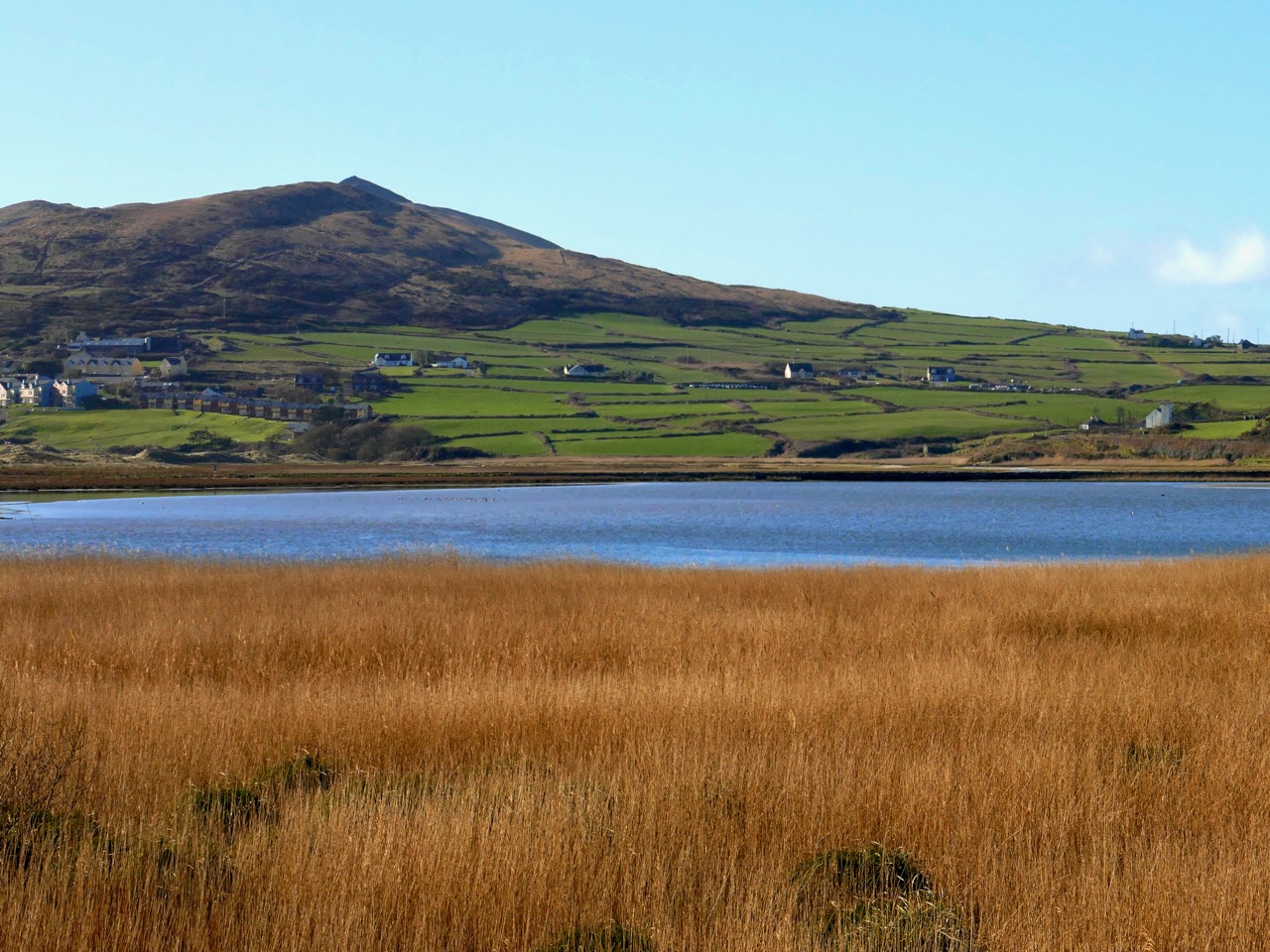
The upper picture, taken on the Winter Solstice, shows the Mizen stretching away from the heights of Mount Gabriel: the Mizen Peak is the little pointed blip just left of centre. The lower picture looks across the wetlands behind the sand dunes at Barley Cove, and was taken today in the Spring sunlight: the Peak is clearly visible as the highest point. I believe that our forebears attached great importance to high places, as many stone monuments and Rock Art often seem to be placed in the landscape with commanding views towards hilltops. Mike Wilson’s site Mega-What sets out his detailed studies of the orientation of ancient sites within the natural landscape. Here is his analysis of the setting of the Altar Wedge Tomb.

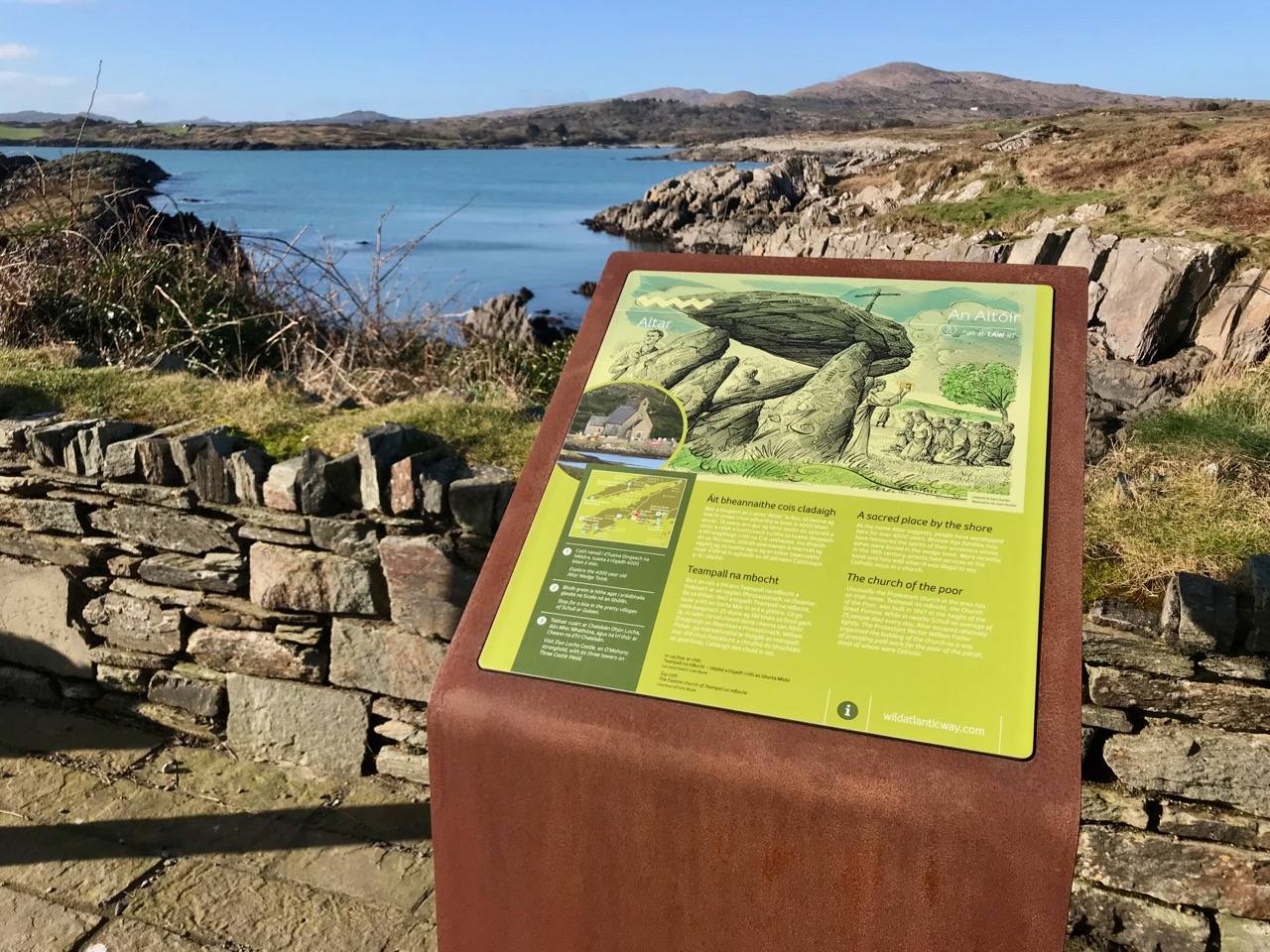
I am always alert for the ways in which our special sites are interpreted for us. I created a bit of a storm a while back when I commended the signage which has been put in place along the Wild Atlantic Way using visually strong corten steel elements (above left) supplemented more recently by (in my opinion) very well designed information boards. The image on the right above is from an earlier OPW board which explains the possible early use of the wedge tomb, while the images below show the new signage, which features the later use of the tomb as a Christian altar during the Penal times (hence the name: The Altar), with a drawing by Sam Hunter. I am struck by the way this monument has been a focal point for differing rituals spanning countless generations.

When writing about archaeological subjects I am always on the lookout for the way that antiquarians saw the sites which we are familiar with today. I had hoped that George Victor du Noyer – the subject of an excellent recent exhibition in Cork’s Crawford Gallery – might have drawn this wedge tomb when he travelled the country for the Ordnance Survey during the early nineteenth century: he may well have done, but the annotation and cataloguing of his vast legacy of work has yet to be completed and I have not found such a record. His drawings below are not of The Altar, but a portal tomb, Ballybrittas in County Wexford. Portal tombs (sometimes known as dolmens) share similarities with wedge tombs, but are earlier, dating from between 3000 BC to 2000 BC, while wedge tombs tend to be associated with the Bronze Age, which followed this period.

Cremated remains were found in Altar Wedge Tomb when it was excavated in 1989 by Dr William O’Brien, now Professor of Archaeology at UCC. We can never know exactly what the significance of these impressive structures was to those who built them. For me, I’m pretty sure that it was connected with their relationships to, and respect of, the landscapes which they inhabited, and which they invested with meaning. They must certainly have paid heed to the passing of the seasons and the continual cycles of nature, and their closeness to all of this must have given them an inherent knowledge of the paths of the sun, moon and stars. Above all, our ancestors had to understand and appreciate the environment around them, and make it work for them. In a practical sense, certainly, but also in terms of the stories they might pass on about the meaning of places.

Above – the magical landscape of the Mizen: we will never tire of it

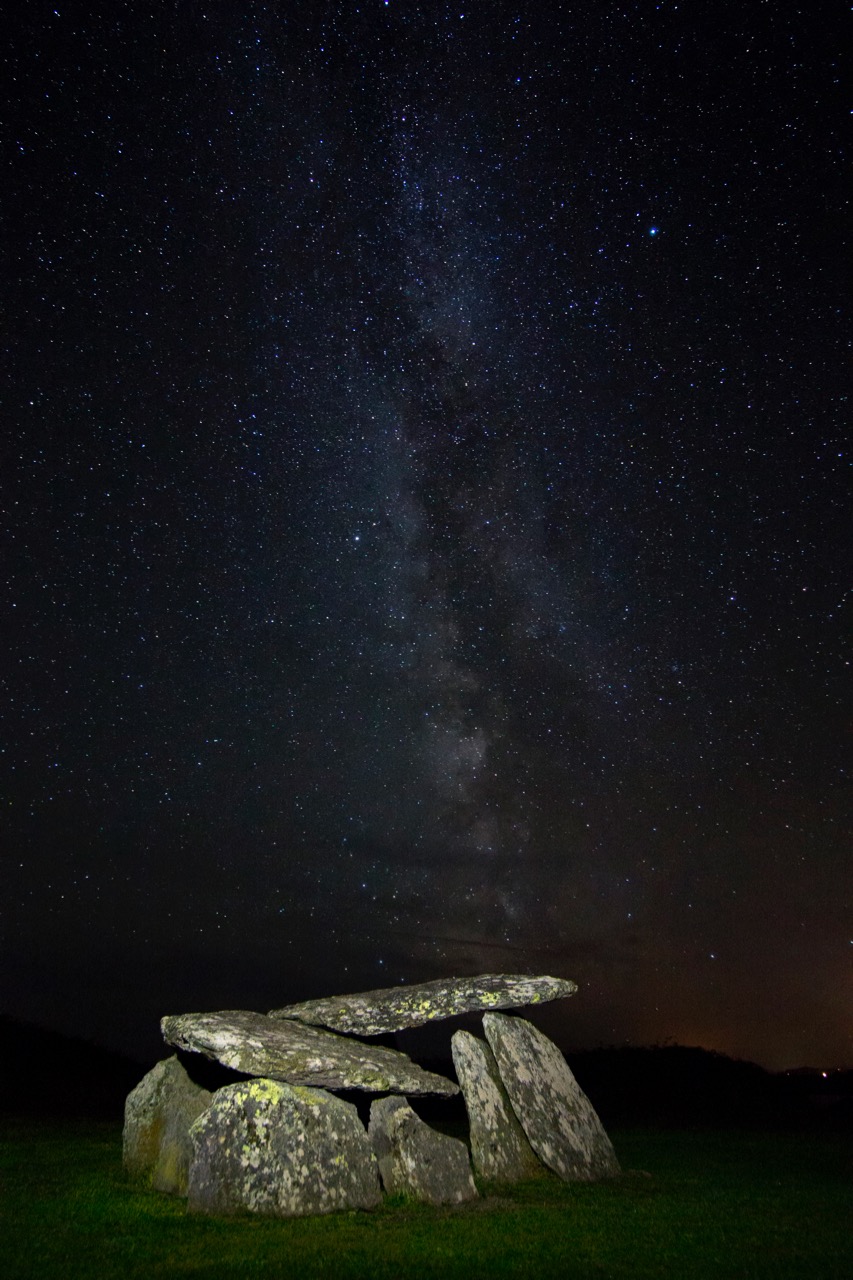
The tailpiece picture, which is from Wikimedia Commons, attributed to Lukeoc88, is a remarkable timeless view of a human construction in the setting of our Universe: Altar Wedge Tomb under the Milky Way.

Robert Gibbings

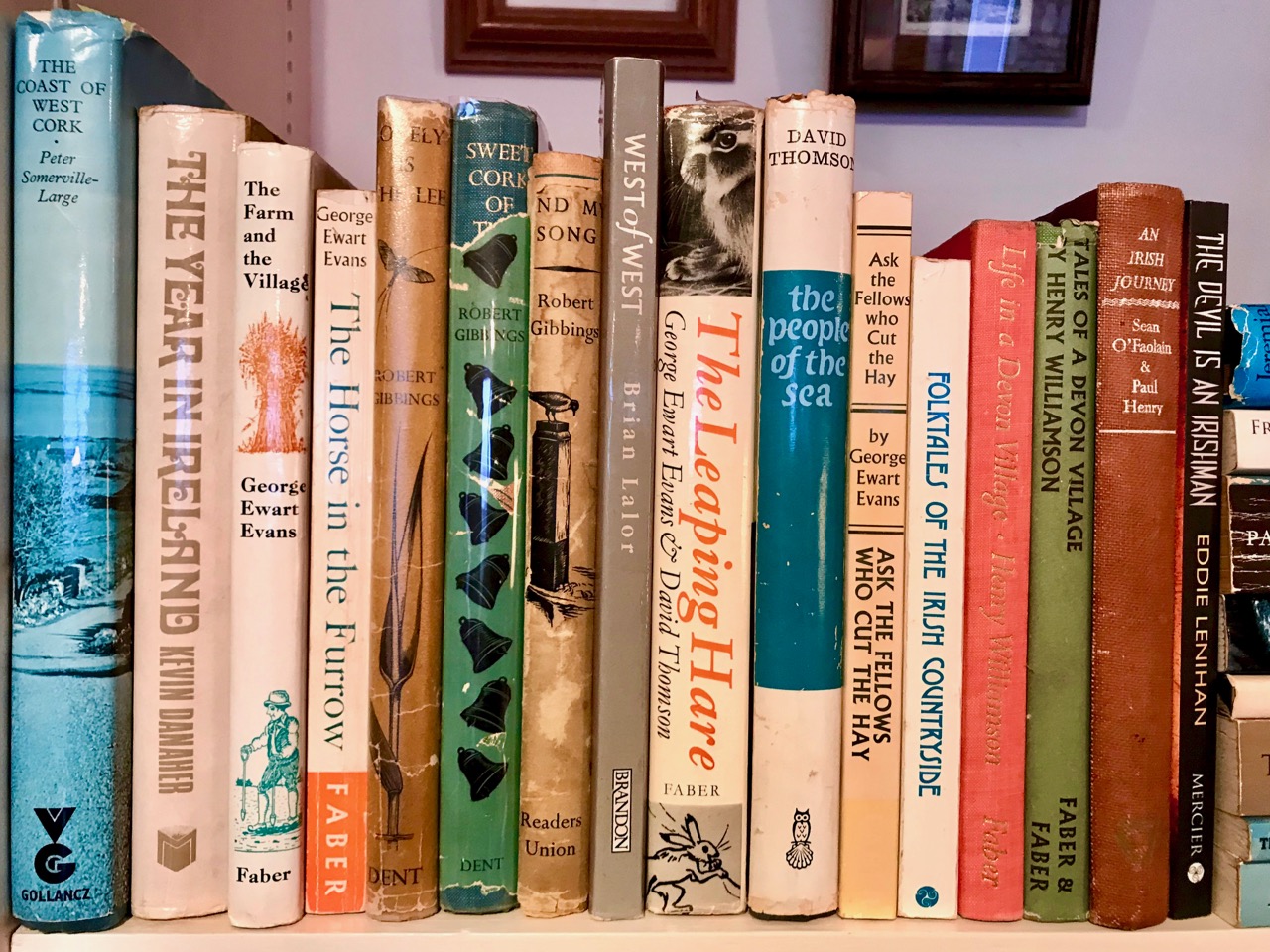
Our bookshelves in Nead an Iolair include some volumes which have travelled with me for the best part of fifty years. They include titles by George Ewart Evans, Henry Williamson, Brian Lalor, Peter Somerville-Large. Look carefully and you’ll also see some there by Robert Gibbings. Who is he?

A writer and illustrator, Gibbings was born in 1889 and died exactly sixty years ago, on 19 January 1958. He was a Cork man, raised in Kinsale, where his father became the Rector of St Multose Church. However, he was an inveterate traveller and lived most of his working life in England. Much of his work seems to exude ‘Englishness’ and – in an Irish Times article this week to mark the anniversary of his death, Alannah Hopkin writes:

People often forget that Gibbings was Irish. Brian Lalor, author of Ink-stained Hands, the definitive history of Irish print-making, was challenged by an English academic at a conference in Dublin in 2007, who refused to believe that Gibbings was Irish, as he had produced archetypal English landscapes. But his account of Gougane Barra, for example, confirms how deeply steeped in Irish myth and folklore Gibbings was.

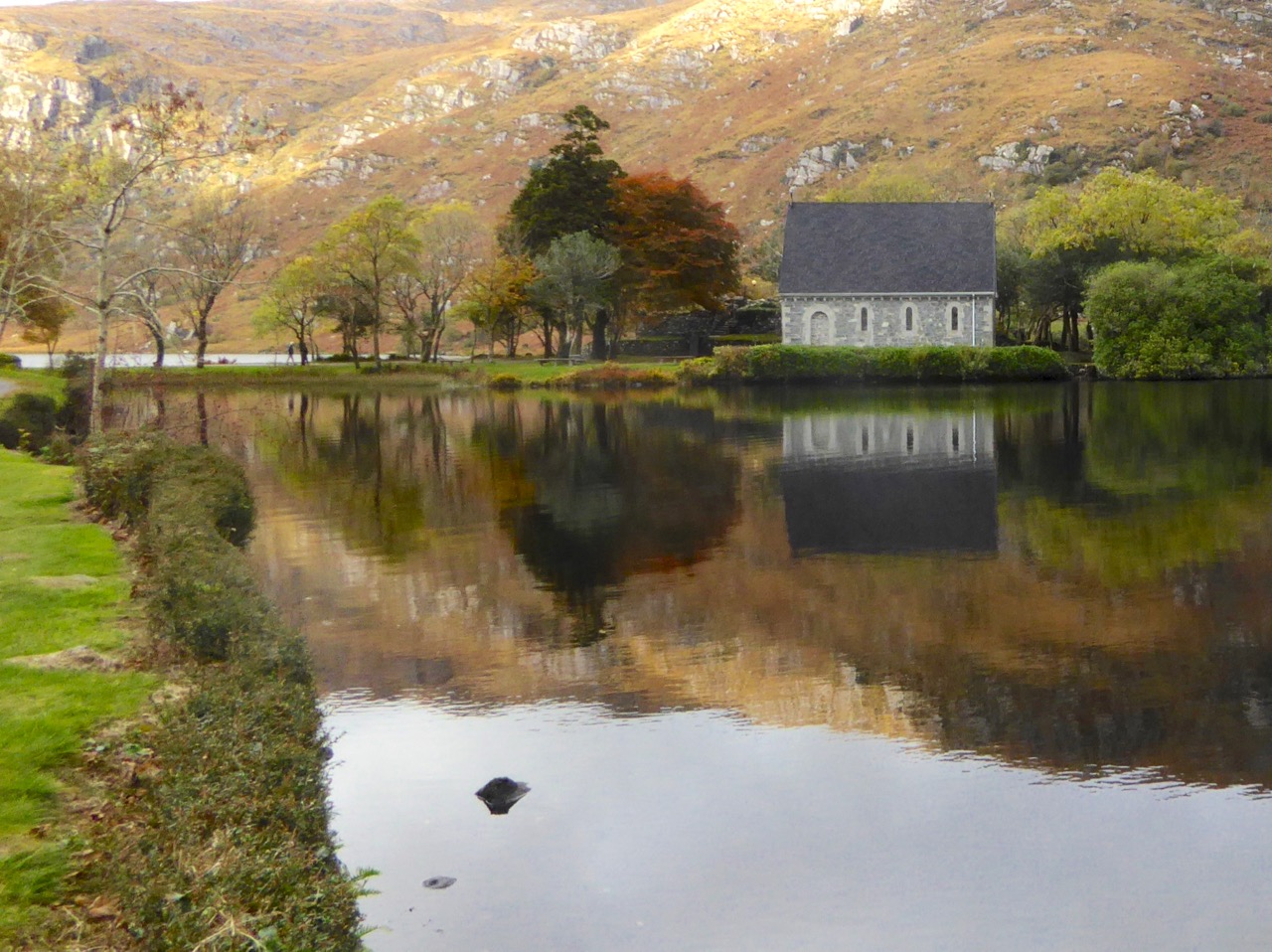
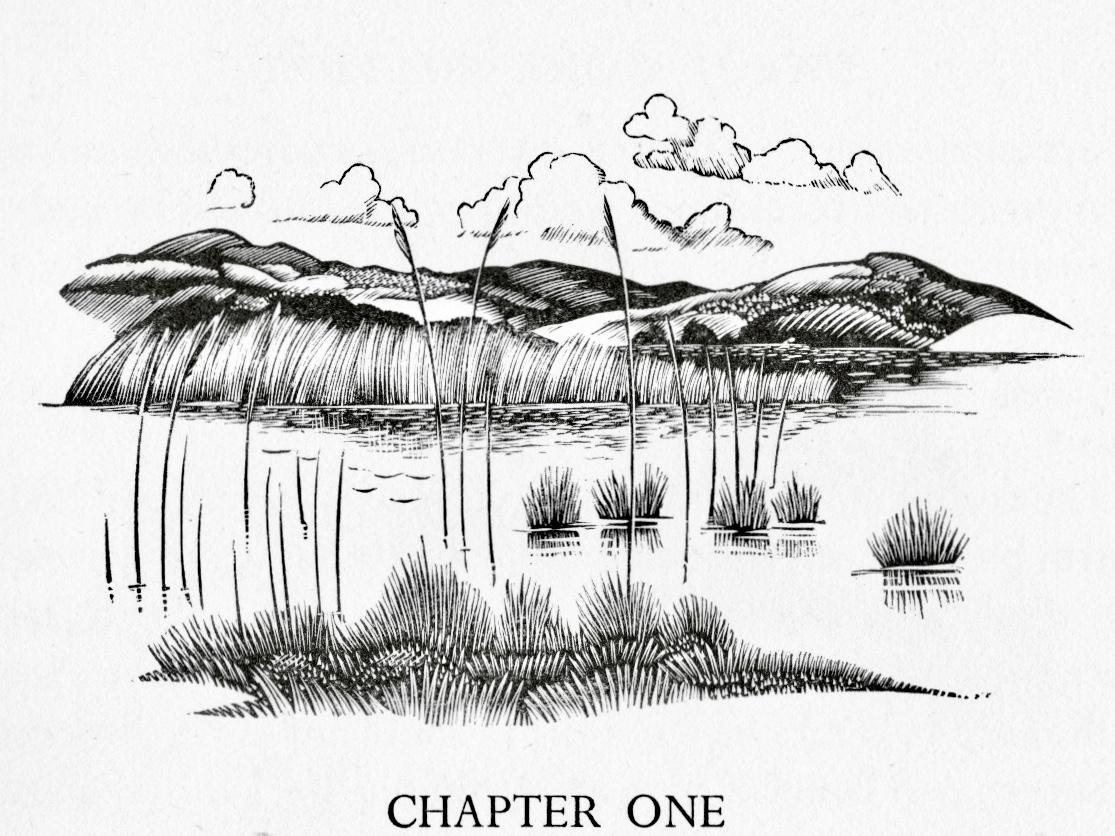
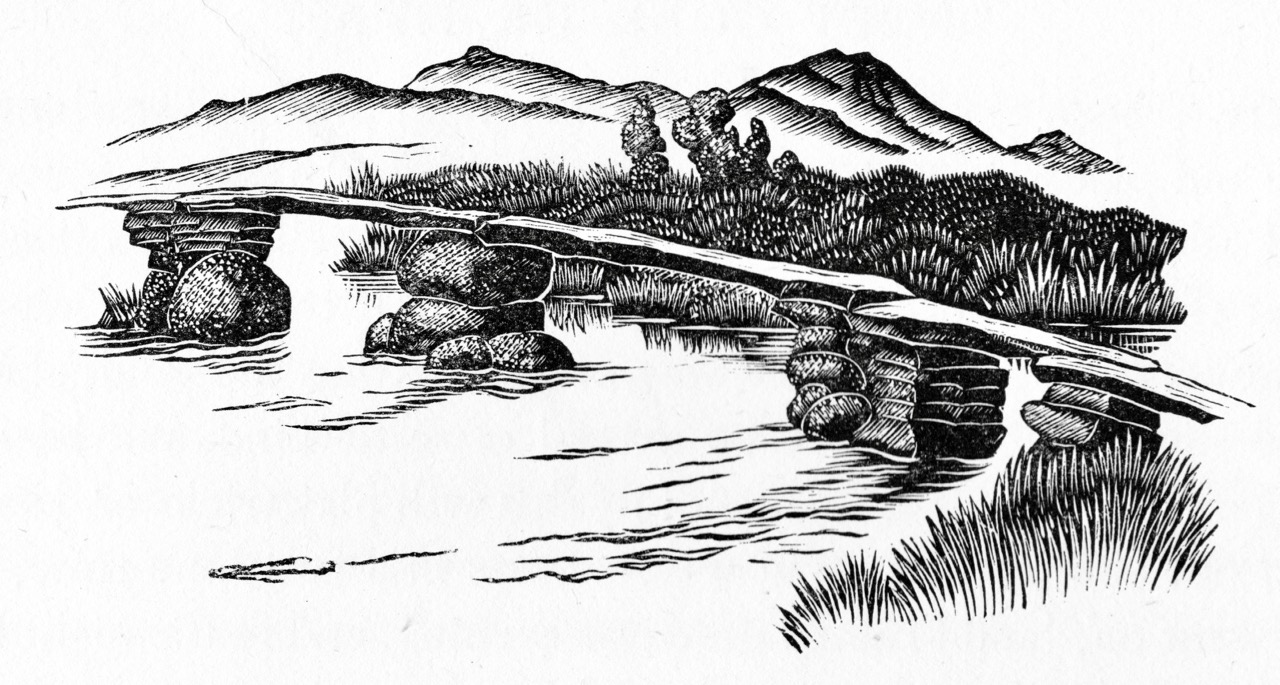
Gougane Barra in County Cork: upper image – the lake in the mountain. Centre – Robert Gibbings’ woodcut engraving of the lake which opens ‘Sweet Cork of Thee’ (1951). Lower image: a clapper bridge near Gougane – perhaps the same one which Finola illustrates in her post today

At the insistence of his parents, Gibbings studied medicine at UCC, although his ambition was to be an artist . . . writes Alannah Hopkin . . . While he enjoyed the scientific side of his studies, it soon became apparent that this big, soft-hearted man was unable to cope with the human suffering of his patients. His parents were apprehensive about his decision to be an artist, fearing, quite rightly, that it meant he would lead an unconventional life, looking at naked women, dressing untidily and consorting with social misfits . . . From 1911 he studied life drawing at the Slade in London. His contemporaries included Eric Gill, John Nash, David Jones and Mabel Annesley. He was advised to take wood-engraving classes; the technique perfectly suited his strong line and close observation of nature, which in this phase was lightly stylised.

Gibbing’s woodblock signature – used in the majority of his books – shows the tools of the wood engraver

The wood engravings of Robert Gibbings are exquisite: his eye is attuned to fine detail. His writing is also compelling: I suppose it reflects a nostalgia for past times and things gone, but it is also humorous and always tightly observant. He brings to life characters he has met in his travels.

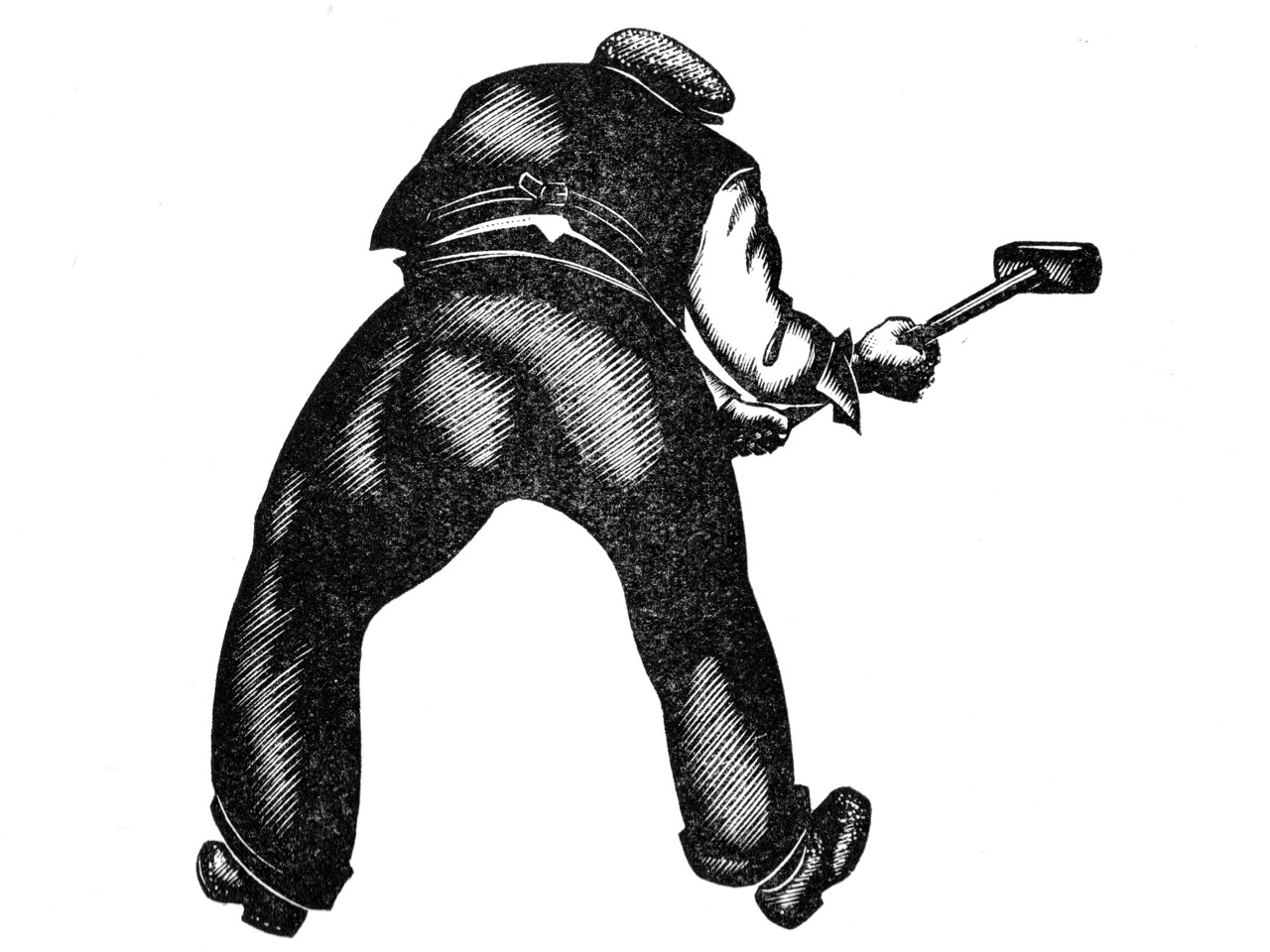
‘Paddy the Forge’ putting metal tyres on wagon wheels – from Sweet Cork of Thee

In the 1940s Gibbings attended the World Ploughing Contest, held for the first time in England, at Shillingford on Thames:

Bowler hats and highly polished riding boots had been the order of the day at the Arab Horse Show: here among the shires it was rubber-boots, corduroy caps, and hats of weathered tweed. ‘I think you’re Irish,’ said a man to me as I was admiring a pair of Pedigree Suffolks resplendent with brasses that told of former triumphs. ‘What gives me away?’ I asked. ‘The tilt of your hat,’ he said, ‘I can always tell an Irishman – he just sticks it on his head and forgets it. Look at some of these fellows – caps, hats, pulled up here, pushed down there – self-conscious all of them. Look at those two fellows in the pork-pie hats – I wouldn’t trust that one on the right, he wears his too straight, has to – it’s psychological.’ ‘Bishops wear their hats straight,’ I said. ‘Same idea,’ he answered. ‘Suggests the narrow path, only they keeps to it.’

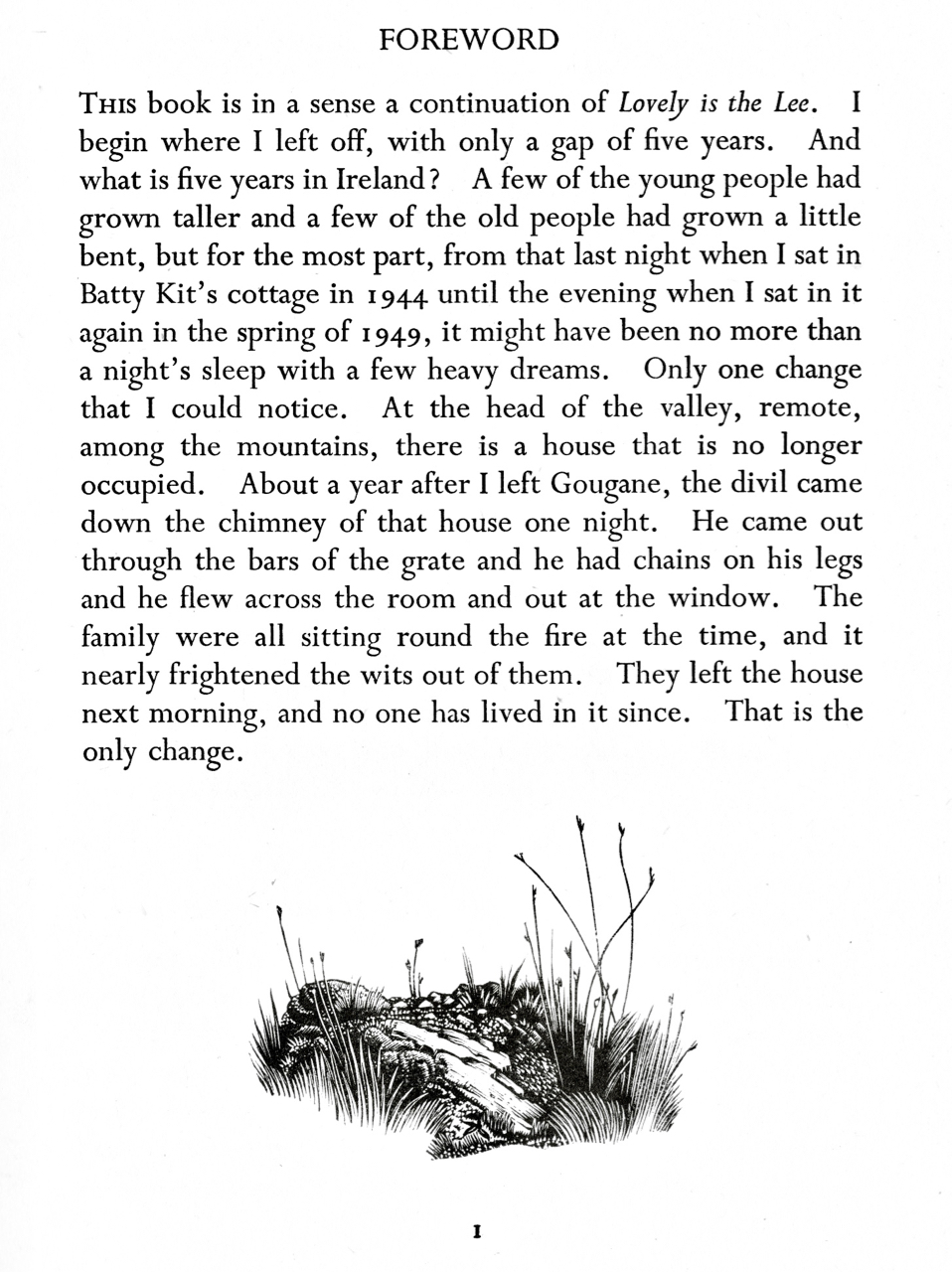
For Robert Gibbings, text and illustration were always of equal importance. Each page of his books is set out as an art work, to be enjoyed by the two senses of sight and feeling – the feeling engendered by his descriptive writing. Here is the Foreword to his second ‘Irish’ book – Sweet Cork of Thee:


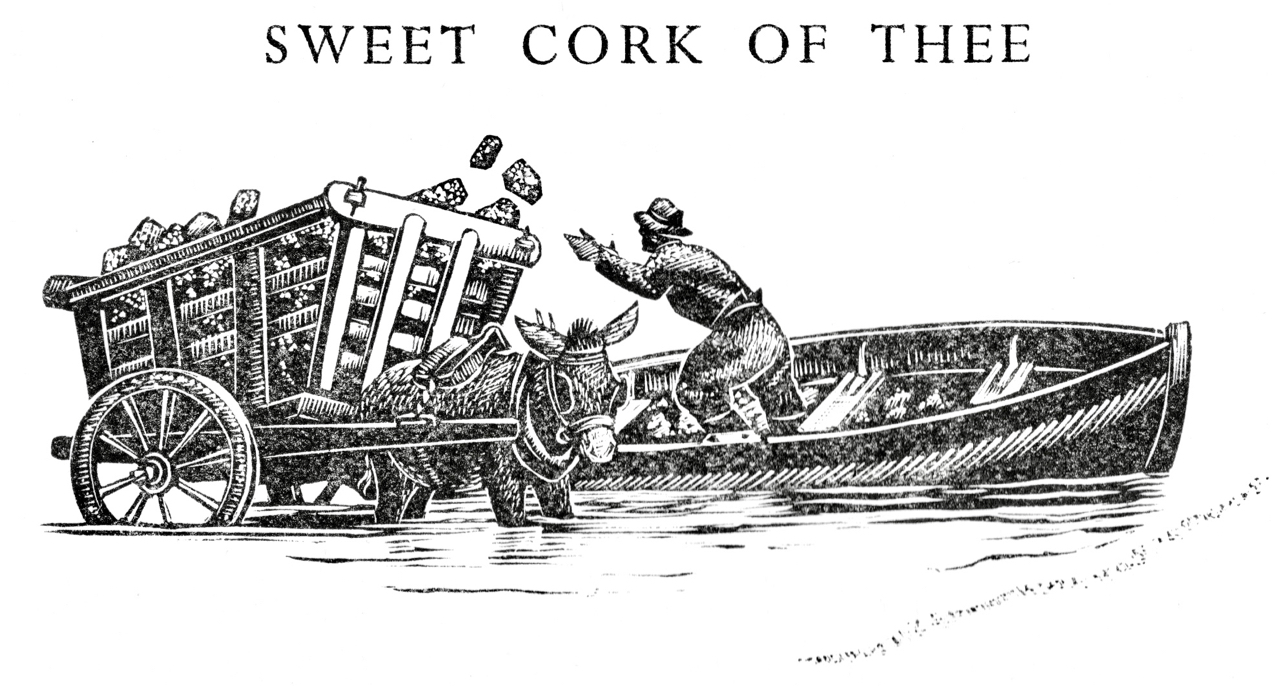
The illustrated Foreword to Sweet Cork of Thee, the second of Gibbings’ books which describe his travels in the land of his birth

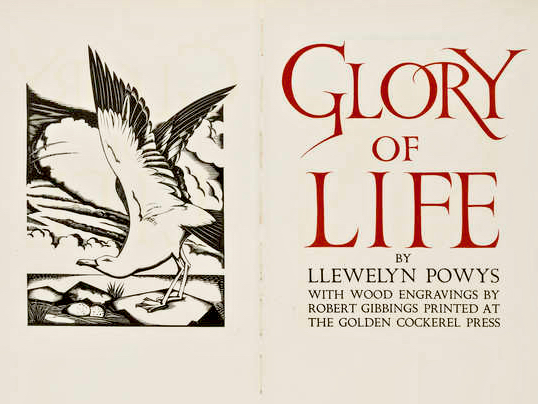
Throughout his life, Gibbings immersed himself in travelling and in art. His best known books are his ‘river’ books, beginning with ‘Sweet Thames Flow Softly’, published in 1940 and, at the end of his life, the sequel: ‘Till I End My Song’ completed in 1957: he died at the age of 68. The rivers he explored included the Thames, the Wye, the Seine and Cork’s River Lee. Between 1924 and 1933 he owned and ran the art-based Golden Cockerel Press. Founded in 1920, its earliest prospectus proclaimed:

This press is a co-operative society for the printing and publishing of books. It is co-operative in the strictest sense. Its members are their own craftsmen, and will produce their books themselves in their own communal workshops without recourse to paid and irresponsible labour.

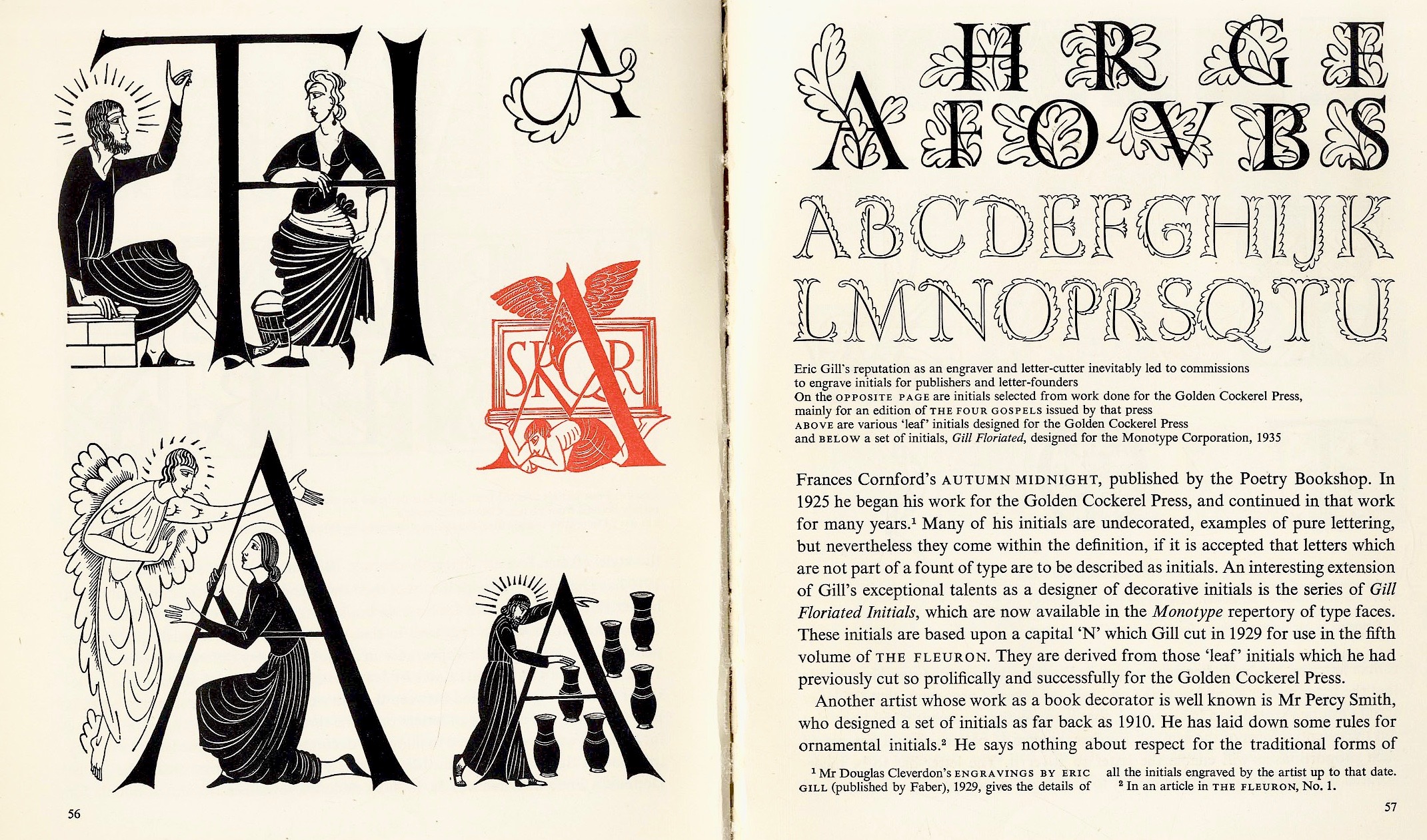
Work from the Golden Cockerel Press: typefaces by Eric Gill

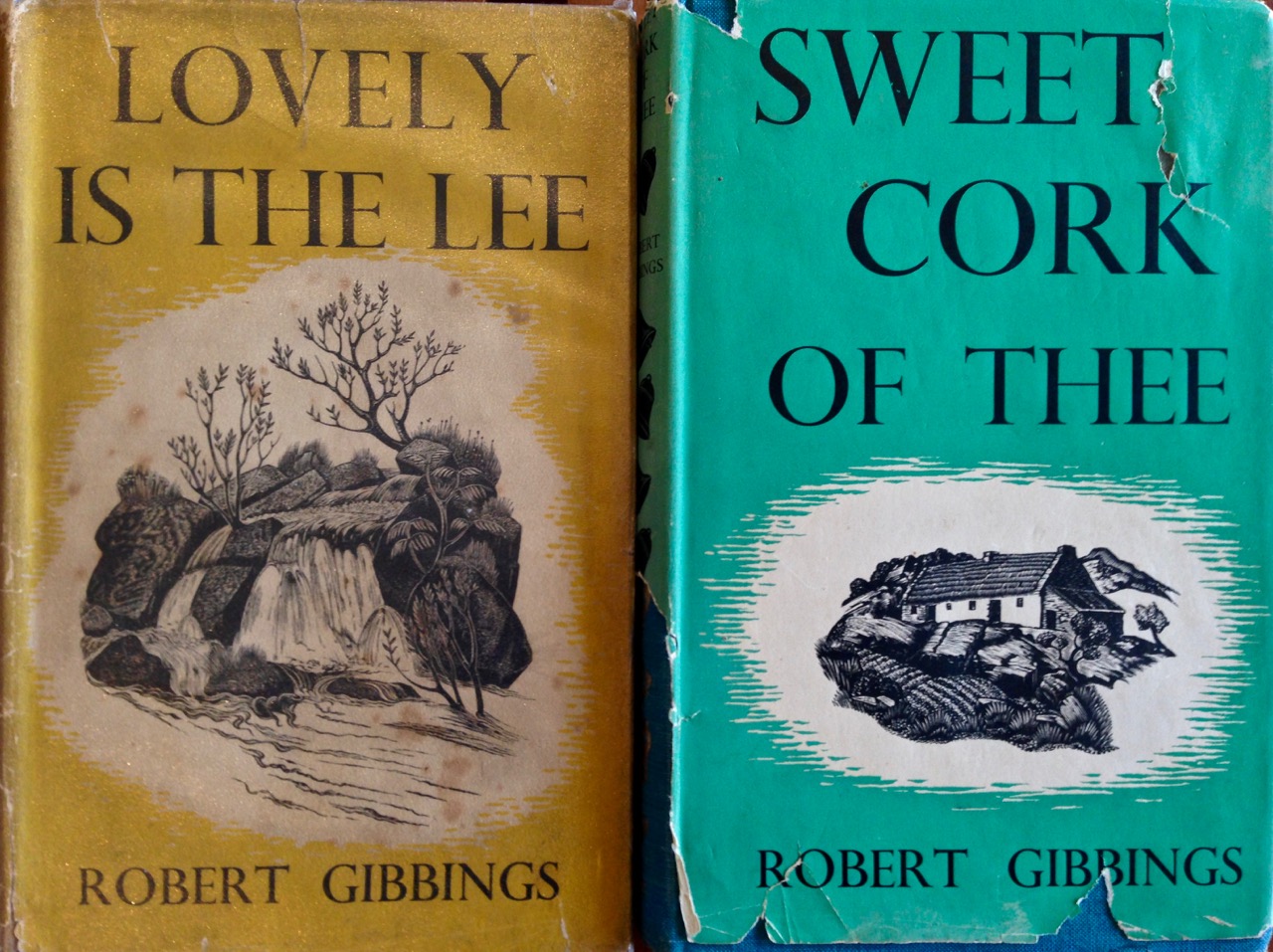
It is the two ‘River Lee’ books that will concern those interested in all things Irish. My copies (both first editions) were given to me by Danny who I first met when I moved to Devon in the 1970s. Danny was determined that I was going to fall in love with Ireland – and it didn’t take me very long! Eventually Danny – who hailed from Limerick but, like Gibbings, led a restless life during which he travelled the world – settled in Devon and then moved on to West Cork.

Danny gave me these books to encourage my interest in Ireland. At the time he told me that ‘these were all I needed’ to get to know his country. I think he was right!

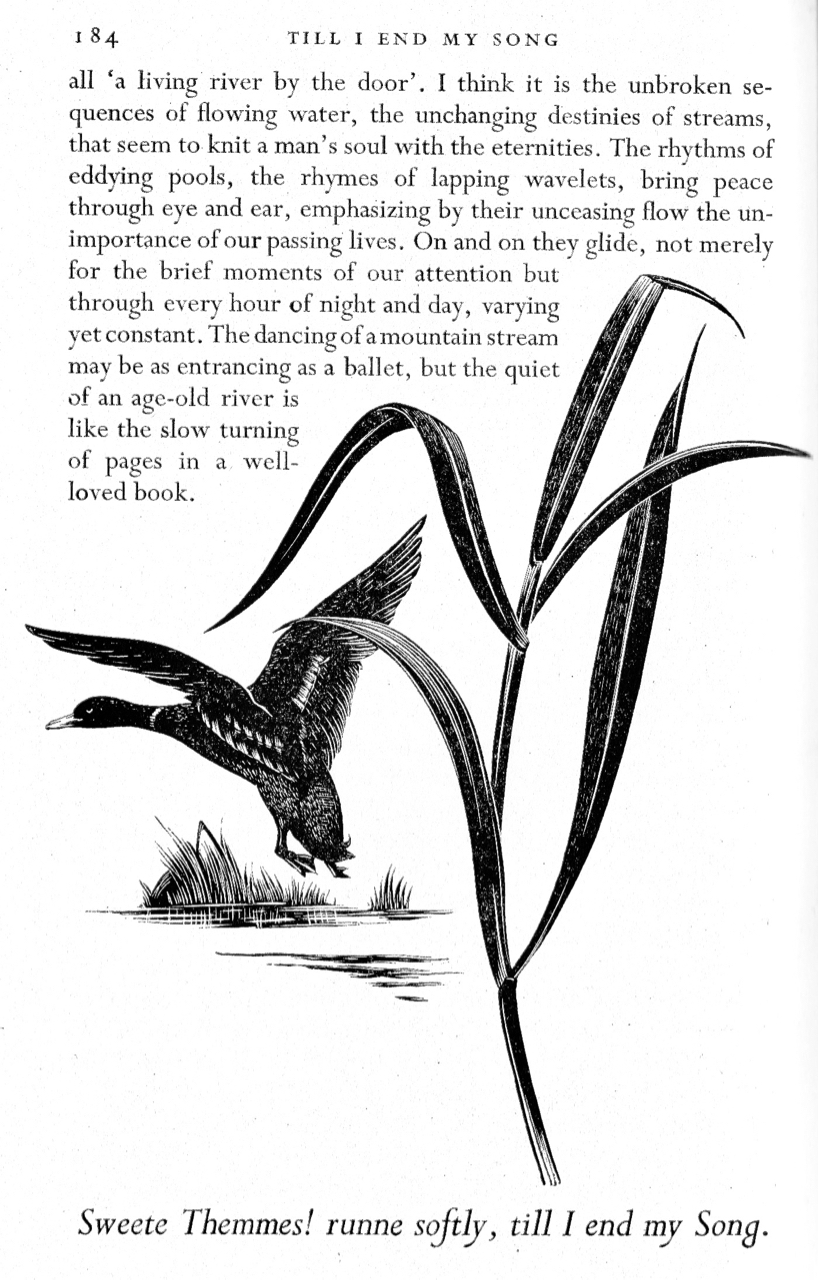
I encourage anyone who follows Ireland to read these books – and anyone who appreciates art to get to know the work of Robert Gibbings who died just fifty years ago. I will ‘play out’ the man by quoting these lines from his aptly titled ‘Till I End My Song’, and include an image of the last page of this, his final book.

Poets throughout the ages have sung of the peace of gently running streams. In the sacred writings a river is used constantly as a symbol of peace: ‘Then had thy peace been as a river’, ‘He leadeth me beside the still waters’. Throughout our own literature flows the timelesss tranquility of rivers. Spenser’s Prothalamion is borne on the waters of Sweete Themmes. The tortured mind of Swift longed for a river at his garden’s end. The gentler Stevenson wishes to all ‘a living river by the door’. I think it is the unbroken sequences of flowing water, the punching destiny of stream, that seem to knit a man’s soul with the eternities . . .