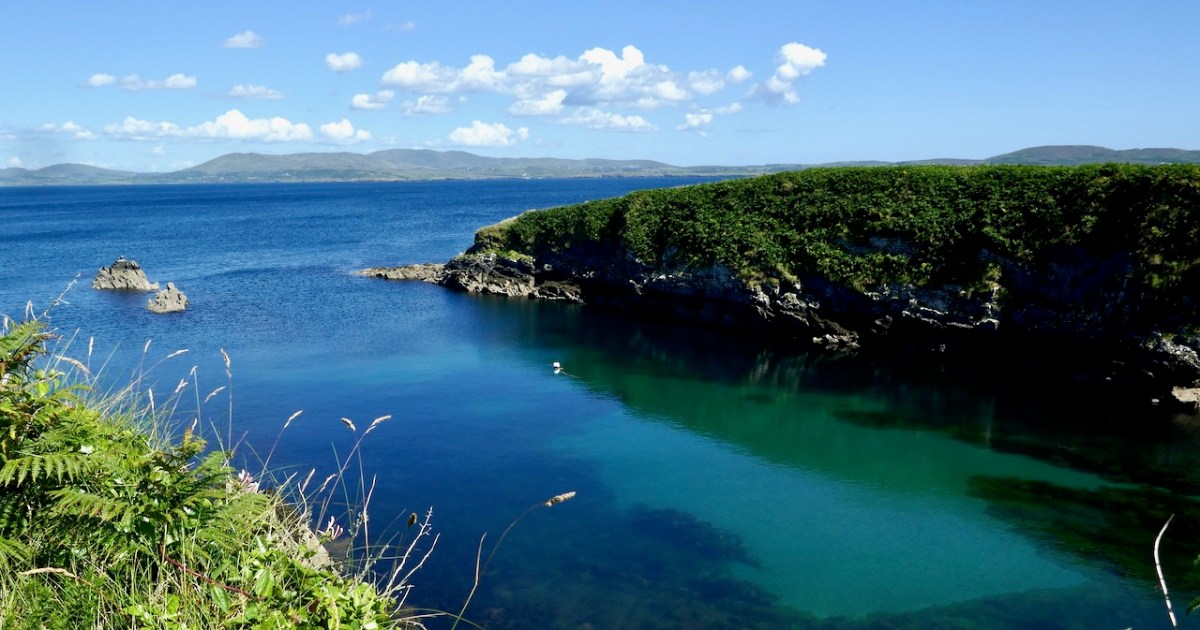
The Cliffs of Dooneen – on the Sheep’s Head

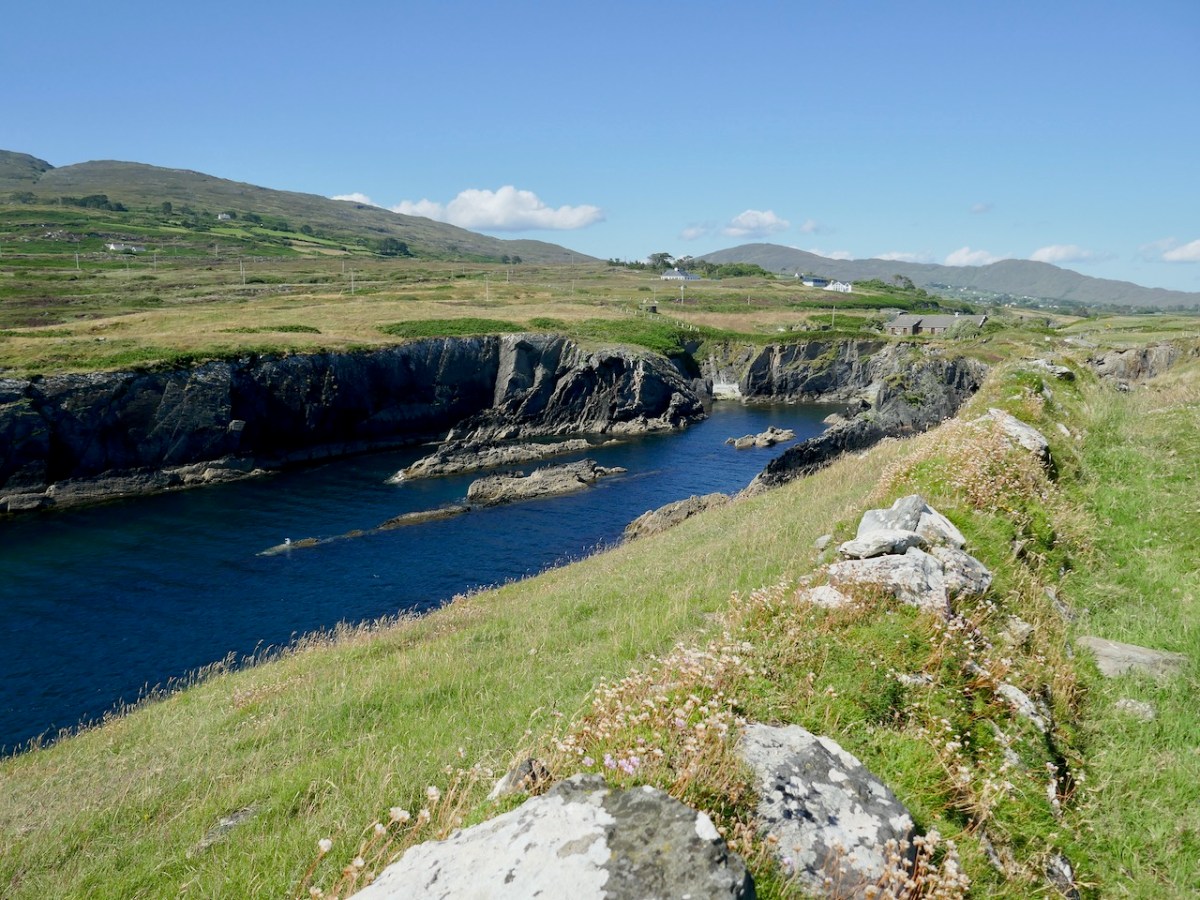
The Cliffs of Dooneen – surely that’s in Clare? Well, no, the song was actually written by Jack McAuliffe about the cliffs near Lixnaw, Co Kerry, from which Clare can, apparently, be seen. It was initially popularised by Paddy Breen, a traditional flute player, but got famous when it was performed by Christy Moore of Planxty. Paddy Reilly has a nice version too. But the Dooneen we are talking about today is the one on the Sheep’s Head, a few kilometres beyond Kilcrohane and on the way-marked trails of the Sheeps Head Way. It’s a spectacular spot, well worth visiting for no reason at all other than to contemplate the glories of the scenery in this part of the world. 
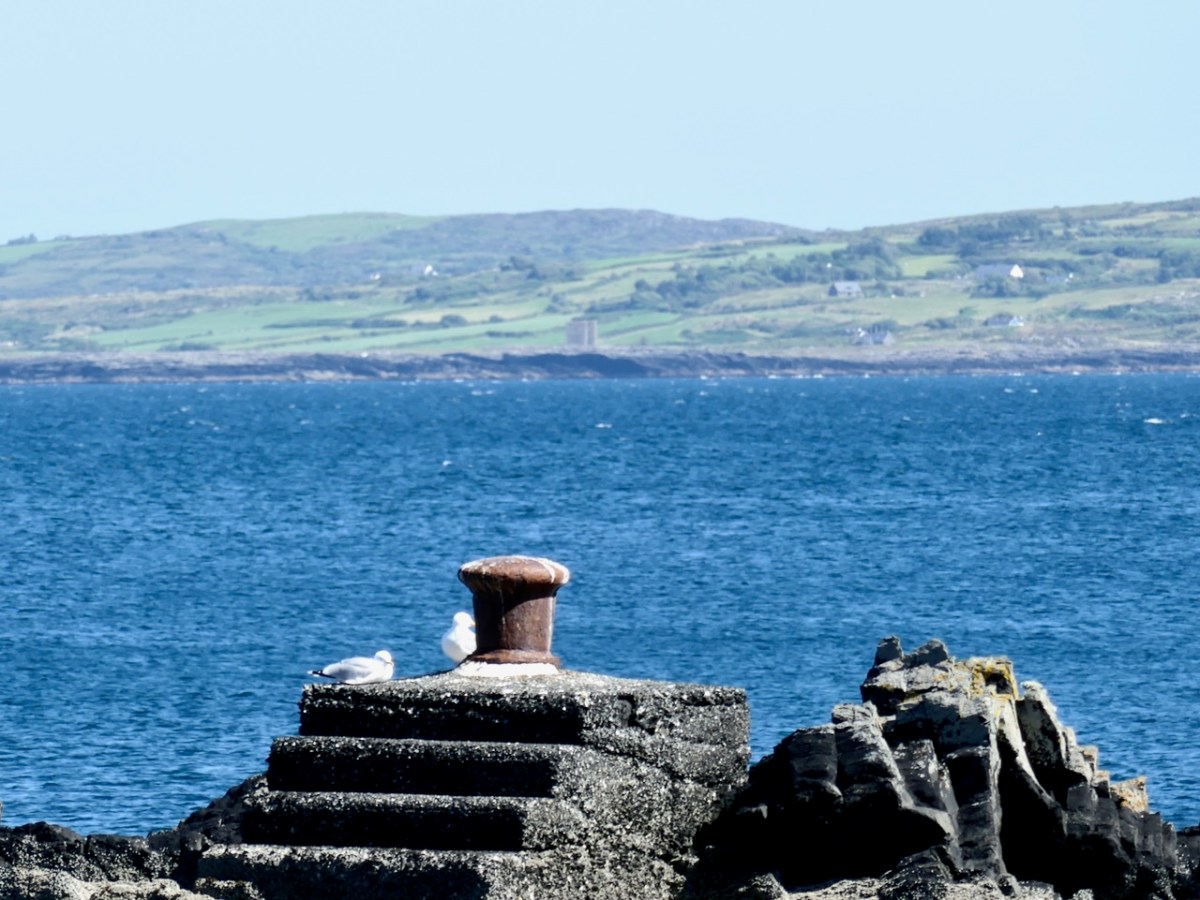
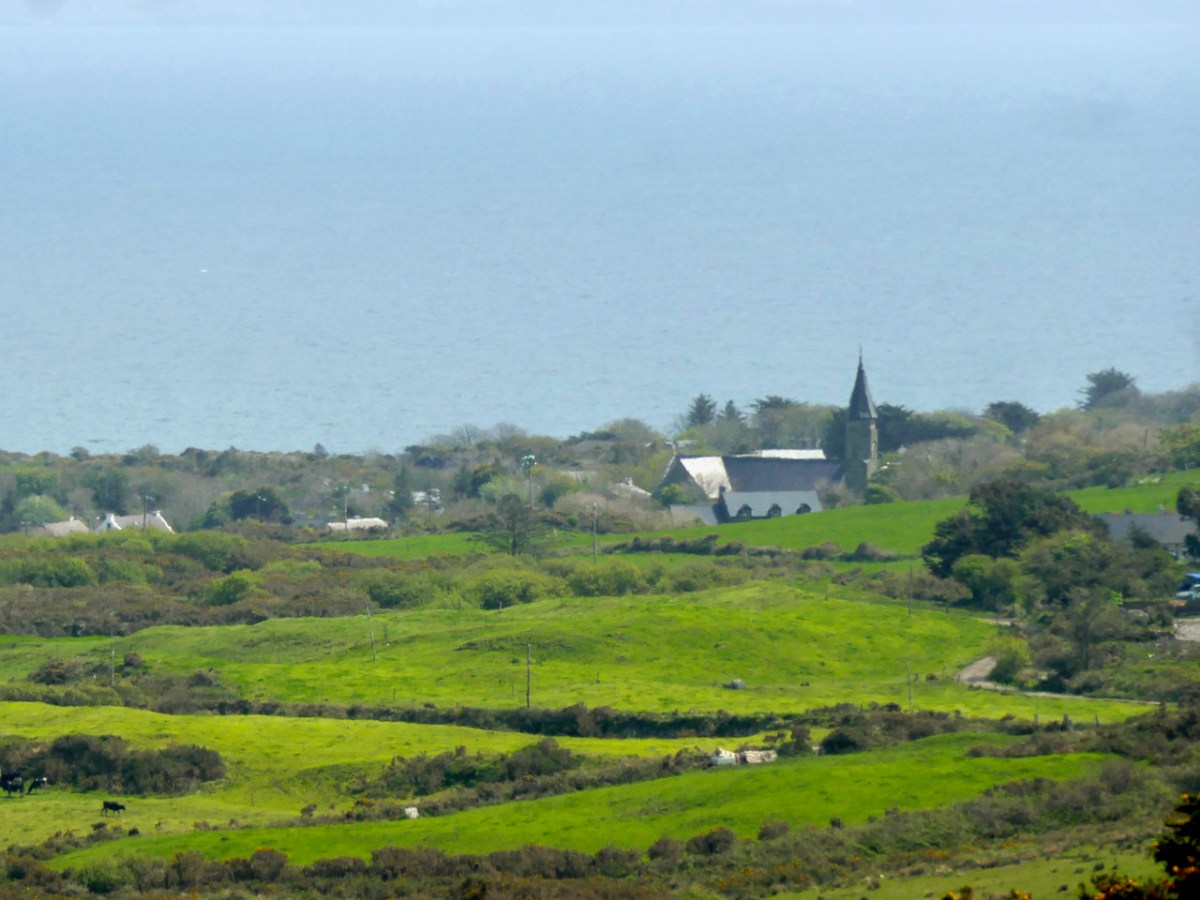
Dunmanus Castle can be glimpsed across Dunmanus Bay (above), and the whole of the Mizen Peninsula lies across from you, from Mount Gabriel to the end of the Peninsular where Dunlough Head hosts the magnificent Three Castles.
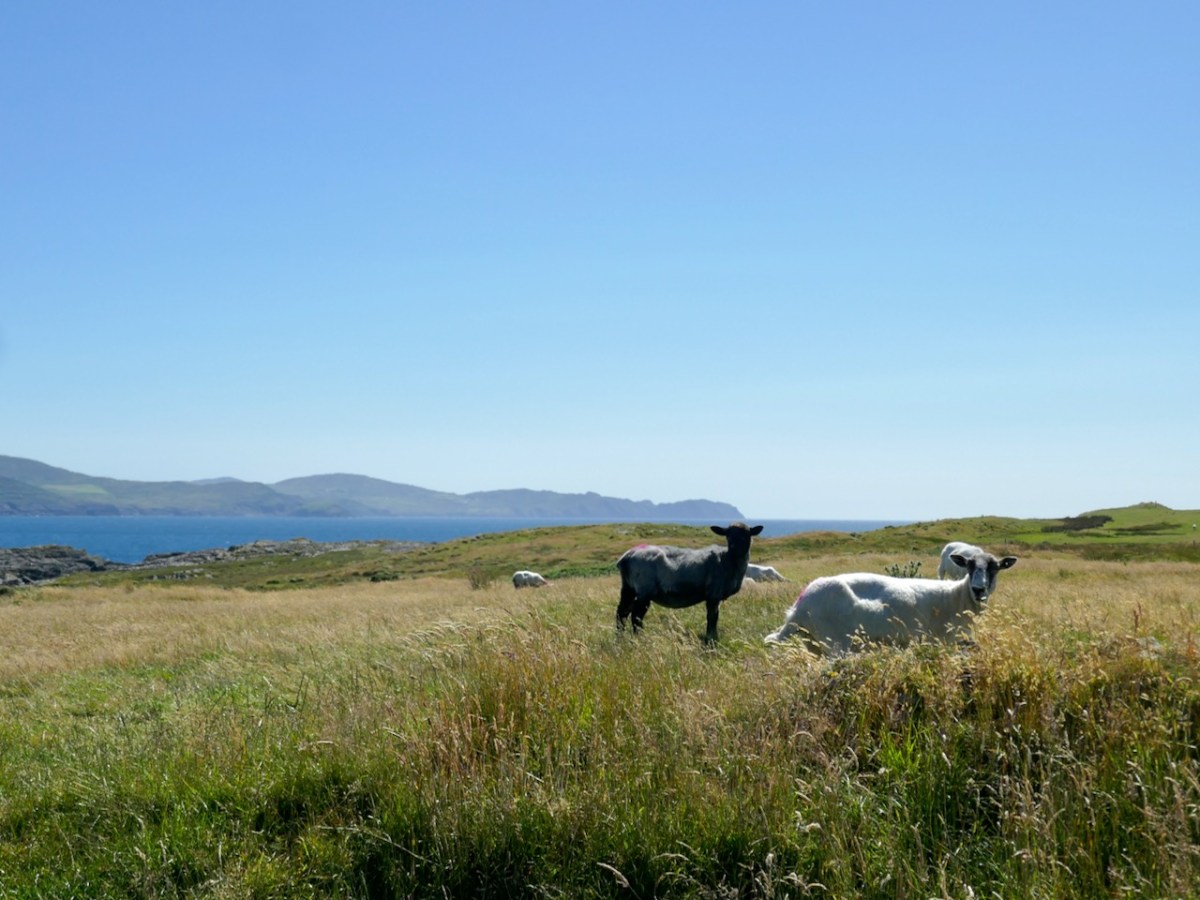
Dooneen (Dúnín – ‘Little Fort’) has been a locus of activity for a long time, probably because it provides a sheltered spot for boats. Sheltered – but not necessarily safe!
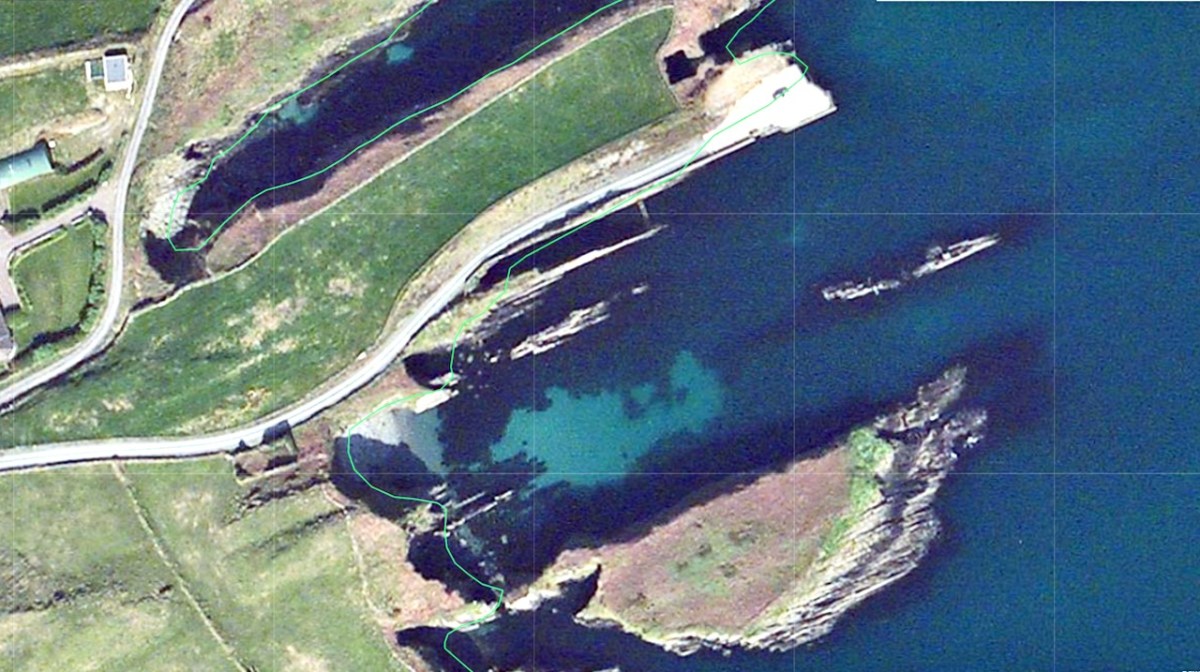
The pier here is substantial. This was the centre for a busy fishing industry early in the 20th century. We’ve often talked about the 15th century as a time when vast shoals of pilchards and herring congregated in the waters of West Cork. It happened again in the first half of the 1900s, and this is when this pier probably dates to. We know that, because it is not shown on the 6” or 25” Ordnance Survey Maps which date from the 19th and early 20th centuries.
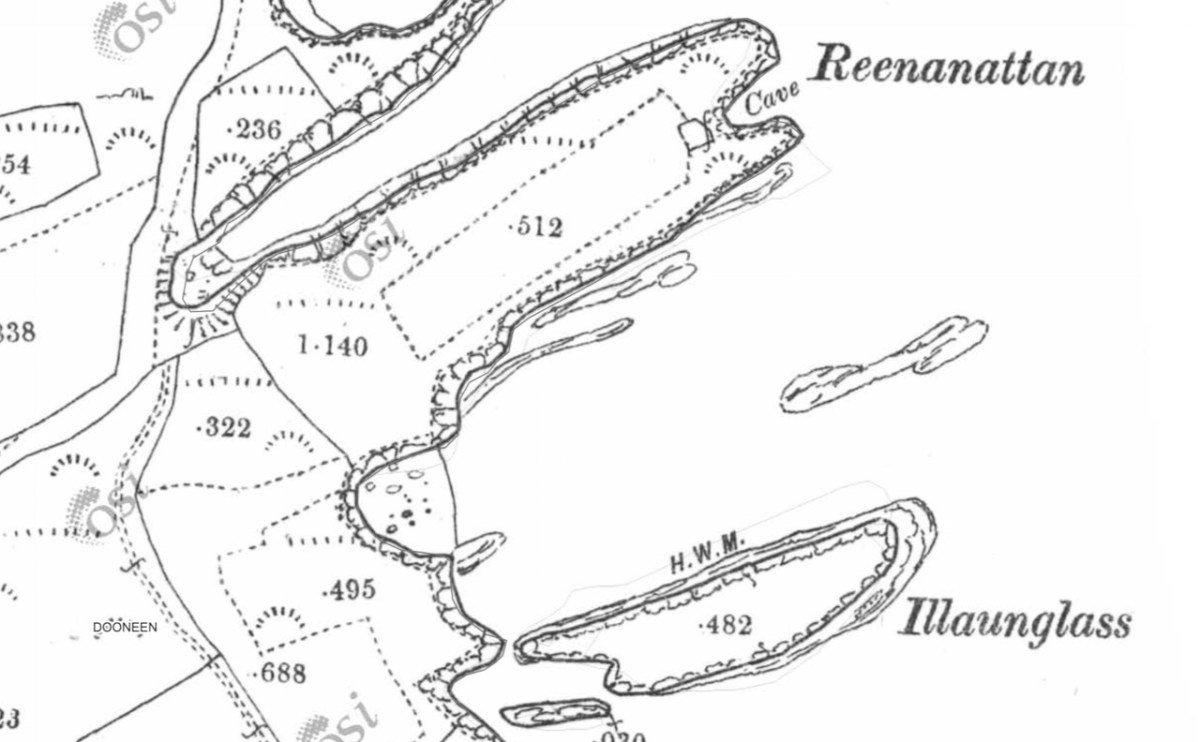

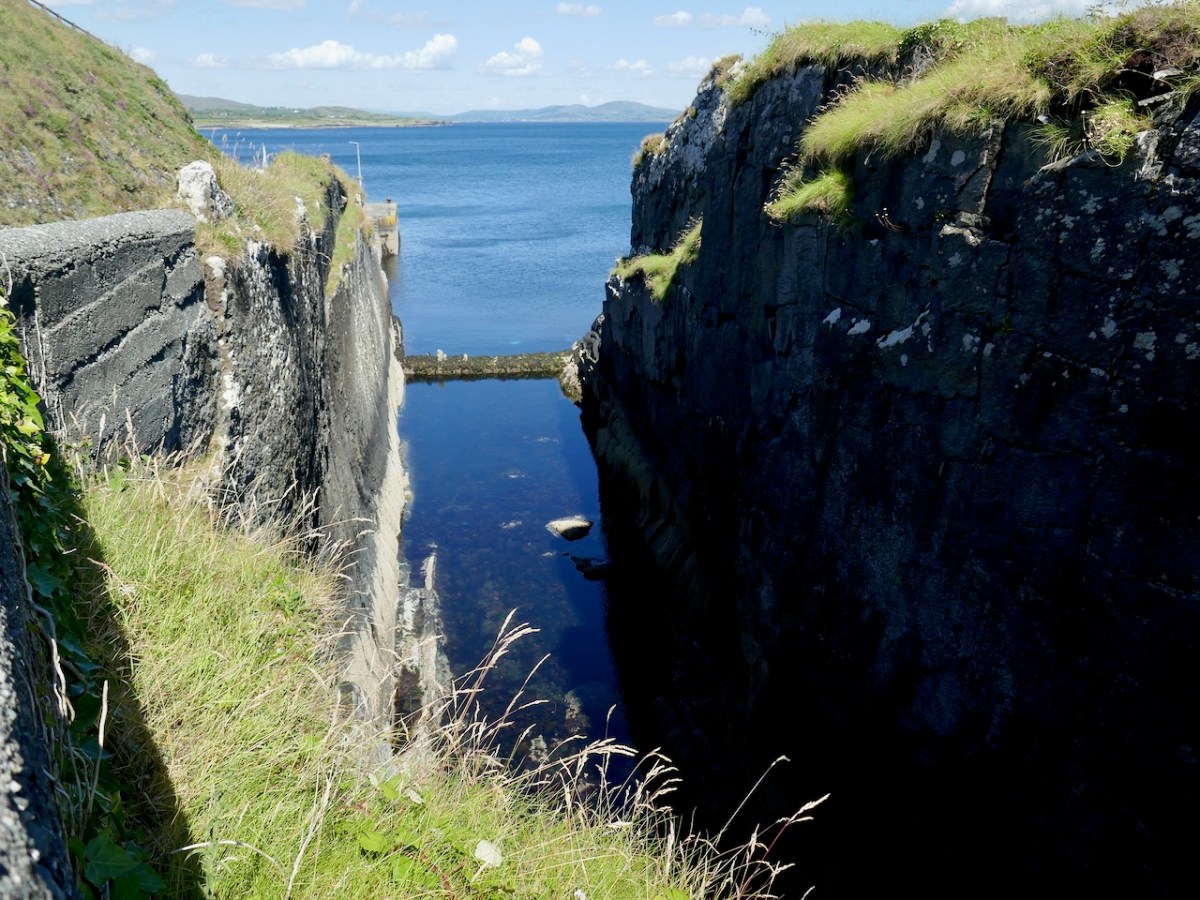
There are a couple of buildings that may relate to the processing of the fish (see Robert’s post Pilchards and Palaces for an explanation). And this odd feature below – what looks like a holding pond created by a concrete dam.
An excellent page on eOceanic provides directions for mooring and some history of the area. This page also has some great photos of the pier from the sea, such as this one, below, taken by Burke Corbett, and used here with thanks to the admins of eOceanic
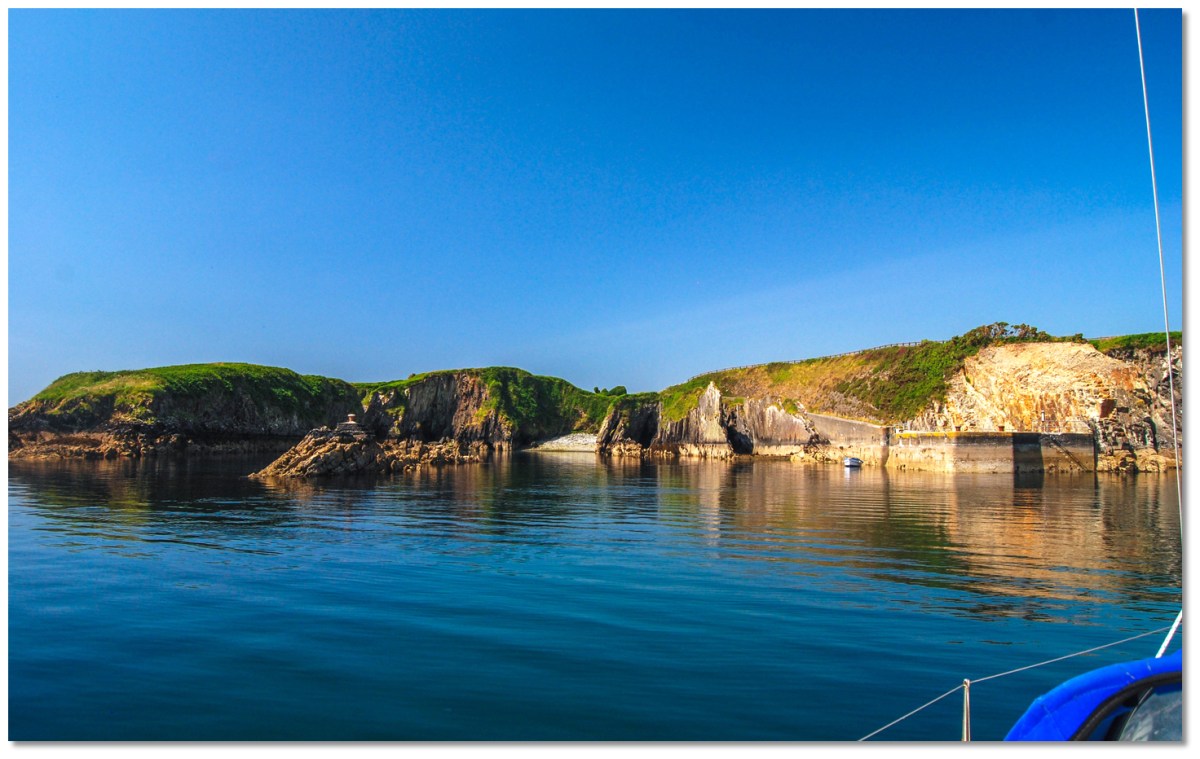
The author states that the pier was initially built to service the busy copper mines in the area. However, I would expect the roads he refers to, to be visible on the OS maps, and they are not, so perhaps the pier here was quite rudimentary or natural before the current concrete pier was constructed. 
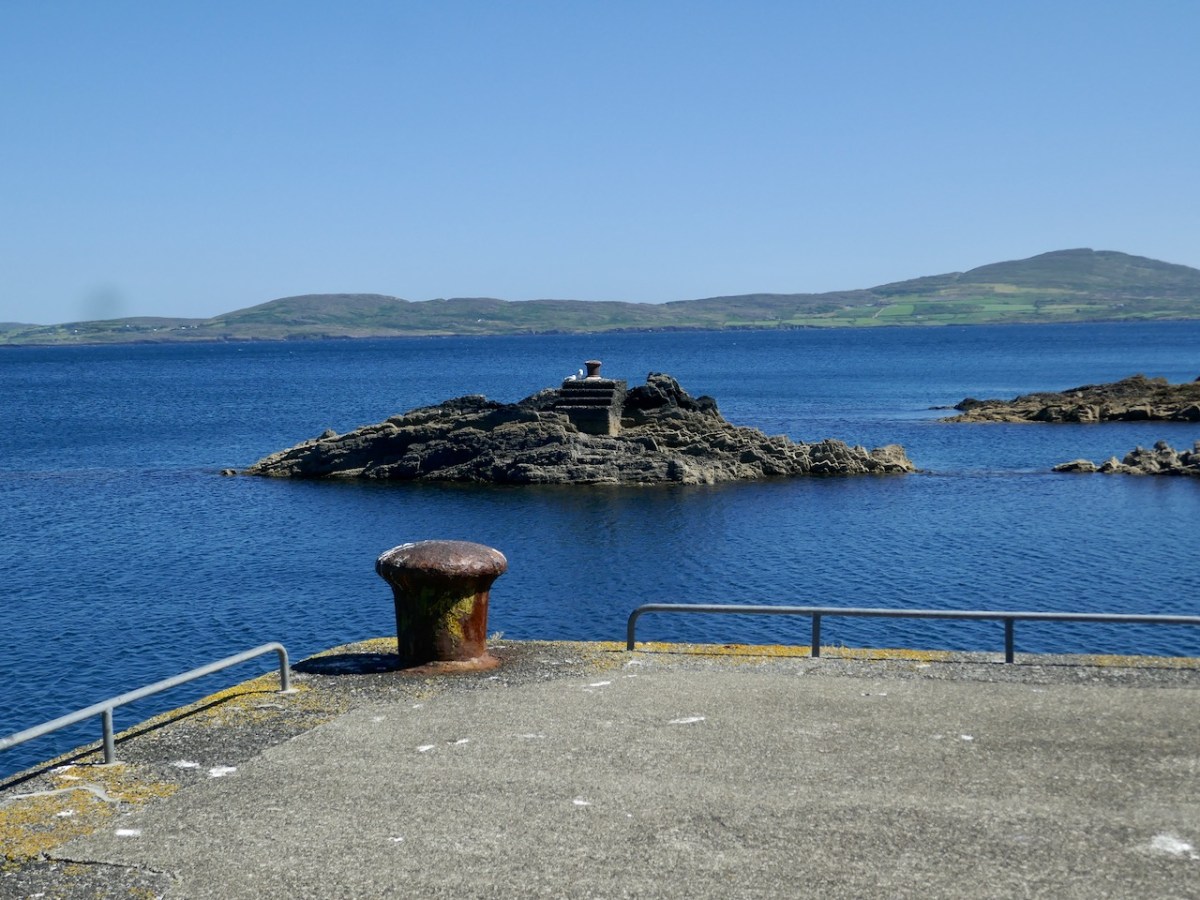
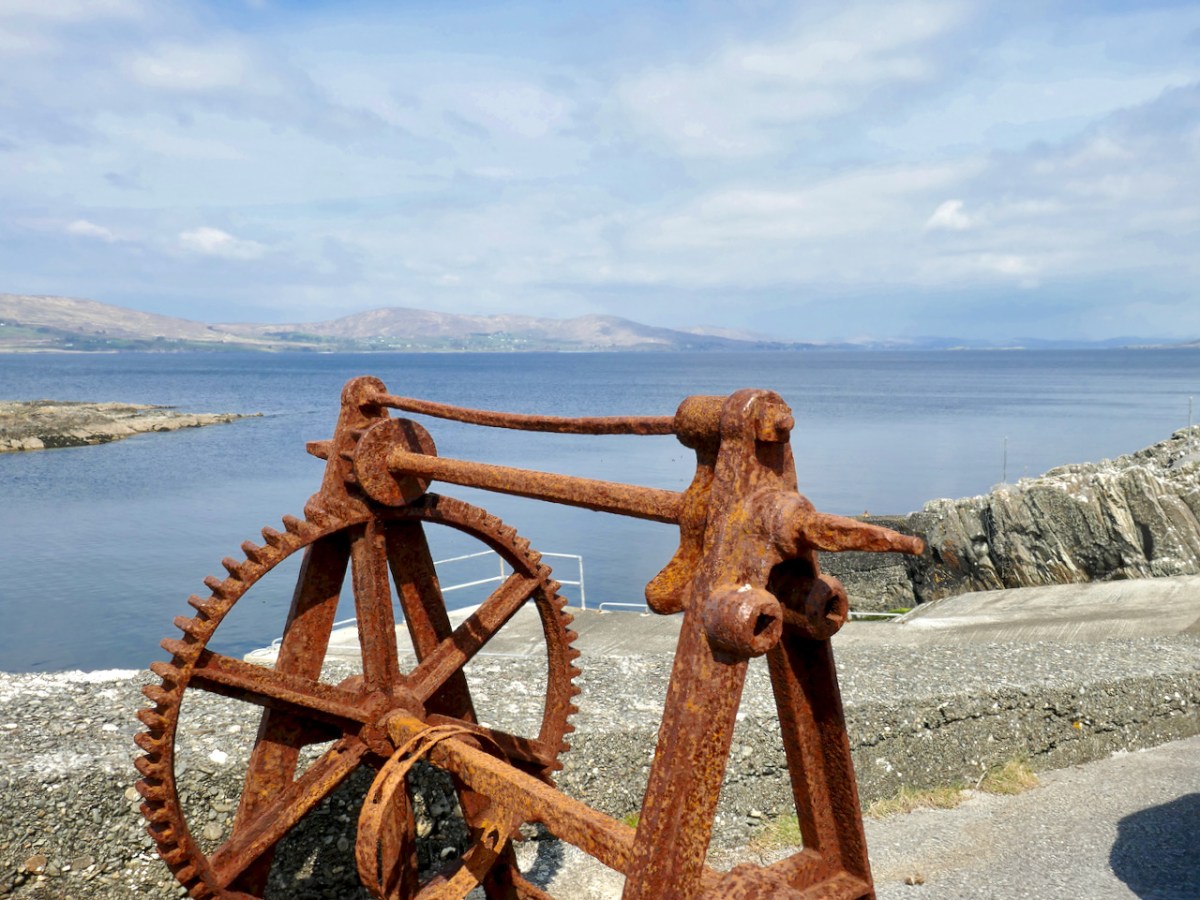
The author of the eOceanic page refers to the feature above on the rock as a ‘steamer turning bollard.’ I had never heard that term before so I turned to my friend Sean O’Mahony, mariner and historian, for an explanation. Here’s what he told me, along with an illustration. Thank you, Sean!

To assist the ship from movement on the jetty, two lines (mooring ropes or hawsers) are extended from the bow and stern to the bollard. This will help to keep the ship reasonably secure from moving backwards and forwards (ranging) along the pier and also prevent her from being pushed hard alongside. This method would only succeed under reasonable weather conditions. I have a feeling that a lot of wooden fenders would also have been employed. My crude drawing demonstrates this with red lines extending to the bollard.

Second, and probably its primary purpose, was to aid in getting the ship off the berth when she is ready for departure. This procedure is known as warping and works like this. The lines to shore from the bow are left go and then using the ship’s windlass the line to the turning bollard is heaved in causing the bow to move outward in the direction of the open sea, at the same time the line from the stern to the bollard is released as are the stern spring lines just holding one line fast to the shore until the turning manoeuvre is complete, When she has turned sufficiently all remaining lines are released and recovered, engine speed is increased and you steam away to somewhere nice…. like the South sea islands…..
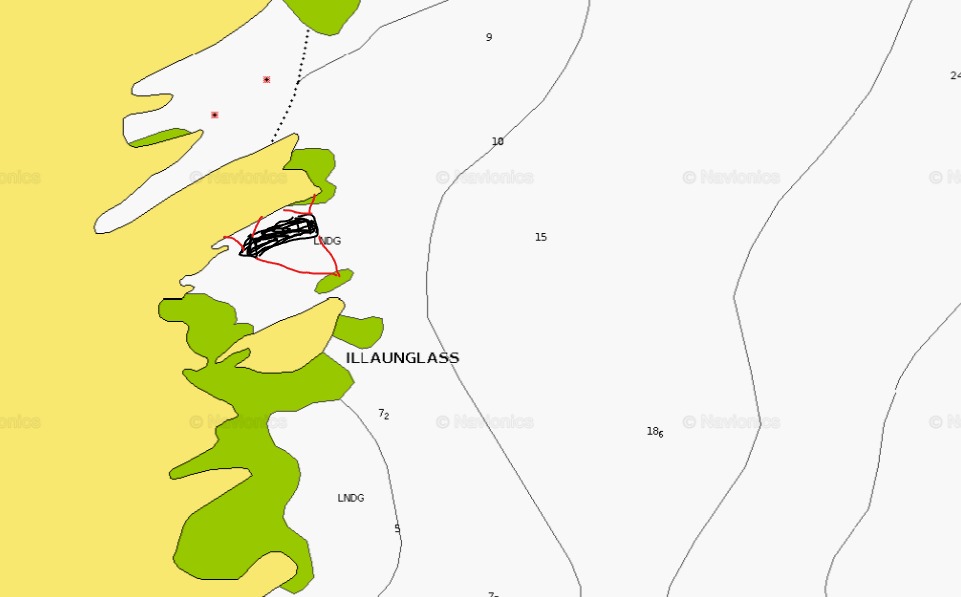
    As we might expect with a place with Dún in the title, there is a promontory fort here, and another one next door. (Here’s a good example of a West Cork Promontory Fort.) When studying promontory forts my first port of call is always our old friend Thomas Westropp and indeed Westropp has written about the fort at Gouladoo, on the north side of the peninsula.
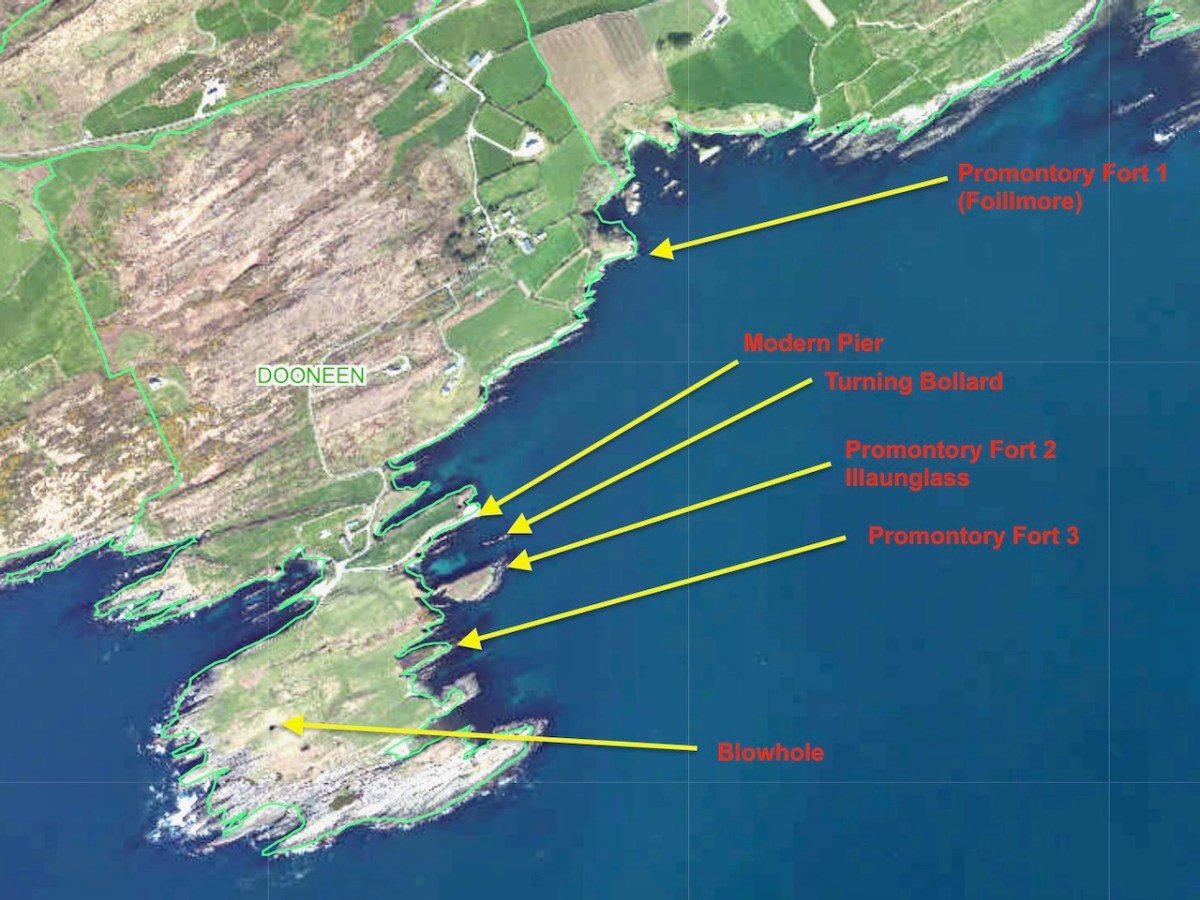
    Normally intrepid in his pursuit of the forts. Westropp’s courage failed him when faced, a hundred years ago, with the prospect of travelling on the old, fearfully steep and rough road to this, at that time, remote part of Muinter Bheara. Finding the way ‘insuperable’, he confined his efforts to looking at it with strong field glasses, clear air and light from the Mizen Peninsula across Dunmanus Bay. The fort he describes, as a result of this remote surveillance, and with the help of local informants, appears to be the one further east along the cliffs from Dooneen Pier. It is located on Foilmore (Big Cliff), along from Foilnanoon (Cliff of the Fort). It’s National Monument No CO138-012. It’s Promontory Fort 1 on the map above.

    Here’s what Westropp has to say about this fort*: 

    The high mound and fosse are curved, and bushes grow on the former; inside is a level garth with long grassy slopes down to the cliffs. The rampart, I was told, was “about as high as a man” very steep, “cut by a gap, with a high narrow roadway, only wide enough for a cart to go inside across the ditch” which was “about as deep” as the mound was high – i.e., 5 ft. to 6 ft., making the rampart 10 ft. to 12 ft. high in all. Near it is a small, low peninsula, with little headlands and creeks, Reenanattin (furze point), Coosabriste (broken creek), Carrignagappul, Cooshaneagh (called from horses), and Murkogh. The fort is near Foillmore cliff, and is locally called “the Island of Dooneen” a not unusual term for such forts in Counties Mayo, Clare, Kerry, Cork, and especially Waterford.

    Determined to best Westropp and actually visit the fort, I set out, in the company of Amanda and Peter and my sister, to tramp across the fields to it. Alas, we got no further than the farmhouse on whose land the fort is situated, where we were warned that a) it’s crumbling and very dangerous and b) it’s impossible to see anything because of the growth of gorse, trees and scrub.
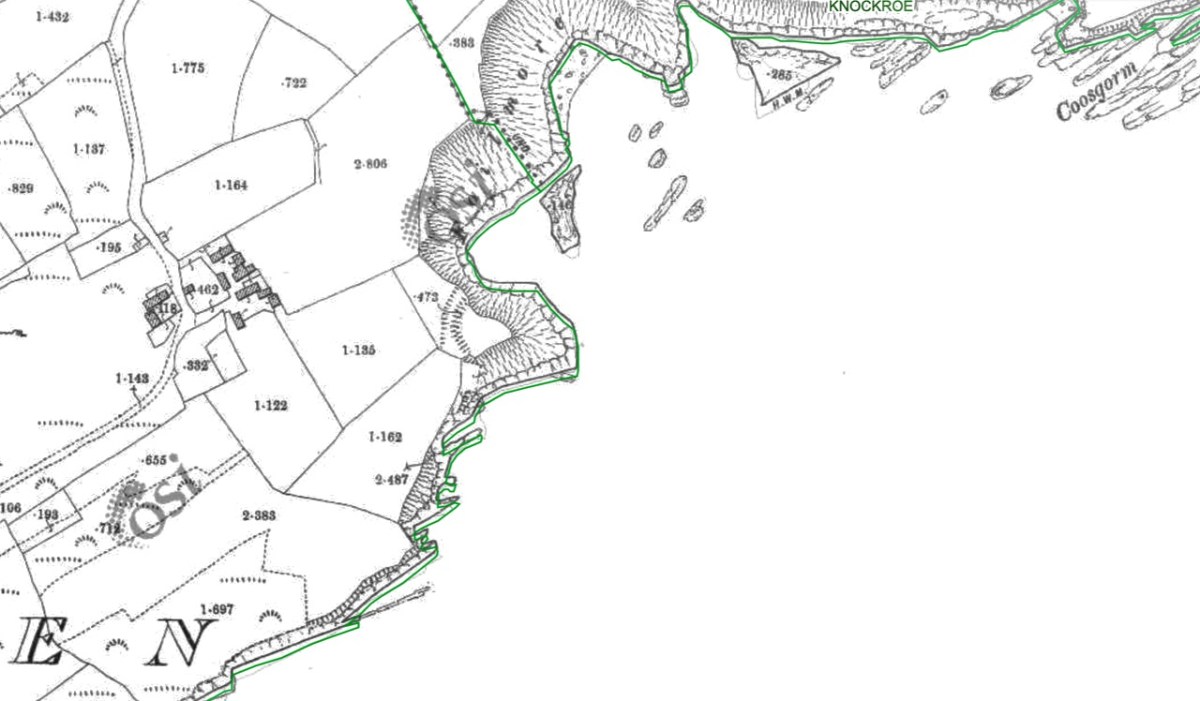
    We abandoned the attempt – I will never doubt Westropp’s good sense again! I contented myself with what is showing on the 19th century OS map, above.
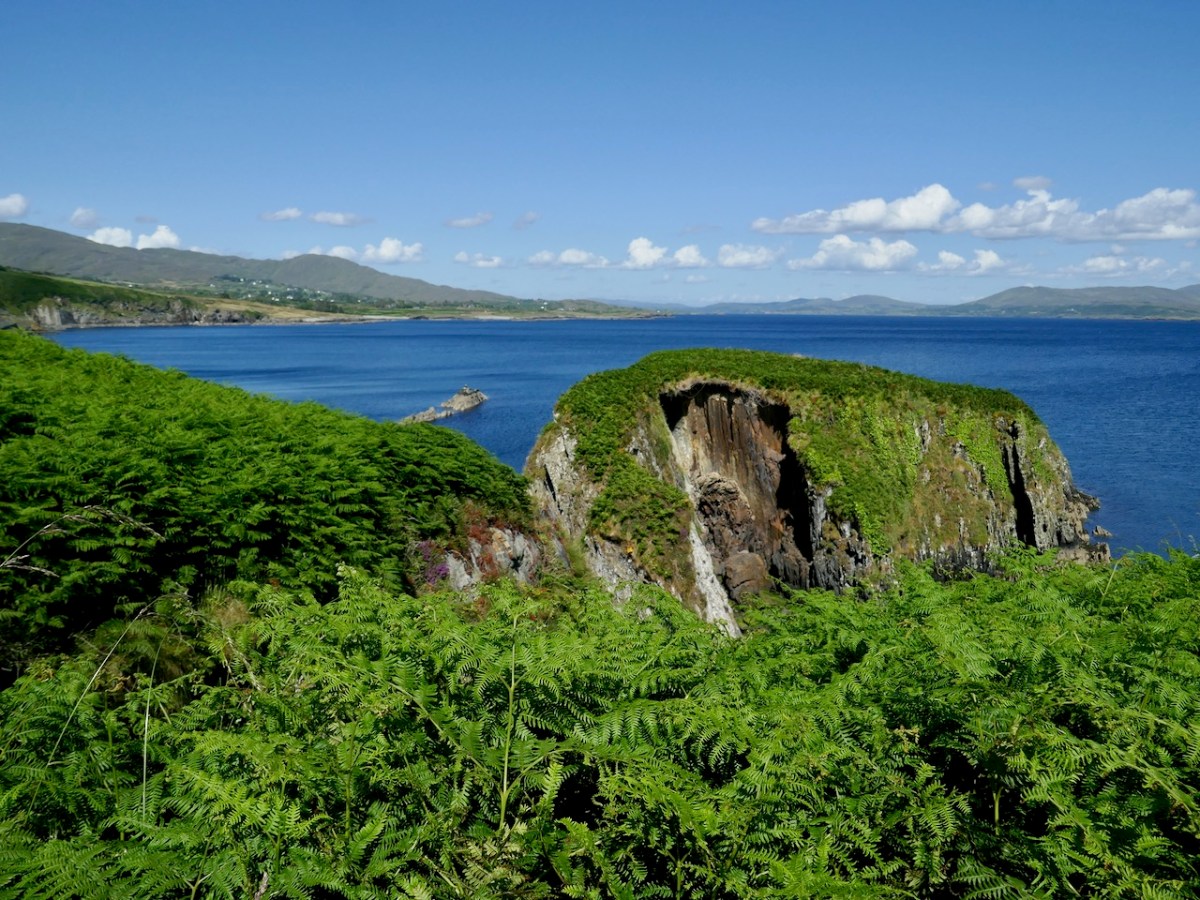
    Two more promontory forts are shown on the National Monuments map, presumably identified in the course of the archaeological surveys of the 1980s. It is no longer possible to see the ramparts, banks or ditches of the promontory fort immediately south of Dooneen Pier (above and below) as they have fallen into the sea (like those at Dún an Óir on Cape Clear). This one is called Illaunglass, or Green Island, on the map. According to the National Monument record (CO138-034002) it has a hut site on it. Frustratingly, the details of this record are hidden from view at the moment. 
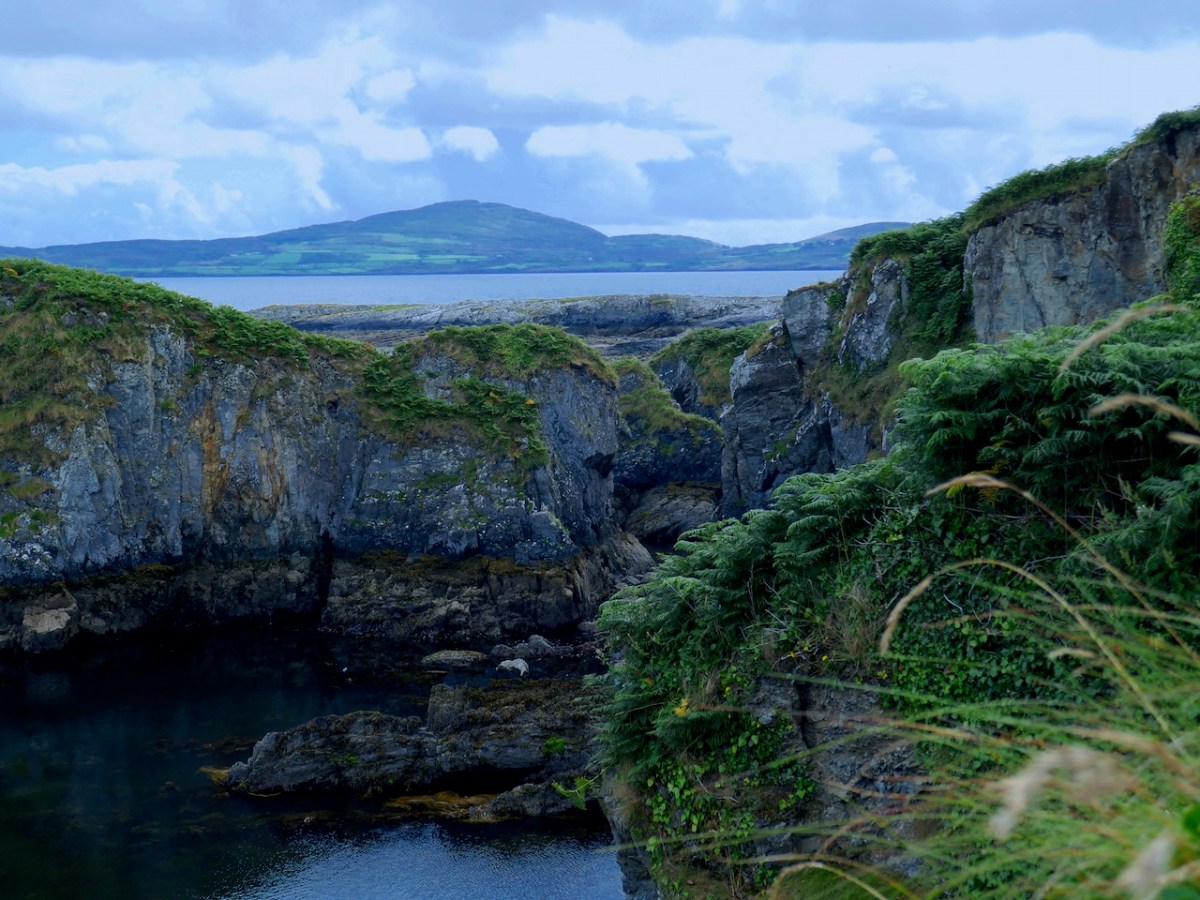
    The next one to the south (CO138-035, no. 3 on the map), details also hidden, has a very slight discernible bank, partly covered by a wall, possibly modern (below). However, there is no indication of a ditch or bank in the OS maps, so it is unclear on what basis it has been assigned as a promontory fort.
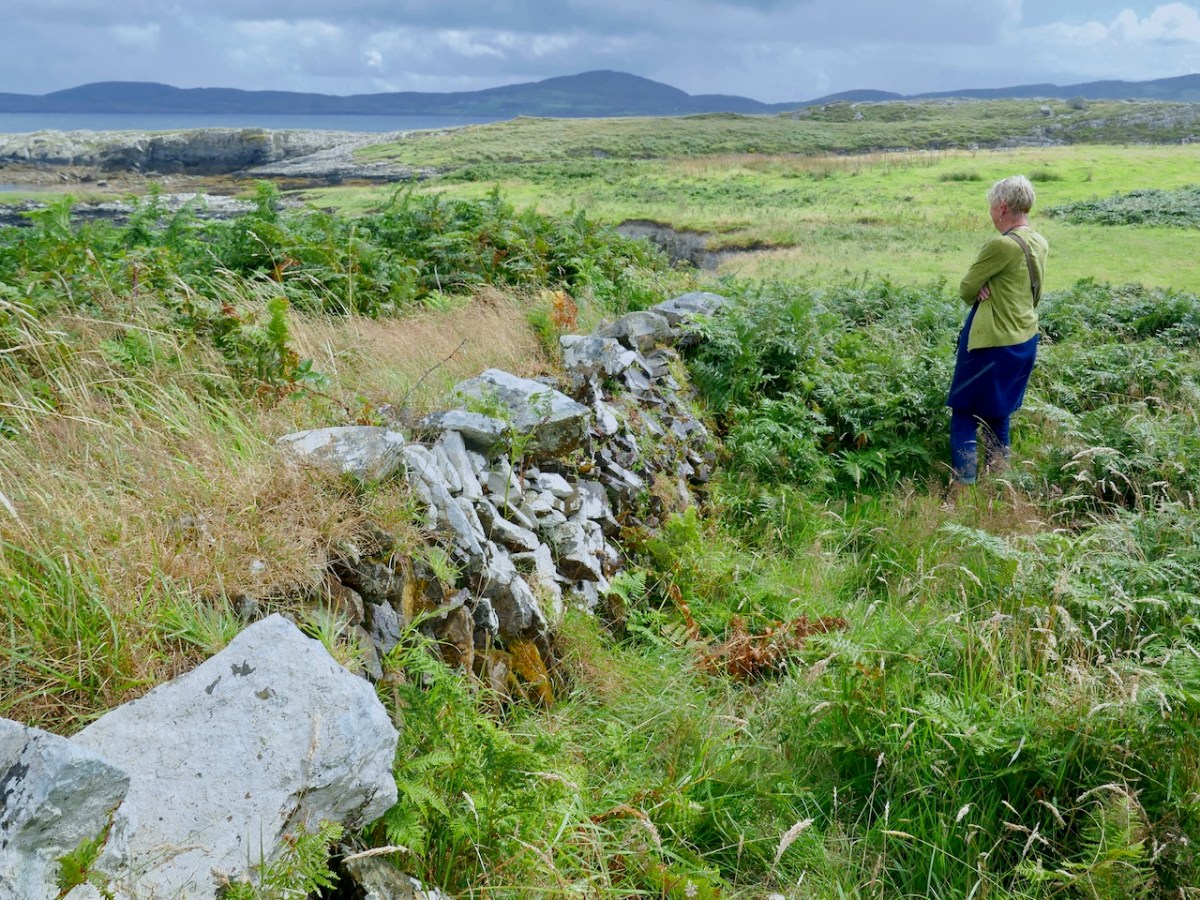
    It is obvious that this area has been important to the inhabitants of Muinter Bheara for a long time, since promontory forts can date as early as the Iron Age (which ended around 500 CE/AD) but are commonly early Medieval, dating up to around 1000 CE/AD. 
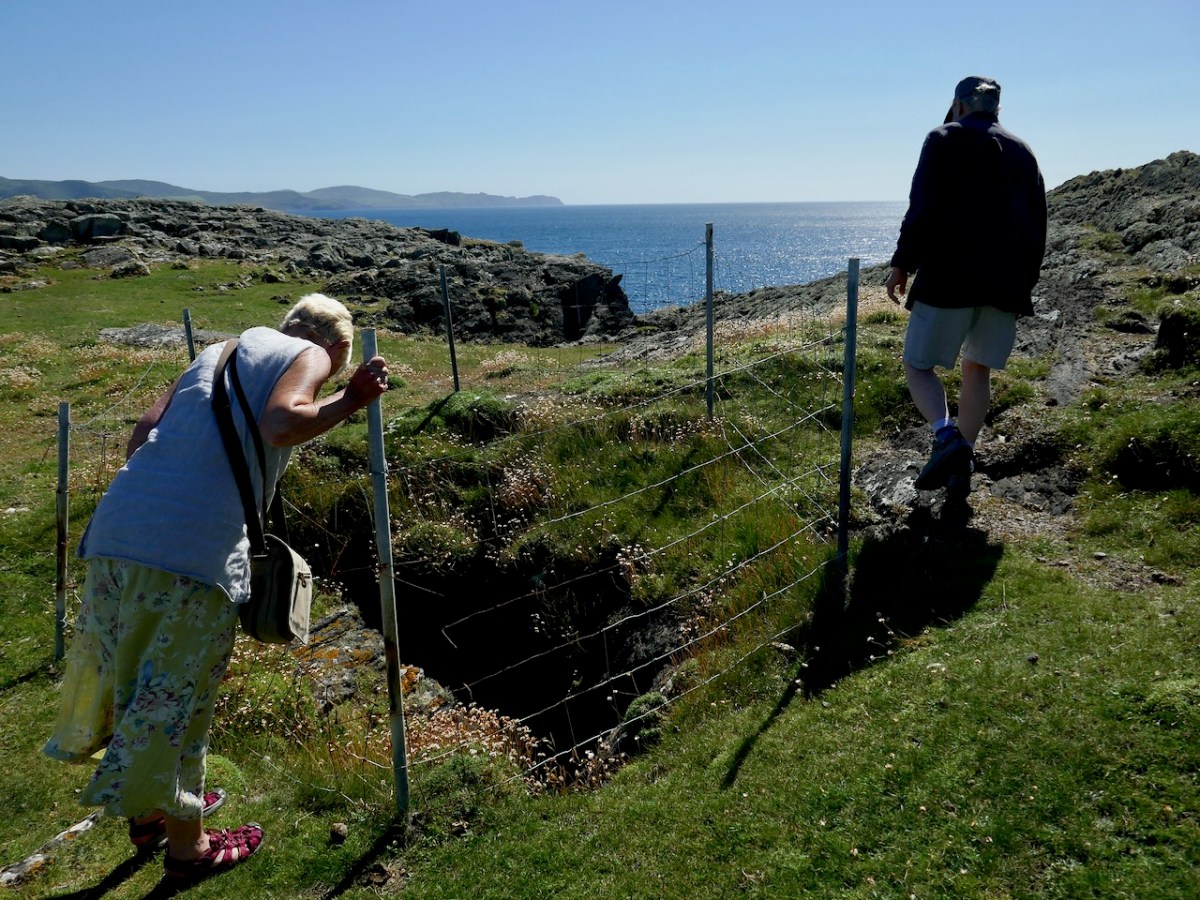
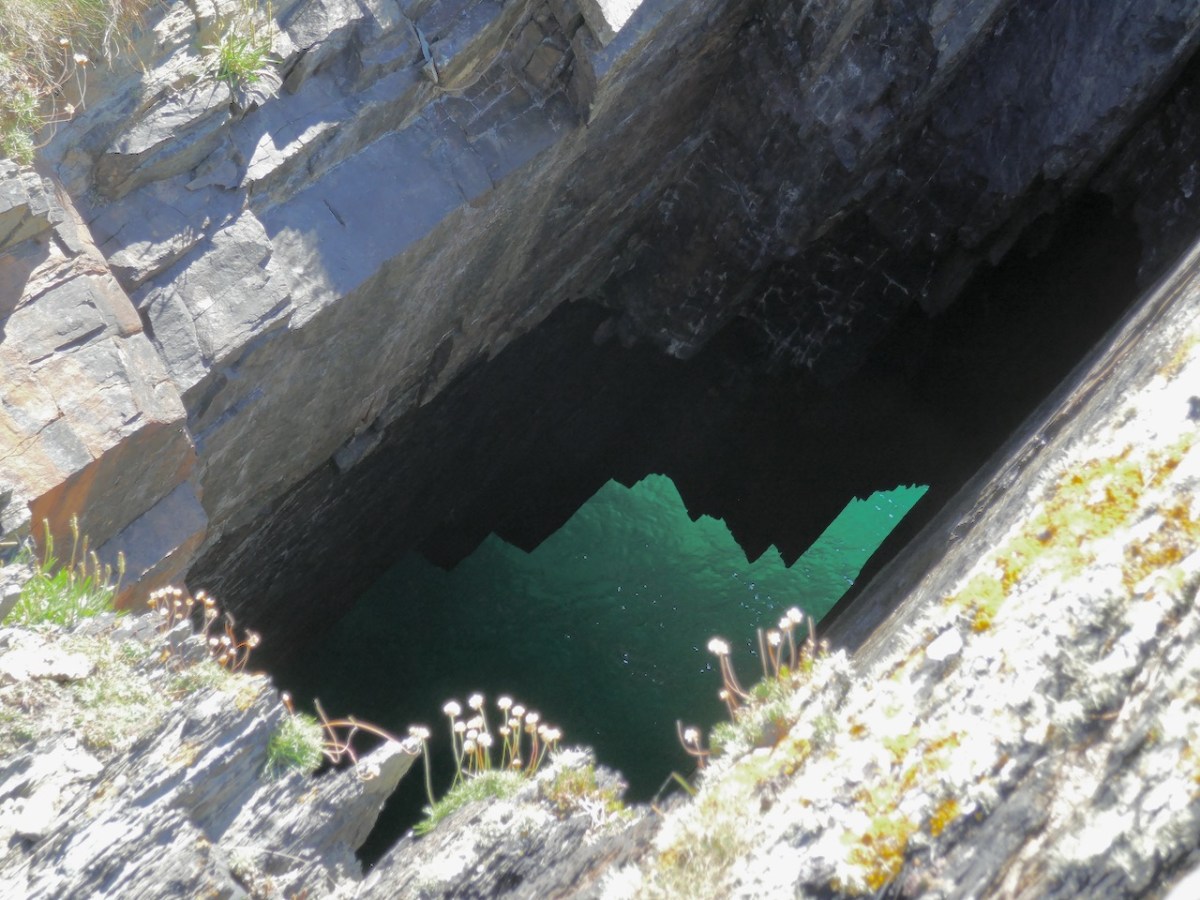
    One more curious feature awaited us on our walk around the ‘Island of Dooneen’ – a blowhole, thankfully guarded by a wire fence. I’d love to go back some time when it’s blowing!
    The last thing you see as you head back to the road is the house that was once home to Donald and Mary Grant – the American couple with the White Goats and Black Bees, and the checkered past!
    Take a trip out to this part of the Sheeps Head – It’s amazing how one tiny section of coastline can hold such history and magnificent landscape.


    *The Promontory Forts of Beare and Bantry: Part III: Thomas Johnson Westropp. The Journal of the Royal Society of Antiquaries of Ireland , Dec. 31, 1921, Sixth Series, Vol. 11, No. 2 (Dec. 31, 1921), pp. 101-115. Stable URL: https://www.jstor.org/stable/25513219 

    Rossbrin Review

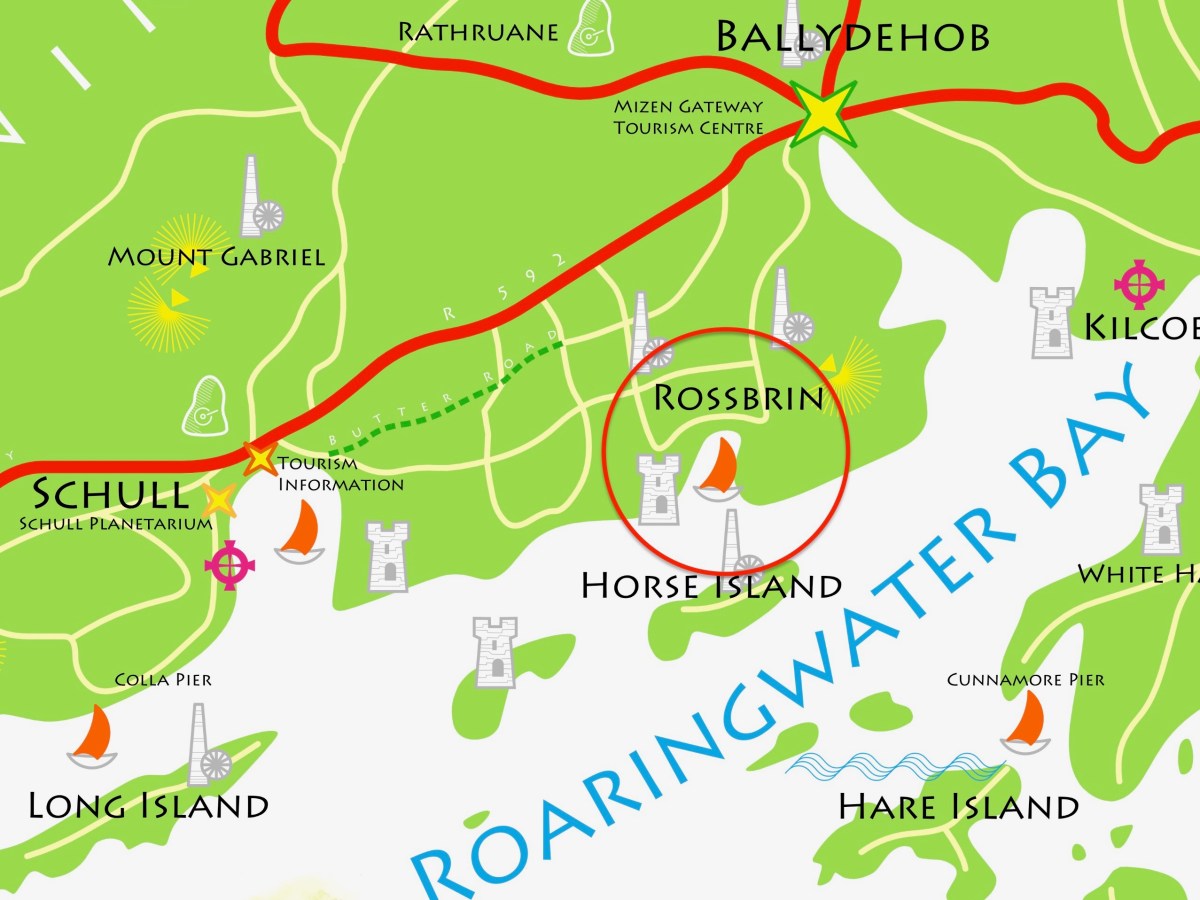
    The weather so far this year is breaking records for coldness, wetness and evapotranspiration – while Earth as a whole continues to get warmer. In simple terms that means it’s not pleasant to wander too far from home. I decided to walk down to the shoreline of Rossbrin Cove – all of ten minutes – and see what the winter storms may have washed up: often an interesting diversion.

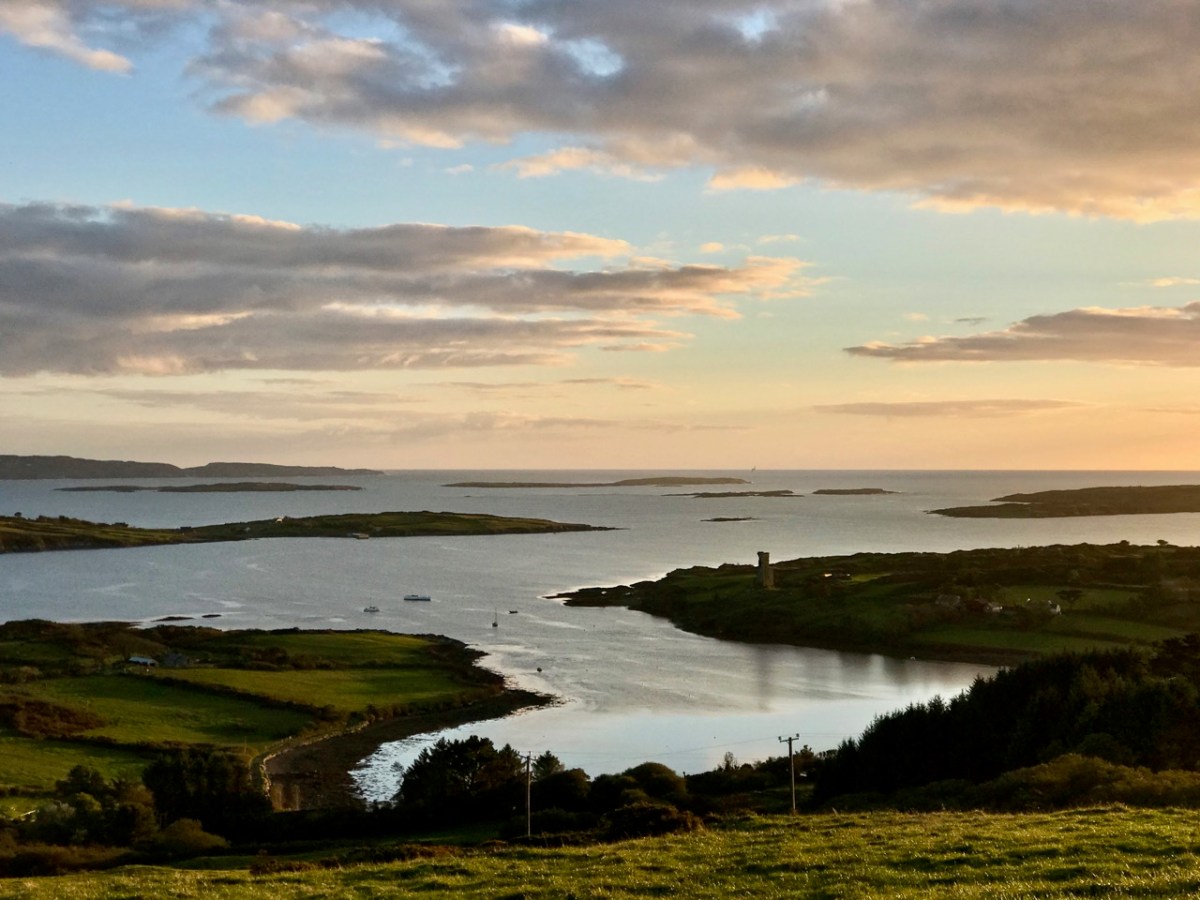
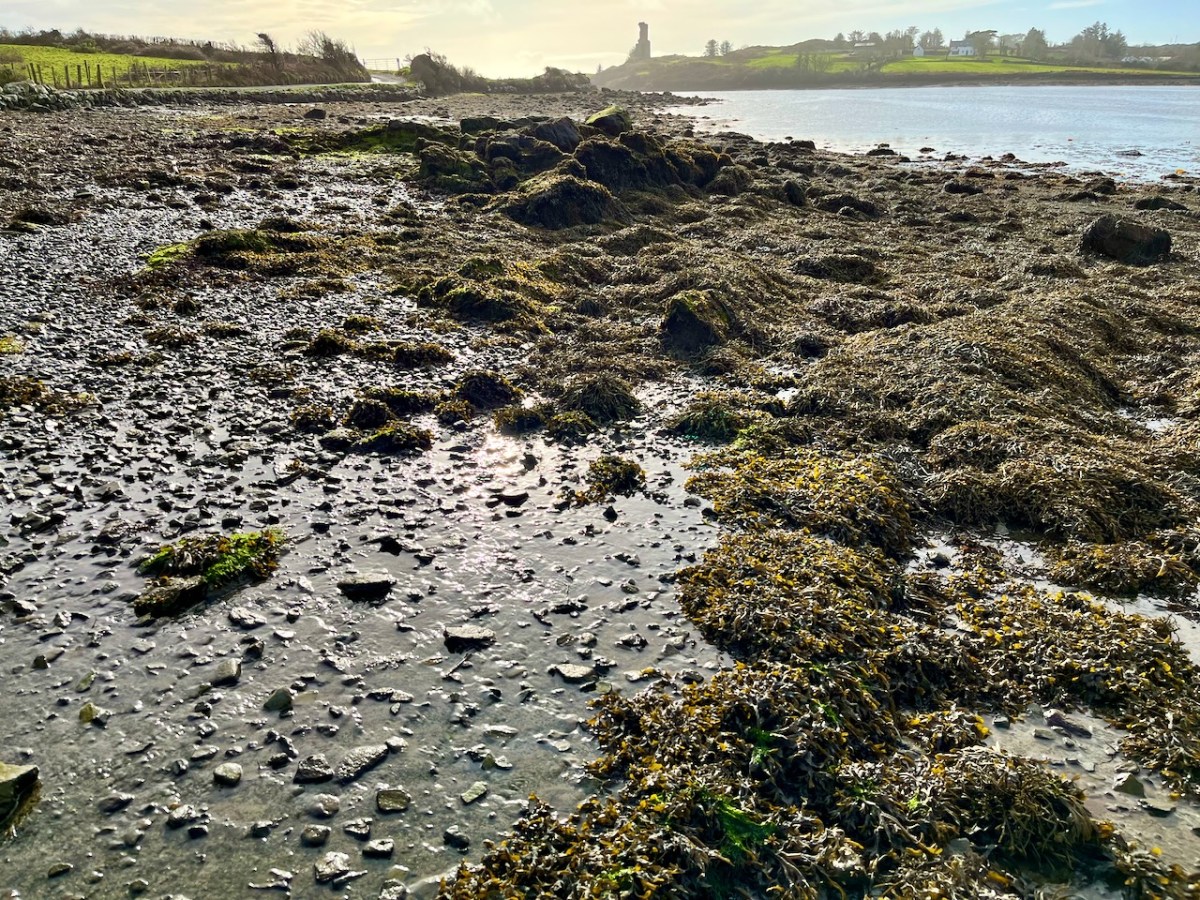
    Above: looking down on Rossbrin Cove with some of the islands of Roaringwater Bay beyond. It is a natural harbour, and there is a thriving boatyard at the western end of it. The difference between low and high tides is around 2.5 metres on average, and much of the inlet dries out when it is at an extreme low. I timed my walk to arrive when the tide was fully down, as I wanted to explore the exposed mud-flats, with hopes of finding intriguing detritus.

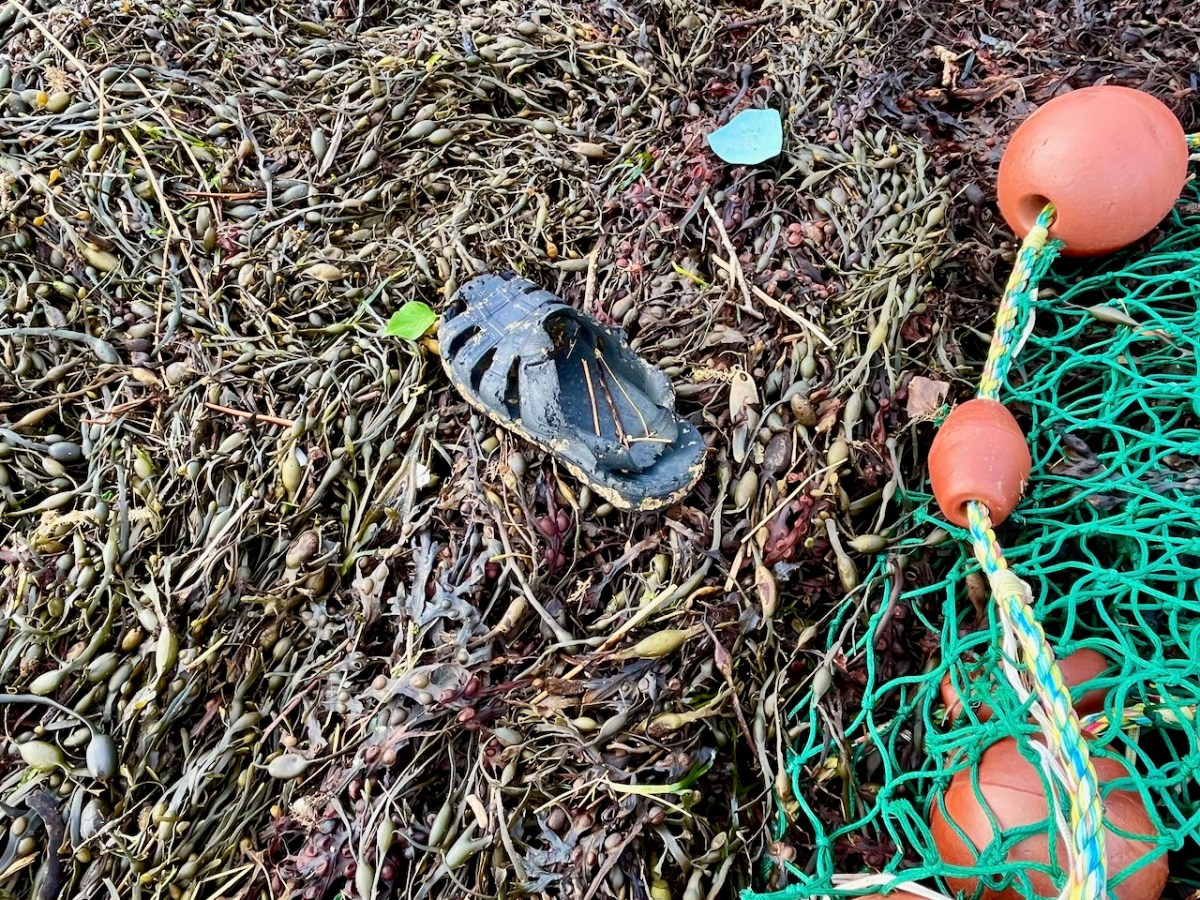
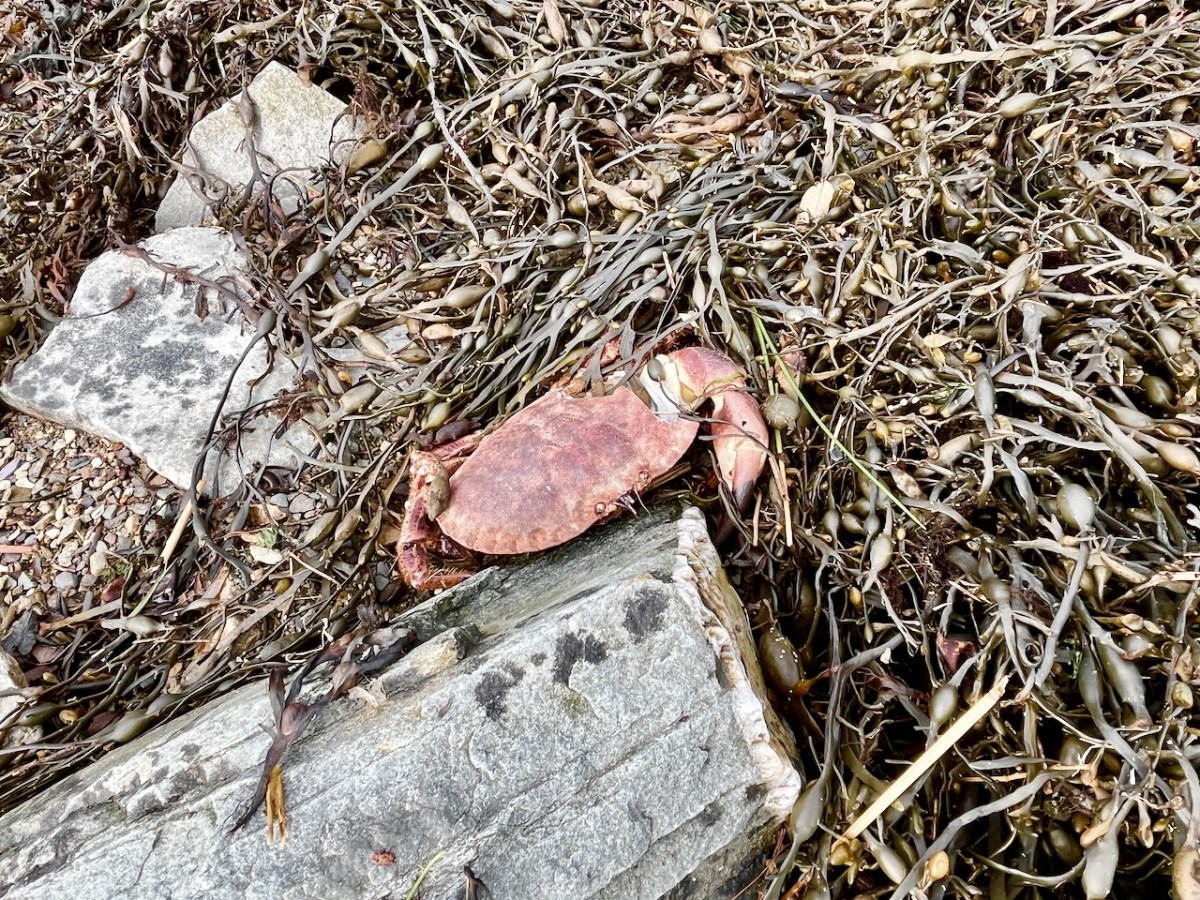
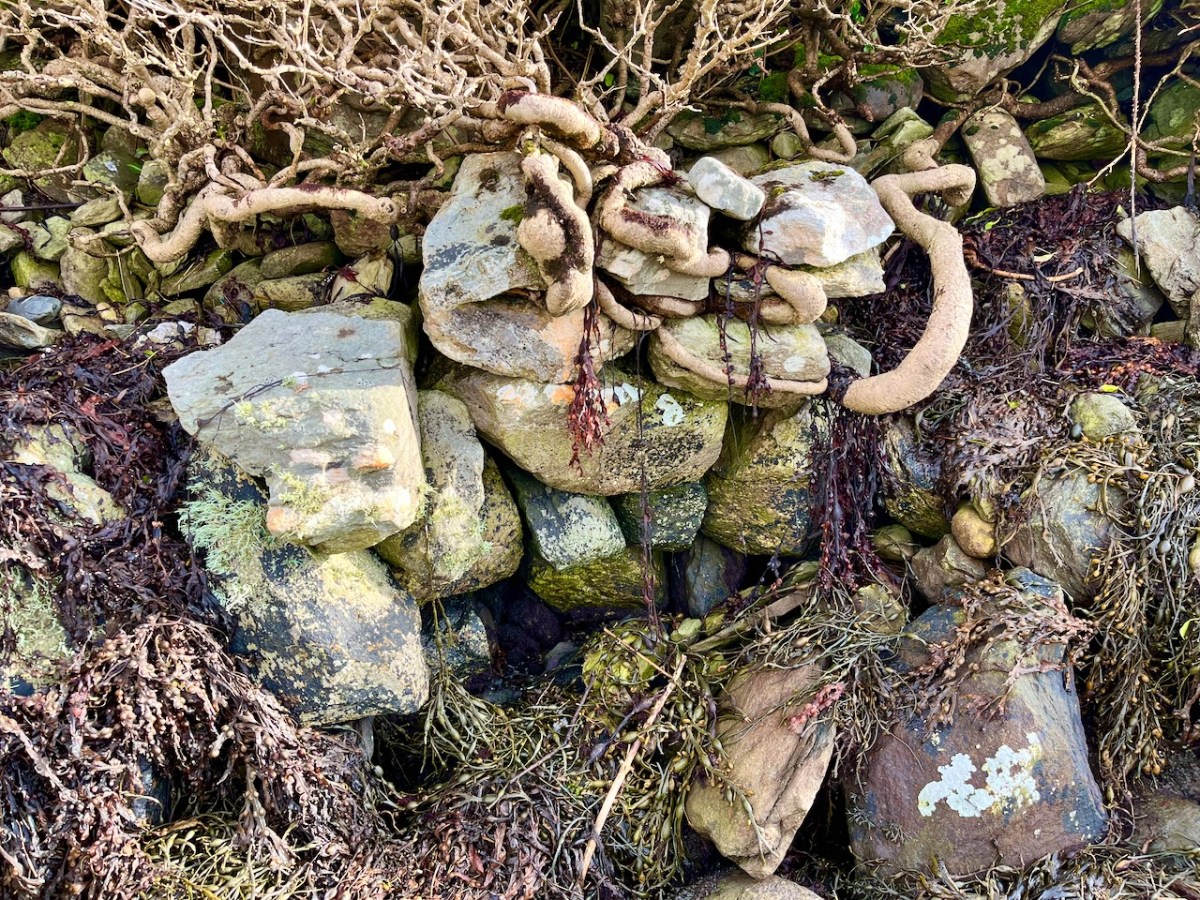
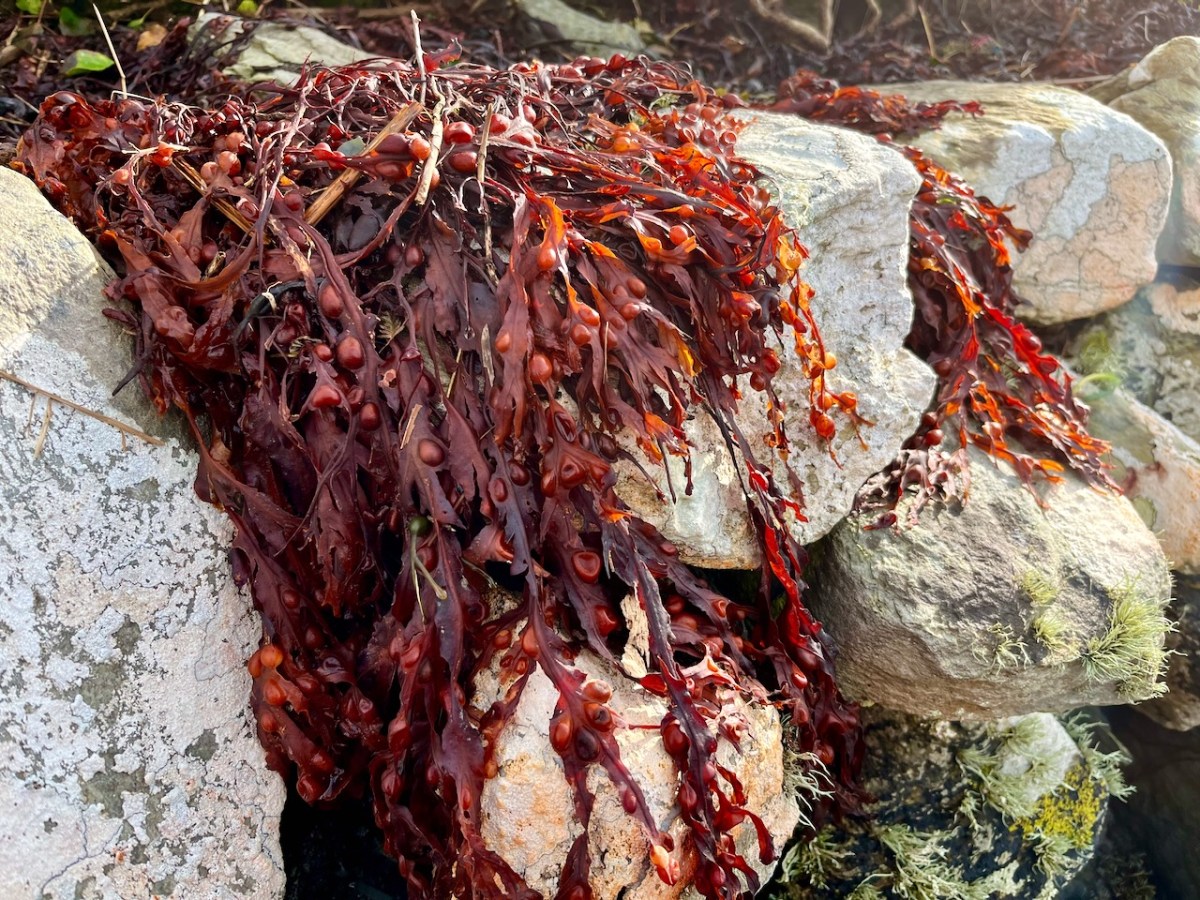
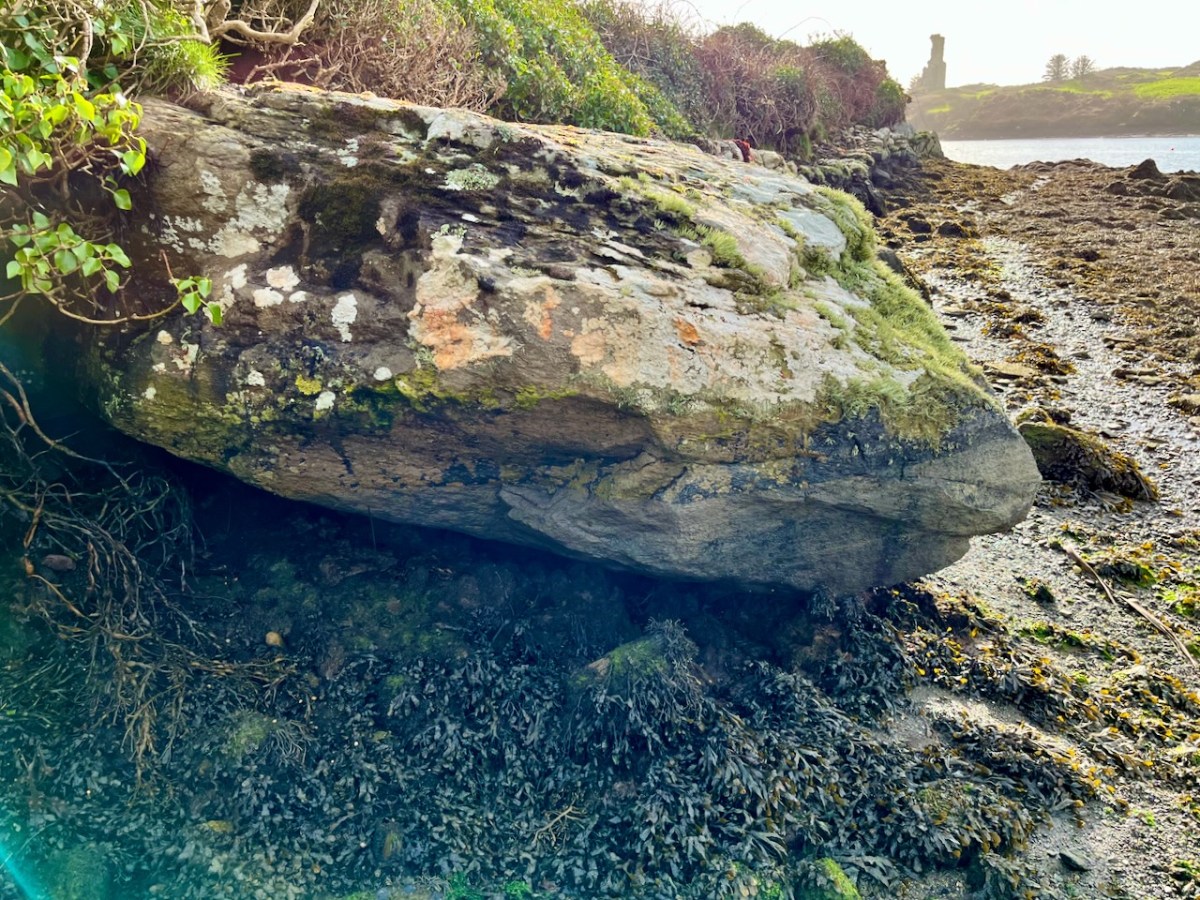
    Not an inspiring start! In fact, as I continued my review, I noted that there was very little other than the natural environment – weather-worn boulders, skeletal shells and masses of seaweed – to disturb the order of things in Rossbrin on this February day. If our harsh storms had been of some positive effect it was perhaps to flush out any washed-up debris that might have accumulated in the winter – being now past St Brigid’s Day I consider it appropriate to call the season spring.

    No matter that the exploration was superficially disappointing, the magic of this little bit of West Cork soon took over, and my mind was filled with the enormity of its history. There was a university here in medieval times: manuscripts were written here in the castle that has become a crumbling pile. Ravens and seabirds now rule over the stronghold. I walked on.

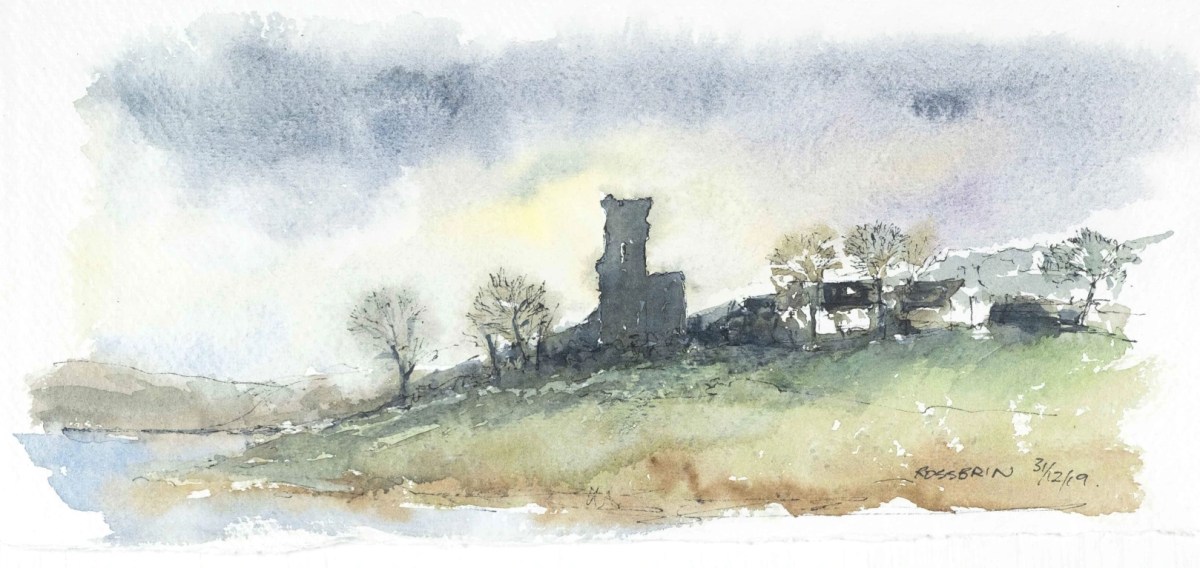
    The margins of the cove are lined with ancient banks. At every turn there is a composition which a maestro could frame: I make do with a camera. Rossbrin inspired our artist friend Peter Clarke . . . Thank you, Peter!

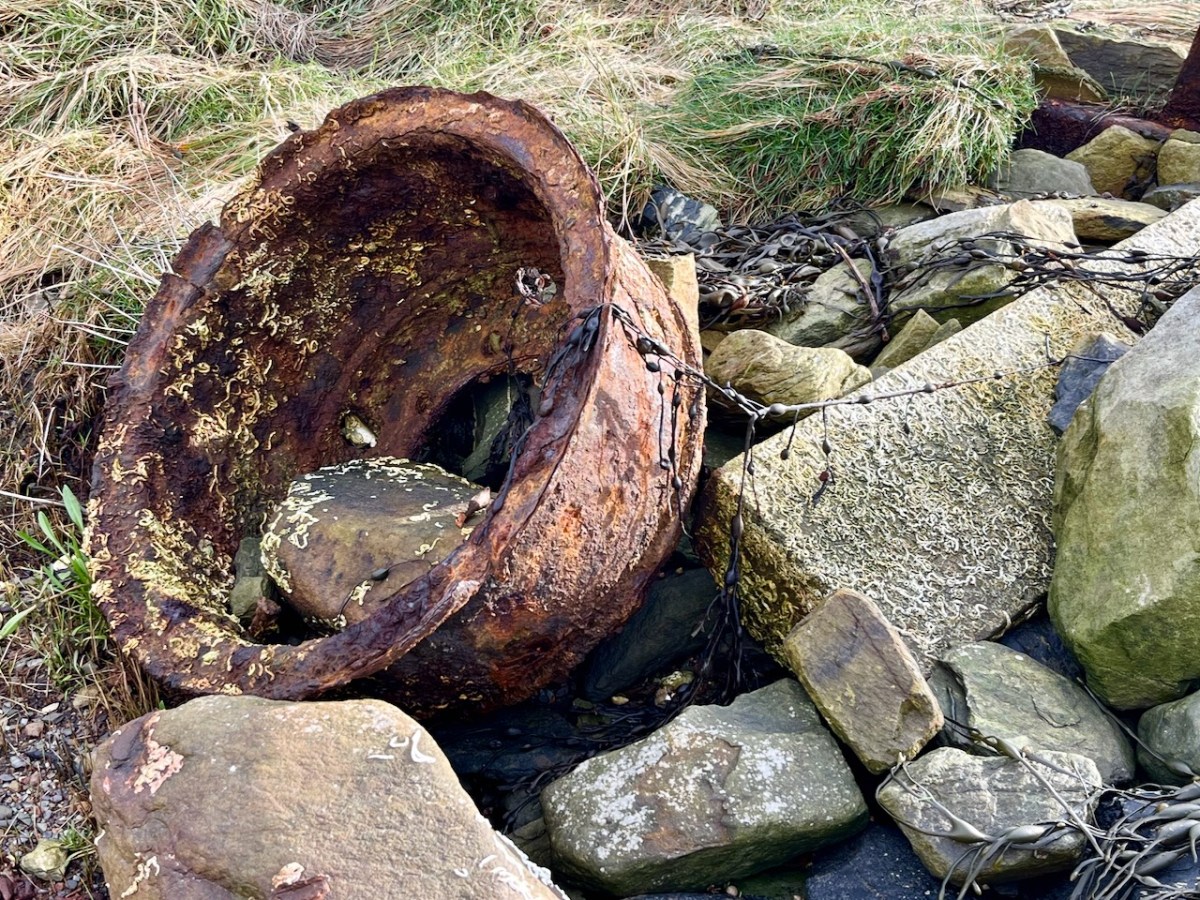
    Evidence of more recent history: possibly a pot which was used in the process of tarring a clinker boat hull. No doubt vessels were built on these shores – and used to make basic livings. There is still fishing activity in and around the cove; mussel beds thrive in Roaringwater Bay; seaweed collection happens also. In summer months the deeper waters of Rossbrin are occupied by leisure orientated sailing craft. I enjoy the calm days of winter when there is hardly anything on the water. I watched a small flock of oystercatchers scurrying and foraging with their brilliant beaks, and then I turned for home.

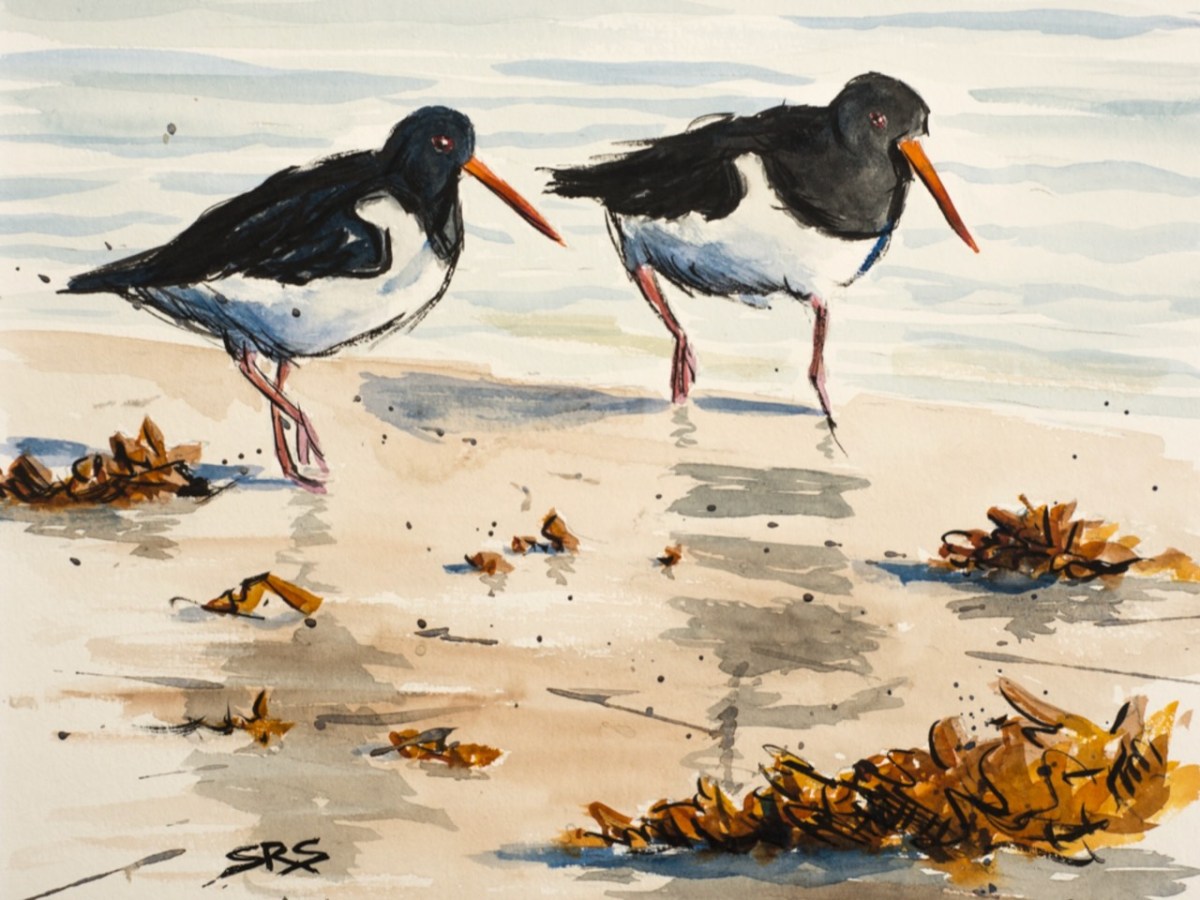
    The Rossbrin oystercatchers were uncooperative, and wouldn’t let me photograph them. Instead I have imported this wonderfully atmospheric painting by Cornish based artist Steve Sherris. Thank you, Steve

    We have posted extensively about Rossbrin Cove, its history and its people. Have a look at these:

    The Down Survey – Closer to Home

    Looking at Rossbrin

    Rossbrin Calendar

    Fastnet Trails: Rossbrin Loop 2

    Sheep’s Head Stone Circle Revived!

    Gorteanish Stone Circle, near Ahakista on the Sheep’s Head Peninsula, is singular because it lacks ancient history. It doesn’t appear on the early Ordnance Survey maps and – to the best of my knowledge – no local stories or folklore have been recorded about it. It is a Bronze Age archaeological site, but it has apparently been overlooked until comparatively recent times.

    It’s a short walk to the west out of Ahakista to the site of the stone circle. The way is marked by the stone above. Atha Tomais means ‘Tomais’s Place, and refers to Tom Whitty from Philadelphia, who settled on the Sheep’s Head in the 1980’s with his wife Suzanne and family. He is credited with having come up with the idea of establishing The Sheep’s Head Way – a series of footpaths covering the peninsula, and the project was put in hand by Tom and a local farmer, James O’Mahony, completed in (remarkably) just 18 months and formally opened by President of Ireland Mary Robinson in July 1996. During clearance work for the Ahakista footpath the remains of the stone circle at Gorteanish were discovered. It has since been suggested that there were stories of ‘old stones’ being hidden in the undergrowth. A footpath giving access to the stones from the nearby lane was duly completed and opened, and the inscribed stone marks this occasion.

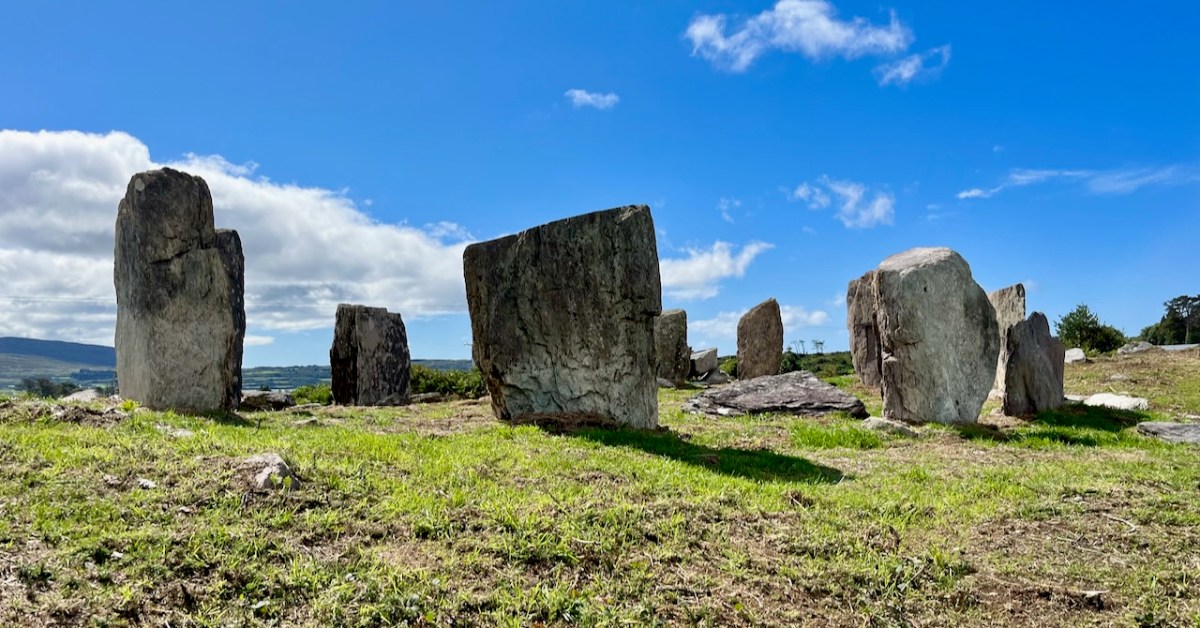
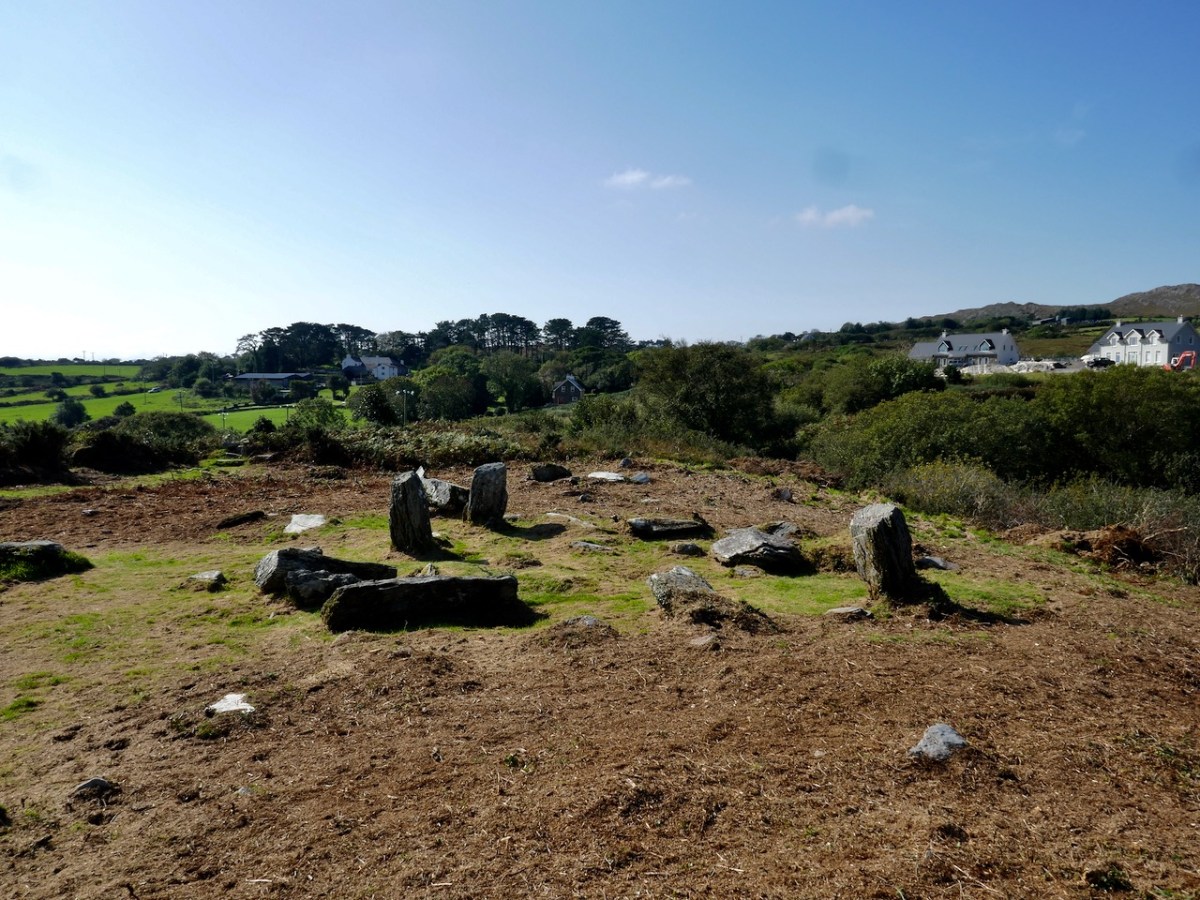
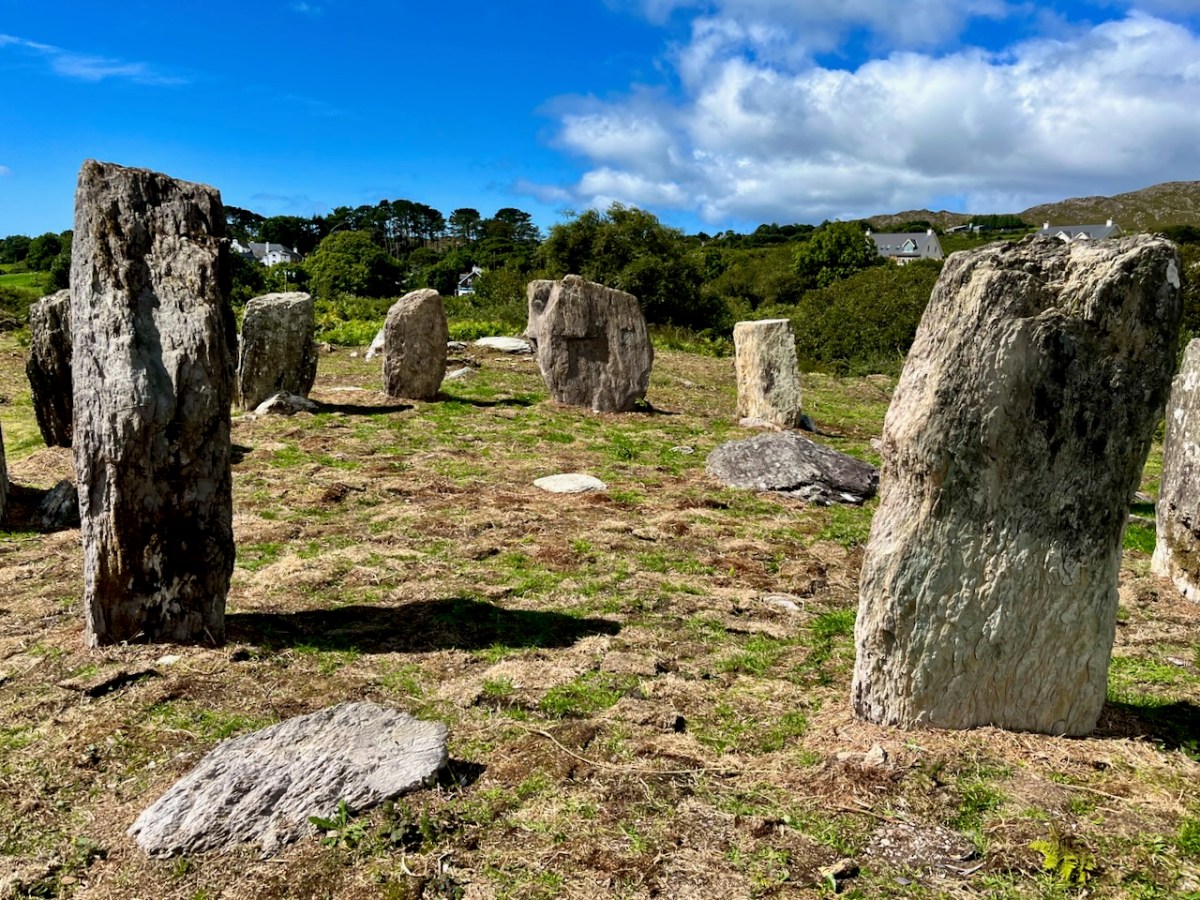
    This photograph shows the circle more or less as it was found in the 1990s. Four stones are standing, and others are lying prostrate.

    Earlier this year, the decision was taken by Professor of Archaeology at University College Cork, William O’Brien, together with a group of students, to extensively study the site at Gorteanish. Their mission was to excavate the site where necessary to establish which of the stones had been standing and to see how feasible it might be to restore these standing stones in their original sockets, using only traditional methodology. A significant area around the whole site would also be examined to search out any evidence of human occupation and activity – and hopefully to provide a reasonably accurate dating for the circle.

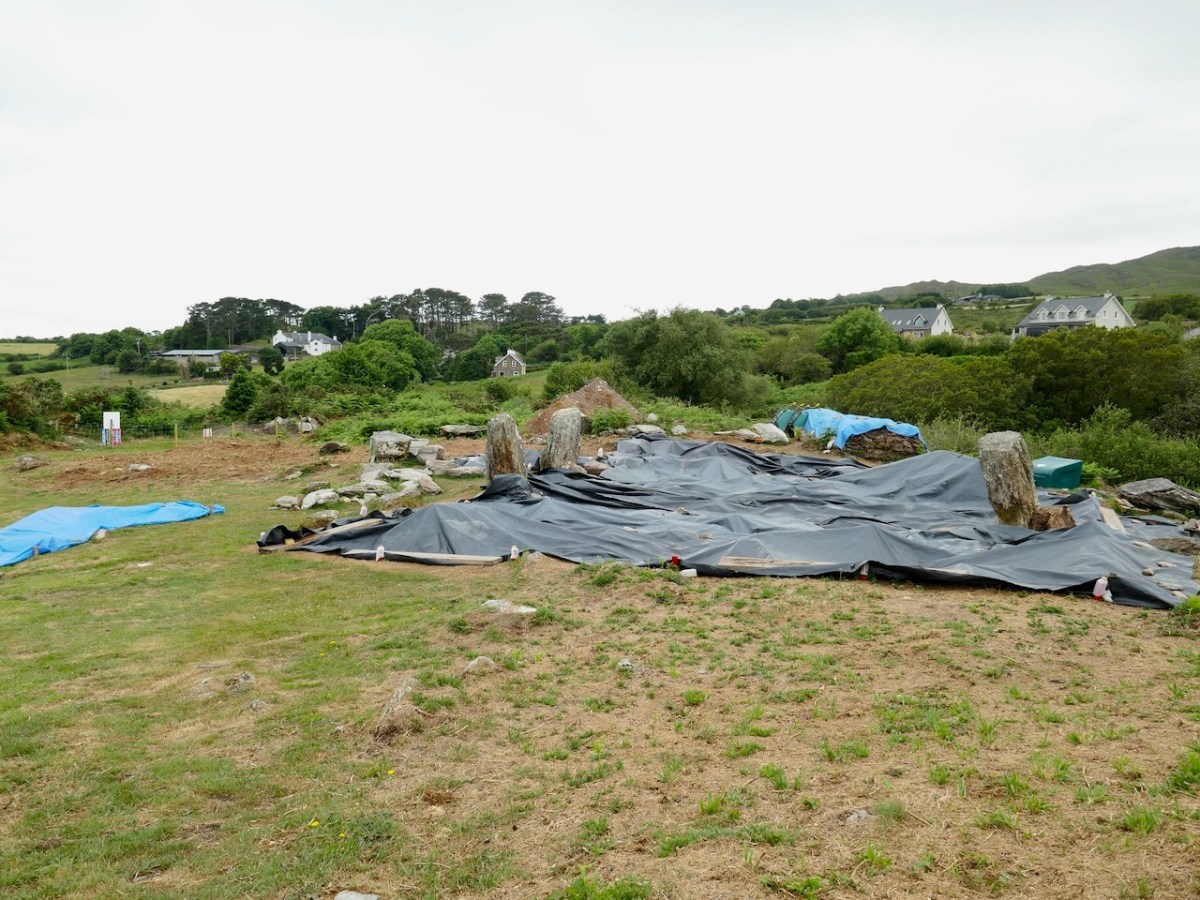
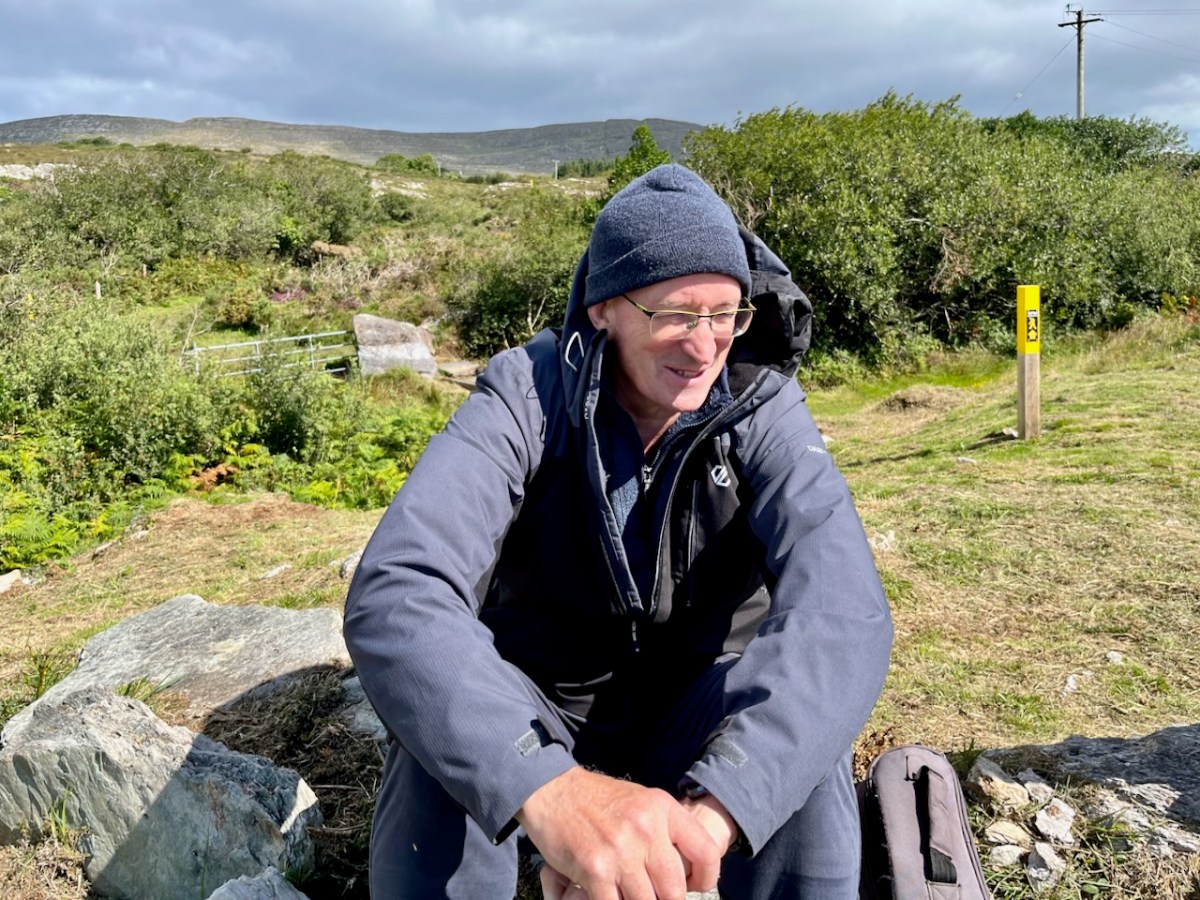
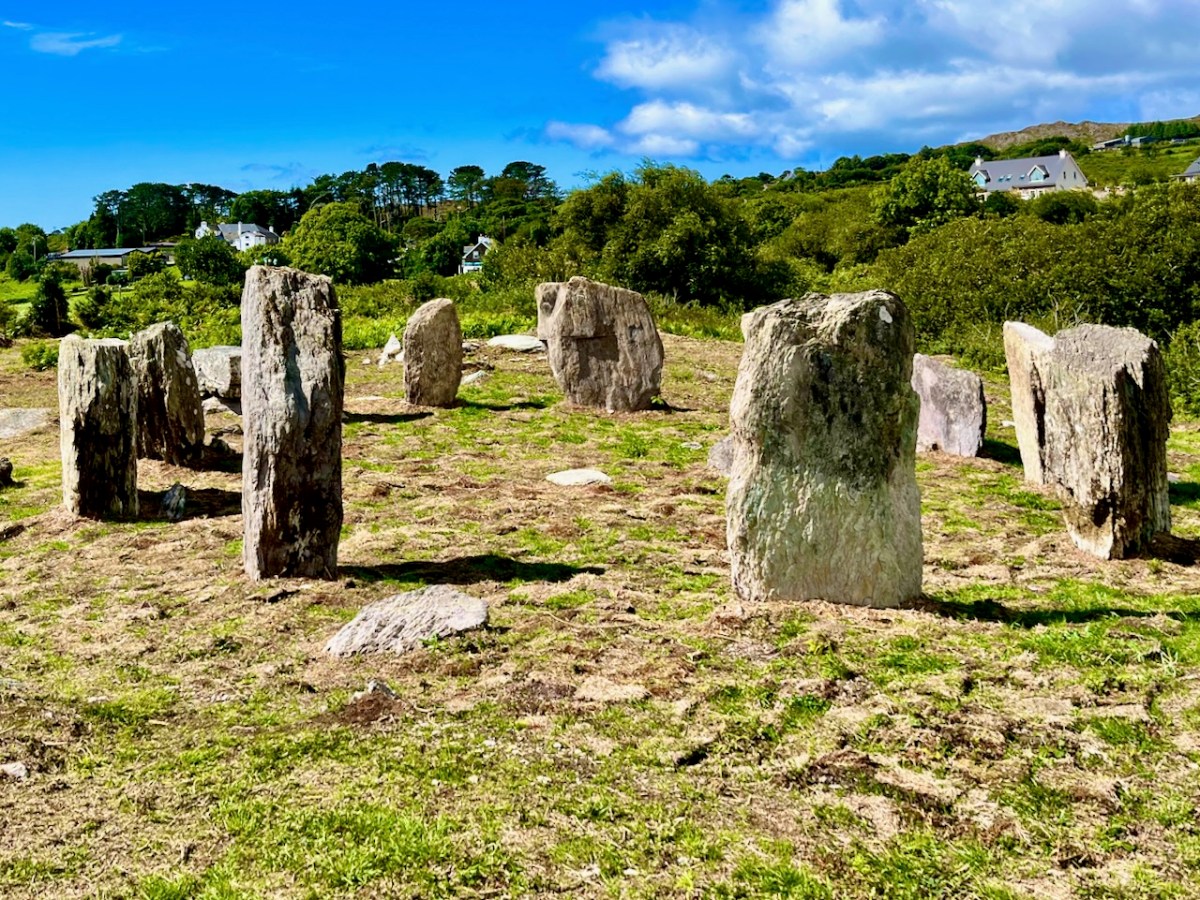
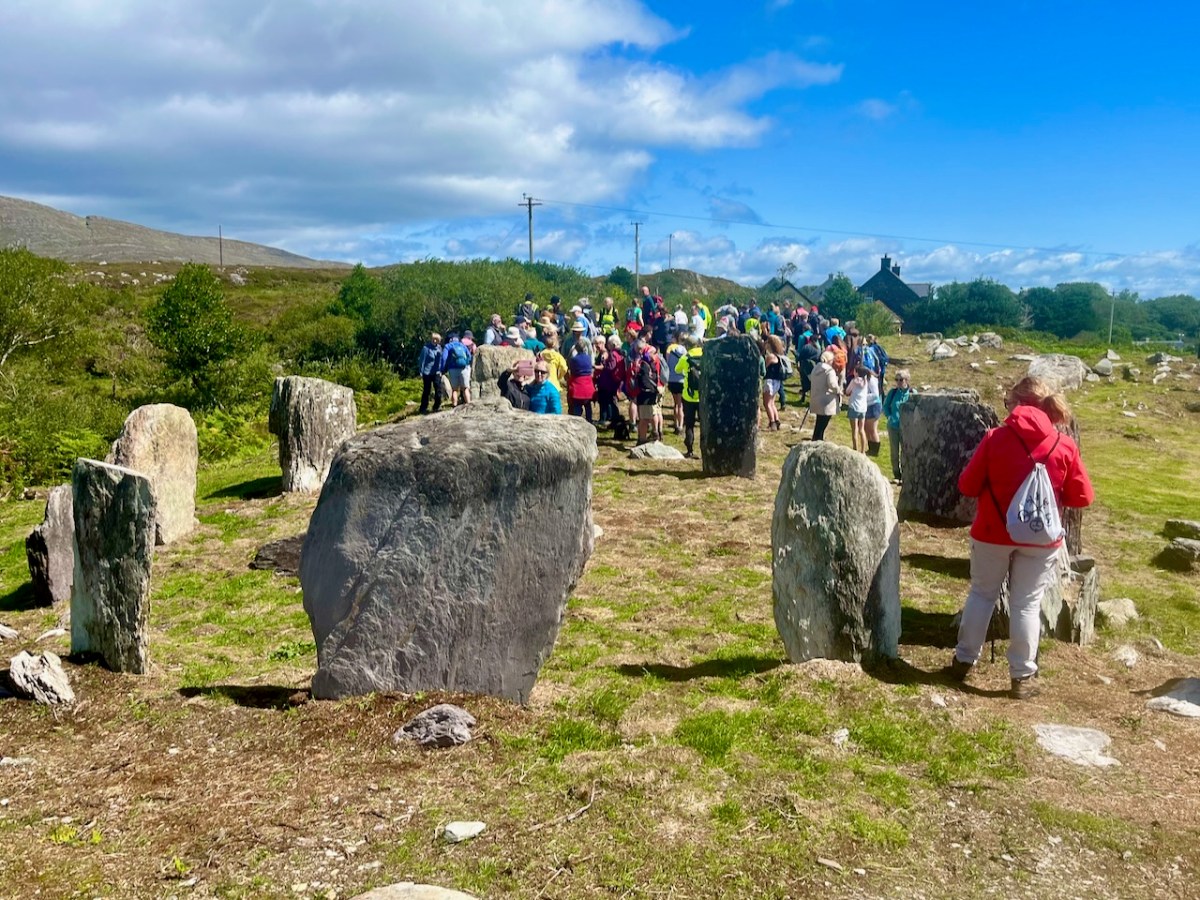
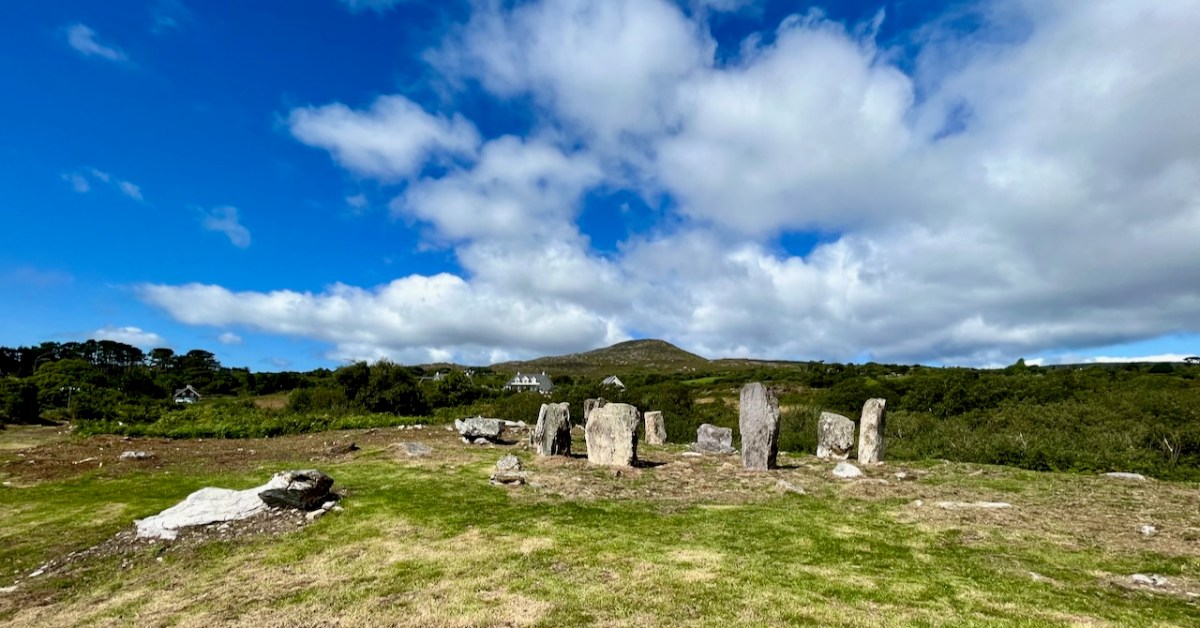
    Finola and I visited the site while the archaeological works were progressing (above). Yesterday (5 August 2023) Billy O’Brien (below) was on hand to give a detailed talk on the excavation and restoration work, and we could see, for the first time in many generations, the circle restored to its complete state: it now has all eleven stones standing.

    The view above shows a boulder burial monument situated to the south-west of the main circle. This has always been a visible feature of the site. A boulder burial (once called a boulder dolmen) is peculiar to Ireland. In fact it is found only in Counties Cork and Kerry. Finola has written comprehensively on this subject, here. It is usually a substantial raised stone supported on a bed of smaller stones:

    . . . Boulder-burials are a group of prehistoric stone monuments of megalithic proportions, whose distribution is largely confined to south-west Ireland. Some 84 examples have been identified, 72 of these in Co Cork and the remainder in Co Kerry, where they occur both singly or in small groups of between two and four. They consist of a large boulder erratic supported by an arrangement of smaller stones, with no covering cairn or tumulus. Several examples are known which are centrally placed within stone circles . . .


    Boulder-burials: A Later Bronze Age Megalithic Tradition in South-West Ireland
    William O’Brien Dept of Archaeology, UCG 1992

    A closer view of the boulder-burial at Gorteanish: it can be seen that the main ‘boulder’ element has split in two through the ravages of time. In the main circle, all the standing stones have been restored to their original (relatively shallow) sockets, and fixed using rammed small stones, following the evidence gained during excavation.

    Most stone circles have a specific orientation. This can be seen by the shaping of the stones around the circle. In this case there are two clear ‘portal stones’ on the east side, directly opposite an axial stone on the far side (above). More usually, the stone opposite the portals is flatter, when it is known as the ‘recumbent’. In this case it is a substantial stone with a shaped top (detail, below).Perhaps this points to a feature on the horizon? Our calculations show that the orientation of this circle is towards the winter solstice sunset – just as at Drombeg Circle, not too far from here.

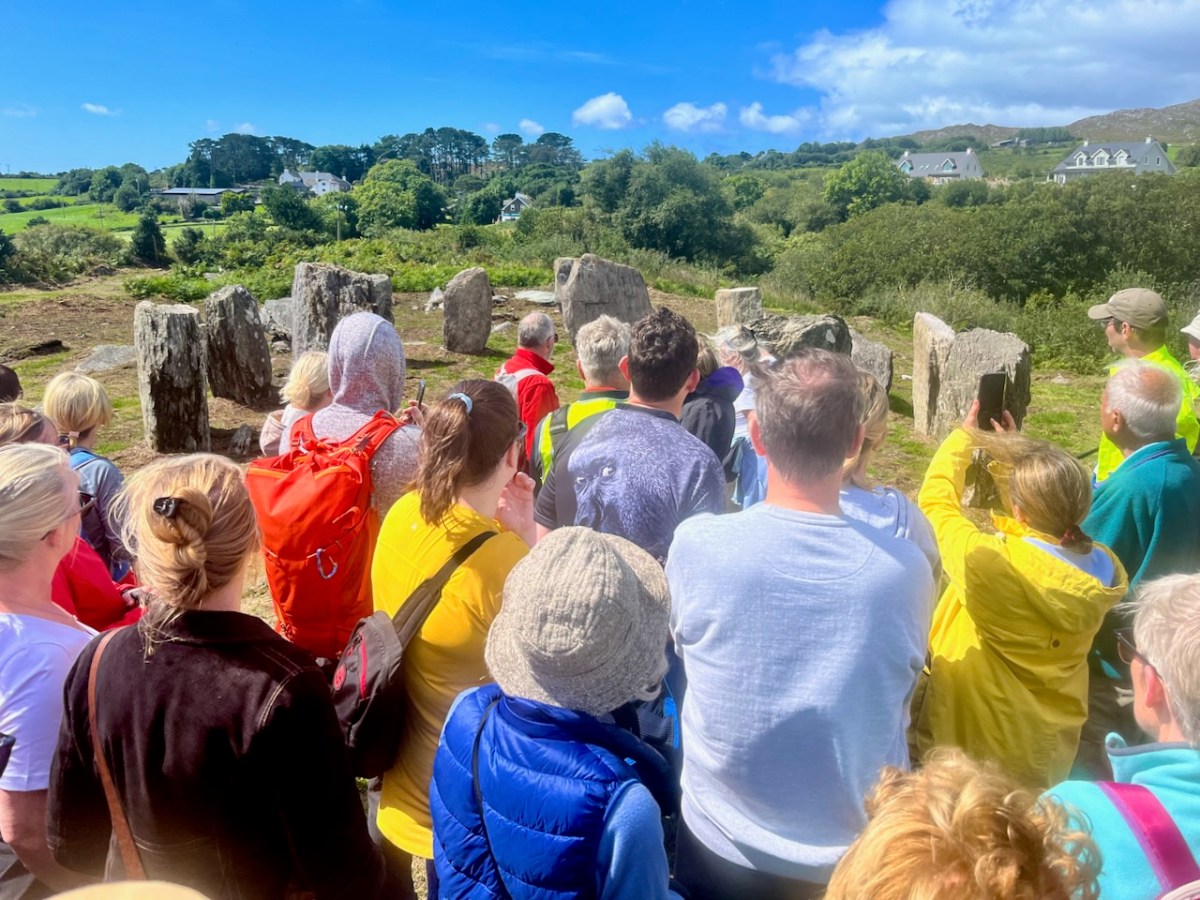
    Yesterday’s event attracted a substantial crowd, eager to hear Professor O’Brien talking about this project. Many were no doubt surprised to see the site returned so faithfully to its original state. But – with stones standing – it has now become an iconic piece of archaeology. We are delighted that it is on our doorstep. If you want to read a deeper discussion on stone circles and their historical contexts, look at Finola’s post here – one of many that include the subject.

    Another thing that Billy pointed out was the significant ancient stone wall that runs across the site; you can see traces of this above. In this view you can also see an elongated large rock apparently lying on its side. Some local commentators have suggested that this was once a very tall standing stone. If so, at about nine metres, it would have been spectacular! But the excavation confirmed O’Brien’s view that it was never standing, and has always been part of the landscape in its current position.

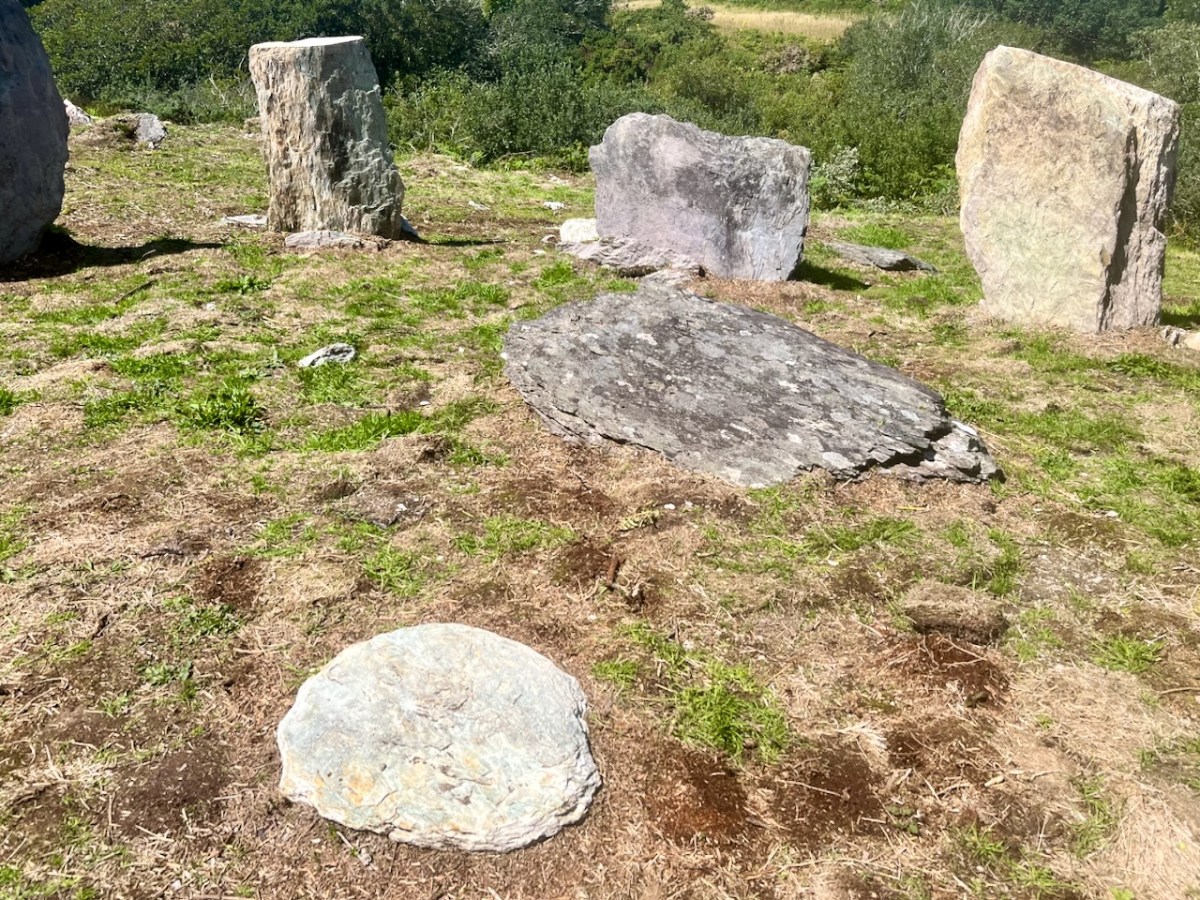
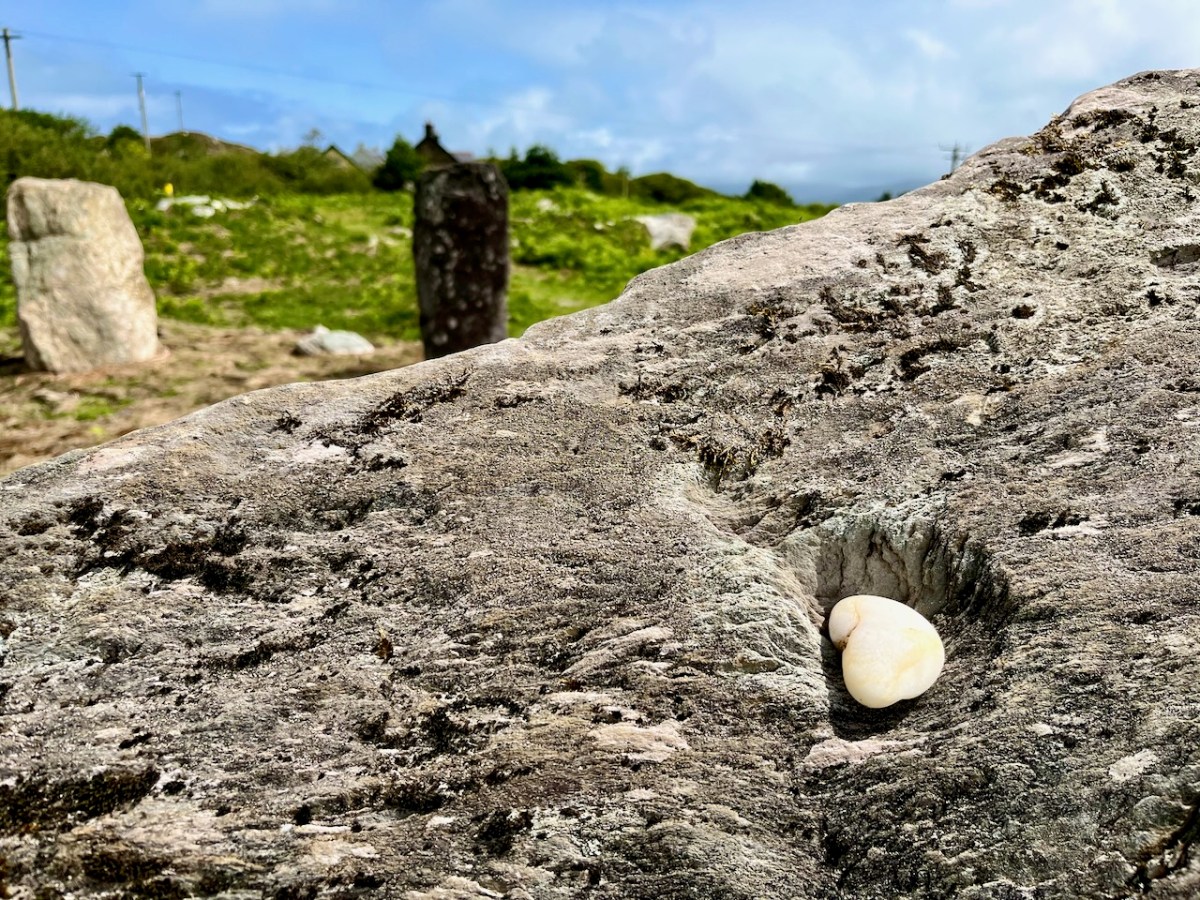
    Also, an area of flat ground to the east above the site was closely examined, in case it revealed traces of any human use, but none was found. In fact, there were no signs of any notable human activity. However, one point that I found particularly interesting was that, in the centre of the circle, is a pit containing quartz stones. Quartz, that glinting reflective material that faces the much older main chamber at Newgrange (you can see a pic of it in this post), certainly catches the attention; it’s fascinating that the Gorteanish people – whoever they were – gave it an aura of importance by burying it at the focal point of this circle. The quartz has been replaced in the pit, after the excavation. Its position is marked by the only ‘alien’ element that has been introduce here – a pale coloured flat stone:

    The larger earth-fast stone beyond this new addition has always been there: the site might have been constructed around it. It’s always interesting to see how people are going to react to a circle like this – here is someone’s recent contribution, also giving importance to the ‘magical’ quartz:

    All in all, our day was exciting. It’s pretty special to see something ancient faithfully restored – and open for all to access. The seven fallen stones probably collapsed because of cattle rubbing up against them over centuries. That has been prevented now. We hope you will all appreciate – and enjoy – this new West Cork experience.

    In High Places

    Here is a collection of photographs taken in West Cork from some of the high places: ridges, peaks, mountain paths. The pics were all taken around ten years ago, and haven’t been used in our blog posts previously. They serve to show stunning landscapes, of course, and hopefully illustrate the variety of the country which surrounds us here. The header is taken from the peak above Three Castle Head.

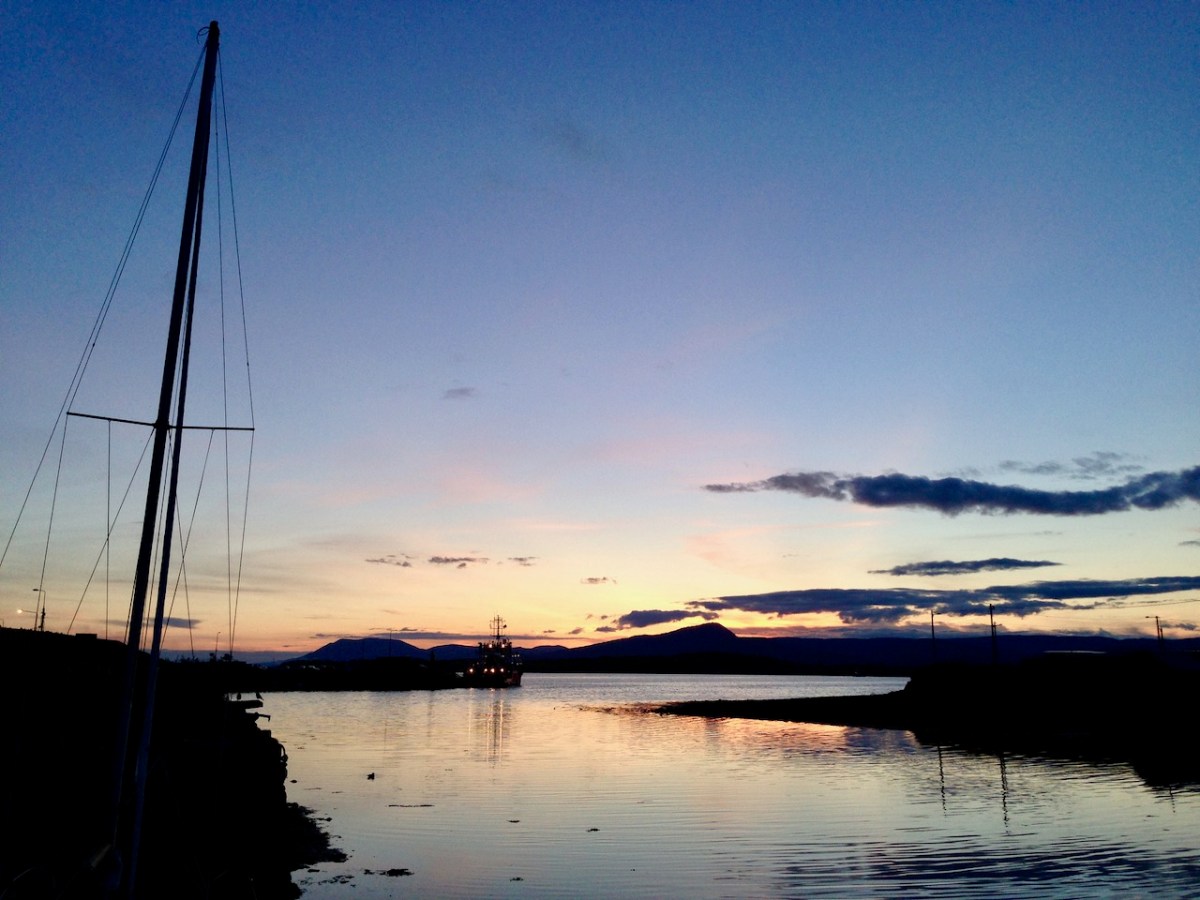
    The upper pic is looking down on Bantry town from the high ground to the south, while the lower one reminds you of the evening view from Bantry at sea level.

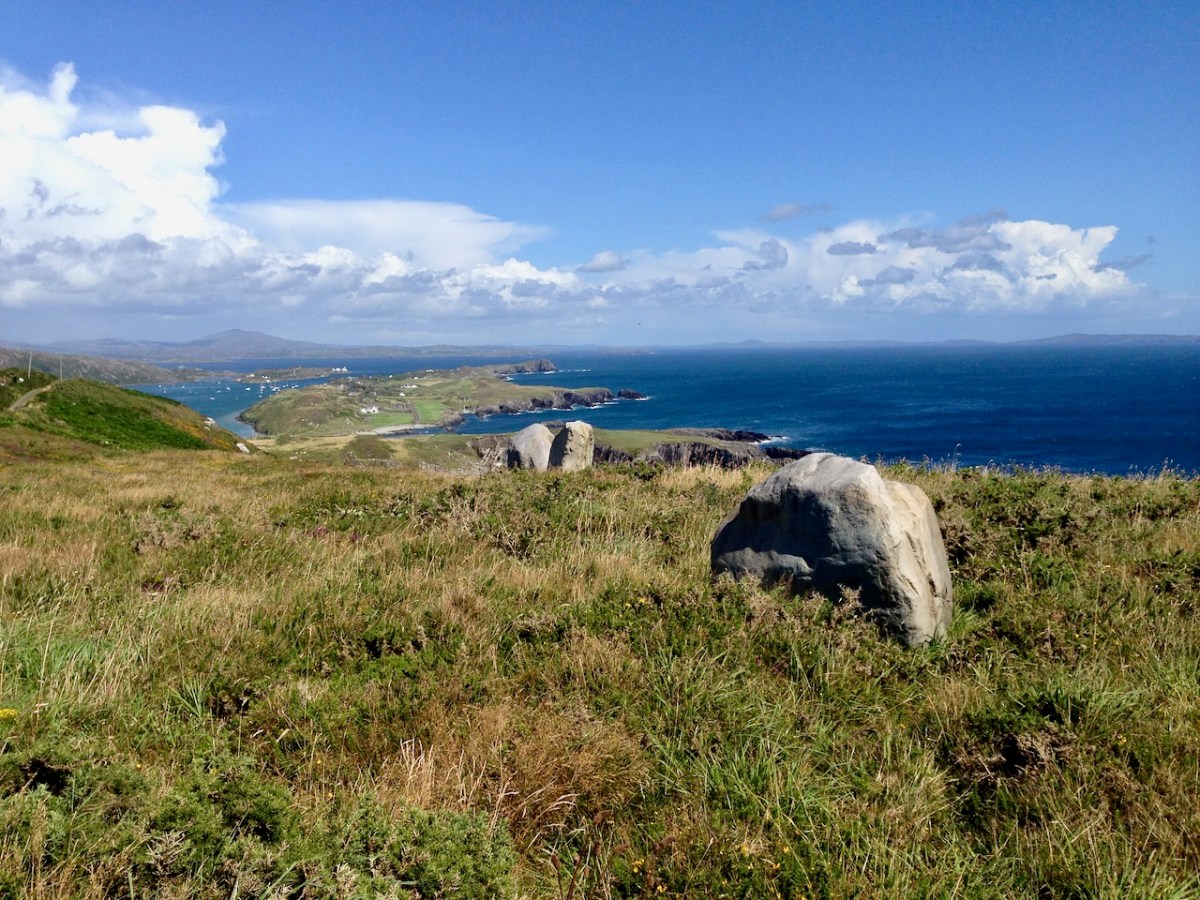
    If you leave your car at Galley Cove Beach and walk up the steep track towards Brow Head you will come across this enormous stone row – and you will look back to the peninsula of Crookhaven. Don’t be fooled by the stones: they have been placed on this site fairly recently. They are impressive, nevertheless.

    And here is a closer view of Crookhaven.

    While turning from this spot and looking west, you will see the end of the coastline at Brow Head. This stone is likely to be more anciently placed. In the distance is Mizen Head with its Napoleonic era signal tower at Cloghane.

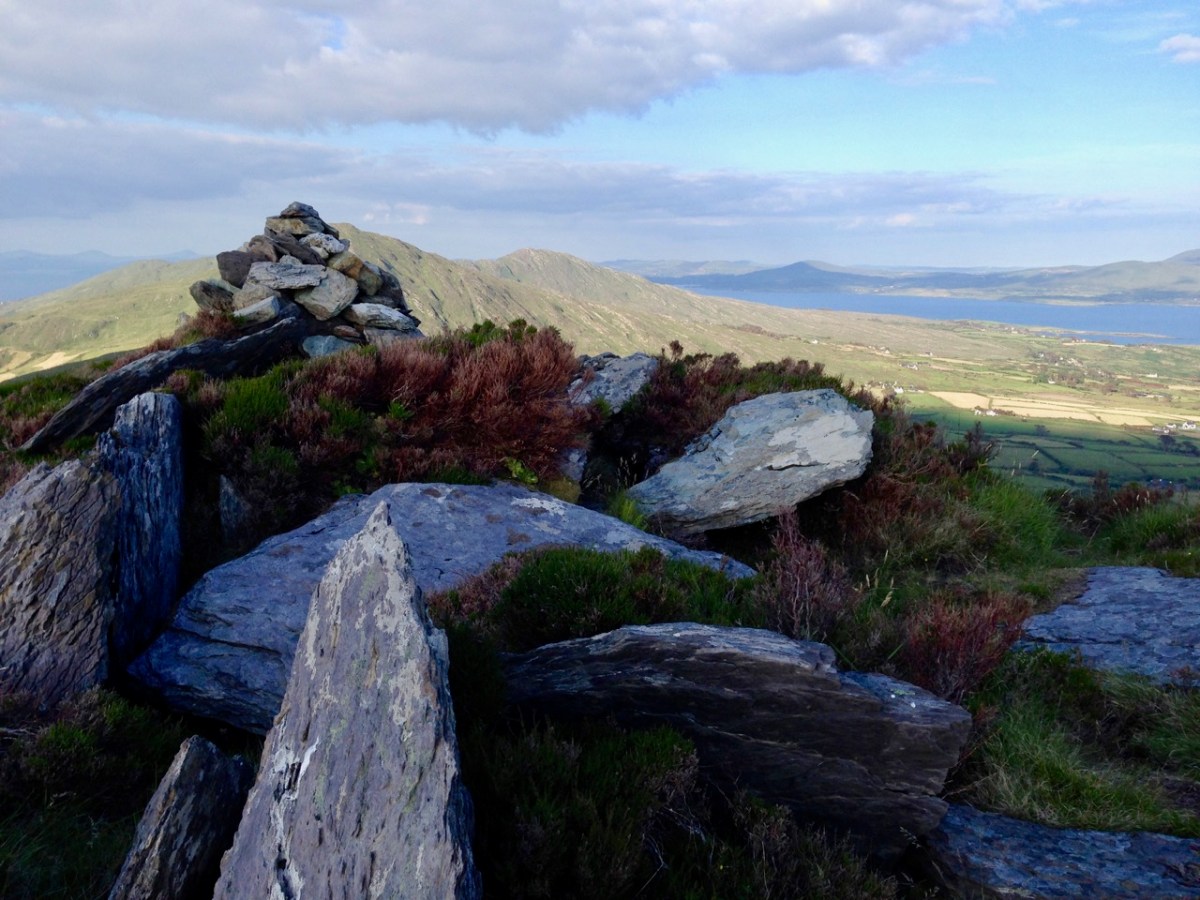
    Contrasting light effects seen on the footpath that follows the ridge on the Sheep’s Head Way. That’s the spit of land that runs from east to west between the Mizen Head and the Beara Peninsula. There are cairns on the summits, with the remains of a wedge tomb and a Marriage Stone to be seen along the way.

    The view north from the heights of the Sheep’s Head takes in the Beara Peninsula and – seen above – the high point of Hungry Hill dominating the distant rugged landscape.

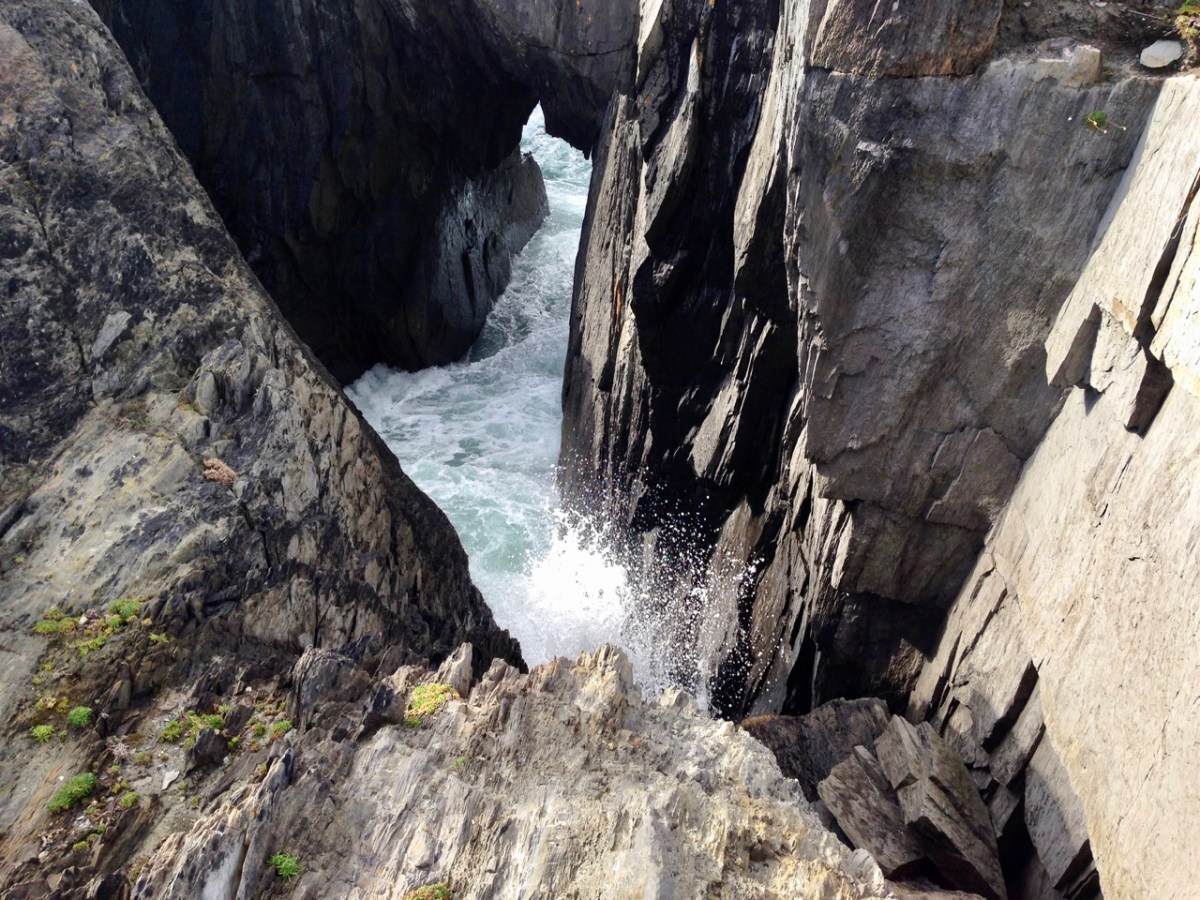
    You are never far from the coastline in West Cork. Look out for wild seas constantly sculpting the rocks over millennia.

    From our home in Cappaghglass we look out to our own ‘high place’ – Mount Gabriel. This enigmatic tract of land dominates the area and is imbued with legends and folklore. It is also one of the most atmospheric of our peaks at all times of the year.

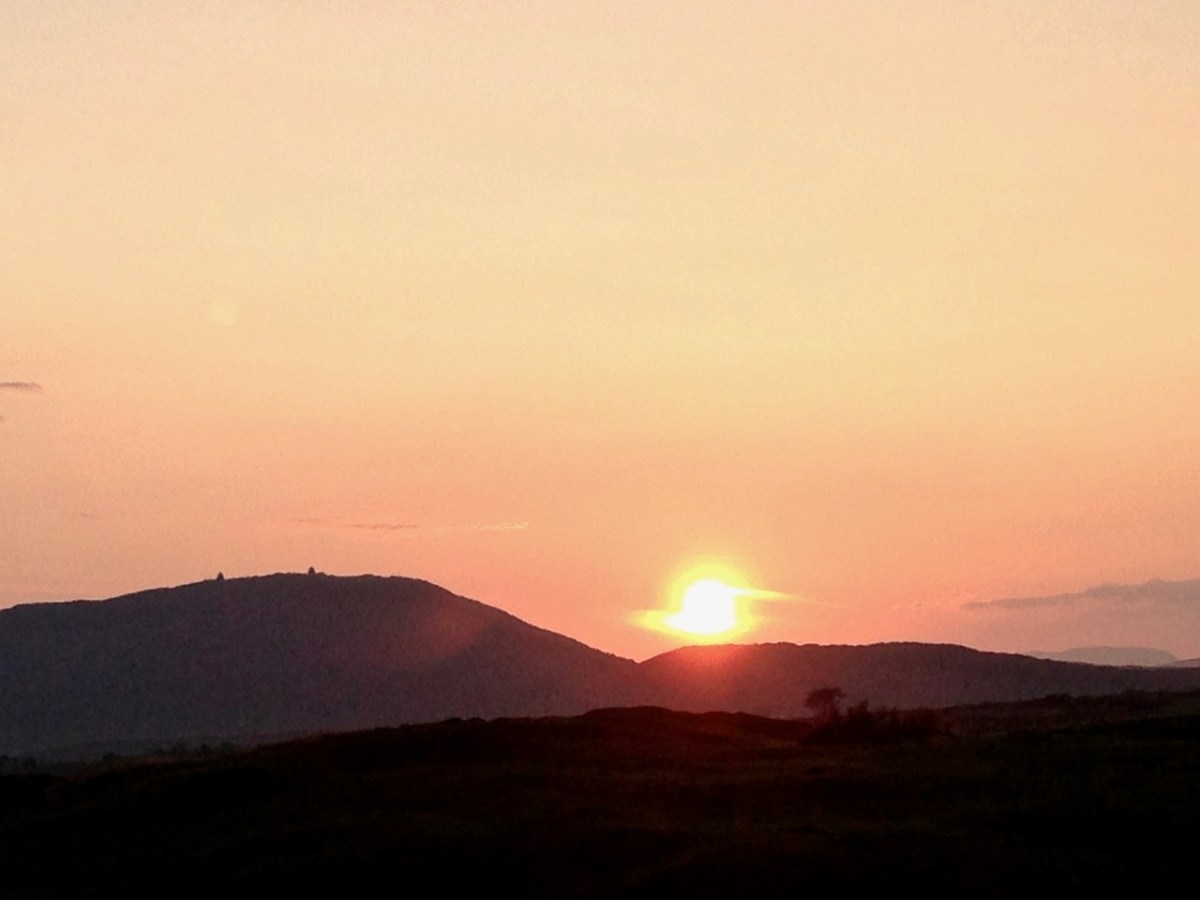
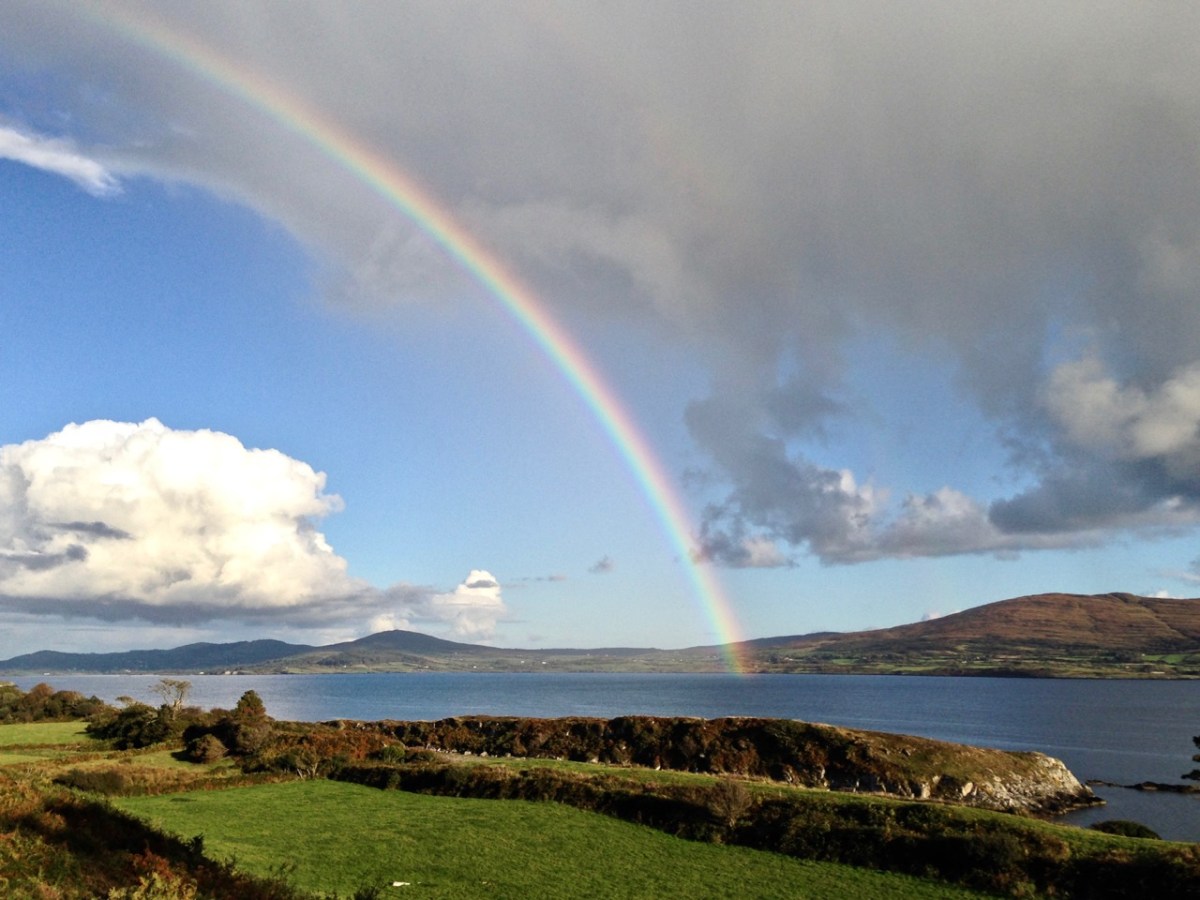
    Another local view for us (above): we face out to Rossbrin Cove on the Mizen Peninsula. Finally, the celestial spectacle (below) finds its pot of gold on the shores of the Mizen.

    A Map of the County of Cork, Part 2

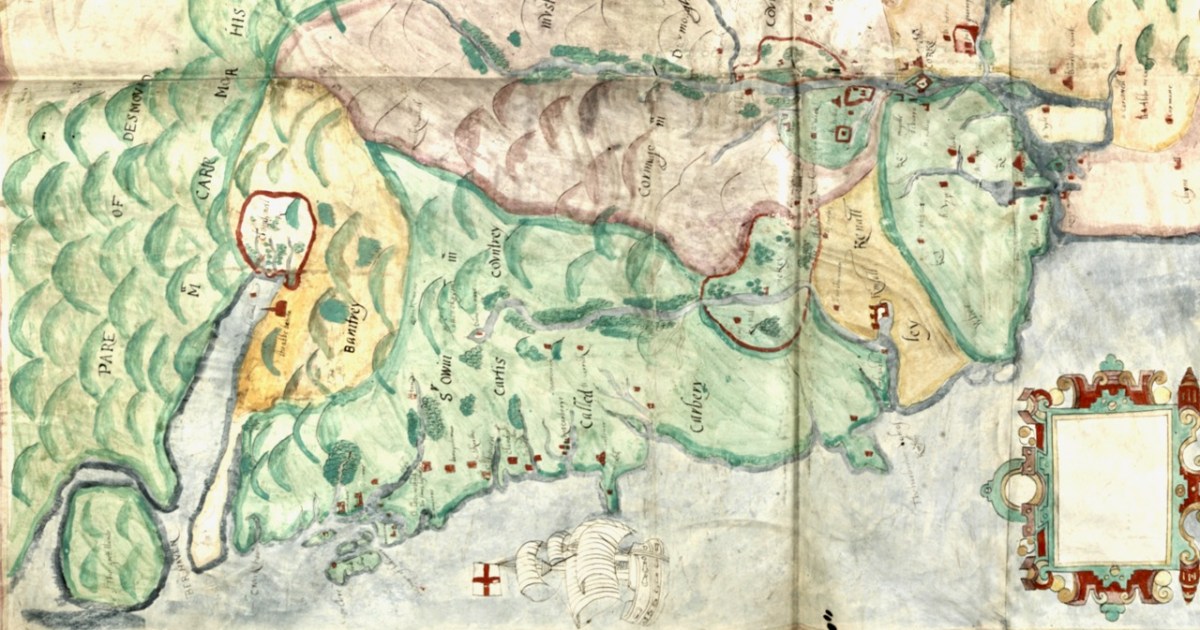
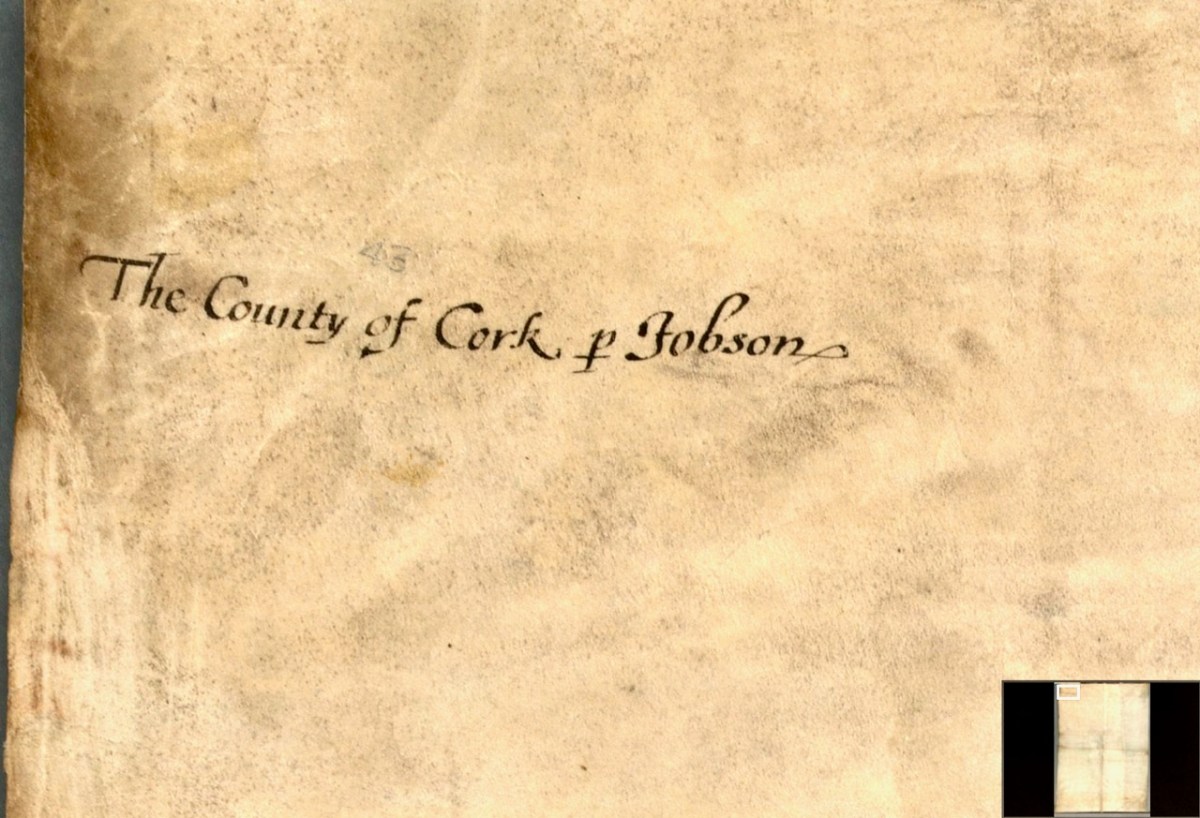
    In Part 1, I said that We don’t know who did this one, or when: The date is given as 1560-1620. It seems in some ways more basic than other maps of the period, and less exact. I have now gone to the Atlas itself in Trinity College and discovered that the maps in the Digital Repository are an incomplete set. Specifically, the original Atlas at TCD contains the reverse side, the ‘verso’ of each map. Here’s what’s on the verso of the County of Cork. This:

    and this:

    So we see that the map is attributed to our old friend Jobson – he who drew the plantation map I wrote about here and here and which was dated to 1589. There are similarities and differences between this map and that one – the galleons and scales for example look very alike. But there’s a lot more information on the plantation map and some of it is different from our Map of the County of Cork. As to the date of the County of Cork map – we will try in this post to see if we can narrow that down a bit from the broad estimate of 1560-1620. 

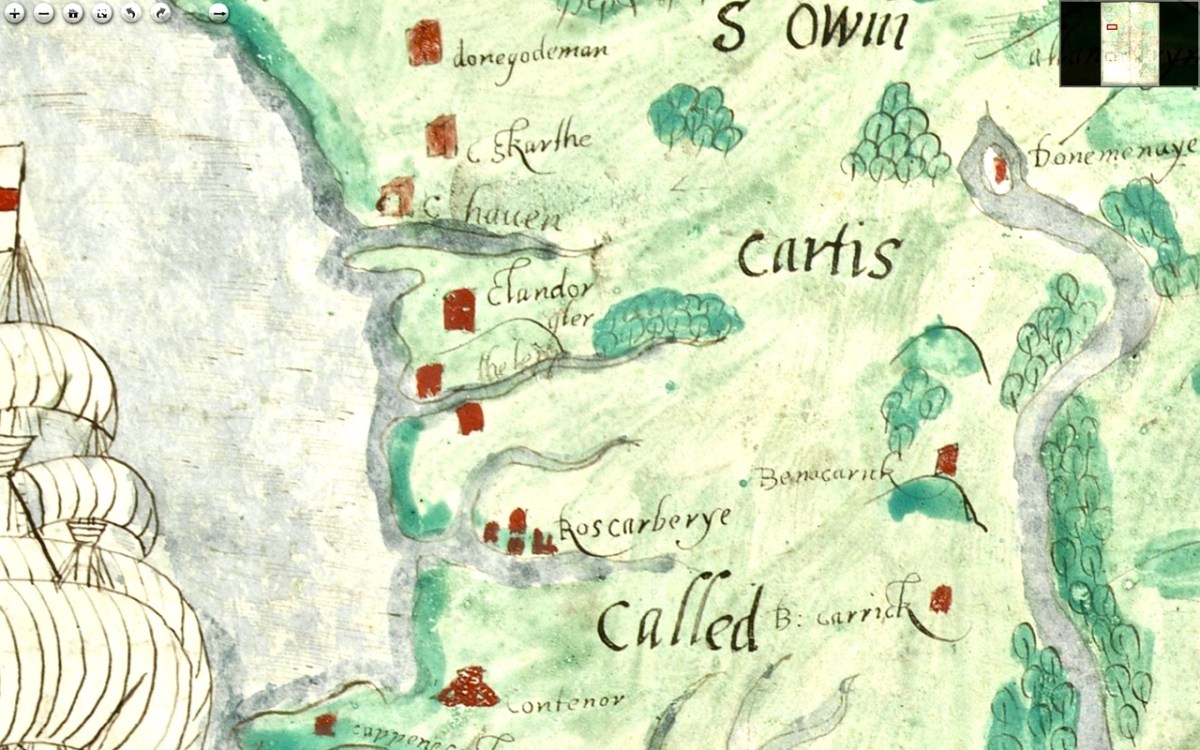
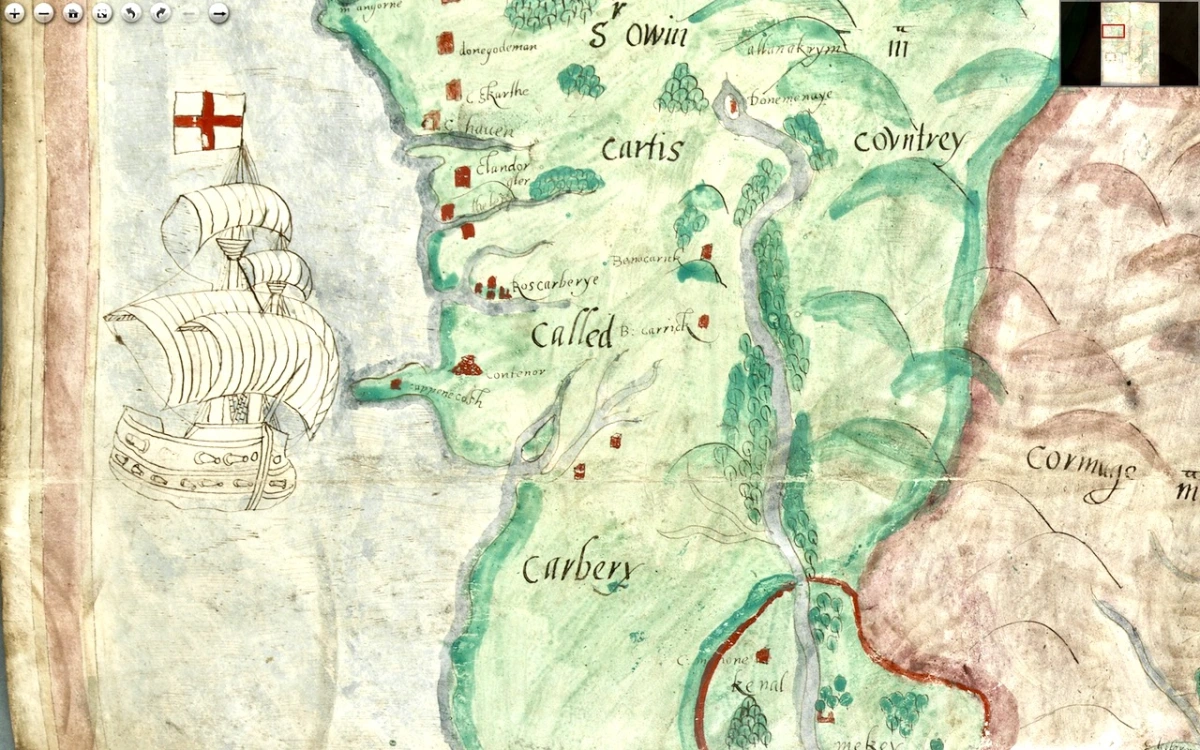
    I want to go, as they say in Ireland, east along. That is, take off from where I finished last time, and travel east along the coast towards Cork, taking in the River Bandon. For the rest of this post, I’m keeping the map oriented as it is originally – that is, with west at the top (it’s actually surprising how quickly you can get used to this). Between Baltimore (Donashad) and Castlehaven (C haven), there are three castles shown, one labelled Sir Jmes Castell, Doneygodman and C skarthe. These are all a bit of a puzzle and I would invite readers to contribute ideas. On the archaeological list of Monuments for this area we can identify the O’Driscoll Castle on the Island in Lough Ine – could this be the Sir Jmes Castell? A promontory fort on Toe Head, known now as Dooneendermotmore, although likely originally an iron age refuge, was refortified in the 16th century and may, like the one I wrote about in Dunworley, have had a significant curtain wall. Was this Doneygodeman? It seems unlikely, as Doneygodeman is show inland – I wonder if instead it could be the castle at Raheen, which was a castle of the O’Donovans.

    Finally, C skarthe might be a castle of the McCarthy’s – McCarthy is spelled in a variety of ways on this map, but there I can find no trace of it now. There was a castle in Listarkin, but once again, this is in the wrong place, unless this map, while certainly approximate in places, is wildly inaccurate. It seems reasonable to conclude that the more inland castles may have been harder to plot on a map that the coastal ones.

    The castle at Glandore (c Landorgter) is clearly shown, along with two castles guarding the entrance to a long inlet labelled ‘the lepp.’ One may have been Kilfinnan, actually located near Glandore, which the other could possible be the coastal tower house at Downeen. This brings us to Rosscarbery (Roscarberye), shown as a collection of Buildings, as befits its status as a substantial town with a cathedral and a college, and a place of pilgrimage in the name of St Fachtna.

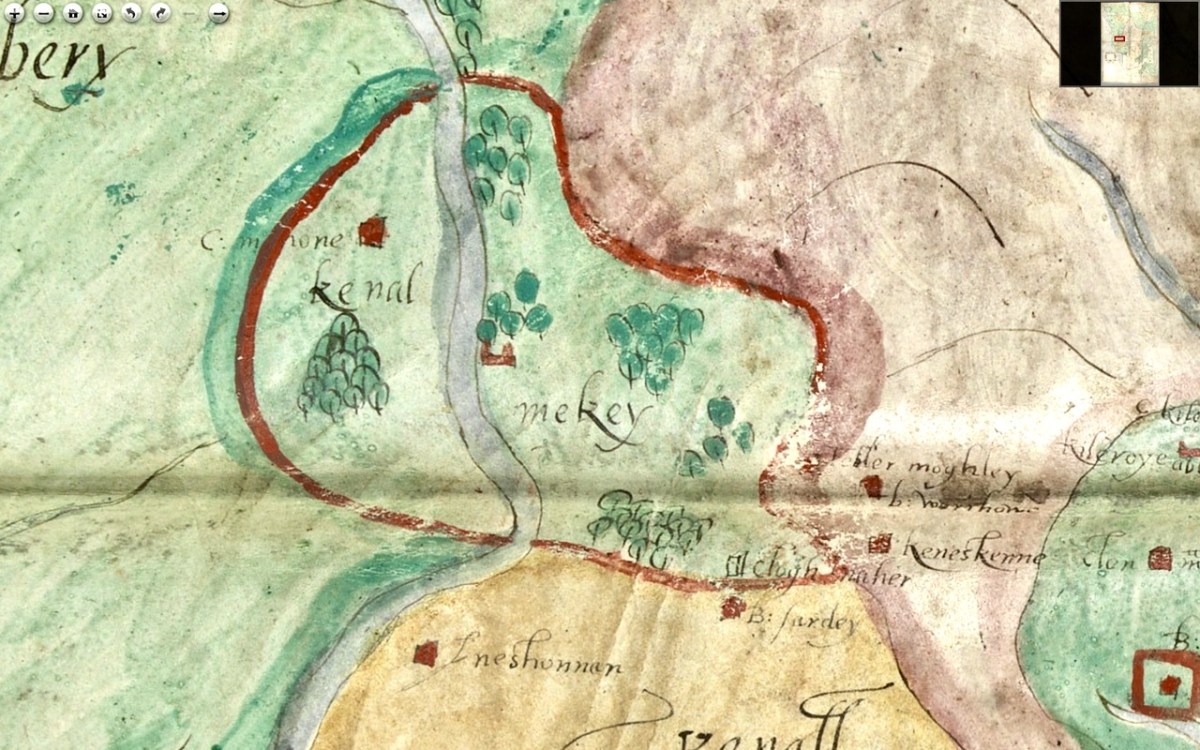
    The entirety of this area, in green, is identified as Sir Owin Mc Cartis Countrey Called Carbery. Several other castles are identified here and there, and the course of the River Bandon is traced. The southernmost area is identified as Kenal Mekey, and to the south of the green-shaded section is Kennal Ley. In Canon O’Mahony’s magisterial History of the O’Mahony septs of Kinelmeky and Ivagha he states: 

    In the history of South Munster there is no fact attested by more abundant evidence (evidence unknown to Smith and Gibson) than that the Sept-land of the Ui Eachach Mumhan during many centuries extended from Cork to the Mizen Head, as one continuous territory, including Kinelea and Muskerry, and was ruled by a chief whose principal residence was Rath Rathleann, in Kinelmeky.


    https://archive.org/details/historyofomahony00omah/page/n1/mode/2up  Page 105

    He identifies Rath Rathleann as the mighty multi-vallate ringfort of Gurranes, which was superseded by Castle Mahon, which stood where Bandon is now situated. And here it is, Kinelmeky, with C Mahon shown beside the river. Castle Mahon was later incorporated into Castle Bernard, home of Lords Bandon. Another Castle is shown further down the river – no doubt the one we are familiar with as we travel the N71.

    We know that all this land was acquired by Richard Boyle after the Battle of Kinsale (1601) and that he started on his walled town of Bandon Bridge around 1620. Since this is still clearly identified as O’Mahony Territory I think we can take it that this map dates to before the battle of Kinsale.

    We see Kenall Ley (Kinelea) in yellow, with the walled town of Kinsale at its heart. Kinsale walls were begun around 1380 and lasted until most of them were destroyed around 1690 by the forces of William of Orange. Inishannon is noted in Kinelea, as well as Park Castell (in what is now the townland of Castlelands) and finally B: Sardey (or is that a different first letter?). We know from another map in the Hardiman Atlas (below) that B designated a small town. Given that Kinsale is such a prominent walled town on this map, once again, a date before 1601 is likely. 

    Supporting a pre-1600 date is the fact that it is the old Irish families that are identified with their territories – no settler or Plantation names are given. In fact the O’Mahonys and McCarthys are the only names on the sections of the map we have seen so far. Moreover, it it really was the work of Jobson, we know he was actively mapping in 1589.

    In Part 3 I’ll do a quick meander through the most interesting parts of the rest of the map. Stay tuned.

    A Map of the County of Cork, Part 1

    A Map of the County of Cork, Part 3

    Mizen Magic 25: Gortduv Loop (Fastnet Trails)

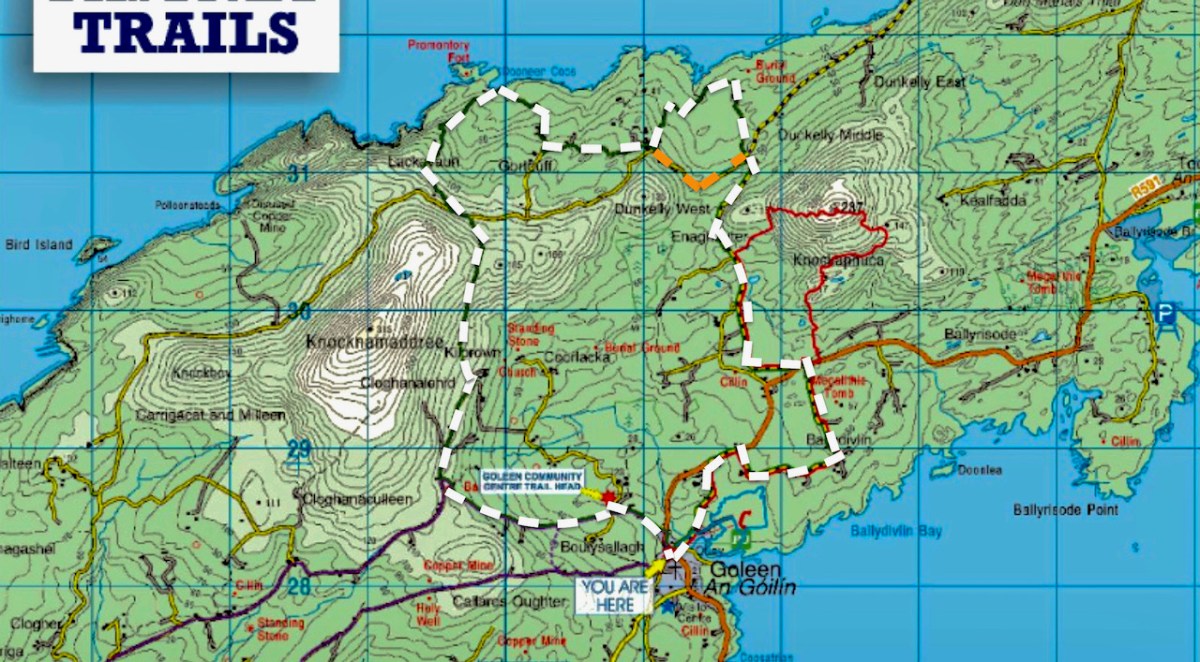
    Ready for a longer walk? If yes – this one is 13.5km and has strenuous stretches. If not, don’t worry – there are lots of possibilities for doing parts of the walk, or for going with friends and leaving a car at strategic spots. We didn’t do it all at once, in case you get to thinking we are super-fit hikers. (The sad truth is we can’t be too far from a coffee shop.) As with all the Fastnet walks, keep dogs on leads – we did encounter both cattle and sheep on this walk, right on the road. There is a short stretch of ‘green road’ and although it’s well maintained, it might be muddy after rains, so good shoes are essential.

    This loop takes you from Goleen on the south side of the Mizen right across the peninsula to the fabulously scenic north side. It skirts along the edges of the valley that runs between Knocknamaddree (Hill of the Dogs) to the west, and Knockaphuca (Hill of the Pooka, or Mischievous Spirit) to the east, rising to a maximum altitude of 180m (or about 600 feet). Most of the altitude is gained in the first half of the walk – so a packed lunch and water will be both welcome and needed if you’re doing the whole walk.

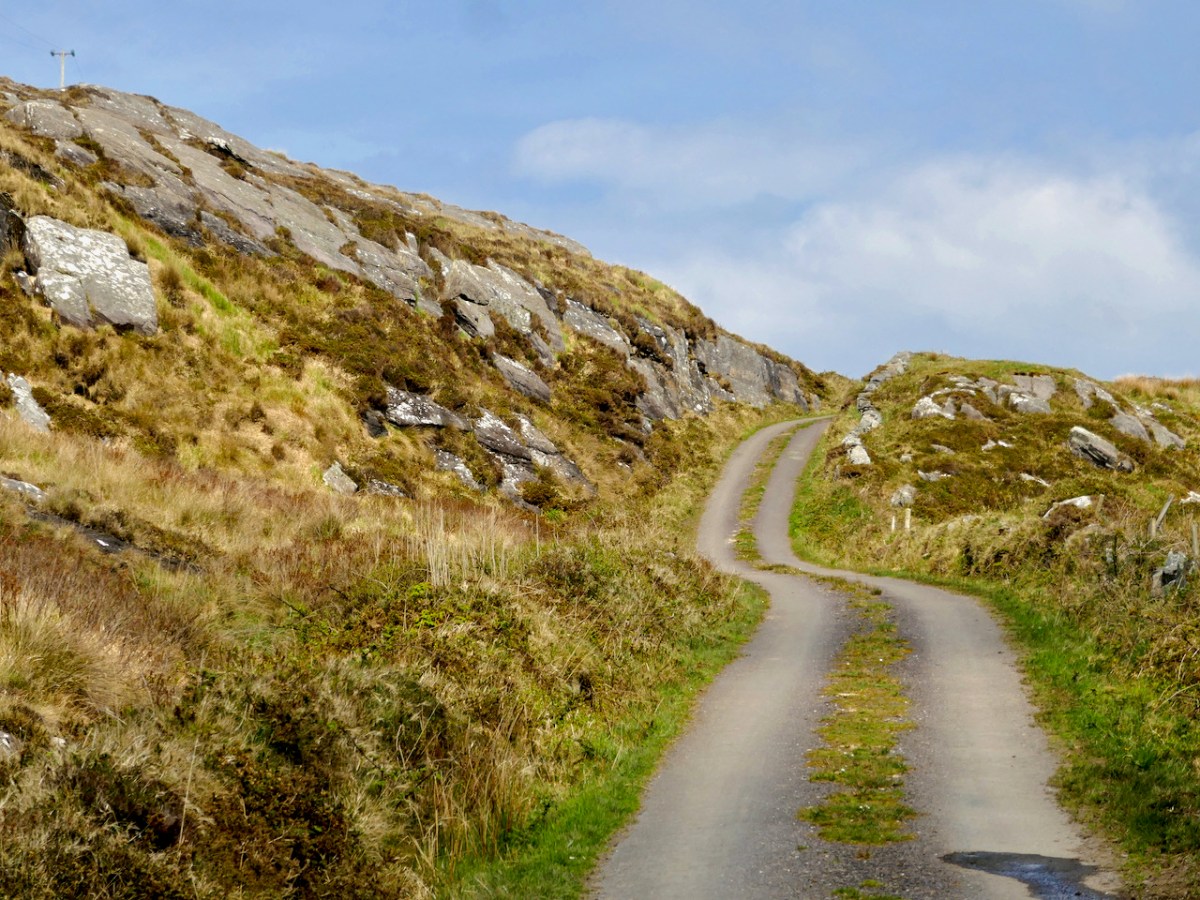
    Set out from the Goleen Community Centre and the first part of the walk is shared with the Lissagriffin Loop – see our recent post on that walk. As you ascend, the views are immense – back to Goleen and across to Knockaphuca and Mount Gabriel beyond it.

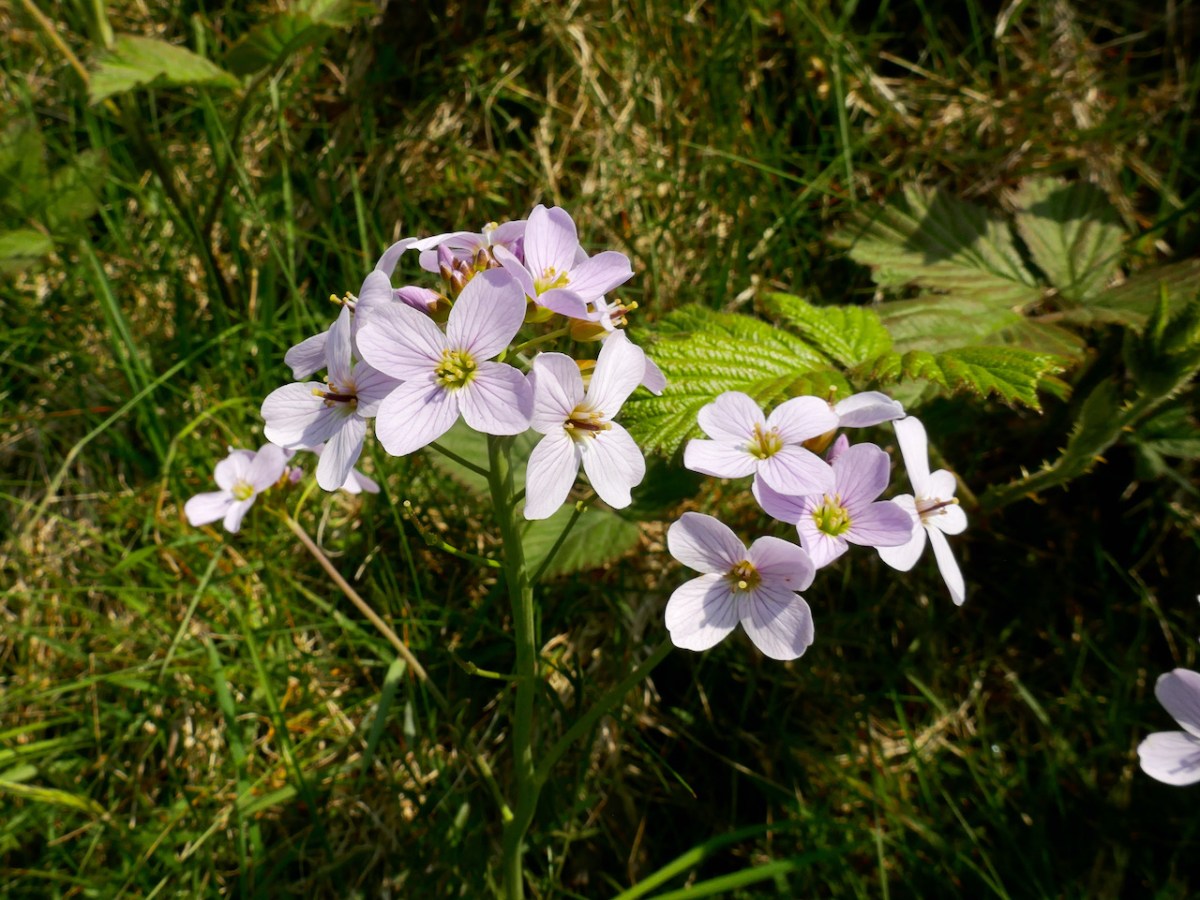
    You’ll have to dig into your reserves of energy (or maybe have some chocolate) as you continue the climb. You are in true mountainy heathland now – look out for orchids in the spring and early summer, or Cuckooflower (below) in damp ditches.

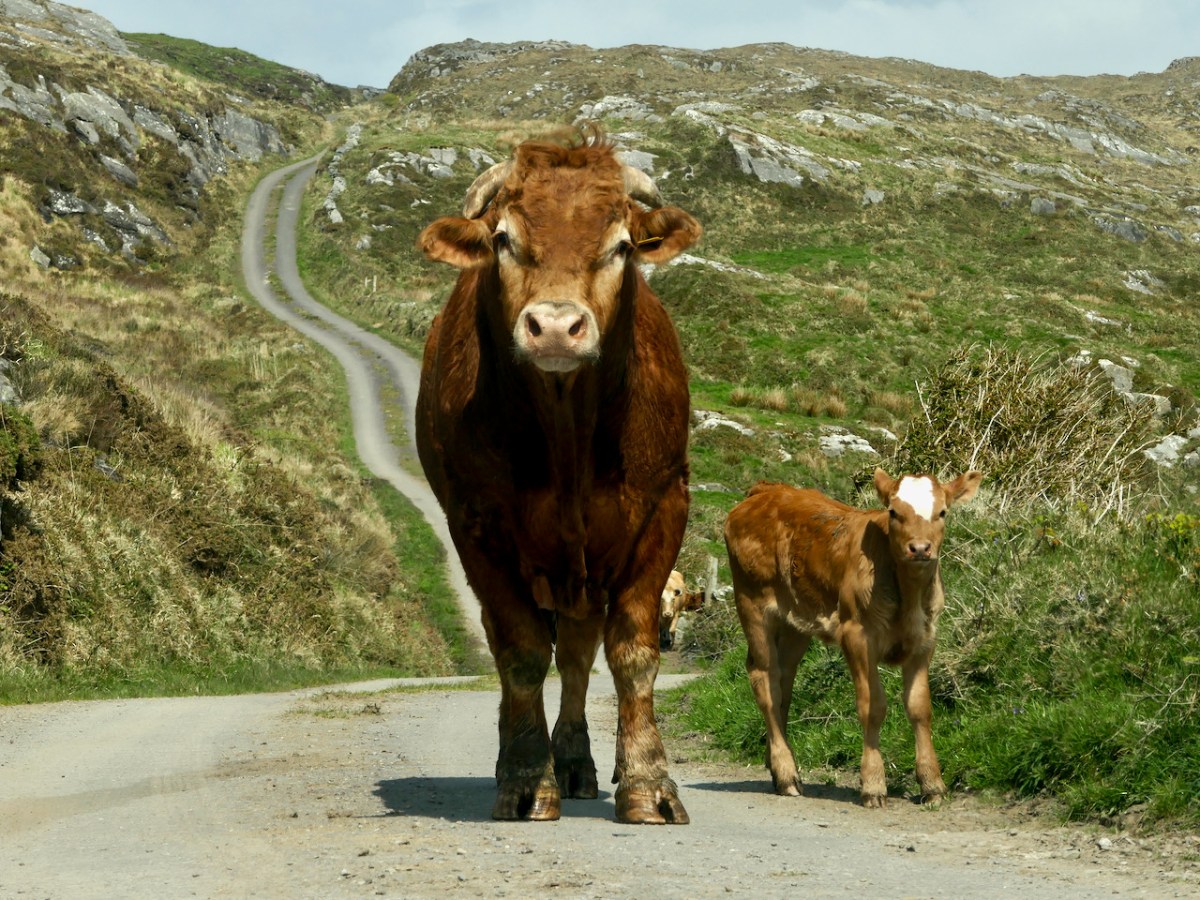
    Watch out also for cattle on the road – we were startled by a line of plodding cattle coming towards us, and even more startled when we realised that one was a mighty fine bull. Fortunately, they turned into a field before we reached that spot, but there was no human around and the gates were open, so we can only assume we were simply in the wrong place at the wrong time as it is very unusual (although not unknown) to see cattle wandering like this.

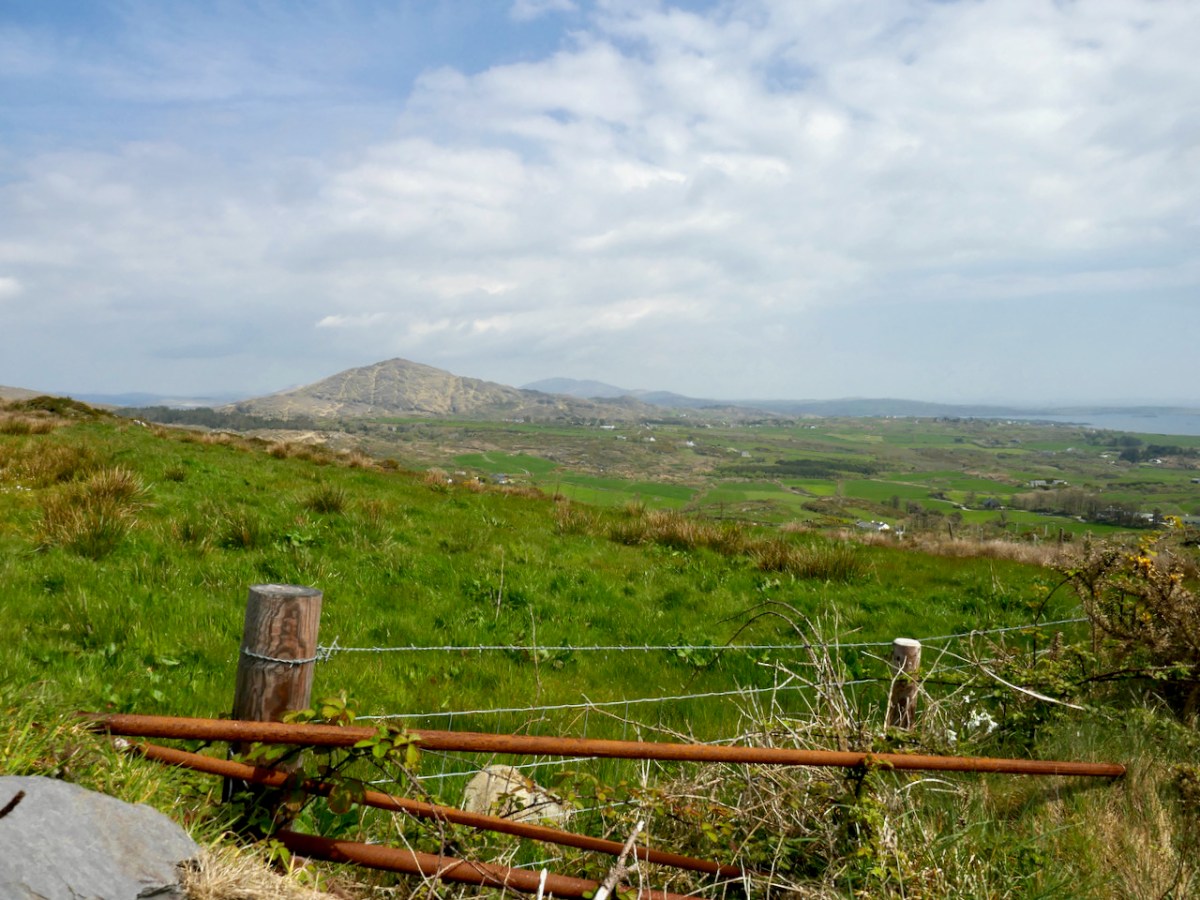
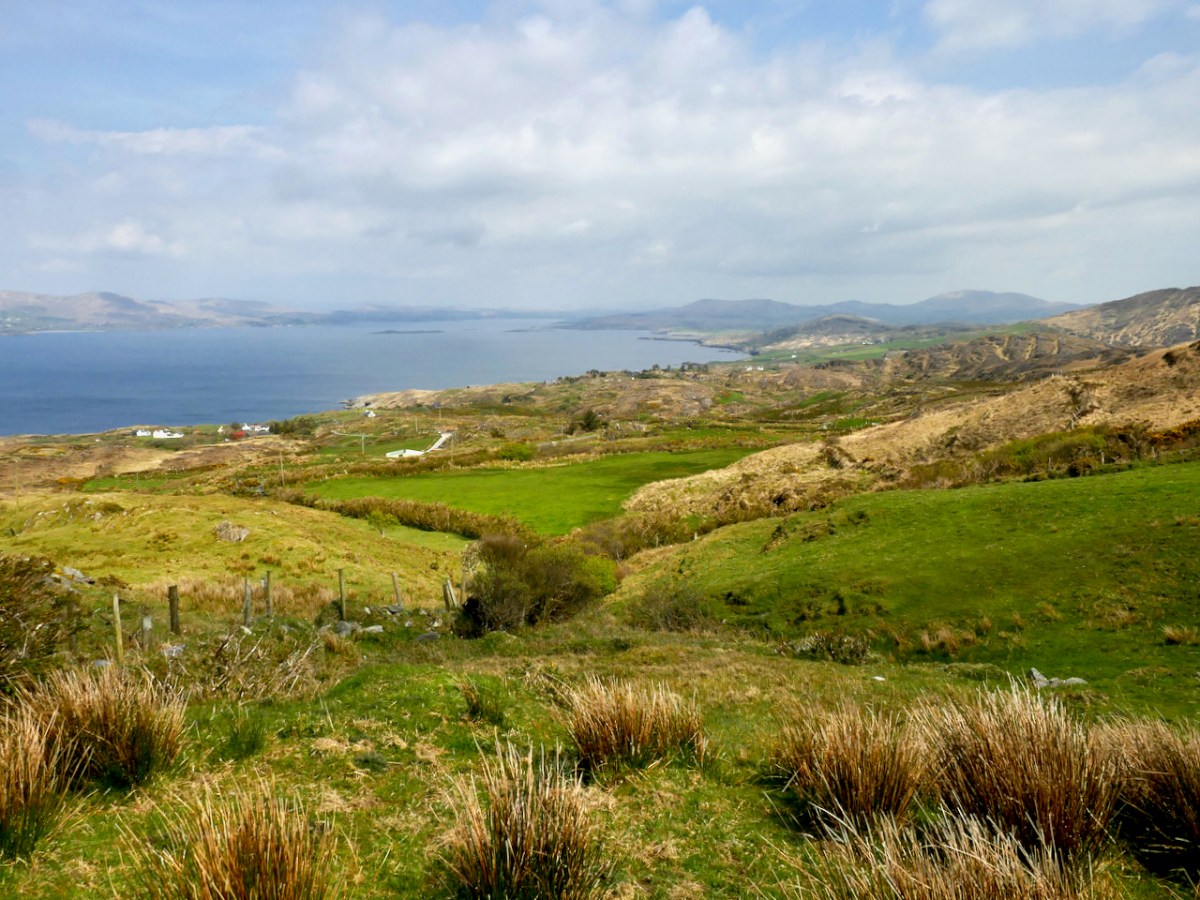
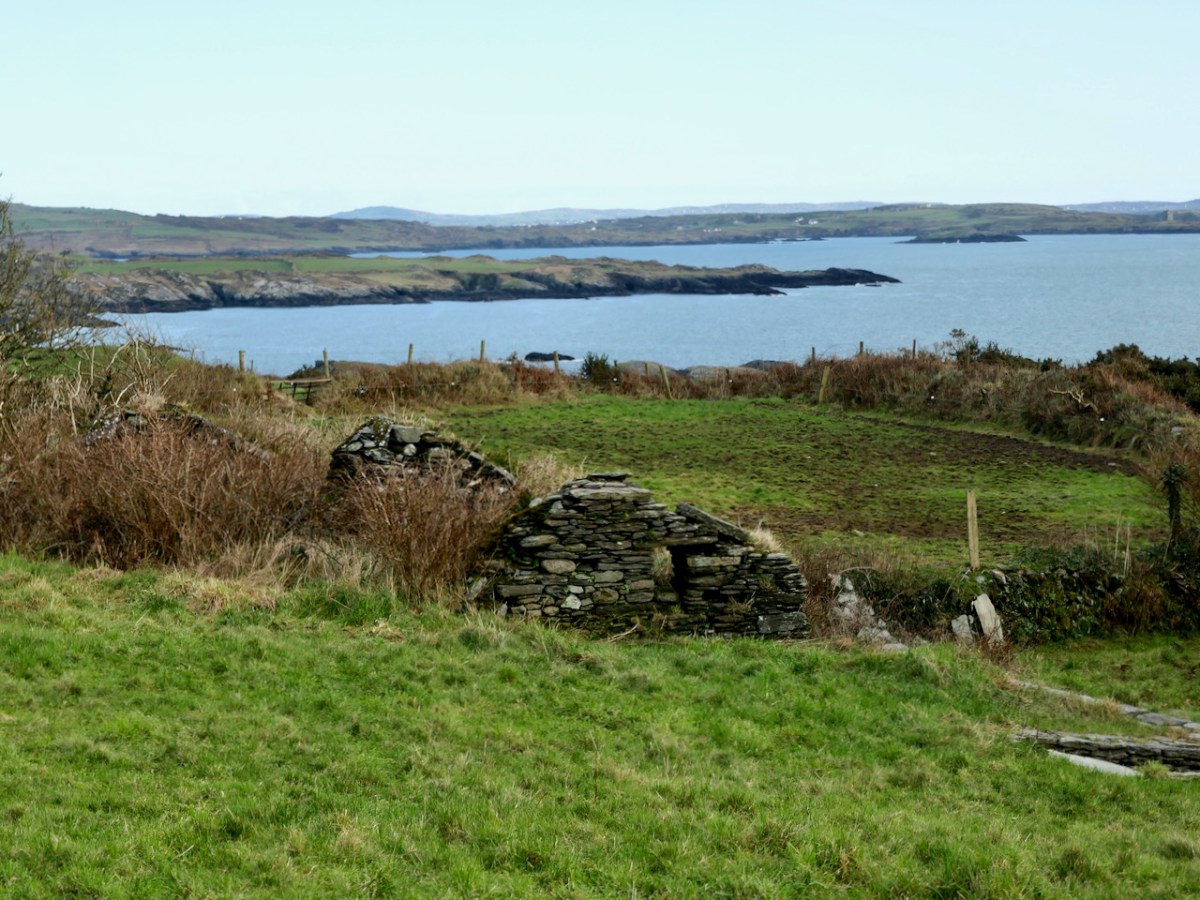
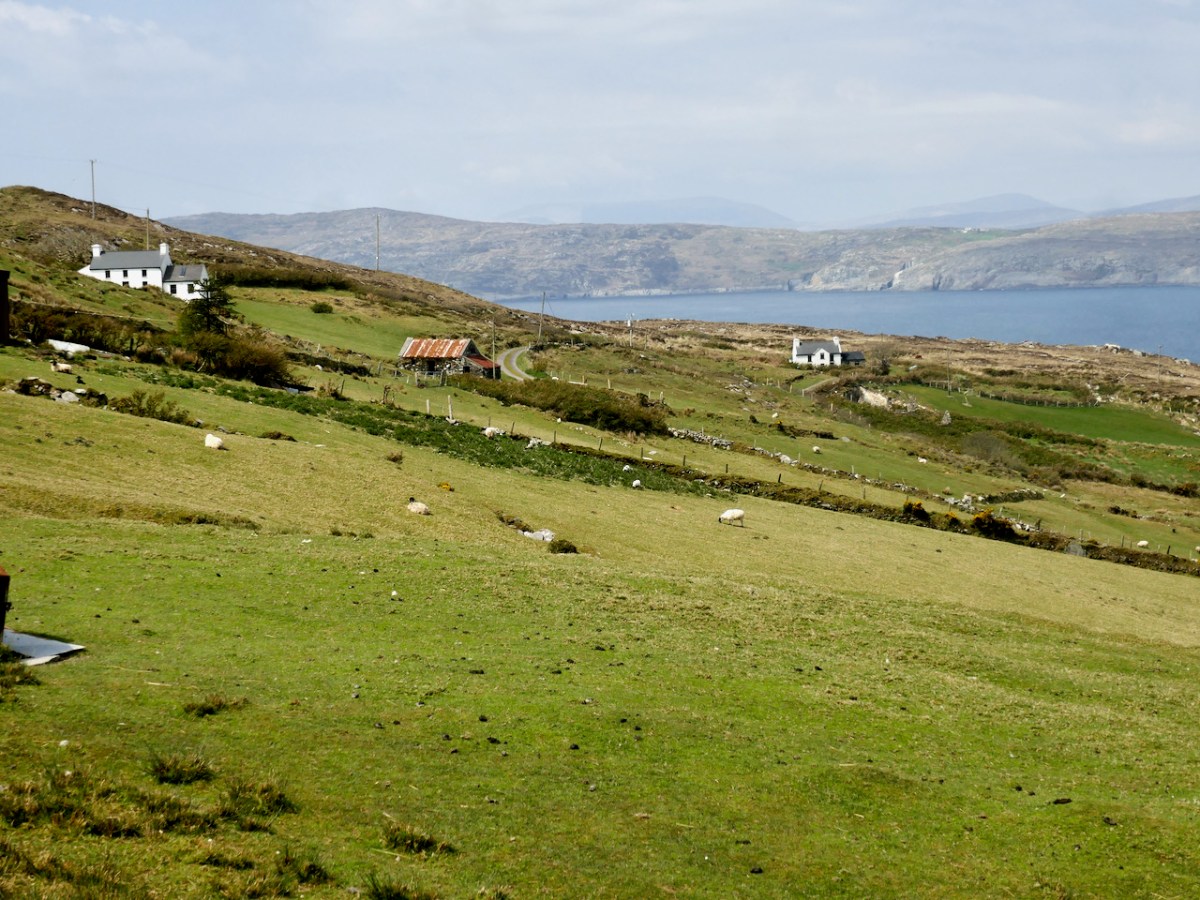
    Coming over the top of the hill you have the whole of Dunmanus Bay in front of you and you can see clear up to the head of the bay, across to the Sheep’s Head, and to the Mountains of the Beara behind that. Have a nice sit down on some convenient boulder here – you deserve it – and just absorb that breathtaking sweep of land and sea.

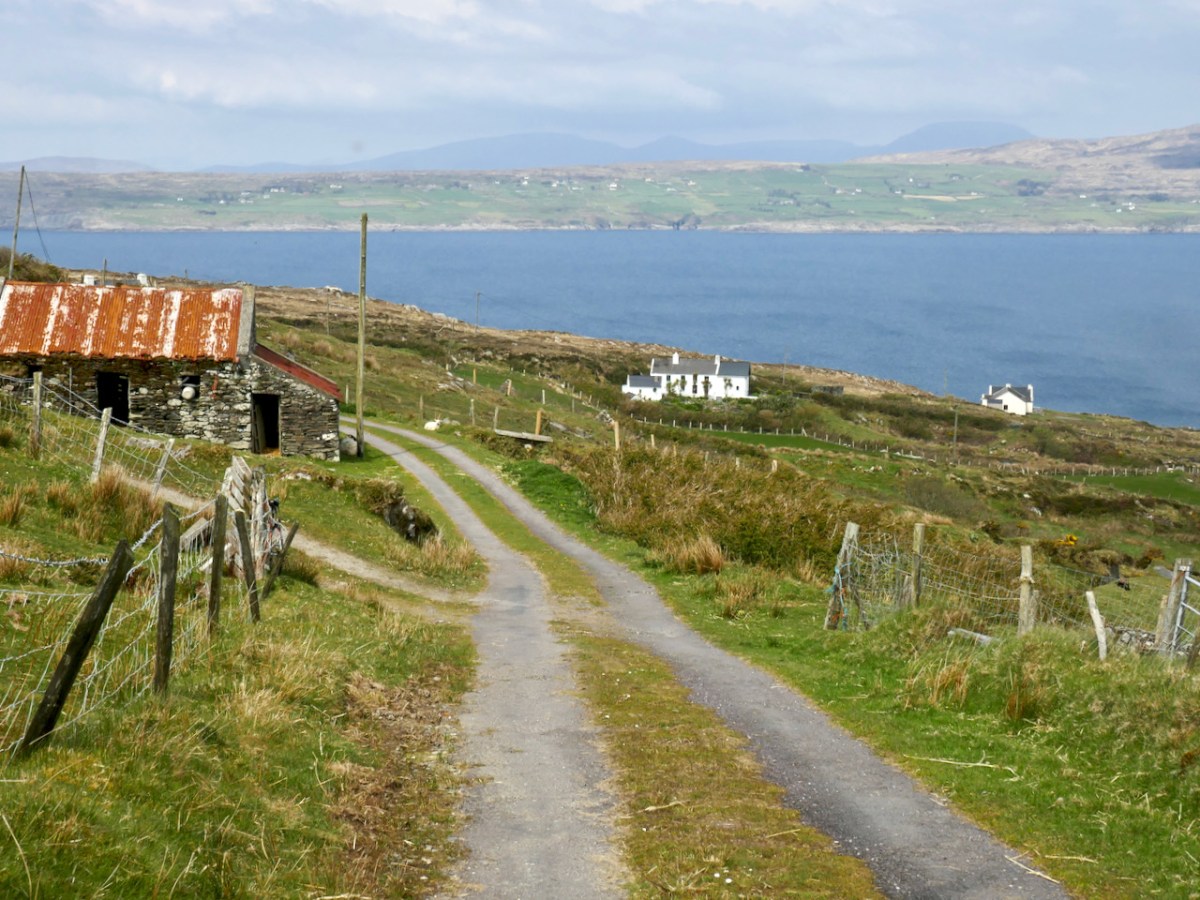
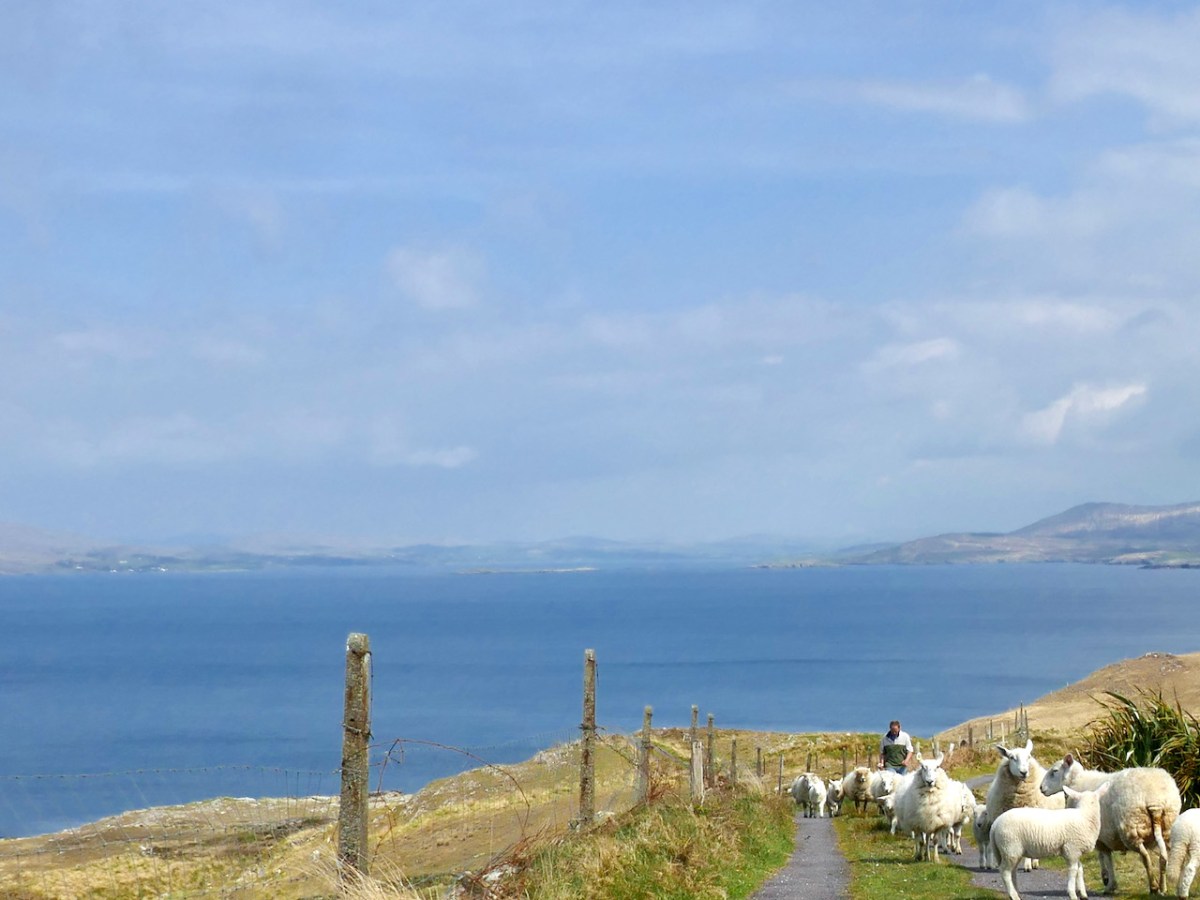
    And talking of sea – you’re heading down now towards it, past picturesque stone farm buildings and beautifully renovated cottages until you arrive at Dooneen Coos (the Cove of the Little Fort). Along the way we ran into a shepherd moving his sheep up into higher ground, with the aid of the marvellously well-trained dogs that attend to their business but also like a good pat.

    Dooneen Coos is a good spot for lunch – or even a swim if you’re that way inclined. it’s close to the peninsula we wrote about in our post Mizen Magic 23: Lackavaun and The Meallán so you can always take a side trip there if you wish. This might also be a good spot to leave a car if you’re not doing the whole loop on this occasion.

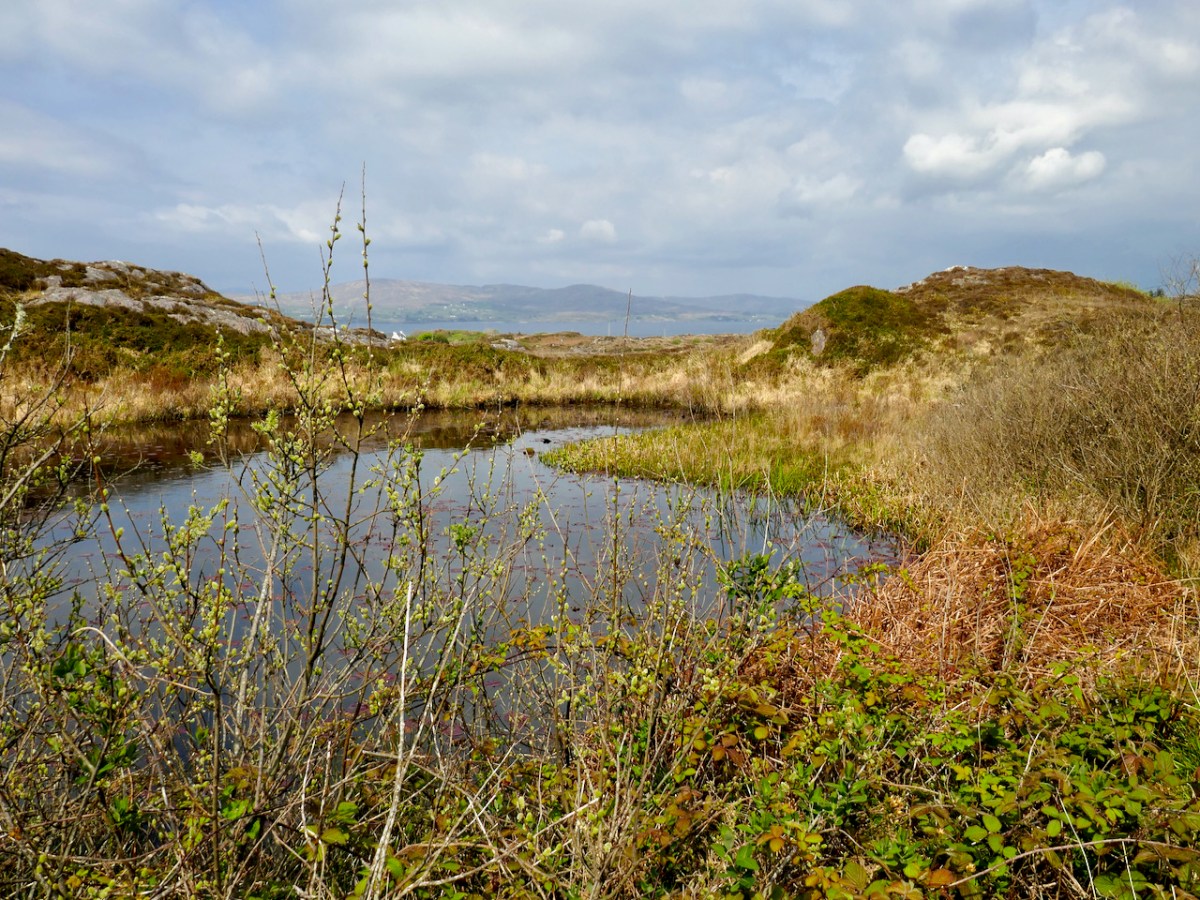
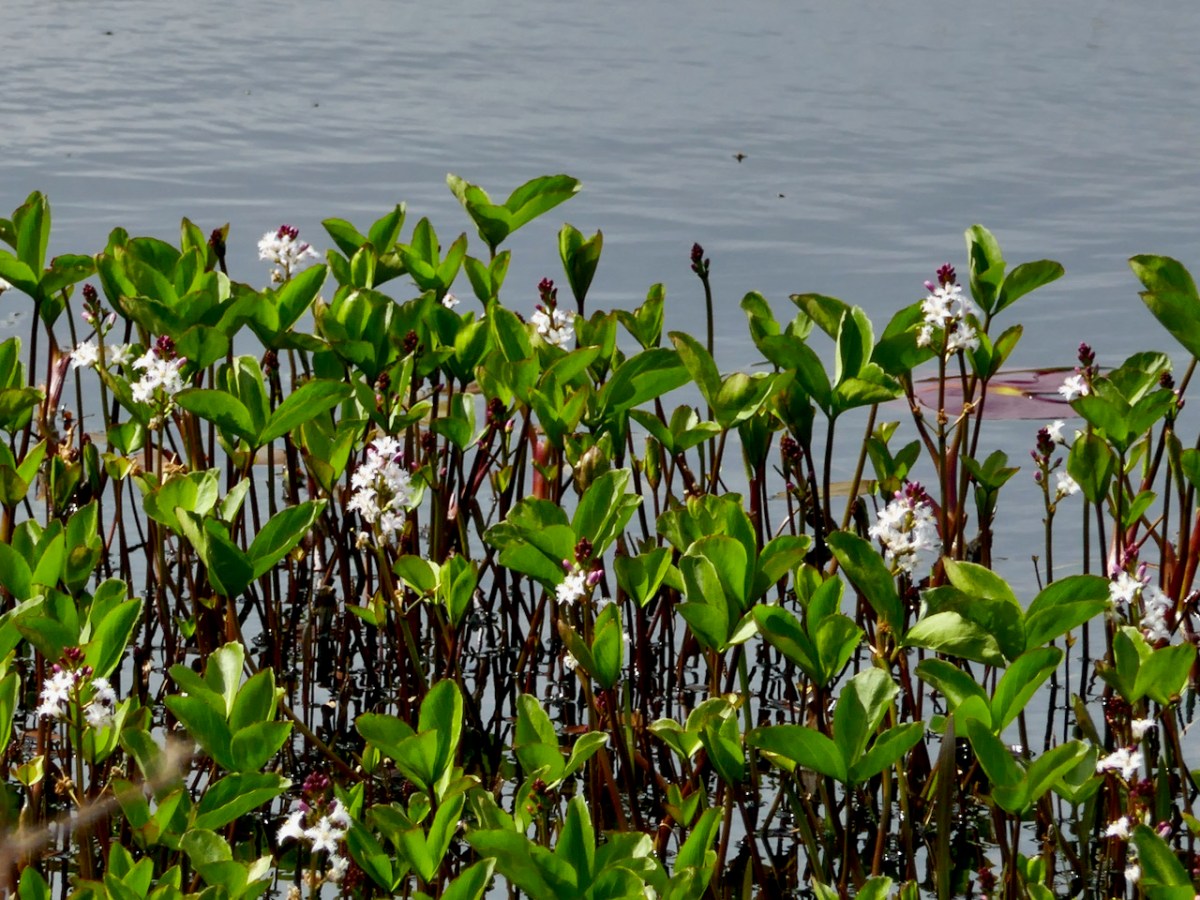
    But if you’re carrying on, you’re now heading towards Dunkelly and the storied inlet known as Canty’s Cove. Read all about it here. Here, because we have been to Canty’s Cove lots, we took the short cut – marked in orange on the map. The compensation is that this stretch contains the remains of old ruined cabins and clacháns (hamlets) along the road, as well as a beautiful pond which, at the time of our visit was full of flowering Bogbean. 

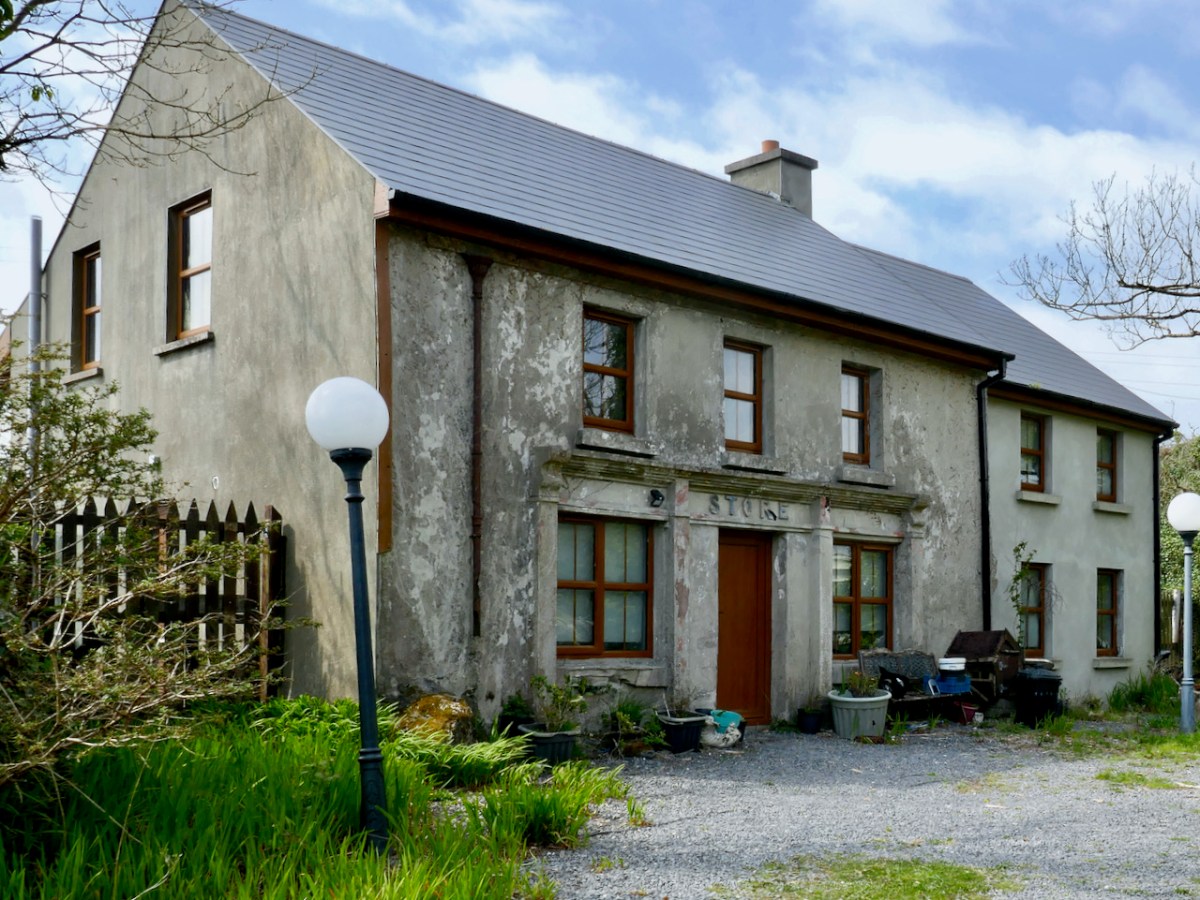
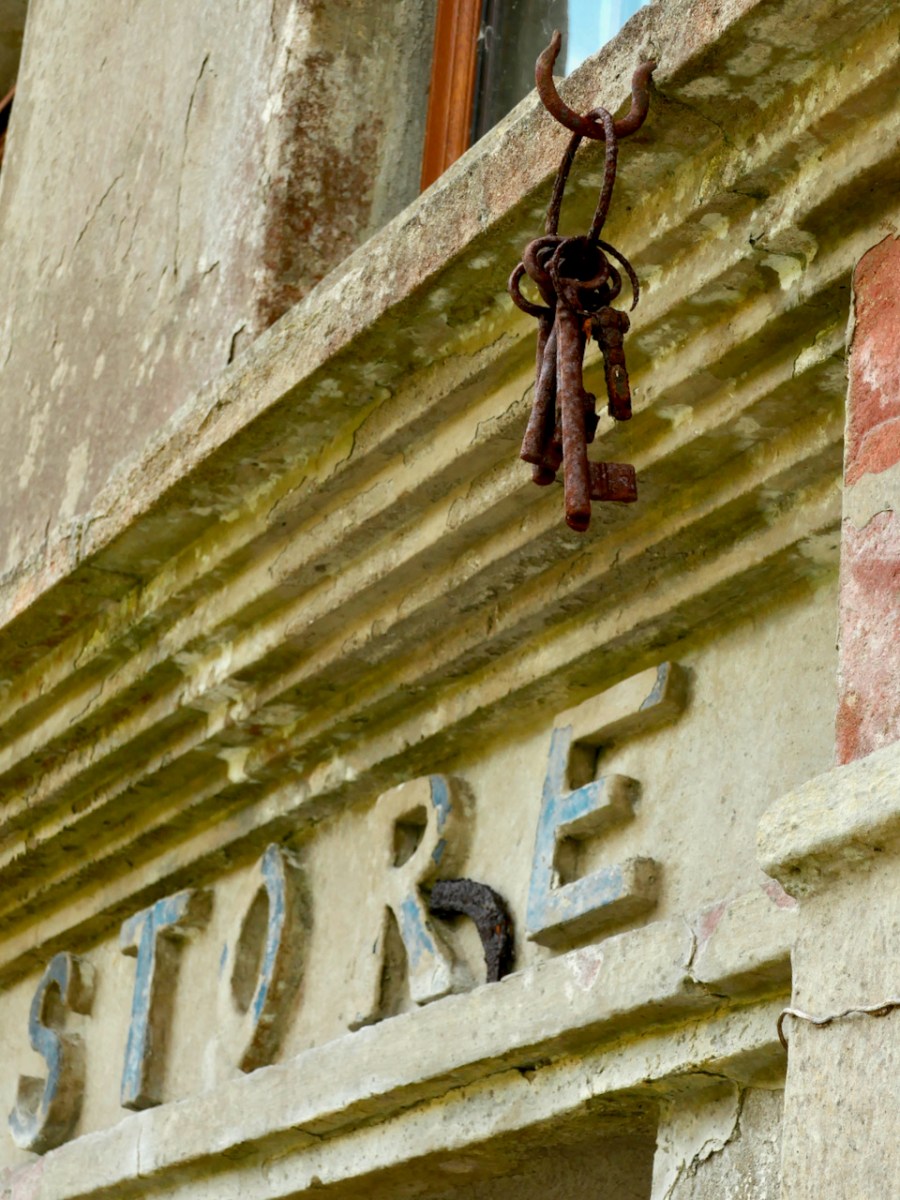
    From Dunkelly the road turns back along the slopes of Knockaphuca  and along the way there’s a  bit of a surprise – an old store that once supplied necessities for the population of this area but which has not been viable for many years. No doubt local people have all kinds of memories and stories about this one. I was taken by the keys, still hanging above the door!

    By now we were on the stretch of road that this loop shares with the Knockaphuca Walk and that’s a walk you HAVE to do, if you haven’t already. Possibly the jewel in the Fastnet Trails crown. Crossing the main Schull-Goleen road we head down to Ballydivlin. 

    We’re at the sea again now, back on the south side of the peninsula, looking across to Castlepoint (and Leamcon Castle) and out to the Fastnet Rock with its iconic lighthouse

    It’s been a long haul but SO worth it – wouldn’t you agree?

    The Fastnet Trails website is coming soon. We will update this post with that link once it’s finalised and active.